EP3176176A1 - 3-(4'-substituted)-benzyl-ether derivatives of pregnenolone - Google Patents
3-(4'-substituted)-benzyl-ether derivatives of pregnenolone Download PDFInfo
- Publication number
- EP3176176A1 EP3176176A1 EP17151891.3A EP17151891A EP3176176A1 EP 3176176 A1 EP3176176 A1 EP 3176176A1 EP 17151891 A EP17151891 A EP 17151891A EP 3176176 A1 EP3176176 A1 EP 3176176A1
- Authority
- EP
- European Patent Office
- Prior art keywords
- pregnenolone
- methyl
- benzyl
- methoxybenzyloxy
- methoxy
- Prior art date
- Legal status (The legal status is an assumption and is not a legal conclusion. Google has not performed a legal analysis and makes no representation as to the accuracy of the status listed.)
- Withdrawn
Links
- 229960000249 pregnenolone Drugs 0.000 title claims description 238
- ORNBQBCIOKFOEO-YQUGOWONSA-N Pregnenolone Natural products O=C(C)[C@@H]1[C@@]2(C)[C@H]([C@H]3[C@@H]([C@]4(C)C(=CC3)C[C@@H](O)CC4)CC2)CC1 ORNBQBCIOKFOEO-YQUGOWONSA-N 0.000 title description 50
- 150000001875 compounds Chemical class 0.000 claims abstract description 55
- 125000003545 alkoxy group Chemical group 0.000 claims abstract description 25
- 125000004209 (C1-C8) alkyl group Chemical group 0.000 claims abstract description 23
- 229910052736 halogen Inorganic materials 0.000 claims abstract description 21
- 150000002367 halogens Chemical class 0.000 claims abstract description 21
- 150000003839 salts Chemical class 0.000 claims abstract description 18
- 125000002924 primary amino group Chemical group [H]N([H])* 0.000 claims abstract description 14
- JCXJVPUVTGWSNB-UHFFFAOYSA-N Nitrogen dioxide Chemical compound O=[N]=O JCXJVPUVTGWSNB-UHFFFAOYSA-N 0.000 claims abstract description 10
- 125000000882 C2-C6 alkenyl group Chemical group 0.000 claims abstract description 8
- 125000000896 monocarboxylic acid group Chemical group 0.000 claims abstract 4
- 208000037265 diseases, disorders, signs and symptoms Diseases 0.000 claims description 14
- 238000000034 method Methods 0.000 claims description 14
- OIRDBPQYVWXNSJ-UHFFFAOYSA-N methyl trifluoromethansulfonate Chemical compound COS(=O)(=O)C(F)(F)F OIRDBPQYVWXNSJ-UHFFFAOYSA-N 0.000 claims description 14
- 208000035475 disorder Diseases 0.000 claims description 12
- 239000002253 acid Substances 0.000 claims description 9
- -1 methoxy, ethoxy, methylcarboxy Chemical group 0.000 claims description 9
- 239000002516 radical scavenger Substances 0.000 claims description 7
- 241001465754 Metazoa Species 0.000 claims description 5
- 238000004519 manufacturing process Methods 0.000 claims description 5
- 230000007170 pathology Effects 0.000 claims description 5
- 230000008569 process Effects 0.000 claims description 5
- 125000001495 ethyl group Chemical group [H]C([H])([H])C([H])([H])* 0.000 claims description 4
- 125000002496 methyl group Chemical group [H]C([H])([H])* 0.000 claims description 4
- 208000008338 non-alcoholic fatty liver disease Diseases 0.000 claims description 4
- 206010053219 non-alcoholic steatohepatitis Diseases 0.000 claims description 4
- 230000007863 steatosis Effects 0.000 claims description 4
- 231100000240 steatosis hepatitis Toxicity 0.000 claims description 4
- 125000003903 2-propenyl group Chemical group [H]C([*])([H])C([H])=C([H])[H] 0.000 claims description 3
- 125000004093 cyano group Chemical group *C#N 0.000 claims description 3
- 208000030767 Autoimmune encephalitis Diseases 0.000 claims description 2
- 206010003827 Autoimmune hepatitis Diseases 0.000 claims description 2
- 208000024172 Cardiovascular disease Diseases 0.000 claims description 2
- 206010012335 Dependence Diseases 0.000 claims description 2
- 208000018522 Gastrointestinal disease Diseases 0.000 claims description 2
- 208000010412 Glaucoma Diseases 0.000 claims description 2
- 208000008238 Muscle Spasticity Diseases 0.000 claims description 2
- 206010028980 Neoplasm Diseases 0.000 claims description 2
- 208000012902 Nervous system disease Diseases 0.000 claims description 2
- 208000025966 Neurological disease Diseases 0.000 claims description 2
- 208000008589 Obesity Diseases 0.000 claims description 2
- 208000001132 Osteoporosis Diseases 0.000 claims description 2
- 230000001476 alcoholic effect Effects 0.000 claims description 2
- 208000029162 bladder disease Diseases 0.000 claims description 2
- 229910052794 bromium Inorganic materials 0.000 claims description 2
- 201000011510 cancer Diseases 0.000 claims description 2
- 229910052801 chlorine Inorganic materials 0.000 claims description 2
- 208000019425 cirrhosis of liver Diseases 0.000 claims description 2
- 201000010099 disease Diseases 0.000 claims description 2
- 239000003937 drug carrier Substances 0.000 claims description 2
- 230000003176 fibrotic effect Effects 0.000 claims description 2
- 229910052731 fluorine Inorganic materials 0.000 claims description 2
- 208000027866 inflammatory disease Diseases 0.000 claims description 2
- 230000002757 inflammatory effect Effects 0.000 claims description 2
- 208000017169 kidney disease Diseases 0.000 claims description 2
- 208000019423 liver disease Diseases 0.000 claims description 2
- 208000030159 metabolic disease Diseases 0.000 claims description 2
- 208000015122 neurodegenerative disease Diseases 0.000 claims description 2
- 235000020824 obesity Nutrition 0.000 claims description 2
- 230000036407 pain Effects 0.000 claims description 2
- 239000008194 pharmaceutical composition Substances 0.000 claims description 2
- 208000020016 psychiatric disease Diseases 0.000 claims description 2
- 230000001850 reproductive effect Effects 0.000 claims description 2
- 208000018198 spasticity Diseases 0.000 claims description 2
- ORNBQBCIOKFOEO-QGVNFLHTSA-N pregnenolone Chemical compound C1C=C2C[C@@H](O)CC[C@]2(C)[C@@H]2[C@@H]1[C@@H]1CC[C@H](C(=O)C)[C@@]1(C)CC2 ORNBQBCIOKFOEO-QGVNFLHTSA-N 0.000 description 48
- 230000015572 biosynthetic process Effects 0.000 description 24
- 150000003431 steroids Chemical class 0.000 description 23
- XEKOWRVHYACXOJ-UHFFFAOYSA-N Ethyl acetate Chemical compound CCOC(C)=O XEKOWRVHYACXOJ-UHFFFAOYSA-N 0.000 description 22
- 238000003786 synthesis reaction Methods 0.000 description 22
- 239000012429 reaction media Substances 0.000 description 19
- VYPSYNLAJGMNEJ-UHFFFAOYSA-N Silicium dioxide Chemical compound O=[Si]=O VYPSYNLAJGMNEJ-UHFFFAOYSA-N 0.000 description 18
- YXFVVABEGXRONW-UHFFFAOYSA-N Toluene Chemical compound CC1=CC=CC=C1 YXFVVABEGXRONW-UHFFFAOYSA-N 0.000 description 18
- 150000003131 pregnenolone derivatives Chemical class 0.000 description 16
- 230000000694 effects Effects 0.000 description 14
- AURFZBICLPNKBZ-FZCSVUEKSA-N 3beta-hydroxy-5alpha-pregnan-20-one Chemical compound C([C@@H]1CC2)[C@@H](O)CC[C@]1(C)[C@@H]1[C@@H]2[C@@H]2CC[C@H](C(=O)C)[C@@]2(C)CC1 AURFZBICLPNKBZ-FZCSVUEKSA-N 0.000 description 13
- AURFZBICLPNKBZ-UHFFFAOYSA-N Pregnanolone Natural products C1CC2CC(O)CCC2(C)C2C1C1CCC(C(=O)C)C1(C)CC2 AURFZBICLPNKBZ-UHFFFAOYSA-N 0.000 description 13
- CPLXHLVBOLITMK-UHFFFAOYSA-N magnesium oxide Inorganic materials [Mg]=O CPLXHLVBOLITMK-UHFFFAOYSA-N 0.000 description 13
- 239000000243 solution Substances 0.000 description 13
- CSCPPACGZOOCGX-UHFFFAOYSA-N Acetone Chemical compound CC(C)=O CSCPPACGZOOCGX-UHFFFAOYSA-N 0.000 description 12
- XDTMQSROBMDMFD-UHFFFAOYSA-N Cyclohexane Chemical compound C1CCCCC1 XDTMQSROBMDMFD-UHFFFAOYSA-N 0.000 description 12
- MUMGGOZAMZWBJJ-DYKIIFRCSA-N Testostosterone Chemical compound O=C1CC[C@]2(C)[C@H]3CC[C@](C)([C@H](CC4)O)[C@@H]4[C@@H]3CCC2=C1 MUMGGOZAMZWBJJ-DYKIIFRCSA-N 0.000 description 12
- 238000004587 chromatography analysis Methods 0.000 description 12
- 239000003480 eluent Substances 0.000 description 12
- 239000000741 silica gel Substances 0.000 description 12
- 229910002027 silica gel Inorganic materials 0.000 description 12
- 125000003178 carboxy group Chemical group [H]OC(*)=O 0.000 description 11
- 239000007787 solid Substances 0.000 description 11
- WFDIJRYMOXRFFG-UHFFFAOYSA-N Acetic anhydride Chemical compound CC(=O)OC(C)=O WFDIJRYMOXRFFG-UHFFFAOYSA-N 0.000 description 10
- 239000007832 Na2SO4 Substances 0.000 description 10
- PMZURENOXWZQFD-UHFFFAOYSA-L Sodium Sulfate Chemical compound [Na+].[Na+].[O-]S([O-])(=O)=O PMZURENOXWZQFD-UHFFFAOYSA-L 0.000 description 10
- 229910052938 sodium sulfate Inorganic materials 0.000 description 10
- XLYOFNOQVPJJNP-UHFFFAOYSA-N water Substances O XLYOFNOQVPJJNP-UHFFFAOYSA-N 0.000 description 8
- GETTZEONDQJALK-UHFFFAOYSA-N (trifluoromethyl)benzene Chemical compound FC(F)(F)C1=CC=CC=C1 GETTZEONDQJALK-UHFFFAOYSA-N 0.000 description 7
- 125000000217 alkyl group Chemical group 0.000 description 7
- 210000004027 cell Anatomy 0.000 description 7
- 239000000395 magnesium oxide Substances 0.000 description 7
- 239000012074 organic phase Substances 0.000 description 7
- 150000003132 pregnenolones Chemical class 0.000 description 7
- 238000010992 reflux Methods 0.000 description 7
- WVDDGKGOMKODPV-UHFFFAOYSA-N Benzyl alcohol Chemical class OCC1=CC=CC=C1 WVDDGKGOMKODPV-UHFFFAOYSA-N 0.000 description 6
- 239000002858 neurotransmitter agent Substances 0.000 description 6
- 239000002243 precursor Substances 0.000 description 6
- 229960003604 testosterone Drugs 0.000 description 6
- 0 *c1ccc(CO)cc1 Chemical compound *c1ccc(CO)cc1 0.000 description 5
- 239000002207 metabolite Substances 0.000 description 5
- KWYUFKZDYYNOTN-UHFFFAOYSA-M potassium hydroxide Substances [OH-].[K+] KWYUFKZDYYNOTN-UHFFFAOYSA-M 0.000 description 5
- XEZNGIUYQVAUSS-UHFFFAOYSA-N 18-crown-6 Chemical compound C1COCCOCCOCCOCCOCCO1 XEZNGIUYQVAUSS-UHFFFAOYSA-N 0.000 description 4
- OKDGRDCXVWSXDC-UHFFFAOYSA-N 2-chloropyridine Chemical compound ClC1=CC=CC=N1 OKDGRDCXVWSXDC-UHFFFAOYSA-N 0.000 description 4
- RTZKZFJDLAIYFH-UHFFFAOYSA-N Diethyl ether Chemical compound CCOCC RTZKZFJDLAIYFH-UHFFFAOYSA-N 0.000 description 4
- RJKFOVLPORLFTN-LEKSSAKUSA-N Progesterone Chemical compound C1CC2=CC(=O)CC[C@]2(C)[C@@H]2[C@@H]1[C@@H]1CC[C@H](C(=O)C)[C@@]1(C)CC2 RJKFOVLPORLFTN-LEKSSAKUSA-N 0.000 description 4
- 210000004978 chinese hamster ovary cell Anatomy 0.000 description 4
- FMGSKLZLMKYGDP-USOAJAOKSA-N dehydroepiandrosterone Chemical compound C1[C@@H](O)CC[C@]2(C)[C@H]3CC[C@](C)(C(CC4)=O)[C@@H]4[C@@H]3CC=C21 FMGSKLZLMKYGDP-USOAJAOKSA-N 0.000 description 4
- 238000000338 in vitro Methods 0.000 description 4
- 102000005962 receptors Human genes 0.000 description 4
- 108020003175 receptors Proteins 0.000 description 4
- CGFZAHKUHHZQTP-UHFFFAOYSA-M 2-[(4-bromophenyl)methoxy]-1-methylpyridin-1-ium;trifluoromethanesulfonate Chemical compound [O-]S(=O)(=O)C(F)(F)F.C[N+]1=CC=CC=C1OCC1=CC=C(Br)C=C1 CGFZAHKUHHZQTP-UHFFFAOYSA-M 0.000 description 3
- QTBSBXVTEAMEQO-UHFFFAOYSA-N Acetic acid Chemical compound CC(O)=O QTBSBXVTEAMEQO-UHFFFAOYSA-N 0.000 description 3
- YMWUJEATGCHHMB-UHFFFAOYSA-N Dichloromethane Chemical compound ClCCl YMWUJEATGCHHMB-UHFFFAOYSA-N 0.000 description 3
- LFQSCWFLJHTTHZ-UHFFFAOYSA-N Ethanol Chemical compound CCO LFQSCWFLJHTTHZ-UHFFFAOYSA-N 0.000 description 3
- OKKJLVBELUTLKV-UHFFFAOYSA-N Methanol Chemical compound OC OKKJLVBELUTLKV-UHFFFAOYSA-N 0.000 description 3
- 239000005557 antagonist Substances 0.000 description 3
- 238000005574 benzylation reaction Methods 0.000 description 3
- 125000000051 benzyloxy group Chemical group [H]C1=C([H])C([H])=C(C([H])=C1[H])C([H])([H])O* 0.000 description 3
- 210000004556 brain Anatomy 0.000 description 3
- KRKNYBCHXYNGOX-UHFFFAOYSA-N citric acid Chemical compound OC(=O)CC(O)(C(O)=O)CC(O)=O KRKNYBCHXYNGOX-UHFFFAOYSA-N 0.000 description 3
- 239000012230 colorless oil Substances 0.000 description 3
- 239000003112 inhibitor Substances 0.000 description 3
- 230000004060 metabolic process Effects 0.000 description 3
- 239000012044 organic layer Substances 0.000 description 3
- 230000000144 pharmacologic effect Effects 0.000 description 3
- 238000012360 testing method Methods 0.000 description 3
- VOXZDWNPVJITMN-ZBRFXRBCSA-N 17β-estradiol Chemical compound OC1=CC=C2[C@H]3CC[C@](C)([C@H](CC4)O)[C@@H]4[C@@H]3CCC2=C1 VOXZDWNPVJITMN-ZBRFXRBCSA-N 0.000 description 2
- CXHTWPOTYXMDPR-UHFFFAOYSA-N 2-(4-methylphenyl)-2-(1-methylpyridin-1-ium-2-yl)oxyacetic acid;trifluoromethanesulfonate Chemical compound [O-]S(=O)(=O)C(F)(F)F.C1=CC(C)=CC=C1C(C(O)=O)OC1=CC=CC=[N+]1C CXHTWPOTYXMDPR-UHFFFAOYSA-N 0.000 description 2
- ZEHFHYXZTJWXHH-UHFFFAOYSA-N 2-(4-methylphenyl)-2-pyridin-2-yloxyacetic acid Chemical compound C1=CC(C)=CC=C1C(C(O)=O)OC1=CC=CC=N1 ZEHFHYXZTJWXHH-UHFFFAOYSA-N 0.000 description 2
- BQHIGHWZFXQXAC-UHFFFAOYSA-N 2-[(4-bromophenyl)methoxy]pyridine Chemical compound C1=CC(Br)=CC=C1COC1=CC=CC=N1 BQHIGHWZFXQXAC-UHFFFAOYSA-N 0.000 description 2
- CTBYHUPHELJVIU-UHFFFAOYSA-N 4-methyl-2-[(4-methylphenyl)methoxy]quinoline Chemical compound C1=CC(C)=CC=C1COC1=CC(C)=C(C=CC=C2)C2=N1 CTBYHUPHELJVIU-UHFFFAOYSA-N 0.000 description 2
- CYKYBWRSLLXBOW-GDYGHMJCSA-N 5-alpha-THDOC Chemical compound C1[C@H](O)CC[C@]2(C)[C@H]3CC[C@](C)([C@H](CC4)C(=O)CO)[C@@H]4[C@@H]3CC[C@H]21 CYKYBWRSLLXBOW-GDYGHMJCSA-N 0.000 description 2
- QTBSBXVTEAMEQO-UHFFFAOYSA-M Acetate Chemical compound CC([O-])=O QTBSBXVTEAMEQO-UHFFFAOYSA-M 0.000 description 2
- 206010001497 Agitation Diseases 0.000 description 2
- 102000009132 CB1 Cannabinoid Receptor Human genes 0.000 description 2
- 102000004190 Enzymes Human genes 0.000 description 2
- 108090000790 Enzymes Proteins 0.000 description 2
- VZCYOOQTPOCHFL-OWOJBTEDSA-N Fumaric acid Chemical compound OC(=O)\C=C\C(O)=O VZCYOOQTPOCHFL-OWOJBTEDSA-N 0.000 description 2
- 239000007818 Grignard reagent Substances 0.000 description 2
- 241000282412 Homo Species 0.000 description 2
- VEXZGXHMUGYJMC-UHFFFAOYSA-N Hydrochloric acid Chemical compound Cl VEXZGXHMUGYJMC-UHFFFAOYSA-N 0.000 description 2
- 241000124008 Mammalia Species 0.000 description 2
- AFVFQIVMOAPDHO-UHFFFAOYSA-N Methanesulfonic acid Chemical compound CS(O)(=O)=O AFVFQIVMOAPDHO-UHFFFAOYSA-N 0.000 description 2
- NBIIXXVUZAFLBC-UHFFFAOYSA-N Phosphoric acid Chemical compound OP(O)(O)=O NBIIXXVUZAFLBC-UHFFFAOYSA-N 0.000 description 2
- CDBYLPFSWZWCQE-UHFFFAOYSA-L Sodium Carbonate Chemical compound [Na+].[Na+].[O-]C([O-])=O CDBYLPFSWZWCQE-UHFFFAOYSA-L 0.000 description 2
- QAOWNCQODCNURD-UHFFFAOYSA-N Sulfuric acid Chemical compound OS(O)(=O)=O QAOWNCQODCNURD-UHFFFAOYSA-N 0.000 description 2
- DTQVDTLACAAQTR-UHFFFAOYSA-N Trifluoroacetic acid Chemical compound OC(=O)C(F)(F)F DTQVDTLACAAQTR-UHFFFAOYSA-N 0.000 description 2
- 230000009471 action Effects 0.000 description 2
- 230000003444 anaesthetic effect Effects 0.000 description 2
- 230000001548 androgenic effect Effects 0.000 description 2
- 235000019445 benzyl alcohol Nutrition 0.000 description 2
- 239000012267 brine Substances 0.000 description 2
- 125000004432 carbon atom Chemical group C* 0.000 description 2
- 238000004113 cell culture Methods 0.000 description 2
- 238000006243 chemical reaction Methods 0.000 description 2
- QTMDXZNDVAMKGV-UHFFFAOYSA-L copper(ii) bromide Chemical compound [Cu+2].[Br-].[Br-] QTMDXZNDVAMKGV-UHFFFAOYSA-L 0.000 description 2
- 239000012039 electrophile Substances 0.000 description 2
- 150000002085 enols Chemical class 0.000 description 2
- 229930182833 estradiol Natural products 0.000 description 2
- 229960005309 estradiol Drugs 0.000 description 2
- 230000001076 estrogenic effect Effects 0.000 description 2
- 230000006870 function Effects 0.000 description 2
- 238000002290 gas chromatography-mass spectrometry Methods 0.000 description 2
- 239000003862 glucocorticoid Substances 0.000 description 2
- 150000004795 grignard reagents Chemical class 0.000 description 2
- 239000001963 growth medium Substances 0.000 description 2
- 125000004435 hydrogen atom Chemical group [H]* 0.000 description 2
- 238000001727 in vivo Methods 0.000 description 2
- 230000003993 interaction Effects 0.000 description 2
- INQOMBQAUSQDDS-UHFFFAOYSA-N iodomethane Chemical compound IC INQOMBQAUSQDDS-UHFFFAOYSA-N 0.000 description 2
- JVTAAEKCZFNVCJ-UHFFFAOYSA-N lactic acid Chemical compound CC(O)C(O)=O JVTAAEKCZFNVCJ-UHFFFAOYSA-N 0.000 description 2
- BDAGIHXWWSANSR-UHFFFAOYSA-N methanoic acid Natural products OC=O BDAGIHXWWSANSR-UHFFFAOYSA-N 0.000 description 2
- 239000000203 mixture Substances 0.000 description 2
- KJIFKLIQANRMOU-UHFFFAOYSA-N oxidanium;4-methylbenzenesulfonate Chemical compound O.CC1=CC=C(S(O)(=O)=O)C=C1 KJIFKLIQANRMOU-UHFFFAOYSA-N 0.000 description 2
- 230000001575 pathological effect Effects 0.000 description 2
- BWHMMNNQKKPAPP-UHFFFAOYSA-L potassium carbonate Chemical group [K+].[K+].[O-]C([O-])=O BWHMMNNQKKPAPP-UHFFFAOYSA-L 0.000 description 2
- LPNYRYFBWFDTMA-UHFFFAOYSA-N potassium tert-butoxide Chemical compound [K+].CC(C)(C)[O-] LPNYRYFBWFDTMA-UHFFFAOYSA-N 0.000 description 2
- 230000003449 preventive effect Effects 0.000 description 2
- 239000000186 progesterone Substances 0.000 description 2
- 229960003387 progesterone Drugs 0.000 description 2
- 239000000932 sedative agent Substances 0.000 description 2
- 230000001624 sedative effect Effects 0.000 description 2
- HPALAKNZSZLMCH-UHFFFAOYSA-M sodium;chloride;hydrate Chemical compound O.[Na+].[Cl-] HPALAKNZSZLMCH-UHFFFAOYSA-M 0.000 description 2
- 102000005969 steroid hormone receptors Human genes 0.000 description 2
- 239000001117 sulphuric acid Substances 0.000 description 2
- 235000011149 sulphuric acid Nutrition 0.000 description 2
- 230000001225 therapeutic effect Effects 0.000 description 2
- 230000001988 toxicity Effects 0.000 description 2
- 231100000419 toxicity Toxicity 0.000 description 2
- VZCYOOQTPOCHFL-UHFFFAOYSA-N trans-butenedioic acid Natural products OC(=O)C=CC(O)=O VZCYOOQTPOCHFL-UHFFFAOYSA-N 0.000 description 2
- BJEPYKJPYRNKOW-REOHCLBHSA-N (S)-malic acid Chemical compound OC(=O)[C@@H](O)CC(O)=O BJEPYKJPYRNKOW-REOHCLBHSA-N 0.000 description 1
- RYHBNJHYFVUHQT-UHFFFAOYSA-N 1,4-Dioxane Chemical compound C1COCCO1 RYHBNJHYFVUHQT-UHFFFAOYSA-N 0.000 description 1
- DUXHYQYOPHEFGC-UHFFFAOYSA-M 1-methyl-2-phenylmethoxypyridin-1-ium;trifluoromethanesulfonate Chemical compound [O-]S(=O)(=O)C(F)(F)F.C[N+]1=CC=CC=C1OCC1=CC=CC=C1 DUXHYQYOPHEFGC-UHFFFAOYSA-M 0.000 description 1
- GMSYIHVWEACPQE-UHFFFAOYSA-N 2-(phenylmethoxymethyl)pyridin-1-ium;trifluoromethanesulfonate Chemical compound [O-]S(=O)(=O)C(F)(F)F.C=1C=CC=CC=1COCC1=CC=CC=[NH+]1 GMSYIHVWEACPQE-UHFFFAOYSA-N 0.000 description 1
- SFGURAWGCAPHON-UHFFFAOYSA-N 2-hydroxy-2-(4-methylphenyl)acetic acid Chemical compound CC1=CC=C(C(O)C(O)=O)C=C1 SFGURAWGCAPHON-UHFFFAOYSA-N 0.000 description 1
- DUHUCHOQIDJXAT-OLVMNOGESA-N 3-hydroxy-(3-α,5-α)-Pregnane-11,20-dione Chemical compound C([C@@H]1CC2)[C@H](O)CC[C@]1(C)[C@@H]1[C@@H]2[C@@H]2CC[C@H](C(=O)C)[C@@]2(C)CC1=O DUHUCHOQIDJXAT-OLVMNOGESA-N 0.000 description 1
- OSWFIVFLDKOXQC-UHFFFAOYSA-N 4-(3-methoxyphenyl)aniline Chemical compound COC1=CC=CC(C=2C=CC(N)=CC=2)=C1 OSWFIVFLDKOXQC-UHFFFAOYSA-N 0.000 description 1
- KMTDMTZBNYGUNX-UHFFFAOYSA-N 4-methylbenzyl alcohol Chemical compound CC1=CC=C(CO)C=C1 KMTDMTZBNYGUNX-UHFFFAOYSA-N 0.000 description 1
- CBMYJHIOYJEBSB-KHOSGYARSA-N 5alpha-androstane-3alpha,17beta-diol Chemical compound C1[C@H](O)CC[C@]2(C)[C@H]3CC[C@](C)([C@H](CC4)O)[C@@H]4[C@@H]3CC[C@H]21 CBMYJHIOYJEBSB-KHOSGYARSA-N 0.000 description 1
- CBMYJHIOYJEBSB-YSZCXEEOSA-N 5alpha-androstane-3beta,17beta-diol Chemical compound C1[C@@H](O)CC[C@]2(C)[C@H]3CC[C@](C)([C@H](CC4)O)[C@@H]4[C@@H]3CC[C@H]21 CBMYJHIOYJEBSB-YSZCXEEOSA-N 0.000 description 1
- NLXLAEXVIDQMFP-UHFFFAOYSA-N Ammonia chloride Chemical compound [NH4+].[Cl-] NLXLAEXVIDQMFP-UHFFFAOYSA-N 0.000 description 1
- 102000013455 Amyloid beta-Peptides Human genes 0.000 description 1
- 108010073366 CB1 Cannabinoid Receptor Proteins 0.000 description 1
- VQELDWVLGSXFHN-VTOJMZLHSA-N C[C@](CC1)(C(C)(CC2)C1C1C2[C@@](C)(CC[C@@H](C2)OCc(cc3)ccc3OC)C2=CC1)C(C)=O Chemical compound C[C@](CC1)(C(C)(CC2)C1C1C2[C@@](C)(CC[C@@H](C2)OCc(cc3)ccc3OC)C2=CC1)C(C)=O VQELDWVLGSXFHN-VTOJMZLHSA-N 0.000 description 1
- OYPRJOBELJOOCE-UHFFFAOYSA-N Calcium Chemical compound [Ca] OYPRJOBELJOOCE-UHFFFAOYSA-N 0.000 description 1
- 241000282465 Canis Species 0.000 description 1
- 101710187010 Cannabinoid receptor 1 Proteins 0.000 description 1
- OKTJSMMVPCPJKN-UHFFFAOYSA-N Carbon Chemical compound [C] OKTJSMMVPCPJKN-UHFFFAOYSA-N 0.000 description 1
- IETUFOBKNLDTNL-UHFFFAOYSA-N Cc1cc(Cl)cc2ncccc12 Chemical compound Cc1cc(Cl)cc2ncccc12 IETUFOBKNLDTNL-UHFFFAOYSA-N 0.000 description 1
- 229910021590 Copper(II) bromide Inorganic materials 0.000 description 1
- VPGRYOFKCNULNK-ACXQXYJUSA-N Deoxycorticosterone acetate Chemical compound C1CC2=CC(=O)CC[C@]2(C)[C@@H]2[C@@H]1[C@@H]1CC[C@H](C(=O)COC(=O)C)[C@@]1(C)CC2 VPGRYOFKCNULNK-ACXQXYJUSA-N 0.000 description 1
- FEWJPZIEWOKRBE-JCYAYHJZSA-N Dextrotartaric acid Chemical compound OC(=O)[C@H](O)[C@@H](O)C(O)=O FEWJPZIEWOKRBE-JCYAYHJZSA-N 0.000 description 1
- 206010061818 Disease progression Diseases 0.000 description 1
- 241000282324 Felis Species 0.000 description 1
- 108090000045 G-Protein-Coupled Receptors Proteins 0.000 description 1
- 102000003688 G-Protein-Coupled Receptors Human genes 0.000 description 1
- 102000005915 GABA Receptors Human genes 0.000 description 1
- 108010005551 GABA Receptors Proteins 0.000 description 1
- 102000004300 GABA-A Receptors Human genes 0.000 description 1
- 108090000839 GABA-A Receptors Proteins 0.000 description 1
- PGTVWKLGGCQMBR-FLBATMFCSA-N Ganaxolone Chemical compound C([C@@H]1CC2)[C@](C)(O)CC[C@]1(C)[C@@H]1[C@@H]2[C@@H]2CC[C@H](C(=O)C)[C@@]2(C)CC1 PGTVWKLGGCQMBR-FLBATMFCSA-N 0.000 description 1
- 102000018899 Glutamate Receptors Human genes 0.000 description 1
- 108010027915 Glutamate Receptors Proteins 0.000 description 1
- 101000710899 Homo sapiens Cannabinoid receptor 1 Proteins 0.000 description 1
- DGAQECJNVWCQMB-PUAWFVPOSA-M Ilexoside XXIX Chemical compound C[C@@H]1CC[C@@]2(CC[C@@]3(C(=CC[C@H]4[C@]3(CC[C@@H]5[C@@]4(CC[C@@H](C5(C)C)OS(=O)(=O)[O-])C)C)[C@@H]2[C@]1(C)O)C)C(=O)O[C@H]6[C@@H]([C@H]([C@@H]([C@H](O6)CO)O)O)O.[Na+] DGAQECJNVWCQMB-PUAWFVPOSA-M 0.000 description 1
- 108090000862 Ion Channels Proteins 0.000 description 1
- 102000004310 Ion Channels Human genes 0.000 description 1
- WHUUTDBJXJRKMK-VKHMYHEASA-N L-glutamic acid Chemical compound OC(=O)[C@@H](N)CCC(O)=O WHUUTDBJXJRKMK-VKHMYHEASA-N 0.000 description 1
- 108090000543 Ligand-Gated Ion Channels Proteins 0.000 description 1
- 102000004086 Ligand-Gated Ion Channels Human genes 0.000 description 1
- WHXSMMKQMYFTQS-UHFFFAOYSA-N Lithium Chemical compound [Li] WHXSMMKQMYFTQS-UHFFFAOYSA-N 0.000 description 1
- FYYHWMGAXLPEAU-UHFFFAOYSA-N Magnesium Chemical compound [Mg] FYYHWMGAXLPEAU-UHFFFAOYSA-N 0.000 description 1
- 102000004108 Neurotransmitter Receptors Human genes 0.000 description 1
- 108090000590 Neurotransmitter Receptors Proteins 0.000 description 1
- GRYLNZFGIOXLOG-UHFFFAOYSA-N Nitric acid Chemical compound O[N+]([O-])=O GRYLNZFGIOXLOG-UHFFFAOYSA-N 0.000 description 1
- ZLMJMSJWJFRBEC-UHFFFAOYSA-N Potassium Chemical compound [K] ZLMJMSJWJFRBEC-UHFFFAOYSA-N 0.000 description 1
- 241000288906 Primates Species 0.000 description 1
- OFOBLEOULBTSOW-UHFFFAOYSA-N Propanedioic acid Natural products OC(=O)CC(O)=O OFOBLEOULBTSOW-UHFFFAOYSA-N 0.000 description 1
- 101710150593 Protein beta Proteins 0.000 description 1
- 241000283984 Rodentia Species 0.000 description 1
- 108010085012 Steroid Receptors Proteins 0.000 description 1
- KDYFGRWQOYBRFD-UHFFFAOYSA-N Succinic acid Natural products OC(=O)CCC(O)=O KDYFGRWQOYBRFD-UHFFFAOYSA-N 0.000 description 1
- FEWJPZIEWOKRBE-UHFFFAOYSA-N Tartaric acid Natural products [H+].[H+].[O-]C(=O)C(O)C(O)C([O-])=O FEWJPZIEWOKRBE-UHFFFAOYSA-N 0.000 description 1
- 235000011054 acetic acid Nutrition 0.000 description 1
- 230000004913 activation Effects 0.000 description 1
- 239000013543 active substance Substances 0.000 description 1
- 230000001154 acute effect Effects 0.000 description 1
- 210000004100 adrenal gland Anatomy 0.000 description 1
- 239000000556 agonist Substances 0.000 description 1
- 150000001338 aliphatic hydrocarbons Chemical class 0.000 description 1
- 229910052783 alkali metal Inorganic materials 0.000 description 1
- 150000001340 alkali metals Chemical class 0.000 description 1
- 229910052784 alkaline earth metal Inorganic materials 0.000 description 1
- 150000001342 alkaline earth metals Chemical class 0.000 description 1
- 125000003342 alkenyl group Chemical group 0.000 description 1
- 208000026935 allergic disease Diseases 0.000 description 1
- BJEPYKJPYRNKOW-UHFFFAOYSA-N alpha-hydroxysuccinic acid Natural products OC(=O)C(O)CC(O)=O BJEPYKJPYRNKOW-UHFFFAOYSA-N 0.000 description 1
- 229910000147 aluminium phosphate Inorganic materials 0.000 description 1
- 239000003098 androgen Substances 0.000 description 1
- 229940030486 androgens Drugs 0.000 description 1
- 230000003556 anti-epileptic effect Effects 0.000 description 1
- 230000000573 anti-seizure effect Effects 0.000 description 1
- 239000001961 anticonvulsive agent Substances 0.000 description 1
- 239000002249 anxiolytic agent Substances 0.000 description 1
- 230000000949 anxiolytic effect Effects 0.000 description 1
- 239000007864 aqueous solution Substances 0.000 description 1
- 239000003849 aromatic solvent Substances 0.000 description 1
- 125000003118 aryl group Chemical group 0.000 description 1
- 125000004104 aryloxy group Chemical group 0.000 description 1
- 230000009286 beneficial effect Effects 0.000 description 1
- 230000008901 benefit Effects 0.000 description 1
- 125000001797 benzyl group Chemical group [H]C1=C([H])C([H])=C(C([H])=C1[H])C([H])([H])* 0.000 description 1
- AURFZBICLPNKBZ-SYBPFIFISA-N brexanolone Chemical compound C([C@@H]1CC2)[C@H](O)CC[C@]1(C)[C@@H]1[C@@H]2[C@@H]2CC[C@H](C(=O)C)[C@@]2(C)CC1 AURFZBICLPNKBZ-SYBPFIFISA-N 0.000 description 1
- 125000001246 bromo group Chemical group Br* 0.000 description 1
- KDYFGRWQOYBRFD-NUQCWPJISA-N butanedioic acid Chemical compound O[14C](=O)CC[14C](O)=O KDYFGRWQOYBRFD-NUQCWPJISA-N 0.000 description 1
- 229910052791 calcium Inorganic materials 0.000 description 1
- 239000011575 calcium Substances 0.000 description 1
- 229910052799 carbon Inorganic materials 0.000 description 1
- 239000011203 carbon fibre reinforced carbon Substances 0.000 description 1
- 239000006143 cell culture medium Substances 0.000 description 1
- 210000003169 central nervous system Anatomy 0.000 description 1
- 210000003710 cerebral cortex Anatomy 0.000 description 1
- 125000001309 chloro group Chemical group Cl* 0.000 description 1
- 235000015165 citric acid Nutrition 0.000 description 1
- 238000001816 cooling Methods 0.000 description 1
- ZESRJSPZRDMNHY-UHFFFAOYSA-N de-oxy corticosterone Natural products O=C1CCC2(C)C3CCC(C)(C(CC4)C(=O)CO)C4C3CCC2=C1 ZESRJSPZRDMNHY-UHFFFAOYSA-N 0.000 description 1
- 230000003247 decreasing effect Effects 0.000 description 1
- CZWCKYRVOZZJNM-USOAJAOKSA-N dehydroepiandrosterone sulfate Chemical compound C1[C@@H](OS(O)(=O)=O)CC[C@]2(C)[C@H]3CC[C@](C)(C(CC4)=O)[C@@H]4[C@@H]3CC=C21 CZWCKYRVOZZJNM-USOAJAOKSA-N 0.000 description 1
- 229940119740 deoxycorticosterone Drugs 0.000 description 1
- 238000001514 detection method Methods 0.000 description 1
- 230000005750 disease progression Effects 0.000 description 1
- 239000003814 drug Substances 0.000 description 1
- 125000001153 fluoro group Chemical group F* 0.000 description 1
- 235000019253 formic acid Nutrition 0.000 description 1
- 239000001530 fumaric acid Substances 0.000 description 1
- 235000011087 fumaric acid Nutrition 0.000 description 1
- 229960003692 gamma aminobutyric acid Drugs 0.000 description 1
- BTCSSZJGUNDROE-UHFFFAOYSA-N gamma-aminobutyric acid Chemical compound NCCCC(O)=O BTCSSZJGUNDROE-UHFFFAOYSA-N 0.000 description 1
- 229950006567 ganaxolone Drugs 0.000 description 1
- 229930195712 glutamate Natural products 0.000 description 1
- 210000002149 gonad Anatomy 0.000 description 1
- 230000000971 hippocampal effect Effects 0.000 description 1
- 210000001320 hippocampus Anatomy 0.000 description 1
- 150000002430 hydrocarbons Chemical group 0.000 description 1
- 229910052739 hydrogen Inorganic materials 0.000 description 1
- 239000001257 hydrogen Substances 0.000 description 1
- 125000002887 hydroxy group Chemical group [H]O* 0.000 description 1
- 230000006872 improvement Effects 0.000 description 1
- 230000003834 intracellular effect Effects 0.000 description 1
- 125000002346 iodo group Chemical group I* 0.000 description 1
- 230000007794 irritation Effects 0.000 description 1
- 239000004310 lactic acid Substances 0.000 description 1
- 235000014655 lactic acid Nutrition 0.000 description 1
- 230000003902 lesion Effects 0.000 description 1
- 229910052744 lithium Inorganic materials 0.000 description 1
- 229910052749 magnesium Inorganic materials 0.000 description 1
- 239000011777 magnesium Substances 0.000 description 1
- NXPHGHWWQRMDIA-UHFFFAOYSA-M magnesium;carbanide;bromide Chemical compound [CH3-].[Mg+2].[Br-] NXPHGHWWQRMDIA-UHFFFAOYSA-M 0.000 description 1
- AXZKOIWUVFPNLO-UHFFFAOYSA-N magnesium;oxygen(2-) Chemical compound [O-2].[Mg+2] AXZKOIWUVFPNLO-UHFFFAOYSA-N 0.000 description 1
- VZCYOOQTPOCHFL-UPHRSURJSA-N maleic acid Chemical compound OC(=O)\C=C/C(O)=O VZCYOOQTPOCHFL-UPHRSURJSA-N 0.000 description 1
- 239000011976 maleic acid Substances 0.000 description 1
- 239000001630 malic acid Substances 0.000 description 1
- 235000011090 malic acid Nutrition 0.000 description 1
- 239000000463 material Substances 0.000 description 1
- 108020004084 membrane receptors Proteins 0.000 description 1
- 102000006240 membrane receptors Human genes 0.000 description 1
- 230000007334 memory performance Effects 0.000 description 1
- 229940098779 methanesulfonic acid Drugs 0.000 description 1
- ZBELDPMWYXDLNY-UHFFFAOYSA-N methyl 9-(4-bromo-2-fluoroanilino)-[1,3]thiazolo[5,4-f]quinazoline-2-carboximidate Chemical compound C12=C3SC(C(=N)OC)=NC3=CC=C2N=CN=C1NC1=CC=C(Br)C=C1F ZBELDPMWYXDLNY-UHFFFAOYSA-N 0.000 description 1
- NCGLTZSBTFVVAW-KNXRZYMVSA-N minaxolone Chemical compound C1[C@@H](N(C)C)[C@@H]2[C@@]3(C)C[C@H](OCC)[C@@H](O)C[C@@H]3CC[C@H]2[C@@H]2CC[C@H](C(C)=O)[C@]21C NCGLTZSBTFVVAW-KNXRZYMVSA-N 0.000 description 1
- 229960004798 minaxolone Drugs 0.000 description 1
- 150000007522 mineralic acids Chemical class 0.000 description 1
- 230000001537 neural effect Effects 0.000 description 1
- 230000003227 neuromodulating effect Effects 0.000 description 1
- 210000002569 neuron Anatomy 0.000 description 1
- 229910017604 nitric acid Inorganic materials 0.000 description 1
- 125000000449 nitro group Chemical group [O-][N+](*)=O 0.000 description 1
- 210000000056 organ Anatomy 0.000 description 1
- 150000007524 organic acids Chemical class 0.000 description 1
- 235000005985 organic acids Nutrition 0.000 description 1
- 210000001672 ovary Anatomy 0.000 description 1
- VEDDBHYQWFOITD-UHFFFAOYSA-N para-bromobenzyl alcohol Chemical compound OCC1=CC=C(Br)C=C1 VEDDBHYQWFOITD-UHFFFAOYSA-N 0.000 description 1
- 230000000149 penetrating effect Effects 0.000 description 1
- 125000001997 phenyl group Chemical group [H]C1=C([H])C([H])=C(*)C([H])=C1[H] 0.000 description 1
- 235000011007 phosphoric acid Nutrition 0.000 description 1
- 230000004962 physiological condition Effects 0.000 description 1
- 229910052700 potassium Inorganic materials 0.000 description 1
- 239000011591 potassium Substances 0.000 description 1
- 229910000027 potassium carbonate Inorganic materials 0.000 description 1
- DIJBBUIOWGGQOP-QGVNFLHTSA-N pregnenolone sulfate Chemical compound C1C=C2C[C@@H](OS(O)(=O)=O)CC[C@]2(C)[C@@H]2[C@@H]1[C@@H]1CC[C@H](C(=O)C)[C@@]1(C)CC2 DIJBBUIOWGGQOP-QGVNFLHTSA-N 0.000 description 1
- 238000002360 preparation method Methods 0.000 description 1
- 230000000069 prophylactic effect Effects 0.000 description 1
- 108090000623 proteins and genes Proteins 0.000 description 1
- 238000001953 recrystallisation Methods 0.000 description 1
- 229920006395 saturated elastomer Polymers 0.000 description 1
- 229930195734 saturated hydrocarbon Natural products 0.000 description 1
- 239000011734 sodium Substances 0.000 description 1
- 229910052708 sodium Inorganic materials 0.000 description 1
- 229910000029 sodium carbonate Inorganic materials 0.000 description 1
- 239000002904 solvent Substances 0.000 description 1
- 239000003270 steroid hormone Substances 0.000 description 1
- 108020003113 steroid hormone receptors Proteins 0.000 description 1
- 125000001424 substituent group Chemical group 0.000 description 1
- 239000000725 suspension Substances 0.000 description 1
- 208000024891 symptom Diseases 0.000 description 1
- 235000002906 tartaric acid Nutrition 0.000 description 1
- 239000011975 tartaric acid Substances 0.000 description 1
- JOXIMZWYDAKGHI-UHFFFAOYSA-N toluene-4-sulfonic acid Chemical compound CC1=CC=C(S(O)(=O)=O)C=C1 JOXIMZWYDAKGHI-UHFFFAOYSA-N 0.000 description 1
- 238000013518 transcription Methods 0.000 description 1
- 230000035897 transcription Effects 0.000 description 1
- 230000009466 transformation Effects 0.000 description 1
- 239000003981 vehicle Substances 0.000 description 1
Classifications
-
- C—CHEMISTRY; METALLURGY
- C07—ORGANIC CHEMISTRY
- C07J—STEROIDS
- C07J7/00—Normal steroids containing carbon, hydrogen, halogen or oxygen substituted in position 17 beta by a chain of two carbon atoms
- C07J7/0005—Normal steroids containing carbon, hydrogen, halogen or oxygen substituted in position 17 beta by a chain of two carbon atoms not substituted in position 21
- C07J7/001—Normal steroids containing carbon, hydrogen, halogen or oxygen substituted in position 17 beta by a chain of two carbon atoms not substituted in position 21 substituted in position 20 by a keto group
- C07J7/004—Normal steroids containing carbon, hydrogen, halogen or oxygen substituted in position 17 beta by a chain of two carbon atoms not substituted in position 21 substituted in position 20 by a keto group substituted in position 17 alfa
- C07J7/0045—Normal steroids containing carbon, hydrogen, halogen or oxygen substituted in position 17 beta by a chain of two carbon atoms not substituted in position 21 substituted in position 20 by a keto group substituted in position 17 alfa not substituted in position 16
-
- A—HUMAN NECESSITIES
- A61—MEDICAL OR VETERINARY SCIENCE; HYGIENE
- A61K—PREPARATIONS FOR MEDICAL, DENTAL OR TOILETRY PURPOSES
- A61K31/00—Medicinal preparations containing organic active ingredients
- A61K31/56—Compounds containing cyclopenta[a]hydrophenanthrene ring systems; Derivatives thereof, e.g. steroids
- A61K31/57—Compounds containing cyclopenta[a]hydrophenanthrene ring systems; Derivatives thereof, e.g. steroids substituted in position 17 beta by a chain of two carbon atoms, e.g. pregnane or progesterone
-
- A—HUMAN NECESSITIES
- A61—MEDICAL OR VETERINARY SCIENCE; HYGIENE
- A61P—SPECIFIC THERAPEUTIC ACTIVITY OF CHEMICAL COMPOUNDS OR MEDICINAL PREPARATIONS
- A61P1/00—Drugs for disorders of the alimentary tract or the digestive system
-
- A—HUMAN NECESSITIES
- A61—MEDICAL OR VETERINARY SCIENCE; HYGIENE
- A61P—SPECIFIC THERAPEUTIC ACTIVITY OF CHEMICAL COMPOUNDS OR MEDICINAL PREPARATIONS
- A61P1/00—Drugs for disorders of the alimentary tract or the digestive system
- A61P1/06—Anti-spasmodics, e.g. drugs for colics, esophagic dyskinesia
-
- A—HUMAN NECESSITIES
- A61—MEDICAL OR VETERINARY SCIENCE; HYGIENE
- A61P—SPECIFIC THERAPEUTIC ACTIVITY OF CHEMICAL COMPOUNDS OR MEDICINAL PREPARATIONS
- A61P1/00—Drugs for disorders of the alimentary tract or the digestive system
- A61P1/16—Drugs for disorders of the alimentary tract or the digestive system for liver or gallbladder disorders, e.g. hepatoprotective agents, cholagogues, litholytics
-
- A—HUMAN NECESSITIES
- A61—MEDICAL OR VETERINARY SCIENCE; HYGIENE
- A61P—SPECIFIC THERAPEUTIC ACTIVITY OF CHEMICAL COMPOUNDS OR MEDICINAL PREPARATIONS
- A61P13/00—Drugs for disorders of the urinary system
- A61P13/10—Drugs for disorders of the urinary system of the bladder
-
- A—HUMAN NECESSITIES
- A61—MEDICAL OR VETERINARY SCIENCE; HYGIENE
- A61P—SPECIFIC THERAPEUTIC ACTIVITY OF CHEMICAL COMPOUNDS OR MEDICINAL PREPARATIONS
- A61P13/00—Drugs for disorders of the urinary system
- A61P13/12—Drugs for disorders of the urinary system of the kidneys
-
- A—HUMAN NECESSITIES
- A61—MEDICAL OR VETERINARY SCIENCE; HYGIENE
- A61P—SPECIFIC THERAPEUTIC ACTIVITY OF CHEMICAL COMPOUNDS OR MEDICINAL PREPARATIONS
- A61P15/00—Drugs for genital or sexual disorders; Contraceptives
- A61P15/08—Drugs for genital or sexual disorders; Contraceptives for gonadal disorders or for enhancing fertility, e.g. inducers of ovulation or of spermatogenesis
-
- A—HUMAN NECESSITIES
- A61—MEDICAL OR VETERINARY SCIENCE; HYGIENE
- A61P—SPECIFIC THERAPEUTIC ACTIVITY OF CHEMICAL COMPOUNDS OR MEDICINAL PREPARATIONS
- A61P17/00—Drugs for dermatological disorders
-
- A—HUMAN NECESSITIES
- A61—MEDICAL OR VETERINARY SCIENCE; HYGIENE
- A61P—SPECIFIC THERAPEUTIC ACTIVITY OF CHEMICAL COMPOUNDS OR MEDICINAL PREPARATIONS
- A61P19/00—Drugs for skeletal disorders
- A61P19/08—Drugs for skeletal disorders for bone diseases, e.g. rachitism, Paget's disease
- A61P19/10—Drugs for skeletal disorders for bone diseases, e.g. rachitism, Paget's disease for osteoporosis
-
- A—HUMAN NECESSITIES
- A61—MEDICAL OR VETERINARY SCIENCE; HYGIENE
- A61P—SPECIFIC THERAPEUTIC ACTIVITY OF CHEMICAL COMPOUNDS OR MEDICINAL PREPARATIONS
- A61P25/00—Drugs for disorders of the nervous system
-
- A—HUMAN NECESSITIES
- A61—MEDICAL OR VETERINARY SCIENCE; HYGIENE
- A61P—SPECIFIC THERAPEUTIC ACTIVITY OF CHEMICAL COMPOUNDS OR MEDICINAL PREPARATIONS
- A61P25/00—Drugs for disorders of the nervous system
- A61P25/04—Centrally acting analgesics, e.g. opioids
-
- A—HUMAN NECESSITIES
- A61—MEDICAL OR VETERINARY SCIENCE; HYGIENE
- A61P—SPECIFIC THERAPEUTIC ACTIVITY OF CHEMICAL COMPOUNDS OR MEDICINAL PREPARATIONS
- A61P25/00—Drugs for disorders of the nervous system
- A61P25/28—Drugs for disorders of the nervous system for treating neurodegenerative disorders of the central nervous system, e.g. nootropic agents, cognition enhancers, drugs for treating Alzheimer's disease or other forms of dementia
-
- A—HUMAN NECESSITIES
- A61—MEDICAL OR VETERINARY SCIENCE; HYGIENE
- A61P—SPECIFIC THERAPEUTIC ACTIVITY OF CHEMICAL COMPOUNDS OR MEDICINAL PREPARATIONS
- A61P25/00—Drugs for disorders of the nervous system
- A61P25/30—Drugs for disorders of the nervous system for treating abuse or dependence
-
- A—HUMAN NECESSITIES
- A61—MEDICAL OR VETERINARY SCIENCE; HYGIENE
- A61P—SPECIFIC THERAPEUTIC ACTIVITY OF CHEMICAL COMPOUNDS OR MEDICINAL PREPARATIONS
- A61P27/00—Drugs for disorders of the senses
- A61P27/02—Ophthalmic agents
- A61P27/06—Antiglaucoma agents or miotics
-
- A—HUMAN NECESSITIES
- A61—MEDICAL OR VETERINARY SCIENCE; HYGIENE
- A61P—SPECIFIC THERAPEUTIC ACTIVITY OF CHEMICAL COMPOUNDS OR MEDICINAL PREPARATIONS
- A61P29/00—Non-central analgesic, antipyretic or antiinflammatory agents, e.g. antirheumatic agents; Non-steroidal antiinflammatory drugs [NSAID]
-
- A—HUMAN NECESSITIES
- A61—MEDICAL OR VETERINARY SCIENCE; HYGIENE
- A61P—SPECIFIC THERAPEUTIC ACTIVITY OF CHEMICAL COMPOUNDS OR MEDICINAL PREPARATIONS
- A61P29/00—Non-central analgesic, antipyretic or antiinflammatory agents, e.g. antirheumatic agents; Non-steroidal antiinflammatory drugs [NSAID]
- A61P29/02—Non-central analgesic, antipyretic or antiinflammatory agents, e.g. antirheumatic agents; Non-steroidal antiinflammatory drugs [NSAID] without antiinflammatory effect
-
- A—HUMAN NECESSITIES
- A61—MEDICAL OR VETERINARY SCIENCE; HYGIENE
- A61P—SPECIFIC THERAPEUTIC ACTIVITY OF CHEMICAL COMPOUNDS OR MEDICINAL PREPARATIONS
- A61P3/00—Drugs for disorders of the metabolism
-
- A—HUMAN NECESSITIES
- A61—MEDICAL OR VETERINARY SCIENCE; HYGIENE
- A61P—SPECIFIC THERAPEUTIC ACTIVITY OF CHEMICAL COMPOUNDS OR MEDICINAL PREPARATIONS
- A61P3/00—Drugs for disorders of the metabolism
- A61P3/04—Anorexiants; Antiobesity agents
-
- A—HUMAN NECESSITIES
- A61—MEDICAL OR VETERINARY SCIENCE; HYGIENE
- A61P—SPECIFIC THERAPEUTIC ACTIVITY OF CHEMICAL COMPOUNDS OR MEDICINAL PREPARATIONS
- A61P35/00—Antineoplastic agents
-
- A—HUMAN NECESSITIES
- A61—MEDICAL OR VETERINARY SCIENCE; HYGIENE
- A61P—SPECIFIC THERAPEUTIC ACTIVITY OF CHEMICAL COMPOUNDS OR MEDICINAL PREPARATIONS
- A61P37/00—Drugs for immunological or allergic disorders
- A61P37/02—Immunomodulators
- A61P37/06—Immunosuppressants, e.g. drugs for graft rejection
-
- A—HUMAN NECESSITIES
- A61—MEDICAL OR VETERINARY SCIENCE; HYGIENE
- A61P—SPECIFIC THERAPEUTIC ACTIVITY OF CHEMICAL COMPOUNDS OR MEDICINAL PREPARATIONS
- A61P39/00—General protective or antinoxious agents
- A61P39/02—Antidotes
-
- A—HUMAN NECESSITIES
- A61—MEDICAL OR VETERINARY SCIENCE; HYGIENE
- A61P—SPECIFIC THERAPEUTIC ACTIVITY OF CHEMICAL COMPOUNDS OR MEDICINAL PREPARATIONS
- A61P43/00—Drugs for specific purposes, not provided for in groups A61P1/00-A61P41/00
-
- A—HUMAN NECESSITIES
- A61—MEDICAL OR VETERINARY SCIENCE; HYGIENE
- A61P—SPECIFIC THERAPEUTIC ACTIVITY OF CHEMICAL COMPOUNDS OR MEDICINAL PREPARATIONS
- A61P9/00—Drugs for disorders of the cardiovascular system
-
- C—CHEMISTRY; METALLURGY
- C07—ORGANIC CHEMISTRY
- C07J—STEROIDS
- C07J41/00—Normal steroids containing one or more nitrogen atoms not belonging to a hetero ring
- C07J41/0033—Normal steroids containing one or more nitrogen atoms not belonging to a hetero ring not covered by C07J41/0005
- C07J41/005—Normal steroids containing one or more nitrogen atoms not belonging to a hetero ring not covered by C07J41/0005 the 17-beta position being substituted by an uninterrupted chain of only two carbon atoms, e.g. pregnane derivatives
-
- C—CHEMISTRY; METALLURGY
- C07—ORGANIC CHEMISTRY
- C07J—STEROIDS
- C07J41/00—Normal steroids containing one or more nitrogen atoms not belonging to a hetero ring
- C07J41/0033—Normal steroids containing one or more nitrogen atoms not belonging to a hetero ring not covered by C07J41/0005
- C07J41/0094—Normal steroids containing one or more nitrogen atoms not belonging to a hetero ring not covered by C07J41/0005 containing nitrile radicals, including thiocyanide radicals
-
- C—CHEMISTRY; METALLURGY
- C07—ORGANIC CHEMISTRY
- C07J—STEROIDS
- C07J7/00—Normal steroids containing carbon, hydrogen, halogen or oxygen substituted in position 17 beta by a chain of two carbon atoms
- C07J7/0005—Normal steroids containing carbon, hydrogen, halogen or oxygen substituted in position 17 beta by a chain of two carbon atoms not substituted in position 21
- C07J7/001—Normal steroids containing carbon, hydrogen, halogen or oxygen substituted in position 17 beta by a chain of two carbon atoms not substituted in position 21 substituted in position 20 by a keto group
- C07J7/0015—Normal steroids containing carbon, hydrogen, halogen or oxygen substituted in position 17 beta by a chain of two carbon atoms not substituted in position 21 substituted in position 20 by a keto group not substituted in position 17 alfa
- C07J7/002—Normal steroids containing carbon, hydrogen, halogen or oxygen substituted in position 17 beta by a chain of two carbon atoms not substituted in position 21 substituted in position 20 by a keto group not substituted in position 17 alfa not substituted in position 16
Definitions
- the present invention relates to synthetic neuroactive steroids and more particularly to synthetic Pregnenolone derivatives and their use in a method for treatment of the human or animal body.
- neuroactive steroids has been coined (Majewska et al., 1986), or “neurteroids” for those that the brain can synthesize de novo (Baulieu, 1991).
- Testosterone-derived androgens such as androstanediol (5 ⁇ -androstane-3 ⁇ ,17 ⁇ -diol) and estradiol can be considered as neurosteroids (Reddy, 2008).
- neurosteroids are not related to interactions with classical steroid hormone receptors that regulate gene transcription.
- neurosteroids are not themselves active at intracellular steroid receptors. They modulate brain excitability primarily by interaction with neuronal membrane receptors and ion channels, principally GABA-A receptors (Lambert et al ., 2003; Reddy, 2003; Akk et al ., 2009).
- Some synthetic neurosteroids that show better pharmacokinetics and efficacy are evaluated for sedative and anxiolytic (minaxolone), anesthetic (alphaxolone) and antiepileptic (ganaxolone) effects.
- neuroactive steroids depend on the lack of specificity of natural and synthetic steroids that do not bind uniquely to one neurotransmitter receptor but on several of them.
- the metabolism of neuroactive steroids with metabolites that exhibit different pharmacological profiles compared to their precursors is also responsible for the variety of effects of a single steroid.
- no derivatives of naturally occurring or synthetic steroids have been developed that show exclusive receptor specificity or avoid side effects due to it metabolization.
- pregnenolone has also been suggested to enhance memory performance (Mathis et al ., 1994).
- pregnenolone has been classically attributed to the downstream metabolites of pregnenolone, that in itself is considered the inactive precursor of downstream active steroids.
- pregnenolone has not effects on the principal targets of neuroactive steroids that are the GABA and Excitatory aminoacid receptors.
- pregnenolone acts as an inhibitor of the human CB1 receptor with a pharmacological profile different from orthosteric antagonist and from other neuroactive steroids, which indicates that pregnenolone has less unspecific and undesiderable effects than orthosteric antagonists of the CB1 and other neuroactive steroids (patent application PCT/EP2012/059310 published under WO2012/160006 ; Vallée et al ., 2013).
- pregnenolone is the first step of steroid synthesis in the brain and other organ, pregnenolone is not considered as a good target to derive synthetic neuroactive steroids from.
- pregnenolone derivatives present high risk to be metabolised.
- the generated metabolites could exhibit different pharmacological profiles compared to their precursors and exert side effects.
- the inventors have found that molecules derived from pregnenolone that contain a 3-benzyloxy function (substituted or not) cannot be converted into metabolites endowed with progestative, androgenic, estrogenic, and glucocorticoid activity. Therefore, using these pregnenolone derivatives that are not or not substantially converted into pregnenolone metabolites avoids side effects.
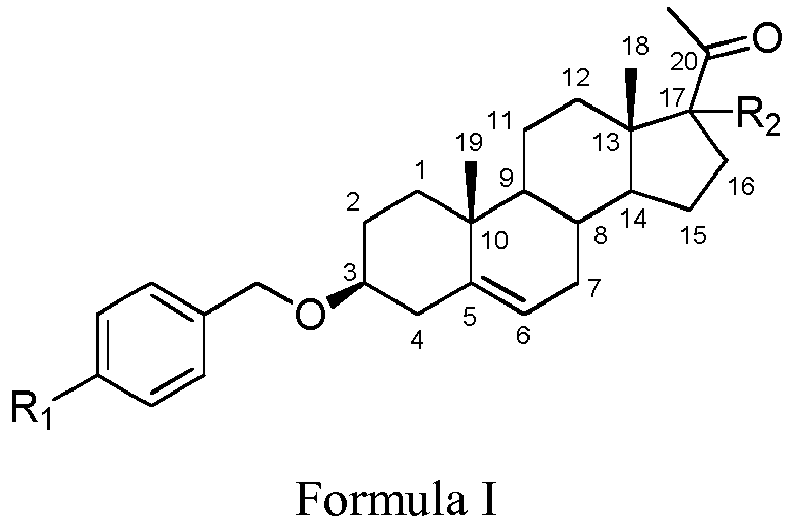
- the present invention relates to a compound of Formula I or a pharmaceutically acceptable salt thereof, wherein:
- Antist refers to a compound that enhances the activity of another compound or receptor site.
- Antagonist and “Inhibitor” refer to a compound that diminishes or prevents the activity of another compound at a receptor site and more generally refer to a compound that diminishes or prevents the activation and/or the activity of a receptor.
- Treatment or treating refer to both therapeutic treatment and prophylactic or preventive measures, wherein the object is to prevent or slow down the targeted pathologic condition or disorder.
- Those in need of treatment include those already with the disorder as well as those prone to have the disorder or those in whom the disorder is to be prevented.
- the subject to be treated herein may have been diagnosed as having the disorder or may be predisposed or susceptible to the disorder.
- a subject denotes a mammal, such as a rodent, a feline, a canine, and a primate.
- a subject according to the invention is a human.
- a “therapeutically effective amount” is intended for a minimal amount of active agent which is necessary to impart therapeutic or a preventive benefit to a subject.
- a “therapeutically effective amount” to a mammal is such an amount which induces, ameliorates or otherwise causes an improvement in the pathological-symptoms, disease progression or physiological conditions associated with or resistance to succumbing to a disorder.
- Alkyl means monovalent linear or branched saturated hydrocarbon moiety, consisting solely of carbon and hydrogen atoms.
- C1-8 alkyl means a linear or branched alkyl having from one to eight carbon atoms.
- Alkoxy means a moiety of the formula -OR, wherein R is an alkyl moiety as defined herein.
- alkenyl used herein describes an unsaturated, linear or branched aliphatic hydrocarbon having at least one carbon-carbon double bond.
- C2-6 alkenyl denotes a straight- or branched-chain of 2 to 6 carbon atoms with at least one double bond.
- halogen alone or in combination with other groups, denotes chloro (Cl), iodo (I), fluoro (F) and bromo (Br).
- nitro alone or in combination with other groups, denotes the group - NO 2 .
- Amino means a moiety of the formula -NRR' wherein R and R' each independently is hydrogen, or alkyl as defined herein.
- the abbreviation Bn refers to a benzyl group.
- Ph refers to a phenyl group.
- salts refers to salts that are suitable for use in contact with the tissues of humans and animals without undue toxicity, irritation, allergic response, and the like.
- suitable salts include salts of alkali metals such as potassium, sodium, lithium, salts of alkaline earth metals such as calcium, magnesium and acid addition salts with inorganic and organic acids are, but are not limited to, hydrochloric acid, nitric acid, sulphuric acid, phosphoric acid, sulphuric acid, citric acid, formic acid, fumaric acid, maleic acid, lactic acid, malic acid, acetic acid, succinic acid, hemisuccinic acid, tartaric acid, methane-sulfonic acid, p-toluenesulphonic acid, trifluoro acetic acid and the like.
- the invention relates to compounds of Formula I or pharmaceutically acceptable salts thereof: wherein:
- R2 is in ⁇ position.
- the compounds of the invention have the Formula II: wherein:
- R1 is OH, C1-8 alkyl, C1-8 alkoxy or halogen, more preferably R1 is OH, methyl, ethyl, methoxy, ethoxy, methylcarboxy, Cl, Br, F or cyano.
- R2 is H, OH, C1-8 alkyl, C1-8 alkoxy, C2-6 alkenyl or Bn, more preferably R2 is H, OH, methyl, ethyl, methoxy, ethoxy, allyl or Bn.
- the compound of the invention is:
- the preferred compounds of the invention is selected from the group consisting of 3 ⁇ -( p -Methoxybenzyloxy)-17 ⁇ -methyl-pregnenolone, 17-benzyl-3-( p -methoxybenzyloxy)-pregnenolone, 3-( p -methoxybenzyloxy)-pregnenolone, 3-( p -bromobenzyloxy)-pregnenolone, 3-( p -methylcarboxybenzyloxy)-pregnenolone, 3-( p -methylbenzyloxy)-pregnenolone, 3-( p -fluorobenzyloxy)-pregnenolone and 3-( p -cyanobenzyloxy)-pregnenolone.
- the preferred compound of the invention is 3 ⁇ -( p -Methoxybenzyloxy)-17 ⁇ -methyl-pregnenolone.
- the invention also relates to a pharmaceutical composition
- a pharmaceutical composition comprising a compound of the invention or a pharmaceutically salt thereof and a pharmaceutically acceptable carrier.
- the present invention also relates to a process for the manufacture of the compounds of the invention, which comprises reacting a compound of Formula III:
- the process for the manufacture of the compounds of the invention comprises reacting a compound of Formula III:
- the process for the manufacture of the compounds of the invention comprises reacting a compound of Formula III:
- the solvent for this reaction is an aromatic solvent such as trifluorotoluene or toluene.
- the heterogeneous acid scavenger is potassium carbonate or magnesium oxide.
- synthesis of a compound of formula III wherein R2 is an alkyl, - allyl, -benzyl or -aryl may be done by reacting pregnenolone with Ac 2 O to form a enol acetate. Then, the enol acetate is reacted with a Grignard reagent to generate an enolate which is subsequently trapped with a halogeno-R2.
- synthesis of a compound of formula III wherein R2 is an an alkoxy, benzyloxy or aryloxy may be is done by reacting pregnenolone with the corresponding alcohol in the presence of Cu 2+ .
- the present invention also relates to a compound of the invention as defined above or a pharmaceutically acceptable salt thereof for use in a method for treatment of the human or animal body.
- the present invention also relates to a method for the treatment of a pathologic condition or disorder in a subject in need thereof comprising administering to said subject an effective amount of a compound of the invention as defined above or a pharmaceutically acceptable salt thereof.
- the pathologies that may be treated with the compounds of the invention are those which may be treated by Pregnenolone, for example the pathologies that may be treated by Pregnenolone because of it action as an inhibitor of the CB1 receptor.
- pathologies are psychiatric and neurological disorders; neurodegenerative disorders; metabolic disorders; addiction, dependence, abuse relapse and related disorders; bladder and gastrointestinal disorders ; hepatic diseases such as steatosis; non-alcoholic steatohepatitis (NASH), liver cirrhosis; alcoholic steatosis ; inflammatory diseases; cardiovascular diseases; nephropathies; glaucoma ; spasticity ; cancer ; osteoporosis ; obesity ; autoimmune hepatitis and encephalitis ; pain or reproductive disorders and skin inflammatory and fibrotic diseases.
- NASH non-alcoholic steatohepatitis
- inflammatory diseases cardiovascular diseases
- nephropathies nephropathies
- glaucoma glaucoma
- spasticity cancer
- cancer osteoporosis
- obesity autoimmune hepatitis and encephalitis
- pain or reproductive disorders and skin inflammatory and fibrotic diseases are examples of such pathologies.
- the present invention also relates to the use of compounds of the invention or a pharmaceutically acceptable salt thereof for the preparation of a medicament for treating one of the above mentioned pathologies.
- Pregnenolone is a well-known and commercially available steroid (CAS number 145-13-1).
- Pregnenolone can be used as precursor for the synthesis of its derivatives.
- the corresponding enol acetate is formed by reacting Pregnenolone with Ac 2 O. Then, the enol acetate is reacted with a Grignard reagent such as MeMgBr in THF to generate an enolate which is subsequently trapped with an electrophile.
- the electrophile would be preferentially an R-iodo- or R-bromo wherein R is an alkyl, -allyl, -benzyl or -aryl.
- p -toluenesulfonic acid monohydrate (1.12 g; 5.9 mmol; 0,93 eq.) was added to a solution of Pregnenolone (2 g; 6.3 mmol; 1 eq.) in acetic anhydride (230 ml).
- the reaction medium was stirred for 5h at reflux and acetic anhydride was slowly distilled. After allowed to cool to 20°C, the reaction medium was poured into crushed ice then the mixture is extracted with diethyl ether. The organic layer was washed with saturated aqueous Na 2 CO 3 , dried over Na 2 SO 4 then evaporated under reduced pressure.
- MeMgBr 2 (3M in Et 2 O; 25 ml; 75 mmol; 10 eq.) was added to a solution of pregnenolone enol acetate (3 g; 7.5 mmol; 1 eq.) in anhydrous THF (65 ml).
- the reaction medium was stirred for 1h at reflux, then allowed to cool to 20°C.
- CH 3 I (4.6 ml; 75 mmol; 10 eq.) was added and reaction medium was stirred at reflux. Adding CH 3 I was repeated every 45 minutes until 40 equivalents. After cooling to 20 °C, an aqueous solution of NH 4 Cl is added then the mixture is extracted with ethyl acetate.
- Pregnenolone substituted with an alkoxy-, benzyloxy- or aryloxy- at C17 position
- Pregnenolone is reacted with the corresponding alcohol, R-OH, in the presence of Cu 2+ .
- Compounds of formula IV may also be synthetized by reacting 2-chloro-4-methylquinoleine and para-substituted benzyl alcohol in the presence of 18-crown-6 and KOH according the schema below.
- Compounds of formula V may be synthetized in two steps: First by reacting 2-chloropyridine and para-substituted benzyl alcohol in the presence of 18-crown-6 and KOH or t-BuOK; Second by reacting the resulting product with methyl triflate to allow the salt formation according to the schema below.
- methyl triflate, MeOTf (450 ⁇ L; 3.97 mmol; 1.05 eq) was added to a cold solution of 2-( p -bromobenzyloxy)-pyridine (1 g; .3.7 mmol; 1 eq).
- the reaction medium was stirred for 2 hours at room temperature then evaporated under vacuum to give quantitatively 2-( p -Bromobenzyloxy)-1-methylpyridinium Triflate (1.6 g) as a white solid.
- the pregnenolone or pregnenolone derivative is substituted in C3 with a group OBn-R1 according to known methods of benzylation of alcohol (Poon KWC. et al. 2006, Giannis et al ., 2009, Nwoye, E. O et al ., 2007) and as shown below. or
- MgO 116 mg; 2.42 mmol; 2.0 eq.
- 2-benzyloxymethylpyridinium triflate (1 g; 2.86 mmol; 2.0 eq.) were added to a solution of 17 ⁇ -benzylpregnenolone (580 mg; 1.43 mmol; 1 eq.) in trifluorotoluene (15ml).
- the reaction medium was stirred for one night at 85°C, then filtered on celite and evaporated under reduced pressure.
- the compound can be administered to any cell line expressing the enzyme that metabolizes pregnenolone in culture, measuring then the content of metabolites of pregnenolone within the cell or on the cell culture medium by GC/MS and comparing these concentrations to metabolites in cell cultures that have been received only a vehicle or pregnenolone.
- CHO cell line was used. These cells derived from the ovary have all the enzymes needed to metabolize pregnenolone in downstream steroids.
- ALLO allopregnanolone
- EPIALLO epiallopregnanolone
- PREG pregnenolone
- DHEA DHEA
- testosterone TESTO
- the inventors have analyzed the metabolism of pregnenolone derivatives using an in vitro test in CHO cells.
- the compound 68 3 ⁇ -( p -Methoxybenzyloxy)-17 ⁇ -methyl-pregnenolone, is not metabolised in Pregnenolone and the compounds 63 and 41 are not significantly metabolized in Pregnenolone (metabolization ⁇ 1%).
- Pregnenolone derivatives that contain a 3-benzyloxy function show no detectable metabolization of derivative of Pregnenolone in DHEA and Testosterone and very low metabolization in Allopregnanolone and Epiallopregnano lone.
Landscapes
- Health & Medical Sciences (AREA)
- Chemical & Material Sciences (AREA)
- Organic Chemistry (AREA)
- General Health & Medical Sciences (AREA)
- Life Sciences & Earth Sciences (AREA)
- Veterinary Medicine (AREA)
- Public Health (AREA)
- Medicinal Chemistry (AREA)
- Animal Behavior & Ethology (AREA)
- Pharmacology & Pharmacy (AREA)
- General Chemical & Material Sciences (AREA)
- Nuclear Medicine, Radiotherapy & Molecular Imaging (AREA)
- Chemical Kinetics & Catalysis (AREA)
- Engineering & Computer Science (AREA)
- Bioinformatics & Cheminformatics (AREA)
- Neurosurgery (AREA)
- Neurology (AREA)
- Biomedical Technology (AREA)
- Rheumatology (AREA)
- Toxicology (AREA)
- Immunology (AREA)
- Physical Education & Sports Medicine (AREA)
- Pain & Pain Management (AREA)
- Psychiatry (AREA)
- Reproductive Health (AREA)
- Ophthalmology & Optometry (AREA)
- Orthopedic Medicine & Surgery (AREA)
- Urology & Nephrology (AREA)
- Obesity (AREA)
- Hematology (AREA)
- Diabetes (AREA)
- Heart & Thoracic Surgery (AREA)
- Gastroenterology & Hepatology (AREA)
- Dermatology (AREA)
- Gynecology & Obstetrics (AREA)
- Pregnancy & Childbirth (AREA)
- Addiction (AREA)
- Endocrinology (AREA)
- Cardiology (AREA)
- Hospice & Palliative Care (AREA)
Abstract
Description
- The present invention relates to synthetic neuroactive steroids and more particularly to synthetic Pregnenolone derivatives and their use in a method for treatment of the human or animal body.
- Various steroids synthesized in the adrenal glands and gonads are capable of modulating neuron excitability in the CNS. For these compounds the term "neuroactive steroids" has been coined (Majewska et al., 1986), or "neurosteroids" for those that the brain can synthesize de novo (Baulieu, 1991).
- Steroid hormones have long been recognized to have sedative, anesthetic and anti-seizure properties in animals and humans (Aird, 1944; Aird and Gordan, 1951; Gyermek et al., 1967; Green et al., 1978). Studies during the past two decades have uncovered that progesterone and deoxycorticosterone serve as precursors for the endogenous neurosteroids allopregnanolone (5α-pregnane-3α-ol-20-one) and THDOC (5α-pregnane-3α,21-diol-20-one), respectively (Reddy, 2003; 2009a). Testosterone-derived androgens such as androstanediol (5α-androstane-3α,17β-diol) and estradiol can be considered as neurosteroids (Reddy, 2008). Generally, the acute effects of neurosteroids are not related to interactions with classical steroid hormone receptors that regulate gene transcription. Moreover, neurosteroids are not themselves active at intracellular steroid receptors. They modulate brain excitability primarily by interaction with neuronal membrane receptors and ion channels, principally GABA-A receptors (Lambert et al., 2003; Reddy, 2003; Akk et al., 2009).
- In addition to endogenous steroids such as pregnenolone sulfate, DHEA-S, estradiol, or progesterone for which neuroactive properties have been described (Paul and Purdy, 1992; Rupprecht, 1997), synthetic steroids have been developed recently that share their endogenous counterparts' characteristic of modulating a variety of G-protein-coupled receptors and ligand-gated ion channels (Gasior et al., 1999).
- Some synthetic neurosteroids that show better pharmacokinetics and efficacy are evaluated for sedative and anxiolytic (minaxolone), anesthetic (alphaxolone) and antiepileptic (ganaxolone) effects.
- However, the diverse in vivo actions of neuroactive steroids depend on the lack of specificity of natural and synthetic steroids that do not bind uniquely to one neurotransmitter receptor but on several of them. The metabolism of neuroactive steroids with metabolites that exhibit different pharmacological profiles compared to their precursors is also responsible for the variety of effects of a single steroid. As yet, no derivatives of naturally occurring or synthetic steroids have been developed that show exclusive receptor specificity or avoid side effects due to it metabolization.
- Among the naturally occurring steroid, studies that demonstrate an in vivo effect by pregnenolone are very few but they suggest a beneficial role for this steroid. It was shown that pregnenolone administration decreased the formation of gliotic tissue following a penetrating lesion in rat cerebral cortex and hippocampus (Garcia-Estrada et al., 1999). Pregnenolone was showed to protect against toxicity induced by glutamate and the protein beta amyloid in hippocampal cells line (HT-22) cultures (Gursoy et al., 2001). Furthermore, pregnenolone has also been suggested to enhance memory performance (Mathis et al., 1994). However, these effects of pregnenolone have been classically attributed to the downstream metabolites of pregnenolone, that in itself is considered the inactive precursor of downstream active steroids. Thus, pregnenolone has not effects on the principal targets of neuroactive steroids that are the GABA and Excitatory aminoacid receptors.
- Recently, the inventors have shown that pregnenolone acts as an inhibitor of the human CB1 receptor with a pharmacological profile different from orthosteric antagonist and from other neuroactive steroids, which indicates that pregnenolone has less unspecific and undesiderable effects than orthosteric antagonists of the CB1 and other neuroactive steroids (patent application
PCT/EP2012/059310 WO2012/160006 ; Vallée et al., 2013). - Given that pregnenolone is the first step of steroid synthesis in the brain and other organ, pregnenolone is not considered as a good target to derive synthetic neuroactive steroids from.
- Indeed, such pregnenolone derivatives present high risk to be metabolised. The generated metabolites could exhibit different pharmacological profiles compared to their precursors and exert side effects.
- The inventors have found that molecules derived from pregnenolone that contain a 3-benzyloxy function (substituted or not) cannot be converted into metabolites endowed with progestative, androgenic, estrogenic, and glucocorticoid activity. Therefore, using these pregnenolone derivatives that are not or not substantially converted into pregnenolone metabolites avoids side effects.
- Thus, the present invention relates to a compound of Formula I or a pharmaceutically acceptable salt thereof,

- R1 is:
- C1-8 alkyl,
- C1-8 alkoxy,
- CN,
- NO2,
- amino,
- COOH,
- COOCH3,
- OH,
- N3,
or - halogen
- R2 is:
- H,
- OH,
- C1-8 alkyl,
- C1-8 alkoxy,
- C2-C6 alkenyl,
- halogen,
- Bn-O-,
- Bn- optionally substituted with C1-8 alkyl, C1-8 alkoxy, CN, NO2, amino, COOH or halogen or
- Ph- optionally substituted with C1-8 alkyl, C1-8 alkoxy, CN, NO2, amino, COOH or halogen.
- The term "Agonist" refers to a compound that enhances the activity of another compound or receptor site.
- The terms "Antagonist" and "Inhibitor" refer to a compound that diminishes or prevents the activity of another compound at a receptor site and more generally refer to a compound that diminishes or prevents the activation and/or the activity of a receptor.
- The terms "Treatment or treating" refer to both therapeutic treatment and prophylactic or preventive measures, wherein the object is to prevent or slow down the targeted pathologic condition or disorder. Those in need of treatment include those already with the disorder as well as those prone to have the disorder or those in whom the disorder is to be prevented. Hence, the subject to be treated herein may have been diagnosed as having the disorder or may be predisposed or susceptible to the disorder.
- As used herein, the term "subject" denotes a mammal, such as a rodent, a feline, a canine, and a primate. Preferably, a subject according to the invention is a human.
- A "therapeutically effective amount" is intended for a minimal amount of active agent which is necessary to impart therapeutic or a preventive benefit to a subject. For example, a "therapeutically effective amount" to a mammal is such an amount which induces, ameliorates or otherwise causes an improvement in the pathological-symptoms, disease progression or physiological conditions associated with or resistance to succumbing to a disorder.
- "Alkyl" means monovalent linear or branched saturated hydrocarbon moiety, consisting solely of carbon and hydrogen atoms. C1-8 alkyl means a linear or branched alkyl having from one to eight carbon atoms.
- "Alkoxy" means a moiety of the formula -OR, wherein R is an alkyl moiety as defined herein.
- The term "alkenyl" used herein describes an unsaturated, linear or branched aliphatic hydrocarbon having at least one carbon-carbon double bond. "C2-6 alkenyl" denotes a straight- or branched-chain of 2 to 6 carbon atoms with at least one double bond.
- The term "halogen", alone or in combination with other groups, denotes chloro (Cl), iodo (I), fluoro (F) and bromo (Br).
- The term "cyano", alone or in combination with other groups, denotes the group - CN.
- The term "hydroxyl", alone or in combination with other groups, denotes the group -OH.
- The term "nitro", alone or in combination with other groups, denotes the group - NO2.
- The term "carboxyl", alone or in combination with other groups, denotes the group -COOH.
- "Amino" means a moiety of the formula -NRR' wherein R and R' each independently is hydrogen, or alkyl as defined herein.
- The abbreviation Bn refers to a benzyl group.
- The abbreviation Ph refers to a phenyl group.
- The term "pharmaceutically acceptable salts" refers to salts that are suitable for use in contact with the tissues of humans and animals without undue toxicity, irritation, allergic response, and the like. Examples of suitable salts include salts of alkali metals such as potassium, sodium, lithium, salts of alkaline earth metals such as calcium, magnesium and acid addition salts with inorganic and organic acids are, but are not limited to, hydrochloric acid, nitric acid, sulphuric acid, phosphoric acid, sulphuric acid, citric acid, formic acid, fumaric acid, maleic acid, lactic acid, malic acid, acetic acid, succinic acid, hemisuccinic acid, tartaric acid, methane-sulfonic acid, p-toluenesulphonic acid, trifluoro acetic acid and the like.
- Substituents above the plane of the molecule are shown as a solid line () and are described as β; those below the plane are shown by a broken line (
 ) and are described as α.
- The invention relates to compounds of Formula I or pharmaceutically acceptable salts thereof:

- R1 is:
- C1-8 alkyl,
- C1-8 alkoxy,
- CN,
- NO2,
- amino,
- COOH,
- COOCH3,
- OH,
- N3,
or - halogen
- R2 is:
- H,
- OH,
- C1-8 alkyl,
- C1-8 alkoxy,
- C2-C6 alkenyl,
- halogen,
- Bn-O-,
- Bn- optionally substituted with C1-8 alkyl, C1-8 alkoxy, CN, NO2, amino, COOH or halogen
or - Ph- optionally substituted with C1-8 alkyl, C1-8 alkoxy, CN, NO2, amino, COOH or halogen.
- In one preferred embodiment, R2 is in α position.
- In this embodiment, the compounds of the invention have the Formula II:

- R1 is:
- C1-8 alkyl,
- C1-8 alkoxy,
- CN,
- NO2,
- amino,
- COOH,
- COOCH3,
- OH,
- N3,
or - halogen
- R2 is:
- H,
- OH,
- C1-8 alkyl,
- C1-8 alkoxy,
- C2-C6 alkenyl,
- halogen,
- Bn-O-,
- Bn- optionally substituted with C1-8 alkyl, C1-8 alkoxy, CN, NO2, amino, COOH or halogen
or - Ph- optionally substituted with C1-8 alkyl, C1-8 alkoxy, CN, NO2, amino, COOH or halogen.
- In a preferred embodiment, R1 is OH, C1-8 alkyl, C1-8 alkoxy or halogen, more preferably R1 is OH, methyl, ethyl, methoxy, ethoxy, methylcarboxy, Cl, Br, F or cyano.
- In a preferred embodiment, R2 is H, OH, C1-8 alkyl, C1-8 alkoxy, C2-6 alkenyl or Bn, more preferably R2 is H, OH, methyl, ethyl, methoxy, ethoxy, allyl or Bn.
- More preferably, the compound of the invention is:
- 3-(p-hydroxybenzyloxy)-pregnenolone,
- 3-(p-methylbenzyloxy)-pregnenolone,
- 3-(p-ethylbenzyloxy)-pregnenolone,
- 3-(p-methoxybenzyloxy)-pregnenolone,
- 3-(p-ethoxybenzyloxy)-pregnenolone,
- 3-(p-methylcarboxybenzyloxy)-pregnenolone,
- 3-(p-fluorobenzyloxy)-pregnenolone,
- 3-(p-chlorobenzyloxy)-pregnenolone,
- 3-(p-bromobenzyloxy)-pregnenolone,
- 3-(p-cyanobenzyloxy)-pregnenolone,
- 17-hydroxy-3-(p-hydroxybenzyloxy)-pregnenolone,
- 17-hydroxy-3-(p-methylbenzyloxy)-pregnenolone,
- 3-(p-ethylbenzyloxy)-17-hydroxy-pregnenolone,
- 17-hydroxy-3-(p-methoxybenzyloxy)-pregnenolone,
- 3-(p-ethoxybenzyloxy)-17-hydroxy-pregnenolone,
- 17-hydroxy-3-(p-methylcarboxybenzyloxy)-pregnenolone,
- 3-(p-fluorobenzyloxy)-17-hydroxy-pregnenolone,
- 3-(p-chlorobenzyloxy)-17-hydroxy-pregnenolone,
- 3-(p-bromobenzyloxy)-17-hydroxy-pregnenolone,
- 3-(p-cyanobenzyloxy)-17-hydroxy-pregnenolone,
- 3-(p-hydroxybenzyloxy)-17-methyl-pregnenolone,
- 17-methyl-3-(p-methylbenzyloxy)-pregnenolone,
- 3-(p-ethylbenzyloxy)-17-methyl-pregnenolone,
- 3-(p-methoxybenzyloxy)-17-methyl-pregnenolone,
- 3-(p-ethoxybenzyloxy)-17-methyl-pregnenolone,
- 17-methyl-3-(p-methylcarboxybenzyloxy)-pregnenolone,
- 3-(p-fluorobenzyloxy)-17-methyl-pregnenolone,
- 3-(p-chlorobenzyloxy)-17-methyl-pregnenolone,
- 3-(p-bromobenzyloxy)-17-methyl-pregnenolone,
- 3-(p-cyanobenzyloxy)-17-methyl-pregnenolone,
- 17-ethyl-3-(p-hydroxybenzyloxy)-pregnenolone,
- 17-ethyl-3-(p-methylbenzyloxy)-pregnenolone,
- 17-ethyl-3-(p-ethylbenzyloxy)-pregnenolone,
- 17-ethyl-3-(p-methoxybenzyloxy)-pregnenolone,
- 3-(p-ethoxybenzyloxy)-17-ethyl-pregnenolone,
- 17-ethyl-3-(p-methylcarboxybenzyloxy)-pregnenolone,
- 17-ethyl-3-(p-fluorobenzyloxy)-pregnenolone,
- 3-(p-chlorobenzyloxy)-17-ethyl-pregnenolone,
- 3-(p-bromobenzyloxy)-17-ethyl-pregnenolone,
- 3-(p-cyanobenzyloxy)-17-ethyl-pregnenolone,
- 3-(p-hydroxybenzyloxy)-17-methoxy-pregnenolone,
- 17-methoxy-3-(p-methylbenzyloxy)-pregnenolone,
- 3-(p-ethylbenzyloxy)-17-methoxy-pregnenolone,
- 17-methoxy-3-(p-methoxybenzyloxy)-pregnenolone,
- 3-(p-ethoxybenzyloxy)-17-methoxy-pregnenolone,
- 17-methoxy-3-(p-methylcarboxybenzyloxy)-pregnenolone,
- 3-(p-fluorobenzyloxy)-17-methoxy-pregnenolone,
- 3-(p-chlorobenzyloxy)-17-methoxy-pregnenolone,
- 3-(p-bromobenzyloxy)-17-methoxy-pregnenolone,
- 3-(p-cyanobenzyloxy)-17-methoxy-pregnenolone,
- 17-ethoxy-3-(p-hydroxybenzyloxy)-pregnenolone,
- 17-ethoxy-3-(p-methylbenzyloxy)-pregnenolone,
- 17-ethoxy-3-(p-ethylbenzyloxy)-pregnenolone,
- 17-ethoxy-3-(p-methoxybenzyloxy)-pregnenolone,
- 17-ethoxy-3-(p-ethoxybenzyloxy)-pregnenolone,
- 17-ethoxy-3-(p-methylcarboxybenzyloxy)-pregnenolone,
- 17-ethoxy-3-(p-fluorobenzyloxy)-pregnenolone,
- 3-(p-chlorobenzyloxy)-17-ethoxy-pregnenolone,
- 3-(p-bromobenzyloxy)-17-ethoxy-pregnenolone,
- 3-(p-cyanobenzyloxy)-17-ethoxy-pregnenolone,
- 17-allyl-3-(p-hydroxybenzyloxy)-pregnenolone,
- 17-allyl-3-(p-methylbenzyloxy)-pregnenolone,
- 17-allyl-3-(p-ethylbenzyloxy)-pregnenolone,
- 17-allyl-3-(p-methoxybenzyloxy)-pregnenolone,
- 17-allyl-3-(p-ethoxybenzyloxy)-pregnenolone,
- 17-allyl-3-(p-methylcarboxybenzyloxy)-pregnenolone,
- 17-allyl-3-(p-fluorobenzyloxy)-pregnenolone,
- 17-allyl-3-(p-chlorobenzyloxy)-pregnenolone,
- 17-allyl-3-(p-bromobenzyloxy)-pregnenolone,
- 17-allyl-3-(p-cyanobenzyloxy)-pregnenolone,
- 17-benzyl-3-(p-hydroxybenzyloxy)-pregnenolone,
- 17-benzyl-3-(p-methylbenzyloxy)-pregnenolone,
- 17-benzyl-3-(p-ethylbenzyloxy)-pregnenolone,
- 17-benzyl-3-(p-methoxybenzyloxy)-pregnenolone,
- 17-benzyl-3-(p-ethoxybenzyloxy)-pregnenolone,
- 17-benzyl-3-(p-methylcarboxybenzyloxy)-pregnenolone,
- 17-benzyl-3-(p-fluorobenzyloxy)-pregnenolone
- 17-benzyl-3-(p-chlorobenzyloxy)-pregnenolone
- 17-benzyl-3-(p-bromobenzyloxy)-pregnenolone or
- 17-benzyl-3-(p-cyanobenzyloxy)-pregnenolone.
- The preferred compounds of the invention is selected from the group consisting of 3β-(p-Methoxybenzyloxy)-17α-methyl-pregnenolone, 17-benzyl-3-(p-methoxybenzyloxy)-pregnenolone, 3-(p-methoxybenzyloxy)-pregnenolone, 3-(p-bromobenzyloxy)-pregnenolone, 3-(p-methylcarboxybenzyloxy)-pregnenolone, 3-(p-methylbenzyloxy)-pregnenolone, 3-(p-fluorobenzyloxy)-pregnenolone and 3-(p-cyanobenzyloxy)-pregnenolone.
- The preferred compound of the invention is 3β-(p-Methoxybenzyloxy)-17α-methyl-pregnenolone.
- The invention also relates to a pharmaceutical composition comprising a compound of the invention or a pharmaceutically salt thereof and a pharmaceutically acceptable carrier.
- The present invention also relates to a process for the manufacture of the compounds of the invention, which comprises reacting a compound of Formula III:

- wherein R2 is as defined above,
- with a compound of Formula IV:

- wherein R1 is as defined above,
- in the presence of a heterogeneous acid scavenger and of methyl triflate or
- with a compound of Formula V

- wherein R1 is as defined above
- in the presence of a heterogeneous acid scavenger.
- In case of a compound of formula V, there is no need for the presence of methyl triflate due to the OTf group.
In one embodiment, the process for the manufacture of the compounds of the invention, comprises reacting a compound of Formula III:
- wherein R2 is as defined above,
- with a compound of Formula IV:
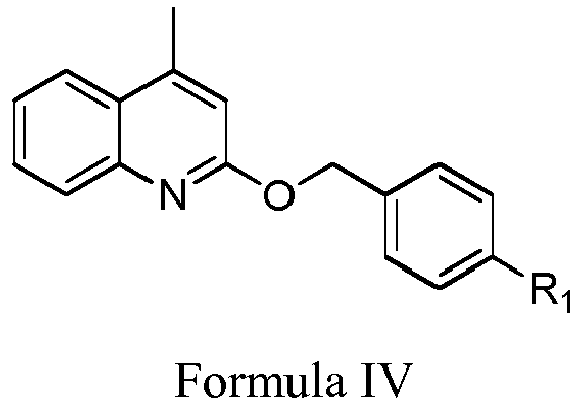
- wherein R1 is as defined above,
- in the presence of a heterogeneous acid scavenger and of methyl triflate.
- In another embodiment, the process for the manufacture of the compounds of the invention, comprises reacting a compound of Formula III:

- wherein R2 is as defined above,
- with a compound of Formula V

- wherein R1 is as defined above
- in the presence of a heterogeneous acid scavenger.
- Preferably, the solvent for this reaction is an aromatic solvent such as trifluorotoluene or toluene.
- Preferably, the heterogeneous acid scavenger is potassium carbonate or magnesium oxide.
- Method for synthesis of compounds of formula III are well described in the prior art (Glazier E.R., 1962, Marshall et al., 1948, Jones et al., 1965).
- For example, synthesis of a compound of formula III wherein R2 is an alkyl, - allyl, -benzyl or -aryl may be done by reacting pregnenolone with Ac2O to form a enol acetate. Then, the enol acetate is reacted with a Grignard reagent to generate an enolate which is subsequently trapped with a halogeno-R2.
- Further, for example, synthesis of a compound of formula III wherein R2 is an an alkoxy, benzyloxy or aryloxy may be is done by reacting pregnenolone with the corresponding alcohol in the presence of Cu2+.
- The present invention also relates to a compound of the invention as defined above or a pharmaceutically acceptable salt thereof for use in a method for treatment of the human or animal body.
- The present invention also relates to a method for the treatment of a pathologic condition or disorder in a subject in need thereof comprising administering to said subject an effective amount of a compound of the invention as defined above or a pharmaceutically acceptable salt thereof.
- The pathologies that may be treated with the compounds of the invention are those which may be treated by Pregnenolone, for example the pathologies that may be treated by Pregnenolone because of it action as an inhibitor of the CB1 receptor.
- Examples of such pathologies are psychiatric and neurological disorders; neurodegenerative disorders; metabolic disorders; addiction, dependence, abuse relapse and related disorders; bladder and gastrointestinal disorders ; hepatic diseases such as steatosis; non-alcoholic steatohepatitis (NASH), liver cirrhosis; alcoholic steatosis ; inflammatory diseases; cardiovascular diseases; nephropathies; glaucoma ; spasticity ; cancer ; osteoporosis ; obesity ; autoimmune hepatitis and encephalitis ; pain or reproductive disorders and skin inflammatory and fibrotic diseases.
- The present invention also relates to the use of compounds of the invention or a pharmaceutically acceptable salt thereof for the preparation of a medicament for treating one of the above mentioned pathologies.
- The invention will be further illustrated by the following figures and examples. However, these examples and figures should not be interpreted in any way as limiting the scope of the present invention.
- Pregnenolone is a well-known and commercially available steroid (CAS number 145-13-1).
- As shown below, Pregnenolone can be used as precursor for the synthesis of its derivatives.
- First, Pregnenolone is substituted in C17.
- As shown below, to synthesize a Pregnenolone substituted with an alkyl, an allyl or an aryl at C17 position, in a first step, the corresponding enol acetate is formed by reacting Pregnenolone with Ac2O. Then, the enol acetate is reacted with a Grignard reagent such as MeMgBr in THF to generate an enolate which is subsequently trapped with an electrophile. The electrophile would be preferentially an R-iodo- or R-bromo wherein R is an alkyl, -allyl, -benzyl or -aryl.

- As shown below, p-toluenesulfonic acid monohydrate (1.12 g; 5.9 mmol; 0,93 eq.) was added to a solution of Pregnenolone (2 g; 6.3 mmol; 1 eq.) in acetic anhydride (230 ml). The reaction medium was stirred for 5h at reflux and acetic anhydride was slowly distilled. After allowed to cool to 20°C, the reaction medium was poured into crushed ice then the mixture is extracted with diethyl ether. The organic layer was washed with saturated aqueous Na2CO3, dried over Na2SO4 then evaporated under reduced pressure. The residue was purified by chromatography on silica gel (eluent: cyclohexane/AcOEt from 100/0 to 90/10) to give the Pregnenolone enol acetate (2.2 g; 85%) as a white solid.

- As shown below, MeMgBr2 (3M in Et2O; 25 ml; 75 mmol; 10 eq.) was added to a solution of pregnenolone enol acetate (3 g; 7.5 mmol; 1 eq.) in anhydrous THF (65 ml). The reaction medium was stirred for 1h at reflux, then allowed to cool to 20°C. CH3I (4.6 ml; 75 mmol; 10 eq.) was added and reaction medium was stirred at reflux. Adding CH3I was repeated every 45 minutes until 40 equivalents. After cooling to 20 °C, an aqueous solution of NH4Cl is added then the mixture is extracted with ethyl acetate. The organic layer was washed with brine, dried over Na2SO4 then evaporated under reduced pressure. The residue was purified by chromatography on silica gel (eluent: cyclohexane/AcOEt 75/25) to give the 17α-methyl-pregnenolone (600 mg; 25%) as a white solid.

- To synthesize a Pregnenolone substituted with an alkoxy-, benzyloxy- or aryloxy- at C17 position, Pregnenolone is reacted with the corresponding alcohol, R-OH, in the presence of Cu2+.
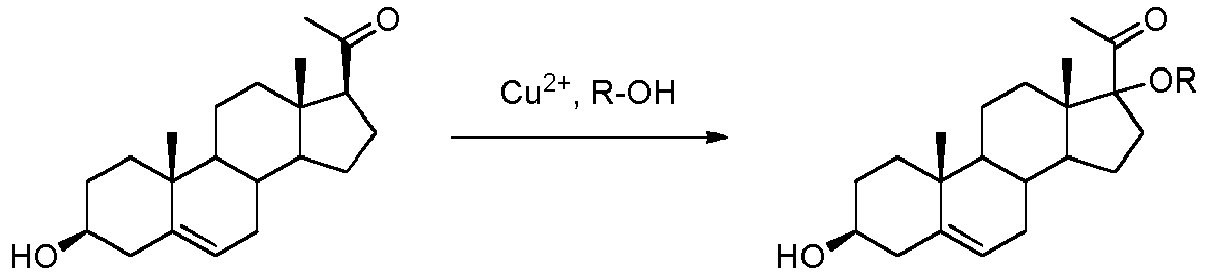
- As shown below, CuBr2 (4.05 g; 18.13 mmol; 1.9 eq.) was added to a suspension of pregnenolone (3 g; 9.48 mmol; 1 eq.) in methanol (360 ml). The reaction medium was stirred for 24h at reflux, then evaporated under reduced pressure. The residue was dissolved in dichloromethane and water. The organic layer was washed with brine, dried over Na2SO4 then concentrated under reduced pressure. The residue was purified by chromatography on silica gel (eluent: cyclohexane/AcOEt 80/20) then by recrystallisation (acetone) to give the 17-methoxy-pregnenolone (510 mg; 15%) as a white solid.

- Some compounds of formula IV may be commercially available for example 2-(4-methoxybenzyloxy)-4-methylquinoleine.
- Compounds of formula IV may also be synthetized by reacting 2-chloro-4-methylquinoleine and para-substituted benzyl alcohol in the presence of 18-crown-6 and KOH according the schema below.

- As shown below, to a solution of 2-chloro-4-methylquinoleine- (500 mg; 2.8 mmol; 1 eq.) in anhydrous toluene (10 mL) was added successively 4-methylbenzyl alcohol (409 mg, 3.35 mmol; 1.25 eq), KOH (630 mg; 11.2 mmol; 4.0 eq.), then 18-crown-6 (45 mg, 0.16 mmol, 0.06 eq). The reaction medium was heated at reflux for 1.5 h using a Dean-Stark trap. The reaction medium was then cooled to room temperature then water was added and product is extracted with AcOEt. The organic phase is dried (Na2SO4) then evaporated under vacuum. The residue was purified by chromatography on silica gel (eluent: cyclohexane/AcOEt 95/5) to give 2-(p-methylbenzyloxy)-4-methylquinoline (660 mg; 89%) as a colorless oil.

- Compounds of formula V may be synthetized in two steps: First by reacting 2-chloropyridine and para-substituted benzyl alcohol in the presence of 18-crown-6 and KOH or t-BuOK; Second by reacting the resulting product with methyl triflate to allow the salt formation according to the schema below.

- As shown below, to a solution of 2-chloropyridine (0.9 mL; 9.6 mmol; 1.2 eq.) in anhydrous toluene (16 mL) was added successively 4-Bromobenzyl alcohol (1.5 g, 8.0 mmol; 1 eq), KOH (1.35 g; 24 mmol; 3.0 eq.), then 18-crown-6 (105 mg, 0.4 mmol, 0.05 eq). The reaction medium was stirred at reflux for 1 h using a Dean-Stark trap. The reaction medium was cooled to room temperature then water was added and product was extracted with AcOEt. The organic phase is dried (Na2SO4) then evaporated under vacuum. The residue was purified by chromatography on silica gel (eluent: cyclohexane/AcOEt 9/1) to give 2-(p-Bromobenzyloxy)-pyridine (2 g; 78%) as a colorless oil.
- For the second step, methyl triflate, MeOTf, (450µL; 3.97 mmol; 1.05 eq) was added to a cold solution of 2-(p-bromobenzyloxy)-pyridine (1 g; .3.7 mmol; 1 eq). The reaction medium was stirred for 2 hours at room temperature then evaporated under vacuum to give quantitatively 2-(p-Bromobenzyloxy)-1-methylpyridinium Triflate (1.6 g) as a white solid.

- As shown below, to a solution of 2-chloropyridine (1.13 mL; 12.0 mmol; 1.0 eq.) in anhydrous dioxane (48 mL) was added successively 4-Methylcarboxy-benzyl alcohol (1.5 g, 8.0 mmol; 1 eq) and t-BuOK (2 g; 18 mmol; 1.5 eq.). The reaction medium was heated at reflux for 16 h. The reaction medium was cooled to room temperature then water was added and product is extracted with AcOEt. The organic phase is dried (Na2SO4) then evaporated under vacuum. The residue was purified by chromatography on silica gel (eluent: cyclohexane/AcOEt 96/4) to give 2-(p- Methylcarboxybenzyloxy)-pyridine (1.13g; 39%) as a colorless oil.
- For the second step, MeOTf, (293µL; 2.59 mmol; 1.05 eq) was added to a cold solution of 2-(p-Methylcarboxybenzyloxy)-pyridine (600 mg; 2.46 mmol; 1 eq). The reaction medium was stirred for 2 hours at room temperature then evaporated under vacuum to give quantitatively 2-(p-Methylcarboxybenzyloxy)-1-methylpyridinium Triflate (0.9 g) as a white solid.

- Starting from Pregnenolone or Pregnenolone derivative having the suitable group in C17, the pregnenolone or pregnenolone derivative is substituted in C3 with a group OBn-R1 according to known methods of benzylation of alcohol (Poon KWC. et al. 2006, Giannis et al., 2009, Nwoye, E. O et al., 2007) and as shown below.


- As shown below, MgO (46 mg; 1.14 mmol; 2 eq.) and 2-benzyloxy-1-methylpyridinium triflate (400 mg; 1.14 mmol; 2.0 eq.) were added to a solution of pregnenolone (181 mg; 0.57 mmol; 1 eq.) in trifluorotoluene (4ml). The reaction medium was stirred for one night at 85°C, then filtered on celite and evaporated under reduced pressure. The residue was purified by chromatography on silica gel (eluent: cyclohexane/AcOEt 95/5) to give the 3β-benzyloxy-pregnenolone (0.16 g; 70%) as a white solid.

- As shown below, MgO (116 mg; 2.42 mmol; 2.0 eq.) and 2-benzyloxymethylpyridinium triflate (1 g; 2.86 mmol; 2.0 eq.) were added to a solution of 17α-benzylpregnenolone (580 mg; 1.43 mmol; 1 eq.) in trifluorotoluene (15ml). The reaction medium was stirred for one night at 85°C, then filtered on celite and evaporated under reduced pressure. The residue was purified by chromatography on silica gel (eluent: cyclohexane/AcOEt 95/5) to give the 3β-benzyloxy-17α-benzyl-pregnenolone (300 mg; 42%) as a white solid.

- A shown below, to a solution of pregnenolone (477 mg; 1.51 mmol; 1 eq.) in anhydrous α,α,α-trifluorotoluene (9 mL) was added MgO (121 mg; 3.02 mmol; 2.0 eq.) then 2-(p-Bromobenzyloxy)-1-methylpyridinium Triflate (1.29 g; 3.02 mmol; 2.0 eq.). The reaction medium was stirred for 20 h at 100°C, and then filtered on celite. Water was added and product is extracted with AcOEt. The organic phase is dried (Na2SO4) then evaporated under vacuum. The residue was purified by chromatography on silica gel (eluent: cyclohexane/AcOEt 96/4) then triturated with acetone to give the 3β-(p-bromobenzyloxy)-pregnenolone (375mg; 49%) as a white solid.

- As shown below, to a solution of pregnenolone (250 mg; 0.79 mmol; 1 eq.) in anhydrous toluene was added successively MgO (63 mg; 1.58 mmol; 2.0 eq.), 2-(4-methoxybenzyloxy)-4-methylquinoleine (441 mg; 1.58 mmol; 2.0 eq.) and methyl triflate (MeOTf) (180 µl; 1.58 mmol; 2 eq). The reaction medium was stirred for 20 h at 60°C, and then filtered on celite. Water was added and product is extracted with AcOEt. The organic phase is dried (Na2SO4) then evaporated under vacuum. The residue was purified by chromatography on silica gel (eluent: cyclohexane/AcOEt 9/1) to give the 3β-(p-methoxybenzyloxy)-pregnenolone (160mg; 43%) as a white solid.

- 17α-methyl-pregnenolone was synthesized as shown above.
- To a solution of 17α-methyl-pregnenolone (170 mg; 0.5 mmol; 1 eq.) in anhydrous toluene was added successively MgO (40 mg; 1 mmol; 2 eq.), 2-(4-methoxybenzyloxy)-4-methylquinoleine (290 mg; 1 mmol; 2 eq), and methyl triflate (MeOTf) (0.11 ml; 1 mmol; 2 eq). The reaction medium was stirred for one night at 85°C, and then filtered on celite. Water was added and product is extracted with AcOEt. The organic phase is dried (Na2SO4) then evaporated under vacuum. The residue was purified by chromatography on silica gel (eluent: cyclohexane/AcOEt from 1/0 to 95/5) then triturated with acetone to give the 3β-(p-Methoxybenzyloxy)-17α-methyl-pregnenolone (80mg; 35%) as a white solid.

- 17α-benzyl-pregnenolone was synthesized as shown above.
- To a solution of 17α-benzyl-pregnenolone (1.9 g; 4.66 mmol; 1 eq.) in anhydrous toluene (45 ml) was added successively MgO (373 mg; 9.3 mmol; 2 eq.), 2-(4-methoxybenzyloxy)-4-methylquinoleine (2.6 g; 9.33 mmol; 2 eq), and methyl triflate (MeOTf) (1.06 ml; 9.33 mmol; 2 eq). The reaction medium was stirred for one night at 40°C, and then filtered on celite. Water was added and product is extracted with AcOEt. The organic phase is dried (Na2SO4) then evaporated under vacuum. The residue was purified by chromatography on silica gel (eluent: cyclohexane/AcOEt 9/1) then triturated with acetone to give the 3β-(p-methoxybenzyloxy)-17α-benzyl-pregnenolone (1.18 g; 49%) as a white solid.

- Alternatively the compound can be administered to any cell line expressing the enzyme that metabolizes pregnenolone in culture, measuring then the content of metabolites of pregnenolone within the cell or on the cell culture medium by GC/MS and comparing these concentrations to metabolites in cell cultures that have been received only a vehicle or pregnenolone.
- In this example, CHO cell line was used. These cells derived from the ovary have all the enzymes needed to metabolize pregnenolone in downstream steroids.
- The content in CHO culture medium of allopregnanolone (ALLO), epiallopregnanolone (EPIALLO), pregnenolone (PREG), DHEA, and testosterone (TESTO) was measured by GC/MS.
- The inventors have analyzed the metabolism of pregnenolone derivatives using an in vitro test in CHO cells.
- The administration of Pregnenolone (1µM) to these cells for 48 hours produced a significant increase in Allopregnanolone and Epiallopregnanolone in the culture medium (Table 1).
Table 1 Table 1 : Pregnenolone metabolism ALLO EPIALLO PREG DHEA TESTO Control cell cultures Steroid levels pg/ml 0.00 0.00 96.92 0.00 0.00 Pregnenolone (1µM) treated cells 3529.99 16963.84 11440.66 0.00 0.00 - Pregnenolone derivatives having C3 substituted with benzyloxy were tested using in vitro test in CHO cells.
- Results are shown in Table 2 below. Results expressed as percentage changes from CHO cells treated with Pregnenolone or as pg/ml (0=concentrations below the detection limit).
Table 2 Table 2 : Reduced metabolim % changes from Pregnenolone treated cells pg/ml N° Name Structure ALLO EPIALLO PREG DHEA TESTO 42 3β-Benzyloxy-17α-methyl-pregnenolone 
-99,87 -99,94 -100,00 0,00 0,00 63 17α-Benzyl-3β-benzyloxy-pregnenolone 
-99,01 -99,84 -99,87 0,00 0,00 41 3β-Benzyloxy-pregnenolone 
-98,82 -99,88 -99,35 0,00 0,00 68 3β-(p-methoxy-benzyloxy)-17α-methyl-pregnenolone 
-100,00 -100,00 -100,00 0,00 0,00 - As shown in table 2, the compound 68, 3β-(p-Methoxybenzyloxy)-17α-methyl-pregnenolone, is not metabolised in Pregnenolone and the compounds 63 and 41 are not significantly metabolized in Pregnenolone (metabolization <1%).
- Pregnenolone derivatives that contain a 3-benzyloxy function (substituted or not) show no detectable metabolization of derivative of Pregnenolone in DHEA and Testosterone and very low metabolization in Allopregnanolone and Epiallopregnano lone.
- These results show the presence of a OBn-R group in C3 avoid the conversion of Pregnenolone derivatives into Pregnenolone and Pregnenolone metabolites, in particular metabolites whose Pregnenolone is precursor and that are endowed with progestative, androgenic, estrogenic, glucocorticoid activity, or neuromodulatory properties.
- Throughout this application, various references describe the state of the art to which this invention pertains. The disclosures of these references are hereby incorporated by reference into the present disclosure.
- Aird RB. The effect of desoxycorticosterone in epilepsy. The Journal of Nervous and Mental Disorders. 1944; 99:501-510.
- Aird RB, Gordan GS. Anticonvulsive properties of desoxycorticosterone. Journal of the American Medical Association. 1951; 145:715-719
- Baulieu EE (1991) Neurosteroids: A new function in the brain. Biol Cell 71:3-10.
- Falkenstein E, Tillmann HC, Christ M, Feuring M and Wehling M. Multiple actions of steroid hormones--a focus on rapid, nongenomic effects. Pharmacol Rev. 2000 Dec;52(4):513-56.
- García-Estrada J, Luquín S, Fernández AM, Garcia-Segura LM. Dehydroepiandrosterone, pregnenolone and sex steroids down-regulate reactive astroglia in the male rat brain after a penetrating brain injury. Int J Dev Neurosci. 1999 Apr;17(2):145-51.
- Gasior M, Carter RB, Witkin JM. Neuroactive steroids: potential therapeutic use in neurological and psychiatric disorders. Trends Pharmacol Sci. 1999 Mar ; 20(3):107-12. Review.
- Giannis A., Heretsch P., Sarli V. and Stößel A.,. Synthesis of Cyclopamine Using a Biomimetic and Diastereoselective Approach. Angew Chem Int Ed Engl. 2009, 48(42), 7911-7914.
- Glazier, E. R.. Bromination with Cupric Bromide. II. 1,2 Bromination in the Presence of an Olefinic Bond; J. Org. Chem. 1962, 27, 4397-4399.
- Gursoy E, Cardounel A, Kalimi M. Pregnenolone protects mouse hippocampal (HT-22) cells against glutamate and amyloid beta protein toxicity. Neurochem Res. 2001 Jan; 26(1):15-21.
- Green CJ, Halsey MJ, Precious S, Wardley-Smith B. Alphaxolone-alphadolone anesthesia in laboratory animals. Laboratory Animals. 1978; 12:85-89.
- Gyermek L, Genther G, Fleming N. Some effects of progesterone and related steroids on the central nervous system. International Journal of Neuropharmacology. 1967; 6:191-198.
- Jones E.R. H. and Wilson D. A., Studies in the steroid group. Part LXXVI. The methylation of enol acetates and bromo-ketones. Nuclear magnetic resonance spectra of 11-keto-steroids. J. Chem. Soc., 1965, 2933-2944.
- Lambert JJ, Belelli D, Peden DR, Vardy AW, Peters JA. Neurosteroid modulation of GABAA receptors. Progress in Neurobiology. 2003; 71:67-80.
- Majewska MD, Harrison NL, Schwartz RD, Barker JL and Paul SM Steroid hormone metabolites are barbiturate-like modulators of the GABA receptor. Science (Wash DC) (1986) 232:1004-1007.
- Marshall C.W., Kritchevsky T.H., Lieberman S., and Gallagher T.F. Preparation of 17-Ketosteroids from Enol Acetates of 20-Ketosteroids. J. Am. Chem. Soc., 1948, 70 (5), pp 1837-1839
- Mathis C, Paul SM, Crawley JN. The neurosteroid pregnenolone sulfate blocks NMDA antagonist-induced deficits in a passive avoidance memory task. Psychopharmacology (Berl). 1994 Oct;116(2):201-6.
- Nwoye, E. O.and Dudley, G. B. A method for the synthesis of para-methoxybenzyl (PMB) ethers under effectively neutral conditions. Chem. Commun. 2007, 1436-1437.
- Paul SM, Purdy RH. Neuroactive steroids FASEB J. 1992 Mar;6(6):2311-22. Review.
- Poon KWC. and Dudley G.B., Mix-and-Heat Benzylation of Alcohols Using a Bench-Stable Pyridinium Salt J. Org. Chem., 2006, 71, 3923-3927
- Reddy DS, Rogawski MA. Enhanced anticonvulsant activity of ganaxolone after neurosteroid withdrawal in a rat model of catamenial epilepsy. Journal of Pharmacology and Experimental Therapeutics. 2000a; 294:909-915.
- Reddy DS. Pharmacology of endogenous neuroactive steroids. Critical Reviews in Neurobiology. 2003; 15:197-234.
- Reddy DS. Mass spectrometric quantification and physiological-pharmacological activity of androgenic neurosteroids. Neurochemistry International. 2008; 52(4-5):541-553.
- Reddy DS. Neurosteroids: endogenous role in the human brain and therapeutic potentials. Prog Brain Res. 2010;186:113-37. Review.
- Rupprecht R. The neuropsychopharmacological potential of neuroactive steroids. J Psychiatr Res. 1997 May-Jun;31(3):297-314. Review.
- Vallée M., Vitiello S., Bellocchio L., Hébert-Chatelain E., Monlezun S., Martin-Garcia E., Kasanetz F., Baillie G.L., Panin F., Cathala A., Roullot-Lacarrière V., Fabre S., Hurst D.P., Lynch D.L., Shore D.M., Deroche-Gamonet V., Spampinato U., Revest J.M., Maldonado R., Reggio P.H., Ross R.A., Marsicano G.and Piazza P.V. Pregnenolone can protect the brain from cannabis intoxication. Sciences. 2013. In press
Claims (12)
- A compound of Formula I or a pharmaceutically acceptable salt thereof,
 R1 is:C1-8 alkyl,C1-8 alkoxy,CN,NO2,amino,COOH,COOCH3,OH,N3,
orhalogenandR2 is:H,OH,C1-8 alkyl,C1-8 alkoxy,C2-C6 alkenyl,halogen,Bn-O-,Bn- optionally substituted with C1-8 alkyl, C1-8 alkoxy, CN, NO2, amino, COOH or halogen orPh- optionally substituted with C1-8 alkyl, C1-8 alkoxy, CN, NO2, amino, COOH or halogen. - The compound according to claim 1 wherein R2 is in α position.
- The compound according to claim 1 or 2 wherein R1 is OH, C1-8 alkyl, C1-8 alkoxy or halogen.
- The compound according to claim 3 wherein R1 is OH, methyl, ethyl, methoxy, ethoxy, methylcarboxy, Cl, Br, F or cyano.
- The compound according to any of claims 1 to 4 wherein R2 is H, OH, C1-8 alkyl, C1-8 alkoxy, C2-6 alkenyl or Bn.
- The compound according to claim 5 wherein R2 is H, OH, methyl, ethyl, methoxy, ethoxy, allyl or Bn.
- The compound according to any of claims 1 to 6 is:3-(p-hydroxybenzyloxy)-pregnenolone,3-(p-methylbenzyloxy)-pregnenolone,3-(p-ethylbenzyloxy)-pregnenolone,3-(p-methoxybenzyloxy)-pregnenolone,3-(p-ethoxybenzyloxy)-pregnenolone,3-(p-methylcarboxybenzyloxy)-pregnenolone,3-(p-fluorobenzyloxy)-pregnenolone,3-(p-chlorobenzyloxy)-pregnenolone,3-(p-bromobenzyloxy)-pregnenolone,3-(p-cyanobenzyloxy)-pregnenolone,17-hydroxy-3-(p-hydroxybenzyloxy)-pregnenolone,17-hydroxy-3-(p-methylbenzyloxy)-pregnenolone,3-(p-ethylbenzyloxy)-17-hydroxy-pregnenolone,17-hydroxy-3-(p-methoxybenzyloxy)-pregnenolone,3-(p-ethoxybenzyloxy)-17-hydroxy-pregnenolone,17-hydroxy-3-(p-methylcarboxybenzyloxy)-pregnenolone,3-(p-fluorobenzyloxy)-17-hydroxy-pregnenolone,3-(p-chlorobenzyloxy)-17-hydroxy-pregnenolone,3-(p-bromobenzyloxy)-17-hydroxy-pregnenolone,3-(p-cyanobenzyloxy)-17-hydroxy-pregnenolone,3-(p-hydroxybenzyloxy)-17-methyl-pregnenolone,17-methyl-3-(p-methylbenzyloxy)-pregnenolone,3-(p-ethylbenzyloxy)-17-methyl-pregnenolone,3-(p-methoxybenzyloxy)-17-methyl-pregnenolone,3-(p-ethoxybenzyloxy)-17-methyl-pregnenolone,17-methyl-3-(p-methylcarboxybenzyloxy)-pregnenolone,3-(p-fluorobenzyloxy)-17-methyl-pregnenolone,3-(p-chlorobenzyloxy)-17-methyl-pregnenolone,3-(p-bromobenzyloxy)-17-methyl-pregnenolone,3-(p-cyanobenzyloxy)-17-methyl-pregnenolone,17-ethyl-3-(p-hydroxybenzyloxy)-pregnenolone,17-ethyl-3-(p-methylbenzyloxy)-pregnenolone,17-ethyl-3-(p-ethylbenzyloxy)-pregnenolone,17-ethyl-3-(p-methoxybenzyloxy)-pregnenolone,3-(p-ethoxybenzyloxy)-17-ethyl-pregnenolone,17-ethyl-3-(p-methylcarboxybenzyloxy)-pregnenolone,17-ethyl-3-(p-fluorobenzyloxy)-pregnenolone,3-(p-chlorobenzyloxy)-17-ethyl-pregnenolone,3-(p-bromobenzyloxy)-17-ethyl-pregnenolone,3-(p-cyanobenzyloxy)-17-ethyl-pregnenolone,3-(p-hydroxybenzyloxy)-17-methoxy-pregnenolone,17-methoxy-3-(p-methylbenzyloxy)-pregnenolone,3-(p-ethylbenzyloxy)-17-methoxy-pregnenolone,17-methoxy-3-(p-methoxybenzyloxy)-pregnenolone,3-(p-ethoxybenzyloxy)-17-methoxy-pregnenolone,17-methoxy-3-(p-methylcarboxybenzyloxy)-pregnenolone,3-(p-fluorobenzyloxy)-17-methoxy-pregnenolone,3-(p-chlorobenzyloxy)-17-methoxy-pregnenolone,3-(p-bromobenzyloxy)-17-methoxy-pregnenolone,3-(p-cyanobenzyloxy)-17-methoxy-pregnenolone,17-ethoxy-3-(p-hydroxybenzyloxy)-pregnenolone,17-ethoxy-3-(p-methylbenzyloxy)-pregnenolone,17-ethoxy-3-(p-ethylbenzyloxy)-pregnenolone,17-ethoxy-3-(p-methoxybenzyloxy)-pregnenolone,17-ethoxy-3-(p-ethoxybenzyloxy)-pregnenolone,17-ethoxy-3-(p-methylcarboxybenzyloxy)-pregnenolone,17-ethoxy-3-(p-fluorobenzyloxy)-pregnenolone,3-(p-chlorobenzyloxy)-17-ethoxy-pregnenolone,3-(p-bromobenzyloxy)-17-ethoxy-pregnenolone,3-(p-cyanobenzyloxy)-17-ethoxy-pregnenolone,17-allyl-3-(p-hydroxybenzyloxy)-pregnenolone,17-allyl-3-(p-methylbenzyloxy)-pregnenolone,17-allyl-3-(p-ethylbenzyloxy)-pregnenolone,17-allyl-3-(p-methoxybenzyloxy)-pregnenolone,17-allyl-3-(p-ethoxybenzyloxy)-pregnenolone,17-allyl-3-(p-methylcarboxybenzyloxy)-pregnenolone,17-allyl-3-(p-fluorobenzyloxy)-pregnenolone,17-allyl-3-(p-chlorobenzyloxy)-pregnenolone,17-allyl-3-(p-bromobenzyloxy)-pregnenolone,17-allyl-3-(p-cyanobenzyloxy)-pregnenolone,17-benzyl-3-(p-hydroxybenzyloxy)-pregnenolone,17-benzyl-3-(p-methylbenzyloxy)-pregnenolone,17-benzyl-3-(p-ethylbenzyloxy)-pregnenolone,17-benzyl-3-(p-methoxybenzyloxy)-pregnenolone,17-benzyl-3-(p-ethoxybenzyloxy)-pregnenolone,17-benzyl-3-(p-methylcarboxybenzyloxy)-pregnenolone,17-benzyl-3-(p-fluorobenzyloxy)-pregnenolone,17-benzyl-3-(p-chlorobenzyloxy)-pregnenolone,17-benzyl-3-(p-bromobenzyloxy)-pregnenolone or17-benzyl-3-(p-cyanobenzyloxy)-pregnenolone.
- The compound according to any of claims 1 to 7 which is selected from the group consisting of 3β-(p-Methoxybenzyloxy)-17α-methyl-pregnenolone, 17-benzyl-3-(p-methoxybenzyloxy)-pregnenolone, 3-(p-methoxybenzyloxy)-pregnenolone, 3-(p-bromobenzyloxy)-pregnenolone, 3-(p-methylcarboxybenzyloxy)-pregnenolone, 3-(p-methylbenzyloxy)-pregnenolone, 3-(p-fluorobenzyloxy)-pregnenolone and 3-(p-cyanobenzyloxy)-pregnenolone.
- A pharmaceutical composition comprising a compound according to any of claims 1 to 8 or a pharmaceutically acceptable salt thereof and a pharmaceutically acceptable carrier.
- A process for the manufacture of the compound of Formula I according to any one of claims 1 to 8, which comprises reacting a compound of Formula III:
 - with a compound of Formula IV:
in the presence of methyl triflate and of a heterogeneous acid scavenger or- with a compound of Formula V
in the presence a heterogeneous acid scavenger. - The compound according to any of claims 1 to 8 or a pharmaceutically acceptable salt thereof for use in a method for treatment of the human or animal body.
- The compound according to any of claims 1 to 8 or a pharmaceutically acceptable salt thereof for use in a method for treatment of a pathology selected from the group consisting of psychiatric and neurological disorders; neurodegenerative disorders; metabolic disorders; addiction, dependence, abuse relapse and related disorders; bladder and gastrointestinal disorders ; hepatic diseases such as steatosis; non-alcoholic steatohepatitis (NASH), liver cirrhosis; alcoholic steatosis ; inflammatory diseases; cardiovascular diseases; nephropathies; glaucoma ; spasticity ; cancer ; osteoporosis ; obesity ; autoimmune hepatitis and encephalitis ; pain or reproductive disorders and skin inflammatory and fibrotic diseases.
Applications Claiming Priority (2)
| Application Number | Priority Date | Filing Date | Title |
|---|---|---|---|
| EP12194704 | 2012-11-28 | ||
| EP13795536.5A EP2925770B1 (en) | 2012-11-28 | 2013-11-27 | 3-(4'-substituted)-benzyl-ether derivatives of pregnenolone |
Related Parent Applications (1)
| Application Number | Title | Priority Date | Filing Date |
|---|---|---|---|
| EP13795536.5A Division EP2925770B1 (en) | 2012-11-28 | 2013-11-27 | 3-(4'-substituted)-benzyl-ether derivatives of pregnenolone |
Publications (1)
| Publication Number | Publication Date |
|---|---|
| EP3176176A1 true EP3176176A1 (en) | 2017-06-07 |
Family
ID=47278185
Family Applications (2)
| Application Number | Title | Priority Date | Filing Date |
|---|---|---|---|
| EP17151891.3A Withdrawn EP3176176A1 (en) | 2012-11-28 | 2013-11-27 | 3-(4'-substituted)-benzyl-ether derivatives of pregnenolone |
| EP13795536.5A Active EP2925770B1 (en) | 2012-11-28 | 2013-11-27 | 3-(4'-substituted)-benzyl-ether derivatives of pregnenolone |
Family Applications After (1)
| Application Number | Title | Priority Date | Filing Date |
|---|---|---|---|
| EP13795536.5A Active EP2925770B1 (en) | 2012-11-28 | 2013-11-27 | 3-(4'-substituted)-benzyl-ether derivatives of pregnenolone |
Country Status (25)
| Country | Link |
|---|---|
| US (4) | US10259839B2 (en) |
| EP (2) | EP3176176A1 (en) |
| JP (1) | JP6335915B2 (en) |
| CN (1) | CN105189529B (en) |
| AU (1) | AU2013351190B2 (en) |
| BR (1) | BR112015012194B8 (en) |
| CA (1) | CA2892347C (en) |
| CL (1) | CL2015001438A1 (en) |
| CY (1) | CY1118825T1 (en) |
| DK (1) | DK2925770T3 (en) |
| ES (1) | ES2621528T3 (en) |
| HR (1) | HRP20170503T1 (en) |
| HU (1) | HUE032190T2 (en) |
| LT (1) | LT2925770T (en) |
| MX (1) | MX349703B (en) |
| NZ (1) | NZ708086A (en) |
| PE (2) | PE20151557A1 (en) |
| PL (1) | PL2925770T3 (en) |
| PT (1) | PT2925770T (en) |
| RS (1) | RS55803B1 (en) |
| RU (1) | RU2667065C2 (en) |
| SI (1) | SI2925770T1 (en) |
| SM (1) | SMT201700194T1 (en) |
| WO (1) | WO2014083068A1 (en) |
| ZA (1) | ZA201503326B (en) |
Families Citing this family (3)
| Publication number | Priority date | Publication date | Assignee | Title |
|---|---|---|---|---|
| CN103764151B (en) | 2011-05-20 | 2017-05-17 | 国家医疗保健研究所 | CB1 receptor antagonist |
| MX2020008687A (en) | 2018-02-20 | 2020-09-25 | Aelis Farma | 3beta-(4-methoxybenzyloxy)pregn-5-en-20-one for use in the treatment of cannabinoids-related disorders. |
| EP3669876A1 (en) | 2018-12-18 | 2020-06-24 | Aelis Farma | 3béta-(benzyloxy)-17alpha-methyl-pregn-5-en-20-one for use in the treatment of cognitive disorders |
Citations (5)
| Publication number | Priority date | Publication date | Assignee | Title |
|---|---|---|---|---|
| DE972443C (en) * | 1952-12-18 | 1959-10-15 | Ciba Geigy | Skin care products |
| US4933157A (en) * | 1988-06-27 | 1990-06-12 | The University Of Michigan | Radioiodinated arylaliphatic ether analogues of cholesterol |
| FR2850023A1 (en) * | 2003-01-17 | 2004-07-23 | Mapreg | Treating acute lesions or degenerative diseases of the nervous system, e.g. Alzheimer's disease, spinal-cerebral trauma or pain, using 3-methoxypregnenolone or derivatives having microtubule stabilizing action |
| US20090203658A1 (en) * | 2007-01-08 | 2009-08-13 | Duke University | Neuroactive steroid compositions and methods of use therefor |
| WO2012160006A1 (en) | 2011-05-20 | 2012-11-29 | INSERM (Institut National de la Santé et de la Recherche Médicale) | Antagonists of cb1 receptor. |
Family Cites Families (37)
| Publication number | Priority date | Publication date | Assignee | Title |
|---|---|---|---|---|
| US3244696A (en) | 1959-04-30 | 1966-04-05 | Oletta Sa | Extraction of alkaloids from plants of genus holarrhena |
| US3084174A (en) | 1960-11-17 | 1963-04-02 | Merck & Co Inc | 3-enol ethers of delta-steroids |
| DE1166189B (en) | 1961-09-01 | 1964-03-26 | Merck Ag E | Process for the preparation of 3ª ‰ -fluoro-í¸-steroids |
| US3169133A (en) | 1962-07-02 | 1965-02-09 | Upjohn Co | 3alpha-fluoroandrostanes and 15beta-fluorogesterone |
| US3361744A (en) | 1962-07-18 | 1968-01-02 | American Cyanamid Co | Novel 17-hydrocarbon substituted progesterones, intermediates and methods of preparing the same |
| US3351639A (en) | 1963-03-20 | 1967-11-07 | American Cyanamid Co | 17-alkyl-20-keto substituted pregnenes, pregnadienes and methods of preparing the same |
| US4622317A (en) | 1984-08-16 | 1986-11-11 | University Of Miami | Treatment of skin over androgenicity using compositions containing pregnenolone |
| US4628052A (en) | 1985-05-28 | 1986-12-09 | Peat Raymond F | Pharmaceutical compositions containing dehydroepiandrosterone and other anesthetic steroids in the treatment of arthritis and other joint disabilities |
| US5226943A (en) | 1986-08-20 | 1993-07-13 | Akzo N.V. | Herbicides and fungicides containing activity promoting additives |
| US5232917A (en) | 1987-08-25 | 1993-08-03 | University Of Southern California | Methods, compositions, and compounds for allosteric modulation of the GABA receptor by members of the androstane and pregnane series |
| US5175154A (en) | 1987-11-25 | 1992-12-29 | Research Corporation Technologies, Inc. | 5 α-pregnan-20-ones and 5-pregnen-20-ones and related compounds |
| ATE185071T1 (en) | 1991-06-18 | 1999-10-15 | Theramex | STEROID-CONTAINING EYE COMPOSITIONS AND THEIR USE IN THE TREATMENT OF GLAUCOMA |
| US5763431A (en) | 1993-08-20 | 1998-06-09 | Jackson; Meyer B. | Method for regulating neuropeptide hormone secretion |
| US6117860A (en) | 1994-08-04 | 2000-09-12 | Pherin Pharmaceuticals, Inc. | Steroids as neurochemical stimulators of the VNO to treat paroxistic tachycardia |
| US5994334A (en) | 1997-02-05 | 1999-11-30 | University Of Maryland | Androgen synthesis inhibitors |
| US6056972A (en) | 1997-02-26 | 2000-05-02 | Dimera, Llc | Method for reducing coronary artery reactivity |
| US5968918A (en) | 1997-10-17 | 1999-10-19 | Kanda; Iwao | Method for the prevention of coronary artery spasm |
| CN1270718C (en) | 1998-03-11 | 2006-08-23 | 托布乔恩·贝克斯托罗姆 | Use of epipregnanolone in the preparation of medicaments for the treatment of steroid-induced diseases |
| US6579862B1 (en) | 1999-01-12 | 2003-06-17 | Council Of Scientific & Industrial Research | Method of treating hyperlipidemic and hyperglycemic conditions in mammals using pregnadienols and pregnadienones |
| US6610674B1 (en) | 1999-09-28 | 2003-08-26 | University Of Pennsylvania | Method of treating inflammatory conditions with progesterone analogs |
| US20030125311A1 (en) | 2000-03-17 | 2003-07-03 | Etienne-Emile Baulieu | Compounds capable of binding with the cytoskeleton |
| EP1347763A4 (en) | 2000-11-06 | 2005-10-12 | Univ Boston | NEURACTIVE STEROID DERIVATIVES AND METHOD FOR THEIR USE |
| SE0100857D0 (en) | 2001-03-13 | 2001-03-13 | Tomas Hagstroem | Treatment of tumors |
| US20030045514A1 (en) | 2001-05-03 | 2003-03-06 | Louis Monti | 17-Methyleneandrostan-3alpha-ol analogs as CRH inhibitors |
| WO2003045362A2 (en) | 2001-11-30 | 2003-06-05 | Solvay Pharmaceuticals Gmbh | Treatment of th1 dominated immunological disease states with non-endogenous gestagen compounds |
| SE0104423D0 (en) | 2001-12-27 | 2001-12-27 | Umecrine Ab | Pregnane steroids and their use in the treatment of CNS disorders |
| KR20050023998A (en) | 2003-09-04 | 2005-03-10 | 주식회사 코오롱 | Peptic ulcer healing agent |
| CA2571440A1 (en) | 2004-06-29 | 2006-01-12 | Jadolabs Gmbh | Use of steroid-derived pharmaceutical compositions for treating disorders relating to pathological processes in lipid rafts |
| US8604011B2 (en) | 2004-09-27 | 2013-12-10 | The Regents Of The University Of California | Therapy for treatment of chronic degenerative brain diseases and nervous system injury |
| EP1841778B1 (en) | 2005-01-18 | 2012-03-14 | Abbott Products GmbH | Method for preparing medrogestone |
| US8080538B2 (en) | 2006-07-12 | 2011-12-20 | Smith Edwin B | Method for increasing absorption of steroid hormones |
| US7960553B1 (en) | 2006-10-02 | 2011-06-14 | Florida State University Research Founation, Inc. | Reagent for synthesis of para-methoxbenzyl (PMB) ethers and associated methods |
| MX2009005335A (en) * | 2006-11-21 | 2009-06-08 | Umecrine Ab | The use of pregnane and androstane steroids for the manufacture of a pharmaceutical composition for the treatment of cns disorders. |
| WO2008089093A2 (en) | 2007-01-12 | 2008-07-24 | Quatrx Pharmaceuticals Company | Efficient processes for preparing steroids and vitamin d derivatives with the unnatural configuration at c20 (20 alpha-methyl) from pregnenolone |
| WO2010107922A1 (en) | 2009-03-17 | 2010-09-23 | Duke University | Neuroactive steroid compositions and methods of use for lowering cholesterol |
| CZ303037B6 (en) | 2009-05-28 | 2012-03-07 | Ústav organické chemie a biochemie, Akademie ved CR, v. v. i. | Pregnanolone derivatives substituted in position 3 alpha, process for their preparation and use |
| US20130203718A1 (en) * | 2010-05-07 | 2013-08-08 | Marie-Edith Rafestin-Oblin | Progesterone receptor antagonists and uses thereof |
-
2013
- 2013-11-27 RS RS20170346A patent/RS55803B1/en unknown
- 2013-11-27 CN CN201380062354.2A patent/CN105189529B/en active Active
- 2013-11-27 PL PL13795536T patent/PL2925770T3/en unknown
- 2013-11-27 EP EP17151891.3A patent/EP3176176A1/en not_active Withdrawn
- 2013-11-27 HR HRP20170503TT patent/HRP20170503T1/en unknown
- 2013-11-27 PT PT137955365T patent/PT2925770T/en unknown
- 2013-11-27 LT LTEP13795536.5T patent/LT2925770T/en unknown
- 2013-11-27 CA CA2892347A patent/CA2892347C/en active Active
- 2013-11-27 MX MX2015006724A patent/MX349703B/en active IP Right Grant
- 2013-11-27 ES ES13795536.5T patent/ES2621528T3/en active Active
- 2013-11-27 US US14/443,778 patent/US10259839B2/en active Active
- 2013-11-27 SM SM20170194T patent/SMT201700194T1/en unknown
- 2013-11-27 PE PE2015000680A patent/PE20151557A1/en not_active Application Discontinuation
- 2013-11-27 BR BR112015012194A patent/BR112015012194B8/en active IP Right Grant
- 2013-11-27 PE PE2017001377A patent/PE20171736A1/en active IP Right Grant
- 2013-11-27 DK DK13795536.5T patent/DK2925770T3/en active
- 2013-11-27 NZ NZ708086A patent/NZ708086A/en unknown
- 2013-11-27 EP EP13795536.5A patent/EP2925770B1/en active Active
- 2013-11-27 AU AU2013351190A patent/AU2013351190B2/en active Active
- 2013-11-27 RU RU2015125568A patent/RU2667065C2/en active
- 2013-11-27 SI SI201330588A patent/SI2925770T1/en unknown
- 2013-11-27 HU HUE13795536A patent/HUE032190T2/en unknown
- 2013-11-27 WO PCT/EP2013/074886 patent/WO2014083068A1/en not_active Ceased
- 2013-11-27 JP JP2015544455A patent/JP6335915B2/en active Active
-
2015
- 2015-05-13 ZA ZA2015/03326A patent/ZA201503326B/en unknown
- 2015-05-27 CL CL2015001438A patent/CL2015001438A1/en unknown
-
2017
- 2017-04-06 CY CY20171100408T patent/CY1118825T1/en unknown
- 2017-04-25 US US15/496,160 patent/US20170226148A1/en not_active Abandoned
-
2019
- 2019-03-11 US US16/298,060 patent/US20190202857A1/en not_active Abandoned
-
2020
- 2020-12-01 US US17/108,163 patent/US20210230211A1/en not_active Abandoned
Patent Citations (5)
| Publication number | Priority date | Publication date | Assignee | Title |
|---|---|---|---|---|
| DE972443C (en) * | 1952-12-18 | 1959-10-15 | Ciba Geigy | Skin care products |
| US4933157A (en) * | 1988-06-27 | 1990-06-12 | The University Of Michigan | Radioiodinated arylaliphatic ether analogues of cholesterol |
| FR2850023A1 (en) * | 2003-01-17 | 2004-07-23 | Mapreg | Treating acute lesions or degenerative diseases of the nervous system, e.g. Alzheimer's disease, spinal-cerebral trauma or pain, using 3-methoxypregnenolone or derivatives having microtubule stabilizing action |
| US20090203658A1 (en) * | 2007-01-08 | 2009-08-13 | Duke University | Neuroactive steroid compositions and methods of use therefor |
| WO2012160006A1 (en) | 2011-05-20 | 2012-11-29 | INSERM (Institut National de la Santé et de la Recherche Médicale) | Antagonists of cb1 receptor. |
Non-Patent Citations (27)
| Title |
|---|
| AIRD RB: "The effect of desoxycorticosterone in epilepsy", THE JOURNAL OF NERVOUS AND MENTAL DISORDERS, vol. 99, 1944, pages 501 - 510 |
| AIRD RB; GORDAN GS.: "Anticonvulsive properties of desoxycorticosterone", JOURNAL OF THE AMERICAN MEDICAL ASSOCIATION, vol. 145, 1951, pages 715 - 719 |
| BAULIEU EE: "Neurosteroids: A new function in the brain", BIOL CELL, vol. 71, 1991, pages 3 - 10, XP025422330, DOI: doi:10.1016/0248-4900(91)90045-O |
| CHEN S C ET AL: "Intradermal pregnenolone sulfate attenuates capsaicin-induced nociception in rats", BIOCHEMICAL AND BIOPHYSICAL RESEARCH COMMUNICATIONS, ACADEMIC PRESS INC. ORLANDO, FL, US, vol. 349, no. 2, 20 October 2006 (2006-10-20), pages 626 - 633, XP024924481, ISSN: 0006-291X, [retrieved on 20061020], DOI: 10.1016/J.BBRC.2006.08.076 * |
| FAUKENSTEIN E; TILLMANN HC; CHRIST M; FEURING M; WEHLING M.: "Multiple actions of steroid hormones--a focus on rapid, nongenomic effects", PHARMACOL REV., vol. 52, no. 4, December 2000 (2000-12-01), pages 513 - 56, XP002238553 |
| GARCIA-ESTRADA J; LUQUIN S; FERNANDEZ AM; GARCIA-SEGURA LM.: "Dehydroepiandrosterone, pregnenolone and sex steroids down-regulate reactive astroglia in the male rat brain after a penetrating brain injury", INT J DEV NEUROSCI., vol. 17, no. 2, April 1999 (1999-04-01), pages 145 - 51 |
| GASIOR M; CARTER RB; WITKIN JM.: "Neuroactive steroids: potential therapeutic use in neurological and psychiatric disorders", TRENDS PHARMACOL SCI., vol. 20, no. 3, March 1999 (1999-03-01), pages 107 - 12, XP004165930, DOI: doi:10.1016/S0165-6147(99)01318-8 |
| GIANNIS A.; HERETSCH P.; SARLI V.; STOBEL A.: "Synthesis of Cyclopamine Using a Biomimetic and Diastereoselective Approach", ANGEW CHEM INT ED ENGL., vol. 48, no. 42, 2009, pages 7911 - 7914 |
| GLAZIER, E. R.: "Bromination with Cupric Bromide. 11.1,2 Bromination in the Presence of an Olefinic Bond", J. ORG. CHEM., vol. 27, 1962, pages 4397 - 4399 |
| GREEN CJ; HALSEY MJ; PRECIOUS S; WARDLEY-SMITH B.: "Alphaxolone-alphadolone anesthesia in laboratory animals", LABORATORY ANIMALS., vol. 12, 1978, pages 85 - 89 |
| GURSOY E; CARDOUNEL A; KALIMI M.: "Pregnenolone protects mouse hippocampal (HT-22) cells against glutamate and amyloid beta protein toxicity", NEUROCHEM RES., vol. 26, no. 1, January 2001 (2001-01-01), pages 15 - 21, XP009018728, DOI: doi:10.1023/A:1007668213330 |
| GYERMEK L; GENTHER G; FLEMING N.: "Some effects of progesterone and related steroids on the central nervous system", INTERNATIONAL JOURNAL OF NEUROPHARMACOLOGY., vol. 6, 1967, pages 191 - 198, XP022252567 |
| JONES E.R. H.; WILSON D. A.: "Studies in the steroid group. Part LXXVI. The methylation of enol acetates and bromo-ketones. Nuclear magnetic resonance spectra of 11-keto-steroids", J. CHEM. SOC., 1965, pages 2933 - 2944 |
| LAMBERT JJ; BELELLI D; PEDEN DR; VARDY AW; PETERS JA., NEUROSTEROID MODULATION OF GABAA RECEPTORS. PROGRESS IN NEUROBIOLOGY, vol. 71, 2003, pages 67 - 80 |
| MAJEWSKA ET AL., NEUROSTEROIDS, 1986 |
| MAJEWSKA MD; HARRISON NL; SCHWARTZ RD; BARKER JL; PAUL SM: "Steroid hormone metabolites are barbiturate-like modulators of the GABA receptor", SCIENCE (WASH DC, vol. 232, 1986, pages 1004 - 1007, XP001041766, DOI: doi:10.1126/science.2422758 |
| MARSHALL C.W.; KRITCHEVSKY T.H.; LIEBERMAN S.; GALLAGHER T.F.: "Preparation of 17-Ketosteroids from Enol Acetates of 20-Ketosteroids", J. AM. CHEM. SOC., vol. 70, no. 5, 1948, pages 1837 - 1839 |
| MATHIS C; PAUL SM; CRAWLEY JN: "The neurosteroid pregnenolone sulfate blocks NMDA antagonist-induced deficits in a passive avoidance memory task", PSYCHOPHARMACOLOGY (BERL, vol. 116, no. 2, October 1994 (1994-10-01), pages 201 - 6 |
| NWOYE, E. O.; DUDLEY, G. B.: "A method for the synthesis of para-methoxybenzyl (PMB) ethers under effectively neutral conditions", CHEM. COMMUN., 2007, pages 1436 - 1437 |
| PAUL SM; PURDY RH.: "Neuroactive steroids", FASEB J., vol. 6, no. 6, March 1992 (1992-03-01), pages 2311 - 22 |
| POON KWC.; DUDLEY G.B: "Mix-and-Heat Benzylation of Alcohols Using a Bench-Stable Pyridinium Salt", J. ORG. CHEM., vol. 71, 2006, pages 3923 - 3927, XP055086170, DOI: doi:10.1021/jo0602773 |
| REDDY DS.: "Mass spectrometric quantification and physiological-pharmacological activity of androgenic neurosteroids", NEUROCHEMISTRY INTERNATIONAL., vol. 52, no. 4-5, 2008, pages 541 - 553 |
| REDDY DS.: "Neurosteroids: endogenous role in the human brain and therapeutic potentials", PROG BRAIN RES., vol. 186, 2010, pages 113 - 37 |
| REDDY DS.: "Pharmacology of endogenous neuroactive steroids. Critical Reviews", NEUROBIOLOGY., vol. 15, 2003, pages 197 - 234 |
| REDDY DS; ROGAWSKI MA: "Enhanced anticonvulsant activity of ganaxolone after neurosteroid withdrawal in a rat model of catamenial epilepsy", JOURNAL OF PHARMACOLOGY AND EXPERIMENTAL THERAPEUTICS., vol. 294, 2000, pages 909 - 915 |
| RUPPRECHT R.: "The neuropsychopharmacological potential of neuroactive steroids.", J PSYCHIATR RES., vol. 31, no. 3, May 1997 (1997-05-01), pages 297 - 314 |
| VALLEE M.; VITIELLO S.; BELLOCCHIO L.; HEBERT-CHATELAIN E.; MONLEZUN S.; MARTIN-GARCIA E.; KASANETZ F.; BAILLIE G.L.; PANIN F.; CA: "Pregnenolone can protect the brain from cannabis intoxication", SCIENCES, 2013 |
Also Published As
Similar Documents
| Publication | Publication Date | Title |
|---|---|---|
| EP3170501B1 (en) | Antagonists of cb1 receptor | |
| BR122013033954B1 (en) | new steroids showing increased water solubility and resistance to metabolism, and methods for their production | |
| US20210230211A1 (en) | 3-(4'-substituted)-benzyl-ether derivatives of pregnenolone | |
| US5292906A (en) | Tricyclic steroid analogs | |
| JP2016501871A5 (en) | ||
| JP2004528364A (en) | 17-methyleneandrostane-3α-ol analogs as CRH inhibitors | |
| Lidman | Micro Scale Synthesis of Tritium LabeledIsoallopregnanolone for Use in RIA-analysis |
Legal Events
| Date | Code | Title | Description |
|---|---|---|---|
| AC | Divisional application: reference to earlier application |
Ref document number: 2925770 Country of ref document: EP Kind code of ref document: P |
|
| AK | Designated contracting states |
Kind code of ref document: A1 Designated state(s): AL AT BE BG CH CY CZ DE DK EE ES FI FR GB GR HR HU IE IS IT LI LT LU LV MC MK MT NL NO PL PT RO RS SE SI SK SM TR |
|
| PUAI | Public reference made under article 153(3) epc to a published international application that has entered the european phase |
Free format text: ORIGINAL CODE: 0009012 |
|
| STAA | Information on the status of an ep patent application or granted ep patent |
Free format text: STATUS: THE APPLICATION HAS BEEN PUBLISHED |
|
| STAA | Information on the status of an ep patent application or granted ep patent |
Free format text: STATUS: REQUEST FOR EXAMINATION WAS MADE |
|
| 17P | Request for examination filed |
Effective date: 20171207 |
|
| RBV | Designated contracting states (corrected) |
Designated state(s): AL AT BE BG CH CY CZ DE DK EE ES FI FR GB GR HR HU IE IS IT LI LT LU LV MC MK MT NL NO PL PT RO RS SE SI SK SM TR |
|
| STAA | Information on the status of an ep patent application or granted ep patent |
Free format text: STATUS: THE APPLICATION IS DEEMED TO BE WITHDRAWN |
|
| 18D | Application deemed to be withdrawn |
Effective date: 20171208 |