EP3175609B1 - Verarbeitung von daten zur darstellung eines bildes - Google Patents
Verarbeitung von daten zur darstellung eines bildes Download PDFInfo
- Publication number
- EP3175609B1 EP3175609B1 EP14898980.9A EP14898980A EP3175609B1 EP 3175609 B1 EP3175609 B1 EP 3175609B1 EP 14898980 A EP14898980 A EP 14898980A EP 3175609 B1 EP3175609 B1 EP 3175609B1
- Authority
- EP
- European Patent Office
- Prior art keywords
- image
- data
- illumination
- flash light
- camera
- Prior art date
- Legal status (The legal status is an assumption and is not a legal conclusion. Google has not performed a legal analysis and makes no representation as to the accuracy of the status listed.)
- Not-in-force
Links
Images


Classifications
-
- G—PHYSICS
- G06—COMPUTING OR CALCULATING; COUNTING
- G06T—IMAGE DATA PROCESSING OR GENERATION, IN GENERAL
- G06T1/00—General purpose image data processing
- G06T1/0007—Image acquisition
-
- G—PHYSICS
- G06—COMPUTING OR CALCULATING; COUNTING
- G06V—IMAGE OR VIDEO RECOGNITION OR UNDERSTANDING
- G06V10/00—Arrangements for image or video recognition or understanding
- G06V10/10—Image acquisition
-
- G—PHYSICS
- G06—COMPUTING OR CALCULATING; COUNTING
- G06V—IMAGE OR VIDEO RECOGNITION OR UNDERSTANDING
- G06V10/00—Arrangements for image or video recognition or understanding
- G06V10/10—Image acquisition
- G06V10/12—Details of acquisition arrangements; Constructional details thereof
- G06V10/14—Optical characteristics of the device performing the acquisition or on the illumination arrangements
- G06V10/141—Control of illumination
-
- G—PHYSICS
- G06—COMPUTING OR CALCULATING; COUNTING
- G06V—IMAGE OR VIDEO RECOGNITION OR UNDERSTANDING
- G06V10/00—Arrangements for image or video recognition or understanding
- G06V10/40—Extraction of image or video features
- G06V10/56—Extraction of image or video features relating to colour
-
- G—PHYSICS
- G06—COMPUTING OR CALCULATING; COUNTING
- G06V—IMAGE OR VIDEO RECOGNITION OR UNDERSTANDING
- G06V10/00—Arrangements for image or video recognition or understanding
- G06V10/40—Extraction of image or video features
- G06V10/60—Extraction of image or video features relating to illumination properties, e.g. using a reflectance or lighting model
-
- G—PHYSICS
- G06—COMPUTING OR CALCULATING; COUNTING
- G06V—IMAGE OR VIDEO RECOGNITION OR UNDERSTANDING
- G06V20/00—Scenes; Scene-specific elements
- G06V20/60—Type of objects
- G06V20/64—Three-dimensional [3D] objects
-
- G—PHYSICS
- G06—COMPUTING OR CALCULATING; COUNTING
- G06V—IMAGE OR VIDEO RECOGNITION OR UNDERSTANDING
- G06V30/00—Character recognition; Recognising digital ink; Document-oriented image-based pattern recognition
- G06V30/40—Document-oriented image-based pattern recognition
- G06V30/41—Analysis of document content
- G06V30/413—Classification of content, e.g. text, photographs or tables
-
- G—PHYSICS
- G06—COMPUTING OR CALCULATING; COUNTING
- G06V—IMAGE OR VIDEO RECOGNITION OR UNDERSTANDING
- G06V30/00—Character recognition; Recognising digital ink; Document-oriented image-based pattern recognition
- G06V30/40—Document-oriented image-based pattern recognition
- G06V30/41—Analysis of document content
- G06V30/414—Extracting the geometrical structure, e.g. layout tree; Block segmentation, e.g. bounding boxes for graphics or text
-
- H—ELECTRICITY
- H04—ELECTRIC COMMUNICATION TECHNIQUE
- H04N—PICTORIAL COMMUNICATION, e.g. TELEVISION
- H04N1/00—Scanning, transmission or reproduction of documents or the like, e.g. facsimile transmission; Details thereof
- H04N1/387—Composing, repositioning or otherwise geometrically modifying originals
-
- H—ELECTRICITY
- H04—ELECTRIC COMMUNICATION TECHNIQUE
- H04N—PICTORIAL COMMUNICATION, e.g. TELEVISION
- H04N7/00—Television systems
- H04N7/01—Conversion of standards, e.g. involving analogue television standards or digital television standards processed at pixel level
-
- G—PHYSICS
- G06—COMPUTING OR CALCULATING; COUNTING
- G06T—IMAGE DATA PROCESSING OR GENERATION, IN GENERAL
- G06T2207/00—Indexing scheme for image analysis or image enhancement
- G06T2207/10—Image acquisition modality
- G06T2207/10016—Video; Image sequence
-
- G—PHYSICS
- G06—COMPUTING OR CALCULATING; COUNTING
- G06V—IMAGE OR VIDEO RECOGNITION OR UNDERSTANDING
- G06V2201/00—Indexing scheme relating to image or video recognition or understanding
- G06V2201/12—Acquisition of 3D measurements of objects
Definitions
- This application relates to the field of digital image acquisition and processing.
- a digital imaging system may include a digital camera that is constructed to electrically capture, or acquire, data that represents a pixel image of a given object.
- the camera may contain an image signal processor (ISP), which may perform various image processing functions on the acquired image data, such as functions pertaining to autowhite balancing, Bayer transformations, noise attenuation, image sharpening, and so forth.
- ISP image signal processor
- US 2006/043264 A1 which relates to a method in which a document camera detects a figure of a known shape on a stage and acquires the coordinates of the figure, and acquires image processing area and an projection correction parameter.
- the document camera extracts image data of the image processing area from image data acquired by shooting the stage and an original, and performs projection correction on the image data using the projection correction parameter. Rotation correction is performed on image data which has undergone projection correction, and zoom correction is performed on image data which has undergone rotation correction.
- the application US 2007/159655 A1 discloses a method for compensating two-dimensional images for non-uniformity variations in the illumination of a document, or a scene, that is acquired by a digital camera.
- the method captures initial image data, determines a region having substantially uniform pixel intensities and uses that as a border region.
- the border region is used to calculate correction data to compensate the non-border pixel values for non-uniformities in the illumination of the image when it was first acquired, without needing a separate reference frame.
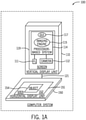
- a computer system 100 which may be used for such purposes as digital image acquisition and processing, includes dual display units: a generally vertically-disposed display unit 110 and a generally horizontally-disposed display unit 150.
- the vertical display unit 110 includes a generally vertically-oriented display screen 119 for displaying icons, graphics, graphical user interface (GUI) images, multimedia content, application-generated images, and so forth.
- the horizontal display unit 150 may contain a generally horizontally-oriented display, or screen 151, for displaying, for example, content similar to that displayed by the vertical display unit 110.
- the vertical display unit 110 and the horizontal display unit 150 horizontal display unit 150 may or may not be physically connected together (via a hinged connection, for example), depending on the particular implementation.
- the vertical display unit 110 may be supported on a vertically extending stand (not shown) that rests on a table, which also supports the horizontal display unit 150.
- the vertical display unit 110 and/or the horizontal display unit 150 may include components of a processor-based system, such as illustrated example processor-based system 114 that is disposed in the vertical display unit 110.
- the processor-based system 110 may be electrically coupled to a built-in camera 112 of the vertical display unit 110.
- the camera 112 is positioned to capture, or acquire, images of objects that are placed on a surface 152, which, for this example, is formed on a region on the display screen 151 of the horizontal display unit 150.
- the surface 152 in general, refers to a surface that has defined boundaries such that an object to be imaged is placed within the boundaries.
- the surface 152 may or not be a surface on a horizontal display unit or even a surface of an electronic device, in accordance with further example implementations.
- the surface 152 may be the surface of a mat or the surface of a table top within a certain predefined rectangular or square region of the table top.
- a user may place a relatively flat, or planar, object 154 (as depicted in an example in Fig. 1A ), such as a photograph or a document, on the surface 152; or the user may place a three-dimensional (3-D) object on the surface 152.
- the imaging of the object 154 may be used for a number of different purposes, such as acquiring a digital image of a 3-D object; storing and/or manipulating a digital image of a photograph; performing optical character recognition (OCR) of a text document or converting a document to a particular format (portable document format (pdf), for example); and so forth.
- OCR optical character recognition
- the user may position the object 154 on the surface 152 and interact with machine executable instructions, or "software," of the system 114 via a GUI (for example) to set up the camera 112 and initiate actions by the camera 112 to acquire image data representing one or multiple pixel images of the object 154.
- the camera 112 generally illuminates the surface 152 (and object 154) during the image capture by triggering an electronic flash unit 111 of the processor-based system 114 to generate a corresponding flash light.
- the flash unit 111 may be part of a projector (not shown) of the system 114; and the camera 112 may trigger the flash light by communicating a general purposes input/output (GPIO) signal to the projector.
- the flash unit 111 may be part of another component other than a projector; may be a standalone unit; may be triggered using other signals; and so forth, depending on the particular implementation.
- the camera 112 activates its electronic shutter to acquire pixel image data in its imager(s).
- the camera 112 contains an image signal processor (ISP) to perform image signal processing on the data; and subsequently, the camera 112 may communicate the processed image data to the processor-based system 114, where the data may be processed to further manipulate the captured image(s).
- ISP image signal processor
- Techniques and systems are disclosed herein for purposes of processing the image data (via post ISP processing by the processor-based system 114, for example) to compensate the image data for non-uniform illumination by the flash light and for purposes of enhancing the image data by applying processing operations that are based on a classified type of the object 154 (e.g., processing operations are selected and performed based on whether the object 154 is classified as being a 3-D object, a photograph or a document).
- a processor-based imaging engine 115 of the system 114 receives pixel image data that is provided by the camera 112 and performs such functions as correcting for non-uniform illumination of the surface 152 by the flash flight; identifying, or classifying the type of the object 154; and selectively performing image processing operations based on classified object type.
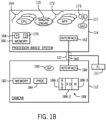
- Fig. 1B depicts an electrical schematic diagram of the computer system 100 in accordance with example implementations.
- the camera 112 may include one or multiple imagers 188.
- the camera 112 includes a red green blue (RGB) imager 188-1 (to capture data representing an RGB image); a 3-D imager 188-2 (to capture data representing a 3-D image); and an infrared (IR) imager 188-3 (to capture data representing an IR image).
- the imaging engine 115 Fig. 1A
- the camera 112 may include one or multiple processing cores 184, the flash light unit 111 and a memory 182.
- the memory 182 may represents the overall system memory of the camera 112 and may, for example, store data indicative of the captured image(s) as well as instructions that are executed by an image signal processor (ISP) 190 of the camera 112.
- ISP image signal processor
- the ISP 190 may perform various functions to enhance the captured image, such as, for example, autowhite balancing, Bayer signal processing, gamma correction, lens distortion compensation, contrast or image sharpening, color matrix processing, lens shading, gamma correction and so forth.
- the camera 112 may further include, as an example, an input/output (I/O) interface 180 (a Universal Serial Bus (USB) interface, for example) 160 that communicates data (over a USB bus, for example) between the camera 112 and a corresponding I/O interface 162 of the processor-based system 114.
- I/O interface 180 of the camera 112 may communicate with the flash unit 111, as described above.
- the processor-based system 114 includes other hardware, such as one or multiple central processing units (CPUs) 164 and a memory 166.
- the memory 166 may contain program instructions 168 for execution by the CPU(s) 164 as well as data 170 (shared image data, image data in intermediate stages of processing, final image data and so forth).
- the processor-based system 114 may include various machine executable instructions, or "software,” such as the imaging engine 115, device drivers, an operating system 173 and various applications 172 (an application to control the setup, image capturing, image processing parameters, and data transfer by the camera 112, as an example).
- the ISP 190 of the camera 112 assumes that the captured image is symmetrical about the camera's optical axis.
- the surface 152 may be disposed at a non-orthogonal angle with respect to the camera's optical axis. Therefore, the surface 152 may not exhibit symmetry about the camera's optical axis, which may result in imperfect illumination uniformity correction by the ISP 190.
- the imaging engine 115 of the processor-based system 114 provides post imaging operations that account for this asymmetry, as well as provides other enhancements, such as classifying the capture object and selecting image processing operations for the specific object type of the captured image.
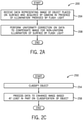
- the image engine 115 performs a technique 200 that is depicted in Fig. 2A .
- the technique 200 includes receiving (block 204) data that represents an image of an object that is placed on a surface and is acquired by a camera in the presence of illumination provided by a flash light of the camera.
- the technique 200 includes performing (block 208) uniformity correction on the data to compensate the image for non-uniform illumination of the surface by the flash light.
- the intensity of light attributable to a given light source is proportional to the inverse of the distance squared from the light source.
- the camera 112 may capture an image 220 of the surface 152 when no object is present.
- the image 220 contains a region 222 in which the surface 152 is generally more illuminated and regions, such as regions 226, in which the surface is less illuminated.
- the imaging engine 115 applies the pixel intensities of the captured image; and for this purpose, the engine 115 may use a model that describes how the flash light illuminates the surface 152.
- a technique 400 includes first capturing an image of the surface 152, without an object being present on the surface 152.
- the method 400 includes receiving (block 404) data representing an image (the "base image") that is captured in the presence of illumination provided by a flash light of a camera when no object is present.
- This captured image allows the non-uniform illumination to be measured and characterized so that compensation may be applied to future images containing captured objects.
- coefficients are determined (block 408) for a polynomial model that describes the illumination uniformity of the captured base image.
- a polynomial model that describes the illumination uniformity of the captured base image.
- least squares-based fitting may be used to determine the coefficients of the polynomial function that describes the illumination.
- an inverse of the model may then be determined for purposes of guiding the non-uniform illumination compensation.
- the technique 400 includes determining (block 412) a model for the compensation (an inverse of the determined polynomial model, for example) to be applied to future image data to correct for the non-uniform illumination.
- the imaging engine 115 applies post processing applications to the captured image data based on an identified, or classified, object type.
- the object identification and applied operators occur, in accordance with example implementations, after the illumination uniformity compensation.
- certain image processing operations depend on the type of object that is captured. For example, for a document, operations may be applied to sharpen, or increase the contrast, of the image so that the black text of the image is darkened and the lighter portions of the image are converted into a "page white" color.
- document processing may involve snapping the corners of the document to fit a rectangular page profile.
- shadow compensation may be applied to brighten dark regions of the image.
- specular compensation may be applied to soften "hot spots" of the image, such as, for example, regions of the image, which are saturated with the red color.
- degree of white enhancement as well as an amount of saturation boost to be added, may be determined.
- a technique 250 includes identifying (block 254) an object type associated with an object contained in an image and processing (block 258) the image based at least in part on the identified object type.
- the image is processed to classify the object as belonging to a given object type out of a plurality of candidate object types, such as object types associated with a photograph, a document, a 3-D object, and so forth.
- the imaging engine 115 may perform a technique 300 that is depicted in Fig. 3 .
- the technique 300 includes receiving image data from an image signal processor (ISP), where the received image data is derived by capturing at least one image of an object that is placed on a surface.
- ISP image signal processor
- the imaging engine 115 may process the image data to perform autowhite balancing, pursuant to block 306.
- the imaging engine 115 may perform (block 308) illumination uniformity correction on the received image.
- the imaging engine identifies an object type, pursuant to block 312.
- the engine 115 processes the image data (block 316) to perform a 3-D object enhancement.
- the imaging engine 115 processes (block 320) the image data to perform photograph enhancement for the image.
- the imaging engine 115 processes (block 324) image data to perform document enhancement for the image.
- the imaging engine 115 saves (block 328) the resulting final image data.
- the imaging engine 115 performs a technique 500 for purposes of identifying the object type.
- the imaging engine 115 determines (decision block 504), based on the 3-D image, whether the object lies in a plane. If so, then the object is either a document or a photograph. Otherwise, the engine 115 determines (decision block 508) whether the object is sufficiently tall.
- the captured image may be associated with a certain level of noise such that an image of an entirely planar object may appear to have some height variations, and as such, may incorrectly be perceived as being non-planar.
- the imaging engine 115 compensates for the noise, as the engine 115 compares the measured height of the object to a threshold that accounts for the presence of noise; and based on this comparison, the imaging engine 115 determines whether to classify the object as being planar (the measured height is below the threshold, for example) or classify (block 512) the object as being a 3-D object (the measured height is at or above the threshold, for example).
- the imaging engine 115 determines that the object is planar, then the imaging engine 115 applies further processing operations, in accordance with example implementations, for purposes of determining whether the object is a photograph, document or another object type. More specifically, pursuant to the technique 500, the imaging engine 115 determines (block 516) whether edges are identified in the infrared (IR) and red green blue (RGB) images that are acquired by the camera 112.
- IR infrared
- RGB red green blue
- the imaging engine 115 then combines (block 520) the identified edges in the IR and RGB images, such as through a union operation, to derive a composite image that reveals all of the identified edges. If the imaging engine 115 determines (decision block 524) that a rectangular perimeter is present in this composite image, then the imaging engine 115 applies further tests to discriminate between a photograph and a document. Otherwise, the imaging engine 115 classifies (block 544) the object as belonging to a class associated with a planar object that is neither a photograph nor a document.
- the imaging engine 115 analyzes (block 528) such factors as pixel intensities, intensity gradients and the color of the image; and based on this analysis, the imaging engine 115 determines (decision block 532) whether a photograph has been identified. If so, the imaging engine 115 classifies the object as belonging to the photograph class, pursuant to block 536. Otherwise, the imaging engine 115 classifies (block 540) the object as belonging to the document class.
- a user may guide the specific post processing operations that are applied by the imaging engine 115.
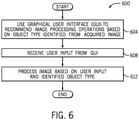
- the imaging engine 115 uses (block 604) a graphical user interface (GUI) 117 (see Fig. 1A ) to recommend image processing operations based on the identified object type. For example, based on the identified object type, the imaging engine 115 may recommend a certain set of filters to be applied to the image so that the user may then elect whether to accept recommended application of filters, reject the recommended application of filters, or modify the filtering (select different parameters for a given recommended filter, add another filter to be applied, reject a recommend filter, and so forth).
- GUI graphical user interface
- the imaging engine 115 receives (block 608) user input; and this input may be used to allow all of the recommended post processing operations to be applied; to restrict the set of the recommended post processing operations to be applied; to cancel one or multiple post processing operations; to select additional post processing operations that are not recommended; to modify parameters of selected post processing operations; and so forth.
- the technique 600 includes processing the image based on the user input and the identified object type, pursuant to block 612.
Landscapes
- Engineering & Computer Science (AREA)
- Physics & Mathematics (AREA)
- Multimedia (AREA)
- General Physics & Mathematics (AREA)
- Theoretical Computer Science (AREA)
- Computer Vision & Pattern Recognition (AREA)
- Artificial Intelligence (AREA)
- Signal Processing (AREA)
- Software Systems (AREA)
- Computer Graphics (AREA)
- Geometry (AREA)
- Studio Devices (AREA)
- Image Processing (AREA)
Claims (4)
- Verfahren, das Folgendes umfasst:Empfangen erster Daten, die ein Bild darstellen, das in der Gegenwart von Beleuchtung, die durch ein Blitzlicht bereitgestellt wird, aufgenommen wird;unter Verwendung einer Anpassung auf der Basis kleinster Quadrate, Bestimmen von Koeffizienten eines Polynommodells, das die Beleuchtung durch das Blitzlicht auf der Basis der ersten Daten darstellt;Empfangen zweiter Daten, die ein Bild darstellen, das von einem Objekt, das auf einer Oberfläche angeordnet ist, in der Gegenwart von Beleuchtung durch das Blitzlicht aufgenommen wird;Verarbeiten der zweiten Daten in einem prozessorbasierten Rechensystem, um eine Objektart zu identifizieren, die dem Objekt zugeordnet ist, und weiteres Verarbeiten der zweiten Daten, wenigstens teilweise auf der Basis der identifizierten Objektart; undVerarbeiten der zweiten Daten, um das Bild für eine ungleichmäßige Beleuchtung der Oberfläche durch das Blitzlicht zu kompensieren,wobei das Verarbeiten der zweiten Daten, um für die ungleichmäßige Beleuchtung zu kompensieren, das Kompensieren von Intensitätswerten des Bildes wenigstens teilweise auf der Basis des Polynommodells umfasst, das die Beleuchtung der Oberfläche durch das Blitzlicht darstellt; dadurch gekennzeichnet, dass das Bild, das durch die ersten Daten dargestellt wird, ein Bild der Oberfläche ist, wenn kein Objekt auf der Oberfläche gegenwärtig ist.
- Verfahren nach Anspruch 1, wobei das Empfangen das Empfangen der ersten und zweiten Daten von der Kamera umfasst.
- System (100), das Folgendes umfasst:ein Blitzlicht (111), um eine Oberfläche (152) zu beleuchten;eine Kamera (112), um ein Bild der Oberfläche (152) in der Gegenwart einer Beleuchtung, die durch das Blitzlicht (111) bereitgestellt wird, zu erfassen, wenn kein Objekt auf der Oberfläche (152) gegenwärtig ist, und um ein Bild eines Objekts, das auf der Oberfläche (152) angeordnet ist, in der Gegenwart von Beleuchtung durch das Blitzlicht (111) zu erfassen; undeine prozessorbasierte Maschine (119) für Folgendes:Verarbeiten zweiter Daten, die das Bild darstellen, das von dem Objekt, das auf der Oberfläche (152) angeordnet ist, in der Gegenwart von Beleuchtung durch das Blitzlicht (111) aufgenommen wird, um eine Objektart, die dem Objekt zugeordnet ist, zu identifizieren, und ferner Verarbeiten der zweiten Daten wenigstens teilweise auf der Basis der identifizierten Objektart;unter Verwendung der Anpassung auf der Basis kleinster Quadrate, Bestimmen von Koeffizienten eines Polynommodells, das die Beleuchtung der Oberfläche (152) durch das Blitzlicht (111) auf der Basis der ersten Daten darstellt, die das Bild darstellen, das von der Oberfläche (152) in der Gegenwart von Beleuchtung, die durch das Blitzlicht (111) bereitgestellt wird, wenn kein Objekt auf der Oberfläche (152) gegenwärtig ist, aufgenommen wird; undVerarbeiten der zweiten Daten, um das Bild für die ungleichmäßige Beleuchtung der Oberfläche (152) durch das Blitzlicht (111) zu kompensieren, durch Kompensieren von Intensitätswerten des Bildes wenigstens teilweise auf der Basis des Polynommodells, das die Beleuchtung der Oberfläche durch das Blitzlicht darstellt.
- System (100) nach Anspruch 3, wobei die Maschine (119) die zweiten Daten verarbeitet, um ein Umgebungslicht zu kompensieren.
Applications Claiming Priority (1)
| Application Number | Priority Date | Filing Date | Title |
|---|---|---|---|
| PCT/US2014/049308 WO2016018419A1 (en) | 2014-07-31 | 2014-07-31 | Processing data representing an image |
Publications (3)
| Publication Number | Publication Date |
|---|---|
| EP3175609A1 EP3175609A1 (de) | 2017-06-07 |
| EP3175609A4 EP3175609A4 (de) | 2018-09-26 |
| EP3175609B1 true EP3175609B1 (de) | 2022-02-23 |
Family
ID=55218133
Family Applications (1)
| Application Number | Title | Priority Date | Filing Date |
|---|---|---|---|
| EP14898980.9A Not-in-force EP3175609B1 (de) | 2014-07-31 | 2014-07-31 | Verarbeitung von daten zur darstellung eines bildes |
Country Status (4)
| Country | Link |
|---|---|
| US (1) | US10666840B2 (de) |
| EP (1) | EP3175609B1 (de) |
| CN (1) | CN106797420B (de) |
| WO (1) | WO2016018419A1 (de) |
Families Citing this family (3)
| Publication number | Priority date | Publication date | Assignee | Title |
|---|---|---|---|---|
| TWI688502B (zh) * | 2018-02-14 | 2020-03-21 | 先進光電科技股份有限公司 | 用於警告車輛障礙物的設備 |
| JP2020144612A (ja) * | 2019-03-06 | 2020-09-10 | 日本電信電話株式会社 | ラベリング支援方法、ラベリング支援装置及びプログラム |
| US10841482B1 (en) * | 2019-05-23 | 2020-11-17 | International Business Machines Corporation | Recommending camera settings for publishing a photograph based on identified substance |
Citations (1)
| Publication number | Priority date | Publication date | Assignee | Title |
|---|---|---|---|---|
| US20070159655A1 (en) * | 2006-01-11 | 2007-07-12 | Lexmark International, Inc. | Method and apparatus for compensating two-dimensional images for illumination non-uniformities |
Family Cites Families (29)
| Publication number | Priority date | Publication date | Assignee | Title |
|---|---|---|---|---|
| US5758049A (en) | 1992-05-01 | 1998-05-26 | International Business Machines Corporation | Method of and apparatus for providing automatic detection and processing of an empty multimedia data object |
| US5831748A (en) * | 1994-12-19 | 1998-11-03 | Minolta Co., Ltd. | Image processor |
| JPH10210266A (ja) * | 1997-01-22 | 1998-08-07 | Minolta Co Ltd | 画像読み取り装置 |
| US6771838B1 (en) | 2000-10-06 | 2004-08-03 | Hewlett-Packard Development Company, L.P. | System and method for enhancing document images |
| JP4012710B2 (ja) * | 2001-02-14 | 2007-11-21 | 株式会社リコー | 画像入力装置 |
| GB2372392A (en) | 2001-02-16 | 2002-08-21 | Hewlett Packard Co | Improvements to image capture |
| US7053939B2 (en) | 2001-10-17 | 2006-05-30 | Hewlett-Packard Development Company, L.P. | Automatic document detection method and system |
| US7710391B2 (en) | 2002-05-28 | 2010-05-04 | Matthew Bell | Processing an image utilizing a spatially varying pattern |
| US20050078092A1 (en) | 2003-10-08 | 2005-04-14 | Clapper Edward O. | Whiteboard desk projection display |
| CN1300744C (zh) | 2003-12-09 | 2007-02-14 | 香港中文大学 | 对数字图像曝光不足的缺陷进行自动修正的方法和系统 |
| JP2006074512A (ja) | 2004-09-02 | 2006-03-16 | Casio Comput Co Ltd | 撮影装置、撮影装置の画像処理方法及びプログラム |
| US7324703B2 (en) | 2004-11-05 | 2008-01-29 | Hewlett-Packard Development Company, L.P. | Method and system for correcting the effect of non-uniform illumination |
| JP4701774B2 (ja) | 2005-03-24 | 2011-06-15 | カシオ計算機株式会社 | 撮影装置、画像撮影方法及び画像撮影プログラム |
| US7599561B2 (en) | 2006-02-28 | 2009-10-06 | Microsoft Corporation | Compact interactive tabletop with projection-vision |
| US8259179B2 (en) * | 2006-05-15 | 2012-09-04 | Csr Technology Inc. | Compensating for non-uniform illumination of object fields captured by a camera |
| US20080018591A1 (en) | 2006-07-20 | 2008-01-24 | Arkady Pittel | User Interfacing |
| US8199117B2 (en) | 2007-05-09 | 2012-06-12 | Microsoft Corporation | Archive for physical and digital objects |
| JP5045538B2 (ja) | 2008-05-02 | 2012-10-10 | カシオ計算機株式会社 | 撮像装置、及び、プログラム |
| US8121640B2 (en) | 2009-03-19 | 2012-02-21 | Microsoft Corporation | Dual module portable devices |
| US8270733B2 (en) | 2009-08-31 | 2012-09-18 | Behavioral Recognition Systems, Inc. | Identifying anomalous object types during classification |
| TWI423096B (zh) | 2010-04-01 | 2014-01-11 | Compal Communication Inc | 具可觸控投影畫面之投影系統 |
| US8736583B2 (en) | 2011-03-29 | 2014-05-27 | Intel Corporation | Virtual links between different displays to present a single virtual object |
| JP2013009304A (ja) | 2011-05-20 | 2013-01-10 | Ricoh Co Ltd | 画像入力装置、会議装置、画像処理制御プログラム、記録媒体 |
| US8554011B2 (en) | 2011-06-07 | 2013-10-08 | Microsoft Corporation | Automatic exposure correction of images |
| US9521276B2 (en) * | 2011-08-02 | 2016-12-13 | Hewlett-Packard Development Company, L.P. | Portable projection capture device |
| US20130080932A1 (en) | 2011-09-27 | 2013-03-28 | Sanjiv Sirpal | Secondary single screen mode activation through user interface toggle |
| US9286678B2 (en) | 2011-12-28 | 2016-03-15 | Pelco, Inc. | Camera calibration using feature identification |
| US9667883B2 (en) * | 2013-01-07 | 2017-05-30 | Eminent Electronic Technology Corp. Ltd. | Three-dimensional image sensing device and method of sensing three-dimensional images |
| US9633462B2 (en) * | 2014-05-09 | 2017-04-25 | Google Inc. | Providing pre-edits for photos |
-
2014
- 2014-07-31 EP EP14898980.9A patent/EP3175609B1/de not_active Not-in-force
- 2014-07-31 WO PCT/US2014/049308 patent/WO2016018419A1/en not_active Ceased
- 2014-07-31 CN CN201480082306.4A patent/CN106797420B/zh not_active Expired - Fee Related
- 2014-07-31 US US15/500,561 patent/US10666840B2/en not_active Expired - Fee Related
Patent Citations (1)
| Publication number | Priority date | Publication date | Assignee | Title |
|---|---|---|---|---|
| US20070159655A1 (en) * | 2006-01-11 | 2007-07-12 | Lexmark International, Inc. | Method and apparatus for compensating two-dimensional images for illumination non-uniformities |
Non-Patent Citations (1)
| Title |
|---|
| "Image Processing: The Fundamentals", 9 April 2010, JOHN WILEY & SONS, LTD, ISBN: 978-0-470-74586-1, article MARIA PETROU ET AL: "Section 4.3: Reducing low frequency interference", pages: 351 - 366, XP055656517, DOI: 10.1002/9781119994398 * |
Also Published As
| Publication number | Publication date |
|---|---|
| US10666840B2 (en) | 2020-05-26 |
| CN106797420B (zh) | 2020-06-12 |
| EP3175609A4 (de) | 2018-09-26 |
| WO2016018419A1 (en) | 2016-02-04 |
| CN106797420A (zh) | 2017-05-31 |
| US20170223235A1 (en) | 2017-08-03 |
| EP3175609A1 (de) | 2017-06-07 |
Similar Documents
| Publication | Publication Date | Title |
|---|---|---|
| KR101662846B1 (ko) | 아웃 포커싱 촬영에서 빛망울 효과를 생성하기 위한 장치 및 방법 | |
| CN108111749B (zh) | 图像处理方法和装置 | |
| WO2019085951A1 (en) | Image processing method, and device | |
| US10015374B2 (en) | Image capturing apparatus and photo composition method thereof | |
| WO2019233264A1 (zh) | 图像处理方法、计算机可读存储介质和电子设备 | |
| CN107862663A (zh) | 图像处理方法、装置、可读存储介质和计算机设备 | |
| JP6755787B2 (ja) | 画像処理装置、画像処理方法およびプログラム | |
| CN106604005B (zh) | 一种投影电视自动对焦方法及系统 | |
| CN111368819B (zh) | 光斑检测方法和装置 | |
| CN114764779A (zh) | 运算装置及用于近眼显示装置的缺陷检测方法 | |
| CN107172354A (zh) | 视频处理方法、装置、电子设备及存储介质 | |
| CN107018407B (zh) | 信息处理装置、评价用图、评价系统、以及性能评价方法 | |
| CN107465903A (zh) | 图像白平衡方法、装置和计算机可读存储介质 | |
| CN105389809A (zh) | 显示性能测试方法、系统和装置 | |
| CN110879131B (zh) | 目视光学系统的成像质量测试方法、成像质量测试装置和电子设备 | |
| TW201730813A (zh) | 具有深度資訊之影像處理方法及其電腦程式產品 | |
| WO2012008116A1 (en) | Image processing apparatus, image processing method, and program | |
| CN105701809A (zh) | 一种基于线阵相机扫描的平场校正方法 | |
| EP3175609B1 (de) | Verarbeitung von daten zur darstellung eines bildes | |
| CN108574796B (zh) | 针对计算机视觉应用而优化的数字相机方法和设备 | |
| CN113936017B (zh) | 图像处理方法及装置 | |
| CN104966060A (zh) | 一种运动物体的目标识别方法和装置 | |
| US20160275345A1 (en) | Camera systems with enhanced document capture | |
| TWI620147B (zh) | 用於合成人物的影像合成方法 | |
| JP6508617B2 (ja) | 画像読取装置、画像読取方法及び画像読取プログラム |
Legal Events
| Date | Code | Title | Description |
|---|---|---|---|
| STAA | Information on the status of an ep patent application or granted ep patent |
Free format text: STATUS: THE INTERNATIONAL PUBLICATION HAS BEEN MADE |
|
| 17P | Request for examination filed |
Effective date: 20170127 |
|
| AK | Designated contracting states |
Kind code of ref document: A1 Designated state(s): AL AT BE BG CH CY CZ DE DK EE ES FI FR GB GR HR HU IE IS IT LI LT LU LV MC MK MT NL NO PL PT RO RS SE SI SK SM TR |
|
| AX | Request for extension of the european patent |
Extension state: BA ME |
|
| PUAI | Public reference made under article 153(3) epc to a published international application that has entered the european phase |
Free format text: ORIGINAL CODE: 0009012 |
|
| STAA | Information on the status of an ep patent application or granted ep patent |
Free format text: STATUS: REQUEST FOR EXAMINATION WAS MADE |
|
| DAX | Request for extension of the european patent (deleted) | ||
| RIC1 | Information provided on ipc code assigned before grant |
Ipc: G06T 1/00 20060101ALI20180219BHEP Ipc: G06K 9/20 20060101ALI20180219BHEP Ipc: H04N 5/341 20110101ALI20180219BHEP Ipc: G06K 9/00 20060101ALI20180219BHEP Ipc: G06K 9/46 20060101ALI20180219BHEP Ipc: G06F 1/16 20060101ALI20180219BHEP Ipc: H04N 7/01 20060101ALI20180219BHEP Ipc: H04N 5/225 20060101ALI20180219BHEP Ipc: H04N 1/387 20060101AFI20180219BHEP |
|
| RIC1 | Information provided on ipc code assigned before grant |
Ipc: H04N 5/225 20060101ALI20180814BHEP Ipc: G06F 1/16 20060101ALI20180814BHEP Ipc: H04N 7/01 20060101ALI20180814BHEP Ipc: G06K 9/00 20060101ALI20180814BHEP Ipc: H04N 5/341 20110101ALI20180814BHEP Ipc: G06K 9/46 20060101ALI20180814BHEP Ipc: G06K 9/20 20060101ALI20180814BHEP Ipc: G06T 1/00 20060101ALI20180814BHEP Ipc: H04N 1/387 20060101AFI20180814BHEP |
|
| A4 | Supplementary search report drawn up and despatched |
Effective date: 20180828 |
|
| RIC1 | Information provided on ipc code assigned before grant |
Ipc: G06K 9/00 20060101ALI20180822BHEP Ipc: H04N 5/341 20110101ALI20180822BHEP Ipc: G06K 9/46 20060101ALI20180822BHEP Ipc: G06K 9/20 20060101ALI20180822BHEP Ipc: H04N 5/225 20060101ALI20180822BHEP Ipc: H04N 7/01 20060101ALI20180822BHEP Ipc: G06F 1/16 20060101ALI20180822BHEP Ipc: G06T 1/00 20060101ALI20180822BHEP Ipc: H04N 1/387 20060101AFI20180822BHEP |
|
| RAP1 | Party data changed (applicant data changed or rights of an application transferred) |
Owner name: HEWLETT-PACKARD DEVELOPMENT COMPANY, L.P. |
|
| STAA | Information on the status of an ep patent application or granted ep patent |
Free format text: STATUS: EXAMINATION IS IN PROGRESS |
|
| 17Q | First examination report despatched |
Effective date: 20200117 |
|
| GRAP | Despatch of communication of intention to grant a patent |
Free format text: ORIGINAL CODE: EPIDOSNIGR1 |
|
| STAA | Information on the status of an ep patent application or granted ep patent |
Free format text: STATUS: GRANT OF PATENT IS INTENDED |
|
| INTG | Intention to grant announced |
Effective date: 20211020 |
|
| GRAS | Grant fee paid |
Free format text: ORIGINAL CODE: EPIDOSNIGR3 |
|
| GRAA | (expected) grant |
Free format text: ORIGINAL CODE: 0009210 |
|
| STAA | Information on the status of an ep patent application or granted ep patent |
Free format text: STATUS: THE PATENT HAS BEEN GRANTED |
|
| AK | Designated contracting states |
Kind code of ref document: B1 Designated state(s): AL AT BE BG CH CY CZ DE DK EE ES FI FR GB GR HR HU IE IS IT LI LT LU LV MC MK MT NL NO PL PT RO RS SE SI SK SM TR |
|
| REG | Reference to a national code |
Ref country code: GB Ref legal event code: FG4D |
|
| REG | Reference to a national code |
Ref country code: CH Ref legal event code: EP |
|
| REG | Reference to a national code |
Ref country code: AT Ref legal event code: REF Ref document number: 1471361 Country of ref document: AT Kind code of ref document: T Effective date: 20220315 |
|
| REG | Reference to a national code |
Ref country code: IE Ref legal event code: FG4D |
|
| REG | Reference to a national code |
Ref country code: DE Ref legal event code: R096 Ref document number: 602014082631 Country of ref document: DE |
|
| REG | Reference to a national code |
Ref country code: LT Ref legal event code: MG9D |
|
| REG | Reference to a national code |
Ref country code: NL Ref legal event code: MP Effective date: 20220223 |
|
| REG | Reference to a national code |
Ref country code: AT Ref legal event code: MK05 Ref document number: 1471361 Country of ref document: AT Kind code of ref document: T Effective date: 20220223 |
|
| PG25 | Lapsed in a contracting state [announced via postgrant information from national office to epo] |
Ref country code: SE Free format text: LAPSE BECAUSE OF FAILURE TO SUBMIT A TRANSLATION OF THE DESCRIPTION OR TO PAY THE FEE WITHIN THE PRESCRIBED TIME-LIMIT Effective date: 20220223 Ref country code: RS Free format text: LAPSE BECAUSE OF FAILURE TO SUBMIT A TRANSLATION OF THE DESCRIPTION OR TO PAY THE FEE WITHIN THE PRESCRIBED TIME-LIMIT Effective date: 20220223 Ref country code: PT Free format text: LAPSE BECAUSE OF FAILURE TO SUBMIT A TRANSLATION OF THE DESCRIPTION OR TO PAY THE FEE WITHIN THE PRESCRIBED TIME-LIMIT Effective date: 20220623 Ref country code: NO Free format text: LAPSE BECAUSE OF FAILURE TO SUBMIT A TRANSLATION OF THE DESCRIPTION OR TO PAY THE FEE WITHIN THE PRESCRIBED TIME-LIMIT Effective date: 20220523 Ref country code: NL Free format text: LAPSE BECAUSE OF FAILURE TO SUBMIT A TRANSLATION OF THE DESCRIPTION OR TO PAY THE FEE WITHIN THE PRESCRIBED TIME-LIMIT Effective date: 20220223 Ref country code: LT Free format text: LAPSE BECAUSE OF FAILURE TO SUBMIT A TRANSLATION OF THE DESCRIPTION OR TO PAY THE FEE WITHIN THE PRESCRIBED TIME-LIMIT Effective date: 20220223 Ref country code: HR Free format text: LAPSE BECAUSE OF FAILURE TO SUBMIT A TRANSLATION OF THE DESCRIPTION OR TO PAY THE FEE WITHIN THE PRESCRIBED TIME-LIMIT Effective date: 20220223 Ref country code: ES Free format text: LAPSE BECAUSE OF FAILURE TO SUBMIT A TRANSLATION OF THE DESCRIPTION OR TO PAY THE FEE WITHIN THE PRESCRIBED TIME-LIMIT Effective date: 20220223 Ref country code: BG Free format text: LAPSE BECAUSE OF FAILURE TO SUBMIT A TRANSLATION OF THE DESCRIPTION OR TO PAY THE FEE WITHIN THE PRESCRIBED TIME-LIMIT Effective date: 20220523 |
|
| PG25 | Lapsed in a contracting state [announced via postgrant information from national office to epo] |
Ref country code: PL Free format text: LAPSE BECAUSE OF FAILURE TO SUBMIT A TRANSLATION OF THE DESCRIPTION OR TO PAY THE FEE WITHIN THE PRESCRIBED TIME-LIMIT Effective date: 20220223 Ref country code: LV Free format text: LAPSE BECAUSE OF FAILURE TO SUBMIT A TRANSLATION OF THE DESCRIPTION OR TO PAY THE FEE WITHIN THE PRESCRIBED TIME-LIMIT Effective date: 20220223 Ref country code: GR Free format text: LAPSE BECAUSE OF FAILURE TO SUBMIT A TRANSLATION OF THE DESCRIPTION OR TO PAY THE FEE WITHIN THE PRESCRIBED TIME-LIMIT Effective date: 20220524 Ref country code: FI Free format text: LAPSE BECAUSE OF FAILURE TO SUBMIT A TRANSLATION OF THE DESCRIPTION OR TO PAY THE FEE WITHIN THE PRESCRIBED TIME-LIMIT Effective date: 20220223 Ref country code: AT Free format text: LAPSE BECAUSE OF FAILURE TO SUBMIT A TRANSLATION OF THE DESCRIPTION OR TO PAY THE FEE WITHIN THE PRESCRIBED TIME-LIMIT Effective date: 20220223 |
|
| PG25 | Lapsed in a contracting state [announced via postgrant information from national office to epo] |
Ref country code: IS Free format text: LAPSE BECAUSE OF FAILURE TO SUBMIT A TRANSLATION OF THE DESCRIPTION OR TO PAY THE FEE WITHIN THE PRESCRIBED TIME-LIMIT Effective date: 20220623 |
|
| PG25 | Lapsed in a contracting state [announced via postgrant information from national office to epo] |
Ref country code: SM Free format text: LAPSE BECAUSE OF FAILURE TO SUBMIT A TRANSLATION OF THE DESCRIPTION OR TO PAY THE FEE WITHIN THE PRESCRIBED TIME-LIMIT Effective date: 20220223 Ref country code: SK Free format text: LAPSE BECAUSE OF FAILURE TO SUBMIT A TRANSLATION OF THE DESCRIPTION OR TO PAY THE FEE WITHIN THE PRESCRIBED TIME-LIMIT Effective date: 20220223 Ref country code: RO Free format text: LAPSE BECAUSE OF FAILURE TO SUBMIT A TRANSLATION OF THE DESCRIPTION OR TO PAY THE FEE WITHIN THE PRESCRIBED TIME-LIMIT Effective date: 20220223 Ref country code: EE Free format text: LAPSE BECAUSE OF FAILURE TO SUBMIT A TRANSLATION OF THE DESCRIPTION OR TO PAY THE FEE WITHIN THE PRESCRIBED TIME-LIMIT Effective date: 20220223 Ref country code: DK Free format text: LAPSE BECAUSE OF FAILURE TO SUBMIT A TRANSLATION OF THE DESCRIPTION OR TO PAY THE FEE WITHIN THE PRESCRIBED TIME-LIMIT Effective date: 20220223 Ref country code: CZ Free format text: LAPSE BECAUSE OF FAILURE TO SUBMIT A TRANSLATION OF THE DESCRIPTION OR TO PAY THE FEE WITHIN THE PRESCRIBED TIME-LIMIT Effective date: 20220223 |
|
| PGFP | Annual fee paid to national office [announced via postgrant information from national office to epo] |
Ref country code: DE Payment date: 20220621 Year of fee payment: 9 |
|
| REG | Reference to a national code |
Ref country code: DE Ref legal event code: R097 Ref document number: 602014082631 Country of ref document: DE |
|
| PG25 | Lapsed in a contracting state [announced via postgrant information from national office to epo] |
Ref country code: AL Free format text: LAPSE BECAUSE OF FAILURE TO SUBMIT A TRANSLATION OF THE DESCRIPTION OR TO PAY THE FEE WITHIN THE PRESCRIBED TIME-LIMIT Effective date: 20220223 |
|
| PLBE | No opposition filed within time limit |
Free format text: ORIGINAL CODE: 0009261 |
|
| STAA | Information on the status of an ep patent application or granted ep patent |
Free format text: STATUS: NO OPPOSITION FILED WITHIN TIME LIMIT |
|
| 26N | No opposition filed |
Effective date: 20221124 |
|
| PG25 | Lapsed in a contracting state [announced via postgrant information from national office to epo] |
Ref country code: SI Free format text: LAPSE BECAUSE OF FAILURE TO SUBMIT A TRANSLATION OF THE DESCRIPTION OR TO PAY THE FEE WITHIN THE PRESCRIBED TIME-LIMIT Effective date: 20220223 Ref country code: MC Free format text: LAPSE BECAUSE OF FAILURE TO SUBMIT A TRANSLATION OF THE DESCRIPTION OR TO PAY THE FEE WITHIN THE PRESCRIBED TIME-LIMIT Effective date: 20220223 |
|
| REG | Reference to a national code |
Ref country code: CH Ref legal event code: PL |
|
| GBPC | Gb: european patent ceased through non-payment of renewal fee |
Effective date: 20220731 |
|
| REG | Reference to a national code |
Ref country code: BE Ref legal event code: MM Effective date: 20220731 |
|
| PG25 | Lapsed in a contracting state [announced via postgrant information from national office to epo] |
Ref country code: LU Free format text: LAPSE BECAUSE OF NON-PAYMENT OF DUE FEES Effective date: 20220731 Ref country code: LI Free format text: LAPSE BECAUSE OF NON-PAYMENT OF DUE FEES Effective date: 20220731 Ref country code: FR Free format text: LAPSE BECAUSE OF NON-PAYMENT OF DUE FEES Effective date: 20220731 Ref country code: CH Free format text: LAPSE BECAUSE OF NON-PAYMENT OF DUE FEES Effective date: 20220731 |
|
| PG25 | Lapsed in a contracting state [announced via postgrant information from national office to epo] |
Ref country code: GB Free format text: LAPSE BECAUSE OF NON-PAYMENT OF DUE FEES Effective date: 20220731 Ref country code: BE Free format text: LAPSE BECAUSE OF NON-PAYMENT OF DUE FEES Effective date: 20220731 |
|
| PG25 | Lapsed in a contracting state [announced via postgrant information from national office to epo] |
Ref country code: IT Free format text: LAPSE BECAUSE OF FAILURE TO SUBMIT A TRANSLATION OF THE DESCRIPTION OR TO PAY THE FEE WITHIN THE PRESCRIBED TIME-LIMIT Effective date: 20220223 Ref country code: IE Free format text: LAPSE BECAUSE OF NON-PAYMENT OF DUE FEES Effective date: 20220731 |
|
| REG | Reference to a national code |
Ref country code: DE Ref legal event code: R119 Ref document number: 602014082631 Country of ref document: DE |
|
| PG25 | Lapsed in a contracting state [announced via postgrant information from national office to epo] |
Ref country code: HU Free format text: LAPSE BECAUSE OF FAILURE TO SUBMIT A TRANSLATION OF THE DESCRIPTION OR TO PAY THE FEE WITHIN THE PRESCRIBED TIME-LIMIT; INVALID AB INITIO Effective date: 20140731 |
|
| PG25 | Lapsed in a contracting state [announced via postgrant information from national office to epo] |
Ref country code: MK Free format text: LAPSE BECAUSE OF FAILURE TO SUBMIT A TRANSLATION OF THE DESCRIPTION OR TO PAY THE FEE WITHIN THE PRESCRIBED TIME-LIMIT Effective date: 20220223 Ref country code: DE Free format text: LAPSE BECAUSE OF NON-PAYMENT OF DUE FEES Effective date: 20240201 Ref country code: CY Free format text: LAPSE BECAUSE OF FAILURE TO SUBMIT A TRANSLATION OF THE DESCRIPTION OR TO PAY THE FEE WITHIN THE PRESCRIBED TIME-LIMIT Effective date: 20220223 |
|
| PG25 | Lapsed in a contracting state [announced via postgrant information from national office to epo] |
Ref country code: TR Free format text: LAPSE BECAUSE OF FAILURE TO SUBMIT A TRANSLATION OF THE DESCRIPTION OR TO PAY THE FEE WITHIN THE PRESCRIBED TIME-LIMIT Effective date: 20220223 |
|
| PG25 | Lapsed in a contracting state [announced via postgrant information from national office to epo] |
Ref country code: MT Free format text: LAPSE BECAUSE OF FAILURE TO SUBMIT A TRANSLATION OF THE DESCRIPTION OR TO PAY THE FEE WITHIN THE PRESCRIBED TIME-LIMIT Effective date: 20220223 |