EP3173870A2 - Image forming apparatus - Google Patents
Image forming apparatus Download PDFInfo
- Publication number
- EP3173870A2 EP3173870A2 EP16199904.0A EP16199904A EP3173870A2 EP 3173870 A2 EP3173870 A2 EP 3173870A2 EP 16199904 A EP16199904 A EP 16199904A EP 3173870 A2 EP3173870 A2 EP 3173870A2
- Authority
- EP
- European Patent Office
- Prior art keywords
- image
- color material
- sheet
- text
- image data
- Prior art date
- Legal status (The legal status is an assumption and is not a legal conclusion. Google has not performed a legal analysis and makes no representation as to the accuracy of the status listed.)
- Withdrawn
Links
Images

Classifications
-
- H—ELECTRICITY
- H04—ELECTRIC COMMUNICATION TECHNIQUE
- H04N—PICTORIAL COMMUNICATION, e.g. TELEVISION
- H04N1/00—Scanning, transmission or reproduction of documents or the like, e.g. facsimile transmission; Details thereof
- H04N1/00795—Reading arrangements
- H04N1/00798—Circuits or arrangements for the control thereof, e.g. using a programmed control device or according to a measured quantity
- H04N1/00801—Circuits or arrangements for the control thereof, e.g. using a programmed control device or according to a measured quantity according to characteristics of the original
-
- G—PHYSICS
- G03—PHOTOGRAPHY; CINEMATOGRAPHY; ANALOGOUS TECHNIQUES USING WAVES OTHER THAN OPTICAL WAVES; ELECTROGRAPHY; HOLOGRAPHY
- G03G—ELECTROGRAPHY; ELECTROPHOTOGRAPHY; MAGNETOGRAPHY
- G03G15/00—Apparatus for electrographic processes using a charge pattern
- G03G15/50—Machine control of apparatus for electrographic processes using a charge pattern, e.g. regulating differents parts of the machine, multimode copiers, microprocessor control
- G03G15/5062—Machine control of apparatus for electrographic processes using a charge pattern, e.g. regulating differents parts of the machine, multimode copiers, microprocessor control by measuring the characteristics of an image on the copy material
-
- G—PHYSICS
- G03—PHOTOGRAPHY; CINEMATOGRAPHY; ANALOGOUS TECHNIQUES USING WAVES OTHER THAN OPTICAL WAVES; ELECTROGRAPHY; HOLOGRAPHY
- G03G—ELECTROGRAPHY; ELECTROPHOTOGRAPHY; MAGNETOGRAPHY
- G03G15/00—Apparatus for electrographic processes using a charge pattern
- G03G15/01—Apparatus for electrographic processes using a charge pattern for producing multicoloured copies
-
- G—PHYSICS
- G03—PHOTOGRAPHY; CINEMATOGRAPHY; ANALOGOUS TECHNIQUES USING WAVES OTHER THAN OPTICAL WAVES; ELECTROGRAPHY; HOLOGRAPHY
- G03G—ELECTROGRAPHY; ELECTROPHOTOGRAPHY; MAGNETOGRAPHY
- G03G15/00—Apparatus for electrographic processes using a charge pattern
- G03G15/01—Apparatus for electrographic processes using a charge pattern for producing multicoloured copies
- G03G15/0142—Structure of complete machines
- G03G15/0178—Structure of complete machines using more than one reusable electrographic recording member, e.g. one for every monocolour image
- G03G15/0189—Structure of complete machines using more than one reusable electrographic recording member, e.g. one for every monocolour image primary transfer to an intermediate transfer belt
-
- G—PHYSICS
- G03—PHOTOGRAPHY; CINEMATOGRAPHY; ANALOGOUS TECHNIQUES USING WAVES OTHER THAN OPTICAL WAVES; ELECTROGRAPHY; HOLOGRAPHY
- G03G—ELECTROGRAPHY; ELECTROPHOTOGRAPHY; MAGNETOGRAPHY
- G03G15/00—Apparatus for electrographic processes using a charge pattern
- G03G15/50—Machine control of apparatus for electrographic processes using a charge pattern, e.g. regulating differents parts of the machine, multimode copiers, microprocessor control
- G03G15/5025—Machine control of apparatus for electrographic processes using a charge pattern, e.g. regulating differents parts of the machine, multimode copiers, microprocessor control by measuring the original characteristics, e.g. contrast, density
-
- G—PHYSICS
- G06—COMPUTING OR CALCULATING; COUNTING
- G06V—IMAGE OR VIDEO RECOGNITION OR UNDERSTANDING
- G06V30/00—Character recognition; Recognising digital ink; Document-oriented image-based pattern recognition
- G06V30/40—Document-oriented image-based pattern recognition
- G06V30/41—Analysis of document content
- G06V30/413—Classification of content, e.g. text, photographs or tables
-
- H—ELECTRICITY
- H04—ELECTRIC COMMUNICATION TECHNIQUE
- H04N—PICTORIAL COMMUNICATION, e.g. TELEVISION
- H04N1/00—Scanning, transmission or reproduction of documents or the like, e.g. facsimile transmission; Details thereof
- H04N1/00002—Diagnosis, testing or measuring; Detecting, analysing or monitoring not otherwise provided for
- H04N1/00005—Diagnosis, testing or measuring; Detecting, analysing or monitoring not otherwise provided for relating to image data
-
- H—ELECTRICITY
- H04—ELECTRIC COMMUNICATION TECHNIQUE
- H04N—PICTORIAL COMMUNICATION, e.g. TELEVISION
- H04N1/00—Scanning, transmission or reproduction of documents or the like, e.g. facsimile transmission; Details thereof
- H04N1/0035—User-machine interface; Control console
- H04N1/00405—Output means
- H04N1/00408—Display of information to the user, e.g. menus
- H04N1/00411—Display of information to the user, e.g. menus the display also being used for user input, e.g. touch screen
-
- H—ELECTRICITY
- H04—ELECTRIC COMMUNICATION TECHNIQUE
- H04N—PICTORIAL COMMUNICATION, e.g. TELEVISION
- H04N1/00—Scanning, transmission or reproduction of documents or the like, e.g. facsimile transmission; Details thereof
- H04N1/0035—User-machine interface; Control console
- H04N1/00405—Output means
- H04N1/00474—Output means outputting a plurality of functional options, e.g. scan, copy or print
-
- H—ELECTRICITY
- H04—ELECTRIC COMMUNICATION TECHNIQUE
- H04N—PICTORIAL COMMUNICATION, e.g. TELEVISION
- H04N1/00—Scanning, transmission or reproduction of documents or the like, e.g. facsimile transmission; Details thereof
- H04N1/23—Reproducing arrangements
- H04N1/2307—Circuits or arrangements for the control thereof, e.g. using a programmed control device, according to a measured quantity
- H04N1/233—Circuits or arrangements for the control thereof, e.g. using a programmed control device, according to a measured quantity according to characteristics of the data to be reproduced, e.g. number of lines
-
- H—ELECTRICITY
- H04—ELECTRIC COMMUNICATION TECHNIQUE
- H04N—PICTORIAL COMMUNICATION, e.g. TELEVISION
- H04N1/00—Scanning, transmission or reproduction of documents or the like, e.g. facsimile transmission; Details thereof
- H04N1/46—Colour picture communication systems
- H04N1/56—Processing of colour picture signals
- H04N1/60—Colour correction or control
- H04N1/6002—Corrections within particular colour systems
- H04N1/6008—Corrections within particular colour systems with primary colour signals, e.g. RGB or CMY(K)
-
- H—ELECTRICITY
- H04—ELECTRIC COMMUNICATION TECHNIQUE
- H04N—PICTORIAL COMMUNICATION, e.g. TELEVISION
- H04N2201/00—Indexing scheme relating to scanning, transmission or reproduction of documents or the like, and to details thereof
- H04N2201/0077—Types of the still picture apparatus
- H04N2201/0094—Multifunctional device, i.e. a device capable of all of reading, reproducing, copying, facsimile transception, file transception
Definitions
- an image forming apparatus includes a reading unit, an image forming unit, and a controller.
- the reading unit is configured to acquire image data by reading an image on a first sheet.
- the image forming unit is configured to form an image from the image data on a second sheet using a first color material and a second color material.
- the controller is configured to perform text recognition on the image data, cause the image forming unit to form text from the image data on the second sheet using the second color material, and cause the image forming unit to form portions of the image data other than the text on the second sheet using the first color material.
- the apparatus may further comprise a display unit and an input unit.
- the controller may further be configured to cause the display unit to display a setting screen for selecting a range of the image data in which text recognition is to be performed, to cause the input unit to receive selection of the range, and to perform text recognition on the image data within the range.
- the controller is further configured to receive selection of the range by definition of an upper and lower boundary of the range.
- the controller is further configured to cause the display unit to display a setting screen for selecting a first image forming process using only the non-decolorable toner, a second image forming process using the decolorable toner only for text, and a third image forming process using only the decolorable toner.
- the controller is configured to cause the image forming unit to form only a portion of the text from the text recognition on the second sheet using the second color material.
- the second color material is decolorable toner that removes color by heating.
- the first color material is non-decolorable toner that is not decolored at a decoloring temperature of the decolorable toner.
- one of the first and the second color material is a CYMK color material and the other is a material that does not have a CYMK color.
- the present invention also relates to an image processing apparatus comprising: a reading unit configured to acquire image data by reading an image on a first sheet; an image forming unit comprising a first developing assembly, a second developing assembly, and a transfer belt; an input unit; and
- a controller configured to receive selection of a range for text recognition from the input unit, perform text recognition in the selected range on the image data, cause the second developing assembly to develop text from the text recognition using the second color material, cause the first developing assembly to develop portions of the image data other than the recognized text on the second sheet using the first color material, and cause the transfer belt to transfer the developed text and image portions to a second sheet.
- the first color material is a non-decolorable material and the second color material is a decolorable material.
- the decolorable material is a material that removes color by heating.
- the first color material is a CMYK color material and the second color material is a material that does not have a CYMK color.
- the controller is further configured to receive selection of a first image forming process using only the non-decolorable toner, a second image forming process using the decolorable toner only for text, and a third image forming process using only the decolorable toner from the input unit.
- the controller is further configured to cause the second developing assembly to develop only a portion of the recognized text using the second color material.
- the present invention further relates to a method of forming an image on a sheet, comprising reading an image from a first sheet to acquire image data; performing text recognition on the image data to define one or more text objects and one or more image objects; forming an image of the one or more text objects on a second sheet using a first color material; and forming an image of the one or more image objects on the second sheet using a second color material.
- the text recognition is performed in a selected range of the image data.
- a portion of the text objects is formed using the first color material.
- one of the first color material and the second color material is a CYMK color material and the other is a material that does not have a CYMK color.
- one of the first color material and the second color material is a non-decolorable material and the other is a decolorable material.
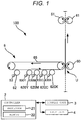
- FIG. 1 is a schematic diagram illustrating an image forming apparatus 100.
- the image forming apparatus 100 is a multi-function peripheral (MFP) that has a plurality of functions such as copying, printing, scanning, faxing, and email transmission.
- MFP multi-function peripheral
- the image forming apparatus 100 includes an image forming unit 6 capable of forming an image on a sheet by non-decolorable toner (first color material) of a plurality of colors, by decolorable toner (second color material) of a plurality of colors, and by both the non-decolorable toner and the decolorable toner.
- image forming unit 6 capable of forming an image on a sheet by non-decolorable toner (first color material) of a plurality of colors, by decolorable toner (second color material) of a plurality of colors, and by both the non-decolorable toner and the decolorable toner.
- the decolorable toner is used as a decolorable material.
- the decolorable material contains a coloring compound, a developer, and a decoloring agent.
- An example of the coloring compound includes a leuco dye that colors blue.
- An example of the developer includes phenols.
- An example of the decoloring agent includes a material that has no affinity to a developer and is made compatible with a coloring compound when heated. The decolorable material colors by interaction of a coloring compound and a developer, and color is removed when the interaction of the coloring compound and the developer is diminished by heating at a decoloring temperature or more.
- decolorable ink may also be used.
- the image forming unit 6 is configured to form an image on a sheet by an ink jet method rather than by an electrographic method.
- photosensitive drums 620Y, 620M, 620C, 620K, and 62 are used to form an image on a sheet by ejecting decolorable ink from an ink jet head.
- the image forming apparatus 100 uses four colors, cyan (C), magenta (M), yellow (Y), and black (K) as non-decolorable toner, although the image forming apparatus 100 may be configured to use only the non-decolorable toner K, or another non-decolorable toner.
- the image forming apparatus 100 uses only blue decolorable toner, although the image forming apparatus 100 may be configured to use four colors, C, M, Y, and K, as decolorable toner.
- a fixing unit 61 fixes the decolorable toner to the second sheet by heating the sheet to a decolorable toner fixing temperature.
- the fixing unit 61 likewise fixes the non-decolorable toner to the second sheet by heating the second sheet to a non-decolorable toner fixing temperature.
- a decoloring temperature, at which color is removed from the decolorable toner, is higher than both the decolorable toner fixing temperature and the non-decolorable toner fixing temperature. Thus, the non-decolorable toner is not erased at the decoloring temperature of the decolorable toner.
- decoloring means that an image formed with a color different from the background color of the second sheet (including not only chromatic color but also achromatic color such as white or black) is no longer seen visually or is rarely seen visually.
- non longer seen visually means that the image, originally formed from one or more colors visibly distinct from the background color of the second sheet, has been changed to have only colors the same as, or similar to, the background color of the second sheet, or the material from which the image is formed has been made achromatic or transparent.
- a first developing assembly 630 comprising the photosensitive drums 620Y to 620K and the developing units 630Y, 630M, 630C, and 630K, is used to develop the non-decolorable toners and a second developing assembly 631, comprising a photosensitive drum 62 and developing unit 63, is used to develop the blue decolorable toner.
- the first developing assembly 630 is located between a secondary transfer position U, and the second developing assembly 631 in a rotation direction of a transfer belt 65.
- the secondary transfer position U is a position at which a nip is formed by a secondary transfer roller 60 and the transfer belt 65.
- the positions of the first and second developing assemblies 630 and 631 may be reversed.
- the image forming unit 6 causes laser units (not illustrated) to form electrostatic latent images on the photosensitive drums 620Y to 620K and 62 and causes the developing units 630Y to 630K and 63 to develop the electrostatic latent images using the non-decolorable toner and the decolorable toner.
- the image forming unit 6 transfers the developed toner images to the second sheet at the secondary transfer position U through the transfer belt 65.
- the second sheet is transmitted to the fixing unit 61 after the image forming unit 6 forms the toner images on the second sheet.
- the fixing unit 61 heats the second sheet and fixes the toner images to the second sheet.
- the image forming apparatus 100 includes a controller 2, a display unit 3, and an input unit 4.
- the controller 2 controls the entire image forming apparatus 100.
- the controller 2 includes a processor 21 and a memory 22.
- the processor 21 reads a program stored in the memory 22 to perform various processes.
- the processor 21 may be divided into several portions for each processing function or may include an application specific integrated circuit (ASIC).
- the memory 22 may include a hard disk drive (HDD) .
- the controller causes the first developing assembly of the image forming unit 6 to form all, or a portion, of an image acquired from the first sheet by the reading unit from the first color material for subsequent fixing to the second sheet in the fixing unit 61.
- the controller also causes the second developing assembly of the image forming unit 6 to form all, or a portion, of an image acquired from the first sheet by the reading unit from the second color material for subsequent fixing to the second sheet in the fixing unit 61.
- the display unit 3 is a touch panel or the like, and displays setting information or an operation status of the image forming apparatus 100, log information, and notification to a user.
- the input unit 4 is a button, a key, or a touch panel.
- the input unit 4 receives an input of the user, and receives an instruction of a function operation of the image forming apparatus 100 such as a printing instruction or an input of setting.
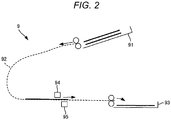
- FIG. 2 is a schematic diagram illustrating an ADF 9.
- the image forming apparatus 100 includes the ADF 9, although not shown in FIG. 1 .
- the ADF 9 feeds a sheet from a sheet feeding tray 91 to a transport path 92.
- the ADF 9 causes reading units 94 and 95 to read images of both surfaces of the sheet, and then discharges the sheet to a sheet discharging tray 93.
- the reading units 94 and 95 may include a charge coupled device (CCD).
- FIG. 3 is a flowchart illustrating a copying process by the processor 21.
- the processor 21 displays a setting screen on the display unit 3 for selecting a first image forming process using only the non-decolorable toner, a second image forming process using the decolorable toner only for text, and a third image forming process using only the decolorable toner.
- the processor 21 receives one selection of the first, second, and third copying processes on the setting screen (Act 1).
- the processor 21 reads an image on a sheet (Act 4).
- the processor 21 displays a setting screen on the display unit 3 for selecting whether to perform a first text recognition (optical character recognition (OCR)) process on the entire surface of the read image data or to perform a second text recognition process in a designated range of the read image data.
- the processor 21 receives one selection of the first text recognition and the second text recognition on the setting screen (Act 5).
- the processor 21 displays the read image data on the display unit 3 (Act 7).
- the processor 21 receives the user's designation of a range in which text recognition is performed (Act 8).
- the user can designate the range for text recognition by specifying an upper and lower bound for the range in the image data using the display unit 3 or other input device.
- the processor 21 performs the text recognition in the designated range of the image data (Act 9).
- the processor 21 performs text recognition on the entire image data (Act 9).
- the processor 21 determines that there is text within the range in which the text recognition is performed in the image data (YES in Act 10)
- the processor 21 extracts the text and forms the text as an object (recognizes the text).
- the processor 21 prints the text object of the image data using the decolorable toner and prints the image objects of the image data, which is all the image data other than the extracted text objects, using the non-decolorable toner (Act 11).
- the processor 21 determines that there is no text within the range in which the text recognition is performed in the image data (NO in Act 10)
- the processor 21 prints all the image data with the non-decolorable toner (Act 12).
- the processor 21 reads an image on the sheet (Act 13) to acquire image data and prints the read image data with the non-decolorable toner (Act 12).
- the processor 21 reads an image on the sheet (Act 14) to acquire image data and prints the read image data with the decolorable toner (Act 15).
- the processor 21 may print only a designated portion of the text subjected to the text recognition in the image data with the second color material, for example the decolorable toner.
- the processor 21 may perform the text recognition on the image data of the sheet read by the reading units 94 and 95, may cause the image forming unit 6 to form the text on a sheet using the second color material, and may cause the image forming unit 6 to form portions other than the text of the image data on the sheet using the first color material different from the second color material.
- the decolorable material is used as the second color material
- the non-decolorable material is used as the first color material.
- a special color material toner or ink which may not have a CMYK color may be used as the second color material.
- the special color material may have a golden color or glossy color or a color material containing a glistening lame.
- the sheet, or recording medium may be a normal sheet, a heat-sensitive sheet, a resin film, or cloth.
Landscapes
- Engineering & Computer Science (AREA)
- Multimedia (AREA)
- Signal Processing (AREA)
- General Physics & Mathematics (AREA)
- Physics & Mathematics (AREA)
- Microelectronics & Electronic Packaging (AREA)
- Biomedical Technology (AREA)
- Health & Medical Sciences (AREA)
- General Health & Medical Sciences (AREA)
- Human Computer Interaction (AREA)
- Computer Vision & Pattern Recognition (AREA)
- Theoretical Computer Science (AREA)
- Artificial Intelligence (AREA)
- Developing Agents For Electrophotography (AREA)
- Color Electrophotography (AREA)
- Control Or Security For Electrophotography (AREA)
- Cleaning In Electrography (AREA)
- Character Input (AREA)
- Fixing For Electrophotography (AREA)
Abstract
Description
- There are known image forming apparatuses that form images on sheets based on image data. In the related art, there are technologies for printing only text objects based on image data using designated toner different from toner used to print other image objects.
- However, when an image forming apparatus executes copying, all copied image data are image objects. Therefore, there is a problem in that text (which is an image object in a copying process) in image data may not be printed using the designated toner.
-
-
FIG. 1 is a schematic diagram illustrating an image forming apparatus. -
FIG. 2 is a schematic diagram illustrating an automatic document feeder (ADF). -
FIG. 3 is a flowchart illustrating a copying process by a processor. - According to an embodiment, there is provided a technology for printing text in read image data using a color material different from color materials of other portions of the read image data in a copying process. In general, according to an embodiment, an image forming apparatus includes a reading unit, an image forming unit, and a controller. The reading unit is configured to acquire image data by reading an image on a first sheet. The image forming unit is configured to form an image from the image data on a second sheet using a first color material and a second color material. The controller is configured to perform text recognition on the image data, cause the image forming unit to form text from the image data on the second sheet using the second color material, and cause the image forming unit to form portions of the image data other than the text on the second sheet using the first color material.
- The apparatus may further comprise a display unit and an input unit.
- In this case, the controller may further be configured to cause the display unit to display a setting screen for selecting a range of the image data in which text recognition is to be performed, to cause the input unit to receive selection of the range, and to perform text recognition on the image data within the range.
- Preferably, the controller is further configured to receive selection of the range by definition of an upper and lower boundary of the range.
- Preferably, the controller is further configured to cause the display unit to display a setting screen for selecting a first image forming process using only the non-decolorable toner, a second image forming process using the decolorable toner only for text, and a third image forming process using only the decolorable toner.
- Preferably, the controller is configured to cause the image forming unit to form only a portion of the text from the text recognition on the second sheet using the second color material.
- Preferably, the second color material is decolorable toner that removes color by heating.
- Preferably, the first color material is non-decolorable toner that is not decolored at a decoloring temperature of the decolorable toner.
- Preferably, one of the first and the second color material is a CYMK color material and the other is a material that does not have a CYMK color.
- The present invention also relates to an image processing apparatus comprising: a reading unit configured to acquire image data by reading an image on a first sheet; an image forming unit comprising a first developing assembly, a second developing assembly, and a transfer belt; an input unit; and
- a controller configured to receive selection of a range for text recognition from the input unit, perform text recognition in the selected range on the image data, cause the second developing assembly to develop text from the text recognition using the second color material, cause the first developing assembly to develop portions of the image data other than the recognized text on the second sheet using the first color material, and cause the transfer belt to transfer the developed text and image portions to a second sheet.
- Preferably, the first color material is a non-decolorable material and the second color material is a decolorable material.
- Preferably, the decolorable material is a material that removes color by heating.
- Preferably, the first color material is a CMYK color material and the second color material is a material that does not have a CYMK color.
- Preferably, the controller is further configured to receive selection of a first image forming process using only the non-decolorable toner, a second image forming process using the decolorable toner only for text, and a third image forming process using only the decolorable toner from the input unit.
- Preferably, the controller is further configured to cause the second developing assembly to develop only a portion of the recognized text using the second color material.
- The present invention further relates to a method of forming an image on a sheet, comprising reading an image from a first sheet to acquire image data; performing text recognition on the image data to define one or more text objects and one or more image objects; forming an image of the one or more text objects on a second sheet using a first color material; and forming an image of the one or more image objects on the second sheet using a second color material.
- Preferably, the text recognition is performed in a selected range of the image data.
- Preferably, a portion of the text objects is formed using the first color material.
- Preferably, one of the first color material and the second color material is a CYMK color material and the other is a material that does not have a CYMK color.
- Preferably, one of the first color material and the second color material is a non-decolorable material and the other is a decolorable material.
- Hereinafter, an embodiment will be described with reference to the drawings.
-
FIG. 1 is a schematic diagram illustrating animage forming apparatus 100. - The
image forming apparatus 100 is a multi-function peripheral (MFP) that has a plurality of functions such as copying, printing, scanning, faxing, and email transmission. - The
image forming apparatus 100 includes animage forming unit 6 capable of forming an image on a sheet by non-decolorable toner (first color material) of a plurality of colors, by decolorable toner (second color material) of a plurality of colors, and by both the non-decolorable toner and the decolorable toner. - In the embodiment, the decolorable toner is used as a decolorable material. The decolorable material contains a coloring compound, a developer, and a decoloring agent. An example of the coloring compound includes a leuco dye that colors blue. An example of the developer includes phenols. An example of the decoloring agent includes a material that has no affinity to a developer and is made compatible with a coloring compound when heated. The decolorable material colors by interaction of a coloring compound and a developer, and color is removed when the interaction of the coloring compound and the developer is diminished by heating at a decoloring temperature or more.
- As the decolorable material, decolorable ink may also be used. In this case, the
image forming unit 6 is configured to form an image on a sheet by an ink jet method rather than by an electrographic method. In an ink jet method, photosensitive drums 620Y, 620M, 620C, 620K, and 62 are used to form an image on a sheet by ejecting decolorable ink from an ink jet head. - In the embodiment, the
image forming apparatus 100 uses four colors, cyan (C), magenta (M), yellow (Y), and black (K) as non-decolorable toner, although theimage forming apparatus 100 may be configured to use only the non-decolorable toner K, or another non-decolorable toner. - In the embodiment, the
image forming apparatus 100 uses only blue decolorable toner, although theimage forming apparatus 100 may be configured to use four colors, C, M, Y, and K, as decolorable toner. - A
fixing unit 61 fixes the decolorable toner to the second sheet by heating the sheet to a decolorable toner fixing temperature. Thefixing unit 61 likewise fixes the non-decolorable toner to the second sheet by heating the second sheet to a non-decolorable toner fixing temperature. A decoloring temperature, at which color is removed from the decolorable toner, is higher than both the decolorable toner fixing temperature and the non-decolorable toner fixing temperature. Thus, the non-decolorable toner is not erased at the decoloring temperature of the decolorable toner. - The word "decoloring," as used herein, means that an image formed with a color different from the background color of the second sheet (including not only chromatic color but also achromatic color such as white or black) is no longer seen visually or is rarely seen visually. The phrase "no longer seen visually" means that the image, originally formed from one or more colors visibly distinct from the background color of the second sheet, has been changed to have only colors the same as, or similar to, the background color of the second sheet, or the material from which the image is formed has been made achromatic or transparent.
- In the
image forming unit 6, a first developing assembly 630, comprising the photosensitive drums 620Y to 620K and the developingunits unit 63, is used to develop the blue decolorable toner. - The first developing assembly 630 is located between a secondary transfer position U, and the second developing assembly 631 in a rotation direction of a
transfer belt 65. The secondary transfer position U is a position at which a nip is formed by asecondary transfer roller 60 and thetransfer belt 65. The positions of the first and second developing assemblies 630 and 631 may be reversed. - The
image forming unit 6 causes laser units (not illustrated) to form electrostatic latent images on the photosensitive drums 620Y to 620K and 62 and causes the developingunits 630Y to 630K and 63 to develop the electrostatic latent images using the non-decolorable toner and the decolorable toner. Theimage forming unit 6 transfers the developed toner images to the second sheet at the secondary transfer position U through thetransfer belt 65. - In the
image forming apparatus 100, the second sheet is transmitted to thefixing unit 61 after theimage forming unit 6 forms the toner images on the second sheet. In theimage forming apparatus 100, thefixing unit 61 heats the second sheet and fixes the toner images to the second sheet. - The
image forming apparatus 100 includes acontroller 2, adisplay unit 3, and aninput unit 4. Thecontroller 2 controls the entireimage forming apparatus 100. Thecontroller 2 includes aprocessor 21 and amemory 22. Theprocessor 21 reads a program stored in thememory 22 to perform various processes. Theprocessor 21 may be divided into several portions for each processing function or may include an application specific integrated circuit (ASIC). Thememory 22 may include a hard disk drive (HDD) . - Thus, the controller causes the first developing assembly of the
image forming unit 6 to form all, or a portion, of an image acquired from the first sheet by the reading unit from the first color material for subsequent fixing to the second sheet in the fixingunit 61. The controller also causes the second developing assembly of theimage forming unit 6 to form all, or a portion, of an image acquired from the first sheet by the reading unit from the second color material for subsequent fixing to the second sheet in the fixingunit 61. - The
display unit 3 is a touch panel or the like, and displays setting information or an operation status of theimage forming apparatus 100, log information, and notification to a user. - The
input unit 4 is a button, a key, or a touch panel. Theinput unit 4 receives an input of the user, and receives an instruction of a function operation of theimage forming apparatus 100 such as a printing instruction or an input of setting. -
FIG. 2 is a schematic diagram illustrating anADF 9. - The
image forming apparatus 100 includes theADF 9, although not shown inFIG. 1 . TheADF 9 feeds a sheet from asheet feeding tray 91 to atransport path 92. TheADF 9causes reading units sheet discharging tray 93. The readingunits -
FIG. 3 is a flowchart illustrating a copying process by theprocessor 21. - The
processor 21 displays a setting screen on thedisplay unit 3 for selecting a first image forming process using only the non-decolorable toner, a second image forming process using the decolorable toner only for text, and a third image forming process using only the decolorable toner. Theprocessor 21 receives one selection of the first, second, and third copying processes on the setting screen (Act 1). - When the second copying process using the decolorable toner only for text is selected (YES in
Act 2 and YES in Act 3), theprocessor 21 reads an image on a sheet (Act 4). - The
processor 21 displays a setting screen on thedisplay unit 3 for selecting whether to perform a first text recognition (optical character recognition (OCR)) process on the entire surface of the read image data or to perform a second text recognition process in a designated range of the read image data. Theprocessor 21 receives one selection of the first text recognition and the second text recognition on the setting screen (Act 5). - When the second text recognition is selected, for executing text recognition in the designated range of the image data (Yes in Act 6), the
processor 21 displays the read image data on the display unit 3 (Act 7). - The
processor 21 receives the user's designation of a range in which text recognition is performed (Act 8). The user can designate the range for text recognition by specifying an upper and lower bound for the range in the image data using thedisplay unit 3 or other input device. - After
Act 8, theprocessor 21 performs the text recognition in the designated range of the image data (Act 9). When the first text recognition is selected, for executing text recognition on the entire image data (NO in Act 6), theprocessor 21 performs text recognition on the entire image data (Act 9). - When the
processor 21 determines that there is text within the range in which the text recognition is performed in the image data (YES in Act 10), theprocessor 21 extracts the text and forms the text as an object (recognizes the text). Theprocessor 21 prints the text object of the image data using the decolorable toner and prints the image objects of the image data, which is all the image data other than the extracted text objects, using the non-decolorable toner (Act 11). - When the
processor 21 determines that there is no text within the range in which the text recognition is performed in the image data (NO in Act 10), theprocessor 21 prints all the image data with the non-decolorable toner (Act 12). - When the first copying process using only the non-decolorable toner is selected (NO in Act 2), the
processor 21 reads an image on the sheet (Act 13) to acquire image data and prints the read image data with the non-decolorable toner (Act 12). - When the third copying process using only the decolorable toner is selected (NO in Act 3), the
processor 21 reads an image on the sheet (Act 14) to acquire image data and prints the read image data with the decolorable toner (Act 15). - In Act 11, the
processor 21 may print only a designated portion of the text subjected to the text recognition in the image data with the second color material, for example the decolorable toner. - The
processor 21 may perform the text recognition on the image data of the sheet read by the readingunits image forming unit 6 to form the text on a sheet using the second color material, and may cause theimage forming unit 6 to form portions other than the text of the image data on the sheet using the first color material different from the second color material. - Accordingly, in the above embodiment, the decolorable material is used as the second color material, the non-decolorable material is used as the first color material. Alternately, a special color material (toner or ink) which may not have a CMYK color may be used as the second color material. The special color material may have a golden color or glossy color or a color material containing a glistening lame.
- The sheet, or recording medium, may be a normal sheet, a heat-sensitive sheet, a resin film, or cloth.
- While certain embodiments have been described, these embodiments have been presented by way of example only, and are not intended to limit the scope of the inventions. Indeed, the novel embodiments described herein may be embodied in a variety of other forms; furthermore, various omissions, substitutions and changes in the form of the embodiments described herein may be made without departing from the framework of the inventions. The accompanying claims and their equivalents are intended to cover such forms or modifications as would fall within the scope of the inventions.
Claims (15)
- An image processing apparatus comprising:a reading unit configured to acquire image data by reading an image on a first sheet;an image forming unit configured to form an image from the image data on a second sheet using a first color material and a second color material; anda controller configured to perform text recognition on the image data, cause the image forming unit to form text from the image data on the second sheet using the second color material, and cause the image forming unit to form portions of the image data other than the text on the second sheet using the first color material.
- The apparatus according to claim 1, further comprising a display unit and an input unit,
wherein the controller is further configured to cause the display unit to display a setting screen for selecting a range of the image data in which text recognition is to be performed, to cause the input unit to receive selection of the range, and to perform text recognition on the image data within the range. - The apparatus according to claim 2, wherein the controller is further configured to receive selection of the range by definition of an upper and lower boundary of the range.
- The apparatus according to claim 2 or 3, wherein the controller is further configured to cause the display unit to display a setting screen for selecting a first image forming process using only the non-decolorable toner, a second image forming process using the decolorable toner only for text, and a third image forming process using only the decolorable toner.
- The apparatus according to any one of claims 1 to 4,
wherein the controller is configured to cause the image forming unit to form only a portion of the text from the text recognition on the second sheet using the second color material. - The apparatus according to any one of claims 1 to 5,
wherein the second color material is decolorable toner that removes color by heating. - The apparatus according to claim 6, wherein the first color material is non-decolorable toner that is not decolored at a decoloring temperature of the decolorable toner.
- The apparatus according to any one of claims 1 to 7, wherein one of the first and the second color material is a CYMK color material and the other is a material that does not have a CYMK color.
- A method of forming an image on a sheet, comprising:reading an image from a first sheet to acquire image data;performing text recognition on the image data to define one or more text objects and one or more image objects;forming an image of the one or more text objects on a second sheet using a first color material; andforming an image of the one or more image objects on the second sheet using a second color material.
- The method of claim 9, wherein the text recognition is performed in a selected range of the image data.
- The method of claim 10, wherein a portion of the text objects is formed using the first color material.
- The method according to any one of claims 9 to 11, wherein one of the first color material and the second color material is a CYMK color material and the other is a material that does not have a CYMK color.
- The method of claim 12, wherein one of the first color material and the second color material is a non-decolorable material and the other is a decolorable material.
- An image processing apparatus comprising:a reading unit configured to acquire image data by reading an image on a first sheet;an image forming unit comprising a first developing assembly, a second developing assembly, and a transfer belt;an input unit; anda controller configured to receive selection of a range for text recognition from the input unit, perform text recognition in the selected range on the image data, cause the second developing assembly to develop text from the text recognition using the second color material, cause the first developing assembly to develop portions of the image data other than the recognized text on the second sheet using the first color material, and cause the transfer belt to transfer the developed text and image portions to a second sheet.
- The apparatus of claim 14, wherein the first color material is a non-decolorable material and the second color material is a decolorable material.
Applications Claiming Priority (1)
| Application Number | Priority Date | Filing Date | Title |
|---|---|---|---|
| JP2015232934A JP2017102152A (en) | 2015-11-30 | 2015-11-30 | Image forming apparatus |
Publications (2)
| Publication Number | Publication Date |
|---|---|
| EP3173870A2 true EP3173870A2 (en) | 2017-05-31 |
| EP3173870A3 EP3173870A3 (en) | 2017-08-09 |
Family
ID=57389280
Family Applications (1)
| Application Number | Title | Priority Date | Filing Date |
|---|---|---|---|
| EP16199904.0A Withdrawn EP3173870A3 (en) | 2015-11-30 | 2016-11-22 | Image forming apparatus |
Country Status (4)
| Country | Link |
|---|---|
| US (2) | US9871936B2 (en) |
| EP (1) | EP3173870A3 (en) |
| JP (1) | JP2017102152A (en) |
| CN (1) | CN106896661A (en) |
Families Citing this family (2)
| Publication number | Priority date | Publication date | Assignee | Title |
|---|---|---|---|---|
| JP2017102152A (en) * | 2015-11-30 | 2017-06-08 | 株式会社東芝 | Image forming apparatus |
| JP6951156B2 (en) * | 2017-09-01 | 2021-10-20 | 株式会社東芝 | Image decolorizer |
Citations (2)
| Publication number | Priority date | Publication date | Assignee | Title |
|---|---|---|---|---|
| JP2001216298A (en) * | 2000-02-02 | 2001-08-10 | Minolta Co Ltd | Character processor |
| US20150043042A1 (en) * | 2013-08-09 | 2015-02-12 | Fuji Xerox Co., Ltd. | Image reading apparatus, image reading method, and computer-readable medium |
Family Cites Families (13)
| Publication number | Priority date | Publication date | Assignee | Title |
|---|---|---|---|---|
| US4992828A (en) * | 1989-12-11 | 1991-02-12 | Eastman Kodak Company | Digitizer having selected area designation |
| JP2006086727A (en) * | 2004-09-15 | 2006-03-30 | Ricoh Co Ltd | Image reading system, program, and storage medium |
| EP2247091B1 (en) * | 2009-04-27 | 2019-04-17 | Kabushiki Kaisha Toshiba | Image forming apparatus, image forming method, and computer-readable recording medium having image forming program recorded therein |
| JP5556438B2 (en) * | 2010-06-28 | 2014-07-23 | 富士ゼロックス株式会社 | Developing device and image forming apparatus |
| US20120038941A1 (en) | 2010-08-10 | 2012-02-16 | Toshiba Tec Kabushiki Kaisha | Image forming apparatus, information processing apparatus, image forming system, and image forming method |
| US9037031B2 (en) * | 2011-04-14 | 2015-05-19 | Kabushiki Kaisha Toshiba | Image forming apparatus including control substrate connected to electrical component through cable |
| US8849161B2 (en) * | 2011-06-14 | 2014-09-30 | Kabushiki Kaisha Toshiba | Image forming apparatus and method for image forming |
| JP2013030916A (en) * | 2011-07-27 | 2013-02-07 | Kyocera Document Solutions Inc | Image processing apparatus and image forming apparatus including the same |
| JP2014167612A (en) * | 2013-01-31 | 2014-09-11 | Toshiba Corp | Image forming apparatus |
| JP5674839B2 (en) * | 2013-03-08 | 2015-02-25 | 株式会社東芝 | Image forming apparatus and image forming method |
| US9158252B2 (en) * | 2013-08-12 | 2015-10-13 | Kabushiki Kaisha Toshiba | Apparatus and method for forming an image on a recording medium using erasable material and non-erasable material |
| JP2015197672A (en) * | 2014-04-03 | 2015-11-09 | 株式会社東芝 | Image forming apparatus and program |
| JP2017102152A (en) * | 2015-11-30 | 2017-06-08 | 株式会社東芝 | Image forming apparatus |
-
2015
- 2015-11-30 JP JP2015232934A patent/JP2017102152A/en active Pending
-
2016
- 2016-08-30 US US15/252,044 patent/US9871936B2/en active Active
- 2016-11-21 CN CN201611028135.4A patent/CN106896661A/en active Pending
- 2016-11-22 EP EP16199904.0A patent/EP3173870A3/en not_active Withdrawn
-
2017
- 2017-12-05 US US15/832,260 patent/US10250769B2/en active Active
Patent Citations (2)
| Publication number | Priority date | Publication date | Assignee | Title |
|---|---|---|---|---|
| JP2001216298A (en) * | 2000-02-02 | 2001-08-10 | Minolta Co Ltd | Character processor |
| US20150043042A1 (en) * | 2013-08-09 | 2015-02-12 | Fuji Xerox Co., Ltd. | Image reading apparatus, image reading method, and computer-readable medium |
Also Published As
| Publication number | Publication date |
|---|---|
| US20180097955A1 (en) | 2018-04-05 |
| JP2017102152A (en) | 2017-06-08 |
| US10250769B2 (en) | 2019-04-02 |
| CN106896661A (en) | 2017-06-27 |
| US9871936B2 (en) | 2018-01-16 |
| US20170155784A1 (en) | 2017-06-01 |
| EP3173870A3 (en) | 2017-08-09 |
Similar Documents
| Publication | Publication Date | Title |
|---|---|---|
| US10990028B2 (en) | Information processing apparatus, image forming system, information processing method, and recording medium | |
| US9834025B2 (en) | Image forming apparatus | |
| US9628639B2 (en) | Printer driver that causes a computer to generate a print command to print with decolorable material | |
| US20140212160A1 (en) | Image forming apparatus | |
| US10185275B2 (en) | Image forming apparatus and image forming method having decolorizing function in the image forming apparatus | |
| JP6296897B2 (en) | Image forming apparatus | |
| US10250769B2 (en) | Image forming apparatus using decolorable and non-decolorable toner for printing acquired images | |
| EP3528053B1 (en) | Image forming apparatus | |
| JP5449210B2 (en) | Image forming apparatus and image forming program | |
| US9552184B2 (en) | Facsimile apparatus and method for printing facsimile | |
| JP2017032735A (en) | Image forming apparatus and program | |
| JP6587490B2 (en) | Image forming apparatus | |
| JP2015197672A (en) | Image forming apparatus and program | |
| JP6955390B2 (en) | Decolorizer | |
| JP5764582B2 (en) | Image forming apparatus | |
| JP2018116311A (en) | Image forming apparatus |
Legal Events
| Date | Code | Title | Description |
|---|---|---|---|
| PUAI | Public reference made under article 153(3) epc to a published international application that has entered the european phase |
Free format text: ORIGINAL CODE: 0009012 |
|
| STAA | Information on the status of an ep patent application or granted ep patent |
Free format text: STATUS: THE APPLICATION HAS BEEN PUBLISHED |
|
| AK | Designated contracting states |
Kind code of ref document: A2 Designated state(s): AL AT BE BG CH CY CZ DE DK EE ES FI FR GB GR HR HU IE IS IT LI LT LU LV MC MK MT NL NO PL PT RO RS SE SI SK SM TR |
|
| AX | Request for extension of the european patent |
Extension state: BA ME |
|
| PUAL | Search report despatched |
Free format text: ORIGINAL CODE: 0009013 |
|
| AK | Designated contracting states |
Kind code of ref document: A3 Designated state(s): AL AT BE BG CH CY CZ DE DK EE ES FI FR GB GR HR HU IE IS IT LI LT LU LV MC MK MT NL NO PL PT RO RS SE SI SK SM TR |
|
| AX | Request for extension of the european patent |
Extension state: BA ME |
|
| RIC1 | Information provided on ipc code assigned before grant |
Ipc: G03G 15/00 20060101ALI20170704BHEP Ipc: G03G 15/01 20060101AFI20170704BHEP |
|
| STAA | Information on the status of an ep patent application or granted ep patent |
Free format text: STATUS: REQUEST FOR EXAMINATION WAS MADE |
|
| 17P | Request for examination filed |
Effective date: 20180209 |
|
| RBV | Designated contracting states (corrected) |
Designated state(s): AL AT BE BG CH CY CZ DE DK EE ES FI FR GB GR HR HU IE IS IT LI LT LU LV MC MK MT NL NO PL PT RO RS SE SI SK SM TR |
|
| STAA | Information on the status of an ep patent application or granted ep patent |
Free format text: STATUS: EXAMINATION IS IN PROGRESS |
|
| 17Q | First examination report despatched |
Effective date: 20190124 |
|
| STAA | Information on the status of an ep patent application or granted ep patent |
Free format text: STATUS: THE APPLICATION HAS BEEN WITHDRAWN |
|
| 18W | Application withdrawn |
Effective date: 20190429 |