EP3173134B1 - Synchronisationsobjektbestimmungsverfahren, -vorrichtung und -system - Google Patents
Synchronisationsobjektbestimmungsverfahren, -vorrichtung und -system Download PDFInfo
- Publication number
- EP3173134B1 EP3173134B1 EP16194958.1A EP16194958A EP3173134B1 EP 3173134 B1 EP3173134 B1 EP 3173134B1 EP 16194958 A EP16194958 A EP 16194958A EP 3173134 B1 EP3173134 B1 EP 3173134B1
- Authority
- EP
- European Patent Office
- Prior art keywords
- terminal
- indicates
- information
- synchronization
- distance
- Prior art date
- Legal status (The legal status is an assumption and is not a legal conclusion. Google has not performed a legal analysis and makes no representation as to the accuracy of the status listed.)
- Active
Links
Images



Classifications
-
- G—PHYSICS
- G06—COMPUTING OR CALCULATING; COUNTING
- G06F—ELECTRIC DIGITAL DATA PROCESSING
- G06F3/00—Input arrangements for transferring data to be processed into a form capable of being handled by the computer; Output arrangements for transferring data from processing unit to output unit, e.g. interface arrangements
- G06F3/14—Digital output to display device ; Cooperation and interconnection of the display device with other functional units
- G06F3/1454—Digital output to display device ; Cooperation and interconnection of the display device with other functional units involving copying of the display data of a local workstation or window to a remote workstation or window so that an actual copy of the data is displayed simultaneously on two or more displays, e.g. teledisplay
-
- A—HUMAN NECESSITIES
- A63—SPORTS; GAMES; AMUSEMENTS
- A63F—CARD, BOARD, OR ROULETTE GAMES; INDOOR GAMES USING SMALL MOVING PLAYING BODIES; VIDEO GAMES; GAMES NOT OTHERWISE PROVIDED FOR
- A63F13/00—Video games, i.e. games using an electronically generated display having two or more dimensions
- A63F13/30—Interconnection arrangements between game servers and game devices; Interconnection arrangements between game devices; Interconnection arrangements between game servers
- A63F13/35—Details of game servers
- A63F13/358—Adapting the game course according to the network or server load, e.g. for reducing latency due to different connection speeds between clients
-
- A—HUMAN NECESSITIES
- A63—SPORTS; GAMES; AMUSEMENTS
- A63F—CARD, BOARD, OR ROULETTE GAMES; INDOOR GAMES USING SMALL MOVING PLAYING BODIES; VIDEO GAMES; GAMES NOT OTHERWISE PROVIDED FOR
- A63F13/00—Video games, i.e. games using an electronically generated display having two or more dimensions
- A63F13/30—Interconnection arrangements between game servers and game devices; Interconnection arrangements between game devices; Interconnection arrangements between game servers
- A63F13/35—Details of game servers
- A63F13/352—Details of game servers involving special game server arrangements, e.g. regional servers connected to a national server or a plurality of servers managing partitions of the game world
-
- G—PHYSICS
- G06—COMPUTING OR CALCULATING; COUNTING
- G06T—IMAGE DATA PROCESSING OR GENERATION, IN GENERAL
- G06T19/00—Manipulating three-dimensional [3D] models or images for computer graphics
- G06T19/006—Mixed reality
-
- H—ELECTRICITY
- H04—ELECTRIC COMMUNICATION TECHNIQUE
- H04L—TRANSMISSION OF DIGITAL INFORMATION, e.g. TELEGRAPHIC COMMUNICATION
- H04L67/00—Network arrangements or protocols for supporting network services or applications
- H04L67/01—Protocols
- H04L67/10—Protocols in which an application is distributed across nodes in the network
- H04L67/1095—Replication or mirroring of data, e.g. scheduling or transport for data synchronisation between network nodes
-
- H—ELECTRICITY
- H04—ELECTRIC COMMUNICATION TECHNIQUE
- H04L—TRANSMISSION OF DIGITAL INFORMATION, e.g. TELEGRAPHIC COMMUNICATION
- H04L67/00—Network arrangements or protocols for supporting network services or applications
- H04L67/01—Protocols
- H04L67/131—Protocols for games, networked simulations or virtual reality
-
- G—PHYSICS
- G06—COMPUTING OR CALCULATING; COUNTING
- G06T—IMAGE DATA PROCESSING OR GENERATION, IN GENERAL
- G06T2219/00—Indexing scheme for manipulating 3D models or images for computer graphics
- G06T2219/024—Multi-user, collaborative environment
Definitions
- the present invention relates to the field of image processing technologies, and in particular, to a synchronization object determining method, apparatus, and system.
- a virtual reality technology is a computer emulation technology by using which a virtual world can be created and experienced.
- the virtual reality technology uses a computer to generate a simulation environment, so that a user is immersed in the environment.
- a common application scenario is multi-person coordination or a multi-person game.
- a great challenge to the multi-person coordination or the multi-person game is how to synchronize multiple terminals. For example, in a multi-person game, all participating terminals are located in one virtual environment, and coordinate with each other and move in the virtual environment. If the terminals are not synchronized, that is, a time difference exists between the terminals, during coordination or game battling, problems such as asynchronous and delayed pictures watched on multiple terminals are caused, thereby affecting user experience.
- each terminal executes the following procedure according to a specified period:
- CN 104 954 349 A discloses a client synchronization method in 2D game, a device thereof and a system thereof.
- the method comprises the following steps that: the real position and display position of a second service object are monitored at a server side, the display position is the position of the second service object in a first client, when the distance between the real position and the display position exceeds a preset deviation threshold, the prediction position of the second service object in a preset time is calculation according to the operation information corresponding to the second service object, the acceleration of the second service object which moves to the prediction position from the display position in the preset time in a horizontal direction is calculated, and the acceleration is sent to the first client.
- the embodiment of the present invention through movement split analog correction, a path is closer to a real movement path in the condition of simulating gravity acceleration, and the accuracy of synchronization is improved.
- US 2014/0075046 A1 discloses methods and devices that may be used to maintain continued synchronization during a P2P session when a synchronizing terminal withdraws from synchronizing the operations of one or more participating terminals.
- a server may temporarily replace the synchronizing terminal and request operating status information from the participating terminals. After calculating data differences between the participating terminals using the operating status information, the server may transmit the data differences to the participating terminals so that each participating terminal is configured to synchronize itself with the other participating terminals.
- a new synchronizing terminal is selected from the participating terminals so that the new synchronizing terminal is configured to synchronize the operations of the remaining participating terminals.;
- the current invention prevents termination of network applications due to the withdrawal of the synchronizing terminal, maintaining synchronization and improving the quality of the network applications.
- US6040871 discloses a method of synchronizing a video signal to a client device by adjusting the time duration of the video signal to align with the sampling period of the client device.
- WO2014124483 discloses a device for detecting a position of a human body comprising emitter units which are synchronised.
- Embodiments of the present invention provide a synchronization object determining method, apparatus, and system to resolve a problem of an unsmooth or stalling picture watched on a terminal in a multi-terminal synchronization scenario due to an excessively large time adjustment range.
- a synchronization object determining method includes:
- a mobility feature of the terminal is considered.
- a future status of the terminal is predicted, and a proper synchronization object is dynamically selected for each terminal according to whether a distance between the terminals increases or decreases after specified duration, so as to improve synchronization efficiency and reduce a probability of a relatively large time adjustment range in subsequent synchronization.
- a synchronization object determining method includes:
- a terminal relatively close to the first terminal is selected from some terminals in a system to be used as a synchronization object of the first terminal, so that a quantity of synchronization objects of the first terminal decreases, and a problem of an excessively large time adjustment range in synchronization performed by the first terminal can be avoided.
- a synchronization object determining apparatus has functions of implementing the synchronization device in the foregoing method, where the functions may be implemented by using hardware, or may be implemented by executing corresponding software by hardware, and the hardware or the software includes one or more modules corresponding to the foregoing functions.
- the synchronization object determining apparatus includes:
- the synchronization object determining apparatus includes:
- a synchronization object determining apparatus has functions of implementing the synchronization device in the foregoing method, where the functions may be implemented by using hardware, or may be implemented by executing corresponding software by hardware, and the hardware or the software includes one or more modules corresponding to the foregoing functions.
- the synchronization object determining apparatus includes:
- the synchronization object determining apparatus includes:
- a synchronization object determining system including a first terminal, at least one second terminal, and a synchronization device, where
- the status information further includes a distance threshold; and that the synchronization device classifies the second terminal as a first-type synchronization object of the first terminal if the first distance is greater than the second distance specifically includes: classifying, by the synchronization device, the second terminal as a first-type synchronization object of the first terminal if the first distance is greater than the distance threshold of the first terminal and the first distance is greater than the second distance.
- the status information further includes time information, where the time information is used to describe time of the terminal in the display picture; and the synchronization device is further configured to:
- a progressive time difference is introduced; and therefore, a synchronization process can be extended, that is, one-time synchronization is changed to multiple times of synchronization.
- a time adjustment range is relatively small in each-time synchronization, and a problem, such as an unsmooth or stalling picture, caused by a relatively large time adjustment range in subsequent synchronization is avoided.
- the status information further includes time information, where the time information is used to describe time of the terminal in the display picture; and the synchronization device is further configured to:
- a synchronization object determining system including a first terminal and at least one second terminal, where
- the status information further includes a distance threshold; and that the first terminal classifies the second terminal as a first-type synchronization object of the first terminal if the first distance is greater than the second distance specifically includes: classifying, by the first terminal, the second terminal as a first-type synchronization object of the first terminal if the first distance is greater than the distance threshold of the first terminal and the first distance is greater than the second distance.
- the status information further includes time information, where the time information is used to describe time of the terminal in the display picture; and the first terminal is further configured to:
- the status information further includes time information, where the time information is used to describe time of the terminal in the display picture; and the first terminal is further configured to:
- a computer readable storage medium storing one or more programs
- the one or more programs include an instruction
- the portable electronic device is enabled to execute the method in any implementation manner of the first aspect, the first possible implementation manner of the first aspect, the second aspect, and the first possible implementation manner of the second aspect.
- a proper synchronization object is selected for each terminal. Therefore, on the one hand, an objective of synchronization can be achieved; on the other hand, problems of an unsmooth or stalling picture, unnecessary bandwidth consumption, and a decrease in usage time of a device that are caused by excessive synchronization objects can be avoided.
- a display picture on a terminal mainly includes two parts: one part is a basic picture, which may also be referred to as a scenario picture and is a virtual environment picture that is unrelated to a participating terminal; and the other part is an operation picture, which is a picture of a change that is on the basic picture and caused by an operation of a user, for example, a picture of an explosion that is on a virtual object and caused by a shot operation of a user in a battling game.
- a superposition picture of the basic picture and the operation picture is finally presented on the terminal.
- a time difference that is, asynchronization, of finally presenting a picture on different terminals may exist because of impacts of factors such as a network transmission delay, a local buffer, and a difference between user access time points. If the terminals interact with each other, such asynchronization severely affects user experience. Therefore, synchronization needs to be performed on related terminals.
- This application provides a synchronization object determining method, apparatus, and system.
- a proper synchronization object is selected for each terminal. Therefore, on the one hand, an objective of synchronization can be achieved; on the other hand, problems of an unsmooth or stalling display picture, unnecessary bandwidth consumption, and a decrease in usage time of a device that are caused by an excessively large time adjustment range because of excessive synchronization objects can be avoided.
- the synchronization object determining method provided in this application may be applied to, but is not limited to, a multi-terminal synchronization system in the following two forms:
- a first form is a centralized system.
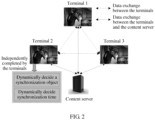
- the centralized multi-terminal synchronization system includes a content server, a synchronization server, and some terminals.
- the content server and the synchronization server are host servers on a cloud side.
- client-content-server data Client-Content-Server Data, CCSD for short
- client-synchronization-server data Client-Synchronization-Server data, CSSD for short
- the CCSD mainly refers to an operation and status information of each terminal that are fed back by each terminal to the content server in real time.
- the content server generates an operation picture according to an operation of the terminal, superposes the operation picture on a corresponding basic picture to generate a composite picture, and then transmits, with reference to status information of the terminal and a request of the terminal, the composite picture or data of the composite picture to the terminal for rendering.
- the CSSD data is mainly status information of each terminal that is periodically sent from each terminal to the synchronization server.
- the synchronization server dynamically determines, for each terminal according to the status information, a synchronization object corresponding to each terminal, determines a time adjustment range according to the determined synchronization object, and feeds back the time adjustment range to a corresponding terminal, so that each terminal performs a synchronization operation according to a time adjustment range received by each terminal.
- a second form is a distributed system.
- the distributed multi-terminal synchronization system includes a content server and some terminals.
- the content server is a host server on a cloud side.
- client-server data Client-Server Data
- CCD client-client data
- the CSD mainly refers to an operation and status information of each terminal that are fed back by each terminal to the content server in real time.
- the content server generates an operation picture according to an operation of a terminal, superposes the operation picture on a corresponding basic picture to generate a composite picture, and then transmits, with reference to status information of the terminal and a request of the terminal, the composite picture or data of the composite picture to the terminal for rendering.
- the CCD is mainly status information of each terminal that is periodically exchanged between the terminals.
- Each terminal independently determines a synchronization object according to the status information, determines a time adjustment range according to the determined synchronization object, and performs a synchronization operation.
- the status information of each terminal is sent to the synchronization server instead of being exchanged between the terminals; and operations such as selection of a synchronization object and calculation of a time adjustment range are also completed on the synchronization server instead of being completed on the terminals.
- a content server and a synchronization server may be implemented by using a computer; and a terminal may be implemented by using a head mounted display(Head Mounted Display, HMD for short), a mobile phone or a tablet terminal with an acceleration sensor, or the like.
- HMD Head Mounted Display
- the first synchronization object determining system includes a first terminal, at least one second terminal, and a synchronization device. It should be noted that the first terminal mentioned herein refers to any terminal in the some terminals in the centralized system, the second terminal refers to another terminal except the first terminal, and the synchronization device is the foregoing mentioned synchronization server,
- Initial location information of the terminal needs to be obtained from the content server by the terminal. Then, when the location information of the terminal is changed by means of a movement operation, the terminal may update the location information according to the movement operation, or the terminal may obtain new location information from the content server.
- the velocity information includes a magnitude of the velocity and the velocity direction of the terminal and may be obtained by performing calculus on the acceleration information.
- the acceleration information includes a magnitude of the acceleration and the acceleration direction of the terminal and may be obtained by using an acceleration sensor built in the terminal.
- the specified duration may be understood as a synchronization adjustment period preset by the synchronization device itself.
- x , y , z respectively indicate the location information that is of the terminal in three dimensions and that is included in the status information obtained by the synchronization device
- x' , y' , z' indicate the location information that is of the terminal in three dimensions after the specified duration and that is predicted by the synchronization device
- T indicates the specified duration
- v x , v y , v z indicate the velocity information that is of the terminal in three dimensions and that is included in the status information
- a x , a y, a z indicate the acceleration information
- the synchronization device learns structure information of a whole basic picture in advance, including information such as a block relationship between models in a whole virtual scenario, and materials and volumes of the models. Therefore, in a case in which location information of any two terminals is learned, the synchronization device may determine, according to whether a subset is generated between an existing model included in the structure information and a connection line between any two terminals, whether an obstacle exists between the any two terminals, for example, whether a terminal A and a terminal B are blocked by a building or a wall.
- ⁇ may be a specified value, or may be a value selected from multiple specified values by the synchronization device according to a result of foregoing determining.
- the synchronization device determines that no obstacle exists between the first terminal and the second terminal, the first distance meets Formula (1), and the second distance meets Formula (3). On the contrary, if the synchronization device determines that an obstacle exists between the first terminal and the second terminal, the first distance meets Formula (2), and the second distance meets Formula (4).
- the status information further include a distance threshold.
- the distance threshold is used to describe an asynchronization tolerance degree of the terminal, that is, when a distance between a terminal and another terminal in the display picture exceeds a distance threshold preset by the terminal, an impact of asynchronization with the another terminal can be ignored.
- the distance threshold is set by the terminal. Different terminals may use a same distance threshold or different distance thresholds.
- a terminal may set a distance threshold according to an actual application scenario. For example, a relatively small distance threshold may be set in a game scenario, and a relatively large distance threshold may be set in a medical scenario or in an industrial design scenario.
- the distance threshold preset by the first terminal is further considered. For example, if the first distance is greater than the distance threshold of the first terminal, and the first distance is greater than the second distance, the synchronization device classifies the second terminal as a first-type synchronization object of the first terminal. For another example, if the first distance is less than the distance threshold of the first terminal, the synchronization device may directly classify the second terminal as a second-type synchronization object of the first terminal.
- the status information further includes time information, where the time information is used to describe time of the terminal in the display picture. It should be noted that the time information herein is a virtual concept and is not equivalent to a local clock of the terminal.
- Initial time information of the terminal needs to be obtained from the content server by the terminal. Then, as time goes by, the terminal may update the time information, or the terminal may further obtain new time information from the content server.
- the synchronization device classifies the second terminal as a first-type or a second-type synchronization object of the first terminal, there are, but not limited to, the following two manners in which the synchronization device further determines a time adjustment range of the first terminal according to status information of a synchronization object of the first terminal:
- a time adjustment range is determined according to an absolute time difference.
- synchronization objects of the first terminal include only first-type synchronization objects to describe how to perform synchronization on the first terminal according to an absolute time difference.
- First step Determine an absolute time difference between the first terminal and each terminal in the first-type synchronization objects of the first terminal, where the absolute time difference is a difference value of the time information.
- ⁇ t im 0, it may be understood that time of the first terminal is earlier than that of the compared terminal. If ⁇ t im ⁇ 0, it may be understood that time of the first terminal is later than that of the compared terminal.
- Second step Determine waiting duration or jump duration of the first terminal according to a preset synchronization policy and the absolute time difference between the first terminal and each terminal in the first-type synchronization objects.
- the synchronization policy includes waiting-type synchronization and jump-type synchronization.
- the terminals in the system may agree on a synchronization policy in advance.
- the waiting-type synchronization indicates that the first terminal waits for particular duration by means of a suspension operation to be synchronized with a terminal with the latest time in the synchronization objects of the first terminal. If the time of the first terminal is later than that of all terminals in the synchronization objects of the first terminal, the first terminal does not need to wait.
- the jump-type synchronization means that the first terminal jumps forwards for particular duration by means of a jump operation to be synchronized with a terminal with the earliest time in the synchronization objects of the first terminal. If the time of the first terminal is earlier than that of all terminals in the synchronization objects of the first terminal, the first terminal does not need to jump.
- Third step If waiting-type synchronization is used, notify the first terminal of the waiting duration to instruct the first terminal to suspend the time of the first terminal in the display picture for the waiting duration, so that a display picture on the first terminal keeps consistent with a display picture on a terminal with the latest time in the first-type synchronization objects; or if jump-type synchronization is used, notify the first terminal of the jump duration to instruct the first terminal to jump the time of the first terminal in the display picture forwards for the jump duration, so that a display picture on the first terminal keeps consistent with a display picture on a terminal with the earliest time in the first-type synchronization objects.
- a time adjustment range for synchronization is determined mainly according to time information of each terminal.
- a time adjustment range is determined according to a progressive time difference.
- synchronization objects of the first terminal include only first-type synchronization objects to describe how to perform synchronization on the first terminal according to a progressive time difference.
- First step Determine a progressive time difference between the first terminal and each terminal in the first-type synchronization objects of the first terminal.
- the progressive time difference may be understood as 1 n im of an absolute time difference.
- the absolute time difference is a difference value of the time information
- n im is a maximum quantity of passed specified duration when a distance between any terminal in the first-type synchronization objects and the first terminal in the display picture is not greater than the distance threshold of the first terminal.
- the specified duration reference may be made to Formula (5).
- the progressive time difference is that an absolute time difference between the first terminal and any terminal in the first-type synchronization objects is allocated for multiple times of synchronization, so as to make a time difference in each-time synchronization as small as possible.
- s im indicates the first distance between the first terminal and any terminal in the first-type synchronization objects in the display picture, and for calculation of s im , reference may be made to Formula (1) or Formula (2)
- s im ′ indicates a second distance between the first terminal and any terminal in the first-type synchronization objects in the display picture, and for calculation of s im ′ , reference may be made to Formula (3) or Formula (4)
- d i indicates the distance threshold of the first terminal
- ⁇ s im ⁇ d i s im ⁇ s im ′ ⁇ represents round-up of s im ⁇ d i s im ⁇ s im ′ .
- Second step Determine waiting duration or jump duration of the first terminal according to a preset synchronization policy and the progressive time difference between the first terminal and each terminal in the first-type synchronization objects.
- ⁇ t i _ wait max 0 , max ⁇ t im ′ , ⁇ m
- ⁇ t i _ wait indicates the waiting duration of the first terminal
- ⁇ t i _ jump max 0 , ⁇ min ⁇ t im ′ ⁇ m
- ⁇ t i _ jump indicates the jump duration of the first terminal
- Third step If waiting-type synchronization is used, notify the first terminal of the waiting duration to instruct the first terminal to suspend the time of the first terminal in the display picture for the waiting duration, so that a display picture on the first terminal keeps consistent with a display picture on a terminal with the latest time in the first-type synchronization objects; or if jump-type synchronization is used, notify the first terminal of the jump duration to instruct the first terminal to jump the time of the first terminal in the display picture forwards for the jump duration, so that a display picture on the first terminal keeps consistent with a display picture on a terminal with the earliest time in the first-type synchronization objects.
- the synchronization objects of the first terminal not only include the first-type synchronization objects, but also includes second-type synchronization objects
- the time adjustment range of the first terminal is determined, in addition to the absolute time difference or the progressive time difference between the first terminal and each terminal in the first-type synchronization objects, an absolute time difference or a progressive time difference between the first terminal and each terminal in the second-type synchronization objects is considered.
- s il indicates the first distance between the first terminal and any terminal in the second-type synchronization objects in the display picture, and for calculation of s il , reference may be made to Formula (1) or Formula (2);
- s il ′ indicates the second distance between the first terminal and any terminal in the second-type synchronization objects in the display picture, and for calculation of s il ′ , reference may be made to Formula (3) or Formula (4); and d i ′ indicates another distance threshold set by the first terminal, and d i ′ is not greater than the first distance between the first terminal and any terminal in the second-type synchronization objects in the display picture.
- the following uses a progressive time difference between the first terminal and each terminal in the first-type synchronization objects and an absolute time difference between the first terminal and each terminal in the second-type synchronization objects as examples to describe how to perform synchronization on the first terminal according to the first-type synchronization objects and the second-type synchronization objects of the first terminal.
- First step Determine the progressive time difference between the first terminal and each terminal in the first-type synchronization objects of the first terminal.
- Second step Determine the absolute time difference between the first terminal and each terminal in the second-type synchronization objects of the first terminal.
- Third step Determine waiting duration or jump duration of the first terminal according to a preset synchronization policy, the progressive time difference between the first terminal and each terminal in the first-type synchronization objects, and the absolute time difference between the first terminal and each terminal in the second-type synchronization objects.
- ⁇ t i _ wait max 0 , max ⁇ t il ⁇ t im ′ , ⁇ l , ⁇ m
- ⁇ t i _ wait indicates the waiting duration of the first terminal
- ⁇ t i _ jump max 0 , ⁇ min ⁇ t il ⁇ t im ′ , ⁇ l , ⁇ m
- ⁇ t i _ jump indicates the jump duration of the first terminal
- Fourth step If waiting-type synchronization is used, notify the first terminal of the waiting duration to instruct the first terminal to suspend the time of the first terminal in the display picture for the waiting duration, so that a display picture on the first terminal keeps consistent with a display picture on a terminal with the latest time in the first-type synchronization objects and the second-type synchronization objects; or if jump-type synchronization is used, notify the first terminal of the jump duration to instruct the first terminal to jump the time of the first terminal in the display picture forwards for the jump duration, so that a display picture on the first terminal keeps consistent with a display picture on a terminal with the earliest time in the first-type synchronization objects and the second-type synchronization objects.
- the second synchronization object determining system includes a first terminal and at least one second terminal. It should be noted that the first terminal mentioned herein refers to any terminal in the some terminals in the distributed system, and the second terminal refers to another terminal except the first terminal.
- the second terminal is configured to send status information of the second terminal to the first terminal.
- the first terminal is configured to: obtain status information of the first terminal and status information of the second terminal, where the status information includes location information, velocity information, and acceleration information, the location information is used to describe a coordinate location of the terminal in a display picture, the velocity information is used to describe a velocity and a velocity direction of the terminal, and the acceleration information is used to describe an acceleration and an acceleration direction of the terminal; then determine a first distance between the first terminal and the second terminal in the display picture, and predict a second distance between the first terminal and the second terminal after specified duration in the display picture according to the location information, the velocity information, and the acceleration information of the first terminal and the location information, the velocity information, and the acceleration information of the second terminal; and finally classify the second terminal as a first-type synchronization object of the first terminal if the first distance is greater than the second distance.
- the status information includes location information, velocity information, and acceleration information
- the location information is used to describe a coordinate location of the terminal in a display picture
- the velocity information is used to describe a velocity and a
- the first terminal may measure the first distance and the second distance by using a Euclidean distance.
- x , y , z respectively indicate the location information that is of the terminal in three dimensions and that is included in the status information obtained by the first terminal
- x' , y' , z' indicate the location information that is of the terminal in three dimensions after the specified duration and that is predicted by the first terminal
- T indicates the specified duration
- v x , v y , v z indicate the velocity information that is of the terminal in three dimensions and that is included in the status information
- a x , a y , a z indicate the acceleration information that is of the terminal
- the first terminal does not learn structure information of a whole basic picture; and therefore, ⁇ that is used by the synchronization device in the foregoing first synchronization object determining system does not need to be used to modify a distance between the first terminal and the second terminal in the display picture.
- the status information may further include a distance threshold and time information.
- the distance threshold preset by the first terminal may be further considered. For example, if the first distance is greater than the distance threshold of the first terminal, and the first distance is greater than the second distance, the first terminal classifies the second terminal as a first-type synchronization object of the first terminal. For another example, if the first distance is less than the distance threshold of the first terminal, the first terminal may directly classify the second terminal as a second-type synchronization object of the first terminal.
- the first terminal classifies the second terminal as a first-type or a second-type synchronization object of the first terminal, there may be, but not limited to, the following two manners in which the first terminal further determines a time adjustment range of the first terminal according to status information of a synchronization object of the first terminal: determining a time adjustment range according to an absolute time difference, or determining a time adjustment range according to a progressive time difference.
- determining a time adjustment range according to an absolute time difference or determining a time adjustment range according to a progressive time difference.
- a difference between the first synchronization object determining system and the second synchronization object determining system is that in the first synchronization object determining system, status information of each terminal is sent to the synchronization device, and operations such as selection of a synchronization object and calculation of a time adjustment range are also completed on a synchronization device; however, in the second synchronization object determining system, status information of each terminal is exchanged between the terminals, and each terminal independently determines a synchronization object and a time adjustment range of each terminal.
- FIG. 3 is a schematic flowchart of a first synchronization object determining method according to this application.
- the method includes: Step 301: A synchronization device obtains status information of a first terminal and status information of a second terminal, where the status information includes location information, velocity information, and acceleration information, the location information is used to describe a coordinate location of the terminal in a display picture, the velocity information is used to describe a velocity and a velocity direction of the terminal, and the acceleration information is used to describe an acceleration and an acceleration direction of the terminal.
- Initial location information of the terminal needs to be obtained from a content server. Then, when the terminal moves and changes the location information, the terminal may update the location information according to a movement operation, or the terminal may obtain new location information from the content server.
- the velocity information includes a magnitude of the velocity and the velocity direction of the terminal and may be obtained by performing calculus on the acceleration information.
- the acceleration information includes a magnitude of the acceleration and the acceleration direction of the terminal and may be obtained by using an acceleration sensor built in the terminal.
- Step 302 The synchronization device determines a first distance between the first terminal and the second terminal in the display picture according to the location information of the first terminal and the location information of the second terminal, and predicts a second distance between the first terminal and the second terminal after specified duration in the display picture according to the location information, the velocity information, and the acceleration information of the first terminal and the location information, the velocity information, and the acceleration information of the second terminal.
- x , y , z respectively indicate the location information that is of the terminal in three dimensions and that is included in the status information obtained by the synchronization device
- x' , y' , z' indicate the location information that is of the terminal in three dimensions after the specified duration and that is predicted by the synchronization device
- T indicates the specified duration
- v x , v y , v z indicate the velocity information that is of the terminal in three dimensions and that is included in the status information
- a x , a y , a z indicate the acceleration
- Step 303 The synchronization device classifies the second terminal as a synchronization object of the first terminal if the first distance is greater than the second distance.
- the second terminal When ⁇ s ij ⁇ 0, it indicates that the first terminal and the second terminal are approaching to each other; and therefore, the second terminal may be added to a terminal set D 1 i ; or when ⁇ s ij >0, it indicates that the first terminal and the second terminal are departing from each other; and therefore, the second terminal is added to a terminal set D 2 i , that is: ⁇ j ⁇ D 1 i if ⁇ s ij ⁇ 0 j ⁇ D 2 i if ⁇ s ij > 0 .
- the second terminal may be classified into the set D 1 i , or may be classified into the set D 2 i .
- an obtained set D 1 i is synchronization objects of the first terminal.
- a terminal in the set D 2 i means that a distance between the terminal and the first terminal may increase in the future. Therefore, when the first terminal performs synchronization, an impact of the terminal in the set D 2 i can be ignored.
- the terminal may affect the first terminal in the future; and therefore, when the first terminal performs synchronization, an impact of the terminal in the set D 1 i needs to be considered, and the terminal in the set D 1 i is classified as a synchronization object of the first terminal.
- FIG. 4 is a schematic flowchart of a second synchronization object determining method according to this application.
- the method includes: Step 401: A synchronization device obtains status information of a first terminal and status information of a second terminal, where the status information includes location information and a distance threshold, and the location information is used to describe a coordinate location of the terminal in a display picture.
- the distance threshold is used to describe an asychronization tolerance degree of the terminal, that is, when a distance between a terminal and another terminal in the display picture exceeds a distance threshold preset by the terminal, an impact of asynchronization with the another terminal can be ignored.
- the distance threshold is set by the terminal. Different terminals may use a same distance threshold or different distance thresholds.
- a terminal may set a distance threshold according to an actual application scenario. For example, a relatively small distance threshold may be set in a game scenario, and a relatively large distance threshold may be set in a medical scenario or in an industrial design scenario.
- Step 402 The synchronization device determines a distance between the first terminal and the second terminal in the display picture according to the location information of the first terminal and the location information of the second terminal.
- Step 403 The synchronization device classifies the second terminal as a synchronization object of the first terminal if the distance is less than the distance threshold of the first terminal.
- the synchronization device may classify, according to the distance threshold preset by the first terminal and the distance between the first terminal and the second terminal in the display picture, another terminal except the first terminal in a system into a set C 1 i of terminals with a relatively short distance to the first terminal and a set C 2 i of terminals with a relatively long distance to the first terminal.
- the second terminal is added to the set C 1 i ; or if the distance between the second terminal and the first terminal is greater than d i , the second terminal is added to the set C 2 i , that is: ⁇ j ⁇ C 1 i if d i > s ij j ⁇ C 2 i if d i ⁇ s ij .
- the second terminal may be classified into the set C 1 i , or may be classified into the set C 2 i .
- an obtained set C 1 i is synchronization objects of the first terminal.
- this application provides a synchronization object determining apparatus 50, which may be configured to implement the synchronization object determining method shown in FIG. 3 in this application.
- the apparatus 50 includes:
- x , y , z respectively indicate the location information that is of the terminal in three dimensions and that is included in the status information obtained by the obtaining unit 501
- x',y' , z' indicate the location information that is of the terminal in three dimensions after the specified duration and that is predicted by the calculation unit 502
- T indicates the specified duration
- v x , v y , v z indicate the velocity information that is of the terminal in three dimensions and that is included in the status information
- the apparatus 50 may be located at the first terminal, or may be located at a synchronization device on a cloud side.
- this application further provides a synchronization object determining apparatus 60, which may be configured to implement the synchronization object determining method shown in FIG. 4 in this application.
- the apparatus includes:
- the apparatus 60 may be the first terminal, or may be a synchronization device on a cloud side.
- unit division in this application is merely exemplary, is merely logical function division, and may be other division in actual implementation.
- functional units in the embodiments of this application may be integrated into one processing unit, or each of the units may exist alone physically, or two or more units are integrated into one unit.
- the integrated unit may be implemented in a form of hardware, or may be implemented in a form of a software function module.
- entity hardware corresponding to the obtaining unit 501 and the obtaining unit 601 is a transceiver.
- An entity hardware device corresponding to the calculation unit 502, the calculation unit 602, the processing unit 503, and the processing unit 603 is a processor.
- this application further provides a computer readable storage medium storing one or more programs, where the one or more programs include an instruction.
- the portable electronic device including multiple application programs executes the instruction, the portable electronic device is enabled to execute the synchronization object determining method in any of the foregoing cases.
- a definition of a location of a terminal may be expanded to another expression, for example, latitude and longitude; and estimation of a distance between terminals may be expanded to another calculation method, for example, a method for calculating a distance on a two-dimensional plane or on a spherical surface.
- a mobility feature of a terminal is considered.
- a future status of the terminal is predicted according to status information of the terminal such as time information, location information, velocity information, acceleration information, and a distance threshold.
- a proper synchronization object is dynamically selected for each terminal according to whether a distance between the terminals increases or decreases after specified duration. Therefore, on the one hand, an objective of synchronization can be achieved; on the other hand, problems of an unsmooth or stalling picture, unnecessary bandwidth consumption, and a decrease in usage time of a device that are caused by excessive synchronization objects can be avoided, so as to improve synchronization efficiency.
- the embodiments of the present invention may be provided as a method, a system, or a computer program product. Therefore, the present invention may use a form of hardware only embodiments, software only embodiments, or embodiments with a combination of software and hardware. Moreover, the present invention may use a form of a computer program product that is implemented on one or more computer-usable storage media (including but not limited to a disk memory, a CD-ROM, an optical memory, and the like) that include computer-usable program code.
- computer-usable storage media including but not limited to a disk memory, a CD-ROM, an optical memory, and the like
- These computer program instructions may be provided for a general-purpose computer, a dedicated computer, an embedded processor, or a processor of any other programmable data processing device to generate a machine, so that the instructions executed by a computer or a processor of any other programmable data processing device generate an apparatus for implementing a specific function in one or more processes in the flowcharts and/or in one or more blocks in the block diagrams.
- These computer program instructions may also be stored in a computer readable memory that can instruct the computer or any other programmable data processing device to work in a specific manner, so that the instructions stored in the computer readable memory generate an artifact that includes an instruction apparatus.
- the instruction apparatus implements a specific function in one or more processes in the flowcharts and/or in one or more blocks in the block diagrams.
- These computer program instructions may also be loaded onto a computer or another programmable data processing device, so that a series of operations and steps are performed on the computer or the another programmable device, thereby generating computer-implemented processing. Therefore, the instructions executed on the computer or the another programmable device provide steps for implementing a specific function in one or more processes in the flowcharts and/or in one or more blocks in the block diagrams.
Landscapes
- Engineering & Computer Science (AREA)
- Multimedia (AREA)
- Theoretical Computer Science (AREA)
- General Engineering & Computer Science (AREA)
- Physics & Mathematics (AREA)
- General Physics & Mathematics (AREA)
- Signal Processing (AREA)
- Computer Networks & Wireless Communication (AREA)
- Computer Hardware Design (AREA)
- Human Computer Interaction (AREA)
- Software Systems (AREA)
- Computer Graphics (AREA)
- Information Transfer Between Computers (AREA)
- User Interface Of Digital Computer (AREA)
- Two-Way Televisions, Distribution Of Moving Picture Or The Like (AREA)
Claims (8)
- Synchronisationsobjektbestimmungssystem, das ein erstes Endgerät, mindestens ein zweites Endgerät und eine Synchronisationsvorrichtung (50) umfasst, wobeidas erste Endgerät konfiguriert ist, um Statusinformationen des ersten Endgeräts an die Synchronisationsvorrichtung (50) zu senden;das zweite Endgerät konfiguriert ist, um Statusinformationen des zweiten Endgeräts an die Synchronisationsvorrichtung zu senden; unddie Synchronisationsvorrichtung zu Folgendem konfiguriert ist: Erhalten der Statusinformationen des ersten Endgeräts und der Statusinformationen des zweiten Endgeräts, wobei die Statusinformationen einen Abstandsschwellenwert, Standortinformationen, Geschwindigkeitsinformationen, Beschleunigungsinformationen und Zeitinformationen umfassen, wobei die Standortinformationen, die in den Statusinformationen eines Endgeräts enthalten sind, verwendet werden, um einen Koordinatenstandort des Endgeräts in einem Anzeigebild zu beschreiben, wobei die Geschwindigkeitsinformationen, die in den Statusinformationen eines Endgeräts enthalten sind, verwendet werden, um eine Geschwindigkeit und eine Geschwindigkeitsrichtung des Endgeräts zu beschreiben, wobei der Abstandsschwellenwert, der in den Statusinformationen eines Endgeräts enthalten ist, verwendet wird, um einen Asynchronisationstoleranzgrad des Endgeräts zu beschreiben, wobei, wenn ein Abstand zwischen dem Endgerät und einem anderen Endgerät in dem Anzeigebild den Abstandsschwellenwert, der durch Endgerät voreingestellt wird, überschreitet, ein Einfluss einer Asynchronisierung mit dem anderen Endgerät ignoriert werden kann, die Beschleunigungsinformationen, die in den Statusinformationen eines Endgeräts enthalten sind, verwendet werden, um eine Beschleunigung und eine Beschleunigungsrichtung des Endgeräts zu beschreiben, und die Zeitinformationen verwendet werden, um die Zeit des Endgeräts in dem Anzeigebild zu beschreiben, wobei das Anzeigebild zwei Teile beinhaltet: ein Basisbild, das ein Bild einer virtuellen Umgebung ist, das sich nicht auf das Endgerät bezieht; und ein Betriebsbild, das ein Bild einer Änderung ist, die auf dem Basisbild ist und durch einen Betrieb eines Benutzers verursacht wird; Bestimmen eines ersten Abstands zwischen dem ersten Endgerät und dem zweiten Endgerät in dem Anzeigebild, und Vorhersagen eines zweiten Abstands zwischen dem ersten Endgerät und dem zweiten Endgerät nach einer festgelegten Dauer in dem Anzeigebild gemäß den Standortinformationen, den Geschwindigkeitsinformationen und den Beschleunigungsinformationen des ersten Endgeräts und den Standortinformationen, den Geschwindigkeitsinformationen und den Beschleunigungsinformationen des zweiten Endgeräts, wobei die festgelegte Dauer ein Synchronisationseinstellungszeitraum ist, der durch die Synchronisationsvorrichtung voreingestellt wird; und Klassifizieren des zweiten Endgeräts als ein Synchronisationsobjekt erster Art des ersten Endgeräts, falls der erste Abstand über dem zweiten Abstand liegt und der erste Abstand über dem Abstandsschwellenwert liegt, und Klassifizieren des zweiten Endgeräts als ein Synchronisationsobjekt zweiter Art des ersten Endgeräts, falls der erste Abstand kleiner als der Abstandschwellenwert derart ist, dass das erste Endgerät mit jedem Endgerät synchronisiert wird, das als Synchronisationsobjekt erster Art des ersten Endgeräts oder als Synchronisationsobjekt zweiter Art des ersten Endgeräts klassifiziert ist; und die erste Endgerätvorrichtung nicht mit Endgeräten synchronisiert ist, die nicht als Synchronisationsobjekt erster Art des ersten Endgeräts oder als Synchronisationsobjekt zweiter Art des ersten Endgeräts klassifiziert sind;wobei die Synchronisationsvorrichtung ein Synchronisationsserver ist und die Synchronisationsvorrichtung ferner für Folgendes konfiguriert ist:Bestimmen einer Zeitdifferenz zwischen der Zeit des ersten Endgeräts und der Zeit jedes Endgeräts des Synchronisationsobjekts erster Art und zweiter Art,Bestimmen, gemäß einer voreingestellten Synchronisationsrichtlinie, einer Wartedauer des ersten Endgeräts gemäß der Zeitdifferenz zu einem Endgerät mit der letzten Zeit in den Synchronisationsobjekten und Benachrichtigen des ersten Endgeräts über die Wartedauer oderBestimmen, gemäß der voreingestellten Synchronisationsrichtlinie, einer Sprungdauer des ersten Endgeräts gemäß der Zeitdifferenz zu einem Endgerät mit der frühesten Zeit in den Synchronisationsobjekten und Benachrichtigen des ersten Endgeräts über die Sprungdauer;wobei das erste Endgerät für Folgendes konfiguriert ist:falls eine Wartedauer benachrichtigt wird, Unterbrechen der Zeit des ersten Endgeräts in dem Anzeigebild für die Wartedauer, oderfalls eine Sprungdauer benachrichtigt wird, Vorspringen der Zeit des ersten Endgeräts in dem Anzeigebild für die Sprungdauer.
- System nach Anspruch 1, wobei der erste Abstand eine Anforderung der folgenden Formel erfüllt:

 wobei Sij den ersten Abstand anzeigt, (xi, yi , zi ) die Standortinformationen des ersten Endgeräts anzeigt, die in Statusinformationen, die durch die Synchronisationsvorrichtung erhalten werden, enthalten sind, (xj, yj , zj ) die Standortinformationen des zweiten Endgeräts anzeigt, die in den Statusinformationen, die durch die Synchronisationsvorrichtung erhalten werden, enthalten sind, a ein Modifikationsparameter ist, wenn ein Hindernis zwischen den Endgeräten besteht, und a > 1;der zweite Abstand eine Anforderung der folgenden Formel erfüllt:
 wobei
wobei


 wobei x, y, z jeweils die Standortinformationen, die zu dem Endgerät gehören, in drei Dimensionen anzeigen und die in den Statusinformationen, die durch die Synchronisationsvorrichtung erhalten werden, enthalten sind, x', y', z' die Standortinformationen, die zu dem Endgerät gehören, in drei Dimensionen nach der festgelegten Dauer anzeigen und die durch die Synchronisationsvorrichtung vorhergesagt wird, T die festgelegte Dauer anzeigt,
v x ,v y ,v z die Geschwindigkeitsinformationen, die zu dem Endgerät gehören, in drei Dimensionen anzeigen und die in den Statusinformationen enthalten sind, unda x,a y,a z die Beschleunigungsinformationen, die zu dem Endgerät gehören, in drei Dimensionen anzeigen und die in den Statusinformationen enthalten sind. - System nach Anspruch 1, wobei die Synchronisationsvorrichtung (50) ferner für Folgendes konfiguriert ist:falls die Synchronisationsobjekte des ersten Endgeräts nur Synchronisationsobjekte erster Art beinhalten,Bestimmen der Zeitdifferenz als eine progressive Zeitdifferenz zwischen dem ersten Endgerät und jedem Endgerät in Synchronisationsobjekten erster Art des ersten Endgeräts, wobei die progressive Zeitdifferenz
 die Wartedauer Δti_warten des ersten Endgeräts eine Anforderung der folgenden Formel erfüllt:
 die Sprungdauer Δti_springen des ersten Endgeräts eine Anforderung der folgenden Formel erfüllt:
 wobei
wobei

 Δtim die absolute Zeitdifferenz zwischen dem ersten Endgerät und einem beliebigen Endgerät in den Synchronisationsobjekten erster Art anzeigt, ti die Zeitinformationen des ersten Endgeräts anzeigt und tm die Zeitinformationen eines beliebigen Endgeräts in den Synchronisationsobjekten erster Art anzeigt; undnim eine Anforderung der folgenden Formel erfüllt:
 Sim den ersten Abstand zwischen dem ersten Endgerät und einem beliebigen Endgerät in den Synchronisationsobjekten erster Art in dem Anzeigebild anzeigt,
- System nach Anspruch 1, wobei die Synchronisationsvorrichtung (50) ferner für Folgendes konfiguriert ist:falls die Synchronisationsobjekte des ersten Endgeräts Synchronisationsobjekte erster und zweiter Art beinhalten, Bestimmen für jedes Endgerät in Synchronisationsobjekten erster Art die Zeitdifferenz als eine progressive Zeitdifferenz zwischen dem ersten Endgerät und jedem Endgerät in Synchronisationsobjekten erster Art des ersten Endgeräts, wobei die progressive Zeitdifferenz
 Bestimmen für jedes Endgerät in Synchronisationsobjekten zweiter Art die Zeitdifferenz als eine absolute Zeitdifferenz zwischen dem ersten Endgerät und jedem Endgerät in Synchronisierungsobjekten zweiter Art des ersten Endgeräts; unddie Wartedauer Δti_warten des ersten Endgeräts eine Anforderung der folgenden Formel erfüllt:
 die Sprungdauer Δ ti_springen des ersten Endgeräts eine Anforderung der folgenden Formel erfüllt:
 wobei
wobei Δtil eine absolute Zeitdifferenz zwischen dem ersten Endgerät und einem beliebigen Endgerät in den Synchronisationsobjekten zweiter Art anzeigt, ti die Zeitinformationen des ersten Endgeräts anzeigt, und tl die Zeitinformationen eines beliebigen Endgeräts in den Synchronisationsobjekten zweiter Art anzeigt;

 Δtim die absolute Zeitdifferenz zwischen dem ersten Endgerät und einem beliebigen Endgerät in den Synchronisationsobjekten erster Art anzeigt, ti die Zeitinformationen des ersten Endgeräts anzeigt und tm die Zeitinformationen eines beliebigen Endgeräts in den Synchronisationsobjekten erster Art anzeigt; undnim eine Anforderung der folgenden Formel erfüllt:
 Sim den ersten Abstand zwischen dem ersten Endgerät und einem beliebigen Endgerät in den Synchronisationsobjekten erster Art in dem Anzeigebild anzeigt,
- Synchronisationsobjektbestimmungssystem, das ein erstes Endgerät und mindestens ein zweites Endgerät umfasst, wobeidas zweite Endgerät konfiguriert ist, um Statusinformationen des zweiten Endgeräts an das erste Endgerät zu senden; unddas erste Endgerät für Folgendes konfiguriert ist: Erhalten von Statusinformationen des ersten Endgeräts und Statusinformationen des zweiten Endgeräts, wobei die Statusinformationen einen Abstandsschwellenwert, Standortinformationen, Geschwindigkeitsinformationen, Beschleunigungsinformationen und Zeitinformationen umfassen, wobei die Standortinformationen, die in den Statusinformationen eines Endgeräts enthalten sind, verwendet werden, um einen Koordinatenstandort des Endgeräts in einem Anzeigebild zu beschreiben, wobei die Geschwindigkeitsinformationen, die in den Statusinformationen eines Endgeräts enthalten sind, verwendet werden, um eine Geschwindigkeit und eine Geschwindigkeitsrichtung des Endgeräts zu beschreiben, wobei der Abstandsschwellenwert, der in den Statusinformationen eines Endgeräts enthalten ist, verwendet wird, um einen Asynchronisationstoleranzgrad des Endgeräts zu beschreiben, wobei, wenn ein Abstand zwischen dem Endgerät und einem anderen Endgerät in dem Anzeigebild den Abstandsschwellenwert, der durch Endgerät voreingestellt wird, überschreitet, ein Einfluss der Asynchronisierung mit dem anderen Endgerät ignoriert werden kann, und die Beschleunigungsinformationen, die in den Statusinformationen eines Endgeräts enthalten sind, verwendet werden, um eine Beschleunigung und eine Beschleunigungsrichtung des Endgeräts zu beschreiben, und die Zeitinformationen verwendet werden, um die Zeit des Endgeräts in dem Anzeigebild zu beschreiben, wobei das Anzeigebild zwei Teile beinhaltet: ein Basisbild, das ein Bild der virtuellen Umgebung ist, das sich nicht auf das Endgerät bezieht; und ein Betriebsbild, das ein Bild einer Änderung ist, die auf dem Basisbild ist und durch einen Betrieb eines Benutzers verursacht wird; Bestimmen eines ersten Abstands zwischen dem ersten Endgerät und dem zweiten Endgerät in dem Anzeigebild, und Vorhersagen eines zweiten Abstands zwischen dem ersten Endgerät und dem zweiten Endgerät nach einer festgelegten Dauer in dem Anzeigebild gemäß den Standortinformationen, den Geschwindigkeitsinformationen und den Beschleunigungsinformationen des ersten Endgeräts und den Standortinformationen, den Geschwindigkeitsinformationen und den Beschleunigungsinformationen des zweiten Endgeräts, wobei die festgelegte Dauer ein Synchronisationseinstellungszeitraum ist, der durch die Synchronisationsvorrichtung voreingestellt wird; und Klassifizieren des zweiten Endgeräts als ein Synchronisationsobjekt erster Art des ersten Endgeräts, falls der erste Abstand über dem zweiten Abstand liegt und der erste Abstand über dem Abstandsschwellenwert liegt, und Klassifizieren des zweiten Endgeräts als ein Synchronisationsobjekt zweiter Art des ersten Endgeräts, falls der erste Abstand kleiner als der Abstandschwellenwert derart ist, dass das erste Endgerät mit jedem Endgerät synchronisiert wird, das als Synchronisationsobjekt erster Art des ersten Endgeräts oder als Synchronisationsobjekt zweiter Art des ersten Endgeräts klassifiziert ist; und die erste Endgerätvorrichtung nicht mit Endgeräten synchronisiert ist, die nicht als Synchronisationsobjekt erster Art des ersten Endgeräts oder als Synchronisationsobjekt zweiter Art des ersten Endgeräts klassifiziert sind; undBestimmen einer Zeitdifferenz zwischen der Zeit des ersten Endgeräts und der Zeit jedes Endgeräts des Synchronisationsobjekts erster Art und zweiter Art,Bestimmen, gemäß einer voreingestellten Synchronisationsrichtlinie, einer Wartedauer des ersten Endgeräts gemäß der Zeitdifferenz zu einem Endgerät mit der letzten Zeit in den Synchronisationsobjekten und Unterbrechen der Zeit des ersten Endgeräts in dem Anzeigebild für die Wartedauer oderBestimmen, gemäß der voreingestellten Synchronisationsrichtlinie, einer Sprungdauer des ersten Endgeräts gemäß der Zeitdifferenz zu einem Endgerät mit der frühesten Zeit in den Synchronisationsobjekten und Vorspringen der Zeit des ersten Endgeräts in dem Anzeigebild für die Sprungdauer.
- System nach Anspruch 5, wobei der erste Abstand eine Anforderung der folgenden Formel erfüllt:
 wobei sij den ersten Abstand anzeigt, (xi, yi, zi) die Standortinformationen des ersten Endgeräts anzeigt, die in den Statusinformationen, die durch das erste Endgerät erhalten werden, enthalten sind, und (xj, yj, zj) die Standortinformationen des zweiten Endgeräts anzeigt, die in den Statusinformationen, die durch das erste Endgerät erhalten werden, enthalten sind;der zweite Abstand eine Anforderung der folgenden Formel erfüllt:
 wobei
wobei

 die Standortinformationen, die zu dem Endgerät gehören, nach der festgelegten Dauer und die durch das erste Endgerät vorhergesagt werden, eine Anforderung der folgenden Formeln erfüllen:

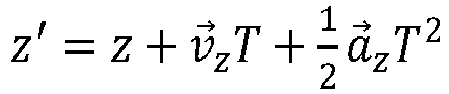 wobei x, y, z jeweils die Standortinformationen, die zu dem Endgerät gehören, in drei Dimensionen anzeigen und die in den Statusinformationen, die durch das erste Endgerät erhalten werden, enthalten sind, x', y', z' die Standortinformationen, die zu dem Endgerät gehören, in drei Dimensionen nach der festgelegten Dauer anzeigen und die durch das erste Endgerät vorhergesagt werden, T die festgelegte Dauer anzeigt,
v x ,v y ,v z die Geschwindigkeitsinformationen, die zu dem Endgerät gehören, in drei Dimensionen anzeigen und die in den Statusinformationen enthalten sind, unda x,a y,a z die Beschleunigungsinformationen, die zu dem Endgerät gehören, in drei Dimensionen anzeigen und die in den Statusinformationen enthalten sind. - System nach Anspruch 5, wobei das erste Endgerät ferner für Folgendes konfiguriert ist:falls die Synchronisationsobjekte des ersten Endgeräts nur Synchronisationsobjekte erster Art beinhalten,Bestimmen der Zeitdifferenz als eine progressive Zeitdifferenz zwischen dem ersten Endgerät und jedem Endgerät in Synchronisationsobjekten erster Art des ersten Endgeräts, wobei die progressive Zeitdifferenz
 die Wartedauer Δti_warten des ersten Endgeräts eine Anforderung der folgenden Formel erfüllt:
 die Sprungdauer Δti_springen des ersten Endgeräts eine Anforderung der folgenden Formel erfüllt:
 wobei
wobei

 Δtim die absolute Zeitdifferenz zwischen dem ersten Endgerät und einem beliebigen Endgerät in den Synchronisationsobjekten erster Art anzeigt, ti die Zeitinformationen des ersten Endgeräts anzeigt, und tm Zeitinformationen eines beliebigen Endgeräts in den Synchronisationsobjekten erster Art anzeigt; undnim eine Anforderung der folgenden Formel erfüllt:
 Sim den ersten Abstand zwischen dem ersten Endgerät und einem beliebigen Endgerät in den Synchronisationsobjekten erster Art in dem Anzeigebild anzeigt,
- System nach Anspruch 5, wobei das erste Endgerät ferner für Folgendes konfiguriert ist:falls die Synchronisationsobjekte des ersten Endgeräts Synchronisationsobjekte erster und zweiter Art beinhalten, Bestimmen für jedes Endgerät in Synchronisationsobjekten erster Art die Zeitdifferenz als eine progressive Zeitdifferenz zwischen dem ersten Endgerät und jedem Endgerät in Synchronisationsobjekten erster Art des ersten Endgeräts, wobei die progressive Zeitdifferenz
 Bestimmen für jedes Endgerät in Synchronisationsobjekten zweiter Art die Zeitdifferenz als eine absolute Zeitdifferenz zwischen dem ersten Endgerät und jedem Endgerät in Synchronisierungsobjekten zweiter Art des ersten Endgeräts; unddie Wartedauer Δti_warten des ersten Endgeräts eine Anforderung der folgenden Formel erfüllt:
 die Sprungdauer Δti_springen des ersten Endgeräts eine Anforderung der folgenden Formel erfüllt:
 wobei
wobei Δtil eine absolute Zeitdifferenz zwischen dem ersten Endgerät und einem beliebigen Endgerät in den Synchronisationsobjekten zweiter Art anzeigt, ti die Zeitinformationen des ersten Endgeräts anzeigt, und tl Zeitinformationen eines beliebigen Endgeräts in den Synchronisationsobjekten zweiter Art anzeigt;

 Δtim die absolute Zeitdifferenz zwischen dem ersten Endgerät und einem beliebigen Endgerät in den Synchronisationsobjekten erster Art anzeigt, ti die Zeitinformationen des ersten Endgeräts anzeigt, tm und Zeitinformationen eines beliebigen Endgeräts in den Synchronisationsobjekten erster Art anzeigt; undnim eine Anforderung der folgenden Formel erfüllt:
 Sim den ersten Abstand zwischen dem ersten Endgerät und einem beliebigen Endgerät in den Synchronisationsobjekten erster Art in dem Anzeigebild anzeigt,
Applications Claiming Priority (1)
| Application Number | Priority Date | Filing Date | Title |
|---|---|---|---|
| CN201510863976.6A CN106817508B (zh) | 2015-11-30 | 2015-11-30 | 一种同步对象确定方法、装置和系统 |
Publications (2)
| Publication Number | Publication Date |
|---|---|
| EP3173134A1 EP3173134A1 (de) | 2017-05-31 |
| EP3173134B1 true EP3173134B1 (de) | 2023-07-26 |
Family
ID=57226772
Family Applications (1)
| Application Number | Title | Priority Date | Filing Date |
|---|---|---|---|
| EP16194958.1A Active EP3173134B1 (de) | 2015-11-30 | 2016-10-21 | Synchronisationsobjektbestimmungsverfahren, -vorrichtung und -system |
Country Status (3)
| Country | Link |
|---|---|
| US (1) | US10338879B2 (de) |
| EP (1) | EP3173134B1 (de) |
| CN (1) | CN106817508B (de) |
Families Citing this family (8)
| Publication number | Priority date | Publication date | Assignee | Title |
|---|---|---|---|---|
| CN109471603A (zh) * | 2017-09-07 | 2019-03-15 | 华为终端(东莞)有限公司 | 一种界面显示方法及装置 |
| CN111542871B (zh) * | 2017-11-10 | 2024-07-02 | 赛斯-伊玛格标签有限责任公司 | 在多个回放装置上进行同步视频回放的系统 |
| US11416767B2 (en) * | 2018-04-27 | 2022-08-16 | Docusign International (Emea) Limited | Generative adversarial network model training using distributed ledger |
| CN109364478B (zh) | 2018-09-07 | 2022-08-23 | 深圳市腾讯信息技术有限公司 | 信息同步方法、装置及存储介质 |
| CN111265863B (zh) * | 2020-01-17 | 2022-05-24 | 腾讯科技(深圳)有限公司 | 一种目标对象的位置纠正方法、装置、设备及介质 |
| CN113365126B (zh) * | 2021-05-24 | 2023-02-21 | 武汉乐谷在线科技有限公司 | 一种游戏数据同步方法及系统、设备、存储介质 |
| CN117082441A (zh) * | 2022-12-15 | 2023-11-17 | Tcl通讯(宁波)有限公司 | 数据传输方法、装置、电子设备及计算机存储介质 |
| CN117641020B (zh) * | 2024-01-26 | 2024-04-30 | 腾讯科技(深圳)有限公司 | 一种信息处理方法和相关装置 |
Family Cites Families (30)
| Publication number | Priority date | Publication date | Assignee | Title |
|---|---|---|---|---|
| US4493053A (en) | 1982-12-10 | 1985-01-08 | At&T Bell Laboratories | Multi-device apparatus synchronized to the slowest device |
| US5426539A (en) | 1992-12-01 | 1995-06-20 | National Semiconductor Corporation | Multiple gap read/write head for data storage devices |
| US5606164A (en) | 1996-01-16 | 1997-02-25 | Boehringer Mannheim Corporation | Method and apparatus for biological fluid analyte concentration measurement using generalized distance outlier detection |
| JPH0991468A (ja) * | 1995-09-22 | 1997-04-04 | Nippon Telegr & Teleph Corp <Ntt> | 3次元画像表示装置および方法 |
| US6028593A (en) * | 1995-12-01 | 2000-02-22 | Immersion Corporation | Method and apparatus for providing simulated physical interactions within computer generated environments |
| US6026172A (en) | 1996-09-06 | 2000-02-15 | Lewis, Jr.; Clarence A. | System and method for zoom lens calibration and method using same |
| US6040871A (en) * | 1996-12-27 | 2000-03-21 | Lucent Technologies Inc. | Method and apparatus for synchronizing video signals |
| US7574493B2 (en) * | 2000-11-22 | 2009-08-11 | Cricket Communications, Inc. | Method and system for improving the efficiency of state information transfer over a wireless communications network |
| US6845287B2 (en) | 2002-11-20 | 2005-01-18 | Asml Holding N.V. | Method, system, and computer program product for improved trajectory planning and execution |
| US7294822B2 (en) | 2004-03-19 | 2007-11-13 | Mitch Randall | Method and apparatus to communicate with and individually locate multiple remote devices on a two-dimensional surface |
| WO2006092078A1 (en) | 2005-03-01 | 2006-09-08 | Yue Ma | X-ray device |
| JP4897038B2 (ja) | 2006-03-20 | 2012-03-14 | ケイティーフリーテル カンパニー リミテッド | Cdma網を用いた交通情報測定方法及びそのシステム |
| US7733223B2 (en) * | 2007-08-17 | 2010-06-08 | The Invention Science Fund I, Llc | Effectively documenting irregularities in a responsive user's environment |
| US7996686B2 (en) * | 2008-07-07 | 2011-08-09 | International Business Machines Corporation | Branch trace methodology |
| US20100053151A1 (en) * | 2008-09-02 | 2010-03-04 | Samsung Electronics Co., Ltd | In-line mediation for manipulating three-dimensional content on a display device |
| US8347210B2 (en) | 2008-09-26 | 2013-01-01 | Apple Inc. | Synchronizing video with audio beats |
| GB2477688B (en) | 2008-11-26 | 2014-03-05 | Pronk Technologies Inc | Pump tester |
| DE102009048553A1 (de) | 2009-09-29 | 2011-03-31 | Carl Zeiss Smt Gmbh | Katadioptrisches Projektionsobjektiv mit Umlenkspiegeln und Projektionsbelichtungsverfahren |
| KR101126110B1 (ko) * | 2010-06-28 | 2012-03-29 | (주)펜앤프리 | 3차원 입체 영상 표시 시스템 및 이를 이용한 3차원 입체 영상 표시 방법 |
| US8904197B2 (en) * | 2011-03-07 | 2014-12-02 | Ricoh Co., Ltd. | Power management based on combined user interface and sensor inputs |
| KR101274556B1 (ko) * | 2011-08-17 | 2013-06-17 | 국방과학연구소 | 증강현실을 이용한 실물과 가상모델 사이의 거리측정 시스템 및 방법 |
| US9674661B2 (en) * | 2011-10-21 | 2017-06-06 | Microsoft Technology Licensing, Llc | Device-to-device relative localization |
| CN102348276B (zh) | 2011-11-23 | 2014-07-23 | 电信科学技术研究院 | 一种自组织网络中进行同步的方法和设备 |
| KR101925361B1 (ko) * | 2012-06-04 | 2018-12-05 | 삼성전자주식회사 | 사용자 단말 장치, 메시지 교환 시스템, 메시지 표시 방법 및 메시지 교환 방법 |
| CN103685388B (zh) * | 2012-09-13 | 2015-01-07 | 腾讯科技(深圳)有限公司 | 信息管理的方法和装置 |
| AU2014218314A1 (en) * | 2013-02-14 | 2015-08-27 | Deakin University | Position sensing apparatus and method |
| US9928652B2 (en) * | 2013-03-01 | 2018-03-27 | Apple Inc. | Registration between actual mobile device position and environmental model |
| US10262462B2 (en) * | 2014-04-18 | 2019-04-16 | Magic Leap, Inc. | Systems and methods for augmented and virtual reality |
| CN104427607B (zh) | 2013-08-26 | 2018-01-19 | 北京信威通信技术股份有限公司 | 一种自组织网络中节点间时间同步的方法 |
| CN104954349B (zh) * | 2014-03-31 | 2018-07-20 | 北京畅游天下网络技术有限公司 | 一种2d游戏中客户端的同步方法、装置和系统 |
-
2015
- 2015-11-30 CN CN201510863976.6A patent/CN106817508B/zh active Active
-
2016
- 2016-10-21 EP EP16194958.1A patent/EP3173134B1/de active Active
- 2016-11-29 US US15/363,341 patent/US10338879B2/en active Active
Also Published As
| Publication number | Publication date |
|---|---|
| CN106817508A (zh) | 2017-06-09 |
| CN106817508B (zh) | 2019-11-22 |
| US20170153864A1 (en) | 2017-06-01 |
| US10338879B2 (en) | 2019-07-02 |
| EP3173134A1 (de) | 2017-05-31 |
Similar Documents
| Publication | Publication Date | Title |
|---|---|---|
| US10338879B2 (en) | Synchronization object determining method, apparatus, and system | |
| US11514839B2 (en) | Optimized display image rendering | |
| EP3970117B1 (de) | Verteilte posenschätzung | |
| WO2018140129A1 (en) | Systems and methods for tracking a controller | |
| CN104954349B (zh) | 一种2d游戏中客户端的同步方法、装置和系统 | |
| WO2018201935A1 (zh) | 多化身位置同步系统、方法、装置及电子设备和存储介质 | |
| US20160086025A1 (en) | Pose tracker with multi threaded architecture | |
| JP2016116221A (ja) | 3d表示のための装置及び方法 | |
| US20230267063A1 (en) | Real-time latency measurements in streaming systems and applications | |
| US12002162B2 (en) | Method and apparatus for providing virtual contents in virtual space based on common coordinate system | |
| US11677833B2 (en) | Methods for visualizing and interacting with a three dimensional object in a collaborative augmented reality environment and apparatuses thereof | |
| CN112486326B (zh) | 手势控制运动的位置坐标预测方法、智能终端及介质 | |
| US12257498B2 (en) | Server, processing system, processing method, and program | |
| US11694409B1 (en) | Augmented reality using a split architecture | |
| US20250191199A1 (en) | Frame rate up-conversion using optical flow | |
| US20250068806A1 (en) | Adaptive and distributed simulation of fluids with rigid body coupling | |
| CN110073314A (zh) | 磁跟踪器双模式 | |
| Debner et al. | Scalability of a machine learning environment for autonomous driving research | |
| Choi et al. | Haptic interactions for probing real objects in remote places | |
| CN113640739B (zh) | 一种三维场景下的协作定位方法及装置 |
Legal Events
| Date | Code | Title | Description |
|---|---|---|---|
| PUAI | Public reference made under article 153(3) epc to a published international application that has entered the european phase |
Free format text: ORIGINAL CODE: 0009012 |
|
| STAA | Information on the status of an ep patent application or granted ep patent |
Free format text: STATUS: THE APPLICATION HAS BEEN PUBLISHED |
|
| AK | Designated contracting states |
Kind code of ref document: A1 Designated state(s): AL AT BE BG CH CY CZ DE DK EE ES FI FR GB GR HR HU IE IS IT LI LT LU LV MC MK MT NL NO PL PT RO RS SE SI SK SM TR |
|
| AX | Request for extension of the european patent |
Extension state: BA ME |
|
| STAA | Information on the status of an ep patent application or granted ep patent |
Free format text: STATUS: REQUEST FOR EXAMINATION WAS MADE |
|
| 17P | Request for examination filed |
Effective date: 20171003 |
|
| RBV | Designated contracting states (corrected) |
Designated state(s): AL AT BE BG CH CY CZ DE DK EE ES FI FR GB GR HR HU IE IS IT LI LT LU LV MC MK MT NL NO PL PT RO RS SE SI SK SM TR |
|
| STAA | Information on the status of an ep patent application or granted ep patent |
Free format text: STATUS: EXAMINATION IS IN PROGRESS |
|
| 17Q | First examination report despatched |
Effective date: 20190708 |
|
| REG | Reference to a national code |
Ref country code: DE Ref legal event code: R079 Free format text: PREVIOUS MAIN CLASS: A63F0013358000 Ipc: A63F0013560000 Ref country code: DE Ref legal event code: R079 Ref document number: 602016081311 Country of ref document: DE Free format text: PREVIOUS MAIN CLASS: A63F0013358000 Ipc: A63F0013560000 |
|
| GRAP | Despatch of communication of intention to grant a patent |
Free format text: ORIGINAL CODE: EPIDOSNIGR1 |
|
| STAA | Information on the status of an ep patent application or granted ep patent |
Free format text: STATUS: GRANT OF PATENT IS INTENDED |
|
| RIC1 | Information provided on ipc code assigned before grant |
Ipc: A63F 13/358 20140101ALI20230309BHEP Ipc: A63F 13/56 20140101AFI20230309BHEP |
|
| INTG | Intention to grant announced |
Effective date: 20230331 |
|
| GRAS | Grant fee paid |
Free format text: ORIGINAL CODE: EPIDOSNIGR3 |
|
| GRAA | (expected) grant |
Free format text: ORIGINAL CODE: 0009210 |
|
| STAA | Information on the status of an ep patent application or granted ep patent |
Free format text: STATUS: THE PATENT HAS BEEN GRANTED |
|
| AK | Designated contracting states |
Kind code of ref document: B1 Designated state(s): AL AT BE BG CH CY CZ DE DK EE ES FI FR GB GR HR HU IE IS IT LI LT LU LV MC MK MT NL NO PL PT RO RS SE SI SK SM TR |
|
| REG | Reference to a national code |
Ref country code: GB Ref legal event code: FG4D |
|
| REG | Reference to a national code |
Ref country code: CH Ref legal event code: EP |
|
| REG | Reference to a national code |
Ref country code: DE Ref legal event code: R096 Ref document number: 602016081311 Country of ref document: DE |
|
| REG | Reference to a national code |
Ref country code: IE Ref legal event code: FG4D |
|
| P01 | Opt-out of the competence of the unified patent court (upc) registered |
Effective date: 20230727 |
|
| REG | Reference to a national code |
Ref country code: LT Ref legal event code: MG9D |
|
| REG | Reference to a national code |
Ref country code: NL Ref legal event code: MP Effective date: 20230726 |
|
| REG | Reference to a national code |
Ref country code: AT Ref legal event code: MK05 Ref document number: 1591268 Country of ref document: AT Kind code of ref document: T Effective date: 20230726 |
|
| PG25 | Lapsed in a contracting state [announced via postgrant information from national office to epo] |
Ref country code: NL Free format text: LAPSE BECAUSE OF FAILURE TO SUBMIT A TRANSLATION OF THE DESCRIPTION OR TO PAY THE FEE WITHIN THE PRESCRIBED TIME-LIMIT Effective date: 20230726 |
|
| PG25 | Lapsed in a contracting state [announced via postgrant information from national office to epo] |
Ref country code: GR Free format text: LAPSE BECAUSE OF FAILURE TO SUBMIT A TRANSLATION OF THE DESCRIPTION OR TO PAY THE FEE WITHIN THE PRESCRIBED TIME-LIMIT Effective date: 20231027 |
|
| PG25 | Lapsed in a contracting state [announced via postgrant information from national office to epo] |
Ref country code: IS Free format text: LAPSE BECAUSE OF FAILURE TO SUBMIT A TRANSLATION OF THE DESCRIPTION OR TO PAY THE FEE WITHIN THE PRESCRIBED TIME-LIMIT Effective date: 20231126 |
|
| PG25 | Lapsed in a contracting state [announced via postgrant information from national office to epo] |
Ref country code: SE Free format text: LAPSE BECAUSE OF FAILURE TO SUBMIT A TRANSLATION OF THE DESCRIPTION OR TO PAY THE FEE WITHIN THE PRESCRIBED TIME-LIMIT Effective date: 20230726 Ref country code: RS Free format text: LAPSE BECAUSE OF FAILURE TO SUBMIT A TRANSLATION OF THE DESCRIPTION OR TO PAY THE FEE WITHIN THE PRESCRIBED TIME-LIMIT Effective date: 20230726 Ref country code: PT Free format text: LAPSE BECAUSE OF FAILURE TO SUBMIT A TRANSLATION OF THE DESCRIPTION OR TO PAY THE FEE WITHIN THE PRESCRIBED TIME-LIMIT Effective date: 20231127 Ref country code: NO Free format text: LAPSE BECAUSE OF FAILURE TO SUBMIT A TRANSLATION OF THE DESCRIPTION OR TO PAY THE FEE WITHIN THE PRESCRIBED TIME-LIMIT Effective date: 20231026 Ref country code: LV Free format text: LAPSE BECAUSE OF FAILURE TO SUBMIT A TRANSLATION OF THE DESCRIPTION OR TO PAY THE FEE WITHIN THE PRESCRIBED TIME-LIMIT Effective date: 20230726 Ref country code: LT Free format text: LAPSE BECAUSE OF FAILURE TO SUBMIT A TRANSLATION OF THE DESCRIPTION OR TO PAY THE FEE WITHIN THE PRESCRIBED TIME-LIMIT Effective date: 20230726 Ref country code: IS Free format text: LAPSE BECAUSE OF FAILURE TO SUBMIT A TRANSLATION OF THE DESCRIPTION OR TO PAY THE FEE WITHIN THE PRESCRIBED TIME-LIMIT Effective date: 20231126 Ref country code: HR Free format text: LAPSE BECAUSE OF FAILURE TO SUBMIT A TRANSLATION OF THE DESCRIPTION OR TO PAY THE FEE WITHIN THE PRESCRIBED TIME-LIMIT Effective date: 20230726 Ref country code: GR Free format text: LAPSE BECAUSE OF FAILURE TO SUBMIT A TRANSLATION OF THE DESCRIPTION OR TO PAY THE FEE WITHIN THE PRESCRIBED TIME-LIMIT Effective date: 20231027 Ref country code: FI Free format text: LAPSE BECAUSE OF FAILURE TO SUBMIT A TRANSLATION OF THE DESCRIPTION OR TO PAY THE FEE WITHIN THE PRESCRIBED TIME-LIMIT Effective date: 20230726 Ref country code: AT Free format text: LAPSE BECAUSE OF FAILURE TO SUBMIT A TRANSLATION OF THE DESCRIPTION OR TO PAY THE FEE WITHIN THE PRESCRIBED TIME-LIMIT Effective date: 20230726 |
|
| PG25 | Lapsed in a contracting state [announced via postgrant information from national office to epo] |
Ref country code: PL Free format text: LAPSE BECAUSE OF FAILURE TO SUBMIT A TRANSLATION OF THE DESCRIPTION OR TO PAY THE FEE WITHIN THE PRESCRIBED TIME-LIMIT Effective date: 20230726 |
|
| PG25 | Lapsed in a contracting state [announced via postgrant information from national office to epo] |
Ref country code: ES Free format text: LAPSE BECAUSE OF FAILURE TO SUBMIT A TRANSLATION OF THE DESCRIPTION OR TO PAY THE FEE WITHIN THE PRESCRIBED TIME-LIMIT Effective date: 20230726 |
|
| REG | Reference to a national code |
Ref country code: DE Ref legal event code: R097 Ref document number: 602016081311 Country of ref document: DE |
|
| PG25 | Lapsed in a contracting state [announced via postgrant information from national office to epo] |
Ref country code: SM Free format text: LAPSE BECAUSE OF FAILURE TO SUBMIT A TRANSLATION OF THE DESCRIPTION OR TO PAY THE FEE WITHIN THE PRESCRIBED TIME-LIMIT Effective date: 20230726 Ref country code: RO Free format text: LAPSE BECAUSE OF FAILURE TO SUBMIT A TRANSLATION OF THE DESCRIPTION OR TO PAY THE FEE WITHIN THE PRESCRIBED TIME-LIMIT Effective date: 20230726 Ref country code: ES Free format text: LAPSE BECAUSE OF FAILURE TO SUBMIT A TRANSLATION OF THE DESCRIPTION OR TO PAY THE FEE WITHIN THE PRESCRIBED TIME-LIMIT Effective date: 20230726 Ref country code: EE Free format text: LAPSE BECAUSE OF FAILURE TO SUBMIT A TRANSLATION OF THE DESCRIPTION OR TO PAY THE FEE WITHIN THE PRESCRIBED TIME-LIMIT Effective date: 20230726 Ref country code: DK Free format text: LAPSE BECAUSE OF FAILURE TO SUBMIT A TRANSLATION OF THE DESCRIPTION OR TO PAY THE FEE WITHIN THE PRESCRIBED TIME-LIMIT Effective date: 20230726 Ref country code: CZ Free format text: LAPSE BECAUSE OF FAILURE TO SUBMIT A TRANSLATION OF THE DESCRIPTION OR TO PAY THE FEE WITHIN THE PRESCRIBED TIME-LIMIT Effective date: 20230726 Ref country code: SK Free format text: LAPSE BECAUSE OF FAILURE TO SUBMIT A TRANSLATION OF THE DESCRIPTION OR TO PAY THE FEE WITHIN THE PRESCRIBED TIME-LIMIT Effective date: 20230726 |
|
| PG25 | Lapsed in a contracting state [announced via postgrant information from national office to epo] |
Ref country code: IT Free format text: LAPSE BECAUSE OF FAILURE TO SUBMIT A TRANSLATION OF THE DESCRIPTION OR TO PAY THE FEE WITHIN THE PRESCRIBED TIME-LIMIT Effective date: 20230726 Ref country code: MC Free format text: LAPSE BECAUSE OF FAILURE TO SUBMIT A TRANSLATION OF THE DESCRIPTION OR TO PAY THE FEE WITHIN THE PRESCRIBED TIME-LIMIT Effective date: 20230726 |
|
| PLBE | No opposition filed within time limit |
Free format text: ORIGINAL CODE: 0009261 |
|
| REG | Reference to a national code |
Ref country code: CH Ref legal event code: PL |
|
| STAA | Information on the status of an ep patent application or granted ep patent |
Free format text: STATUS: NO OPPOSITION FILED WITHIN TIME LIMIT |
|
| REG | Reference to a national code |
Ref country code: BE Ref legal event code: MM Effective date: 20231031 |
|
| PG25 | Lapsed in a contracting state [announced via postgrant information from national office to epo] |
Ref country code: LU Free format text: LAPSE BECAUSE OF NON-PAYMENT OF DUE FEES Effective date: 20231021 |
|
| PG25 | Lapsed in a contracting state [announced via postgrant information from national office to epo] |
Ref country code: LU Free format text: LAPSE BECAUSE OF NON-PAYMENT OF DUE FEES Effective date: 20231021 |
|
| 26N | No opposition filed |
Effective date: 20240429 |
|
| PG25 | Lapsed in a contracting state [announced via postgrant information from national office to epo] |
Ref country code: CH Free format text: LAPSE BECAUSE OF NON-PAYMENT OF DUE FEES Effective date: 20231031 |
|
| PG25 | Lapsed in a contracting state [announced via postgrant information from national office to epo] |
Ref country code: FR Free format text: LAPSE BECAUSE OF NON-PAYMENT OF DUE FEES Effective date: 20231031 Ref country code: CH Free format text: LAPSE BECAUSE OF NON-PAYMENT OF DUE FEES Effective date: 20231031 Ref country code: SI Free format text: LAPSE BECAUSE OF FAILURE TO SUBMIT A TRANSLATION OF THE DESCRIPTION OR TO PAY THE FEE WITHIN THE PRESCRIBED TIME-LIMIT Effective date: 20230726 |
|
| PG25 | Lapsed in a contracting state [announced via postgrant information from national office to epo] |
Ref country code: BE Free format text: LAPSE BECAUSE OF NON-PAYMENT OF DUE FEES Effective date: 20231031 |
|
| PG25 | Lapsed in a contracting state [announced via postgrant information from national office to epo] |
Ref country code: IE Free format text: LAPSE BECAUSE OF NON-PAYMENT OF DUE FEES Effective date: 20231021 |
|
| PG25 | Lapsed in a contracting state [announced via postgrant information from national office to epo] |
Ref country code: IE Free format text: LAPSE BECAUSE OF NON-PAYMENT OF DUE FEES Effective date: 20231021 |
|
| PG25 | Lapsed in a contracting state [announced via postgrant information from national office to epo] |
Ref country code: BG Free format text: LAPSE BECAUSE OF FAILURE TO SUBMIT A TRANSLATION OF THE DESCRIPTION OR TO PAY THE FEE WITHIN THE PRESCRIBED TIME-LIMIT Effective date: 20230726 |
|
| PG25 | Lapsed in a contracting state [announced via postgrant information from national office to epo] |
Ref country code: BG Free format text: LAPSE BECAUSE OF FAILURE TO SUBMIT A TRANSLATION OF THE DESCRIPTION OR TO PAY THE FEE WITHIN THE PRESCRIBED TIME-LIMIT Effective date: 20230726 |
|
| PG25 | Lapsed in a contracting state [announced via postgrant information from national office to epo] |
Ref country code: CY Free format text: LAPSE BECAUSE OF FAILURE TO SUBMIT A TRANSLATION OF THE DESCRIPTION OR TO PAY THE FEE WITHIN THE PRESCRIBED TIME-LIMIT; INVALID AB INITIO Effective date: 20161021 |
|
| PG25 | Lapsed in a contracting state [announced via postgrant information from national office to epo] |
Ref country code: HU Free format text: LAPSE BECAUSE OF FAILURE TO SUBMIT A TRANSLATION OF THE DESCRIPTION OR TO PAY THE FEE WITHIN THE PRESCRIBED TIME-LIMIT; INVALID AB INITIO Effective date: 20161021 |
|
| PGFP | Annual fee paid to national office [announced via postgrant information from national office to epo] |
Ref country code: GB Payment date: 20250904 Year of fee payment: 10 |
|
| PG25 | Lapsed in a contracting state [announced via postgrant information from national office to epo] |
Ref country code: TR Free format text: LAPSE BECAUSE OF FAILURE TO SUBMIT A TRANSLATION OF THE DESCRIPTION OR TO PAY THE FEE WITHIN THE PRESCRIBED TIME-LIMIT Effective date: 20230726 |
|
| PGFP | Annual fee paid to national office [announced via postgrant information from national office to epo] |
Ref country code: DE Payment date: 20250902 Year of fee payment: 10 |