EP3170170B1 - Biological sample containment system and label - Google Patents
Biological sample containment system and label Download PDFInfo
- Publication number
- EP3170170B1 EP3170170B1 EP15742167.8A EP15742167A EP3170170B1 EP 3170170 B1 EP3170170 B1 EP 3170170B1 EP 15742167 A EP15742167 A EP 15742167A EP 3170170 B1 EP3170170 B1 EP 3170170B1
- Authority
- EP
- European Patent Office
- Prior art keywords
- layer
- label
- container
- readable information
- biological sample
- Prior art date
- Legal status (The legal status is an assumption and is not a legal conclusion. Google has not performed a legal analysis and makes no representation as to the accuracy of the status listed.)
- Active
Links
Images




Classifications
-
- B—PERFORMING OPERATIONS; TRANSPORTING
- B65—CONVEYING; PACKING; STORING; HANDLING THIN OR FILAMENTARY MATERIAL
- B65D—CONTAINERS FOR STORAGE OR TRANSPORT OF ARTICLES OR MATERIALS, e.g. BAGS, BARRELS, BOTTLES, BOXES, CANS, CARTONS, CRATES, DRUMS, JARS, TANKS, HOPPERS, FORWARDING CONTAINERS; ACCESSORIES, CLOSURES, OR FITTINGS THEREFOR; PACKAGING ELEMENTS; PACKAGES
- B65D25/00—Details of other kinds or types of rigid or semi-rigid containers
- B65D25/20—External fittings
- B65D25/205—Means for the attachment of labels, cards, coupons or the like
-
- A—HUMAN NECESSITIES
- A61—MEDICAL OR VETERINARY SCIENCE; HYGIENE
- A61B—DIAGNOSIS; SURGERY; IDENTIFICATION
- A61B5/00—Measuring for diagnostic purposes; Identification of persons
- A61B5/15—Devices for taking samples of blood
- A61B5/150007—Details
- A61B5/150015—Source of blood
- A61B5/15003—Source of blood for venous or arterial blood
-
- A—HUMAN NECESSITIES
- A61—MEDICAL OR VETERINARY SCIENCE; HYGIENE
- A61B—DIAGNOSIS; SURGERY; IDENTIFICATION
- A61B5/00—Measuring for diagnostic purposes; Identification of persons
- A61B5/15—Devices for taking samples of blood
- A61B5/150007—Details
- A61B5/150206—Construction or design features not otherwise provided for; manufacturing or production; packages; sterilisation of piercing element, piercing device or sampling device
- A61B5/150259—Improved gripping, e.g. with high friction pattern or projections on the housing surface or an ergonometric shape
-
- A—HUMAN NECESSITIES
- A61—MEDICAL OR VETERINARY SCIENCE; HYGIENE
- A61B—DIAGNOSIS; SURGERY; IDENTIFICATION
- A61B5/00—Measuring for diagnostic purposes; Identification of persons
- A61B5/15—Devices for taking samples of blood
- A61B5/150007—Details
- A61B5/150755—Blood sample preparation for further analysis, e.g. by separating blood components or by mixing
-
- A—HUMAN NECESSITIES
- A61—MEDICAL OR VETERINARY SCIENCE; HYGIENE
- A61B—DIAGNOSIS; SURGERY; IDENTIFICATION
- A61B5/00—Measuring for diagnostic purposes; Identification of persons
- A61B5/15—Devices for taking samples of blood
- A61B5/150007—Details
- A61B5/150763—Details with identification means
- A61B5/150786—Optical identification systems, e.g. bar codes, colour codes
-
- B—PERFORMING OPERATIONS; TRANSPORTING
- B01—PHYSICAL OR CHEMICAL PROCESSES OR APPARATUS IN GENERAL
- B01L—CHEMICAL OR PHYSICAL LABORATORY APPARATUS FOR GENERAL USE
- B01L3/00—Containers or dishes for laboratory use, e.g. laboratory glassware; Droppers
- B01L3/54—Labware with identification means
- B01L3/545—Labware with identification means for laboratory containers
- B01L3/5453—Labware with identification means for laboratory containers for test tubes
-
- G—PHYSICS
- G09—EDUCATION; CRYPTOGRAPHY; DISPLAY; ADVERTISING; SEALS
- G09F—DISPLAYING; ADVERTISING; SIGNS; LABELS OR NAME-PLATES; SEALS
- G09F3/00—Labels, tag tickets, or similar identification or indication means; Seals; Postage or like stamps
- G09F3/02—Forms or constructions
-
- G—PHYSICS
- G09—EDUCATION; CRYPTOGRAPHY; DISPLAY; ADVERTISING; SEALS
- G09F—DISPLAYING; ADVERTISING; SIGNS; LABELS OR NAME-PLATES; SEALS
- G09F3/00—Labels, tag tickets, or similar identification or indication means; Seals; Postage or like stamps
- G09F3/02—Forms or constructions
- G09F3/0297—Forms or constructions including a machine-readable marking, e.g. a bar code
-
- G—PHYSICS
- G09—EDUCATION; CRYPTOGRAPHY; DISPLAY; ADVERTISING; SEALS
- G09F—DISPLAYING; ADVERTISING; SIGNS; LABELS OR NAME-PLATES; SEALS
- G09F3/00—Labels, tag tickets, or similar identification or indication means; Seals; Postage or like stamps
- G09F3/08—Fastening or securing by means not forming part of the material of the label itself
- G09F3/10—Fastening or securing by means not forming part of the material of the label itself by an adhesive layer
-
- A—HUMAN NECESSITIES
- A61—MEDICAL OR VETERINARY SCIENCE; HYGIENE
- A61B—DIAGNOSIS; SURGERY; IDENTIFICATION
- A61B5/00—Measuring for diagnostic purposes; Identification of persons
- A61B5/15—Devices for taking samples of blood
- A61B5/153—Devices specially adapted for taking samples of venous or arterial blood, e.g. with syringes
-
- B—PERFORMING OPERATIONS; TRANSPORTING
- B01—PHYSICAL OR CHEMICAL PROCESSES OR APPARATUS IN GENERAL
- B01L—CHEMICAL OR PHYSICAL LABORATORY APPARATUS FOR GENERAL USE
- B01L2200/00—Solutions for specific problems relating to chemical or physical laboratory apparatus
- B01L2200/14—Process control and prevention of errors
- B01L2200/143—Quality control, feedback systems
- B01L2200/147—Employing temperature sensors
-
- B—PERFORMING OPERATIONS; TRANSPORTING
- B01—PHYSICAL OR CHEMICAL PROCESSES OR APPARATUS IN GENERAL
- B01L—CHEMICAL OR PHYSICAL LABORATORY APPARATUS FOR GENERAL USE
- B01L2300/00—Additional constructional details
- B01L2300/02—Identification, exchange or storage of information
- B01L2300/021—Identification, e.g. bar codes
-
- B—PERFORMING OPERATIONS; TRANSPORTING
- B01—PHYSICAL OR CHEMICAL PROCESSES OR APPARATUS IN GENERAL
- B01L—CHEMICAL OR PHYSICAL LABORATORY APPARATUS FOR GENERAL USE
- B01L2300/00—Additional constructional details
- B01L2300/08—Geometry, shape and general structure
- B01L2300/0832—Geometry, shape and general structure cylindrical, tube shaped
-
- B—PERFORMING OPERATIONS; TRANSPORTING
- B01—PHYSICAL OR CHEMICAL PROCESSES OR APPARATUS IN GENERAL
- B01L—CHEMICAL OR PHYSICAL LABORATORY APPARATUS FOR GENERAL USE
- B01L2300/00—Additional constructional details
- B01L2300/08—Geometry, shape and general structure
- B01L2300/0887—Laminated structure
-
- G—PHYSICS
- G09—EDUCATION; CRYPTOGRAPHY; DISPLAY; ADVERTISING; SEALS
- G09F—DISPLAYING; ADVERTISING; SIGNS; LABELS OR NAME-PLATES; SEALS
- G09F3/00—Labels, tag tickets, or similar identification or indication means; Seals; Postage or like stamps
- G09F3/02—Forms or constructions
- G09F2003/0208—Indicia
- G09F2003/0211—Transfer or thermo-sensitive
-
- G—PHYSICS
- G09—EDUCATION; CRYPTOGRAPHY; DISPLAY; ADVERTISING; SEALS
- G09F—DISPLAYING; ADVERTISING; SIGNS; LABELS OR NAME-PLATES; SEALS
- G09F3/00—Labels, tag tickets, or similar identification or indication means; Seals; Postage or like stamps
- G09F3/02—Forms or constructions
- G09F2003/0214—Stock management
- G09F2003/0216—Stock management for containers
-
- G—PHYSICS
- G09—EDUCATION; CRYPTOGRAPHY; DISPLAY; ADVERTISING; SEALS
- G09F—DISPLAYING; ADVERTISING; SIGNS; LABELS OR NAME-PLATES; SEALS
- G09F3/00—Labels, tag tickets, or similar identification or indication means; Seals; Postage or like stamps
- G09F3/02—Forms or constructions
- G09F2003/0214—Stock management
- G09F2003/0219—Stock management to keep record of the use of a product
-
- G—PHYSICS
- G09—EDUCATION; CRYPTOGRAPHY; DISPLAY; ADVERTISING; SEALS
- G09F—DISPLAYING; ADVERTISING; SIGNS; LABELS OR NAME-PLATES; SEALS
- G09F3/00—Labels, tag tickets, or similar identification or indication means; Seals; Postage or like stamps
- G09F3/02—Forms or constructions
- G09F2003/023—Adhesive
- G09F2003/0245—Differential adhesive strength
-
- G—PHYSICS
- G09—EDUCATION; CRYPTOGRAPHY; DISPLAY; ADVERTISING; SEALS
- G09F—DISPLAYING; ADVERTISING; SIGNS; LABELS OR NAME-PLATES; SEALS
- G09F3/00—Labels, tag tickets, or similar identification or indication means; Seals; Postage or like stamps
- G09F3/02—Forms or constructions
- G09F2003/0257—Multilayer
-
- G—PHYSICS
- G09—EDUCATION; CRYPTOGRAPHY; DISPLAY; ADVERTISING; SEALS
- G09F—DISPLAYING; ADVERTISING; SIGNS; LABELS OR NAME-PLATES; SEALS
- G09F3/00—Labels, tag tickets, or similar identification or indication means; Seals; Postage or like stamps
- G09F3/02—Forms or constructions
- G09F2003/0272—Labels for containers
Definitions
- the present disclosure relates generally to biological sample containment systems. More particularly, the present disclosure relates to systems and methods for providing identifying information for biological sample containment systems.
- Bio sample collection containers such as blood collection containers, are well-known in the medical arts. Biological sample collection containers are used to store a sample obtained by a healthcare professional from a patient until the sample is ready to be tested or used for other purposes.
- the container and/or sample are not exposed to a temperature that exceeds a certain threshold.
- it is sometimes important that the container is used within a certain timeframe upon manufacture, shipment, or some other event.
- identifying other characteristics and/or information of the sample and/or container may be useful to the healthcare practitioner. For example, identifying the integrity of the sample, whether the sample has been subjected to appropriate procedures, e.g., mixing, or whether the appropriate amount of sample has been collected may be significant.
- the dual-sided two-ply direct thermal image element comprises a first substrate having a first side and a second side, and a second substrate having a first side and a second side, wherein both the first substrate and the second substrate include a thermally sensitive coating on at least a first side thereof, and wherein the second side of the first substrate is releasably attached to the second side of the second substrate.
- WO 2007/092585 A2 describes a biological sample containment system and method are provided that include a container for storing the biological sample and an indicator affixed to the container for displaying at least one measured characteristics of the container or sample, wherein measurement of the characteristic is commenced by activation of the indicator.
- a biological sample containment system and method are provided that include a container for storing the biological sample and a colored scale affixed to the container, wherein the colored scale facilitates identification of at least one characteristic of the biological sample.
- a biological sample containment system and method include a container for collecting a biological sample and a label affixed to the container, wherein information relating to the biological sample or container is situated on the label and at least a portion of said information is situated on a face of the label that is affixed to the container.
- US 5 686 159 A describes a piggyback label construction includes a first label having a stock ply with a bottom face having pressure sensitive adhesive, and an imagable top face.
- a second label comprises a stock ply having a bottom face with pressure sensitive adhesive, a top face with a continuous image-producing coating, and a continuous adhesive release coating over the image-producing coating.
- the image-producing coating in US 5 686 159 A preferably is a thermosensitive coating having a first heat activation temperature of about 140 DEG -250 DEG F. (preferably about 145 DEG -155 DEG F).
- the first label stock ply has a weight of about 30 lbs.
- the first label stock imagable top face preferably is a second thermosensitive coating having a higher heat activation temperature than the first heat activation temperature.
- the image-producing coating of US 5 686 159 A may comprise a self-contained coating.
- the first label of US 5 686 159 A may be offset from the second label to provide an exposed portion of the second label image-producing portion which is separated from the rest of the construction by a perforation line, and having pre-printed non-variable indicia.
- the present invention is defined in claim 1.
- the present disclosure provides a biological sample containment system and a label for a container that includes a first layer having a first readable information portion and a second layer removably attached to the first layer, the second layer having a second readable information portion.
- the first layer and the second layer of the label are both formed of a thermosensitive material.
- the first readable information portion is identical to the second readable information portion.
- the label of the present disclosure allows a portion of the label having readable information to be removed and adhered to a patient record, for example, while a portion of the label having identical readable information remains on the container.
- the label for a container includes a first layer having a first readable information portion and formed of a thermosensitive material; and a second layer removably attached to the first layer, the second layer having a second readable information portion and formed of a thermosensitive material.
- the first readable information portion is identical to the second readable information portion.
- at least a part of the first readable information portion is a first barcode and at least a part of the second readable information portion is a second barcode, the second barcode identical to the first barcode.
- the label includes a securement portion on a surface of the first layer.
- the securement portion comprises an adhesive on a rear surface of the first layer.
- at least a part of the first readable information portion and at least a part of the second readable information portion comprise electronically readable information.
- the label includes a release layer disposed between the first layer and the second layer.
- the label includes a fill line indicator.
- a portion of the first layer includes the fill line indicator.
- a portion of the second layer includes the fill line indicator.
- the first layer and the second layer are formed of the same thermosensitive material.
- the biological sample containment system includes a container for collecting a biological sample and a label for the container including a first layer having a first readable information portion and formed of a thermosensitive material and a second layer removably attached to the first layer, the second layer having a second readable information portion and formed of a thermosensitive material.
- the label for the container of the biological sample containment system corresponds to a label as defined above.
- the first readable information portion is identical to the second readable information portion.
- at least a part of the first readable information portion is a first barcode and at least a part of the second readable information portion is a second barcode, the second barcode identical to the first barcode.
- the biological sample containment system includes a securement portion on a surface of the first layer.
- the securement portion comprises an adhesive on a rear surface of the first layer.
- at least a part of the first readable information portion and at least a part of the second readable information portion comprise electronically readable information.
- the biological sample containment system includes a release layer disposed between the first layer and the second layer.
- the label further comprises a fill line indicator.
- a portion of the first layer includes the fill line indicator.
- a portion of the second layer includes the fill line indicator.
- the first layer and the second layer are formed of the same thermosensitive material.
- the container is a biological specimen collection container. In one configuration, the container is a blood collection tube.
- a method of providing information on a container includes providing a label comprising a first layer formed of a thermosensitive material and a second layer removably attached to the first layer and formed of a thermosensitive material; providing a container; adhering the label to the container; and imparting a first readable information portion in the first layer and a second readable information portion in the second layer.
- the method includes simultaneously imparting the first readable information portion in the first layer and the second readable information portion in the second layer.
- at least a part of the first readable information portion is identical to at least a part of the second readable information portion.
- at least a part of the first readable information portion is a first barcode and at least a part of the second readable information portion is a second barcode, the second barcode identical to the first barcode.
- the method includes forming a securement portion on a surface of the first layer.
- the method includes forming the securement portion on a rear surface of the first layer.
- the securement portion comprises an adhesive.
- the method includes forming a fill line indicator on the label. In yet another configuration, the method includes forming the fill line indicator on a portion of the first layer. In one configuration, the method includes forming the fill line indicator on a portion of the second layer. In another configuration, the first layer and the second layer are formed of the same thermosensitive material.
- a biological sample containment system 10 of the present disclosure includes a biological specimen collection container 12 for collecting a biological sample and a labeling system or label 20 for the container 12.
- the label 20 includes a first layer 22 having a first readable information portion 24 and a second layer 26 removably attached to the first layer 22, the second layer 26 having a second readable information portion 28 .
- the first layer 22 and the second layer 26 of the label 20 are both formed of a thermosensitive material.
- the first layer 22 and the second layer 26 are formed of a thermo-sensitive material.
- the first readable information portion 24 is identical to the second readable information portion 28.
- the label 20 of the present disclosure allows a portion of the label 20 having readable information to be removed and adhered, such as by an adhesive on the label 20, to a patient record, for example, while a portion of the label 20 having identical readable information remains on the container 12.
- the container 12 comprises a specimen collection tube 14 and a closure 16.
- the specimen collection tube 14 may comprise any sample collection tubes or containers.
- the specimen collection tube 14 may comprise a blood collection tube, a chemistry sample tube, a coagulation sample tube, a hematology sample tube, or other sample tube.
- the tube 14 is generally cylindrical and may be made of one or more of the following representative materials: polypropylene, polyethylene terapthalate (PET), glass, or combinations thereof.
- the biological specimen collection container 12 may comprise a vessel of a different shape, i.e., other than a cylindrical shape, and, in some instances, may not be a tube.
- the biological specimen collection container 12 may comprise a collection cup, bag, or other container.
- the closure 16 may be made of a resealable elastomeric polymer and additionally may comprise a polymer cap integral to the resealable elastomeric polymer.
- the biological specimen collection container 12 may include an open top end 80, a closed bottom end 82, and a sidewall 84 extending therebetween, defining a container interior 86 adapted to receive a biological specimen, such as blood, therein.
- the closure 16 may cover the open top end 80 of the specimen collection container 12.
- the specimen collection container 12 may be a single walled container formed of glass and/or a polymeric composition.
- the specimen collection container 12 may include a tube-in-tube configuration in which a second specimen collection container is disposed within the container interior 86.
- the biological sample containment system 10 of the present disclosure includes a labeling system or label 20 for the container 12.
- the label 20 includes a first layer 22 having a first readable information portion 24 and a second layer 26 removably attached to the first layer 22, the second layer 26 having a second readable information portion 28.
- the first readable information portion 24 is identical to the second readable information portion 28.
- the label 20 of the present disclosure allows a portion of the label 20 having readable information to be removed and adhered to a patient record, for example, while a portion of the label 20 having identical readable information remains on the container 12.
- the label 20 includes an additional identifying information portion 44 that has a front surface 46 and a rear surface 48.
- the first layer 22 includes a rear surface 50 and a front surface 52.
- the second layer 26 includes a rear surface 54 and a front surface 56.
- the second layer 26 includes a flap 29 for easy gripping to facilitate removal of the second layer 26 from the first layer 22.
- the label 20 that can be applied to a container 12 includes multiple layers.
- the label 20 includes a first layer 22, a second layer 26, a release layer 30, a securement portion 32, and a label backing 36.
- the release layer 30 is disposed between the first layer 22 and the second layer 26. In this manner, the second layer 26 is removably attached to the first layer 22 such that the second layer 26 can be pulled off the first layer 22 and adhered to an item such as a patient record.
- the release layer 30 comprises a weaker adhesive that allows the second layer 26 to be removably attached to the first layer 22.
- the label 20 includes a securement portion 32 on a surface of the first layer 22.
- the securement portion 32 may be located on a rear surface 50 of the first layer 22 .
- the securement portion 32 comprises a stronger adhesive layer or adhesive 34 that allows the label 20 to be securely attached to a container 12.
- the label 20 also includes a label backing 36 disposed behind the securement portion 32 to cover and protect the securement portion 32 until it is desired to adhere the label 20 to a container 12. Before applying the label 20, the label backing 36 is removed and the securement portion 32 is adhered to a container 12.
- the first layer 22 and the second layer 26 of the label 20 are both formed of a thermosensitive material.
- the thermosensitive material may comprise any suitable material which allows for an image or indicia to be formed thereon or therein in response to an applied increase of temperature, such as, for example, a barcode burned therein.
- the first layer 22 and the second layer 26 are formed of the same thermosensitive material.
- the label 20 includes a first layer 22 having a first readable information portion 24 and a second layer 26 removably attached to the first layer 22, the second layer 26 having a second readable information portion 28.
- at least a part of the first readable information portion 24 is identical to at least a part of the second readable information portion 28.
- the label 20 of the present disclosure allows a portion of the label 20 having readable information to be removed and adhered to a patient record, for example, while a portion of the label 20 having identical readable information remains on the container 12.
- the first readable information portion 24 and/or the second readable information portion 28 of the label 20 may include any information identifying characteristics of the sample and/or container that may be useful to the healthcare practitioner. For example, the information may identify the integrity of the sample, whether the sample has been subjected to appropriate procedures, or whether the appropriate amount of sample has been collected.
- the information may relate to maximum temperatures that the container and/or sample may be exposed to, the timeframe that the container and/or sample may be used upon manufacture, shipment, or some other event, or the amount of time that has transpired after collection of the sample into the container.
- the first readable information portion 24 and/or the second readable information portion 28 of the label 20 may include fill range indicators, low fill indicators, high fill indicators, hemolysis indicators, time indicators, temperature indicators, or other information identifying characteristics of the sample and/or container that may be useful to the healthcare practitioner.
- At least a part of the first readable information portion 24 is a first barcode 40 and at least a part of the second readable information portion 28 is a second barcode 42.
- the second barcode 42 may be identical to the first barcode 40.
- at least a part of the first readable information portion 24 and at least a part of the second readable information portion 28 comprise electronically readable information.
- a barcode or some other machine readable data that is unique to each container or optionally unique to a subset of containers.
- Such information may also be used for storage of additional data associated with a container, such as container manufacturer information, container type, intended draw size information, and the like.
- patient-specific, test-specific, or other application-specific information may be stored, e.g., electronically, and associated with the container's unique identifier.
- the first readable information portion 24 and/or the second readable information portion 28 of the label 20 may include a radio frequency identification (RFID) tag which provides information associated with a container.
- RFID tag allows for unique identification of the container.
- RFID tags may be passive in nature with an electronic device having some type of reading/scanning mechanism to receive identification information off the tag.
- the tag is active in nature in which an electronic device is used to receive a signal generated by or from the tag.
- the tags may be writeable, readable, or both. With such a system, the need for more conventional type labeling having machine readable or human readable information may be complemented or obviated.
- the first readable information portion 24 and/or the second readable information portion 28 of the label 20 may include information relating to monitoring the maximum temperature to which the label 20 and the container 12 are exposed.
- the label 20 may include information relating to measuring the temperature once the label 20 and the container 12 are exposed to light and/or air.
- the first readable information portion 24 and/or the second readable information portion 28 of the label 20 may include information relating to a time and temperature shelf life indicator that allows a user to easily observe whether a container has "expired" prior to drawing a sample, testing the sample, or some other point in the sample collection and testing process resulting in fewer redraws or unnecessary or inaccurate testing.
- the first readable information portion 24 and/or the second readable information portion 28 of the label 20 may include information relating to a mix indicator 90 that ensures that the appropriate number of mixes and amount of mixing time is performed. Adequate mixing improves sample integrity, quality, and reliability.
- an accelerometer may be integrated with the container 12 such that motion representative of mixing may be identified, recorded, and outputted. The output may be in a form that is visually apparent to the user or optionally may be discreet such that the output may be interrogated by a device remote from the tube, i.e., a reading from a hand-held scanner.
- scales/terminologies that can be included to convey for measuring levels of hemolysis are: a 0, +1, +2, and +3 scale; a 0, 1+, 2+, and 3+ scale; a 0, 1, 2, and 3 scale; a 0, +, ++, and +++ scale; or a zero, trace, +, ++, and +++ scale.
- the color scale for indicating hemolysis ranges from a light yellow to a dark reddish orange.
- a Pantome color scheme may be chosen to represent variances between the low and high color indicators. Other indications of hemolysis levels may be provided.
- the label 20 includes an additional identifying information portion 44 that has a front surface 46 and a rear surface 48.
- the first layer 22 includes a rear surface 50 and a front surface 52.
- the second layer 26 includes a rear surface 54 and a front surface 56.
- the rear surface 48 of the additional identifying information portion 44 and/or the rear surface 50 of the first layer 22 includes a first information area 91, a second information area 92, a third information area 94, a fourth information area 96, and a fifth information area 98.
- the information areas may include any of the identifying information described above.
- the rear surface 48 of the additional identifying information portion 44 and/or the rear surface 50 of the first layer 22 may include any orientation and/or number of information areas configured to provide any of the identifying information described above.
- the rear surface 48 of the additional identifying information portion 44 and/or the rear surface 50 of the first layer 22 may include information pertaining to at least one of a manufacture catalog number, identifiable bar code, shelf life, lot identification number, container specific identifier, information specific to a sample intended to be placed or already placed into the container, and/or information specific to a patient in a hospital.
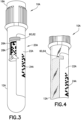
- Figs. 3 and 4 illustrate another exemplary embodiment.
- the embodiment illustrated in Figs. 3 and 4 includes similar components to the embodiment illustrated in Figs. 1, 2 , 5, and 6 , and the similar components are denoted by a reference number followed by the letter A.
- these similar components and the similar steps of using a biological sample containment system 10A will not all be discussed in conjunction with the embodiment illustrated in Figs. 3 and 4 .
- the biological sample containment system 10A includes a label 20A for a container 12A that includes a fill line indicator 60.
- the fill line indicator 60 may comprise some form of pre-printed marking or shape specific marking, such as a black solid indicator portion or a cut, cutout, or visible perforation portion. The color, shading, pattern, and shape of such portions may vary as long as each is recognizable by the user.
- the fill line indicator 60 includes a low fill indicator situated at the bottom boundary of the fill line indicator 60 and a high fill indicator situated at the upper boundary of the fill line indicator 60. In other embodiments, one of either a low fill indicator or high fill indicator may be utilized.
- a portion of the first layer 22A includes the fill line indicator 60.
- the first layer 22A includes a notch 64 that can be used as the fill line indicator 60.
- a portion of the second layer 26A includes the fill line indicator 60.
- the second layer 26A includes a band 62 that can be used as the fill line indicator 60.
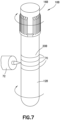
- Fig. 7 illustrates another exemplary embodiment.
- the embodiment illustrated in Fig. 7 also includes similar components to the embodiment illustrated in Figs. 1, 2 , 5, and 6 , and the similar components are denoted by a reference number followed by the letter B.
- these similar components and the similar steps of using a biological sample containment system 10B will not all be discussed in conjunction with the embodiment illustrated in Fig. 7 .
- the biological sample containment system 10B includes grooves 70 disposed in a label 20B or a container 12B and a reading needle 72.
- information may be obtained using the reading needle 72 which can be disposed within the grooves 70 while the container 12B is rotated as shown in Fig. 7 .
- the label 20 of the present disclosure allows a second layer 26 of the label 20 having readable information 28 to be removed and adhered to a patient record 74, for example, while a first layer 22 of the label 20 having identical readable information 24 remains on the container 12.
- Figs. 11 and 12 illustrates other exemplary embodiments.
- the embodiment illustrated in Figs. 11 and 12 includes similar components to the embodiment illustrated in Figs. 1, 2 , 5, and 6 , and the similar components are denoted by a reference number followed by the letters C and D.
- these similar components and the similar steps of using a biological sample containment system 10C ( Fig. 11 ) and a biological sample containment system 10D ( Fig. 12 ) will not all be discussed in conjunction with the embodiment illustrated in Figs. 11 and 12 .
- the biological sample containment system 10C includes a label 20C for a container 12C that includes a tear away portion 66.
- the tear away portion 66 may be removed so that a fill line indicator or clear portion 68 is exposed.
- the biological sample containment system 10D includes a label 20D for a container 12D that includes an invisible bar code label 76 on a rear surface 48D of the label 20D.
- a camera recognition system may be used with the invisible bar code label 76 to read and utilize information.
- the method includes providing a label 20 having a first layer 22 formed of a thermosensitive material and a second layer 26 removably attached to the first layer 22 and formed of a thermosensitive material; providing a container 12; adhering the label 20 to the container 12; and imparting a first readable information portion 24 in the first layer 22 and a second readable information portion 28 in the second layer 26.
- the method includes simultaneously imparting the first readable information portion 24 in the first layer 22 and the second readable information portion 28 in the second layer 26.
- the label 20 of the present disclosure is capable of receiving information so that the label 20 may first be secured to a container 12 and then the information may be imparted into the first layer 22 and the second layer 26 after the label 20 is secured to a container 12.
- the first layer 22 and the second layer 26 are formed of a thermosensitive material to allow information to be burned into the first layer 22 and the second layer 26.
- the first layer 22 and the second layer 26 include preprinted information and other information may be imparted to the first layer 22 and the second layer 26 after securing the label 20 to a container 12.
- a thermal energy source may be used to impart information to the label 20. Referring to Fig. 10 , in one embodiment, thermal ink 88 may be used to print information and/or a barcode onto a first layer 22 and/or a second layer 26 of the label 20.
Landscapes
- Health & Medical Sciences (AREA)
- Life Sciences & Earth Sciences (AREA)
- Engineering & Computer Science (AREA)
- Physics & Mathematics (AREA)
- Hematology (AREA)
- General Health & Medical Sciences (AREA)
- Surgery (AREA)
- Public Health (AREA)
- Biophysics (AREA)
- Pathology (AREA)
- Biomedical Technology (AREA)
- Heart & Thoracic Surgery (AREA)
- Medical Informatics (AREA)
- Molecular Biology (AREA)
- Veterinary Medicine (AREA)
- Animal Behavior & Ethology (AREA)
- Theoretical Computer Science (AREA)
- General Physics & Mathematics (AREA)
- Chemical & Material Sciences (AREA)
- Chemical Kinetics & Catalysis (AREA)
- Analytical Chemistry (AREA)
- Clinical Laboratory Science (AREA)
- Manufacturing & Machinery (AREA)
- Mechanical Engineering (AREA)
- Automatic Analysis And Handling Materials Therefor (AREA)
- Investigating Or Analysing Biological Materials (AREA)
- Medical Preparation Storing Or Oral Administration Devices (AREA)
- Details Of Rigid Or Semi-Rigid Containers (AREA)
- Sampling And Sample Adjustment (AREA)
Description
- The present disclosure relates generally to biological sample containment systems. More particularly, the present disclosure relates to systems and methods for providing identifying information for biological sample containment systems.
- Biological sample collection containers, such as blood collection containers, are well-known in the medical arts. Biological sample collection containers are used to store a sample obtained by a healthcare professional from a patient until the sample is ready to be tested or used for other purposes.
- When collecting biological samples in collection containers, it is often important that the container and/or sample are not exposed to a temperature that exceeds a certain threshold. In addition, it is sometimes important that the container is used within a certain timeframe upon manufacture, shipment, or some other event. In addition, it may be important to know the amount of time that has transpired after collection of the sample into the container.
- Additionally, identifying other characteristics and/or information of the sample and/or container may be useful to the healthcare practitioner. For example, identifying the integrity of the sample, whether the sample has been subjected to appropriate procedures, e.g., mixing, or whether the appropriate amount of sample has been collected may be significant.
- In
WO 2008/107662 A1 a dual-sided two-ply direct thermal image element is provided. In one embodiment ofWO 2008/107662 A1 , the dual-sided two-ply direct thermal image element comprises a first substrate having a first side and a second side, and a second substrate having a first side and a second side, wherein both the first substrate and the second substrate include a thermally sensitive coating on at least a first side thereof, and wherein the second side of the first substrate is releasably attached to the second side of the second substrate. -
WO 2007/092585 A2 describes a biological sample containment system and method are provided that include a container for storing the biological sample and an indicator affixed to the container for displaying at least one measured characteristics of the container or sample, wherein measurement of the characteristic is commenced by activation of the indicator. In another embodiment of theWO 2007/092585 A2 , a biological sample containment system and method are provided that include a container for storing the biological sample and a colored scale affixed to the container, wherein the colored scale facilitates identification of at least one characteristic of the biological sample. In yet another embodiment of theWO 2007/092585 A2 , a biological sample containment system and method are provided that include a container for collecting a biological sample and a label affixed to the container, wherein information relating to the biological sample or container is situated on the label and at least a portion of said information is situated on a face of the label that is affixed to the container. -
US 5 686 159 A describes a piggyback label construction includes a first label having a stock ply with a bottom face having pressure sensitive adhesive, and an imagable top face. InUS 5 686 159 A , a second label comprises a stock ply having a bottom face with pressure sensitive adhesive, a top face with a continuous image-producing coating, and a continuous adhesive release coating over the image-producing coating. The image-producing coating inUS 5 686 159 A preferably is a thermosensitive coating having a first heat activation temperature of about 140 DEG -250 DEG F. (preferably about 145 DEG -155 DEG F). InUS 5 686 159 A , the first label stock ply has a weight of about 30 lbs. per 1000 sheet 11"x17" ream, or less (preferably about 18-30 lbs.). InUS 5 686 159 A , the first label stock imagable top face preferably is a second thermosensitive coating having a higher heat activation temperature than the first heat activation temperature. The image-producing coating ofUS 5 686 159 A may comprise a self-contained coating. The first label ofUS 5 686 159 A may be offset from the second label to provide an exposed portion of the second label image-producing portion which is separated from the rest of the construction by a perforation line, and having pre-printed non-variable indicia. - Further background art for the present invention is described in
EP 2 571 008 A2 andEP 2 292 331 A2 . - The present invention is defined in claim 1.
- The present disclosure provides a biological sample containment system and a label for a container that includes a first layer having a first readable information portion and a second layer removably attached to the first layer, the second layer having a second readable information portion. The first layer and the second layer of the label are both formed of a thermosensitive material. The first readable information portion is identical to the second readable information portion. The label of the present disclosure allows a portion of the label having readable information to be removed and adhered to a patient record, for example, while a portion of the label having identical readable information remains on the container.
- The label for a container includes a first layer having a first readable information portion and formed of a thermosensitive material; and a second layer removably attached to the first layer, the second layer having a second readable information portion and formed of a thermosensitive material.
- The first readable information portion is identical to the second readable information portion. In another configuration, at least a part of the first readable information portion is a first barcode and at least a part of the second readable information portion is a second barcode, the second barcode identical to the first barcode. The label includes a securement portion on a surface of the first layer. The securement portion comprises an adhesive on a rear surface of the first layer. In another configuration, at least a part of the first readable information portion and at least a part of the second readable information portion comprise electronically readable information. The label includes a release layer disposed between the first layer and the second layer. In one configuration, the label includes a fill line indicator. In another configuration, a portion of the first layer includes the fill line indicator. In yet another configuration, a portion of the second layer includes the fill line indicator. In one configuration, the first layer and the second layer are formed of the same thermosensitive material.
- The biological sample containment system includes a container for collecting a biological sample and a label for the container including a first layer having a first readable information portion and formed of a thermosensitive material and a second layer removably attached to the first layer, the second layer having a second readable information portion and formed of a thermosensitive material. The label for the container of the biological sample containment system corresponds to a label as defined above.
- The first readable information portion is identical to the second readable information portion. In another configuration, at least a part of the first readable information portion is a first barcode and at least a part of the second readable information portion is a second barcode, the second barcode identical to the first barcode. In yet another configuration, the biological sample containment system includes a securement portion on a surface of the first layer. In one configuration, the securement portion comprises an adhesive on a rear surface of the first layer. In another configuration, at least a part of the first readable information portion and at least a part of the second readable information portion comprise electronically readable information. In yet another configuration, the biological sample containment system includes a release layer disposed between the first layer and the second layer. In one configuration, the label further comprises a fill line indicator. In another configuration, a portion of the first layer includes the fill line indicator. In yet another configuration, a portion of the second layer includes the fill line indicator. In one configuration, the first layer and the second layer are formed of the same thermosensitive material. In yet another configuration, the container is a biological specimen collection container. In one configuration, the container is a blood collection tube.
- In accordance with another example, a method of providing information on a container includes providing a label comprising a first layer formed of a thermosensitive material and a second layer removably attached to the first layer and formed of a thermosensitive material; providing a container; adhering the label to the container; and imparting a first readable information portion in the first layer and a second readable information portion in the second layer.
- In one configuration, the method includes simultaneously imparting the first readable information portion in the first layer and the second readable information portion in the second layer. In another configuration, at least a part of the first readable information portion is identical to at least a part of the second readable information portion. In yet another configuration, at least a part of the first readable information portion is a first barcode and at least a part of the second readable information portion is a second barcode, the second barcode identical to the first barcode. In one configuration, the method includes forming a securement portion on a surface of the first layer. In another configuration, the method includes forming the securement portion on a rear surface of the first layer. In yet another configuration, the securement portion comprises an adhesive. In one configuration, at least a part of the first readable information portion and at least a part of the second readable information portion comprise electronically readable information. In another configuration, the method includes forming a fill line indicator on the label. In yet another configuration, the method includes forming the fill line indicator on a portion of the first layer. In one configuration, the method includes forming the fill line indicator on a portion of the second layer. In another configuration, the first layer and the second layer are formed of the same thermosensitive material.
- The above-mentioned and other features and advantages of this disclosure, and the manner of attaining them, will become more apparent and the disclosure itself will be better understood by reference to the following descriptions of embodiments of the disclosure taken in conjunction with the accompanying drawings, wherein:
-
Fig. 1 is a perspective view of a biological sample containment system in accordance with an embodiment of the present invention. -
Fig. 2 is an exploded view of a labeling system in accordance with an embodiment of the present invention. -
Fig. 3 is a perspective view of a biological sample containment system in accordance with another embodiment of the present invention. -
Fig. 4 is a fragmentary perspective view of a biological sample containment system in accordance with another embodiment of the present invention. -
Fig. 5 is a front elevation view of a biological sample containment system in accordance with an embodiment of the present invention. -
Fig. 6 is a rear elevation view of a biological sample containment system in accordance with an embodiment of the present invention. -
Fig. 7 is a perspective view of a biological sample containment system and a reading needle in accordance with another embodiment of the present invention. -
Fig. 8 is an exploded view of a labeling system in accordance with an embodiment of the present invention. -
Fig. 9 is a front view of a biological sample containment system having a first layer of a label on a container and a second layer of the label on a patient record in accordance with an embodiment of the present invention. -
Fig. 10 is an exploded view of a labeling system in accordance with another embodiment of the present invention. -
Fig. 11 is elevation views of a biological sample containment system in accordance with another embodiment of the present invention. -
Fig. 12 is elevation views of a biological sample containment system in accordance with another embodiment of the present invention. - Corresponding reference characters indicate corresponding parts throughout the several views.
- For purposes of the description hereinafter, the terms "upper", "lower", "right", "left", "vertical", "horizontal", "top", "bottom", "lateral", "longitudinal", and derivatives thereof shall relate to the invention as it is oriented in the drawing figures. However, it is to be understood that the invention may assume alternative variations and step sequences, except where expressly specified to the contrary. It is also to be understood that the specific devices and processes illustrated in the attached drawings, and described in the following specification, are simply exemplary embodiments of the invention. Hence, specific dimensions and other physical characteristics related to the embodiments disclosed herein are not to be considered as limiting.
-
Figs. 1 and 2 illustrate an exemplary embodiment of the present disclosure. Referring toFigs. 1 and 2 , a biologicalsample containment system 10 of the present disclosure includes a biologicalspecimen collection container 12 for collecting a biological sample and a labeling system orlabel 20 for thecontainer 12. In one embodiment, thelabel 20 includes afirst layer 22 having a firstreadable information portion 24 and asecond layer 26 removably attached to thefirst layer 22, thesecond layer 26 having a secondreadable information portion 28. Thefirst layer 22 and thesecond layer 26 of thelabel 20 are both formed of a thermosensitive material. Thefirst layer 22 and thesecond layer 26 are formed of a thermo-sensitive material. The firstreadable information portion 24 is identical to the secondreadable information portion 28. Thelabel 20 of the present disclosure allows a portion of thelabel 20 having readable information to be removed and adhered, such as by an adhesive on thelabel 20, to a patient record, for example, while a portion of thelabel 20 having identical readable information remains on thecontainer 12. - Referring to
Figs. 1 and 2 -6, a biologicalspecimen collection container 12 for collecting a biological sample of the present disclosure is illustrated. In one embodiment, thecontainer 12 comprises aspecimen collection tube 14 and aclosure 16. Thespecimen collection tube 14 may comprise any sample collection tubes or containers. For example, thespecimen collection tube 14 may comprise a blood collection tube, a chemistry sample tube, a coagulation sample tube, a hematology sample tube, or other sample tube. In one embodiment, thetube 14 is generally cylindrical and may be made of one or more of the following representative materials: polypropylene, polyethylene terapthalate (PET), glass, or combinations thereof. In other embodiments, the biologicalspecimen collection container 12 may comprise a vessel of a different shape, i.e., other than a cylindrical shape, and, in some instances, may not be a tube. For example, the biologicalspecimen collection container 12 may comprise a collection cup, bag, or other container. In one embodiment, theclosure 16 may be made of a resealable elastomeric polymer and additionally may comprise a polymer cap integral to the resealable elastomeric polymer. - The biological
specimen collection container 12 may include an opentop end 80, a closedbottom end 82, and asidewall 84 extending therebetween, defining acontainer interior 86 adapted to receive a biological specimen, such as blood, therein. Theclosure 16 may cover the opentop end 80 of thespecimen collection container 12. In some embodiments, thespecimen collection container 12 may be a single walled container formed of glass and/or a polymeric composition. In other embodiments, thespecimen collection container 12 may include a tube-in-tube configuration in which a second specimen collection container is disposed within thecontainer interior 86. - Referring to
Figs. 1 and 2 , the biologicalsample containment system 10 of the present disclosure includes a labeling system orlabel 20 for thecontainer 12. In one embodiment, thelabel 20 includes afirst layer 22 having a firstreadable information portion 24 and asecond layer 26 removably attached to thefirst layer 22, thesecond layer 26 having a secondreadable information portion 28. The firstreadable information portion 24 is identical to the secondreadable information portion 28. Thelabel 20 of the present disclosure allows a portion of thelabel 20 having readable information to be removed and adhered to a patient record, for example, while a portion of thelabel 20 having identical readable information remains on thecontainer 12. Thelabel 20 includes an additional identifyinginformation portion 44 that has afront surface 46 and arear surface 48. Thefirst layer 22 includes arear surface 50 and afront surface 52. Thesecond layer 26 includes arear surface 54 and afront surface 56. In one embodiment, thesecond layer 26 includes aflap 29 for easy gripping to facilitate removal of thesecond layer 26 from thefirst layer 22. - Referring to
Fig. 2 , thelabel 20 that can be applied to acontainer 12 includes multiple layers. For example, thelabel 20 includes afirst layer 22, asecond layer 26, arelease layer 30, a securement portion 32, and alabel backing 36. - The
release layer 30 is disposed between thefirst layer 22 and thesecond layer 26. In this manner, thesecond layer 26 is removably attached to thefirst layer 22 such that thesecond layer 26 can be pulled off thefirst layer 22 and adhered to an item such as a patient record. Therelease layer 30 comprises a weaker adhesive that allows thesecond layer 26 to be removably attached to thefirst layer 22. - The
label 20 includes a securement portion 32 on a surface of thefirst layer 22. For example, the securement portion 32 may be located on arear surface 50 of thefirst layer 22. The securement portion 32 comprises a stronger adhesive layer or adhesive 34 that allows thelabel 20 to be securely attached to acontainer 12. Thelabel 20 also includes alabel backing 36 disposed behind the securement portion 32 to cover and protect the securement portion 32 until it is desired to adhere thelabel 20 to acontainer 12. Before applying thelabel 20, thelabel backing 36 is removed and the securement portion 32 is adhered to acontainer 12. - The
first layer 22 and thesecond layer 26 of thelabel 20 are both formed of a thermosensitive material. The thermosensitive material may comprise any suitable material which allows for an image or indicia to be formed thereon or therein in response to an applied increase of temperature, such as, for example, a barcode burned therein. Thefirst layer 22 and thesecond layer 26 are formed of the same thermosensitive material. - The
label 20 includes afirst layer 22 having a firstreadable information portion 24 and asecond layer 26 removably attached to thefirst layer 22, thesecond layer 26 having a secondreadable information portion 28. In one embodiment, at least a part of the firstreadable information portion 24 is identical to at least a part of the secondreadable information portion 28. Thelabel 20 of the present disclosure allows a portion of thelabel 20 having readable information to be removed and adhered to a patient record, for example, while a portion of thelabel 20 having identical readable information remains on thecontainer 12. - The first
readable information portion 24 and/or the secondreadable information portion 28 of thelabel 20 may include any information identifying characteristics of the sample and/or container that may be useful to the healthcare practitioner. For example, the information may identify the integrity of the sample, whether the sample has been subjected to appropriate procedures, or whether the appropriate amount of sample has been collected. - Furthermore, the information may relate to maximum temperatures that the container and/or sample may be exposed to, the timeframe that the container and/or sample may be used upon manufacture, shipment, or some other event, or the amount of time that has transpired after collection of the sample into the container.
- For example, the first
readable information portion 24 and/or the secondreadable information portion 28 of thelabel 20 may include fill range indicators, low fill indicators, high fill indicators, hemolysis indicators, time indicators, temperature indicators, or other information identifying characteristics of the sample and/or container that may be useful to the healthcare practitioner. - In one embodiment, at least a part of the first
readable information portion 24 is afirst barcode 40 and at least a part of the secondreadable information portion 28 is asecond barcode 42. In one embodiment, thesecond barcode 42 may be identical to thefirst barcode 40. In one embodiment, at least a part of the firstreadable information portion 24 and at least a part of the secondreadable information portion 28 comprise electronically readable information. - For example, in one embodiment, included on a portion of the
label 20 is a barcode or some other machine readable data that is unique to each container or optionally unique to a subset of containers. Such information may also be used for storage of additional data associated with a container, such as container manufacturer information, container type, intended draw size information, and the like. In addition, patient-specific, test-specific, or other application-specific information may be stored, e.g., electronically, and associated with the container's unique identifier. - The first
readable information portion 24 and/or the secondreadable information portion 28 of thelabel 20 may include a radio frequency identification (RFID) tag which provides information associated with a container. An RFID tag allows for unique identification of the container. Such RFID tags may be passive in nature with an electronic device having some type of reading/scanning mechanism to receive identification information off the tag. In another embodiment, the tag is active in nature in which an electronic device is used to receive a signal generated by or from the tag. In accordance with an embodiment of the invention, the tags may be writeable, readable, or both. With such a system, the need for more conventional type labeling having machine readable or human readable information may be complemented or obviated. - The first
readable information portion 24 and/or the secondreadable information portion 28 of thelabel 20 may include information relating to monitoring the maximum temperature to which thelabel 20 and thecontainer 12 are exposed. In another embodiment, thelabel 20 may include information relating to measuring the temperature once thelabel 20 and thecontainer 12 are exposed to light and/or air. - The first
readable information portion 24 and/or the secondreadable information portion 28 of thelabel 20 may include information relating to a time and temperature shelf life indicator that allows a user to easily observe whether a container has "expired" prior to drawing a sample, testing the sample, or some other point in the sample collection and testing process resulting in fewer redraws or unnecessary or inaccurate testing. - Referring to
Figs. 1-6 , the firstreadable information portion 24 and/or the secondreadable information portion 28 of thelabel 20 may include information relating to amix indicator 90 that ensures that the appropriate number of mixes and amount of mixing time is performed. Adequate mixing improves sample integrity, quality, and reliability. In one embodiment, an accelerometer may be integrated with thecontainer 12 such that motion representative of mixing may be identified, recorded, and outputted. The output may be in a form that is visually apparent to the user or optionally may be discreet such that the output may be interrogated by a device remote from the tube, i.e., a reading from a hand-held scanner. - Referring to
Figs. 1-6 , the firstreadable information portion 24 and/or the secondreadable information portion 28 of thelabel 20 may include information relating to a hemolysis indicator, possibly in the form of a chart or scale. One method for measuring levels of hemolysis, i.e., the breaking of the cell membranes of red blood cells, is visually identifying the color of all or a portion of a blood sample. For example, in many instances, the shade of the serum that resides above the hematocrit for a blood sample is indicative of general qualitative hemolysis levels, such as zero, trace (or slight), moderate, and gross (or severe). Such indication may be displayed by including a color scale on a blood containment device having different hemolysis level terminologies associated with and printed on the hemolysis scale. Some examples of scales/terminologies that can be included to convey for measuring levels of hemolysis are: a 0, +1, +2, and +3 scale; a 0, 1+, 2+, and 3+ scale; a 0, 1, 2, and 3 scale; a 0, +, ++, and +++ scale; or a zero, trace, +, ++, and +++ scale. The color scale for indicating hemolysis ranges from a light yellow to a dark reddish orange. A Pantome color scheme may be chosen to represent variances between the low and high color indicators. Other indications of hemolysis levels may be provided. - Referring to
Figs. 1, 2 ,5, and 6 , thelabel 20 includes an additional identifyinginformation portion 44 that has afront surface 46 and arear surface 48. Thefirst layer 22 includes arear surface 50 and afront surface 52. Thesecond layer 26 includes arear surface 54 and afront surface 56. Referring toFig. 6 , in one embodiment, therear surface 48 of the additional identifyinginformation portion 44 and/or therear surface 50 of thefirst layer 22 includes afirst information area 91, asecond information area 92, athird information area 94, afourth information area 96, and afifth information area 98. The information areas may include any of the identifying information described above. In other embodiments, therear surface 48 of the additional identifyinginformation portion 44 and/or therear surface 50 of thefirst layer 22 may include any orientation and/or number of information areas configured to provide any of the identifying information described above. - In one embodiment, the
rear surface 48 of the additional identifyinginformation portion 44 and/or therear surface 50 of thefirst layer 22 may include information pertaining to at least one of a manufacture catalog number, identifiable bar code, shelf life, lot identification number, container specific identifier, information specific to a sample intended to be placed or already placed into the container, and/or information specific to a patient in a hospital. -
Figs. 3 and 4 illustrate another exemplary embodiment. The embodiment illustrated inFigs. 3 and 4 includes similar components to the embodiment illustrated inFigs. 1, 2 ,5, and 6 , and the similar components are denoted by a reference number followed by the letter A. For the sake of brevity, these similar components and the similar steps of using a biologicalsample containment system 10A (Figs. 3 and 4 ) will not all be discussed in conjunction with the embodiment illustrated inFigs. 3 and 4 . - Referring to
Figs. 3 and 4 , the biologicalsample containment system 10A includes alabel 20A for acontainer 12A that includes a fill line indicator 60. In one embodiment, the fill line indicator 60 may comprise some form of pre-printed marking or shape specific marking, such as a black solid indicator portion or a cut, cutout, or visible perforation portion. The color, shading, pattern, and shape of such portions may vary as long as each is recognizable by the user. In one embodiment, the fill line indicator 60 includes a low fill indicator situated at the bottom boundary of the fill line indicator 60 and a high fill indicator situated at the upper boundary of the fill line indicator 60. In other embodiments, one of either a low fill indicator or high fill indicator may be utilized. The low fill indicator and the high fill indicator set the lower and upper limits for drawing a sample from a sample source, e.g., a patient's venous blood, such that sufficient sample amounts are collected to effectuate certain tests and to effectuate adequate reagent to sample mixing ratios and proper centrifugation considerations or conditions. In another embodiment, the word "fill" or some other word indicative of the indicator's purpose may be displayed in the indicator area. High fill, low fill, and generic fill indicators may comprise boundaries of each limit, or optionally may include a filled or empty space area correlating to a desired fill range. For certain containers, the desired fill range may correlate to the quantity of reagents or additives deployed into the container prior to use or at the point of manufacture to ensure proper sample to additive ration. The fill line indicators may be disposed on a portion of thelabel 20 such that a user may interpret the level or quantity of sample collected from the patient into the container by looking through a portion of the generally clear sidewall of thecontainer 12. - In one embodiment, a portion of the
first layer 22A includes the fill line indicator 60. For example, referring toFig. 4 , thefirst layer 22A includes a notch 64 that can be used as the fill line indicator 60. - In one embodiment, a portion of the
second layer 26A includes the fill line indicator 60. For example, referring toFig. 3 , thesecond layer 26A includes a band 62 that can be used as the fill line indicator 60. -
Fig. 7 illustrates another exemplary embodiment. The embodiment illustrated inFig. 7 also includes similar components to the embodiment illustrated inFigs. 1, 2 ,5, and 6 , and the similar components are denoted by a reference number followed by the letter B. For the sake of brevity, these similar components and the similar steps of using a biologicalsample containment system 10B (Fig. 7 ) will not all be discussed in conjunction with the embodiment illustrated inFig. 7 . - Referring to
Fig. 7 , the biologicalsample containment system 10B includesgrooves 70 disposed in alabel 20B or acontainer 12B and a readingneedle 72. In such an embodiment, information may be obtained using the readingneedle 72 which can be disposed within thegrooves 70 while thecontainer 12B is rotated as shown inFig. 7 . - Referring to
Fig. 9 , as described above, thelabel 20 of the present disclosure allows asecond layer 26 of thelabel 20 havingreadable information 28 to be removed and adhered to apatient record 74, for example, while afirst layer 22 of thelabel 20 having identicalreadable information 24 remains on thecontainer 12. -
Figs. 11 and 12 illustrates other exemplary embodiments. The embodiment illustrated inFigs. 11 and 12 includes similar components to the embodiment illustrated inFigs. 1, 2 ,5, and 6 , and the similar components are denoted by a reference number followed by the letters C and D. For the sake of brevity, these similar components and the similar steps of using a biologicalsample containment system 10C (Fig. 11 ) and a biologicalsample containment system 10D (Fig. 12 ) will not all be discussed in conjunction with the embodiment illustrated inFigs. 11 and 12 . - Referring to
Fig. 11 , the biologicalsample containment system 10C includes alabel 20C for acontainer 12C that includes a tear awayportion 66. In such an embodiment, the tear awayportion 66 may be removed so that a fill line indicator orclear portion 68 is exposed. - Referring to
Fig. 12 , the biologicalsample containment system 10D includes alabel 20D for acontainer 12D that includes an invisiblebar code label 76 on arear surface 48D of thelabel 20D. In such an embodiment, a camera recognition system may be used with the invisiblebar code label 76 to read and utilize information. - Referring to
Figs. 1-10 , a method of providing information on a container will now be described. The method includes providing alabel 20 having afirst layer 22 formed of a thermosensitive material and asecond layer 26 removably attached to thefirst layer 22 and formed of a thermosensitive material; providing acontainer 12; adhering thelabel 20 to thecontainer 12; and imparting a firstreadable information portion 24 in thefirst layer 22 and a secondreadable information portion 28 in thesecond layer 26. The method includes simultaneously imparting the firstreadable information portion 24 in thefirst layer 22 and the secondreadable information portion 28 in thesecond layer 26. - In one embodiment, the
label 20 of the present disclosure is capable of receiving information so that thelabel 20 may first be secured to acontainer 12 and then the information may be imparted into thefirst layer 22 and thesecond layer 26 after thelabel 20 is secured to acontainer 12. Thefirst layer 22 and thesecond layer 26 are formed of a thermosensitive material to allow information to be burned into thefirst layer 22 and thesecond layer 26. In one embodiment, thefirst layer 22 and thesecond layer 26 include preprinted information and other information may be imparted to thefirst layer 22 and thesecond layer 26 after securing thelabel 20 to acontainer 12. In one embodiment, a thermal energy source may be used to impart information to thelabel 20. Referring toFig. 10 , in one embodiment,thermal ink 88 may be used to print information and/or a barcode onto afirst layer 22 and/or asecond layer 26 of thelabel 20.
Claims (11)
- A label (20) for a container, the label comprising:a first layer (22) having a first readable information portion (24);an adhesive layer (34) located on a back surface of the first layer and a release layer (30) located on a front surface of the first layer, said front surface being an opposite surface from the back surface, said adhesive layer capable of securely adhering the label to a container; anda second layer (26) having a back surface superimposed on and removably secured to a portion of the release layer (30) and a portion of the first layer, wherein the release layer comprises an adhesive capable of removably securing the second layer (26) to the first layer (22), the second layer having a second readable information portion (28),said label (20) characterized in thatthe first layer (22) is formed of a thermosensitive material capable of having first readable information burned therein, and the second layer (26) is formed of a thermosensitive material capable of having second readable information burned therein, wherein the first layer and the second layer are formed from the same material, wherein the first and second readable information is simultaneously burned into the first and second layers, wherein said second readable information is identical to the first readable information burned therein, and wherein the release layer (30) enables the second layer (26) to be removed from the first layer (22).
- The label (20) of claim 1, wherein at least a part of the first readable information portion (24) is a first barcode (40) and at least a part of the second readable information portion (28) is a second barcode (42), the second barcode (42) identical to the first barcode (40).
- The label (20) of claim 1, wherein at least a part of the first readable information portion (24) and at least a part of the second readable information portion (28) comprise electronically readable information.
- The label (20A) of claim 1, further comprising a fill line indicator (60).
- The label (20A) of claim 4, wherein a portion of the first layer (22A) includes the fill line indicator (60).
- The label (20A) of claim 4, wherein a portion of the second layer (26A) includes the fill line indicator (60).
- A biological sample containment system (10, 10A), comprising:a container (12, 12A) for collecting a biological sample; anda label (20, 20A) for the container according to any one of claims 1-7.
- The biological sample containment system (10, 10A) of claim 8, wherein the container (12, 12A) is a biological specimen collection container.
- The biological sample containment system (10, 10A) of claim 8, wherein the container (12, 12A) is a blood collection tube (14).
- The biological sample containment system (10, 10A) of claim 8, wherein the second layer (26, 26A) is capable of being removed from the container (12, 12A) and adhered to another surface while the first layer (22, 22A), having identical readable information as the second layer (26, 26A), remains on the container (12, 12A).
- The biological sample containment system of claim 8, wherein the first and second readable information is imparted into the first layer (22) and the second layer (26) after the label (20) is secured to the container (12).
Applications Claiming Priority (2)
| Application Number | Priority Date | Filing Date | Title |
|---|---|---|---|
| US201462025696P | 2014-07-17 | 2014-07-17 | |
| PCT/US2015/039714 WO2016010814A1 (en) | 2014-07-17 | 2015-07-09 | Biological sample containment system and label |
Publications (3)
| Publication Number | Publication Date |
|---|---|
| EP3170170A1 EP3170170A1 (en) | 2017-05-24 |
| EP3170170B1 true EP3170170B1 (en) | 2025-05-21 |
| EP3170170C0 EP3170170C0 (en) | 2025-05-21 |
Family
ID=53724466
Family Applications (1)
| Application Number | Title | Priority Date | Filing Date |
|---|---|---|---|
| EP15742167.8A Active EP3170170B1 (en) | 2014-07-17 | 2015-07-09 | Biological sample containment system and label |
Country Status (6)
| Country | Link |
|---|---|
| US (1) | US10501235B2 (en) |
| EP (1) | EP3170170B1 (en) |
| JP (3) | JP2017523833A (en) |
| CN (2) | CN115363578A (en) |
| AU (1) | AU2015290046B2 (en) |
| WO (1) | WO2016010814A1 (en) |
Families Citing this family (10)
| Publication number | Priority date | Publication date | Assignee | Title |
|---|---|---|---|---|
| JP6889009B2 (en) * | 2017-04-13 | 2021-06-18 | 浜松ホトニクス株式会社 | Image acquisition system and image acquisition method |
| IT201700052157A1 (en) * | 2017-05-15 | 2018-11-15 | Postel S P A | AUTOMATIC SYSTEM OF MANAGEMENT OF A MEDICAL SCREENING CAMPAIGN |
| DE102017126131B4 (en) * | 2017-11-08 | 2022-09-08 | Aesculap Ag | universal label |
| EP3723637B1 (en) * | 2017-12-14 | 2022-04-20 | Aesculap Inc. | Interchangeable labelling plate |
| EP3746222A1 (en) * | 2018-01-30 | 2020-12-09 | Life Technologies Corporation | Instruments, devices and consumables for use in a workflow of a smart molecular analysis system |
| ES2748186A1 (en) * | 2018-09-13 | 2020-03-13 | Menarini Diagnosticos S A | METHOD AND SYSTEM FOR MANAGING OBJECT STORAGE BASED ON DOUBLE LABELING (Machine-translation by Google Translate, not legally binding) |
| DE102020103131A1 (en) * | 2020-02-07 | 2021-08-12 | Aesculap Ag | Identification system for sterile containers and mesh trays |
| US12354717B2 (en) * | 2020-11-16 | 2025-07-08 | Radeas, LLC | Patient sample tracking systems and methods |
| CN117580506A (en) * | 2021-06-29 | 2024-02-20 | 贝克顿·迪金森公司 | capillary blood collection device |
| USD1121723S1 (en) * | 2023-11-03 | 2026-04-07 | Eli Lilly And Company | Label |
Citations (2)
| Publication number | Priority date | Publication date | Assignee | Title |
|---|---|---|---|---|
| US5686159A (en) * | 1994-10-26 | 1997-11-11 | Moore Business Forms, Inc. | Imagable piggyback label |
| EP2292331B1 (en) * | 1998-11-25 | 2017-08-02 | Becton, Dickinson and Company | Partitioned specimen label for collection containers |
Family Cites Families (30)
| Publication number | Priority date | Publication date | Assignee | Title |
|---|---|---|---|---|
| US4128954A (en) * | 1977-03-11 | 1978-12-12 | Njm, Inc. | Package label and manufacture of same |
| JPH0617141Y2 (en) * | 1987-12-08 | 1994-05-02 | 成就 宍戸 | Multi-layer label |
| CA2132164A1 (en) | 1993-09-16 | 1995-03-17 | Richard W. Foote | Pharmaceutical label and record system |
| CA2122680C (en) | 1994-05-02 | 1996-06-25 | Francois Lambert | Courier waybills |
| US6280891B2 (en) | 1994-05-04 | 2001-08-28 | Hologram Industries S.A. | Multi-layer assembly and method for marking articles and resulting marked articles |
| JP2893162B2 (en) * | 1994-07-21 | 1999-05-17 | 株式会社サトー | How to use multi-layer tag |
| US5735549A (en) | 1995-06-02 | 1998-04-07 | The Standard Register Company | Dual use product or shipping label |
| US5914165A (en) * | 1996-07-29 | 1999-06-22 | Avery Dennison Corporation | Peelable label for articles for resale |
| US6130699A (en) | 1997-07-03 | 2000-10-10 | Datamax Corporation | Thermal ink printer with media supply |
| DE19742456C2 (en) | 1997-09-26 | 2001-06-07 | Telefunken Microelectron | Procedure for marking housings |
| US6428640B1 (en) * | 1998-08-13 | 2002-08-06 | Becton, Dickinson And Company | Label system and method for label alignment and placement |
| US6133195A (en) | 1999-02-09 | 2000-10-17 | Moore North America, Inc. | Package shipment-facilitating business forms and method of utilization thereof |
| JP2002006743A (en) * | 2000-06-19 | 2002-01-11 | Asahi Printing & Packaging Co Ltd | Multi-layer label for drug management |
| US6976628B2 (en) | 2001-01-12 | 2005-12-20 | Allscripts, Inc. | System and method for ensuring the proper dispensation of pharmaceuticals |
| US6637775B1 (en) | 2002-03-07 | 2003-10-28 | Cameo Crafts Graphic Industries Limited | Two-ply label for pharmaceutical products |
| US7407195B2 (en) | 2004-04-14 | 2008-08-05 | William Berson | Label for receiving indicia having variable spectral emissivity values |
| US20060091669A1 (en) | 2004-11-01 | 2006-05-04 | Becton, Dickinson And Company | Label system with fill line indicator |
| US7600684B2 (en) | 2005-04-11 | 2009-10-13 | Datamax Corporation | Direct thermal barcode printer |
| US7445152B2 (en) * | 2005-05-06 | 2008-11-04 | Becton, Dickinson And Company | Label system and method for label alignment and placement |
| JP2007125733A (en) * | 2005-11-01 | 2007-05-24 | Kyowa Hakko Kogyo Co Ltd | Thermal printing composition and printing method |
| US7777770B2 (en) * | 2005-12-08 | 2010-08-17 | Ncr Corporation | Dual-sided two-ply direct thermal image element |
| CN101415814A (en) * | 2006-02-08 | 2009-04-22 | 贝克顿·迪金森公司 | Improved sample collection and storage devices and methods related thereto |
| US20070252378A1 (en) * | 2006-04-17 | 2007-11-01 | Walgreen Co. | Pharmacy label and method for preparation |
| WO2008028028A2 (en) * | 2006-08-30 | 2008-03-06 | Becton, Dickinson And Company | Multiple barcode format labelling system and method |
| WO2009113694A1 (en) | 2008-03-13 | 2009-09-17 | Nakahana Yoko | Sample storage container |
| JP4696186B2 (en) | 2008-06-10 | 2011-06-08 | 容子 中鼻 | Sample container |
| US8133423B2 (en) * | 2009-10-20 | 2012-03-13 | The Hong Kong Polytechnic University | Method for fabrication of silicone composite with antimicrobial coating |
| US9539374B2 (en) * | 2010-05-12 | 2017-01-10 | Haemonetics Corporation | Donated blood collection kit |
| US8568847B2 (en) * | 2011-09-16 | 2013-10-29 | Ncr Corporation | Two-sided direct thermal label with pouch |
| US20130298435A1 (en) * | 2012-05-08 | 2013-11-14 | Thomas J. Silvano | Nested label for displaying information on a container and method of same |
-
2015
- 2015-07-09 JP JP2017502798A patent/JP2017523833A/en active Pending
- 2015-07-09 EP EP15742167.8A patent/EP3170170B1/en active Active
- 2015-07-09 AU AU2015290046A patent/AU2015290046B2/en active Active
- 2015-07-09 CN CN202211109421.9A patent/CN115363578A/en active Pending
- 2015-07-09 WO PCT/US2015/039714 patent/WO2016010814A1/en not_active Ceased
- 2015-07-09 CN CN201580048154.0A patent/CN106714687A/en active Pending
- 2015-07-09 US US14/795,180 patent/US10501235B2/en active Active
-
2018
- 2018-11-12 JP JP2018212181A patent/JP6882247B2/en active Active
-
2021
- 2021-01-15 JP JP2021004914A patent/JP2021076612A/en not_active Withdrawn
Patent Citations (2)
| Publication number | Priority date | Publication date | Assignee | Title |
|---|---|---|---|---|
| US5686159A (en) * | 1994-10-26 | 1997-11-11 | Moore Business Forms, Inc. | Imagable piggyback label |
| EP2292331B1 (en) * | 1998-11-25 | 2017-08-02 | Becton, Dickinson and Company | Partitioned specimen label for collection containers |
Also Published As
| Publication number | Publication date |
|---|---|
| CN106714687A (en) | 2017-05-24 |
| JP2021076612A (en) | 2021-05-20 |
| AU2015290046B2 (en) | 2018-03-08 |
| WO2016010814A1 (en) | 2016-01-21 |
| JP6882247B2 (en) | 2021-06-02 |
| JP2019037830A (en) | 2019-03-14 |
| US10501235B2 (en) | 2019-12-10 |
| CN115363578A (en) | 2022-11-22 |
| JP2017523833A (en) | 2017-08-24 |
| EP3170170A1 (en) | 2017-05-24 |
| US20160016165A1 (en) | 2016-01-21 |
| EP3170170C0 (en) | 2025-05-21 |
| AU2015290046A1 (en) | 2017-02-02 |
Similar Documents
| Publication | Publication Date | Title |
|---|---|---|
| US10501235B2 (en) | Biological sample containment system and label | |
| EP3170169B1 (en) | Biological sample containment system and label | |
| US20100279397A1 (en) | Biological specimen collection and storage devices | |
| US20110053208A1 (en) | Biological sample identification system | |
| US20230410691A1 (en) | Label for matrix tubes | |
| EP2948248B1 (en) | Dual barcode labeling facilitating automated decapping | |
| US20190291101A1 (en) | Pcr tube holder | |
| US20100160830A1 (en) | Coding for a sample carrier | |
| US20230177303A1 (en) | Label with wireless communication capability for vial or tube | |
| JP2007033293A (en) | Detector | |
| WO2019023593A1 (en) | Container for a specimen and method of using same | |
| CN204719027U (en) | One special quality control test card and multimode group Quality Control test card thereof | |
| RU2414756C2 (en) | Indicator label | |
| AU2023432625A1 (en) | Label for microcentrifuge tube and vials and method for labelling same |
Legal Events
| Date | Code | Title | Description |
|---|---|---|---|
| STAA | Information on the status of an ep patent application or granted ep patent |
Free format text: STATUS: THE INTERNATIONAL PUBLICATION HAS BEEN MADE |
|
| PUAI | Public reference made under article 153(3) epc to a published international application that has entered the european phase |
Free format text: ORIGINAL CODE: 0009012 |
|
| STAA | Information on the status of an ep patent application or granted ep patent |
Free format text: STATUS: REQUEST FOR EXAMINATION WAS MADE |
|
| 17P | Request for examination filed |
Effective date: 20170209 |
|
| AK | Designated contracting states |
Kind code of ref document: A1 Designated state(s): AL AT BE BG CH CY CZ DE DK EE ES FI FR GB GR HR HU IE IS IT LI LT LU LV MC MK MT NL NO PL PT RO RS SE SI SK SM TR |
|
| AX | Request for extension of the european patent |
Extension state: BA ME |
|
| DAV | Request for validation of the european patent (deleted) | ||
| DAX | Request for extension of the european patent (deleted) | ||
| STAA | Information on the status of an ep patent application or granted ep patent |
Free format text: STATUS: EXAMINATION IS IN PROGRESS |
|
| 17Q | First examination report despatched |
Effective date: 20190408 |
|
| REG | Reference to a national code |
Ref country code: DE Ref legal event code: R079 Free format text: PREVIOUS MAIN CLASS: G09F0003100000 Ipc: G09F0003020000 Ref country code: DE Ref legal event code: R079 Ref document number: 602015091697 Country of ref document: DE Free format text: PREVIOUS MAIN CLASS: G09F0003100000 Ipc: G09F0003020000 |
|
| GRAP | Despatch of communication of intention to grant a patent |
Free format text: ORIGINAL CODE: EPIDOSNIGR1 |
|
| RIC1 | Information provided on ipc code assigned before grant |
Ipc: B01L 3/00 20060101ALI20241128BHEP Ipc: A61B 5/153 20060101ALI20241128BHEP Ipc: A61B 5/15 20060101ALI20241128BHEP Ipc: G09F 3/00 20060101ALI20241128BHEP Ipc: G09F 3/10 20060101ALI20241128BHEP Ipc: G09F 3/02 20060101AFI20241128BHEP |
|
| STAA | Information on the status of an ep patent application or granted ep patent |
Free format text: STATUS: GRANT OF PATENT IS INTENDED |
|
| INTG | Intention to grant announced |
Effective date: 20250102 |
|
| GRAS | Grant fee paid |
Free format text: ORIGINAL CODE: EPIDOSNIGR3 |
|
| GRAA | (expected) grant |
Free format text: ORIGINAL CODE: 0009210 |
|
| STAA | Information on the status of an ep patent application or granted ep patent |
Free format text: STATUS: THE PATENT HAS BEEN GRANTED |
|
| AK | Designated contracting states |
Kind code of ref document: B1 Designated state(s): AL AT BE BG CH CY CZ DE DK EE ES FI FR GB GR HR HU IE IS IT LI LT LU LV MC MK MT NL NO PL PT RO RS SE SI SK SM TR |
|
| REG | Reference to a national code |
Ref country code: GB Ref legal event code: FG4D |
|
| REG | Reference to a national code |
Ref country code: CH Ref legal event code: EP |
|
| REG | Reference to a national code |
Ref country code: DE Ref legal event code: R096 Ref document number: 602015091697 Country of ref document: DE |
|
| REG | Reference to a national code |
Ref country code: IE Ref legal event code: FG4D |
|
| PGFP | Annual fee paid to national office [announced via postgrant information from national office to epo] |
Ref country code: GB Payment date: 20250619 Year of fee payment: 11 |
|
| U01 | Request for unitary effect filed |
Effective date: 20250617 |
|
| U07 | Unitary effect registered |
Designated state(s): AT BE BG DE DK EE FI FR IT LT LU LV MT NL PT RO SE SI Effective date: 20250630 |
|
| PG25 | Lapsed in a contracting state [announced via postgrant information from national office to epo] |
Ref country code: ES Free format text: LAPSE BECAUSE OF FAILURE TO SUBMIT A TRANSLATION OF THE DESCRIPTION OR TO PAY THE FEE WITHIN THE PRESCRIBED TIME-LIMIT Effective date: 20250521 |
|
| PG25 | Lapsed in a contracting state [announced via postgrant information from national office to epo] |
Ref country code: NO Free format text: LAPSE BECAUSE OF FAILURE TO SUBMIT A TRANSLATION OF THE DESCRIPTION OR TO PAY THE FEE WITHIN THE PRESCRIBED TIME-LIMIT Effective date: 20250821 Ref country code: GR Free format text: LAPSE BECAUSE OF FAILURE TO SUBMIT A TRANSLATION OF THE DESCRIPTION OR TO PAY THE FEE WITHIN THE PRESCRIBED TIME-LIMIT Effective date: 20250822 |
|
| PG25 | Lapsed in a contracting state [announced via postgrant information from national office to epo] |
Ref country code: PL Free format text: LAPSE BECAUSE OF FAILURE TO SUBMIT A TRANSLATION OF THE DESCRIPTION OR TO PAY THE FEE WITHIN THE PRESCRIBED TIME-LIMIT Effective date: 20250521 |
|
| PG25 | Lapsed in a contracting state [announced via postgrant information from national office to epo] |
Ref country code: HR Free format text: LAPSE BECAUSE OF FAILURE TO SUBMIT A TRANSLATION OF THE DESCRIPTION OR TO PAY THE FEE WITHIN THE PRESCRIBED TIME-LIMIT Effective date: 20250521 |
|
| PG25 | Lapsed in a contracting state [announced via postgrant information from national office to epo] |
Ref country code: RS Free format text: LAPSE BECAUSE OF FAILURE TO SUBMIT A TRANSLATION OF THE DESCRIPTION OR TO PAY THE FEE WITHIN THE PRESCRIBED TIME-LIMIT Effective date: 20250821 |
|
| PG25 | Lapsed in a contracting state [announced via postgrant information from national office to epo] |
Ref country code: IS Free format text: LAPSE BECAUSE OF FAILURE TO SUBMIT A TRANSLATION OF THE DESCRIPTION OR TO PAY THE FEE WITHIN THE PRESCRIBED TIME-LIMIT Effective date: 20250921 |
|
| U21 | Renewal fee for the european patent with unitary effect paid with additional fee |
Year of fee payment: 11 Effective date: 20251118 |
|
| PG25 | Lapsed in a contracting state [announced via postgrant information from national office to epo] |
Ref country code: SM Free format text: LAPSE BECAUSE OF FAILURE TO SUBMIT A TRANSLATION OF THE DESCRIPTION OR TO PAY THE FEE WITHIN THE PRESCRIBED TIME-LIMIT Effective date: 20250521 |
|
| PG25 | Lapsed in a contracting state [announced via postgrant information from national office to epo] |
Ref country code: CZ Free format text: LAPSE BECAUSE OF FAILURE TO SUBMIT A TRANSLATION OF THE DESCRIPTION OR TO PAY THE FEE WITHIN THE PRESCRIBED TIME-LIMIT Effective date: 20250521 |
|
| PG25 | Lapsed in a contracting state [announced via postgrant information from national office to epo] |
Ref country code: SK Free format text: LAPSE BECAUSE OF FAILURE TO SUBMIT A TRANSLATION OF THE DESCRIPTION OR TO PAY THE FEE WITHIN THE PRESCRIBED TIME-LIMIT Effective date: 20250521 |
|
| REG | Reference to a national code |
Ref country code: CH Ref legal event code: H13 Free format text: ST27 STATUS EVENT CODE: U-0-0-H10-H13 (AS PROVIDED BY THE NATIONAL OFFICE) Effective date: 20260224 |
|
| PLBE | No opposition filed within time limit |
Free format text: ORIGINAL CODE: 0009261 |
|
| STAA | Information on the status of an ep patent application or granted ep patent |
Free format text: STATUS: NO OPPOSITION FILED WITHIN TIME LIMIT |
|
| REG | Reference to a national code |
Ref country code: CH Ref legal event code: L10 Free format text: ST27 STATUS EVENT CODE: U-0-0-L10-L00 (AS PROVIDED BY THE NATIONAL OFFICE) Effective date: 20260402 |
|
| PG25 | Lapsed in a contracting state [announced via postgrant information from national office to epo] |
Ref country code: CH Free format text: LAPSE BECAUSE OF NON-PAYMENT OF DUE FEES Effective date: 20250731 |
|
| 26N | No opposition filed |
Effective date: 20260224 |