EP3169821B1 - Cold work tool steel - Google Patents
Cold work tool steel Download PDFInfo
- Publication number
- EP3169821B1 EP3169821B1 EP15821258.9A EP15821258A EP3169821B1 EP 3169821 B1 EP3169821 B1 EP 3169821B1 EP 15821258 A EP15821258 A EP 15821258A EP 3169821 B1 EP3169821 B1 EP 3169821B1
- Authority
- EP
- European Patent Office
- Prior art keywords
- steel
- carbides
- following requirements
- fulfilling
- amount
- Prior art date
- Legal status (The legal status is an assumption and is not a legal conclusion. Google has not performed a legal analysis and makes no representation as to the accuracy of the status listed.)
- Active
Links
Images

Classifications
-
- C—CHEMISTRY; METALLURGY
- C22—METALLURGY; FERROUS OR NON-FERROUS ALLOYS; TREATMENT OF ALLOYS OR NON-FERROUS METALS
- C22C—ALLOYS
- C22C38/00—Ferrous alloys, e.g. steel alloys
- C22C38/18—Ferrous alloys, e.g. steel alloys containing chromium
- C22C38/40—Ferrous alloys, e.g. steel alloys containing chromium with nickel
- C22C38/46—Ferrous alloys, e.g. steel alloys containing chromium with nickel with vanadium
-
- C—CHEMISTRY; METALLURGY
- C22—METALLURGY; FERROUS OR NON-FERROUS ALLOYS; TREATMENT OF ALLOYS OR NON-FERROUS METALS
- C22C—ALLOYS
- C22C33/00—Making ferrous alloys
- C22C33/02—Making ferrous alloys by powder metallurgy
-
- C—CHEMISTRY; METALLURGY
- C21—METALLURGY OF IRON
- C21D—MODIFYING THE PHYSICAL STRUCTURE OF FERROUS METALS; GENERAL DEVICES FOR HEAT TREATMENT OF FERROUS OR NON-FERROUS METALS OR ALLOYS; MAKING METAL MALLEABLE, e.g. BY DECARBURISATION OR TEMPERING
- C21D6/00—Heat treatment of ferrous alloys
- C21D6/002—Heat treatment of ferrous alloys containing Cr
-
- C—CHEMISTRY; METALLURGY
- C21—METALLURGY OF IRON
- C21D—MODIFYING THE PHYSICAL STRUCTURE OF FERROUS METALS; GENERAL DEVICES FOR HEAT TREATMENT OF FERROUS OR NON-FERROUS METALS OR ALLOYS; MAKING METAL MALLEABLE, e.g. BY DECARBURISATION OR TEMPERING
- C21D6/00—Heat treatment of ferrous alloys
- C21D6/02—Hardening by precipitation
-
- C—CHEMISTRY; METALLURGY
- C22—METALLURGY; FERROUS OR NON-FERROUS ALLOYS; TREATMENT OF ALLOYS OR NON-FERROUS METALS
- C22C—ALLOYS
- C22C33/00—Making ferrous alloys
- C22C33/02—Making ferrous alloys by powder metallurgy
- C22C33/0257—Making ferrous alloys by powder metallurgy characterised by the range of the alloying elements
- C22C33/0278—Making ferrous alloys by powder metallurgy characterised by the range of the alloying elements with at least one alloying element having a minimum content above 5%
-
- C—CHEMISTRY; METALLURGY
- C22—METALLURGY; FERROUS OR NON-FERROUS ALLOYS; TREATMENT OF ALLOYS OR NON-FERROUS METALS
- C22C—ALLOYS
- C22C38/00—Ferrous alloys, e.g. steel alloys
- C22C38/001—Ferrous alloys, e.g. steel alloys containing N
-
- C—CHEMISTRY; METALLURGY
- C22—METALLURGY; FERROUS OR NON-FERROUS ALLOYS; TREATMENT OF ALLOYS OR NON-FERROUS METALS
- C22C—ALLOYS
- C22C38/00—Ferrous alloys, e.g. steel alloys
- C22C38/02—Ferrous alloys, e.g. steel alloys containing silicon
-
- C—CHEMISTRY; METALLURGY
- C22—METALLURGY; FERROUS OR NON-FERROUS ALLOYS; TREATMENT OF ALLOYS OR NON-FERROUS METALS
- C22C—ALLOYS
- C22C38/00—Ferrous alloys, e.g. steel alloys
- C22C38/04—Ferrous alloys, e.g. steel alloys containing manganese
-
- C—CHEMISTRY; METALLURGY
- C22—METALLURGY; FERROUS OR NON-FERROUS ALLOYS; TREATMENT OF ALLOYS OR NON-FERROUS METALS
- C22C—ALLOYS
- C22C38/00—Ferrous alloys, e.g. steel alloys
- C22C38/18—Ferrous alloys, e.g. steel alloys containing chromium
- C22C38/22—Ferrous alloys, e.g. steel alloys containing chromium with molybdenum or tungsten
-
- C—CHEMISTRY; METALLURGY
- C22—METALLURGY; FERROUS OR NON-FERROUS ALLOYS; TREATMENT OF ALLOYS OR NON-FERROUS METALS
- C22C—ALLOYS
- C22C38/00—Ferrous alloys, e.g. steel alloys
- C22C38/18—Ferrous alloys, e.g. steel alloys containing chromium
- C22C38/24—Ferrous alloys, e.g. steel alloys containing chromium with vanadium
-
- C—CHEMISTRY; METALLURGY
- C22—METALLURGY; FERROUS OR NON-FERROUS ALLOYS; TREATMENT OF ALLOYS OR NON-FERROUS METALS
- C22C—ALLOYS
- C22C38/00—Ferrous alloys, e.g. steel alloys
- C22C38/18—Ferrous alloys, e.g. steel alloys containing chromium
- C22C38/40—Ferrous alloys, e.g. steel alloys containing chromium with nickel
- C22C38/44—Ferrous alloys, e.g. steel alloys containing chromium with nickel with molybdenum or tungsten
-
- B—PERFORMING OPERATIONS; TRANSPORTING
- B22—CASTING; POWDER METALLURGY
- B22F—WORKING METALLIC POWDER; MANUFACTURE OF ARTICLES FROM METALLIC POWDER; MAKING METALLIC POWDER; APPARATUS OR DEVICES SPECIALLY ADAPTED FOR METALLIC POWDER
- B22F2998/00—Supplementary information concerning processes or compositions relating to powder metallurgy
- B22F2998/10—Processes characterised by the sequence of their steps
-
- B—PERFORMING OPERATIONS; TRANSPORTING
- B22—CASTING; POWDER METALLURGY
- B22F—WORKING METALLIC POWDER; MANUFACTURE OF ARTICLES FROM METALLIC POWDER; MAKING METALLIC POWDER; APPARATUS OR DEVICES SPECIALLY ADAPTED FOR METALLIC POWDER
- B22F2999/00—Aspects linked to processes or compositions used in powder metallurgy
-
- C—CHEMISTRY; METALLURGY
- C21—METALLURGY OF IRON
- C21D—MODIFYING THE PHYSICAL STRUCTURE OF FERROUS METALS; GENERAL DEVICES FOR HEAT TREATMENT OF FERROUS OR NON-FERROUS METALS OR ALLOYS; MAKING METAL MALLEABLE, e.g. BY DECARBURISATION OR TEMPERING
- C21D2211/00—Microstructure comprising significant phases
- C21D2211/004—Dispersions; Precipitations
Definitions
- the invention relates to a nitrogen alloyed cold work tool steel.
- the basic steel composition is atomized, subjected to nitrogenation and thereafter the powder is filled into a capsule and subjected to hot isostatic pressing (HIP) in order to produce an isotropic steel.
- a high performance steel produced in this way is VANCRON®40.
- VANCRON®40 has a very attractive property profile there is a continuous strive for improvements of the tool material in order to further improve the surface quality of the products produced as well as to extend the tool life, in particular under severe working conditions, where galling is the main problem.
- the object of the present invention is to provide a nitrogen alloyed powder metallurgy (PM) produced cold work tool steel having an improved property profile for advanced cold working.
- PM nitrogen alloyed powder metallurgy
- Another object of the present invention is to provide a powder metallurgy (PM) produced cold work tool steel having a composition and microstructure leading to improvements in the surface quality of the produced parts.
- PM powder metallurgy
- Carbon is to be present in a minimum content of 0.5 %, preferably at least 1.0 %.
- the upper limit for carbon may be set to 1.8 % or 2.1 %. Preferred ranges include 0.8 - 1.6 %, 1.0 -1.4 % and 1.25 - 1.35 %.
- Carbon is important for the formation of the MX and for the hardening, where the metal M is mainly V but Mo, Cr and W may also be present.
- X is one or more of C, N and B.
- the carbon content is adjusted in order to obtain 0.4-0.6 %C dissolved in the matrix at the austenitizing temperature.
- the amount of carbon should be controlled such that the amount of carbides of the type M 23 C 6 , M 7 C 3 and M 6 Cin the steel is limited, preferably the steel is free from said carbides.
- Nitrogen is in the present invention essential for the formation of the hard carbonitrides of the MX-type. Nitrogen should therefore be present in an amount of at least 1.3 %.
- the lower limit may be 1.4 %, 1.5%, 1.6%, 1.7 %, 1.8 %, 1.9%, 2.0 % 2.1 % or even 2.2 %.
- the upper limit is 3.5 % and it may be set to 3.3 %, 3.2 %, 3.0 %, 2.8 %, 2.6 %, 2.4 %, 2.2 %, 2.1 % 1.9 % or 1.7%.
- Preferred ranges include 1.6 -2.1 % and 1.7 - 1.9 %.
- Chromium is to be present in a content of at least 2.5 % in order to provide a sufficient hardenability. Cr is preferably higher for providing a good hardenability in large cross sections during heat treatment. If the chromium content is too high, this may lead to the formation of undesired carbides, such as M 7 C 3 . In addition, this may also increase the propensity of retained austenite in the microstructure.
- the lower limit may be 2.8 %, 3.0 %, 3.2 %, 3.4 %, 3.6 %, 3.8 %, 4.0 %, 4.2%, 4.35 %, 4.4 % or 4.6 %.
- the upper limit may be 5.2 %, 5.0 %, 4.9 %, 4.8 % or 4,65%.
- the chromium content is preferably 4.2 - 4.8 %.
- Mo is known to have a very favourable effect on the hardenability. Molybdenum is essential for attaining a good secondary hardening response. The minimum content is 0.8 %, and may be set to 1 %, 1.25 %, 1,5 %, 1.6 %, 1.65 % or 1.8 %. Molybdenum is a strong carbide-forming element. However, molybdenum is also a strong ferrite former. Mo needs to be restricted also for the reason of limiting the amount of other hard phases than MX. In particular the amount of M 6 C-carbides should be limited, preferably to ⁇ 3 vol. %. Most preferably no M 6 C-carbides should be present in the microstructure. The maximum content of molybdenum is therefore 2.2 %. Preferably Mo is limited to 2.15 %, 2.1 %, 2.0 % or 1.9 %.
- tungsten is similar to that of Mo. However, for attaining the same effect it is necessary to add twice as much W as Mo on a weight % basis. Tungsten is expensive and it also complicates the handling of scrap metal. Like Mo, W is also forming M 6 C-carbides. The maximum amount is therefore limited to 1 %, preferably 0.5 %, more preferably 0.3 % and most preferably W is not deliberately added at all. By not adding W and restricting Mo, as set out above, make it possible to completely avoid the formation of M 6 C-carbides.
- Vanadium forms evenly distributed primary precipitated carbides and carbonitrides of the type MX.
- the precipitates may be represented by the formula M(N,C) and they are commonly also called nitrocarbides, because of the high nitrogen content.
- M is mainly vanadium but Cr and Mo may be present to some extent. Vanadium shall be present in an amount of 6 -18 % in order to get the desired amount of MX.
- the upper limit may be set to 16 %, 15%, 14 %, 13%, 12%, 11 %, 10,25 %, 10 % or 9 %.
- the lower limit may be 7 %, 8 %, 8.5 %, 9 %, 9.75 %, 10 %, 11 % or 12 %.
- Preferred ranges include 8 - 14 %, 8.5 - 11.0 % and 9.75 - 10.25 %.
- Niobium is similar to vanadium in that it forms MX or carbonitrides of the type M(N,C). However, Nb results in a more angular shape of the M(N,C). Hence, the maximum addition of Nb is restricted to 2.0% and the preferred maximum amount is 0.5%. Preferably, no niobium is added.
- Silicon is used for deoxidation. Si also increases the carbon activity and is beneficial for the machinability. Si is therefore present in an amount of 0.05 - 1.2 %. For a good deoxidation, it is preferred to adjust the Si content to at least 0.2 %.
- the lower limit may be set to 0.3 %, 0.35 % or 0.4 %. However, Si is a strong ferrite former and should be limited to1.2 %.
- the upper limit may be set to 1.1%, 1 %, 0.9 %, 0.8 %, 0.75 %, 0.7 % or 0.65 %. A preferred range is 0.3 - 0.8 %.
- Manganese contributes to improving the hardenability of the steel and together with sulphur manganese contributes to improving the machinability by forming manganese sulphides.
- Manganese shall therefore be present in a minimum content of 0.05 %, preferably at least 0.1 % and more preferably at least 0.2 %. At higher sulphur contents manganese prevents red brittleness in the steel.
- the steel shall contain maximum 1.5 % Mn.
- the upper limit may be set to 1.4 %, 1.3 %, 1.2 %, 1.1 %, 1.0 %, 0.9 %, 0.8 %, 0.7 %, 0.7 % 0.6% or 0.5 %. However, preferred ranges are 0.2 - 0.9 %, 0.2 - 0.6 and 0.3 - 0.5 %.
- Nickel is optional and may be present in an amount of up to 3 %. It gives the steel a good hardenability and toughness. Because of the expense, the nickel content of the steel should be limited as far as possible. Accordingly, the Ni content is limited to 1%, preferably 0.3%. Most preferably, no nickel additions are made.
- Cu is an optional element, which may contribute to increasing the hardness and the corrosion resistance of the steel. If used, the preferred range is 0.02 - 2% and the most preferred range is 0.04 - 1.6%. However, it is not possible to extract copper from the steel once it has been added. This drastically makes the scrap handling more difficult. For this reason, copper is normally not deliberately added.
- Co is an optional element. Co dissolves in iron (ferrite and austenite) and strengthens it whilst at the same time imparting high temperature strength. Co increases the M s temperature. During solution heat treatment Co helps to resist grain growth so that higher solution temperatures can be used which ensures a higher percentage of carbides being dissolved resulting in an improved secondary hardening response. Co also delays the coalescence of the carbides and carbonitrides and tends to cause secondary hardening to occur at higher temperatures. Co contributes to increase the hardness of the martensite. The maximum amount is 12 %. The upper limit may be set to 10 %, 8 %, 7%, 6 %, 5 % or 4 %. The lower limit may be set to 1%, 2 %, 3 %, 4 % or 5%. However, for practical reasons such as scrap handling there is no deliberate addition of Co. A preferred maximum content is 1 %.
- P is a solid solution strengthening element. However, P tends to segregate to the grain boundaries, reduces the cohesion and thereby the toughness. P is therefore limited to ⁇ 0.05 %.
- the steel contributes to improving the machinability of the steel. At higher sulphur contents there is a risk for red brittleness. Moreover, a high sulphur content may have a negative effect on the fatigue properties of the steel.
- the steel shall therefore contain ⁇ 0.5 %, preferably ⁇ 0.03 %.
- These elements may be added to the steel in the claimed amounts in order to further improve the machinability, hot workability and/or weldability of the claimed steel.
- Substantial amounts of boron may optionally be used to assist in the formation of the hard phase MX.
- B may be used in order to increase the hardness of the steel. The amount is then limited to 0.01%, preferably ⁇ 0.004%.
- These elements are carbide formers and may be present in the alloy in the claimed ranges for altering the composition of the hard phases. However, normally none of these elements are added.
- Tool steels having the claimed chemical composition can be produced by conventional gas atomizing followed by a nitrogenation treatment.
- the nitrogenation may be performed by subjecting the atomized powder to an ammonia based gas mixture at 500 - 600 °C, whereby nitrogen diffuses into the powder, reacts with vanadium and nucleate minute carbonitrides. Normally the steel is subjected to hardening and tempering before being used.
- Austenitizing may be performed at an austenitizing temperature (T A ) in the range of 950 - 1150 °C, typically 1020 - 1080 °C.
- a typical treatment comprises austenitizing at 1050 °C for 30 minutes, gas quenching and tempering three times at 530 °C for 1 hour followed by air cooling. This results in a hardness of 60-66 HRC.
- a steel according to the invention is compared to the known steel. Both steels were produced by powder metallurgy.
- the basic steel compositions were melted and subjected to gas atomization, nitrgogenation, capsuling and HIPing.
- the steels thus obtained had the following compositions (in wt. %): Inventive steel VANCRON®40 C 1.3 1.2 N 1.8 1.8 Si 0.5 0.5 Mn 0.4 0.4 Cr 4.5 4.6 Mo 1.8 3.25 W 0.1 3.8 V 10.0 8.5 balance iron and impurities.
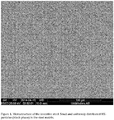
- the microstructure of the two steels was examined and it was found that the inventive steel contained about 20 vol. % MX (black phase), which particles are small in size and uniformly distributed within the matrix as disclosed in Fig. 1 .
- the comparative steel on the other hand contained about 15 vol. % MX and about 6 vol. % M 6 C (white phase) as shown in Fig. 2 . It is apparent from this figure that the M 6 C carbides are larger than the MX-particles and that there is a certain spread in the particle size distribution of the M 6 C carbides.
- the steels were austenitized at 1050 °C for 30 minutes and hardened by gas quenching and tempering at 550 °C for 1 hour (3xlh) followed by air cooling. This resulted in a hardness of 63 HRC for the inventive steel and 62 HRC for the comparative material.
- the equilibrium composition of the matrix and the amount of primary MX and M 6 C at the austenitizing temperature (1050 °C) were calculated in a Thermo-Calc simulation with the software version S-build-2532 and the database TCFE6. The calculations showed that the inventive steel was free from M 6 C-carbides and contained 16.3 vol. % MX.
- the comparative steel on the other hand was found to contain 5.2 vol. % M 6 C and 14.3 vol. % MX.
- the two materials were used in rolls for cold rolling of stainless steel and it was found that the inventive material resulted in an improved surface micro-roughness of the cold rolled steel, which may be attributed to the more uniform microstructure and to the absence of the large M 6 C-carbides.
- the cold work tool steel of the present invention is particular useful in applications requiring very high galling resistance such as blanking and forming of austenitic stainless steel.
- the small size of the MX-carbonitrides in combination with their uniform distribution is also expected to result in an improved galling resistance.
Landscapes
- Chemical & Material Sciences (AREA)
- Engineering & Computer Science (AREA)
- Materials Engineering (AREA)
- Mechanical Engineering (AREA)
- Metallurgy (AREA)
- Organic Chemistry (AREA)
- Physics & Mathematics (AREA)
- Thermal Sciences (AREA)
- Crystallography & Structural Chemistry (AREA)
- Powder Metallurgy (AREA)
- Heat Treatment Of Articles (AREA)
- Heat Treatment Of Steel (AREA)
- Forging (AREA)
- Solid-Phase Diffusion Into Metallic Material Surfaces (AREA)
Description
- The invention relates to a nitrogen alloyed cold work tool steel.
- Nitrogen and vanadium alloyed powder metallurgy (PM) tool steels attained a considerable interest because of their unique combination of high hardness, high wear resistance and excellent galling resistance. These steels have a wide rang of applications where the predominant failure mechanisms are adhesive wear or galling. Typical areas of application include blanking and forming, fine blanking, cold extrusion, deep drawing and powder pressing. The basic steel composition is atomized, subjected to nitrogenation and thereafter the powder is filled into a capsule and subjected to hot isostatic pressing (HIP) in order to produce an isotropic steel. A high performance steel produced in this way is VANCRON®40. It has high carbon, nitrogen and vanadium contents and is also alloyed with substantial amounts of Cr, Mo and W, which result in a microstructure comprising hard phases of the type MX (14 vol. %) and M6C (5 vol. %). The steel is described in
WO 00/79015 A1 - Although VANCRON®40 has a very attractive property profile there is a continuous strive for improvements of the tool material in order to further improve the surface quality of the products produced as well as to extend the tool life, in particular under severe working conditions, where galling is the main problem.
- The object of the present invention is to provide a nitrogen alloyed powder metallurgy (PM) produced cold work tool steel having an improved property profile for advanced cold working.
- Another object of the present invention is to provide a powder metallurgy (PM) produced cold work tool steel having a composition and microstructure leading to improvements in the surface quality of the produced parts.
- The foregoing objects, as well as additional advantages are achieved to a significant measure by providing a cold work tool steel having a composition as set out in the claims.
- The invention is defined in the claims.
- The importance of the separate elements and their interaction with each other as well as the limitations of the chemical ingredients of the claimed alloy are briefly explained in the following. All percentages for the chemical composition of the steel are given in weight % (wt. %) throughout the description. The upper and lower limits of the individual elements may be freely combined within the limits set out in claim 1.
- Carbon is to be present in a minimum content of 0.5 %, preferably at least 1.0 %. The upper limit for carbon may be set to 1.8 % or 2.1 %. Preferred ranges include 0.8 - 1.6 %, 1.0 -1.4 % and 1.25 - 1.35 %. Carbon is important for the formation of the MX and for the hardening, where the metal M is mainly V but Mo, Cr and W may also be present. X is one or more of C, N and B. Preferably, the carbon content is adjusted in order to obtain 0.4-0.6 %C dissolved in the matrix at the austenitizing temperature. In any case, the amount of carbon should be controlled such that the amount of carbides of the type M23C6, M7C3 and M6Cin the steel is limited, preferably the steel is free from said carbides.
- Nitrogen is in the present invention essential for the formation of the hard carbonitrides of the MX-type. Nitrogen should therefore be present in an amount of at least 1.3 %. The lower limit may be 1.4 %, 1.5%, 1.6%, 1.7 %, 1.8 %, 1.9%, 2.0 % 2.1 % or even 2.2 %. The upper limit is 3.5 % and it may be set to 3.3 %, 3.2 %, 3.0 %, 2.8 %, 2.6 %, 2.4 %, 2.2 %, 2.1 % 1.9 % or 1.7%. Preferred ranges include 1.6 -2.1 % and 1.7 - 1.9 %.
- Chromium is to be present in a content of at least 2.5 % in order to provide a sufficient hardenability. Cr is preferably higher for providing a good hardenability in large cross sections during heat treatment. If the chromium content is too high, this may lead to the formation of undesired carbides, such as M7C3. In addition, this may also increase the propensity of retained austenite in the microstructure. The lower limit may be 2.8 %, 3.0 %, 3.2 %, 3.4 %, 3.6 %, 3.8 %, 4.0 %, 4.2%, 4.35 %, 4.4 % or 4.6 %. The upper limit may be 5.2 %, 5.0 %, 4.9 %, 4.8 % or 4,65%. The chromium content is preferably 4.2 - 4.8 %.
- Mo is known to have a very favourable effect on the hardenability. Molybdenum is essential for attaining a good secondary hardening response. The minimum content is 0.8 %, and may be set to 1 %, 1.25 %, 1,5 %, 1.6 %, 1.65 % or 1.8 %. Molybdenum is a strong carbide-forming element. However, molybdenum is also a strong ferrite former. Mo needs to be restricted also for the reason of limiting the amount of other hard phases than MX. In particular the amount of M6C-carbides should be limited, preferably to ≤ 3 vol. %. Most preferably no M6C-carbides should be present in the microstructure. The maximum content of molybdenum is therefore 2.2 %. Preferably Mo is limited to 2.15 %, 2.1 %, 2.0 % or 1.9 %.
- The effect of tungsten is similar to that of Mo. However, for attaining the same effect it is necessary to add twice as much W as Mo on a weight % basis. Tungsten is expensive and it also complicates the handling of scrap metal. Like Mo, W is also forming M6C-carbides. The maximum amount is therefore limited to 1 %, preferably 0.5 %, more preferably 0.3 % and most preferably W is not deliberately added at all. By not adding W and restricting Mo, as set out above, make it possible to completely avoid the formation of M6C-carbides.
- Vanadium forms evenly distributed primary precipitated carbides and carbonitrides of the type MX. The precipitates may be represented by the formula M(N,C) and they are commonly also called nitrocarbides, because of the high nitrogen content. In the inventive steel M is mainly vanadium but Cr and Mo may be present to some extent. Vanadium shall be present in an amount of 6 -18 % in order to get the desired amount of MX. The upper limit may be set to 16 %, 15%, 14 %, 13%, 12%, 11 %, 10,25 %, 10 % or 9 %. The lower limit may be 7 %, 8 %, 8.5 %, 9 %, 9.75 %, 10 %, 11 % or 12 %. Preferred ranges include 8 - 14 %, 8.5 - 11.0 % and 9.75 - 10.25 %.
- Niobium is similar to vanadium in that it forms MX or carbonitrides of the type M(N,C). However, Nb results in a more angular shape of the M(N,C). Hence, the maximum addition of Nb is restricted to 2.0% and the preferred maximum amount is 0.5%. Preferably, no niobium is added.
- Silicon is used for deoxidation. Si also increases the carbon activity and is beneficial for the machinability. Si is therefore present in an amount of 0.05 - 1.2 %. For a good deoxidation, it is preferred to adjust the Si content to at least 0.2 %. The lower limit may be set to 0.3 %, 0.35 % or 0.4 %. However, Si is a strong ferrite former and should be limited to1.2 %. The upper limit may be set to 1.1%, 1 %, 0.9 %, 0.8 %, 0.75 %, 0.7 % or 0.65 %. A preferred range is 0.3 - 0.8 %.
- Manganese contributes to improving the hardenability of the steel and together with sulphur manganese contributes to improving the machinability by forming manganese sulphides. Manganese shall therefore be present in a minimum content of 0.05 %, preferably at least 0.1 % and more preferably at least 0.2 %. At higher sulphur contents manganese prevents red brittleness in the steel. The steel shall contain maximum 1.5 % Mn. The upper limit may be set to 1.4 %, 1.3 %, 1.2 %, 1.1 %, 1.0 %, 0.9 %, 0.8 %, 0.7 %, 0.7 % 0.6% or 0.5 %. However, preferred ranges are 0.2 - 0.9 %, 0.2 - 0.6 and 0.3 - 0.5 %.
- Nickel is optional and may be present in an amount of up to 3 %. It gives the steel a good hardenability and toughness. Because of the expense, the nickel content of the steel should be limited as far as possible. Accordingly, the Ni content is limited to 1%, preferably 0.3%. Most preferably, no nickel additions are made.
- Cu is an optional element, which may contribute to increasing the hardness and the corrosion resistance of the steel. If used, the preferred range is 0.02 - 2% and the most preferred range is 0.04 - 1.6%. However, it is not possible to extract copper from the steel once it has been added. This drastically makes the scrap handling more difficult. For this reason, copper is normally not deliberately added.
- Co is an optional element. Co dissolves in iron (ferrite and austenite) and strengthens it whilst at the same time imparting high temperature strength. Co increases the Ms temperature. During solution heat treatment Co helps to resist grain growth so that higher solution temperatures can be used which ensures a higher percentage of carbides being dissolved resulting in an improved secondary hardening response. Co also delays the coalescence of the carbides and carbonitrides and tends to cause secondary hardening to occur at higher temperatures. Co contributes to increase the hardness of the martensite. The maximum amount is 12 %. The upper limit may be set to 10 %, 8 %, 7%, 6 %, 5 % or 4 %. The lower limit may be set to 1%, 2 %, 3 %, 4 % or 5%. However, for practical reasons such as scrap handling there is no deliberate addition of Co. A preferred maximum content is 1 %.
- P is a solid solution strengthening element. However, P tends to segregate to the grain boundaries, reduces the cohesion and thereby the toughness. P is therefore limited to ≤ 0.05 %.
- S contributes to improving the machinability of the steel. At higher sulphur contents there is a risk for red brittleness. Moreover, a high sulphur content may have a negative effect on the fatigue properties of the steel. The steel shall therefore contain ≤ 0.5 %, preferably ≤ 0.03 %.
- These elements may be added to the steel in the claimed amounts in order to further improve the machinability, hot workability and/or weldability of the claimed steel.
- Substantial amounts of boron may optionally be used to assist in the formation of the hard phase MX. B may be used in order to increase the hardness of the steel. The amount is then limited to 0.01%, preferably ≤0.004%.
- These elements are carbide formers and may be present in the alloy in the claimed ranges for altering the composition of the hard phases. However, normally none of these elements are added.
- Tool steels having the claimed chemical composition can be produced by conventional gas atomizing followed by a nitrogenation treatment. The nitrogenation may be performed by subjecting the atomized powder to an ammonia based gas mixture at 500 - 600 °C, whereby nitrogen diffuses into the powder, reacts with vanadium and nucleate minute carbonitrides. Normally the steel is subjected to hardening and tempering before being used.
- Austenitizing may be performed at an austenitizing temperature (TA) in the range of 950 - 1150 °C, typically 1020 - 1080 °C. A typical treatment comprises austenitizing at 1050 °C for 30 minutes, gas quenching and tempering three times at 530 °C for 1 hour followed by air cooling. This results in a hardness of 60-66 HRC.
- In this example, a steel according to the invention is compared to the known steel. Both steels were produced by powder metallurgy.
- The basic steel compositions were melted and subjected to gas atomization, nitrgogenation, capsuling and HIPing.
- The steels thus obtained had the following compositions (in wt. %):
Inventive steel VANCRON®40 C 1.3 1.2 N 1.8 1.8 Si 0.5 0.5 Mn 0.4 0.4 Cr 4.5 4.6 Mo 1.8 3.25 W 0.1 3.8 V 10.0 8.5 - The microstructure of the two steels was examined and it was found that the inventive steel contained about 20 vol. % MX (black phase), which particles are small in size and uniformly distributed within the matrix as disclosed in
Fig. 1 . - The comparative steel on the other hand contained about 15 vol. % MX and about 6 vol. % M6C (white phase) as shown in
Fig. 2 . It is apparent from this figure that the M6C carbides are larger than the MX-particles and that there is a certain spread in the particle size distribution of the M6C carbides. - The steels were austenitized at 1050 °C for 30 minutes and hardened by gas quenching and tempering at 550 °C for 1 hour (3xlh) followed by air cooling. This resulted in a hardness of 63 HRC for the inventive steel and 62 HRC for the comparative material. The equilibrium composition of the matrix and the amount of primary MX and M6C at the austenitizing temperature (1050 °C) were calculated in a Thermo-Calc simulation with the software version S-build-2532 and the database TCFE6. The calculations showed that the inventive steel was free from M6C-carbides and contained 16.3 vol. % MX. The comparative steel on the other hand was found to contain 5.2 vol. % M6C and 14.3 vol. % MX.
- The two materials were used in rolls for cold rolling of stainless steel and it was found that the inventive material resulted in an improved surface micro-roughness of the cold rolled steel, which may be attributed to the more uniform microstructure and to the absence of the large M6C-carbides.
- The cold work tool steel of the present invention is particular useful in applications requiring very high galling resistance such as blanking and forming of austenitic stainless steel. The small size of the MX-carbonitrides in combination with their uniform distribution is also expected to result in an improved galling resistance.
Claims (10)
- A steel consisting of in weight % (wt.%):
C 0.5 - 2.1 N 1.3 - 3.5 Si 0.05 - 1.2 Mn 0.05 - 1.5 Cr 2.5 - 5.5 Mo 0.8 - 2.2 V 6 - 18 P ≤ 0.05 S ≤ 0.5 W ≤ 1.0 Cu ≤ 3 Co ≤ 12 Ni ≤ 3 Nb ≤ 2 Ti ≤ 0.1 Zr ≤ 0.1 Ta ≤ 0.1 B ≤ 0.6 Be ≤ 0.2 Bi ≤ 0.2 Se ≤ 0.3 Ca 0.0003 - 0.009 Mg ≤ 0.01 REM ≤ 0.2 - A steel according to claim 1 fulfilling at least one of the following requirements:
C 0.6 - 1.8 N 1.4 - 3.3 Si 0.2 - 1.1 Mn 0.1 - 1.1 Cr 2.8 - 5.2 Mo 1.25 - 2.15 W ≤ 0.5 V 7 - 16 P ≤ 0.03 S ≤ 0.03 Cu 0.02 - 2 Co ≤ 1 Ni ≤ 1 Nb ≤ 1 Ti ≤ 0.01 Zr ≤ 0.01 Ta ≤ 0.01 B ≤ 0.005 Be ≤ 0.02 Se ≤ 0.03 Mg ≤ 0.001 - A steel according to claim 1 or 2 fulfilling at least one of the following requirements:
C 0.8 - 1.6 N 1.6 - 3.2 Si 0.25 - 0.85 Mn 0.2 - 0.9 Cr 3.2 - 5.0 Mo 1.5 - 2.1 W ≤ 0.45 V 8 - 14 Co ≤ 1 Cu ≤ 0.5 Ni ≤ 0.3 Nb ≤ 0.5 - A steel according to any of the preceding claims fulfilling at least one of the following requirements:
C 1.0 - 1.4 N 1.6 - 2.1 Si 0.3 - 0.8 Mn 0.2 - 0.6 Cr 4.2 - 4.8 Mo 1.6 - 2.0 W ≤ 0.40 V 8.5 - 11.0 - A steel according to any of the preceding claims fulfilling at least one of the following requirements:
C 1.25 - 1.35 N 1.7 - 1.9 Si 0.35 - 0.65 Mn 0.3 - 0.5 Cr 4.35 - 4.65 Mo 1.65 - 1.95 W ≤ 0.30 V 9.75 - 10.25 - A steel according to claim 4 consisting of:
C 1.0 - 1.4 N 1.6 - 2.1 Si 0.3 - 0.8 Mn 0.2 - 0.6 Cr 4.2 - 4.8 Mo 1.6 - 2.0 W ≤ 0.40 V 8.5 - 11.0 - A powder metallurgy produced steel for cold working having a composition as defined in any of claims 1 - 6, wherein the amount of carbides and carbonitrides present in the steel fulfils the following requirements in volume %:
MX 15 - 35 M6X ≤ 3 M7X3 ≤ 1 M23X6 ≤ 1 - A powder metallurgy produced steel for cold working according to claim 7 fulfilling the requirement:
MX 15 - 30 M6X ≤ 1 M7X3 ≤ 0.2 M23X6 ≤ 0.2 - A powder metallurgy produced steel for cold working according to claim 7 or 8, wherein the amount of carbides and carbonitrides fulfils the following requirements in volume %:
MX 15 - 30 M6X ≤ 0.1 - A powder metallurgy produced steel for cold working steel according to any of the claims 7 -9, wherein the Equivalent Circle Diameter (ECD) of the carbides and carbonitrides in the microstructure is less than 1.5 µm, preferably less than 1.0 µm.
Priority Applications (3)
| Application Number | Priority Date | Filing Date | Title |
|---|---|---|---|
| SI201531156T SI3169821T1 (en) | 2014-07-16 | 2015-06-26 | Cold work tool steel |
| HRP20200517TT HRP20200517T1 (en) | 2014-07-16 | 2015-06-26 | COLD TREATED TOOL STEEL |
| PL15821258T PL3169821T3 (en) | 2014-07-16 | 2015-06-26 | Cold work tool steel |
Applications Claiming Priority (2)
| Application Number | Priority Date | Filing Date | Title |
|---|---|---|---|
| EP14177221.0A EP2975146A1 (en) | 2014-07-16 | 2014-07-16 | Cold work tool steel |
| PCT/SE2015/050751 WO2016010469A1 (en) | 2014-07-16 | 2015-06-26 | Cold work tool steel |
Publications (3)
| Publication Number | Publication Date |
|---|---|
| EP3169821A1 EP3169821A1 (en) | 2017-05-24 |
| EP3169821A4 EP3169821A4 (en) | 2017-06-28 |
| EP3169821B1 true EP3169821B1 (en) | 2020-01-08 |
Family
ID=51178774
Family Applications (2)
| Application Number | Title | Priority Date | Filing Date |
|---|---|---|---|
| EP14177221.0A Withdrawn EP2975146A1 (en) | 2014-07-16 | 2014-07-16 | Cold work tool steel |
| EP15821258.9A Active EP3169821B1 (en) | 2014-07-16 | 2015-06-26 | Cold work tool steel |
Family Applications Before (1)
| Application Number | Title | Priority Date | Filing Date |
|---|---|---|---|
| EP14177221.0A Withdrawn EP2975146A1 (en) | 2014-07-16 | 2014-07-16 | Cold work tool steel |
Country Status (18)
| Country | Link |
|---|---|
| US (1) | US10472705B2 (en) |
| EP (2) | EP2975146A1 (en) |
| JP (1) | JP6615858B2 (en) |
| KR (1) | KR102417003B1 (en) |
| CN (2) | CN106795611A (en) |
| BR (1) | BR112017000078B1 (en) |
| CA (1) | CA2948143C (en) |
| DK (1) | DK3169821T3 (en) |
| ES (1) | ES2784266T3 (en) |
| HR (1) | HRP20200517T1 (en) |
| PL (1) | PL3169821T3 (en) |
| PT (1) | PT3169821T (en) |
| RU (1) | RU2695692C2 (en) |
| SG (1) | SG11201609197SA (en) |
| SI (1) | SI3169821T1 (en) |
| TW (1) | TWI650433B (en) |
| UA (1) | UA118051C2 (en) |
| WO (1) | WO2016010469A1 (en) |
Families Citing this family (6)
| Publication number | Priority date | Publication date | Assignee | Title |
|---|---|---|---|---|
| EP2933345A1 (en) * | 2014-04-14 | 2015-10-21 | Uddeholms AB | Cold work tool steel |
| WO2021092737A1 (en) * | 2019-11-12 | 2021-05-20 | 常德菲尔美化工技术有限公司 | Wear-resistant metal material and manufacturing method therefor |
| US12123464B2 (en) * | 2020-12-17 | 2024-10-22 | Aktiebolaget Skf | Bearing component and method of manufacturing thereof |
| CN114318133A (en) * | 2021-03-22 | 2022-04-12 | 武汉钜能科技有限责任公司 | Wear-resistant tool steel |
| CN114959174B (en) * | 2022-06-07 | 2024-01-12 | 西峡县丰业冶金材料有限公司 | High-strength hot rolled ribbed steel bar produced by rare earth element and production method thereof |
| KR102805395B1 (en) | 2022-09-29 | 2025-05-12 | 박기혁 | Low temperature solution and precipitation hardening Heat treating method of alloy steel |
Family Cites Families (22)
| Publication number | Priority date | Publication date | Assignee | Title |
|---|---|---|---|---|
| JPS52141406A (en) * | 1976-05-21 | 1977-11-25 | Kobe Steel Ltd | Tool steel containing nitrogen made by powder metallurgy |
| PL256701A1 (en) * | 1985-12-06 | 1987-09-21 | Akad Gorniczo Hutnicza | Alloyed tool steel of high resistance to abrasive wear |
| SE456650C (en) * | 1987-03-19 | 1989-10-16 | Uddeholm Tooling Ab | POWDER METAL SURGICAL PREPARED STEEL STEEL |
| WO1993002819A1 (en) * | 1991-08-07 | 1993-02-18 | Kloster Speedsteel Aktiebolag | High-speed steel manufactured by powder metallurgy |
| DE69217960T2 (en) * | 1991-08-07 | 1997-06-26 | Erasteel Kloster Ab | POWDER METALLURGICALLY PRODUCED FAST WORK STEEL |
| DE4231695C2 (en) * | 1992-09-22 | 1994-11-24 | Ver Schmiedewerke Gmbh | Use of steel for tools |
| SE508872C2 (en) * | 1997-03-11 | 1998-11-09 | Erasteel Kloster Ab | Powder metallurgically made steel for tools, tools made therefrom, process for making steel and tools and use of steel |
| SE514410C2 (en) * | 1999-06-16 | 2001-02-19 | Erasteel Kloster Ab | Powder metallurgically made steel |
| DE102005020081A1 (en) * | 2005-04-29 | 2006-11-09 | Köppern Entwicklungs-GmbH | Powder metallurgically produced, wear-resistant material |
| SE528991C2 (en) * | 2005-08-24 | 2007-04-03 | Uddeholm Tooling Ab | Steel alloy and tools or components made of the steel alloy |
| SE0600841L (en) * | 2006-04-13 | 2007-10-14 | Uddeholm Tooling Ab | Cold Work |
| JP2008303413A (en) * | 2007-06-06 | 2008-12-18 | Sanyo Special Steel Co Ltd | High nitrogen stainless steel powder for solidification molding with excellent corrosion resistance and method for producing the same |
| SE533988C2 (en) | 2008-10-16 | 2011-03-22 | Uddeholms Ab | Steel material and process for making them |
| WO2011135700A1 (en) * | 2010-04-28 | 2011-11-03 | 住友金属工業株式会社 | Hot rolled dual phase steel sheet having excellent dynamic strength, and method for producing same |
| CN103348023B (en) * | 2011-02-08 | 2015-11-25 | 新日铁住金不锈钢株式会社 | The manufacture method of ferrite-group stainless steel hot-rolled steel sheet and manufacture method and ferrite series stainless steel plate |
| EP2698442B1 (en) * | 2011-04-13 | 2018-05-30 | Nippon Steel & Sumitomo Metal Corporation | High-strength cold-rolled steel sheet with excellent local formability, and manufacturing method therefor |
| CN103492599B (en) * | 2011-04-21 | 2016-05-04 | 新日铁住金株式会社 | High-strength cold-rolled steel sheet excellent in uniform stretchability and hole expandability and manufacturing method thereof |
| WO2012166851A1 (en) * | 2011-06-02 | 2012-12-06 | Aktiebolaget Skf | Carbo-nitriding process for martensitic stainless steel and stainless steel article having improved corrosion resistance |
| EP2662460A1 (en) * | 2012-05-07 | 2013-11-13 | Valls Besitz GmbH | Tough bainitic heat treatments on steels for tooling |
| FI125855B (en) * | 2012-06-26 | 2016-03-15 | Outokumpu Oy | Ferritic stainless steel |
| BR112015002312A2 (en) * | 2012-08-06 | 2017-07-04 | Nippon Steel & Sumitomo Metal Corp | cold-rolled steel plate and method for producing it, and hot-formed element |
| IN2015DN00770A (en) * | 2012-09-13 | 2015-07-03 | Jfe Steel Corp |
-
2014
- 2014-07-16 EP EP14177221.0A patent/EP2975146A1/en not_active Withdrawn
-
2015
- 2015-06-26 PL PL15821258T patent/PL3169821T3/en unknown
- 2015-06-26 HR HRP20200517TT patent/HRP20200517T1/en unknown
- 2015-06-26 EP EP15821258.9A patent/EP3169821B1/en active Active
- 2015-06-26 SI SI201531156T patent/SI3169821T1/en unknown
- 2015-06-26 CN CN201580037760.2A patent/CN106795611A/en active Pending
- 2015-06-26 RU RU2017102699A patent/RU2695692C2/en active
- 2015-06-26 CN CN202110993653.4A patent/CN113913679A/en active Pending
- 2015-06-26 ES ES15821258T patent/ES2784266T3/en active Active
- 2015-06-26 JP JP2017502158A patent/JP6615858B2/en active Active
- 2015-06-26 CA CA2948143A patent/CA2948143C/en active Active
- 2015-06-26 WO PCT/SE2015/050751 patent/WO2016010469A1/en not_active Ceased
- 2015-06-26 US US15/324,560 patent/US10472705B2/en active Active
- 2015-06-26 KR KR1020177004252A patent/KR102417003B1/en active Active
- 2015-06-26 SG SG11201609197SA patent/SG11201609197SA/en unknown
- 2015-06-26 PT PT158212589T patent/PT3169821T/en unknown
- 2015-06-26 BR BR112017000078-4A patent/BR112017000078B1/en active IP Right Grant
- 2015-06-26 UA UAA201612707A patent/UA118051C2/en unknown
- 2015-06-26 DK DK15821258.9T patent/DK3169821T3/en active
- 2015-07-02 TW TW104121457A patent/TWI650433B/en not_active IP Right Cessation
Non-Patent Citations (1)
| Title |
|---|
| None * |
Also Published As
| Publication number | Publication date |
|---|---|
| CA2948143C (en) | 2022-08-09 |
| CA2948143A1 (en) | 2016-01-21 |
| CN113913679A (en) | 2022-01-11 |
| SI3169821T1 (en) | 2020-08-31 |
| JP2017525848A (en) | 2017-09-07 |
| SG11201609197SA (en) | 2016-12-29 |
| EP2975146A1 (en) | 2016-01-20 |
| PT3169821T (en) | 2020-03-25 |
| EP3169821A4 (en) | 2017-06-28 |
| US10472705B2 (en) | 2019-11-12 |
| DK3169821T3 (en) | 2020-04-14 |
| BR112017000078A2 (en) | 2017-10-31 |
| TW201606095A (en) | 2016-02-16 |
| BR112017000078B1 (en) | 2021-05-04 |
| RU2017102699A3 (en) | 2018-11-12 |
| RU2017102699A (en) | 2018-08-16 |
| JP6615858B2 (en) | 2019-12-04 |
| PL3169821T3 (en) | 2020-09-07 |
| UA118051C2 (en) | 2018-11-12 |
| EP3169821A1 (en) | 2017-05-24 |
| ES2784266T3 (en) | 2020-09-23 |
| KR102417003B1 (en) | 2022-07-04 |
| US20170233854A1 (en) | 2017-08-17 |
| RU2695692C2 (en) | 2019-07-25 |
| KR20170029008A (en) | 2017-03-14 |
| CN106795611A (en) | 2017-05-31 |
| WO2016010469A1 (en) | 2016-01-21 |
| HRP20200517T1 (en) | 2020-06-26 |
| TWI650433B (en) | 2019-02-11 |
Similar Documents
| Publication | Publication Date | Title |
|---|---|---|
| US12577641B2 (en) | Wear resistant alloy | |
| AU2014330080B2 (en) | Corrosion and wear resistant cold work tool steel | |
| EP3034211A1 (en) | A wear resistant tool steel produced by HIP | |
| US10472705B2 (en) | Cold work tool steel | |
| SE1650850A1 (en) | Steel suitable for plastic moulding tools | |
| WO2018056884A1 (en) | Hot work tool steel | |
| SE539667C2 (en) | A wear resistant alloy | |
| WO2023080832A1 (en) | A wear resistant alloy | |
| HK1243145A1 (en) | A wear resistant alloy | |
| HK1243145B (en) | A wear resistant alloy |
Legal Events
| Date | Code | Title | Description |
|---|---|---|---|
| STAA | Information on the status of an ep patent application or granted ep patent |
Free format text: STATUS: THE INTERNATIONAL PUBLICATION HAS BEEN MADE |
|
| PUAI | Public reference made under article 153(3) epc to a published international application that has entered the european phase |
Free format text: ORIGINAL CODE: 0009012 |
|
| STAA | Information on the status of an ep patent application or granted ep patent |
Free format text: STATUS: REQUEST FOR EXAMINATION WAS MADE |
|
| 17P | Request for examination filed |
Effective date: 20161109 |
|
| AK | Designated contracting states |
Kind code of ref document: A1 Designated state(s): AL AT BE BG CH CY CZ DE DK EE ES FI FR GB GR HR HU IE IS IT LI LT LU LV MC MK MT NL NO PL PT RO RS SE SI SK SM TR |
|
| AX | Request for extension of the european patent |
Extension state: BA ME |
|
| A4 | Supplementary search report drawn up and despatched |
Effective date: 20170531 |
|
| RIC1 | Information provided on ipc code assigned before grant |
Ipc: C22C 38/24 20060101ALI20170524BHEP Ipc: C22C 38/04 20060101ALI20170524BHEP Ipc: C22C 33/02 20060101AFI20170524BHEP Ipc: C21D 6/00 20060101ALI20170524BHEP Ipc: C21D 6/02 20060101ALI20170524BHEP Ipc: C21D 9/08 20060101ALI20170524BHEP Ipc: C22C 38/00 20060101ALI20170524BHEP Ipc: C22C 38/02 20060101ALI20170524BHEP Ipc: C22C 38/22 20060101ALI20170524BHEP |
|
| DAV | Request for validation of the european patent (deleted) | ||
| DAX | Request for extension of the european patent (deleted) | ||
| STAA | Information on the status of an ep patent application or granted ep patent |
Free format text: STATUS: EXAMINATION IS IN PROGRESS |
|
| 17Q | First examination report despatched |
Effective date: 20171123 |
|
| REG | Reference to a national code |
Ref country code: DE Ref legal event code: R079 Ref document number: 602015045311 Country of ref document: DE Free format text: PREVIOUS MAIN CLASS: C22C0038240000 Ipc: C22C0038440000 |
|
| RIC1 | Information provided on ipc code assigned before grant |
Ipc: C22C 38/44 20060101AFI20190607BHEP Ipc: C22C 38/04 20060101ALI20190607BHEP Ipc: C21D 6/02 20060101ALI20190607BHEP Ipc: C22C 38/00 20060101ALI20190607BHEP Ipc: C22C 33/02 20060101ALI20190607BHEP Ipc: C22C 38/46 20060101ALI20190607BHEP Ipc: C22C 38/24 20060101ALI20190607BHEP Ipc: C22C 38/22 20060101ALI20190607BHEP Ipc: C22C 38/02 20060101ALI20190607BHEP Ipc: C21D 6/00 20060101ALI20190607BHEP |
|
| GRAP | Despatch of communication of intention to grant a patent |
Free format text: ORIGINAL CODE: EPIDOSNIGR1 |
|
| STAA | Information on the status of an ep patent application or granted ep patent |
Free format text: STATUS: GRANT OF PATENT IS INTENDED |
|
| INTG | Intention to grant announced |
Effective date: 20190807 |
|
| GRAS | Grant fee paid |
Free format text: ORIGINAL CODE: EPIDOSNIGR3 |
|
| GRAA | (expected) grant |
Free format text: ORIGINAL CODE: 0009210 |
|
| STAA | Information on the status of an ep patent application or granted ep patent |
Free format text: STATUS: THE PATENT HAS BEEN GRANTED |
|
| AK | Designated contracting states |
Kind code of ref document: B1 Designated state(s): AL AT BE BG CH CY CZ DE DK EE ES FI FR GB GR HR HU IE IS IT LI LT LU LV MC MK MT NL NO PL PT RO RS SE SI SK SM TR |
|
| REG | Reference to a national code |
Ref country code: GB Ref legal event code: FG4D |
|
| REG | Reference to a national code |
Ref country code: CH Ref legal event code: EP |
|
| REG | Reference to a national code |
Ref country code: DE Ref legal event code: R096 Ref document number: 602015045311 Country of ref document: DE |
|
| REG | Reference to a national code |
Ref country code: IE Ref legal event code: FG4D |
|
| REG | Reference to a national code |
Ref country code: AT Ref legal event code: REF Ref document number: 1222806 Country of ref document: AT Kind code of ref document: T Effective date: 20200215 |
|
| REG | Reference to a national code |
Ref country code: RO Ref legal event code: EPE |
|
| REG | Reference to a national code |
Ref country code: PT Ref legal event code: SC4A Ref document number: 3169821 Country of ref document: PT Date of ref document: 20200325 Kind code of ref document: T Free format text: AVAILABILITY OF NATIONAL TRANSLATION Effective date: 20200317 |
|
| REG | Reference to a national code |
Ref country code: HR Ref legal event code: TUEP Ref document number: P20200517T Country of ref document: HR |
|
| REG | Reference to a national code |
Ref country code: FI Ref legal event code: FGE |
|
| REG | Reference to a national code |
Ref country code: DK Ref legal event code: T3 Effective date: 20200407 |
|
| REG | Reference to a national code |
Ref country code: NL Ref legal event code: FP |
|
| REG | Reference to a national code |
Ref country code: SE Ref legal event code: TRGR |
|
| REG | Reference to a national code |
Ref country code: NO Ref legal event code: T2 Effective date: 20200108 |
|
| REG | Reference to a national code |
Ref country code: EE Ref legal event code: FG4A Ref document number: E018990 Country of ref document: EE Effective date: 20200325 Ref country code: CH Ref legal event code: NV Representative=s name: ISLER AND PEDRAZZINI AG, CH |
|
| REG | Reference to a national code |
Ref country code: NO Ref legal event code: CREP Representative=s name: ZACCO NORWAY AS, POSTBOKS 2003 VIKA, 0125 OSLO |
|
| REG | Reference to a national code |
Ref country code: HR Ref legal event code: T1PR Ref document number: P20200517 Country of ref document: HR |
|
| REG | Reference to a national code |
Ref country code: LT Ref legal event code: MG4D Ref country code: HR Ref legal event code: ODRP Ref document number: P20200517 Country of ref document: HR Payment date: 20200608 Year of fee payment: 6 |
|
| REG | Reference to a national code |
Ref country code: GR Ref legal event code: EP Ref document number: 20200400984 Country of ref document: GR Effective date: 20200716 |
|
| PG25 | Lapsed in a contracting state [announced via postgrant information from national office to epo] |
Ref country code: LT Free format text: LAPSE BECAUSE OF FAILURE TO SUBMIT A TRANSLATION OF THE DESCRIPTION OR TO PAY THE FEE WITHIN THE PRESCRIBED TIME-LIMIT Effective date: 20200108 Ref country code: RS Free format text: LAPSE BECAUSE OF FAILURE TO SUBMIT A TRANSLATION OF THE DESCRIPTION OR TO PAY THE FEE WITHIN THE PRESCRIBED TIME-LIMIT Effective date: 20200108 |
|
| PGFP | Annual fee paid to national office [announced via postgrant information from national office to epo] |
Ref country code: RO Payment date: 20200617 Year of fee payment: 6 Ref country code: CZ Payment date: 20200611 Year of fee payment: 6 Ref country code: LU Payment date: 20200617 Year of fee payment: 6 Ref country code: EE Payment date: 20200625 Year of fee payment: 6 Ref country code: GR Payment date: 20200618 Year of fee payment: 6 Ref country code: PT Payment date: 20200609 Year of fee payment: 6 Ref country code: NO Payment date: 20200619 Year of fee payment: 6 Ref country code: FI Payment date: 20200617 Year of fee payment: 6 |
|
| REG | Reference to a national code |
Ref country code: SK Ref legal event code: T3 Ref document number: E 34283 Country of ref document: SK |
|
| PG25 | Lapsed in a contracting state [announced via postgrant information from national office to epo] |
Ref country code: IS Free format text: LAPSE BECAUSE OF FAILURE TO SUBMIT A TRANSLATION OF THE DESCRIPTION OR TO PAY THE FEE WITHIN THE PRESCRIBED TIME-LIMIT Effective date: 20200508 Ref country code: BG Free format text: LAPSE BECAUSE OF FAILURE TO SUBMIT A TRANSLATION OF THE DESCRIPTION OR TO PAY THE FEE WITHIN THE PRESCRIBED TIME-LIMIT Effective date: 20200408 |
|
| PGFP | Annual fee paid to national office [announced via postgrant information from national office to epo] |
Ref country code: HR Payment date: 20200608 Year of fee payment: 6 |
|
| REG | Reference to a national code |
Ref country code: ES Ref legal event code: FG2A Ref document number: 2784266 Country of ref document: ES Kind code of ref document: T3 Effective date: 20200923 |
|
| REG | Reference to a national code |
Ref country code: DE Ref legal event code: R097 Ref document number: 602015045311 Country of ref document: DE |
|
| PG25 | Lapsed in a contracting state [announced via postgrant information from national office to epo] |
Ref country code: SM Free format text: LAPSE BECAUSE OF FAILURE TO SUBMIT A TRANSLATION OF THE DESCRIPTION OR TO PAY THE FEE WITHIN THE PRESCRIBED TIME-LIMIT Effective date: 20200108 |
|
| PGFP | Annual fee paid to national office [announced via postgrant information from national office to epo] |
Ref country code: SK Payment date: 20200610 Year of fee payment: 6 |
|
| PLBE | No opposition filed within time limit |
Free format text: ORIGINAL CODE: 0009261 |
|
| STAA | Information on the status of an ep patent application or granted ep patent |
Free format text: STATUS: NO OPPOSITION FILED WITHIN TIME LIMIT |
|
| 26N | No opposition filed |
Effective date: 20201009 |
|
| PG25 | Lapsed in a contracting state [announced via postgrant information from national office to epo] |
Ref country code: MC Free format text: LAPSE BECAUSE OF FAILURE TO SUBMIT A TRANSLATION OF THE DESCRIPTION OR TO PAY THE FEE WITHIN THE PRESCRIBED TIME-LIMIT Effective date: 20200108 |
|
| PG25 | Lapsed in a contracting state [announced via postgrant information from national office to epo] |
Ref country code: IE Free format text: LAPSE BECAUSE OF NON-PAYMENT OF DUE FEES Effective date: 20200626 |
|
| REG | Reference to a national code |
Ref country code: HR Ref legal event code: PBON Ref document number: P20200517 Country of ref document: HR Effective date: 20210626 |
|
| REG | Reference to a national code |
Ref country code: EE Ref legal event code: MM4A Ref document number: E018990 Country of ref document: EE Effective date: 20210630 |
|
| REG | Reference to a national code |
Ref country code: FI Ref legal event code: MAE |
|
| REG | Reference to a national code |
Ref country code: NO Ref legal event code: MMEP |
|
| PG25 | Lapsed in a contracting state [announced via postgrant information from national office to epo] |
Ref country code: PT Free format text: LAPSE BECAUSE OF NON-PAYMENT OF DUE FEES Effective date: 20211227 Ref country code: RO Free format text: LAPSE BECAUSE OF NON-PAYMENT OF DUE FEES Effective date: 20210626 Ref country code: FI Free format text: LAPSE BECAUSE OF NON-PAYMENT OF DUE FEES Effective date: 20210626 Ref country code: CZ Free format text: LAPSE BECAUSE OF NON-PAYMENT OF DUE FEES Effective date: 20210626 |
|
| REG | Reference to a national code |
Ref country code: SK Ref legal event code: MM4A Ref document number: E 34283 Country of ref document: SK Effective date: 20210626 |
|
| PG25 | Lapsed in a contracting state [announced via postgrant information from national office to epo] |
Ref country code: LU Free format text: LAPSE BECAUSE OF NON-PAYMENT OF DUE FEES Effective date: 20210626 |
|
| PG25 | Lapsed in a contracting state [announced via postgrant information from national office to epo] |
Ref country code: SK Free format text: LAPSE BECAUSE OF NON-PAYMENT OF DUE FEES Effective date: 20210626 Ref country code: NO Free format text: LAPSE BECAUSE OF NON-PAYMENT OF DUE FEES Effective date: 20210630 Ref country code: MT Free format text: LAPSE BECAUSE OF FAILURE TO SUBMIT A TRANSLATION OF THE DESCRIPTION OR TO PAY THE FEE WITHIN THE PRESCRIBED TIME-LIMIT Effective date: 20200108 Ref country code: HR Free format text: LAPSE BECAUSE OF NON-PAYMENT OF DUE FEES Effective date: 20210626 Ref country code: GR Free format text: LAPSE BECAUSE OF NON-PAYMENT OF DUE FEES Effective date: 20220105 Ref country code: EE Free format text: LAPSE BECAUSE OF NON-PAYMENT OF DUE FEES Effective date: 20210630 Ref country code: CY Free format text: LAPSE BECAUSE OF FAILURE TO SUBMIT A TRANSLATION OF THE DESCRIPTION OR TO PAY THE FEE WITHIN THE PRESCRIBED TIME-LIMIT Effective date: 20200108 |
|
| REG | Reference to a national code |
Ref country code: AT Ref legal event code: UEP Ref document number: 1222806 Country of ref document: AT Kind code of ref document: T Effective date: 20200108 |
|
| PG25 | Lapsed in a contracting state [announced via postgrant information from national office to epo] |
Ref country code: MK Free format text: LAPSE BECAUSE OF FAILURE TO SUBMIT A TRANSLATION OF THE DESCRIPTION OR TO PAY THE FEE WITHIN THE PRESCRIBED TIME-LIMIT Effective date: 20200108 Ref country code: AL Free format text: LAPSE BECAUSE OF FAILURE TO SUBMIT A TRANSLATION OF THE DESCRIPTION OR TO PAY THE FEE WITHIN THE PRESCRIBED TIME-LIMIT Effective date: 20200108 |
|
| P01 | Opt-out of the competence of the unified patent court (upc) registered |
Effective date: 20230628 |
|
| PGFP | Annual fee paid to national office [announced via postgrant information from national office to epo] |
Ref country code: PL Payment date: 20250527 Year of fee payment: 11 Ref country code: DE Payment date: 20250618 Year of fee payment: 11 |
|
| PGFP | Annual fee paid to national office [announced via postgrant information from national office to epo] |
Ref country code: GB Payment date: 20250618 Year of fee payment: 11 Ref country code: DK Payment date: 20250618 Year of fee payment: 11 |
|
| PGFP | Annual fee paid to national office [announced via postgrant information from national office to epo] |
Ref country code: NL Payment date: 20250618 Year of fee payment: 11 Ref country code: BE Payment date: 20250618 Year of fee payment: 11 |
|
| PGFP | Annual fee paid to national office [announced via postgrant information from national office to epo] |
Ref country code: LV Payment date: 20250618 Year of fee payment: 11 |
|
| PGFP | Annual fee paid to national office [announced via postgrant information from national office to epo] |
Ref country code: FR Payment date: 20250617 Year of fee payment: 11 |
|
| PGFP | Annual fee paid to national office [announced via postgrant information from national office to epo] |
Ref country code: AT Payment date: 20250618 Year of fee payment: 11 |
|
| PGFP | Annual fee paid to national office [announced via postgrant information from national office to epo] |
Ref country code: TR Payment date: 20250604 Year of fee payment: 11 |
|
| PGFP | Annual fee paid to national office [announced via postgrant information from national office to epo] |
Ref country code: SI Payment date: 20250613 Year of fee payment: 11 Ref country code: SE Payment date: 20250618 Year of fee payment: 11 |
|
| PGFP | Annual fee paid to national office [announced via postgrant information from national office to epo] |
Ref country code: ES Payment date: 20250710 Year of fee payment: 11 |
|
| PGFP | Annual fee paid to national office [announced via postgrant information from national office to epo] |
Ref country code: IT Payment date: 20250618 Year of fee payment: 11 |
|
| PGFP | Annual fee paid to national office [announced via postgrant information from national office to epo] |
Ref country code: CH Payment date: 20250701 Year of fee payment: 11 |