EP3166283A1 - Verfahren, system und vorrichtung für geschäftszugang - Google Patents
Verfahren, system und vorrichtung für geschäftszugang Download PDFInfo
- Publication number
- EP3166283A1 EP3166283A1 EP15814144.0A EP15814144A EP3166283A1 EP 3166283 A1 EP3166283 A1 EP 3166283A1 EP 15814144 A EP15814144 A EP 15814144A EP 3166283 A1 EP3166283 A1 EP 3166283A1
- Authority
- EP
- European Patent Office
- Prior art keywords
- service
- request message
- verification
- permission
- service request
- Prior art date
- Legal status (The legal status is an assumption and is not a legal conclusion. Google has not performed a legal analysis and makes no representation as to the accuracy of the status listed.)
- Granted
Links
Images

Classifications
-
- H—ELECTRICITY
- H04—ELECTRIC COMMUNICATION TECHNIQUE
- H04L—TRANSMISSION OF DIGITAL INFORMATION, e.g. TELEGRAPHIC COMMUNICATION
- H04L63/00—Network architectures or network communication protocols for network security
- H04L63/04—Network architectures or network communication protocols for network security for providing a confidential data exchange among entities communicating through data packet networks
- H04L63/0428—Network architectures or network communication protocols for network security for providing a confidential data exchange among entities communicating through data packet networks wherein the data content is protected, e.g. by encrypting or encapsulating the payload
-
- G—PHYSICS
- G06—COMPUTING OR CALCULATING; COUNTING
- G06F—ELECTRIC DIGITAL DATA PROCESSING
- G06F16/00—Information retrieval; Database structures therefor; File system structures therefor
- G06F16/90—Details of database functions independent of the retrieved data types
- G06F16/95—Retrieval from the web
- G06F16/951—Indexing; Web crawling techniques
-
- H—ELECTRICITY
- H04—ELECTRIC COMMUNICATION TECHNIQUE
- H04L—TRANSMISSION OF DIGITAL INFORMATION, e.g. TELEGRAPHIC COMMUNICATION
- H04L63/00—Network architectures or network communication protocols for network security
- H04L63/02—Network architectures or network communication protocols for network security for separating internal from external traffic, e.g. firewalls
- H04L63/0281—Proxies
-
- H—ELECTRICITY
- H04—ELECTRIC COMMUNICATION TECHNIQUE
- H04L—TRANSMISSION OF DIGITAL INFORMATION, e.g. TELEGRAPHIC COMMUNICATION
- H04L63/00—Network architectures or network communication protocols for network security
- H04L63/06—Network architectures or network communication protocols for network security for supporting key management in a packet data network
- H04L63/062—Network architectures or network communication protocols for network security for supporting key management in a packet data network for key distribution, e.g. centrally by trusted party
-
- H—ELECTRICITY
- H04—ELECTRIC COMMUNICATION TECHNIQUE
- H04L—TRANSMISSION OF DIGITAL INFORMATION, e.g. TELEGRAPHIC COMMUNICATION
- H04L63/00—Network architectures or network communication protocols for network security
- H04L63/10—Network architectures or network communication protocols for network security for controlling access to devices or network resources
-
- H—ELECTRICITY
- H04—ELECTRIC COMMUNICATION TECHNIQUE
- H04L—TRANSMISSION OF DIGITAL INFORMATION, e.g. TELEGRAPHIC COMMUNICATION
- H04L67/00—Network arrangements or protocols for supporting network services or applications
- H04L67/2866—Architectures; Arrangements
- H04L67/30—Profiles
- H04L67/306—User profiles
-
- H—ELECTRICITY
- H04—ELECTRIC COMMUNICATION TECHNIQUE
- H04L—TRANSMISSION OF DIGITAL INFORMATION, e.g. TELEGRAPHIC COMMUNICATION
- H04L69/00—Network arrangements, protocols or services independent of the application payload and not provided for in the other groups of this subclass
- H04L69/08—Protocols for interworking; Protocol conversion
Definitions
- the present invention relates to the field of communications technologies, and in particular, to a service access method and system, and an apparatus.
- the business support system is a service operation and management platform provided by a telecommunications service operations system, for example, systems such as charging, settlement, accounting, customer service, and business.
- a service request is sent to each business support system in an internal network by using the Internet.
- the business support system receives a service request from an external network, because the BSS system involves a large amount of private sensitive information of customers, in view of security, the client needs to communicate with a service server side by using a standard security protocol, for example, the HTTPs protocol.
- a security certificate is separately published to a client by using each business support system in the internal network, the client encrypts the service request according to the security certificate. If a client needs to use services provided by multiple business support systems in the internal network, the client needs to import multiple security certificates and select different certificates according to different services to encrypt the service request, so as to ensure security of communication between the client and the service server side.
- each business support system needs to externally publish a security certificate and perform security verification, for a business support system with heavy access traffic and a high performance requirement, to avoid response timeout and meet the performance requirement, a capacity of a device needs to be expanded, increasing networking costs.
- each service system server side needs to publish a certificate, leading to difficulty in maintenance, and also increasing workload of reconstruction and maintenance of the client.
- Embodiments of the present invention provide a service access method and an apparatus.
- a secure transmission proxy apparatus performs verification and management on service permission, which reduces networking costs of a service server side and workload of reconstruction and maintenance of the service server side, and enhances communication security.
- an embodiment of the present invention provides a secure transmission proxy apparatus, including:
- the service request message further includes at least a message channel and user information;
- the verification unit is configured to: perform first verification on the service permission according to the message channel and the service type, and perform second verification on the service permission according to the user information and the service type if the first verification succeeds;
- the conversion unit is configured to perform protocol conversion on the decrypted service request message after the second verification succeeds.
- the verification unit is specifically configured to search a preset database for a first service type corresponding to the message channel, where the first verification succeeds if the service type is any service type in the first service type.
- the verification unit is specifically configured to search the preset database for a first permission value corresponding to the user information and search the preset database for a second permission value corresponding to the service type, where the second verification succeeds if the first permission value is greater than or equal to the second permission value; and the conversion unit is configured to perform protocol conversion on the decrypted service request message after the second verification succeeds.
- the verification unit is specifically configured to: search the preset database for a first home service system and a third permission value that are corresponding to the user information, and search the preset database for a second home service system and a fourth permission value that are corresponding to the service type, where the second verification succeeds if the first home service system is the same as the second home service system and the third permission value is greater than or equal to the fourth permission value; and the conversion unit is configured to perform protocol conversion on the decrypted service request message after the second verification succeeds.
- the decrypted service request message carries a first protocol identifier
- the conversion unit is specifically configured to convert the first protocol identifier carried in the decrypted service request message to a second protocol identifier that can be identified by the service server side.
- the apparatus further includes: an adaptation unit, configured to perform protocol adaptation on the service request message.
- the sending unit is further configured to publish a security certificate to the client, so that the client encrypts the service request message according to the security certificate.
- the sending unit is further configured to send a request failure message to the client if the service permission verification fails.
- an embodiment of the present invention provides a client, including:
- the client further includes:
- the service request message carries a first protocol identifier.
- an embodiment of the present invention provides a service access system, including: at least one client described above, a load balancer, at least one service server side, and the secure transmission proxy apparatus described above, where the at least one client is connected to the load balancer, the load balancer is connected to the secure transmission proxy apparatus, and the secure transmission proxy apparatus is connected to the at least one service server side.
- an embodiment of the present invention provides a service access method, including:
- the service request message further includes at least a message channel and user information
- the performing verification on service permission of a decrypted service request message according to the service type includes:
- the performing first verification on the service permission according to the message channel and the service type specifically includes:
- the performing second verification on the service permission according to the user information and the service type specifically includes:
- the performing second verification on the service permission according to the user information and the service type specifically includes:
- the decrypted service request message carries a first protocol identifier
- the performing protocol conversion on the decrypted service request message includes:
- the method before the decrypting the service request message, the method further includes: performing protocol adaptation on the service request message.
- the method before the receiving a service request message sent by a client, the method further includes: publishing a security certificate to the client, so that the client encrypts the service request message according to the security certificate.
- the method further includes: sending a request failure message to the client if the service permission verification fails.
- an embodiment of the present invention provides a service system access method, including:
- the method before the encrypting the service request message, the method further includes:
- the service request message carries a first protocol identifier.
- a secure transmission proxy apparatus receives a service request message sent by a client and decrypts the service request message, where the service request message includes a service type; performs verification on service permission of a decrypted service request message according to the service type; performs protocol conversion on the decrypted service request message if the service permission verification succeeds; and sends a service request message obtained after the protocol conversion to a service server side, so that the service server side executes a corresponding service according to the service request message obtained after the protocol conversion.
- the secure transmission proxy apparatus may decrypt a service request sent by a client on the Internet and perform verification on service permission, and each service server side no longer publishes a certificate and performs permission verification separately. Therefore, workload of reconstruction and maintenance of the service server side is reduced.
- a permission verification method may be formulated and maintained more effectively, which reduces networking costs, and communication security is enhanced because verification is performed on service permission of the decrypted service request message according to the service type.
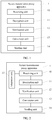
- This embodiment of the present invention provides a secure transmission proxy apparatus 1.
- the apparatus 1 may include:
- the service request message further includes at least a message channel and user information.
- the verification unit 12 is configured to: perform first verification on the service permission according to the message channel and the service type, and perform second verification on the service permission according to the user information and the service type if the first verification succeeds.
- the conversion unit 13 is configured to perform protocol conversion on the decrypted service request message after the second verification succeeds.
- the verification unit 12 is specifically configured to search a preset database for a first service type corresponding to the message channel, where the first verification succeeds if the service type is any service type in the first service type.
- the verification unit 12 is specifically configured to search the preset database for a first permission value corresponding to the user information and search the preset database for a second permission value corresponding to the service type, where the second verification succeeds if the first permission value is greater than or equal to the second permission value.
- the conversion unit 13 is configured to perform protocol conversion on the decrypted service request message after the second verification succeeds.
- the verification unit 12 is specifically configured to: search the preset database for a first home service system and a third permission value that are corresponding to the user information, and search the preset database for a second home service system and a fourth permission value that are corresponding to the service type, where the second verification succeeds if the first home service system is the same as the second home service system and the third permission value is greater than or equal to the fourth permission value.
- the conversion unit 13 is configured to perform protocol conversion on the decrypted service request message after the second verification succeeds.
- the decrypted service request message carries a first protocol identifier; and the conversion unit 13 is specifically configured to convert the first protocol identifier carried in the decrypted service request message to a second protocol identifier that can be identified by the service server side.
- the apparatus further includes: an adaptation unit 15, configured to perform protocol adaptation on the service request message.
- the sending unit 14 is further configured to publish a security certificate to the client, so that the client encrypts the service request message according to the security certificate.
- the sending unit 14 is further configured to send a request failure message to the client if the service permission verification fails.
- the secure transmission proxy apparatus receives a service request message sent by a client and decrypts the service request message, where a decrypted service request message includes a service type; performs verification on service permission of the decrypted service request message according to the service type; performs protocol conversion on the decrypted service request message if the service permission verification succeeds; and sends a service request message obtained after the protocol conversion to a service server side, so that the service server side executes a corresponding service according to the service request message obtained after the protocol conversion.
- the secure transmission proxy apparatus may decrypt a service request sent by a client on the Internet and perform verification on service permission, and each service server side no longer publishes a certificate and performs permission verification separately. Therefore, workload of reconstruction and maintenance of the service server side is reduced.
- a permission verification method may be formulated and maintained more effectively, which reduces networking costs, and communication security is enhanced because verification is performed on service permission of the decrypted service request message according to the service type.
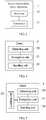
- the apparatus 2 may include a processor 20 and a transmitter 21, where:
- the service request message further includes at least a message channel and user information.
- the processor 20 is configured to: perform first verification on the service permission according to the message channel and the service type, perform second verification on the service permission according to the user information and the service type if the first verification succeeds, and perform protocol conversion on the decrypted service request message after the second verification succeeds.
- the processor 20 is specifically configured to search a preset database for a first service type corresponding to the message channel, where the first verification succeeds if the service type is any service type in the first service type.
- the processor 20 is specifically configured to search the preset database for a first permission value corresponding to the user information and search the preset database for a second permission value corresponding to the service type, where the second verification succeeds if the first permission value is greater than or equal to the second permission value, and perform protocol conversion on the decrypted service request message after the second verification succeeds.
- the processor 20 is specifically configured to: search the preset database for a first home service system and a third permission value that are corresponding to the user information, and search the preset database for a second home service system and a fourth permission value that are corresponding to the service type, where the second verification succeeds if the first home service system is the same as the second home service system and the third permission value is greater than or equal to the fourth permission value, and perform protocol conversion on the decrypted service request message after the second verification succeeds.
- the decrypted service request message carries a first protocol identifier
- the processor 20 is specifically configured to convert the first protocol identifier carried in the decrypted service request message to a second protocol identifier that can be identified by the service server side.
- processor 20 is further configured to perform protocol adaptation on the service request message.
- the transmitter 21 is further configured to publish a security certificate to the client, so that the client encrypts the service request message according to the security certificate.
- the transmitter 21 is further configured to send a request failure message to the client if the service permission verification fails.
- the secure transmission proxy apparatus receives a service request message sent by a client and decrypts the service request message, where a decrypted service request message includes a service type; performs verification on service permission of the decrypted service request message according to the service type; performs protocol conversion on the decrypted service request message if the service permission verification succeeds; and sends a service request message obtained after the protocol conversion to a service server side, so that the service server side executes a corresponding service according to the service request message obtained after the protocol conversion.
- the secure transmission proxy apparatus may decrypt a service request sent by a client on the Internet and perform verification on service permission, and each service server side no longer publishes a certificate and performs permission verification separately. Therefore, workload of reconstruction and maintenance of the service server side is reduced.
- a permission verification method may be formulated and maintained more effectively, which reduces networking costs, and communication security is enhanced because verification is performed on service permission of the decrypted service request message according to the service type.
- This embodiment of the present invention provides a client 3.
- the client 3 may include:
- the client 3 further includes:
- the service request message carries a first protocol identifier.
- This embodiment of the present invention provides a client, where the client encrypts an obtained service request message and sends an encrypted service request message to a secure transmission proxy apparatus.
- the secure transmission proxy apparatus may decrypt a service request sent by a client on the Internet and perform verification on service permission, and each service server side no longer publishes a certificate and performs permission verification separately. Therefore, workload of reconstruction and maintenance of the service server side is reduced.
- a permission verification method may be formulated and maintained more effectively, which reduces networking costs, and communication security is enhanced because verification is performed on service permission of the decrypted service request message according to the service type.
- This embodiment of the present invention provides a service access system 4.
- the system includes: at least one client 3 described above, a load balancer 40, the secure transmission proxy apparatus 1 described above, and at least one service server side 41, where the at least one client 3 is connected to the load balancer 40, the load balancer 40 is connected to the secure transmission proxy apparatus 1, and the secure transmission proxy apparatus 1 is connected to the at least one service server side 41.
- a working process of each client is basically the same as that of each service server side.
- One client of at least one client and one service server side of at least one service server side are used as an example to describe a working process of the service access system.
- the secure transmission proxy apparatus publishes a security certificate to the client, and the client loads the security certificate published by the secure transmission proxy apparatus.
- the client encrypts a service request message according to the security certificate and sends the service request message to the load balancer.
- the load balancer receives the service request message and sends the service request message to the secure transmission proxy apparatus.
- the secure transmission proxy apparatus receives the service request message and decrypts the service request message, where the service request message includes a service type; performs verification on service permission of a decrypted service request message according to the service type; performs protocol conversion on the decrypted service request message if the service permission verification succeeds; and sends a service request message obtained after the protocol conversion to the service server side.
- the service server side executes a corresponding service according to the service request message obtained after the protocol conversion.
- the load balancer is a hardware device that distributes a network request to an available server in a server cluster by using various allocation algorithms, and enables a network visitor to obtain the best possible networking experience by managing incoming Web data traffic and increasing valid network bandwidth.
- the security certificate is a private key for a user during online communication.
- the security certificate performs high intensity encryption on communication information of the user, so as to prevent the communication information from being stolen or modified by another user etc., and ensure security.
- This embodiment of the present invention provides the service access system, where the system includes: at least one client, a load balancer, at least one service server side, and a secure transmission proxy apparatus, where the secure transmission proxy apparatus publishes a security certificate to the at least one client, the client loads the security certificate published by the secure transmission proxy apparatus and encrypts a service request message according to the security certificate, the secure transmission proxy apparatus decrypts the received service request message and performs permission verification, and sends, if the permission verification succeeds, a service request message obtained after protocol conversion to the service server side, and the service server side performs a corresponding service according to the service request message.
- the secure transmission proxy apparatus may decrypt a service request sent by a client on the Internet and perform verification on service permission, and each service server side no longer publishes a certificate and performs permission verification separately. Therefore, workload of reconstruction and maintenance of the service server side is reduced.
- a permission verification method may be formulated and maintained more effectively, which reduces networking costs, and communication security is enhanced because verification is performed on service permission of the decrypted service request message according to a service type.
- a service operation between each client and the service server side only needs to be performed with respect to a unified security permission verification center, which also reduces workload of reconstruction and maintenance of the client.
- This embodiment of the present invention provides a service access method. As shown in FIG. 7 , the method may include:
- a secure transmission proxy apparatus receives a service request message sent by a client and decrypts the service request message, where the service request message includes a service type.
- a secure transmission proxy apparatus publishes, in a DMZ (demilitarized zone), a security certificate to a client on the Internet with respect to a security protocol that each client can support, and a manner in which each service server side separately publishes a security certificate to the client is no longer used.
- the secure transmission proxy apparatus may publish one security certificate to multiple clients, where the client may encrypt the service request message according to the security certificate, so as to ensure security of communication between the client and a service server side.
- the DMZ is referred to as a demilitarized zone or an isolated zone.
- the DMZ is a special network area different from an external network or an internal network.
- servers such as a Web, a Mail, and an FTP that allow access to an external network are connected to an internal port in the DMZ, and an entire internal network that needs to be protected is connected to a location behind a port in a trusted zone, so as to separate the internal network and the external network.
- the security certificate is a private key for a user during online communication.
- the security certificate performs high intensity encryption on communication information of the user, so as to prevent the communication information from being stolen or modified by another user etc., and ensure security.
- the secure transmission proxy apparatus obtains the service request message sent by the client, where the service request message has been encrypted by the client according to the certificate published by the secure transmission proxy apparatus, and the secure transmission proxy apparatus decrypts the service request message, where the service request message may include the service type, a message channel, and user information, and may also include other information such as service content, which is not limited in this embodiment.
- the secure transmission proxy apparatus may decrypt the service request message according to a first preset algorithm, where the first preset algorithm is corresponding to an algorithm in which the client encrypts the service request message according to the security certificate. That is, the client encrypts the service request message according to the security certificate, and the secure transmission proxy apparatus may decrypt the encrypted service request message by using the first preset algorithm, where the first preset algorithm may be a decryption algorithm in the prior art, which is not limited in this embodiment.
- the secure transmission proxy apparatus may also publish the security certificate if the client needs to use a private encryption protocol to perform service interaction with the service server side, where the security certificate may be different from a security certificate applied in another service server side.
- the secure transmission proxy apparatus manages the privately encrypted security certificate, decryption of the service request message, and service permission verification.
- the secure transmission proxy apparatus performs verification on service permission of a decrypted service request message according to the service type.
- the service request message described above may include the message channel, the user information, the service type, the service content, and the like.
- An implementation manner in which the secure transmission proxy apparatus performs service permission verification on the decrypted service request message according to the service type may be as follows: the secure transmission proxy apparatus performs first verification on the service permission according to the message channel and the service type, and performs second verification on the service permission according to the user information and the service type if the first verification succeeds.
- a possible implementation manner in which the secure transmission proxy apparatus performs the first verification on the service permission according to the message channel and the service type is:
- a possible implementation manner in which the secure transmission proxy apparatus performs the second verification on the service permission according to the user information and the service type is:
- a possible implementation manner in which the secure transmission proxy apparatus performs the second verification on the service permission according to the user information and the service type is:
- the secure transmission proxy apparatus performs protocol conversion on the decrypted service request message if the service permission verification succeeds.
- different sides in communication may use different communication protocols, and the different communication protocols do not identify a frame format transmission method of another party. Therefore, protocol conversion needs to be performed between network areas in which different protocols are used.
- the client uses a first communication protocol and the service server side uses a second communication protocol, it may be understood that a message using the first communication protocol carries a first protocol identifier, a message using the second communication protocol carries a second protocol identifier, the decrypted service request message carries the first protocol identifier, and the service server side may identify the second communication protocol.
- the secure transmission proxy apparatus needs to convert the first protocol identifier carried in the decrypted service request message to the second protocol identifier that can be identified by the service server side, that is, the secure transmission proxy apparatus converts the first communication protocol of the decrypted service request message to the second communication protocol that can be identified by the service server side.
- the protocol conversion in this embodiment of the present invention refers to converting a protocol of a message according to a protocol format indicated by the protocol identifier.
- the secure transmission proxy apparatus may perform protocol conversion on the decrypted service request message according to a second preset algorithm, where the second preset algorithm may be a protocol conversion algorithm in the prior art, which is not limited in this embodiment.
- the secure transmission proxy apparatus sends a service request message obtained after the protocol conversion to a service server side, so that the service server side executes a corresponding service according to the service request message obtained after the protocol conversion.
- the secure transmission proxy apparatus sends the service request message obtained after the protocol conversion to the service server side, so that the service server side executes a corresponding service according to the service request message.
- a secure transmission proxy apparatus receives a service request message sent by a client and decrypts the service request message, where the service request message includes a service type; performs verification on service permission of a decrypted service request message according to the service type; performs protocol conversion on the decrypted service request message if the service permission verification succeeds; and sends a service request message obtained after the protocol conversion to a service server side, so that the service server side executes a corresponding service according to the service request message obtained after the protocol conversion.
- the secure transmission proxy apparatus may decrypt a service request sent by a client on the Internet and perform verification on service permission, and each service server side no longer publishes a certificate and performs permission verification separately.
- a permission verification method may be formulated and maintained more effectively, which reduces networking costs, and communication security is enhanced because verification is performed on service permission of the decrypted service request message according to the service type.
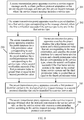
- This embodiment of the present invention provides a service access method. As shown in FIG. 8 , the method includes:
- a secure transmission proxy apparatus publishes, in a DMZ (demilitarized zone), a security certificate to a client on the Internet with respect to a security protocol that each client can support, and a manner in which each service server side separately publishes a security certificate to the client is no longer used.
- the secure transmission proxy apparatus may publish one security certificate to multiple clients, where the client may encrypt, according to the security certificate, a service request message that needs to be sent, so as to ensure security of communication between the client and a service server side.
- the DMZ is referred to as a demilitarized zone or an isolated zone.
- the DMZ is a special network area different from an external network or an internal network.
- servers such as a Web, a Mail, and an FTP that allow access to an external network are connected to an internal port in the DMZ, and an entire internal network that needs to be protected is connected to a location behind a port in a trusted zone, so as to separate the internal network and the external network.
- the secure transmission proxy apparatus obtains the service request message sent by the client, where the service request message has been encrypted by the client according to the certificate published by the secure transmission proxy apparatus, and the secure transmission proxy apparatus performs protocol adaptation on the service request message, and decrypts a service request message obtained after the protocol adaptation, where the service request message obtained after decryption may specifically include a service type, a message channel, and user information, and may also include other information such as service content, which is not limited in this embodiment.
- the secure transmission proxy apparatus may decrypt the service request message according to a first preset algorithm, where the first preset algorithm is corresponding to an algorithm in which the client encrypts the service request message according to the security certificate. That is, the client encrypts the service request message according to the security certificate, and the secure transmission proxy apparatus may decrypt the encrypted service request message by using the first preset algorithm, where the first preset algorithm may be a decryption algorithm in the prior art, which is not limited in this embodiment.
- the secure transmission proxy apparatus may also publish the security certificate if the client needs to use a private encryption protocol to perform service interaction with the service server side, where the security certificate may be different from a security certificate applied in another service server side.
- the secure transmission proxy apparatus manages the privately encrypted security certificate, decryption of the service request message, and service permission verification.
- the secure transmission proxy apparatus searches a preset database for a first service type corresponding to a message channel, where the first verification succeeds if the service type is any service type in the first service type.
- the service request message obtained after decryption may include the message channel, the user information, the service type, the service content, and may also include other information, which is not limited in this embodiment.
- the message channel is a medium for sending the service request message, for example, an electronic channel e-care, and a voice channel IVR (interactive voice response).
- first verification is performed on the service permission.
- the e-care (electronic service) channel allows a service to request the following services: query customer information, recharge by voucher card, change primary offering, and change supplementary offering.
- the IVR (voice service) channel allows a service to request only the following services: recharge by voucher card and change supplementary offering. If the IVR channel requests a service that is not allowed to be executed (for example, change primary offering), the service request is rejected.
- Table 1 Service channel Service type IVR Recharge by voucher card IVR Change supplementary offering e-care Change Primary offering e-care Query Customer Information e-care Change supplementary offering e-care Recharge by voucher card
- the message channel is IVR and the service type is recharge by voucher card.
- a first service type that is corresponding to the message channel IVR and that is searched for by the secure transmission proxy apparatus in the preset first database includes: Recharge by voucher card and Change supplementary offering. If the service type Recharge by voucher card is the same as Recharge by voucher card in the first service type, the first verification succeeds, that is, Recharge by voucher card is in a range of services that the IVR channel allows to apply for, and the service request may be accepted.
- the first service type that is corresponding to the message channel and that is searched for in the preset database may be one or more service types, and it may be determined that the first verification succeeds as long as the service type is the same as any service type in the first service type.
- the secure transmission proxy apparatus searches the preset database for the first service type corresponding to the message channel. If the service type is different from any service type in the first service type, the first verification fails, and the secure transmission proxy apparatus sends a request failure message to the client.
- the message channel is IVR and the service type is change primary offering.
- a first service type that is corresponding to the message channel IVR and that is searched for by the secure transmission proxy apparatus in the preset first database includes: Recharge by voucher card and Change supplementary offering. If the service type Change Primary offering is different from either of Recharge by voucher card and Change supplementary offering that are in the first service type, the first permission verification according to the message channel and the service type fails, that is, Change Primary offering is not in a range of services that the IVR channel allows to apply for, the service request cannot pass the permission verification, and the service request is rejected for acceptance.
- the first service type that is corresponding to the message channel and that is searched for in the preset database may be one or more service types, and it may be determined that the first verification fails if the service type is different from any service type in the first service type.
- step 203 may be used to perform verification.
- the secure transmission proxy apparatus searches the preset database for a first permission value corresponding to user information, and searches the preset database for a second permission value corresponding to the service type, where second verification succeeds if the first permission value is greater than or equal to the second permission value.
- the user information may include a user ID and a password.
- the decrypted service request message may include the message channel, the user information, the service type, the service content, and may also include other information, which is not limited in this embodiment.
- a permission value is divided into three levels: S, A, and B, which are ranked in descending order, that is, a permission value in the level S is the largest, a permission value in the level B is the smallest, and a permission value in the level A is between the level S and the level B.
- the message channel is e-care (electronic service)
- the service type is change primary offering
- the user ID is operator 1.
- a first permission value that is corresponding to the user information operator 1 and that is searched for by the secure transmission proxy apparatus in a preset second database is S.
- a second permission value that is corresponding to the service type Change Primary offering and that is searched for in the preset database (as shown in Table 3) is S. If the first permission value S of operator 1 is equal to the second permission value S, the second permission verification succeeds and the service request may be accepted.
- Table 2 User ID User permission value operator1 S operator2 A Table 3 Service type Permission value of a service type Change Primary offering S Query Customer Information B Change supplementary offering A Recharge by voucher card S
- the message channel is e-care (electronic service)
- the service type is query customer information
- the user ID is operator 1.
- a first permission value that is corresponding to the user information operator 1 and that is searched for by the secure transmission proxy apparatus in a preset second database (as shown in Table 2) is S.
- a second permission value that is corresponding to the service type Query Customer Information and that is searched for in a preset third database (as shown in Table 3) is B. If the first permission value S of operator 1 is greater than the second permission value S, the second verification succeeds and the service request may be accepted.
- the message channel is e-care
- the service type is change supplementary offering
- the user ID is operator 2.
- a first permission value that is corresponding to the user information operator 2 and that is searched for by the secure transmission proxy apparatus in a preset second database (as shown in Table 2) is A.
- a second permission value that is corresponding to the service type Change supplementary offering and that is searched for in a preset third database (as shown in Table 3) is A. If the first permission value A of operator 1 is equal to the second permission value A, the second verification succeeds and the service request may be accepted.
- the secure transmission proxy apparatus searches the preset database for the first permission value corresponding to the user information, and searches the preset database for the second permission value corresponding to the service type. If the first permission value is less than the second permission value, the second verification according to the user information and the service type fails, and the secure transmission proxy apparatus sends a request failure message to the client.
- the message channel is e-care
- the service type is change supplementary offering
- the user ID is operator 2.
- a first permission value that is corresponding to the user information operator 2 and that is searched for by the secure transmission proxy apparatus in a preset second database (as shown in Table 2) is A.
- a second permission value that is corresponding to the service type Change Primary offering and that is searched for in a preset third database (as shown in Table 3) is S. If the first permission value A of operator 1 is less than the second permission value S, the second verification fails and the service request cannot be accepted.
- each service server side in an internal network separately uses an independent management mechanism, in this case, when verification is performed on the service request message sent on the Internet, there is a need to consider a service server side that finally processes the service request message and whether a user ID passed in the service request message is an authorized operating user of the service server side. Therefore, the following step 204 may be used to perform verification.
- the secure transmission proxy apparatus searches the preset database for a first home service system and a third permission value that are corresponding to the user information, and searches the preset database for a second home service system and a fourth permission value that are corresponding to the service type, where the second verification succeeds if the first home service system is the same as the second home service system and the third permission value is greater than or equal to the fourth permission value.
- the user information may include a user ID and a password.
- the decrypted service request message may include the message channel, the user information, the service type, the service content, and may also include other information, which is not limited in this embodiment.
- a permission value is divided into three levels: S, A, and B, which are ranked in descending order, that is, a permission value in the level S is the largest, a permission value in the level B is the smallest, and a permission value in the level A is between the level S and the level B.
- the message channel is e-care
- the service type is change primary offering
- the user ID is operator 1.
- the secure transmission proxy apparatus searches a preset fourth database (as shown in Table 4) for a first home service system CRM and a third permission value S that are corresponding to the user information operator 1, and searches a preset fifth database (as shown in Table 5) for a second home service system CRM and a fourth permission value S that are corresponding to the service type Change Primary offering. If the first home service system is the same as the second home service system, that is, the user ID and the requested service type belong to a same service system, and the third permission value is equal to the fourth permission value, the second verification succeeds and the service request may be accepted.
- the message channel is e-care
- the service type is query customer information
- the user ID is operator 1.
- the secure transmission proxy apparatus searches a preset fourth database (as shown in Table 4) for a first home service system CRM (customer relationship management) and a third permission value S that are corresponding to the user information operator 1, and searches a preset fifth database (as shown in Table 5) for a second home service system CRM and a fourth permission value B that are corresponding to the service type Query Customer Information. If the first home service system is the same as the second home service system, that is, the user ID and the requested service type belong to a same service system, and the third permission value is greater than the fourth permission value, the second verification succeeds and the service request may be accepted.
- Table 4 User ID Home service system User permission value operator 1 CRM S operator2 CBS A operator2 CBS S Table 5 Service type Home service system Permission value of a service type Change Primary offering CRM S Query Customer Information CRM B Change supplementary offering CRM A Recharge by voucher card CBS S
- the secure transmission proxy apparatus searches the preset database for a first home service system and a third permission value that are corresponding to the user information, and searches the preset database for a second home service system and a fourth permission value that are corresponding to the service type. If the first home service system is different from the second home service system, or if the third permission value is less than the fourth permission value, the second verification fails and the secure transmission proxy apparatus sends a request failure message to the client.
- the message channel is e-care
- the service type is change supplementary offering
- the user ID is operator 3.
- the secure transmission proxy apparatus searches a preset fourth database (as shown in Table 4) for a first home service system CBS (converting billing system) and a third permission value S that are corresponding to the user information operator 3, and searches a preset fifth database (as shown in Table 5) for a second home service system CRM and a fourth permission value A that are corresponding to the service type Change supplementary offering.
- the third permission value is greater than the fourth permission value, the user ID and the requested service type do not belong to a same service system; in this case, the second verification fails and the service request cannot be accepted.
- the message channel is e-care
- the service type is recharge by voucher card
- the user ID is operator 2.
- the secure transmission proxy apparatus searches a preset fourth database (as shown in Table 4) for a first home service system CBS and a third permission value S that are corresponding to the user information operator 2, and searches a preset fifth database (as shown in Table 5) for a second home service system CBS and a fourth permission value S that are corresponding to the service type Recharge by voucher card.
- the third permission value is less than the fourth permission value; in this case, the second verification fails and the service request cannot be accepted.
- the secure transmission proxy apparatus converts a first protocol identifier carried in the decrypted service request message to a second protocol identifier that can be identified by a service server side.
- different sides in communication may use different communication protocols, and the different communication protocols do not identify a frame format transmission method of another party. Therefore, protocol conversion needs to be performed between network areas in which different protocols are used.
- the client uses a first communication protocol and the service server side uses a second communication protocol, it may be understood that a message using the first communication protocol carries a first protocol identifier, a message using the second communication protocol carries a second protocol identifier, the decrypted service request message carries the first protocol identifier, and the service server side may identify the second communication protocol.
- the secure transmission proxy apparatus needs to convert the first protocol identifier carried in the decrypted service request message to the second protocol identifier that can be identified by the service server side, that is, the secure transmission proxy apparatus converts the first communication protocol of the decrypted service request message to the second communication protocol that can be identified by the service server side.
- the protocol conversion in this embodiment of the present invention refers to converting a protocol of a message according to a protocol format indicated by the protocol identifier.
- the secure transmission proxy apparatus needs to convert the https protocol to the http protocol.
- the secure transmission proxy apparatus may perform protocol conversion on the decrypted service request message according to a second preset algorithm, where the second preset algorithm may be a protocol conversion algorithm in the prior art, which is not limited in this embodiment.
- the secure transmission proxy apparatus sends a service request message obtained after the protocol conversion to the service server side, so that the service server side executes a corresponding service according to the service request message obtained after the protocol conversion.
- the secure transmission proxy apparatus sends the service request message obtained after the protocol conversion to the service server side, so that the service server side executes a corresponding service according to the service request message.
- a secure transmission proxy apparatus receives a service request message sent by a client and decrypts the service request message, where the service request message includes a service type; performs verification on service permission of a decrypted service request message according to the service type; performs protocol conversion on the decrypted service request message if the service permission verification succeeds; and sends a service request message obtained after the protocol conversion to a service server side, so that the service server side executes a corresponding service according to the service request message obtained after the protocol conversion.
- the secure transmission proxy apparatus may decrypt a service request sent by a client on the Internet and perform verification on service permission, and each service server side no longer publishes a certificate and performs permission verification separately.
- a permission verification method may be formulated and maintained more effectively, which reduces networking costs, and communication security is enhanced because verification is performed on service permission of the decrypted service request message according to the service type, a message channel, and user information.
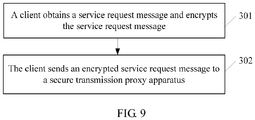
- This embodiment of the present invention provides a service system access method. As shown in FIG. 9 , the method includes:
- the client sends the service request message encrypted by the security certificate to the secure transmission proxy apparatus, where the service request message carries a first protocol identifier, and the first protocol identifier is used to indicate a protocol used by the client.
- This embodiment of the present invention provides the service access method, where a client encrypts an obtained service request message and sends an encrypted service request message to a secure transmission proxy apparatus.
- the secure transmission proxy apparatus may decrypt a service request sent by a client on the Internet and perform verification on service permission, and each service server side no longer publishes a certificate and performs permission verification separately. Therefore, workload of reconstruction and maintenance of the service server side is reduced.
- a permission verification method may be formulated and maintained more effectively, which reduces networking costs, and communication security is enhanced because verification is performed on service permission of the decrypted service request message according to a service type, a message channel, and user information.
- the disclosed system, apparatus, and method may be implemented in other manners.
- the described apparatus embodiment is merely exemplary.
- the module or unit division is merely logical function division and may be other division in actual implementation.
- a plurality of units or components may be combined or integrated into another system, or some features may be ignored or not performed.
- the displayed or discussed mutual couplings or direct couplings or communication connections may be implemented by using some interfaces.
- the indirect couplings or communication connections between the apparatuses or units may be implemented in electronic, mechanical, or other forms.
- the units described as separate parts may or may not be physically separate, and parts displayed as units may or may not be physical units, may be located in one position, or may be distributed on a plurality of network units. Some or all of the units may be selected according to actual needs to achieve the objectives of the solutions of the embodiments.
- functional units in the embodiments of the present invention may be integrated into one processing unit, or each of the units may exist alone physically, or two or more units are integrated into one unit.
- the integrated unit may be implemented in a form of hardware, or may be implemented in a form of a software functional unit.
- the integrated unit When the integrated unit is implemented in the form of a software functional unit and sold or used as an independent product, the integrated unit may be stored in a computer-readable storage medium.
- the software product is stored in a storage medium and includes several instructions for instructing a computer device (which may be a personal computer, a server, or a network device) or a processor (processor) to perform all or some of the steps of the methods described in the embodiments of the present invention.
- the foregoing storage medium includes: any medium that can store program code, such as a USB flash drive, a removable hard disk, a read-only memory (ROM), a random access memory, a magnetic disk, or an optical disc.
Landscapes
- Engineering & Computer Science (AREA)
- Computer Security & Cryptography (AREA)
- Computer Networks & Wireless Communication (AREA)
- Signal Processing (AREA)
- General Engineering & Computer Science (AREA)
- Computing Systems (AREA)
- Computer Hardware Design (AREA)
- Theoretical Computer Science (AREA)
- Databases & Information Systems (AREA)
- General Physics & Mathematics (AREA)
- Physics & Mathematics (AREA)
- Data Mining & Analysis (AREA)
- Computer And Data Communications (AREA)
- Management, Administration, Business Operations System, And Electronic Commerce (AREA)
- Data Exchanges In Wide-Area Networks (AREA)
Applications Claiming Priority (2)
| Application Number | Priority Date | Filing Date | Title |
|---|---|---|---|
| CN201410312944.2A CN105338020B (zh) | 2014-07-02 | 2014-07-02 | 一种业务访问方法及装置 |
| PCT/CN2015/076094 WO2016000473A1 (zh) | 2014-07-02 | 2015-04-08 | 一种业务访问方法、系统及装置 |
Publications (3)
| Publication Number | Publication Date |
|---|---|
| EP3166283A1 true EP3166283A1 (de) | 2017-05-10 |
| EP3166283A4 EP3166283A4 (de) | 2017-05-10 |
| EP3166283B1 EP3166283B1 (de) | 2019-11-13 |
Family
ID=55018413
Family Applications (1)
| Application Number | Title | Priority Date | Filing Date |
|---|---|---|---|
| EP15814144.0A Active EP3166283B1 (de) | 2014-07-02 | 2015-04-08 | Verfahren, system und vorrichtung für geschäftszugang |
Country Status (4)
| Country | Link |
|---|---|
| US (1) | US10412057B2 (de) |
| EP (1) | EP3166283B1 (de) |
| CN (1) | CN105338020B (de) |
| WO (1) | WO2016000473A1 (de) |
Families Citing this family (4)
| Publication number | Priority date | Publication date | Assignee | Title |
|---|---|---|---|---|
| CN108242021B (zh) * | 2016-12-26 | 2022-02-01 | 航天信息股份有限公司 | 一种账务数据的处理系统、方法及装置 |
| CN108667933A (zh) * | 2018-05-11 | 2018-10-16 | 星络科技有限公司 | 连接建立方法、连接建立装置及通信系统 |
| CN110971622A (zh) * | 2020-03-04 | 2020-04-07 | 信联科技(南京)有限公司 | 一种公网应用系统与内网应用系统间双向访问方法及系统 |
| CN111510476B (zh) * | 2020-04-03 | 2023-06-20 | 金蝶软件(中国)有限公司 | 通信方法、装置、计算机设备和计算机可读存储介质 |
Family Cites Families (19)
| Publication number | Priority date | Publication date | Assignee | Title |
|---|---|---|---|---|
| US6219790B1 (en) * | 1998-06-19 | 2001-04-17 | Lucent Technologies Inc. | Centralized authentication, authorization and accounting server with support for multiple transport protocols and multiple client types |
| BR0013748A (pt) * | 1999-09-02 | 2002-05-21 | Nokia Mobile Phones Ltd | Terminal de comunicação sem fio para acessar informação de localização a partir de um servidor |
| US7237261B1 (en) * | 1999-09-07 | 2007-06-26 | Swisscom Ag | Method, system and gateway allowing secured end-to-end access to WAP services |
| US20020116637A1 (en) * | 2000-12-21 | 2002-08-22 | General Electric Company | Gateway for securely connecting arbitrary devices and service providers |
| US20040030887A1 (en) * | 2002-08-07 | 2004-02-12 | Harrisville-Wolff Carol L. | System and method for providing secure communications between clients and service providers |
| US20040225657A1 (en) * | 2003-05-07 | 2004-11-11 | Panacea Corporation | Web services method and system |
| CN1314251C (zh) * | 2004-01-05 | 2007-05-02 | 中兴通讯股份有限公司 | 一种综合业务平台及其业务流程控制方法 |
| CN1314221C (zh) * | 2004-02-01 | 2007-05-02 | 中兴通讯股份有限公司 | 一种安全代理方法 |
| US20070288487A1 (en) * | 2006-06-08 | 2007-12-13 | Samsung Electronics Co., Ltd. | Method and system for access control to consumer electronics devices in a network |
| US7970943B2 (en) * | 2007-08-14 | 2011-06-28 | Oracle International Corporation | Providing interoperability in software identifier standards |
| CN101552989B (zh) * | 2009-05-20 | 2011-01-26 | 中国电信股份有限公司 | 一种用户数据配置方法、系统和移动网络配置网关 |
| US8867539B2 (en) * | 2009-09-18 | 2014-10-21 | At&T Intellectual Property I, L.P. | Multicast-unicast protocol converter |
| CN101753561B (zh) * | 2009-12-28 | 2013-01-16 | 中兴通讯股份有限公司 | 业务的集群处理方法及集群系统 |
| CN102104607B (zh) * | 2011-03-10 | 2013-11-06 | 易程(苏州)软件股份有限公司 | 访问业务的安全控制方法、装置及系统 |
| CN102291796A (zh) * | 2011-09-02 | 2011-12-21 | 中国联合网络通信集团有限公司 | 业务数据传输方法、系统及管理控制中心 |
| HK1201965A1 (en) * | 2011-12-13 | 2015-09-11 | 维萨国际服务协会 | Integrated mobile trusted service manager |
| GB2497940B (en) * | 2011-12-21 | 2016-02-17 | Eckoh Uk Ltd | Method and apparatus for mediating communications |
| CN103001962B (zh) * | 2012-12-03 | 2015-07-29 | 中国联合网络通信集团有限公司 | 业务支撑方法和系统 |
| CN103428700A (zh) * | 2013-07-26 | 2013-12-04 | 中国联合网络通信集团有限公司 | 业务鉴权方法及装置 |
-
2014
- 2014-07-02 CN CN201410312944.2A patent/CN105338020B/zh active Active
-
2015
- 2015-04-08 EP EP15814144.0A patent/EP3166283B1/de active Active
- 2015-04-08 WO PCT/CN2015/076094 patent/WO2016000473A1/zh not_active Ceased
-
2016
- 2016-12-27 US US15/390,974 patent/US10412057B2/en active Active
Also Published As
| Publication number | Publication date |
|---|---|
| WO2016000473A1 (zh) | 2016-01-07 |
| US10412057B2 (en) | 2019-09-10 |
| US20170111329A1 (en) | 2017-04-20 |
| CN105338020B (zh) | 2018-12-07 |
| EP3166283A4 (de) | 2017-05-10 |
| EP3166283B1 (de) | 2019-11-13 |
| CN105338020A (zh) | 2016-02-17 |
Similar Documents
| Publication | Publication Date | Title |
|---|---|---|
| EP4216081B1 (de) | Informationsverifizierungsverfahren, zugehörige vorrichtung, vorrichtung und speichermedium | |
| US10735426B2 (en) | Secure asynchronous retrieval of data behind a firewall | |
| EP2924948B1 (de) | Externe indizierung und suche nach einem sicheren cloud-kollaborationssystem | |
| US9473938B2 (en) | Content sharing method, apparatus, and system | |
| CN103036867B (zh) | 基于相互认证的虚拟专用网络服务设备和方法 | |
| US10341118B2 (en) | SSL gateway with integrated hardware security module | |
| EP2767029B1 (de) | Sichere kommunikation | |
| EP2475194B1 (de) | Dienstzugangsverfahren, -system und vorrichtung auf basis von wlan-zugangsauthentifikationen | |
| CN106411926B (zh) | 一种数据加密通信方法及系统 | |
| WO2019168477A1 (en) | System and method for securing data communication between computers | |
| CN104486307A (zh) | 一种基于同态加密的分权密钥管理方法 | |
| CN111447220B (zh) | 认证信息管理方法、应用系统的服务端及计算机存储介质 | |
| JP2018050294A (ja) | デジタルアイデンティティ | |
| US10412057B2 (en) | Service access method and system, and apparatus | |
| EP2942899B1 (de) | Informationsverarbeitungsverfahren, sicherer server und cloud-server | |
| JP5992535B2 (ja) | 無線idプロビジョニングを実行するための装置及び方法 | |
| CN113472722A (zh) | 数据传输方法、存储介质、电子设备及自动售检票系统 | |
| CN104065479A (zh) | 基于群组的密钥生成方法和系统、密钥分发方法和系统 | |
| CN112966287B (zh) | 获取用户数据的方法、系统、设备和计算机可读介质 | |
| US20030007645A1 (en) | Method and system for allowing a sender to send an encrypted message to a recipient from any data terminal | |
| US9419800B2 (en) | Secure network systems and methods | |
| CN117394978A (zh) | 基于bgv同态加密的电力数据共享方法、系统及存储介质 | |
| CN107547570B (zh) | 一种数据安全服务平台和数据安全传输方法 | |
| CN207251667U (zh) | 一种数据安全服务平台 | |
| CN106685906A (zh) | 鉴权处理方法、节点及系统 |
Legal Events
| Date | Code | Title | Description |
|---|---|---|---|
| STAA | Information on the status of an ep patent application or granted ep patent |
Free format text: STATUS: THE INTERNATIONAL PUBLICATION HAS BEEN MADE |
|
| PUAI | Public reference made under article 153(3) epc to a published international application that has entered the european phase |
Free format text: ORIGINAL CODE: 0009012 |
|
| STAA | Information on the status of an ep patent application or granted ep patent |
Free format text: STATUS: REQUEST FOR EXAMINATION WAS MADE |
|
| 17P | Request for examination filed |
Effective date: 20161230 |
|
| A4 | Supplementary search report drawn up and despatched |
Effective date: 20170330 |
|
| AK | Designated contracting states |
Kind code of ref document: A1 Designated state(s): AL AT BE BG CH CY CZ DE DK EE ES FI FR GB GR HR HU IE IS IT LI LT LU LV MC MK MT NL NO PL PT RO RS SE SI SK SM TR |
|
| AX | Request for extension of the european patent |
Extension state: BA ME |
|
| DAV | Request for validation of the european patent (deleted) | ||
| DAX | Request for extension of the european patent (deleted) | ||
| STAA | Information on the status of an ep patent application or granted ep patent |
Free format text: STATUS: EXAMINATION IS IN PROGRESS |
|
| 17Q | First examination report despatched |
Effective date: 20180827 |
|
| GRAP | Despatch of communication of intention to grant a patent |
Free format text: ORIGINAL CODE: EPIDOSNIGR1 |
|
| STAA | Information on the status of an ep patent application or granted ep patent |
Free format text: STATUS: GRANT OF PATENT IS INTENDED |
|
| INTG | Intention to grant announced |
Effective date: 20190625 |
|
| GRAS | Grant fee paid |
Free format text: ORIGINAL CODE: EPIDOSNIGR3 |
|
| GRAA | (expected) grant |
Free format text: ORIGINAL CODE: 0009210 |
|
| STAA | Information on the status of an ep patent application or granted ep patent |
Free format text: STATUS: THE PATENT HAS BEEN GRANTED |
|
| AK | Designated contracting states |
Kind code of ref document: B1 Designated state(s): AL AT BE BG CH CY CZ DE DK EE ES FI FR GB GR HR HU IE IS IT LI LT LU LV MC MK MT NL NO PL PT RO RS SE SI SK SM TR |
|
| REG | Reference to a national code |
Ref country code: CH Ref legal event code: EP Ref country code: AT Ref legal event code: REF Ref document number: 1202872 Country of ref document: AT Kind code of ref document: T Effective date: 20191115 |
|
| REG | Reference to a national code |
Ref country code: DE Ref legal event code: R096 Ref document number: 602015041751 Country of ref document: DE |
|
| REG | Reference to a national code |
Ref country code: IE Ref legal event code: FG4D |
|
| REG | Reference to a national code |
Ref country code: NL Ref legal event code: MP Effective date: 20191113 |
|
| REG | Reference to a national code |
Ref country code: LT Ref legal event code: MG4D |
|
| PG25 | Lapsed in a contracting state [announced via postgrant information from national office to epo] |
Ref country code: LV Free format text: LAPSE BECAUSE OF FAILURE TO SUBMIT A TRANSLATION OF THE DESCRIPTION OR TO PAY THE FEE WITHIN THE PRESCRIBED TIME-LIMIT Effective date: 20191113 Ref country code: SE Free format text: LAPSE BECAUSE OF FAILURE TO SUBMIT A TRANSLATION OF THE DESCRIPTION OR TO PAY THE FEE WITHIN THE PRESCRIBED TIME-LIMIT Effective date: 20191113 Ref country code: PL Free format text: LAPSE BECAUSE OF FAILURE TO SUBMIT A TRANSLATION OF THE DESCRIPTION OR TO PAY THE FEE WITHIN THE PRESCRIBED TIME-LIMIT Effective date: 20191113 Ref country code: PT Free format text: LAPSE BECAUSE OF FAILURE TO SUBMIT A TRANSLATION OF THE DESCRIPTION OR TO PAY THE FEE WITHIN THE PRESCRIBED TIME-LIMIT Effective date: 20200313 Ref country code: NO Free format text: LAPSE BECAUSE OF FAILURE TO SUBMIT A TRANSLATION OF THE DESCRIPTION OR TO PAY THE FEE WITHIN THE PRESCRIBED TIME-LIMIT Effective date: 20200213 Ref country code: BG Free format text: LAPSE BECAUSE OF FAILURE TO SUBMIT A TRANSLATION OF THE DESCRIPTION OR TO PAY THE FEE WITHIN THE PRESCRIBED TIME-LIMIT Effective date: 20200213 Ref country code: GR Free format text: LAPSE BECAUSE OF FAILURE TO SUBMIT A TRANSLATION OF THE DESCRIPTION OR TO PAY THE FEE WITHIN THE PRESCRIBED TIME-LIMIT Effective date: 20200214 Ref country code: LT Free format text: LAPSE BECAUSE OF FAILURE TO SUBMIT A TRANSLATION OF THE DESCRIPTION OR TO PAY THE FEE WITHIN THE PRESCRIBED TIME-LIMIT Effective date: 20191113 Ref country code: FI Free format text: LAPSE BECAUSE OF FAILURE TO SUBMIT A TRANSLATION OF THE DESCRIPTION OR TO PAY THE FEE WITHIN THE PRESCRIBED TIME-LIMIT Effective date: 20191113 Ref country code: NL Free format text: LAPSE BECAUSE OF FAILURE TO SUBMIT A TRANSLATION OF THE DESCRIPTION OR TO PAY THE FEE WITHIN THE PRESCRIBED TIME-LIMIT Effective date: 20191113 |
|
| PG25 | Lapsed in a contracting state [announced via postgrant information from national office to epo] |
Ref country code: RS Free format text: LAPSE BECAUSE OF FAILURE TO SUBMIT A TRANSLATION OF THE DESCRIPTION OR TO PAY THE FEE WITHIN THE PRESCRIBED TIME-LIMIT Effective date: 20191113 Ref country code: HR Free format text: LAPSE BECAUSE OF FAILURE TO SUBMIT A TRANSLATION OF THE DESCRIPTION OR TO PAY THE FEE WITHIN THE PRESCRIBED TIME-LIMIT Effective date: 20191113 Ref country code: IS Free format text: LAPSE BECAUSE OF FAILURE TO SUBMIT A TRANSLATION OF THE DESCRIPTION OR TO PAY THE FEE WITHIN THE PRESCRIBED TIME-LIMIT Effective date: 20200313 |
|
| PG25 | Lapsed in a contracting state [announced via postgrant information from national office to epo] |
Ref country code: AL Free format text: LAPSE BECAUSE OF FAILURE TO SUBMIT A TRANSLATION OF THE DESCRIPTION OR TO PAY THE FEE WITHIN THE PRESCRIBED TIME-LIMIT Effective date: 20191113 |
|
| PG25 | Lapsed in a contracting state [announced via postgrant information from national office to epo] |
Ref country code: RO Free format text: LAPSE BECAUSE OF FAILURE TO SUBMIT A TRANSLATION OF THE DESCRIPTION OR TO PAY THE FEE WITHIN THE PRESCRIBED TIME-LIMIT Effective date: 20191113 Ref country code: EE Free format text: LAPSE BECAUSE OF FAILURE TO SUBMIT A TRANSLATION OF THE DESCRIPTION OR TO PAY THE FEE WITHIN THE PRESCRIBED TIME-LIMIT Effective date: 20191113 Ref country code: DK Free format text: LAPSE BECAUSE OF FAILURE TO SUBMIT A TRANSLATION OF THE DESCRIPTION OR TO PAY THE FEE WITHIN THE PRESCRIBED TIME-LIMIT Effective date: 20191113 Ref country code: ES Free format text: LAPSE BECAUSE OF FAILURE TO SUBMIT A TRANSLATION OF THE DESCRIPTION OR TO PAY THE FEE WITHIN THE PRESCRIBED TIME-LIMIT Effective date: 20191113 Ref country code: CZ Free format text: LAPSE BECAUSE OF FAILURE TO SUBMIT A TRANSLATION OF THE DESCRIPTION OR TO PAY THE FEE WITHIN THE PRESCRIBED TIME-LIMIT Effective date: 20191113 |
|
| REG | Reference to a national code |
Ref country code: DE Ref legal event code: R097 Ref document number: 602015041751 Country of ref document: DE |
|
| REG | Reference to a national code |
Ref country code: AT Ref legal event code: MK05 Ref document number: 1202872 Country of ref document: AT Kind code of ref document: T Effective date: 20191113 |
|
| PG25 | Lapsed in a contracting state [announced via postgrant information from national office to epo] |
Ref country code: SK Free format text: LAPSE BECAUSE OF FAILURE TO SUBMIT A TRANSLATION OF THE DESCRIPTION OR TO PAY THE FEE WITHIN THE PRESCRIBED TIME-LIMIT Effective date: 20191113 Ref country code: SM Free format text: LAPSE BECAUSE OF FAILURE TO SUBMIT A TRANSLATION OF THE DESCRIPTION OR TO PAY THE FEE WITHIN THE PRESCRIBED TIME-LIMIT Effective date: 20191113 |
|
| PLBE | No opposition filed within time limit |
Free format text: ORIGINAL CODE: 0009261 |
|
| STAA | Information on the status of an ep patent application or granted ep patent |
Free format text: STATUS: NO OPPOSITION FILED WITHIN TIME LIMIT |
|
| 26N | No opposition filed |
Effective date: 20200814 |
|
| PG25 | Lapsed in a contracting state [announced via postgrant information from national office to epo] |
Ref country code: SI Free format text: LAPSE BECAUSE OF FAILURE TO SUBMIT A TRANSLATION OF THE DESCRIPTION OR TO PAY THE FEE WITHIN THE PRESCRIBED TIME-LIMIT Effective date: 20191113 Ref country code: MC Free format text: LAPSE BECAUSE OF FAILURE TO SUBMIT A TRANSLATION OF THE DESCRIPTION OR TO PAY THE FEE WITHIN THE PRESCRIBED TIME-LIMIT Effective date: 20191113 Ref country code: AT Free format text: LAPSE BECAUSE OF FAILURE TO SUBMIT A TRANSLATION OF THE DESCRIPTION OR TO PAY THE FEE WITHIN THE PRESCRIBED TIME-LIMIT Effective date: 20191113 |
|
| REG | Reference to a national code |
Ref country code: CH Ref legal event code: PL |
|
| PG25 | Lapsed in a contracting state [announced via postgrant information from national office to epo] |
Ref country code: CH Free format text: LAPSE BECAUSE OF NON-PAYMENT OF DUE FEES Effective date: 20200430 Ref country code: IT Free format text: LAPSE BECAUSE OF FAILURE TO SUBMIT A TRANSLATION OF THE DESCRIPTION OR TO PAY THE FEE WITHIN THE PRESCRIBED TIME-LIMIT Effective date: 20191113 Ref country code: LI Free format text: LAPSE BECAUSE OF NON-PAYMENT OF DUE FEES Effective date: 20200430 Ref country code: LU Free format text: LAPSE BECAUSE OF NON-PAYMENT OF DUE FEES Effective date: 20200408 |
|
| REG | Reference to a national code |
Ref country code: BE Ref legal event code: MM Effective date: 20200430 |
|
| PG25 | Lapsed in a contracting state [announced via postgrant information from national office to epo] |
Ref country code: BE Free format text: LAPSE BECAUSE OF NON-PAYMENT OF DUE FEES Effective date: 20200430 |
|
| PG25 | Lapsed in a contracting state [announced via postgrant information from national office to epo] |
Ref country code: IE Free format text: LAPSE BECAUSE OF NON-PAYMENT OF DUE FEES Effective date: 20200408 |
|
| REG | Reference to a national code |
Ref country code: DE Ref legal event code: R079 Ref document number: 602015041751 Country of ref document: DE Free format text: PREVIOUS MAIN CLASS: H04L0029080000 Ipc: H04L0065000000 |
|
| PG25 | Lapsed in a contracting state [announced via postgrant information from national office to epo] |
Ref country code: TR Free format text: LAPSE BECAUSE OF FAILURE TO SUBMIT A TRANSLATION OF THE DESCRIPTION OR TO PAY THE FEE WITHIN THE PRESCRIBED TIME-LIMIT Effective date: 20191113 Ref country code: MT Free format text: LAPSE BECAUSE OF FAILURE TO SUBMIT A TRANSLATION OF THE DESCRIPTION OR TO PAY THE FEE WITHIN THE PRESCRIBED TIME-LIMIT Effective date: 20191113 Ref country code: CY Free format text: LAPSE BECAUSE OF FAILURE TO SUBMIT A TRANSLATION OF THE DESCRIPTION OR TO PAY THE FEE WITHIN THE PRESCRIBED TIME-LIMIT Effective date: 20191113 |
|
| PG25 | Lapsed in a contracting state [announced via postgrant information from national office to epo] |
Ref country code: MK Free format text: LAPSE BECAUSE OF FAILURE TO SUBMIT A TRANSLATION OF THE DESCRIPTION OR TO PAY THE FEE WITHIN THE PRESCRIBED TIME-LIMIT Effective date: 20191113 |
|
| PGFP | Annual fee paid to national office [announced via postgrant information from national office to epo] |
Ref country code: DE Payment date: 20250305 Year of fee payment: 11 |
|
| PGFP | Annual fee paid to national office [announced via postgrant information from national office to epo] |
Ref country code: GB Payment date: 20260310 Year of fee payment: 12 |
|
| PGFP | Annual fee paid to national office [announced via postgrant information from national office to epo] |
Ref country code: FR Payment date: 20260309 Year of fee payment: 12 |