EP3164396B1 - Cyclohexen-1-yl-pyridin-2-yl-1h-pyrazole-4-carboxylic acid derivatives and the use thereof as soluble guanylate cyclase activators - Google Patents
Cyclohexen-1-yl-pyridin-2-yl-1h-pyrazole-4-carboxylic acid derivatives and the use thereof as soluble guanylate cyclase activators Download PDFInfo
- Publication number
- EP3164396B1 EP3164396B1 EP15742105.8A EP15742105A EP3164396B1 EP 3164396 B1 EP3164396 B1 EP 3164396B1 EP 15742105 A EP15742105 A EP 15742105A EP 3164396 B1 EP3164396 B1 EP 3164396B1
- Authority
- EP
- European Patent Office
- Prior art keywords
- methyl
- ethyl
- pyrazole
- pyridin
- mmol
- Prior art date
- Legal status (The legal status is an assumption and is not a legal conclusion. Google has not performed a legal analysis and makes no representation as to the accuracy of the status listed.)
- Not-in-force
Links
- 102000007637 Soluble Guanylyl Cyclase Human genes 0.000 title description 42
- 108010007205 Soluble Guanylyl Cyclase Proteins 0.000 title description 42
- SJYBJTACUSQTBX-UHFFFAOYSA-N 3-(cyclohexen-1-yl)-1-pyridin-2-ylpyrazole-4-carboxylic acid Chemical class C1(=CCCCC1)C1=NN(C=C1C(=O)O)C1=NC=CC=C1 SJYBJTACUSQTBX-UHFFFAOYSA-N 0.000 title 1
- 239000003119 guanylate cyclase activator Substances 0.000 title 1
- 150000001875 compounds Chemical class 0.000 claims description 309
- -1 monofluoromethyl Chemical group 0.000 claims description 84
- 238000000034 method Methods 0.000 claims description 80
- 150000003839 salts Chemical class 0.000 claims description 76
- 229910052739 hydrogen Inorganic materials 0.000 claims description 53
- 239000001257 hydrogen Substances 0.000 claims description 52
- 238000011282 treatment Methods 0.000 claims description 44
- 125000004178 (C1-C4) alkyl group Chemical group 0.000 claims description 42
- 208000010412 Glaucoma Diseases 0.000 claims description 33
- 125000002496 methyl group Chemical group [H]C([H])([H])* 0.000 claims description 31
- 230000004410 intraocular pressure Effects 0.000 claims description 29
- 125000001495 ethyl group Chemical group [H]C([H])([H])C([H])([H])* 0.000 claims description 27
- UFHFLCQGNIYNRP-UHFFFAOYSA-N Hydrogen Chemical compound [H][H] UFHFLCQGNIYNRP-UHFFFAOYSA-N 0.000 claims description 26
- 125000001559 cyclopropyl group Chemical group [H]C1([H])C([H])([H])C1([H])* 0.000 claims description 24
- 239000003795 chemical substances by application Substances 0.000 claims description 17
- 239000008194 pharmaceutical composition Substances 0.000 claims description 17
- 125000005913 (C3-C6) cycloalkyl group Chemical group 0.000 claims description 14
- 125000001072 heteroaryl group Chemical group 0.000 claims description 14
- 125000004435 hydrogen atom Chemical group [H]* 0.000 claims description 14
- 125000002023 trifluoromethyl group Chemical group FC(F)(F)* 0.000 claims description 13
- FNEBNVRWTSBLMP-UHFFFAOYSA-N 1-[6-[2-[[4-[1-(cyclopropanecarbonyl)piperidin-4-yl]-3-ethylphenoxy]methyl]-3-methylcyclohexen-1-yl]pyridin-2-yl]-5-methylpyrazole-4-carboxylic acid Chemical compound C1(CC1)C(=O)N1CCC(CC1)C1=C(C=C(OCC2=C(CCCC2C)C2=CC=CC(=N2)N2N=CC(=C2C)C(=O)O)C=C1)CC FNEBNVRWTSBLMP-UHFFFAOYSA-N 0.000 claims description 11
- 125000000229 (C1-C4)alkoxy group Chemical group 0.000 claims description 10
- WGLPLGFIOZBTKQ-UHFFFAOYSA-N 1-[6-[2-[[4-[1-(cyclopropanecarbonyl)piperidin-4-yl]-2-methylphenoxy]methyl]-3-methylcyclohexen-1-yl]pyridin-2-yl]-5-(trifluoromethyl)pyrazole-4-carboxylic acid Chemical compound C1(CC1)C(=O)N1CCC(CC1)C1=CC(=C(OCC2=C(CCCC2C)C2=CC=CC(=N2)N2N=CC(=C2C(F)(F)F)C(=O)O)C=C1)C WGLPLGFIOZBTKQ-UHFFFAOYSA-N 0.000 claims description 10
- 125000002887 hydroxy group Chemical group [H]O* 0.000 claims description 10
- 229910052760 oxygen Inorganic materials 0.000 claims description 10
- 239000000546 pharmaceutical excipient Substances 0.000 claims description 10
- 125000005842 heteroatom Chemical group 0.000 claims description 9
- 229910052717 sulfur Inorganic materials 0.000 claims description 9
- 125000004066 1-hydroxyethyl group Chemical group [H]OC([H])([*])C([H])([H])[H] 0.000 claims description 8
- 125000004206 2,2,2-trifluoroethyl group Chemical group [H]C([H])(*)C(F)(F)F 0.000 claims description 8
- XMRNTTICFHANRN-UHFFFAOYSA-N 1-[6-[2-[[4-[1-(cyclopropanecarbonyl)piperidin-4-yl]-3-ethylphenoxy]methyl]-3-methylcyclohexen-1-yl]pyridin-2-yl]-5-ethylpyrazole-4-carboxylic acid Chemical compound C1(CC1)C(=O)N1CCC(CC1)C1=C(C=C(OCC2=C(CCCC2C)C2=CC=CC(=N2)N2N=CC(=C2CC)C(=O)O)C=C1)CC XMRNTTICFHANRN-UHFFFAOYSA-N 0.000 claims description 7
- 229910052736 halogen Inorganic materials 0.000 claims description 6
- 150000002367 halogens Chemical group 0.000 claims description 6
- 125000001449 isopropyl group Chemical group [H]C([H])([H])C([H])(*)C([H])([H])[H] 0.000 claims description 6
- 239000002590 phosphodiesterase V inhibitor Substances 0.000 claims description 6
- 125000003386 piperidinyl group Chemical group 0.000 claims description 6
- 229920006395 saturated elastomer Polymers 0.000 claims description 6
- 239000000556 agonist Substances 0.000 claims description 5
- 125000001995 cyclobutyl group Chemical group [H]C1([H])C([H])([H])C([H])(*)C1([H])[H] 0.000 claims description 5
- 125000004029 hydroxymethyl group Chemical group [H]OC([H])([H])* 0.000 claims description 5
- 229910052757 nitrogen Inorganic materials 0.000 claims description 5
- 125000002924 primary amino group Chemical group [H]N([H])* 0.000 claims description 5
- 125000006413 ring segment Chemical group 0.000 claims description 5
- 125000000217 alkyl group Chemical group 0.000 claims description 4
- 125000001797 benzyl group Chemical group [H]C1=C([H])C([H])=C(C([H])=C1[H])C([H])([H])* 0.000 claims description 4
- 239000003489 carbonate dehydratase inhibitor Substances 0.000 claims description 4
- BNRNXUUZRGQAQC-UHFFFAOYSA-N sildenafil Chemical compound CCCC1=NN(C)C(C(N2)=O)=C1N=C2C(C(=CC=1)OCC)=CC=1S(=O)(=O)N1CCN(C)CC1 BNRNXUUZRGQAQC-UHFFFAOYSA-N 0.000 claims description 4
- 239000000674 adrenergic antagonist Substances 0.000 claims description 3
- 229940006133 antiglaucoma drug and miotics carbonic anhydrase inhibitors Drugs 0.000 claims description 3
- 102000012740 beta Adrenergic Receptors Human genes 0.000 claims description 3
- 108010079452 beta Adrenergic Receptors Proteins 0.000 claims description 3
- 125000000753 cycloalkyl group Chemical group 0.000 claims description 3
- 239000004090 neuroprotective agent Substances 0.000 claims description 3
- 150000003180 prostaglandins Chemical class 0.000 claims description 3
- SECKRCOLJRRGGV-UHFFFAOYSA-N Vardenafil Chemical compound CCCC1=NC(C)=C(C(N=2)=O)N1NC=2C(C(=CC=1)OCC)=CC=1S(=O)(=O)N1CCN(CC)CC1 SECKRCOLJRRGGV-UHFFFAOYSA-N 0.000 claims description 2
- 125000003545 alkoxy group Chemical group 0.000 claims description 2
- 125000001028 difluoromethyl group Chemical group [H]C(F)(F)* 0.000 claims description 2
- 230000003547 miosis Effects 0.000 claims description 2
- 239000003604 miotic agent Substances 0.000 claims description 2
- 229960003310 sildenafil Drugs 0.000 claims description 2
- 229960000835 tadalafil Drugs 0.000 claims description 2
- IEHKWSGCTWLXFU-IIBYNOLFSA-N tadalafil Chemical compound C1=C2OCOC2=CC([C@@H]2C3=C([C]4C=CC=CC4=N3)C[C@H]3N2C(=O)CN(C3=O)C)=C1 IEHKWSGCTWLXFU-IIBYNOLFSA-N 0.000 claims description 2
- 229960002381 vardenafil Drugs 0.000 claims description 2
- 239000000543 intermediate Substances 0.000 description 202
- 239000000203 mixture Substances 0.000 description 202
- XEKOWRVHYACXOJ-UHFFFAOYSA-N Ethyl acetate Chemical compound CCOC(C)=O XEKOWRVHYACXOJ-UHFFFAOYSA-N 0.000 description 198
- IMNFDUFMRHMDMM-UHFFFAOYSA-N N-Heptane Chemical compound CCCCCCC IMNFDUFMRHMDMM-UHFFFAOYSA-N 0.000 description 122
- YMWUJEATGCHHMB-UHFFFAOYSA-N Dichloromethane Chemical compound ClCCl YMWUJEATGCHHMB-UHFFFAOYSA-N 0.000 description 121
- OKKJLVBELUTLKV-UHFFFAOYSA-N Methanol Chemical compound OC OKKJLVBELUTLKV-UHFFFAOYSA-N 0.000 description 99
- 235000019439 ethyl acetate Nutrition 0.000 description 98
- XLYOFNOQVPJJNP-UHFFFAOYSA-N water Substances O XLYOFNOQVPJJNP-UHFFFAOYSA-N 0.000 description 90
- 238000005160 1H NMR spectroscopy Methods 0.000 description 76
- 239000000243 solution Substances 0.000 description 76
- VYPSYNLAJGMNEJ-UHFFFAOYSA-N Silicium dioxide Chemical compound O=[Si]=O VYPSYNLAJGMNEJ-UHFFFAOYSA-N 0.000 description 67
- 235000002639 sodium chloride Nutrition 0.000 description 61
- 239000000741 silica gel Substances 0.000 description 52
- 229910002027 silica gel Inorganic materials 0.000 description 52
- 238000003818 flash chromatography Methods 0.000 description 49
- 238000006243 chemical reaction Methods 0.000 description 48
- 239000011541 reaction mixture Substances 0.000 description 45
- OKKJLVBELUTLKV-MZCSYVLQSA-N Deuterated methanol Chemical compound [2H]OC([2H])([2H])[2H] OKKJLVBELUTLKV-MZCSYVLQSA-N 0.000 description 43
- WYURNTSHIVDZCO-UHFFFAOYSA-N tetrahydrofuran Substances C1CCOC1 WYURNTSHIVDZCO-UHFFFAOYSA-N 0.000 description 42
- PMZURENOXWZQFD-UHFFFAOYSA-L Sodium Sulfate Chemical compound [Na+].[Na+].[O-]S([O-])(=O)=O PMZURENOXWZQFD-UHFFFAOYSA-L 0.000 description 40
- 229910052938 sodium sulfate Inorganic materials 0.000 description 40
- 239000002904 solvent Substances 0.000 description 39
- 208000037265 diseases, disorders, signs and symptoms Diseases 0.000 description 34
- HEMHJVSKTPXQMS-UHFFFAOYSA-M Sodium hydroxide Chemical compound [OH-].[Na+] HEMHJVSKTPXQMS-UHFFFAOYSA-M 0.000 description 33
- MWUXSHHQAYIFBG-UHFFFAOYSA-N Nitric oxide Chemical compound O=[N] MWUXSHHQAYIFBG-UHFFFAOYSA-N 0.000 description 32
- 239000012044 organic layer Substances 0.000 description 32
- 239000012267 brine Substances 0.000 description 31
- HPALAKNZSZLMCH-UHFFFAOYSA-M sodium;chloride;hydrate Chemical compound O.[Na+].[Cl-] HPALAKNZSZLMCH-UHFFFAOYSA-M 0.000 description 31
- ZMXDDKWLCZADIW-UHFFFAOYSA-N N,N-Dimethylformamide Chemical compound CN(C)C=O ZMXDDKWLCZADIW-UHFFFAOYSA-N 0.000 description 28
- KDLHZDBZIXYQEI-UHFFFAOYSA-N Palladium Chemical compound [Pd] KDLHZDBZIXYQEI-UHFFFAOYSA-N 0.000 description 26
- 230000002829 reductive effect Effects 0.000 description 25
- 229940125526 sGC activator Drugs 0.000 description 25
- WEVYAHXRMPXWCK-UHFFFAOYSA-N Acetonitrile Chemical compound CC#N WEVYAHXRMPXWCK-UHFFFAOYSA-N 0.000 description 24
- 239000000725 suspension Substances 0.000 description 24
- 201000010099 disease Diseases 0.000 description 23
- 235000011152 sodium sulphate Nutrition 0.000 description 23
- WMFOQBRAJBCJND-UHFFFAOYSA-M Lithium hydroxide Chemical compound [Li+].[OH-] WMFOQBRAJBCJND-UHFFFAOYSA-M 0.000 description 22
- JGFZNNIVVJXRND-UHFFFAOYSA-N N,N-Diisopropylethylamine (DIPEA) Chemical compound CCN(C(C)C)C(C)C JGFZNNIVVJXRND-UHFFFAOYSA-N 0.000 description 22
- 239000007858 starting material Substances 0.000 description 22
- 239000012074 organic phase Substances 0.000 description 21
- RIOQSEWOXXDEQQ-UHFFFAOYSA-N triphenylphosphine Chemical compound C1=CC=CC=C1P(C=1C=CC=CC=1)C1=CC=CC=C1 RIOQSEWOXXDEQQ-UHFFFAOYSA-N 0.000 description 20
- RYHBNJHYFVUHQT-UHFFFAOYSA-N 1,4-Dioxane Chemical compound C1COCCO1 RYHBNJHYFVUHQT-UHFFFAOYSA-N 0.000 description 19
- IAZDPXIOMUYVGZ-WFGJKAKNSA-N Dimethyl sulfoxide Chemical compound [2H]C([2H])([2H])S(=O)C([2H])([2H])[2H] IAZDPXIOMUYVGZ-WFGJKAKNSA-N 0.000 description 19
- LFQSCWFLJHTTHZ-UHFFFAOYSA-N Ethanol Chemical compound CCO LFQSCWFLJHTTHZ-UHFFFAOYSA-N 0.000 description 19
- VEXZGXHMUGYJMC-UHFFFAOYSA-N Hydrochloric acid Chemical compound Cl VEXZGXHMUGYJMC-UHFFFAOYSA-N 0.000 description 19
- 239000003814 drug Substances 0.000 description 19
- CSNNHWWHGAXBCP-UHFFFAOYSA-L Magnesium sulfate Chemical compound [Mg+2].[O-][S+2]([O-])([O-])[O-] CSNNHWWHGAXBCP-UHFFFAOYSA-L 0.000 description 18
- HEDRZPFGACZZDS-MICDWDOJSA-N Trichloro(2H)methane Chemical compound [2H]C(Cl)(Cl)Cl HEDRZPFGACZZDS-MICDWDOJSA-N 0.000 description 18
- BZLVMXJERCGZMT-UHFFFAOYSA-N Methyl tert-butyl ether Chemical compound COC(C)(C)C BZLVMXJERCGZMT-UHFFFAOYSA-N 0.000 description 17
- 239000007832 Na2SO4 Substances 0.000 description 17
- 239000002253 acid Substances 0.000 description 17
- 229910052805 deuterium Inorganic materials 0.000 description 17
- 230000002378 acidificating effect Effects 0.000 description 16
- 238000003786 synthesis reaction Methods 0.000 description 16
- YZCKVEUIGOORGS-OUBTZVSYSA-N Deuterium Chemical compound [2H] YZCKVEUIGOORGS-OUBTZVSYSA-N 0.000 description 15
- UIIMBOGNXHQVGW-UHFFFAOYSA-M Sodium bicarbonate Chemical compound [Na+].OC([O-])=O UIIMBOGNXHQVGW-UHFFFAOYSA-M 0.000 description 15
- YXFVVABEGXRONW-UHFFFAOYSA-N Toluene Chemical compound CC1=CC=CC=C1 YXFVVABEGXRONW-UHFFFAOYSA-N 0.000 description 15
- 239000012190 activator Substances 0.000 description 15
- RUWSWVWKRCXWAA-UHFFFAOYSA-M chloropalladium(1+) dicyclohexyl-[2-(2,6-dimethoxyphenyl)phenyl]phosphane 2-phenylethanamine Chemical compound [Pd+]Cl.NCCC1=CC=CC=[C-]1.COC1=CC=CC(OC)=C1C1=CC=CC=C1P(C1CCCCC1)C1CCCCC1 RUWSWVWKRCXWAA-UHFFFAOYSA-M 0.000 description 15
- KRKNYBCHXYNGOX-UHFFFAOYSA-N citric acid Chemical compound OC(=O)CC(O)(C(O)=O)CC(O)=O KRKNYBCHXYNGOX-UHFFFAOYSA-N 0.000 description 15
- RAXXELZNTBOGNW-UHFFFAOYSA-N imidazole Natural products C1=CNC=N1 RAXXELZNTBOGNW-UHFFFAOYSA-N 0.000 description 15
- 239000011734 sodium Substances 0.000 description 15
- 238000004808 supercritical fluid chromatography Methods 0.000 description 15
- DTQVDTLACAAQTR-UHFFFAOYSA-N trifluoroacetic acid Substances OC(=O)C(F)(F)F DTQVDTLACAAQTR-UHFFFAOYSA-N 0.000 description 15
- DGAQECJNVWCQMB-PUAWFVPOSA-M Ilexoside XXIX Chemical compound C[C@@H]1CC[C@@]2(CC[C@@]3(C(=CC[C@H]4[C@]3(CC[C@@H]5[C@@]4(CC[C@@H](C5(C)C)OS(=O)(=O)[O-])C)C)[C@@H]2[C@]1(C)O)C)C(=O)O[C@H]6[C@@H]([C@H]([C@@H]([C@H](O6)CO)O)O)O.[Na+] DGAQECJNVWCQMB-PUAWFVPOSA-M 0.000 description 14
- 239000002585 base Substances 0.000 description 14
- ZOOSILUVXHVRJE-UHFFFAOYSA-N cyclopropanecarbonyl chloride Chemical compound ClC(=O)C1CC1 ZOOSILUVXHVRJE-UHFFFAOYSA-N 0.000 description 14
- 230000000694 effects Effects 0.000 description 14
- 238000002360 preparation method Methods 0.000 description 14
- 229910052708 sodium Inorganic materials 0.000 description 14
- 229940124597 therapeutic agent Drugs 0.000 description 14
- 230000000699 topical effect Effects 0.000 description 14
- VGOKNANPAQUEEG-UHFFFAOYSA-N 1-[6-[2-[[4-[1-(cyclopropanecarbonyl)piperidin-4-yl]-2-methylphenoxy]methyl]-5-methylcyclohexen-1-yl]pyridin-2-yl]-5-(trifluoromethyl)pyrazole-4-carboxylic acid Chemical compound C1(CC1)C(=O)N1CCC(CC1)C1=CC(=C(OCC2=C(CC(CC2)C)C2=CC=CC(=N2)N2N=CC(=C2C(F)(F)F)C(=O)O)C=C1)C VGOKNANPAQUEEG-UHFFFAOYSA-N 0.000 description 13
- ZLMJMSJWJFRBEC-UHFFFAOYSA-N Potassium Chemical compound [K] ZLMJMSJWJFRBEC-UHFFFAOYSA-N 0.000 description 13
- ZMANZCXQSJIPKH-UHFFFAOYSA-N Triethylamine Chemical compound CCN(CC)CC ZMANZCXQSJIPKH-UHFFFAOYSA-N 0.000 description 13
- IPWKHHSGDUIRAH-UHFFFAOYSA-N bis(pinacolato)diboron Chemical compound O1C(C)(C)C(C)(C)OB1B1OC(C)(C)C(C)(C)O1 IPWKHHSGDUIRAH-UHFFFAOYSA-N 0.000 description 13
- 239000000284 extract Substances 0.000 description 13
- 239000011591 potassium Substances 0.000 description 13
- 229910052700 potassium Inorganic materials 0.000 description 13
- SCVFZCLFOSHCOH-UHFFFAOYSA-M potassium acetate Chemical compound [K+].CC([O-])=O SCVFZCLFOSHCOH-UHFFFAOYSA-M 0.000 description 13
- CSCPPACGZOOCGX-UHFFFAOYSA-N Acetone Chemical compound CC(C)=O CSCPPACGZOOCGX-UHFFFAOYSA-N 0.000 description 12
- QGZKDVFQNNGYKY-UHFFFAOYSA-O Ammonium Chemical compound [NH4+] QGZKDVFQNNGYKY-UHFFFAOYSA-O 0.000 description 12
- OYPRJOBELJOOCE-UHFFFAOYSA-N Calcium Chemical compound [Ca] OYPRJOBELJOOCE-UHFFFAOYSA-N 0.000 description 12
- XEEYBQQBJWHFJM-UHFFFAOYSA-N Iron Chemical compound [Fe] XEEYBQQBJWHFJM-UHFFFAOYSA-N 0.000 description 12
- GLUUGHFHXGJENI-UHFFFAOYSA-N Piperazine Chemical compound C1CNCCN1 GLUUGHFHXGJENI-UHFFFAOYSA-N 0.000 description 12
- CDBYLPFSWZWCQE-UHFFFAOYSA-L Sodium Carbonate Chemical compound [Na+].[Na+].[O-]C([O-])=O CDBYLPFSWZWCQE-UHFFFAOYSA-L 0.000 description 12
- 239000011575 calcium Substances 0.000 description 12
- 229910052791 calcium Inorganic materials 0.000 description 12
- NXFFJDQHYLNEJK-UHFFFAOYSA-N 2-[4-[(4-chlorophenyl)methyl]-7-fluoro-5-methylsulfonyl-2,3-dihydro-1h-cyclopenta[b]indol-3-yl]acetic acid Chemical compound C1=2C(S(=O)(=O)C)=CC(F)=CC=2C=2CCC(CC(O)=O)C=2N1CC1=CC=C(Cl)C=C1 NXFFJDQHYLNEJK-UHFFFAOYSA-N 0.000 description 11
- HBAQYPYDRFILMT-UHFFFAOYSA-N 8-[3-(1-cyclopropylpyrazol-4-yl)-1H-pyrazolo[4,3-d]pyrimidin-5-yl]-3-methyl-3,8-diazabicyclo[3.2.1]octan-2-one Chemical class C1(CC1)N1N=CC(=C1)C1=NNC2=C1N=C(N=C2)N1C2C(N(CC1CC2)C)=O HBAQYPYDRFILMT-UHFFFAOYSA-N 0.000 description 11
- 230000015572 biosynthetic process Effects 0.000 description 11
- ZOOGRGPOEVQQDX-KHLHZJAASA-N cyclic guanosine monophosphate Chemical compound C([C@H]1O2)O[P@](O)(=O)O[C@@H]1[C@H](O)[C@H]2N1C(N=C(NC2=O)N)=C2N=C1 ZOOGRGPOEVQQDX-KHLHZJAASA-N 0.000 description 11
- 208000035475 disorder Diseases 0.000 description 11
- 239000010410 layer Substances 0.000 description 11
- 239000000047 product Substances 0.000 description 11
- VVWRJUBEIPHGQF-MDZDMXLPSA-N propan-2-yl (ne)-n-propan-2-yloxycarbonyliminocarbamate Chemical compound CC(C)OC(=O)\N=N\C(=O)OC(C)C VVWRJUBEIPHGQF-MDZDMXLPSA-N 0.000 description 11
- 238000004007 reversed phase HPLC Methods 0.000 description 11
- 238000003756 stirring Methods 0.000 description 11
- AWNXKZVIZARMME-UHFFFAOYSA-N 1-[[5-[2-[(2-chloropyridin-4-yl)amino]pyrimidin-4-yl]-4-(cyclopropylmethyl)pyrimidin-2-yl]amino]-2-methylpropan-2-ol Chemical compound N=1C(NCC(C)(O)C)=NC=C(C=2N=C(NC=3C=C(Cl)N=CC=3)N=CC=2)C=1CC1CC1 AWNXKZVIZARMME-UHFFFAOYSA-N 0.000 description 10
- AFVFQIVMOAPDHO-UHFFFAOYSA-N Methanesulfonic acid Chemical compound CS(O)(=O)=O AFVFQIVMOAPDHO-UHFFFAOYSA-N 0.000 description 10
- 150000002431 hydrogen Chemical group 0.000 description 10
- 238000010348 incorporation Methods 0.000 description 10
- 239000012071 phase Substances 0.000 description 10
- 239000003755 preservative agent Substances 0.000 description 10
- FPGGTKZVZWFYPV-UHFFFAOYSA-M tetrabutylammonium fluoride Chemical compound [F-].CCCC[N+](CCCC)(CCCC)CCCC FPGGTKZVZWFYPV-UHFFFAOYSA-M 0.000 description 10
- WJKHJLXJJJATHN-UHFFFAOYSA-N triflic anhydride Chemical compound FC(F)(F)S(=O)(=O)OS(=O)(=O)C(F)(F)F WJKHJLXJJJATHN-UHFFFAOYSA-N 0.000 description 10
- BSBQDUABNFPDND-UHFFFAOYSA-N 1-[6-[2-[[4-[1-(cyclopropanecarbonyl)piperidin-4-yl]-3-ethylphenoxy]methyl]-3-methylcyclohexen-1-yl]pyridin-2-yl]-5-(trifluoromethyl)pyrazole-4-carboxylic acid Chemical compound C1(CC1)C(=O)N1CCC(CC1)C1=C(C=C(OCC2=C(CCCC2C)C2=CC=CC(=N2)N2N=CC(=C2C(F)(F)F)C(=O)O)C=C1)CC BSBQDUABNFPDND-UHFFFAOYSA-N 0.000 description 9
- KFZMGEQAYNKOFK-UHFFFAOYSA-N Isopropanol Chemical compound CC(C)O KFZMGEQAYNKOFK-UHFFFAOYSA-N 0.000 description 9
- 230000004913 activation Effects 0.000 description 9
- 239000004480 active ingredient Substances 0.000 description 9
- 210000004027 cell Anatomy 0.000 description 9
- 239000003153 chemical reaction reagent Substances 0.000 description 9
- LFOXZWAGBUQPOE-UHFFFAOYSA-N ethyl 1-[6-[2-[[4-[1-(cyclopropanecarbonyl)piperidin-4-yl]-3-ethylphenoxy]methyl]-3-methylcyclohexen-1-yl]pyridin-2-yl]-5-ethylpyrazole-4-carboxylate Chemical compound C1(CC1)C(=O)N1CCC(CC1)C1=C(C=C(OCC2=C(CCCC2C)C2=CC=CC(=N2)N2N=CC(=C2CC)C(=O)OCC)C=C1)CC LFOXZWAGBUQPOE-UHFFFAOYSA-N 0.000 description 9
- 229910052943 magnesium sulfate Inorganic materials 0.000 description 9
- 238000007127 saponification reaction Methods 0.000 description 9
- 150000003457 sulfones Chemical class 0.000 description 9
- DYHSDKLCOJIUFX-UHFFFAOYSA-N tert-butoxycarbonyl anhydride Chemical compound CC(C)(C)OC(=O)OC(=O)OC(C)(C)C DYHSDKLCOJIUFX-UHFFFAOYSA-N 0.000 description 9
- LWIHDJKSTIGBAC-UHFFFAOYSA-K tripotassium phosphate Chemical compound [K+].[K+].[K+].[O-]P([O-])([O-])=O LWIHDJKSTIGBAC-UHFFFAOYSA-K 0.000 description 9
- FYYHWMGAXLPEAU-UHFFFAOYSA-N Magnesium Chemical compound [Mg] FYYHWMGAXLPEAU-UHFFFAOYSA-N 0.000 description 8
- 230000008901 benefit Effects 0.000 description 8
- 239000013078 crystal Substances 0.000 description 8
- HPNMFZURTQLUMO-UHFFFAOYSA-N diethylamine Chemical compound CCNCC HPNMFZURTQLUMO-UHFFFAOYSA-N 0.000 description 8
- LDNOFFUBXOJWKH-YNMFNDETSA-N ethyl 1-[6-[2-[[3-ethyl-4-[1-[(2S)-2-hydroxypropanoyl]piperidin-4-yl]phenoxy]methyl]-3-methylcyclohexen-1-yl]pyridin-2-yl]-5-methylpyrazole-4-carboxylate Chemical compound C(C)C=1C=C(OCC2=C(CCCC2C)C2=CC=CC(=N2)N2N=CC(=C2C)C(=O)OCC)C=CC=1C1CCN(CC1)C([C@H](C)O)=O LDNOFFUBXOJWKH-YNMFNDETSA-N 0.000 description 8
- ZLBSHRPDPHZEEL-UHFFFAOYSA-N ethyl 1-[6-[2-[[4-[1-(cyclopropanecarbonyl)piperidin-4-yl]-2-methylphenoxy]methyl]-3-methylcyclohexen-1-yl]pyridin-2-yl]-5-(trifluoromethyl)pyrazole-4-carboxylate Chemical compound C1(CC1)C(=O)N1CCC(CC1)C1=CC(=C(OCC2=C(CCCC2C)C2=CC=CC(=N2)N2N=CC(=C2C(F)(F)F)C(=O)OCC)C=C1)C ZLBSHRPDPHZEEL-UHFFFAOYSA-N 0.000 description 8
- GRVPWSVNSHQSMC-UHFFFAOYSA-N ethyl 1-[6-[2-[[4-[1-(cyclopropanecarbonyl)piperidin-4-yl]-3-ethylphenoxy]methyl]-3-methylcyclohexen-1-yl]pyridin-2-yl]-5-(trifluoromethyl)pyrazole-4-carboxylate Chemical compound C1(CC1)C(=O)N1CCC(CC1)C1=C(C=C(OCC2=C(CCCC2C)C2=CC=CC(=N2)N2N=CC(=C2C(F)(F)F)C(=O)OCC)C=C1)CC GRVPWSVNSHQSMC-UHFFFAOYSA-N 0.000 description 8
- UDPQPDGQRXYHLE-UHFFFAOYSA-N ethyl 1-[6-[2-[[4-[1-(cyclopropanecarbonyl)piperidin-4-yl]-3-ethylphenoxy]methyl]-3-methylcyclohexen-1-yl]pyridin-2-yl]-5-methylpyrazole-4-carboxylate Chemical compound C1(CC1)C(=O)N1CCC(CC1)C1=C(C=C(OCC2=C(CCCC2C)C2=CC=CC(=N2)N2N=CC(=C2C)C(=O)OCC)C=C1)CC UDPQPDGQRXYHLE-UHFFFAOYSA-N 0.000 description 8
- 239000011777 magnesium Substances 0.000 description 8
- 229910052749 magnesium Inorganic materials 0.000 description 8
- QARBMVPHQWIHKH-UHFFFAOYSA-N methanesulfonyl chloride Chemical compound CS(Cl)(=O)=O QARBMVPHQWIHKH-UHFFFAOYSA-N 0.000 description 8
- 230000003287 optical effect Effects 0.000 description 8
- BWHMMNNQKKPAPP-UHFFFAOYSA-L potassium carbonate Chemical compound [K+].[K+].[O-]C([O-])=O BWHMMNNQKKPAPP-UHFFFAOYSA-L 0.000 description 8
- 238000000746 purification Methods 0.000 description 8
- 239000003826 tablet Substances 0.000 description 8
- 238000002560 therapeutic procedure Methods 0.000 description 8
- GETQZCLCWQTVFV-UHFFFAOYSA-N trimethylamine Chemical compound CN(C)C GETQZCLCWQTVFV-UHFFFAOYSA-N 0.000 description 8
- WGHDZXSKJPEPMY-UHFFFAOYSA-N 1-[6-[2-[[4-[1-(cyclopropanecarbonyl)piperidin-4-yl]-3-ethylphenoxy]methyl]-3-methylcyclohexen-1-yl]pyridin-2-yl]-5-(difluoromethyl)pyrazole-4-carboxylic acid Chemical compound C1(CC1)C(=O)N1CCC(CC1)C1=C(C=C(OCC2=C(CCCC2C)C2=CC=CC(=N2)N2N=CC(=C2C(F)F)C(=O)O)C=C1)CC WGHDZXSKJPEPMY-UHFFFAOYSA-N 0.000 description 7
- XYUPMURFBLEIKR-UHFFFAOYSA-N 1-[6-[2-[[4-[1-(cyclopropanecarbonyl)piperidin-4-yl]-3-ethylphenoxy]methyl]-3-methylcyclopenten-1-yl]pyridin-2-yl]-5-(trifluoromethyl)pyrazole-4-carboxylic acid Chemical compound C1(CC1)C(=O)N1CCC(CC1)C1=C(C=C(OCC2=C(CCC2C)C2=CC=CC(=N2)N2N=CC(=C2C(F)(F)F)C(=O)O)C=C1)CC XYUPMURFBLEIKR-UHFFFAOYSA-N 0.000 description 7
- 239000007821 HATU Substances 0.000 description 7
- HCHKCACWOHOZIP-UHFFFAOYSA-N Zinc Chemical compound [Zn] HCHKCACWOHOZIP-UHFFFAOYSA-N 0.000 description 7
- FJDQFPXHSGXQBY-UHFFFAOYSA-L caesium carbonate Chemical compound [Cs+].[Cs+].[O-]C([O-])=O FJDQFPXHSGXQBY-UHFFFAOYSA-L 0.000 description 7
- HBXOHRWAGWUOIG-BBMPLOMVSA-N ethyl 5-ethyl-1-[6-[2-[[3-ethyl-4-[1-[(2S)-2-hydroxypropanoyl]piperidin-4-yl]phenoxy]methyl]-3-methylcyclohexen-1-yl]pyridin-2-yl]pyrazole-4-carboxylate Chemical compound C(C)C1=C(C=NN1C1=NC(=CC=C1)C1=C(C(CCC1)C)COC1=CC(=C(C=C1)C1CCN(CC1)C([C@H](C)O)=O)CC)C(=O)OCC HBXOHRWAGWUOIG-BBMPLOMVSA-N 0.000 description 7
- 239000000706 filtrate Substances 0.000 description 7
- 150000003278 haem Chemical class 0.000 description 7
- 238000004519 manufacturing process Methods 0.000 description 7
- WYVAMUWZEOHJOQ-UHFFFAOYSA-N propionic anhydride Chemical compound CCC(=O)OC(=O)CC WYVAMUWZEOHJOQ-UHFFFAOYSA-N 0.000 description 7
- 229910000030 sodium bicarbonate Inorganic materials 0.000 description 7
- 239000007787 solid Substances 0.000 description 7
- 229910052725 zinc Inorganic materials 0.000 description 7
- 239000011701 zinc Substances 0.000 description 7
- QTBSBXVTEAMEQO-UHFFFAOYSA-N Acetic acid Chemical compound CC(O)=O QTBSBXVTEAMEQO-UHFFFAOYSA-N 0.000 description 6
- VHUUQVKOLVNVRT-UHFFFAOYSA-N Ammonium hydroxide Chemical compound [NH4+].[OH-] VHUUQVKOLVNVRT-UHFFFAOYSA-N 0.000 description 6
- HEDRZPFGACZZDS-UHFFFAOYSA-N Chloroform Chemical compound ClC(Cl)Cl HEDRZPFGACZZDS-UHFFFAOYSA-N 0.000 description 6
- RYGMFSIKBFXOCR-UHFFFAOYSA-N Copper Chemical compound [Cu] RYGMFSIKBFXOCR-UHFFFAOYSA-N 0.000 description 6
- YIIMEMSDCNDGTB-UHFFFAOYSA-N Dimethylcarbamoyl chloride Chemical compound CN(C)C(Cl)=O YIIMEMSDCNDGTB-UHFFFAOYSA-N 0.000 description 6
- IAZDPXIOMUYVGZ-UHFFFAOYSA-N Dimethylsulphoxide Chemical compound CS(C)=O IAZDPXIOMUYVGZ-UHFFFAOYSA-N 0.000 description 6
- KDXKERNSBIXSRK-YFKPBYRVSA-N L-lysine Chemical compound NCCCC[C@H](N)C(O)=O KDXKERNSBIXSRK-YFKPBYRVSA-N 0.000 description 6
- 239000004472 Lysine Substances 0.000 description 6
- KDXKERNSBIXSRK-UHFFFAOYSA-N Lysine Natural products NCCCCC(N)C(O)=O KDXKERNSBIXSRK-UHFFFAOYSA-N 0.000 description 6
- MBBZMMPHUWSWHV-BDVNFPICSA-N N-methylglucamine Chemical compound CNC[C@H](O)[C@@H](O)[C@H](O)[C@H](O)CO MBBZMMPHUWSWHV-BDVNFPICSA-N 0.000 description 6
- BQCADISMDOOEFD-UHFFFAOYSA-N Silver Chemical compound [Ag] BQCADISMDOOEFD-UHFFFAOYSA-N 0.000 description 6
- FAPWRFPIFSIZLT-UHFFFAOYSA-M Sodium chloride Chemical compound [Na+].[Cl-] FAPWRFPIFSIZLT-UHFFFAOYSA-M 0.000 description 6
- JUHORIMYRDESRB-UHFFFAOYSA-N benzathine Chemical compound C=1C=CC=CC=1CNCCNCC1=CC=CC=C1 JUHORIMYRDESRB-UHFFFAOYSA-N 0.000 description 6
- ZADPBFCGQRWHPN-UHFFFAOYSA-N boronic acid Chemical compound OBO ZADPBFCGQRWHPN-UHFFFAOYSA-N 0.000 description 6
- 239000003054 catalyst Substances 0.000 description 6
- ZBCBWPMODOFKDW-UHFFFAOYSA-N diethanolamine Chemical compound OCCNCCO ZBCBWPMODOFKDW-UHFFFAOYSA-N 0.000 description 6
- 235000019441 ethanol Nutrition 0.000 description 6
- 238000001914 filtration Methods 0.000 description 6
- 238000004128 high performance liquid chromatography Methods 0.000 description 6
- 238000001727 in vivo Methods 0.000 description 6
- 238000002347 injection Methods 0.000 description 6
- 239000007924 injection Substances 0.000 description 6
- 229910052742 iron Inorganic materials 0.000 description 6
- JJWLVOIRVHMVIS-UHFFFAOYSA-N isopropylamine Chemical compound CC(C)N JJWLVOIRVHMVIS-UHFFFAOYSA-N 0.000 description 6
- 229960003646 lysine Drugs 0.000 description 6
- 159000000003 magnesium salts Chemical class 0.000 description 6
- 229960003194 meglumine Drugs 0.000 description 6
- 235000019371 penicillin G benzathine Nutrition 0.000 description 6
- 229960005141 piperazine Drugs 0.000 description 6
- 229910052709 silver Inorganic materials 0.000 description 6
- 239000004332 silver Substances 0.000 description 6
- 229910000029 sodium carbonate Inorganic materials 0.000 description 6
- 239000000126 substance Substances 0.000 description 6
- 125000001424 substituent group Chemical group 0.000 description 6
- 210000001519 tissue Anatomy 0.000 description 6
- JOXIMZWYDAKGHI-UHFFFAOYSA-N toluene-4-sulfonic acid Chemical compound CC1=CC=C(S(O)(=O)=O)C=C1 JOXIMZWYDAKGHI-UHFFFAOYSA-N 0.000 description 6
- LENZDBCJOHFCAS-UHFFFAOYSA-N tris Chemical compound OCC(N)(CO)CO LENZDBCJOHFCAS-UHFFFAOYSA-N 0.000 description 6
- PQMFVUNERGGBPG-UHFFFAOYSA-N (6-bromopyridin-2-yl)hydrazine Chemical compound NNC1=CC=CC(Br)=N1 PQMFVUNERGGBPG-UHFFFAOYSA-N 0.000 description 5
- RTZKZFJDLAIYFH-UHFFFAOYSA-N Diethyl ether Chemical compound CCOCC RTZKZFJDLAIYFH-UHFFFAOYSA-N 0.000 description 5
- 102000004190 Enzymes Human genes 0.000 description 5
- 108090000790 Enzymes Proteins 0.000 description 5
- 230000005526 G1 to G0 transition Effects 0.000 description 5
- PEDCQBHIVMGVHV-UHFFFAOYSA-N Glycerine Chemical compound OCC(O)CO PEDCQBHIVMGVHV-UHFFFAOYSA-N 0.000 description 5
- JVTAAEKCZFNVCJ-REOHCLBHSA-N L-lactic acid Chemical compound C[C@H](O)C(O)=O JVTAAEKCZFNVCJ-REOHCLBHSA-N 0.000 description 5
- 150000007513 acids Chemical class 0.000 description 5
- 239000007864 aqueous solution Substances 0.000 description 5
- 125000004429 atom Chemical group 0.000 description 5
- 235000015165 citric acid Nutrition 0.000 description 5
- NKLCNNUWBJBICK-UHFFFAOYSA-N dess–martin periodinane Chemical compound C1=CC=C2I(OC(=O)C)(OC(C)=O)(OC(C)=O)OC(=O)C2=C1 NKLCNNUWBJBICK-UHFFFAOYSA-N 0.000 description 5
- XNGGOXOLHQANRB-WAYWQWQTSA-N ethyl (2z)-2-(ethoxymethylidene)-4,4,4-trifluoro-3-oxobutanoate Chemical compound CCO\C=C(C(=O)C(F)(F)F)/C(=O)OCC XNGGOXOLHQANRB-WAYWQWQTSA-N 0.000 description 5
- 238000009472 formulation Methods 0.000 description 5
- 238000000338 in vitro Methods 0.000 description 5
- 239000000314 lubricant Substances 0.000 description 5
- 230000014759 maintenance of location Effects 0.000 description 5
- XMJHPCRAQCTCFT-UHFFFAOYSA-N methyl chloroformate Chemical compound COC(Cl)=O XMJHPCRAQCTCFT-UHFFFAOYSA-N 0.000 description 5
- 239000002480 mineral oil Substances 0.000 description 5
- 230000009467 reduction Effects 0.000 description 5
- 238000006722 reduction reaction Methods 0.000 description 5
- 229940127296 soluble guanylate cyclase stimulator Drugs 0.000 description 5
- 239000012453 solvate Substances 0.000 description 5
- 239000003381 stabilizer Substances 0.000 description 5
- PFISJTIABFCTNG-UHFFFAOYSA-N tert-butyl 4-[2-ethyl-4-[[6-methyl-2-(trifluoromethylsulfonyloxy)cyclohexen-1-yl]methoxy]phenyl]piperidine-1-carboxylate Chemical compound C(C)C1=C(C=CC(=C1)OCC1=C(CCCC1C)OS(=O)(=O)C(F)(F)F)C1CCN(CC1)C(=O)OC(C)(C)C PFISJTIABFCTNG-UHFFFAOYSA-N 0.000 description 5
- 238000004809 thin layer chromatography Methods 0.000 description 5
- 230000009466 transformation Effects 0.000 description 5
- HZDNNJABYXNPPV-UHFFFAOYSA-N (2-chloro-2-oxoethyl) acetate Chemical compound CC(=O)OCC(Cl)=O HZDNNJABYXNPPV-UHFFFAOYSA-N 0.000 description 4
- KZPYGQFFRCFCPP-UHFFFAOYSA-N 1,1'-bis(diphenylphosphino)ferrocene Chemical compound [Fe+2].C1=CC=C[C-]1P(C=1C=CC=CC=1)C1=CC=CC=C1.C1=CC=C[C-]1P(C=1C=CC=CC=1)C1=CC=CC=C1 KZPYGQFFRCFCPP-UHFFFAOYSA-N 0.000 description 4
- USVPGYXADKFDAI-UHFFFAOYSA-N 1,2,3,4-tetrahydroisoquinolin-6-ol;hydrobromide Chemical compound Br.C1NCCC2=CC(O)=CC=C21 USVPGYXADKFDAI-UHFFFAOYSA-N 0.000 description 4
- PTVHGLSWQQDLFD-YANBTOMASA-N 1-[6-[2-[[3-ethyl-4-[1-[(2S)-2-hydroxypropanoyl]piperidin-4-yl]phenoxy]methyl]-3-methylcyclohexen-1-yl]pyridin-2-yl]-5-methylpyrazole-4-carboxylic acid Chemical compound C(C)C=1C=C(OCC2=C(CCCC2C)C2=CC=CC(=N2)N2N=CC(=C2C)C(=O)O)C=CC=1C1CCN(CC1)C([C@H](C)O)=O PTVHGLSWQQDLFD-YANBTOMASA-N 0.000 description 4
- LZMHWZHOZLVYDL-UHFFFAOYSA-N 1H-[1,2,4]oxadiazolo[4,3-a]quinoxalin-1-one Chemical compound C1=CC=C2N3C(=O)ON=C3C=NC2=C1 LZMHWZHOZLVYDL-UHFFFAOYSA-N 0.000 description 4
- RTMMSCJWQYWMNK-UHFFFAOYSA-N 2,2,2-trifluoroethyl trifluoromethanesulfonate Chemical compound FC(F)(F)COS(=O)(=O)C(F)(F)F RTMMSCJWQYWMNK-UHFFFAOYSA-N 0.000 description 4
- GQHTUMJGOHRCHB-UHFFFAOYSA-N 2,3,4,6,7,8,9,10-octahydropyrimido[1,2-a]azepine Chemical compound C1CCCCN2CCCN=C21 GQHTUMJGOHRCHB-UHFFFAOYSA-N 0.000 description 4
- PAQZWJGSJMLPMG-UHFFFAOYSA-N 2,4,6-tripropyl-1,3,5,2$l^{5},4$l^{5},6$l^{5}-trioxatriphosphinane 2,4,6-trioxide Chemical compound CCCP1(=O)OP(=O)(CCC)OP(=O)(CCC)O1 PAQZWJGSJMLPMG-UHFFFAOYSA-N 0.000 description 4
- ZYUVGYBAPZYKSA-UHFFFAOYSA-N 5-(3-hydroxybutan-2-yl)-4-methylbenzene-1,3-diol Chemical compound CC(O)C(C)C1=CC(O)=CC(O)=C1C ZYUVGYBAPZYKSA-UHFFFAOYSA-N 0.000 description 4
- PAYRUJLWNCNPSJ-UHFFFAOYSA-N Aniline Chemical compound NC1=CC=CC=C1 PAYRUJLWNCNPSJ-UHFFFAOYSA-N 0.000 description 4
- IJGRMHOSHXDMSA-UHFFFAOYSA-N Atomic nitrogen Chemical group N#N IJGRMHOSHXDMSA-UHFFFAOYSA-N 0.000 description 4
- VTYYLEPIZMXCLO-UHFFFAOYSA-L Calcium carbonate Chemical compound [Ca+2].[O-]C([O-])=O VTYYLEPIZMXCLO-UHFFFAOYSA-L 0.000 description 4
- 241000124008 Mammalia Species 0.000 description 4
- 239000012359 Methanesulfonyl chloride Substances 0.000 description 4
- WRQNANDWMGAFTP-UHFFFAOYSA-N Methylacetoacetic acid Chemical compound COC(=O)CC(C)=O WRQNANDWMGAFTP-UHFFFAOYSA-N 0.000 description 4
- JRNVZBWKYDBUCA-UHFFFAOYSA-N N-chlorosuccinimide Chemical compound ClN1C(=O)CCC1=O JRNVZBWKYDBUCA-UHFFFAOYSA-N 0.000 description 4
- 238000005481 NMR spectroscopy Methods 0.000 description 4
- 206010030043 Ocular hypertension Diseases 0.000 description 4
- 206010030348 Open-Angle Glaucoma Diseases 0.000 description 4
- MUBZPKHOEPUJKR-UHFFFAOYSA-N Oxalic acid Chemical compound OC(=O)C(O)=O MUBZPKHOEPUJKR-UHFFFAOYSA-N 0.000 description 4
- 229920002472 Starch Polymers 0.000 description 4
- 238000006069 Suzuki reaction reaction Methods 0.000 description 4
- RBYGDVHOECIAFC-UHFFFAOYSA-L acetonitrile;palladium(2+);dichloride Chemical compound [Cl-].[Cl-].[Pd+2].CC#N.CC#N RBYGDVHOECIAFC-UHFFFAOYSA-L 0.000 description 4
- 230000003213 activating effect Effects 0.000 description 4
- 239000012298 atmosphere Substances 0.000 description 4
- 229910000024 caesium carbonate Inorganic materials 0.000 description 4
- 238000002648 combination therapy Methods 0.000 description 4
- NHADDZMCASKINP-HTRCEHHLSA-N decarboxydihydrocitrinin Natural products C1=C(O)C(C)=C2[C@H](C)[C@@H](C)OCC2=C1O NHADDZMCASKINP-HTRCEHHLSA-N 0.000 description 4
- 239000003937 drug carrier Substances 0.000 description 4
- 239000000839 emulsion Substances 0.000 description 4
- QBTYXTBRUQWTGC-UHFFFAOYSA-N ethyl 1-[6-[2-(hydroxymethyl)cyclopenten-1-yl]pyridin-2-yl]-5-(trifluoromethyl)pyrazole-4-carboxylate Chemical compound OCC1=C(CCC1)C1=CC=CC(=N1)N1N=CC(=C1C(F)(F)F)C(=O)OCC QBTYXTBRUQWTGC-UHFFFAOYSA-N 0.000 description 4
- CGJBPTGGMIKEFO-UHFFFAOYSA-N ethyl 1-[6-[2-[(2-methyl-4-piperidin-4-ylphenoxy)methyl]cyclopenten-1-yl]pyridin-2-yl]-5-(trifluoromethyl)pyrazole-4-carboxylate Chemical compound CC1=C(OCC2=C(CCC2)C2=CC=CC(=N2)N2N=CC(=C2C(F)(F)F)C(=O)OCC)C=CC(=C1)C1CCNCC1 CGJBPTGGMIKEFO-UHFFFAOYSA-N 0.000 description 4
- AMJCAESCPSIAOO-UHFFFAOYSA-N ethyl 5-ethyl-1-[6-[2-[(3-ethyl-4-piperidin-4-ylphenoxy)methyl]-3-methylcyclohexen-1-yl]pyridin-2-yl]pyrazole-4-carboxylate Chemical compound C(C)C1=C(C=NN1C1=NC(=CC=C1)C1=C(C(CCC1)C)COC1=CC(=C(C=C1)C1CCNCC1)CC)C(=O)OCC AMJCAESCPSIAOO-UHFFFAOYSA-N 0.000 description 4
- 150000004677 hydrates Chemical class 0.000 description 4
- 238000005984 hydrogenation reaction Methods 0.000 description 4
- 230000000155 isotopic effect Effects 0.000 description 4
- 235000010446 mineral oil Nutrition 0.000 description 4
- MZRVEZGGRBJDDB-UHFFFAOYSA-N n-Butyllithium Substances [Li]CCCC MZRVEZGGRBJDDB-UHFFFAOYSA-N 0.000 description 4
- XSXHWVKGUXMUQE-UHFFFAOYSA-N osmium dioxide Inorganic materials O=[Os]=O XSXHWVKGUXMUQE-UHFFFAOYSA-N 0.000 description 4
- 230000036542 oxidative stress Effects 0.000 description 4
- MUMZUERVLWJKNR-UHFFFAOYSA-N oxoplatinum Chemical compound [Pt]=O MUMZUERVLWJKNR-UHFFFAOYSA-N 0.000 description 4
- 229910052763 palladium Inorganic materials 0.000 description 4
- 229910003446 platinum oxide Inorganic materials 0.000 description 4
- 235000011056 potassium acetate Nutrition 0.000 description 4
- 229910000027 potassium carbonate Inorganic materials 0.000 description 4
- LJCNRYVRMXRIQR-OLXYHTOASA-L potassium sodium L-tartrate Chemical compound [Na+].[K+].[O-]C(=O)[C@H](O)[C@@H](O)C([O-])=O LJCNRYVRMXRIQR-OLXYHTOASA-L 0.000 description 4
- 201000006366 primary open angle glaucoma Diseases 0.000 description 4
- 230000008569 process Effects 0.000 description 4
- 239000012279 sodium borohydride Substances 0.000 description 4
- 229910000033 sodium borohydride Inorganic materials 0.000 description 4
- 208000024891 symptom Diseases 0.000 description 4
- VVDCRJGWILREQH-UHFFFAOYSA-N tert-butyl 4-(4,4,5,5-tetramethyl-1,3,2-dioxaborolan-2-yl)-3,6-dihydro-2h-pyridine-1-carboxylate Chemical compound C1N(C(=O)OC(C)(C)C)CCC(B2OC(C)(C)C(C)(C)O2)=C1 VVDCRJGWILREQH-UHFFFAOYSA-N 0.000 description 4
- VZCYOOQTPOCHFL-UHFFFAOYSA-N trans-butenedioic acid Natural products OC(=O)C=CC(O)=O VZCYOOQTPOCHFL-UHFFFAOYSA-N 0.000 description 4
- AHZJKOKFZJYCLG-UHFFFAOYSA-K trifluoromethanesulfonate;ytterbium(3+) Chemical compound [Yb+3].[O-]S(=O)(=O)C(F)(F)F.[O-]S(=O)(=O)C(F)(F)F.[O-]S(=O)(=O)C(F)(F)F AHZJKOKFZJYCLG-UHFFFAOYSA-K 0.000 description 4
- 230000004382 visual function Effects 0.000 description 4
- YKIOZIKSMAVYLM-UHFFFAOYSA-N 1-[3-[2-[[4-[1-(cyclopropanecarbonyl)piperidin-4-yl]-2-methylphenoxy]methyl]-5-methylcyclohexen-1-yl]phenyl]-5-(trifluoromethyl)pyrazole-4-carboxylic acid Chemical compound C1(CC1)C(=O)N1CCC(CC1)C1=CC(=C(OCC=2CCC(CC=2C2=CC(=CC=C2)N2N=CC(=C2C(F)(F)F)C(=O)O)C)C=C1)C YKIOZIKSMAVYLM-UHFFFAOYSA-N 0.000 description 3
- XBXJLEFYZDMSSD-UHFFFAOYSA-N 1-[6-[2-[[4-(1-methoxycarbonylpiperidin-4-yl)-2-methylphenoxy]methyl]cyclopenten-1-yl]pyridin-2-yl]-5-(trifluoromethyl)pyrazole-4-carboxylic acid Chemical compound COC(=O)N1CCC(CC1)C1=CC(=C(OCC2=C(CCC2)C2=CC=CC(=N2)N2N=CC(=C2C(F)(F)F)C(=O)O)C=C1)C XBXJLEFYZDMSSD-UHFFFAOYSA-N 0.000 description 3
- JFUGOXVEGMWQHR-UHFFFAOYSA-N 1-[6-[2-[[4-[1-(2-hydroxyacetyl)piperidin-4-yl]-2-methylphenoxy]methyl]cyclohexen-1-yl]pyridin-2-yl]-5-(trifluoromethyl)pyrazole-4-carboxylic acid Chemical compound OCC(=O)N1CCC(CC1)C1=CC(=C(OCC2=C(CCCC2)C2=CC=CC(=N2)N2N=CC(=C2C(F)(F)F)C(=O)O)C=C1)C JFUGOXVEGMWQHR-UHFFFAOYSA-N 0.000 description 3
- PFYQDAFJVVEUES-UHFFFAOYSA-N 1-[6-[2-[[4-[1-(dimethylcarbamoyl)piperidin-4-yl]-2-methylphenoxy]methyl]cyclopenten-1-yl]pyridin-2-yl]-5-(trifluoromethyl)pyrazole-4-carboxylic acid Chemical compound CN(C(=O)N1CCC(CC1)C1=CC(=C(OCC2=C(CCC2)C2=CC=CC(=N2)N2N=CC(=C2C(F)(F)F)C(=O)O)C=C1)C)C PFYQDAFJVVEUES-UHFFFAOYSA-N 0.000 description 3
- OZAIFHULBGXAKX-UHFFFAOYSA-N 2-(2-cyanopropan-2-yldiazenyl)-2-methylpropanenitrile Chemical compound N#CC(C)(C)N=NC(C)(C)C#N OZAIFHULBGXAKX-UHFFFAOYSA-N 0.000 description 3
- OZMLUMPWPFZWTP-UHFFFAOYSA-N 2-(tributyl-$l^{5}-phosphanylidene)acetonitrile Chemical compound CCCCP(CCCC)(CCCC)=CC#N OZMLUMPWPFZWTP-UHFFFAOYSA-N 0.000 description 3
- NGNBDVOYPDDBFK-UHFFFAOYSA-N 2-[2,4-di(pentan-2-yl)phenoxy]acetyl chloride Chemical compound CCCC(C)C1=CC=C(OCC(Cl)=O)C(C(C)CCC)=C1 NGNBDVOYPDDBFK-UHFFFAOYSA-N 0.000 description 3
- MAAADQMBQYSOOG-UHFFFAOYSA-N 4-bromo-2-ethylphenol Chemical compound CCC1=CC(Br)=CC=C1O MAAADQMBQYSOOG-UHFFFAOYSA-N 0.000 description 3
- PAHAIHXVVJMZKU-UHFFFAOYSA-N 4-bromo-2-methyl-1-nitrobenzene Chemical compound CC1=CC(Br)=CC=C1[N+]([O-])=O PAHAIHXVVJMZKU-UHFFFAOYSA-N 0.000 description 3
- RKUBLOVENWTXKK-WCSIJFPASA-N 5-ethyl-1-[6-[2-[[3-ethyl-4-[1-[(2S)-2-hydroxypropanoyl]piperidin-4-yl]phenoxy]methyl]-3-methylcyclohexen-1-yl]pyridin-2-yl]pyrazole-4-carboxylic acid Chemical compound C(C)C1=C(C=NN1C1=NC(=CC=C1)C1=C(C(CCC1)C)COC1=CC(=C(C=C1)C1CCN(CC1)C([C@H](C)O)=O)CC)C(=O)O RKUBLOVENWTXKK-WCSIJFPASA-N 0.000 description 3
- GUBGYTABKSRVRQ-XLOQQCSPSA-N Alpha-Lactose Chemical compound O[C@@H]1[C@@H](O)[C@@H](O)[C@@H](CO)O[C@H]1O[C@@H]1[C@@H](CO)O[C@H](O)[C@H](O)[C@H]1O GUBGYTABKSRVRQ-XLOQQCSPSA-N 0.000 description 3
- NLXLAEXVIDQMFP-UHFFFAOYSA-N Ammonia chloride Chemical compound [NH4+].[Cl-] NLXLAEXVIDQMFP-UHFFFAOYSA-N 0.000 description 3
- 201000001320 Atherosclerosis Diseases 0.000 description 3
- WVDDGKGOMKODPV-UHFFFAOYSA-N Benzyl alcohol Chemical compound OCC1=CC=CC=C1 WVDDGKGOMKODPV-UHFFFAOYSA-N 0.000 description 3
- KQODNIDLODRVFC-UHFFFAOYSA-N C(C)C1=C(C=CC(=C1)OCC1=C(CCCC1C)B1OC(C(O1)(C)C)(C)C)C1CCN(CC1)C(=O)OC(C)(C)C Chemical compound C(C)C1=C(C=CC(=C1)OCC1=C(CCCC1C)B1OC(C(O1)(C)C)(C)C)C1CCN(CC1)C(=O)OC(C)(C)C KQODNIDLODRVFC-UHFFFAOYSA-N 0.000 description 3
- FEWJPZIEWOKRBE-JCYAYHJZSA-N Dextrotartaric acid Chemical compound OC(=O)[C@H](O)[C@@H](O)C(O)=O FEWJPZIEWOKRBE-JCYAYHJZSA-N 0.000 description 3
- 208000010228 Erectile Dysfunction Diseases 0.000 description 3
- LYCAIKOWRPUZTN-UHFFFAOYSA-N Ethylene glycol Chemical compound OCCO LYCAIKOWRPUZTN-UHFFFAOYSA-N 0.000 description 3
- VZCYOOQTPOCHFL-OWOJBTEDSA-N Fumaric acid Chemical compound OC(=O)\C=C\C(O)=O VZCYOOQTPOCHFL-OWOJBTEDSA-N 0.000 description 3
- 239000012981 Hank's balanced salt solution Substances 0.000 description 3
- 241000282412 Homo Species 0.000 description 3
- 206010020772 Hypertension Diseases 0.000 description 3
- GUBGYTABKSRVRQ-QKKXKWKRSA-N Lactose Natural products OC[C@H]1O[C@@H](O[C@H]2[C@H](O)[C@@H](O)C(O)O[C@@H]2CO)[C@H](O)[C@@H](O)[C@H]1O GUBGYTABKSRVRQ-QKKXKWKRSA-N 0.000 description 3
- 241001465754 Metazoa Species 0.000 description 3
- LRHPLDYGYMQRHN-UHFFFAOYSA-N N-Butanol Chemical compound CCCCO LRHPLDYGYMQRHN-UHFFFAOYSA-N 0.000 description 3
- 229910019142 PO4 Inorganic materials 0.000 description 3
- NFHFRUOZVGFOOS-UHFFFAOYSA-N Pd(PPh3)4 Substances [Pd].C1=CC=CC=C1P(C=1C=CC=CC=1)C1=CC=CC=C1.C1=CC=CC=C1P(C=1C=CC=CC=1)C1=CC=CC=C1.C1=CC=CC=C1P(C=1C=CC=CC=1)C1=CC=CC=C1.C1=CC=CC=C1P(C=1C=CC=CC=1)C1=CC=CC=C1 NFHFRUOZVGFOOS-UHFFFAOYSA-N 0.000 description 3
- 229910002666 PdCl2 Inorganic materials 0.000 description 3
- OFOBLEOULBTSOW-UHFFFAOYSA-N Propanedioic acid Natural products OC(=O)CC(O)=O OFOBLEOULBTSOW-UHFFFAOYSA-N 0.000 description 3
- DNIAPMSPPWPWGF-UHFFFAOYSA-N Propylene glycol Chemical compound CC(O)CO DNIAPMSPPWPWGF-UHFFFAOYSA-N 0.000 description 3
- 229920002125 Sokalan® Polymers 0.000 description 3
- SXVIIAAAADABIH-UHFFFAOYSA-N [2-(hydroxymethyl)-3-methylcyclopenten-1-yl] trifluoromethanesulfonate Chemical compound FC(S(=O)(=O)OC1=C(C(CC1)C)CO)(F)F SXVIIAAAADABIH-UHFFFAOYSA-N 0.000 description 3
- 150000008065 acid anhydrides Chemical class 0.000 description 3
- 150000001299 aldehydes Chemical class 0.000 description 3
- 235000010443 alginic acid Nutrition 0.000 description 3
- 229920000615 alginic acid Polymers 0.000 description 3
- 230000029936 alkylation Effects 0.000 description 3
- 238000005804 alkylation reaction Methods 0.000 description 3
- 150000001412 amines Chemical class 0.000 description 3
- 239000003963 antioxidant agent Substances 0.000 description 3
- 235000006708 antioxidants Nutrition 0.000 description 3
- 210000001742 aqueous humor Anatomy 0.000 description 3
- WPYMKLBDIGXBTP-UHFFFAOYSA-N benzoic acid Chemical compound OC(=O)C1=CC=CC=C1 WPYMKLBDIGXBTP-UHFFFAOYSA-N 0.000 description 3
- 239000011230 binding agent Substances 0.000 description 3
- AEILLAXRDHDKDY-UHFFFAOYSA-N bromomethylcyclopropane Chemical compound BrCC1CC1 AEILLAXRDHDKDY-UHFFFAOYSA-N 0.000 description 3
- 239000000872 buffer Substances 0.000 description 3
- 239000006172 buffering agent Substances 0.000 description 3
- 239000000460 chlorine Chemical group 0.000 description 3
- 125000001309 chloro group Chemical group Cl* 0.000 description 3
- 230000001276 controlling effect Effects 0.000 description 3
- 238000002425 crystallisation Methods 0.000 description 3
- 230000008025 crystallization Effects 0.000 description 3
- JHIVVAPYMSGYDF-UHFFFAOYSA-N cyclohexanone Chemical compound O=C1CCCCC1 JHIVVAPYMSGYDF-UHFFFAOYSA-N 0.000 description 3
- XOCQYWKXKXKXSU-UHFFFAOYSA-N cyclopropyl-[4-(4-hydroxy-3-methylphenyl)piperidin-1-yl]methanone Chemical compound C1(CC1)C(=O)N1CCC(CC1)C1=CC(=C(C=C1)O)C XOCQYWKXKXKXSU-UHFFFAOYSA-N 0.000 description 3
- 230000001419 dependent effect Effects 0.000 description 3
- 229940079593 drug Drugs 0.000 description 3
- 239000003480 eluent Substances 0.000 description 3
- 150000002148 esters Chemical class 0.000 description 3
- CTNMIFRSQHYFQQ-UHFFFAOYSA-N ethyl 1-(6-bromopyridin-2-yl)-5-methylpyrazole-4-carboxylate Chemical compound CC1=C(C(=O)OCC)C=NN1C1=CC=CC(Br)=N1 CTNMIFRSQHYFQQ-UHFFFAOYSA-N 0.000 description 3
- SGOURJRDCXUQSU-UHFFFAOYSA-N ethyl 1-[6-[2-[(3-ethyl-4-piperidin-4-ylphenoxy)methyl]-3-methylcyclohexen-1-yl]pyridin-2-yl]-5-methylpyrazole-4-carboxylate Chemical compound C(C)C=1C=C(OCC2=C(CCCC2C)C2=CC=CC(=N2)N2N=CC(=C2C)C(=O)OCC)C=CC=1C1CCNCC1 SGOURJRDCXUQSU-UHFFFAOYSA-N 0.000 description 3
- WUDNUHPRLBTKOJ-UHFFFAOYSA-N ethyl isocyanate Chemical compound CCN=C=O WUDNUHPRLBTKOJ-UHFFFAOYSA-N 0.000 description 3
- 238000001704 evaporation Methods 0.000 description 3
- 230000008020 evaporation Effects 0.000 description 3
- 239000000796 flavoring agent Substances 0.000 description 3
- 229910052731 fluorine Inorganic materials 0.000 description 3
- 235000003599 food sweetener Nutrition 0.000 description 3
- 239000007903 gelatin capsule Substances 0.000 description 3
- 201000001881 impotence Diseases 0.000 description 3
- 239000008101 lactose Substances 0.000 description 3
- 230000000670 limiting effect Effects 0.000 description 3
- DLEDOFVPSDKWEF-UHFFFAOYSA-N lithium butane Chemical compound [Li+].CCC[CH2-] DLEDOFVPSDKWEF-UHFFFAOYSA-N 0.000 description 3
- 235000019341 magnesium sulphate Nutrition 0.000 description 3
- NUJOXMJBOLGQSY-UHFFFAOYSA-N manganese dioxide Chemical compound O=[Mn]=O NUJOXMJBOLGQSY-UHFFFAOYSA-N 0.000 description 3
- 230000001404 mediated effect Effects 0.000 description 3
- 239000002609 medium Substances 0.000 description 3
- VLKZOEOYAKHREP-UHFFFAOYSA-N n-Hexane Chemical compound CCCCCC VLKZOEOYAKHREP-UHFFFAOYSA-N 0.000 description 3
- QIQXTHQIDYTFRH-UHFFFAOYSA-N octadecanoic acid Chemical compound CCCCCCCCCCCCCCCCCC(O)=O QIQXTHQIDYTFRH-UHFFFAOYSA-N 0.000 description 3
- 230000003647 oxidation Effects 0.000 description 3
- 238000007254 oxidation reaction Methods 0.000 description 3
- PIBWKRNGBLPSSY-UHFFFAOYSA-L palladium(II) chloride Chemical compound Cl[Pd]Cl PIBWKRNGBLPSSY-UHFFFAOYSA-L 0.000 description 3
- 230000037361 pathway Effects 0.000 description 3
- 238000005897 peptide coupling reaction Methods 0.000 description 3
- 239000008177 pharmaceutical agent Substances 0.000 description 3
- 125000000951 phenoxy group Chemical group [H]C1=C([H])C([H])=C(O*)C([H])=C1[H] 0.000 description 3
- IPNPIHIZVLFAFP-UHFFFAOYSA-N phosphorus tribromide Chemical compound BrP(Br)Br IPNPIHIZVLFAFP-UHFFFAOYSA-N 0.000 description 3
- 239000012286 potassium permanganate Substances 0.000 description 3
- 229910000160 potassium phosphate Inorganic materials 0.000 description 3
- 235000011009 potassium phosphates Nutrition 0.000 description 3
- 239000000843 powder Substances 0.000 description 3
- 239000002244 precipitate Substances 0.000 description 3
- 150000003217 pyrazoles Chemical class 0.000 description 3
- 230000002285 radioactive effect Effects 0.000 description 3
- 239000003590 rho kinase inhibitor Substances 0.000 description 3
- 239000011780 sodium chloride Substances 0.000 description 3
- VNFWTIYUKDMAOP-UHFFFAOYSA-N sphos Chemical group COC1=CC=CC(OC)=C1C1=CC=CC=C1P(C1CCCCC1)C1CCCCC1 VNFWTIYUKDMAOP-UHFFFAOYSA-N 0.000 description 3
- 239000007921 spray Substances 0.000 description 3
- 235000019698 starch Nutrition 0.000 description 3
- 239000004094 surface-active agent Substances 0.000 description 3
- 239000003765 sweetening agent Substances 0.000 description 3
- ZQNJUSJWSGXVSW-UHFFFAOYSA-N tert-butyl 4-[3-methyl-4-[[2-(trifluoromethylsulfonyloxy)cyclohexen-1-yl]methoxy]phenyl]piperidine-1-carboxylate Chemical compound CC=1C=C(C=CC=1OCC1=C(CCCC1)OS(=O)(=O)C(F)(F)F)C1CCN(CC1)C(=O)OC(C)(C)C ZQNJUSJWSGXVSW-UHFFFAOYSA-N 0.000 description 3
- UJSPOTUJUFUQAI-UHFFFAOYSA-N tert-butyl 4-[4-[[2-[6-(4-ethoxycarbonyl-5-ethylpyrazol-1-yl)pyridin-2-yl]-6-methylcyclohexen-1-yl]methoxy]-2-ethylphenyl]piperidine-1-carboxylate Chemical compound C(C)OC(=O)C=1C=NN(C=1CC)C1=CC=CC(=N1)C1=C(C(CCC1)C)COC1=CC(=C(C=C1)C1CCN(CC1)C(=O)OC(C)(C)C)CC UJSPOTUJUFUQAI-UHFFFAOYSA-N 0.000 description 3
- QCIWZIYBBNEPKB-UHFFFAOYSA-N tert-butyl(dimethyl)silane Chemical compound C[SiH](C)C(C)(C)C QCIWZIYBBNEPKB-UHFFFAOYSA-N 0.000 description 3
- 238000012360 testing method Methods 0.000 description 3
- 230000001225 therapeutic effect Effects 0.000 description 3
- 238000011285 therapeutic regimen Methods 0.000 description 3
- 125000005270 trialkylamine group Chemical group 0.000 description 3
- 125000002827 triflate group Chemical group FC(S(=O)(=O)O*)(F)F 0.000 description 3
- 229910000404 tripotassium phosphate Inorganic materials 0.000 description 3
- TZWYIKFZJLGJEB-UHFFFAOYSA-N (2-bromocyclopenten-1-yl)methanol Chemical compound OCC1=C(Br)CCC1 TZWYIKFZJLGJEB-UHFFFAOYSA-N 0.000 description 2
- QBYIENPQHBMVBV-HFEGYEGKSA-N (2R)-2-hydroxy-2-phenylacetic acid Chemical compound O[C@@H](C(O)=O)c1ccccc1.O[C@@H](C(O)=O)c1ccccc1 QBYIENPQHBMVBV-HFEGYEGKSA-N 0.000 description 2
- RPYIPFXHIKXRKS-UHFFFAOYSA-N (3-bromophenyl)hydrazine;hydron;chloride Chemical compound Cl.NNC1=CC=CC(Br)=C1 RPYIPFXHIKXRKS-UHFFFAOYSA-N 0.000 description 2
- HFTSPKIAXHZROA-UHFFFAOYSA-N (6-chloropyridin-2-yl)hydrazine Chemical compound NNC1=CC=CC(Cl)=N1 HFTSPKIAXHZROA-UHFFFAOYSA-N 0.000 description 2
- WSLDOOZREJYCGB-UHFFFAOYSA-N 1,2-Dichloroethane Chemical compound ClCCCl WSLDOOZREJYCGB-UHFFFAOYSA-N 0.000 description 2
- GLYLOKJCTYNIMV-UHFFFAOYSA-N 1-[3-[2-[[4-[1-(cyclopropanecarbonyl)piperidin-4-yl]-2-methylphenoxy]methyl]cyclohexen-1-yl]phenyl]-5-(trifluoromethyl)pyrazole-4-carboxylic acid Chemical compound C1(CC1)C(=O)N1CCC(CC1)C1=CC(=C(OCC=2CCCCC=2C2=CC(=CC=C2)N2N=CC(=C2C(F)(F)F)C(=O)O)C=C1)C GLYLOKJCTYNIMV-UHFFFAOYSA-N 0.000 description 2
- SZCTZERBRRNWBV-UHFFFAOYSA-N 1-[6-[2-[[2-(pyridin-2-ylmethyl)-3,4-dihydro-1H-isoquinolin-6-yl]oxymethyl]cyclohexen-1-yl]pyridin-2-yl]-5-(trifluoromethyl)pyrazole-4-carboxylic acid Chemical compound N1=C(C=CC=C1)CN1CC2=CC=C(C=C2CC1)OCC1=C(CCCC1)C1=CC=CC(=N1)N1N=CC(=C1C(F)(F)F)C(=O)O SZCTZERBRRNWBV-UHFFFAOYSA-N 0.000 description 2
- SZHVIFSNTGUKRT-UHFFFAOYSA-N 1-[6-[2-[[2-(quinolin-2-ylmethyl)-3,4-dihydro-1H-isoquinolin-6-yl]oxymethyl]cyclohexen-1-yl]pyridin-2-yl]-5-(trifluoromethyl)pyrazole-4-carboxylic acid Chemical compound N1=C(C=CC2=CC=CC=C12)CN1CC2=CC=C(C=C2CC1)OCC1=C(CCCC1)C1=CC=CC(=N1)N1N=CC(=C1C(F)(F)F)C(=O)O SZHVIFSNTGUKRT-UHFFFAOYSA-N 0.000 description 2
- VGVPHERVGNZQCV-UHFFFAOYSA-N 1-[6-[2-[[2-[(6-methylpyridin-2-yl)methyl]-3,4-dihydro-1H-isoquinolin-6-yl]oxymethyl]cyclohexen-1-yl]pyridin-2-yl]-5-(trifluoromethyl)pyrazole-4-carboxylic acid Chemical compound CC1=CC=CC(=N1)CN1CC2=CC=C(C=C2CC1)OCC1=C(CCCC1)C1=CC=CC(=N1)N1N=CC(=C1C(F)(F)F)C(=O)O VGVPHERVGNZQCV-UHFFFAOYSA-N 0.000 description 2
- NHICNESPVXQMBH-UHFFFAOYSA-N 1-[6-[2-[[2-methyl-4-(1-methylsulfonylpiperidin-4-yl)phenoxy]methyl]cyclohexen-1-yl]pyridin-2-yl]-5-(trifluoromethyl)pyrazole-4-carboxylic acid Chemical compound CC1=C(OCC2=C(CCCC2)C2=CC=CC(=N2)N2N=CC(=C2C(F)(F)F)C(=O)O)C=CC(=C1)C1CCN(CC1)S(=O)(=O)C NHICNESPVXQMBH-UHFFFAOYSA-N 0.000 description 2
- MCNCGQATCKCKFB-UHFFFAOYSA-N 1-[6-[2-[[2-methyl-4-(1-methylsulfonylpiperidin-4-yl)phenoxy]methyl]cyclopenten-1-yl]pyridin-2-yl]-5-(trifluoromethyl)pyrazole-4-carboxylic acid Chemical compound CC1=C(OCC2=C(CCC2)C2=CC=CC(=N2)N2N=CC(=C2C(F)(F)F)C(=O)O)C=CC(=C1)C1CCN(CC1)S(=O)(=O)C MCNCGQATCKCKFB-UHFFFAOYSA-N 0.000 description 2
- QDSQJGDOLBAAQQ-UHFFFAOYSA-N 1-[6-[2-[[2-methyl-4-(1-propanoylpiperidin-4-yl)phenoxy]methyl]cyclohexen-1-yl]pyridin-2-yl]-5-(trifluoromethyl)pyrazole-4-carboxylic acid Chemical compound CC1=C(OCC2=C(CCCC2)C2=CC=CC(=N2)N2N=CC(=C2C(F)(F)F)C(=O)O)C=CC(=C1)C1CCN(CC1)C(CC)=O QDSQJGDOLBAAQQ-UHFFFAOYSA-N 0.000 description 2
- JYSSSQNSXAANKQ-UHFFFAOYSA-N 1-[6-[2-[[2-methyl-4-(1-propanoylpiperidin-4-yl)phenoxy]methyl]cyclopenten-1-yl]pyridin-2-yl]-5-(trifluoromethyl)pyrazole-4-carboxylic acid Chemical compound CC1=C(OCC2=C(CCC2)C2=CC=CC(=N2)N2N=CC(=C2C(F)(F)F)C(=O)O)C=CC(=C1)C1CCN(CC1)C(CC)=O JYSSSQNSXAANKQ-UHFFFAOYSA-N 0.000 description 2
- KCCMMRXWMADVSF-UHFFFAOYSA-N 1-[6-[2-[[2-methyl-4-[1-(2,2,2-trifluoroethyl)piperidin-4-yl]phenoxy]methyl]cyclohexen-1-yl]pyridin-2-yl]-5-(trifluoromethyl)pyrazole-4-carboxylic acid Chemical compound CC1=C(OCC2=C(CCCC2)C2=CC=CC(=N2)N2N=CC(=C2C(F)(F)F)C(=O)O)C=CC(=C1)C1CCN(CC1)CC(F)(F)F KCCMMRXWMADVSF-UHFFFAOYSA-N 0.000 description 2
- ZDPZRZFOMHOJFT-UHFFFAOYSA-N 1-[6-[2-[[2-methyl-4-[1-(2,2,2-trifluoroethyl)piperidin-4-yl]phenoxy]methyl]cyclopenten-1-yl]pyridin-2-yl]-5-(trifluoromethyl)pyrazole-4-carboxylic acid Chemical compound CC1=C(OCC2=C(CCC2)C2=CC=CC(=N2)N2N=CC(=C2C(F)(F)F)C(=O)O)C=CC(=C1)C1CCN(CC1)CC(F)(F)F ZDPZRZFOMHOJFT-UHFFFAOYSA-N 0.000 description 2
- RFVPRAIRUZAGKU-UHFFFAOYSA-N 1-[6-[2-[[2-methyl-4-[1-(2-methylpropanoyl)piperidin-4-yl]phenoxy]methyl]cyclohexen-1-yl]pyridin-2-yl]-5-(trifluoromethyl)pyrazole-4-carboxylic acid Chemical compound C(C(C)C)(=O)N1CCC(CC1)C1=CC(=C(OCC2=C(CCCC2)C2=CC=CC(=N2)N2N=CC(=C2C(F)(F)F)C(=O)O)C=C1)C RFVPRAIRUZAGKU-UHFFFAOYSA-N 0.000 description 2
- CPSQLMJQAXZSFZ-UHFFFAOYSA-N 1-[6-[2-[[2-methyl-4-[1-[(2-methylpropan-2-yl)oxycarbonyl]piperidin-4-yl]phenoxy]methyl]cyclohexen-1-yl]pyridin-2-yl]-5-(trifluoromethyl)pyrazole-4-carboxylic acid Chemical compound C(C)(C)(C)OC(=O)N1CCC(CC1)C1=CC(=C(OCC2=C(CCCC2)C2=CC=CC(=N2)N2N=CC(=C2C(F)(F)F)C(=O)O)C=C1)C CPSQLMJQAXZSFZ-UHFFFAOYSA-N 0.000 description 2
- IPUYHVRTXNEKJK-UHFFFAOYSA-N 1-[6-[2-[[4-(1-cyclopropylsulfonylpiperidin-4-yl)-2-methylphenoxy]methyl]cyclohexen-1-yl]pyridin-2-yl]-5-(trifluoromethyl)pyrazole-4-carboxylic acid Chemical compound C1(CC1)S(=O)(=O)N1CCC(CC1)C1=CC(=C(OCC2=C(CCCC2)C2=CC=CC(=N2)N2N=CC(=C2C(F)(F)F)C(=O)O)C=C1)C IPUYHVRTXNEKJK-UHFFFAOYSA-N 0.000 description 2
- ORIVIIPJBYFNCQ-UHFFFAOYSA-N 1-[6-[2-[[4-(1-ethylsulfonylpiperidin-4-yl)-2-methylphenoxy]methyl]cyclohexen-1-yl]pyridin-2-yl]-5-(trifluoromethyl)pyrazole-4-carboxylic acid Chemical compound C(C)S(=O)(=O)N1CCC(CC1)C1=CC(=C(OCC2=C(CCCC2)C2=CC=CC(=N2)N2N=CC(=C2C(F)(F)F)C(=O)O)C=C1)C ORIVIIPJBYFNCQ-UHFFFAOYSA-N 0.000 description 2
- UNSGQHOGYGYWDY-UHFFFAOYSA-N 1-[6-[2-[[4-(1-methoxycarbonylpiperidin-4-yl)-2-methylphenoxy]methyl]cyclohexen-1-yl]pyridin-2-yl]-5-(trifluoromethyl)pyrazole-4-carboxylic acid Chemical compound COC(=O)N1CCC(CC1)C1=CC(=C(OCC2=C(CCCC2)C2=CC=CC(=N2)N2N=CC(=C2C(F)(F)F)C(=O)O)C=C1)C UNSGQHOGYGYWDY-UHFFFAOYSA-N 0.000 description 2
- MXRGDVVKMQGCRQ-UHFFFAOYSA-N 1-[6-[2-[[4-[1-(2-aminoacetyl)piperidin-4-yl]-2-methylphenoxy]methyl]cyclohexen-1-yl]pyridin-2-yl]-5-(trifluoromethyl)pyrazole-4-carboxylic acid Chemical compound NCC(=O)N1CCC(CC1)C1=CC(=C(OCC2=C(CCCC2)C2=CC=CC(=N2)N2N=CC(=C2C(F)(F)F)C(=O)O)C=C1)C MXRGDVVKMQGCRQ-UHFFFAOYSA-N 0.000 description 2
- DUYYZGPDRBHSQQ-UHFFFAOYSA-N 1-[6-[2-[[4-[1-(2-hydroxyacetyl)piperidin-4-yl]-2-methylphenoxy]methyl]cyclopenten-1-yl]pyridin-2-yl]-5-(trifluoromethyl)pyrazole-4-carboxylic acid Chemical compound OCC(=O)N1CCC(CC1)C1=CC(=C(OCC2=C(CCC2)C2=CC=CC(=N2)N2N=CC(=C2C(F)(F)F)C(=O)O)C=C1)C DUYYZGPDRBHSQQ-UHFFFAOYSA-N 0.000 description 2
- XMALFZJQJQRJLC-UHFFFAOYSA-N 1-[6-[2-[[4-[1-(cyclobutanecarbonyl)piperidin-4-yl]-2-methylphenoxy]methyl]cyclohexen-1-yl]pyridin-2-yl]-5-(trifluoromethyl)pyrazole-4-carboxylic acid Chemical compound C1(CCC1)C(=O)N1CCC(CC1)C1=CC(=C(OCC2=C(CCCC2)C2=CC=CC(=N2)N2N=CC(=C2C(F)(F)F)C(=O)O)C=C1)C XMALFZJQJQRJLC-UHFFFAOYSA-N 0.000 description 2
- ODLLZCIPYSQNFR-UHFFFAOYSA-N 1-[6-[2-[[4-[1-(cyclopropanecarbonyl)piperidin-4-yl]-2-ethylphenoxy]methyl]cyclohexen-1-yl]pyridin-2-yl]-5-(trifluoromethyl)pyrazole-4-carboxylic acid Chemical compound C1(CC1)C(=O)N1CCC(CC1)C1=CC(=C(OCC2=C(CCCC2)C2=CC=CC(=N2)N2N=CC(=C2C(F)(F)F)C(=O)O)C=C1)CC ODLLZCIPYSQNFR-UHFFFAOYSA-N 0.000 description 2
- PWQAGYOUSXOWGG-UHFFFAOYSA-N 1-[6-[2-[[4-[1-(cyclopropanecarbonyl)piperidin-4-yl]-2-methylanilino]methyl]cyclohexen-1-yl]pyridin-2-yl]-5-(trifluoromethyl)pyrazole-4-carboxylic acid Chemical compound C1(CC1)C(=O)N1CCC(CC1)C1=CC(=C(C=C1)NCC1=C(CCCC1)C1=CC=CC(=N1)N1N=CC(=C1C(F)(F)F)C(=O)O)C PWQAGYOUSXOWGG-UHFFFAOYSA-N 0.000 description 2
- RMJUZJQMBKKGFC-UHFFFAOYSA-N 1-[6-[2-[[4-[1-(cyclopropanecarbonyl)piperidin-4-yl]-2-methylphenoxy]methyl]cyclohexen-1-yl]pyridin-2-yl]-5-(trifluoromethyl)pyrazole-4-carboxylic acid Chemical compound C1(CC1)C(=O)N1CCC(CC1)C1=CC(=C(OCC2=C(CCCC2)C2=CC=CC(=N2)N2N=CC(=C2C(F)(F)F)C(=O)O)C=C1)C RMJUZJQMBKKGFC-UHFFFAOYSA-N 0.000 description 2
- IHEPPIYXUAWLDV-UHFFFAOYSA-N 1-[6-[2-[[4-[1-(cyclopropanecarbonyl)piperidin-4-yl]-2-methylphenoxy]methyl]cyclohexen-1-yl]pyridin-2-yl]-5-ethylpyrazole-4-carboxylic acid Chemical compound C1(CC1)C(=O)N1CCC(CC1)C1=CC(=C(OCC2=C(CCCC2)C2=CC=CC(=N2)N2N=CC(=C2CC)C(=O)O)C=C1)C IHEPPIYXUAWLDV-UHFFFAOYSA-N 0.000 description 2
- FWIQJXYAPVUMQM-UHFFFAOYSA-N 1-[6-[2-[[4-[1-(cyclopropanecarbonyl)piperidin-4-yl]-2-methylphenoxy]methyl]cyclopenten-1-yl]pyridin-2-yl]-5-(trifluoromethyl)pyrazole-4-carboxylic acid Chemical compound C1(CC1)C(=O)N1CCC(CC1)C1=CC(=C(OCC2=C(CCC2)C2=CC=CC(=N2)N2N=CC(=C2C(F)(F)F)C(=O)O)C=C1)C FWIQJXYAPVUMQM-UHFFFAOYSA-N 0.000 description 2
- RAJCOYAQBRSKHA-UHFFFAOYSA-N 1-[6-[2-[[4-[1-(cyclopropanecarbonyl)piperidin-4-yl]-3-ethylanilino]methyl]cyclohexen-1-yl]pyridin-2-yl]-5-(trifluoromethyl)pyrazole-4-carboxylic acid Chemical compound C1(CC1)C(=O)N1CCC(CC1)C1=C(C=C(C=C1)NCC1=C(CCCC1)C1=CC=CC(=N1)N1N=CC(=C1C(F)(F)F)C(=O)O)CC RAJCOYAQBRSKHA-UHFFFAOYSA-N 0.000 description 2
- BHKWPWKZKLOKCX-UHFFFAOYSA-N 1-[6-[2-[[4-[1-(cyclopropanecarbonyl)piperidin-4-yl]-3-ethylphenoxy]methyl]-3,3-dimethylcyclohexen-1-yl]pyridin-2-yl]-5-(trifluoromethyl)pyrazole-4-carboxylic acid Chemical compound C1(CC1)C(=O)N1CCC(CC1)C1=C(C=C(OCC2=C(CCCC2(C)C)C2=CC=CC(=N2)N2N=CC(=C2C(F)(F)F)C(=O)O)C=C1)CC BHKWPWKZKLOKCX-UHFFFAOYSA-N 0.000 description 2
- YXXRNZRFKTUPPI-UHFFFAOYSA-N 1-[6-[2-[[4-[1-(cyclopropanecarbonyl)piperidin-4-yl]-3-ethylphenoxy]methyl]cyclohexen-1-yl]pyridin-2-yl]-5-(trifluoromethyl)pyrazole-4-carboxylic acid Chemical compound C1(CC1)C(=O)N1CCC(CC1)C1=C(C=C(OCC2=C(CCCC2)C2=CC=CC(=N2)N2N=CC(=C2C(F)(F)F)C(=O)O)C=C1)CC YXXRNZRFKTUPPI-UHFFFAOYSA-N 0.000 description 2
- CIKNNYSIMIDHJL-UHFFFAOYSA-N 1-[6-[2-[[4-[1-(cyclopropanecarbonyl)piperidin-4-yl]anilino]methyl]cyclohexen-1-yl]pyridin-2-yl]-5-(trifluoromethyl)pyrazole-4-carboxylic acid Chemical compound C1(CC1)C(=O)N1CCC(CC1)C1=CC=C(C=C1)NCC1=C(CCCC1)C1=CC=CC(=N1)N1N=CC(=C1C(F)(F)F)C(=O)O CIKNNYSIMIDHJL-UHFFFAOYSA-N 0.000 description 2
- UBNGJRIJMOFSJP-UHFFFAOYSA-N 1-[6-[2-[[4-[1-(cyclopropanecarbonyl)piperidin-4-yl]phenoxy]methyl]cyclohexen-1-yl]pyridin-2-yl]-5-(trifluoromethyl)pyrazole-4-carboxylic acid Chemical compound C1(CC1)C(=O)N1CCC(CC1)C1=CC=C(OCC2=C(CCCC2)C2=CC=CC(=N2)N2N=CC(=C2C(F)(F)F)C(=O)O)C=C1 UBNGJRIJMOFSJP-UHFFFAOYSA-N 0.000 description 2
- WSONHUXIPHAIOH-UHFFFAOYSA-N 1-[6-[2-[[4-[1-(cyclopropylmethyl)piperidin-4-yl]-2-methylphenoxy]methyl]cyclohexen-1-yl]pyridin-2-yl]-5-(trifluoromethyl)pyrazole-4-carboxylic acid Chemical compound C1(CC1)CN1CCC(CC1)C1=CC(=C(OCC2=C(CCCC2)C2=CC=CC(=N2)N2N=CC(=C2C(F)(F)F)C(=O)O)C=C1)C WSONHUXIPHAIOH-UHFFFAOYSA-N 0.000 description 2
- FAZZQRWLAUVYFP-UHFFFAOYSA-N 1-[6-[2-[[4-[1-(diethylcarbamoyl)piperidin-4-yl]-2-methylphenoxy]methyl]cyclohexen-1-yl]pyridin-2-yl]-5-(trifluoromethyl)pyrazole-4-carboxylic acid Chemical compound C(C)N(C(=O)N1CCC(CC1)C1=CC(=C(OCC2=C(CCCC2)C2=CC=CC(=N2)N2N=CC(=C2C(F)(F)F)C(=O)O)C=C1)C)CC FAZZQRWLAUVYFP-UHFFFAOYSA-N 0.000 description 2
- BGEYJVCNVYBYMZ-UHFFFAOYSA-N 1-[6-[2-[[4-[1-(dimethylcarbamoyl)piperidin-4-yl]-2-methylphenoxy]methyl]cyclohexen-1-yl]pyridin-2-yl]-5-(trifluoromethyl)pyrazole-4-carboxylic acid Chemical compound CN(C(=O)N1CCC(CC1)C1=CC(=C(OCC2=C(CCCC2)C2=CC=CC(=N2)N2N=CC(=C2C(F)(F)F)C(=O)O)C=C1)C)C BGEYJVCNVYBYMZ-UHFFFAOYSA-N 0.000 description 2
- CGOGFJHZZLJTAR-UHFFFAOYSA-N 1-[6-[2-[[4-[1-(ethylcarbamoyl)piperidin-4-yl]-2-methylphenoxy]methyl]cyclohexen-1-yl]pyridin-2-yl]-5-(trifluoromethyl)pyrazole-4-carboxylic acid Chemical compound C(C)NC(=O)N1CCC(CC1)C1=CC(=C(OCC2=C(CCCC2)C2=CC=CC(=N2)N2N=CC(=C2C(F)(F)F)C(=O)O)C=C1)C CGOGFJHZZLJTAR-UHFFFAOYSA-N 0.000 description 2
- DLVVENNQSQEFHO-HXUWFJFHSA-N 1-[6-[2-[[4-[1-[(2R)-2-hydroxypropanoyl]piperidin-4-yl]-2-methylphenoxy]methyl]cyclohexen-1-yl]pyridin-2-yl]-5-(trifluoromethyl)pyrazole-4-carboxylic acid Chemical compound O[C@@H](C(=O)N1CCC(CC1)C1=CC(=C(OCC2=C(CCCC2)C2=CC=CC(=N2)N2N=CC(=C2C(F)(F)F)C(=O)O)C=C1)C)C DLVVENNQSQEFHO-HXUWFJFHSA-N 0.000 description 2
- DLVVENNQSQEFHO-FQEVSTJZSA-N 1-[6-[2-[[4-[1-[(2S)-2-hydroxypropanoyl]piperidin-4-yl]-2-methylphenoxy]methyl]cyclohexen-1-yl]pyridin-2-yl]-5-(trifluoromethyl)pyrazole-4-carboxylic acid Chemical compound O[C@H](C(=O)N1CCC(CC1)C1=CC(=C(OCC2=C(CCCC2)C2=CC=CC(=N2)N2N=CC(=C2C(F)(F)F)C(=O)O)C=C1)C)C DLVVENNQSQEFHO-FQEVSTJZSA-N 0.000 description 2
- FWARWZGHKBEHCD-UHFFFAOYSA-N 1-[6-[3-methyl-2-[[2-(pyridin-2-ylmethyl)-3,4-dihydro-1H-isoquinolin-6-yl]oxymethyl]cyclohexen-1-yl]pyridin-2-yl]-5-(trifluoromethyl)pyrazole-4-carboxylic acid Chemical compound CC1C(=C(CCC1)C1=CC=CC(=N1)N1N=CC(=C1C(F)(F)F)C(=O)O)COC=1C=C2CCN(CC2=CC=1)CC1=NC=CC=C1 FWARWZGHKBEHCD-UHFFFAOYSA-N 0.000 description 2
- LOYZVRIHVZEDMW-UHFFFAOYSA-N 1-bromo-3-methylbut-2-ene Chemical compound CC(C)=CCBr LOYZVRIHVZEDMW-UHFFFAOYSA-N 0.000 description 2
- ZDFBKZUDCQQKAC-UHFFFAOYSA-N 1-bromo-4-nitrobenzene Chemical compound [O-][N+](=O)C1=CC=C(Br)C=C1 ZDFBKZUDCQQKAC-UHFFFAOYSA-N 0.000 description 2
- VBICKXHEKHSIBG-UHFFFAOYSA-N 1-monostearoylglycerol Chemical compound CCCCCCCCCCCCCCCCCC(=O)OCC(O)CO VBICKXHEKHSIBG-UHFFFAOYSA-N 0.000 description 2
- RKMGAJGJIURJSJ-UHFFFAOYSA-N 2,2,6,6-Tetramethylpiperidine Substances CC1(C)CCCC(C)(C)N1 RKMGAJGJIURJSJ-UHFFFAOYSA-N 0.000 description 2
- WJFDCFHWFHCLIW-UHFFFAOYSA-N 2-(bromomethyl)-6-methylpyridine Chemical compound CC1=CC=CC(CBr)=N1 WJFDCFHWFHCLIW-UHFFFAOYSA-N 0.000 description 2
- JQDNCGRNPYKRAO-UHFFFAOYSA-N 2-(bromomethyl)pyridine;hydron;bromide Chemical compound Br.BrCC1=CC=CC=N1 JQDNCGRNPYKRAO-UHFFFAOYSA-N 0.000 description 2
- WDETYCRYUBGKCE-UHFFFAOYSA-N 2-(chloromethyl)quinolin-1-ium;chloride Chemical compound Cl.C1=CC=CC2=NC(CCl)=CC=C21 WDETYCRYUBGKCE-UHFFFAOYSA-N 0.000 description 2
- VRPJIFMKZZEXLR-UHFFFAOYSA-N 2-[(2-methylpropan-2-yl)oxycarbonylamino]acetic acid Chemical compound CC(C)(C)OC(=O)NCC(O)=O VRPJIFMKZZEXLR-UHFFFAOYSA-N 0.000 description 2
- IZHVBANLECCAGF-UHFFFAOYSA-N 2-hydroxy-3-(octadecanoyloxy)propyl octadecanoate Chemical compound CCCCCCCCCCCCCCCCCC(=O)OCC(O)COC(=O)CCCCCCCCCCCCCCCCC IZHVBANLECCAGF-UHFFFAOYSA-N 0.000 description 2
- DGMOBVGABMBZSB-UHFFFAOYSA-N 2-methylpropanoyl chloride Chemical compound CC(C)C(Cl)=O DGMOBVGABMBZSB-UHFFFAOYSA-N 0.000 description 2
- WRMNZCZEMHIOCP-UHFFFAOYSA-N 2-phenylethanol Chemical compound OCCC1=CC=CC=C1 WRMNZCZEMHIOCP-UHFFFAOYSA-N 0.000 description 2
- UMCMPZBLKLEWAF-BCTGSCMUSA-N 3-[(3-cholamidopropyl)dimethylammonio]propane-1-sulfonate Chemical compound C([C@H]1C[C@H]2O)[C@H](O)CC[C@]1(C)[C@@H]1[C@@H]2[C@@H]2CC[C@H]([C@@H](CCC(=O)NCCC[N+](C)(C)CCCS([O-])(=O)=O)C)[C@@]2(C)[C@@H](O)C1 UMCMPZBLKLEWAF-BCTGSCMUSA-N 0.000 description 2
- KQOVARQHMQMHEH-UHFFFAOYSA-N 4-[(3-methylpyridin-4-yl)methylamino]-6-oxo-N-phenyl-2,3-dihydro-1H-pyridine-5-carbothioamide Chemical compound CC1=C(CNC2=C(C(=S)NC3=CC=CC=C3)C(=O)NCC2)C=CN=C1 KQOVARQHMQMHEH-UHFFFAOYSA-N 0.000 description 2
- IWJGMJHAIUBWKT-UHFFFAOYSA-N 4-bromo-2-methylphenol Chemical compound CC1=CC(Br)=CC=C1O IWJGMJHAIUBWKT-UHFFFAOYSA-N 0.000 description 2
- KWQNNOZROOJVJB-UHFFFAOYSA-N 4-bromo-3-ethylaniline Chemical compound CCC1=CC(N)=CC=C1Br KWQNNOZROOJVJB-UHFFFAOYSA-N 0.000 description 2
- PZASAAIJIFDWSB-CKPDSHCKSA-N 8-[(1S)-1-[8-(trifluoromethyl)-7-[4-(trifluoromethyl)cyclohexyl]oxynaphthalen-2-yl]ethyl]-8-azabicyclo[3.2.1]octane-3-carboxylic acid Chemical compound FC(F)(F)C=1C2=CC([C@@H](N3C4CCC3CC(C4)C(O)=O)C)=CC=C2C=CC=1OC1CCC(C(F)(F)F)CC1 PZASAAIJIFDWSB-CKPDSHCKSA-N 0.000 description 2
- 229920001817 Agar Polymers 0.000 description 2
- XYLJNLCSTIOKRM-UHFFFAOYSA-N Alphagan Chemical compound C1=CC2=NC=CN=C2C(Br)=C1NC1=NCCN1 XYLJNLCSTIOKRM-UHFFFAOYSA-N 0.000 description 2
- XKRFYHLGVUSROY-UHFFFAOYSA-N Argon Chemical compound [Ar] XKRFYHLGVUSROY-UHFFFAOYSA-N 0.000 description 2
- CIWBSHSKHKDKBQ-JLAZNSOCSA-N Ascorbic acid Chemical compound OC[C@H](O)[C@H]1OC(=O)C(O)=C1O CIWBSHSKHKDKBQ-JLAZNSOCSA-N 0.000 description 2
- 241000416162 Astragalus gummifer Species 0.000 description 2
- WKBOTKDWSSQWDR-UHFFFAOYSA-N Bromine atom Chemical compound [Br] WKBOTKDWSSQWDR-UHFFFAOYSA-N 0.000 description 2
- 239000004322 Butylated hydroxytoluene Substances 0.000 description 2
- NLZUEZXRPGMBCV-UHFFFAOYSA-N Butylhydroxytoluene Chemical compound CC1=CC(C(C)(C)C)=C(O)C(C(C)(C)C)=C1 NLZUEZXRPGMBCV-UHFFFAOYSA-N 0.000 description 2
- REXVQNDCTJWLBF-UHFFFAOYSA-N C(C)OC(=O)C=1C=NN(C=1C(F)(F)F)C1=CC(=CC=C1)B1OC(C(O1)(C)C)(C)C Chemical compound C(C)OC(=O)C=1C=NN(C=1C(F)(F)F)C1=CC(=CC=C1)B1OC(C(O1)(C)C)(C)C REXVQNDCTJWLBF-UHFFFAOYSA-N 0.000 description 2
- 0 CCc1cc(*)ccc1C(CC1)CCN1C(OC(C)(C)C)=O Chemical compound CCc1cc(*)ccc1C(CC1)CCN1C(OC(C)(C)C)=O 0.000 description 2
- 241000282472 Canis lupus familiaris Species 0.000 description 2
- OKTJSMMVPCPJKN-UHFFFAOYSA-N Carbon Chemical group [C] OKTJSMMVPCPJKN-UHFFFAOYSA-N 0.000 description 2
- VEXZGXHMUGYJMC-UHFFFAOYSA-M Chloride anion Chemical compound [Cl-] VEXZGXHMUGYJMC-UHFFFAOYSA-M 0.000 description 2
- 244000303965 Cyamopsis psoralioides Species 0.000 description 2
- FBPFZTCFMRRESA-FSIIMWSLSA-N D-Glucitol Natural products OC[C@H](O)[C@H](O)[C@@H](O)[C@H](O)CO FBPFZTCFMRRESA-FSIIMWSLSA-N 0.000 description 2
- FBPFZTCFMRRESA-KVTDHHQDSA-N D-Mannitol Chemical compound OC[C@@H](O)[C@@H](O)[C@H](O)[C@H](O)CO FBPFZTCFMRRESA-KVTDHHQDSA-N 0.000 description 2
- FBPFZTCFMRRESA-JGWLITMVSA-N D-glucitol Chemical compound OC[C@H](O)[C@@H](O)[C@H](O)[C@H](O)CO FBPFZTCFMRRESA-JGWLITMVSA-N 0.000 description 2
- JVTAAEKCZFNVCJ-UWTATZPHSA-N D-lactic acid Chemical compound C[C@@H](O)C(O)=O JVTAAEKCZFNVCJ-UWTATZPHSA-N 0.000 description 2
- WCPFVKJFMRHGFV-UHFFFAOYSA-N FC(S(=O)(=O)OC1=C(C(CC1)C)CO[Si](C)(C)C(C)(C)C)(F)F Chemical compound FC(S(=O)(=O)OC1=C(C(CC1)C)CO[Si](C)(C)C(C)(C)C)(F)F WCPFVKJFMRHGFV-UHFFFAOYSA-N 0.000 description 2
- TVQQERLNRJSPLC-UHFFFAOYSA-N FC(S(=O)(=O)OC1=C(C(CCC1)C)CO[Si](C)(C)C(C)(C)C)(F)F Chemical compound FC(S(=O)(=O)OC1=C(C(CCC1)C)CO[Si](C)(C)C(C)(C)C)(F)F TVQQERLNRJSPLC-UHFFFAOYSA-N 0.000 description 2
- RLXPTXNTWQSNPT-UHFFFAOYSA-N FC(S(=O)(=O)OC1=C(CCC(C1)C)CO[Si](C)(C)C(C)(C)C)(F)F Chemical compound FC(S(=O)(=O)OC1=C(CCC(C1)C)CO[Si](C)(C)C(C)(C)C)(F)F RLXPTXNTWQSNPT-UHFFFAOYSA-N 0.000 description 2
- PXGOKWXKJXAPGV-UHFFFAOYSA-N Fluorine Chemical group FF PXGOKWXKJXAPGV-UHFFFAOYSA-N 0.000 description 2
- 108010010803 Gelatin Proteins 0.000 description 2
- AEMRFAOFKBGASW-UHFFFAOYSA-N Glycolic acid Chemical compound OCC(O)=O AEMRFAOFKBGASW-UHFFFAOYSA-N 0.000 description 2
- XKMLYUALXHKNFT-UUOKFMHZSA-N Guanosine-5'-triphosphate Chemical compound C1=2NC(N)=NC(=O)C=2N=CN1[C@@H]1O[C@H](COP(O)(=O)OP(O)(=O)OP(O)(O)=O)[C@@H](O)[C@H]1O XKMLYUALXHKNFT-UUOKFMHZSA-N 0.000 description 2
- 206010019280 Heart failures Diseases 0.000 description 2
- XLYOFNOQVPJJNP-ZSJDYOACSA-N Heavy water Chemical compound [2H]O[2H] XLYOFNOQVPJJNP-ZSJDYOACSA-N 0.000 description 2
- 229920002153 Hydroxypropyl cellulose Polymers 0.000 description 2
- 240000007472 Leucaena leucocephala Species 0.000 description 2
- 235000010643 Leucaena leucocephala Nutrition 0.000 description 2
- 229930195725 Mannitol Natural products 0.000 description 2
- 241000699670 Mus sp. Species 0.000 description 2
- 206010067013 Normal tension glaucoma Diseases 0.000 description 2
- 229910020667 PBr3 Inorganic materials 0.000 description 2
- ISWSIDIOOBJBQZ-UHFFFAOYSA-N Phenol Chemical compound OC1=CC=CC=C1 ISWSIDIOOBJBQZ-UHFFFAOYSA-N 0.000 description 2
- NBIIXXVUZAFLBC-UHFFFAOYSA-N Phosphoric acid Chemical compound OP(O)(O)=O NBIIXXVUZAFLBC-UHFFFAOYSA-N 0.000 description 2
- NQRYJNQNLNOLGT-UHFFFAOYSA-N Piperidine Chemical compound C1CCNCC1 NQRYJNQNLNOLGT-UHFFFAOYSA-N 0.000 description 2
- 229920003171 Poly (ethylene oxide) Polymers 0.000 description 2
- 239000002202 Polyethylene glycol Substances 0.000 description 2
- 239000004372 Polyvinyl alcohol Substances 0.000 description 2
- 241000288906 Primates Species 0.000 description 2
- IWYDHOAUDWTVEP-UHFFFAOYSA-N R-2-phenyl-2-hydroxyacetic acid Natural products OC(=O)C(O)C1=CC=CC=C1 IWYDHOAUDWTVEP-UHFFFAOYSA-N 0.000 description 2
- 241000700159 Rattus Species 0.000 description 2
- 208000007718 Stable Angina Diseases 0.000 description 2
- 235000021355 Stearic acid Nutrition 0.000 description 2
- 208000006011 Stroke Diseases 0.000 description 2
- QAOWNCQODCNURD-UHFFFAOYSA-L Sulfate Chemical compound [O-]S([O-])(=O)=O QAOWNCQODCNURD-UHFFFAOYSA-L 0.000 description 2
- QAOWNCQODCNURD-UHFFFAOYSA-N Sulfuric acid Chemical compound OS(O)(=O)=O QAOWNCQODCNURD-UHFFFAOYSA-N 0.000 description 2
- FEWJPZIEWOKRBE-UHFFFAOYSA-N Tartaric acid Natural products [H+].[H+].[O-]C(=O)C(O)C(O)C([O-])=O FEWJPZIEWOKRBE-UHFFFAOYSA-N 0.000 description 2
- 229920001615 Tragacanth Polymers 0.000 description 2
- 108010018242 Transcription Factor AP-1 Proteins 0.000 description 2
- 102100023118 Transcription factor JunD Human genes 0.000 description 2
- 208000007814 Unstable Angina Diseases 0.000 description 2
- OGYRVGYPRRIFHH-UHFFFAOYSA-N [2-[[4-[1-(cyclopropanecarbonyl)piperidin-4-yl]-2-methylphenoxy]methyl]cyclohexen-1-yl] trifluoromethanesulfonate Chemical compound FC(S(=O)(=O)OC1=C(CCCC1)COC1=C(C=C(C=C1)C1CCN(CC1)C(=O)C1CC1)C)(F)F OGYRVGYPRRIFHH-UHFFFAOYSA-N 0.000 description 2
- QQDRLKRHJOAQDC-FBHGDYMESA-N [4-[(2s)-3-amino-1-(isoquinolin-6-ylamino)-1-oxopropan-2-yl]phenyl]methyl 2,4-dimethylbenzoate;methanesulfonic acid Chemical compound CS(O)(=O)=O.CS(O)(=O)=O.CC1=CC(C)=CC=C1C(=O)OCC1=CC=C([C@@H](CN)C(=O)NC=2C=C3C=CN=CC3=CC=2)C=C1 QQDRLKRHJOAQDC-FBHGDYMESA-N 0.000 description 2
- DPXJVFZANSGRMM-UHFFFAOYSA-N acetic acid;2,3,4,5,6-pentahydroxyhexanal;sodium Chemical compound [Na].CC(O)=O.OCC(O)C(O)C(O)C(O)C=O DPXJVFZANSGRMM-UHFFFAOYSA-N 0.000 description 2
- 239000002671 adjuvant Substances 0.000 description 2
- 239000000443 aerosol Substances 0.000 description 2
- 239000008272 agar Substances 0.000 description 2
- 235000010419 agar Nutrition 0.000 description 2
- 239000000783 alginic acid Substances 0.000 description 2
- 229960001126 alginic acid Drugs 0.000 description 2
- 150000004781 alginic acids Chemical class 0.000 description 2
- 239000000908 ammonium hydroxide Substances 0.000 description 2
- 238000004458 analytical method Methods 0.000 description 2
- 235000010323 ascorbic acid Nutrition 0.000 description 2
- 238000003556 assay Methods 0.000 description 2
- 239000012131 assay buffer Substances 0.000 description 2
- 229960000686 benzalkonium chloride Drugs 0.000 description 2
- CADWTSSKOVRVJC-UHFFFAOYSA-N benzyl(dimethyl)azanium;chloride Chemical compound [Cl-].C[NH+](C)CC1=CC=CC=C1 CADWTSSKOVRVJC-UHFFFAOYSA-N 0.000 description 2
- 230000004071 biological effect Effects 0.000 description 2
- 230000031018 biological processes and functions Effects 0.000 description 2
- SIPUZPBQZHNSDW-UHFFFAOYSA-N bis(2-methylpropyl)aluminum Chemical compound CC(C)C[Al]CC(C)C SIPUZPBQZHNSDW-UHFFFAOYSA-N 0.000 description 2
- ILAHWRKJUDSMFH-UHFFFAOYSA-N boron tribromide Chemical compound BrB(Br)Br ILAHWRKJUDSMFH-UHFFFAOYSA-N 0.000 description 2
- 229960003679 brimonidine Drugs 0.000 description 2
- HCRKCZRJWPKOAR-JTQLQIEISA-N brinzolamide Chemical compound CCN[C@H]1CN(CCCOC)S(=O)(=O)C2=C1C=C(S(N)(=O)=O)S2 HCRKCZRJWPKOAR-JTQLQIEISA-N 0.000 description 2
- 229960000722 brinzolamide Drugs 0.000 description 2
- 229910052794 bromium Inorganic materials 0.000 description 2
- 235000010354 butylated hydroxytoluene Nutrition 0.000 description 2
- 229940095259 butylated hydroxytoluene Drugs 0.000 description 2
- 229910000019 calcium carbonate Inorganic materials 0.000 description 2
- 239000001506 calcium phosphate Substances 0.000 description 2
- 229910000389 calcium phosphate Inorganic materials 0.000 description 2
- 235000011010 calcium phosphates Nutrition 0.000 description 2
- 229910052799 carbon Inorganic materials 0.000 description 2
- 239000000969 carrier Substances 0.000 description 2
- 230000001413 cellular effect Effects 0.000 description 2
- 229920002678 cellulose Polymers 0.000 description 2
- 229910052801 chlorine Chemical group 0.000 description 2
- OSASVXMJTNOKOY-UHFFFAOYSA-N chlorobutanol Chemical compound CC(C)(O)C(Cl)(Cl)Cl OSASVXMJTNOKOY-UHFFFAOYSA-N 0.000 description 2
- 238000004587 chromatography analysis Methods 0.000 description 2
- 238000011260 co-administration Methods 0.000 description 2
- 238000000576 coating method Methods 0.000 description 2
- 239000003086 colorant Substances 0.000 description 2
- 238000007796 conventional method Methods 0.000 description 2
- 239000006071 cream Substances 0.000 description 2
- 238000006880 cross-coupling reaction Methods 0.000 description 2
- JFWMYCVMQSLLOO-UHFFFAOYSA-N cyclobutanecarbonyl chloride Chemical compound ClC(=O)C1CCC1 JFWMYCVMQSLLOO-UHFFFAOYSA-N 0.000 description 2
- FWFSEYBSWVRWGL-UHFFFAOYSA-N cyclohex-2-enone Chemical compound O=C1CCCC=C1 FWFSEYBSWVRWGL-UHFFFAOYSA-N 0.000 description 2
- SNRCKKQHDUIRIY-UHFFFAOYSA-L cyclopenta-1,4-dien-1-yl(diphenyl)phosphane;dichloromethane;dichloropalladium;iron(2+) Chemical compound [Fe+2].ClCCl.Cl[Pd]Cl.C1=C[CH-]C(P(C=2C=CC=CC=2)C=2C=CC=CC=2)=C1.C1=C[CH-]C(P(C=2C=CC=CC=2)C=2C=CC=CC=2)=C1 SNRCKKQHDUIRIY-UHFFFAOYSA-L 0.000 description 2
- NXQGGXCHGDYOHB-UHFFFAOYSA-L cyclopenta-1,4-dien-1-yl(diphenyl)phosphane;dichloropalladium;iron(2+) Chemical compound [Fe+2].Cl[Pd]Cl.[CH-]1C=CC(P(C=2C=CC=CC=2)C=2C=CC=CC=2)=C1.[CH-]1C=CC(P(C=2C=CC=CC=2)C=2C=CC=CC=2)=C1 NXQGGXCHGDYOHB-UHFFFAOYSA-L 0.000 description 2
- LPIQUOYDBNQMRZ-UHFFFAOYSA-N cyclopentene Chemical compound C1CC=CC1 LPIQUOYDBNQMRZ-UHFFFAOYSA-N 0.000 description 2
- YMGUBTXCNDTFJI-UHFFFAOYSA-N cyclopropanecarboxylic acid Chemical compound OC(=O)C1CC1 YMGUBTXCNDTFJI-UHFFFAOYSA-N 0.000 description 2
- 238000010511 deprotection reaction Methods 0.000 description 2
- 238000013461 design Methods 0.000 description 2
- 150000001975 deuterium Chemical group 0.000 description 2
- 238000011161 development Methods 0.000 description 2
- FAMRKDQNMBBFBR-BQYQJAHWSA-N diethyl azodicarboxylate Substances CCOC(=O)\N=N\C(=O)OCC FAMRKDQNMBBFBR-BQYQJAHWSA-N 0.000 description 2
- 239000003085 diluting agent Substances 0.000 description 2
- XBDQKXXYIPTUBI-UHFFFAOYSA-N dimethylselenoniopropionate Natural products CCC(O)=O XBDQKXXYIPTUBI-UHFFFAOYSA-N 0.000 description 2
- ZUOUZKKEUPVFJK-UHFFFAOYSA-N diphenyl Chemical group C1=CC=CC=C1C1=CC=CC=C1 ZUOUZKKEUPVFJK-UHFFFAOYSA-N 0.000 description 2
- 239000003995 emulsifying agent Substances 0.000 description 2
- 210000002889 endothelial cell Anatomy 0.000 description 2
- FRYHCSODNHYDPU-UHFFFAOYSA-N ethanesulfonyl chloride Chemical compound CCS(Cl)(=O)=O FRYHCSODNHYDPU-UHFFFAOYSA-N 0.000 description 2
- LQSOVGAUOHMPLK-SOFGYWHQSA-N ethyl (2e)-2-(dimethylaminomethylidene)-3-oxobutanoate Chemical compound CCOC(=O)C(\C(C)=O)=C\N(C)C LQSOVGAUOHMPLK-SOFGYWHQSA-N 0.000 description 2
- JRTFEJHJGVAKDD-UHFFFAOYSA-N ethyl 1-(6-bromopyridin-2-yl)-5-(difluoromethyl)pyrazole-4-carboxylate Chemical compound BrC1=CC=CC(=N1)N1N=CC(=C1C(F)F)C(=O)OCC JRTFEJHJGVAKDD-UHFFFAOYSA-N 0.000 description 2
- VNZPXEMLXFCTOV-UHFFFAOYSA-N ethyl 1-(6-bromopyridin-2-yl)-5-ethylpyrazole-4-carboxylate Chemical compound BrC1=CC=CC(=N1)N1N=CC(=C1CC)C(=O)OCC VNZPXEMLXFCTOV-UHFFFAOYSA-N 0.000 description 2
- HKUSNFDWRQCFFK-UHFFFAOYSA-N ethyl 1-(6-chloropyridin-2-yl)-5-(trifluoromethyl)pyrazole-4-carboxylate Chemical compound FC(F)(F)C1=C(C(=O)OCC)C=NN1C1=CC=CC(Cl)=N1 HKUSNFDWRQCFFK-UHFFFAOYSA-N 0.000 description 2
- TXEWLMCUPGGWEL-UHFFFAOYSA-N ethyl 1-[6-[2-(hydroxymethyl)-3-methylcyclopenten-1-yl]pyridin-2-yl]-5-(trifluoromethyl)pyrazole-4-carboxylate Chemical compound OCC1=C(CCC1C)C1=CC=CC(=N1)N1N=CC(=C1C(F)(F)F)C(=O)OCC TXEWLMCUPGGWEL-UHFFFAOYSA-N 0.000 description 2
- SEBKODAMULKBGL-UHFFFAOYSA-N ethyl 1-[6-[2-[[4-[1-(cyclopropanecarbonyl)piperidin-4-yl]-2-methylphenoxy]methyl]cyclopenten-1-yl]pyridin-2-yl]-5-(trifluoromethyl)pyrazole-4-carboxylate Chemical compound C1(CC1)C(=O)N1CCC(CC1)C1=CC(=C(OCC2=C(CCC2)C2=CC=CC(=N2)N2N=CC(=C2C(F)(F)F)C(=O)OCC)C=C1)C SEBKODAMULKBGL-UHFFFAOYSA-N 0.000 description 2
- VWIUHGUFSGOXDX-UHFFFAOYSA-N ethyl 2-(trifluoromethylsulfonyloxy)cyclohexene-1-carboxylate Chemical compound CCOC(=O)C1=C(OS(=O)(=O)C(F)(F)F)CCCC1 VWIUHGUFSGOXDX-UHFFFAOYSA-N 0.000 description 2
- FFVHHWOJYFCNJP-UHFFFAOYSA-N ethyl 4-methyl-2-oxocyclohexane-1-carboxylate Chemical compound CCOC(=O)C1CCC(C)CC1=O FFVHHWOJYFCNJP-UHFFFAOYSA-N 0.000 description 2
- 239000011737 fluorine Chemical group 0.000 description 2
- 235000013355 food flavoring agent Nutrition 0.000 description 2
- 238000001640 fractional crystallisation Methods 0.000 description 2
- 239000000499 gel Substances 0.000 description 2
- 239000008273 gelatin Substances 0.000 description 2
- 229920000159 gelatin Polymers 0.000 description 2
- 235000019322 gelatine Nutrition 0.000 description 2
- 235000011852 gelatine desserts Nutrition 0.000 description 2
- 235000011187 glycerol Nutrition 0.000 description 2
- 239000008187 granular material Substances 0.000 description 2
- XMBWDFGMSWQBCA-UHFFFAOYSA-N hydrogen iodide Chemical compound I XMBWDFGMSWQBCA-UHFFFAOYSA-N 0.000 description 2
- 235000010977 hydroxypropyl cellulose Nutrition 0.000 description 2
- 239000001863 hydroxypropyl cellulose Substances 0.000 description 2
- 235000010979 hydroxypropyl methyl cellulose Nutrition 0.000 description 2
- 239000001866 hydroxypropyl methyl cellulose Substances 0.000 description 2
- 229920003088 hydroxypropyl methyl cellulose Polymers 0.000 description 2
- UFVKGYZPFZQRLF-UHFFFAOYSA-N hydroxypropyl methyl cellulose Chemical compound OC1C(O)C(OC)OC(CO)C1OC1C(O)C(O)C(OC2C(C(O)C(OC3C(C(O)C(O)C(CO)O3)O)C(CO)O2)O)C(CO)O1 UFVKGYZPFZQRLF-UHFFFAOYSA-N 0.000 description 2
- 229940071676 hydroxypropylcellulose Drugs 0.000 description 2
- 238000011065 in-situ storage Methods 0.000 description 2
- 230000001965 increasing effect Effects 0.000 description 2
- 239000003701 inert diluent Substances 0.000 description 2
- 230000002401 inhibitory effect Effects 0.000 description 2
- 150000007529 inorganic bases Chemical class 0.000 description 2
- 150000002500 ions Chemical class 0.000 description 2
- 150000002576 ketones Chemical class 0.000 description 2
- 208000017169 kidney disease Diseases 0.000 description 2
- JVTAAEKCZFNVCJ-UHFFFAOYSA-N lactic acid Chemical compound CC(O)C(O)=O JVTAAEKCZFNVCJ-UHFFFAOYSA-N 0.000 description 2
- YNESATAKKCNGOF-UHFFFAOYSA-N lithium bis(trimethylsilyl)amide Chemical compound [Li+].C[Si](C)(C)[N-][Si](C)(C)C YNESATAKKCNGOF-UHFFFAOYSA-N 0.000 description 2
- ZCSHNCUQKCANBX-UHFFFAOYSA-N lithium diisopropylamide Chemical compound [Li+].CC(C)[N-]C(C)C ZCSHNCUQKCANBX-UHFFFAOYSA-N 0.000 description 2
- 201000002978 low tension glaucoma Diseases 0.000 description 2
- HQKMJHAJHXVSDF-UHFFFAOYSA-L magnesium stearate Chemical compound [Mg+2].CCCCCCCCCCCCCCCCCC([O-])=O.CCCCCCCCCCCCCCCCCC([O-])=O HQKMJHAJHXVSDF-UHFFFAOYSA-L 0.000 description 2
- VZCYOOQTPOCHFL-UPHRSURJSA-N maleic acid Chemical compound OC(=O)\C=C/C(O)=O VZCYOOQTPOCHFL-UPHRSURJSA-N 0.000 description 2
- BJEPYKJPYRNKOW-UHFFFAOYSA-N malic acid Chemical compound OC(=O)C(O)CC(O)=O BJEPYKJPYRNKOW-UHFFFAOYSA-N 0.000 description 2
- 229960002510 mandelic acid Drugs 0.000 description 2
- 235000010355 mannitol Nutrition 0.000 description 2
- 239000000594 mannitol Substances 0.000 description 2
- 238000004949 mass spectrometry Methods 0.000 description 2
- 239000000463 material Substances 0.000 description 2
- BCVXHSPFUWZLGQ-UHFFFAOYSA-N mecn acetonitrile Chemical compound CC#N.CC#N BCVXHSPFUWZLGQ-UHFFFAOYSA-N 0.000 description 2
- 230000002503 metabolic effect Effects 0.000 description 2
- 229940098779 methanesulfonic acid Drugs 0.000 description 2
- LVRRGMFLSBNYAV-UHFFFAOYSA-N methyl 2,2-dimethyl-6-oxocyclohexane-1-carboxylate Chemical compound COC(=O)C1C(=O)CCCC1(C)C LVRRGMFLSBNYAV-UHFFFAOYSA-N 0.000 description 2
- SVYJAKSNXZQAQI-UHFFFAOYSA-N methyl 2-methyl-5-oxocyclopentane-1-carboxylate Chemical compound COC(=O)C1C(C)CCC1=O SVYJAKSNXZQAQI-UHFFFAOYSA-N 0.000 description 2
- OTBYQIAPKOZUSE-UHFFFAOYSA-N methyl 2-methyl-6-oxocyclohexane-1-carboxylate Chemical compound COC(=O)C1C(C)CCCC1=O OTBYQIAPKOZUSE-UHFFFAOYSA-N 0.000 description 2
- XGIMGZXEKOFZPM-UHFFFAOYSA-N methyl 5-methyl-2-(trifluoromethylsulfonyloxy)cyclopentene-1-carboxylate Chemical compound CC1CCC(=C1C(=O)OC)OS(=O)(=O)C(F)(F)F XGIMGZXEKOFZPM-UHFFFAOYSA-N 0.000 description 2
- LXCFILQKKLGQFO-UHFFFAOYSA-N methylparaben Chemical compound COC(=O)C1=CC=C(O)C=C1 LXCFILQKKLGQFO-UHFFFAOYSA-N 0.000 description 2
- 238000004452 microanalysis Methods 0.000 description 2
- 150000007522 mineralic acids Chemical class 0.000 description 2
- 239000001788 mono and diglycerides of fatty acids Substances 0.000 description 2
- OFCCYDUUBNUJIB-UHFFFAOYSA-N n,n-diethylcarbamoyl chloride Chemical compound CCN(CC)C(Cl)=O OFCCYDUUBNUJIB-UHFFFAOYSA-N 0.000 description 2
- WOOWBQQQJXZGIE-UHFFFAOYSA-N n-ethyl-n-propan-2-ylpropan-2-amine Chemical compound CCN(C(C)C)C(C)C.CCN(C(C)C)C(C)C WOOWBQQQJXZGIE-UHFFFAOYSA-N 0.000 description 2
- 239000002736 nonionic surfactant Substances 0.000 description 2
- 231100000252 nontoxic Toxicity 0.000 description 2
- 230000003000 nontoxic effect Effects 0.000 description 2
- OQCDKBAXFALNLD-UHFFFAOYSA-N octadecanoic acid Natural products CCCCCCCC(C)CCCCCCCCC(O)=O OQCDKBAXFALNLD-UHFFFAOYSA-N 0.000 description 2
- 239000003921 oil Substances 0.000 description 2
- 239000002674 ointment Substances 0.000 description 2
- 210000001328 optic nerve Anatomy 0.000 description 2
- 150000007524 organic acids Chemical class 0.000 description 2
- 235000005985 organic acids Nutrition 0.000 description 2
- 150000007530 organic bases Chemical class 0.000 description 2
- 238000007911 parenteral administration Methods 0.000 description 2
- 230000001575 pathological effect Effects 0.000 description 2
- 230000000144 pharmacologic effect Effects 0.000 description 2
- 150000002989 phenols Chemical class 0.000 description 2
- 239000010452 phosphate Substances 0.000 description 2
- 235000021317 phosphate Nutrition 0.000 description 2
- 239000002953 phosphate buffered saline Substances 0.000 description 2
- 229920001223 polyethylene glycol Polymers 0.000 description 2
- 229920005862 polyol Polymers 0.000 description 2
- 150000003077 polyols Chemical class 0.000 description 2
- 229920002451 polyvinyl alcohol Polymers 0.000 description 2
- 239000001267 polyvinylpyrrolidone Substances 0.000 description 2
- 229920000036 polyvinylpyrrolidone Polymers 0.000 description 2
- 235000013855 polyvinylpyrrolidone Nutrition 0.000 description 2
- 238000002600 positron emission tomography Methods 0.000 description 2
- 230000002035 prolonged effect Effects 0.000 description 2
- QELSKZZBTMNZEB-UHFFFAOYSA-N propylparaben Chemical compound CCCOC(=O)C1=CC=C(O)C=C1 QELSKZZBTMNZEB-UHFFFAOYSA-N 0.000 description 2
- 238000000425 proton nuclear magnetic resonance spectrum Methods 0.000 description 2
- XKMLYUALXHKNFT-UHFFFAOYSA-N rGTP Natural products C1=2NC(N)=NC(=O)C=2N=CN1C1OC(COP(O)(=O)OP(O)(=O)OP(O)(O)=O)C(O)C1O XKMLYUALXHKNFT-UHFFFAOYSA-N 0.000 description 2
- 239000003642 reactive oxygen metabolite Substances 0.000 description 2
- 102000005962 receptors Human genes 0.000 description 2
- 108020003175 receptors Proteins 0.000 description 2
- 238000006268 reductive amination reaction Methods 0.000 description 2
- 238000000926 separation method Methods 0.000 description 2
- 230000011664 signaling Effects 0.000 description 2
- 238000009097 single-agent therapy Methods 0.000 description 2
- 238000002603 single-photon emission computed tomography Methods 0.000 description 2
- 235000011006 sodium potassium tartrate Nutrition 0.000 description 2
- 239000012321 sodium triacetoxyborohydride Substances 0.000 description 2
- 239000011877 solvent mixture Substances 0.000 description 2
- 239000000600 sorbitol Substances 0.000 description 2
- 235000010356 sorbitol Nutrition 0.000 description 2
- 230000006641 stabilisation Effects 0.000 description 2
- 238000011105 stabilization Methods 0.000 description 2
- 239000008107 starch Substances 0.000 description 2
- 239000008117 stearic acid Substances 0.000 description 2
- 238000006467 substitution reaction Methods 0.000 description 2
- 150000003459 sulfonic acid esters Chemical class 0.000 description 2
- 239000000829 suppository Substances 0.000 description 2
- 230000002459 sustained effect Effects 0.000 description 2
- 239000000454 talc Substances 0.000 description 2
- 235000012222 talc Nutrition 0.000 description 2
- 229910052623 talc Inorganic materials 0.000 description 2
- 239000011975 tartaric acid Substances 0.000 description 2
- 235000002906 tartaric acid Nutrition 0.000 description 2
- LOVKILUSQSZJSJ-UHFFFAOYSA-N tert-butyl 4-(2-ethyl-4-hydroxyphenyl)piperidine-1-carboxylate Chemical compound C(C)C1=C(C=CC(=C1)O)C1CCN(CC1)C(=O)OC(C)(C)C LOVKILUSQSZJSJ-UHFFFAOYSA-N 0.000 description 2
- VSRPOQDOXMYYNF-UHFFFAOYSA-N tert-butyl 4-(4-amino-2-ethylphenyl)-3,6-dihydro-2H-pyridine-1-carboxylate Chemical compound NC1=CC(=C(C=C1)C1=CCN(CC1)C(=O)OC(C)(C)C)CC VSRPOQDOXMYYNF-UHFFFAOYSA-N 0.000 description 2
- ZFZSPLFKSLVQAX-UHFFFAOYSA-N tert-butyl 4-(4-hydroxy-3-methylphenyl)piperidine-1-carboxylate Chemical compound OC1=C(C=C(C=C1)C1CCN(CC1)C(=O)OC(C)(C)C)C ZFZSPLFKSLVQAX-UHFFFAOYSA-N 0.000 description 2
- MKPUFJOTPHRGJP-UHFFFAOYSA-N tert-butyl 4-[4-[[2-[6-(4-ethoxycarbonyl-5-methylpyrazol-1-yl)pyridin-2-yl]-6-methylcyclohexen-1-yl]methoxy]-2-ethylphenyl]piperidine-1-carboxylate Chemical compound C(C)OC(=O)C=1C=NN(C=1C)C1=CC=CC(=N1)C1=C(C(CCC1)C)COC1=CC(=C(C=C1)C1CCN(CC1)C(=O)OC(C)(C)C)CC MKPUFJOTPHRGJP-UHFFFAOYSA-N 0.000 description 2
- HQVASYDKMUYEFR-UHFFFAOYSA-N tert-butyl 4-[4-[[2-[6-[4-ethoxycarbonyl-5-(trifluoromethyl)pyrazol-1-yl]pyridin-2-yl]cyclohexen-1-yl]methylamino]-2-ethylphenyl]piperidine-1-carboxylate Chemical compound C(C)OC(=O)C=1C=NN(C=1C(F)(F)F)C1=CC=CC(=N1)C1=C(CCCC1)CNC1=CC(=C(C=C1)C1CCN(CC1)C(=O)OC(C)(C)C)CC HQVASYDKMUYEFR-UHFFFAOYSA-N 0.000 description 2
- 230000009424 thromboembolic effect Effects 0.000 description 2
- 210000001585 trabecular meshwork Anatomy 0.000 description 2
- 235000010487 tragacanth Nutrition 0.000 description 2
- 239000000196 tragacanth Substances 0.000 description 2
- 229940116362 tragacanth Drugs 0.000 description 2
- 229910052723 transition metal Inorganic materials 0.000 description 2
- 150000003624 transition metals Chemical class 0.000 description 2
- QORWJWZARLRLPR-UHFFFAOYSA-H tricalcium bis(phosphate) Chemical compound [Ca+2].[Ca+2].[Ca+2].[O-]P([O-])([O-])=O.[O-]P([O-])([O-])=O QORWJWZARLRLPR-UHFFFAOYSA-H 0.000 description 2
- ITMCEJHCFYSIIV-UHFFFAOYSA-M triflate Chemical compound [O-]S(=O)(=O)C(F)(F)F ITMCEJHCFYSIIV-UHFFFAOYSA-M 0.000 description 2
- MWKJTNBSKNUMFN-UHFFFAOYSA-N trifluoromethyltrimethylsilane Chemical compound C[Si](C)(C)C(F)(F)F MWKJTNBSKNUMFN-UHFFFAOYSA-N 0.000 description 2
- 238000004704 ultra performance liquid chromatography Methods 0.000 description 2
- 208000014001 urinary system disease Diseases 0.000 description 2
- 239000003981 vehicle Substances 0.000 description 2
- 239000000080 wetting agent Substances 0.000 description 2
- DYWNLSQWJMTVGJ-UHFFFAOYSA-N (1-hydroxy-1-phenylpropan-2-yl)azanium;chloride Chemical compound Cl.CC(N)C(O)C1=CC=CC=C1 DYWNLSQWJMTVGJ-UHFFFAOYSA-N 0.000 description 1
- SCUFZUNMLIZMCM-UHFFFAOYSA-N (2-bromocyclohexen-1-yl)methanol Chemical compound OCC1=C(Br)CCCC1 SCUFZUNMLIZMCM-UHFFFAOYSA-N 0.000 description 1
- DNISEZBAYYIQFB-PHDIDXHHSA-N (2r,3r)-2,3-diacetyloxybutanedioic acid Chemical compound CC(=O)O[C@@H](C(O)=O)[C@H](C(O)=O)OC(C)=O DNISEZBAYYIQFB-PHDIDXHHSA-N 0.000 description 1
- CWQAJUGYGJZUFG-WDEREUQCSA-N (3s,4s)-4-(4-hydroxyphenyl)piperidin-3-ol Chemical compound O[C@@H]1CNCC[C@H]1C1=CC=C(O)C=C1 CWQAJUGYGJZUFG-WDEREUQCSA-N 0.000 description 1
- MIOPJNTWMNEORI-GMSGAONNSA-N (S)-camphorsulfonic acid Chemical compound C1C[C@@]2(CS(O)(=O)=O)C(=O)C[C@@H]1C2(C)C MIOPJNTWMNEORI-GMSGAONNSA-N 0.000 description 1
- BJEPYKJPYRNKOW-REOHCLBHSA-N (S)-malic acid Chemical compound OC(=O)[C@@H](O)CC(O)=O BJEPYKJPYRNKOW-REOHCLBHSA-N 0.000 description 1
- BYEAHWXPCBROCE-UHFFFAOYSA-N 1,1,1,3,3,3-hexafluoropropan-2-ol Chemical compound FC(F)(F)C(O)C(F)(F)F BYEAHWXPCBROCE-UHFFFAOYSA-N 0.000 description 1
- GGUSQTSTQSHJAH-UHFFFAOYSA-N 1-(4-chlorophenyl)-2-[4-(4-fluorobenzyl)piperidin-1-yl]ethanol Chemical compound C=1C=C(Cl)C=CC=1C(O)CN(CC1)CCC1CC1=CC=C(F)C=C1 GGUSQTSTQSHJAH-UHFFFAOYSA-N 0.000 description 1
- VAZJLPXFVQHDFB-UHFFFAOYSA-N 1-(diaminomethylidene)-2-hexylguanidine Polymers CCCCCCN=C(N)N=C(N)N VAZJLPXFVQHDFB-UHFFFAOYSA-N 0.000 description 1
- FXLXCMBHCTXXLG-UHFFFAOYSA-N 1-[6-[2-[[2-methyl-4-[1-(pyridine-2-carbonyl)piperidin-4-yl]phenoxy]methyl]cyclohexen-1-yl]pyridin-2-yl]-5-(trifluoromethyl)pyrazole-4-carboxylic acid Chemical compound CC1=C(OCC2=C(CCCC2)C2=CC=CC(=N2)N2N=CC(=C2C(F)(F)F)C(=O)O)C=CC(=C1)C1CCN(CC1)C(C1=NC=CC=C1)=O FXLXCMBHCTXXLG-UHFFFAOYSA-N 0.000 description 1
- MICMHFIQSAMEJG-UHFFFAOYSA-N 1-bromopyrrolidine-2,5-dione Chemical compound BrN1C(=O)CCC1=O.BrN1C(=O)CCC1=O MICMHFIQSAMEJG-UHFFFAOYSA-N 0.000 description 1
- LNETULKMXZVUST-UHFFFAOYSA-N 1-naphthoic acid Chemical compound C1=CC=C2C(C(=O)O)=CC=CC2=C1 LNETULKMXZVUST-UHFFFAOYSA-N 0.000 description 1
- FZWBNHMXJMCXLU-UHFFFAOYSA-N 2,3,4,5-tetrahydroxy-6-[3,4,5-trihydroxy-6-[[3,4,5-trihydroxy-6-(hydroxymethyl)oxan-2-yl]oxymethyl]oxan-2-yl]oxyhexanal Chemical compound OC1C(O)C(O)C(CO)OC1OCC1C(O)C(O)C(O)C(OCC(O)C(O)C(O)C(O)C=O)O1 FZWBNHMXJMCXLU-UHFFFAOYSA-N 0.000 description 1
- IWWLVWWEZSOTJH-UHFFFAOYSA-N 2,3-dihydroxy-4-(4-methylbenzoyl)oxy-4-oxobutanoic acid Chemical compound CC1=CC=C(C(=O)OC(=O)C(O)C(O)C(O)=O)C=C1 IWWLVWWEZSOTJH-UHFFFAOYSA-N 0.000 description 1
- DOSGEBYQRMBTGS-UHFFFAOYSA-N 2-(3,6-dihydro-2h-pyran-4-yl)-4,4,5,5-tetramethyl-1,3,2-dioxaborolane Chemical compound O1C(C)(C)C(C)(C)OB1C1=CCOCC1 DOSGEBYQRMBTGS-UHFFFAOYSA-N 0.000 description 1
- SFANBVOWJBQWBX-UHFFFAOYSA-N 2-(pyridin-2-ylmethyl)-3,4-dihydro-1H-isoquinolin-6-ol Chemical compound N1=C(C=CC=C1)CN1CC2=CC=C(C=C2CC1)O SFANBVOWJBQWBX-UHFFFAOYSA-N 0.000 description 1
- LBLYYCQCTBFVLH-UHFFFAOYSA-N 2-Methylbenzenesulfonic acid Chemical compound CC1=CC=CC=C1S(O)(=O)=O LBLYYCQCTBFVLH-UHFFFAOYSA-N 0.000 description 1
- UHTQHHLSGVOGQR-UHFFFAOYSA-N 2-[4-(2-hydroxyethyl)piperazin-4-ium-1-yl]ethanesulfonate Chemical compound OCCN1CCN(CCS(O)(=O)=O)CC1.OCC[NH+]1CCN(CCS([O-])(=O)=O)CC1 UHTQHHLSGVOGQR-UHFFFAOYSA-N 0.000 description 1
- WXHLLJAMBQLULT-UHFFFAOYSA-N 2-[[6-[4-(2-hydroxyethyl)piperazin-1-yl]-2-methylpyrimidin-4-yl]amino]-n-(2-methyl-6-sulfanylphenyl)-1,3-thiazole-5-carboxamide;hydrate Chemical compound O.C=1C(N2CCN(CCO)CC2)=NC(C)=NC=1NC(S1)=NC=C1C(=O)NC1=C(C)C=CC=C1S WXHLLJAMBQLULT-UHFFFAOYSA-N 0.000 description 1
- KMGUEILFFWDGFV-UHFFFAOYSA-N 2-benzoyl-2-benzoyloxy-3-hydroxybutanedioic acid Chemical compound C=1C=CC=CC=1C(=O)C(C(C(O)=O)O)(C(O)=O)OC(=O)C1=CC=CC=C1 KMGUEILFFWDGFV-UHFFFAOYSA-N 0.000 description 1
- JBOQAJUQZHIPGU-UHFFFAOYSA-N 2-bromocyclohexene-1-carbaldehyde Chemical compound BrC1=C(C=O)CCCC1 JBOQAJUQZHIPGU-UHFFFAOYSA-N 0.000 description 1
- KVVDRQDTODKIJD-UHFFFAOYSA-N 2-cyclopropylacetic acid Chemical compound OC(=O)CC1CC1 KVVDRQDTODKIJD-UHFFFAOYSA-N 0.000 description 1
- JVTIXNMXDLQEJE-UHFFFAOYSA-N 2-decanoyloxypropyl decanoate 2-octanoyloxypropyl octanoate Chemical compound C(CCCCCCC)(=O)OCC(C)OC(CCCCCCC)=O.C(=O)(CCCCCCCCC)OCC(C)OC(=O)CCCCCCCCC JVTIXNMXDLQEJE-UHFFFAOYSA-N 0.000 description 1
- NRGGMCIBEHEAIL-UHFFFAOYSA-N 2-ethylpyridine Chemical compound CCC1=CC=CC=N1 NRGGMCIBEHEAIL-UHFFFAOYSA-N 0.000 description 1
- PQARDSOLYLHRQD-UHFFFAOYSA-N 2-methyl-4-piperidin-4-ylphenol Chemical compound C1=C(O)C(C)=CC(C2CCNCC2)=C1 PQARDSOLYLHRQD-UHFFFAOYSA-N 0.000 description 1
- HTTSLVFOIBKDFR-UHFFFAOYSA-N 253607-91-9 Chemical compound C1C2C3C4C5OC6(C(F)(F)C(=O)O)C4C3C1C6C52 HTTSLVFOIBKDFR-UHFFFAOYSA-N 0.000 description 1
- APIXJSLKIYYUKG-UHFFFAOYSA-N 3 Isobutyl 1 methylxanthine Chemical compound O=C1N(C)C(=O)N(CC(C)C)C2=C1N=CN2 APIXJSLKIYYUKG-UHFFFAOYSA-N 0.000 description 1
- YLZOPXRUQYQQID-UHFFFAOYSA-N 3-(2,4,6,7-tetrahydrotriazolo[4,5-c]pyridin-5-yl)-1-[4-[2-[[3-(trifluoromethoxy)phenyl]methylamino]pyrimidin-5-yl]piperazin-1-yl]propan-1-one Chemical compound N1N=NC=2CN(CCC=21)CCC(=O)N1CCN(CC1)C=1C=NC(=NC=1)NCC1=CC(=CC=C1)OC(F)(F)F YLZOPXRUQYQQID-UHFFFAOYSA-N 0.000 description 1
- BMYNFMYTOJXKLE-UHFFFAOYSA-N 3-azaniumyl-2-hydroxypropanoate Chemical compound NCC(O)C(O)=O BMYNFMYTOJXKLE-UHFFFAOYSA-N 0.000 description 1
- DVKVZPIRWWREJC-UHFFFAOYSA-N 4-chloro-3-ethylphenol Chemical compound CCC1=CC(O)=CC=C1Cl DVKVZPIRWWREJC-UHFFFAOYSA-N 0.000 description 1
- JVVRCYWZTJLJSG-UHFFFAOYSA-N 4-dimethylaminophenol Chemical compound CN(C)C1=CC=C(O)C=C1 JVVRCYWZTJLJSG-UHFFFAOYSA-N 0.000 description 1
- 229960000549 4-dimethylaminophenol Drugs 0.000 description 1
- VHYFNPMBLIVWCW-UHFFFAOYSA-N 4-dimethylaminopyridine Substances CN(C)C1=CC=NC=C1 VHYFNPMBLIVWCW-UHFFFAOYSA-N 0.000 description 1
- 229940090248 4-hydroxybenzoic acid Drugs 0.000 description 1
- QJNLUNBGDFUULX-UHFFFAOYSA-N 4-n,4-n'-dimethyl-3h-pyridine-4,4-diamine Chemical compound CNC1(NC)CC=NC=C1 QJNLUNBGDFUULX-UHFFFAOYSA-N 0.000 description 1
- NEYKRKVLEWKOBI-UHFFFAOYSA-N 5-[2-ethoxy-5-[4-(2-hydroxyethyl)piperazin-1-yl]sulfonylphenyl]-1-methyl-3-propyl-4h-pyrazolo[4,3-d]pyrimidin-7-one Chemical compound CCCC1=NN(C)C(C(N=2)=O)=C1NC=2C(C(=CC=1)OCC)=CC=1S(=O)(=O)N1CCN(CCO)CC1 NEYKRKVLEWKOBI-UHFFFAOYSA-N 0.000 description 1
- YIEAVVIJPFEHCX-UHFFFAOYSA-N 5-ethyl-2-[5-[4-(2-hydroxyethyl)piperazin-1-yl]sulfonyl-2-propoxyphenyl]-7-propyl-4a,7a-dihydro-3H-pyrrolo[3,2-d]pyrimidin-4-one Chemical compound CCCOC1=CC=C(C=C1C1=NC2C(N(CC)C=C2CCC)C(=O)N1)S(=O)(=O)N1CCN(CCO)CC1 YIEAVVIJPFEHCX-UHFFFAOYSA-N 0.000 description 1
- DEXFNLNNUZKHNO-UHFFFAOYSA-N 6-[3-[4-[2-(2,3-dihydro-1H-inden-2-ylamino)pyrimidin-5-yl]piperidin-1-yl]-3-oxopropyl]-3H-1,3-benzoxazol-2-one Chemical compound C1C(CC2=CC=CC=C12)NC1=NC=C(C=N1)C1CCN(CC1)C(CCC1=CC2=C(NC(O2)=O)C=C1)=O DEXFNLNNUZKHNO-UHFFFAOYSA-N 0.000 description 1
- OZAIFHULBGXAKX-VAWYXSNFSA-N AIBN Substances N#CC(C)(C)\N=N\C(C)(C)C#N OZAIFHULBGXAKX-VAWYXSNFSA-N 0.000 description 1
- 108091006112 ATPases Proteins 0.000 description 1
- QTBSBXVTEAMEQO-UHFFFAOYSA-M Acetate Chemical compound CC([O-])=O QTBSBXVTEAMEQO-UHFFFAOYSA-M 0.000 description 1
- NIXOWILDQLNWCW-UHFFFAOYSA-N Acrylic acid Chemical compound OC(=O)C=C NIXOWILDQLNWCW-UHFFFAOYSA-N 0.000 description 1
- 241000251468 Actinopterygii Species 0.000 description 1
- 102000057290 Adenosine Triphosphatases Human genes 0.000 description 1
- 239000005995 Aluminium silicate Substances 0.000 description 1
- 208000024827 Alzheimer disease Diseases 0.000 description 1
- 206010002383 Angina Pectoris Diseases 0.000 description 1
- 206010002388 Angina unstable Diseases 0.000 description 1
- 206010003225 Arteriospasm coronary Diseases 0.000 description 1
- 102100039341 Atrial natriuretic peptide receptor 2 Human genes 0.000 description 1
- 241000271566 Aves Species 0.000 description 1
- 206010004446 Benign prostatic hyperplasia Diseases 0.000 description 1
- 239000005711 Benzoic acid Substances 0.000 description 1
- BVKZGUZCCUSVTD-UHFFFAOYSA-M Bicarbonate Chemical compound OC([O-])=O BVKZGUZCCUSVTD-UHFFFAOYSA-M 0.000 description 1
- 241000283690 Bos taurus Species 0.000 description 1
- 108091003079 Bovine Serum Albumin Proteins 0.000 description 1
- CPELXLSAUQHCOX-UHFFFAOYSA-M Bromide Chemical compound [Br-] CPELXLSAUQHCOX-UHFFFAOYSA-M 0.000 description 1
- FYXUKEGVWKYJTK-UHFFFAOYSA-N CCc([n](-c1nc(C2=C(COc3ccc(C4CCNCC4)c(CC)c3)C(C)CCC2)ccc1)nc1)c1C(/[O]=C/C)=O Chemical compound CCc([n](-c1nc(C2=C(COc3ccc(C4CCNCC4)c(CC)c3)C(C)CCC2)ccc1)nc1)c1C(/[O]=C/C)=O FYXUKEGVWKYJTK-UHFFFAOYSA-N 0.000 description 1
- BHPQYMZQTOCNFJ-UHFFFAOYSA-N Calcium cation Chemical compound [Ca+2] BHPQYMZQTOCNFJ-UHFFFAOYSA-N 0.000 description 1
- 241000283707 Capra Species 0.000 description 1
- CKDWPUIZGOQOOM-UHFFFAOYSA-N Carbamyl chloride Chemical class NC(Cl)=O CKDWPUIZGOQOOM-UHFFFAOYSA-N 0.000 description 1
- BVKZGUZCCUSVTD-UHFFFAOYSA-L Carbonate Chemical compound [O-]C([O-])=O BVKZGUZCCUSVTD-UHFFFAOYSA-L 0.000 description 1
- 229940122072 Carbonic anhydrase inhibitor Drugs 0.000 description 1
- RIICQWMCGUTDMT-UHFFFAOYSA-N Cc1cc(C2CCN(CC3CC3)CC2)ccc1OCC(CCCC1)=C1c1cccc(-[n]2ncc(C(O)=O)c2C(F)(F)[I]=C)n1 Chemical compound Cc1cc(C2CCN(CC3CC3)CC2)ccc1OCC(CCCC1)=C1c1cccc(-[n]2ncc(C(O)=O)c2C(F)(F)[I]=C)n1 RIICQWMCGUTDMT-UHFFFAOYSA-N 0.000 description 1
- 241000282693 Cercopithecidae Species 0.000 description 1
- KZBUYRJDOAKODT-UHFFFAOYSA-N Chlorine Chemical compound ClCl KZBUYRJDOAKODT-UHFFFAOYSA-N 0.000 description 1
- ZAMOUSCENKQFHK-UHFFFAOYSA-N Chlorine atom Chemical group [Cl] ZAMOUSCENKQFHK-UHFFFAOYSA-N 0.000 description 1
- 208000006545 Chronic Obstructive Pulmonary Disease Diseases 0.000 description 1
- KRKNYBCHXYNGOX-UHFFFAOYSA-K Citrate Chemical compound [O-]C(=O)CC(O)(CC([O-])=O)C([O-])=O KRKNYBCHXYNGOX-UHFFFAOYSA-K 0.000 description 1
- 108020004635 Complementary DNA Proteins 0.000 description 1
- 206010010264 Condition aggravated Diseases 0.000 description 1
- 229920002261 Corn starch Polymers 0.000 description 1
- 208000003890 Coronary Vasospasm Diseases 0.000 description 1
- 241000699802 Cricetulus griseus Species 0.000 description 1
- 101710095468 Cyclase Proteins 0.000 description 1
- 102000004654 Cyclic GMP-Dependent Protein Kinases Human genes 0.000 description 1
- 108010003591 Cyclic GMP-Dependent Protein Kinases Proteins 0.000 description 1
- 201000003883 Cystic fibrosis Diseases 0.000 description 1
- RGHNJXZEOKUKBD-SQOUGZDYSA-M D-gluconate Chemical compound OC[C@@H](O)[C@@H](O)[C@H](O)[C@@H](O)C([O-])=O RGHNJXZEOKUKBD-SQOUGZDYSA-M 0.000 description 1
- AEMOLEFTQBMNLQ-AQKNRBDQSA-N D-glucopyranuronic acid Chemical compound OC1O[C@H](C(O)=O)[C@@H](O)[C@H](O)[C@H]1O AEMOLEFTQBMNLQ-AQKNRBDQSA-N 0.000 description 1
- 229920002307 Dextran Polymers 0.000 description 1
- LCGLNKUTAGEVQW-UHFFFAOYSA-N Dimethyl ether Chemical compound COC LCGLNKUTAGEVQW-UHFFFAOYSA-N 0.000 description 1
- 206010061818 Disease progression Diseases 0.000 description 1
- 239000003109 Disodium ethylene diamine tetraacetate Substances 0.000 description 1
- ZGTMUACCHSMWAC-UHFFFAOYSA-L EDTA disodium salt (anhydrous) Chemical compound [Na+].[Na+].OC(=O)CN(CC([O-])=O)CCN(CC(O)=O)CC([O-])=O ZGTMUACCHSMWAC-UHFFFAOYSA-L 0.000 description 1
- 206010048554 Endothelial dysfunction Diseases 0.000 description 1
- 241000283086 Equidae Species 0.000 description 1
- KNCMWACWBPETGX-UHFFFAOYSA-N FC(S(=O)(=O)OC1=C(C(CCC1)(C)C)CO[Si](C)(C)C(C)(C)C)(F)F Chemical compound FC(S(=O)(=O)OC1=C(C(CCC1)(C)C)CO[Si](C)(C)C(C)(C)C)(F)F KNCMWACWBPETGX-UHFFFAOYSA-N 0.000 description 1
- CWYNVVGOOAEACU-UHFFFAOYSA-N Fe2+ Chemical compound [Fe+2] CWYNVVGOOAEACU-UHFFFAOYSA-N 0.000 description 1
- 241000282326 Felis catus Species 0.000 description 1
- 206010018307 Glaucoma and ocular hypertension Diseases 0.000 description 1
- WQZGKKKJIJFFOK-GASJEMHNSA-N Glucose Natural products OC[C@H]1OC(O)[C@H](O)[C@@H](O)[C@@H]1O WQZGKKKJIJFFOK-GASJEMHNSA-N 0.000 description 1
- DHMQDGOQFOQNFH-UHFFFAOYSA-N Glycine Chemical compound NCC(O)=O DHMQDGOQFOQNFH-UHFFFAOYSA-N 0.000 description 1
- AEMRFAOFKBGASW-UHFFFAOYSA-M Glycolate Chemical compound OCC([O-])=O AEMRFAOFKBGASW-UHFFFAOYSA-M 0.000 description 1
- 229920000569 Gum karaya Polymers 0.000 description 1
- CPELXLSAUQHCOX-UHFFFAOYSA-N Hydrogen bromide Chemical compound Br CPELXLSAUQHCOX-UHFFFAOYSA-N 0.000 description 1
- 206010020852 Hypertonia Diseases 0.000 description 1
- 206010020853 Hypertonic bladder Diseases 0.000 description 1
- 238000004566 IR spectroscopy Methods 0.000 description 1
- 102000004310 Ion Channels Human genes 0.000 description 1
- 108090000862 Ion Channels Proteins 0.000 description 1
- 150000000994 L-ascorbates Chemical class 0.000 description 1
- CKLJMWTZIZZHCS-REOHCLBHSA-N L-aspartic acid Chemical compound OC(=O)[C@@H](N)CC(O)=O CKLJMWTZIZZHCS-REOHCLBHSA-N 0.000 description 1
- WHUUTDBJXJRKMK-VKHMYHEASA-N L-glutamic acid Chemical compound OC(=O)[C@@H](N)CCC(O)=O WHUUTDBJXJRKMK-VKHMYHEASA-N 0.000 description 1
- JVTAAEKCZFNVCJ-UHFFFAOYSA-M Lactate Chemical compound CC(O)C([O-])=O JVTAAEKCZFNVCJ-UHFFFAOYSA-M 0.000 description 1
- 102000016469 Large-Conductance Calcium-Activated Potassium Channels Human genes 0.000 description 1
- 108010092555 Large-Conductance Calcium-Activated Potassium Channels Proteins 0.000 description 1
- 239000012097 Lipofectamine 2000 Substances 0.000 description 1
- OFOBLEOULBTSOW-UHFFFAOYSA-L Malonate Chemical compound [O-]C(=O)CC([O-])=O OFOBLEOULBTSOW-UHFFFAOYSA-L 0.000 description 1
- 102000002274 Matrix Metalloproteinases Human genes 0.000 description 1
- 108010000684 Matrix Metalloproteinases Proteins 0.000 description 1
- 229920000881 Modified starch Polymers 0.000 description 1
- 102000005640 Myosin Type II Human genes 0.000 description 1
- 108010045128 Myosin Type II Proteins 0.000 description 1
- ZSXGLVDWWRXATF-UHFFFAOYSA-N N,N-dimethylformamide dimethyl acetal Chemical compound COC(OC)N(C)C ZSXGLVDWWRXATF-UHFFFAOYSA-N 0.000 description 1
- QIAFMBKCNZACKA-UHFFFAOYSA-N N-benzoylglycine Chemical compound OC(=O)CNC(=O)C1=CC=CC=C1 QIAFMBKCNZACKA-UHFFFAOYSA-N 0.000 description 1
- 229910002651 NO3 Inorganic materials 0.000 description 1
- 208000028389 Nerve injury Diseases 0.000 description 1
- 208000012902 Nervous system disease Diseases 0.000 description 1
- 208000025966 Neurological disease Diseases 0.000 description 1
- PVNIIMVLHYAWGP-UHFFFAOYSA-N Niacin Chemical compound OC(=O)C1=CC=CN=C1 PVNIIMVLHYAWGP-UHFFFAOYSA-N 0.000 description 1
- NHNBFGGVMKEFGY-UHFFFAOYSA-N Nitrate Chemical compound [O-][N+]([O-])=O NHNBFGGVMKEFGY-UHFFFAOYSA-N 0.000 description 1
- GRYLNZFGIOXLOG-UHFFFAOYSA-N Nitric acid Chemical compound O[N+]([O-])=O GRYLNZFGIOXLOG-UHFFFAOYSA-N 0.000 description 1
- SNIOPGDIGTZGOP-UHFFFAOYSA-N Nitroglycerin Chemical compound [O-][N+](=O)OCC(O[N+]([O-])=O)CO[N+]([O-])=O SNIOPGDIGTZGOP-UHFFFAOYSA-N 0.000 description 1
- 208000022873 Ocular disease Diseases 0.000 description 1
- 241000283973 Oryctolagus cuniculus Species 0.000 description 1
- 208000009722 Overactive Urinary Bladder Diseases 0.000 description 1
- 208000018737 Parkinson disease Diseases 0.000 description 1
- 235000019483 Peanut oil Nutrition 0.000 description 1
- 241001494479 Pecora Species 0.000 description 1
- NBIIXXVUZAFLBC-UHFFFAOYSA-L Phosphate ion(2-) Chemical compound OP([O-])([O-])=O NBIIXXVUZAFLBC-UHFFFAOYSA-L 0.000 description 1
- 102000004861 Phosphoric Diester Hydrolases Human genes 0.000 description 1
- 108090001050 Phosphoric Diester Hydrolases Proteins 0.000 description 1
- 229920002413 Polyhexanide Polymers 0.000 description 1
- XBDQKXXYIPTUBI-UHFFFAOYSA-M Propionate Chemical compound CCC([O-])=O XBDQKXXYIPTUBI-UHFFFAOYSA-M 0.000 description 1
- 208000004403 Prostatic Hyperplasia Diseases 0.000 description 1
- 102000001708 Protein Isoforms Human genes 0.000 description 1
- 108010029485 Protein Isoforms Proteins 0.000 description 1
- 201000004681 Psoriasis Diseases 0.000 description 1
- 206010064911 Pulmonary arterial hypertension Diseases 0.000 description 1
- 206010063837 Reperfusion injury Diseases 0.000 description 1
- 208000017442 Retinal disease Diseases 0.000 description 1
- 206010038923 Retinopathy Diseases 0.000 description 1
- 208000000453 Skin Neoplasms Diseases 0.000 description 1
- VMHLLURERBWHNL-UHFFFAOYSA-M Sodium acetate Chemical compound [Na+].CC([O-])=O VMHLLURERBWHNL-UHFFFAOYSA-M 0.000 description 1
- MKRNVBXERAPZOP-UHFFFAOYSA-N Starch acetate Chemical compound O1C(CO)C(OC)C(O)C(O)C1OCC1C(OC2C(C(O)C(OC)C(CO)O2)OC(C)=O)C(O)C(O)C(OC2C(OC(C)C(O)C2O)CO)O1 MKRNVBXERAPZOP-UHFFFAOYSA-N 0.000 description 1
- 241000934878 Sterculia Species 0.000 description 1
- KDYFGRWQOYBRFD-UHFFFAOYSA-N Succinic acid Natural products OC(=O)CCC(O)=O KDYFGRWQOYBRFD-UHFFFAOYSA-N 0.000 description 1
- CZMRCDWAGMRECN-UGDNZRGBSA-N Sucrose Chemical compound O[C@H]1[C@H](O)[C@@H](CO)O[C@@]1(CO)O[C@@H]1[C@H](O)[C@@H](O)[C@H](O)[C@@H](CO)O1 CZMRCDWAGMRECN-UGDNZRGBSA-N 0.000 description 1
- 229930006000 Sucrose Natural products 0.000 description 1
- 208000007536 Thrombosis Diseases 0.000 description 1
- DTQVDTLACAAQTR-UHFFFAOYSA-M Trifluoroacetate Chemical compound [O-]C(=O)C(F)(F)F DTQVDTLACAAQTR-UHFFFAOYSA-M 0.000 description 1
- OKJPEAGHQZHRQV-UHFFFAOYSA-N Triiodomethane Natural products IC(I)I OKJPEAGHQZHRQV-UHFFFAOYSA-N 0.000 description 1
- 238000002441 X-ray diffraction Methods 0.000 description 1
- FHKPLLOSJHHKNU-INIZCTEOSA-N [(3S)-3-[8-(1-ethyl-5-methylpyrazol-4-yl)-9-methylpurin-6-yl]oxypyrrolidin-1-yl]-(oxan-4-yl)methanone Chemical compound C(C)N1N=CC(=C1C)C=1N(C2=NC=NC(=C2N=1)O[C@@H]1CN(CC1)C(=O)C1CCOCC1)C FHKPLLOSJHHKNU-INIZCTEOSA-N 0.000 description 1
- RQMLMOXAJWVTGE-UHFFFAOYSA-N [2-(hydroxymethyl)-3,3-dimethylcyclohexen-1-yl] trifluoromethanesulfonate Chemical compound FC(S(=O)(=O)OC1=C(C(CCC1)(C)C)CO)(F)F RQMLMOXAJWVTGE-UHFFFAOYSA-N 0.000 description 1
- KXAIYXJSJPQAAR-UHFFFAOYSA-N [2-(hydroxymethyl)-3-methylcyclohexen-1-yl] trifluoromethanesulfonate Chemical compound FC(S(=O)(=O)OC1=C(C(CCC1)C)CO)(F)F KXAIYXJSJPQAAR-UHFFFAOYSA-N 0.000 description 1
- BIGOYAUAIPNVGO-UHFFFAOYSA-N [2-(hydroxymethyl)-5-methylcyclohexen-1-yl] trifluoromethanesulfonate Chemical compound FC(S(=O)(=O)OC1=C(CCC(C1)C)CO)(F)F BIGOYAUAIPNVGO-UHFFFAOYSA-N 0.000 description 1
- VEEFTTAFCIJDSR-UHFFFAOYSA-N [2-(hydroxymethyl)cyclohexen-1-yl] trifluoromethanesulfonate Chemical compound OCC1=C(OS(=O)(=O)C(F)(F)F)CCCC1 VEEFTTAFCIJDSR-UHFFFAOYSA-N 0.000 description 1
- IMTLECOSKPMJEX-UHFFFAOYSA-N [4-(4-amino-3-methylphenyl)piperidin-1-yl]-cyclopropylmethanone Chemical compound NC1=C(C=C(C=C1)C1CCN(CC1)C(=O)C1CC1)C IMTLECOSKPMJEX-UHFFFAOYSA-N 0.000 description 1
- FQKOKQKXLBWJKK-UHFFFAOYSA-N [4-(4-aminophenyl)piperidin-1-yl]-cyclopropylmethanone Chemical compound C1=CC(N)=CC=C1C1CCN(C(=O)C2CC2)CC1 FQKOKQKXLBWJKK-UHFFFAOYSA-N 0.000 description 1
- DKGZYMLEPQIDIC-UHFFFAOYSA-N [Si](C)(C)(C(C)(C)C)OCC1=C(CC(CC1)C)C1=CC=CC(=N1)N1N=CC(=C1C(F)(F)F)C(=O)OCC Chemical compound [Si](C)(C)(C(C)(C)C)OCC1=C(CC(CC1)C)C1=CC=CC(=N1)N1N=CC(=C1C(F)(F)F)C(=O)OCC DKGZYMLEPQIDIC-UHFFFAOYSA-N 0.000 description 1
- MCECKRQIYZHUJH-UHFFFAOYSA-N [Si](C)(C)(C(C)(C)C)OCC1=C(CCCC1(C)C)C1=CC=CC(=N1)N1N=CC(=C1C(F)(F)F)C(=O)OCC Chemical compound [Si](C)(C)(C(C)(C)C)OCC1=C(CCCC1(C)C)C1=CC=CC(=N1)N1N=CC(=C1C(F)(F)F)C(=O)OCC MCECKRQIYZHUJH-UHFFFAOYSA-N 0.000 description 1
- COOSQEYCVOAQLO-UHFFFAOYSA-N [Si](C)(C)(C(C)(C)C)OCC1=C(CCCC1)C1=CC=CC(=N1)N1N=CC(=C1C(F)(F)F)C(=O)OCC Chemical compound [Si](C)(C)(C(C)(C)C)OCC1=C(CCCC1)C1=CC=CC(=N1)N1N=CC(=C1C(F)(F)F)C(=O)OCC COOSQEYCVOAQLO-UHFFFAOYSA-N 0.000 description 1
- CSFYLSRHKHPGKJ-UHFFFAOYSA-N [Si](C)(C)(C(C)(C)C)OCC1=C(CCCC1)C1=CC=CC(=N1)N1N=CC(=C1CC)C(=O)OCC Chemical compound [Si](C)(C)(C(C)(C)C)OCC1=C(CCCC1)C1=CC=CC(=N1)N1N=CC(=C1CC)C(=O)OCC CSFYLSRHKHPGKJ-UHFFFAOYSA-N 0.000 description 1
- FWXOHXWFSGWMBI-UHFFFAOYSA-N [Si](C)(C)(C(C)(C)C)OCC1=C(CCCC1C)C1=CC=CC(=N1)N1N=CC(=C1C(F)(F)F)C(=O)OCC Chemical compound [Si](C)(C)(C(C)(C)C)OCC1=C(CCCC1C)C1=CC=CC(=N1)N1N=CC(=C1C(F)(F)F)C(=O)OCC FWXOHXWFSGWMBI-UHFFFAOYSA-N 0.000 description 1
- 230000002159 abnormal effect Effects 0.000 description 1
- 239000002250 absorbent Substances 0.000 description 1
- 230000002745 absorbent Effects 0.000 description 1
- 239000003070 absorption delaying agent Substances 0.000 description 1
- 238000010521 absorption reaction Methods 0.000 description 1
- 239000000370 acceptor Substances 0.000 description 1
- 150000001242 acetic acid derivatives Chemical class 0.000 description 1
- WDJHALXBUFZDSR-UHFFFAOYSA-N acetoacetic acid Chemical class CC(=O)CC(O)=O WDJHALXBUFZDSR-UHFFFAOYSA-N 0.000 description 1
- CSCPPACGZOOCGX-WFGJKAKNSA-N acetone d6 Chemical compound [2H]C([2H])([2H])C(=O)C([2H])([2H])[2H] CSCPPACGZOOCGX-WFGJKAKNSA-N 0.000 description 1
- 125000002777 acetyl group Chemical group [H]C([H])([H])C(*)=O 0.000 description 1
- YBCVMFKXIKNREZ-UHFFFAOYSA-N acoh acetic acid Chemical compound CC(O)=O.CC(O)=O YBCVMFKXIKNREZ-UHFFFAOYSA-N 0.000 description 1
- WNLRTRBMVRJNCN-UHFFFAOYSA-L adipate(2-) Chemical compound [O-]C(=O)CCCCC([O-])=O WNLRTRBMVRJNCN-UHFFFAOYSA-L 0.000 description 1
- 239000000384 adrenergic alpha-2 receptor agonist Substances 0.000 description 1
- 239000003463 adsorbent Substances 0.000 description 1
- 230000002411 adverse Effects 0.000 description 1
- 230000001476 alcoholic effect Effects 0.000 description 1
- 150000001298 alcohols Chemical class 0.000 description 1
- 125000005119 alkyl cycloalkyl group Chemical group 0.000 description 1
- 229910000147 aluminium phosphate Inorganic materials 0.000 description 1
- 235000012211 aluminium silicate Nutrition 0.000 description 1
- SNAAJJQQZSMGQD-UHFFFAOYSA-N aluminum magnesium Chemical compound [Mg].[Al] SNAAJJQQZSMGQD-UHFFFAOYSA-N 0.000 description 1
- 235000019270 ammonium chloride Nutrition 0.000 description 1
- 150000003863 ammonium salts Chemical class 0.000 description 1
- 239000003708 ampul Substances 0.000 description 1
- 239000005557 antagonist Substances 0.000 description 1
- 210000002159 anterior chamber Anatomy 0.000 description 1
- 239000003242 anti bacterial agent Substances 0.000 description 1
- 239000003429 antifungal agent Substances 0.000 description 1
- 229940121375 antifungal agent Drugs 0.000 description 1
- 229940027983 antiseptic and disinfectant quaternary ammonium compound Drugs 0.000 description 1
- 230000004509 aqueous humor production Effects 0.000 description 1
- 239000008346 aqueous phase Substances 0.000 description 1
- 229910052786 argon Inorganic materials 0.000 description 1
- 206010003246 arthritis Diseases 0.000 description 1
- 125000005362 aryl sulfone group Chemical group 0.000 description 1
- 238000006254 arylation reaction Methods 0.000 description 1
- 229940072107 ascorbate Drugs 0.000 description 1
- 239000011668 ascorbic acid Substances 0.000 description 1
- 229940009098 aspartate Drugs 0.000 description 1
- 208000006673 asthma Diseases 0.000 description 1
- QVGXLLKOCUKJST-UHFFFAOYSA-N atomic oxygen Chemical group [O] QVGXLLKOCUKJST-UHFFFAOYSA-N 0.000 description 1
- 108010038664 atrial natriuretic factor receptor B Proteins 0.000 description 1
- WEAJZXNPAWBCOA-INIZCTEOSA-N avanafil Chemical compound C1=C(Cl)C(OC)=CC=C1CNC1=NC(N2[C@@H](CCC2)CO)=NC=C1C(=O)NCC1=NC=CC=N1 WEAJZXNPAWBCOA-INIZCTEOSA-N 0.000 description 1
- 229960000307 avanafil Drugs 0.000 description 1
- 125000005604 azodicarboxylate group Chemical group 0.000 description 1
- 230000003385 bacteriostatic effect Effects 0.000 description 1
- 230000004888 barrier function Effects 0.000 description 1
- 150000007514 bases Chemical class 0.000 description 1
- SRSXLGNVWSONIS-UHFFFAOYSA-M benzenesulfonate Chemical compound [O-]S(=O)(=O)C1=CC=CC=C1 SRSXLGNVWSONIS-UHFFFAOYSA-M 0.000 description 1
- 235000010233 benzoic acid Nutrition 0.000 description 1
- 235000019445 benzyl alcohol Nutrition 0.000 description 1
- 229960004217 benzyl alcohol Drugs 0.000 description 1
- WQZGKKKJIJFFOK-VFUOTHLCSA-N beta-D-glucose Chemical compound OC[C@H]1O[C@@H](O)[C@H](O)[C@@H](O)[C@@H]1O WQZGKKKJIJFFOK-VFUOTHLCSA-N 0.000 description 1
- NWIUTZDMDHAVTP-UHFFFAOYSA-N betaxolol Chemical compound C1=CC(OCC(O)CNC(C)C)=CC=C1CCOCC1CC1 NWIUTZDMDHAVTP-UHFFFAOYSA-N 0.000 description 1
- 229960004324 betaxolol Drugs 0.000 description 1
- 230000003115 biocidal effect Effects 0.000 description 1
- 239000012620 biological material Substances 0.000 description 1
- 235000010290 biphenyl Nutrition 0.000 description 1
- AZWXAPCAJCYGIA-UHFFFAOYSA-N bis(2-methylpropyl)alumane Chemical compound CC(C)C[AlH]CC(C)C AZWXAPCAJCYGIA-UHFFFAOYSA-N 0.000 description 1
- 230000037396 body weight Effects 0.000 description 1
- 150000001642 boronic acid derivatives Chemical class 0.000 description 1
- 238000006795 borylation reaction Methods 0.000 description 1
- 229940098773 bovine serum albumin Drugs 0.000 description 1
- GDTBXPJZTBHREO-UHFFFAOYSA-N bromine Substances BrBr GDTBXPJZTBHREO-UHFFFAOYSA-N 0.000 description 1
- 125000001246 bromo group Chemical group Br* 0.000 description 1
- 230000003139 buffering effect Effects 0.000 description 1
- KDYFGRWQOYBRFD-NUQCWPJISA-N butanedioic acid Chemical compound O[14C](=O)CC[14C](O)=O KDYFGRWQOYBRFD-NUQCWPJISA-N 0.000 description 1
- 235000019282 butylated hydroxyanisole Nutrition 0.000 description 1
- 235000010216 calcium carbonate Nutrition 0.000 description 1
- 159000000007 calcium salts Chemical class 0.000 description 1
- MIOPJNTWMNEORI-UHFFFAOYSA-N camphorsulfonic acid Chemical compound C1CC2(CS(O)(=O)=O)C(=O)CC1C2(C)C MIOPJNTWMNEORI-UHFFFAOYSA-N 0.000 description 1
- 239000002775 capsule Substances 0.000 description 1
- 229960001631 carbomer Drugs 0.000 description 1
- 229940049638 carbomer homopolymer type c Drugs 0.000 description 1
- 229940043234 carbomer-940 Drugs 0.000 description 1
- 229940031663 carbomer-974p Drugs 0.000 description 1
- 125000004432 carbon atom Chemical group C* 0.000 description 1
- 125000003178 carboxy group Chemical group [H]OC(*)=O 0.000 description 1
- 239000001768 carboxy methyl cellulose Substances 0.000 description 1
- 150000001732 carboxylic acid derivatives Chemical class 0.000 description 1
- 150000001735 carboxylic acids Chemical class 0.000 description 1
- 229920003123 carboxymethyl cellulose sodium Polymers 0.000 description 1
- 229940063834 carboxymethylcellulose sodium Drugs 0.000 description 1
- 229940082638 cardiac stimulant phosphodiesterase inhibitors Drugs 0.000 description 1
- 235000010418 carrageenan Nutrition 0.000 description 1
- 229920001525 carrageenan Polymers 0.000 description 1
- 238000000423 cell based assay Methods 0.000 description 1
- 239000001913 cellulose Substances 0.000 description 1
- 230000008859 change Effects 0.000 description 1
- 239000002738 chelating agent Substances 0.000 description 1
- 238000004296 chiral HPLC Methods 0.000 description 1
- 239000012069 chiral reagent Substances 0.000 description 1
- 229960004926 chlorobutanol Drugs 0.000 description 1
- AOGYCOYQMAVAFD-UHFFFAOYSA-N chlorocarbonic acid Chemical class OC(Cl)=O AOGYCOYQMAVAFD-UHFFFAOYSA-N 0.000 description 1
- 208000019425 cirrhosis of liver Diseases 0.000 description 1
- 238000003181 co-melting Methods 0.000 description 1
- 239000013066 combination product Substances 0.000 description 1
- 229940127555 combination product Drugs 0.000 description 1
- 239000002299 complementary DNA Substances 0.000 description 1
- 230000001010 compromised effect Effects 0.000 description 1
- 239000000470 constituent Substances 0.000 description 1
- 239000012050 conventional carrier Substances 0.000 description 1
- 229910052802 copper Inorganic materials 0.000 description 1
- 239000010949 copper Substances 0.000 description 1
- 239000008120 corn starch Substances 0.000 description 1
- 201000011634 coronary artery vasospasm Diseases 0.000 description 1
- 239000002537 cosmetic Substances 0.000 description 1
- 230000008878 coupling Effects 0.000 description 1
- 238000010168 coupling process Methods 0.000 description 1
- 238000005859 coupling reaction Methods 0.000 description 1
- 238000011461 current therapy Methods 0.000 description 1
- QBJOHGAEIAUULA-UHFFFAOYSA-N cyclohexen-1-ylmethanol Chemical class OCC1=CCCCC1 QBJOHGAEIAUULA-UHFFFAOYSA-N 0.000 description 1
- 125000000596 cyclohexenyl group Chemical group C1(=CCCCC1)* 0.000 description 1
- BGTOWKSIORTVQH-HOSYLAQJSA-N cyclopentanone Chemical class O=[13C]1CCCC1 BGTOWKSIORTVQH-HOSYLAQJSA-N 0.000 description 1
- ZYYJPIVPTGWHNC-UHFFFAOYSA-N cyclopropyl-[4-(2-ethyl-4-hydroxyphenyl)piperidin-1-yl]methanone Chemical compound C1(CC1)C(=O)N1CCC(CC1)C1=C(C=C(C=C1)O)CC ZYYJPIVPTGWHNC-UHFFFAOYSA-N 0.000 description 1
- UORRCMAXPGKBEW-UHFFFAOYSA-N cyclopropyl-[4-(3-ethyl-4-hydroxyphenyl)piperidin-1-yl]methanone Chemical compound C1(CC1)C(=O)N1CCC(CC1)C1=CC(=C(C=C1)O)CC UORRCMAXPGKBEW-UHFFFAOYSA-N 0.000 description 1
- VXACHMDJVCSSCT-UHFFFAOYSA-N cyclopropyl-[4-(3-methyl-4-nitrophenyl)-3,6-dihydro-2H-pyridin-1-yl]methanone Chemical compound C1(CC1)C(=O)N1CC=C(CC1)C1=CC(=C(C=C1)[N+](=O)[O-])C VXACHMDJVCSSCT-UHFFFAOYSA-N 0.000 description 1
- OGBZCZYBRFUKKO-UHFFFAOYSA-N cyclopropylsulfonylcyclopropane Chemical compound C1CC1S(=O)(=O)C1CC1 OGBZCZYBRFUKKO-UHFFFAOYSA-N 0.000 description 1
- 230000006378 damage Effects 0.000 description 1
- DEZRYPDIMOWBDS-UHFFFAOYSA-N dcm dichloromethane Chemical compound ClCCl.ClCCl DEZRYPDIMOWBDS-UHFFFAOYSA-N 0.000 description 1
- GHVNFZFCNZKVNT-UHFFFAOYSA-M decanoate Chemical compound CCCCCCCCCC([O-])=O GHVNFZFCNZKVNT-UHFFFAOYSA-M 0.000 description 1
- 230000003247 decreasing effect Effects 0.000 description 1
- 230000002950 deficient Effects 0.000 description 1
- 230000003111 delayed effect Effects 0.000 description 1
- 230000036576 dermal application Effects 0.000 description 1
- 238000001514 detection method Methods 0.000 description 1
- 239000011903 deuterated solvents Substances 0.000 description 1
- 229940119743 dextran 70 Drugs 0.000 description 1
- 239000008121 dextrose Substances 0.000 description 1
- 206010012601 diabetes mellitus Diseases 0.000 description 1
- 229940061607 dibasic sodium phosphate Drugs 0.000 description 1
- NBIIXXVUZAFLBC-UHFFFAOYSA-M dihydrogenphosphate Chemical compound OP(O)([O-])=O NBIIXXVUZAFLBC-UHFFFAOYSA-M 0.000 description 1
- JMRYOSQOYJBDOI-UHFFFAOYSA-N dilithium;di(propan-2-yl)azanide Chemical compound [Li+].CC(C)[N-]C(C)C.CC(C)N([Li])C(C)C JMRYOSQOYJBDOI-UHFFFAOYSA-N 0.000 description 1
- 125000002147 dimethylamino group Chemical group [H]C([H])([H])N(*)C([H])([H])[H] 0.000 description 1
- UXGNZZKBCMGWAZ-UHFFFAOYSA-N dimethylformamide dmf Chemical compound CN(C)C=O.CN(C)C=O UXGNZZKBCMGWAZ-UHFFFAOYSA-N 0.000 description 1
- KZTYYGOKRVBIMI-UHFFFAOYSA-N diphenyl sulfone Chemical group C=1C=CC=CC=1S(=O)(=O)C1=CC=CC=C1 KZTYYGOKRVBIMI-UHFFFAOYSA-N 0.000 description 1
- LOKCTEFSRHRXRJ-UHFFFAOYSA-I dipotassium trisodium dihydrogen phosphate hydrogen phosphate dichloride Chemical compound P(=O)(O)(O)[O-].[K+].P(=O)(O)([O-])[O-].[Na+].[Na+].[Cl-].[K+].[Cl-].[Na+] LOKCTEFSRHRXRJ-UHFFFAOYSA-I 0.000 description 1
- 230000005750 disease progression Effects 0.000 description 1
- 239000007884 disintegrant Substances 0.000 description 1
- 235000019301 disodium ethylene diamine tetraacetate Nutrition 0.000 description 1
- BNIILDVGGAEEIG-UHFFFAOYSA-L disodium hydrogen phosphate Chemical compound [Na+].[Na+].OP([O-])([O-])=O BNIILDVGGAEEIG-UHFFFAOYSA-L 0.000 description 1
- SPBWMYPZWNFWES-UHFFFAOYSA-N disodium;azanylidyneoxidanium;iron(2+);pentacyanide;dihydrate Chemical compound O.O.[Na+].[Na+].[Fe+2].N#[C-].N#[C-].N#[C-].N#[C-].N#[C-].[O+]#N SPBWMYPZWNFWES-UHFFFAOYSA-N 0.000 description 1
- 239000002612 dispersion medium Substances 0.000 description 1
- CETRZFQIITUQQL-UHFFFAOYSA-N dmso dimethylsulfoxide Chemical compound CS(C)=O.CS(C)=O CETRZFQIITUQQL-UHFFFAOYSA-N 0.000 description 1
- MOTZDAYCYVMXPC-UHFFFAOYSA-N dodecyl hydrogen sulfate Chemical compound CCCCCCCCCCCCOS(O)(=O)=O MOTZDAYCYVMXPC-UHFFFAOYSA-N 0.000 description 1
- 229940043264 dodecyl sulfate Drugs 0.000 description 1
- 229940052760 dopamine agonists Drugs 0.000 description 1
- 239000003136 dopamine receptor stimulating agent Substances 0.000 description 1
- 231100000673 dose–response relationship Toxicity 0.000 description 1
- 210000003717 douglas' pouch Anatomy 0.000 description 1
- 229940112141 dry powder inhaler Drugs 0.000 description 1
- 239000000975 dye Substances 0.000 description 1
- 230000002500 effect on skin Effects 0.000 description 1
- 239000012039 electrophile Substances 0.000 description 1
- 238000000132 electrospray ionisation Methods 0.000 description 1
- 230000004406 elevated intraocular pressure Effects 0.000 description 1
- 229950005455 eliprodil Drugs 0.000 description 1
- 239000003974 emollient agent Substances 0.000 description 1
- 238000003821 enantio-separation Methods 0.000 description 1
- 230000008694 endothelial dysfunction Effects 0.000 description 1
- 210000002919 epithelial cell Anatomy 0.000 description 1
- LHWWETDBWVTKJO-UHFFFAOYSA-N et3n triethylamine Chemical compound CCN(CC)CC.CCN(CC)CC LHWWETDBWVTKJO-UHFFFAOYSA-N 0.000 description 1
- AFAXGSQYZLGZPG-UHFFFAOYSA-L ethanedisulfonate group Chemical group C(CS(=O)(=O)[O-])S(=O)(=O)[O-] AFAXGSQYZLGZPG-UHFFFAOYSA-L 0.000 description 1
- CCIVGXIOQKPBKL-UHFFFAOYSA-M ethanesulfonate Chemical compound CCS([O-])(=O)=O CCIVGXIOQKPBKL-UHFFFAOYSA-M 0.000 description 1
- OCLXJTCGWSSVOE-UHFFFAOYSA-N ethanol etoh Chemical compound CCO.CCO OCLXJTCGWSSVOE-UHFFFAOYSA-N 0.000 description 1
- BEFDCLMNVWHSGT-UHFFFAOYSA-N ethenylcyclopentane Chemical compound C=CC1CCCC1 BEFDCLMNVWHSGT-UHFFFAOYSA-N 0.000 description 1
- 238000006266 etherification reaction Methods 0.000 description 1
- 150000002170 ethers Chemical class 0.000 description 1
- AFECQUUSJNXMNL-BQYQJAHWSA-N ethyl (2e)-2-(dimethylaminomethylidene)-3-oxopentanoate Chemical compound CCOC(=O)C(=C\N(C)C)\C(=O)CC AFECQUUSJNXMNL-BQYQJAHWSA-N 0.000 description 1
- KDVPGBVZKTVEIS-AATRIKPKSA-N ethyl (2e)-2-(ethoxymethylidene)-4,4-difluoro-3-oxobutanoate Chemical compound CCO\C=C(C(=O)C(F)F)\C(=O)OCC KDVPGBVZKTVEIS-AATRIKPKSA-N 0.000 description 1
- RSBQADGYUJUDDE-UHFFFAOYSA-N ethyl 1-(3-bromophenyl)-5-(trifluoromethyl)pyrazole-4-carboxylate Chemical compound FC(F)(F)C1=C(C(=O)OCC)C=NN1C1=CC=CC(Br)=C1 RSBQADGYUJUDDE-UHFFFAOYSA-N 0.000 description 1
- CSLRTZHIAKGTDY-UHFFFAOYSA-N ethyl 1-[3-[2-(hydroxymethyl)-5-methylcyclohexen-1-yl]phenyl]-5-(trifluoromethyl)pyrazole-4-carboxylate Chemical compound OCC=1CCC(CC=1C1=CC(=CC=C1)N1N=CC(=C1C(F)(F)F)C(=O)OCC)C CSLRTZHIAKGTDY-UHFFFAOYSA-N 0.000 description 1
- HDLPCIKEONWHBO-UHFFFAOYSA-N ethyl 1-[3-[2-[[4-[1-(cyclopropanecarbonyl)piperidin-4-yl]-2-methylphenoxy]methyl]cyclohexen-1-yl]phenyl]-5-(trifluoromethyl)pyrazole-4-carboxylate Chemical compound C1(CC1)C(=O)N1CCC(CC1)C1=CC(=C(OCC=2CCCCC=2C2=CC(=CC=C2)N2N=CC(=C2C(F)(F)F)C(=O)OCC)C=C1)C HDLPCIKEONWHBO-UHFFFAOYSA-N 0.000 description 1
- MMMQURZCTZXEOE-UHFFFAOYSA-N ethyl 1-[6-(2-formylcyclohexen-1-yl)pyridin-2-yl]-5-(trifluoromethyl)pyrazole-4-carboxylate Chemical compound C(=O)C1=C(CCCC1)C1=CC=CC(=N1)N1N=CC(=C1C(F)(F)F)C(=O)OCC MMMQURZCTZXEOE-UHFFFAOYSA-N 0.000 description 1
- BYNRGJZAQWEPAH-UHFFFAOYSA-N ethyl 1-[6-[2-(1,2,3,4-tetrahydroisoquinolin-6-yloxymethyl)cyclohexen-1-yl]pyridin-2-yl]-5-(trifluoromethyl)pyrazole-4-carboxylate Chemical compound C1NCCC2=CC(=CC=C12)OCC1=C(CCCC1)C1=CC=CC(=N1)N1N=CC(=C1C(F)(F)F)C(=O)OCC BYNRGJZAQWEPAH-UHFFFAOYSA-N 0.000 description 1
- WURRWPGJZJPZPA-UHFFFAOYSA-N ethyl 1-[6-[2-(hydroxymethyl)-3,3-dimethylcyclohexen-1-yl]pyridin-2-yl]-5-(trifluoromethyl)pyrazole-4-carboxylate Chemical compound OCC1=C(CCCC1(C)C)C1=CC=CC(=N1)N1N=CC(=C1C(F)(F)F)C(=O)OCC WURRWPGJZJPZPA-UHFFFAOYSA-N 0.000 description 1
- IZSNCXOJSDSQJR-UHFFFAOYSA-N ethyl 1-[6-[2-(hydroxymethyl)-3-methylcyclohexen-1-yl]pyridin-2-yl]-5-(trifluoromethyl)pyrazole-4-carboxylate Chemical compound OCC1=C(CCCC1C)C1=CC=CC(=N1)N1N=CC(=C1C(F)(F)F)C(=O)OCC IZSNCXOJSDSQJR-UHFFFAOYSA-N 0.000 description 1
- FDURDXZCYLAXSJ-UHFFFAOYSA-N ethyl 1-[6-[2-(hydroxymethyl)-5-methylcyclohexen-1-yl]pyridin-2-yl]-5-(trifluoromethyl)pyrazole-4-carboxylate Chemical compound OCC1=C(CC(CC1)C)C1=CC=CC(=N1)N1N=CC(=C1C(F)(F)F)C(=O)OCC FDURDXZCYLAXSJ-UHFFFAOYSA-N 0.000 description 1
- KKGPGGFKDMRNHL-UHFFFAOYSA-N ethyl 1-[6-[2-(hydroxymethyl)cyclohexen-1-yl]pyridin-2-yl]-5-(trifluoromethyl)pyrazole-4-carboxylate Chemical compound OCC1=C(CCCC1)C1=CC=CC(=N1)N1N=CC(=C1C(F)(F)F)C(=O)OCC KKGPGGFKDMRNHL-UHFFFAOYSA-N 0.000 description 1
- YLBGVSFXHDBJMD-UHFFFAOYSA-N ethyl 1-[6-[2-[(2-methyl-4-piperidin-4-ylphenoxy)methyl]cyclohexen-1-yl]pyridin-2-yl]-5-(trifluoromethyl)pyrazole-4-carboxylate Chemical compound CC1=C(OCC2=C(CCCC2)C2=CC=CC(=N2)N2N=CC(=C2C(F)(F)F)C(=O)OCC)C=CC(=C1)C1CCNCC1 YLBGVSFXHDBJMD-UHFFFAOYSA-N 0.000 description 1
- CUWLFCDQLPYVKO-UHFFFAOYSA-N ethyl 1-[6-[2-[(3-ethyl-4-piperidin-4-ylphenoxy)methyl]-3,3-dimethylcyclohexen-1-yl]pyridin-2-yl]-5-(trifluoromethyl)pyrazole-4-carboxylate Chemical compound C(C)C=1C=C(OCC2=C(CCCC2(C)C)C2=CC=CC(=N2)N2N=CC(=C2C(F)(F)F)C(=O)OCC)C=CC=1C1CCNCC1 CUWLFCDQLPYVKO-UHFFFAOYSA-N 0.000 description 1
- DHFNVBLSKANXTB-UHFFFAOYSA-N ethyl 1-[6-[2-[[2-[(6-methylpyridin-2-yl)methyl]-3,4-dihydro-1H-isoquinolin-6-yl]oxymethyl]cyclohexen-1-yl]pyridin-2-yl]-5-(trifluoromethyl)pyrazole-4-carboxylate Chemical compound CC1=CC=CC(=N1)CN1CC2=CC=C(C=C2CC1)OCC1=C(CCCC1)C1=CC=CC(=N1)N1N=CC(=C1C(F)(F)F)C(=O)OCC DHFNVBLSKANXTB-UHFFFAOYSA-N 0.000 description 1
- KZLGGSDAKZUSLF-UHFFFAOYSA-N ethyl 1-[6-[2-[[4-[1-(cyclopropanecarbonyl)piperidin-4-yl]-2-methylphenoxy]methyl]-5-methylcyclohexen-1-yl]pyridin-2-yl]-5-(trifluoromethyl)pyrazole-4-carboxylate Chemical compound C1(CC1)C(=O)N1CCC(CC1)C1=CC(=C(OCC2=C(CC(CC2)C)C2=CC=CC(=N2)N2N=CC(=C2C(F)(F)F)C(=O)OCC)C=C1)C KZLGGSDAKZUSLF-UHFFFAOYSA-N 0.000 description 1
- KLADKSIKESIRQI-UHFFFAOYSA-N ethyl 1-[6-[2-[[4-[1-(cyclopropanecarbonyl)piperidin-4-yl]-2-methylphenoxy]methyl]cyclohexen-1-yl]pyridin-2-yl]-5-(trifluoromethyl)pyrazole-4-carboxylate Chemical compound C1(CC1)C(=O)N1CCC(CC1)C1=CC(=C(OCC2=C(CCCC2)C2=CC=CC(=N2)N2N=CC(=C2C(F)(F)F)C(=O)OCC)C=C1)C KLADKSIKESIRQI-UHFFFAOYSA-N 0.000 description 1
- APJUGWZBUSVNSV-UHFFFAOYSA-N ethyl 1-[6-[2-[[4-[1-(cyclopropanecarbonyl)piperidin-4-yl]-2-methylphenoxy]methyl]cyclohexen-1-yl]pyridin-2-yl]-5-ethylpyrazole-4-carboxylate Chemical compound C1(CC1)C(=O)N1CCC(CC1)C1=CC(=C(OCC2=C(CCCC2)C2=CC=CC(=N2)N2N=CC(=C2CC)C(=O)OCC)C=C1)C APJUGWZBUSVNSV-UHFFFAOYSA-N 0.000 description 1
- MSHJTWSUNMQKCI-UHFFFAOYSA-N ethyl 1-[6-[2-[[4-[1-(cyclopropanecarbonyl)piperidin-4-yl]-3-ethylphenoxy]methyl]-3,3-dimethylcyclohexen-1-yl]pyridin-2-yl]-5-(trifluoromethyl)pyrazole-4-carboxylate Chemical compound C1(CC1)C(=O)N1CCC(CC1)C1=C(C=C(OCC2=C(CCCC2(C)C)C2=CC=CC(=N2)N2N=CC(=C2C(F)(F)F)C(=O)OCC)C=C1)CC MSHJTWSUNMQKCI-UHFFFAOYSA-N 0.000 description 1
- YIXKMILVYYXCOL-UHFFFAOYSA-N ethyl 1-[6-[2-[[4-[1-(cyclopropanecarbonyl)piperidin-4-yl]-3-ethylphenoxy]methyl]cyclohexen-1-yl]pyridin-2-yl]-5-(trifluoromethyl)pyrazole-4-carboxylate Chemical compound C1(CC1)C(=O)N1CCC(CC1)C1=C(C=C(OCC2=C(CCCC2)C2=CC=CC(=N2)N2N=CC(=C2C(F)(F)F)C(=O)OCC)C=C1)CC YIXKMILVYYXCOL-UHFFFAOYSA-N 0.000 description 1
- XPRUVQRSZNNOEY-QFIPXVFZSA-N ethyl 1-[6-[2-[[4-[1-[(2S)-2-hydroxypropanoyl]piperidin-4-yl]-2-methylphenoxy]methyl]cyclohexen-1-yl]pyridin-2-yl]-5-(trifluoromethyl)pyrazole-4-carboxylate Chemical compound O[C@H](C(=O)N1CCC(CC1)C1=CC(=C(OCC2=C(CCCC2)C2=CC=CC(=N2)N2N=CC(=C2C(F)(F)F)C(=O)OCC)C=C1)C)C XPRUVQRSZNNOEY-QFIPXVFZSA-N 0.000 description 1
- AFECQUUSJNXMNL-UHFFFAOYSA-N ethyl 2-(dimethylaminomethylidene)-3-oxopentanoate Chemical compound CCOC(=O)C(=CN(C)C)C(=O)CC AFECQUUSJNXMNL-UHFFFAOYSA-N 0.000 description 1
- KDVPGBVZKTVEIS-UHFFFAOYSA-N ethyl 2-(ethoxymethylidene)-4,4-difluoro-3-oxobutanoate Chemical compound CCOC=C(C(=O)C(F)F)C(=O)OCC KDVPGBVZKTVEIS-UHFFFAOYSA-N 0.000 description 1
- GNCPGXBJUUAXGA-UHFFFAOYSA-N ethyl 4-methyl-2-(trifluoromethylsulfonyloxy)cyclohexene-1-carboxylate Chemical compound CCOC(=O)C1=C(OS(=O)(=O)C(F)(F)F)CC(C)CC1 GNCPGXBJUUAXGA-UHFFFAOYSA-N 0.000 description 1
- UUFWVMWWXOOUPD-UHFFFAOYSA-N ethyl 5-ethyl-1-[6-[2-(hydroxymethyl)cyclohexen-1-yl]pyridin-2-yl]pyrazole-4-carboxylate Chemical compound C(C)C1=C(C=NN1C1=NC(=CC=C1)C1=C(CCCC1)CO)C(=O)OCC UUFWVMWWXOOUPD-UHFFFAOYSA-N 0.000 description 1
- DEQYTNZJHKPYEZ-UHFFFAOYSA-N ethyl acetate;heptane Chemical compound CCOC(C)=O.CCCCCCC DEQYTNZJHKPYEZ-UHFFFAOYSA-N 0.000 description 1
- FAMRKDQNMBBFBR-UHFFFAOYSA-N ethyl n-ethoxycarbonyliminocarbamate Chemical compound CCOC(=O)N=NC(=O)OCC FAMRKDQNMBBFBR-UHFFFAOYSA-N 0.000 description 1
- 125000000031 ethylamino group Chemical group [H]C([H])([H])C([H])([H])N([H])[*] 0.000 description 1
- 238000002474 experimental method Methods 0.000 description 1
- 239000013604 expression vector Substances 0.000 description 1
- 238000000605 extraction Methods 0.000 description 1
- 208000030533 eye disease Diseases 0.000 description 1
- 210000000744 eyelid Anatomy 0.000 description 1
- RWTNPBWLLIMQHL-UHFFFAOYSA-N fexofenadine Chemical group C1=CC(C(C)(C(O)=O)C)=CC=C1C(O)CCCN1CCC(C(O)(C=2C=CC=CC=2)C=2C=CC=CC=2)CC1 RWTNPBWLLIMQHL-UHFFFAOYSA-N 0.000 description 1
- 230000003176 fibrotic effect Effects 0.000 description 1
- 238000011049 filling Methods 0.000 description 1
- 239000012065 filter cake Substances 0.000 description 1
- 235000019634 flavors Nutrition 0.000 description 1
- 229940050411 fumarate Drugs 0.000 description 1
- 239000001530 fumaric acid Substances 0.000 description 1
- 235000011087 fumaric acid Nutrition 0.000 description 1
- 230000006870 function Effects 0.000 description 1
- 125000000524 functional group Chemical group 0.000 description 1
- 210000001035 gastrointestinal tract Anatomy 0.000 description 1
- 229960001731 gluceptate Drugs 0.000 description 1
- KWMLJOLKUYYJFJ-VFUOTHLCSA-N glucoheptonic acid Chemical compound OC[C@@H](O)[C@@H](O)[C@H](O)[C@@H](O)[C@@H](O)C(O)=O KWMLJOLKUYYJFJ-VFUOTHLCSA-N 0.000 description 1
- 229940050410 gluconate Drugs 0.000 description 1
- 229940097042 glucuronate Drugs 0.000 description 1
- 229930195712 glutamate Natural products 0.000 description 1
- 229940049906 glutamate Drugs 0.000 description 1
- JFCQEDHGNNZCLN-UHFFFAOYSA-N glutaric acid Chemical compound OC(=O)CCCC(O)=O JFCQEDHGNNZCLN-UHFFFAOYSA-N 0.000 description 1
- 229940074045 glyceryl distearate Drugs 0.000 description 1
- 229940075507 glyceryl monostearate Drugs 0.000 description 1
- 229960003711 glyceryl trinitrate Drugs 0.000 description 1
- 238000000227 grinding Methods 0.000 description 1
- 150000002357 guanidines Chemical class 0.000 description 1
- 229940083094 guanine derivative acting on arteriolar smooth muscle Drugs 0.000 description 1
- 239000007902 hard capsule Substances 0.000 description 1
- 238000010438 heat treatment Methods 0.000 description 1
- 239000000833 heterodimer Substances 0.000 description 1
- 239000008241 heterogeneous mixture Substances 0.000 description 1
- IPCSVZSSVZVIGE-UHFFFAOYSA-M hexadecanoate Chemical compound CCCCCCCCCCCCCCCC([O-])=O IPCSVZSSVZVIGE-UHFFFAOYSA-M 0.000 description 1
- 238000002868 homogeneous time resolved fluorescence Methods 0.000 description 1
- 150000002429 hydrazines Chemical class 0.000 description 1
- BHEPBYXIRTUNPN-UHFFFAOYSA-N hydridophosphorus(.) (triplet) Chemical group [PH] BHEPBYXIRTUNPN-UHFFFAOYSA-N 0.000 description 1
- QAOWNCQODCNURD-UHFFFAOYSA-M hydrogensulfate Chemical compound OS([O-])(=O)=O QAOWNCQODCNURD-UHFFFAOYSA-M 0.000 description 1
- 239000001341 hydroxy propyl starch Substances 0.000 description 1
- 235000013828 hydroxypropyl starch Nutrition 0.000 description 1
- 238000003384 imaging method Methods 0.000 description 1
- 230000006872 improvement Effects 0.000 description 1
- 230000001939 inductive effect Effects 0.000 description 1
- 208000027866 inflammatory disease Diseases 0.000 description 1
- 239000004615 ingredient Substances 0.000 description 1
- 239000003112 inhibitor Substances 0.000 description 1
- 230000005764 inhibitory process Effects 0.000 description 1
- 239000007972 injectable composition Substances 0.000 description 1
- 201000004332 intermediate coronary syndrome Diseases 0.000 description 1
- 239000013067 intermediate product Substances 0.000 description 1
- 208000001286 intracranial vasospasm Diseases 0.000 description 1
- 238000007918 intramuscular administration Methods 0.000 description 1
- 238000001990 intravenous administration Methods 0.000 description 1
- 229910052740 iodine Inorganic materials 0.000 description 1
- INQOMBQAUSQDDS-UHFFFAOYSA-N iodomethane Chemical compound IC INQOMBQAUSQDDS-UHFFFAOYSA-N 0.000 description 1
- 239000003456 ion exchange resin Substances 0.000 description 1
- 229920003303 ion-exchange polymer Polymers 0.000 description 1
- 239000002563 ionic surfactant Substances 0.000 description 1
- 230000002427 irreversible effect Effects 0.000 description 1
- 208000028867 ischemia Diseases 0.000 description 1
- SUMDYPCJJOFFON-UHFFFAOYSA-N isethionic acid Chemical compound OCCS(O)(=O)=O SUMDYPCJJOFFON-UHFFFAOYSA-N 0.000 description 1
- 239000012948 isocyanate Substances 0.000 description 1
- 150000002513 isocyanates Chemical class 0.000 description 1
- 239000000644 isotonic solution Substances 0.000 description 1
- 239000007951 isotonicity adjuster Substances 0.000 description 1
- NLYAJNPCOHFWQQ-UHFFFAOYSA-N kaolin Chemical compound O.O.O=[Al]O[Si](=O)O[Si](=O)O[Al]=O NLYAJNPCOHFWQQ-UHFFFAOYSA-N 0.000 description 1
- 235000010494 karaya gum Nutrition 0.000 description 1
- 239000000231 karaya gum Substances 0.000 description 1
- 229940039371 karaya gum Drugs 0.000 description 1
- 210000003734 kidney Anatomy 0.000 description 1
- 229940001447 lactate Drugs 0.000 description 1
- 235000014655 lactic acid Nutrition 0.000 description 1
- 229940099584 lactobionate Drugs 0.000 description 1
- JYTUSYBCFIZPBE-AMTLMPIISA-N lactobionic acid Chemical compound OC(=O)[C@H](O)[C@@H](O)[C@@H]([C@H](O)CO)O[C@@H]1O[C@H](CO)[C@H](O)[C@H](O)[C@H]1O JYTUSYBCFIZPBE-AMTLMPIISA-N 0.000 description 1
- 239000007788 liquid Substances 0.000 description 1
- 229940057995 liquid paraffin Drugs 0.000 description 1
- 229910003002 lithium salt Inorganic materials 0.000 description 1
- 159000000002 lithium salts Chemical class 0.000 description 1
- 210000004185 liver Anatomy 0.000 description 1
- 239000006210 lotion Substances 0.000 description 1
- 239000007937 lozenge Substances 0.000 description 1
- 210000004072 lung Anatomy 0.000 description 1
- 235000019359 magnesium stearate Nutrition 0.000 description 1
- 238000012423 maintenance Methods 0.000 description 1
- 229940049920 malate Drugs 0.000 description 1
- 239000011976 maleic acid Substances 0.000 description 1
- 239000001630 malic acid Substances 0.000 description 1
- 235000011090 malic acid Nutrition 0.000 description 1
- IWYDHOAUDWTVEP-UHFFFAOYSA-M mandelate Chemical compound [O-]C(=O)C(O)C1=CC=CC=C1 IWYDHOAUDWTVEP-UHFFFAOYSA-M 0.000 description 1
- 230000007246 mechanism Effects 0.000 description 1
- 238000002844 melting Methods 0.000 description 1
- 230000008018 melting Effects 0.000 description 1
- BUGYDGFZZOZRHP-UHFFFAOYSA-N memantine Chemical compound C1C(C2)CC3(C)CC1(C)CC2(N)C3 BUGYDGFZZOZRHP-UHFFFAOYSA-N 0.000 description 1
- 229960004640 memantine Drugs 0.000 description 1
- COTNUBDHGSIOTA-UHFFFAOYSA-N meoh methanol Chemical compound OC.OC COTNUBDHGSIOTA-UHFFFAOYSA-N 0.000 description 1
- 229910052751 metal Inorganic materials 0.000 description 1
- 239000002184 metal Substances 0.000 description 1
- 150000002739 metals Chemical class 0.000 description 1
- IZDROVVXIHRYMH-UHFFFAOYSA-N methanesulfonic anhydride Chemical compound CS(=O)(=O)OS(C)(=O)=O IZDROVVXIHRYMH-UHFFFAOYSA-N 0.000 description 1
- CKJNUZNMWOVDFN-UHFFFAOYSA-N methanone Chemical compound O=[CH-] CKJNUZNMWOVDFN-UHFFFAOYSA-N 0.000 description 1
- 125000000956 methoxy group Chemical group [H]C([H])([H])O* 0.000 description 1
- KEFBZRDCTCSBIN-UHFFFAOYSA-N methyl 3-oxooct-6-enoate Chemical compound COC(=O)CC(=O)CCC=CC KEFBZRDCTCSBIN-UHFFFAOYSA-N 0.000 description 1
- OWCUCAIORKIOOJ-UHFFFAOYSA-N methyl 6,6-dimethyl-2-(trifluoromethylsulfonyloxy)cyclohexene-1-carboxylate Chemical compound CC1(CCCC(=C1C(=O)OC)OS(=O)(=O)C(F)(F)F)C OWCUCAIORKIOOJ-UHFFFAOYSA-N 0.000 description 1
- WIMAPXUWVQYOLT-UHFFFAOYSA-N methyl 6-methyl-2-(trifluoromethylsulfonyloxy)cyclohexene-1-carboxylate Chemical compound CC1CCCC(=C1C(=O)OC)OS(=O)(=O)C(F)(F)F WIMAPXUWVQYOLT-UHFFFAOYSA-N 0.000 description 1
- KBSCGAWMTGHTPV-UHFFFAOYSA-N methyl 7-methyl-3-oxooct-6-enoate Chemical compound COC(=O)CC(=O)CCC=C(C)C KBSCGAWMTGHTPV-UHFFFAOYSA-N 0.000 description 1
- 229920000609 methyl cellulose Polymers 0.000 description 1
- 239000004292 methyl p-hydroxybenzoate Substances 0.000 description 1
- 235000010270 methyl p-hydroxybenzoate Nutrition 0.000 description 1
- JZMJDSHXVKJFKW-UHFFFAOYSA-M methyl sulfate(1-) Chemical compound COS([O-])(=O)=O JZMJDSHXVKJFKW-UHFFFAOYSA-M 0.000 description 1
- 239000001923 methylcellulose Substances 0.000 description 1
- 235000010981 methylcellulose Nutrition 0.000 description 1
- 229960002216 methylparaben Drugs 0.000 description 1
- 229950002245 mirodenafil Drugs 0.000 description 1
- 238000002156 mixing Methods 0.000 description 1
- 235000019426 modified starch Nutrition 0.000 description 1
- 239000003607 modifier Substances 0.000 description 1
- 201000006417 multiple sclerosis Diseases 0.000 description 1
- 210000000663 muscle cell Anatomy 0.000 description 1
- 208000010125 myocardial infarction Diseases 0.000 description 1
- SQMJDLXORYKZGJ-UHFFFAOYSA-N n',n'-bis(methylamino)ethane-1,2-diamine Chemical compound CNN(NC)CCN SQMJDLXORYKZGJ-UHFFFAOYSA-N 0.000 description 1
- SYSQUGFVNFXIIT-UHFFFAOYSA-N n-[4-(1,3-benzoxazol-2-yl)phenyl]-4-nitrobenzenesulfonamide Chemical class C1=CC([N+](=O)[O-])=CC=C1S(=O)(=O)NC1=CC=C(C=2OC3=CC=CC=C3N=2)C=C1 SYSQUGFVNFXIIT-UHFFFAOYSA-N 0.000 description 1
- 229930014626 natural product Natural products 0.000 description 1
- 239000006199 nebulizer Substances 0.000 description 1
- 230000008764 nerve damage Effects 0.000 description 1
- 230000001537 neural effect Effects 0.000 description 1
- 208000004296 neuralgia Diseases 0.000 description 1
- 210000002569 neuron Anatomy 0.000 description 1
- 208000021722 neuropathic pain Diseases 0.000 description 1
- 235000001968 nicotinic acid Nutrition 0.000 description 1
- 239000011664 nicotinic acid Substances 0.000 description 1
- 229910017604 nitric acid Inorganic materials 0.000 description 1
- 239000012299 nitrogen atmosphere Substances 0.000 description 1
- QIQXTHQIDYTFRH-UHFFFAOYSA-M octadecanoate Chemical compound CCCCCCCCCCCCCCCCCC([O-])=O QIQXTHQIDYTFRH-UHFFFAOYSA-M 0.000 description 1
- 235000019198 oils Nutrition 0.000 description 1
- 229940049964 oleate Drugs 0.000 description 1
- ZQPPMHVWECSIRJ-KTKRTIGZSA-N oleic acid Chemical compound CCCCCCCC\C=C/CCCCCCCC(O)=O ZQPPMHVWECSIRJ-KTKRTIGZSA-N 0.000 description 1
- 239000004006 olive oil Substances 0.000 description 1
- 235000008390 olive oil Nutrition 0.000 description 1
- 210000000056 organ Anatomy 0.000 description 1
- 230000003204 osmotic effect Effects 0.000 description 1
- 210000001672 ovary Anatomy 0.000 description 1
- 208000020629 overactive bladder Diseases 0.000 description 1
- 235000006408 oxalic acid Nutrition 0.000 description 1
- 230000001590 oxidative effect Effects 0.000 description 1
- 239000001301 oxygen Chemical group 0.000 description 1
- 229940094443 oxytocics prostaglandins Drugs 0.000 description 1
- 239000003002 pH adjusting agent Substances 0.000 description 1
- FJKROLUGYXJWQN-UHFFFAOYSA-N papa-hydroxy-benzoic acid Natural products OC(=O)C1=CC=C(O)C=C1 FJKROLUGYXJWQN-UHFFFAOYSA-N 0.000 description 1
- 239000002245 particle Substances 0.000 description 1
- 239000006072 paste Substances 0.000 description 1
- 239000000312 peanut oil Substances 0.000 description 1
- 235000010987 pectin Nutrition 0.000 description 1
- 229920001277 pectin Polymers 0.000 description 1
- 239000001814 pectin Substances 0.000 description 1
- RGSFGYAAUTVSQA-UHFFFAOYSA-N pentamethylene Natural products C1CCCC1 RGSFGYAAUTVSQA-UHFFFAOYSA-N 0.000 description 1
- 230000000737 periodic effect Effects 0.000 description 1
- 208000030613 peripheral artery disease Diseases 0.000 description 1
- 229940021222 peritoneal dialysis isotonic solution Drugs 0.000 description 1
- 125000001997 phenyl group Chemical group [H]C1=C([H])C([H])=C(*)C([H])=C1[H] 0.000 description 1
- NBIIXXVUZAFLBC-UHFFFAOYSA-K phosphate Chemical compound [O-]P([O-])([O-])=O NBIIXXVUZAFLBC-UHFFFAOYSA-K 0.000 description 1
- 239000002571 phosphodiesterase inhibitor Substances 0.000 description 1
- 150000003904 phospholipids Chemical class 0.000 description 1
- 150000003013 phosphoric acid derivatives Chemical class 0.000 description 1
- 230000004962 physiological condition Effects 0.000 description 1
- SIOXPEMLGUPBBT-UHFFFAOYSA-N picolinic acid Chemical compound OC(=O)C1=CC=CC=N1 SIOXPEMLGUPBBT-UHFFFAOYSA-N 0.000 description 1
- 239000006187 pill Substances 0.000 description 1
- 229920001983 poloxamer Polymers 0.000 description 1
- 229920001993 poloxamer 188 Polymers 0.000 description 1
- 229920002432 poly(vinyl methyl ether) polymer Polymers 0.000 description 1
- 239000004584 polyacrylic acid Substances 0.000 description 1
- 229920000642 polymer Polymers 0.000 description 1
- 235000010482 polyoxyethylene sorbitan monooleate Nutrition 0.000 description 1
- 239000000244 polyoxyethylene sorbitan monooleate Substances 0.000 description 1
- 229940068968 polysorbate 80 Drugs 0.000 description 1
- 229920000053 polysorbate 80 Polymers 0.000 description 1
- CHKVPAROMQMJNQ-UHFFFAOYSA-M potassium bisulfate Chemical compound [K+].OS([O-])(=O)=O CHKVPAROMQMJNQ-UHFFFAOYSA-M 0.000 description 1
- 229910000343 potassium bisulfate Inorganic materials 0.000 description 1
- 229940074439 potassium sodium tartrate Drugs 0.000 description 1
- 239000002243 precursor Substances 0.000 description 1
- 238000004321 preservation Methods 0.000 description 1
- 230000002335 preservative effect Effects 0.000 description 1
- 230000002265 prevention Effects 0.000 description 1
- 150000003141 primary amines Chemical class 0.000 description 1
- 230000000750 progressive effect Effects 0.000 description 1
- 239000003380 propellant Substances 0.000 description 1
- 230000000069 prophylactic effect Effects 0.000 description 1
- 235000019260 propionic acid Nutrition 0.000 description 1
- 235000010232 propyl p-hydroxybenzoate Nutrition 0.000 description 1
- 239000004405 propyl p-hydroxybenzoate Substances 0.000 description 1
- 229960003415 propylparaben Drugs 0.000 description 1
- 150000003169 prostaglandin F2α derivatives Chemical class 0.000 description 1
- 230000002685 pulmonary effect Effects 0.000 description 1
- 208000002815 pulmonary hypertension Diseases 0.000 description 1
- 238000011002 quantification Methods 0.000 description 1
- 150000003856 quaternary ammonium compounds Chemical class 0.000 description 1
- IUVKMZGDUIUOCP-BTNSXGMBSA-N quinbolone Chemical compound O([C@H]1CC[C@H]2[C@H]3[C@@H]([C@]4(C=CC(=O)C=C4CC3)C)CC[C@@]21C)C1=CCCC1 IUVKMZGDUIUOCP-BTNSXGMBSA-N 0.000 description 1
- 238000010992 reflux Methods 0.000 description 1
- 230000001105 regulatory effect Effects 0.000 description 1
- 201000002793 renal fibrosis Diseases 0.000 description 1
- 238000011160 research Methods 0.000 description 1
- 230000004044 response Effects 0.000 description 1
- 208000037803 restenosis Diseases 0.000 description 1
- 210000003994 retinal ganglion cell Anatomy 0.000 description 1
- 230000002441 reversible effect Effects 0.000 description 1
- WXXSNCNJFUAIDG-UHFFFAOYSA-N riociguat Chemical compound N1=C(N)C(N(C)C(=O)OC)=C(N)N=C1C(C1=CC=CN=C11)=NN1CC1=CC=CC=C1F WXXSNCNJFUAIDG-UHFFFAOYSA-N 0.000 description 1
- 229960000529 riociguat Drugs 0.000 description 1
- MOODSJOROWROTO-UHFFFAOYSA-N salicylsulfuric acid Chemical compound OC(=O)C1=CC=CC=C1OS(O)(=O)=O MOODSJOROWROTO-UHFFFAOYSA-N 0.000 description 1
- 239000012266 salt solution Substances 0.000 description 1
- 210000003786 sclera Anatomy 0.000 description 1
- 229940116351 sebacate Drugs 0.000 description 1
- CXMXRPHRNRROMY-UHFFFAOYSA-L sebacate(2-) Chemical compound [O-]C(=O)CCCCCCCCC([O-])=O CXMXRPHRNRROMY-UHFFFAOYSA-L 0.000 description 1
- 150000003335 secondary amines Chemical class 0.000 description 1
- 239000000377 silicon dioxide Substances 0.000 description 1
- 201000000849 skin cancer Diseases 0.000 description 1
- 235000017557 sodium bicarbonate Nutrition 0.000 description 1
- 229910001467 sodium calcium phosphate Inorganic materials 0.000 description 1
- 235000019812 sodium carboxymethyl cellulose Nutrition 0.000 description 1
- 229920001027 sodium carboxymethylcellulose Polymers 0.000 description 1
- UKLNMMHNWFDKNT-UHFFFAOYSA-M sodium chlorite Chemical compound [Na+].[O-]Cl=O UKLNMMHNWFDKNT-UHFFFAOYSA-M 0.000 description 1
- 229960002218 sodium chlorite Drugs 0.000 description 1
- 229940083618 sodium nitroprusside Drugs 0.000 description 1
- 229960001922 sodium perborate Drugs 0.000 description 1
- 239000001488 sodium phosphate Substances 0.000 description 1
- 159000000000 sodium salts Chemical class 0.000 description 1
- YKLJGMBLPUQQOI-UHFFFAOYSA-M sodium;oxidooxy(oxo)borane Chemical compound [Na+].[O-]OB=O YKLJGMBLPUQQOI-UHFFFAOYSA-M 0.000 description 1
- 239000007901 soft capsule Substances 0.000 description 1
- 235000010199 sorbic acid Nutrition 0.000 description 1
- 239000004334 sorbic acid Substances 0.000 description 1
- 229940075582 sorbic acid Drugs 0.000 description 1
- 241000894007 species Species 0.000 description 1
- 230000000087 stabilizing effect Effects 0.000 description 1
- 229940114926 stearate Drugs 0.000 description 1
- 230000001954 sterilising effect Effects 0.000 description 1
- 238000004659 sterilization and disinfection Methods 0.000 description 1
- 230000000638 stimulation Effects 0.000 description 1
- 238000007920 subcutaneous administration Methods 0.000 description 1
- 239000000758 substrate Substances 0.000 description 1
- 229940086735 succinate Drugs 0.000 description 1
- KDYFGRWQOYBRFD-UHFFFAOYSA-L succinate(2-) Chemical compound [O-]C(=O)CCC([O-])=O KDYFGRWQOYBRFD-UHFFFAOYSA-L 0.000 description 1
- 239000005720 sucrose Substances 0.000 description 1
- LSNNMFCWUKXFEE-UHFFFAOYSA-L sulfite Chemical class [O-]S([O-])=O LSNNMFCWUKXFEE-UHFFFAOYSA-L 0.000 description 1
- 229940071103 sulfosalicylate Drugs 0.000 description 1
- YBBRCQOCSYXUOC-UHFFFAOYSA-N sulfuryl dichloride Chemical class ClS(Cl)(=O)=O YBBRCQOCSYXUOC-UHFFFAOYSA-N 0.000 description 1
- 230000001629 suppression Effects 0.000 description 1
- 239000006188 syrup Substances 0.000 description 1
- 235000020357 syrup Nutrition 0.000 description 1
- 238000007910 systemic administration Methods 0.000 description 1
- 229940095064 tartrate Drugs 0.000 description 1
- GASMIAYYKCUENM-UHFFFAOYSA-N tert-butyl 4-(2-ethyl-4-hydroxyphenyl)-3,6-dihydro-2H-pyridine-1-carboxylate Chemical compound C(C)C1=C(C=CC(=C1)O)C1=CCN(CC1)C(=O)OC(C)(C)C GASMIAYYKCUENM-UHFFFAOYSA-N 0.000 description 1
- MLMJILGYEYTGNT-UHFFFAOYSA-N tert-butyl 4-(3-methyl-4-nitrophenyl)-3,6-dihydro-2h-pyridine-1-carboxylate Chemical compound C1=C([N+]([O-])=O)C(C)=CC(C=2CCN(CC=2)C(=O)OC(C)(C)C)=C1 MLMJILGYEYTGNT-UHFFFAOYSA-N 0.000 description 1
- GNLMUOBRTDOQID-UHFFFAOYSA-N tert-butyl 4-(4-amino-2-ethylphenyl)piperidine-1-carboxylate Chemical compound NC1=CC(=C(C=C1)C1CCN(CC1)C(=O)OC(C)(C)C)CC GNLMUOBRTDOQID-UHFFFAOYSA-N 0.000 description 1
- GKBNVJLJNRKSAF-UHFFFAOYSA-N tert-butyl 4-(4-hydroxy-3-methylphenyl)-3,6-dihydro-2H-pyridine-1-carboxylate Chemical compound OC1=C(C=C(C=C1)C1=CCN(CC1)C(=O)OC(C)(C)C)C GKBNVJLJNRKSAF-UHFFFAOYSA-N 0.000 description 1
- QZWKXVAQIAYVBN-UHFFFAOYSA-N tert-butyl 4-[4-[[2-[6-[4-ethoxycarbonyl-5-(trifluoromethyl)pyrazol-1-yl]pyridin-2-yl]-6,6-dimethylcyclohexen-1-yl]methoxy]-2-ethylphenyl]piperidine-1-carboxylate Chemical compound C(C)OC(=O)C=1C=NN(C=1C(F)(F)F)C1=CC=CC(=N1)C1=C(C(CCC1)(C)C)COC1=CC(=C(C=C1)C1CCN(CC1)C(=O)OC(C)(C)C)CC QZWKXVAQIAYVBN-UHFFFAOYSA-N 0.000 description 1
- VPBLQNPTWQRLNA-UHFFFAOYSA-N tert-butyl 4-[4-[[2-[6-[4-ethoxycarbonyl-5-(trifluoromethyl)pyrazol-1-yl]pyridin-2-yl]cyclohexen-1-yl]methoxy]-3-methylphenyl]piperidine-1-carboxylate Chemical compound C(C)OC(=O)C=1C=NN(C=1C(F)(F)F)C1=CC=CC(=N1)C1=C(CCCC1)COC1=C(C=C(C=C1)C1CCN(CC1)C(=O)OC(C)(C)C)C VPBLQNPTWQRLNA-UHFFFAOYSA-N 0.000 description 1
- MUZVFUNGNSEMDF-UHFFFAOYSA-N tert-butyl 4-[4-[[2-[6-[4-ethoxycarbonyl-5-(trifluoromethyl)pyrazol-1-yl]pyridin-2-yl]cyclopenten-1-yl]methoxy]-3-methylphenyl]piperidine-1-carboxylate Chemical compound C(C)OC(=O)C=1C=NN(C=1C(F)(F)F)C1=CC=CC(=N1)C1=C(CCC1)COC1=C(C=C(C=C1)C1CCN(CC1)C(=O)OC(C)(C)C)C MUZVFUNGNSEMDF-UHFFFAOYSA-N 0.000 description 1
- CGRZPEBCOMNRHC-UHFFFAOYSA-N tert-butyl 6-[[2-[6-[4-ethoxycarbonyl-5-(trifluoromethyl)pyrazol-1-yl]pyridin-2-yl]cyclohexen-1-yl]methoxy]-3,4-dihydro-1H-isoquinoline-2-carboxylate Chemical compound C(C)OC(=O)C=1C=NN(C=1C(F)(F)F)C1=CC=CC(=N1)C1=C(CCCC1)COC=1C=C2CCN(CC2=CC=1)C(=O)OC(C)(C)C CGRZPEBCOMNRHC-UHFFFAOYSA-N 0.000 description 1
- IVHHZZKGSYGTKZ-UHFFFAOYSA-N tert-butyl 6-hydroxy-3,4-dihydro-1h-isoquinoline-2-carboxylate Chemical compound OC1=CC=C2CN(C(=O)OC(C)(C)C)CCC2=C1 IVHHZZKGSYGTKZ-UHFFFAOYSA-N 0.000 description 1
- 125000000999 tert-butyl group Chemical group [H]C([H])([H])C(*)(C([H])([H])[H])C([H])([H])[H] 0.000 description 1
- BCNZYOJHNLTNEZ-UHFFFAOYSA-N tert-butyldimethylsilyl chloride Chemical compound CC(C)(C)[Si](C)(C)Cl BCNZYOJHNLTNEZ-UHFFFAOYSA-N 0.000 description 1
- 125000001981 tert-butyldimethylsilyl group Chemical group [H]C([H])([H])[Si]([H])(C([H])([H])[H])[*]C(C([H])([H])[H])(C([H])([H])[H])C([H])([H])[H] 0.000 description 1
- 150000003512 tertiary amines Chemical class 0.000 description 1
- DZLFLBLQUQXARW-UHFFFAOYSA-N tetrabutylammonium Chemical compound CCCC[N+](CCCC)(CCCC)CCCC DZLFLBLQUQXARW-UHFFFAOYSA-N 0.000 description 1
- WHRNULOCNSKMGB-UHFFFAOYSA-N tetrahydrofuran thf Chemical compound C1CCOC1.C1CCOC1 WHRNULOCNSKMGB-UHFFFAOYSA-N 0.000 description 1
- WROMPOXWARCANT-UHFFFAOYSA-N tfa trifluoroacetic acid Chemical group OC(=O)C(F)(F)F.OC(=O)C(F)(F)F WROMPOXWARCANT-UHFFFAOYSA-N 0.000 description 1
- 231100001274 therapeutic index Toxicity 0.000 description 1
- 238000003354 tissue distribution assay Methods 0.000 description 1
- 239000012929 tonicity agent Substances 0.000 description 1
- 239000012443 tonicity enhancing agent Substances 0.000 description 1
- 238000011200 topical administration Methods 0.000 description 1
- 230000037317 transdermal delivery Effects 0.000 description 1
- 238000012546 transfer Methods 0.000 description 1
- MKPLKVHSHYCHOC-AHTXBMBWSA-N travoprost Chemical compound CC(C)OC(=O)CCC\C=C/C[C@H]1[C@@H](O)C[C@@H](O)[C@@H]1\C=C\[C@@H](O)COC1=CC=CC(C(F)(F)F)=C1 MKPLKVHSHYCHOC-AHTXBMBWSA-N 0.000 description 1
- 229960002368 travoprost Drugs 0.000 description 1
- 150000008648 triflates Chemical class 0.000 description 1
- 125000000026 trimethylsilyl group Chemical group [H]C([H])([H])[Si]([*])(C([H])([H])[H])C([H])([H])[H] 0.000 description 1
- RYFMWSXOAZQYPI-UHFFFAOYSA-K trisodium phosphate Chemical compound [Na+].[Na+].[Na+].[O-]P([O-])([O-])=O RYFMWSXOAZQYPI-UHFFFAOYSA-K 0.000 description 1
- 229960000281 trometamol Drugs 0.000 description 1
- IYFNEFQTYQPVOC-UHFFFAOYSA-N udenafil Chemical compound C1=C(C=2NC=3C(CCC)=NN(C)C=3C(=O)N=2)C(OCCC)=CC=C1S(=O)(=O)NCCC1CCCN1C IYFNEFQTYQPVOC-UHFFFAOYSA-N 0.000 description 1
- 229960000438 udenafil Drugs 0.000 description 1
- 210000003606 umbilical vein Anatomy 0.000 description 1
- 125000005500 uronium group Chemical group 0.000 description 1
- 235000015112 vegetable and seed oil Nutrition 0.000 description 1
- 239000008158 vegetable oil Substances 0.000 description 1
- 229920002554 vinyl polymer Polymers 0.000 description 1
- 230000000007 visual effect Effects 0.000 description 1
- 230000004393 visual impairment Effects 0.000 description 1
- 239000003643 water by type Substances 0.000 description 1
- 229920003169 water-soluble polymer Polymers 0.000 description 1
- 238000009736 wetting Methods 0.000 description 1
- 235000010493 xanthan gum Nutrition 0.000 description 1
- 239000000230 xanthan gum Substances 0.000 description 1
- 229920001285 xanthan gum Polymers 0.000 description 1
- 229940082509 xanthan gum Drugs 0.000 description 1
- 229950000339 xinafoate Drugs 0.000 description 1
Classifications
-
- C—CHEMISTRY; METALLURGY
- C07—ORGANIC CHEMISTRY
- C07D—HETEROCYCLIC COMPOUNDS
- C07D401/00—Heterocyclic compounds containing two or more hetero rings, having nitrogen atoms as the only ring hetero atoms, at least one ring being a six-membered ring with only one nitrogen atom
- C07D401/14—Heterocyclic compounds containing two or more hetero rings, having nitrogen atoms as the only ring hetero atoms, at least one ring being a six-membered ring with only one nitrogen atom containing three or more hetero rings
-
- A—HUMAN NECESSITIES
- A61—MEDICAL OR VETERINARY SCIENCE; HYGIENE
- A61K—PREPARATIONS FOR MEDICAL, DENTAL OR TOILETRY PURPOSES
- A61K31/00—Medicinal preparations containing organic active ingredients
- A61K31/33—Heterocyclic compounds
- A61K31/395—Heterocyclic compounds having nitrogen as a ring hetero atom, e.g. guanethidine or rifamycins
- A61K31/435—Heterocyclic compounds having nitrogen as a ring hetero atom, e.g. guanethidine or rifamycins having six-membered rings with one nitrogen as the only ring hetero atom
- A61K31/44—Non condensed pyridines; Hydrogenated derivatives thereof
- A61K31/445—Non condensed piperidines, e.g. piperocaine
- A61K31/4523—Non condensed piperidines, e.g. piperocaine containing further heterocyclic ring systems
- A61K31/4545—Non condensed piperidines, e.g. piperocaine containing further heterocyclic ring systems containing a six-membered ring with nitrogen as a ring hetero atom, e.g. pipamperone, anabasine
-
- A—HUMAN NECESSITIES
- A61—MEDICAL OR VETERINARY SCIENCE; HYGIENE
- A61K—PREPARATIONS FOR MEDICAL, DENTAL OR TOILETRY PURPOSES
- A61K31/00—Medicinal preparations containing organic active ingredients
- A61K31/33—Heterocyclic compounds
- A61K31/395—Heterocyclic compounds having nitrogen as a ring hetero atom, e.g. guanethidine or rifamycins
- A61K31/495—Heterocyclic compounds having nitrogen as a ring hetero atom, e.g. guanethidine or rifamycins having six-membered rings with two or more nitrogen atoms as the only ring heteroatoms, e.g. piperazine or tetrazines
- A61K31/4985—Pyrazines or piperazines ortho- or peri-condensed with heterocyclic ring systems
-
- A—HUMAN NECESSITIES
- A61—MEDICAL OR VETERINARY SCIENCE; HYGIENE
- A61K—PREPARATIONS FOR MEDICAL, DENTAL OR TOILETRY PURPOSES
- A61K31/00—Medicinal preparations containing organic active ingredients
- A61K31/33—Heterocyclic compounds
- A61K31/395—Heterocyclic compounds having nitrogen as a ring hetero atom, e.g. guanethidine or rifamycins
- A61K31/495—Heterocyclic compounds having nitrogen as a ring hetero atom, e.g. guanethidine or rifamycins having six-membered rings with two or more nitrogen atoms as the only ring heteroatoms, e.g. piperazine or tetrazines
- A61K31/505—Pyrimidines; Hydrogenated pyrimidines, e.g. trimethoprim
- A61K31/519—Pyrimidines; Hydrogenated pyrimidines, e.g. trimethoprim ortho- or peri-condensed with heterocyclic rings
-
- A—HUMAN NECESSITIES
- A61—MEDICAL OR VETERINARY SCIENCE; HYGIENE
- A61K—PREPARATIONS FOR MEDICAL, DENTAL OR TOILETRY PURPOSES
- A61K31/00—Medicinal preparations containing organic active ingredients
- A61K31/33—Heterocyclic compounds
- A61K31/395—Heterocyclic compounds having nitrogen as a ring hetero atom, e.g. guanethidine or rifamycins
- A61K31/53—Heterocyclic compounds having nitrogen as a ring hetero atom, e.g. guanethidine or rifamycins having six-membered rings with three nitrogens as the only ring hetero atoms, e.g. chlorazanil, melamine
-
- A—HUMAN NECESSITIES
- A61—MEDICAL OR VETERINARY SCIENCE; HYGIENE
- A61K—PREPARATIONS FOR MEDICAL, DENTAL OR TOILETRY PURPOSES
- A61K45/00—Medicinal preparations containing active ingredients not provided for in groups A61K31/00 - A61K41/00
- A61K45/06—Mixtures of active ingredients without chemical characterisation, e.g. antiphlogistics and cardiaca
-
- A—HUMAN NECESSITIES
- A61—MEDICAL OR VETERINARY SCIENCE; HYGIENE
- A61P—SPECIFIC THERAPEUTIC ACTIVITY OF CHEMICAL COMPOUNDS OR MEDICINAL PREPARATIONS
- A61P27/00—Drugs for disorders of the senses
- A61P27/02—Ophthalmic agents
-
- A—HUMAN NECESSITIES
- A61—MEDICAL OR VETERINARY SCIENCE; HYGIENE
- A61P—SPECIFIC THERAPEUTIC ACTIVITY OF CHEMICAL COMPOUNDS OR MEDICINAL PREPARATIONS
- A61P27/00—Drugs for disorders of the senses
- A61P27/02—Ophthalmic agents
- A61P27/06—Antiglaucoma agents or miotics
-
- A—HUMAN NECESSITIES
- A61—MEDICAL OR VETERINARY SCIENCE; HYGIENE
- A61P—SPECIFIC THERAPEUTIC ACTIVITY OF CHEMICAL COMPOUNDS OR MEDICINAL PREPARATIONS
- A61P43/00—Drugs for specific purposes, not provided for in groups A61P1/00-A61P41/00
-
- C—CHEMISTRY; METALLURGY
- C07—ORGANIC CHEMISTRY
- C07D—HETEROCYCLIC COMPOUNDS
- C07D401/00—Heterocyclic compounds containing two or more hetero rings, having nitrogen atoms as the only ring hetero atoms, at least one ring being a six-membered ring with only one nitrogen atom
- C07D401/02—Heterocyclic compounds containing two or more hetero rings, having nitrogen atoms as the only ring hetero atoms, at least one ring being a six-membered ring with only one nitrogen atom containing two hetero rings
- C07D401/04—Heterocyclic compounds containing two or more hetero rings, having nitrogen atoms as the only ring hetero atoms, at least one ring being a six-membered ring with only one nitrogen atom containing two hetero rings directly linked by a ring-member-to-ring-member bond
-
- C—CHEMISTRY; METALLURGY
- C07—ORGANIC CHEMISTRY
- C07D—HETEROCYCLIC COMPOUNDS
- C07D401/00—Heterocyclic compounds containing two or more hetero rings, having nitrogen atoms as the only ring hetero atoms, at least one ring being a six-membered ring with only one nitrogen atom
- C07D401/02—Heterocyclic compounds containing two or more hetero rings, having nitrogen atoms as the only ring hetero atoms, at least one ring being a six-membered ring with only one nitrogen atom containing two hetero rings
- C07D401/12—Heterocyclic compounds containing two or more hetero rings, having nitrogen atoms as the only ring hetero atoms, at least one ring being a six-membered ring with only one nitrogen atom containing two hetero rings linked by a chain containing hetero atoms as chain links
Definitions
- the present invention is related generally to compounds which activate soluble guanylate cyclase (sGC) as defined in the claims.
- the invention further relates to the said sGC activators for use in a method of treatment of glaucoma and in the lowering intraocular pressure such as that associated with glaucoma and ocular hypertension.
- the eye disease glaucoma is characterized by a permanent loss of visual function due to irreversible damage to the optic nerve.
- the several morphologically or functionally distinct types of glaucoma are typically characterized by an undesirable elevation of intraocular pressure (IOP), which is considered to be causally related to the pathological course of the disease.
- IOP intraocular pressure
- Continuously elevated IOP has been associated with the progressive loss of retinal ganglion cells, optic nerve damage ultimately resulting in the loss of visual function.
- ocular hypertension a condition in which IOP is elevated, can present without apparent loss of visual function.
- patients with ocular hypertension are considered to be at a high risk for eventually developing the visual loss associated with glaucoma.
- lowering IOP is the current treatment objective for the of glaucoma patients and for patients with ocular hypertension in order to decrease the potential for, or severity of, glaucomatous retinopathy.
- many individuals do not respond well when treated with existing glaucoma therapies.
- Glaucoma patients have relatively low IOP, yet present with glaucomatous visual field loss. These patients may benefit from agents that lower and control IOP, because glaucoma that is detected early and treated promptly may have reduced or delayed loss of visual function.
- Conventional therapeutic agents that have proven to be effective for the reduction of IOP include both agents that decrease aqueous humor production and agents that increase the outflow facility. Such agents are in general administered by one of two routes; topically by direct application to the eye, or orally. However, many of these agents have associated side effects which may render them undesirable as ocular therapeutic agents.
- Soluble guanylate cyclase is a receptor enzyme for the second messenger, nitric oxide (NO), in several cell types including muscle, epithelia, neuronal, and endothelial cells.
- NO nitric oxide
- functional sGC is a heterodimer composed of either an alpha 1 or alpha 2 subunit combined with the beta 1 subunit which has a heme prosthetic group.
- NO binds to the prosthetic heme of sGC which activates the enzyme to catalyze the conversion of guanosine-5'-triphosphate (GTP) to cyclic guanosine monophosphate (cGMP).
- GTP guanosine-5'-triphosphate
- cGMP cyclic guanosine monophosphate
- cGMP is a second messenger which in turn exerts its effects by activating cGMP dependent protein kinase (PKG) isoforms, phosphodiesterases, and cGMP gated ion channels.
- PKG cGMP dependent protein kinase
- sGC can thus modulate numerous pathways associated with diseases including hypertension (arterial and pulmonary), heart failure, atherosclerosis, erectile dysfunction, liver cirrhosis, and renal fibrosis.
- oxidative stress can cause the oxidation of the heme group of sGC (from ferrous to ferric state) which is incapable of being activated by NO and can contribute to exacerbation of disease processes.
- sGC oxidation and unresponsiveness to NO
- endothelial dysfunction As a consequence of sGC oxidation and unresponsiveness to NO, endothelial dysfunction, atherosclerosis, hypertension, stable or unstable angina pectoris, thromboses, myocardial infarction, strokes or erectile dysfunction are worsened. Therefore, pharmacological stimulation or activation of sGC offers a possibility to normalize cGMP production and therefore makes possible the treatment and/or prevention of such disorders.
- sGC stimulators are dependent on heme, but they are not active once sGC become oxidized.
- sGC activators on the other hand can still activate the enzyme to generate cGMP even in the absence of nitric oxide (NO) and/or under oxidative stress induced oxidation of sGC in disease tissue.
- NO nitric oxide
- sGC activators will be corrected by sGC activators, but not by sGC stimulators, and will have the potential to provide benefit in many diseases caused by defective signaling in the NO pathway especially following oxidative stress.
- WO 2009/032249 A1 and WO2010/099054 A2 disclose substituted pyrazoles as soluble gyanylate cyclase activators without linking of the unsaturated six-membered rings via a cyclopentene or cyclohexene ring.
- the present invention in part relates to new activators of sGC as defined in the claims and said compounds for use in the treatment of disease.
- the sGC activators provided herein are suitable for use in methods of treating glaucoma in human patients or other mammals.
- the present disclosure also relates to methods of lowering or controlling normal or elevated IOP in a human patient or other mammals.
- the disclosure provides methods of treating and/or preventing glaucoma by administration of a sGC activator compound described infra.
- Oxidative stress is thought to be an underlying factor that can adversely affect trabecular meshwork function, resulting from/in IOP elevation in POAG.
- Reactive oxygen species ROS not only decrease the bioavailability of nitric oxide (NO) but also shift the sGC redox equilibrium to its oxidized form, which as mentioned before is unresponsive to NO.
- sGC activators and salts thereof, which have the structure of formula (I): wherein the variables are defined infra and in the claims.
- sGC receptor activity By activating sGC receptor activity, subject compounds according to certain embodiments of the present invention are accordingly useful for lowering and/or controlling IOP associated with normal-tension glaucoma, ocular hypertension, and glaucoma, including primary open-angle glaucoma in humans and other warm-blooded animals.
- the compounds may be formulated in pharmaceutical compositions suitable for topical delivery to the eye.
- sGC activator is a compound capable of modulating sGC activity to generate cGMP signaling which would otherwise be unresponsive to nitric oxide.
- sGC stimulators refers to compounds that are capable of synergizing with nitric oxide and can directly stimulate cGMP production so long as the reduced heme domain is present in the enzyme.
- the invention provides a compound according to Formula (I) or a pharmaceutically acceptable salt thereof, wherein
- Certain compounds of the first embodiment include compounds of the formula: or a pharmaceutically acceptable salt thereof, wherein
- R 2 is N-substituted piperidin-4-yl wherein the N-substituent is haloC 1 -C 4 alkyl, C(O)cyclopropyl, S(O) 2 cyclopropyl, S(O) 2 )C 1 -C 4 alkyl, C(O)cyclobutyl, C(O)N(C 1 -C 4 alkyl) 2 , C(O)C 1 -C 4 alkyl, C(O)C 1 -C 4 alkoxy or C(O)C 1 -C 4 alkyl substituted with hydroxyl or amino.
- R 2 is N-substituted piperidin-4-yl wherein the N-substituent is 2,2,2-trifluoroethyl, C(O)cyclopropyl, C(O)(1-hydroxyethyl), S(O) 2 ethyl, S(O) 2 cyclopropyl, C(O)ethyl, C(O)iso-propyl, C(O)N(methyl) 2 or C(O)N(ethyl) 2 .
- R 5 , R 5a , R 6 and R 6a are independently selected from hydrogen and methyl.
- R 5 is methyl
- R 5a is hydrogen or methyl
- R 6 and R 6a are hydrogen.
- R 5 and R 5a are methyl and R 6 and R 6a are hydrogen.
- R 5 , R 5a and R 6a are hydrogen and R 6 is hydrogen..
- compounds of any one of embodiments 1 to 6, or a pharmaceutically acceptable salt thereof are provided in which R 5 and R 5a are methyl, or R 5 and R 5a , taken in combination form a spirocyclic cyclopropyl ring; and R 6 and R 6a are hydrogen; In certain other aspects of the invention, compounds of any one of embodiments 1 to 6 are provided in which R 5 and R 5a are hydrogen, and R 6 and R 6a are methyl, or R 6 and R 6a , taken in combination form a spirocyclic cyclopropyl ring.
- compounds of embodiments 13, or a pharmaceutically acceptable salt thereof are provided in which R 7 2,2,2-trifluoroethyl, C(O)(1-hydroxyethyl) or C(O)cyclopropyl.
- compounds of embodiments 16 or 17, or a pharmaceutically acceptable salt thereof are provided in which R 7 2,2,2-trifluoroethyl, C(O)(1-hydroxyethyl) or C(O)cyclopropyl.
- compounds of the first embodiment are provided in which n is 0 and each of R 5 , R 5a , R 6 and R 6a are hydrogen.
- W is a moiety suitable for transition metal mediated cross coupling reactions.
- W is a sulfonic acid ester (such as triflate (OSO 2 CF 3 ), mesylate (OSO 2 CH 3 ), or tosylate (OSO 2 CH 2 C 6 H 4 Me)) or W is a boronic acid (e.g.
- preferred synthetic intermediates include compounds of the formula: where n, R 1 , R 3 , R 4 , R 5 , R 5a , R 6 and R 6a are substituents as defined in embodiment 1.
- Q is C(O)R 7 or -C(O)OR 7 where R 7 is C 1 -C 4 alkyl or cyclopropyl.
- W is a moiety suitable for transition metal mediated cross coupling reactions.
- W is a sulfonic acid ester (such as triflate (OSO 2 CF 3 ), mesylate (OSO 2 CH 3 ), or tosylate (OSO 2 CH 2 C 6 H 4 Me)) or W is a boronic acid (e.g. -B(OH) 2 ) or boronic ester (e.g., B(Oalkyl) 2 or 1,3,2-dioxaborolanyl optionally substituted with alkyl).
- a sulfonic acid ester such as triflate (OSO 2 CF 3 ), mesylate (OSO 2 CH 3 ), or tosylate (OSO 2 CH 2 C 6 H 4 Me)
- W is a boronic acid (e.g. -B(OH) 2 ) or boronic ester (e.g., B(Oalkyl) 2 or 1,3,2-dioxaborolanyl optionally substituted with alkyl).
- Certain particularly preferred intermediates disclosed for reference purposes suitable for use in the preparation of some of the compounds of the invention include, 2-((4-(1-(Cyclopropanecarbonyl)piperidin-4-yl)-2-methylphenoxy)methyl)cyclohex-1-en-1-yl trifluoromethanesulfonate tert -Butyl 4-(3-Methyl-4-((2-(((trifluoromethyl)sulfonyl)oxy)cyclohex-1-en-1-yl)methoxy)phenyl)piperidine-1-carboxylate ( ⁇ )- tert -Butyl 4-(2-ethyl-4-((6-methyl-2-(((trifluoromethyl)-sulfonyl)oxy)cyclohex-1-en-1-yl)methoxy)phenyl)piperidine-1-carboxylate ( ⁇ )- tert -Butyl4-(2-ethyl-4-((6-methyl-2
- the present invention relates to the compounds of the present invention for use in a method of treating or preventing glaucoma or reducing intraocular pressure comprising administering to a subject in need thereof a sGC activator selected from the compounds of any one of embodiments one to sixteen.
- a sGC activator selected from the compounds of any one of embodiments one to sixteen.
- compounds of the present invention refers to compounds of fomula (I) and subformulae thereof, and salts thereof, as well as all stereoisomers (including diastereoisomers and enantiomers), rotamers, tautomers and isotopically labeled compounds (including deuterium substitutions).
- the compounds can be present in the form of one of the possible isomers or as mixtures thereof, namely as pure optical isomers, or as isomer mixtures, such as racemates and diastereomer mixtures, depending on the number of asymmetric carbon atoms.
- the present invention is meant to include all such possible isomers, including racemic mixtures, diastereomeric mixtures and optically pure forms.
- Optically active ( R )- and ( S )- isomers may be prepared using chiral synthons or chiral reagents, or resolved using conventional techniques. If the compound contains a double bond, the substituent may be E or Z configuration. If the compound contains a disubstituted cycloalkyl, the cycloalkyl substituent may have a cis- or trans-configuration. All tautomeric forms are also intended to be included.
- salt refers to an acid addition or base addition salt of a compound of the invention.
- Salts means the “pharmaceutical acceptable salts”.
- pharmaceutically acceptable salts refers to salts that retain the biological effectiveness and properties of the compounds of this invention and, which typically are not biologically or otherwise undesirable. In many cases, the compounds of the present invention are capable of forming acid and/or base salts by virtue of the presence of amino and/or carboxyl groups or groups similar thereto.
- Pharmaceutically acceptable acid addition salts can be formed with inorganic acids and organic acids.
- Inorganic acids from which salts can be derived include, for example, hydrochloric acid, hydrobromic acid, sulfuric acid, nitric acid, phosphoric acid, and the like.
- Organic acids from which salts can be derived include, for example, acetic acid, propionic acid, glycolic acid, oxalic acid, maleic acid, malonic acid, succinic acid, fumaric acid, tartaric acid, citric acid, benzoic acid, mandelic acid, methanesulfonic acid, ethanesulfonic acid, toluenesulfonic acid, sulfosalicylic acid, and the like.
- Pharmaceutically acceptable base addition salts can be formed with inorganic and organic bases.
- Inorganic bases from which salts can be derived include, for example, ammonium salts and metals from columns I to XII of the periodic table.
- the salts are derived from sodium, potassium, ammonium, calcium, magnesium, iron, silver, zinc, and copper; particularly suitable salts include ammonium, potassium, sodium, calcium and magnesium salts.
- Organic bases from which salts can be derived include, for example, primary, secondary, and tertiary amines, substituted amines including naturally occurring substituted amines, cyclic amines, basic ion exchange resins, and the like.
- Certain organic amines include isopropylamine, benzathine, cholinate, diethanolamine, diethylamine, lysine, meglumine, piperazine and tromethamine.
- the present invention provides compounds of formula I in acetate, ascorbate, adipate, aspartate, benzoate, besylate, bromide/hydrobromide, bicarbonate/carbonate, bisulfate/sulfate, camphorsulfonate, caprate, chloride/hydrochloride, chlortheophyllonate, citrate, ethandisulfonate, fumarate, gluceptate, gluconate, glucuronate, glutamate, glutarate, glycolate, hippurate, hydroiodide/iodide, isethionate, lactate, lactobionate, laurylsulfate, malate, maleate, malonate, mandelate, mesylate, methylsulphate, mucate, naphthoate, napsylate, nicotinate, nitrate, octadecanoate, oleate, oxalate, palmitate, pamoate,
- the present invention provides 1-(6-(2-((4-(1-(cyclopropanecarbonyl)piperidin-4-yl)-2-methylphenoxy)methyl)-5-methylcyclohex-1-en-1-yl)pyridin-2-yl)-5-(trifluoromethyl)-1 H -pyrazole-4-carboxylic acid in sodium, potassium, ammonium, calcium, magnesium, iron, silver, zinc, and copper salt form; particularly suitable inorganic salts include ammonium, potassium, sodium, calcium and magnesium salts.
- the invention further provides 1-(6-(2-((4-(1-(cyclopropanecarbonyl)piperidin-4-yl)-2-methylphenoxy)methyl)-5-methylcyclohex-1-en-1-yl)pyridin-2-yl)-5-(trifluoromethyl)-1 H -pyrazole-4-carboxylic acid in isopropylamine, benzathine, cholinate, diethanolamine, diethylamine, lysine, meglumine, piperazine and tromethamine salt forms.
- the compound of this embodiment is provided in salt form in racemic or enantiomerically enriched form.
- the present invention provides 1-(6-(2-((4-(1-(cyclopropanecarbonyl)piperidin-4-yl)-3-ethylphenoxy)methyl)-3-methylcyclohex-1-en-1-yl)pyridin-2-yl)-5-methyl-1H-pyrazole-4-carboxylic acid in sodium, potassium, ammonium, calcium, magnesium, iron, silver, zinc, and copper salt form; particularly suitable inorganic salts include ammonium, potassium, sodium, calcium and magnesium salts.
- the invention further provides 1-(6-(2-((4-(1-(cyclopropanecarbonyl)piperidin-4-yl)-3-ethylphenoxy)methyl)-3-methylcyclohex-1-en-1-yl)pyridin-2-yl)-5-methyl-1H-pyrazole-4-carboxylic acid in isopropylamine, benzathine, cholinate, diethanolamine, diethylamine, lysine, meglumine, piperazine and tromethamine salt forms.
- the compound of this embodiment is provided in salt form in racemic or enantiomerically enriched form.
- the present invention provides 1-(6-(2-((4-(1-(Cyclopropanecarbonyl)piperidin-4-yl)-3-ethylphenoxy)methyl)-3-methylcyclohex-1-en-1-yl)pyridin-2-yl)-5-ethyl-1H-pyrazole-4-carboxylic acid in sodium, potassium, ammonium, calcium, magnesium, iron, silver, zinc, and copper salt form; particularly suitable inorganic salts include ammonium, potassium, sodium, calcium and magnesium salts.
- the invention further provides 1-(6-(2-((4-(1-(Cyclopropanecarbonyl)piperidin-4-yl)-3-ethylphenoxy)methyl)-3-methylcyclohex-1-en-1-yl)pyridin-2-yl)-5-ethyl-1H-pyrazole-4-carboxylic acid in isopropylamine, benzathine, cholinate, diethanolamine, diethylamine, lysine, meglumine, piperazine and tromethamine salt forms.
- the compound of this embodiment is provided in salt form in racemic or enantiomerically enriched form.
- the present invention provides 1-(6-(2-((4-(1-(cyclopropanecarbonyl)piperidin-4-yl)-2-methylphenoxy)methyl)-3-methylcyclohex-1-en-1-yl)pyridin-2-yl)-5-(trifluoromethyl)-1H-pyrazole-4-carboxylic acid in sodium, potassium, ammonium, calcium, magnesium, iron, silver, zinc, and copper salt form; particularly suitable inorganic salts include ammonium, potassium, sodium, calcium and magnesium salts.
- the invention further provides 1-(6-(2-((4-(1-(cyclopropanecarbonyl)piperidin-4-yl)-2-methylphenoxy)methyl)-3-methylcyclohex-1-en-1-yl)pyridin-2-yl)-5-(trifluoromethyl)-1H-pyrazole-4-carboxylic acid in isopropylamine, benzathine, cholinate, diethanolamine, diethylamine, lysine, meglumine, piperazine and tromethamine salt forms.
- the compound of this embodiment is provided in salt form in racemic or enantiomerically enriched form.
- the present invention provides 1-(6-(2-((4-(1-(cyclopropanecarbonyl)piperidin-4-yl)-3-ethylphenoxy)methyl)-3-methylcyclohex-1-en-1-yl)pyridin-2-yl)-5-(trifluoromethyl)-1H-pyrazole-4-carboxylic acid in sodium, potassium, ammonium, calcium, magnesium, iron, silver, zinc, and copper salt form; particularly suitable inorganic salts include ammonium, potassium, sodium, calcium and magnesium salts.
- the invention further provides 1-(6-(2-((4-(1-(cyclopropanecarbonyl)piperidin-4-yl)-3-ethylphenoxy)methyl)-3-methylcyclohex-1-en-1-yl)pyridin-2-yl)-5-(trifluoromethyl)-1H-pyrazole-4-carboxylic acid in isopropylamine, benzathine, cholinate, diethanolamine, diethylamine, lysine, meglumine, piperazine and tromethamine salt forms.
- the compound of this embodiment is provided in salt form in racemic or enantiomerically enriched form.
- any formula given herein is also intended to represent unlabeled forms as well as isotopically labeled forms of the compounds.
- Isotopically labeled compounds have structures depicted by the formulas given herein except that one or more atoms are replaced by an atom having a selected atomic mass or mass number.
- isotopes that can be incorporated into compounds of the invention include isotopes of hydrogen, carbon, nitrogen, oxygen, phosphorous, fluorine, and chlorine, such as 2 H, 3 H, 11 C, 13 C, 14 C, 15 N, 18 F 31 P, 32 P, 35 S, 36 Cl, 123 I, 124 I, 125 I respectively.
- the invention includes various isotopically labeled compounds as defined herein, for example those into which radioactive isotopes, such as 3 H and 14 C, or those into which non-radioactive isotopes, such as 2 H and 13 C are present.
- isotopically labelled compounds are useful in metabolic studies (with 14 C), reaction kinetic studies (with, for example 2 H or 3 H), detection or imaging techniques, such as positron emission tomography (PET) or single-photon emission computed tomography (SPECT) including drug or substrate tissue distribution assays, or in radioactive treatment of patients.
- PET positron emission tomography
- SPECT single-photon emission computed tomography
- an 18 F or labeled compound may be particularly desirable for PET or SPECT studies.
- Isotopically-labeled compounds of formula (I) can generally be prepared by conventional techniques known to those skilled in the art or by processes analogous to those described in the accompanying Examples and Preparations using an appropriate isotopically-labeled reagents in place of the non-labeled reagent previously employed.
- isotopic enrichment factor means the ratio between the isotopic abundance and the natural abundance of a specified isotope.
- a substituent in a compound of this invention is denoted deuterium, such compound has an isotopic enrichment factor for each designated deuterium atom of at least 3500 (52.5% deuterium incorporation at each designated deuterium atom), at least 4000 (60% deuterium incorporation), at least 4500 (67.5% deuterium incorporation), at least 5000 (75% deuterium incorporation), at least 5500 (82.5% deuterium incorporation), at least 6000 (90% deuterium incorporation), at least 6333.3 (95% deuterium incorporation), at least 6466.7 (97% deuterium incorporation), at least 6600 (99% deuterium incorporation), or at least 6633.3 (99.5% deuterium incorporation).
- solvates in accordance with the invention include those wherein the solvent of crystallization may be isotopically substituted, e.g. D 2 O, d 6 -acetone, d 6 -DMSO.
- Compounds of the invention i.e. compounds of formula (I) that contain groups capable of acting as donors and/or acceptors for hydrogen bonds may be capable of forming co-crystals with suitable co-crystal formers.
- These co-crystals may be prepared from compounds of formula (I) by known co-crystal forming procedures. Such procedures include grinding, heating, co-subliming, co-melting, or contacting in solution compounds of formula (I) with the co-crystal former under crystallization conditions and isolating co-crystals thereby formed.
- Suitable co-crystal formers include those described in WO 2004/078163 .
- the invention further provides co-crystals comprising a compound of formula (I).
- the term "pharmaceutically acceptable carrier” includes any and all solvents, dispersion media, coatings, surfactants, antioxidants, preservatives (e.g., antibacterial agents, antifungal agents), isotonic agents, absorption delaying agents, salts, preservatives, drug stabilizers, binders, excipients, disintegration agents, lubricants, sweetening agents, flavoring agents, dyes, and the like and combinations thereof, as would be known to those skilled in the art (see, for example, Remington's Pharmaceutical Sciences, 18th Ed. Mack Printing Company, 1990, pp. 1289- 1329 ). Except insofar as any conventional carrier is incompatible with the active ingredient, its use in the therapeutic or pharmaceutical compositions is contemplated.
- a therapeutically effective amount of a compound of the present invention refers to an amount of the compound of the present invention that will elicit the biological or medical response of a subject, for example, activation of soluble guanylate cyclase activity, or ameliorate symptoms, alleviate conditions, slow or delay disease progression, or prevent a disease, etc.
- a therapeutically effective amount refers to the amount of the compound of the present invention that, when administered to a subject, is effective to (1) at least partially alleviate, inhibit, prevent and/or ameliorate a condition, or a disorder or a disease (i) mediated by activation of sGC, or (ii) associated with decreased sGC activity, or (iii) characterized by activity (normal or abnormal) of sGC.
- a therapeutically effective amount refers to the amount of the compound of the present invention that, when administered to a cell, or a tissue, or a non-cellular biological material, or a medium, is effective to at least partially increasing the activity of sGC.
- the term "subject" refers to an animal. Typically the animal is a mammal. A subject also refers to for example, primates ( e.g., humans, male or female), cows, sheep, goats, horses, dogs, cats, rabbits, rats, mice, fish, birds and the like. In certain embodiments, the subject is a primate. In yet other embodiments, the subject is a human.
- primates e.g., humans, male or female
- the subject is a primate.
- the subject is a human.
- the term “inhibit”, “inhibition” or “inhibiting” refers to the reduction or suppression of a given condition, symptom, or disorder, or disease, or a significant decrease in the baseline activity of a biological activity or process.
- activate refers to the significant increase in the baseline activity of a biological activity or process.
- the term “treat”, “treating” or “treatment” of any disease or disorder refers in one embodiment, to ameliorating the disease or disorder (i.e., slowing or arresting or reducing the development of the disease or at least one of the clinical symptoms thereof).
- “treat”, “treating” or “treatment” refers to alleviating or ameliorating at least one physical parameter including those which may not be discernible by the patient.
- “treat”, “treating” or “treatment” refers to modulating the disease or disorder, either physically, ( e.g., stabilization of a discernible symptom), physiologically, ( e.g., stabilization of a physical parameter), or both.
- “treat”, “treating” or “treatment” refers to preventing or delaying the onset or development or progression of the disease or disorder.
- a subject is "in need of” a treatment if such subject would benefit biologically, medically or in quality of life from such treatment.
- any asymmetric atom (e.g., carbon or the like) of the compound(s) of the present invention can be present in racemic or enantiomerically enriched, for example the ( R )-, ( S )- or ( R , S )-configuration.
- each asymmetric atom has at least 50 % enantiomeric excess, at least 60 % enantiomeric excess, at least 70 % enantiomeric excess, at least 80 % enantiomeric excess, at least 90 % enantiomeric excess, at least 95 % enantiomeric excess, or at least 99 % enantiomeric excess in the ( R )- or ( S )- configuration.
- Substituents at atoms with unsaturated double bonds may, if possible, be present in cis- ( Z )- or trans- ( E )- form.
- a compound of the present invention can be in the form of one of the possible isomers as defined above, rotamers, atropisomers, tautomers or mixtures thereof, for example, as substantially pure geometric ( cis or trans ) isomers, diastereomers, optical isomers (antipodes), racemates or mixtures thereof.
- Any resulting mixtures of isomers can be separated on the basis of the physicochemical differences of the constituents, into the pure or substantially pure geometric or optical isomers, diastereomers, racemates, for example, by chromatography and/or fractional crystallization.
- Any resulting racemates of final products or intermediates can be resolved into the optical antipodes by known methods, e.g., by separation of the diastereomeric salts thereof, obtained with an optically active acid or base, and liberating the optically active acidic or basic compound.
- a basic moiety may thus be employed to resolve the compounds of the present invention into their optical antipodes, e.g., by fractional crystallization of a salt formed with an optically active acid, e.g., tartaric acid, dibenzoyl tartaric acid, diacetyl tartaric acid, di- O , O '- p -toluoyl tartaric acid, mandelic acid, malic acid or camphor-10-sulfonic acid. Racemic products can also be resolved by chiral chromatography, e.g., high pressure liquid chromatography (HPLC) using a chiral adsorbent.
- HPLC high pressure liquid chromatography
- the compounds of the present invention can also be obtained in the form of their hydrates, or include other solvents used for their crystallization.
- the compounds of the present invention may inherently or by design form solvates with pharmaceutically acceptable solvents (including water); therefore, it is intended that the invention embrace both solvated and unsolvated forms.
- solvate refers to a molecular complex of a compound of the present invention (including pharmaceutically acceptable salts thereof) with one or more solvent molecules.
- solvent molecules are those commonly used in the pharmaceutical art, which are known to be innocuous to the recipient, e.g., water, ethanol, and the like.
- hydrate refers to the complex where the solvent molecule is water.
- the compounds of the present invention including salts, hydrates and solvates thereof, may inherently or by design form polymorphs.
- the compounds of Formula (I) can be prepared according to the Schemes provided below.
- Aryl hydrazines 1-1 and beta-ketoester derivatives 1-2 can be reacted in an alcoholic solvent such as EtOH at temperatures between room temperature and reflux to provide the pyrazole derivatives 1-3.
- the beta-ketoester derivatives 1-5 can be prepared by a reaction of the corresponding beta-ketoesters 1-4 with N,N-dimethylformamide dimethyl acetal at room temperature. Reaction of 1-5 and 1-1 to afford 1-3 can be achieved by applying the similar condition described above for the reaction with 1-2.
- R c-1 is H, F, R a , C 1 -C 4 alkoxy, or hydroxymethyl
- R c-2 is R b , hydrogen, C 1 -C 4 alkoxy, or fluorine
- R d is hydrogen or methyl
- R e is Boc, C(O)-Et, or -C(O)- c Pr
- R w is C(O)-Et, or -C(O)- c Pr
- 2-1 can be transformed to 2-3 utilizing a Suzuki-type coupling with boronate 2-2.
- 2-4 can be transformed into 2-5 via treatment with boron tribromide in the appropriate solvent such as dichloromethane at low temperatures.
- an acid such as TFA in an appropriate solvent such as CH 2 Cl 2
- an acid anhydride such as propionic anhydride or an acid chloride such as cyclopropylcarbonyl chloride
- a trialkylamine base e.g., trimethylamine
- 2b-1 can be transformed to 2b-2 utilizing a Suzuki-type coupling with boronate 2-2.
- a trialkylamine base e.g., trimethylamine
- Sodium borohydride reduction of aldehyde 3a-2 affords alcohol 3a-3 which can be converted to 3a-4 by treatment with TBSCI and imidazole at room temperature.
- ketoester 3c-1 with NaH and then n-BuLi, followed by alkylation with 3c-2 can afford compound type 3c-3, which can then be cyclized by employing dichlorobis(acetonitrile)palladium(II) in the presence of ytterbium(III) trifluoromethanesulfonate in a solvent such as dioxane at elevated temperature preferably 50 °C to afford cyclohexenone 3c-4. Transformation of 3c-4 to 3c-7 via 3c-5 and 3c-6 can be accomplished in accordance with the route described in Scheme 3b (i.e. 3b-1 ⁇ 3b-2 ⁇ 3b-3 ⁇ 3b-4 ).
- Hydroxymethylcyclohexene derivatives such as 3a-3, 3b-3, or 3c-6 can be reacted with a wide variety of phenol derivatives such as 2-5 by employing triaryl- or trialkyl- phosphines, such as triphenylphosphine, and an azodicarboxylate, such as DIAD, in a suitable solvent, such as DMF, toluene, or THF at temperatures between 0 °C to room temperature, or by employing tri- n -butyl cyanomethylenephosphorane in suitable solvents such as toluene at temperatures between 70 °C to 110 °C to afford 4-1.
- triaryl- or trialkyl- phosphines such as triphenylphosphine
- an azodicarboxylate such as DIAD
- Deprotection of 5-1 can be accomplished by treatment with TBAF in solvents such as THF at temperature between 0 °C to room temperature to afford 5-2, subsequent etherification of the generated alcohol 5-2 with phenols such as 2-5 can be achieved in accordance with the route described in Scheme 4 to afford 5-3.
- compound type 5-3 can be synthesized by reacting 1-3 with trifrate 4-1 with a similar manner as described above (i.e. 1-3 ⁇ 5-1 ).
- saponification of 5-3 can be accomplished employing conditions such as aqueous LiOH in a solvent mixture of MeOH and THF at temperatures between room temperature to 70 °C to afford 5-4.
- Preparation of intermediates 6-3 and 6-6 could be achieved by triflation of the corresponding phenol 2-5 and 6-4 with reagents such as triflic anhydride and a suitable base such as NaH. Sulfone 6-2 could then undergo palladium catalyzed ⁇ -arylation with the preformed triflates to give the corresponding arylsulfone intermediates 6-3 and 6-6 respectively.
- Conversion of alcohol 5-2 to mesylate 7-1 could be accomplished under standard conditions such as treatment with Et 3 N and MsCl.
- Alkylation of the above prepared sulfones 6-3 with mesylate 7-1 could be accomplished upon treatment with a suitable base such as LDA or nBuLi to give 7-2.
- Reductive removal of the phenyl sulfone moiety of 7-2 could be accomplished with reducing reagents such as zinc, sodium or magnesium under suitable conditions to give 7-3.
- saponification of 7-3 could be accomplished with a similar manner as described in Scheme 5 to afford 7-4.
- R e-2 is R a , C 3 -C 6 cycloalkyl, C 1 -C 4 alkoxy, NH(C 1 -C 4 alkyl), N(C 1 -C 4 alkyl) 2 or heteroaryl which heteroaryl has 5 or 6 ring atoms and 1 or 2 ring heteroatoms independently selected from the group consisting of N, O and S;
- R e-3 is C 1 -C 4 alkyl which is optionally substituted with hydroxyl, or C(O)C 3 -C 6 cycloalkyl;
- R e-4 is C 1 -C 4 alkyl or C 3 -C 6 cycloalkyl; and
- R e-5 is C 1 -C 4 alkyl, haloC 1 -C 4 alkyl, or C 3 -C 6 cycloalkyl; can be synthesized according to Scheme 8.
- suitable acids such as TFA in solvents such as CH 2 Cl 2
- a carboxylic acid such as cyclopropanecarboxylic acid
- the invention further includes any variant of the present processes, in which an intermediate product obtainable at any stage thereof is used as starting material and the remaining steps are carried out, or in which the starting materials are formed in situ under the reaction conditions, or in which the reaction components are used in the form of their salts or optically pure material.
- the present invention provides a pharmaceutical composition
- a pharmaceutical composition comprising a compound of the present invention, or a pharmaceutically acceptable salt thereof, and a pharmaceutically acceptable carrier.
- the composition comprises at least two pharmaceutically acceptable carriers, such as those described herein.
- solvates and hydrates are generally considered compositions.
- pharmaceutically acceptable carriers are sterile.
- the pharmaceutical composition can be formulated for particular routes of administration such as oral administration, parenteral administration, and rectal administration, etc.
- compositions of the present invention can be made up in a solid form (including without limitation capsules, tablets, pills, granules, powders or suppositories), or in a liquid form (including without limitation solutions, suspensions or emulsions).
- the pharmaceutical compositions can be subjected to conventional pharmaceutical operations such as sterilization and/or can contain conventional inert diluents, lubricating agents, or buffering agents, as well as adjuvants, such as preservatives, stabilizers, wetting agents, emulsifiers and buffers, etc.
- the pharmaceutical compositions are tablets or gelatin capsules comprising the active ingredient together with one or more of:
- Tablets may be either film coated or enteric coated according to methods known in the art.
- compositions for oral administration include an effective amount of a compound of the invention in the form of tablets, lozenges, aqueous or oily suspensions, dispersible powders or granules, emulsion, hard or soft capsules, or syrups or elixirs.
- Compositions intended for oral use are prepared according to any method known in the art for the manufacture of pharmaceutical compositions and such compositions can contain one or more agents selected from the group consisting of sweetening agents, flavoring agents, coloring agents and preserving agents in order to provide pharmaceutically elegant and palatable preparations. Tablets may contain the active ingredient in admixture with nontoxic pharmaceutically acceptable excipients which are suitable for the manufacture of tablets.
- excipients are, for example, inert diluents, such as calcium carbonate, sodium carbonate, lactose, calcium phosphate or sodium phosphate; granulating and disintegrating agents, for example, corn starch, or alginic acid; binding agents, for example, starch, gelatin or acacia; and lubricating agents, for example magnesium stearate, stearic acid or talc.
- the tablets are uncoated or coated by known techniques to delay disintegration and absorption in the gastrointestinal tract and thereby provide a sustained action over a longer period.
- a time delay material such as glyceryl monostearate or glyceryl distearate can be employed.
- Formulations for oral use can be presented as hard gelatin capsules wherein the active ingredient is mixed with an inert solid diluent, for example, calcium carbonate, calcium phosphate or kaolin, or as soft gelatin capsules wherein the active ingredient is mixed with water or an oil medium, for example, peanut oil, liquid paraffin or olive oil.
- an inert solid diluent for example, calcium carbonate, calcium phosphate or kaolin
- water or an oil medium for example, peanut oil, liquid paraffin or olive oil.
- compositions are aqueous isotonic solutions or suspensions, and suppositories are advantageously prepared from fatty emulsions or suspensions.
- Said compositions may be sterilized and/or contain adjuvants, such as preserving, stabilizing, wetting or emulsifying agents, solution promoters, salts for regulating the osmotic pressure and/or buffers. In addition, they may also contain other therapeutically valuable substances.
- Said compositions are prepared according to conventional mixing, granulating or coating methods, respectively, and contain about 0.1-75%, or contain about 1-50%, of the active ingredient.
- compositions for transdermal application include an effective amount of a compound of the invention with a suitable carrier.
- Carriers suitable for transdermal delivery include absorbable pharmacologically acceptable solvents to assist passage through the skin of the host.
- transdermal devices are in the form of a bandage comprising a backing member, a reservoir containing the compound optionally with carriers, optionally a rate controlling barrier to deliver the compound of the skin of the host at a controlled and predetermined rate over a prolonged period of time, and means to secure the device to the skin.
- compositions for topical application include aqueous solutions, suspensions, ointments, creams, gels or sprayable formulations, e.g., for delivery by aerosol or the like.
- topical delivery systems will in particular be appropriate for dermal application, e.g., for the treatment of skin cancer, e.g., for prophylactic use in sun creams, lotions, sprays and the like. They are thus particularly suited for use in topical, including cosmetic, formulations well-known in the art.
- Such may contain solubilizers, stabilizers, tonicity enhancing agents, buffers and preservatives.
- a topical application may also pertain to an inhalation or to an intranasal application. They may be conveniently delivered in the form of a dry powder (either alone, as a mixture, for example a dry blend with lactose, or a mixed component particle, for example with phospholipids) from a dry powder inhaler or an aerosol spray presentation from a pressurized container, pump, spray, atomizer or nebulizer, with or without the use of a suitable propellant.
- a dry powder either alone, as a mixture, for example a dry blend with lactose, or a mixed component particle, for example with phospholipids
- compositions of the present invention may be utilized in various dosage regimens known to those of skill in the art. Such dosing frequency is maintained for a varying duration of time depending on the therapeutic regimen. The duration of a particular therapeutic regimen may vary from one-time dosing to a maintenance regimen that extends for a month, year or more. One of ordinary skill in the art would be familiar with determining a therapeutic regimen for a specific indication. Preferred dosage regimens of the present invention include, but are not limited to, once a day dosing and twice a day dosing.
- administration to a subject of a composition of the present invention may be by various methods known to those of skill in the art, including, but not limited to, topical, subconjunctival, periocular, retrobulbar, subtenon, intraocular, subretinal, posterior juxtascleral, or suprachoroidal administration.
- administration of a composition of the present invention is by topical administration to the ocular surface.
- the concentration of the sGC activator in the compositions of the present invention can vary, but is preferably 0.001 to 1.0 w/v% and more preferably 0.01-1.0 w/v% or 0.01-0.5 w/v%.
- the most preferred concentration range is from 0.01-0.3 w/v% and the most preferred concentration is between about 0.01 w/v% and 0.1 w/v%.
- the sGC activators of the present invention comprise the pharmaceutically useful hydrates and salts of such compounds and stereoisomers (where applicable), and may be formulated with a pharmaceutically acceptable vehicle.
- the methods of treating glaucoma may include administering the sGC activator compound by a technique selected from the group consisting of: topical ocular administration, periocular injection, subconjunctival injection, sub-tenon injection, intracameral injection, intravitreal injection, intracanalicular injection, implanting delivery device in the cul-de-sac, implanting delivery device adjacent to the sclera, implanting delivery device within the eye, oral administration, intravenous administration, subcutaneous administration, intramuscular administration, parenteral administration, dermal administration, and nasal administration.
- a technique selected from the group consisting of: topical ocular administration, periocular injection, subconjunctival injection, sub-tenon injection, intracameral injection, intravitreal injection, intracanalicular injection, implanting delivery device in the cul-de-sac, implanting delivery device adjacent to the sclera, implanting delivery device within the eye, oral administration, intravenous administration, subcutaneous administration, intramuscular administration, parenter
- compounds of the invention may be formulated in either fixed and unfixed combinations of two therapeutic agents effective in the treatment of glaucoma wherein one therapeutic agent is sGC activator disclosed supra and the second therapeutic agent is an efficacious glaucoma drug.
- a pharmaceutical composition of the invention comprising a sGC activator can be administered to a patient alone or in combination with other IOP-lowering agents to increase the potency, efficacy and/or duration of the IOP reduction.
- the second IOP-lowering agent is selected from carbonic anhydrase inhibitors, beta-adrenergic receptor antagonists, prostaglandins, alpha-2 agonists, serotonin-2 agonists, alpha-1 antagonists, dopamine agonists, Rho kinase inhibitors, myosin-II Ca2 +ATPase, inhibitors, matrix metalloproteinase activators, activator protein-1 (AP-1) activators, natriuretic peptide receptor-B agonists, phosphodiesterase inhibitors, K+-channel blockers and maxi-K-channel activators.
- carbonic anhydrase inhibitors beta-adrenergic receptor antagonists
- prostaglandins alpha-2 agonists
- serotonin-2 agonists alpha-1 antagonists
- dopamine agonists Rho kinase inhibitors
- myosin-II Ca2 +ATPase inhibitors
- matrix metalloproteinase activators activator
- the combination therapy of the invention provides the benefit of lowering IOP by two mechanisms, including inducing uveoscleral outflow of aqueous humor and inhibiting aqueous humor inflow, which can allow for reduced dosages of the compounds thereby lowering the risk of side effects.
- compositions of the invention can also be advantageously combined with suitable neuroprotective agents such as memantine, eliprodil, Ca2+ -channel blockers, and betaxolol.
- suitable neuroprotective agents such as memantine, eliprodil, Ca2+ -channel blockers, and betaxolol.
- the sGC activator may be administered alone or in combination with a second therapeutic agent which is suitable for the treatment of glaucoma.
- second therapeutic agents include beta-adrenergic receptor antagonists, prostaglandin analogs, carbonic anhydrase inhibitors, ⁇ 2 agonists, miotics, PDE-V inhibitors, Rho kinase inhibitors and neuroprotectants.
- a prostaglandin F2 ⁇ analogue selected from the group consisting of Latanaprost and Travoprost is administered in combination with sGC activator of Formula (I) or subformulae thereof.
- a PDE-V inhibitor selected from the group consisting of Sildenafil, Tadalafil, Vardenafil, Udenafil, Avanafil , Lodenafil and Mirodenafil is administered in combination with a sGC activator of Formula (I) or subformulae thereof.
- a sGC activator of Formula (I) or subformulae thereof is administered in combination with a sGC stimulator (such as Riociguat) or a NO precursor (such as sodium nitroprusside or nitroglycerine).
- a sGC activator of Formula (I) or subformulae thereof is administered in combination with a Rho-kinase inhibitor (such as AR-13324 alone or combination of AR-13324 and Latanaprost).
- a sGC activator of Formula (I) is administered in combination with a carbonic anhydrase inhibitor (such as Brinzolamide) for the treatment of glaucoma or to reduce IOP.
- a sGC activator of Formula (I) is administered in combination with a ⁇ 2 adrenergic agonist (such as Brimonidine) for the treatment of glaucoma or to reduce IOP.
- a sGC activator of Formula (I) is administered in combination with a fixed combination of Brimonidine and Brinzolamide (such as SIMBRINZATM from by Alcon, Fort Worth, Texas) for the treatment of glaucoma or to reduce IOP.
- a fixed combination of Brimonidine and Brinzolamide such as SIMBRINZATM from by Alcon, Fort Worth, Texas
- a sGC activator and the second pharmaceutical agent are administered concurrently in separate pharmaceutical compositions.
- a sGC activator and the second pharmaceutical agent are administered formulated together in a pharmaceutical composition.
- the sGC activator and the second pharmaceutical agent are administered sequentially in separate pharmaceutical compositions.
- the compound of the invention and the other therapeutic agent may be manufactured and/or formulated by the same or different manufacturers. Moreover, the compound of the invention and the other therapeutic may be brought together into a combination therapy: (i) prior to release of the combination product to physicians (e.g. in the case of a kit comprising the compound of the invention and the other therapeutic agent); (ii) by the physician themselves (or under the guidance of the physician) shortly before administration; (iii) in the patient themselves, e.g. during sequential administration of the compound of the invention and the other therapeutic agent.
- compositions of the present invention optionally comprise one or more excipients.
- excipients commonly used in pharmaceutical compositions include, but are not limited to, tonicity agents, preservatives, chelating agents, buffering agents, surfactants and antioxidants.
- Other excipients comprise solubilizing agents, stabilizing agents, comfort-enhancing agents, polymers, emollients, pH-adjusting agents and/or lubricants.
- excipients may be used in compositions of the present invention including water, mixtures of water and water-miscible solvents, such as C1-C7-alkanols, vegetable oils or mineral oils comprising from 0.5 to 5% non-toxic water-soluble polymers, natural products, such as alginates, pectins, tragacanth, karaya gum, xanthan gum, carrageenin, agar and acacia, starch derivatives, such as starch acetate and hydroxypropyl cellulose or starch, and also other synthetic products such as polyvinyl alcohol, polyvinylpyrrolidone, polyvinyl methyl ether, polyethylene oxide, preferably cross-linked polyacrylic acid and mixtures of those products.
- concentration of the excipient is, typically, from 1 to 100,000 times the concentration of the sGC activator. In preferred embodiments, excipients are selected on the basis of their inertness towards the sGC activator.
- suitable tonicity-adjusting agents include, but are not limited to, mannitol, sodium chloride, glycerin, sorbitol and the like.
- Suitable buffering agents include, but are not limited to, phosphates, borates, acetates and the like.
- Suitable surfactants include, but are not limited to, ionic and nonionic surfactants (though nonionic surfactants are preferred), RLM 100, POE 20 cetylstearyl ethers such as Procol® CS20 and poloxamers such as Pluronic® F68.
- Suitable antioxidants include, but are not limited to, sulfites, ascorbates, butylated hydroxyanisole (BHA) and butylated hydroxytoluene (BHT).
- compositions set forth herein may comprise one or more preservatives.
- preservatives include p-hydroxybenzoic acid ester, sodium chlorite, benzalkonium chloride, parabens such as methylparaben or propylparaben, alcohols such as chlorobutanol, benzyl alcohol or phenyl ethanol, guanidine derivatives such as polyhexamethylene biguanide, polymeric quaternary ammonium compounds such as Onamer M and Polyquaterium-1 (POLYQUAD® from Alcon), sodium perborate, or sorbic acid.
- the composition may be self-preserved that no preservation agent is required.
- a sGC activator of the present invention will be formulated for topical application to the eye in aqueous solution in the form of drops.
- aqueous typically denotes an aqueous composition wherein the composition is >50%, more preferably >75% and in particular >90% by weight water.
- These drops may be delivered from a single dose ampoule which may preferably be sterile and thus render bacteriostatic components of the composition unnecessary.
- the drops may be delivered from a multi-dose bottle which may preferably comprise a device which extracts any preservative from the composition as it is delivered, such devices being known in the art.
- components of the invention may be delivered to the eye as a concentrated gel or a similar vehicle, or as dissolvable inserts that are placed beneath the eyelids.
- components of the invention may be delivered to the eye as ointments, water-in-oil and oil-in-water emulsions, solutions, or suspensions.
- compositions of the present invention are preferably isotonic or slightly hypotonic in order to combat any hypertonicity of tears caused by evaporation and/or disease. This may require a tonicity agent to bring the osmolality of the composition to a level at or near 210-320 milliosmoles per kilogram (mOsm/kg).
- the compositions of the present invention generally have an osmolality in the range of 220-320 mOsm/kg, and preferably have an osmolality in the range of 235-300 mOsm/kg.
- the ophthalmic compositions will generally be formulated as sterile aqueous solutions.
- a sGC activator of the present invention is formulated in a composition that comprises one or more tear substitutes.
- tear substitutes include, but are not limited to: monomeric polyols, such as glycerol, propylene glycol, and ethylene glycol; polymeric polyols such as polyethylene glycol; cellulose esters such hydroxypropylmethyl cellulose, carboxy methylcellulose sodium and hydroxy propylcellulose; dextrans such as dextran 70; vinyl polymers, such as polyvinyl alcohol; guars, such as HP-guar and other guar derivatives, and carbomers, such as carbomer 934P, carbomer 941, carbomer 940 and carbomer 974P.
- Certain compositions of the present invention may be used with contact lenses or other ophthalmic products.
- compositions set forth herein have a viscosity of 0.5-100 cps, preferably 0.5-50 cps, and most preferably 1-20 cps. These viscosities insure that the product is comfortable, does not cause blurring, and is easily processed during manufacturing, transfer and filling operations.
- compositions are prepared using a buffering system that maintains the composition at a pH of about 3 to a pH of about 8.0, preferably 5.5-7.5, and most preferably 6.0-7.4.
- Topical compositions are preferred which have a physiological pH matching the tissue to which the composition will be applied or dispensed.
- the compounds of formula I in free form or in pharmaceutically acceptable salt form exhibit valuable pharmacological properties, e.g. sGC modulating properties, e.g. as indicated in vitro and in vivo tests as provided in the next sections, and are therefore indicated for therapy or for use as research chemicals, e.g. as tool compounds. More particularly, the compounds of formula I, in free form or in pharmaceutically acceptable salt form, activate sGC which is suitable for use in treatment of disease.
- the compounds of Formula I are suitable for use in lowering intra-ocular pressure (IOP) and in the treatment of glaucoma.
- the compounds of the invention may be for use alone or in combination with a second therapeutic agent for the treatment of glaucoma.
- the embodiment further provides the compounds of the present invention for use in methods of treating glaucoma or reducing intraocular pressure in a subject, the method comprising administering a compound of Formula I alone or in combination with a second therapeutic agent.
- the method contemplates to topical ocular administration of the compound of Formula I to the subject in need of such therapy.
- the method comprises administration of the compound of Formula I as a mono-therapy.
- the method comprises the co-administration (either concomitantly or sequentially) of a compound of Formula I and a PDE-V inhibitor.
- the embodiment further provides the compounds according to the present invention for use in methods of treating glaucoma or reducing intraocular pressure in a subject, the method comprising administering one of the specific compounds listed supra alone or in combination with a second therapeutic agent.
- the method contemplates topical ocular administration of one of the specific compounds listed supra to the subject in need of such therapy.
- the method comprises administration of one of these specific compounds as a mono-therapy.
- the method comprises the co-administration (either concomittantly or sequentially) of a compound of Formula I and a PDE-V inhibitor.
- Compounds of the invention may also be useful in the treatment of an indication selected from: kidney disease, urologic disorders hypertension, atherosclerosis, peripheral artery disease, restenosis, stroke, heart failure, coronary vasospasm, cerebral vasospasm, ischemia/reperfusion injury, thromboembolic pulmonary hypertension, pulmonary arterial hypertension, stable and unstable angina, thromboembolic disorders.
- the compounds of the invention have the potential to treat renal disease, diabetes, fibrotic disorders (including those of the liver, kidney and lungs), urologic disorders (including overactive bladder), benign prostatic hyperplasia, erectile dysfunction, neuropathic pain and neurological disorders (Including Alzheimer's disease and Parkinson's disease).
- Treatment with an sGC activator of the invention may further provide benefit in the treatment of inflammatory disorder such as psoriasis, multiple sclerosis, arthritis, asthma, cystic fibrosis and chronic obstructive pulmonary disease.
- the present invention provides a compound of formula (I) for use in therapy.
- the therapy is selected from a disease which may be treated by activation of sGC.
- the disease is selected from the afore-mentioned list, suitably glaucoma.
- the invention provides a compound of the present invention for use in a method of treating a disease which is treated by activation of sGC comprising administration of a therapeutically acceptable amount of a compound of formula (I) or a salt thereof.
- the disease is selected from the afore-mentioned list, suitably glaucoma.
- the present invention provides a compound of formula (I) or subformulae thereof for use in the manufacture of a medicament.
- the medicament is for treatment of a disease which may be treated by activation of sGC.
- the disease is selected from the afore-mentioned list, suitably glaucoma.
- the administered pharmaceutical composition or combination of the present invention can be in unit dosage of about 1-1000 mg of active ingredient(s) for a subject of about 50-70 kg, or about 1-500 mg or about 1-250 mg or about 1-150 mg or about 0.5-100 mg, or about 1-50 mg of active ingredients.
- the therapeutically effective dosage of a compound, the pharmaceutical composition, or the combinations thereof is dependent on the species of the subject, the body weight, age and individual condition, the disorder or disease or the severity thereof being treated. A physician, clinician or veterinarian of ordinary skill can readily determine the effective amount of each of the active ingredients necessary to prevent, treat or inhibit the progress of the disorder or disease.
- the above-cited dosage properties are demonstrable in vitro and in vivo tests using advantageously mammals, e.g., mice, rats, dogs, monkeys or isolated organs, tissues and preparations thereof.
- the compounds of the present invention can be applied in vitro in the form of solutions, e.g., aqueous solutions, and in vivo either enterally, parenterally, advantageously intravenously, e.g., as a suspension or in aqueous solution.
- the dosage in vitro may range between about 10 -3 molar and 10 -9 molar concentrations.
- a therapeutically effective amount in vivo may range depending on the route of administration, between about 0.1-500 mg/kg, or between about 1-100 mg/kg.
- the activity of a compound according to the present invention can be assessed by the following in vitro & in vivo methods.
- All starting materials, building blocks, reagents, acids, bases, dehydrating agents, solvents, and catalysts utilized to synthesis the compounds of the present invention are either commercially available or can be produced by organic synthesis methods known to one of ordinary skill in the art. Further, the compounds of the present invention can be produced by organic synthesis methods known to one of ordinary skill in the art as shown in the following examples.
- Proton NMR 1 H NMR is conducted in deuterated solvent. In certain compounds disclosed herein, one or more 1 H shifts overlap with residual proteo solvent signals; these signals have not been reported in the experimental provided hereinafter.
- Absolute stereochemistry, retention times on chiral HPLC, and/or optical rotations are provided for the embodiments of the invention where applicable.
- the invention contemplates all stereochemical forms of the compounds provided herein. Where absolute stereochemistry is provided the assessment was made via X-ray diffraction, and/or chemical correlation, and/or at least one chiral center was from a purchased commercial enantiopure (>15:1 er) starting material
- enantiomers are separated by chromatography using a chiral stationary phase and are identified/differentiated either by HPLC retention time employing a chiral stationary phase and the monikers “enantiomer-1" or “enantiomer-2", and/or by a specific "+” or “-” sign referring to the rotation of polarized light when this data is available.
- molecules may be prepared using synthetic conditions that result in a mixture of diastereomers or enantiomers.
- the individual stereoisomer may be separated using standard separation techniques such as chiral SFC.
- the individual enantiomers are identified by optical rotation or as "enantiomer-1" and “enantiomer-2" and/or by chiral SFC retention times.
- diastereomers When the absolute stereochemistry of diastereomers is unknown or partially known (i.e., one or more chiral centers have known absolute stereochemistry but at least one additional chiral center has unknown absolute stereochemistry), then the resulting mixture of diastereomers are separated via chiral SFC to afford the two separate diastereomers both in enantiomerically pure (e. g >90% ee) form.
- the individual diastereomers are identified as "diastereomer-1" and "diastereomer-2" and/or by chiral SFC retention times.
- samples may contain an undetermined mixture of the free acid along with potassium and/or lithium salts of the titled compound. Small changes in the amount of salt present may change the observed chemical shift or intensity for some peaks in the 1 H NMR spectra.
- Intermediate 2-5 The following compounds were prepared with similar methods as described above using the appropriate starting materials, specifically Intermediate 2-5-1 can be prepared starting from Intermediate 2-2 in a fashion similar to the method to go from Intermediate 2-1 to Intermediate 2-4.
- Intermediate 2-5-2 can be accessed starting from 4-bromo-2-ethylphenol in a manner similar to the procedures outlined to access Intermediate 2-1-A and then the procedures to access to Intermediate 2-4.
- PBr 3 (CAS # 7789-60-8 , 27.4 mL, 290 mmol) was added to a mixture of chloroform (160 mL) and DMF (25 mL, 319 mmol) at 0 °C. The mixture was then stirred at 0 °C for 1 h. To the solution, cyclohexanone (CAS # 108-94-1 , 10 mL, 97 mmol) was added dropwise. The resulting mixture was allowed to slowly warm to rt, and then stir for 16 h. The reaction mixture was then poured into ice cold aqueous NaOAc (47.6 g in 150 mL).
- DIBAL-H (1 M in heptane, 34.7 mL, 34.7 mmol) was added dropwise to a DCM (50 mL) solution of ethyl 2-(((trifluoromethyl)sulfonyl)oxy)cyclohex-1-enecarboxylate ( CAS # 122135-83-5 , 5 g, 16.54 mmol) at -78 °C.
- the mixture was stirred for 1 h at -78 °C, and then stirred at rt for 16 h.
- the reaction was quenched with 1:1 water/saturated Rochelle's salt solution.
- the mixture was then stirred at rt for 1 h.
- the mixture was extracted with DCM.
- Methyl acetoacetate (CAS # 105-45-3 , 1.85 mL, 17.2 mmol) was added dropwise to a suspension of NaH (0.76 g, 18.9 mmol, 60% in mineral oil) and THF (60 mL) at 0 °C. After 10 min n-BuLi (7.58 mL, 18.9 mmol, 2.5 M in heptane) was added dropwise. After an additional 10 min crotonyl bromide ( CAS # 55600-70-9 , 1.77 mL, 17.2 mmol) was added and the reaction was allowed to slowly warm to rt.
- Methyl acetoacetate (CAS # 105-45-3 , 7.43 ml, 68.9 mmol) was added dropwise to a suspension of NaH (3.03 g, 76 mmol) and THF (200 ml) at 0 °C. After 10 min n-BuLi (30.3 ml, 76 mmol) was added dropwise. After an additional 10 min 1-bromo-3-methylbut-2-ene ( CAS # 870-63-3 , 8.02 ml, 68.9 mmol) was added and the reaction was allowed to slowly warm to rt. After 2 h the reaction was quenched with 1 M HCl and the mixture was extracted with Et 2 O (200 mL).
- Example 1-A tert -Butyl 4-(4-((2-(6-(4-(ethoxycarbonyl)-5-(trifluoromethyl)-1 H -pyrazol-1-yl)pyridin-2-yl)cyclohex-1-en-1-yl)methoxy)-3-methylphenyl)piperidine-1-carboxylate
- Example 1-B Ethyl 1-(6-(2-((2-methyl-4-(piperidin-4-yl)phenoxy)methyl)cyclohex-1-en-1-yl)pyridin-2-yl)-5-(trifluoromethyl)-1 H -pyrazole-4-carboxylate
- Trifluoroacetic acid (5 mL, 64.9 mmol) was added dropwise to a DCM (5 mL) solution of Example 1-A (396 mg, 0.592 mmol) at 0 °C. The whole mixture was stirred for 30 min at 0 °C. Acetonitrile (10 mL) was added to the mixture and then the solvent was removed under reduced pressure The resulting residue was diluted with DCM and sat'd. aq. NaHCO 3 , and then passed through an ISOLUTE® Phase Separator. The organics were concentrated to furnish the title compound. MS (ESI+) m / z 569.4 (M+H).
- Example 1-C Ethyl 1-(6-(2-((4-(1-(cyclopropanecarbonyl)piperidin-4-yl)-2-methylphenoxy)methyl)cyclohex-1-en-1-yl)pyridin-2-yl)-5-(trifluoromethyl)-1 H -pyrazole-4-carboxylate
- Example 1-C LiOH (0.18 mL, 1M aq.) was added to a THF/MeOH solution (1 mL/1 mL) of Example 1-C (23 mg, 0.036 mmol). The mixture was then stirred at 50 °C for 16 h. The reaction mixture was rendered acidic by the addition of 0.1 N aq HCl until pH ⁇ 4. The mixture was then extracted with EtOAc. The organic phase was washed with water, brine and then dried over sodium sulfate, filtered, and then concentrated. The resulting residue was purified by RP-HPLC (HC-B) to afford the title compound.
- Example 2 The following compounds were prepared with similar methods as described above using the appropriate starting materials. Specifically, Example 2-1, Example 2-6, Example 2-7, Example 2-8, Example 2-9, Example 2-10, Example 2-11, and Example 2-12 were prepared in a fashion similar to Example 1.
- Example 2-2, Example 2-3, Example 2-4, and Example 2-5 were prepared via a Suzuki-type coupling in a manner similar to that described for Intermediate 9-A, but employing Intermediate 1-1 and Intermediate 5-2 as starting material, the subsequent product could then be further transformed to the title compounds in a manner similar to the process to transform Example 1-A to Example 1.
- Example 1-A was saponified by the method analogous to the method for the synthesis of Example 1)
- HATU 38.4 mg, 0.101 mmol
- DMF 2 mL
- L-(+)-lactic acid CAS # 79-33-4 , 8.71 mg, 0.097 mmol
- DIPEA 0.023 mL, 0.132 mmol
- the mixture was then stirred for 1 h, and then diluted with water and EtOAc.
- the organic phase was washed with water and brine, dried over sodium sulfate, filtered, and then concentrated.
- the resulting residue was purified by silica gel flash column chromatography (heptane to 100% EtOAc/heptane) to afford the title compound.
- Example 4 The following compounds were prepared with similar methods as described for Example 3 using Intermediate 2-1, Intermediate 9 and the appropriate acid starting materials.
- Example 5-A tert -Butyl 6-((2-(6-(4-(ethoxycarbonyl)-5-(trifluoromethyl)-1 H -pyrazol-1-yl)pyridin-2-yl)cyclohex-1-en-1-yl)methoxy)-3,4-dihydroisoquinoline-2(1 H )-carboxylate
- Example 5-B Ethyl 1-(6-(2-(((1,2,3,4-tetrahydroisoquinolin-6-yl)oxy)methyl)cyclohex-1-en-1-yl)pyridin-2-yl)-5-(trifluoromethyl)-1 H -pyrazole-4-carboxylate
- Trifluoroacetic acid (0.5 mL, 6.49 mmol) was added dropwise to a DCM (2 mL) solution of Example 5-A (80 mg, 0.128 mmol) at 0 °C. The whole mixture was stirred for 45 min at 0 °C. Acetonitrile (3 mL) was added to the mixture and it was then concentrated. The resulting residue was diluted with EtOAc and sat'd. aq. NaHCO 3 . The organic layer was then separated. The aqueous layer was extracted with EtOAc. The combined organic layers were washed successively with brine, dried over Na 2 SO 4 , filtered, and then concentrated to furnish the title compound. MS (ESI+) m / z 527.3 (M+H).
- Example 5-C Ethyl 1-(6-(2-(((2-((6-methylpyridin-2-yl)methyl)-1,2,3,4-tetrahydroisoquinolin-6-yl)oxy)methyl)cyclohex-1-en-1-yl)pyridin-2-yl)-5-(trifluoromethyl)-1 H- pyrazole-4-carboxylate
- Example 5-B A mixture of Example 5-B (23 mg, 0.044 mmol), DIPEA (0.023 mL, 0.131 mmol), and 2-(bromomethyl)-6-methylpyridine ( CAS # 68470-59-7 , 12.2 mg, 0.066 mmol) in DCM (1 mL) was stirred at rt for 16 h, and then concentrated. The resulting residue was purified by silica gel flash column chromatography (0-10% (MeOH with 10% NH 4 OH) in DCM) to afford the title compound. MS (ESI+) m / z 632.4 (M+H).
- Example 5-C (16 mg, 0.025 mmol) in THF (1 mL), MeOH (1 mL) and 1 N aq NaOH (1 mL, 1.00 mmol) was heated at 50 °C for 1.5 h, and then cooled to room temperature. The reaction mixture was then diluted with EtOAc and water. The mixture was rendered acidic (pH 5 ⁇ 6) by the addition of 1 N aq. HCl. The organic phase was washed with brine, then dried over sodium sulfate, filtered, and concentrated. The resulting residue was triturated with acetonitrile, and then the resulting precipitate was collected by filtration to afford the title compound.
- Example 6 The following compounds were prepared with similar methods as described for Example 5 using the appropriate starting materials.
- Example 7-A Ethyl 1-(6-(2-((4-(1-(cyclopropanecarbonyl)piperidin-4-yl)-3-ethylphenoxy)methyl)cyclohex-1-en-1-yl)pyridin-2-yl)-5-(trifluoromethyl)-1 H -pyrazole-4-carboxylate
- Example 7-A 1 M aqueous NaOH (0.6 mL, 0.60 mmol) was added to a solution of Example 7-A (64 mg, 0.098 mmol) in THF (2 mL) and MeOH (2 mL). The mixture was then stirred at 50 °C for 3 h, then at rt for 16 h. The reaction mixture was diluted with water, and then rendered acidic by the addition of 10% citric acid until pH ⁇ 6. The mixture was diluted with EtOAc and water. The organic phase was separated, and then washed with water (twice), then brine, dried over sodium sulfate, filtered, and then concentrated.
- Example 8 The following compounds were prepared with similar methods as described above for Example 7 using the appropriate starting materials.
- Example 9-A Ethyl 1-(6-(2-((( tert -butyldimethylsilyl)oxy)methyl)cyclohex-1-en-1-yl)pyridin-2-yl)-5-ethyl-1 H -pyrazole-4-carboxylate
- Example 9-C 148 mg, 0.186 mmol
- MeOH 2-ethylpyridine 21x150mm 5um, MeOH w/NH 4 OH modifier
- Example 10-A Ethyl 1-(6'-((4-(1-(cyclopropanecarbonyl)piperidin-4-yl)-2-methylphenoxy)methyl)-2',3',4',5'-tetrahydro-[1,1'-biphenyl]-3-yl)-5-(trifluoromethyl)-1 H- pyrazole-4-carboxylate
- Example 10-A (38 mg, 0.060 mmol) was dissolved in MeOH (0.6 mL) and THF (0.6 mL) and LiOH (2M in water, 149 ⁇ l, 0.299 mmol) was stirred at rt for 16 h.
- the reaction mixture was rendered acidic by the addition of 1 M HCl (ca. 0.3 mL), and then and extract with EtOAc. The organic layer was separated and then concentrated. The resulting residue was purified by RP-HPLC (HC-C) to afford the title compound.
- Example 1-B The title compound was synthesized starting from Example 1-B.
- DIPEA 0.015 mL, 0.089 mmol
- N -Boc glycine CAS # 4530-20-5 , 7.76 mg, 0.044 mmol
- HATU 0.032 mmol
- the mixture was then concentrated to near dryness and the resulting residue diluted with 1,4-dioxane (0.5 mL) and charged with 2N aqueous LiOH. The mixture was then heated at 50 °C for approximately 30 minutes. The mixture was then acidified by the slow addition of 1N aqueous HCl and further diluted with DCM and water, the resulting mixture was passed through a ISOLUTE® Phase Separator and the organic eluent is collected and concentrated. The resulting residue is dissolved in DCM (1 mL), cooled to 0 °C and charged with TFA (0.3 mL) and stirred for 15 minutes at which time the mixture was concentrated to dryness and purified via RP-HPLC (HC-B) to furnish the title compound.
- HC-B RP-HPLC
- Example 12-A ( ⁇ )-Ethyl 1-(6-(2-((( tert -butyldimethylsilyl)oxy)methyl)-5-methylcyclohex-1-en-1-yl)pyridin-2-yl)-5-(trifluoromethyl)-1 H -pyrazole-4-carboxylate
- Example 12-A To a solution of Example 12-A (0.720 g, 1.37 mmol) in THF (10 mL) was added a solution of TBAF (2.1 mL, 2.1 mmol, 1 M THF). The mixture was then stirred at rt for 1 h, and then concentrated. The resulting residue was then dissolved in EtOAc. The organic layer was then washed with brine, dried over sodium sulfate, filtered and then concentrated. The resulting residue was purified by silica gel flash column chromatography (0-50% EtOAc in heptane) to afford the title compound. MS (ESI+) m / z 410.3 (M+H).
- Example 12-C ( ⁇ )-Ethyl 1-(6-(2-((4-(1-(cyclopropanecarbonyl)piperidin-4-yl)-2-methylphenoxy)methyl)-5-methylcyclohex-1-en-1-yl)pyridin-2-yl)-5-(trifluoromethyl)-1 H- pyrazole-4-carboxylate
- Example 12a ( ⁇ )-1-(6-(2-((4-(1-(cyclopropanecarbonyl)piperidin-4-yl)-2-methylphenoxy)methyl)-5-methylcyclohex-1-en-1-yl)pyridin-2-yl)-5-(trifluoromethyl)-1 H- pyrazole-4-carboxylic acid
- Example 12b (+)-1-(6-(2-((4-(1-(cyclopropanecarbonyl)piperidin-4-yl)-2-methylphenoxy)methyl)-5-methylcyclohex-1-en-1-yl)pyridin-2-yl)-5-(trifluoromethyl)-1 H- pyrazole-4-carboxylic acid and (-)-1-(6-(2-((4-(1-(cyclopropanecarbonyl)piperidin-4-yl)-2-methylphenoxy)methyl)-5-methylcyclohex-1-en-1-yl)pyridin-2-yl)-5-(trifluoromethyl)-1 H- pyrazole-4-carboxylic acid
- Example 13a (+)-1-(6-(2-((4-(1-(Cyclopropanecarbonyl)piperidin-4-yl)-3-ethylphenoxy)methyl)-3-methylcyclohex-1-en-1-yl)pyridin-2-yl)-5-(trifluoromethyl)-1 H- pyrazole-4-carboxylic acid
- reaction mixture was then diluted with water, and then rendered acidic by the addition of 1 M aq. HCl (pH ⁇ 2).
- the mixture was extracted with EtOAc.
- the organic phase was dried over MgSO 4 , filtered and then concentrated to afford the title compound.
- Example 13b (-)-1-(6-(2-((4-(1-(Cyclopropanecarbonyl)piperidin-4-yl)-3-ethylphenoxy)methyl)-3-methylcyclohex-1-en-1-yl)pyridin-2-yl)-5-(trifluoromethyl)-1 H- pyrazole-4-carboxylic acid
- Example 14-A Ethyl 1-(6-(2-((( tert- butyldimethylsilyl)oxy)methyl)-3,3-dimethylcyclohex-1-en-1-yl)pyridin-2-yl)-5-(trifluoromethyl)-1H-pyrazole-4-carboxylate
- Example 14-C tert -Butyl 4-(4-((2-(6-(4-(ethoxycarbonyl)-5-(trifluoromethyl)-1H-pyrazol-1-yl)pyridin-2-yl)-6,6-dimethylcyclohex-1-en-1-yl)methoxy)-2-ethylphenyl)piperidine-1-carboxylate
- Example 14-C A mixture of Example 14-C (62 mg, 0.087 mmol) and TFA (0.1 mL, 1.30 mmol) in DCM (3 mL) was stirred at rt for 2 h. The reaction mixture was then diluted with toluene, and then concentrated. The resulting residue was purified by silica gel flash column chromatography (0-20% MeOH/DCM) to afford the title compound. MS (ESI+) m / z 611.5 (M+H).
- Example 14-E Ethyl 1-(6-(2-((4-(1-(cyclopropanecarbonyl)piperidin-4-yl)-3-ethylphenoxy)methyl)-3,3-dimethylcyclohex-1-en-1-yl)pyridin-2-yl)-5-(trifluoromethyl)-1 H- pyrazole-4-carboxylate
- Example 14-D 35 mg, 0.057 mmol
- DIPEA 0.03 mL, 0.17 mmol
- cyclopropanecarbonyl chloride 0.01 mL, 0.110 mmol
- Example 14 1-(6-(2-((4-(1-(Cyclopropanecarbonyl)piperidin-4-yl)-3-ethylphenoxy)methyl)-3,3-dimethylcyclohex-1-en-1-yl)pyridin-2-yl)-5-(trifluoromethyl)-1 H- pyrazole-4-carboxylic acid
- Example 14-E 35 mg, 0.052 mmol
- THF 2 mL
- MeOH 1 mL
- water 1 mL
- LiOH 14 mg, 0.619 mmol
- the mixture was then extracted with EtOAc.
- the organic phase was dried over sodium sulfate filtered and concentrated to afford the title compound.
- Example 15a (+)-1-(6-(2-((4-(1-(cyclopropanecarbonyl)piperidin-4-yl)-2-methylphenoxy)methyl)-3-methylcyclohex-1-en-1-yl)pyridin-2-yl)-5-(trifluoromethyl)-1 H- pyrazole-4-carboxylic acid.
- the mixture was extracted with EtOAc.
- the organic layer was dried over MgSO 4 , filtered and concentrated.
- the residue was purified by RP-HPLC (HC-A) to afford the title compound.
- Example 15b (-)-1-(6-(2-((4-(1-(Cyclopropanecarbonyl)piperidin-4-yl)-2-methylphenoxy)methyl)-3-methylcyclohex-1-en-1-yl)pyridin-2-yl)-5-(trifluoromethyl)-1 H- pyrazole-4-carboxylic acid
- (+) or (-)-ethyl 1-(6-(2-((4-(1-(cyclopropanecarbonyl)piperidin-4-yl)-3-ethylphenoxy)methyl)-3-methylcyclohex-1-en-1-yl)pyridin-2-yl)-5-methyl-1 H -pyrazole-4-carboxylate (enantiomer-1, tr 5.9 min) (160 mg, 0.262 mmol) in MeOH/THF (0.2 mL/3 mL) was added 1M aq. NaOH (2.6 mL, 2.6 mmol). The mixture was stirred at room temperature for 20h, and then stirred at 50 °C for 1h.
- Example 16b (-)-1-(6-(2-((4-(1-(Cyclopropanecarbonyl)piperidin-4-yl)-3-ethylphenoxy)methyl)-3-methylcyclohex-1-en-1-yl)pyridin-2-yl)-5-methyl-1H-pyrazole-4-carboxylic acid
- Example 17a (+)-1-(6-(2-((4-(1-(Cyclopropanecarbonyl)piperidin-4-yl)-3-ethylphenoxy)methyl)-3-methylcyclohex-1-en-1-yl)pyridin-2-yl)-5-ethyl-1H-pyrazole-4-carboxylic acid
- Example 17b (-)-1-(6-(2-((4-(1-(Cyclopropanecarbonyl)piperidin-4-yl)-3-ethylphenoxy)methyl)-3-methylcyclohex-1-en-1-yl)pyridin-2-yl)-5-ethyl-1H-pyrazole-4-carboxylic acid
- Example 18-A(a) Ethyl 5-ethyl-1-(6-(2-((3-ethyl-4-(1-((S)-2-hydroxypropanoyl)piperidin-4-yl)phenoxy)methyl)-3-methylcyclohex-1-en-1-yl)pyridin-2-yl)-1 H -pyrazole-4-carboxylate
- HATU (0.27 g, 0.72 mmol) was added to a DMF (2.9 mL) solution of ( ⁇ )-ethyl 5-ethyl-1-(6-(2-((3-ethyl-4-(piperidin-4-yl)phenoxy)methyl)-3-methylcyclohex-1-en-1-yl)pyridin-2-yl)-1 H -pyrazole-4-carboxylate ( Example 17-B ) (0.32 g, 0.58 mmol), L-(+)-lactic acid (0.065 g, 0.72 mmol) and DIPEA (0.30 mL, 1.724 mmol) at 0 °C.
- Example 18-A(b) Ethyl 5-ethyl-1-(6-(2-((3-ethyl-4-(1-((S)-2-hydroxypropanoyl)piperidin-4-yl)phenoxy)methyl)-3-methylcyclohex-1-en-1-yl)pyridin-2-yl)-1 H -pyrazole-4-carboxylate (diastereomer-1) and ethyl 5-ethyl-1-(6-(2-((3-ethyl-4-(1-((S)-2-hydroxypropanoyl)piperidin-4-yl)phenoxy)methyl)-3-methylcyclohex-1-en-1-yl)pyridin-2-yl)-1 H -pyrazole-4-carboxylate (diastereomer-2)
- Example 18a 5-Ethyl-1-(6-(2-((3-ethy)-4-(1-((S)-2-hydroxypropanoyl)piperidin-4-yl)phenoxy)methyl)-3-methylcyclohex-1-en-1-yl)pyridin-2-yl)-1H-pyrazole-4-carboxylic acid (diastereomer-1).
- Example 18b 5-Ethyl-1-(6-(2-((3-ethyl-4-(1-((S)-2-hydroxypropanoyl)piperidin-4-yl)phenoxy)methyl)-3-methylcyclohex-1-en-1-yl)pyridin-2-yl)-1H-pyrazole-4-carboxylic acid (diastereomer-2).
- Example 18-A(b) Ethyl 1-(6-(2-((3-ethyl-4-(1-((S)-2-hydroxypropanoyl)piperidin-4-yl)phenoxy)methyl)-3-methylcyclohex-1-en-1-yl)pyridin-2-yl)-5-methyl-1H-pyrazole-4-carboxylate (diastereomer-1) and ethyl 1-(6-(2-((3-ethyl-4-(1-((S)-2-hydroxypropanoyl)piperidin-4-yl)phenoxy)methyl)-3-methylcyclohex-1-en-1-yl)pyridin-2-yl)-5-methyl-1 H -pyrazole-4-carboxylate (diastereomer-2).
- Example 19a 1-(6-(2-((3-Ethyl-4-(1-((S)-2-hydroxypropanoyl)piperidin-4-yl)phenoxy)methyl)-3-methylcyclohex-1-en-1-yl)pyridin-2-yl)-5-methyl-1H-pyrazole-4-carboxylic acid (diastereomer-1).
- Example 19b 1-(6-(2-((3-Ethyl-4-(1-((S)-2-hydroxypropanoyl)piperidin-4-yl)phenoxy)methyl)-3-methylcyclohex-1-en-1-yl)pyridin-2-yl)-5-methyl-1H-pyrazole-4-carboxylic acid (diastereomer-2).
- Example 20(a) ( ⁇ )-1-(6-(2-((4-(1-(Cyclopropanecarbonyl)piperidin-4-yl)-3-ethylphenoxy)methyl)-3-methylcyclohex-1-en-1-yl)pyridin-2-yl)-5-(difluoromethyl)-1 H- pyrazole-4-carboxylic acid
- Example 22(a) ( ⁇ )-1-(6-(2-((4-(1-(Cyclopropanecarbonyl)piperidin-4-yl)-3-ethylphenoxy)methyl)-3-methylcyclopent-1-en-1-yl)pyridin-2-yl)-5-(trifluoromethyl)-1 H- pyrazole-4-carboxylic acid
- Example 24 The following compounds were prepared by similar methods as described for the synthesis of Example 23 by using Intermediate 23-B, and Reagent-A instead of dimethylcarbamyl chloride, as delineated in the table below.
- Example 25 1-(6-(2-((2-Methyl-4-(1-(2,2,2-trifluoroethyl)piperidin-4-yl)phenoxy)methyl)cyclopent-1-en-1-yl)pyridin-2-yl)-5-(trifluoromethyl)-1 H -pyrazole-4-carboxylic acid
- Example 26-B tert- butyl 4-(4-(((2-(6-(4-(ethoxycarbonyl)-5-(trifluoromethyl)-1 H- pyrazol-1-yl)pyridin-2-yl)cyclohex-1-en-1-yl)methyl)amino)-2-ethylphenyl)piperidine-1-carboxylate
- the DCM eluent from Example 26-A was added to an acetic acid solution (15 mL) of Intermediate 13 (0.57 g, 1.9 mmol) at room temperature. The mixture was partially concentrated under reduced pressure to remove most of the DCM and afford a volume of ⁇ 15 mL. Sodium triacetoxyborohydride (CAS # 56553-60-7 , 558 mg, 2.63 mmol) was then added to the mixture, and then the mixture was stirred at room temperature for 30 min. The reaction mixture was diluted with EtOAc (25 mL). A solution of 28% aq. NH 4 OH was then added to the mixture to achieve a pH -10.
- Example 26 1-(6-(2-(((4-(1-(Cyclopropanecarbonyl)piperidin-4-yl)-3 ethylphenyl)amino)methyl)cyclohex-1-en-1-yl)pyridin-2-yl)-5-(trifluoromethyl)-1 H -pyrazole-4-carboxylic acid
- the title compound was synthesized starting from tert -butyl 4-(4-(((2-(6-(4-(ethoxycarbonyl)-5-(trifluoromethyl)-1 H -pyrazol-1-yl)pyridin-2-yl)cyclohex-1-en-1-yl)methyl)amino)-2-ethylphenyl)piperidine-1-carboxylate, which was treated with TFA, in a fashion analogous Example 14-D, to afford the unprotected piperidine, which was then reacted with cyclopropanecarboxylic acid in an analogous fashion to the transformation outlined in Example 3-A. The resulting product was saponified as described in Example 14 to furnish the title compound.
- Example 27 The following compounds were prepared with similar methods as described for Example 26. A reductive amination between Intermediate 25-A and the requisite aniline ( Aniline-A ), as delineated in the table below, afforded the coupling product employing the method described for Example 26-B, which was subsequently saponified by the method described in Example 14.
- the mixture was stirred at 100 °C for 16 h, and then cooled to room temperature, and then diluted with EtOAc. The mixture was then washed successively with H 2 O and brine, and then dried over Na 2 SO 4 .
- the extracts were filtered through a plug of silica gel, which was rinsed with EtOAc. The filtrate was concentrated.
- the resulting residue was charged with a solution of TBAF in THF (5 mL, 5 mmol) and was stirred at 40 °C for 2h.
- the reaction mixture was diluted with EtOAc, and then washed successively with H 2 O and brine, and then dried over Na 2 SO 4 .
- the extracts were filtered through a plug of silica gel, which was rinsed with EtOAc.
- Example 28 ( ⁇ )-1-(6'-((4-(1-(Cyclopropanecarbonyl)piperidin-4-yl)-2-methylphenoxy)methyl)-3'-methyl-2',3',4',5'-tetrahydro-[1,1'-biphenyl]-3-yl)-5-(trifluoromethyl)-1 H -pyrazole-4-carboxylic acid
- Example 12a The title compound was synthesized by the method as outlined in the preparation of Example 12a, but using ( ⁇ )-ethyl 1-(6'-(hydroxymethyl)-3'-methyl-2',3',4',5'-tetrahydro-[1,1'-biphenyl]-3-yl)-5-(trifluoromethyl)-1 H -pyrazole-4-carboxylate in the place of Example 12-B.
- Example 29 The following compounds were prepared with similar methods as described for Example 7 using Alcohol-A, as delineated in the table below in the place of Intermediate 9 and Phenol-A, as delineated in the table below, instead of Intermediate 2-5-1.
- CHO cells overexpressing soluble guanylate cyclase were generated to test the effect of sGC activators in a cellular context.
- Human cDNAs for GUCYA3 (RefSeq: NM_000856.3) and GUCYB3 (RefSeq: NM_000857.1) were amplified by PCR from a HUVEC (Human Umbilical Vein Endothelial Cells) cDNA library and cloned into mammalian expression vectors.
- HUVEC Human Umbilical Vein Endothelial Cells
- CHO K1 cells ATCC CCL-61 were transfected using Lipofectamine 2000 following manufacturer's instructions and stably expressing clones were identified by antibiotic selection.
- CHO GUCY clone 8E10 was used for subsequent experiments.
- sGC activators were serially diluted in DMSO, then diluted in assay buffer prior to adding to cells (10ul/well, final DMSO concentration 0.5%). Cells were incubated with compounds for 1h room temperature, then assayed for cGMP production using Cisbio cGMP HTRF kit (62GM2PEC) according to manufacturer's instructions.
- the EC50s are calculated based on the amount of cGMP interpolated from the standard curve, using a 4-parameter sigmoidal dose-response.
Landscapes
- Health & Medical Sciences (AREA)
- Chemical & Material Sciences (AREA)
- Organic Chemistry (AREA)
- Life Sciences & Earth Sciences (AREA)
- Veterinary Medicine (AREA)
- Public Health (AREA)
- General Health & Medical Sciences (AREA)
- Medicinal Chemistry (AREA)
- Animal Behavior & Ethology (AREA)
- Pharmacology & Pharmacy (AREA)
- Epidemiology (AREA)
- Nuclear Medicine, Radiotherapy & Molecular Imaging (AREA)
- General Chemical & Material Sciences (AREA)
- Chemical Kinetics & Catalysis (AREA)
- Bioinformatics & Cheminformatics (AREA)
- Engineering & Computer Science (AREA)
- Ophthalmology & Optometry (AREA)
- Pharmaceuticals Containing Other Organic And Inorganic Compounds (AREA)
- Plural Heterocyclic Compounds (AREA)
- Medicines That Contain Protein Lipid Enzymes And Other Medicines (AREA)
Description
- The present invention is related generally to compounds which activate soluble guanylate cyclase (sGC) as defined in the claims. The invention further relates to the said sGC activators for use in a method of treatment of glaucoma and in the lowering intraocular pressure such as that associated with glaucoma and ocular hypertension.
- The eye disease glaucoma is characterized by a permanent loss of visual function due to irreversible damage to the optic nerve. The several morphologically or functionally distinct types of glaucoma are typically characterized by an undesirable elevation of intraocular pressure (IOP), which is considered to be causally related to the pathological course of the disease. Continuously elevated IOP has been associated with the progressive loss of retinal ganglion cells, optic nerve damage ultimately resulting in the loss of visual function. In some cases, ocular hypertension, a condition in which IOP is elevated, can present without apparent loss of visual function. However, patients with ocular hypertension are considered to be at a high risk for eventually developing the visual loss associated with glaucoma. Therefore, lowering IOP is the current treatment objective for the of glaucoma patients and for patients with ocular hypertension in order to decrease the potential for, or severity of, glaucomatous retinopathy. Unfortunately, many individuals do not respond well when treated with existing glaucoma therapies.
- Patients known as normotensive or low-tension glaucoma patients have relatively low IOP, yet present with glaucomatous visual field loss. These patients may benefit from agents that lower and control IOP, because glaucoma that is detected early and treated promptly may have reduced or delayed loss of visual function. Conventional therapeutic agents that have proven to be effective for the reduction of IOP include both agents that decrease aqueous humor production and agents that increase the outflow facility. Such agents are in general administered by one of two routes; topically by direct application to the eye, or orally. However, many of these agents have associated side effects which may render them undesirable as ocular therapeutic agents.
- Soluble guanylate cyclase (sGC) is a receptor enzyme for the second messenger, nitric oxide (NO), in several cell types including muscle, epithelia, neuronal, and endothelial cells. In humans, functional sGC is a heterodimer composed of either an alpha 1 or alpha 2 subunit combined with the beta 1 subunit which has a heme prosthetic group. Under physiological conditions, NO binds to the prosthetic heme of sGC which activates the enzyme to catalyze the conversion of guanosine-5'-triphosphate (GTP) to cyclic guanosine monophosphate (cGMP). cGMP is a second messenger which in turn exerts its effects by activating cGMP dependent protein kinase (PKG) isoforms, phosphodiesterases, and cGMP gated ion channels. In doing so, sGC can thus modulate numerous pathways associated with diseases including hypertension (arterial and pulmonary), heart failure, atherosclerosis, erectile dysfunction, liver cirrhosis, and renal fibrosis. Under aforementioned pathologic conditions prolonged oxidative stress can cause the oxidation of the heme group of sGC (from ferrous to ferric state) which is incapable of being activated by NO and can contribute to exacerbation of disease processes. As a consequence of sGC oxidation and unresponsiveness to NO, endothelial dysfunction, atherosclerosis, hypertension, stable or unstable angina pectoris, thromboses, myocardial infarction, strokes or erectile dysfunction are worsened. Therefore, pharmacological stimulation or activation of sGC offers a possibility to normalize cGMP production and therefore makes possible the treatment and/or prevention of such disorders.
- To this effort, there are two classes of compounds have been identified, including NO-independent/reduced heme-dependent sGC stimulators and NO-independent/heme-independent sGC activators. sGC stimulators are dependent on heme, but they are not active once sGC become oxidized. sGC activators on the other hand can still activate the enzyme to generate cGMP even in the absence of nitric oxide (NO) and/or under oxidative stress induced oxidation of sGC in disease tissue. Thus, the activity of sGC in these situations will be corrected by sGC activators, but not by sGC stimulators, and will have the potential to provide benefit in many diseases caused by defective signaling in the NO pathway especially following oxidative stress.
WO 2009/032249 A1 andWO2010/099054 A2 disclose substituted pyrazoles as soluble gyanylate cyclase activators without linking of the unsaturated six-membered rings via a cyclopentene or cyclohexene ring. - The present invention in part relates to new activators of sGC as defined in the claims and said compounds for use in the treatment of disease. In one reference aspect of the present disclosure, the sGC activators provided herein are suitable for use in methods of treating glaucoma in human patients or other mammals. The present disclosure also relates to methods of lowering or controlling normal or elevated IOP in a human patient or other mammals. In particular, the disclosure provides methods of treating and/or preventing glaucoma by administration of a sGC activator compound described infra.
- In the eye, the trabecular outflow pathway by which 70-80% of aqueous humor would normally leave the anterior chamber of the eye and lower intraocular pressure (IOP), is pathologically compromised in primary open angle glaucoma (POAG). Oxidative stress is thought to be an underlying factor that can adversely affect trabecular meshwork function, resulting from/in IOP elevation in POAG. Reactive oxygen species (ROS) not only decrease the bioavailability of nitric oxide (NO) but also shift the sGC redox equilibrium to its oxidized form, which as mentioned before is unresponsive to NO. Selective activation of the oxidized form of sGC should target only the diseased state of the target enzyme in the putative target tissue, trabecular meshwork/Schlemm's canal tissue, thus offering a highly innovative therapy for glaucoma that should work adjunctively with current therapies.
- In one aspect of the invention, sGC activators, and salts thereof, are provided which have the structure of formula (I):

- Certain embodiments of the present invention comprise compositions or (as fasr as not encompassed by the claims, as disclosure for reference purposes only) methods which include or use compounds capable of activating sGC thereby modulating intraocular pressure in the eye. By activating sGC receptor activity, subject compounds according to certain embodiments of the present invention are accordingly useful for lowering and/or controlling IOP associated with normal-tension glaucoma, ocular hypertension, and glaucoma, including primary open-angle glaucoma in humans and other warm-blooded animals. When used in such applications, the compounds may be formulated in pharmaceutical compositions suitable for topical delivery to the eye.
- The foregoing brief summary broadly describes the features and technical advantages of certain embodiments of the present invention. Additional features and technical advantages will be described in the detailed description of the invention that follows.
- As the term is used herein, a "sGC activator" is a compound capable of modulating sGC activity to generate cGMP signaling which would otherwise be unresponsive to nitric oxide. In contrast, "sGC stimulators" refers to compounds that are capable of synergizing with nitric oxide and can directly stimulate cGMP production so long as the reduced heme domain is present in the enzyme.
- In a first invention embodiment, the invention provides a compound according to Formula (I)

- n is 0 or 1;
- X is N or CH;
- Z is N(H), O or CH2;
- Z1 is CR4 or N;
- R is hydrogen, C1-C4alkyl, monofluoromethyl, difluoromethyl or trifluoromethyl;
- R1 is hydrogen, halogen, C1-C4alkyl or trifluoromethyl
- R2 is piperidinyl which is N-substituted with C1-C4alkyl, C3-C6cycloalkyl, haloC1-C4alkyl, C(O)C1-C4alkyl, S(O)2C1-C4alkyl, C(O)C3-C6cycloalkyl, C(O)haloC1-C4alkyl, C(O)C1-C4alkoxy, C(O)C1-C4alkenoxy, heteroaryl or CO(O)2benzyl, wherein each cycloalkyl is optionally substituted by hydroxy and each alkyl or alkoxy is optionally substituted by hydroxyl, C1-C4alkoxy or C3-C6cycloalkyl and wherein each heteroaryl has 5 or 6 ring atoms, 1, 2 or 3 ring heteroatoms independently selected from N, O and S and is optionally substituted with 1 or 2 C1-C4alkyl substituents, which piperidinyl ring is further optionally substituted by hydroxyl;
- R3 is hydrogen, halogen or C1-C4alkyl; or
- R2 and R3, taken in combination, form a 5 or 6 member fused saturated azacyclic ring optionally substituted with benzyl or 5 or 6 member heteroarylmethyl, which heteroaryl has 1 or 2 ring heteroatoms independently selected from N, O and S;
- R4 is hydrogen or C1-C4alkyl;
- R5 and R5a are independently selected from the group consisting of hydrogen and C1-C4alkyl; or
- R5 and R5a, taken in combination form a spirocyclic cyclopropyl ring; and
- when n is 0, R6 and R6a are each hydrogen and when n is 1, R6 and R6a are independently selected from the group consisting of hydrogen and C1-C4alkyl; or R6 and R6a, taken in combination form a spirocyclic cyclopropyl ring.
- Certain compounds of the first embodiment, include compounds of the formula:

- X is N or CH;
- Z is O or CH2;
- R is C1-C4alkyl or trifluoromethyl;
- R1 and R4 are each independently selected from hydrogen, halogen or C1-C4alkyl; or R4 is haloC1-C4alkyl;
- R2 is piperidinyl which is N-substituted with C1-C4alkyl, haloC1-C4alkyl, C3-C6cycloalkyl, C(O)C1-C4alkyl which is optionally substituted with hydroxyl or amino, C(O)C3-C6cycloalkyl, C(O)C1-C4alkoxy, C(O)NH(C1-C4alkyl), C(O)N(C1-C4alkyl)2, S(O)2C1-C4alkyl, S(O)2C3-C6cycloalkyl or C(O)heteroaryl which heteroaryl has 5 or 6 ring atoms and 1 or 2 ring heteroatoms independently selected from the group consisting of N, O and S;
- R3 is hydrogen C1-C4alkyl; or
- R2 and R3, taken in combination form a 6 member fused saturated azacyclic ring optionally substituted with benzyl or 5, 6, 9 or 10 member heteroarylmethyl, which heteroaryl has 1 or 2 rings and 1 or 2 ring heteroatoms independently selected from N, O and S;
- R5 and R5a are independently selected from the group consisting of hydrogen and C1-C4alkyl; or
- R5 and R5a, taken in combination form a spirocyclic cyclopropyl ring; and
- R6 and R6a are independently selected from the group consisting of hydrogen and C1-C4alkyl; or
- R6 and R6a, taken in combination form a spirocyclic cyclopropyl ring. Preferred compounds of embodiment 1 include compounds in which at least 1 and preferably at least 2 of R5, R5a, R6 and R6a are hydrogen.
- Certain other compounds of the first embodiment include compounds of the formula:

- In a second embodiment, compounds of embodiment 1 or a pharmaceutically acceptable salt thereof, are provided in which Z is O.
- In a third embodiment, compounds of embodiment 1 or embodiment 2 or a pharmaceutically acceptable salt thereof are provided in which R2 is N-substituted piperidin-4-yl wherein the N-substituent is haloC1-C4alkyl, C(O)cyclopropyl, S(O)2cyclopropyl, S(O)2)C1-C4alkyl, C(O)cyclobutyl, C(O)N(C1-C4alkyl)2, C(O)C1-C4alkyl, C(O)C1-C4alkoxy or C(O)C1-C4alkyl substituted with hydroxyl or amino.
- In a fourth embodiment, compounds of any one of embodiments 1 to 3, or a pharmaceutically acceptable salt thereof, are provided in which R2 is N-substituted piperidin-4-yl wherein the N-substituent is 2,2,2-trifluoroethyl, C(O)cyclopropyl, C(O)(1-hydroxyethyl), S(O)2ethyl, S(O)2cyclopropyl, C(O)ethyl, C(O)iso-propyl, C(O)N(methyl)2 or C(O)N(ethyl)2.
- In a fifth embodiment, compounds of any one of embodiments 1 to 4, or a pharmaceutically acceptable salt thereof, are provided in which R1 is methyl and R3 and R4 are hydrogen.
- In a sixth embodiment, compounds of any one of embodiments 1 to 4, or a pharmaceutically acceptable salt thereof, are provided in which R1 and R4 are hydrogen; and R3 is ethyl.
- In a seventh embodiment, compounds of any one of embodiments 1 to 6, or a pharmaceutically acceptable salt thereof, are provided in which R5, R5a, R6 and R6a are independently selected from hydrogen and methyl. In certain preferred compounds of the seventh embodiment, R5 is methyl, R5a is hydrogen or methyl and R6 and R6a are hydrogen. In other preferred compounds of the seventh embodiment R5 and R5a are methyl and R6 and R6a are hydrogen. In yet other preferred compounds of the seventh invention, R5, R5a and R6a are hydrogen and R6 is hydrogen..
- In an eighth embodiment, compounds of any one of embodiments 1 to 6, or a pharmaceutically acceptable salt thereof, are provided in which R5 and R5a are methyl, or R5 and R5a, taken in combination form a spirocyclic cyclopropyl ring; and R6 and R6a are hydrogen;
In certain other aspects of the invention, compounds of any one of embodiments 1 to 6 are provided in which R5 and R5a are hydrogen, and R6 and R6a are methyl, or R6 and R6a, taken in combination form a spirocyclic cyclopropyl ring. - In a ninth embodiment, compounds of any one of embodiments 1 to 8, or a pharmaceutically acceptable salt thereof, are provided in which R is trifluoromethyl, methyl or ethyl.
- In a tenth embodiment, compounds of any one of embodiments 1 to 9, or a pharmaceutically acceptable salt thereof, are provided in which R is methyl or ethyl.
- In a eleventh embodiment, compounds of any one of embodiments 1 to 9, or a pharmaceutically acceptable salt thereof, are provided in which R is trifluoromethyl.
- In a twelfth embodiment, compounds of any one of embodiments 1 to 11, or a pharmaceutically acceptable salt thereof, are provided in which X is N.
- In a thirteenth embodiment, compounds of embodiment 1 or a pharmaceutically acceptable salt thereof are provided in which the compound represented by Formula (II):

- R is trifluoromethyl, methyl or ethyl;
- R3 is hydrogen or ethyl;
- R4 is hydrogen, methyl or ethyl;
- R5 and R5a are each independently selected from hydrogen and methyl; and
- R7 is 2,2,2-trifluoroethyl, C(O)ethyl, C(O)isopropyl, C(O)(hydroxymethyl), C(O)(1-hydroxyethyl), CO2methyl, C(O)cyclopropyl, C(O)cyclobutyl, C(O)N(methyl)2, C(O)N(ethyl)2, S(O)2methyl, S(O)2ethyl, or S(O)2cyclopropyl.
- In a fourteenth embodiment, compounds of embodiments 13, or a pharmaceutically acceptable salt thereof, are provided in which R7 2,2,2-trifluoroethyl, C(O)(1-hydroxyethyl) or C(O)cyclopropyl.
- In a fifteenth embodiment, compounds of embodiments 13 or embodiment 14, or a pharmaceutically acceptable salt thereof, are provided in which R5 is methyl and R5a is hydrogen.
- In a sixteenth embodiment, compounds of embodiment 1 or a pharmaceutically acceptable salt thereof are provided in which the compound represented by Formula (III):

- R is trifluoromethyl, methyl or ethyl;
- R3 is hydrogen or ethyl;
- R4 is hydrogen, methyl or ethyl;
- R6 and R6a are each independently selected from hydrogen and methyl; and
- R7 is 2,2,2-trifluoroethyl, C(O)ethyl, C(O)isopropyl, C(O)(hydroxymethyl), C(O)(1-hydroxyethyl), CO2methyl, C(O)cyclopropyl, C(O)cyclobutyl, C(O)N(methyl)2, C(O)N(ethyl)2, S(O)2methyl, S(O)2ethyl, or S(O)2cyclopropyl.
- In a seventeenth embodiment, compounds of embodiment 1 or a pharmaceutically acceptable salt thereof are provided in which the compound represented by Formula (III):

- R is trifluoromethyl, methyl or ethyl;
- R3 is hydrogen or ethyl;
- R4 is hydrogen, methyl or ethyl;
- R6 and R6a are each independently selected from hydrogen and methyl; and
- R7 is 2,2,2-trifluoroethyl, C(O)ethyl, C(O)isopropyl, C(O)(hydroxymethyl), C(O)(1-hydroxyethyl), CO2methyl, C(O)cyclopropyl, C(O)cyclobutyl, C(O)N(methyl)2, C(O)N(ethyl)2, S(O)2methyl, S(O)2ethyl, or S(O)2cyclopropyl.
- In an eighteenth embodiment, compounds of embodiments 16 or 17, or a pharmaceutically acceptable salt thereof, are provided in which R7 2,2,2-trifluoroethyl, C(O)(1-hydroxyethyl) or C(O)cyclopropyl.
- In a nineteenth embodiment, compounds of any one of embodiments 16, 17 or 18, or a pharmaceutically acceptable salt thereof, are provided in which R6 is methyl and R6a is hydrogen.
- In another embodiment of the invention, compounds of the first embodiment are provided in which n is 0 and each of R5, R5a, R6 and R6a are hydrogen.
- In a twenthieth embodiment of the invention, compounds of embodiment 1 are provided which are selected from the group consisting of:
- 1-(6-(2-((4-(1-(cyclopropanecarbonyl)piperidin-4-yl)-2-methylphenoxy)methyl)cyclohex-1-en-1-yl)pyridin-2-yl)-5-(trifluoromethyl)-1H-pyrazole-4-carboxylic acid;
- 1-(6-(2-((2-methyl-4-(1-propionylpiperidin-4-yl)phenoxy)methyl)cyclohex-1-en-1-yl)pyridin-2-yl)-5-(trifluoromethyl)-1H-pyrazole-4-carboxylic acid;
- 1-(6-(2-((4-(1-(methoxycarbonyl)piperidin-4-yl)-2-methylphenoxy)methyl)cyclohex-1-en-1-yl)pyridin-2-yl)-5-(trifluoromethyl)-1H-pyrazole-4-carboxylic acid;
- 1-(6-(2-((2-methyl-4-(1-(methylsulfonyl)piperidin-4-yl)phenoxy)methyl)cyclohex-1-en-1-yl)pyridin-2-yl)-5-(trifluoromethyl)-1H-pyrazole-4-carboxylic acid;
- 1-(6-(2-((4-(1-(dimethylcarbamoyl)piperidin-4-yl)-2-methylphenoxy)methyl)cyclohex-1-en-1-yl)pyridin-2-yl)-5-(trifluoromethyl)-1H-pyrazole-4-carboxylic acid;
- 1-(6-(2-((4-(1-(2-hydroxyacetyl)piperidin-4-yl)-2-methylphenoxy)methyl)cyclohex-1-en-1-yl)pyridin-2-yl)-5-(trifluoromethyl)-1H-pyrazole-4-carboxylic acid;
- 1-(6-(2-((4-(1-(cyclopropanecarbonyl)piperidin-4-yl)phenoxy)methyl)cyclohex-1-en-1-yl)pyridin-2-yl)-5-(trifluoromethyl)-1H-pyrazole-4-carboxylic acid;
- 1-(6-(2-((4-(1-(diethylcarbamoyl)piperidin-4-yl)-2-methylphenoxy)methyl)cyclohex-1-en-1-yl)pyridin-2-yl)-5-(trifluoromethyl)-1H-pyrazole-4-carboxylic acid;
- 1-(6-(2-((4-(1-(ethylsulfonyl)piperidin-4-yl)-2-methylphenoxy)methyl)cyclohex-1-en-1-yl)pyridin-2-yl)-5-(trifluoromethyl)-1H-pyrazole-4-carboxylic acid;
- 1-(6-(2-((4-(1-(cyclopropylsulfonyl)piperidin-4-yl)-2-methylphenoxy)methyl)cyclohex-1-en-1-yl)pyridin-2-yl)-5-(trifluoromethyl)-1H-pyrazole-4-carboxylic acid;
- 1-(6-(2-((4-(1-isobutyrylpiperidin-4-yl)-2-methylphenoxy)methyl)cyclohex-1-en-1-yl)pyridin-2-yl)-5-(trifluoromethyl)-1H-pyrazole-4-carboxylic acid;
- 1-(6-(2-((4-(1-(cyclobutanecarbonyl)piperidin-4-yl)-2-methylphenoxy)methyl)cyclohex-1-en-1-yl)pyridin-2-yl)-5-(trifluoromethyl)-1H-pyrazole-4-carboxylic acid;
- 1-(6-(2-((4-(1-(ethylcarbamoyl)piperidin-4-yl)-2-methylphenoxy)methyl)cyclohex-1-en-1-yl)pyridin-2-yl)-5-(trifluoromethyl)-1H-pyrazole-4-carboxylic acid;
- (S)-1-(6-(2-((4-(1-(2-hydroxypropanoyl)piperidin-4-yl)-2-methylphenoxy)methyl)cyclohex-1-en-1-yl)pyridin-2-yl)-5-(trifluoromethyl)-1H-pyrazole-4-carboxylic acid;
- (R)-1-(6-(2-((4-(1-(2-hydroxypropanoyl)piperidin-4-yl)-2-methylphenoxy)methyl)cyclohex-1-en-1-yl)pyridin-2-yl)-5-(trifluoromethyl)-1H-pyrazole-4-carboxylic acid;
- 1-(6-(2-((2-methyl-4-(1-picolinoylpiperidin-4-yl)phenoxy)methyl)cyclohex-1-en-1-yl)pyridin-2-yl)-5-(trifluoromethyl)-1H-pyrazole-4-carboxylic acid;
- 1-(6-(2-(((2-((6-methylpyridin-2-yl)methyl)-1,2,3,4-tetrahydroisoquinolin-6-yl)oxy)methyl)cyclohex-1-en-1-yl)pyridin-2-yl)-5-(trifluoromethyl)-1H-pyrazole-4-carboxylic acid;
- 1-(6-(2-((2-methyl-4-(1-(2,2,2-trifluoroethyl)piperidin-4-yl)phenoxy)methyl)cyclohex-1-en-1-yl)pyridin-2-yl)-5-(trifluoromethyl)-1H-pyrazole-4-carboxylic acid;
- 1-(6-(2-(((2-(quinolin-2-ylmethyl)-1,2,3,4-tetrahydroisoquinolin-6-yl)oxy)methyl)cyclohex-1-en-1-yl)pyridin-2-yl)-5-(trifluoromethyl)-1H-pyrazole-4-carboxylic acid;
- 1-(6-(2-((4-(1-(cyclopropanecarbonyl)piperidin-4-yl)-3-ethylphenoxy)methyl)cyclohex-1-en-1-yl)pyridin-2-yl)-5-(trifluoromethyl)-1H-pyrazole-4-carboxylic acid;
- 1-(6-(2-((4-(1-(cyclopropanecarbonyl)piperidin-4-yl)-2-ethylphenoxy)methyl)cyclohex-1-en-1-yl)pyridin-2-yl)-5-(trifluoromethyl)-1H-pyrazole-4-carboxylic acid;
- 1-(6-(2-(((2-(pyridin-2-ylmethyl)-1,2,3,4-tetrahydroisoquinolin-6-yl)oxy)methyl)cyclohex-1-en-1-yl)pyridin-2-yl)-5-(trifluoromethyl)-1H-pyrazole-4-carboxylic acid;
- 1-(6-(2-((4-(1-(cyclopropanecarbonyl)piperidin-4-yl)-2-methylphenoxy)methyl)cyclohex-1-en-1-yl)pyridin-2-yl)-5-ethyl-1H-pyrazole-4-carboxylic acid;
- 1-(6'-((4-(1-(cyclopropanecarbonyl)piperidin-4-yl)-2-methylphenoxy)methyl)-2',3',4',5'-tetrahydro-[1,1'-biphenyl]-3-yl)-5-(trifluoromethyl)-1H-pyrazole-4-carboxylic acid;
- 1-(6-(2-((4-(1-(2-aminoacetyl)piperidin-4-yl)-2-methylphenoxy)methyl)cyclohex-1-en-1-yl)pyridin-2-yl)-5-(trifluoromethyl)-1H-pyrazole-4-carboxylic acid;
- (+)-1-(6-(2-((4-(1-(cyclopropanecarbonyl)piperidin-4-yl)-2-methylphenoxy)methyl)-5-methylcyclohex-1-en-1-yl)pyridin-2-yl)-5-(trifluoromethyl)-1H-pyrazole-4-carboxylic acid;
- (-)-1-(6-(2-((4-(1-(cyclopropanecarbonyl)piperidin-4-yl)-2-methylphenoxy)methyl)-5-methylcyclohex-1-en-1-yl)pyridin-2-yl)-5-(trifluoromethyl)-1H-pyrazole-4-carboxylic acid;
- (+)-1-(6-(2-((4-(1-(cyclopropanecarbonyl)piperidin-4-yl)-3-ethylphenoxy)methyl)-3-methylcyclohex-1-en-1-yl)pyridin-2-yl)-5-(trifluoromethyl)-1H-pyrazole-4-carboxylic acid;
- (-)-1-(6-(2-((4-(1-(cyclopropanecarbonyl)piperidin-4-yl)-3-ethylphenoxy)methyl)-3-methylcyclohex-1-en-1-yl)pyridin-2-yl)-5-(trifluoromethyl)-1H-pyrazole-4-carboxylic acid;
- 1-(6-(2-((4-(1-(cyclopropanecarbonyl)piperidin-4-yl)-3-ethylphenoxy)methyl)-3,3-dimethylcyclohex-1-en-1-yl)pyridin-2-yl)-5-(trifluoromethyl)-1H-pyrazole-4-carboxylic acid;
- (+)-1-(6-(2-((4-(1-(cyclopropanecarbonyl)piperidin-4-yl)-2-methylphenoxy)methyl)-3-methylcyclohex-1-en-1-yl)pyridin-2-yl)-5-(trifluoromethyl)-1H-pyrazole-4-carboxylic acid;
- (-)-1-(6-(2-((4-(1-(cyclopropanecarbonyl)piperidin-4-yl)-2-methylphenoxy)methyl)-3-methylcyclohex-1-en-1-yl)pyridin-2-yl)-5-(trifluoromethyl)-1H-pyrazole-4-carboxylic acid;
- (-)-1-(6-(2-((4-(1-(cyclopropanecarbonyl)piperidin-4-yl)-3-ethylphenoxy)methyl)-3-methylcyclohex-1-en-1-yl)pyridin-2-yl)-5-methyl-1H-pyrazole-4-carboxylic acid;
- (+)-1-(6-(2-((4-(1-(cyclopropanecarbonyl)piperidin-4-yl)-3-ethylphenoxy)methyl)-3-methylcyclohex-1-en-1-yl)pyridin-2-yl)-5-methyl-1H-pyrazole-4-carboxylic acid;
- (+)-1-(6-(2-((4-(1-(Cyclopropanecarbonyl)piperidin-4-yl)-3-ethylphenoxy)methyl)-3-methylcyclohex-1-en-1-yl)pyridin-2-yl)-5-ethyl-1H-pyrazole-4-carboxylic acid;
- (-)-1-(6-(2-((4-(1-(Cyclopropanecarbonyl)piperidin-4-yl)-3-ethylphenoxy)methyl)-3-methylcyclohex-1-en-1-yl)pyridin-2-yl)-5-ethyl-1H-pyrazole-4-carboxylic acid;
- 5-Ethyl-1-(6-(2-((3-ethyl-4-(1-((S)-2-hydroxypropanoyl)piperidin-4-yl)phenoxy)methyl)-3-methylcyclohex-1-en-1-yl)pyridin-2-yl)-1H-pyrazole-4-carboxylic acid (diastereomer-1);
- 5-Ethyl-1-(6-(2-((3-ethyl-4-(1-((S)-2-hydroxypropanoyl)piperidin-4-yl)phenoxy)methyl)-3-methylcyclohex-1-en-1-yl)pyridin-2-yl)-1H-pyrazole-4-carboxylic acid (diastereomer-2);
- 1-(6-(2-((3-Ethyl-4-(1-((S)-2-hydroxypropanoyl)piperidin-4-yl)phenoxy)methyl)-3-methylcyclohex-1-en-1-yl)pyridin-2-yl)-5-methyl-1H-pyrazole-4-carboxylic acid (diastereomer-1);
- 1-(6-(2-((3-Ethyl-4-(1-((S)-2-hydroxypropanoyl)piperidin-4-yl)phenoxy)methyl)-3-methylcyclohex-1-en-1-yl)pyridin-2-yl)-5-methyl-1H-pyrazole-4-carboxylic acid (diastereomer-2);
- (+)-1-(6-(2-((4-(1-(cyclopropanecarbonyl)piperidin-4-yl)-3-ethylphenoxy)methyl)-3-methylcyclohex-1-en-1-yl)pyridin-2-yl)-5-(difluoromethyl)-1H-pyrazole-4-carboxylic acid;
- (-)-1-(6-(2-((4-(1-(cyclopropanecarbonyl)piperidin-4-yl)-3-ethylphenoxy)methyl)-3-methylcyclohex-1-en-1-yl)pyridin-2-yl)-5-(difluoromethyl)-1H-pyrazole-4-carboxylic acid;
- 1-(6-(2-((4-(1-(Cyclopropanecarbonyl)piperidin-4-yl)-2-methylphenoxy)methyl)cyclopent-1-en-1-yl)pyridin-2-yl)-5-(trifluoromethyl)-1H-pyrazole-4-carboxylic acid;
- (+)-1-(6-(2-((4-(1-(Cyclopropanecarbonyl)piperidin-4-yl)-3-ethylphenoxy)methyl)-3-methylcyclopent-1-en-1-yl)pyridin-2-yl)-5-(trifluoromethyl)-1H-pyrazole-4-carboxylic acid;
- (-)-1-(6-(2-((4-(1-(Cyclopropanecarbonyl)piperidin-4-yl)-3-ethylphenoxy)methyl)-3-methylcyclopent-1-en-1-yl)pyridin-2-yl)-5-(trifluoromethyl)-1H-pyrazole-4-carboxylic acid;
- 1-(6-(2-((4-(1-(Dimethylcarbamoyl)piperidin-4-yl)-2-methylphenoxy)methyl)cyclopent-1-en-1-yl)pyridin-2-yl)-5-(trifluoromethyl)-1H-pyrazole-4-carboxylic acid;
- 1-(6-(2-((4-(1-(2-hydroxyacetyl)piperidin-4-yl)-2-methylphenoxy)methyl)cyclopent-1-en-1-yl)pyridin-2-yl)-5-(trifluoromethyl)-1H-pyrazole-4-carboxylic acid;
- 1-(6-(2-((2-Methyl-4-(1-propionylpiperidin-4-yl)phenoxy)methyl)cyclopent-1-en-1-yl)pyridin-2-yl)-5-(trifluoromethyl)-1H-pyrazole-4-carboxylic acid;
- 1-(6-(2-((4-(1-(Methoxycarbonyl)piperidin-4-yl)-2-methylphenoxy)methyl)cyclopent-1-en-1-yl)pyridin-2-yl)-5-(trifluoromethyl)-1H-pyrazole-4-carboxylic acid;
- 1-(6-(2-((2-Methyl-4-(1-(methylsulfonyl)piperidin-4-yl)phenoxy)methyl)cyclopent-1-en-1-yl)pyridin-2-yl)-5-(trifluoromethyl)-1H-pyrazole-4-carboxylic acid;
- 1-(6-(2-((2-Methyl-4-(1-(2,2,2-trifluoroethyl)piperidin-4-yl)phenoxy)methyl)cyclopent-1-en-1-yl)pyridin-2-yl)-5-(trifluoromethyl)-1H-pyrazole-4-carboxylic acid;
- 1-(6-(2-(((4-(1-(cyclopropanecarbonyl)piperidin-4-yl)-3-ethylphenyl)amino)methyl)cyclohex-1-en-1-yl)pyridin-2-yl)-5-(trifluoromethyl)-1H-pyrazole-4-carboxylic acid;
- 1-(6-(2-(((4-(1-(Cyclopropanecarbonyl)piperidin-4-yl)-2-methylphenyl)amino)methyl)cyclohex-1-en-1-yl)pyridin-2-yl)-5-(trifluoromethyl)-1H-pyrazole-4-carboxylic acid;
- 1-(6-(2-(((4-(1-(Cyclopropanecarbonyl)piperidin-4-yl)phenyl)amino)methyl)cyclohex-1-en-1-yl)pyridin-2-yl)-5-(trifluoromethyl)-1H-pyrazole-4-carboxylic acid;
- (±)-1-(6'-((4-(1-(Cyclopropanecarbonyl)piperidin-4-yl)-2-methylphenoxy)methyl)-3'-methyl-2',3',4',5'-tetrahydro-[1,1'-biphenyl]-3-yl)-5-(trifluoromethyl)-1H-pyrazole-4-carboxylic acid;
- 1-(6-(2-((4-(1-(tert-butoxycarbonyl)piperidin-4-yl)-2-methylphenoxy)methyl)cyclohex-1-en-1-yl)pyridin-2-yl)-5-(trifluoromethyl)-1H-pyrazole-4-carboxylic acid;
- 1-(6-(2-((4-(1-(Cyclopropylmethyl)piperidin-4-yl)-2-methylphenoxy)methyl)cyclohex-1-en-1-yl)pyridin-2-yl)-5-(trifluoromethyl)-1H-pyrazole-4-carboxylic acid;
- (±)-1-(6-(3-Methyl-2-(((2-(pyridin-2-ylmethyl)-1,2,3,4-tetrahydroisoquinolin-6-yl)oxy)methyl)cyclohex-1-en-1-yl)pyridin-2-yl)-5-(trifluoromethyl)-1H-pyrazole-4-carboxylic acid;
- (±)-1-(6-(2-((4-((3,4-trans)-1-(cyclopropanecarbonyl)-3-hydroxypiperidin-4-yl)phenoxy)methyl)cyclohex-1-en-1-yl)pyridin-2-yl)-5-(trifluoromethyl)-1H-pyrazole-4-carboxylic acid; and pharmaceutically acceptable salts thereof.
- In another aspect of the present disclosure and for reference purposes, synthetic intermediates which are suitable for use in the preparation of compounds of embodiments one to twenty of the invention are provided. In particular, intermediates are provided according to the formula:

In certain aspects of the present disclosure and for reference purposes, preferred synthetic intermediates include compounds of the formula:
- Certain particularly preferred intermediates disclosed for reference purposes suitable for use in the preparation of some of the compounds of the invention include, 2-((4-(1-(Cyclopropanecarbonyl)piperidin-4-yl)-2-methylphenoxy)methyl)cyclohex-1-en-1-yl trifluoromethanesulfonatetert-Butyl 4-(3-Methyl-4-((2-(((trifluoromethyl)sulfonyl)oxy)cyclohex-1-en-1-yl)methoxy)phenyl)piperidine-1-carboxylate (±)-tert-Butyl 4-(2-ethyl-4-((6-methyl-2-(((trifluoromethyl)-sulfonyl)oxy)cyclohex-1-en-1-yl)methoxy)phenyl)piperidine-1-carboxylate (±)-tert-Butyl4-(2-ethyl-4-((6-methyl-2-(4,4,5,5-tetramethyl-1,3,2-dioxaborolan-2-yl)cyclohex-1-en-1-yl)methoxy)phenyl)piperidine-1-carboxylate
- In a twentieth first embodiment, the present invention relates to the compounds of the present invention for use in a method of treating or preventing glaucoma or reducing intraocular pressure comprising administering to a subject in need thereof a sGC activator selected from the compounds of any one of embodiments one to sixteen. The invention has surprisingly shown that administration of sGC activators to a patient in need of therapy has desirable sustained efficacy in reducing IOP and in the treatment of glaucoma.
Unless specified otherwise, the term "compounds of the present invention" refers to compounds of fomula (I) and subformulae thereof, and salts thereof, as well as all stereoisomers (including diastereoisomers and enantiomers), rotamers, tautomers and isotopically labeled compounds (including deuterium substitutions). - Depending on the choice of the starting materials and procedures, the compounds can be present in the form of one of the possible isomers or as mixtures thereof, namely as pure optical isomers, or as isomer mixtures, such as racemates and diastereomer mixtures, depending on the number of asymmetric carbon atoms. The present invention is meant to include all such possible isomers, including racemic mixtures, diastereomeric mixtures and optically pure forms. Optically active (R)- and (S)- isomers may be prepared using chiral synthons or chiral reagents, or resolved using conventional techniques. If the compound contains a double bond, the substituent may be E or Z configuration. If the compound contains a disubstituted cycloalkyl, the cycloalkyl substituent may have a cis- or trans-configuration. All tautomeric forms are also intended to be included.
- As used herein, the terms "salt" or "salts" refers to an acid addition or base addition salt of a compound of the invention. "Salts" means the "pharmaceutical acceptable salts". The term "pharmaceutically acceptable salts" refers to salts that retain the biological effectiveness and properties of the compounds of this invention and, which typically are not biologically or otherwise undesirable. In many cases, the compounds of the present invention are capable of forming acid and/or base salts by virtue of the presence of amino and/or carboxyl groups or groups similar thereto.
- Pharmaceutically acceptable acid addition salts can be formed with inorganic acids and organic acids.
- Inorganic acids from which salts can be derived include, for example, hydrochloric acid, hydrobromic acid, sulfuric acid, nitric acid, phosphoric acid, and the like.
- Organic acids from which salts can be derived include, for example, acetic acid, propionic acid, glycolic acid, oxalic acid, maleic acid, malonic acid, succinic acid, fumaric acid, tartaric acid, citric acid, benzoic acid, mandelic acid, methanesulfonic acid, ethanesulfonic acid, toluenesulfonic acid, sulfosalicylic acid, and the like.
- Pharmaceutically acceptable base addition salts can be formed with inorganic and organic bases.
- Inorganic bases from which salts can be derived include, for example, ammonium salts and metals from columns I to XII of the periodic table. In certain embodiments, the salts are derived from sodium, potassium, ammonium, calcium, magnesium, iron, silver, zinc, and copper; particularly suitable salts include ammonium, potassium, sodium, calcium and magnesium salts.
- Organic bases from which salts can be derived include, for example, primary, secondary, and tertiary amines, substituted amines including naturally occurring substituted amines, cyclic amines, basic ion exchange resins, and the like. Certain organic amines include isopropylamine, benzathine, cholinate, diethanolamine, diethylamine, lysine, meglumine, piperazine and tromethamine.
- In another aspect, the present invention provides compounds of formula I in acetate, ascorbate, adipate, aspartate, benzoate, besylate, bromide/hydrobromide, bicarbonate/carbonate, bisulfate/sulfate, camphorsulfonate, caprate, chloride/hydrochloride, chlortheophyllonate, citrate, ethandisulfonate, fumarate, gluceptate, gluconate, glucuronate, glutamate, glutarate, glycolate, hippurate, hydroiodide/iodide, isethionate, lactate, lactobionate, laurylsulfate, malate, maleate, malonate, mandelate, mesylate, methylsulphate, mucate, naphthoate, napsylate, nicotinate, nitrate, octadecanoate, oleate, oxalate, palmitate, pamoate, phosphate/hydrogen phosphate/dihydrogen phosphate, polygalacturonate, propionate, sebacate, stearate, succinate, sulfosalicylate, sulfate, tartrate, tosylate trifenatate, trifluoroacetate or xinafoate salt form.
- In another aspect, the present invention provides 1-(6-(2-((4-(1-(cyclopropanecarbonyl)piperidin-4-yl)-2-methylphenoxy)methyl)-5-methylcyclohex-1-en-1-yl)pyridin-2-yl)-5-(trifluoromethyl)-1H-pyrazole-4-carboxylic acid in sodium, potassium, ammonium, calcium, magnesium, iron, silver, zinc, and copper salt form; particularly suitable inorganic salts include ammonium, potassium, sodium, calcium and magnesium salts. The invention further provides 1-(6-(2-((4-(1-(cyclopropanecarbonyl)piperidin-4-yl)-2-methylphenoxy)methyl)-5-methylcyclohex-1-en-1-yl)pyridin-2-yl)-5-(trifluoromethyl)-1H-pyrazole-4-carboxylic acid in isopropylamine, benzathine, cholinate, diethanolamine, diethylamine, lysine, meglumine, piperazine and tromethamine salt forms. The compound of this embodiment is provided in salt form in racemic or enantiomerically enriched form.
- In another aspect, the present invention provides 1-(6-(2-((4-(1-(cyclopropanecarbonyl)piperidin-4-yl)-3-ethylphenoxy)methyl)-3-methylcyclohex-1-en-1-yl)pyridin-2-yl)-5-methyl-1H-pyrazole-4-carboxylic acid in sodium, potassium, ammonium, calcium, magnesium, iron, silver, zinc, and copper salt form; particularly suitable inorganic salts include ammonium, potassium, sodium, calcium and magnesium salts. The invention further provides 1-(6-(2-((4-(1-(cyclopropanecarbonyl)piperidin-4-yl)-3-ethylphenoxy)methyl)-3-methylcyclohex-1-en-1-yl)pyridin-2-yl)-5-methyl-1H-pyrazole-4-carboxylic acid in isopropylamine, benzathine, cholinate, diethanolamine, diethylamine, lysine, meglumine, piperazine and tromethamine salt forms. The compound of this embodiment is provided in salt form in racemic or enantiomerically enriched form.
- In another aspect, the present invention provides 1-(6-(2-((4-(1-(Cyclopropanecarbonyl)piperidin-4-yl)-3-ethylphenoxy)methyl)-3-methylcyclohex-1-en-1-yl)pyridin-2-yl)-5-ethyl-1H-pyrazole-4-carboxylic acid in sodium, potassium, ammonium, calcium, magnesium, iron, silver, zinc, and copper salt form; particularly suitable inorganic salts include ammonium, potassium, sodium, calcium and magnesium salts. The invention further provides 1-(6-(2-((4-(1-(Cyclopropanecarbonyl)piperidin-4-yl)-3-ethylphenoxy)methyl)-3-methylcyclohex-1-en-1-yl)pyridin-2-yl)-5-ethyl-1H-pyrazole-4-carboxylic acid in isopropylamine, benzathine, cholinate, diethanolamine, diethylamine, lysine, meglumine, piperazine and tromethamine salt forms. The compound of this embodiment is provided in salt form in racemic or enantiomerically enriched form.
- In another aspect, the present invention provides 1-(6-(2-((4-(1-(cyclopropanecarbonyl)piperidin-4-yl)-2-methylphenoxy)methyl)-3-methylcyclohex-1-en-1-yl)pyridin-2-yl)-5-(trifluoromethyl)-1H-pyrazole-4-carboxylic acid in sodium, potassium, ammonium, calcium, magnesium, iron, silver, zinc, and copper salt form; particularly suitable inorganic salts include ammonium, potassium, sodium, calcium and magnesium salts. The invention further provides 1-(6-(2-((4-(1-(cyclopropanecarbonyl)piperidin-4-yl)-2-methylphenoxy)methyl)-3-methylcyclohex-1-en-1-yl)pyridin-2-yl)-5-(trifluoromethyl)-1H-pyrazole-4-carboxylic acid in isopropylamine, benzathine, cholinate, diethanolamine, diethylamine, lysine, meglumine, piperazine and tromethamine salt forms. The compound of this embodiment is provided in salt form in racemic or enantiomerically enriched form.
- In another aspect, the present invention provides 1-(6-(2-((4-(1-(cyclopropanecarbonyl)piperidin-4-yl)-3-ethylphenoxy)methyl)-3-methylcyclohex-1-en-1-yl)pyridin-2-yl)-5-(trifluoromethyl)-1H-pyrazole-4-carboxylic acid in sodium, potassium, ammonium, calcium, magnesium, iron, silver, zinc, and copper salt form; particularly suitable inorganic salts include ammonium, potassium, sodium, calcium and magnesium salts. The invention further provides 1-(6-(2-((4-(1-(cyclopropanecarbonyl)piperidin-4-yl)-3-ethylphenoxy)methyl)-3-methylcyclohex-1-en-1-yl)pyridin-2-yl)-5-(trifluoromethyl)-1H-pyrazole-4-carboxylic acid in isopropylamine, benzathine, cholinate, diethanolamine, diethylamine, lysine, meglumine, piperazine and tromethamine salt forms. The compound of this embodiment is provided in salt form in racemic or enantiomerically enriched form.
- Any formula given herein is also intended to represent unlabeled forms as well as isotopically labeled forms of the compounds. Isotopically labeled compounds have structures depicted by the formulas given herein except that one or more atoms are replaced by an atom having a selected atomic mass or mass number. Examples of isotopes that can be incorporated into compounds of the invention include isotopes of hydrogen, carbon, nitrogen, oxygen, phosphorous, fluorine, and chlorine, such as 2H, 3H, 11C, 13C, 14C, 15N, 18F 31P, 32P, 35S, 36Cl, 123I, 124I, 125I respectively. The invention includes various isotopically labeled compounds as defined herein, for example those into which radioactive isotopes, such as 3H and 14C, or those into which non-radioactive isotopes, such as 2H and 13C are present. Such isotopically labelled compounds are useful in metabolic studies (with 14C), reaction kinetic studies (with, for example 2H or 3H), detection or imaging techniques, such as positron emission tomography (PET) or single-photon emission computed tomography (SPECT) including drug or substrate tissue distribution assays, or in radioactive treatment of patients. In particular, an 18F or labeled compound may be particularly desirable for PET or SPECT studies. Isotopically-labeled compounds of formula (I) can generally be prepared by conventional techniques known to those skilled in the art or by processes analogous to those described in the accompanying Examples and Preparations using an appropriate isotopically-labeled reagents in place of the non-labeled reagent previously employed.
- Further, substitution with heavier isotopes, particularly deuterium (i.e., 2H or D) may afford certain therapeutic advantages resulting from greater metabolic stability, for example increased in vivo half-life or reduced dosage requirements or an improvement in therapeutic index. It is understood that deuterium in this context is regarded as a substituent of a compound of the formula (I). The concentration of such a heavier isotope, specifically deuterium, may be defined by the isotopic enrichment factor. The term "isotopic enrichment factor" as used herein means the ratio between the isotopic abundance and the natural abundance of a specified isotope. If a substituent in a compound of this invention is denoted deuterium, such compound has an isotopic enrichment factor for each designated deuterium atom of at least 3500 (52.5% deuterium incorporation at each designated deuterium atom), at least 4000 (60% deuterium incorporation), at least 4500 (67.5% deuterium incorporation), at least 5000 (75% deuterium incorporation), at least 5500 (82.5% deuterium incorporation), at least 6000 (90% deuterium incorporation), at least 6333.3 (95% deuterium incorporation), at least 6466.7 (97% deuterium incorporation), at least 6600 (99% deuterium incorporation), or at least 6633.3 (99.5% deuterium incorporation).
- Pharmaceutically acceptable solvates in accordance with the invention include those wherein the solvent of crystallization may be isotopically substituted, e.g. D2O, d6-acetone, d6-DMSO.
- Compounds of the invention, i.e. compounds of formula (I) that contain groups capable of acting as donors and/or acceptors for hydrogen bonds may be capable of forming co-crystals with suitable co-crystal formers. These co-crystals may be prepared from compounds of formula (I) by known co-crystal forming procedures. Such procedures include grinding, heating, co-subliming, co-melting, or contacting in solution compounds of formula (I) with the co-crystal former under crystallization conditions and isolating co-crystals thereby formed. Suitable co-crystal formers include those described in
WO 2004/078163 . Hence the invention further provides co-crystals comprising a compound of formula (I). - As used herein, the term "pharmaceutically acceptable carrier" includes any and all solvents, dispersion media, coatings, surfactants, antioxidants, preservatives (e.g., antibacterial agents, antifungal agents), isotonic agents, absorption delaying agents, salts, preservatives, drug stabilizers, binders, excipients, disintegration agents, lubricants, sweetening agents, flavoring agents, dyes, and the like and combinations thereof, as would be known to those skilled in the art (see, for example, Remington's Pharmaceutical Sciences, 18th Ed. Mack Printing Company, 1990, pp. 1289- 1329). Except insofar as any conventional carrier is incompatible with the active ingredient, its use in the therapeutic or pharmaceutical compositions is contemplated.
- The term "a therapeutically effective amount" of a compound of the present invention refers to an amount of the compound of the present invention that will elicit the biological or medical response of a subject, for example, activation of soluble guanylate cyclase activity, or ameliorate symptoms, alleviate conditions, slow or delay disease progression, or prevent a disease, etc. In one non-limiting embodiment, the term "a therapeutically effective amount" refers to the amount of the compound of the present invention that, when administered to a subject, is effective to (1) at least partially alleviate, inhibit, prevent and/or ameliorate a condition, or a disorder or a disease (i) mediated by activation of sGC, or (ii) associated with decreased sGC activity, or (iii) characterized by activity (normal or abnormal) of sGC. In another non-limiting embodiment, the term "a therapeutically effective amount" refers to the amount of the compound of the present invention that, when administered to a cell, or a tissue, or a non-cellular biological material, or a medium, is effective to at least partially increasing the activity of sGC.
- As used herein, the term "subject" refers to an animal. Typically the animal is a mammal. A subject also refers to for example, primates (e.g., humans, male or female), cows, sheep, goats, horses, dogs, cats, rabbits, rats, mice, fish, birds and the like. In certain embodiments, the subject is a primate. In yet other embodiments, the subject is a human.
- As used herein, the term "inhibit", "inhibition" or "inhibiting" refers to the reduction or suppression of a given condition, symptom, or disorder, or disease, or a significant decrease in the baseline activity of a biological activity or process.
- As used herein, the term "activate", "activation" or "activating" refers to the significant increase in the baseline activity of a biological activity or process.
- As used herein, the term "treat", "treating" or "treatment" of any disease or disorder refers in one embodiment, to ameliorating the disease or disorder (i.e., slowing or arresting or reducing the development of the disease or at least one of the clinical symptoms thereof). In another embodiment "treat", "treating" or "treatment" refers to alleviating or ameliorating at least one physical parameter including those which may not be discernible by the patient. In yet another embodiment, "treat", "treating" or "treatment" refers to modulating the disease or disorder, either physically, (e.g., stabilization of a discernible symptom), physiologically, (e.g., stabilization of a physical parameter), or both. In yet another embodiment, "treat", "treating" or "treatment" refers to preventing or delaying the onset or development or progression of the disease or disorder.
- As used herein, a subject is "in need of" a treatment if such subject would benefit biologically, medically or in quality of life from such treatment.
- As used herein, the term "a," "an," "the" and similar terms used in the context of the present invention (especially in the context of the claims) are to be construed to cover both the singular and plural unless otherwise indicated herein or clearly contradicted by the context.
- All methods described herein can be performed in any suitable order unless otherwise indicated herein or otherwise clearly contradicted by context. The use of any and all examples, or exemplary language (e.g. "such as") provided herein is intended merely to better illuminate the invention and does not pose a limitation on the scope of the invention as far as claimed.
- Any asymmetric atom (e.g., carbon or the like) of the compound(s) of the present invention can be present in racemic or enantiomerically enriched, for example the (R)-, (S)- or (R,S)-configuration. In certain embodiments, each asymmetric atom has at least 50 % enantiomeric excess, at least 60 % enantiomeric excess, at least 70 % enantiomeric excess, at least 80 % enantiomeric excess, at least 90 % enantiomeric excess, at least 95 % enantiomeric excess, or at least 99 % enantiomeric excess in the (R)- or (S)- configuration. Substituents at atoms with unsaturated double bonds may, if possible, be present in cis- (Z)- or trans- (E)- form.
- Accordingly, as used herein a compound of the present invention can be in the form of one of the possible isomers as defined above, rotamers, atropisomers, tautomers or mixtures thereof, for example, as substantially pure geometric (cis or trans) isomers, diastereomers, optical isomers (antipodes), racemates or mixtures thereof.
- Any resulting mixtures of isomers can be separated on the basis of the physicochemical differences of the constituents, into the pure or substantially pure geometric or optical isomers, diastereomers, racemates, for example, by chromatography and/or fractional crystallization.
- Any resulting racemates of final products or intermediates can be resolved into the optical antipodes by known methods, e.g., by separation of the diastereomeric salts thereof, obtained with an optically active acid or base, and liberating the optically active acidic or basic compound. In particular, a basic moiety may thus be employed to resolve the compounds of the present invention into their optical antipodes, e.g., by fractional crystallization of a salt formed with an optically active acid, e.g., tartaric acid, dibenzoyl tartaric acid, diacetyl tartaric acid, di-O,O'-p-toluoyl tartaric acid, mandelic acid, malic acid or camphor-10-sulfonic acid. Racemic products can also be resolved by chiral chromatography, e.g., high pressure liquid chromatography (HPLC) using a chiral adsorbent.
- Furthermore, the compounds of the present invention, including their salts, can also be obtained in the form of their hydrates, or include other solvents used for their crystallization. The compounds of the present invention may inherently or by design form solvates with pharmaceutically acceptable solvents (including water); therefore, it is intended that the invention embrace both solvated and unsolvated forms. The term "solvate" refers to a molecular complex of a compound of the present invention (including pharmaceutically acceptable salts thereof) with one or more solvent molecules. Such solvent molecules are those commonly used in the pharmaceutical art, which are known to be innocuous to the recipient, e.g., water, ethanol, and the like. The term "hydrate" refers to the complex where the solvent molecule is water.
- The compounds of the present invention, including salts, hydrates and solvates thereof, may inherently or by design form polymorphs.
- Typically, the compounds of formula (I) can be prepared according to the Schemes provided infra
- The following Examples serve to illustrate the invention without limiting the scope thereof.
- Typically, the compounds of Formula (I) can be prepared according to the Schemes provided below.
- Compounds such as 1-3; wherein Ra is C1-C4 alkyl (preferably methyl or ethyl), Rb is Ra or trifluoromethyl, Wa is CH or N, and Xa is Cl or Br; can be prepared according to Scheme 1.

- Aryl hydrazines 1-1 and beta-ketoester derivatives 1-2 can be reacted in an alcoholic solvent such as EtOH at temperatures between room temperature and reflux to provide the pyrazole derivatives 1-3. Alternatively, the beta-ketoester derivatives 1-5 can be prepared by a reaction of the corresponding beta-ketoesters 1-4 with N,N-dimethylformamide dimethyl acetal at room temperature. Reaction of 1-5 and 1-1 to afford 1-3 can be achieved by applying the similar condition described above for the reaction with 1-2.
- Compounds such as 2-5; wherein Rc-1 is H, F, Ra, C1-C4 alkoxy, or hydroxymethyl; Rc-2 is Rb, hydrogen, C1-C4 alkoxy, or fluorine; and Rd is hydrogen or methyl; Re is Boc, C(O)-Et, or -C(O)-cPr; and Rw is C(O)-Et, or -C(O)-cPr can be synthesized according to Scheme 2.
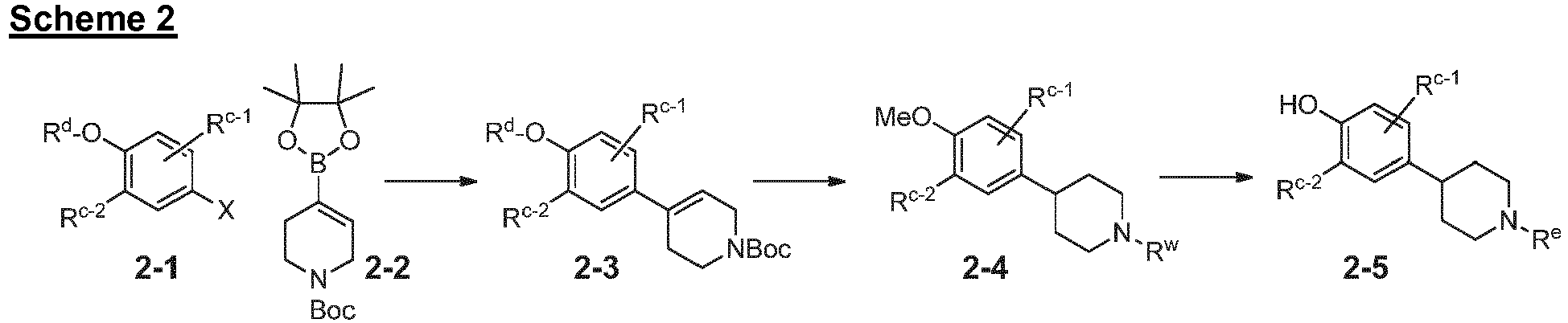
- 2-1 can be transformed to 2-3 utilizing a Suzuki-type coupling with boronate 2-2. 2-3, when Rd = Me, can be transformed into 2-4 via hydrogenation over catalysts such as Pd/C or platinum oxide, followed by treating with an acid such as TFA in an appropriate solvent such as CH2Cl2 and subsequent reaction with an acid anhydride such as propionic anhydride or an acid chloride such as cyclopropylcarbonyl chloride along with a trialkylamine base (e.g., trimethylamine). 2-4 can be transformed into 2-5 via treatment with boron tribromide in the appropriate solvent such as dichloromethane at low temperatures. Alternatively 2-3 when Rd = H can be directly converted to 2a-5 (Re=Boc) by hydrogenation over catalysts such as Pd/C or platinum oxide, or 2-3 when Rd = H can be directly converted to 2-5 (Re=Rw) by treating with an acid such as TFA in an appropriate solvent such as CH2Cl2 and subsequent reaction with an acid anhydride such as propionic anhydride or an acid chloride such as cyclopropylcarbonyl chloride along with a trialkylamine base (e.g., trimethylamine) followed by treatment with MeOH in the presence of K2CO3.
- Compounds such as 2b-3 can be prepared from 2b-2, wherein Wb is NH2 or NO2, according to Scheme 2b.

- 2b-1 can be transformed to 2b-2 utilizing a Suzuki-type coupling with boronate 2-2. 2b-2, when Wb = NO2, can be transformed to 2b-3 by treating with an acid such as TFA in an appropriate solvent such as CH2Cl2 and subsequent reaction with an acid anhydride such as propionic anhydride or an acid chloride such as cyclopropylcarbonyl chloride along with a trialkylamine base (e.g., trimethylamine), followed by hydrogenation over catalysts such as Pd/C or platinum oxide. Alternatively, 2b-2, when Wb = NO2 or NH2 can be directly transformed to 2b-3, wherein Re = Boc, by hydrogenation over catalysts such as Pd/C or platinum oxide.
- Compounds such as 3a-4 can be prepared according to Scheme 3a.

- Ketone 3a-1 (n=0 or 1) can be transformed into bromoaldehyde 3a-2 by treatment with PBr3 and DMF in DCM or chloroform at 0°C or room temperature. Sodium borohydride reduction of aldehyde 3a-2 affords alcohol 3a-3 which can be converted to 3a-4 by treatment with TBSCI and imidazole at room temperature.
- Compounds such as 3b-4 wherein Rf is each independently selected from H or C1-C4 alkyl can be prepared according to Scheme 3b.


- Treatment of 3b-1 with NaH followed by reagents such as triflic anhydride in appropriate solvents such as THF or DCM at temperature between -78 °C to 0 °C to afford 3b-2. Subsequent reduction of 3b-2 by employing reducing reagents such as DIBAL at temperature between -78 °C to 0 °C in solvents such as DCM can afford alcohol 3b-3, which can then converted to the corresponding TBS ether 3b-4 as described in Scheme 3a (i.e. 3a-3→3a-4).
- Compounds such as 3c-4 wherein Rg is each independently selected from H or C1-C4 alkyl (preferably methyl) can be prepared according to Scheme 3c and as referenced in Organic Letters 2003, 5, 2869-2871.
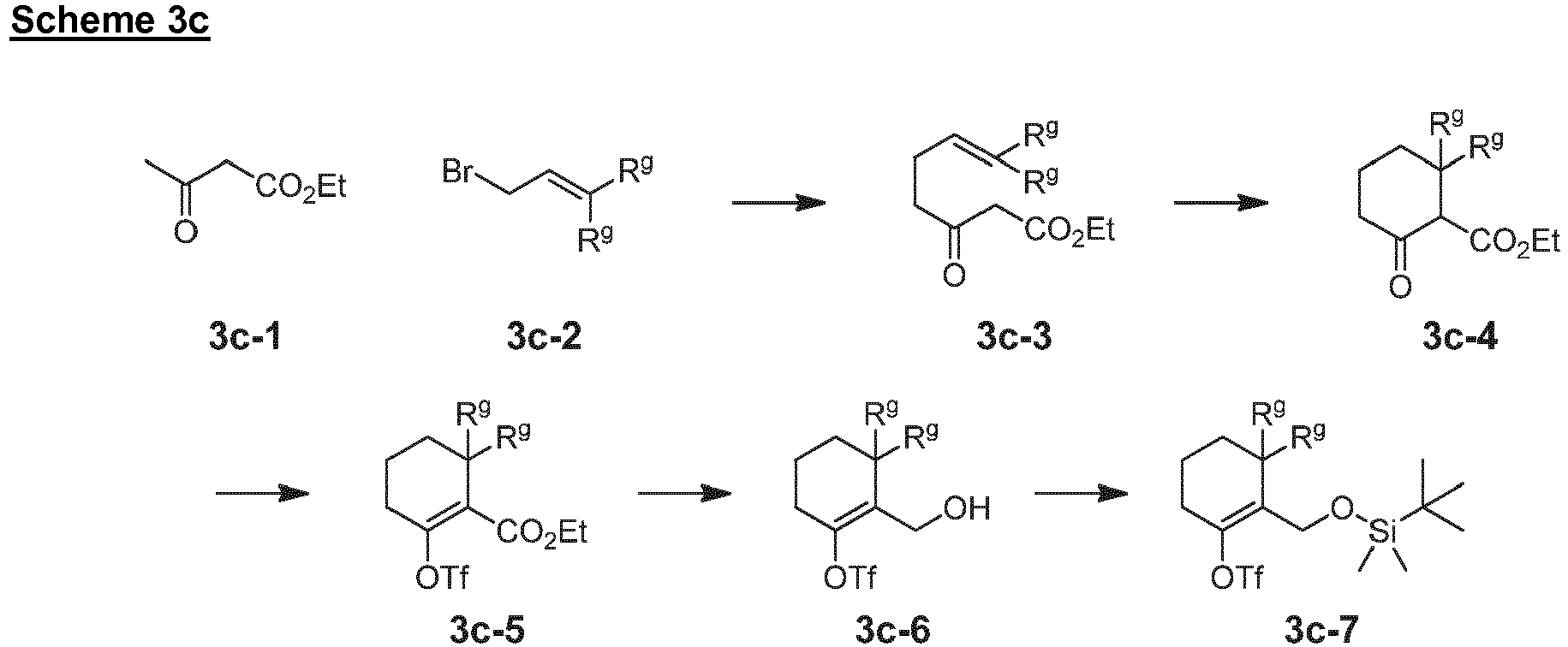
- Treatment of ketoester 3c-1 with NaH and then n-BuLi, followed by alkylation with 3c-2 can afford compound type 3c-3, which can then be cyclized by employing dichlorobis(acetonitrile)palladium(II) in the presence of ytterbium(III) trifluoromethanesulfonate in a solvent such as dioxane at elevated temperature preferably 50 °C to afford cyclohexenone 3c-4. Transformation of 3c-4 to 3c-7 via 3c-5 and 3c-6 can be accomplished in accordance with the route described in Scheme 3b (i.e. 3b-1→3b-2→3b-3→3b-4).
- Compounds such as 3d-2 in Scheme 3d can be prepared starting from appropriately substituted cyclopentanone analogue 3d-1 by the similar route as outlined in Scheme 3b.

- Compounds such as 4-1 wherein Xb= OTf or Br can be synthesized according to Scheme 4.

- Hydroxymethylcyclohexene derivatives such as 3a-3, 3b-3, or 3c-6 can be reacted with a wide variety of phenol derivatives such as 2-5 by employing triaryl- or trialkyl- phosphines, such as triphenylphosphine, and an azodicarboxylate, such as DIAD, in a suitable solvent, such as DMF, toluene, or THF at temperatures between 0 °C to room temperature, or by employing tri-n-butyl cyanomethylenephosphorane in suitable solvents such as toluene at temperatures between 70 °C to 110 °C to afford 4-1.
- Compounds such as 5-4 can be synthesized according to Scheme 5.
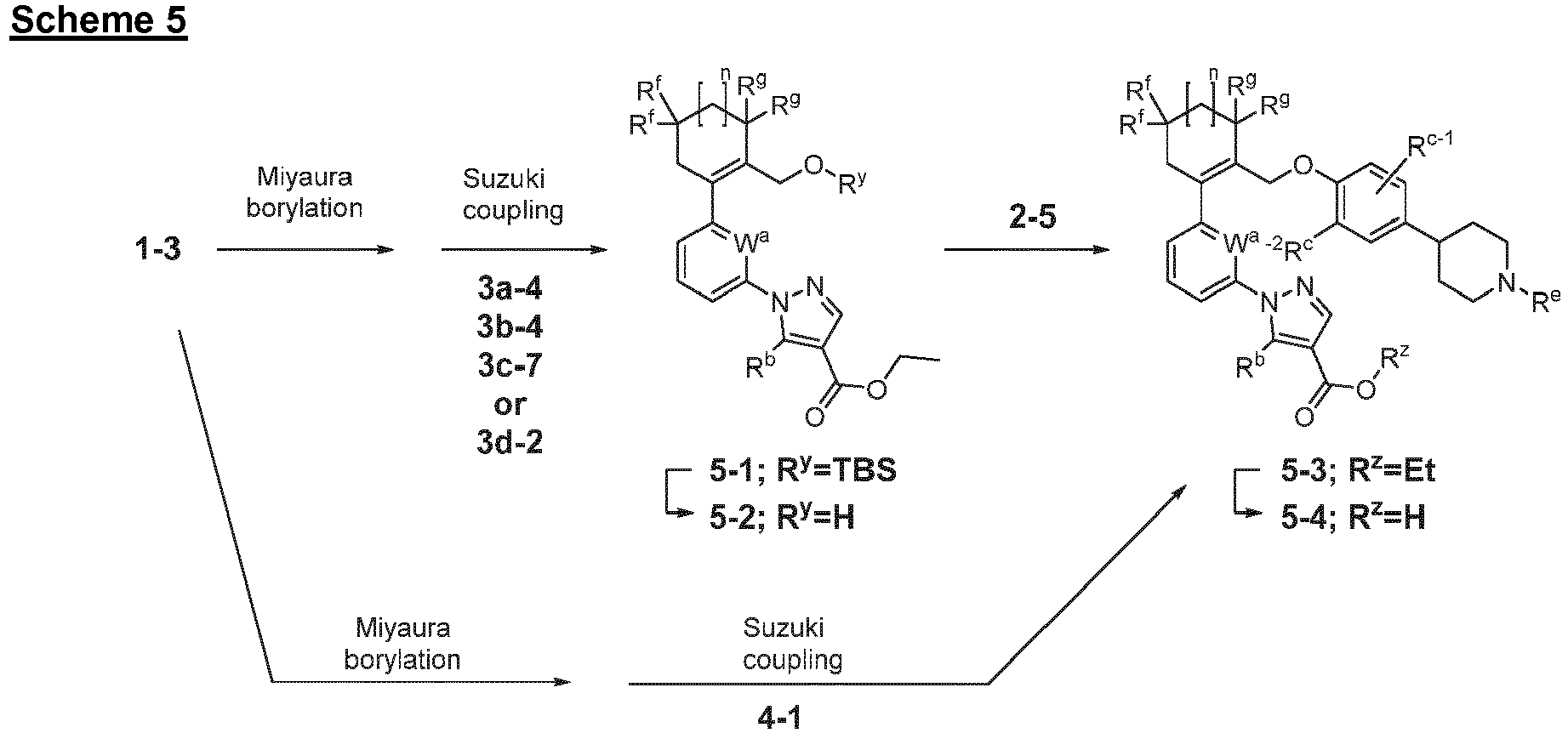
- A Miyaura-type borylation of compounds of type 1-3 with bis(pinacolato)diboron employing conditions such as chloro(2-dicyclohexylphosphino-2',6'-dimethoxy-1,1'-biphenyl)[2-(2-aminoethylphenyl)]palladium(II)-methyl-t-butyl ether adduct and potassium acetate in dioxane at temperatures between 80 °C and 110 °C can provide corresponding boronic ester, which can then be reacted with 3a-4, 3b-4, 3c-7, or 3-2d by a Suzuki-type reaction utilizing conditions such as Pd(dppf)Cl2 or chloro(2-dicyclohexylphosphino-2',6'-dimethoxy-1,1'-biphenyl)[2-(2-aminoethylphenyl)]palladium(II)-methyl-t-butyl ether adduct in the presence of a suitable aqueous base such as aqueous sodium carbonate in dioxane at temperatures between 80 °C to 110 °C to afford 5-1. Deprotection of 5-1 can be accomplished by treatment with TBAF in solvents such as THF at temperature between 0 °C to room temperature to afford 5-2, subsequent etherification of the generated alcohol 5-2 with phenols such as 2-5 can be achieved in accordance with the route described in Scheme 4 to afford 5-3.
- Alternatively, compound type 5-3 can be synthesized by reacting 1-3 with trifrate 4-1 with a similar manner as described above (i.e. 1-3→5-1).
- Lastly, saponification of 5-3 can be accomplished employing conditions such as aqueous LiOH in a solvent mixture of MeOH and THF at temperatures between room temperature to 70 °C to afford 5-4.
- Compounds such as 6-3 or 6-6 could be synthesized according to Scheme 6.

- Preparation of intermediates 6-3 and 6-6 could be achieved by triflation of the corresponding phenol 2-5 and 6-4 with reagents such as triflic anhydride and a suitable base such as NaH. Sulfone 6-2 could then undergo palladium catalyzed α-arylation with the preformed triflates to give the corresponding arylsulfone intermediates 6-3 and 6-6 respectively.
- Compounds such as 7-4 could be synthesized according to Scheme 7.

- Conversion of alcohol 5-2 to mesylate 7-1 could be accomplished under standard conditions such as treatment with Et3N and MsCl. Alkylation of the above prepared sulfones 6-3 with mesylate 7-1 could be accomplished upon treatment with a suitable base such as LDA or nBuLi to give 7-2. Reductive removal of the phenyl sulfone moiety of 7-2 could be accomplished with reducing reagents such as zinc, sodium or magnesium under suitable conditions to give 7-3. Lastly, saponification of 7-3 could be accomplished with a similar manner as described in Scheme 5 to afford 7-4.
- Compounds such as 8-2b, 8-3b, 8-4b and 8-5b wherein; L is O or CH2; Re-2 is Ra, C3-C6cycloalkyl, C1-C4alkoxy, NH(C1-C4alkyl), N(C1-C4alkyl)2 or heteroaryl which heteroaryl has 5 or 6 ring atoms and 1 or 2 ring heteroatoms independently selected from the group consisting of N, O and S; Re-3 is C1-C4alkyl which is optionally substituted with hydroxyl, or C(O)C3-C6cycloalkyl; Re-4 is C1-C4alkyl or C3-C6cycloalkyl; and Re-5 is C1-C4alkyl, haloC1-C4alkyl, or C3-C6cycloalkyl; can be synthesized according to Scheme 8.

- Deprotection of the Boc group of 5-3 (when Rv=Boc, L=O) or 7-3 (when Re=Boc, L=CH2) can be achieved by treatment with suitable acids such as TFA in solvents such as CH2Cl2 at temperatures between 0 °C to room temperature to provide 8-1, which can then be transformed to 8-2a by reactions with variety of chloroformates such as methyl chloroformate (Re-2= -OMe), or carbamic chlorides such as dimethylcarbamic chloride (Re-2= -NMe2), or isocyanates such as ethyl isocyanate (Re-2=-NHEt); or to 8-3a by peptide couplings with wide variety of carboxylic acids such as 2-cyclopropylacetic acid (Re-3= -CH2-cPr) or 2-hydroxypropanoic acid (Re-3= -CH(OH)-CH3) by employing peptide coupling methods well known to those skilled in the art (e.g., HATU, etc.); or to 8-4a by treatment of 8-1 with sulfonyl chlorides such as methanesulfonyl chloride (Re-4= -Me) in DCM in the presence of suitable bases such as DIPEA at temperatures between 0 °C to room temperature; or to 8-5a by alkylation of 8-1 with electrophiles such as 2,2,2-trifluoroethyl trifluoromethanesulfonate (Re-5= -CH2CF3) or cyclopropylmethyl bromide (Re-5= -CH2-cPr) utilizing conditions such as K2CO3 as a base in DMF as solvent at 60 °C. Lastly, saponification of 8-2a, 8-3a, 8-4a and 8-5a can be accomplished by the method as described in Scheme 5 (i.e. 5-3→5-4).
- Compound such as 9-2b can be synthesized according to Scheme 9.

- Compound 9-1a can be synthesized by a reaction of 5-2 with 6-4 (9-1a wherein L=O) by a similar method as described in Scheme 5 (i.e. 5-2→5-3); or starting from 5-2 and 6-6 (9-1a wherein L=CH2) as outlined in Scheme 7. Transformation of 9-1a to 9-2b can be accomplished in accordance with the route described in Scheme 8 (i.e. 8-1→8-5a).
- Compounds such as 10-3b can be synthesized according to Scheme 10.

- Compound 5-2 (n=0 or 1) can be oxidized by oxidizing reagent such as manganase oxide to afford 10-1, subsequent reductive amination with the aniline 2b-3 can afford 10-2. Further transformation from 10-2 to 10-3a can be achieved by treatment with suitable acids such as TFA in solvents such as CH2Cl2 at temperatures between 0 °C to room temperature to remove the Boc moiety, followed by subsequent reaction with a carboxylic acid, such as cyclopropanecarboxylic acid, under peptide coupling conditions, e.g., in the presence of HATU and trimethylamine. Saponification of 10-3a can then be accomplished employing conditions such as aqueous LiOH in a solvent mixture of MeOH and THF at temperatures between room temperature to 70 °C to afford 10-3b.
- The invention further includes any variant of the present processes, in which an intermediate product obtainable at any stage thereof is used as starting material and the remaining steps are carried out, or in which the starting materials are formed in situ under the reaction conditions, or in which the reaction components are used in the form of their salts or optically pure material.
- Compounds of the invention and intermediates can also be converted into each other according to methods generally known to those skilled in the art.
- In another aspect, the present invention provides a pharmaceutical composition comprising a compound of the present invention, or a pharmaceutically acceptable salt thereof, and a pharmaceutically acceptable carrier. In a further embodiment, the composition comprises at least two pharmaceutically acceptable carriers, such as those described herein. For purposes of the present invention, unless designated otherwise, solvates and hydrates are generally considered compositions. Preferably, pharmaceutically acceptable carriers are sterile. The pharmaceutical composition can be formulated for particular routes of administration such as oral administration, parenteral administration, and rectal administration, etc. In addition, the pharmaceutical compositions of the present invention can be made up in a solid form (including without limitation capsules, tablets, pills, granules, powders or suppositories), or in a liquid form (including without limitation solutions, suspensions or emulsions). The pharmaceutical compositions can be subjected to conventional pharmaceutical operations such as sterilization and/or can contain conventional inert diluents, lubricating agents, or buffering agents, as well as adjuvants, such as preservatives, stabilizers, wetting agents, emulsifiers and buffers, etc.
Typically, the pharmaceutical compositions are tablets or gelatin capsules comprising the active ingredient together with one or more of: - a) diluents, e.g., lactose, dextrose, sucrose, mannitol, sorbitol, cellulose and/or glycine;
- b) lubricants, e.g., silica, talcum, stearic acid, its magnesium or calcium salt and/or polyethyleneglycol; for tablets also
- c) binders, e.g., magnesium aluminum silicate, starch paste, gelatin, tragacanth, methylcellulose, sodium carboxymethylcellulose and/or polyvinylpyrrolidone; if desired
- d) disintegrants, e.g., starches, agar, alginic acid or its sodium salt, or effervescent mixtures; and
- e) absorbents, colorants, flavors and sweeteners.
- Tablets may be either film coated or enteric coated according to methods known in the art.
- Suitable compositions for oral administration include an effective amount of a compound of the invention in the form of tablets, lozenges, aqueous or oily suspensions, dispersible powders or granules, emulsion, hard or soft capsules, or syrups or elixirs. Compositions intended for oral use are prepared according to any method known in the art for the manufacture of pharmaceutical compositions and such compositions can contain one or more agents selected from the group consisting of sweetening agents, flavoring agents, coloring agents and preserving agents in order to provide pharmaceutically elegant and palatable preparations. Tablets may contain the active ingredient in admixture with nontoxic pharmaceutically acceptable excipients which are suitable for the manufacture of tablets. These excipients are, for example, inert diluents, such as calcium carbonate, sodium carbonate, lactose, calcium phosphate or sodium phosphate; granulating and disintegrating agents, for example, corn starch, or alginic acid; binding agents, for example, starch, gelatin or acacia; and lubricating agents, for example magnesium stearate, stearic acid or talc. The tablets are uncoated or coated by known techniques to delay disintegration and absorption in the gastrointestinal tract and thereby provide a sustained action over a longer period. For example, a time delay material such as glyceryl monostearate or glyceryl distearate can be employed. Formulations for oral use can be presented as hard gelatin capsules wherein the active ingredient is mixed with an inert solid diluent, for example, calcium carbonate, calcium phosphate or kaolin, or as soft gelatin capsules wherein the active ingredient is mixed with water or an oil medium, for example, peanut oil, liquid paraffin or olive oil.
- Certain injectable compositions are aqueous isotonic solutions or suspensions, and suppositories are advantageously prepared from fatty emulsions or suspensions. Said compositions may be sterilized and/or contain adjuvants, such as preserving, stabilizing, wetting or emulsifying agents, solution promoters, salts for regulating the osmotic pressure and/or buffers. In addition, they may also contain other therapeutically valuable substances. Said compositions are prepared according to conventional mixing, granulating or coating methods, respectively, and contain about 0.1-75%, or contain about 1-50%, of the active ingredient.
- Suitable compositions for transdermal application include an effective amount of a compound of the invention with a suitable carrier. Carriers suitable for transdermal delivery include absorbable pharmacologically acceptable solvents to assist passage through the skin of the host. For example, transdermal devices are in the form of a bandage comprising a backing member, a reservoir containing the compound optionally with carriers, optionally a rate controlling barrier to deliver the compound of the skin of the host at a controlled and predetermined rate over a prolonged period of time, and means to secure the device to the skin.
- Suitable compositions for topical application, e.g., to the skin and eyes, include aqueous solutions, suspensions, ointments, creams, gels or sprayable formulations, e.g., for delivery by aerosol or the like. Such topical delivery systems will in particular be appropriate for dermal application, e.g., for the treatment of skin cancer, e.g., for prophylactic use in sun creams, lotions, sprays and the like. They are thus particularly suited for use in topical, including cosmetic, formulations well-known in the art. Such may contain solubilizers, stabilizers, tonicity enhancing agents, buffers and preservatives.
- As used herein a topical application may also pertain to an inhalation or to an intranasal application. They may be conveniently delivered in the form of a dry powder (either alone, as a mixture, for example a dry blend with lactose, or a mixed component particle, for example with phospholipids) from a dry powder inhaler or an aerosol spray presentation from a pressurized container, pump, spray, atomizer or nebulizer, with or without the use of a suitable propellant.
- Compositions of the present invention may be utilized in various dosage regimens known to those of skill in the art. Such dosing frequency is maintained for a varying duration of time depending on the therapeutic regimen. The duration of a particular therapeutic regimen may vary from one-time dosing to a maintenance regimen that extends for a month, year or more. One of ordinary skill in the art would be familiar with determining a therapeutic regimen for a specific indication. Preferred dosage regimens of the present invention include, but are not limited to, once a day dosing and twice a day dosing.
- As far as the compounds of the present invention are claimed for use therein, in the methods for the treatment of ocular disease and particularly for the treatment of glaucoma, set forth herein, administration to a subject of a composition of the present invention may be by various methods known to those of skill in the art, including, but not limited to, topical, subconjunctival, periocular, retrobulbar, subtenon, intraocular, subretinal, posterior juxtascleral, or suprachoroidal administration. In preferred embodiments, administration of a composition of the present invention is by topical administration to the ocular surface.
- It is contemplated that the concentration of the sGC activator in the compositions of the present invention can vary, but is preferably 0.001 to 1.0 w/v% and more preferably 0.01-1.0 w/v% or 0.01-0.5 w/v%. The most preferred concentration range is from 0.01-0.3 w/v% and the most preferred concentration is between about 0.01 w/v% and 0.1 w/v%. The sGC activators of the present invention comprise the pharmaceutically useful hydrates and salts of such compounds and stereoisomers (where applicable), and may be formulated with a pharmaceutically acceptable vehicle.
- The methods of treating glaucoma, as far as the compounds of the present invention are claimed for use therein, may include administering the sGC activator compound by a technique selected from the group consisting of: topical ocular administration, periocular injection, subconjunctival injection, sub-tenon injection, intracameral injection, intravitreal injection, intracanalicular injection, implanting delivery device in the cul-de-sac, implanting delivery device adjacent to the sclera, implanting delivery device within the eye, oral administration, intravenous administration, subcutaneous administration, intramuscular administration, parenteral administration, dermal administration, and nasal administration.
- In certain aspects of the invention, compounds of the invention may be formulated in either fixed and unfixed combinations of two therapeutic agents effective in the treatment of glaucoma wherein one therapeutic agent is sGC activator disclosed supra and the second therapeutic agent is an efficacious glaucoma drug. In other embodiments, a pharmaceutical composition of the invention comprising a sGC activator can be administered to a patient alone or in combination with other IOP-lowering agents to increase the potency, efficacy and/or duration of the IOP reduction. In certain preferred combinations, the second IOP-lowering agent is selected from carbonic anhydrase inhibitors, beta-adrenergic receptor antagonists, prostaglandins, alpha-2 agonists, serotonin-2 agonists, alpha-1 antagonists, dopamine agonists, Rho kinase inhibitors, myosin-II Ca2 +ATPase, inhibitors, matrix metalloproteinase activators, activator protein-1 (AP-1) activators, natriuretic peptide receptor-B agonists, phosphodiesterase inhibitors, K+-channel blockers and maxi-K-channel activators. The combination therapy of the invention provides the benefit of lowering IOP by two mechanisms, including inducing uveoscleral outflow of aqueous humor and inhibiting aqueous humor inflow, which can allow for reduced dosages of the compounds thereby lowering the risk of side effects.
- Pharmaceutical compositions of the invention can also be advantageously combined with suitable neuroprotective agents such as memantine, eliprodil, Ca2+ -channel blockers, and betaxolol.
- In a further aspect of the invention, the sGC activator may be administered alone or in combination with a second therapeutic agent which is suitable for the treatment of glaucoma. Certain preferred second therapeutic agents include beta-adrenergic receptor antagonists, prostaglandin analogs, carbonic anhydrase inhibitors, α2 agonists, miotics, PDE-V inhibitors, Rho kinase inhibitors and neuroprotectants. In one preferred combination, a prostaglandin F2α analogue selected from the group consisting of Latanaprost and Travoprost is administered in combination with sGC activator of Formula (I) or subformulae thereof. In another preferred combination, a PDE-V inhibitor selected from the group consisting of Sildenafil, Tadalafil, Vardenafil, Udenafil, Avanafil , Lodenafil and Mirodenafil is administered in combination with a sGC activator of Formula (I) or subformulae thereof. In yet another preferred combination, a sGC activator of Formula (I) or subformulae thereof is administered in combination with a sGC stimulator (such as Riociguat) or a NO precursor (such as sodium nitroprusside or nitroglycerine). In another preferred combination, a sGC activator of Formula (I) or subformulae thereof is administered in combination with a Rho-kinase inhibitor (such as AR-13324 alone or combination of AR-13324 and Latanaprost).
- In a further embodiment of the invention, a sGC activator of Formula (I) is administered in combination with a carbonic anhydrase inhibitor (such as Brinzolamide) for the treatment of glaucoma or to reduce IOP. In another embodiment, a sGC activator of Formula (I), as far as the compounds of the present invention are claimed for use therein, is administered in combination with a α2 adrenergic agonist (such as Brimonidine) for the treatment of glaucoma or to reduce IOP. In a particularly preferred combination therapy, a sGC activator of Formula (I) is administered in combination with a fixed combination of Brimonidine and Brinzolamide (such as SIMBRINZA™ from by Alcon, Fort Worth, Texas) for the treatment of glaucoma or to reduce IOP.
- In certain embodiments, a sGC activator and the second pharmaceutical agent are administered concurrently in separate pharmaceutical compositions. In other embodiments, a sGC activator and the second pharmaceutical agent are administered formulated together in a pharmaceutical composition. In yet other embodiments, the sGC activator and the second pharmaceutical agent are administered sequentially in separate pharmaceutical compositions.
- In the combination therapies of the invention, as far as the compounds of the present invention are claimed for use therein, the compound of the invention and the other therapeutic agent may be manufactured and/or formulated by the same or different manufacturers. Moreover, the compound of the invention and the other therapeutic may be brought together into a combination therapy: (i) prior to release of the combination product to physicians (e.g. in the case of a kit comprising the compound of the invention and the other therapeutic agent); (ii) by the physician themselves (or under the guidance of the physician) shortly before administration; (iii) in the patient themselves, e.g. during sequential administration of the compound of the invention and the other therapeutic agent.
- In addition to a sGC activator, the compositions of the present invention optionally comprise one or more excipients. Excipients commonly used in pharmaceutical compositions include, but are not limited to, tonicity agents, preservatives, chelating agents, buffering agents, surfactants and antioxidants. Other excipients comprise solubilizing agents, stabilizing agents, comfort-enhancing agents, polymers, emollients, pH-adjusting agents and/or lubricants. Any of a variety of excipients may be used in compositions of the present invention including water, mixtures of water and water-miscible solvents, such as C1-C7-alkanols, vegetable oils or mineral oils comprising from 0.5 to 5% non-toxic water-soluble polymers, natural products, such as alginates, pectins, tragacanth, karaya gum, xanthan gum, carrageenin, agar and acacia, starch derivatives, such as starch acetate and hydroxypropyl cellulose or starch, and also other synthetic products such as polyvinyl alcohol, polyvinylpyrrolidone, polyvinyl methyl ether, polyethylene oxide, preferably cross-linked polyacrylic acid and mixtures of those products. The concentration of the excipient is, typically, from 1 to 100,000 times the concentration of the sGC activator. In preferred embodiments, excipients are selected on the basis of their inertness towards the sGC activator.
- Relative to ophthalmic formulations, suitable tonicity-adjusting agents include, but are not limited to, mannitol, sodium chloride, glycerin, sorbitol and the like. Suitable buffering agents include, but are not limited to, phosphates, borates, acetates and the like. Suitable surfactants include, but are not limited to, ionic and nonionic surfactants (though nonionic surfactants are preferred), RLM 100, POE 20 cetylstearyl ethers such as Procol® CS20 and poloxamers such as Pluronic® F68. Suitable antioxidants include, but are not limited to, sulfites, ascorbates, butylated hydroxyanisole (BHA) and butylated hydroxytoluene (BHT).
- The compositions set forth herein may comprise one or more preservatives. Examples of such preservatives include p-hydroxybenzoic acid ester, sodium chlorite, benzalkonium chloride, parabens such as methylparaben or propylparaben, alcohols such as chlorobutanol, benzyl alcohol or phenyl ethanol, guanidine derivatives such as polyhexamethylene biguanide, polymeric quaternary ammonium compounds such as Onamer M and Polyquaterium-1 (POLYQUAD® from Alcon), sodium perborate, or sorbic acid. In certain embodiments, the composition may be self-preserved that no preservation agent is required.
- In preferred compositions a sGC activator of the present invention will be formulated for topical application to the eye in aqueous solution in the form of drops. The term "aqueous" typically denotes an aqueous composition wherein the composition is >50%, more preferably >75% and in particular >90% by weight water. These drops may be delivered from a single dose ampoule which may preferably be sterile and thus render bacteriostatic components of the composition unnecessary. Alternatively, the drops may be delivered from a multi-dose bottle which may preferably comprise a device which extracts any preservative from the composition as it is delivered, such devices being known in the art.
- In other aspects, components of the invention may be delivered to the eye as a concentrated gel or a similar vehicle, or as dissolvable inserts that are placed beneath the eyelids. In yet other aspects, components of the invention may be delivered to the eye as ointments, water-in-oil and oil-in-water emulsions, solutions, or suspensions.
- The compositions of the present invention, and particularly the topical compositions, are preferably isotonic or slightly hypotonic in order to combat any hypertonicity of tears caused by evaporation and/or disease. This may require a tonicity agent to bring the osmolality of the composition to a level at or near 210-320 milliosmoles per kilogram (mOsm/kg). The compositions of the present invention generally have an osmolality in the range of 220-320 mOsm/kg, and preferably have an osmolality in the range of 235-300 mOsm/kg. The ophthalmic compositions will generally be formulated as sterile aqueous solutions.
- In certain embodiments, a sGC activator of the present invention is formulated in a composition that comprises one or more tear substitutes. A variety of tear substitutes are known in the art and include, but are not limited to: monomeric polyols, such as glycerol, propylene glycol, and ethylene glycol; polymeric polyols such as polyethylene glycol; cellulose esters such hydroxypropylmethyl cellulose, carboxy methylcellulose sodium and hydroxy propylcellulose; dextrans such as dextran 70; vinyl polymers, such as polyvinyl alcohol; guars, such as HP-guar and other guar derivatives, and carbomers, such as carbomer 934P, carbomer 941, carbomer 940 and carbomer 974P. Certain compositions of the present invention may be used with contact lenses or other ophthalmic products.
- In certain embodiments, the compositions set forth herein have a viscosity of 0.5-100 cps, preferably 0.5-50 cps, and most preferably 1-20 cps. These viscosities insure that the product is comfortable, does not cause blurring, and is easily processed during manufacturing, transfer and filling operations.
- Preferred compositions are prepared using a buffering system that maintains the composition at a pH of about 3 to a pH of about 8.0, preferably 5.5-7.5, and most preferably 6.0-7.4. Topical compositions (particularly topical ophthalmic compositions) are preferred which have a physiological pH matching the tissue to which the composition will be applied or dispensed.
- The following examples are presented to further illustrate selected embodiments of the present invention.
-
Ingredient Concentration (w/v %) sGC activator 0.1 % Dibasic Sodium Phosphate 0.2% Sodium Chloride 0.75% Disodium EDTA 0.01% Polysorbate 80 0.05% Benzalkonium Chloride Solution 0.01% Hydroxypropyl Methylcellulose 0.5% - The compounds of formula I in free form or in pharmaceutically acceptable salt form, exhibit valuable pharmacological properties, e.g. sGC modulating properties, e.g. as indicated in vitro and in vivo tests as provided in the next sections, and are therefore indicated for therapy or for use as research chemicals, e.g. as tool compounds. More particularly, the compounds of formula I, in free form or in pharmaceutically acceptable salt form, activate sGC which is suitable for use in treatment of disease.
- In one preferred use, the compounds of Formula I are suitable for use in lowering intra-ocular pressure (IOP) and in the treatment of glaucoma. The compounds of the invention may be for use alone or in combination with a second therapeutic agent for the treatment of glaucoma. The embodiment further provides the compounds of the present invention for use in methods of treating glaucoma or reducing intraocular pressure in a subject, the method comprising administering a compound of Formula I alone or in combination with a second therapeutic agent. In certain aspects, the method contemplates to topical ocular administration of the compound of Formula I to the subject in need of such therapy. In preferred aspects, the method comprises administration of the compound of Formula I as a mono-therapy. In certain other aspects, the method comprises the co-administration (either concomitantly or sequentially) of a compound of Formula I and a PDE-V inhibitor.
- In a particularly preferred use, 1-(6-(2-((4-(1-(cyclopropanecarbonyl)piperidin-4-yl)-2-methylphenoxy)methyl)-5-methylcyclohex-1-en-1-yl)pyridin-2-yl)-5-(trifluoromethyl)-1H-pyrazole-4-carboxylic acid, 1-(6-(2-((4-(1-(cyclopropanecarbonyl)piperidin-4-yl)-3-ethylphenoxy)methyl)-3-methylcyclohex-1-en-1-yl)pyridin-2-yl)-5-methyl-1H-pyrazole-4-carboxylic acid,1-(6-(2-((4-(1-(Cyclopropanecarbonyl)piperidin-4-yl)-3-ethylphenoxy)methyl)-3-methylcyclohex-1-en-1-yl)pyridin-2-yl)-5-ethyl-1H-pyrazole-4-carboxylic acid, 1-(6-(2-((4-(1-(cyclopropanecarbonyl)piperidin-4-yl)-2-methylphenoxy)methyl)-3-methylcyclohex-1-en-1-yl)pyridin-2-yl)-5-(trifluoromethyl)-1H-pyrazole-4-carboxylic acid, or 1-(6-(2-((4-(1-(cyclopropanecarbonyl)piperidin-4-yl)-3-ethylphenoxy)methyl)-3-methylcyclohex-1-en-1-yl)pyridin-2-yl)-5-(trifluoromethyl)-1H-pyrazole-4-carboxylic acid or a pharmaceutically acceptable salt thereof are suitable for use in lowering intra-ocular pressure (IOP) and in the treatment of glaucoma. 1-(6-(2-((4-(1-(Cyclopropanecarbonyl)piperidin-4-yl)-2-methylphenoxy)methyl)-5-methylcyclohex-1-en-1-yl)pyridin-2-yl)-5-(trifluoromethyl)-1H-pyrazole-4-carboxylic acid, 1-(6-(2-((4-(1-(cyclopropanecarbonyl)piperidin-4-yl)-3-ethylphenoxy)methyl)-3-methylcyclohex-1-en-1-yl)pyridin-2-yl)-5-methyl-1H-pyrazole-4-carboxylic acid,1-(6-(2-((4-(1-(Cyclopropanecarbonyl)piperidin-4-yl)-3-ethylphenoxy)methyl)-3-methylcyclohex-1-en-1-yl)pyridin-2-yl)-5-ethyl-1H-pyrazole-4-carboxylic acid, 1-(6-(2-((4-(1-(cyclopropanecarbonyl)piperidin-4-yl)-2-methylphenoxy)methyl)-3-methylcyclohex-1-en-1-yl)pyridin-2-yl)-5-(trifluoromethyl)-1H-pyrazole-4-carboxylic acid, or 1-(6-(2-((4-(1-(cyclopropanecarbonyl)piperidin-4-yl)-3-ethylphenoxy)methyl)-3-methylcyclohex-1-en-1-yl)pyridin-2-yl)-5-(trifluoromethyl)-1H-pyrazole-4-carboxylic acid or a pharmaceutically acceptable salt thereof are for use alone or in combination with a second therapeutic agent for the treatment of glaucoma. The embodiment further provides the compounds according to the present invention for use in methods of treating glaucoma or reducing intraocular pressure in a subject, the method comprising administering one of the specific compounds listed supra alone or in combination with a second therapeutic agent. In certain aspects, the method contemplates topical ocular administration of one of the specific compounds listed supra to the subject in need of such therapy. In preferred aspects, the method comprises administration of one of these specific compounds as a mono-therapy. In certain other aspects, the method comprises the co-administration (either concomittantly or sequentially) of a compound of Formula I and a PDE-V inhibitor. 1-(6-(2-((4-(1-(Cyclopropanecarbonyl)piperidin-4-yl)-2-methylphenoxy)methyl)-5-methylcyclohex-1-en-1-yl)pyridin-2-yl)-5-(trifluoromethyl)-1H-pyrazole-4-carboxylic acid, 1-(6-(2-((4-(1-(cyclopropanecarbonyl)piperidin-4-yl)-3-ethylphenoxy)methyl)-3-methylcyclohex-1-en-1-yl)pyridin-2-yl)-5-methyl-1H-pyrazole-4-carboxylic acid,1-(6-(2-((4-(1-(Cyclopropanecarbonyl)piperidin-4-yl)-3-ethylphenoxy)methyl)-3-methylcyclohex-1-en-1-yl)pyridin-2-yl)-5-ethyl-1H-pyrazole-4-carboxylic acid, 1-(6-(2-((4-(1-(cyclopropanecarbonyl)piperidin-4-yl)-2-methylphenoxy)methyl)-3-methylcyclohex-1-en-1-yl)pyridin-2-yl)-5-(trifluoromethyl)-1H-pyrazole-4-carboxylic acid, or 1-(6-(2-((4-(1-(cyclopropanecarbonyl)piperidin-4-yl)-3-ethylphenoxy)methyl)-3-methylcyclohex-1-en-1-yl)pyridin-2-yl)-5-(trifluoromethyl)-1H-pyrazole-4-carboxylic acid for use in the treatment of glaucoma or reducing intraocular pressure in racemic or enantiomerically enriched form.
- Compounds of the invention may also be useful in the treatment of an indication selected from: kidney disease, urologic disorders hypertension, atherosclerosis, peripheral artery disease, restenosis, stroke, heart failure, coronary vasospasm, cerebral vasospasm, ischemia/reperfusion injury, thromboembolic pulmonary hypertension, pulmonary arterial hypertension, stable and unstable angina, thromboembolic disorders. In addition, the compounds of the invention have the potential to treat renal disease, diabetes, fibrotic disorders (including those of the liver, kidney and lungs), urologic disorders (including overactive bladder), benign prostatic hyperplasia, erectile dysfunction, neuropathic pain and neurological disorders (Including Alzheimer's disease and Parkinson's disease). Treatment with an sGC activator of the invention may further provide benefit in the treatment of inflammatory disorder such as psoriasis, multiple sclerosis, arthritis, asthma, cystic fibrosis and chronic obstructive pulmonary disease.
- Thus, as a further embodiment, the present invention provides a compound of formula (I) for use in therapy. In a further embodiment, the therapy is selected from a disease which may be treated by activation of sGC. In a preferred application, the disease is selected from the afore-mentioned list, suitably glaucoma.
- In another embodiment, the invention provides a compound of the present invention for use in a method of treating a disease which is treated by activation of sGC comprising administration of a therapeutically acceptable amount of a compound of formula (I) or a salt thereof. In a further embodiment, the disease is selected from the afore-mentioned list, suitably glaucoma.
- Thus, as a further embodiment, the present invention provides a compound of formula (I) or subformulae thereof for use in the manufacture of a medicament. In a further embodiment, the medicament is for treatment of a disease which may be treated by activation of sGC. In another embodiment, the disease is selected from the afore-mentioned list, suitably glaucoma.
- For systemic administration, the administered pharmaceutical composition or combination of the present invention can be in unit dosage of about 1-1000 mg of active ingredient(s) for a subject of about 50-70 kg, or about 1-500 mg or about 1-250 mg or about 1-150 mg or about 0.5-100 mg, or about 1-50 mg of active ingredients. The therapeutically effective dosage of a compound, the pharmaceutical composition, or the combinations thereof, is dependent on the species of the subject, the body weight, age and individual condition, the disorder or disease or the severity thereof being treated. A physician, clinician or veterinarian of ordinary skill can readily determine the effective amount of each of the active ingredients necessary to prevent, treat or inhibit the progress of the disorder or disease.
- The above-cited dosage properties are demonstrable in vitro and in vivo tests using advantageously mammals, e.g., mice, rats, dogs, monkeys or isolated organs, tissues and preparations thereof. The compounds of the present invention can be applied in vitro in the form of solutions, e.g., aqueous solutions, and in vivo either enterally, parenterally, advantageously intravenously, e.g., as a suspension or in aqueous solution. The dosage in vitro may range between about 10-3 molar and 10-9 molar concentrations. A therapeutically effective amount in vivo may range depending on the route of administration, between about 0.1-500 mg/kg, or between about 1-100 mg/kg.
- The activity of a compound according to the present invention can be assessed by the following in vitro & in vivo methods.
- The following examples are intended to illustrate the invention and are not to be construed as being limitations thereon except as provided for by the claims. Temperatures are given in degrees Celsius. If not mentioned otherwise, all evaporations are performed under reduced pressure, typically between about 15 mm Hg and 100 mm Hg (= 20-133 mbar). The structure of final products, intermediates and starting materials is confirmed by standard analytical methods, e.g., microanalysis and spectroscopic characteristics, e.g., MS, IR, NMR. Abbreviations used are those conventional in the art.
- All starting materials, building blocks, reagents, acids, bases, dehydrating agents, solvents, and catalysts utilized to synthesis the compounds of the present invention are either commercially available or can be produced by organic synthesis methods known to one of ordinary skill in the art. Further, the compounds of the present invention can be produced by organic synthesis methods known to one of ordinary skill in the art as shown in the following examples.
-
- Ac
- acetyl
- AcOH
- acetic acid
- AIBN
- azobisisobutyronitrile
- App, app.
- apparent
- aq.
- aqueous
- atm
- atmosphere
- Bis(pinacolato)diboron
- 4,4,4',4',5,5,5',5'-Octamethyl-2,2'-bi-1,3,2-dioxaborolane
- Boc
- tertiary butyl carboxy
- Boc-anhydride
- di-tert-butyl dicarbonate
- (BOC)2O
- di-tert-butyl dicarbonate
- br.
- broad
- BSA
- bovine serum albumin
- BuOH
- butanol
- calcd.
- calculated
- CHAPS
- 3-[(3-cholamidopropyl)dimethylammonio]-1-propanesulfonate
- CH3CN
- acetonitrile
- Cs2CO3
- cesium carbonate
- d
- doublet
- DBU
- 1,8-diazabicyclo[5.4.0]undec-7-ene
- dd
- doublet of doublets
- DCE
- 1,2-dichloroethane
- DCM
- dichloromethane
- DEA
- diethylamine
- DEAD
- diethyl azodicarboxylate
- DIAD
- diisopropyl azodicarboxylate
- DIEA
- N,N-diisopropylethylamine
- DIBAL-H
- diisobutylaluminium hydride
- DIPEA
- N,N-diisopropylethylamine
- DMAP
- 4,4-dimethylaminopyridine
- DME
- 1,4-dimethoxyethane
- DMF
- N,N-dimethylformamide
- Dess-Martin Periodinane
- Dess-Martin reagent; 1,1,1-triacetoxy-1,1-dihydro-1,2-benziodoxol-3(1H)-one (CAS# 87413-09-0)
- DMSO
- dimethylsulfoxide
- ESI
- electrospray ionization
- EtOAc, AcOEt
- ethyl acetate
- Et
- ethyl
- EtOH
- ethanol
- Ex
- Example
- FCC
- flash column chromatography
- g
- grams
- h
- hour(s)
- HATU
- 2-(1H-7-azabenzotriazol-1-yl)--1,1,3,3-tetramethyl uronium hexafluorophosphate methanaminium
- HBTU
- O-benzotriazole-N,N,N',N'-tetramethyl-uronium-hexafluoro-phosphate
- HC
- HPLC condition
- HBSS
- Hank's Balanced Salt Solution
- HEPES
- 4-(2-hydroxyethyl)-1-piperazineethanesulfonic acid
- HFIP
- 1,1,1,3,3,3-hexafluoro-2-propanol
- HPLC
- high performance liquid chromatography
- IBMX
- 1-methyl-3-(2-methylpropyl)-7H-purine-2,6-dione
- IPA
- 2-propanol
- IR
- infrared spectroscopy
- L
- liter(s)
- LDA
- lithium diisopropyl amide
- LHMDS
- lithium bis(trimethylsilyl)amide
- M
- molar
- MHz
- mega Hertz
- m
- multiplet
- Me
- methyl
- MeCN
- acetonitrile
- Mel
- iodomethane
- MeOH
- methanol
- mg
- milligram(s)
- mm
- millimeter(s)
- min
- minutes
- ml
- milliliter(s)
- mL
- milliliter(s)
- mmol
- millimoles
- MP
- melting point
- MS
- mass spectrometry
- MsCl
- methanesulfonyl chloride
- Ms2O
- methanesulfonyl anhydride
- MsOH
- methanesulfonic acid
- MTBE
- methyl tert-butylether
- m/z
- mass to charge ratio
- N
- normal
- NaBH4
- sodium borohydride
- Na(AcO)3BH
- sodium triacetoxyborohydride
- NBS
- N-bromosuccinimide
- NCS
- N-chlorosuccinimide
- NH4Cl
- ammonium chloride
- NMR
- nuclear magnetic resonance
- ODQ
- 1H-[1,2,4]Oxadiazolo[4,3-a]quinoxalin-1-one (CAS# 41443-28-1)
- PBS
- phosphate buffered saline
- Pd/C
- palladium on carbon
- Pd(dppf)2Cl2 CH2Cl2 adduct
- 1,1'-bis(diphenylphosphino)ferrocene-palladium(II)dichloride complex
- Pd(PPh3)4
- tetrakis(triphenylphosphine)palladium(0)
- Ph
- phenyl
- ppm
- parts per million
- PyBOP
- benzotriazol-1-yloxytripyrrolidinophosphonium hexafluorophosphate
- rac
- racemic
- RP
- reverse phase
- Rochelle's salt
- Potassium sodium tartrate (CAS# 304-59-6)
- rt
- room temperature
- s
- singlet
- sat.
- saturated
- sat'd.
- saturated
- SFC
- Supercritical Fluid Chromatography
- t
- triplet
- tr
- retention time
- T3P
- propylphosphonic anhydride
- TBAF
- tetra-n-butylammonium fluoride
- TBAT
- tetrabutylammonium difluorotriphenylsilicate
- TBS
- tert-butyldimethylsilyl
- TBSCI
- tert-butyldimethylsilyl chloride
- TEA, Et3N
- triethylamine
- tert-
- tertiary
- TFA
- trifluoroacetic acid
- THF
- tetrahydrofuran
- TLC
- Thin Layer Chromatography
- TMP
- 2,2',6,6'-tetramethylpiperidine, 2,2',6,6'-tetramethylpiperidyl
- TMSCF3
- trifluoromethyltrimethylsilane
- TMS
- trimethylsilyl
- Ts
- p-toluenesulfonyl
- TsOH
- p-toluenesulfonic acid
- UPLC
- ultra performance liquid chromatography
- v/v
- volume per volume
- w/v
- weight per volume
- w/w
- weight per weight
- The following examples are intended to illustrate the invention. Unless otherwise stated, one or more tautomeric forms of compounds of the examples described hereinafter may be prepared in situ and/or isolated. All tautomeric forms of compounds of the examples described hereafter should be considered to be disclosed. Temperatures are given in degrees centigrade. If not mentioned otherwise, all evaporations are performed under reduced pressure, preferably between about 15 mm Hg and 100 mm Hg (= 20-133 mbar). The structure of final products, intermediates and starting materials is confirmed by standard analytical methods, e.g., microanalysis and spectroscopic characteristics, e.g., MS, IR, NMR. Abbreviations used are those conventional in the art.
- All starting materials, building blocks, reagents, acids, bases, dehydrating agents, solvents, and catalysts utilized to synthesis the compounds of the present invention are either commercially available or can be produced by organic synthesis methods known to one of ordinary skill in the art (Houben-Weyl 4th Ed. 1952, Methods of Organic Synthesis, Thieme, Volume 21). Further, the compounds of the present invention can be produced by organic synthesis methods known to one of ordinary skill in the art as shown in the following examples.
- All reactions are carried out under nitrogen or argon unless otherwise stated. Optical rotations were measured in MeOH, using D line of a sodium lamp.
- Proton NMR (1H NMR) is conducted in deuterated solvent. In certain compounds disclosed herein, one or more 1H shifts overlap with residual proteo solvent signals; these signals have not been reported in the experimental provided hereinafter.
- Multiple parent ion masses are reported for mass spectroscopy data when the compound of the invention contains one or more bromine atoms. Bromine exists as an approximately 1:1 molar ratio of 79Br:81Br. Thus, a compound with a single bromine atom will exhibit two parent mass ions having a difference of 2 amu. The smaller mass is reported in the Experimental infra.
- Following preparation methods were used for RP-HPLC.
- HC-A:
- Stationary phase: Waters SunFire™ Prep C18 OBD™ 5µm, 30x100 mm
- Mobile phase: gradient, water with 0.1% TFA / acetonitrile
- HC-B
- Stationary phase: Gemini® NX 5µ C18 110A 100x30 mm
- Mobile phase: gradient, water with 0.1% (28% ammonium hydroxide) / acetonitrile
- HC-C
- Stationary phase: X-bridge® BEH C18 OBD Prep 5 µm, 30 mm 50 mm
- Mobile phase: gradient, water with 0.1% (28% ammonium hydroxide) / acetonitrile
- Absolute stereochemistry, retention times on chiral HPLC, and/or optical rotations are provided for the embodiments of the invention where applicable. The invention contemplates all stereochemical forms of the compounds provided herein. Where absolute stereochemistry is provided the assessment was made via X-ray diffraction, and/or chemical correlation, and/or at least one chiral center was from a purchased commercial enantiopure (>15:1 er) starting material
- In the case of racemic samples, including intermediates, enantiomers are separated by chromatography using a chiral stationary phase and are identified/differentiated either by HPLC retention time employing a chiral stationary phase and the monikers "enantiomer-1" or "enantiomer-2", and/or by a specific "+" or "-" sign referring to the rotation of polarized light when this data is available.
- In some instances, molecules may be prepared using synthetic conditions that result in a mixture of diastereomers or enantiomers. The individual stereoisomer may be separated using standard separation techniques such as chiral SFC. When the absolute stereochemistry of the purified enantiomer is unknown, the individual enantiomers are identified by optical rotation or as "enantiomer-1" and "enantiomer-2" and/or by chiral SFC retention times. When the absolute stereochemistry of diastereomers is unknown or partially known (i.e., one or more chiral centers have known absolute stereochemistry but at least one additional chiral center has unknown absolute stereochemistry), then the resulting mixture of diastereomers are separated via chiral SFC to afford the two separate diastereomers both in enantiomerically pure (e. g >90% ee) form. The individual diastereomers are identified as "diastereomer-1" and "diastereomer-2" and/or by chiral SFC retention times.
- In some instances examples possess an acidic functional group as such during final purification procedures samples may contain an undetermined mixture of the free acid along with potassium and/or lithium salts of the titled compound. Small changes in the amount of salt present may change the observed chemical shift or intensity for some peaks in the 1H NMR spectra.
-

- A solution of 2-bromo-6-hydrazinylpyridine (CAS# 26944-71-8; 12.63 g, 67 mmol) in THF (350 mL) was cooled in an acetone/CO2 bath, and then ethyl 2-(ethoxymethylene)-4,4,4-trifluoro-3-oxobutyrate (CAS# 571-55-1, 13.72 mL, 71 mmol) was added dropwise. Once the addition was complete, the reaction mixture was gradually allowed to warm to rt over 2h. The reaction mixture was then concentrated, and the residue dissolved in EtOAc. The organic layer was then washed successively with sat. aq. NaHCO3 and brine. The organic layer was then dried over MgSO4, filtered, and concentrated. The resulting residue was purified by silica gel flash column chromatography (10% EtOAc in hexane) to afford the title compound. 1H NMR (400 MHz, CD3OD) δ 8.19 (s, 1H), 7.96 (t, J=7.82 Hz, 1H), 7.74-7.80 (m, 2H), 4.37 (q, J=7.13 Hz, 2H), 1.38 (t, J=7.15 Hz, 3H).
- Intermediate 1-2. The following compounds were prepared with similar methods as described above using the appropriate hydrazines and 3-oxobutyrates as starting materials as delineated in the table below.
Intermediate Structure/Chemical Name Starting materials Analytical data 1-2-1 
2-chloro-6-hydrazinylpyridine (CAS# 5193-03-3) and ethyl 2-(ethoxymethylene)-4,4,4-trifluoro-3-oxobutyrate (CAS# 571-55-1) 1H NMR (400 MHz, DMSO-d 6) δ 8.38 (s, 1H), 8.22 (dd, J=7.8, 7.9 Hz, 1H), 7.86 (dd, J=0.63, 8.0 Hz, 1H), 7.81 (dd, J=0.63, 8.0 Hz, 1H), 4.33 (q, J=7.15 Hz, 2H), 1.31 (t, J=7.15 Hz, 3H) Ethyl 1-(6-chloropyridin-2-yl)-5-(trifluoromethyl)-1 H-pyrazole-4-carboxylate 1-2-2 
(3-bromophenyl) hydrazine hydrochloride (CAS# 27246-81-7) and ethyl 2-(ethoxymethylene)-4,4,4-trifluoro-3-oxobutyrate (the reaction was carried in the presence of Et3N) MS (ESI+) m/z 362.9 (M+H) Ethyl 1-(3-bromophenyl)-5-(trifluoromethyl)-1 H-pyrazole-4-carboxylate 1-2-3 
2-Bromo-6-hydrazinylpyridine and ethyl 2-(ethoxymethylene)-4,4-difluoro-3-oxobutyrate (CAS# 176969-33-8) MS (ESI+) m/z 346.2,(M+H) Ethyl 1-(6-bromopyridin-2-yl)-5-(difluoromethyl)-1 H-pyrazole-4-carboxylate -

- A solution of 2-bromo-6-hydrazinylpyridine (2 g, 10.64 mmol) and ethyl 2-((dimethylamino)methylene)-3-oxopentanoate (CAS# 89193-23-7, 2.33 g, 11.7 mmol) in EtOH (32 mL) was stirred at 70 °C for 1.5 h, and then cooled to rt. The reaction mixture was then poured into H2O. The resulting precipitate was collected by filtration and washed with H2O to furnish the title compound. MS (ESI+) m/z 324.1 (M+H).
-

- To a mixture of Intermediate 1-2-2 (1.04 g, 4.09 mmol), KOAc (0.730 g, 7.44 mmol), and bis(pinacolato)diboron (0.792 g, 3.12 mmol) in dioxane (18.6 ml) was added chloro(2-dicyclohexylphosphino-2',6'-dimethoxy-1,1'-biphenyl)[2-(2-aminoethylphenyl)]palladium(II)- methyl-t-butyl ether adduct (CAS# 1028206-58-7, 0.125 g, 0.186 mmol). The mixture was stirred at 100 °C for 90 min, and then cooled to room temperature. Celite® was added to the reaction mixture and the solvent was removed under reduced pressure. The resulting residue was purified by silica gel flash column chromatography (0-25% EtOAc/heptane) to afford the title compound. 1H NMR (400 MHz, CDCl3) δ 8.10 (d, J = 0.8 Hz, 1H), 7.93 (ddd, J = 6.8, 2.0, 1.1 Hz, 1H), 7.86 (d, J = 2.1 Hz, 1H), 7.55 - 7.45 (m, 2H), 4.38 (q, J = 7.1 Hz, 2H), 1.39 (t, J = 7.1 Hz, 3H), 1.34 (s, 12H).
-

- A mixture of 2-bromo-6-hydrazinylpyridine (5.04 g, 26.8 mmol) and ethyl 2-acetyl-3-(dimethylamino)acrylate (CAS# 51145-57-4; 4.96 g, 26.8 mmol) in EtOH (81 mL) was heated to 70 °C for 1.5 h. The reaction mixture was then allowed to cool to room temperature during which time a precipitate formed. Water (80 mL) was then added to the mixture and the resulting heterogeneous mixture was filtered. The filter cake was washed with water and dried under reduced pressure to yield the title compound. MS (ESI+) m/z 310.1 (M+H).
-

- To a suspension of 4-bromo-2-methyl phenol (CAS# 2362-12-1, 5 g, 26.7 mmol), tert-butyl 4-(4,4,5,5-tetramethyl-1,3,2-dioxaborolan-2-yl)-5,6-dihydropyridine-1(2H)-carboxylate (CAS# 286961-14-6, 8.27 g, 26.7 mmol), and K3PO4 (2 M in H2O, 26.7 mL, 53.5 mmol) in acetonitrile (54 mL) was added PdCl2(dppf) dichloromethane adduct (1.09 g, 1.33 mmol). The mixture was then stirred at 80 °C for 3 h, and then cooled to rt. Celite® was added to the reaction mixture and the solvent was removed under reduced pressure. The resulting residue was purified by silica gel flash column chromatography (heptane/EtOAc = 1/0 to 1/1) to afford the title compound. MS (ESI+) m/z 290.1 (M+H).
-

- A mixture of Intermediate 2-1-A (4.4 g, 15.21 mmol) and Pd/C (5%, 0.8 g) in MeOH (50 mL) was stirred under an H2 atmosphere at rt for 2 h. The reaction mixture was then filtered through a plug of Celite®. The filtrate was then concentrated to furnish the title compound directly. MS (ESI-) m/z 290.2 (M-H).
-

- To a mixture of 4-chloro-3-ethylphenol (CAS# 59-50-7, 3 g, 19.16 mmol), tert-butyl 4-(4,4,5,5-tetramethyl-1,3,2-dioxaborolan-2-yl)-5,6-dihydropyridine-1(2H)-carboxylate (7.70 g, 24.90 mmol), chloro(2-dicyclohexylphosphino-2',6'-dimethoxy-1,1'-biphenyl)[2-(2-aminoethylphenyl)]palladium(II) methyl-t-butylether adduct (CAS# 1028206-58-7, 0.644 g, 0.958 mmol) in DMF (96 mL) was added 2 M aq. potassium phosphate (28.7 mL, 57.5 mmol). The mixture was stirred at 110 °C for 1 h, and then cooled to rt. The reaction mixture was diluted with EtOAc and H2O. The organic layer was then separated, and dried over Na2SO4, filtered, and then concentrated. The resulting residue was purified by silica gel flash column chromatography (heptane/EtOAc = 1/0 to 6/4) to afford the title compound. MS (ESI+) m/z 248.2 (M-tBu+2H).
-

- A mixture of Intermediate 2-2-A (5.4 g, 17.80 mmol) and 10% Pd/C (1.894 g) in MeOH (250 mL) was stirred under an H2 atmosphere at rt for 1 h. The reaction mixture was then filtered through a plug of Celite® which was then washed with MeOH. The filtrate was then concentrated to furnish the title compound directly. MS (ESI+) m/z 250.2 (M-tBu+2H).
-

- To a solution of Intermediate 2-1 (3.98 g, 13.66 mmol) in CH2Cl2 (137 mL) at 0°C was added TFA (12.6 mL, 164 mmol). The mixture was then stirred for 1.5 h, and then concentrated to dryness to furnish the title compound. MS (ESI+) m/z 192.1 (M+H).
-

- To a solution of Intermediate 2-3 (2.6 g, 13.59 mmol) in CH2Cl2 (68 mL) at 0 °C was added DIPEA (9.5 mL, 54.4 mmol), followed by cyclopropanecarbonyl chloride (2.47 mL, 27.2 mmol). The mixture was then stirred at 0 °C for 1h, and then quenched with H2O. The mixture was then extracted with CH2Cl2. The organic layer was then concentrated. The residue was treated with K2CO3 (9.39 g, 68 mmol) in MeOH (68 mL) at rt with stirring for 2 h. The mixture was then diluted with CH2Cl2 and H2O and passed through an ISOLUTE® Phase Separator. The resulting organic layer was then concentrated to furnish the title compound. MS (ESI+) m/z 260.1 (M+H).
- Intermediate 2-5. The following compounds were prepared with similar methods as described above using the appropriate starting materials, specifically Intermediate 2-5-1 can be prepared starting from Intermediate 2-2 in a fashion similar to the method to go from Intermediate 2-1 to Intermediate 2-4. Intermediate 2-5-2 can be accessed starting from 4-bromo-2-ethylphenol in a manner similar to the procedures outlined to access Intermediate 2-1-A and then the procedures to access to Intermediate 2-4.
Intermediate Structure/Chemical Name Starting material(s) Analytical data 2-5-1 
Intermediate 2-2 and cyclopropanecarbonyl chloride MS (ESI+) m/z 274.3 (M+H) Cyclopropyl(4-(2-ethyl-4-hydroxyphenyl)piperidin-1-yl)methanone 2-5-2 
4-bromo-2-ethylphenol (CAS# 18980-21-7) and cyclopropane carbonyl chloride MS (ESI+) m/z 274.3 (M+H) Cyclopropyl(4-(3-ethyl-4-hydroxyphenyl)piperidin-1-yl)methanone -

- To a solution of 1,2,3,4-tetrahydroisoquinolin-6-ol hydrobromide (CAS # 59839-23-5, 0.5 g, 2.17 mmol) in MeOH (20 mL) was added triethylamine (0.73 mL, 5.22 mmol) followed by di-tert-butyl dicarbonate (0.87 mL, 3.76 mmol) at rt. The mixture was then stirred at rt for 16 h. The reaction mixture was concentrated, and then diluted with EtOAc and water. The organic phase was then separated. The organic layer was then washed with 1 N HCl, water, and sat'd. NaHCO3. The organic layer was dried over Na2SO4, filtered, and then concentrated. The resulting residue was purified by silica gel flash column chromatography (0-100% EtOAc in heptane) to afford the title compound. 1H NMR (400 MHz, CDCl3) δ 6.98 (d, J = 8.2 Hz, 1H), 6.68 (dd, J = 2.6, 8.3 Hz, 1H), 6.62 (d, J = 2.6 Hz, 1H), 4.62 (br. s., 1H), 4.50 (s, 2H), 3.62 (t, J = 5.9 Hz, 2H), 2.78 (t, J = 5.9 Hz, 2H), 1.50 (s, 9H).
-

- To a mixture of 1,2,3,4-tetrahydroisoquinolin-6-ol hydrobromide (CAS # 59839-23-5, 2 g, 8.69 mmol) and TEA (4.85 mL, 34.8 mmol) in DCM (87 ml) at 0 °C was added 2-(bromomethyl)pyridine hydrobromide (CAS # 31106-82-8, 2.42 g, 9.56 mmol) portionwise. The mixture was then stirred at rt for 1 h, and then diluted with 1:1 water/saturated sodium bicarbonate and DCM. The mixture was then passed through an ISOLUTE® Phase Separator. The organic phase was then concentrated. The resulting residue was purified by flash column chromatography (acetone/heptane, 0-50%) to afford title compound. MS (ESI+) m/z 241.1 (M+H).
-

- PBr3 (CAS # 7789-60-8, 27.4 mL, 290 mmol) was added to a mixture of chloroform (160 mL) and DMF (25 mL, 319 mmol) at 0 °C. The mixture was then stirred at 0 °C for 1 h. To the solution, cyclohexanone (CAS # 108-94-1, 10 mL, 97 mmol) was added dropwise. The resulting mixture was allowed to slowly warm to rt, and then stir for 16 h. The reaction mixture was then poured into ice cold aqueous NaOAc (47.6 g in 150 mL). The pH was adjusted to ∼5 using 5 N NaOH and the chloroform was removed under the reducing pressure. The aqueous layer was extracted with heptane. The combined organic extracts were washed with water and brine. The organic layer was then dried over sodium sulfate, filtered, and then concentrated to furnish the title compound. 1H NMR (400 MHz, CDCl3) δ 10.05 (s, 1H), 2.77 (tt, J = 6.3, 2.3 Hz, 2H), 2.30 (tt, J = 5.8, 2.3 Hz, 2H), 1.84 - 1.66 (m, 4H).
-

- NaBH4 (2.17 g, 57.3 mmol) was added slowly in portions over 15 min to a methanol solution of Intermediate 4-A (8.33 g, 44.1 mmol) at 0 °C. The reaction was stirred at 0°C for 2.5 h. Acetone and water were added and mixture was partially concentrated. The aqueous phase was acidified with 0.1 N HCI and extracted with EtOAc. The organic phase was washed with water and brine. The organic phase was then dried over sodium sulfate, filtered and concentrated to give the title compound. 1H NMR (400 MHz, DMSO-d 6) δ 4.80 (t, J = 5.7 Hz, 1H), 4.03 (dtd, J = 5.9, 1.6, 0.8 Hz, 2H), 2.43 (tq, J = 5.9, 2.0 Hz, 2H), 2.21 - 2.12 (m, 2H), 1.68 - 1.54 (m, 4H).
-

- TBSCI (6.1 g, 40.5 mmol) was added to a DMF (30 mL) solution of Intermediate 4-B (7.03 g, 36.8 mmol) and imidazole (2.88 g, 43.3 mmol) at rt. The resulting solution was stirred at rt for 16 h. The reaction mixture was diluted with water, and then extracted with a 1/1 mixture of EtOAc/heptane. The organic phase was washed with water and brine. The organic phase was then dried over sodium sulfate, filtered, and concentrated to furnish the title compound. 1H NMR (400 MHz, DMSO-d 6) δ 4.18 (m, 2H), 2.41 - 2.35 (m, 2H), 2.15 - 2.06 (m, 2H), 1.63 - 1.49 (m, 2H), 1.21 - 1.14 (m, 2H), 0.81 (d, J = 5.1 Hz, 9H), -0.06 (s, 6H).
-

- DIBAL-H (1 M in heptane, 34.7 mL, 34.7 mmol) was added dropwise to a DCM (50 mL) solution of ethyl 2-(((trifluoromethyl)sulfonyl)oxy)cyclohex-1-enecarboxylate (CAS # 122135-83-5, 5 g, 16.54 mmol) at -78 °C. The mixture was stirred for 1 h at -78 °C, and then stirred at rt for 16 h. The reaction was quenched with 1:1 water/saturated Rochelle's salt solution. The mixture was then stirred at rt for 1 h. The mixture was extracted with DCM. The organic extracts were dried over sodium sulfate, filtered, and then concentrated. The resulting residue was purified by silica gel flash column chromatography (0-50% EtOAc in heptane) to afford the title compound. MS (ESI+) m/z 243.0 (M-OH)+.
-

- DIAD (95 µl, 0.486 mmol) was added dropwise over 5 min to a 0 °C THF (1.8 mL) solution of Intermediate 2-4 (126 mg, 0.486 mmol), triphenylphosphine (127 mg, 0.486 mmol) and Intermediate 5-1-A (115 mg, 0.442 mmol). The resulting mixture was stirred at 0 °C for 20 min, then stirred at rt for 3.5 h, and then diluted with ca. 2 mL of heptane. The mixture was purified by silica gel flash column chromatography (0-20% EtOAc/heptane) to afford the title compound. MS (ESI+) m/z 502.3 (M+H).
-
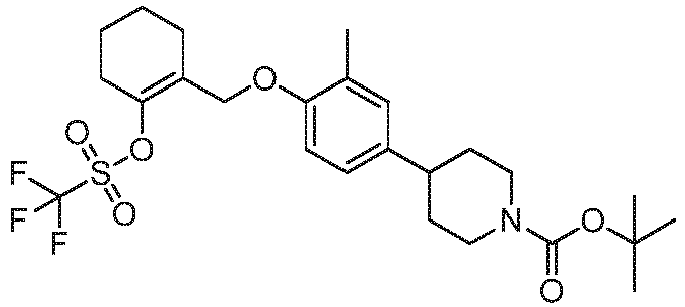
- The title compound was synthesized from Intermediate 5-1-A and Intermediate 2-1 in a similar manner as described for Intermediate 5-1. MS (ESI+) m/z 434.2 (M-t-Boc+2H).
-

- NaH (0.56 g, 14.1 mmol, 60% in mineral oil) was added to a DCM (60 mL) solution of ethyl 4-methyl-2-oxocyclohexanecarboxylate (CAS # 13537-82-1, 2.0 g, 10.9 mmol) at 0 °C. The suspension was allowed to warm to rt and stir for 10 min. The reaction was then cooled to -78 °C. At that time triflic anhydride (2.4 mL, 14.1 mmol) was added. The reaction mixture was allowed to gradually warm to rt. After 1 hour at room temperature, the reaction was quenched by the slow addition of 10% citric acid solution. The mixture was then diluted with DCM and water. The layers were mixed and then separated. The aqueous layer was further extracted with DCM. The combined organic layers were then dried over Na2SO4 and filtered. The solvent was removed under reduced pressure to give the title compound, which was used without further purification. MS (ESI+) m/z 317.0 (M+H).
-
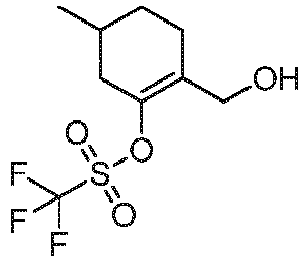
- DIBAL-H (23.6 mL, 23.6 mmol, 1 M heptane) was added dropwise to a solution of Intermediate 6-A (3.4 g, 10.8 mmol) in DCM (100 mL) at -78 °C. After 15 min the solution was removed from the cold bath and allowed to warm gradually to rt. After stirring at rt for 0.5 h the reaction was quenched by the addition of 1 mL of water, 1 mL of 15% NaOH, and 2.5 mL of water. The mixture was vigorously stirred for 30 min before MgSO4 was added. Stirring continued for 15 min and then the mixture was filtered over Celite®. The solvent was removed under reduced pressure to give the title compound, which was taken to the next step without further purification. 1H NMR (400 MHz, CDCl3) δ 4.29 - 4.12 (m, 2H), 2.48 - 2.22 (m, 3H), 2.08 - 1.96 (m, 1H), 1.95 - 1.82 (m, 1H), 1.81 - 1.71 (m, 1H), 1.28 (m, 2H), 1.03 (d, J = 6.6 Hz, 3H).
-

- To a solution of Intermediate 6-B (2.76 g, 10.1 mmol) and imidazole (1.71 g, 25.2 mmol) in DCM (50 mL) was added TBSCI (1.59 g, 10.6 mmol). After 1.5 h the reaction was diluted with DCM and washed with 2% citric acid solution. The organic layer was further washed with brine before being dried over sodium sulfate and filtered. The solvent was removed under reduced pressure to give the title compound, which was used without further purification. 1H NMR (400 MHz, CDCl3) δ 4.33 - 4.20 (m, 2H), 2.42 - 2.17 (m, 3H), 2.06 - 1.98 (m, 1H), 1.93 - 1.81 (m, 1H), 1.78 - 1.69 (m, 1H), 1.34 - 1.18 (m, 1H), 1.02 (d, J = 6.6 Hz, 3H), 0.90 (d, J = 0.8 Hz, 9H), 0.07 (d, J = 0.7 Hz, 6H).
-

- Methyl acetoacetate (CAS # 105-45-3, 1.85 mL, 17.2 mmol) was added dropwise to a suspension of NaH (0.76 g, 18.9 mmol, 60% in mineral oil) and THF (60 mL) at 0 °C. After 10 min n-BuLi (7.58 mL, 18.9 mmol, 2.5 M in heptane) was added dropwise. After an additional 10 min crotonyl bromide (CAS # 55600-70-9, 1.77 mL, 17.2 mmol) was added and the reaction was allowed to slowly warm to rt. After 2 h the reaction was quenched with 1 M HCl and the mixture was extracted with Et2O (200 mL). The organic layer was then dried over MgSO4, filtered, and concentrated under reduced pressure. The residue was purified by silica gel flash column chromatography (5% EtOAc/heptane) to give the title compound as a mixture of E- and Z-isomers. MS (ESI+) m/z 171.1 (M+H).
-

- A mixture of Intermediate 7-A (4.35 g, 25.6 mmol), ytterbium(III) trifluoromethanesulfonate (CAS# 54761-04-5, 4.76 g, 7.67 mmol), and dichlorobis(acetonitrile)palladium(II) (CAS# 14592-56-4, 0.66 g, 2.56 mmol) in dioxane (250 mL) was heated at 50 °C for 30 h. At that point the solvent was removed under reduced pressure. The residue was passed through a silica gel plug, eluting with 30% EtOAc/heptane. The solvent was then removed under reduced pressure to give the title compound which was used without further purification. MS (ESI+) m/z 171.1 (M+H).
-
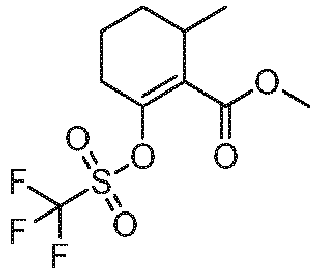
- To a solution of Intermediate 7-B (1.00 g, 5.88 mmol) in DCM (30 mL) at 0 °C, NaH (0.305 g, 7.64 mmol, 60% in mineral oil) was added. The suspension was allowed to warm to rt and stir for 10 min. The reaction was then cooled to -78 °C. At that time triflic anhydride (1.29 mL, 14.1 mmol) was then added. The reaction mixture was then allowed to gradually warm to rt. After 1 hour at that temperature, the reaction was quenched with the slow addition of 10% citric acid solution. The mixture was then diluted with DCM and water. The layers were mixed and then separated. The aqueous layer was further extracted with DCM. The combined organic layers were then dried over Na2SO4 and filtered. The solvent was removed under reduced pressure. The resulting residue was purified by silica gel flash column chromatography (0-10% EtOAc/heptane) to give the title compound. 1H NMR (400 MHz, CDCl3) δ 3.74 (s, 3H), 2.91 - 2.78 (m, 1H), 2.40 - 2.21 (m, 2H), 1.85 - 1.73 (m, 1H), 1.73 - 1.62 (m, 2H), 1.45 - 1.35 (m, 1H), 1.02 (d, J = 6.9 Hz, 3H).
-

- Intermediate 7-C (5.1 g, 16.9 mmol) was dissolved in DCM (170 mL). The solution was cooled to -78 °C under a nitrogen atmosphere. A solution of DIBAL-H (35.4 mL, 35.4 mmol, 1 M) was added to the cool solution. The reaction was allowed to slowly warm to rt over 1 h, at which point the reaction showed complete conversion (TLC, 25% EtOAc/heptane, KMnO4 stain). The reaction was then quenched with the addition of 2.1 mL of water with vigorous stirring at rt for 15 min. Following this, 2.1 mL of 15% aqueous NaOH was added. The reaction was agitated further with vigorous stirring until solids formed. The solids were removed by filtration and the filtrate was concentrated to afford the title compound which was used without further purification. 1H NMR (400 MHz, CD3OD) δ 4.40 (d, J = 12.8 Hz, 1H), 4.05 (d, 1H), 2.62 - 2.76 (m, 1H), 2.30 - 2.39 (m, 2H), 1.64 - 1.95 (m, 3H), 1.37 - 1.50 (m, 1H), 1.15 (d, J = 7.0 Hz, 3H).
-

- Intermediate 7-D (6.0 g, 21.9 mmol) was dissolved in DMF (220 mL). To this solution was added imidazole (1.71 g, 25.2 mmol) and TBSCI (3.63 g, 24.1 mmol) at rt. The resulting solution was stirred at rt for 3 h. The reaction was monitored by TLC with a 25% solution of EtOAc in heptane and stained with KMnO4. The reaction was then filtered through a pad of Celite® eluting with 25% EtOAc-heptane. The resulting solution was then concentrated. To the residue was added water and it was extracted with ca. 1/1 mixture of EtOAc/heptane, the organic phase was washed with dilute NaCl solution and then dried over sodium sulfate. The solution was filtered, and concentrated to afford the title compound. 1H NMR (400 MHz, CD3OD) δ 4.40 (d, J = 12.4 Hz, 1H), 4.07 - 4.14 (m, 1H), 2.55 - 2.67 (m, 1H), 2.18 - 2.30 (m, 2H), 1.72 - 1.85 (m, 1H), 1.57 - 1.72 (m, 2H), 1.30 - 1.41 (m, 1H), 1.06 (d, J = 7.0 Hz, 3H), 0.83 (s, 9H), 0.01 (d, J = 5.2 Hz, 6H).
-

- Methyl acetoacetate (CAS # 105-45-3, 7.43 ml, 68.9 mmol) was added dropwise to a suspension of NaH (3.03 g, 76 mmol) and THF (200 ml) at 0 °C. After 10 min n-BuLi (30.3 ml, 76 mmol) was added dropwise. After an additional 10 min 1-bromo-3-methylbut-2-ene (CAS # 870-63-3, 8.02 ml, 68.9 mmol) was added and the reaction was allowed to slowly warm to rt. After 2 h the reaction was quenched with 1 M HCl and the mixture was extracted with Et2O (200 mL). The organic layer was then dried over MgSO4, filtered, and concentrated under reduced pressure. The resulting residue was purified by silica gel flash column chromatography (5% EtOAc/heptane) to give the title compound. MS (ESI+) m/z 185.2 (M+H).
-

- A solution of Intermediate 8-A (12.5 g, 67.8 mmol), ytterbium(III) trifluoromethanesulfonate (12.5 g, 20.4 mmol), and dichlorobis(acetonitrile)palladium(II) (1.76 g, 6.78 mmol) in dioxane (200 mL) was heated at 50 °C. After 30 h the solvent was removed under reduced pressure. The residue was passed through a silica gel plug, eluting with 30% EtOAc/heptane. The solvent was then removed under reduced pressure to afford the title compound. 1H NMR (400 MHz, CD3OD) δ 3.24 - 3.37 (m, 3H), 2.30 - 2.58 (m, 2H), 1.86 - 1.98 (m, 2H), 1.57 - 1.85 (m, 3H), 1.05 (d, J = 15.4 Hz, 6H).
-

-

- Intermediate 8-C (7.2 g, 22.8 mmol) was dissolved in DCM (230 mL) and cooled to -78 °C. DIBAL-H (50 mL, 50 mmol, 1 M) was added and the reaction was allowed to return to rt and stir overnight. Then, 0.17 mL of water was added. After stirring for 5 min, 0.17 mL of 15% (aq) NaOH was added. Stirring continued until solids form. The reaction mixture was then filtered and concentrated under reduced pressure. The residue was then purified by silica gel flash column chromatography (0-100% EtOAc/heptane) to afford the title compound. 1H NMR (400 MHz, CD3OD) δ 4.20 - 4.25 (m, 2H), 2.34 - 2.41 (m, 2H), 1.75 - 1.86 (m, 2H), 1.46 - 1.55 (m, 2H), 1.17 (s, 6H).
-

- Intermediate 8-D (6.7 g, 23.2 mmol) was dissolved in DMF (200 mL) and imidazole (1.82 g, 26.7 mmol) was added. TBSCI (3.85 g, 25.6 mmol) was then added. The reaction was stirred at rt for 16 h. The reaction was monitored by TLC (25% EtOAc/heptane stained with KMnO4). The reaction was then filtered through a pad of Celite® eluting with 25% EtOAc/heptane and then concentrated. Water was added and extraction done with 1:1 EtOAc/heptane. The organic phase was washed with water then brine before being dried over sodium sulfate. Filtration followed by concentration under reduced pressure afforded the title compound. 1H NMR (400 MHz, Methanol-d 4) δ 4.30 (t, J = 1.0 Hz, 2H), 2.36 (t, J = 6.4 Hz, 2H), 1.77 - 1.88 (m, 2H), 1.46 - 1.54 (m, 2H), 1.19 (d, J = 2.0 Hz, 6H), 0.91 (d, J = 1.6 Hz, 9H), 0.10 (s, 6H).
-

- A suspension of Intermediate 1-1 (5.00 g, 13.73 mmol), bis(pinacolato)diboron (CAS # 73183-34-3 (3.84 g, 15.10 mmol), potassium acetate (2.022 g, 20.60 mmol) and chloro(2-dicyclohexylphosphino-2',6'-dimethoxy-1,1'-biphenyl)[2-(2-aminoethylphenyl)]palladium(II) methyl-t-butylether adduct (CAS # 1028206-58-7) (0.185 g, 0.275 mmol) in dioxane (35 mL) was stirred at 110 °C for 3.5 h. To the mixture was then added a solution of Intermediate 4 (5.87 g, 19.22 mmol) in dioxane (14 mL), followed by chloro(2-dicyclohexylphosphino-2',6'-dimethoxy-1,1'-biphenyl)[2-(2-aminoethylphenyl)]palladium(II) methyl-t-butylether adduct (0.462 g, 0.687 mmol) and Na2CO3 (1 M aq., 13.73 mL, 27.5 mmol). The mixture was stirred at 110 °C for 18 h. The reaction mixture was diluted with EtOAc and water. The organic phase was separated and washed with water and then brine. The combined extracts were then dried over sodium sulfate, filtered, and concentrated. The resulting residue was purified by silica gel flash column chromatography (0-10% EtOAc in heptane) to afford the title compound. MS (ESI+) m/z 510.3 (M+H).
-

- TBAF (1 M in THF 2.81 mL, 2.81 mmol) was added to a THF solution of Intermediate 9-A (1.365 g, 2.68 mmol) at rt. The reaction mixture was stirred at rt for 1 h, and then diluted with EtOAc and water. The organic phase was separated and washed with water and then brine. The combined extracts were then dried over sodium sulfate, filtered, and concentrated. The resulting residue was purified by silica gel flash column chromatography (100% heptane to 100% EtOAc) to afford the title compound. MS (ESI+) m/z 396.2 (M+H).
-

- DIAD (6.43 mL, 33.1 mmol) was added dropwise over 2.5 min to a 0 °C THF (118 mL) solution of Intermediate 2-2 (11.8 g, 38.6 mmol), triphenylphosphine (8.68 g, 33.1 mmol) and Intermediate 7-D (8.25 g, 30.1 mmol). The resulting mixture was stirred at room temperature for 20h. The reaction mixture was diluted with EtOAc. The mixture was washed with water, dried over Na2SO4, filtered, and then concentrated. The resulting residue was purified by silica gel flash column chromatography (0-50% EtOAc/heptane) to afford the title compound. MS (ESI+) m/z 506.3 (M-tBu+2H)+.
-

- The title compound was synthesized from (±)-methyl 2-methyl-5-oxocyclopentanecarboxylate (J. Org. Chem. 5364-5366 (1983), CAS # 18067-33-9) by a similar method as described for Intermediate 6-A except for using DIPEA in the place of NaH. 1H NMR (400 MHz, CDCl3) δ 3.80 (s, 3H), 3.19 - 3.04 (m, 1H), 2.86-2.76 (m, 1H), 2.69-2.60 (m, 1H), 2.30-2.19 (m, 1H), 1.64-1.54 (m, 1H), 1.21 (d, J = 6.8 Hz, 3H).
-

- The title compound was synthesized starting from (±)-methyl 5-methyl-2-(((trifluoromethyl)sulfonyl)oxy)cyclopent-1-enecarboxylate analogously to the method described for Intermediate 6-B. 1H NMR (400 MHz, CDCl3) δ 3.80 (s, 3H), 3.18 - 3.03 (m, 1H), 2.86-2.76 (m, 1H), 2.69-2.59 (m, 1H), 2.30-2.19 (m, 1H), 1.64-1.50 (m, 1H), 1.21 (d, J = 6.8 Hz, 3H).
-

- The title compound was synthesized starting from (±)-2-(hydroxymethyl)-3-methylcyclopent-1-en-1-yl trifluoromethanesulfonate analogously to the preparation of Intermediate 6. 1H NMR (400 MHz, DMSO-d 6) δ 4.31 - 4.22 (m, 1H), 4.19-4.14 (m, 1H), 3.28 (s, 1H), 2.87-2.78 (m, 1H), 2.63-2.55 (m, 1H), 2.24-2.13 (m, 1H), 1.53-1.44 (m, 1H), 1.07 (d, J = 6.9 Hz, 3H), 0.87 (s, 9H), 0.06 (d, J = 3.2 Hz, 6H).
-

- The title compound was synthesized starting from (2-bromocyclopent-1-en-1-yl)methanol (CAS# 121898-54-2) analogously to the preparation of Intermediate 6. 1H NMR (400 MHz, CDCl3) δ 4.19 (s, 2H), 2.60 - 2.53 (m, 2H), 2.35 (t, J=7.2 Hz, 2H), 1.86 (app. quin, J=7.6 Hz, 2H), 0.82 (s, 9H), 0.00 (s, 6H)
-

- To a mixture of 4-bromo-3-ethylaniline (CAS# 52121-42-3, 5 g, 24.99 mmol), 2-(3,6-dihydro-2H-pyran-4-yl)-4,4,5,5-tetramethyl-1,3,2-dioxaborolane (9.66 g, 31.2 mmol), and Pd(dppf)Cl2 CH2Cl2 adduct (1.02 g, 1.25 mmol) in DMF (100 mL) was added 2 M aq. potassium phosphate (37.5 mL, 75.0 mmol). The mixture was then stirred at 110 °C for 50 min, and then cooled to room temperature, and then diluted with EtOAc. The organic layer was then separated from the aqueous layer, and dried over Na2SO4, filtered, and then concentrated. The resulting residue was purified by silica gel flash column chromatography (heptane/EtOAc = 1/0 to 4/6) to afford the title compound. MS (ESI+) m/z 303.1 (M+H).
-

- The title compound was synthesized in a similar manner as described in the synthesis of Intermediate 2-1 starting from tert-butyl 4-(4-amino-2-ethylphenyl)-5,6-dihydropyridine-1(2H)-carboxylate. MS (ESI+) m/z 249.3 (M-tBu+2H).
-

- The title compound was synthesized analogously to the preparation of Intermediate 2-1-A using 4-bromo-2-methyl-1-nitrobenzene (CAS# 52414-98-9) and tert-butyl 4-(4,4,5,5-tetramethyl-1,3,2-dioxaborolan-2-yl)-5,6-dihydropyridine-1(2H)-carboxylate. MS (ESI-) m/z 317.2 (M-H).
-

- The title compound was synthesized from Intermediate 14-A in a similar manner as described in the synthesis of Intermediate 2-4 by way of first deprotecting the Boc moiety as described for Intermediate 2-3. MS (ESI+) m/z 287.2 (M+H).
-

- A mixture of Intermediate 14-B (5.98 g, 20.89 mmol) and Pd/C (1.11 g) in EtOH (104 mL) was stirred under H2 atmosphere at room temperature for 8 h. The mixture was filtered through a plug of Celite®, which was rinsed with EtOH. The filtrate was concentrated. The resulting residue was resubjected to the same reaction conditions for 8h, and the mixture was filtered through a plug of Celite®, which was rinsed with EtOH. The filtrate was concentrated and the resulting residue was purified by silica gel flash column chromatography (0.2% Et3N in heptane/EtOAc = 1/0 to 0/1) to afford the title compound. MS (ESI+) m/z 259.3 (M+H).
-

- The title compound was synthesized by the similar method as described in the synthesis of Intermediate 14 but using 4-bromo-1-nitrobenzene (CAS# 586-78-7) in the place of 4-bromo-2-methyl-1-nitrobenzene. MS (ESI+) m/z 245.1 (M+H).
-

- To a suspension of (±)-(3,4-trans)-4-(4-hydroxyphenyl)piperidin-3-ol (CAS# 188866-44-6, 295 mg, 1.527 mmol) in 5% aq. NaHCO3/THF/CH2Cl2 (5 mL/ 5 mL/ 10 mL) was added cyclopropanecarbonyl chloride (200 µL, 2.20 mmol). The mixture was then stirred at room temperature for 15 h. To the mixture was then added cyclopropanecarbonyl chloride (100 µL, 1.53 mmol). The mixture was then stirred at room temperature for additional 6 h. The reaction was then quenched with N,N-dimethylaminoethylenediamine. The mixture was then stirred for 2h. The mixture was then rendered acidic by half satd. KHSO4. The mixture was then extracted with EtOAc. The mixture was then washed successively with H2O and brine, dried over Na2SO4, filtered, and then concentrated. The resulting residue was triturated with Et2O. The resulting solid was collected by filtration to furnish the title compound. MS (ESI+) m/z 262.1 (M+H).
-

- DIAD (0.209 mL, 1.072 mmol) was added dropwise to a THF (5 mL) solution of Intermediate 9 (373 mg, 0.944 mmol), Intermediate 2-1 (250 mg, 0.858 mmol) and PPh3 (281 mg, 1.072 mmol) at rt. The mixture was stirred for 1 h and then concentrated. The residue was purified by silica gel flash column chromatography (heptane to 25% EtOAc in heptane) to afford the title compound. MS (ESI+) m/z 669.3 (M+H).
-

- Trifluoroacetic acid (5 mL, 64.9 mmol) was added dropwise to a DCM (5 mL) solution of Example 1-A (396 mg, 0.592 mmol) at 0 °C. The whole mixture was stirred for 30 min at 0 °C. Acetonitrile (10 mL) was added to the mixture and then the solvent was removed under reduced pressure The resulting residue was diluted with DCM and sat'd. aq. NaHCO3, and then passed through an ISOLUTE® Phase Separator. The organics were concentrated to furnish the title compound. MS (ESI+) m/z 569.4 (M+H).
-
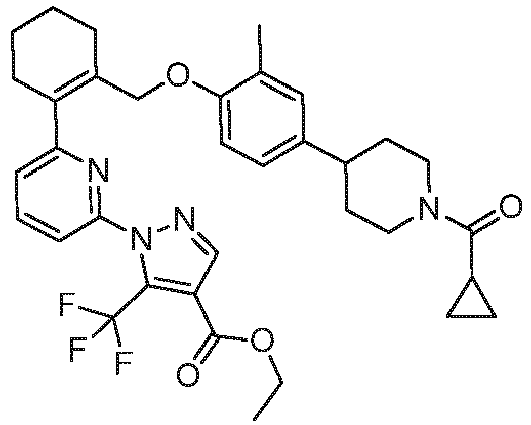
- Cyclopropylcarbonyl chloride (CAS # 4023-34-1, 0.006 mL, 0.100 mmol) was added to a DCM (2 mL) solution of Example 1-B (38 mg, 0.067 mmol) and DIPEA (0.035 mL, 0.200 mmol) at 0 °C. The resulting mixture was stirred for 30 min at 0 °C and then water was added. The mixture was then passed through an ISOLUTE® Phase Separator. The organics were concentrated. The resulting residue was purified by silica gel flash column chromatography (heptane to 50% EtOAc in heptane) to afford the title compound. MS (ESI+) m/z 637.3 (M+H).
-
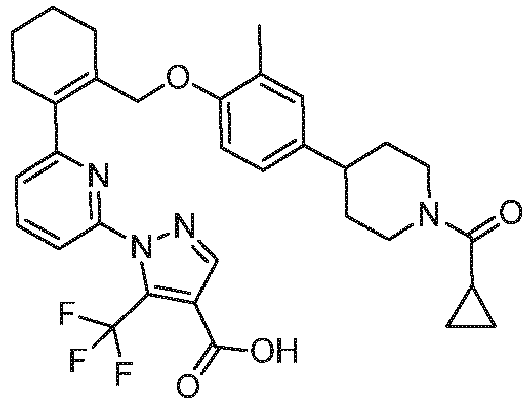
- LiOH (0.18 mL, 1M aq.) was added to a THF/MeOH solution (1 mL/1 mL) of Example 1-C (23 mg, 0.036 mmol). The mixture was then stirred at 50 °C for 16 h. The reaction mixture was rendered acidic by the addition of 0.1 N aq HCl until pH < 4. The mixture was then extracted with EtOAc. The organic phase was washed with water, brine and then dried over sodium sulfate, filtered, and then concentrated. The resulting residue was purified by RP-HPLC (HC-B) to afford the title compound. 1H NMR (400 MHz, DMSO-d 6) δ 13.44 (s, 1H), 8.28 (s, 1H), 8.08 (t, J = 7.8 Hz, 1H), 7.67 (dd, J = 8.0, 0.8 Hz, 1H), 7.50 (dd, J = 7.8, 0.9 Hz, 1H), 7.00 (d, J = 2.2 Hz, 1H), 6.89 (dd, J = 8.3, 2.2 Hz, 1H), 6.60 (d, J = 8.4 Hz, 1H), 4.53 - 4.43 (m, 1H), 4.40 (s, 2H), 4.38 - 4.30 (m, 1H), 3.12 (t, J = 12.8 Hz, 1H), 2.71 - 2.53 (m, 2H), 2.43 (s, 2H), 2.32 (dd, J = 5.0, 2.5 Hz, 2H), 2.11 (s, 3H), 2.04 - 1.92 (m, 1H), 1.79 - 1.66 (m, 6H), 1.49 (d, J = 13.1 Hz, 1H), 1.37 (s, 1H), 0.77 - 0.65 (m, 4H). HRMS; calcd. for C33H36F3N4O4 (M+H) 609.2689, found 609.2682.
- Example 2. The following compounds were prepared with similar methods as described above using the appropriate starting materials. Specifically, Example 2-1, Example 2-6, Example 2-7, Example 2-8, Example 2-9, Example 2-10, Example 2-11, and Example 2-12 were prepared in a fashion similar to Example 1. Example 2-2, Example 2-3, Example 2-4, and Example 2-5 were prepared via a Suzuki-type coupling in a manner similar to that described for Intermediate 9-A, but employing Intermediate 1-1 and Intermediate 5-2 as starting material, the subsequent product could then be further transformed to the title compounds in a manner similar to the process to transform Example 1-A to Example 1.
Example Structure/Name Starting Materials Analytical Data 2-1 
Intermediate 9, Intermediate 2-1, and propionic anhydride(CAS # 123-62-6) 1H NMR (400 MHz, DMSO-d6 ) δ 13.43 (s, 1H), 8.27 (s, 1H), 8.08 (t, J = 7.9 Hz, 1H), 7.67 (dd, J = 7.9, 0.8 Hz, 1H), 7.50 (dd, J = 7.8, 0.9 Hz, 1H), 7.02 - 6.96 (m, 1H), 6.87 (dd, J = 8.3, 2.3 Hz, 1H), 6.60 (d, J = 8.4 Hz, 1H), 4.51 (d, J = 12.8 Hz, 1H), 4.40 (s, 2H), 3.92 (d, J = 13.2 Hz, 1H), 3.28 (s, 1H), 3.04 (t, J = 12.8 Hz, 1H), 2.67 - 2.51 (m, 2H), 2.42 (s, 2H), 2.33 (q, J = 7.1 Hz, 4H), 2.11 (s, 3H), 1.69 (br. s., 5H), 1.48 (t, J = 10.5 Hz, 1H), 1.36 (dd, J = 13.1, 8.9 Hz, 1H), 0.99 (t, J = 7.4 Hz, 3H). HRMS calcd. for C32H36F3N4O4 (M+H) 597.2689, found 597.2677. 1-(6-(2-((2-Methyl-4-(1-propionylpiperidin-4-yl)phenoxy)methyl)cyclohex -1-en-1-yl)pyridin-2-yl)-5-(trifluoromethyl)-1H-pyrazole-4-carboxylic acid 2-2 
Intermediate 1-1, Intermediate 5-2, and methyl chloroformate, CAS # 79-22-1. 1H NMR (400 MHz, DMSO-d 6) δ 7.97 (t, J=7.8 Hz, 1H), 7.70 (s, 1H), 7.55 (dd, J=0.7, 8.0 Hz, 1H), 7.36 (dd, J=0.6, 7.7 Hz, 1H), 6.99 (d, J=2.0 Hz, 1H), 6.88 (dd, J=2.2, 8.3 Hz, 1H), 6.61 (d, J=8.3 Hz, 1H), 4.42 - 4.38 (s, 2H), 4.11 - 4.01 (m, 2H), 3.59 (s, 3H), 3.52 - 3.46 (m, 1H), 3.44 - 3.39 (m, 1H), 2.83 (br. s., 1H), 2.44 (br. s., 2H), 2.31 (br. s., 2H), 2.12 (s, 3H), 1.70 (br. s., 6H), 1.43 (dq, J=4.2, 12.6 Hz, 2H). HRMS calcd. for C31H34F3N4O5 (M+H) 599.2481, found 599.2518. 1-(6-(2-((4-(1-(Methoxycarbonyl)piperidin-4-yl)-2-methylphenoxy)methyl)cycl ohex-1-en-1-yl)pyridin-2-yl)-5-(trifluoromethyl)-1H-pyrazole-4-carboxylic acid 2-3 
Intermediate 1-1, Intermediate 5-2, and methanesulfonyl chloride (CAS # 124-63-0) 1H NMR (400 MHz, DMSO-d 6) δ 13.54 (s, 1H), 8.04 (app. t, J=7.8 Hz, 2H), 7.63 (d, J=7.8 Hz, 1H), 7.45 (d, J=7.6 Hz, 1H), 7.02 (d, J=2.1 Hz, 1H), 6.91 (dd, J=2.2, 8.3 Hz, 1H), 6.62 (d, J=8.4 Hz, 1H), 4.41 (s, 2H), 3.64 (d, J=11.7 Hz, 2H), 2.88 (s, 3H), 2.77 (dt, J=2.3, 12.1 Hz, 2H), 2.43 (br. s., 2H), 2.31 (br. s., 2H), 2.12 (s, 3H), 1.79 (d, J=12.7 Hz, 2H), 1.70 (br. s., 4H), 1.59 (dq, J=4.1, 12.6 Hz, 2H). HRMS calcd. for C30H34F3N4O5S (M+H) 619.2202, found 619.2217. 1-(6-(2-((2-Methyl-4-(1-(methylsulfonyl)piperidin-4-yl)phenoxy)methyl)cyclohex -1-en-1-yl)pyridin-2-yl)-5-(trifluoromethyl)-1 H-pyrazole-4-carboxylic acid 2-4 
Intermediate 1-1, Intermediate 5-2, and dimethylcarbamyl chloride (CAS # 79-44-7) 1H NMR (400 MHz, DMSO-d 6) δ 7.99 (t, J=7.8 Hz, 1H), 7.81 (br. s., 1H), 7.58 (d, J=7.7 Hz, 1H), 7.39 (d, J=7.6 Hz, 1H), 6.99 (d, J=2.0 Hz, 1H), 6.89 (dd, J=2.1, 8.4 Hz, 1H), 6.61 (d, J=8.4 Hz, 1H), 4.40 (s, 2H), 3.61 (d, J=13.1 Hz, 2H), 2.74 (s, 6H), 2.44 (br. s., 2H), 2.31 (br. s., 2H), 2.13 (s, 3H), 1.70 (br. s., 5H), 1.66 (br. s., 1H), 1.50 (dq, J=3.7, 12.4 Hz, 2H). HRMS; calcd. for C32H37F3N5O4 (M+H) 612.2798, found 612.2801. 1-(6-(2-((4-(1-(Dimethyl carbamoyl)piperidin-4-yl)-2-methylphenoxy)methyl) cyclohex-1-en-1-yl)pyridin-2-yl)-5-(trifluoromethyl)-1H-pyrazole-4-carboxylic acid 2-5 
Intermediate 1-1, Intermediate 5-2, and acetoxyacetyl chloride (CAS # 13831-31-7) 1H NMR (400 MHz, DMSO-d 6) δ 7.97 (t, J=7.8 Hz, 1H), 7.69 (s, 1H), 7.55 (dd, J=0.7, 8.0 Hz, 1H), 7.35 (dd, J=0.6, 7.6 Hz, 1H), 6.98 (d, J=2.0 Hz, 1H), 6.87 (dd, J=2.2, 8.3 Hz, 1H), 6.61 (d, J=8.4 Hz, 1H), 4.48 (t, J=5.4 Hz, 1H), 4.40 (s, 2H), 4.17 - 4.00 (m, 2H), 3.74 (d, J=12.8 Hz, 1H), 3.06 - 2.95 (m, 1H), 2.65 - 2.57 (m, 2H), 2.44 (br. s., 2H), 2.30 (br. s., 2H), 2.12 (s, 3H), 1.69 (br. s., 6H), 1.58 - 1.32 (m, 2H). HRMS; calcd. for C31H34F3N4O5 (M+H) 599.2481, found 599.2504. 1-(6-(2-((4-(1-(2-Hydroxyacetyl)piperidin-4-yl)-2-methylphenoxy)methyl)cycl ohex-1-en-1-yl)pyridin-2-yl)-5-(trifluoromethyl)-1 H-pyrazole-4-carboxylic acid 2-6 
Intermediate 9, t-butyl 4-(4-hydroxyphenyl)pi peridine-1-carboxylate (CAS # 149377-19-5), and cyclopropyl carbonyl chloride 1H NMR (400 MHz, DMSO-d 6) δ 13.43 (br s, 1H). 8.28 (s, 1H), 8.07 (t, J = 7.8 Hz, 1H), 7.67 (dd, J = 8.0, 0.8 Hz, 1H), 7.49 (dd, J = 7.7, 0.9 Hz, 1H), 7.13 - 7.04 (m, 2H), 6.79 - 6.70 (m, 2H), 4.48 (s, 1H), 4.38 (s, 2H), 3.13 (s, 1H), 2.78 - 2.54 (m, 2H), 2.42 (s, 2H), 2.28 (s, 2H), 1.98 (tt, J = 7.6, 5.2 Hz, 2H), 1.77 (s, 1H), 1.69 (br. s.,5H), 1.58 - 1.27 (m, 2H), 0.77 - 0.66 (m, 4H). HRMS calcd. for C32H34N4O4F3 (M+H) 595.2532, found 595.2554. 1-(6-(2-((4-(1-(Cyclopropanecarbonyl)pipe ridin-4-yl)phenoxy)methyl)cyclohex -1-en-1-yl)pyridin-2-yl)-5-(trifluoromethyl)-1 H-pyrazole-4-carboxylic acid 2-7 
Intermediate 2-1, Intermediate 9, and diethylcarbamic chloride(CAS # 88-10-8) 1H NMR (400 MHz, DMSO-d 6) δ 13.45 (br. s., 1H), 8.25 (s, 1H), 8.08 (t, J=7.8 Hz, 1H), 7.67 (d, J=7.9 Hz, 1H), 7.50 (d, J=7.7 Hz, 1H), 6.99 (d, J=1.8 Hz, 1H), 6.88 (dd, J=2.0, 8.4 Hz, 1H), 6.60 (d, J=8.4 Hz, 1H), 4.40 (s, 2H), 3.57 (d, J=13.0 Hz, 2H), 3.12 (q, J=7.0 Hz, 4H), 2.74 (t, J=11.7 Hz, 1H), 2.43 (br. s., 2H), 2.31 (br. s., 2H), 2.11 (s, 3H), 1.74 - 1.65 (m, 6H), 1.49 (dq, J=3.8, 12.4 Hz, 2H), 1.04 (t, J=7.0 Hz, 6H); HRMS calcd. for C34H41F3N5O4 (M+H) 640.3111, found 640.3168. 1-(6-(2-((4-(1-(Diethyl carbamoyl)piperidin-4-yl)-2-methylphenoxy)methyl)cycl ohex-1-en-1-yl)pyridin-2-yl)-5-(trifluoromethyl)-1 H-pyrazole-4-carboxylic acid 2-8 
Intermediate 2-1, Intermediate 9, and ethanesulfonyl chloride (CAS # 594-44-5) 1H NMR (400 MHz, DMSO-d 6) δ 13.43 (br. s., 1H), 8.27 (br. s., 1H), 8.08 (t, J=7.8 Hz, 1H), 7.67 (d, J=7.8 Hz, 1H), 7.50 (d, J=7.6 Hz, 1H), 7.00 (d, J=1.8 Hz, 1H), 6.89 (dd, J=2.1, 8.4 Hz, 1H), 6.61 (d, J=8.3 Hz, 1H), 4.41 (s, 2H), 3.68 (d, J=12.0 Hz, 2H), 3.06 (q, J=7.3 Hz, 2H), 2.86 (dt, J=2.1, 12.1 Hz, 2H), 2.43 (br. s., 2H), 2.12 (s, 3H), 1.78 (d, J=12.5 Hz, 2H), 1.70 (br. s., 3H), 1.55 (dq, J=4.2, 12.5 Hz, 2H), 1.22 (t, J=7.4 Hz, 3H). HRMS calcd. for C31H36F3N4O5S (M+H) 633.2359, found 633.2401. 1-(6-(2-((4-(1-(Ethylsulfonyl)piperidin-4-yl)-2-methylphenoxy) methyl)cyclohex-1-en-1-yl)pyridin-2-yl)-5-(trifluoromethyl)-1 H-pyrazole-4-carboxylic acid 2-9 
Intermediate 2-1, Intermediate 9, and cyclopropylsulfon yl chloride (CAS # 139631-62-2) 1H NMR (400 MHz, DMSO-d 6 δ 13.43 (br. s., 1H), 8.27 (s, 1H), 8.08 (t, J=7.8 Hz, 1H), 7.67 (d, J=7.9 Hz, 1H), 7.50 (d, J=7.2 Hz, 1H), 7.01 (d, J=2.1 Hz, 1H), 6.90 (dd, J=2.1, 8.3 Hz, 1H), 6.61 (d, J=8.4 Hz, 1H), 4.41 (s, 2H), 3.68 (d, J=12.0 Hz, 2H), 2.89 (dt, J=2.0, 12.1 Hz, 2H), 2.43 (br. s., 2H), 2.12 (s, 3H), 1.79 (d, J=12.2 Hz, 2H), 1.68 - 1.68 (m, 1H), 1.72 - 1.66 (m, 4H), 1.59 (dq, J=3.7, 12.4 Hz, 2H), 1.25- 1.20 (m, 1H), 1.03 - 0.90 (m, 4H). HRMS calcd. for C32H36F3N4O5S (M+H) 645.2359 found 645.2430. 1-(6-(2-((4-(1-(Cyclopropylsulfonyl)piperid in-4-yl)-2-methylphenoxy)methyl)cycl ohex-1-en-1-yl)pyridin-2-yl)-5-(trifluoromethyl)-1H-pyrazole-4-carboxylic acid 2-10 
Intermediate 2-1, Intermediate 9, and isobutyryl chloride (CAS # 79-30-1) 1H NMR (400 MHz, DMSO-d 6) δ 8.14 (s, 1H), 8.05 (t, J = 7.8 Hz, 1H), 7.64 (dd, J = 8.1, 0.9 Hz, 1H), 7.47 (dd, J = 7.7, 0.9 Hz, 1H), 6.99 (d, J = 2.2 Hz, 1H), 6.88 (dd, J = 8.4, 2.3 Hz, 1H), 6.60 (d, J = 8.4 Hz, 1H), 4.53 (d, J = 12.5 Hz, 1H), 4.40 (s, 2H), 4.02 (d, J = 13.3 Hz, 1H), 3.16 (d, J = 10.9 Hz, 1H), 3.07 (t, J = 12.9 Hz, 1H), 2.88 (p, J = 6.7 Hz, 1H), 2.61 (dt, J = 12.0, 3.6 Hz, 2H), 2.43 (s, 2H), 2.31 (d, J = 4.6 Hz, 2H), 2.11 (s, 3H), 1.70 (br. s., 6H), 1.52 - 1.27 (m, 2H), 1.00 (app dd, J = 10.7, 6.5 Hz, 6H). HRMS calcd. for C33H38F3N4O4 (M+H) 611.2840, found 611.2902. 1-(6-(2-((4-(1-Isobutyrylpiperidin-4-yl)-2-methylphenoxy)methyl)cycl ohex-1-en-1-yl)pyridin-2-yl)-5-(trifluoromethyl)-1 H-pyrazole-4-carboxylic acid 2-11 
Intermediate 2-1, Intermediate 9, and cyclobutanecarbo nyl chloride (CAS # 5006-22-4) 1H NMR (400 MHz, DMSO-d 6) δ 8.09 (s, 1H), 8.04 (t, J = 7.8 Hz, 1H), 7.63 (dd, J = 8.1, 0.8 Hz, 1H), 7.45 (dd, J = 7.7, 0.9 Hz, 1H), 6.98 (d, J = 2.2 Hz, 1H), 6.87 (dd, J = 8.4, 2.3 Hz, 1H), 6.60 (d, J = 8.4 Hz, 1H), 4.48 (d, J = 13.0 Hz, 1H), 4.40 (s, 2H), 3.75 (d, J = 13.6 Hz, 1H), 3.03 - 2.93 (m, 1H), 2.65 - 2.53 (m, 3H), 2.43 (s, 2H), 2.31 (s, 2H), 2.19 (ddd, J = 20.3, 10.2, 2.6 Hz, 2H), 2.11 (s, 4H), 2.10 - 2.02 (m, 2H), 1.95 - 1.85 (dp, J = 10.8, 8.9 Hz, 1H), 1.78 - 1.64 (m, 7H), 1.46 - 1.28 (m, 2H). HRMS calcd. for C34H38F3N4O4 (M+H) 623.28396, found 623.2897 1-(6-(2-((4-(1-(Cyclobutanecarbonyl)piperi din-4-yl)-2-methylphenoxy)methyl)cycl ohex-1-en-1-yl)pyridin-2-yl)-5-(trifluoromethyl)-1H-pyrazole-4-carboxylic acid 2-12 
Intermediate 2-1, Intermediate 9, and ethyl isocyanate (CAS # 109-90-0) 1H NMR (400MHz, DMSO-d 6) δ 13.42 (br. s., 1H), 8.28 (s, 1H), 8.08 (t, J=7.9 Hz, 1H), 7.67 (dd, J=0.6, 7.9 Hz, 1H), 7.50 (dd, J=0.6, 7.8 Hz, 1H), 6.97 (d, J=1.8 Hz, 1H), 6.86 (dd, J=2.3, 8.4 Hz, 1H), 6.60 (d, J=8.4 Hz, 1H), 6.41 (t, J=5.3 Hz, 1H), 4.40 (s, 2H), 4.04 (d, J=13.1 Hz, 2H), 3.04 (dq, J=5.6, 7.1 Hz, 2H), 2.72 - 2.62 (m, 4H), 2.43 (br. s., 2H), 2.11 (s, 3H), 1.70 (br. s., 3H), 1.64 (d, J=13.7 Hz, 2H), 1.38 (dq, J=3.2, 12.3 Hz, 2H), 1.00 (t, J=7.2 Hz, 3H). HRMS calcd. for C32H37F3N5O4 (M+H) 612.2798, found 612.2844. 1-(6-(2-((4-(1-(Ethylcarbamoyl)piperidin-4-yl)-2-methylphenoxy)methyl)cycl ohex-1-en-1-yl)pyridin-2-yl)-5-(trifluoromethyl)-1H-pyrazole-4-carboxylic acid 2-13 
(Example 1-A was saponified by the method analogous to the method for the synthesis of Example 1) 1H NMR (400 MHz, DMSO-d 6) δ 8.28 (s, 1H), 8.08 (t, J=7.9 Hz, 1H), 7.67 (d, J=8.0 Hz, 1H), 7.50 (d, J=7.1 Hz, 1H), 6.98 (d, J=1.9 Hz, 1H), 6.91 - 6.83 (m, 1H), 6.59 (d, J=8.4 Hz, 1H), 4.40 (s, 2H), 4.03 (d, J=12.2 Hz, 2H), 2.75 (s, 2H), 2.43 (s, 2H), 2.32 (d, J=7.0 Hz, 2H), 2.11 (s, 3H), 1.76 - 1.59 (m, J=16.2 Hz, 6H), 1.41 (s, 12H). HRMS calcd. for C34H40F3N4O5 (M+H) 641.2951, found 641.2924. 1-(6-(2-((4-(1-(tert-butoxycarbonyl)piperidin-4-yl)-2-methylphenoxy)methyl)cycl ohex-1-en-1-yl)pyridin-2-yl)-5-(trifluoromethyl)-1 H-pyrazole-4-carboxylic acid -

- HATU (38.4 mg, 0.101 mmol) was added to a DMF (2 mL) solution of Example 1-B (50 mg, 0.088 mmol), L-(+)-lactic acid (CAS # 79-33-4, 8.71 mg, 0.097 mmol) and DIPEA (0.023 mL, 0.132 mmol) at rt. The mixture was then stirred for 1 h, and then diluted with water and EtOAc. The organic phase was washed with water and brine, dried over sodium sulfate, filtered, and then concentrated. The resulting residue was purified by silica gel flash column chromatography (heptane to 100% EtOAc/heptane) to afford the title compound. MS (ESI+) m/z 641.4 (M+H).
-

- LiOH (1M in H2O, 0.312 mL, 0.312 mmol) was added to a THF/MeOH solution (1 mL/1 mL) of Example 3-A (40 mg, 0.062 mmol). The mixture was then stirred at 50 °C for 3 h. The reaction mixture was rendered acidic by the addition of 0.1 N aq. HCl until pH < 4. The mixture was then extracted with EtOAc. The organic phase was washed with water, brine and then dried over sodium sulfate, filtered, and then concentrated. The resulting residue was purified by RP-HPLC (HC-B) to afford the title compound. 1H NMR (400 MHz, DMSO-d 6) δ 13.42 (br s, 1 H), 8.27 (s, 1H), 8.08 (t, J = 7.9 Hz, 1H), 7.67 (dd, J = 8.0, 0.8 Hz, 1H), 7.50 (dd, J = 7.8, 0.9 Hz, 1H), 6.99 (s, 1H), 6.88 (d, J = 8.2 Hz, 1H), 6.60 (d, J = 8.4 Hz, 1H), 4.79 (s, 1H), 4.54 - 4.43 (m, 2H), 4.04 (s, 2H), 3.04 (t, J = 12.8 Hz, 1H), 2.71 - 2.52 (m, 2H), 2.43 (br s, 2H), 2.31 (br s, 2H), 2.11 (s, 3H), 1.77 - 1.66 (m, 7H), 1.55 - 1.43 (m, 1H), 1.42 - 1.35 (m, 1H), 1.26 - 1.14 (m, 4H). HRMS; calcd. for C32H36F3N4O5 (M+H) 612.2560, found 613.2686.
- Example 4. The following compounds were prepared with similar methods as described for Example 3 using Intermediate 2-1, Intermediate 9 and the appropriate acid starting materials.
Ex Structure/Name Starting Materials Analytical Data 4-1 
D-(-)-lactic acid (CAS # 10326-41-7) 1H NMR (400 MHz, DMSO-d 6) δ 8.26 (s, 1H), 8.08 (t, J = 7.9 Hz, 1H), 7.67 (dd, J = 8.0, 0.8 Hz, 1H), 7.50 (dd, J = 7.8, 0.9 Hz, 1H), 6.99 (s, 1H), 6.88 (d, J = 8.3 Hz, 1H), 6.60 (d, J = 8.4 Hz, 1H), 4.53 - 4.38 (m, 4H), 3.04 (t, J = 12.9 Hz, 1H), 2.71 - 2.56 (m, 3H), 2.43 (s, 2H), 2.31 (d, J = 4.3 Hz, 2H), 2.09 (d, J = 15.7 Hz, 4H), 1.74 - 1.66 (m, 6H), 1.55 - 1.43 (m, 1H), 1.38 (s, 1H), 1.26 - 1.13 (m, 4H). HRMS; calcd. for C32H36F3N4O5 (M+H) 613.2632, found 613.2689 (R)-1-(6-(2-((4-(1-(2-Hydroxypropanoyl)piperidi n-4-yl)-2-methylphenoxy)methyl)cyc lohex-1-en-1-yl)pyridin-2-yl)-5-(trifluoromethyl)-1H-pyrazole-4-carboxylic acid 4-2 
picolinic acid (CAS # 98-98-6) 1H NMR (400MHz, DMSO-d 6) δ 13.43 (br. s., 1H), 8.59 (d, J=3.9 Hz, 1H), 8.28 (s, 1H), 8.08 (t, J=7.8 Hz, 1H), 7.92 (t, J=7.2 Hz, 1H), 7.67 (d, J=7.8 Hz, 1H), 7.57 (d, J=7.6 Hz, 1H), 7.53 - 7.43 (m, 2H), 7.01 (br. s., 1H), 6.90 (d, J=7.8 Hz, 1H), 6.61 (d, J=8.3 Hz, 1H), 4.62 (d, J=12.0 Hz, 1H), 4.40 (br. s., 2H), 3.70 (d, J=12.5 Hz, 1H), 3.11 (t, J=12.2 Hz, 1H), 2.83 (t, J=12.0 Hz, 1H), 2.74 - 2.65 (m, 1H), 2.43 (br. s., 2H), 2.31 (br. s., 2H), 2.12 (s, 3H), 1.82 (d, J=12.7 Hz, 1H), 1.70 (br. s., 4H), 1.64 - 1.49 (m, 3H). HRMS calcd. for C35H35F3N5O4 (M+H) 646.2641 found 646.2706. 1-(6-(2-((2-Methyl-4-(1-picolinoylpiperidin-4-yl)phenoxy)methyl)cyclohe x-1-en-1-yl)pyridin-2-yl)-5-(trifluoromethyl)-1H-pyrazole-4-carboxylic acid -

- DIAD (0.060 mL, 0.308 mmol) was added dropwise to a THF (5 mL) solution of Intermediate 3-1 (64 mg, 0.257 mmol), Intermediate 9 (110 mg, 0.277 mmol) and PPh3 (81 mg, 0.308 mmol) at rt. The reaction was stirred for 16 h and then concentrated. The residue was purified by silica gel flash column chromatography (heptane to 60% EtOAc in heptane) to afford the title compound. MS (ESI+) m/z 627.3 (M+H).
-

- Trifluoroacetic acid (0.5 mL, 6.49 mmol) was added dropwise to a DCM (2 mL) solution of Example 5-A (80 mg, 0.128 mmol) at 0 °C. The whole mixture was stirred for 45 min at 0 °C. Acetonitrile (3 mL) was added to the mixture and it was then concentrated. The resulting residue was diluted with EtOAc and sat'd. aq. NaHCO3. The organic layer was then separated. The aqueous layer was extracted with EtOAc. The combined organic layers were washed successively with brine, dried over Na2SO4, filtered, and then concentrated to furnish the title compound. MS (ESI+) m/z 527.3 (M+H).
-
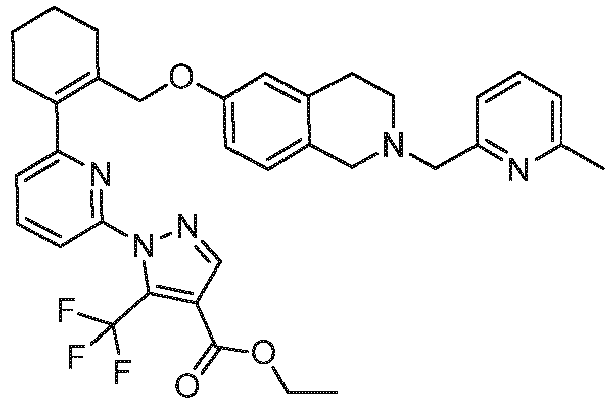
- A mixture of Example 5-B (23 mg, 0.044 mmol), DIPEA (0.023 mL, 0.131 mmol), and 2-(bromomethyl)-6-methylpyridine (CAS # 68470-59-7, 12.2 mg, 0.066 mmol) in DCM (1 mL) was stirred at rt for 16 h, and then concentrated. The resulting residue was purified by silica gel flash column chromatography (0-10% (MeOH with 10% NH4OH) in DCM) to afford the title compound. MS (ESI+) m/z 632.4 (M+H).
-

- A mixture of Example 5-C (16 mg, 0.025 mmol) in THF (1 mL), MeOH (1 mL) and 1 N aq NaOH (1 mL, 1.00 mmol) was heated at 50 °C for 1.5 h, and then cooled to room temperature. The reaction mixture was then diluted with EtOAc and water. The mixture was rendered acidic (pH 5∼6) by the addition of 1 N aq. HCl. The organic phase was washed with brine, then dried over sodium sulfate, filtered, and concentrated. The resulting residue was triturated with acetonitrile, and then the resulting precipitate was collected by filtration to afford the title compound. 1H NMR (400MHz, DMSO-d6) δ 8.19 (s, 1H), 8.06 (t, J = 7.8 Hz, 1H), 7.70 - 7.60 (m, 2H), 7.48 (d, J = 7.7 Hz, 1H), 7.25 (d, J = 7.7 Hz, 1H), 7.12 (d, J = 7.6 Hz, 1H), 6.85 (d, J = 8.4 Hz, 1H), 6.57 (dd, J = 2.4, 8.4 Hz, 1H), 6.53 (s, 1H), 4.38 (s, 2H), 3.68 (s, 2H), 3.49 (s, 2H), 2.72 - 2.62 (m, 4H), 2.45 (s, 3H), 2.42 (br. s., 2H), 2.27 (br. s., 2H), 1.68 (br. s., 4H). HRMS calcd. for C33H33F3N5O3 (M+H) 604.2535 found 604.2563.
- Example 6. The following compounds were prepared with similar methods as described for Example 5 using the appropriate starting materials.
Example Structure/Name Starting Materials Analytical Data 6-1 
Example 1-B and 2,2,2-trifluoroethyl trifluoromethanesulf onate (CAS # 6226-25-1) 1H NMR (400 MHz, DMSO-d 6) δ 8.01 (t, J=7.9 Hz, 1H), 7.91 (br. s., 1H), 7.60 (d, J=7.7 Hz, 1H), 7.41 (d, J=7.6 Hz, 1H), 7.00 (d, J=2.1 Hz, 1H), 6.89 (dd, J=2.2, 8.4 Hz, 1H), 6.60 (d, J=8.4 Hz, 1H), 4.40 (s, 2H), 3.16 (q, J=10.3 Hz, 2H), 2.97 (d, J=11.5 Hz, 2H), 2.44 (br. s., 2H), 2.41 - 2.35 (m, 2H), 2.31 (br. s., 2H), 2.12 (s, 3H), 1.70 (br. s., 4H), 1.64 - 1.54 (m, 4H). HRMS calcd. for C31H33F6N4O3 (M+H) 623.2457, found 623.2485. 1-(6-(2-((2-Methyl-4-(1-(2,2,2-trifluoroethyl)piperidin-4-yl)phenoxy)methyl)cyclohex-1-en-1-yl)pyridin-2-yl)-5-(trifluoromethyl)-1H-pyrazole-4-carboxylic acid 6-2 
Example 5-B, and 2-(chloromethyl)quinoli ne hydrochloride (CAS # 3747-74-8) 1H NMR (400 MHz, DMSO-d 6) δ 8.33 (d, J=8.4 Hz, 1H), 8.05-7.93 (m, 3H), 7.87 (br. s., 1H), 7.74 (ddd, J=1.4, 6.9, 8.4 Hz, 1H), 7.66 (d, J=8.4 Hz, 1H), 7.59 (d, J=8.1 Hz, 2H), 7.40 (d, J=7.6 Hz, 1H), 6.85 (d, J=8.4 Hz, 1H), 6.58 (dd, J=2.6, 8.3 Hz, 1H), 6.55 (d, J=2.4 Hz, 1H), 4.38 (s, 2H), 3.91 (s, 2H), 3.53 (s, 2H), 2.72 (m., 4H), 2.43 (br. s., 2H), 2.27 (br. s., 2H), 1.68 (br. s., 4H). HRMS calcd. for C36H33F3N5O3 (M+H) 640.2535 found 640.2568. 1-(6-(2-(((2-(Quinolin-2-ylmethyl)-1,2,3,4-tetrahydroisoquinolin-6-yl)oxy)methyl)cyclohex-1-en-1-yl)pyridin-2-yl)-5-(trifluoromethyl)-1 H-pyrazole-4-carboxylic acid 6-3 
Example 1-B and (bromomethyl)cyclo propane (CAS # 7051-34-5) 1H NMR (400 MHz, CD3OD) δ 7.95 (app. t, J=7.8 Hz, 1H), 7.92 (s, 1H), 7.60 (dd, J=0.7, 8.0 Hz, 1H), 7.36 (dd, J=0.7, 7.8 Hz, 1H), 6.90-6.94 (m, 1H), 6.74-6.80 (m, 1H), 6.65 (d, J=8.4 Hz, 1H), 4.46 (s, 2H), 3.61-3.72 (m, 2H), 2.93-3.08 (m, 4H), 2.62-2.73 (m, 1H), 2.44 (br. s., 2H), 2.29 (br. s., 2H), 2.13 (s, 3H), 1.83-2.04 (m, 4H), 1.69-1.79 (m, 4H), 1.10-1.23 (m, 1H), 0.73-0.81 (m, 2H), 0.41-0.50 (m, 2H) HRMS calcd. for C33H38F3N4O3 (M+H) 595.2896, found 595.2922. 1-(6-(2-((4-(1-(Cyclopropylmethyl)piperidin -4-yl)-2-methylphenoxy)methyl)cyclo hex-1-en-1-yl)pyridin-2-yl)-5-(trifluoromethyl)-1H-pyrazole-4-carboxylic acid -

- DIAD (0.031 mL, 0.160 mmol) was added dropwise to a THF (5 mL) solution of Intermediate 9 (55.7 mg, 0.141 mmol), Intermediate 2-5-1 (35 mg, 0.128 mmol) and PPh3 (42.0 mg, 0.160 mmol) at rt. The mixture was stirred for 2h and then concentrated. The residue was purified by silica gel flash column chromatography (heptane to 50% EtOAc in heptane) to afford the title compound. MS (ESI+) m/z 651.5 (M+H).
-

- 1 M aqueous NaOH (0.6 mL, 0.60 mmol) was added to a solution of Example 7-A (64 mg, 0.098 mmol) in THF (2 mL) and MeOH (2 mL). The mixture was then stirred at 50 °C for 3 h, then at rt for 16 h. The reaction mixture was diluted with water, and then rendered acidic by the addition of 10% citric acid until pH ∼6. The mixture was diluted with EtOAc and water. The organic phase was separated, and then washed with water (twice), then brine, dried over sodium sulfate, filtered, and then concentrated. The resulting residue was triturated with acetonitrile, and then the resulting solid was collected by filtration to afford the title compound. 1H NMR (400 MHz, DMSO-d6) δ 13.42 (br. s., 1H), 8.27 (br. s., 1H), 8.08 (t, J = 7.89 Hz, 1H), 7.67 (d, J = 7.82 Hz, 1H), 7.49 (d, J = 7.70 Hz, 1H), 7.03 (d, J = 8.93 Hz, 1H), 6.57-6.61 (m, 2H), 4.50 (d, J = 11.37 Hz, 1H), 4.31-4.41 (m, 3H), 3.11-3.22 (m, 1H), 2.90 (tt, J = 3.45, 11.83 Hz, 1H), 2.54-2.64 (m, 2H), 2.42 (br. s., 2H), 2.27 (br. s., 2H), 1.95-2.03 (m, 1H), 1.62-1.72 (m, 4H), 1.49-1.62 (m, 2H), 1.34-1.45 (m, 1H), 1.08 (t, J = 7.52 Hz, 3H), 0.65-0.79 (m, 4H). HRMS calcd. for C34H38F3N4O4 623.2845 (M+H), found 623.2904.
- Example 8. The following compounds were prepared with similar methods as described above for Example 7 using the appropriate starting materials.
Example Structure/Name Starting Materials Analytical Data 8-1 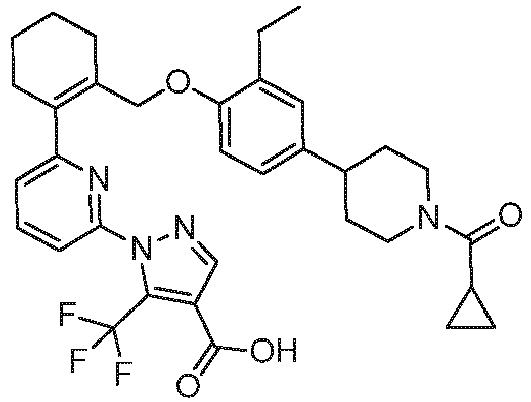
Intermediate 9 and Intermediate 2-5-2 1H NMR (400 MHz, CD3OD) δ 8.14 (s, 1H), 7.98 (t, J=7.8 Hz, 1H), 7.58 (dd, J=8.0, 0.8 Hz, 1H), 7.47 (dd, J=7.7, 0.8 Hz, 1H), 6.98 (d, J=2.2 Hz, 1H), 6.88 (dd, J=8.4, 2.3 Hz, 1H), 6.59 (d, J=8.4 Hz, 1H), 4.62 (d, J=11.1 Hz, 1H), 4.49 - 4.37 (m, 3H), 3.18 - 3.26 (m, 1H), 2.67 - 2.78 (m, 2H), 2.60 (q, J=7.5 Hz, 2H), 2.45 - 2.54 (m, 2H), 2.34 - 2.41 (m, 2H), 1.95 - 2.04 (m, 1H), 1.90 (d, J=12.7 Hz, 1H), 1.73 - 1.85 (m, 5H), 1.44 - 1.69 (m, 2H), 1.16 (t, J=7.5 Hz, 3H), 0.75 - 0.93 (m, 4H). HRMS calcd. for C34H38F3N4O4 (M+H) 623.2845 found 623.2863 (M+H) 1-(6-(2-((4-(1-(Cyclopropanecarbonyl) piperidin-4-yl)-2-ethylphenoxy)methyl)cyc lohex-1-en-1-yl)pyridin-2-yl)-5-(trifluoromethyl)-1H-pyrazole-4-carboxylic acid 8-2 
Intermediate 9 and Intermediate 3-2 1H NMR (400MHz, DMSO-d 6) δ 13.37 (br. s., 1H), 8.50 (dd, J=0.7, 4.8 Hz, 1H), 8.25 (s, 1H), 8.08 (t, J=7.9 Hz, 1H), 7.77 (dt, J=1.7, 7.6 Hz, 1H), 7.67 (d, J=7.8 Hz, 1H), 7.49 (d, J=7.7 Hz, 1H), 7.46 (d, J=7.8 Hz, 1H), 7.27 (dd, J=5.1, 6.5 Hz, 1H), 6.85 (d, J=8.4 Hz, 1H), 6.57 (dd, J=2.5, 8.4 Hz, 1H), 6.53 (d, J=2.3 Hz, 1H), 4.38 (s, 2H), 3.75 (s, 2H), 3.51 (s, 2H), 2.68 (dd, J=3.8, 7.5 Hz, 4H), 2.41 (br. s., 2H), 2.27 (br. s., 2H), 1.68 (br. s., 4H). HRMS calcd. for C32H31F3N5O3 (M+H) 590.2379, found 590.2405. 1-(6-(2-(((2-(Pyridin-2-ylmethyl)-1,2,3,4-tetrahydroisoquinolin-6-yl)oxy)methyl)cyclohex-1-en-1-yl)pyridin-2-yl)-5-(trifluoromethyl)-1H-pyrazole-4-carboxylic acid -

- To a suspension of Intermediate 1-3 (584 mg, 1.801 mmol), bis(pinacolato)diboron (457 mg, 1.801 mmol), KOAc (321 mg, 3.28 mmol) in dioxane (8.2 mL) was added chloro(2-dicyclohexylphosphino-2',6'-dimethoxy-1,1'-biphenyl)[2-(2-aminoethylphenyl)]palladium(II) methyl-t-butylether adduct (CAS # 1028206-58-7, 55.1 mg, 0.082 mmol). The mixture was then stirred at 120 °C under microwave irradiation for 30 min. To the reaction mixture was then added a solution of Intermediate 4 (500 mg, 1.638 mmol) in dioxane (8.2 mL), followed by 2M aq. potassium phosphate (2.4 mL, 4.91 mmol), Pd(dppf)Cl2.CH2Cl2 (66.9 mg, 0.082 mmol). The mixture was then stirred at 110 °C under microwave irradiation for 30 min. The organic phase was then separated, and then concentrated onto Celite®. The resulting residue was purified by silica gel flash column chromatography (0-20% EtOAc/heptane) to afford the title compound. MS (ESI+) m/z 470.7 (M+H).
-

- TBAF (1 M in THF, 478 µl, 0.478 mmol) was added to a THF (4.5 mL) solution of Example 9-A (214 mg, 0.456 mmol) at 0 °C. The solution was stirred at 0 °C for 1 h, and then warmed to rt for 1 h. The reaction mixture was then diluted with EtOAc and 1/1 water: saturated. aq. sodium bicarbonate. The organic layer was then separated, and then washed with brine, dried over sodium sulfate, filtered, and then concentrated to furnish the title compound. MS (ESI+) m/z 356.4 (M+H).
-
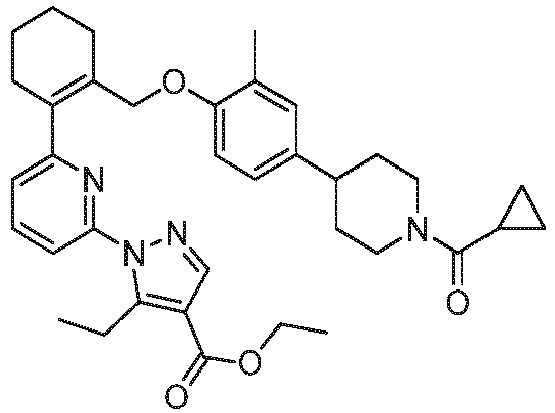
- To a solution of Example 9-B (162 mg, 0.456 mmol), Intermediate 2-1 (118 mg, 0.456 mmol) and PPh3(143 mg, 0.547 mmol) in THF (2.28 mL), DIAD (106 µl, 0.547 mmol) was added at rt. The mixture was then stirred for 1 h, and then diluted with DCM and water. The mixture was then passed through an ISOLUTE® Phase Separator. The organic phase was then concentrated onto Celite®. The resulting residue was purified by silica gel flash column chromatography (heptane/EtOAc = 100/0 to 50/50) to afford the title compound. MS (ESI+) m/z 597.5 (M+H).
-

- To a solution of Example 9-C (148 mg, 0.186 mmol) in MeOH (2.5 mL) and THF (2.5 mL) was added 1 M aq. LiOH (2.42 mL, 2.42 mmol). The mixture was then stirred at 50 °C for 5 h, and the cooled to room temperature. The reaction mixture was rendered acidic by the addition of 1 M HCl (ca. 2.5 mL), and then extract with EtOAc. The organic layer was separated and then concentrated. The resulting residue was purified by SFC (Princeton, 2-ethylpyridine 21x150mm 5um, MeOH w/NH4OH modifier) to afford the title compound. 1H NMR (400 MHz, CD3OD) δ 7.99 (s, 1H), 7.95 - 7.87 (m, 1H), 7.64 (dd, J = 8.1, 0.8 Hz, 1H), 7.33 (dd, J = 7.7, 0.9 Hz, 1H), 6.96 (d, J = 2.2 Hz, 1H), 6.85 (dd, J = 8.3, 2.3 Hz, 1H), 6.55 (d, J = 8.4 Hz, 1H), 4.61 (d, J = 13.0 Hz, 1H), 4.43 (s, 3H), 3.35 (d, J = 7.4 Hz, 2H), 3.27 - 3.17 (m, 1H), 2.77 - 2.63 (m, 2H), 2.51 (t, J = 4.6 Hz, 2H), 2.38 (dd, J = 6.7, 3.8 Hz, 2H), 2.15 (s, 3H), 1.98 (tt, J = 7.9, 4.8 Hz, 1H), 1.83 - 1.74 (m, 6H), 1.66 - 1.41 (m, 2H), 1.19 (t, J = 7.3 Hz, 3H), 0.92 - 0.84 (m, 2H), 0.84 - 0.75 (m, 2H). HRMS calcd for C34H41N4O4 (M+H)+ 569.3050, found 569.3129.
-

- To a suspension of Intermediate 1-4 (70.0 mg, 0.171 mmol), Intermediate 5-1 (107 mg, 0.171 mmol), and Cs2CO3 (167 mg, 0.512 mmol) in dioxane (2.1 mL) and DMF (348 µl), and water (50 uL) was added chloro(2-dicyclohexylphosphino-2',6'-dimethoxy-1,1'-biphenyl)[2-(2-aminoethylphenyl)]palladium(II) - methyl-t-butyl ether adduct (CAS # 1028206-58-7, 5.74 mg, 8.53 µmol). The mixture was then stirred at 110 °C under microwave irradiation for 1 h. The reaction mixture was diluted with EtOAc and water. The organic phase was separated, and then concentrated onto Celite®. The resulting residue was purified by silica gel flash column chromatography (0-50% EtOAc in heptane) to afford the title compound. MS (ESI+) m/z 636.2 (M+H).
-

- Example 10-A (38 mg, 0.060 mmol) was dissolved in MeOH (0.6 mL) and THF (0.6 mL) and LiOH (2M in water, 149 µl, 0.299 mmol) was stirred at rt for 16 h. The reaction mixture was rendered acidic by the addition of 1 M HCl (ca. 0.3 mL), and then and extract with EtOAc. The organic layer was separated and then concentrated. The resulting residue was purified by RP-HPLC (HC-C) to afford the title compound. 1H NMR (400 MHz, CD3OD) δ 8.04 (d, J = 0.7 Hz, 1H), 7.49 (t, J = 7.8 Hz, 1H), 7.37 (dt, J = 7.8, 1.4 Hz, 1H), 7.34 (ddd, J = 7.9, 2.2, 1.1 Hz, 1H), 7.23 (t, J = 1.8 Hz, 1H), 6.92 (d, J = 2.3 Hz, 1H), 6.86 (dd, J = 8.4, 2.3 Hz, 1H), 6.50 (d, J = 8.3 Hz, 1H), 4.61 (d, J = 13.1 Hz, 1H), 4.43 (d, J = 13.5 Hz, 1H), 4.29 (s, 2H), 3.27 - 3.17 (m, 1H), 2.77 - 2.63 (m, 2H), 2.43 - 2.31 (m, 4H), 2.12 (s, 3H), 2.05 - 1.95 (m, 1H), 1.87 (d, J = 13.5 Hz, 1H), 1.78 (m, 5H), 1.67 - 1.41 (m, 2H), 0.93 - 0.77 (m, 4H). HRMS calcd for C34H36F3N3O4 (M+H)+ 608.2658, found 608.2673.
-

- The title compound was synthesized starting from Example 1-B. To a solution of Example 1-B (21 mg, 0.030 mmol) in DCM (0.5 mL) was DIPEA (0.015 mL, 0.089 mmol) followed by N-Boc glycine (CAS # 4530-20-5, 7.76 mg, 0.044 mmol) and HATU (12 mg, 0.032 mmol). The reaction mixture was stirred at room temperature for approximately 15h at which time the mixture was charged with additional HATU (3 mg, 0.008mmol) and stirred for an additional 2h. The mixture was then concentrated to near dryness and the resulting residue diluted with 1,4-dioxane (0.5 mL) and charged with 2N aqueous LiOH. The mixture was then heated at 50 °C for approximately 30 minutes. The mixture was then acidified by the slow addition of 1N aqueous HCl and further diluted with DCM and water, the resulting mixture was passed through a ISOLUTE® Phase Separator and the organic eluent is collected and concentrated. The resulting residue is dissolved in DCM (1 mL), cooled to 0 °C and charged with TFA (0.3 mL) and stirred for 15 minutes at which time the mixture was concentrated to dryness and purified via RP-HPLC (HC-B) to furnish the title compound. 1H NMR (400MHz, DMSO-d6 ) δ 8.48 (br. s., 1H), 8.05 (t, J=7.8 Hz, 1H), 7.83 (s, 1H), 7.66 (dd, J=0.6, 7.9 Hz, 1H), 7.37 (dd, J=0.6, 7.6 Hz, 1H), 6.91 (d, J=8.6 Hz, 1H), 6.84 (d, J=1.8 Hz, 1H), 6.59 - 6.53 (m, 1H), 4.45 - 4.37 (m, 2H), 4.35 - 4.22 (m, 2H), 3.78 (d, J=13.6 Hz, 1H), 3.60 (d, J=15.5 Hz, 1H), 3.51 - 3.45 (m, 1H), 3.10 - 2.99 (m, 2H), 2.64 - 2.57 (m, 2H), 2.30 (br. s., 2H), 2.15 (br. s., 2H), 2.05 (s, 3H), 1.85 - 1.72 (m, 1H), 1.71 - 1.61 (m, 4H), 1.60 - 1.53 (m, 2H), 1.15 (dq, J=4.2, 12.5 Hz, 1H). HRMS calcd. for C31H35F3N5O4 (M+H) 598.2641, found 598.2657.
-

- A mixture of Intermediate 1-1 (2.40 g, 6.59 mmol), bis(pinacolato)diboron (1.84 g, 7.25 mmol), chloro(2-dicyclohexylphosphino-2',6'-dimethoxy-1,1'-biphenyl)[2-(2-aminoethylphenyl)]palladium(II) methyl-t-butylether adduct (0.089 g, 0.132 mmol), and KOAc (0.97 g, 9.89 mmol) in dioxane (60 mL) was stirred at 110 °C for 2.25 h. To the mixture was then added chloro(2-dicyclohexylphosphino-2',6'-dimethoxy-1,1'-biphenyl)[2-(2-aminoethylphenyl)]palladium(II) methyl-t-butylether adduct (0.089 g, 0.132 mmol). The mixture was then stirred for 1 h and then cooled to 65 °C. The reaction mixture was added via cannula to a solution of Intermediate 6 (3.33 g, 8.57 mmol), chloro(2-dicyclohexylphosphino-2',6'-dimethoxy-1,1'-biphenyl)[2-(2-aminoethylphenyl)]palladium(II) methyl-t-butylether adduct (0.222 g, 0.330 mmol), and Na2CO3 (2 M in H2O, 6.59 mL, 13.2 mmol). The whole mixture was then stirred at 100 °C for 16 h. The reaction mixture was concentrated with silica gel. The resulting residue was purified by silica gel flash column chromatography (0-5% acetone in heptane) to afford the title compound. MS (ESI+) m/z (M+H) 524.2.
-

- To a solution of Example 12-A (0.720 g, 1.37 mmol) in THF (10 mL) was added a solution of TBAF (2.1 mL, 2.1 mmol, 1 M THF). The mixture was then stirred at rt for 1 h, and then concentrated. The resulting residue was then dissolved in EtOAc. The organic layer was then washed with brine, dried over sodium sulfate, filtered and then concentrated. The resulting residue was purified by silica gel flash column chromatography (0-50% EtOAc in heptane) to afford the title compound. MS (ESI+) m/z 410.3 (M+H).
-

- The title compound was synthesized in a similar manner to the preparation of Example 7 starting from Example 12-B using Intermediate 2-1. MS (ESI+) m/z (M+H) 651.2.
-

- To a mixture of Example 12-C (0.061 g, 0.094 mmol) in THF (2 mL)/ MeOH (1 mL)/water (1 mL) was added LiOH•H2O (0.071 g, 1.687 mmol). The mixture was then stirred at rt for 3 h. The reaction mixture was rendered acidic by the addition of 3 M aq. HCl (∼pH = 3). The mixture was then diluted with EtOAc and water. The organic layer was then separated. The aqueous layer was then extracted twice with EtOAc. The combined organic layers were dried over sodium sulfate, filtered and concentrated. The resulting residue was purified by silica gel flash column chromatography (5-20% MeOH in DCM) to afford the title compound. 1H NMR (400 MHz, CD3OD) δ 7.99 (s, 1H), 7.94 (t, J = 7.8 Hz, 1H), 7.56 (dd, J = 8.0, 0.8 Hz, 1H), 7.40 (dd, J = 7.7, 0.9 Hz, 1H), 6.96 (d, J = 2.3 Hz, 1H), 6.87 (dd, J = 8.4, 2.3 Hz, 1H), 6.56 (d, J = 8.4 Hz, 1H), 4.62 (d, J = 13.0 Hz, 1H), 4.48 - 4.37 (m, 3H), 3.28 - 3.17 (m, 1H), 2.76 - 2.61 (m, 3H), 2.52 - 2.43 (m, 1H), 2.41 - 2.28 (m, 1H), 2.16 (s, 3H), 2.08 - 1.94 (m, 2H), 1.82 (dd, J = 23.0, 12.4 Hz, 4H), 1.67 - 1.43 (m, 2H), 1.37 (ddd, J = 12.4, 9.1, 5.5 Hz, 1H), 1.04 (d, J = 6.4 Hz, 3H), 0.93 - 0.76 (m, 4H); HRMS; calcd. for C34H38F3N4O4 (M+H) 623.2845, found 623.2882.
-

- Resolution of the enantiomers of (±)-1-(6-(2-((4-(1-(cyclopropanecarbonyl)piperidin-4-yl)-2-methylphenoxy)methyl)-5-methylcyclohex-1-en-1-yl)pyridin-2-yl)-5-(trifluoromethyl)-1H-pyrazole-4-carboxylic acid was achieved by chiral SFC using a CHIRALPAK® AS-H column with 15% MeOH in CO2 to afford (+)-1-(6-(2-((4-(1-(cyclopropanecarbonyl)piperidin-4-yl)-2-methylphenoxy)methyl)-5-methylcyclohex-1-en-1-yl)pyridin-2-yl)-5-(trifluoromethyl)-1H-pyrazole-4-carboxylic acid (enantiomer-1, tr = 2.7 min) and (-)-1-(6-(2-((4-(1-(cyclopropanecarbonyl)piperidin-4-yl)-2-methylphenoxy)methyl)-5-methylcyclohex-1-en-1-yl)pyridin-2-yl)-5-(trifluoromethyl)-1H-pyrazole-4-carboxylic acid (enantiomer-2, tr = 3.23 min).
-

- To a mixture of Intermediate 1-1 (2.81 g, 7.72 mmol) and bis(pinacolato)diboron (2.16 g, 8.49 mmol) in dioxane (50 mL), was added potassium acetate (1.14 g, 11.6 mmol), followed by chloro(2-dicyclohexylphosphino-2',6'-dimethoxy-1,1'-biphenyl)[2-(2-aminoethylphenyl)]palladium(II) methyl-t-butylether adduct (0.10 g, 0.15 mmol). The mixture was stirred at 110 °C for 20 h. To the reaction mixture were added (±)-2-(((tert-Butyldimethylsilyl)oxy)methyl)-3-methylcyclohex-1-en-1-yl trifluoromethanesulfonate (Intermediate 7) (3.0 g, 7.72 mmol), chloro(2-dicyclohexylphosphino-2',6'-dimethoxy-1,1'-biphenyl)[2-(2-aminoethylphenyl)]palladium(II) methyl-t-butylether adduct (0.26 g, 0.386 mmol), dioxane (50 mL) and then 1 M aq. Na2CO3 (15.5 mL, 15.5 mmol). The mixture was then stirred at 100 °C for 20 h, and then cooled to room temperature. The reaction mixture was then diluted with EtOAc, and then washed with water (x2) and brine. The aqueous layer was then extracted with EtOAc, which was then washed with water and brine. The combined organic layers were dried over sodium sulfate, filtered, and then concentrated. The resulting residue was purified by silica gel flash column chromatography (0-100% EtOAc in heptane) to afford the title compound. MS (ESI+) m/z 524.3 (M+H).
-

- TBAF (1M in THF, 2.9 mL, 2.9 mmol, 1 M) was added to a THF (19 mL) solution of Example 13-A (1.0 g, 1.93 mmol) at rt. The mixture was stirred at rt for 3 h, and then diluted with EtOAc and water. The organic layer was separated, and then washed with water, and then brine, dried over sodium sulfate, filtered and concentrated. The resulting residue was purified by silica gel flash column chromatography (0-100% EtOAc in heptane) to afford the title compound. MS (ESI+) m/z 410.6 (M+H).
-

- To a solution of Intermediate 2-4 (200 mg, 0.74 mmol), Example 13-B (300 mg, 0.74 mmol), and PPh3 (240 mg, 0.93 mmol) in THF (6 mL) was added DIAD (0.2 mL, 0.93 mmol). The mixture was stirred at rt for 1 h, and then diluted with water. The mixture was then extracted with EtOAc. The organic layer was dried over magnesium sulfate, filtered and concentrated. The resulting residue was purified by silica gel flash column chromatography (0-100% EtOAc in heptane) to give the title compound.
- Resolution of the enantiomers of (±)-ethyl 1-(6-(2-((4-(1-(cyclopropanecarbonyl)piperidin-4-yl)-3-ethylphenoxy)methyl)-3-methylcyclohex-1-en-1-yl)pyridin-2-yl)-5-(trifluoromethyl)-1H-pyrazole-4-carboxylate was achieved by chiral SFC using a CHIRALPAK® AD-H column with 5-55% MeOH in CO2 to afford (+) or (-)-ethyl 1-(6-(2-((4-(1-(cyclopropanecarbonyl)piperidin-4-yl)-3-ethylphenoxy)methyl)-3-methylcyclohex-1-en-1-yl)pyridin-2-yl)-5-(trifluoromethyl)-1H-pyrazole-4-carboxylate (enantiomer-1, tr = 2.3 min) and (-) or (+)-ethyl 1-(6-(2-((4-(1-(cyclopropanecarbonyl)piperidin-4-yl)-3-ethylphenoxy)methyl)-3-methylcyclohex-1-en-1-yl)pyridin-2-yl)-5-(trifluoromethyl)-1H-pyrazole-4-carboxylate (enantiomer-2, tr = 2.5 min).
-

- To a solution of (+) or (-)-ethyl 1-(6-(2-((4-(1-(cyclopropanecarbonyl)piperidin-4-yl)-3-ethylphenoxy)methyl)-3-methylcyclohex-1-en-1-yl)pyridin-2-yl)-5-(trifluoromethyl)-1H-pyrazole-4-carboxylate (Example 13-C(b), enantiomer-1, tr = 2.3 min) (73 mg, 0.110 mmol) in THF (2 mL)/MeOH (1 mL)/water (1 mL) was added LiOH (26 mg, 1.1 mmol). The mixture as then stirred at rt for 1 h. The reaction mixture was then diluted with water, and then rendered acidic by the addition of 1 M aq. HCl (pH∼2). The mixture was extracted with EtOAc. The organic phase was dried over MgSO4, filtered and then concentrated to afford the title compound. 1H NMR (400 MHz, CD3OD) δ 8.06 (s, 1H), 7.95 (t, J = 7.8 Hz, 1H), 7.56 (dd, J = 8.0, 0.9 Hz, 1H), 7.45 (dd, J = 7.7, 0.9 Hz, 1H), 6.96 - 7.05 (m, 1H), 6.52 - 6.63 (m, 2H), 4.64 (d, J = 13.1 Hz, 1H), 4.32 - 4.54 (m, 3H), 2.93 - 3.07 (m, 1H), 2.68 - 2.80 (m, 1H), 2.50 - 2.67 (m, 4H), 2.31 - 2.44 (m, 1H), 2.27 (t, J = 7.4 Hz, 1H), 1.93 - 2.06 (m, 1H), 1.46 - 1.92 (m, 8H), 1.21 (d, J = 7.0 Hz, 3H), 1.14 (t, J = 7.5 Hz, 3H), 0.75 - 0.99 (m, 4H). HRMS; calcd. for C35H40F3N4O4 (M+H) 637.2996, found 637.3014.
-

- The title compound was synthesized from (-) or (+)-ethyl 1-(6-(2-((4-(1-(cyclopropanecarbonyl)piperidin-4-yl)-3-ethylphenoxy)methyl)-3-methylcyclohex-1-en-1-yl)pyridin-2-yl)-5-(trifluoromethyl)-1H-pyrazole-4-carboxylate (Example 13-C(b), (enantiomer-2, tr = 2.5 min) analogously to the preparation of Example 13a. 1H NMR (400 MHz, CD3OD) δ 8.06 (s, 1H), 7.95 (t, J = 7.8 Hz, 1H), 7.56 (dd, J = 8.0, 0.9 Hz, 1H), 7.45 (dd, J = 7.7, 0.9 Hz, 1H), 6.96 - 7.05 (m, 1H), 6.52 - 6.63 (m, 2H), 4.64 (d, J = 13.1 Hz, 1H), 4.32 - 4.54 (m, 3H), 2.93 - 3.07 (m, 1H), 2.68 - 2.80 (m, 1H), 2.50 - 2.67 (m, 4H), 2.31 - 2.44 (m, 1H), 2.27 (t, J = 7.4 Hz, 1H), 1.93 - 2.06 (m, 1H), 1.46 - 1.92 (m, 8H), 1.21 (d, J = 7.0 Hz, 3H), 1.14 (t, J = 7.5 Hz, 3H), 0.75 - 0.99 (m, 4H). HRMS; calcd. for C35H40F3N4O4 (M+H) 637.2996, found 637.3014.
-

- A suspension of Intermediate 1-1, bis(pinacolato)diboron (2.08 g, 8.20 mmol), potassium acetate (1.10 g, 11.2 mmol) and chloro(2-dicyclohexylphosphino-2',6'-dimethoxy-1,1'-biphenyl)[2-(2-aminoethylphenyl)]palladium(II) methyl-t-butylether adduct (0.100 g, 0.149 mmol) in dioxane (50 mL) was stirred at 110 °C for 3 h. To the reaction mixture was then added Intermediate 8 (3.0 g, 7.45 mmol), chloro(2-dicyclohexylphosphino-2',6'-dimethoxy-1,1'-biphenyl)[2-(2-aminoethylphenyl)]palladium(II) methyl-t-butylether adduct (0.251 g, 0.373 mmol), dioxane (50 mL,) and 1 M aq. Na2CO3 (14.9 mL, 14.9 mmol). The mixture was then stirred at 100 °C for 16 h, and then cooled to rt. The reaction mixture was then diluted with EtOAc and water. The organic layer was separated, and then washed with water and then brine. The aqueous layer was extracted with EtOAc, which was then washed with water and brine. The combined organic layers were dried over sodium sulfate, filtered and then concentrated. The resulting residue was purified by silica gel flash column chromatography (0-100% EtOAc in heptane) to afford the title compound. MS (ESI+) m/z 538.3 (M+H).
-

- TBAF (1 M in THF, 0.72 mL, 0.72 mmol) was added to a THF (5 mL) solution of Example 14-A (257 mg, 0.478 mmol) at rt. The mixture was then stirred at rt for 3 h, and then diluted with EtOAc and water. The organic layer was then washed with water and brine, dried over sodium sulfate, filtered and concentrated. The resulting residue was purified by silica gel flash column chromatography (0-100% EtOAc in heptane) to afford the title compound. (ESI+) m/z 424.4 (M+H).
-

- To a solution Example 14-B (45 mg, 0.106 mmol), Intermediate 2-2 (48.7 mg, 0.159 mmol) and PPh3 (41.8 mg, 0.159 mmol) in THF (3 mL) was added DIAD (0.04 mL, 0.206 mmol), and then the mixture was stirred at rt for 2 h. The reaction mixture was purified by silica gel flash column chromatography (0-100% EtOAc in heptane) to afford the title compound. (ESI+) m/z 711.5 (M+H).
-

- A mixture of Example 14-C (62 mg, 0.087 mmol) and TFA (0.1 mL, 1.30 mmol) in DCM (3 mL) was stirred at rt for 2 h. The reaction mixture was then diluted with toluene, and then concentrated. The resulting residue was purified by silica gel flash column chromatography (0-20% MeOH/DCM) to afford the title compound. MS (ESI+) m/z 611.5 (M+H).
-

- To a solution of Example 14-D (35 mg, 0.057 mmol) and DIPEA (0.03 mL, 0.17 mmol) in DCM (3 mL) was added cyclopropanecarbonyl chloride (0.01 mL, 0.110 mmol). The mixture was stirred at rt for 1 h. The reaction mixture purified by silica gel flash column chromatography (20% EtOAc in heptane) to afford the title compound. MS (ESI+) m/z 679.5 (M+H).
-

- To a solution of Example 14-E (35 mg, 0.052 mmol) in THF (2 mL)/MeOH (1 mL)/water (1 mL) was added LiOH (14 mg, 0.619 mmol). The mixture was then stirred at rt for 20 h, and diluted with water, and then rendered acidic by 1M aq. HCl (pH=2). The mixture was then extracted with EtOAc. The organic phase was dried over sodium sulfate filtered and concentrated to afford the title compound. 1H NMR (400 MHz, CD3OD) δ 8.11 (s, 1H), 7.87 (t, J = 7.8 Hz, 1H), 7.56 (dd, J = 7.7, 0.9 Hz, 1H), 7.51 (dd, J = 8.0, 0.9 Hz, 1H), 6.98 - 7.07 (m, 1H), 6.59 (dt, J = 4.4, 2.4 Hz, 2H), 4.65 (d, J = 13.3 Hz, 1H), 4.46 (d, J = 13.3 Hz, 1H), 4.30 (s, 2H), 3.01 (t, J = 12.0 Hz, 1H), 2.74 (t, J = 12.9 Hz, 1H), 2.65 (q, J = 7.5 Hz, 2H), 2.48 (t, J = 6.3 Hz, 2H), 2.27 (t, J = 7.4 Hz, 1H), 1.95 - 2.07 (m, 1H), 1.49 - 1.93 (m, 9H), 1.21 (s, 6H), 1.17 (t, J = 7.5 Hz, 3H), 0.73 - 0.99 (m, 4H). HRMS calcd. for C36H42F3N4O4 (M+H) 651.3153, found 651.3165.
-

- To a solution of Intermediate 2-4 (152 mg, 0.586 mmol), PPh3 (192 mg, 0.733 mmol) and Example 13-B (240 mg, 0.586 mmol) in THF (6 mL) at rt was added DIAD (0.15 mL, 0.733 mmol). The mixture was then stirred at room temperature for 1 h, and then diluted with water. The mixture was then extracted with EtOAc. The organic layer was then dried over magnesium sulfate, filtered and concentrated. The resulting residue was purified by silica gel flash column chromatography (0-100% EtOAc in heptane), followed by RP-HPLC (HC-B) to afford the title compound. MS (ESI+) m/z 651.4 (M+H).
- Resolution of the enantiomers of (±)-ethyl 1-(6-(2-((4-(1-(cyclopropanecarbonyl)piperidin-4-yl)-2-methylphenoxy)methyl)-3-methylcyclohex-1-en-1-yl)pyridin-2-yl)-5-(trifluoromethyl)-1H-pyrazole-4-carboxylate was achieved by chiral SFC using a CHIRALPAK® AD-H column with 30% (10 mM NH4OH in 2-propanol) in CO2 to afford (+) or (-)-ethyl 1-(6-(2-((4-(1-(cyclopropanecarbonyl)piperidin-4-yl)-2-methylphenoxy)methyl)-3-methylcyclohex-1-en-1-yl)pyridin-2-yl)-5-(trifluoromethyl)-1H-pyrazole-4-carboxylate (enantiomer-1, tr = 2.6 min) and (-) or (+)-ethyl 1-(6-(2-((4-(1-(cyclopropanecarbonyl)piperidin-4-yl)-2-methylphenoxy)methyl)-3-methylcyclohex-1-en-1-yl)pyridin-2-yl)-5-(trifluoromethyl)-1H-pyrazole-4-carboxylate (enantiomer-2, tr = 2.8 min).
-

- To a solution of (+) or (-)-ethyl 1-(6-(2-((4-(1-(cyclopropanecarbonyl)piperidin-4-yl)-2-methylphenoxy)methyl)-3-methylcyclohex-1-en-1-yl)pyridin-2-yl)-5-(trifluoromethyl)-1H-pyrazole-4-carboxylate (Example 15-A(b), enatiomer-1, tr = 2.6 min) (70 mg, 0.108 mmol) in THF (2 mL)/MeOH (1 mL)/ water (1 mL) was added LiOH (20 mg, 0.835 mmol). The mixture was then stirred at rt for 20 h. The reaction mixture was diluted with water, and then rendered acidic by the addition of 1M aq. HCl (ca. pH=2). The mixture was extracted with EtOAc. The organic layer was dried over MgSO4, filtered and concentrated. The residue was purified by RP-HPLC (HC-A) to afford the title compound. 1H NMR (400 MHz, CD3OD) δ 8.06 (s, 1H), 7.95 (t, J = 7.8 Hz, 1H), 7.56 (dd, J = 8.0, 0.9 Hz, 1H), 7.45 (dd, J = 7.7, 0.9 Hz, 1H), 7.05 - 6.96 (m, 1H), 6.63 - 6.52 (m, 2H), 4.64 (d, J = 13.1 Hz, 1H), 4.56 - 4.30 (m, 3H), 2.99 (tt, J = 12.4, 3.4 Hz, 1H), 2.81 - 2.67 (m, 1H), 2.66 - 2.50 (m, 4H), 2.45 - 2.31 (m, 1H), 2.06 - 1.94 (m, 1H), 1.91 - 1.44 (m, 9H), 1.21 (d, J = 7.0 Hz, 3H), 1.14 (t, J = 7.5 Hz, 3H), 0.97 - 0.73 (m, 4H).
HRMS calcd. for C34H38F3N4O4 (M+H) 623.2840, found 623.2870. -

- The title compound was synthesized from (-) or (+)-ethyl 1-(6-(2-((4-(1-(cyclopropanecarbonyl)piperidin-4-yl)-2-methylphenoxy)methyl)-3-methylcyclohex-1-en-1-yl)pyridin-2-yl)-5-(trifluoromethyl)-1H-pyrazole-4-carboxylate (Example 15-A(b), enantiomer-2, tr = 2.8 min) analogously to the preparation of Example 15a. 1H NMR (400 MHz, CD3OD) δ 8.06 (s, 1H), 7.95 (t, J = 7.8 Hz, 1H), 7.56 (dd, J = 8.0, 0.9 Hz, 1H), 7.45 (dd, J = 7.7, 0.9 Hz, 1H), 7.05 - 6.96 (m, 1H), 6.63 - 6.52 (m, 2H), 4.64 (d, J = 13.1 Hz, 1H), 4.56 - 4.30 (m, 3H), 2.99 (tt, J = 12.4, 3.4 Hz, 1H), 2.81 - 2.67 (m, 1H), 2.66 - 2.50 (m, 4H), 2.45 - 2.31 (m, 1H), 2.06 - 1.94 (m, 1H), 1.91 - 1.44 (m, 9H), 1.21 (d, J = 7.0 Hz, 3H), 1.14 (t, J = 7.5 Hz, 3H), 0.97 - 0.73 (m, 4H). HRMS calcd. for C34H38F3N4O4 (M+H) 623.2840, found 623.2870.
-

- To a suspension of (±)-tert-butyl 4-(2-ethyl-4-((6-methyl-2-(((trifluoromethyl)-sulfonyl)oxy)cyclohex-1-en-1-yl)methoxy)phenyl)piperidine-1-carboxylate (Intermediate 10) (1.22 g, 2.17 mmol), bis(pinacolato)diboron (0.827 g, 3.26 mmol), KOAc (0.384 g, 3.91 mmol) in dioxane (21.7 mL) was added PdCl2(dppf).CH2Cl2 adduct (0.06 g, 0.07 mmol). The mixture was then stirred at 60 °C for 2 h, and then at 80 °C for 1.5 h. The reaction mixture was cooled to room temperature, and then diluted with EtOAc. The mixture was washed with water, dried over Na2SO4, filtered, and then concentrated. The resulting residue was purified by silica gel flash column chromatography (0-40% EtOAc/heptane) to afford the title compound. MS (ESI+) m/z 484.5 (M-tBu+2H)+
-

- A suspension of (±)-tert-butyl 4-(2-ethyl-4-((6-methyl-2-(4,4,5,5-tetramethyl-1,3,2-dioxaborolan-2-yl)cyclohex-1-en-1-yl)methoxy)phenyl)piperidine-1-carboxylate (1.56 g, 2.89 mmol), ethyl 1-(6-bromopyridin-2-yl)-5-methyl-1H-pyrazole-4-carboxylate (Intermediate 1-5) (1.26 g, 4.05 mmol), 2 M aq. K3PO4 (4.34 mL, 8.68 mmol), and chloro(2-dicyclohexylphosphino-2',6'-dimethoxy-1,1'-biphenyl)[2-(2-aminoethylphenyl)]palladium(II) methyl-t-butylether adduct (CAS# 1028206-58-7, 0.097 g, 0.145 mmol) in DMF (10 mL) was stirred at 110 °C for 3 h. The reaction mixture was cooled to room temperature, and then diluted with EtOAc. The mixture was then washed with water, dried over Na2SO4, filtered, and then concentrated. The resulting residue was purified by silica gel flash column chromatography (0-30% EtOAc/heptane) to afford the title compound. MS (ESI+) m/z 643.6 (M+H)+
-
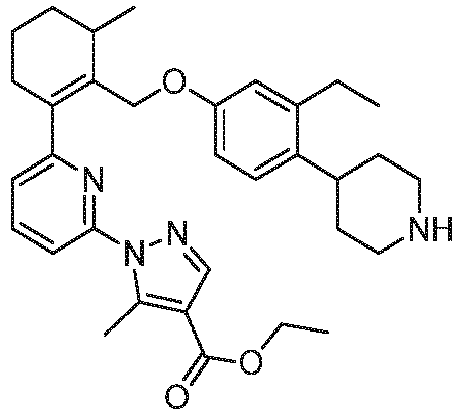
- A solution of (±)-tert-butyl 4-(4-((2-(6-(4-(ethoxycarbonyl)-5-methyl-1H-pyrazol-1-yl)pyridin-2-yl)-6-methylcyclohex-1-en-1-yl)methoxy)-2-ethylphenyl)piperidine-1-carboxylate (225 mg, 0.350 mmol) and TFA (1.1 mL) in DCM (5 mL) was stirred at 0 °C for 3 h. The reaction was quenched with satd. aq. NaHCO3. The mixture was then extracted three times with EtOAc. The combined organic layers were washed with brine, dried over Na2SO4, filtered, and then concentrated to furnish the title compound. MS (ESI+) m/z 543.5 (M+H)+
-

- To a solution of (±)-ethyl 1-(6-(2-((3-ethyl-4-(piperidin-4-yl)phenoxy)methyl)-3-methylcyclohex-1-en-1-yl)pyridin-2-yl)-5-methyl-1H-pyrazole-4-carboxylate (0.2 g, 0.37 mmol) in DCM (4 mL) was added DIPEA (0.26 mL), followed by cyclopropanecarbonyl chloride (0.067 mL, 0.737 mmol). The mixture was stirred at room temperature for 72 h, and then diluted with water. The mixture was extracted twice with DCM. Combined organic extracts were washed with brine, dried over Na2SO4, filtered, and then concentrated. The resulting residue was purified by silica gel flash column chromatography (0-70% EtOAc/heptane) to afford the title compound. MS (ESI+) m/z 611.5 (M+H)+.
- Resolution of the enantiomers of (±)-ethyl 1-(6-(2-((4-(1-(cyclopropanecarbonyl)piperidin-4-yl)-3-ethylphenoxy)methyl)-3-methylcyclohex-1-en-1-yl)pyridin-2-yl)-5-methyl-1H-pyrazole-4-carboxylate was achieved by chiral SFC using a CHIRALPAK® AD-H column with 25% iPrOH in CO2 to afford (+) or (-)-ethyl 1-(6-(2-((4-(1-(cyclopropanecarbonyl)piperidin-4-yl)-3-ethylphenoxy)methyl)-3-methylcyclohex-1-en-1-yl)pyridin-2-yl)-5-methyl-1H-pyrazole-4-carboxylate (enantiomer-1, tr = 5.9 min) and (-) or (+)-ethyl 1-(6-(2-((4-(1-(cyclopropanecarbonyl)piperidin-4-yl)-3-ethylphenoxy)methyl)-3-methylcyclohex-1-en-1-yl)pyridin-2-yl)-5-methyl-1H-pyrazole-4-carboxylate (enantiomer-2, tr = 7.5 min).
-
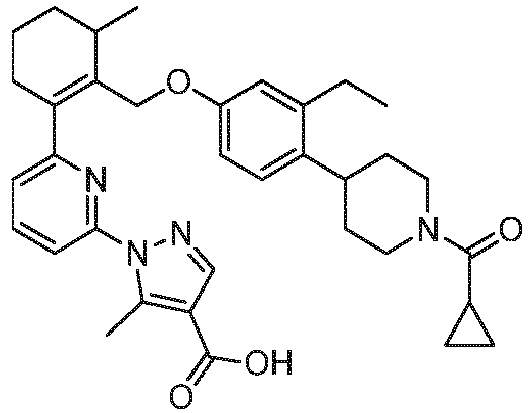
- To a solution of (+) or (-)-ethyl 1-(6-(2-((4-(1-(cyclopropanecarbonyl)piperidin-4-yl)-3-ethylphenoxy)methyl)-3-methylcyclohex-1-en-1-yl)pyridin-2-yl)-5-methyl-1H-pyrazole-4-carboxylate (enantiomer-1, tr = 5.9 min) (160 mg, 0.262 mmol) in MeOH/THF (0.2 mL/3 mL) was added 1M aq. NaOH (2.6 mL, 2.6 mmol). The mixture was stirred at room temperature for 20h, and then stirred at 50 °C for 1h. The mixture was diluted with EtOAc. The mixture was then rendered acidic by treatment with 1N aq. HCl, and was then extracted with three times with EtOAc. Combined organic extracts were then washed with brine, dried over Na2SO4, filtered, and then concentrated. The resulting residue was purified by silica gel flash column chromatography (0-10% MeOH/DCM) to afford the title compound. 1H NMR (400 MHz, CD3OD) δ 7.99 (s, 1 H) 7.90 (dd, J = 8.0, 7.8 Hz, 1 H) 7.63 (dd, J = 8.1, 0.8 Hz, 1 H) 7.34 (dd, J = 7.6, 0.8 Hz, 1 H) 7.00 (d, J = 8.1 Hz, 1 H) 6.53 - 6.60 (m, 2 H) 4.58 - 4.69 (m, 1 H) 4.48 - 4.54 (m, 1 H) 4.38 - 4.48 (m, 2 H) 3.19 - 3.27 (m, 1 H) 2.93 - 3.03 (m, 1 H) 2.78 (s, 3 H) 2.66 - 2.77 (m, 1 H) 2.52 - 2.64 (m, 4 H) 2.35 - 2.47 (m, 1 H) 1.94 - 2.04 (m, 1 H) 1.82 - 1.93 (m, 2 H) 1.46 - 1.82 (m, 6 H) 1.22 (d, J = 7.0 Hz, 3 H) 1.12 (t, J = 7.6 Hz, 3 H) 0.76 - 0.94 (m, 4 H). HRMS; calcd. for C35H43N4O4 (M+H) 583.3279, found 583.3253.
- (-) or (+)-Ethyl 1-(6-(2-((4-(1-(cyclopropanecarbonyl)piperidin-4-yl)-3-ethylphenoxy)methyl)-3-methylcyclohex-1-en-1-yl)pyridin-2-yl)-5-methyl-1H-pyrazole-4-carboxylate (enantiomer-2, tr = 7.5 min) was saponified as described in Example 16a to afford the title compound. 1H NMR and HRMS data were substantially identical to Example 16a.
-

- A suspension of ethyl 1-(6-bromopyridin-2-yl)-5-ethyl-1H-pyrazole-4-carboxylate (Intermediate 1-3) (0.56 g, 1.73 mmol), bis(pinacolato)diboron (0.48 g, 1.90 mmol), KOAc (0.34 g, 3.45 mmol) and chloro(2-dicyclohexylphosphino-2',6'-dimethoxy-1,1'-biphenyl)[2-(2-aminoethylphenyl)]palladium(II) methyl-t-butylether adduct (0.058 g, 0.086 mmol) in dioxane (5 mL) was stirred at 110 °C for 2 h. To the mixture at 50 °C were then added a solution of (±)-tert-butyl 4-(2-ethyl-4-((6-methyl-2-(((trifluoromethyl)-sulfonyl)oxy)cyclohex-1-en-1-yl)methoxy)phenyl)piperidine-1-carboxylate (Intermediate 10) (0.92 g, 1.64 mmol) in DMF (5 mL), Cs2CO3 (1.7 g, 5.2 mmol), and chloro(2-dicyclohexylphosphino-2',6'-dimethoxy-1,1'-biphenyl)[2-(2-aminoethylphenyl)]palladium(II) methyl-t-butylether adduct (0.058 g, 0.086 mmol). The mixture was then stirred at 50 °C for 15 h, and then at 110 °C for 5 h. The reaction mixture was cooled to room temperature, and then diluted with water. The mixture was then extracted twice with EtOAc. Combined organic extracts were successively washed three times with water and brine, dried over Na2SO4, filtered, and then concentrated. The resulting residue was purified by silica gel flash column chromatography (0-40% EtOAc/heptane) to afford the title compound. MS (ESI+) m/z 657.7 (M+H)+
-

- The title compound was synthesized starting from (±)-tert-butyl 4-(4-((2-(6-(4-(ethoxycarbonyl)-5-ethyl-1H-pyrazol-1-yl)pyridin-2-yl)-6-methylcyclohex-1-en-1-yl)methoxy)-2-ethylphenyl)piperidine-1-carboxylate analogously to the procedure as described in Example 16-C. MS (ESI+) m/z 557.5 (M+H)+
-

- The title compound was synthesized by reacting (±)-ethyl 5-ethyl-1-(6-(2-((3-ethyl-4-(piperidin-4-yl)phenoxy)methyl)-3-methylcyclohex-1-en-1-yl)pyridin-2-yl)-1H-pyrazole-4-carboxylate with cyclopropanecarbonyl chloride analogously to the procedure described in Example 16-D(a). MS (ESI+) m/z 625.6 (M+H)+.
- Resolution of the enantiomers of (±)-ethyl 1-(6-(2-((4-(1-(cyclopropanecarbonyl)piperidin-4-yl)-3-ethylphenoxy)methyl)-3-methylcyclohex-1-en-1-yl)pyridin-2-yl)-5-ethyl-1H-pyrazole-4-carboxylate was achieved by chiral SFC using a CHIRALPAK® IA column with 25% iPrOH in CO2 to afford (+) or (-)-ethyl 1-(6-(2-((4-(1-(cyclopropanecarbonyl)piperidin-4-yl)-3-ethylphenoxy)methyl)-3-methylcyclohex-1-en-1-yl)pyridin-2-yl)-5-ethyl-1H-pyrazole-4-carboxylate (enantiomer-1, tr = 6.5 min) and (-) or (+)-ethyl 1-(6-(2-((4-(1-(cyclopropanecarbonyl)piperidin-4-yl)-3-ethylphenoxy)methyl)-3-methylcyclohex-1-en-1-yl)pyridin-2-yl)-5-ethyl-1H-pyrazole-4-carboxylate (enantiomer-2, tr = 7.8 min).
-

- The title compound was synthesized by a saponification of (+) or (-)-ethyl 1-(6-(2-((4-(1-(cyclopropanecarbonyl)piperidin-4-yl)-3-ethylphenoxy)methyl)-3-methylcyclohex-1-en-1-yl)pyridin-2-yl)-5-ethyl-1H-pyrazole-4-carboxylate (enantiomer-1, tr = 6.5 min) by an analogous method as described in Example 16a. 1H NMR (400MHz, CD3OD δ 8.00 (s, 1 H) 7.91 (t, J = 7.8 Hz, 1 H) 7.64 (d, J = 7.5 Hz, 1 H) 7.36 (d, J = 7.6 Hz, 1 H) 6.95 - 7.02 (m, 1 H) 6.52 - 6.60 (m, 2 H) 4.59 - 4.68 (m, 1 H) 4.36 - 4.58 (m, 4 H) 3.19 - 3.28 (m, 2 H) 2.93 - 3.03 (m, 1 H) 2.67 - 2.79 (m, 1 H) 2.51 - 2.66 (m, 4 H) 2.34 - 2.45 (m, 1 H) 1.95 - 2.04 (m, 1 H) 1.82 - 1.94 (m, 2 H) 1.45 - 1.82 (m, 6 H) 1.16 - 1.26 (m, 6 H) 1.12 (t, J = 7.5 Hz, 3 H) 0.74 - 0.95 (m, 4 H). HRMS; calcd. for C36H45N4O4 (M+H) 597.3435, found 597.3398.
- (-) or (+)-Ethyl 1-(6-(2-((4-(1-(cyclopropanecarbonyl)piperidin-4-yl)-3-ethylphenoxy)methyl)-3-methylcyclohex-1-en-1-yl)pyridin-2-yl)-5-ethyl-1H-pyrazole-4-carboxylate (enantiomer-2, tr = 7.8 min) was saponified by an analogous method as described in Example 16a to afford the title compound. 1H NMR and HRMS data were substantially identical to Example 17a.
-

- HATU (0.27 g, 0.72 mmol) was added to a DMF (2.9 mL) solution of (±)-ethyl 5-ethyl-1-(6-(2-((3-ethyl-4-(piperidin-4-yl)phenoxy)methyl)-3-methylcyclohex-1-en-1-yl)pyridin-2-yl)-1H-pyrazole-4-carboxylate (Example 17-B) (0.32 g, 0.58 mmol), L-(+)-lactic acid (0.065 g, 0.72 mmol) and DIPEA (0.30 mL, 1.724 mmol) at 0 °C. The mixture was then stirred at room temperature for 0.5h, and then diluted with water. The mixture was then extracted twice with EtOAc. The combined organic extracts were washed with brine, dried over Na2SO4, filtered, and then concentrated. The resulting residue was purified by silica gel flash column chromatography (0-60% EtOAc/heptane) to afford the title compound. MS (ESI+) m/z 629.5 (M+H).
- Resolution of the diastereomers of ethyl 1-(6-(2-((4-(1-(cyclopropanecarbonyl)piperidin-4-yl)-3-ethylphenoxy)methyl)-3-methylcyclohex-1-en-1-yl)pyridin-2-yl)-5-ethyl-1H-pyrazole-4-carboxylate was achieved by chiral SFC using a CHIRALPAK® AD-H column with 25% MeOH in CO2 to afford ethyl 5-ethyl-1-(6-(2-((3-ethyl-4-(1-((S)-2-hydroxypropanoyl)piperidin-4-yl)phenoxy)methyl)-3-methylcyclohex-1-en-1-yl)pyridin-2-yl)-1H-pyrazole-4-carboxylate (diastereomer-1, tr = 10.1 min) and ethyl 5-ethyl-1-(6-(2-((3-ethyl-4-(1-((S)-2-hydroxypropanoyl)piperidin-4-yl)phenoxy)methyl)-3-methylcyclohex-1-en-1-yl)pyridin-2-yl)-1H-pyrazole-4-carboxylate (diastereomer-2, tr = 13.4 min).
-

- The title compound was synthesized by a saponification of ethyl 5-ethyl-1-(6-(2-((3-ethyl-4-(1-((S)-2-hydroxypropanoyl)piperidin-4-yl)phenoxy)methyl)-3-methylcyclohex-1-en-1-yl)pyridin-2-yl)-1H-pyrazole-4-carboxylate (diastereomer-1, tr = 10.1 min) by the method described in Example 16a. 1H NMR (400MHz, DMSO-d6) δ 7.87 - 8.07 (m, 2 H) 7.68 (d, J = 7.70 Hz, 1 H) 7.36 (d, J = 7.58 Hz, 1 H) 7.00 (d, J = 8.59 Hz, 1 H) 6.34 - 6.74 (m, 2 H) 4.79 (br. s., 1 H) 4.40 - 4.56 (m, 3 H) 4.36 (d, J = 11.37 Hz, 1 H) 4.05 (d, J = 12.00 Hz, 1 H) 3.22 - 3.30 (m, 2 H) 3.08 (t, J = 12.57 Hz, 1 H) 2.81 - 2.94 (m, 1 H) 2.60 - 2.72 (m, 1 H) 2.54 (d, J = 7.45 Hz, 3 H) 2.28 - 2.42 (m, 1 H) 1.73 - 1.89 (m, 2 H) 1.57 -1.71 (m, 3 H) 1.31 - 1.56 (m, 3 H) 1.11 - 1.26 (m, 9 H) 1.07 (t, J = 7.52 Hz, 3 H). HRMS; calcd. for C35H45N4O5 (M+H) 601.3390, found 601.3384.
- Ethyl 5-ethyl-1-(6-(2-((3-ethyl-4-(1-((S)-2-hydroxypropanoyl)piperidin-4-yl)phenoxy)methyl)-3-methylcyclohex-1-en-1-yl)pyridin-2-yl)-1H-pyrazole-4-carboxylate (diastereomer-2, tr = 13.4 min).was saponified as described in Example 16a to afford the title compound. 1H-NMR (400 MHz, DMSO-d6 ) δ 12.48 (br. s., 1H), 7.95-8.03 (m, 2H), 7.67 (d, J = 7.50 Hz, 1H), 7.33 - 7.39 (m, 1H), 6.96 - 7.03 (m, 1H), 6.56 - 6.63 (m, 2H), 4.78 (d, J = 6.44 Hz, 1H), 4.40 - 4.54 (m, 3H), 4.35 (d, J = 11.37 Hz, 1H), 3.99 - 4.12 (m, 1H), 3.22 - 3.30 (m, 3H), 3.02-3.15 (m, 1H), 2.83 - 2.94 (m, 1H), 2.60 - 2.72 (m, 1H), 2.52 - 2.60 (m, 3H), 2.30 - 2.41 (m, 1H), 1.73 - 1.86 (m, 2H), 1.30 - 1.72 (m, 6H), 1.11 - 1.24 (m, 9H), 1.06 (t, J = 7.52 Hz, 3H). HRMS; calcd. for C35H45N4O5 (M+H) 601.3390, found 601.3391.
-

- The title compound was synthesized from (±)-ethyl 1-(6-(2-((3-ethyl-4-(piperidin-4-yl)phenoxy)methyl)-3-methylcyclohex-1-en-1-yl)pyridin-2-yl)-5-methyl-1H-pyrazole-4-carboxylate, Example 16-C, by the method described for Example 18-A(a). MS (ESI+) m/z 615.6 (M+H). Example 18-A(b) Ethyl 1-(6-(2-((3-ethyl-4-(1-((S)-2-hydroxypropanoyl)piperidin-4-yl)phenoxy)methyl)-3-methylcyclohex-1-en-1-yl)pyridin-2-yl)-5-methyl-1H-pyrazole-4-carboxylate (diastereomer-1) and ethyl 1-(6-(2-((3-ethyl-4-(1-((S)-2-hydroxypropanoyl)piperidin-4-yl)phenoxy)methyl)-3-methylcyclohex-1-en-1-yl)pyridin-2-yl)-5-methyl-1H-pyrazole-4-carboxylate (diastereomer-2).
- Resolution of the diastereomers of ethyl 1-(6-(2-((3-ethyl-4-(1-((S)-2-hydroxypropanoyl)piperidin-4-yl)phenoxy)methyl)-3-methylcyclohex-1-en-1-yl)pyridin-2-yl)-5-methyl-1H-pyrazole-4-carboxylate was achieved by chiral SFC using a CHIRALPAK® AD-H column with 20% iPrOH in CO2 to afford ethyl 1-(6-(2-((3-ethyl-4-(1-((S)-2-hydroxypropanoyl)piperidin-4-yl)phenoxy)methyl)-3-methylcyclohex-1-en-1-yl)pyridin-2-yl)-5-methyl-1H-pyrazole-4-carboxylate (diastereomer-1, tr = 16.0 min) and ethyl 1-(6-(2-((3-ethyl-4-(1-((S)-2-hydroxypropanoyl)piperidin-4-yl)phenoxy)methyl)-3-methylcyclohex-1-en-1-yl)pyridin-2-yl)-5-methyl-1H-pyrazole-4-carboxylate (diastereomer-2, tr = 19.5 min).
-

- The title compound was synthesized by a saponification of ethyl 1-(6-(2-((3-ethyl-4-(1-((S)-2-hydroxypropanoyl)piperidin-4-yl)phenoxy)methyl)-3-methylcyclohex-1-en-1-yl)pyridin-2-yl)-5-methyl-1H-pyrazole-4-carboxylate (diastereomer-1, tr = 16.0 min) by the method described in Example 16a. 1H NMR (400 MHz, DMSO-d 6) δ 7.91 - 8.04 (m, 2 H) 7.63 - 7.72 (m, 1 H) 7.32 - 7.40 (m, 1 H) 7.00 (d, J = 8.08 Hz, 1 H) 6.49 - 6.67 (m, 2 H) 4.79 (br. s., 1 H) 4.35 - 4.55 (m, 5 H) 4.05 (d, J = 14.02 Hz, 1 H) 3.08 (t, J = 11.87 Hz, 1 H) 2.88 (t, J = 11.68 Hz, 1 H) 2.78 (s, 3 H) 2.54 (d, J = 7.45 Hz, 5 H) 1.79 (d, J = 7.96 Hz, 2 H) 1.62 (d, J = 12.88 Hz, 3 H) 1.34 - 1.55 (m, 3 H) 1.13 - 1.24 (m, 6 H) 1.07 (t, J = 7.52 Hz, 3 H). HRMS; calcd. for C34H43N4O5 (M+H) 587.3233, found 587.3218.
- Ethyl 1-(6-(2-((3-ethyl-4-(1-((S)-2-hydroxypropanoyl)piperidin-4-yl)phenoxy)methyl)-3-methylcyclohex-1-en-1-yl)pyridin-2-yl)-5-methyl-1H-pyrazole-4-carboxylate (diastereomer-2, tr = 19.5 min).was saponified as described in Example 16a to afford the title compound. 1H-NMR (400 MHz, DMSO-d6 ) δ 12.50 (br. s., 1H), 7.94-8.02 (m, 2H), 7.68 (dd, J=0.63, 8.08 Hz, 1H), 7.36 (dd, J=0.69, 7.64 Hz, 1H), 6.97-7.03 (m, 1H), 6.57-6.64 (m, 2H), 4.72-4.86 (m, 1H), 4.37-4.55 (m, 4H), 4.00-4.11 (m, 1H), 3.02-3.15 (m, 1H), 2.84-2.95 (m, 1H), 2.78 (s, 3H), 2.52-2.71 (m, 5H), 2.31-2.42 (m, 1H), 1.73-1.86 (m, 2H), 1.30-1.72 (m, 6H), 1.12-1.24 (m, 6H), 1.07 (t, J=7.52 Hz, 3H). HRMS; calcd. for C34H43N4O5 (M+H) 587.3233, found 587.3223.
-

- The title compound was synthesized starting from ethyl 1-(6-bromopyridin-2-yl)-5-(difluoromethyl)-1H-pyrazole-4-carboxylate (Intermediate 1-2-3). The sequence began with reaction of Intermediate 1-2-3 with bis(pinacolato)diboron and subsequent Suzuki coupling with (±)-tert-butyl 4-(2-ethyl-4-((6-methyl-2-(((trifluoromethyl)-sulfonyl)oxy)cyclohex-1-en-1-yl)methoxy)phenyl)piperidine-1-carboxylate (Intermediate 10) analogous to the transformation outlined for Example 17-C(a), and then saponification analogous to the method described in Example 16a to afford the title compound. 1H NMR (400 MHz, DMSO-d 6) δ 13.25 (br. s., 1 H) 8.19 (s, 1 H) 8.03 (t, J = 7.8 Hz, 1 H) 7.67 (d, J = 8.1 Hz, 1 H) 7.62 (t, J = 52.4 Hz, 1 H) 7.45 (d, J = 7.6 Hz, 1 H) 7.03 (d, J = 8.2 Hz, 1 H) 6.56 - 6.67 (m, 2 H) 4.44 - 4.56 (m, 2 H) 4.27 - 4.44 (m, 2 H) 3.09 - 3.22 (m, 1 H) 2.94 - 2.84 (m, 1 H) 2.53 - 2.71 (m, 5 H) 2.28 - 2.40 (m, 1 H) 1.93 - 2.04 (m, 1 H) 1.31 - 1.86 (m, 8 H) 1.15 (d, J = 6.8 Hz, 3 H) 1.08 (t, J = 7.5 Hz, 3 H) 0.62 - 0.83 (m, 4 H). HRMS; calcd. for C35H41F2N4O4 (M+H) 619.3096, found 619.3074.
- Resolution of the enantiomers of (±)-1-(6-(2-((4-(1-(cyclopropanecarbonyl)piperidin-4-yl)-3-ethylphenoxy)methyl)-3-methylcyclohex-1-en-1-yl)pyridin-2-yl)-5-(difluoromethyl)-1H-pyrazole-4-carboxylic acid was achieved by chiral SFC using a CHIRALPAK® AD-H column with 25% MeOH in CO2 to afford (+)-1-(6-(2-((4-(1-(cyclopropanecarbonyl)piperidin-4-yl)-3-ethylphenoxy)methyl)-3-methylcyclohex-1-en-1-yl)pyridin-2-yl)-5-(difluoromethyl)-1H-pyrazole-4-carboxylic acid (enantiomer-1, tr = 3.6 min) and (-)-1-(6-(2-((4-(1-(cyclopropanecarbonyl)piperidin-4-yl)-3-ethylphenoxy)methyl)-3-methylcyclohex-1-en-1-yl)pyridin-2-yl)-5-(difluoromethyl)-1H-pyrazole-4-carboxylic acid (enantiomer-2, tr = 4.4 min).
-

- The title compound was synthesized employing the method described for the synthesis of Intermediate 9 starting from ethyl 1-(6-bromopyridin-2-yl)-5-(trifliuoromethyl)-1H-pyrazole-4-carboxylate (Intermediate 1-1) and using ((2-bromocyclopent-1-en-1-yl)methoxy)(tert-butyl)dimethylsilane (Intermediate 12) in the place of Intermediate 4. MS (ESI+) m/z 382.2 (M+H).
-

- To a suspension of cyclopropyl(4-(4-hydroxy-3-methylphenyl)piperidin-1-yl)methanone (Intermediate 2-4) (50 mg, 0.19 mmol), ethyl 1-(6-(2-(hydroxymethyl)cyclopent-1-en-1-yl)pyridin-2-yl)-5-(trifluoromethyl)-1H-pyrazole-4-carboxylate and cyclopropyl(4-(4-hydroxy-3-methylphenyl)piperidin-1-yl)methanone (77 mg, 0.20 mmol) in toluene (2.7 mL) was added tri-n-butyl cyanomethylenephosphorane (CAS# 157141-27-0, 0.11 mL, 0.39 mmol). The mixture was then stirred at 100 °C for 40 min, and then cooled to room temperature. The mixture was directly purified by silica gel flash column chromatography (0-20% EtOAC in DCM) to afford the title compound. MS (ESI+) m/z 623.3 (M+H).
-

- Saponification of ethyl 1-(6-(2-((4-(1-(cyclopropanecarbonyl)piperidin-4-yl)-2-methylphenoxy)methyl)cyclopent-1-en-1-yl)pyridin-2-yl)-5-(trifluoromethyl)-1H-pyrazole-4-carboxylate by the method described in Example 7 followed by RP-HPLC (HC-B) to furnish the title compound. 1H NMR (400 MHz, CD3OD) δ 13.44 (br. s., 1H), 8.29 (s, 1H), 8.14 (t, J=7.9 Hz, 1H), 7.64 (d, J=7.8 Hz, 1H), 7.59 (d, J=7.8 Hz, 1H), 7.00 (d, J=1.8 Hz, 1H), 6.87 (dd, J=2.1, 8.3 Hz, 1H), 6.62 (d, J=8.4 Hz, 1H), 5.04 (s, 2H), 4.49 (d, J=12.1 Hz, 1H), 4.34 (d, J=12.2 Hz, 1H), 3.12 (t, J=12.1 Hz, 1H), 2.88 (t, J=7.2 Hz, 2H), 2.73 (t, J=7.2 Hz, 2H), 2.69 - 2.61 (m, 2H), 2.11 (s, 3H), 2.02 - 1.88 (m, 3H), 1.82 - 1.66 (m, 2H), 1.55 - 1.31 (m, 2H), 0.80 - 0.66 (m, 4H). HRMS; calcd. for C32H34F3N4O4 (M+H) 595.2532, found 595.2549.
-

- The title compound was synthesized as outlined for the synthesis of Intermediate 9 starting from ethyl 1-(6-bromopyridin-2-yl)-5-(trifliuoromethyl)-1H-pyrazole-4-carboxylate (Intermediate 1-1) and using (±)-2-(((tert-butyldimethylsilyl)oxy)methyl)-3-methylcyclopent-1-en-1-yl trifluoromethanesulfonate (Intermediate 11-C) in the place of Intermediate 4. MS (ESI+) m/z 396.3 (M+H).
-

- The title compound was synthesized starting from (±)-ethyl 1-(6-(2-(hydroxymethyl)-3-methylcyclopent-1-en-1-yl)pyridin-2-yl)-5-(trifluoromethyl)-1H-pyrazole-4-carboxylate, which was reacted with tert-butyl 4-(2-ethyl-4-hydroxyphenyl)piperidine-1-carboxylate (Intermediate 2-2) by the method described for Example 14. Purification was accomplished by RP-HPLC (HC-B) to furnish the title compound. 1H NMR (400 MHz, DMSO-d 6) δ 13.43 (s, 1H), 8.28 (s, 1H), 8.14 (t, J = 7.9 Hz, 1H), 7.66 (d, J = 7.9 Hz, 1 H) 7.59 (m, 1 H), 7.02 (d, J = 8.5 Hz, 1H), 6.65 - 6.56 (m, 2H), 5.25 (d, J = 13.2 Hz, 1H), 4.72 (d, J = 13.2 Hz, 1H), 4.61 - 4.22 (m, 2H), 3.21-3.11 (m, 1H), 3.05 (q, J = 7.2 Hz, 1H), 2.97 - 2.73 (m, 3H), 2.70 - 2.57 (m, 1H), 2.10 - 2.21 (m, 1 H), 2.05 - 1.92 (m, 1H), 1.77 - 1.29 (m, 6H), 1.16 (d, J = 6.9 Hz, 3H), 1.04 (t, J = 7.5 Hz, 3H), 0.80 - 0.64 (m, 4H). HRMS; calcd. for C34H37F3N4O4 (M+H) 623.2845, found 623.2818.
- Resolution of the enantiomers of (±)-1-(6-(2-((4-(1-(cyclopropanecarbonyl)piperidin-4-yl)-3-ethylphenoxy)methyl)-3-methylcyclopent-1-en-1-yl)pyridin-2-yl)-5-(trifluoromethyl)-1H-pyrazole-4-carboxylic acid was achieved by chiral SFC using a CHIRALPAK® AD-H column with 5-55% MeOH in CO2 to afford (+)-1-(6-(2-((4-(1-(cyclopropanecarbonyl)piperidin-4-yl)-3-ethylphenoxy)methyl)-3-methylcyclopent-1-en-1-yl)pyridin-2-yl)-5-(trifluoromethyl)-1H-pyrazole-4-carboxylic acid (enantiomer-1, tr = 3.9 min) and (-)-1-(6-(2-((4-(1-(cyclopropanecarbonyl)piperidin-4-yl)-3-ethylphenoxy)methyl)-3-methylcyclopent-1-en-1-yl)pyridin-2-yl)-5-(trifluoromethyl)-1H-pyrazole-4-carboxylic acid (enantiomer-2, tr = 4.2 min).
-

- The title compound was synthesized by reaction of ethyl 1-(6-(2-(hydroxymethyl)cyclopent-1-en-1-yl)pyridin-2-yl)-5-(trifluoromethyl)-1H-pyrazole-4-carboxylate (Example 21-A) with tert-butyl 4-(4-hydroxy-3-methylphenyl)piperidine-1-carboxylate (Intermediate 2-1) by a similar manner as described in the synthesis of Example 1-A. MS (ESI+) m/z 655.4 (M+H).
-
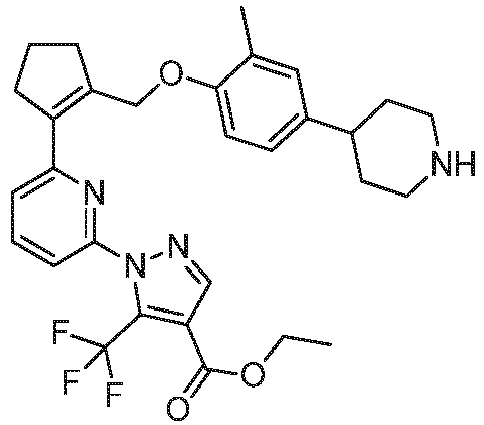
- The title compound was synthesized by removal of the Boc group with the method described for the synthesis of Example 1-B. MS (ESI+) m/z 555.3 (M+H).
-

- To a solution of ethyl 1-(6-(2-((2-methyl-4-(piperidin-4-yl)phenoxy)methyl)cyclopent-1-en-1-yl)pyridin-2-yl)-5-(trifluoromethyl)-1H-pyrazole-4-carboxylate (19 mg, 0.034 mmol) in DCM (2 mL) was added DIPEA (0.024 mL, 0.14 mmol) followed by dimethylcarbamyl chloride (CAS# 79-44-7, 7.4 mg, 0.069 mmol). The mixture was then stirred at room temperature for 1 h, and then concentrated. The resulting residue was dissolved in THF/MeOH (1 mL/ 0.1 mL). To the mixture was added 1N aq. NaOH (0.2 mL, 0.2 mmol), and then the mixture was stirred at 50°C for 1 h. To the mixture was then added 1N aq. NaOH (0.4 mL), and then the mixture was stirred at 50°C for another 1h, and then cooled to room temperature. The mixture was then rendered acidic by conc. HCl, which was then purified by RP-HPLC (HC-B) to afford the title compound. 1H NMR (400 MHz, DMSO-d 6) δ 13.50 (br. s., 1H), 8.17 (br.s., 1H), 8.12 (t, J = 7.9 Hz, 1H), 7.62 (d, J = 7.8 Hz, 1H), 7.56 (d, J= 7.7 Hz, 1H), 7.00 (d, J = 1.8 Hz, 1H), 6.87 (dd, J = 2.1, 8.4 Hz, 1H), 6.63 (d, J = 8.4 Hz, 1H), 5.04 (s, 2H), 3.62 (d, J = 13.1 Hz, 2H), 2.88 (t, J = 7.5 Hz, 2H), 2.77 - 2.69 (m, 10H), 2.6 - 2.5 (2H, m), 2.12 (s, 3H), 1.92 (app. quin, J = 7.6 Hz, 2H), 1.68 (dd, J = 1.8, 12.8 Hz, 2H), 1.50 (dq, J = 3.7, 12.5 Hz, 2H). HRMS; calcd. for C31H35F3N5O4 (M+H) 598.2641, found 598.2655.
- Example 24. The following compounds were prepared by similar methods as described for the synthesis of Example 23 by using Intermediate 23-B, and Reagent-A instead of dimethylcarbamyl chloride, as delineated in the table below.
Example Structure/Name Reagent-A Analytical Data 24-1 
2-chloro-2-oxoethyl acetate (CAS# 13831-31-7) 1H NMR (400 MHz, DMSO-d 6) δ 13.45 (br. s, 1 H) 8.06 - 8.16 (m, 2 H) 7.60 (d, J = 7.8 Hz, 1 H) 7.55 (d, J = 7.8 Hz, 1 H) 6.99 (s, 1 H) 6.87 (dd, J = 8.4, 2.2 Hz, 1 H) 6.63 (d, J = 8.4 Hz, 1 H) 5.04 (s, 2 H) 4.37 - 4.52 (m, 2 H) 4.02 - 4.17 (m, 2 H) 3.74 (br. d, J = 13.0 Hz, 1 H) 3.01 (app. t, J = 12.3 Hz, 1 H) 2.84 - 2.92 (m, 2 H) 2.69 - 2.76 (m, 2 H) 2.58 - 2.65 (m, 2 H) 2.11 (s, 3 H) 1.92 (quin, J = 7.5 Hz, 2 H) 1.67 - 1.77 (m, 2 H) 1.28 - 1.58 (m, 2 H) HRMS calcd. for C30H32F3N4O5 (M+H) 585.2325, found 585.2339. 1-(6-(2-((4-(1-(2-Hydroxyacetyl)piperidin-4-yl)-2-methylphenoxy)methyl)cycl opent-1-en-1-yl)pyridin-2-yl)-5-(trifluoromethyl)-1H-pyrazole-4-carboxylic acid 24-2 
Propionic anhydride (CAS# 123-62-6) 1H NMR (400 MHz, DMSO-d 6) δ 13.48 (br. s., 1H), 8.20 - 8.04 (m, 2H), 7.61 (d, J=7.8 Hz, 1H), 7.55 (d, J=7.7 Hz, 1H), 6.99 (d, J=1.7 Hz, 1H), 6.87 (dd, J=2.2, 8.3 Hz, 1H), 6.63 (d, J=8.4 Hz, 1H), 5.04 (s, 2H), 4.52 (d, J=12.3 Hz, 1H), 3.92 (d, J=13.3 Hz, 1H), 3.04 (t, J=12.0 Hz, 1H), 2.88 (t, J=6.6 Hz, 2H), 2.76 - 2.69 (m, 2H), 2.63 - 2.56 (m, 2H), 2.33 (q, J=7.4 Hz, 2H), 2.11 (s, 3H), 1.92 (quin, J=7.7 Hz, 2H), 1.71 (t, J=12.1 Hz, 2H), 1.54 - 1.29 (m, 2H), 0.99 (t, J=7.4 Hz, 3H). HRMS calcd. for C31H34F3N4O4 (M+H) 583.2532, found 583.2552. 1-(6-(2-((2-Methyl-4-(1-propionylpiperidin-4-yl)phenoxy)methyl)cyclope nt-1-en-1-yl)pyridin-2-yl)-5-(trifluoromethyl)-1H-pyrazole-4-carboxylic acid 24-3 
Methyl chloroformate (CAS# 79-22-1) 1H NMR (400 MHz, DMSO-d 6) δ 13.43 (br. s., 1H), 8.29 (s, 1H), 8.14 (t, J=7.9 Hz, 1H), 7.65 (d, J=7.7 Hz, 1H), 7.59 (d, J=7.8 Hz, 1H), 6.99 (d, J=1.8 Hz, 1H), 6.86 (dd, J=2.1, 8.3 Hz, 1H), 6.62 (d, J=8.4 Hz, 1H), 5.04 (s, 2H), 4.06 (d, J=10.3 Hz, 2H), 3.60 (s, 3H), 2.92 - 2.85 (m, J=7.2 Hz, 2H), 2.85 - 2.77 (m, 2H), 2.72 (t, J=7.3 Hz, 2H), 2.61 - 2.55 (m, 1H), 2.11 (s, 3H), 1.92 (quin, J=7.5 Hz, 2H), 1.69 (d, J=12.5 Hz, 2H), 1.43 (dq, J=4.3, 12.6 Hz, 2H). HRMS calcd. for C30H32F3N4O5 (M+H) 585.2325, found 585.2341. 1-(6-(2-((4-(1-(Methoxycarbonyl)piperidin -4-yl)-2-methylphenoxy)methyl)cycl opent-1-en-1-yl)pyridin-2-yl)-5-(trifluoromethyl)-1H-pyrazole-4-carboxylic acid 24-4 
methanesulfonyl chloride (CAS # 124-63-0) 1H NMR (400 MHz, CD3OD) δ 13.49 (br. s, 1H), 8.21 - 8.08 (m, 2H), 7.62 (d, J=7.9 Hz, 1H), 7.56 (d, J=7.7 Hz, 1H), 7.02 (s, 1H), 6.90 (d, J=8.2 Hz, 1H), 6.64 (d, J=8.4 Hz, 1H), 5.05 (br. s., 2H), 3.64 (d, J=11.5 Hz, 2H), 2.88 (br. s, 5H), 2.81 - 2.65 (m, 5H), 2.12 (s, 3H), 1.92 (quin, J=7.4 Hz, 2H), 1.80 (d, J=12.1 Hz, 2H), 1.59 (dq, J=3.9, 12.6 Hz, 2H). HRMS calcd. for C29H32F3N4O5S (M+H) 605.2046, found 605.2072. 1-(6-(2-((2-Methyl-4-(1-(methylsulfonyl)piperidin-4-yl)phenoxy)methyl)cyclope nt-1-en-1-yl)pyridin-2-yl)-5-(trifluoromethyl)-1 H- pyrazole-4-carboxylic acid -

- To a solution of ethyl 1-(6-(2-((2-methyl-4-(piperidin-4-yl)phenoxy)methyl)cyclopent-1-en-1-yl)pyridin-2-yl)-5-(trifluoromethyl)-1H-pyrazole-4-carboxylate (Example 23-B) (19 mg, 0.034 mmol) in THF (2 mL) was added K2CO3 (14.2 mg, 0.11 mmol) followed by 2,2,2-trifluoroethyl trifluoromethanesulfonate (12.7 mg, 0.055 mmol). The mixture was then stirred at 45 °C for 1 h. To the mixture was then added MeOH (0.1 mL), followed by 1N aq. NaOH (0.2 mL, 0.2 mmol), and then the mixture was stirred at 50°C for 1 h. To the mixture was then added 1N aq. NaOH (0.4 mL), and then the mixture was stirred at 50°C for another 1h, and then cooled to room temperature. The mixture was then rendered acidic by conc. HCl, which was then purified by RP-HPLC (HC-B) to afford the title compound. 1H NMR (400 MHz, DMSO-d 6) δ 13.55 (br. s., 1H), 8.11 (s, 2H), 7.60 (d, J=7.8 Hz, 1H), 7.54 (d, J=7.7 Hz, 1H), 7.00 (d, J=2.0 Hz, 1H), 6.88 (dd, J=2.1, 8.4 Hz, 1H), 6.63 (d, J=8.4 Hz, 1H), 6.41 - 6.41 (m, 1H), 5.03 (s, 2H), 3.16 (q, J=10.3 Hz, 2H), 2.97 (d, J=11.5 Hz, 2H), 2.88 (t, J=7.2 Hz, 2H), 2.72 (t, J=7.3 Hz, 2H), 2.45 - 2.36 (m, 2H), 2.11 (s, 3H), 1.92 (quin, J=7.5 Hz, 2H), 1.70 - 1.53 (m, 4H). HRMS; calcd. for C30H31F6N4O3 (M+H) 609.2300, found 609.2318.
-

- A DCM (10 mL) suspension of Intermediate 9 (744 mg, 1.88 mmol) and manganese dioxide (CAS # 1313-13-9, 3.27 g, 37.6 mmol) was vigorously stirred at room temperature for 16 h. The suspension was filtered through a plug of Celite® and the resulting DCM eluent was used directly in the next step without concentration or additional purification. MS (ESI+) m/z 394.3 (M+H).
-

- The DCM eluent from Example 26-A was added to an acetic acid solution (15 mL) of Intermediate 13 (0.57 g, 1.9 mmol) at room temperature. The mixture was partially concentrated under reduced pressure to remove most of the DCM and afford a volume of ∼ 15 mL. Sodium triacetoxyborohydride (CAS # 56553-60-7, 558 mg, 2.63 mmol) was then added to the mixture, and then the mixture was stirred at room temperature for 30 min. The reaction mixture was diluted with EtOAc (25 mL). A solution of 28% aq. NH4OH was then added to the mixture to achieve a pH -10. The resulting layers were then separated and the organic phase was washed with water, brine, and dried over sodium sulfate. The resulting residue was purified by silica gel flash column chromatography (0% to 100% EtOAc in heptane) to afford the title compound. MS (ESI+) m/z 682.7 (M+H).
-

- The title compound was synthesized starting from tert-butyl 4-(4-(((2-(6-(4-(ethoxycarbonyl)-5-(trifluoromethyl)-1H-pyrazol-1-yl)pyridin-2-yl)cyclohex-1-en-1-yl)methyl)amino)-2-ethylphenyl)piperidine-1-carboxylate, which was treated with TFA, in a fashion analogous Example 14-D, to afford the unprotected piperidine, which was then reacted with cyclopropanecarboxylic acid in an analogous fashion to the transformation outlined in Example 3-A. The resulting product was saponified as described in Example 14 to furnish the title compound. 1H NMR (400 MHz, DMSO-d6 ) δ 13.41 (br. s., 1 H) 8.27 (s, 1 H) 8.09 (app. t, J = 7.8 Hz, 1 H) 7.63 - 7.69 (m, 1 H) 7.54 - 7.59 (m, 1 H) 6.78 (d, J = 8.4 Hz, 1 H) 6.23 (br. dd, J = 8.4, 2.4 Hz, 1 H) 6.17 (br. d, J = 2.4 Hz, 1 H) 4.27 - 4.55 (m, 2 H) 3.54 (s, 2 H) 3.05 - 3.21 (m, 1 H) 2.73 - 2.84 (m, 1 H) 2.54 - 2.65 (m, 1 H) 2.35 - 2.46 (m, 4 H) 2.19 (br. s., 2 H) 1.93 - 2.02 (m, 1 H) 1.64 (br. s., 5 H) 1.25 - 1.59 (m, 4 H) 1.01 (t, J = 7.5 Hz, 3 H) 0.62 - 0.79 (m, 4 H). HRMS calcd. for C34H39F3N5O3 (M+H) 622.3005, found 622.2986.
- Example 27. The following compounds were prepared with similar methods as described for Example 26. A reductive amination between Intermediate 25-A and the requisite aniline (Aniline-A), as delineated in the table below, afforded the coupling product employing the method described for Example 26-B, which was subsequently saponified by the method described in Example 14.
Example Structure/Name Aniline-A Analytical Data 27-1 
Intermediate 14 1H NMR (400 MHz, DMSO-d 6) δ 8.15 (s, 1H), 8.07 (t, J = 7.8 Hz, 1H), 7.62 (d, J = 7.9 Hz, 1H), 7.57 (d, J = 7.7 Hz, 1H), 6.79 (d, J = 2.1 Hz, 1H), 6.69 (d, J = 8.9 Hz, 1H), 6.13 (d, J = 8.3 Hz, 1H), 4.76 (s, 1H), 4.46 (s, 1H), 4.31 (s, 1H), 3.65 (s, 2H), 3.11 (s, 1H), 2.47-2.41 (m, 1H), 2.38 (s, 2H), 2.17 (s, 2H), 2.01 (s, 3H), 2.00 - 1.92 (m, 1H), 1.63 (s, 5H), 1.78-1.70 (m, 1H), 1.51-1.22 (m, 2H), 0.68 (d, J = 7.9 Hz, 4H). HRMS calcd. for C33H37F3N5O3 (M+H) 608.2848, found 608.2872. 1-(6-(2-(((4-(1-(Cyclopropanecarbonyl)pip eridin-4-yl)-2-methylphenyl)amino)methyl )cyclohex-1-en-1-yl)pyridin-2-yl)-5-(trifluoromethyl)-1H-pyrazole-4-carboxylic acid 27-2 
Intermediate 15 1H NMR (400 MHz, DMSO-d 6) δ 7.99 (t, J = 7.8 Hz, 1H), 7.82 (s, 1H), 7.55 (dd, J = 8.0, 0.8 Hz, 1H), 7.47 (dd, J = 7.7, 0.9 Hz, 1H), 6.90 - 6.80 (m, 2H), 6.42 - 6.32 (m, 2H), 5.57 (s, 1H), 4.46 (s, 1H), 4.34 (s, 1H), 3.55 (d, J = 3.6 Hz, 2H), 3.11 (s, 1H), 2.63 - 2.53 (m, 2H), 2.39 (s, 2H), 2.20 (s, 2H), 1.98 (p, J = 6.5 Hz, 1H), 1.74 (s, 1H), 1.70 - 1.58 (m, 5H), 1.44 (s, 1H), 1.32 (s, 1H), 0.68 (d, J = 8.7 Hz, 4H). HRMS calcd. for C32H35F3N5O3 (M+H) 594.2692, found 594.2728. 1-(6-(2-(((4-(1-(Cyclopropanecarbonyl)pip eridin-4-yl)phenyl)amino)methyl)cyc lohex-1-en-1-yl)pyridin-2-yl)-5-(trifluoromethyl)-1H-pyrazole-4-carboxylic acid -

- To a suspension of (±)-2-(((tert-butyldimethylsilyl)oxy)methyl)-5-methylcyclohex-1-en-1-yl trifluoromethanesulfonate (Intermediate 6) (1 g, 2.6 mmol), ethyl 1-(3-(4,4,5,5-tetramethyl-1,3,2-dioxaborolan-2-yl)phenyl)-5-(trifluoromethyl)-1H-pyrazole-4-carboxylate (Intermediate 1-4) (1.6 g, 3.9 mmol) and K3PO4 (1.5 g, 7.1 mmol) in toluene/H2O (10 mL/ 7 mL) was added PdCl2(dppf)-CH2Cl2 adduct (0.4 g, 0.49 mmol). The mixture was stirred at 100 °C for 16 h, and then cooled to room temperature, and then diluted with EtOAc. The mixture was then washed successively with H2O and brine, and then dried over Na2SO4. The extracts were filtered through a plug of silica gel, which was rinsed with EtOAc. The filtrate was concentrated. The resulting residue was charged with a solution of TBAF in THF (5 mL, 5 mmol) and was stirred at 40 °C for 2h. The reaction mixture was diluted with EtOAc, and then washed successively with H2O and brine, and then dried over Na2SO4. The extracts were filtered through a plug of silica gel, which was rinsed with EtOAc. The filtrate was concentrated. The resulting residue was purified by silica gel flash column chromatography (heptane/EtOAc = 78/22 to 56/44) to afford the title compound. MS (ESI+) m/z 391.2 (M-OH)+.
-

- The title compound was synthesized by the method as outlined in the preparation of Example 12a, but using (±)-ethyl 1-(6'-(hydroxymethyl)-3'-methyl-2',3',4',5'-tetrahydro-[1,1'-biphenyl]-3-yl)-5-(trifluoromethyl)-1H-pyrazole-4-carboxylate in the place of Example 12-B. 1H NMR (400 MHz, CD3OD) δ 8.11 (s, 1H), 7.47-7.53 (m, 1H), 7.31-7.41 (m, 2H), 7.19-7.24 (m, 1H), 6.90-6.93 (m, 1H), 6.85 (dd, J=2.2, 8.31 Hz, 1H), 6.49 (d, J=8.3 Hz, 1H), 4.61 (br. d, J=12.1 Hz, 1H), 4.42 (br. d, J=13.0 Hz, 1H), 4.25-4.33 (m, 2H), 3.16-3.28 (m, 1H), 2.62-2.76 (m, 2H), 2.40-2.51 (m, 2H), 2.29-2.40 (m, 1H), 2.11 (s, 3H), 1.94-2.07 (m, 2H), 1.73-1.91 (m, 4H), 1.42-1.65 (m, 2H), 1.27-1.42 (m, 1H), 1.04 (d, J=6.4 Hz, 3H), 0.73-0.93 (m, 4H). HRMS; calcd. for C35H39F3N3O4(M+H) 622.2893, found 622.2872.
- Example 29. The following compounds were prepared with similar methods as described for Example 7 using Alcohol-A, as delineated in the table below in the place of Intermediate 9 and Phenol-A, as delineated in the table below, instead of Intermediate 2-5-1.
Example Structure/Name Starting Materials Alcohol-A and Phenol-A Analytical Data 29-1 
Example 13-B (Alcohol-A) and Intermediate 3-2 (Phenol-A) 1H NMR (400 MHz, DMSO-d6 ) δ 8.64 (ddd, J=4.9, 1.8, 0.9 Hz, 1H), 8.00 - 7.91 (m, 2H), 7.89 (td, J=7.7, 1.8 Hz, 1H), 7.62 - 7.50 (m, 2H), 7.47 - 7.37 (m, 2H), 6.92 (d, J=8.5 Hz, 1H), 6.65 (dd, J=8.5, 2.6 Hz, 1H), 6.56 (d, J=2.5 Hz, 1H), 4.56 (d, J=11.7 Hz, 1H), 4.44 (d, J=11.7 Hz, 1H), 4.34 (s, 2H), 4.14 (s, 2H), 3.39 (ddt, J=20.0, 3.3, 1.7 Hz, 2H), 3.01 - 2.79 (m, 2H), 2.56 (dd, J=15.0, 8.8 Hz, 2H), 2.34 (d, J=17.8 Hz, 1H), 1.85 (dd, J=10.2, 5.0 Hz, 2H), 1.67 (dt, J=7.5, 4.9 Hz, 1H), 1.53 (td, J=9.8, 9.3, 6.1 Hz, 1H), 1.22 (d, J=6.9 Hz, 3H). HRMS calcd. for C33H33F3N5O3 (M+H) 604.2535, found 604.2540. (±)-1-(6-(3-Methyl-2-(((2-(pyridin-2-ylmethyl)-1,2,3,4-tetrahydroisoquinolin-6-yl)oxy)methyl)cyclohex-1-en-1-yl)pyridin-2-yl)-5-(trifluoromethyl)-1H-pyrazole-4-carboxylic acid 29-2 
Intermediate 9 (Alcohol-A) and Intermediate 16 (Phenol-A) 1H NMR (400 MHz, CD3OD) δ 8.16 (s, 1H), 7.97 (t, J=7.8 Hz, 1H), 7.57 (dd, J=0.8, 8.0 Hz, 1H), 7.47 (dd, J=0.8, 7.7 Hz, 1H), 7.11 (d, J=8.7 Hz, 2H), 6.75 (d, J=8.7 Hz, 2H), 4.66-4.76 (m, 1H), 4.30-4.59 (m, 4H), 3.49-3.70 (m, 1H), 2.94-3.25 (m, 1H), 2.42-2.75 (m, 4H), 2.34 (br. s., 2H), 1.95-2.06 (m, 1H), 1.72-1.92 (m, 5H), 1.49-1.72 (m, 1H), 0.76-0.95 (m, 4H). HRMS; calc. for C32H34F3N4O5 (M+H) 611.2476, found 611.2527. (±)-1-(6-(2-((4-((3,4-tans)-1-(cyclopropanecarbonyl)-3-hydroxypiperidin-4-yl)phenoxy)methyl)cyclohex-1-en-1-yl)pyridin-2-yl)-5-(trifluoromethyl)-1H-pyrazole-4-carboxylic acid - Chinese hamster ovary (CHO) cells overexpressing soluble guanylate cyclase were generated to test the effect of sGC activators in a cellular context. Human cDNAs for GUCYA3 (RefSeq: NM_000856.3) and GUCYB3 (RefSeq: NM_000857.1) were amplified by PCR from a HUVEC (Human Umbilical Vein Endothelial Cells) cDNA library and cloned into mammalian expression vectors. CHO K1 cells (ATCC CCL-61) were transfected using Lipofectamine 2000 following manufacturer's instructions and stably expressing clones were identified by antibiotic selection. CHO GUCY clone 8E10 was used for subsequent experiments.
- Cells were seeded at a density of 3000 cells/well in white 384-well proxyplates (Perkin Elmer) and incubated overnight, then the medium was removed and cells were washed with assay buffer (HBSS, 0.1% BSA, 1mM IBMX, 20uM ODQ). sGC activators were serially diluted in DMSO, then diluted in assay buffer prior to adding to cells (10ul/well, final DMSO concentration 0.5%). Cells were incubated with compounds for 1h room temperature, then assayed for cGMP production using Cisbio cGMP HTRF kit (62GM2PEC) according to manufacturer's instructions.
- The EC50s are calculated based on the amount of cGMP interpolated from the standard curve, using a 4-parameter sigmoidal dose-response.
- Compounds of invention are active on sGC activation. Data on Table 1 collected using the assay of Biological Example 1. The minimum EC50 quantification limit of the assay is 0.5 nM, therefore any compound listed as having an EC50 value of 0.5 nM has a actual EC50 0f ≤ 0.5 nM.


Claims (15)
- A compound according to Formula (I)
 n is 0 or 1;X is N or CH;Z is N(H), O or CH2;Z1 is CR4 or N;R is hydrogen, C1-C4alkyl, monofluoromethyl, difluoromethyl or trifluoromethyl;R1 is hydrogen, halogen, C1-C4alkyl or trifluoromethylR2 is piperidinyl which is N-substituted with C1-C4alkyl, C3-C6cycloalkyl, haloC1-C4alkyl, C(O)C1-C4alkyl, S(O)2C1-C4alkyl, C(O)C3-C6cycloalkyl, C(O)haloC1-C4alkyl, C(O)C1-C4alkoxy, C(O)C1-C4alkenoxy, heteroaryl or CO(O)2benzyl, wherein each cycloalkyl is optionally substituted by hydroxy and each alkyl or alkoxy is optionally substituted by hydroxyl, C1-C4alkoxy or C3-C6cycloalkyl and wherein each heteroaryl has 5 or 6 ring atoms, 1, 2 or 3 ring heteroatoms independently selected from N, O and S and is optionally substituted with 1 or 2 C1-C4alkyl substituents, which piperidinyl ring is further optionally substituted by hydroxyl;R3 is hydrogen, halogen or C1-C4alkyl; orR2 and R3, taken in combination, form a 5 or 6 member fused saturated azacyclic ring optionally substituted with benzyl or 5 or 6 member heteroarylmethyl, which heteroaryl has 1 or 2 ring heteroatoms independently selected from N, O and S; R4 is hydrogen or C1-C4alkyl;R5 and R5a are independently selected from the group consisting of hydrogen and C1-C4alkyl; orR5 and R5a, taken in combination form a spirocyclic cyclopropyl ring; andwhen n is 0, R6 and R6a are each hydrogen and when n is 1, R6 and R6a are independently selected from the group consisting of hydrogen and C1-C4alkyl; orR6 and R6a, taken in combination form a spirocyclic cyclopropyl ring.
 - A compound according to Formula (Ia)
 X is N or CH;Z is O or CH2;R is C1-C4alkyl or trifluoromethyl;R1 and R4 are each independently selected from hydrogen, halogen or C1-C4alkyl; orR4 is haloC1-C4alkyl;R2 is piperidinyl which is N-substituted with C1-C4alkyl, haloC1-C4alkyl, C3-C6cycloalkyl, C(O)C1-C4alkyl which is optionally substituted with hydroxyl or amino, C(O)C3-C6cycloalkyl, C(O)C1-C4alkoxy, C(O)NH(C1-C4alkyl), C(O)N(C1-C4alkyl)2, S(O)2C1-C4alkyl, S(O)2C3-C6cycloalkyl or C(O)heteroaryl which heteroaryl has 5 or 6 ring atoms and 1 or 2 ring heteroatoms independently selected from the group consisting of N, O and S;R3 is hydrogen or C1-C4alkyl; orR2 and R3, taken in combination form a 6 member fused saturated azacyclic ring optionally substituted with benzyl or 5, 6, 9 or 10 member heteroarylmethyl, which heteroaryl has 1 or 2 rings and 1 or 2 ring heteroatoms independently selected from N, O and S;R5 and R5a are independently selected from the group consisting of hydrogen and C1-C4alkyl; orR5 and R5a, taken in combination form a spirocyclic cyclopropyl ring; andR6 and R6a are independently selected from the group consisting of hydrogen and C1-C4alkyl; orR6 and R6a, taken in combination form a spirocyclic cyclopropyl ring.
 - The compound of claim 2, or a pharmaceutically acceptable salt thereof, wherein Z is O.
- The compound of any one of claims 1 to 3, or a pharmaceutically acceptable salt thereof, wherein R2 is N-substituted piperidin-4-yl wherein the N-substituent is 2,2,2-trifluoroethyl, C(O)cyclopropyl, C(O)(1-hydroxyethyl), S(O)2ethyl, S(O)2cyclopropyl, C(O)ethyl, C(O)iso-propyl, C(O)N(methyl)2 or C(O)N(ethyl)2.
- The compound of any one of claims 1 to 4, wherein R is methyl or ethyl.
- The compound of any one of claims 1 to 5, wherein X is N.
- The compound of claim 2, or a pharmaceutically acceptable salt thereof, the compound represented by Formula (II):
 R is trifluoromethyl, methyl or ethyl;R3 is hydrogen or ethyl;R4 is hydrogen, methyl or ethyl;R5 and R5a are each independently selected from hydrogen and methyl; andR7 is 2,2,2-trifluoroethyl, C(O)ethyl, C(O)isopropyl, C(O)(hydroxymethyl), C(O)(1-hydroxyethyl), CO2methyl, C(O)cyclopropyl, C(O)cyclobutyl, C(O)N(methyl)2, C(O)N(ethyl)2, S(O)2methyl, S(O)2ethyl, or S(O)2cyclopropyl.
 - A compound accoding to claim 1 which is 1-(6-(2-((4-(1-(cyclopropanecarbonyl)piperidin-4-yl)-3-ethylphenoxy)methyl)-3-methylcyclohex-1-en-1-yl)pyridin-2-yl)-5-methyl-1H-pyrazole-4-carboxylic acid having the following formula:

- A compound according to claim 1 which is 1-(6-(2-((4-(1-(Cyclopropanecarbonyl)piperidin-4-yl)-3-ethylphenoxy)methyl)-3-methylcyclohex-1-en-1-yl)pyridin-2-yl)-5-ethyl-1H-pyrazole-4-carboxylic acid having the following formula:

- A compound according to claim 1 which is 1-(6-(2-((4-(1-(cyclopropanecarbonyl)piperidin-4-yl)-2-methylphenoxy)methyl)-3-methylcyclohex-1-en-1-yl)pyridin-2-yl)-5-(trifluoromethyl)-1H-pyrazole-4-carboxylic acid having the following formula:

- A pharmaceutical composition comprising a compound of any one of claims 1 to 10, or a salt thereof, and a pharmaceutically acceptable excipient.
- A compound of any one of claims 1 to 10, or a pharmaceutically acceptable salt thereof, for use in a method of treating glaucoma and controlling intraocular pressure.
- The compound for use according to claim 12, further compring administering to the affected eye of the patient a glaucoma treatment agent selected from the group consisting of beta-adrenergic receptor antagonists , prostaglandin analogs, carbonic anhydrase inhibitors, α2 agonists, miotics, and neuroprotectants.
- The compound for use according to claims 12 or 13, wherein the method further comprises administering to the affected eye of the patient a PDE-V inhibitor.
- The compound for use according to claim 14 wherein the method PDE-V inhibitor is selected from sildenafil, tadalafil and vardenafil.
Applications Claiming Priority (4)
| Application Number | Priority Date | Filing Date | Title |
|---|---|---|---|
| US201462020187P | 2014-07-02 | 2014-07-02 | |
| US201562127535P | 2015-03-03 | 2015-03-03 | |
| US201562168651P | 2015-05-29 | 2015-05-29 | |
| PCT/IB2015/055009 WO2016001878A1 (en) | 2014-07-02 | 2015-07-02 | Cyclohexen-1-yl-pyridin-2-yl-1h-pyrazole-4-carboxylic acid derivatives and the use thereof as soluble guanylate cyclase activators |
Publications (2)
| Publication Number | Publication Date |
|---|---|
| EP3164396A1 EP3164396A1 (en) | 2017-05-10 |
| EP3164396B1 true EP3164396B1 (en) | 2019-01-16 |
Family
ID=53724404
Family Applications (1)
| Application Number | Title | Priority Date | Filing Date |
|---|---|---|---|
| EP15742105.8A Not-in-force EP3164396B1 (en) | 2014-07-02 | 2015-07-02 | Cyclohexen-1-yl-pyridin-2-yl-1h-pyrazole-4-carboxylic acid derivatives and the use thereof as soluble guanylate cyclase activators |
Country Status (6)
| Country | Link |
|---|---|
| US (1) | US9957254B2 (en) |
| EP (1) | EP3164396B1 (en) |
| JP (1) | JP2017519836A (en) |
| CN (1) | CN106470986A (en) |
| TW (1) | TW201625586A (en) |
| WO (1) | WO2016001878A1 (en) |
Families Citing this family (13)
| Publication number | Priority date | Publication date | Assignee | Title |
|---|---|---|---|---|
| TW201625584A (en) | 2014-07-02 | 2016-07-16 | 諾華公司 | Indane and indoline derivatives and the use thereof as soluble guanylate cyclase activators |
| EP3359532A1 (en) | 2015-10-06 | 2018-08-15 | GlaxoSmithKline Intellectual Property Development Limited | Biaryl pyrazoles as nrf2 regulators |
| JP2018529744A (en) * | 2015-10-06 | 2018-10-11 | グラクソスミスクライン、インテレクチュアル、プロパティー、ディベロップメント、リミテッドGlaxosmithkline Intellectual Property Development Limited | Arylcyclohexylpyrazoles as NRF2 regulators |
| WO2017103888A1 (en) | 2015-12-18 | 2017-06-22 | Novartis Ag | Indane derivatives and the use thereof as soluble guanylate cyclase activators |
| AU2017300558B2 (en) * | 2016-07-22 | 2021-02-25 | Toa Eiyo Ltd. | Therapeutic agent for glaucoma |
| WO2018069148A1 (en) | 2016-10-11 | 2018-04-19 | Bayer Pharma Aktiengesellschaft | Combination containing sgc activators and mineralocorticoid receptor antagonists |
| WO2019081456A1 (en) | 2017-10-24 | 2019-05-02 | Bayer Aktiengesellschaft | Use of activators and stimulators of sgc comprising a beta2 subunit |
| EP3498298A1 (en) | 2017-12-15 | 2019-06-19 | Bayer AG | The use of sgc stimulators and sgc activators alone or in combination with pde5 inhibitors for the treatment of bone disorders including osteogenesis imperfecta (oi) |
| CN112055584A (en) | 2018-04-30 | 2020-12-08 | 拜耳公司 | Use of sGC activators and sGC stimulators for the treatment of cognitive impairment |
| JP2021523201A (en) | 2018-05-15 | 2021-09-02 | バイエル アクチェンゲゼルシャフトBayer Aktiengesellschaft | 1,3-thiazole-2-yl-substituted benzamide for treating diseases associated with nerve fiber sensitization |
| US11508483B2 (en) | 2018-05-30 | 2022-11-22 | Adverio Pharma Gmbh | Method of identifying a subgroup of patients suffering from dcSSc which benefits from a treatment with sGC stimulators and sGC activators in a higher degree than a control group |
| US20220128561A1 (en) | 2019-01-17 | 2022-04-28 | Bayer Aktiengesellschaft | Methods to determine whether a subject is suitable of being treated with an agonist of soluble gyanylyl cyclase (sgc) |
| CA3258617A1 (en) | 2022-06-09 | 2023-12-14 | Bayer Aktiengesellschaft | Soluble guanylate cyclase activators for use in the treatment of heart failure with preserved ejection fraction in women |
Family Cites Families (24)
| Publication number | Priority date | Publication date | Assignee | Title |
|---|---|---|---|---|
| KR100720844B1 (en) | 1998-07-08 | 2007-05-25 | 사노피-아벤티스 도이칠란트 게엠베하 | Sulfur substituted sulfonylaminocarboxylic acid N-arylamides, methods for preparing the same, and pharmaceutical preparations containing the same |
| EP1420023B1 (en) | 2001-01-24 | 2006-12-06 | Yung Shin Pharmaceutical Ind. Co., Ltd. | Use of fused pyrazolyl compounds for the preparation of a medicament for treating hypertension |
| DE10110749A1 (en) | 2001-03-07 | 2002-09-12 | Bayer Ag | Substituted aminodicarboxylic acid derivatives |
| DE10110750A1 (en) | 2001-03-07 | 2002-09-12 | Bayer Ag | Novel aminodicarboxylic acid derivatives with pharmaceutical properties |
| DE10216145A1 (en) | 2002-04-12 | 2003-10-23 | Bayer Ag | Use of stimulators of soluble guanylate cyclase to produce a medicament for treating glaucoma |
| CA2514733A1 (en) | 2003-02-28 | 2004-09-16 | Transform Pharmaceuticals, Inc. | Pharmaceutical co-crystal compositions of drugs such as carbamazepine, celecoxib, olanzapine, itraconazole, topiramate, modafinil, 5-fluorouracil, hydrochlorothiazide, acetaminophen, aspirin, flurbiprofen, phenytoin and ibuprofen |
| EP2114166A4 (en) | 2006-12-11 | 2011-05-25 | Reviva Pharmaceuticals Inc | Compositions, synthesis, and methods of using indanone based cholinesterase inhibitors |
| DE102007015035A1 (en) | 2007-03-29 | 2008-10-02 | Bayer Healthcare Ag | Substituted dibenzoic acid derivatives and their use |
| CA2698332C (en) * | 2007-09-06 | 2012-08-21 | Merck Sharp & Dohme Corp. | Pyrazole derivatives as soluble guanylate cyclase activators |
| WO2009068652A1 (en) | 2007-11-30 | 2009-06-04 | Smithkline Beecham Corporation | 2, 6-disubstituted pyridines and 2, 4-disubstituted pyrimidines as soluble guanylate cyclase activators |
| PE20091258A1 (en) | 2007-12-03 | 2009-09-12 | Smithkline Beecham Corp | PYRIDINE DERIVATIVES AS SOLUBLE GUANILATE CYCLASE ACTIVATORS |
| WO2009123316A1 (en) | 2008-04-04 | 2009-10-08 | 武田薬品工業株式会社 | Heterocyclic derivative and use thereof |
| DE102008018675A1 (en) | 2008-04-14 | 2009-10-15 | Bayer Schering Pharma Aktiengesellschaft | Oxo-heterocyclic substituted carboxylic acid derivatives and their use |
| CN102414194A (en) * | 2009-02-26 | 2012-04-11 | 默沙东公司 | Soluble guanylate cyclase activators |
| DE102009012314A1 (en) | 2009-03-09 | 2010-09-16 | Bayer Schering Pharma Aktiengesellschaft | Oxo-heterocyclic substituted alkylcarboxylic acids and their use |
| DE102009046115A1 (en) | 2009-10-28 | 2011-09-08 | Bayer Schering Pharma Aktiengesellschaft | Substituted 3-phenylpropanoic acids and their use |
| EP2632551B1 (en) | 2010-10-28 | 2016-07-06 | Merck Sharp & Dohme Corp. | Soluble guanylate cyclase activators |
| SG190296A1 (en) | 2010-12-07 | 2013-06-28 | Bayer Ip Gmbh | Substituted 1-benzylcycloalkylcarboxlic acids and use thereof |
| JP5715713B2 (en) | 2011-03-10 | 2015-05-13 | ベーリンガー インゲルハイム インターナショナル ゲゼルシャフト ミット ベシュレンクテル ハフツング | Soluble guanylate cyclase activator |
| DE102011007272A1 (en) | 2011-04-13 | 2012-10-18 | Bayer Pharma Aktiengesellschaft | Branched 3-phenylpropionic acid derivatives and their use |
| US8815857B2 (en) | 2011-08-12 | 2014-08-26 | Boehringer Ingelheim International Gmbh | Soluble guanylate cyclase activators |
| WO2014057740A1 (en) | 2012-10-09 | 2014-04-17 | Dic株式会社 | Bump cushion |
| US10265314B2 (en) | 2013-07-25 | 2019-04-23 | Bayer Pharma Aktiengesellschaft | SGC stimulators in combination with additional treatment for the therapy of cystic fibrosis |
| JP2016530292A (en) | 2013-09-05 | 2016-09-29 | グラクソスミスクライン、インテレクチュアル、プロパティー、ディベロップメント、リミテッドGlaxosmithkline Intellectual Property Development Limited | Novel soluble guanylate cyclase activators and their use |
-
2015
- 2015-07-01 TW TW104121396A patent/TW201625586A/en unknown
- 2015-07-02 CN CN201580036309.9A patent/CN106470986A/en active Pending
- 2015-07-02 JP JP2017520036A patent/JP2017519836A/en not_active Ceased
- 2015-07-02 WO PCT/IB2015/055009 patent/WO2016001878A1/en not_active Ceased
- 2015-07-02 US US15/320,815 patent/US9957254B2/en active Active
- 2015-07-02 EP EP15742105.8A patent/EP3164396B1/en not_active Not-in-force
Non-Patent Citations (1)
| Title |
|---|
| None * |
Also Published As
| Publication number | Publication date |
|---|---|
| EP3164396A1 (en) | 2017-05-10 |
| US9957254B2 (en) | 2018-05-01 |
| JP2017519836A (en) | 2017-07-20 |
| US20170197941A1 (en) | 2017-07-13 |
| CN106470986A (en) | 2017-03-01 |
| WO2016001878A1 (en) | 2016-01-07 |
| TW201625586A (en) | 2016-07-16 |
Similar Documents
| Publication | Publication Date | Title |
|---|---|---|
| US9957254B2 (en) | Cyclohexen-1-yl-pyridin-2-yl-1h-pyrazole-4-carboxylic acid derivatives and the use thereof as soluble guanylate cyclase activators | |
| US10550102B2 (en) | Indane and indoline derivatives and the use thereof as soluble guanylate cyclase activators | |
| US9765067B2 (en) | Thiophen-2-yl-pyridin-2-yl-1H-pyrazole-4-carboxylic acid derivatives and the use thereof as soluble guanylate cyclase activators | |
| US11572374B2 (en) | N-cyano-7-azanorbornane derivatives and uses thereof | |
| KR20160121572A (en) | 1,2-substituted cyclopentanes as orexin receptor antagonists | |
| JP2013532184A (en) | N-sulfonylbenzamide derivatives useful as voltage-gated sodium channel inhibitors | |
| US10316020B2 (en) | Indane derivatives and the use thereof as soluble guanylate cyclase activators | |
| CN102414194A (en) | Soluble guanylate cyclase activators | |
| US11845730B2 (en) | 1,3-substituted cyclobutyl derivatives and uses thereof | |
| TWI924820B (en) | 1,3-substituted cyclobutyl derivatives and uses thereof | |
| HK40080163A (en) | Substituted tetrahydrofurans as modulators of sodium channels | |
| HK40080163B (en) | Substituted tetrahydrofurans as modulators of sodium channels |
Legal Events
| Date | Code | Title | Description |
|---|---|---|---|
| STAA | Information on the status of an ep patent application or granted ep patent |
Free format text: STATUS: THE INTERNATIONAL PUBLICATION HAS BEEN MADE |
|
| PUAI | Public reference made under article 153(3) epc to a published international application that has entered the european phase |
Free format text: ORIGINAL CODE: 0009012 |
|
| STAA | Information on the status of an ep patent application or granted ep patent |
Free format text: STATUS: REQUEST FOR EXAMINATION WAS MADE |
|
| 17P | Request for examination filed |
Effective date: 20170202 |
|
| AK | Designated contracting states |
Kind code of ref document: A1 Designated state(s): AL AT BE BG CH CY CZ DE DK EE ES FI FR GB GR HR HU IE IS IT LI LT LU LV MC MK MT NL NO PL PT RO RS SE SI SK SM TR |
|
| AX | Request for extension of the european patent |
Extension state: BA ME |
|
| RIN1 | Information on inventor provided before grant (corrected) |
Inventor name: JI, NAN Inventor name: FERRARA, LUCIANA Inventor name: POWERS, JAMES J. Inventor name: KATO, MITSUNORI Inventor name: BOLDUC, PHILIPPE Inventor name: PRASANNA, GANESH Inventor name: EHARA, TAKERU Inventor name: MEREDITH, ERIK Inventor name: ADAMS, CHRISTOPHER MICHAEL Inventor name: BELANGER, DAVID Inventor name: MOGI, MUNETO Inventor name: BEVAN, DOUG |
|
| DAV | Request for validation of the european patent (deleted) | ||
| DAX | Request for extension of the european patent (deleted) | ||
| GRAP | Despatch of communication of intention to grant a patent |
Free format text: ORIGINAL CODE: EPIDOSNIGR1 |
|
| STAA | Information on the status of an ep patent application or granted ep patent |
Free format text: STATUS: GRANT OF PATENT IS INTENDED |
|
| INTG | Intention to grant announced |
Effective date: 20180305 |
|
| RIN1 | Information on inventor provided before grant (corrected) |
Inventor name: FERRARA, LUCIANA Inventor name: JI, NAN Inventor name: PRASANNA, GANESH Inventor name: BELANGER, DAVID Inventor name: BEVAN, DOUG Inventor name: POWERS, JAMES J. Inventor name: KATO, MITSUNORI Inventor name: EHARA, TAKERU Inventor name: MEREDITH, ERIK Inventor name: BOLDUC, PHILIPPE Inventor name: ADAMS, CHRISTOPHER MICHAEL Inventor name: MOGI, MUNETO |
|
| GRAJ | Information related to disapproval of communication of intention to grant by the applicant or resumption of examination proceedings by the epo deleted |
Free format text: ORIGINAL CODE: EPIDOSDIGR1 |
|
| STAA | Information on the status of an ep patent application or granted ep patent |
Free format text: STATUS: REQUEST FOR EXAMINATION WAS MADE |
|
| INTC | Intention to grant announced (deleted) | ||
| GRAP | Despatch of communication of intention to grant a patent |
Free format text: ORIGINAL CODE: EPIDOSNIGR1 |
|
| STAA | Information on the status of an ep patent application or granted ep patent |
Free format text: STATUS: GRANT OF PATENT IS INTENDED |
|
| INTG | Intention to grant announced |
Effective date: 20180820 |
|
| GRAS | Grant fee paid |
Free format text: ORIGINAL CODE: EPIDOSNIGR3 |
|
| GRAA | (expected) grant |
Free format text: ORIGINAL CODE: 0009210 |
|
| STAA | Information on the status of an ep patent application or granted ep patent |
Free format text: STATUS: THE PATENT HAS BEEN GRANTED |
|
| AK | Designated contracting states |
Kind code of ref document: B1 Designated state(s): AL AT BE BG CH CY CZ DE DK EE ES FI FR GB GR HR HU IE IS IT LI LT LU LV MC MK MT NL NO PL PT RO RS SE SI SK SM TR |
|
| REG | Reference to a national code |
Ref country code: GB Ref legal event code: FG4D |
|
| REG | Reference to a national code |
Ref country code: CH Ref legal event code: EP |
|
| REG | Reference to a national code |
Ref country code: IE Ref legal event code: FG4D |
|
| REG | Reference to a national code |
Ref country code: DE Ref legal event code: R096 Ref document number: 602015023644 Country of ref document: DE |
|
| REG | Reference to a national code |
Ref country code: AT Ref legal event code: REF Ref document number: 1089608 Country of ref document: AT Kind code of ref document: T Effective date: 20190215 |
|
| REG | Reference to a national code |
Ref country code: NL Ref legal event code: MP Effective date: 20190116 |
|
| REG | Reference to a national code |
Ref country code: LT Ref legal event code: MG4D |
|
| PG25 | Lapsed in a contracting state [announced via postgrant information from national office to epo] |
Ref country code: NL Free format text: LAPSE BECAUSE OF FAILURE TO SUBMIT A TRANSLATION OF THE DESCRIPTION OR TO PAY THE FEE WITHIN THE PRESCRIBED TIME-LIMIT Effective date: 20190116 |
|
| REG | Reference to a national code |
Ref country code: AT Ref legal event code: MK05 Ref document number: 1089608 Country of ref document: AT Kind code of ref document: T Effective date: 20190116 |
|
| PG25 | Lapsed in a contracting state [announced via postgrant information from national office to epo] |
Ref country code: NO Free format text: LAPSE BECAUSE OF FAILURE TO SUBMIT A TRANSLATION OF THE DESCRIPTION OR TO PAY THE FEE WITHIN THE PRESCRIBED TIME-LIMIT Effective date: 20190416 Ref country code: LT Free format text: LAPSE BECAUSE OF FAILURE TO SUBMIT A TRANSLATION OF THE DESCRIPTION OR TO PAY THE FEE WITHIN THE PRESCRIBED TIME-LIMIT Effective date: 20190116 Ref country code: PL Free format text: LAPSE BECAUSE OF FAILURE TO SUBMIT A TRANSLATION OF THE DESCRIPTION OR TO PAY THE FEE WITHIN THE PRESCRIBED TIME-LIMIT Effective date: 20190116 Ref country code: ES Free format text: LAPSE BECAUSE OF FAILURE TO SUBMIT A TRANSLATION OF THE DESCRIPTION OR TO PAY THE FEE WITHIN THE PRESCRIBED TIME-LIMIT Effective date: 20190116 Ref country code: SE Free format text: LAPSE BECAUSE OF FAILURE TO SUBMIT A TRANSLATION OF THE DESCRIPTION OR TO PAY THE FEE WITHIN THE PRESCRIBED TIME-LIMIT Effective date: 20190116 Ref country code: PT Free format text: LAPSE BECAUSE OF FAILURE TO SUBMIT A TRANSLATION OF THE DESCRIPTION OR TO PAY THE FEE WITHIN THE PRESCRIBED TIME-LIMIT Effective date: 20190516 Ref country code: FI Free format text: LAPSE BECAUSE OF FAILURE TO SUBMIT A TRANSLATION OF THE DESCRIPTION OR TO PAY THE FEE WITHIN THE PRESCRIBED TIME-LIMIT Effective date: 20190116 |
|
| PG25 | Lapsed in a contracting state [announced via postgrant information from national office to epo] |
Ref country code: LV Free format text: LAPSE BECAUSE OF FAILURE TO SUBMIT A TRANSLATION OF THE DESCRIPTION OR TO PAY THE FEE WITHIN THE PRESCRIBED TIME-LIMIT Effective date: 20190116 Ref country code: HR Free format text: LAPSE BECAUSE OF FAILURE TO SUBMIT A TRANSLATION OF THE DESCRIPTION OR TO PAY THE FEE WITHIN THE PRESCRIBED TIME-LIMIT Effective date: 20190116 Ref country code: BG Free format text: LAPSE BECAUSE OF FAILURE TO SUBMIT A TRANSLATION OF THE DESCRIPTION OR TO PAY THE FEE WITHIN THE PRESCRIBED TIME-LIMIT Effective date: 20190416 Ref country code: RS Free format text: LAPSE BECAUSE OF FAILURE TO SUBMIT A TRANSLATION OF THE DESCRIPTION OR TO PAY THE FEE WITHIN THE PRESCRIBED TIME-LIMIT Effective date: 20190116 Ref country code: IS Free format text: LAPSE BECAUSE OF FAILURE TO SUBMIT A TRANSLATION OF THE DESCRIPTION OR TO PAY THE FEE WITHIN THE PRESCRIBED TIME-LIMIT Effective date: 20190516 Ref country code: GR Free format text: LAPSE BECAUSE OF FAILURE TO SUBMIT A TRANSLATION OF THE DESCRIPTION OR TO PAY THE FEE WITHIN THE PRESCRIBED TIME-LIMIT Effective date: 20190417 |
|
| REG | Reference to a national code |
Ref country code: DE Ref legal event code: R097 Ref document number: 602015023644 Country of ref document: DE |
|
| PG25 | Lapsed in a contracting state [announced via postgrant information from national office to epo] |
Ref country code: DK Free format text: LAPSE BECAUSE OF FAILURE TO SUBMIT A TRANSLATION OF THE DESCRIPTION OR TO PAY THE FEE WITHIN THE PRESCRIBED TIME-LIMIT Effective date: 20190116 Ref country code: AL Free format text: LAPSE BECAUSE OF FAILURE TO SUBMIT A TRANSLATION OF THE DESCRIPTION OR TO PAY THE FEE WITHIN THE PRESCRIBED TIME-LIMIT Effective date: 20190116 Ref country code: SK Free format text: LAPSE BECAUSE OF FAILURE TO SUBMIT A TRANSLATION OF THE DESCRIPTION OR TO PAY THE FEE WITHIN THE PRESCRIBED TIME-LIMIT Effective date: 20190116 Ref country code: CZ Free format text: LAPSE BECAUSE OF FAILURE TO SUBMIT A TRANSLATION OF THE DESCRIPTION OR TO PAY THE FEE WITHIN THE PRESCRIBED TIME-LIMIT Effective date: 20190116 Ref country code: RO Free format text: LAPSE BECAUSE OF FAILURE TO SUBMIT A TRANSLATION OF THE DESCRIPTION OR TO PAY THE FEE WITHIN THE PRESCRIBED TIME-LIMIT Effective date: 20190116 Ref country code: IT Free format text: LAPSE BECAUSE OF FAILURE TO SUBMIT A TRANSLATION OF THE DESCRIPTION OR TO PAY THE FEE WITHIN THE PRESCRIBED TIME-LIMIT Effective date: 20190116 Ref country code: EE Free format text: LAPSE BECAUSE OF FAILURE TO SUBMIT A TRANSLATION OF THE DESCRIPTION OR TO PAY THE FEE WITHIN THE PRESCRIBED TIME-LIMIT Effective date: 20190116 Ref country code: AT Free format text: LAPSE BECAUSE OF FAILURE TO SUBMIT A TRANSLATION OF THE DESCRIPTION OR TO PAY THE FEE WITHIN THE PRESCRIBED TIME-LIMIT Effective date: 20190116 |
|
| PLBE | No opposition filed within time limit |
Free format text: ORIGINAL CODE: 0009261 |
|
| STAA | Information on the status of an ep patent application or granted ep patent |
Free format text: STATUS: NO OPPOSITION FILED WITHIN TIME LIMIT |
|
| PG25 | Lapsed in a contracting state [announced via postgrant information from national office to epo] |
Ref country code: SM Free format text: LAPSE BECAUSE OF FAILURE TO SUBMIT A TRANSLATION OF THE DESCRIPTION OR TO PAY THE FEE WITHIN THE PRESCRIBED TIME-LIMIT Effective date: 20190116 |
|
| 26N | No opposition filed |
Effective date: 20191017 |
|
| REG | Reference to a national code |
Ref country code: DE Ref legal event code: R119 Ref document number: 602015023644 Country of ref document: DE |
|
| PG25 | Lapsed in a contracting state [announced via postgrant information from national office to epo] |
Ref country code: MC Free format text: LAPSE BECAUSE OF FAILURE TO SUBMIT A TRANSLATION OF THE DESCRIPTION OR TO PAY THE FEE WITHIN THE PRESCRIBED TIME-LIMIT Effective date: 20190116 Ref country code: SI Free format text: LAPSE BECAUSE OF FAILURE TO SUBMIT A TRANSLATION OF THE DESCRIPTION OR TO PAY THE FEE WITHIN THE PRESCRIBED TIME-LIMIT Effective date: 20190116 |
|
| REG | Reference to a national code |
Ref country code: CH Ref legal event code: PL |
|
| GBPC | Gb: european patent ceased through non-payment of renewal fee |
Effective date: 20190702 |
|
| PG25 | Lapsed in a contracting state [announced via postgrant information from national office to epo] |
Ref country code: TR Free format text: LAPSE BECAUSE OF FAILURE TO SUBMIT A TRANSLATION OF THE DESCRIPTION OR TO PAY THE FEE WITHIN THE PRESCRIBED TIME-LIMIT Effective date: 20190116 |
|
| REG | Reference to a national code |
Ref country code: BE Ref legal event code: MM Effective date: 20190731 |
|
| PG25 | Lapsed in a contracting state [announced via postgrant information from national office to epo] |
Ref country code: DE Free format text: LAPSE BECAUSE OF NON-PAYMENT OF DUE FEES Effective date: 20200201 Ref country code: GB Free format text: LAPSE BECAUSE OF NON-PAYMENT OF DUE FEES Effective date: 20190702 |
|
| PG25 | Lapsed in a contracting state [announced via postgrant information from national office to epo] |
Ref country code: BE Free format text: LAPSE BECAUSE OF NON-PAYMENT OF DUE FEES Effective date: 20190731 Ref country code: LU Free format text: LAPSE BECAUSE OF NON-PAYMENT OF DUE FEES Effective date: 20190702 Ref country code: CH Free format text: LAPSE BECAUSE OF NON-PAYMENT OF DUE FEES Effective date: 20190731 Ref country code: LI Free format text: LAPSE BECAUSE OF NON-PAYMENT OF DUE FEES Effective date: 20190731 |
|
| PG25 | Lapsed in a contracting state [announced via postgrant information from national office to epo] |
Ref country code: FR Free format text: LAPSE BECAUSE OF NON-PAYMENT OF DUE FEES Effective date: 20190731 |
|
| PG25 | Lapsed in a contracting state [announced via postgrant information from national office to epo] |
Ref country code: IE Free format text: LAPSE BECAUSE OF NON-PAYMENT OF DUE FEES Effective date: 20190702 |
|
| PG25 | Lapsed in a contracting state [announced via postgrant information from national office to epo] |
Ref country code: CY Free format text: LAPSE BECAUSE OF FAILURE TO SUBMIT A TRANSLATION OF THE DESCRIPTION OR TO PAY THE FEE WITHIN THE PRESCRIBED TIME-LIMIT Effective date: 20190116 |
|
| PG25 | Lapsed in a contracting state [announced via postgrant information from national office to epo] |
Ref country code: MT Free format text: LAPSE BECAUSE OF FAILURE TO SUBMIT A TRANSLATION OF THE DESCRIPTION OR TO PAY THE FEE WITHIN THE PRESCRIBED TIME-LIMIT Effective date: 20190116 Ref country code: HU Free format text: LAPSE BECAUSE OF FAILURE TO SUBMIT A TRANSLATION OF THE DESCRIPTION OR TO PAY THE FEE WITHIN THE PRESCRIBED TIME-LIMIT; INVALID AB INITIO Effective date: 20150702 |
|
| PG25 | Lapsed in a contracting state [announced via postgrant information from national office to epo] |
Ref country code: MK Free format text: LAPSE BECAUSE OF FAILURE TO SUBMIT A TRANSLATION OF THE DESCRIPTION OR TO PAY THE FEE WITHIN THE PRESCRIBED TIME-LIMIT Effective date: 20190116 |