EP3163930A1 - Frequency spectrum allocation method, device and system - Google Patents
Frequency spectrum allocation method, device and system Download PDFInfo
- Publication number
- EP3163930A1 EP3163930A1 EP15810932.2A EP15810932A EP3163930A1 EP 3163930 A1 EP3163930 A1 EP 3163930A1 EP 15810932 A EP15810932 A EP 15810932A EP 3163930 A1 EP3163930 A1 EP 3163930A1
- Authority
- EP
- European Patent Office
- Prior art keywords
- frequency spectrum
- spectrum reference
- reference unit
- prb
- determined
- Prior art date
- Legal status (The legal status is an assumption and is not a legal conclusion. Google has not performed a legal analysis and makes no representation as to the accuracy of the status listed.)
- Granted
Links
Images



Classifications
-
- H—ELECTRICITY
- H04—ELECTRIC COMMUNICATION TECHNIQUE
- H04W—WIRELESS COMMUNICATION NETWORKS
- H04W72/00—Local resource management
- H04W72/04—Wireless resource allocation
- H04W72/044—Wireless resource allocation based on the type of the allocated resource
- H04W72/0453—Resources in frequency domain, e.g. a carrier in FDMA
-
- H—ELECTRICITY
- H04—ELECTRIC COMMUNICATION TECHNIQUE
- H04W—WIRELESS COMMUNICATION NETWORKS
- H04W16/00—Network planning, e.g. coverage or traffic planning tools; Network deployment, e.g. resource partitioning or cells structures
- H04W16/14—Spectrum sharing arrangements between different networks
-
- H—ELECTRICITY
- H04—ELECTRIC COMMUNICATION TECHNIQUE
- H04L—TRANSMISSION OF DIGITAL INFORMATION, e.g. TELEGRAPHIC COMMUNICATION
- H04L5/00—Arrangements affording multiple use of the transmission path
- H04L5/003—Arrangements for allocating sub-channels of the transmission path
- H04L5/0048—Allocation of pilot signals, i.e. of signals known to the receiver
- H04L5/005—Allocation of pilot signals, i.e. of signals known to the receiver of common pilots, i.e. pilots destined for multiple users or terminals
-
- H—ELECTRICITY
- H04—ELECTRIC COMMUNICATION TECHNIQUE
- H04W—WIRELESS COMMUNICATION NETWORKS
- H04W24/00—Supervisory, monitoring or testing arrangements
- H04W24/06—Testing, supervising or monitoring using simulated traffic
-
- H—ELECTRICITY
- H04—ELECTRIC COMMUNICATION TECHNIQUE
- H04W—WIRELESS COMMUNICATION NETWORKS
- H04W24/00—Supervisory, monitoring or testing arrangements
- H04W24/08—Testing, supervising or monitoring using real traffic
-
- H—ELECTRICITY
- H04—ELECTRIC COMMUNICATION TECHNIQUE
- H04W—WIRELESS COMMUNICATION NETWORKS
- H04W72/00—Local resource management
- H04W72/50—Allocation or scheduling criteria for wireless resources
- H04W72/54—Allocation or scheduling criteria for wireless resources based on quality criteria
- H04W72/542—Allocation or scheduling criteria for wireless resources based on quality criteria using measured or perceived quality
Definitions
- the present invention relates to the field of communications, and particularly to a frequency spectrum allocation method, apparatus and system.
- the radio communication frequency spectrums are valuable natural resources.
- the frequency spectrum resources become increasingly scarce along with the rapid development of radio communications.
- a fixed frequency spectrum allocation is applied to a radio communication network, and the related departments and organizations have identified from their monitoring and studies on the radio communication frequency spectrums that some frequency bands (e.g., a TV frequency band) are idle in the majority of periods of time or in the majority of regions, whereas some frequency bands are competed for by multiple systems and multiple users at the same time, that is, there are no sufficient frequency spectrum resources for some system carrying a large amount of traffic, whereas too many frequency spectrum resources are occupied by some system carrying a small amount of traffic.
- some frequency bands e.g., a TV frequency band
- CR Cognitive Radio
- a general idea thereof lies in that a change to the current radio communication environment is detected, and an white space frequency band of an incumbent system is selected dynamically for communication, without any interference with the incumbent system, to avoid the frequency spectrum resources from being accessed unreasonably at present as a result of fixed allocation of the frequency spectrum, where the white space frequency band refers to a frequency band allocated to the incumbent system and being in an idle state.
- an access system which can access the idle-state frequency spectrum allocated to the incumbent system for communication will be referred to as a cognitive system.
- the first category relates to an opportunistic access to the frequency spectrum of the incumbent system, for example, an International Mobile Telecommunication (IMT) system accesses an white space frequency band of a radio and TV system; and the second category relates to an opportunistic access of multiple cognitive systems to some frequency band which is not authorized individually to any system, but accessed fairly by the multiple systems.
- IMT International Mobile Telecommunication
- the service performance of the incumbent system, or a system at a high priority is required to be guaranteed, and particularly the cognitive system determines accurately which frequency bands are available white space frequency bands (some cognitive system can be introduced to these frequency bands without any influence upon normal operation of the incumbent system, or the system at a high priority); and if the occupied frequency bands become not available any longer, that is, the incumbent system, or the system at a high priority becomes operative, then the cognitive system will give up these frequency bands to the incumbent system, or the system at a high priority.
- Dynamic frequency spectrum allocation or sharing is essentially a multi-objective optimization problem, and since respective participants (including a frequency spectrum administrative department, an authorized user, an operator, and a cognitive user) belong to different organizations, and have different objectives and benefits, their decisive behaviors may affect each other, and have a competitive and cooperative relationship with each other. In this case, it may be crucial to design an access or allocation rule of the frequency spectrum, to coordinate the behaviors of the respective participants, to enable the frequency spectrum to be shared efficiently, to satisfy their different benefit demands, and to optimize the access efficiency of the frequency spectrum.
- Embodiments of the invention provide a frequency spectrum allocation method, apparatus, and system so as to provide a particular solution of frequency spectrum allocation in an application scenario where a frequency spectrum is shared by multiple operators or cognitive systems.
- the first system throughputs, reported by the servers of the different operators and determined by the servers on each frequency spectrum reference unit are compared, and the different frequency spectrum reference units are allocated to the different operators, to thereby improve the access efficiency of the available frequency spectrum.
- the method further includes:
- the re-dividing the frequency spectrum reference units includes:
- the determined first system throughputs corresponding to each frequency spectrum reference unit are reported to the frequency spectrum allocation apparatus, so that the frequency spectrum allocation apparatus can compare the first system throughputs, reported by the servers of the different operators and determined by the servers on each frequency spectrum reference unit, and allocate the different frequency spectrum reference units to the different operators, to thereby improve the access efficiency of the available frequency spectrum.
- the determining, by each of the base stations, the second system throughput on each frequency spectrum reference unit includes:
- the method further includes:
- the apparatus further includes:
- the frequency spectrum dividing module is particularly configured:
- An embodiment of the invention provides a server of an operator, the server including:
- the receiving module is further configured to receive updated frequency spectrum reference units notified by the frequency spectrum allocation apparatus; and the sending module is further configured to notify the updated frequency spectrum reference units to the respective base stations served by the server, so that the base stations report second system throughputs determined on each updated frequency spectrum reference unit.
- An embodiment of the invention provides another frequency spectrum allocation apparatus including a transceiver, and at least one processor connected with the transceiver, where:
- transceiver and the processor can be connected via a bus.
- processor is further configured:
- the processor is particularly configured:
- An embodiment of the invention provides another server of an operator, the server including a transceiver, and at least one processor connected with the transceiver, where:
- transceiver and the processor can be connected via a bus.
- the transceiver is further configured to receive updated frequency spectrum reference units notified by the frequency spectrum allocation apparatus; and to notify the updated frequency spectrum reference units to the respective base stations served by the server, so that the base stations report second system throughputs determined on each updated frequency spectrum reference unit.
- An embodiment of the invention provides another base station including a transceiver, and at least one processor connected with the transceiver, where:
- transceiver and the processor can be connected via a bus.
- each of the base stations is configured:
- the servers of the different operators report the determined first system throughputs corresponding to each frequency spectrum reference unit to the frequency spectrum allocation apparatus, so that the spectrum allocation apparatus can compare the first system throughputs, reported by the servers of the different operators and determined by the servers on each frequency spectrum reference unit, and allocate the different frequency spectrum reference units to the different operators, to thereby improve the access efficiency of the available frequency spectrum.
- first system throughputs, reported by servers of different operators and determined by the servers on each frequency spectrum reference unit are compared, and the different frequency spectrum reference units are allocated to the different operators, to thereby improve the access efficiency of the available frequency spectrum.
- a centralized system architecture can be applied, where there is a central control node (i.e., a frequency spectrum allocation apparatus as referred to in the embodiments of the invention), and the servers of the different operators report frequency spectrum demands of the operators, so that the central control node allocates the frequency spectrum to the respective operators under some frequency spectrum allocation criterion.
- a central control node i.e., a frequency spectrum allocation apparatus as referred to in the embodiments of the invention
- a frequency spectrum allocation method includes:
- Operation 11 receiving first system throughputs, reported by servers of different operators and determined by the servers on each frequency spectrum reference unit, where an available frequency spectrum is divided into a number of frequency spectrum reference units.
- each operator can be provided with an access to the entire available frequency spectrum, for example.
- Operation 12 for each frequency spectrum reference unit, allocating the frequency spectrum reference unit to an operator with the largest value of the first system throughput according to the first system throughputs reported by the servers of the respective operators on the frequency spectrum reference unit.
- the first system throughputs, reported by the servers of the different operators and determined by the servers on each frequency spectrum reference unit are received, where the available frequency spectrum is divided into a number of frequency spectrum reference units; and for each frequency spectrum reference unit, the frequency spectrum reference unit is allocated to the operator with the largest value of the first system throughput according to the first system throughputs reported by the servers of the respective operators on the frequency spectrum reference unit, to thereby improve the access efficiency of the available frequency spectrum.
- the available frequency spectrum is initially divided into frequency spectrum reference units at a set granularity for dividing an available frequency spectrum into frequency spectrum reference units.
- the available frequency spectrum is M MHz
- the set granularity for dividing an available frequency spectrum into frequency spectrum reference units is P MHz
- the frequency spectrum reference units can be initially determined by a frequency spectrum allocation apparatus, and notified to the servers of the different operators, or can be predefined, although the invention will not be limited to any particular scheme in which the frequency spectrum reference units are initially configured, as long as both the frequency spectrum allocation apparatus, and the servers of the different operators can know the initial frequency spectrum reference units.
- the method further includes:
- the re-dividing the frequency spectrum reference units could be applied in the following three scenarios:
- another frequency spectrum allocation method includes:
- the second system throughputs, reported by the respective served base stations and determined by the base stations on each frequency spectrum reference unit are received; for each frequency spectrum reference unit, the second system throughputs, reported by the respective base stations and determined on the frequency spectrum reference unit are integrated, and the result of integration is determined as the first system throughput corresponding to the frequency spectrum reference unit; and the determined first system throughput corresponding to each frequency spectrum reference unit is reported to the frequency spectrum allocation apparatus, so that the frequency spectrum allocation apparatus allocates the frequency spectrum reference unit to the operator according to the first system throughput, to thereby improve the access efficiency of the available frequency spectrum.
- each of the base stations determines the second system throughput on each frequency spectrum reference unit as follows:
- the base station determines the corresponding relationship between a channel quality and a system throughput in the following operations:
- all the terminals in a cell served by each operator measure channel qualities on each of PRBs of each frequency spectrum reference unit configured for the cell, and report the measured channel qualities to the base station serving the terminals.
- the base station determines the second system throughputs as depicted in Table 1 according to the resource allocation result of simulated resource scheduling.
- Table 1 Frequency spectrum reference unit number Resource number UE (terminal) number Second system throughput Frequency spectrum reference unit 1 PRB_1 UE_X Throuthput PRB 1 PRB_2 UE_X Throuthput PRB 2 PRB_3 UE_Y Throuthput PRB 3 ... ... ... PRB_n UE_W Throuthput PRBn Frequency spectrum reference unit 2 PRB_1 UE_X Throuthput PRB 1 PRB_2 UE_X Throuthput PRB 2 PRB_3 UE_Y Throuthput PRB 3 ... ... ... PRB_n UE_W Throuthput PRBn ... ... ... ... ... PRB_n UE_W Throuthput PRBn ... ... ... ... ...
- the second system throughputs, reported by the respective base stations, determined on the frequency spectrum reference unit are integrated, and the result of integration is determined as the first system throughput corresponding to the frequency spectrum reference unit, as depicted in Table 2.
- Table 2 Operator number Frequency spectrum reference unit 1 Frequency spectrum reference unit 2 ... Frequency spectrum reference unit N 1 Through_1 Throught_2 ... Throught_N
- the base station performs simulated resource scheduling on the respective terminals by allocating a PRB to each terminal under some resource scheduling criterion, where the resource allocation result of simulated resource scheduling will not be notified to the terminal, and no service will be transmitted over the resource for performing simulated resource scheduling, that is, no resource will be really scheduled to any terminal, but only the resource allocation result of simulated resource scheduling will be recorded.
- a PRB is allocated to each terminal under some resource scheduling criterion in simulated resource scheduling as in the prior art, so a repeated description thereof will be omitted here.
- the method further includes:
- the updated frequency spectrum reference units are notified to the respective served base stations, so that the base stations report second system throughputs determined on each updated frequency spectrum reference unit.
- the updated frequency spectrum reference units are notified to the respective served base stations, and thereafter the operation 31 to the operation 33 are further repeated.
- the frequency spectrum allocation method according to the invention will be described from the perspective of interaction between the respective apparatuses. As illustrated in Fig.4 , the method includes the following operations:
- each of the base stations reports the system throughput particularly as follows:
- a second embodiment there are currently two operators in total sharing a segment of available frequency spectrum, which are denoted respectively as operator_A and operator_B sharing a frequency band of 10 MHz in total divided into frequency spectrum reference units, each of which is 5 MHz; and for example, there are two base stations deployed under each operator, which are denoted respectively as NodeB_a_1 and NodeB_a_2; and NodeB_b_1 and NodeB_b_2, where NodeB_a_1 represents a first base station of the operator a, and the same definition will apply to the other denominations, so a repeated description thereof will be omitted here. There are 30 UEs of each base station. Then a particular implementation flow of the inventive solution is as follows: 1.
- the frequency spectrum allocation apparatus divides an available frequency spectrum served by the frequency spectrum allocation apparatus at some granularity, so the 10-MHz frequency spectrum can be divided into two 5-MHz frequency spectrum reference units. 2. If both operator_A and operator_B can be provided with an access to the entire frequency spectrum, then operator_A and operator_B will count system throughputs thereof available on each frequency spectrum reference unit respectively, and report the system throughputs respectively to the frequency spectrum allocation apparatus. Taking the operator A as an example:
- an embodiment of the invention further provides a frequency spectrum allocation apparatus as illustrated in Fig.5 including:
- the apparatus further includes:
- the frequency spectrum dividing module 53 is particularly configured:
- an embodiment of the invention further provides a server of an operator, and as illustrated in Fig.6 , the server includes:
- the receiving module 61 is further configured to receive updated frequency spectrum reference units notified by the frequency spectrum allocation apparatus; and
- the sending module 63 is further configured to notify the updated frequency spectrum reference units to the respective base stations served by the server, so that the base stations report second system throughputs determined on each updated frequency spectrum reference unit.
- an embodiment of the invention further provides a base station as illustrated in Fig.7 including:
- an embodiment of the invention further provides another frequency spectrum allocation apparatus as illustrated in Fig.8 including a transceiver 81, and at least one processor 82 connected with the transceiver 81, where:
- transceiver 81 and the processor 82 can be connected via a bus.
- the processor 82 is further configured:
- processor 82 is particularly configured:
- an embodiment of the invention further provides another server of an operator, and as illustrated in Fig.9 , the server includes a transceiver 91, and at least one processor 92 connected with the transceiver 91, where:
- transceiver 91 and the processor 92 can be connected via a bus.
- transceiver 91 is further configured to receive updated frequency spectrum reference units notified by the frequency spectrum allocation apparatus; and to notify the updated frequency spectrum reference units to the respective base stations served by the server, so that the base stations report second system throughputs determined on each updated frequency spectrum reference unit.
- an embodiment of the invention further provides another base station as illustrated in Fig.10 including a transceiver 101, and at least one processor 102 connected with the transceiver 101, where:
- transceiver 101 and the processor 102 can be connected via a bus.
- an embodiment of the invention further provides a communication system as illustrated in Fig.11 including:
- each of the base stations 112 is particularly configured:
- the embodiments of the invention can be embodied as a method, a system or a computer program product. Therefore the invention can be embodied in the form of an all-hardware embodiment, an all-software embodiment or an embodiment of software and hardware in combination. Furthermore the invention can be embodied in the form of a computer program product embodied in one or more computer useable storage mediums (including but not limited to a disk memory, a CD-ROM, an optical memory, etc.) in which computer useable program codes are contained.
- a computer useable storage mediums including but not limited to a disk memory, a CD-ROM, an optical memory, etc.
- These computer program instructions can also be stored into a computer readable memory capable of directing the computer or the other programmable data processing device to operate in a specific manner so that the instructions stored in the computer readable memory create an article of manufacture including instruction means which perform the functions specified in the flow(s) of the flow chart and/or the block(s) of the block diagram.
- These computer program instructions can also be loaded onto the computer or the other programmable data processing device so that a series of operational operations are performed on the computer or the other programmable data processing device to create a computer implemented process so that the instructions executed on the computer or the other programmable device provide operations for performing the functions specified in the flow(s) of the flow chart and/or the block(s) of the block diagram.
Landscapes
- Engineering & Computer Science (AREA)
- Signal Processing (AREA)
- Computer Networks & Wireless Communication (AREA)
- Quality & Reliability (AREA)
- Mobile Radio Communication Systems (AREA)
Abstract
Description
- This application claims the benefit of Chinese Patent Application No.
201410302922.8 - The present invention relates to the field of communications, and particularly to a frequency spectrum allocation method, apparatus and system.
- The radio communication frequency spectrums are valuable natural resources. The frequency spectrum resources become increasingly scarce along with the rapid development of radio communications. At present, a fixed frequency spectrum allocation is applied to a radio communication network, and the related departments and organizations have identified from their monitoring and studies on the radio communication frequency spectrums that some frequency bands (e.g., a TV frequency band) are idle in the majority of periods of time or in the majority of regions, whereas some frequency bands are competed for by multiple systems and multiple users at the same time, that is, there are no sufficient frequency spectrum resources for some system carrying a large amount of traffic, whereas too many frequency spectrum resources are occupied by some system carrying a small amount of traffic.
- In order to improve the utilization ratio of the frequency spectrum resources, the technology of Cognitive Radio (CR) has emerged in response to this. A general idea thereof lies in that a change to the current radio communication environment is detected, and an white space frequency band of an incumbent system is selected dynamically for communication, without any interference with the incumbent system, to avoid the frequency spectrum resources from being accessed unreasonably at present as a result of fixed allocation of the frequency spectrum, where the white space frequency band refers to a frequency band allocated to the incumbent system and being in an idle state. Based on the technology of cognitive radio, an access system which can access the idle-state frequency spectrum allocated to the incumbent system for communication will be referred to as a cognitive system.
- There are generally two categories of application scenarios of cognitive radio, where the first category relates to an opportunistic access to the frequency spectrum of the incumbent system, for example, an International Mobile Telecommunication (IMT) system accesses an white space frequency band of a radio and TV system; and the second category relates to an opportunistic access of multiple cognitive systems to some frequency band which is not authorized individually to any system, but accessed fairly by the multiple systems.
- In the first category of scenarios, the service performance of the incumbent system, or a system at a high priority is required to be guaranteed, and particularly the cognitive system determines accurately which frequency bands are available white space frequency bands (some cognitive system can be introduced to these frequency bands without any influence upon normal operation of the incumbent system, or the system at a high priority); and if the occupied frequency bands become not available any longer, that is, the incumbent system, or the system at a high priority becomes operative, then the cognitive system will give up these frequency bands to the incumbent system, or the system at a high priority.
- In the second category of scenarios, there is such a more typical application scenario that multiple operators share some frequency bands under the management by a centralized frequency spectrum manager, that is, dynamic frequency spectrum allocation or sharing problem is involved. Dynamic frequency spectrum allocation or sharing is essentially a multi-objective optimization problem, and since respective participants (including a frequency spectrum administrative department, an authorized user, an operator, and a cognitive user) belong to different organizations, and have different objectives and benefits, their decisive behaviors may affect each other, and have a competitive and cooperative relationship with each other. In this case, it may be crucial to design an access or allocation rule of the frequency spectrum, to coordinate the behaviors of the respective participants, to enable the frequency spectrum to be shared efficiently, to satisfy their different benefit demands, and to optimize the access efficiency of the frequency spectrum.
- In summary, there has been absent so far a particular solution of frequency spectrum allocation in an application scenario where a frequency spectrum is shared by multiple operators or cognitive systems.
- Embodiments of the invention provide a frequency spectrum allocation method, apparatus, and system so as to provide a particular solution of frequency spectrum allocation in an application scenario where a frequency spectrum is shared by multiple operators or cognitive systems.
- An embodiment of the invention provides a frequency spectrum allocation method including:
- receiving first system throughputs, reported by servers of different operators, determined by the servers on each frequency spectrum reference unit, where an available frequency spectrum is divided into a number of frequency spectrum reference units; and
- for each frequency spectrum reference unit, allocating the frequency spectrum reference unit to an operator with a largest value of the first system throughput according to the first system throughputs reported by the servers of the respective operators on the frequency spectrum reference unit.
- In the embodiment of the invention, the first system throughputs, reported by the servers of the different operators and determined by the servers on each frequency spectrum reference unit are compared, and the different frequency spectrum reference units are allocated to the different operators, to thereby improve the access efficiency of the available frequency spectrum.
- Preferably the method further includes:
- re-dividing the frequency spectrum reference units, and notifying the updated frequency spectrum reference units to the servers of the different operators, so that the servers report first system throughputs determined on each updated frequency spectrum reference unit.
- Preferably the re-dividing the frequency spectrum reference units includes:
- if the available frequency spectrum is changed, then re-dividing the available frequency spectrum into frequency spectrum reference units at an original granularity for dividing an available frequency spectrum into frequency spectrum reference units; or
- if the granularity for dividing an available frequency spectrum into frequency spectrum reference units is changed, then re-dividing the available frequency spectrum into frequency spectrum reference units at the updated granularity; or
- if both the available frequency spectrum and the granularity for dividing an available frequency spectrum into frequency spectrum reference units are changed, then re-dividing the available frequency spectrum into frequency spectrum reference units at the updated granularity.
- An embodiment of the invention provides another frequency spectrum allocation method including:
- receiving second system throughputs, reported by respective served base stations, determined by the base stations on each frequency spectrum reference unit, where an available frequency spectrum is divided into a number of frequency spectrum reference units;
- for each frequency spectrum reference unit, integrating the second system throughputs, reported by the respective base stations, determined on the frequency spectrum reference unit, and determining a result of integration as a first system throughput corresponding to the frequency spectrum reference unit; and
- reporting the determined first system throughput corresponding to each frequency spectrum reference unit to a frequency spectrum allocation apparatus.
- In the embodiment of the invention, the determined first system throughputs corresponding to each frequency spectrum reference unit are reported to the frequency spectrum allocation apparatus, so that the frequency spectrum allocation apparatus can compare the first system throughputs, reported by the servers of the different operators and determined by the servers on each frequency spectrum reference unit, and allocate the different frequency spectrum reference units to the different operators, to thereby improve the access efficiency of the available frequency spectrum.
- Preferably the determining, by each of the base stations, the second system throughput on each frequency spectrum reference unit includes:
- receiving, by the base station, channel qualities measured by respective terminals on each Physical Resource Block (PRB) of each frequency spectrum reference unit, where the base station configures a common pilot signal on each PRB of each frequency spectrum reference unit, and the channel quality measured on each PRB of each frequency spectrum reference unit is a channel quality measured by each terminal using the common pilot signal on the PRB;
- performing, by the base station, simulated resource scheduling on each terminal, and determining a corresponding channel quality on a PRB allocated simulatively to each terminal from the received channel qualities according to a resource allocation result of simulated resource scheduling; and
- determining, by the base station, a corresponding system throughput on the PRB allocated simulatively to each terminal according to a corresponding relationship between a channel quality and a system throughput, and determining the determined system throughputs corresponding to the PRBs belonging to the respective frequency spectrum reference units as the second system throughputs of the respective frequency spectrum reference units.
- Preferably the method further includes:
- after updated frequency spectrum reference units notified by the frequency spectrum allocation apparatus are received, notifying the updated frequency spectrum reference units to the respective served base stations, so that the base stations report second system throughputs determined on each updated frequency spectrum reference unit.
- An embodiment of the invention provides a frequency spectrum allocation apparatus including:
- a receiving module configured to receive first system throughputs, reported by servers of different operators, determined by the servers on each frequency spectrum reference unit, where an available frequency spectrum is divided into a number of frequency spectrum reference units; and
- a processing module configured, for each frequency spectrum reference unit, to allocate the frequency spectrum reference unit to an operator with a largest value of the first system throughput according to the first system throughputs reported by the servers of the respective operators on the frequency spectrum reference unit.
- Preferably the apparatus further includes:
- a frequency spectrum dividing module configured to re-divide the frequency spectrum reference units, and to notify the updated frequency spectrum reference units to the servers of the different operators, so that the servers report first system throughputs determined on each updated frequency spectrum reference unit.
- Preferably the frequency spectrum dividing module is particularly configured:
- if the available frequency spectrum is changed, to re-divide the available frequency spectrum into frequency spectrum reference units at an original granularity for dividing an available frequency spectrum into frequency spectrum reference units; or
- if the granularity for dividing an available frequency spectrum into frequency spectrum reference units is changed, to re-divide the available frequency spectrum into frequency spectrum reference units at the updated granularity; or
- if both the available frequency spectrum and the granularity for dividing an available frequency spectrum into frequency spectrum reference units are changed, to re-divide the available frequency spectrum into frequency spectrum reference units at the updated granularity.
- An embodiment of the invention provides a server of an operator, the server including:
- a receiving module configured to receive second system throughputs, reported by respective base stations served by the server, determined by the base stations on each frequency spectrum reference unit, where an available frequency spectrum is divided into a number of frequency spectrum reference units;
- a processing module configured, for each frequency spectrum reference unit, to integrate the second system throughputs, reported by the respective base stations, determined on the frequency spectrum reference unit, and to determine a result of integration as a first system throughput corresponding to the frequency spectrum reference unit; and
- a sending module configured to report the determined first system throughput corresponding to each frequency spectrum reference unit to a frequency spectrum allocation apparatus.
- Preferably the receiving module is further configured to receive updated frequency spectrum reference units notified by the frequency spectrum allocation apparatus; and
the sending module is further configured to notify the updated frequency spectrum reference units to the respective base stations served by the server, so that the base stations report second system throughputs determined on each updated frequency spectrum reference unit. - An embodiment of the invention provides a base station including:
- a receiving module configured to receive channel qualities measured by respective terminals on each Physical Resource Block (PRB) of each frequency spectrum reference unit, where the base station configures a common pilot signal on each PRB of each frequency spectrum reference unit, and the channel quality measured on each PRB of each frequency spectrum reference unit is a channel quality measured by each terminal using the common pilot signal on the PRB;
- a simulated scheduling module configured to perform simulated resource scheduling on each terminal, and to determine a corresponding channel quality on a PRB allocated simulatively to each terminal from the received channel qualities according to a resource allocation result of simulated resource scheduling; and
- a processing module configured to determine a corresponding system throughput on the PRB allocated simulatively to each terminal according to a corresponding relationship between a channel quality and a system throughput, to determine the determined system throughputs corresponding to the PRBs belonging to the respective frequency spectrum reference units as the second system throughputs of the respective frequency spectrum reference units, and to report the determined second system throughputs of respective frequency spectrum reference units to a server of an operator.
- An embodiment of the invention provides another frequency spectrum allocation apparatus including a transceiver, and at least one processor connected with the transceiver, where:
- the transceiver is configured to receive first system throughputs, reported by servers of different operators, determined by the servers on each frequency spectrum reference unit, where an available frequency spectrum is divided into a number of frequency spectrum reference units; and
- the processor is configured, for each frequency spectrum reference unit, to allocate the frequency spectrum reference unit to an operator with a largest value of the first system throughput according to the first system throughputs reported by the servers of the respective operators on the frequency spectrum reference unit.
- Where the transceiver and the processor can be connected via a bus.
- Preferably the processor is further configured:
- to re-divide the frequency spectrum reference units, and to notify the updated frequency spectrum reference units to the servers of the different operators, so that the servers of the respective operators report first system throughputs determined on each updated frequency spectrum reference unit.
- Preferably the processor is particularly configured:
- if the available frequency spectrum is changed, to re-divide the available frequency spectrum into frequency spectrum reference units at an original granularity for dividing an available frequency spectrum into frequency spectrum reference units; or
- if the granularity for dividing an available frequency spectrum into frequency spectrum reference units is changed, to re-divide the available frequency spectrum into frequency spectrum reference units at the updated granularity; or
- if both the available frequency spectrum and the granularity for dividing an available frequency spectrum into frequency spectrum reference units are changed, to re-divide the available frequency spectrum into frequency spectrum reference units at the updated granularity.
- An embodiment of the invention provides another server of an operator, the server including a transceiver, and at least one processor connected with the transceiver, where:
- the transceiver is configured to receive second system throughputs, reported by respective base stations served by the server, determined by the base stations on each frequency spectrum reference unit, where an available frequency spectrum is divided into a number of frequency spectrum reference units;
- the processor is configured, for each frequency spectrum reference unit, to integrate the second system throughputs, reported by the respective base stations, determined on the frequency spectrum reference unit, and to determine a result of integration as a first system throughput corresponding to the frequency spectrum reference unit; and
- the transceiver is configured to report the determined first system throughput corresponding to each frequency spectrum reference unit to a frequency spectrum allocation apparatus.
- Where the transceiver and the processor can be connected via a bus.
- Preferably the transceiver is further configured to receive updated frequency spectrum reference units notified by the frequency spectrum allocation apparatus; and to notify the updated frequency spectrum reference units to the respective base stations served by the server, so that the base stations report second system throughputs determined on each updated frequency spectrum reference unit.
- An embodiment of the invention provides another base station including a transceiver, and at least one processor connected with the transceiver, where:
- the transceiver is configured to receive channel qualities measured by respective terminals on each Physical Resource Block (PRB) of each frequency spectrum reference unit, where the base station configures a common pilot signal on each PRB of each frequency spectrum reference unit, and the channel quality measured on each PRB of each frequency spectrum reference unit is a channel quality measured by each terminal using the common pilot signal on the PRB;
- the processor is configured to perform simulated resource scheduling on each terminal, and to determine a corresponding channel quality on a PRB allocated simulatively to each terminal from the received channel qualities according to a resource allocation result of simulated resource scheduling; to determine a corresponding system throughput on the PRB allocated simulatively to each terminal according to a corresponding relationship between a channel quality and a system throughput, to determine the determined system throughputs corresponding to the PRBs belonging to the respective frequency spectrum reference units as the second system throughputs of the respective frequency spectrum reference units; and
- the transceiver is configured to report the determined second system throughputs of the respective frequency spectrum reference units to a server.
- Where the transceiver and the processor can be connected via a bus.
- An embodiment of the invention provides a communication system including:
- servers of operators, configured to receive second system throughputs, reported by respective base stations served by the servers, determined by the base stations on each frequency spectrum reference unit; for each frequency spectrum reference unit, to integrate the second system throughputs, reported by the respective base stations, determined on the frequency spectrum reference unit, and to determine results of integration as first system throughputs corresponding to the frequency spectrum reference unit; and to report the determined first system throughputs corresponding to each frequency spectrum reference unit to a frequency spectrum allocation apparatus; and
- the frequency spectrum allocation apparatus configured to receive the first system throughputs, reported by the servers of the different operators, determined by the servers on each frequency spectrum reference unit, where an available frequency spectrum is divided into a number of frequency spectrum reference units; and for each frequency spectrum reference unit, to allocate the frequency spectrum reference unit to an operator with a largest value of the first system throughput according to the first system throughputs reported by the servers of the respective operators on the frequency spectrum reference unit.
- Preferably each of the base stations is configured:
- to receive channel qualities measured by respective terminals on each Physical Resource Block (PRB) of each frequency spectrum reference unit, where the base station configures a common pilot signal on each PRB of each frequency spectrum reference unit, and the channel quality measured on each PRB of each frequency spectrum reference unit is a channel quality measured by each terminal using the common pilot signal on the PRB;
- to perform simulated resource scheduling on each terminal, and to determine a corresponding channel quality on a PRB allocated simulatively to each terminal from the received channel qualities according to a resource allocation result of simulated resource scheduling; and
- to determine a corresponding system throughput on the PRB allocated simulatively to each terminal according to a corresponding relationship between a channel quality and a system throughput, and to determine the determined system throughputs corresponding to the PRBs belonging to the respective frequency spectrum reference units as the second system throughputs of the respective frequency spectrum reference units.
- In the methods, apparatuses, and system according to the embodiments of the invention, the servers of the different operators report the determined first system throughputs corresponding to each frequency spectrum reference unit to the frequency spectrum allocation apparatus, so that the spectrum allocation apparatus can compare the first system throughputs, reported by the servers of the different operators and determined by the servers on each frequency spectrum reference unit, and allocate the different frequency spectrum reference units to the different operators, to thereby improve the access efficiency of the available frequency spectrum.
-
-
Fig.1 is a schematic flow chart of a frequency spectrum allocation method according to an embodiment of the invention; -
Fig.2 is a schematic diagram of division into spectrum reference units according to an embodiment of the invention; -
Fig.3 is a schematic flow chart of another frequency spectrum allocation method according to an embodiment of the invention; -
Fig.4 is a schematic flow chart of a first embodiment of the invention; -
Fig.5 is a schematic diagram of a frequency spectrum allocation apparatus according to an embodiment of the invention; -
Fig.6 is a schematic diagram of a server of an operator according to an embodiment of the invention; -
Fig.7 is a schematic diagram of a base station according to an embodiment of the invention; -
Fig.8 is a schematic diagram of another frequency spectrum allocation apparatus according to an embodiment of the invention; -
Fig.9 is a schematic diagram of another server of an operator according to an embodiment of the invention; -
Fig.10 is a schematic diagram of another base station according to an embodiment of the invention; and -
Fig.11 is a schematic diagram of a communication system according to an embodiment of the invention. - In the embodiments of the invention, first system throughputs, reported by servers of different operators and determined by the servers on each frequency spectrum reference unit are compared, and the different frequency spectrum reference units are allocated to the different operators, to thereby improve the access efficiency of the available frequency spectrum.
- When frequency spectrum allocation is performed, a centralized system architecture can be applied, where there is a central control node (i.e., a frequency spectrum allocation apparatus as referred to in the embodiments of the invention), and the servers of the different operators report frequency spectrum demands of the operators, so that the central control node allocates the frequency spectrum to the respective operators under some frequency spectrum allocation criterion.
- The embodiments of the invention will be described below in further details with reference to the drawings. It shall be appreciated that the embodiments described here are merely intended to illustrate and explain the invention, but not to limit the invention.
- As illustrated in
Fig.1 , a frequency spectrum allocation method according to an embodiment of the invention includes: - Operation 11, receiving first system throughputs, reported by servers of different operators and determined by the servers on each frequency spectrum reference unit, where an available frequency spectrum is divided into a number of frequency spectrum reference units.
- In an embodiment of the invention, each operator can be provided with an access to the entire available frequency spectrum, for example.
-
Operation 12, for each frequency spectrum reference unit, allocating the frequency spectrum reference unit to an operator with the largest value of the first system throughput according to the first system throughputs reported by the servers of the respective operators on the frequency spectrum reference unit. - In the embodiments of the invention, the first system throughputs, reported by the servers of the different operators and determined by the servers on each frequency spectrum reference unit are received, where the available frequency spectrum is divided into a number of frequency spectrum reference units; and for each frequency spectrum reference unit, the frequency spectrum reference unit is allocated to the operator with the largest value of the first system throughput according to the first system throughputs reported by the servers of the respective operators on the frequency spectrum reference unit, to thereby improve the access efficiency of the available frequency spectrum.
- In an implementation, the available frequency spectrum is initially divided into frequency spectrum reference units at a set granularity for dividing an available frequency spectrum into frequency spectrum reference units. By way of an example, as illustrated in
Fig.2 , if the available frequency spectrum is M MHz, and the set granularity for dividing an available frequency spectrum into frequency spectrum reference units is P MHz, then the available frequency spectrum will be divided into N=M/P frequency spectrum reference units. - It shall be noted that the frequency spectrum reference units can be initially determined by a frequency spectrum allocation apparatus, and notified to the servers of the different operators, or can be predefined, although the invention will not be limited to any particular scheme in which the frequency spectrum reference units are initially configured, as long as both the frequency spectrum allocation apparatus, and the servers of the different operators can know the initial frequency spectrum reference units.
- In an implementation, preferably the method further includes:
- Re-dividing the frequency spectrum reference units, and notifying the updated frequency spectrum reference units to the servers of the different operators, so that the servers report first system throughputs determined on each updated frequency spectrum reference unit.
- Preferably the re-dividing the frequency spectrum reference units could be applied in the following three scenarios:
- If the available frequency spectrum is changed, then the available frequency spectrum will be re-divided into frequency spectrum reference units at the original granularity for dividing an available frequency spectrum into frequency spectrum reference units; or
- If the granularity for dividing an available frequency spectrum into frequency spectrum reference units is changed, then the available frequency spectrum will be re-divided into frequency spectrum reference units at the updated granularity; or
- If both the available frequency spectrum and the granularity for dividing an available frequency spectrum into frequency spectrum reference units are changed, then the available frequency spectrum will be re-divided into frequency spectrum reference units at the updated granularity.
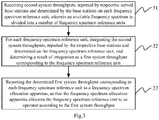
- Based upon the same inventive idea, as illustrated in
Fig.3 , another frequency spectrum allocation method according to an embodiment of the invention includes: -
Operation 31, receiving second system throughputs, reported by respective served base stations, determined by the base stations on each frequency spectrum reference unit, where an available frequency spectrum is divided into a number of frequency spectrum reference units; -
Operation 32, for each frequency spectrum reference unit, integrating the second system throughputs, reported by the respective base stations and determined on the frequency spectrum reference unit, and determining a result of integration as a first system throughput corresponding to the frequency spectrum reference unit; and -
Operation 33, reporting the determined first system throughput corresponding to each frequency spectrum reference unit to a frequency spectrum allocation apparatus, so that the frequency spectrum allocation apparatus allocates the frequency spectrum reference unit to an operator according to the first system throughput. - In the embodiments of the invention, the second system throughputs, reported by the respective served base stations and determined by the base stations on each frequency spectrum reference unit, are received; for each frequency spectrum reference unit, the second system throughputs, reported by the respective base stations and determined on the frequency spectrum reference unit are integrated, and the result of integration is determined as the first system throughput corresponding to the frequency spectrum reference unit; and the determined first system throughput corresponding to each frequency spectrum reference unit is reported to the frequency spectrum allocation apparatus, so that the frequency spectrum allocation apparatus allocates the frequency spectrum reference unit to the operator according to the first system throughput, to thereby improve the access efficiency of the available frequency spectrum.
- In an implementation, each of the base stations determines the second system throughput on each frequency spectrum reference unit as follows:
- The base station receives channel qualities measured by respective terminals on each Physical Resource Block (PRB) of each frequency spectrum reference unit, where the base station configures a common pilot signal on each PRB of each frequency spectrum reference unit, and the channel quality measured on each PRB of each frequency spectrum reference unit is a channel quality measured by each terminal using the common pilot signal on the PRB;
- The base station performs simulated resource scheduling on each terminal, and determines a corresponding channel quality on a PRB allocated simulatively to each terminal from the received channel qualities according to a resource allocation result of simulated resource scheduling; and
- The base station determines a corresponding system throughput on the PRB allocated simulatively to each terminal according to a corresponding relationship between a channel quality and a system throughput, and determines the determined system throughputs corresponding to the PRBs belonging to the respective frequency spectrum reference units as the second system throughputs of the respective frequency spectrum reference units.
- Preferably the base station determines the corresponding relationship between a channel quality and a system throughput in the following operations:
- The base station selects an appropriate Modulation and Coding Scheme (MCS) level according to the channel quality;
- The base station determines a corresponding Transport Block Size (TBS) according to the selected MCS level; and
- The base station determines the system throughput according to the determined TBS, and a received signal to noise ratio.
- In an implementation, all the terminals in a cell served by each operator measure channel qualities on each of PRBs of each frequency spectrum reference unit configured for the cell, and report the measured channel qualities to the base station serving the terminals.
- By way of an example, the base station determines the second system throughputs as depicted in Table 1 according to the resource allocation result of simulated resource scheduling.
Table 1 Frequency spectrum reference unit number Resource number UE (terminal) number Second system throughput Frequency spectrum reference unit 1 PRB_1 UE_X Throuthput PRB1 PRB_2 UE_X Throuthput PRB2 PRB_3 UE_Y Throuthput PRB3 ... ... ... PRB_n UE_W ThrouthputPRBn Frequency spectrum reference unit 2 PRB_1 UE_X Throuthput PRB1 PRB_2 UE_X Throuthput PRB2 PRB_3 UE_Y Throuthput PRB3 ... ... ... PRB_n UE_W ThrouthputPRBn ... ... ... ... - According to Table 1, in the
operation 32, for each frequency spectrum reference unit, the second system throughputs, reported by the respective base stations, determined on the frequency spectrum reference unit are integrated, and the result of integration is determined as the first system throughput corresponding to the frequency spectrum reference unit, as depicted in Table 2.Table 2 Operator number Frequency spectrum reference unit 1 Frequency spectrum reference unit 2 ... Frequency spectrum reference unit N 1 Through_1 Throught_2 ... Throught_N - Where

- It shall be noted that the base station performs simulated resource scheduling on the respective terminals by allocating a PRB to each terminal under some resource scheduling criterion, where the resource allocation result of simulated resource scheduling will not be notified to the terminal, and no service will be transmitted over the resource for performing simulated resource scheduling, that is, no resource will be really scheduled to any terminal, but only the resource allocation result of simulated resource scheduling will be recorded. Here a PRB is allocated to each terminal under some resource scheduling criterion in simulated resource scheduling as in the prior art, so a repeated description thereof will be omitted here.
- Further to any one of the embodiments above, the method further includes:
- After updated frequency spectrum reference units notified by the frequency spectrum allocation apparatus are received, the updated frequency spectrum reference units are notified to the respective served base stations, so that the base stations report second system throughputs determined on each updated frequency spectrum reference unit.
- Particularly after updated frequency spectrum reference units notified by the frequency spectrum allocation apparatus are received, the updated frequency spectrum reference units are notified to the respective served base stations, and thereafter the
operation 31 to theoperation 33 are further repeated. - The frequency spectrum allocation method according to the embodiments of the invention will be described below in details with connection with two particular embodiments thereof.
- In a first embodiment, the frequency spectrum allocation method according to the invention will be described from the perspective of interaction between the respective apparatuses. As illustrated in
Fig.4 , the method includes the following operations: -
Operation 41, the frequency spectrum allocation apparatus divides an available frequency spectrum served by the frequency spectrum allocation apparatus into at least two frequency spectrum reference units; -
Operation 42, each operator can be provided with an access to all the frequency spectrum reference units; -
Operation 43, the servers of the respective operators count system throughputs available on each frequency spectrum reference unit according to system throughputs reported by the base stations, and report the system throughputs to the frequency spectrum allocation apparatus; and -
Operation 44, the frequency spectrum allocation apparatus allocates the frequency spectrum under a system throughput maximization principle. - Here in the
operation 43, each of the base stations reports the system throughput particularly as follows: -
Operation 43a, the terminals measure common pilot signals on all the PRBs of all the frequency spectrum reference units; -
Operation 43b, the terminals report measured channel qualities to the base station serving the terminals; -
Operation 43c, the base station performs simulated resource scheduling on the respective terminals under a set criterion, and records a resource allocation result; and -
Operation 43d, the base station counts a system throughput available on the respective PRBs of each frequency spectrum reference unit according to the resource allocation result, and reports the system throughput to the server. - In a second embodiment, for example, there are currently two operators in total sharing a segment of available frequency spectrum, which are denoted respectively as operator_A and operator_B sharing a frequency band of 10 MHz in total divided into frequency spectrum reference units, each of which is 5 MHz; and for example, there are two base stations deployed under each operator, which are denoted respectively as NodeB_a_1 and NodeB_a_2; and NodeB_b_1 and NodeB_b_2, where NodeB_a_1 represents a first base station of the operator a, and the same definition will apply to the other denominations, so a repeated description thereof will be omitted here. There are 30 UEs of each base station. Then a particular implementation flow of the inventive solution is as follows:
1. The frequency spectrum allocation apparatus divides an available frequency spectrum served by the frequency spectrum allocation apparatus at some granularity, so the 10-MHz frequency spectrum can be divided into two 5-MHz frequency spectrum reference units.
2. If both operator_A and operator_B can be provided with an access to the entire frequency spectrum, then operator_A and operator_B will count system throughputs thereof available on each frequency spectrum reference unit respectively, and report the system throughputs respectively to the frequency spectrum allocation apparatus.
Taking the operator A as an example: - All the terminals of NodeB_a_1 and NodeB_a_2 served by the operator measure channel qualities on all the frequency bands configured for the cells, and report the measured channel qualities respectively to the corresponding base stations;
- In this operation, bandwidths allocated for the base stations, and their particular frequency ranges are determined as in the prior art, that is, by the operators, and the bandwidth is allocated in each cell particularly as in the prior art. For example, in this solution, NodeB_a_1 and NodeB_a_2 are deployed in the same-frequency network deployment scheme, and both of the base stations are allocated with 10-MHz frequency spectrum.
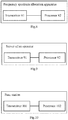
- Based upon the same inventive idea, an embodiment of the invention further provides a frequency spectrum allocation apparatus as illustrated in
Fig.5 including: - A receiving
module 51 is configured to receive first system throughputs, reported by servers of different operators and determined by the servers on each frequency spectrum reference unit, where an available frequency spectrum is divided into a number of frequency spectrum reference units; and - A
processing module 52 is configured, for each frequency spectrum reference unit, to allocate the frequency spectrum reference unit to an operator with the largest value of the first system throughput according to the first system throughputs reported by the servers of the respective operators on the frequency spectrum reference unit. - In an implementation, the apparatus further includes:
- A frequency
spectrum dividing module 53 is configured to re-divide the frequency spectrum reference units, and to notify the updated frequency spectrum reference units to the servers of the different operators, so that the servers of the respective operators report first system throughputs determined on each updated frequency spectrum reference unit. - Preferably the frequency
spectrum dividing module 53 is particularly configured: - If the available frequency spectrum is changed, to re-divide the available frequency spectrum into frequency spectrum reference units at an original granularity for dividing an available frequency spectrum into frequency spectrum reference units; or
- If the granularity for dividing an available frequency spectrum into frequency spectrum reference units is changed, to re-divide the available frequency spectrum into frequency spectrum reference units at the updated granularity; or
- If both the available frequency spectrum and the granularity for dividing an available frequency spectrum into frequency spectrum reference units are changed, to re-divide the available frequency spectrum into frequency spectrum reference units at the updated granularity.
- Based upon the same inventive idea, an embodiment of the invention further provides a server of an operator, and as illustrated in
Fig.6 , the server includes: - A receiving
module 61 is configured to receive second system throughputs, reported by respective base stations served by the server, determined by the base stations on each frequency spectrum reference unit, where an available frequency spectrum is divided into a number of frequency spectrum reference units; - A
processing module 62 is configured, for each frequency spectrum reference unit, to integrate the second system throughputs, reported by the respective base stations and determined on the frequency spectrum reference unit, and to determine a result of integration as a first system throughput corresponding to the frequency spectrum reference unit; and - A sending
module 63 is configured to report the determined first system throughput corresponding to each frequency spectrum reference unit to a frequency spectrum allocation apparatus. - Furthermore the receiving
module 61 is further configured to receive updated frequency spectrum reference units notified by the frequency spectrum allocation apparatus; and
The sendingmodule 63 is further configured to notify the updated frequency spectrum reference units to the respective base stations served by the server, so that the base stations report second system throughputs determined on each updated frequency spectrum reference unit. - Based upon the same inventive idea, an embodiment of the invention further provides a base station as illustrated in
Fig.7 including: - A receiving
module 71 is configured to receive channel qualities measured by respective terminals on each Physical Resource Block (PRB) of each frequency spectrum reference unit, where the base station configures a common pilot signal on each PRB of each frequency spectrum reference unit, and the channel quality measured on each PRB of each frequency spectrum reference unit is a channel quality measured by each terminal using the common pilot signal on the PRB; - A
simulated scheduling module 72 is configured to perform simulated resource scheduling on each terminal, and to determine a corresponding channel quality on a PRB allocated simulatively to each terminal from the received channel qualities according to a resource allocation result of simulated resource scheduling; and - A
processing module 73 is configured to determine a corresponding system throughput on the PRB allocated simulatively to each terminal according to a corresponding relationship between a channel quality and a system throughput, to determine the determined system throughputs corresponding to the PRBs belonging to the respective frequency spectrum reference units as the second system throughputs of the respective frequency spectrum reference units, and to report the determined second system throughputs to a server of an operator. - Based upon the same inventive idea, an embodiment of the invention further provides another frequency spectrum allocation apparatus as illustrated in
Fig.8 including atransceiver 81, and at least oneprocessor 82 connected with thetransceiver 81, where: - The
transceiver 81 is configured to receive first system throughputs, reported by servers of different operators and determined by the servers on each frequency spectrum reference unit, where an available frequency spectrum is divided into a number of frequency spectrum reference units; and - The
processor 82 is configured, for each frequency spectrum reference unit, to allocate the frequency spectrum reference unit to an operator with the largest value of the first system throughput according to the first system throughputs reported by the servers of the respective operators on the frequency spectrum reference unit. - Where the
transceiver 81 and theprocessor 82 can be connected via a bus. - In an implementation, the
processor 82 is further configured: - To re-divide the frequency spectrum reference units, and to notify the updated frequency spectrum reference units to the servers of the different operators, so that the servers of the respective operators report first system throughputs determined on each updated frequency spectrum reference unit.
- Preferably the
processor 82 is particularly configured: - If the available frequency spectrum is changed, to re-divide the available frequency spectrum into frequency spectrum reference units at an original granularity for dividing an available frequency spectrum into frequency spectrum reference units; or
- If the granularity for dividing an available frequency spectrum into frequency spectrum reference units is changed, to re-divide the available frequency spectrum into frequency spectrum reference units at the updated granularity; or
- If both the available frequency spectrum and the granularity for dividing an available frequency spectrum into frequency spectrum reference units are changed, to re-divide the available frequency spectrum into frequency spectrum reference units at the updated granularity.
- Based upon the same inventive idea, an embodiment of the invention further provides another server of an operator, and as illustrated in
Fig.9 , the server includes atransceiver 91, and at least oneprocessor 92 connected with thetransceiver 91, where: - The
transceiver 91 is configured to receive second system throughputs, reported by respective base stations served by the server and determined by the base stations on each frequency spectrum reference unit, where an available frequency spectrum is divided into a number of frequency spectrum reference units; - The
processor 92 is configured, for each frequency spectrum reference unit, to integrate the second system throughputs, reported by the respective base stations and determined on the frequency spectrum reference unit, and to determine a result of integration as a first system throughput corresponding to the frequency spectrum reference unit; and - The
transceiver 91 is configured to report the determined first system throughput corresponding to each frequency spectrum reference unit to a frequency spectrum allocation apparatus. - Where the
transceiver 91 and theprocessor 92 can be connected via a bus. - Furthermore the
transceiver 91 is further configured to receive updated frequency spectrum reference units notified by the frequency spectrum allocation apparatus; and to notify the updated frequency spectrum reference units to the respective base stations served by the server, so that the base stations report second system throughputs determined on each updated frequency spectrum reference unit. - Based upon the same inventive idea, an embodiment of the invention further provides another base station as illustrated in
Fig.10 including atransceiver 101, and at least oneprocessor 102 connected with thetransceiver 101, where: - The
transceiver 101 is configured to receive channel qualities measured by respective terminals on each Physical Resource Block (PRB) of each frequency spectrum reference unit, where the base station configures a common pilot signal on each PRB of each frequency spectrum reference unit, and the channel quality measured on each PRB of each frequency spectrum reference unit is a channel quality measured by each terminal using the common pilot signal on the PRB; - The
processor 102 is configured to perform simulated resource scheduling on each terminal, and to determine a corresponding channel quality on a PRB allocated simulatively to each terminal from the received channel qualities according to a resource allocation result of simulated resource scheduling; to determine a corresponding system throughput on the PRB allocated simulatively to each terminal according to a corresponding relationship between a channel quality and a system throughput, to determine the determined system throughputs corresponding to the PRBs belonging to the respective frequency spectrum reference units as the second system throughputs of the respective frequency spectrum reference units; and - The
transceiver 101 is configured to report the determined second system throughputs of the respective frequency spectrum reference units to a server. - Where the
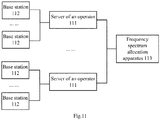
transceiver 101 and theprocessor 102 can be connected via a bus. - Based upon the same inventive idea, an embodiment of the invention further provides a communication system as illustrated in
Fig.11 including: -
Servers 111 of operators are configured to receive second system throughputs, reported byrespective base stations 112 served by the servers and determined by the base stations on each frequency spectrum reference unit; for each frequency spectrum reference unit, to integrate the second system throughputs, reported by therespective base stations 112 and determined on the frequency spectrum reference unit, and to determine results of integration as first system throughputs corresponding to the frequency spectrum reference unit; and to report the determined first system throughputs corresponding to each frequency spectrum reference unit to a frequency spectrum allocation apparatus; and - The frequency spectrum allocation apparatus 113 is configured to receive the first system throughputs, reported by the servers of the different operators and determined by the servers on each frequency spectrum reference unit, where an available frequency spectrum is divided into a number of frequency spectrum reference units; and for each frequency spectrum reference unit, to allocate the frequency spectrum reference unit to an operator with the largest value of the first system throughput according to the first system throughputs reported by the servers of the respective operators on the frequency spectrum reference unit.
- Preferably each of the
base stations 112 is particularly configured: - To receive channel qualities measured by respective terminals on each Physical Resource Block (PRB) of each frequency spectrum reference unit, where the base station configures a common pilot signal on each PRB of each frequency spectrum reference unit, and the channel quality measured on each PRB of each frequency spectrum reference unit is a channel quality measured by each terminal using the common pilot signal on the PRB;
- To perform simulated resource scheduling on each terminal, and to determine a corresponding channel quality on a PRB allocated simulatively to each terminal from the received channel qualities according to a resource allocation result of simulated resource scheduling; and
- To determine a corresponding system throughput on the PRB allocated simulatively to each terminal according to a corresponding relationship between a channel quality and a system throughput, and to determine the determined system throughputs corresponding to the PRBs belonging to the respective frequency spectrum reference units as the second system throughputs of the respective frequency spectrum reference units.
- Those skilled in the art shall appreciate that the embodiments of the invention can be embodied as a method, a system or a computer program product. Therefore the invention can be embodied in the form of an all-hardware embodiment, an all-software embodiment or an embodiment of software and hardware in combination. Furthermore the invention can be embodied in the form of a computer program product embodied in one or more computer useable storage mediums (including but not limited to a disk memory, a CD-ROM, an optical memory, etc.) in which computer useable program codes are contained.
- The invention has been described in a flow chart and/or a block diagram of the method, the device (system) and the computer program product according to the embodiments of the invention. It shall be appreciated that respective flows and/or blocks in the flow chart and/or the block diagram and combinations of the flows and/or the blocks in the flow chart and/or the block diagram can be embodied in computer program instructions. These computer program instructions can be loaded onto a general-purpose computer, a specific-purpose computer, an embedded processor or a processor of another programmable data processing device to produce a machine so that the instructions executed on the computer or the processor of the other programmable data processing device create means for performing the functions specified in the flow(s) of the flow chart and/or the block(s) of the block diagram.
- These computer program instructions can also be stored into a computer readable memory capable of directing the computer or the other programmable data processing device to operate in a specific manner so that the instructions stored in the computer readable memory create an article of manufacture including instruction means which perform the functions specified in the flow(s) of the flow chart and/or the block(s) of the block diagram.
- These computer program instructions can also be loaded onto the computer or the other programmable data processing device so that a series of operational operations are performed on the computer or the other programmable data processing device to create a computer implemented process so that the instructions executed on the computer or the other programmable device provide operations for performing the functions specified in the flow(s) of the flow chart and/or the block(s) of the block diagram.
- Although the preferred embodiments of the invention have been described, those skilled in the art benefiting from the underlying inventive concept can make additional modifications and variations to these embodiments. Therefore the appended claims are intended to be construed as encompassing the preferred embodiments and all the modifications and variations coming into the scope of the invention.
- Evidently those skilled in the art can make various modifications and variations to the invention without departing from the spirit and scope of the invention. Thus the invention is also intended to encompass these modifications and variations thereto so long as the modifications and variations come into the scope of the claims appended to the invention and their equivalents.
In this operation, the base station shall configure common pilot signals on all the frequency spectrums to be measured by the terminals; and the base stations perform simulated scheduling on the UEs according to reported measurement results under some criterion, and record their scheduling decisions, particularly as depicted in Table 3:
| Resource number | UE number | Throughput information | |
| Frequency spectrum reference unit1 (5 MHz) | PRB_1 | UE_1 | Throughput_1 |
| PRB_2 | UE_1 | Throughput_1 | |
| PRB_3 | UE_2 | Throughput_2 | |
| ... | ... | ... | |
| PRB_25 | UE_18 | Throughput_18 | |
| Frequency spectrum reference unit 2 (5 MHz) | PRB_1 | UE_3 | Throughput_3 |
| PRB_2 | UE_5 | Throughput_5 | |
| PRB_3 | UE_7 | Throughput_7 | |
| ... | ... | ... | |
| PRB_25 | UE_29 | Throughput_29 |
| Resource number | UE number | Throughput information | |
| Frequency spectrum reference unit1 (5MHz) | PRB_1 | UE_2 | Throughput_2 |
| PRB_2 | UE_2 | Throughput_2 | |
| PRB_3 | UE_3 | Throughput_3 | |
| ... | ... | ... | |
| PRB_25 | UE_16 | Throughput_16 | |
| Frequency spectrum reference unit 2 (5 MHz) | PRB_1 | UE_2 | Throughput_2 |
| PRB_2 | UE_7 | Throughput_7 | |
| PRB_3 | UE_7 | Throughput_7 | |
| ... | ... | ... | |
| PRB_25 | UE_30 | Throughput_30 |
The two base stations count throughputs which may be available on all the frequency bands under a recorded scheduling strategy, and report the throughputs to the server of the operator, and the server integrates all the throughput data reported by the base stations served by the server as depicted in Table 5 and Table 6, where the throughputs of the first 25 PRBs corresponding to the throughput information in Table 3 and Table 4 are integrated as the throughput information corresponding to the frequency spectrum reference unit 1, and alike the throughputs of the last 25 PRBs corresponding to the throughput information in Table 3 and Table 4 are integrated as the throughput information corresponding to the frequency spectrum reference unit 2.
| Operator number | Frequency spectrum reference unit 1 | Frequency spectrum reference unit 2 |
| Operator_A | Throught_A_1 | Throught_A_2 |
| Operator number | Frequency spectrum | Frequency spectrum |
| reference unit 1 | reference unit 2 | |
| Operator_B | Throught_B_1 | Throught_B_2 |
3. The frequency spectrum allocation apparatus schedules and allocates the frequency spectrums under the throughput maximum criterion, particularly as follows:
For each frequency spectrum reference unit, the throughputs of the respective operators on the frequency spectrum reference unit are sorted, and the operator with the highest throughput is provided with an access to the frequency spectrum reference unit. If Throught_A_1> Throught_B_1, then 5 MHz represented by the frequency spectrum reference unit 1 will be allocated to the operator A; and if Throught_A_2< Throught_B_2, then 5 MHz represented by the frequency spectrum reference unit 2 will be allocated to the operator B.
Claims (14)
- A frequency spectrum allocation method, the method comprising:receiving first system throughputs, reported by servers of different operators and determined by the servers on each frequency spectrum reference unit, wherein an available frequency spectrum is divided into a number of frequency spectrum reference units; andfor each frequency spectrum reference unit, allocating the frequency spectrum reference unit to an operator with a largest value of the first system throughput according to the first system throughputs reported by the servers of the respective operators on the frequency spectrum reference unit.
- The method according to claim 1, wherein the method further comprises:re-dividing the frequency spectrum reference units, and notifying the updated frequency spectrum reference units to the servers of the different operators, so that the servers report first system throughputs determined on each updated frequency spectrum reference unit.
- The method according to claim 2, wherein the re-dividing the frequency spectrum reference units comprises:if the available frequency spectrum is changed, then re-dividing the available frequency spectrum into frequency spectrum reference units at an original granularity for dividing an available frequency spectrum into frequency spectrum reference units; orif the granularity for dividing an available frequency spectrum into frequency spectrum reference units is changed, then re-dividing the available frequency spectrum into frequency spectrum reference units at the updated granularity; orif both the available frequency spectrum and the granularity for dividing an available frequency spectrum into frequency spectrum reference units are changed, then re-dividing the available frequency spectrum into frequency spectrum reference units at the updated granularity.
- A spectrum allocation method, the method comprising:receiving second system throughputs, reported by respective served base stations, determined by the base stations on each frequency spectrum reference unit, wherein an available frequency spectrum is divided into a number of frequency spectrum reference units;for each frequency spectrum reference unit, integrating the second system throughputs, reported by the respective base stations and determined on the frequency spectrum reference unit, and determining a result of integration as a first system throughput corresponding to the frequency spectrum reference unit; andreporting the determined first system throughput corresponding to each frequency spectrum reference unit to a frequency spectrum allocation apparatus.
- The method according to claim 4, wherein the determining, by each of the base stations, the second system throughput on each frequency spectrum reference unit comprises:receiving, by the base station, channel qualities measured by respective terminals on each Physical Resource Block, PRB, of each frequency spectrum reference unit, wherein the base station configures a common pilot signal on each PRB of each frequency spectrum reference unit, and the channel quality measured on each PRB of each frequency spectrum reference unit is a channel quality measured by each terminal using the common pilot signal on the PRB;performing, by the base station, simulated resource scheduling on each terminal, and determining a corresponding channel quality on a PRB allocated simulatively to each terminal from the received channel qualities according to a resource allocation result of simulated resource scheduling; anddetermining, by the base station, a corresponding system throughput on the PRB allocated simulatively to each terminal according to a corresponding relationship between a channel quality and a system throughput, and determining the determined system throughputs corresponding to the PRBs belonging to the respective frequency spectrum reference units as the second system throughputs of the respective frequency spectrum reference units.
- The method according to claim 4 or 5, wherein the method further comprises:after updated frequency spectrum reference units notified by the frequency spectrum allocation apparatus are received, notifying the updated frequency spectrum reference units to the respective served base stations, so that the base stations report second system throughputs determined on each updated frequency spectrum reference unit.
- A frequency spectrum allocation apparatus, comprising:a receiving module configured to receive first system throughputs, reported by servers of different operators, determined by the servers on each frequency spectrum reference unit, wherein an available frequency spectrum is divided into a number of frequency spectrum reference units; anda processing module configured, for each frequency spectrum reference unit, to allocate the frequency spectrum reference unit to an operator with a largest value of the first system throughput according to the first system throughputs reported by the servers of the respective operators on the frequency spectrum reference unit.
- The apparatus according to claim 7, wherein the apparatus further comprises:a frequency spectrum dividing module configured to re-divide the frequency spectrum reference units, and to notify the updated frequency spectrum reference units to the servers of the different operators, so that the servers report first system throughputs determined on each updated frequency spectrum reference unit.
- The apparatus according to claim 8, wherein the frequency spectrum dividing module is particularly configured:if the available frequency spectrum is changed, to re-divide the available frequency spectrum into frequency spectrum reference units at an original granularity for dividing an available frequency spectrum into frequency spectrum reference units; orif the granularity for dividing an available frequency spectrum into frequency spectrum reference units is changed, to re-divide the available frequency spectrum into frequency spectrum reference units at the updated granularity; orif both the available frequency spectrum and the granularity for dividing an available frequency spectrum into frequency spectrum reference units are changed, to re-divide the available frequency spectrum into frequency spectrum reference units at the updated granularity.
- A server of an operator, the server comprising:a receiving module configured to receive second system throughputs, reported by respective base stations served by the server and determined by the base stations on each frequency spectrum reference unit, wherein an available frequency spectrum is divided into a number of frequency spectrum reference units;a processing module configured, for each frequency spectrum reference unit, to integrate the second system throughputs, reported by the respective base stations and determined on the frequency spectrum reference unit, and to determine a result of integration as a first system throughput corresponding to the frequency spectrum reference unit; anda sending module configured to report the determined first system throughput corresponding to each frequency spectrum reference unit to a frequency spectrum allocation apparatus.
- The server according to claim 10, wherein the receiving module is further configured to receive updated frequency spectrum reference units notified by the frequency spectrum allocation apparatus; and
the sending module is further configured to notify the updated frequency spectrum reference units to the respective base stations served by the server, so that the base stations report second system throughputs determined on each updated frequency spectrum reference unit. - Abase station, comprising:a receiving module configured to receive channel qualities measured by respective terminals on each Physical Resource Block, PRB, of each frequency spectrum reference unit, wherein the base station configures a common pilot signal on each PRB of each frequency spectrum reference unit, and the channel quality measured on each PRB of each frequency spectrum reference unit is a channel quality measured by each terminal using the common pilot signal on the PRB;a simulated scheduling module configured to perform simulated resource scheduling on each terminal, and to determine a corresponding channel quality on a PRB allocated simulatively to each terminal from the received channel qualities according to a resource allocation result of simulated resource scheduling; anda processing module configured to determine a corresponding system throughput on the PRB allocated simulatively to each terminal according to a corresponding relationship between a channel quality and a system throughput, to determine the determined system throughputs corresponding to the PRBs belonging to the respective frequency spectrum reference units as the second system throughputs of the respective frequency spectrum reference units, and to report the determined second system throughputs of respective frequency spectrum reference units to a server of an operator.
- A communication system, comprising:servers of operators, configured to receive second system throughputs, reported by respective base stations served by the servers, determined by the base stations on each frequency spectrum reference unit; for each frequency spectrum reference unit, to integrate the second system throughputs, reported by the respective base stations, determined on the frequency spectrum reference unit, and to determine results of integration as first system throughputs corresponding to the frequency spectrum reference unit; and to report the determined first system throughputs corresponding to each frequency spectrum reference unit to a frequency spectrum allocation apparatus; andthe frequency spectrum allocation apparatus configured to receive the first system throughputs, reported by the servers of different operators, determined by the servers on each frequency spectrum reference unit, wherein an available frequency spectrum is divided into a number of frequency spectrum reference units; and for each frequency spectrum reference unit, to allocate the frequency spectrum reference unit to an operator with a largest value of the first system throughput according to the first system throughputs reported by the servers of the respective operators on the frequency spectrum reference unit.
- The system according to claim 13, wherein each of the base stations is configured:to receive channel qualities measured by respective terminals on each Physical Resource Block, PRB, of each frequency spectrum reference unit, wherein a common pilot signal is configured on each PRB of each frequency spectrum reference unit, and the channel quality measured on each PRB of each frequency spectrum reference unit is a channel quality measured by each terminal using the common pilot signal on the PRB;to perform simulated resource scheduling on each terminal, and to determine a corresponding channel quality on a PRB allocated simulatively to each terminal from the received channel qualities according to a resource allocation result of simulated resource scheduling; andto determine a corresponding system throughput on the PRB allocated simulatively to each terminal according to a corresponding relationship between a channel quality and a system throughput, and to determine the determined system throughputs corresponding to the PRBs belonging to the respective frequency spectrum reference units as the second system throughputs of the respective frequency spectrum reference units.
Applications Claiming Priority (2)
| Application Number | Priority Date | Filing Date | Title |
|---|---|---|---|
| CN201410302922.8A CN104066092B (en) | 2014-06-27 | 2014-06-27 | A kind of frequency spectrum distributing method, device and system |
| PCT/CN2015/082120 WO2015196980A1 (en) | 2014-06-27 | 2015-06-23 | Frequency spectrum allocation method, device and system |
Publications (3)
| Publication Number | Publication Date |
|---|---|
| EP3163930A1 true EP3163930A1 (en) | 2017-05-03 |
| EP3163930A4 EP3163930A4 (en) | 2017-07-05 |
| EP3163930B1 EP3163930B1 (en) | 2023-12-20 |
Family
ID=51553579
Family Applications (1)
| Application Number | Title | Priority Date | Filing Date |
|---|---|---|---|
| EP15810932.2A Active EP3163930B1 (en) | 2014-06-27 | 2015-06-23 | Frequency spectrum allocation method, device and system |
Country Status (4)
| Country | Link |
|---|---|
| US (1) | US10064185B2 (en) |
| EP (1) | EP3163930B1 (en) |
| CN (1) | CN104066092B (en) |
| WO (1) | WO2015196980A1 (en) |
Cited By (5)
| Publication number | Priority date | Publication date | Assignee | Title |
|---|---|---|---|---|
| EP3855842A1 (en) * | 2020-01-27 | 2021-07-28 | Sterlite Technologies Limited | Method and apparatus for dynamically allocating radio resources in a wireless communication system |
| EP3855844A1 (en) * | 2020-01-27 | 2021-07-28 | Sterlite Technologies Limited | Method and apparatus for allocating bandwidth in a wireless communication system based on utilization |
| EP3855839A1 (en) * | 2020-01-27 | 2021-07-28 | Sterlite Technologies Limited | Method and apparatus for distribution and synchronization of radio resource assignments in a wireless communication system |
| EP3855841A1 (en) * | 2020-01-27 | 2021-07-28 | Sterlite Technologies Limited | Method and apparatus for allocating bandwidth in a wireless communication system based on demand |
| EP3855840A1 (en) * | 2020-01-27 | 2021-07-28 | Sterlite Technologies Limited | Method and apparatus for orthogonal resource allocation in a wireless communication system |
Families Citing this family (12)
| Publication number | Priority date | Publication date | Assignee | Title |
|---|---|---|---|---|
| CN104066092B (en) * | 2014-06-27 | 2018-01-16 | 电信科学技术研究院 | A kind of frequency spectrum distributing method, device and system |
| CN104113844B (en) * | 2014-07-24 | 2018-06-26 | 电信科学技术研究院 | A kind of frequency spectrum distributing method and information uploading method, device |
| CN105636060B (en) * | 2014-11-06 | 2019-10-22 | 电信科学技术研究院 | A kind of method and apparatus of frequency spectrum distribution |
| CN105792223B (en) * | 2014-12-25 | 2019-08-16 | 电信科学技术研究院 | A kind of method and apparatus distributing frequency spectrum |
| CN107615852B (en) * | 2015-06-16 | 2020-02-21 | 华为技术有限公司 | Method, apparatus and device for resource scheduling |
| CN108667540B (en) * | 2018-04-03 | 2020-12-15 | 南京邮电大学 | A Spectrum Allocation Method Based on Idle Spectrum Continuity Awareness in Elastic Optical Networks |
| CN110719575B (en) * | 2019-10-18 | 2021-08-17 | 中国联合网络通信集团有限公司 | A blockchain-based radio spectrum allocation method and system |
| US11265040B2 (en) * | 2019-10-30 | 2022-03-01 | The United States Of America As Represented By The Secretary Of The Army | Method and system for optimizing transceiver spectrum sharing |
| CN112153701B (en) * | 2020-09-09 | 2023-11-21 | 中国联合网络通信集团有限公司 | Method and device for determining bandwidth usage |
| CN114567931B (en) * | 2021-11-05 | 2025-04-29 | 西安电子科技大学重庆集成电路创新研究院 | A fast spectrum allocation method based on composite criteria for multi-user arbitrary bandwidth access |
| WO2024065450A1 (en) * | 2022-09-29 | 2024-04-04 | Oppo广东移动通信有限公司 | Communication methods, communication devices, and control devices |
| JP7604442B2 (en) * | 2022-12-05 | 2024-12-23 | アンリツ株式会社 | Mobile terminal test device and mobile terminal test method |
Family Cites Families (9)
| Publication number | Priority date | Publication date | Assignee | Title |
|---|---|---|---|---|
| DE602005004619T2 (en) | 2005-11-04 | 2009-04-30 | Alcatel Lucent | Allocation of limited power frequencies to improve intercell interference |
| CN100589360C (en) * | 2006-08-23 | 2010-02-10 | 大唐移动通信设备有限公司 | Method and system for processing reference symbols in OFDM system |
| CN101626618B (en) * | 2008-07-07 | 2012-08-08 | 华为技术有限公司 | Radio resource allocation method, network node equipment and radio communication system |
| CN101436891B (en) * | 2008-12-24 | 2012-07-25 | 清华大学 | Method for scheduling global proportionality equitableness of multiple base stations and multiuser |
| US8995996B2 (en) * | 2009-08-12 | 2015-03-31 | Harry V. Bims | Methods and apparatus for performance optimization of heterogeneous wireless system communities |
| CN201947445U (en) | 2011-02-14 | 2011-08-24 | 国家无线电频谱管理研究所 | Dynamic spectrum allocation system based on time particle size |
| EP2858284B1 (en) | 2012-07-10 | 2019-12-04 | Huawei Technologies Co., Ltd. | Channel quality indicator acquisition method, user equipment, and evolved node b and system |
| US8792941B2 (en) * | 2012-09-13 | 2014-07-29 | Alcatel Lucent | Method and apparatus of virtualized resource sharing in cellular networks |
| CN104066092B (en) | 2014-06-27 | 2018-01-16 | 电信科学技术研究院 | A kind of frequency spectrum distributing method, device and system |
-
2014
- 2014-06-27 CN CN201410302922.8A patent/CN104066092B/en active Active
-
2015
- 2015-06-23 EP EP15810932.2A patent/EP3163930B1/en active Active
- 2015-06-23 WO PCT/CN2015/082120 patent/WO2015196980A1/en not_active Ceased
- 2015-06-23 US US15/322,445 patent/US10064185B2/en active Active
Cited By (5)
| Publication number | Priority date | Publication date | Assignee | Title |
|---|---|---|---|---|
| EP3855842A1 (en) * | 2020-01-27 | 2021-07-28 | Sterlite Technologies Limited | Method and apparatus for dynamically allocating radio resources in a wireless communication system |
| EP3855844A1 (en) * | 2020-01-27 | 2021-07-28 | Sterlite Technologies Limited | Method and apparatus for allocating bandwidth in a wireless communication system based on utilization |
| EP3855839A1 (en) * | 2020-01-27 | 2021-07-28 | Sterlite Technologies Limited | Method and apparatus for distribution and synchronization of radio resource assignments in a wireless communication system |
| EP3855841A1 (en) * | 2020-01-27 | 2021-07-28 | Sterlite Technologies Limited | Method and apparatus for allocating bandwidth in a wireless communication system based on demand |
| EP3855840A1 (en) * | 2020-01-27 | 2021-07-28 | Sterlite Technologies Limited | Method and apparatus for orthogonal resource allocation in a wireless communication system |
Also Published As
| Publication number | Publication date |
|---|---|
| US10064185B2 (en) | 2018-08-28 |
| WO2015196980A1 (en) | 2015-12-30 |
| US20170135106A1 (en) | 2017-05-11 |
| EP3163930A4 (en) | 2017-07-05 |
| CN104066092B (en) | 2018-01-16 |
| EP3163930B1 (en) | 2023-12-20 |
| CN104066092A (en) | 2014-09-24 |
Similar Documents
| Publication | Publication Date | Title |
|---|---|---|
| EP3163930B1 (en) | Frequency spectrum allocation method, device and system | |
| CN108418667B (en) | Method and indication method for measuring CSI-RS, network device, terminal | |
| EP2597917B1 (en) | Resource allocation method and device | |
| US11337244B2 (en) | Scheduling subband allocation method and apparatus, and device and readable storage medium | |
| CN102958133B (en) | Communication system access method, downlink information transmitting method, terminal and base station | |
| CN103874073B (en) | A communication system carrier selection method, base station and terminal equipment | |
| US9538391B2 (en) | Sharing frequencies in an OFDM-based wireless communication system | |
| CN104126286B (en) | Allocating a frequency band from a frequency band group to a wireless network system | |
| JP5915766B2 (en) | Base station apparatus, radio communication system, and radio communication control method | |
| CN107154829B (en) | Determine in wireless communication system uplink from the method and apparatus of system interference | |
| US10349409B2 (en) | Method and system for transmission schedule instruction for allocating resources in an unlicensed spectrum | |
| CN109150471A (en) | Information transferring method and device | |
| CN105450374B (en) | A kind of information processing method, system and base station | |
| CN106550467B (en) | Resource scheduling method and base station | |
| EP3375240B1 (en) | Feedback assisted downlink control channel configuration | |
| US20240365360A1 (en) | Method and apparatus for in-band multi-channel determination and utilization | |
| Huang et al. | CURT: A real-time scheduling algorithm for coexistence of LTE and Wi-Fi in unlicensed spectrum | |
| CN106912058A (en) | A kind of channel disturbance coordination approach and device | |
| CN114513808A (en) | Method and controller for implementing user equipment measurement with low overhead | |
| CN103634818B (en) | The measuring method and device of multi-user installation and the method and apparatus for distributing resource | |
| CN105451236B (en) | Method, device and system for managing frequency spectrum | |
| US11432270B2 (en) | System for dynamic PUCCH reallocation | |
| CN105554766B (en) | A method for allocating wireless resources | |
| CN112448776A (en) | Channel quality measuring method of communication system, terminal and base station | |
| CN110392434B (en) | Method for accessing frequency point under discrete sub-band, base station and terminal |
Legal Events
| Date | Code | Title | Description |
|---|---|---|---|
| STAA | Information on the status of an ep patent application or granted ep patent |
Free format text: STATUS: THE INTERNATIONAL PUBLICATION HAS BEEN MADE |
|
| PUAI | Public reference made under article 153(3) epc to a published international application that has entered the european phase |
Free format text: ORIGINAL CODE: 0009012 |
|
| STAA | Information on the status of an ep patent application or granted ep patent |
Free format text: STATUS: REQUEST FOR EXAMINATION WAS MADE |
|
| 17P | Request for examination filed |
Effective date: 20161223 |
|
| AK | Designated contracting states |
Kind code of ref document: A1 Designated state(s): AL AT BE BG CH CY CZ DE DK EE ES FI FR GB GR HR HU IE IS IT LI LT LU LV MC MK MT NL NO PL PT RO RS SE SI SK SM TR |
|
| AX | Request for extension of the european patent |
Extension state: BA ME |
|
| A4 | Supplementary search report drawn up and despatched |
Effective date: 20170607 |
|
| RIC1 | Information provided on ipc code assigned before grant |
Ipc: H04W 16/04 20090101AFI20170531BHEP Ipc: H04W 48/18 20090101ALI20170531BHEP Ipc: H04W 16/14 20090101ALI20170531BHEP |
|
| DAV | Request for validation of the european patent (deleted) | ||
| DAX | Request for extension of the european patent (deleted) | ||
| STAA | Information on the status of an ep patent application or granted ep patent |
Free format text: STATUS: EXAMINATION IS IN PROGRESS |
|
| 17Q | First examination report despatched |
Effective date: 20200910 |
|
| RAP1 | Party data changed (applicant data changed or rights of an application transferred) |
Owner name: DATANG MOBILE COMMUNICATIONS EQUIPMENT CO., LTD. |
|
| GRAP | Despatch of communication of intention to grant a patent |
Free format text: ORIGINAL CODE: EPIDOSNIGR1 |
|
| STAA | Information on the status of an ep patent application or granted ep patent |
Free format text: STATUS: GRANT OF PATENT IS INTENDED |
|
| INTG | Intention to grant announced |
Effective date: 20230710 |
|
| GRAS | Grant fee paid |
Free format text: ORIGINAL CODE: EPIDOSNIGR3 |
|
| GRAA | (expected) grant |
Free format text: ORIGINAL CODE: 0009210 |
|
| STAA | Information on the status of an ep patent application or granted ep patent |
Free format text: STATUS: THE PATENT HAS BEEN GRANTED |
|
| AK | Designated contracting states |
Kind code of ref document: B1 Designated state(s): AL AT BE BG CH CY CZ DE DK EE ES FI FR GB GR HR HU IE IS IT LI LT LU LV MC MK MT NL NO PL PT RO RS SE SI SK SM TR |
|
| REG | Reference to a national code |
Ref country code: GB Ref legal event code: FG4D |
|
| REG | Reference to a national code |
Ref country code: DE Ref legal event code: R096 Ref document number: 602015087025 Country of ref document: DE |
|
| REG | Reference to a national code |
Ref country code: CH Ref legal event code: EP |
|
| REG | Reference to a national code |
Ref country code: IE Ref legal event code: FG4D |
|
| PG25 | Lapsed in a contracting state [announced via postgrant information from national office to epo] |
Ref country code: GR Free format text: LAPSE BECAUSE OF FAILURE TO SUBMIT A TRANSLATION OF THE DESCRIPTION OR TO PAY THE FEE WITHIN THE PRESCRIBED TIME-LIMIT Effective date: 20240321 |
|
| REG | Reference to a national code |
Ref country code: LT Ref legal event code: MG9D |
|
| PG25 | Lapsed in a contracting state [announced via postgrant information from national office to epo] |
Ref country code: LT Free format text: LAPSE BECAUSE OF FAILURE TO SUBMIT A TRANSLATION OF THE DESCRIPTION OR TO PAY THE FEE WITHIN THE PRESCRIBED TIME-LIMIT Effective date: 20231220 |
|
| REG | Reference to a national code |
Ref country code: NL Ref legal event code: MP Effective date: 20231220 |
|
| PG25 | Lapsed in a contracting state [announced via postgrant information from national office to epo] |
Ref country code: ES Free format text: LAPSE BECAUSE OF FAILURE TO SUBMIT A TRANSLATION OF THE DESCRIPTION OR TO PAY THE FEE WITHIN THE PRESCRIBED TIME-LIMIT Effective date: 20231220 |
|
| PG25 | Lapsed in a contracting state [announced via postgrant information from national office to epo] |
Ref country code: LT Free format text: LAPSE BECAUSE OF FAILURE TO SUBMIT A TRANSLATION OF THE DESCRIPTION OR TO PAY THE FEE WITHIN THE PRESCRIBED TIME-LIMIT Effective date: 20231220 Ref country code: GR Free format text: LAPSE BECAUSE OF FAILURE TO SUBMIT A TRANSLATION OF THE DESCRIPTION OR TO PAY THE FEE WITHIN THE PRESCRIBED TIME-LIMIT Effective date: 20240321 Ref country code: FI Free format text: LAPSE BECAUSE OF FAILURE TO SUBMIT A TRANSLATION OF THE DESCRIPTION OR TO PAY THE FEE WITHIN THE PRESCRIBED TIME-LIMIT Effective date: 20231220 Ref country code: ES Free format text: LAPSE BECAUSE OF FAILURE TO SUBMIT A TRANSLATION OF THE DESCRIPTION OR TO PAY THE FEE WITHIN THE PRESCRIBED TIME-LIMIT Effective date: 20231220 Ref country code: BG Free format text: LAPSE BECAUSE OF FAILURE TO SUBMIT A TRANSLATION OF THE DESCRIPTION OR TO PAY THE FEE WITHIN THE PRESCRIBED TIME-LIMIT Effective date: 20240320 |
|
| REG | Reference to a national code |
Ref country code: AT Ref legal event code: MK05 Ref document number: 1643509 Country of ref document: AT Kind code of ref document: T Effective date: 20231220 |
|
| PG25 | Lapsed in a contracting state [announced via postgrant information from national office to epo] |
Ref country code: NL Free format text: LAPSE BECAUSE OF FAILURE TO SUBMIT A TRANSLATION OF THE DESCRIPTION OR TO PAY THE FEE WITHIN THE PRESCRIBED TIME-LIMIT Effective date: 20231220 |
|
| PG25 | Lapsed in a contracting state [announced via postgrant information from national office to epo] |
Ref country code: SE Free format text: LAPSE BECAUSE OF FAILURE TO SUBMIT A TRANSLATION OF THE DESCRIPTION OR TO PAY THE FEE WITHIN THE PRESCRIBED TIME-LIMIT Effective date: 20231220 Ref country code: RS Free format text: LAPSE BECAUSE OF FAILURE TO SUBMIT A TRANSLATION OF THE DESCRIPTION OR TO PAY THE FEE WITHIN THE PRESCRIBED TIME-LIMIT Effective date: 20231220 Ref country code: NO Free format text: LAPSE BECAUSE OF FAILURE TO SUBMIT A TRANSLATION OF THE DESCRIPTION OR TO PAY THE FEE WITHIN THE PRESCRIBED TIME-LIMIT Effective date: 20240320 Ref country code: NL Free format text: LAPSE BECAUSE OF FAILURE TO SUBMIT A TRANSLATION OF THE DESCRIPTION OR TO PAY THE FEE WITHIN THE PRESCRIBED TIME-LIMIT Effective date: 20231220 Ref country code: LV Free format text: LAPSE BECAUSE OF FAILURE TO SUBMIT A TRANSLATION OF THE DESCRIPTION OR TO PAY THE FEE WITHIN THE PRESCRIBED TIME-LIMIT Effective date: 20231220 Ref country code: HR Free format text: LAPSE BECAUSE OF FAILURE TO SUBMIT A TRANSLATION OF THE DESCRIPTION OR TO PAY THE FEE WITHIN THE PRESCRIBED TIME-LIMIT Effective date: 20231220 |
|
| PG25 | Lapsed in a contracting state [announced via postgrant information from national office to epo] |
Ref country code: IS Free format text: LAPSE BECAUSE OF FAILURE TO SUBMIT A TRANSLATION OF THE DESCRIPTION OR TO PAY THE FEE WITHIN THE PRESCRIBED TIME-LIMIT Effective date: 20240420 |
|
| PG25 | Lapsed in a contracting state [announced via postgrant information from national office to epo] |
Ref country code: CZ Free format text: LAPSE BECAUSE OF FAILURE TO SUBMIT A TRANSLATION OF THE DESCRIPTION OR TO PAY THE FEE WITHIN THE PRESCRIBED TIME-LIMIT Effective date: 20231220 Ref country code: AT Free format text: LAPSE BECAUSE OF FAILURE TO SUBMIT A TRANSLATION OF THE DESCRIPTION OR TO PAY THE FEE WITHIN THE PRESCRIBED TIME-LIMIT Effective date: 20231220 |
|
| PG25 | Lapsed in a contracting state [announced via postgrant information from national office to epo] |
Ref country code: SK Free format text: LAPSE BECAUSE OF FAILURE TO SUBMIT A TRANSLATION OF THE DESCRIPTION OR TO PAY THE FEE WITHIN THE PRESCRIBED TIME-LIMIT Effective date: 20231220 |
|
| PG25 | Lapsed in a contracting state [announced via postgrant information from national office to epo] |
Ref country code: SM Free format text: LAPSE BECAUSE OF FAILURE TO SUBMIT A TRANSLATION OF THE DESCRIPTION OR TO PAY THE FEE WITHIN THE PRESCRIBED TIME-LIMIT Effective date: 20231220 Ref country code: SK Free format text: LAPSE BECAUSE OF FAILURE TO SUBMIT A TRANSLATION OF THE DESCRIPTION OR TO PAY THE FEE WITHIN THE PRESCRIBED TIME-LIMIT Effective date: 20231220 Ref country code: RO Free format text: LAPSE BECAUSE OF FAILURE TO SUBMIT A TRANSLATION OF THE DESCRIPTION OR TO PAY THE FEE WITHIN THE PRESCRIBED TIME-LIMIT Effective date: 20231220 Ref country code: IT Free format text: LAPSE BECAUSE OF FAILURE TO SUBMIT A TRANSLATION OF THE DESCRIPTION OR TO PAY THE FEE WITHIN THE PRESCRIBED TIME-LIMIT Effective date: 20231220 Ref country code: IS Free format text: LAPSE BECAUSE OF FAILURE TO SUBMIT A TRANSLATION OF THE DESCRIPTION OR TO PAY THE FEE WITHIN THE PRESCRIBED TIME-LIMIT Effective date: 20240420 Ref country code: EE Free format text: LAPSE BECAUSE OF FAILURE TO SUBMIT A TRANSLATION OF THE DESCRIPTION OR TO PAY THE FEE WITHIN THE PRESCRIBED TIME-LIMIT Effective date: 20231220 Ref country code: CZ Free format text: LAPSE BECAUSE OF FAILURE TO SUBMIT A TRANSLATION OF THE DESCRIPTION OR TO PAY THE FEE WITHIN THE PRESCRIBED TIME-LIMIT Effective date: 20231220 Ref country code: AT Free format text: LAPSE BECAUSE OF FAILURE TO SUBMIT A TRANSLATION OF THE DESCRIPTION OR TO PAY THE FEE WITHIN THE PRESCRIBED TIME-LIMIT Effective date: 20231220 |
|
| PG25 | Lapsed in a contracting state [announced via postgrant information from national office to epo] |
Ref country code: PT Free format text: LAPSE BECAUSE OF FAILURE TO SUBMIT A TRANSLATION OF THE DESCRIPTION OR TO PAY THE FEE WITHIN THE PRESCRIBED TIME-LIMIT Effective date: 20240422 Ref country code: PL Free format text: LAPSE BECAUSE OF FAILURE TO SUBMIT A TRANSLATION OF THE DESCRIPTION OR TO PAY THE FEE WITHIN THE PRESCRIBED TIME-LIMIT Effective date: 20231220 |
|
| PG25 | Lapsed in a contracting state [announced via postgrant information from national office to epo] |
Ref country code: PT Free format text: LAPSE BECAUSE OF FAILURE TO SUBMIT A TRANSLATION OF THE DESCRIPTION OR TO PAY THE FEE WITHIN THE PRESCRIBED TIME-LIMIT Effective date: 20240422 Ref country code: PL Free format text: LAPSE BECAUSE OF FAILURE TO SUBMIT A TRANSLATION OF THE DESCRIPTION OR TO PAY THE FEE WITHIN THE PRESCRIBED TIME-LIMIT Effective date: 20231220 |
|
| REG | Reference to a national code |
Ref country code: DE Ref legal event code: R097 Ref document number: 602015087025 Country of ref document: DE |
|
| PG25 | Lapsed in a contracting state [announced via postgrant information from national office to epo] |
Ref country code: DK Free format text: LAPSE BECAUSE OF FAILURE TO SUBMIT A TRANSLATION OF THE DESCRIPTION OR TO PAY THE FEE WITHIN THE PRESCRIBED TIME-LIMIT Effective date: 20231220 |
|
| PLBE | No opposition filed within time limit |
Free format text: ORIGINAL CODE: 0009261 |
|
| STAA | Information on the status of an ep patent application or granted ep patent |
Free format text: STATUS: NO OPPOSITION FILED WITHIN TIME LIMIT |
|
| PG25 | Lapsed in a contracting state [announced via postgrant information from national office to epo] |
Ref country code: SI Free format text: LAPSE BECAUSE OF FAILURE TO SUBMIT A TRANSLATION OF THE DESCRIPTION OR TO PAY THE FEE WITHIN THE PRESCRIBED TIME-LIMIT Effective date: 20231220 |
|
| PG25 | Lapsed in a contracting state [announced via postgrant information from national office to epo] |
Ref country code: SI Free format text: LAPSE BECAUSE OF FAILURE TO SUBMIT A TRANSLATION OF THE DESCRIPTION OR TO PAY THE FEE WITHIN THE PRESCRIBED TIME-LIMIT Effective date: 20231220 Ref country code: DK Free format text: LAPSE BECAUSE OF FAILURE TO SUBMIT A TRANSLATION OF THE DESCRIPTION OR TO PAY THE FEE WITHIN THE PRESCRIBED TIME-LIMIT Effective date: 20231220 |
|
| 26N | No opposition filed |
Effective date: 20240923 |
|
| PG25 | Lapsed in a contracting state [announced via postgrant information from national office to epo] |
Ref country code: MC Free format text: LAPSE BECAUSE OF FAILURE TO SUBMIT A TRANSLATION OF THE DESCRIPTION OR TO PAY THE FEE WITHIN THE PRESCRIBED TIME-LIMIT Effective date: 20231220 |
|
| REG | Reference to a national code |
Ref country code: CH Ref legal event code: PL |
|
| PG25 | Lapsed in a contracting state [announced via postgrant information from national office to epo] |
Ref country code: LU Free format text: LAPSE BECAUSE OF NON-PAYMENT OF DUE FEES Effective date: 20240623 |
|
| PG25 | Lapsed in a contracting state [announced via postgrant information from national office to epo] |
Ref country code: IE Free format text: LAPSE BECAUSE OF NON-PAYMENT OF DUE FEES Effective date: 20240623 |
|
| PG25 | Lapsed in a contracting state [announced via postgrant information from national office to epo] |
Ref country code: BE Free format text: LAPSE BECAUSE OF NON-PAYMENT OF DUE FEES Effective date: 20240630 Ref country code: CH Free format text: LAPSE BECAUSE OF NON-PAYMENT OF DUE FEES Effective date: 20240630 |
|
| REG | Reference to a national code |
Ref country code: BE Ref legal event code: MM Effective date: 20240630 |
|
| PGFP | Annual fee paid to national office [announced via postgrant information from national office to epo] |
Ref country code: DE Payment date: 20250618 Year of fee payment: 11 |
|
| PGFP | Annual fee paid to national office [announced via postgrant information from national office to epo] |
Ref country code: GB Payment date: 20250618 Year of fee payment: 11 |
|
| PGFP | Annual fee paid to national office [announced via postgrant information from national office to epo] |
Ref country code: FR Payment date: 20250625 Year of fee payment: 11 |
|
| PG25 | Lapsed in a contracting state [announced via postgrant information from national office to epo] |
Ref country code: CY Free format text: LAPSE BECAUSE OF FAILURE TO SUBMIT A TRANSLATION OF THE DESCRIPTION OR TO PAY THE FEE WITHIN THE PRESCRIBED TIME-LIMIT; INVALID AB INITIO Effective date: 20150623 |
|
| PG25 | Lapsed in a contracting state [announced via postgrant information from national office to epo] |
Ref country code: HU Free format text: LAPSE BECAUSE OF FAILURE TO SUBMIT A TRANSLATION OF THE DESCRIPTION OR TO PAY THE FEE WITHIN THE PRESCRIBED TIME-LIMIT; INVALID AB INITIO Effective date: 20150623 |