EP3163448A1 - Test case generation system and recording medium wherein test case is recorded - Google Patents
Test case generation system and recording medium wherein test case is recorded Download PDFInfo
- Publication number
- EP3163448A1 EP3163448A1 EP15816004.4A EP15816004A EP3163448A1 EP 3163448 A1 EP3163448 A1 EP 3163448A1 EP 15816004 A EP15816004 A EP 15816004A EP 3163448 A1 EP3163448 A1 EP 3163448A1
- Authority
- EP
- European Patent Office
- Prior art keywords
- test case
- information
- pass criteria
- pass
- test
- Prior art date
- Legal status (The legal status is an assumption and is not a legal conclusion. Google has not performed a legal analysis and makes no representation as to the accuracy of the status listed.)
- Withdrawn
Links
Images




Classifications
-
- G—PHYSICS
- G06—COMPUTING OR CALCULATING; COUNTING
- G06F—ELECTRIC DIGITAL DATA PROCESSING
- G06F11/00—Error detection; Error correction; Monitoring
- G06F11/36—Prevention of errors by analysis, debugging or testing of software
- G06F11/3668—Testing of software
- G06F11/3672—Test management
- G06F11/3684—Test management for test design, e.g. generating new test cases
-
- G—PHYSICS
- G06—COMPUTING OR CALCULATING; COUNTING
- G06F—ELECTRIC DIGITAL DATA PROCESSING
- G06F11/00—Error detection; Error correction; Monitoring
- G06F11/36—Prevention of errors by analysis, debugging or testing of software
- G06F11/3604—Analysis of software for verifying properties of programs
- G06F11/3608—Analysis of software for verifying properties of programs using formal methods, e.g. model checking, abstract interpretation
Definitions
- the present invention relates to a test case generation system for checking software, and a recording medium in which a test case is recorded.
- model checking which is a formal verification method, is present as a measure against the above-mentioned problem.
- a design corresponding to a checking object specifically, software specifications or source code is expressed using a format specification descriptive language (hereinafter which will be referred to as a "verification model").
- a required characteristic for the checking object is expressed as a property using a temporal logic formula which is a logic formula having a concept of time and an operator, or is expressed as an assertion by a logic formula not having a concept of time.
- source code is compiled and converted into object code, and is installed in a system as an executable format combined in a particular format.
- a defect may be generated in the object code due to an influence of optimization or a bug of a compiler.
- a product developer desires to verify whether defectiveness is present in the object code which is a final form of software. For this reason, application of model checking to the object code is useful when model checking is applicable to the object code.
- model checking with respect to the object code has a technical difficulty since expression of code is different according to a computer on which the object code operates, and is not common. Further, there are few tools for expression.
- the model checker has a function of comprehensively searching for an available action or an execution path of a checking object through a verification model, and thus this function is used in a test case generation technology.
- a mechanism is described below.
- a verification model is constructed from source code which is a source of object code set as a checking object, and a property or an assertion corresponding to "an end point of an execution path desired to be tested is not reached" is defined with respect to the end point in the source code.
- a model checker outputs an execution path reaching the end point as a counterexample. For example, checking is executed by describing "assert (false)" at a finally executed point in the verification model using Simple Promela Interpreter (SPIN) in the model checker.
- SPIN Simple Promela Interpreter
- a trace corresponding to information related to an execution path from the point at which execution starts to the point at which execution ends is output as one or a plurality of counterexamples.
- One trace corresponds to one test case (may correspond to a plurality of test cases in which an execution condition is changed).
- This trace includes substitution for a variable which is non-deterministically selected in the middle, that is, input value determination or an execution order when a plurality of processes is present.
- This trace is converted into data for execution of a test, and is set as an input of a system in which the object code corresponding to the checking object is executed on a real machine or a simulator.
- This data is a test case or a part of the test case.
- a test case is data indicating a test condition.
- an expression "a part of the test case" is used since the data converted from the trace does not include a pass criterion or some execution conditions of a program set as a checking object.
- This test case generation technology may include execution paths, and thus may be expected to have a similar effect to that of a technology in which model checking is performed with respect to object code.
- PTL 1 is present as a prior art that performs test case generation applying model checking.
- a pass criterion may be expressed using a temporal logic formula.
- every single test is executed in a real machine or a simulator, and thus a pass criterion may not be expressed using a temporal logic formula.
- model checking "always" or “future” corresponding to an operator of a temporal logic formula is treated, and thus a logic formula is evaluated at all control points (execution steps in model checking).
- pass determination is evaluation of a logic formula at predetermined timing. Normally, a logic formula for pass determination is evaluated only at one point after execution in many cases.
- a temporal logic formula may not be input as a pass criterion to a system that executes a test using a real machine or a simulator, and evaluation of a characteristic including a concept of time expressed by the temporal logic formula may not be implemented.
- An object of the invention is to provide a technology capable of expressing a pass criterion using a temporal logic formula when object code is tested.
- a configuration described in claims is employed to solve the above-mentioned problem.
- the present application includes a plurality of means to solve the above issue, and according to an example thereof, there is provided a test case generation system including: a control content generator that generates information related to test execution control content from execution path information searched from a model of an executable file or object code corresponding to a checking object; a pass criteria generator that generates information related to pass criteria including a set of a criterion formula having no time element and a timing of executing the criterion formula from the execution path information, and a checking formula including a time element with respect to the checking object; and a test case generator that generates a test case having the pass criteria corresponding to the checking formula from the information related to the test execution control content and the information related to the pass criteria.
- a computer-readable recording medium recording data having a data structure of a test case used to cause a computer to execute a process of checking an executable file or object code corresponding to a checking object, the data structure including information related to test execution control content and information related to pass criteria including a set of a criterion formula having no time element and a timing of executing the criterion formula.
- a pass criterion may be expressed using a temporal logic formula when object code is tested.
- content that can be checked is widened when compared to a case in which only a logic formula having no concept of time is present.
- FIG. 1 is a block diagram of a system that implements a test case generation system of the invention.
- the invention is a system that generates a test case used for a test system that checks an executable format or object code compiled from source code.
- the test case refers to data indicating a test condition.
- a test case generation system 100 includes a computer 110.
- the computer 110 includes a main arithmetic and logic unit (central processing unit (CPU)) 111, a main memory (random access memory (RAM)) 112, a storage medium (read only memory (ROM)) 113, an auxiliary memory (hard disk) 114, an input device (a key board, a pointing device, etc.) 130, and a display device (a display, a printer, etc.) 140.
- CPU central processing unit
- RAM random access memory
- ROM read only memory
- auxiliary memory hard disk
- Software that implements the invention is stored in the ROM 113 of the computer 110 as a test case generation program 120, and is read and executed by the CPU 111.
- the CPU 111 of the computer 110 executes a process defined by the test case generation program 120.
- a file of source code corresponding to a source of object code which is a checking object or a file of a verification model constructed based on the source code are stored in the hard disk 114 on the computer 110.
- a user operation with respect to the test case generation program 120 may be performed from the input device 130 such as the key board.
- Output by the test case generation program 120 is performed as display on the display device 140 such as the display or data file generation in the hard disk 114.
- output by the test case generation program 120 may correspond to output to an external computer (not illustrated) through a network, and output by writing to an external storage medium such as a CD-ROM in a data file format.
- another program may be treated similarly to the test case generation program 120, and the CPU 111 may execute and output the other program.
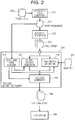
- FIG. 2 illustrates a configuration of the test case generation program 120 stored in the ROM 113, and a configuration of another program associated with the test case generation program 120.
- a verification model generation program 210 generates a verification model 215 by setting, as an input, source code 200 corresponding to a source of object code which is a checking object.
- the verification model 215 is obtained by expressing software specifications or source code using a format specification descriptive language.
- An execution path search program 220 searches for the verification model 215 with regard to a checking object, and outputs execution path information (for example, a trace 225 described below). More specifically, the execution path search program 220 generates one or a plurality of trace groups 225 corresponding to a source of a test case as a counterexample by setting, as an input, a file obtained by adding a property or an assertion for test case generation (trace generation in the narrow sense) to the verification model 215.
- the execution path search program 220 uses a known model checker for generation of the counterexample. In the present embodiment, a SPIN is used as the model checker. The number of generated counterexamples may be adjusted by specifying an option on the model checker.
- the test case generation program 120 generates a test case group 280 by setting the trace group 225 and a temporal logic formula 235 as an input.
- the temporal logic formula 235 is a property with regard to an executable format or object code which corresponds to a checking object, and is a checking formula including a time element.
- the test case generation program 120 has the following configuration.
- the test case generation program includes an execution path analyzer 230, a control content generator 240, a pass criteria generator 250, and a test case generator 260.
- the execution path analyzer 230 receives the verification model 215 as an input, and analyzes a control flow including a process call relationship inside the source code 200 expressed by the verification model 215.
- the process call relationship refers to a function call tree.
- the execution path analyzer 230 outputs information about the control flow as an analysis result, and the information about the control flow is used inside the test case generation program 120.
- the trace group 225 includes the information about the control flow, the control flow may be analyzed from the trace group 225 rather than from the verification model 215. That is, the trace group 225 may be set as an input of the execution path analyzer 230.
- the control content generator 240 sets the trace group 225 as an input, and generates information related to control content of test execution (hereinafter referred to as "test execution control content information") with respect to each trace of the trace group 225.
- the control content of test execution refers to information about an operation that affects execution content of a test including a behavior of a program corresponding to a checking object such as an operation of data of a register of a microcomputer or a variable, processing execution of task initiation in a real-time operating system (OS) or interruption, and a trigger using an execution condition of the program corresponding to the checking object as a condition (standing by until a designated condition is satisfied).
- the control content of test execution and information about timing at which the operation is executed correspond to a set.
- the test execution control content information is defined as one or a plurality of event queues with respect to one trace.
- the pass criteria generator 250 receives the trace group 225 and the temporal logic formula 235 as inputs, and outputs information related to a pass criteria (hereinafter referred to as "pass criteria information") with respect to each trace of the trace group 225.
- This pass criteria information includes a set of a criterion formula having no time element and timing of executing the criterion formula.
- one or a plurality of pass determination event queues are defined with respect to one trace.
- the test case generator 260 outputs the test case group 280 from the test execution control content information which is output by the control content generator 240 and the pass criteria information which is output by the pass criteria generator 250.
- the test case group 280 is in a format that can be input to a test system 290.
- the test case generator 260 aligns event queues of the test execution control content information and the pass criteria information as one event queue in an execution order using the information about the control flow from the execution path analyzer 230. Thereafter, the test case generator 260 creates the test case group 280 by converting the event queues aligned in the execution order into a format input to the test system.
- the test case group 280 is recorded in a memory such as the hard disk 114 or a predetermined computer-readable recording medium.
- the test system 290 is a system that checks object code compiled from the source code 200 or an executable file.
- the test system 290 checks the object code or the executable file using the test case group 280. In this way, an executable format or object code corresponding to a checking object may be checked by the test case group 280 in which an expression of a temporal operator is input to a pass criteria.
- FIG. 3 is a processing flow of the test case generation program 120. First, processing starts in step 300. Subsequently, the execution path analyzer 230 analyzes a control flow of the verification model 215 and outputs information about the control flow in step 310.
- Step 320 to step 340 are repeatedly executed. Step 320 to step 340 are executed with respect to each trace of the trace group 225, and thus are repeated the number of times corresponding to the number of traces included in the trace group 225.
- the control content generator 240 analyzes the trace group 225, and outputs test execution control content information.
- the pass criteria generator 250 outputs pass criteria information from the trace group 225 and the temporal logic formula 235.
- the test case generator 260 outputs one test case of the test case group 280 from the test execution control content information and the pass criteria information. The above steps are repeated and processing ends in step 390.
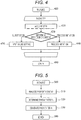
- FIG. 4 specifies a processing flow of step 320 by the control content generator 240. Processing starts in step 400. Step 410 to step 440 are repeated the number of times corresponding to the number of processing steps included in each trace of the trace group 225. In step 410, the control content generator 240 extracts the steps included in each trace corresponding to a processing object one by one from a head. Herein, one of processing steps to be subsequently executed is extracted by one execution among processing steps to be extracted, and content thereof is analyzed.
- step 420 the control content generator 240 determines a type of processing extracted in step 410.
- the processing corresponds to input value setting by substituting a value for a variable (including a resister of a microcomputer)
- the operation proceeds to step 430.
- the processing corresponds to process initiation the operation proceeds to step 440.
- a criterion for determining that the processing corresponds to input value setting is that the processing corresponds to an assignment statement, and the substituted variable is set as an input value.
- a criterion for determining that the processing corresponds to process initiation is that the processing is initial processing of a function designated as a start point of a process. Whether the processing is the initial processing of the function may be determined using the control flow information from the execution path analyzer 230.
- step 430 the control content generator 240 adds a process of substituting a value for a variable to the output test execution control content information.
- a description location (a function, a row, etc.) of the process is assigned as information about execution timing.
- the description location of the process may be acquired from a trace or acquired by retracing the control flow information from the execution path analyzer 230.
- step 440 similarly to step 430, the control content generator 240 adds a control process for generating task initiation or interruption indicated by trace processing to the test execution control content information. It is presumed that information about a process (interruption, task initiation, etc.) to which each process of the verification model corresponds in the program corresponding to the checking object is set in the control content generator 240, and a control process according to the process is selected. The above steps are repeated and processing ends in step 490.
- FIG. 5 specifies a processing flow of step 330 by the pass criteria generator 250. Processing starts in step 500.
- the pass criteria generator 250 analyzes syntax of the input temporal logic formula 235. The analyzed syntax is expressed as internal data in the form of an abstract syntax tree (AST).
- AST abstract syntax tree
- the pass criteria generator 250 compares the syntax of the temporal logic formula 235 analyzed in step 510 with a database related to a syntax pattern of a property of the pass criteria generator 250 (checking formula analysis information), and extracts a corresponding pattern.
- the pass criteria generator 250 extracts a logic formula (criterion formula) used for pass determination of a test case from the syntax of the property analyzed in step 510.
- the pass criteria generator 250 generates one or a plurality of pieces of information related to timing at which pass determination is performed from the control flow information from the execution path analyzer 230 and the pattern of the property determined in step 520.
- the pass criteria generator 250 creates pass criteria information by including the logic formula (criterion formula) and the information related to determination timing in a set. The above processing is executed, and processing ends in step 590.
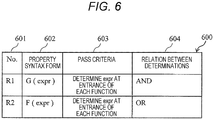
- FIG. 6 illustrates a property analysis table (checking formula analysis information) 600 corresponding to a database related to a syntax pattern of a property.
- the property analysis table 600 is information referred to in step 510 of FIG. 5 .
- the property analysis table 600 includes a rule for converting a property into pass criteria.
- the property analysis table 600 is stored in a memory such as the hard disk 114, and the pass criteria generator 250 reads this information and performs the above processing. Only a property having a syntax form defined in the property analysis table 600 may be treated in the test case generation program 120.
- the property analysis table 600 includes, as configuration items, a rule number 601 assigned to each pattern of a property syntax form, a property syntax form 602, pass criteria 603, and a relationship between respective pass determinations (a relationship between respective pass determinations when used for pass determination serving as one whole test case) 604.
- a property treated in the property analysis table 600 is linear temporal logic (LTL).
- G is a temporal operator indicating "always”
- F is a temporal operator indicating "future”.
- expr is an abstract expression indicating a logic formula. expr is a logic formula used for pass determination.
- a record in which the rule number 601 is "R1" describes a rule in which "G (expr) " is converted into “expr is determined at an entrance/exit of each (executed) function" in a test case.
- a rule may be expressed by a language that describes the rule, or a program that performs conversion.
- the record in which the rule number 601 is "R1” specifies that "AND” of each determination result is adopted when a result of each determination based on expr is used for pass determination serving as one whole test case.
- Content specified in the property analysis table 600 may be changed according to a function of a used test system. For example, when a test system can implement pass determination for each statement of a program corresponding to a checking object, the property analysis table 600 may specify that G (expr) is converted into "expr is determined after execution of each (executed) statement". In addition, the property analysis table 600 may treat a syntax form which is not indicated in FIG. 6 .
- FIG. 7 illustrates source code 710 of a sample program set as a checking object described in the C language, a verification model 720 in which the source code 710 is described in a model descriptive language Promela of the SPIN and to which an assertion "assert (0)" for test case generation is added, and an example of a trace 730 obtained when the verification model 720 is checked using the SPIN.
- a function of the source code 710 is converted into inline macro in the verification model 720.
- DI0 indicates a register of a digital input. Substitution of DI0 for a variable "a" in the source code is expressed as non-deterministic substitution of 0 or 1 for the variable "a" in the verification model 720.
- the execution path analyzer 230 generates an AST by parsing the verification model 720, and searches the AST to detect description in which another inline function is used among respective inline functions, thereby analyzing a function call tree of the original source code 710.
- a call function of main ⁇ func1 is understood.
- FIG. 8 and FIG. 9 illustrate data output when the test case generation program 120 executes processing of FIG. 3 by setting the verification model 720 and the trace 730 as inputs.
- FIG. 8 illustrates test execution control content information 810 and pass criteria information 820.
- the test execution control content information 810 includes, as configuration items, a number 811, a type of processing of test execution control 812, and content of the processing 813.
- the pass criteria information 820 includes, as configuration items, a number 821, a type of processing of test execution control (pass determination is regarded as one type of the test execution control) 822, and content of the processing 823.
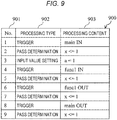
- FIG. 9 illustrates a test case 900. In FIG. 8 and FIG. 9 , one row of each piece of information indicates one event or one step of a process in which a test system is executed. The test case 900 is separately converted into a format that can be input to the test system.
- the control content generator 240 receives the trace 730 as an input, and then analyzes the trace 730, and extracts a process in which 1 is substituted for an input variable "a". Further, the control content generator 240 determines that the process is implemented in a function "main" from a location of a process described in the trace 730 (corresponding to a twelfth row of reference numeral 720 of FIG. 7 ) and the information about the control flow. The control content generator 240 outputs the test execution control content information 810 using this determination result. In the test execution control content information 810 which is output by the control content generator 240, a length of an event queue is 2. A first event is a trigger with a condition that the function "main" is entered. A second event is a process in which 1 is substituted for the variable "a".
- the pass criteria generator 250 refers to a rule described in the property analysis table 600.
- the pass criteria generator 250 selects (refers to) a rule "R1" in the property analysis table 600.
- the pass criteria generator 250 sets triggers at an entrance of the function "main”, an entrance of a function "func1", an exit of the function "func1”, and an exit of the function "main” in accordance with the information about the control flow, and sets pass determination immediately after each trigger.
- Adopting AND of each determination result in pass determination serving as one whole test case is omitted in FIG. 8 and FIG. 9 .
- the information is assigned to the pass criteria information 820 and the test case 900. That is, the pass criteria generator 250 adds information indicating that AND of each determination result is adopted in pass determination serving as one whole test case to the pass criteria information, and the test case generator 260 finally generates a test case by adding the information.
- the test case generator 260 outputs the test case 900 from the test execution control content information 810 and the pass criteria information 820.
- the test case 900 includes, as configuration items, a step number 901, a type of processing of test execution control (pass determination is regarded as one type of the test execution control) 902, and content of the processing of the test execution control 903.
- the test execution control content information 810 and the pass criteria information 820 are combined into one piece of information.
- the test case generator 260 determines that triggers overlap at the entrance of the function "main", and integrates the overlapping part into one part.
- a trigger may be used when obtaining timing of executing processing of interruption or task initiation.
- an execution end time of a statement executed immediately before processes are switched in a trace may be designated as a trigger condition.
- the used test system can detect an entrance/exit of a function, there may be a scheme in which an entrance of a function of the statement and passage of predetermined time therefrom are set as a trigger condition.
- the pass criteria generator 250 selects (refers to) a rule "R2" in the property analysis table 600, and creates pass criteria information in which a trigger and pass determination are set in accordance with the information about the control flow. Thereafter, the test case generator 260 outputs the test case 900 from this pass criteria information and the test execution control content information output from the control content generator 240.
- a determination result thereof is used for pass determination of one whole test case in the test system 290.
- the case in a case in which a logic formula (x > 1) of a property is satisfied at one or more places during execution of a program, the case may be detected.
- similar pass determination to "future" of the property may be implemented.
- a temporal logic formula when object code is checked, a temporal logic formula may be used as pass criterion. In this way, an expression of a temporal operator such as “always" or “future” may be adopted to the pass criteria.
- a temporal logic formula when a temporal logic formula is adopted to a pass criterion in test case generation that applies model checking, similar checking to model checking with respect to object code may be implemented. In this way, it is possible to achieve a decrease in defect of software and an improvement in reliability of a system.
- the invention is not restricted to the above-described embodiment, and various modified examples are included.
- the above embodiment has been described in detail to facilitate understanding of the invention, and may not include all described configurations.
- a portion of a configuration of an embodiment may be replaced by a configuration of another embodiment.
- a configuration of an embodiment may be added to a configuration of another embodiment.
- another configuration may be added/deleted/replaced.
- Each configuration, function, and the like described above may be implemented in software by a processor analyzing and executing a program that implements each function.
- Information about the program that implements each function may be stored in a recording device or a recording medium.
- data of a test case having a data structure illustrated in FIG. 9 may be stored in a recording device or a recording medium.
Landscapes
- Engineering & Computer Science (AREA)
- Theoretical Computer Science (AREA)
- Computer Hardware Design (AREA)
- Quality & Reliability (AREA)
- Physics & Mathematics (AREA)
- General Engineering & Computer Science (AREA)
- General Physics & Mathematics (AREA)
- Software Systems (AREA)
- Debugging And Monitoring (AREA)
Abstract
Description
- The present invention relates to a test case generation system for checking software, and a recording medium in which a test case is recorded.
- With an increase in scale of software installed in a system, it is becoming more difficult to check all software specifications or codes through review or conduct a test thereof. In addition, in software that performs a concurrent operation, a defect may be generated due to processing timing, and there is a difficulty in detecting such a defect through a test. A method of applying model checking, which is a formal verification method, is present as a measure against the above-mentioned problem.
- In model checking, a design corresponding to a checking object, specifically, software specifications or source code is expressed using a format specification descriptive language (hereinafter which will be referred to as a "verification model"). In addition, a required characteristic for the checking object is expressed as a property using a temporal logic formula which is a logic formula having a concept of time and an operator, or is expressed as an assertion by a logic formula not having a concept of time. When these verification models and a checking formula indicated by the property or the assertion are input to a model checker which is a tool operating on a computer, whether the required characteristic for the checking object is satisfied is determined by a mathematical technique such as a comprehensive state search. In addition, when the required characteristic is not satisfied, a counterexample is derived.
- Meanwhile, source code is compiled and converted into object code, and is installed in a system as an executable format combined in a particular format. In this process, even when there is no defect in the source code, a defect may be generated in the object code due to an influence of optimization or a bug of a compiler. In addition, a product developer desires to verify whether defectiveness is present in the object code which is a final form of software. For this reason, application of model checking to the object code is useful when model checking is applicable to the object code. However, model checking with respect to the object code has a technical difficulty since expression of code is different according to a computer on which the object code operates, and is not common. Further, there are few tools for expression.
- A technology for generating a test case by applying model checking is present as a measure against this problem. The model checker has a function of comprehensively searching for an available action or an execution path of a checking object through a verification model, and thus this function is used in a test case generation technology. A mechanism is described below.
- A verification model is constructed from source code which is a source of object code set as a checking object, and a property or an assertion corresponding to "an end point of an execution path desired to be tested is not reached" is defined with respect to the end point in the source code. With regard to an input of the property or the assertion, a model checker outputs an execution path reaching the end point as a counterexample. For example, checking is executed by describing "assert (false)" at a finally executed point in the verification model using Simple Promela Interpreter (SPIN) in the model checker. When there is a case in which the point at which the assertion is described is executed, a trace corresponding to information related to an execution path from the point at which execution starts to the point at which execution ends is output as one or a plurality of counterexamples. One trace corresponds to one test case (may correspond to a plurality of test cases in which an execution condition is changed). This trace includes substitution for a variable which is non-deterministically selected in the middle, that is, input value determination or an execution order when a plurality of processes is present. This trace is converted into data for execution of a test, and is set as an input of a system in which the object code corresponding to the checking object is executed on a real machine or a simulator. This data is a test case or a part of the test case. A test case is data indicating a test condition. Herein, an expression "a part of the test case" is used since the data converted from the trace does not include a pass criterion or some execution conditions of a program set as a checking object.
- This test case generation technology may include execution paths, and thus may be expected to have a similar effect to that of a technology in which model checking is performed with respect to object code.
PTL 1 is present as a prior art that performs test case generation applying model checking. - PTL 1:
JP 2010-102624 A - In model checking of source code, a pass criterion may be expressed using a temporal logic formula. However, at the time of checking object code, every single test is executed in a real machine or a simulator, and thus a pass criterion may not be expressed using a temporal logic formula. In model checking, "always" or "future" corresponding to an operator of a temporal logic formula is treated, and thus a logic formula is evaluated at all control points (execution steps in model checking). However, in a test of object code, pass determination is evaluation of a logic formula at predetermined timing. Normally, a logic formula for pass determination is evaluated only at one point after execution in many cases. For this reason, a temporal logic formula may not be input as a pass criterion to a system that executes a test using a real machine or a simulator, and evaluation of a characteristic including a concept of time expressed by the temporal logic formula may not be implemented.
- An object of the invention is to provide a technology capable of expressing a pass criterion using a temporal logic formula when object code is tested.
- For example, a configuration described in claims is employed to solve the above-mentioned problem. The present application includes a plurality of means to solve the above issue, and according to an example thereof, there is provided a test case generation system including: a control content generator that generates information related to test execution control content from execution path information searched from a model of an executable file or object code corresponding to a checking object; a pass criteria generator that generates information related to pass criteria including a set of a criterion formula having no time element and a timing of executing the criterion formula from the execution path information, and a checking formula including a time element with respect to the checking object; and a test case generator that generates a test case having the pass criteria corresponding to the checking formula from the information related to the test execution control content and the information related to the pass criteria.
- According to another example, there is provided a computer-readable recording medium recording data having a data structure of a test case used to cause a computer to execute a process of checking an executable file or object code corresponding to a checking object, the data structure including information related to test execution control content and information related to pass criteria including a set of a criterion formula having no time element and a timing of executing the criterion formula.
- According to the invention, a pass criterion may be expressed using a temporal logic formula when object code is tested. In this way, content that can be checked is widened when compared to a case in which only a logic formula having no concept of time is present. When checking of object code in a test case generated by applying model checking is combined with an expression of the pass criterion, it is possible to implement similar matter to checking of a property described in a temporal logic using model checking with respect to object code.
- Another characteristic related to the invention is clear from description of the present specification and accompanying drawings. In addition, a problem, a configuration, and an effect which are not described above are made clear by description of an embodiment below.
-
- [
FIG. 1] FIG. 1 is a block diagram of a system that implements a test case generation system according to the invention. - [
FIG. 2] FIG. 2 is a diagram illustrating a configuration of a program related to a function of the test case generation program in an embodiment of the invention. - [
FIG. 3] FIG. 3 is a processing flow of the test case generation program in the embodiment of the invention. - [
FIG. 4] FIG. 4 is a processing flow of a control content generator in the embodiment of the invention. - [
FIG. 5] FIG. 5 is a processing flow of a pass criteria generator in the embodiment of the invention. - [
FIG. 6] FIG. 6 is an example of a database related to a syntax pattern of a property. - [
FIG. 7] FIG. 7 is a diagram illustrating an example of a sample program corresponding to a checking object, a verification model thereof, and a trace. - [
FIG. 8] FIG. 8 is a diagram illustrating an example of test execution control content information and pass determination information in the embodiment of the invention. - [
FIG. 9] FIG. 9 is a diagram illustrating an example of an output test case in the embodiment of the invention. - Hereinafter, an embodiment of the invention will be described with reference to accompanying drawings. Even though the accompanying drawings illustrate a specific embodiment in accordance with a principle of the invention, the accompanying drawings are provided for understanding of the invention, and are not used to restrictively interpret the invention. In addition, in the respective drawings, the same reference numeral is assigned to a common configuration.
-
FIG. 1 is a block diagram of a system that implements a test case generation system of the invention. The invention is a system that generates a test case used for a test system that checks an executable format or object code compiled from source code. As described in the foregoing, the test case refers to data indicating a test condition. - The invention is implemented as a software tool. Each function of the test case generation system is implemented as software. A test
case generation system 100 includes acomputer 110. Thecomputer 110 includes a main arithmetic and logic unit (central processing unit (CPU)) 111, a main memory (random access memory (RAM)) 112, a storage medium (read only memory (ROM)) 113, an auxiliary memory (hard disk) 114, an input device (a key board, a pointing device, etc.) 130, and a display device (a display, a printer, etc.) 140. - Software that implements the invention is stored in the
ROM 113 of thecomputer 110 as a testcase generation program 120, and is read and executed by theCPU 111. TheCPU 111 of thecomputer 110 executes a process defined by the testcase generation program 120. - A file of source code corresponding to a source of object code which is a checking object or a file of a verification model constructed based on the source code are stored in the
hard disk 114 on thecomputer 110. A user operation with respect to the testcase generation program 120 may be performed from theinput device 130 such as the key board. Output by the testcase generation program 120 is performed as display on thedisplay device 140 such as the display or data file generation in thehard disk 114. As another example, output by the testcase generation program 120 may correspond to output to an external computer (not illustrated) through a network, and output by writing to an external storage medium such as a CD-ROM in a data file format. In addition, another program may be treated similarly to the testcase generation program 120, and theCPU 111 may execute and output the other program. -
FIG. 2 illustrates a configuration of the testcase generation program 120 stored in theROM 113, and a configuration of another program associated with the testcase generation program 120. A verificationmodel generation program 210 generates averification model 215 by setting, as an input,source code 200 corresponding to a source of object code which is a checking object. Herein, as described in the foregoing, theverification model 215 is obtained by expressing software specifications or source code using a format specification descriptive language. - An execution
path search program 220 searches for theverification model 215 with regard to a checking object, and outputs execution path information (for example, atrace 225 described below). More specifically, the executionpath search program 220 generates one or a plurality oftrace groups 225 corresponding to a source of a test case as a counterexample by setting, as an input, a file obtained by adding a property or an assertion for test case generation (trace generation in the narrow sense) to theverification model 215. The executionpath search program 220 uses a known model checker for generation of the counterexample. In the present embodiment, a SPIN is used as the model checker. The number of generated counterexamples may be adjusted by specifying an option on the model checker. - The test
case generation program 120 generates atest case group 280 by setting thetrace group 225 and atemporal logic formula 235 as an input. Herein, thetemporal logic formula 235 is a property with regard to an executable format or object code which corresponds to a checking object, and is a checking formula including a time element. The testcase generation program 120 has the following configuration. The test case generation program includes anexecution path analyzer 230, acontrol content generator 240, apass criteria generator 250, and atest case generator 260. - The
execution path analyzer 230 receives theverification model 215 as an input, and analyzes a control flow including a process call relationship inside thesource code 200 expressed by theverification model 215. When thesource code 200 is described in the C language, the process call relationship refers to a function call tree. Theexecution path analyzer 230 outputs information about the control flow as an analysis result, and the information about the control flow is used inside the testcase generation program 120. When thetrace group 225 includes the information about the control flow, the control flow may be analyzed from thetrace group 225 rather than from theverification model 215. That is, thetrace group 225 may be set as an input of theexecution path analyzer 230. - The
control content generator 240 sets thetrace group 225 as an input, and generates information related to control content of test execution (hereinafter referred to as "test execution control content information") with respect to each trace of thetrace group 225. Herein, specifically, the control content of test execution refers to information about an operation that affects execution content of a test including a behavior of a program corresponding to a checking object such as an operation of data of a register of a microcomputer or a variable, processing execution of task initiation in a real-time operating system (OS) or interruption, and a trigger using an execution condition of the program corresponding to the checking object as a condition (standing by until a designated condition is satisfied). In addition, the control content of test execution and information about timing at which the operation is executed correspond to a set. The test execution control content information is defined as one or a plurality of event queues with respect to one trace. - The
pass criteria generator 250 receives thetrace group 225 and thetemporal logic formula 235 as inputs, and outputs information related to a pass criteria (hereinafter referred to as "pass criteria information") with respect to each trace of thetrace group 225. This pass criteria information includes a set of a criterion formula having no time element and timing of executing the criterion formula. In addition, in the pass criteria information, one or a plurality of pass determination event queues are defined with respect to one trace. - The
test case generator 260 outputs thetest case group 280 from the test execution control content information which is output by thecontrol content generator 240 and the pass criteria information which is output by thepass criteria generator 250. Thetest case group 280 is in a format that can be input to atest system 290. Thetest case generator 260 aligns event queues of the test execution control content information and the pass criteria information as one event queue in an execution order using the information about the control flow from theexecution path analyzer 230. Thereafter, thetest case generator 260 creates thetest case group 280 by converting the event queues aligned in the execution order into a format input to the test system. - The
test case group 280 is recorded in a memory such as thehard disk 114 or a predetermined computer-readable recording medium. Thetest system 290 is a system that checks object code compiled from thesource code 200 or an executable file. Thetest system 290 checks the object code or the executable file using thetest case group 280. In this way, an executable format or object code corresponding to a checking object may be checked by thetest case group 280 in which an expression of a temporal operator is input to a pass criteria. -
FIG. 3 is a processing flow of the testcase generation program 120. First, processing starts instep 300. Subsequently, theexecution path analyzer 230 analyzes a control flow of theverification model 215 and outputs information about the control flow instep 310. - Step 320 to step 340 are repeatedly executed. Step 320 to step 340 are executed with respect to each trace of the
trace group 225, and thus are repeated the number of times corresponding to the number of traces included in thetrace group 225. Instep 320, thecontrol content generator 240 analyzes thetrace group 225, and outputs test execution control content information. Instep 330, thepass criteria generator 250 outputs pass criteria information from thetrace group 225 and thetemporal logic formula 235. Instep 340, thetest case generator 260 outputs one test case of thetest case group 280 from the test execution control content information and the pass criteria information. The above steps are repeated and processing ends instep 390. -
FIG. 4 specifies a processing flow ofstep 320 by thecontrol content generator 240. Processing starts instep 400. Step 410 to step 440 are repeated the number of times corresponding to the number of processing steps included in each trace of thetrace group 225. Instep 410, thecontrol content generator 240 extracts the steps included in each trace corresponding to a processing object one by one from a head. Herein, one of processing steps to be subsequently executed is extracted by one execution among processing steps to be extracted, and content thereof is analyzed. - In
step 420, thecontrol content generator 240 determines a type of processing extracted instep 410. When the processing corresponds to input value setting by substituting a value for a variable (including a resister of a microcomputer), the operation proceeds to step 430. When the processing corresponds to process initiation, the operation proceeds to step 440. A criterion for determining that the processing corresponds to input value setting is that the processing corresponds to an assignment statement, and the substituted variable is set as an input value. A criterion for determining that the processing corresponds to process initiation is that the processing is initial processing of a function designated as a start point of a process. Whether the processing is the initial processing of the function may be determined using the control flow information from theexecution path analyzer 230. - In
step 430, thecontrol content generator 240 adds a process of substituting a value for a variable to the output test execution control content information. A description location (a function, a row, etc.) of the process is assigned as information about execution timing. The description location of the process may be acquired from a trace or acquired by retracing the control flow information from theexecution path analyzer 230. - In
step 440, similarly to step 430, thecontrol content generator 240 adds a control process for generating task initiation or interruption indicated by trace processing to the test execution control content information. It is presumed that information about a process (interruption, task initiation, etc.) to which each process of the verification model corresponds in the program corresponding to the checking object is set in thecontrol content generator 240, and a control process according to the process is selected. The above steps are repeated and processing ends instep 490. -
FIG. 5 specifies a processing flow ofstep 330 by thepass criteria generator 250. Processing starts instep 500. Instep 510, thepass criteria generator 250 analyzes syntax of the inputtemporal logic formula 235. The analyzed syntax is expressed as internal data in the form of an abstract syntax tree (AST). Instep 520, thepass criteria generator 250 compares the syntax of thetemporal logic formula 235 analyzed instep 510 with a database related to a syntax pattern of a property of the pass criteria generator 250 (checking formula analysis information), and extracts a corresponding pattern. - In
step 530, thepass criteria generator 250 extracts a logic formula (criterion formula) used for pass determination of a test case from the syntax of the property analyzed instep 510. In addition, thepass criteria generator 250 generates one or a plurality of pieces of information related to timing at which pass determination is performed from the control flow information from theexecution path analyzer 230 and the pattern of the property determined instep 520. Finally, thepass criteria generator 250 creates pass criteria information by including the logic formula (criterion formula) and the information related to determination timing in a set. The above processing is executed, and processing ends instep 590. - Next, a description will be given of information treated in the test case generation system of the present embodiment. Some pieces of information below will be described using a "table" structure. However, the information may not be expressed by a data structure according to a table, and may be expressed by another data structure. For this reason, hereinafter, data expressed in a table form may be simply referred to as "information" to indicate that the data is independent of a data structure.
-
FIG. 6 illustrates a property analysis table (checking formula analysis information) 600 corresponding to a database related to a syntax pattern of a property. The property analysis table 600 is information referred to instep 510 ofFIG. 5 . The property analysis table 600 includes a rule for converting a property into pass criteria. For example, the property analysis table 600 is stored in a memory such as thehard disk 114, and thepass criteria generator 250 reads this information and performs the above processing. Only a property having a syntax form defined in the property analysis table 600 may be treated in the testcase generation program 120. - In the present embodiment, the property analysis table 600 includes, as configuration items, a
rule number 601 assigned to each pattern of a property syntax form, aproperty syntax form 602, passcriteria 603, and a relationship between respective pass determinations (a relationship between respective pass determinations when used for pass determination serving as one whole test case) 604. In this example, a property treated in the property analysis table 600 is linear temporal logic (LTL). - Two temporal logic formula patterns are described in the property analysis table 600. One of the patterns is G (expr), and the other one is F (expr). G is a temporal operator indicating "always", and F is a temporal operator indicating "future". In addition, herein, expr is an abstract expression indicating a logic formula. expr is a logic formula used for pass determination.
- A record in which the
rule number 601 is "R1" describes a rule in which "G (expr) " is converted into "expr is determined at an entrance/exit of each (executed) function" in a test case. Such a rule may be expressed by a language that describes the rule, or a program that performs conversion. In addition, the record in which therule number 601 is "R1" specifies that "AND" of each determination result is adopted when a result of each determination based on expr is used for pass determination serving as one whole test case. Similarly, a record in which therule number 601 is "R2" specifies that F (expr) is converted into "expr is determined at an entrance/exit of each function", and "OR" of each determination result is adopted in pass determination serving as one whole test case. - Content specified in the property analysis table 600 may be changed according to a function of a used test system. For example, when a test system can implement pass determination for each statement of a program corresponding to a checking object, the property analysis table 600 may specify that G (expr) is converted into "expr is determined after execution of each (executed) statement". In addition, the property analysis table 600 may treat a syntax form which is not indicated in
FIG. 6 . -
FIG. 7 illustratessource code 710 of a sample program set as a checking object described in the C language, averification model 720 in which thesource code 710 is described in a model descriptive language Promela of the SPIN and to which an assertion "assert (0)" for test case generation is added, and an example of atrace 730 obtained when theverification model 720 is checked using the SPIN. - A function of the
source code 710 is converted into inline macro in theverification model 720. In addition, in thesource code 710, DI0 indicates a register of a digital input. Substitution of DI0 for a variable "a" in the source code is expressed as non-deterministic substitution of 0 or 1 for the variable "a" in theverification model 720. Thetrace 730 corresponds to a case in which 1 is substituted for the variable "a". However, to facilitate description, thetrace 730 is different from a format of an actual trace (counterexample). It is presumed that the variable "a" is designated as an input to the testcase generation program 120. In addition, G (x < = 1) is designated as a property in the testcase generation program 120. - The
execution path analyzer 230 generates an AST by parsing theverification model 720, and searches the AST to detect description in which another inline function is used among respective inline functions, thereby analyzing a function call tree of theoriginal source code 710. Herein, a call function of main → func1 is understood. -
FIG. 8 andFIG. 9 illustrate data output when the testcase generation program 120 executes processing ofFIG. 3 by setting theverification model 720 and thetrace 730 as inputs.FIG. 8 illustrates test executioncontrol content information 810 and passcriteria information 820. The test executioncontrol content information 810 includes, as configuration items, anumber 811, a type of processing oftest execution control 812, and content of theprocessing 813. In addition, thepass criteria information 820 includes, as configuration items, anumber 821, a type of processing of test execution control (pass determination is regarded as one type of the test execution control) 822, and content of theprocessing 823.FIG. 9 illustrates atest case 900. InFIG. 8 andFIG. 9 , one row of each piece of information indicates one event or one step of a process in which a test system is executed. Thetest case 900 is separately converted into a format that can be input to the test system. - A description will be given of processing of the
control content generator 240. Thecontrol content generator 240 receives thetrace 730 as an input, and then analyzes thetrace 730, and extracts a process in which 1 is substituted for an input variable "a". Further, thecontrol content generator 240 determines that the process is implemented in a function "main" from a location of a process described in the trace 730 (corresponding to a twelfth row ofreference numeral 720 ofFIG. 7 ) and the information about the control flow. Thecontrol content generator 240 outputs the test executioncontrol content information 810 using this determination result. In the test executioncontrol content information 810 which is output by thecontrol content generator 240, a length of an event queue is 2. A first event is a trigger with a condition that the function "main" is entered. A second event is a process in which 1 is substituted for the variable "a". - Next, a description will be given of processing of the
pass criteria generator 250. Thepass criteria generator 250 analyzes thetrace 730 and the property G (x < = 1), and outputs thepass criteria information 820. In this instance, thepass criteria generator 250 refers to a rule described in the property analysis table 600. In this example, thepass criteria generator 250 selects (refers to) a rule "R1" in the property analysis table 600. As a result, thepass criteria generator 250 sets triggers at an entrance of the function "main", an entrance of a function "func1", an exit of the function "func1", and an exit of the function "main" in accordance with the information about the control flow, and sets pass determination immediately after each trigger. That is, the outputpass criteria information 820 corresponds to content in which the triggers are set at the entrance of the function "main", the entrance of the function "fund1", the exit of the function "fund1", and the exit of the function "main", and x < = 1 is determined immediately after each trigger is set. Adopting AND of each determination result in pass determination serving as one whole test case is omitted inFIG. 8 andFIG. 9 . However, the information is assigned to thepass criteria information 820 and thetest case 900. That is, thepass criteria generator 250 adds information indicating that AND of each determination result is adopted in pass determination serving as one whole test case to the pass criteria information, and thetest case generator 260 finally generates a test case by adding the information. - Next, a description will be given of processing of the
test case generator 260. Thetest case generator 260 outputs thetest case 900 from the test executioncontrol content information 810 and thepass criteria information 820. As illustrated inFIG. 9 , thetest case 900 includes, as configuration items, astep number 901, a type of processing of test execution control (pass determination is regarded as one type of the test execution control) 902, and content of the processing of thetest execution control 903. Herein, in thetest case 900 output by thetest case generator 260, the test executioncontrol content information 810 and thepass criteria information 820 are combined into one piece of information. Thetest case generator 260 determines that triggers overlap at the entrance of the function "main", and integrates the overlapping part into one part. - In an example of
FIG. 8 andFIG. 9 , input value setting, a trigger, and pass determination are described as processing types of test execution. Additionally, description indicating interruption or task initiation is presumed to be prepared. A trigger may be used when obtaining timing of executing processing of interruption or task initiation. When a used test system can designate timing for each statement of a program, an execution end time of a statement executed immediately before processes are switched in a trace may be designated as a trigger condition. When the used test system can detect an entrance/exit of a function, there may be a scheme in which an entrance of a function of the statement and passage of predetermined time therefrom are set as a trigger condition. - According to the above description, a logic formula (x < = 1) of a property is determined at each place of execution of a program, and thus it is possible to implement similar pass determination to "always" of the property. Determination only at an entrance/exit of a function does not fully reproduce determination at each statement of model checking. However, determination based on the determination is performed. In addition, when a rule of the property analysis table 600 is changed according to a function of a used test system, a determination frequency may be the same as that in model checking.
- Next, a description will be given of a case in which a temporal operator of a property is "future". In this example, the
pass criteria generator 250 selects (refers to) a rule "R2" in the property analysis table 600, and creates pass criteria information in which a trigger and pass determination are set in accordance with the information about the control flow. Thereafter, thetest case generator 260 outputs thetest case 900 from this pass criteria information and the test execution control content information output from thecontrol content generator 240. - More specifically, when a temporal operator of an input property is "future", adoption of OR of each determination result in pass determination serving as one whole test case is specified in the
test case 900, and a trigger of pass determination is added as a final event. Herein, it is presumed that F (x > 1) is designated as a property in the testcase generation program 120. In the case of F (x > 1), a trigger with a condition of x > 1 is added to an end of thetest case 900. A timeout time of a trigger is set in the testcase generation program 120, and is assigned to the test case 900 (not described in the figure). Whether a trigger with a condition of a logic formula has been executed is determined and recorded similarly to the pass criteria in thetest system 290. In addition, a determination result thereof is used for pass determination of one whole test case in thetest system 290. According to the above description, in a case in which a logic formula (x > 1) of a property is satisfied at one or more places during execution of a program, the case may be detected. Thus, similar pass determination to "future" of the property may be implemented. - According to the above description, when object code is checked, a temporal logic formula may be used as pass criterion. In this way, an expression of a temporal operator such as "always" or "future" may be adopted to the pass criteria. In addition, when a temporal logic formula is adopted to a pass criterion in test case generation that applies model checking, similar checking to model checking with respect to object code may be implemented. In this way, it is possible to achieve a decrease in defect of software and an improvement in reliability of a system.
- The invention is not restricted to the above-described embodiment, and various modified examples are included. The above embodiment has been described in detail to facilitate understanding of the invention, and may not include all described configurations. In addition, a portion of a configuration of an embodiment may be replaced by a configuration of another embodiment. Further, a configuration of an embodiment may be added to a configuration of another embodiment. Furthermore, with respect to a portion of a configuration of each embodiment, another configuration may be added/deleted/replaced.
- Each configuration, function, and the like described above may be implemented in software by a processor analyzing and executing a program that implements each function. Information about the program that implements each function may be stored in a recording device or a recording medium. In addition, data of a test case having a data structure illustrated in
FIG. 9 may be stored in a recording device or a recording medium. -
- 100
- test case generation system
- 110
- computer
- 111
- CPU
- 113
- ROM
- 114
- hard disk
- 120
- test case generation program
- 130
- input device
- 140
- display device
- 200
- source code
- 210
- verification model generation program
- 215
- verification model
- 220
- execution path search program
- 225
- trace group
- 230
- execution path analyzer
- 235
- temporal logic formula
- 240
- control content generator
- 250
- pass criteria generator
- 260
- test case generator
- 280
- test case group
- 290
- test system
- 600
- property analysis table
- 710
- source code
- 720
- verification model
- 730
- trace
- 810
- test execution control content information
- 820
- pass criteria information
- 900
- test case
Claims (13)
- A test case generation system comprising:a control content generator that generates information related to test execution control content from execution path information searched from a model of an executable file or object code corresponding to a checking object;a pass criteria generator that generates information related to pass criteria including a set of a criterion formula having no time element and a timing of executing the criterion formula from the execution path information, and a checking formula including a time element with respect to the checking object; anda test case generator that generates a test case having the pass criteria corresponding to the checking formula from the information related to the test execution control content and the information related to the pass criteria.
- The test case generation system according to claim 1,
wherein the pass criteria generator adds first information indicating adoption of AND of a determination result of the pass criteria to the information related to the pass criteria when the time element of the checking formula corresponds to a meaning of "always", and
the test case generator generates the test case by adding the first information. - The test case generation system according to claim 1,
wherein the pass criteria generator adds second information indicating adoption of OR of a determination result of the pass criteria to the information related to the pass criteria when the time element of the checking formula corresponds to a meaning of "future", and
the test case generator generates the test case by adding the second information. - The test case generation system according to claim 1, wherein the test case generator outputs the test case in which a trigger of the pass criteria corresponding to the checking formula is added as a final event when the time element of the checking formula corresponds to a meaning of "future".
- The test case generation system according to claim 1, wherein the pass criteria generator generates the information related to the pass criteria with reference to checking formula analysis information including a rule for converting the checking formula into the pass criteria.
- The test case generation system according to claim 5, wherein the checking formula analysis information includes, as configuration items, a syntax form of the checking formula, the pass criteria, and a relationship between pass criteria when pass determination is performed by one whole test case.
- The test case generation system according to claim 1, further comprising
an execution path analyzer that analyzes information about a control flow from the model. - The test case generation system according to claim 7, wherein the test case generator generates the test case by aligning the information related to the test execution control content and the information related to the pass criteria using the information about the control flow.
- The test case generation system according to claim 7, wherein the control content generator generates the information related to the test execution control content using the information about the control flow.
- The test case generation system according to claim 7, wherein the pass criteria generator generates the information related to the pass criteria using the information about the control flow.
- A computer-readable recording medium recording data having a data structure of a test case used to cause a computer to execute a process of checking an executable file or object code corresponding to a checking object, the data structure including information related to test execution control content and information related to pass criteria including a set of a criterion formula having no time element and a timing of executing the criterion formula.
- The computer-readable recording medium according to claim 11, wherein information indicating adoption of AND or OR of a determination result of the pass criteria is added to the data structure.
- The computer-readable recording medium according to claim 12, wherein a trigger of the pass criteria is added as a final event in the data structure when information indicating adoption of OR of the determination result of the pass criteria is added.
Applications Claiming Priority (2)
| Application Number | Priority Date | Filing Date | Title |
|---|---|---|---|
| JP2014134156A JP6316120B2 (en) | 2014-06-30 | 2014-06-30 | Test case generation system and recording medium recording test case |
| PCT/JP2015/065964 WO2016002417A1 (en) | 2014-06-30 | 2015-06-03 | Test case generation system and recording medium wherein test case is recorded |
Publications (2)
| Publication Number | Publication Date |
|---|---|
| EP3163448A1 true EP3163448A1 (en) | 2017-05-03 |
| EP3163448A4 EP3163448A4 (en) | 2018-06-13 |
Family
ID=55018969
Family Applications (1)
| Application Number | Title | Priority Date | Filing Date |
|---|---|---|---|
| EP15816004.4A Withdrawn EP3163448A4 (en) | 2014-06-30 | 2015-06-03 | Test case generation system and recording medium wherein test case is recorded |
Country Status (5)
| Country | Link |
|---|---|
| US (1) | US10162739B2 (en) |
| EP (1) | EP3163448A4 (en) |
| JP (1) | JP6316120B2 (en) |
| CN (1) | CN106415504B (en) |
| WO (1) | WO2016002417A1 (en) |
Families Citing this family (10)
| Publication number | Priority date | Publication date | Assignee | Title |
|---|---|---|---|---|
| KR101704338B1 (en) * | 2016-02-12 | 2017-02-08 | 강원대학교산학협력단 | Appratus and method of generating test case for real time system |
| JP6802354B2 (en) * | 2017-03-03 | 2020-12-16 | 三菱電機株式会社 | Communication test equipment, communication test methods and programs |
| KR20180119857A (en) * | 2017-04-26 | 2018-11-05 | 현대자동차주식회사 | Method and apparatus for software change impact analysis |
| JP6796203B2 (en) * | 2017-06-23 | 2020-12-02 | 日立オートモティブシステムズ株式会社 | Electronic control device |
| KR102104295B1 (en) * | 2018-02-20 | 2020-04-24 | 주식회사 아이오티큐브 | Method for automatically generating search heuristics and performing method of concolic testing using automatically generated search heuristics |
| EP3614217A3 (en) * | 2018-08-24 | 2020-09-09 | Tata Consultancy Services Limited | Controlling behavior of an internet of things (iot) automation system by identifying policy violations |
| CN112585471B (en) * | 2018-09-27 | 2024-12-20 | 株式会社岛津制作所 | Automatic qualification determination system |
| US10761961B2 (en) * | 2018-12-21 | 2020-09-01 | Fujitsu Limited | Identification of software program fault locations |
| EP3859532B1 (en) * | 2020-01-31 | 2022-10-12 | Tata Consultancy Services Limited | Method and system for counter example guided loop abstraction refinement |
| CN115934513A (en) * | 2022-11-16 | 2023-04-07 | 大商所飞泰测试技术有限公司 | Demand analysis and test design adaptation method, device, equipment and medium |
Family Cites Families (34)
| Publication number | Priority date | Publication date | Assignee | Title |
|---|---|---|---|---|
| US6499132B1 (en) * | 2001-06-15 | 2002-12-24 | Verisity Ltd. | System and method for analyzing temporal expressions |
| US7340725B1 (en) * | 2004-03-31 | 2008-03-04 | Microsoft Corporation | Smart test attributes and test case scenario in object oriented programming environment |
| US7503037B2 (en) * | 2004-04-02 | 2009-03-10 | Bea Systems, Inc. | System and method for identifying bugs in software source code, using information from code coverage tools and source control tools to determine bugs introduced within a time or edit interval |
| JP2006024006A (en) * | 2004-07-08 | 2006-01-26 | Denso Corp | A test case generation device, a test case generation program, a model base development program, a source code generation validity diagnosis device, a source code generation validity diagnosis program, and a model base development method. |
| CN100351811C (en) * | 2004-11-15 | 2007-11-28 | 华为技术有限公司 | Method and device for testing software product robustness |
| US8146057B1 (en) * | 2005-01-07 | 2012-03-27 | Interactive TKO, Inc. | Instrumentation system and method for testing software |
| US7644078B2 (en) * | 2005-02-28 | 2010-01-05 | Gm Global Technology Operations, Inc. | System and method for mining of temporal data |
| US8266600B2 (en) * | 2005-03-28 | 2012-09-11 | Nec Laboratories America, Inc. | Model checking of multi threaded software |
| CN1908892A (en) * | 2005-08-01 | 2007-02-07 | 王彤 | System and method for test examples design |
| US8683441B2 (en) * | 2006-01-11 | 2014-03-25 | International Business Machines Corporation | Software equivalence checking |
| US8347271B1 (en) * | 2007-03-05 | 2013-01-01 | Emc Corporation | Software testing |
| TWI347519B (en) * | 2007-05-16 | 2011-08-21 | Nat Univ Tsing Hua | Method for generating software test cases |
| US7873945B2 (en) * | 2007-06-29 | 2011-01-18 | Microsoft Corporation | Automatically generating test cases for binary code |
| US7506312B1 (en) * | 2008-01-31 | 2009-03-17 | International Business Machines Corporation | Method and system for automatically determining risk areas to retest |
| JP2009251936A (en) * | 2008-04-07 | 2009-10-29 | Mitsubishi Electric Corp | Automatic testing system for picture program of programmable display unit |
| US8495574B2 (en) * | 2008-06-16 | 2013-07-23 | International Business Machines Corporation | Code coverage tool |
| US8387021B2 (en) * | 2008-09-26 | 2013-02-26 | Microsoft Corporation | Symbolic runtime checking of quantified contracts |
| JP5176869B2 (en) | 2008-10-27 | 2013-04-03 | 富士通株式会社 | Test case generation program, test case generation apparatus, and test case generation method |
| US8359576B2 (en) * | 2008-11-14 | 2013-01-22 | Fujitsu Limited | Using symbolic execution to check global temporal requirements in an application |
| JP2010250669A (en) * | 2009-04-17 | 2010-11-04 | Denso Corp | Test case generation device, object inspection device, and program |
| US9117028B2 (en) * | 2011-12-15 | 2015-08-25 | The Boeing Company | Automated framework for dynamically creating test scripts for software testing |
| CN103186466B (en) * | 2011-12-31 | 2016-06-15 | 中国银联股份有限公司 | Information interactive testing device and method based on association automatic generating test case |
| US20130275946A1 (en) * | 2012-04-16 | 2013-10-17 | Oracle International Corporation | Systems and methods for test development process automation for a test harness |
| US8972949B2 (en) * | 2012-05-29 | 2015-03-03 | Fujitsu Limited | Rule-based method for proving unsatisfiable conditions in a mixed numeric and string solver |
| CN102693183B (en) * | 2012-05-30 | 2015-04-01 | 瑞斯康达科技发展股份有限公司 | Method and system for realizing automatic software testing |
| US9021449B2 (en) * | 2012-08-16 | 2015-04-28 | Fujitsu Limited | Software regression testing using symbolic execution |
| US8997064B2 (en) * | 2012-08-16 | 2015-03-31 | Fujitsu Limited | Symbolic testing of software using concrete software execution |
| US8856751B2 (en) * | 2012-09-20 | 2014-10-07 | Fujitsu Limited | Abstract symbolic execution for scaling symbolic execution generation and automatic test generation |
| JP6003699B2 (en) * | 2013-02-08 | 2016-10-05 | 富士通株式会社 | Test data generation program, method and apparatus |
| JP6032095B2 (en) * | 2013-03-27 | 2016-11-24 | 富士通株式会社 | Test case generation method, test case generation apparatus, and test case generation program |
| US10031841B2 (en) * | 2013-06-26 | 2018-07-24 | Sap Se | Method and system for incrementally updating a test suite utilizing run-time application executions |
| US9251045B2 (en) * | 2013-12-27 | 2016-02-02 | International Business Machines Corporation | Control flow error localization |
| US9336128B2 (en) * | 2014-03-21 | 2016-05-10 | Oracle International Corporation | Method and system for code analysis using symbolic types |
| US9483380B2 (en) * | 2014-04-15 | 2016-11-01 | Fujitsu Limited | Parameterized states in symbolic execution for software testing |
-
2014
- 2014-06-30 JP JP2014134156A patent/JP6316120B2/en active Active
-
2015
- 2015-06-03 US US15/308,299 patent/US10162739B2/en not_active Expired - Fee Related
- 2015-06-03 EP EP15816004.4A patent/EP3163448A4/en not_active Withdrawn
- 2015-06-03 CN CN201580023480.6A patent/CN106415504B/en not_active Expired - Fee Related
- 2015-06-03 WO PCT/JP2015/065964 patent/WO2016002417A1/en not_active Ceased
Also Published As
| Publication number | Publication date |
|---|---|
| US20170046252A1 (en) | 2017-02-16 |
| JP2016012274A (en) | 2016-01-21 |
| US10162739B2 (en) | 2018-12-25 |
| JP6316120B2 (en) | 2018-04-25 |
| CN106415504B (en) | 2019-08-30 |
| WO2016002417A1 (en) | 2016-01-07 |
| CN106415504A (en) | 2017-02-15 |
| EP3163448A4 (en) | 2018-06-13 |
Similar Documents
| Publication | Publication Date | Title |
|---|---|---|
| US10162739B2 (en) | Test case generation system and recording medium wherein test case is recorded | |
| US7958400B2 (en) | Detecting unexpected impact of software changes using coverage analysis | |
| US10025696B2 (en) | System and method for equivalence class analysis-based automated requirements-based test case generation | |
| US9208451B2 (en) | Automatic identification of information useful for generation-based functional verification | |
| US8819492B2 (en) | System and method for testing and analyses of the computer applications | |
| US20170010957A1 (en) | Method for Multithreaded Program Output Uniqueness Testing and Proof-Generation, Based on Program Constraint Construction | |
| US9626468B2 (en) | Assertion extraction from design and its signal traces | |
| US12339763B2 (en) | Automated test generation | |
| Singh et al. | A systematic review on fault based mutation testing techniques and tools for Aspect-J programs | |
| US12379872B2 (en) | Program detection method and apparatus | |
| KR101788279B1 (en) | Measuring system and method of worst-case execution time using test techniques | |
| JPWO2019142266A1 (en) | Test case generation device, test case generation method, and test case generation program | |
| JP6416588B2 (en) | Source code verification system | |
| Debbarma et al. | Static and dynamic software metrics complexity analysis in regression testing | |
| CN109783837A (en) | Emulator, analogue system, emulation mode and simulated program | |
| US20160063162A1 (en) | System and method using pass/fail test results to prioritize electronic design verification review | |
| JP2015069400A (en) | Software test system | |
| US10546080B1 (en) | Method and system for identifying potential causes of failure in simulation runs using machine learning | |
| CN109101355B (en) | Processor debugging method for extracting error site characteristic test excitation | |
| Wahba et al. | Expediting design bug discovery in regressions of x86 processors using machine learning | |
| Khatun et al. | An automatic test suite regeneration technique ensuring state model coverage using UML diagrams and source syntax | |
| Gustafsson | Usability aspects of WCET analysis | |
| El Mandouh et al. | Guiding intelligent testbench automation using data mining and formal methods | |
| Große et al. | Measuring the quality of a SystemC testbench by using code coverage techniques | |
| Sharma et al. | Discovering instructions for robust binary-level coverage criteria |
Legal Events
| Date | Code | Title | Description |
|---|---|---|---|
| STAA | Information on the status of an ep patent application or granted ep patent |
Free format text: STATUS: THE INTERNATIONAL PUBLICATION HAS BEEN MADE |
|
| PUAI | Public reference made under article 153(3) epc to a published international application that has entered the european phase |
Free format text: ORIGINAL CODE: 0009012 |
|
| STAA | Information on the status of an ep patent application or granted ep patent |
Free format text: STATUS: REQUEST FOR EXAMINATION WAS MADE |
|
| 17P | Request for examination filed |
Effective date: 20170130 |
|
| AK | Designated contracting states |
Kind code of ref document: A1 Designated state(s): AL AT BE BG CH CY CZ DE DK EE ES FI FR GB GR HR HU IE IS IT LI LT LU LV MC MK MT NL NO PL PT RO RS SE SI SK SM TR |
|
| AX | Request for extension of the european patent |
Extension state: BA ME |
|
| DAV | Request for validation of the european patent (deleted) | ||
| DAX | Request for extension of the european patent (deleted) | ||
| A4 | Supplementary search report drawn up and despatched |
Effective date: 20180516 |
|
| RIC1 | Information provided on ipc code assigned before grant |
Ipc: G06F 11/28 20060101AFI20180509BHEP |
|
| STAA | Information on the status of an ep patent application or granted ep patent |
Free format text: STATUS: EXAMINATION IS IN PROGRESS |
|
| 17Q | First examination report despatched |
Effective date: 20200213 |
|
| STAA | Information on the status of an ep patent application or granted ep patent |
Free format text: STATUS: THE APPLICATION IS DEEMED TO BE WITHDRAWN |
|
| 18D | Application deemed to be withdrawn |
Effective date: 20200624 |