EP3162874A1 - Luminescent semiconductor nanocrystals and methods for making same - Google Patents
Luminescent semiconductor nanocrystals and methods for making same Download PDFInfo
- Publication number
- EP3162874A1 EP3162874A1 EP15192630.0A EP15192630A EP3162874A1 EP 3162874 A1 EP3162874 A1 EP 3162874A1 EP 15192630 A EP15192630 A EP 15192630A EP 3162874 A1 EP3162874 A1 EP 3162874A1
- Authority
- EP
- European Patent Office
- Prior art keywords
- range
- iii
- group
- combinations
- amide
- Prior art date
- Legal status (The legal status is an assumption and is not a legal conclusion. Google has not performed a legal analysis and makes no representation as to the accuracy of the status listed.)
- Withdrawn
Links
Images

Classifications
-
- C—CHEMISTRY; METALLURGY
- C09—DYES; PAINTS; POLISHES; NATURAL RESINS; ADHESIVES; COMPOSITIONS NOT OTHERWISE PROVIDED FOR; APPLICATIONS OF MATERIALS NOT OTHERWISE PROVIDED FOR
- C09K—MATERIALS FOR MISCELLANEOUS APPLICATIONS, NOT PROVIDED FOR ELSEWHERE
- C09K11/00—Luminescent materials, e.g. electroluminescent or chemiluminescent
- C09K11/08—Luminescent materials, e.g. electroluminescent or chemiluminescent containing inorganic luminescent materials
- C09K11/88—Luminescent materials, e.g. electroluminescent or chemiluminescent containing inorganic luminescent materials containing selenium, tellurium or unspecified chalcogen elements
- C09K11/881—Chalcogenides
- C09K11/883—Chalcogenides with zinc or cadmium
-
- C—CHEMISTRY; METALLURGY
- C09—DYES; PAINTS; POLISHES; NATURAL RESINS; ADHESIVES; COMPOSITIONS NOT OTHERWISE PROVIDED FOR; APPLICATIONS OF MATERIALS NOT OTHERWISE PROVIDED FOR
- C09K—MATERIALS FOR MISCELLANEOUS APPLICATIONS, NOT PROVIDED FOR ELSEWHERE
- C09K11/00—Luminescent materials, e.g. electroluminescent or chemiluminescent
- C09K11/02—Use of particular materials as binders, particle coatings or suspension media therefor
Definitions
- the present invention proposes a new nanocrystalline particulate material with luminescent properties having the following composition: M I a M II b M III c M VI
- M I is a cation selected from the group IB in the periodic table, and is specifically selected from the group consisting of: Cu, Ag, and combinations thereof.
- M II is a cation selected from the group IIB from the periodic table, and is specifically selected from the group consisting of: Zn, Cd, and combinations thereof.
- M III is selected from the group IIIA of the periodic table, and is specifically selected to be In only.
- M VI is a chalcogen source, so an element from the group VIA of the periodic table, specifically selected from the group consisting of: Se, Te and combinations thereof.
- the atomic proportion of Cd with respect to the total of M II taken as 1 is less than 0.5, preferably less than 0.1, wherein most preferably the material is free from Cd (meaning that M II is selected to be Zn).
- the particles with the above defined composition may have an additional, preferably fully covering shell layer, which typically has a thickness of 1-4 atom layers.
- the proposed particulate material is surrounded by a (protective) shell layer, preferably by a crystalline shell layer, wherein preferably this shell layer has a thickness in the range of 0.25-1 nm, more preferably in the range of 0.25-0.5 nm.
- the material of said shell coating layer can be selected from the group consisting of ZnS, CdS, CdSe, ZnSe.
- Such a shell layer can be applied to the nanoparticles by methods known in the art, by a subsequent deposition of the shell layer after initial preparation of the core nanoparticles (see e.g. Danek, Michal, et al. "Synthesis of luminescent thin-film CdSe/ZnSe quantum dot composites using CdSe quantum dots passivated with an overlayer of ZnSe.” Chemistry of Materials 8.1 (1996): 173-180 ).
- compositional definition as given above with a-c relates to the particle without the shell layer.
- the proposed material can be provided in the form of a powder, of a colloidal system, or also embedded in a polymer matrix.
- the individual particles according to a preferred embodiment have a mean particle diameter (D) in the range of 1-25 nm, preferably in the range of 2-10 nm, most preferably in the range of 2-6 nm. These values apply for the situation where there is an additional shell layer or where there is no additional shell layer.
- the proposed material is Cu a Zn b In c Se with a in the range of 0.26-0.29, b in the range of 0.08-0.15 and c in the range of 0.60-0.64. For this particular choice of the composition an enhanced photoluminescence quantum yield is observed.
- the materials preferably have a photoluminescence quantum yield of at least 16%, preferably of at least 20%, most preferably of at least 24%, these values being without an additional shell layer. In case of an additional protective shell layer, these values are boosted and the luminescence efficiency can be more than 80%.
- the cations M I , M II , and M III are provided as salts dissolved in a solvent.
- a suitable polar solvent such as tri-n-octylphosphine to provide for a homogeneous solution, e.g. at an elevated temperature of above 200°C, preferably in the range of 260-310°C.
- a superbase is added (after dissolution of the salts), and the chalcogen source for M VI is provided (again after dissolution of the salts, preferably the chalcogen source for M VI is added together with the super base).
- the chalcogen source for M VI is added in the form of an alkylphosphine precursor compound, e.g. Se:tri-n-octylphosphine adduct.
- the resulting material is isolated in particulate form from suspension, preferably via precipitation upon cooling. This can be followed by further purification steps like filtering, decanting, washing, sedimenting, centrifuging etc.
- reaction scheme indicates the reaction pathway for the case of Cu a Zn b In c Se quantum dots, which is assumed to be taken by such an amide promoted reaction including the formation of highly reactive metal-amide intermediate compounds of M I , M II , and M III :
- the starting materials for the cations M I , M II , and M III are provided as halogenide salts, preferably chloride, bromide or iodide salts, most preferably chloride salts.
- the starting materials for the cations M I , M II , and M III are provided in an organic polar solvent, preferably selected as an alkylphosphine solvent, most preferably selected to be tri-n-octylphosphine.
- the superbase is a metal amide in a solvent, preferably an organic polar solvent, most preferably selected as an alkylphosphine and/or alkylamine solvent, including tri-n-octylphosphine or a mixture thereof.
- the metal amide providing the superbase is an organo-lithium amide, organo-sodium amide, or a mixture thereof.
- organo-lithium amide organo-sodium amide
- these systems can be selected but not limited to the group consisting of Li and/or Na amides, such as bis(trimethylsilyl)amide (N(SiMe 3 ) 2 ), dimethylamide, diethylamide, diisopropylamide and combinations/mixtures thereof.
- the superbase is preferably added in an at least 2 times excess, most preferably in an at least 5 times excess, with respect to the cation concentration of the sum of M I , M II , and M III .
- the concentrations of the starting materials for M I , M II , and M III in particular in the form of chloride salts is selected in a calculated manner.
- this compound comprising at least 4 different atomic constituents under the chosen reaction conditions only the starting ratios of the cations determine the final composition, which is in contrast to previously reported synthetic pathways. This allows for tailored production of various compositions.
- M I a M II b M III c M VI
- M II is an element selected from the group IIB
- M III is an element selected from the group IIIA
- M VI is an element selected from the group VIA
- a A • M I E 0 • M I I I E 3 0 0.67
- b B • M I I E 2 0 • M I E 0
- c C • M I I I E 3 0 0.67
- E is halogen element to be selected from the group VIIA from Cl, Br, or I.
- the constants A, B, and C are preferably determined based on the specific selection of M I , M II , M III and M VI , the chosen halogens E, and optionally also based on the chosen solvents and/or superbase(s).
- prefactors A, B, and C are to a certain extent dependent on the choice of M I , M II , and M III constituents and whether chlorides, bromides or iodides salts of metals are used for the synthesis of I-II-III-VI nanocrystals.
Landscapes
- Chemical & Material Sciences (AREA)
- Engineering & Computer Science (AREA)
- Materials Engineering (AREA)
- Organic Chemistry (AREA)
- Inorganic Chemistry (AREA)
- Luminescent Compositions (AREA)
Abstract
Nanocrystalline particulate material with luminescent properties is proposed having the following composition:
MI aMII bMIII cMVI
wherein
MI is selected from the group consisting of: Cu, Ag, and combinations thereof;
MII is selected from the group consisting of: Zn, Cd, and combinations thereof;
MIII is selected to be In;
MVI is selected from the group consisting of: Se, Te and combinations thereof;
and wherein a, b, and c designate the atomic proportions within MI, MII, and MIII and the sum of a, b and c is equal to 1, wherein a is in the range of 0.22-0.35; b is in the range of 0.0003-0.2; c is in the range of 0.52-0.66.
MI aMII bMIII cMVI
wherein
MI is selected from the group consisting of: Cu, Ag, and combinations thereof;
MII is selected from the group consisting of: Zn, Cd, and combinations thereof;
MIII is selected to be In;
MVI is selected from the group consisting of: Se, Te and combinations thereof;
and wherein a, b, and c designate the atomic proportions within MI, MII, and MIII and the sum of a, b and c is equal to 1, wherein a is in the range of 0.22-0.35; b is in the range of 0.0003-0.2; c is in the range of 0.52-0.66.
Description
- The present invention relates to nanocrystalline materials with the luminescent properties which can be used in quantum dot LED devices or the like. It furthermore relates to a methods of making nanocrystalline materials with such luminescent properties.
- Semiconductor colloidal nanocrystals with luminescent properties (also known as quantum dots) are interesting materials for many applications, are for example already currently used in high-definition televisions and color e-readers, and will most likely also be used for cell phones and computer displays in the near future. These luminescent nanocrystalline materials are also of interest in the solid-state lighting industry as replacements for expensive red and green phosphors and to the medical industry as luminescent probes. All these applications rely on the luminescent efficiency of the semiconductor nanocrystalline materials, i.e. their efficiency in emitting light when excited by a photon or electron-hole pair.
- In current commercial devices, for these applications CdSe based materials are commonly used. Academic and industrial research has driven luminescence efficiencies of these materials up to 95% and more, but these systems are toxic due to the cadmium content. Regulations of production or sale of products containing cadmium presents a possible risk for industry, if not now, surely for the future. There is therefore large interest in cadmium-free luminescent nanocrystalline materials with high luminescent efficiency and reliable production availability for the above-mentioned applications and other fields. Multicomponent I-II-III-VI group semiconductor quantum dots are considered as potential replacements for the pure CdSe quantum dot materials, not only reducing the toxicity of colloidal nanocrystals, but also providing comparable luminescence efficiencies over a broad spectral range. In addition to offering cadmium free emitters this proposed group of materials enables the emission wavelength to be controlled by composition in addition to size. For certain applications, for example involving electrical excitation of nanocrystals in a light-limiting field effect transistor, it can be advantageous to change the emission wavelength independent of nanocrystal size. This is because the mobility of a solid composed of nanocrystals is strongly dependent on nanocrystal size. In designing a device, it is important to be able to control emission wavelength independently of mobility.
- On other hand, a synthesis with predictable composition control over luminescing multicomponent I-II-III-VI quantum dots remains a striking challenge, frequently involving multiple-step cation-exchange protocols or necessity of in-lab synthesis of several metal precursors prior the synthesis of I-II-III-VI quantum dots. The development of fast and reproducible, one-step synthesis of I-II-III-VI quantum dots, which uses only commercially available precursors, is highly advantageous for practical industrial applications, where large quantities of quantum dots will be required.
-
US 8,409,473 as well asCN 103589427 ,CN 103265948 andCN 102676162 generally disclose the possibility of using multicomponent I-II-III-VI group semiconductor particles without however specifying compositional ranges where optimum properties can be achieved. If at all, only proportions are indicated and worked where the constituents of the groups I-II-III are equally distributed in atomic proportions. -
CN 102154007 discloses multicomponent I-II-III-VI group semiconductor materials which are however containing gallium and comprise small proportions of indium, and no information is given correlating the photoluminescence efficiency and the atomic proportions in the material. -
EP 2879211 A1 discloses the preparation method of nanocrystals using organometallic amide, at which conditions the metallic sources are reduced to metallic nanoparticles. However, examples ofEP 2879211 A1 do not consider the use of chalcogenides (i.e., S, Se, and Te), nor luminescent quantum dots. The examples there are limited to bimetallic Sn-containing two-component products which are to be post-synthetically oxidized to compositions SnMxOy. - It is the object of the present invention to provide novel luminescent nanocrystalline I-II-III-VI group materials, in particular intended as a replacement for the presently available luminescent nanocrystalline materials. The proposed methods shall have a high photoluminescent efficiency, be available by an efficient and reliable one-step production process, and shall be of low toxicity. The materials according to the invention enable a notable improvement of luminescence properties of such multicomponent semiconductor nanocrystals. They also allow a complete or essentially complete omission of the highly toxic cadmium in these materials. Due to the available reduced toxicity and the high luminescence efficiency the materials are highly attractive for lightning technologies (LED, displays) and medicine (bio-applications of quantum dots).
- As concerns the proposed nanocrystalline I-II-III-VI group materials with luminescent properties it is demonstrated that there is a composition dependence of photoluminescence efficiency. Furthermore, for the claimed composition range the highest luminescence quantum yields can be achieved. Furthermore a new production method is proposed involving an amide superbase that controls in a predictable manner the composition of the resulting multicomponent nanoparticles, i.e. the proportion of the I, II, and III group atoms in the resulting I-II-III-VI nanocrystalline particles.
- More specifically, the present invention proposes a new nanocrystalline particulate material with luminescent properties having the following composition:
MI aMII bMIII cMVI
- In this definition, MI is a cation selected from the group IB in the periodic table, and is specifically selected from the group consisting of: Cu, Ag, and combinations thereof. Furthermore MII is a cation selected from the group IIB from the periodic table, and is specifically selected from the group consisting of: Zn, Cd, and combinations thereof.
- MIII is selected from the group IIIA of the periodic table, and is specifically selected to be In only.
- MVI is a chalcogen source, so an element from the group VIA of the periodic table, specifically selected from the group consisting of: Se, Te and combinations thereof.
- The parameters a, b, and c designate the atomic proportions within MI, MII, and MIII and the sum of a, b and c is equal to 1 (i.e. a+b+c=1). The corresponding coefficient for MVI in this formula is 1.
- Only for particular ranges for a, b, and c one notices an unexpectedly enhanced luminescence, in particular photoluminescence. More specifically, only if these parameters are chosen as follows:
- a is in the range of 0.22-0.35;
- b is in the range of 0.0003-0.2;
- c is in the range of 0.52-0.66.
- In the detailed specification given below it is demonstrated that within this composition range for I-II-III-VI group semiconductor nanocrystals, the luminescence efficiency is the highest. In the following it is shown that the luminescence efficiency of these quaternary semiconductor quantum dot systems is a well characterizing function of the composition, with a narrow optimum range defined in terms of the 3 parameters a-c as given above.
- To optimize the photoluminescence properties of multicomponent semiconductor quantum dots, a method for composition control is crucial. Furthermore, to be industrially relevant, such a method must be fast and reliable, one-step protocol, which uses commercially available chemicals. A corresponding new and inventive method for making such systems, but also more general systems, is furthermore proposed and will be outlined further below. The general strategy is to employ a synthesis involving an amide superbase that controls the composition of these multicomponent semiconductor nanocrystals with more than 3 elements in their structure in a very efficient and predictable fashion.
- As pointed out above, one of the concerns with the existing materials is the presence of cadmium for its toxicity. Correspondingly therefore according to a 1st preferred embodiment within MII the atomic proportion of Cd with respect to the total of MII taken as 1 is less than 0.5, preferably less than 0.1, wherein most preferably the material is free from Cd (meaning that MII is selected to be Zn).
- Particularly good results are obtainable according to yet another preferred embodiment, if within MI the atomic proportion of Ag with respect to the total of MI taken as 1 is less than 0.5, preferably less than 0.1, wherein most preferably the material is free from Ag (meaning that MI is selected to be Cu).
- In addition to that or alternatively, particularly good results are obtainable if within MVI the atomic proportion of Te with respect to the total of MVI taken as 1 is less than 0.5, preferably less than 0.1, wherein most preferably the material is free from Te (meaning that MVI is selected to be Se).
- Particularly high photoluminescence quantum yields can be achieved according to yet another preferred embodiment if the composition is chosen as follows:
- a is in the range of 0.25-0.33, preferably in the range of 0.26-0.29;
- and/or wherein b is in the range of 0.05-0.18, preferably in the range of 0.08-0.15.
- and/or wherein c is in the range of 0.55-0.65, preferably in the range of 0.60-0.64;
- As pointed out, the particles with the above defined composition may have an additional, preferably fully covering shell layer, which typically has a thickness of 1-4 atom layers. Correspondingly according to yet another preferred embodiment, the proposed particulate material is surrounded by a (protective) shell layer, preferably by a crystalline shell layer, wherein preferably this shell layer has a thickness in the range of 0.25-1 nm, more preferably in the range of 0.25-0.5 nm. The material of said shell coating layer can be selected from the group consisting of ZnS, CdS, CdSe, ZnSe. Such a shell layer can be applied to the nanoparticles by methods known in the art, by a subsequent deposition of the shell layer after initial preparation of the core nanoparticles (see e.g. Danek, Michal, et al. "Synthesis of luminescent thin-film CdSe/ZnSe quantum dot composites using CdSe quantum dots passivated with an overlayer of ZnSe." Chemistry of Materials 8.1 (1996): 173-180).
- In relation with such a shell layer it is to be pointed out that the compositional definition as given above with a-c relates to the particle without the shell layer.
- The proposed material can be provided in the form of a powder, of a colloidal system, or also embedded in a polymer matrix. The individual particles according to a preferred embodiment have a mean particle diameter (D) in the range of 1-25 nm, preferably in the range of 2-10 nm, most preferably in the range of 2-6 nm. These values apply for the situation where there is an additional shell layer or where there is no additional shell layer. According to a particularly preferred embodiment, the proposed material is CuaZnbIncSe with a in the range of 0.26-0.29, b in the range of 0.08-0.15 and c in the range of 0.60-0.64. For this particular choice of the composition an enhanced photoluminescence quantum yield is observed. For this range of compositions, the materials preferably have a photoluminescence quantum yield of at least 16%, preferably of at least 20%, most preferably of at least 24%, these values being without an additional shell layer. In case of an additional protective shell layer, these values are boosted and the luminescence efficiency can be more than 80%.
- As pointed out above, the present invention furthermore relates to a method for the preparation of this type of materials in the form of nanoparticles. More specifically, according to this invention a method for the preparation of a nanocrystalline particulate material, preferably with luminescent properties, and preferably of the type as specifically defined above, having the following composition:
MI aMII bMIII cMVI
wherein - MI is selected from the group consisting of: Cu, Ag, Au and combinations thereof;
- MII is selected from the group consisting of: Zn, Cd, Hg and combinations thereof;
- MIII is selected to be Al, Ga, In, Tl and combinations thereof;
- MVI is selected from the group consisting of: Se, S, Te and combinations thereof;
- and wherein a, b, and c designate the atomic proportions within MI, MII, and MIII and the sum of a, b and c is equal to 1.
- According to the proposed method as starting materials the cations MI, MII, and MIII are provided as salts dissolved in a solvent. This is preferably carried out in a suitable polar solvent such as tri-n-octylphosphine to provide for a homogeneous solution, e.g. at an elevated temperature of above 200°C, preferably in the range of 260-310°C.
- Further a superbase is added (after dissolution of the salts), and the chalcogen source for MVI is provided (again after dissolution of the salts, preferably the chalcogen source for MVI is added together with the super base). Preferably the chalcogen source for MVI is added in the form of an alkylphosphine precursor compound, e.g. Se:tri-n-octylphosphine adduct. Subsequently the resulting material is isolated in particulate form from suspension, preferably via precipitation upon cooling. This can be followed by further purification steps like filtering, decanting, washing, sedimenting, centrifuging etc.
- The following reaction scheme indicates the reaction pathway for the case of CuaZnbIncSe quantum dots, which is assumed to be taken by such an amide promoted reaction including the formation of highly reactive metal-amide intermediate compounds of MI, MII, and MIII:

- According to a preferred embodiment of this method, the starting materials for the cations MI, MII, and MIII are provided as halogenide salts, preferably chloride, bromide or iodide salts, most preferably chloride salts.
- According to another preferred embodiment, the starting materials for the cations MI, MII, and MIII are provided in an organic polar solvent, preferably selected as an alkylphosphine solvent, most preferably selected to be tri-n-octylphosphine.
- According to yet another preferred embodiment of the method, the superbase is a metal amide in a solvent, preferably an organic polar solvent, most preferably selected as an alkylphosphine and/or alkylamine solvent, including tri-n-octylphosphine or a mixture thereof.
- According to another preferred embodiment, the metal amide providing the superbase is an organo-lithium amide, organo-sodium amide, or a mixture thereof. These systems can be selected but not limited to the group consisting of Li and/or Na amides, such as bis(trimethylsilyl)amide (N(SiMe3)2), dimethylamide, diethylamide, diisopropylamide and combinations/mixtures thereof.
- In order to provide for superbasic conditions, the superbase is preferably added in an at least 2 times excess, most preferably in an at least 5 times excess, with respect to the cation concentration of the sum of MI, MII, and MIII.
- For the creation of nanocrystalline particulate material of a given predetermined desired composition defined by the values of a, b, and c, according to a preferred embodiment the concentrations of the starting materials for MI, MII, and MIII in particular in the form of chloride salts, is selected in a calculated manner. As a matter of fact it was found out that also for this compound comprising at least 4 different atomic constituents under the chosen reaction conditions only the starting ratios of the cations determine the final composition, which is in contrast to previously reported synthetic pathways. This allows for tailored production of various compositions. This tailored synthesis layout is preferably done in that in this calculation the concentrations for a desired set of a-c are selected such that the following conditions are fulfilled (this representation being given for the choice of the anion for the MI, MII, and MIII to be chloride, however being applicable equivalently to other choices of anions):



with given constants A, B, and C determined based on the specific selection of MI, MII, and MIII and normally also MVI, and optionally also based on the chosen solvent(s) and/or superbase(s). - More generally speaking, for the general composition MI aMII bMIII cMVI, where in MI is an element selected from the group IB, MII is an element selected from the group IIB, MIII is an element selected from the group IIIA, and MVI is an element selected from the group VIA, the required concentrations for a desired set of a-c are selected such that the following conditions are fulfilled:


where E is halogen element to be selected from the group VIIA from Cl, Br, or I. - The constants A, B, and C, are preferably determined based on the specific selection of MI, MII, MIII and MVI, the chosen halogens E, and optionally also based on the chosen solvents and/or superbase(s).
- According to a preferred embodiment, when concentrations of MIE, MIIE2, and MIIIE3 are given in mol/L, A is selected in the range of 22-31, preferably 24.5-28; B is selected in the range of 105-195, preferably 135-170; C is selected in the range of 1.2-6.3, preferably 2-4. Preferably for the system CuZnInSe and when concentrations of MI, MII, and MIII chlorides (i.e. E is Cl) are given in mol/L, these parameters are chosen to be as follows:
- A is selected in the range of 24.5-25.5, preferably at or around 24.9;
- B is selected in the range of 135-145, preferably at or around 137.8;
- C is selected in the range of 3.0-3.5, preferably at or around 3.3.
- Preferably for the system AgZnInSe and when concentrations of MI, MII, and MIII iodides (i.e. E is I) are given in mol/L, these parameters are chosen to be as follows:
- A is selected in the range of 25-29, preferably at or around 27;
- B is selected in the range of 145-175, preferably at or around 160;
- C is selected in the range of 1.2-2.8, preferably at or around 2.
- Preferably for the systems CuZnInTe, CuCdInSe, and CuCdInTe and when concentrations of MI, MII, and MIII chlorides (i.e. E is Cl) are given in mol/L, these parameters are chosen to be as follows:
- A is selected in the range of 22-28;
- B is selected in the range of 105-170;
- C is selected in the range of 2.1-4.5.
- Preferably for the systems CuZnInSe, CuZnInTe, CuCdInSe, CuCdInTe AgZnInTe, AgCdInSe, and AgCdInTe and when concentrations of MI, MII, and MIII iodides or bromides (i.e. E is I or Br) are given in mol/L and for the system AgZnInSe and when concentrations of MI, MII, and MIII bromides (i.e. E is Br) are given in mol/L, these parameters are chosen to be as follows:
- A is selected in the range of 22-31;
- B is selected in the range of 105-195;
- C is selected in the range of 1.2-6.3.
- Furthermore the present invention relates to the use of a material as detailed above in a semiconductor device, preferably in an optical semiconductor device, and in particular for the uses as outlined in the introduction of this document.
- Furthermore the present invention relates to the use of a superbase for the preparation of a nanocrystalline particulate material, preferably with luminescent properties, having the following composition:
MI aMII bMIII cMVI
- wherein MI is selected from the group consisting of: Cu, Ag, Au and combinations thereof; MII is selected from the group consisting of: Zn, Cd, Hg and combinations thereof;
- MIII is selected to be Al, Ga, In, Tl and combinations thereof; MVI is selected from the group consisting of: Se, S, Te and combinations thereof; and wherein a, b, and c designate the atomic proportions within MI, MII, and MIII and the sum of a, b and c is equal to 1. Also here, preferably the super base is a metal amide in a solvent, preferably an organic polar solvent, most preferably selected as an alkylphosphine and/or alkylamine solvent, including tri-n-octylphosphine or a mixture thereof, and wherein preferably the metal amide is an organo-lithium amide and/or organo-sodium amide, in particular selected but not limited to the group consisting of Li and/or Na amides, such as bis(trimethylsilyl)amide (N(SiMe3)2), dimethylamide, diethylamide, diisopropylamide and combinations thereof. Again preferably the super base is added in an at least 2 times excess, most preferably in an at least 5 times excess, with respect to the cation concentration of the sum of MI, MII, and
- MIII.
- Further embodiments of the invention are laid down in the dependent claims.
- Preferred embodiments of the invention are described in the following with reference to the drawings, which are for the purpose of illustrating the present preferred embodiments of the invention and not for the purpose of limiting the same. In the drawings,
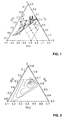
- Fig. 1
- shows in filled gray circles the nominal composition, calculated as a ratio between starting chloride salt concentrations, where [Cu] = [CuCl]/([CuCl]+[ZnCl2]+[InCl3]), [Zn] = [ZnCl2]/([CuCl]+[ZnCl2]+[InCl3]), [In] = [InCl3]/([CuCl]+[ZnCl2]+[InCl3]); in filled black triangles the measured composition of CZISe nanocrystals, measured by energy dispersive X-ray spectroscopy, where [Cu] = a, [Zn] = b, [In] = c in the formula CuaZnbIncSe and a+b+c=1; in empty black circles the corresponding values predicted by a model based on the nominal composition, where [Cu] = a, [Zn] = b, [In] = c in the formula CuaZnbIncSe and a+b+c=1;
- Fig. 2
- shows a photoluminescence efficiency plot, mapped as a function of the measured composition of the nanoparticles, where [Cu] = a, [Zn] = b, [In] = c in the formula CuaZnbIncSe and a+b+c=1; numbers of contours are photoluminescence quantum yield in %; mean diameter of nanocrystals, D, remains 3.3 nm for each composition (see Table 2)
- Fig. 3
- shows emission spectra of the proposed nanocrystalline quantum dots before (dashed line) and after (solid line) ZnS shell growth; and
- Fig. 4
- shows typical transmission electron microscopy image of CZISe nanocrystals with the mean diameter D = 3.3 nm.
- Syntheses of CuZnInSe (CZISe) and other I-II-III-VI nanocrystals were performed using air-less Schlenk line set-up. All chemicals, precursor solutions, and nanocrystals samples were stored and handled air/water-free in the N2-filled glovebox. Photoluminescence spectra were taken exciting the colloidal solutions of CZISe NCs with 405 nm CW laser and recording the data with the Ocean Optics QE65000 spectrometer. Photoluminescence quantum yield set-up consisted form integrating sphere, coupled 532 nm CW laser, and the Ocean Optics QE65000 spectrometer. Rhodamine B was used as internal reference. Energy dispersive X-ray measurements were performed on FEI Quanta 200 FEG electron microscope, transmission electron microscopy on Technai F30 microscope.
- In a typical synthesis, calculated amounts of CuCl, ZnCl2, and InCl3 (see Table 1) were weighted and dissolved in 6 mL of tri-n-octylphosphine (TOP) inside a N2-filled glovebox. The solution was then loaded air-free in a 25 mL three neck flask using Schlenk line technique. The reaction solution was then additionally purified during 30 min at 100°C under vacuum. Meanwhile, an injection mixture of 0.316 g Se, 1.002 g LiN(SiMe3)2 and 6 mL TOP was prepared in the glove box. The injection mixture was swiftly added to the reaction solution at 300°C and 1 bar N2 atmosphere. Upon injection, the reaction solution immediately turns turbid, indicating formation of white LiCl byproducts. At the same time, overall color of the reaction slurry gradually changed to orange, red and deep-brown, attributed to the nucleation and growth of CuZnInSe nanocrystals (CZISe NCs). Reaction was terminated by fast cooling to room temperature 40 s after injection. The overall volume of the reaction mixture before purification was 12.5 mL; this value was used to calculate molar concentrations of CuCl, ZnCl2, and InCl3 (see Table 1)
- Purification of CZISe NCs is based on immiscibility of TOP and methanol. The as-synthesized reaction solution was mixed with same volume of toluene and 8 times the volume of methanol, resulting in phase separation. The mixture was vigorously shaken for 1 min and centrifuged at 6000 rpm for 3 min. An upper fraction (methanol) was decanted, and the purification step was repeated. After these two washing rounds, the TOP-rich solution of CZISe NCs became optically clear, indicating a removal of most of the methanol-soluble LiCl byproducts. CZISe NCs can then be washed via conventional solvent-nonsolvent protocol, using e.g. toluene and ethanol-methanol (1:1), respectively. Syntheses of other I-II-III-VI nanocrystals were carried out in similar way to CZISe NCs, taking appropriate metal halogenide precursors and adjusting injection temperature and time of reaction. Purification of other I-II-III-VI nanocrystals was performed in complete analogy to the CZISe NCs.
- Compositions of CZISe NCs (CuaZnbIncSe, with a+b+c=1) can be calculated via


where [CuCl]0, [ZnCl2]0, [InCl3]0 are the starting molar concentrations of metal chlorides, in mol/L, and A, B, C - prefactors (for CZISe NCs, A = 24.9, B = 137.8, C = 3.3). - To develop a model, 25 separate reactions were performed. Changing only amounts of introduced metal chlorides, but keeping reaction time, reaction temperature and amounts of all other chemicals, it is ensured to keep constant a mean diameter of resulting CZISe NCs to be D = 3.3 nm (see
Fig. 4 ). Starting masses of CuCl, ZnCl2, and InCl3 are listed in Table 1. The molar concentrations are calculated, taking into account the total volume of reaction mixture to be 12.5 mL, as stated above. Nominal compositions of CuaZnbIncSe nanocrystals (where a+b+c=1) are deduces as ratios between molar concentrations. - The composition of each sample is measured with Energy dispersive X-ray spectroscopy, deriving measured (i.e., experimentally determined) compositions of CuaZnbIncSe nanocrystals, where a+b+c=1. Finally, predicted compositions of CuaZnbIncSe nanocrystals (a+b+c=1) were calculated using the above formulae. The composition of CuaZnbIncSe nanocrystals were found to be proportional to the power functions of starting molar concentrations of metal salts or a product of such power functions (see formulae above). Table 2 listed nominal, measured, and predicted compositions for all samples.
-
Table 1. Masses of metal chloride salts in starting reaction mixture and calculated molar concentrations and calculated nominal compositions (i.e., molar ratios between metal salts). Results are presented for CuZnInSe synthesis. Starting mass of metal salts, in g Starting concentration of metal salts, in mol/L Nominal composition of CuaZnbIncSe nanocrystals CuCl ZnCl2 InCl3 CuCl ZnCl2 InCl3 a b c Sample 1 0.139 0 0.133 0.112 0 0.048 0.7 0 0.3 Sample2 0.119 0 0.177 0.096 0 0.064 0.6 0 0.4 Sample3 0.104 0 0.21 0.084 0 0.076 0.525 0 0.475 Sample4 0.099 0 0.221 0.08 0 0.08 0.5 0 0.5 Sample5 0.099 0 0.221 0.08 0 0.08 0.5 0 0.5 Sample6 0.079 0 0.265 0.064 0 0.096 0.4 0 0.6 Sample7 0.089 0.014 0.221 0.072 0.008 0.08 0.45 0.05 0.5 Sample8 0.079 0.014 0.243 0.064 0.008 0.088 0.4 0.05 0.55 Sample9 0.069 0.014 0.265 0.056 0.008 0.096 0.35 0.05 0.6 Sample 10 0.079 0.02 0.232 0.064 0.012 0.084 0.4 0.075 0.525 Sample 11 0.099 0.027 0.177 0.08 0.016 0.064 0.5 0.1 0.4 Sample 12 0.089 0.027 0.199 0.072 0.016 0.072 0.45 0.1 0.45 Sample 13 0.079 0.027 0.221 0.064 0.016 0.08 0.4 0.1 0.5 Sample 14 0.069 0.027 0.243 0.056 0.016 0.088 0.35 0.1 0.55 Sample 15 0.059 0.027 0.265 0.048 0.016 0.096 0.3 0.1 0.6 Sample 16 0.119 0.055 0.088 0.096 0.032 0.032 0.6 0.2 0.2 Sample 17 0.099 0.055 0.133 0.08 0.032 0.048 0.5 0.2 0.3 Sample 18 0.089 0.055 0.155 0.072 0.032 0.056 0.45 0.2 0.35 Sample 19 0.079 0.055 0.177 0.064 0.032 0.064 0.4 0.2 0.4 Sample20 0.069 0.055 0.199 0.056 0.032 0.072 0.35 0.2 0.45 Sample21 0.059 0.055 0.221 0.048 0.032 0.08 0.3 0.2 0.5 Sample22 0.099 0.082 0.088 0.08 0.048 0.032 0.5 0.3 0.2 Sample23 0.069 0.082 0.155 0.056 0.048 0.056 0.35 0.3 0.35 Sample24 0.04 0.082 0.221 0.032 0.048 0.08 0.2 0.3 0.5 Sample25 0.03 0.082 0.243 0.024 0.048 0.088 0.15 0.3 0.55 Table 2: Nominal compositions, measured compositions of obtained CuaZnbIncSe nanocrystals and compositions predicted by a model. Photoluminescence (PL) quantum yield of obtained CuaZnbIncSe quantum dots, in %. Nominal composition of CuaZnbIncSe nanocrystals Measured composition of CuaZnbIncSe nanocrystals Predicted composition of CuaZnbIncSe nanocrystals PL quantum yield, in % a b c a b c a b c Sample1 0.7 0 0.3 0.405 0 0.595 0.365 0 0.431 3.7 Sample2 0.6 0 0.4 0.426 0 0.574 0.379 0 0.523 4 Sample3 0.525 0 0.475 0.388 0 0.612 0.372 0 0.587 6.6 Sample4 0.5 0 0.5 0.365 0 0.635 0.367 0 0.608 15.9 Sample5 0.5 0 0.5 0.356 0 0.644 0.367 0 0.608 10 Sample6 0.4 0 0.6 0.347 0 0.653 0.332 0 0.686 6.6 Sample7 0.45 0.05 0.5 0.297 0.058 0.645 0.33 0.079 0.608 18.4 Sample8 0.4 0.05 0.55 0.305 0.062 0.633 0.313 0.071 0.648 22 Sample9 0.35 0.05 0.6 0.285 0.046 0.669 0.29 0.062 0.686 19 Sample10 0.4 0.075 0.525 0.293 0.087 0.62 0.303 0.106 0.628 19.3 Sample11 0.5 0.1 0.4 0.33 0.14 0.53 0.316 0.176 0.523 14.6 Sample12 0.45 0.1 0.45 0.31 0.136 0.554 0.308 0.159 0.566 13.8 Sample13 0.4 0.1 0.5 0.273 0.106 0.621 0.293 0.141 0.608 28.7 Sample14 0.35 0.1 0.55 0.277 0.106 0.617 0.274 0.123 0.648 25.6 Sample15 0.3 0.1 0.6 0.256 0.09 0.654 0.249 0.106 0.686 13 Sample16 0.6 0.2 0.2 0.205 0.472 0.323 0.238 0.423 0.329 1.4 Sample17 0.5 0.2 0.3 0.254 0.331 0.415 0.26 0.353 0.431 5.7 Sample18 0.45 0.2 0.35 0.251 0.301 0.448 0.26 0.317 0.478 6.3 Sample19 0.4 0.2 0.4 0.25 0.261 0.489 0.253 0.282 0.523 8.1 Sample20 0.35 0.2 0.45 0.253 0.243 0.504 0.239 0.247 0.566 11.1 Sample21 0.3 0.2 0.5 0.23 0.185 0.585 0.22 0.212 0.608 12.9 Sample22 0.5 0.3 0.2 0.151 0.552 0.297 0.198 0.529 0.329 0.7 Sample23 0.35 0.3 0.35 0.2 0.366 0.434 0.202 0.37 0.478 3.1 Sample24 0.2 0.3 0.5 0.133 0.297 0.57 0.147 0.212 0.608 1.7 Sample25 0.15 0.3 0.55 0.145 0.207 0.648 0.117 0.159 0.648 0.3 -
Figure 1 graphically shows the experimental results, presented in Table 2. In the filled gray circles the nominal compositions, and in filled black triangles the measured compositions of CuaZnbIncSe samples are indicated. Corresponding to the chemistry law of mass action, the amounts of deposited MI, MII, and MIII (i.e., Cu, Zn, and In for this case) is found to be proportional to the power functions of starting molar concentrations of metal salts or a product of such power functions (see formulae above). This allows us to define the prefactors A, B, C and predict the composition of obtained CuaZnbIncSe quantum dots very accurately with the error (SD, standard deviation) not exceeding 4% for any of metal constituents or for the model as a whole (if compared calculated compositions with respect to measured ones). In fact, SD for Cu amount is 1.4%, SD for Zn amount is 2.0%, and SD for In amount is 3.2%. SD for all metals and all compositions is 2.4% only. Predicted compositions of CuaZnbIncSe quantum dots are depicted as empty black circles inFigure 1 . Furthermore, the composition model shows its applicability for other I-II-III-VI quantum dots and for the general composition MI aMII bMIII cMVI, where in MI is an element selected from the group IB, MII is an element selected from the group IIB, MIII is an element selected from the group IIIA, and MVI is an element selected from the group VIA, can be described as:


where E is halogen element to be selected from the group VIIA from Cl, Br, or I. - As pointed out above, prefactors A, B, and C are to a certain extent dependent on the choice of MI, MII, and MIII constituents and whether chlorides, bromides or iodides salts of metals are used for the synthesis of I-II-III-VI nanocrystals.
-
Figure 2 plots the photoluminescence efficiency as a function of I-II-III-VI composition, presented for the case of CuaZnbIncSe quantum dots and for average diameter of the quantum dots (D) of 3.3 nm. A very well determined composition range where the photoluminescence efficiency is the highest is apparent from theFigure 2 . The composition of CuaZnbIncSe quantum dots with enhanced photoluminescence is correspondent to the parameters a-c, chosen as claimed. Outside of this range the photoluminescence efficiency is significantly lower. - As pointed out above, the efficiency and correspondingly the photoluminescence intensity can be boosted by additionally providing a shell layer around these nanoparticles. In
Figure 3 emission spectra of nanocrystals before (dashed line, given for CuaZnbIncSe quantum dots with the following composition a = 0.273, b = 0.106, c = 0.621) and after ZnS shell growth (solid line, again with the following composition of the core a = 0.273, b = 0.106, c = 0.621), with a ZnS shell layer thickness of about 0.5 nm, are indicated. Because the ZnS shell grows via cation-exchange mechanism, the mean diameter (D) of nanocrystals doesn't change significantly during Zn-shell coating and is equal 3.3 nm.Figure 4 represents the wide-range and high-resolution TEM images of CuaZnbIncSe quantum dots before the ZnS shell growth.
Claims (15)
- Nanocrystalline particulate material with luminescent properties having the following composition:
MI aMII bMIII cMVI
whereinMI is selected from the group consisting of: Cu, Ag, and combinations thereof;MII is selected from the group consisting of: Zn, Cd, and combinations thereof;MIII is selected to be In;MVI is selected from the group consisting of: Se, Te and combinations thereof; andwherein a, b, and c designate the atomic proportions within MI, MII, and MIII and the sum of a, b and c is equal to 1,wherein a is in the range of 0.22-0.35;b is in the range of 0.0003-0.2;c is in the range of 0.52-0.66. - Material according to claim 1, wherein within MII the atomic proportion of Cd with respect to the total of MII taken as 1 is less than 0.5, preferably less than 0.1, wherein most preferably the material is free from Cd.
- Material according to any of the preceding claims, wherein
a is in the range of 0.25-0.33, preferably in the range of 0.26-0.29;
and/or wherein b is in the range of 0.05-0.18, preferably in the range of 0.08-0.15; and/or wherein c is in the range of 0.55-0.65, preferably in the range of 0.60-0.64. - Material according to any of the preceding claims, wherein within MI the atomic proportion of Ag with respect to the total of MI taken as 1 is less than 0.5, preferably less than 0.1, wherein most preferably the material is free from Ag, and/or within MVI the atomic proportion of Te with respect to the total of MVI taken as 1 is less than 0.5, preferably less than 0.1, wherein most preferably the material is free from Te.
- Material according to any of the preceding claims, wherein the material is in the form of particles with a mean particle diameter (D) in the range of 1-25 nm, preferably in the range of 2-10 nm, most preferably in the range of 2-6 nm.
- Material according to any of the preceding claims, wherein the particulate material is surrounded by a shell layer, preferably by a crystalline shell layer, wherein preferably this shell layer has a thickness in the range of 0.25-1 nm, more preferably in the range of 0.25-0.5 nm, and wherein the material of said shell coating layer is preferably selected from the group consisting of ZnS, CdS, CdSe, ZnSe.
- Material according to any of the preceding claims, wherein the material is CuaInbZncSe with a in the range of 0.26-0.29, b in the range of 0.08-0.15 and c in the range of 0.60-0.64.
- Material according to any of the preceding claims, wherein it has a photoluminescence quantum yield of at least 16%, preferably of at least 20%, most preferably of at least 24% or in case of an additional protective shell layer, the luminescence efficiency of more than 80%.
- Method for the preparation of a nanocrystalline particulate material, preferably with luminescent properties, having the following composition:
MI aMII bMIII cMVI
whereinMI is selected from the group consisting of: Cu, Ag, Au and combinations thereof; MII is selected from the group consisting of: Zn, Cd, Hg and combinations thereof;MIII is selected to be Al, Ga, In, Tl and combinations thereof;MVI is selected from the group consisting of: Se, S, Te and combinations thereof; andwherein a, b, and c designate the atomic proportions within MI, MII, and MIII and the sum of a, b and c is equal to 1,preferably for the preparation of the material according to any of the preceding claims,wherein as starting materials the cations MI, MII, and MIII are provided as salts dissolved in a solvent,wherein super base is added, and the chalcogen source for MVI,and wherein the resultant nanocrystalline particulate material is isolated, preferably via precipitation. - Method according to claim 9, wherein the starting materials for the cations MI, MII, and MIII are provided as halogenide salts, preferably as chloride salts,
and/or wherein the starting materials for the cations MI, MII, and MIII are provided in an organic polar solvent, preferably selected as an alkylphosphine or alkylamine solvent or a mixture thereof, most preferably selected to be tri-n-octylphosphine. - Method according to any of the preceding claims 9 or 10, wherein the super base is a metal amide in a solvent, preferably an organic polar solvent, most preferably selected as an alkylphosphine solvent, including tri-n-octylphosphine, and wherein preferably the metal amide is an organo-lithium amide and/or organo-sodium amide, in particular selected from the group consisting of Li and/or Na amides of bis(trimethylsilyl)amide (N(SiMe3)2), dimethylamide, diethylamide, diisopropylamide, and combinations/mixtures thereof,
and/or wherein preferably the super base is added in an at least 2 times or at least 5 times excess with respect to the cation concentration of the sum of MI, MII, and MIII. - Method according to any of the preceding claims 9-11, wherein for the creation of nanocrystalline particulate material of a given predetermined desired composition defined by the values of a, b, and c, the concentrations of the starting materials for MI, MII, and MIII, used in the form of the corresponding halogenides MIE, MIIE2, and MIIIE3, where E is a halogen element, wherein E is preferably chosen to be Cl, Br, or I or a combination thereof, is selected in a calculated manner, preferably such that the following conditions are fulfilled:


 with given constants A, B, and C, preferably determined based on the specific selection of MI, MII, MIII and MVI, the chosen halogens E, and optionally also based on the chosen solvents and/or superbase(s), wherein preferably, when concentrations of MIE, MIIE2, and MIIIE3 are given in mol/L,A is selected in the range of 22-31, preferably 24.5-28;B is selected in the range of 105-195, preferably 135-170;C is selected in the range of 1.2-6.3, preferably 2-4.
 - Method according to claim 12, wherein
for the system CuaZnbIncSe and when concentrations of MIE, MIIE2, and MIIIE3 are given in mol/L and E is selected to be chlorine, the parameters A-C are chosen to be as follows:A is selected in the range of 24.5-25.5, preferably at or around 24.9;B is selected in the range of 135-145, preferably at or around 137.8;C is selected in the range of 3.0-3.5, preferably at or around 3.3.or wherein for the system AgZnInSe and when concentrations of MIE, MIIE2, andMIIIE3 are given in mol/L and E is selected to be iodine, the parameters A-C are chosen to be as follows:A is selected in the range of 25-29, preferably at or around 27;B is selected in the range of 145-175, preferably at or around 160;C is selected in the range of 1.2-2.8, preferably at or around 2.or wherein for the systems CuZnInTe, CuCdInSe, and CuCdInTe and when concentrations of MIE, MIIE2, and MIIIE3 are given in mol/L and E is selected to be chlorine, the parameters A-C are chosen to be as follows:A is selected in the range of 22-28;B is selected in the range of 105-170;C is selected in the range of 2.1-4.5.or wherein for the systems CuZnInSe, CuZnInTe, CuCdInSe, CuCdInTe, AgZnInTe, AgCdInSe, and AgCdInTe and when concentrations of MIE, MIIE2,and MIIIE3 are given in mol/L and E is selected to be iodine or bromine or a combination thereof, and for the system AgZnInSe and when concentrations of MIE, MIIE2, and MIIIE3 are given in mol/L and E is selected to be bromine, the parameters A-C are chosen to be as follows:A is selected in the range of 22-31;B is selected in the range of 105-195;C is selected in the range of 1.2-6.3. - Use of a material according to any of the preceding claims 1-8 in a semiconductor device, preferably in an optical semiconductor device.
- Use of a superbase for the preparation of a nanocrystalline particulate material, preferably with luminescent properties, having the following composition:
MI aMII bMIII cMVI
whereinMI is selected from the group consisting of: Cu, Ag, Au and combinations thereof;MII is selected from the group consisting of: Zn, Cd, Hg and combinations thereof;MIII is selected to be Al, Ga, In, Tl and combinations thereof;MVI is selected from the group consisting of: Se, S, Te and combinations thereof; andwherein a, b, and c designate the atomic proportions within MI, MII, and MIII and the sum of a, b and c is equal to 1,wherein preferably the superbase is a metal amide in a solvent, preferably an organic polar solvent, most preferably selected as an alkylphosphine and/or alkylamine solvent, including tri-n-octylphosphine, or a mixture thereof and wherein preferably the metal amide is an organo-lithium amide and/or organo-sodium amide, in particular selected from the group consisting of Li and/or Na amides of bis(trimethylsilyl)amide (N(SiMe3)2), dimethylamide, diethylamide, diisopropylamide, and combinations/mixtures thereof,and/or wherein preferably the super base is added in an at least 2 or at least 5 times excess with respect to the cation concentration of the sum of MI, MII, and MIII.
Priority Applications (2)
| Application Number | Priority Date | Filing Date | Title |
|---|---|---|---|
| EP15192630.0A EP3162874A1 (en) | 2015-11-02 | 2015-11-02 | Luminescent semiconductor nanocrystals and methods for making same |
| PCT/EP2016/076349 WO2017076863A1 (en) | 2015-11-02 | 2016-11-02 | Luminescent semiconductor nanocrystals and methods for making same |
Applications Claiming Priority (1)
| Application Number | Priority Date | Filing Date | Title |
|---|---|---|---|
| EP15192630.0A EP3162874A1 (en) | 2015-11-02 | 2015-11-02 | Luminescent semiconductor nanocrystals and methods for making same |
Publications (1)
| Publication Number | Publication Date |
|---|---|
| EP3162874A1 true EP3162874A1 (en) | 2017-05-03 |
Family
ID=54396767
Family Applications (1)
| Application Number | Title | Priority Date | Filing Date |
|---|---|---|---|
| EP15192630.0A Withdrawn EP3162874A1 (en) | 2015-11-02 | 2015-11-02 | Luminescent semiconductor nanocrystals and methods for making same |
Country Status (2)
| Country | Link |
|---|---|
| EP (1) | EP3162874A1 (en) |
| WO (1) | WO2017076863A1 (en) |
Citations (8)
| Publication number | Priority date | Publication date | Assignee | Title |
|---|---|---|---|---|
| CN102154007A (en) | 2011-04-15 | 2011-08-17 | 吉林大学 | I-II-III-VI family quantum dots and preparation method thereof |
| CN102676162A (en) | 2012-05-04 | 2012-09-19 | 天津大学 | A preparation method of quaternary ZnCuInS3 quantum dots with high fluorescence performance |
| WO2012135744A2 (en) * | 2011-04-01 | 2012-10-04 | Kai Su | White light-emitting device |
| US8409473B2 (en) | 2007-01-30 | 2013-04-02 | Evident Technologies, Inc. | Group II alloyed I-III-VI semiconductor nanocrystal compositions and methods of making same |
| CN103265948A (en) | 2013-04-28 | 2013-08-28 | 温州大学 | Preparation method for doping type four-element multicolor fluorescent Ag-N-In-S quantum dot |
| CN103589427A (en) | 2013-09-29 | 2014-02-19 | 温州大学 | Preparation method of Cu-Zn-In-S quantum dot luminescent thin film |
| EP2768925A1 (en) * | 2011-10-20 | 2014-08-27 | Koninklijke Philips N.V. | Light source with quantum dots |
| EP2879211A1 (en) | 2013-11-28 | 2015-06-03 | Belenos Clean Power Holding AG | Antimony based anode material for rechargeable batteries and preparation method |
-
2015
- 2015-11-02 EP EP15192630.0A patent/EP3162874A1/en not_active Withdrawn
-
2016
- 2016-11-02 WO PCT/EP2016/076349 patent/WO2017076863A1/en not_active Ceased
Patent Citations (8)
| Publication number | Priority date | Publication date | Assignee | Title |
|---|---|---|---|---|
| US8409473B2 (en) | 2007-01-30 | 2013-04-02 | Evident Technologies, Inc. | Group II alloyed I-III-VI semiconductor nanocrystal compositions and methods of making same |
| WO2012135744A2 (en) * | 2011-04-01 | 2012-10-04 | Kai Su | White light-emitting device |
| CN102154007A (en) | 2011-04-15 | 2011-08-17 | 吉林大学 | I-II-III-VI family quantum dots and preparation method thereof |
| EP2768925A1 (en) * | 2011-10-20 | 2014-08-27 | Koninklijke Philips N.V. | Light source with quantum dots |
| CN102676162A (en) | 2012-05-04 | 2012-09-19 | 天津大学 | A preparation method of quaternary ZnCuInS3 quantum dots with high fluorescence performance |
| CN103265948A (en) | 2013-04-28 | 2013-08-28 | 温州大学 | Preparation method for doping type four-element multicolor fluorescent Ag-N-In-S quantum dot |
| CN103589427A (en) | 2013-09-29 | 2014-02-19 | 温州大学 | Preparation method of Cu-Zn-In-S quantum dot luminescent thin film |
| EP2879211A1 (en) | 2013-11-28 | 2015-06-03 | Belenos Clean Power Holding AG | Antimony based anode material for rechargeable batteries and preparation method |
Non-Patent Citations (3)
| Title |
|---|
| BODNAR L V ET AL: "Optical Properties of the (CuInSe2)x(2ZnSe)1-x and (CuInTe2)x(2ZnTe)1-x Solid Solutions", JOURNAL OF APPLIED SPECTROSCOPY, NEW YORK,NY, US, vol. 70, no. 3, 1 January 2003 (2003-01-01), pages 482 - 485, XP002993048, ISSN: 0021-9037, DOI: 10.1023/A:1025114429022 * |
| DANEK, MICHAL ET AL.: "Synthesis of luminescent thin-film CdSe/ZnSe quantum dot composites using CdSe quantum dots passivated with an overlayer of ZnSe", CHEMISTRY OF MATERIALS, vol. 8, no. 1, 1996, pages 173 - 180, XP002261065, DOI: doi:10.1021/cm9503137 |
| LISNYAK V V ET AL: "Synthesis and transport properties of prospective photovoltaic systems related to CuInSe2 and CuGaSe2", SOLAR ENERGY MATERIALS AND SOLAR CELLS, ELSEVIER SCIENCE PUBLISHERS, AMSTERDAM, NL, vol. 76, no. 4, 1 April 2003 (2003-04-01), pages 553 - 562, XP004409571, ISSN: 0927-0248, DOI: 10.1016/S0927-0248(02)00266-0 * |
Also Published As
| Publication number | Publication date |
|---|---|
| WO2017076863A1 (en) | 2017-05-11 |
Similar Documents
| Publication | Publication Date | Title |
|---|---|---|
| Gan et al. | Enhanced photoluminescence and characterization of Mn-doped ZnS nanocrystallites synthesized in microemulsion | |
| CN110337481B (en) | Semiconductor nanoparticle, method for producing same, and light-emitting device | |
| Shen et al. | High quality synthesis of monodisperse zinc-blende CdSe and CdSe/ZnS nanocrystals with a phosphine-free method | |
| US20200052169A1 (en) | Cadmium-Free Quantum Dot Nanoparticles | |
| CN115612484B (en) | Semiconductor nanoparticle, method for producing the same, and light-emitting device | |
| JP5801828B2 (en) | Nanocrystalline doped matrix | |
| TWI621692B (en) | Quantum dot nanoparticle with improved stability and luminous efficiency | |
| KR20190104583A (en) | Colloidal quantum dots that do not contain Cd that emits visible fluorescence and methods of manufacturing the same | |
| JP2002097100A (en) | Method for producing high quality semiconductor nanocrystal doped with manganese | |
| KR20190091338A (en) | Semiconducting Light Emitting Nanoparticles | |
| Yao et al. | Phosphine-free synthesis of Ag–In–Se alloy nanocrystals with visible emissions | |
| JPWO2016133110A1 (en) | Method for manufacturing phosphor | |
| JPWO2017057671A1 (en) | Fluoride phosphor, light emitting device, and method for producing fluoride phosphor | |
| US11935984B2 (en) | Semiconductor nanocrystal particle, method for preparing same, and device including same | |
| Vishaka et al. | Lattice constriction and trapped excitons: a structure–property relationship unveiled in CsPbBr 3 perovskite QDs | |
| Ji et al. | Colloidal synthesis of size-confined CsAgCl 2 nanocrystals: implications for electroluminescence applications | |
| US20030129311A1 (en) | Method of producing quantum-dot powder and film via templating by a 2-d ordered array of air bubbles in a polymer | |
| Zeng et al. | A facile route to aqueous Ag: ZnCdS and Ag: ZnCdSeS quantum dots: Pure emission color tunable over entire visible spectrum | |
| WO2017076863A1 (en) | Luminescent semiconductor nanocrystals and methods for making same | |
| DE1514332A1 (en) | Image display tube with fluorescent screen | |
| DE68917016T2 (en) | Process for producing an electroluminescent film. | |
| WO2023157640A1 (en) | Semiconductor nanoparticles and method for producing same | |
| JP2003160336A (en) | Method for producing compound semiconductor ultrafine particles | |
| JP4504268B2 (en) | Method for coating semiconductor surface and method for producing semiconductor particle | |
| KR20230156406A (en) | Phosphor particles, composites, and light-emitting devices |
Legal Events
| Date | Code | Title | Description |
|---|---|---|---|
| PUAI | Public reference made under article 153(3) epc to a published international application that has entered the european phase |
Free format text: ORIGINAL CODE: 0009012 |
|
| AK | Designated contracting states |
Kind code of ref document: A1 Designated state(s): AL AT BE BG CH CY CZ DE DK EE ES FI FR GB GR HR HU IE IS IT LI LT LU LV MC MK MT NL NO PL PT RO RS SE SI SK SM TR |
|
| AX | Request for extension of the european patent |
Extension state: BA ME |
|
| STAA | Information on the status of an ep patent application or granted ep patent |
Free format text: STATUS: THE APPLICATION IS DEEMED TO BE WITHDRAWN |
|
| 18D | Application deemed to be withdrawn |
Effective date: 20171104 |