EP3160929B1 - Process and plant for the purification of acrylic acid - Google Patents
Process and plant for the purification of acrylic acid Download PDFInfo
- Publication number
- EP3160929B1 EP3160929B1 EP15741124.0A EP15741124A EP3160929B1 EP 3160929 B1 EP3160929 B1 EP 3160929B1 EP 15741124 A EP15741124 A EP 15741124A EP 3160929 B1 EP3160929 B1 EP 3160929B1
- Authority
- EP
- European Patent Office
- Prior art keywords
- stream
- acetic acid
- acrylic acid
- distillation
- raffinate
- Prior art date
- Legal status (The legal status is an assumption and is not a legal conclusion. Google has not performed a legal analysis and makes no representation as to the accuracy of the status listed.)
- Active
Links
Images
Classifications
-
- B—PERFORMING OPERATIONS; TRANSPORTING
- B01—PHYSICAL OR CHEMICAL PROCESSES OR APPARATUS IN GENERAL
- B01D—SEPARATION
- B01D11/00—Solvent extraction
- B01D11/04—Solvent extraction of solutions which are liquid
- B01D11/0488—Flow sheets
-
- B—PERFORMING OPERATIONS; TRANSPORTING
- B01—PHYSICAL OR CHEMICAL PROCESSES OR APPARATUS IN GENERAL
- B01D—SEPARATION
- B01D11/00—Solvent extraction
- B01D11/04—Solvent extraction of solutions which are liquid
- B01D11/0492—Applications, solvents used
-
- B—PERFORMING OPERATIONS; TRANSPORTING
- B01—PHYSICAL OR CHEMICAL PROCESSES OR APPARATUS IN GENERAL
- B01D—SEPARATION
- B01D3/00—Distillation or related exchange processes in which liquids are contacted with gaseous media, e.g. stripping
- B01D3/14—Fractional distillation or use of a fractionation or rectification column
- B01D3/143—Fractional distillation or use of a fractionation or rectification column by two or more of a fractionation, separation or rectification step
-
- C—CHEMISTRY; METALLURGY
- C07—ORGANIC CHEMISTRY
- C07C—ACYCLIC OR CARBOCYCLIC COMPOUNDS
- C07C51/00—Preparation of carboxylic acids or their salts, halides or anhydrides
- C07C51/42—Separation; Purification; Stabilisation; Use of additives
- C07C51/43—Separation; Purification; Stabilisation; Use of additives by change of the physical state, e.g. crystallisation
- C07C51/44—Separation; Purification; Stabilisation; Use of additives by change of the physical state, e.g. crystallisation by distillation
-
- C—CHEMISTRY; METALLURGY
- C07—ORGANIC CHEMISTRY
- C07C—ACYCLIC OR CARBOCYCLIC COMPOUNDS
- C07C51/00—Preparation of carboxylic acids or their salts, halides or anhydrides
- C07C51/42—Separation; Purification; Stabilisation; Use of additives
- C07C51/48—Separation; Purification; Stabilisation; Use of additives by liquid-liquid treatment
-
- C—CHEMISTRY; METALLURGY
- C07—ORGANIC CHEMISTRY
- C07C—ACYCLIC OR CARBOCYCLIC COMPOUNDS
- C07C57/00—Unsaturated compounds having carboxyl groups bound to acyclic carbon atoms
- C07C57/02—Unsaturated compounds having carboxyl groups bound to acyclic carbon atoms with only carbon-to-carbon double bonds as unsaturation
- C07C57/03—Monocarboxylic acids
- C07C57/04—Acrylic acid; Methacrylic acid
-
- Y—GENERAL TAGGING OF NEW TECHNOLOGICAL DEVELOPMENTS; GENERAL TAGGING OF CROSS-SECTIONAL TECHNOLOGIES SPANNING OVER SEVERAL SECTIONS OF THE IPC; TECHNICAL SUBJECTS COVERED BY FORMER USPC CROSS-REFERENCE ART COLLECTIONS [XRACs] AND DIGESTS
- Y02—TECHNOLOGIES OR APPLICATIONS FOR MITIGATION OR ADAPTATION AGAINST CLIMATE CHANGE
- Y02P—CLIMATE CHANGE MITIGATION TECHNOLOGIES IN THE PRODUCTION OR PROCESSING OF GOODS
- Y02P20/00—Technologies relating to chemical industry
- Y02P20/50—Improvements relating to the production of bulk chemicals
- Y02P20/582—Recycling of unreacted starting or intermediate materials
Definitions
- This invention relates to a process for the purification of acrylic acid from a mixture containing acrylic acid and acetic acid.
- acrylic acid is one of the most produced intermediate products of the chemical industry, as acrylic acid and its derivatives are starting substances for numerous industrial-scale products. Particularly important are the so-called superabsorbents, to which acrylic acid is polymerized together with sodium acrylate (the sodium salt of acrylic acid). The same for the most part are employed in hygiene products (e.g. diapers), but are also used for the storage of water in soils. The esters of acrylic acid are converted to polymers, and the resulting plastics are used in paints or as dispersing agents.
- Acrylic acid is industrially produced in a two-stage, heterogeneously catalyzed process. Proceeding from propene, acrolein is obtained at about 350 °C on bismuth molybdates with a selectivity and yield greater than 90 wt-%. In the second step, acrolein is oxidized further on mixed Mo/V/W oxides at about 280 °C to obtain acrylic acid. As by-products the total oxidation products CO, CO 2 and water are obtained as well as small amounts of acetic acid from the acetaldehyde obtained during the propene oxidation. Therefore, a multistage processing is carried out subsequent to the reaction.
- a particular challenge in the purification of the acrylic acid is the polymerization tendency of the acrylic acid, in particular at elevated temperatures.
- the polymerization of acrylic acid is a strongly exothermal reaction which releases large amounts of heat. Since the heat in turn leads to an acceleration of the polymerization, acrylic acid tends to explosion-like polymerizations.
- a polymerization of acrylic acid often leads to clogging and thus to undesired shut-down periods of the entire plant.
- the acetic acid obtained as by-product is to be classified as particularly problematic, as the same promotes the polymerization of acrylic acid as a proton donor.
- the acetic acid produced thereby has a comparatively high purity of > 90 wt-%, but the relatively low sales revenue from the additional production of the acetic acid hardly or only with difficulty makes up for the expenditures for additional investments (e.g. in distillation columns, tank farms, loading etc.) as well as operative costs (e.g. increased consumption of resources). Furthermore, the increased polymer formation and fouling tendency results in distinct reductions in the availability of the plant as well as in acrylic acid product losses due to polymer formation and in additional costs for the disposal of the wastes which are obtained in the cleaning and removal of polymers.
- the acetic acid is removed from the acrylic acid by distillation in an acrylic acid/acetic acid separation column, wherein the acetic acid obtained is supplied to the condensate, the stripping column or the extraction column.
- an acrylic acid/acetic acid separation column a part of the acrylic acid is recirculated, whereby the acrylic acid concentration in the separation column is adjusted to values between 10 wt-% and 70 wt-%.
- the concentration of the acetic acid of 90 wt-% to 30 wt-% as described in the prior art cannot reliably prevent a polymer formation in the separation column and promotes fouling over an extended period.
- a part of the acrylic acid is recirculated not only within the separation column, but also back to the extractor.
- the acrylic acid repeatedly passes through the entire separating section including the distillation columns and thus is exposed to a thermal load for a comparatively long time, which in turn promotes the polymer formation and the fouling and at the same time leads to losses of the valuable product acrylic acid.
- US 6,737,546 B2 discloses a process for recovery and refining of at least acrylic acid from a gaseous mixture such as is obtainable by gas-phase catalytic oxidation of propylene.
- it is intended to increase the availability (runtime/operating time) of the plant and to prevent a time- and cost-intensive cleaning of the distillation units, as this would also involve considerable production losses.
- the process according to the invention for the purification of acrylic acid from a mixture containing acrylic acid and acetic acid comprises an extraction of the mixture containing acrylic acid and acetic acid, whereby a raffinate stream and an extract stream are obtained. This is followed by a multistage distillation of the extract stream, whereby an acrylic acid stream and a return stream are obtained, with the latter being introduced into the extractant stream.
- the return stream furthermore guides the acetic acid contained in the extract stream back into the extractant stream.
- the return stream contains at least 90 wt-%, preferably > 95 wt-% of the acetic acid contained in the extract stream.
- the acrylic acid thereby can be withdrawn with very high purity.
- the acetic acid chiefly, namely for more than 50 wt-%, preferably for more than 60 wt-%, based on the total amount of acetic acid introduced into the extraction, already is removed from the process with the raffinate stream.
- Total amount in the sense of the invention is understood to be that amount of acetic acid which results from the sum of those amounts of acetic acid which are introduced into the extraction on the one hand via the mixture containing acrylic acid and acetic acid and on the other hand via the return stream.
- the fraction of acetic acid in the extract stream obtained in the extraction is ⁇ 2 wt-%, preferably ⁇ 1 wt-% based on the entire extract stream.
- the remaining acetic acid is recirculated to the extractor with the return stream in small concentrations, typically with 3 to 7 wt-%, preferably 5 wt-%, based on the total mass flow of the return stream.
- the acetic acid can separately be introduced into the extraction or be joined with the extractant stream, and the resulting mixture can be introduced into the extraction.
- the mixture containing acrylic acid and acetic acid is mixed with a liquid, preferably water, before the extraction.
- a liquid preferably water
- the acrylic acid is produced in a two-stage catalytic gas phase oxidation of propene at temperatures of 200 to 400 °C.
- the liquid acts as quenching medium for the hot gas mixture of the oxidation.
- the acetic acid almost completely, namely for at least 99 wt-%, preferably for 99.9 wt-% based on the total amount of acetic acid introduced into the stripping unit, hence also remains in the stripping agent stream and can be discharged from the process. It should be emphasized that almost the entire amount of acetic acid gets into the stripper with the raffinate stream and correspondingly is discharged via the bottom (stripping agent stream).
- the extracting agent typically is contained in the raffinate stream at small fractions, namely at less than 3 wt-%, preferably 2 wt-% based on the raffinate stream.
- the residual stream (recovery stream) is separated into a less dense and into a denser liquid phase, wherein the less dense phase is supplied to the extractant stream and the denser phase is supplied to the raffinate.
- the purity of the less dense phase recirculated to the extractant stream is increased.
- possibly contained acetic acid is removed from the residual stream and the concentration of the acetic acid is reduced within the following distillation of the extract stream.
- the extracting agent is a mixture of isopropyl acetate and cyclohexane.
- extracting agents consisting of 70 - 20 wt-% isopropyl acetate and 30 to 80 wt-% cyclohexane based on the total amount of extracting agent were found to be advantageous.
- Cyclohexane is separated from the extract stream before the distillation of the extract stream. This simplifies the following distillation of the extract stream and leads to a better separation efficiency of the corresponding distillation column.
- the subsequent distillation is carried out with moderate temperatures of ⁇ 110 °C, preferably ⁇ 100 °C, particularly preferably ⁇ 95 °C, and at pressures of ⁇ 0.4 bar, preferably ⁇ 0.3 bar, particularly preferably ⁇ 0.2 bar.
- the distillation of the extract stream is carried out in two stages, wherein in the first distillation stage the acrylic acid stream is at least partly discharged and the remaining stream of the second stage is separated into a return stream and a recirculation stream, wherein the recirculation stream is completely recirculated into the first stage.
- concentration of the acrylic acid in the first stage and the separation of the return stream in the second stage is carried out. Due to this spatial and technical division of the separation tasks, namely the separation of the acrylic acid and the separation of the return stream, on several distillation stages, the conditions in one stage can be optimized for the respective separation task. As a result, a particularly careful and efficient separation is achieved.
- both stages operate with the moderate temperatures of ⁇ 110 °C, preferably ⁇ 100 °C, particularly preferably ⁇ 95 °C, and pressures of ⁇ 0.4 bar, preferably ⁇ 0.3 bar, particularly preferably ⁇ 0.2 bar.
- the first stage preferably operates at a lower pressure than the second stage. This takes account of the higher acrylic acid concentration at the bottom of the first stage.
- a slightly higher pressure is sufficient and expedient, in order to be able to efficiently condense the relatively low-boiling extracting agent at the top of the second stage at moderate cooling water temperatures.
- the process may be performed using a plant which comprises an extraction column for the extraction of a mixture containing acrylic acid and acetic acid. Through a conduit, an extractant stream is supplied to the extraction column. In addition, a distillation column for the distillation of the extract stream and a return conduit are provided. The distillation column is designed such that via the return conduit at least one return stream is guided, which contains at least 90 wt-% of the acetic acid contained in the extract stream.
- This return conduit and/or the extractant conduit open(s) preferably at the bottom of the extraction.
- a configuration of the plant in which the return conduit first opens into the extractant conduit is preferred particularly.
- Directly or indirectly feeding the return stream into the bottom of the extraction has the advantage that the acetic acid contained in the aqueous return stream would have to pass all internal fittings in the extraction column, in order to get into the withdrawn extract stream at the top.
- a raffinate stripper is provided, wherein the raffinate stripper for stripping the raffinate stream is designed such that a stripping agent stream (bottom) and a residual stream (recovery stream / top) is obtained, wherein a return conduit partly supplies the stripping agent stream to a heater, and that a return conduit recirculates the heated stripping agent stream into the raffinate stripper.
- the heater provides the amount of heat required for stripping.
- a direct addition of fresh stripping agent, preferably steam hence is omitted and larger amounts of waste water are avoided.
- a conduit which supplies the residual stream (recovery stream) to a phase separator, wherein the phase separator is designed such that the residual stream (recovery stream) is separated into a less dense and into a denser phase. Furthermore, the less dense phase is guided into the extractant stream via one conduit, and the denser phase is guided into the raffinate stripper via another conduit.
- two distillation columns are provided, wherein the first distillation column is designed such that via conduits a stream consisting of at least 95 wt-%, preferably > 96.5 wt-% acrylic acid is withdrawn. Via further conduits, the top product from the first distillation column gets into the second distillation column, from which a stream is recirculated into the first column via a return conduit.
- a very high purity of the withdrawn acrylic acid can be achieved thereby, as this interconnection of first column, second column and recirculation into the first column at least is just as good as three columns connected in series.
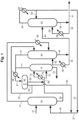
- the plant shown in Fig. 1 comprises an extraction column 30 for the extraction of a mixture containing acrylic acid and acetic acid, which is supplied to the extraction column 30 via conduit 21.
- an extractant stream here a mixture of cyclohexane and isopropyl acetate, is supplied to the extraction column 30.
- the raffinate obtained from the extraction column 30 is passed into a stripper charge distributor 86, then into the heater 79 and via conduit 74 supplied to the raffinate stripper 70.
- the extract obtained in the extraction column 30 is introduced into a heat exchanger or heater 38 via conduit 31 and subsequently supplied to a solvent separation column 40.
- a stripping agent preferably steam, is supplied to the raffinate stripper 70 via conduit 73.
- a stripping agent stream is removed from the process.
- the main part of the acetic acid namely > 99 wt-% based on the raffinate stream, which introduces the main amount of acetic acid into the stripper 70, is discharged with the stripping agent stream.
- the residual stream obtained is discharged via conduit 71 and together with the top stream from conduit 41 of the solvent separation column 40 supplied to a heat exchanger 48.
- this unified stream is supplied from the heat exchanger 48 to a phase separator with 2 liquid phases, here a decanting drum 80.
- the decanting drum 80 separates the residual stream coming from conduit 81 into a denser and a less dense liquid phase.
- the denser phase which preferably represents an aqueous phase, is supplied to the stripper charge distributor 86 via conduit 82.
- the less dense phase which preferably contains the extracting agent or parts thereof, is at least partly supplied via conduits 22 and 83 to the extractant stream in conduit 24. A part of the less dense phase also can be recirculated to the solvent separation column 40 via conduits 22 and 23.
- the solvent separation column 40 is used for separating the cyclohexane from the extract stream.
- the cyclohexane is withdrawn as top stream via conduit 41, while the remaining extract stream, which here contains acrylic acid, isopropyl acetate and residual acetic acid, is supplied to a distillation column 50 via conduits 46, 44.
- a part of this residual extract stream also can be recirculated into the solvent separation column 40 via conduits 46, 42, 43 and in the process is heated in the heater 49.
- acrylic acid is removed from the process as acrylic acid stream via conduits 56, 51 as product with a purity of typically > 95 wt-%, preferably > 96.5 wt-%.
- a part of the acrylic acid stream also can be recirculated into the distillation column 50 via conduits 56, 52, 53 and in the process is heated in the heater 59.
- the return stream is withdrawn from the distillation column 50 via conduit 54 and contains acetic acid and isopropyl acetate.
- the return stream is condensed in the heat exchanger 58 and via conduit 57 supplied to the extractant stream in conduit 24. After the heat exchanger 58, a part of the extractant stream also can be recirculated to the distillation column 50 via conduit 55.
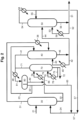
- Fig. 2 shows a plant like that of Fig. 1 .
- a part of the stripping agent stream is recirculated into the raffinate stripper 70 via conduits 75, 76 and in the process heated in the heater 78.
- a supply of fresh stripping agent via conduit 73, as shown in Figs. 1 and 3 thereby can be omitted.
- the fraction of discharged stripping agent stream likewise is reduced, so that on the whole an ecologically and economically more efficient process is possible.
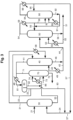
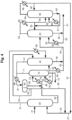
- Figs. 3 and 4 show a preferred plant, wherein Fig. 3 in turn shows a raffinate stripper 70 without heater and Fig. 4 shows a raffinate stripper 70 with heater 78 and recirculation of the stripping agent stream via conduits 75, 76.
- Figs. 3 and 4 show a two-stage distillation of the extract stream, wherein the first stage corresponds to the distillation column 50 of Figs. 1 and 2 .
- the return stream is not supplied directly via conduits 56, 57 to the extractant stream in conduit 24, but is first fed into a second distillation column 90 via conduit 56.
- a recirculation stream is discharged via conduits 92, 91 and charged to the first distillation column 50 via conduit 55.
- a part of the recirculation stream can be introduced into the second distillation column 90 via conduits 92, 93 and in the process is heated by the heater 99.
- the return stream is introduced into the extractant stream in conduit 24.
- a part of this stream can be recirculated to the second distillation column 90 via conduit 95.
- Table 1 shows typical process conditions and concentrations in Table 1: Table 1: conduit T / °C p / Mpa(a) c acrylic acid / wt-% c acetic acid / wt-% c cyclohexane / wt-% c isopropyl acetate / wt-% 21 35 3 45-55 - - - 24 35 5 ⁇ 1 ⁇ 2 50-60 40-50 33 35 5 ⁇ 1 ⁇ 5 - ⁇ 3 74 65 4 ⁇ 1 ⁇ 5 - ⁇ 2 31 35 3 21 ⁇ 2 35-45 25-35 72 70 6 ⁇ 1 ⁇ 5 - - 71 70 ⁇ 1 - ⁇ 0.2 ⁇ 1 80-90 41 81 82 33 4 - - ⁇ 1 ⁇ 2 22 33 6 - - 55-65 35-40 83 33 6 - - 55-65 35-40 23 33 6 - - 55-65 35-40 44 90 - 110 4 65-75
Landscapes
- Chemical & Material Sciences (AREA)
- Organic Chemistry (AREA)
- Engineering & Computer Science (AREA)
- Oil, Petroleum & Natural Gas (AREA)
- Crystallography & Structural Chemistry (AREA)
- Chemical Kinetics & Catalysis (AREA)
- Organic Low-Molecular-Weight Compounds And Preparation Thereof (AREA)
Description
- This invention relates to a process for the purification of acrylic acid from a mixture containing acrylic acid and acetic acid.
- With a global annual production of more than 4 mio. t, acrylic acid is one of the most produced intermediate products of the chemical industry, as acrylic acid and its derivatives are starting substances for numerous industrial-scale products. Particularly important are the so-called superabsorbents, to which acrylic acid is polymerized together with sodium acrylate (the sodium salt of acrylic acid). The same for the most part are employed in hygiene products (e.g. diapers), but are also used for the storage of water in soils. The esters of acrylic acid are converted to polymers, and the resulting plastics are used in paints or as dispersing agents.
- Acrylic acid is industrially produced in a two-stage, heterogeneously catalyzed process. Proceeding from propene, acrolein is obtained at about 350 °C on bismuth molybdates with a selectivity and yield greater than 90 wt-%. In the second step, acrolein is oxidized further on mixed Mo/V/W oxides at about 280 °C to obtain acrylic acid. As by-products the total oxidation products CO, CO2 and water are obtained as well as small amounts of acetic acid from the acetaldehyde obtained during the propene oxidation. Therefore, a multistage processing is carried out subsequent to the reaction.
- A particular challenge in the purification of the acrylic acid is the polymerization tendency of the acrylic acid, in particular at elevated temperatures. The polymerization of acrylic acid is a strongly exothermal reaction which releases large amounts of heat. Since the heat in turn leads to an acceleration of the polymerization, acrylic acid tends to explosion-like polymerizations. A polymerization of acrylic acid often leads to clogging and thus to undesired shut-down periods of the entire plant. In this connection, the acetic acid obtained as by-product is to be classified as particularly problematic, as the same promotes the polymerization of acrylic acid as a proton donor.
-
DE 102 51 328 B4 describes a purification for acrylic acid in which the acetic acid is separated such that it can be obtained from the process in an economically exploitable manner. For this purpose, the reaction products from a mixture of cyclohexane and propyl acetate are absorbed in an extraction column and supplied to a solvent separation column. Cyclohexane is separated therein as top stream and after purification recirculated into the extraction column. The product stream in the bottom of the solvent separation column contains propyl acetate, acetic acid and acrylic acid. This stream is supplied to an acrylic acid separation tower from which acrylic acid is discharged as relatively pure product. The remaining mixture of acetic acid and propyl acetate, which also contains fractions of acrylic acid, is separated in an acetic acid separation tower, where acetic acid is discharged as product and propyl acetate is supplied into the extraction column as solvent. - It was found out, however, that with this purification variant the undesired polymer formation and the fouling both in the acrylic acid separation tower and in the solvent separation column occur to a considerable extent due to the relatively high concentration of the acetic acid. As a result, cloggings already occur within the plant after few weeks of operating time, which is why an intensive cleaning above all within the distillation columns and the associated heat exchangers becomes necessary with corresponding shut-down periods of the plant.
- The acetic acid produced thereby has a comparatively high purity of > 90 wt-%, but the relatively low sales revenue from the additional production of the acetic acid hardly or only with difficulty makes up for the expenditures for additional investments (e.g. in distillation columns, tank farms, loading etc.) as well as operative costs (e.g. increased consumption of resources). Furthermore, the increased polymer formation and fouling tendency results in distinct reductions in the availability of the plant as well as in acrylic acid product losses due to polymer formation and in additional costs for the disposal of the wastes which are obtained in the cleaning and removal of polymers.
- With the catalysts commonly used today and the available reactor sizes, about 400 kg/h of acetic acid are produced in an acrylic acid plant as side reaction. A sales revenue of about 200,000 € (at a price of 500 €/t) can be achieved therewith. This revenue however is relativized by the acrylic acid losses connected with the separation of the acetic acid. On an assumption of an acrylic acid price of 1500 €/t, the revenue already is used up with losses of 130 kg/h of acrylic acid. Acrylic acid nowadays also achieves far higher market prices, and further costs, already described above, for additional investments as well as disposal costs have not yet been taken into account.
- A process for the purification of acrylic acid by avoiding a polymer formation and a fouling within the plant is proposed in
US 3,798,264 . Initially, reaction products are separated as condensate in a condenser and separated from low boilers in a stripping column. The remaining phase containing acrylic acid is separated from the aqueous phase in an extraction column by an extracting agent, wherein a part of the acetic acid already is removed with the aqueous phase. Subsequently, the extracting agent is separated from the acrylic acid and the acetic acid in a solvent separation column. Finally, the acetic acid is removed from the acrylic acid by distillation in an acrylic acid/acetic acid separation column, wherein the acetic acid obtained is supplied to the condensate, the stripping column or the extraction column. To avoid an acid-related polymerization within the acrylic acid/acetic acid separation column, a part of the acrylic acid is recirculated, whereby the acrylic acid concentration in the separation column is adjusted to values between 10 wt-% and 70 wt-%. - It has been noted, however, that the concentration of the acetic acid of 90 wt-% to 30 wt-% as described in the prior art cannot reliably prevent a polymer formation in the separation column and promotes fouling over an extended period. Furthermore, it is disadvantageous in the known processes that a part of the acrylic acid is recirculated not only within the separation column, but also back to the extractor. As a result, the acrylic acid repeatedly passes through the entire separating section including the distillation columns and thus is exposed to a thermal load for a comparatively long time, which in turn promotes the polymer formation and the fouling and at the same time leads to losses of the valuable product acrylic acid.
-
US 6,737,546 B2 discloses a process for recovery and refining of at least acrylic acid from a gaseous mixture such as is obtainable by gas-phase catalytic oxidation of propylene. - It is the object of the present invention to provide a process for the purification of acrylic acid, wherein the disadvantages present in the prior art are overcome. In particular, it is intended to increase the availability (runtime/operating time) of the plant and to prevent a time- and cost-intensive cleaning of the distillation units, as this would also involve considerable production losses.
- This object is solved by a process with the features of
claim 1, which defines the subject matter of the present invention. - The process according to the invention for the purification of acrylic acid from a mixture containing acrylic acid and acetic acid comprises an extraction of the mixture containing acrylic acid and acetic acid, whereby a raffinate stream and an extract stream are obtained. This is followed by a multistage distillation of the extract stream, whereby an acrylic acid stream and a return stream are obtained, with the latter being introduced into the extractant stream. The return stream furthermore guides the acetic acid contained in the extract stream back into the extractant stream.
- According to the invention, the return stream contains at least 90 wt-%, preferably > 95 wt-% of the acetic acid contained in the extract stream. The acrylic acid thereby can be withdrawn with very high purity.
- Thus, a direct distillative separation step of acrylic acid and acetic acid as described in the prior art no longer is necessary with the process according to the invention. A high concentration of the acetic acid, in particular with high acrylic acid fractions, thereby is avoided and an acid-related polymerization of the acrylic acid is inhibited. Correspondingly, this results in considerably longer runtimes of the plant. As compared to the prior art, in which usually after few weeks of operating time an intensive cleaning above all within the distillation columns and associated heat exchangers is necessary with corresponding shut-down periods, the process according to the invention can be carried out over very long operating times (more than one year) without corresponding shut-down periods.
- It is favorable that the acetic acid chiefly, namely for more than 50 wt-%, preferably for more than 60 wt-%, based on the total amount of acetic acid introduced into the extraction, already is removed from the process with the raffinate stream. Total amount in the sense of the invention is understood to be that amount of acetic acid which results from the sum of those amounts of acetic acid which are introduced into the extraction on the one hand via the mixture containing acrylic acid and acetic acid and on the other hand via the return stream.
- However, it is decisive above all that in the raffinate stream already a distinctly larger amount of acetic acid is removed from the process than the amount of acetic acid which has been recirculated into the extractor with the return stream. Based on the amount of acetic acid contained in the return stream over 40% more, preferably even over 50% more of acetic acid are removed from the process than has reached the extractor with the return stream (taking the amount contained in the return stream as 100 %, an amount of acetic acid corresponding to >140 % or >150 % is discharged in the raffinate). It thereby is ensured that the concentration of the acetic acid in the extract stream and in the subsequent distillation is comparatively low. For example, at a total amount of about 1000 kg/h of acetic acid to the extractor (from feed stream + return stream) about 600 kg/h are removed with the raffinate, while only about 400 kg/h are contained in the return stream.
- The fraction of acetic acid in the extract stream obtained in the extraction is < 2 wt-%, preferably < 1 wt-% based on the entire extract stream.
- The remaining acetic acid is recirculated to the extractor with the return stream in small concentrations, typically with 3 to 7 wt-%, preferably 5 wt-%, based on the total mass flow of the return stream.
- The acetic acid can separately be introduced into the extraction or be joined with the extractant stream, and the resulting mixture can be introduced into the extraction.
- In a preferred aspect, the mixture containing acrylic acid and acetic acid is mixed with a liquid, preferably water, before the extraction. This is preferred in particular when the acrylic acid is produced in a two-stage catalytic gas phase oxidation of propene at temperatures of 200 to 400 °C. The liquid acts as quenching medium for the hot gas mixture of the oxidation.
- It has been found to be favorable as well to separate the raffinate stream by means of stripping into a stripping agent stream (bottom) and into a residual stream (recovery stream / top), wherein the acetic acid contained in the raffinate stream remains in the stripping agent stream (bottom product). As stripping agent, water preferably is used.
- During stripping, the acetic acid almost completely, namely for at least 99 wt-%, preferably for 99.9 wt-% based on the total amount of acetic acid introduced into the stripping unit, hence also remains in the stripping agent stream and can be discharged from the process. It should be emphasized that almost the entire amount of acetic acid gets into the stripper with the raffinate stream and correspondingly is discharged via the bottom (stripping agent stream).
- It is preferred particularly when the residual stream (recovery stream / top) from the stripping unit is supplied to the extractant stream, as due to stripping additional extracting agent can be recovered from the raffinate stream, wherein the extracting agent typically is contained in the raffinate stream at small fractions, namely at less than 3 wt-%, preferably 2 wt-% based on the raffinate stream.
- In addition, it can be provided that the residual stream (recovery stream) is separated into a less dense and into a denser liquid phase, wherein the less dense phase is supplied to the extractant stream and the denser phase is supplied to the raffinate. The purity of the less dense phase recirculated to the extractant stream is increased. In addition, possibly contained acetic acid is removed from the residual stream and the concentration of the acetic acid is reduced within the following distillation of the extract stream.
- The extracting agent is a mixture of isopropyl acetate and cyclohexane. In particular, extracting agents consisting of 70 - 20 wt-% isopropyl acetate and 30 to 80 wt-% cyclohexane based on the total amount of extracting agent were found to be advantageous.
- Cyclohexane is separated from the extract stream before the distillation of the extract stream. This simplifies the following distillation of the extract stream and leads to a better separation efficiency of the corresponding distillation column.
- The subsequent distillation is carried out with moderate temperatures of < 110 °C, preferably < 100 °C, particularly preferably < 95 °C, and at pressures of < 0.4 bar, preferably < 0.3 bar, particularly preferably < 0.2 bar.
- The distillation of the extract stream is carried out in two stages, wherein in the first distillation stage the acrylic acid stream is at least partly discharged and the remaining stream of the second stage is separated into a return stream and a recirculation stream, wherein the recirculation stream is completely recirculated into the first stage. As a result, the concentration of the acrylic acid in the first stage and the separation of the return stream in the second stage is carried out. Due to this spatial and technical division of the separation tasks, namely the separation of the acrylic acid and the separation of the return stream, on several distillation stages, the conditions in one stage can be optimized for the respective separation task. As a result, a particularly careful and efficient separation is achieved. In particular, both stages operate with the moderate temperatures of < 110 °C, preferably < 100 °C, particularly preferably < 95 °C, and pressures of < 0.4 bar, preferably < 0.3 bar, particularly preferably < 0.2 bar.
- In the preferred configuration with two distillation stages, the first stage preferably operates at a lower pressure than the second stage. This takes account of the higher acrylic acid concentration at the bottom of the first stage. For the second stage a slightly higher pressure is sufficient and expedient, in order to be able to efficiently condense the relatively low-boiling extracting agent at the top of the second stage at moderate cooling water temperatures.
- The process may be performed using a plant which comprises an extraction column for the extraction of a mixture containing acrylic acid and acetic acid. Through a conduit, an extractant stream is supplied to the extraction column. In addition, a distillation column for the distillation of the extract stream and a return conduit are provided. The distillation column is designed such that via the return conduit at least one return stream is guided, which contains at least 90 wt-% of the acetic acid contained in the extract stream.
- This return conduit and/or the extractant conduit open(s) preferably at the bottom of the extraction. When the extractant conduit opens at the bottom of the extraction, a configuration of the plant in which the return conduit first opens into the extractant conduit is preferred particularly. Directly or indirectly feeding the return stream into the bottom of the extraction has the advantage that the acetic acid contained in the aqueous return stream would have to pass all internal fittings in the extraction column, in order to get into the withdrawn extract stream at the top. By internal fittings in the extraction column, preferably trays, particularly preferably more than 60 trays, quite particularly preferably more than 90 trays, such a high separation efficiency can be achieved that the acetic acid recirculated via the return stream practically is withdrawn completely and thus an accumulation of the acetic acid during the operation of the plant is prevented.
- The recovery of acetic acid as by-product as described in the prior art is omitted and hence a special separation of acetic acid and extractant stream no longer is necessary. Therefore, an additional separation unit as described in the prior art can be omitted in principle, whereby the equipment expenditure is reduced.
- In a preferred aspect, a raffinate stripper is provided, wherein the raffinate stripper for stripping the raffinate stream is designed such that a stripping agent stream (bottom) and a residual stream (recovery stream / top) is obtained, wherein a return conduit partly supplies the stripping agent stream to a heater, and that a return conduit recirculates the heated stripping agent stream into the raffinate stripper. The heater provides the amount of heat required for stripping. In general, a direct addition of fresh stripping agent, preferably steam, hence is omitted and larger amounts of waste water are avoided.
- In a particularly preferred aspect, a conduit is provided which supplies the residual stream (recovery stream) to a phase separator, wherein the phase separator is designed such that the residual stream (recovery stream) is separated into a less dense and into a denser phase. Furthermore, the less dense phase is guided into the extractant stream via one conduit, and the denser phase is guided into the raffinate stripper via another conduit.
- In a preferred aspect, two distillation columns are provided, wherein the first distillation column is designed such that via conduits a stream consisting of at least 95 wt-%, preferably > 96.5 wt-% acrylic acid is withdrawn. Via further conduits, the top product from the first distillation column gets into the second distillation column, from which a stream is recirculated into the first column via a return conduit. With relatively little technical effort and under mild conditions, a very high purity of the withdrawn acrylic acid can be achieved thereby, as this interconnection of first column, second column and recirculation into the first column at least is just as good as three columns connected in series.
- Further features, advantages and possible applications of the invention can also be taken from the following description of the drawings and the exemplary embodiment.
- In the drawings:
- Fig. 1
- shows a plant with a distillation column and a raffinate stripper without heater,
- Fig. 2
- shows a plant as shown in
Fig. 1 and a raffinate stripper with heater, - Fig. 3
- shows a plant with two distillation columns and a raffinate stripper without heater, and
- Fig. 4
- shows a plant as shown in
Fig. 3 and a raffinate stripper with heater. - The plants as such do not form part of the claimed subject matter, which is directed to a process.
- The plant shown in
Fig. 1 comprises anextraction column 30 for the extraction of a mixture containing acrylic acid and acetic acid, which is supplied to theextraction column 30 viaconduit 21. Viaconduit 24, an extractant stream, here a mixture of cyclohexane and isopropyl acetate, is supplied to theextraction column 30. Viaconduit 33, the raffinate obtained from theextraction column 30 is passed into astripper charge distributor 86, then into theheater 79 and viaconduit 74 supplied to theraffinate stripper 70. The extract obtained in theextraction column 30 is introduced into a heat exchanger orheater 38 viaconduit 31 and subsequently supplied to asolvent separation column 40. - A stripping agent, preferably steam, is supplied to the
raffinate stripper 70 viaconduit 73. Viaconduit 72, a stripping agent stream is removed from the process. In this instance, the main part of the acetic acid, namely > 99 wt-% based on the raffinate stream, which introduces the main amount of acetic acid into thestripper 70, is discharged with the stripping agent stream. The residual stream obtained is discharged viaconduit 71 and together with the top stream fromconduit 41 of thesolvent separation column 40 supplied to aheat exchanger 48. Viaconduit 81, this unified stream is supplied from theheat exchanger 48 to a phase separator with 2 liquid phases, here a decantingdrum 80. - The decanting
drum 80 separates the residual stream coming fromconduit 81 into a denser and a less dense liquid phase. The denser phase, which preferably represents an aqueous phase, is supplied to thestripper charge distributor 86 viaconduit 82. The less dense phase, which preferably contains the extracting agent or parts thereof, is at least partly supplied viaconduits conduit 24. A part of the less dense phase also can be recirculated to thesolvent separation column 40 viaconduits - In the plant shown, the
solvent separation column 40 is used for separating the cyclohexane from the extract stream. The cyclohexane is withdrawn as top stream viaconduit 41, while the remaining extract stream, which here contains acrylic acid, isopropyl acetate and residual acetic acid, is supplied to adistillation column 50 viaconduits solvent separation column 40 viaconduits heater 49. - From the
distillation column 50 acrylic acid is removed from the process as acrylic acid stream viaconduits distillation column 50 viaconduits heater 59. The return stream is withdrawn from thedistillation column 50 viaconduit 54 and contains acetic acid and isopropyl acetate. The return stream is condensed in theheat exchanger 58 and viaconduit 57 supplied to the extractant stream inconduit 24. After theheat exchanger 58, a part of the extractant stream also can be recirculated to thedistillation column 50 viaconduit 55. -
Fig. 2 shows a plant like that ofFig. 1 . In addition, a part of the stripping agent stream is recirculated into theraffinate stripper 70 viaconduits heater 78. A supply of fresh stripping agent viaconduit 73, as shown inFigs. 1 and3 , thereby can be omitted. The fraction of discharged stripping agent stream likewise is reduced, so that on the whole an ecologically and economically more efficient process is possible. -
Figs. 3 and4 show a preferred plant, whereinFig. 3 in turn shows araffinate stripper 70 without heater andFig. 4 shows araffinate stripper 70 withheater 78 and recirculation of the stripping agent stream viaconduits -
Figs. 3 and4 show a two-stage distillation of the extract stream, wherein the first stage corresponds to thedistillation column 50 ofFigs. 1 and2 . InFigs. 3 and4 , however, the return stream is not supplied directly viaconduits conduit 24, but is first fed into asecond distillation column 90 viaconduit 56. - In the
second distillation column 90, a recirculation stream is discharged viaconduits first distillation column 50 viaconduit 55. A part of the recirculation stream can be introduced into thesecond distillation column 90 viaconduits heater 99. Viaconduits heat exchanger 98, the return stream is introduced into the extractant stream inconduit 24. A part of this stream can be recirculated to thesecond distillation column 90 viaconduit 95. - The following exemplary embodiment shows typical process conditions and concentrations in Table 1:
Table 1: conduit T / °C p / Mpa(a) cacrylic acid / wt-% cacetic acid / wt-% ccyclohexane / wt-% cisopropyl acetate / wt-% 21 35 3 45-55 - - - 24 35 5 < 1 < 2 50-60 40-50 33 35 5 < 1 < 5 - < 3 74 65 4 < 1 < 5 - < 2 31 35 3 21 < 2 35-45 25-35 72 70 6 < 1 < 5 - - 71 70 < 1 - < 0.2 < 1 80-90 41 81 82 33 4 - - < 1 < 2 22 33 6 - - 55-65 35-40 83 33 6 - - 55-65 35-40 23 33 6 - - 55-65 35-40 44 90 - 110 4 65-75 < 2 < 1 25-35 42 90 - 110 2 65-75 < 2 < 1 25-35 43 90 - 110 1 65-75 < 2 < 1 25-35 51 20 4 > 95 - - - 57 33 5 < 2 < 6 < 2 90-95 -
- 21 - 24
- conduits
- 30
- extraction column
- 31, 33
- conduits
- 38
- heater
- 40
- solvent separation column
- 41 - 46
- conduits
- 49
- heater
- 48
- heat exchanger
- 50
- first distillation column
- 51 - 57
- conduits
- 59
- heater
- 58
- heat exchanger
- 70
- raffinate stripper
- 71 - 76
- conduits
- 78 and 79
- heater
- 80
- decanting drum
- 81 - 83
- conduits
- 86
- stripper charge distributor
- 90
- second distillation column
- 91 - 95
- conduits
- 98
- heat exchanger
- 99
- heater
Claims (7)
- A process for the purification of acrylic acid from a mixture containing acrylic acid and acetic acid, comprising the following steps:extraction of the mixture containing acrylic acid and acetic acid with an extractant stream, whereby a raffinate stream and an extract stream are obtained, distillation of the extract stream, whereby an acrylic acid stream and a return stream are obtained,characterized in that the return stream contains acetic acid and is recirculated into the extraction, that for the extraction a mixture of isopropyl acetate and cyclohexane is used as extracting agent, and that before the distillation of the extract stream cyclohexane is separated from the extract stream,wherein the distillation of the extract stream is carried out in two stages, wherein in the first distillation stage the acrylic acid stream is at least partly discharged and the remaining stream of the second stage is separated into a return stream and a recirculation stream, wherein the recirculation stream is completely recirculated into the first stage of the distillation.
- The process according to claim 1, characterized in that the absolute amount of acetic acid in the raffinate stream is greater than the absolute amount of acetic acid in the return stream.
- The process according to claim 1 or 2, characterized in that the return stream contains at least 90 wt-% of the acetic acid contained in the extract stream.
- The process according to any of the preceding claims, characterized in that before the extraction the mixture containing acrylic acid and acetic acid is mixed with a liquid.
- The process according to any of the preceding claims, characterized in that the raffinate stream is separated into a stripping agent stream and a residual stream by means of stripping, wherein the acetic acid contained in the raffinate stream remains in the stripping agent stream.
- The process according to claim 5, characterized in that the residual stream is supplied to the extractant stream.
- The process according to claim 6, characterized in that the residual stream is separated into a less dense and into a denser phase, wherein the less dense phase is supplied to the extractant stream and the denser phase is supplied to the raffinate stream.
Priority Applications (1)
| Application Number | Priority Date | Filing Date | Title |
|---|---|---|---|
| RS20240996A RS65925B1 (en) | 2014-06-26 | 2015-06-16 | Process and plant for the purification of acrylic acid |
Applications Claiming Priority (2)
| Application Number | Priority Date | Filing Date | Title |
|---|---|---|---|
| DE102014108980.4A DE102014108980A1 (en) | 2014-06-26 | 2014-06-26 | Process and installation for the purification of acrylic acid |
| PCT/EP2015/025033 WO2015197197A1 (en) | 2014-06-26 | 2015-06-16 | Process and plant for the purification of acrylic acid |
Publications (3)
| Publication Number | Publication Date |
|---|---|
| EP3160929A1 EP3160929A1 (en) | 2017-05-03 |
| EP3160929C0 EP3160929C0 (en) | 2024-08-14 |
| EP3160929B1 true EP3160929B1 (en) | 2024-08-14 |
Family
ID=53717973
Family Applications (1)
| Application Number | Title | Priority Date | Filing Date |
|---|---|---|---|
| EP15741124.0A Active EP3160929B1 (en) | 2014-06-26 | 2015-06-16 | Process and plant for the purification of acrylic acid |
Country Status (11)
| Country | Link |
|---|---|
| US (1) | US10029976B2 (en) |
| EP (1) | EP3160929B1 (en) |
| KR (1) | KR102349662B1 (en) |
| CN (2) | CN105218355B (en) |
| BR (1) | BR112016029736A8 (en) |
| DE (1) | DE102014108980A1 (en) |
| HU (1) | HUE068038T2 (en) |
| IN (1) | IN2015MU00580A (en) |
| PL (1) | PL3160929T3 (en) |
| RS (1) | RS65925B1 (en) |
| WO (1) | WO2015197197A1 (en) |
Families Citing this family (4)
| Publication number | Priority date | Publication date | Assignee | Title |
|---|---|---|---|---|
| KR102079775B1 (en) | 2016-11-25 | 2020-02-20 | 주식회사 엘지화학 | Process for continuous recovering (meth)acrylic acid and apparatus for the process |
| CN107641536B (en) * | 2017-10-19 | 2019-12-31 | 北京化工大学 | System device and process suitable for dehydration treatment of natural gas for liquefaction on offshore platforms |
| CN116574003B (en) * | 2023-05-04 | 2026-01-02 | 广东长鸿艾凯茵科技有限公司 | A method for preparing high-purity acrylic acid from crude acrylic acid aqueous solution |
| WO2025131819A2 (en) | 2023-12-19 | 2025-06-26 | IFP Energies Nouvelles | Process for production of bio-acrylic acid |
Citations (3)
| Publication number | Priority date | Publication date | Assignee | Title |
|---|---|---|---|---|
| GB997325A (en) * | 1963-06-20 | 1965-07-07 | Distillers Co Yeast Ltd | Recovery of acrylic acid |
| US6737546B2 (en) * | 2001-11-13 | 2004-05-18 | Lurgi Ag | Extraction process for recovery of acrylic acid |
| US20130253224A1 (en) * | 2012-03-20 | 2013-09-26 | Celanese International Corporation | Process for Producing Acrylic Acids and Acrylates |
Family Cites Families (5)
| Publication number | Priority date | Publication date | Assignee | Title |
|---|---|---|---|---|
| JPS4924898B1 (en) | 1970-12-26 | 1974-06-26 | ||
| JPS4862712A (en) * | 1971-12-07 | 1973-09-01 | ||
| NL180579C (en) * | 1972-05-24 | 1987-03-16 | Sumitomo Chemical Co | METHOD FOR SEPARATING A MIX consisting of ACRYLIC ACID, ACETIC ACID AND WATER. |
| US20030150705A1 (en) * | 2002-01-08 | 2003-08-14 | Deshpande Sanjeev D. | Acrylic acid recovery utilizing ethyl acrylate and selected co-solvents |
| JP2010163383A (en) * | 2009-01-14 | 2010-07-29 | Toagosei Co Ltd | Method for purifying acrylic acid |
-
2014
- 2014-06-26 DE DE102014108980.4A patent/DE102014108980A1/en not_active Withdrawn
-
2015
- 2015-02-21 IN IN580MU2015 patent/IN2015MU00580A/en unknown
- 2015-06-16 RS RS20240996A patent/RS65925B1/en unknown
- 2015-06-16 US US15/317,755 patent/US10029976B2/en active Active
- 2015-06-16 HU HUE15741124A patent/HUE068038T2/en unknown
- 2015-06-16 EP EP15741124.0A patent/EP3160929B1/en active Active
- 2015-06-16 PL PL15741124.0T patent/PL3160929T3/en unknown
- 2015-06-16 WO PCT/EP2015/025033 patent/WO2015197197A1/en not_active Ceased
- 2015-06-16 BR BR112016029736A patent/BR112016029736A8/en active Search and Examination
- 2015-06-16 KR KR1020177001269A patent/KR102349662B1/en active Active
- 2015-06-26 CN CN201510363347.7A patent/CN105218355B/en active Active
- 2015-06-26 CN CN201520449580.2U patent/CN205035299U/en not_active Expired - Lifetime
Patent Citations (3)
| Publication number | Priority date | Publication date | Assignee | Title |
|---|---|---|---|---|
| GB997325A (en) * | 1963-06-20 | 1965-07-07 | Distillers Co Yeast Ltd | Recovery of acrylic acid |
| US6737546B2 (en) * | 2001-11-13 | 2004-05-18 | Lurgi Ag | Extraction process for recovery of acrylic acid |
| US20130253224A1 (en) * | 2012-03-20 | 2013-09-26 | Celanese International Corporation | Process for Producing Acrylic Acids and Acrylates |
Also Published As
| Publication number | Publication date |
|---|---|
| CN105218355B (en) | 2019-07-09 |
| WO2015197197A8 (en) | 2017-01-05 |
| BR112016029736A2 (en) | 2017-08-22 |
| KR20170026474A (en) | 2017-03-08 |
| PL3160929T3 (en) | 2024-10-21 |
| IN2015MU00580A (en) | 2015-04-10 |
| EP3160929C0 (en) | 2024-08-14 |
| HUE068038T2 (en) | 2024-12-28 |
| WO2015197197A1 (en) | 2015-12-30 |
| CN105218355A (en) | 2016-01-06 |
| RS65925B1 (en) | 2024-10-31 |
| CN205035299U (en) | 2016-02-17 |
| KR102349662B1 (en) | 2022-01-12 |
| US20170113994A1 (en) | 2017-04-27 |
| DE102014108980A1 (en) | 2015-12-31 |
| US10029976B2 (en) | 2018-07-24 |
| BR112016029736A8 (en) | 2020-10-20 |
| EP3160929A1 (en) | 2017-05-03 |
Similar Documents
| Publication | Publication Date | Title |
|---|---|---|
| US6642414B2 (en) | Method for production of (meth) acrylic acid | |
| EP3201167B1 (en) | Method and system for recovering acrylic acid | |
| EP2913319A1 (en) | Synthesis of guerbet alcohols | |
| KR102641477B1 (en) | Method for purifying (meth)acrylic acid comprising a distillation column with dividing walls | |
| US10029976B2 (en) | Process and plant for the purification of acrylic acid | |
| EP1903025B1 (en) | Method for producing (meth)acrylic acid | |
| US8772534B2 (en) | Method of recovering (meth) acrylic acid ester | |
| US9975842B2 (en) | Method for producing alkyl (meth)acrylates | |
| JP5821660B2 (en) | Method for producing (meth) acrylic acid | |
| JPH03291246A (en) | Removal of impurity form mixture of cylcohexanone and cyclohexanol | |
| JP6036402B2 (en) | Method for producing (meth) acrylic acid ester | |
| CN218793944U (en) | Acrylic acid rectification piece-rate system | |
| JP2007510636A (en) | Method for purifying (meth) acrylic acid obtained by oxidation of gas material | |
| US20040267045A1 (en) | Processes for producing (meth)acrylic acid compound | |
| CN104968638B (en) | Method for removing acrolein from process gas of heterogeneously catalyzed oxidation of propene | |
| JP6036400B2 (en) | Method for producing (meth) acrylic acid ester | |
| CN218834066U (en) | Novel separation system for acrylic acid device | |
| WO2003043968A1 (en) | Process for producing (meth)acrylic acid compounds | |
| CN110950757A (en) | Production method and system of malonic diester | |
| CN113318471B (en) | Treatment method and system for dimethylbenzene oxidation reaction liquid | |
| CN115925526B (en) | A circulation process for supercritical synthesis gas hydroformylation reaction | |
| CN115246773B (en) | A system for separating MMA from aldol condensation products | |
| JP2014528936A (en) | Method for producing methacrylic acid and methacrylic acid ester | |
| JP4018512B2 (en) | Method for producing (meth) acrylic acids | |
| CN120904047A (en) | Methacrylic acid methyl ester separation method |
Legal Events
| Date | Code | Title | Description |
|---|---|---|---|
| STAA | Information on the status of an ep patent application or granted ep patent |
Free format text: STATUS: THE INTERNATIONAL PUBLICATION HAS BEEN MADE |
|
| PUAI | Public reference made under article 153(3) epc to a published international application that has entered the european phase |
Free format text: ORIGINAL CODE: 0009012 |
|
| STAA | Information on the status of an ep patent application or granted ep patent |
Free format text: STATUS: REQUEST FOR EXAMINATION WAS MADE |
|
| 17P | Request for examination filed |
Effective date: 20161215 |
|
| AK | Designated contracting states |
Kind code of ref document: A1 Designated state(s): AL AT BE BG CH CY CZ DE DK EE ES FI FR GB GR HR HU IE IS IT LI LT LU LV MC MK MT NL NO PL PT RO RS SE SI SK SM TR |
|
| AX | Request for extension of the european patent |
Extension state: BA ME |
|
| DAV | Request for validation of the european patent (deleted) | ||
| DAX | Request for extension of the european patent (deleted) | ||
| STAA | Information on the status of an ep patent application or granted ep patent |
Free format text: STATUS: EXAMINATION IS IN PROGRESS |
|
| 17Q | First examination report despatched |
Effective date: 20200316 |
|
| RAP3 | Party data changed (applicant data changed or rights of an application transferred) |
Owner name: L'AIR LIQUIDE, SOCIETE ANONYME POUR L'ETUDE ET L'EXPLOITATION DES PROCEDES GEORGES CLAUDE |
|
| RAP1 | Party data changed (applicant data changed or rights of an application transferred) |
Owner name: AIR LIQUIDE GLOBAL E&C SOLUTIONS GERMANY GMBH |
|
| GRAP | Despatch of communication of intention to grant a patent |
Free format text: ORIGINAL CODE: EPIDOSNIGR1 |
|
| STAA | Information on the status of an ep patent application or granted ep patent |
Free format text: STATUS: GRANT OF PATENT IS INTENDED |
|
| INTG | Intention to grant announced |
Effective date: 20240315 |
|
| RAP1 | Party data changed (applicant data changed or rights of an application transferred) |
Owner name: LUMMUS TECHNOLOGY LLC |
|
| GRAS | Grant fee paid |
Free format text: ORIGINAL CODE: EPIDOSNIGR3 |
|
| GRAA | (expected) grant |
Free format text: ORIGINAL CODE: 0009210 |
|
| STAA | Information on the status of an ep patent application or granted ep patent |
Free format text: STATUS: THE PATENT HAS BEEN GRANTED |
|
| AK | Designated contracting states |
Kind code of ref document: B1 Designated state(s): AL AT BE BG CH CY CZ DE DK EE ES FI FR GB GR HR HU IE IS IT LI LT LU LV MC MK MT NL NO PL PT RO RS SE SI SK SM TR |
|
| REG | Reference to a national code |
Ref country code: GB Ref legal event code: FG4D |
|
| REG | Reference to a national code |
Ref country code: CH Ref legal event code: EP |
|
| REG | Reference to a national code |
Ref country code: DE Ref legal event code: R096 Ref document number: 602015089531 Country of ref document: DE |
|
| REG | Reference to a national code |
Ref country code: IE Ref legal event code: FG4D |
|
| U01 | Request for unitary effect filed |
Effective date: 20240903 |
|
| U07 | Unitary effect registered |
Designated state(s): AT BE BG DE DK EE FI FR IT LT LU LV MT NL PT RO SE SI Effective date: 20240923 |
|
| REG | Reference to a national code |
Ref country code: SK Ref legal event code: T3 Ref document number: E 44904 Country of ref document: SK |
|
| REG | Reference to a national code |
Ref country code: HU Ref legal event code: AG4A Ref document number: E068038 Country of ref document: HU |
|
| PG25 | Lapsed in a contracting state [announced via postgrant information from national office to epo] |
Ref country code: NO Free format text: LAPSE BECAUSE OF FAILURE TO SUBMIT A TRANSLATION OF THE DESCRIPTION OR TO PAY THE FEE WITHIN THE PRESCRIBED TIME-LIMIT Effective date: 20241114 |
|
| PG25 | Lapsed in a contracting state [announced via postgrant information from national office to epo] |
Ref country code: GR Free format text: LAPSE BECAUSE OF FAILURE TO SUBMIT A TRANSLATION OF THE DESCRIPTION OR TO PAY THE FEE WITHIN THE PRESCRIBED TIME-LIMIT Effective date: 20241115 |
|
| PG25 | Lapsed in a contracting state [announced via postgrant information from national office to epo] |
Ref country code: IS Free format text: LAPSE BECAUSE OF FAILURE TO SUBMIT A TRANSLATION OF THE DESCRIPTION OR TO PAY THE FEE WITHIN THE PRESCRIBED TIME-LIMIT Effective date: 20241214 |
|
| PG25 | Lapsed in a contracting state [announced via postgrant information from national office to epo] |
Ref country code: HR Free format text: LAPSE BECAUSE OF FAILURE TO SUBMIT A TRANSLATION OF THE DESCRIPTION OR TO PAY THE FEE WITHIN THE PRESCRIBED TIME-LIMIT Effective date: 20240814 |
|
| PG25 | Lapsed in a contracting state [announced via postgrant information from national office to epo] |
Ref country code: ES Free format text: LAPSE BECAUSE OF FAILURE TO SUBMIT A TRANSLATION OF THE DESCRIPTION OR TO PAY THE FEE WITHIN THE PRESCRIBED TIME-LIMIT Effective date: 20240814 |
|
| PG25 | Lapsed in a contracting state [announced via postgrant information from national office to epo] |
Ref country code: NO Free format text: LAPSE BECAUSE OF FAILURE TO SUBMIT A TRANSLATION OF THE DESCRIPTION OR TO PAY THE FEE WITHIN THE PRESCRIBED TIME-LIMIT Effective date: 20241114 Ref country code: IS Free format text: LAPSE BECAUSE OF FAILURE TO SUBMIT A TRANSLATION OF THE DESCRIPTION OR TO PAY THE FEE WITHIN THE PRESCRIBED TIME-LIMIT Effective date: 20241214 Ref country code: HR Free format text: LAPSE BECAUSE OF FAILURE TO SUBMIT A TRANSLATION OF THE DESCRIPTION OR TO PAY THE FEE WITHIN THE PRESCRIBED TIME-LIMIT Effective date: 20240814 Ref country code: GR Free format text: LAPSE BECAUSE OF FAILURE TO SUBMIT A TRANSLATION OF THE DESCRIPTION OR TO PAY THE FEE WITHIN THE PRESCRIBED TIME-LIMIT Effective date: 20241115 Ref country code: ES Free format text: LAPSE BECAUSE OF FAILURE TO SUBMIT A TRANSLATION OF THE DESCRIPTION OR TO PAY THE FEE WITHIN THE PRESCRIBED TIME-LIMIT Effective date: 20240814 |
|
| PG25 | Lapsed in a contracting state [announced via postgrant information from national office to epo] |
Ref country code: SM Free format text: LAPSE BECAUSE OF FAILURE TO SUBMIT A TRANSLATION OF THE DESCRIPTION OR TO PAY THE FEE WITHIN THE PRESCRIBED TIME-LIMIT Effective date: 20240814 |
|
| U20 | Renewal fee for the european patent with unitary effect paid |
Year of fee payment: 11 Effective date: 20250509 |
|
| PLBE | No opposition filed within time limit |
Free format text: ORIGINAL CODE: 0009261 |
|
| STAA | Information on the status of an ep patent application or granted ep patent |
Free format text: STATUS: NO OPPOSITION FILED WITHIN TIME LIMIT |
|
| PGFP | Annual fee paid to national office [announced via postgrant information from national office to epo] |
Ref country code: PL Payment date: 20250409 Year of fee payment: 11 |
|
| PGFP | Annual fee paid to national office [announced via postgrant information from national office to epo] |
Ref country code: RS Payment date: 20250516 Year of fee payment: 11 |
|
| PGFP | Annual fee paid to national office [announced via postgrant information from national office to epo] |
Ref country code: HU Payment date: 20250513 Year of fee payment: 11 |
|
| 26N | No opposition filed |
Effective date: 20250515 |
|
| PGFP | Annual fee paid to national office [announced via postgrant information from national office to epo] |
Ref country code: TR Payment date: 20250613 Year of fee payment: 11 Ref country code: SK Payment date: 20250513 Year of fee payment: 11 |
|
| PGFP | Annual fee paid to national office [announced via postgrant information from national office to epo] |
Ref country code: CZ Payment date: 20250530 Year of fee payment: 11 |
|
| PGFP | Annual fee paid to national office [announced via postgrant information from national office to epo] |
Ref country code: CY Payment date: 20250507 Year of fee payment: 11 |
|
| REG | Reference to a national code |
Ref country code: CH Ref legal event code: H13 Free format text: ST27 STATUS EVENT CODE: U-0-0-H10-H13 (AS PROVIDED BY THE NATIONAL OFFICE) Effective date: 20260127 |
|
| PG25 | Lapsed in a contracting state [announced via postgrant information from national office to epo] |
Ref country code: MC Free format text: LAPSE BECAUSE OF FAILURE TO SUBMIT A TRANSLATION OF THE DESCRIPTION OR TO PAY THE FEE WITHIN THE PRESCRIBED TIME-LIMIT Effective date: 20240814 |
|
| GBPC | Gb: european patent ceased through non-payment of renewal fee |
Effective date: 20250616 |
|
| PG25 | Lapsed in a contracting state [announced via postgrant information from national office to epo] |
Ref country code: GB Free format text: LAPSE BECAUSE OF NON-PAYMENT OF DUE FEES Effective date: 20250616 |
|
| PG25 | Lapsed in a contracting state [announced via postgrant information from national office to epo] |
Ref country code: IE Free format text: LAPSE BECAUSE OF NON-PAYMENT OF DUE FEES Effective date: 20250616 |
|
| PG25 | Lapsed in a contracting state [announced via postgrant information from national office to epo] |
Ref country code: CH Free format text: LAPSE BECAUSE OF NON-PAYMENT OF DUE FEES Effective date: 20250630 |