EP3160740B1 - Blown films with improved toughness - Google Patents
Blown films with improved toughness Download PDFInfo
- Publication number
- EP3160740B1 EP3160740B1 EP15734535.6A EP15734535A EP3160740B1 EP 3160740 B1 EP3160740 B1 EP 3160740B1 EP 15734535 A EP15734535 A EP 15734535A EP 3160740 B1 EP3160740 B1 EP 3160740B1
- Authority
- EP
- European Patent Office
- Prior art keywords
- composition
- film
- ethylene
- blown film
- polymer
- Prior art date
- Legal status (The legal status is an assumption and is not a legal conclusion. Google has not performed a legal analysis and makes no representation as to the accuracy of the status listed.)
- Active
Links
Images




Classifications
-
- B—PERFORMING OPERATIONS; TRANSPORTING
- B32—LAYERED PRODUCTS
- B32B—LAYERED PRODUCTS, i.e. PRODUCTS BUILT-UP OF STRATA OF FLAT OR NON-FLAT, e.g. CELLULAR OR HONEYCOMB, FORM
- B32B27/00—Layered products comprising a layer of synthetic resin
- B32B27/06—Layered products comprising a layer of synthetic resin as the main or only constituent of a layer, which is next to another layer of the same or of a different material
- B32B27/08—Layered products comprising a layer of synthetic resin as the main or only constituent of a layer, which is next to another layer of the same or of a different material of synthetic resin
-
- B—PERFORMING OPERATIONS; TRANSPORTING
- B32—LAYERED PRODUCTS
- B32B—LAYERED PRODUCTS, i.e. PRODUCTS BUILT-UP OF STRATA OF FLAT OR NON-FLAT, e.g. CELLULAR OR HONEYCOMB, FORM
- B32B27/00—Layered products comprising a layer of synthetic resin
- B32B27/32—Layered products comprising a layer of synthetic resin comprising polyolefins
-
- B—PERFORMING OPERATIONS; TRANSPORTING
- B32—LAYERED PRODUCTS
- B32B—LAYERED PRODUCTS, i.e. PRODUCTS BUILT-UP OF STRATA OF FLAT OR NON-FLAT, e.g. CELLULAR OR HONEYCOMB, FORM
- B32B27/00—Layered products comprising a layer of synthetic resin
- B32B27/06—Layered products comprising a layer of synthetic resin as the main or only constituent of a layer, which is next to another layer of the same or of a different material
-
- B—PERFORMING OPERATIONS; TRANSPORTING
- B32—LAYERED PRODUCTS
- B32B—LAYERED PRODUCTS, i.e. PRODUCTS BUILT-UP OF STRATA OF FLAT OR NON-FLAT, e.g. CELLULAR OR HONEYCOMB, FORM
- B32B27/00—Layered products comprising a layer of synthetic resin
- B32B27/30—Layered products comprising a layer of synthetic resin comprising vinyl (co)polymers; comprising acrylic (co)polymers
-
- B—PERFORMING OPERATIONS; TRANSPORTING
- B32—LAYERED PRODUCTS
- B32B—LAYERED PRODUCTS, i.e. PRODUCTS BUILT-UP OF STRATA OF FLAT OR NON-FLAT, e.g. CELLULAR OR HONEYCOMB, FORM
- B32B27/00—Layered products comprising a layer of synthetic resin
- B32B27/30—Layered products comprising a layer of synthetic resin comprising vinyl (co)polymers; comprising acrylic (co)polymers
- B32B27/302—Layered products comprising a layer of synthetic resin comprising vinyl (co)polymers; comprising acrylic (co)polymers comprising aromatic vinyl (co)polymers, e.g. styrenic (co)polymers
-
- B—PERFORMING OPERATIONS; TRANSPORTING
- B32—LAYERED PRODUCTS
- B32B—LAYERED PRODUCTS, i.e. PRODUCTS BUILT-UP OF STRATA OF FLAT OR NON-FLAT, e.g. CELLULAR OR HONEYCOMB, FORM
- B32B27/00—Layered products comprising a layer of synthetic resin
- B32B27/30—Layered products comprising a layer of synthetic resin comprising vinyl (co)polymers; comprising acrylic (co)polymers
- B32B27/306—Layered products comprising a layer of synthetic resin comprising vinyl (co)polymers; comprising acrylic (co)polymers comprising vinyl acetate or vinyl alcohol (co)polymers
-
- B—PERFORMING OPERATIONS; TRANSPORTING
- B32—LAYERED PRODUCTS
- B32B—LAYERED PRODUCTS, i.e. PRODUCTS BUILT-UP OF STRATA OF FLAT OR NON-FLAT, e.g. CELLULAR OR HONEYCOMB, FORM
- B32B27/00—Layered products comprising a layer of synthetic resin
- B32B27/30—Layered products comprising a layer of synthetic resin comprising vinyl (co)polymers; comprising acrylic (co)polymers
- B32B27/308—Layered products comprising a layer of synthetic resin comprising vinyl (co)polymers; comprising acrylic (co)polymers comprising acrylic (co)polymers
-
- B—PERFORMING OPERATIONS; TRANSPORTING
- B32—LAYERED PRODUCTS
- B32B—LAYERED PRODUCTS, i.e. PRODUCTS BUILT-UP OF STRATA OF FLAT OR NON-FLAT, e.g. CELLULAR OR HONEYCOMB, FORM
- B32B27/00—Layered products comprising a layer of synthetic resin
- B32B27/36—Layered products comprising a layer of synthetic resin comprising polyesters
-
- C—CHEMISTRY; METALLURGY
- C08—ORGANIC MACROMOLECULAR COMPOUNDS; THEIR PREPARATION OR CHEMICAL WORKING-UP; COMPOSITIONS BASED THEREON
- C08F—MACROMOLECULAR COMPOUNDS OBTAINED BY REACTIONS ONLY INVOLVING CARBON-TO-CARBON UNSATURATED BONDS
- C08F210/00—Copolymers of unsaturated aliphatic hydrocarbons having only one carbon-to-carbon double bond
- C08F210/16—Copolymers of ethene with alpha-alkenes, e.g. EP rubbers
-
- C—CHEMISTRY; METALLURGY
- C08—ORGANIC MACROMOLECULAR COMPOUNDS; THEIR PREPARATION OR CHEMICAL WORKING-UP; COMPOSITIONS BASED THEREON
- C08J—WORKING-UP; GENERAL PROCESSES OF COMPOUNDING; AFTER-TREATMENT NOT COVERED BY SUBCLASSES C08B, C08C, C08F, C08G or C08H
- C08J5/00—Manufacture of articles or shaped materials containing macromolecular substances
- C08J5/18—Manufacture of films or sheets
-
- C—CHEMISTRY; METALLURGY
- C08—ORGANIC MACROMOLECULAR COMPOUNDS; THEIR PREPARATION OR CHEMICAL WORKING-UP; COMPOSITIONS BASED THEREON
- C08L—COMPOSITIONS OF MACROMOLECULAR COMPOUNDS
- C08L23/00—Compositions of homopolymers or copolymers of unsaturated aliphatic hydrocarbons having only one carbon-to-carbon double bond; Compositions of derivatives of such polymers
- C08L23/02—Compositions of homopolymers or copolymers of unsaturated aliphatic hydrocarbons having only one carbon-to-carbon double bond; Compositions of derivatives of such polymers not modified by chemical after-treatment
- C08L23/04—Homopolymers or copolymers of ethene
- C08L23/08—Copolymers of ethene
- C08L23/0807—Copolymers of ethene with unsaturated hydrocarbons only containing four or more carbon atoms
- C08L23/0815—Copolymers of ethene with unsaturated hydrocarbons only containing four or more carbon atoms with aliphatic 1-olefins containing one carbon-to-carbon double bond
-
- B—PERFORMING OPERATIONS; TRANSPORTING
- B32—LAYERED PRODUCTS
- B32B—LAYERED PRODUCTS, i.e. PRODUCTS BUILT-UP OF STRATA OF FLAT OR NON-FLAT, e.g. CELLULAR OR HONEYCOMB, FORM
- B32B2250/00—Layers arrangement
- B32B2250/24—All layers being polymeric
-
- B—PERFORMING OPERATIONS; TRANSPORTING
- B32—LAYERED PRODUCTS
- B32B—LAYERED PRODUCTS, i.e. PRODUCTS BUILT-UP OF STRATA OF FLAT OR NON-FLAT, e.g. CELLULAR OR HONEYCOMB, FORM
- B32B2270/00—Resin or rubber layer containing a blend of at least two different polymers
-
- B—PERFORMING OPERATIONS; TRANSPORTING
- B32—LAYERED PRODUCTS
- B32B—LAYERED PRODUCTS, i.e. PRODUCTS BUILT-UP OF STRATA OF FLAT OR NON-FLAT, e.g. CELLULAR OR HONEYCOMB, FORM
- B32B2307/00—Properties of the layers or laminate
- B32B2307/40—Properties of the layers or laminate having particular optical properties
-
- B—PERFORMING OPERATIONS; TRANSPORTING
- B32—LAYERED PRODUCTS
- B32B—LAYERED PRODUCTS, i.e. PRODUCTS BUILT-UP OF STRATA OF FLAT OR NON-FLAT, e.g. CELLULAR OR HONEYCOMB, FORM
- B32B2307/00—Properties of the layers or laminate
- B32B2307/50—Properties of the layers or laminate having particular mechanical properties
-
- B—PERFORMING OPERATIONS; TRANSPORTING
- B32—LAYERED PRODUCTS
- B32B—LAYERED PRODUCTS, i.e. PRODUCTS BUILT-UP OF STRATA OF FLAT OR NON-FLAT, e.g. CELLULAR OR HONEYCOMB, FORM
- B32B2307/00—Properties of the layers or laminate
- B32B2307/50—Properties of the layers or laminate having particular mechanical properties
- B32B2307/558—Impact strength, toughness
-
- B—PERFORMING OPERATIONS; TRANSPORTING
- B32—LAYERED PRODUCTS
- B32B—LAYERED PRODUCTS, i.e. PRODUCTS BUILT-UP OF STRATA OF FLAT OR NON-FLAT, e.g. CELLULAR OR HONEYCOMB, FORM
- B32B2307/00—Properties of the layers or laminate
- B32B2307/50—Properties of the layers or laminate having particular mechanical properties
- B32B2307/582—Tearability
- B32B2307/5825—Tear resistant
-
- B—PERFORMING OPERATIONS; TRANSPORTING
- B32—LAYERED PRODUCTS
- B32B—LAYERED PRODUCTS, i.e. PRODUCTS BUILT-UP OF STRATA OF FLAT OR NON-FLAT, e.g. CELLULAR OR HONEYCOMB, FORM
- B32B2307/00—Properties of the layers or laminate
- B32B2307/70—Other properties
- B32B2307/72—Density
-
- B—PERFORMING OPERATIONS; TRANSPORTING
- B32—LAYERED PRODUCTS
- B32B—LAYERED PRODUCTS, i.e. PRODUCTS BUILT-UP OF STRATA OF FLAT OR NON-FLAT, e.g. CELLULAR OR HONEYCOMB, FORM
- B32B2410/00—Agriculture-related articles
-
- B—PERFORMING OPERATIONS; TRANSPORTING
- B32—LAYERED PRODUCTS
- B32B—LAYERED PRODUCTS, i.e. PRODUCTS BUILT-UP OF STRATA OF FLAT OR NON-FLAT, e.g. CELLULAR OR HONEYCOMB, FORM
- B32B2419/00—Buildings or parts thereof
-
- B—PERFORMING OPERATIONS; TRANSPORTING
- B32—LAYERED PRODUCTS
- B32B—LAYERED PRODUCTS, i.e. PRODUCTS BUILT-UP OF STRATA OF FLAT OR NON-FLAT, e.g. CELLULAR OR HONEYCOMB, FORM
- B32B2439/00—Containers; Receptacles
- B32B2439/02—Open containers
- B32B2439/06—Bags, sacks, sachets
-
- B—PERFORMING OPERATIONS; TRANSPORTING
- B32—LAYERED PRODUCTS
- B32B—LAYERED PRODUCTS, i.e. PRODUCTS BUILT-UP OF STRATA OF FLAT OR NON-FLAT, e.g. CELLULAR OR HONEYCOMB, FORM
- B32B2439/00—Containers; Receptacles
- B32B2439/40—Closed containers
- B32B2439/46—Bags
-
- B—PERFORMING OPERATIONS; TRANSPORTING
- B32—LAYERED PRODUCTS
- B32B—LAYERED PRODUCTS, i.e. PRODUCTS BUILT-UP OF STRATA OF FLAT OR NON-FLAT, e.g. CELLULAR OR HONEYCOMB, FORM
- B32B2439/00—Containers; Receptacles
- B32B2439/70—Food packaging
-
- B—PERFORMING OPERATIONS; TRANSPORTING
- B32—LAYERED PRODUCTS
- B32B—LAYERED PRODUCTS, i.e. PRODUCTS BUILT-UP OF STRATA OF FLAT OR NON-FLAT, e.g. CELLULAR OR HONEYCOMB, FORM
- B32B2553/00—Packaging equipment or accessories not otherwise provided for
-
- B—PERFORMING OPERATIONS; TRANSPORTING
- B32—LAYERED PRODUCTS
- B32B—LAYERED PRODUCTS, i.e. PRODUCTS BUILT-UP OF STRATA OF FLAT OR NON-FLAT, e.g. CELLULAR OR HONEYCOMB, FORM
- B32B27/00—Layered products comprising a layer of synthetic resin
- B32B27/32—Layered products comprising a layer of synthetic resin comprising polyolefins
- B32B27/327—Layered products comprising a layer of synthetic resin comprising polyolefins comprising polyolefins obtained by a metallocene or single-site catalyst
-
- C—CHEMISTRY; METALLURGY
- C08—ORGANIC MACROMOLECULAR COMPOUNDS; THEIR PREPARATION OR CHEMICAL WORKING-UP; COMPOSITIONS BASED THEREON
- C08J—WORKING-UP; GENERAL PROCESSES OF COMPOUNDING; AFTER-TREATMENT NOT COVERED BY SUBCLASSES C08B, C08C, C08F, C08G or C08H
- C08J2323/00—Characterised by the use of homopolymers or copolymers of unsaturated aliphatic hydrocarbons having only one carbon-to-carbon double bond; Derivatives of such polymers
- C08J2323/02—Characterised by the use of homopolymers or copolymers of unsaturated aliphatic hydrocarbons having only one carbon-to-carbon double bond; Derivatives of such polymers not modified by chemical after treatment
- C08J2323/04—Homopolymers or copolymers of ethene
- C08J2323/08—Copolymers of ethene
-
- C—CHEMISTRY; METALLURGY
- C08—ORGANIC MACROMOLECULAR COMPOUNDS; THEIR PREPARATION OR CHEMICAL WORKING-UP; COMPOSITIONS BASED THEREON
- C08J—WORKING-UP; GENERAL PROCESSES OF COMPOUNDING; AFTER-TREATMENT NOT COVERED BY SUBCLASSES C08B, C08C, C08F, C08G or C08H
- C08J2423/00—Characterised by the use of homopolymers or copolymers of unsaturated aliphatic hydrocarbons having only one carbon-to-carbon double bond; Derivatives of such polymers
- C08J2423/02—Characterised by the use of homopolymers or copolymers of unsaturated aliphatic hydrocarbons having only one carbon-to-carbon double bond; Derivatives of such polymers not modified by chemical after treatment
- C08J2423/04—Homopolymers or copolymers of ethene
- C08J2423/06—Polyethene
-
- C—CHEMISTRY; METALLURGY
- C08—ORGANIC MACROMOLECULAR COMPOUNDS; THEIR PREPARATION OR CHEMICAL WORKING-UP; COMPOSITIONS BASED THEREON
- C08L—COMPOSITIONS OF MACROMOLECULAR COMPOUNDS
- C08L2203/00—Applications
- C08L2203/16—Applications used for films
Definitions
- the present invention relates generally to blown films and in some aspects, blown films having improved toughness.
- the present invention utilizes ethylene-based polymers exhibiting certain features in the formation of blown films with desirable properties.
- the blown films have improved toughness (e.g., as measured by dart impact strength) as compared to blown films formed from other ethylene-based polymers, while maintaining a good balance of other properties (e.g., tear strength, optical properties, etc.).
- the present invention provides a blown film comprising a layer formed from a composition comprising a first composition, wherein the first composition comprises at least one ethylene-based polymer and wherein the first composition comprises a MWCDI value greater than 0.9, and a melt index ratio (110/12) that meets the following equation: 110/12 ⁇ 7.0 - 1.2 x log (12); wherein the first composition has a melt index ratio 110/12 less than, or equal to, 9.2; and wherein the blown film comprises at least 20 percent by weight of the first composition; wherein the MWCDI is Molecular Weighted Comonomer Distribution Index and is measured as described in the description.
- inventive compositions can be used to form inventive films with improved toughness.
- Such compositions contain an ethylene-based polymer that has a superior comonomer distribution, which is significantly higher in comonomer concentration, and a good distribution of comonomer, in the high molecular weight polymer molecules, and issignificantly lower in comonomer concentration in the low molecular weight polymer molecules, as compared to conventional polymers of the art at the same overall density.
- the ethylene-based polymer has low LCB (Long Chain Branches), as indicated by low ZSVR, as compared to conventional polymers.
- inventive compositions have more tie chains, and thus, improved film toughness.
- inventive compositions can be useful in forming the inventive blown films of the present invention.
- the invention provides a composition comprising a first composition, comprising at least one ethylene-based polymer, wherein the first composition comprises a MWCDI value greater than 0.9, and a melt index ratio (110/12) that meets the following equation: 110/12 ⁇ 7.0 - 1.2 x log (I2); wherein the first composition has a melt index ratio 110/12 less than, or equal to, 9.2; and wherein the blown film comprises at least 20 percent by weight of the first composition; wherein the MWCDI is Molecular Weighted Comonomer Distribution Index and is measured as described in the description.
- the inventive composition may comprise a combination of two or more embodiments described herein.
- the first composition may comprise a combination of two or more embodiments as described herein.
- the ethylene-based polymer may comprise a combination of two or more embodiments as described herein.
- the first composition has a MWCDI value less than, or equal to, 10.0, further less than, or equal to, 8.0, further less than, or equal to, 6.0.
- the first composition has a MWCDI value less than, or equal to, 5.0, further less than, or equal to, 4.0, further less than, or equal to, 3.0.
- the first composition has a MWCDI value greater than, or equal to, 1.0, further greater than, or equal to, 1.1, further greater than, or equal to, 1.2.
- the first composition has a MWCDI value greater than, or equal to, 1.3, further greater than, or equal to, 1.4, further greater than, or equal to, 1.5.
- the first composition has a melt index ratio 110/12 greater than, or equal to, 7.0, further greater than, or equal to, 7.1, further greater than, or equal to, 7.2, further greater than, or equal to, 7.3.
- the first composition has a melt index ratio 110/12 less than, or equal to, 9.2, preferably less than, or equal to, 9.0, further less than, or equal to, 8.8, further less than, or equal to, 8.5.
- the first composition has a ZSVR value from 1.2 to 3.0, further from 1.2 to 2.5, further 1.2 to 2.0.
- the first composition has a vinyl unsaturation level greater than 10 vinyls per 1,000,000 total carbons. For example, greater than 20 vinyls per 1,000,000 total carbons, or greater than 50 vinyls per 1,000,000 total carbons, or greater than 70 vinyls per 1,000,000 total carbons, or greater than 100 vinyls per 1,000,000 total carbons.
- the first composition has a density in the range of 0.910 to 0.940 g/cm 3 , for example from 0.910 to 0.930, or from 0.910 to 0.925 g/cm 3 .
- the first composition has a melt index (I 2 or 12; at 190°C / 2.16kg) from 0.1 to 50 g/10 minutes, for example from 0.1 to 30 g/10 minutes, or from 0.1 to 20 g/10 minutes, or from 0.1 to 10 g/10 minutes.
- the melt index (I 2 or 12; at 190°C / 2.16 kg) can be from a lower limit of 0.1, 0.2, or 0.5 g/10 minutes, to an upper limit of 1.0, 2.0, 3.0, 4.0, 5.0, 10, 15, 20, 25, 30, 40, or 50 g/10 minutes.
- the first composition has a molecular weight distribution, expressed as the ratio of the weight average molecular weight to number average molecular weight (M w /M n ; as determined by conv. GPC) in the range of from 2.2 to 5.0.
- the molecular weight distribution (M w /M n ) can be from a lower limit of 2.2, 2.3, 2.4, 2.5, 3.0, 3.2, or 3.4, to an upper limit of 3.9, 4.0, 4.1, 4.2, 4.5, 5.0.
- the first composition has a number average molecular weight (M n ; as determined by conv. GPC) in the range from 10,000 to 50,000 g/mole.
- M n number average molecular weight
- the number average molecular weight can be from a lower limit of 10,000, 20,000, or 25,000 g/mole, to an upper limit of 35,000, 40,000, 45,000, or 50,000 g/mole.
- the first composition has a weight average molecular weight (M w ; as determined by conv. GPC) in the range from 70,000 to 200,000 g/mole.
- M w weight average molecular weight
- the number average molecular weight can be from a lower limit of 70,000, 75,000, or 78,000 g/mole, to an upper limit of 120,000, 140,000, 160,000, 180,000 or 200,000 g/mole.
- the first composition has a melt viscosity ratio, Eta*0.1 / Eta*100, in the range from 2.2 to 7.0.
- the number average molecular weight can be from a lower limit of 2.2, 2.3, 2.4 or 2.5, to an upper limit of 6.0, 6.2, 6.5, or 7.0.
- the ethylene-based polymer is an ethylene/ ⁇ -olefin interpolymer, and further an ethylene/ ⁇ -olefin copolymer.
- the first ethylene-based polymer is an ethylene/ ⁇ -olefin interpolymer, and further an ethylene/ ⁇ -olefin copolymer.
- the ⁇ -olefin has less than, or equal to, 20 carbon atoms.
- the ⁇ -olefin comonomers may preferably have 3 to 10 carbon atoms, and more preferably 3 to 8 carbon atoms.
- Exemplary ⁇ -olefin comonomers include, but are not limited to, propylene, 1-butene, 1-pentene, 1-hexene, 1-heptene, 1-octene, 1-nonene, 1-decene, and 4-methyl-1-pentene.
- the one or more ⁇ -olefin comonomers may, for example, be selected from the group consisting of propylene, 1-butene, 1-hexene, and 1-octene; or in the alternative, from the group consisting of 1-butene, 1-hexene and 1-octene, and further 1-hexene and 1-octene.
- the ethylene-based polymer, or first ethylene-based polymer has a molecular weight distribution (M w /M n ; as determined by conv. GPC) in the range from 1.5 to 4.0, for example, from 1.5 to 3.5, or from 2.0 to 3.0.
- M w /M n can be from a lower limit of 1.5, 1.7, 2.0, 2.1, or 2.2, to an upper limit of 2.5, 2.6, 2.8, 3.0, 3.5, or 4.0.
- the first composition further comprises a second ethylene-based polymer.
- the second ethylene-based polymer is an ethylene/ ⁇ -olefin interpolymer, and further an ethylene/ ⁇ -olefin copolymer, or a LDPE.
- the ⁇ -olefin has less than, or equal to, 20 carbon atoms.
- the ⁇ -olefin comonomers may preferably have 3 to 10 carbon atoms, and more preferably 3 to 8 carbon atoms.
- Exemplary ⁇ -olefin comonomers include, but are not limited to, propylene, 1-butene, 1-pentene, 1-hexene, 1-heptene, 1-octene, 1-nonene, 1-decene, and 4-methyl-1-pentene.
- the one or more ⁇ -olefin comonomers may, for example, be selected from the group consisting of propylene, 1-butene, 1-hexene, and 1-octene; or in the alternative, from the group consisting of 1-butene, 1-hexene and 1-octene, and further 1-hexene and 1-octene.
- the second ethylene-based polymer is a heterogeneously branched ethylene/ ⁇ -olefin interpolymer, and further a heterogeneously branched ethylene/ ⁇ -olefin copolymer.
- Heterogeneously branched ethylene/ ⁇ -olefin interpolymers and copolymers are typically produced using Ziegler/Natta type catalyst system, and have more comonomer distributed in the lower molecular weight molecules of the polymer.
- the second ethylene-based polymer has a molecular weight distribution (M w /M n ) in the range from 3.0 to 5.0, for example from 3.2 to 4.6.
- the molecular weight distribution (M w /M n ) can be from a lower limit of 3.2, 3.3, 3.5, 3.7, or 3.9, to an upper limit of 4.6, 4.7, 4.8, 4.9, or 5.0.
- the composition comprises from 50 to 80 wt%, or from 50 to 85 wt%, or from 50 to 90 wt%, or from 50 to 95 wt% of the first composition, based on the weight of the composition.
- the composition comprises greater than or equal to 80 wt%, or greater than or equal to 85 wt%, or greater than or equal to 90 wt%, or greater than or equal to 95 wt%, or greater than or equal to 98 wt% of the first composition, based on the weight of the composition.
- the composition further comprises another polymer.
- the polymer is selected from the following: a LLDPE, a VLDPE (a very low density polyethylene), a MDPE, a LDPE, a HDPE, a HMWHDPE (a high molecular weight HDPE), a propylene-based polymer, a polyolefin plastomer, a polyolefin elastomer, an olefin block copolymer, an ethylene vinyl acetate, an ethylene acrylic acid, an ethylene methacrylic acid, an ethylene methyl acrylate, an ethylene ethyl acrylate, an ethylene butyl acrylate, a polyisobutylene, a maleic anhydride-grafted polyolefin, an ionomer of any of the foregoing, or a combination thereof.
- the composition further comprises a LDPE.
- the LDPE is present in an amount from 5 to 50 wt%, further from 10 to 40 wt%, further from 15 to 30 wt%, based on the weight of the composition.
- the LDPE has a density from 0.915 to 0.930 g/cc, and a melt index (12) from 0.15 to 10 g/10 min, further from 0.25 to 10 g/10 min.
- the composition further comprises one or more additives.
- the invention also provides an article comprising at least one component formed from an inventive composition as described herein.
- the article is a film or a coating.
- the present invention relates to a blown film formed from any of the inventive compositions as described herein.
- the blown film is a monolayer film.
- the blown film in some embodiments, is a multilayer film.
- a blown film of the present invention has a thickness of up to 30 mils.
- the blown film can have a thickness from a lower limit of 0.25 mils, 0.5 mils, 0.7 mils, 1.0 mil, 1.75 mils, and 2.0 mils to an upper limit of 4.0 mils, 6.0 mils, 10 mils, 15 mils, 20 mils, 25 mils, or 30 mils.
- a blown film of the present invention comprises at least 20 percent by weight of the inventive composition, preferably at least 30 percent by weight of the inventive composition, and more preferably at least 40 percent by weight of the inventive composition.
- the film can further comprise a second layer, wherein the second layer comprises a polymer selected from the following: the inventive composition, a LLDPE, a VLDPE (a very low density polyethylene), a MDPE, a LDPE, a HDPE, a HMWHDPE (a high molecular weight HDPE), a propylene-based polymer, a polyolefin plastomer, a polyolefin elastomer, an olefin block copolymer, an ethylene vinyl acetate, an ethylene acrylic acid, an ethylene methacrylic acid, an ethylene methyl acrylate, an ethylene ethyl acrylate, an ethylene butyl acrylate, an isobutylene, a maleic anhydride-grafted polyolefin, an ionomer of any of the foregoing, or a combination thereof.
- the inventive composition a LLDPE, a VLDPE (a very low density polyethylene), a MDPE,
- the blown film in some embodiments, can comprise a third layer, wherein the third layer comprises a polymer selected from the following: the first composition, a LLDPE, a VLDPE, a LDPE, a MDPE, a HDPE, a HMWHDPE, a propylene-based polymer, a polyolefin plastomer, a polyolefin elastomer, an olefin block copolymer, an ethylene vinyl acetate, an ethylene acrylic acid, an ethylene methacrylic acid, an ethylene methyl acrylate, an ethylene ethyl acrylate, an ethylene butyl acrylate, an isobutylene, a maleic anhydride-grafted polyolefin, an ionomer of any of the foregoing, or a combination thereof.
- the third layer comprises a polymer selected from the following: the first composition, a LLDPE, a VLDPE, a LDPE, a MD
- a multilayer blown film can comprise up to 2, 3, 4, 5, 6, 7, 8, 9, 10, or 11 layers in various embodiments.
- the inventive composition used in the layer of blown film has a density in the range of 0.885 to 0.945 g/cm 3 , for example from 0.895 to 0.940, or from 0.905 to 0.935 g/cm 3 , or from 0.910 to 0.928 g/cm 3 .
- the inventive composition used in the layer of blown film has a melt index (I 2 or I2; at 190°C / 2.16kg) from 0.3 to 5 g/10 minutes, for example from 0.5 to 3 g/10 minutes, or from 0.5 to 2 g/10 minutes.
- the melt index (I 2 or I2; at 190°C / 2.16 kg) can be from a lower limit of 0.3 or 0.5 g/10 minutes, to an upper limit of 2.0, 3.0, 4.0, or 5.0 g/10 minutes.
- the blown film comprising a layer formed from the inventive composition can be laminated to another film or a woven structure.
- the layer in a blown film comprising a layer formed from the composition comprising the inventive composition, can be a sealant layer and/or an abuse layer.
- Blown films of the present invention can be incorporated into a variety of articles including, for example, food packages, industrial and consumer packaging materials, construction films, foamed films, and others.
- Food packages can comprise a blown film according to the present invention.
- a variety of food items known to those of skill in the art can be provided in such food packages including, for example, solid foods, liquids, beverages, cooking ingredients (e.g., sugar, flour, etc.), etc.
- Industrial and consumer packaging materials can comprise a blown film according to the present invention.
- Exemplary industrial and consumer packaging materials include construction films (including, e.g., concrete underlayment), protective films, films for waste management application, agricultural films, heavy duty shipping sacks, silage wraps, silage bags, blown stretch wrap films, collation shrink films, stretch hood films, shrink hood films, industrial and consumer liners, and others.
- the silage or stretch wrap can further comprise polyisobutylene.
- Exemplary construction films that can comprise a blown film of the present invention include surface protection films, vapor/gas barriers for use under concrete slabs (concrete underlayment), and others.
- Polymerization processes include, but are not limited to, solution polymerization processes, using one or more conventional reactors, e.g., loop reactors, isothermal reactors, adiabatic reactors, stirred tank reactors, autoclave reactors in parallel, series, and/or any combinations thereof.
- the ethylene based polymer compositions may, for example, be produced via solution phase polymerization processes, using one or more loop reactors, adiabatic reactors, and combinations thereof.
- the solution phase polymerization process occurs in one or more well mixed reactors, such as one or more loop reactors and/or one or more adiabatic reactors at a temperature in the range from 115 to 250°C; for example, from 135 to 200°C, and at pressures in the range of from 300 to 1000 psig, for example, from 450 to 750 psig.
- well mixed reactors such as one or more loop reactors and/or one or more adiabatic reactors at a temperature in the range from 115 to 250°C; for example, from 135 to 200°C, and at pressures in the range of from 300 to 1000 psig, for example, from 450 to 750 psig.
- the ethylene based polymer composition (e.g., the first composition of claim 1) may be produced in two loop reactors in series configuration, the first reactor temperature is in the range from 115 to 200°C, for example, from 135 to 165°C, and the second reactor temperature is in the range from 150 to 210°C, for example, from 185 to 200°C.
- the ethylene based polymer composition may be produced in a single reactor, the reactor temperature is in the range from 115 to 200°C, for example from 130 to 190°C.
- the residence time in a solution phase polymerization process is typically in the range from 2 to 40 minutes, for example from 5 to 20 minutes.
- Ethylene, solvent, one or more catalyst systems, optionally one or more cocatalysts, and optionally one or more comonomers are fed continuously to one or more reactors.
- exemplary solvents include, but are not limited to, isoparaffins.
- such solvents are commercially available under the name ISOPAR E from ExxonMobil Chemical.
- ISOPAR E isoparaffins
- the resultant mixture of the ethylene based polymer composition and solvent is then removed from the reactor or reactors, and the ethylene based polymer composition is isolated.
- Solvent is typically recovered via a solvent recovery unit, i.e., heat exchangers and separator vessel, and the solvent is then recycled back into the polymerization system.
- the ethylene based polymer composition may be produced, via a solution polymerization process, in a dual reactor system, for example a dual loop reactor system, wherein ethylene, and optionally one or more ⁇ -olefins, are polymerized in the presence of one or more catalyst systems, in one reactor, to produce a first ethylene-based polymer, and ethylene, and optionally one or more ⁇ -olefins, are polymerized in the presence of one or more catalyst systems, in a second reactor, to produce a second ethylene-based polymer. Additionally, one or more cocatalysts may be present.
- a dual reactor system for example a dual loop reactor system
- ethylene, and optionally one or more ⁇ -olefins are polymerized in the presence of one or more catalyst systems, in one reactor, to produce a first ethylene-based polymer
- ethylene, and optionally one or more ⁇ -olefins are polymerized in the presence of one or more catalyst systems, in a second
- the ethylene based polymer composition may be produced via a solution polymerization process, in a single reactor system, for example, a single loop reactor system, wherein ethylene, and optionally one or more ⁇ -olefins, are polymerized in the presence of one or more catalyst systems. Additionally, one or more cocatalysts may be present.
- the invention provides a process to form a composition comprising at least two ethylene-based polymers, said process comprising the following:
- An inventive process may comprise a combination of two or more embodiments as described herein.
- said process comprises polymerizing ethylene, and optionally at least one ⁇ -olefin, in solution, in the presence of a catalyst system comprising a metal-ligand complex of Structure I, to form a first ethylene-based polymer; and polymerizing ethylene, and optionally at least one ⁇ -olefin, in the presence of a catalyst system comprising a Ziegler/Natta catalyst, to form a second ethylene-based polymer.
- each ⁇ -olefin is independently a C1-C8 ⁇ -olefin.
- two or more R groups from R 9 through R 13 , or R 4 through R 8 can combine together into one or more ring structures, with such ring structures each, independently, having from 3 to 50 atoms in the ring, excluding any hydrogen atom.
- M is hafnium
- R 3 and R 14 are each independently an alkyl, and further a C1-C3 alkyl, and further methyl.
- R 1 and R 16 are each as follows:
- each of the aryl, heteroaryl, hydrocarbyl, heterohydrocarbyl, Si(R C ) 3 , Ge(R C ) 3 , P(R P ) 2 , N(R N ) 2 , OR C , SR C , R C S(O)-, R C S(O) 2 -, (R C ) 2 C N-, R C C(O)O-, R C OC(O)-, R C C(O)N(R)-, (R C ) 2 NC(O)-, hydrocarbylene, and heterohydrocarbylene groups, independently, is unsubstituted or substituted with one or more R S substituents; and each R S independently is a halogen atom, polyfluoro substitution, perfluoro substitution, unsubstituted (C 1 -C 18 )alkyl, F 3 C-, FCH 2 O-, F 2 HCO-, F 3 CO-, R 3 Si-, R 3 Ge-
- two or more of R1 through R16 do not combine to form one or more ring structures.
- the catalyst system suitable for producing the first ethylene/ ⁇ -olefin interpolymer is a catalyst system comprising bis((2-oxoyl-3-(dibenzo-1H-pyrrole-1-yl)-5-(methyl)phenyl)-2-phenoxymethyl)-methylene-1,2-cyclohexanediylhafnium (IV) dimethyl, represented by the following Structure: IA:
- the Ziegler/Natta catalysts suitable for use in the invention are typical supported, Ziegler-type catalysts, which are particularly useful at the high polymerization temperatures of the solution process.
- Examples of such compositions are those derived from organomagnesium compounds, alkyl halides or aluminum halides or hydrogen chloride, and a transition metal compound. Examples of such catalysts are described in U.S. Pat Nos. 4,612,300 ; 4,314,912 ; and 4,547,475 ; the teachings of which are incorporated herein by reference.
- Particularly suitable organomagnesium compounds include, for example, hydrocarbon soluble dihydrocarbylmagnesium, such as the magnesium dialkyls and the magnesium diaryls.
- Exemplary suitable magnesium dialkyls include, particularly, n-butyl-sec-butylmagnesium, diisopropylmagnesium, di-n-hexylmagnesium, isopropyl-n-butyl-magnesium, ethyl-n-hexylmagnesium, ethyl-n-butylmagnesium, di-n-octylmagnesium, and others, wherein the alkyl has from 1 to 20 carbon atoms.
- Exemplary suitable magnesium diaryls include diphenylmagnesium, dibenzylmagnesium and ditolylmagnesium.
- Suitable organomagnesium compounds include alkyl and aryl magnesium alkoxides and aryloxides and aryl and alkyl magnesium halides, with the halogen-free organomagnesium compounds being more desirable.
- Halide sources include active non-metallic halides, metallic halides, and hydrogen chloride.
- Suitable non-metallic halides are represented by the formula R'X, wherein R' is hydrogen or an active monovalent organic radical, and X is a halogen.
- Particularly suitable non-metallic halides include, for example, hydrogen halides and active organic halides, such as t-alkyl halides, allyl halides, benzyl halides and other active hydrocarbyl halides.
- an active organic halide is meant a hydrocarbyl halide that contains a labile halogen at least as active, i.e., as easily lost to another compound, as the halogen of sec-butyl chloride, preferably as active as t-butyl chloride.
- organic monohalides it is understood that organic dihalides, trihalides and other polyhalides that are active, as defined hereinbefore, are also suitably employed.
- Examples of preferred active non-metallic halides include hydrogen chloride, hydrogen bromide, t-butyl chloride, t-amyl bromide, allyl chloride, benzyl chloride, crotyl chloride, methylvinyl carbinyl chloride, a-phenylethyl bromide, diphenyl methyl chloride, and the like. Most preferred are hydrogen chloride, t-butyl chloride, allyl chloride and benzyl chloride.
- Suitable metallic halides include those represented by the formula MRy-a Xa, wherein: M is a metal of Groups IIB, IIIA or IVA of Mendeleev's periodic Table of Elements; R is a monovalent organic radical; X is a halogen; y has a value corresponding to the valence of M; and "a" has a value from 1 to y.
- Preferred metallic halides are aluminum halides of the formula AlR 3-a X a , wherein each R is independently hydrocarbyl, such as alkyl; X is a halogen; and a is a number from 1 to 3.
- alkylaluminum halides such as ethylaluminum sesquichloride, diethylaluminum chloride, ethylaluminum dichloride, and diethylaluminum bromide, with ethylaluminum dichloride being especially preferred.
- a metal halide such as aluminum trichloride, or a combination of aluminum trichloride with an alkyl aluminum halide, or a trialkyl aluminum compound may be suitably employed.
- the transition metal component is a compound of a Group IVB, VB, or VIB metal.
- the transition metal component is generally, represented by the formulas: TrX' 4-q (OR1)q, TrX' 4-q (R2)q, VOX' 3 and VO(OR) 3 .
- Tr is a Group IVB, VB, or VIB metal, preferably a Group IVB or VB metal, preferably titanium, vanadium or zirconium; q is 0 or a number equal to, or less than, 4; X' is a halogen, and R1 is an alkyl group, aryl group or cycloalkyl group having from 1 to 20 carbon atoms; and R2 is an alkyl group, aryl group, aralkyl group, substituted aralkyls, and the like.
- the aryl, aralkyls and substituted aralkys contain 1 to 20 carbon atoms, preferably 1 to 10 carbon atoms.
- the hydrocarbyl group will preferably not contain an H atom in the position beta to the metal carbon bond.
- aralkyl groups are methyl, neopentyl, 2,2-dimethylbutyl, 2,2-dimethylhexyl; aryl groups such as benzyl; cycloalkyl groups such as 1-norbornyl. Mixtures of these transition metal compounds can be employed if desired.
- transition metal compounds include TiCl 4 , TiBr 4 , Ti(OC 2 H 5 ) 3 Cl, Ti(OC 2 H 5 )Cl 3 , Ti(OC 4 H 9 ) 3 Cl, Ti(OC 3 H 7 ) 2 Cl 2 , Ti(OC 6 H 13 ) 2 Cl 2 , Ti(OC 8 H 17 ) 2 Br 2 , and Ti(OC 12 H 25 )Cl 3 , Ti(O-iC 3 H 7 ) 4 , and Ti(O-nC 4 H 9 ) 4 .
- vanadium compounds include VCl 4 , VOCl 3 , VO(OC 2 H 5 ) 3 , and VO(OC 4 H 9 ) 3 .
- zirconium compounds include ZrCl 4 , ZrCl 3 (OC 2 H 5 ), ZrCl 2 (OC 2 H 5 ) 2 , ZrCl(OC 2 H 5 ) 3 , Zr(OC 2 H 5 ) 4 , ZrCl 3 (OC 4 H 9 ), ZrCl 2 (OC 4 H 9 ) 2 , and ZrCl(OC 4 H 9 )3.
- An inorganic oxide support may be used in the preparation of the catalyst, and the support may be any particulate oxide, or mixed oxide which has been thermally or chemically dehydrated, such that it is substantially free of adsorbed moisture. See U. S. Pat Nos. 4,612,300 ; 4,314,912 ; and 4,547,475 ; the teachings of which are incorporated herein by reference.
- the composition comprises a MWCDI value greater than 0.9.
- the composition comprises a melt index ratio (I10/I2) that meets the following equation: I10/I2 ⁇ 7.0 - 1.2 x log (I2).
- composition may comprise one embodiment, or a combination of two or more embodiments, as listed above for the "first composition.”
- An inventive process may comprise a combination of two or more embodiments described herein.
- the above described catalyst systems can be rendered catalytically active by contacting it to, or combining it with, the activating co-catalyst, or by using an activating technique, such as those known in the art, for use with metal-based olefin polymerization reactions.
- Suitable activating co-catalysts include alkyl aluminums; polymeric or oligomeric alumoxanes (also known as aluminoxanes); neutral Lewis acids; and non-polymeric, non-coordinating, ion-forming compounds (including the use of such compounds under oxidizing conditions).
- a suitable activating technique is bulk electrolysis. Combinations of one or more of the foregoing activating co-catalysts and techniques are also contemplated.
- alkyl aluminum means a monoalkyl aluminum dihydride or monoalkylaluminum dihalide, a dialkyl aluminum hydride or dialkyl aluminum halide, or a trialkylaluminum.
- Aluminoxanes and their preparations are known at, for example, U.S. Patent 6,103,657 .
- Examples of preferred polymeric or oligomeric alumoxanes are methylalumoxane, triisobutylaluminum-modified methylalumoxane, and isobutylalumoxane.
- Exemplary Lewis acid activating co-catalysts are Group 13 metal compounds containing from 1 to 3 hydrocarbyl substituents as described herein.
- exemplary Group 13 metal compounds are tri(hydrocarbyl)-substituted-aluminum or tri(hydrocarbyl)-boron compounds.
- exemplary Group 13 metal compounds are tri(hydrocarbyl)-substituted-aluminum or tri(hydrocarbyl)-boron compounds are tri((C 1 -C 10 )alkyl)aluminum or tri((C 6 -C 18 )aryl)boron compounds and halogenated (including perhalogenated) derivatives thereof.
- exemplary Group 13 metal compounds are tris(fluoro-substituted phenyl)boranes, in other embodiments, tris(pentafluorophenyl)borane.
- the activating co-catalyst is a tris((C 1 -C 20 )hydrocarbyl) borate (e.g., trityl tetrafluoroborate) or a tri((C 1 -C 20 )hydrocarbyl)ammonium tetra((C 1 -C 20 )hydrocarbyl)borane (e.g., bis(octadecyl)methylammonium tetrakis(pentafluorophenyl)borane).
- ammonium means a nitrogen cation that is a ((C 1 -C 20 )hydrocarbyl) 4 N + , a ((C 1 -C 20 )hydrocarbyl) 3 N(H) + , a ((C 1 -C 20 )hydrocarbyl) 2 N(H) 2 + , (C 1 -C 20 )hydrocarbylN(H) 3 + , or N(H) 4 + , wherein each (C 1 -C 20 )hydrocarbyl may be the same or different.
- Exemplary combinations of neutral Lewis acid activating co-catalysts include mixtures comprising a combination of a tri((C 1 -C 4 )alkyl)aluminum and a halogenated tri((C 6 -C 18 )aryl)boron compound, especially a tris(pentafluorophenyl)borane.
- Other exemplary embodiments are combinations of such neutral Lewis acid mixtures with a polymeric or oligomeric alumoxane, and combinations of a single neutral Lewis acid, especially tris(pentafluorophenyl)borane with a polymeric or oligomeric alumoxane.
- ratios of numbers of moles of (metal-ligand complex):(tris(pentafluoro-phenylborane): (alumoxane) are from 1:1:1 to 1:10:30, other exemplary embodiments are from 1:1:1.5 to 1:5:10.
- Examples of suitable Bronsted acid salts for addition polymerization catalysts are disclosed in US 5,064,802 ; US 5,919,983 ; US 5,783,512 .
- Examples of suitable salts of a cationic oxidizing agent and a non-coordinating, compatible anion, as activating co-catalysts for addition polymerization catalysts are disclosed in US 5,321,106 .
- Examples of suitable carbenium salts as activating co-catalysts for addition polymerization catalysts are disclosed in US 5,350,723 .
- Examples of suitable silylium salts, as activating co-catalysts for addition polymerization catalysts are disclosed in US 5,625,087 .
- the above described catalyst systems can be activated to form an active catalyst composition by combination with one or more cocatalyst, such as a cation forming cocatalyst, a strong Lewis acid, or a combination thereof.
- cocatalysts for use include polymeric or oligomeric aluminoxanes, especially methyl aluminoxane, as well as inert, compatible, noncoordinating, ion forming compounds.
- Suitable cocatalysts include, but are not limited to, modified methyl aluminoxane (MMAO), bis(hydrogenated tallow alkyl)methyl, tetrakis(pentafluorophenyl)borate(1-) amine, triethyl aluminum (TEA), and any combinations thereof.
- MMAO modified methyl aluminoxane
- TOA triethyl aluminum
- one or more of the foregoing activating co-catalysts are used in combination with each other.
- a combination of a mixture of a tri((C 1 -C 4 )hydrocarbyl)aluminum, tri((C 1 -C 4 )hydrocarbyl)borane, or an ammonium borate with an oligomeric or polymeric alumoxane compound can be used.
- An inventive composition may comprise one or more additives.
- Additives include, but are not limited to, antistatic agents, color enhancers, dyes, lubricants, fillers (for example,TiO 2 or CaCO 3 ), opacifiers, nucleators, processing aids, pigments, primary anti-oxidants, secondary anti-oxidants, UV stabilizers, anti-blocks, slip agents, tackifiers, fire retardants, anti-microbial agents, odor reducer agents, anti-fungal agents, and combinations thereof.
- An inventive composition may comprise from about 0.001 to about 10 percent by the combined weight of such additives, based on the weight of the composition including such additives. In some embodiments, such as applications where fire resistance is important, the combined weight of such additives can be up to 40 weight percent.
- An inventive composition may further comprise one or more other polymers.
- one or more other ethylene-based polymers such polymers differ in one or more properties from the ethylene-based polymer of the first composition and the second ethylene-based polymer; i.e., density, melt index, comonomer, Mn, Mw, and/or MWD), or one or more propylene-based polymers, or combinations thereof.
- Such compositions may be blended via any method, known to a person of ordinary skill in the art, including, but not limited to, dry blending, and melt blending via any suitable equipment, for example, an extruder.
- the invention provides for an article comprising at least one component formed from an inventive composition.
- Articles includes, but are not limited to, film, sheets, coatings, and multilayer structures.
- Multilayer structures typically comprise one or more film layers or sheets comprising an inventive composition.
- the multilayer structure may further comprise one or more layers comprising one or more polyamides, one or more polyesters, one or more olefin-based polymers, and combinations thereof.
- the inventive compositions according to the present invention are characterized by one or more of the followings: (a) having a Dart impact A of at least 400 g, measured according to ASTM D1709 (Method A), when said composition is formed into a monolayer blown film having a thickness of 1 mil; and/or (b) having a normalized machine direction Elmendorf tear of at least 250 g/mil, measured according to ASTM D1922, when said polyolefin composition is formed into a monolayer blown film having a thickness of 1 mil.
- an inventive composition further comprises from 5 to 20 percent by weight of low density polyethylene (LDPE).
- LDPE low density polyethylene
- the composition has a Dart Impact A greater than 275 g, preferably greater than 300 g, measured according to ASTM D1709, when said composition is formed into a monolayer blown film having a thickness of 1 mil.
- the present invention relates to a blown film formed from any of the inventive compositions as described herein.
- the blown film is a monolayer film.
- the blown film in some embodiments, is a multilayer film. Blown films can be formed from inventive compositions using methods and equipment well-known to those of skill in the art.
- a blown film of the present invention comprises at least 20 percent by weight of the inventive composition, preferably at least 30 percent by weight of the inventive composition, and more preferably at least 40 percent by weight of the inventive composition. In some embodiments, a blown film of the present invention comprises up to about 95 percent by weight of the inventive composition, or, in some embodiments, a blown film of the present invention is formed entirely from the inventive composition.
- Blown films of the present invention can have a variety of thicknesses.
- the thickness of the blown film can depend on a number of factors including, for example, whether the film is a monolayer or multilayer film, the other layers in the film if it is a multilayer film, the desired properties of the film, the end use application of the film, the desired properties of the film, the equipment available to manufacture the film, and others.
- a blown film of the present invention has a thickness of up to 30 mils.
- the blown film can have a thickness from a lower limit of 0.25 mils, 0.5 mils, 0.7 mils, 1.0 mil, 1.75 mils, or 2.0 mils to an upper limit of 4.0 mils, 6.0 mils, 10 mils, 15 mils, 20 mils, 25 mils, or 30 mils.
- the number of layers in the film can depend on a number of factors including, for example, the desired properties of the film, the desired thickness of the film, the content of the other layers of the film, whether any of the layers in the film are to be foamed, the end use application of the film, the equipment available to manufacture the film, and others.
- a multilayer blown film can comprise up to 2, 3, 4, 5, 6, 7, 8, 9, 10, or 11 layers in various embodiments.
- the inventive composition in some embodiments, can be used in more than one layer of the film.
- Other layers within a multilayer film of the present invention can comprise, in various embodiments, a polymer selected from the following: the inventive composition, a LLDPE, a VLDPE (a very low density polyethylene), a MDPE, a LDPE, a HDPE, a HMWHDPE (a high molecular weight HDPE), a propylene-based polymer, a polyolefin plastomer, a polyolefin elastomer, an olefin block copolymer, an ethylene vinyl acetate, an ethylene acrylic acid, an ethylene methacrylic acid, an ethylene methyl acrylate, an ethylene ethyl acrylate, an ethylene butyl acrylate, an isobutylene, a maleic anhydride-grafted polyolefin, an ionomer of any of the foregoing, or a combination thereof.
- the blown film comprising a layer formed from the inventive composition can be laminated to another film or a woven structure.
- Blown films of the present invention in some embodiments, can be corona treated and/or printed (e.g., reverse or surface printed) using techniques known to those of skill in the art.
- the blown films of the present invention may be subjected to a post-quench orientation step where the film is stretched at a temperature below the melting point of any polyethylene used in the film.
- the degree of stretching could be from 1.1 : 1 to 5 : 1 in the machine direction or the cross (transverse) direction or both directions.
- the degree of stretching is the ratio of the original film thickness to that of the film thickness of the stretched portion of the film. So the portion of the film that originally was 100 micron after a 3:1 stretch ratio in one direction (for example, the machine direction) would be 33 micron.
- the post-quench stretching is less than 4.5:1, 4:1, or 3.5: 1 in the machine direction, the cross direction or both directions.
- the stretching is done in only one direction (that is, monoaxial orientation). In such cases, it may be preferred that the orientation be only in the machine direction. In some embodiments where the blown films are to be oriented, the orientation can be performed in-line (i.e., just after extrusion), or off-line as part of a separate process or at a different location.
- the stretching can be conducted in the machine direction using a set of rolls and in the cross direction using a tenter frame, or using other methods which uniformly stretch the films.
- the films may be stretched by techniques which stretch the film in a non-uniform manner such that localized regions of the film remain unstretched. Such techniques include local stretching, interdigitized rollers or embossing techniques. It should be understood that with such localized stretching, the degree of stretching referred to above for some embodiments (that is from 1.1 to 3.5 to 1) refers to the stretch in the area which were subjected to the stretching and not the overall film.
- a blown film of the present invention can comprise coextruded multilayer films comprising a core component that is a nanolayer structure.
- the core component can be a layer comprising any of the inventive compositions disclosed herein.
- the core component comprises 15 to 4,000 layers (sublayers). Each layer (sublayer) can have a thickness of 10 nanometers to 10 microns in some embodiments.
- the layers (sublayers) in the core component comprise two or more types of films.
- Blown films of the present invention can be incorporated into a variety of articles including, for example, food packages, industrial and consumer packaging materials, foamed films, and others. Blown films of the present invention might be particularly useful in applications that require a film with high dart, puncture and/or tear resistance properties.
- blown films of the present invention can be used to form laminates by laminating the film to a substrate (e.g., paperboard, metallic films, and other substrates to which blown films can be laminated).
- a substrate e.g., paperboard, metallic films, and other substrates to which blown films can be laminated.
- Food packages can comprise a blown film according to the present invention.
- a variety of food items known to those of skill in the art can be provided in such food packages including, for example, solid foods, liquids, beverages, cooking ingredients (e.g., sugar, flour, etc.), etc.
- Exemplary food packaging materials include films for packaging baked goods, cheese, and others.
- Industrial and consumer packaging materials can comprise a blown film according to the present invention.
- Exemplary industrial and consumer packaging materials include construction films (including, e.g., concrete underlayment), protective films, films for waste management application, agricultural films, heavy duty shipping sacks, silage wraps, silage bags, blown stretch wrap films, collation shrink films, stretch hood films, shrink hood films, industrial and consumer liners, and others.
- the silage or stretch wrap can further comprise polyisobutylene.
- composition includes material(s) which comprise the composition, as well as reaction products and decomposition products formed from the materials of the composition.
- compositions claimed herein through use of the term “comprising” may include any additional additive, adjuvant, or compound, whether polymeric or otherwise, unless stated to the contrary.
- the term, “consisting essentially of” excludes from the scope of any succeeding recitation any other component, step or procedure, excepting those that are not essential to operability.
- the term “consisting of” excludes any component, step or procedure not specifically delineated or listed.
- polymer refers to a polymeric compound prepared by polymerizing monomers, whether of the same or a different type.
- the generic term polymer thus embraces the term homopolymer (employed to refer to polymers prepared from only one type of monomer, with the understanding that trace amounts of impurities can be incorporated into the polymer structure), and the term interpolymer as defined hereinafter. Trace amounts of impurities may be incorporated into and/or within the polymer.
- interpolymer refers to a polymer prepared by the polymerization of at least two different types of monomers.
- the generic term interpolymer thus includes copolymers (employed to refer to polymers prepared from two different types of monomers), and polymers prepared from more than two different types of monomers.
- olefin-based polymer refers to a polymer that comprises, in polymerized form, a majority amount of olefin monomer, for example ethylene or propylene (based on the weight of the polymer), and optionally may comprise at least one polymerized comonomer.
- ethylene-based polymer refers to a polymer that comprises a majority amount of polymerized ethylene monomer (based on the total weight of the polymer), and optionally may comprise at least one polymerized comonomer.
- ethylene/ ⁇ -olefin interpolymer refers to an interpolymer that comprises, in polymerized form, a majority amount of ethylene monomer (based on the weight of the interpolymer), and at least one ⁇ -olefin.
- ethylene/ ⁇ -olefin copolymer refers to a copolymer that comprises, in polymerized form, a majority amount of ethylene monomer (based on the weight of the copolymer), and an ⁇ -olefin, as the only two monomer types.
- propylene-based polymer refers to a polymer that comprises, in polymerized form, a majority amount of propylene monomer (based on the total weight of the polymer) and optionally may comprise at least one polymerized comonomer.
- Samples for density measurement were prepared according to ASTM D4703. Measurements were made, according to ASTM D792, Method B, within one hour of sample pressing.
- Each sample was compression-molded into "3 mm thick x 25 mm diameter" circular plaque, at 177°C, for five minutes, under 10 MPa pressure, in air. The sample was then taken out of the press and placed on a counter top to cool.
- Constant temperature, frequency sweep measurements were performed on an ARES strain controlled rheometer (TA Instruments), equipped with 25 mm parallel plates, under a nitrogen purge. For each measurement, the rheometer was thermally equilibrated, for at least 30 minutes, prior to zeroing the gap. The sample disk was placed on the plate, and allowed to melt for five minutes at 190°C. The plates were then closed to 2 mm, the sample trimmed, and then the test was started. The method had an additional five minute delay built in, to allow for temperature equilibrium. The experiments were performed at 190°C, over a frequency range from 0.1 to 100 rad/s, at five points per decade interval. The strain amplitude was constant at 10%.
- the stress response was analyzed in terms of amplitude and phase, from which the storage modulus (G'), loss modulus (G"), complex modulus (G*), dynamic viscosity ( ⁇ * or Eta*), and tan ⁇ (or tan delta) were calculated.
- a GPC-IR high temperature chromatographic system from PolymerChar (Valencia, Spain), was equipped with a Precision Detectors (Amherst, MA), 2-angle laser light scattering detector Model 2040, an IR5 infra-red detector and a 4-capillary viscometer, both from PolymerChar. Data collection was performed using PolymerChar Instrument Control software and data collection interface. The system was equipped with an on-line, solvent degas device and pumping system from Agilent Technologies (Santa Clara, CA).
- Injection temperature was controlled at 150 degrees Celsius.
- the columns used were three, 10-micron "Mixed-B” columns from Polymer Laboratories (Shropshire, UK).
- the solvent used was 1,2,4-trichlorobenzene.
- the samples were prepared at a concentration of "0.1 grams of polymer in 50 milliliters of solvent.”
- the chromatographic solvent and the sample preparation solvent each contained "200 ppm of butylated hydroxytoluene (BHT)." Both solvent sources were nitrogen sparged. Ethylene-based polymer samples were stirred gently at 160 degrees Celsius for three hours.
- the injection volume was "200 microliters,' and the flow rate was “1 milliliters/minute.”
- the GPC column set was calibrated by running 21 "narrow molecular weight distribution” polystyrene standards.
- the molecular weight (MW) of the standards ranges from 580 to 8,400,000 g/mole, and the standards were contained in six "cocktail” mixtures. Each standard mixture had at least a decade of separation between individual molecular weights.
- the standard mixtures were purchased from Polymer Laboratories.
- the polystyrene standards were prepared at "0.025 g in 50 mL of solvent" for molecular weights equal to, or greater than, 1,000,000 g/mole, and at "0.050 g in 50 mL of solvent” for molecular weights less than 1,000,000 g/mole.
- the polystyrene standards were dissolved at 80°C, with gentle agitation, for 30 minutes. The narrow standards mixtures were run first, and in order of decreasing "highest molecular weight component," to minimize degradation. The polystyrene standard peak molecular weights were converted to polyethylene molecular weight using Equation 1 (as described in Williams and
- Mpolyethylene A ⁇ Mpolystyrene B where M is the molecular weight, A is equal to 0.4316 and B is equal to 1.0.
- Mn(conv gpc) Number-average molecular weight (Mn(conv gpc)), weight average molecular weight (Mw-conv gpc), and z-average molecular weight (Mz(conv gpc)) were calculated according to Equations 2-4 below.
- Equation 2-4 the RV is column retention volume (linearly-spaced), collected at "1 point per second," the IR is the baseline-subtracted IR detector signal, in Volts, from the IR5 measurement channel of the GPC instrument, and M PE is the polyethylene-equivalent MW determined from Equation 1. Data calculation were performed using "GPC One software (version 2.013H)" from PolymerChar.
- Zero-shear viscosities were obtained via creep tests, which were conducted on an AR-G2 stress controlled rheometer (TA Instruments; New Castle, Del), using "25-mm-diameter" parallel plates, at 190°C.
- the rheometer oven was set to test temperature for at least 30 minutes, prior to zeroing the fixtures.
- a compression molded sample disk was inserted between the plates, and allowed to come to equilibrium for five minutes.
- the upper plate was then lowered down to 50 ⁇ m (instrument setting) above the desired testing gap (1.5 mm). Any superfluous material was trimmed off, and the upper plate was lowered to the desired gap. Measurements were done under nitrogen purging, at a flow rate of 5 L/min.
- the default creep time was set for two hours.
- Each sample was compression-molded into a "2 mm thick x 25 mm diameter" circular plaque, at 177°C, for five minutes, under 10 MPa pressure, in air. The sample was then taken out of the press and placed on a
- the steady state shear rate was determined from the slope of the linear regression of all of the data points, in the last 10% time window of the plot of " ⁇ vs. t," where ⁇ was strain.
- the zero-shear viscosity was determined from the ratio of the applied stress to the steady state shear rate.
- the ZSV value was obtained from creep test, at 190°C, via the method described above.
- the Mw(conv gpc) value was determined by the conventional GPC method (Equation 3), as discussed above.
- the correlation between ZSV of linear polyethylene and its Mw(conv gpc) was established based on a series of linear polyethylene reference materials.
- a description for the ZSV-Mw relationship can be found in the ANTEC proceeding: Karjala et al., Detection of Low Levels of Long-chain Branching in Polyolefins, Annual Technical Conference - Society of Plastics Engineers (2008), 66th 887-891 .
- a stock solution (3.26 g) was added to "0.133 g of the polymer sample" in 10 mm NMR tube.
- the stock solution was a mixture of tetrachloroethane-d 2 (TCE) and perchloroethylene (50:50, w:w) with 0.001M Cr 3+ .
- the solution in the tube was purged with N 2 , for 5 minutes, to reduce the amount of oxygen.
- the capped sample tube was left at room temperature, overnight, to swell the polymer sample.
- the sample was dissolved at 110°C with periodic vortex mixing.
- the samples were free of the additives that may contribute to unsaturation, for example, slip agents such as erucamide.
- Each 1 H NMR analysis was run with a 10 mm cryoprobe, at 120°C, on Bruker AVANCE 400 MHz spectrometer.
- the signal from residual 1 H of TCE was set to 100, and the corresponding integrals for unsaturations (I vinylene ,
- the chemical shift reference was set at 6.0 ppm for the 1 H signal from residual proton from TCE-d2.
- Samples are prepared by adding approximately 3g of a 50/50 mixture of tetra-chloroethane-d2/orthodichlorobenzene, containing 0.025 M Cr(AcAc) 3 , to a "0.25 g polymer sample" in a 10 mm NMR tube. Oxygen is removed from the sample by purging the tube headspace with nitrogen. The samples are then dissolved, and homogenized, by heating the tube and its contents to 150°C, using a heating block and heat gun. Each dissolved sample is visually inspected to ensure homogeneity.
- a GPC-IR, high temperature chromatographic system from PolymerChar (Valencia, Spain) was equipped with a Precision Detectors' (Amherst, MA) 2-angle laser light scattering detector Model 2040, and an IR5 infra-red detector (GPC-IR) and a 4-capillary viscometer, both from PolymerChar.
- the "15-degree angle" of the light scattering detector was used for calculation purposes.
- Data collection was performed using PolymerChar Instrument Control software and data collection interface.
- the system was equipped with an on-line, solvent degas device and pumping system from Agilent Technologies (Santa Clara, CA).
- Injection temperature was controlled at 150 degrees Celsius.
- the columns used were four, 20-micron "Mixed-A” light scattering columns from Polymer Laboratories (Shropshire, UK).
- the solvent was 1,2,4-trichlorobenzene.
- the samples were prepared at a concentration of "0.1 grams of polymer in 50 milliliters of solvent.”
- the chromatographic solvent and the sample preparation solvent each contained "200 ppm of butylated hydroxytoluene (BHT)." Both solvent sources were nitrogen sparged.
- BHT butylated hydroxytoluene
- NBS 1475A NIST linear polyethylene weight-average molecular weight corresponded to 52,000 g/mole, as calculated by Equation 3B, below:
- a series of "linear baseline-subtracted chromatographic heights" for the chromatogram generated by the "IR5 methyl channel sensor” was established as a function of column elution volume, to generate a baseline-corrected chromatogram (methyl channel).
- a series of "linear baseline-subtracted chromatographic heights" for the chromatogram generated by the "IR5 measurement channel” was established as a function of column elution volume, to generate a baseline-corrected chromatogram (measurement channel).
- the "IR5 Height Ratio" of "the baseline-corrected chromatogram (methyl channel)” to "the baseline-corrected chromatogram (measurement channel)” was calculated at each column elution volume index (each equally-spaced index, representing 1 data point per second at 1 ml/min elution) across the sample integration bounds.
- the "IR5 Height Ratio” was multiplied by the coefficient A 1 , and the coefficient A 0 was added to this result, to produce the predicted SCB frequency of the sample.
- Each elution volume index was converted to a molecular weight value (Mw i ) using the method of Williams and Ward (described above; Eqn. 1B).
- the "Mole Percent Comonomer (y axis )" was plotted as a function of Log(Mw i ), and the slope was calculated between Mw i of 15,000 and Mw i of 150,000 g/mole (end group corrections on chain ends were omitted for this calculation).
- the SCB f was converted into "Mole Percent Comonomer” via Equation 5B.
- the film was conditioned for at least 40 hours at 23°C (+/- 2°C) and 50% R.H (+/- 5) as per ASTM standards. Standard testing conditions were 23°C (+/- 2°C) and 50% R.H (+/- 5) as per ASTM standards.
- the force, in grams, required to propagate tearing across a film or sheeting specimen was measured using a precisely calibrated pendulum device.
- the pendulum acting by gravity, the pendulum swung through an arc, tearing the specimen from a precut slit.
- the specimen was held on one side by the pendulum and on the other side by a stationary member.
- the loss in energy by the pendulum was indicated by a pointer or by an electronic scale.
- the scale indication was a function of the force required to tear the specimen.
- the sample specimen geometry used in the Elmendorf tear test was the 'constant radius geometry,' as specified in ASTM D1922. Testing is typically carried out on specimens that have been cut from both the film MD and CD directions. Prior to testing, the film specimen thickness was measured at the sample center. A total of 15 specimens per film direction were tested, and the average tear strength and average thickness reported. The average tear strength was normalized to the average thickness.
- the Puncture test determines the resistance of a film to the penetration of a probe at a standard low rate, a single test velocity.
- the puncture test method is based on ASTM D5748. After film production, the film was conditioned for at least 40 hours at 23°C (+/- 2°C) and 50% R.H (+/-5) as per ASTM standards. Standard testing conditions are 23°C (+/- 2°C) and 50% R.H (+/- 5) as per ASTM standards. Puncture was measured on a tensile testing machine.
- the film Dart Drop test determines the energy that causes a plastic film to fail, under specified conditions of impact by a free falling dart.
- the test result is the energy, expressed in terms of the weight of the missile falling from a specified height, which would result in the failure of 50% of the specimens tested.
- the film was produced, it was conditioned for at least 40 hours at 23°C (+/- 2°C) and 50% R.H (+/- 5), as per ASTM standards. Standard testing conditions are 23°C (+/- 2°C) and 50% R.H (+/- 5), as per ASTM standards.
- test result was reported as either by Method A, which uses a 1.5" diameter dart head and 26" drop height, or by Method B, which uses a 2" diameter dart head and 60" drop height.
- the sample thickness was measured at the sample center, and the sample then clamped by an annular specimen holder with an inside diameter of 5 inches. The dart was loaded above the center of the sample, and released by either a pneumatic or electromagnetic mechanism.
- Testing was carried out according to the 'staircase' method. If the sample failed, a new sample was tested with the weight of the dart reduced by a known and fixed amount. If the sample did not fail, a new sample was tested with the weight of the dart increased by a known amount.
- ASTM D7192 provides the load vs deformation response of plastic films under essentially multiaxial deformation conditions at impact velocities. Samples are conditioned at 23 +/- 2°C and 50 +/- 10% relative humidity for at least 40 hours prior to testing (per ASTM D618) and tested under the same conditions.
- the film samples are pneumatically clamped such that the unsupported test region has a diameter of 76 +/- 3 mm.
- the sample size is such that at least 13 mm of material is clamped.
- the film sample is impacted by a stainless steel plunger that is 12.7 +/- 0.13 mm in diameter with a hemispherical end of the same diameter.
- the plunger is a free-falling, gravity driven device, with the impact speed determined by the drop height (with allowances made for friction).
- the standard impact speed is 3.33 m/s.
- the plunger assembly is of sufficient mass that the reduction in velocity at the end of the test is less than 20%.
- a load-displacement curve is generated from which the following data may be reported: peak load, extension to peak load, energy to peak load, load at failure, extension to failure, and total energy.
- first compositions 1, 2 and 3 each contain two ethylene-octene copolymers. Each composition was prepared, via solution polymerization, in a dual series loop reactor system according to U.S. Pat. No. 5,977,251 (see Figure 2 of this patent), in the presence of a first catalyst system, as described below, in the first reactor, and a second catalyst system, as described below, in the second reactor.
- the first catalyst system comprised a bis((2-oxoyl-3-(dibenzo-1H-pyrrole-1-yl)-5-(methyl)phenyl)-2-phenoxymethyl)-methylene-1,2-cyclohexanediylhafnium (IV) dimethyl, represented by the following formula (CAT 1):
- the molar ratios of the metal of CAT 1, added to the polymerization reactor, in-situ, to that of Cocat1 (modified methyl aluminoxane), or Cocat2 (bis(hydrogenated tallow alkyl)methyl, tetrakis(pentafluorophenyl)borate(1-) amine), are shown in Table 1.
- Comparative compositions A and B each contain two ethylene-octene copolymers, and each was prepared, via solution polymerization, in a dual loop reactor system, in the presence of a first catalyst system, as described below, in the first reactor, and a second catalyst system, as described below, in the second reactor.
- the first catalyst system comprised titanium, [N-(1,1-dimethylethyl)-1,1-dimethyl-1-[(1,2,3,3a,8a- ⁇ )-1,5,6,7-tetrahydro-2-methyl- s -indacen-1-yl]silanaminato(2-)- ⁇ N ][(1,2,3,4- ⁇ )-1,3-pentadiene]- (CAT 3, a constrained geometry catalyst).
- the second catalyst system comprised the Ziegler-Natta premix (CAT 2), as discussed above.
- Comparative C is an ethylene-hexene copolymer composition, commercially available under the commercial designation EXCEED 1018HA from EXXONMOBIL Chemical Company, and having a density of approximately 0.918 g/cm 3 , a melt index (I 2 or I2), measured at 190°C and 2.16 kg, of approximately 1.0 g/10 minutes. Additional properties of the comparative example C were measured, and are reported in Table 2.
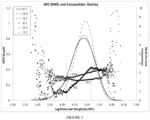
- the GPC MWD profile, and corresponding comonomer distribution overlay, is shown in Figure 5 .
- Monolayer blown films were produced from the inventive compositions 1 and 2 and comparative compositions A, B and C, via a Sterling extruder, equipped with a semi grooved barrel of ID 3.5 inch; 30/1 LID ratio; a barrier screw, and an Alpine air ring.
- the extrusion line had an "8 inch die” with internal bubble cooling.
- the extrusion line also had a film thickness gauge scanner.
- the film fabrication conditions were as follows: film thickness maintained at 1 mil (0.001 in or 0.0254 mm); blow up ratio (BUR) 2.5; die gap 90 mil; and frost line height (FLH) 30 inch, at a output rate of approximately "10 lbs per inch" of circumference of the die, and an approximately 410 degree Fahrenheit polymer melt temperature. Film properties are reported in Table 3.
- compositions 1 and 2 and comparative compositions A, B, and C were further dry blended with a low density polyethylene (LDPE) at 80:20 weight ratio (Expt. First Composition : LDPE), and the respective monolayer blown films were produced via a Sterling extruder, equipped with a semi grooved barrel of ID 3.5 inch; 30/1 LID ratio; a barrier screw, and an Alpine air ring.
- the extrusion line had an "8 inch die” with internal bubble cooling.
- the extrusion line also had a film thickness gauge scanner.
- the film fabrication conditions were as follows: film thickness maintained at 1 mil (0.001 in or 0.0254 mm); blow up ratio (BUR) 2.5; die gap 90 mil; and frost line height (FLH) 30 inch, at a output rate of approximately 10 lbs per inch of circumference of the die, and an approximately 410 degree Fahrenheit polymer melt temperature.
- the LDPE AGILITY 1021 from The Dow Chemical Company
- Film properties are reported in Table 3. Table 3: Blown Film Properties 100% Expt. First Composition Inv. 1 Inv. 2 Comp. A Comp. B Comp.
- inventive first composition 1 showed significantly higher toughness (as indicated by dart drop impact values) than comparative compositions A and C.
- inventive first composition 2 also showed significantly higher toughness (as indicated by dart drop impact values) than comparative composition B. It is believed that the improved film toughness from the inventive compositions is a result of their high MWCDI values.
- a high MWCDI value indicates comonomers are more favorably incorporated (a higher incorporation of comonomer and a better distribution of comonomer) in the high molecular weight polymer molecules, rather than in the low molecular weight polymer molecules.
- the inventive compositions also have low LCB, as indicated by low ZSVR, as compared to conventional polymers. As a result the polymer contains more tie chains, and therefore, provides better film toughness.
- the inventive compositions also have significantly high I10/I2 values, indicating good processibility of these compositions.
- compositions 4-7 are discussed in connection with Examples 2-4 below.
- Examples 4, 6, and 7 contain an ethylene-octene copolymer, and
- Example 5 contains an ethylene-hexene copolymer.
- Table 4 Polymerization Conditions Sample # Units Inv. Comp. 4 Inv. Comp. 5 Inv. Comp. 6 Inv. Comp.
- inventive compositions 4 and 5 were prepared as set forth above. Additional properties of the inventive compositions 4 and 5 were measured, and are reported in Table 5.
- Comparative composition E is an ethylene-hexene copolymer composition, commercially available under the commercial designation EXCEED 1018HA from EXXONMOBIL Chemical Company, and having a density of approximately 0.9191 g/cm 3 , a melt index (I 2 or I2), measured at 190°C and 2.16 kg, of approximately 0.95 g/10 minutes. Additional properties of the comparative composition E were measured, and are reported in Table 5.
- Table 5 Properties of Inventive and Comparative Compositions Unit Inv. Comp. 4 Inv. Comp. 5 Comp. Comp.
- Monolayer blown films were produced from inventive compositions 4 and 5 and comparative composition E, via a Sterling extruder, equipped with a semi grooved barrel of ID 3.5 inch; 30/1 LID ratio; a barrier screw, and an Alpine air ring.
- the extrusion line had an "8 inch die” with internal bubble cooling.
- the extrusion line also had a film thickness gauge scanner.
- the film fabrication conditions were as follows: film thickness maintained at 1 mil (0.001 in or 0.0254 mm); blow up ratio (BUR) 2.5; die gap 90 mil; and frost line height (FLH) 39-43 inches, at an output rate of approximately 260 pounds per hour, a head pressure of 3600- 4000 psi, and a polymer melt temperature of ⁇ 430 degrees Fahrenheit. Film properties are reported in Table 6.
- inventive compositions 4 and 5 and comparative composition E were further dry blended with a low density polyethylene (LDPE) at a 80:20 weight ratio (Original Composition : LDPE), and the respective monolayer blown films were produced via a Sterling extruder, equipped with a semi grooved barrel of ID 3.5 inch; 30/1 LID ratio; a barrier screw, and an Alpine air ring.
- LDPE low density polyethylene
- the extrusion line has an "8 inch die” with internal bubble cooling.
- the extrusion line also had a film thickness gauge scanner.
- the film fabrication conditions were as follows: film thickness maintained at 1 mil (0.001 in or 0.0254 mm); blow up ratio (BUR) 2.5; die gap 90 mil; and frost line height (FLH) 40-43 inches, at a output rate of approximately 260 lbs per hour, a head pressure of 3350-3800 psi, and a polymer melt temperature of 420-435 degrees Fahrenheit.
- the LDPE AGILITY 1021 from The Dow Chemical Company
- Film properties are reported in Table 6. Table 6: Blown Film Properties 100% Original Composition Inv. Comp. 4 Inv. Comp. 5 Comp. Comp.
- inventive compositions 4 and 5 (alone and when blended with 20% LDPE) showed significantly higher toughness (as indicated by dart drop impact values) than comparative composition E. It is believed that the improved film toughness from the inventive compositions is a result of their high MWCDI values. From a molecular structure standpoint, a high MWCDI value indicates comonomers are more favorably incorporated (a higher incorporation of comonomer and a better distribution of comonomer) in the high molecular weight polymer molecules, rather than in the low molecular weight polymer molecules.
- the inventive compositions also have low LCB, as indicated by low ZSVR, as compared to conventional polymers. As a result the polymer contains more tie chains, and therefore, provides better film toughness.
- the inventive compositions also have significantly high I 10 /I 2 values, indicating good processability of these compositions.
- inventive composition 6 was prepared as set forth above. Additional properties of inventive composition 6 were measured, and are reported in Table 7.
- Comparative composition F is an ethylene-hexene copolymer composition, commercially available under the commercial designation EXCEED 1015HA from EXXONMOBIL Chemical Company, and having a density of approximately 0.9162 g/cm 3 , a melt index (I 2 or I2), measured at 190°C and 2.16 kg, of approximately 1.0 g/10 minutes. Additional properties of the comparative composition G were measured, and are reported in Table 7. Table 7: Properties of Inventive and Comparative Compositions Unit Inv. Comp. 6 Comp. Comp.
- Monolayer blown films were produced from inventive composition 6 and comparative composition F, via a three layer Collin film line.
- the line was comprised of three 25:1 LID single screw extruders, equipped with grooved feed zones.
- the screw diameters were 25 mm for the inner layer, 30 mm for the core and 25 mm for the outer layer.
- the annular die was 60 mm in diameter and used a dual lip air ring cooling system.
- the film fabrication conditions were as follows: film thickness maintained at 1.24 mil (0.00124 in or 0.0315 mm); blow up ratio (BUR) 2.5; die lip gap was set at 2 mm; blow up ratio (BUR) was 2.5; and frost line height (FLH) of 6.5 inches, at a output rate of approximately 19.4 pounds per hour for inventive composition 6 and 17.4 pounds per hour for comparative composition F, at head pressures of 4060 psi for inventive composition 6 and 4133 psi for comparative composition F, and a polymer melt temperature of -424 degrees Fahrenheit for inventive composition 6 and -406 degrees Fahrenheit for comparative composition F. Film properties are reported in Table 8. Table 8: Blown Film Properties 100% Original Composition Inv. Comp. 6 Comp. Comp.
- inventive composition 6 showed significantly higher toughness (as indicated by dart drop impact values) than comparative composition F. It is believed that the improved film toughness from the inventive composition is a result of their high MWCDI values. From a molecular structure standpoint, a high MWCDI value indicates comonomers are more favorably incorporated (a higher incorporation of comonomer and a better distribution of comonomer) in the high molecular weight polymer molecules, rather than in the low molecular weight polymer molecules.
- the inventive composition also has low LCB, as indicated by low ZSVR, as compared to conventional polymers. As a result the polymer contains more tie chains, and therefore, provides better film toughness.
- the inventive composition also has significantly high I 10 /I 2 values, indicating good processability of these compositions.
- inventive composition 7 was prepared as set forth above. Additional properties of inventive composition 7 were measured, and are reported in Table 9.
- Comparative composition G is an ethylene-octene copolymer composition, commercially available under the commercial designation ELITE 5111 G from The Dow Chemical Company, and having a density of approximately 0.9249 g/cm 3 , a melt index (I 2 or I2), measured at 190°C and 2.16 kg, of approximately 0.86 g/10 minutes. Additional properties of the comparative composition G were measured, and are reported in Table 9. Table 9 Properties of Inventive and Comparative Compositions Unit Inv. Comp. 7 Comp. Comp.
- Monolayer blown films were produced from inventive composition 7 and comparative composition G, via a Sterling extruder, equipped with a semi grooved barrel of ID 3.5 inch; 30/1 LID ratio; a barrier screw, and an Alpine air ring.
- the extrusion line had an "8 inch die” with internal bubble cooling.
- the extrusion line also had a film thickness gauge scanner.
- the film fabrication conditions were as follows: film thickness maintained at 1 mil (0.001 in or 0.0254 mm); blow up ratio (BUR) 2.5; die gap 90 mil; and frost line height (FLH) 43 inches, at a output rate of approximately 260 pounds per hour, a head pressure of 3200-3500 psi, and a polymer melt temperature of -425 degrees Fahrenheit. Film properties are reported in Table 13.
- inventive composition 7 and comparative composition G were further dry blended with a low density polyethylene (LDPE) at a 80:20 weight ratio (Original Composition : LDPE), and the respective monolayer blown films were produced via a Sterling extruder, equipped with a semi grooved barrel of ID 3.5 inch; 30/1 LID ratio; a barrier screw, and an Alpine air ring.
- LDPE low density polyethylene
- the extrusion line has an "8 inch die” with internal bubble cooling.
- the extrusion line also had a film thickness gauge scanner.
- the film fabrication conditions were as follows: film thickness maintained at 1 mil (0.001 in or 0.0254 mm); blow up ratio (BUR) 2.5; die gap 90 mil; and frost line height (FLH) 42 inches, at a output rate of approximately 260 lbs per hour, a head pressure of 3200-3500 psi, and a polymer melt temperature of -420 degrees Fahrenheit.
- the LDPE AGILITY 1021 from The Dow Chemical Company
- Film properties are reported in Table 10. Table 10: Blown Film Properties 100% Original Composition Inv. Comp. 7 Comp. Comp.
- inventive composition 7 showed significantly higher toughness (as indicated by dart drop impact values) than comparative composition G. It is believed that the improved film toughness from the inventive compositions is a result of their high MWCDI values. From a molecular structure standpoint, a high MWCDI value indicates comonomers are more favorably incorporated (a higher incorporation of comonomer and a better distribution of comonomer) in the high molecular weight polymer molecules, rather than in the low molecular weight polymer molecules.
- the inventive composition also had low LCB, as indicated by low ZSVR, as compared to conventional polymers. As a result the polymer contains more tie chains, and therefore, provides better film toughness.
- the inventive composition also had significantly high I 10 /I 2 values, indicating good processability of this composition.
- Inventive composition 8 contains an ethylene-octene copolymer.
- Inventive composition 8 was produced using the same catalyst system as described above in connection with inventive compositions 1-3, and under polymerization conditions modified so as to produce a polymer having a density of approximately 0.918 g/cm 3 , a melt index (I 2 or I2), measured at 190°C and 2.16 kg, of approximately 0.87 g/10 minutes. Additional properties of inventive composition 8 were measured, and are reported in Table 11.
- Comparative composition H is an ethylene-hexene copolymer composition, commercially available under the commercial designation EXCEED 1018HA from EXXONMOBIL Chemical Company, and having a density of approximately 0.9191 g/cm 3 , a melt index (I 2 or I2), measured at 190°C and 2.16 kg, of approximately 0.95 g/10 minutes. Additional properties of the comparative composition H were measured, and are reported in Table 11. Table 11: Properties of Inventive and Comparative Compositions Unit Inv. Comp. 8 Comp. Comp.
- Monolayer blown films were produced from inventive composition 8 and comparative composition H, via a five layer blown film line with five Labtech extruders (25 mm skin layer extruders and 20 mm core layer extruders) with smooth barrel, single flight 30/1 LID screws with no mixing.
- the extrusion line had a 75 mm die.
- the film fabrication conditions were as follows: blow up ratio (BUR) of 2; die gap of 78 mil; and frost line height (FLH) 8 to 10 inches, at a output rate of approximately 39 pounds per hour for inventive composition 8 and 40 pounds per hour for comparative composition H, a head pressure of 3767 psi for inventive composition 8 and 4223 for comparative composition H, and a polymer melt temperature of -417 degrees Fahrenheit.
- Blown films having nominal thicknesses of 2.0 mils, 4.0 mils, and 6.0 mils were made from each composition. Film properties are reported in Table 12. Table 12: Blown Film Properties 100% Original Composition Inv. Comp. 8 (2.0 mil) Comp. Comp. H (2.0 mil) Inv. Comp. 8 (4.0 mil) Comp. Comp.H(4.0 mil) Inv. Comp. 8 (6.0 mil) Comp. Comp.
- inventive composition 8 showed significantly higher toughness (as indicated by dart drop impact values) than comparative composition H at film thicknesses of 2.0 mils, 4.0 mils, and 6.0 mils. It is believed that the improved film toughness from the inventive compositions is a result of their high MWCDI values. From a molecular structure standpoint, a high MWCDI value indicates comonomers are more favorably incorporated (a higher incorporation of comonomer and a better distribution of comonomer) in the high molecular weight polymer molecules, rather than in the low molecular weight polymer molecules.
- the inventive compositions also have low LCB, as indicated by low ZSVR, as compared to conventional polymers. As a result the polymer contains more tie chains, and therefore, provides better film toughness.
- the inventive compositions also have significantly high I 10 /I 2 values, indicating good processability of these compositions.
- the multilayer blown films were produced using a five layer blown film line with five Labtech extruders (25 mm skin layer extruders and 20 mm core layer extruders) with smooth barrel, single flight 30/1 LID screws with no mixing.
- the extrusion line had a 75 mm die.
- the films with inventive composition 9 in the A layers showed significantly higher toughness (as indicated by dart drop impact values) than the films with comparative composition I in the A layers. It is believed that the improved film toughness from the inventive compositions is a result of their high MWCDI values. From a molecular structure standpoint, a high MWCDI value indicates comonomers are more favorably incorporated (a higher incorporation of comonomer and a better distribution of comonomer) in the high molecular weight polymer molecules, rather than in the low molecular weight polymer molecules.
- the inventive composition also has low LCB, as indicated by low ZSVR, as compared to conventional polymers. As a result the polymer contains more tie chains, and therefore, provides better film toughness.
- the inventive composition also has significantly high I 10 /I 2 values, indicating good processability of this composition.
Landscapes
- Chemical & Material Sciences (AREA)
- Organic Chemistry (AREA)
- Health & Medical Sciences (AREA)
- Chemical Kinetics & Catalysis (AREA)
- Medicinal Chemistry (AREA)
- Polymers & Plastics (AREA)
- Manufacturing & Machinery (AREA)
- Engineering & Computer Science (AREA)
- Materials Engineering (AREA)
- Addition Polymer Or Copolymer, Post-Treatments, Or Chemical Modifications (AREA)
- Manufacture Of Macromolecular Shaped Articles (AREA)
- Compositions Of Macromolecular Compounds (AREA)
- Laminated Bodies (AREA)
- Transition And Organic Metals Composition Catalysts For Addition Polymerization (AREA)
- Shaping By String And By Release Of Stress In Plastics And The Like (AREA)
Description
- The present invention relates generally to blown films and in some aspects, blown films having improved toughness.
- Various polymerization techniques, using different catalyst systems, have been employed to produce ethylene-based polymer compositions suitable for films. Ethylene-based polymer compositions are described in the following references:
US5844045 (see alsoUS5869575 andUS6448341 ),US6566446 ,US5677383 (see alsoUS6111023 ),US5977251 ,US2015/0148490 ,US20150148491 andWO2014/058639 .WO2014100889 A1 relates to polyethylene blend compositions and films. However, there remains a need for compositions that can be used to form films with improved toughness, while maintaining a good balance of other film physical properties, such as tear strength, puncture, and optics. - The present invention utilizes ethylene-based polymers exhibiting certain features in the formation of blown films with desirable properties. For example, in some embodiments, the blown films have improved toughness (e.g., as measured by dart impact strength) as compared to blown films formed from other ethylene-based polymers, while maintaining a good balance of other properties (e.g., tear strength, optical properties, etc.).
In one aspect, the present invention provides a blown film comprising a layer formed from a composition comprising a first composition, wherein the first composition comprises at least one ethylene-based polymer and wherein the first composition comprises a MWCDI value greater than 0.9, and a melt index ratio (110/12) that meets the following equation: 110/12 ≥ 7.0 - 1.2 x log (12); wherein the first composition has a melt index ratio 110/12 less than, or equal to, 9.2; and wherein the blown film comprises at least 20 percent by weight of the first composition; wherein the MWCDI is Molecular Weighted Comonomer Distribution Index and is measured as described in the description. - These and other embodiments are described in more detail in the Detailed Description.
-
-
Figure 1 depicts the plot of "SCBf versus IR5 Area Ratio" for ten SCB Standards. -
Figure 2 depicts the several GPC profiles for the determination of IR5 Height Ratio for InventiveFirst Composition 2. -
Figure 3 depicts the plot of "SCBf versus Polyethylene Equivalent molecular Log Mwi (GPC)" for InventiveFirst Composition 2. -
Figure 4 depicts a plot of the "Mole Percent Comonomer versus Polyethylene Equivalent Log Mwi (GPC)" for InventiveFirst Composition 2. -
Figure 5 depicts some GPC MWD profiles and corresponding comonomer distribution overlays for some inventive and comparative compositions (density 0.916-0.919 g/cc). -
Figure 6 depicts some GPC MWD profiles and corresponding comonomer distribution overlays for some inventive and comparative compositions (density 0.924-0.926 g/cc). -
Figure 7 depicts some GPC MWD profiles and corresponding comonomer distribution overlays for some inventive and comparative compositions (Cast stretch). - It has been discovered that the inventive compositions can be used to form inventive films with improved toughness. Such compositions contain an ethylene-based polymer that has a superior comonomer distribution, which is significantly higher in comonomer concentration, and a good distribution of comonomer, in the high molecular weight polymer molecules, and issignificantly lower in comonomer concentration in the low molecular weight polymer molecules, as compared to conventional polymers of the art at the same overall density. It has also been discovered that the ethylene-based polymer has low LCB (Long Chain Branches), as indicated by low ZSVR, as compared to conventional polymers. As a result of this optimized distribution of the comonomer, as well as the inherent low LCB nature, the inventive compositions have more tie chains, and thus, improved film toughness. The inventive compositions can be useful in forming the inventive blown films of the present invention.
- As discussed above, the invention provides a composition comprising a first composition, comprising at least one ethylene-based polymer, wherein the first composition comprises a MWCDI value greater than 0.9, and a melt index ratio (110/12) that meets the following equation: 110/12 ≥ 7.0 - 1.2 x log (I2); wherein the first composition has a melt index ratio 110/12 less than, or equal to, 9.2; and wherein the blown film comprises at least 20 percent by weight of the first composition; wherein the MWCDI is Molecular Weighted Comonomer Distribution Index and is measured as described in the description.
- The inventive composition may comprise a combination of two or more embodiments described herein.
- The first composition may comprise a combination of two or more embodiments as described herein.
- The ethylene-based polymer may comprise a combination of two or more embodiments as described herein.
- In one embodiment, the first composition has a MWCDI value less than, or equal to, 10.0, further less than, or equal to, 8.0, further less than, or equal to, 6.0.
- In one embodiment, the first composition has a MWCDI value less than, or equal to, 5.0, further less than, or equal to, 4.0, further less than, or equal to, 3.0.
- In one embodiment, the first composition has a MWCDI value greater than, or equal to, 1.0, further greater than, or equal to, 1.1, further greater than, or equal to, 1.2.
- In one embodiment, the first composition has a MWCDI value greater than, or equal to, 1.3, further greater than, or equal to, 1.4, further greater than, or equal to, 1.5.
- In one embodiment, the first composition has a melt index ratio 110/12 greater than, or equal to, 7.0, further greater than, or equal to, 7.1, further greater than, or equal to, 7.2, further greater than, or equal to, 7.3.
- The first composition has a melt index ratio 110/12 less than, or equal to, 9.2, preferably less than, or equal to, 9.0, further less than, or equal to, 8.8, further less than, or equal to, 8.5.
- In one embodiment, the first composition has a ZSVR value from 1.2 to 3.0, further from 1.2 to 2.5, further 1.2 to 2.0.
- In one embodiment, the first composition has a vinyl unsaturation level greater than 10 vinyls per 1,000,000 total carbons. For example, greater than 20 vinyls per 1,000,000 total carbons, or greater than 50 vinyls per 1,000,000 total carbons, or greater than 70 vinyls per 1,000,000 total carbons, or greater than 100 vinyls per 1,000,000 total carbons.
- In one embodiment, the first composition has a density in the range of 0.910 to 0.940 g/cm3, for example from 0.910 to 0.930, or from 0.910 to 0.925 g/cm3. For example, the density can be from a lower limit of 0.910, 0.912, or 0.914 g/cm3, to an upper limit of 0.925, 0.927, or 0.930 g/cm3 (1 cm3 = 1 cc).
- In one embodiment, the first composition has a melt index (I2 or 12; at 190°C / 2.16kg) from 0.1 to 50 g/10 minutes, for example from 0.1 to 30 g/10 minutes, or from 0.1 to 20 g/10 minutes, or from 0.1 to 10 g/10 minutes. For example, the melt index (I2 or 12; at 190°C / 2.16 kg) can be from a lower limit of 0.1, 0.2, or 0.5 g/10 minutes, to an upper limit of 1.0, 2.0, 3.0, 4.0, 5.0, 10, 15, 20, 25, 30, 40, or 50 g/10 minutes.
- In one embodiment, the first composition has a molecular weight distribution, expressed as the ratio of the weight average molecular weight to number average molecular weight (Mw/Mn; as determined by conv. GPC) in the range of from 2.2 to 5.0. For example, the molecular weight distribution (Mw/Mn) can be from a lower limit of 2.2, 2.3, 2.4, 2.5, 3.0, 3.2, or 3.4, to an upper limit of 3.9, 4.0, 4.1, 4.2, 4.5, 5.0.
- In one embodiment, the first composition has a number average molecular weight (Mn; as determined by conv. GPC) in the range from 10,000 to 50,000 g/mole. For example, the number average molecular weight can be from a lower limit of 10,000, 20,000, or 25,000 g/mole, to an upper limit of 35,000, 40,000, 45,000, or 50,000 g/mole.
- In one embodiment, the first composition has a weight average molecular weight (Mw; as determined by conv. GPC) in the range from 70,000 to 200,000 g/mole. For example, the number average molecular weight can be from a lower limit of 70,000, 75,000, or 78,000 g/mole, to an upper limit of 120,000, 140,000, 160,000, 180,000 or 200,000 g/mole.
- In one embodiment, the first composition has a melt viscosity ratio, Eta*0.1 / Eta*100, in the range from 2.2 to 7.0. For example, the number average molecular weight can be from a lower limit of 2.2, 2.3, 2.4 or 2.5, to an upper limit of 6.0, 6.2, 6.5, or 7.0.
- In one embodiment, the ethylene-based polymer is an ethylene/α-olefin interpolymer, and further an ethylene/α-olefin copolymer.
- In one embodiment, the first ethylene-based polymer is an ethylene/α-olefin interpolymer, and further an ethylene/α-olefin copolymer.
- In one embodiment, the α-olefin has less than, or equal to, 20 carbon atoms. For example, the α-olefin comonomers may preferably have 3 to 10 carbon atoms, and more preferably 3 to 8 carbon atoms. Exemplary α-olefin comonomers include, but are not limited to, propylene, 1-butene, 1-pentene, 1-hexene, 1-heptene, 1-octene, 1-nonene, 1-decene, and 4-methyl-1-pentene. The one or more α-olefin comonomers may, for example, be selected from the group consisting of propylene, 1-butene, 1-hexene, and 1-octene; or in the alternative, from the group consisting of 1-butene, 1-hexene and 1-octene, and further 1-hexene and 1-octene.
- In one embodiment, the ethylene-based polymer, or first ethylene-based polymer, has a molecular weight distribution (Mw/Mn; as determined by conv. GPC) in the range from 1.5 to 4.0, for example, from 1.5 to 3.5, or from 2.0 to 3.0. For example, the molecular weight distribution (Mw/Mn) can be from a lower limit of 1.5, 1.7, 2.0, 2.1, or 2.2, to an upper limit of 2.5, 2.6, 2.8, 3.0, 3.5, or 4.0.
- In one embodiment, the first composition further comprises a second ethylene-based polymer. In a further embodiment, the second ethylene-based polymer is an ethylene/α-olefin interpolymer, and further an ethylene/α-olefin copolymer, or a LDPE.
- In one embodiment, the α-olefin has less than, or equal to, 20 carbon atoms. For example, the α-olefin comonomers may preferably have 3 to 10 carbon atoms, and more preferably 3 to 8 carbon atoms. Exemplary α-olefin comonomers include, but are not limited to, propylene, 1-butene, 1-pentene, 1-hexene, 1-heptene, 1-octene, 1-nonene, 1-decene, and 4-methyl-1-pentene. The one or more α-olefin comonomers may, for example, be selected from the group consisting of propylene, 1-butene, 1-hexene, and 1-octene; or in the alternative, from the group consisting of 1-butene, 1-hexene and 1-octene, and further 1-hexene and 1-octene.
- In one embodiment, the second ethylene-based polymer is a heterogeneously branched ethylene/α-olefin interpolymer, and further a heterogeneously branched ethylene/α-olefin copolymer. Heterogeneously branched ethylene/α-olefin interpolymers and copolymers are typically produced using Ziegler/Natta type catalyst system, and have more comonomer distributed in the lower molecular weight molecules of the polymer.
- In one embodiment, the second ethylene-based polymer has a molecular weight distribution (Mw/Mn) in the range from 3.0 to 5.0, for example from 3.2 to 4.6. For example, the molecular weight distribution (Mw/Mn) can be from a lower limit of 3.2, 3.3, 3.5, 3.7, or 3.9, to an upper limit of 4.6, 4.7, 4.8, 4.9, or 5.0.
- In one embodiment, the composition comprises from 50 to 80 wt%, or from 50 to 85 wt%, or from 50 to 90 wt%, or from 50 to 95 wt% of the first composition, based on the weight of the composition.
- In one embodiment, the composition comprises greater than or equal to 80 wt%, or greater than or equal to 85 wt%, or greater than or equal to 90 wt%, or greater than or equal to 95 wt%, or greater than or equal to 98 wt% of the first composition, based on the weight of the composition.
- In one embodiment, the composition further comprises another polymer. In a further embodiment, the polymer is selected from the following: a LLDPE, a VLDPE (a very low density polyethylene), a MDPE, a LDPE, a HDPE, a HMWHDPE (a high molecular weight HDPE), a propylene-based polymer, a polyolefin plastomer, a polyolefin elastomer, an olefin block copolymer, an ethylene vinyl acetate, an ethylene acrylic acid, an ethylene methacrylic acid, an ethylene methyl acrylate, an ethylene ethyl acrylate, an ethylene butyl acrylate, a polyisobutylene, a maleic anhydride-grafted polyolefin, an ionomer of any of the foregoing, or a combination thereof.
- In one embodiment, the composition further comprises a LDPE. In a further embodiment, the LDPE is present in an amount from 5 to 50 wt%, further from 10 to 40 wt%, further from 15 to 30 wt%, based on the weight of the composition. In a further embodiment, the LDPE has a density from 0.915 to 0.930 g/cc, and a melt index (12) from 0.15 to 10 g/10 min, further from 0.25 to 10 g/10 min.
- In one embodiment, the composition further comprises one or more additives.
- The invention also provides an article comprising at least one component formed from an inventive composition as described herein. In a further embodiment, the article is a film or a coating.
- In some embodiments, the present invention relates to a blown film formed from any of the inventive compositions as described herein. In some embodiments, the blown film is a monolayer film. The blown film, in some embodiments, is a multilayer film.
- In some embodiments, a blown film of the present invention has a thickness of up to 30 mils. For example, the blown film can have a thickness from a lower limit of 0.25 mils, 0.5 mils, 0.7 mils, 1.0 mil, 1.75 mils, and 2.0 mils to an upper limit of 4.0 mils, 6.0 mils, 10 mils, 15 mils, 20 mils, 25 mils, or 30 mils.
- A blown film of the present inventioncomprises at least 20 percent by weight of the inventive composition, preferably at least 30 percent by weight of the inventive composition, and more preferably at least 40 percent by weight of the inventive composition.
- In some embodiments where the blown film is a multilayer film, the film can further comprise a second layer, wherein the second layer comprises a polymer selected from the following: the inventive composition, a LLDPE, a VLDPE (a very low density polyethylene), a MDPE, a LDPE, a HDPE, a HMWHDPE (a high molecular weight HDPE), a propylene-based polymer, a polyolefin plastomer, a polyolefin elastomer, an olefin block copolymer, an ethylene vinyl acetate, an ethylene acrylic acid, an ethylene methacrylic acid, an ethylene methyl acrylate, an ethylene ethyl acrylate, an ethylene butyl acrylate, an isobutylene, a maleic anhydride-grafted polyolefin, an ionomer of any of the foregoing, or a combination thereof. The blown film, in some embodiments, can comprise a third layer, wherein the third layer comprises a polymer selected from the following: the first composition, a LLDPE, a VLDPE, a LDPE, a MDPE, a HDPE, a HMWHDPE, a propylene-based polymer, a polyolefin plastomer, a polyolefin elastomer, an olefin block copolymer, an ethylene vinyl acetate, an ethylene acrylic acid, an ethylene methacrylic acid, an ethylene methyl acrylate, an ethylene ethyl acrylate, an ethylene butyl acrylate, an isobutylene, a maleic anhydride-grafted polyolefin, an ionomer of any of the foregoing, or a combination thereof.
- A multilayer blown film can comprise up to 2, 3, 4, 5, 6, 7, 8, 9, 10, or 11 layers in various embodiments.
- In some embodiments, the inventive composition used in the layer of blown film has a density in the range of 0.885 to 0.945 g/cm3, for example from 0.895 to 0.940, or from 0.905 to 0.935 g/cm3, or from 0.910 to 0.928 g/cm3. For example, the density can be from a lower limit of 0.885, 0.895, 0.905, or 0.910 g/cm3, to an upper limit of 0.928, 0.935, 0.940, or 0.945 g/cm3 (1 cm3 = 1 cc).
- In one embodiment, the inventive composition used in the layer of blown film has a melt index (I2 or I2; at 190°C / 2.16kg) from 0.3 to 5 g/10 minutes, for example from 0.5 to 3 g/10 minutes, or from 0.5 to 2 g/10 minutes. For example, the melt index (I2 or I2; at 190°C / 2.16 kg) can be from a lower limit of 0.3 or 0.5 g/10 minutes, to an upper limit of 2.0, 3.0, 4.0, or 5.0 g/10 minutes.
- In some embodiments, the blown film comprising a layer formed from the inventive composition can be laminated to another film or a woven structure.
- In some embodiments, in a blown film comprising a layer formed from the composition comprising the inventive composition, the layer can be a sealant layer and/or an abuse layer.
- Blown films of the present invention can be incorporated into a variety of articles including, for example, food packages, industrial and consumer packaging materials, construction films, foamed films, and others.
- Food packages can comprise a blown film according to the present invention. A variety of food items known to those of skill in the art can be provided in such food packages including, for example, solid foods, liquids, beverages, cooking ingredients (e.g., sugar, flour, etc.), etc.
- Industrial and consumer packaging materials can comprise a blown film according to the present invention. Exemplary industrial and consumer packaging materials include construction films (including, e.g., concrete underlayment), protective films, films for waste management application, agricultural films, heavy duty shipping sacks, silage wraps, silage bags, blown stretch wrap films, collation shrink films, stretch hood films, shrink hood films, industrial and consumer liners, and others. In embodiments related to silage or stretch wraps, in some embodiments, the silage or stretch wrap can further comprise polyisobutylene. Exemplary construction films that can comprise a blown film of the present invention include surface protection films, vapor/gas barriers for use under concrete slabs (concrete underlayment), and others.
- Polymerization processes include, but are not limited to, solution polymerization processes, using one or more conventional reactors, e.g., loop reactors, isothermal reactors, adiabatic reactors, stirred tank reactors, autoclave reactors in parallel, series, and/or any combinations thereof. The ethylene based polymer compositions may, for example, be produced via solution phase polymerization processes, using one or more loop reactors, adiabatic reactors, and combinations thereof.
- In general, the solution phase polymerization process occurs in one or more well mixed reactors, such as one or more loop reactors and/or one or more adiabatic reactors at a temperature in the range from 115 to 250°C; for example, from 135 to 200°C, and at pressures in the range of from 300 to 1000 psig, for example, from 450 to 750 psig.
- In one embodiment, the ethylene based polymer composition (e.g., the first composition of claim 1) may be produced in two loop reactors in series configuration, the first reactor temperature is in the range from 115 to 200°C, for example, from 135 to 165°C, and the second reactor temperature is in the range from 150 to 210°C, for example, from 185 to 200°C. In another embodiment, the ethylene based polymer composition may be produced in a single reactor, the reactor temperature is in the range from 115 to 200°C, for example from 130 to 190°C. The residence time in a solution phase polymerization process is typically in the range from 2 to 40 minutes, for example from 5 to 20 minutes. Ethylene, solvent, one or more catalyst systems, optionally one or more cocatalysts, and optionally one or more comonomers, are fed continuously to one or more reactors. Exemplary solvents include, but are not limited to, isoparaffins. For example, such solvents are commercially available under the name ISOPAR E from ExxonMobil Chemical. The resultant mixture of the ethylene based polymer composition and solvent is then removed from the reactor or reactors, and the ethylene based polymer composition is isolated. Solvent is typically recovered via a solvent recovery unit, i.e., heat exchangers and separator vessel, and the solvent is then recycled back into the polymerization system.
- In one embodiment, the ethylene based polymer composition may be produced, via a solution polymerization process, in a dual reactor system, for example a dual loop reactor system, wherein ethylene, and optionally one or more α-olefins, are polymerized in the presence of one or more catalyst systems, in one reactor, to produce a first ethylene-based polymer, and ethylene, and optionally one or more α-olefins, are polymerized in the presence of one or more catalyst systems, in a second reactor, to produce a second ethylene-based polymer. Additionally, one or more cocatalysts may be present.
- In another embodiment, the ethylene based polymer composition may be produced via a solution polymerization process, in a single reactor system, for example, a single loop reactor system, wherein ethylene, and optionally one or more α-olefins, are polymerized in the presence of one or more catalyst systems. Additionally, one or more cocatalysts may be present.
- As discussed above, the invention provides a process to form a composition comprising at least two ethylene-based polymers, said process comprising the following:
- polymerizing ethylene, and optionally at least one comonomer, in solution, in the present of a catalyst system comprising a metal-ligand complex of Structure I, to form a first ethylene-based polymer; and
- polymerizing ethylene, and optionally at least one comonomer, in the presence of a catalyst system comprising a Ziegler/Natta catalyst, to form a second ethylene-based polymer; and wherein Structure I is as follows:

- M is titanium, zirconium, or hafnium, each, independently, being in a formal oxidation state of +2, +3, or +4; and
- n is an integer from 0 to 3, and wherein when n is 0, X is absent; and
- each X, independently, is a monodentate ligand that is neutral, monoanionic, or dianionic; or two Xs are taken together to form a bidentate ligand that is neutral, monoanionic, or dianionic; and
- X and n are chosen, in such a way, that the metal-ligand complex of formula (I) is, overall, neutral; and
- each Z, independently, is O, S, N(C1-C40)hydrocarbyl, or P(C1-C40)hydrocarbyl; and
- wherein the Z-L-Z fragment is comprised of formula (1):

- R1 through R16 are each, independently, selected from the group consisting of the following: a substituted or unsubstituted (C1-C40)hydrocarbyl, a substituted or unsubstituted (C1-C40)heterohydrocarbyl, Si(RC)3, Ge(RC)3, P(RP)2, N(RN)2, ORC, SRC, NO2, CN, CF3, RCS(O)-, RCS(O)2-, (RC)2C=N-, RCC(O)O-, RCOC(O)-, RCC(O)N(R)-, (RC)2NC(O)-, halogen atom, hydrogen atom; and wherein each RC is independently a (C1-C30)hydrocarbyl; RP is a (C1-C30)hydrocarbyl; and RN is a (C1-C30)hydrocarbyl; and
- wherein, optionally, two or more R groups (from R1 through R16) can combine together into one or more ring structures, with such ring structures each, independently, having from 3 to 50 atoms in the ring, excluding any hydrogen atom.
- An inventive process may comprise a combination of two or more embodiments as described herein.
- In one embodiment, said process comprises polymerizing ethylene, and optionally at least one α-olefin, in solution, in the presence of a catalyst system comprising a metal-ligand complex of Structure I, to form a first ethylene-based polymer; and polymerizing ethylene, and optionally at least one α-olefin, in the presence of a catalyst system comprising a Ziegler/Natta catalyst, to form a second ethylene-based polymer. In a further embodiment, each α-olefin is independently a C1-C8 α-olefin.
- In one embodiment, optionally, two or more R groups from R9 through R13, or R4 through R8 can combine together into one or more ring structures, with such ring structures each, independently, having from 3 to 50 atoms in the ring, excluding any hydrogen atom.
- In one embodiment, M is hafnium.
- In one embodiment, R3 and R14 are each independently an alkyl, and further a C1-C3 alkyl, and further methyl.
- In one embodiment, R1 and R16 are each as follows:

- In one embodiment, each of the aryl, heteroaryl, hydrocarbyl, heterohydrocarbyl, Si(RC)3, Ge(RC)3, P(RP)2, N(RN)2, ORC, SRC, RCS(O)-, RCS(O)2-, (RC)2C=N-, RCC(O)O-, RCOC(O)-, RCC(O)N(R)-, (RC)2NC(O)-, hydrocarbylene, and heterohydrocarbylene groups, independently, is unsubstituted or substituted with one or more RS substituents; and each RS independently is a halogen atom, polyfluoro substitution, perfluoro substitution, unsubstituted (C1-C18)alkyl, F3C-, FCH2O-, F2HCO-, F3CO-, R3Si-, R3Ge-, RO-, RS-, RS(O)-, RS(O)2-, R2P-, R2N-, R2C=N-, NC-, RC(O)O-, ROC(O)-, RC(O)N(R)-, or R2NC(O)-, or two of the RS are taken together to form an unsubstituted (C1-C18)alkylene, wherein each R independently is an unsubstituted (C1-C18)alkyl.
- In one embodiment, two or more of R1 through R16 do not combine to form one or more ring structures.
- In one embodiment, the catalyst system suitable for producing the first ethylene/α-olefin interpolymer is a catalyst system comprising bis((2-oxoyl-3-(dibenzo-1H-pyrrole-1-yl)-5-(methyl)phenyl)-2-phenoxymethyl)-methylene-1,2-cyclohexanediylhafnium (IV) dimethyl, represented by the following Structure: IA:
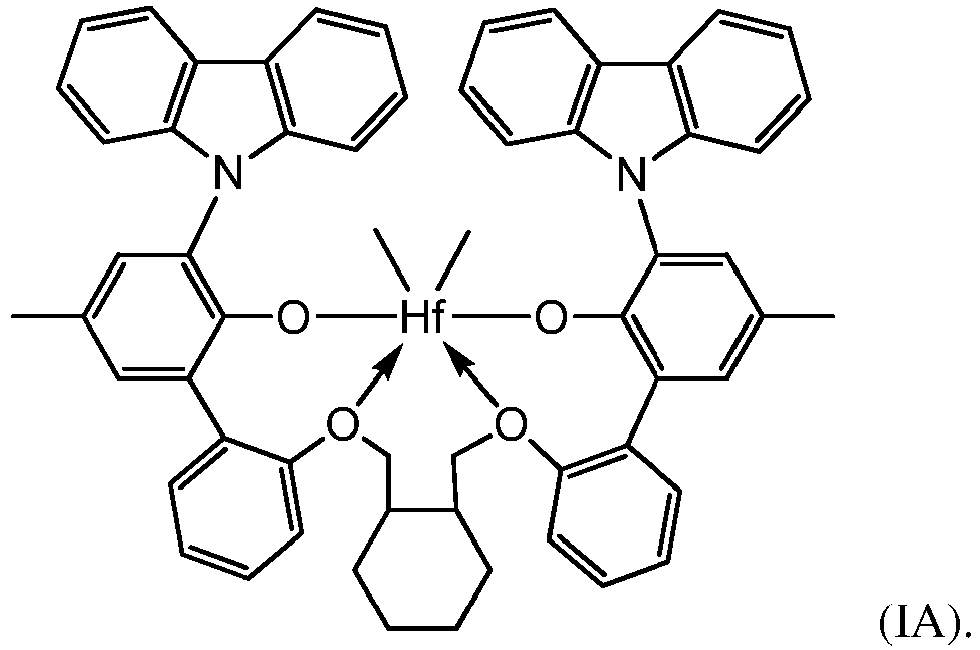
- The Ziegler/Natta catalysts suitable for use in the invention are typical supported, Ziegler-type catalysts, which are particularly useful at the high polymerization temperatures of the solution process. Examples of such compositions are those derived from organomagnesium compounds, alkyl halides or aluminum halides or hydrogen chloride, and a transition metal compound. Examples of such catalysts are described in
U.S. Pat Nos. 4,612,300 ;4,314,912 ; and4,547,475 ; the teachings of which are incorporated herein by reference. - Particularly suitable organomagnesium compounds include, for example, hydrocarbon soluble dihydrocarbylmagnesium, such as the magnesium dialkyls and the magnesium diaryls. Exemplary suitable magnesium dialkyls include, particularly, n-butyl-sec-butylmagnesium, diisopropylmagnesium, di-n-hexylmagnesium, isopropyl-n-butyl-magnesium, ethyl-n-hexylmagnesium, ethyl-n-butylmagnesium, di-n-octylmagnesium, and others, wherein the alkyl has from 1 to 20 carbon atoms. Exemplary suitable magnesium diaryls include diphenylmagnesium, dibenzylmagnesium and ditolylmagnesium. Suitable organomagnesium compounds include alkyl and aryl magnesium alkoxides and aryloxides and aryl and alkyl magnesium halides, with the halogen-free organomagnesium compounds being more desirable.
- Halide sources include active non-metallic halides, metallic halides, and hydrogen chloride. Suitable non-metallic halides are represented by the formula R'X, wherein R' is hydrogen or an active monovalent organic radical, and X is a halogen. Particularly suitable non-metallic halides include, for example, hydrogen halides and active organic halides, such as t-alkyl halides, allyl halides, benzyl halides and other active hydrocarbyl halides. By an active organic halide is meant a hydrocarbyl halide that contains a labile halogen at least as active, i.e., as easily lost to another compound, as the halogen of sec-butyl chloride, preferably as active as t-butyl chloride. In addition to the organic monohalides, it is understood that organic dihalides, trihalides and other polyhalides that are active, as defined hereinbefore, are also suitably employed. Examples of preferred active non-metallic halides, include hydrogen chloride, hydrogen bromide, t-butyl chloride, t-amyl bromide, allyl chloride, benzyl chloride, crotyl chloride, methylvinyl carbinyl chloride, a-phenylethyl bromide, diphenyl methyl chloride, and the like. Most preferred are hydrogen chloride, t-butyl chloride, allyl chloride and benzyl chloride.
- Suitable metallic halides include those represented by the formula MRy-a Xa, wherein: M is a metal of Groups IIB, IIIA or IVA of Mendeleev's periodic Table of Elements; R is a monovalent organic radical; X is a halogen; y has a value corresponding to the valence of M; and "a" has a value from 1 to y. Preferred metallic halides are aluminum halides of the formula AlR3-a Xa, wherein each R is independently hydrocarbyl, such as alkyl; X is a halogen; and a is a number from 1 to 3. Most preferred are alkylaluminum halides, such as ethylaluminum sesquichloride, diethylaluminum chloride, ethylaluminum dichloride, and diethylaluminum bromide, with ethylaluminum dichloride being especially preferred. Alternatively, a metal halide, such as aluminum trichloride, or a combination of aluminum trichloride with an alkyl aluminum halide, or a trialkyl aluminum compound may be suitably employed.
- Any of the conventional Ziegler-Natta transition metal compounds can be usefully employed, as the transition metal component in preparing the supported catalyst component. Typically, the transition metal component is a compound of a Group IVB, VB, or VIB metal. The transition metal component is generally, represented by the formulas: TrX'4-q (OR1)q, TrX'4-q (R2)q, VOX'3 and VO(OR)3.
- Tr is a Group IVB, VB, or VIB metal, preferably a Group IVB or VB metal, preferably titanium, vanadium or zirconium; q is 0 or a number equal to, or less than, 4; X' is a halogen, and R1 is an alkyl group, aryl group or cycloalkyl group having from 1 to 20 carbon atoms; and R2 is an alkyl group, aryl group, aralkyl group, substituted aralkyls, and the like.
- The aryl, aralkyls and substituted aralkys contain 1 to 20 carbon atoms, preferably 1 to 10 carbon atoms. When the transition metal compound contains a hydrocarbyl group, R2, being an alkyl, cycloalkyl, aryl, or aralkyl group, the hydrocarbyl group will preferably not contain an H atom in the position beta to the metal carbon bond. Illustrative, but non-limiting, examples of aralkyl groups are methyl, neopentyl, 2,2-dimethylbutyl, 2,2-dimethylhexyl; aryl groups such as benzyl; cycloalkyl groups such as 1-norbornyl. Mixtures of these transition metal compounds can be employed if desired.
- Illustrative examples of the transition metal compounds include TiCl4, TiBr4, Ti(OC2H5)3Cl, Ti(OC2H5)Cl3, Ti(OC4H9)3Cl, Ti(OC3H7)2Cl2, Ti(OC6H13)2Cl2, Ti(OC8H17)2Br2, and Ti(OC12H25)Cl3, Ti(O-iC3H7)4, and Ti(O-nC4H9)4. Illustrative examples of vanadium compounds include VCl4, VOCl3, VO(OC2H5)3, and VO(OC4H9)3. Illustrative examples of zirconium compounds include ZrCl4, ZrCl3(OC2H5), ZrCl2(OC2H5)2, ZrCl(OC2H5)3, Zr(OC2H5)4, ZrCl3(OC4H9), ZrCl2(OC4H9)2, and ZrCl(OC4H9)3.
- An inorganic oxide support may be used in the preparation of the catalyst, and the support may be any particulate oxide, or mixed oxide which has been thermally or chemically dehydrated, such that it is substantially free of adsorbed moisture. See
U. S. Pat Nos. 4,612,300 ;4,314,912 ; and4,547,475 ; the teachings of which are incorporated herein by reference. - In one embodiment, the composition comprises a MWCDI value greater than 0.9.
- In one embodiment, the composition comprises a melt index ratio (I10/I2) that meets the following equation: I10/I2 ≥ 7.0 - 1.2 x log (I2).
- The composition may comprise one embodiment, or a combination of two or more embodiments, as listed above for the "first composition."
- An inventive process may comprise a combination of two or more embodiments described herein.
- The above described catalyst systems can be rendered catalytically active by contacting it to, or combining it with, the activating co-catalyst, or by using an activating technique, such as those known in the art, for use with metal-based olefin polymerization reactions. Suitable activating co-catalysts, for use herein, include alkyl aluminums; polymeric or oligomeric alumoxanes (also known as aluminoxanes); neutral Lewis acids; and non-polymeric, non-coordinating, ion-forming compounds (including the use of such compounds under oxidizing conditions). A suitable activating technique is bulk electrolysis. Combinations of one or more of the foregoing activating co-catalysts and techniques are also contemplated. The term "alkyl aluminum" means a monoalkyl aluminum dihydride or monoalkylaluminum dihalide, a dialkyl aluminum hydride or dialkyl aluminum halide, or a trialkylaluminum. Aluminoxanes and their preparations are known at, for example,
U.S. Patent 6,103,657 . Examples of preferred polymeric or oligomeric alumoxanes are methylalumoxane, triisobutylaluminum-modified methylalumoxane, and isobutylalumoxane. - Exemplary Lewis acid activating co-catalysts are Group 13 metal compounds containing from 1 to 3 hydrocarbyl substituents as described herein. In some embodiments, exemplary Group 13 metal compounds are tri(hydrocarbyl)-substituted-aluminum or tri(hydrocarbyl)-boron compounds. In some other embodiments, exemplary Group 13 metal compounds are tri(hydrocarbyl)-substituted-aluminum or tri(hydrocarbyl)-boron compounds are tri((C1-C10)alkyl)aluminum or tri((C6-C18)aryl)boron compounds and halogenated (including perhalogenated) derivatives thereof. In some other embodiments, exemplary Group 13 metal compounds are tris(fluoro-substituted phenyl)boranes, in other embodiments, tris(pentafluorophenyl)borane. In some embodiments, the activating co-catalyst is a tris((C1-C20)hydrocarbyl) borate (e.g., trityl tetrafluoroborate) or a tri((C1-C20)hydrocarbyl)ammonium tetra((C1-C20)hydrocarbyl)borane (e.g., bis(octadecyl)methylammonium tetrakis(pentafluorophenyl)borane). As used herein, the term "ammonium" means a nitrogen cation that is a ((C1-C20)hydrocarbyl)4N+, a ((C1-C20)hydrocarbyl)3N(H)+, a ((C1-C20)hydrocarbyl)2N(H)2 +, (C1-C20)hydrocarbylN(H)3 +, or N(H)4 +, wherein each (C1-C20)hydrocarbyl may be the same or different.
- Exemplary combinations of neutral Lewis acid activating co-catalysts include mixtures comprising a combination of a tri((C1-C4)alkyl)aluminum and a halogenated tri((C6-C18)aryl)boron compound, especially a tris(pentafluorophenyl)borane. Other exemplary embodiments are combinations of such neutral Lewis acid mixtures with a polymeric or oligomeric alumoxane, and combinations of a single neutral Lewis acid, especially tris(pentafluorophenyl)borane with a polymeric or oligomeric alumoxane. Exemplary embodiments ratios of numbers of moles of (metal-ligand complex):(tris(pentafluoro-phenylborane): (alumoxane) [e.g., (
Group 4 metal-ligand complex):(tris(pentafluoro-phenylborane):(alumoxane)] are from 1:1:1 to 1:10:30, other exemplary embodiments are from 1:1:1.5 to 1:5:10. - Many activating co-catalysts and activating techniques have been previously taught, with respect to different metal-ligand complexes, in the following U.S. patents:
US 5,064,802 ;US 5,153,157 ;US 5,296,433 ;US 5,321,106 ;US 5,350,723 ;US 5,425,872 ;US 5,625,087 ;US 5,721,185 ;US 5,783,512 ;US 5,883,204 ;US 5,919,983 ;US 6,696,379 ; andUS 7,163,907 . Examples of suitable hydrocarbyloxides are disclosed inUS 5,296,433 . Examples of suitable Bronsted acid salts for addition polymerization catalysts are disclosed inUS 5,064,802 ;US 5,919,983 ;US 5,783,512 . Examples of suitable salts of a cationic oxidizing agent and a non-coordinating, compatible anion, as activating co-catalysts for addition polymerization catalysts, are disclosed inUS 5,321,106 . Examples of suitable carbenium salts as activating co-catalysts for addition polymerization catalysts are disclosed inUS 5,350,723 . Examples of suitable silylium salts, as activating co-catalysts for addition polymerization catalysts, are disclosed inUS 5,625,087 . Examples of suitable complexes of alcohols, mercaptans, silanols, and oximes with tris(pentafluorophenyl)borane are disclosed inUS 5,296,433 . Some of these catalysts are also described in a portion ofUS 6,515,155 B1 , beginning atcolumn 50, at line 39, and going through column 56, at line 55, only the portion of which is incorporated by reference herein. - In some embodiments, the above described catalyst systems can be activated to form an active catalyst composition by combination with one or more cocatalyst, such as a cation forming cocatalyst, a strong Lewis acid, or a combination thereof. Suitable cocatalysts for use include polymeric or oligomeric aluminoxanes, especially methyl aluminoxane, as well as inert, compatible, noncoordinating, ion forming compounds. Exemplary suitable cocatalysts include, but are not limited to, modified methyl aluminoxane (MMAO), bis(hydrogenated tallow alkyl)methyl, tetrakis(pentafluorophenyl)borate(1-) amine, triethyl aluminum (TEA), and any combinations thereof.
- In some embodiments, one or more of the foregoing activating co-catalysts are used in combination with each other. In one embodiment, a combination of a mixture of a tri((C1-C4)hydrocarbyl)aluminum, tri((C1-C4)hydrocarbyl)borane, or an ammonium borate with an oligomeric or polymeric alumoxane compound, can be used.
- An inventive composition may comprise one or more additives. Additives include, but are not limited to, antistatic agents, color enhancers, dyes, lubricants, fillers (for example,TiO2 or CaCO3), opacifiers, nucleators, processing aids, pigments, primary anti-oxidants, secondary anti-oxidants, UV stabilizers, anti-blocks, slip agents, tackifiers, fire retardants, anti-microbial agents, odor reducer agents, anti-fungal agents, and combinations thereof. An inventive composition may comprise from about 0.001 to about 10 percent by the combined weight of such additives, based on the weight of the composition including such additives. In some embodiments, such as applications where fire resistance is important, the combined weight of such additives can be up to 40 weight percent.
- An inventive composition may further comprise one or more other polymers. For example one or more other ethylene-based polymers (such polymers differ in one or more properties from the ethylene-based polymer of the first composition and the second ethylene-based polymer; i.e., density, melt index, comonomer, Mn, Mw, and/or MWD), or one or more propylene-based polymers, or combinations thereof. Such compositions may be blended via any method, known to a person of ordinary skill in the art, including, but not limited to, dry blending, and melt blending via any suitable equipment, for example, an extruder.
- The invention provides for an article comprising at least one component formed from an inventive composition. Articles includes, but are not limited to, film, sheets, coatings, and multilayer structures. Multilayer structures typically comprise one or more film layers or sheets comprising an inventive composition. The multilayer structure may further comprise one or more layers comprising one or more polyamides, one or more polyesters, one or more olefin-based polymers, and combinations thereof.
- In one embodiment, the inventive compositions according to the present invention are characterized by one or more of the followings: (a) having a Dart impact A of at least 400 g, measured according to ASTM D1709 (Method A), when said composition is formed into a monolayer blown film having a thickness of 1 mil; and/or (b) having a normalized machine direction Elmendorf tear of at least 250 g/mil, measured according to ASTM D1922, when said polyolefin composition is formed into a monolayer blown film having a thickness of 1 mil.
- In one embodiment, an inventive composition further comprises from 5 to 20 percent by weight of low density polyethylene (LDPE). In a further embodiment, the composition has a Dart Impact A greater than 275 g, preferably greater than 300 g, measured according to ASTM D1709, when said composition is formed into a monolayer blown film having a thickness of 1 mil.
- In some embodiments, the present invention relates to a blown film formed from any of the inventive compositions as described herein. In some embodiments, the blown film is a monolayer film. The blown film, in some embodiments, is a multilayer film. Blown films can be formed from inventive compositions using methods and equipment well-known to those of skill in the art.
- The amount of the inventive composition to use in blown films of the present invention can depend on a number of factors including, for example, whether the film is a monolayer or multilayer film, the other layers in the film if it is a multilayer film, the desired properties of the film, the end use application of the film, the desired properties of the film, the equipment available to manufacture the film, and others. A blown film of the present invention, in some embodiments, comprises at least 20 percent by weight of the inventive composition, preferably at least 30 percent by weight of the inventive composition, and more preferably at least 40 percent by weight of the inventive composition. In some embodiments, a blown film of the present invention comprises up to about 95 percent by weight of the inventive composition, or, in some embodiments, a blown film of the present invention is formed entirely from the inventive composition.
- Blown films of the present invention can have a variety of thicknesses. The thickness of the blown film can depend on a number of factors including, for example, whether the film is a monolayer or multilayer film, the other layers in the film if it is a multilayer film, the desired properties of the film, the end use application of the film, the desired properties of the film, the equipment available to manufacture the film, and others. In some embodiments, a blown film of the present invention has a thickness of up to 30 mils. For example, the blown film can have a thickness from a lower limit of 0.25 mils, 0.5 mils, 0.7 mils, 1.0 mil, 1.75 mils, or 2.0 mils to an upper limit of 4.0 mils, 6.0 mils, 10 mils, 15 mils, 20 mils, 25 mils, or 30 mils.
- In embodiments where the blown film comprises a multilayer film, the number of layers in the film can depend on a number of factors including, for example, the desired properties of the film, the desired thickness of the film, the content of the other layers of the film, whether any of the layers in the film are to be foamed, the end use application of the film, the equipment available to manufacture the film, and others. A multilayer blown film can comprise up to 2, 3, 4, 5, 6, 7, 8, 9, 10, or 11 layers in various embodiments.
- The inventive composition, in some embodiments, can be used in more than one layer of the film. Other layers within a multilayer film of the present invention can comprise, in various embodiments, a polymer selected from the following: the inventive composition, a LLDPE, a VLDPE (a very low density polyethylene), a MDPE, a LDPE, a HDPE, a HMWHDPE (a high molecular weight HDPE), a propylene-based polymer, a polyolefin plastomer, a polyolefin elastomer, an olefin block copolymer, an ethylene vinyl acetate, an ethylene acrylic acid, an ethylene methacrylic acid, an ethylene methyl acrylate, an ethylene ethyl acrylate, an ethylene butyl acrylate, an isobutylene, a maleic anhydride-grafted polyolefin, an ionomer of any of the foregoing, or a combination thereof. In some embodiments, a multilayer film of the present invention can comprise one or more tie layers known to those of skill in the art.
- In some embodiments, the blown film comprising a layer formed from the inventive composition can be laminated to another film or a woven structure.
- Blown films of the present invention, in some embodiments, can be corona treated and/or printed (e.g., reverse or surface printed) using techniques known to those of skill in the art.
- The blown films of the present invention may be subjected to a post-quench orientation step where the film is stretched at a temperature below the melting point of any polyethylene used in the film. The degree of stretching could be from 1.1 : 1 to 5 : 1 in the machine direction or the cross (transverse) direction or both directions. The degree of stretching is the ratio of the original film thickness to that of the film thickness of the stretched portion of the film. So the portion of the film that originally was 100 micron after a 3:1 stretch ratio in one direction (for example, the machine direction) would be 33 micron. In some embodiments the post-quench stretching is less than 4.5:1, 4:1, or 3.5: 1 in the machine direction, the cross direction or both directions. In some preferred embodiments, the stretching is done in only one direction (that is, monoaxial orientation). In such cases, it may be preferred that the orientation be only in the machine direction. In some embodiments where the blown films are to be oriented, the orientation can be performed in-line (i.e., just after extrusion), or off-line as part of a separate process or at a different location.
- For example, the stretching can be conducted in the machine direction using a set of rolls and in the cross direction using a tenter frame, or using other methods which uniformly stretch the films. Alternatively, the films may be stretched by techniques which stretch the film in a non-uniform manner such that localized regions of the film remain unstretched. Such techniques include local stretching, interdigitized rollers or embossing techniques. It should be understood that with such localized stretching, the degree of stretching referred to above for some embodiments (that is from 1.1 to 3.5 to 1) refers to the stretch in the area which were subjected to the stretching and not the overall film.
- In some embodiments, a blown film of the present invention can comprise coextruded multilayer films comprising a core component that is a nanolayer structure. In such embodiments, the core component can be a layer comprising any of the inventive compositions disclosed herein. In some embodiments, the core component comprises 15 to 4,000 layers (sublayers). Each layer (sublayer) can have a thickness of 10 nanometers to 10 microns in some embodiments. In some embodiments, the layers (sublayers) in the core component comprise two or more types of films.
- Blown films of the present invention can be incorporated into a variety of articles including, for example, food packages, industrial and consumer packaging materials, foamed films, and others. Blown films of the present invention might be particularly useful in applications that require a film with high dart, puncture and/or tear resistance properties.
- In some embodiments, blown films of the present invention can be used to form laminates by laminating the film to a substrate (e.g., paperboard, metallic films, and other substrates to which blown films can be laminated).
- Food packages can comprise a blown film according to the present invention. A variety of food items known to those of skill in the art can be provided in such food packages including, for example, solid foods, liquids, beverages, cooking ingredients (e.g., sugar, flour, etc.), etc. Exemplary food packaging materials include films for packaging baked goods, cheese, and others.
- Industrial and consumer packaging materials can comprise a blown film according to the present invention. Exemplary industrial and consumer packaging materials include construction films (including, e.g., concrete underlayment), protective films, films for waste management application, agricultural films, heavy duty shipping sacks, silage wraps, silage bags, blown stretch wrap films, collation shrink films, stretch hood films, shrink hood films, industrial and consumer liners, and others. In embodiments related to silage or stretch wraps, in some embodiments, the silage or stretch wrap can further comprise polyisobutylene.
- Unless stated to the contrary, implicit from the context, or customary in the art, all parts and percents are based on weight, and all test methods are current as of the filing date of this disclosure.
- The term "composition," as used herein, includes material(s) which comprise the composition, as well as reaction products and decomposition products formed from the materials of the composition.
- The term "comprising," and derivatives thereof, is not intended to exclude the presence of any additional component, step or procedure, whether or not the same is disclosed herein. In order to avoid any doubt, all compositions claimed herein through use of the term "comprising" may include any additional additive, adjuvant, or compound, whether polymeric or otherwise, unless stated to the contrary. In contrast, the term, "consisting essentially of" excludes from the scope of any succeeding recitation any other component, step or procedure, excepting those that are not essential to operability. The term "consisting of" excludes any component, step or procedure not specifically delineated or listed.
- The term "polymer," as used herein, refers to a polymeric compound prepared by polymerizing monomers, whether of the same or a different type. The generic term polymer thus embraces the term homopolymer (employed to refer to polymers prepared from only one type of monomer, with the understanding that trace amounts of impurities can be incorporated into the polymer structure), and the term interpolymer as defined hereinafter. Trace amounts of impurities may be incorporated into and/or within the polymer.
- The term "interpolymer," as used herein, refers to a polymer prepared by the polymerization of at least two different types of monomers. The generic term interpolymer thus includes copolymers (employed to refer to polymers prepared from two different types of monomers), and polymers prepared from more than two different types of monomers.
- The term, "olefin-based polymer," as used herein, refers to a polymer that comprises, in polymerized form, a majority amount of olefin monomer, for example ethylene or propylene (based on the weight of the polymer), and optionally may comprise at least one polymerized comonomer.
- The term, "ethylene-based polymer," as used herein, refers to a polymer that comprises a majority amount of polymerized ethylene monomer (based on the total weight of the polymer), and optionally may comprise at least one polymerized comonomer.
- The term, "ethylene/α-olefin interpolymer," as used herein, refers to an interpolymer that comprises, in polymerized form, a majority amount of ethylene monomer (based on the weight of the interpolymer), and at least one α-olefin.
- The term, "ethylene/α-olefin copolymer," as used herein, refers to a copolymer that comprises, in polymerized form, a majority amount of ethylene monomer (based on the weight of the copolymer), and an α-olefin, as the only two monomer types.
- The term "propylene-based polymer," as used herein, refers to a polymer that comprises, in polymerized form, a majority amount of propylene monomer (based on the total weight of the polymer) and optionally may comprise at least one polymerized comonomer.
- Melt indices I2 (or I2) and I10 (or I10) were measured in accordance to ASTM D-1238 (method B) at 190°C and at 2.16 kg and 10 kg load, respectively. Their values are reported in g/10 min.
- Samples for density measurement were prepared according to ASTM D4703. Measurements were made, according to ASTM D792, Method B, within one hour of sample pressing.
- Each sample was compression-molded into "3 mm thick x 25 mm diameter" circular plaque, at 177°C, for five minutes, under 10 MPa pressure, in air. The sample was then taken out of the press and placed on a counter top to cool.
- Constant temperature, frequency sweep measurements were performed on an ARES strain controlled rheometer (TA Instruments), equipped with 25 mm parallel plates, under a nitrogen purge. For each measurement, the rheometer was thermally equilibrated, for at least 30 minutes, prior to zeroing the gap. The sample disk was placed on the plate, and allowed to melt for five minutes at 190°C. The plates were then closed to 2 mm, the sample trimmed, and then the test was started. The method had an additional five minute delay built in, to allow for temperature equilibrium. The experiments were performed at 190°C, over a frequency range from 0.1 to 100 rad/s, at five points per decade interval. The strain amplitude was constant at 10%. The stress response was analyzed in terms of amplitude and phase, from which the storage modulus (G'), loss modulus (G"), complex modulus (G*), dynamic viscosity (η* or Eta*), and tan δ (or tan delta) were calculated.
- A GPC-IR high temperature chromatographic system from PolymerChar (Valencia, Spain), was equipped with a Precision Detectors (Amherst, MA), 2-angle laser light scattering detector Model 2040, an IR5 infra-red detector and a 4-capillary viscometer, both from PolymerChar. Data collection was performed using PolymerChar Instrument Control software and data collection interface. The system was equipped with an on-line, solvent degas device and pumping system from Agilent Technologies (Santa Clara, CA).
- Injection temperature was controlled at 150 degrees Celsius. The columns used, were three, 10-micron "Mixed-B" columns from Polymer Laboratories (Shropshire, UK). The solvent used was 1,2,4-trichlorobenzene. The samples were prepared at a concentration of "0.1 grams of polymer in 50 milliliters of solvent." The chromatographic solvent and the sample preparation solvent each contained "200 ppm of butylated hydroxytoluene (BHT)." Both solvent sources were nitrogen sparged. Ethylene-based polymer samples were stirred gently at 160 degrees Celsius for three hours. The injection volume was "200 microliters,' and the flow rate was "1 milliliters/minute." The GPC column set was calibrated by running 21 "narrow molecular weight distribution" polystyrene standards. The molecular weight (MW) of the standards ranges from 580 to 8,400,000 g/mole, and the standards were contained in six "cocktail" mixtures. Each standard mixture had at least a decade of separation between individual molecular weights. The standard mixtures were purchased from Polymer Laboratories. The polystyrene standards were prepared at "0.025 g in 50 mL of solvent" for molecular weights equal to, or greater than, 1,000,000 g/mole, and at "0.050 g in 50 mL of solvent" for molecular weights less than 1,000,000 g/mole.
- The polystyrene standards were dissolved at 80°C, with gentle agitation, for 30 minutes. The narrow standards mixtures were run first, and in order of decreasing "highest molecular weight component," to minimize degradation. The polystyrene standard peak molecular weights were converted to polyethylene molecular weight using Equation 1 (as described in Williams and
- Ward, J. Polym. Sci., Polym. Letters, 6, 621 (1968)):

- Number-average molecular weight (Mn(conv gpc)), weight average molecular weight (Mw-conv gpc), and z-average molecular weight (Mz(conv gpc)) were calculated according to Equations 2-4 below.


- In Equations 2-4, the RV is column retention volume (linearly-spaced), collected at "1 point per second," the IR is the baseline-subtracted IR detector signal, in Volts, from the IR5 measurement channel of the GPC instrument, and MPE is the polyethylene-equivalent MW determined from
Equation 1. Data calculation were performed using "GPC One software (version 2.013H)" from PolymerChar. - Zero-shear viscosities were obtained via creep tests, which were conducted on an AR-G2 stress controlled rheometer (TA Instruments; New Castle, Del), using "25-mm-diameter" parallel plates, at 190°C. The rheometer oven was set to test temperature for at least 30 minutes, prior to zeroing the fixtures. At the testing temperature, a compression molded sample disk was inserted between the plates, and allowed to come to equilibrium for five minutes. The upper plate was then lowered down to 50 µm (instrument setting) above the desired testing gap (1.5 mm). Any superfluous material was trimmed off, and the upper plate was lowered to the desired gap. Measurements were done under nitrogen purging, at a flow rate of 5 L/min. The default creep time was set for two hours. Each sample was compression-molded into a "2 mm thick x 25 mm diameter" circular plaque, at 177°C, for five minutes, under 10 MPa pressure, in air. The sample was then taken out of the press and placed on a counter top to cool.
- A constant low shear stress of 20 Pa was applied for all of the samples, to ensure that the steady state shear rate was low enough to be in the Newtonian region. The resulting steady state shear rates were in the range from 10-3 to 10-4 s-1 for the samples in this study. Steady state was determined by taking a linear regression for all the data, in the last 10% time window of the plot of "log (J(t)) vs. log(t)," where J(t) was creep compliance and t was creep time. If the slope of the linear regression was greater than 0.97, steady state was considered to be reached, then the creep test was stopped. In all cases in this study, the slope meets the criterion within one hour. The steady state shear rate was determined from the slope of the linear regression of all of the data points, in the last 10% time window of the plot of "ε vs. t," where ε was strain. The zero-shear viscosity was determined from the ratio of the applied stress to the steady state shear rate.
- In order to determine if the sample was degraded during the creep test, a small amplitude oscillatory shear test was conducted before, and after, the creep test, on the same specimen from 0.1 to 100 rad/s. The complex viscosity values of the two tests were compared. If the difference of the viscosity values, at 0.1 rad/s, was greater than 5%, the sample was considered to have degraded during the creep test, and the result was discarded.
- Zero-Shear Viscosity Ratio (ZSVR) is defined as the ratio of the zero-shear viscosity (ZSV) of the branched polyethylene material to the ZSV of a linear polyethylene material (see ANTEC proceeding below) at the equivalent weight average molecular weight (Mw(conv gpc)), according to the following Equation 5:

- The ZSV value was obtained from creep test, at 190°C, via the method described above. The Mw(conv gpc) value was determined by the conventional GPC method (Equation 3), as discussed above. The correlation between ZSV of linear polyethylene and its Mw(conv gpc) was established based on a series of linear polyethylene reference materials. A description for the ZSV-Mw relationship can be found in the ANTEC proceeding: Karjala et al., Detection of Low Levels of Long-chain Branching in Polyolefins, Annual Technical Conference - Society of Plastics Engineers (2008), 66th 887-891.
- A stock solution (3.26 g) was added to "0.133 g of the polymer sample" in 10 mm NMR tube. The stock solution was a mixture of tetrachloroethane-d2 (TCE) and perchloroethylene (50:50, w:w) with 0.001M Cr3+. The solution in the tube was purged with N2, for 5 minutes, to reduce the amount of oxygen. The capped sample tube was left at room temperature, overnight, to swell the polymer sample. The sample was dissolved at 110°C with periodic vortex mixing. The samples were free of the additives that may contribute to unsaturation, for example, slip agents such as erucamide. Each 1H NMR analysis was run with a 10 mm cryoprobe, at 120°C, on Bruker AVANCE 400 MHz spectrometer.
- Two experiments were run to get the unsaturation: the control and the double presaturation experiments. For the control experiment, the data was processed with an exponential window function with LB=1 Hz, and the baseline was corrected from 7 to -2 ppm. The signal from residual 1H of TCE was set to 100, and the integral Itotal from -0.5 to 3 ppm was used as the signal from whole polymer in the control experiment. The "number of CH2 group, NCH2," in the polymer was calculated as follows in Equation 1A:

- For the double presaturation experiment, the data was processed with an exponential window function with LB=1 Hz, and the baseline was corrected from about 6.6 to 4.5 ppm. The signal from residual 1H of TCE was set to 100, and the corresponding integrals for unsaturations (Ivinylene,
- Itrisubstituted, Ivinyl and Ivinylidene) were integrated. It is well known to use NMR spectroscopic methods for determining polyethylene unsaturation, for example, see Busico, V., et al., Macromolecules, 2005, 38, 6988. The number of unsaturation unit for vinylene, trisubstituted, vinyl and vinylidene were calculated as follows:


- The unsaturation units per 1,000 carbons, all polymer carbons including backbone carbons and branch carbons, were calculated as follows:


- The chemical shift reference was set at 6.0 ppm for the 1H signal from residual proton from TCE-d2. The control was run with ZG pulse, NS=4, DS=12, SWH=10,000 Hz, AQ=1.64s, D1=14s. The double presaturation experiment was run with a modified pulse sequence, with O1P = 1.354 ppm, O2P = 0.960 ppm, PL9 = 57db, PL21 = 70 db, NS = 100, DS = 4, SWH = 10,000 Hz, AQ = 1.64s, D1 = 1 s (where D1 is the presaturation time), D13 = 13s. Only the vinyl levels were reported in Table 2 below.
- Samples are prepared by adding approximately 3g of a 50/50 mixture of tetra-chloroethane-d2/orthodichlorobenzene, containing 0.025 M Cr(AcAc)3, to a "0.25 g polymer sample" in a 10 mm NMR tube. Oxygen is removed from the sample by purging the tube headspace with nitrogen. The samples are then dissolved, and homogenized, by heating the tube and its contents to 150°C, using a heating block and heat gun. Each dissolved sample is visually inspected to ensure homogeneity.
- All data are collected using a Bruker 400 MHz spectrometer. The data is acquired using a 6 second pulse repetition delay, 90-degree flip angles, and inverse gated decoupling with a sample temperature of 120°C. All measurements are made on non-spinning samples in locked mode. Samples are allowed to thermally equilibrate for 7 minutes prior to data acquisition. The 13C NMR chemical shifts were internally referenced to the EEE triad at 30.0 ppm.
- C13 NMR Comonomer Content: It is well known to use NMR spectroscopic methods for determining polymer composition. ASTM D 5017-96; J. C. Randall et al., in "NMR and Macromolecules" ACS Symposium series 247; J. C. Randall, Ed., Am. Chem. Soc., Washington, D.C., 1984, Ch. 9; and J. C. Randall in "Polymer Sequence Determination", Academic Press, New York (1977) provide general methods of polymer analysis by NMR spectroscopy.
- A GPC-IR, high temperature chromatographic system from PolymerChar (Valencia, Spain) was equipped with a Precision Detectors' (Amherst, MA) 2-angle laser light scattering detector Model 2040, and an IR5 infra-red detector (GPC-IR) and a 4-capillary viscometer, both from PolymerChar. The "15-degree angle" of the light scattering detector was used for calculation purposes. Data collection was performed using PolymerChar Instrument Control software and data collection interface. The system was equipped with an on-line, solvent degas device and pumping system from Agilent Technologies (Santa Clara, CA).
- Injection temperature was controlled at 150 degrees Celsius. The columns used, were four, 20-micron "Mixed-A" light scattering columns from Polymer Laboratories (Shropshire, UK). The solvent was 1,2,4-trichlorobenzene. The samples were prepared at a concentration of "0.1 grams of polymer in 50 milliliters of solvent." The chromatographic solvent and the sample preparation solvent each contained "200 ppm of butylated hydroxytoluene (BHT)." Both solvent sources were nitrogen sparged. Ethylene-based polymer samples were stirred gently, at 160 degrees Celsius, for three hours. The injection volume was "200 microliters," and the flow rate
was "1 milliliters/minute." - Calibration of the GPC column set was performed with 21 "narrow molecular weight distribution" polystyrene standards, with molecular weights ranging from 580 to 8,400,000 g/mole. These standards were arranged in six "cocktail" mixtures, with at least a decade of separation between individual molecular weights. The standards were purchased from Polymer Laboratories (Shropshire UK). The polystyrene standards were prepared at "0.025 grams in 50 milliliters of solvent" for molecular weights equal to, or greater than, 1,000,000 g/mole, and at "0.050 grams in 50 milliliters of solvent" for molecular weights less than 1,000,000 g/mole. The polystyrene standards were dissolved at 80 degrees Celsius, with gentle agitation, for 30 minutes. The narrow standards mixtures were run first, and in order of decreasing "highest molecular weight component," to minimize degradation. The polystyrene standard peak molecular weights were converted to polyethylene molecular weights using Equation 1B (as described in Williams and Ward, J. Polym. Sci., Polym. Let., 6, 621 (1968)):


- In Equations 2B and 3B, RV is column retention volume (linearly-spaced), collected at "1 point per second." The IR is the baseline-subtracted IR detector signal, in Volts, from the measurement channel of the GPC instrument, and the MPE is the polyethylene-equivalent MW determined from Equation 1B. Data calculation were performed using "GPC One software (version 2.013H)" from PolymerChar.
- A calibration for the IR5 detector ratios was performed using at least ten ethylene-based polymer standards (polyethylene homopolymer and ethylene/octene copolymers; narrow molecular weight distribution and homogeneous comonomer distribution) of known short chain branching (SCB) frequency (measured by the 13C NMR Method, as discussed above), ranging from homopolymer (0 SCB/1000 total C) to approximately 50 SCB/1000 total C, where total C = carbons in backbone + carbons in branches. Each standard had a weight-average molecular weight from 36,000 g/mole to 126,000 g/mole, as determined by the GPC-LALS processing method described above. Each standard had a molecular weight distribution (Mw/Mn) from 2.0 to 2.5, as determined by the GPC-LALS processing method described above. Polymer properties for the SCB standards are shown in Table A.
Table A: "SCB" Standards Wt % Comonomer IR5 Area ratio SCB / 1000 Total C Mw Mw/Mn 23.1 0.2411 28.9 37,300 2.22 14.0 0.2152 17.5 36,000 2.19 0.0 0.1809 0.0 38,400 2.20 35.9 0.2708 44.9 42,200 2.18 5.4 0.1959 6.8 37,400 2.16 8.6 0.2043 10.8 36,800 2.20 39.2 0.2770 49.0 125,600 2.22 1.1 0.1810 1.4 107,000 2.09 14.3 0.2161 17.9 103,600 2.20 9.4 0.2031 11.8 103,200 2.26 - The "IR5 Area Ratio (or "IR5 methyl Channel Area / IR5 Measurement Channel Area")" of "the baseline-subtracted area response of the IR5 methyl channel sensor" to "the baseline-subtracted area response of IR5 measurement channel sensor" (standard filters and filter wheel as supplied by PolymerChar: Part Number IR5_FWM01 included as part of the GPC-IR instrument) was calculated for each of the "SCB" standards. A linear fit of the SCB frequency versus the "IR5 Area Ratio" was constructed in the form of the following Equation 4B:

- A series of "linear baseline-subtracted chromatographic heights" for the chromatogram generated by the "IR5 methyl channel sensor" was established as a function of column elution volume, to generate a baseline-corrected chromatogram (methyl channel). A series of "linear baseline-subtracted chromatographic heights" for the chromatogram generated by the "IR5 measurement channel" was established as a function of column elution volume, to generate a baseline-corrected chromatogram (measurement channel).
- The "IR5 Height Ratio" of "the baseline-corrected chromatogram (methyl channel)" to "the baseline-corrected chromatogram (measurement channel)" was calculated at each column elution volume index (each equally-spaced index, representing 1 data point per second at 1 ml/min elution) across the sample integration bounds. The "IR5 Height Ratio" was multiplied by the coefficient A1, and the coefficient A0 was added to this result, to produce the predicted SCB frequency of the sample. The result was converted into mole percent comonomer, as follows in Equation 5B:

- Each elution volume index was converted to a molecular weight value (Mwi) using the method of Williams and Ward (described above; Eqn. 1B). The "Mole Percent Comonomer (y axis)" was plotted as a function of Log(Mwi), and the slope was calculated between Mwi of 15,000 and Mwi of 150,000 g/mole (end group corrections on chain ends were omitted for this calculation). An EXCEL linear regression was used to calculate the slope between, and including, Mwi from 15,000 to 150,000 g/mole. This slope is defined as the molecular weighted comonomer distribution index (MWCDI = Molecular Weighted Comonomer Distribution Index).
- A plot of the measured "SCB per 1000 total C (= SCBf)" versus the observed "IR5 Area Ratio" of the SCB standards was generated (see
Figure 1 ), and the intercept (A0) and slope (A1) were determined. Here, A0 = -90.246 SCB/1000 total C; and A1 = 499.32 SCB/1000 total C. - The "IR5 Height Ratio" was determined for Inventive Example 2 (see integration shown in
Figure 2 ). This height ratio (IR5 Height Ratio of Inventive Example 2) was multiplied by the coefficient A1, and the coefficient A0 was added to this result, to produce the predicted SCB frequency of this example, at each elution volume index, as described above (A0 = -90.246 SCB/1000 total C; and A1 = 499.32 SCB/1000 total C). The SCBf was plotted as a function of polyethylene-equivalent molecular weight, as determined using Equation 1B, as discussed above. SeeFigure 3 (Log Mwi used as the x-axis). - The SCBf was converted into "Mole Percent Comonomer" via Equation 5B. The "Mole Percent Comonomer" was plotted as a function of polyethylene-equivalent molecular weight, as determined using Equation 1B, as discussed above. See
Figure 4 (Log Mwi used as the x-axis). A linear fit was from Mwi of 15,000 g/mole to Mwi of 150,000 g/mole, yielding a slope of "2.27 mole percent comonomer x mole/g." Thus, the MWCDI = 2.27. An EXCEL linear regression was used to calculate the slope between, and including, Mwi from 15,000 to 150,000 g/mole. - The following physical properties were measured on the films produced (see experimental section).
- 45° Gloss: ASTM D-2457.
- Clarity: ASTM: D-1746.
- Samples measured for internal haze and overall (total) haze were sampled and prepared according to ASTM D1003. Internal haze was obtained via refractive index matching using mineral oil on both sides of the films. A Hazeguard Plus (BYK-Gardner USA; Columbia, MD) was used for testing. Surface haze was determined as the difference between total haze and internal haze. The total haze was reported as the average of five measurements.
- The Elmendorf Tear test determines the average force to propagate tearing through a specified length of plastic film or non rigid sheeting, after the tear has been started, using an Elmendorf-type tearing tester.
- After film production from the sample to be tested, the film was conditioned for at least 40 hours at 23°C (+/- 2°C) and 50% R.H (+/- 5) as per ASTM standards. Standard testing conditions were 23°C (+/- 2°C) and 50% R.H (+/- 5) as per ASTM standards.
- The force, in grams, required to propagate tearing across a film or sheeting specimen was measured using a precisely calibrated pendulum device. In the test, acting by gravity, the pendulum swung through an arc, tearing the specimen from a precut slit. The specimen was held on one side by the pendulum and on the other side by a stationary member. The loss in energy by the pendulum was indicated by a pointer or by an electronic scale. The scale indication was a function of the force required to tear the specimen.
- The sample specimen geometry used in the Elmendorf tear test was the 'constant radius geometry,' as specified in ASTM D1922. Testing is typically carried out on specimens that have been cut from both the film MD and CD directions. Prior to testing, the film specimen thickness was measured at the sample center. A total of 15 specimens per film direction were tested, and the average tear strength and average thickness reported. The average tear strength was normalized to the average thickness.
- The film MD (Machine Direction) and CD (Cross Direction) secant modulus was determined per ASTM D882. The reported secant modulus value was the average of five measurements.
- The Puncture test determines the resistance of a film to the penetration of a probe at a standard low rate, a single test velocity. The puncture test method is based on ASTM D5748. After film production, the film was conditioned for at least 40 hours at 23°C (+/- 2°C) and 50% R.H (+/-5) as per ASTM standards. Standard testing conditions are 23°C (+/- 2°C) and 50% R.H (+/- 5) as per ASTM standards. Puncture was measured on a tensile testing machine. Square specimens were cut from a sheet to a size of "6 inches by 6 inches." The specimen was clamped in a "4 inch diameter" circular specimen holder, and a puncture probe was pushed into the centre of the clamped film at a cross head speed of 10 inches/minute. The internal test method follows ASTM D5748, with one modification. It deviated from the ASTM D5748 method, in that the probe used was a "0.5 inch diameter" polished steel ball on a "0.25 inch" support rod (rather than the 0.75 inch diameter, pear shaped probe specified in D5748).
- There was a "7.7 inch" maximum travel length to prevent damage to the test fixture. There was no gauge length; prior to testing, the probe was as close as possible to, but not touching the specimen.
- A single thickness measurement was made in the centre of the specimen. For each specimen, the maximum force, the force at break, the penetration distance, and the energy to break were determined. A total of five specimens were tested to determine an average puncture value. The puncture probe was cleaned using a "Kim-wipe" after each specimen.
- The film Dart Drop test determines the energy that causes a plastic film to fail, under specified conditions of impact by a free falling dart. The test result is the energy, expressed in terms of the weight of the missile falling from a specified height, which would result in the failure of 50% of the specimens tested.
- After the film was produced, it was conditioned for at least 40 hours at 23°C (+/- 2°C) and 50% R.H (+/- 5), as per ASTM standards. Standard testing conditions are 23°C (+/- 2°C) and 50% R.H (+/- 5), as per ASTM standards.
- The test result was reported as either by Method A, which uses a 1.5" diameter dart head and 26" drop height, or by Method B, which uses a 2" diameter dart head and 60" drop height. The sample thickness was measured at the sample center, and the sample then clamped by an annular specimen holder with an inside diameter of 5 inches. The dart was loaded above the center of the sample, and released by either a pneumatic or electromagnetic mechanism.
- Testing was carried out according to the 'staircase' method. If the sample failed, a new sample was tested with the weight of the dart reduced by a known and fixed amount. If the sample did not fail, a new sample was tested with the weight of the dart increased by a known amount.
- After 20 specimens had been tested, the number of failures was determined. If this number was 10, then the test is complete. If the number was less than 10, then the testing continued, until 10 failures had been recorded. If the number was greater than 10, testing was continued, until the total of non-failures was 10. The Dart Drop Strength was determined from these data, as per ASTM D1709, and expressed in grams, as either the Dart Drop Impact of Type A or Type B. In some cases, the sample Dart Drop Impact strength may lie between A and B. In these cases, it is not possible to obtain a quantitative dart value.
- ASTM D7192 provides the load vs deformation response of plastic films under essentially multiaxial deformation conditions at impact velocities. Samples are conditioned at 23 +/- 2°C and 50 +/- 10% relative humidity for at least 40 hours prior to testing (per ASTM D618) and tested under the same conditions.
- The film samples are pneumatically clamped such that the unsupported test region has a diameter of 76 +/- 3 mm. The sample size is such that at least 13 mm of material is clamped. The film sample is impacted by a stainless steel plunger that is 12.7 +/- 0.13 mm in diameter with a hemispherical end of the same diameter. The plunger is a free-falling, gravity driven device, with the impact speed determined by the drop height (with allowances made for friction). The standard impact speed is 3.33 m/s. The plunger assembly is of sufficient mass that the reduction in velocity at the end of the test is less than 20%.
- A load-displacement curve is generated from which the following data may be reported: peak load, extension to peak load, energy to peak load, load at failure, extension to failure, and total energy.
- The following examples illustrate the present invention, but are not intended to limit the scope of the invention.
- Inventive
first compositions U.S. Pat. No. 5,977,251 (seeFigure 2 of this patent), in the presence of a first catalyst system, as described below, in the first reactor, and a second catalyst system, as described below, in the second reactor. - The first catalyst system comprised a bis((2-oxoyl-3-(dibenzo-1H-pyrrole-1-yl)-5-(methyl)phenyl)-2-phenoxymethyl)-methylene-1,2-cyclohexanediylhafnium (IV) dimethyl, represented by the following formula (CAT 1):

- The molar ratios of the metal of
CAT 1, added to the polymerization reactor, in-situ, to that of Cocat1 (modified methyl aluminoxane), or Cocat2 (bis(hydrogenated tallow alkyl)methyl, tetrakis(pentafluorophenyl)borate(1-) amine), are shown in Table 1. - The second catalyst system comprised a Ziegler-Natta type catalyst (CAT 2). The heterogeneous Ziegler-Natta type catalyst-premix was prepared substantially according to
U.S. Pat. No. 4,612,300 , by sequentially adding to a volume of ISOPAR E, a slurry of anhydrous magnesium chloride in ISOPAR E, a solution of EtAlCl2 in heptane, and a solution of Ti(O-iPr)4 in heptane, to yield a composition containing a magnesium concentration of 0.20M, and a ratio of Mg/Al/Ti of 40/12.5/3. An aliquot of this composition was further diluted with ISOPAR-E to yield a final concentration of 500 ppm Ti in the slurry. While being fed to, and prior to entry into, the polymerization reactor, the catalyst premix was contacted with a dilute solution of Et3Al, in the molar Al to Ti ratio specified in Table 1, to give the active catalyst. - The polymerization conditions for the inventive
first compositions CAT 1. Additional properties of theinventive compositions Figures 5-7 . Each polymer composition was stabilized with minor (ppm) amounts of stabilizers. - Comparative compositions A and B, each contain two ethylene-octene copolymers, and each was prepared, via solution polymerization, in a dual loop reactor system, in the presence of a first catalyst system, as described below, in the first reactor, and a second catalyst system, as described below, in the second reactor. The first catalyst system comprised titanium, [N-(1,1-dimethylethyl)-1,1-dimethyl-1-[(1,2,3,3a,8a-η)-1,5,6,7-tetrahydro-2-methyl-s-indacen-1-yl]silanaminato(2-)-κN][(1,2,3,4-η)-1,3-pentadiene]- (
CAT 3, a constrained geometry catalyst). The second catalyst system comprised the Ziegler-Natta premix (CAT 2), as discussed above. - The polymerization conditions for comparative compositions A and B are reported in Table 1. As seen in Table 1, Cocat. 1 (modified methyl aluminoxane (MMAO)) and Cocat. 2 (bis(hydrogenated tallow alkyl)methyl, tetrakis(pentafluorophenyl)borate(1-) amine) were each used as cocatalysts for
CAT 3. Additional properties of the comparative compositions A and B were measured, and are reported in Table 2. The GPC MWD profiles, and corresponding comonomer distribution overlays, are shown inFigures 5 and6 . Each polymer composition was stabilized with minor (ppm) amounts of stabilizers. - Comparative C is an ethylene-hexene copolymer composition, commercially available under the commercial designation EXCEED 1018HA from EXXONMOBIL Chemical Company, and having a density of approximately 0.918 g/cm3, a melt index (I2 or I2), measured at 190°C and 2.16 kg, of approximately 1.0 g/10 minutes. Additional properties of the comparative example C were measured, and are reported in Table 2. The GPC MWD profile, and corresponding comonomer distribution overlay, is shown in
Figure 5 . - Comparative D is an ethylene-octene copolymer composition, provided by The Dow Chemical Company, under the commercial designation ELITE 5230G, and having a density of approximately 0.916 g/cm3, a melt index (I2 or I2), measured at 190°C and 2.16 kg, of approximately 4.0 g/10 minutes. Additional properties of the comparative example D were measured, and are reported in Table 2. The GPC MWD profile, and corresponding comonomer distribution overlay, is shown in
Figure 7 .Table 1: Polymerization Conditions (Rx1 = reactor 1; Rx2 = reactor 2)Sample # Units Inv. First 1 Inv. First 2 Inv. First 3 Comp. First A Comp. First B Reactor Configuration Dual Series Dual Series Dual Series Dual Series Dual Series Comonomer 1-octene 1-octene 1-octene 1-octene 1-octene REACTOR FEEDS First Reactor Total Solvent Flow lb/hr 1122 1057 1177 958 1061 First Reactor Total Ethylene Flow lb/hr 190 175 269 184 187 First Reactor Total Comonomer Flow lb/hr 74 48 118 97 58 First Reactor Hydrogen Feed Flow SCCM 6827 5017 22848 525 857 Second Reactor Total Solvent Flow lb/hr 384 451 421 494 561 Second Reactor Total Ethylene Flow lb/hr 173 204 155 182 216 Second Reactor Total Comonomer Flow lb/hr 12 8 22 50 17 Second Reactor Hydrogen Feed Flow SCCM 298 99 100 2446 3829 REACTION First Reactor Control Temperature °C 140 150 143 145 135 First Reactor Ethylene Conversion % 86.7 90.5 72.7 69.4 77.7 First Reactor Viscosity cP 2400 2315 824 891 1318 Second Reactor Control Temperature °C 195 195 190 190 195 Second Reactor Ethylene Conversion % 87.1 86 87.8 89.2 88.8 Second Reactor Viscosity cP 869 876 264 892 848 CATALYST First Reactor Catalyst type CAT 1 CAT 1 CAT 1 CAT 3 CAT 3 First Reactor Catalyst Efficiency g polymer per g catalyst metal 3,681,068 2,333,579 481,051 2,984,071 2,653,724 First Reactor Cocatalyst (Cocat. 2) to Catalyst Metal Molar Ratio Ratio 1.3 1.8 1.2 1.2 1.5 First Reactor Cocatalyst (Cocat. 1) to Catalyst Metal Molar Ratio Ratio 20 100 5 15 25 Second Reactor Catalyst Efficiency g polymer per g catalyst metal 404,385 469,511 176,500 561,063 390,994 Second Reactor Al to Ti Molar Ratio Ratio 4.0 4.0 1.2 4.0 4.0 *solvent = ISOPAR E Table 2: Properties of Inventive and Comparative Compositions Unit Inv. First 1 Inv. First 2 Inv. First 3 Comp. First A Comp. First B Comp. First C Comp. First D Density g/cc 0.9174 0.9245 0.9148 0.9162 0.9253 0.9191 0.9158 I2 g/10 min 0.83 0.87 3.91 0.93 0.80 0.95 4.05 I10/I2 7.7 8.0 7.3 8.2 8.4 6.0 7.0 7.0 - 1.2xlog(I2) 7.1 7.1 6.3 7.0 7.1 7.0 6.3 Mn (conv.gpc) g/mol 32,973 33,580 20,244 33,950 34,626 45,645 26,355 Mw (conv.gpc) 117,553 117,172 78,820 111,621 112,688 109,931 76,118 Mz (conv.gpc) 270,191 277,755 186,520 258,547 254,301 197,425 155,254 Mw/Mn (conv.gpc) 3.57 3.49 3.89 3.29 3.25 2.41 2.89 Mz/Mw (conv.gpc) 2.30 2.37 2.37 2.32 2.26 1.80 2.04 Eta* (0.1 rad/s) Pa•s 9,496 11,231 1,997 10,342 11,929 6,975 2,057 Eta* (1.0 rad/s) Pa•s 7,693 8,455 1,920 7,313 7,942 6,472 1,908 Eta* (10 rad/s) Pa•s 4,706 4,977 1,527 4,337 4,586 5,071 1,473 Eta* (100 rad/s) Pa•s 1,778 1,893 792 1,769 1,873 2,415 834 Eta*0.1/ Eta*100 5.34 5.93 2.52 5.85 6.37 2.89 2.47 Eta zero Pa•s 11,210 13,947 2,142 12,994 15,661 7,748 2,176 MWCDI 2.64 2.27 1.56 0.65 0.79 -0.06 -0.54 Vinyls Per 1000 total Carbons 134 179 115 157 148 69 56 ZSVR 1.53 1.92 1.25 2.13 2.49 1.35 1.45 - Monolayer blown films were produced from the
inventive compositions -
Inventive compositions Table 3: Blown Film Properties 100% Expt. First Composition Inv. 1 Inv. 2 Comp. A Comp. B Comp. C Dart Drop Impact (Method-A) g 1363 553 583 238 880 Normalized tear (MD) g/ mil 280 251 314 269 277 Normalized tear (CD) g/mil 526 611 593 666 386 Gloss - 45 degree % 39 35 52 37 44 Haze - total % 19.4 18.7 13.2 21.0 13 Puncture Strength ft*lbf/in^3 362 310 419 252 416 Secant Modulus - MD at 1% strain psi 35,612 45,023 30,013 51,238 31,178 Secant Modulus - MD at 2% strain psi 32,243 39,572 26,818 43,100 26,890 80% Expt. First Composition + 20% LDPE Inv. 1 Inv. 2 Comp. A Comp. B Comp. C Dart Drop Impact (Method-A) g 494 176 200 143 241 Normalized tear (MD) g/mil 135 115 141 116 115 Normalized tear (CD) g/mil 739 821 692 759 645 Gloss - 45 degree % 76 70 70 62 82 Haze - total % 4.7 6.0 5.5 7.5 3.1 Puncture Strength ft*lbf/in^3 246 193 274 168 298 Secant Modulus - MD at 1% strain psi 45,544 53,234 34,564 45,254 38,927 Secant Modulus - MD at 2% strain psi 38,999 45,301 30,772 41,253 34,383 - It has been discovered, that for blown films, within the density range from 0.916 to 0.918 g/cc, inventive
first composition 1 showed significantly higher toughness (as indicated by dart drop impact values) than comparative compositions A and C. Within the density range from 0.924 to 0.926 g/cc, inventivefirst composition 2 also showed significantly higher toughness (as indicated by dart drop impact values) than comparative composition B. It is believed that the improved film toughness from the inventive compositions is a result of their high MWCDI values. From a molecular structure standpoint, a high MWCDI value indicates comonomers are more favorably incorporated (a higher incorporation of comonomer and a better distribution of comonomer) in the high molecular weight polymer molecules, rather than in the low molecular weight polymer molecules. The inventive compositions also have low LCB, as indicated by low ZSVR, as compared to conventional polymers. As a result the polymer contains more tie chains, and therefore, provides better film toughness. The inventive compositions also have significantly high I10/I2 values, indicating good processibility of these compositions. - Inventive compositions 4-7 are discussed in connection with Examples 2-4 below. Examples 4, 6, and 7 contain an ethylene-octene copolymer, and Example 5 contains an ethylene-hexene copolymer. These compositions were prepared in the same manner and using the same catalyst system as inventive compositions 1-3, with the exception of the polymerization conditions which are reported in Table 4.
Table 4: Polymerization Conditions Sample # Units Inv. Comp. 4 Inv. Comp. 5 Inv. Comp. 6 Inv. Comp. 7 Reactor Configuration Dual Series Dual Series Dual Series Dual Series Comonomer 1 -octene 1-hexene 1-octene 1 -octene REACTOR FEEDS First Reactor Total Solvent Flow lb/hr 814 1152 1240 1067 First Reactor Total Ethylene Flow lb/hr 175 184 198 176 First Reactor Total Comonomer Flow lb/hr 62 58 79 43 First Reactor Hydrogen Feed Flow SCCM 3276 5507 4899 4607 Second Reactor Total Solvent Flow lb/hr 400 476 382 447 Second Reactor Total Ethylene Flow lb/hr 180 182 159 202 Second Reactor Total Comonomer Flow lb/hr 11 10 10 6 Second Reactor Hydrogen Feed Flow SCCM 1782 200 2701 1357 REACTION First Reactor Control Temperature °C 160 145 145 150 First Reactor Ethylene Conversion % 90.9 86.8 87.8 90.9 First Reactor Viscosity cP 4361 1327 1469 1658 Second Reactor Control Temperature °C 195 195 195 195 Second Reactor Ethylene Conversion % 86.4 86.2 83.0 84.6 Second Reactor Viscosity cP 1548 628 521 814 CATALYST First Reactor Catalyst type CAT 1 CAT 1 CAT 1 CAT 1 First Reactor Catalyst Efficiency g polymer per g catalyst metal 907560 2051097 668470 653238 First Reactor Cocatalyst (Cocat. 2) to Catalyst Metal Molar Ratio Ratio 1.2 1.2 1.1 1.2 First Reactor Cocatalyst (Cocat. 1) to Catalyst Metal Molar Ratio Ratio 50.0 40.0 50.0 50.0 Second Reactor Catalyst Efficiency g polymer per g catalyst metal 458017 220169 381486 431113 Second Reactor Al to Ti Molar Ratio Ratio 4.0 3.7 4.0 4.0 *solvent = ISOPAR E -
Inventive compositions inventive compositions - Comparative composition E is an ethylene-hexene copolymer composition, commercially available under the commercial designation EXCEED 1018HA from EXXONMOBIL Chemical Company, and having a density of approximately 0.9191 g/cm3, a melt index (I2 or I2), measured at 190°C and 2.16 kg, of approximately 0.95 g/10 minutes. Additional properties of the comparative composition E were measured, and are reported in Table 5.
Table 5: Properties of Inventive and Comparative Compositions Unit Inv. Comp. 4 Inv. Comp. 5 Comp. Comp. E Density g/cc 0.9185 0.9178 0.9191 I2 g/10 min 0.84 1.02 0.95 I10/I2 8.1 7.4 6.0 7.0 - 1.2xlog(I2) 7.1 7.0 7.0 Mn (conv.gpc) g/mol 33,304 32,601 45,645 Mw (conv.gpc) 116,005 115,678 109,931 Mz (conv.gpc) 268,386 273,646 197,425 Mw/Mn (conv.gpc) 3.48 3.55 2.41 Mz/Mw (conv.gpc) 2.31 2.37 1.80 Eta* (0.1 rad/s) Pa•s 10,755 8,186 6,975 Eta* (1.0 rad/s) Pa•s 7,842 6,689 6,472 Eta* (10 rad/s) Pa•s 4,508 4,234 5,071 Eta* (100 rad/s) Pa•s 1,723 1,699 2,415 Eta*0.1/ Eta*100 6.24 4.82 2.89 Eta zero Pa•s 13,821 9,469 7,748 MWCDI 2.59 2.37 -0.06 Vinyls Per 1000 total Carbons NM 129 69 ZSVR 1.97 1.37 1.35 NM = Not Measured. - Monolayer blown films were produced from
inventive compositions - In an additional trial,
inventive compositions Table 6: Blown Film Properties 100% Original Composition Inv. Comp. 4 Inv. Comp. 5 Comp. Comp. E Dart Drop Impact (Method-A) g 1570 1680 1040 Normalized tear (MD) g/mil 278 265 283 Normalized tear (CD) g/mil 518 432 353 Gloss - 45 degree % 51.6 48.6 34.6 Haze - total % 11.3 14.0 22.9 Puncture Strength ft*lbf/in3 335 339 404 Secant Modulus - MD at 2% strain Psi 27770 29,533 27,165 Secant Modulus - CD at 2% strain Psi 36307 35,663 27,192 80% Original Composition + 20% LDPE Inv. Comp. 4 Inv. Comp. 5 Comp. Comp. E Dart Drop Impact (Method-A) g 535 364 227 Normalized tear (MD) g/mil 175 142 98 Normalized tear (CD) g/mil 721 752 671 Gloss - 45 degree % 71.3 73.6 84.4 Haze - total % 5.4 4.9 2.9 Puncture Strength ft*lbf/in3 229 242 282 Secant Modulus - MD at 2% strain psi 30821 33878 29418 Secant Modulus - MD at 2% strain psi 37500 37503 37010 - At a density of -0.918 g/cm3,
inventive compositions 4 and 5 (alone and when blended with 20% LDPE) showed significantly higher toughness (as indicated by dart drop impact values) than comparative composition E. It is believed that the improved film toughness from the inventive compositions is a result of their high MWCDI values. From a molecular structure standpoint, a high MWCDI value indicates comonomers are more favorably incorporated (a higher incorporation of comonomer and a better distribution of comonomer) in the high molecular weight polymer molecules, rather than in the low molecular weight polymer molecules. The inventive compositions also have low LCB, as indicated by low ZSVR, as compared to conventional polymers. As a result the polymer contains more tie chains, and therefore, provides better film toughness. The inventive compositions also have significantly high I10/I2 values, indicating good processability of these compositions. -
Inventive composition 6 was prepared as set forth above. Additional properties ofinventive composition 6 were measured, and are reported in Table 7. - Comparative composition F is an ethylene-hexene copolymer composition, commercially available under the commercial designation EXCEED 1015HA from EXXONMOBIL Chemical Company, and having a density of approximately 0.9162 g/cm3, a melt index (I2 or I2), measured at 190°C and 2.16 kg, of approximately 1.0 g/10 minutes. Additional properties of the comparative composition G were measured, and are reported in Table 7.
Table 7: Properties of Inventive and Comparative Compositions Unit Inv. Comp. 6 Comp. Comp. F Density g/cc 0.9156 0.9162 I2 g/10 min 0.82 1.0 I10/I2 8.1 5.7 7.0-1.2xlog(I2) 7.1 7.0 Mn (conv.gpc) g/mol 28,130 48,189 Mw (conv.gpc) 114,384 114,529 Mz (conv.gpc) 274,682 199,441 Mw/Mn (conv.gpc) 4.07 2.38 Mz/Mw (conv.gpc) 2.40 1.74 Eta* (0.1 rad/s) Pa•s 10,388 6,582 Eta* (1.0 rad/s) Pa•s 8,031 6,289 Eta* (10 rad/s) Pa•s 4,634 5,028 Eta* (100 rad/s) Pa•s 1,669 2,381 Eta*0.1/ Eta*100 6.22 2.76 Eta zero Pa•s 12,828 7,410 MWCDI 3.17 1.09 ZSVR 1.93 1.11 - Monolayer blown films were produced from
inventive composition 6 and comparative composition F, via a three layer Collin film line. The line was comprised of three 25:1 LID single screw extruders, equipped with grooved feed zones. The screw diameters were 25 mm for the inner layer, 30 mm for the core and 25 mm for the outer layer. The annular die was 60 mm in diameter and used a dual lip air ring cooling system. The film fabrication conditions were as follows: film thickness maintained at 1.24 mil (0.00124 in or 0.0315 mm); blow up ratio (BUR) 2.5; die lip gap was set at 2 mm; blow up ratio (BUR) was 2.5; and frost line height (FLH) of 6.5 inches, at a output rate of approximately 19.4 pounds per hour forinventive composition 6 and 17.4 pounds per hour for comparative composition F, at head pressures of 4060 psi forinventive composition 6 and 4133 psi for comparative composition F, and a polymer melt temperature of -424 degrees Fahrenheit forinventive composition 6 and -406 degrees Fahrenheit for comparative composition F. Film properties are reported in Table 8.Table 8: Blown Film Properties 100% Original Composition Inv. Comp. 6 Comp. Comp. F Dart Drop Impact (Method-A) g 1810 1480 Normalized tear (MD) g/mil 251 207 Normalized tear (CD) g/mil 456 338 Gloss - 45 degree % 63.5 69.4 Haze - total % 9.8 8.3 Puncture - # of did not break (DNB) 3/5 DNB 1/5 DNB Puncture Strength ft*lbf/in3 370 288 Secant Modulus - MD at 1% strain Psi 31,130 28,381 Secant Modulus - MD at 2% strain Psi 27,201 24,338 - At a density of 0.9156 g/cm3,
inventive composition 6 showed significantly higher toughness (as indicated by dart drop impact values) than comparative composition F. It is believed that the improved film toughness from the inventive composition is a result of their high MWCDI values. From a molecular structure standpoint, a high MWCDI value indicates comonomers are more favorably incorporated (a higher incorporation of comonomer and a better distribution of comonomer) in the high molecular weight polymer molecules, rather than in the low molecular weight polymer molecules. The inventive composition also has low LCB, as indicated by low ZSVR, as compared to conventional polymers. As a result the polymer contains more tie chains, and therefore, provides better film toughness. The inventive composition also has significantly high I10/I2 values, indicating good processability of these compositions. -
Inventive composition 7 was prepared as set forth above. Additional properties ofinventive composition 7 were measured, and are reported in Table 9. - Comparative composition G is an ethylene-octene copolymer composition, commercially available under the commercial designation ELITE 5111 G from The Dow Chemical Company, and having a density of approximately 0.9249 g/cm3, a melt index (I2 or I2), measured at 190°C and 2.16 kg, of approximately 0.86 g/10 minutes. Additional properties of the comparative composition G were measured, and are reported in Table 9.
Table 9 Properties of Inventive and Comparative Compositions Unit Inv. Comp. 7 Comp. Comp. G Density g/cc 0.9257 0.9249 I2 g/10 min 0.88 0.86 I10/I2 7.5 8.3 7.0 - 1.2xlog(I2) 7.1 7.1 Mn (conv.gpc) g/mol 32,467 34,280 Mw (conv.gpc) 112,291 110,630 Mz (conv.gpc) 262,093 250,220 Mw/Mn (conv.gpc) 3.46 3.23 Mz/Mw (conv.gpc) 2.33 2.26 Eta* (0.1 rad/s) Pa•s 9,550 11,969 Eta* (1.0 rad/s) Pa•s 7,377 7,600 Eta* (10 rad/s) Pa•s 4,470 4,249 Eta* (100 rad/s) Pa•s 1,774 1,733 Eta*0.1/ Eta* 100 5.38 6.91 Eta zero Pa•s 11,764 16,891 MWCDI 1.86 0.79 ZSVR 1.89 2.87 - Monolayer blown films were produced from
inventive composition 7 and comparative composition G, via a Sterling extruder, equipped with a semi grooved barrel of ID 3.5 inch; 30/1 LID ratio; a barrier screw, and an Alpine air ring. The extrusion line had an "8 inch die" with internal bubble cooling. The extrusion line also had a film thickness gauge scanner. The film fabrication conditions were as follows: film thickness maintained at 1 mil (0.001 in or 0.0254 mm); blow up ratio (BUR) 2.5; die gap 90 mil; and frost line height (FLH) 43 inches, at a output rate of approximately 260 pounds per hour, a head pressure of 3200-3500 psi, and a polymer melt temperature of -425 degrees Fahrenheit. Film properties are reported in Table 13. - In an additional trial,
inventive composition 7 and comparative composition G were further dry blended with a low density polyethylene (LDPE) at a 80:20 weight ratio (Original Composition : LDPE), and the respective monolayer blown films were produced via a Sterling extruder, equipped with a semi grooved barrel of ID 3.5 inch; 30/1 LID ratio; a barrier screw, and an Alpine air ring. The extrusion line has an "8 inch die" with internal bubble cooling. The extrusion line also had a film thickness gauge scanner. The film fabrication conditions were as follows: film thickness maintained at 1 mil (0.001 in or 0.0254 mm); blow up ratio (BUR) 2.5; die gap 90 mil; and frost line height (FLH) 42 inches, at a output rate of approximately 260 lbs per hour, a head pressure of 3200-3500 psi, and a polymer melt temperature of -420 degrees Fahrenheit. The LDPE (AGILITY 1021 from The Dow Chemical Company) had melt index I2 of 1.9 g/10 minutes, and density of 0.919 g/cm3. Film properties are reported in Table 10.Table 10: Blown Film Properties 100% Original Composition Inv. Comp. 7 Comp. Comp. G Dart Drop Impact (Method-A) G 526 280 Normalized tear (MD) g/mil 243 244 Normalized tear (CD) g/mil 584 653 Gloss - 45 degree % 32.1 58.6 Haze - total % 23.1 8.7 Puncture Strength ft*lbf/in3 217 200 Secant Modulus - MD at 1% strain Psi 59,191 53,777 Secant Modulus - CD at 1% strain Psi 70,042 65,210 80% Original Composition + 20% LDPE Inv. Comp. 7 Comp. Comp. G Dart Drop Impact (Method-A) G 153 134 Normalized tear (MD) g/mil 144 127 Normalized tear (CD) g/mil 818 748 Gloss - 45 degree % 65.5 26.1 Haze - total % 6.9 27.8 Puncture Strength ft*lbf/in3 175 169 Secant Modulus - MD at 1% strain Psi 52,859 54,921 Secant Modulus - CD at 1% strain psi 70,002 70,891 - At a density of 0.9257 g/cm3,
inventive composition 7 showed significantly higher toughness (as indicated by dart drop impact values) than comparative composition G. It is believed that the improved film toughness from the inventive compositions is a result of their high MWCDI values. From a molecular structure standpoint, a high MWCDI value indicates comonomers are more favorably incorporated (a higher incorporation of comonomer and a better distribution of comonomer) in the high molecular weight polymer molecules, rather than in the low molecular weight polymer molecules. The inventive composition also had low LCB, as indicated by low ZSVR, as compared to conventional polymers. As a result the polymer contains more tie chains, and therefore, provides better film toughness. The inventive composition also had significantly high I10/I2 values, indicating good processability of this composition. - Inventive composition 8 contains an ethylene-octene copolymer. Inventive composition 8 was produced using the same catalyst system as described above in connection with inventive compositions 1-3, and under polymerization conditions modified so as to produce a polymer having a density of approximately 0.918 g/cm3, a melt index (I2 or I2), measured at 190°C and 2.16 kg, of approximately 0.87 g/10 minutes. Additional properties of inventive composition 8 were measured, and are reported in Table 11.
- Comparative composition H is an ethylene-hexene copolymer composition, commercially available under the commercial designation EXCEED 1018HA from EXXONMOBIL Chemical Company, and having a density of approximately 0.9191 g/cm3, a melt index (I2 or I2), measured at 190°C and 2.16 kg, of approximately 0.95 g/10 minutes. Additional properties of the comparative composition H were measured, and are reported in Table 11.
Table 11: Properties of Inventive and Comparative Compositions Unit Inv. Comp. 8 Comp. Comp. H Density g/cc 0.9178 0.9191 12 g/10 min 0.87 0.95 I10/I2 7.7 6.0 7.0-1.2xlog(I2) 7.1 7.0 Mn (conv.gpc) g/mol 29,882 45,645 Mw (conv.gpc) 114,164 109,931 Mz (conv.gpc) 264,668 197,425 Mw/Mn (conv.gpc) 3.82 2.41 Mz/Mw (conv.gpc) 2.32 1.80 Eta* (0.1 rad/s) Pa•s 9,438 6,975 Eta* (1.0 rad/s) Pa•s 7,543 6,472 Eta* (10 rad/s) Pa•s 4,548 5,071 Eta* (100 rad/s) Pa•s 1,699 2,415 Eta*0.1/ Eta*100 5.55 2.89 Eta zero Pa•s 11,267 7,748 MWCDI 2.63 -0.06 ZSVR 1.71 1.35 - Monolayer blown films were produced from inventive composition 8 and comparative composition H, via a five layer blown film line with five Labtech extruders (25 mm skin layer extruders and 20 mm core layer extruders) with smooth barrel,
single flight 30/1 LID screws with no mixing. The extrusion line had a 75 mm die. The film fabrication conditions were as follows: blow up ratio (BUR) of 2; die gap of 78 mil; and frost line height (FLH) 8 to 10 inches, at a output rate of approximately 39 pounds per hour forinventive composition 8 and 40 pounds per hour for comparative composition H, a head pressure of 3767 psi for inventive composition 8 and 4223 for comparative composition H, and a polymer melt temperature of -417 degrees Fahrenheit. Blown films having nominal thicknesses of 2.0 mils, 4.0 mils, and 6.0 mils were made from each composition. Film properties are reported in Table 12.Table 12: Blown Film Properties 100% Original Composition Inv. Comp. 8 (2.0 mil) Comp. Comp. H (2.0 mil) Inv. Comp. 8 (4.0 mil) Comp. Comp.H(4.0 mil) Inv. Comp. 8 (6.0 mil) Comp. Comp. H (6.0 mil) Dart Drop Impact (Method B) G 1133 433 1460 852 - - High Speed Puncture (ASTM D7192) J - - - - 4.82 3.25 Normalized tear (MD) g/mil 302 299 336 314 342 - Normalized tear (CD) g/mil 371 370 363 419 396 389 Puncture Strength ft*lbf/in3 335 310 266 281 - - Secant Modulus - MD at 1% strain Psi 32,609 34,366 34,907 34,187 33,199 34,668 Secant Modulus - MD at 2% strain Psi 27,831 29,068 30,589 29,636 28,648 30,401 - At a density of -0.918 g/cm3, inventive composition 8 showed significantly higher toughness (as indicated by dart drop impact values) than comparative composition H at film thicknesses of 2.0 mils, 4.0 mils, and 6.0 mils. It is believed that the improved film toughness from the inventive compositions is a result of their high MWCDI values. From a molecular structure standpoint, a high MWCDI value indicates comonomers are more favorably incorporated (a higher incorporation of comonomer and a better distribution of comonomer) in the high molecular weight polymer molecules, rather than in the low molecular weight polymer molecules. The inventive compositions also have low LCB, as indicated by low ZSVR, as compared to conventional polymers. As a result the polymer contains more tie chains, and therefore, provides better film toughness. The inventive compositions also have significantly high I10/I2 values, indicating good processability of these compositions.
- Inventive composition 9 contains an ethylene-octene copolymer. Inventive composition 9 was produced using the same catalyst system as described above in connection with inventive compositions 1-3, and under polymerization conditions modified so as to produce a polymer having a density of approximately 0.918 g/cm3, a melt index (I2 or I2), measured at 190°C and 2.16 kg, of approximately 0.87 g/10 minutes. Additional properties of inventive composition 8 were measured, and are reported in Table 13.
- Comparative composition I is an ethylene-hexene copolymer composition, commercially available under the commercial designation EXCEED 1018HA from EXXONMOBIL Chemical Company, and having a density of approximately 0.9191 g/cm3, a melt index (I2 or I2), measured at 190°C and 2.16 kg, of approximately 0.95 g/10 minutes. Additional properties of comparative composition J were measured, and are reported in Table 13.
Table 13: Properties of Inventive and Comparative Compositions Unit Inv. Comp. 9 Comp. Comp. I Density g/cc 0.9178 0.9191 I2 g/10 min 0.87 0.95 I10/I2 7.7 6.0 7.0-1.2xlog(I2) 7.1 7.0 Mn (conv.gpc) g/mol 29,882 45,645 Mw (conv.gpc) 114,164 109,931 Mz (conv.gpc) 264,668 197,425 Mw/Mn (conv.gpc) 3.82 2.41 Mz/Mw (conv.gpc) 2.32 1.80 Eta* (0.1 rad/s) Pa•s 9,438 6,975 Eta* (1.0 rad/s) Pa•s 7,543 6,472 Eta* (10 rad/s) Pa•s 4,548 5,071 Eta* (100 rad/s) Pa•s 1,699 2,415 Eta*0.1/ Eta*100 5.55 2.89 Eta zero Pa•s 11,267 7,748 MWCDI 2.63 -0.06 ZSVR 1.71 1.35 - Multilayer blown films were produced from inventive composition 9 and comparative composition I. The multilayer blown films had an A/B/A structure with the A layer being either inventive composition 9 or comparative composition I. The B layer was a LLDPE made with butene as the comonomer in varying amounts. The LLDPE (DFDA 7047 from The Dow Chemical Company) had a melt index I2 of 1.0 g/10 minutes, and a density of 0.918 g/cm3. The butene content in the B layer is reported in Table 14. Each layer in the multilayer blown film had a nominal thickness of 1.0 mil.
- The multilayer blown films were produced using a five layer blown film line with five Labtech extruders (25 mm skin layer extruders and 20 mm core layer extruders) with smooth barrel,
single flight 30/1 LID screws with no mixing. The extrusion line had a 75 mm die. The film fabrication conditions were as follows: blow up ratio (BUR) of 2.5; die gap of 78.7 mils; and frost line height (FLH) 8 to 10 inches, at a output rate of approximately 38 pounds per hour, a head pressure of 4026 psi for the films made with inventive composition 9 and 4231 for the films made with comparative composition I, and a polymer melt temperature of -420 degrees Fahrenheit for the films made with inventive composition 9 and 390 degrees Fahrenheit for the films made with comparative composition I. Film properties are reported in Table 14.Table 14: Blown Film Properties A Layer in A/B/A Multlayer Film Inv. Comp. 9 Comp. Comp. I Inv. Comp. 9 Comp. Comp. I Inv. Comp. 9 Comp. Comp. I Butene Content in B Layer (DFD 7047) % 20 20 30 30 40 40 Dart Drop Impact (Method A) g 1470 676 1610 649 1380 529 Normalized tear (MD) g/mil 368 353 231 Normalized tear (CD) g/mil 539 582 552 Puncture Strength ft*lbf/in3 151 111 134 Secant Modulus - MD at 2% strain Psi 27,124 28,193 31,772 Secant Modulus - CD at 2% strain Psi 32,822 31,611 33,277 A Layer in A/B/A Multlayer Film Inv. Comp. 9 Comp. Comp. I Inv. Comp. 9 Comp. Comp. I Butene Content in B Layer (DFD 7047) % 50 50 60 60 Dart Drop Impact (Method A) g 1070 490 877 385 Normalized tear (MD) g/mil 304 268 Normalized tear (CD) g/mil 529 526 Puncture Strength ft*lbf/in3 135 157 Secant Modulus - MD at 2% strain Psi 31,676 27,974 Secant Modulus - CD at 2% strain Psi 33,099 28,568 - In these multilayer films, and at each of the butene content levels in the B layer polymer, the films with inventive composition 9 in the A layers showed significantly higher toughness (as indicated by dart drop impact values) than the films with comparative composition I in the A layers. It is believed that the improved film toughness from the inventive compositions is a result of their high MWCDI values. From a molecular structure standpoint, a high MWCDI value indicates comonomers are more favorably incorporated (a higher incorporation of comonomer and a better distribution of comonomer) in the high molecular weight polymer molecules, rather than in the low molecular weight polymer molecules. The inventive composition also has low LCB, as indicated by low ZSVR, as compared to conventional polymers. As a result the polymer contains more tie chains, and therefore, provides better film toughness. The inventive composition also has significantly high I10/I2 values, indicating good processability of this composition.
Claims (14)
- A blown film comprising a layer formed from a composition comprising a first composition, wherein the first composition comprises at least one ethylene-based polymer and wherein the first composition comprises a MWCDI value greater than 0.9, and a melt index ratio (I10/I2) that meets the following equation: I10/I2 ≥ 7.0 - 1.2 x log (I2); wherein the first composition has a melt index ratio I10/I2 less than, or equal to, 9.2; and wherein the blown film comprises at least 20 percent by weight of the first composition; wherein MWCDI is Molecular Weighted Comonomer Distribution Index and is measured as described in the description.
- The blown film of claim 1, wherein the first composition has a MWCDI value less than, or equal to, 10.0.
- The blown film of any one of the preceding claims, wherein the first composition has a ZSVR value from 1.2 to 3.0; wherein ZSVR is the Zero-Shear Viscosity Ratio and is as defined and is measured as described in the description.
- The blown film of any one of the preceding claims, wherein the first composition has a vinyl unsaturation level greater than 10 vinyls per 1,000,000 total carbons.
- The blown film of any one of the preceding claims, wherein the layer further comprises a second polymer and the second polymer is selected from the following: a LLDPE, a VLDPE, a LDPE, a MDPE, a HDPE, a HMWHDPE, a propylene-based polymer, a polyolefin plastomer, a polyolefin elastomer, an olefin block copolymer, an ethylene vinyl acetate, an ethylene acrylic acid, an ethylene methacrylic acid, an ethylene methyl acrylate, an ethylene ethyl acrylate, an ethylene butyl acrylate, a polyisobutylene, a maleic anhydride-grafted polyolefin, an ionomer of any of the foregoing, or a combination thereof.
- The blown film of any one of the preceding claims, wherein the blown film is a multilayer film.
- The blown film of any of the preceding claims, wherein the first composition has a density of 0.905 to 0.935 g/cm3.
- The blown film of any of the preceding claims, wherein the first composition has a melt index (I2) of 0.5 to 3 g/10 minutes.
- The blown film of any of the preceding claims, wherein the layer formed from the composition comprising the first composition is at least one of a sealant layer or an abuse layer.
- The blown film of any one of the preceding claims, wherein the layer formed from the composition comprising the first composition is a core component comprising 15 to 4,000 sublayers, wherein each sublayer has a thickness of 10 nanometers to 10 microns.
- The blown film of any one of the preceding claims, wherein the first composition has a MWCDI value greater than 1.2 or greater than, or equal to, 1.5.
- An article comprising the blown film of any one of the preceding claims.
- A foamed film comprising the blown film of any one of claims 1-12.
- A laminate comprising the blown film of any one of claims 1-12 laminated to a substrate.
Applications Claiming Priority (3)
| Application Number | Priority Date | Filing Date | Title |
|---|---|---|---|
| US201462017525P | 2014-06-26 | 2014-06-26 | |
| US201562152402P | 2015-04-24 | 2015-04-24 | |
| PCT/US2015/037872 WO2015200743A1 (en) | 2014-06-26 | 2015-06-26 | Blown films with improved toughness |
Publications (2)
| Publication Number | Publication Date |
|---|---|
| EP3160740A1 EP3160740A1 (en) | 2017-05-03 |
| EP3160740B1 true EP3160740B1 (en) | 2023-12-20 |
Family
ID=53514432
Family Applications (1)
| Application Number | Title | Priority Date | Filing Date |
|---|---|---|---|
| EP15734535.6A Active EP3160740B1 (en) | 2014-06-26 | 2015-06-26 | Blown films with improved toughness |
Country Status (8)
| Country | Link |
|---|---|
| US (1) | US20170129229A1 (en) |
| EP (1) | EP3160740B1 (en) |
| JP (1) | JP6825917B2 (en) |
| CN (1) | CN106457793B (en) |
| BR (1) | BR112016029163B8 (en) |
| ES (1) | ES2970112T3 (en) |
| MX (1) | MX393687B (en) |
| WO (1) | WO2015200743A1 (en) |
Families Citing this family (42)
| Publication number | Priority date | Publication date | Assignee | Title |
|---|---|---|---|---|
| CA2952031C (en) | 2014-06-26 | 2022-10-04 | Dow Global Technologies Llc | Cast films with improved toughness |
| US20170152377A1 (en) | 2014-06-26 | 2017-06-01 | Dow Global Technologies Llc | Breathable films and articles incorporating same |
| US11312844B2 (en) * | 2016-07-28 | 2022-04-26 | Dow Global Technologies Llc | Compositions suitable for manufacturing polyethylene foam, and articles thereof |
| MX2019003398A (en) * | 2016-09-27 | 2019-08-05 | Dow Global Technologies Llc | Films having desirable mechanical properties and articles made therefrom. |
| CA3038258C (en) | 2016-09-28 | 2024-05-21 | Dow Global Technologies Llc | Blown films with improved properties |
| US20210276303A1 (en) * | 2016-09-30 | 2021-09-09 | Dow Global Technologies Llc | Resins for use as tie layers in multilayer films and multilayer films comprising the same |
| US11718719B2 (en) * | 2016-10-14 | 2023-08-08 | Exxonmobil Chemical Patents Inc. | Oriented films comprising ethlyene-based polymers and methods of making same |
| WO2018106558A1 (en) * | 2016-12-09 | 2018-06-14 | 3M Innovative Properties Company | Polymeric multilayer film |
| CN110049862B (en) * | 2016-12-09 | 2021-09-28 | 3M创新有限公司 | Articles comprising multilayer films |
| TWI757456B (en) | 2017-04-07 | 2022-03-11 | 美商陶氏全球科技有限責任公司 | Polyethylene laminates for use in flexible packaging materials |
| AR112359A1 (en) * | 2017-06-30 | 2019-10-23 | Dow Global Technologies Llc | POLYETHYLENE LAMINATES FOR USE IN FLEXIBLE PACKAGING MATERIALS |
| AR112245A1 (en) | 2017-06-30 | 2019-10-09 | Dow Global Technologies Llc | LAMINATES AND MULTILAYER POLYETHYLENE FILMS FOR USE IN FLEXIBLE PACKAGING MATERIALS |
| EP3684850B1 (en) * | 2017-09-22 | 2024-04-10 | Dow Global Technologies LLC | Thermoformed film compositions with enhanced toughness after thermoforming processes |
| CN107624515A (en) * | 2017-10-24 | 2018-01-26 | 建瓯市元润塑料有限公司 | Black fungus open air cultivating bacteria bag and its preparation and application method |
| KR102656043B1 (en) | 2017-12-26 | 2024-04-12 | 다우 글로벌 테크놀로지스 엘엘씨 | Compositions with multimodal ethylene-based polymers with improved toughness at low temperatures |
| US11384229B2 (en) | 2017-12-26 | 2022-07-12 | Dow Global Technologies Llc | Compositions comprising multimodal ethylene-based polymers and low density polyethylene (LDPE) |
| ES2946586T3 (en) | 2017-12-26 | 2023-07-21 | Dow Global Technologies Llc | Procedure for the production of multimodal ethylene-based polymers |
| KR102663559B1 (en) | 2017-12-26 | 2024-05-20 | 다우 글로벌 테크놀로지스 엘엘씨 | Multimodal ethylene-based polymer processing systems and methods |
| SG11202005765YA (en) | 2017-12-26 | 2020-07-29 | Dow Global Technologies Llc | Dual reactor solution process for the production of multimodal ethylene-based polymer |
| CN111655744B (en) | 2017-12-26 | 2023-04-28 | 陶氏环球技术有限责任公司 | Multimodal ethylenic polymer composition with improved toughness |
| US20220118750A1 (en) * | 2019-03-26 | 2022-04-21 | Dow Global Technologies Llc | Multilayer films, laminates, and articles comprising multilayer films |
| JP7708671B2 (en) * | 2019-05-31 | 2025-07-15 | ダウ グローバル テクノロジーズ エルエルシー | Ziegler-Natta catalyzed polyethylene resins and films incorporating same |
| AR119085A1 (en) * | 2019-06-06 | 2021-11-24 | Dow Global Technologies Llc | MULTILAYER BLOWN FILM |
| JP7724200B2 (en) | 2019-07-31 | 2025-08-15 | ダウ グローバル テクノロジーズ エルエルシー | Polymerization process of ethylene in solution using Ziegler-Natta catalyst and hydrogenated procatalyst |
| ES2956397T3 (en) | 2019-08-06 | 2023-12-20 | Dow Global Technologies Llc | Multilayer films including at least five layers and production methods thereof |
| US12187016B2 (en) | 2019-08-06 | 2025-01-07 | Dow Global Technologies Llc | Multilayer films having at least three layers and methods of producing the same |
| MX2020008168A (en) | 2019-08-06 | 2021-02-08 | Dow Global Technologies Llc | Polyethylene compositions. |
| ES2938408T3 (en) | 2019-08-06 | 2023-04-10 | Dow Global Technologies Llc | Multilayer films comprising polyethylene and barrier layers and methods for producing the same |
| AR119590A1 (en) | 2019-08-06 | 2021-12-29 | Dow Global Technologies Llc | POLYETHYLENE COMPOSITIONS |
| US12479197B2 (en) * | 2019-10-09 | 2025-11-25 | Sabic Global Technologies B.V. | Bag for containing bulk goods |
| ES2977175T3 (en) | 2019-12-31 | 2024-08-20 | Dow Global Technologies Llc | Polyethylene compositions |
| MX2023000122A (en) | 2020-06-30 | 2023-04-05 | Dow Global Technologies Llc | POLYETHYLENE COMPOSITIONS AND FILMS THAT INCLUDE POLYETHYLENE COMPOSITIONS. |
| US12606647B2 (en) | 2020-07-17 | 2026-04-21 | Dow Global Technologies Llc | Hydrocarbyl-modified methylaluminoxane cocatalysts for bis-phenylphenoxy metal-ligand complexes |
| JP7726977B2 (en) | 2020-07-17 | 2025-08-20 | ダウ グローバル テクノロジーズ エルエルシー | Hydrocarbyl-modified methylaluminoxane cocatalysts for constrained geometry procatalysts. |
| EP4019583B1 (en) | 2020-12-28 | 2024-04-10 | ABU DHABI POLYMERS CO. LTD (BOROUGE) - Sole Proprietorship L.L.C. | Polyethylene composition for film applications with improved toughness and stiffness |
| EP4284644B1 (en) | 2021-01-26 | 2025-03-05 | Dow Global Technologies LLC | Polyethylene compositions, films, and articles |
| US20240218599A1 (en) * | 2021-04-15 | 2024-07-04 | Dow Global Technologies Llc | Article coated with a polyisobutylene-polyolefin film |
| WO2023039515A2 (en) | 2021-09-10 | 2023-03-16 | Dow Global Technologies Llc | Borate cocatalysts for polyolefin production |
| JP2024533235A (en) | 2021-09-10 | 2024-09-12 | ダウ グローバル テクノロジーズ エルエルシー | Hydrocarbon-soluble borate cocatalysts for olefin polymerization. |
| EP4448283A4 (en) * | 2021-12-16 | 2025-08-13 | Dow Global Technologies Llc | MULTI-LAYER FILMS |
| CN118632875A (en) | 2022-01-13 | 2024-09-10 | 陶氏环球技术有限责任公司 | Polyethylene composition |
| CN122070329A (en) | 2023-10-31 | 2026-05-19 | 陶氏环球技术有限责任公司 | Ethylene-based polymer compositions for TPO applications |
Citations (2)
| Publication number | Priority date | Publication date | Assignee | Title |
|---|---|---|---|---|
| WO2014058639A1 (en) | 2012-10-09 | 2014-04-17 | Dow Global Technologies Llc | Sealant composition |
| WO2014100889A1 (en) | 2012-12-24 | 2014-07-03 | Nova Chemicals (International) S.A. | Polyethylene blend compositions and film |
Family Cites Families (41)
| Publication number | Priority date | Publication date | Assignee | Title |
|---|---|---|---|---|
| US4314912A (en) | 1977-02-03 | 1982-02-09 | The Dow Chemical Company | High efficiency, high temperature catalyst for polymerizing olefins |
| US4547475A (en) | 1984-09-07 | 1985-10-15 | The Dow Chemical Company | Magnesium halide catalyst support and transition metal catalyst prepared thereon |
| US4612300A (en) | 1985-06-06 | 1986-09-16 | The Dow Chemical Company | Novel catalyst for producing relatively narrow molecular weight distribution olefin polymers |
| US5153157A (en) | 1987-01-30 | 1992-10-06 | Exxon Chemical Patents Inc. | Catalyst system of enhanced productivity |
| US7163907B1 (en) | 1987-01-30 | 2007-01-16 | Exxonmobil Chemical Patents Inc. | Aluminum-free monocyclopentadienyl metallocene catalysts for olefin polymerization |
| US5064802A (en) | 1989-09-14 | 1991-11-12 | The Dow Chemical Company | Metal complex compounds |
| JP2545006B2 (en) | 1990-07-03 | 1996-10-16 | ザ ダウ ケミカル カンパニー | Addition polymerization catalyst |
| US5721185A (en) | 1991-06-24 | 1998-02-24 | The Dow Chemical Company | Homogeneous olefin polymerization catalyst by abstraction with lewis acids |
| US5847053A (en) | 1991-10-15 | 1998-12-08 | The Dow Chemical Company | Ethylene polymer film made from ethylene polymer blends |
| US5677383A (en) | 1991-10-15 | 1997-10-14 | The Dow Chemical Company | Fabricated articles made from ethylene polymer blends |
| JP3157163B2 (en) | 1991-12-30 | 2001-04-16 | ザ・ダウ・ケミカル・カンパニー | Polymerization of ethylene interpolymer |
| US5296433A (en) | 1992-04-14 | 1994-03-22 | Minnesota Mining And Manufacturing Company | Tris(pentafluorophenyl)borane complexes and catalysts derived therefrom |
| US5350723A (en) | 1992-05-15 | 1994-09-27 | The Dow Chemical Company | Process for preparation of monocyclopentadienyl metal complex compounds and method of use |
| US6448341B1 (en) | 1993-01-29 | 2002-09-10 | The Dow Chemical Company | Ethylene interpolymer blend compositions |
| RU2113443C1 (en) | 1993-01-29 | 1998-06-20 | Дзе Дау Кемикал Компани | Method of preparing ethylene-alpha olefin copolymer composition and ethylene-alpha olefin copolymer composition |
| US5372682A (en) | 1993-06-24 | 1994-12-13 | The Dow Chemical Company | Electrochemical preparation of addition polymerization catalysts |
| US5625087A (en) | 1994-09-12 | 1997-04-29 | The Dow Chemical Company | Silylium cationic polymerization activators for metallocene complexes |
| US5869575A (en) | 1995-08-02 | 1999-02-09 | The Dow Chemical Company | Ethylene interpolymerizations |
| EP0889910B1 (en) | 1996-03-27 | 2003-03-19 | Dow Global Technologies Inc. | Solution polymerization process with dispersed catalyst activator |
| ATE194629T1 (en) | 1996-03-27 | 2000-07-15 | Dow Chemical Co | HIGHLY SOLUBLE ACTIVATION AGENT FOR OLEFIN POLYMERIZATION CATALYST |
| US5977251A (en) | 1996-04-01 | 1999-11-02 | The Dow Chemical Company | Non-adiabatic olefin solution polymerization |
| JPH09309926A (en) * | 1996-05-17 | 1997-12-02 | Dow Chem Co:The | Production of ethylene copolymer |
| CN1245513A (en) * | 1996-12-12 | 2000-02-23 | 陶氏化学公司 | Interpolymer compositions and cast stretch film therefrom |
| US5783512A (en) | 1996-12-18 | 1998-07-21 | The Dow Chemical Company | Catalyst component dispersion comprising an ionic compound and solid addition polymerization catalysts containing the same |
| US6103657A (en) | 1997-07-02 | 2000-08-15 | Union Carbide Chemicals & Plastics Technology Corporation | Catalyst for the production of olefin polymers |
| US6696379B1 (en) | 1997-09-19 | 2004-02-24 | The Dow Chemical Company | Supported modified alumoxane catalyst activator |
| CA2393793C (en) | 1999-12-10 | 2009-09-29 | Jerzy Klosin | Substituted group 4 metal complexes, catalysts and olefin polymerization process |
| CN101323676B (en) * | 2003-07-07 | 2013-03-27 | 陶氏环球技术有限责任公司 | Thin foamed polyethylene sheets and manufacture method thereof |
| ES2400224T3 (en) * | 2006-06-15 | 2013-04-08 | Dow Global Technologies Llc | Functionalized olefin interpolymers, compositions and articles prepared therewith and methods for producing them |
| EP2799235A1 (en) * | 2007-10-22 | 2014-11-05 | Dow Global Technologies LLC | Multilayer films |
| WO2009155326A1 (en) * | 2008-06-20 | 2009-12-23 | The Procter & Gamble Company | Foamed film package |
| WO2010015402A1 (en) * | 2008-08-07 | 2010-02-11 | Cryovac, Inc. | Multilayer structures comprising a microlayer sequence |
| US8784996B2 (en) * | 2009-11-24 | 2014-07-22 | Dow Global Technologies Llc | Extrusion coating composition |
| CN103038281B (en) * | 2010-03-02 | 2015-11-25 | 陶氏环球技术有限责任公司 | Based on the polymer composition of ethene |
| US8835567B2 (en) * | 2010-11-02 | 2014-09-16 | Dow Global Technologies Llc | Sealant composition, method of producing the same |
| JP6336908B2 (en) * | 2011-10-05 | 2018-06-06 | ダウ グローバル テクノロジーズ エルエルシー | Spunbond nonwoven fabric |
| BR112014031191B1 (en) * | 2012-06-26 | 2021-08-24 | Dow Global Technologies Llc | POLYETHYLENE MIXTURE COMPOSITION SUITABLE FOR BLOW FILM AND BLOW FILM |
| KR102121298B1 (en) * | 2012-12-14 | 2020-06-11 | 노바 케미컬즈 (인터내셔널) 소시에테 아노님 | Ethylene copolymer compositions, film and polymerization processes |
| KR20150100694A (en) | 2012-12-27 | 2015-09-02 | 다우 글로벌 테크놀로지스 엘엘씨 | Catalyst systems for olefin polymerization |
| CA2952031C (en) * | 2014-06-26 | 2022-10-04 | Dow Global Technologies Llc | Cast films with improved toughness |
| US20170152377A1 (en) | 2014-06-26 | 2017-06-01 | Dow Global Technologies Llc | Breathable films and articles incorporating same |
-
2015
- 2015-06-26 US US15/318,044 patent/US20170129229A1/en not_active Abandoned
- 2015-06-26 ES ES15734535T patent/ES2970112T3/en active Active
- 2015-06-26 CN CN201580032700.1A patent/CN106457793B/en active Active
- 2015-06-26 BR BR112016029163A patent/BR112016029163B8/en active IP Right Grant
- 2015-06-26 WO PCT/US2015/037872 patent/WO2015200743A1/en not_active Ceased
- 2015-06-26 MX MX2016016605A patent/MX393687B/en unknown
- 2015-06-26 JP JP2016573118A patent/JP6825917B2/en active Active
- 2015-06-26 EP EP15734535.6A patent/EP3160740B1/en active Active
Patent Citations (2)
| Publication number | Priority date | Publication date | Assignee | Title |
|---|---|---|---|---|
| WO2014058639A1 (en) | 2012-10-09 | 2014-04-17 | Dow Global Technologies Llc | Sealant composition |
| WO2014100889A1 (en) | 2012-12-24 | 2014-07-03 | Nova Chemicals (International) S.A. | Polyethylene blend compositions and film |
Non-Patent Citations (4)
| Title |
|---|
| "Handbook of Polyethylene", 1 January 2000, MARCEL DEKKER, INC., US, ISBN: 0-8247-9546-6, article ANDREW J. PEACOCK: "Chapter 1: Introduction", pages: 1 - 25, XP009558470 |
| "Handbook of Polyethylene", 1 January 2000, MARCEL DEKKER, INC., US, ISBN: 0-8247-9546-6, article ANDREW J. PEACOCK: "Chapter 3: Production Processes", pages: 43 - 66, XP009558471 |
| "Handbook of Polyethylene", 1 January 2000, MARCEL DEKKER, INC., US, ISBN: 0-8247-9546-6, article ANDREW J. PEACOCK: "Chapter 9: Use and Fabrication of Polyethylene Products", pages: 459 - 507, XP009558472 |
| D4 - DECLARATION BY DR PAUL BALDING |
Also Published As
| Publication number | Publication date |
|---|---|
| MX2016016605A (en) | 2017-04-27 |
| JP2017522408A (en) | 2017-08-10 |
| ES2970112T3 (en) | 2024-05-27 |
| BR112016029163A2 (en) | 2017-08-22 |
| CN106457793A (en) | 2017-02-22 |
| WO2015200743A1 (en) | 2015-12-30 |
| BR112016029163B8 (en) | 2022-07-26 |
| CN106457793B (en) | 2019-05-17 |
| US20170129229A1 (en) | 2017-05-11 |
| JP6825917B2 (en) | 2021-02-03 |
| BR112016029163B1 (en) | 2022-03-22 |
| EP3160740A1 (en) | 2017-05-03 |
| MX393687B (en) | 2025-03-11 |
Similar Documents
| Publication | Publication Date | Title |
|---|---|---|
| EP3160742B1 (en) | Cast films with improved toughness | |
| EP3160739B1 (en) | Ethylene-based polymer composition for films with improved toughness | |
| US20230079895A1 (en) | Resins for use as tie layers in multilayer films and multilayer films comprising the same | |
| US20170129229A1 (en) | Blown films with improved toughness | |
| EP3519190B1 (en) | Blown films with improved properties | |
| EP3645271B1 (en) | Polyethylene laminates for use in flexible packaging materials | |
| EP3645272B1 (en) | Multilayer polyethylene laminates and films for use in flexible packaging materials | |
| EP3946938B1 (en) | Multilayer films, laminates, and articles comprising multilayer films | |
| EP3684850B1 (en) | Thermoformed film compositions with enhanced toughness after thermoforming processes |
Legal Events
| Date | Code | Title | Description |
|---|---|---|---|
| STAA | Information on the status of an ep patent application or granted ep patent |
Free format text: STATUS: THE INTERNATIONAL PUBLICATION HAS BEEN MADE |
|
| TPAC | Observations filed by third parties |
Free format text: ORIGINAL CODE: EPIDOSNTIPA |
|
| PUAI | Public reference made under article 153(3) epc to a published international application that has entered the european phase |
Free format text: ORIGINAL CODE: 0009012 |
|
| STAA | Information on the status of an ep patent application or granted ep patent |
Free format text: STATUS: REQUEST FOR EXAMINATION WAS MADE |
|
| 17P | Request for examination filed |
Effective date: 20170116 |
|
| AK | Designated contracting states |
Kind code of ref document: A1 Designated state(s): AL AT BE BG CH CY CZ DE DK EE ES FI FR GB GR HR HU IE IS IT LI LT LU LV MC MK MT NL NO PL PT RO RS SE SI SK SM TR |
|
| AX | Request for extension of the european patent |
Extension state: BA ME |
|
| DAV | Request for validation of the european patent (deleted) | ||
| DAX | Request for extension of the european patent (deleted) | ||
| STAA | Information on the status of an ep patent application or granted ep patent |
Free format text: STATUS: EXAMINATION IS IN PROGRESS |
|
| TPAC | Observations filed by third parties |
Free format text: ORIGINAL CODE: EPIDOSNTIPA |
|
| 17Q | First examination report despatched |
Effective date: 20210629 |
|
| P01 | Opt-out of the competence of the unified patent court (upc) registered |
Effective date: 20230526 |
|
| GRAJ | Information related to disapproval of communication of intention to grant by the applicant or resumption of examination proceedings by the epo deleted |
Free format text: ORIGINAL CODE: EPIDOSDIGR1 |
|
| STAA | Information on the status of an ep patent application or granted ep patent |
Free format text: STATUS: GRANT OF PATENT IS INTENDED |
|
| GRAP | Despatch of communication of intention to grant a patent |
Free format text: ORIGINAL CODE: EPIDOSNIGR1 |
|
| INTG | Intention to grant announced |
Effective date: 20230719 |
|
| GRAS | Grant fee paid |
Free format text: ORIGINAL CODE: EPIDOSNIGR3 |
|
| GRAA | (expected) grant |
Free format text: ORIGINAL CODE: 0009210 |
|
| STAA | Information on the status of an ep patent application or granted ep patent |
Free format text: STATUS: THE PATENT HAS BEEN GRANTED |
|
| AK | Designated contracting states |
Kind code of ref document: B1 Designated state(s): AL AT BE BG CH CY CZ DE DK EE ES FI FR GB GR HR HU IE IS IT LI LT LU LV MC MK MT NL NO PL PT RO RS SE SI SK SM TR |
|
| REG | Reference to a national code |
Ref country code: GB Ref legal event code: FG4D |
|
| REG | Reference to a national code |
Ref country code: DE Ref legal event code: R096 Ref document number: 602015087002 Country of ref document: DE |
|
| REG | Reference to a national code |
Ref country code: CH Ref legal event code: EP |
|
| REG | Reference to a national code |
Ref country code: IE Ref legal event code: FG4D |
|
| PG25 | Lapsed in a contracting state [announced via postgrant information from national office to epo] |
Ref country code: GR Free format text: LAPSE BECAUSE OF FAILURE TO SUBMIT A TRANSLATION OF THE DESCRIPTION OR TO PAY THE FEE WITHIN THE PRESCRIBED TIME-LIMIT Effective date: 20240321 |
|
| REG | Reference to a national code |
Ref country code: LT Ref legal event code: MG9D |
|
| PG25 | Lapsed in a contracting state [announced via postgrant information from national office to epo] |
Ref country code: LT Free format text: LAPSE BECAUSE OF FAILURE TO SUBMIT A TRANSLATION OF THE DESCRIPTION OR TO PAY THE FEE WITHIN THE PRESCRIBED TIME-LIMIT Effective date: 20231220 |
|
| REG | Reference to a national code |
Ref country code: NL Ref legal event code: MP Effective date: 20231220 |
|
| PG25 | Lapsed in a contracting state [announced via postgrant information from national office to epo] |
Ref country code: LT Free format text: LAPSE BECAUSE OF FAILURE TO SUBMIT A TRANSLATION OF THE DESCRIPTION OR TO PAY THE FEE WITHIN THE PRESCRIBED TIME-LIMIT Effective date: 20231220 Ref country code: GR Free format text: LAPSE BECAUSE OF FAILURE TO SUBMIT A TRANSLATION OF THE DESCRIPTION OR TO PAY THE FEE WITHIN THE PRESCRIBED TIME-LIMIT Effective date: 20240321 Ref country code: FI Free format text: LAPSE BECAUSE OF FAILURE TO SUBMIT A TRANSLATION OF THE DESCRIPTION OR TO PAY THE FEE WITHIN THE PRESCRIBED TIME-LIMIT Effective date: 20231220 Ref country code: BG Free format text: LAPSE BECAUSE OF FAILURE TO SUBMIT A TRANSLATION OF THE DESCRIPTION OR TO PAY THE FEE WITHIN THE PRESCRIBED TIME-LIMIT Effective date: 20240320 |
|
| REG | Reference to a national code |
Ref country code: AT Ref legal event code: MK05 Ref document number: 1642154 Country of ref document: AT Kind code of ref document: T Effective date: 20231220 |
|
| PG25 | Lapsed in a contracting state [announced via postgrant information from national office to epo] |
Ref country code: NL Free format text: LAPSE BECAUSE OF FAILURE TO SUBMIT A TRANSLATION OF THE DESCRIPTION OR TO PAY THE FEE WITHIN THE PRESCRIBED TIME-LIMIT Effective date: 20231220 |
|
| REG | Reference to a national code |
Ref country code: ES Ref legal event code: FG2A Ref document number: 2970112 Country of ref document: ES Kind code of ref document: T3 Effective date: 20240527 |
|
| PG25 | Lapsed in a contracting state [announced via postgrant information from national office to epo] |
Ref country code: SE Free format text: LAPSE BECAUSE OF FAILURE TO SUBMIT A TRANSLATION OF THE DESCRIPTION OR TO PAY THE FEE WITHIN THE PRESCRIBED TIME-LIMIT Effective date: 20231220 Ref country code: RS Free format text: LAPSE BECAUSE OF FAILURE TO SUBMIT A TRANSLATION OF THE DESCRIPTION OR TO PAY THE FEE WITHIN THE PRESCRIBED TIME-LIMIT Effective date: 20231220 Ref country code: NO Free format text: LAPSE BECAUSE OF FAILURE TO SUBMIT A TRANSLATION OF THE DESCRIPTION OR TO PAY THE FEE WITHIN THE PRESCRIBED TIME-LIMIT Effective date: 20240320 Ref country code: NL Free format text: LAPSE BECAUSE OF FAILURE TO SUBMIT A TRANSLATION OF THE DESCRIPTION OR TO PAY THE FEE WITHIN THE PRESCRIBED TIME-LIMIT Effective date: 20231220 Ref country code: LV Free format text: LAPSE BECAUSE OF FAILURE TO SUBMIT A TRANSLATION OF THE DESCRIPTION OR TO PAY THE FEE WITHIN THE PRESCRIBED TIME-LIMIT Effective date: 20231220 Ref country code: HR Free format text: LAPSE BECAUSE OF FAILURE TO SUBMIT A TRANSLATION OF THE DESCRIPTION OR TO PAY THE FEE WITHIN THE PRESCRIBED TIME-LIMIT Effective date: 20231220 |
|
| PG25 | Lapsed in a contracting state [announced via postgrant information from national office to epo] |
Ref country code: IS Free format text: LAPSE BECAUSE OF FAILURE TO SUBMIT A TRANSLATION OF THE DESCRIPTION OR TO PAY THE FEE WITHIN THE PRESCRIBED TIME-LIMIT Effective date: 20240420 |
|
| PG25 | Lapsed in a contracting state [announced via postgrant information from national office to epo] |
Ref country code: CZ Free format text: LAPSE BECAUSE OF FAILURE TO SUBMIT A TRANSLATION OF THE DESCRIPTION OR TO PAY THE FEE WITHIN THE PRESCRIBED TIME-LIMIT Effective date: 20231220 Ref country code: AT Free format text: LAPSE BECAUSE OF FAILURE TO SUBMIT A TRANSLATION OF THE DESCRIPTION OR TO PAY THE FEE WITHIN THE PRESCRIBED TIME-LIMIT Effective date: 20231220 |
|
| PG25 | Lapsed in a contracting state [announced via postgrant information from national office to epo] |
Ref country code: SK Free format text: LAPSE BECAUSE OF FAILURE TO SUBMIT A TRANSLATION OF THE DESCRIPTION OR TO PAY THE FEE WITHIN THE PRESCRIBED TIME-LIMIT Effective date: 20231220 |
|
| PG25 | Lapsed in a contracting state [announced via postgrant information from national office to epo] |
Ref country code: SM Free format text: LAPSE BECAUSE OF FAILURE TO SUBMIT A TRANSLATION OF THE DESCRIPTION OR TO PAY THE FEE WITHIN THE PRESCRIBED TIME-LIMIT Effective date: 20231220 Ref country code: SK Free format text: LAPSE BECAUSE OF FAILURE TO SUBMIT A TRANSLATION OF THE DESCRIPTION OR TO PAY THE FEE WITHIN THE PRESCRIBED TIME-LIMIT Effective date: 20231220 Ref country code: RO Free format text: LAPSE BECAUSE OF FAILURE TO SUBMIT A TRANSLATION OF THE DESCRIPTION OR TO PAY THE FEE WITHIN THE PRESCRIBED TIME-LIMIT Effective date: 20231220 Ref country code: IT Free format text: LAPSE BECAUSE OF FAILURE TO SUBMIT A TRANSLATION OF THE DESCRIPTION OR TO PAY THE FEE WITHIN THE PRESCRIBED TIME-LIMIT Effective date: 20231220 Ref country code: IS Free format text: LAPSE BECAUSE OF FAILURE TO SUBMIT A TRANSLATION OF THE DESCRIPTION OR TO PAY THE FEE WITHIN THE PRESCRIBED TIME-LIMIT Effective date: 20240420 Ref country code: EE Free format text: LAPSE BECAUSE OF FAILURE TO SUBMIT A TRANSLATION OF THE DESCRIPTION OR TO PAY THE FEE WITHIN THE PRESCRIBED TIME-LIMIT Effective date: 20231220 Ref country code: CZ Free format text: LAPSE BECAUSE OF FAILURE TO SUBMIT A TRANSLATION OF THE DESCRIPTION OR TO PAY THE FEE WITHIN THE PRESCRIBED TIME-LIMIT Effective date: 20231220 Ref country code: AT Free format text: LAPSE BECAUSE OF FAILURE TO SUBMIT A TRANSLATION OF THE DESCRIPTION OR TO PAY THE FEE WITHIN THE PRESCRIBED TIME-LIMIT Effective date: 20231220 |
|
| PG25 | Lapsed in a contracting state [announced via postgrant information from national office to epo] |
Ref country code: PT Free format text: LAPSE BECAUSE OF FAILURE TO SUBMIT A TRANSLATION OF THE DESCRIPTION OR TO PAY THE FEE WITHIN THE PRESCRIBED TIME-LIMIT Effective date: 20240422 Ref country code: PL Free format text: LAPSE BECAUSE OF FAILURE TO SUBMIT A TRANSLATION OF THE DESCRIPTION OR TO PAY THE FEE WITHIN THE PRESCRIBED TIME-LIMIT Effective date: 20231220 |
|
| PG25 | Lapsed in a contracting state [announced via postgrant information from national office to epo] |
Ref country code: PT Free format text: LAPSE BECAUSE OF FAILURE TO SUBMIT A TRANSLATION OF THE DESCRIPTION OR TO PAY THE FEE WITHIN THE PRESCRIBED TIME-LIMIT Effective date: 20240422 Ref country code: PL Free format text: LAPSE BECAUSE OF FAILURE TO SUBMIT A TRANSLATION OF THE DESCRIPTION OR TO PAY THE FEE WITHIN THE PRESCRIBED TIME-LIMIT Effective date: 20231220 |
|
| REG | Reference to a national code |
Ref country code: DE Ref legal event code: R026 Ref document number: 602015087002 Country of ref document: DE |
|
| PLBI | Opposition filed |
Free format text: ORIGINAL CODE: 0009260 |
|
| PLAX | Notice of opposition and request to file observation + time limit sent |
Free format text: ORIGINAL CODE: EPIDOSNOBS2 |
|
| PG25 | Lapsed in a contracting state [announced via postgrant information from national office to epo] |
Ref country code: DK Free format text: LAPSE BECAUSE OF FAILURE TO SUBMIT A TRANSLATION OF THE DESCRIPTION OR TO PAY THE FEE WITHIN THE PRESCRIBED TIME-LIMIT Effective date: 20231220 |
|
| PG25 | Lapsed in a contracting state [announced via postgrant information from national office to epo] |
Ref country code: SI Free format text: LAPSE BECAUSE OF FAILURE TO SUBMIT A TRANSLATION OF THE DESCRIPTION OR TO PAY THE FEE WITHIN THE PRESCRIBED TIME-LIMIT Effective date: 20231220 |
|
| 26 | Opposition filed |
Opponent name: BOREALIS AG Effective date: 20240920 |
|
| PG25 | Lapsed in a contracting state [announced via postgrant information from national office to epo] |
Ref country code: SI Free format text: LAPSE BECAUSE OF FAILURE TO SUBMIT A TRANSLATION OF THE DESCRIPTION OR TO PAY THE FEE WITHIN THE PRESCRIBED TIME-LIMIT Effective date: 20231220 Ref country code: DK Free format text: LAPSE BECAUSE OF FAILURE TO SUBMIT A TRANSLATION OF THE DESCRIPTION OR TO PAY THE FEE WITHIN THE PRESCRIBED TIME-LIMIT Effective date: 20231220 |
|
| PG25 | Lapsed in a contracting state [announced via postgrant information from national office to epo] |
Ref country code: MC Free format text: LAPSE BECAUSE OF FAILURE TO SUBMIT A TRANSLATION OF THE DESCRIPTION OR TO PAY THE FEE WITHIN THE PRESCRIBED TIME-LIMIT Effective date: 20231220 |
|
| REG | Reference to a national code |
Ref country code: CH Ref legal event code: PL |
|
| PLBB | Reply of patent proprietor to notice(s) of opposition received |
Free format text: ORIGINAL CODE: EPIDOSNOBS3 |
|
| PG25 | Lapsed in a contracting state [announced via postgrant information from national office to epo] |
Ref country code: LU Free format text: LAPSE BECAUSE OF NON-PAYMENT OF DUE FEES Effective date: 20240626 |
|
| PG25 | Lapsed in a contracting state [announced via postgrant information from national office to epo] |
Ref country code: IE Free format text: LAPSE BECAUSE OF NON-PAYMENT OF DUE FEES Effective date: 20240626 |
|
| PG25 | Lapsed in a contracting state [announced via postgrant information from national office to epo] |
Ref country code: BE Free format text: LAPSE BECAUSE OF NON-PAYMENT OF DUE FEES Effective date: 20240630 Ref country code: CH Free format text: LAPSE BECAUSE OF NON-PAYMENT OF DUE FEES Effective date: 20240630 |
|
| REG | Reference to a national code |
Ref country code: BE Ref legal event code: MM Effective date: 20240630 |
|
| PLAB | Opposition data, opponent's data or that of the opponent's representative modified |
Free format text: ORIGINAL CODE: 0009299OPPO |
|
| R26 | Opposition filed (corrected) |
Opponent name: BOREALIS GMBH Effective date: 20240920 |
|
| PGFP | Annual fee paid to national office [announced via postgrant information from national office to epo] |
Ref country code: ES Payment date: 20250703 Year of fee payment: 11 |
|
| PG25 | Lapsed in a contracting state [announced via postgrant information from national office to epo] |
Ref country code: CY Free format text: LAPSE BECAUSE OF FAILURE TO SUBMIT A TRANSLATION OF THE DESCRIPTION OR TO PAY THE FEE WITHIN THE PRESCRIBED TIME-LIMIT; INVALID AB INITIO Effective date: 20150626 |
|
| PG25 | Lapsed in a contracting state [announced via postgrant information from national office to epo] |
Ref country code: HU Free format text: LAPSE BECAUSE OF FAILURE TO SUBMIT A TRANSLATION OF THE DESCRIPTION OR TO PAY THE FEE WITHIN THE PRESCRIBED TIME-LIMIT; INVALID AB INITIO Effective date: 20150626 |
|
| PG25 | Lapsed in a contracting state [announced via postgrant information from national office to epo] |
Ref country code: TR Free format text: LAPSE BECAUSE OF FAILURE TO SUBMIT A TRANSLATION OF THE DESCRIPTION OR TO PAY THE FEE WITHIN THE PRESCRIBED TIME-LIMIT Effective date: 20231220 |
|
| APAH | Appeal reference modified |
Free format text: ORIGINAL CODE: EPIDOSCREFNO |
|
| APBP | Date of receipt of notice of appeal recorded |
Free format text: ORIGINAL CODE: EPIDOSNNOA2O |
|
| APBM | Appeal reference recorded |
Free format text: ORIGINAL CODE: EPIDOSNREFNO |
|
| APBP | Date of receipt of notice of appeal recorded |
Free format text: ORIGINAL CODE: EPIDOSNNOA2O |
|
| PGFP | Annual fee paid to national office [announced via postgrant information from national office to epo] |
Ref country code: GB Payment date: 20260408 Year of fee payment: 12 |
|
| PGFP | Annual fee paid to national office [announced via postgrant information from national office to epo] |
Ref country code: DE Payment date: 20260331 Year of fee payment: 12 |
|
| PGFP | Annual fee paid to national office [announced via postgrant information from national office to epo] |
Ref country code: FR Payment date: 20260401 Year of fee payment: 12 |
|
| APBQ | Date of receipt of statement of grounds of appeal recorded |
Free format text: ORIGINAL CODE: EPIDOSNNOA3O |
|
| APBQ | Date of receipt of statement of grounds of appeal recorded |
Free format text: ORIGINAL CODE: EPIDOSNNOA3O |