EP3159347A1 - Method for producing sulfonyl-bond-containing silane compound - Google Patents
Method for producing sulfonyl-bond-containing silane compound Download PDFInfo
- Publication number
- EP3159347A1 EP3159347A1 EP15812824.9A EP15812824A EP3159347A1 EP 3159347 A1 EP3159347 A1 EP 3159347A1 EP 15812824 A EP15812824 A EP 15812824A EP 3159347 A1 EP3159347 A1 EP 3159347A1
- Authority
- EP
- European Patent Office
- Prior art keywords
- group
- formula
- compound
- reaction
- solvent
- Prior art date
- Legal status (The legal status is an assumption and is not a legal conclusion. Google has not performed a legal analysis and makes no representation as to the accuracy of the status listed.)
- Withdrawn
Links
- -1 silane compound Chemical class 0.000 title claims description 100
- 238000004519 manufacturing process Methods 0.000 title claims description 15
- 229910000077 silane Inorganic materials 0.000 title claims description 14
- 238000006243 chemical reaction Methods 0.000 claims description 46
- 239000002904 solvent Substances 0.000 claims description 28
- 150000001875 compounds Chemical class 0.000 claims description 27
- XLYOFNOQVPJJNP-UHFFFAOYSA-N water Substances O XLYOFNOQVPJJNP-UHFFFAOYSA-N 0.000 claims description 25
- 150000004945 aromatic hydrocarbons Chemical class 0.000 claims description 18
- 239000002798 polar solvent Substances 0.000 claims description 16
- GEHJYWRUCIMESM-UHFFFAOYSA-L sodium sulfite Chemical compound [Na+].[Na+].[O-]S([O-])=O GEHJYWRUCIMESM-UHFFFAOYSA-L 0.000 claims description 16
- SECXISVLQFMRJM-UHFFFAOYSA-N N-Methylpyrrolidone Chemical group CN1CCCC1=O SECXISVLQFMRJM-UHFFFAOYSA-N 0.000 claims description 14
- 238000000034 method Methods 0.000 claims description 13
- 230000018044 dehydration Effects 0.000 claims description 8
- 238000006297 dehydration reaction Methods 0.000 claims description 8
- 125000001188 haloalkyl group Chemical group 0.000 claims description 8
- 235000010265 sodium sulphite Nutrition 0.000 claims description 8
- 125000004435 hydrogen atom Chemical group [H]* 0.000 claims description 7
- 125000000027 (C1-C10) alkoxy group Chemical group 0.000 claims description 5
- 125000000008 (C1-C10) alkyl group Chemical group 0.000 claims description 5
- 125000004438 haloalkoxy group Chemical group 0.000 claims description 5
- 125000005843 halogen group Chemical group 0.000 claims description 5
- 125000000217 alkyl group Chemical group 0.000 claims description 4
- 125000004093 cyano group Chemical group *C#N 0.000 claims description 4
- 125000000449 nitro group Chemical group [O-][N+](*)=O 0.000 claims description 4
- 125000004122 cyclic group Chemical group 0.000 claims description 3
- 229920006395 saturated elastomer Polymers 0.000 claims description 3
- 125000001424 substituent group Chemical group 0.000 claims description 3
- 125000001183 hydrocarbyl group Chemical group 0.000 claims 1
- YXFVVABEGXRONW-UHFFFAOYSA-N Toluene Chemical compound CC1=CC=CC=C1 YXFVVABEGXRONW-UHFFFAOYSA-N 0.000 description 30
- 239000010408 film Substances 0.000 description 22
- 239000000203 mixture Substances 0.000 description 13
- FVAUCKIRQBBSSJ-UHFFFAOYSA-M sodium iodide Chemical compound [Na+].[I-] FVAUCKIRQBBSSJ-UHFFFAOYSA-M 0.000 description 12
- 239000000758 substrate Substances 0.000 description 10
- 239000004065 semiconductor Substances 0.000 description 9
- 239000012043 crude product Substances 0.000 description 8
- 125000001495 ethyl group Chemical group [H]C([H])([H])C([H])([H])* 0.000 description 7
- 125000002496 methyl group Chemical group [H]C([H])([H])* 0.000 description 7
- 239000012074 organic phase Substances 0.000 description 7
- 229920002120 photoresistant polymer Polymers 0.000 description 7
- OKTJSMMVPCPJKN-UHFFFAOYSA-N Carbon Chemical compound [C] OKTJSMMVPCPJKN-UHFFFAOYSA-N 0.000 description 6
- IAZDPXIOMUYVGZ-WFGJKAKNSA-N Dimethyl sulfoxide Chemical compound [2H]C([2H])([2H])S(=O)C([2H])([2H])[2H] IAZDPXIOMUYVGZ-WFGJKAKNSA-N 0.000 description 6
- 238000001312 dry etching Methods 0.000 description 6
- 238000010438 heat treatment Methods 0.000 description 6
- 150000001282 organosilanes Chemical class 0.000 description 6
- 239000002994 raw material Substances 0.000 description 6
- DGAQECJNVWCQMB-PUAWFVPOSA-M Ilexoside XXIX Chemical compound C[C@@H]1CC[C@@]2(CC[C@@]3(C(=CC[C@H]4[C@]3(CC[C@@H]5[C@@]4(CC[C@@H](C5(C)C)OS(=O)(=O)[O-])C)C)[C@@H]2[C@]1(C)O)C)C(=O)O[C@H]6[C@@H]([C@H]([C@@H]([C@H](O6)CO)O)O)O.[Na+] DGAQECJNVWCQMB-PUAWFVPOSA-M 0.000 description 5
- 239000002585 base Substances 0.000 description 5
- 238000007086 side reaction Methods 0.000 description 5
- 229910052708 sodium Inorganic materials 0.000 description 5
- 239000011734 sodium Substances 0.000 description 5
- 239000012295 chemical reaction liquid Substances 0.000 description 4
- 239000007789 gas Substances 0.000 description 4
- 125000000959 isobutyl group Chemical group [H]C([H])([H])C([H])(C([H])([H])[H])C([H])([H])* 0.000 description 4
- 125000001449 isopropyl group Chemical group [H]C([H])([H])C([H])(*)C([H])([H])[H] 0.000 description 4
- 125000004108 n-butyl group Chemical group [H]C([H])([H])C([H])([H])C([H])([H])C([H])([H])* 0.000 description 4
- 125000000740 n-pentyl group Chemical group [H]C([H])([H])C([H])([H])C([H])([H])C([H])([H])C([H])([H])* 0.000 description 4
- 125000004123 n-propyl group Chemical group [H]C([H])([H])C([H])([H])C([H])([H])* 0.000 description 4
- 238000010992 reflux Methods 0.000 description 4
- 125000002914 sec-butyl group Chemical group [H]C([H])([H])C([H])([H])C([H])(*)C([H])([H])[H] 0.000 description 4
- 235000009518 sodium iodide Nutrition 0.000 description 4
- 125000000999 tert-butyl group Chemical group [H]C([H])([H])C(*)(C([H])([H])[H])C([H])([H])[H] 0.000 description 4
- 125000001140 1,4-phenylene group Chemical group [H]C1=C([H])C([*:2])=C([H])C([H])=C1[*:1] 0.000 description 3
- 238000005160 1H NMR spectroscopy Methods 0.000 description 3
- KSCAZPYHLGGNPZ-UHFFFAOYSA-N 3-chloropropyl(triethoxy)silane Chemical compound CCO[Si](OCC)(OCC)CCCCl KSCAZPYHLGGNPZ-UHFFFAOYSA-N 0.000 description 3
- UHOVQNZJYSORNB-UHFFFAOYSA-N Benzene Chemical compound C1=CC=CC=C1 UHOVQNZJYSORNB-UHFFFAOYSA-N 0.000 description 3
- ZMXDDKWLCZADIW-UHFFFAOYSA-N N,N-Dimethylformamide Chemical compound CN(C)C=O ZMXDDKWLCZADIW-UHFFFAOYSA-N 0.000 description 3
- KWYUFKZDYYNOTN-UHFFFAOYSA-M Potassium hydroxide Chemical compound [OH-].[K+] KWYUFKZDYYNOTN-UHFFFAOYSA-M 0.000 description 3
- UIIMBOGNXHQVGW-DEQYMQKBSA-M Sodium bicarbonate-14C Chemical compound [Na+].O[14C]([O-])=O UIIMBOGNXHQVGW-DEQYMQKBSA-M 0.000 description 3
- HEMHJVSKTPXQMS-UHFFFAOYSA-M Sodium hydroxide Chemical compound [OH-].[Na+] HEMHJVSKTPXQMS-UHFFFAOYSA-M 0.000 description 3
- 239000006227 byproduct Substances 0.000 description 3
- 125000001995 cyclobutyl group Chemical group [H]C1([H])C([H])([H])C([H])(*)C1([H])[H] 0.000 description 3
- 125000001511 cyclopentyl group Chemical group [H]C1([H])C([H])([H])C([H])([H])C([H])(*)C1([H])[H] 0.000 description 3
- 125000001559 cyclopropyl group Chemical group [H]C1([H])C([H])([H])C1([H])* 0.000 description 3
- 230000000694 effects Effects 0.000 description 3
- 238000005530 etching Methods 0.000 description 3
- NLKNQRATVPKPDG-UHFFFAOYSA-M potassium iodide Chemical compound [K+].[I-] NLKNQRATVPKPDG-UHFFFAOYSA-M 0.000 description 3
- 238000011084 recovery Methods 0.000 description 3
- 239000007858 starting material Substances 0.000 description 3
- 125000002030 1,2-phenylene group Chemical group [H]C1=C([H])C([*:1])=C([*:2])C([H])=C1[H] 0.000 description 2
- 125000001989 1,3-phenylene group Chemical group [H]C1=C([H])C([*:1])=C([H])C([*:2])=C1[H] 0.000 description 2
- NGNBDVOYPDDBFK-UHFFFAOYSA-N 2-[2,4-di(pentan-2-yl)phenoxy]acetyl chloride Chemical compound CCCC(C)C1=CC=C(OCC(Cl)=O)C(C(C)CCC)=C1 NGNBDVOYPDDBFK-UHFFFAOYSA-N 0.000 description 2
- 0 CC=[S@](CCC[*+])C1=CCC(C(F)(F)F)C=C1 Chemical compound CC=[S@](CCC[*+])C1=CCC(C(F)(F)F)C=C1 0.000 description 2
- XUIMIQQOPSSXEZ-UHFFFAOYSA-N Silicon Chemical compound [Si] XUIMIQQOPSSXEZ-UHFFFAOYSA-N 0.000 description 2
- CDBYLPFSWZWCQE-UHFFFAOYSA-L Sodium Carbonate Chemical compound [Na+].[Na+].[O-]C([O-])=O CDBYLPFSWZWCQE-UHFFFAOYSA-L 0.000 description 2
- UIIMBOGNXHQVGW-UHFFFAOYSA-M Sodium bicarbonate Chemical compound [Na+].OC([O-])=O UIIMBOGNXHQVGW-UHFFFAOYSA-M 0.000 description 2
- 229910052783 alkali metal Inorganic materials 0.000 description 2
- 125000002947 alkylene group Chemical group 0.000 description 2
- 229940125904 compound 1 Drugs 0.000 description 2
- 229940125782 compound 2 Drugs 0.000 description 2
- 229940126214 compound 3 Drugs 0.000 description 2
- 239000000470 constituent Substances 0.000 description 2
- 229910052731 fluorine Inorganic materials 0.000 description 2
- 150000002430 hydrocarbons Chemical group 0.000 description 2
- 238000001459 lithography Methods 0.000 description 2
- 239000000463 material Substances 0.000 description 2
- 125000001280 n-hexyl group Chemical group C(CCCCC)* 0.000 description 2
- 239000003960 organic solvent Substances 0.000 description 2
- BWHMMNNQKKPAPP-UHFFFAOYSA-L potassium carbonate Chemical compound [K+].[K+].[O-]C([O-])=O BWHMMNNQKKPAPP-UHFFFAOYSA-L 0.000 description 2
- 230000035484 reaction time Effects 0.000 description 2
- 238000000926 separation method Methods 0.000 description 2
- 229910052710 silicon Inorganic materials 0.000 description 2
- 239000010703 silicon Substances 0.000 description 2
- CYSGHNMQYZDMIA-UHFFFAOYSA-N 1,3-Dimethyl-2-imidazolidinon Chemical compound CN1CCN(C)C1=O CYSGHNMQYZDMIA-UHFFFAOYSA-N 0.000 description 1
- OZDCZHDOIBUGAJ-UHFFFAOYSA-N 4-(trifluoromethyl)benzenesulfonyl chloride Chemical compound FC(F)(F)C1=CC=C(S(Cl)(=O)=O)C=C1 OZDCZHDOIBUGAJ-UHFFFAOYSA-N 0.000 description 1
- BFXHJFKKRGVUMU-UHFFFAOYSA-N 4-fluorobenzenesulfonyl chloride Chemical compound FC1=CC=C(S(Cl)(=O)=O)C=C1 BFXHJFKKRGVUMU-UHFFFAOYSA-N 0.000 description 1
- DTJVECUKADWGMO-UHFFFAOYSA-N 4-methoxybenzenesulfonyl chloride Chemical compound COC1=CC=C(S(Cl)(=O)=O)C=C1 DTJVECUKADWGMO-UHFFFAOYSA-N 0.000 description 1
- ZCYVEMRRCGMTRW-UHFFFAOYSA-N 7553-56-2 Chemical group [I] ZCYVEMRRCGMTRW-UHFFFAOYSA-N 0.000 description 1
- WKBOTKDWSSQWDR-UHFFFAOYSA-N Bromine atom Chemical group [Br] WKBOTKDWSSQWDR-UHFFFAOYSA-N 0.000 description 1
- PEEJMHNFPIIEPB-UHFFFAOYSA-N CO[S+](C)(CCCS(c(c(F)c(c(F)c1F)F)c1F)(=O)=O)=C Chemical compound CO[S+](C)(CCCS(c(c(F)c(c(F)c1F)F)c1F)(=O)=O)=C PEEJMHNFPIIEPB-UHFFFAOYSA-N 0.000 description 1
- YCKRFDGAMUMZLT-UHFFFAOYSA-N Fluorine atom Chemical compound [F] YCKRFDGAMUMZLT-UHFFFAOYSA-N 0.000 description 1
- FXHOOIRPVKKKFG-UHFFFAOYSA-N N,N-Dimethylacetamide Chemical compound CN(C)C(C)=O FXHOOIRPVKKKFG-UHFFFAOYSA-N 0.000 description 1
- 239000002253 acid Substances 0.000 description 1
- 229910000288 alkali metal carbonate Inorganic materials 0.000 description 1
- 150000008041 alkali metal carbonates Chemical class 0.000 description 1
- 150000008044 alkali metal hydroxides Chemical class 0.000 description 1
- QVGXLLKOCUKJST-UHFFFAOYSA-N atomic oxygen Chemical compound [O] QVGXLLKOCUKJST-UHFFFAOYSA-N 0.000 description 1
- 238000009835 boiling Methods 0.000 description 1
- 239000007810 chemical reaction solvent Substances 0.000 description 1
- 229910052801 chlorine Inorganic materials 0.000 description 1
- 125000001309 chloro group Chemical group Cl* 0.000 description 1
- 239000011248 coating agent Substances 0.000 description 1
- 238000000576 coating method Methods 0.000 description 1
- 238000009833 condensation Methods 0.000 description 1
- 230000005494 condensation Effects 0.000 description 1
- 238000006482 condensation reaction Methods 0.000 description 1
- 125000000113 cyclohexyl group Chemical group [H]C1([H])C([H])([H])C([H])([H])C([H])(*)C([H])([H])C1([H])[H] 0.000 description 1
- 125000002933 cyclohexyloxy group Chemical group C1(CCCCC1)O* 0.000 description 1
- 125000001887 cyclopentyloxy group Chemical group C1(CCCC1)O* 0.000 description 1
- 230000007547 defect Effects 0.000 description 1
- 238000004821 distillation Methods 0.000 description 1
- 238000010894 electron beam technology Methods 0.000 description 1
- 125000001301 ethoxy group Chemical group [H]C([H])([H])C([H])([H])O* 0.000 description 1
- 125000000816 ethylene group Chemical group [H]C([H])([*:1])C([H])([H])[*:2] 0.000 description 1
- 239000011737 fluorine Substances 0.000 description 1
- 125000001153 fluoro group Chemical group F* 0.000 description 1
- XMBWDFGMSWQBCA-UHFFFAOYSA-N hydrogen iodide Chemical compound I XMBWDFGMSWQBCA-UHFFFAOYSA-N 0.000 description 1
- 150000007529 inorganic bases Chemical class 0.000 description 1
- 230000010354 integration Effects 0.000 description 1
- 229910052740 iodine Inorganic materials 0.000 description 1
- 125000000956 methoxy group Chemical group [H]C([H])([H])O* 0.000 description 1
- 125000001570 methylene group Chemical group [H]C([H])([*:1])[*:2] 0.000 description 1
- 150000007522 mineralic acids Chemical class 0.000 description 1
- 125000003136 n-heptyl group Chemical group [H]C([H])([H])C([H])([H])C([H])([H])C([H])([H])C([H])([H])C([H])([H])C([H])([H])* 0.000 description 1
- 125000001298 n-hexoxy group Chemical group [H]C([H])([H])C([H])([H])C([H])([H])C([H])([H])C([H])([H])C([H])([H])O* 0.000 description 1
- 125000003935 n-pentoxy group Chemical group [H]C([H])([H])C([H])([H])C([H])([H])C([H])([H])C([H])([H])O* 0.000 description 1
- 238000005580 one pot reaction Methods 0.000 description 1
- 239000001301 oxygen Substances 0.000 description 1
- 229910052760 oxygen Inorganic materials 0.000 description 1
- 229910000028 potassium bicarbonate Inorganic materials 0.000 description 1
- 235000015497 potassium bicarbonate Nutrition 0.000 description 1
- 239000011736 potassium bicarbonate Substances 0.000 description 1
- 229910000027 potassium carbonate Inorganic materials 0.000 description 1
- 235000011181 potassium carbonates Nutrition 0.000 description 1
- TYJJADVDDVDEDZ-UHFFFAOYSA-M potassium hydrogencarbonate Chemical compound [K+].OC([O-])=O TYJJADVDDVDEDZ-UHFFFAOYSA-M 0.000 description 1
- LWIHDJKSTIGBAC-UHFFFAOYSA-K potassium phosphate Substances [K+].[K+].[K+].[O-]P([O-])([O-])=O LWIHDJKSTIGBAC-UHFFFAOYSA-K 0.000 description 1
- 229910000160 potassium phosphate Inorganic materials 0.000 description 1
- 238000003672 processing method Methods 0.000 description 1
- 230000001681 protective effect Effects 0.000 description 1
- 229910000030 sodium bicarbonate Inorganic materials 0.000 description 1
- 235000017557 sodium bicarbonate Nutrition 0.000 description 1
- 229910000029 sodium carbonate Inorganic materials 0.000 description 1
- 239000001488 sodium phosphate Substances 0.000 description 1
- 229910000162 sodium phosphate Inorganic materials 0.000 description 1
- DPKBAXPHAYBPRL-UHFFFAOYSA-M tetrabutylazanium;iodide Chemical compound [I-].CCCC[N+](CCCC)(CCCC)CCCC DPKBAXPHAYBPRL-UHFFFAOYSA-M 0.000 description 1
- 239000010409 thin film Substances 0.000 description 1
- 125000002023 trifluoromethyl group Chemical group FC(F)(F)* 0.000 description 1
Classifications
-
- C—CHEMISTRY; METALLURGY
- C07—ORGANIC CHEMISTRY
- C07F—ACYCLIC, CARBOCYCLIC OR HETEROCYCLIC COMPOUNDS CONTAINING ELEMENTS OTHER THAN CARBON, HYDROGEN, HALOGEN, OXYGEN, NITROGEN, SULFUR, SELENIUM OR TELLURIUM
- C07F7/00—Compounds containing elements of Groups 4 or 14 of the Periodic Table
- C07F7/02—Silicon compounds
- C07F7/08—Compounds having one or more C—Si linkages
- C07F7/18—Compounds having one or more C—Si linkages as well as one or more C—O—Si linkages
- C07F7/1804—Compounds having Si-O-C linkages
- C07F7/1872—Preparation; Treatments not provided for in C07F7/20
- C07F7/1892—Preparation; Treatments not provided for in C07F7/20 by reactions not provided for in C07F7/1876 - C07F7/1888
-
- C—CHEMISTRY; METALLURGY
- C07—ORGANIC CHEMISTRY
- C07F—ACYCLIC, CARBOCYCLIC OR HETEROCYCLIC COMPOUNDS CONTAINING ELEMENTS OTHER THAN CARBON, HYDROGEN, HALOGEN, OXYGEN, NITROGEN, SULFUR, SELENIUM OR TELLURIUM
- C07F7/00—Compounds containing elements of Groups 4 or 14 of the Periodic Table
- C07F7/02—Silicon compounds
- C07F7/08—Compounds having one or more C—Si linkages
- C07F7/18—Compounds having one or more C—Si linkages as well as one or more C—O—Si linkages
- C07F7/1804—Compounds having Si-O-C linkages
-
- C—CHEMISTRY; METALLURGY
- C07—ORGANIC CHEMISTRY
- C07F—ACYCLIC, CARBOCYCLIC OR HETEROCYCLIC COMPOUNDS CONTAINING ELEMENTS OTHER THAN CARBON, HYDROGEN, HALOGEN, OXYGEN, NITROGEN, SULFUR, SELENIUM OR TELLURIUM
- C07F7/00—Compounds containing elements of Groups 4 or 14 of the Periodic Table
- C07F7/02—Silicon compounds
- C07F7/08—Compounds having one or more C—Si linkages
- C07F7/18—Compounds having one or more C—Si linkages as well as one or more C—O—Si linkages
- C07F7/1804—Compounds having Si-O-C linkages
- C07F7/1872—Preparation; Treatments not provided for in C07F7/20
Definitions
- the present invention relates to a novel method for producing a silane compound having a sulfonyl bond useful for a raw material for a composition for forming an underlayer film between a substrate and a resist (such as a photoresist, an electron beam resist, and an EUV resist) used in production of a semiconductor device.
- a resist such as a photoresist, an electron beam resist, and an EUV resist
- Fine processing by lithography using a photoresist has been conventionally carried out in production of a semiconductor device.
- the fine processing is a processing method in which a thin film of the photoresist is formed on a semiconductor substrate such as a silicon wafer, irradiated with an active light such as ultraviolet light through a mask pattern that has a pattern of the semiconductor device, and developed, and the substrate is etched using the obtained photoresist pattern as a protective film to form fine concaves and convexes corresponding to the pattern on a surface of the substrate.
- an underlayer film between a semiconductor substrate and a photoresist a film that contains silicon or the like and is conventionally known as a hard mask has been used (for example, see Patent Document 1).
- constituent components of the resist and the hard mask (underlayer film) are largely different. Therefore, rates of removing the constituent components by dry etching largely depend on the type of gas used in the dry etching. When the type of gas is appropriately selected, only the hard mask can be selectively removed by dry etching without a large decrease in the film thickness of the photoresist.
- a resist underlayer film is disposed between the semiconductor substrate and the photoresist in order to achieve various effects including an effect of preventing the reflection.
- a composition for the resist underlayer film has been investigated, development of a novel material for the resist underlayer film is desired to meet diverse properties that the resist underlayer film is required to have.
- a resist underlayer film formed from a resist underlayer film-forming composition containing a polyorganosiloxane obtained using a constant amount of silane compound having a sulfonyl bond improves the dry etching rate relative to a resist as an upper layer and has resistance to dry etching during processing a substrate, and the shape of a resist pattern after exposure and development is a rectangular. It has recently been found that the composition allows substrate processing using a fine pattern (see Patent Document 2).
- a silane compound having a sulfonyl bond described in Patent Document 2 is produced by a reaction of sodium organosulfinate with haloalkyl trialkoxysilane.
- this method has such a defect that sodium organosulfinate as a raw material is not easily available.
- sodium organosulfinate can be produced from an organosulfonic acid chloride as a raw material that is a general-purpose material easily obtained from organosulfonic acid, it is expected that the silane compound having a sulfonyl bond as a target is produced at low cost by a reaction of the sodium organosulfinate with haloalkyl trialkoxysilane.
- An object of the present invention is to provide a novel method for producing a silane compound having a sulfonyl bond useful for a raw material for a resist underlayer film to solve the aforementioned problems.
- a second aspect is the method according to the first aspect, wherein at the step (B), the reaction after addition of the aprotic polar solvent is carried out while the aromatic hydrocarbon solvent in the reaction system is distilled off.
- a third aspect is the method according to the first or second aspect, wherein the aprotic polar solvent is N-methyl-2-pyrrolidone.
- a fourth aspect is the method according to the first aspect, wherein R 1 , R 2 , R 3 , R 4 , and R 5 are each independently a hydrogen atom, a halogen atom, a C 1-10 alkyl group, a C 1-10 alkoxy group, a C 1-10 haloalkyl group, or a C 1-10 haloalkoxy group.
- a silane compound having a sulfonyl bond useful as a raw material for a resist underlayer film can be efficiently produced from an easily available and inexpensive raw material while production of a byproduct and a side reaction are suppressed.
- a chlorosulfonyl compound of Formula (1) is reacted with sodium sulfite in water as a solvent in the presence of a base, to produce a sulfinic acid sodium salt of Formula (II), an aromatic hydrocarbon solvent is added to this reaction system to carry out azeotropic dehydration, and an aprotic polar solvent and a chloroalkylsilane compound of Formula (III) are added to cause a reaction.
- a silane compound having a sulfonyl bond of Formula (1) can be obtained.
- R 1 , R 2 , R 3 , R 4 , and R 5 are each independently a substituent selected from the group consisting of a hydrogen atom, a halogen atom, a C 1-10 alkyl group, a C 1-10 alkoxy group, a C 1-10 haloalkyl group, a C 1-10 haloalkoxy group, a cyano group, and a nitro group
- R 6 and R 7 are each independently a C 1-5 alkyl group
- L is a single bond or a saturated or unsaturated divalent C 1-19 hydrocarbon group having a structure that is linear, branched, cyclic, or a combination thereof
- q is an integer of 1 to 3.
- each of R 1 , R 2 , R 3 , R 4 , and R 5 independently include a hydrogen atom, a fluorine atom, a chlorine atom, a bromine atom, an iodine atom, methyl group, ethyl group, n-propyl group, i-propyl group, cyclopropyl group, n-butyl group, i-butyl group, s-butyl group, t-butyl group, cyclobutyl group, n-pentyl group, cyclopentyl group, n-hexyl group, cyclohexyl group, trifluoromethyl group, methoxy group, ethoxy group, n-propyloxy group, i-propyloxy group, n-butyloxy group, i-butyloxy group, s-butyloxy group,
- examples of R 6 include methyl group, ethyl group, n-propyl group, i-propyl group, cyclopropyl group, n-butyl group, i-butyl group, s-butyl group, t-butyl group, cyclobutyl group, n-pentyl group, and cyclopentyl group.
- methyl group and ethyl group are preferred.
- examples of R 7 include methyl group, ethyl group, n-propyl group, i-propyl group, cyclopropyl group, n-butyl group, i-butyl group, s-butyl group, t-butyl group, cyclobutyl group, n-pentyl group, and cyclopentyl group.
- methyl group and ethyl group are preferred.
- L is a single bond or, for example, a divalent group (alkylene group) obtained by removing one hydrogen atom from an alkyl group selected from methyl group, ethyl group, n-propyl group, i-propyl group, n-butyl group, i-butyl group, s-butyl group, t-butyl group, n-pentyl group, 1-methyl-n-butyl group, 2-methyl-n-butyl group, 3-methyl-n-butyl group, 1,1-dimethyl-n-propyl group, 1,2-dimethyl-n-propyl group, 2,2-dimethyl-n-propyl group, 1-ethyl-n-propyl group, n-hexyl group, 1-methyl-n-pentyl group, 2-methyl-n-pentyl group, 3-methyl-n-pentyl group, 4-methyl-n-
- ethylene group, p-phenylene group, and a single bond are preferred.
- q is an integer of 1 to 3.
- the amount of sodium sulfite used is preferably 0.9 equivalent weights to 3.0 equivalent weights, and more preferably 1.0 equivalent weight to 1.5 equivalent weights, relative to 1 equivalent weight of the compound of Formula (I).
- the amount (reaction concentration) of water used as a reaction solvent is not particularly limited. Water may be used in an amount of 0.1 to 100 times the mass of the chlorosulfonyl compound of Formula (I). The amount is preferably 1 to 10 times, and more preferably 2 to 5 times the mass of the chlorosulfonyl compound.
- the reaction temperature is not particularly limited, and is, for example, 1 to 100°C, preferably 10 to 90°C, and more preferably 50°C to 80°C.
- the reaction time is typically 0.05 to 200 hours, and preferably 0.5 to 100 hours.
- Examples of the base used in the reaction of (I) into (II) include inorganic bases including: alkali metal hydroxides such as sodium hydroxide and potassium hydroxide; alkali metal carbonates such as sodium carbonate and potassium carbonate; alkali metal bicarbonates such as sodium bicarbonate and potassium bicarbonate; and alkali metal salts of inorganic acid such as 2- or 3-sodium phosphate and 2- or 3-potassium phosphate.
- inorganic bases including: alkali metal hydroxides such as sodium hydroxide and potassium hydroxide; alkali metal carbonates such as sodium carbonate and potassium carbonate; alkali metal bicarbonates such as sodium bicarbonate and potassium bicarbonate; and alkali metal salts of inorganic acid such as 2- or 3-sodium phosphate and 2- or 3-potassium phosphate.
- the amount of the base used may be 2 to 10 mol, preferably 2 to 6 mol, and more preferably 2.5 to 5 mol, relative to 1 mol of the chlorosulfonyl compound of Formula (I).
- This reaction may be carried out under normal pressure or under pressure.
- the reaction may be carried out in a batchwise or continuous manner.
- the aromatic hydrocarbon solvent is distilled off and replaced by the aprotic polar solvent, and at substantially the same time, a reaction of the sulfinic acid sodium salt of Formula (II) with the chloroalkylsilane compound of Formula (III) advances.
- the compound of Formula (1) can be obtained at high purity in one pot from a starting material.
- the amount of the aromatic hydrocarbon solvent added in azeotropic dehydration is 0.8 to 10 times, preferably 1 to 5 times, and more preferably 1 to 2 times the mass of water present in the reaction system. It is preferable that the azeotropic dehydration be carried out in a reactor provided with a Dean-Stark apparatus under heating and reflux.
- the aprotic polar solvent and the chloroalkylsilane compound of Formula (III) are added to the reaction system, to cause a reaction.
- aprotic polar solvent examples include N-methyl-2-pyrrolidone, N,N-dimethylformamide, N,N-dimethylacetamide, and 1,3-dimethyl-2-imidazolidinone.
- N-methyl-2-pyrrolidone is particularly preferred.
- the amount of the aprotic polar solvent added at that time is 0.1 to 100 times, preferably 1 to 10 times, and more preferably 2 to 5 times the mass of the chlorosulfonyl compound of Formula (I) as the starting material.
- the amount of the chloroalkylsilane compound of Formula (III) added is 0.4 to 0.99 mol, preferably 0.5 to 0.8 mol, and more preferably 0.6 to 0.7 mol relative to 1 mol of the chlorosulfonyl compound of Formula (I) as the starting material.
- the reaction temperature is preferably 160°C or lower. Heating at higher than 160°C is not preferred since a side reaction occurs.
- the reaction time is typically 0.05 to 200 hours, and preferably 0.5 to 100 hours.
- the reaction after addition of the aprotic polar solvent and the chloroalkylsilane compound of Formula (III) to the reaction system is carried out while the aromatic hydrocarbon solvent is distilled off in the reaction system.
- the reaction of the compound of Formula (II) with the compound of Formula (III) advances. This is preferred since the reaction rate can be accelerated and production of a byproduct and a side reaction can be suppressed.
- the aromatic hydrocarbon solvent can be distilled off even under normal pressure or reduced pressure.
- the temperature at which the aromatic hydrocarbon solvent is distilled off is equal to or higher than the boiling point of the aromatic hydrocarbon solvent, and preferably 160°C or lower. Heating at higher than 160°C is not preferred since a side reaction occurs.
- an iodide such as tetra-n-butylammonium iodide, sodium iodide, and potassium iodide may be added.
- the reaction liquid is cooled to room temperature, and solution separation is carried out by adding an organic solvent that is separated from water and water.
- a crude product of the compound of Formula (1) is obtained.
- the resulting crude product is purified by distillation, to obtain the compound of Formula (1).
- hydrolyzable organosilane of (1) examples include as follows. In the following Formulae, Me is methyl group, and Et is ethyl group.
- a silane compound having a sulfonyl bond usable as a resist underlayer film-forming composition for lithography for forming a resist underlayer film that can be used as a hard mask can be easily obtained.
- the silane compound having a sulfonyl bond obtained by the present invention is used as a component of the resist underlayer film-forming composition, a resist underlayer film that does not cause intermixing with a top coating resist can be formed.
- the dry etching rate of the resist underlayer film when a fluorine-based etching gas is used is higher than that of the resist. Therefore, a resist pattern can be transferred to the resist underlayer film.
- the resist underlayer film exhibits resistance to etching when an oxygen-based etching gas is used. Therefore, the resist pattern transferred to the resist underlayer film can be transferred to an organic underlayer film formed on a lower layer of the resist underlayer film. Therefore, a silane compound having a sulfonyl bond that is important to provide a resist underlayer film-forming composition for forming a resist underlayer film capable of substrate processing using a rectangular pattern can be provided by the method of the present invention.
Landscapes
- Chemical & Material Sciences (AREA)
- Organic Chemistry (AREA)
- Chemical Kinetics & Catalysis (AREA)
- Organic Low-Molecular-Weight Compounds And Preparation Thereof (AREA)
Abstract

Description
- The present invention relates to a novel method for producing a silane compound having a sulfonyl bond useful for a raw material for a composition for forming an underlayer film between a substrate and a resist (such as a photoresist, an electron beam resist, and an EUV resist) used in production of a semiconductor device.
- Fine processing by lithography using a photoresist has been conventionally carried out in production of a semiconductor device. The fine processing is a processing method in which a thin film of the photoresist is formed on a semiconductor substrate such as a silicon wafer, irradiated with an active light such as ultraviolet light through a mask pattern that has a pattern of the semiconductor device, and developed, and the substrate is etched using the obtained photoresist pattern as a protective film to form fine concaves and convexes corresponding to the pattern on a surface of the substrate. In recent years, an increase in degree of integration of the semiconductor device has advanced, and shorter wavelength active light tends to be used from a KrF excimer laser (248 nm) to an ArF excimer laser (193 nm) or EUV light (13.5 nm). For this reason, influence of reflection of active light from the semiconductor substrate is a sever problem.
- As an underlayer film between a semiconductor substrate and a photoresist, a film that contains silicon or the like and is conventionally known as a hard mask has been used (for example, see Patent Document 1). In this case, constituent components of the resist and the hard mask (underlayer film) are largely different. Therefore, rates of removing the constituent components by dry etching largely depend on the type of gas used in the dry etching. When the type of gas is appropriately selected, only the hard mask can be selectively removed by dry etching without a large decrease in the film thickness of the photoresist.
- In the recent production of a semiconductor device, a resist underlayer film is disposed between the semiconductor substrate and the photoresist in order to achieve various effects including an effect of preventing the reflection. Although a composition for the resist underlayer film has been investigated, development of a novel material for the resist underlayer film is desired to meet diverse properties that the resist underlayer film is required to have.
- In such a circumstance, a resist underlayer film formed from a resist underlayer film-forming composition containing a polyorganosiloxane obtained using a constant amount of silane compound having a sulfonyl bond improves the dry etching rate relative to a resist as an upper layer and has resistance to dry etching during processing a substrate, and the shape of a resist pattern after exposure and development is a rectangular. It has recently been found that the composition allows substrate processing using a fine pattern (see Patent Document 2).
-
- Patent Document 1: International Publication No.
2011/033965 (WO 2011/033965 ) - Patent Document 2: International Publication No.
WO 2013/022099 (WO 2013/022099 ) - Conventionally, a silane compound having a sulfonyl bond described in Patent Document 2 is produced by a reaction of sodium organosulfinate with haloalkyl trialkoxysilane. However, this method has such a defect that sodium organosulfinate as a raw material is not easily available.
- If sodium organosulfinate can be produced from an organosulfonic acid chloride as a raw material that is a general-purpose material easily obtained from organosulfonic acid, it is expected that the silane compound having a sulfonyl bond as a target is produced at low cost by a reaction of the sodium organosulfinate with haloalkyl trialkoxysilane.
- Unfortunately, a desired compound cannot be obtained. This is because a reaction system of producing the sodium organosulfinate from the organosulfonic acid chloride is carried out in water, and at the subsequent reaction with haloalkyl trialkoxysilane, a condensation reaction of trialkoxysilane with water remained in the system may occur.
- An object of the present invention is to provide a novel method for producing a silane compound having a sulfonyl bond useful for a raw material for a resist underlayer film to solve the aforementioned problems.
- A first aspect of the invention of the present application is a method for producing a silane compound having a sulfonyl bond of Formula (1):


- A second aspect is the method according to the first aspect, wherein at the step (B), the reaction after addition of the aprotic polar solvent is carried out while the aromatic hydrocarbon solvent in the reaction system is distilled off.
- A third aspect is the method according to the first or second aspect, wherein the aprotic polar solvent is N-methyl-2-pyrrolidone.
- A fourth aspect is the method according to the first aspect, wherein R1, R2, R3, R4, and R5 are each independently a hydrogen atom, a halogen atom, a C1-10 alkyl group, a C1-10 alkoxy group, a C1-10 haloalkyl group, or a C1-10 haloalkoxy group.
- According to the method of the present invention, a silane compound having a sulfonyl bond useful as a raw material for a resist underlayer film can be efficiently produced from an easily available and inexpensive raw material while production of a byproduct and a side reaction are suppressed.
- In the method of the present invention, a chlorosulfonyl compound of Formula (1) is reacted with sodium sulfite in water as a solvent in the presence of a base, to produce a sulfinic acid sodium salt of Formula (II), an aromatic hydrocarbon solvent is added to this reaction system to carry out azeotropic dehydration, and an aprotic polar solvent and a chloroalkylsilane compound of Formula (III) are added to cause a reaction. Thus, a silane compound having a sulfonyl bond of Formula (1) can be obtained.
- Especially, after production of the sulfinic acid sodium salt of Formula (II), water as a solvent that exists in the system is replaced by the aromatic hydrocarbon solvent by azeotropic dehydration. After that, the aromatic hydrocarbon solvent is distilled off and replaced by the aprotic polar solvent, and at the same time, the chloroalkylsilane compound of Formula (III) is reacted with the sulfinic acid sodium salt. As a result, production of a byproduct and occurrence of a side reaction such as condensation are suppressed, and a target compound is obtained at relatively high purity. Based on this finding, the present invention is made.
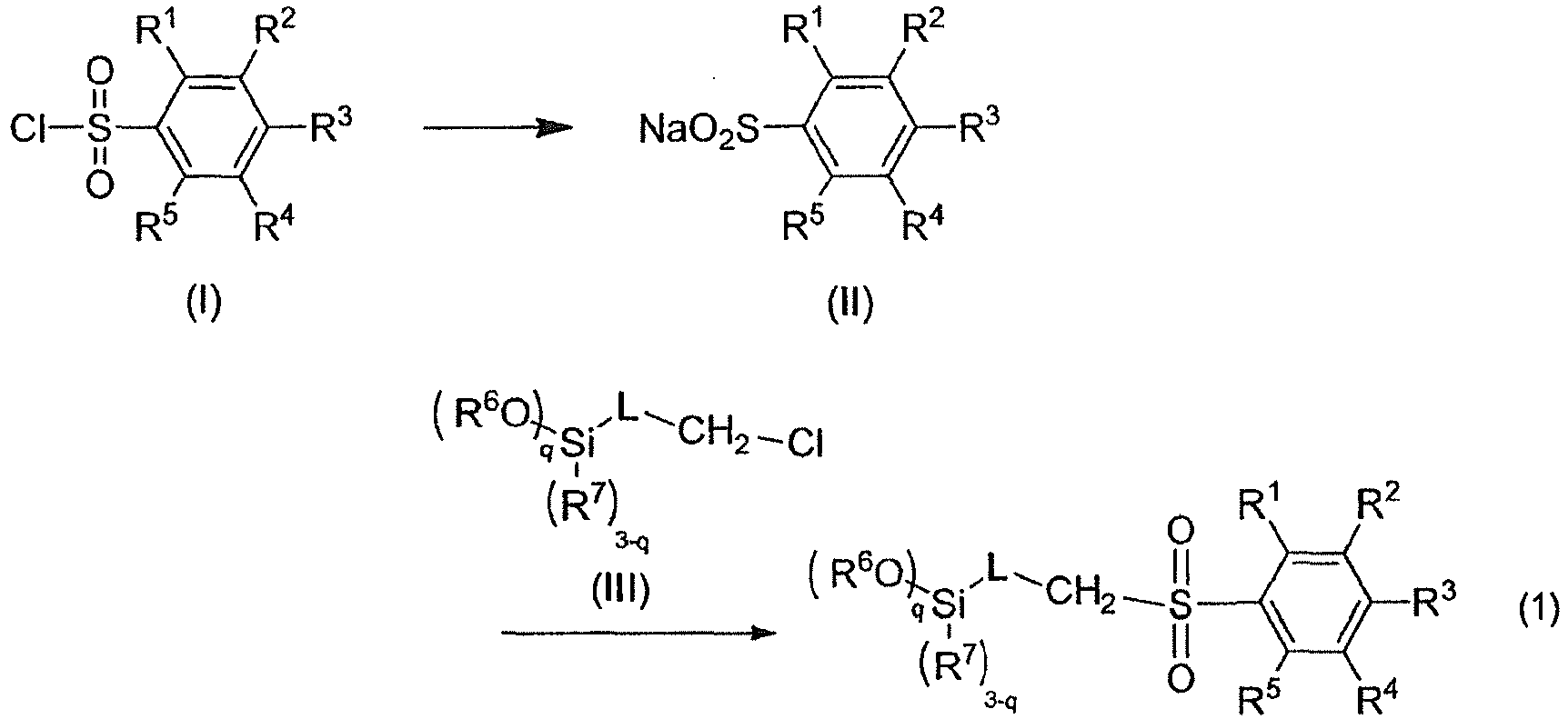
- In aforementioned Formulae (1), (I), (II), and (III), R1, R2, R3, R4, and R5 are each independently a substituent selected from the group consisting of a hydrogen atom, a halogen atom, a C1-10 alkyl group, a C1-10 alkoxy group, a C1-10 haloalkyl group, a C1-10 haloalkoxy group, a cyano group, and a nitro group, R2 and R1 or R3 may form -CH=CH-CH=CH- together, R6 and R7 are each independently a C1-5 alkyl group, L is a single bond or a saturated or unsaturated divalent C1-19 hydrocarbon group having a structure that is linear, branched, cyclic, or a combination thereof, and q is an integer of 1 to 3.
- In a hydrolyzable organosilane of Formula (1) of the present invention, specific examples of each of R1, R2, R3, R4, and R5 independently include a hydrogen atom, a fluorine atom, a chlorine atom, a bromine atom, an iodine atom, methyl group, ethyl group, n-propyl group, i-propyl group, cyclopropyl group, n-butyl group, i-butyl group, s-butyl group, t-butyl group, cyclobutyl group, n-pentyl group, cyclopentyl group, n-hexyl group, cyclohexyl group, trifluoromethyl group, methoxy group, ethoxy group, n-propyloxy group, i-propyloxy group, n-butyloxy group, i-butyloxy group, s-butyloxy group, t-butyloxy group, n-pentyloxy group, cyclopentyloxy group, n-hexyloxy group, cyclohexyloxy group, cyano group, and nitro group. Furthermore, R2 and R1 or R3 may form -CH=CH-CH=CH- together.
- In the hydrolyzable organosilane of Formula (1) of the present invention, examples of R6 include methyl group, ethyl group, n-propyl group, i-propyl group, cyclopropyl group, n-butyl group, i-butyl group, s-butyl group, t-butyl group, cyclobutyl group, n-pentyl group, and cyclopentyl group. In particular, methyl group and ethyl group are preferred.
- In the hydrolyzable organosilane of Formula (1) of the present invention, examples of R7 include methyl group, ethyl group, n-propyl group, i-propyl group, cyclopropyl group, n-butyl group, i-butyl group, s-butyl group, t-butyl group, cyclobutyl group, n-pentyl group, and cyclopentyl group. In particular, methyl group and ethyl group are preferred.
- In the hydrolyzable organosilane of Formula (1) of the present invention, L is a single bond or, for example, a divalent group (alkylene group) obtained by removing one hydrogen atom from an alkyl group selected from methyl group, ethyl group, n-propyl group, i-propyl group, n-butyl group, i-butyl group, s-butyl group, t-butyl group, n-pentyl group, 1-methyl-n-butyl group, 2-methyl-n-butyl group, 3-methyl-n-butyl group, 1,1-dimethyl-n-propyl group, 1,2-dimethyl-n-propyl group, 2,2-dimethyl-n-propyl group, 1-ethyl-n-propyl group, n-hexyl group, 1-methyl-n-pentyl group, 2-methyl-n-pentyl group, 3-methyl-n-pentyl group, 4-methyl-n-pentyl group, 1,1-dimethyl-n-butyl group, 1,2-dimethyl-n-butyl group, 1,3-dimethyl-n-butyl group, 2,2-dimethyl-n-butyl group, 2,3-dimethyl-n-butyl group, 3,3-dimethyl-n-butyl group, 1-ethyl-n-butyl group, 2-ethyl-n-butyl group, 1,1,2-trimethyl-n-propyl group, 1,2,2-trimethyl-n-propyl group, 1-ethyl-1-methyl-n-propyl group, 1-ethyl-2-methyl-n-propyl group, n-heptyl group, 1-methyl-n-hexyl group, 2-methyl-n-hexyl group, 3-methyl-n-hexyl group, 1,1-dimethyl-n-pentyl group, 1,2-dimethyl-n-pentyl group, 1,3-dimethyl-n-pentyl group, 2,2-dimethyl-n-pentyl group, 2,3-dimethyl-n-pentyl group, 3,3-dimethyl-n-pentyl group, 1-ethyl-n-pentyl group, 2-ethyl-n-pentyl group, 3-ethyl-n-pentyl group, 1-methyl-1-ethyl-n-butyl group, 1-methyl-2-ethyl-n-butyl group, 1-ethyl-2-methyl-n-butyl group, 2-methyl-2-ethyl-n-butyl group, 2-ethyl-3-methyl-n-butyl group, n-octyl group, 1-methyl-n-heptyl group, 2-methyl-n-heptyl group, 3-methyl-n-heptyl group, 1,1-dimethyl-n-hexyl group, 1,2-dimethyl-n-hexyl group, 1,3-dimethyl-n-hexyl group, 2,2-dimethyl-n-hexyl group, 2,3-dimethyl-n-hexyl group, 3,3-dimethyl-n-hexyl group, 1-ethyl-n-hexyl group, 2-ethyl-n-hexyl group, 3-ethyl-n-hexyl group, 1-methyl-1-ethyl-n-pentyl group, 1-methyl-2-ethyl-n-pentyl group, 1-methyl-3-ethyl-n-pentyl group, 2-methyl-2-ethyl-n-pentyl group, 2-methyl-3-ethyl-n-pentyl group, 3-methyl-3-ethyl-n-pentyl group, n-nonyl group, and n-decyl group, o-phenylene group, m-phenylene group, p-phenylene group, or a group obtained by substituting one or more methylene groups in the alkylene group with an o-phenylene group, an m-phenylene group, or a p-phenylene group.
- Among them, ethylene group, p-phenylene group, and a single bond are preferred.
- In the hydrolyzable organosilane of Formula (1) of the present invention, q is an integer of 1 to 3.
- In the reaction in which the chlorosulfonyl compound of Formula (I) is reacted with sodium sulfite in water as a solvent in the presence of a base to produce the sulfinic acid sodium salt of Formula (II) (reaction of (I) into (II)), the amount of sodium sulfite used is preferably 0.9 equivalent weights to 3.0 equivalent weights, and more preferably 1.0 equivalent weight to 1.5 equivalent weights, relative to 1 equivalent weight of the compound of Formula (I).
- The amount (reaction concentration) of water used as a reaction solvent is not particularly limited. Water may be used in an amount of 0.1 to 100 times the mass of the chlorosulfonyl compound of Formula (I). The amount is preferably 1 to 10 times, and more preferably 2 to 5 times the mass of the chlorosulfonyl compound.
- The reaction temperature is not particularly limited, and is, for example, 1 to 100°C, preferably 10 to 90°C, and more preferably 50°C to 80°C.
- The reaction time is typically 0.05 to 200 hours, and preferably 0.5 to 100 hours.
- Examples of the base used in the reaction of (I) into (II) include inorganic bases including: alkali metal hydroxides such as sodium hydroxide and potassium hydroxide; alkali metal carbonates such as sodium carbonate and potassium carbonate; alkali metal bicarbonates such as sodium bicarbonate and potassium bicarbonate; and alkali metal salts of inorganic acid such as 2- or 3-sodium phosphate and 2- or 3-potassium phosphate.
- The amount of the base used may be 2 to 10 mol, preferably 2 to 6 mol, and more preferably 2.5 to 5 mol, relative to 1 mol of the chlorosulfonyl compound of Formula (I).
- This reaction may be carried out under normal pressure or under pressure. The reaction may be carried out in a batchwise or continuous manner.
- After the reaction, a separation operation is carried out by adding an organic solvent and water, and an organic phase is concentrated and dried under reduced pressure. Thus, the sulfinic acid sodium salt of Formula (II) as a target compound is obtained.
- As described below in the present invention, after water as a solvent is distilled off by azeotropic dehydration and replaced by the aromatic hydrocarbon solvent, the aromatic hydrocarbon solvent is distilled off and replaced by the aprotic polar solvent, and at substantially the same time, a reaction of the sulfinic acid sodium salt of Formula (II) with the chloroalkylsilane compound of Formula (III) advances. As a result, the compound of Formula (1) can be obtained at high purity in one pot from a starting material.
- After completion of the reaction of (I) into (II), water as a solvent is distilled off from the reaction system by azeotropic dehydration, and replaced by the aromatic hydrocarbon solvent selected from benzene, toluene, and the like, the aprotic polar solvent and the chloroalkylsilane compound of Formula (III) are added to cause the reaction of the compound of Formula (II) with the compound of Formula (III). It is preferable that the reaction of the compound of Formula (II) with the compound of Formula (III) be carried out while the aromatic hydrocarbon solvent is distilled off in the reaction system. Thus, the silane compound having a sulfonyl bond of Formula (1) can be obtained.
- The amount of the aromatic hydrocarbon solvent added in azeotropic dehydration is 0.8 to 10 times, preferably 1 to 5 times, and more preferably 1 to 2 times the mass of water present in the reaction system. It is preferable that the azeotropic dehydration be carried out in a reactor provided with a Dean-Stark apparatus under heating and reflux.
- After water is completely distilled off in the reaction system and replacing by the aromatic hydrocarbon solvent is completed, the aprotic polar solvent and the chloroalkylsilane compound of Formula (III) are added to the reaction system, to cause a reaction.
- Examples of the aprotic polar solvent include N-methyl-2-pyrrolidone, N,N-dimethylformamide, N,N-dimethylacetamide, and 1,3-dimethyl-2-imidazolidinone. N-methyl-2-pyrrolidone is particularly preferred.
- The amount of the aprotic polar solvent added at that time is 0.1 to 100 times, preferably 1 to 10 times, and more preferably 2 to 5 times the mass of the chlorosulfonyl compound of Formula (I) as the starting material.
- The amount of the chloroalkylsilane compound of Formula (III) added is 0.4 to 0.99 mol, preferably 0.5 to 0.8 mol, and more preferably 0.6 to 0.7 mol relative to 1 mol of the chlorosulfonyl compound of Formula (I) as the starting material.
- In the reaction after addition of the aprotic polar solvent and the chloroalkylsilane compound of Formula (III) in the reaction system, the reaction temperature is preferably 160°C or lower. Heating at higher than 160°C is not preferred since a side reaction occurs.
- The reaction time is typically 0.05 to 200 hours, and preferably 0.5 to 100 hours.
- As described above, the reaction after addition of the aprotic polar solvent and the chloroalkylsilane compound of Formula (III) to the reaction system is carried out while the aromatic hydrocarbon solvent is distilled off in the reaction system. Specifically, while the aromatic hydrocarbon solvent is replaced by the aprotic polar solvent, the reaction of the compound of Formula (II) with the compound of Formula (III) advances. This is preferred since the reaction rate can be accelerated and production of a byproduct and a side reaction can be suppressed.
- The aromatic hydrocarbon solvent can be distilled off even under normal pressure or reduced pressure.
- The temperature at which the aromatic hydrocarbon solvent is distilled off is equal to or higher than the boiling point of the aromatic hydrocarbon solvent, and preferably 160°C or lower. Heating at higher than 160°C is not preferred since a side reaction occurs.
- In order to efficiently promote the reaction of (II) with (III), an iodide such as tetra-n-butylammonium iodide, sodium iodide, and potassium iodide may be added.
- The reaction liquid is cooled to room temperature, and solution separation is carried out by adding an organic solvent that is separated from water and water. Thus, a crude product of the compound of Formula (1) is obtained. The resulting crude product is purified by distillation, to obtain the compound of Formula (1).
- Examples of the hydrolyzable organosilane of (1) include as follows. In the following Formulae, Me is methyl group, and Et is ethyl group.





- Hereinafter, the present invention will be more specifically described with reference to Examples, but the present invention is not limited to the Examples.
-

- 32.2 g (0.156 mol) of 4-methoxybenzene-1-sulfonyl chloride, 19.6 g (0.156 mol) of sodium sulfite, 39.3 g (0.467 mol) of sodium bicarbonate, and 100 g of water were placed in a 500-mL recovery flask, and heated to 100°C, and a reaction was caused for 1 hour. Subsequently, 100 g of toluene was added, the mixture was heated until a reflux state, and water was collected by a Dean-Stark apparatus. 25.0 g (0.104 mol) of 3-chloropropyltriethoxysilane, 3.1 g (0.021 mol) of sodium iodide, and 100 g of N-methyl-2-pyrrolidone were further added, and the mixture was stirred under heating for 3 hours while the solvent was distilled off at 150°C. The reaction liquid was separated using toluene and water, activated carbon was added to the organic phase, the organic phase was stirred and filtered, and toluene was removed by an evaporator, to obtain a crude product. The crude product was distilled under reduced pressure, to obtain a compound 1 as a target at a yield of 24%.
1H-NMR (500 MHz, DMSO-d6): 0.63 ppm (m, 2H), 1.10 ppm (t, 9H), 1.55 ppm (m, 2H), 3.24 ppm (m, 2H), 3.71 ppm (m, 6H), 3.86 ppm (s, 3H), 7.17 ppm (d, 2H), 7.79 ppm (d, 2H) -

- 38.1 g (0.156 mol) of 4-trifluoromethylbenzene-1-sulfonyl chloride, 19.6 g (0.156 mol) of sodium sulfite, 39.3 g (0.467 mol) of sodium bicarbonate, and 100 g of water were placed in a 500-mL recovery flask, and heated to 100°C, and a reaction was caused for 1 hour. Subsequently, 100 g of toluene was added, the mixture was heated until a reflux state, and water was collected by a Dean-Stark apparatus. 25.0 g (0.104 mol) of 3-chloropropyltriethoxysilane, 3.1 g (0.021 mol) of sodium iodide, and 100 g of N-methyl-2-pyrrolidone were further added, and the mixture was stirred under heating for 3 hours while the solvent was distilled off at 150°C. The reaction liquid was separated using toluene and water, activated carbon was added to the organic phase, the organic phase was stirred and filtered, and toluene was removed by an evaporator, to obtain a crude product. The crude product was distilled under reduced pressure, to obtain a compound 2 as a target at a yield of 46%.
1H-NMR (500 MHz, DMSO-d6): 0.64 ppm (m, 2H), 1.09 ppm (t, 9H), 1.58 ppm (m, 2H), 3.43 ppm (m, 2H), 3.68 ppm (m, 6H), 8.07 ppm (d, 2H), 8.12 ppm (d, 2H) -

- 24.25 g (0.125 mol) of 4-fluorobenzene-1-sulfonyl chloride, 15.7 g (0.125 mol) of sodium sulfite, 31.4 g (0.374 mol) of sodium bicarbonate, and 100 g of water were placed in a 500-mL recovery flask, and heated to 100°C, and a reaction was caused for 1 hour. Subsequently, 100 g of toluene was added, the mixture was heated until a reflux state, and water was collected by a Dean-Stark apparatus. 20.0 g (0.083 mol) of 3-chloropropyltriethoxysilane, 2.5 g (0.017 mol) of sodium iodide, and 100 g of N-methyl-2-pyrrolidone were further added, and the mixture was stirred under heating for 3 hours while the solvent was distilled off at 150°C. The reaction liquid was separated using toluene and water, activated carbon was added to the organic phase, the organic phase was stirred and filtered, and toluene was removed by an evaporator, to obtain a crude product. The crude product was distilled under reduced pressure, to obtain a compound 3 as a target at a yield of 28%.
1H-NMR (500 MHz, DMSO-d6): 0.63 ppm (m, 2H), 1.10 ppm (t, 9H), 1.58 ppm (m, 2H), 3.33 ppm (m, 2H), 3.69 ppm (m, 6H), 7.52 ppm (d, 2H), 7.95 ppm (d, 2H) - According to the method of the present invention, a silane compound having a sulfonyl bond usable as a resist underlayer film-forming composition for lithography for forming a resist underlayer film that can be used as a hard mask can be easily obtained. When the silane compound having a sulfonyl bond obtained by the present invention is used as a component of the resist underlayer film-forming composition, a resist underlayer film that does not cause intermixing with a top coating resist can be formed. The dry etching rate of the resist underlayer film when a fluorine-based etching gas is used is higher than that of the resist. Therefore, a resist pattern can be transferred to the resist underlayer film. The resist underlayer film exhibits resistance to etching when an oxygen-based etching gas is used. Therefore, the resist pattern transferred to the resist underlayer film can be transferred to an organic underlayer film formed on a lower layer of the resist underlayer film. Therefore, a silane compound having a sulfonyl bond that is important to provide a resist underlayer film-forming composition for forming a resist underlayer film capable of substrate processing using a rectangular pattern can be provided by the method of the present invention.
Claims (4)
- A method for producing a silane compound having a sulfonyl bond of Formula (1):
 a step (A) of reacting a chlorosulfonyl compound of Formula (I):
 a step (B) of adding an aromatic hydrocarbon solvent to this reaction system to carry out azeotropic dehydration, and adding an aprotic polar solvent and a chloroalkylsilane compound of Formula (III):
- The method according to claim 1, wherein at the step (B), the reaction after addition of the aprotic polar solvent is carried out while the aromatic hydrocarbon solvent in the reaction system is distilled off.
- The method according to claim 1 or 2, wherein the aprotic polar solvent is N-methyl-2-pyrrolidone.
- The method according to claim 1, wherein R1, R2, R3, R4, and R5 are each independently a hydrogen atom, a halogen atom, a C1-10 alkyl group, a C1-10 alkoxy group, a C1-10 haloalkyl group, or a C1-10 haloalkoxy group.
Applications Claiming Priority (2)
| Application Number | Priority Date | Filing Date | Title |
|---|---|---|---|
| JP2014128284 | 2014-06-23 | ||
| PCT/JP2015/067483 WO2015198945A1 (en) | 2014-06-23 | 2015-06-17 | Method for producing sulfonyl-bond-containing silane compound |
Publications (2)
| Publication Number | Publication Date |
|---|---|
| EP3159347A1 true EP3159347A1 (en) | 2017-04-26 |
| EP3159347A4 EP3159347A4 (en) | 2018-01-24 |
Family
ID=54938031
Family Applications (1)
| Application Number | Title | Priority Date | Filing Date |
|---|---|---|---|
| EP15812824.9A Withdrawn EP3159347A4 (en) | 2014-06-23 | 2015-06-17 | Method for producing sulfonyl-bond-containing silane compound |
Country Status (8)
| Country | Link |
|---|---|
| US (1) | US9765097B2 (en) |
| EP (1) | EP3159347A4 (en) |
| JP (1) | JP6562221B2 (en) |
| KR (1) | KR20170021232A (en) |
| CN (1) | CN106459105B (en) |
| SG (1) | SG11201610815PA (en) |
| TW (1) | TWI647232B (en) |
| WO (1) | WO2015198945A1 (en) |
Family Cites Families (15)
| Publication number | Priority date | Publication date | Assignee | Title |
|---|---|---|---|---|
| DE3616065A1 (en) * | 1986-05-13 | 1987-11-19 | Bayer Ag | POLY SULPHONES CONTAINING AROMATIC KETONE OR ALDEHYDE GROUPS AND METHOD FOR THE PRODUCTION THEREOF |
| JPH0822844B2 (en) * | 1987-03-17 | 1996-03-06 | 株式会社クラレ | Method for producing allyl sulfone |
| US5008369A (en) * | 1989-11-01 | 1991-04-16 | Eastman Kodak Company | Preparation of polysulfones |
| JP3167354B2 (en) * | 1991-07-18 | 2001-05-21 | 三井化学株式会社 | Method for producing p-toluenesulfonylacetic acid |
| JPH11323129A (en) * | 1998-05-21 | 1999-11-26 | Jsr Corp | Thermosetting resin composition and cured product thereof |
| DE19832428A1 (en) * | 1998-07-18 | 2000-01-20 | Hoechst Marion Roussel De Gmbh | New imidazolylmethyl-biphenyl-sulfonylcyanamides, are sodium-dependent bicarbonate/chloride exchanger inhibitors used e.g. for treating cardiovascular disorders such as cardiac infarction |
| DE19951418A1 (en) * | 1999-10-26 | 2001-05-03 | Merck Patent Gmbh | Process for the preparation of N- (4,5-bismethanesulfonyl-2-methyl-benzoyl) guanidine, hydrochloride |
| JP2002020364A (en) * | 2000-07-06 | 2002-01-23 | Konica Corp | Method for producing sodium sulfinate and potassium sulfinate and method for producing photographic coupler using the same |
| WO2003068750A1 (en) * | 2002-02-13 | 2003-08-21 | Takeda Chemical Industries, Ltd. | Jnk inhibitor |
| US7442821B2 (en) * | 2005-11-28 | 2008-10-28 | Momentive Performance Materials Inc. | Process for preparing unsaturated imidoalkoxysilanes |
| US8541532B2 (en) * | 2007-02-09 | 2013-09-24 | Nippon Shokubai Co., Ltd. | Silane compound, production method thereof, and resin composition containing silane compound |
| WO2011033965A1 (en) | 2009-09-16 | 2011-03-24 | 日産化学工業株式会社 | Silicon-containing composition having sulfonamide group for forming resist underlayer film |
| WO2011044134A1 (en) * | 2009-10-05 | 2011-04-14 | Albany Molecular Research, Inc. | Epiminocycloalkyl(b)indole derivatives as serotonin sub-type 6 (5-ht6) modulators and uses thereof |
| JP5655633B2 (en) * | 2010-03-04 | 2015-01-21 | セントラル硝子株式会社 | Method for producing perfluoroalkanesulfinate |
| KR101947103B1 (en) * | 2011-08-10 | 2019-02-13 | 닛산 가가쿠 가부시키가이샤 | Silicon-containing resist underlayer film-forming composition having sulfone structure |
-
2015
- 2015-06-17 WO PCT/JP2015/067483 patent/WO2015198945A1/en not_active Ceased
- 2015-06-17 EP EP15812824.9A patent/EP3159347A4/en not_active Withdrawn
- 2015-06-17 US US15/321,384 patent/US9765097B2/en not_active Expired - Fee Related
- 2015-06-17 SG SG11201610815PA patent/SG11201610815PA/en unknown
- 2015-06-17 KR KR1020167032276A patent/KR20170021232A/en not_active Withdrawn
- 2015-06-17 CN CN201580034218.1A patent/CN106459105B/en active Active
- 2015-06-17 JP JP2016529408A patent/JP6562221B2/en active Active
- 2015-06-23 TW TW104120188A patent/TWI647232B/en not_active IP Right Cessation
Also Published As
| Publication number | Publication date |
|---|---|
| US9765097B2 (en) | 2017-09-19 |
| JP6562221B2 (en) | 2019-08-21 |
| EP3159347A4 (en) | 2018-01-24 |
| SG11201610815PA (en) | 2017-02-27 |
| TWI647232B (en) | 2019-01-11 |
| WO2015198945A1 (en) | 2015-12-30 |
| CN106459105B (en) | 2021-05-07 |
| JPWO2015198945A1 (en) | 2017-04-20 |
| CN106459105A (en) | 2017-02-22 |
| US20170158716A1 (en) | 2017-06-08 |
| TW201602123A (en) | 2016-01-16 |
| KR20170021232A (en) | 2017-02-27 |
Similar Documents
| Publication | Publication Date | Title |
|---|---|---|
| TW201125848A (en) | Compound, resin, resist composition and method for producing resist pattern | |
| JPWO2016159193A1 (en) | Mixture and method for producing polymerizable compound | |
| JP5478161B2 (en) | Acrylic ester derivatives and alcohol derivatives and methods for producing them | |
| EA201170809A1 (en) | METHOD FOR PRODUCING DERIVATIVES OF PIPERAZINE | |
| KR101907217B1 (en) | Method for forming pattern | |
| CN111574425A (en) | Novel benzoyl formic acid methyl ester photoinitiator and preparation method thereof | |
| US9765097B2 (en) | Method for producing silane compound having sulfonyl bond | |
| CN108698966A (en) | Include the manufacturing method of the manufacturing method of the liquid composite of monoether compound, liquid composite and polymerizable compound | |
| US20220040655A1 (en) | Fluorinated amine oxide surfactants | |
| RU2217423C2 (en) | Method for preparing quinoline carbaldehyde | |
| JP2008120700A (en) | Sulfonium salt | |
| JP4926172B2 (en) | Method for synthesizing sulfonyl halides and sulfonamides from sulfonates | |
| CN113698329B (en) | 193nm immersion lithography photoacid generator and intermediate thereof | |
| JP2005035916A (en) | Method for producing halogen-substituted aromatic compound and solvent for halogenation reaction | |
| JP2012208325A (en) | Quaternary ammonium compound, method of manufacturing the same, and developer composition containing the same | |
| KR102605033B1 (en) | A method of preparing 5-alkyltetrazole | |
| Arimitsu et al. | Base-amplifying silicone resins generating aliphatic secondary amines autocatalytically: synthesis, characterization and application to positive-working photoresists | |
| JP6431294B2 (en) | 5- (Trifluoromethyl) pyrimidine derivative and process for producing the same | |
| EP3246309B1 (en) | Method for treating tin compound in reaction mixture | |
| JP5647783B2 (en) | Solvent for radical reaction consisting of fluorine-containing compounds | |
| CN113698330B (en) | Preparation method of 193nm immersion type photoacid generator for lithography | |
| CN101679196B (en) | Process for preparing alkyl alkoxybenzoates in one step | |
| US10316026B2 (en) | Method for removing dimethoxybenzyl group | |
| WO2014065327A1 (en) | Acrylic or methacrylic compound having hydroxyl group, and method for producing same | |
| JP2016108332A (en) | Method for producing amino compound |
Legal Events
| Date | Code | Title | Description |
|---|---|---|---|
| PUAI | Public reference made under article 153(3) epc to a published international application that has entered the european phase |
Free format text: ORIGINAL CODE: 0009012 |
|
| 17P | Request for examination filed |
Effective date: 20170102 |
|
| AK | Designated contracting states |
Kind code of ref document: A1 Designated state(s): AL AT BE BG CH CY CZ DE DK EE ES FI FR GB GR HR HU IE IS IT LI LT LU LV MC MK MT NL NO PL PT RO RS SE SI SK SM TR |
|
| AX | Request for extension of the european patent |
Extension state: BA ME |
|
| DAV | Request for validation of the european patent (deleted) | ||
| DAX | Request for extension of the european patent (deleted) | ||
| A4 | Supplementary search report drawn up and despatched |
Effective date: 20180103 |
|
| RIC1 | Information provided on ipc code assigned before grant |
Ipc: C07F 7/18 20060101AFI20171220BHEP |
|
| RAP1 | Party data changed (applicant data changed or rights of an application transferred) |
Owner name: NISSAN CHEMICAL CORPORATION |
|
| GRAP | Despatch of communication of intention to grant a patent |
Free format text: ORIGINAL CODE: EPIDOSNIGR1 |
|
| INTG | Intention to grant announced |
Effective date: 20181120 |
|
| STAA | Information on the status of an ep patent application or granted ep patent |
Free format text: STATUS: THE APPLICATION IS DEEMED TO BE WITHDRAWN |
|
| 18D | Application deemed to be withdrawn |
Effective date: 20190402 |