EP3159296B1 - Rope for elevator and manufacturing method therefor - Google Patents
Rope for elevator and manufacturing method therefor Download PDFInfo
- Publication number
- EP3159296B1 EP3159296B1 EP15808960.7A EP15808960A EP3159296B1 EP 3159296 B1 EP3159296 B1 EP 3159296B1 EP 15808960 A EP15808960 A EP 15808960A EP 3159296 B1 EP3159296 B1 EP 3159296B1
- Authority
- EP
- European Patent Office
- Prior art keywords
- layer strands
- diameter
- inner layer
- outer layer
- strands
- Prior art date
- Legal status (The legal status is an assumption and is not a legal conclusion. Google has not performed a legal analysis and makes no representation as to the accuracy of the status listed.)
- Active
Links
Images

Classifications
-
- B—PERFORMING OPERATIONS; TRANSPORTING
- B66—HOISTING; LIFTING; HAULING
- B66B—ELEVATORS; ESCALATORS OR MOVING WALKWAYS
- B66B7/00—Other common features of elevators
- B66B7/06—Arrangements of ropes or cables
-
- D—TEXTILES; PAPER
- D07—ROPES; CABLES OTHER THAN ELECTRIC
- D07B—ROPES OR CABLES IN GENERAL
- D07B1/00—Constructional features of ropes or cables
- D07B1/06—Ropes or cables built-up from metal wires, e.g. of section wires around a hemp core
- D07B1/0673—Ropes or cables built-up from metal wires, e.g. of section wires around a hemp core having a rope configuration
-
- B—PERFORMING OPERATIONS; TRANSPORTING
- B66—HOISTING; LIFTING; HAULING
- B66B—ELEVATORS; ESCALATORS OR MOVING WALKWAYS
- B66B7/00—Other common features of elevators
- B66B7/06—Arrangements of ropes or cables
- B66B7/062—Belts
-
- D—TEXTILES; PAPER
- D07—ROPES; CABLES OTHER THAN ELECTRIC
- D07B—ROPES OR CABLES IN GENERAL
- D07B1/00—Constructional features of ropes or cables
- D07B1/06—Ropes or cables built-up from metal wires, e.g. of section wires around a hemp core
-
- D—TEXTILES; PAPER
- D07—ROPES; CABLES OTHER THAN ELECTRIC
- D07B—ROPES OR CABLES IN GENERAL
- D07B1/00—Constructional features of ropes or cables
- D07B1/06—Ropes or cables built-up from metal wires, e.g. of section wires around a hemp core
- D07B1/0673—Ropes or cables built-up from metal wires, e.g. of section wires around a hemp core having a rope configuration
- D07B1/0686—Ropes or cables built-up from metal wires, e.g. of section wires around a hemp core having a rope configuration characterised by the core design
-
- D—TEXTILES; PAPER
- D07—ROPES; CABLES OTHER THAN ELECTRIC
- D07B—ROPES OR CABLES IN GENERAL
- D07B5/00—Making ropes or cables from special materials or of particular form
- D07B5/005—Making ropes or cables from special materials or of particular form characterised by their outer shape or surface properties
-
- D—TEXTILES; PAPER
- D07—ROPES; CABLES OTHER THAN ELECTRIC
- D07B—ROPES OR CABLES IN GENERAL
- D07B2201/00—Ropes or cables
- D07B2201/10—Rope or cable structures
- D07B2201/1012—Rope or cable structures characterised by their internal structure
- D07B2201/1016—Rope or cable structures characterised by their internal structure characterised by the use of different strands
-
- D—TEXTILES; PAPER
- D07—ROPES; CABLES OTHER THAN ELECTRIC
- D07B—ROPES OR CABLES IN GENERAL
- D07B2201/00—Ropes or cables
- D07B2201/10—Rope or cable structures
- D07B2201/1012—Rope or cable structures characterised by their internal structure
- D07B2201/102—Rope or cable structures characterised by their internal structure including a core
-
- D—TEXTILES; PAPER
- D07—ROPES; CABLES OTHER THAN ELECTRIC
- D07B—ROPES OR CABLES IN GENERAL
- D07B2201/00—Ropes or cables
- D07B2201/10—Rope or cable structures
- D07B2201/1028—Rope or cable structures characterised by the number of strands
- D07B2201/1036—Rope or cable structures characterised by the number of strands nine or more strands respectively forming multiple layers
-
- D—TEXTILES; PAPER
- D07—ROPES; CABLES OTHER THAN ELECTRIC
- D07B—ROPES OR CABLES IN GENERAL
- D07B2201/00—Ropes or cables
- D07B2201/10—Rope or cable structures
- D07B2201/104—Rope or cable structures twisted
- D07B2201/1076—Open winding
-
- D—TEXTILES; PAPER
- D07—ROPES; CABLES OTHER THAN ELECTRIC
- D07B—ROPES OR CABLES IN GENERAL
- D07B2201/00—Ropes or cables
- D07B2201/20—Rope or cable components
- D07B2201/2001—Wires or filaments
- D07B2201/2006—Wires or filaments characterised by a value or range of the dimension given
-
- D—TEXTILES; PAPER
- D07—ROPES; CABLES OTHER THAN ELECTRIC
- D07B—ROPES OR CABLES IN GENERAL
- D07B2201/00—Ropes or cables
- D07B2201/20—Rope or cable components
- D07B2201/2015—Strands
- D07B2201/202—Strands characterised by a value or range of the dimension given
-
- D—TEXTILES; PAPER
- D07—ROPES; CABLES OTHER THAN ELECTRIC
- D07B—ROPES OR CABLES IN GENERAL
- D07B2201/00—Ropes or cables
- D07B2201/20—Rope or cable components
- D07B2201/2015—Strands
- D07B2201/2024—Strands twisted
- D07B2201/2025—Strands twisted characterised by a value or range of the pitch parameter given
-
- D—TEXTILES; PAPER
- D07—ROPES; CABLES OTHER THAN ELECTRIC
- D07B—ROPES OR CABLES IN GENERAL
- D07B2201/00—Ropes or cables
- D07B2201/20—Rope or cable components
- D07B2201/2015—Strands
- D07B2201/2036—Strands characterised by the use of different wires or filaments
- D07B2201/2037—Strands characterised by the use of different wires or filaments regarding the dimension of the wires or filaments
-
- D—TEXTILES; PAPER
- D07—ROPES; CABLES OTHER THAN ELECTRIC
- D07B—ROPES OR CABLES IN GENERAL
- D07B2201/00—Ropes or cables
- D07B2201/20—Rope or cable components
- D07B2201/2047—Cores
- D07B2201/2051—Cores characterised by a value or range of the dimension given
-
- D—TEXTILES; PAPER
- D07—ROPES; CABLES OTHER THAN ELECTRIC
- D07B—ROPES OR CABLES IN GENERAL
- D07B2201/00—Ropes or cables
- D07B2201/20—Rope or cable components
- D07B2201/2047—Cores
- D07B2201/2052—Cores characterised by their structure
- D07B2201/2059—Cores characterised by their structure comprising wires
- D07B2201/2061—Cores characterised by their structure comprising wires resulting in a twisted structure
-
- D—TEXTILES; PAPER
- D07—ROPES; CABLES OTHER THAN ELECTRIC
- D07B—ROPES OR CABLES IN GENERAL
- D07B2501/00—Application field
- D07B2501/20—Application field related to ropes or cables
- D07B2501/2007—Elevators
Definitions
- a pitch of the center strand may be 6-8 times as large as the diameter of the center strand
- a pitch of the inner layer strands may be 8-10 times as large as the diameter of the inner layer strands
- a pitch of the outer layer strands may be 6.5-8.5 times as large as the diameter of the outer layer strands.
Landscapes
- Ropes Or Cables (AREA)
- Lift-Guide Devices, And Elevator Ropes And Cables (AREA)
Description
- The present invention relates to a rope for an elevator and a manufacturing method therefor, and more particularly, to a rope for an elevator and a manufacturing method therefor, whereby the structure may be stabilized due to an increased number of strands and a high fill factor, excellent roundness and dimensional stability may be obtained, and riding comfort may be improved by minimizing vibration in times of driving the elevator.
- In general, a conventional elevator rope for mid-rise/high-rise buildings is composed of eight outer layer strands and a center (independent wire rope core (IWRC) or fiber). Usually, products to which fiber has been applied are used for main traction, and products to which IWRC has been applied are used in governors.
- However, as a high safety factor is needed for use in super high-rise buildings, higher breaking load is required, compared to the conventional elevator rope having a fiber center. Although the strength of wires may be improved in order to obtain high breaking load, due to characteristics of elevator ropes, main traction ropes cause friction with traction sheaves, and thus, there is a limit to increasing the strength of wires used to form elevator ropes. That is, the higher the strength of wires, the shorter the life of sheaves (normally, the hardness of wires contacting sheaves is less than that of the sheaves, and the wires maintain Vickers hardness at about 450±30), and accordingly, the IWRC is used instead of the fiber center.
- As described above, although elevator ropes for super high-rise buildings, to which the IWRC has been applied, are used, eight outer layer strands are still used currently as in conventional elevator ropes for mid-rise/high-rise buildings. For safe running in times of high-speed running of elevators in super high-rise buildings, elevator ropes are required to be more structurally stabilized.
- The document
CN 201 686 879 U provides a high-strength anti-corrosion galvanized steel cable for high-speed railway is a multi-strand steel cable consisting of a center strand, inner stands and outer strands, the center strand is a stand of 19-W steel cables, the inner strands include ten strands of 1∗7 type steel cables, which are uniformly distributed around the center strand, the outer strands include ten strands of 1∗25 type steel cables which are uniformly distributed around the inner strands, and all the strands are in line contact. - As the number of super high-rise buildings has increased recently, demand for elevator ropes for use in super high-rise buildings has increased, and these elevator ropes have been required to have a high safety factor, a high elastic coefficient and a low elongation rate because of long-distance running, compared to conventional elevator ropes for mid-rise/high-rise buildings. Further, minimization of vibration has been required in order to maintain riding comfort in times of running and getting on/off when elevators run a long distance at a high speed.
- The present invention has been created to satisfy such demands and particularly provides an elevator rope and a manufacturing method therefor, whereby the structure may be stabilized due to an increased number of strands and a high fill factor, excellent roundness and dimensional stability may be obtained, and riding comfort may be improved by minimizing vibration in times of driving an elevator.
- According to an aspect of the present invention, a rope for an elevator includes: a center strand formed by twisting a plurality of wires; inner layer strands formed by twisting the plurality of wires and arranged along the outer periphery of the center strand; and outer layer strands formed by twisting the plurality of wires and arranged along the outer periphery of the inner layer strands, wherein ten of each of the inner layer strands and the outer layer strands are prepared, a diameter of the center strand, a diameter of the inner layer strands and a diameter of the outer layer strands are respectively 0.33-0.35 times, 0.13-0.15 times and 0.22-0.24 times as large as a diameter of a first imaginary circle circumscribed around the outer layer strands, and a fill factor is 64-67%.
- Also, a gap formed by spacing apart the inner layer strands that are adjacent to each other is defined as a gap (NG) between the inner layer strands, and a diameter of a second imaginary circle circumscribed around the inner layer strands is defined as an inner layer rope diameter (NR), the relationship of 0.3% ≤ (NG/NR)×100 ≤ 0.6% is established, and alternatively a gap formed by spacing apart the outer layer strands that are adjacent to each other is defined as a gap (OG) between the outer layer strands, and the diameter of the first imaginary circle circumscribed around the outer layer strands is defined as an outer layer rope diameter (OR), the relationship of 0.5% ≤ (OG/OR)×100 ≤ 1.0% is established.
- Also, a pitch of the center strand may be 6-8 times as large as the diameter of the center strand, a pitch of the inner layer strands may be 8-10 times as large as the diameter of the inner layer strands, and a pitch of the outer layer strands may be 6.5-8.5 times as large as the diameter of the outer layer strands.
- According to another aspect of the present invention, a method of manufacturing a rope for an elevator includes: a strand setting operation in which a center strand formed by twisting a plurality of wires is disposed, ten inner layer strands each formed by twisting the plurality of wires are arranged along the outer periphery of the center strand, and ten outer layer strands each formed by twisting the plurality of wires are arranged along the outer periphery of the inner layer strands; and a single closing operation in which the center strand, the inner layer strands and the outer layer strands are twisted simultaneously so that a fill factor ranges between 64-67%, wherein a diameter of the center strand, a diameter of the inner layer strands and a diameter of the outer layer strands are respectively 0.33-0.35 times, 0.13-0.15 times and 0.22-0.24 times as large as a diameter of a first imaginary circle circumscribed around the outer layer strands.
- In this respect, in the single closing operation, a gap formed by spacing apart the inner layer strands that are adjacent to each other is defined as a gap (NG) between the inner layer strands, and a diameter of a second imaginary circle circumscribed around the inner layer strands is defined as an inner layer rope diameter (NR), the relationship of 0.3% ≤ (NG/NR)×100 ≤ 0.6% is established, and alternatively a gap formed by spacing apart the outer layer strands that are adjacent to each other is defined as a gap (OG) between the outer layer strands, and the diameter of the first imaginary circle circumscribed around the outer layer strands is defined as an outer layer rope diameter (OR), the relationship of 0.5% ≤ (OG/OR)×100 ≤ 1.0% is established.
- In this respect, a pitch of the center strand may be 6-8 times as large as the diameter of the center strand, a pitch of the inner layer strands may be 8-10 times as large as the diameter of the inner layer strands, and a pitch of the outer layer strands may be 6.5-8.5 times as large as the diameter of the outer layer strands.
- In a rope for an elevator and a manufacturing method therefor according to the present invention, the structure may be stabilized due to an increased number of strands and a high fill factor, excellent roundness and dimensional stability may be obtained, and riding comfort may be improved by minimizing vibration in times of driving the elevator.
-
-
FIG. 1 is a cross-sectional view of a rope for an elevator, according to an embodiment of the present invention. -
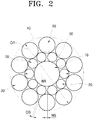
FIG. 2 is a drawing schematically illustratingFIG. 1 in terms of strands. - The present invention relates to an elevator rope for use in a super high-rise building and a manufacturing method therefor.
- Hereinafter, exemplary embodiments according to the present invention will be described in detail with reference to the accompanying
FIGS. 1 and2 . - As shown in
FIG. 1 , a rope for an elevator according to an aspect of the present invention includes acenter strand 10, aninner layer strand 20, and anouter layer strand 30. - The
center strand 10 is disposed in the center of the rope for an elevator and is formed by twisting a plurality ofwires 1. The plurality ofwires 1 are made of steel. - The
inner layer strand 20 is disposed along the outer periphery of thecenter strand 10, and according to the present embodiment, teninner layer strands 20 are prepared. Each of theinner layer strands 20 is formed by twisting the plurality ofwires 1. - The
outer layer strand 30 is disposed along the outer periphery of theinner layer strand 20, and according to the present embodiment, tenouter layer strands 30 are prepared as in the case of theinner layer strand 20. Each of theouter layer strands 30 is also formed by twisting the plurality ofwires 1. - A diameter of the
center strand 10, a diameter of theinner layer strand 20 and a diameter of theouter layer strand 30 are respectively 0.33-0.35 times, 0.13-0.15 times and 0.22-0.24 times as large as a diameter of a firstimaginary circle 40 circumscribed around theouter layer strands 30, and a fill factor is 64-67%. - By preparing ten
inner layer strands 20 and tenouter layer strands 30, a contact surface area with a sheave may be increased compared to a conventional rope, and thus, surface pressure may be dispersed. Accordingly, the rope may maintain its roundness well, and the dimensional stability of the rope may also be maintained well. - Also, as shown in
FIG. 1 , a diameter of each strand is formed to be small in this stated order: the diameter of thecenter strand 10, the diameter of theouter layer strand 30 and the diameter of theinner layer strand 20, and is set to fall within the above-described range with respect to the diameter of thefirst circle 40 so that the fill factor may be maintained, as described above, as high as 64-67%, and at the same time, a rope diameter may be within a permissible tolerance range (EN12385-5) of the rope diameter. That is, the permissible tolerance range of the rope diameter is given as +2% from a rope nominal diameter, and in the rope for an elevator according to the present invention, the diameter of each strand is set to be in the above-described range, thereby satisfying the permissible tolerance range. When the diameter of each strand is out of the above-described range with respect to the diameter of thefirst circle 40, the fill factor is less than 64% or exceeds 67%, and the rope diameter is out of the permissible tolerance range of the rope diameter. - Further, in the rope for an elevator according to the present embodiment, the
center strand 10, theinner layer strand 20 and theouter layer strand 30 are manufactured by a single closing process, and thus, the fill factor is maintained as high as in the above-described range. The single closing process will be described in detail when describing later a method of manufacturing a rope for an elevator, according to the present invention. - According to an embodiment of the present invention, spacing of the
inner layer strands 20 and spacing of theouter layer strands 30 are set as below. - As shown in
FIG. 2 , a gap formed by spacing apart adjacentinner layer strands 20 is defined as a gap NG between theinner layer strands 20, and a diameter of a secondimaginary circle 50 circumscribed around theinner layer strands 20 is defined as an inner layer rope diameter NR, the relationship of 0.3% ≤ (NG/NR)×100 ≤ 0.6% is established. In this respect, (NG/NR)×100 is defined as spacing of theinner layer strands 20. - A gap formed by spacing apart adjacent
outer layer strands 30 is defined as a gap OG between theouter layer strands 30, and the diameter of the firstimaginary circle 40 circumscribed around theouter layer strands 30 is defined as an outer layer rope diameter OR, the relationship of 0.5% ≤ (OG/OR)×100 ≤ 1.0% is established. In this respect, (OG/OR)×100 is defined as spacing of theouter layer strands 30. - Spacing is an essential element of elevator ropes and has a lot to do with a structural elongation rate and fatigue life. When spacing is large, the structural elongation rate increases, and dimensional stability deteriorates. On the other hand, when spacing is too small, the structural elongation rate decreases, whereas interlocking pressure between strands increases, thereby degrading flexibility and decreasing fatigue life.
- According to the embodiment of the present invention, as described above, spacing of the
inner layer strands 20 is set to range between 0.3% and 0.6%, and spacing of theouter layer strands 30 is set to range between 0.5% and 1.0%. Thus, no interlocking pressure may occur while the rope is used, and structural instability due to excessive spacing may be solved. - Accordingly, since spacing of the
inner layer strands 20 and theouter layer strands 30 is set to be in the above-described range, the rope may have a high fill factor, thereby increasing breaking load and improving a safety factor of the rope. Furthermore, the rope may have a high elastic coefficient and a low elongation rate. Due to the high elastic coefficient and the low elongation rate, vibration during driving of an elevator is minimized, and thus, riding comfort increases. - Also, according to the embodiment of the present invention, a pitch of the
center strand 10 is formed to be 6-8 times as large as the diameter of thecenter strand 10, a pitch of theinner layer strand 20 is formed to be 8-10 times as large as the diameter of theinner layer strand 20, and a pitch of theouter layer strand 30 is formed to be 6.5-8.5 times as large as the diameter of theouter layer strand 30. - As the pitches are set to be in the above-described ranges, all the strands constituting the rope are subjected to loading when the rope is subjected to loading, and accordingly, a structural elongation rate of the rope decreases, and load distribution additionally becomes uniform. When the pitches are out of the above-described ranges, load is relatively concentrated on one or two of the
center strand 10, theinner layer strand 20, and theouter layer strand 30, and the rest of them is less subjected to loading, causing lack of uniformity in load distribution. For example, load may be concentrated on thecenter strand 10, and theinner layer strand 20 or theouter layer strand 30 may be relatively less subjected to loading. - According to another aspect of the present invention, there is provided a method of manufacturing the above-described rope for an elevator.
- The method of manufacturing a rope for an elevator, according to the present embodiment, includes a strand setting operation and a single closing operation.
- The strand setting operation is an operation of disposing the
center strand 10 formed by twisting the plurality ofwires 1, arranging, along the outer periphery of thecenter strand 10, teninner layer strands 20 formed by twisting the plurality ofwires 1, and arranging, along the outer periphery of theinner layer strands 20, tenouter layer strands 30 formed by twisting the plurality ofwires 1. The plurality ofwires 1 used to form each strand are made of steel. - In this respect, a pitch of the
center strand 10 is set to be 6-8 times as large as a diameter of thecenter strand 10, a pitch of theinner layer strand 20 is set to be 8-10 times as large as a diameter of theinner layer strand 20, and a pitch of theouter layer strand 30 is set to be 6.5-8.5 times as large as a diameter of theouter layer strand 30. After each strand having a pitch set as described above is previously manufactured, the strand setting operation is performed. - Also, the diameter of the
center strand 10, the diameter of theinner layer strand 20 and the diameter of theouter layer strand 30 are respectively 0.33-0.35 times, 0.13-0.15 times and 0.22-0.24 times as large as a diameter of the firstimaginary circle 40 circumscribed around theouter layer strands 30. Actions and effects caused by setting a range of a diameter of each strand as described above have already been described above, and thus, detailed descriptions thereof are omitted. - Next, the single closing operation is performed. A closing process refers to a process of twisting ropes, and in the present embodiment, the single closing operation refers to manufacturing, after disposing the
center strand 10, theinner layer strand 20 and theouter layer strand 30 during the strand setting process, a rope by twisting all of them at a time. - As described above, while the diameter of each strand is set to be in the above-described range, the
center strand 10, theinner layer strand 20 and theouter layer strand 30 are twisted simultaneously, and thus, a fill factor becomes 64-67%. - The single closing operation is performed such that spacing of the
inner layer strands 20 and spacing of theouter layer strands 30 is maintained in the ranges as described below. - That is, the single closing operation is performed such that, a gap formed by spacing apart adjacent
inner layer strands 20 is defined as a gap NG between theinner layer strands 20, and a diameter of a secondimaginary circle 50 circumscribed around theinner layer strands 20 is defined as an inner layer rope diameter NR, the relationship of 0.3% ≤ (NG/NR)×100 ≤ 0.6% is established. A gap formed by spacing apart adjacentouter layer strands 30 is defined as a gap OG between theouter layer strands 30, and the diameter of the firstimaginary circle 40 circumscribed around theouter layer strands 30 is defined as an outer layer rope diameter OR, the relationship of 0.5% ≤ (OG/OR)×100 ≤ 1.0% is established. Actions and effects caused by setting spacing of theinner layer strands 20 and spacing of theouter layer strands 30 to be in the above-described ranges have already been described above, and thus, detailed descriptions thereof are omitted. - As described above, in a rope for an elevator and a manufacturing method therefor according to the present invention, ten of each of the
inner layer strand 20 and theouter layer strand 30 disposed around thecenter strand 10 is prepared, and thus, surface pressure is dispersed during contact with a sheave, and structural stability is increased. - Also, diameters of the
center strand 10, theinner layer strand 20, and theouter layer strand 30 are set to fall within predetermined ranges with respect to a diameter of thefirst circle 40, and spacing of theinner layer strands 20 and spacing of theouter layer strands 30 are set to be in predetermined ranges, thereby increasing a fill factor and thus improving breaking load and an elastic coefficient of the rope and decreasing an elongation rate of the rope. - While the present invention has been described in detail above with reference to exemplary embodiments, the present invention is not limited to the exemplary embodiments, and various changes in form and details may be made therein without departing from the scope of the present invention as defined by the following claims.
Claims (6)
- A rope for an elevator, the rope comprising:a center strand (10) formed by twisting a first plurality of wires (1);inner layer strands (20), each formed by twisting a second plurality of wires (1) and arranged along the outer periphery of the center strand (10); andouter layer strands (30), each formed by twisting a third plurality of wires (1), arranged along the outer periphery of the inner layer strands (20),wherein the number of strands per layer is ten of each of the inner layer strands (20) and the outer layer strands (30),a diameter of the center strand (10), a diameter of the inner layer strands (20) and a diameter of the outer layer strands (30) are respectively 0.33-0.35 times, 0.13-0.15 times and 0.22-0.24 times as large as a diameter of a first imaginary circle (40) circumscribed around the outer layer strands (30), anda fill factor is 64-67%,characterized in that,a gap formed by spacing apart the inner layer strands (20) that are adjacent to each other is defined as a gap NG between the inner layer strands (20), and a diameter of a second imaginary circle (50) circumscribed around the inner layer strands (20) is defined as an inner layer rope diameter NR,the relationship of 0.3% ≤ NG/NR×100 ≤ 0.6% is established.
- A rope for an elevator, the rope comprising:a center strand (10) formed by twisting a first plurality of wires (1);inner layer strands (20), each formed by twisting a second plurality of wires (1) and arranged along the outer periphery of the center strand (10); andouter layer strands (30), each formed by twisting a third plurality of wires (1), arranged along the outer periphery of the inner layer strands (20),wherein the number of strands per layer is ten of each of the inner layer strands (20) and the outer layer strands (30),a diameter of the center strand (10), a diameter of the inner layer strands (20) and a diameter of the outer layer strands (30) are respectively 0.33-0.35 times, 0.13-0.15 times and 0.22-0.24 times as large as a diameter of a first imaginary circle (40) circumscribed around the outer layer strands (30), anda fill factor is 64-67%,characterized in that,a gap formed by spacing apart the outer layer strands (30) that are adjacent to each other is defined as a gap OG between the outer layer strands (30), and the diameter of the first imaginary circle (40) circumscribed around the outer layer strands (30) is defined as an outer layer rope diameter OR,the relationship of 0.5% ≤ OG/OR×100 ≤ 1.0% is established.
- The rope of claim 1 or 2, wherein a pitch of the center strand (10) is 6-8 times as large as the diameter of the center strand (10),
a pitch of the inner layer strands (20) is 8-10 times as large as the diameter of the inner layer strands (20), and
a pitch of the outer layer strands (30) is 6.5-8.5 times as large as the diameter of the outer layer strands (30). - A method of manufacturing a rope for an elevator, the method comprising:a strand setting operation in which- a center strand (10) formed by twisting a first plurality of wires (1) is disposed,- ten inner layer strands (20) each formed by twisting a second plurality of wires (1) are disposed, and- ten outer layer strands (30) each formed by twisting a third plurality of wires (1) are disposed, anda single closing operation in which the center strand (10), the inner layer strands (20) and the outer layer strands (30) are twisted simultaneously so that a fill factor ranges between 64-67%, the ten inner layer strands (20) are arranged along the outer periphery of the center strand (10), and the ten outer layer strands (30) are arranged along the outer periphery of the inner layer strands (20);wherein a diameter of the center strand (10), a diameter of the inner layer strands (20) and a diameter of the outer layer strands (30) are respectively 0.33-0.35 times, 0.13-0.15 times and 0.22-0.24 times as large as a diameter of a first imaginary circle (40) circumscribed around the outer layer strands (30),characterized in that,in the single closing operation,a gap formed by spacing apart the inner layer strands (20) that are adjacent to each other is defined as a gap NG between the inner layer strands (20), and a diameter of a second imaginary circle (50) circumscribed around the inner layer strands (20) is defined as an inner layer rope diameter NR,the relationship of 0.3% ≤ NG/NR×100 ≤ 0.6% is established.
- A method of manufacturing a rope for an elevator, the method comprising:a strand setting operation in which- a center strand (10) formed by twisting a first plurality of wires (1) is disposed,- ten inner layer strands (20) each formed by twisting a second plurality of wires (1) are disposed, and- ten outer layer strands (30) each formed by twisting a third plurality of wires (1) are disposed, anda single closing operation in which the center strand (10), the inner layer strands (20) and the outer layer strands (30) are twisted simultaneously so that a fill factor ranges between 64-67%, the ten inner layer strands (20) are arranged along the outer periphery of the center strand (10), and the ten outer layer strands (30) are arranged along the outer periphery of the inner layer strands (20);wherein a diameter of the center strand (10), a diameter of the inner layer strands (20) and a diameter of the outer layer strands (30) are respectively 0.33-0.35 times, 0.13-0.15 times and 0.22-0.24 times as large as a diameter of a first imaginary circle (40) circumscribed around the outer layer strands (30),characterized in that,in the single closing operation,a gap formed by spacing apart the outer layer strands (30) that are adjacent to each other is defined as a gap OG between the outer layer strands (30), and the diameter of the first imaginary circle (40) circumscribed around the outer layer strands (30) is defined as an outer layer rope diameter OR,the relationship of 0.5% ≤ OG/OR×100 ≤ 1.0% is established.
- The method of claim 4 or 5, wherein a pitch of the center strand (10) is 6-8 times as large as the diameter of the center strand (10),
a pitch of the inner layer strands (20) is 8-10 times as large as the diameter of the inner layer strands (20), and
a pitch of the outer layer strands (30) is 6.5-8.5 times as large as the diameter of the outer layer strands (30).
Priority Applications (1)
| Application Number | Priority Date | Filing Date | Title |
|---|---|---|---|
| PL15808960T PL3159296T3 (en) | 2014-06-19 | 2015-06-18 | Rope for elevator and manufacturing method therefor |
Applications Claiming Priority (2)
| Application Number | Priority Date | Filing Date | Title |
|---|---|---|---|
| KR1020140075058A KR101601894B1 (en) | 2014-06-19 | 2014-06-19 | Elevator Rope and Method for manufacturing the same |
| PCT/KR2015/006212 WO2015194893A1 (en) | 2014-06-19 | 2015-06-18 | Rope for elevator and manufacturing method therefor |
Publications (3)
| Publication Number | Publication Date |
|---|---|
| EP3159296A1 EP3159296A1 (en) | 2017-04-26 |
| EP3159296A4 EP3159296A4 (en) | 2018-03-14 |
| EP3159296B1 true EP3159296B1 (en) | 2020-01-01 |
Family
ID=54935801
Family Applications (1)
| Application Number | Title | Priority Date | Filing Date |
|---|---|---|---|
| EP15808960.7A Active EP3159296B1 (en) | 2014-06-19 | 2015-06-18 | Rope for elevator and manufacturing method therefor |
Country Status (10)
| Country | Link |
|---|---|
| US (1) | US10443191B2 (en) |
| EP (1) | EP3159296B1 (en) |
| JP (1) | JP6248311B2 (en) |
| KR (1) | KR101601894B1 (en) |
| CN (1) | CN106458516B (en) |
| DK (1) | DK3159296T3 (en) |
| ES (1) | ES2773640T3 (en) |
| PL (1) | PL3159296T3 (en) |
| PT (1) | PT3159296T (en) |
| WO (1) | WO2015194893A1 (en) |
Families Citing this family (10)
| Publication number | Priority date | Publication date | Assignee | Title |
|---|---|---|---|---|
| KR101667991B1 (en) * | 2015-03-19 | 2016-10-21 | 고려제강 주식회사 | Wire rope for elevator |
| US10676320B2 (en) * | 2015-10-16 | 2020-06-09 | Mitsubishi Electric Corporation | Elevator rope and a manufacturing method therefor |
| KR101843142B1 (en) * | 2016-01-28 | 2018-03-28 | 고려제강 주식회사 | Wire Rope for Elevator |
| JP6760824B2 (en) * | 2016-11-11 | 2020-09-23 | 神鋼鋼線工業株式会社 | High strength wire rope |
| CN107034709A (en) * | 2017-06-07 | 2017-08-11 | 扬州兴轮绳缆有限公司 | A kind of hawser |
| DE102017112639B3 (en) * | 2017-06-08 | 2018-06-21 | Firma Pfeifer Drako Drahtseilwerk GmbH & Co. KG | Wire rope as a traction rope for lifts |
| DE102017130743A1 (en) * | 2017-12-20 | 2019-06-27 | Gustav Wolf GmbH | Elevator rope and method of making an elevator rope |
| ES2960882T3 (en) * | 2018-10-23 | 2024-03-07 | Bekaert Advanced Cords Aalter Nv | Steel wire rope and method of producing it |
| JP2021188197A (en) * | 2020-06-02 | 2021-12-13 | 朝日インテック株式会社 | Wire rope |
| CN113863038B (en) * | 2021-08-30 | 2023-04-07 | 江苏赛福天钢索股份有限公司 | Multilayer winding steel wire rope and preparation method thereof |
Family Cites Families (30)
| Publication number | Priority date | Publication date | Assignee | Title |
|---|---|---|---|---|
| US1373632A (en) * | 1920-08-25 | 1921-04-05 | American Steel & Wire Co | Wire rope |
| US2604509A (en) * | 1948-04-06 | 1952-07-22 | Schlumberger Well Surv Corp | Nonspinning armored electric cable |
| NL134372C (en) * | 1966-09-07 | Michelin & Cie | ||
| AT288792B (en) * | 1968-01-16 | 1971-03-25 | Gerhard Dietz | Stranded spiral rope |
| FR2260660B1 (en) * | 1974-02-12 | 1976-11-26 | Michelin & Cie | |
| JPS5158555A (en) * | 1974-11-13 | 1976-05-21 | Kanai Hiroyuki | WAIYAKOODO |
| US4365467A (en) * | 1980-12-12 | 1982-12-28 | Armco Inc. | Rotation resistant wire rope |
| GB2174118B (en) * | 1985-03-19 | 1989-01-05 | Bridon Plc | Manufacture of elongate members such as strand and rope |
| JP3209610B2 (en) * | 1993-03-31 | 2001-09-17 | 東京製綱株式会社 | Non-rotating wire rope |
| EP0675223A1 (en) | 1994-03-24 | 1995-10-04 | N.V. Bekaert S.A. | Layered steel cord construction |
| JP2849620B2 (en) | 1995-06-08 | 1999-01-20 | 東京製綱株式会社 | High strength 8 strand type wire rope |
| JPH09137391A (en) * | 1995-11-07 | 1997-05-27 | Tokyo Seiko Co Ltd | Wire rope |
| CN2276511Y (en) * | 1996-11-13 | 1998-03-18 | 宁波渔业钢丝绳厂 | External-rough type fishing wirerope |
| AU3366701A (en) * | 1999-12-30 | 2001-07-16 | Michelin Recherche Et Technique S.A. | Multilayer steel cable for a tire carcass |
| JP4011827B2 (en) * | 2000-03-23 | 2007-11-21 | 東京製綱株式会社 | Steel cord |
| US6658836B2 (en) * | 2001-03-14 | 2003-12-09 | The Goodyear Tire & Rubber Company | Hybrid cord |
| JP3910377B2 (en) * | 2001-04-25 | 2007-04-25 | 東京製綱株式会社 | Wire rope |
| JP3660319B2 (en) * | 2002-03-08 | 2005-06-15 | 東京製綱株式会社 | Wire rope |
| MY136077A (en) * | 2002-11-05 | 2008-08-29 | Inventio Ag | Drive-capable support or traction means and method for production thereof |
| JP4296152B2 (en) * | 2002-11-12 | 2009-07-15 | 三菱電機株式会社 | Elevator rope and elevator equipment |
| JP3756878B2 (en) * | 2002-12-18 | 2006-03-15 | 東京製綱株式会社 | Covered wire rope |
| CN100335398C (en) | 2003-01-24 | 2007-09-05 | 三菱电机株式会社 | rope for elevator |
| CN1930074B (en) * | 2005-01-14 | 2010-05-05 | 三菱电机株式会社 | Elevator rope and manufacturing method thereof |
| KR101171688B1 (en) * | 2006-08-25 | 2012-08-06 | 미쓰비시덴키 가부시키가이샤 | Elevator rope |
| JPWO2010082666A1 (en) * | 2009-01-19 | 2012-07-05 | 株式会社ブリヂストン | Steel cords for reinforcing rubber articles and pneumatic tires |
| CN201656879U (en) | 2010-03-29 | 2010-11-24 | 卧龙电气集团股份有限公司 | Variable-frequency and speed-regulating subcircuit control device |
| CN201686879U (en) * | 2010-04-02 | 2010-12-29 | 江苏芸裕金属制品有限公司 | High-strength anti-corrosion galvanized steel cable for high-speed railway |
| KR20130079822A (en) | 2012-01-03 | 2013-07-11 | 윤종국 | Rope for elevator and the manufacture method |
| CN103526618A (en) * | 2013-10-24 | 2014-01-22 | 无锡市前洲康华染整设备厂 | Highly tension-resisting steel wire rope for portal crane |
| TWI566659B (en) * | 2014-09-18 | 2017-01-11 | 矽品精密工業股份有限公司 | Package substrate and its preparation method |
-
2014
- 2014-06-19 KR KR1020140075058A patent/KR101601894B1/en active Active
-
2015
- 2015-06-18 PL PL15808960T patent/PL3159296T3/en unknown
- 2015-06-18 ES ES15808960T patent/ES2773640T3/en active Active
- 2015-06-18 CN CN201580033013.1A patent/CN106458516B/en active Active
- 2015-06-18 WO PCT/KR2015/006212 patent/WO2015194893A1/en not_active Ceased
- 2015-06-18 US US15/318,565 patent/US10443191B2/en active Active
- 2015-06-18 EP EP15808960.7A patent/EP3159296B1/en active Active
- 2015-06-18 PT PT158089607T patent/PT3159296T/en unknown
- 2015-06-18 DK DK15808960.7T patent/DK3159296T3/en active
- 2015-06-18 JP JP2017518025A patent/JP6248311B2/en active Active
Non-Patent Citations (1)
| Title |
|---|
| None * |
Also Published As
| Publication number | Publication date |
|---|---|
| JP2017517655A (en) | 2017-06-29 |
| JP6248311B2 (en) | 2017-12-20 |
| EP3159296A1 (en) | 2017-04-26 |
| KR101601894B1 (en) | 2016-03-09 |
| KR20150145473A (en) | 2015-12-30 |
| US10443191B2 (en) | 2019-10-15 |
| WO2015194893A1 (en) | 2015-12-23 |
| ES2773640T3 (en) | 2020-07-13 |
| EP3159296A4 (en) | 2018-03-14 |
| CN106458516A (en) | 2017-02-22 |
| PL3159296T3 (en) | 2020-06-29 |
| DK3159296T3 (en) | 2020-02-17 |
| CN106458516B (en) | 2018-10-02 |
| PT3159296T (en) | 2020-02-24 |
| US20170129742A1 (en) | 2017-05-11 |
Similar Documents
| Publication | Publication Date | Title |
|---|---|---|
| US10443191B2 (en) | Rope for elevator and manufacturing method therefor | |
| KR101665837B1 (en) | Elevator rope | |
| US10676320B2 (en) | Elevator rope and a manufacturing method therefor | |
| US20140374195A1 (en) | Rope for lifting and an elevator comprising the rope | |
| JP3910377B2 (en) | Wire rope | |
| JP2019503322A (en) | Elevator wire rope | |
| JP2002275773A (en) | Wire rope | |
| CN204356566U (en) | Steel wire rope | |
| JP2009292630A (en) | Hoisting rope for elevator, and manufacturing method thereof | |
| CN111065594B (en) | elevator rope | |
| US10221043B2 (en) | Elevator suspension and/or driving arrangement | |
| CN204355905U (en) | traction belt | |
| CN204356567U (en) | Steel wire rope | |
| CN204355906U (en) | traction belt | |
| RU109113U1 (en) | ROPE STEEL MULTI-ORDER SMALL-ROLLING | |
| RU2822146C1 (en) | Steel rope and method of manufacturing thereof | |
| CN104192674B (en) | A kind of elevator traction suspension | |
| US1777117A (en) | Wire rope and method of making the same | |
| JP2016020269A (en) | Hoisting rope for elevator | |
| HK1188427A (en) | Elevator suspension and/or driving arrangement |
Legal Events
| Date | Code | Title | Description |
|---|---|---|---|
| STAA | Information on the status of an ep patent application or granted ep patent |
Free format text: STATUS: THE INTERNATIONAL PUBLICATION HAS BEEN MADE |
|
| PUAI | Public reference made under article 153(3) epc to a published international application that has entered the european phase |
Free format text: ORIGINAL CODE: 0009012 |
|
| STAA | Information on the status of an ep patent application or granted ep patent |
Free format text: STATUS: REQUEST FOR EXAMINATION WAS MADE |
|
| 17P | Request for examination filed |
Effective date: 20161130 |
|
| AK | Designated contracting states |
Kind code of ref document: A1 Designated state(s): AL AT BE BG CH CY CZ DE DK EE ES FI FR GB GR HR HU IE IS IT LI LT LU LV MC MK MT NL NO PL PT RO RS SE SI SK SM TR |
|
| AX | Request for extension of the european patent |
Extension state: BA ME |
|
| DAV | Request for validation of the european patent (deleted) | ||
| DAX | Request for extension of the european patent (deleted) | ||
| A4 | Supplementary search report drawn up and despatched |
Effective date: 20180209 |
|
| RIC1 | Information provided on ipc code assigned before grant |
Ipc: D07B 1/06 20060101ALI20180205BHEP Ipc: B66B 7/06 20060101AFI20180205BHEP |
|
| GRAP | Despatch of communication of intention to grant a patent |
Free format text: ORIGINAL CODE: EPIDOSNIGR1 |
|
| STAA | Information on the status of an ep patent application or granted ep patent |
Free format text: STATUS: GRANT OF PATENT IS INTENDED |
|
| INTG | Intention to grant announced |
Effective date: 20190822 |
|
| GRAS | Grant fee paid |
Free format text: ORIGINAL CODE: EPIDOSNIGR3 |
|
| GRAA | (expected) grant |
Free format text: ORIGINAL CODE: 0009210 |
|
| STAA | Information on the status of an ep patent application or granted ep patent |
Free format text: STATUS: THE PATENT HAS BEEN GRANTED |
|
| AK | Designated contracting states |
Kind code of ref document: B1 Designated state(s): AL AT BE BG CH CY CZ DE DK EE ES FI FR GB GR HR HU IE IS IT LI LT LU LV MC MK MT NL NO PL PT RO RS SE SI SK SM TR |
|
| REG | Reference to a national code |
Ref country code: GB Ref legal event code: FG4D |
|
| REG | Reference to a national code |
Ref country code: CH Ref legal event code: EP Ref country code: AT Ref legal event code: REF Ref document number: 1219559 Country of ref document: AT Kind code of ref document: T Effective date: 20200115 |
|
| REG | Reference to a national code |
Ref country code: IE Ref legal event code: FG4D |
|
| REG | Reference to a national code |
Ref country code: DE Ref legal event code: R096 Ref document number: 602015044824 Country of ref document: DE |
|
| REG | Reference to a national code |
Ref country code: RO Ref legal event code: EPE |
|
| REG | Reference to a national code |
Ref country code: FI Ref legal event code: FGE |
|
| REG | Reference to a national code |
Ref country code: DK Ref legal event code: T3 Effective date: 20200212 |
|
| REG | Reference to a national code |
Ref country code: PT Ref legal event code: SC4A Ref document number: 3159296 Country of ref document: PT Date of ref document: 20200224 Kind code of ref document: T Free format text: AVAILABILITY OF NATIONAL TRANSLATION Effective date: 20200214 |
|
| REG | Reference to a national code |
Ref country code: SE Ref legal event code: TRGR |
|
| REG | Reference to a national code |
Ref country code: CH Ref legal event code: NV Representative=s name: VALIPAT S.A. C/O BOVARD SA NEUCHATEL, CH |
|
| REG | Reference to a national code |
Ref country code: NL Ref legal event code: FP |
|
| REG | Reference to a national code |
Ref country code: NO Ref legal event code: T2 Effective date: 20200101 |
|
| REG | Reference to a national code |
Ref country code: GR Ref legal event code: EP Ref document number: 20200400525 Country of ref document: GR Effective date: 20200511 |
|
| REG | Reference to a national code |
Ref country code: LT Ref legal event code: MG4D |
|
| REG | Reference to a national code |
Ref country code: ES Ref legal event code: FG2A Ref document number: 2773640 Country of ref document: ES Kind code of ref document: T3 Effective date: 20200713 |
|
| PG25 | Lapsed in a contracting state [announced via postgrant information from national office to epo] |
Ref country code: LT Free format text: LAPSE BECAUSE OF FAILURE TO SUBMIT A TRANSLATION OF THE DESCRIPTION OR TO PAY THE FEE WITHIN THE PRESCRIBED TIME-LIMIT Effective date: 20200101 Ref country code: RS Free format text: LAPSE BECAUSE OF FAILURE TO SUBMIT A TRANSLATION OF THE DESCRIPTION OR TO PAY THE FEE WITHIN THE PRESCRIBED TIME-LIMIT Effective date: 20200101 |
|
| PG25 | Lapsed in a contracting state [announced via postgrant information from national office to epo] |
Ref country code: BG Free format text: LAPSE BECAUSE OF FAILURE TO SUBMIT A TRANSLATION OF THE DESCRIPTION OR TO PAY THE FEE WITHIN THE PRESCRIBED TIME-LIMIT Effective date: 20200401 Ref country code: HR Free format text: LAPSE BECAUSE OF FAILURE TO SUBMIT A TRANSLATION OF THE DESCRIPTION OR TO PAY THE FEE WITHIN THE PRESCRIBED TIME-LIMIT Effective date: 20200101 Ref country code: LV Free format text: LAPSE BECAUSE OF FAILURE TO SUBMIT A TRANSLATION OF THE DESCRIPTION OR TO PAY THE FEE WITHIN THE PRESCRIBED TIME-LIMIT Effective date: 20200101 Ref country code: IS Free format text: LAPSE BECAUSE OF FAILURE TO SUBMIT A TRANSLATION OF THE DESCRIPTION OR TO PAY THE FEE WITHIN THE PRESCRIBED TIME-LIMIT Effective date: 20200501 |
|
| REG | Reference to a national code |
Ref country code: DE Ref legal event code: R097 Ref document number: 602015044824 Country of ref document: DE |
|
| PG25 | Lapsed in a contracting state [announced via postgrant information from national office to epo] |
Ref country code: SK Free format text: LAPSE BECAUSE OF FAILURE TO SUBMIT A TRANSLATION OF THE DESCRIPTION OR TO PAY THE FEE WITHIN THE PRESCRIBED TIME-LIMIT Effective date: 20200101 Ref country code: SM Free format text: LAPSE BECAUSE OF FAILURE TO SUBMIT A TRANSLATION OF THE DESCRIPTION OR TO PAY THE FEE WITHIN THE PRESCRIBED TIME-LIMIT Effective date: 20200101 Ref country code: EE Free format text: LAPSE BECAUSE OF FAILURE TO SUBMIT A TRANSLATION OF THE DESCRIPTION OR TO PAY THE FEE WITHIN THE PRESCRIBED TIME-LIMIT Effective date: 20200101 |
|
| PLBE | No opposition filed within time limit |
Free format text: ORIGINAL CODE: 0009261 |
|
| STAA | Information on the status of an ep patent application or granted ep patent |
Free format text: STATUS: NO OPPOSITION FILED WITHIN TIME LIMIT |
|
| 26N | No opposition filed |
Effective date: 20201002 |
|
| PG25 | Lapsed in a contracting state [announced via postgrant information from national office to epo] |
Ref country code: MC Free format text: LAPSE BECAUSE OF FAILURE TO SUBMIT A TRANSLATION OF THE DESCRIPTION OR TO PAY THE FEE WITHIN THE PRESCRIBED TIME-LIMIT Effective date: 20200101 |
|
| PG25 | Lapsed in a contracting state [announced via postgrant information from national office to epo] |
Ref country code: SI Free format text: LAPSE BECAUSE OF FAILURE TO SUBMIT A TRANSLATION OF THE DESCRIPTION OR TO PAY THE FEE WITHIN THE PRESCRIBED TIME-LIMIT Effective date: 20200101 |
|
| REG | Reference to a national code |
Ref country code: AT Ref legal event code: UEP Ref document number: 1219559 Country of ref document: AT Kind code of ref document: T Effective date: 20200101 |
|
| PG25 | Lapsed in a contracting state [announced via postgrant information from national office to epo] |
Ref country code: LU Free format text: LAPSE BECAUSE OF NON-PAYMENT OF DUE FEES Effective date: 20200618 |
|
| PG25 | Lapsed in a contracting state [announced via postgrant information from national office to epo] |
Ref country code: IE Free format text: LAPSE BECAUSE OF NON-PAYMENT OF DUE FEES Effective date: 20200618 |
|
| PG25 | Lapsed in a contracting state [announced via postgrant information from national office to epo] |
Ref country code: MT Free format text: LAPSE BECAUSE OF FAILURE TO SUBMIT A TRANSLATION OF THE DESCRIPTION OR TO PAY THE FEE WITHIN THE PRESCRIBED TIME-LIMIT Effective date: 20200101 Ref country code: CY Free format text: LAPSE BECAUSE OF FAILURE TO SUBMIT A TRANSLATION OF THE DESCRIPTION OR TO PAY THE FEE WITHIN THE PRESCRIBED TIME-LIMIT Effective date: 20200101 |
|
| PG25 | Lapsed in a contracting state [announced via postgrant information from national office to epo] |
Ref country code: MK Free format text: LAPSE BECAUSE OF FAILURE TO SUBMIT A TRANSLATION OF THE DESCRIPTION OR TO PAY THE FEE WITHIN THE PRESCRIBED TIME-LIMIT Effective date: 20200101 Ref country code: AL Free format text: LAPSE BECAUSE OF FAILURE TO SUBMIT A TRANSLATION OF THE DESCRIPTION OR TO PAY THE FEE WITHIN THE PRESCRIBED TIME-LIMIT Effective date: 20200101 |
|
| PGFP | Annual fee paid to national office [announced via postgrant information from national office to epo] |
Ref country code: FI Payment date: 20250617 Year of fee payment: 11 |
|
| PGFP | Annual fee paid to national office [announced via postgrant information from national office to epo] |
Ref country code: PL Payment date: 20250610 Year of fee payment: 11 |
|
| PGFP | Annual fee paid to national office [announced via postgrant information from national office to epo] |
Ref country code: GB Payment date: 20250620 Year of fee payment: 11 Ref country code: DK Payment date: 20250618 Year of fee payment: 11 |
|
| PGFP | Annual fee paid to national office [announced via postgrant information from national office to epo] |
Ref country code: NO Payment date: 20250617 Year of fee payment: 11 |
|
| PGFP | Annual fee paid to national office [announced via postgrant information from national office to epo] |
Ref country code: NL Payment date: 20250618 Year of fee payment: 11 Ref country code: BE Payment date: 20250617 Year of fee payment: 11 |
|
| PGFP | Annual fee paid to national office [announced via postgrant information from national office to epo] |
Ref country code: PT Payment date: 20250606 Year of fee payment: 11 |
|
| PGFP | Annual fee paid to national office [announced via postgrant information from national office to epo] |
Ref country code: HU Payment date: 20250613 Year of fee payment: 11 Ref country code: FR Payment date: 20250618 Year of fee payment: 11 |
|
| PGFP | Annual fee paid to national office [announced via postgrant information from national office to epo] |
Ref country code: GR Payment date: 20250616 Year of fee payment: 11 |
|
| PGFP | Annual fee paid to national office [announced via postgrant information from national office to epo] |
Ref country code: RO Payment date: 20250610 Year of fee payment: 11 Ref country code: AT Payment date: 20250616 Year of fee payment: 11 |
|
| PGFP | Annual fee paid to national office [announced via postgrant information from national office to epo] |
Ref country code: TR Payment date: 20250613 Year of fee payment: 11 |
|
| PGFP | Annual fee paid to national office [announced via postgrant information from national office to epo] |
Ref country code: CZ Payment date: 20250605 Year of fee payment: 11 |
|
| PGFP | Annual fee paid to national office [announced via postgrant information from national office to epo] |
Ref country code: SE Payment date: 20250618 Year of fee payment: 11 |
|
| PGFP | Annual fee paid to national office [announced via postgrant information from national office to epo] |
Ref country code: ES Payment date: 20250718 Year of fee payment: 11 |
|
| PGFP | Annual fee paid to national office [announced via postgrant information from national office to epo] |
Ref country code: DE Payment date: 20250627 Year of fee payment: 11 |
|
| PGFP | Annual fee paid to national office [announced via postgrant information from national office to epo] |
Ref country code: IT Payment date: 20250630 Year of fee payment: 11 |
|
| PGFP | Annual fee paid to national office [announced via postgrant information from national office to epo] |
Ref country code: CH Payment date: 20250701 Year of fee payment: 11 |