EP3159005A1 - Uric acid level lowering agent - Google Patents
Uric acid level lowering agent Download PDFInfo
- Publication number
- EP3159005A1 EP3159005A1 EP14894840.9A EP14894840A EP3159005A1 EP 3159005 A1 EP3159005 A1 EP 3159005A1 EP 14894840 A EP14894840 A EP 14894840A EP 3159005 A1 EP3159005 A1 EP 3159005A1
- Authority
- EP
- European Patent Office
- Prior art keywords
- uric acid
- cyclo
- tyr
- group
- lowering
- Prior art date
- Legal status (The legal status is an assumption and is not a legal conclusion. Google has not performed a legal analysis and makes no representation as to the accuracy of the status listed.)
- Withdrawn
Links
- LEHOTFFKMJEONL-UHFFFAOYSA-N Uric Acid Chemical compound N1C(=O)NC(=O)C2=C1NC(=O)N2 LEHOTFFKMJEONL-UHFFFAOYSA-N 0.000 title claims abstract description 89
- TVWHNULVHGKJHS-UHFFFAOYSA-N Uric acid Natural products N1C(=O)NC(=O)C2NC(=O)NC21 TVWHNULVHGKJHS-UHFFFAOYSA-N 0.000 title claims abstract description 50
- 229940116269 uric acid Drugs 0.000 title claims abstract description 50
- 239000003795 chemical substances by application Substances 0.000 title claims abstract description 45
- 108010016626 Dipeptides Proteins 0.000 claims abstract description 118
- 125000004122 cyclic group Chemical group 0.000 claims abstract description 114
- 150000003839 salts Chemical class 0.000 claims abstract description 55
- NQXUYGGCWWRWBP-LBPRGKRZSA-N (2s)-2-[(1-aminocyclopentanecarbonyl)amino]-3-(4-hydroxyphenyl)propanoic acid Chemical compound N([C@@H](CC=1C=CC(O)=CC=1)C(O)=O)C(=O)C1(N)CCCC1 NQXUYGGCWWRWBP-LBPRGKRZSA-N 0.000 claims abstract description 24
- 239000004480 active ingredient Substances 0.000 claims abstract description 23
- 108010093894 Xanthine oxidase Proteins 0.000 claims description 50
- 102100033220 Xanthine oxidase Human genes 0.000 claims description 50
- 239000000203 mixture Substances 0.000 claims description 40
- 108090000765 processed proteins & peptides Proteins 0.000 claims description 33
- 235000010469 Glycine max Nutrition 0.000 claims description 28
- 244000068988 Glycine max Species 0.000 claims description 28
- 230000002401 inhibitory effect Effects 0.000 claims description 27
- 238000000034 method Methods 0.000 claims description 22
- 229940123769 Xanthine oxidase inhibitor Drugs 0.000 claims description 10
- 239000003064 xanthine oxidase inhibitor Substances 0.000 claims description 10
- OUYCCCASQSFEME-QMMMGPOBSA-N L-tyrosine Chemical compound OC(=O)[C@@H](N)CC1=CC=C(O)C=C1 OUYCCCASQSFEME-QMMMGPOBSA-N 0.000 abstract description 33
- OUYCCCASQSFEME-UHFFFAOYSA-N tyrosine Natural products OC(=O)C(N)CC1=CC=C(O)C=C1 OUYCCCASQSFEME-UHFFFAOYSA-N 0.000 abstract description 21
- 201000005569 Gout Diseases 0.000 abstract description 6
- 201000001431 Hyperuricemia Diseases 0.000 abstract description 4
- 230000002265 prevention Effects 0.000 abstract description 2
- 229950000193 oteracil Drugs 0.000 description 35
- IAPCTXZQXAVYNG-UHFFFAOYSA-M Potassium 2,6-dihydroxytriazinecarboxylate Chemical compound [K+].[O-]C(=O)C1=NC(=O)NC(=O)N1 IAPCTXZQXAVYNG-UHFFFAOYSA-M 0.000 description 32
- 230000000694 effects Effects 0.000 description 31
- 239000000047 product Substances 0.000 description 25
- 229960004441 tyrosine Drugs 0.000 description 20
- 229940024606 amino acid Drugs 0.000 description 18
- 150000001413 amino acids Chemical class 0.000 description 18
- 210000004369 blood Anatomy 0.000 description 17
- 239000008280 blood Substances 0.000 description 17
- QHLSAVHDWSYPEP-UHFFFAOYSA-N 3-[(4-hydroxyphenyl)methyl]piperazine-2,5-dione Chemical compound C1=CC(O)=CC=C1CC1C(=O)NCC(=O)N1 QHLSAVHDWSYPEP-UHFFFAOYSA-N 0.000 description 15
- 238000012360 testing method Methods 0.000 description 15
- 241001465754 Metazoa Species 0.000 description 11
- 241000699670 Mus sp. Species 0.000 description 11
- OFCNXPDARWKPPY-UHFFFAOYSA-N allopurinol Chemical compound OC1=NC=NC2=C1C=NN2 OFCNXPDARWKPPY-UHFFFAOYSA-N 0.000 description 11
- 229960003459 allopurinol Drugs 0.000 description 11
- 210000002966 serum Anatomy 0.000 description 11
- 210000004185 liver Anatomy 0.000 description 9
- RYYCJUAHISIHTL-UHFFFAOYSA-N 5-azaorotic acid Chemical compound OC(=O)C1=NC(=O)NC(=O)N1 RYYCJUAHISIHTL-UHFFFAOYSA-N 0.000 description 7
- GRWVBLRIPRGGPD-HOTGVXAUSA-N cyclo(L-tyrosyl-L-phenylalanyl) Chemical compound C1=CC(O)=CC=C1C[C@H]1C(=O)N[C@@H](CC=2C=CC=CC=2)C(=O)N1 GRWVBLRIPRGGPD-HOTGVXAUSA-N 0.000 description 7
- 238000010586 diagram Methods 0.000 description 7
- 230000005764 inhibitory process Effects 0.000 description 7
- 239000000243 solution Substances 0.000 description 7
- MFUNIDMQFPXVGU-UHFFFAOYSA-N 3-[(4-hydroxyphenyl)methyl]-6-methylpiperazine-2,5-dione Chemical compound N1C(=O)C(C)NC(=O)C1CC1=CC=C(O)C=C1 MFUNIDMQFPXVGU-UHFFFAOYSA-N 0.000 description 6
- OKKJLVBELUTLKV-UHFFFAOYSA-N Methanol Chemical compound OC OKKJLVBELUTLKV-UHFFFAOYSA-N 0.000 description 6
- GRWVBLRIPRGGPD-UHFFFAOYSA-N cYF Natural products C1=CC(O)=CC=C1CC1C(=O)NC(CC=2C=CC=CC=2)C(=O)N1 GRWVBLRIPRGGPD-UHFFFAOYSA-N 0.000 description 6
- 238000011068 loading method Methods 0.000 description 6
- 238000002835 absorbance Methods 0.000 description 5
- NGPCLOGFGKJCBP-UHFFFAOYSA-N cYY Natural products C1=CC(O)=CC=C1CC1C(=O)NC(CC=2C=CC(O)=CC=2)C(=O)N1 NGPCLOGFGKJCBP-UHFFFAOYSA-N 0.000 description 5
- NGPCLOGFGKJCBP-HOTGVXAUSA-N cyclo(L-tyrosyl-L-tyrosyl) Chemical compound C1=CC(O)=CC=C1C[C@H]1C(=O)N[C@@H](CC=2C=CC(O)=CC=2)C(=O)N1 NGPCLOGFGKJCBP-HOTGVXAUSA-N 0.000 description 5
- 108010053287 cyclo(tyrosyl-tyrosyl) Proteins 0.000 description 5
- 208000037265 diseases, disorders, signs and symptoms Diseases 0.000 description 5
- 230000037406 food intake Effects 0.000 description 5
- 238000010438 heat treatment Methods 0.000 description 5
- CHYMARRIVIIBNV-UWVGGRQHSA-N (3S,6S)-3-(4-Hydroxybenzyl)-6-(hydroxymethyl)-2,5-piperazinedione Chemical compound N1C(=O)[C@H](CO)NC(=O)[C@@H]1CC1=CC=C(O)C=C1 CHYMARRIVIIBNV-UWVGGRQHSA-N 0.000 description 4
- ZJDMXAAEAVGGSK-ROUUACIJSA-N (3s,6s)-3-[(4-hydroxyphenyl)methyl]-6-(1h-indol-3-ylmethyl)piperazine-2,5-dione Chemical compound C1=CC(O)=CC=C1C[C@H]1C(=O)N[C@@H](CC=2C3=CC=CC=C3NC=2)C(=O)N1 ZJDMXAAEAVGGSK-ROUUACIJSA-N 0.000 description 4
- GENSLUDVKWKQMX-STQMWFEESA-N (3s,6s)-3-[(4-hydroxyphenyl)methyl]-6-(2-methylpropyl)piperazine-2,5-dione Chemical compound N1C(=O)[C@H](CC(C)C)NC(=O)[C@@H]1CC1=CC=C(O)C=C1 GENSLUDVKWKQMX-STQMWFEESA-N 0.000 description 4
- LMDVFSHGYANGRP-UHFFFAOYSA-N 3-[(4-hydroxyphenyl)methyl]-6-propan-2-ylpiperazine-2,5-dione Chemical compound N1C(=O)C(C(C)C)NC(=O)C1CC1=CC=C(O)C=C1 LMDVFSHGYANGRP-UHFFFAOYSA-N 0.000 description 4
- GENSLUDVKWKQMX-UHFFFAOYSA-N 9-Acetyl-10-deacetylspicataxine Natural products N1C(=O)C(CC(C)C)NC(=O)C1CC1=CC=C(O)C=C1 GENSLUDVKWKQMX-UHFFFAOYSA-N 0.000 description 4
- LRFVTYWOQMYALW-UHFFFAOYSA-N 9H-xanthine Chemical compound O=C1NC(=O)NC2=C1NC=N2 LRFVTYWOQMYALW-UHFFFAOYSA-N 0.000 description 4
- FYRVDDJMNISIKJ-UWVGGRQHSA-N Asn-Tyr Chemical compound NC(=O)C[C@H](N)C(=O)N[C@H](C(O)=O)CC1=CC=C(O)C=C1 FYRVDDJMNISIKJ-UWVGGRQHSA-N 0.000 description 4
- KDAHZWKHYACWHQ-XDTLVQLUSA-N Cyclo-(Leu-Tyr) Natural products O=C1[C@H]([C@H](CC)C)NC(=O)[C@H](Cc2ccc(O)cc2)N1 KDAHZWKHYACWHQ-XDTLVQLUSA-N 0.000 description 4
- XBGGUPMXALFZOT-VIFPVBQESA-N Gly-Tyr Chemical compound NCC(=O)N[C@H](C(O)=O)CC1=CC=C(O)C=C1 XBGGUPMXALFZOT-VIFPVBQESA-N 0.000 description 4
- MUFXDFWAJSPHIQ-XDTLVQLUSA-N Ile-Tyr Chemical compound CC[C@H](C)[C@H]([NH3+])C(=O)N[C@H](C([O-])=O)CC1=CC=C(O)C=C1 MUFXDFWAJSPHIQ-XDTLVQLUSA-N 0.000 description 4
- COLNVLDHVKWLRT-QMMMGPOBSA-N L-phenylalanine Chemical compound OC(=O)[C@@H](N)CC1=CC=CC=C1 COLNVLDHVKWLRT-QMMMGPOBSA-N 0.000 description 4
- WJKJJGXZRHDNTN-UWVGGRQHSA-N Tyr-Cys Chemical compound SC[C@@H](C(O)=O)NC(=O)[C@@H](N)CC1=CC=C(O)C=C1 WJKJJGXZRHDNTN-UWVGGRQHSA-N 0.000 description 4
- HPYDSVWYXXKHRD-VIFPVBQESA-N Tyr-Gly Chemical compound [O-]C(=O)CNC(=O)[C@@H]([NH3+])CC1=CC=C(O)C=C1 HPYDSVWYXXKHRD-VIFPVBQESA-N 0.000 description 4
- 239000003153 chemical reaction reagent Substances 0.000 description 4
- 108010030615 cyclo(leucyl-tyrosyl) Proteins 0.000 description 4
- 108010012664 cyclo(seryltyrosyl) Proteins 0.000 description 4
- ZJDMXAAEAVGGSK-UHFFFAOYSA-N cyclo-L-Trp-L-Phe Natural products C1=CC(O)=CC=C1CC1C(=O)NC(CC=2C3=CC=CC=C3NC=2)C(=O)N1 ZJDMXAAEAVGGSK-UHFFFAOYSA-N 0.000 description 4
- 201000010099 disease Diseases 0.000 description 4
- 108010087823 glycyltyrosine Proteins 0.000 description 4
- 108010044374 isoleucyl-tyrosine Proteins 0.000 description 4
- BDAGIHXWWSANSR-UHFFFAOYSA-N methanoic acid Natural products OC=O BDAGIHXWWSANSR-UHFFFAOYSA-N 0.000 description 4
- 239000000126 substance Substances 0.000 description 4
- XLYOFNOQVPJJNP-UHFFFAOYSA-N water Substances O XLYOFNOQVPJJNP-UHFFFAOYSA-N 0.000 description 4
- XTWSWDJMIKUJDQ-RYUDHWBXSA-N Arg-Tyr Chemical compound NC(N)=NCCC[C@H](N)C(=O)N[C@H](C(O)=O)CC1=CC=C(O)C=C1 XTWSWDJMIKUJDQ-RYUDHWBXSA-N 0.000 description 3
- UVTGNSWSRSCPLP-UHFFFAOYSA-N Arg-Tyr Natural products NC(CCNC(=N)N)C(=O)NC(Cc1ccc(O)cc1)C(=O)O UVTGNSWSRSCPLP-UHFFFAOYSA-N 0.000 description 3
- NALWOULWGHTVDA-UWVGGRQHSA-N Asp-Tyr Chemical compound OC(=O)C[C@H](N)C(=O)N[C@H](C(O)=O)CC1=CC=C(O)C=C1 NALWOULWGHTVDA-UWVGGRQHSA-N 0.000 description 3
- LSGOTAXPWMCUCK-UHFFFAOYSA-N D-prolyl-L-tyrosine anhydride Natural products C1=CC(O)=CC=C1CC1C(=O)N2CCCC2C(=O)N1 LSGOTAXPWMCUCK-UHFFFAOYSA-N 0.000 description 3
- KGNSGRRALVIRGR-QWRGUYRKSA-N Gln-Tyr Chemical compound NC(=O)CC[C@H](N)C(=O)N[C@H](C(O)=O)CC1=CC=C(O)C=C1 KGNSGRRALVIRGR-QWRGUYRKSA-N 0.000 description 3
- YSWHPLCDIMUKFE-QWRGUYRKSA-N Glu-Tyr Chemical compound OC(=O)CC[C@H](N)C(=O)N[C@H](C(O)=O)CC1=CC=C(O)C=C1 YSWHPLCDIMUKFE-QWRGUYRKSA-N 0.000 description 3
- HTOOKGDPMXSJSY-STQMWFEESA-N His-Tyr Chemical compound C([C@H](N)C(=O)N[C@@H](CC=1C=CC(O)=CC=1)C(O)=O)C1=CN=CN1 HTOOKGDPMXSJSY-STQMWFEESA-N 0.000 description 3
- MYTOTTSMVMWVJN-STQMWFEESA-N Lys-Tyr Chemical compound NCCCC[C@H](N)C(=O)N[C@H](C(O)=O)CC1=CC=C(O)C=C1 MYTOTTSMVMWVJN-STQMWFEESA-N 0.000 description 3
- PESQCPHRXOFIPX-RYUDHWBXSA-N Met-Tyr Chemical compound CSCC[C@H](N)C(=O)N[C@H](C(O)=O)CC1=CC=C(O)C=C1 PESQCPHRXOFIPX-RYUDHWBXSA-N 0.000 description 3
- PESQCPHRXOFIPX-UHFFFAOYSA-N N-L-methionyl-L-tyrosine Natural products CSCCC(N)C(=O)NC(C(O)=O)CC1=CC=C(O)C=C1 PESQCPHRXOFIPX-UHFFFAOYSA-N 0.000 description 3
- WCRFXRIWBFRZBR-GGVZMXCHSA-N Thr-Tyr Chemical compound C[C@@H](O)[C@H](N)C(=O)N[C@H](C(O)=O)CC1=CC=C(O)C=C1 WCRFXRIWBFRZBR-GGVZMXCHSA-N 0.000 description 3
- 238000004458 analytical method Methods 0.000 description 3
- 108010068265 aspartyltyrosine Proteins 0.000 description 3
- 230000037396 body weight Effects 0.000 description 3
- 150000001875 compounds Chemical class 0.000 description 3
- NAKUGCPAQTUSBE-IUCAKERBSA-N cyclo(L-His-L-Pro) Chemical compound C([C@@H]1NC([C@@H]2CCCN2C1=O)=O)C1=CN=CN1 NAKUGCPAQTUSBE-IUCAKERBSA-N 0.000 description 3
- 230000018044 dehydration Effects 0.000 description 3
- 238000006297 dehydration reaction Methods 0.000 description 3
- 239000012153 distilled water Substances 0.000 description 3
- XBGGUPMXALFZOT-UHFFFAOYSA-N glycyl-L-tyrosine hemihydrate Natural products NCC(=O)NC(C(O)=O)CC1=CC=C(O)C=C1 XBGGUPMXALFZOT-UHFFFAOYSA-N 0.000 description 3
- 108010017068 histidyl-proline diketopiperazine Proteins 0.000 description 3
- 238000002347 injection Methods 0.000 description 3
- 239000007924 injection Substances 0.000 description 3
- LSGOTAXPWMCUCK-RYUDHWBXSA-N maculosin Chemical compound C1=CC(O)=CC=C1C[C@H]1C(=O)N2CCC[C@H]2C(=O)N1 LSGOTAXPWMCUCK-RYUDHWBXSA-N 0.000 description 3
- 239000011734 sodium Substances 0.000 description 3
- OWOHLURDBZHNGG-YFKPBYRVSA-N (8ar)-hexahydropyrrolo[1,2-a]pyrazine-1,4-dione Chemical compound O=C1CNC(=O)[C@@H]2CCCN12 OWOHLURDBZHNGG-YFKPBYRVSA-N 0.000 description 2
- QZBUWPVZSXDWSB-UHFFFAOYSA-N 3-benzyl-2,3,6,7,8,8a-hexahydropyrrolo[1,2-a]pyrazine-1,4-dione Chemical compound O=C1N2CCCC2C(=O)NC1CC1=CC=CC=C1 QZBUWPVZSXDWSB-UHFFFAOYSA-N 0.000 description 2
- UZOJHXFWJFSFAI-UHFFFAOYSA-N 3-benzylpiperazine-2,5-dione Chemical compound N1C(=O)CNC(=O)C1CC1=CC=CC=C1 UZOJHXFWJFSFAI-UHFFFAOYSA-N 0.000 description 2
- OSWFIVFLDKOXQC-UHFFFAOYSA-N 4-(3-methoxyphenyl)aniline Chemical compound COC1=CC=CC(C=2C=CC(N)=CC=2)=C1 OSWFIVFLDKOXQC-UHFFFAOYSA-N 0.000 description 2
- KDCGOANMDULRCW-UHFFFAOYSA-N 7H-purine Chemical compound N1=CNC2=NC=NC2=C1 KDCGOANMDULRCW-UHFFFAOYSA-N 0.000 description 2
- 238000000035 BCA protein assay Methods 0.000 description 2
- 241000725101 Clea Species 0.000 description 2
- 102000004190 Enzymes Human genes 0.000 description 2
- 108090000790 Enzymes Proteins 0.000 description 2
- 206010018634 Gouty Arthritis Diseases 0.000 description 2
- 239000004793 Polystyrene Substances 0.000 description 2
- 229940124158 Protease/peptidase inhibitor Drugs 0.000 description 2
- 235000010724 Wisteria floribunda Nutrition 0.000 description 2
- 125000003277 amino group Chemical group 0.000 description 2
- 230000000844 anti-bacterial effect Effects 0.000 description 2
- 238000003149 assay kit Methods 0.000 description 2
- 125000003178 carboxy group Chemical group [H]OC(*)=O 0.000 description 2
- 238000009833 condensation Methods 0.000 description 2
- 230000005494 condensation Effects 0.000 description 2
- 230000003750 conditioning effect Effects 0.000 description 2
- 108010001140 cyclo(glycylprolyl) Proteins 0.000 description 2
- 239000002552 dosage form Substances 0.000 description 2
- 238000005516 engineering process Methods 0.000 description 2
- 235000019253 formic acid Nutrition 0.000 description 2
- 230000006870 function Effects 0.000 description 2
- 238000000338 in vitro Methods 0.000 description 2
- 239000007788 liquid Substances 0.000 description 2
- 238000001294 liquid chromatography-tandem mass spectrometry Methods 0.000 description 2
- 239000000463 material Substances 0.000 description 2
- 230000006386 memory function Effects 0.000 description 2
- 238000002552 multiple reaction monitoring Methods 0.000 description 2
- 239000000137 peptide hydrolase inhibitor Substances 0.000 description 2
- COLNVLDHVKWLRT-UHFFFAOYSA-N phenylalanine Natural products OC(=O)C(N)CC1=CC=CC=C1 COLNVLDHVKWLRT-UHFFFAOYSA-N 0.000 description 2
- 230000001766 physiological effect Effects 0.000 description 2
- BXRNXXXXHLBUKK-UHFFFAOYSA-N piperazine-2,5-dione Chemical group O=C1CNC(=O)CN1 BXRNXXXXHLBUKK-UHFFFAOYSA-N 0.000 description 2
- 229920002223 polystyrene Polymers 0.000 description 2
- 239000000843 powder Substances 0.000 description 2
- 238000000751 protein extraction Methods 0.000 description 2
- 238000007363 ring formation reaction Methods 0.000 description 2
- 230000028327 secretion Effects 0.000 description 2
- 208000024891 symptom Diseases 0.000 description 2
- 229940075420 xanthine Drugs 0.000 description 2
- OQQPOHUVAQPSHJ-UHFFFAOYSA-N (3S,6S)-3-(1-methylethyl)-6-(phenylmethyl)piperazine-2,5-dione Natural products N1C(=O)C(C(C)C)NC(=O)C1CC1=CC=CC=C1 OQQPOHUVAQPSHJ-UHFFFAOYSA-N 0.000 description 1
- VQFHWKRNHGHZTK-LURJTMIESA-N (3s)-3-(2-methylpropyl)piperazine-2,5-dione Chemical compound CC(C)C[C@@H]1NC(=O)CNC1=O VQFHWKRNHGHZTK-LURJTMIESA-N 0.000 description 1
- HLXXMJDWTBXTOR-STQMWFEESA-N (3s,6s)-3-benzyl-6-(1h-imidazol-5-ylmethyl)piperazine-2,5-dione Chemical compound C([C@@H]1NC([C@@H](NC1=O)CC=1NC=NC=1)=O)C1=CC=CC=C1 HLXXMJDWTBXTOR-STQMWFEESA-N 0.000 description 1
- OQQPOHUVAQPSHJ-RYUDHWBXSA-N (3s,6s)-3-benzyl-6-propan-2-ylpiperazine-2,5-dione Chemical compound N1C(=O)[C@H](C(C)C)NC(=O)[C@@H]1CC1=CC=CC=C1 OQQPOHUVAQPSHJ-RYUDHWBXSA-N 0.000 description 1
- VNHJXYUDIBQDDX-UWVGGRQHSA-N 2-[(2s,5s)-5-benzyl-3,6-dioxopiperazin-2-yl]acetic acid Chemical compound N1C(=O)[C@H](CC(=O)O)NC(=O)[C@@H]1CC1=CC=CC=C1 VNHJXYUDIBQDDX-UWVGGRQHSA-N 0.000 description 1
- CNXWPOWVDIUTPS-UHFFFAOYSA-N 3-benzyl-6-methylpiperazine-2,5-dione Chemical compound N1C(=O)C(C)NC(=O)C1CC1=CC=CC=C1 CNXWPOWVDIUTPS-UHFFFAOYSA-N 0.000 description 1
- 241000251468 Actinopterygii Species 0.000 description 1
- 241000143060 Americamysis bahia Species 0.000 description 1
- 206010002091 Anaesthesia Diseases 0.000 description 1
- 206010059245 Angiopathy Diseases 0.000 description 1
- PQBHGSGQZSOLIR-RYUDHWBXSA-N Arg-Phe Chemical compound NC(N)=NCCC[C@H](N)C(=O)N[C@H](C(O)=O)CC1=CC=CC=C1 PQBHGSGQZSOLIR-RYUDHWBXSA-N 0.000 description 1
- OMSMPWHEGLNQOD-UWVGGRQHSA-N Asn-Phe Chemical compound NC(=O)C[C@H](N)C(=O)N[C@H](C(O)=O)CC1=CC=CC=C1 OMSMPWHEGLNQOD-UWVGGRQHSA-N 0.000 description 1
- UKGGPJNBONZZCM-WDSKDSINSA-N Asp-Pro Chemical compound OC(=O)C[C@H](N)C(=O)N1CCC[C@H]1C(O)=O UKGGPJNBONZZCM-WDSKDSINSA-N 0.000 description 1
- 241000283690 Bos taurus Species 0.000 description 1
- 206010007027 Calculus urinary Diseases 0.000 description 1
- 241000282472 Canis lupus familiaris Species 0.000 description 1
- 241000283707 Capra Species 0.000 description 1
- 241000700198 Cavia Species 0.000 description 1
- 241000282693 Cercopithecidae Species 0.000 description 1
- 241000555825 Clupeidae Species 0.000 description 1
- QPDMOMIYLJMOQJ-UHFFFAOYSA-N Cyclo-L-leu-L-phe Natural products N1C(=O)C(CC(C)C)NC(=O)C1CC1=CC=CC=C1 QPDMOMIYLJMOQJ-UHFFFAOYSA-N 0.000 description 1
- KCXVZYZYPLLWCC-UHFFFAOYSA-N EDTA Chemical compound OC(=O)CN(CC(O)=O)CCN(CC(O)=O)CC(O)=O KCXVZYZYPLLWCC-UHFFFAOYSA-N 0.000 description 1
- 241000283086 Equidae Species 0.000 description 1
- 241000282326 Felis catus Species 0.000 description 1
- VHLZDSUANXBJHW-QWRGUYRKSA-N Gln-Phe Chemical compound NC(=O)CC[C@H](N)C(=O)N[C@H](C(O)=O)CC1=CC=CC=C1 VHLZDSUANXBJHW-QWRGUYRKSA-N 0.000 description 1
- XMBSYZWANAQXEV-QWRGUYRKSA-N Glu-Phe Chemical compound OC(=O)CC[C@H](N)C(=O)N[C@H](C(O)=O)CC1=CC=CC=C1 XMBSYZWANAQXEV-QWRGUYRKSA-N 0.000 description 1
- 206010018641 Gouty tophus Diseases 0.000 description 1
- 108010051696 Growth Hormone Proteins 0.000 description 1
- WMDZARSFSMZOQO-DRZSPHRISA-N Ile-Phe Chemical compound CC[C@H](C)[C@H](N)C(=O)N[C@H](C(O)=O)CC1=CC=CC=C1 WMDZARSFSMZOQO-DRZSPHRISA-N 0.000 description 1
- HGCNKOLVKRAVHD-UHFFFAOYSA-N L-Met-L-Phe Natural products CSCCC(N)C(=O)NC(C(O)=O)CC1=CC=CC=C1 HGCNKOLVKRAVHD-UHFFFAOYSA-N 0.000 description 1
- QCZYYEFXOBKCNQ-STQMWFEESA-N Lys-Phe Chemical compound NCCCC[C@H](N)C(=O)N[C@H](C(O)=O)CC1=CC=CC=C1 QCZYYEFXOBKCNQ-STQMWFEESA-N 0.000 description 1
- HGCNKOLVKRAVHD-RYUDHWBXSA-N Met-Phe Chemical compound CSCC[C@H](N)C(=O)N[C@H](C(O)=O)CC1=CC=CC=C1 HGCNKOLVKRAVHD-RYUDHWBXSA-N 0.000 description 1
- XMBSYZWANAQXEV-UHFFFAOYSA-N N-alpha-L-glutamyl-L-phenylalanine Natural products OC(=O)CCC(N)C(=O)NC(C(O)=O)CC1=CC=CC=C1 XMBSYZWANAQXEV-UHFFFAOYSA-N 0.000 description 1
- 241000283973 Oryctolagus cuniculus Species 0.000 description 1
- 229910019142 PO4 Inorganic materials 0.000 description 1
- KNPVDQMEHSCAGX-UWVGGRQHSA-N Phe-Cys Chemical compound SC[C@@H](C(O)=O)NC(=O)[C@@H](N)CC1=CC=CC=C1 KNPVDQMEHSCAGX-UWVGGRQHSA-N 0.000 description 1
- 102100024819 Prolactin Human genes 0.000 description 1
- 108010057464 Prolactin Proteins 0.000 description 1
- XBDQKXXYIPTUBI-UHFFFAOYSA-N Propionic acid Chemical class CCC(O)=O XBDQKXXYIPTUBI-UHFFFAOYSA-N 0.000 description 1
- 241000700159 Rattus Species 0.000 description 1
- 241000269821 Scombridae Species 0.000 description 1
- PPQRSMGDOHLTBE-UWVGGRQHSA-N Ser-Phe Chemical compound OC[C@H](N)C(=O)N[C@H](C(O)=O)CC1=CC=CC=C1 PPQRSMGDOHLTBE-UWVGGRQHSA-N 0.000 description 1
- VYPSYNLAJGMNEJ-UHFFFAOYSA-N Silicium dioxide Chemical compound O=[Si]=O VYPSYNLAJGMNEJ-UHFFFAOYSA-N 0.000 description 1
- 102100038803 Somatotropin Human genes 0.000 description 1
- 238000000692 Student's t-test Methods 0.000 description 1
- IQHUITKNHOKGFC-MIMYLULJSA-N Thr-Phe Chemical compound C[C@@H](O)[C@H](N)C(=O)N[C@H](C(O)=O)CC1=CC=CC=C1 IQHUITKNHOKGFC-MIMYLULJSA-N 0.000 description 1
- IMMPMHKLUUZKAZ-WMZOPIPTSA-N Trp-Phe Chemical compound C([C@H](NC(=O)[C@H](CC=1C2=CC=CC=C2NC=1)N)C(O)=O)C1=CC=CC=C1 IMMPMHKLUUZKAZ-WMZOPIPTSA-N 0.000 description 1
- 208000035896 Twin-reversed arterial perfusion sequence Diseases 0.000 description 1
- BMPPMAOOKQJYIP-WMZOPIPTSA-N Tyr-Trp Chemical compound C([C@H]([NH3+])C(=O)N[C@@H](CC=1C2=CC=CC=C2NC=1)C([O-])=O)C1=CC=C(O)C=C1 BMPPMAOOKQJYIP-WMZOPIPTSA-N 0.000 description 1
- 208000009911 Urinary Calculi Diseases 0.000 description 1
- 230000003187 abdominal effect Effects 0.000 description 1
- 150000001242 acetic acid derivatives Chemical class 0.000 description 1
- DPXJVFZANSGRMM-UHFFFAOYSA-N acetic acid;2,3,4,5,6-pentahydroxyhexanal;sodium Chemical compound [Na].CC(O)=O.OCC(O)C(O)C(O)C(O)C=O DPXJVFZANSGRMM-UHFFFAOYSA-N 0.000 description 1
- 230000001154 acute effect Effects 0.000 description 1
- 238000004378 air conditioning Methods 0.000 description 1
- 150000003863 ammonium salts Chemical class 0.000 description 1
- 230000037005 anaesthesia Effects 0.000 description 1
- 238000010171 animal model Methods 0.000 description 1
- 230000001093 anti-cancer Effects 0.000 description 1
- 230000001430 anti-depressive effect Effects 0.000 description 1
- 239000000935 antidepressant agent Substances 0.000 description 1
- 230000003078 antioxidant effect Effects 0.000 description 1
- 230000036528 appetite Effects 0.000 description 1
- 235000019789 appetite Nutrition 0.000 description 1
- 239000007864 aqueous solution Substances 0.000 description 1
- 125000003118 aryl group Chemical group 0.000 description 1
- 108010093581 aspartyl-proline Proteins 0.000 description 1
- 238000003556 assay Methods 0.000 description 1
- 239000012131 assay buffer Substances 0.000 description 1
- 230000002238 attenuated effect Effects 0.000 description 1
- SRSXLGNVWSONIS-UHFFFAOYSA-N benzenesulfonic acid Chemical class OS(=O)(=O)C1=CC=CC=C1 SRSXLGNVWSONIS-UHFFFAOYSA-N 0.000 description 1
- 150000001558 benzoic acid derivatives Chemical class 0.000 description 1
- 239000011230 binding agent Substances 0.000 description 1
- 230000036760 body temperature Effects 0.000 description 1
- 238000009395 breeding Methods 0.000 description 1
- 230000001488 breeding effect Effects 0.000 description 1
- 239000000872 buffer Substances 0.000 description 1
- 159000000007 calcium salts Chemical class 0.000 description 1
- 238000004364 calculation method Methods 0.000 description 1
- 239000002775 capsule Substances 0.000 description 1
- 239000001768 carboxy methyl cellulose Substances 0.000 description 1
- 210000003169 central nervous system Anatomy 0.000 description 1
- 238000005119 centrifugation Methods 0.000 description 1
- 230000001684 chronic effect Effects 0.000 description 1
- 150000001860 citric acid derivatives Chemical class 0.000 description 1
- 238000004440 column chromatography Methods 0.000 description 1
- 239000000470 constituent Substances 0.000 description 1
- QZBUWPVZSXDWSB-RYUDHWBXSA-N cyclo(L-Phe-L-Pro) Chemical compound C([C@@H]1NC([C@@H]2CCCN2C1=O)=O)C1=CC=CC=C1 QZBUWPVZSXDWSB-RYUDHWBXSA-N 0.000 description 1
- QPDMOMIYLJMOQJ-STQMWFEESA-N cyclo(L-phenylalanyl-L-leucyl) Chemical compound N1C(=O)[C@H](CC(C)C)NC(=O)[C@@H]1CC1=CC=CC=C1 QPDMOMIYLJMOQJ-STQMWFEESA-N 0.000 description 1
- JUAPMRSLDANLAS-HOTGVXAUSA-N cyclo(L-phenylalanyl-L-phenylalanyl) Chemical compound C([C@@H]1NC([C@@H](NC1=O)CC=1C=CC=CC=1)=O)C1=CC=CC=C1 JUAPMRSLDANLAS-HOTGVXAUSA-N 0.000 description 1
- 108010048643 cyclo(aspartyl-phenylalanyl) Proteins 0.000 description 1
- 108010048344 cyclo(leucyl-phenylalanyl) Proteins 0.000 description 1
- 108010021250 cyclo(leucylglycine) Proteins 0.000 description 1
- 108010039669 cyclo(phenylalanyl-phenylalanyl) Proteins 0.000 description 1
- 108010038252 cyclo(phenylalanyl-prolyl) Proteins 0.000 description 1
- 108010016303 cyclo(tryptophyl-prolyl) Proteins 0.000 description 1
- 108010073868 cyclo(tyrosyl-prolyl) Proteins 0.000 description 1
- JUAPMRSLDANLAS-UHFFFAOYSA-N cyclo-L-Phe-L-Phe Natural products O=C1NC(CC=2C=CC=CC=2)C(=O)NC1CC1=CC=CC=C1 JUAPMRSLDANLAS-UHFFFAOYSA-N 0.000 description 1
- 235000005911 diet Nutrition 0.000 description 1
- 230000000378 dietary effect Effects 0.000 description 1
- 239000007884 disintegrant Substances 0.000 description 1
- 208000035475 disorder Diseases 0.000 description 1
- 239000002270 dispersing agent Substances 0.000 description 1
- 239000006185 dispersion Substances 0.000 description 1
- 231100000673 dose–response relationship Toxicity 0.000 description 1
- 230000035622 drinking Effects 0.000 description 1
- 239000003814 drug Substances 0.000 description 1
- 239000003995 emulsifying agent Substances 0.000 description 1
- 239000000839 emulsion Substances 0.000 description 1
- 230000005284 excitation Effects 0.000 description 1
- 238000002474 experimental method Methods 0.000 description 1
- 238000000855 fermentation Methods 0.000 description 1
- 230000004151 fermentation Effects 0.000 description 1
- 238000001914 filtration Methods 0.000 description 1
- 235000019688 fish Nutrition 0.000 description 1
- 235000013305 food Nutrition 0.000 description 1
- 150000004675 formic acid derivatives Chemical class 0.000 description 1
- 238000009472 formulation Methods 0.000 description 1
- 238000004108 freeze drying Methods 0.000 description 1
- VZCYOOQTPOCHFL-OWOJBTEDSA-L fumarate(2-) Chemical class [O-]C(=O)\C=C\C([O-])=O VZCYOOQTPOCHFL-OWOJBTEDSA-L 0.000 description 1
- 239000008187 granular material Substances 0.000 description 1
- 238000000227 grinding Methods 0.000 description 1
- 239000000122 growth hormone Substances 0.000 description 1
- 239000011874 heated mixture Substances 0.000 description 1
- ZFGMDIBRIDKWMY-PASTXAENSA-N heparin Chemical compound CC(O)=N[C@@H]1[C@@H](O)[C@H](O)[C@@H](COS(O)(=O)=O)O[C@@H]1O[C@@H]1[C@@H](C(O)=O)O[C@@H](O[C@H]2[C@@H]([C@@H](OS(O)(=O)=O)[C@@H](O[C@@H]3[C@@H](OC(O)[C@H](OS(O)(=O)=O)[C@H]3O)C(O)=O)O[C@@H]2O)CS(O)(=O)=O)[C@H](O)[C@H]1O ZFGMDIBRIDKWMY-PASTXAENSA-N 0.000 description 1
- 229920000669 heparin Polymers 0.000 description 1
- 229960001008 heparin sodium Drugs 0.000 description 1
- 230000002363 herbicidal effect Effects 0.000 description 1
- 239000004009 herbicide Substances 0.000 description 1
- 238000004128 high performance liquid chromatography Methods 0.000 description 1
- 230000003054 hormonal effect Effects 0.000 description 1
- 150000003840 hydrochlorides Chemical class 0.000 description 1
- 125000002887 hydroxy group Chemical group [H]O* 0.000 description 1
- 230000008407 joint function Effects 0.000 description 1
- 210000003734 kidney Anatomy 0.000 description 1
- 150000003893 lactate salts Chemical class 0.000 description 1
- 244000144972 livestock Species 0.000 description 1
- 239000000314 lubricant Substances 0.000 description 1
- 108010038320 lysylphenylalanine Proteins 0.000 description 1
- 159000000003 magnesium salts Chemical class 0.000 description 1
- 150000002688 maleic acid derivatives Chemical class 0.000 description 1
- 150000004701 malic acid derivatives Chemical class 0.000 description 1
- 239000008204 material by function Substances 0.000 description 1
- 238000005259 measurement Methods 0.000 description 1
- 230000002503 metabolic effect Effects 0.000 description 1
- 108010068488 methionylphenylalanine Proteins 0.000 description 1
- 230000000813 microbial effect Effects 0.000 description 1
- 238000002156 mixing Methods 0.000 description 1
- 230000008450 motivation Effects 0.000 description 1
- 238000010172 mouse model Methods 0.000 description 1
- 150000002823 nitrates Chemical class 0.000 description 1
- 238000001543 one-way ANOVA Methods 0.000 description 1
- 150000007524 organic acids Chemical class 0.000 description 1
- 235000005985 organic acids Nutrition 0.000 description 1
- 150000003891 oxalate salts Chemical class 0.000 description 1
- 239000000546 pharmaceutical excipient Substances 0.000 description 1
- ISWSIDIOOBJBQZ-UHFFFAOYSA-N phenol group Chemical group C1(=CC=CC=C1)O ISWSIDIOOBJBQZ-UHFFFAOYSA-N 0.000 description 1
- 235000021317 phosphate Nutrition 0.000 description 1
- 239000008363 phosphate buffer Substances 0.000 description 1
- 150000003013 phosphoric acid derivatives Chemical class 0.000 description 1
- 230000000704 physical effect Effects 0.000 description 1
- OXNIZHLAWKMVMX-UHFFFAOYSA-N picric acid Chemical class OC1=C([N+]([O-])=O)C=C([N+]([O-])=O)C=C1[N+]([O-])=O OXNIZHLAWKMVMX-UHFFFAOYSA-N 0.000 description 1
- 239000013641 positive control Substances 0.000 description 1
- 159000000001 potassium salts Chemical class 0.000 description 1
- VWBQYTRBTXKKOG-IYNICTALSA-M pravastatin sodium Chemical compound [Na+].C1=C[C@H](C)[C@H](CC[C@@H](O)C[C@@H](O)CC([O-])=O)[C@H]2[C@@H](OC(=O)[C@@H](C)CC)C[C@H](O)C=C21 VWBQYTRBTXKKOG-IYNICTALSA-M 0.000 description 1
- 229960001495 pravastatin sodium Drugs 0.000 description 1
- 238000002360 preparation method Methods 0.000 description 1
- 102000004196 processed proteins & peptides Human genes 0.000 description 1
- 229940097325 prolactin Drugs 0.000 description 1
- 102000004169 proteins and genes Human genes 0.000 description 1
- 108090000623 proteins and genes Proteins 0.000 description 1
- 230000008085 renal dysfunction Effects 0.000 description 1
- 238000012552 review Methods 0.000 description 1
- 239000012488 sample solution Substances 0.000 description 1
- 235000019512 sardine Nutrition 0.000 description 1
- 235000019812 sodium carboxymethyl cellulose Nutrition 0.000 description 1
- 229920001027 sodium carboxymethylcellulose Polymers 0.000 description 1
- 159000000000 sodium salts Chemical class 0.000 description 1
- 239000007787 solid Substances 0.000 description 1
- 230000007928 solubilization Effects 0.000 description 1
- 238000005063 solubilization Methods 0.000 description 1
- 239000002904 solvent Substances 0.000 description 1
- 239000007921 spray Substances 0.000 description 1
- 239000003381 stabilizer Substances 0.000 description 1
- 238000007619 statistical method Methods 0.000 description 1
- 238000000528 statistical test Methods 0.000 description 1
- 150000003890 succinate salts Chemical class 0.000 description 1
- 150000003467 sulfuric acid derivatives Chemical class 0.000 description 1
- 239000006228 supernatant Substances 0.000 description 1
- 239000000829 suppository Substances 0.000 description 1
- 230000001629 suppression Effects 0.000 description 1
- 239000000375 suspending agent Substances 0.000 description 1
- 238000003786 synthesis reaction Methods 0.000 description 1
- 230000001225 therapeutic effect Effects 0.000 description 1
- 238000002560 therapeutic procedure Methods 0.000 description 1
- 238000004724 ultra fast liquid chromatography Methods 0.000 description 1
- 238000000108 ultra-filtration Methods 0.000 description 1
- 208000019553 vascular disease Diseases 0.000 description 1
- 238000009423 ventilation Methods 0.000 description 1
- 230000036642 wellbeing Effects 0.000 description 1
Images



Classifications
-
- A—HUMAN NECESSITIES
- A61—MEDICAL OR VETERINARY SCIENCE; HYGIENE
- A61K—PREPARATIONS FOR MEDICAL, DENTAL OR TOILETRY PURPOSES
- A61K38/00—Medicinal preparations containing peptides
- A61K38/04—Peptides having up to 20 amino acids in a fully defined sequence; Derivatives thereof
- A61K38/12—Cyclic peptides, e.g. bacitracins; Polymyxins; Gramicidins S, C; Tyrocidins A, B or C
-
- C—CHEMISTRY; METALLURGY
- C07—ORGANIC CHEMISTRY
- C07K—PEPTIDES
- C07K5/00—Peptides containing up to four amino acids in a fully defined sequence; Derivatives thereof
- C07K5/04—Peptides containing up to four amino acids in a fully defined sequence; Derivatives thereof containing only normal peptide links
- C07K5/06—Dipeptides
- C07K5/06008—Dipeptides with the first amino acid being neutral
- C07K5/06078—Dipeptides with the first amino acid being neutral and aromatic or cycloaliphatic
-
- A—HUMAN NECESSITIES
- A61—MEDICAL OR VETERINARY SCIENCE; HYGIENE
- A61K—PREPARATIONS FOR MEDICAL, DENTAL OR TOILETRY PURPOSES
- A61K38/00—Medicinal preparations containing peptides
- A61K38/005—Enzyme inhibitors
-
- A—HUMAN NECESSITIES
- A61—MEDICAL OR VETERINARY SCIENCE; HYGIENE
- A61K—PREPARATIONS FOR MEDICAL, DENTAL OR TOILETRY PURPOSES
- A61K38/00—Medicinal preparations containing peptides
- A61K38/01—Hydrolysed proteins; Derivatives thereof
- A61K38/011—Hydrolysed proteins; Derivatives thereof from plants
-
- A—HUMAN NECESSITIES
- A61—MEDICAL OR VETERINARY SCIENCE; HYGIENE
- A61K—PREPARATIONS FOR MEDICAL, DENTAL OR TOILETRY PURPOSES
- A61K38/00—Medicinal preparations containing peptides
- A61K38/04—Peptides having up to 20 amino acids in a fully defined sequence; Derivatives thereof
- A61K38/05—Dipeptides
-
- A—HUMAN NECESSITIES
- A61—MEDICAL OR VETERINARY SCIENCE; HYGIENE
- A61P—SPECIFIC THERAPEUTIC ACTIVITY OF CHEMICAL COMPOUNDS OR MEDICINAL PREPARATIONS
- A61P19/00—Drugs for skeletal disorders
- A61P19/06—Antigout agents, e.g. antihyperuricemic or uricosuric agents
-
- A—HUMAN NECESSITIES
- A61—MEDICAL OR VETERINARY SCIENCE; HYGIENE
- A61P—SPECIFIC THERAPEUTIC ACTIVITY OF CHEMICAL COMPOUNDS OR MEDICINAL PREPARATIONS
- A61P43/00—Drugs for specific purposes, not provided for in groups A61P1/00-A61P41/00
-
- C—CHEMISTRY; METALLURGY
- C07—ORGANIC CHEMISTRY
- C07K—PEPTIDES
- C07K5/00—Peptides containing up to four amino acids in a fully defined sequence; Derivatives thereof
- C07K5/04—Peptides containing up to four amino acids in a fully defined sequence; Derivatives thereof containing only normal peptide links
- C07K5/06—Dipeptides
- C07K5/06008—Dipeptides with the first amino acid being neutral
- C07K5/06017—Dipeptides with the first amino acid being neutral and aliphatic
- C07K5/06026—Dipeptides with the first amino acid being neutral and aliphatic the side chain containing 0 or 1 carbon atom, i.e. Gly or Ala
-
- C—CHEMISTRY; METALLURGY
- C07—ORGANIC CHEMISTRY
- C07K—PEPTIDES
- C07K5/00—Peptides containing up to four amino acids in a fully defined sequence; Derivatives thereof
- C07K5/04—Peptides containing up to four amino acids in a fully defined sequence; Derivatives thereof containing only normal peptide links
- C07K5/12—Cyclic peptides with only normal peptide bonds in the ring
-
- A—HUMAN NECESSITIES
- A61—MEDICAL OR VETERINARY SCIENCE; HYGIENE
- A61K—PREPARATIONS FOR MEDICAL, DENTAL OR TOILETRY PURPOSES
- A61K38/00—Medicinal preparations containing peptides
Definitions
- the present invention relates to a uric acid-lowering agent. More specifically, the present invention relates to a uric acid-lowering agent, containing a cyclic dipeptide as an active ingredient; a uric acid-lowering agent containing, as an active ingredient, a composition containing the cyclic dipeptide; a composition for lowering a uric acid level, containing the cyclic dipeptide; a xanthine oxidase inhibitor containing the cyclic dipeptide as an active ingredient; a xanthine oxidase inhibitor containing, as an active ingredient, a composition containing the cyclic dipeptide; and a composition for inhibiting a xanthine oxidase containing the cyclic dipeptide.
- Dipeptides in which two amino acids are bonded have been remarked as functional materials.
- the dipeptides make it possible to add a physical property not found in a single amino acid, or add a new function, so that the dipeptides have been expected to have a wider range of applications beyond the amino acids.
- diketopiperazines which are cyclic dipeptides, have been known to have various physiological activities, and it has been expected that the diketopiperazines will expand in demands in the fields of medicine and pharmacology.
- Patent Publication 1 has reported that cyclic dipeptides having 2,5-diketopiperazine structures have anti-depressant action, action for improving learning motivation or the like.
- Non-Patent Publication 1 describes that a cyclic dipeptide Cyclo(His-Pro) shows diversified physiological activities, including actions involving the central nervous system, such as lowering of body temperature and suppression of appetite; and hormone-like actions such as inhibition of prolactin secretion and promotion of growth hormone secretion, and the publication also reports that a cyclic dipeptide Cyclo(Leu-Gly) shows actions for improving memory functions, and that a cyclic dipeptide Cyclo(Asp-Pro) shows an action of inhibiting fat preference.
- Non-Patent Publication 2 has reported cyclic dipeptides having an anti-bacterial action and an antioxidative action.
- Non-Patent Publication 3 describes that a cyclic dipeptide Cyclo(Trp-Pro) has an anti-cancer action, that cyclic dipeptides Cyclo(His-Pro) and Cyclo(Gly-Pro) have an anti-bacterial action, that a cyclic dipeptide Cyclo(His-Pro) has a neuroprotectant action, that a cyclic dipeptide Cyclo(Gly-Pro) has an action for improving memory functions, and that cyclic dipeptides Cyclo(Tyr-Pro) and Cyclo(Phe-Pro) have an action as a biological herbicide.
- Patent Publication 1 Japanese Unexamined Patent Publication No. 2012-517998
- An object of the present invention is to provide a uric acid-lowering agent containing, as an active ingredient, a cyclic dipeptide having an excellent action of lowering a uric acid level; a uric acid-lowering agent containing, as an active ingredient, a composition containing the cyclic dipeptide; and a xanthine oxidase inhibitor containing the cyclic dipeptide as an active ingredient.
- the present invention relates to the following [1] to [9]:
- the uric acid-lowering agent of the present invention exhibits an excellent effect of having an excellent action of lowering a uric acid level.
- the uric acid-lowering agent of the present invention is characterized in that the uric acid-lowering agent contains, as an active ingredient, a cyclic dipeptide selected from the group consisting of cyclotryptophanyltyrosine [Cyclo(Trp-Tyr)], cycloseryltyrosine [Cyclo(Ser-Tyr)], cycloprolyltyrosine [Cyclo(Pro-Tyr)], cyclotyrosylglycine [Cyclo(Tyr-Gly)], cyclotyrosyltyrosine [Cyclo(Tyr-Tyr)], cyclophenylalanyltyrosine [Cyclo(Phe-Tyr)], cycloleucyltyrosine [Cyclo(Leu-Tyr)], cyclolysyltyrosine [Cyclo(Lys-Tyr)], cyclohistidylt
- the above tyrosine-containing cyclic dipeptide may be hereinafter referred to as the cyclic dipeptide of the present invention or the diketopiperazine of the present invention.
- the cyclic dipeptide of the present invention or the diketopiperazine of the present invention.
- Cyclo(Trp-Tyr) and Cyclo(Tyr-Trp) are the same cyclic dipeptide.
- the cyclic dipeptide of the present invention may be any one so long as at least one of the constituting amino acids is tyrosine.
- the cyclic dipeptide has a structure such that a carboxy group of the amino acid A and an amino group of the amino acid B may be subjected to dehydration condensation, and an amino group of the amino acid A and a carboxy group of the amino acid B are subjected to dehydration condensation.
- the cyclic dipeptide of the present invention as described above contains tyrosine as a constituent.
- the uric acid-lowering agent of the present invention may be any ones so long as the uric acid-lowering agent contains, as an active ingredient, one or more cyclic dipeptides among the twenty cyclic dipeptides listed above or salts thereof. Therefore, one embodiment of the present invention includes a uric acid-lowering agent containing, as an active ingredient, a composition containing a cyclic dipeptide selected from the twenty cyclic dipeptides listed above or a salt thereof.
- one or more cyclic dipeptides selected from the group consisting of cycloseryltyrosine, cyclotyrosylglycine, cyclotyrosyltyrosine, cyclophenylalanyltyrosine, cycloleucyltyrosine, cyclovalyltyrosine, cycloisoleucyltyrosine, cycloaspartyltyrosine, cycloasparaginyltyrosine, cycloarginyltyrosine, cyclomethionyltyrosine, and cyclotyrosylcysteine, or salts thereof are preferably contained; one or more cyclic dipeptides selected from the group consisting of cyclotyrosylglycine, cyclotyrosylt
- the ratio of a total amount occupied by cyclotyrosyltyrosine, cyclophenylalanyltyrosine, and cycloleucyltyrosine and salts thereof having high action of inhibiting xanthine oxidase is preferably 5% by weight or more, more preferably 10% by weight or more, and even more preferably 15% by weight or more, from the viewpoint of effects of inhibiting a xanthine oxidase.
- the upper limit is not particularly limited, the total amount is preferably 90% by weight or less, and more preferably 60% by weight or less, from the viewpoint of solubilization property.
- a weight ratio of cyclophenylalanyltyrosine to cyclotyrosyltyrosine is preferably from 95/5 to 35/65, more preferably from 90/10 to 40/60, and even more preferably from 90/10 to 50/50, from the viewpoint of the effects of inhibiting a xanthine oxidase.
- a weight ratio of cyclophenylalanyltyrosine to cyclotyrosylglycine is preferably from 90/10 to 30/70, more preferably from 90/10 to 40/60, and even more preferably from 90/10 to 50/50, from the viewpoint of the effects of inhibiting a xanthine oxidase.
- the salts of the cyclic dipeptide as used herein refer to any optional pharmacologically acceptable salts of the above-mentioned cyclic dipeptides, including inorganic salts and organic salts, and the salts include, for example, sodium salts, potassium salts, calcium salts, magnesium salts, ammonium salts, hydrochlorides, sulfates, nitrates, phosphates, salts of organic acids (acetates, citrates, maleates, malates, oxalates, lactates, succinates, fumarates, propionates, formates, benzoates, picrates, benzenesulfonates, and the like), and the like of the above cyclic dipeptides.
- the cyclic dipeptide of the present invention can be prepared in accordance with a method known in the art.
- the cyclic dipeptide may be produced by a chemical synthesis method, an enzyme method, or a microbial fermentation method, or the cyclic dipeptide may be synthesized by subjecting a linear peptide to dehydration and cyclization reaction, or the cyclic dipeptide can also be prepared in accordance with a method described in Japanese Patent Laid-Open No. 2003-252896 or J. Peptide Sci., 10, 737-737 (2004 ).
- a treated product obtained by subjecting a solution containing a soybean peptide to a heat treatment can be suitably used.
- a uric acid-lowering agent containing, as an active ingredient, a treated product obtained by subjecting a solution containing a soybean peptide to a heat treatment can be provided, as a composition containing the cyclic dipeptide or a salt thereof of the present invention.
- the treated product obtained by subjecting a solution containing a soybean peptide to a heat treatment refers specifically to one that can be prepared, for example, by dissolving a soybean peptide in water at a concentration of from 20 to 500 mg/mL, and heating the solution under the conditions of from 40° to 150°C for 5 minutes to 120 hours.
- the treated product obtained may be subjected to a treatment such as filtration, centrifugation, concentration, ultrafiltration, lyophilization, or powdering as desired.
- the salt of the cyclic dipeptide can be easily prepared by one of ordinary skill in the art in accordance with any methods that are known in the art.
- the cyclic dipeptide or a salt thereof of the present invention obtained as mentioned above can be used for inhibiting the activity of a xanthine oxidase, thereby controlling the generation of uric acid. Accordingly, the present invention also provides a xanthine oxidase inhibitor containing, as an active ingredient, a cyclic dipeptide or a salt thereof of the present invention, and a xanthine oxidase inhibitor containing, as an active ingredient, a composition containing a cyclic dipeptide or a salt thereof of the present invention.
- the present invention provides a composition characterized in that the composition contains a cyclic dipeptide or a salt thereof of the present invention. Since the composition has the above feature, the composition is capable of inhibiting the activity of a xanthine oxidase, thereby controlling the generation of uric acid, so that the composition can be suitably used as a composition for lowering a uric acid level, or a composition for inhibiting a xanthine oxidase. Therefore, the composition of the present invention is one embodiment of the uric acid-lowering agent, and the composition containing a cyclic dipeptide or a salt thereof is embraced in the present invention.
- the uric acid-lowering agent of the present invention is not limited in a dosage form thereof, so long as a cyclic dipeptide or a salt thereof of the present invention migrates in the circulating blood.
- the dosing or dosage as used herein embraces all the embodiments of administration, ingestion, dosing, and drinking.
- the diseases that are in need of administration of a uric acid-lowering agent of the present invention are not particularly limited so long as the diseases are diseases in which some therapeutic effects are observed by lowering a blood uric acid level.
- the diseases are exemplified by, for example, hyperuricemia, gout, gouty tophus, acute gouty arthritis, chronic gouty arthritis, gouty kidney, urinary calculus, renal dysfunction, joint function disorder, vascular disorder, and the like.
- the uric acid-lowering agent of the present invention can also be produced into a formulation in the form of a solid such as a tablet, a granule, a powder, a fine powder, or a capsule, or a liquid such as a common liquid agent, a suspension agent or an emulsion by adding as desired a solvent, a dispersant, an emulsifier, a buffer, a stabilizer, an excipient, a binder, a disintegrant, a lubricant or the like to a cyclic dipeptide or a salt thereof of the present invention in accordance with a known method.
- these agents may be administered in accordance with a method of orally ingesting these agents, a method of administration with an injection; or a method of allowing the agents to be absorbed with a percutaneous agent.
- the content of the cyclic dipeptide or a salt thereof of the present invention in the above form is not particularly limited, so long as the content is an amount in which the desired effects of the present invention can be obtained, in consideration of a dosing form, a method of administration or the like.
- the content of the cyclic dipeptide or a salt thereof of the present invention in the uric acid-lowering agent of the present invention is usually from 1 to 100% by weight or so.
- the content of the cyclic dipeptide or a salt thereof of the present invention refers to a total amount of the cyclic dipeptide or a salt thereof contained in the uric acid-lowering agent.
- the uric acid-lowering agent of the present invention is administered by a suitable method of administration depending upon its form.
- the method of administration is also not particularly limited so long as a cyclic dipeptide or a salt thereof of the present invention can migrate in the circulating blood, and the uric acid-lowering agent can be administered by, for example, internal ingestion, external application, and an injection.
- the uric acid-lowering agent can be administered intravenously, intramuscularly, subcutaneously, and intradermally, and in the case of external applications, the uric acid-lowering agent may be administered by a suitable method of administration as an external preparation such as a suppository.
- the dose of the uric acid-lowering agent of the present invention is variable, and may be properly set depending upon the forms, the methods of administration, and the purposes of use, and the age, body weight, and symptoms of human patients or animal patients that are subjects for administration with the uric acid-lowering agent.
- an effective amount of human ingestion in the present invention of the cyclic dipeptide or a salt thereof of the present invention is preferably 0.2 mg or more, more preferably 2 mg or more, and even more preferably 20 mg or more, and preferably 10 g or less, more preferably 5 g or less, and even more preferably 2 g or less, for 50 kg body weight human per day.
- the administration may be performed in a single dose or in a several divided doses in a day within the desired dose range.
- the period of administration is also optionally chosen.
- the effective amount of human ingestion of the cyclic dipeptide or a salt thereof of the present invention refers to a total amount of ingestion of the cyclic dipeptide or a salt thereof that shows some effects in human, and the kinds of the cyclic dipeptides are not particularly limited.
- the subjects for administration of the uric acid-lowering agent of the present invention as used herein refer preferably to human in need of lowering a blood uric acid level, and the subjects may be also livestock animals such as cattle, horses, and goats; pet animals such as dogs, cats, and rabbits; and experimental animals such as mice, rats, guinea pigs, and monkeys.
- the subjects for administration include not only individuals with high blood uric acid levels but also individuals who want to prevent an increase of blood uric acid levels, such as individuals whose blood uric acid levels are not so high but with concerns of increase in blood uric acid levels, individuals who want to prevent hyperuricemia, individuals who want to prevent gout, and individuals who have high levels of intake of foodstuff that increase blood uric acid levels (for example, foodstuff containing purine products such as liver, and fishes and shells such as milts, shrimps, sardines, and bonitos), potential individuals who are considering to ingest the uric acid-lowering agent for physical well-being by seeing the indications that a tyrosine-containing cyclic dipeptide or a soybean peptide heat-treated product is blended.
- foodstuff that increase blood uric acid levels for example, foodstuff containing purine products such as liver, and fishes and shells such as milts, shrimps, sardines, and bonitos
- the present invention also provides a method for lowering a uric acid level, including administering a cyclic dipeptide or a salt thereof of the present invention, or a composition containing a cyclic dipeptide or a salt thereof of the present invention in a therapeutically effective amount to an individual in need of lowering a uric acid level.
- the individuals in need of lowering a uric acid level are the same as the administration subjects for the uric acid-lowering agent of the present invention mentioned above.
- the therapeutically effective amount as used herein refers to an amount that lowers a uric acid level in a case where a cyclic dipeptide or a salt thereof of the present invention is administered to the above individual, as compared to an individual not administered.
- a specific effective amount is variable, and may be appropriately set depending upon the dosage forms, the methods of administration, the purposes of use, and age, body weight, symptoms and the like of the individuals.
- a cyclic dipeptide or a salt thereof of the present invention may be administered directly, or as a composition containing a cyclic dipeptide or a salt thereof of the present invention, so as to have the above therapeutically effective amount.
- the method of administration is not limited, and the administration can be made by, for example, oral administration.
- a cyclic dipeptide one synthesized by KNC Laboratories Co., Ltd. was used.
- xanthine Sodium Carboxymethyl Cellulose (CMC-Na), tyrosine (Tyr), formic acid (Special Grade reagent for column chromatography), methanol (used for high-performance liquid chromatography), manufactured by NACALAI TESQUE INC.
- Allopurinol and potassium oxonate manufactured by Wako Pure Chemical Industries, Ltd.
- xanthine oxidase manufactured by TOYOBO CO., LTD.
- Xanthine Oxidase Assay Kit manufactured by Cayman Chemical Company
- L-Tyrosylglycine manufactured by Santa Cruz Biotechnology Inc.
- Glycyl-L-tyrosine manufactured by Sigma-Aldrich
- T-PER Tissue Protein Extraction Reagent
- Protease inhibitor cocktail kit Pierce BCA protein assay kit
- Test Example 1 (Studies on in vitro XO Inhibiting Action)
- the in vitro xanthine oxidase (XO) inhibiting action was studied on 210 kinds of cyclic dipeptides, linear dipeptides Tyr-Gly and Gly-Tyr, and an amino acid Tyr.
- Table 1 shows activities of inhibiting a xanthine oxidase (IC 50 values) of 12 kinds of Tyr-containing cyclic dipeptides
- Table 2 shows xanthine oxidase inhibition rates (%) of 8 kinds of Tyr-containing cyclic dipeptides at a concentration of 100 ⁇ M
- Table 3 shows activities of inhibiting a xanthine oxidase (IC 50 values) of 20 kinds of Phecontaining cyclic dipeptides.
- a positive control a known uric acid-lowering agent Allopurinol (IC 50 value: 12.5 ⁇ M) was utilized.
- % Inhibition A ⁇ B ⁇ C ⁇ D A ⁇ B ⁇ 100
- Test Example 2 (Studies on Actions of Lowering Serum Uric Acid Levels for Hyperuricemic Mice)
- mice male 7-week old BALBc mice were purchased from CLEA Japan, Inc., and subjected to an experiment after a one-week period of conditioning.
- the animals were bred in a breeding room with air-conditioning facilities (temperature: 23.5° ⁇ 1.0°C, humidity: 55 ⁇ 10 RH%, the number of ventilation: 12 to 15 times/hour, illuminated: from 7:00 to 19:00 each day).
- air-conditioning facilities temperature: 23.5° ⁇ 1.0°C, humidity: 55 ⁇ 10 RH%, the number of ventilation: 12 to 15 times/hour, illuminated: from 7:00 to 19:00 each day.
- CE-2 commercially available feed
- CLEA Japan, Inc. distilled water ad libitum
- Oxonic acid is a substance that raises a blood uric acid level by inhibiting a urikase, a metabolic enzyme for uric acid.
- potassium oxonate (PO) was administered, thereby generating hyperuricemic model animals (see, Planta Med 2009; 75:302-306 ). Studies were made on the following 6 groups:
- the serum uric acid level was measured using 7180 Clinical Analyzer (manufactured by Hitachi Technologies). The results are shown in FIG. 2 .
- livers of mice were added to a mixture of an ice-cooled protease inhibitor cocktail and an EDTA-containing tissue protein extraction reagent (T-PER), and homogenized, and the homogenate was then centrifuged at 15,000 rpm, at 4°C for 15 minutes, and the collected supernatant was subjected to an assay for a xanthine oxidase (XO) activity.
- XO activities in the livers and the sera were assayed using a xanthine oxidase assay kit and a polystyrene Black 96-well plate.
- XO standard samples, liver samples, or sera samples were added in an amount of 50 ⁇ L, and thereafter 50 ⁇ L of an analytical cocktail prepared by mixing an assay buffer, a Detector and HRP in a mass ratio of 98/1/1 was added thereto.
- the mixture was allowed to react at 37°C for 45 minutes while shading light, and a fluorescence was then measured at an excitation wavelength of from 520 to 550 nm and an emission wavelength of from 585 to 595 nm with a spectrophotometer (Synegy HT, manufactured by Bio Tek).
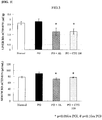
- the sera XO activities were indicated in units of mU/mL, and the XO activities in the liver were indicated in units of mU/mg, using the results of assaying a protein concentration with a Pierce BCA protein assay kit. The results are shown in FIG. 3 .
- Cyclo(Tyr-Gly) has an action of lowering a uric acid level in a dose-dependent manner, and that the group administered with Cyclo(Tyr-Gly) 30 or 100 mg/kg has a significant difference in effects on the PO Group, in the same manner as the group administered with Allopurinol.
- FIG. 3 it can be seen from FIG. 3 that the xanthine oxidase activities in the liver and in the sera are inhibited in the group administered with Cyclo(Tyr-Gly) 100 mg/kg, in the same manner as the group administered with Allopurinol 1 mg/kg.
- Test Example 3 (Studies on Action of Lowering Serum Uric Acid Levels of Soybean Peptide Heat-Treated Products for Hyperuricemic Mice)
- the heat-treated product of the soybean peptide obtained by dissolving a soybean peptide (Hinute AM, manufactured by FUJI OIL, CO., LTD.) in distilled water in a concentration of 200 mg/mL, heating to 132°C for 3 hours, and lyophilizing the heated mixture was used.
- the content of the cyclic dipeptide of the soybean peptide heat-treated product was measured according to LC-MS/MS under the following conditions.
- Cyclo(Tyr-Cys) could not be determined because the standard product was unstable in an aqueous solution. The results are shown in Table 4.
- the soybean peptide heat-treated product contains a cyclic dipeptide of the present invention, and has an excellent action of lowering a blood uric acid level.
- soybean peptide heat-treated product is found to have a significant difference against the uric acid level of hyperuricemic model mice by administering the soybean peptide heat-treated product at 800 mg/kg.
- the cyclic dipeptide of the present invention can be prepared even from materials derived from foods, and the cyclic dipeptide is a material that is comfortably ingestible and has safety, so that the cyclic dipeptide has an advantage different from Allopurinol, which has some concerns in side effects.
- the cyclic dipeptide of the present invention might differ in the extent of actions depending upon the amounts used, the cyclic dipeptide is found to have actions of lowering a uric acid level that are equivalent or milder than that of Allopurinol depending upon the amounts used. The lowering of uric acid levels must be dealt over a long period of time together with dietary therapy, so that those having milder actions are said to be rather preferable, from the viewpoint of daily intake.
- the uric acid-lowering agent of the present invention has an excellent an action of lowering a uric acid level, and the uric acid-lowering agent is useful in, for example, prevention or treatment of hyperuricemia, gout or the like.
Landscapes
- Health & Medical Sciences (AREA)
- Chemical & Material Sciences (AREA)
- Life Sciences & Earth Sciences (AREA)
- Organic Chemistry (AREA)
- Medicinal Chemistry (AREA)
- General Health & Medical Sciences (AREA)
- Proteomics, Peptides & Aminoacids (AREA)
- Veterinary Medicine (AREA)
- Public Health (AREA)
- Pharmacology & Pharmacy (AREA)
- Animal Behavior & Ethology (AREA)
- Engineering & Computer Science (AREA)
- Bioinformatics & Cheminformatics (AREA)
- Biochemistry (AREA)
- Biophysics (AREA)
- Genetics & Genomics (AREA)
- Molecular Biology (AREA)
- Epidemiology (AREA)
- Immunology (AREA)
- Gastroenterology & Hepatology (AREA)
- Botany (AREA)
- Nuclear Medicine, Radiotherapy & Molecular Imaging (AREA)
- General Chemical & Material Sciences (AREA)
- Chemical Kinetics & Catalysis (AREA)
- Physical Education & Sports Medicine (AREA)
- Rheumatology (AREA)
- Pain & Pain Management (AREA)
- Medicines That Contain Protein Lipid Enzymes And Other Medicines (AREA)
- Dermatology (AREA)
Abstract
A uric acid-lowering agent containing, as an active ingredient, a tyrosine-containing cyclic dipeptide selected from the group consisting of cyclotryptophanyltyrosine, cycloseryltyrosine, cycloprolyltyrosine, cyclotyrosylglycine, cyclotyrosyltyrosine, cyclophenylalanyltyrosine, cycloleucyltyrosine, cyclolysyltyrosine, cyclohistidyltyrosine, cycloalanyltyrosine, cycloglutamyltyrosine, cyclovalyltyrosine, cycloisoleucyltyrosine, cyclothreonyltyrosine, cycloaspartyltyrosine, cycloasparaginyltyrosine, cycloglutaminyltyrosine, cycloarginyltyrosine, cyclomethionyltyrosine, and cyclotyrosylcysteine, or a salt thereof. The uric acid-lowering agent of the present invention has an excellent action of lowering a uric acid level, and the uric acid-lowering agent is useful in, for example, prevention or treatment of hyperuricemia, gout or the like.
Description
- The present invention relates to a uric acid-lowering agent. More specifically, the present invention relates to a uric acid-lowering agent, containing a cyclic dipeptide as an active ingredient; a uric acid-lowering agent containing, as an active ingredient, a composition containing the cyclic dipeptide; a composition for lowering a uric acid level, containing the cyclic dipeptide; a xanthine oxidase inhibitor containing the cyclic dipeptide as an active ingredient; a xanthine oxidase inhibitor containing, as an active ingredient, a composition containing the cyclic dipeptide; and a composition for inhibiting a xanthine oxidase containing the cyclic dipeptide.
- "Dipeptides" in which two amino acids are bonded have been remarked as functional materials. The dipeptides make it possible to add a physical property not found in a single amino acid, or add a new function, so that the dipeptides have been expected to have a wider range of applications beyond the amino acids. Among them, diketopiperazines, which are cyclic dipeptides, have been known to have various physiological activities, and it has been expected that the diketopiperazines will expand in demands in the fields of medicine and pharmacology.
- For example, Patent Publication 1 has reported that cyclic dipeptides having 2,5-diketopiperazine structures have anti-depressant action, action for improving learning motivation or the like. Also, Non-Patent
Publication 1 describes that a cyclic dipeptide Cyclo(His-Pro) shows diversified physiological activities, including actions involving the central nervous system, such as lowering of body temperature and suppression of appetite; and hormone-like actions such as inhibition of prolactin secretion and promotion of growth hormone secretion, and the publication also reports that a cyclic dipeptide Cyclo(Leu-Gly) shows actions for improving memory functions, and that a cyclic dipeptide Cyclo(Asp-Pro) shows an action of inhibiting fat preference. Non-Patent Publication 2 has reported cyclic dipeptides having an anti-bacterial action and an antioxidative action. - In addition, Non-Patent
Publication 3 describes that a cyclic dipeptide Cyclo(Trp-Pro) has an anti-cancer action, that cyclic dipeptides Cyclo(His-Pro) and Cyclo(Gly-Pro) have an anti-bacterial action, that a cyclic dipeptide Cyclo(His-Pro) has a neuroprotectant action, that a cyclic dipeptide Cyclo(Gly-Pro) has an action for improving memory functions, and that cyclic dipeptides Cyclo(Tyr-Pro) and Cyclo(Phe-Pro) have an action as a biological herbicide. - Patent Publication 1:
Japanese Unexamined Patent Publication No. 2012-517998 -
- Non-Patent Publication 1: Peptides, 16(1), 151-164 (1995)
- Non-Patent Publication 2: Biosciences and Industries, 60(7), 454-457 (2002)
- Non-Patent Publication 3: Chemical Reviews, 112, 3641-3716 (2012)
- However, there are many functions not yet elucidated for cyclic dipeptides.
- An object of the present invention is to provide a uric acid-lowering agent containing, as an active ingredient, a cyclic dipeptide having an excellent action of lowering a uric acid level; a uric acid-lowering agent containing, as an active ingredient, a composition containing the cyclic dipeptide; and a xanthine oxidase inhibitor containing the cyclic dipeptide as an active ingredient.
- The present invention relates to the following [1] to [9]:
- [1] a uric acid-lowering agent containing, as an active ingredient, a tyrosine-containing cyclic dipeptide selected from the group consisting of cyclotryptophanyltyrosine, cycloseryltyrosine, cycloprolyltyrosine, cyclotyrosylglycine, cyclotyrosyltyrosine, cyclophenylalanyltyrosine, cycloleucyltyrosine, cyclolysyltyrosine, cyclohistidyltyrosine, cycloalanyltyrosine, cycloglutamyltyrosine, cyclovalyltyrosine, cycloisoleucyltyrosine, cyclothreonyltyrosine, cycloaspartyltyrosine, cycloasparaginyltyrosine, cycloglutaminyltyrosine, cycloarginyltyrosine, cyclomethionyltyrosine, and cyclotyrosylcysteine, or a salt thereof;
- [2] a uric acid-lowering agent containing, as an active ingredient, a composition containing a tyrosine-containing cyclic dipeptide selected from the group consisting of cyclotryptophanyltyrosine, cycloseryltyrosine, cycloprolyltyrosine, cyclotyrosylglycine, cyclotyrosyltyrosine, cyclophenylalanyltyrosine, cycloleucyltyrosine, cyclolysyltyrosine, cyclohistidyltyrosine, cycloalanyltyrosine, cycloglutamyltyrosine, cyclovalyltyrosine, cycloisoleucyltyrosine, cyclothreonyltyrosine, cycloaspartyltyrosine, cycloasparaginyltyrosine, cycloglutaminyltyrosine, cycloarginyltyrosine, cyclomethionyltyrosine, and cyclotyrosylcysteine, or a salt thereof;
- [3] a composition for lowering a uric acid level, containing one or more tyrosine-containing cyclic dipeptides selected from the group consisting of cyclotryptophanyltyrosine, cycloseryltyrosine, cycloprolyltyrosine, cyclotyrosylglycine, cyclotyrosyltyrosine, cyclophenylalanyltyrosine, cycloleucyltyrosine, cyclolysyltyrosine, cyclohistidyltyrosine, cycloalanyltyrosine, cycloglutamyltyrosine, cyclovalyltyrosine, cycloisoleucyltyrosine, cyclothreonyltyrosine, cycloaspartyltyrosine, cycloasparaginyltyrosine, cycloglutaminyltyrosine, cycloarginyltyrosine, cyclomethionyltyrosine, and cyclotyrosylcysteine, or salts thereof;
- [4] a xanthine oxidase inhibitor containing, as an active ingredient, a tyrosine-containing cyclic dipeptide selected from the group consisting of cyclotryptophanyltyrosine, cycloseryltyrosine, cycloprolyltyrosine, cyclotyrosylglycine, cyclotyrosyltyrosine, cyclophenylalanyltyrosine, cycloleucyltyrosine, cyclolysyltyrosine, cyclohistidyltyrosine, cycloalanyltyrosine, cycloglutamyltyrosine, cyclovalyltyrosine, cycloisoleucyltyrosine, cyclothreonyltyrosine, cycloaspartyltyrosine, cycloasparaginyltyrosine, cycloglutaminyltyrosine, cycloarginyltyrosine, cyclomethionyltyrosine, and cyclotyrosylcysteine, or a salt thereof;
- [5] a xanthine oxidase inhibitor containing, as an active ingredient, a composition containing a tyrosine-containing cyclic dipeptide selected from the group consisting of cyclotryptophanyltyrosine, cycloseryltyrosine, cycloprolyltyrosine, cyclotyrosylglycine, cyclotyrosyltyrosine, cyclophenylalanyltyrosine, cycloleucyltyrosine, cyclolysyltyrosine, cyclohistidyltyrosine, cycloalanyltyrosine, cycloglutamyltyrosine, cyclovalyltyrosine, cycloisoleucyltyrosine, cyclothreonyltyrosine, cycloaspartyltyrosine, cycloasparaginyltyrosine, cycloglutaminyltyrosine, cycloarginyltyrosine, cyclomethionyltyrosine, and cyclotyrosylcysteine, or a salt thereof;
- [6] a composition for inhibiting a xanthine oxidase, containing one or more tyrosine-containing cyclic dipeptides selected from the group consisting of cyclotryptophanyltyrosine, cycloseryltyrosine, cycloprolyltyrosine, cyclotyrosylglycine, cyclotyrosyltyrosine, cyclophenylalanyltyrosine, cycloleucyltyrosine, cyclolysyltyrosine, cyclohistidyltyrosine, cycloalanyltyrosine, cycloglutamyltyrosine, cyclovalyltyrosine, cycloisoleucyltyrosine, cyclothreonyltyrosine, cycloaspartyltyrosine, cycloasparaginyltyrosine, cycloglutaminyltyrosine, cycloarginyltyrosine, cyclomethionyltyrosine, and cyclotyrosylcysteine, or a salt thereof;
- [7] one or more tyrosine-containing cyclic dipeptides selected from the group consisting of cyclotryptophanyltyrosine, cycloseryltyrosine, cycloprolyltyrosine, cyclotyrosylglycine, cyclotyrosyltyrosine, cyclophenylalanyltyrosine, cycloleucyltyrosine, cyclolysyltyrosine, cyclohistidyltyrosine, cycloalanyltyrosine, cycloglutamyltyrosine, cyclovalyltyrosine, cycloisoleucyltyrosine, cyclothreonyltyrosine, cycloaspartyltyrosine, cycloasparaginyltyrosine, cycloglutaminyltyrosine, cycloarginyltyrosine, cyclomethionyltyrosine, and cyclotyrosylcysteine, or salts thereof, for use in lowering a uric acid level;
- [8] use of one or more tyrosine-containing cyclic dipeptides selected from the group consisting of cyclotryptophanyltyrosine, cycloseryltyrosine, cycloprolyltyrosine, cyclotyrosylglycine, cyclotyrosyltyrosine, cyclophenylalanyltyrosine, cycloleucyltyrosine, cyclolysyltyrosine, cyclohistidyltyrosine, cycloalanyltyrosine, cycloglutamyltyrosine, cyclovalyltyrosine, cycloisoleucyltyrosine, cyclothreonyltyrosine, cycloaspartyltyrosine, cycloasparaginyltyrosine, cycloglutaminyltyrosine, cycloarginyltyrosine, cyclomethionyltyrosine, and cyclotyrosylcysteine, or salts thereof, for lowering a uric acid level;
- [9] a method for lowering a uric acid level, including the step of administering an effective amount of one or more tyrosine-containing cyclic dipeptides selected from the group consisting of cyclotryptophanyltyrosine, cycloseryltyrosine, cycloprolyltyrosine, cyclotyrosylglycine, cyclotyrosyltyrosine, cyclophenylalanyltyrosine, cycloleucyltyrosine, cyclolysyltyrosine, cyclohistidyltyrosine, cycloalanyltyrosine, cycloglutamyltyrosine, cyclovalyltyrosine, cycloisoleucyltyrosine, cyclothreonyltyrosine, cycloaspartyltyrosine, cycloasparaginyltyrosine, cycloglutaminyltyrosine, cycloarginyltyrosine, cyclomethionyltyrosine, and cyclotyrosylcysteine, or salts thereof to an individual in need of lowering a uric acid level.
- The uric acid-lowering agent of the present invention exhibits an excellent effect of having an excellent action of lowering a uric acid level.
-
- [
FIG. 1] FIG. 1 is a diagram showing xanthine oxidase inhibition rates (%) of Cyclo(Tyr-Gly), linear dipeptides Tyr-Gly and Gly-Tyr, and an amino acid Tyr. - [
FIG. 2] FIG. 2 is a diagram showing the results of studies on the actions of lowering serum uric acid levels of tyrosine-containing cyclic dipeptides for hyperuricemic mice. - [
FIG. 3] FIG. 3 is a diagram showing the results of studies on actions of inhibiting xanthine oxidase (XO) activity of tyrosine-containing cyclic dipeptides for hyperuricemic mice, wherein the upper panel is a diagram showing XO activity in the liver, and the lower panel is a diagram showing XO activity in the sera. - [
FIG. 4] FIG. 4 is a diagram showing the results of studies on actions of lowering serum uric acid levels of soybean peptide heat-treated product, and a mixture of 8 kinds of Tyr-containing cyclic dipeptides contained in the soybean peptide heat-treated product for hyperuricemic mice. - [
FIG. 5] FIG. 5 is a diagram showing the results of studies on serum uric acid according to the dosages of the soybean peptide heat-treated products for hyperuricemic mice. - The uric acid-lowering agent of the present invention is characterized in that the uric acid-lowering agent contains, as an active ingredient, a cyclic dipeptide selected from the group consisting of cyclotryptophanyltyrosine [Cyclo(Trp-Tyr)], cycloseryltyrosine [Cyclo(Ser-Tyr)], cycloprolyltyrosine [Cyclo(Pro-Tyr)], cyclotyrosylglycine [Cyclo(Tyr-Gly)], cyclotyrosyltyrosine [Cyclo(Tyr-Tyr)], cyclophenylalanyltyrosine [Cyclo(Phe-Tyr)], cycloleucyltyrosine [Cyclo(Leu-Tyr)], cyclolysyltyrosine [Cyclo(Lys-Tyr)], cyclohistidyltyrosine [Cyclo(His-Tyr)], cycloalanyltyrosine [Cyclo(Ala-Tyr)], cycloglutamyltyrosine [Cyclo(Glu-Tyr)], cyclovalyltyrosine [Cyclo(Val-Tyr)], cycloisoleucyltyrosine [Cyclo(Ile-Tyr)], cyclothreonyltyrosine [Cyclo(Thr-Tyr)], cycloaspartyltyrosine [Cyclo(Asp-Tyr)], cycloasparaginyltyrosine [Cyclo(Asn-Tyr)], cycloglutaminyltyrosine [Cyclo(Gln-Tyr)], cycloarginyltyrosine [Cyclo(Arg-Tyr)], cyclomethionyltyrosine[Cyclo(Met-Tyr)], and cyclotyrosylcysteine [Cyclo(Tyr-Cys)], or salts thereof, the cyclic dipeptide containing tyrosine. The above tyrosine-containing cyclic dipeptide may be hereinafter referred to as the cyclic dipeptide of the present invention or the diketopiperazine of the present invention. Here, in the present specification, so long as the constitution of the amino acids in the cyclic dipeptides is the same, it does not matter which amino acids are written first. For example, Cyclo(Trp-Tyr) and Cyclo(Tyr-Trp) are the same cyclic dipeptide.
- The cyclic dipeptide of the present invention may be any one so long as at least one of the constituting amino acids is tyrosine. For example, in a case where the two constituting amino acids are named an amino acid A and an amino acid B, the cyclic dipeptide has a structure such that a carboxy group of the amino acid A and an amino group of the amino acid B may be subjected to dehydration condensation, and an amino group of the amino acid A and a carboxy group of the amino acid B are subjected to dehydration condensation. The cyclic dipeptide of the present invention as described above contains tyrosine as a constituent. Although the detailed reasons are not elucidated, in consideration of the matters that the phenylalanine-containing cyclic dipeptide having the same aromatic ring is not confirmed to have an action of inhibiting a xanthine oxidase according to the comparison made between Tables 1 and 3 given later, it is assumed that the activity of a xanthine oxidase is inhibited by a phenolic hydroxyl group of the tyrosine. However, these assumptions are not construed to limit the present invention.
- The uric acid-lowering agent of the present invention may be any ones so long as the uric acid-lowering agent contains, as an active ingredient, one or more cyclic dipeptides among the twenty cyclic dipeptides listed above or salts thereof. Therefore, one embodiment of the present invention includes a uric acid-lowering agent containing, as an active ingredient, a composition containing a cyclic dipeptide selected from the twenty cyclic dipeptides listed above or a salt thereof. Among them, from the viewpoint of the effects of inhibiting a xanthine oxidase, as the cyclic dipeptide used as an active ingredient, one or more cyclic dipeptides selected from the group consisting of cycloseryltyrosine, cyclotyrosylglycine, cyclotyrosyltyrosine, cyclophenylalanyltyrosine, cycloleucyltyrosine, cyclovalyltyrosine, cycloisoleucyltyrosine, cycloaspartyltyrosine, cycloasparaginyltyrosine, cycloarginyltyrosine, cyclomethionyltyrosine, and cyclotyrosylcysteine, or salts thereof are preferably contained; one or more cyclic dipeptides selected from the group consisting of cyclotyrosylglycine, cyclotyrosyltyrosine, cyclophenylalanyltyrosine, cycloleucyltyrosine, cyclovalyltyrosine, cycloisoleucyltyrosine, cyclomethionyltyrosine, and cyclotyrosylcysteine, or salts thereof are more preferably contained; one or more cyclic dipeptides selected from the group consisting of cyclotyrosyltyrosine, cyclophenylalanyltyrosine, and cycloleucyltyrosine or salts thereof are even more preferably contained; and cyclotyrosyltyrosine or a salt thereof is even more preferably contained.
- Among the cyclic dipeptides constituting the uric acid-lowering agent of the present invention, the ratio of a total amount occupied by cyclotyrosyltyrosine, cyclophenylalanyltyrosine, and cycloleucyltyrosine and salts thereof having high action of inhibiting xanthine oxidase is preferably 5% by weight or more, more preferably 10% by weight or more, and even more preferably 15% by weight or more, from the viewpoint of effects of inhibiting a xanthine oxidase. In addition, although the upper limit is not particularly limited, the total amount is preferably 90% by weight or less, and more preferably 60% by weight or less, from the viewpoint of solubilization property.
- In addition, a weight ratio of cyclophenylalanyltyrosine to cyclotyrosyltyrosine, i.e. Cyclo(Tyr-Phe)/Cyclo(Tyr-Tyr), is preferably from 95/5 to 35/65, more preferably from 90/10 to 40/60, and even more preferably from 90/10 to 50/50, from the viewpoint of the effects of inhibiting a xanthine oxidase.
- In addition, a weight ratio of cyclophenylalanyltyrosine to cyclotyrosylglycine, i.e. Cyclo(Phe-Tyr)/Cyclo(Tyr-Gly), is preferably from 90/10 to 30/70, more preferably from 90/10 to 40/60, and even more preferably from 90/10 to 50/50, from the viewpoint of the effects of inhibiting a xanthine oxidase.
- The salts of the cyclic dipeptide as used herein refer to any optional pharmacologically acceptable salts of the above-mentioned cyclic dipeptides, including inorganic salts and organic salts, and the salts include, for example, sodium salts, potassium salts, calcium salts, magnesium salts, ammonium salts, hydrochlorides, sulfates, nitrates, phosphates, salts of organic acids (acetates, citrates, maleates, malates, oxalates, lactates, succinates, fumarates, propionates, formates, benzoates, picrates, benzenesulfonates, and the like), and the like of the above cyclic dipeptides.
- The cyclic dipeptide of the present invention can be prepared in accordance with a method known in the art. For example, the cyclic dipeptide may be produced by a chemical synthesis method, an enzyme method, or a microbial fermentation method, or the cyclic dipeptide may be synthesized by subjecting a linear peptide to dehydration and cyclization reaction, or the cyclic dipeptide can also be prepared in accordance with a method described in
Japanese Patent Laid-Open No. 2003-252896 - The treated product obtained by subjecting a solution containing a soybean peptide to a heat treatment refers specifically to one that can be prepared, for example, by dissolving a soybean peptide in water at a concentration of from 20 to 500 mg/mL, and heating the solution under the conditions of from 40° to 150°C for 5 minutes to 120 hours. The treated product obtained may be subjected to a treatment such as filtration, centrifugation, concentration, ultrafiltration, lyophilization, or powdering as desired.
- The salt of the cyclic dipeptide can be easily prepared by one of ordinary skill in the art in accordance with any methods that are known in the art.
- The cyclic dipeptide or a salt thereof of the present invention obtained as mentioned above can be used for inhibiting the activity of a xanthine oxidase, thereby controlling the generation of uric acid. Accordingly, the present invention also provides a xanthine oxidase inhibitor containing, as an active ingredient, a cyclic dipeptide or a salt thereof of the present invention, and a xanthine oxidase inhibitor containing, as an active ingredient, a composition containing a cyclic dipeptide or a salt thereof of the present invention.
- Furthermore, the present invention provides a composition characterized in that the composition contains a cyclic dipeptide or a salt thereof of the present invention. Since the composition has the above feature, the composition is capable of inhibiting the activity of a xanthine oxidase, thereby controlling the generation of uric acid, so that the composition can be suitably used as a composition for lowering a uric acid level, or a composition for inhibiting a xanthine oxidase. Therefore, the composition of the present invention is one embodiment of the uric acid-lowering agent, and the composition containing a cyclic dipeptide or a salt thereof is embraced in the present invention.
- The uric acid-lowering agent of the present invention is not limited in a dosage form thereof, so long as a cyclic dipeptide or a salt thereof of the present invention migrates in the circulating blood. Here, the dosing or dosage as used herein embraces all the embodiments of administration, ingestion, dosing, and drinking.
- The diseases that are in need of administration of a uric acid-lowering agent of the present invention are not particularly limited so long as the diseases are diseases in which some therapeutic effects are observed by lowering a blood uric acid level. The diseases are exemplified by, for example, hyperuricemia, gout, gouty tophus, acute gouty arthritis, chronic gouty arthritis, gouty kidney, urinary calculus, renal dysfunction, joint function disorder, vascular disorder, and the like.
- The uric acid-lowering agent of the present invention can also be produced into a formulation in the form of a solid such as a tablet, a granule, a powder, a fine powder, or a capsule, or a liquid such as a common liquid agent, a suspension agent or an emulsion by adding as desired a solvent, a dispersant, an emulsifier, a buffer, a stabilizer, an excipient, a binder, a disintegrant, a lubricant or the like to a cyclic dipeptide or a salt thereof of the present invention in accordance with a known method. In addition, these agents may be administered in accordance with a method of orally ingesting these agents, a method of administration with an injection; or a method of allowing the agents to be absorbed with a percutaneous agent.
- In addition, the content of the cyclic dipeptide or a salt thereof of the present invention in the above form is not particularly limited, so long as the content is an amount in which the desired effects of the present invention can be obtained, in consideration of a dosing form, a method of administration or the like. The content of the cyclic dipeptide or a salt thereof of the present invention in the uric acid-lowering agent of the present invention is usually from 1 to 100% by weight or so. Here, the content of the cyclic dipeptide or a salt thereof of the present invention refers to a total amount of the cyclic dipeptide or a salt thereof contained in the uric acid-lowering agent.
- The uric acid-lowering agent of the present invention is administered by a suitable method of administration depending upon its form. The method of administration is also not particularly limited so long as a cyclic dipeptide or a salt thereof of the present invention can migrate in the circulating blood, and the uric acid-lowering agent can be administered by, for example, internal ingestion, external application, and an injection. In the case of injection, the uric acid-lowering agent can be administered intravenously, intramuscularly, subcutaneously, and intradermally, and in the case of external applications, the uric acid-lowering agent may be administered by a suitable method of administration as an external preparation such as a suppository.
- The dose of the uric acid-lowering agent of the present invention is variable, and may be properly set depending upon the forms, the methods of administration, and the purposes of use, and the age, body weight, and symptoms of human patients or animal patients that are subjects for administration with the uric acid-lowering agent. For example, an effective amount of human ingestion in the present invention of the cyclic dipeptide or a salt thereof of the present invention is preferably 0.2 mg or more, more preferably 2 mg or more, and even more preferably 20 mg or more, and preferably 10 g or less, more preferably 5 g or less, and even more preferably 2 g or less, for 50 kg body weight human per day. In addition, the administration may be performed in a single dose or in a several divided doses in a day within the desired dose range. The period of administration is also optionally chosen. Here, the effective amount of human ingestion of the cyclic dipeptide or a salt thereof of the present invention refers to a total amount of ingestion of the cyclic dipeptide or a salt thereof that shows some effects in human, and the kinds of the cyclic dipeptides are not particularly limited.
- The subjects for administration of the uric acid-lowering agent of the present invention as used herein refer preferably to human in need of lowering a blood uric acid level, and the subjects may be also livestock animals such as cattle, horses, and goats; pet animals such as dogs, cats, and rabbits; and experimental animals such as mice, rats, guinea pigs, and monkeys. In addition, the subjects for administration include not only individuals with high blood uric acid levels but also individuals who want to prevent an increase of blood uric acid levels, such as individuals whose blood uric acid levels are not so high but with concerns of increase in blood uric acid levels, individuals who want to prevent hyperuricemia, individuals who want to prevent gout, and individuals who have high levels of intake of foodstuff that increase blood uric acid levels (for example, foodstuff containing purine products such as liver, and fishes and shells such as milts, shrimps, sardines, and bonitos), potential individuals who are considering to ingest the uric acid-lowering agent for physical well-being by seeing the indications that a tyrosine-containing cyclic dipeptide or a soybean peptide heat-treated product is blended.
- The present invention also provides a method for lowering a uric acid level, including administering a cyclic dipeptide or a salt thereof of the present invention, or a composition containing a cyclic dipeptide or a salt thereof of the present invention in a therapeutically effective amount to an individual in need of lowering a uric acid level. Here, the individuals in need of lowering a uric acid level are the same as the administration subjects for the uric acid-lowering agent of the present invention mentioned above.
- In addition, the therapeutically effective amount as used herein refers to an amount that lowers a uric acid level in a case where a cyclic dipeptide or a salt thereof of the present invention is administered to the above individual, as compared to an individual not administered. A specific effective amount is variable, and may be appropriately set depending upon the dosage forms, the methods of administration, the purposes of use, and age, body weight, symptoms and the like of the individuals.
- In the method of treatment of the present invention, a cyclic dipeptide or a salt thereof of the present invention may be administered directly, or as a composition containing a cyclic dipeptide or a salt thereof of the present invention, so as to have the above therapeutically effective amount. In addition, the method of administration is not limited, and the administration can be made by, for example, oral administration.
- According to the method of treatment of the present invention, it is possible to lower a blood uric acid level without causing side effects.
- The present invention will be more particularly described showing Examples, without intending to limit the scope of the present invention to the following Examples.
- As a cyclic dipeptide, one synthesized by KNC Laboratories Co., Ltd. was used. Each of xanthine, Sodium Carboxymethyl Cellulose (CMC-Na), tyrosine (Tyr), formic acid (Special Grade reagent for column chromatography), methanol (used for high-performance liquid chromatography), manufactured by NACALAI TESQUE INC.; each of Allopurinol and potassium oxonate, manufactured by Wako Pure Chemical Industries, Ltd.; xanthine oxidase, manufactured by TOYOBO CO., LTD.; Xanthine Oxidase Assay Kit, manufactured by Cayman Chemical Company; L-Tyrosylglycine, manufactured by Santa Cruz Biotechnology Inc.; Glycyl-L-tyrosine, manufactured by Sigma-Aldrich; each of Tissue Protein Extraction Reagent (T-PER), Protease inhibitor cocktail kit, Pierce BCA protein assay kit, and polystyrene Black 96-well plate manufactured by Thermo Scientific; heparin sodium manufactured by MOCHIDA PHARMACEUTICAL CO., LTD.; Pravastatin sodium, manufactured by SIGMA; a soybean peptide (Hinute AM), manufactured by FUJI OIL, CO., LTD., were respectively used.
- In the subsequent Test Examples, data were indicated as mean ± standard error. As a statistical test, in Test Example 1 a Student's t-test was used, and in other Test Examples dispersion analysis was performed with a one-way ANOVA, and thereafter a multiple comparison test was carried out using Dunnet's test. In the results the denotation "*" means a significant difference p < 0.05, and the denotation "#" means a significant difference p < 0.1. Here, all these analyses were performed using SPSS for Windows(registered trademark) release 17.0, manufactured by SPSS.
- The in vitro xanthine oxidase (XO) inhibiting action was studied on 210 kinds of cyclic dipeptides, linear dipeptides Tyr-Gly and Gly-Tyr, and an amino acid Tyr.
- Concretely, 75 µL of 4 U/L xanthine oxidase (XO) dissolved in a phosphate buffer (PBS), pH 7.5, was dispensed in each of the wells of a 96-well plate, and 5 µL of a sample solution was added thereto so that a peptide or amino acid had a given concentration based on the final XO concentration, and the mixture was mixed for 5 minutes (a final concentration of a peptide or amino acid being from 50 to 500 µM). Thereafter, 20 µL of a 250 µM xanthine solution previously dissolved in the PBS was added thereto, and the absorbance after 30 minutes was measured using a spectrophotometer (Synegy HT, manufactured by Bio Tek). The XO inhibition rate (%) at each concentration was calculated by the following calculation formula, to obtain activities of inhibiting XO (IC50 values). Table 1 shows activities of inhibiting a xanthine oxidase (IC50 values) of 12 kinds of Tyr-containing cyclic dipeptides, Table 2 shows xanthine oxidase inhibition rates (%) of 8 kinds of Tyr-containing cyclic dipeptides at a concentration of 100 µM, and Table 3 shows activities of inhibiting a xanthine oxidase (IC50 values) of 20 kinds of Phecontaining cyclic dipeptides. Here, as a positive control, a known uric acid-lowering agent Allopurinol (IC50 value: 12.5 µM) was utilized.

- wherein A: the absorbance of an enzyme-added, sample-non-added group at 295 nm;
- B: the absorbance of an enzyme-non-added, sample-non-added group at 295 nm;
- C: the absorbance of an enzyme-added, sample-added group at 295 nm; and
- D: the absorbance of an enzyme-non-added, sample-added group at 295 nm.
- [Table 1]
Table 1 Activity of Inhibiting XO (Xanthine Oxidase) of Tyr(Tyrosine)-Containing Cyclic Dipeptides Compound IC50 (µM) Cyclo(Ser-Tyr) 188.9 ± 52.5 Cyclo(Tyr-Gly) 49.0 ± 3.0 Cyclo(Tyr-Tyr) 29.5 ± 2.9 Cyclo(Phe-Tyr) 22.2 ± 0.8 Cyclo(Leu-Tyr) 23.8 ± 5.3 Cyclo(Val-Tyr) 79.4 ± 16.1 Cyclo(Ile-Tyr) 86.7 ± 2.8 Cyclo(Asp-Tyr) 172 ± 13.5 Cyclo(Asn-Tyr) 113 ± 11.4 Cyclo(Arg-Tyr) 211 ± 36.2 Cyclo(Met-Tyr) 56.4 ± 2.9 Cyclo(Tyr-Cys) 77.2 ± 4.7 - [Table 2]
Table 2 Activity of Inhibiting XO (Xanthine Oxidase) of Tyr(Tyrosine)-Containing Cyclic Dipeptides Compound Inhibition Rate (%) at Concentration of 100 µM Cyclo(Trp-Tyr) 19.1 Cyclo(Pro-Tyr) 2.3 Cyclo(Lys-Tyr) 25.7 Cyclo(His-Tyr) 3.2 Cyclo(Ala-Tyr) 8.3 Cyclo(Glu-Tyr) 0.4 Cyclo(Thr-Tyr) 2.6 Cyclo(Gln-Tyr) 42.6 - [Table 3]
Table 3 Activity of Inhibiting XO (Xanthine Oxidase) of Phe(Phenylalanine)-Containing Cyclic Dipeptides Compound IC50 (µM) Cyclo(Trp-Phe) >100 Cyclo(Ser-Phe) >300 Cyclo(Pro-Phe) >100 Cyclo(Phe-Gly) >100 Cyclo(Phe-Tyr) 22.2 ± 0.8 Cyclo(Phe-Phe) >100 Cyclo(Leu-Phe) >100 Cyclo(Lys-Phe) >300 Cyclo(His-Phe) >100 Cyclo(Ala-Phe) >100 Cyclo(Glu-Phe) >100 Cyclo(Val-Phe) 60.5 ± 2.4 Cyclo(Ile-Phe) >100 Cyclo(Thr-Phe) >300 Cyclo(Asp-Phe) >300 Cyclo(Asn-Phe) >300 Cyclo(Gln-Phe) >300 Cyclo(Arg-Phe) >300 Cyclo(Met-Phe) >100 Cyclo(Phe-Cys) 132.8 ± 25.2 - It can be seen from Tables 1 and 2 that the Tyr-containing cyclic dipeptides have activities of inhibiting an XO, and from Table 3 that the activities of inhibiting an XO are attenuated when Tyr is replaced by Phe.
- Also, the XO inhibition rates (%) were measured for Cyclo(Tyr-Gly), linear dipeptides Tyr-Gly and Gly-Tyr, and an amino acid Tyr in the same manner. The results are shown in
FIG. 1 . - It can be seen from
FIG. 1 that the activity of inhibiting an XO is exhibited by cyclization, suggesting that a cyclic dipeptide is important. - The actions of lowering serum uric acid levels with cyclic dipeptides were studied in hyperuricemic model animals.
- As to the animals used, male 7-week old BALBc mice were purchased from CLEA Japan, Inc., and subjected to an experiment after a one-week period of conditioning. The animals were bred in a breeding room with air-conditioning facilities (temperature: 23.5° ± 1.0°C, humidity: 55 ± 10 RH%, the number of ventilation: 12 to 15 times/hour, illuminated: from 7:00 to 19:00 each day). During the period of conditioning, the mice were allowed to take a commercially available feed (CE-2, manufactured by CLEA Japan, Inc.) and distilled water ad libitum.
- Oxonic acid is a substance that raises a blood uric acid level by inhibiting a urikase, a metabolic enzyme for uric acid. In view of the above, potassium oxonate (PO) was administered, thereby generating hyperuricemic model animals (see, Planta Med 2009; 75:302-306). Studies were made on the following 6 groups:
- 1) normal group (Normal Group, without loading oxonic acid);
- 2) group administered with PO (PO Group, with loading oxonic acid);
- 3) group administered with PO +
Allopurinol 1 mg/kg (PO + AL Group); - 4) group administered with PO + Cyclo(Tyr-Gly) 10 mg/kg (PO +
CTG 10 Group); - 5) group administered with PO + Cyclo(Tyr-Gly) 30 mg/kg (PO +
CTG 30 Group); and - 6) group administered with PO + Cyclo(Tyr-Gly) 100 mg/kg (PO +
CTG 100 Group), - The serum uric acid level was measured using 7180 Clinical Analyzer (manufactured by Hitachi Technologies). The results are shown in
FIG. 2 . - Next, the livers of mice were added to a mixture of an ice-cooled protease inhibitor cocktail and an EDTA-containing tissue protein extraction reagent (T-PER), and homogenized, and the homogenate was then centrifuged at 15,000 rpm, at 4°C for 15 minutes, and the collected supernatant was subjected to an assay for a xanthine oxidase (XO) activity. The XO activities in the livers and the sera were assayed using a xanthine oxidase assay kit and a polystyrene Black 96-well plate. Concretely, XO standard samples, liver samples, or sera samples were added in an amount of 50 µL, and thereafter 50 µL of an analytical cocktail prepared by mixing an assay buffer, a Detector and HRP in a mass ratio of 98/1/1 was added thereto. The mixture was allowed to react at 37°C for 45 minutes while shading light, and a fluorescence was then measured at an excitation wavelength of from 520 to 550 nm and an emission wavelength of from 585 to 595 nm with a spectrophotometer (Synegy HT, manufactured by Bio Tek). The sera XO activities were indicated in units of mU/mL, and the XO activities in the liver were indicated in units of mU/mg, using the results of assaying a protein concentration with a Pierce BCA protein assay kit. The results are shown in
FIG. 3 . - It can be seen from
FIG. 2 that Cyclo(Tyr-Gly) has an action of lowering a uric acid level in a dose-dependent manner, and that the group administered with Cyclo(Tyr-Gly) 30 or 100 mg/kg has a significant difference in effects on the PO Group, in the same manner as the group administered with Allopurinol. In addition, it can be seen fromFIG. 3 that the xanthine oxidase activities in the liver and in the sera are inhibited in the group administered with Cyclo(Tyr-Gly) 100 mg/kg, in the same manner as the group administered withAllopurinol 1 mg/kg. - The actions of lowering serum uric acid levels of soybean peptide heat-treated products were studied using hyperuricemic model animals, in the same manner as in Test Example 2. Concretely, the animals used were furnished in the same manner as in Test Example 2, and studies were made on the following 5 groups.
- 1) normal group (Normal Group, without loading oxonic acid);
- 2) group administered with PO (PO Group, with loading oxonic acid);
- 3) group administered with PO +
Allopurinol 1 mg/kg (PO + AL Group); - 4) group administered with PO + soybean peptide heat-treated
product 2 g/kg; and - 5) group administered with PO + mixture of 8 kinds of Tyr-containing cyclic dipeptides 11 mg/kg,
- For each of the above-mentioned groups, the administration and the blood collection were carried out in the same manner as in Test Example 2 to measure a serum uric acid level. The results are shown in
FIG. 4 . Here, the mixture of the 8 kinds of cyclic dipeptides prepared by using synthesized products of Cyclo(Ser-Tyr), Cyclo(Tyr-Gly), Cyclo(Tyr-Tyr), Cyclo(Phe-Tyr), Cyclo(Leu-Tyr), Cyclo(Val-Tyr), Cyclo(Ile-Tyr), and Cyclo(Asn-Tyr), in amounts to be contained in the soybean peptide heat-treated product, was used. - Here, the heat-treated product of the soybean peptide obtained by dissolving a soybean peptide (Hinute AM, manufactured by FUJI OIL, CO., LTD.) in distilled water in a concentration of 200 mg/mL, heating to 132°C for 3 hours, and lyophilizing the heated mixture was used. The content of the cyclic dipeptide of the soybean peptide heat-treated product was measured according to LC-MS/MS under the following conditions. Here, Cyclo(Tyr-Cys) could not be determined because the standard product was unstable in an aqueous solution. The results are shown in Table 4.
[LC-MS/MS Analytical Conditions] LC Apparatus SHIMADZU UFLC XR Column Agilent technologies, Zorbax SB-AQ, 1.8 µm, 2.1 mm × 150 mm Column Temperature 40°C Mobile Phase Gradient Analyses of A: 0.1% formic acid, and B: methanol Flow Rate 0.2 mL/min Amount Injected 2 µL Detector AB Sciex 4000 Q TRAP-Turbo Spray (ESI)-Scheduled MRM (multiple reaction monitoring) Table 4 Cyclic Dipeptide Content (× 103ppm) Cyclo(Trp-Tyr) 0.10 Cyclo(Ser-Tyr) 1.06 Cyclo(Pro-Tyr) 0.53 Cyclo(Tyr-Gly) 0.47 Cyclo(Tyr-Tyr) 0.18 Cyclo(Phe-Tyr) 0.74 Cyclo(Leu-Tyr) 0.92 Cyclo(Lys-Tyr) 1.25 Cyclo(His-Tyr) 0.32 Cyclo(Ala-Tyr) 0.52 Cyclo(Glu-Tyr) 0.22 Cyclo(Val-Tyr) 0.23 Cyclo(Ile-Tyr) 1.02 Cyclo(Thr-Tyr) 0.73 Cyclo(Asp-Tyr) 0.23 Cyclo(Asn-Tyr) 0.73 Cyclo(Gln-Tyr) 0.39 Cyclo(Arg-Tyr) 1.34 Cyclo(Met-Tyr) 0.17 Cyclo(Tyr-Cys) Undeterminable - It can be seen from Table 4 and
FIG. 4 that the soybean peptide heat-treated product contains a cyclic dipeptide of the present invention, and has an excellent action of lowering a blood uric acid level. - The actions of lowering serum uric acid levels of soybean peptide heat-treated products according to dose were studied using hyperuricemic model animals, in the same manner as in Test Example 3. Concretely, the animals used were furnished in the same manner as in Test Example 2, and studies were made on the following 6 groups.
- 1) normal group (Normal Group, without loading oxonic acid);
- 2) group administered with PO (PO Group, with loading oxonic acid);
- 3) group administered with PO +
Allopurinol 1 mg/kg (PO + AL Group); - 4) group administered with PO + soybean peptide heat-treated product 200 mg/kg;
- 5) group administered with PO + soybean peptide heat-treated product 400 mg/kg; and
- 6) group administered with PO + soybean peptide heat-treated product 800 mg/kg,
- It can be seen from
FIG. 5 that the soybean peptide heat-treated product is found to have a significant difference against the uric acid level of hyperuricemic model mice by administering the soybean peptide heat-treated product at 800 mg/kg. - The cyclic dipeptide of the present invention can be prepared even from materials derived from foods, and the cyclic dipeptide is a material that is comfortably ingestible and has safety, so that the cyclic dipeptide has an advantage different from Allopurinol, which has some concerns in side effects. Although the cyclic dipeptide of the present invention might differ in the extent of actions depending upon the amounts used, the cyclic dipeptide is found to have actions of lowering a uric acid level that are equivalent or milder than that of Allopurinol depending upon the amounts used. The lowering of uric acid levels must be dealt over a long period of time together with dietary therapy, so that those having milder actions are said to be rather preferable, from the viewpoint of daily intake.
- The uric acid-lowering agent of the present invention has an excellent an action of lowering a uric acid level, and the uric acid-lowering agent is useful in, for example, prevention or treatment of hyperuricemia, gout or the like.
Claims (13)
- A uric acid-lowering agent comprising, as an active ingredient, a tyrosine-comprising cyclic dipeptide selected from the group consisting of cyclotryptophanyltyrosine, cycloseryltyrosine, cycloprolyltyrosine, cyclotyrosylglycine, cyclotyrosyltyrosine, cyclophenylalanyltyrosine, cycloleucyltyrosine, cyclolysyltyrosine, cyclohistidyltyrosine, cycloalanyltyrosine, cycloglutamyltyrosine, cyclovalyltyrosine, cycloisoleucyltyrosine, cyclothreonyltyrosine, cycloaspartyltyrosine, cycloasparaginyltyrosine, cycloglutaminyltyrosine, cycloarginyltyrosine, cyclomethionyltyrosine, and cyclotyrosylcysteine, or a salt thereof.
- A uric acid-lowering agent comprising, as an active ingredient, a composition comprising a tyrosine-comprising cyclic dipeptide selected from the group consisting of cyclotryptophanyltyrosine, cycloseryltyrosine, cycloprolyltyrosine, cyclotyrosylglycine, cyclotyrosyltyrosine, cyclophenylalanyltyrosine, cycloleucyltyrosine, cyclolysyltyrosine, cyclohistidyltyrosine, cycloalanyltyrosine, cycloglutamyltyrosine, cyclovalyltyrosine, cycloisoleucyltyrosine, cyclothreonyltyrosine, cycloaspartyltyrosine, cycloasparaginyltyrosine, cycloglutaminyltyrosine, cycloarginyltyrosine, cyclomethionyltyrosine, and cyclotyrosylcysteine, or a salt thereof.
- The uric acid-lowering agent according to claim 2, wherein the composition is a treated product obtained by heat-treating a solution comprising a soybean peptide.
- A composition for lowering a uric acid level, comprising one or more tyrosine-comprising cyclic dipeptides selected from the group consisting of cyclotryptophanyltyrosine, cycloseryltyrosine, cycloprolyltyrosine, cyclotyrosylglycine, cyclotyrosyltyrosine, cyclophenylalanyltyrosine, cycloleucyltyrosine, cyclolysyltyrosine, cyclohistidyltyrosine, cycloalanyltyrosine, cycloglutamyltyrosine, cyclovalyltyrosine, cycloisoleucyltyrosine, cyclothreonyltyrosine, cycloaspartyltyrosine, cycloasparaginyltyrosine, cycloglutaminyltyrosine, cycloarginyltyrosine, cyclomethionyltyrosine, and cyclotyrosylcysteine, or salts thereof.
- The composition for lowering a uric acid level according to claim 4, wherein the composition is a treated product obtained by heat-treating a solution comprising a soybean peptide.
- A xanthine oxidase inhibitor comprising, as an active ingredient, a tyrosine-comprising cyclic dipeptide selected from the group consisting of cyclotryptophanyltyrosine, cycloseryltyrosine, cycloprolyltyrosine, cyclotyrosylglycine, cyclotyrosyltyrosine, cyclophenylalanyltyrosine, cycloleucyltyrosine, cyclolysyltyrosine, cyclohistidyltyrosine, cycloalanyltyrosine, cycloglutamyltyrosine, cyclovalyltyrosine, cycloisoleucyltyrosine, cyclothreonyltyrosine, cycloaspartyltyrosine, cycloasparaginyltyrosine, cycloglutaminyltyrosine, cycloarginyltyrosine, cyclomethionyltyrosine, and cyclotyrosylcysteine, or a salt thereof.
- A xanthine oxidase inhibitor comprising, as an active ingredient, a composition comprising a tyrosine-comprising cyclic dipeptide selected from the group consisting of cyclotryptophanyltyrosine, cycloseryltyrosine, cycloprolyltyrosine, cyclotyrosylglycine, cyclotyrosyltyrosine, cyclophenylalanyltyrosine, cycloleucyltyrosine, cyclolysyltyrosine, cyclohistidyltyrosine, cycloalanyltyrosine, cycloglutamyltyrosine, cyclovalyltyrosine, cycloisoleucyltyrosine, cyclothreonyltyrosine, cycloaspartyltyrosine, cycloasparaginyltyrosine, cycloglutaminyltyrosine, cycloarginyltyrosine, cyclomethionyltyrosine, and cyclotyrosylcysteine, or a salt thereof.
- The xanthine oxidase inhibitor according to claim 7, wherein the composition is a treated product obtained by heat-treating a solution comprising a soybean peptide.
- A composition for inhibiting a xanthine oxidase comprising one or more tyrosine-comprising cyclic dipeptides selected from the group consisting of cyclotryptophanyltyrosine, cycloseryltyrosine, cycloprolyltyrosine, cyclotyrosylglycine, cyclotyrosyltyrosine, cyclophenylalanyltyrosine, cycloleucyltyrosine, cyclolysyltyrosine, cyclohistidyltyrosine, cycloalanyltyrosine, cycloglutamyltyrosine, cyclovalyltyrosine, cycloisoleucyltyrosine, cyclothreonyltyrosine, cycloaspartyltyrosine, cycloasparaginyltyrosine, cycloglutaminyltyrosine, cycloarginyltyrosine, cyclomethionyltyrosine, and cyclotyrosylcysteine, or salts thereof.
- The composition for inhibiting a xanthine oxidase according to claim 9, wherein the composition is a treated product obtained by heat-treating a solution comprising a soybean peptide.
- One or more tyrosine-comprising cyclic dipeptides selected from the group consisting of cyclotryptophanyltyrosine, cycloseryltyrosine, cycloprolyltyrosine, cyclotyrosylglycine, cyclotyrosyltyrosine, cyclophenylalanyltyrosine, cycloleucyltyrosine, cyclolysyltyrosine, cyclohistidyltyrosine, cycloalanyltyrosine, cycloglutamyltyrosine, cyclovalyltyrosine, cycloisoleucyltyrosine, cyclothreonyltyrosine, cycloaspartyltyrosine, cycloasparaginyltyrosine, cycloglutaminyltyrosine, cycloarginyltyrosine, cyclomethionyltyrosine, and cyclotyrosylcysteine, or salts thereof, for use in lowering a uric acid level.
- Use of one or more tyrosine-comprising cyclic dipeptides selected from the group consisting of cyclotryptophanyltyrosine, cycloseryltyrosine, cycloprolyltyrosine, cyclotyrosylglycine, cyclotyrosyltyrosine, cyclophenylalanyltyrosine, cycloleucyltyrosine, cyclolysyltyrosine, cyclohistidyltyrosine, cycloalanyltyrosine, cycloglutamyltyrosine, cyclovalyltyrosine, cycloisoleucyltyrosine, cyclothreonyltyrosine, cycloaspartyltyrosine, cycloasparaginyltyrosine, cycloglutaminyltyrosine, cycloarginyltyrosine, cyclomethionyltyrosine, and cyclotyrosylcysteine, or salts thereof, for lowering a uric acid level.
- A method for lowering a uric acid level, comprising the step of administering an effective amount of one or more tyrosine-comprising cyclic dipeptides selected from the group consisting of cyclotryptophanyltyrosine, cycloseryltyrosine, cycloprolyltyrosine, cyclotyrosylglycine, cyclotyrosyltyrosine, cyclophenylalanyltyrosine, cycloleucyltyrosine, cyclolysyltyrosine, cyclohistidyltyrosine, cycloalanyltyrosine, cycloglutamyltyrosine, cyclovalyltyrosine, cycloisoleucyltyrosine, cyclothreonyltyrosine, cycloaspartyltyrosine, cycloasparaginyltyrosine, cycloglutaminyltyrosine, cycloarginyltyrosine, cyclomethionyltyrosine, and cyclotyrosylcysteine, or salts thereof to an individual in need of lowering a uric acid level.
Applications Claiming Priority (1)
| Application Number | Priority Date | Filing Date | Title |
|---|---|---|---|
| PCT/JP2014/066424 WO2015194034A1 (en) | 2014-06-20 | 2014-06-20 | Uric acid level lowering agent |
Publications (1)
| Publication Number | Publication Date |
|---|---|
| EP3159005A1 true EP3159005A1 (en) | 2017-04-26 |
Family
ID=52823346
Family Applications (1)
| Application Number | Title | Priority Date | Filing Date |
|---|---|---|---|
| EP14894840.9A Withdrawn EP3159005A1 (en) | 2014-06-20 | 2014-06-20 | Uric acid level lowering agent |
Country Status (13)
| Country | Link |
|---|---|
| US (1) | US9650415B2 (en) |
| EP (1) | EP3159005A1 (en) |
| JP (1) | JP5690028B1 (en) |
| KR (1) | KR20160022292A (en) |
| CN (1) | CN105407907A (en) |
| AU (1) | AU2014386720B2 (en) |
| BR (1) | BR112015026685A2 (en) |
| CA (1) | CA2904493A1 (en) |
| HK (1) | HK1215797A1 (en) |
| MX (1) | MX2015015162A (en) |
| SG (1) | SG11201507823RA (en) |
| TW (1) | TWI564018B (en) |
| WO (1) | WO2015194034A1 (en) |
Families Citing this family (11)
| Publication number | Priority date | Publication date | Assignee | Title |
|---|---|---|---|---|
| KR102189566B1 (en) | 2013-06-10 | 2020-12-11 | 산토리 홀딩스 가부시키가이샤 | Plant extract containing diketopiperazine and method for producing same |
| WO2017002786A1 (en) * | 2015-07-02 | 2017-01-05 | サントリーホールディングス株式会社 | Composition for promoting glp-2 secretion |
| WO2017002906A1 (en) * | 2015-07-02 | 2017-01-05 | サントリーホールディングス株式会社 | Composition for inhibiting alcohol absorption |
| WO2017010537A1 (en) * | 2015-07-16 | 2017-01-19 | サントリーホールディングス株式会社 | Composition that contains ring-shaped dipeptide and inhibits serum carnosinase |
| JP6666912B2 (en) * | 2015-07-17 | 2020-03-18 | サントリーホールディングス株式会社 | Composition for stimulating TRPV1 |
| JP6777632B2 (en) * | 2015-07-27 | 2020-10-28 | サントリーホールディングス株式会社 | Compositions containing cyclic dipeptides and sweeteners |
| WO2017038799A1 (en) * | 2015-09-04 | 2017-03-09 | サントリーホールディングス株式会社 | Urease activity inhibitor |
| SG10201912843YA (en) | 2016-05-26 | 2020-02-27 | Amino Up Chemical Co Ltd | Sleep improving agent |
| JP2019011303A (en) * | 2017-07-03 | 2019-01-24 | サントリーホールディングス株式会社 | Method for producing cyclic dipeptide |
| CN119837994A (en) * | 2025-01-16 | 2025-04-18 | 广州中医药大学(广州中医药研究院) | Application of cyclic dipeptide in improving or treating diseases related to dyslipidemia |
| CN120842303B (en) * | 2025-07-07 | 2026-06-16 | 江南大学 | Dipeptide with URAT1 inhibitory activity and application thereof in hyperuricemia medicament |
Family Cites Families (9)
| Publication number | Priority date | Publication date | Assignee | Title |
|---|---|---|---|---|
| JPS5973574A (en) * | 1982-10-21 | 1984-04-25 | Grelan Pharmaceut Co Ltd | cyclic dipeptides |
| JP5048201B2 (en) * | 2000-08-04 | 2012-10-17 | ディーエムアイ バイオサイエンシズ インコーポレイテッド | Method for using diketopiperazines and compositions containing diketopiperazines |
| EP1492794B1 (en) | 2002-03-28 | 2007-12-12 | Eli Lilly And Company | Piperazine substituted aryl benzodiazepines and their use as dopamine receptor antagonists for the treatment of psychotic disorders |
| CN102210852B (en) * | 2003-05-15 | 2016-10-19 | 安皮奥制药股份有限公司 | Treatment of T-cell mediated diseases |
| JP2006111541A (en) | 2004-10-12 | 2006-04-27 | Toyo Shinyaku:Kk | Oral skin quality improving agent containing processed kuzuhana |
| EP2088143A1 (en) * | 2008-01-24 | 2009-08-12 | Commissariat A L'energie Atomique | Novel inhibitors of mycobacterium tuberculosis complex cytochrome P450 CYP121 |
| NZ600755A (en) | 2009-12-25 | 2014-10-31 | Suntory Holdings Ltd | Learning motivation improvers |
| JP2013053115A (en) * | 2011-09-06 | 2013-03-21 | Josho Gakuen | METHOD OF PRODUCING α CYCLIC DIPEPTIDE |
| KR102189566B1 (en) * | 2013-06-10 | 2020-12-11 | 산토리 홀딩스 가부시키가이샤 | Plant extract containing diketopiperazine and method for producing same |
-
2014
- 2014-06-20 SG SG11201507823RA patent/SG11201507823RA/en unknown
- 2014-06-20 CN CN201480005474.3A patent/CN105407907A/en active Pending
- 2014-06-20 BR BR112015026685A patent/BR112015026685A2/en not_active IP Right Cessation
- 2014-06-20 HK HK16103771.1A patent/HK1215797A1/en unknown
- 2014-06-20 US US14/787,677 patent/US9650415B2/en not_active Expired - Fee Related
- 2014-06-20 JP JP2014545991A patent/JP5690028B1/en active Active
- 2014-06-20 CA CA2904493A patent/CA2904493A1/en not_active Abandoned
- 2014-06-20 EP EP14894840.9A patent/EP3159005A1/en not_active Withdrawn
- 2014-06-20 MX MX2015015162A patent/MX2015015162A/en unknown
- 2014-06-20 AU AU2014386720A patent/AU2014386720B2/en not_active Ceased
- 2014-06-20 KR KR1020157031132A patent/KR20160022292A/en not_active Ceased
- 2014-06-20 WO PCT/JP2014/066424 patent/WO2015194034A1/en not_active Ceased
- 2014-09-26 TW TW103133548A patent/TWI564018B/en not_active IP Right Cessation
Also Published As
| Publication number | Publication date |
|---|---|
| US20160159858A1 (en) | 2016-06-09 |
| JP5690028B1 (en) | 2015-03-25 |
| KR20160022292A (en) | 2016-02-29 |
| MX2015015162A (en) | 2016-03-15 |
| TWI564018B (en) | 2017-01-01 |
| AU2014386720A1 (en) | 2016-01-21 |
| TW201600103A (en) | 2016-01-01 |
| CN105407907A (en) | 2016-03-16 |
| AU2014386720B2 (en) | 2016-07-21 |
| HK1215797A1 (en) | 2016-09-15 |
| BR112015026685A2 (en) | 2017-07-25 |
| CA2904493A1 (en) | 2015-12-20 |
| SG11201507823RA (en) | 2016-01-28 |
| WO2015194034A1 (en) | 2015-12-23 |
| JPWO2015194034A1 (en) | 2017-04-20 |
| US9650415B2 (en) | 2017-05-16 |
Similar Documents
| Publication | Publication Date | Title |
|---|---|---|
| US9650415B2 (en) | Uric acid-lowering agent | |
| Soleimani et al. | Protective effects of propolis on hepatic steatosis and fibrosis among patients with nonalcoholic fatty liver disease (NAFLD) evaluated by real‐time two‐dimensional shear wave elastography: A randomized clinical trial | |
| CN110087647B (en) | Amino acid composition and method for treating liver disease | |
| EP3159353A1 (en) | Cyclic dipeptide-containing composition | |
| JP2021527671A (en) | Compositions and Methods for Relieving or Treating Insulin Resistance and Metabolic Disorders | |
| US20210008088A1 (en) | Composition for preventing or treating non-alcoholic liver disease or insulin resistance comprising ginsenoside f2 | |
| KR20170020459A (en) | Glucose metabolism ameliorating agent | |
| JP6666912B2 (en) | Composition for stimulating TRPV1 | |
| Fujii et al. | Antidiabetic effect of orally administered conophylline-containing plant extract on streptozotocin-treated and Goto-Kakizaki rats | |
| KR20090027664A (en) | Anti-foot-and-mouth virus preparations for wild boar animals or sheep and methods of preventing or treating foot-and-mouth disease of wild boar animals or sheep | |
| KR102288716B1 (en) | Peptide for anti-obesity and use thereof | |
| EP3810272A1 (en) | Compositions and methods for the reduction or treatment of fibrosis | |
| CN103446166A (en) | Liver function-improving agent | |
| TW201717985A (en) | Endothelin receptor antagonist composition | |
| Woźniacka et al. | Rosacea. Diagnostic and therapeutic recommendations of the Polish Dermatological Society. Part 1. Epidemiology, classification and clinical presentation | |
| KR101595987B1 (en) | A composition comprising Osmanthus matsumuranus extracts having anti-cancer activity | |
| KR102294523B1 (en) | Composition for protecting neuronal cells comprising ginsenoside Rb2 | |
| KR20190041904A (en) | Chronic stress-exposed animal model of diabetes mellitus characterized by overproduction of nitric oxide, vascular endothelial dysfunction and heat rate reduction, its manufacturing method and uses thereof | |
| KR101895554B1 (en) | Composition for preventing, improving or treating neurodevelopmental or obsessive compulsive disorder comprising oleanolic acid | |
| KR20200042745A (en) | Composition for protecting neuronal cells comprising ginsenoside Rb2 | |
| HK1154217A (en) | Apoaequorin-containing compositions and methods of using same |
Legal Events
| Date | Code | Title | Description |
|---|---|---|---|
| PUAI | Public reference made under article 153(3) epc to a published international application that has entered the european phase |
Free format text: ORIGINAL CODE: 0009012 |
|
| 17P | Request for examination filed |
Effective date: 20170118 |
|
| AK | Designated contracting states |
Kind code of ref document: A1 Designated state(s): AL AT BE BG CH CY CZ DE DK EE ES FI FR GB GR HR HU IE IS IT LI LT LU LV MC MK MT NL NO PL PT RO RS SE SI SK SM TR |
|
| AX | Request for extension of the european patent |
Extension state: BA ME |
|
| STAA | Information on the status of an ep patent application or granted ep patent |
Free format text: STATUS: THE APPLICATION HAS BEEN WITHDRAWN |
|
| DAX | Request for extension of the european patent (deleted) | ||
| 18W | Application withdrawn |
Effective date: 20170830 |