EP3156897A1 - Program generation device, program generation method and program - Google Patents
Program generation device, program generation method and program Download PDFInfo
- Publication number
- EP3156897A1 EP3156897A1 EP14894688.2A EP14894688A EP3156897A1 EP 3156897 A1 EP3156897 A1 EP 3156897A1 EP 14894688 A EP14894688 A EP 14894688A EP 3156897 A1 EP3156897 A1 EP 3156897A1
- Authority
- EP
- European Patent Office
- Prior art keywords
- processing
- program
- evolution
- fitness level
- partial
- Prior art date
- Legal status (The legal status is an assumption and is not a legal conclusion. Google has not performed a legal analysis and makes no representation as to the accuracy of the status listed.)
- Granted
Links
Images









Classifications
-
- G—PHYSICS
- G06—COMPUTING OR CALCULATING; COUNTING
- G06N—COMPUTING ARRANGEMENTS BASED ON SPECIFIC COMPUTATIONAL MODELS
- G06N3/00—Computing arrangements based on biological models
- G06N3/12—Computing arrangements based on biological models using genetic models
- G06N3/126—Evolutionary algorithms, e.g. genetic algorithms or genetic programming
-
- G—PHYSICS
- G06—COMPUTING OR CALCULATING; COUNTING
- G06F—ELECTRIC DIGITAL DATA PROCESSING
- G06F11/00—Error detection; Error correction; Monitoring
- G06F11/36—Prevention of errors by analysis, debugging or testing of software
-
- G—PHYSICS
- G06—COMPUTING OR CALCULATING; COUNTING
- G06F—ELECTRIC DIGITAL DATA PROCESSING
- G06F8/00—Arrangements for software engineering
- G06F8/30—Creation or generation of source code
- G06F8/36—Software reuse
-
- G—PHYSICS
- G06—COMPUTING OR CALCULATING; COUNTING
- G06F—ELECTRIC DIGITAL DATA PROCESSING
- G06F9/00—Arrangements for program control, e.g. control units
- G06F9/06—Arrangements for program control, e.g. control units using stored programs, i.e. using an internal store of processing equipment to receive or retain programs
- G06F9/44—Arrangements for executing specific programs
-
- G—PHYSICS
- G06—COMPUTING OR CALCULATING; COUNTING
- G06N—COMPUTING ARRANGEMENTS BASED ON SPECIFIC COMPUTATIONAL MODELS
- G06N7/00—Computing arrangements based on specific mathematical models
- G06N7/01—Probabilistic graphical models, e.g. probabilistic networks
-
- G—PHYSICS
- G06—COMPUTING OR CALCULATING; COUNTING
- G06T—IMAGE DATA PROCESSING OR GENERATION, IN GENERAL
- G06T1/00—General purpose image data processing
Definitions
- the embodiments discussed herein relates to a program generation apparatus, a program generation method, and a program.
- an image processing program which is generated by combining partial programs (for example, image filter programs) for image processing, is optimized by using an input image and an image (a target image) obtained as a result of processing on the basis of genetic programming.
- NPTL 1 Shinya Aoki and Tomoharu Nagao, "ACTIT: Automatic Construction of Tree-structural Image Transformations," The Journal of The institute of Image Information and Television Engineers, Vol.53, No.6, June 20, 1999, p.890-892
- the above processing in which an image processing program is automatically generated on the basis of genetic programming has a problem that much time is needed for the program generation processing. For example, in the case of the above processing, if more selectable partial programs are prepared, it is more likely that high-quality image processing is performed. However, it is also more likely that much time is needed for a fitness level calculated during processing to reach a high value. As a result, it is more likely that more time is needed to complete the program generation processing.
- a program generation apparatus that generates an image processing program by determining, based on genetic programming, a combination of partial programs to be included in the image processing program.
- the program generation apparatus includes an information recording unit and a probability setting unit. Each time evolution processing for evolving an individual formed by a combination of partial programs is performed, the information recording unit records information indicating a type of partial program that has been changed in number between pre- and post-evolution individuals and indicating difference between fitness levels calculated based on the pre- and post-evolution individuals, respectively, in a storage unit.
- the probability setting unit determines, per partial program, a contribution level indicating how much an individual partial program contributes to increasing a fitness level, based on the information stored in the storage unit within a predetermined time period, and sets a selection probability per partial program in such a manner that a partial program having a higher contribution level determined is given a higher setting value as its selection probability.
- the program generation apparatus selects a partial program to be included in a post-evolution individual in mutation processing according to the set selection probabilities.
- the time needed to generate an image processing program is shortened.
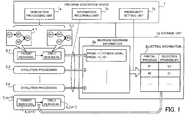
- FIG. 1 illustrates an example of a configuration and processing of a program generation device according to a first embodiment.
- a program generation device 1 includes a generation processing unit 1a, an information recording unit 1b, a probability setting unit 1c, and a storage unit 1d. While the storage unit 1d is illustrated outside the program generation device 1 in FIG. 1 , the storage unit 1d is realized as a storage area in a storage device included in the program generation device 1.
- the generation processing unit 1a generates an image processing program on the basis of genetic programming.
- the generation processing unit 1a generates an image processing program by combining partial programs, each of which is used for performing image processing.
- the generation processing unit 1a determines the combination of partial programs to be included in the image processing program on the basis of genetic programming.
- a plurality of partial programs that can be included in the image processing program is stored in advance in the storage unit 1d.
- the generation processing unit 1a generates a predetermined number of individuals each of which is formed by randomly selecting and combining stored partial programs.
- the generation processing unit 1a evolves the generated individuals and removes individuals having low fitness levels. In this way, the generation processing unit 1a determines an individual formed by an optimized combination of partial programs and outputs this individual as a final image processing program.
- Examples of the evolution processing for evolving the individuals include crossover processing in which partial programs are exchanged between two parent individuals and mutation processing in which another partial program is substituted as a partial program to be included in the next parent individual.
- a partial program to be included in a child individual in the mutation processing is selected randomly (namely, with the same probability) from the partial programs stored in advance.
- a selection probability is set per partial program, a partial program to be included in a child individual is selected according to the set selection probabilities.
- the information recording unit 1b records information indicating a type of partial program that has been changed in number between pre- and post-evolution individuals and indicating difference between fitness levels calculated based on the pre- and post-evolution individuals, respectively, in the storage unit 1d.
- the information recorded in the storage unit 1d by the information recording unit 1b is expressed as "increase-decrease information 2a.”
- a child individual 5_1 is generated from a parent individual 4_1.
- the parent individual 4_1 includes partial programs #1 to #4, and the child individual 5_1 includes partial programs #1 and #3 to #5. Namely, when the parent individual 4_1 evolves to the child individual 5_1, the partial program #2 is removed, and the partial program #5 is newly included.
- the information recording unit 1b records information indicating the partial programs #2 and #5 as the partial programs, each of which has been changed in number as a result of the evolution processing, in the increase-decrease information 2a.
- the information recording unit 1b records a value "-1" in association with the partial program #2 and a value "+1" in association with the partial program #5 in the increase-decrease information 2a. This indicates that one partial program #2 has been subtracted and one partial program #5 has been added as a result of the evolution processing.
- the information recording unit 1b may record only the information about the partial program #5 added as a result of the evolution processing in the increase-decrease information 2a.
- a fitness level calculated based on the child individual 5_1 is larger than a fitness level calculated based on the parent individual 4_1 by "0.1".
- the information recording unit 1b records a value "+0.1" in the increase-decrease information 2a, as the information indicating the difference between the fitness levels calculated based on the pre- and post-evolution individuals. For example, only when the fitness level is increased as a result of evolution processing, the information recording unit 1b may record the information indicating the difference between the fitness levels in the increase-decrease information 2a.
- the probability setting unit 1c determines, per partial program, a contribution level indicating how much an individual partial program contributes to increasing a fitness level, based on the information recorded in the storage unit 1d by the information recording unit 1b within a predetermined time period.
- the probability setting unit 1c sets a selection probability per partial program in such a manner that a partial program having a higher contribution level is given a higher setting value as its selection probability.
- the probability setting unit 1c determines a contribution level per partial program on the basis of the increase-decrease information 2a recorded within the time period in which n times of evolution processing 3_1 to 3_n is performed. Next, on the basis of the determination results, the probability setting unit 1c sets a selection probability per partial program in setting information 2b.
- the generation processing unit 1a selects a partial program to be included in a post-evolution individual in mutation processing on the basis of the selection probabilities set in the setting information 2b. For example, when the generation processing unit 1a performs mutation processing on the parent individual 4_(n + 1) to generate a child individual 5_(n + 1) in the (n + 1)th evolution processing 3_(n + 1), the generation processing unit 1a does not randomly select a partial program to be newly included in the child individual 5_(n + 1) but according to the selection probabilities set in the setting information 2b. In this way, a partial program with a higher selection probability is more likely to be newly included in the child individual in the next mutation processing.
- the probability setting unit 1c can estimate a contribution level indicating how much an individual partial program contributes to increasing a fitness level as follows. For example, when the fitness level has been increased as a result of evolution processing, it can be assumed that a type of partial program that has been increased in number as a result of the evolution processing is likely to have contributed to the increase of the fitness level. In addition, when the fitness level has been increased as a result of evolution processing, it can be assumed that, if more types of partial programs have been increased in number as a result of the evolution processing, each type of partial program has a lower contribution level with respect to the increase of the fitness level. In addition, when the fitness level has been decreased as a result of evolution processing, it can be assumed that a type of partial program been increased in number as a result of the evolution processing is not likely to contribute to increasing the fitness level.
- the probability setting unit 1c sets a selection probability per partial program in such a manner that a partial program having a higher contribution level is given a higher setting value as its selection probability.
- a partial program that is more likely to contribute to increasing the fitness level is more likely to be newly included in a child individual.
- it is more likely that a higher fitness level is calculated based on the generated child individual.
- the program generation device 1 needs less time for the program generation processing while maintaining the quality of the generated image processing program.
- the program generation device 1 With the program generation device 1 according to the present embodiment, even when the number of selectable partial programs is increased, a partial program that is more likely to contribute to increasing the fitness level is selected with a higher probability from these partial programs as the learning progresses. In this way, the fitness level reaches a high value more easily, and the learning is facilitated. Thus, it is more likely that an image processing program that performs high-quality image processing is generated within a short time.
- the image processing device includes the processing functions of the program generation device illustrated in FIG. 1 and includes a function of performing image processing by executing an image processing program generated by the processing functions.
- FIG. 2 illustrates a reference example of a procedure of processing for generating an image processing program.
- the learning data 50 includes an input image 51 and a target image 52, which is obtained by performing image processing on the input image 51.
- the input image 51 can be obtained by capturing an image of a subject with a camera.
- an individual is formed by combining at least one partial program. For example, as illustrated in the top left corner in FIG. 2 , an individual is defined by a tree structure.
- a plurality of partial programs that can be included in individuals is also prepared.
- image filters as examples of the partial programs that can be included in the individuals.
- the examples of the partial programs are not limited to image filters.
- Other programs that perform other kinds of image processing may be used.
- F,” "I,” and "O" represent an image filter, an input terminal, and an output terminal, respectively.
- the processing for generating an image processing program on the basis of genetic programming is performed as follows. First, a group of individuals 61, which is a plurality of initial individuals, is generated (step S11). Image filters are randomly selected from a plurality of prepared image filters and included in an individual one of the initial individuals. Next, two parent individuals are randomly extracted from the group of individuals 61 generated (step S12).
- step S13 by performing evolution processing on these two parent individuals, at least two child individuals are generated (step S13).
- evolution processing crossover processing and mutation processing are performed on the two parent individuals. Different kinds of crossover processing and mutation processing may be performed on each of the two parent individuals, and at least three child individuals may be generated as a result.
- a fitness level is calculated for each of the child individuals generated as a result of the evolution processing and the parent individuals (step S14).
- this processing by performing image processing using an individual one of the individuals on an individual one of the input images 51 in the learning data 50 and comparing an individual image obtained by this image processing with the corresponding target image 52, an individual fitness level is calculated. If a plurality of learning data 50 is used, each one of the individuals is applied to each of the plurality of learning data 50, and an average value of the fitness levels is calculated.
- the program generation processing is ended.
- survival selection is performed from a group of individuals 62 including the generated child individuals and the two original parent individuals (step S15). In this survival selection, an individual with the highest fitness level calculated is selected from the group of individuals 62.
- one individual is selected from the remaining individuals in the group of individuals 62 by using a predetermined method. For example, from the remaining individuals, an individual is selected according to the probabilities based on the fitness levels.
- the two individuals selected by the survival selection are substituted for the two individuals extracted as the parent individuals in the group of individuals 61 (step S16). Consequently, the individuals included in the group of individuals 61 are changed to the next-generation individuals. Next, the like processing is repeated until an individual whose fitness level is the predetermined threshold or more appears.
- the image processing program generated by the above procedure may be used in the field of FA (factory automation). More specifically, the image processing program may be used to obtain a desired effect by performing the corresponding image processing on an image of a product. For example, the image processing may be performed on an image of the exterior of a product, to extract a defective portion or an alignment portion.
- an image processing program When an image processing program is used for such a purpose, for example, if a subject product is changed or modified or if the imaging environment is changed along with the change or modification of a product, an image processing algorithm may need to be reconfigured. Thus, an image processing algorithm that can easily be configured is demanded. In addition, an image processing algorithm having high robustness against change of the imaging environment, such as against change of lighting conditions and variation of the shape, position, or orientation of the subject, is demanded.
- the processing for generating an image processing program on the basis of genetic programming has a problem that the processing takes a long processing time.
- the processing time could be extended, while it is more likely that high quality image processing could be performed.
- image filters are randomly selected in the process of evolving component filters. For example, if an image filter is randomly selected, an image filter that is not suitable for performing desired image processing could be selected. In such an unsuitable image filter is selected, a post-evolution individual having a lower fitness level could be generated. If such an unsuitable image filter is selected many times, since unnecessary evolution processing is performed many times, the learning slows down.
- the image processing device additionally includes processing in addition to the above program generation procedure. More specifically, in the evolution processing, the image processing device is more likely to select an image filter that is more likely to contribute to increasing the fitness level. Thus, the image processing device needs less time for the program generation processing while maintaining the quality of the image processing performed by the generated image processing program. In addition, even when the number of selectable image filters is increased, the chance that the time needed for the program generation processing is extended is reduced.
- FIG. 3 illustrates an example of a hardware configuration of an image processing device.
- an image processing device 100 is realized as a computer as illustrated in FIG. 3 .
- the image processing device 100 is comprehensively controlled by a processor 101.
- the processor 101 may be a multiprocessor. Examples of the processor 101 include a CPU (central processing unit), an MPU (micro processing unit), a DSP (digital signal processor), an ASIC (application specific integrated circuit), and a PLD (programmable logic device).
- the processor 101 may be a combination of at least two elements of a CPU, an MPU, a DSP, an ASIC, and a PLD.
- the processor 101 is connected to a RAM (random access memory) 102 and a plurality of peripheral devices via a bus 109.
- RAM random access memory
- the RAM 102 is used as a main storage device of the image processing device 100. At least part of an OS (operating system) program or an application program executed by the processor 101 is temporarily stored in the RAM 102. In addition, various kinds of data for the processing performed by the processor 101 are stored in the RAM 102.
- peripheral devices connected to the bus 109 include an HDD (hard disk drive) 103, a graphics processing device 104, an input interface 105, a reading device 106, a network interface 107, and a communication interface 108.
- HDD hard disk drive
- the HDD 103 is used as an auxiliary storage device of the image processing device 100.
- An OS program, application programs, and various kinds of data are stored in the HDD 103.
- a different kind of non-volatile storage device such as an SSD (solid state drive) may be used as the auxiliary storage device.
- the graphics processing device 104 is connected to a display device 104a.
- the graphics processing device 104 displays an image on a screen of the display device 104a in accordance with an instruction from the processor 101.
- Examples of the display device include a CRT (cathode ray tube) display device and a liquid crystal display device.
- the input interface 105 is connected to an input device 105a.
- the input interface 105 transmits a signal outputted from the input device 105a to the processor 101.
- Examples of the input device 105a include a keyboard and a pointing device.
- Examples of the pointing device include a mouse, a touch panel, a tablet, a touchpad, and a trackball.
- a portable recording medium 106a can be attached to the reading device 106.
- the reading device 106 reads data recorded in the portable recording medium 106a and transmits the read data to the processor 101.
- Examples of the portable recording medium 106a include an optical disc, a magneto-optical disk, and a semiconductor memory.
- the network interface 107 exchanges data with other devices via a network 107a.
- the communication interface 108 exchanges data with an external device connected thereto.
- a camera 108a as the external device is connected to the communication interface 108.
- the communication interface 108 transmits image data transmitted from the camera 108a to the processor.
- the processing functions of the image processing device 100 may be realized by the above hardware configuration.
- FIG. 4 is a block diagram illustrating a configuration example of the processing functions of the image processing device.
- the image processing device 100 includes an image acquisition unit 111, a learning processing unit 112, an image processing unit 113, a program storage unit 130, a filter set storage unit 140, a learning data storage unit 150, and a fitness level change storage unit 160.
- processing of the image acquisition unit 111 and processing of the learning processing unit 112 are realized by causing the processor 101 of the image processing device 100 to execute predetermined programs.
- the program storage unit 130, the filter set storage unit 140, and the learning data storage unit 150 are realized as storage areas in the HDD 103 of the image processing device 100.
- the fitness level change storage unit 160 is realized as a storage area in the RAM 102 of the image processing device 100.
- the image acquisition unit 111 acquires data of a captured image from the camera 108a and outputs the acquired data to the learning processing unit 112 or the image processing unit 113.
- the learning processing unit 112 generates an image processing program on the basis of genetic programming and stores the generated image processing program in the program storage unit 130.
- Processing of the image processing unit 113 is realized by causing the processor 101 of the image processing device 100 to execute the image processing program stored in the program storage unit 130.
- the image processing unit 113 acquires data of the image captured by the camera 108a via the image acquisition unit 111 and performs image processing on the acquired image data.
- the processed image is displayed by the display device 104a, for example.
- the filter set storage unit 140 holds a plurality of image filter programs that can be selected by the learning processing unit 112. In addition, the filter set storage unit 140 holds selection probabilities associated with the respective image filters.
- the learning data storage unit 150 holds at least one learning data, each of which includes data of an input image and data of a corresponding target image.
- the input image included in the learning data may be an image captured by the camera 108a connected to the image processing device 100.
- a fitness level change table which will be described below, is stored in the fitness level change storage unit 160.
- the fitness level change table is an example of the increase-decrease information 2a illustrated in FIG. 1 .
- the fitness level change table holds information indicating a type of partial program that has been changed in number between parent and child individuals as a result of evolution processing and indicating the difference between fitness levels calculated on the basis of the parent and child individuals, respectively.
- the learning processing unit 112 includes a learning control unit 121, an image processing unit 122, a fitness level calculation unit 123, a fitness level change registration unit 124, and a selection probability setting unit 125.
- the learning control unit 121, the image processing unit 122, and the fitness level calculation unit 123 are examples of the generation processing unit 1a illustrated in FIG. 1 .
- the fitness level change registration unit 124 is an example of the information recording unit 1b illustrated in FIG. 1
- the selection probability setting unit 125 is an example of the probability setting unit 1c illustrated in FIG. 1 .
- the learning control unit 121 comprehensively controls the program generation processing of the learning processing unit 112.
- the image processing unit 122 performs image processing based on an individual generated when the program generation processing is performed on an input image stored in the learning data storage unit 150.
- the fitness level calculation unit 123 compares the processed image with a corresponding target image stored in the learning data storage unit 150 and calculates a fitness level.
- the fitness level change registration unit 124 determines a type of partial program that has been changed in number between parent and child individuals as a result of evolution processing and the difference between the fitness levels calculated on the basis of the parent and child individuals.
- the fitness level change registration unit 124 registers information based on the determination results in the fitness level change storage unit 160.
- the selection probability setting unit 125 calculates a selection probability for each of the image filters registered in the filter set storage unit 140.
- the selection probability setting unit 125 stores the calculated selection probabilities in association with the respective image filters in the filter set storage unit 140.
- FIG. 5 illustrates an example of information registered in a filter set database.
- a filter set database (DB) 141 is an example of the setting information 2b illustrated in FIG. 1 and is stored in the filter set storage unit 140 in FIG. 4 .
- the filter set database 141 a record is registered for each image filter that can be included in an image processing program.
- a program code of the corresponding image filter and a selection probability are registered.
- selection probability the same value is set to all the image filters (for example, a value obtained by dividing a value "1" by the number of registered image filters).
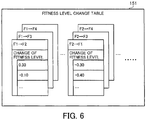
- FIG. 6 illustrates a first example of the fitness level change table. Records are registered in a fitness level change table 151 illustrated in FIG. 6 , and each record indicates a pair of a type of image filter that has been decreased in number and a type of image filter that has been increased in number included in an individual as a result of evolution processing. For example, in FIG. 6 , a record corresponding to "F1 ⁇ F2" indicates that the number of image filters F1 has been decreased and the number of image filters F2 has been increased as a result of evolution processing. This happens, for example, when an image filter F1 included in a parent individual is replaced by an image filter F2 that is added to a child individual.
- change of a fitness level is recorded in each record.
- a fitness level is calculated on the basis of a value obtained by subtracting the fitness level calculated based on a pre-evolution parent individual from the fitness level calculated based on a post-evolution child individual.
- the value indicating the change of the fitness level for example, the above difference may be recorded without change.
- a value obtained by defining the above difference with the number of image filters changed as a result of evolution processing may be recorded. For example, each time evolution processing is performed, the value indicating change of a fitness level is recorded in a corresponding record.
- FIG. 7 illustrates a second example of the fitness level change table.
- a record is registered for each image filter, and a value indicating change of a fitness level is recorded in each record.
- the value indicating change of a fitness level is registered in a corresponding record when the number of corresponding image filters has been increased as a result of evolution processing.
- the value indicating change of a fitness level may be recorded in a corresponding record when the number of corresponding image filters has been decreased as a result of evolution processing.
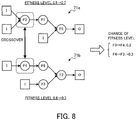
- FIG. 8 illustrates a first example of processing for registering change of fitness levels.
- a parent individual 71a includes image filters F1, F3, and F5
- a parent individual 71b includes image filters F2, F3, F4, and F6.
- crossover processing is performed between the parent individual 71a and the parent individual 71b.
- the fitness level calculated based on the parent individual 71a is "0.5," and the fitness level calculated based on the child individual corresponding to the parent individual 71a is "0.7.”
- the fitness level calculated based on the parent individual 71b is "0.6,” and the fitness level calculated based on the child individual corresponding to the parent individual 71b is "0.3.”
- the fitness level change registration unit 124 registers "0.2" as the value indicating the change of the fitness level in the record corresponding to "F3 ⁇ F4" in the fitness level change table 151 in FIG. 6 .
- the fitness level change registration unit 124 registers "-0.3" as the value indicating the change of the fitness level in the record corresponding to "F4 ⁇ F3" in the fitness level change table 151 in FIG. 6 .
- FIG. 9 illustrates a second example of the processing for registering change of a fitness level.
- a parent individual 72 includes image filters F1, F3, and F5. Mutation processing is performed on the parent individual 72, and a child individual (not illustrated) corresponding to the parent individual 72 is generated.
- the image filter F1 included in the parent individual 72 is replaced by an image filter F2 in the mutation processing.
- the fitness level calculated based on the parent individual 72 is "0.4," and the fitness level calculated based on the child individual corresponding to the parent individual 72 is "0.5.”
- the fitness level change registration unit 124 registers "0.1" as the value indicating the change of the fitness level in the record corresponding to "F1 ⁇ F2" in the fitness level change table 151 in FIG. 6 .
- the registration processing is performed as follows. First, for example, only for the types of image filter that have been increased in number as a result of evolution processing, the change of the fitness level is registered.
- the fitness level change registration unit 124 registers "0.2" as the value indicating the change of the fitness level in the record corresponding to the image filter "F4" and registers "-0.3” as the value indicating the change of the fitness level in the record corresponding to the image filter "F3.”
- the fitness level change registration unit 124 registers "0.1" as the value indicating the change of the fitness level in the record corresponding to the image filter "F2.”
- the change of the fitness level may also be registered.
- these types of image filter can be assumed to have a low contribution level with respect to the change of the fitness level as a result of the evolution processing, as the value indicating the change of the fitness level, for example, a value obtained by inverting the plus or minus of the amount of the change of the fitness level as a result of the evolution processing is registered. In the case in FIG.
- the fitness level change registration unit 124 registers "-0.2" as the value indicating the change of the fitness level in the record corresponding to the image filter "F3" and registers "0.3” as the value indicating the change of the fitness level in the record corresponding to the image filter image filter "F4.” In the case in FIG. 9 , for example, the fitness level change registration unit 124 registers "-0.1" as the value indicating the change of the fitness level in the record corresponding to the image filter "F1.”
- FIGS. 8 and 9 are simple examples in which one image filter is added and one filter is subtracted as a result of evolution processing.
- two or more image filters could be added or subtracted.
- the fitness level change registration unit 124 may calculate the value indicating the change of the fitness level in view of the number of image filters added and the number of image filters subtracted as a result of evolution processing.
- FIG. 10 illustrates an example of change of image filters as a result of evolution processing.
- FIGS. 11 and 12 an example of processing for registering change of a fitness level by using the example in FIG. 10 will be described with reference to FIGS. 11 and 12 .
- FIG. 10 illustrates an example of change of image filters as a result of evolution processing.
- a table 81 in FIG. 10 illustrates an example of configurations of pre- and post-evolution individuals and an example of the change of the fitness level as a result of evolution processing.
- the parent individual includes three image filters F1, two image filters F2, two image filters F3, and three image filters F4.
- the child individual generated by the evolution of this parent individual includes two image filters F1, three image filters F2, two image filters F3, one image filter F4, and three image filters F5.
- the fitness level calculated based on the parent individual is "0.5," and the fitness level calculated based on the child individual is "0.7.”
- the fitness level change registration unit 124 extracts the difference between the number of image filters of an individual type in the pre-evolution individual and the number of image filters of the corresponding type in the post-evolution individual.
- the differences based on the table 81 are extracted as illustrated in the table 82 in FIG. 10 . Namely, as a result of the evolution processing, one image filter F1 has been subtracted, and one image filter F2 has been added. In addition, two image filters F4 have been subtracted, and three image filters F5 have been added. The number of image filters F3 has not been changed.
- FIG. 11 illustrates a third example of the processing for registering change of a fitness level.
- FIG. 11 assumes that the fitness level change registration unit 124 registers change of a fitness level in the fitness level change table 152 in FIG. 7 .
- the fitness level change registration unit 124 calculates the change of the fitness level in accordance with the following formula (1).
- the fitness level change registration unit 124 calculates the change of the fitness level in accordance with the following formula (2).
- Change of fitness level " ⁇ 1 ⁇ " increased amount of fitness level " / " number of types of image filters that have been decreased in number " ⁇ " number of image filters subtracted from target image filter "
- the fitness level change registration unit 124 can more accurately reflect how much each image filter affects the amount of the change of a fitness level as a result of evolution processing on each fitness value to be registered. Consequently, an individual contribution level with respect to the increase of the fitness level can accurately be reflected on the selection probability per image filter, and the chance that the time needed for the program generation processing can be shortened is increased.
- FIG. 12 illustrates a fourth example of the processing for registering change of a fitness level.
- FIG. 12 assumes that the fitness level change registration unit 124 registers change of a fitness level in the fitness level change table 151 in FIG. 6 .
- image filters arranged in the vertical direction are image filters that have been decreased in number as a result of evolution processing
- image filters arranged in the horizontal direction are image filters that have been increased in number as a result of the evolution processing.
- each of the left-side tables in (A) and (C) of FIG. 12 illustrates the number of image filters added
- (B) of FIG. 12 illustrates the number of image filters added and the number of image filters subtracted.
- Each of the right-side tables in (A) to (C) of FIG. 12 illustrates change of a fitness level.
- a combination of any one of the image filters arranged in the vertical direction and any one of the image filters arranged in the horizontal direction forms a single record in the fitness level change table 151.
- a combination of an image filter F1 in the vertical direction and an image filter F2 in the horizontal direction forms a record corresponding to "F1 ⁇ F2" in the fitness level change table 151 (namely, a record indicating that the number of image filters F1 has been decreased and the number of image filters F2 has been increased).
- the fitness level change registration unit 124 calculates the number of filters added that corresponds to the record "F1 ⁇ F2" and the number of filters added that corresponds to the record "F4 ⁇ F2" in such a manner that these numbers match the ratio of the number of image filters F2 subtracted and the number of image filters F4 subtracted with reference to the number "1" of image filters F2 added.
- the fitness level change registration unit 124 calculates "1" and "0.5” as the number of filters added that corresponds to the record "F1 ⁇ F2” and as the number of filters added that corresponds to the record "F4 ⁇ F2,” respectively.
- the fitness level change registration unit 124 calculates the number of filters added that corresponds to the record "F1 ⁇ F5" and the number of filters added that corresponds to the record "F4 ⁇ F5" in such a manner that these numbers match the ratio of the number of image filters F2 subtracted and the number of image filters F4 subtracted with reference to the number "3" of image filters F5 added.
- the fitness level change registration unit 124 calculates "3" and "1.5” as the number of filters added that corresponds to the record "F1 ⁇ F5" and as the number of filters added that corresponds to the record "F4 ⁇ F5,” respectively.
- the fitness level change registration unit 124 calculates the change of the fitness level that corresponds to an individual record, on the basis of the number of filters added that corresponds to an individual record. For example, the fitness level change registration unit 124 defines the increased amount "0.2" of the fitness level by using an individual number of filters added that has been calculated by the above processing.
- the fitness level change registration unit 124 calculates the change of the fitness level to be registered in a record in accordance with the following formula (3) obtained by changing the above formula (1).
- the fitness level change registration unit 124 can more accurately reflect how much each image filter affects the amount of the change of the fitness level as a result of the evolution processing on each fitness value to be registered. Consequently, an individual contribution level with respect to the increase of the fitness level can accurately be reflected on the selection probability per image filter, and the chance that the time needed for the program generation processing can be shortened is increased.
- the selection probability setting unit 125 calculates an effectiveness level per image filter on the basis of the changes of the fitness levels registered in the fitness level change storage unit 160 within a predetermined time. Each effectiveness level is an estimated value indicating how much an image filter is effective in (contributes to) increasing the corresponding fitness level.
- the selection probability setting unit 125 calculates a selection probability per image filter on the basis of the calculated effectiveness levels, and sets the calculated selection probabilities in association with the respective image filters in the filter set database 141.
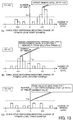
- FIG. 13 illustrates examples of cumulative histograms indicating changes of fitness levels.
- An example of processing for calculating an effectiveness level by using a cumulative histogram indicating change of a fitness level will be described with reference to FIG. 13.
- FIG. 13 assumes using the changes of the fitness levels registered in the fitness level change table 151 in FIG. 6 .
- a value between "0" and "1" is used as the fitness level calculated by evolution processing.
- a first example in (A) of FIG. 13 illustrates a cumulative histogram indicating change of a fitness level registered in a record corresponding to "F1 ⁇ F2" in the fitness level change table 151.
- the peak in the cumulative histogram exists in a region where the change of the fitness level is positive, and the number of times corresponding to the peak is over a predetermined threshold Th1.
- the image filter F2 is estimated to contribute to increasing the fitness level, and the value of the peak position can be thought of as its contribution level.
- the selection probability setting unit 125 calculates the value of the peak position in the cumulative histogram ("0.5" in the example in (A) of FIG. 13 ) as the effectiveness level of the image filter F2.
- the selection probability setting unit 125 may calculate an average value in the cumulative histogram as the effectiveness level of the image filter F2.
- the fitness level change table 151 includes a plurality of records, in each of which the image filter F2 is set as a type of image filter that has been increased in number as a result of evolution processing. For example, when n image filters exist, the fitness level change table 151 includes (n - 1) records corresponding to "F1 ⁇ F2,” “F3 ⁇ F2,” to "Fn ⁇ F2.” The selection probability setting unit 125 determines the value of the peak position in the cumulative histogram from each of the (n-1) records and calculates the average value of all the determined values as the effectiveness level of the image filter F2.
- the selection probability setting unit 125 calculates the selection probability per image filter on the basis of the calculated effectiveness levels.
- the selection probability of this image filter is "1/n.”
- the selection probability of an image filter if the effectiveness level of the image filter is over the average value of the effectiveness levels of all the image filters, the selection probability of the image filter may be set higher than "1/n".
- the selection probability of the image filter may be set lower than "1/n.”
- a second example in (B) of FIG. 13 illustrates a cumulative histogram indicating change of a fitness level registered in a record corresponding to "F2 ⁇ F1" in the fitness level change table 151. While the peak value in the cumulative histogram is over the threshold Th1 in the example in (B) of FIG. 13 , the peak position exists in a region where the change of the fitness level is negative.
- the selection probability setting unit 125 may calculate the value of the peak position in the cumulative histogram as the effectiveness level of the image filter F1. However, when the value of the effectiveness level is low, it is more likely that the image filter F1 that has been increased in number does not contribute to increasing the fitness level.
- the selection probability setting unit 125 may set the selection probability of the target image filter to a predetermined minimum value. In this way, when subsequent evolution processing is performed, an image filter that does not contribute to increasing the fitness level is selected with a lower probability, and the calculated fitness level reaches a high value more quickly.
- the selection probability setting unit 125 may remove such image filters from the selection targets in the evolution processing.
- "0" may be set as the selection probability of these image filters.
- a second example in (C) of FIG. 13 illustrates a cumulative histogram indicating change of a fitness level registered in a record corresponding to "F3 ⁇ F4" in the fitness level change table 151.
- the change of the fitness level registered ranges in a wide region, and no peak values in the cumulative histogram are over the threshold Th1.
- the selection probability setting unit 125 sets the effectiveness level of the image filter F4 to a predetermined minimum value (for example, "-1") and sets a low value as the selection probability of the image filter F4.
- FIG. 13 assumes that the selection probability setting unit 125 uses the cumulative histograms based on the fitness level change table 151 in FIG. 6 , the selection probability setting unit 125 may use cumulative histograms based on the fitness level change table 152 in FIG. 7 .
- FIG. 14 illustrates another example of processing for setting selection probabilities.
- FIG. 14 also assumes that the selection probability setting unit 125 uses the changes of the fitness levels registered in the fitness level change table 151 in FIG. 6 .
- a single record in the fitness level change table 151 is determined by a combination of one of the image filters Fm arranged in the vertical direction and one of the image filters Fn arranged in the horizontal direction.
- the average value of the changes of the fitness levels registered in the corresponding records is set.
- the effectiveness levels of the image filters F1 and F4 are values less than "0."
- the selection probability setting unit 125 may set "0" as the selection probability of the image filter. In this way, the image filter is removed from the selection targets in the evolution processing.
- FIG. 15 is a flowchart illustrating an example of a procedure of program generation processing.
- the learning control unit 121 receives an input operation of setting learning data.
- the learning data used in the present processing is specified from the learning data stored in the learning data storage unit 150.
- the learning control unit 121 receives an input operation of setting a filter set.
- the image filters used in the present processing are specified from the image filters registered in the filter set database 141.
- the learning control unit 121 generates a group of individuals including a predetermined number of individuals. Each individual is generated by randomly selecting and combining image filters from the image filters specified in step S22.
- the group of individuals generated corresponds to the group of individuals 61 illustrated in FIG. 2 , and therefore, this group of individuals will hereinafter be referred to as "the group of individuals 61.”
- Step S24 The learning control unit 121 randomly selects two parent individuals from the individuals included in the group of individuals 61.
- Step S25 By performing crossover processing between the selected two parent individuals, the learning control unit 121 generates a predetermined number of child individuals, which are two or more child individuals.
- Step S26 The learning control unit 121 performs mutation processing on the generated child individuals. In this processing, one of the image filters included in a child individual is replaced with another image filter specified in step S22. The learning control unit 121 selects this substituting image filter on the basis of the selection probabilities associated with the image filters in the filter set database 141. Namely, the selection processing is performed in such a manner that an image filter with a higher selection probability is more likely to be newly included in a child individual in the next mutation processing.
- the fitness level calculation unit 123 calculates the fitness level of each of the parent individuals selected in step S24 and the fitness level of each of the child individuals obtained by the processing in steps S26 and S27. In this processing, each calculation target individual is processed as follows.
- the image processing unit 122 selects one learning data specified in step S21 and applies the processing of the calculation target individual to the input image included in the selected learning data.
- the fitness level calculation unit 123 calculates a fitness level by calculating a conformity level between the image obtained by the processing of the individual and the corresponding target image included in the selected learning data.
- the image processing unit 122 and the fitness level calculation unit 123 perform the above processing on all the learning data specified in step S21.
- the fitness level calculation unit 123 calculates an average value of all the fitness levels calculated and outputs this average value as the fitness level of the calculation target individual.
- Step S28 The learning control unit 121 determines whether the maximal value of the fitness levels of the individuals calculated in step S27 is larger than a predetermined threshold. If the maximal value of the fitness levels is larger than the threshold, the operation proceeds to step S29. However, if the maximal value of the fitness levels is equal to or less than the threshold, the operation proceeds to step S30.
- Step S29 The learning control unit 121 selects the individual with the maximum fitness level from the individuals whose fitness levels have been calculated in step S27.
- the learning control unit 121 stores the image processing program indicated by the selected individual in the program storage unit 130 and ends the program generation processing.
- Step S30 By associating each child individual obtained by the processing in steps S25 and S26 with the original parent individuals corresponding to the child individual, the fitness level change registration unit 124 generates a plurality of pairs of parent and child individuals. The fitness level change registration unit 124 calculates the increase or decrease of the fitness level for each of the pairs of individuals generated. The increase or decrease of the fitness level is calculated as a value obtained by subtracting the fitness level of the parent individual from the fitness level of the child individual.
- the fitness level change registration unit 124 For each of the pairs of individuals generated, the fitness level change registration unit 124 extracts the difference between their filter configurations. In this processing, the fitness level change registration unit 124 determines, per pair, a type of image filter that has been decreased in number between the parent and child individuals, the number of image filters decreased, a type of image filter that has been increased in number between the parent and child individuals, the number of image filters added.
- Step S32 On the basis of the information about the increases and decreases of the fitness levels calculated in step S30 and about the difference between the filter configurations extracted in step S31, the fitness level change registration unit 124 calculates change of the fitness level per image filter and registers these changes in the fitness level change storage unit 160.
- the fitness level change calculation method is as described with reference to FIGS. 8 to 12 .
- a value indicating change of a fitness level is registered in a record given to a combination of a type of image filter that has been decreased in number and a type of image filter that has been increased in number.
- a value indicating change of a fitness level is registered in a record given per image filter.
- Step S33 The learning control unit 121 selects an individual with the highest fitness level as an individual allowed to survive from the parent individuals selected in step S24 and the child individuals obtained by the processing in steps S26 and S27. In addition, the learning control unit 121 selects one more individual allowed to survive from the remaining individuals. In this selection processing, for example, an individual is selected based on the probabilities based on the calculated fitness levels.
- the learning control unit 121 replaces the two individuals selected in step S24 with the two individuals selected as the individual allowed to survive. In this way, the generation of the group of individuals 62 is updated.
- Step S34 The learning control unit 121 determines whether a predetermined time has elapsed. If the predetermined time has elapsed, the operation proceeds to step S35. However, if the predetermined time has not elapsed, the operation proceeds to step S24. After performing step S34, the count value measuring the predetermined time is reset.
- step S34 the learning control unit 121 determines that the predetermined time has elapsed when the processing from step S24 to step S33 has been repeated a predetermined number of times (namely, when evolution processing has been performed for a predetermined number of generations).
- the learning control unit 121 may determine that the predetermined time has elapsed.
- Step S35 On the basis of the changes of the fitness levels registered in the fitness level change storage unit 160 within the predetermined time determined in step S34, the selection probability setting unit 125 calculates an effectiveness level per image filter. The effectiveness level is calculated as described with reference to FIGS. 13 and 14 .
- the selection probability setting unit 125 calculates the selection probabilities of the image filters on the basis of the effectiveness levels calculated in step S35.
- the selection probability setting unit 125 calculates the selection probabilities in accordance with the above formula (4), for example.
- the selection probability setting unit 125 may set "0" as the selection probability for the image filters whose effectiveness level is equal to or less than a predetermined threshold. These image filters whose selection probability has been set to "0" are removed from the selection targets in the subsequent processing in step S26.
- the selection probability setting unit 125 sets the calculated selection probabilities in the filter set database 141.
- the values of the selection probabilities registered in the filter set database 141 are updated by the values of the newly calculated selection probabilities.
- the image processing device 100 accumulates information about changes of fitness levels and changes of filter configurations between pre- and post-evolution individuals and calculates, per image filter, an effectiveness level with respect to the increase of the corresponding fitness level on the basis of the accumulated information.
- the image processing device 100 sets, to each image filter, a selection probability based on the corresponding effectiveness level calculated.
- the image processing device 100 selects an image filter to be included in a child individual in accordance with the set selection probabilities. In this way, in subsequent evolution processing, an image filter that contributes to increasing the fitness level is more likely to be included in a child individual.
- the fitness level is more likely to reach a high value.
- the time needed for processing for generating an image processing program is more likely to be shortened.
- the selection probabilities of the image filters that are estimated to contribute to increasing the corresponding fitness level are increased, the learning rate is increased.
- the chance that an individual solution search ends up in a local solution search is increased.
- the solution searches converge to a local solution that is different from an optimum solution. In such cases, it is a good idea to change the selection of an image filter to random selection again. In this way, the solution search range can be expanded, and the next solution search is performed more comprehensively.
- an image processing device includes a function of switching the selection mode between a selection mode in which an image filter is selected in accordance with the selection probabilities set in the filter set database 141 and a selection mode in which an image filter is randomly selected in evolution processing, in addition to the functions of the image processing device 100 according to the second embodiment.
- the image processing device determines the trend of the transition of the fitness level between parent and child individuals in evolution processing and switches the selection mode on the basis of the determination result.
- a non-random selection mode the selection mode in which an image filter is selected in accordance with the selection probabilities set in the filter set database 141
- a random selection mode the selection mode in which an image filter is randomly selected
- FIG. 16 is a block diagram illustrating a configuration example of processing functions of the image processing device according to the third embodiment.
- the image processing device in FIG. 16 includes the same components as those in FIG. 4 . Thus, these components will be denoted by the same reference characters, and description thereof will be omitted.
- An image processing device 100a illustrated in FIG. 16 is realized by replacing the learning processing unit 112 of the processing functions of the image processing device 100 in FIG. 4 with a learning processing unit 112a and additionally arranging a mode storage unit 170a.
- the mode storage unit 170a includes information indicating which one of the random selection mode and the non-random selection mode is currently set.
- the learning processing unit 112a includes a learning control unit 121a in place of the learning control unit 121 in FIG. 4 . While the learning control unit 121a basically performs the same processing as that of the learning control unit 121 in FIG. 4 , the learning control unit 121a differs from the learning control unit 121 in that the learning control unit 121a selects an image filter in accordance with the selection mode set in the mode storage unit 170a when performing mutation processing.
- the learning processing unit 112a includes a mode setting unit 126a in addition to the image processing unit 122, the fitness level calculation unit 123, the fitness level change registration unit 124, and the selection probability setting unit 125 included in the learning processing unit 112 in FIG. 4 .
- the mode setting unit 126a determines the trend of the transition of the fitness level between parent and child individuals through evolution processing, switches the selection mode on the basis of the determination result, and sets the selection mode in the mode storage unit 170a.
- FIG. 17 illustrates selection mode setting processing.
- FIG. 17 is a graph illustrating transition of the maximal value of the fitness levels (maximum fitness level) calculated in evolution processing.
- a polygonal line L1 which is a dotted line in FIG. 17 indicates the transition of the maximum fitness level when the program generation processing is performed in the non-random selection mode.
- the maximum fitness level does not always continue to increase. For example, as in the period between timing T1 and timing T2 in FIG. 17 , the increase rate could remain at the same level.
- the mode setting unit 126a calculates the increase rate of the maximum fitness level on the basis of the maximum value of the fitness levels calculated in the processing corresponding to a predetermined number of previous generations. If the increase rate of the maximum fitness level is equal to or more than a predetermined threshold (the threshold is over "0"), the mode setting unit 126a sets the selection mode to the non-random mode. If the increase rate is less than the threshold, the mode setting unit 126a sets the selection mode to the random mode. In this way, as illustrated in a polygonal line L2 which is a bold line in FIG. 17 , it is more likely that the period in which the increase rate of the maximum fitness level remains at the same level is shortened. Thus, it is more likely that less time is needed for the maximum fitness level to reach a predetermined target value.
- FIG. 18 is a flowchart illustrating an example of a procedure of program generation processing according to the third embodiment.
- FIGS. 18 and 15 include the same steps. Thus, in FIG. 18 , these steps will be denoted by the same reference characters, and description of the same processing contents will be omitted.
- the processing performed by the learning control unit 121 in FIG. 15 is performed by the learning control unit 121a in FIG. 18 .
- step S26a is performed in place of step S26 in FIG. 15 .
- step S41 is performed between steps S33 and S34 in FIG. 15 .
- Step S26a The learning control unit 121a performs mutation processing on the generated child individuals. In this processing, one of the image filters included in a child individual is replaced with another image filter specified in step S22. In this processing, the learning control unit 121a refers to the mode storage unit 170a and recognizes the current selection mode. If the current selection mode is the random mode, the learning control unit 121a randomly selects a substituting image filter. In contrast, if the current selection mode is the non-random mode, the learning control unit 121a selects a substituting image filter on the basis of the selection probabilities associated with the image filters in the filter set database 141.
- Step S41 The mode setting unit 126a sets the selection mode. This processing will be described with reference to FIG. 19 .
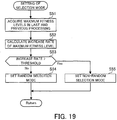
- FIG. 19 is a flowchart illustrating an example of a procedure of the selection mode setting processing.
- the mode setting unit 126a acquires the maximal fitness level calculated in the current-generation processing (namely, the processing in the last step S27) and the maximal value of the fitness levels calculated in the processing corresponding to a predetermined number of previous generations. For example, these maximum fitness levels can be acquired from a log (not illustrated) in which the calculated fitness levels are stored or from the information in the fitness level change storage unit 160.
- the mode setting unit 126a calculates the increase rate of the extracted maximum fitness level.
- the maximum fitness level is calculated by subtracting the maximum fitness level in the previous-generation processing from the maximum fitness level in the current-generation processing and dividing the subtraction result by the difference in the generation number (namely, the number of repetitions of step S27 from the previous generation to the current generation).
- Step S53 The mode setting unit 126a compares the calculated increase rate with a predetermined threshold larger than "0.” If the increase rate is equal to or less than the threshold, step S54 is performed. If the increase rate is over the threshold, step S55 is performed.
- Step S54 The mode setting unit 126a updates the selection mode set in the mode storage unit 170a to the random selection mode.
- Step S55 The mode setting unit 126a updates the selection mode set in the mode storage unit 170a to the non-random selection mode.
- the image processing device 100a determines that the fitness level is steadily increasing, the image processing device 100a selects an image filter used in the next mutation processing according to the selection probabilities set to the respective image filters. However, if the image processing device 100a determines that the increase rate of the maximum fitness level remains at the same level for a while, the image processing device 100a randomly selects an image filter used in the next mutation processing. In this way, the chance that the calculated maximum fitness level increases is increased, and the fitness level reaches a high value more quickly. As a result, the chance that less time is needed for the processing for generating an image processing program is increased.
- the mode setting unit 126a determines whether the increase rate of the maximum fitness level is larger than a threshold. In addition, based on the determination result, the mode setting unit 126a determines whether to select an image filter randomly or according to the set selection probabilities. However, alternatively, the mode setting unit 126a may change weight added to the set selection probabilities, depending on whether the increase rate of the maximum fitness level is larger than a threshold. In this way, when the next mutation processing is performed, an image filter is selected according to the selection probabilities on which the weighting has been performed.
- step S53 in FIG. 19 when the increase rate is less than the threshold, the mode setting unit 126a decreases a value indicating the weight by a predetermined value or ratio. As a result, the selection of an image filter in the next mutation processing is performed more randomly, and the next solution search is performed more comprehensively.
- the mode setting unit 126a increases the value indicating the weight by a predetermined value or ratio. As a result, an image filter determined to have a higher contribution level with respect to the increase of the fitness level is more likely to be selected in the next mutation processing.
- the value indicating the weight is set in the range between "0" and "1.”
- An image processing device differs from the image processing device 100a according to the third embodiment in that the contents of the selection modes and the switching conditions thereof.
- the image processing device according to the fourth embodiment Since the basic configuration of the processing functions of the image processing device according to the fourth embodiment is the same as that according to the third embodiment, the image processing device according to the fourth embodiment will be described by using the reference characters in FIG. 16 .
- FIG. 20 illustrates an example of groups of image filters.
- the image filters registered in the filter set database 141 are classified into groups Fa to Fd.
- the processing contents of the image filters that belong to any one of the groups Fa to Fd are similar to each other.
- Image filters for performing spatial filter processing belong to the group Fa.
- an image filter Fa1 for performing edge extraction an image filter Fa2 for contour enhancement, an image filter Fa3 for performing smoothing, and an image filter Fa4 for performing noise removal belong to the group Fa.
- Image filters for performing shape detection processing belong to the group Fb.
- an image filter Fb1 for performing straight line detection an image filter Fb2 for performing corner detection, an image filter Fb3 for performing circle detection, an image filter Fb4 for performing character detection, and an image filter Fb5 for performing face detection belong to the group Fb.
- Image filter for performing binarization processing belong to the group Fc.
- an image filter Fc1 for performing binarization processing by using a fixed threshold an image filter Fc2 for performing binarization processing by using a variable threshold, an image filter Fc3 for performing binarization processing by using a percentile method, and an image filter Fc4 for performing adaptive binarization processing belong to the group Fc.
- Image filters for processing binary images belong to the group Fd.
- an image filter Fd1 for performing dilation and erosion processing an image filter Fd2 for performing an AND operation, an image filter Fd3 for performing an OR operation, and an image filter Fd4 for performing brightness inversion processing belong to the group Fd.
- the image processing device 100a selects an image filter on the basis of "selection mode 1."
- selection mode 1 the image processing device 100a selects a mutation target image filter on the basis of the selection probabilities of the image filters that belong to the same group as that of the image filter to be replaced.
- the image processing device 100a sets selection mode 2 in which an image filter is selected more randomly than in the selection mode 1.
- selection mode 2 the image processing device 100a selects an image filter on the basis of the selection probabilities of all the image filters. Since this switching from selection mode 1 to selection mode 2 expands the solution search range, it is more likely that the increase of the fitness level is accelerated.
- the image processing device 100b sets selection mode 3 in which an image filter is selected even more randomly.
- selection mode 3 the image processing device 100a randomly selects an image filter from all the image filters. Since this switching from selection mode 2 to selection mode 3 expands the solution search range, it is more likely that the increase of the fitness level is accelerated.
- the program generation processing performed by the image processing device 100a according to the fourth embodiment is realized by changing the processing in step S26a in FIG. 18 to processing in FIG. 21 and changing the processing in step S41 in FIG. 18 to processing in FIG. 22 .
- FIG. 21 is a flowchart illustrating an example of a procedure of mutation processing according to the fourth embodiment.
- the learning control unit 121a refers to the mode storage unit 170a and determines the current selection mode. If the current selection mode is selection mode 1, the operation proceeds to step S62. If the current selection mode is selection mode 2, the operation proceeds to step S63. If the current selection mode is selection mode 3, the operation proceeds to step S64.
- the learning control unit 121a performs mutation processing on a child individual generated in the processing in step S25 in FIG. 18 by replacing an image filter included in the child individual by one of the other image filters specified in step S22. In this operation, the learning control unit 121 selects a substituting image filter as follows.
- the learning control unit 121a selects the group to which the image filter to be replaced belongs.
- the learning control unit 121a selects an image filter on the basis of the probabilities set in the filter set database 141 from the image filters other than the image filter to be replaced.
- the probabilities used when a substituting image filter is selected are calculated as follows. Assuming that the selection probabilities set to the image filters Fa2 to Fa4 are Sa2 to Sa4, respectively, the learning control unit 121a selects the image filters Fa2 to Fa4 with probabilities of Sa2/(Sa2 + Sa3 + Sa4), Sa3/(Sa2 + Sa3 + Sa4), and Sa4/(Sa2 + Sa3 + Sa4), respectively.
- Step S63 The learning control unit 121a selects a substituting image filter on the basis of the selection probabilities associated with image filters in the filter set database 141 from the image filters in all the groups.
- Step S64 The learning control unit 121a randomly selects a substituting image filter from the image filters in all the groups.
- FIG. 22 is a flowchart illustrating an example of a procedure of selection mode setting processing according to the fourth embodiment. Since the processing contents in steps S51 and S52 in FIG. 22 are the same as those in steps S51 and S52 in FIG. 19 , description thereof will be omitted.
- Step S71 The mode setting unit 126a compares the calculated increase rate with the predetermined threshold H (H > 0). If the increase rate is over the threshold H, the operation proceeds to step S72. If the increase rate is not over the threshold H, the operation proceeds to step S73.
- the mode setting unit 126a updates the selection mode set in the mode storage unit 170a to selection mode 1.
- Step S73 The mode setting unit 126a compares the calculated increase rate with the predetermined threshold L (H > L > 0). If the increase rate is over the threshold L, the operation proceeds to step S74. If the increase rate is equal to or less than the threshold L, the operation proceeds to step S74.
- the mode setting unit 126a updates the selection mode set in the mode storage unit 170a to selection mode 2.
- Step S75 The mode setting unit 126a updates the selection mode set in the mode storage unit 170a to selection mode 3.
- the selection mode can be switched among selection modes 1 to 3 in the fourth embodiment, alternatively, the selection mode may be switched between selection modes 1 and 3.
- the processing in FIG. 22 may be modified so that selection mode 1 is set when the increase rate is over the threshold H and selection mode 3 is set when the increase rate is equal to or less than the threshold H.
- the image filters may be grouped as illustrated in FIG. 23 .
- FIG. 23 illustrates another example of grouping image filters.
- FIG. 23 illustrates an example in which image filters are divided into four groups, each of which includes the same kind of image filter having different parameters set.
- Sobel filters having different parameters set belong to a Sobel filter group. For example, a parameter indicating detection of a vertical edge or a horizontal edge and a parameter indicating a kernel size are used.
- Laplacian filters having different parameters set belong to a Laplacian filter group. For example, coefficient sets each indicating a different combination of coefficients and a parameter indicating a kernel size are used.
- Smoothing filters having different parameters set belong to a smoothing filter group.
- a parameter indicating a function for average value calculation or a function as a Gaussian filter and a parameter indicating a kernel size are used.
- Noise removal filters having different parameters set belong to a noise removal filter group.
- a parameter specifying a function as a Median filter or an isolated-point removal filter and a parameter indicating a kernel size are used.
- the fitness level reaches a high value more quickly. As a result, the chance that less time is needed for processing for generating an image processing program is increased.
- the processing functions of each of the devices according to the above embodiments may be realized by a computer.
- a program in which the processing contents of the functions of any one of the devices are written is provided.
- the program in which the processing contents are written may be recorded in a computer-readable recording medium.
- the computer-readable recording medium include a magnetic storage device, an optical disc, a magneto-optical recording medium, and a semiconductor memory.
- the magnetic storage device include an HDD, a flexible disk (FD), and a magnetic tape.
- optical disc examples include a DVD (digital versatile disc), a DVD-RAM, a CD-ROM (compact disc read-only memory), and a CD-R (Recordable)/RW (ReWritable).
- magneto-optical recording medium examples include an MO (magneto-optical disk).
- portable recording media such as DVDs or CD-ROMs in which the program is recorded may be sold.
- the program may be stored in a storage device in a server computer and be forwarded to another computer from the server computer via a network.
- a computer that executes the program stores the program recorded in a portable recording medium or forwarded from the server computer in its storage device. Next, the computer reads the program from its storage device and performs processing in accordance with the program. The computer may directly read the program from the portable recording medium and execute processing in accordance with the program. Each time the program is forwarded from the server computer connected via the network, the computer may execute the processing in accordance with the program received.
Landscapes
- Engineering & Computer Science (AREA)
- Theoretical Computer Science (AREA)
- Physics & Mathematics (AREA)
- Software Systems (AREA)
- General Physics & Mathematics (AREA)
- General Engineering & Computer Science (AREA)
- Biophysics (AREA)
- Life Sciences & Earth Sciences (AREA)
- Health & Medical Sciences (AREA)
- Evolutionary Biology (AREA)
- Bioinformatics & Computational Biology (AREA)
- Bioinformatics & Cheminformatics (AREA)
- Computing Systems (AREA)
- Artificial Intelligence (AREA)
- Mathematical Physics (AREA)
- Data Mining & Analysis (AREA)
- Evolutionary Computation (AREA)
- Computational Linguistics (AREA)
- Molecular Biology (AREA)
- General Health & Medical Sciences (AREA)
- Biomedical Technology (AREA)
- Genetics & Genomics (AREA)
- Physiology (AREA)
- Computer Hardware Design (AREA)
- Quality & Reliability (AREA)
- Probability & Statistics with Applications (AREA)
- Algebra (AREA)
- Mathematical Analysis (AREA)
- Mathematical Optimization (AREA)
- Computational Mathematics (AREA)
- Pure & Applied Mathematics (AREA)
- Image Processing (AREA)
- Stored Programmes (AREA)
- Image Analysis (AREA)
Abstract
Description
- The embodiments discussed herein relates to a program generation apparatus, a program generation method, and a program.
- Techniques of automatically generating an image processing program that performs desired image processing on the basis of genetic programming are drawing attention. In these techniques, an image processing program, which is generated by combining partial programs (for example, image filter programs) for image processing, is optimized by using an input image and an image (a target image) obtained as a result of processing on the basis of genetic programming.
- In relation to this, for example, there has been proposed a technique relating to processing for generating a processing program. In this technique, when more nodes are used in the processing program, a smaller value is calculated as a fitness level used in genetic programming.
- As an example of a technique of generating an image processing procedure, there has been proposed a technique in which image processing procedures, each of which has a high fitness level, are crossed with one another.
-
- PTL 1: Japanese Laid-open Patent Publication No.
2006-178857 - PTL 2: International Publication Pamphlet No.
WO2006/001107 - NPTL 1: Shinya Aoki and Tomoharu Nagao, "ACTIT: Automatic Construction of Tree-structural Image Transformations," The Journal of The institute of Image Information and Television Engineers, Vol.53, No.6, June 20, 1999, p.890-892
- The above processing in which an image processing program is automatically generated on the basis of genetic programming has a problem that much time is needed for the program generation processing. For example, in the case of the above processing, if more selectable partial programs are prepared, it is more likely that high-quality image processing is performed. However, it is also more likely that much time is needed for a fitness level calculated during processing to reach a high value. As a result, it is more likely that more time is needed to complete the program generation processing.
- According to one aspect, it is an object of the embodiments to provide a program generation apparatus, a program generation method, and a program that are capable of shortening the time needed to generate an image processing program.
- According to one aspect, there is provided a program generation apparatus that generates an image processing program by determining, based on genetic programming, a combination of partial programs to be included in the image processing program. The program generation apparatus includes an information recording unit and a probability setting unit. Each time evolution processing for evolving an individual formed by a combination of partial programs is performed, the information recording unit records information indicating a type of partial program that has been changed in number between pre- and post-evolution individuals and indicating difference between fitness levels calculated based on the pre- and post-evolution individuals, respectively, in a storage unit. The probability setting unit determines, per partial program, a contribution level indicating how much an individual partial program contributes to increasing a fitness level, based on the information stored in the storage unit within a predetermined time period, and sets a selection probability per partial program in such a manner that a partial program having a higher contribution level determined is given a higher setting value as its selection probability. After the probability setting unit sets the selection probability per partial program, when the evolution processing is performed, the program generation apparatus selects a partial program to be included in a post-evolution individual in mutation processing according to the set selection probabilities.
- According to another aspect, there is provided a program generation method for performing the same processing as that performed by the above program generation apparatus.
- According to yet another aspect, there is provided a program for causing a computer to perform the same processing as that performed by the above program generation apparatus.
- According to one aspect, the time needed to generate an image processing program is shortened.
- The above object and other objects, features, and advantages of the embodiments will be made apparent with reference to the accompanying drawings illustrating the embodiments as suitable examples and the following description related to the embodiments.
-
- [
FIG. 1] FIG. 1 illustrates an example of a configuration and processing of a program generation device according to a first embodiment. - [
FIG. 2] FIG. 2 illustrates a reference example of a procedure of processing for generating an image processing program. - [
FIG. 3] FIG. 3 illustrates an example of a hardware configuration of an image processing device. - [
FIG. 4] FIG. 4 is a block diagram illustrating a configuration example of processing functions of the image processing device. - [
FIG. 5] FIG. 5 illustrates an example of information registered in a filter set database. - [
FIG. 6] FIG. 6 illustrates a first example of a fitness level change table. - [
FIG. 7] FIG. 7 illustrates a second example of the fitness level change table. - [
FIG. 8] FIG. 8 illustrates a first example of processing for registering change of fitness levels. - [
FIG. 9] FIG. 9 illustrates a second example of the processing for registering change of a fitness level. - [
FIG. 10] FIG. 10 illustrates an example of change of image filters as a result of evolution processing. - [
FIG. 11] FIG. 11 illustrates a third example of the processing for registering change of a fitness level. - [
FIG. 12] FIG. 12 illustrates a fourth example of the processing for registering change of a fitness level. - [
FIG. 13] FIG. 13 illustrates examples of cumulative histograms indicating changes of fitness levels. - [
FIG. 14] FIG. 14 illustrates another example of processing for setting selection probabilities. - [
FIG. 15] FIG. 15 is a flowchart illustrating an example of a procedure of program generation processing. - [
FIG. 16] FIG. 16 is a block diagram illustrating a configuration example of processing functions of an image processing device according to a third embodiment. - [
FIG. 17] FIG. 17 illustrates selection mode setting processing. - [
FIG. 18] FIG. 18 is a flowchart illustrating an example of a procedure of program generation processing according to the third embodiment. - [
FIG. 19] FIG. 19 is a flowchart illustrating an example of a procedure of the selection mode setting processing. - [
FIG. 20] FIG. 20 illustrates an example of grouping image filters. - [
FIG. 21] FIG. 21 is a flowchart illustrating an example of a procedure of mutation processing according to a fourth embodiment. - [
FIG. 22] FIG. 22 is a flowchart illustrating an example of a procedure of selection mode setting processing according to the fourth embodiment. - [
FIG. 23] FIG. 23 illustrates another example of grouping image filters. - Several embodiments will be described below with reference to the accompanying drawings, wherein like reference characters refer to like elements throughout.
-
FIG. 1 illustrates an example of a configuration and processing of a program generation device according to a first embodiment. Aprogram generation device 1 includes ageneration processing unit 1a, aninformation recording unit 1b, aprobability setting unit 1c, and astorage unit 1d. While thestorage unit 1d is illustrated outside theprogram generation device 1 inFIG. 1 , thestorage unit 1d is realized as a storage area in a storage device included in theprogram generation device 1. - The
generation processing unit 1a generates an image processing program on the basis of genetic programming. Thegeneration processing unit 1a generates an image processing program by combining partial programs, each of which is used for performing image processing. Thegeneration processing unit 1a determines the combination of partial programs to be included in the image processing program on the basis of genetic programming. - For example, a plurality of partial programs that can be included in the image processing program is stored in advance in the
storage unit 1d. For example, thegeneration processing unit 1a generates a predetermined number of individuals each of which is formed by randomly selecting and combining stored partial programs. Next, thegeneration processing unit 1a evolves the generated individuals and removes individuals having low fitness levels. In this way, thegeneration processing unit 1a determines an individual formed by an optimized combination of partial programs and outputs this individual as a final image processing program. - Examples of the evolution processing for evolving the individuals include crossover processing in which partial programs are exchanged between two parent individuals and mutation processing in which another partial program is substituted as a partial program to be included in the next parent individual. In an initial state, a partial program to be included in a child individual in the mutation processing is selected randomly (namely, with the same probability) from the partial programs stored in advance. As will be described below, after a selection probability is set per partial program, a partial program to be included in a child individual is selected according to the set selection probabilities.
- Each time the
generation processing unit 1a performs evolution processing, theinformation recording unit 1b records information indicating a type of partial program that has been changed in number between pre- and post-evolution individuals and indicating difference between fitness levels calculated based on the pre- and post-evolution individuals, respectively, in thestorage unit 1d. InFIG. 1 , the information recorded in thestorage unit 1d by theinformation recording unit 1b is expressed as "increase-decrease information 2a." - For example, as illustrated in
FIG. 1 , in evolution processing 3_1, a child individual 5_1 is generated from a parent individual 4_1. The parent individual 4_1 includespartial programs # 1 to #4, and the child individual 5_1 includespartial programs # 1 and #3 to #5. Namely, when the parent individual 4_1 evolves to the child individual 5_1, thepartial program # 2 is removed, and thepartial program # 5 is newly included. - In this case, for example, the
information recording unit 1b records information indicating thepartial programs # 2 and #5 as the partial programs, each of which has been changed in number as a result of the evolution processing, in the increase-decrease information 2a. In the example inFIG. 1 , theinformation recording unit 1b records a value "-1" in association with thepartial program # 2 and a value "+1" in association with thepartial program # 5 in the increase-decrease information 2a. This indicates that onepartial program # 2 has been subtracted and onepartial program # 5 has been added as a result of the evolution processing. Theinformation recording unit 1b may record only the information about thepartial program # 5 added as a result of the evolution processing in the increase-decrease information 2a. - In addition, in the evolution processing 3_1, a fitness level calculated based on the child individual 5_1 is larger than a fitness level calculated based on the parent individual 4_1 by "0.1". In this case, for example, the
information recording unit 1b records a value "+0.1" in the increase-decrease information 2a, as the information indicating the difference between the fitness levels calculated based on the pre- and post-evolution individuals. For example, only when the fitness level is increased as a result of evolution processing, theinformation recording unit 1b may record the information indicating the difference between the fitness levels in the increase-decrease information 2a. - The
probability setting unit 1c determines, per partial program, a contribution level indicating how much an individual partial program contributes to increasing a fitness level, based on the information recorded in thestorage unit 1d by theinformation recording unit 1b within a predetermined time period. Theprobability setting unit 1c sets a selection probability per partial program in such a manner that a partial program having a higher contribution level is given a higher setting value as its selection probability. - For example, as illustrated in
FIG. 1 , theprobability setting unit 1c determines a contribution level per partial program on the basis of the increase-decrease information 2a recorded within the time period in which n times of evolution processing 3_1 to 3_n is performed. Next, on the basis of the determination results, theprobability setting unit 1c sets a selection probability per partial program in setting information 2b. - After the
probability setting unit 1c sets the setting information 2b, when thegeneration processing unit 1a performs evolution processing, thegeneration processing unit 1a selects a partial program to be included in a post-evolution individual in mutation processing on the basis of the selection probabilities set in the setting information 2b. For example, when thegeneration processing unit 1a performs mutation processing on the parent individual 4_(n + 1) to generate a child individual 5_(n + 1) in the (n + 1)th evolution processing 3_(n + 1), thegeneration processing unit 1a does not randomly select a partial program to be newly included in the child individual 5_(n + 1) but according to the selection probabilities set in the setting information 2b. In this way, a partial program with a higher selection probability is more likely to be newly included in the child individual in the next mutation processing. - On the basis of the increase-
decrease information 2a recorded in thestorage unit 1d within the predetermined time period, theprobability setting unit 1c can estimate a contribution level indicating how much an individual partial program contributes to increasing a fitness level as follows. For example, when the fitness level has been increased as a result of evolution processing, it can be assumed that a type of partial program that has been increased in number as a result of the evolution processing is likely to have contributed to the increase of the fitness level. In addition, when the fitness level has been increased as a result of evolution processing, it can be assumed that, if more types of partial programs have been increased in number as a result of the evolution processing, each type of partial program has a lower contribution level with respect to the increase of the fitness level. In addition, when the fitness level has been decreased as a result of evolution processing, it can be assumed that a type of partial program been increased in number as a result of the evolution processing is not likely to contribute to increasing the fitness level. - On the basis of these contribution levels determined in this way, the
probability setting unit 1c sets a selection probability per partial program in such a manner that a partial program having a higher contribution level is given a higher setting value as its selection probability. In this way, when performing mutation processing subsequently, a partial program that is more likely to contribute to increasing the fitness level is more likely to be newly included in a child individual. As a result, it is more likely that a higher fitness level is calculated based on the generated child individual. In addition, by repeating evolution processing in this way, the fitness level reaches a higher value more easily, and the learning is facilitated. Thus, theprogram generation device 1 needs less time for the program generation processing while maintaining the quality of the generated image processing program. - In the processing for generating an image processing program on the basis of genetic programming, when more selectable partial programs are prepared, it is more likely that the generated image processing program performs image processing with higher quality. However, since the fitness level does not easily reach a high value, it is more likely that more time is needed for the program generation processing.
- With the
program generation device 1 according to the present embodiment, even when the number of selectable partial programs is increased, a partial program that is more likely to contribute to increasing the fitness level is selected with a higher probability from these partial programs as the learning progresses. In this way, the fitness level reaches a high value more easily, and the learning is facilitated. Thus, it is more likely that an image processing program that performs high-quality image processing is generated within a short time. - Next, an image processing device according to a second embodiment will be described. The image processing device according to the second embodiment includes the processing functions of the program generation device illustrated in
FIG. 1 and includes a function of performing image processing by executing an image processing program generated by the processing functions. - In the following description, first, a reference example indicating a basic procedure of processing for generating an image processing program on the basis of genetic programming will be described with reference to
FIG. 2 . Next, the image processing device according to the second embodiment will be described. -
FIG. 2 illustrates a reference example of a procedure of processing for generating an image processing program. - Before the processing for generating an image processing program is started, at least one
learning data 50 is prepared. The learningdata 50 includes aninput image 51 and atarget image 52, which is obtained by performing image processing on theinput image 51. For example, theinput image 51 can be obtained by capturing an image of a subject with a camera. - In the processing for generating an image processing program on the basis of genetic programming, an individual is formed by combining at least one partial program. For example, as illustrated in the top left corner in
FIG. 2 , an individual is defined by a tree structure. - A plurality of partial programs that can be included in individuals is also prepared. The following description assumes image filters as examples of the partial programs that can be included in the individuals. However, the examples of the partial programs are not limited to image filters. Other programs that perform other kinds of image processing may be used. In the top left corner in
FIG. 2 , "F," "I," and "O" represent an image filter, an input terminal, and an output terminal, respectively. - For example, the processing for generating an image processing program on the basis of genetic programming is performed as follows. First, a group of
individuals 61, which is a plurality of initial individuals, is generated (step S11). Image filters are randomly selected from a plurality of prepared image filters and included in an individual one of the initial individuals. Next, two parent individuals are randomly extracted from the group ofindividuals 61 generated (step S12). - Next, by performing evolution processing on these two parent individuals, at least two child individuals are generated (step S13). In the evolution processing, crossover processing and mutation processing are performed on the two parent individuals. Different kinds of crossover processing and mutation processing may be performed on each of the two parent individuals, and at least three child individuals may be generated as a result.
- Next, a fitness level is calculated for each of the child individuals generated as a result of the evolution processing and the parent individuals (step S14). In this processing, by performing image processing using an individual one of the individuals on an individual one of the
input images 51 in the learningdata 50 and comparing an individual image obtained by this image processing with thecorresponding target image 52, an individual fitness level is calculated. If a plurality of learningdata 50 is used, each one of the individuals is applied to each of the plurality of learningdata 50, and an average value of the fitness levels is calculated. - If the fitness level of any one of the individuals is a predetermined threshold or more, that individual is outputted as a final image processing program, and the program generation processing is ended. However, if the fitness levels of all the individuals are less than the predetermined threshold, survival selection is performed from a group of
individuals 62 including the generated child individuals and the two original parent individuals (step S15). In this survival selection, an individual with the highest fitness level calculated is selected from the group ofindividuals 62. In addition, one individual is selected from the remaining individuals in the group ofindividuals 62 by using a predetermined method. For example, from the remaining individuals, an individual is selected according to the probabilities based on the fitness levels. - The two individuals selected by the survival selection are substituted for the two individuals extracted as the parent individuals in the group of individuals 61 (step S16). Consequently, the individuals included in the group of
individuals 61 are changed to the next-generation individuals. Next, the like processing is repeated until an individual whose fitness level is the predetermined threshold or more appears. - For example, the image processing program generated by the above procedure may be used in the field of FA (factory automation). More specifically, the image processing program may be used to obtain a desired effect by performing the corresponding image processing on an image of a product. For example, the image processing may be performed on an image of the exterior of a product, to extract a defective portion or an alignment portion.
- When an image processing program is used for such a purpose, for example, if a subject product is changed or modified or if the imaging environment is changed along with the change or modification of a product, an image processing algorithm may need to be reconfigured. Thus, an image processing algorithm that can easily be configured is demanded. In addition, an image processing algorithm having high robustness against change of the imaging environment, such as against change of lighting conditions and variation of the shape, position, or orientation of the subject, is demanded.
- If genetic programming is used, only by preparing at least one
input image 51 and at least onecorresponding target image 52, an image processing program that can be used for the above purposes can easily be generated. In addition, by preparing a plurality of pairs of learningdata 50, each pair including aninput image 51 and atarget image 52, theinput images 51 having been captured in different imaging environments, an image processing algorithm with high robustness against change of the imaging environment can automatically be generated. - However, the processing for generating an image processing program on the basis of genetic programming has a problem that the processing takes a long processing time. In particular, if more selectable image filters are prepared, it is more likely that convergence of the learning could be more difficult and that the processing time could be extended, while it is more likely that high quality image processing could be performed.
- One conceivable reason why the processing time could be extended is that image filters are randomly selected in the process of evolving component filters. For example, if an image filter is randomly selected, an image filter that is not suitable for performing desired image processing could be selected. In such an unsuitable image filter is selected, a post-evolution individual having a lower fitness level could be generated. If such an unsuitable image filter is selected many times, since unnecessary evolution processing is performed many times, the learning slows down.
- Thus, the image processing device according to the second embodiment additionally includes processing in addition to the above program generation procedure. More specifically, in the evolution processing, the image processing device is more likely to select an image filter that is more likely to contribute to increasing the fitness level. Thus, the image processing device needs less time for the program generation processing while maintaining the quality of the image processing performed by the generated image processing program. In addition, even when the number of selectable image filters is increased, the chance that the time needed for the program generation processing is extended is reduced.
- Hereinafter, the image processing device according to the second embodiment will be described in detail.
-
FIG. 3 illustrates an example of a hardware configuration of an image processing device. For example, animage processing device 100 is realized as a computer as illustrated inFIG. 3 . - The
image processing device 100 is comprehensively controlled by aprocessor 101. Theprocessor 101 may be a multiprocessor. Examples of theprocessor 101 include a CPU (central processing unit), an MPU (micro processing unit), a DSP (digital signal processor), an ASIC (application specific integrated circuit), and a PLD (programmable logic device). Theprocessor 101 may be a combination of at least two elements of a CPU, an MPU, a DSP, an ASIC, and a PLD. - The
processor 101 is connected to a RAM (random access memory) 102 and a plurality of peripheral devices via abus 109. - The
RAM 102 is used as a main storage device of theimage processing device 100. At least part of an OS (operating system) program or an application program executed by theprocessor 101 is temporarily stored in theRAM 102. In addition, various kinds of data for the processing performed by theprocessor 101 are stored in theRAM 102. - Examples of the peripheral devices connected to the
bus 109 include an HDD (hard disk drive) 103, agraphics processing device 104, aninput interface 105, areading device 106, anetwork interface 107, and acommunication interface 108. - The
HDD 103 is used as an auxiliary storage device of theimage processing device 100. An OS program, application programs, and various kinds of data are stored in theHDD 103. A different kind of non-volatile storage device such as an SSD (solid state drive) may be used as the auxiliary storage device. - The
graphics processing device 104 is connected to adisplay device 104a. Thegraphics processing device 104 displays an image on a screen of thedisplay device 104a in accordance with an instruction from theprocessor 101. Examples of the display device include a CRT (cathode ray tube) display device and a liquid crystal display device. - The
input interface 105 is connected to aninput device 105a. Theinput interface 105 transmits a signal outputted from theinput device 105a to theprocessor 101. Examples of theinput device 105a include a keyboard and a pointing device. Examples of the pointing device include a mouse, a touch panel, a tablet, a touchpad, and a trackball. - A
portable recording medium 106a can be attached to thereading device 106. Thereading device 106 reads data recorded in theportable recording medium 106a and transmits the read data to theprocessor 101. Examples of theportable recording medium 106a include an optical disc, a magneto-optical disk, and a semiconductor memory. - The
network interface 107 exchanges data with other devices via anetwork 107a. - The
communication interface 108 exchanges data with an external device connected thereto. In the present embodiment, acamera 108a as the external device is connected to thecommunication interface 108. Thecommunication interface 108 transmits image data transmitted from thecamera 108a to the processor. - The processing functions of the
image processing device 100 may be realized by the above hardware configuration. -
FIG. 4 is a block diagram illustrating a configuration example of the processing functions of the image processing device. Theimage processing device 100 includes animage acquisition unit 111, alearning processing unit 112, animage processing unit 113, aprogram storage unit 130, a filter setstorage unit 140, a learningdata storage unit 150, and a fitness levelchange storage unit 160. - For example, processing of the
image acquisition unit 111 and processing of thelearning processing unit 112 are realized by causing theprocessor 101 of theimage processing device 100 to execute predetermined programs. For example, theprogram storage unit 130, the filter setstorage unit 140, and the learningdata storage unit 150 are realized as storage areas in theHDD 103 of theimage processing device 100. For example, the fitness levelchange storage unit 160 is realized as a storage area in theRAM 102 of theimage processing device 100. - The
image acquisition unit 111 acquires data of a captured image from thecamera 108a and outputs the acquired data to thelearning processing unit 112 or theimage processing unit 113. - The
learning processing unit 112 generates an image processing program on the basis of genetic programming and stores the generated image processing program in theprogram storage unit 130. - Processing of the
image processing unit 113 is realized by causing theprocessor 101 of theimage processing device 100 to execute the image processing program stored in theprogram storage unit 130. Theimage processing unit 113 acquires data of the image captured by thecamera 108a via theimage acquisition unit 111 and performs image processing on the acquired image data. The processed image is displayed by thedisplay device 104a, for example. - The filter set
storage unit 140 holds a plurality of image filter programs that can be selected by thelearning processing unit 112. In addition, the filter setstorage unit 140 holds selection probabilities associated with the respective image filters. - The learning
data storage unit 150 holds at least one learning data, each of which includes data of an input image and data of a corresponding target image. For example, the input image included in the learning data may be an image captured by thecamera 108a connected to theimage processing device 100. - A fitness level change table, which will be described below, is stored in the fitness level
change storage unit 160. The fitness level change table is an example of the increase-decrease information 2a illustrated inFIG. 1 . The fitness level change table holds information indicating a type of partial program that has been changed in number between parent and child individuals as a result of evolution processing and indicating the difference between fitness levels calculated on the basis of the parent and child individuals, respectively. - The
learning processing unit 112 includes alearning control unit 121, animage processing unit 122, a fitnesslevel calculation unit 123, a fitness levelchange registration unit 124, and a selectionprobability setting unit 125. Thelearning control unit 121, theimage processing unit 122, and the fitnesslevel calculation unit 123 are examples of thegeneration processing unit 1a illustrated inFIG. 1 . The fitness levelchange registration unit 124 is an example of theinformation recording unit 1b illustrated inFIG. 1 , and the selectionprobability setting unit 125 is an example of theprobability setting unit 1c illustrated inFIG. 1 . - The
learning control unit 121 comprehensively controls the program generation processing of thelearning processing unit 112. - The
image processing unit 122 performs image processing based on an individual generated when the program generation processing is performed on an input image stored in the learningdata storage unit 150. - When the
image processing unit 122 performs the processing on the input image, the fitnesslevel calculation unit 123 compares the processed image with a corresponding target image stored in the learningdata storage unit 150 and calculates a fitness level. - The fitness level
change registration unit 124 determines a type of partial program that has been changed in number between parent and child individuals as a result of evolution processing and the difference between the fitness levels calculated on the basis of the parent and child individuals. The fitness levelchange registration unit 124 registers information based on the determination results in the fitness levelchange storage unit 160. - On the basis of the information registered in the fitness level
change storage unit 160 within a predetermined time period, the selectionprobability setting unit 125 calculates a selection probability for each of the image filters registered in the filter setstorage unit 140. The selectionprobability setting unit 125 stores the calculated selection probabilities in association with the respective image filters in the filter setstorage unit 140. -
FIG. 5 illustrates an example of information registered in a filter set database. A filter set database (DB) 141 is an example of the setting information 2b illustrated inFIG. 1 and is stored in the filter setstorage unit 140 inFIG. 4 . - In the filter set
database 141, a record is registered for each image filter that can be included in an image processing program. In each record, a program code of the corresponding image filter and a selection probability are registered. In an initial state, under the column "selection probability," the same value is set to all the image filters (for example, a value obtained by dividing a value "1" by the number of registered image filters). - Next, two examples of the fitness level change table registered in the fitness level
change storage unit 160 will be described. -
FIG. 6 illustrates a first example of the fitness level change table. Records are registered in a fitness level change table 151 illustrated inFIG. 6 , and each record indicates a pair of a type of image filter that has been decreased in number and a type of image filter that has been increased in number included in an individual as a result of evolution processing. For example, inFIG. 6 , a record corresponding to "F1→F2" indicates that the number of image filters F1 has been decreased and the number of image filters F2 has been increased as a result of evolution processing. This happens, for example, when an image filter F1 included in a parent individual is replaced by an image filter F2 that is added to a child individual. - In addition, change of a fitness level is recorded in each record. A fitness level is calculated on the basis of a value obtained by subtracting the fitness level calculated based on a pre-evolution parent individual from the fitness level calculated based on a post-evolution child individual. As the value indicating the change of the fitness level, for example, the above difference may be recorded without change. Alternatively, as will be described below, a value obtained by defining the above difference with the number of image filters changed as a result of evolution processing may be recorded. For example, each time evolution processing is performed, the value indicating change of a fitness level is recorded in a corresponding record.
-
FIG. 7 illustrates a second example of the fitness level change table. In a fitness level change table 152 illustrated inFIG. 7 , unlike the example inFIG. 6 , a record is registered for each image filter, and a value indicating change of a fitness level is recorded in each record. For example, the value indicating change of a fitness level is registered in a corresponding record when the number of corresponding image filters has been increased as a result of evolution processing. The value indicating change of a fitness level may be recorded in a corresponding record when the number of corresponding image filters has been decreased as a result of evolution processing. - Next, an example of how the fitness level
change registration unit 124 registers change of a fitness level by using the above fitness level change table 151 or 152 will be described. First, an example of processing for registering change of a fitness level performed when image filters have been changed as a result of evolution processing will be described with referenceFIGS. 8 and9 . -
FIG. 8 illustrates a first example of processing for registering change of fitness levels. InFIG. 8 , a parent individual 71a includes image filters F1, F3, and F5, and aparent individual 71b includes image filters F2, F3, F4, and F6. By performing crossover processing between the parent individual 71a and theparent individual 71b, child individuals (not illustrated) corresponding to therespective parent individuals FIG. 8 , crossover processing is performed between the image filter F3 included in the parent individual 71a and the image filter F4 included in theparent individual 71b. - In addition, the fitness level calculated based on the parent individual 71a is "0.5," and the fitness level calculated based on the child individual corresponding to the parent individual 71a is "0.7." In addition, the fitness level calculated based on the
parent individual 71b is "0.6," and the fitness level calculated based on the child individual corresponding to theparent individual 71b is "0.3." - In this case in the
FIG. 8 , as a result of the evolution processing on the parent individual 71a, the number of image filters F3 has been decreased by one, the number of image filters F4 has been increased by one, and the fitness level has been increased by "0.2." Thus, for example, the fitness levelchange registration unit 124 registers "0.2" as the value indicating the change of the fitness level in the record corresponding to "F3→F4" in the fitness level change table 151 inFIG. 6 . - In addition, in the case in
FIG. 8 , as a result of the evolution processing on theparent individual 71b, the number of image filters F4 has been decreased by one, the number of image filters F3 has been increased by one, and the fitness level has been decreased by "0.3." Thus, for example, the fitness levelchange registration unit 124 registers "-0.3" as the value indicating the change of the fitness level in the record corresponding to "F4→F3" in the fitness level change table 151 inFIG. 6 . -
FIG. 9 illustrates a second example of the processing for registering change of a fitness level. InFIG. 9 , aparent individual 72 includes image filters F1, F3, and F5. Mutation processing is performed on theparent individual 72, and a child individual (not illustrated) corresponding to theparent individual 72 is generated. In the example inFIG. 9 , the image filter F1 included in theparent individual 72 is replaced by an image filter F2 in the mutation processing. In addition, the fitness level calculated based on theparent individual 72 is "0.4," and the fitness level calculated based on the child individual corresponding to theparent individual 72 is "0.5." - In this case in
FIG. 9 , as a result of the evolution on theparent individual 72, the number of image filters F1 has been decreased by one, the number of image filters F2 has been increased by one, and the fitness level has been increased by "0.1." Thus, for example, the fitness levelchange registration unit 124 registers "0.1" as the value indicating the change of the fitness level in the record corresponding to "F1→F2" in the fitness level change table 151 inFIG. 6 . - When the fitness level change table 152 in
FIG. 7 is used, in the cases inFIGS. 7 and8 , for example, the registration processing is performed as follows. First, for example, only for the types of image filter that have been increased in number as a result of evolution processing, the change of the fitness level is registered. In the case inFIG. 8 , the fitness levelchange registration unit 124 registers "0.2" as the value indicating the change of the fitness level in the record corresponding to the image filter "F4" and registers "-0.3" as the value indicating the change of the fitness level in the record corresponding to the image filter "F3." In the case inFIG. 9 , the fitness levelchange registration unit 124 registers "0.1" as the value indicating the change of the fitness level in the record corresponding to the image filter "F2." - In addition, for the types of image filter that have been decreased in number as a result of the evolution processing, the change of the fitness level may also be registered. In this case, since these types of image filter can be assumed to have a low contribution level with respect to the change of the fitness level as a result of the evolution processing, as the value indicating the change of the fitness level, for example, a value obtained by inverting the plus or minus of the amount of the change of the fitness level as a result of the evolution processing is registered. In the case in
FIG. 8 , for example, the fitness levelchange registration unit 124 registers "-0.2" as the value indicating the change of the fitness level in the record corresponding to the image filter "F3" and registers "0.3" as the value indicating the change of the fitness level in the record corresponding to the image filter image filter "F4." In the case inFIG. 9 , for example, the fitness levelchange registration unit 124 registers "-0.1" as the value indicating the change of the fitness level in the record corresponding to the image filter "F1." - The above examples in
FIGS. 8 and9 are simple examples in which one image filter is added and one filter is subtracted as a result of evolution processing. However, in actual evolution processing, for example, when crossover processing is performed, two or more image filters could be added or subtracted. For example, when two image filters have been added as a result of evolution processing and when the fitness level has been increased by "0.2," each of the added two image filters can be assumed to have contributed to half of the increase "0.2" of the fitness level. The fitness levelchange registration unit 124 may calculate the value indicating the change of the fitness level in view of the number of image filters added and the number of image filters subtracted as a result of evolution processing. - In the following description, first,
FIG. 10 illustrates an example of change of image filters as a result of evolution processing. Next, an example of processing for registering change of a fitness level by using the example inFIG. 10 will be described with reference toFIGS. 11 and12 . -
FIG. 10 illustrates an example of change of image filters as a result of evolution processing. A table 81 inFIG. 10 illustrates an example of configurations of pre- and post-evolution individuals and an example of the change of the fitness level as a result of evolution processing. In the example in the table 81, the parent individual includes three image filters F1, two image filters F2, two image filters F3, and three image filters F4. In addition, the child individual generated by the evolution of this parent individual includes two image filters F1, three image filters F2, two image filters F3, one image filter F4, and three image filters F5. In addition, the fitness level calculated based on the parent individual is "0.5," and the fitness level calculated based on the child individual is "0.7." - When the evolution has changed the configuration of the parent individual as illustrated in the table 81, the fitness level
change registration unit 124 extracts the difference between the number of image filters of an individual type in the pre-evolution individual and the number of image filters of the corresponding type in the post-evolution individual. The differences based on the table 81 are extracted as illustrated in the table 82 inFIG. 10 . Namely, as a result of the evolution processing, one image filter F1 has been subtracted, and one image filter F2 has been added. In addition, two image filters F4 have been subtracted, and three image filters F5 have been added. The number of image filters F3 has not been changed. -
FIG. 11 illustrates a third example of the processing for registering change of a fitness level.FIG. 11 assumes that the fitness levelchange registration unit 124 registers change of a fitness level in the fitness level change table 152 inFIG. 7 . - (A) of
FIG. 11 illustrates an example in which only the types of image filters that have been increased in number as a result of evolution processing are registered. As illustrated in the table 82 inFIG. 10 , one image filter F2 and three image filters F5 have been added as a result of the evolution processing. Thus, the fitness levelchange registration unit 124 registers the change of the fitness level in the records corresponding to the image filters F2 and F5 among the records in the fitness level change table 152. In the example in (A) ofFIG. 11 , the fitness levelchange registration unit 124 registers the increased amount "0.2" of the fitness level obtained as a result of the evolution processing in the records corresponding to the image filters F2 and F5 without change. - (B) of
FIG. 11 illustrates an example in which the types of image filters that have been decreased in number as a result of the evolution processing are also registered, in addition to the types of image filters described in (A) ofFIG. 11 . As illustrated in the table 82 inFIG. 10 , one image filter F1 and two image filters F4 have been subtracted as a result of the evolution processing. Thus, the fitness levelchange registration unit 124 also registers the change of the fitness level in the records corresponding to the image filters F1 and F4 among the records in the fitness level change table 152. In the example in (B) ofFIG. 11 , the fitness levelchange registration unit 124 register "-0.2," which is a value obtained by inverting the plus or minus of the increased amount of the fitness level obtained as a result of the evolution processing, in the records corresponding to the image filters F1 and F4. - (C) of
FIG. 11 illustrates an example in which change of a fitness level is defined based on the number of image filters of an individual type changed as a result of the evolution processing. In the example in (C) ofFIG. 11 , as in (B) ofFIG. 11 , not only the records corresponding to the types of image filters that have been increased in number as a result of the evolution processing, the records corresponding to the types of image filters that have been decreased in number as a result of the evolution processing are also used as the fitness level change registration targets. - For example, regarding a type of image filter that has been increased in number as a result of evolution processing, the fitness level
change registration unit 124 calculates the change of the fitness level in accordance with the following formula (1).
- For example, regarding the image filters F2, the fitness level
change registration unit 124 calculates the change of the fitness level as (0.7 - 0.5)/(2 x 1) = 0.1. - In addition, for example, regarding a type of image filter that has been decreased in number as a result of evolution processing, the fitness level
change registration unit 124 calculates the change of the fitness level in accordance with the following formula (2).
- For example, regarding the image filter F1, the fitness level
change registration unit 124 calculates the change of the fitness level as (-1) x (0.7 - 0.5)/(2 x 1) = -0.1. - As illustrated in the example in (C) of
FIG. 11 , by defining the change of the fitness level on the basis of the number of image filters of an individual type changed as a result of evolution processing, compared with the examples illustrated in (A) and (B) ofFIG. 11 , the fitness levelchange registration unit 124 can more accurately reflect how much each image filter affects the amount of the change of a fitness level as a result of evolution processing on each fitness value to be registered. Consequently, an individual contribution level with respect to the increase of the fitness level can accurately be reflected on the selection probability per image filter, and the chance that the time needed for the program generation processing can be shortened is increased. -
FIG. 12 illustrates a fourth example of the processing for registering change of a fitness level.FIG. 12 assumes that the fitness levelchange registration unit 124 registers change of a fitness level in the fitness level change table 151 inFIG. 6 . - In the tables in (A) to (C) of
FIG. 12 , image filters arranged in the vertical direction are image filters that have been decreased in number as a result of evolution processing, and image filters arranged in the horizontal direction are image filters that have been increased in number as a result of the evolution processing. In addition, each of the left-side tables in (A) and (C) ofFIG. 12 illustrates the number of image filters added, and (B) ofFIG. 12 illustrates the number of image filters added and the number of image filters subtracted. Each of the right-side tables in (A) to (C) ofFIG. 12 illustrates change of a fitness level. - Regarding each of the right-side tables, a combination of any one of the image filters arranged in the vertical direction and any one of the image filters arranged in the horizontal direction forms a single record in the fitness level change table 151. For example, a combination of an image filter F1 in the vertical direction and an image filter F2 in the horizontal direction forms a record corresponding to "F1→F2" in the fitness level change table 151 (namely, a record indicating that the number of image filters F1 has been decreased and the number of image filters F2 has been increased).
- (A) of
FIG. 12 illustrates an example in which change of a fitness level is registered in an individual record corresponding to a combination of a type of image filter that has been decreased in number and a type of image filter that has been increased in number. As illustrated in the table 82 inFIG. 10 , the number of image filters F2 and the number of image filters F5 have been increased as a result of the evolution processing. In addition, the number of image filters F1 and the number of image filters F4 have been decreased. Thus, the fitness levelchange registration unit 124 registers the change of the fitness level in the records corresponding to "F1→ F2," "F4→F2," "F1→F5," and "F4→F5" among the records in the fitness level change table 151.
In the example in (A) ofFIG. 12 , as illustrated in the left-side table, the number of image filters added is not considered. In this table, "1" is consistently registered as the number of image filters added. The number of image filters added and the number of image filters subtracted are not reflected on the change of the fitness level. In this case, as illustrated in the right-side table in (A) ofFIG. 12 , the fitness levelchange registration unit 124 directly registers the increased amount "0.2" of the fitness level obtained as a result of the evolution processing in the records corresponding to "F1→F2," "F4→F2," "F1→F5," and "F4→ F5." - (B) of
FIG. 12 illustrates an example in which the change of the fitness level is also registered in an individual record corresponding to a combination of a type of image filter that has been increased in number and a type of image filter that has been decreased in number, in addition to the example in (A) ofFIG. 12 . The fitness levelchange registration unit 124 registers a negative value indicating the change of the fitness level in the records corresponding to "F2→F1," "F2→F4," "F5→F1," and "F5→F4" among the records in the fitness level change table 151.
In the example in (B) ofFIG. 12 , as in (A) ofFIG. 12 , as illustrated in the left-side table, the number of image filters subtracted is not considered. In this table, "1" is consistently registered as the number of image filters subtracted. The number of image filters added and the number of image filters subtracted are not reflected on the change of the fitness level. In this case, as illustrated in the right-side table in (B) ofFIG. 12 , the fitness levelchange registration unit 124 registers a value "-0.2" obtained by inverting the plus or minus of the amount of the change of the fitness level as a result of the evolution processing in the records corresponding to "F2→F1," "F2→F4," "F5→F1," and "F5→F4." - (C) of
FIG. 12 illustrates an example obtained by changing the example in (A) ofFIG. 12 . In (C) ofFIG. 12 , the change of the fitness level is defined based on the number of image filters of an individual type added and the number of image filters of an individual type subtracted. First, the fitness levelchange registration unit 124 defines the number of image filters of an individual type added by using the number of image filters of an individual type subtracted. - For example, the number of image filters F2 added and the number of image filters F5 added are "1" and "3," respectively. In addition, the number of image filters F1 subtracted and the number of image filters F4 subtracted are "1" and "2," respectively. Thus, the fitness level
change registration unit 124 calculates the number of filters added that corresponds to the record "F1→F2" and the number of filters added that corresponds to the record "F4→F2" in such a manner that these numbers match the ratio of the number of image filters F2 subtracted and the number of image filters F4 subtracted with reference to the number "1" of image filters F2 added. Thus, as illustrated in the left-side table in (C) ofFIG. 12 , the fitness levelchange registration unit 124 calculates "1" and "0.5" as the number of filters added that corresponds to the record "F1→F2" and as the number of filters added that corresponds to the record "F4→F2," respectively. - Likewise, the fitness level
change registration unit 124 calculates the number of filters added that corresponds to the record "F1→F5" and the number of filters added that corresponds to the record "F4→F5" in such a manner that these numbers match the ratio of the number of image filters F2 subtracted and the number of image filters F4 subtracted with reference to the number "3" of image filters F5 added. Thus, as illustrated in the left-side table in (C) ofFIG. 12 , the fitness levelchange registration unit 124 calculates "3" and "1.5" as the number of filters added that corresponds to the record "F1→F5" and as the number of filters added that corresponds to the record "F4→F5," respectively. - Next, the fitness level
change registration unit 124 calculates the change of the fitness level that corresponds to an individual record, on the basis of the number of filters added that corresponds to an individual record. For example, the fitness levelchange registration unit 124 defines the increased amount "0.2" of the fitness level by using an individual number of filters added that has been calculated by the above processing. - For example, the fitness level
change registration unit 124 calculates the change of the fitness level to be registered in a record in accordance with the following formula (3) obtained by changing the above formula (1).
- For example, as illustrated in the right-side table in (C) of
FIG. 12 , the change of the fitness level registered in the record corresponding to "F1→F2" is calculated to be (0.7 - 0.5)/(4 x 1) = 0.5. - As illustrated in the example in (C) of
FIG. 12 , by defining the change of the fitness level on the basis of the number of image filters changed as a result of the evolution processing, compared with the example illustrated in (A) ofFIG. 12 , the fitness levelchange registration unit 124 can more accurately reflect how much each image filter affects the amount of the change of the fitness level as a result of the evolution processing on each fitness value to be registered. Consequently, an individual contribution level with respect to the increase of the fitness level can accurately be reflected on the selection probability per image filter, and the chance that the time needed for the program generation processing can be shortened is increased. - In
FIGS. 11 and (C) of 12, "0" is registered in each of the records corresponding to the image filters that have not been changed in number as a result of the evolution processing. In actual registration processing, in an individual record in the fitness level change table that corresponds to a type of image filter that has not been changed in number as a result of evolution processing, the value "0" may or may not be registered as the change of the fitness level. - Next, an example of processing for setting the selection probabilities by the selection
probability setting unit 125 will be described with reference toFIGS. 13 and14 . The selectionprobability setting unit 125 calculates an effectiveness level per image filter on the basis of the changes of the fitness levels registered in the fitness levelchange storage unit 160 within a predetermined time. Each effectiveness level is an estimated value indicating how much an image filter is effective in (contributes to) increasing the corresponding fitness level. The selectionprobability setting unit 125 calculates a selection probability per image filter on the basis of the calculated effectiveness levels, and sets the calculated selection probabilities in association with the respective image filters in the filter setdatabase 141. -
FIG. 13 illustrates examples of cumulative histograms indicating changes of fitness levels. An example of processing for calculating an effectiveness level by using a cumulative histogram indicating change of a fitness level will be described with reference toFIG. 13. FIG. 13 assumes using the changes of the fitness levels registered in the fitness level change table 151 inFIG. 6 . In addition, a value between "0" and "1" is used as the fitness level calculated by evolution processing. - A first example in (A) of
FIG. 13 illustrates a cumulative histogram indicating change of a fitness level registered in a record corresponding to "F1→F2" in the fitness level change table 151. In the example in (A) ofFIG. 13 , the peak in the cumulative histogram exists in a region where the change of the fitness level is positive, and the number of times corresponding to the peak is over a predetermined threshold Th1. - In this case, the image filter F2 is estimated to contribute to increasing the fitness level, and the value of the peak position can be thought of as its contribution level. Thus, the selection
probability setting unit 125 calculates the value of the peak position in the cumulative histogram ("0.5" in the example in (A) ofFIG. 13 ) as the effectiveness level of the image filter F2. Alternatively, the selectionprobability setting unit 125 may calculate an average value in the cumulative histogram as the effectiveness level of the image filter F2. - In reality, the fitness level change table 151 includes a plurality of records, in each of which the image filter F2 is set as a type of image filter that has been increased in number as a result of evolution processing. For example, when n image filters exist, the fitness level change table 151 includes (n - 1) records corresponding to "F1→F2," "F3→F2," to "Fn→F2." The selection
probability setting unit 125 determines the value of the peak position in the cumulative histogram from each of the (n-1) records and calculates the average value of all the determined values as the effectiveness level of the image filter F2. - After calculating the effectiveness level per image filter in accordance with the above procedure, the selection
probability setting unit 125 calculates the selection probability per image filter on the basis of the calculated effectiveness levels. When an image filter is randomly selected from the n image filters (namely, with the same selection probability), the selection probability of this image filter is "1/n." Thus, for example, when calculating the selection probability of an image filter, if the effectiveness level of the image filter is over the average value of the effectiveness levels of all the image filters, the selection probability of the image filter may be set higher than "1/n". In addition, if the effectiveness level of the image filter falls below the average value of the effectiveness levels of all the image filters, the selection probability of the image filter may be set lower than "1/n." For example, the selection probability of an image filter is calculated in accordance with the following formula (4).
- A second example in (B) of
FIG. 13 illustrates a cumulative histogram indicating change of a fitness level registered in a record corresponding to "F2→F1" in the fitness level change table 151. While the peak value in the cumulative histogram is over the threshold Th1 in the example in (B) ofFIG. 13 , the peak position exists in a region where the change of the fitness level is negative. - In this case, too, the selection
probability setting unit 125 may calculate the value of the peak position in the cumulative histogram as the effectiveness level of the image filter F1. However, when the value of the effectiveness level is low, it is more likely that the image filter F1 that has been increased in number does not contribute to increasing the fitness level. - Thus, when the value of the effectiveness level is equal to or less than a predetermined value (for example, "0"), the selection
probability setting unit 125 may set the selection probability of the target image filter to a predetermined minimum value. In this way, when subsequent evolution processing is performed, an image filter that does not contribute to increasing the fitness level is selected with a lower probability, and the calculated fitness level reaches a high value more quickly. - Alternatively, the selection
probability setting unit 125 may remove such image filters from the selection targets in the evolution processing. Alternatively, to remove such image filters from the selection targets, "0" may be set as the selection probability of these image filters. By preventing these image filters that do not contribute to increasing the fitness level from being newly selected in the evolution processing, the chance that the fitness level reaches a high value more quickly is increased. - A second example in (C) of
FIG. 13 illustrates a cumulative histogram indicating change of a fitness level registered in a record corresponding to "F3→F4" in the fitness level change table 151. In the example in (C) ofFIG. 13 , the change of the fitness level registered ranges in a wide region, and no peak values in the cumulative histogram are over the threshold Th1. In this case, it is estimated that the image filter F4 does not significantly contribute to increasing the fitness level. Thus, for example, the selectionprobability setting unit 125 sets the effectiveness level of the image filter F4 to a predetermined minimum value (for example, "-1") and sets a low value as the selection probability of the image filter F4. -
FIG. 13 assumes that the selectionprobability setting unit 125 uses the cumulative histograms based on the fitness level change table 151 inFIG. 6 , the selectionprobability setting unit 125 may use cumulative histograms based on the fitness level change table 152 inFIG. 7 . -
FIG. 14 illustrates another example of processing for setting selection probabilities.FIG. 14 also assumes that the selectionprobability setting unit 125 uses the changes of the fitness levels registered in the fitness level change table 151 inFIG. 6 . - In the table in
FIG. 14 , image filters arranged in the vertical direction are image filters Fm (m = 1 to 5) that have been decreased in number as a result of evolution processing, and image filters arranged in the horizontal direction are image filters Fn (n = 1 to 5) that have been increased in number as a result of the evolution processing. In addition, a single record in the fitness level change table 151 is determined by a combination of one of the image filters Fm arranged in the vertical direction and one of the image filters Fn arranged in the horizontal direction. InFIG. 14 , in a box associated with a single image filter Fm and a single image filter Fn, the average value of the changes of the fitness levels registered in the corresponding records is set. - For example, the selection
probability setting unit 125 obtains an average value of these averages values of the changes of the fitness levels per image filter Fn. In this way, the selectionprobability setting unit 125 calculates the effectiveness level of an image filter Fn. For example, the selectionprobability setting unit 125 calculates the effectiveness level of the image filter F1 as "(-0.40-0.20-0.10-0.20)/4 = -0.225." In addition, the selectionprobability setting unit 125 calculates the selection probability per image filter Fn in accordance with the above formula (4). - In the example in
FIG. 14 , the effectiveness levels of the image filters F1 and F4 are values less than "0." For example, when the effectiveness level of an image filter is equal to or less than a predetermined threshold (for example, "0"), the selectionprobability setting unit 125 may set "0" as the selection probability of the image filter. In this way, the image filter is removed from the selection targets in the evolution processing. - Next, a procedure of the program generation processing according to the second embodiment will be described with reference to a flowchart.
FIG. 15 is a flowchart illustrating an example of a procedure of program generation processing. - [Step S21] The
learning control unit 121 receives an input operation of setting learning data. For example, the learning data used in the present processing is specified from the learning data stored in the learningdata storage unit 150. - [Step S22] The
learning control unit 121 receives an input operation of setting a filter set. For example, the image filters used in the present processing are specified from the image filters registered in the filter setdatabase 141. - [Step S23] The
learning control unit 121 generates a group of individuals including a predetermined number of individuals. Each individual is generated by randomly selecting and combining image filters from the image filters specified in step S22. The group of individuals generated corresponds to the group ofindividuals 61 illustrated inFIG. 2 , and therefore, this group of individuals will hereinafter be referred to as "the group ofindividuals 61." - [Step S24] The
learning control unit 121 randomly selects two parent individuals from the individuals included in the group ofindividuals 61. - [Step S25] By performing crossover processing between the selected two parent individuals, the
learning control unit 121 generates a predetermined number of child individuals, which are two or more child individuals. - [Step S26] The
learning control unit 121 performs mutation processing on the generated child individuals. In this processing, one of the image filters included in a child individual is replaced with another image filter specified in step S22. Thelearning control unit 121 selects this substituting image filter on the basis of the selection probabilities associated with the image filters in the filter setdatabase 141. Namely, the selection processing is performed in such a manner that an image filter with a higher selection probability is more likely to be newly included in a child individual in the next mutation processing. - [Step S27] The fitness
level calculation unit 123 calculates the fitness level of each of the parent individuals selected in step S24 and the fitness level of each of the child individuals obtained by the processing in steps S26 and S27. In this processing, each calculation target individual is processed as follows. - The
image processing unit 122 selects one learning data specified in step S21 and applies the processing of the calculation target individual to the input image included in the selected learning data. The fitnesslevel calculation unit 123 calculates a fitness level by calculating a conformity level between the image obtained by the processing of the individual and the corresponding target image included in the selected learning data. Theimage processing unit 122 and the fitnesslevel calculation unit 123 perform the above processing on all the learning data specified in step S21. The fitnesslevel calculation unit 123 calculates an average value of all the fitness levels calculated and outputs this average value as the fitness level of the calculation target individual. - [Step S28] The
learning control unit 121 determines whether the maximal value of the fitness levels of the individuals calculated in step S27 is larger than a predetermined threshold. If the maximal value of the fitness levels is larger than the threshold, the operation proceeds to step S29. However, if the maximal value of the fitness levels is equal to or less than the threshold, the operation proceeds to step S30. - [Step S29] The
learning control unit 121 selects the individual with the maximum fitness level from the individuals whose fitness levels have been calculated in step S27. Thelearning control unit 121 stores the image processing program indicated by the selected individual in theprogram storage unit 130 and ends the program generation processing. - [Step S30] By associating each child individual obtained by the processing in steps S25 and S26 with the original parent individuals corresponding to the child individual, the fitness level
change registration unit 124 generates a plurality of pairs of parent and child individuals. The fitness levelchange registration unit 124 calculates the increase or decrease of the fitness level for each of the pairs of individuals generated. The increase or decrease of the fitness level is calculated as a value obtained by subtracting the fitness level of the parent individual from the fitness level of the child individual. - [Step S31] For each of the pairs of individuals generated, the fitness level
change registration unit 124 extracts the difference between their filter configurations. In this processing, the fitness levelchange registration unit 124 determines, per pair, a type of image filter that has been decreased in number between the parent and child individuals, the number of image filters decreased, a type of image filter that has been increased in number between the parent and child individuals, the number of image filters added. - [Step S32] On the basis of the information about the increases and decreases of the fitness levels calculated in step S30 and about the difference between the filter configurations extracted in step S31, the fitness level
change registration unit 124 calculates change of the fitness level per image filter and registers these changes in the fitness levelchange storage unit 160. - The fitness level change calculation method is as described with reference to
FIGS. 8 to 12 . In addition, when the fitness level change table 151 inFIG. 6 is used, a value indicating change of a fitness level is registered in a record given to a combination of a type of image filter that has been decreased in number and a type of image filter that has been increased in number. In contrast, when the fitness level change table 152 inFIG. 7 is used, a value indicating change of a fitness level is registered in a record given per image filter. - [Step S33] The
learning control unit 121 selects an individual with the highest fitness level as an individual allowed to survive from the parent individuals selected in step S24 and the child individuals obtained by the processing in steps S26 and S27. In addition, thelearning control unit 121 selects one more individual allowed to survive from the remaining individuals. In this selection processing, for example, an individual is selected based on the probabilities based on the calculated fitness levels. - Among the individuals in the group of
individuals 62, thelearning control unit 121 replaces the two individuals selected in step S24 with the two individuals selected as the individual allowed to survive. In this way, the generation of the group ofindividuals 62 is updated. - [Step S34] The
learning control unit 121 determines whether a predetermined time has elapsed. If the predetermined time has elapsed, the operation proceeds to step S35. However, if the predetermined time has not elapsed, the operation proceeds to step S24. After performing step S34, the count value measuring the predetermined time is reset. - In this processing in step S34, for example, the
learning control unit 121 determines that the predetermined time has elapsed when the processing from step S24 to step S33 has been repeated a predetermined number of times (namely, when evolution processing has been performed for a predetermined number of generations). Alternatively, when the number of data indicating the changes of the fitness levels accumulated in the fitness levelchange storage unit 160 reaches a predetermined number, thelearning control unit 121 may determine that the predetermined time has elapsed. - [Step S35] On the basis of the changes of the fitness levels registered in the fitness level
change storage unit 160 within the predetermined time determined in step S34, the selectionprobability setting unit 125 calculates an effectiveness level per image filter. The effectiveness level is calculated as described with reference toFIGS. 13 and14 . - [Step S36] The selection
probability setting unit 125 calculates the selection probabilities of the image filters on the basis of the effectiveness levels calculated in step S35. The selectionprobability setting unit 125 calculates the selection probabilities in accordance with the above formula (4), for example. In addition, the selectionprobability setting unit 125 may set "0" as the selection probability for the image filters whose effectiveness level is equal to or less than a predetermined threshold. These image filters whose selection probability has been set to "0" are removed from the selection targets in the subsequent processing in step S26. - The selection
probability setting unit 125 sets the calculated selection probabilities in the filter setdatabase 141. The values of the selection probabilities registered in the filter setdatabase 141 are updated by the values of the newly calculated selection probabilities. - In the second embodiment, the
image processing device 100 accumulates information about changes of fitness levels and changes of filter configurations between pre- and post-evolution individuals and calculates, per image filter, an effectiveness level with respect to the increase of the corresponding fitness level on the basis of the accumulated information. Next, theimage processing device 100 sets, to each image filter, a selection probability based on the corresponding effectiveness level calculated. When performing mutation in subsequent evolution processing, theimage processing device 100 selects an image filter to be included in a child individual in accordance with the set selection probabilities. In this way, in subsequent evolution processing, an image filter that contributes to increasing the fitness level is more likely to be included in a child individual. As a result, since a higher fitness level is more likely to be calculated, the fitness level is more likely to reach a high value. Thus, the time needed for processing for generating an image processing program is more likely to be shortened. - In addition, even when the number of selectable image filters is increased and the number of learning data to be referred to is increased, the chance that the time needed for the program generation processing is extended is reduced. As a result, the chance that a high-quality image processing program is generated within a short time is increased.
- If, as in the second embodiment, the selection probabilities of the image filters that are estimated to contribute to increasing the corresponding fitness level are increased, the learning rate is increased. However, the chance that an individual solution search ends up in a local solution search is increased. In the local solution search, the solution searches converge to a local solution that is different from an optimum solution. In such cases, it is a good idea to change the selection of an image filter to random selection again. In this way, the solution search range can be expanded, and the next solution search is performed more comprehensively.
- Thus, an image processing device according to a third embodiment includes a function of switching the selection mode between a selection mode in which an image filter is selected in accordance with the selection probabilities set in the filter set
database 141 and a selection mode in which an image filter is randomly selected in evolution processing, in addition to the functions of theimage processing device 100 according to the second embodiment. The image processing device according to the third embodiment determines the trend of the transition of the fitness level between parent and child individuals in evolution processing and switches the selection mode on the basis of the determination result. - Hereinafter, the selection mode in which an image filter is selected in accordance with the selection probabilities set in the filter set
database 141 will be referred to as "a non-random selection mode," and the selection mode in which an image filter is randomly selected will be referred to as "a random selection mode." -
FIG. 16 is a block diagram illustrating a configuration example of processing functions of the image processing device according to the third embodiment. The image processing device inFIG. 16 includes the same components as those inFIG. 4 . Thus, these components will be denoted by the same reference characters, and description thereof will be omitted. - An
image processing device 100a illustrated inFIG. 16 is realized by replacing thelearning processing unit 112 of the processing functions of theimage processing device 100 inFIG. 4 with alearning processing unit 112a and additionally arranging amode storage unit 170a. Themode storage unit 170a includes information indicating which one of the random selection mode and the non-random selection mode is currently set. - The
learning processing unit 112a includes alearning control unit 121a in place of thelearning control unit 121 inFIG. 4 . While thelearning control unit 121a basically performs the same processing as that of thelearning control unit 121 inFIG. 4 , thelearning control unit 121a differs from thelearning control unit 121 in that thelearning control unit 121a selects an image filter in accordance with the selection mode set in themode storage unit 170a when performing mutation processing. - In addition, the
learning processing unit 112a includes amode setting unit 126a in addition to theimage processing unit 122, the fitnesslevel calculation unit 123, the fitness levelchange registration unit 124, and the selectionprobability setting unit 125 included in thelearning processing unit 112 inFIG. 4 . Themode setting unit 126a determines the trend of the transition of the fitness level between parent and child individuals through evolution processing, switches the selection mode on the basis of the determination result, and sets the selection mode in themode storage unit 170a. -
FIG. 17 illustrates selection mode setting processing.FIG. 17 is a graph illustrating transition of the maximal value of the fitness levels (maximum fitness level) calculated in evolution processing. A polygonal line L1 which is a dotted line inFIG. 17 indicates the transition of the maximum fitness level when the program generation processing is performed in the non-random selection mode. As illustrated in this polygonal line L1, even when the non-random selection mode is set, the maximum fitness level does not always continue to increase. For example, as in the period between timing T1 and timing T2 inFIG. 17 , the increase rate could remain at the same level. One conceivable reason why the increase rate of the maximum fitness level remains at the same level is that the solution searches end up in a local solution search as described above. In such cases, the chance that the increase rate of the maximum fitness level is improved is increased by switching the selection mode to the random selection mode so that the next solution search is performed more comprehensively. - Thus, the
mode setting unit 126a calculates the increase rate of the maximum fitness level on the basis of the maximum value of the fitness levels calculated in the processing corresponding to a predetermined number of previous generations. If the increase rate of the maximum fitness level is equal to or more than a predetermined threshold (the threshold is over "0"), themode setting unit 126a sets the selection mode to the non-random mode. If the increase rate is less than the threshold, themode setting unit 126a sets the selection mode to the random mode. In this way, as illustrated in a polygonal line L2 which is a bold line inFIG. 17 , it is more likely that the period in which the increase rate of the maximum fitness level remains at the same level is shortened. Thus, it is more likely that less time is needed for the maximum fitness level to reach a predetermined target value. -
FIG. 18 is a flowchart illustrating an example of a procedure of program generation processing according to the third embodiment.FIGS. 18 and15 include the same steps. Thus, inFIG. 18 , these steps will be denoted by the same reference characters, and description of the same processing contents will be omitted. The processing performed by thelearning control unit 121 inFIG. 15 is performed by thelearning control unit 121a inFIG. 18 . - In
FIG. 18 , step S26a is performed in place of step S26 inFIG. 15 . In addition, step S41 is performed between steps S33 and S34 inFIG. 15 . - [Step S26a] The
learning control unit 121a performs mutation processing on the generated child individuals. In this processing, one of the image filters included in a child individual is replaced with another image filter specified in step S22. In this processing, thelearning control unit 121a refers to themode storage unit 170a and recognizes the current selection mode. If the current selection mode is the random mode, thelearning control unit 121a randomly selects a substituting image filter. In contrast, if the current selection mode is the non-random mode, thelearning control unit 121a selects a substituting image filter on the basis of the selection probabilities associated with the image filters in the filter setdatabase 141. - [Step S41] The
mode setting unit 126a sets the selection mode. This processing will be described with reference toFIG. 19 . -
FIG. 19 is a flowchart illustrating an example of a procedure of the selection mode setting processing. - [Step S51] The
mode setting unit 126a acquires the maximal fitness level calculated in the current-generation processing (namely, the processing in the last step S27) and the maximal value of the fitness levels calculated in the processing corresponding to a predetermined number of previous generations. For example, these maximum fitness levels can be acquired from a log (not illustrated) in which the calculated fitness levels are stored or from the information in the fitness levelchange storage unit 160. - [Step S52] The
mode setting unit 126a calculates the increase rate of the extracted maximum fitness level. For example, the maximum fitness level is calculated by subtracting the maximum fitness level in the previous-generation processing from the maximum fitness level in the current-generation processing and dividing the subtraction result by the difference in the generation number (namely, the number of repetitions of step S27 from the previous generation to the current generation). - [Step S53] The
mode setting unit 126a compares the calculated increase rate with a predetermined threshold larger than "0." If the increase rate is equal to or less than the threshold, step S54 is performed. If the increase rate is over the threshold, step S55 is performed. - [Step S54] The
mode setting unit 126a updates the selection mode set in themode storage unit 170a to the random selection mode. - [Step S55] The
mode setting unit 126a updates the selection mode set in themode storage unit 170a to the non-random selection mode. - In the above third embodiment, the
image processing device 100a determines that the fitness level is steadily increasing, theimage processing device 100a selects an image filter used in the next mutation processing according to the selection probabilities set to the respective image filters. However, if theimage processing device 100a determines that the increase rate of the maximum fitness level remains at the same level for a while, theimage processing device 100a randomly selects an image filter used in the next mutation processing. In this way, the chance that the calculated maximum fitness level increases is increased, and the fitness level reaches a high value more quickly. As a result, the chance that less time is needed for the processing for generating an image processing program is increased. - In the above processing, the
mode setting unit 126a determines whether the increase rate of the maximum fitness level is larger than a threshold. In addition, based on the determination result, themode setting unit 126a determines whether to select an image filter randomly or according to the set selection probabilities. However, alternatively, themode setting unit 126a may change weight added to the set selection probabilities, depending on whether the increase rate of the maximum fitness level is larger than a threshold. In this way, when the next mutation processing is performed, an image filter is selected according to the selection probabilities on which the weighting has been performed. - For example, in step S53 in
FIG. 19 , when the increase rate is less than the threshold, themode setting unit 126a decreases a value indicating the weight by a predetermined value or ratio. As a result, the selection of an image filter in the next mutation processing is performed more randomly, and the next solution search is performed more comprehensively. In contrast, when the increase rate is equal to or more than the threshold, themode setting unit 126a increases the value indicating the weight by a predetermined value or ratio. As a result, an image filter determined to have a higher contribution level with respect to the increase of the fitness level is more likely to be selected in the next mutation processing. The value indicating the weight is set in the range between "0" and "1." - Even such processing is performed, as in the above third embodiment, the chance that the calculated maximum fitness level increases is increased, and the fitness level reaches a high value more quickly.
- An image processing device according to a fourth embodiment differs from the
image processing device 100a according to the third embodiment in that the contents of the selection modes and the switching conditions thereof. - Since the basic configuration of the processing functions of the image processing device according to the fourth embodiment is the same as that according to the third embodiment, the image processing device according to the fourth embodiment will be described by using the reference characters in
FIG. 16 . -
FIG. 20 illustrates an example of groups of image filters. In theimage processing device 100a according to the fourth embodiment, the image filters registered in the filter setdatabase 141 are classified into groups Fa to Fd. The processing contents of the image filters that belong to any one of the groups Fa to Fd are similar to each other. - Image filters for performing spatial filter processing belong to the group Fa. For example, an image filter Fa1 for performing edge extraction, an image filter Fa2 for contour enhancement, an image filter Fa3 for performing smoothing, and an image filter Fa4 for performing noise removal belong to the group Fa.
- Image filters for performing shape detection processing belong to the group Fb. For example, an image filter Fb1 for performing straight line detection, an image filter Fb2 for performing corner detection, an image filter Fb3 for performing circle detection, an image filter Fb4 for performing character detection, and an image filter Fb5 for performing face detection belong to the group Fb.
- Image filter for performing binarization processing belong to the group Fc. For example, an image filter Fc1 for performing binarization processing by using a fixed threshold, an image filter Fc2 for performing binarization processing by using a variable threshold, an image filter Fc3 for performing binarization processing by using a percentile method, and an image filter Fc4 for performing adaptive binarization processing belong to the group Fc.
- Image filters for processing binary images belong to the group Fd. For example, an image filter Fd1 for performing dilation and erosion processing, an image filter Fd2 for performing an AND operation, an image filter Fd3 for performing an OR operation, and an image filter Fd4 for performing brightness inversion processing belong to the group Fd.
- When the increase rate of the maximum fitness level is high, the
image processing device 100a according to the fourth embodiment selects an image filter on the basis of "selection mode 1." In thisselection mode 1, theimage processing device 100a selects a mutation target image filter on the basis of the selection probabilities of the image filters that belong to the same group as that of the image filter to be replaced. When the increase rate of the maximum fitness level is high, by selecting an image filter that belongs to the same group, namely, an image filter whose processing content is similar to the image filter to be replaced, it is assumed that the chance that an image filter effective in increasing the fitness level is selected is increased. - However, in the
above selection mode 1, the chance that the solution search ends up in a local solution search is also high. Thus, when the increase rate of the maximum fitness level is equal to or less than a predetermined threshold Th_H, theimage processing device 100a setsselection mode 2 in which an image filter is selected more randomly than in theselection mode 1. Inselection mode 2, theimage processing device 100a selects an image filter on the basis of the selection probabilities of all the image filters. Since this switching fromselection mode 1 toselection mode 2 expands the solution search range, it is more likely that the increase of the fitness level is accelerated. - In addition, when the increase rate of the maximum fitness level is equal to or less than a predetermined threshold Th_L that is less than the threshold Th_H, the image processing device 100b sets
selection mode 3 in which an image filter is selected even more randomly. Inselection mode 3, theimage processing device 100a randomly selects an image filter from all the image filters. Since this switching fromselection mode 2 toselection mode 3 expands the solution search range, it is more likely that the increase of the fitness level is accelerated. - In this processing, it is more likely that a higher maximum fitness level is calculated and that the fitness level reaches a high value more quickly. As a result, it is more likely that less time is needed for the processing for generating an image processing program. The program generation processing performed by the
image processing device 100a according to the fourth embodiment is realized by changing the processing in step S26a inFIG. 18 to processing inFIG. 21 and changing the processing in step S41 inFIG. 18 to processing inFIG. 22 . -
FIG. 21 is a flowchart illustrating an example of a procedure of mutation processing according to the fourth embodiment. - [Step S61] The
learning control unit 121a refers to themode storage unit 170a and determines the current selection mode. If the current selection mode isselection mode 1, the operation proceeds to step S62. If the current selection mode isselection mode 2, the operation proceeds to step S63. If the current selection mode isselection mode 3, the operation proceeds to step S64. - In steps S62 to S64, the
learning control unit 121a performs mutation processing on a child individual generated in the processing in step S25 inFIG. 18 by replacing an image filter included in the child individual by one of the other image filters specified in step S22. In this operation, thelearning control unit 121 selects a substituting image filter as follows. - [Step S62] The
learning control unit 121a selects the group to which the image filter to be replaced belongs. Thelearning control unit 121a selects an image filter on the basis of the probabilities set in the filter setdatabase 141 from the image filters other than the image filter to be replaced. - For example, when the image filter Fa1 is replaced by another image filter that belongs to the group Fa, the probabilities used when a substituting image filter is selected are calculated as follows. Assuming that the selection probabilities set to the image filters Fa2 to Fa4 are Sa2 to Sa4, respectively, the
learning control unit 121a selects the image filters Fa2 to Fa4 with probabilities of Sa2/(Sa2 + Sa3 + Sa4), Sa3/(Sa2 + Sa3 + Sa4), and Sa4/(Sa2 + Sa3 + Sa4), respectively. - [Step S63] The
learning control unit 121a selects a substituting image filter on the basis of the selection probabilities associated with image filters in the filter setdatabase 141 from the image filters in all the groups. - [Step S64] The
learning control unit 121a randomly selects a substituting image filter from the image filters in all the groups. -
FIG. 22 is a flowchart illustrating an example of a procedure of selection mode setting processing according to the fourth embodiment. Since the processing contents in steps S51 and S52 inFIG. 22 are the same as those in steps S51 and S52 inFIG. 19 , description thereof will be omitted. - [Step S71] The
mode setting unit 126a compares the calculated increase rate with the predetermined threshold H (H > 0). If the increase rate is over the threshold H, the operation proceeds to step S72. If the increase rate is not over the threshold H, the operation proceeds to step S73. - [Step S72] The
mode setting unit 126a updates the selection mode set in themode storage unit 170a toselection mode 1. - [Step S73] The
mode setting unit 126a compares the calculated increase rate with the predetermined threshold L (H > L > 0). If the increase rate is over the threshold L, the operation proceeds to step S74. If the increase rate is equal to or less than the threshold L, the operation proceeds to step S74. - [Step S74] The
mode setting unit 126a updates the selection mode set in themode storage unit 170a toselection mode 2. - [Step S75] The
mode setting unit 126a updates the selection mode set in themode storage unit 170a toselection mode 3. - While the selection mode can be switched among
selection modes 1 to 3 in the fourth embodiment, alternatively, the selection mode may be switched betweenselection modes FIG. 22 may be modified so thatselection mode 1 is set when the increase rate is over the threshold H andselection mode 3 is set when the increase rate is equal to or less than the threshold H. - The image filters may be grouped as illustrated in
FIG. 23 . -
FIG. 23 illustrates another example of grouping image filters.FIG. 23 illustrates an example in which image filters are divided into four groups, each of which includes the same kind of image filter having different parameters set. - Sobel filters having different parameters set belong to a Sobel filter group. For example, a parameter indicating detection of a vertical edge or a horizontal edge and a parameter indicating a kernel size are used.
- Laplacian filters having different parameters set belong to a Laplacian filter group. For example, coefficient sets each indicating a different combination of coefficients and a parameter indicating a kernel size are used.
- Smoothing filters having different parameters set belong to a smoothing filter group. For example, a parameter indicating a function for average value calculation or a function as a Gaussian filter and a parameter indicating a kernel size are used.
- Noise removal filters having different parameters set belong to a noise removal filter group. For example, a parameter specifying a function as a Median filter or an isolated-point removal filter and a parameter indicating a kernel size are used.
- By using the image filters as classified in
FIG. 23 and performing the processing described with reference toFIGS. 21 and22 , the fitness level reaches a high value more quickly. As a result, the chance that less time is needed for processing for generating an image processing program is increased. - The processing functions of each of the devices according to the above embodiments (the
program generation device 1 and theimage processing devices - To distribute the program, for example, portable recording media such as DVDs or CD-ROMs in which the program is recorded may be sold. The program may be stored in a storage device in a server computer and be forwarded to another computer from the server computer via a network.
- For example, a computer that executes the program stores the program recorded in a portable recording medium or forwarded from the server computer in its storage device. Next, the computer reads the program from its storage device and performs processing in accordance with the program. The computer may directly read the program from the portable recording medium and execute processing in accordance with the program. Each time the program is forwarded from the server computer connected via the network, the computer may execute the processing in accordance with the program received.
- The above description simply indicates a principle of the present invention. Various variations and modifications could be made by those skilled in the art. The present invention is not limited to the exact configuration and application examples indicated and described above. All the corresponding variations and equivalents shall fall within the scope of the present invention based on the attached claims and equivalents thereof.
-
- 1
- program generation device
- 1a
- generation processing unit
- 1b
- information recording unit
- 1c
- probability setting unit
- 1d
- storage unit
- 2a
- increase-decrease information
- 2b
- setting information
- 3_1, 3_2, 3_n, 3_(n+1)
- evolution processing
- 4_1, 4_(n+1)
- parent individual
- 5_1, 5_(n+1)
- child individual
Claims (15)
- A program generation apparatus that generates an image processing program by determining, based on genetic programming, a combination of partial programs to be included in the image processing program, the program generation apparatus comprising:an information recording unit that records, each time evolution processing for evolving an individual formed by a combination of partial programs is performed, information indicating a type of partial program that has been changed in number between pre- and post-evolution individuals and indicating difference between fitness levels calculated based on the pre- and post-evolution individuals, respectively, in a storage unit; anda probability setting unit that determines, per partial program, a contribution level indicating how much an individual partial program contributes to increasing a fitness level, based on information stored in the storage unit within a predetermined time period, and that sets a selection probability per partial program in such a manner that a partial program having a higher contribution level determined is given a higher setting value as its selection probability,wherein, after the probability setting unit sets the selection probability per partial program, when the evolution processing is performed, a partial program to be included in a post-evolution individual in mutation processing is selected according to the set selection probabilities.
- The program generation apparatus according to claim 1,
wherein, each time the evolution processing is performed, the information recording unit records an increased amount of the fitness level, the increased amount being based on a value obtained by subtracting the fitness level based on the pre-evolution individual from the fitness level based on the post-evolution individual, in association with an individual type of partial program that has been increased in number as a result of the evolution processing in the storage unit, and
wherein the probability setting unit sets the selection probability per partial program, based on the increased amount of the fitness level per partial program accumulated in the storage unit within the predetermined time period. - The program generation apparatus according to claim 2,
wherein, based on the increased amount of the fitness level per partial program accumulated in the storage unit within the predetermined time period, the probability setting unit determines the contribution level per partial program and removes a partial program whose contribution level determined is equal to or less than a predetermined value from selection targets in the evolution processing performed subsequently. - The program generation apparatus according to claim 2 or 3,
wherein the information recording unit calculates the increased amount of the fitness level by defining the value obtained by subtracting the fitness level based on the pre-evolution individual from the fitness level based on the post-evolution individual with the number of corresponding partial programs added in the post-evolution individual. - The program generation apparatus according to any one of claims 1 to 4, further comprising:a selection control unit that monitors transition of a maximum fitness level calculated when the evolution processing is performed and that determines, based on an increase rate of the maximum fitness level, whether to select a partial program to be included in a post-evolution individual in mutation processing performed when the subsequent evolution processing is performed according to the set selection probabilities or randomly.
- The program generation apparatus according to any one of claims 1 to 4,
wherein the plurality of partial programs to be included in the image processing program are classified into a plurality of groups, based on similarity in processing content, and
wherein the program generation apparatus further includes a selection control unit that monitors transition of a maximum fitness level calculated when the evolution processing is performed and that determines, based on an increase rate of the maximum fitness level, whether to select a partial program to be included in a post-evolution individual in mutation processing performed when the subsequent evolution processing is performed according to the set selection probabilities from other partial programs that belong to the same group to which a partial program to be replaced in the pre-evolution individual belongs or from all the plurality of partial programs. - The program generation apparatus according to any one of claims 1 to 4,
wherein the plurality of partial programs to be included in the image processing program are classified into groups in such a manner that partial programs that are used for the same kind of processing and that have different parameters set belong to the same group, and
wherein the program generation apparatus further includes a selection control unit that monitors transition of a maximum fitness level calculated when the evolution processing is performed and that determines, based on an increase rate of the maximum fitness level, whether to select a partial program to be included in the post-evolution individual in mutation processing performed when the subsequent evolution processing is performed according to the set selection probabilities from other partial programs that belong to the same group to which a partial program to be replaced in the pre-evolution individual belongs or from all the plurality of partial programs. - A program generation method that is executed by a computer and that generates an image processing program by determining, based on genetic programming, a combination of partial programs to be included in the image processing program, the program generation method comprising:recording, each time evolution processing for evolving an individual formed by a combination of partial programs is performed, information indicating a type of partial program that has been changed in number between pre- and post-evolution individuals and indicating difference between fitness levels calculated based on the pre- and the post-individuals, respectively, in a storage unit; anddetermining, per partial program, a contribution level indicating how much an individual partial program contributes to increasing a fitness level, based on information stored in the storage unit within a predetermined time period, and setting a selection probability per partial program in such a manner that a partial program having a higher contribution level determined is given a higher setting value as its selection probability,wherein, after the selection probability is set per partial program, when the evolution processing is performed, a partial program to be included in a post-evolution individual in mutation processing is selected according to the selection probabilities set.
- The program generation method according to claim 8,
wherein, in the recording of the information in the storage unit, each time the evolution processing is performed, an increased amount of the fitness level, the increased amount being based on a value obtained by subtracting the fitness level based on the pre-evolution individual from the fitness level based on the post-evolution individual, is recorded in association with an individual type of partial program that has been increased in number as a result of the evolution processing in the storage unit, and
wherein, in the setting of the selection probabilities, the selection probability is set per partial program, based on the increased amount of the fitness level per partial program accumulated in the storage unit within the predetermined time period. - The program generation method according to claim 9,
wherein, in the setting of the selection probabilities, based on the increased amount of the fitness level per partial program accumulated in the storage unit within the predetermined time period, the contribution level per partial program is determined, and a partial program whose contribution level determined is equal to or less than a predetermined value is removed from selection targets in the evolution processing performed subsequently. - The program generation method according to claim 9 or 10,
wherein the increased amount of the fitness level is calculated by defining the value obtained by subtracting the fitness level based on the pre-evolution individual from the fitness level based on the post-evolution individual with the number of corresponding partial programs added in the post-evolution individual. - The program generation method according to any one of claims 8 to 11, further comprising:monitoring transition of a maximum fitness level calculated when the evolution processing is performed and determining, based on an increase rate of the maximum fitness level, whether to select a partial program to be included in a post-evolution individual in mutation processing performed when the subsequent evolution processing is performed according to the set selection probabilities or randomly.
- The program generation method according to any one of claims 8 to 11,
wherein the plurality of partial programs to be included in the image processing program are classified into a plurality of groups, based on similarity in processing content, and
wherein the program generation method further includes monitoring transition of a maximum fitness level calculated when the evolution processing is performed and determining, based on an increase rate of the maximum fitness level, whether to select a partial program to be included in a post-evolution individual in mutation processing performed when the subsequent evolution processing is performed according to the set selection probabilities from other partial programs that belong to the same group to which a partial program to be replaced in the pre-evolution individual belongs or from all the plurality of partial programs. - The program generation method according to any one of claims 8 to 11,
wherein the plurality of partial programs to be included in the image processing program are classified into groups in such a manner that partial programs that are used for the same kind of processing and that have different parameters set belong to the same group, and
wherein the program generation method further includes monitoring transition of a maximum fitness level calculated when the evolution processing is performed and determining, based on an increase rate of the maximum fitness level, whether to select a partial program to be included in a post-evolution individual in mutation processing performed when the subsequent evolution processing is performed according to the set selection probabilities from other partial programs that belong to the same group to which a partial program to be replaced in the pre-evolution individual belongs or from all the plurality of partial programs. - A program that generates an image processing program by determining, based on genetic programming, a combination of partial programs to be included in the image processing program, the program causing a computer to perform a procedure comprising:recording, each time evolution processing for evolving an individual formed by a combination of partial programs is performed, information indicating a type of partial program that has been changed in number between pre- and post-evolution individuals and indicating difference between fitness levels calculated based on the pre- and the post-individuals, respectively, in a storage unit; anddetermining, per partial program, a contribution level indicating how much an individual partial program contributes to increasing a fitness level, based on information stored in the storage unit within a predetermined time period, and setting a selection probability per partial program in such a manner that a partial program having a higher contribution level determined is given a higher setting value as its selection probability,wherein, after the selection probability is set per partial program, when the evolution processing is performed, a partial program to be included in a post-evolution individual in mutation processing is selected according to the selection probabilities set.
Applications Claiming Priority (1)
| Application Number | Priority Date | Filing Date | Title |
|---|---|---|---|
| PCT/JP2014/065470 WO2015189935A1 (en) | 2014-06-11 | 2014-06-11 | Program generation device, program generation method and program |
Publications (3)
| Publication Number | Publication Date |
|---|---|
| EP3156897A1 true EP3156897A1 (en) | 2017-04-19 |
| EP3156897A4 EP3156897A4 (en) | 2017-05-10 |
| EP3156897B1 EP3156897B1 (en) | 2023-04-19 |
Family
ID=54833066
Family Applications (1)
| Application Number | Title | Priority Date | Filing Date |
|---|---|---|---|
| EP14894688.2A Active EP3156897B1 (en) | 2014-06-11 | 2014-06-11 | Program generation device, program generation method and program |
Country Status (5)
| Country | Link |
|---|---|
| US (1) | US10540592B2 (en) |
| EP (1) | EP3156897B1 (en) |
| JP (1) | JP6344469B2 (en) |
| CN (1) | CN106462397B (en) |
| WO (1) | WO2015189935A1 (en) |
Families Citing this family (8)
| Publication number | Priority date | Publication date | Assignee | Title |
|---|---|---|---|---|
| JP6544435B2 (en) * | 2015-10-02 | 2019-07-17 | 富士通株式会社 | PROGRAM GENERATION DEVICE, PROGRAM GENERATION METHOD, AND GENERATION PROGRAM |
| JP6631641B2 (en) * | 2016-01-20 | 2020-01-15 | 富士通株式会社 | Image processing apparatus, image processing method, and image processing program |
| JP6663873B2 (en) * | 2017-02-22 | 2020-03-13 | 株式会社日立製作所 | Automatic program generation system and automatic program generation method |
| JP6836540B2 (en) * | 2018-04-12 | 2021-03-03 | ファナック株式会社 | Information processing device and information processing method |
| WO2020012523A1 (en) * | 2018-07-09 | 2020-01-16 | 富士通株式会社 | Information processing device, information processing method, and information processing program |
| CN111694580B (en) * | 2019-03-13 | 2023-03-10 | 杭州宏杉科技股份有限公司 | Method and device for upgrading and initializing storage device and electronic device |
| CN112017099B (en) * | 2020-09-03 | 2023-12-15 | 山东省计算中心(国家超级计算济南中心) | A method and system for hiding and parsing program code in images |
| WO2022249255A1 (en) * | 2021-05-24 | 2022-12-01 | 日本電信電話株式会社 | Program generation device, program generation method, and program |
Family Cites Families (11)
| Publication number | Priority date | Publication date | Assignee | Title |
|---|---|---|---|---|
| JPH11282822A (en) * | 1998-03-26 | 1999-10-15 | Toshiba Corp | Image processing program synthesizing method and device, optimal solution searching method and device |
| US6532453B1 (en) * | 1999-04-12 | 2003-03-11 | John R. Koza | Genetic programming problem solver with automatically defined stores loops and recursions |
| CN1906480B (en) | 2004-06-24 | 2012-08-08 | 株式会社石田 | X-ray inspection apparatus, and method for creating an image processing procedure of the X-ray inspection apparatus |
| JP2006178857A (en) | 2004-12-24 | 2006-07-06 | Yokohama National Univ | Image processing device |
| JP2007102634A (en) * | 2005-10-06 | 2007-04-19 | Sony Corp | Image processing device |
| JP5022979B2 (en) * | 2007-07-12 | 2012-09-12 | 株式会社リコー | Image processing apparatus, image processing method, and program |
| US8253824B2 (en) * | 2007-10-12 | 2012-08-28 | Microsoft Corporation | Multi-spectral imaging |
| US8315158B2 (en) * | 2008-05-01 | 2012-11-20 | Siemens Aktiengesellschaft | Methods and apparatus for decentralized rapid recovery for Ethernet rings |
| JP5408128B2 (en) * | 2008-05-15 | 2014-02-05 | 株式会社ニコン | Image processing apparatus, image processing method, processing apparatus, and program |
| US20100179930A1 (en) * | 2009-01-13 | 2010-07-15 | Eric Teller | Method and System for Developing Predictions from Disparate Data Sources Using Intelligent Processing |
| JP5304401B2 (en) * | 2009-04-07 | 2013-10-02 | 株式会社ニコン | Genetic processing apparatus, genetic processing method and program |
-
2014
- 2014-06-11 WO PCT/JP2014/065470 patent/WO2015189935A1/en not_active Ceased
- 2014-06-11 JP JP2016527548A patent/JP6344469B2/en not_active Expired - Fee Related
- 2014-06-11 CN CN201480079469.7A patent/CN106462397B/en not_active Expired - Fee Related
- 2014-06-11 EP EP14894688.2A patent/EP3156897B1/en active Active
-
2016
- 2016-11-03 US US15/342,752 patent/US10540592B2/en active Active
Also Published As
| Publication number | Publication date |
|---|---|
| JP6344469B2 (en) | 2018-06-20 |
| WO2015189935A1 (en) | 2015-12-17 |
| US20170053204A1 (en) | 2017-02-23 |
| JPWO2015189935A1 (en) | 2017-04-20 |
| CN106462397A (en) | 2017-02-22 |
| US10540592B2 (en) | 2020-01-21 |
| EP3156897A4 (en) | 2017-05-10 |
| CN106462397B (en) | 2019-10-29 |
| EP3156897B1 (en) | 2023-04-19 |
Similar Documents
| Publication | Publication Date | Title |
|---|---|---|
| EP3156897B1 (en) | Program generation device, program generation method and program | |
| US10303447B2 (en) | Program generating apparatus and method therefor | |
| JP6303332B2 (en) | Image processing apparatus, image processing method, and image processing program | |
| JP6798619B2 (en) | Information processing equipment, information processing programs and information processing methods | |
| US10489710B2 (en) | Program generation apparatus and program generation method | |
| CN112037185B (en) | Chromosome splitting phase image screening method and device and terminal equipment | |
| US11468261B2 (en) | Information processing apparatus, image processing method, and computer-readable recording medium recording image processing program | |
| JP2017010475A (en) | Program generation device, program generation method, and generated program | |
| JP2014216715A5 (en) | ||
| CN110060278B (en) | Method and device for detecting moving target based on background subtraction | |
| US10127672B2 (en) | Separation of foreground and background in medical images | |
| US10192319B1 (en) | Surveillance method and computing device using the same | |
| EP3683763A1 (en) | Information processing device, information processing method and information processing program | |
| JP6798607B2 (en) | Information processing equipment, information processing methods and information processing programs | |
| US11151458B2 (en) | Apparatus and method for generating image processing program using genetic programming | |
| JP6331914B2 (en) | Algorithm generating apparatus, algorithm generating method and algorithm generating computer program | |
| KR20150060032A (en) | System and method for motion detecting | |
| JP6242196B2 (en) | Image processing apparatus, image processing apparatus control method, and program | |
| KR20220107790A (en) | Apparatus and method for estimating deterioration condition using image of metal surface | |
| JP2012098983A (en) | Object detection device, object detection method and program | |
| JP2010186433A (en) | Target detector | |
| TWI635403B (en) | Method for dynamically adjusting data hierarchy and data visualization processing device | |
| JP2016103165A (en) | Image processor, image processing method and image processing program | |
| JP5861542B2 (en) | Noise removing apparatus and noise removing method | |
| JP2010231532A (en) | Image processing program, image processing method, and image processing apparatus |
Legal Events
| Date | Code | Title | Description |
|---|---|---|---|
| STAA | Information on the status of an ep patent application or granted ep patent |
Free format text: STATUS: THE INTERNATIONAL PUBLICATION HAS BEEN MADE |
|
| PUAI | Public reference made under article 153(3) epc to a published international application that has entered the european phase |
Free format text: ORIGINAL CODE: 0009012 |
|
| STAA | Information on the status of an ep patent application or granted ep patent |
Free format text: STATUS: REQUEST FOR EXAMINATION WAS MADE |
|
| 17P | Request for examination filed |
Effective date: 20161103 |
|
| AK | Designated contracting states |
Kind code of ref document: A1 Designated state(s): AL AT BE BG CH CY CZ DE DK EE ES FI FR GB GR HR HU IE IS IT LI LT LU LV MC MK MT NL NO PL PT RO RS SE SI SK SM TR |
|
| AX | Request for extension of the european patent |
Extension state: BA ME |
|
| A4 | Supplementary search report drawn up and despatched |
Effective date: 20170410 |
|
| RIC1 | Information provided on ipc code assigned before grant |
Ipc: G06N 3/00 20060101ALI20170404BHEP Ipc: G06F 11/36 20060101ALI20170404BHEP Ipc: G06T 1/00 20060101ALI20170404BHEP Ipc: G06F 9/44 20060101AFI20170404BHEP |
|
| DAX | Request for extension of the european patent (deleted) | ||
| STAA | Information on the status of an ep patent application or granted ep patent |
Free format text: STATUS: EXAMINATION IS IN PROGRESS |
|
| 17Q | First examination report despatched |
Effective date: 20190520 |
|
| REG | Reference to a national code |
Ref country code: DE Ref legal event code: R079 Ref document number: 602014086746 Country of ref document: DE Free format text: PREVIOUS MAIN CLASS: G06F0009440000 Ipc: G06F0008360000 |
|
| GRAP | Despatch of communication of intention to grant a patent |
Free format text: ORIGINAL CODE: EPIDOSNIGR1 |
|
| STAA | Information on the status of an ep patent application or granted ep patent |
Free format text: STATUS: GRANT OF PATENT IS INTENDED |
|
| RIC1 | Information provided on ipc code assigned before grant |
Ipc: G06T 1/00 20060101ALI20221017BHEP Ipc: G06F 9/44 20060101ALI20221017BHEP Ipc: G06F 11/36 20060101ALI20221017BHEP Ipc: G06N 3/12 20060101ALI20221017BHEP Ipc: G06F 8/36 20180101AFI20221017BHEP |
|
| INTG | Intention to grant announced |
Effective date: 20221110 |
|
| GRAS | Grant fee paid |
Free format text: ORIGINAL CODE: EPIDOSNIGR3 |
|
| GRAA | (expected) grant |
Free format text: ORIGINAL CODE: 0009210 |
|
| STAA | Information on the status of an ep patent application or granted ep patent |
Free format text: STATUS: THE PATENT HAS BEEN GRANTED |
|
| AK | Designated contracting states |
Kind code of ref document: B1 Designated state(s): AL AT BE BG CH CY CZ DE DK EE ES FI FR GB GR HR HU IE IS IT LI LT LU LV MC MK MT NL NO PL PT RO RS SE SI SK SM TR |
|
| REG | Reference to a national code |
Ref country code: GB Ref legal event code: FG4D |
|
| REG | Reference to a national code |
Ref country code: DE Ref legal event code: R096 Ref document number: 602014086746 Country of ref document: DE |
|
| REG | Reference to a national code |
Ref country code: CH Ref legal event code: EP |
|
| REG | Reference to a national code |
Ref country code: IE Ref legal event code: FG4D |
|
| REG | Reference to a national code |
Ref country code: AT Ref legal event code: REF Ref document number: 1561703 Country of ref document: AT Kind code of ref document: T Effective date: 20230515 |
|
| REG | Reference to a national code |
Ref country code: LT Ref legal event code: MG9D |
|
| REG | Reference to a national code |
Ref country code: NL Ref legal event code: MP Effective date: 20230419 |
|
| REG | Reference to a national code |
Ref country code: AT Ref legal event code: MK05 Ref document number: 1561703 Country of ref document: AT Kind code of ref document: T Effective date: 20230419 |
|
| PG25 | Lapsed in a contracting state [announced via postgrant information from national office to epo] |
Ref country code: NL Free format text: LAPSE BECAUSE OF FAILURE TO SUBMIT A TRANSLATION OF THE DESCRIPTION OR TO PAY THE FEE WITHIN THE PRESCRIBED TIME-LIMIT Effective date: 20230419 |
|
| PG25 | Lapsed in a contracting state [announced via postgrant information from national office to epo] |
Ref country code: SE Free format text: LAPSE BECAUSE OF FAILURE TO SUBMIT A TRANSLATION OF THE DESCRIPTION OR TO PAY THE FEE WITHIN THE PRESCRIBED TIME-LIMIT Effective date: 20230419 Ref country code: PT Free format text: LAPSE BECAUSE OF FAILURE TO SUBMIT A TRANSLATION OF THE DESCRIPTION OR TO PAY THE FEE WITHIN THE PRESCRIBED TIME-LIMIT Effective date: 20230821 Ref country code: NO Free format text: LAPSE BECAUSE OF FAILURE TO SUBMIT A TRANSLATION OF THE DESCRIPTION OR TO PAY THE FEE WITHIN THE PRESCRIBED TIME-LIMIT Effective date: 20230719 Ref country code: ES Free format text: LAPSE BECAUSE OF FAILURE TO SUBMIT A TRANSLATION OF THE DESCRIPTION OR TO PAY THE FEE WITHIN THE PRESCRIBED TIME-LIMIT Effective date: 20230419 Ref country code: AT Free format text: LAPSE BECAUSE OF FAILURE TO SUBMIT A TRANSLATION OF THE DESCRIPTION OR TO PAY THE FEE WITHIN THE PRESCRIBED TIME-LIMIT Effective date: 20230419 |
|
| PG25 | Lapsed in a contracting state [announced via postgrant information from national office to epo] |
Ref country code: RS Free format text: LAPSE BECAUSE OF FAILURE TO SUBMIT A TRANSLATION OF THE DESCRIPTION OR TO PAY THE FEE WITHIN THE PRESCRIBED TIME-LIMIT Effective date: 20230419 Ref country code: PL Free format text: LAPSE BECAUSE OF FAILURE TO SUBMIT A TRANSLATION OF THE DESCRIPTION OR TO PAY THE FEE WITHIN THE PRESCRIBED TIME-LIMIT Effective date: 20230419 Ref country code: LV Free format text: LAPSE BECAUSE OF FAILURE TO SUBMIT A TRANSLATION OF THE DESCRIPTION OR TO PAY THE FEE WITHIN THE PRESCRIBED TIME-LIMIT Effective date: 20230419 Ref country code: LT Free format text: LAPSE BECAUSE OF FAILURE TO SUBMIT A TRANSLATION OF THE DESCRIPTION OR TO PAY THE FEE WITHIN THE PRESCRIBED TIME-LIMIT Effective date: 20230419 Ref country code: IS Free format text: LAPSE BECAUSE OF FAILURE TO SUBMIT A TRANSLATION OF THE DESCRIPTION OR TO PAY THE FEE WITHIN THE PRESCRIBED TIME-LIMIT Effective date: 20230819 Ref country code: HR Free format text: LAPSE BECAUSE OF FAILURE TO SUBMIT A TRANSLATION OF THE DESCRIPTION OR TO PAY THE FEE WITHIN THE PRESCRIBED TIME-LIMIT Effective date: 20230419 Ref country code: GR Free format text: LAPSE BECAUSE OF FAILURE TO SUBMIT A TRANSLATION OF THE DESCRIPTION OR TO PAY THE FEE WITHIN THE PRESCRIBED TIME-LIMIT Effective date: 20230720 Ref country code: AL Free format text: LAPSE BECAUSE OF FAILURE TO SUBMIT A TRANSLATION OF THE DESCRIPTION OR TO PAY THE FEE WITHIN THE PRESCRIBED TIME-LIMIT Effective date: 20230419 |
|
| PG25 | Lapsed in a contracting state [announced via postgrant information from national office to epo] |
Ref country code: FI Free format text: LAPSE BECAUSE OF FAILURE TO SUBMIT A TRANSLATION OF THE DESCRIPTION OR TO PAY THE FEE WITHIN THE PRESCRIBED TIME-LIMIT Effective date: 20230419 |
|
| REG | Reference to a national code |
Ref country code: DE Ref legal event code: R119 Ref document number: 602014086746 Country of ref document: DE |
|
| PG25 | Lapsed in a contracting state [announced via postgrant information from national office to epo] |
Ref country code: SK Free format text: LAPSE BECAUSE OF FAILURE TO SUBMIT A TRANSLATION OF THE DESCRIPTION OR TO PAY THE FEE WITHIN THE PRESCRIBED TIME-LIMIT Effective date: 20230419 |
|
| PG25 | Lapsed in a contracting state [announced via postgrant information from national office to epo] |
Ref country code: MC Free format text: LAPSE BECAUSE OF FAILURE TO SUBMIT A TRANSLATION OF THE DESCRIPTION OR TO PAY THE FEE WITHIN THE PRESCRIBED TIME-LIMIT Effective date: 20230419 |
|
| PG25 | Lapsed in a contracting state [announced via postgrant information from national office to epo] |
Ref country code: SM Free format text: LAPSE BECAUSE OF FAILURE TO SUBMIT A TRANSLATION OF THE DESCRIPTION OR TO PAY THE FEE WITHIN THE PRESCRIBED TIME-LIMIT Effective date: 20230419 Ref country code: SK Free format text: LAPSE BECAUSE OF FAILURE TO SUBMIT A TRANSLATION OF THE DESCRIPTION OR TO PAY THE FEE WITHIN THE PRESCRIBED TIME-LIMIT Effective date: 20230419 Ref country code: RO Free format text: LAPSE BECAUSE OF FAILURE TO SUBMIT A TRANSLATION OF THE DESCRIPTION OR TO PAY THE FEE WITHIN THE PRESCRIBED TIME-LIMIT Effective date: 20230419 Ref country code: MC Free format text: LAPSE BECAUSE OF FAILURE TO SUBMIT A TRANSLATION OF THE DESCRIPTION OR TO PAY THE FEE WITHIN THE PRESCRIBED TIME-LIMIT Effective date: 20230419 Ref country code: EE Free format text: LAPSE BECAUSE OF FAILURE TO SUBMIT A TRANSLATION OF THE DESCRIPTION OR TO PAY THE FEE WITHIN THE PRESCRIBED TIME-LIMIT Effective date: 20230419 Ref country code: DK Free format text: LAPSE BECAUSE OF FAILURE TO SUBMIT A TRANSLATION OF THE DESCRIPTION OR TO PAY THE FEE WITHIN THE PRESCRIBED TIME-LIMIT Effective date: 20230419 Ref country code: CZ Free format text: LAPSE BECAUSE OF FAILURE TO SUBMIT A TRANSLATION OF THE DESCRIPTION OR TO PAY THE FEE WITHIN THE PRESCRIBED TIME-LIMIT Effective date: 20230419 |
|
| REG | Reference to a national code |
Ref country code: CH Ref legal event code: PL |
|
| PLBE | No opposition filed within time limit |
Free format text: ORIGINAL CODE: 0009261 |
|
| STAA | Information on the status of an ep patent application or granted ep patent |
Free format text: STATUS: NO OPPOSITION FILED WITHIN TIME LIMIT |
|
| REG | Reference to a national code |
Ref country code: BE Ref legal event code: MM Effective date: 20230630 |
|
| PG25 | Lapsed in a contracting state [announced via postgrant information from national office to epo] |
Ref country code: LU Free format text: LAPSE BECAUSE OF NON-PAYMENT OF DUE FEES Effective date: 20230611 |
|
| 26N | No opposition filed |
Effective date: 20240122 |
|
| GBPC | Gb: european patent ceased through non-payment of renewal fee |
Effective date: 20230719 |
|
| REG | Reference to a national code |
Ref country code: IE Ref legal event code: MM4A |
|
| PG25 | Lapsed in a contracting state [announced via postgrant information from national office to epo] |
Ref country code: LU Free format text: LAPSE BECAUSE OF NON-PAYMENT OF DUE FEES Effective date: 20230611 |
|
| PG25 | Lapsed in a contracting state [announced via postgrant information from national office to epo] |
Ref country code: IE Free format text: LAPSE BECAUSE OF NON-PAYMENT OF DUE FEES Effective date: 20230611 |
|
| PG25 | Lapsed in a contracting state [announced via postgrant information from national office to epo] |
Ref country code: IE Free format text: LAPSE BECAUSE OF NON-PAYMENT OF DUE FEES Effective date: 20230611 Ref country code: DE Free format text: LAPSE BECAUSE OF NON-PAYMENT OF DUE FEES Effective date: 20240103 Ref country code: GB Free format text: LAPSE BECAUSE OF NON-PAYMENT OF DUE FEES Effective date: 20230719 Ref country code: CH Free format text: LAPSE BECAUSE OF NON-PAYMENT OF DUE FEES Effective date: 20230630 |
|
| PG25 | Lapsed in a contracting state [announced via postgrant information from national office to epo] |
Ref country code: SI Free format text: LAPSE BECAUSE OF FAILURE TO SUBMIT A TRANSLATION OF THE DESCRIPTION OR TO PAY THE FEE WITHIN THE PRESCRIBED TIME-LIMIT Effective date: 20230419 |
|
| PG25 | Lapsed in a contracting state [announced via postgrant information from national office to epo] |
Ref country code: SI Free format text: LAPSE BECAUSE OF FAILURE TO SUBMIT A TRANSLATION OF THE DESCRIPTION OR TO PAY THE FEE WITHIN THE PRESCRIBED TIME-LIMIT Effective date: 20230419 Ref country code: IT Free format text: LAPSE BECAUSE OF FAILURE TO SUBMIT A TRANSLATION OF THE DESCRIPTION OR TO PAY THE FEE WITHIN THE PRESCRIBED TIME-LIMIT Effective date: 20230419 Ref country code: FR Free format text: LAPSE BECAUSE OF NON-PAYMENT OF DUE FEES Effective date: 20230619 Ref country code: BE Free format text: LAPSE BECAUSE OF NON-PAYMENT OF DUE FEES Effective date: 20230630 |
|
| PG25 | Lapsed in a contracting state [announced via postgrant information from national office to epo] |
Ref country code: BG Free format text: LAPSE BECAUSE OF FAILURE TO SUBMIT A TRANSLATION OF THE DESCRIPTION OR TO PAY THE FEE WITHIN THE PRESCRIBED TIME-LIMIT Effective date: 20230419 |
|
| PG25 | Lapsed in a contracting state [announced via postgrant information from national office to epo] |
Ref country code: BG Free format text: LAPSE BECAUSE OF FAILURE TO SUBMIT A TRANSLATION OF THE DESCRIPTION OR TO PAY THE FEE WITHIN THE PRESCRIBED TIME-LIMIT Effective date: 20230419 |
|
| PG25 | Lapsed in a contracting state [announced via postgrant information from national office to epo] |
Ref country code: CY Free format text: LAPSE BECAUSE OF FAILURE TO SUBMIT A TRANSLATION OF THE DESCRIPTION OR TO PAY THE FEE WITHIN THE PRESCRIBED TIME-LIMIT; INVALID AB INITIO Effective date: 20140611 |
|
| PG25 | Lapsed in a contracting state [announced via postgrant information from national office to epo] |
Ref country code: HU Free format text: LAPSE BECAUSE OF FAILURE TO SUBMIT A TRANSLATION OF THE DESCRIPTION OR TO PAY THE FEE WITHIN THE PRESCRIBED TIME-LIMIT; INVALID AB INITIO Effective date: 20140611 |
|
| PG25 | Lapsed in a contracting state [announced via postgrant information from national office to epo] |
Ref country code: TR Free format text: LAPSE BECAUSE OF FAILURE TO SUBMIT A TRANSLATION OF THE DESCRIPTION OR TO PAY THE FEE WITHIN THE PRESCRIBED TIME-LIMIT Effective date: 20230419 |