EP3153666A1 - Keramische hybrid-schaufel für strömungsmaschinen - Google Patents
Keramische hybrid-schaufel für strömungsmaschinen Download PDFInfo
- Publication number
- EP3153666A1 EP3153666A1 EP15188448.3A EP15188448A EP3153666A1 EP 3153666 A1 EP3153666 A1 EP 3153666A1 EP 15188448 A EP15188448 A EP 15188448A EP 3153666 A1 EP3153666 A1 EP 3153666A1
- Authority
- EP
- European Patent Office
- Prior art keywords
- ceramic
- outer shell
- inner core
- blade
- flowable mixture
- Prior art date
- Legal status (The legal status is an assumption and is not a legal conclusion. Google has not performed a legal analysis and makes no representation as to the accuracy of the status listed.)
- Withdrawn
Links
Images


Classifications
-
- F—MECHANICAL ENGINEERING; LIGHTING; HEATING; WEAPONS; BLASTING
- F01—MACHINES OR ENGINES IN GENERAL; ENGINE PLANTS IN GENERAL; STEAM ENGINES
- F01D—NON-POSITIVE DISPLACEMENT MACHINES OR ENGINES, e.g. STEAM TURBINES
- F01D5/00—Blades; Blade-carrying members; Heating, heat-insulating, cooling or antivibration means on the blades or the members
- F01D5/12—Blades
- F01D5/28—Selecting particular materials; Particular measures relating thereto; Measures against erosion or corrosion
- F01D5/282—Selecting composite materials, e.g. blades with reinforcing filaments
-
- B—PERFORMING OPERATIONS; TRANSPORTING
- B22—CASTING; POWDER METALLURGY
- B22F—WORKING METALLIC POWDER; MANUFACTURE OF ARTICLES FROM METALLIC POWDER; MAKING METALLIC POWDER; APPARATUS OR DEVICES SPECIALLY ADAPTED FOR METALLIC POWDER
- B22F3/00—Manufacture of workpieces or articles from metallic powder characterised by the manner of compacting or sintering; Apparatus specially adapted therefor ; Presses and furnaces
- B22F3/10—Sintering only
- B22F3/11—Making porous workpieces or articles
- B22F3/1103—Making porous workpieces or articles with particular physical characteristics
- B22F3/1118—Making porous workpieces or articles with particular physical characteristics comprising internal reinforcements
-
- B—PERFORMING OPERATIONS; TRANSPORTING
- B22—CASTING; POWDER METALLURGY
- B22F—WORKING METALLIC POWDER; MANUFACTURE OF ARTICLES FROM METALLIC POWDER; MAKING METALLIC POWDER; APPARATUS OR DEVICES SPECIALLY ADAPTED FOR METALLIC POWDER
- B22F3/00—Manufacture of workpieces or articles from metallic powder characterised by the manner of compacting or sintering; Apparatus specially adapted therefor ; Presses and furnaces
- B22F3/10—Sintering only
- B22F3/11—Making porous workpieces or articles
- B22F3/1121—Making porous workpieces or articles by using decomposable, meltable or sublimatable fillers
-
- B—PERFORMING OPERATIONS; TRANSPORTING
- B22—CASTING; POWDER METALLURGY
- B22F—WORKING METALLIC POWDER; MANUFACTURE OF ARTICLES FROM METALLIC POWDER; MAKING METALLIC POWDER; APPARATUS OR DEVICES SPECIALLY ADAPTED FOR METALLIC POWDER
- B22F5/00—Manufacture of workpieces or articles from metallic powder characterised by the special shape of the product
- B22F5/04—Manufacture of workpieces or articles from metallic powder characterised by the special shape of the product of turbine blades
-
- B—PERFORMING OPERATIONS; TRANSPORTING
- B22—CASTING; POWDER METALLURGY
- B22F—WORKING METALLIC POWDER; MANUFACTURE OF ARTICLES FROM METALLIC POWDER; MAKING METALLIC POWDER; APPARATUS OR DEVICES SPECIALLY ADAPTED FOR METALLIC POWDER
- B22F7/00—Manufacture of composite layers, workpieces, or articles, comprising metallic powder, by sintering the powder, with or without compacting wherein at least one part is obtained by sintering or compression
- B22F7/06—Manufacture of composite layers, workpieces, or articles, comprising metallic powder, by sintering the powder, with or without compacting wherein at least one part is obtained by sintering or compression of composite workpieces or articles from parts, e.g. to form tipped tools
-
- B—PERFORMING OPERATIONS; TRANSPORTING
- B22—CASTING; POWDER METALLURGY
- B22F—WORKING METALLIC POWDER; MANUFACTURE OF ARTICLES FROM METALLIC POWDER; MAKING METALLIC POWDER; APPARATUS OR DEVICES SPECIALLY ADAPTED FOR METALLIC POWDER
- B22F7/00—Manufacture of composite layers, workpieces, or articles, comprising metallic powder, by sintering the powder, with or without compacting wherein at least one part is obtained by sintering or compression
- B22F7/06—Manufacture of composite layers, workpieces, or articles, comprising metallic powder, by sintering the powder, with or without compacting wherein at least one part is obtained by sintering or compression of composite workpieces or articles from parts, e.g. to form tipped tools
- B22F7/08—Manufacture of composite layers, workpieces, or articles, comprising metallic powder, by sintering the powder, with or without compacting wherein at least one part is obtained by sintering or compression of composite workpieces or articles from parts, e.g. to form tipped tools with one or more parts not made from powder
-
- B—PERFORMING OPERATIONS; TRANSPORTING
- B28—WORKING CEMENT, CLAY, OR STONE
- B28B—SHAPING CLAY OR OTHER CERAMIC COMPOSITIONS; SHAPING SLAG; SHAPING MIXTURES CONTAINING CEMENTITIOUS MATERIAL, e.g. PLASTER
- B28B1/00—Producing shaped prefabricated articles from the material
- B28B1/001—Rapid manufacturing of 3D objects by additive depositing, agglomerating or laminating of material
-
- B—PERFORMING OPERATIONS; TRANSPORTING
- B28—WORKING CEMENT, CLAY, OR STONE
- B28B—SHAPING CLAY OR OTHER CERAMIC COMPOSITIONS; SHAPING SLAG; SHAPING MIXTURES CONTAINING CEMENTITIOUS MATERIAL, e.g. PLASTER
- B28B1/00—Producing shaped prefabricated articles from the material
- B28B1/52—Producing shaped prefabricated articles from the material specially adapted for producing articles from mixtures containing fibres, e.g. asbestos cement
-
- B—PERFORMING OPERATIONS; TRANSPORTING
- B33—ADDITIVE MANUFACTURING TECHNOLOGY
- B33Y—ADDITIVE MANUFACTURING, i.e. MANUFACTURING OF THREE-DIMENSIONAL [3D] OBJECTS BY ADDITIVE DEPOSITION, ADDITIVE AGGLOMERATION OR ADDITIVE LAYERING, e.g. BY 3D PRINTING, STEREOLITHOGRAPHY OR SELECTIVE LASER SINTERING
- B33Y80/00—Products made by additive manufacturing
-
- C—CHEMISTRY; METALLURGY
- C04—CEMENTS; CONCRETE; ARTIFICIAL STONE; CERAMICS; REFRACTORIES
- C04B—LIME, MAGNESIA; SLAG; CEMENTS; COMPOSITIONS THEREOF, e.g. MORTARS, CONCRETE OR LIKE BUILDING MATERIALS; ARTIFICIAL STONE; CERAMICS; REFRACTORIES; TREATMENT OF NATURAL STONE
- C04B35/00—Shaped ceramic products characterised by their composition; Ceramics compositions; Processing powders of inorganic compounds preparatory to the manufacturing of ceramic products
- C04B35/51—Shaped ceramic products characterised by their composition; Ceramics compositions; Processing powders of inorganic compounds preparatory to the manufacturing of ceramic products based on compounds of actinides
-
- C—CHEMISTRY; METALLURGY
- C04—CEMENTS; CONCRETE; ARTIFICIAL STONE; CERAMICS; REFRACTORIES
- C04B—LIME, MAGNESIA; SLAG; CEMENTS; COMPOSITIONS THEREOF, e.g. MORTARS, CONCRETE OR LIKE BUILDING MATERIALS; ARTIFICIAL STONE; CERAMICS; REFRACTORIES; TREATMENT OF NATURAL STONE
- C04B35/00—Shaped ceramic products characterised by their composition; Ceramics compositions; Processing powders of inorganic compounds preparatory to the manufacturing of ceramic products
- C04B35/515—Shaped ceramic products characterised by their composition; Ceramics compositions; Processing powders of inorganic compounds preparatory to the manufacturing of ceramic products based on non-oxide ceramics
- C04B35/56—Shaped ceramic products characterised by their composition; Ceramics compositions; Processing powders of inorganic compounds preparatory to the manufacturing of ceramic products based on non-oxide ceramics based on carbides or oxycarbides
- C04B35/5607—Shaped ceramic products characterised by their composition; Ceramics compositions; Processing powders of inorganic compounds preparatory to the manufacturing of ceramic products based on non-oxide ceramics based on carbides or oxycarbides based on refractory metal carbides
-
- C—CHEMISTRY; METALLURGY
- C04—CEMENTS; CONCRETE; ARTIFICIAL STONE; CERAMICS; REFRACTORIES
- C04B—LIME, MAGNESIA; SLAG; CEMENTS; COMPOSITIONS THEREOF, e.g. MORTARS, CONCRETE OR LIKE BUILDING MATERIALS; ARTIFICIAL STONE; CERAMICS; REFRACTORIES; TREATMENT OF NATURAL STONE
- C04B35/00—Shaped ceramic products characterised by their composition; Ceramics compositions; Processing powders of inorganic compounds preparatory to the manufacturing of ceramic products
- C04B35/515—Shaped ceramic products characterised by their composition; Ceramics compositions; Processing powders of inorganic compounds preparatory to the manufacturing of ceramic products based on non-oxide ceramics
- C04B35/56—Shaped ceramic products characterised by their composition; Ceramics compositions; Processing powders of inorganic compounds preparatory to the manufacturing of ceramic products based on non-oxide ceramics based on carbides or oxycarbides
- C04B35/5607—Shaped ceramic products characterised by their composition; Ceramics compositions; Processing powders of inorganic compounds preparatory to the manufacturing of ceramic products based on non-oxide ceramics based on carbides or oxycarbides based on refractory metal carbides
- C04B35/5611—Shaped ceramic products characterised by their composition; Ceramics compositions; Processing powders of inorganic compounds preparatory to the manufacturing of ceramic products based on non-oxide ceramics based on carbides or oxycarbides based on refractory metal carbides based on titanium carbides
-
- C—CHEMISTRY; METALLURGY
- C04—CEMENTS; CONCRETE; ARTIFICIAL STONE; CERAMICS; REFRACTORIES
- C04B—LIME, MAGNESIA; SLAG; CEMENTS; COMPOSITIONS THEREOF, e.g. MORTARS, CONCRETE OR LIKE BUILDING MATERIALS; ARTIFICIAL STONE; CERAMICS; REFRACTORIES; TREATMENT OF NATURAL STONE
- C04B35/00—Shaped ceramic products characterised by their composition; Ceramics compositions; Processing powders of inorganic compounds preparatory to the manufacturing of ceramic products
- C04B35/515—Shaped ceramic products characterised by their composition; Ceramics compositions; Processing powders of inorganic compounds preparatory to the manufacturing of ceramic products based on non-oxide ceramics
- C04B35/58—Shaped ceramic products characterised by their composition; Ceramics compositions; Processing powders of inorganic compounds preparatory to the manufacturing of ceramic products based on non-oxide ceramics based on borides, nitrides, i.e. nitrides, oxynitrides, carbonitrides or oxycarbonitrides or silicides
-
- C—CHEMISTRY; METALLURGY
- C04—CEMENTS; CONCRETE; ARTIFICIAL STONE; CERAMICS; REFRACTORIES
- C04B—LIME, MAGNESIA; SLAG; CEMENTS; COMPOSITIONS THEREOF, e.g. MORTARS, CONCRETE OR LIKE BUILDING MATERIALS; ARTIFICIAL STONE; CERAMICS; REFRACTORIES; TREATMENT OF NATURAL STONE
- C04B35/00—Shaped ceramic products characterised by their composition; Ceramics compositions; Processing powders of inorganic compounds preparatory to the manufacturing of ceramic products
- C04B35/515—Shaped ceramic products characterised by their composition; Ceramics compositions; Processing powders of inorganic compounds preparatory to the manufacturing of ceramic products based on non-oxide ceramics
- C04B35/58—Shaped ceramic products characterised by their composition; Ceramics compositions; Processing powders of inorganic compounds preparatory to the manufacturing of ceramic products based on non-oxide ceramics based on borides, nitrides, i.e. nitrides, oxynitrides, carbonitrides or oxycarbonitrides or silicides
- C04B35/58007—Shaped ceramic products characterised by their composition; Ceramics compositions; Processing powders of inorganic compounds preparatory to the manufacturing of ceramic products based on non-oxide ceramics based on borides, nitrides, i.e. nitrides, oxynitrides, carbonitrides or oxycarbonitrides or silicides based on refractory metal nitrides
- C04B35/58014—Shaped ceramic products characterised by their composition; Ceramics compositions; Processing powders of inorganic compounds preparatory to the manufacturing of ceramic products based on non-oxide ceramics based on borides, nitrides, i.e. nitrides, oxynitrides, carbonitrides or oxycarbonitrides or silicides based on refractory metal nitrides based on titanium nitrides, e.g. TiAlON
-
- C—CHEMISTRY; METALLURGY
- C04—CEMENTS; CONCRETE; ARTIFICIAL STONE; CERAMICS; REFRACTORIES
- C04B—LIME, MAGNESIA; SLAG; CEMENTS; COMPOSITIONS THEREOF, e.g. MORTARS, CONCRETE OR LIKE BUILDING MATERIALS; ARTIFICIAL STONE; CERAMICS; REFRACTORIES; TREATMENT OF NATURAL STONE
- C04B35/00—Shaped ceramic products characterised by their composition; Ceramics compositions; Processing powders of inorganic compounds preparatory to the manufacturing of ceramic products
- C04B35/515—Shaped ceramic products characterised by their composition; Ceramics compositions; Processing powders of inorganic compounds preparatory to the manufacturing of ceramic products based on non-oxide ceramics
- C04B35/58—Shaped ceramic products characterised by their composition; Ceramics compositions; Processing powders of inorganic compounds preparatory to the manufacturing of ceramic products based on non-oxide ceramics based on borides, nitrides, i.e. nitrides, oxynitrides, carbonitrides or oxycarbonitrides or silicides
- C04B35/58007—Shaped ceramic products characterised by their composition; Ceramics compositions; Processing powders of inorganic compounds preparatory to the manufacturing of ceramic products based on non-oxide ceramics based on borides, nitrides, i.e. nitrides, oxynitrides, carbonitrides or oxycarbonitrides or silicides based on refractory metal nitrides
- C04B35/58028—Shaped ceramic products characterised by their composition; Ceramics compositions; Processing powders of inorganic compounds preparatory to the manufacturing of ceramic products based on non-oxide ceramics based on borides, nitrides, i.e. nitrides, oxynitrides, carbonitrides or oxycarbonitrides or silicides based on refractory metal nitrides based on zirconium or hafnium nitrides
-
- C—CHEMISTRY; METALLURGY
- C04—CEMENTS; CONCRETE; ARTIFICIAL STONE; CERAMICS; REFRACTORIES
- C04B—LIME, MAGNESIA; SLAG; CEMENTS; COMPOSITIONS THEREOF, e.g. MORTARS, CONCRETE OR LIKE BUILDING MATERIALS; ARTIFICIAL STONE; CERAMICS; REFRACTORIES; TREATMENT OF NATURAL STONE
- C04B35/00—Shaped ceramic products characterised by their composition; Ceramics compositions; Processing powders of inorganic compounds preparatory to the manufacturing of ceramic products
- C04B35/515—Shaped ceramic products characterised by their composition; Ceramics compositions; Processing powders of inorganic compounds preparatory to the manufacturing of ceramic products based on non-oxide ceramics
- C04B35/58—Shaped ceramic products characterised by their composition; Ceramics compositions; Processing powders of inorganic compounds preparatory to the manufacturing of ceramic products based on non-oxide ceramics based on borides, nitrides, i.e. nitrides, oxynitrides, carbonitrides or oxycarbonitrides or silicides
- C04B35/5805—Shaped ceramic products characterised by their composition; Ceramics compositions; Processing powders of inorganic compounds preparatory to the manufacturing of ceramic products based on non-oxide ceramics based on borides, nitrides, i.e. nitrides, oxynitrides, carbonitrides or oxycarbonitrides or silicides based on borides
- C04B35/58064—Shaped ceramic products characterised by their composition; Ceramics compositions; Processing powders of inorganic compounds preparatory to the manufacturing of ceramic products based on non-oxide ceramics based on borides, nitrides, i.e. nitrides, oxynitrides, carbonitrides or oxycarbonitrides or silicides based on borides based on refractory borides
- C04B35/58078—Shaped ceramic products characterised by their composition; Ceramics compositions; Processing powders of inorganic compounds preparatory to the manufacturing of ceramic products based on non-oxide ceramics based on borides, nitrides, i.e. nitrides, oxynitrides, carbonitrides or oxycarbonitrides or silicides based on borides based on refractory borides based on zirconium or hafnium borides
-
- C—CHEMISTRY; METALLURGY
- C04—CEMENTS; CONCRETE; ARTIFICIAL STONE; CERAMICS; REFRACTORIES
- C04B—LIME, MAGNESIA; SLAG; CEMENTS; COMPOSITIONS THEREOF, e.g. MORTARS, CONCRETE OR LIKE BUILDING MATERIALS; ARTIFICIAL STONE; CERAMICS; REFRACTORIES; TREATMENT OF NATURAL STONE
- C04B35/00—Shaped ceramic products characterised by their composition; Ceramics compositions; Processing powders of inorganic compounds preparatory to the manufacturing of ceramic products
- C04B35/71—Ceramic products containing macroscopic reinforcing agents
- C04B35/78—Ceramic products containing macroscopic reinforcing agents containing non-metallic materials
- C04B35/80—Fibres, filaments, whiskers, platelets, or the like
-
- C—CHEMISTRY; METALLURGY
- C04—CEMENTS; CONCRETE; ARTIFICIAL STONE; CERAMICS; REFRACTORIES
- C04B—LIME, MAGNESIA; SLAG; CEMENTS; COMPOSITIONS THEREOF, e.g. MORTARS, CONCRETE OR LIKE BUILDING MATERIALS; ARTIFICIAL STONE; CERAMICS; REFRACTORIES; TREATMENT OF NATURAL STONE
- C04B38/00—Porous mortars, concrete, artificial stone or ceramic ware; Preparation thereof
- C04B38/06—Porous mortars, concrete, artificial stone or ceramic ware; Preparation thereof by burning-out added substances by burning natural expanding materials or by sublimating or melting out added substances
- C04B38/063—Preparing or treating the raw materials individually or as batches
- C04B38/0635—Compounding ingredients
- C04B38/0645—Burnable, meltable, sublimable materials
- C04B38/067—Macromolecular compounds
-
- F—MECHANICAL ENGINEERING; LIGHTING; HEATING; WEAPONS; BLASTING
- F01—MACHINES OR ENGINES IN GENERAL; ENGINE PLANTS IN GENERAL; STEAM ENGINES
- F01D—NON-POSITIVE DISPLACEMENT MACHINES OR ENGINES, e.g. STEAM TURBINES
- F01D5/00—Blades; Blade-carrying members; Heating, heat-insulating, cooling or antivibration means on the blades or the members
- F01D5/12—Blades
- F01D5/14—Form or construction
- F01D5/147—Construction, i.e. structural features, e.g. of weight-saving hollow blades
-
- F—MECHANICAL ENGINEERING; LIGHTING; HEATING; WEAPONS; BLASTING
- F01—MACHINES OR ENGINES IN GENERAL; ENGINE PLANTS IN GENERAL; STEAM ENGINES
- F01D—NON-POSITIVE DISPLACEMENT MACHINES OR ENGINES, e.g. STEAM TURBINES
- F01D5/00—Blades; Blade-carrying members; Heating, heat-insulating, cooling or antivibration means on the blades or the members
- F01D5/12—Blades
- F01D5/28—Selecting particular materials; Particular measures relating thereto; Measures against erosion or corrosion
- F01D5/284—Selection of ceramic materials
-
- C—CHEMISTRY; METALLURGY
- C04—CEMENTS; CONCRETE; ARTIFICIAL STONE; CERAMICS; REFRACTORIES
- C04B—LIME, MAGNESIA; SLAG; CEMENTS; COMPOSITIONS THEREOF, e.g. MORTARS, CONCRETE OR LIKE BUILDING MATERIALS; ARTIFICIAL STONE; CERAMICS; REFRACTORIES; TREATMENT OF NATURAL STONE
- C04B2111/00—Mortars, concrete or artificial stone or mixtures to prepare them, characterised by specific function, property or use
- C04B2111/00241—Physical properties of the materials not provided for elsewhere in C04B2111/00
- C04B2111/00413—Materials having an inhomogeneous concentration of ingredients or irregular properties in different layers
-
- C—CHEMISTRY; METALLURGY
- C04—CEMENTS; CONCRETE; ARTIFICIAL STONE; CERAMICS; REFRACTORIES
- C04B—LIME, MAGNESIA; SLAG; CEMENTS; COMPOSITIONS THEREOF, e.g. MORTARS, CONCRETE OR LIKE BUILDING MATERIALS; ARTIFICIAL STONE; CERAMICS; REFRACTORIES; TREATMENT OF NATURAL STONE
- C04B2235/00—Aspects relating to ceramic starting mixtures or sintered ceramic products
- C04B2235/02—Composition of constituents of the starting material or of secondary phases of the final product
- C04B2235/30—Constituents and secondary phases not being of a fibrous nature
- C04B2235/32—Metal oxides, mixed metal oxides, or oxide-forming salts thereof, e.g. carbonates, nitrates, (oxy)hydroxides, chlorides
-
- C—CHEMISTRY; METALLURGY
- C04—CEMENTS; CONCRETE; ARTIFICIAL STONE; CERAMICS; REFRACTORIES
- C04B—LIME, MAGNESIA; SLAG; CEMENTS; COMPOSITIONS THEREOF, e.g. MORTARS, CONCRETE OR LIKE BUILDING MATERIALS; ARTIFICIAL STONE; CERAMICS; REFRACTORIES; TREATMENT OF NATURAL STONE
- C04B2235/00—Aspects relating to ceramic starting mixtures or sintered ceramic products
- C04B2235/02—Composition of constituents of the starting material or of secondary phases of the final product
- C04B2235/30—Constituents and secondary phases not being of a fibrous nature
- C04B2235/38—Non-oxide ceramic constituents or additives
- C04B2235/3804—Borides
- C04B2235/3813—Refractory metal borides
-
- C—CHEMISTRY; METALLURGY
- C04—CEMENTS; CONCRETE; ARTIFICIAL STONE; CERAMICS; REFRACTORIES
- C04B—LIME, MAGNESIA; SLAG; CEMENTS; COMPOSITIONS THEREOF, e.g. MORTARS, CONCRETE OR LIKE BUILDING MATERIALS; ARTIFICIAL STONE; CERAMICS; REFRACTORIES; TREATMENT OF NATURAL STONE
- C04B2235/00—Aspects relating to ceramic starting mixtures or sintered ceramic products
- C04B2235/02—Composition of constituents of the starting material or of secondary phases of the final product
- C04B2235/30—Constituents and secondary phases not being of a fibrous nature
- C04B2235/38—Non-oxide ceramic constituents or additives
- C04B2235/3817—Carbides
- C04B2235/3826—Silicon carbides
-
- C—CHEMISTRY; METALLURGY
- C04—CEMENTS; CONCRETE; ARTIFICIAL STONE; CERAMICS; REFRACTORIES
- C04B—LIME, MAGNESIA; SLAG; CEMENTS; COMPOSITIONS THEREOF, e.g. MORTARS, CONCRETE OR LIKE BUILDING MATERIALS; ARTIFICIAL STONE; CERAMICS; REFRACTORIES; TREATMENT OF NATURAL STONE
- C04B2235/00—Aspects relating to ceramic starting mixtures or sintered ceramic products
- C04B2235/02—Composition of constituents of the starting material or of secondary phases of the final product
- C04B2235/30—Constituents and secondary phases not being of a fibrous nature
- C04B2235/38—Non-oxide ceramic constituents or additives
- C04B2235/3817—Carbides
- C04B2235/3839—Refractory metal carbides
- C04B2235/3843—Titanium carbides
-
- C—CHEMISTRY; METALLURGY
- C04—CEMENTS; CONCRETE; ARTIFICIAL STONE; CERAMICS; REFRACTORIES
- C04B—LIME, MAGNESIA; SLAG; CEMENTS; COMPOSITIONS THEREOF, e.g. MORTARS, CONCRETE OR LIKE BUILDING MATERIALS; ARTIFICIAL STONE; CERAMICS; REFRACTORIES; TREATMENT OF NATURAL STONE
- C04B2235/00—Aspects relating to ceramic starting mixtures or sintered ceramic products
- C04B2235/02—Composition of constituents of the starting material or of secondary phases of the final product
- C04B2235/50—Constituents or additives of the starting mixture chosen for their shape or used because of their shape or their physical appearance
- C04B2235/52—Constituents or additives characterised by their shapes
- C04B2235/5208—Fibers
- C04B2235/5216—Inorganic
- C04B2235/522—Oxidic
-
- C—CHEMISTRY; METALLURGY
- C04—CEMENTS; CONCRETE; ARTIFICIAL STONE; CERAMICS; REFRACTORIES
- C04B—LIME, MAGNESIA; SLAG; CEMENTS; COMPOSITIONS THEREOF, e.g. MORTARS, CONCRETE OR LIKE BUILDING MATERIALS; ARTIFICIAL STONE; CERAMICS; REFRACTORIES; TREATMENT OF NATURAL STONE
- C04B2235/00—Aspects relating to ceramic starting mixtures or sintered ceramic products
- C04B2235/02—Composition of constituents of the starting material or of secondary phases of the final product
- C04B2235/50—Constituents or additives of the starting mixture chosen for their shape or used because of their shape or their physical appearance
- C04B2235/52—Constituents or additives characterised by their shapes
- C04B2235/5208—Fibers
- C04B2235/5216—Inorganic
- C04B2235/524—Non-oxidic, e.g. borides, carbides, silicides or nitrides
-
- C—CHEMISTRY; METALLURGY
- C22—METALLURGY; FERROUS OR NON-FERROUS ALLOYS; TREATMENT OF ALLOYS OR NON-FERROUS METALS
- C22C—ALLOYS
- C22C49/00—Alloys containing metallic or non-metallic fibres or filaments
- C22C49/02—Alloys containing metallic or non-metallic fibres or filaments characterised by the matrix material
- C22C49/12—Intermetallic matrix material
-
- F—MECHANICAL ENGINEERING; LIGHTING; HEATING; WEAPONS; BLASTING
- F05—INDEXING SCHEMES RELATING TO ENGINES OR PUMPS IN VARIOUS SUBCLASSES OF CLASSES F01-F04
- F05D—INDEXING SCHEME FOR ASPECTS RELATING TO NON-POSITIVE-DISPLACEMENT MACHINES OR ENGINES, GAS-TURBINES OR JET-PROPULSION PLANTS
- F05D2230/00—Manufacture
- F05D2230/20—Manufacture essentially without removing material
- F05D2230/22—Manufacture essentially without removing material by sintering
-
- F—MECHANICAL ENGINEERING; LIGHTING; HEATING; WEAPONS; BLASTING
- F05—INDEXING SCHEMES RELATING TO ENGINES OR PUMPS IN VARIOUS SUBCLASSES OF CLASSES F01-F04
- F05D—INDEXING SCHEME FOR ASPECTS RELATING TO NON-POSITIVE-DISPLACEMENT MACHINES OR ENGINES, GAS-TURBINES OR JET-PROPULSION PLANTS
- F05D2230/00—Manufacture
- F05D2230/30—Manufacture with deposition of material
-
- F—MECHANICAL ENGINEERING; LIGHTING; HEATING; WEAPONS; BLASTING
- F05—INDEXING SCHEMES RELATING TO ENGINES OR PUMPS IN VARIOUS SUBCLASSES OF CLASSES F01-F04
- F05D—INDEXING SCHEME FOR ASPECTS RELATING TO NON-POSITIVE-DISPLACEMENT MACHINES OR ENGINES, GAS-TURBINES OR JET-PROPULSION PLANTS
- F05D2230/00—Manufacture
- F05D2230/40—Heat treatment
-
- F—MECHANICAL ENGINEERING; LIGHTING; HEATING; WEAPONS; BLASTING
- F05—INDEXING SCHEMES RELATING TO ENGINES OR PUMPS IN VARIOUS SUBCLASSES OF CLASSES F01-F04
- F05D—INDEXING SCHEME FOR ASPECTS RELATING TO NON-POSITIVE-DISPLACEMENT MACHINES OR ENGINES, GAS-TURBINES OR JET-PROPULSION PLANTS
- F05D2300/00—Materials; Properties thereof
- F05D2300/20—Oxide or non-oxide ceramics
-
- F—MECHANICAL ENGINEERING; LIGHTING; HEATING; WEAPONS; BLASTING
- F05—INDEXING SCHEMES RELATING TO ENGINES OR PUMPS IN VARIOUS SUBCLASSES OF CLASSES F01-F04
- F05D—INDEXING SCHEME FOR ASPECTS RELATING TO NON-POSITIVE-DISPLACEMENT MACHINES OR ENGINES, GAS-TURBINES OR JET-PROPULSION PLANTS
- F05D2300/00—Materials; Properties thereof
- F05D2300/20—Oxide or non-oxide ceramics
- F05D2300/22—Non-oxide ceramics
- F05D2300/226—Carbides
- F05D2300/2261—Carbides of silicon
-
- F—MECHANICAL ENGINEERING; LIGHTING; HEATING; WEAPONS; BLASTING
- F05—INDEXING SCHEMES RELATING TO ENGINES OR PUMPS IN VARIOUS SUBCLASSES OF CLASSES F01-F04
- F05D—INDEXING SCHEME FOR ASPECTS RELATING TO NON-POSITIVE-DISPLACEMENT MACHINES OR ENGINES, GAS-TURBINES OR JET-PROPULSION PLANTS
- F05D2300/00—Materials; Properties thereof
- F05D2300/50—Intrinsic material properties or characteristics
- F05D2300/514—Porosity
-
- F—MECHANICAL ENGINEERING; LIGHTING; HEATING; WEAPONS; BLASTING
- F05—INDEXING SCHEMES RELATING TO ENGINES OR PUMPS IN VARIOUS SUBCLASSES OF CLASSES F01-F04
- F05D—INDEXING SCHEME FOR ASPECTS RELATING TO NON-POSITIVE-DISPLACEMENT MACHINES OR ENGINES, GAS-TURBINES OR JET-PROPULSION PLANTS
- F05D2300/00—Materials; Properties thereof
- F05D2300/60—Properties or characteristics given to material by treatment or manufacturing
- F05D2300/603—Composites; e.g. fibre-reinforced
- F05D2300/6033—Ceramic matrix composites [CMC]
-
- F—MECHANICAL ENGINEERING; LIGHTING; HEATING; WEAPONS; BLASTING
- F05—INDEXING SCHEMES RELATING TO ENGINES OR PUMPS IN VARIOUS SUBCLASSES OF CLASSES F01-F04
- F05D—INDEXING SCHEME FOR ASPECTS RELATING TO NON-POSITIVE-DISPLACEMENT MACHINES OR ENGINES, GAS-TURBINES OR JET-PROPULSION PLANTS
- F05D2300/00—Materials; Properties thereof
- F05D2300/60—Properties or characteristics given to material by treatment or manufacturing
- F05D2300/614—Fibres or filaments
-
- Y—GENERAL TAGGING OF NEW TECHNOLOGICAL DEVELOPMENTS; GENERAL TAGGING OF CROSS-SECTIONAL TECHNOLOGIES SPANNING OVER SEVERAL SECTIONS OF THE IPC; TECHNICAL SUBJECTS COVERED BY FORMER USPC CROSS-REFERENCE ART COLLECTIONS [XRACs] AND DIGESTS
- Y02—TECHNOLOGIES OR APPLICATIONS FOR MITIGATION OR ADAPTATION AGAINST CLIMATE CHANGE
- Y02T—CLIMATE CHANGE MITIGATION TECHNOLOGIES RELATED TO TRANSPORTATION
- Y02T50/00—Aeronautics or air transport
- Y02T50/60—Efficient propulsion technologies, e.g. for aircraft
Definitions
- the present invention relates to a hybrid blade for turbomachines, such as stationary gas turbines or aircraft engines, wherein the blade has an outer shell and an inner core, which is at least partially surrounded by the outer shell. Moreover, the invention relates to a manufacturing method for such a blade.
- Turbomachines such as stationary gas turbines or aircraft engines, have a plurality of blades and vanes that interact with the flowing fluid, such as air and combustion gases.
- the guide and rotor blades are exposed to high temperatures and aggressive media and high pressures.
- foreign objects and objects that have entered the turbomachine can result in erosion and impact loads.
- the blades must accommodate high centrifugal forces due to the high speeds at which they are rotated, so that turbomachinery blades must meet a complex requirement profile in terms of strength, high temperature strength, oxidation and corrosion resistance, impact resistance, and the like.
- the specific weight of the blades in particular should be low in order to keep centrifugal forces low and to keep the mass to be accelerated low or to allow a low overall weight of the turbomachine in aircraft engines.
- a ceramic hybrid blade that has an outer shell portion and an inner core portion, wherein the outer shell portion is made of a SiC / SiC material is formed while the inner core portion is formed of a Si / SiC composite material and a monolithic ceramic material.
- the invention proposes similar to the hybrid blade of US 2011/0 229 337 A1 a hybrid blade having an outer shell and an inner core, the outer shell at least partially surrounding the inner core.
- partial encircling is understood to mean that the outer shell can have openings in certain areas in order to have access to the inner core from outside, which is necessary, for example, for the production.
- the outer sheath preferably covers the inner core in the region of more than half the surface of the inner core, preferably more than 70% and in particular more than 90% of the surface of the inner core.
- the outer sheath is formed of a ceramic body or of a ceramic matrix composite material
- the inner core is formed of a fiber-reinforced ceramic or of a fiber-reinforced ceramic matrix composite material.
- the inner core has a higher porosity than the outer shell.
- the operating temperature of a corresponding blade can be very high, which on the one hand can improve the efficiency of the turbomachine and on the other hand can simplify the manufacture of the blade, as can be dispensed with cooling channels and the like.
- the outer shell is formed of a compact ceramic body and the inner core of a porous, fiber-reinforced ceramic.
- a ceramic matrix composite material may be used for both the outer shell and the inner core, wherein the ceramic matrix composite material may be a ceramic-ceramic composite material or a composite of a ceramic and an intermetallic compound.
- the ceramic matrix composite material is formed of at least two different ceramics, while in a composite of a ceramic and an intermetallic compound, a combination of these materials is provided.
- the ceramic matrix composite material for the core may be additionally formed with a fiber reinforcement.
- the fibers for the fiber-reinforced ceramic or the fiber-reinforced ceramic matrix composite material may be fibers of the same ceramic material with which the matrix of the ceramic matrix composite material or the ceramic base material of the fiber-reinforced ceramic is formed, the fibers being referred to as whiskers or needle crystals chopped ceramic fibers can be used, for example with dimensions in the range of 0.5 microns to 2 microns, preferably 0.6 microns to 1 micron in diameter and / or a length in the range of 5 .mu.m to 100 .mu.m, preferably 10 .mu.m to 80 microns.
- a ceramic material for both the outer shell and the matrix of the ceramic matrix composite material of the sheath or core and the fibers of the fiber-reinforced ceramic or the fiber-reinforced ceramic matrix composite material hafnium diboride, zirconium boride, hafnium nitride, zirconium nitride, titanium carbide, titanium nitride, thorium oxide, tantalum carbide and mixtures with a the said substances with silicon carbide in question.
- the outer shell may have a wall thickness in the range of at least 1.5 mm to 3 mm.
- the porosity of the outer shell may be less than or equal to 5% by volume, in particular less than or equal to 1% by volume, so that the outer shell has a dense and compact shape.
- the porosity of the inner core may be in the range of 10% by volume to 30% by volume, in particular 15% by volume to 23% by volume, so that there is a significant proportion of pores, which correspondingly influences the property profile of the blade.
- the production of a corresponding blade according to the invention is carried out so that first the outer shell is made and this is then used as a mold for the inner core.
- the outer shell can be made by a generative process in which the shell is built up in layers from a powder material or a corresponding mixture with a solvent, for example by a 3D printing process, or by wax or plastic remelting process.
- the outer shell may be used in the form of a green body made of the ceramic slurry by the above-mentioned methods or after the outer shell has been fired as a core mold.
- a flowable mixture of a starting material is prepared which can be filled into the cavity of the previously produced outer shell.
- the starting material for producing the flowable mixture may have pore-forming agents, for example in the form of organic compounds such as nylon, polyesters, acrylics, epoxy resins and the like, which burn in a subsequent heat treatment or in a gaseous state to produce the pores in the inner core of the blade can be transferred to form corresponding pores in the inner core of the blade.
- the starting material for the flowable mixture may comprise 20 to 30% by volume of pore formers and 10 to 30% by volume, in particular 15 to 25% by volume, of fibers and the remainder ceramic material and / or intermetallic compounds.
- the starting material can be used directly as a powder mixture, or mixed with a solvent for improving the flowability, in particular with an organic solvent, such as, for example, hexane, or with water, in particular distilled water.
- a solvent for improving the flowability in particular with an organic solvent, such as, for example, hexane, or with water, in particular distilled water.
- the flowable mixture which is filled into the cavity of the outer shell of the blade to form the inner core of the blade, can be homogenized prior to filling in the outer shell, for example by rotary mixers and / or by ultrasonic homogenization. It can thereby be achieved that, on the one hand, the constituents are homogeneously and uniformly distributed, and, on the other hand, that the contained fibers are oriented in different directions in the form of whiskers or needle crystals so as to provide a uniform, isotropic property profile in different directions.
- the outer shell filled with the flowable mixture is subjected to a heat treatment, so that on the one hand, the pore-forming agent of the flowable mixture in the gaseous state
- both the outer shell if it has found use as a green body as a mold for the inner core, and the inner core can be sintered, at the same time a firm connection between the inner core and the outer shell can be produced.
- the heat treatment may be carried out at a temperature in the range of 1300 ° C to 1700 ° C for a period of 2 or more hours.
- FIG. 1 shows a side view of a high-pressure turbine blade 1 according to the present invention.
- the high-pressure turbine blade 1 comprises an airfoil region 2 and a foot region 3, with which the turbine blade 1 can be inserted into a turbine disk. Between the airfoil region 2 and the foot region 3, an inner shroud 4 is provided.
- the outer shell 5 may be formed of a dense, compact ceramic, for example, hafnium diboride, zirconium diboride, hafnium nitride, zirconium nitride, titanium carbide, titanium nitride, thorium dioxide, tantalum carbide and / or combinations of the above Ceramics with admixtures of silicon carbide may include.
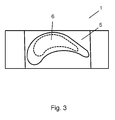
- the inner core 6, except for the pouring 7 and 8 and the vent opening 9 (see FIG. 3 ) is surrounded by the outer shell 5 is formed in the embodiment shown by a porous, fiber-reinforced ceramic body, wherein both the fibers and the ceramic matrix, in which the fibers are embedded, may be formed of the same ceramic materials, such as the outer shell 5.
- fiber and matrix material can be the same.
- the fibers incorporated in the ceramic matrix of the inner core 6 may be present as chopped ceramic fibers or as so-called whiskers (needle crystals).
- the porosity of the inner core 6 may be, for example, 20% by volume.
- the blade 1 is produced in such a way that the outer shell 5 is first produced, it being possible to use a 3D printing process as the production method, in which the shell 5 can be printed in layers with a ceramic slip in order to form a green body.
- a 3D printing process as the production method, in which the shell 5 can be printed in layers with a ceramic slip in order to form a green body.
- other methods such as lost wax or plastic Ausschmelz compiler be applied, in which a model of the inner core 6 made of wax or plastic with a ceramic slurry is coated, for example by repeated immersion, so that an outer shell around the wax or Plastic core forms.
- the outer shell can then additionally shaped according to the outer contour of the blade to be produced and the wax or plastic model can be melted after firing or simultaneously with the burning of the ceramic silt or of the resulting green body, so that a hollow body in the form of the outer shell 5 is made.
- the corresponding ceramic body in the form of the outer shell 5 or a green body after production by the 3D printing are then used as a mold for the inner core 6.
- a flowable mixture, which forms the inner core 6 poured into the outer shell 5 via the Eing manötechnischen 7 and 8, wherein air in the cavity of the outer shell 5 can escape through the vent opening 9.
- the flowable mixture has a starting material with which the desired inner core 6 of the blade 1 can be produced.
- the starting material about 20 vol.% Chopped ceramic fibers and 25 vol.% Pore forming agent for the production of pores and the remainder corresponding ceramic material in the form of ceramic powder.
- the pore formers may be formed by organic substances such as nylon, polyester, acrylics or epoxy resins.
- the flowable mixture may also be formed with or without liquid portions.
- the flowable mixture comprises a solvent, such as an organic solvent, such as hexane, or water, especially distilled water.
- the flowable mixture Before pouring the flowable mixture into the cavity of the outer shell, the flowable mixture may be mixed in a mixer, for example in a rotary mixer at a rotational speed of 15,000 to 20,000 revolutions per minute for a period of several minutes, for example 2 minutes. After mixing, the flowable mixture may be placed in an ultrasonic homogenizer to obtain as homogeneous a mixture as possible. This can then be filled into the outer shell 5 and the cavity of the outer shell 5.
- a mixer for example in a rotary mixer at a rotational speed of 15,000 to 20,000 revolutions per minute for a period of several minutes, for example 2 minutes.
- the flowable mixture may be placed in an ultrasonic homogenizer to obtain as homogeneous a mixture as possible. This can then be filled into the outer shell 5 and the cavity of the outer shell 5.
- the pore-forming agents are transferred to the gas phase to form the desired pores in the inner core 6.
- the ceramic material sinters to a ceramic body, at the same time the inner core 6 and the outer shell 5 are connected to each other.
- a blade 1 is formed with a porous, inner core 6 with a compact, dense outer shell 5, in which additionally the inner core 6 has ceramic fibers.
- a Such blade 1 has improved fracture toughness due to the structure, while achieving a low specific gravity.
- chopped ceramic fibers or needle crystals into the inner core, the tensile strength of the blade is improved, while the porosity of the inner core improves shear strength and elasticity.
Landscapes
- Engineering & Computer Science (AREA)
- Chemical & Material Sciences (AREA)
- Ceramic Engineering (AREA)
- Manufacturing & Machinery (AREA)
- Materials Engineering (AREA)
- Mechanical Engineering (AREA)
- Organic Chemistry (AREA)
- Structural Engineering (AREA)
- Composite Materials (AREA)
- General Engineering & Computer Science (AREA)
- Chemical Kinetics & Catalysis (AREA)
- Physics & Mathematics (AREA)
- Plasma & Fusion (AREA)
- Architecture (AREA)
- Turbine Rotor Nozzle Sealing (AREA)
Abstract
Description
- Die vorliegende Erfindung betrifft eine Hybrid-Schaufel für Strömungsmaschinen, wie stationäre Gasturbinen oder Flugtriebwerke, wobei die Schaufel eine äußere Hülle und einen inneren Kern aufweist, der von der äußeren Hülle zumindest teilweise umgeben ist. Außerdem betrifft die Erfindung ein Herstellungsverfahren für eine derartige Schaufel.
- Strömungsmaschinen, wie stationäre Gasturbinen oder Flugtriebwerke, weisen eine Vielzahl von Lauf- und Leitschaufeln auf, die mit dem strömenden Fluid, wie Luft und Verbrennungsgase, in Wechselwirkung treten. Die Leit- und Laufschaufeln sind hierbei hohen Temperaturen und aggressiven Medien und hohen Drücken ausgesetzt. Zusätzlich kann es durch in die Strömungsmaschine gelangte Fremdstoffe und Gegenstände zu Erosion und Schlagbeanspruchungen kommen. Die Laufschaufeln müssen darüber hinaus hohe Zentrifugalkräfte durch die hohen Geschwindigkeiten, mit denen sie rotiert werden, aufnehmen, sodass Schaufeln von Strömungsmaschinen einem komplexen Anforderungsprofil hinsichtlich Festigkeit, Hochtemperaturfestigkeit, Oxidations- und Korrosionsbeständigkeit, Schlagfestigkeit usw. genügen müssen. Gleichzeitig soll jedoch das spezifische Gewicht insbesondere der Laufschaufeln niedrig sein, um Zentrifugalkräfte niedrig zu halten und die zu beschleunigende Masse gering zu halten bzw. bei Flugtriebwerken ein insgesamt geringes Gewicht der Strömungsmaschine zu ermöglichen.
- Obwohl im Stand der Technik bereits eine Vielzahl von entsprechenden Schaufeln aus unterschiedlichen Materialien bekannt sind, besteht aufgrund des komplexen Anforderungsprofils weiterer Bedarf einer entsprechenden Optimierung, um Schaufeln mit einem geeigneten Eigenschaftsprofil bereitstellen zu können. Aus der Druckschrift
US 2011/0 229 337 A1 ist beispielsweise eine keramische Hybridschaufel bekannt, die einen äußeren Hüllenbereich und einen inneren Kernbereich aufweist, wobei der äußere Hüllenbereich aus einem SiC/SiC-Material gebildet ist, während der innere Kernbereich aus einem Si/SiC-Verbundmaterial und einem monolithischen Keramikmaterial gebildet ist. - Es ist Aufgabe der vorliegenden Erfindung eine Schaufel für eine Strömungsmaschine bereit zu stellen, die insbesondere für den Einsatz in Flugtriebwerken ein optimiertes Eigenschaftsprofil aufweist und vorzugsweise bei einem niedrigen spezifischen Gewicht eine gute Korrosions- und Oxidationsbeständigkeit sowie eine hohe Festigkeit, insbesondere Schlag- und Scherfestigkeit aufweist. Gleichwohl soll die entsprechende Schaufel einfach herstellbar und zuverlässig einsetzbar sein.
- Diese Aufgabe wird gelöst durch eine Schaufel mit den Merkmalen des Anspruchs 1 sowie einem Herstellungsverfahren für eine Schaufel einer Strömungsmaschine mit den Merkmalen des Anspruchs 6. Vorteilhafte Ausgestaltungen sind Gegenstand der abhängigen Ansprüche.
- Die Erfindung schlägt ähnlich der Hybrid-Schaufel der
US 2011/0 229 337 A1 eine Hybrid-Schaufel vor, die eine äußere Hülle und einen inneren Kern aufweist, wobei die äußere Hülle den inneren Kern zumindest teilweise umgibt. Unter teilweise Umgeben wird hierbei verstanden, dass die äußere Hülle in bestimmten Bereichen Öffnungen aufweisen kann, um von außen Zugang zum inneren Kern zu haben, was beispielsweise für die Herstellung erforderlich ist. Entsprechend umhüllt die äußere Hülle den inneren Kern vorzugsweise im Bereich von mehr als der Hälfte der Oberfläche des inneren Kerns, vorzugsweise mehr als 70% und insbesondere mehr als 90% der Oberfläche des inneren Kerns. Gemäß der Erfindung wird die äußere Hülle aus einem Keramikkörper oder aus einem Keramikmatrixverbundmaterial gebildet, während der innere Kern aus einer faserverstärkten Keramik oder aus einem faserverstärkten Keramikmatrixverbundmaterial gebildet wird. Zusätzlich weist der innere Kern eine höhere Porosität als die äußere Hülle auf. Durch die Faserverstärkung des inneren Kerns kann die Festigkeit des inneren Kerns verbessert werden, während gleichzeitig durch die höhere Porosität die Elastizität und die Bruchzähigkeit erhöht wird. Damit kann die erfindungsgemäße Hybrid-Schaufel die Vorteile des keramischen Materials mit einer verbesserten Schlagfestigkeit und Bruchzähigkeit vereinen, wobei zusätzlich durch die Porosität des inneren Kerns das spezifische Gewicht niedrig gehalten wird. Durch die Hochtemperaturbeständigkeit des Keramikmaterials kann die Einsatztemperatur einer entsprechenden Schaufel sehr hoch gewählt werden, was zum einen den Wirkungsgrad der Strömungsmaschine verbessern kann und zum anderen die Herstellung der Schaufel vereinfachen kann, da auf Kühlkanäle und dergleichen verzichtet werden kann. - Vorzugsweise ist die äußere Hülle aus einem kompakten Keramikkörper und der innere Kern aus einer porösen, faserverstärkten Keramik gebildet.
- Statt eines homogenen Keramikmaterials kann auch ein Keramikmatrixverbundmaterial sowohl für die äußere Hülle als auch für den inneren Kern Verwendung finden, wobei das Keramikmatrixverbundmaterial ein Keramik-Keramik-Verbundmaterial oder ein Verbund aus einer Keramik und einer intermetallischen Verbindung sein kann. Bei einem Keramik-Keramik-Verbundmaterial ist das Keramikmatrixverbundmaterial aus mindestens zwei unterschiedlichen Keramiken ausgebildet, während bei einem Verbund aus einer Keramik und einer intermetallischen Verbindung eine Kombination aus diesen Materialien vorgesehen ist. Genauso wie ein homogenes Keramikmaterial, welches aus einem einheitlichen Keramikmaterial gebildet ist, kann das Keramikmatrixverbundmaterial für den Kern zusätzlich mit einer Faserverstärkung ausgebildet sein. Bei den Fasern für die faserverstärkte Keramik oder das faserverstärkte Keramikmatrixverbundmaterial kann es sich insbesondere um Fasern aus dem gleichen Keramikmaterial handeln, mit dem die Matrix des Keramikmatrixverbundmaterials bzw. das Keramikgrundmaterial der faserverstärkten Keramik gebildet ist, wobei die Fasern als sogenannte Whisker (Nadelkristalle) oder als zerhäckselte Keramikfasern eingesetzt werden können, beispielsweise mit Dimensionen im Bereich von 0,5 µm bis 2 µm, vorzugsweise 0,6 µm bis 1 µm bezüglich des Durchmessers und/oder einer Länge im Bereich von 5 µm bis 100 µm, vorzugsweise 10 µm bis 80 µm.
- Als Keramikmaterial sowohl für die äußere Hülle als auch für die Matrix des Keramikmatrixverbundmaterials der Hülle oder des Kerns sowie die Fasern der faserverstärkten Keramik bzw. des faserverstärkten Keramikmatrixverbundmaterials kommen Hafniumdiborid, Zirkondiborid, Hafniumnitrid, Zirkonnitrid, Titancarbid, Titannitrid, Thoriumoxyd, Tantalcarbid sowie Mischungen mit einem der genannten Stoffe mit Siliziumcarbid in Frage.
- Die äußere Hülle kann eine Wanddicke im Bereich von mindestens 1,5 mm bis 3 mm aufweisen.
- Die Porosität der äußeren Hülle kann kleiner oder gleich 5 Vol.%, insbesondere kleiner oder gleich 1 Vol.% sein, sodass die äußere Hülle eine dichte und kompakte Form aufweist.
- Die Porosität des inneren Kerns kann im Bereich von 10 Vol.% bis 30 Vol.%, insbesondere 15 Vol.% bis 23 Vol.% liegen, sodass ein erheblicher Anteil an Poren vorliegt, der entsprechend das Eigenschaftsprofil der Schaufel beeinflusst.
- Die Herstellung einer entsprechenden Schaufel erfolgt erfindungsgemäß so, dass zunächst die äußere Hülle gefertigt wird und diese dann als Form für den inneren Kern genutzt wird. Die äußere Hülle kann durch ein generatives Verfahren, bei dem die Hülle lagenweise aus einem Pulvermaterial bzw. einer entsprechenden Mischung mit einem Lösungsmittel aufgebaut wird, beispielsweise durch ein 3D-Druckverfahren, oder durch Wachs- oder Kunststoffausschmelzverfahren hergestellt werden.
- Die äußere Hülle kann in Form eines Grünkörpers, der durch die genannten Verfahren aus einem Keramikschlicker hergestellt worden ist, oder nach dem Brennen der äußeren Hülle als Form für den Kern eingesetzt werden.
- Zur Herstellung des Kerns wird eine fließfähige Mischung aus einem Ausgangsmaterial hergestellt, die in den Hohlraum der zuvor hergestellten äußeren Hülle gefüllt werden kann. Das Ausgangsmaterial zur Herstellung der fließfähigen Mischung kann zur Erzeugung der Poren im inneren Kern der Schaufel Porenbildner, beispielsweise in Form von organischen Verbindungen, wie Nylon, Polyester, Acrylverbindungen, Epoxidharze und dergleichen aufweisen, die bei einer nachfolgenden Wärmebehandlung verbrannt bzw. in einen gasförmigen Zustand überführt werden können, um entsprechende Poren im inneren Kern der Schaufel zu bilden. Das Ausgangsmaterial für die fließfähige Mischung kann 20 bis 30 Vol.-% Porenbildner und 10 - 30 Vol.-%, insbesondere 15 - 25 Vol.-% Fasern sowie als Rest Keramikmaterial und/oder intermetallische Verbindungen aufweisen.
- Als Keramikmaterial kommen wiederum sowohl für die Fasern als auch für das Matrixmaterial die oben genannten keramischen Stoffe in Frage. Das Ausgangsmaterial kann direkt als Pulvermischung Verwendung finden, oder zur Verbesserung der Fließfähigkeit mit einem Lösungsmittel vermischt werden, insbesondere mit einem organischen Lösungsmittel, wie beispielsweise Hexan, oder mit Wasser, insbesondere destilliertem Wasser.
- Die fließfähige Mischung, die zur Bildung des inneren Kerns der Schaufel in den Hohlraum der äußeren Hülle der Schaufel eingefüllt wird, kann vor dem Einfüllen in die äußere Hülle homogenisiert werden, beispielsweise durch Rotationsmischer und/oder durch Ultraschallhomogenisieren. Dadurch kann erreicht werden, dass zum einen die Bestandteile homogen und gleichmäßig verteilt sind und zum anderen, dass die enthaltenen Fasern in Form von Whiskern bzw. Nadelkristallen in unterschiedlichen Richtungen orientiert sind, um so in verschiedene Richtungen ein gleichmäßiges, isotropes Eigenschaftsprofil bereit zu stellen.
- Nach dem Einfüllen der fließfähigen Mischung in den Hohlraum der äußeren Hülle wird die mit der fließfähigen Mischung gefüllte, äußere Hülle einer Wärmebehandlung unterzogen, sodass zum einen die Porenbildner der fließfähigen Mischung in den gasförmigen Zustand
- überführt und/oder ausgetrieben werden, um entsprechende Poren im inneren Kern der Schaufel auszubilden, und zum anderen werden das Keramikmaterial und/oder eventuell enthaltende intermetallische Verbindungen durch Sintern zu einem einzigen festen Schaufelkörper verbunden. Dabei können sowohl die äußere Hülle, sofern sie als Grünkörper als Form für den inneren Kern Verwendung gefunden hat, als auch der innere Kern gesintert werden, wobei gleichzeitig eine feste Verbindung zwischen dem inneren Kern und der äußeren Hülle erzeugt werden kann.
- Die Wärmebehandlung kann bei einer Temperatur im Bereich von 1300°C bis 1700°C für eine Dauer von 2 oder mehr Stunden durchgeführt werden.
- Die beigefügten Zeichnungen zeigen in rein schematischer Weise in
- Figur 1
- eine Seitenansicht einer erfindungsgemäßen Turbinenschaufel mit gestrichelt eingezeichnetem Kern,
- Figur 2
- eine Seitenansicht der Turbinenschaufel aus
Figur 1 mit gestrichelt eingezeichnetem Kern um 90 ° gedreht und in - Figur 3
- eine Querschnittsansicht der Turbinenschaufel aus
Figur 1 mit gestrichelt eingezeichnetem Kern. - Weitere Vorteile, Kennzeichen und Merkmale der vorliegenden Erfindung werden bei der nachfolgenden detaillierten Beschreibung eines Ausführungsbeispiels anhand der beigefügten Zeichnungen deutlich. Allerdings ist die Erfindung nicht auf dieses Ausführungsbeispiel beschränkt.
- Die
Figur 1 zeigt eine Seitenansicht einer Hochdruckturbinenschaufel 1 gemäß der vorliegenden Erfindung. Die Hochdruckturbinenschaufel 1 umfasst einen Schaufelblattbereich 2 und einen Fußbereich 3, mit dem die Turbinenschaufel 1 in eine Turbinenscheibe eingesetzt werden kann. Zwischen dem Schaufelblattbereich 2 und dem Fußbereich 3 ist ein inneres Deckband 4 vorgesehen. - Gemäß der Erfindung umfasst die in den
Figuren 1 bis 3 gezeigte Hochdruckturbinenschaufel 1 eine äußere Hülle 5 und einen inneren Kern 6. Die äußere Hülle 5 kann aus einer dichten, kompakten Keramik gebildet sein, die beispielsweise Hafniumdiborid, Zirkondiborid, Hafniumnitrid, Zirkonnitrid, Titancarbid, Titannitrid, Thoriumdioxid, Tantalcarbid und/oder Kombinationen der genannten Keramiken mit Beimengungen von Siliziumcarbid umfassen kann. - Der innere Kern 6, der bis auf die Eingießöffnungen 7 und 8 und die Entlüftungsöffnung 9 (siehe
Figur 3 ) von der äußeren Hülle 5 umgeben ist, ist in dem gezeigten Ausführungsbeispiel durch einen porösen, faserverstärkten Keramikkörper gebildet, wobei sowohl die Fasern als auch die Keramikmatrix, in der die Fasern eingelagert sind, aus den gleichen Keramikmaterialien gebildet sein kann, wie die äußere Hülle 5. Insbesondere können auch Faser- und Matrixwerkstoff gleich sein. Die Fasern, die in der Keramikmatrix des inneren Kerns 6 eingelagert sind, können als abgehackte Keramikfasern oder als sogenannte Whisker (Nadelkristalle) vorliegen. Die Porosität des inneren Kerns 6 kann beispielsweise 20 Vol.% betragen. - Die Herstellung der Schaufel 1 erfolgt in der Weise, dass zunächst die äußere Hülle 5 gefertigt wird, wobei als Fertigungsverfahren ein 3D-Druckverfahren eingesetzt werden kann, bei welchem die Hülle 5 schichtweise mit einem Keramikschlicker gedruckt werden kann, um einen Grünkörper auszubilden. Darüber hinaus können alternativ auch andere Verfahren, wie Wachsausschmelz- bzw. Kunststoffausschmelzverfahren angewandt werden, bei welchem ein Modell des inneren Kerns 6 aus Wachs oder Kunststoff mit einem Keramikschlicker beschichtet wird, beispielsweise durch wiederholtes Eintauchen, sodass sich eine äußere Hülle um den Wachs- oder Kunststoffkern bildet. Die äußere Hülle kann dann zusätzlich entsprechend der äußeren Kontur der herzustellenden Schaufel geformt und das Wachs- bzw. Kunststoffmodell kann nach dem Brennen oder gleichzeitig mit dem Brennen des Keramikschlickes bzw. des daraus entstandenen Grünkörpers ausgeschmolzen werden, sodass ein Hohlkörper in Form der äußeren Hülle 5 hergestellt ist.
- Der entsprechende Keramikkörper in Form der äußeren Hülle 5 oder ein Grünkörper nach Herstellung durch den 3D-Druck werden dann als Form für den inneren Kern 6 verwendet. Dazu wird eine fließfähige Mischung, die den inneren Kern 6 bildet, in die äußere Hülle 5 über die Eingießöffnungen 7 und 8 eingegossen, wobei Luft im Hohlraum der äußeren Hülle 5 durch die Entlüftungsöffnung 9 entweichen kann.
- Die fließfähige Mischung weist ein Ausgangsmaterial auf, mit welchem der gewünschte innere Kern 6 der Schaufel 1 hergestellt werden kann. Bei dem vorgestellten Ausführungsbeispiel weist das Ausgangsmaterial ca. 20 Vol.% gehäckselte Keramikfasern sowie 25 Vol.% Porenbildner zur Erzeugung von Poren sowie als Rest entsprechendes Keramikmaterial in Form von Keramikpulver auf. Die Porenbildner können durch organische Stoffe, wie beispielsweise Nylon, Polyester, Acrylverbindungen oder Epoxidharze gebildet sein.
- Die fließfähige Mischung kann darüber hinaus mit oder ohne flüssige Anteile gebildet sein. Vorzugsweise weist die fließfähige Mischung ein Lösungsmittel auf, wie beispielsweise ein organisches Lösungsmittel, wie Hexan, oder Wasser, insbesondere destilliertes Wasser.
- Vor dem Einfüllen der fließfähigen Mischung in den Hohlraum der äußeren Hülle kann die fließfähige Mischung in einem Mischer gemischt werden, beispielsweise in einem Rotationsmischer mit einer Drehgeschwindigkeit von 15 000 bis 20 000 Umdrehungen pro Minute für eine Dauer von einigen Minuten, beispielsweise 2 Minuten. Nach dem Mischen kann die fließfähige Mischung in einen Ultraschallhomogenisierer gegeben werden, um eine möglichst homogene Mischung zu erhalten. Diese kann dann in die äußere Hülle 5 bzw. den Hohlraum der äußeren Hülle 5 eingefüllt werden.
- Durch eine Wärmebehandlung der mit der fließfähigen Mischung gefüllten, äußeren Hülle 5 bei einer Temperatur von 1300°C bis 1700 °C für eine Dauer von 2 oder mehr Stunden werden die Porenbildner in die Gasphase überführt, um die gewünschten Poren im inneren Kern 6 auszubilden. Gleichzeitig sintert das keramische Material zu einem Keramikkörper, wobei gleichzeitig der innere Kern 6 und die äußere Hülle 5 mit einander verbunden werden.
- Damit wird eine Schaufel 1 mit einem porösen, inneren Kern 6 mit einer kompakten, dichten, äußeren Hülle 5 gebildet, bei der zusätzlich der innere Kern 6 Keramikfasern aufweist. Eine derartige Schaufel 1 weist aufgrund der Struktur eine verbesserte Bruchzähigkeit auf, wobei gleichzeitig ein niedriges, spezifisches Gewicht erzielt wird. Durch den Einbau von gehackten Keramikfasern bzw. Nadelkristallen in den inneren Kern, wird die Zugfestigkeit der Schaufel verbessert, während durch die Porosität des inneren Kerns die Scherfestigkeit und die Elastizität verbessert werden.
- Obwohl die vorliegende Erfindung anhand des Ausführungsbeispiels detailliert beschrieben worden ist, ist für einen Fachmann selbstverständlich, dass die Erfindung nicht durch dieses Ausführungsbeispiel beschränkt ist, sondern dass vielmehr Abwandlungen in der Weise möglich sind, dass einzelne Merkmale weggelassen oder andersartige Kombinationen von Merkmalen verwirklicht werden können, ohne dass der Schutzbereich der beigefügten Ansprüche verlassen wird. Die vorliegende Offenbarung schließt sämtliche Kombinationen der vorgestellten Einzelmerkmale mit ein.
-
- 1
- Schaufel, Hochdruckturbinenschaufel
- 2
- Schaufelblattbereich
- 3
- Fußbereich
- 4
- Deckband
- 5
- äußere Hülle
- 6
- innerer Kern
- 7
- Eingießöffnung
- 8
- Eingießöffnung
- 9
- Entlüftungsöffnung
Claims (13)
- Schaufel (1) für eine Strömungsmaschine mit einer äußeren Hülle (5) und einem inneren Kern (6), der von der äußeren Hülle (5) zumindest teilweise umgeben ist,
dadurch gekennzeichnet, dass
die äußere Hülle (5) aus einem Keramikkörper oder aus einem Körper aus einem Keramikmatrixverbundmaterial gebildet ist und dass der innere Kern (6) aus einer faserverstärkten Keramik oder einem faserverstärkten Keramikmatrixverbundmaterial gebildet ist, wobei der innere Kern (6) eine höhere Porosität als die äußere Hülle (5) aufweist. - Schaufel (1) nach Anspruch 1,
dadurch gekennzeichnet, dass
die äußere Hülle (5) aus einem kompakten Keramikkörper und der innere Kern (6) aus einer porösen, faserverstärkten Keramik gebildet sind. - Schaufel (1) nach einem der vorhergehenden Ansprüche,
dadurch gekennzeichnet, dass
das Keramikmatrixverbundmaterial ein Keramik-Keramik-Verbundmaterial oder ein Verbund aus einer Keramik und einer intermetallischen Verbindung ist. - Schaufel (1) nach einem der vorhergehenden Ansprüche,
dadurch gekennzeichnet, dass
die Porosität der äußeren Hülle (5) kleiner oder gleich 5 Vol.%, insbesondere kleiner oder gleich 1 Vol.% beträgt und/oder die Porosität des inneren Kerns (6) im Bereich von 10 bis 30 Vol.%, insbesondere 15 bis 23 Vol.% liegt. - Schaufel (1) nach einem der vorhergehenden Ansprüche,
dadurch gekennzeichnet, dass
das Keramikmaterial aus dem eine Komponente aus einer Gruppe, die den Keramikkörper der äußeren Hülle (5) und das Keramikmatrixverbundmaterial der äußeren Hülle (5) und des inneren Kerns (6) sowie Fasern der faserverstärkten Keramik und Fasern des Keramikmatrixverbundmaterials umfasst, aus mindestens einem Material gefertigt ist, das aus einer Gruppe ausgewählt ist, die HfB2, ZrB2, HfN, ZrN, TiC, TiN, ThO2,TaC und Mischungen von mindestens einem der genannten Stoffe mit SiC umfasst. - Verfahren zur Herstellung einer Schaufel einer Strömungsmaschine, insbesondere einer Schaufel nach einem der vorhergehenden Ansprüche, bei welchem zunächst eine äußere Hülle (5) der Schaufel (1) aus einem Keramikkörper oder aus einem Körper aus einem Keramikmatrixverbundmaterial gebildet wird, wobei die äußere Hülle (5) der Schaufel (1) in einem nachfolgenden Verfahrensschritt als Form für den inneren Kern (6) verwendet wird, wobei der innere Kern (6) durch eine fließfähige Mischung gebildet wird, die in die äußere Hülle (5) eingefüllt wird, und wobei die fließfähige Mischung und die äußere Hülle (5) durch eine Wärmebehandlung zur Schaufel (1) ausgebildet werden.
- Verfahren nach Anspruch 6,
dadurch gekennzeichnet, dass
die äußere Hülle (5) durch ein generatives Verfahren, insbesondere ein dreidimensionales Druckverfahren, oder durch ein Wachs- oder Kunststoffausschmelzverfahren hergestellt wird. - Verfahren nach einem der Ansprüche 6 bis 7,
dadurch gekennzeichnet, dass
zur Herstellung der äußeren Hülle (5) ein Keramikschlicker verwendet wird, der zu einem Grünkörper geformt wird, wobei der Grünkörper direkt oder nach einer Wärmebehandlung als Form für den inneren Kern (6) eingesetzt wird. - Verfahren nach einem der Ansprüche 6 bis 8,
dadurch gekennzeichnet, dass
die fließfähige Mischung ein Ausgangsmaterial mit 10 bis 30 Vol.%, insbesondere 15 bis 25 Vol.% Fasern, 20 bis 30 Vol.% Porenbildner und Rest Keramikmaterial und/oder intermetallische Verbindungen umfasst. - Verfahren nach Anspruch 9,
dadurch gekennzeichnet, dass
das Ausgangsmaterial mit Lösungsmittel, insbesondere Hexan oder destilliertem Wasser, zur fließfähigen Mischung vermischt wird. - Verfahren nach einem der Ansprüche 6 bis 10,
dadurch gekennzeichnet, dass
die fließfähige Mischung vor dem Einfüllen in die äußere Hülle (5) homogenisiert wird. - Verfahren nach einem der Ansprüche 6 bis 11,
dadurch gekennzeichnet, dass
das Keramikmaterial für mindestens einen Bestandteil aus einer Gruppe, die den Keramikschlicker und das Keramikmaterial der fließfähigen Mischung und die Fasern der fließfähigen Mischung umfasst, aus mindestens einem Material aus einer Gruppe ausgewählt ist, die HfB2, ZrB2, HfN, ZrN, TiC, TiN, ThO2,TaC und Mischungen von mindestens einem der genannten Stoffe mit SiC umfasst. - Verfahren nach einem der Ansprüche 6 bis 12,
dadurch gekennzeichnet, dass
die äußere Hülle (5) und die fließfähige Mischung in der äußere Hülle (5) bei einer Temperatur im Bereich von 1300°C bis 1700°C für eine Dauer von gleich oder mehr als 2 Stunden ausgelagert werden.
Priority Applications (2)
| Application Number | Priority Date | Filing Date | Title |
|---|---|---|---|
| EP15188448.3A EP3153666A1 (de) | 2015-10-06 | 2015-10-06 | Keramische hybrid-schaufel für strömungsmaschinen |
| US15/280,653 US10544689B2 (en) | 2015-10-06 | 2016-09-29 | Hybrid blade for turbomachines |
Applications Claiming Priority (1)
| Application Number | Priority Date | Filing Date | Title |
|---|---|---|---|
| EP15188448.3A EP3153666A1 (de) | 2015-10-06 | 2015-10-06 | Keramische hybrid-schaufel für strömungsmaschinen |
Publications (1)
| Publication Number | Publication Date |
|---|---|
| EP3153666A1 true EP3153666A1 (de) | 2017-04-12 |
Family
ID=54266429
Family Applications (1)
| Application Number | Title | Priority Date | Filing Date |
|---|---|---|---|
| EP15188448.3A Withdrawn EP3153666A1 (de) | 2015-10-06 | 2015-10-06 | Keramische hybrid-schaufel für strömungsmaschinen |
Country Status (2)
| Country | Link |
|---|---|
| US (1) | US10544689B2 (de) |
| EP (1) | EP3153666A1 (de) |
Cited By (3)
| Publication number | Priority date | Publication date | Assignee | Title |
|---|---|---|---|---|
| CN108069706A (zh) * | 2017-12-15 | 2018-05-25 | 天津大学 | 一种基于3d打印技术的纤维增强陶瓷薄壁件的成型方法 |
| CN109128037A (zh) * | 2018-07-20 | 2019-01-04 | 江苏大学 | 一种复合改性的陶瓷型壳及其制备方法 |
| EP3901414A1 (de) * | 2020-02-07 | 2021-10-27 | Raytheon Technologies Corporation | Cmc-komponente mit kühlschutz |
Families Citing this family (3)
| Publication number | Priority date | Publication date | Assignee | Title |
|---|---|---|---|---|
| US20210262354A1 (en) * | 2020-02-21 | 2021-08-26 | United Technologies Corporation | Ceramic matrix composite component having low density core and method of making |
| US11286783B2 (en) | 2020-04-27 | 2022-03-29 | Raytheon Technologies Corporation | Airfoil with CMC liner and multi-piece monolithic ceramic shell |
| CN112457003B (zh) * | 2020-12-16 | 2021-12-21 | 华南理工大学 | 一种新型bt/ha双相压电生物陶瓷骨组织工程修复体及其制备方法 |
Citations (12)
| Publication number | Priority date | Publication date | Assignee | Title |
|---|---|---|---|---|
| US4935178A (en) * | 1986-06-24 | 1990-06-19 | General Signal Corporation | Method of making refractory fiber products |
| DE4338457A1 (de) * | 1993-11-11 | 1995-05-18 | Mtu Muenchen Gmbh | Bauteil aus Metall oder Keramik mit dichter Außenschale und porösem Kern und Herstellungsverfahren |
| DE19903436A1 (de) * | 1999-01-29 | 2000-08-24 | Fraunhofer Ges Forschung | Verfahren zur Herstellung dreidimensionaler Formkörper |
| US20020155269A1 (en) * | 1999-11-19 | 2002-10-24 | Holowczak John E. | Hybrid monolithic ceramic and ceramic matrix composite airfoil and method for making the same |
| US20030223861A1 (en) * | 2002-05-31 | 2003-12-04 | Siemens Westinghouse Power Corporation | Ceramic matrix composite gas turbine vane |
| US20050249602A1 (en) * | 2004-05-06 | 2005-11-10 | Melvin Freling | Integrated ceramic/metallic components and methods of making same |
| US20100032875A1 (en) * | 2005-03-17 | 2010-02-11 | Siemens Westinghouse Power Corporation | Processing method for solid core ceramic matrix composite airfoil |
| US20110111211A1 (en) * | 2009-11-06 | 2011-05-12 | Honeywell International Inc. | Protective coatings for ceramic matrix composite substrates and methods for improving the wear resistance thereof and coated articles produced therefrom |
| US20110229337A1 (en) | 2004-01-15 | 2011-09-22 | General Electric Company | Hybrid ceramic matrix composite turbine blades for improved processibility and performance and process for producing hybrid turbine blades |
| EP2522810A1 (de) * | 2011-05-12 | 2012-11-14 | MTU Aero Engines GmbH | Verfahren zum generativen Herstellen eines Bauteils, insbesondere eines Verdichterschaufelelements, sowie ein derartiges Bauteil |
| US20130171426A1 (en) * | 2012-01-03 | 2013-07-04 | General Electric Company | Method of forming a ceramic matrix composite and a ceramic matrix composite component |
| US20140271153A1 (en) * | 2013-03-12 | 2014-09-18 | Rolls-Royce Corporation | Cooled ceramic matrix composite airfoil |
Family Cites Families (11)
| Publication number | Priority date | Publication date | Assignee | Title |
|---|---|---|---|---|
| US4543345A (en) | 1984-02-09 | 1985-09-24 | The United States Of America As Represented By The Department Of Energy | Silicon carbide whisker reinforced ceramic composites and method for making same |
| US4820663A (en) | 1987-09-02 | 1989-04-11 | Kennametal Inc. | Whisker reinforced ceramic and a method of clad/hot isostatic pressing same |
| US7278830B2 (en) * | 2005-05-18 | 2007-10-09 | Allison Advanced Development Company, Inc. | Composite filled gas turbine engine blade with gas film damper |
| US8021742B2 (en) * | 2006-12-15 | 2011-09-20 | Siemens Energy, Inc. | Impact resistant thermal barrier coating system |
| US9212560B2 (en) * | 2011-06-30 | 2015-12-15 | United Technologies Corporation | CMC blade with integral 3D woven platform |
| US8980435B2 (en) * | 2011-10-04 | 2015-03-17 | General Electric Company | CMC component, power generation system and method of forming a CMC component |
| US10100666B2 (en) * | 2013-03-29 | 2018-10-16 | General Electric Company | Hot gas path component for turbine system |
| US10787914B2 (en) * | 2013-08-29 | 2020-09-29 | United Technologies Corporation | CMC airfoil with monolithic ceramic core |
| FR3023211B1 (fr) * | 2014-07-03 | 2016-08-05 | Herakles | Piece revetue par un revetement de surface et procedes associes |
| US10294802B2 (en) * | 2014-12-05 | 2019-05-21 | Rolls-Royce American Technologies, Inc. | Turbine engine components with chemical vapor infiltrated isolation layers |
| US20160251272A1 (en) * | 2015-02-27 | 2016-09-01 | General Electric Company | Laminate structure fabricated using chemical vapor infiltration (cvi) |
-
2015
- 2015-10-06 EP EP15188448.3A patent/EP3153666A1/de not_active Withdrawn
-
2016
- 2016-09-29 US US15/280,653 patent/US10544689B2/en not_active Expired - Fee Related
Patent Citations (12)
| Publication number | Priority date | Publication date | Assignee | Title |
|---|---|---|---|---|
| US4935178A (en) * | 1986-06-24 | 1990-06-19 | General Signal Corporation | Method of making refractory fiber products |
| DE4338457A1 (de) * | 1993-11-11 | 1995-05-18 | Mtu Muenchen Gmbh | Bauteil aus Metall oder Keramik mit dichter Außenschale und porösem Kern und Herstellungsverfahren |
| DE19903436A1 (de) * | 1999-01-29 | 2000-08-24 | Fraunhofer Ges Forschung | Verfahren zur Herstellung dreidimensionaler Formkörper |
| US20020155269A1 (en) * | 1999-11-19 | 2002-10-24 | Holowczak John E. | Hybrid monolithic ceramic and ceramic matrix composite airfoil and method for making the same |
| US20030223861A1 (en) * | 2002-05-31 | 2003-12-04 | Siemens Westinghouse Power Corporation | Ceramic matrix composite gas turbine vane |
| US20110229337A1 (en) | 2004-01-15 | 2011-09-22 | General Electric Company | Hybrid ceramic matrix composite turbine blades for improved processibility and performance and process for producing hybrid turbine blades |
| US20050249602A1 (en) * | 2004-05-06 | 2005-11-10 | Melvin Freling | Integrated ceramic/metallic components and methods of making same |
| US20100032875A1 (en) * | 2005-03-17 | 2010-02-11 | Siemens Westinghouse Power Corporation | Processing method for solid core ceramic matrix composite airfoil |
| US20110111211A1 (en) * | 2009-11-06 | 2011-05-12 | Honeywell International Inc. | Protective coatings for ceramic matrix composite substrates and methods for improving the wear resistance thereof and coated articles produced therefrom |
| EP2522810A1 (de) * | 2011-05-12 | 2012-11-14 | MTU Aero Engines GmbH | Verfahren zum generativen Herstellen eines Bauteils, insbesondere eines Verdichterschaufelelements, sowie ein derartiges Bauteil |
| US20130171426A1 (en) * | 2012-01-03 | 2013-07-04 | General Electric Company | Method of forming a ceramic matrix composite and a ceramic matrix composite component |
| US20140271153A1 (en) * | 2013-03-12 | 2014-09-18 | Rolls-Royce Corporation | Cooled ceramic matrix composite airfoil |
Cited By (4)
| Publication number | Priority date | Publication date | Assignee | Title |
|---|---|---|---|---|
| CN108069706A (zh) * | 2017-12-15 | 2018-05-25 | 天津大学 | 一种基于3d打印技术的纤维增强陶瓷薄壁件的成型方法 |
| CN109128037A (zh) * | 2018-07-20 | 2019-01-04 | 江苏大学 | 一种复合改性的陶瓷型壳及其制备方法 |
| EP3901414A1 (de) * | 2020-02-07 | 2021-10-27 | Raytheon Technologies Corporation | Cmc-komponente mit kühlschutz |
| US11697994B2 (en) | 2020-02-07 | 2023-07-11 | Raytheon Technologies Corporation | CMC component with cooling protection |
Also Published As
| Publication number | Publication date |
|---|---|
| US10544689B2 (en) | 2020-01-28 |
| US20170241272A1 (en) | 2017-08-24 |
Similar Documents
| Publication | Publication Date | Title |
|---|---|---|
| DE112009004286B4 (de) | Keramikmatrixverbundwerkstofflaufschaufel mit integralen Plattformstrukturen und Verfahren und Werkzeug zu ihrer Herstellung | |
| EP1691946B1 (de) | Verfahren zur herstellung von gasturbinenbauteilen und bauteil für eine gasturbine | |
| DE4012230A1 (de) | Verdichteter bauteil und verfahren und vorform zur herstellung | |
| US10544689B2 (en) | Hybrid blade for turbomachines | |
| WO2005049312A1 (de) | Hochtemperatur-schichtsystem zur wärmeableitung und verfahren zu dessen herstellung | |
| EP3028793A1 (de) | Verfahren zur Herstellung einer Laufschaufel | |
| DE102016203785A1 (de) | Verfahren zum Herstellen einer Schaufel für eine Strömungsmaschine | |
| EP3450056A1 (de) | Verfahren zur herstellung eines titanaluminid-bauteils mit zähem kern und entsprechend hergestelltes bauteil | |
| EP3368237A1 (de) | Verfahren zur herstellung eines bauteils und vorrichtung | |
| EP2522810A1 (de) | Verfahren zum generativen Herstellen eines Bauteils, insbesondere eines Verdichterschaufelelements, sowie ein derartiges Bauteil | |
| DE112014002572T5 (de) | Feingusskern, Verfahren zur Herstellung eines Feingusskerns, und Feingussformwerkzeug | |
| EP1748253B1 (de) | Brennkammer und Verfahren zur Herstellung einer Brennkammer | |
| WO2005008032A1 (de) | Leichtbau-schaufel für eine gasturbine sowie verfahren zur herstlellung derselben | |
| EP3112597A1 (de) | Temperatur beständige turbinenschaufel mit oxidkeramik beschichtung | |
| WO2019137765A1 (de) | Cmc-formkörper, sowie herstellungsverfahren dazu | |
| EP3642514B1 (de) | Kolbenring, verwendung eines kolbenrings und verfahren zum herstellen eines kolbenrings | |
| DE102015210014B4 (de) | Gehäusestruktur einer Strömungsmaschine mit einem Bauteil mit gerichteter Mikrostruktur | |
| DE102014100345A1 (de) | Verfahren zur Herstellung einer Schubkammervorrichtung, Schubkammervorrichtung und Raketentriebwerk | |
| DE112014002622T5 (de) | Feingusskern, Verfahren zur Herstellung eines Feingusskerns, und Feingussformwerkzeug | |
| EP1378652A2 (de) | Mehrschichtiger Verbundwerkstoff | |
| DE102004001260A1 (de) | Rotor für eine Turbomaschine und Verfahren zur Herstellung eines solchen Rotors | |
| EP2230394A2 (de) | Bauteil zum Einsatz in Heißgasströmungen | |
| WO2021094026A1 (de) | Verfahren zur schichtweisen additiven herstellung eines verbundwerkstoffs | |
| DE102018213309A1 (de) | Verbund aus metallischem Träger und CMC-Formkörper, Verfahren zur Herstellung dazu | |
| EP2628816A1 (de) | Verfahren zum Aufbringen einer Wärmedämmschicht |
Legal Events
| Date | Code | Title | Description |
|---|---|---|---|
| PUAI | Public reference made under article 153(3) epc to a published international application that has entered the european phase |
Free format text: ORIGINAL CODE: 0009012 |
|
| STAA | Information on the status of an ep patent application or granted ep patent |
Free format text: STATUS: THE APPLICATION HAS BEEN PUBLISHED |
|
| AK | Designated contracting states |
Kind code of ref document: A1 Designated state(s): AL AT BE BG CH CY CZ DE DK EE ES FI FR GB GR HR HU IE IS IT LI LT LU LV MC MK MT NL NO PL PT RO RS SE SI SK SM TR |
|
| AX | Request for extension of the european patent |
Extension state: BA ME |
|
| STAA | Information on the status of an ep patent application or granted ep patent |
Free format text: STATUS: REQUEST FOR EXAMINATION WAS MADE |
|
| 17P | Request for examination filed |
Effective date: 20171011 |
|
| RBV | Designated contracting states (corrected) |
Designated state(s): AL AT BE BG CH CY CZ DE DK EE ES FI FR GB GR HR HU IE IS IT LI LT LU LV MC MK MT NL NO PL PT RO RS SE SI SK SM TR |
|
| STAA | Information on the status of an ep patent application or granted ep patent |
Free format text: STATUS: EXAMINATION IS IN PROGRESS |
|
| 17Q | First examination report despatched |
Effective date: 20190528 |
|
| STAA | Information on the status of an ep patent application or granted ep patent |
Free format text: STATUS: THE APPLICATION IS DEEMED TO BE WITHDRAWN |
|
| 18D | Application deemed to be withdrawn |
Effective date: 20210501 |