EP3151469B1 - Methods and systems for performing lawful interception in communication networks - Google Patents
Methods and systems for performing lawful interception in communication networks Download PDFInfo
- Publication number
- EP3151469B1 EP3151469B1 EP16153530.7A EP16153530A EP3151469B1 EP 3151469 B1 EP3151469 B1 EP 3151469B1 EP 16153530 A EP16153530 A EP 16153530A EP 3151469 B1 EP3151469 B1 EP 3151469B1
- Authority
- EP
- European Patent Office
- Prior art keywords
- packets
- network
- adulteration
- content
- adulterated
- Prior art date
- Legal status (The legal status is an assumption and is not a legal conclusion. Google has not performed a legal analysis and makes no representation as to the accuracy of the status listed.)
- Active
Links
- 238000004891 communication Methods 0.000 title claims description 91
- 238000000034 method Methods 0.000 title claims description 36
- 238000012544 monitoring process Methods 0.000 claims description 13
- 230000008859 change Effects 0.000 claims description 7
- 230000004044 response Effects 0.000 claims description 5
- 230000001934 delay Effects 0.000 claims description 3
- 238000012937 correction Methods 0.000 description 15
- 230000002159 abnormal effect Effects 0.000 description 12
- 238000001514 detection method Methods 0.000 description 11
- 238000004458 analytical method Methods 0.000 description 9
- 238000010586 diagram Methods 0.000 description 8
- 230000006870 function Effects 0.000 description 6
- 238000012545 processing Methods 0.000 description 6
- 230000005540 biological transmission Effects 0.000 description 5
- 235000008694 Humulus lupulus Nutrition 0.000 description 3
- 230000006978 adaptation Effects 0.000 description 3
- 238000007796 conventional method Methods 0.000 description 3
- 238000009826 distribution Methods 0.000 description 3
- 238000005516 engineering process Methods 0.000 description 3
- 230000007246 mechanism Effects 0.000 description 3
- 230000002411 adverse Effects 0.000 description 2
- 230000001413 cellular effect Effects 0.000 description 2
- 230000003993 interaction Effects 0.000 description 2
- 239000000523 sample Substances 0.000 description 2
- 238000012163 sequencing technique Methods 0.000 description 2
- 230000011664 signaling Effects 0.000 description 2
- FMFKNGWZEQOWNK-UHFFFAOYSA-N 1-butoxypropan-2-yl 2-(2,4,5-trichlorophenoxy)propanoate Chemical compound CCCCOCC(C)OC(=O)C(C)OC1=CC(Cl)=C(Cl)C=C1Cl FMFKNGWZEQOWNK-UHFFFAOYSA-N 0.000 description 1
- 241000010972 Ballerus ballerus Species 0.000 description 1
- VYZAMTAEIAYCRO-UHFFFAOYSA-N Chromium Chemical compound [Cr] VYZAMTAEIAYCRO-UHFFFAOYSA-N 0.000 description 1
- 230000005856 abnormality Effects 0.000 description 1
- 239000008186 active pharmaceutical agent Substances 0.000 description 1
- 230000003466 anti-cipated effect Effects 0.000 description 1
- 238000003491 array Methods 0.000 description 1
- 239000002131 composite material Substances 0.000 description 1
- 230000002950 deficient Effects 0.000 description 1
- 238000011161 development Methods 0.000 description 1
- 239000000835 fiber Substances 0.000 description 1
- 238000007667 floating Methods 0.000 description 1
- 239000010931 gold Substances 0.000 description 1
- 229910052737 gold Inorganic materials 0.000 description 1
- 239000004973 liquid crystal related substance Substances 0.000 description 1
- 230000007774 longterm Effects 0.000 description 1
- 238000010295 mobile communication Methods 0.000 description 1
- 238000012986 modification Methods 0.000 description 1
- 230000004048 modification Effects 0.000 description 1
- 230000003287 optical effect Effects 0.000 description 1
- 230000008520 organization Effects 0.000 description 1
- 238000011897 real-time detection Methods 0.000 description 1
- 230000001105 regulatory effect Effects 0.000 description 1
- 230000000717 retained effect Effects 0.000 description 1
- 238000013515 script Methods 0.000 description 1
- 230000035945 sensitivity Effects 0.000 description 1
- 238000012546 transfer Methods 0.000 description 1
- 230000001052 transient effect Effects 0.000 description 1
- 230000000007 visual effect Effects 0.000 description 1
Images



Classifications
-
- H—ELECTRICITY
- H04—ELECTRIC COMMUNICATION TECHNIQUE
- H04L—TRANSMISSION OF DIGITAL INFORMATION, e.g. TELEGRAPHIC COMMUNICATION
- H04L43/00—Arrangements for monitoring or testing data switching networks
- H04L43/16—Threshold monitoring
-
- H—ELECTRICITY
- H04—ELECTRIC COMMUNICATION TECHNIQUE
- H04L—TRANSMISSION OF DIGITAL INFORMATION, e.g. TELEGRAPHIC COMMUNICATION
- H04L1/00—Arrangements for detecting or preventing errors in the information received
-
- H—ELECTRICITY
- H04—ELECTRIC COMMUNICATION TECHNIQUE
- H04L—TRANSMISSION OF DIGITAL INFORMATION, e.g. TELEGRAPHIC COMMUNICATION
- H04L43/00—Arrangements for monitoring or testing data switching networks
- H04L43/04—Processing captured monitoring data, e.g. for logfile generation
-
- H—ELECTRICITY
- H04—ELECTRIC COMMUNICATION TECHNIQUE
- H04L—TRANSMISSION OF DIGITAL INFORMATION, e.g. TELEGRAPHIC COMMUNICATION
- H04L43/00—Arrangements for monitoring or testing data switching networks
- H04L43/08—Monitoring or testing based on specific metrics, e.g. QoS, energy consumption or environmental parameters
-
- H—ELECTRICITY
- H04—ELECTRIC COMMUNICATION TECHNIQUE
- H04L—TRANSMISSION OF DIGITAL INFORMATION, e.g. TELEGRAPHIC COMMUNICATION
- H04L43/00—Arrangements for monitoring or testing data switching networks
- H04L43/08—Monitoring or testing based on specific metrics, e.g. QoS, energy consumption or environmental parameters
- H04L43/0823—Errors, e.g. transmission errors
-
- H—ELECTRICITY
- H04—ELECTRIC COMMUNICATION TECHNIQUE
- H04L—TRANSMISSION OF DIGITAL INFORMATION, e.g. TELEGRAPHIC COMMUNICATION
- H04L45/00—Routing or path finding of packets in data switching networks
- H04L45/28—Routing or path finding of packets in data switching networks using route fault recovery
-
- H—ELECTRICITY
- H04—ELECTRIC COMMUNICATION TECHNIQUE
- H04L—TRANSMISSION OF DIGITAL INFORMATION, e.g. TELEGRAPHIC COMMUNICATION
- H04L63/00—Network architectures or network communication protocols for network security
- H04L63/30—Network architectures or network communication protocols for network security for supporting lawful interception, monitoring or retaining of communications or communication related information
-
- H—ELECTRICITY
- H04—ELECTRIC COMMUNICATION TECHNIQUE
- H04L—TRANSMISSION OF DIGITAL INFORMATION, e.g. TELEGRAPHIC COMMUNICATION
- H04L63/00—Network architectures or network communication protocols for network security
- H04L63/30—Network architectures or network communication protocols for network security for supporting lawful interception, monitoring or retaining of communications or communication related information
- H04L63/306—Network architectures or network communication protocols for network security for supporting lawful interception, monitoring or retaining of communications or communication related information intercepting packet switched data communications, e.g. Web, Internet or IMS communications
Definitions
- This disclosure relates generally to lawful interception and more particularly to methods and systems for performing lawful interception in communication networks.
- one or more of these users may manipulate media content in order to mislead a Law Enforcement Agency (LEA).
- LSA Law Enforcement Agency
- the manipulation may be achieved by adulterating traffic generated from his/her system. The adulteration is done such that only the intended recipient of the communication receives unadulterated content and the LEA receives adulterated content.
- the term "adulterated” is preferably used herein to refer to data that has been corrupted, particularly where the data has been deliberately corrupted.
- communication data may be corrupted by inclusion of data not normally included in communications data such as data that does not comply with a communication protocol.
- unadulterated is preferably used herein to refer to uncorrupted data. This may be enabled as intermediate systems may interpret the adulterated communication content as unadulterated content or the adulterated content may be forwarded to the LEA without understanding that it is corrupted. As a result, LI content may be corrupted beyond interpretation by the LEA.
- adulterated packets are detected based on an offline analysis.
- the offline analysis may include analysis of histogram of the hop length of packets and thereafter determining minimum hop length for packets to reach the receiver.
- the offline analysis further includes analysis of average bytes per packet, and comparison with standard communication flows to determine a possibility of an attack. Based on this analysis, the adulterated packets are removed thereafter.
- TCP Transmission Control Protocol
- sensitivity of a network node that performs functionality of a Content Duplication Function is enhanced, such that, the network node collects all information that may help in detection of adulterated packets.
- the network node may also send out some probe packets to learn more about the network. Additionally, the network node may be placed as close as possible to the receiver.
- these conventional methods fail to address detection of adulterated packets (which have been adulterated at the network or higher layer) in a manner that complies with legal and regulatory requirements, irrespective of the CDF location, and without employing any probe packets to learn about the network.
- JP 2007325293 A relates to a system for detecting unauthorized access to an internal network.
- the system is installed at the boundary of the internal network and an external network and comprises a decoy apparatus and a firewall apparatus.
- a reliability-management unit implemented within the firewall apparatus or as a separate server, detects reliability of the input packets and then forwards the input packets determined to be reliable to the internal network and input packets determined to be suspicious to the decoy apparatus.
- US 2015/0229670 A1 relates to a method and a system for detecting and preventing flooding attacks in a network environment and discloses using a concurrent session counter and/or a rate-based counter to facilitate detection of flooding attacks.
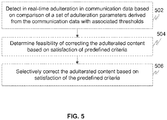
- method for lawful interception in a communication network includes detecting in real-time, via at least one network device, adulteration in communication data based on comparison of a set of adulteration parameters derived from the communication data with associated thresholds within a set of thresholds; analyzing, via the at least one network device, adulterated content in the communication data to determine feasibility of correcting the adulterated content based on satisfaction of predefined criteria; and correcting, selectively, the adulterated content based on satisfaction of the predefined criteria.
- the method may further comprise monitoring, by the at least one network device, a set of network parameters to detect a change in one or more of the set of network parameters.
- the method may further comprise sending additional information to a lawful interception gateway, the additional information comprising at least one of entity causing adulteration, means of adulteration, frequency of adulterated packets, which adulteration parameter thresholds were crossed, and at least one of indication of inability to correct the adulterated content along with the reason and other relevant information, and indication of adulterated content being corrected along with relevant information
- the method may further comprise sending feedback comprising information associated with the adulteration identified to a controller; and adapting the set of threshold based on the feedback for future communication sessions.
- a system for lawful interception in a communication network includes at least one processor and a computer-readable medium.
- the computer-readable medium stores instructions that, when executed by the at least one processor, cause the at least one processor to perform operations that include detecting in real-time, via at least one network device, adulteration in communication data based on comparison of a set of adulteration parameters derived from the communication data with associated thresholds within a set of thresholds; analyzing, via the at least one network device, adulterated content in the communication data to determine feasibility of correcting the adulterated content based on satisfaction of predefined criteria; and correcting, selectively, the adulterated content based on satisfaction of the predefined criteria.
- a non-transitory computer-readable storage medium for rationalizing a portfolio of assets which when executed by a computing device, cause the computing device to: detect in real-time, via at least one network device, adulteration in communication data based on comparison of a set of adulteration parameters derived from the communication data with associated thresholds within a set of thresholds; analyze, via the at least one network device, adulterated content in the communication data to determine feasibility of correcting the adulterated content based on satisfaction of predefined criteria; and correct, selectively, the adulterated content based on satisfaction of the predefined criteria.
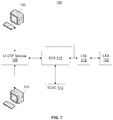
- FIG. 1 an environment 100 (that is exemplary) in which various embodiments may function is illustrated in FIG. 1 .
- Environment 100 includes a target user 102 who initiates a communication session with a peer user 104.
- Target user 102 is identified for lawful interception, as a result, each communication session that involves target use 102 as a sender or a recipient is routed through a Lawful Interception (LI) Content Duplication Function (CDF) module 106.
- LICDF module 106 intercepts all communication sessions involving target user 102.
- the functionality of LICDF module 106 may be built in a network device or node within a network of target user 102.
- the network device or node is configured to perform data duplication.
- LICDF module 106 creates a copy of the contents of each communication session and sends these copies to a Law Enforcement Agency (LEA) 108 through a Session Continuity Server (SCS) 110 and an LI Gateway (LIG) 112.
- LEA Law Enforcement Agency
- SCS Session Continuity Server
- LIG LI Gateway
- An SCS controller (SCSC) 114 selects a network device or node that performs functionality of LICDF module 106 based on one or more of pre-provisioning by the operator, dynamic network conditions, and session characteristics. Accordingly, the selected network device or node initiates LI and acts as LICDF module 106. Thereafter, LICDF module 106 starts sending copies of data packets in a communication session between target user 102 and peer user 104 to SCS 110. During the communication session, at least one of target user 102 or peer user 104 may adulterate the communication content using various adulteration methods.
- Examples of such methods may include, but are not limited to sending fake data packets for which Time-To-Live (TTL) value is kept sufficiently small so that these fake data packets are dropped before reaching the designated user.
- TTL Time-To-Live
- the adulterated content is also sent along with the non-adulterated content in the communication session to SCS 110 by LICDF module 106.
- SCS 110 performs suitable formatting and sequencing on data packets received from LICDF module 106 and sends these data packets to LIG 112.
- LIG 112 further sends these data packets exchanged between target user 102 and peer user 104 along with adulterated packets to LEA 108.
- data packets received by LEA 108 may not represent the actual conversation between target user 102 and peer user 104.
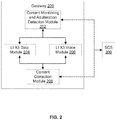
- gateway 200 includes a Content Monitoring and Adulteration Detection (CMAD) module 202, an LI X3 data module 204, an LI X3 voice module 206, and a Content Correction (CC) module 208.
- CMAD Content Monitoring and Adulteration Detection
- LI X3 data module 204 LI X3 data module 204
- LI X3 voice module 206 LI X3 voice module 206
- CC Content Correction
- FIG. 2 also shows an SCS 300 that communicates with gateway 200 and is analogous to SCS 110 shown in FIG.1 .
- CMAD module 202 obtains relevant information from SCS 300 in order to monitor communication data exchanged between target user 102 and peer user 104 and to detect potential adulteration in real-time.
- the relevant information received from SCS 300 includes a set of thresholds associated with adulteration parameters.
- adulteration parameters is preferably used herein to describe information or properties associated with communication data and which are abnormal and/or defective so as to make reading of the communication data difficult.
- the relevant information may include network topology related information, which is relevant to a session (for example, minimum number of hops between target user 102 and peer user 104 for the session); specific content-adulteration mechanisms (for example, IP hop length manipulation and filling certain unused protocol headers) to monitor based on provisioned or historical data of sessions involving target user 102 and/or peer user 104; and session-type specific monitoring inputs (for example, examining RTP headers in case of voice sessions, monitoring the interval of retransmission of same packet, and whether the retransmitted packet has different contents in case of TCP, use of unacceptable header values in case of UDP, and minimum content length of each packet).
- network topology related information for example, minimum number of hops between target user 102 and peer user 104 for the session
- specific content-adulteration mechanisms for example, IP hop length manipulation and filling certain unused protocol headers
- session-type specific monitoring inputs for example, examining RTP headers in case of voice sessions, monitoring the interval of retransmission of same packet,
- CMAD module 202 receives from SCS 300 a set of adulteration parameters derived from the communication data by SCS 300 and compares the values of the set of adulteration parameters with associated thresholds within the set of thresholds.
- the set of thresholds are also received by CMAD module 202 from SCS 300.
- the set of adulteration parameters may include, but are not limited to packets with insufficient hop length, packets with unused protocol headers filled in, packets with invalid, not used, or intentionally misleading Real-time Transport Protocol (RTP) header contents (for example, an old time stamp), interval between retransmission of the same packet, packets with difference in content between the initially sent and retransmitted version(s) of the same packet, packets with unacceptable protocol or packet header values, port changes, RST and other flag adulterations, packets with insufficient or invalid TTL contents, and packets with content length lower than the minimum possible content length for that packet type or protocol.
- RTP Real-time Transport Protocol
- CMAD module 202 may also dynamically adapt each threshold in the set based on a set of network parameters that it monitors in real time. These set of network parameters may include, but are not limited to network congestion, link unavailability, network choke, packet queueing, buffer overflows, insufficient network coverage, network delays, packet drops, and users involved in session for the communication data. Based on a result of comparison of the set of adulteration parameter values with associated thresholds, whether adapted dynamically or not, CMAD module 202 determines adulteration in communication data exchanged between target user 102 and peer user 104. This is further explained in detail in conjunction with FIGs. 5 and 6 .
- CMAD module 202 may communicate with LI X3 data module 204 for data sessions and LI X3 voice module 206 for voice sessions to receive information that may include one or more of timestamps of TCP packets and their acknowledgements to determine Round Trip Time (RTT), instances of retransmission of TCP packets by the source in quick succession or before re-transmission timer expiry, duplicate-acknowledgement reception for TCP packet, TCP packets being retransmitted with different contents each time; abnormal values in packet headers in protocols at the network layer (for example, IP), transport layer (for example, TCP, UDP, SCTP) or higher layers (for example, application layer protocols, like RTSP); trend of minimum hop length/TTL of TCP/SCTP packets below which the packets are dropped en route (i.e., before the packets reach the intended recipient) within a data stream.
- RTT Round Trip Time
- CMAD module 202 instructs each of LI X3 data module 204 and LI X3 voice module 206 to forward the identified adulteration information along with the communication data to CC module 208.
- CC module 208 analyzes adulterated content in the communication data to determine whether it is feasible to correct the adulterated content based on satisfaction of predefined criteria.
- the term "adulterated content” is preferably used herein to refer to content that comprises adulterated data.
- the predefined criteria include meeting a confidence level of accuracy in correcting the adulterated content in the communication data.
- CC module 208 selectively corrects the adulterated content based on which confidence range the confidence level falls in. This is further explained in detail in conjunction with FIGs. 7A and 7B .
- CC module 208 sends the communication data back to LI X3 data module 204 for data sessions and to LI X3 voice module 206 for voice sessions. Thereafter, LI X3 data module 204 and LI X3 module 206 forward communicated data to the SSC.
- CMAD module 202 may directly forward identified adulteration information along with the communication data to SCS 300. SCS 300 is further explained in detail in conjunction with FIG. 3 .
- SCS 300 receives adulteration information along with the communication data from gateway 200.
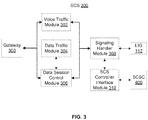
- SCS 300 includes a voice traffic module 302, a data traffic module 304, a data session control module 306, a signaling handler module 308, and an SCSC interface module 310.
- voice traffic module 302 receives information regarding the set of thresholds associated with adulteration parameters from an SCSC 400. Additionally, the information may include network topology related information, which is relevant to a session (for example, minimum number of hops between target user 102 and peer user 104 for the session); specific content-adulteration mechanisms (for example, IP hop length manipulation and filling certain unused protocol headers) to monitor based on provisioned or historical data of sessions involving target user 102 and/or peer user 104; and session-type specific monitoring inputs (for example, examining RTP headers in case of voice sessions, monitoring the interval of retransmission of same packet, and whether the retransmitted packet has different contents in case of TCP, use of unacceptable header values in case of UDP, and minimum content length of each packet).
- network topology related information which is relevant to a session (for example, minimum number of hops between target user 102 and peer user 104 for the session); specific content-adulteration mechanisms (for example, IP hop length manipulation and filling certain unused protocol headers)
- voice traffic module 302 performs functionality of CMAD module 202 and CC module 208 to detect adulteration and thereafter correct the adulteration during the period of gateway handover. This may be required when target user 102 is not stationary or when a gateway handover occurs due to adverse network conditions. For example, target user 102 may be using a mobile phone to communicate with peer user 104 and may be constantly moving, and hence may involve a gateway handover. By way of another example, the network conditions in the network segment of gateway 200 may become adverse (for example, due to increased congestion levels), thereby necessitating a gateway handover to ensure LI continuity. Additionally, voice traffic module 302 sends data received from gateway 200 before the handover and data associated with adulteration detection and correction performed by voice traffic module 302 to the new gateway that will perform lawful interception for target user 102 in future.
- data traffic module 304 and data session control module 306 performs same functionalities as are performed by voice traffic module 302 for voice sessions.
- Data traffic module 304 detects and corrects adulteration during gateway handover. Thereafter, data session control module 306 sends data received from gateway 200 before the handover and data associated with adulteration detection and correction performed by data traffic module 304 to the new gateway.
- SCSC 400 performs the functionality of selecting gateway 200 and SCS 300 for performing their respective functions.
- SCSC 400 includes a Content Monitoring and Adulteration Detection Manager (CMADM) 402, a provisioning module 404, and an SCS interface module 406.
- CDMADM Content Monitoring and Adulteration Detection Manager
- CMADM 402 determines the set of adulteration parameters and computes the associated set of thresholds based on network topology and the selected gateway 200 and SCS 300. Thereafter, CMADM 402 sends information for the set of thresholds to SCS 300, which forwards this information to gateway 200. This enables SCS 300 and gateway 200 to identify adulteration in the communication data.
- CMADM 402 sends additional information to SCS 300, which may include network topology related information, which is relevant to a session (for example, minimum number of hops between target user 102 and peer user 104 for the session); specific content-adulteration mechanisms (for example, IP hop length manipulation and filling certain unused protocol headers) to monitor based on provisioned or historical data of sessions involving target user 102 and/or peer user 104; and session-type specific monitoring inputs (for example, examining RTP headers in case of voice sessions, monitoring the interval of retransmission of same packet, and whether the retransmitted packet has different contents in case of TCP, use of unacceptable header values in case of UDP, and minimum content length of each packet).
- the relevant information sent by CMADM 402 to SCS 300 as described above is, in turn, forwarded to gateway 200.
- CMADM 402 may perform these computations at start of a session, each time a new gateway is selected or when there is change in the session characteristics.
- the session characteristics may include, but are not limited to a new user being added to the session and one of the users being handed over to another network.
- CMADM 402 also adapts each of the set of thresholds based on updates received from gateway 200 and /or SCS 300. These adaptations made by CMADM 402 are used in future by each of gateway 200 and SCS 300 to identify and correct adulterations detected in communication data exchanged between target user 102 and peer user 104. In other words, historical data of sessions that involve target user 102 is utilized for more accurate monitoring and detection of adulteration.
- Provisioning module 404 receives all provisioned inputs relevant to monitoring of the communication data and subsequent detection of adulteration in the communication data that involves target user 102. Additionally, provisioning module 404 receives all provisioned inputs relevant to a possible correction of detected adulteration in the communication data. These provisioned inputs may include, but are not limited to specific events related to target user 102, the set of thresholds, and the set of network parameters. These inputs are then communicated to CMADM 402.
- SCS interface module 406 which directly communicates with SCS controller interface module 310.
- a flow chart of a method for performing lawful interception in a communication network is illustrated, in accordance with an embodiment.
- a lawful interception is initiated for target user 102 by selecting a network device.
- the network device may be at least one of gateway 200 and SCS 300 that are selected by SCSC 400.
- the network device detects adulteration in the communication data in real time as the communication data is being exchanged.
- the adulteration is detected by comparing dynamically the values of a set of adulteration parameters derived from the communication data with associated thresholds within a set of thresholds.
- the set of thresholds are also received by CMAD module 202 from SCS 300.
- the set of adulteration parameters may include, but are not limited to packets with insufficient hop length, packets with unused protocol headers filled in, packets with invalid, not used, or intentionally misleading Real-time Transport Protocol (RTP) header contents (for example, an old time stamp), interval between retransmission of the same packet, packets with difference in content between the initially sent and retransmitted version(s) of the same packet, packets with unacceptable protocol or packet header values, port changes, RST and other flag adulterations, packets with insufficient or invalid TTL contents, and packets with content length lower than the minimum possible content length for that packet type or protocol.
- RTP Real-time Transport Protocol
- the set of adulteration parameter values may be computed in gateway 200 at fixed intervals or upon occurrence of an event, such as, onset or abatement of congestion.
- the RTT value may be computed by examining the timestamps of TCP packets and their acknowledgements in real-time.
- the set of thresholds may also be computed by gateway 200.
- SCSC 400 may compute the set of thresholds based on session characteristics and users involved in the session. For example, during handover of the user to a different network or handover of the gateway, the hop length threshold may be computed based on the network topology and users involved in the session.
- the set of thresholds may be dynamically adapted based on a set of network parameters and comparison of the set of adulteration parameters with associated dynamically adapted thresholds may be performed thereafter. This is further explained in conjunction with FIG. 6 .
- gateway 200 stores the result of this comparison and forwards the same to SCS 300.
- the result of such comparison may include, but are not limited to threshold(s) that were crossed, and values of adulteration parameters that did not cross associated thresholds; number and content of TCP packets which were below the hop length threshold but did not involve a retransmission, number and content of packets which contained abnormal header contents but did not involve a retransmission, number; and content of TCP packets which were above the hop length threshold by a certain number (for example, up to 3), but involved retransmission with different contents each time.
- gateway 200 determines whether content adulteration has occurred or not. For example, such a determination could be based on the number of packets retransmitted with different contents (in case of TCP/SCTP) crossing an associated threshold; number of packets which contained abnormal headers and their frequency of occurrence, and correlation of these with the percentage of such packets that were retransmitted in spite of good network conditions.
- the network device analyzes adulterated content in the communication data in order to determine whether it would be feasible to correct the adulterated content based on satisfaction of predefined criteria.
- the predefined criteria include meeting a confidence level of accuracy in correcting the adulterated content. In other words, the adulterated content is corrected only when the corrections made would be reasonably accurate. However, if the corrections made to the adulterated content would not be reasonably accurate the adulterated content may not be corrected.
- the information stored for content adulteration is used by gateway 200 to perform content correction.
- This information may include, but is not limited to all adulterated packets, information regarding abnormalities in these packets (for example, abnormal header contents and fast retransmissions with different contents each time), number and content of TCP packets which were below the hop length threshold but did not involve a retransmission, and number and content of packets which contained abnormal header contents but did not involve a retransmission.
- gateway 200 determines whether it is possible to correct the adulteration by performing some assessments for different scenarios.
- assessments may include, but are not limited to analysis of the timestamps of retransmissions and acknowledgement received to match the packet and its retransmission, taking into account also RTT value; and analysis of the difference in contents of packets to look for abnormal header values.
- gateway 200 performs assessments that may include, but are not limited to analysis of the contents of these packets and matching the acknowledgement timestamps. Additionally, in case of number of abnormal UDP/RTP packets with abnormal contents crossing the threshold, gateway 200 examines the contents of such packets.
- gateway 200 determines whether it is possible to correct at least some of the packets. If gateway 200 determines that it is possible to correct one or more packets with a minimum confidence level, it further proceeds to correct the adulterated content.
- the minimum confidence level may be provisioned by LEA 108.
- gateway 200 determines that it is not possible to correct the adulteration, it sends information that may include, but is not limited to confidence level and inability to identify exact adulterated packet to SCS 300. Correction of adulterated content is further explained in detail in conjunction with FIGs. 7A and 7B .
- a flow chart of a method for performing lawful interception in a communication network is illustrated, in accordance with another embodiment.
- a set of network parameters are monitored in order to detect a change in one or more of the set of network parameters.
- the set of network parameters may include, but are not limited to network congestion, network choke, packet queueing, buffer overflows, insufficient network coverage, link unavailability, network delays, packet drops, and users involved in session for the communication data.
- one or more of the set of thresholds are dynamically adapted at 604.
- the dynamic adaptation of thresholds is performed by gateway 200 at fixed intervals of time and/or on occurrence of an event, for example, high network congestion.
- adulteration in communication data is detected in real-time based on comparison of a set of adulteration parameters derived from the communication data with associated dynamically adapted thresholds.
- feasibility of correcting the adulterated content is determined based on satisfaction of predefined criteria.
- the term "feasibility" is preferably used herein to describe a likelihood of success in correcting the adulterated content.
- the adulterated content is selectively corrected at 610. This has been explained in detail in conjunction with FIG. 5 .
- additional information associated with the adulterated content is sent to LIG 112.
- the additional information that is sent to LIG 112 may include, but is not limited to type of adulteration done, whether adulteration was done by target user 102 or peer user 104, and at least one of indication of inability to correct the adulterated content along with the reason and relevant information (for example, confidence level and inability to identify the exact adulterated packet), or indication of adulterated content being corrected along with relevant information (for example, output confidence level and information about packets removed with a lower confidence level).
- the feedback may include, but is not limited to number and content of TCP packets which were below the hop length threshold but did not involve a retransmission, number and content of packets which contained abnormal header contents but did not involve a retransmission, number and content of TCP packets which were above the hop length threshold by a certain number, but involved retransmission with different contents each time.
- aggregated content is sent to LIG 112.
- the aggregated content includes corrected packets after suitable formatting and sequencing has been performed. Additionally, more information is sent to LIG 112 based on confidence level of identification of unwanted packets. This is further explained in conjunction with FIGs. 7A and 7B . This information enables further processing by LIG 112, which further helps LEA 108 to reach appropriate conclusions and define appropriate future course of actions.
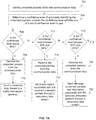
- FIGs. 7A and 7B a flow chart of a method for correcting adulterated content is illustrated, in accordance with an embodiment.
- unwanted packets within the communication data are identified at 702. These unwanted packets are the cause of adulteration in the communication data and include garbage or misleading content.
- a confidence level of accurately identifying the unwanted packets is determined. There are a set of confidence level ranges, such that, the confidence level satisfies one of these confidence level ranges.
- a confidence level represents the probability of identifying the packet correctly as being unwanted. The probability, for example, may be computed based on the match between the packet and its acknowledgement.
- the set of confidence level ranges as indicated above may be provisioned by LEA 108.
- a check is performed to determine whether the confidence level is above 95 percent. If the confidence level is above 95 percent, the unwanted packets are removed from the communication data at 708. Thereafter, at 710, a corrected data stream is sent to LIG 112.
- a check is performed at 712 to determine if the confidence level is between 95 and 80 percent. If the confidence level is between 95 and 80 percent, then at 714 the unwanted packets are removed from the communication data. Thereafter, information associated with the removed unwanted packets is also sent through a secondary data stream to LIG 112 at 716.
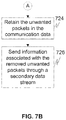
- the unwanted packets in the communication data are retained at 724, instead of being removed. Thereafter, at 726, information associated with the removed unwanted packets is sent through a secondary data stream to LIG 112. In all above scenarios, confidence level of identification is also sent to LIG 112, in order to aid further processing by LIG 112.
- FIG. 8 is a block diagram of an exemplary computer system for implementing various embodiments.
- Computer system 802 may comprise a central processing unit (“CPU” or "processor") 804.
- Processor 804 may comprise at least one data processor for executing program components for executing user- or system-generated requests.
- a user may include a person, a person using a device such as such as those included in this disclosure, or such a device itself.
- the processor may include specialized processing units such as integrated system (bus) controllers, memory management control units, floating point units, graphics processing units, digital signal processing units, etc.
- the processor may include a microprocessor, such as AMD Athlon, Duron or Opteron, ARM's application, embedded or secure processors, IBM PowerPC, Intel's Core, Itanium, Xeon, Celeron or other line of processors, etc.
- Processor 804 may be implemented using mainframe, distributed processor, multi-core, parallel, grid, or other architectures. Some embodiments may utilize embedded technologies like application-specific integrated circuits (ASICs), digital signal processors (DSPs), Field Programmable Gate Arrays (FPGAs), etc.
- ASICs application-specific integrated circuits
- DSPs digital signal processors
- FPGAs Field Programmable Gate Arrays
- I/O interface 806 may employ communication protocols/methods such as, without limitation, audio, analog, digital, monoaural, RCA, stereo, IEEE-1394, serial bus, universal serial bus (USB), infrared, PS/2, BNC, coaxial, component, composite, digital visual interface (DVI), high-definition multimedia interface (HDMI), RF antennas, S-Video, VGA, IEEE 802.n /b/g/n/x, Bluetooth, cellular (e.g., code-division multiple access (CDMA), high-speed packet access (HSPA+), global system for mobile communications (GSM), long-term evolution (LTE), WiMax, or the like), etc.
- CDMA code-division multiple access
- HSPA+ high-speed packet access
- GSM global system for mobile communications
- LTE long-term evolution
- WiMax wireless wide area network
- an input device 808 may be an antenna, keyboard, mouse, joystick, (infrared) remote control, camera, card reader, fax machine, dongle, biometric reader, microphone, touch screen, touchpad, trackball, sensor (e.g., accelerometer, light sensor, GPS, gyroscope, proximity sensor, or the like), stylus, scanner, storage device, transceiver, video device/source, visors, etc.
- an input device 808 may be an antenna, keyboard, mouse, joystick, (infrared) remote control, camera, card reader, fax machine, dongle, biometric reader, microphone, touch screen, touchpad, trackball, sensor (e.g., accelerometer, light sensor, GPS, gyroscope, proximity sensor, or the like), stylus, scanner, storage device, transceiver, video device/source, visors, etc.
- sensor e.g., accelerometer, light sensor, GPS, gyroscope, proximity sensor, or the like
- An output device 810 may be a printer, fax machine, video display (e.g., cathode ray tube (CRT), liquid crystal display (LCD), light-emitting diode (LED), plasma, or the like), audio speaker, etc.
- a transceiver 812 may be disposed in connection with processor 804. Transceiver 812 may facilitate various types of wireless transmission or reception.
- transceiver 812 may include an antenna operatively connected to a transceiver chip (e.g., Texas Instruments WiLink WL1283, Broadcom BCM4750IUB8, Infineon Technologies X-Gold 618-PMB9800, or the like), providing IEEE 802.11a/b/g/n, Bluetooth, FM, global positioning system (GPS), 2G/3G HSDPA/HSUPA communications, etc.
- a transceiver chip e.g., Texas Instruments WiLink WL1283, Broadcom BCM4750IUB8, Infineon Technologies X-Gold 618-PMB9800, or the like
- IEEE 802.11a/b/g/n e.g., Texas Instruments WiLink WL1283, Broadcom BCM4750IUB8, Infineon Technologies X-Gold 618-PMB9800, or the like
- IEEE 802.11a/b/g/n e.g., Bluetooth, FM, global positioning system (GPS), 2G/3G HSDPA/
- processor 804 may be disposed in communication with a communication network 814 via a network interface 816.
- Network interface 816 may communicate with communication network 814.
- Network interface 816 may employ connection protocols including, without limitation, direct connect, Ethernet (e.g., twisted pair 50/500/5000 Base T), transmission control protocol/internet protocol (TCP/IP), token ring, IEEE 802.11a/b/g/n/x, etc.
- Communication network 814 may include, without limitation, a direct interconnection, local area network (LAN), wide area network (WAN), wireless network (e.g., using Wireless Application Protocol), the Internet, etc.
- LAN local area network
- WAN wide area network
- wireless network e.g., using Wireless Application Protocol
- These devices may include, without limitation, personal computer(s), server(s), fax machines, printers, scanners, various mobile devices such as cellular telephones, smartphones (e.g., Apple iPhone, Blackberry, Android-based phones, etc.), tablet computers, eBook readers (Amazon Kindle, Nook, etc.), laptop computers, notebooks, gaming consoles (Microsoft Xbox, Nintendo DS, Sony PlayStation, etc.), or the like.
- computer system 802 may itself embody one or more of these devices.
- processor 804 may be disposed in communication with one or more memory devices (e.g., RAM 826, ROM 828, etc.) via a storage interface 824.
- Storage interface 824 may connect to memory devices 830 including, without limitation, memory drives, removable disc drives, etc., employing connection protocols such as serial advanced technology attachment (SATA), integrated drive electronics (IDE), IEEE-1394, universal serial bus (USB), fiber channel, small computer systems interface (SCSI), etc.
- the memory drives may further include a drum, magnetic disc drive, magneto-optical drive, optical drive, redundant array of independent discs (RAID), solid-state memory devices, solid-state drives, etc.
- Memory devices 830 may store a collection of program or database components, including, without limitation, an operating system 832, a user interface application 834, a web browser 836, a mail server 838, a mail client 840, a user/application data 842 (e.g., any data variables or data records discussed in this disclosure), etc.
- Operating system 832 may facilitate resource management and operation of the computer system 802.
- operating system 832 examples include, without limitation, Apple Macintosh OS X, Unix, Unix-like system distributions (e.g., Berkeley Software Distribution (BSD), FreeBSD, NetBSD, OpenBSD, etc.), Linux distributions (e.g., Red Hat, Ubuntu, Kubuntu, etc.), IBM OS/2, Microsoft Windows (XP, Vista/7/8, etc.), Apple iOS, Google Android, Blackberry OS, or the like.
- User interface 834 may facilitate display, execution, interaction, manipulation, or operation of program components through textual or graphical facilities.
- user interfaces may provide computer interaction interface elements on a display system operatively connected to computer system 802, such as cursors, icons, check boxes, menus, scrollers, windows, widgets, etc.
- GUIs Graphical user interfaces
- GUIs may be employed, including, without limitation, Apple Macintosh operating systems' Aqua, IBM OS/2, Microsoft Windows (e.g., Aero, Metro, etc.), Unix X-Windows, web interface libraries (e.g., ActiveX, Java, Javascript, AJAX, HTML, Adobe Flash, etc.), or the like.
- computer system 802 may implement web browser 836 stored program component.
- Web browser 836 may be a hypertext viewing application, such as Microsoft Internet Explorer, Google Chrome, Mozilla Firefox, Apple Safari, etc. Secure web browsing may be provided using HTTPS (secure hypertext transport protocol), secure sockets layer (SSL), Transport Layer Security (TLS), etc. Web browsers may utilize facilities such as AJAX, DHTML, Adobe Flash, JavaScript, Java, application programming interfaces (APIs), etc.
- computer system 802 may implement mail server 838 stored program component.
- Mail server 838 may be an Internet mail server such as Microsoft Exchange, or the like.
- the mail server may utilize facilities such as ASP, ActiveX, ANSI C++/C#, Microsoft .NET, CGI scripts, Java, JavaScript, PERL, PHP, Python, WebObjects, etc.
- the mail server may utilize communication protocols such as internet message access protocol (IMAP), messaging application programming interface (MAPI), Microsoft Exchange, post office protocol (POP), simple mail transfer protocol (SMTP), or the like.
- computer system 802 may implement mail client 840 stored program component.
- Mail client 840 may be a mail viewing application, such as Apple Mail, Microsoft Entourage, Microsoft Outlook, Mozilla Thunderbird, etc.
- computer system 802 may store user/application data 842, such as the data, variables, records, etc. as described in this disclosure.
- databases may be implemented as fault-tolerant, relational, scalable, secure databases such as Oracle or Sybase.
- databases may be implemented using standardized data structures, such as an array, hash, linked list, struct, structured text file (e.g., XML), table, or as object-oriented databases (e.g., using ObjectStore, Poet, Zope, etc.).
- object-oriented databases e.g., using ObjectStore, Poet, Zope, etc.
- Such databases may be consolidated or distributed, sometimes among the various computer systems discussed above in this disclosure. It is to be understood that the structure and operation of the any computer or database component may be combined, consolidated, or distributed in any working combination.
- a computer-readable storage medium refers to any type of physical memory on which information or data readable by a processor may be stored.
- a computer-readable storage medium may store instructions for execution by one or more processors, including instructions for causing the processor(s) to perform steps or stages consistent with the embodiments described herein.
- the term "computer-readable medium” should be understood to include tangible items and exclude carrier waves and transient signals, i.e., be non-transitory. Examples include random access memory (RAM), read-only memory (ROM), volatile memory, nonvolatile memory, hard drives, CD ROMs, DVDs, flash drives, disks, and any other known physical storage media.
Landscapes
- Engineering & Computer Science (AREA)
- Computer Networks & Wireless Communication (AREA)
- Signal Processing (AREA)
- Environmental & Geological Engineering (AREA)
- Technology Law (AREA)
- Computer Hardware Design (AREA)
- Computer Security & Cryptography (AREA)
- Computing Systems (AREA)
- General Engineering & Computer Science (AREA)
- Data Mining & Analysis (AREA)
- Data Exchanges In Wide-Area Networks (AREA)
- Mobile Radio Communication Systems (AREA)
Applications Claiming Priority (1)
| Application Number | Priority Date | Filing Date | Title |
|---|---|---|---|
| IN5233CH2015 IN2015CH05233A (enExample) | 2015-09-30 | 2015-09-30 |
Publications (2)
| Publication Number | Publication Date |
|---|---|
| EP3151469A1 EP3151469A1 (en) | 2017-04-05 |
| EP3151469B1 true EP3151469B1 (en) | 2020-07-15 |
Family
ID=54397736
Family Applications (1)
| Application Number | Title | Priority Date | Filing Date |
|---|---|---|---|
| EP16153530.7A Active EP3151469B1 (en) | 2015-09-30 | 2016-01-29 | Methods and systems for performing lawful interception in communication networks |
Country Status (3)
| Country | Link |
|---|---|
| US (1) | US9705933B2 (enExample) |
| EP (1) | EP3151469B1 (enExample) |
| IN (1) | IN2015CH05233A (enExample) |
Families Citing this family (3)
| Publication number | Priority date | Publication date | Assignee | Title |
|---|---|---|---|---|
| WO2018044260A1 (en) * | 2016-08-29 | 2018-03-08 | Ruckus Wireless, Inc. | Transmitting traffic in a shared frequency bandwidth |
| US10218743B2 (en) * | 2017-01-13 | 2019-02-26 | Wipro Limited | Systems and methods of intent-based lawful interception (LI) in communication networks |
| JP2021177598A (ja) * | 2020-05-08 | 2021-11-11 | シャープ株式会社 | 音声処理システム、音声処理方法、及び音声処理プログラム |
Family Cites Families (7)
| Publication number | Priority date | Publication date | Assignee | Title |
|---|---|---|---|---|
| JP2007325293A (ja) * | 2002-08-20 | 2007-12-13 | Nec Corp | 攻撃検知システムおよび攻撃検知方法 |
| US7609625B2 (en) * | 2005-07-06 | 2009-10-27 | Fortinet, Inc. | Systems and methods for detecting and preventing flooding attacks in a network environment |
| WO2007105193A1 (en) * | 2006-03-12 | 2007-09-20 | Nice Systems Ltd. | Apparatus and method for target oriented law enforcement interception and analysis |
| JP2008278339A (ja) * | 2007-05-01 | 2008-11-13 | Ntt Docomo Inc | 基地局装置及び通信制御方法 |
| US9106603B2 (en) * | 2009-12-23 | 2015-08-11 | Synchronics plc | Apparatus, method and computer-readable storage mediums for determining application protocol elements as different types of lawful interception content |
| US20120084288A1 (en) * | 2010-10-01 | 2012-04-05 | Mohammed Abdul-Razzak | Criminal relationship analysis and visualization |
| EP2692161B1 (en) * | 2011-03-29 | 2015-09-02 | Telefonaktiebolaget L M Ericsson (publ) | Lawful interception in an ip multimedia subsystem network |
-
2015
- 2015-09-30 IN IN5233CH2015 patent/IN2015CH05233A/en unknown
- 2015-11-17 US US14/943,799 patent/US9705933B2/en active Active
-
2016
- 2016-01-29 EP EP16153530.7A patent/EP3151469B1/en active Active
Non-Patent Citations (1)
| Title |
|---|
| None * |
Also Published As
| Publication number | Publication date |
|---|---|
| IN2015CH05233A (enExample) | 2015-10-16 |
| US20170093927A1 (en) | 2017-03-30 |
| EP3151469A1 (en) | 2017-04-05 |
| US9705933B2 (en) | 2017-07-11 |
Similar Documents
| Publication | Publication Date | Title |
|---|---|---|
| EP3206359B1 (en) | Methods and systems for performing lawful interception (li) in communication networks involving content adulteration with colluding agents | |
| US10349297B2 (en) | Quality of user experience analysis | |
| US20200267588A1 (en) | Contextual Quality of User Experience Analysis Using Equipment Dynamics | |
| US9426046B2 (en) | Web page download time analysis | |
| EP3462684B1 (en) | Method and system for adaptive and context-aware service function chaining in communication networks | |
| US10637770B2 (en) | Method and system for optimizing service function paths associated with common service functions | |
| US10952091B2 (en) | Quality of user experience analysis | |
| EP3169027B1 (en) | System and method for modifying per hop behavior of one or more expedited forwarding packets | |
| US9774757B2 (en) | Methods and systems for increasing quality and reliability of fax communications | |
| US10218743B2 (en) | Systems and methods of intent-based lawful interception (LI) in communication networks | |
| CN110890972B (zh) | 一种业务系统的健康度评估方法及装置 | |
| US11784870B2 (en) | System and method for effective determination and resolution of network issues impacting application performance in multi-domain networks | |
| EP3151469B1 (en) | Methods and systems for performing lawful interception in communication networks | |
| CN108476423A (zh) | 使用设备动态的用户体验质量上下文分析 | |
| US20160295481A1 (en) | System and method of improved lawful interception of seamless data session continuity across heterogeneous networks | |
| US10686760B2 (en) | Method and system for generating dynamic rules for computer network firewall | |
| EP3070918B1 (en) | Method and device for improving lawful interception of a call | |
| US12052284B1 (en) | System and method for detecting phishing attacks in SMS communications | |
| EP3316141A1 (en) | Method and system for determining performance of an application installed on mobile stations | |
| US10020985B2 (en) | System and method for effective and reliable lawful interception content transmission across networks | |
| EP3076631B1 (en) | System and method of improved lawful interception of seamless data session continuity across heterogeneous networks | |
| EP3107257A1 (en) | Network resource optimization for continuity of lawful interception of voice and data sessions across networks |
Legal Events
| Date | Code | Title | Description |
|---|---|---|---|
| PUAI | Public reference made under article 153(3) epc to a published international application that has entered the european phase |
Free format text: ORIGINAL CODE: 0009012 |
|
| STAA | Information on the status of an ep patent application or granted ep patent |
Free format text: STATUS: THE APPLICATION HAS BEEN PUBLISHED |
|
| AK | Designated contracting states |
Kind code of ref document: A1 Designated state(s): AL AT BE BG CH CY CZ DE DK EE ES FI FR GB GR HR HU IE IS IT LI LT LU LV MC MK MT NL NO PL PT RO RS SE SI SK SM TR |
|
| AX | Request for extension of the european patent |
Extension state: BA ME |
|
| STAA | Information on the status of an ep patent application or granted ep patent |
Free format text: STATUS: REQUEST FOR EXAMINATION WAS MADE |
|
| 17P | Request for examination filed |
Effective date: 20171005 |
|
| RBV | Designated contracting states (corrected) |
Designated state(s): AL AT BE BG CH CY CZ DE DK EE ES FI FR GB GR HR HU IE IS IT LI LT LU LV MC MK MT NL NO PL PT RO RS SE SI SK SM TR |
|
| GRAP | Despatch of communication of intention to grant a patent |
Free format text: ORIGINAL CODE: EPIDOSNIGR1 |
|
| STAA | Information on the status of an ep patent application or granted ep patent |
Free format text: STATUS: GRANT OF PATENT IS INTENDED |
|
| RIC1 | Information provided on ipc code assigned before grant |
Ipc: H04L 1/00 20060101ALI20200207BHEP Ipc: H04L 29/06 20060101ALI20200207BHEP Ipc: H04L 12/26 20060101AFI20200207BHEP |
|
| INTG | Intention to grant announced |
Effective date: 20200226 |
|
| GRAS | Grant fee paid |
Free format text: ORIGINAL CODE: EPIDOSNIGR3 |
|
| GRAA | (expected) grant |
Free format text: ORIGINAL CODE: 0009210 |
|
| STAA | Information on the status of an ep patent application or granted ep patent |
Free format text: STATUS: THE PATENT HAS BEEN GRANTED |
|
| AK | Designated contracting states |
Kind code of ref document: B1 Designated state(s): AL AT BE BG CH CY CZ DE DK EE ES FI FR GB GR HR HU IE IS IT LI LT LU LV MC MK MT NL NO PL PT RO RS SE SI SK SM TR |
|
| REG | Reference to a national code |
Ref country code: GB Ref legal event code: FG4D Ref country code: CH Ref legal event code: EP |
|
| REG | Reference to a national code |
Ref country code: IE Ref legal event code: FG4D |
|
| REG | Reference to a national code |
Ref country code: DE Ref legal event code: R096 Ref document number: 602016039828 Country of ref document: DE |
|
| REG | Reference to a national code |
Ref country code: AT Ref legal event code: REF Ref document number: 1292183 Country of ref document: AT Kind code of ref document: T Effective date: 20200815 |
|
| REG | Reference to a national code |
Ref country code: LT Ref legal event code: MG4D |
|
| REG | Reference to a national code |
Ref country code: AT Ref legal event code: MK05 Ref document number: 1292183 Country of ref document: AT Kind code of ref document: T Effective date: 20200715 |
|
| REG | Reference to a national code |
Ref country code: NL Ref legal event code: MP Effective date: 20200715 |
|
| PG25 | Lapsed in a contracting state [announced via postgrant information from national office to epo] |
Ref country code: HR Free format text: LAPSE BECAUSE OF FAILURE TO SUBMIT A TRANSLATION OF THE DESCRIPTION OR TO PAY THE FEE WITHIN THE PRESCRIBED TIME-LIMIT Effective date: 20200715 Ref country code: SE Free format text: LAPSE BECAUSE OF FAILURE TO SUBMIT A TRANSLATION OF THE DESCRIPTION OR TO PAY THE FEE WITHIN THE PRESCRIBED TIME-LIMIT Effective date: 20200715 Ref country code: ES Free format text: LAPSE BECAUSE OF FAILURE TO SUBMIT A TRANSLATION OF THE DESCRIPTION OR TO PAY THE FEE WITHIN THE PRESCRIBED TIME-LIMIT Effective date: 20200715 Ref country code: AT Free format text: LAPSE BECAUSE OF FAILURE TO SUBMIT A TRANSLATION OF THE DESCRIPTION OR TO PAY THE FEE WITHIN THE PRESCRIBED TIME-LIMIT Effective date: 20200715 Ref country code: GR Free format text: LAPSE BECAUSE OF FAILURE TO SUBMIT A TRANSLATION OF THE DESCRIPTION OR TO PAY THE FEE WITHIN THE PRESCRIBED TIME-LIMIT Effective date: 20201016 Ref country code: BG Free format text: LAPSE BECAUSE OF FAILURE TO SUBMIT A TRANSLATION OF THE DESCRIPTION OR TO PAY THE FEE WITHIN THE PRESCRIBED TIME-LIMIT Effective date: 20201015 Ref country code: NO Free format text: LAPSE BECAUSE OF FAILURE TO SUBMIT A TRANSLATION OF THE DESCRIPTION OR TO PAY THE FEE WITHIN THE PRESCRIBED TIME-LIMIT Effective date: 20201015 Ref country code: PT Free format text: LAPSE BECAUSE OF FAILURE TO SUBMIT A TRANSLATION OF THE DESCRIPTION OR TO PAY THE FEE WITHIN THE PRESCRIBED TIME-LIMIT Effective date: 20201116 Ref country code: FI Free format text: LAPSE BECAUSE OF FAILURE TO SUBMIT A TRANSLATION OF THE DESCRIPTION OR TO PAY THE FEE WITHIN THE PRESCRIBED TIME-LIMIT Effective date: 20200715 Ref country code: LT Free format text: LAPSE BECAUSE OF FAILURE TO SUBMIT A TRANSLATION OF THE DESCRIPTION OR TO PAY THE FEE WITHIN THE PRESCRIBED TIME-LIMIT Effective date: 20200715 |
|
| PG25 | Lapsed in a contracting state [announced via postgrant information from national office to epo] |
Ref country code: IS Free format text: LAPSE BECAUSE OF FAILURE TO SUBMIT A TRANSLATION OF THE DESCRIPTION OR TO PAY THE FEE WITHIN THE PRESCRIBED TIME-LIMIT Effective date: 20201115 Ref country code: LV Free format text: LAPSE BECAUSE OF FAILURE TO SUBMIT A TRANSLATION OF THE DESCRIPTION OR TO PAY THE FEE WITHIN THE PRESCRIBED TIME-LIMIT Effective date: 20200715 Ref country code: RS Free format text: LAPSE BECAUSE OF FAILURE TO SUBMIT A TRANSLATION OF THE DESCRIPTION OR TO PAY THE FEE WITHIN THE PRESCRIBED TIME-LIMIT Effective date: 20200715 Ref country code: PL Free format text: LAPSE BECAUSE OF FAILURE TO SUBMIT A TRANSLATION OF THE DESCRIPTION OR TO PAY THE FEE WITHIN THE PRESCRIBED TIME-LIMIT Effective date: 20200715 |
|
| PG25 | Lapsed in a contracting state [announced via postgrant information from national office to epo] |
Ref country code: NL Free format text: LAPSE BECAUSE OF FAILURE TO SUBMIT A TRANSLATION OF THE DESCRIPTION OR TO PAY THE FEE WITHIN THE PRESCRIBED TIME-LIMIT Effective date: 20200715 |
|
| REG | Reference to a national code |
Ref country code: DE Ref legal event code: R097 Ref document number: 602016039828 Country of ref document: DE |
|
| PG25 | Lapsed in a contracting state [announced via postgrant information from national office to epo] |
Ref country code: EE Free format text: LAPSE BECAUSE OF FAILURE TO SUBMIT A TRANSLATION OF THE DESCRIPTION OR TO PAY THE FEE WITHIN THE PRESCRIBED TIME-LIMIT Effective date: 20200715 Ref country code: SM Free format text: LAPSE BECAUSE OF FAILURE TO SUBMIT A TRANSLATION OF THE DESCRIPTION OR TO PAY THE FEE WITHIN THE PRESCRIBED TIME-LIMIT Effective date: 20200715 Ref country code: RO Free format text: LAPSE BECAUSE OF FAILURE TO SUBMIT A TRANSLATION OF THE DESCRIPTION OR TO PAY THE FEE WITHIN THE PRESCRIBED TIME-LIMIT Effective date: 20200715 Ref country code: DK Free format text: LAPSE BECAUSE OF FAILURE TO SUBMIT A TRANSLATION OF THE DESCRIPTION OR TO PAY THE FEE WITHIN THE PRESCRIBED TIME-LIMIT Effective date: 20200715 Ref country code: CZ Free format text: LAPSE BECAUSE OF FAILURE TO SUBMIT A TRANSLATION OF THE DESCRIPTION OR TO PAY THE FEE WITHIN THE PRESCRIBED TIME-LIMIT Effective date: 20200715 Ref country code: IT Free format text: LAPSE BECAUSE OF FAILURE TO SUBMIT A TRANSLATION OF THE DESCRIPTION OR TO PAY THE FEE WITHIN THE PRESCRIBED TIME-LIMIT Effective date: 20200715 |
|
| PLBE | No opposition filed within time limit |
Free format text: ORIGINAL CODE: 0009261 |
|
| STAA | Information on the status of an ep patent application or granted ep patent |
Free format text: STATUS: NO OPPOSITION FILED WITHIN TIME LIMIT |
|
| PG25 | Lapsed in a contracting state [announced via postgrant information from national office to epo] |
Ref country code: AL Free format text: LAPSE BECAUSE OF FAILURE TO SUBMIT A TRANSLATION OF THE DESCRIPTION OR TO PAY THE FEE WITHIN THE PRESCRIBED TIME-LIMIT Effective date: 20200715 |
|
| 26N | No opposition filed |
Effective date: 20210416 |
|
| PG25 | Lapsed in a contracting state [announced via postgrant information from national office to epo] |
Ref country code: SK Free format text: LAPSE BECAUSE OF FAILURE TO SUBMIT A TRANSLATION OF THE DESCRIPTION OR TO PAY THE FEE WITHIN THE PRESCRIBED TIME-LIMIT Effective date: 20200715 |
|
| PG25 | Lapsed in a contracting state [announced via postgrant information from national office to epo] |
Ref country code: SI Free format text: LAPSE BECAUSE OF FAILURE TO SUBMIT A TRANSLATION OF THE DESCRIPTION OR TO PAY THE FEE WITHIN THE PRESCRIBED TIME-LIMIT Effective date: 20200715 Ref country code: MC Free format text: LAPSE BECAUSE OF FAILURE TO SUBMIT A TRANSLATION OF THE DESCRIPTION OR TO PAY THE FEE WITHIN THE PRESCRIBED TIME-LIMIT Effective date: 20200715 |
|
| REG | Reference to a national code |
Ref country code: CH Ref legal event code: PL |
|
| PG25 | Lapsed in a contracting state [announced via postgrant information from national office to epo] |
Ref country code: LU Free format text: LAPSE BECAUSE OF NON-PAYMENT OF DUE FEES Effective date: 20210129 |
|
| REG | Reference to a national code |
Ref country code: BE Ref legal event code: MM Effective date: 20210131 |
|
| REG | Reference to a national code |
Ref country code: DE Ref legal event code: R079 Ref document number: 602016039828 Country of ref document: DE Free format text: PREVIOUS MAIN CLASS: H04L0012260000 Ipc: H04L0043000000 |
|
| PG25 | Lapsed in a contracting state [announced via postgrant information from national office to epo] |
Ref country code: LI Free format text: LAPSE BECAUSE OF NON-PAYMENT OF DUE FEES Effective date: 20210131 Ref country code: CH Free format text: LAPSE BECAUSE OF NON-PAYMENT OF DUE FEES Effective date: 20210131 |
|
| PG25 | Lapsed in a contracting state [announced via postgrant information from national office to epo] |
Ref country code: IE Free format text: LAPSE BECAUSE OF NON-PAYMENT OF DUE FEES Effective date: 20210129 |
|
| PG25 | Lapsed in a contracting state [announced via postgrant information from national office to epo] |
Ref country code: BE Free format text: LAPSE BECAUSE OF NON-PAYMENT OF DUE FEES Effective date: 20210131 |
|
| PG25 | Lapsed in a contracting state [announced via postgrant information from national office to epo] |
Ref country code: HU Free format text: LAPSE BECAUSE OF FAILURE TO SUBMIT A TRANSLATION OF THE DESCRIPTION OR TO PAY THE FEE WITHIN THE PRESCRIBED TIME-LIMIT; INVALID AB INITIO Effective date: 20160129 |
|
| PG25 | Lapsed in a contracting state [announced via postgrant information from national office to epo] |
Ref country code: CY Free format text: LAPSE BECAUSE OF FAILURE TO SUBMIT A TRANSLATION OF THE DESCRIPTION OR TO PAY THE FEE WITHIN THE PRESCRIBED TIME-LIMIT Effective date: 20200715 |
|
| P01 | Opt-out of the competence of the unified patent court (upc) registered |
Effective date: 20230605 |
|
| PG25 | Lapsed in a contracting state [announced via postgrant information from national office to epo] |
Ref country code: MK Free format text: LAPSE BECAUSE OF FAILURE TO SUBMIT A TRANSLATION OF THE DESCRIPTION OR TO PAY THE FEE WITHIN THE PRESCRIBED TIME-LIMIT Effective date: 20200715 |
|
| PG25 | Lapsed in a contracting state [announced via postgrant information from national office to epo] |
Ref country code: TR Free format text: LAPSE BECAUSE OF FAILURE TO SUBMIT A TRANSLATION OF THE DESCRIPTION OR TO PAY THE FEE WITHIN THE PRESCRIBED TIME-LIMIT Effective date: 20200715 |
|
| PG25 | Lapsed in a contracting state [announced via postgrant information from national office to epo] |
Ref country code: MT Free format text: LAPSE BECAUSE OF FAILURE TO SUBMIT A TRANSLATION OF THE DESCRIPTION OR TO PAY THE FEE WITHIN THE PRESCRIBED TIME-LIMIT Effective date: 20200715 |
|
| PGFP | Annual fee paid to national office [announced via postgrant information from national office to epo] |
Ref country code: GB Payment date: 20241205 Year of fee payment: 10 |
|
| PGFP | Annual fee paid to national office [announced via postgrant information from national office to epo] |
Ref country code: FR Payment date: 20241209 Year of fee payment: 10 |
|
| PGFP | Annual fee paid to national office [announced via postgrant information from national office to epo] |
Ref country code: DE Payment date: 20241203 Year of fee payment: 10 |