EP3151434A1 - Method for demodulating received symbols using a turbo-demodulation scheme comprising an iterative channel equalization and wherein an iterative channel decoder is used in the turbo-demodulation scheme - Google Patents
Method for demodulating received symbols using a turbo-demodulation scheme comprising an iterative channel equalization and wherein an iterative channel decoder is used in the turbo-demodulation scheme Download PDFInfo
- Publication number
- EP3151434A1 EP3151434A1 EP15187978.0A EP15187978A EP3151434A1 EP 3151434 A1 EP3151434 A1 EP 3151434A1 EP 15187978 A EP15187978 A EP 15187978A EP 3151434 A1 EP3151434 A1 EP 3151434A1
- Authority
- EP
- European Patent Office
- Prior art keywords
- iterative
- channel decoder
- turbo
- iterative channel
- decoder
- Prior art date
- Legal status (The legal status is an assumption and is not a legal conclusion. Google has not performed a legal analysis and makes no representation as to the accuracy of the status listed.)
- Withdrawn
Links
Images



Classifications
-
- H—ELECTRICITY
- H04—ELECTRIC COMMUNICATION TECHNIQUE
- H04L—TRANSMISSION OF DIGITAL INFORMATION, e.g. TELEGRAPHIC COMMUNICATION
- H04L1/00—Arrangements for detecting or preventing errors in the information received
- H04L1/004—Arrangements for detecting or preventing errors in the information received by using forward error control
- H04L1/0056—Systems characterized by the type of code used
- H04L1/0057—Block codes
- H04L1/0058—Block-coded modulation
-
- H—ELECTRICITY
- H03—ELECTRONIC CIRCUITRY
- H03M—CODING; DECODING; CODE CONVERSION IN GENERAL
- H03M13/00—Coding, decoding or code conversion, for error detection or error correction; Coding theory basic assumptions; Coding bounds; Error probability evaluation methods; Channel models; Simulation or testing of codes
- H03M13/03—Error detection or forward error correction by redundancy in data representation, i.e. code words containing more digits than the source words
- H03M13/05—Error detection or forward error correction by redundancy in data representation, i.e. code words containing more digits than the source words using block codes, i.e. a predetermined number of check bits joined to a predetermined number of information bits
- H03M13/11—Error detection or forward error correction by redundancy in data representation, i.e. code words containing more digits than the source words using block codes, i.e. a predetermined number of check bits joined to a predetermined number of information bits using multiple parity bits
- H03M13/1102—Codes on graphs and decoding on graphs, e.g. low-density parity check [LDPC] codes
- H03M13/1105—Decoding
- H03M13/1111—Soft-decision decoding, e.g. by means of message passing or belief propagation algorithms
-
- H—ELECTRICITY
- H03—ELECTRONIC CIRCUITRY
- H03M—CODING; DECODING; CODE CONVERSION IN GENERAL
- H03M13/00—Coding, decoding or code conversion, for error detection or error correction; Coding theory basic assumptions; Coding bounds; Error probability evaluation methods; Channel models; Simulation or testing of codes
- H03M13/03—Error detection or forward error correction by redundancy in data representation, i.e. code words containing more digits than the source words
- H03M13/05—Error detection or forward error correction by redundancy in data representation, i.e. code words containing more digits than the source words using block codes, i.e. a predetermined number of check bits joined to a predetermined number of information bits
- H03M13/11—Error detection or forward error correction by redundancy in data representation, i.e. code words containing more digits than the source words using block codes, i.e. a predetermined number of check bits joined to a predetermined number of information bits using multiple parity bits
- H03M13/1102—Codes on graphs and decoding on graphs, e.g. low-density parity check [LDPC] codes
-
- H—ELECTRICITY
- H03—ELECTRONIC CIRCUITRY
- H03M—CODING; DECODING; CODE CONVERSION IN GENERAL
- H03M13/00—Coding, decoding or code conversion, for error detection or error correction; Coding theory basic assumptions; Coding bounds; Error probability evaluation methods; Channel models; Simulation or testing of codes
- H03M13/25—Error detection or forward error correction by signal space coding, i.e. adding redundancy in the signal constellation, e.g. Trellis Coded Modulation [TCM]
- H03M13/258—Error detection or forward error correction by signal space coding, i.e. adding redundancy in the signal constellation, e.g. Trellis Coded Modulation [TCM] with turbo codes, e.g. Turbo Trellis Coded Modulation [TTCM]
-
- H—ELECTRICITY
- H03—ELECTRONIC CIRCUITRY
- H03M—CODING; DECODING; CODE CONVERSION IN GENERAL
- H03M13/00—Coding, decoding or code conversion, for error detection or error correction; Coding theory basic assumptions; Coding bounds; Error probability evaluation methods; Channel models; Simulation or testing of codes
- H03M13/29—Coding, decoding or code conversion, for error detection or error correction; Coding theory basic assumptions; Coding bounds; Error probability evaluation methods; Channel models; Simulation or testing of codes combining two or more codes or code structures, e.g. product codes, generalised product codes, concatenated codes, inner and outer codes
- H03M13/2957—Turbo codes and decoding
-
- H—ELECTRICITY
- H03—ELECTRONIC CIRCUITRY
- H03M—CODING; DECODING; CODE CONVERSION IN GENERAL
- H03M13/00—Coding, decoding or code conversion, for error detection or error correction; Coding theory basic assumptions; Coding bounds; Error probability evaluation methods; Channel models; Simulation or testing of codes
- H03M13/37—Decoding methods or techniques, not specific to the particular type of coding provided for in groups H03M13/03 - H03M13/35
- H03M13/3723—Decoding methods or techniques, not specific to the particular type of coding provided for in groups H03M13/03 - H03M13/35 using means or methods for the initialisation of the decoder
-
- H—ELECTRICITY
- H03—ELECTRONIC CIRCUITRY
- H03M—CODING; DECODING; CODE CONVERSION IN GENERAL
- H03M13/00—Coding, decoding or code conversion, for error detection or error correction; Coding theory basic assumptions; Coding bounds; Error probability evaluation methods; Channel models; Simulation or testing of codes
- H03M13/37—Decoding methods or techniques, not specific to the particular type of coding provided for in groups H03M13/03 - H03M13/35
- H03M13/3746—Decoding methods or techniques, not specific to the particular type of coding provided for in groups H03M13/03 - H03M13/35 with iterative decoding
-
- H—ELECTRICITY
- H03—ELECTRONIC CIRCUITRY
- H03M—CODING; DECODING; CODE CONVERSION IN GENERAL
- H03M13/00—Coding, decoding or code conversion, for error detection or error correction; Coding theory basic assumptions; Coding bounds; Error probability evaluation methods; Channel models; Simulation or testing of codes
- H03M13/63—Joint error correction and other techniques
- H03M13/6325—Error control coding in combination with demodulation
-
- H—ELECTRICITY
- H03—ELECTRONIC CIRCUITRY
- H03M—CODING; DECODING; CODE CONVERSION IN GENERAL
- H03M13/00—Coding, decoding or code conversion, for error detection or error correction; Coding theory basic assumptions; Coding bounds; Error probability evaluation methods; Channel models; Simulation or testing of codes
- H03M13/63—Joint error correction and other techniques
- H03M13/6331—Error control coding in combination with equalisation
-
- H—ELECTRICITY
- H04—ELECTRIC COMMUNICATION TECHNIQUE
- H04L—TRANSMISSION OF DIGITAL INFORMATION, e.g. TELEGRAPHIC COMMUNICATION
- H04L1/00—Arrangements for detecting or preventing errors in the information received
- H04L1/0001—Systems modifying transmission characteristics according to link quality, e.g. power backoff
- H04L1/0009—Systems modifying transmission characteristics according to link quality, e.g. power backoff by adapting the channel coding
-
- H—ELECTRICITY
- H04—ELECTRIC COMMUNICATION TECHNIQUE
- H04L—TRANSMISSION OF DIGITAL INFORMATION, e.g. TELEGRAPHIC COMMUNICATION
- H04L1/00—Arrangements for detecting or preventing errors in the information received
- H04L1/004—Arrangements for detecting or preventing errors in the information received by using forward error control
- H04L1/0056—Systems characterized by the type of code used
- H04L1/0071—Use of interleaving
-
- H—ELECTRICITY
- H04—ELECTRIC COMMUNICATION TECHNIQUE
- H04L—TRANSMISSION OF DIGITAL INFORMATION, e.g. TELEGRAPHIC COMMUNICATION
- H04L25/00—Baseband systems
- H04L25/02—Details ; arrangements for supplying electrical power along data transmission lines
- H04L25/0202—Channel estimation
- H04L25/024—Channel estimation channel estimation algorithms
- H04L25/025—Channel estimation channel estimation algorithms using least-mean-square [LMS] method
-
- H—ELECTRICITY
- H04—ELECTRIC COMMUNICATION TECHNIQUE
- H04L—TRANSMISSION OF DIGITAL INFORMATION, e.g. TELEGRAPHIC COMMUNICATION
- H04L27/00—Modulated-carrier systems
- H04L27/01—Equalisers
-
- H—ELECTRICITY
- H04—ELECTRIC COMMUNICATION TECHNIQUE
- H04L—TRANSMISSION OF DIGITAL INFORMATION, e.g. TELEGRAPHIC COMMUNICATION
- H04L5/00—Arrangements affording multiple use of the transmission path
- H04L5/0001—Arrangements for dividing the transmission path
- H04L5/0003—Two-dimensional division
- H04L5/0005—Time-frequency
- H04L5/0007—Time-frequency the frequencies being orthogonal, e.g. OFDM(A) or DMT
Definitions
- the invention concerns a method for demodulating received symbols using a turbo-demodulation scheme comprising an iterative channel equalization and wherein an iterative channel decoder is used in the turbo-demodulation scheme.
- a powerful iterative channel decoder for example using a LDPC code, a convolutional turbo-code (CTC) or a block turbo-code (BTC), the decoders of these codes have in common to work according to the turbo principle. Internally some units, either implemented in hardware or software, exchange information in an iterative way.
- CTC convolutional turbo-code
- BTC block turbo-code
- LDPC code For a LDPC code, it is classically considered generally that at least 50 iterations are needed to get good performances. For turbo-codes, between 4 and 8 decoding iterations are needed.
- turbo-channel-decoder When such a turbo-channel-decoder is implemented inside a turbo-demodulation scheme, the complexity explodes. If 5 turbo iterations are used for the turbo-demodulation, with a LDPC decoder implementing 50 iterations inside, we get 250 LDPC iterations globally. The same reasoning can be used with turbo-codes.
- the present invention aims at significantly decreasing the total number of decoding iterations, without any performance degradation.
- the present invention concerns a method for demodulating received symbols using a turbo-demodulation scheme comprising an iterative channel equalization and wherein an iterative channel decoder is used in the turbo-demodulation scheme, characterized in that the iterative channel decoder performs a first iterative process named iterative decoding process, the turbo-demodulation performing a second iterative process named iterative demodulation and decoding process, at each iteration of the second iterative process, the iterative channel decoder executing plural iterations in order to decode bits from which symbols are derived from, and wherein the method comprises the steps executed by the iterative channel decoder of :
- the present invention concerns also a device for demodulating received symbols using a turbo-demodulation scheme comprising an iterative channel equalization and wherein an iterative channel decoder is used in the turbo-demodulation scheme, characterized in that the iterative channel decoder performs a first iterative process named iterative decoding process, the turbo-demodulation performing a second iterative process named iterative demodulation and decoding process, at each iteration of the second iterative process, the iterative channel decoder executing plural iterations in order to decode bits from which symbols are derived from, and wherein the iterative channel decoder comprises :
- the present invention only needs 5 to 20 iterations in order to get good performances.
- the present invention only needs between 1 to 3 iterations in order to get good performances, instead of 4 to 8 without the present invention.
- the received symbols are transferred by a source using Single-Carrier Frequency Division Multiple Access or a single-carrier orthogonal frequency division multiplex.
- the iterative channel equalization is a Minimum Mean Square Error equalization.
- the complexity of the equalization module is reduced, which further reduces the overall complexity of the receiver.
- the turbo-demodulation scheme comprises an iterative channel estimation.
- the turbo-demodulation scheme comprises an iterative de-mapping.
- the iterative channel decoder receives from a controller messages indicating to the iterative channel decoder that iterative channel decoder has to read the memorized variables at the following iteration of the second iterative process or to reset the memorized variables.
- the decoder uses the memory content when it is really needed only.
- the turbo-demodulation scheme comprises a de-interleaving process based on a set of code blocks and the message further comprises the block identifier within the set of code blocks of the next block to be decoded.
- the iterative channel decoder uses the memory content corresponding to the current code block
- the received symbols are transferred using a non-orthogonal transmission scheme Faster-Than-Nyquist.
- the iterative channel decoder is a Low Density Parity Check decoder.
- the iterative channel decoder is a Convolutional Turbo Code decoder.
- the iterative channel decoder is a Block Turbo Code decoder.
- Block Turbo Code decoder works in an iterative manner.
- the present invention concerns also a computer program comprising program code instructions which can be loaded in a programmable device for implementing the method according to the first embodiment, when the program code instructions are run by the programmable device.
- the present invention concerns also information storage means storing a computer program comprising program code instructions which can be loaded in a programmable device for implementing the method according to the first embodiment, when the program code instructions are run by the programmable device.
- Fig. 1 illustrates schematically an example of a telecommunication system in which the invention can be implemented.
- the telecommunication system comprises at least a source Src which transmits symbols to at least one receiver Rec.
- the telecommunication system may be a 3GPP/LTE uplink wireless telecommunication system using for example Single-Carrier Frequency Division Multiple Access (SC-FDMA) or a broadcasting telecommunication network like a DVB (Digital Video Broadcast) Next Generation broadcasting system to Handheld (NGH) telecommunication system using for example single-carrier orthogonal frequency division multiplex (SC-OFDM) for its satellite component.
- SC-FDMA Single-Carrier Frequency Division Multiple Access
- NGH Next Generation broadcasting system to Handheld
- SC-OFDM single-carrier orthogonal frequency division multiplex
- SC-FDMA is a modulation scheme with OFDM-type multiplexing but single-carrier-like envelope. It can be implemented either in the time-domain (IFDMA) or in the frequency-domain. In the last case, it is also called DFT-spread OFDM, or SC-FDE (Single Carrier Frequency domain Equalisation) or SC-OFDM (Single Carrier Frequency Division Multiple Access).
- IFDMA time-domain
- SC-FDE Single Carrier Frequency domain Equalisation
- SC-OFDM Single Carrier Frequency Division Multiple Access
- the present invention is applicable in any telecommunication system wherein an iterative equalization is needed and a channel decoder with an iterative decoding process is used.
- the telecommunication system for improving spectral efficiency, uses a non-orthogonal transmission scheme Faster-Than-Nyquist (FtN).
- FtN Faster-Than-Nyquist
- ISI Inter-symbol interference
- Equalization is needed to cancel or limit performance degradation due to ISI.
- Turbo-equalization i.e. feedback from the channel decoder to the equalization process, improves equalization performance when a channel decoder is used.
- Inter-symbol interference appears in a multipath channel and is generated in FtN.
- the FtN concept was introduced by Mazo in the paper entitled " Faster-than-Nyquist Signaling", published in Bell Syst. Tech. J, vol. 54, no. 8, pp. 1451-1462, Oct. 1975 .
- the signal is modulated faster than the usual rate and introduces intentional ISI at the transmitter side.
- FtN The complexity of FtN lies in the receiver side which is responsible for compensating the intentional ISI introduced at the transmitter.
- FtN may be interpreted as a filtering at the transmitter. Therefore it can be implemented in the time or frequency domain.
- Fig. 2 illustrates schematically an example of a receiver in which the present invention may be implemented.
- the receiver Rec comprises the following components interconnected by a communication bus 201: a processor, microprocessor, microcontroller or CPU ( Central Processing Unit ) 200; a RAM ( Random-Access Memory) 203; a ROM (Read-Only Memory) 202 and a wireless interface 205 connected to at least one antenna Ant.
- a communication bus 201 a processor, microprocessor, microcontroller or CPU ( Central Processing Unit ) 200; a RAM ( Random-Access Memory) 203; a ROM (Read-Only Memory) 202 and a wireless interface 205 connected to at least one antenna Ant.
- the wireless interface 205 allows the receiver Rec to receive symbols.
- CPU 200 is capable of executing instructions loaded into RAM 203 from ROM 202 or from an external memory. After the receiver Rec is powered on, CPU 200 is capable of reading instructions from RAM 203 and executing these instructions.
- the instructions form one computer program that causes CPU 200 to decode received symbols according to the present invention.
- the decoding may be implemented in software by execution of a set of instructions or program by a programmable computing machine, such as a PC ( Personal Computer ), a DSP ( Digital Signal Processor) or a microcontroller; or else implemented in hardware by a machine or a dedicated component, such as an FPGA (Field-Programmable Gate Array ) or an ASIC (Application-Specific Integrated Circuit ).
- a programmable computing machine such as a PC ( Personal Computer ), a DSP ( Digital Signal Processor) or a microcontroller
- FPGA Field-Programmable Gate Array
- ASIC Application-Specific Integrated Circuit
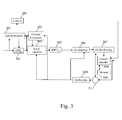
- Fig. 3 represents an example of a hardware architecture of a wireless interface of the receiver in which the present invention may be implemented.
- the wireless interface 205 comprises a synchronization module 301, a control module 300, a discrete Fourier transform module 302, a channel estimation module 303, a block equalizer 304, an IDFT module 305, a de-mapping module 306, an iterative channel decoder 308 which is associated to a memory 309, a subtracting module 311 and may comprise a de-interleaving module 307 and an interleaving module 310.
- the block equalizer 304 is a MMSE (Minimum Mean Square Error) equalizer.
- a block processed by equalizer 304 corresponds to a set of samples over which DFT and IDFT are processed.
- the memory 309 is distinct from the iterative channel decoder 308.
- the memory 309 may be comprised in the iterative channel decoder 308.
- the iterative channel decoder 308 is from a general point of view a turbo-decoder.
- a turbo decoder uses an iterative implementation of the decoding.
- the iterative channel decoder 308 performs a first iterative process named iterative decoding process.
- the iterative channel decoder 308 executes plural iterations in order to decode bits.
- the iterative channel decoder 308 provides extrinsic information used by the second iterative process in order to perform a block equalization and according to particular features used by a channel estimation and/or a de-mapping at the following step of the second iterative process.
- Extrinsic information is for example a Log Likelihood Ratio (LLR) about the transmitted bits of the transmitted symbols.
- LLR Log Likelihood Ratio
- the wireless interface 205 comprises then at least two interlinked iterative processes in order to decode receive symbols.
- the iterative channel decoder 308 memorizes in a memory 309, at the end of the iterations of the first iterative process, the variables used by the iterative channel decoder 308 and reads the stored variables at the following iteration of the second iterative process.
- the wireless interface 205 comprises synchronization module 301 which provides synchronization information related to start of frames, start of blocks to a control module 300, to a channel estimation module 303 and to a DFT module 302, and more generally such synchronization information to all modules which may need them.
- a frame corresponds to one or several codewords.
- the control module 300 from the information received from the synchronization module 301, generates, according to the present invention a command signal indicating to the iterative channel decoder 308 if the iterative channel decoder 308 has to read in the memory 309 information previously stored in the memory 308, i.e. reuse the stored variables at a previous iteration or if the iterative channel decoder 308 has to re initialize the stored variables in the memory 308.
- the DFT module 302 provides samples to the channel estimation module 303 and to the block equalization module 304.
- the channel estimation module 303 may perform a first channel estimation by performing a preliminary and non perfect channel estimation, on some pilots or on data in a blind way and may perform in the following iterations a channel estimation on pilot or data using in addition extrinsic information provided by the interleaving module 310 if there or by the subtracting module 311.
- the output of the channel estimation module 303 is provided to the block equalizer module 304 which performs an equalization based on channel estimations at first iteration and, from the second iteration, based on channel estimations and the extrinsic information provided by the interleaving module 310 if there or by the subtracting module 311.
- the output of the block equalization module is provided to the IDFT module 305 which performs an inverse discrete Fourier transform of size M.
- M is lower than N the size of the discrete Fourier transform performed by the DFT module 302.
- the output of the IDFT module 305 is provided to the de-mapping module 306.
- the de-mapping module 306 may perform a turbo de-mapping based on the output of the IDFT module 305 at first iteration and based on the output of the IDFT module 305 and the extrinsic information from the second iteration of the second iterative process.
- the output of the de-mapping module 307 consists in soft estimations like LLR and is provided to a de-interleaving module 306 if there which de-interleaves the soft estimations or to the channel decoder 308.
- the de-interleaving module 306 may de-interleave the soft estimations code block by code block or may de-interleave the soft estimations by set of code blocks if interleaving is performed on a set of code blocks.
- a block corresponds to a codeword.
- the iterative channel decoder 308 is for example a LDPC (Low Density Parity Check) decoder or a CTC (Convolutional Turbo Code) decoder or a BTC (Block Turbo Code) decoder.
- LDPC Low Density Parity Check
- CTC Convolutional Turbo Code
- BTC Block Turbo Code
- LDPC codes are linear block codes, the syndrome matrix H of which being sparse.
- the sparse aspect means that parity equations only contain a relatively low number of variables, generally between 2 and 80, orders of magnitude lower than the size of the code block.
- LDPC codes exhibit a performance extremely close to the best possible as determined by the Shannon capacity formula.
- LDPC codes are well represented by bipartite graphs in which one set of nodes, the variable nodes, corresponds to elements of the codeword and the other set of nodes, the check nodes, corresponds to the set of parity-check constraints which define the code.
- Variable nodes and check nodes exchange messages iteratively.
- a check node gets messages from its neighbour nodes, processes the messages, and sends the resulting messages back to its neighbour nodes.
- Neighbour nodes are the variable nodes which are involved in the corresponding check.
- a variable node receives messages from its neighbour nodes, processes the messages, and sends messages back to its neighbour nodes.
- neighbour nodes are the check nodes where the variable is involved.
- Each output message of a variable or a check node is a function of all incoming messages to the node except the incoming message from the neighbour node that the output message is sent to.
- each variable node decodes its associated bit based on all information obtained from neighbours and from the iterative decoder block input.
- LLRs log-likelihood ratios
- L i ⁇ ⁇ c log p y c i - 1
- x 0
- i is the iteration index
- x is the bit associated to the variable node v that gets the message from the check node c
- y ⁇ i denotes all the information available to the check node c up to the present iteration obtained from edges other than the one corresponding to v.
- the message from a variable node to a check node is equal to the sum of all incoming LLRs, including a priori information, but excluding the previous message coming from this check node:
- the operation is commutative and associative, which allows a recursive implementation.
- each information L ext ( c ⁇ v ) is stored in memory 309 at last iteration of the first iterative process and each information L ext ( c ⁇ v ) is read at next iteration of the second iterative process for the same code block. Once the information is read, node c sends to each connected variable node v : L ext ( c ⁇ v ).
- the iterative channel decoder 308 is for example a CTC decoder.
- a CTC code consists in parallel concatenation of convolutional codes. Generally, two convolutional codes are used.
- turbo codes are known from a publication disclosed in Proc. 1993 IEEE International Conference of Communications, Geneva, Switzerland, pp 1064 - 1070 of May 1993 under the title "Near Shannon Limit Error-Correcting coding and decoding: Turbo-Codes", the authors of which are Berrou C., Glavieux A. and Thitimajshima P.
- These codes designate a set of error-correcting codes constituted by the concatenation in parallel of a number of Recursive Systematic Convolutional (RSC) codes, each elementary code being separated from the preceding one by means of an interleaving process.
- RSC Recursive Systematic Convolutional
- turbo decoding The sequences coded in this way are decoded by an iterative method with weighted inputs and outputs commonly referred to as turbo decoding.
- Each turbo decoding iteration is composed of the association in series or parallel of elementary decoders each corresponding to an elementary code.
- the weighted information produced by each elementary decoder (referred to as extrinsic information) is de-interleaved and then propagated to the input of another elementary decoder. Therefore messages are exchanged between elementary convolutional decoders.
- each elementary decoder generates its extrinsic information from only part of the available information (i.e. the bits related to the corresponding elementary encoder) justifies the iterative process: the extrinsic information is sent to another elementary decoder (in serial implementation), the second decoder within one iteration or the first one from one iteration to the next one which updates its input information by adding the extrinsic information of the previous decoder.
- One decoding iteration is made of the concatenation (or parallel processing in a parallel implementation) of the elementary decoders (2 in the case of two dimensional turbo codes). From one decoding to the next one, the amplitude of the extrinsic information increases, i.e.
- the extrinsic information coming from the second (n th ) decoder is stored in memory at last iteration of the first iterative process and each extrinsic information is read at next iteration of the second iterative process for the same block.
- the decoding is performed in parallel on the two (n) decoders
- the extrinsic information coming from both or all decoders is stored in memory at last iteration of the first iterative process and each variable extrinsic information is read at next iteration of the second iterative process for the same block.
- the iterative channel decoder 308 is for example a block turbo decoder (BTC).
- BTC codes consist in serial concatenation of short block-codes and need an iterative decoding.
- data are represented in a matrix.
- Each line is encoded by an elementary linear block code and then each column is encoded by the same or another elementary linear block code.
- messages are exchanges between decoders on horizontal dimension and decoders on vertical dimension.
- the extrinsic information coming from decoders on vertical dimension is stored in memory at last iteration of the first iterative process and each extrinsic information coming from decoders on vertical dimension is read for decoding on horizontal dimension at next iteration of the second iterative process for the same block.
- the output of the iterative channel decoder 308 is outputted as the decoded symbols and provided to the processor 200, to the subtracting module 311.
- the subtracting module 311 subtracts the output of the de-interleaving module if there to the output of the iterative channel decoder 308 or subtracts the output of the de-mapping module 306 to the output of the iterative channel decoder 308.
- the output of the subtracting module 311 so-called extrinsic information is provided to the interleaving module 310 if there which performs a reverse process as the one performed by the de-interleaving module 307.
- the output of the interleaving module 310 if there is provided to the de-mapping module 306, to the block equalizer 304 and to the channel estimation module 303.
- the interleaving module 310 If the interleaving module 310 is not there, the output of the subtracting module 311, so-called extrinsic information is provided to the de-mapping module 306, to the block equalizer 304 and to the channel estimation module 303.
- Fig. 4 represents an example of an algorithm executed by the control module according to the present invention.
- the control module 300 checks if a new code block or a new set of code blocks is received i.e. if a new frame is received.
- the control module 300 receives, from the synchronization module 301, information related to start of frames and start of code blocks.
- the control 300 is informed of state of each module of the wireless interface disclosed in reference to Fig. 3 .
- control module 300 moves to step S41. Otherwise, the control module 300 moves to step S42.
- control module 300 transfers to the iterative channel decoder 308 a command signal indicating to the iterative channel decoder 308 that the iterative channel decoder 308 has to read in the memory 309 information previously stored in the memory 309, i.e. reuse the stored variables at a previous iteration.
- control module 300 transfers also a block index to be used by the channel decoder 308 for retrieving the stored variables at a previous iteration for the block the index is transferred.
- control module 300 moves to step S43.
- the control module 300 transfers to the iterative channel decoder 308 a command signal indicating to the iterative channel decoder 308 that the iterative channel decoder 308 has to reinitialize the variables stored in the memory 308. If an interleaving is performed on a set of blocks and not an unique one, the control module 300 transfers also a block index to be used by the channel decoder 308 for determining in which part of memory 309 the extrinsic information must be stored at the end of the decoding process.
- control module 300 moves to step S43.
- control module 300 checks if the iterative decoding by the channel decoder 308 for the currently processed code block ends.
- step S40 If the iterative decoding by the channel decoder 308 ends, the processor 300 moves to step S40. Otherwise, the processor 300 returns to step S43.
- Fig. 5 represents an example of an algorithm executed by the iterative channel decoder according to the present invention.
- step S50 after having received from the control module 308 a message indicating that a new code block is available and that a decoding must begin the iterative channel decoder 308 checks if a command signal is received.
- This command signal is a 'reuse' or 'not reuse' command.
- the 'reuse' command signal indicates to the iterative channel decoder 308 that the iterative channel decoder 308 has to read in the memory 309 information previously stored in the memory 309, i.e. reuse the stored variables at a previous iteration.
- the command signal further comprises also a block index to be used by the channel decoder 308. If a 'reuse' command is received, it will be used for retrieving the stored variables at a previous iteration for the block the index is transferred.
- step S51 If a command signal indicating to the iterative channel decoder 308 that the iterative channel decoder 308 has to read in the memory 309 information previously stored in the memory 309, the iterative channel decoder 308 moves to step S51. Otherwise, the iterative channel decoder 308 moves to step S52.
- the iterative channel decoder 308 reads in the memory 309, each extrinsic information stored in memory 309 at last iteration of the first iterative process. If an interleaving is performed on a set of blocks, the iterative channel decoder 308 reads in the memory 309, each extrinsic information stored in memory 309 at last iteration of the first iterative process which correspond to the block the index of which is comprised in the control message.
- the iterative channel decoder 308 If the iterative channel decoder 308 is a LDPC, the iterative channel decoder 308 reads in the memory 309 each variable L ext ( c ⁇ v ) stored in memory 309 at last iteration of the first iterative process and each variable L ext ( c ⁇ v)
- the iterative channel decoder 308 If the iterative channel decoder 308 is a LDPC and if the interleaving is performed on a set of blocks, the iterative channel decoder 308 reads in the memory 309, each variable L ext ( c ⁇ v ) stored in memory 309 at last iteration of the first iterative process and each variable L ext ( c ⁇ v ) which correspond to the block the index of which is comprised in the control message.
- the iterative channel decoder 308 moves to step S53.
- the iterative channel decoder 308 resets the extrinsic information stored in memory 309 at last iteration of the first iterative process, corresponding to the received code block index if an interleaving is performed on a set of blocks.
- the iterative channel decoder uses this information for decoding.
- node c sends to each variable node v : L ext ( c ⁇ v ) for the beginning of the decoding process of the currently decoded block.
- the iterative channel decoder 308 moves to step S53.
- the iterative channel decoder 308 starts a new iterative decoding.
- the present invention reduces drastically the number of iterations of the second iterative process and therefore reduces the complexity of the receiver.
- the iterative channel decoder 308 checks if the last iteration of the first iterative process is executed.
- the iterative channel decoder 308 moves to step S55. Otherwise, the iterative channel decoder 308 returns to step S53.
- the iterative channel decoder 308 stores the internal extrinsic information in the memory 309.
- the iterative channel decoder 308 stores the internal extrinsic information in the memory 309 in a memory area dedicated to the block using the index received at step S50.
- the iterative channel decoder 308 transfers the soft decoded information to the subtracting module 311 and to the processor 200.
- the soft decoded information is for example a Log Likelihood Ratio (LLR) about the transmitted bits of the transmitted symbols.
- LLR Log Likelihood Ratio
Landscapes
- Engineering & Computer Science (AREA)
- Physics & Mathematics (AREA)
- Probability & Statistics with Applications (AREA)
- Theoretical Computer Science (AREA)
- Signal Processing (AREA)
- Computer Networks & Wireless Communication (AREA)
- Quality & Reliability (AREA)
- Power Engineering (AREA)
- Error Detection And Correction (AREA)
Abstract
- memorizes at the end of the iterations of the first iterative process, the variables used internally by the iterative channel decoder,
- reads the memorized variables at the following iteration of the second iterative process.
Description
- The invention concerns a method for demodulating received symbols using a turbo-demodulation scheme comprising an iterative channel equalization and wherein an iterative channel decoder is used in the turbo-demodulation scheme.
- Implementing a turbo-demodulation scheme is complex, especially when an iterative channel decoder is used in the turbo-demodulation scheme.
- When a powerful iterative channel decoder is used, for example using a LDPC code, a convolutional turbo-code (CTC) or a block turbo-code (BTC), the decoders of these codes have in common to work according to the turbo principle. Internally some units, either implemented in hardware or software, exchange information in an iterative way.
- For a LDPC code, it is classically considered generally that at least 50 iterations are needed to get good performances. For turbo-codes, between 4 and 8 decoding iterations are needed.
- When such a turbo-channel-decoder is implemented inside a turbo-demodulation scheme, the complexity explodes. If 5 turbo iterations are used for the turbo-demodulation, with a LDPC decoder implementing 50 iterations inside, we get 250 LDPC iterations globally. The same reasoning can be used with turbo-codes.
- The present invention aims at significantly decreasing the total number of decoding iterations, without any performance degradation.
- The present invention concerns a method for demodulating received symbols using a turbo-demodulation scheme comprising an iterative channel equalization and wherein an iterative channel decoder is used in the turbo-demodulation scheme, characterized in that the iterative channel decoder performs a first iterative process named iterative decoding process, the turbo-demodulation performing a second iterative process named iterative demodulation and decoding process, at each iteration of the second iterative process, the iterative channel decoder executing plural iterations in order to decode bits from which symbols are derived from, and wherein the method comprises the steps executed by the iterative channel decoder of :
- memorizing at the end of the iterations of the first iterative process, the variables used internally by the iterative channel decoder,
- reading the memorized variables at the following iteration of the second iterative process.
- The present invention concerns also a device for demodulating received symbols using a turbo-demodulation scheme comprising an iterative channel equalization and wherein an iterative channel decoder is used in the turbo-demodulation scheme, characterized in that the iterative channel decoder performs a first iterative process named iterative decoding process, the turbo-demodulation performing a second iterative process named iterative demodulation and decoding process, at each iteration of the second iterative process, the iterative channel decoder executing plural iterations in order to decode bits from which symbols are derived from, and wherein the iterative channel decoder comprises :
- means for memorizing at the end of the iterations of the first iterative process, the variables used internally by the iterative channel decoder,
- means for reading the memorized variables at the following iteration of the second iterative process.
- Thus, during the second and following iterations of the second iterative process, it is possible to reduce the number of decoding iterations without any loss in performance and thus it is possible to reduce the complexity of the receiver for the same performance or to improve performance for the same complexity.
- For example, if the iterative channel decoder uses a LDPC code, the present invention only needs 5 to 20 iterations in order to get good performances.
- For example, if the iterative channel decoder uses Convolutional turbo-codes, the present invention only needs between 1 to 3 iterations in order to get good performances, instead of 4 to 8 without the present invention.
- According to a particular feature, the received symbols are transferred by a source using Single-Carrier Frequency Division Multiple Access or a single-carrier orthogonal frequency division multiplex.
- Thus, performance and/or complexity are improved for this waveform, for which turbo-equalization improves performance when signal is transmitted through a wireless channel.
- According to a particular feature, the iterative channel equalization is a Minimum Mean Square Error equalization.
- Thus, the complexity of the equalization module is reduced, which further reduces the overall complexity of the receiver.
- According to a particular feature, the turbo-demodulation scheme comprises an iterative channel estimation.
- Thus, performance of channel estimation is improved, which improves the receiver performance.
- According to a particular feature, the turbo-demodulation scheme comprises an iterative de-mapping.
- Thus, performance is improved when the constellation is large enough and when the bit-to-constellation mapping is well selected.
- According to a particular feature, the iterative channel decoder receives from a controller messages indicating to the iterative channel decoder that iterative channel decoder has to read the memorized variables at the following iteration of the second iterative process or to reset the memorized variables.
- Thus, the decoder uses the memory content when it is really needed only.
- According to a particular feature, the turbo-demodulation scheme comprises a de-interleaving process based on a set of code blocks and the message further comprises the block identifier within the set of code blocks of the next block to be decoded.
- Thus, the iterative channel decoder uses the memory content corresponding to the current code block
- According to a particular feature, the received symbols are transferred using a non-orthogonal transmission scheme Faster-Than-Nyquist.
- Thus, performance and/or complexity are improved for this waveform, for which turbo-equalization improves performance when signal is transmitted when FtN is used.
- According to a particular feature, the iterative channel decoder is a Low Density Parity Check decoder.
- Thus, performance and/or complexity are improved, as LDPC decoder works in an iterative manner.
- According to a particular feature, the iterative channel decoder is a Convolutional Turbo Code decoder.
- Thus, performance and/or complexity are improved, as a Convolutional Turbo Code decoder works in an iterative manner.
- According to a particular feature, the iterative channel decoder is a Block Turbo Code decoder.
- Thus, performance and/or complexity are improved, as a Block Turbo Code decoder works in an iterative manner.
- The present invention concerns also a computer program comprising program code instructions which can be loaded in a programmable device for implementing the method according to the first embodiment, when the program code instructions are run by the programmable device.
- The present invention concerns also information storage means storing a computer program comprising program code instructions which can be loaded in a programmable device for implementing the method according to the first embodiment, when the program code instructions are run by the programmable device.
- The characteristics of the present invention mentioned above, as well as other characteristics will appear more clearly on reading the following description of an example of an embodiment, said description being done in relation with the joint drawings, among which:
-
Fig. 1 illustrates schematically an example of a communication system in which the invention may be implemented; -
Fig. 2 illustrates schematically an example of a receiver in which the present invention may be implemented; -
Fig. 3 represents an example of a hardware architecture of a wireless interface of the receiver in which the present invention may be implemented; -
Fig. 4 represents an example of an algorithm executed by the control module according to the present invention; -
Fig. 5 represents an example of an algorithm executed by the iterative channel decoder according to the present invention. -
Fig. 1 illustrates schematically an example of a telecommunication system in which the invention can be implemented. - The telecommunication system comprises at least a source Src which transmits symbols to at least one receiver Rec.
- The telecommunication system may be a 3GPP/LTE uplink wireless telecommunication system using for example Single-Carrier Frequency Division Multiple Access (SC-FDMA) or a broadcasting telecommunication network like a DVB (Digital Video Broadcast) Next Generation broadcasting system to Handheld (NGH) telecommunication system using for example single-carrier orthogonal frequency division multiplex (SC-OFDM) for its satellite component.
- SC-FDMA is a modulation scheme with OFDM-type multiplexing but single-carrier-like envelope. It can be implemented either in the time-domain (IFDMA) or in the frequency-domain. In the last case, it is also called DFT-spread OFDM, or SC-FDE (Single Carrier Frequency domain Equalisation) or SC-OFDM (Single Carrier Frequency Division Multiple Access).
- The present invention is applicable in any telecommunication system wherein an iterative equalization is needed and a channel decoder with an iterative decoding process is used.
- According to a particular feature, the telecommunication system, for improving spectral efficiency, uses a non-orthogonal transmission scheme Faster-Than-Nyquist (FtN).
- Inter-symbol interference (ISI) is a distortion that occurs to the sent symbols when they overlap partially or totally leading to a degraded detection performance at the receiver. Equalization is needed to cancel or limit performance degradation due to ISI. Turbo-equalization, i.e. feedback from the channel decoder to the equalization process, improves equalization performance when a channel decoder is used.
- Inter-symbol interference appears in a multipath channel and is generated in FtN. The FtN concept was introduced by Mazo in the paper entitled "Faster-than-Nyquist Signaling", published in Bell Syst. Tech. J, vol. 54, no. 8, pp. 1451-1462, Oct. 1975.
- The signal is modulated faster than the usual rate and introduces intentional ISI at the transmitter side.
- In the Nyquist case, a signal is sent every T seconds while in the FTN case, the signal is sent every τT seconds where τ < 1.
- Mazo showed that sending pulses up to 25% faster than Nyquist rate doesn't decrease the minimum Euclidean distance between symbol sequences for a system using binary or QPSK modulation (Quadrature Phase Shift Keying).
- The complexity of FtN lies in the receiver side which is responsible for compensating the intentional ISI introduced at the transmitter.
- From the principle point of view, there is no difference between correcting ISI brought by a frequency selective multipath channel and correcting ISI introduced at the transmitter.
- FtN may be interpreted as a filtering at the transmitter. Therefore it can be implemented in the time or frequency domain.
-
Fig. 2 illustrates schematically an example of a receiver in which the present invention may be implemented. - According to the shown architecture, the receiver Rec comprises the following components interconnected by a communication bus 201: a processor, microprocessor, microcontroller or CPU (Central Processing Unit) 200; a RAM (Random-Access Memory) 203; a ROM (Read-Only Memory) 202 and a
wireless interface 205 connected to at least one antenna Ant. - The
wireless interface 205 allows the receiver Rec to receive symbols. -
CPU 200 is capable of executing instructions loaded intoRAM 203 fromROM 202 or from an external memory. After the receiver Rec is powered on,CPU 200 is capable of reading instructions fromRAM 203 and executing these instructions. The instructions form one computer program that causesCPU 200 to decode received symbols according to the present invention. - The decoding may be implemented in software by execution of a set of instructions or program by a programmable computing machine, such as a PC (Personal Computer), a DSP (Digital Signal Processor) or a microcontroller; or else implemented in hardware by a machine or a dedicated component, such as an FPGA (Field-Programmable Gate Array) or an ASIC (Application-Specific Integrated Circuit).
-
Fig. 3 represents an example of a hardware architecture of a wireless interface of the receiver in which the present invention may be implemented. - The example of hardware architecture given in
Fig. 3 is in an SC-FDMA context. As already stated, the present invention found applications in other contexts. - The
wireless interface 205 comprises asynchronization module 301, acontrol module 300, a discreteFourier transform module 302, achannel estimation module 303, ablock equalizer 304, anIDFT module 305, ade-mapping module 306, aniterative channel decoder 308 which is associated to amemory 309, asubtracting module 311 and may comprise ade-interleaving module 307 and an interleaving module 310. As an example, theblock equalizer 304 is a MMSE (Minimum Mean Square Error) equalizer. Here, a block processed byequalizer 304 corresponds to a set of samples over which DFT and IDFT are processed. - In the example of
Fig. 3 , thememory 309 is distinct from theiterative channel decoder 308. Thememory 309 may be comprised in theiterative channel decoder 308. - The
iterative channel decoder 308 is from a general point of view a turbo-decoder. A turbo decoder uses an iterative implementation of the decoding. - The
iterative channel decoder 308 performs a first iterative process named iterative decoding process. - The
channel estimation module 303, theblock equalizer 304, thede-spreading module 305, thede-mapping module 306, theiterative channel decoder 308, the subtractingmodule 311, thede-interleaving module 307 and the interleaving module 310 if there form a second iterative process named iterative demodulation and decoding process. At each iteration of the second iterative process, theiterative channel decoder 308 executes plural iterations in order to decode bits. - The
channel estimation module 303, theblock equalizer 304, thede-spreading module 305, thede-mapping module 306, , the subtractingmodule 311, thede-interleaving module 307 and the interleaving module 310 if there perform a demodulation process in the example of the present invention. - At the end of the first iterative process, the
iterative channel decoder 308 provides extrinsic information used by the second iterative process in order to perform a block equalization and according to particular features used by a channel estimation and/or a de-mapping at the following step of the second iterative process. - Extrinsic information is for example a Log Likelihood Ratio (LLR) about the transmitted bits of the transmitted symbols.
- The
wireless interface 205 comprises then at least two interlinked iterative processes in order to decode receive symbols. - According to the invention, the
iterative channel decoder 308 memorizes in amemory 309, at the end of the iterations of the first iterative process, the variables used by theiterative channel decoder 308 and reads the stored variables at the following iteration of the second iterative process. - The
wireless interface 205 comprisessynchronization module 301 which provides synchronization information related to start of frames, start of blocks to acontrol module 300, to achannel estimation module 303 and to aDFT module 302, and more generally such synchronization information to all modules which may need them. Here a frame corresponds to one or several codewords. When an interleaving is applied, we assume for simplicity of the description that a frame corresponds to one interleaving depth. - The
control module 300, from the information received from thesynchronization module 301, generates, according to the present invention a command signal indicating to theiterative channel decoder 308 if theiterative channel decoder 308 has to read in thememory 309 information previously stored in thememory 308, i.e. reuse the stored variables at a previous iteration or if theiterative channel decoder 308 has to re initialize the stored variables in thememory 308. - The
DFT module 302 provides samples to thechannel estimation module 303 and to theblock equalization module 304. - The
channel estimation module 303 may perform a first channel estimation by performing a preliminary and non perfect channel estimation, on some pilots or on data in a blind way and may perform in the following iterations a channel estimation on pilot or data using in addition extrinsic information provided by the interleaving module 310 if there or by the subtractingmodule 311. - The output of the
channel estimation module 303 is provided to theblock equalizer module 304 which performs an equalization based on channel estimations at first iteration and, from the second iteration, based on channel estimations and the extrinsic information provided by the interleaving module 310 if there or by the subtractingmodule 311. - The output of the block equalization module is provided to the
IDFT module 305 which performs an inverse discrete Fourier transform of size M. M is lower than N the size of the discrete Fourier transform performed by theDFT module 302. The output of theIDFT module 305 is provided to thede-mapping module 306. - The
de-mapping module 306 may perform a turbo de-mapping based on the output of theIDFT module 305 at first iteration and based on the output of theIDFT module 305 and the extrinsic information from the second iteration of the second iterative process. - The output of the
de-mapping module 307 consists in soft estimations like LLR and is provided to ade-interleaving module 306 if there which de-interleaves the soft estimations or to thechannel decoder 308. - The
de-interleaving module 306 may de-interleave the soft estimations code block by code block or may de-interleave the soft estimations by set of code blocks if interleaving is performed on a set of code blocks. - A block corresponds to a codeword.
- The output of the
de-interleaving module 307 if there is provided to theiterative channel decoder 308. - The
iterative channel decoder 308 is for example a LDPC (Low Density Parity Check) decoder or a CTC (Convolutional Turbo Code) decoder or a BTC (Block Turbo Code) decoder. - LDPC codes are linear block codes, the syndrome matrix H of which being sparse. The sparse aspect means that parity equations only contain a relatively low number of variables, generally between 2 and 80, orders of magnitude lower than the size of the code block.
- LDPC codes exhibit a performance extremely close to the best possible as determined by the Shannon capacity formula.
- LDPC codes are well represented by bipartite graphs in which one set of nodes, the variable nodes, corresponds to elements of the codeword and the other set of nodes, the check nodes, corresponds to the set of parity-check constraints which define the code.
- Variable nodes and check nodes exchange messages iteratively. A check node gets messages from its neighbour nodes, processes the messages, and sends the resulting messages back to its neighbour nodes. Neighbour nodes are the variable nodes which are involved in the corresponding check. Similarly, a variable node receives messages from its neighbour nodes, processes the messages, and sends messages back to its neighbour nodes. Here, neighbour nodes are the check nodes where the variable is involved. Each output message of a variable or a check node is a function of all incoming messages to the node except the incoming message from the neighbour node that the output message is sent to.
- This two-step procedure is repeated many times. After n such iterations, each variable node decodes its associated bit based on all information obtained from neighbours and from the iterative decoder block input.
- Classically, log-likelihood ratios (LLRs) are used as messages, i.e., we use


- At the first iteration, for starting of the decoding process, these values are equal to the a priori information available, i.e. the inputs La (v) :

- Likewise, we define the output message of a check node as

- Where i is the iteration index, x is the bit associated to the variable node v that gets the message from the check node c, and

- Under sum-product decoding, the message from a variable node to a check node is equal to the sum of all incoming LLRs, including a priori information, but excluding the previous message coming from this check node:

- Where the extrinsic information associated to a variable v is defined as:

- The message update rule for a check node c associated with dc variables vj can be obtained for example from the following equation:

- With the definition of the operation

- The operationis commutative and associative, which allows a recursive implementation. For example, this operation can be implemented by:


- The function f is given by f(u) = log(1 + e -|u|)
- It has to be noted here that a simplified version of the equation Li (c →v) may be used.
- According to the invention, each information Lext (c → v) is stored in
memory 309 at last iteration of the first iterative process and each information Lext (c→v) is read at next iteration of the second iterative process for the same code block. Once the information is read, node c sends to each connected variable node v: Lext (c→v). - The
iterative channel decoder 308 is for example a CTC decoder. A CTC code consists in parallel concatenation of convolutional codes. Generally, two convolutional codes are used. - So-called turbo codes are known from a publication disclosed in Proc. 1993 IEEE International Conference of Communications, Geneva, Switzerland, pp 1064 - 1070 of May 1993 under the title "Near Shannon Limit Error-Correcting coding and decoding: Turbo-Codes", the authors of which are Berrou C., Glavieux A. and Thitimajshima P.
- These codes designate a set of error-correcting codes constituted by the concatenation in parallel of a number of Recursive Systematic Convolutional (RSC) codes, each elementary code being separated from the preceding one by means of an interleaving process.
- The sequences coded in this way are decoded by an iterative method with weighted inputs and outputs commonly referred to as turbo decoding. Each turbo decoding iteration is composed of the association in series or parallel of elementary decoders each corresponding to an elementary code. The weighted information produced by each elementary decoder (referred to as extrinsic information) is de-interleaved and then propagated to the input of another elementary decoder. Therefore messages are exchanged between elementary convolutional decoders.
- The fact that each elementary decoder generates its extrinsic information from only part of the available information (i.e. the bits related to the corresponding elementary encoder) justifies the iterative process: the extrinsic information is sent to another elementary decoder (in serial implementation), the second decoder within one iteration or the first one from one iteration to the next one which updates its input information by adding the extrinsic information of the previous decoder. One decoding iteration is made of the concatenation (or parallel processing in a parallel implementation) of the elementary decoders (2 in the case of two dimensional turbo codes). From one decoding to the next one, the amplitude of the extrinsic information increases, i.e. the estimation of the decoded bits becomes more and more reliable. Equivalently, a performance gain is achieved from one iteration to the next one. After several iterations, the amplitude of the extrinsic information does not change: all available information is "exhausted" and the algorithm has converged.
- For example, by assuming two (n) elementary codes and that the decoding is performed serially, the extrinsic information coming from the second (nth) decoder is stored in memory at last iteration of the first iterative process and each extrinsic information is read at next iteration of the second iterative process for the same block. In case the decoding is performed in parallel on the two (n) decoders, the extrinsic information coming from both or all decoders is stored in memory at last iteration of the first iterative process and each variable extrinsic information is read at next iteration of the second iterative process for the same block.
- The
iterative channel decoder 308 is for example a block turbo decoder (BTC). - BTC codes consist in serial concatenation of short block-codes and need an iterative decoding.
- Generally, data are represented in a matrix. Each line is encoded by an elementary linear block code and then each column is encoded by the same or another elementary linear block code.
- In the iterative decoder, messages are exchanges between decoders on horizontal dimension and decoders on vertical dimension.
- This implies that soft input soft output decoders are used for the elementary short codes.
- By assuming that decoding is performed first on horizontal dimension, the extrinsic information coming from decoders on vertical dimension is stored in memory at last iteration of the first iterative process and each extrinsic information coming from decoders on vertical dimension is read for decoding on horizontal dimension at next iteration of the second iterative process for the same block.
- The output of the
iterative channel decoder 308 is outputted as the decoded symbols and provided to theprocessor 200, to thesubtracting module 311. - The
subtracting module 311 subtracts the output of the de-interleaving module if there to the output of theiterative channel decoder 308 or subtracts the output of thede-mapping module 306 to the output of theiterative channel decoder 308. - The output of the
subtracting module 311 so-called extrinsic information is provided to the interleaving module 310 if there which performs a reverse process as the one performed by thede-interleaving module 307. The output of the interleaving module 310 if there is provided to thede-mapping module 306, to theblock equalizer 304 and to thechannel estimation module 303. - If the interleaving module 310 is not there, the output of the
subtracting module 311, so-called extrinsic information is provided to thede-mapping module 306, to theblock equalizer 304 and to thechannel estimation module 303. -
Fig. 4 represents an example of an algorithm executed by the control module according to the present invention. - At step S40, for example at the beginning of a new equalization iteration, the
control module 300 checks if a new code block or a new set of code blocks is received i.e. if a new frame is received. Thecontrol module 300 receives, from thesynchronization module 301, information related to start of frames and start of code blocks. Thecontrol 300 is informed of state of each module of the wireless interface disclosed in reference toFig. 3 . - If a new block or a new set of blocks is received, the
control module 300 moves to step S41. Otherwise, thecontrol module 300 moves to step S42. - At step S42, the
control module 300 transfers to the iterative channel decoder 308 a command signal indicating to theiterative channel decoder 308 that theiterative channel decoder 308 has to read in thememory 309 information previously stored in thememory 309, i.e. reuse the stored variables at a previous iteration. - If an interleaving is performed on a set of blocks and not on a unique block, the
control module 300 transfers also a block index to be used by thechannel decoder 308 for retrieving the stored variables at a previous iteration for the block the index is transferred. - After that, the
control module 300 moves to step S43. - At step S41, the
control module 300 transfers to the iterative channel decoder 308 a command signal indicating to theiterative channel decoder 308 that theiterative channel decoder 308 has to reinitialize the variables stored in thememory 308. If an interleaving is performed on a set of blocks and not an unique one, thecontrol module 300 transfers also a block index to be used by thechannel decoder 308 for determining in which part ofmemory 309 the extrinsic information must be stored at the end of the decoding process. - After that, the
control module 300 moves to step S43. - At next step S43, the
control module 300 checks if the iterative decoding by thechannel decoder 308 for the currently processed code block ends. - If the iterative decoding by the
channel decoder 308 ends, theprocessor 300 moves to step S40. Otherwise, theprocessor 300 returns to step S43. -
Fig. 5 represents an example of an algorithm executed by the iterative channel decoder according to the present invention. - At step S50, after having received from the control module 308 a message indicating that a new code block is available and that a decoding must begin the
iterative channel decoder 308 checks if a command signal is received. This command signal is a 'reuse' or 'not reuse' command. The 'reuse' command signal indicates to theiterative channel decoder 308 that theiterative channel decoder 308 has to read in thememory 309 information previously stored in thememory 309, i.e. reuse the stored variables at a previous iteration. - If an interleaving is performed on a set of code blocks, the command signal further comprises also a block index to be used by the
channel decoder 308. If a 'reuse' command is received, it will be used for retrieving the stored variables at a previous iteration for the block the index is transferred. - If a command signal indicating to the
iterative channel decoder 308 that theiterative channel decoder 308 has to read in thememory 309 information previously stored in thememory 309, theiterative channel decoder 308 moves to step S51. Otherwise, theiterative channel decoder 308 moves to step S52. - At step S51, the
iterative channel decoder 308 reads in thememory 309, each extrinsic information stored inmemory 309 at last iteration of the first iterative process. If an interleaving is performed on a set of blocks, theiterative channel decoder 308 reads in thememory 309, each extrinsic information stored inmemory 309 at last iteration of the first iterative process which correspond to the block the index of which is comprised in the control message. - If the
iterative channel decoder 308 is a LDPC, theiterative channel decoder 308 reads in thememory 309 each variable Lext (c→v) stored inmemory 309 at last iteration of the first iterative process and each variable Lext (c → v) - If the
iterative channel decoder 308 is a LDPC and if the interleaving is performed on a set of blocks, theiterative channel decoder 308 reads in thememory 309, each variable Lext (c → v) stored inmemory 309 at last iteration of the first iterative process and each variable Lext (c → v) which correspond to the block the index of which is comprised in the control message. - After that, the
iterative channel decoder 308 moves to step S53. - At step S52, the
iterative channel decoder 308 resets the extrinsic information stored inmemory 309 at last iteration of the first iterative process, corresponding to the received code block index if an interleaving is performed on a set of blocks. - Once the extrinsic information is read or reset, the iterative channel decoder uses this information for decoding.
- If the
iterative channel decoder 308 is a LDPC, once the information is read, node c sends to each variable node v : Lext (c→v) for the beginning of the decoding process of the currently decoded block. - After that, the
iterative channel decoder 308 moves to step S53. - At step S53, the
iterative channel decoder 308 starts a new iterative decoding. By reading in thememory 309 information previously stored in thememory 309 at previous iteration of the second iterative process for the same block, the present invention reduces drastically the number of iterations of the second iterative process and therefore reduces the complexity of the receiver. - At next step S54, the
iterative channel decoder 308 checks if the last iteration of the first iterative process is executed. - If the last iteration of the first iterative process is executed, the
iterative channel decoder 308 moves to step S55. Otherwise, theiterative channel decoder 308 returns to step S53. - At step S55, the
iterative channel decoder 308 stores the internal extrinsic information in thememory 309. - If an interleaving is performed on a set of blocks, the
iterative channel decoder 308 stores the internal extrinsic information in thememory 309 in a memory area dedicated to the block using the index received at step S50. - At next step S56, the
iterative channel decoder 308 transfers the soft decoded information to thesubtracting module 311 and to theprocessor 200. The soft decoded information is for example a Log Likelihood Ratio (LLR) about the transmitted bits of the transmitted symbols.
Claims (13)
- A method for demodulating received symbols using a turbo-demodulation scheme comprising an iterative channel equalization and wherein an iterative channel decoder is used in the turbo-demodulation scheme, characterized in that the iterative channel decoder performs a first iterative process named iterative decoding process, the turbo-demodulation performing a second iterative process named iterative demodulation and decoding process, at each iteration of the second iterative process, the iterative channel decoder executing plural iterations in order to decode bits from which symbols are derived from, and wherein the method comprises the steps executed by the iterative channel decoder of :- memorizing at the end of the iterations of the first iterative process, the variables used internally by the iterative channel decoder,- reading the memorized variables at the following iteration of the second iterative process.
- The method according to claim 1, characterized in that the received symbols are transferred by a source using Single-Carrier Frequency Division Multiple Access or a single-carrier orthogonal frequency division multiplex.
- The method according to any of the claims 1 to 2, characterized in that the iterative channel equalization is a Minimum Mean Square Error equalization.
- The method according to any of the claims 1 to 3, characterized in that the turbo-demodulation scheme comprises an iterative channel estimation.
- The method according to any of the claims 1 to 4, characterized in that the turbo-demodulation scheme comprises an iterative de-mapping.
- The method according to any of the claims 1 to 5, characterized in that the iterative channel decoder receives from a controller messages indicating to the iterative channel decoder that iterative channel decoder has to read the memorized variables at the following iteration of the second iterative process or to reset the memorized variables.
- The method according to claim 6, characterized in that the turbo-demodulation scheme comprises a de-interleaving process based on a set of code blocks and in that the message further comprises the block identifier within the set of code blocks of the next block to be decoded.
- The method according to any of the claims 1 to 8, characterized in that the received symbols are transferred using a non-orthogonal transmission scheme Faster-Than-Nyquist.
- The method according to any of the claims 1 to 8, characterized in that the iterative channel decoder is a Low Density Parity Check decoder.
- The method according to any of the claims 1 to 8, characterized in that the iterative channel decoder is a Convolutional Turbo Code decoder.
- The method according to any of the claims 1 to 8, characterized in that the iterative channel decoder is a Block Turbo Code decoder.
- A device for demodulating received symbols using a turbo-demodulation scheme comprising an iterative channel equalization and wherein an iterative channel decoder is used in the turbo-demodulation scheme, characterized in that the iterative channel decoder performs a first iterative process named iterative decoding process, the turbo-demodulation performing a second iterative process named iterative demodulation and decoding process, at each iteration of the second iterative process, the iterative channel decoder executing plural iterations in order to decode bits from which symbols are derived from, and wherein the iterative channel decoder comprises:- means for memorizing at the end of the iterations of the first iterative process, the variables used internally by the iterative channel decoder,- means for reading the memorized variables at the following iteration of the second iterative process.
- A computer program comprising program code instructions which can be loaded in a programmable device for implementing the method according to any previous claims from claims 1 to 11, when the program code instructions are run by the programmable device.
Priority Applications (4)
| Application Number | Priority Date | Filing Date | Title |
|---|---|---|---|
| EP15187978.0A EP3151434A1 (en) | 2015-10-01 | 2015-10-01 | Method for demodulating received symbols using a turbo-demodulation scheme comprising an iterative channel equalization and wherein an iterative channel decoder is used in the turbo-demodulation scheme |
| JP2017559477A JP6456522B2 (en) | 2015-10-01 | 2016-09-15 | Method, apparatus and computer program for iterative modulation, equalization and channel decoding |
| US15/752,324 US10511410B2 (en) | 2015-10-01 | 2016-09-15 | Method and device for iterative demodulation, equalization and channel decoding |
| PCT/JP2016/078133 WO2017057204A1 (en) | 2015-10-01 | 2016-09-15 | Method device and computer program for iterative demodulation, equalization and channel decoding |
Applications Claiming Priority (1)
| Application Number | Priority Date | Filing Date | Title |
|---|---|---|---|
| EP15187978.0A EP3151434A1 (en) | 2015-10-01 | 2015-10-01 | Method for demodulating received symbols using a turbo-demodulation scheme comprising an iterative channel equalization and wherein an iterative channel decoder is used in the turbo-demodulation scheme |
Publications (1)
| Publication Number | Publication Date |
|---|---|
| EP3151434A1 true EP3151434A1 (en) | 2017-04-05 |
Family
ID=54252146
Family Applications (1)
| Application Number | Title | Priority Date | Filing Date |
|---|---|---|---|
| EP15187978.0A Withdrawn EP3151434A1 (en) | 2015-10-01 | 2015-10-01 | Method for demodulating received symbols using a turbo-demodulation scheme comprising an iterative channel equalization and wherein an iterative channel decoder is used in the turbo-demodulation scheme |
Country Status (4)
| Country | Link |
|---|---|
| US (1) | US10511410B2 (en) |
| EP (1) | EP3151434A1 (en) |
| JP (1) | JP6456522B2 (en) |
| WO (1) | WO2017057204A1 (en) |
Cited By (1)
| Publication number | Priority date | Publication date | Assignee | Title |
|---|---|---|---|---|
| EP3499823A1 (en) * | 2017-12-18 | 2019-06-19 | Mitsubishi Electric R & D Centre Europe B.V. | Method and device for demodulating received symbols using a turbo equalization loop for a single carrier system |
Families Citing this family (4)
| Publication number | Priority date | Publication date | Assignee | Title |
|---|---|---|---|---|
| EP3151432B1 (en) * | 2015-10-01 | 2018-08-01 | Mitsubishi Electric R&D Centre Europe B.V. | Method and a device for demodulating received symbols using a turbo-demodulation scheme comprising an iterative mimo decoder and wherein an iterative channel decoder is used in the turbo-demodulation scheme |
| US10312953B2 (en) * | 2016-12-26 | 2019-06-04 | Industrial Technology Research Institute | Orthogonal frequency division multiplexing receiver with low-resolution analog to digital converter and electronic device thereof |
| CN111884959B (en) * | 2020-07-14 | 2021-07-13 | 西安交通大学 | An iterative equalization method and device for a single-carrier broadband wireless communication system |
| US12244428B2 (en) * | 2023-02-23 | 2025-03-04 | Qualcomm Incorporated | Network entity assisted decoding for repetition-based transmissions |
Citations (3)
| Publication number | Priority date | Publication date | Assignee | Title |
|---|---|---|---|---|
| WO2010066778A1 (en) * | 2008-12-12 | 2010-06-17 | Thomson Licensing | Method for turbo equalization of zarray coded words |
| US20110311002A1 (en) * | 2009-03-05 | 2011-12-22 | Lsi Corporation | Turbo-Equalization Methods For Iterative Decoders |
| US20120020402A1 (en) * | 2010-07-26 | 2012-01-26 | Technische Universitat Berlin | Receiver |
Family Cites Families (7)
| Publication number | Priority date | Publication date | Assignee | Title |
|---|---|---|---|---|
| GB2394389B (en) * | 2002-10-15 | 2005-05-18 | Toshiba Res Europ Ltd | Equalisation apparatus and methods |
| US7237181B2 (en) * | 2003-12-22 | 2007-06-26 | Qualcomm Incorporated | Methods and apparatus for reducing error floors in message passing decoders |
| JP2007124341A (en) * | 2005-10-28 | 2007-05-17 | Kddi Corp | Decoding device and method, and demodulation decoding device and method |
| US20120033752A1 (en) * | 2009-04-24 | 2012-02-09 | Panasonic Corporation | Wireless communication device and wireless communication method |
| US8880973B1 (en) * | 2011-02-03 | 2014-11-04 | Marvell International Ltd. | Detector-decoder interface for GF(q) iterative decoding |
| JP6254019B2 (en) * | 2014-02-28 | 2017-12-27 | 株式会社Nttドコモ | Wireless base station, user terminal, wireless communication method, and wireless communication system |
| EP3151432B1 (en) * | 2015-10-01 | 2018-08-01 | Mitsubishi Electric R&D Centre Europe B.V. | Method and a device for demodulating received symbols using a turbo-demodulation scheme comprising an iterative mimo decoder and wherein an iterative channel decoder is used in the turbo-demodulation scheme |
-
2015
- 2015-10-01 EP EP15187978.0A patent/EP3151434A1/en not_active Withdrawn
-
2016
- 2016-09-15 US US15/752,324 patent/US10511410B2/en not_active Expired - Fee Related
- 2016-09-15 WO PCT/JP2016/078133 patent/WO2017057204A1/en not_active Ceased
- 2016-09-15 JP JP2017559477A patent/JP6456522B2/en active Active
Patent Citations (3)
| Publication number | Priority date | Publication date | Assignee | Title |
|---|---|---|---|---|
| WO2010066778A1 (en) * | 2008-12-12 | 2010-06-17 | Thomson Licensing | Method for turbo equalization of zarray coded words |
| US20110311002A1 (en) * | 2009-03-05 | 2011-12-22 | Lsi Corporation | Turbo-Equalization Methods For Iterative Decoders |
| US20120020402A1 (en) * | 2010-07-26 | 2012-01-26 | Technische Universitat Berlin | Receiver |
Non-Patent Citations (6)
| Title |
|---|
| BERROU C.; GLAVIEUX A.; THITIMAJSHIMA P: "Near Shannon Limit Error-Correcting coding and decoding: Turbo-Codes", PROC. 1993 IEEE INTERNATIONAL CONFERENCE OF COMMUNICATIONS, GENEVA, SWITZERLAND, May 1993 (1993-05-01), pages 1064 - 1070, XP010137024, DOI: doi:10.1109/ICC.1993.397441 |
| CHARAF A ET AL: "Turbo-equalization of LDPC coded MIMO inner/outer scheduling", WIRELESS COMMUNICATIONS AND SIGNAL PROCESSING (WCSP), 2010 INTERNATIONAL CONFERENCE ON, IEEE, PISCATAWAY, NJ, USA, 21 October 2010 (2010-10-21), pages 1 - 5, XP031800057, ISBN: 978-1-4244-7556-8 * |
| CLEVORN T ET AL: "Iterative Demodulation for DVB-S2", 16TH INTERNATIONAL SYMPOSIUM ON PERSONAL, INDOOR AND MOBILE RADIO COMMUNICATIONS, 2005, PIMRC 2005, BERLIN, GERMANY 11-14 SEPT. 2005, IEEE, PISCATAWAY, NJ, USA, vol. 4, 11 September 2005 (2005-09-11), pages 2576 - 2580, XP010928157, ISBN: 978-978-38007-2-4, DOI: 10.1109/PIMRC.2005.1651909 * |
| HONG-FU CHOU ET AL: "An RLL-Constrained LDPC Coded Recording System Using Deliberate Flipping and Flipped-Bit Detection", IEEE TRANSACTIONS ON COMMUNICATIONS, IEEE SERVICE CENTER, PISCATAWAY, NJ. USA, vol. 60, no. 12, December 2012 (2012-12-01), pages 3587 - 3596, XP011483249, ISSN: 0090-6778, DOI: 10.1109/TCOMM.2012.101712.110501 * |
| MAZO: "Faster-than-Nyquist Signaling", BELL SYST. TECH. J, vol. 54, no. 8, October 1975 (1975-10-01), pages 1451 - 1462 |
| TAEHYUK KANG ET AL: "Iterative Carrier Frequency Offset and Channel Estimation for Underwater Acoustic OFDM Systems", IEEE JOURNAL ON SELECTED AREAS IN COMMUNICATIONS, IEEE SERVICE CENTER, PISCATAWAY, US, vol. 25, no. 9, December 2008 (2008-12-01), pages 1650 - 1661, XP011238894, ISSN: 0733-8716 * |
Cited By (2)
| Publication number | Priority date | Publication date | Assignee | Title |
|---|---|---|---|---|
| EP3499823A1 (en) * | 2017-12-18 | 2019-06-19 | Mitsubishi Electric R & D Centre Europe B.V. | Method and device for demodulating received symbols using a turbo equalization loop for a single carrier system |
| WO2019123858A1 (en) * | 2017-12-18 | 2019-06-27 | Mitsubishi Electric Corporation | Device and method for demodulating received symbol |
Also Published As
| Publication number | Publication date |
|---|---|
| JP6456522B2 (en) | 2019-01-23 |
| JP2018520553A (en) | 2018-07-26 |
| WO2017057204A1 (en) | 2017-04-06 |
| US10511410B2 (en) | 2019-12-17 |
| US20180234208A1 (en) | 2018-08-16 |
Similar Documents
| Publication | Publication Date | Title |
|---|---|---|
| US11271673B2 (en) | Bandwidth constrained communication systems with optimized low-density parity-check codes | |
| EP2436120B1 (en) | Adaptive scheduling of iterative demodulation and ldpc decoding | |
| US8542724B1 (en) | Iterative joint minimum mean square error decision feedback equalizer and turbo decoder | |
| US20170359150A1 (en) | Data checking method and device | |
| US10511410B2 (en) | Method and device for iterative demodulation, equalization and channel decoding | |
| KR20090086893A (en) | Method and apparatus for channel coding / decoding in communication system using low density parity check code | |
| KR20090092197A (en) | Apparatus and method for encoding and decoding channel in communication system using low-density parity-check codes | |
| Hehn et al. | LDPC codes and convolutional codes with equal structural delay: A comparison | |
| KR20090095432A (en) | Apparatus and method for channel encoding and decoding in communication system using low-density parity-check codes | |
| US20050102600A1 (en) | High data rate communication system for wireless applications | |
| CN110383727B (en) | Layered decoding method and device for LDPC code | |
| US10454502B2 (en) | Method and device and computer program for demodulating received symbols using turbo-demodulation scheme | |
| US7573962B1 (en) | Diversity code combining scheme for turbo coded systems | |
| US10382068B2 (en) | Method and device for turbo demodulation, iterative demapping and iterative decoding | |
| EP3301814A1 (en) | Message passing decoder for decoding ldpc codes jointly with convolutional or turbo codes | |
| WO2019123858A1 (en) | Device and method for demodulating received symbol | |
| EP1962430A1 (en) | Coding/Decoding | |
| Zillmann et al. | Turbo equalization for clipped and filtered cofdm signals | |
| Montezuma et al. | qLow complexity LDPC coded IB-DFE for multilevel modulations and coded OFDM: comparison and complexity trade-offs | |
| Geldmacher et al. | Low complexity syndrome based decoding of turbo codes | |
| Mihaylov et al. | Analysis of the Physical Layer in IEEE 802.16 (e) Standard | |
| Du | Performance of multi-rate equalizer with lte standard turbo code | |
| Palenik et al. | Exploiting redundancy in an OFDM SDR receiver |
Legal Events
| Date | Code | Title | Description |
|---|---|---|---|
| PUAI | Public reference made under article 153(3) epc to a published international application that has entered the european phase |
Free format text: ORIGINAL CODE: 0009012 |
|
| AK | Designated contracting states |
Kind code of ref document: A1 Designated state(s): AL AT BE BG CH CY CZ DE DK EE ES FI FR GB GR HR HU IE IS IT LI LT LU LV MC MK MT NL NO PL PT RO RS SE SI SK SM TR |
|
| AX | Request for extension of the european patent |
Extension state: BA ME |
|
| 17P | Request for examination filed |
Effective date: 20171005 |
|
| RBV | Designated contracting states (corrected) |
Designated state(s): AL AT BE BG CH CY CZ DE DK EE ES FI FR GB GR HR HU IE IS IT LI LT LU LV MC MK MT NL NO PL PT RO RS SE SI SK SM TR |
|
| 17Q | First examination report despatched |
Effective date: 20191011 |
|
| STAA | Information on the status of an ep patent application or granted ep patent |
Free format text: STATUS: THE APPLICATION IS DEEMED TO BE WITHDRAWN |
|
| 18D | Application deemed to be withdrawn |
Effective date: 20200603 |