EP3146904A1 - Tissue protection device for mitral valve membrane cerclage procedure - Google Patents
Tissue protection device for mitral valve membrane cerclage procedure Download PDFInfo
- Publication number
- EP3146904A1 EP3146904A1 EP15796546.8A EP15796546A EP3146904A1 EP 3146904 A1 EP3146904 A1 EP 3146904A1 EP 15796546 A EP15796546 A EP 15796546A EP 3146904 A1 EP3146904 A1 EP 3146904A1
- Authority
- EP
- European Patent Office
- Prior art keywords
- cerclage
- tricuspid valve
- cylindrical tube
- coronary sinus
- protection device
- Prior art date
- Legal status (The legal status is an assumption and is not a legal conclusion. Google has not performed a legal analysis and makes no representation as to the accuracy of the status listed.)
- Granted
Links
Images


Classifications
-
- A—HUMAN NECESSITIES
- A61—MEDICAL OR VETERINARY SCIENCE; HYGIENE
- A61B—DIAGNOSIS; SURGERY; IDENTIFICATION
- A61B17/00—Surgical instruments, devices or methods
-
- A—HUMAN NECESSITIES
- A61—MEDICAL OR VETERINARY SCIENCE; HYGIENE
- A61B—DIAGNOSIS; SURGERY; IDENTIFICATION
- A61B17/00—Surgical instruments, devices or methods
- A61B17/04—Surgical instruments, devices or methods for suturing wounds; Holders or packages for needles or suture materials
- A61B17/0493—Protective devices for suturing, i.e. for protecting the patient's organs or the operator
-
- A—HUMAN NECESSITIES
- A61—MEDICAL OR VETERINARY SCIENCE; HYGIENE
- A61B—DIAGNOSIS; SURGERY; IDENTIFICATION
- A61B90/00—Instruments, implements or accessories specially adapted for surgery or diagnosis and not covered by any of the groups A61B1/00 - A61B50/00, e.g. for luxation treatment or for protecting wound edges
-
- A—HUMAN NECESSITIES
- A61—MEDICAL OR VETERINARY SCIENCE; HYGIENE
- A61B—DIAGNOSIS; SURGERY; IDENTIFICATION
- A61B90/00—Instruments, implements or accessories specially adapted for surgery or diagnosis and not covered by any of the groups A61B1/00 - A61B50/00, e.g. for luxation treatment or for protecting wound edges
- A61B90/04—Protection of tissue around surgical sites against effects of non-mechanical surgery, e.g. laser surgery
-
- A—HUMAN NECESSITIES
- A61—MEDICAL OR VETERINARY SCIENCE; HYGIENE
- A61F—FILTERS IMPLANTABLE INTO BLOOD VESSELS; PROSTHESES; DEVICES PROVIDING PATENCY TO, OR PREVENTING COLLAPSING OF, TUBULAR STRUCTURES OF THE BODY, e.g. STENTS; ORTHOPAEDIC, NURSING OR CONTRACEPTIVE DEVICES; FOMENTATION; TREATMENT OR PROTECTION OF EYES OR EARS; BANDAGES, DRESSINGS OR ABSORBENT PADS; FIRST-AID KITS
- A61F2/00—Filters implantable into blood vessels; Prostheses, i.e. artificial substitutes or replacements for parts of the body; Appliances for connecting them with the body; Devices providing patency to, or preventing collapsing of, tubular structures of the body, e.g. stents
- A61F2/02—Prostheses implantable into the body
- A61F2/24—Heart valves ; Vascular valves, e.g. venous valves; Heart implants, e.g. passive devices for improving the function of the native valve or the heart muscle; Transmyocardial revascularisation [TMR] devices; Valves implantable in the body
- A61F2/2442—Annuloplasty rings or inserts for correcting the valve shape; Implants for improving the function of a native heart valve
- A61F2/2451—Inserts in the coronary sinus for correcting the valve shape
-
- A—HUMAN NECESSITIES
- A61—MEDICAL OR VETERINARY SCIENCE; HYGIENE
- A61B—DIAGNOSIS; SURGERY; IDENTIFICATION
- A61B17/00—Surgical instruments, devices or methods
- A61B17/00234—Surgical instruments, devices or methods for minimally invasive surgery
- A61B2017/00238—Type of minimally invasive operation
- A61B2017/00243—Type of minimally invasive operation cardiac
-
- A—HUMAN NECESSITIES
- A61—MEDICAL OR VETERINARY SCIENCE; HYGIENE
- A61B—DIAGNOSIS; SURGERY; IDENTIFICATION
- A61B17/00—Surgical instruments, devices or methods
- A61B2017/00477—Coupling
-
- A—HUMAN NECESSITIES
- A61—MEDICAL OR VETERINARY SCIENCE; HYGIENE
- A61B—DIAGNOSIS; SURGERY; IDENTIFICATION
- A61B17/00—Surgical instruments, devices or methods
- A61B2017/00743—Type of operation; Specification of treatment sites
- A61B2017/00778—Operations on blood vessels
- A61B2017/00783—Valvuloplasty
-
- A—HUMAN NECESSITIES
- A61—MEDICAL OR VETERINARY SCIENCE; HYGIENE
- A61F—FILTERS IMPLANTABLE INTO BLOOD VESSELS; PROSTHESES; DEVICES PROVIDING PATENCY TO, OR PREVENTING COLLAPSING OF, TUBULAR STRUCTURES OF THE BODY, e.g. STENTS; ORTHOPAEDIC, NURSING OR CONTRACEPTIVE DEVICES; FOMENTATION; TREATMENT OR PROTECTION OF EYES OR EARS; BANDAGES, DRESSINGS OR ABSORBENT PADS; FIRST-AID KITS
- A61F2/00—Filters implantable into blood vessels; Prostheses, i.e. artificial substitutes or replacements for parts of the body; Appliances for connecting them with the body; Devices providing patency to, or preventing collapsing of, tubular structures of the body, e.g. stents
- A61F2/02—Prostheses implantable into the body
- A61F2/24—Heart valves ; Vascular valves, e.g. venous valves; Heart implants, e.g. passive devices for improving the function of the native valve or the heart muscle; Transmyocardial revascularisation [TMR] devices; Valves implantable in the body
- A61F2/2442—Annuloplasty rings or inserts for correcting the valve shape; Implants for improving the function of a native heart valve
- A61F2/2466—Delivery devices therefor
Definitions
- the present invention relates to a tissue protection device for mitral valve cerclage annuloplasty and, more particularly to a tissue protection device for protecting tissues of a body (heart) during mitral valve cerclage annuloplasty that is performed on a mitral valve cerclage patient with mitral regurgitation.
- the heart is the center of the human circulatory system that pumps blood through our body. It is a muscle that pumps the blood only in one direction. In order for the heart to effectively maintain this unidirectional flow of blood, it must have properly functioning valves that prevent back flow through its system, or regurgitation.
- the heart is divided into four chambers: right and left atrium, and right and left ventricles. The four chambers are connected to the aorta, inferior and superior vena cava, pulmonary artery, and pulmonary veins.
- the mitral valve (MV) separates left atrium from left ventricle while the tricuspid valve (TV) separates right atrium from the right ventricle.
- the aortic valve (AV) is located between the left ventricle and the aorta while the pulmonary valve (PV) is located between the right ventricle and the pulmonary artery.
- valves should open and close completely with every heart beat or contraction. Incomplete opening or closing of the valves causes improper flow of blood. Valvular diseases are divided into two categories, regurgitation and stenosis. Regurgitation is a failure of a valve to close completely and stenosis is a failure of a valve to open completely.
- Mitral valve regurgitation is a common cardiac valve disorder that is caused by incomplete closure of the mitral valve (MV).
- the MV is located between the left atrium and the left ventricle. Over time, MVR places a burden on the heart and worsens its ability to pump blood properly. Such stress on the heart will ultimately lead to heart failure.
- the aforementioned thesis and published patent application disclosed the mitral cerclage coronary annuloplasty (MVA) procedure. Briefly explained, a catheter is placed in coronary sinus after accessing the right atrium through the jugular vein, and then a cerclage suture is passed through the proximal septal vein. This cerclage suture can easily pass through right ventricular outflow tract (RVOT), and this inventor defines this technique as "simple mitral cerclage annuloplasty”. Then, the cerclage suture can be easily pulled into the right atrium thus placing the cerclage suture circumferentially around the mitral annulus. Once positioned, tension is applied to the cerclage suture, thereby tightening the mitral valve.
- RVA mitral cerclage coronary annuloplasty
- the cerclage suture passes through the tricuspid valve and the heart, so it may reduce the function of the valve or may damage the valve and other parts.
- the inventor has developed a tissue protection device for the coronary sinus and the tricuspid valve and has filed a patent application as a technology for protecting tissues in a body (heart) and it has been registered (Korean Patent No. 10-1116867 , registered on February 08, 2012).
- the present invention is proposed to improve the technology disclosed in Korean Patent No. 10-1116867 of the inventor and provides a tissue protection device for mitral valve cerclage annuloplasty, whereby the device can protect tissues in the body from a cerclage suture having a simpler structure than the suture used in cerclage annuloplasty.
- a tissue protection device for mitral valve cerclage annuloplasty of the present invention is a hollow cylindrical tube where cerclage sutures 10a and 10b are inserted, in which a hole 22 is formed at a predetermined portion of the cylindrical tube so that a coronary sinus cerclage suture 10a inserted in a coronary sinus comes out of the cylindrical tube, and a lower section from the hole is inserted into a tricuspid valve to protect tissues of the tricuspid valve and a ventricular septum.
- the cylindrical tube may have: a stem section 23 at an upper portion; a support section 26 connected to the stem section, having the hole, defined at a predetermined portion over and under the hole, and being more rigid than a tricuspid valve insert; and a tricuspid valve insert 24 connected to the support section and protecting tissues of the tricuspid valve and the ventricular septum.
- the tube may be thicker at the support section than at the tricuspid valve insert.
- a protrusion 27 may be formed at a predetermined portion of the cylindrical tube to inform a user of the position of the coronary sinus.
- the coronary sinus cerclage suture 10a and the tricuspid valve cerclage suture 10b may be connected to each other, and the coronary sinus cerclage suture 10a may be formed to be more rigid than the tricuspid valve cerclage suture 10b.
- a stopper 24a preventing the cylindrical tube from going deep inside the myocardium may be formed at a lower end portion of the cylindrical tube, and the stopper 24a may be a circular protrusion.
- the device may become narrower as it goes to an end to cover a cerclage suture in the ventricular septum.
- the tissue protection device for mitral valve cerclage annuloplasty of the present invention has a simple structure for protecting the body in mitral valve cerclage annuloplasty performed on a patient with mitral regurgitation, so it is possible to provide convenience and safety in annuloplasty.
- tissue protection device for mitral valve cerclage annuloplasty of the present invention will be described in detail with reference to the accompanying drawings.
- Fig. 1 is a schematic perspective view of the tissue protection device for mitral valve cerclage annuloplasty according to an embodiment of the present invention
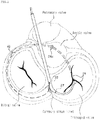
- Fig. 2 is a virtual partial cut view of a heart with the tissue protection device for mitral valve cerclage annuloplasty according to an embodiment of the present invention.
- a cerclage suture 10 which is a very thin thread having a thickness of about 0.014" and used for mitral cerclage coronary sinus annuloplasty (MVA), was named in the meaning that a piece of string comes out of a body after going around a coronary sinus (CS), a tricuspid valve (TV), and a ventricular septum, and when the cerclage suture comes out of a body, it is divided into two pieces at one end and the other end. That is, a cerclage suture is divided into a coronary sinus cerclage suture 10a and a tricuspid valve cerclage suture 10b in Fig. 1 , but it is one continuous string making a circle, as shown in the figure.
- the cerclage suture may be a string made of synthetic resin such as nylon or a metallic wire (stainless steel or metal coated with nylon). Further, a wire formed by twisting a plurality of thin wires may be used.
- the cerclage suture 10 is made by twisting a plurality of strings (wires), it is also called a "cerclage rope” or a “cerclage wire” and it is also a kind of cerclage suture.
- a tissue protection device 20 is a hollow cylindrical tube where the cerclage sutures 10a and 10b are inserted.
- the tissue protection device 20 is a hollow cylindrical tube, that is, it has an empty inside and is manufactured as thick as a 4Fr catheter.
- the material is a soft and flexible rubber or synthetic resin. Alternatively, a metal spring coated with biological synthetic resin may be used.
- the device is composed of a stem section 23 that is the upper part, a support section 26 that is the middle part, and a tricuspid valve insert 24 that is the lower part.
- the parts collectively make one hollow thin cylindrical tube.
- the tissue protection device of the present invention has a hole 22 at a predetermined position and the hole 22 is a part through which the coronary sinus cerclage suture 10a inserted in a coronary sinus comes out of the cylindrical tube.
- the support section 26 is defined to predetermined positions over and under the hole 22, the step section 23 is defined over the support section, and the tricuspid valve insert 24 for protecting a tricuspid valve and a ventricular septum is defined under the support section.
- the coronary sinus cerclage suture 10a and the tricuspid valve cerclage suture 10b are connected to each other.
- the cerclage suture 10a that is supposed to be inserted into a coronary sinus is not covered with the tube in the coronary sinus, so it may be formed to be more rigid than the tricuspid valve cerclage suture 10b in order to protect the coronary sinus tissues.
- the coronary sinus cerclage suture 10a is formed thicker than the tricuspid valve cerclage suture 10b and thus damage to the coronary sinus tissues due to the coronary sinus cerclage suture is prevented.
- the support section 26 where the hole 22 for the coronary sinus cerclage suture 10a to come out of the tissue protection device 20 is connected to the stem section 23 and positioned under the stem section 23.
- the support section 26 is formed to be more rigid than the stem section 23 or the tricuspid valve insert 24. This is for more stably supporting the coronary sinus cerclage suture 10a when the coronary sinus cerclage suture 10a comes out of the hole.
- Fig. 3 is a partial cross-sectional view of a tissue protection device for mitral valve cerclage annuloplasty according to an embodiment of the present invention.
- the support section 26 is thicker than the tricuspid valve insert 24. That is, since it is preferable that the support section 26 is more rigid than the tricuspid valve insert 24, the tube is formed thicker at the support section 26 than at the tricuspid valve insert 24. In order to make the support section rigid, the outer diameter of the support section may be increased or the support section may be made of a different material.
- the tricuspid valve insert 24 connected to the support section 26 is a part that protects the tricuspid valve and the ventricular septum from the cerclage suture 10b that is inserted in the tricuspid valve.
- a stopper 24a is formed at a lower end portion of the cylindrical tube (that is, a lower end portion of the tricuspid valve insert) to prevent the tissue protection device from going deep inside the myocardium.
- the stopper 24a may be a circular protrusion, as shown in the figure.
- the lower end portion of the cylindrical tube that is, the lower end portion of the tricuspid valve insert
- the distance between an RVOT stopper 24a and the hole 22a is selected in advance such that the tricuspid valve insert 24 is around two times longer than the distance between an RVOT exit and the coronary sinus hole that is measured from a scanning image of a patient obtained in advance. That is, the distance between the hole 22 and the stopper 24a is designed around two times longer than the distance from the stopper to the end. To this end, it may be possible to change the position of the stopper at the tricuspid valve insert 24, but various tissue protection devices having different distances between the hole 22 and the stopper 24a may be provided.
- the hole 22 is locked to the edge of a CS inlet. Accordingly, the stopper 24a of the tricuspid valve insert 24 (RVOT exit stopper) and the hole 22 are fixed, so the tricuspid valve insert 24 is curved into a reverse C-shape as long as the length without being in contact with the wall of the tricuspid valve (TV). Accordingly, erosion of the tricuspid valve due to the cerclage suture 10 is prevented and movement of lobes of the mitral valve is less limited.
- a protrusion 27 may be formed on the outer side of the tissue protection device 20, as shown in the figure.
- the protrusion 27 prevents the tissue protection device from being excessively inserting into the body by locking to a tissue inside the body and supports a side when the tricuspid valve insert 24 is curved in a reverse C-shape.
- the present invention can be used for a tissue protection device for mitral valve cerclage annuloplasty and, more particularly to a tissue protection device for protecting tissues of the body (heart) during mitral valve cerclage annuloplasty that is performed on a mitral valve cerclage patient with mitral regurgitation.
Landscapes
- Health & Medical Sciences (AREA)
- Life Sciences & Earth Sciences (AREA)
- Surgery (AREA)
- Veterinary Medicine (AREA)
- General Health & Medical Sciences (AREA)
- Biomedical Technology (AREA)
- Heart & Thoracic Surgery (AREA)
- Engineering & Computer Science (AREA)
- Public Health (AREA)
- Animal Behavior & Ethology (AREA)
- Cardiology (AREA)
- Molecular Biology (AREA)
- Nuclear Medicine, Radiotherapy & Molecular Imaging (AREA)
- Medical Informatics (AREA)
- Oral & Maxillofacial Surgery (AREA)
- Pathology (AREA)
- Transplantation (AREA)
- Vascular Medicine (AREA)
- Prostheses (AREA)
Abstract
Description
- The present invention relates to a tissue protection device for mitral valve cerclage annuloplasty and, more particularly to a tissue protection device for protecting tissues of a body (heart) during mitral valve cerclage annuloplasty that is performed on a mitral valve cerclage patient with mitral regurgitation.
- The heart is the center of the human circulatory system that pumps blood through our body. It is a muscle that pumps the blood only in one direction. In order for the heart to effectively maintain this unidirectional flow of blood, it must have properly functioning valves that prevent back flow through its system, or regurgitation. The heart is divided into four chambers: right and left atrium, and right and left ventricles. The four chambers are connected to the aorta, inferior and superior vena cava, pulmonary artery, and pulmonary veins.
- The mitral valve (MV) separates left atrium from left ventricle while the tricuspid valve (TV) separates right atrium from the right ventricle. The aortic valve (AV) is located between the left ventricle and the aorta while the pulmonary valve (PV) is located between the right ventricle and the pulmonary artery.
- Generally, valves should open and close completely with every heart beat or contraction. Incomplete opening or closing of the valves causes improper flow of blood. Valvular diseases are divided into two categories, regurgitation and stenosis. Regurgitation is a failure of a valve to close completely and stenosis is a failure of a valve to open completely.
- Mitral valve regurgitation (MVR) is a common cardiac valve disorder that is caused by incomplete closure of the mitral valve (MV). The MV is located between the left atrium and the left ventricle. Over time, MVR places a burden on the heart and worsens its ability to pump blood properly. Such stress on the heart will ultimately lead to heart failure.
- Traditional treatment for worsening MVR requires open heart surgery with sternotomy or thoracotomy with cardiac arrest and cardio-pulmonary bypass. Once the chest is open and access to heart is gained, the MV is either repaired or replaced using an artificial valve. Although very effective, this open-heart procedure is a high risk surgery accompanied by substantial morbidity and prolonged convalescence. Mortality due to surgery itself can be as high as 5%. As a result, the procedure often is not offered to patients who are insufficiently symptomatic to justify the surgical risk and morbidity, or to patients with substantial co-morbidity. It is reserved only for those with severe symptomatic MVR. This high morbidity rate of open heart surgery has motivated further research into developing a safer and less risky alternative to repair MV. Much of the research involves use of cardiac catheterization. Recently, the inventor of the present invention presented a thesis regarding "mitral valve cerclage coronary sinus annuloplasty (MVA" showing outstanding results of MVR treatment through applying circular pressure around the mitral annulus (MA). This thesis has been filed through PCT as an international patent application (PCT application number
PCT/US2007/023836 ) and has been published (International publication numberWO2008/060553 ). - The aforementioned thesis and published patent application disclosed the mitral cerclage coronary annuloplasty (MVA) procedure. Briefly explained, a catheter is placed in coronary sinus after accessing the right atrium through the jugular vein, and then a cerclage suture is passed through the proximal septal vein. This cerclage suture can easily pass through right ventricular outflow tract (RVOT), and this inventor defines this technique as "simple mitral cerclage annuloplasty". Then, the cerclage suture can be easily pulled into the right atrium thus placing the cerclage suture circumferentially around the mitral annulus. Once positioned, tension is applied to the cerclage suture, thereby tightening the mitral valve. This brings together the two lobes of the MV so that they are approximated and reduce the size of its incomplete closure. This procedure can theoretically obtain very similar results to those that conventional surgeries can obtain by directly tightening the mitral annulus, and shows an immediate reduction of MVR.
- However, the cerclage suture passes through the tricuspid valve and the heart, so it may reduce the function of the valve or may damage the valve and other parts. The inventor has developed a tissue protection device for the coronary sinus and the tricuspid valve and has filed a patent application as a technology for protecting tissues in a body (heart) and it has been registered (Korean Patent No.
10-1116867 - The present invention is proposed to improve the technology disclosed in Korean Patent No.
10-1116867 - In order to achieve the object of the present invention, a tissue protection device for mitral valve cerclage annuloplasty of the present invention is a hollow cylindrical tube where
cerclage sutures hole 22 is formed at a predetermined portion of the cylindrical tube so that a coronarysinus cerclage suture 10a inserted in a coronary sinus comes out of the cylindrical tube, and a lower section from the hole is inserted into a tricuspid valve to protect tissues of the tricuspid valve and a ventricular septum. - The cylindrical tube may have: a
stem section 23 at an upper portion; asupport section 26 connected to the stem section, having the hole, defined at a predetermined portion over and under the hole, and being more rigid than a tricuspid valve insert; and a tricuspid valve insert 24 connected to the support section and protecting tissues of the tricuspid valve and the ventricular septum. The tube may be thicker at the support section than at the tricuspid valve insert. - A
protrusion 27 may be formed at a predetermined portion of the cylindrical tube to inform a user of the position of the coronary sinus. - The coronary
sinus cerclage suture 10a and the tricuspidvalve cerclage suture 10b may be connected to each other, and the coronarysinus cerclage suture 10a may be formed to be more rigid than the tricuspidvalve cerclage suture 10b. - A
stopper 24a preventing the cylindrical tube from going deep inside the myocardium may be formed at a lower end portion of the cylindrical tube, and thestopper 24a may be a circular protrusion. - The device may become narrower as it goes to an end to cover a cerclage suture in the ventricular septum.
- As described above, the tissue protection device for mitral valve cerclage annuloplasty of the present invention has a simple structure for protecting the body in mitral valve cerclage annuloplasty performed on a patient with mitral regurgitation, so it is possible to provide convenience and safety in annuloplasty.
-
-
Fig. 1 is a schematic perspective view of the tissue protection device for mitral valve cerclage annuloplasty according to an embodiment of the present invention. -
Fig. 2 is a virtual partial cut view of a heart with the tissue protection device for mitral valve cerclage annuloplasty according to an embodiment of the present invention. -
Fig. 3 is a partial cross-sectional view of the tissue protection device for mitral valve cerclage annuloplasty according to an embodiment of the present invention. - Hereinafter, the tissue protection device for mitral valve cerclage annuloplasty of the present invention will be described in detail with reference to the accompanying drawings.
-
Fig. 1 is a schematic perspective view of the tissue protection device for mitral valve cerclage annuloplasty according to an embodiment of the present invention andFig. 2 is a virtual partial cut view of a heart with the tissue protection device for mitral valve cerclage annuloplasty according to an embodiment of the present invention. - A cerclage suture 10, which is a very thin thread having a thickness of about 0.014" and used for mitral cerclage coronary sinus annuloplasty (MVA), was named in the meaning that a piece of string comes out of a body after going around a coronary sinus (CS), a tricuspid valve (TV), and a ventricular septum, and when the cerclage suture comes out of a body, it is divided into two pieces at one end and the other end. That is, a cerclage suture is divided into a coronary
sinus cerclage suture 10a and a tricuspidvalve cerclage suture 10b inFig. 1 , but it is one continuous string making a circle, as shown in the figure. The cerclage suture may be a string made of synthetic resin such as nylon or a metallic wire (stainless steel or metal coated with nylon). Further, a wire formed by twisting a plurality of thin wires may be used. When the cerclage suture 10 is made by twisting a plurality of strings (wires), it is also called a "cerclage rope" or a "cerclage wire" and it is also a kind of cerclage suture. - A
tissue protection device 20 is a hollow cylindrical tube where thecerclage sutures tissue protection device 20 is a hollow cylindrical tube, that is, it has an empty inside and is manufactured as thick as a 4Fr catheter. The material is a soft and flexible rubber or synthetic resin. Alternatively, a metal spring coated with biological synthetic resin may be used. - As for each part of the
tissue protection device 20, the device is composed of astem section 23 that is the upper part, asupport section 26 that is the middle part, and atricuspid valve insert 24 that is the lower part. The parts collectively make one hollow thin cylindrical tube. - The tissue protection device of the present invention has a
hole 22 at a predetermined position and thehole 22 is a part through which the coronarysinus cerclage suture 10a inserted in a coronary sinus comes out of the cylindrical tube. Thesupport section 26 is defined to predetermined positions over and under thehole 22, thestep section 23 is defined over the support section, and thetricuspid valve insert 24 for protecting a tricuspid valve and a ventricular septum is defined under the support section. - The coronary
sinus cerclage suture 10a and the tricuspidvalve cerclage suture 10b are connected to each other. Thecerclage suture 10a that is supposed to be inserted into a coronary sinus is not covered with the tube in the coronary sinus, so it may be formed to be more rigid than the tricuspidvalve cerclage suture 10b in order to protect the coronary sinus tissues. The coronarysinus cerclage suture 10a is formed thicker than the tricuspidvalve cerclage suture 10b and thus damage to the coronary sinus tissues due to the coronary sinus cerclage suture is prevented. - The
support section 26 where thehole 22 for the coronarysinus cerclage suture 10a to come out of thetissue protection device 20 is connected to thestem section 23 and positioned under thestem section 23. - The
support section 26 is formed to be more rigid than thestem section 23 or thetricuspid valve insert 24. This is for more stably supporting the coronarysinus cerclage suture 10a when the coronarysinus cerclage suture 10a comes out of the hole. -
Fig. 3 is a partial cross-sectional view of a tissue protection device for mitral valve cerclage annuloplasty according to an embodiment of the present invention. - As shown in
Fig. 3 , thesupport section 26 is thicker than thetricuspid valve insert 24. That is, since it is preferable that thesupport section 26 is more rigid than thetricuspid valve insert 24, the tube is formed thicker at thesupport section 26 than at thetricuspid valve insert 24. In order to make the support section rigid, the outer diameter of the support section may be increased or the support section may be made of a different material. - The
tricuspid valve insert 24 connected to thesupport section 26 is a part that protects the tricuspid valve and the ventricular septum from thecerclage suture 10b that is inserted in the tricuspid valve. - A
stopper 24a is formed at a lower end portion of the cylindrical tube (that is, a lower end portion of the tricuspid valve insert) to prevent the tissue protection device from going deep inside the myocardium. Thestopper 24a may be a circular protrusion, as shown in the figure. Further, as shown in the figure, the lower end portion of the cylindrical tube (that is, the lower end portion of the tricuspid valve insert) may become narrower as it goes to the end in order to cover thecerclage suture 10b in a ventricular septum. - The distance between an
RVOT stopper 24a and the hole 22a is selected in advance such that thetricuspid valve insert 24 is around two times longer than the distance between an RVOT exit and the coronary sinus hole that is measured from a scanning image of a patient obtained in advance. That is, the distance between thehole 22 and thestopper 24a is designed around two times longer than the distance from the stopper to the end. To this end, it may be possible to change the position of the stopper at thetricuspid valve insert 24, but various tissue protection devices having different distances between thehole 22 and thestopper 24a may be provided. - When the coronary
sinus cerclage suture 10a coming out of thetissue protection device 20 is inserted into the coronary sinus, thehole 22 is locked to the edge of a CS inlet. Accordingly, thestopper 24a of the tricuspid valve insert 24 (RVOT exit stopper) and thehole 22 are fixed, so thetricuspid valve insert 24 is curved into a reverse C-shape as long as the length without being in contact with the wall of the tricuspid valve (TV). Accordingly, erosion of the tricuspid valve due to the cerclage suture 10 is prevented and movement of lobes of the mitral valve is less limited. - On the other hand, a
protrusion 27 may be formed on the outer side of thetissue protection device 20, as shown in the figure. Theprotrusion 27 prevents the tissue protection device from being excessively inserting into the body by locking to a tissue inside the body and supports a side when thetricuspid valve insert 24 is curved in a reverse C-shape. - The embodiments described above are just examples of the present invention and the scope of the present invention is not limited to the embodiments. The present invention may be changed, replaced, and modified in various ways by those skilled in the art without departing from the scope of the present invention described in claims.
- The present invention can be used for a tissue protection device for mitral valve cerclage annuloplasty and, more particularly to a tissue protection device for protecting tissues of the body (heart) during mitral valve cerclage annuloplasty that is performed on a mitral valve cerclage patient with mitral regurgitation.
Claims (9)
- A tissue protection device for mitral valve cerclage annuloplasty, the tissue protection device being a hollow cylindrical tube where cerclage sutures (10a, 10b) are inserted, wherein a hole (22) is formed at a predetermined portion of the cylindrical tube so that a coronary sinus cerclage suture (10a) inserted in a coronary sinus comes out of the cylindrical tube, and a lower section from the hole is inserted into a tricuspid valve to protect tissues of the tricuspid valve and a ventricular septum.
- The device of claim 1, wherein the cylindrical tube has: a stem section (23) at an upper portion; a support section (26) connected to the stem section, having the hole, defined at a predetermined portion over and under the hole, and being more rigid than a tricuspid valve insert; and a tricuspid valve insert (24) connected to the support section and protecting tissues of a tricuspid valve and a ventricular septum.
- The device of claim 2, wherein the tube is thicker at the support section than at the tricuspid valve insert.
- The device of claim 1, wherein a protrusion (27) is formed at a predetermined portion of the cylindrical tube to inform a user of the position of a coronary sinus.
- The device of claim 1, wherein the coronary sinus cerclage suture (10a) and the tricuspid valve cerclage suture (10b) are connected to each other, and the coronary sinus cerclage suture (10a) is formed to be more rigid than the tricuspid valve cerclage suture (10b).
- The device of claim 1, wherein a stopper (24a) preventing the cylindrical tube from going deep inside a myocardium is formed at a lower end portion of the cylindrical tube.
- The device of claim 6, wherein the stopper (24a) is a circular protrusion.
- The device of claim 1, wherein the device becomes narrower as it goes to an end to cover a cerclage suture in a ventricular septum.
- The device of claim 6, wherein the device maintains a reverse C-shape between the hole and the stopper without being in contact with a wall of a tricuspid valve in cerclage annuloplasty.
Applications Claiming Priority (2)
| Application Number | Priority Date | Filing Date | Title |
|---|---|---|---|
| KR1020140060587A KR101563172B1 (en) | 2014-05-20 | 2014-05-20 | Tissue protective device for the cerclage annuloplasty procedure |
| PCT/KR2015/004728 WO2015178612A1 (en) | 2014-05-20 | 2015-05-12 | Tissue protection device for mitral valve membrane cerclage procedure |
Publications (3)
| Publication Number | Publication Date |
|---|---|
| EP3146904A1 true EP3146904A1 (en) | 2017-03-29 |
| EP3146904A4 EP3146904A4 (en) | 2018-01-24 |
| EP3146904B1 EP3146904B1 (en) | 2024-07-03 |
Family
ID=54428611
Family Applications (1)
| Application Number | Title | Priority Date | Filing Date |
|---|---|---|---|
| EP15796546.8A Active EP3146904B1 (en) | 2014-05-20 | 2015-05-12 | Tissue protection device for mitral valve membrane cerclage procedure |
Country Status (5)
| Country | Link |
|---|---|
| US (2) | US10729427B2 (en) |
| EP (1) | EP3146904B1 (en) |
| KR (1) | KR101563172B1 (en) |
| CN (1) | CN106456144B (en) |
| WO (1) | WO2015178612A1 (en) |
Families Citing this family (19)
| Publication number | Priority date | Publication date | Assignee | Title |
|---|---|---|---|---|
| US9943409B2 (en) * | 2006-11-14 | 2018-04-17 | The United States Of America, As Represented By The Secretary, Department Of Health And Human Services | Transcatheter coronary sinus mitral valve annuloplasty procedure and coronary artery and myocardial protection device |
| US11980545B2 (en) | 2016-05-06 | 2024-05-14 | Transmural Systems Llc | Annuloplasty procedures, related devices and methods |
| US11039923B2 (en) | 2016-05-06 | 2021-06-22 | Transmural Systems Llc | Annuloplasty procedures, related devices and methods |
| US11007059B2 (en) | 2016-05-06 | 2021-05-18 | Transmural Systems Llc | Annuloplasty procedures, related devices and methods |
| US12544227B2 (en) | 2016-05-06 | 2026-02-10 | Transmural Systems Llc | Annuloplasty procedures, related devices and methods |
| KR102654995B1 (en) | 2016-05-06 | 2024-04-04 | 더 유나이티드 스테이츠 오브 어메리카, 애즈 리프리젠티드 바이 더 세크러테리, 디파트먼트 오브 헬쓰 앤드 휴먼 서비씨즈 | Annuloplasty procedures, related devices and methods |
| KR101805679B1 (en) * | 2017-02-01 | 2017-12-06 | (주) 타우피엔유메디칼 | Device for transcatheter treatment for tricuspid regurgitation |
| KR101972991B1 (en) | 2017-07-31 | 2019-08-16 | (주) 타우피엔유메디칼 | Equipment for the treatment of tricuspid regurgitation |
| KR101965637B1 (en) * | 2017-07-31 | 2019-04-03 | (주) 타우피엔유메디칼 | A device for the treatment of tricuspid regurgitation in the pulmonary artery |
| US10686618B2 (en) | 2017-08-13 | 2020-06-16 | Carbyne Ltd. | Method for streaming real-time data from a user device to a dispatch unit terminal |
| EP3672532B1 (en) | 2017-08-26 | 2022-08-03 | Transmural Systems LLC | Implantable cardiac pacing system |
| KR101955291B1 (en) | 2017-10-25 | 2019-03-08 | (주) 타우피엔유메디칼 | A device to treat heart valve regurgitation and fix the pacemaker lead |
| KR102053451B1 (en) * | 2017-11-24 | 2020-01-08 | (주) 타우피엔유메디칼 | Cerclage atrial implantable cardioverter defibrillators |
| KR102137740B1 (en) | 2018-11-15 | 2020-07-24 | (주) 타우피엔유메디칼 | Pacemaker lead for cerclage pacing |
| WO2020105768A1 (en) | 2018-11-23 | 2020-05-28 | 주식회사 타우피엔유메디칼 | Device for valve regurgitation surgery and cardiac pacemaker lead fixation |
| KR102156647B1 (en) | 2019-01-21 | 2020-09-16 | (주) 타우피엔유메디칼 | An assembled device for treatment of tricuspid regurgitation |
| KR102240805B1 (en) | 2019-07-12 | 2021-04-15 | (주) 타우피엔유메디칼 | Apparatus for cerclage annuloplasty with position fixing device |
| CN113018544B (en) * | 2021-03-02 | 2021-11-02 | 江苏赛腾医疗科技有限公司 | Flow control device |
| CN113057677B (en) * | 2021-03-30 | 2022-05-24 | 华南理工大学 | Heart image modeling method, system and equipment for fusing ultrasonic image and CT image |
Family Cites Families (22)
| Publication number | Priority date | Publication date | Assignee | Title |
|---|---|---|---|---|
| US6074407A (en) * | 1997-10-14 | 2000-06-13 | Target Therapeutics, Inc. | Delivery catheter for occlusive implants |
| US6402781B1 (en) | 2000-01-31 | 2002-06-11 | Mitralife | Percutaneous mitral annuloplasty and cardiac reinforcement |
| US6585730B1 (en) * | 2000-08-30 | 2003-07-01 | Opus Medical, Inc. | Method and apparatus for attaching connective tissues to bone using a knotless suture anchoring device |
| US6810882B2 (en) * | 2001-01-30 | 2004-11-02 | Ev3 Santa Rosa, Inc. | Transluminal mitral annuloplasty |
| US6676702B2 (en) * | 2001-05-14 | 2004-01-13 | Cardiac Dimensions, Inc. | Mitral valve therapy assembly and method |
| EP1521550A4 (en) * | 2002-06-12 | 2011-02-23 | Mitral Interventions Inc | Method and apparatus for tissue connection |
| WO2004045378A2 (en) | 2002-11-15 | 2004-06-03 | The Government Of The United States Of America As Represented By The Secretary Of Health And Human Services | Method and device for catheter-based repair of cardiac valves |
| US7381210B2 (en) | 2003-03-14 | 2008-06-03 | Edwards Lifesciences Corporation | Mitral valve repair system and method for use |
| US7942927B2 (en) * | 2004-03-15 | 2011-05-17 | Baker Medical Research Institute | Treating valve failure |
| US7749250B2 (en) * | 2006-02-03 | 2010-07-06 | Biomet Sports Medicine, Llc | Soft tissue repair assembly and associated method |
| US7731693B2 (en) * | 2005-10-27 | 2010-06-08 | Cook Incorporated | Coupling wire guide |
| ES2310092B1 (en) * | 2006-06-02 | 2009-09-30 | Ignacio Rada Martinez | TELE-ADJUSTABLE PROTEST RING FOR MITRAL AND TRICUSPIDE VALVE REPAIR |
| WO2008060553A1 (en) | 2006-11-14 | 2008-05-22 | The Government Of The United States Of America As Represented By The Secretary Of The Department Of Health And Human Services | Transcatheter coronary sinus mitral valve annuloplasty procedure and coronary artery and myocardial protection device |
| US20080195126A1 (en) * | 2007-02-14 | 2008-08-14 | Jan Otto Solem | Suture and method for repairing a heart |
| WO2010070649A1 (en) * | 2008-12-21 | 2010-06-24 | Mor Research Applications Ltd. | Elongated body for deployment in a coronary sinus |
| KR101116867B1 (en) * | 2009-08-28 | 2012-03-06 | 김준홍 | The device for delivering optimal tension safaely and effectively in cerclage annuloplasty procedure |
| US8632588B2 (en) * | 2009-12-04 | 2014-01-21 | June-Hong Kim | Mitral valve cerclarge annuloplasty appratus and method thereof |
| TWM392640U (en) * | 2010-07-09 | 2010-11-21 | xie-xing Lin | Surgical suture needle kit with variable-diameter suture |
| BR112013007253B1 (en) * | 2010-09-29 | 2021-10-05 | Taupnumedical Co.,Ltd | TISSUE PROTECTION DEVICE FOR CORONARY SINUS AND TRICUSPID VALVE, NODE DISTRIBUTION DEVICE AND DEVICE FOR MICRAL VALVE CENCLING, CONTAINING THE SAME |
| US11213393B2 (en) * | 2011-04-01 | 2022-01-04 | Edwards Lifesciences Corporation | Compressible heart valve annulus sizing templates |
| KR101296604B1 (en) | 2012-09-05 | 2013-08-14 | 부산대학교 산학협력단 | Sheath and cerclage thread for mitral cerclage annuloplasty |
| CN203506933U (en) * | 2013-05-17 | 2014-04-02 | 中国人民解放军第二军医大学 | Adjustable mitral valve forming ring |
-
2014
- 2014-05-20 KR KR1020140060587A patent/KR101563172B1/en active Active
-
2015
- 2015-05-12 WO PCT/KR2015/004728 patent/WO2015178612A1/en not_active Ceased
- 2015-05-12 EP EP15796546.8A patent/EP3146904B1/en active Active
- 2015-05-12 CN CN201580022575.6A patent/CN106456144B/en active Active
- 2015-05-12 US US15/312,660 patent/US10729427B2/en active Active
-
2020
- 2020-06-30 US US16/917,554 patent/US11944290B2/en active Active
Also Published As
| Publication number | Publication date |
|---|---|
| US10729427B2 (en) | 2020-08-04 |
| EP3146904B1 (en) | 2024-07-03 |
| US20200330091A1 (en) | 2020-10-22 |
| US20170150964A1 (en) | 2017-06-01 |
| US11944290B2 (en) | 2024-04-02 |
| CN106456144A (en) | 2017-02-22 |
| CN106456144B (en) | 2019-12-13 |
| WO2015178612A1 (en) | 2015-11-26 |
| KR101563172B1 (en) | 2015-10-27 |
| EP3146904A4 (en) | 2018-01-24 |
Similar Documents
| Publication | Publication Date | Title |
|---|---|---|
| US11944290B2 (en) | Tissue protection device for mitral valve membrane cerclage procedure | |
| US10973524B2 (en) | Device for transcatheter treatment for tricuspid regurgitation | |
| US10940006B2 (en) | Mitral cerclage annuloplasty apparatus | |
| US8632588B2 (en) | Mitral valve cerclarge annuloplasty appratus and method thereof | |
| JP5592016B2 (en) | Tissue protector for coronary sinus and tricuspid valve | |
| EP2742912A2 (en) | Device for mitral valve membrane cerclage procedure | |
| EP3155974B1 (en) | Cerclage rope for mitral valve cerclage procedure having arched coronary artery protector integrally formed therewith | |
| KR101805679B1 (en) | Device for transcatheter treatment for tricuspid regurgitation | |
| JP2020505136A (en) | Chord adjustment | |
| KR101581021B1 (en) | Tissue protective device for the cerclage annuloplasty procedure in use of the coil spring, and tissue protective device making method | |
| KR20150007557A (en) | Cerclage rope for the cerclage annuloplasty procedure | |
| US20220296371A1 (en) | Cerclage operation device provided with position fixing device | |
| KR101467373B1 (en) | Stopper for myocardial protection and cerclage annuloplasty procedure apparatus with the same | |
| KR20190117877A (en) | Wire connection device | |
| JP7735392B2 (en) | Prosthetic valve device for the treatment of mitral regurgitation | |
| KR20160002107A (en) | Tricuspid valve tube end of the tissue protective device for the cerclage annuloplasty procedure |
Legal Events
| Date | Code | Title | Description |
|---|---|---|---|
| STAA | Information on the status of an ep patent application or granted ep patent |
Free format text: STATUS: THE INTERNATIONAL PUBLICATION HAS BEEN MADE |
|
| PUAI | Public reference made under article 153(3) epc to a published international application that has entered the european phase |
Free format text: ORIGINAL CODE: 0009012 |
|
| STAA | Information on the status of an ep patent application or granted ep patent |
Free format text: STATUS: REQUEST FOR EXAMINATION WAS MADE |
|
| 17P | Request for examination filed |
Effective date: 20161007 |
|
| AK | Designated contracting states |
Kind code of ref document: A1 Designated state(s): AL AT BE BG CH CY CZ DE DK EE ES FI FR GB GR HR HU IE IS IT LI LT LU LV MC MK MT NL NO PL PT RO RS SE SI SK SM TR |
|
| AX | Request for extension of the european patent |
Extension state: BA ME |
|
| DAV | Request for validation of the european patent (deleted) | ||
| DAX | Request for extension of the european patent (deleted) | ||
| A4 | Supplementary search report drawn up and despatched |
Effective date: 20180102 |
|
| RIC1 | Information provided on ipc code assigned before grant |
Ipc: A61F 2/24 20060101ALI20171219BHEP Ipc: A61B 17/04 20060101AFI20171219BHEP Ipc: A61B 17/00 20060101ALN20171219BHEP |
|
| STAA | Information on the status of an ep patent application or granted ep patent |
Free format text: STATUS: EXAMINATION IS IN PROGRESS |
|
| 17Q | First examination report despatched |
Effective date: 20190307 |
|
| RAP3 | Party data changed (applicant data changed or rights of an application transferred) |
Owner name: TAU-PNU MEDICAL CO., LTD. |
|
| RAP3 | Party data changed (applicant data changed or rights of an application transferred) |
Owner name: TAU MEDICAL INC. |
|
| REG | Reference to a national code |
Ref country code: DE Ref legal event code: R079 Free format text: PREVIOUS MAIN CLASS: A61B0017000000 Ipc: A61B0017040000 Ref country code: DE Ref legal event code: R079 Ref document number: 602015089119 Country of ref document: DE Free format text: PREVIOUS MAIN CLASS: A61B0017000000 Ipc: A61B0017040000 |
|
| GRAP | Despatch of communication of intention to grant a patent |
Free format text: ORIGINAL CODE: EPIDOSNIGR1 |
|
| STAA | Information on the status of an ep patent application or granted ep patent |
Free format text: STATUS: GRANT OF PATENT IS INTENDED |
|
| RIC1 | Information provided on ipc code assigned before grant |
Ipc: A61B 17/00 20060101ALN20240215BHEP Ipc: A61F 2/24 20060101ALI20240215BHEP Ipc: A61B 17/04 20060101AFI20240215BHEP |
|
| RIC1 | Information provided on ipc code assigned before grant |
Ipc: A61B 17/00 20060101ALN20240221BHEP Ipc: A61F 2/24 20060101ALI20240221BHEP Ipc: A61B 17/04 20060101AFI20240221BHEP |
|
| INTG | Intention to grant announced |
Effective date: 20240305 |
|
| RAP3 | Party data changed (applicant data changed or rights of an application transferred) |
Owner name: TAU MEDICAL INC. |
|
| P01 | Opt-out of the competence of the unified patent court (upc) registered |
Effective date: 20240322 |
|
| GRAS | Grant fee paid |
Free format text: ORIGINAL CODE: EPIDOSNIGR3 |
|
| GRAA | (expected) grant |
Free format text: ORIGINAL CODE: 0009210 |
|
| STAA | Information on the status of an ep patent application or granted ep patent |
Free format text: STATUS: THE PATENT HAS BEEN GRANTED |
|
| AK | Designated contracting states |
Kind code of ref document: B1 Designated state(s): AL AT BE BG CH CY CZ DE DK EE ES FI FR GB GR HR HU IE IS IT LI LT LU LV MC MK MT NL NO PL PT RO RS SE SI SK SM TR |
|
| REG | Reference to a national code |
Ref country code: CH Ref legal event code: EP |
|
| REG | Reference to a national code |
Ref country code: DE Ref legal event code: R096 Ref document number: 602015089119 Country of ref document: DE |
|
| REG | Reference to a national code |
Ref country code: LT Ref legal event code: MG9D |
|
| REG | Reference to a national code |
Ref country code: NL Ref legal event code: MP Effective date: 20240703 |
|
| PG25 | Lapsed in a contracting state [announced via postgrant information from national office to epo] |
Ref country code: PT Free format text: LAPSE BECAUSE OF FAILURE TO SUBMIT A TRANSLATION OF THE DESCRIPTION OR TO PAY THE FEE WITHIN THE PRESCRIBED TIME-LIMIT Effective date: 20241104 |
|
| REG | Reference to a national code |
Ref country code: AT Ref legal event code: MK05 Ref document number: 1698973 Country of ref document: AT Kind code of ref document: T Effective date: 20240703 |
|
| PG25 | Lapsed in a contracting state [announced via postgrant information from national office to epo] |
Ref country code: NL Free format text: LAPSE BECAUSE OF FAILURE TO SUBMIT A TRANSLATION OF THE DESCRIPTION OR TO PAY THE FEE WITHIN THE PRESCRIBED TIME-LIMIT Effective date: 20240703 |
|
| PG25 | Lapsed in a contracting state [announced via postgrant information from national office to epo] |
Ref country code: PT Free format text: LAPSE BECAUSE OF FAILURE TO SUBMIT A TRANSLATION OF THE DESCRIPTION OR TO PAY THE FEE WITHIN THE PRESCRIBED TIME-LIMIT Effective date: 20241104 Ref country code: NL Free format text: LAPSE BECAUSE OF FAILURE TO SUBMIT A TRANSLATION OF THE DESCRIPTION OR TO PAY THE FEE WITHIN THE PRESCRIBED TIME-LIMIT Effective date: 20240703 |
|
| PG25 | Lapsed in a contracting state [announced via postgrant information from national office to epo] |
Ref country code: NO Free format text: LAPSE BECAUSE OF FAILURE TO SUBMIT A TRANSLATION OF THE DESCRIPTION OR TO PAY THE FEE WITHIN THE PRESCRIBED TIME-LIMIT Effective date: 20241003 |
|
| PG25 | Lapsed in a contracting state [announced via postgrant information from national office to epo] |
Ref country code: PL Free format text: LAPSE BECAUSE OF FAILURE TO SUBMIT A TRANSLATION OF THE DESCRIPTION OR TO PAY THE FEE WITHIN THE PRESCRIBED TIME-LIMIT Effective date: 20240703 Ref country code: GR Free format text: LAPSE BECAUSE OF FAILURE TO SUBMIT A TRANSLATION OF THE DESCRIPTION OR TO PAY THE FEE WITHIN THE PRESCRIBED TIME-LIMIT Effective date: 20241004 Ref country code: FI Free format text: LAPSE BECAUSE OF FAILURE TO SUBMIT A TRANSLATION OF THE DESCRIPTION OR TO PAY THE FEE WITHIN THE PRESCRIBED TIME-LIMIT Effective date: 20240703 |
|
| PG25 | Lapsed in a contracting state [announced via postgrant information from national office to epo] |
Ref country code: BG Free format text: LAPSE BECAUSE OF FAILURE TO SUBMIT A TRANSLATION OF THE DESCRIPTION OR TO PAY THE FEE WITHIN THE PRESCRIBED TIME-LIMIT Effective date: 20240703 |
|
| PG25 | Lapsed in a contracting state [announced via postgrant information from national office to epo] |
Ref country code: LV Free format text: LAPSE BECAUSE OF FAILURE TO SUBMIT A TRANSLATION OF THE DESCRIPTION OR TO PAY THE FEE WITHIN THE PRESCRIBED TIME-LIMIT Effective date: 20240703 |
|
| PG25 | Lapsed in a contracting state [announced via postgrant information from national office to epo] |
Ref country code: AT Free format text: LAPSE BECAUSE OF FAILURE TO SUBMIT A TRANSLATION OF THE DESCRIPTION OR TO PAY THE FEE WITHIN THE PRESCRIBED TIME-LIMIT Effective date: 20240703 Ref country code: IS Free format text: LAPSE BECAUSE OF FAILURE TO SUBMIT A TRANSLATION OF THE DESCRIPTION OR TO PAY THE FEE WITHIN THE PRESCRIBED TIME-LIMIT Effective date: 20241103 |
|
| PG25 | Lapsed in a contracting state [announced via postgrant information from national office to epo] |
Ref country code: CZ Free format text: LAPSE BECAUSE OF FAILURE TO SUBMIT A TRANSLATION OF THE DESCRIPTION OR TO PAY THE FEE WITHIN THE PRESCRIBED TIME-LIMIT Effective date: 20240703 Ref country code: HR Free format text: LAPSE BECAUSE OF FAILURE TO SUBMIT A TRANSLATION OF THE DESCRIPTION OR TO PAY THE FEE WITHIN THE PRESCRIBED TIME-LIMIT Effective date: 20240703 |
|
| PG25 | Lapsed in a contracting state [announced via postgrant information from national office to epo] |
Ref country code: ES Free format text: LAPSE BECAUSE OF FAILURE TO SUBMIT A TRANSLATION OF THE DESCRIPTION OR TO PAY THE FEE WITHIN THE PRESCRIBED TIME-LIMIT Effective date: 20240703 Ref country code: RS Free format text: LAPSE BECAUSE OF FAILURE TO SUBMIT A TRANSLATION OF THE DESCRIPTION OR TO PAY THE FEE WITHIN THE PRESCRIBED TIME-LIMIT Effective date: 20241003 |
|
| PG25 | Lapsed in a contracting state [announced via postgrant information from national office to epo] |
Ref country code: RS Free format text: LAPSE BECAUSE OF FAILURE TO SUBMIT A TRANSLATION OF THE DESCRIPTION OR TO PAY THE FEE WITHIN THE PRESCRIBED TIME-LIMIT Effective date: 20241003 Ref country code: PL Free format text: LAPSE BECAUSE OF FAILURE TO SUBMIT A TRANSLATION OF THE DESCRIPTION OR TO PAY THE FEE WITHIN THE PRESCRIBED TIME-LIMIT Effective date: 20240703 Ref country code: NO Free format text: LAPSE BECAUSE OF FAILURE TO SUBMIT A TRANSLATION OF THE DESCRIPTION OR TO PAY THE FEE WITHIN THE PRESCRIBED TIME-LIMIT Effective date: 20241003 Ref country code: LV Free format text: LAPSE BECAUSE OF FAILURE TO SUBMIT A TRANSLATION OF THE DESCRIPTION OR TO PAY THE FEE WITHIN THE PRESCRIBED TIME-LIMIT Effective date: 20240703 Ref country code: IS Free format text: LAPSE BECAUSE OF FAILURE TO SUBMIT A TRANSLATION OF THE DESCRIPTION OR TO PAY THE FEE WITHIN THE PRESCRIBED TIME-LIMIT Effective date: 20241103 Ref country code: HR Free format text: LAPSE BECAUSE OF FAILURE TO SUBMIT A TRANSLATION OF THE DESCRIPTION OR TO PAY THE FEE WITHIN THE PRESCRIBED TIME-LIMIT Effective date: 20240703 Ref country code: GR Free format text: LAPSE BECAUSE OF FAILURE TO SUBMIT A TRANSLATION OF THE DESCRIPTION OR TO PAY THE FEE WITHIN THE PRESCRIBED TIME-LIMIT Effective date: 20241004 Ref country code: FI Free format text: LAPSE BECAUSE OF FAILURE TO SUBMIT A TRANSLATION OF THE DESCRIPTION OR TO PAY THE FEE WITHIN THE PRESCRIBED TIME-LIMIT Effective date: 20240703 Ref country code: ES Free format text: LAPSE BECAUSE OF FAILURE TO SUBMIT A TRANSLATION OF THE DESCRIPTION OR TO PAY THE FEE WITHIN THE PRESCRIBED TIME-LIMIT Effective date: 20240703 Ref country code: CZ Free format text: LAPSE BECAUSE OF FAILURE TO SUBMIT A TRANSLATION OF THE DESCRIPTION OR TO PAY THE FEE WITHIN THE PRESCRIBED TIME-LIMIT Effective date: 20240703 Ref country code: BG Free format text: LAPSE BECAUSE OF FAILURE TO SUBMIT A TRANSLATION OF THE DESCRIPTION OR TO PAY THE FEE WITHIN THE PRESCRIBED TIME-LIMIT Effective date: 20240703 Ref country code: AT Free format text: LAPSE BECAUSE OF FAILURE TO SUBMIT A TRANSLATION OF THE DESCRIPTION OR TO PAY THE FEE WITHIN THE PRESCRIBED TIME-LIMIT Effective date: 20240703 |
|
| REG | Reference to a national code |
Ref country code: DE Ref legal event code: R097 Ref document number: 602015089119 Country of ref document: DE |
|
| PG25 | Lapsed in a contracting state [announced via postgrant information from national office to epo] |
Ref country code: SM Free format text: LAPSE BECAUSE OF FAILURE TO SUBMIT A TRANSLATION OF THE DESCRIPTION OR TO PAY THE FEE WITHIN THE PRESCRIBED TIME-LIMIT Effective date: 20240703 Ref country code: DK Free format text: LAPSE BECAUSE OF FAILURE TO SUBMIT A TRANSLATION OF THE DESCRIPTION OR TO PAY THE FEE WITHIN THE PRESCRIBED TIME-LIMIT Effective date: 20240703 Ref country code: RO Free format text: LAPSE BECAUSE OF FAILURE TO SUBMIT A TRANSLATION OF THE DESCRIPTION OR TO PAY THE FEE WITHIN THE PRESCRIBED TIME-LIMIT Effective date: 20240703 |
|
| PG25 | Lapsed in a contracting state [announced via postgrant information from national office to epo] |
Ref country code: EE Free format text: LAPSE BECAUSE OF FAILURE TO SUBMIT A TRANSLATION OF THE DESCRIPTION OR TO PAY THE FEE WITHIN THE PRESCRIBED TIME-LIMIT Effective date: 20240703 |
|
| PG25 | Lapsed in a contracting state [announced via postgrant information from national office to epo] |
Ref country code: SK Free format text: LAPSE BECAUSE OF FAILURE TO SUBMIT A TRANSLATION OF THE DESCRIPTION OR TO PAY THE FEE WITHIN THE PRESCRIBED TIME-LIMIT Effective date: 20240703 |
|
| PLBE | No opposition filed within time limit |
Free format text: ORIGINAL CODE: 0009261 |
|
| STAA | Information on the status of an ep patent application or granted ep patent |
Free format text: STATUS: NO OPPOSITION FILED WITHIN TIME LIMIT |
|
| 26N | No opposition filed |
Effective date: 20250404 |
|
| PG25 | Lapsed in a contracting state [announced via postgrant information from national office to epo] |
Ref country code: SE Free format text: LAPSE BECAUSE OF FAILURE TO SUBMIT A TRANSLATION OF THE DESCRIPTION OR TO PAY THE FEE WITHIN THE PRESCRIBED TIME-LIMIT Effective date: 20240703 |
|
| REG | Reference to a national code |
Ref country code: CH Ref legal event code: H13 Free format text: ST27 STATUS EVENT CODE: U-0-0-H10-H13 (AS PROVIDED BY THE NATIONAL OFFICE) Effective date: 20251223 |
|
| PG25 | Lapsed in a contracting state [announced via postgrant information from national office to epo] |
Ref country code: LU Free format text: LAPSE BECAUSE OF NON-PAYMENT OF DUE FEES Effective date: 20250512 |
|
| PG25 | Lapsed in a contracting state [announced via postgrant information from national office to epo] |
Ref country code: CH Free format text: LAPSE BECAUSE OF NON-PAYMENT OF DUE FEES Effective date: 20250531 |
|
| REG | Reference to a national code |
Ref country code: BE Ref legal event code: MM Effective date: 20250531 |
|
| PG25 | Lapsed in a contracting state [announced via postgrant information from national office to epo] |
Ref country code: MC Free format text: LAPSE BECAUSE OF FAILURE TO SUBMIT A TRANSLATION OF THE DESCRIPTION OR TO PAY THE FEE WITHIN THE PRESCRIBED TIME-LIMIT Effective date: 20240703 |
|
| PG25 | Lapsed in a contracting state [announced via postgrant information from national office to epo] |
Ref country code: BE Free format text: LAPSE BECAUSE OF NON-PAYMENT OF DUE FEES Effective date: 20250531 |
|
| PG25 | Lapsed in a contracting state [announced via postgrant information from national office to epo] |
Ref country code: LT Free format text: LAPSE BECAUSE OF FAILURE TO SUBMIT A TRANSLATION OF THE DESCRIPTION OR TO PAY THE FEE WITHIN THE PRESCRIBED TIME-LIMIT Effective date: 20240703 |
|
| PGFP | Annual fee paid to national office [announced via postgrant information from national office to epo] |
Ref country code: GB Payment date: 20260521 Year of fee payment: 12 |
|
| PGFP | Annual fee paid to national office [announced via postgrant information from national office to epo] |
Ref country code: IT Payment date: 20260529 Year of fee payment: 12 |
|
| PGFP | Annual fee paid to national office [announced via postgrant information from national office to epo] |
Ref country code: DE Payment date: 20260515 Year of fee payment: 12 |
|
| PGFP | Annual fee paid to national office [announced via postgrant information from national office to epo] |
Ref country code: IE Payment date: 20260526 Year of fee payment: 12 |
|
| PGFP | Annual fee paid to national office [announced via postgrant information from national office to epo] |
Ref country code: FR Payment date: 20260522 Year of fee payment: 12 |
|
| PG25 | Lapsed in a contracting state [announced via postgrant information from national office to epo] |
Ref country code: CY Free format text: LAPSE BECAUSE OF FAILURE TO SUBMIT A TRANSLATION OF THE DESCRIPTION OR TO PAY THE FEE WITHIN THE PRESCRIBED TIME-LIMIT Effective date: 20240703 |