EP3144370A1 - Polyhydroxyalkyl ether amines and fuels containing them - Google Patents
Polyhydroxyalkyl ether amines and fuels containing them Download PDFInfo
- Publication number
- EP3144370A1 EP3144370A1 EP16189362.3A EP16189362A EP3144370A1 EP 3144370 A1 EP3144370 A1 EP 3144370A1 EP 16189362 A EP16189362 A EP 16189362A EP 3144370 A1 EP3144370 A1 EP 3144370A1
- Authority
- EP
- European Patent Office
- Prior art keywords
- fuel composition
- fuel
- additive
- engine
- carbon atoms
- Prior art date
- Legal status (The legal status is an assumption and is not a legal conclusion. Google has not performed a legal analysis and makes no representation as to the accuracy of the status listed.)
- Granted
Links
- 0 CC*(C)*(*)(*)N Chemical compound CC*(C)*(*)(*)N 0.000 description 1
Classifications
-
- C—CHEMISTRY; METALLURGY
- C10—PETROLEUM, GAS OR COKE INDUSTRIES; TECHNICAL GASES CONTAINING CARBON MONOXIDE; FUELS; LUBRICANTS; PEAT
- C10L—FUELS NOT OTHERWISE PROVIDED FOR; NATURAL GAS; SYNTHETIC NATURAL GAS OBTAINED BY PROCESSES NOT COVERED BY SUBCLASSES C10G OR C10K; LIQUIFIED PETROLEUM GAS; USE OF ADDITIVES TO FUELS OR FIRES; FIRE-LIGHTERS
- C10L10/00—Use of additives to fuels or fires for particular purposes
- C10L10/18—Use of additives to fuels or fires for particular purposes use of detergents or dispersants for purposes not provided for in groups C10L10/02 - C10L10/16
-
- C—CHEMISTRY; METALLURGY
- C10—PETROLEUM, GAS OR COKE INDUSTRIES; TECHNICAL GASES CONTAINING CARBON MONOXIDE; FUELS; LUBRICANTS; PEAT
- C10L—FUELS NOT OTHERWISE PROVIDED FOR; NATURAL GAS; SYNTHETIC NATURAL GAS OBTAINED BY PROCESSES NOT COVERED BY SUBCLASSES C10G OR C10K; LIQUIFIED PETROLEUM GAS; USE OF ADDITIVES TO FUELS OR FIRES; FIRE-LIGHTERS
- C10L1/00—Liquid carbonaceous fuels
- C10L1/04—Liquid carbonaceous fuels essentially based on blends of hydrocarbons
-
- C—CHEMISTRY; METALLURGY
- C07—ORGANIC CHEMISTRY
- C07C—ACYCLIC OR CARBOCYCLIC COMPOUNDS
- C07C217/00—Compounds containing amino and etherified hydroxy groups bound to the same carbon skeleton
- C07C217/02—Compounds containing amino and etherified hydroxy groups bound to the same carbon skeleton having etherified hydroxy groups and amino groups bound to acyclic carbon atoms of the same carbon skeleton
- C07C217/04—Compounds containing amino and etherified hydroxy groups bound to the same carbon skeleton having etherified hydroxy groups and amino groups bound to acyclic carbon atoms of the same carbon skeleton the carbon skeleton being acyclic and saturated
- C07C217/06—Compounds containing amino and etherified hydroxy groups bound to the same carbon skeleton having etherified hydroxy groups and amino groups bound to acyclic carbon atoms of the same carbon skeleton the carbon skeleton being acyclic and saturated having only one etherified hydroxy group and one amino group bound to the carbon skeleton, which is not further substituted
- C07C217/08—Compounds containing amino and etherified hydroxy groups bound to the same carbon skeleton having etherified hydroxy groups and amino groups bound to acyclic carbon atoms of the same carbon skeleton the carbon skeleton being acyclic and saturated having only one etherified hydroxy group and one amino group bound to the carbon skeleton, which is not further substituted the oxygen atom of the etherified hydroxy group being further bound to an acyclic carbon atom
-
- C—CHEMISTRY; METALLURGY
- C10—PETROLEUM, GAS OR COKE INDUSTRIES; TECHNICAL GASES CONTAINING CARBON MONOXIDE; FUELS; LUBRICANTS; PEAT
- C10L—FUELS NOT OTHERWISE PROVIDED FOR; NATURAL GAS; SYNTHETIC NATURAL GAS OBTAINED BY PROCESSES NOT COVERED BY SUBCLASSES C10G OR C10K; LIQUIFIED PETROLEUM GAS; USE OF ADDITIVES TO FUELS OR FIRES; FIRE-LIGHTERS
- C10L1/00—Liquid carbonaceous fuels
- C10L1/10—Liquid carbonaceous fuels containing additives
- C10L1/14—Organic compounds
- C10L1/22—Organic compounds containing nitrogen
- C10L1/222—Organic compounds containing nitrogen containing at least one carbon-to-nitrogen single bond
- C10L1/2222—(cyclo)aliphatic amines; polyamines (no macromolecular substituent 30C); quaternair ammonium compounds; carbamates
- C10L1/2225—(cyclo)aliphatic amines; polyamines (no macromolecular substituent 30C); quaternair ammonium compounds; carbamates hydroxy containing
-
- C—CHEMISTRY; METALLURGY
- C10—PETROLEUM, GAS OR COKE INDUSTRIES; TECHNICAL GASES CONTAINING CARBON MONOXIDE; FUELS; LUBRICANTS; PEAT
- C10L—FUELS NOT OTHERWISE PROVIDED FOR; NATURAL GAS; SYNTHETIC NATURAL GAS OBTAINED BY PROCESSES NOT COVERED BY SUBCLASSES C10G OR C10K; LIQUIFIED PETROLEUM GAS; USE OF ADDITIVES TO FUELS OR FIRES; FIRE-LIGHTERS
- C10L1/00—Liquid carbonaceous fuels
- C10L1/10—Liquid carbonaceous fuels containing additives
- C10L1/14—Organic compounds
- C10L1/22—Organic compounds containing nitrogen
- C10L1/234—Macromolecular compounds
- C10L1/238—Macromolecular compounds obtained otherwise than by reactions involving only carbon-to-carbon unsaturated bonds
- C10L1/2383—Polyamines or polyimines, or derivatives thereof (poly)amines and imines; derivatives thereof (substituted by a macromolecular group containing 30C)
- C10L1/2387—Polyoxyalkyleneamines (poly)oxyalkylene amines and derivatives thereof (substituted by a macromolecular group containing 30C)
-
- C—CHEMISTRY; METALLURGY
- C10—PETROLEUM, GAS OR COKE INDUSTRIES; TECHNICAL GASES CONTAINING CARBON MONOXIDE; FUELS; LUBRICANTS; PEAT
- C10L—FUELS NOT OTHERWISE PROVIDED FOR; NATURAL GAS; SYNTHETIC NATURAL GAS OBTAINED BY PROCESSES NOT COVERED BY SUBCLASSES C10G OR C10K; LIQUIFIED PETROLEUM GAS; USE OF ADDITIVES TO FUELS OR FIRES; FIRE-LIGHTERS
- C10L10/00—Use of additives to fuels or fires for particular purposes
- C10L10/08—Use of additives to fuels or fires for particular purposes for improving lubricity; for reducing wear
-
- C—CHEMISTRY; METALLURGY
- C10—PETROLEUM, GAS OR COKE INDUSTRIES; TECHNICAL GASES CONTAINING CARBON MONOXIDE; FUELS; LUBRICANTS; PEAT
- C10L—FUELS NOT OTHERWISE PROVIDED FOR; NATURAL GAS; SYNTHETIC NATURAL GAS OBTAINED BY PROCESSES NOT COVERED BY SUBCLASSES C10G OR C10K; LIQUIFIED PETROLEUM GAS; USE OF ADDITIVES TO FUELS OR FIRES; FIRE-LIGHTERS
- C10L10/00—Use of additives to fuels or fires for particular purposes
- C10L10/14—Use of additives to fuels or fires for particular purposes for improving low temperature properties
-
- C—CHEMISTRY; METALLURGY
- C10—PETROLEUM, GAS OR COKE INDUSTRIES; TECHNICAL GASES CONTAINING CARBON MONOXIDE; FUELS; LUBRICANTS; PEAT
- C10L—FUELS NOT OTHERWISE PROVIDED FOR; NATURAL GAS; SYNTHETIC NATURAL GAS OBTAINED BY PROCESSES NOT COVERED BY SUBCLASSES C10G OR C10K; LIQUIFIED PETROLEUM GAS; USE OF ADDITIVES TO FUELS OR FIRES; FIRE-LIGHTERS
- C10L2200/00—Components of fuel compositions
- C10L2200/04—Organic compounds
- C10L2200/0407—Specifically defined hydrocarbon fractions as obtained from, e.g. a distillation column
- C10L2200/0415—Light distillates, e.g. LPG, naphtha
- C10L2200/0423—Gasoline
-
- C—CHEMISTRY; METALLURGY
- C10—PETROLEUM, GAS OR COKE INDUSTRIES; TECHNICAL GASES CONTAINING CARBON MONOXIDE; FUELS; LUBRICANTS; PEAT
- C10L—FUELS NOT OTHERWISE PROVIDED FOR; NATURAL GAS; SYNTHETIC NATURAL GAS OBTAINED BY PROCESSES NOT COVERED BY SUBCLASSES C10G OR C10K; LIQUIFIED PETROLEUM GAS; USE OF ADDITIVES TO FUELS OR FIRES; FIRE-LIGHTERS
- C10L2230/00—Function and purpose of a components of a fuel or the composition as a whole
- C10L2230/14—Function and purpose of a components of a fuel or the composition as a whole for improving storage or transport of the fuel
-
- C—CHEMISTRY; METALLURGY
- C10—PETROLEUM, GAS OR COKE INDUSTRIES; TECHNICAL GASES CONTAINING CARBON MONOXIDE; FUELS; LUBRICANTS; PEAT
- C10L—FUELS NOT OTHERWISE PROVIDED FOR; NATURAL GAS; SYNTHETIC NATURAL GAS OBTAINED BY PROCESSES NOT COVERED BY SUBCLASSES C10G OR C10K; LIQUIFIED PETROLEUM GAS; USE OF ADDITIVES TO FUELS OR FIRES; FIRE-LIGHTERS
- C10L2230/00—Function and purpose of a components of a fuel or the composition as a whole
- C10L2230/22—Function and purpose of a components of a fuel or the composition as a whole for improving fuel economy or fuel efficiency
-
- C—CHEMISTRY; METALLURGY
- C10—PETROLEUM, GAS OR COKE INDUSTRIES; TECHNICAL GASES CONTAINING CARBON MONOXIDE; FUELS; LUBRICANTS; PEAT
- C10L—FUELS NOT OTHERWISE PROVIDED FOR; NATURAL GAS; SYNTHETIC NATURAL GAS OBTAINED BY PROCESSES NOT COVERED BY SUBCLASSES C10G OR C10K; LIQUIFIED PETROLEUM GAS; USE OF ADDITIVES TO FUELS OR FIRES; FIRE-LIGHTERS
- C10L2270/00—Specifically adapted fuels
- C10L2270/02—Specifically adapted fuels for internal combustion engines
- C10L2270/023—Specifically adapted fuels for internal combustion engines for gasoline engines
Definitions
- the disclosure is directed to use of a gasoline fuel composition that improves fuel economy and fuel additives that can be formulated into a fuel additive package that remains in a fluid state at low temperatures.
- the disclosure relates to polyhydroxyalkyl ether amine additives that reduce friction or wear of engine parts and improve fuel economy of an engine while remaining stable in a fuel additive package.
- Fuel compositions for vehicles are continually being improved to enhance various properties of the fuels in order to accommodate their use in newer, more advanced engines including direct injection gasoline engines. Accordingly, fuel compositions typically include additives that are directed to certain properties that require improvement. For example, friction modifiers, such as fatty acid amides, are added to fuel to reduce friction and wear in the fuel delivery systems of an engine. However, certain fatty amides may be unstable in additive packages for fuels at low storage temperatures and the performance of such fatty acid amides is often less than desirable. Fuel additives may be passed into the oil sump during engine operation, so that a fuel additive that is also beneficial to the engine lubricant is desirable.
- friction modifiers such as fatty acid amides
- additives may be beneficially added to the lubricant rather than the fuel, such additive are not effective for improving wear in fuel delivery systems. Also, such additives, when added to the fuel, rather than the lubricant, may reduce friction and wear in the piston ring zone of the engine and thus improve fuel economy. Accordingly, it is beneficial to include additives in fuels to provide both improved fuel delivery system wear protection as well as improved fuel economy.
- Partial esters of fatty acid and polyhydroxy alcohols such as glycerol monooleate (GMO) are known as friction modifiers for lubricant compositions.
- diethanolamine fatty amides are also well known friction modifiers. While GMO and fatty amide friction modifiers may improve fuel economy when added to a lubricant, GMO and certain diethanolamine fatty amides may be unstable in additive packages for fuels or may cause an increase in intake valve deposits in gasoline engines. Furthermore, fuel economy improvement may be less than desirable when using GMO or certain fatty amides in fuel compositions. Accordingly, GMO and fatty amide friction modifiers cannot be beneficially added to a fuel composition to improve the wear protection of the fuel delivery system without harmful and undesirable side effects.
- Fatty amine ethoxylates are also known as fuel additives that may reduce fuel consumption.
- fatty amine ethoxylates are typically derived from natural sources and thus may vary by region and over time.
- some fatty amine ethoxylates have high freezing points or are solids at room temperature and may require heating or the use of a solvent for storage and handling.
- fatty amine ethoxylates typically have poor low temperature compatibility with fuel compositions.
- Certain etheramine polyalkoxylates were believed to be useful as anti-corrosion additives in gasoline fuels. However, such compounds perform poorly with regard to corrosion in a NACE TM0172-2001 corrosion test and may dramatically increase the amount of intake valve deposits in an engine.
- exemplary embodiments provide a method for improving fuel economy in an engine.
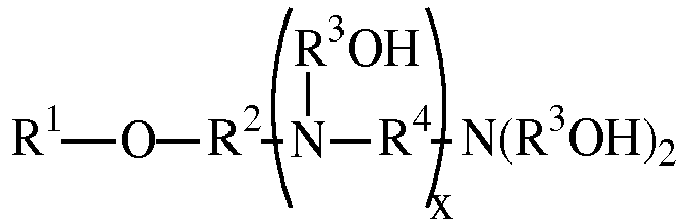
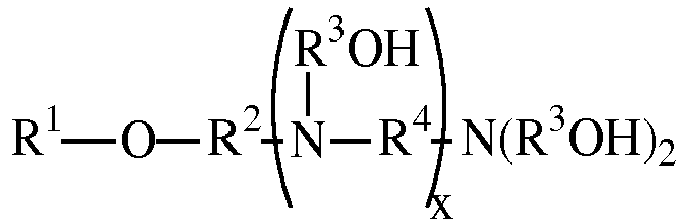
- the method includes providing a fuel composition to an engine, wherein the fuel composition comprises gasoline and from 10 to 750 ppm by weight based on a total weight of the fuel composition of a fuel stable additive of the formula: wherein R 1 comprises a saturated hydrocarbyl group having from 6 to 30 carbon atoms, R 2 is an alkylene, polyalkylene, alkoxyalkylene, or polyalkoxyalkylene group containing from 2 to 25 carbon atoms, R 3 is an alkylene group containing from 2 to 5 carbon atoms, R 4 is a linear alkylene group containing 2 to 3 carbon atoms, and x is an integer selected from 0 and 1, and combusting the fuel composition in the engine.
- R 1 comprises a saturated hydrocarbyl group having from 6 to 30 carbon atoms
- R 2 is an alkylene, polyalkylene, alkoxyalkylene, or polyalkoxyalkylene group containing from 2 to 25
- a method for improving the fuel economy in an engine includes providing to the engine a fuel composition, wherein the fuel composition comprises gasoline and from 10 to 750 ppm by weight based on the total weight of the fuel composition of a fuel stable additive that is a polyhydroxyalkyl ether amine, wherein the polyhydroxyalkyl ether amine contains one or more tertiary nitrogen atoms and is devoid of primary and secondary nitrogen atoms, and combusting the fuel composition in the engine.
- a further embodiment provides a fuel composition that includes gasoline and from 10 to 750 ppm by weight based on the total weight of the fuel composition of an additive of the formula wherein R 1 comprises a saturated hydrocarbyl group having from 6 to 30 carbon atoms, R 2 is a linear alkylene group containing from 2 to 25 carbon atoms, R 3 is an alkylene group containing from 2 to 5 carbon atoms, R 4 is a linear alkylene group containing 2 to 3 carbon atoms, and x is an integer selected from 0 and 1.
- the additive for the fuel composition may not only improve the friction or wear properties of the fuel, but the additive may also be effective to improve fuel economy without detrimentally affecting the low temperature stability of a fuel additive package containing the additive component.
- the additive is derived from a hydrocarbyl substituted ether amine that is reacted with an epoxide.
- the hydrocarbyl group of the hydrocarbyl substituted ether amine contains from 6 to 30 carbon atoms.
- the hydrocarbyl ether amine is a compound of the formula wherein R 1 comprises a saturated hydrocarbyl group having from 6 to 30 carbon atoms, R 2 is an alkylene, polyalkylene, alkoxyalkylene, or polyalkoxyalkylene group containing from 2 to 25 carbon atoms, R 3 is an alkylene group containing from 2 to 5 carbon atoms, R 4 is a linear alkylene group containing 2 to 3 carbon atoms, and x is an integer selected from 0 and 1.
- the fuel composition contains from 10 to 750 ppm by weight, such as from 40 to 500 ppm by weight, or from 50 to 250 ppm by weight of the polyhydroxyalkyl ether amine based on a total weight of the fuel composition.
- the fuel additive component of the present application may be used in a minor amount in a major amount of fuel and may be added to the fuel directly or added as a component of an additive concentrate to the fuel.
- a suitable fuel additive component for improving the operation of internal combustion engines may be made by reacting an ether amine or ether diamine with an epoxide.
- hydrocarbyl group or “hydrocarbyl” is used in its ordinary sense, which is well-known to those skilled in the art. Specifically, it refers to a group having a carbon atom directly attached to the remainder of a molecule and having a predominantly hydrocarbon character. Examples of hydrocarbyl groups include:
- the term “major amount” is understood to mean an amount greater than or equal to 50 wt. %, for example from 80 to 98 wt.% relative to the total weight of the composition.
- the term “minor amount” is understood to mean an amount less than 50 wt. % relative to the total weight of the composition.
- any suitable ether-amine or ether-diamine may be used to prepare a compound of the formula: wherein R 1 comprises a saturated hydrocarbyl group having from 6 to 30 carbon atoms, R 2 is an alkylene, polyalkylene, alkoxyalkylene, or polyalkoxyalkylene group containing from 2 to 25 carbon atoms, R 3 is an alkylene group containing from 2 to 5 carbon atoms, R 4 is a linear alkylene group containing 2 to 3 carbon atoms, and x is an integer selected from 0 and 1.
- the amine may be a compound of the formula: R 1 -O-R 2 -(NH-R 4 ) x -NH 2 wherein R 1 comprises a saturated hydrocarbyl group having from 6 to 30 carbon atoms, R 2 is an alkylene, polyalkylene, alkoxyalkylene, or polyalkoxyalkylene group containing from 2 to 25 carbon atoms, R 4 is a linear alkylene group containing 2 to 3 carbon atoms, and x is an integer selected from 0 and 1.
- Representative etheramines may include, but are not limited to, isohexyloxyethylamine, isohexyloxypropylamine, 2-ethylhexyloxyethylamine, 2-ethylhexyloxypropylamine, a mixture of octyloxyethylamine and decyloxyethylamine, a mixture of octyloxypropylamine and decyloxypropylamine, isodecyloxyethylamine, isodecyloxypropylamine, isododecyloxyethylamine, isododecyloxypropylamine, isotridecyloxyethylamine, isotridecyloxypolyproxypropylamine, isotridecyloxypoly-C 2 -C 4 -oxypropylamine, isotridecyloxypropylamine, C 12 -C 15
- a suitable epoxide compound may be selected from the group consisting of:
- the polyhydroxy ether amines may be made in one stage or two stages.
- the reaction may be carried out by contacting and mixing an alcohol or ether alcohol with an epoxide to form an alkoxylated alcohol, aminating the alkoxylated alcohol with ammonia in the presence of a catalyst to form an alkoxylated alkylamine, and subsequently reacting the alkoxylated alkylamine with an epoxide to form the alkoxylated ether amines.
- the mole ratio of alcohol to epoxide may range from 1 to 8, such as a mole ratio of alcohol to epoxide ranging from 2 to 4.
- the mole ratio of ammonia or amine to alkoxylated alcohol may range from 1 to 10.
- the mole ratio of epoxide to alkoxylated alkylamine may range from 1 to 5. In one embodiment, only one epoxy group is added to each NH group. The reactions may be conducted at temperatures ranging from 0° C to 160° C. In another embodiment, the ether amine could be made by reacting a hydrocarbyl ether with acrylonitrile followed by reduction of the resulting intermediate.
- the fuels may contain conventional quantities of octane improvers, corrosion inhibitors, cold flow improvers (CFPP additive), pour point depressants, solvents, demulsifiers, lubricity additives, additional friction modifiers, amine stabilizers, combustion improvers, dispersants, detergents, antioxidants, heat stabilizers, conductivity improvers, metal deactivators, carrier fluid, marker dyes, organic nitrate ignition accelerators, cyclomatic manganese tricarbonyl compounds, and the like.
- CFPP additive cold flow improvers
- pour point depressants solvents
- demulsifiers demulsifiers
- lubricity additives additional friction modifiers
- amine stabilizers amine stabilizers
- combustion improvers dispersants
- detergents antioxidants
- heat stabilizers conductivity improvers
- metal deactivators carrier fluid, marker dyes, organic nitrate ignition accelerators, cyclomatic manganese tricarbonyl compounds, and the like.
- compositions described herein may contain 10 weight percent or less, or in other aspects, 5 weight percent or less, based on the total weight of the additive concentrate, of one or more of the above additives.
- the fuels may contain suitable amounts of conventional fuel blending components such as methanol, ethanol, dialkyl ethers, 2-ethylhexanol, and the like.
- a fuel additive package may contain the above described polyhydroxyalkyl ether amine additive in combination with a carrier fluid and other ingredients selected from fatty amine ethoxylates; one or more detergents selected from Mannich bases, polyalkylamines, polyalkylpolyamines, polyalkenyl succinimides, and quaternary ammonium salt detergents.
- Quaternary ammonium salt detergents may be selected from compounds of the formula wherein each of R 1 , R 2 , R 3 , and R 4 is selected from a hydrocarbyl group containing from 1 to 50 carbon atoms, wherein at least one and not more than three of R 1 , R 2 , R 3 , and R 4 is a hydrocarbyl group containing from 1 to 4 carbon atoms and at least one of R 1 , R 2 , R 3 , and R 4 is a hydrocarbyl group containing from 8 to 50 carbon atoms, M- is selected from ions of the group consisting of carboxylates, nitrates, nitrides, nitrites, hyponitrites, phenates, carbamates, carbonates, and mixtures thereof, wherein the carboxylate is not an oxalate or formate; alkoxylated quaternary ammonium salts derived from epoxides, tertiary amines, and optional proton
- Suitable carrier fluids may be selected from any suitable carrier fluid that is compatible with the fuel or gasoline and is capable of dissolving or dispersing the components of the additive package.
- the carrier fluid is a hydrocarbyl polyether or a hydrocarbon fluid, for example a petroleum or synthetic lubricating oil basestock including mineral oil, synthetic oils such as polyesters or polyethers or other polyols, or hydrocracked or hydroisomerised basestock.
- the carrier fluid may be a distillate boiling at a temperature in a range of boiling temperatures of the fuel or gasoline of from about 30 to 200°C or from about 35 to 175°C.
- the amount of carrier fluid contained in the additive package may range from 10 to 80 wt %, preferably from 20 to 75 wt %, and more preferably from 30 to 60 wt % based on a total weight of the additive package.
- Such additive packages containing the polyhydroxyalkyl ether amine additive, detergent and carrier fluid were found to remain as clear fluids even at temperatures as low as -20 to -30° C.
- the additives of the present application including the polyhydroxylalkyl ether amines described above, and optional additives used in formulating the fuels of this invention may be blended into the base fuel individually or in various sub-combinations.
- the additive components of the present application may be blended into the fuel concurrently using an additive concentrate, as this takes advantage of the mutual compatibility and convenience afforded by the combination of ingredients when in the form of an additive concentrate. Also, use of a concentrate may reduce blending time and lessen the possibility of blending errors.
- the fuels of the present application may be applicable to the operation of gasoline engines.
- the engine include both stationary engines (e.g., engines used in electrical power generation installations, in pumping stations, etc.) and ambulatory engines (e.g., engines used as prime movers in automobiles, trucks, road-grading equipment, military vehicles, etc.).
- a friction test was conducted on a GF-5 lubricating oil that was devoid of friction modifiers using a high frequency reciprocating rig (HFRR) under a 4N load with a stroke distance of 1 millimeter at 20 Hz at 70° C, 100° C and 130° C according to ASTM D6079.
- the base lubricating oil contained a GF-5 dispersant/inhibitor (DI) package that contained no friction modifiers.
- Inventive Additive 2 was made using the process of Inventive Example 1 except that C 13 OH was replaced by a mixture of C 16 and C 18 alcohols.
- Inventive Example 3 was bis(2-hydroxyethyl) isotridecyloxylpropylamine.
- Inventive Example 4 was a reaction product of a mixture of dodecylcycloxypropyl-1,3-diamno propane and tetradcyloxypropyl-1,3-diamineopropane with three equivalents of ethylene oxide.
- the friction modifier to be tested was solubilized in the Sequence VIE motor oil.
- the concentration of friction modifier in the top-treat was sufficient to provide a concentration of 0.125 wt.% of friction modifier in the crankcase lubricant.
- the engine was operated with the baseline engine oil at 1500 rpm, a torque of 150 N-m, an oil temperature of 115° C and a coolant temperature of 109° C until the temperatures stabilized.
- the brake specific fuel consumption (BSFC) was measured for approximately one hour after stabilization.
- the top-treated lubricant containing the friction modifier was then added to the crankcase. Upon the addition of the top-treated lubricant, the BSFC decreased over the course of about five minutes.
- Table 3 The results in Table 3 were obtained from fuels dosed with friction modifiers. Each fuel was dosed with 480 ppm of the friction modifier tested and the fuel economy was determined in the same manner as with the top-treated lubricant runs. Table 3 - Fuel Economy Increase Run No. Friction Modifier dosed into the fuel at a concentration of 480ppm % Fuel Economy Increase 8 Fuel plus - diethanolamine fatty amide derived from fatty acid and diethanol amine ⁇ 0.2 9 Fuel plus Inventive Example 1 0.4
- An important characteristic of the fuel additives of the disclosure is the low temperature stability of a fuel additive package containing the above described polyhydroxy ether amine.
- An advantage of providing the additive in a fuel additive package rather than in a lubricant composition is that the additive is continually renewed over time as fuel is combusted in the engine. By contrast, as the lubricant ages, additives provided by the lubricant are typically depleted over time. Accordingly, in order to provide sufficient additive to a fuel to improve the fuel economy of an engine, the additive package containing the foregoing polyhydroxy ether amine must be stable in the fuel additive package.
- stable is meant the additive package remains a clear fluid at temperatures as low as -20° C over a period of time.
- each amount/value or range of amounts/values for each component, compound, substituent, or parameter disclosed herein is to be interpreted as also being disclosed in combination with each amount/value or range of amounts/values disclosed for any other component(s), compounds(s), substituent(s), or parameter(s) disclosed herein and that any combination of amounts/values or ranges of amounts/values for two or more component(s), compounds(s), substituent(s), or parameters disclosed herein are thus also disclosed in combination with each other for the purposes of this description.
- each lower limit of each range disclosed herein is to be interpreted as disclosed in combination with each upper limit of each range disclosed herein for the same component, compounds, substituent, or parameter.
- a disclosure of two ranges is to be interpreted as a disclosure of four ranges derived by combining each lower limit of each range with each upper limit of each range.
- a disclosure of three ranges is to be interpreted as a disclosure of nine ranges derived by combining each lower limit of each range with each upper limit of each range, etc.
Landscapes
- Chemical & Material Sciences (AREA)
- Oil, Petroleum & Natural Gas (AREA)
- Organic Chemistry (AREA)
- Engineering & Computer Science (AREA)
- Chemical Kinetics & Catalysis (AREA)
- General Chemical & Material Sciences (AREA)
- Combustion & Propulsion (AREA)
- Solid Fuels And Fuel-Associated Substances (AREA)
- Liquid Carbonaceous Fuels (AREA)
- Lubricants (AREA)
Abstract
Description
- The disclosure is directed to use of a gasoline fuel composition that improves fuel economy and fuel additives that can be formulated into a fuel additive package that remains in a fluid state at low temperatures. In particular, the disclosure relates to polyhydroxyalkyl ether amine additives that reduce friction or wear of engine parts and improve fuel economy of an engine while remaining stable in a fuel additive package.
- Fuel compositions for vehicles are continually being improved to enhance various properties of the fuels in order to accommodate their use in newer, more advanced engines including direct injection gasoline engines. Accordingly, fuel compositions typically include additives that are directed to certain properties that require improvement. For example, friction modifiers, such as fatty acid amides, are added to fuel to reduce friction and wear in the fuel delivery systems of an engine. However, certain fatty amides may be unstable in additive packages for fuels at low storage temperatures and the performance of such fatty acid amides is often less than desirable. Fuel additives may be passed into the oil sump during engine operation, so that a fuel additive that is also beneficial to the engine lubricant is desirable. While such additives may be beneficially added to the lubricant rather than the fuel, such additive are not effective for improving wear in fuel delivery systems. Also, such additives, when added to the fuel, rather than the lubricant, may reduce friction and wear in the piston ring zone of the engine and thus improve fuel economy. Accordingly, it is beneficial to include additives in fuels to provide both improved fuel delivery system wear protection as well as improved fuel economy.
- Partial esters of fatty acid and polyhydroxy alcohols such as glycerol monooleate (GMO) are known as friction modifiers for lubricant compositions. Likewise diethanolamine fatty amides are also well known friction modifiers. While GMO and fatty amide friction modifiers may improve fuel economy when added to a lubricant, GMO and certain diethanolamine fatty amides may be unstable in additive packages for fuels or may cause an increase in intake valve deposits in gasoline engines. Furthermore, fuel economy improvement may be less than desirable when using GMO or certain fatty amides in fuel compositions. Accordingly, GMO and fatty amide friction modifiers cannot be beneficially added to a fuel composition to improve the wear protection of the fuel delivery system without harmful and undesirable side effects.
- Fatty amine ethoxylates are also known as fuel additives that may reduce fuel consumption. However, such fatty amine ethoxylates are typically derived from natural sources and thus may vary by region and over time. In addition, some fatty amine ethoxylates have high freezing points or are solids at room temperature and may require heating or the use of a solvent for storage and handling. Lastly, fatty amine ethoxylates typically have poor low temperature compatibility with fuel compositions.
- Certain etheramine polyalkoxylates were believed to be useful as anti-corrosion additives in gasoline fuels. However, such compounds perform poorly with regard to corrosion in a NACE TM0172-2001 corrosion test and may dramatically increase the amount of intake valve deposits in an engine.
- Many other friction modifiers have been tried, however there remains a need for a friction modifier that enables a fuel additive packages containing the friction modifier to achieve one or more of remaining fluid at low temperatures, being resistant to hydrolysis, that may be readily formulated into a fuel additive packages, that offer good fuel economy benefits, and that provide wear protection to fuel delivery systems, among other characteristics. Accordingly, there continues to be a need for a fuel additive that is cost effective to manufacture and improves at least one and preferably multiple characteristics of a fuel.
- In accordance with the disclosure, exemplary embodiments provide a method for improving fuel economy in an engine. The method includes providing a fuel composition to an engine, wherein the fuel composition comprises gasoline and from 10 to 750 ppm by weight based on a total weight of the fuel composition of a fuel stable additive of the formula:
- In another embodiment, there is provided a method for improving the fuel economy in an engine. The method includes providing to the engine a fuel composition, wherein the fuel composition comprises gasoline and from 10 to 750 ppm by weight based on the total weight of the fuel composition of a fuel stable additive that is a polyhydroxyalkyl ether amine, wherein the polyhydroxyalkyl ether amine contains one or more tertiary nitrogen atoms and is devoid of primary and secondary nitrogen atoms, and combusting the fuel composition in the engine.
- A further embodiment provides a fuel composition that includes gasoline and from 10 to 750 ppm by weight based on the total weight of the fuel composition of an additive of the formula

- An advantage of the methods described herein is that the additive for the fuel composition may not only improve the friction or wear properties of the fuel, but the additive may also be effective to improve fuel economy without detrimentally affecting the low temperature stability of a fuel additive package containing the additive component.
- In one embodiment, the additive is derived from a hydrocarbyl substituted ether amine that is reacted with an epoxide. In another embodiment, the hydrocarbyl group of the hydrocarbyl substituted ether amine contains from 6 to 30 carbon atoms.
- In one embodiment, the hydrocarbyl ether amine is a compound of the formula

- In a further embodiment, the fuel composition contains from 10 to 750 ppm by weight, such as from 40 to 500 ppm by weight, or from 50 to 250 ppm by weight of the polyhydroxyalkyl ether amine based on a total weight of the fuel composition.
- Additional embodiments and advantages of the disclosure will be set forth in part in the detailed description which follows, and/or can be learned by practice of the disclosure. It is to be understood that both the foregoing general description and the following detailed description are exemplary and explanatory only and are not restrictive of the disclosure, as claimed.
- The fuel additive component of the present application may be used in a minor amount in a major amount of fuel and may be added to the fuel directly or added as a component of an additive concentrate to the fuel. A suitable fuel additive component for improving the operation of internal combustion engines may be made by reacting an ether amine or ether diamine with an epoxide.
- As used herein, the term "hydrocarbyl group" or "hydrocarbyl" is used in its ordinary sense, which is well-known to those skilled in the art. Specifically, it refers to a group having a carbon atom directly attached to the remainder of a molecule and having a predominantly hydrocarbon character. Examples of hydrocarbyl groups include:
- (1) hydrocarbon substituents, that is, aliphatic (e.g., alkyl or alkenyl), alicyclic (e.g., cycloalkyl, cycloalkenyl) substituents, and aromatic-, aliphatic-, and alicyclic-substituted aromatic substituents, as well as cyclic substituents wherein the ring is completed through another portion of the molecule (e.g., two substituents together form an alicyclic radical);
- (2) substituted hydrocarbon substituents, that is, substituents containing non-hydrocarbon groups which, in the context of the description herein, do not alter the predominantly hydrocarbon substituent (e.g., halo (especially chloro and fluoro), hydroxy, alkoxy, mercapto, alkylmercapto, nitro, nitroso, amino, alkylamino, and sulfoxy);
- (3) hetero-substituents, that is, substituents which, while having a predominantly hydrocarbon character, in the context of this description, contain other than carbon in a ring or chain otherwise composed of carbon atoms. Hetero-atoms include sulfur, oxygen, nitrogen, and encompass than two, or as a further example, no more than one, non-hydrocarbon substituent will be present for every ten carbon atoms in the hydrocarbyl group; in some embodiments, there will be no non-hydrocarbon substituent in the hydrocarbyl group.
- As used herein, the term "major amount" is understood to mean an amount greater than or equal to 50 wt. %, for example from 80 to 98 wt.% relative to the total weight of the composition. Moreover, as used herein, the term "minor amount" is understood to mean an amount less than 50 wt. % relative to the total weight of the composition.
- According to the disclosure, any suitable ether-amine or ether-diamine may be used to prepare a compound of the formula:

R1-O-R2-(NH-R4)x-NH2
wherein R1 comprises a saturated hydrocarbyl group having from 6 to 30 carbon atoms, R2 is an alkylene, polyalkylene, alkoxyalkylene, or polyalkoxyalkylene group containing from 2 to 25 carbon atoms, R4 is a linear alkylene group containing 2 to 3 carbon atoms, and x is an integer selected from 0 and 1. - Representative etheramines may include, but are not limited to, isohexyloxyethylamine, isohexyloxypropylamine, 2-ethylhexyloxyethylamine, 2-ethylhexyloxypropylamine, a mixture of octyloxyethylamine and decyloxyethylamine, a mixture of octyloxypropylamine and decyloxypropylamine, isodecyloxyethylamine, isodecyloxypropylamine, isododecyloxyethylamine, isododecyloxypropylamine, isotridecyloxyethylamine, isotridecyloxypolyproxypropylamine, isotridecyloxypoly-C2-C4-oxypropylamine, isotridecyloxypropylamine, C12-C15-alkyloxyethylamine, C12-C15-alkyloxypropylamine, C16-C18-alkyloxyethylamine, C16-C18-alkyloxypropylamine, isodecyloxyethyl-1,3-diaminopropane, isodecyloxypropyl-1,3-diaminopropane, isododecyloxyethyl-1,3-diaminopropane, isododecyloxypropyl-1,3-diaminopropane, isotridecyloxyethyl-1,3-diaminopropane, isotridecyloxypropyl-1,3-diaminopropane, and the like.
- A suitable epoxide compound may be selected from the group consisting of:
- 1,3-Butadiene diepoxide
- Cyclohexene oxide
- Cyclopentene oxide
- Dicyclopentadiene dioxide
- 1,2,5,6-Diepoxycyclooctane
- 1,2,7,8-Diepoxyoctane
- 1,2-Epoxybutane
- cis-2,3-Epoxybutane
- 3,4-Epoxy-1-butene
- 3,4-Epoxycyclohexylmethyl 3,4-epoxycyclohexanecarboxylate
- 1,2-Epoxydodecane
- 1,2-Epoxyhexadecane
- 1,2-Epoxyhexane
- 1,2-Epoxy-5-hexene
- 1,2-Epoxy-2-methylpropane
- exo-2,3-Epoxynorbornane
- 1,2-Epoxyoctane
- 1,2-Epoxypentane
- 1,2-Epoxy-3-phenoxypropane
- (2,3-Epoxypropyl)benzene
- N-(2,3-Epoxypropyl)phthalimide
- 1,2-Epoxytetradecane
- exo-3,6-Epoxy-1,2,3,6-tetrahydrophthalic anhydride
- 3,4-Epoxytetrahydrothiophene-1,1-dioxide
- Isophorone oxide
- Methyl-1,2-cyclopentene oxide
- 2-Methyl-2-vinyloxirane
- α-Pinene oxide
- Ethylene oxide
- (±)-propylene oxide
- Polyisobutene oxide
- cis-Stilbene oxide
- Styrene oxide
- Glycidol
- Glycidol ethers
- Tetracyanoethylene oxide
- Tris(2,3-epoxypropyl) isocyanurate and combinations of two or more of the foregoing. A particularly suitable epoxide may be selected from ethylene oxide, propylene oxide, and glycidol.
- The polyhydroxy ether amines may be made in one stage or two stages. The reaction may be carried out by contacting and mixing an alcohol or ether alcohol with an epoxide to form an alkoxylated alcohol, aminating the alkoxylated alcohol with ammonia in the presence of a catalyst to form an alkoxylated alkylamine, and subsequently reacting the alkoxylated alkylamine with an epoxide to form the alkoxylated ether amines. The mole ratio of alcohol to epoxide may range from 1 to 8, such as a mole ratio of alcohol to epoxide ranging from 2 to 4. The mole ratio of ammonia or amine to alkoxylated alcohol may range from 1 to 10. The mole ratio of epoxide to alkoxylated alkylamine may range from 1 to 5. In one embodiment, only one epoxy group is added to each NH group. The reactions may be conducted at temperatures ranging from 0° C to 160° C. In another embodiment, the ether amine could be made by reacting a hydrocarbyl ether with acrylonitrile followed by reduction of the resulting intermediate.
- One or more additional optional compounds may be present in the fuel compositions of the disclosed embodiments. For example, the fuels may contain conventional quantities of octane improvers, corrosion inhibitors, cold flow improvers (CFPP additive), pour point depressants, solvents, demulsifiers, lubricity additives, additional friction modifiers, amine stabilizers, combustion improvers, dispersants, detergents, antioxidants, heat stabilizers, conductivity improvers, metal deactivators, carrier fluid, marker dyes, organic nitrate ignition accelerators, cyclomatic manganese tricarbonyl compounds, and the like. In some aspects, the compositions described herein may contain 10 weight percent or less, or in other aspects, 5 weight percent or less, based on the total weight of the additive concentrate, of one or more of the above additives. Similarly, the fuels may contain suitable amounts of conventional fuel blending components such as methanol, ethanol, dialkyl ethers, 2-ethylhexanol, and the like.
- In one embodiment, a fuel additive package may contain the above described polyhydroxyalkyl ether amine additive in combination with a carrier fluid and other ingredients selected from fatty amine ethoxylates; one or more detergents selected from Mannich bases, polyalkylamines, polyalkylpolyamines, polyalkenyl succinimides, and quaternary ammonium salt detergents. Quaternary ammonium salt detergents may be selected from compounds of the formula

- Suitable carrier fluids may be selected from any suitable carrier fluid that is compatible with the fuel or gasoline and is capable of dissolving or dispersing the components of the additive package. Typically the carrier fluid is a hydrocarbyl polyether or a hydrocarbon fluid, for example a petroleum or synthetic lubricating oil basestock including mineral oil, synthetic oils such as polyesters or polyethers or other polyols, or hydrocracked or hydroisomerised basestock. Alternatively the carrier fluid may be a distillate boiling at a temperature in a range of boiling temperatures of the fuel or gasoline of from about 30 to 200°C or from about 35 to 175°C. The amount of carrier fluid contained in the additive package may range from 10 to 80 wt %, preferably from 20 to 75 wt %, and more preferably from 30 to 60 wt % based on a total weight of the additive package. Such additive packages containing the polyhydroxyalkyl ether amine additive, detergent and carrier fluid were found to remain as clear fluids even at temperatures as low as -20 to -30° C.
- The additives of the present application, including the polyhydroxylalkyl ether amines described above, and optional additives used in formulating the fuels of this invention may be blended into the base fuel individually or in various sub-combinations. In some embodiments, the additive components of the present application may be blended into the fuel concurrently using an additive concentrate, as this takes advantage of the mutual compatibility and convenience afforded by the combination of ingredients when in the form of an additive concentrate. Also, use of a concentrate may reduce blending time and lessen the possibility of blending errors.
- The fuels of the present application may be applicable to the operation of gasoline engines. The engine include both stationary engines (e.g., engines used in electrical power generation installations, in pumping stations, etc.) and ambulatory engines (e.g., engines used as prime movers in automobiles, trucks, road-grading equipment, military vehicles, etc.).
- The following examples are illustrative of exemplary embodiments of the disclosure. In these examples as well as elsewhere in this application, all parts and percentages are by weight unless otherwise indicated. It is intended that these examples are being presented for the purpose of illustration only and are not intended to limit the scope of the invention disclosed herein.
- In the following example, a friction test was conducted on a GF-5 lubricating oil that was devoid of friction modifiers using a high frequency reciprocating rig (HFRR) under a 4N load with a stroke distance of 1 millimeter at 20 Hz at 70° C, 100° C and 130° C according to ASTM D6079. The base lubricating oil contained a GF-5 dispersant/inhibitor (DI) package that contained no friction modifiers.
- Inventive additives were made as follows:
- An alkyl amine ethoxylate, C13O(PO)3N(EO)2, made by reaction of C13OH with propylene oxide followed by reductive amination and was reacted with 2 equivalents of ethylene oxide to yield Inventive Additive 1.
- Inventive Additive 2 was made using the process of Inventive Example 1 except that C13OH was replaced by a mixture of C16 and C18 alcohols.
- Inventive Example 3 was bis(2-hydroxyethyl) isotridecyloxylpropylamine.
- Inventive Example 4 was a reaction product of a mixture of dodecylcycloxypropyl-1,3-diamno propane and tetradcyloxypropyl-1,3-diamineopropane with three equivalents of ethylene oxide.
- The treat rate of the additive and the results are given in the following table.
Table 1- Oil HFRR data Ex. No. Additive Treat rate (wt.%) Coefficients of friction at 130° C 1 Base lubricant plus DI package 0 0.159 2 No. 1 plus additive of Inventive Ex. 1 0.125 0.123 3 No. 1 plus additive of Inventive Ex. 2 0.125 0.116 4 No. 1 plus additive of Inventive Ex. 3 0.125 0.139 - Some of the additive in fuel is transferred into the lubricant within the piston area between the liner and the ring and accumulates in the lubricant in the oil sump over time. Thus, the performance of the inventive examples in reducing the coefficient of friction as shown in Table 1 is indicative of the beneficial effect of the present invention on friction and wear in the piston ring zone as well as reducing friction in the other engine components. As shown by the foregoing examples, the inventive examples (Runs 2-4) exhibited reduced friction in a lubricant composition compared the base lubricant devoid of friction modifiers (Run 1).
- The following results were from top-treat additions of friction modifiers to a Sequence VIE motor oil (Table 2) and fuel (Table 3) while the engine was operating at high temperature and load. The modified Sequence VIE testing was carried out using a General Motors 3.6L (LY7) V6, 4-cycle engine equipped with dual overhead camshafts and having four valves per cylinder and also equipped with a dual stage Plenum induction manifold with a 94 x 85.6 mm bore & stroke with a 10.2:1 compression ratio. The test fuel was the Sequence VI E reference fuel and the motor oil was a formulated SAE 0W-20 passenger car engine oil containing all of the standard engine oil components, but containing no friction modifiers. To make the top-treated lubricant, the friction modifier to be tested was solubilized in the Sequence VIE motor oil. The concentration of friction modifier in the top-treat was sufficient to provide a concentration of 0.125 wt.% of friction modifier in the crankcase lubricant. The engine was operated with the baseline engine oil at 1500 rpm, a torque of 150 N-m, an oil temperature of 115° C and a coolant temperature of 109° C until the temperatures stabilized. The brake specific fuel consumption (BSFC) was measured for approximately one hour after stabilization. The top-treated lubricant containing the friction modifier was then added to the crankcase. Upon the addition of the top-treated lubricant, the BSFC decreased over the course of about five minutes. After the BSFC stabilized, the fuel consumption was measured for approximately one hour. The fuel economy improvement was calculated from the average BSFC before and after the addition of the friction modifier top-treat.
Table 2 - Fuel Economy Increase Run No. Friction Modifier in engine oil % Fuel Economy Increase 1 Base oil, plus no top treat additive 0 2 Base oil, plus glycerol monooleate 0.42 3 Base oil, plus - diethanolamine fatty amide derived from fatty acid and diethanol amine 0.24 4 Base oil plus Inventive Example 1 1.19 5 Base oil plus Inventive Example 2 1.08 6 Base oil plus Inventive Example 3 0.93 7 Base oil plus Inventive Example 4 1.02 - The results in Table 3 were obtained from fuels dosed with friction modifiers. Each fuel was dosed with 480 ppm of the friction modifier tested and the fuel economy was determined in the same manner as with the top-treated lubricant runs.
Table 3 - Fuel Economy Increase Run No. Friction Modifier dosed into the fuel at a concentration of 480ppm % Fuel Economy Increase 8 Fuel plus - diethanolamine fatty amide derived from fatty acid and diethanol amine <0.2 9 Fuel plus Inventive Example 1 0.4 - As shown in the foregoing tables, all of the inventive examples provided a significant fuel economy increase in an engine oil composition compared to the base oil composition that was devoid of the inventive friction modifiers. The fuel dosed with the friction modifier of Inventive Example 1 provided a significantly better fuel economy increase than the fuel of Run 2 containing a diethanolamine fatty amide.
- An important characteristic of the fuel additives of the disclosure is the low temperature stability of a fuel additive package containing the above described polyhydroxy ether amine. An advantage of providing the additive in a fuel additive package rather than in a lubricant composition is that the additive is continually renewed over time as fuel is combusted in the engine. By contrast, as the lubricant ages, additives provided by the lubricant are typically depleted over time. Accordingly, in order to provide sufficient additive to a fuel to improve the fuel economy of an engine, the additive package containing the foregoing polyhydroxy ether amine must be stable in the fuel additive package. By "stable" is meant the additive package remains a clear fluid at temperatures as low as -20° C over a period of time.
- In the following example, the storage stability of conventional gasoline fuel additive packages containing the compounds of Inventive Examples 1-3 (Ex. Nos. 4-6) were compared to additive packages containing conventional friction modifiers. All of the samples in the following table contained 53.85 wt.% of the conventional gasoline fuel additive package and the amount of additive and solvent shown.
Table 4 - Storage Stability at -20°C Ex. No. Additive Treat rate (wt.%) Solvent Wt.% 1 day 1 week 1 Cocoamine diethoxylate in aromatic solvent 30.77 15.38 frozen frozen 2 Tallowamine diethoxylate in aromatic solvent 30.77 15.38 frozen frozen 3 diethanolamine fatty amide derived from fatty acid and diethanol amine 30.77 15.38 Clear and bright Clear and bright 4 Inventive Ex. 1 in aromatic solvent 30.77 15.38 Clear and bright Clear and bright 5 Inventive Ex. 2 in aromatic solvent 30.77 15.38 Clear and bright Clear and bright 6 Inventive Ex. 3 in aromatic solvent 30.77 15.38 Clear and bright Clear and bright 7 Mixture of cocoamine diethoxylate and Inventive Ex. 1 in aromatic solvent (1:2 weight ratio) 10.26/20.5 15.38 Clear and bright Clear and bright 8 Mixture of cocoamine diethoxylate and Inventive Ex. 1 in aromatic solvent (1:1 weight ratio) 15.38/15.38 15.38 Clear and bright Clear and bright - As shown in the foregoing table, all of the Inventive Examples 1-3 remained clear and bright after a week at a temperature of -20°C (Ex. Nos. 4-6) compared to conventional friction modifiers Ex. Nos. 1-2. Furthermore, Ex. Nos. 7-8, showed that a combination of inventive friction modifier and conventional friction modifier may be used to improve the low temperature storage stability of a conventional friction modifier in a fuel additive composition.
- It is noted that, as used in this specification and the appended claims, the singular forms "a," "an," and "the," include plural referents unless expressly and unequivocally limited to one referent. Thus, for example, reference to "an antioxidant" includes two or more different antioxidants. As used herein, the term "include" and its grammatical variants are intended to be non-limiting, such that recitation of items in a list is not to the exclusion of other like items that can be substituted or added to the listed items
- Unless otherwise indicated, all numbers expressing quantities of ingredients, properties such as molecular weight, percent, ratio, reaction conditions, and so forth used in the specification and claims are to be understood as being modified in all instances by the term "about," whether or not the term "about" is present. Accordingly, unless indicated to the contrary, the numerical parameters set forth in the specification and claims are approximations that may vary depending upon the desired properties sought to be obtained by the present disclosure. At the very least, and not as an attempt to limit the application of the doctrine of equivalents to the scope of the claims, each numerical parameter should at least be construed in light of the number of reported significant digits and by applying ordinary rounding techniques. Notwithstanding that the numerical ranges and parameters setting forth the broad scope of the disclosure are approximations, the numerical values set forth in the specific examples are reported as precisely as possible. Any numerical value, however, inherently contains certain errors necessarily resulting from the standard deviation found in their respective testing measurements.
- It is to be understood that each component, compound, substituent, or parameter disclosed herein is to be interpreted as being disclosed for use alone or in combination with one or more of each and every other component, compound, substituent, or parameter disclosed herein.
- It is also to be understood that each amount/value or range of amounts/values for each component, compound, substituent, or parameter disclosed herein is to be interpreted as also being disclosed in combination with each amount/value or range of amounts/values disclosed for any other component(s), compounds(s), substituent(s), or parameter(s) disclosed herein and that any combination of amounts/values or ranges of amounts/values for two or more component(s), compounds(s), substituent(s), or parameters disclosed herein are thus also disclosed in combination with each other for the purposes of this description.
- It is further understood that each lower limit of each range disclosed herein is to be interpreted as disclosed in combination with each upper limit of each range disclosed herein for the same component, compounds, substituent, or parameter. Thus, a disclosure of two ranges is to be interpreted as a disclosure of four ranges derived by combining each lower limit of each range with each upper limit of each range. A disclosure of three ranges is to be interpreted as a disclosure of nine ranges derived by combining each lower limit of each range with each upper limit of each range, etc. Furthermore, specific amounts/values of a component, compound, substituent, or parameter disclosed in the description or an example is to be interpreted as a disclosure of either a lower or an upper limit of a range and thus can be combined with any other lower or upper limit of a range or specific amount/value for the same component, compound, substituent, or parameter disclosed elsewhere in the application to form a range for that component, compound, substituent, or parameter.
- For the purposes of this specification and appended claims, unless otherwise indicated, all numbers expressing quantities, percentages or proportions, and other numerical values used in the specification and claims, are to be understood as being modified in all instances by the term "about." Accordingly, unless indicated to the contrary, the numerical parameters set forth in the following specification and attached claims are approximations that can vary depending upon the desired properties sought to be obtained by the present disclosure. At the very least, and not as an attempt to limit the application of the doctrine of equivalents to the scope of the claims, each numerical parameter should at least be construed in light of the number of reported significant digits and by applying ordinary rounding techniques.
- While particular embodiments have been described, alternatives, modifications, variations, improvements, and substantial equivalents that are or can be presently unforeseen can arise to applicants or others skilled in the art. Accordingly, the appended claims as filed and as they can be amended are intended to embrace all such alternatives, modifications variations, improvements, and substantial equivalents.
Claims (15)
- A fuel composition comprising gasoline and from 10 to 750 ppm by weight based on the total weight of the fuel composition of an additive of the formula:

- The fuel composition of claim 1, wherein the fuel composition contains from 40 to 250 ppm by weight of the additive based on a total weight of the fuel composition.
- The fuel composition of any one of claims 1-2, wherein R1 is a saturated hydrocarbyl group having from 8 to 18 carbon atoms.
- The fuel composition of any one of claims 1-2, wherein R2 is -CH2CH2CH2-.
- The fuel composition of any one of claims 1-3, wherein x is 1 and R2 and R4 are -CH2CH2CH2-.
- The fuel composition of any one of claims 1-3, wherein R2 is an alkylene or alkoxyalkylene group containing from 2 to 10 carbon atoms.
- The fuel composition of any one of claims 1-3, wherein x is 0 and R2 is -CH2CH2CH2-.
- The fuel composition of any one of claims 1-7, wherein the fuel composition further comprises a fatty amine diethoxylate, wherein a ratio of the additive to the fatty amine diethoxylate ranges from 1:1 to 2:1.
- The fuel composition as claimed in any one of claims 1-8, wherein the fuel composition further comprises one or more detergents selected from Mannich bases, polyalkylamines, polyalkylpolyamines, polyalkenyl succinimides, and quaternary ammonium salt detergents.
- A method for improving the fuel economy in an engine comprising steps of:providing to the engine a fuel composition, wherein the fuel composition comprises gasoline and from 10 to 750 ppm by weight based on the total weight of the fuel composition of a fuel stable additive that is a polyhydroxyalkyl ether amine, wherein the polyhydroxyalkyl ether amine contains one or more tertiary nitrogen atoms and is devoid of primary and secondary nitrogen atoms, andcombusting the fuel composition in the engine.
- The method of claim 10 wherein the fuel composition is a fuel composition as claimed in any one of claims 1-8.
- The method of any one of claims 10-11, wherein the engine is a direct fuel injected gasoline engine.
- The method of any one of claims 10-11, wherein the engine is a fuel injected gasoline engine.
- An additive package comprising the additive of any one of claims 3-7 and 10-80 wt.% of a carrier fluid, based on the total weight fo the additive package, and wherein the additive package remains a clear fluid at a temperature of -20° C or below for at least one week.
- The additive package of claim 14, wherein the carrier fluid is selected from a hydrocarbyl polyether, a petroleum or synthetic lubricating oil basestock a hydrocracked or hydroisomerised basestock and a distillate boiling at a temperature in a range of gasoline boiling temperatures.
Applications Claiming Priority (1)
| Application Number | Priority Date | Filing Date | Title |
|---|---|---|---|
| US14/855,674 US9382495B1 (en) | 2015-09-16 | 2015-09-16 | Polyhydroxyalkyl ether amines and fuels containing them |
Publications (2)
| Publication Number | Publication Date |
|---|---|
| EP3144370A1 true EP3144370A1 (en) | 2017-03-22 |
| EP3144370B1 EP3144370B1 (en) | 2018-11-14 |
Family
ID=56234814
Family Applications (1)
| Application Number | Title | Priority Date | Filing Date |
|---|---|---|---|
| EP16189362.3A Active EP3144370B1 (en) | 2015-09-16 | 2016-09-16 | Use of a fuel composition |
Country Status (4)
| Country | Link |
|---|---|
| US (1) | US9382495B1 (en) |
| EP (1) | EP3144370B1 (en) |
| CN (1) | CN106544064B (en) |
| BR (1) | BR102016021205B1 (en) |
Cited By (1)
| Publication number | Priority date | Publication date | Assignee | Title |
|---|---|---|---|---|
| EP3505608A1 (en) * | 2017-12-27 | 2019-07-03 | Oleon N.V. | Composition useful as friction modifier |
Families Citing this family (1)
| Publication number | Priority date | Publication date | Assignee | Title |
|---|---|---|---|---|
| US10011795B1 (en) * | 2017-12-27 | 2018-07-03 | Afton Chemical Corporation | Fuel additive mixtures and fuels containing them |
Citations (5)
| Publication number | Priority date | Publication date | Assignee | Title |
|---|---|---|---|---|
| US4231883A (en) * | 1979-05-04 | 1980-11-04 | Ethyl Corporation | Lubricant composition |
| US5678631A (en) * | 1994-07-01 | 1997-10-21 | Well-Flow Technologies, Inc. | Process for removing solids from a well drilling system |
| EP0869163A1 (en) * | 1997-04-03 | 1998-10-07 | Mobil Oil Corporation | Method for reducing engine friction |
| EP0887401A1 (en) * | 1997-06-27 | 1998-12-30 | Huntsman Petrochemical Corporation | Fuel compositions containing etheramine alkoxylates |
| WO2001042188A2 (en) * | 1999-11-30 | 2001-06-14 | Texaco Development Corporation | Hydrocarbyl polyoxyalkylene aminoalcohol and fuel composition containing same |
Family Cites Families (7)
| Publication number | Priority date | Publication date | Assignee | Title |
|---|---|---|---|---|
| US4391610A (en) * | 1982-01-08 | 1983-07-05 | Texaco Inc. | Liquid hydrocarbon fuel containing a corrosion inhibitor, dialkoxylated alkyl polyoxyalkyl primary amine |
| US4704217A (en) | 1986-08-20 | 1987-11-03 | Texaco Inc. | Gasoline crankcase lubricant |
| JP4383660B2 (en) * | 1998-01-13 | 2009-12-16 | ベイカー ヒューズ インコーポレイテッド | Compositions and methods for improving the lubricity of fuels |
| US7435272B2 (en) | 2002-04-24 | 2008-10-14 | Afton Chemical Intangibles | Friction modifier alkoxyamine salts of carboxylic acids as additives for fuel compositions and methods of use thereof |
| WO2007053787A1 (en) | 2005-11-04 | 2007-05-10 | The Lubrizol Corporation | Fuel additive concentrate composition and fuel composition and method thereof |
| AU2007228832B2 (en) | 2006-03-21 | 2012-06-14 | Akzo Nobel Chemicals International B.V. | Additive for preserving the fluidity of fluids containing gas hydrates |
| RU2012110180A (en) | 2009-08-18 | 2013-09-27 | Шелл Интернэшнл Рисерч Маатсхаппий Б.В. | FUEL COMPOSITION AND ENGINE OIL COMPOSITION, AND THEIR APPLICATION |
-
2015
- 2015-09-16 US US14/855,674 patent/US9382495B1/en active Active
-
2016
- 2016-09-14 BR BR102016021205-7A patent/BR102016021205B1/en not_active IP Right Cessation
- 2016-09-14 CN CN201610824223.9A patent/CN106544064B/en active Active
- 2016-09-16 EP EP16189362.3A patent/EP3144370B1/en active Active
Patent Citations (5)
| Publication number | Priority date | Publication date | Assignee | Title |
|---|---|---|---|---|
| US4231883A (en) * | 1979-05-04 | 1980-11-04 | Ethyl Corporation | Lubricant composition |
| US5678631A (en) * | 1994-07-01 | 1997-10-21 | Well-Flow Technologies, Inc. | Process for removing solids from a well drilling system |
| EP0869163A1 (en) * | 1997-04-03 | 1998-10-07 | Mobil Oil Corporation | Method for reducing engine friction |
| EP0887401A1 (en) * | 1997-06-27 | 1998-12-30 | Huntsman Petrochemical Corporation | Fuel compositions containing etheramine alkoxylates |
| WO2001042188A2 (en) * | 1999-11-30 | 2001-06-14 | Texaco Development Corporation | Hydrocarbyl polyoxyalkylene aminoalcohol and fuel composition containing same |
Cited By (3)
| Publication number | Priority date | Publication date | Assignee | Title |
|---|---|---|---|---|
| EP3505608A1 (en) * | 2017-12-27 | 2019-07-03 | Oleon N.V. | Composition useful as friction modifier |
| WO2019129793A1 (en) * | 2017-12-27 | 2019-07-04 | Oleon Nv | Composition useful as friction modifier |
| US11248183B2 (en) | 2017-12-27 | 2022-02-15 | Oleon Nv | Composition useful as friction modifier |
Also Published As
| Publication number | Publication date |
|---|---|
| BR102016021205B1 (en) | 2018-02-06 |
| CN106544064B (en) | 2018-07-27 |
| EP3144370B1 (en) | 2018-11-14 |
| US9382495B1 (en) | 2016-07-05 |
| BR102016021205A2 (en) | 2017-04-04 |
| CN106544064A (en) | 2017-03-29 |
Similar Documents
| Publication | Publication Date | Title |
|---|---|---|
| US9321976B1 (en) | Hydroxyalkyl substituted succinimides and fuels containing them | |
| EP2987845B1 (en) | Use of quaternary ammonium salts in gasoline fuel to improve performance | |
| US10407636B2 (en) | Dialkylaminoalkanol friction modifiers for fuels and lubricants | |
| US9340742B1 (en) | Fuel additive for improved injector performance | |
| US8915977B2 (en) | Gasoline fuel composition for improved performance in fuel injected engines | |
| EP2796446B1 (en) | Fuel composition comprising alkoxylated quaternary ammonium salts | |
| CN109971518B (en) | Fuel additive mixture and fuel containing same | |
| EP3144370B1 (en) | Use of a fuel composition | |
| KR101697877B1 (en) | Esters of alkoxylated quaternary ammonium salts and fuels containing them | |
| EP3199610B1 (en) | Fuel additives and fuels containing the additives | |
| US12241034B2 (en) | Synthetic lubricity additives for hydrocarbon fuels | |
| BR102016007667B1 (en) | SUBSTITUTED SUBSTITUTES WITH HYDROXYALKYL AND FUELS CONTAINING THE SAME |
Legal Events
| Date | Code | Title | Description |
|---|---|---|---|
| PUAI | Public reference made under article 153(3) epc to a published international application that has entered the european phase |
Free format text: ORIGINAL CODE: 0009012 |
|
| STAA | Information on the status of an ep patent application or granted ep patent |
Free format text: STATUS: THE APPLICATION HAS BEEN PUBLISHED |
|
| AK | Designated contracting states |
Kind code of ref document: A1 Designated state(s): AL AT BE BG CH CY CZ DE DK EE ES FI FR GB GR HR HU IE IS IT LI LT LU LV MC MK MT NL NO PL PT RO RS SE SI SK SM TR |
|
| AX | Request for extension of the european patent |
Extension state: BA ME |
|
| STAA | Information on the status of an ep patent application or granted ep patent |
Free format text: STATUS: REQUEST FOR EXAMINATION WAS MADE |
|
| 17P | Request for examination filed |
Effective date: 20170920 |
|
| RBV | Designated contracting states (corrected) |
Designated state(s): AL AT BE BG CH CY CZ DE DK EE ES FI FR GB GR HR HU IE IS IT LI LT LU LV MC MK MT NL NO PL PT RO RS SE SI SK SM TR |
|
| STAA | Information on the status of an ep patent application or granted ep patent |
Free format text: STATUS: EXAMINATION IS IN PROGRESS |
|
| 17Q | First examination report despatched |
Effective date: 20171214 |
|
| GRAP | Despatch of communication of intention to grant a patent |
Free format text: ORIGINAL CODE: EPIDOSNIGR1 |
|
| STAA | Information on the status of an ep patent application or granted ep patent |
Free format text: STATUS: GRANT OF PATENT IS INTENDED |
|
| INTG | Intention to grant announced |
Effective date: 20180409 |
|
| GRAS | Grant fee paid |
Free format text: ORIGINAL CODE: EPIDOSNIGR3 |
|
| GRAA | (expected) grant |
Free format text: ORIGINAL CODE: 0009210 |
|
| STAA | Information on the status of an ep patent application or granted ep patent |
Free format text: STATUS: THE PATENT HAS BEEN GRANTED |
|
| AK | Designated contracting states |
Kind code of ref document: B1 Designated state(s): AL AT BE BG CH CY CZ DE DK EE ES FI FR GB GR HR HU IE IS IT LI LT LU LV MC MK MT NL NO PL PT RO RS SE SI SK SM TR |
|
| REG | Reference to a national code |
Ref country code: CH Ref legal event code: EP Ref country code: AT Ref legal event code: REF Ref document number: 1064813 Country of ref document: AT Kind code of ref document: T Effective date: 20181115 |
|
| REG | Reference to a national code |
Ref country code: DE Ref legal event code: R096 Ref document number: 602016007129 Country of ref document: DE |
|
| REG | Reference to a national code |
Ref country code: IE Ref legal event code: FG4D |
|
| REG | Reference to a national code |
Ref country code: NL Ref legal event code: MP Effective date: 20181114 |
|
| REG | Reference to a national code |
Ref country code: LT Ref legal event code: MG4D |
|
| REG | Reference to a national code |
Ref country code: AT Ref legal event code: MK05 Ref document number: 1064813 Country of ref document: AT Kind code of ref document: T Effective date: 20181114 |
|
| PG25 | Lapsed in a contracting state [announced via postgrant information from national office to epo] |
Ref country code: IS Free format text: LAPSE BECAUSE OF FAILURE TO SUBMIT A TRANSLATION OF THE DESCRIPTION OR TO PAY THE FEE WITHIN THE PRESCRIBED TIME-LIMIT Effective date: 20190314 Ref country code: FI Free format text: LAPSE BECAUSE OF FAILURE TO SUBMIT A TRANSLATION OF THE DESCRIPTION OR TO PAY THE FEE WITHIN THE PRESCRIBED TIME-LIMIT Effective date: 20181114 Ref country code: NO Free format text: LAPSE BECAUSE OF FAILURE TO SUBMIT A TRANSLATION OF THE DESCRIPTION OR TO PAY THE FEE WITHIN THE PRESCRIBED TIME-LIMIT Effective date: 20190214 Ref country code: AT Free format text: LAPSE BECAUSE OF FAILURE TO SUBMIT A TRANSLATION OF THE DESCRIPTION OR TO PAY THE FEE WITHIN THE PRESCRIBED TIME-LIMIT Effective date: 20181114 Ref country code: ES Free format text: LAPSE BECAUSE OF FAILURE TO SUBMIT A TRANSLATION OF THE DESCRIPTION OR TO PAY THE FEE WITHIN THE PRESCRIBED TIME-LIMIT Effective date: 20181114 Ref country code: LV Free format text: LAPSE BECAUSE OF FAILURE TO SUBMIT A TRANSLATION OF THE DESCRIPTION OR TO PAY THE FEE WITHIN THE PRESCRIBED TIME-LIMIT Effective date: 20181114 Ref country code: HR Free format text: LAPSE BECAUSE OF FAILURE TO SUBMIT A TRANSLATION OF THE DESCRIPTION OR TO PAY THE FEE WITHIN THE PRESCRIBED TIME-LIMIT Effective date: 20181114 Ref country code: LT Free format text: LAPSE BECAUSE OF FAILURE TO SUBMIT A TRANSLATION OF THE DESCRIPTION OR TO PAY THE FEE WITHIN THE PRESCRIBED TIME-LIMIT Effective date: 20181114 Ref country code: BG Free format text: LAPSE BECAUSE OF FAILURE TO SUBMIT A TRANSLATION OF THE DESCRIPTION OR TO PAY THE FEE WITHIN THE PRESCRIBED TIME-LIMIT Effective date: 20190214 |
|
| PG25 | Lapsed in a contracting state [announced via postgrant information from national office to epo] |
Ref country code: PT Free format text: LAPSE BECAUSE OF FAILURE TO SUBMIT A TRANSLATION OF THE DESCRIPTION OR TO PAY THE FEE WITHIN THE PRESCRIBED TIME-LIMIT Effective date: 20190314 Ref country code: AL Free format text: LAPSE BECAUSE OF FAILURE TO SUBMIT A TRANSLATION OF THE DESCRIPTION OR TO PAY THE FEE WITHIN THE PRESCRIBED TIME-LIMIT Effective date: 20181114 Ref country code: GR Free format text: LAPSE BECAUSE OF FAILURE TO SUBMIT A TRANSLATION OF THE DESCRIPTION OR TO PAY THE FEE WITHIN THE PRESCRIBED TIME-LIMIT Effective date: 20190215 Ref country code: RS Free format text: LAPSE BECAUSE OF FAILURE TO SUBMIT A TRANSLATION OF THE DESCRIPTION OR TO PAY THE FEE WITHIN THE PRESCRIBED TIME-LIMIT Effective date: 20181114 Ref country code: SE Free format text: LAPSE BECAUSE OF FAILURE TO SUBMIT A TRANSLATION OF THE DESCRIPTION OR TO PAY THE FEE WITHIN THE PRESCRIBED TIME-LIMIT Effective date: 20181114 Ref country code: NL Free format text: LAPSE BECAUSE OF FAILURE TO SUBMIT A TRANSLATION OF THE DESCRIPTION OR TO PAY THE FEE WITHIN THE PRESCRIBED TIME-LIMIT Effective date: 20181114 |
|
| PG25 | Lapsed in a contracting state [announced via postgrant information from national office to epo] |
Ref country code: CZ Free format text: LAPSE BECAUSE OF FAILURE TO SUBMIT A TRANSLATION OF THE DESCRIPTION OR TO PAY THE FEE WITHIN THE PRESCRIBED TIME-LIMIT Effective date: 20181114 Ref country code: PL Free format text: LAPSE BECAUSE OF FAILURE TO SUBMIT A TRANSLATION OF THE DESCRIPTION OR TO PAY THE FEE WITHIN THE PRESCRIBED TIME-LIMIT Effective date: 20181114 Ref country code: DK Free format text: LAPSE BECAUSE OF FAILURE TO SUBMIT A TRANSLATION OF THE DESCRIPTION OR TO PAY THE FEE WITHIN THE PRESCRIBED TIME-LIMIT Effective date: 20181114 Ref country code: IT Free format text: LAPSE BECAUSE OF FAILURE TO SUBMIT A TRANSLATION OF THE DESCRIPTION OR TO PAY THE FEE WITHIN THE PRESCRIBED TIME-LIMIT Effective date: 20181114 |
|
| REG | Reference to a national code |
Ref country code: DE Ref legal event code: R097 Ref document number: 602016007129 Country of ref document: DE |
|
| PG25 | Lapsed in a contracting state [announced via postgrant information from national office to epo] |
Ref country code: SM Free format text: LAPSE BECAUSE OF FAILURE TO SUBMIT A TRANSLATION OF THE DESCRIPTION OR TO PAY THE FEE WITHIN THE PRESCRIBED TIME-LIMIT Effective date: 20181114 Ref country code: EE Free format text: LAPSE BECAUSE OF FAILURE TO SUBMIT A TRANSLATION OF THE DESCRIPTION OR TO PAY THE FEE WITHIN THE PRESCRIBED TIME-LIMIT Effective date: 20181114 Ref country code: RO Free format text: LAPSE BECAUSE OF FAILURE TO SUBMIT A TRANSLATION OF THE DESCRIPTION OR TO PAY THE FEE WITHIN THE PRESCRIBED TIME-LIMIT Effective date: 20181114 Ref country code: SK Free format text: LAPSE BECAUSE OF FAILURE TO SUBMIT A TRANSLATION OF THE DESCRIPTION OR TO PAY THE FEE WITHIN THE PRESCRIBED TIME-LIMIT Effective date: 20181114 |
|
| PLBE | No opposition filed within time limit |
Free format text: ORIGINAL CODE: 0009261 |
|
| STAA | Information on the status of an ep patent application or granted ep patent |
Free format text: STATUS: NO OPPOSITION FILED WITHIN TIME LIMIT |
|
| 26N | No opposition filed |
Effective date: 20190815 |
|
| PG25 | Lapsed in a contracting state [announced via postgrant information from national office to epo] |
Ref country code: SI Free format text: LAPSE BECAUSE OF FAILURE TO SUBMIT A TRANSLATION OF THE DESCRIPTION OR TO PAY THE FEE WITHIN THE PRESCRIBED TIME-LIMIT Effective date: 20181114 |
|
| PG25 | Lapsed in a contracting state [announced via postgrant information from national office to epo] |
Ref country code: TR Free format text: LAPSE BECAUSE OF FAILURE TO SUBMIT A TRANSLATION OF THE DESCRIPTION OR TO PAY THE FEE WITHIN THE PRESCRIBED TIME-LIMIT Effective date: 20181114 |
|
| PG25 | Lapsed in a contracting state [announced via postgrant information from national office to epo] |
Ref country code: MC Free format text: LAPSE BECAUSE OF FAILURE TO SUBMIT A TRANSLATION OF THE DESCRIPTION OR TO PAY THE FEE WITHIN THE PRESCRIBED TIME-LIMIT Effective date: 20181114 |
|
| REG | Reference to a national code |
Ref country code: CH Ref legal event code: PL |
|
| PG25 | Lapsed in a contracting state [announced via postgrant information from national office to epo] |
Ref country code: LU Free format text: LAPSE BECAUSE OF NON-PAYMENT OF DUE FEES Effective date: 20190916 Ref country code: CH Free format text: LAPSE BECAUSE OF NON-PAYMENT OF DUE FEES Effective date: 20190930 Ref country code: LI Free format text: LAPSE BECAUSE OF NON-PAYMENT OF DUE FEES Effective date: 20190930 Ref country code: IE Free format text: LAPSE BECAUSE OF NON-PAYMENT OF DUE FEES Effective date: 20190916 |
|
| PG25 | Lapsed in a contracting state [announced via postgrant information from national office to epo] |
Ref country code: CY Free format text: LAPSE BECAUSE OF FAILURE TO SUBMIT A TRANSLATION OF THE DESCRIPTION OR TO PAY THE FEE WITHIN THE PRESCRIBED TIME-LIMIT Effective date: 20181114 |
|
| PG25 | Lapsed in a contracting state [announced via postgrant information from national office to epo] |
Ref country code: MT Free format text: LAPSE BECAUSE OF FAILURE TO SUBMIT A TRANSLATION OF THE DESCRIPTION OR TO PAY THE FEE WITHIN THE PRESCRIBED TIME-LIMIT Effective date: 20181114 Ref country code: HU Free format text: LAPSE BECAUSE OF FAILURE TO SUBMIT A TRANSLATION OF THE DESCRIPTION OR TO PAY THE FEE WITHIN THE PRESCRIBED TIME-LIMIT; INVALID AB INITIO Effective date: 20160916 |
|
| PG25 | Lapsed in a contracting state [announced via postgrant information from national office to epo] |
Ref country code: MK Free format text: LAPSE BECAUSE OF FAILURE TO SUBMIT A TRANSLATION OF THE DESCRIPTION OR TO PAY THE FEE WITHIN THE PRESCRIBED TIME-LIMIT Effective date: 20181114 |
|
| PGFP | Annual fee paid to national office [announced via postgrant information from national office to epo] |
Ref country code: DE Payment date: 20250929 Year of fee payment: 10 |
|
| PGFP | Annual fee paid to national office [announced via postgrant information from national office to epo] |
Ref country code: BE Payment date: 20250929 Year of fee payment: 10 Ref country code: GB Payment date: 20250929 Year of fee payment: 10 |
|
| PGFP | Annual fee paid to national office [announced via postgrant information from national office to epo] |
Ref country code: FR Payment date: 20250925 Year of fee payment: 10 |