EP3144196A2 - Control apparatus of vehicle - Google Patents
Control apparatus of vehicle Download PDFInfo
- Publication number
- EP3144196A2 EP3144196A2 EP16184665.4A EP16184665A EP3144196A2 EP 3144196 A2 EP3144196 A2 EP 3144196A2 EP 16184665 A EP16184665 A EP 16184665A EP 3144196 A2 EP3144196 A2 EP 3144196A2
- Authority
- EP
- European Patent Office
- Prior art keywords
- vehicle
- acceleration
- preceding vehicle
- communicating preceding
- control
- Prior art date
- Legal status (The legal status is an assumption and is not a legal conclusion. Google has not performed a legal analysis and makes no representation as to the accuracy of the status listed.)
- Granted
Links
Images



Classifications
-
- B—PERFORMING OPERATIONS; TRANSPORTING
- B60—VEHICLES IN GENERAL
- B60W—CONJOINT CONTROL OF VEHICLE SUB-UNITS OF DIFFERENT TYPE OR DIFFERENT FUNCTION; CONTROL SYSTEMS SPECIALLY ADAPTED FOR HYBRID VEHICLES; ROAD VEHICLE DRIVE CONTROL SYSTEMS FOR PURPOSES NOT RELATED TO THE CONTROL OF A PARTICULAR SUB-UNIT
- B60W30/00—Purposes of road vehicle drive control systems not related to the control of a particular sub-unit, e.g. of systems using conjoint control of vehicle sub-units
- B60W30/14—Adaptive cruise control
- B60W30/16—Control of distance between vehicles, e.g. keeping a distance to preceding vehicle
-
- B—PERFORMING OPERATIONS; TRANSPORTING
- B60—VEHICLES IN GENERAL
- B60W—CONJOINT CONTROL OF VEHICLE SUB-UNITS OF DIFFERENT TYPE OR DIFFERENT FUNCTION; CONTROL SYSTEMS SPECIALLY ADAPTED FOR HYBRID VEHICLES; ROAD VEHICLE DRIVE CONTROL SYSTEMS FOR PURPOSES NOT RELATED TO THE CONTROL OF A PARTICULAR SUB-UNIT
- B60W10/00—Conjoint control of vehicle sub-units of different type or different function
- B60W10/04—Conjoint control of vehicle sub-units of different type or different function including control of propulsion units
-
- B—PERFORMING OPERATIONS; TRANSPORTING
- B60—VEHICLES IN GENERAL
- B60W—CONJOINT CONTROL OF VEHICLE SUB-UNITS OF DIFFERENT TYPE OR DIFFERENT FUNCTION; CONTROL SYSTEMS SPECIALLY ADAPTED FOR HYBRID VEHICLES; ROAD VEHICLE DRIVE CONTROL SYSTEMS FOR PURPOSES NOT RELATED TO THE CONTROL OF A PARTICULAR SUB-UNIT
- B60W10/00—Conjoint control of vehicle sub-units of different type or different function
- B60W10/18—Conjoint control of vehicle sub-units of different type or different function including control of braking systems
- B60W10/184—Conjoint control of vehicle sub-units of different type or different function including control of braking systems with wheel brakes
-
- B—PERFORMING OPERATIONS; TRANSPORTING
- B60—VEHICLES IN GENERAL
- B60W—CONJOINT CONTROL OF VEHICLE SUB-UNITS OF DIFFERENT TYPE OR DIFFERENT FUNCTION; CONTROL SYSTEMS SPECIALLY ADAPTED FOR HYBRID VEHICLES; ROAD VEHICLE DRIVE CONTROL SYSTEMS FOR PURPOSES NOT RELATED TO THE CONTROL OF A PARTICULAR SUB-UNIT
- B60W30/00—Purposes of road vehicle drive control systems not related to the control of a particular sub-unit, e.g. of systems using conjoint control of vehicle sub-units
- B60W30/14—Adaptive cruise control
- B60W30/16—Control of distance between vehicles, e.g. keeping a distance to preceding vehicle
- B60W30/162—Speed limiting therefor
-
- B—PERFORMING OPERATIONS; TRANSPORTING
- B60—VEHICLES IN GENERAL
- B60W—CONJOINT CONTROL OF VEHICLE SUB-UNITS OF DIFFERENT TYPE OR DIFFERENT FUNCTION; CONTROL SYSTEMS SPECIALLY ADAPTED FOR HYBRID VEHICLES; ROAD VEHICLE DRIVE CONTROL SYSTEMS FOR PURPOSES NOT RELATED TO THE CONTROL OF A PARTICULAR SUB-UNIT
- B60W40/00—Estimation or calculation of non-directly measurable driving parameters for road vehicle drive control systems not related to the control of a particular sub unit, e.g. by using mathematical models
- B60W40/10—Estimation or calculation of non-directly measurable driving parameters for road vehicle drive control systems not related to the control of a particular sub unit, e.g. by using mathematical models related to vehicle motion
-
- B—PERFORMING OPERATIONS; TRANSPORTING
- B60—VEHICLES IN GENERAL
- B60W—CONJOINT CONTROL OF VEHICLE SUB-UNITS OF DIFFERENT TYPE OR DIFFERENT FUNCTION; CONTROL SYSTEMS SPECIALLY ADAPTED FOR HYBRID VEHICLES; ROAD VEHICLE DRIVE CONTROL SYSTEMS FOR PURPOSES NOT RELATED TO THE CONTROL OF A PARTICULAR SUB-UNIT
- B60W50/00—Details of control systems for road vehicle drive control not related to the control of a particular sub-unit, e.g. process diagnostic or vehicle driver interfaces
- B60W50/06—Improving the dynamic response of the control system, e.g. improving the speed of regulation or avoiding hunting or overshoot
-
- G—PHYSICS
- G08—SIGNALLING
- G08G—TRAFFIC CONTROL SYSTEMS
- G08G1/00—Traffic control systems for road vehicles
- G08G1/22—Platooning, i.e. convoy of communicating vehicles
-
- B—PERFORMING OPERATIONS; TRANSPORTING
- B60—VEHICLES IN GENERAL
- B60W—CONJOINT CONTROL OF VEHICLE SUB-UNITS OF DIFFERENT TYPE OR DIFFERENT FUNCTION; CONTROL SYSTEMS SPECIALLY ADAPTED FOR HYBRID VEHICLES; ROAD VEHICLE DRIVE CONTROL SYSTEMS FOR PURPOSES NOT RELATED TO THE CONTROL OF A PARTICULAR SUB-UNIT
- B60W50/00—Details of control systems for road vehicle drive control not related to the control of a particular sub-unit, e.g. process diagnostic or vehicle driver interfaces
- B60W2050/0001—Details of the control system
- B60W2050/0002—Automatic control, details of type of controller or control system architecture
- B60W2050/0008—Feedback, closed loop systems or details of feedback error signal
-
- B—PERFORMING OPERATIONS; TRANSPORTING
- B60—VEHICLES IN GENERAL
- B60W—CONJOINT CONTROL OF VEHICLE SUB-UNITS OF DIFFERENT TYPE OR DIFFERENT FUNCTION; CONTROL SYSTEMS SPECIALLY ADAPTED FOR HYBRID VEHICLES; ROAD VEHICLE DRIVE CONTROL SYSTEMS FOR PURPOSES NOT RELATED TO THE CONTROL OF A PARTICULAR SUB-UNIT
- B60W50/00—Details of control systems for road vehicle drive control not related to the control of a particular sub-unit, e.g. process diagnostic or vehicle driver interfaces
- B60W2050/0001—Details of the control system
- B60W2050/0002—Automatic control, details of type of controller or control system architecture
- B60W2050/0012—Feedforward or open loop systems
-
- B—PERFORMING OPERATIONS; TRANSPORTING
- B60—VEHICLES IN GENERAL
- B60W—CONJOINT CONTROL OF VEHICLE SUB-UNITS OF DIFFERENT TYPE OR DIFFERENT FUNCTION; CONTROL SYSTEMS SPECIALLY ADAPTED FOR HYBRID VEHICLES; ROAD VEHICLE DRIVE CONTROL SYSTEMS FOR PURPOSES NOT RELATED TO THE CONTROL OF A PARTICULAR SUB-UNIT
- B60W2554/00—Input parameters relating to objects
- B60W2554/80—Spatial relation or speed relative to objects
- B60W2554/801—Lateral distance
-
- B—PERFORMING OPERATIONS; TRANSPORTING
- B60—VEHICLES IN GENERAL
- B60W—CONJOINT CONTROL OF VEHICLE SUB-UNITS OF DIFFERENT TYPE OR DIFFERENT FUNCTION; CONTROL SYSTEMS SPECIALLY ADAPTED FOR HYBRID VEHICLES; ROAD VEHICLE DRIVE CONTROL SYSTEMS FOR PURPOSES NOT RELATED TO THE CONTROL OF A PARTICULAR SUB-UNIT
- B60W2554/00—Input parameters relating to objects
- B60W2554/80—Spatial relation or speed relative to objects
- B60W2554/804—Relative longitudinal speed
-
- B—PERFORMING OPERATIONS; TRANSPORTING
- B60—VEHICLES IN GENERAL
- B60W—CONJOINT CONTROL OF VEHICLE SUB-UNITS OF DIFFERENT TYPE OR DIFFERENT FUNCTION; CONTROL SYSTEMS SPECIALLY ADAPTED FOR HYBRID VEHICLES; ROAD VEHICLE DRIVE CONTROL SYSTEMS FOR PURPOSES NOT RELATED TO THE CONTROL OF A PARTICULAR SUB-UNIT
- B60W2556/00—Input parameters relating to data
- B60W2556/45—External transmission of data to or from the vehicle
- B60W2556/65—Data transmitted between vehicles
-
- B—PERFORMING OPERATIONS; TRANSPORTING
- B60—VEHICLES IN GENERAL
- B60W—CONJOINT CONTROL OF VEHICLE SUB-UNITS OF DIFFERENT TYPE OR DIFFERENT FUNCTION; CONTROL SYSTEMS SPECIALLY ADAPTED FOR HYBRID VEHICLES; ROAD VEHICLE DRIVE CONTROL SYSTEMS FOR PURPOSES NOT RELATED TO THE CONTROL OF A PARTICULAR SUB-UNIT
- B60W2720/00—Output or target parameters relating to overall vehicle dynamics
- B60W2720/10—Longitudinal speed
- B60W2720/106—Longitudinal acceleration
Definitions
- the present invention relates to a control apparatus of a vehicle for controlling an acceleration including a deceleration of an own vehicle to cause the own vehicle to travel following a preceding vehicle.
- a control apparatus of a vehicle that controls an acceleration of an own vehicle to cause the own vehicle to travel following a preceding vehicle is described in JP 2015-51716 A .
- This control apparatus (hereinafter, will be referred to as "the conventional apparatus") is configured to acquire a distance between the own vehicle and the preceding vehicle as an inter-vehicle distance and a traveling speed of the own vehicle as an own vehicle speed using sensors of the own vehicle and acquire a requested acceleration information of the preceding vehicle from the preceding vehicle through a wireless communication.
- the conventional apparatus acquires an inter-vehicle time by dividing the acquired inter-vehicle distance by the acquired own vehicle speed and calculates a feedback requested acceleration which is an acceleration of the own vehicle requested for making the inter-vehicle time correspond to a target inter-vehicle time corresponding to a target value of the inter-vehicle time on the basis of a difference between the inter-vehicle time and the target inter-vehicle time. Further, the conventional apparatus calculates a feedforward requested acceleration which is an acceleration of the own vehicle requested for causing the own vehicle to travel following the preceding vehicle on the basis of the acquired requested acceleration information of the preceding vehicle.
- the conventional apparatus sets a total value of the feedback and feedforward requested accelerations as a requested acceleration of the own vehicle and accelerates or decelerates the own vehicle to achieve the requested acceleration.
- the preceding vehicle may send to the own vehicle as the requested acceleration information of the preceding vehicle, a requested acceleration calculated on the basis of an operation amount of an acceleration pedal (an acceleration operation element) and an operation amount of a brake pedal (a brake operation element) and an actual acceleration of the preceding vehicle calculated on the basis of a vehicle wheel speed of the preceding vehicle.
- the conventional apparatus calculates a feedforward requested acceleration on the basis of the requested acceleration and the actual acceleration sent from the preceding vehicle through the wireless communication.
- a vehicle comprising a vehicle travel stabilization control device.
- a vehicle travel stabilization control executed by the vehicle travel stabilization control device there are known an anti-lock brake control for preventing vehicle wheels from being locked to stabilize the vehicle during a braking of the vehicle, a traction control for preventing driving wheels of the vehicle from being slipped or idled to stabilize the vehicle during an acceleration of the vehicle, for example, at a start of a travel of the vehicle, a vehicle behavior stabilization control for preventing the vehicle from being sideslipped to stabilize the vehicle during a turning travel of the vehicle and the like.
- a friction braking force is applied to at least one of the vehicle wheels of the preceding vehicle and therefore, even when the operation amount of the acceleration pedal of the preceding vehicle increases, the actual acceleration of the preceding vehicle may not correspond to a value depending on the operation amount of the acceleration pedal.
- the preceding vehicle sends to the own vehicle as the requested acceleration of the preceding vehicle, a requested acceleration calculated on the basis of the increased operation amount of the acceleration pedal of the preceding vehicle.
- the own vehicle is accelerated at an acceleration depending on the thus-set requested acceleration and then, the inter-vehicle distance may decrease while the preceding vehicle is not accelerated at an acceleration generally equal to the requested acceleration of the preceding vehicle. In this case, the own vehicle cannot travel following the preceding vehicle accurately. In other words, the inter-vehicle distance cannot be maintained in a predetermined manner.
- the preceding vehicle even when the vehicle wheel speed of the preceding vehicle is increased due to an elimination of the locked state of at least one of the vehicle wheels of the preceding vehicle by the anti-lock brake control executed in the preceding vehicle, the preceding vehicle is not accelerated.
- the preceding vehicle sends to the own vehicle as the actual acceleration of the preceding vehicle, an actual acceleration calculated on the basis of the increased vehicle wheel speed of the preceding vehicle.
- the own vehicle may be accelerated and thus, the inter-vehicle distance may decrease while the preceding vehicle is not accelerated. In this case, the own vehicle cannot travel following the preceding vehicle accurately.
- the present invention has been made for solving the above-described problem. Therefore, one of objects of the present invention is to provide a control apparatus of a vehicle which can cause the own vehicle to travel following the preceding vehicle accurately while preventing the inter-vehicle distance from decreasing unnecessarily even when the vehicle travel stabilization control is executed in the preceding vehicle.
- a control apparatus comprises:
- the acceleration control device (20, 30, 40) includes first to third calculation means.
- the first calculation means is configured to calculate a feedback requested acceleration (GFB) which is an acceleration requested to the own vehicle (10) for maintaining the inter-vehicle distance (D) at a target inter-vehicle distance (Dtgt) (see a step 280 of FIG.2 and a routine of FIG. 5 ).
- GFB feedback requested acceleration
- Dtgt target inter-vehicle distance
- the second calculation means is configured to calculate a feedforward requested acceleration (GFF) which is an acceleration requested to the own vehicle (10) for causing the own vehicle (10) to travel following the communicating preceding vehicle (11) on the basis of at least one of the requested acceleration information (Gs, Accp, Brkp) and the actual acceleration information (Gas, ⁇ a to ⁇ d, ⁇ ave) (see a step 270 of FIG. 2 and a routine of FIG. 4 ).
- GFF feedforward requested acceleration
- the third calculation means is configured to calculate a requested acceleration (Gj) of the own vehicle (10) on the basis of the feedback requested acceleration (GFB) and the feedforward requested acceleration (GFF) (see a step 285 of FIG. 3 ).
- the acceleration control device (20, 30, 40) is configured to execute a following travel control that causes the own vehicle (10) to travel following the communicating preceding vehicle (11) by controlling the acceleration of the own vehicle (10) such that the acceleration of the own vehicle (10) corresponds to the requested acceleration (Gj) of the own vehicle (10) calculated by the third calculation means.
- a control method of a vehicle comprises an inter-vehicle distance detection device (60, 61) configured to detect an inter-vehicle distance (D) between an own vehicle (10) and a communicating preceding vehicle (11), a wireless communication device (80, 81) configured to acquire communicating preceding vehicle information including at least one of requested acceleration information (Gs, Accp, Brkp) on a requested acceleration of the communicating preceding vehicle (11) and actual acceleration information (Gas, ⁇ a to ⁇ d, ⁇ ave) on an actual acceleration of the communicating preceding vehicle (11) from the communicating preceding vehicle (11) through a wireless communication; and an acceleration control device (20, 30, 40) configured to control an acceleration of the own vehicle (10) such that the acceleration of the own vehicle (10) corresponds to a requested acceleration (Gj) of the own vehicle (10).
- the acceleration control device (20, 30, 40) includes first calculation means, second calculation means and third calculation means.
- the control method includes the steps of calculating a feedback requested acceleration (GFB) by the first calculation means, which is an acceleration requested to the own vehicle (10) for maintaining the inter-vehicle distance (D) at a target inter-vehicle distance (Dtgt); calculating a feedforward requested acceleration (GFF) by the second calculation means, which is an acceleration requested to the own vehicle (10) for causing the own vehicle (10) to travel following the communicating preceding vehicle (11) on the basis of at least one of the requested acceleration information (Gs, Accp, Brkp) and the actual acceleration information (Gas, ⁇ a to ⁇ d, ⁇ ave); and calculating a requested acceleration (Gj) of the own vehicle (10) on the basis of the feedback requested acceleration (GFB) and the feedforward requested acceleration (GFF) by the third calculation means, and executing a following travel control that causes the own vehicle (10) to travel following the communicating preceding vehicle (11) by controlling the
- the control method further comprises setting the feedforward requested acceleration (GFF) to zero by the third calculation means when the communicating preceding vehicle information includes information i) indicating that a vehicle travel stabilization control is executed to control a friction braking force applied to at least one of vehicle wheels of the communicating preceding vehicle (11) from a friction braking device of the communicating preceding vehicle (11) to stabilize a traveling of the communicating preceding vehicle (11), and ii) indicating that the feedforward requested acceleration (GFF) is larger than zero.
- the own vehicle it is possible to cause the own vehicle to travel following the communicating preceding vehicle at an acceleration depending on the requested acceleration or the actual acceleration of the communicating preceding vehicle such that the inter-vehicle distance is maintained at a predetermined distance (the target inter-vehicle distance).
- the third calculation means is configured to set the feedforward requested acceleration (GFF) to zero (see a step 425 of FIG. 4 ) when the communicating preceding vehicle information includes information indicating that a vehicle travel stabilization control is executed to control a friction braking force applied to at least one of vehicle wheels of the communicating preceding vehicle (11) from a friction braking device of the communicating preceding vehicle (11) to stabilize a traveling of the communicating preceding vehicle (11) (see a determination of "Yes" at a step 415 of FIG. 4 ) and indicating that the feedforward requested acceleration (GFF) is larger than zero (see a determination of "Yes" at a step 420 of FIG. 4 ).
- the requested acceleration (Gs) of the communicating preceding vehicle (11) is a requested acceleration calculated by the control apparatus of the communicating preceding vehicle (11) on the basis of an operation amount (Accp) of an acceleration operation element of the communicating preceding vehicle (11) and an operation amount (Brkp) of a brake operation element of the communicating preceding vehicle (11).
- the requested acceleration (Gs) of the communicating preceding vehicle (11) is a requested acceleration of the communicating preceding vehicle (11) calculated by the control apparatus of the communicating preceding vehicle (11) on the basis of acceleration information (Gss, Gass) on an acceleration of the vehicle traveling in front of the communicating preceding vehicle (11), i.e. the vehicle which travels straight ahead of the communicating preceding vehicle (11), acquired from the vehicle traveling in front of the communicating preceding vehicle (11) through the wireless communication by the control apparatus of the communicating preceding vehicle (11).
- vehicle travel stabilization control includes, for example, at least one of:
- the feedforward requested acceleration is set to zero, that is, the feedforward requested acceleration is limited to a value equal to or smaller than zero when the vehicle travel stabilization control is executed in the communicating preceding vehicle.
- the feedforward requested acceleration is set to a value equal to or smaller than zero. Therefore, the acceleration of the own vehicle derived from the feedforward requested acceleration does not occur when the communicating preceding vehicle is not accelerated. As a result, the own vehicle can be caused to travel following the communicating preceding vehicle accurately.
- the own vehicle is a subject vehicle, to which the present invention is applied and the preceding vehicle is a vehicle which travels in front of the own vehicle, is acquired by a sensor installed in the own vehicle as described later and outputs information permitted to be used by the control apparatus of the own vehicle to change a control for causing the own vehicle to travel.
- the embodiment control apparatus is applied to a vehicle (an own vehicle) 10.
- the own vehicle 10 comprises a vehicle control ECU 20, an engine control ECU 30, an acceleration pedal operation amount sensor 31, a brake control ECU 40, a brake pedal operation amount sensor 41, vehicle wheel speed sensors 42a to 42d, a steering control ECU 50, a yaw rate sensor 51, a steering angle sensor 52, a sensor ECU 60, an own vehicle sensor 61, a GPS device 70, a wireless communication control ECU 80 and a wireless antenna 81.
- a preceding vehicle 11 has the same configuration as the configuration of the own vehicle 10.
- the vehicle control ECU 20 can send data to and receive data from, that is, can communicate with the engine control ECU 30, the brake control ECU 40, the steering control ECU 50, the sensor ECU 60, the GPS device 70 and the wireless communication control ECU 80 via a sensor system CAN (i.e., a sensor system Controller Area Network) 101.
- a sensor system CAN i.e., a sensor system Controller Area Network
- Each of the ECUs is an electronic control unit and includes, as a main part, a microcomputer including a CPU, a ROM, a RAM, an interface and the like.
- the CPU is configured or programmed to execute instructions (or programs) stored in a memory (i.e., the ROM) to realize various functions described later.
- the vehicle control ECU 20 is electrically connected to a cooperative following travel control request switch 21 which is an ON-OFF switch and various sensors 22.
- a cooperative following travel control request switch 21 which is an ON-OFF switch and various sensors 22.
- the cooperative following travel control request switch 21 will be referred to as "the CACC switch 21".
- the CACC switch 21 When the CACC switch 21 is set to an ON-position by an occupant (in particular, a driver) of the own vehicle 10, a start of an execution of a cooperative following travel control described later is requested to the vehicle control ECU 20.
- the cooperative following travel control includes an inter-vehicle distance control described later.
- the engine control ECU 30 is known and is configured or programmed to acquire detection signals from sensors (partially not shown) that detect various engine operation state amounts, respectively.
- the engine control ECU 30 is electrically connected to the acceleration pedal operation amount sensor 31.
- the acceleration pedal operation amount sensor 31 detects an operation amount Accp of an acceleration pedal 91 or an acceleration operation element 91 and outputs a detection signal expressing the operation amount Accp to the engine control ECU 30.
- the engine control ECU 30 is configured or programmed to acquire the acceleration pedal operation amount Accp on the basis of the detection signal, calculate or acquire a requested acceleration Gj on the basis of the acquired acceleration pedal operation amount Accp and store the calculated requested acceleration Gj in the RAM of the engine control ECU 30. It should be noted that the engine control ECU 30 may be configured or programmed to calculate the requested acceleration Gj on the basis of a traveling speed SPDj of the own vehicle 10 acquired as described later and an engine speed NE. Hereinafter, the traveling speed SPDj will be referred to as "the own vehicle speed SPDj".
- engine actuators 32 including a throttle valve actuator (not shown) are electrically connected to the engine control ECU 30.
- the engine control ECU 30 is configured or programmed to activate the engine actuators 32 to change a torque generated by the engine (not shown) of the own vehicle 10 such that an acceleration of the own vehicle 10 approaches the requested acceleration Gj when the requested acceleration Gj of the own vehicle 10 is a positive value, that is, when the acceleration of the own vehicle 10 is requested.
- the brake control ECU 40 is known and is configured or programmed to acquire detection signals from sensors (partially not shown) that detects various vehicle operation state amounts.
- the brake control ECU 40 is electrically connected to the brake pedal operation amount sensor 41 and the vehicle wheel speed sensors 42a to 42d.
- the brake pedal operation amount sensor 41 detects an operation amount Brkp of a brake pedal 93 or a brake operation element 93 and outputs a signal expressing the operation amount Brkp to the brake control ECU 40.
- the operation amount Brkp will be referred to as "the brake pedal operation amount Brkp".
- the brake control ECU 40 is configured or programmed to acquire the brake pedal operation amount Brkp on the basis of the detection signal sent from the brake pedal operation amount sensor 41, calculate or acquire the requested acceleration Gj including the requested deceleration on the basis of the acquired brake pedal operation amount Brkp and store the calculated requested acceleration Gj in the RAM of the brake control ECU 40. It should be noted that the brake control ECU 40 may be configured or programmed to calculate the requested acceleration Gj on the basis of the own vehicle speed SPDj acquired as described later.
- the vehicle wheel speed sensors 42a to 42d are provided on the respective vehicle wheels of the own vehicle 10.
- the vehicle wheel speed sensors 42a to 42d detect vehicle wheel rotation speeds ⁇ a to ⁇ d of the vehicle wheels, respectively and output detection signals expressing the vehicle wheel rotation speeds ⁇ a to ⁇ d, respectively to the brake control ECU 40.
- the brake control ECU 40 is configured or programmed to acquire the vehicle wheel rotation speeds ⁇ a to ⁇ d on the basis of the detection signals and store the acquired vehicle wheel rotation speeds ⁇ a to ⁇ d in the RAM of the brake control ECU 40.
- the average value ⁇ ave will be referred to as "the average vehicle wheel rotation speed ⁇ ave".
- the brake control ECU 40 may be configured or programmed to acquire the own vehicle speed SPDj on the basis of a detection signal output from a sensor (not shown) that detects a rotation speed of a propeller shaft of the own vehicle 10 in place of acquiring the average vehicle wheel rotation speed ⁇ ave as the own vehicle speed SPDj.
- a brake actuator 43 of a friction braking device or the like is electrically connected to the brake control ECU 40.
- the brake control ECU 40 is configured or programmed to activate the brake actuator 43 to generate friction braking forces at the vehicle wheels of the own vehicle 10, respectively such that the deceleration of the own vehicle 10 approaches the requested acceleration Gj corresponding to the requested deceleration when the requested acceleration Gj of the own vehicle 10 is a negative value, that is, when the deceleration of the own vehicle 10 is requested.
- the brake control ECU 40 is programmed or configured to execute a known anti-lock brake control for adjusting the friction braking force applied to at least one of the vehicle wheels determined as a vehicle wheel locked during a braking of the own vehicle 10 to eliminate the locked state of the vehicle wheel, thereby to stabilize the own vehicle 10.
- the brake control ECU 40 starts to execute the anti-lock brake control to reduce the friction braking force applied to the vehicle wheel having the calculated slip rate RSD equal to or larger than the predetermined control start threshold RSDstart.
- the slip rate RSD of the vehicle wheel having the calculated slip rate RSD equal to or larger than the predetermined control start threshold RSDstart is reduced.
- the vehicle wheel having the calculated slip rate RSD equal to or larger than the predetermined control start threshold RSDstart will be referred to as "the vehicle wheel to be controlled”.
- the brake control ECU 40 terminates the execution of the anti-lock brake control and increases the friction braking force applied to the vehicle wheel to be controlled.
- the brake control ECU 40 is programmed or configured to execute a known traction control for applying the friction braking force to at least one of driving wheels of the own vehicle 10 determined as a driving wheel slipped or idled during the acceleration of the own vehicle 10, for example, at a start of the travel of the own vehicle 10 to eliminate the slipped state of the driving wheel, thereby to stabilize the own vehicle 10.
- the brake control ECU 40 starts to execute the traction control to apply a predetermined friction braking force to the driving wheel having the calculated slip rate RSA equal to or larger than the predetermined control start threshold RSAstart.
- the slip rate RSA of the driving wheel having the calculated slip rate RSA equal to or larger than the predetermined control start threshold RSAstart is reduced.
- the driving wheel having the calculated slip rate RSA equal to or larger than the predetermined control start threshold RSAstart will be referred to as "the driving wheel to be controlled”.
- the brake control ECU 40 terminates the execution of the traction control and thus, stops applying the friction braking force to the driving wheel to be controlled.
- the brake control ECU 40 is programmed or configured to execute a known vehicle behavior stabilization control for applying the friction braking force to at least one of the vehicle wheels of the own vehicle 10 to eliminate a sideslipped state of the own vehicle 10, thereby to stabilize the own vehicle 10 when it is determined that the sideslipped state occurs in the own vehicle 10 during a turning travel of the own vehicle 10.
- a slip angle ⁇ slip of the own vehicle 10 is equal to or larger than a predetermined slip angle ⁇ slipth and a slip angle speed ⁇ slip of the own vehicle 10 is equal to or larger than a predetermined slip angle speed ⁇ slipth, it can be determined that a strong sideslip occurs in the rear wheels of the own vehicle 10.
- the brake control ECU 40 calculates or acquires a slip angle ⁇ slip of the own vehicle 10 and a slip angle speed ⁇ slip of the own vehicle 10 on the basis of a yaw rate ⁇ stored in the RAM of the steering control ECU 50 as described later.
- the brake control ECU 40 starts to execute the vehicle behavior stabilization control to apply the friction braking force to a front wheel outside with respect to the turning travel of the own vehicle 10.
- the slip angle ⁇ slip of the own vehicle 10 and the slip angle speed ⁇ slip are reduced.
- the front wheel outside with respect to the turning travel of the vehicle will be referred to as "the front wheel to be controlled”.
- the brake control ECU 40 terminates the execution of the vehicle behavior stabilization control and thus, stops applying the friction braking force to the front wheel to be controlled.
- the difference d ⁇ will be referred to as "the yaw rate difference d ⁇ ".
- the brake control ECU 40 acquires a steering angle ⁇ and the actual yaw rate ⁇ of the own vehicle 10 both stored in the RAM of the steering control ECU 50. In addition, the brake control ECU 40 calculates or acquires the target yaw rate ⁇ tgt on the basis of the own vehicle speed SPDj stored in the RAM of the brake control ECU 40 and the acquired steering angle ⁇ .
- the brake control ECU 40 calculates or acquires the yaw rate difference d ⁇ on the basis of the calculated target yaw rate ⁇ tgt and the actual yaw rate ⁇ .
- the brake control ECU 40 starts to execute the vehicle behavior stabilization control to apply the friction braking force to the right and left rear wheel and the front wheel to be controlled and sends to the engine control ECU 30, a signal for requesting the decreasing of driving force applied to the driving wheels.
- the yaw rate difference d ⁇ decreases.
- the right and left rear wheels and the front wheel to be controlled will be collectively referred to as "the front and rear wheels to be controlled”.
- the brake control ECU 40 terminates the execution of the vehicle behavior stabilization control and thus, stops applying the friction braking force to the front and rear wheels to be controlled and stops sending the signal for requesting the decreasing of the driving force applied to the driving wheels.
- the brake control ECU 40 sends to the vehicle control ECU 20, a vehicle travel stabilization control signal S which indicates whether or not at least one of the anti-lock brake control, the traction control and the vehicle behavior stabilization control is executed.
- a vehicle travel stabilization control signal S which indicates whether or not at least one of the anti-lock brake control, the traction control and the vehicle behavior stabilization control is executed.
- the anti-lock brake control, the traction control and the vehicle behavior stabilization control will be referred to as "the vehicle travel stabilization control", respectively.
- the brake control ECU 40 sends to the vehicle control ECU 20 as the vehicle travel stabilization control signal S, a signal Sv which indicates that at least one of the vehicle travel stabilization controls is executed.
- the brake control ECU 40 sends to the vehicle control ECU 20 as the vehicle travel stabilization control signal S, a signal Sn which indicates that the vehicle travel stabilization controls are not executed.
- the steering control ECU 50 is known and is configured or programmed to acquire detection signals from sensors (partially not shown) that detects various vehicle operation state amounts, respectively.
- the steering control ECU 50 is electrically connected to the yaw rate sensor 51 and the steering angle sensor 52.
- the yaw rate sensor 51 detects the yaw rate ⁇ of the own vehicle 10 and outputs a detection signal indicating the detected yaw rate ⁇ to the steering control ECU 50.
- the steering control ECU 50 acquires the yaw rate ⁇ of the own vehicle 10 on the basis of the detection signal and stores the acquired yaw rate ⁇ in the RAM of the steering control ECU 50.
- the steering angle sensor 52 detects the steering angle ⁇ of the steering wheel of the own vehicle 10 and outputs a detection signal indicating the detected steering angle ⁇ to the steering control ECU 50.
- the steering control ECU 50 acquires the steering angle ⁇ of the steering wheel of the own vehicle 10 on the basis of the detection signal and stores the acquired steering angle ⁇ in the RAM of the steering control ECU 50.
- a steering actuator 53 such as a motor of an electric power steering device (not shown) is electrically connected to the steering control ECU 50.
- the sensor ECU 60 is electrically connected to the own vehicle sensor 61.
- the own vehicle sensor 61 is a known millimeter wave radar sensor.
- the own vehicle sensor 61 outputs a millimeter wave ahead of the own vehicle 10.
- the millimeter wave is reflected by the preceding vehicle 11.
- the own vehicle sensor 61 receives this reflected millimeter wave.
- the sensor ECU 60 constitutes an own vehicle sensor device that detects or acquires the preceding vehicle 11 on the basis of the reflected millimeter wave detected by the own vehicle sensor 61 and acquire the inter-vehicle distance D between the own vehicle 10 and the preceding vehicle 11 on the basis of the reflected millimeter wave detected by the own vehicle sensor 61.
- the GPS device 70 is known and acquires a latitude and a longitude of a point where the own vehicle 10 travels on the basis of a GPS signal sent from an artificial satellite and stores the acquired latitude and longitude as a position of the own vehicle 10 in the RAM of the GPS device 70.
- the wireless communication control ECU 80 is electrically connected to the wireless antenna 81 used for performing an inter-vehicle wireless communication.
- the wireless communication control ECU 80 is configured or programmed to receive communication information or communicating vehicle information and data, which identifies the communicating vehicles, sent from the communicating vehicles through a wireless communication each time a predetermine time elapses and store the received data in the RAM of the wireless communication control ECU 80.
- Each of the communicating vehicles is different from the own vehicle and has a function that performs the wireless communication.
- the communicating vehicle information sent from each of the communicating vehicles includes data indicating operation state amounts of each of the communicating vehicles.
- the data which indicates the operation state amounts of each of the communicating vehicles, received by the wireless communication control ECU 80 of the own vehicle 10 through the inter-vehicle wireless communication, includes data acquired by the vehicle control ECU 20, the engine control ECU 30, the brake control ECU 40 and the like of each of the communicating vehicles on the basis of detection signals output from various sensors of each of the communicating vehicles, data of states of the actuators of each of the communicating vehicles, to which the vehicle control ECU 20, the engine control ECU 30, the brake control ECU 40 and the like of each of the communicating vehicles send activation signals and the like.
- the data sent from the communicating vehicle as communicated data includes data (A) to (G) described below.
- the wireless communication control ECU 80 is configured or programmed to send or output the above-described data indicating the operation state amounts of the own vehicle 10 to the outside of the own vehicle 10 each time a predetermined time elapses.
- the requested acceleration Gj of the own vehicle 10 sent from the wireless communication control ECU 80 of the own vehicle 10 to a vehicle traveling immediately behind the own vehicle 10 as the above-described data is a requested acceleration of the own vehicle 10 calculated on the basis of the requested acceleration Gs of the preceding vehicle 11.
- the requested acceleration Gs of the preceding vehicle 11 received by the wireless communication control ECU 80 of the own vehicle 10 from the preceding vehicle 11 as the above-described data through the wireless communication is a requested acceleration of the preceding vehicle 11 calculated by the vehicle control ECU 20 of the preceding vehicle 11 on the basis of the requested acceleration Gss of the vehicle traveling immediately in front of the preceding vehicle 11.
- the embodiment control apparatus starts to execute the cooperative following travel control when the CACC switch 21 is positioned at an ON-position by the occupant, in particular, the driver of the own vehicle 10. It should be noted that the vehicle control ECU 20 is configured or programmed to control an operation of the engine actuators 32 on the basis of the acceleration pedal operation amount Accp, the engine speed NE and the like when the CACC switch 21 is positioned at an OFF-position.
- the brake control ECU 40 is configured or programmed to control an operation of the brake actuator 43 on the basis of the brake pedal operation amount Brkp and the own vehicle speed SPDj or the vehicle wheel rotation speeds ⁇ a to ⁇ d of the vehicle wheels when the CACC switch 21 is positioned at an OFF-position.
- the vehicle control ECU 20 starts to execute the cooperative following travel control
- the vehicle control ECU 20 starts to execute a process that identifies a communicating vehicle detected or acquired by the own vehicle sensor 61 among the communicating vehicles, which sends data to the own vehicle 10, as a communicating preceding vehicle on the basis of data acquired by the own vehicle sensor 61 and the sensor ECU 60 and data acquired by the wireless antenna 81 and the wireless communication control ECU 80.
- the vehicle control ECU 20 estimates a traveling speed of a candidate vehicle, which is a candidate of the communicating vehicle to be identified as the communicating preceding vehicle 11, on the basis of the relative vehicle speed dSPD and the own vehicle speed SPDj acquired by the sensor ECU 60.
- the vehicle control ECU 20 identifies that candidate vehicle as the communicating preceding vehicle 11. For example, a method described in JP 5522193 B can be used as a method for identifying the communicating preceding vehicle 11.
- a target value Ttgt of a value T obtained by dividing the inter-vehicle distance D by the own vehicle speed SPDj (T D/SPDj), is previously set.
- the value Ttgt will be referred to as "the target inter-vehicle time Ttgt”.
- the target inter-vehicle time Ttgt is set to a predetermined constant value.
- the target inter-vehicle time Ttgt may be variably set by a switch (not shown) operated by the driver of the own vehicle 10.
- the embodiment control apparatus controls the acceleration including the deceleration of the own vehicle 10 such that the value T obtained by dividing the actual inter-vehicle distance D by the actual own vehicle speed SPDj corresponds to the target inter-vehicle time Ttgt when the CACC switch 21 is set at the ON-position by the driver of the own vehicle 10.
- the value T will be referred to as "the inter-vehicle time T”.
- the embodiment control apparatus accelerates the own vehicle 10 to decrease the inter-vehicle time T.
- the embodiment control apparatus decelerates the own vehicle 10 to increase the inter-vehicle time T.
- the embodiment control apparatus calculates or sets a requested acceleration Gj of the own vehicle 10 as described below and controls the engine control ECU 30 to cause the engine control ECU 30 to control the operation of the engine actuators 32 of the engine or controls the brake control ECU 40 to cause the brake control ECU 40 to control the operation of the brake actuator 43 of the braking device such that the requested acceleration Gj is achieved, that is, such that the acceleration of the own vehicle 10 corresponds to the requested acceleration Gj.
- the requested acceleration Gj can be any of a positive value for accelerating the own vehicle 10 and a negative value for decelerating the own vehicle 10. Thereby, the requested acceleration Gj can be referred to as a requested acceleration/deceleration Gj.
- the target inter-vehicle time Ttgt is set to a constant value and thus, the calculated target inter-vehicle distance Dtgt increases as the actual own vehicle speed SPDj increases.
- the difference dD will be referred to as "the inter-vehicle distance difference dD”.
- the acquired inter-vehicle distance difference dD is a positive value when the actual inter-vehicle distance D is larger than the target inter-vehicle distance Dtgt.
- the embodiment control apparatus acquires the relative traveling speed dSPD detected by the own vehicle sensor 61.
- the acquired relative traveling speed dSPD is a positive value when the traveling speed SPDs of the communicating preceding vehicle 11 is larger than the own vehicle speed SPDj.
- the traveling speed SPDs will be referred to as "the preceding vehicle speed SPDs”.
- the correction coefficients KFB1 and KFB2 are set to positive constant values larger than "0", respectively.
- the determination-used calculation value P is a positive value, it can be determined that the acceleration of the own vehicle 10 is needed to maintain or control the inter-vehicle time T at or to the target inter-vehicle time Ttgt, that is, to maintain or control the inter-vehicle distance D at or to the target inter-vehicle distance Dtgt.
- the correction coefficient KFB3 is a positive value larger than "0" and equal to or smaller than "1” and decreases as the own vehicle speed SPDj increases. Therefore, when the acceleration of the own vehicle 10 is needed, the calculated feedback requested acceleration GFB is a positive value.
- the embodiment control apparatus can control the inter-vehicle time T to the target inter-vehicle time Ttgt by accelerating or decelerating the own vehicle 10 such that the feedback requested acceleration GFB is achieved.
- the inter-vehicle distance D and the relative traveling speed dSPD acquired by the sensor ECU 60 varies, for example, after the communicating preceding vehicle 11 starts to accelerate or decelerate. Therefore, if the acceleration or deceleration of the own vehicle 10 is controlled only using the feedback requested acceleration GFB, the start timing of the acceleration or deceleration of the own vehicle 10 delays with respect to the start timing of the acceleration or deceleration of the communicating preceding vehicle 11.
- the embodiment control apparatus predicts the start of the acceleration or deceleration of the communicating preceding vehicle 11 on the basis of preceding vehicle acceleration information on the acceleration of the communicating preceding vehicle 11 acquired by the wireless communication control ECU 80 and controls the acceleration of the own vehicle 10 on the basis of the result of the prediction.
- the embodiment control apparatus calculates or estimates or acquires the acceleration Ges of the communicating preceding vehicle 11 on the basis of a value fh(Gs) obtained by filtering the requested acceleration Gs of the communicating preceding vehicle 11 with a high-pass filter and a value hl(Gas) obtained by filtering the actual acceleration Gas of the communicating preceding vehicle 11 with a low-pass filter when the requested acceleration Gs and the actual acceleration Gas of the communicating preceding vehicle 11 have been acquired by the wireless communication control ECU 80.
- the estimated acceleration Ges of the communicating preceding vehicle 11 will be simply referred to as "the estimated acceleration Ges”.
- the embodiment control apparatus acquires or estimates an actual acceleration Gas of the communicating preceding vehicle 11 as the estimated acceleration Ges of the communicating preceding vehicle 11 when only the actual acceleration Gas of the communicating preceding vehicle 11 is acquired by the wireless communication control ECU 80.
- the calculated or acquired estimated acceleration Ges is a positive value.
- the calculated or acquired estimated acceleration Ges is a negative value.
- the embodiment control apparatus calculates or acquires a value obtained by multiplying the calculated or acquired estimated acceleration Ges by a coefficient smaller than "1" as a feedforward requested acceleration GFF.
- the calculated feedforward requested acceleration GFF is a positive value.
- the calculated feedforward requested acceleration GFF is a negative value.
- the calculated requested acceleration Gj is a positive value.
- the calculated requested acceleration Gj is a negative value.
- the conclusive requested acceleration Gj of the own vehicle 10 which is an acceleration obtained by adding the feedforward requested acceleration GFF to the feedback requested acceleration GFB will be referred to as "the CACC requested G" in some cases.
- the CACC corresponding to the cooperative following travel control is a control that makes the acceleration of the own vehicle 10 correspond to the CACC requested G.
- the ACC corresponding to the inter-vehicle distance control is a control that makes the acceleration of the own vehicle 10 correspond to the conclusive requested acceleration Gj corresponding to the feedback requested acceleration GFB without using the feedforward requested acceleration GFF.
- the cooperative following travel control can accelerate or decelerate the own vehicle 10 while predicting the acceleration or deceleration of the communicating preceding vehicle 11. Therefore, the inter-vehicle time T can be controlled to the target inter-vehicle time Ttgt with a high following property. In other words, the own vehicle 10 can be caused to travel accurately following the communicating preceding vehicle 11.
- any of the vehicle wheel speeds ⁇ a to ⁇ d of the vehicle wheels of the communicating preceding vehicle 11 may increase while the locked state of the vehicle wheel of the communicating preceding vehicle 11 is eliminated.
- the actual acceleration Gas of the communicating preceding vehicle 11 calculated on the basis of the average vehicle wheel speed ⁇ ave of the communicating preceding vehicle 11 increases and the communicating preceding vehicle 11 sends the increased actual acceleration Gas to the own vehicle 10.
- the communicating preceding vehicle 11 is not accelerated.
- the own vehicle 10 may be accelerated and the inter-vehicle distance D may decrease.
- the traction control or the vehicle behavior stabilization control may be executed in the communicating preceding vehicle 11.
- the communicating preceding vehicle 11 sends to the own vehicle 10, the requested acceleration Gs calculated on the basis of the increased acceleration pedal operation amount Accp.
- the friction braking force is applied to at least one of the vehicle wheels of the communicating preceding vehicle 11 and therefore, even when the acceleration pedal operation amount Accp of the communicating preceding vehicle 11 is increased, the actual acceleration of the communicating preceding vehicle 11 does not correspond to a value depending on the increased acceleration pedal operation amount Accp of the communicating preceding vehicle 11.
- the own vehicle 10 may be accelerated at an acceleration depending on the requested acceleration Gs of the communicating preceding vehicle 11 and the inter-vehicle distance D may decrease even when the communicating preceding vehicle 11 is not accelerated at an acceleration generally equal to the requested acceleration Gs of the communicating preceding vehicle 11.
- the embodiment control apparatus sets the feedforward requested acceleration GFF to zero when at least one of the vehicle travel stabilization controls (i.e., the anti-lock control, the traction control and the vehicle behavior stabilization control) is executed in the communicating preceding vehicle 11 and the feedforward requested acceleration GFF acquired or set as described above is larger than zero.
- the embodiment control apparatus sets an upper limit of the feedforward requested acceleration GFF to zero when at least one of the vehicle travel stabilization controls is executed in the communicating preceding vehicle 11. That is, the embodiment control apparatus limits the feedforward requested acceleration GFF to a value equal to or smaller than zero.
- the communicating preceding vehicle 11 is unlikely to be accelerated at the acceleration depending on the requested acceleration Gs or the actual acceleration Gas of the communicating preceding vehicle 11
- the own vehicle 10 is not accelerated forward due to the feedforward requested acceleration GFF.
- the inter-vehicle distance D does not decrease excessively and thus, the own vehicle 10 can be caused to travel following the communicating preceding vehicle 11 accurately.
- the requested acceleration Gj of the own vehicle 10 is set using the calculated feedforward requested acceleration GFF.
- the own vehicle 10 is decelerated such that the inter-vehicle distance D increases and thus, the occupants including the driver of the own vehicle 10 does not feel anxious.
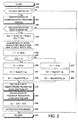
- the CPU of the vehicle control ECU 20 is programmed or configured to start an execution of a routine shown by a flowchart in FIG. 2 each time a predetermined time elapses. Therefore, at a predetermined timing, the CPU starts to execute this routine from a step 200 and then, proceeds with the process to a step 205 to determine whether or not the CACC switch 21 is positioned at the ON-position.
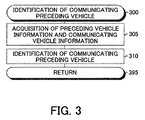
- the CPU determines "Yes" at the step 205 and then, proceeds with the process to a step 207 to start an execution of a routine shown by a flowchart in FIG. 3 to identify the communicating preceding vehicle 11. That is, when the CPU proceeds with the process to the step 207, the CPU starts to execute the routine from a step 300 of FIG. 3 and then, executes processes of steps 305 and 310 described below. Then, the CPU proceeds with the process to a step 209 of FIG. 2 via a step 395.
- Step 305 The CPU acquires preceding vehicle information including data of the operation state amounts of the preceding vehicle from the sensor ECU 60 and acquires communicating vehicle information including data of the operation state amounts of the communicating vehicles from the wireless communication control ECU 80.
- Step 310 The CPU identifies the communicating preceding vehicle 11 among the communicating vehicles on the basis of the operation state amounts of the communicating vehicles included in the communicating vehicle information and the operation state amounts of the preceding vehicle 11 included in the preceding vehicle information. For example, the CPU calculates or estimates the traveling speed of the preceding vehicle 11 on the basis of the relative traveling speed dSPD acquired by the own vehicle sensor 61 and the own vehicle speed SPDj. Then, when the degree of the similarity between the calculated traveling speed of the preceding vehicle 11 and the traveling speed of the communicating vehicle sent from the communicating vehicle through a wireless communication is large, the CPU identifies that communicating vehicle as the communicating preceding vehicle 11.
- the identified communicating vehicle is employed as the communicating preceding vehicle 11 until the CPU determines that the identified communicating vehicle is not the preceding vehicle 11.
- the CPU determines whether or not the identification of the communicating preceding vehicle 11 has been completed at the step 207.
- the CPU determines "Yes" at the step 209 and then, sequentially executes processes of steps 220 to 230 described below.
- the communicating vehicle information will be referred to as "the communicating preceding vehicle information”.
- the CPU employs the actual acceleration Gas as the estimated acceleration Ges when no requested acceleration Gs is included in the communicating preceding vehicle information and only the actual acceleration Gas is included in the communicating preceding vehicle information.
- Step 225 The CPU acquires the inter-vehicle distance D from the sensor ECU 60 and acquires the own vehicle speed SPDj from the brake control ECU 40.
- the sensor ECU 60 executes a separate routine to acquire the inter-vehicle distance D on the basis of the detection signal of the own vehicle sensor 61 and store the acquired inter-vehicle distance D in the RAM of the sensor ECU 60.
- the brake control ECU 40 executes a separate routine to acquire the own vehicle speed SPDj on the basis of the detection signal of the vehicle wheel speed sensors 42 and store the acquired own vehicle speed SPDj in the RAM of the brake control ECU 40.
- the inter-vehicle time T is a time taken for the own vehicle 10 to travel for the inter-vehicle distance D at the own vehicle speed SPDj.
- the CPU proceeds with the process to a step 235 to determine whether or not the estimated acceleration Ges calculated or acquired at the step 220 is larger than zero.
- the CPU determines "Yes" at the step 235 and then, sequentially executes processes of steps 240 to 250 described below. Then, the CPU proceeds with the process to a step 270.
- Step 240 The CPU sets a first correction coefficient Klac for the acceleration as the first correction coefficient K1.
- the first correction coefficient Klac for the acceleration is a constant value smaller than "1 ".
- the first correction coefficient Klac for the acceleration may be "1 ".
- Step 245 The CPU applies the inter-vehicle time T to a look-up table MapK2(T)_ac shown in FIG. 6(A) to acquire the second correction coefficient K2 for the acceleration.
- MapK2(T)_ac when the inter-vehicle time T is between "0" and a time T1, the second correction coefficient K2 for the acceleration is "0".
- the second correction coefficient K2 for the acceleration is a value equal to or smaller than "1" and increases as the inter-vehicle time T increases.
- the second correction coefficient K2 for the acceleration is "1 ".
- the second correction coefficient K2 for the acceleration is a value equal to or smaller than "1" and decreases as the inter-vehicle time T increases.
- the second correction coefficient K2 for the acceleration is "0".
- Step 250 The CPU applies the own vehicle speed SPDj to a look-up table MapK3(SPDj)_ac shown in FIG. 6(C) to acquire the third correction coefficient K3 for the acceleration.
- MapK3(SPDj)_ac when the own vehicle speed SPDj is between "0" and a vehicle speed SPDj1, the third correction coefficient K3 for the acceleration is "0".
- the third correction coefficient K3 for the acceleration is equal to or smaller than "1" and increases as the own vehicle speed SPDj increases.
- the third correction coefficient K3 for the acceleration is "1 ".
- the third correction coefficient K3 for the acceleration is equal to or smaller than "1" and decreases as the own vehicle speed SPDj increases.
- the third correction coefficient K3 for the acceleration is "0".
- the CPU determines "No" at the step 235 and then, sequentially executes processes of steps 255 to 265 described below. Then, the CPU proceeds with the process to a step 270.
- Step 255 The CPU sets a first correction coefficient Klde for the deceleration as the first correction coefficient K1.
- the first correction coefficient Klde for the deceleration is a constant value smaller than "1" and equal to or larger than the first correction coefficient Klac for the acceleration. In this regard, the first correction coefficient Klde for the deceleration may be "1".
- Step 260 The CPU applies the inter-vehicle time T to a look-up table MapK2(T)_de shown in FIG. 6(B) to acquire the second correction coefficient K2 for the deceleration.
- MapK2(T)_de when the inter-vehicle time T is between "0" and a time T5, the second correction coefficient K2 for the deceleration is "1 ".
- the second correction coefficient K2 for the deceleration is equal to or smaller than "1" and decreases as the inter-vehicle time T increases.
- the second correction coefficient K2 for the deceleration is "0".
- Step 265 The CPU applies the own vehicle speed SPDj to a look-up table MapK3(SPDj)_de shown in FIG. 6(D) to acquire the third correction coefficient K3 for the deceleration.
- MapK3(SPDj)_de when the own vehicle speed SPDj is between "0" and a vehicle speed SPDj5, the third correction coefficient K3 for the deceleration is "0".
- the third correction coefficient K3 for the deceleration is equal to or smaller than "1" and increases as the own vehicle speed SPDj increases.
- the third correction coefficient K3 for the deceleration is equal to or smaller than "1” and increases as the own vehicle speed SPDj increases.
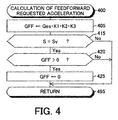
- the CPU proceeds with the process to the step 270, the CPU starts to execute a feedforward requested acceleration calculation routine shown by a flowchart in FIG. 4 to calculate the feedforward requested acceleration GFF. Therefore, when the CPU proceeds with the process to the step 270, the CPU starts to execute the routine from a step 400 of FIG. 4 and then, executes a process of step 405 described below.
- Step 405 The CPU calculates or acquires the feedforward requested acceleration GFF in accordance with a following expression (1).
- GFF Ges ⁇ K 1 ⁇ K 2 ⁇ K 3
- the symbol “Ges” is the estimated acceleration calculated or acquired at the step 220 of FIG. 2
- the symbol “K1” is the first correction value set at the step 240 or 255
- the symbol “K2” is the second correction value set at the step 245 or 260
- the symbol “K3” is the third correction value set at the step 250 or 265.
- the CPU proceeds with the process to a step 415 to determine whether or not the vehicle travel stabilization control signal S included in the communicating vehicle information acquired at the step 207 of FIG. 2 (in particular, at the step 305 of FIG. 3 ) corresponds to a signal Sv which indicates that at least one of the vehicle travel stabilization controls is executed in the communicating preceding vehicle 11.
- the CPU determines "Yes” at the step 415 and then, proceeds with the process to a step 420 to determine whether or not the feedforward requested acceleration GFF is larger than zero.
- the CPU determines "Yes” at the step 420 and then, proceeds with the process to a step 425 to set the feedforward requested acceleration GFF to zero. Then, the CPU proceeds with the process to a step 280 of FIG. 2 via a step 495.
- the CPU determines "No" at the step 420 and then, proceeds with the process directly to the step 280 of FIG. 2 via the step 495.
- the feedforward requested acceleration GFF is limited to a value equal to or smaller than zero.
- the CPU determines "No" at the step 415 and then, proceeds with the process to the step 280 of FIG. 2 via the step 495.
- the CPU proceeds with the process to the step 280, the CPU starts to execute a feedback requested acceleration calculation routine shown by a flowchart in FIG. 5 to calculate the feedback requested acceleration GFB. Therefore, when the CPU proceeds with the process to the step 280, the CPU starts the execution of the routine from a step 500 of FIG. 5 and then, sequentially executes processes of steps 505 and 520 described below.
- Step 505 The CPU acquires the relative traveling speed dSPD from the sensor ECU 60.
- the sensor ECU 60 executes a separate routine to acquire the relative traveling speed dSPD on the basis of the detection signal of the own vehicle sensor 61 and store the acquired relative traveling speed dSPD in the RAM of the sensor ECU 60.
- Step 520 The CPU calculates or acquires the determination-used calculation value P in accordance with a following expression (2).
- P dD ⁇ KFB 1 + dSPD ⁇ KFB 2
- the symbol “dD” is the inter-vehicle distance difference calculated at the step 515
- the symbol “dSPD” is the relative traveling speed acquired at the step 505
- the symbols "KFB1" and “KFB2" are correction coefficients, respectively, which are positive constant values larger than "0".
- the CPU proceeds with the process to a step 525 to determine whether or not the determination-used calculation value P is larger than zero.
- the determination-used calculation value P larger than zero indicates that the acceleration request due to the inter-vehicle distance D occurs in the own vehicle 10 and the determination-used calculation value P equal to or smaller than zero indicates that no acceleration request due to the inter-vehicle distance D occurs in the own vehicle 10.
- the CPU determines "Yes" at the step 525 and then, proceeds with the process to a step 530 to calculate or acquire the feedback requested acceleration GFB in accordance with a following expression (3). Then, the CPU proceeds with the process to a step 285 of FIG. 2 via a step 595.
- GFB dD ⁇ KFB 1 + dSPD ⁇ KFB 2 ⁇ KFB 3
- KFB3 is a correction coefficient which is a positive value larger than "0" and smaller than "1” and decreases as the own vehicle speed SPDj increases.
- the CPU determines "No" at the step 525 and then, proceeds with the process to a step 535 to calculate or acquire the feedback requested acceleration GFB in accordance with a following expression (4). Then, the CPU proceeds with the process to a step 285 of FIG. 2 via the step 595.
- GFB dD ⁇ KFB 1 + dSPD ⁇ KFB 2
- the CPU proceeds with the process to a step 290 to execute processes for activating the engine actuators 32 of the engine or the brake actuator 43 of the braking device such that the requested acceleration Gj calculated at the step 285 is achieved, that is, such that the acceleration (in particular, acceleration/deceleration) of the own vehicle 10 corresponds to the requested acceleration Gj.
- the requested acceleration Gj is larger than zero, the own vehicle 10 is accelerated.
- the requested acceleration Gj is smaller than zero, the own vehicle 10 is decelerated.
- the CPU proceeds with the process to a step 295 to terminate the execution of this routine once.
- the CPU determines "No" at the step 209 and then, proceeds with the process directly to the step 295 to terminate the execution of this routine once.
- the CPU may proceed with the process to the step 280 after the CPU sets the feedforward requested acceleration GFF to zero.
- the feedback control i.e., the inter-vehicle distance control
- the feedforward requested acceleration GFF is a negative value, for example, when the brake pedal operation amount Brkp of the communicating preceding vehicle 11 increases or when any of the vehicle wheel speeds ⁇ a to ⁇ d of the communicating preceding vehicle 11 decreases even under the condition that the vehicle travel stabilization control is executed, the feedforward requested acceleration GFF is considered in the calculation of the requested acceleration Gj of the own vehicle 10 without setting the feedforward requested acceleration GFF to zero. Therefore, when the communicating preceding vehicle 11 starts to decelerate, the own vehicle 10 can be caused to be decelerated with predicting the deceleration of the communicating preceding vehicle 11 and thus, the own vehicle 10 can be caused to travel accurately following the communicating preceding vehicle 11 without decreasing the inter-vehicle distance D.
- the total value of the feedback requested acceleration GFB and the feedforward requested acceleration GFF is calculated as the requested acceleration Gj of the own vehicle 10.
- a weighted average of the feedback requested acceleration GFB and the feedforward requested acceleration GFF may be calculated as the requested acceleration Gj of the own vehicle 10.
- the requested acceleration Gj of the own vehicle 10 may be calculated in accordance with a following expression (5).
- the symbols " ⁇ " and " ⁇ " are positive constants, respectively.
- the constants ⁇ and ⁇ are larger than "0" and smaller than "1" and the constant ⁇ may be a value 1 - ⁇ .
- Gj ⁇ ⁇ GFF + ⁇ ⁇ GFB
- the correction coefficient KFB is a constant positive value larger than "0".
- control apparatus calculates the feedforward requested acceleration GFF on the basis of the requested acceleration Gs and the actual acceleration Gas of the communicating preceding vehicle 11 acquired through the wireless communication.
- control apparatus may calculate the feedforward requested acceleration GFF only on the basis of the requested acceleration Gs without using the actual acceleration Gas or only on the basis of the actual acceleration Gas without using the requested acceleration Gs.
- the control apparatus may be configured to acquire the acceleration pedal operation amount Accp and the brake pedal operation amount Brkp as information on the requested acceleration Gs of the communicating preceding vehicle 11, estimate the requested acceleration Gs of the communicating preceding vehicle 11 on the basis of the acceleration pedal operation amount Accp and the brake pedal operation amount Brkp and calculate the feedforward requested acceleration GFF using the estimated requested acceleration Gs.
- the control apparatus may be configured to acquire the vehicle wheel rotation speeds ⁇ a to ⁇ d or the average vehicle wheel rotation speed ⁇ ave as information on the actual acceleration Gas of the communicating preceding vehicle 11, estimate the actual acceleration Gas of the communicating preceding vehicle 11 on the basis of the vehicle wheel rotation speeds ⁇ a to ⁇ d or the average vehicle wheel rotation speed ⁇ ave and calculate the feedforward requested acceleration GFF using the estimated actual acceleration Gas.
- the invention relates to a control apparatus of a vehicle for causing an own vehicle to travel following a preceding vehicle.
- the apparatus calculates a requested acceleration of the own vehicle on the basis of a feedback requested acceleration for maintaining an inter-vehicle distance to a target distance and a feedforward requested acceleration for causing the own vehicle to travel following the preceding vehicle.
- the apparatus calculates the feedforward requested acceleration on the basis of information on an acceleration of the preceding vehicle sent from the preceding vehicle through a wireless communication.
- the apparatus sets the feedforward requested acceleration to zero when a vehicle travel stabilization control is executed in the preceding vehicle to control a friction braking force applied to at least one of vehicle wheels of the preceding vehicle to stabilize a travel of the preceding vehicle and that the feedforward requested acceleration is larger than zero.
Landscapes
- Engineering & Computer Science (AREA)
- Transportation (AREA)
- Mechanical Engineering (AREA)
- Automation & Control Theory (AREA)
- Chemical & Material Sciences (AREA)
- Combustion & Propulsion (AREA)
- Physics & Mathematics (AREA)
- Human Computer Interaction (AREA)
- General Physics & Mathematics (AREA)
- Mathematical Physics (AREA)
- Control Of Driving Devices And Active Controlling Of Vehicle (AREA)
- Regulating Braking Force (AREA)
- Control Of Vehicle Engines Or Engines For Specific Uses (AREA)
- Traffic Control Systems (AREA)
Abstract
Description
- The present invention relates to a control apparatus of a vehicle for controlling an acceleration including a deceleration of an own vehicle to cause the own vehicle to travel following a preceding vehicle.
- A control apparatus of a vehicle that controls an acceleration of an own vehicle to cause the own vehicle to travel following a preceding vehicle is described in
JP 2015-51716 A - The conventional apparatus acquires an inter-vehicle time by dividing the acquired inter-vehicle distance by the acquired own vehicle speed and calculates a feedback requested acceleration which is an acceleration of the own vehicle requested for making the inter-vehicle time correspond to a target inter-vehicle time corresponding to a target value of the inter-vehicle time on the basis of a difference between the inter-vehicle time and the target inter-vehicle time. Further, the conventional apparatus calculates a feedforward requested acceleration which is an acceleration of the own vehicle requested for causing the own vehicle to travel following the preceding vehicle on the basis of the acquired requested acceleration information of the preceding vehicle.
- Lastly, the conventional apparatus sets a total value of the feedback and feedforward requested accelerations as a requested acceleration of the own vehicle and accelerates or decelerates the own vehicle to achieve the requested acceleration.
- The preceding vehicle may send to the own vehicle as the requested acceleration information of the preceding vehicle, a requested acceleration calculated on the basis of an operation amount of an acceleration pedal (an acceleration operation element) and an operation amount of a brake pedal (a brake operation element) and an actual acceleration of the preceding vehicle calculated on the basis of a vehicle wheel speed of the preceding vehicle. In this case, the conventional apparatus calculates a feedforward requested acceleration on the basis of the requested acceleration and the actual acceleration sent from the preceding vehicle through the wireless communication.
- In this regard, a vehicle comprising a vehicle travel stabilization control device is known. For example, as a vehicle travel stabilization control executed by the vehicle travel stabilization control device, there are known an anti-lock brake control for preventing vehicle wheels from being locked to stabilize the vehicle during a braking of the vehicle, a traction control for preventing driving wheels of the vehicle from being slipped or idled to stabilize the vehicle during an acceleration of the vehicle, for example, at a start of a travel of the vehicle, a vehicle behavior stabilization control for preventing the vehicle from being sideslipped to stabilize the vehicle during a turning travel of the vehicle and the like.
- When at least one of the traction control and the vehicle behavior stabilization control is executed in the preceding vehicle, a friction braking force is applied to at least one of the vehicle wheels of the preceding vehicle and therefore, even when the operation amount of the acceleration pedal of the preceding vehicle increases, the actual acceleration of the preceding vehicle may not correspond to a value depending on the operation amount of the acceleration pedal. On the other hand, when at least one of the traction control and the vehicle behavior stabilization control is executed in the preceding vehicle and the operation amount of the acceleration pedal of the preceding vehicle increases, the preceding vehicle sends to the own vehicle as the requested acceleration of the preceding vehicle, a requested acceleration calculated on the basis of the increased operation amount of the acceleration pedal of the preceding vehicle.
- In this case, if the feedforward requested acceleration is calculated on the basis of the requested acceleration sent from the preceding vehicle and the requested acceleration of the own vehicle is set on the basis of the calculated feedforward requested acceleration, the own vehicle is accelerated at an acceleration depending on the thus-set requested acceleration and then, the inter-vehicle distance may decrease while the preceding vehicle is not accelerated at an acceleration generally equal to the requested acceleration of the preceding vehicle. In this case, the own vehicle cannot travel following the preceding vehicle accurately. In other words, the inter-vehicle distance cannot be maintained in a predetermined manner.
- Further, even when the vehicle wheel speed of the preceding vehicle is increased due to an elimination of the locked state of at least one of the vehicle wheels of the preceding vehicle by the anti-lock brake control executed in the preceding vehicle, the preceding vehicle is not accelerated. On the other hand, when the vehicle wheel speed is increased due to the anti-lock brake control executed in the preceding vehicle, the preceding vehicle sends to the own vehicle as the actual acceleration of the preceding vehicle, an actual acceleration calculated on the basis of the increased vehicle wheel speed of the preceding vehicle.
- In this case, if the feedforward requested acceleration is calculated on the basis of the actual acceleration sent from the preceding vehicle and the requested acceleration of the own vehicle is set on the basis of the calculated feedforward requested acceleration, the own vehicle may be accelerated and thus, the inter-vehicle distance may decrease while the preceding vehicle is not accelerated. In this case, the own vehicle cannot travel following the preceding vehicle accurately.
- The present invention has been made for solving the above-described problem. Therefore, one of objects of the present invention is to provide a control apparatus of a vehicle which can cause the own vehicle to travel following the preceding vehicle accurately while preventing the inter-vehicle distance from decreasing unnecessarily even when the vehicle travel stabilization control is executed in the preceding vehicle.
- A control apparatus according to the present invention comprises:
- an inter-vehicle distance detection device (60, 61) that is configured to detect an inter-vehicle distance (D) between an own vehicle (10) and a communicating preceding vehicle (11);
- a wireless communication device (80, 81) that is configured to acquire communicating preceding vehicle information including at least one of requested acceleration information (Gs, Accp, Brkp) on a requested acceleration of the communicating preceding vehicle (11) and actual acceleration information (Gas, ωa to ωd, ωave) on an actual acceleration of the communicating preceding vehicle (11) from the communicating preceding vehicle (11) through a wireless communication; and
- an acceleration control device (20, 30, 40) that is configured to control an acceleration of the own vehicle (10) such that the acceleration of the own vehicle (10) corresponds to a requested acceleration (Gj) of the own vehicle (10).
- The acceleration control device (20, 30, 40) includes first to third calculation means. The first calculation means is configured to calculate a feedback requested acceleration (GFB) which is an acceleration requested to the own vehicle (10) for maintaining the inter-vehicle distance (D) at a target inter-vehicle distance (Dtgt) (see a
step 280 ofFIG.2 and a routine ofFIG. 5 ). - The second calculation means is configured to calculate a feedforward requested acceleration (GFF) which is an acceleration requested to the own vehicle (10) for causing the own vehicle (10) to travel following the communicating preceding vehicle (11) on the basis of at least one of the requested acceleration information (Gs, Accp, Brkp) and the actual acceleration information (Gas,ωa to ωd,ωave) (see a
step 270 ofFIG. 2 and a routine ofFIG. 4 ). - The third calculation means is configured to calculate a requested acceleration (Gj) of the own vehicle (10) on the basis of the feedback requested acceleration (GFB) and the feedforward requested acceleration (GFF) (see a
step 285 ofFIG. 3 ). - The acceleration control device (20, 30, 40) is configured to execute a following travel control that causes the own vehicle (10) to travel following the communicating preceding vehicle (11) by controlling the acceleration of the own vehicle (10) such that the acceleration of the own vehicle (10) corresponds to the requested acceleration (Gj) of the own vehicle (10) calculated by the third calculation means.
Moreover, a control method of a vehicle comprises an inter-vehicle distance detection device (60, 61) configured to detect an inter-vehicle distance (D) between an own vehicle (10) and a communicating preceding vehicle (11), a wireless communication device (80, 81) configured to acquire communicating preceding vehicle information including at least one of requested acceleration information (Gs, Accp, Brkp) on a requested acceleration of the communicating preceding vehicle (11) and actual acceleration information (Gas,ωa to ωd,ωave) on an actual acceleration of the communicating preceding vehicle (11) from the communicating preceding vehicle (11) through a wireless communication; and an acceleration control device (20, 30, 40) configured to control an acceleration of the own vehicle (10) such that the acceleration of the own vehicle (10) corresponds to a requested acceleration (Gj) of the own vehicle (10). The acceleration control device (20, 30, 40) includes first calculation means, second calculation means and third calculation means. The control method includes the steps of calculating a feedback requested acceleration (GFB) by the first calculation means, which is an acceleration requested to the own vehicle (10) for maintaining the inter-vehicle distance (D) at a target inter-vehicle distance (Dtgt); calculating a feedforward requested acceleration (GFF) by the second calculation means, which is an acceleration requested to the own vehicle (10) for causing the own vehicle (10) to travel following the communicating preceding vehicle (11) on the basis of at least one of the requested acceleration information (Gs, Accp, Brkp) and the actual acceleration information (Gas,ωa to ωd,ωave); and calculating a requested acceleration (Gj) of the own vehicle (10) on the basis of the feedback requested acceleration (GFB) and the feedforward requested acceleration (GFF) by the third calculation means, and executing a following travel control that causes the own vehicle (10) to travel following the communicating preceding vehicle (11) by controlling the acceleration of the own vehicle (10) such that the acceleration of the own vehicle (10) corresponds to the requested acceleration (Gj) of the own vehicle (10) calculated by the third calculation means. The control method further comprises setting the feedforward requested acceleration (GFF) to zero by the third calculation means when the communicating preceding vehicle information includes information i) indicating that a vehicle travel stabilization control is executed to control a friction braking force applied to at least one of vehicle wheels of the communicating preceding vehicle (11) from a friction braking device of the communicating preceding vehicle (11) to stabilize a traveling of the communicating preceding vehicle (11), and ii) indicating that the feedforward requested acceleration (GFF) is larger than zero. - According to the above-described following travel control, it is possible to cause the own vehicle to travel following the communicating preceding vehicle at an acceleration depending on the requested acceleration or the actual acceleration of the communicating preceding vehicle such that the inter-vehicle distance is maintained at a predetermined distance (the target inter-vehicle distance).
- The third calculation means is configured to set the feedforward requested acceleration (GFF) to zero (see a
step 425 ofFIG. 4 ) when the communicating preceding vehicle information includes information indicating that a vehicle travel stabilization control is executed to control a friction braking force applied to at least one of vehicle wheels of the communicating preceding vehicle (11) from a friction braking device of the communicating preceding vehicle (11) to stabilize a traveling of the communicating preceding vehicle (11) (see a determination of "Yes" at astep 415 ofFIG. 4 ) and indicating that the feedforward requested acceleration (GFF) is larger than zero (see a determination of "Yes" at astep 420 ofFIG. 4 ). - For example, when a control apparatus of the communicating preceding vehicle (11), i.e. the preceding vehicle which is in wireless communication with the own vehicle, does not execute a control for causing the communicating preceding vehicle (11) to travel following a vehicle traveling in front of the communicating preceding vehicle (11), the requested acceleration (Gs) of the communicating preceding vehicle (11) is a requested acceleration calculated by the control apparatus of the communicating preceding vehicle (11) on the basis of an operation amount (Accp) of an acceleration operation element of the communicating preceding vehicle (11) and an operation amount (Brkp) of a brake operation element of the communicating preceding vehicle (11).
- In addition, for example, when the control apparatus of the communicating preceding vehicle (11) executes the control for causing the communicating preceding vehicle (11) to travel following a vehicle traveling in front of the communicating preceding vehicle (11), the requested acceleration (Gs) of the communicating preceding vehicle (11) is a requested acceleration of the communicating preceding vehicle (11) calculated by the control apparatus of the communicating preceding vehicle (11) on the basis of acceleration information (Gss, Gass) on an acceleration of the vehicle traveling in front of the communicating preceding vehicle (11), i.e. the vehicle which travels straight ahead of the communicating preceding vehicle (11), acquired from the vehicle traveling in front of the communicating preceding vehicle (11) through the wireless communication by the control apparatus of the communicating preceding vehicle (11).
- In addition, the vehicle travel stabilization control includes, for example, at least one of:
- a control for adjusting a friction braking force applied to at least one of vehicle wheels of the communicating preceding vehicle (11) determined as a vehicle wheel locked during a braking of the communicating preceding vehicle (11) to eliminate the locked state of the vehicle wheel (the anti-lock brake control);
- a control for applying the friction braking force to at least one of driving wheels of the communicating preceding vehicle (11) determined as a driving wheel slipped during an acceleration of the communicating preceding vehicle (11) to eliminate the slipped state of the driving wheel (the traction control); and,
- a control for applying the friction braking force to at least one of the vehicle wheels of the communicating preceding vehicle (11) to eliminate a sideslipped state of the communicating preceding vehicle (11) determined to be generated during a turning travel of the communicating preceding vehicle (11) (the vehicle behavior stabilization control, also known as ESP).
- According to the control apparatus of the present invention, the feedforward requested acceleration is set to zero, that is, the feedforward requested acceleration is limited to a value equal to or smaller than zero when the vehicle travel stabilization control is executed in the communicating preceding vehicle. Thus, when the vehicle travel stabilization control is executed in the communicating preceding vehicle and thus, the communicating preceding vehicle is unlikely to be accelerated at the acceleration depending on the requested acceleration of the communicating preceding vehicle, the feedforward requested acceleration is set to a value equal to or smaller than zero. Therefore, the acceleration of the own vehicle derived from the feedforward requested acceleration does not occur when the communicating preceding vehicle is not accelerated. As a result, the own vehicle can be caused to travel following the communicating preceding vehicle accurately.
- In the above description, for facilitating understanding of the present invention, elements of the present invention corresponding to elements of an embodiment described later are denoted by reference symbols used in the description of the embodiment accompanied with parentheses. However, the elements of the present invention are not limited to the elements of the embodiment defined by the reference symbols. The other objects, features and accompanied advantages of the present invention can be easily understood from the description of the embodiment of the present invention along with the drawings.
-
-
FIG. 1 shows a general configuration view of a control apparatus of a vehicle according to an embodiment of the present invention and the vehicle installed with the control apparatus. -
FIG. 2 shows a flowchart of a routine executed by a CPU of a vehicle control ECU shown inFIG. 1 . -
FIG. 3 shows a flowchart of a routine executed by the CPU. -
FIG. 4 shows a flowchart of a routine executed by the CPU. -
FIG. 5 shows a flowchart of a routine executed by the CPU. -
FIG. 6(A) shows a look-up table used for acquiring a second correction coefficient for an acceleration on the basis of an inter-vehicle time. -
FIG. 6(B) shows a look-up table used for acquiring a second correction coefficient for a deceleration on the basis of the inter-vehicle time. -
FIG. 6(C) shows a look-up table used for acquiring a third correction coefficient for an acceleration on the basis of a traveling speed of an own vehicle. -
FIG. 6(D) shows a look-up table used for acquiring a third correction coefficient for a deceleration on the basis of the traveling speed of the own vehicle. - Below, a control apparatus of a vehicle according to an embodiment of the present invention will be described with reference to the drawings. Hereinafter, the control apparatus according to the embodiment will be referred to as "the embodiment control apparatus". In the description, the drawings and the claims, the own vehicle is a subject vehicle, to which the present invention is applied and the preceding vehicle is a vehicle which travels in front of the own vehicle, is acquired by a sensor installed in the own vehicle as described later and outputs information permitted to be used by the control apparatus of the own vehicle to change a control for causing the own vehicle to travel.
- As shown in
FIG. 1 , the embodiment control apparatus is applied to a vehicle (an own vehicle) 10. Theown vehicle 10 comprises avehicle control ECU 20, anengine control ECU 30, an acceleration pedaloperation amount sensor 31, abrake control ECU 40, a brake pedaloperation amount sensor 41, vehiclewheel speed sensors 42a to 42d, asteering control ECU 50, ayaw rate sensor 51, asteering angle sensor 52, asensor ECU 60, anown vehicle sensor 61, aGPS device 70, a wirelesscommunication control ECU 80 and awireless antenna 81. A precedingvehicle 11 has the same configuration as the configuration of theown vehicle 10. - The
vehicle control ECU 20 can send data to and receive data from, that is, can communicate with theengine control ECU 30, thebrake control ECU 40, thesteering control ECU 50, thesensor ECU 60, theGPS device 70 and the wirelesscommunication control ECU 80 via a sensor system CAN (i.e., a sensor system Controller Area Network) 101. Each of the ECUs is an electronic control unit and includes, as a main part, a microcomputer including a CPU, a ROM, a RAM, an interface and the like. The CPU is configured or programmed to execute instructions (or programs) stored in a memory (i.e., the ROM) to realize various functions described later. - The
vehicle control ECU 20 is electrically connected to a cooperative following travelcontrol request switch 21 which is an ON-OFF switch andvarious sensors 22. Hereinafter, the cooperative following travelcontrol request switch 21 will be referred to as "theCACC switch 21". - When the
CACC switch 21 is set to an ON-position by an occupant (in particular, a driver) of theown vehicle 10, a start of an execution of a cooperative following travel control described later is requested to thevehicle control ECU 20. The cooperative following travel control includes an inter-vehicle distance control described later. - The
engine control ECU 30 is known and is configured or programmed to acquire detection signals from sensors (partially not shown) that detect various engine operation state amounts, respectively. In particular, theengine control ECU 30 is electrically connected to the acceleration pedaloperation amount sensor 31. - The acceleration pedal
operation amount sensor 31 detects an operation amount Accp of anacceleration pedal 91 or anacceleration operation element 91 and outputs a detection signal expressing the operation amount Accp to theengine control ECU 30. Theengine control ECU 30 is configured or programmed to acquire the acceleration pedal operation amount Accp on the basis of the detection signal, calculate or acquire a requested acceleration Gj on the basis of the acquired acceleration pedal operation amount Accp and store the calculated requested acceleration Gj in the RAM of theengine control ECU 30. It should be noted that theengine control ECU 30 may be configured or programmed to calculate the requested acceleration Gj on the basis of a traveling speed SPDj of theown vehicle 10 acquired as described later and an engine speed NE. Hereinafter, the traveling speed SPDj will be referred to as "the own vehicle speed SPDj". - Further,
engine actuators 32 including a throttle valve actuator (not shown) are electrically connected to theengine control ECU 30. Theengine control ECU 30 is configured or programmed to activate theengine actuators 32 to change a torque generated by the engine (not shown) of theown vehicle 10 such that an acceleration of theown vehicle 10 approaches the requested acceleration Gj when the requested acceleration Gj of theown vehicle 10 is a positive value, that is, when the acceleration of theown vehicle 10 is requested. - The
brake control ECU 40 is known and is configured or programmed to acquire detection signals from sensors (partially not shown) that detects various vehicle operation state amounts. In particular, thebrake control ECU 40 is electrically connected to the brake pedaloperation amount sensor 41 and the vehiclewheel speed sensors 42a to 42d. - The brake pedal
operation amount sensor 41 detects an operation amount Brkp of abrake pedal 93 or abrake operation element 93 and outputs a signal expressing the operation amount Brkp to thebrake control ECU 40. Hereinafter, the operation amount Brkp will be referred to as "the brake pedal operation amount Brkp". Thebrake control ECU 40 is configured or programmed to acquire the brake pedal operation amount Brkp on the basis of the detection signal sent from the brake pedaloperation amount sensor 41, calculate or acquire the requested acceleration Gj including the requested deceleration on the basis of the acquired brake pedal operation amount Brkp and store the calculated requested acceleration Gj in the RAM of thebrake control ECU 40. It should be noted that thebrake control ECU 40 may be configured or programmed to calculate the requested acceleration Gj on the basis of the own vehicle speed SPDj acquired as described later. - The vehicle
wheel speed sensors 42a to 42d are provided on the respective vehicle wheels of theown vehicle 10. The vehiclewheel speed sensors 42a to 42d detect vehicle wheel rotation speeds ωa to ωd of the vehicle wheels, respectively and output detection signals expressing the vehicle wheel rotation speeds ωa to ωd, respectively to thebrake control ECU 40. - The
brake control ECU 40 is configured or programmed to acquire the vehicle wheel rotation speeds ωa to ωd on the basis of the detection signals and store the acquired vehicle wheel rotation speeds ωa to ωd in the RAM of thebrake control ECU 40. - Further, the
brake control ECU 40 is configured or programmed to calculate or acquire an average value ωave of the acquired vehicle wheel rotation speeds ωa to ωd (ωave = (ωa + ωb + ωc + ωd)/4) and store the calculated average value ωave as the own vehicle speed SPDj of theown vehicle 10 in the RAM of thebrake control ECU 40. Hereinafter, the average value ωave will be referred to as "the average vehicle wheel rotation speed ωave". - Alternatively, the
brake control ECU 40 may be configured or programmed to acquire the own vehicle speed SPDj on the basis of a detection signal output from a sensor (not shown) that detects a rotation speed of a propeller shaft of theown vehicle 10 in place of acquiring the average vehicle wheel rotation speed ωave as the own vehicle speed SPDj. - Further, the
brake control ECU 40 is configured or programmed to calculate an amount of a change of the acquired own vehicle speed SPDj per minute unit time, that is, calculate or acquire a time derivative value of the own vehicle speed SPDj as an actual acceleration Gaj (= dSPDj/dt) and store the calculated actual acceleration Gaj in the RAM of thebrake control ECU 40. - Further, a
brake actuator 43 of a friction braking device or the like is electrically connected to thebrake control ECU 40. Thebrake control ECU 40 is configured or programmed to activate thebrake actuator 43 to generate friction braking forces at the vehicle wheels of theown vehicle 10, respectively such that the deceleration of theown vehicle 10 approaches the requested acceleration Gj corresponding to the requested deceleration when the requested acceleration Gj of theown vehicle 10 is a negative value, that is, when the deceleration of theown vehicle 10 is requested. - The
brake control ECU 40 is programmed or configured to execute a known anti-lock brake control for adjusting the friction braking force applied to at least one of the vehicle wheels determined as a vehicle wheel locked during a braking of theown vehicle 10 to eliminate the locked state of the vehicle wheel, thereby to stabilize theown vehicle 10. In particular, thebrake control ECU 40 calculates or acquires a slip rate RSD on the basis of the average vehicle wheel speed ωave stored in the RAM of thebrake control ECU 40 and each vehicle wheel speed ωn which corresponds to each of the vehicle wheel speeds ωa to ωd (RSD = (ωave - ωn)/ωave). - When the calculated slip rate RSD of any of the vehicle wheels is equal to or larger than a predetermined control start threshold RSDstart, the
brake control ECU 40 starts to execute the anti-lock brake control to reduce the friction braking force applied to the vehicle wheel having the calculated slip rate RSD equal to or larger than the predetermined control start threshold RSDstart. Thereby, the slip rate RSD of the vehicle wheel having the calculated slip rate RSD equal to or larger than the predetermined control start threshold RSDstart, is reduced. Hereinafter, the vehicle wheel having the calculated slip rate RSD equal to or larger than the predetermined control start threshold RSDstart, will be referred to as "the vehicle wheel to be controlled". - Then, when the slip rate RSD of the vehicle wheel to be controlled becomes equal to or smaller than a predetermined control end threshold RSDend, the
brake control ECU 40 terminates the execution of the anti-lock brake control and increases the friction braking force applied to the vehicle wheel to be controlled. - Further, the
brake control ECU 40 is programmed or configured to execute a known traction control for applying the friction braking force to at least one of driving wheels of theown vehicle 10 determined as a driving wheel slipped or idled during the acceleration of theown vehicle 10, for example, at a start of the travel of theown vehicle 10 to eliminate the slipped state of the driving wheel, thereby to stabilize theown vehicle 10. In particular, thebrake control ECU 40 calculates or acquires a slip rate RSA on the basis of the average vehicle wheel speed ωave stored in the RAM of thebrake control ECU 40 and each vehicle wheel speed ωn which corresponds to each of the vehicle wheel speeds ωa and ωb of the driving wheels, respectively (RSA = (ωn - ωave)/ωn). - When the calculated slip rate RSA of at least one of the driving wheels is equal to or larger than a predetermined control start threshold RSAstart, the
brake control ECU 40 starts to execute the traction control to apply a predetermined friction braking force to the driving wheel having the calculated slip rate RSA equal to or larger than the predetermined control start threshold RSAstart. Thereby, the slip rate RSA of the driving wheel having the calculated slip rate RSA equal to or larger than the predetermined control start threshold RSAstart, is reduced. Hereinafter, the driving wheel having the calculated slip rate RSA equal to or larger than the predetermined control start threshold RSAstart, will be referred to as "the driving wheel to be controlled". - Then, when the slip rate RSA of the driving wheel to be controlled becomes equal to or smaller than a predetermined control end threshold RSAend, the
brake control ECU 40 terminates the execution of the traction control and thus, stops applying the friction braking force to the driving wheel to be controlled. - Further, the
brake control ECU 40 is programmed or configured to execute a known vehicle behavior stabilization control for applying the friction braking force to at least one of the vehicle wheels of theown vehicle 10 to eliminate a sideslipped state of theown vehicle 10, thereby to stabilize theown vehicle 10 when it is determined that the sideslipped state occurs in theown vehicle 10 during a turning travel of theown vehicle 10. In particular, when a slip angle θslip of theown vehicle 10 is equal to or larger than a predetermined slip angle θslipth and a slip angle speed ωslip of theown vehicle 10 is equal to or larger than a predetermined slip angle speed ωslipth, it can be determined that a strong sideslip occurs in the rear wheels of theown vehicle 10. - Accordingly, the
brake control ECU 40 calculates or acquires a slip angle θslip of theown vehicle 10 and a slip angle speed ωslip of theown vehicle 10 on the basis of a yaw rate δ stored in the RAM of thesteering control ECU 50 as described later. - When the calculated slip angle θslip is equal to or larger than the predetermined slip angle θslipth and the calculated slip angle speed ωslip is equal to or larger than the predetermined slip angle speed ωslipth, the
brake control ECU 40 starts to execute the vehicle behavior stabilization control to apply the friction braking force to a front wheel outside with respect to the turning travel of theown vehicle 10. Thereby, the slip angle θslip of theown vehicle 10 and the slip angle speed ωslip are reduced. Hereinafter, the front wheel outside with respect to the turning travel of the vehicle will be referred to as "the front wheel to be controlled". - When the slip angle θslip of the
own vehicle 10 becomes smaller than the predetermined slip angle θslipth or the slip angle speed ωslip of theown vehicle 10 becomes smaller than the predetermined slip angle speed ωslipth, thebrake control ECU 40 terminates the execution of the vehicle behavior stabilization control and thus, stops applying the friction braking force to the front wheel to be controlled. - Further, when a difference dδ between the actual yaw rate δ and a target yaw rate δtgt (dδ = δtgt - δ) is a positive value and an absolute value of the difference dδ is equal to or larger than a predetermined threshold dδth, it can be determined that a strong sideslip occurs in the front wheels of the
own vehicle 10. Hereinafter, the difference dδ will be referred to as "the yaw rate difference dδ". - The
brake control ECU 40 acquires a steering angle θ and the actual yaw rate δ of theown vehicle 10 both stored in the RAM of thesteering control ECU 50. In addition, thebrake control ECU 40 calculates or acquires the target yaw rate δtgt on the basis of the own vehicle speed SPDj stored in the RAM of thebrake control ECU 40 and the acquired steering angle θ. - Then, the
brake control ECU 40 calculates or acquires the yaw rate difference dδ on the basis of the calculated target yaw rate δtgt and the actual yaw rate δ. When the yaw rate difference dδ is a positive value and the absolute value of the yaw rate difference dδ is equal to or larger than the predetermined threshold dδth, thebrake control ECU 40 starts to execute the vehicle behavior stabilization control to apply the friction braking force to the right and left rear wheel and the front wheel to be controlled and sends to theengine control ECU 30, a signal for requesting the decreasing of driving force applied to the driving wheels. Thereby, the yaw rate difference dδ decreases. Hereinafter, the right and left rear wheels and the front wheel to be controlled will be collectively referred to as "the front and rear wheels to be controlled". - Thereafter, when the yaw rate difference dδ becomes a negative value or when the yaw rate difference dδ is a positive value and the absolute value of the yaw rate difference dδ becomes smaller than the predetermined threshold dδth, the
brake control ECU 40 terminates the execution of the vehicle behavior stabilization control and thus, stops applying the friction braking force to the front and rear wheels to be controlled and stops sending the signal for requesting the decreasing of the driving force applied to the driving wheels. - The
brake control ECU 40 sends to thevehicle control ECU 20, a vehicle travel stabilization control signal S which indicates whether or not at least one of the anti-lock brake control, the traction control and the vehicle behavior stabilization control is executed. Hereinafter, the anti-lock brake control, the traction control and the vehicle behavior stabilization control will be referred to as "the vehicle travel stabilization control", respectively. - When at least one of the vehicle travel stabilization controls is executed, the
brake control ECU 40 sends to thevehicle control ECU 20 as the vehicle travel stabilization control signal S, a signal Sv which indicates that at least one of the vehicle travel stabilization controls is executed. On the other hand, when the vehicle travel stabilization controls are not executed, thebrake control ECU 40 sends to thevehicle control ECU 20 as the vehicle travel stabilization control signal S, a signal Sn which indicates that the vehicle travel stabilization controls are not executed. - The
steering control ECU 50 is known and is configured or programmed to acquire detection signals from sensors (partially not shown) that detects various vehicle operation state amounts, respectively. In particular, thesteering control ECU 50 is electrically connected to theyaw rate sensor 51 and thesteering angle sensor 52. - The
yaw rate sensor 51 detects the yaw rate δ of theown vehicle 10 and outputs a detection signal indicating the detected yaw rate δ to thesteering control ECU 50. Thesteering control ECU 50 acquires the yaw rate δ of theown vehicle 10 on the basis of the detection signal and stores the acquired yaw rate δ in the RAM of thesteering control ECU 50. - The
steering angle sensor 52 detects the steering angle θ of the steering wheel of theown vehicle 10 and outputs a detection signal indicating the detected steering angle θ to thesteering control ECU 50. Thesteering control ECU 50 acquires the steering angle θ of the steering wheel of theown vehicle 10 on the basis of the detection signal and stores the acquired steering angle θ in the RAM of thesteering control ECU 50. - Further, a
steering actuator 53 such as a motor of an electric power steering device (not shown) is electrically connected to thesteering control ECU 50. - The
sensor ECU 60 is electrically connected to theown vehicle sensor 61. Theown vehicle sensor 61 is a known millimeter wave radar sensor. Theown vehicle sensor 61 outputs a millimeter wave ahead of theown vehicle 10. The millimeter wave is reflected by the precedingvehicle 11. Theown vehicle sensor 61 receives this reflected millimeter wave. - The
sensor ECU 60 is configured or programmed to detect the precedingvehicle 11 traveling immediately in front of theown vehicle 10 on the basis of the reflected millimeter wave received by theown vehicle sensor 61. Further, thesensor ECU 60 is configured or programmed to acquire a difference dSPD between the own vehicle speed SPDj and a traveling speed SPDs of the preceding vehicle 11 (i.e., a relative traveling speed dSPD between theown vehicle 10 and the preceding vehicle 11) (dSPD = SPDs - SPDj), an inter-vehicle distance D between theown vehicle 10 and the precedingvehicle 11 and a relative orientation of the precedingvehicle 11 with respect to theown vehicle 10 in a chronological manner each time a predetermined time elapses on the basis of a phase difference between the millimeter wave output from theown vehicle sensor 61 and the reflected millimeter wave received by theown vehicle sensor 61, a damping level of the reflected millimeter wave, a detection time of the reflected millimeter wave and the like and store the acquired relative speed dSPD, the inter-vehicle distance D, the relative orientation and the like in the RAM of thesensor ECU 60. - Therefore, the
sensor ECU 60 constitutes an own vehicle sensor device that detects or acquires the precedingvehicle 11 on the basis of the reflected millimeter wave detected by theown vehicle sensor 61 and acquire the inter-vehicle distance D between theown vehicle 10 and the precedingvehicle 11 on the basis of the reflected millimeter wave detected by theown vehicle sensor 61. - The
GPS device 70 is known and acquires a latitude and a longitude of a point where theown vehicle 10 travels on the basis of a GPS signal sent from an artificial satellite and stores the acquired latitude and longitude as a position of theown vehicle 10 in the RAM of theGPS device 70. - The wireless
communication control ECU 80 is electrically connected to thewireless antenna 81 used for performing an inter-vehicle wireless communication. The wirelesscommunication control ECU 80 is configured or programmed to receive communication information or communicating vehicle information and data, which identifies the communicating vehicles, sent from the communicating vehicles through a wireless communication each time a predetermine time elapses and store the received data in the RAM of the wirelesscommunication control ECU 80. Each of the communicating vehicles is different from the own vehicle and has a function that performs the wireless communication. The communicating vehicle information sent from each of the communicating vehicles includes data indicating operation state amounts of each of the communicating vehicles. - The data, which indicates the operation state amounts of each of the communicating vehicles, received by the wireless
communication control ECU 80 of theown vehicle 10 through the inter-vehicle wireless communication, includes data acquired by thevehicle control ECU 20, theengine control ECU 30, thebrake control ECU 40 and the like of each of the communicating vehicles on the basis of detection signals output from various sensors of each of the communicating vehicles, data of states of the actuators of each of the communicating vehicles, to which thevehicle control ECU 20, theengine control ECU 30, thebrake control ECU 40 and the like of each of the communicating vehicles send activation signals and the like. - In particular, the data sent from the communicating vehicle as communicated data includes data (A) to (G) described below.
- (A) A traveling speed SPDs of the communicating vehicle acquired by the
brake control ECU 40 of the communicating vehicle. Hereinafter, this traveling speed SPDs will be referred to as "the communicating vehicle speed SPDs". - (B) A position of the communicating vehicle acquired by the
GPS device 70 of the communicating vehicle. - (C) A requested acceleration Gs of the communicating vehicle calculated by the
engine control ECU 30 of the communicating vehicle on the basis of the acceleration pedal operation amount Accp of the communicating vehicle when any of a cooperative following travel control or a CACC (Cooperative Adaptive Cruise Control) and an inter-vehicle distance control or an ACC (Adaptive Cruise Control) is not executed in the communicating vehicle. - (D) The requested acceleration Gs of the communicating vehicle corresponding to a requested deceleration of the communicating vehicle calculated by the
brake control ECU 40 of the communicating vehicle on the basis of the brake pedal operation amount Brkp of the communicating vehicle when any of the cooperative following travel control and the inter-vehicle distance control is not executed in the communicating vehicle. - (E) The requested acceleration Gs of the communicating vehicle calculated by the
vehicle control ECU 20 of the communicating vehicle on the basis of the requested acceleration Gss of a vehicle traveling immediately in front of the communicating vehicle in order to cause the communicating vehicle to travel following the vehicle traveling immediately in front of the communicating vehicle when any of the cooperative following travel control and the inter-vehicle distance control is executed in the communicating vehicle. - (F) An actual acceleration Gas of the communicating vehicle acquired by the
brake control ECU 40 of the communicating vehicle on the basis of the average vehicle wheel speed ωave of the communicating vehicle. - (G) The vehicle travel stabilization control signal S which indicates that at least one of the vehicle travel stabilization controls as mentioned above is executed in the communicating vehicle.
- Further, the wireless
communication control ECU 80 is configured or programmed to send or output the above-described data indicating the operation state amounts of theown vehicle 10 to the outside of theown vehicle 10 each time a predetermined time elapses. - It should be noted that when any of the cooperative following travel control and the inter-vehicle distance control described later is executed in the
own vehicle 10 and the precedingvehicle 11, the requested acceleration Gj of theown vehicle 10 sent from the wirelesscommunication control ECU 80 of theown vehicle 10 to a vehicle traveling immediately behind theown vehicle 10 as the above-described data is a requested acceleration of theown vehicle 10 calculated on the basis of the requested acceleration Gs of the precedingvehicle 11. - Therefore, when any of the cooperative following travel control and the inter-vehicle distance control described later is executed in the preceding
vehicle 11 and the vehicle traveling immediately in front of the precedingvehicle 11, the requested acceleration Gs of the precedingvehicle 11 received by the wirelesscommunication control ECU 80 of theown vehicle 10 from the precedingvehicle 11 as the above-described data through the wireless communication is a requested acceleration of the precedingvehicle 11 calculated by thevehicle control ECU 20 of the precedingvehicle 11 on the basis of the requested acceleration Gss of the vehicle traveling immediately in front of the precedingvehicle 11. - Below, a summary of the cooperative following travel control or the CACC executed by the embodiment control apparatus will be described. The embodiment control apparatus starts to execute the cooperative following travel control when the
CACC switch 21 is positioned at an ON-position by the occupant, in particular, the driver of theown vehicle 10. It should be noted that thevehicle control ECU 20 is configured or programmed to control an operation of theengine actuators 32 on the basis of the acceleration pedal operation amount Accp, the engine speed NE and the like when theCACC switch 21 is positioned at an OFF-position. In addition, thebrake control ECU 40 is configured or programmed to control an operation of thebrake actuator 43 on the basis of the brake pedal operation amount Brkp and the own vehicle speed SPDj or the vehicle wheel rotation speeds ωa to ωd of the vehicle wheels when theCACC switch 21 is positioned at an OFF-position. - When the
vehicle control ECU 20 starts to execute the cooperative following travel control, thevehicle control ECU 20 starts to execute a process that identifies a communicating vehicle detected or acquired by theown vehicle sensor 61 among the communicating vehicles, which sends data to theown vehicle 10, as a communicating preceding vehicle on the basis of data acquired by theown vehicle sensor 61 and thesensor ECU 60 and data acquired by thewireless antenna 81 and the wirelesscommunication control ECU 80. - For example, the
vehicle control ECU 20 estimates a traveling speed of a candidate vehicle, which is a candidate of the communicating vehicle to be identified as the communicating precedingvehicle 11, on the basis of the relative vehicle speed dSPD and the own vehicle speed SPDj acquired by thesensor ECU 60. When a degree of a similarity between the estimated traveling speed of the candidate vehicle and the traveling speed of the candidate vehicle sent from the candidate vehicle through the wireless communication is high, thevehicle control ECU 20 identifies that candidate vehicle as the communicating precedingvehicle 11. For example, a method described inJP 5522193 B vehicle 11. - Further, in this embodiment, a target value Ttgt of a value T obtained by dividing the inter-vehicle distance D by the own vehicle speed SPDj (T = D/SPDj), is previously set. Hereinafter, the value Ttgt will be referred to as "the target inter-vehicle time Ttgt". The target inter-vehicle time Ttgt is set to a predetermined constant value. In this regard, the target inter-vehicle time Ttgt may be variably set by a switch (not shown) operated by the driver of the
own vehicle 10. - The embodiment control apparatus controls the acceleration including the deceleration of the
own vehicle 10 such that the value T obtained by dividing the actual inter-vehicle distance D by the actual own vehicle speed SPDj corresponds to the target inter-vehicle time Ttgt when theCACC switch 21 is set at the ON-position by the driver of theown vehicle 10. Hereinafter, the value T will be referred to as "the inter-vehicle time T". - For example, when the communicating preceding
vehicle 11 accelerates under the condition that the inter-vehicle time T corresponds to the target inter-vehicle time Ttgt and the own vehicle speed SPDj is constant, the inter-vehicle distance D increases. As a result, the inter-vehicle time T becomes larger than the target inter-vehicle time Ttgt and thus, the embodiment control apparatus accelerates theown vehicle 10 to decrease the inter-vehicle time T. - On the other hand, when the communicating preceding
vehicle 11 decelerates under the condition that the inter-vehicle time T corresponds to the target inter-vehicle time Ttgt and the own vehicle speed SPDj is constant, the inter-vehicle distance D decreases. As a result, the inter-vehicle time T becomes smaller than the target inter-vehicle time Ttgt and thus, the embodiment control apparatus decelerates theown vehicle 10 to increase the inter-vehicle time T. - When the embodiment control apparatus accelerates or decelerates the
own vehicle 10, the embodiment control apparatus calculates or sets a requested acceleration Gj of theown vehicle 10 as described below and controls theengine control ECU 30 to cause theengine control ECU 30 to control the operation of theengine actuators 32 of the engine or controls thebrake control ECU 40 to cause thebrake control ECU 40 to control the operation of thebrake actuator 43 of the braking device such that the requested acceleration Gj is achieved, that is, such that the acceleration of theown vehicle 10 corresponds to the requested acceleration Gj. The requested acceleration Gj can be any of a positive value for accelerating theown vehicle 10 and a negative value for decelerating theown vehicle 10. Thereby, the requested acceleration Gj can be referred to as a requested acceleration/deceleration Gj. - The embodiment control apparatus multiplies the target inter-vehicle time Ttgt by the actual own vehicle speed SPDj to calculate or acquire a target inter-vehicle distance Dtgt (= Ttgt x SPDj). In this embodiment, the target inter-vehicle time Ttgt is set to a constant value and thus, the calculated target inter-vehicle distance Dtgt increases as the actual own vehicle speed SPDj increases.
- Further, the embodiment control apparatus acquires a difference dD of the target inter-vehicle distance Dtgt with respect to the actual inter-vehicle distance D (dD = D - Dtgt). Hereinafter, the difference dD will be referred to as "the inter-vehicle distance difference dD". The acquired inter-vehicle distance difference dD is a positive value when the actual inter-vehicle distance D is larger than the target inter-vehicle distance Dtgt.
- In addition, the embodiment control apparatus acquires the relative traveling speed dSPD detected by the
own vehicle sensor 61. The acquired relative traveling speed dSPD is a positive value when the traveling speed SPDs of the communicating precedingvehicle 11 is larger than the own vehicle speed SPDj. Hereinafter, the traveling speed SPDs will be referred to as "the preceding vehicle speed SPDs". - Then, the embodiment control apparatus calculates or acquires a total value of a value obtained by multiplying the inter-vehicle distance difference dD by a correction coefficient KFB1 and a value obtained by the relative traveling speed dSPD by a correction coefficient KFB2 as a determination-used calculation value P (= dD x KFB1 + dSPD x KFB2). The correction coefficients KFB1 and KFB2 are set to positive constant values larger than "0", respectively.
- When the determination-used calculation value P is a positive value, it can be determined that the acceleration of the
own vehicle 10 is needed to maintain or control the inter-vehicle time T at or to the target inter-vehicle time Ttgt, that is, to maintain or control the inter-vehicle distance D at or to the target inter-vehicle distance Dtgt. - In this case, the embodiment control apparatus calculates or acquires a feedback requested acceleration GFB by multiplying the determination-used calculation value P by a correction coefficient KFB3 (GFB = (dD x KFB1 + dSPD x KFB2) x KFB3). The correction coefficient KFB3 is a positive value larger than "0" and equal to or smaller than "1" and decreases as the own vehicle speed SPDj increases. Therefore, when the acceleration of the
own vehicle 10 is needed, the calculated feedback requested acceleration GFB is a positive value. - On the other hand, when the determination-used calculation value P is a negative value, it can be determined that the deceleration of the
own vehicle 10 is needed to maintain or control the inter-vehicle time T at or to the target inter-vehicle time Ttgt, that is, to maintain or control the inter-vehicle distance D at or to the target inter-vehicle distance Dtgt. In this case, the embodiment control apparatus acquires the determination-used calculation value P as the feedback requested acceleration GFB (= dD x KFB1 + dSPD x KFB2). Therefore, when the deceleration of theown vehicle 10 is needed, the acquired feedback requested acceleration GFB is a negative value. - The embodiment control apparatus can control the inter-vehicle time T to the target inter-vehicle time Ttgt by accelerating or decelerating the
own vehicle 10 such that the feedback requested acceleration GFB is achieved. In this regard, the inter-vehicle distance D and the relative traveling speed dSPD acquired by thesensor ECU 60 varies, for example, after the communicating precedingvehicle 11 starts to accelerate or decelerate. Therefore, if the acceleration or deceleration of theown vehicle 10 is controlled only using the feedback requested acceleration GFB, the start timing of the acceleration or deceleration of theown vehicle 10 delays with respect to the start timing of the acceleration or deceleration of the communicating precedingvehicle 11. - Accordingly, the embodiment control apparatus predicts the start of the acceleration or deceleration of the communicating preceding
vehicle 11 on the basis of preceding vehicle acceleration information on the acceleration of the communicating precedingvehicle 11 acquired by the wirelesscommunication control ECU 80 and controls the acceleration of theown vehicle 10 on the basis of the result of the prediction. - In particular, the embodiment control apparatus calculates or estimates or acquires the acceleration Ges of the communicating preceding
vehicle 11 on the basis of a value fh(Gs) obtained by filtering the requested acceleration Gs of the communicating precedingvehicle 11 with a high-pass filter and a value hl(Gas) obtained by filtering the actual acceleration Gas of the communicating precedingvehicle 11 with a low-pass filter when the requested acceleration Gs and the actual acceleration Gas of the communicating precedingvehicle 11 have been acquired by the wirelesscommunication control ECU 80. Hereinafter, the estimated acceleration Ges of the communicating precedingvehicle 11 will be simply referred to as "the estimated acceleration Ges". - Alternatively, the embodiment control apparatus acquires or estimates an actual acceleration Gas of the communicating preceding
vehicle 11 as the estimated acceleration Ges of the communicating precedingvehicle 11 when only the actual acceleration Gas of the communicating precedingvehicle 11 is acquired by the wirelesscommunication control ECU 80. - When the acceleration of the communicating preceding
vehicle 11 is predicted, the calculated or acquired estimated acceleration Ges is a positive value. On the other hand, when the deceleration of the communicating precedingvehicle 11 is predicted, the calculated or acquired estimated acceleration Ges is a negative value. - The embodiment control apparatus calculates or acquires a value obtained by multiplying the calculated or acquired estimated acceleration Ges by a coefficient smaller than "1" as a feedforward requested acceleration GFF. When the acceleration of the communicating preceding
vehicle 11 is predicted, the calculated feedforward requested acceleration GFF is a positive value. On the other hand, when the deceleration of the communicating precedingvehicle 11 is predicted, the calculated feedforward requested acceleration GFF is a negative value. - The embodiment control apparatus calculates or acquires a conclusive requested acceleration Gj of the
own vehicle 10 by adding the feedforward requested acceleration GFF to the feedback requested acceleration GFB (Gj = GFF + GFB) and controls operations of theengine actuators 32 of the engine or an operation of thebrake actuator 43 of the braking device such that the calculated requested acceleration Gj is achieved. When theown vehicle 10 should be accelerated, the calculated requested acceleration Gj is a positive value. On the other hand, when theown vehicle 10 should be decelerated, the calculated requested acceleration Gj is a negative value. - It should be noted that the conclusive requested acceleration Gj of the
own vehicle 10 which is an acceleration obtained by adding the feedforward requested acceleration GFF to the feedback requested acceleration GFB will be referred to as "the CACC requested G" in some cases. The CACC corresponding to the cooperative following travel control is a control that makes the acceleration of theown vehicle 10 correspond to the CACC requested G. The ACC corresponding to the inter-vehicle distance control is a control that makes the acceleration of theown vehicle 10 correspond to the conclusive requested acceleration Gj corresponding to the feedback requested acceleration GFB without using the feedforward requested acceleration GFF. - The cooperative following travel control can accelerate or decelerate the
own vehicle 10 while predicting the acceleration or deceleration of the communicating precedingvehicle 11. Therefore, the inter-vehicle time T can be controlled to the target inter-vehicle time Ttgt with a high following property. In other words, theown vehicle 10 can be caused to travel accurately following the communicating precedingvehicle 11. - When the anti-lock brake control is executed in the communicating preceding
vehicle 11, any of the vehicle wheel speeds ωa to ωd of the vehicle wheels of the communicating precedingvehicle 11 may increase while the locked state of the vehicle wheel of the communicating precedingvehicle 11 is eliminated. In this case, the actual acceleration Gas of the communicating precedingvehicle 11 calculated on the basis of the average vehicle wheel speed ωave of the communicating precedingvehicle 11 increases and the communicating precedingvehicle 11 sends the increased actual acceleration Gas to theown vehicle 10. In this regard, even when any of the vehicle wheel speeds ωa to ωd of the communicating precedingvehicle 11 is increased due to the execution of the anti-lock brake control in the communicating precedingvehicle 11, the communicating precedingvehicle 11 is not accelerated. - Therefore, if the requested acceleration Gj of the
own vehicle 10 is set using the feedforward requested acceleration GFF set on the basis of the actual acceleration Gas sent from the communicating precedingvehicle 11, theown vehicle 10 may be accelerated and the inter-vehicle distance D may decrease. - In addition, when the acceleration pedal operation amount Accp of the communicating preceding
vehicle 11 is increased, the traction control or the vehicle behavior stabilization control may be executed in the communicating precedingvehicle 11. In this case, the communicating precedingvehicle 11 sends to theown vehicle 10, the requested acceleration Gs calculated on the basis of the increased acceleration pedal operation amount Accp. In this regard, when the traction control or the vehicle behavior stabilization control is executed in the communicating precedingvehicle 11, the friction braking force is applied to at least one of the vehicle wheels of the communicating precedingvehicle 11 and therefore, even when the acceleration pedal operation amount Accp of the communicating precedingvehicle 11 is increased, the actual acceleration of the communicating precedingvehicle 11 does not correspond to a value depending on the increased acceleration pedal operation amount Accp of the communicating precedingvehicle 11. - Therefore, if the requested acceleration Gj of the
own vehicle 10 is set using the feedforward requested acceleration GFF set on the basis of the requested acceleration Gs sent from the communicating precedingvehicle 11, theown vehicle 10 may be accelerated at an acceleration depending on the requested acceleration Gs of the communicating precedingvehicle 11 and the inter-vehicle distance D may decrease even when the communicating precedingvehicle 11 is not accelerated at an acceleration generally equal to the requested acceleration Gs of the communicating precedingvehicle 11. - Accordingly, the embodiment control apparatus sets the feedforward requested acceleration GFF to zero when at least one of the vehicle travel stabilization controls (i.e., the anti-lock control, the traction control and the vehicle behavior stabilization control) is executed in the communicating preceding
vehicle 11 and the feedforward requested acceleration GFF acquired or set as described above is larger than zero. In other words, the embodiment control apparatus sets an upper limit of the feedforward requested acceleration GFF to zero when at least one of the vehicle travel stabilization controls is executed in the communicating precedingvehicle 11. That is, the embodiment control apparatus limits the feedforward requested acceleration GFF to a value equal to or smaller than zero. - Thereby, when at least one of the vehicle travel stabilization controls is executed in the communicating preceding
vehicle 11 and thus, the communicating precedingvehicle 11 is unlikely to be accelerated at the acceleration depending on the requested acceleration Gs or the actual acceleration Gas of the communicating precedingvehicle 11, theown vehicle 10 is not accelerated forward due to the feedforward requested acceleration GFF. As a result, the inter-vehicle distance D does not decrease excessively and thus, theown vehicle 10 can be caused to travel following the communicating precedingvehicle 11 accurately. - It should be noted that when the vehicle travel stabilization control is executed in the communicating preceding
vehicle 11 and the calculated or acquired feedforward requested acceleration GFF is smaller than zero, the requested acceleration Gj of theown vehicle 10 is set using the calculated feedforward requested acceleration GFF. In this case, theown vehicle 10 is decelerated such that the inter-vehicle distance D increases and thus, the occupants including the driver of theown vehicle 10 does not feel anxious. - Next, the cooperative following travel control (the CACC) executed by the embodiment control apparatus will be concretely described. The CPU of the
vehicle control ECU 20 is programmed or configured to start an execution of a routine shown by a flowchart inFIG. 2 each time a predetermined time elapses. Therefore, at a predetermined timing, the CPU starts to execute this routine from astep 200 and then, proceeds with the process to astep 205 to determine whether or not theCACC switch 21 is positioned at the ON-position. - When the
CACC switch 21 is positioned at the ON-position, the CPU determines "Yes" at thestep 205 and then, proceeds with the process to a step 207 to start an execution of a routine shown by a flowchart inFIG. 3 to identify the communicating precedingvehicle 11. That is, when the CPU proceeds with the process to the step 207, the CPU starts to execute the routine from astep 300 ofFIG. 3 and then, executes processes ofsteps step 209 ofFIG. 2 via astep 395. - Step 305 : The CPU acquires preceding vehicle information including data of the operation state amounts of the preceding vehicle from the
sensor ECU 60 and acquires communicating vehicle information including data of the operation state amounts of the communicating vehicles from the wirelesscommunication control ECU 80. - Step 310 : The CPU identifies the communicating preceding
vehicle 11 among the communicating vehicles on the basis of the operation state amounts of the communicating vehicles included in the communicating vehicle information and the operation state amounts of the precedingvehicle 11 included in the preceding vehicle information. For example, the CPU calculates or estimates the traveling speed of the precedingvehicle 11 on the basis of the relative traveling speed dSPD acquired by theown vehicle sensor 61 and the own vehicle speed SPDj. Then, when the degree of the similarity between the calculated traveling speed of the precedingvehicle 11 and the traveling speed of the communicating vehicle sent from the communicating vehicle through a wireless communication is large, the CPU identifies that communicating vehicle as the communicating precedingvehicle 11. - It should be noted that after a particular communicating vehicle is identified as the communicating preceding
vehicle 11 by the execution of the process of thestep 310 once, the identified communicating vehicle is employed as the communicating precedingvehicle 11 until the CPU determines that the identified communicating vehicle is not the precedingvehicle 11. - When the CPU proceeds with the process to the
step 209, the CPU determines whether or not the identification of the communicating precedingvehicle 11 has been completed at the step 207. When the identification of the communicating precedingvehicle 11 has been completed, the CPU determines "Yes" at thestep 209 and then, sequentially executes processes ofsteps 220 to 230 described below. - Step 220 : The CPU calculates or acquires, as the estimated acceleration Ges (= fh(Gs) + fl(Gas)), a total value of a value obtained by multiplying a value fh(Gs) obtained by filtering the requested acceleration Gs of the communicating preceding
vehicle 11 with the high-pass filter by a predetermined positive coefficient kh (in this embodiment, "1 ") and a value fl(Gas) obtained by filtering the actual acceleration Gas of the communicating precedingvehicle 11 with the low-pass filter when the requested acceleration Gs and the actual acceleration Gas are included in the communicating vehicle information acquired at the step 207 (in particular, thestep 305 ofFIG. 3 ) and relating to the communicating vehicle identified as the communicating precedingvehicle 11 at the step 207 (in particular, at thestep 310 ofFIG. 3 ). Hereinafter, the communicating vehicle information will be referred to as "the communicating preceding vehicle information". - Alternatively, the CPU employs the actual acceleration Gas as the estimated acceleration Ges when no requested acceleration Gs is included in the communicating preceding vehicle information and only the actual acceleration Gas is included in the communicating preceding vehicle information.
- Step 225 : The CPU acquires the inter-vehicle distance D from the
sensor ECU 60 and acquires the own vehicle speed SPDj from thebrake control ECU 40. Thesensor ECU 60 executes a separate routine to acquire the inter-vehicle distance D on the basis of the detection signal of theown vehicle sensor 61 and store the acquired inter-vehicle distance D in the RAM of thesensor ECU 60. Thebrake control ECU 40 executes a separate routine to acquire the own vehicle speed SPDj on the basis of the detection signal of the vehicle wheel speed sensors 42 and store the acquired own vehicle speed SPDj in the RAM of thebrake control ECU 40. - Step 230 : The CPU calculates or acquires a value obtained by dividing the inter-vehicle distance D by the own vehicle speed SPDj as the inter-vehicle time T (= D/SPDj). The inter-vehicle time T is a time taken for the
own vehicle 10 to travel for the inter-vehicle distance D at the own vehicle speed SPDj. - Next, the CPU proceeds with the process to a
step 235 to determine whether or not the estimated acceleration Ges calculated or acquired at thestep 220 is larger than zero. When the estimated acceleration Ges is larger than zero, the CPU determines "Yes" at thestep 235 and then, sequentially executes processes ofsteps 240 to 250 described below. Then, the CPU proceeds with the process to astep 270. - Step 240 : The CPU sets a first correction coefficient Klac for the acceleration as the first correction coefficient K1. The first correction coefficient Klac for the acceleration is a constant value smaller than "1 ". In this regard, the first correction coefficient Klac for the acceleration may be "1 ".
- Step 245 : The CPU applies the inter-vehicle time T to a look-up table MapK2(T)_ac shown in
FIG. 6(A) to acquire the second correction coefficient K2 for the acceleration. According to the look-up table MapK2(T)_ac, when the inter-vehicle time T is between "0" and a time T1, the second correction coefficient K2 for the acceleration is "0". When the inter-vehicle time T is between the time T1 and a time T2, the second correction coefficient K2 for the acceleration is a value equal to or smaller than "1" and increases as the inter-vehicle time T increases. When the inter-vehicle time T is between the time T2 and a time T3, the second correction coefficient K2 for the acceleration is "1 ". When the inter-vehicle time T is between the time T3 and a time T4, the second correction coefficient K2 for the acceleration is a value equal to or smaller than "1" and decreases as the inter-vehicle time T increases. When the inter-vehicle time T is larger than the time T4, the second correction coefficient K2 for the acceleration is "0". - Step 250 : The CPU applies the own vehicle speed SPDj to a look-up table MapK3(SPDj)_ac shown in
FIG. 6(C) to acquire the third correction coefficient K3 for the acceleration. According to the look-up table MapK3(SPDj)_ac, when the own vehicle speed SPDj is between "0" and a vehicle speed SPDj1, the third correction coefficient K3 for the acceleration is "0". When the own vehicle speed SPDj is between the vehicle speed SPDj1 and a vehicle speed SPDj2, the third correction coefficient K3 for the acceleration is equal to or smaller than "1" and increases as the own vehicle speed SPDj increases. When the own vehicle speed SPDj is between the vehicle speed SPDj2 and a vehicle speed SPDj3, the third correction coefficient K3 for the acceleration is "1 ". When the own vehicle speed SPDj is between the vehicle speed SPDj3 and a vehicle speed SPDj4, the third correction coefficient K3 for the acceleration is equal to or smaller than "1" and decreases as the own vehicle speed SPDj increases. When the own vehicle speed SPDj is larger than the vehicle speed SPDj4, the third correction coefficient K3 for the acceleration is "0". - When the estimated acceleration Ges is equal to or smaller than "0" upon the execution of the process of the
step 235, the CPU determines "No" at thestep 235 and then, sequentially executes processes ofsteps 255 to 265 described below. Then, the CPU proceeds with the process to astep 270. - Step 255 : The CPU sets a first correction coefficient Klde for the deceleration as the first correction coefficient K1. The first correction coefficient Klde for the deceleration is a constant value smaller than "1" and equal to or larger than the first correction coefficient Klac for the acceleration. In this regard, the first correction coefficient Klde for the deceleration may be "1".
- Step 260 : The CPU applies the inter-vehicle time T to a look-up table MapK2(T)_de shown in
FIG. 6(B) to acquire the second correction coefficient K2 for the deceleration. According to the look-up table MapK2(T)_de, when the inter-vehicle time T is between "0" and a time T5, the second correction coefficient K2 for the deceleration is "1 ". When the inter-vehicle time T is between the time T5 and a time T6, the second correction coefficient K2 for the deceleration is equal to or smaller than "1" and decreases as the inter-vehicle time T increases. When the inter-vehicle time T is larger than the time T6, the second correction coefficient K2 for the deceleration is "0". - Step 265 : The CPU applies the own vehicle speed SPDj to a look-up table MapK3(SPDj)_de shown in
FIG. 6(D) to acquire the third correction coefficient K3 for the deceleration. According to the look-up table MapK3(SPDj)_de, when the own vehicle speed SPDj is between "0" and a vehicle speed SPDj5, the third correction coefficient K3 for the deceleration is "0". When the own vehicle speed SPDj is between the vehicle speed SPDj5 and a vehicle speed SPDj6, the third correction coefficient K3 for the deceleration is equal to or smaller than "1" and increases as the own vehicle speed SPDj increases. When the own vehicle speed SPDj is larger than the vehicle speed SPDj6, the third correction coefficient K3 for the deceleration is equal to or smaller than "1" and increases as the own vehicle speed SPDj increases. - When the CPU proceeds with the process to the
step 270, the CPU starts to execute a feedforward requested acceleration calculation routine shown by a flowchart inFIG. 4 to calculate the feedforward requested acceleration GFF. Therefore, when the CPU proceeds with the process to thestep 270, the CPU starts to execute the routine from astep 400 ofFIG. 4 and then, executes a process ofstep 405 described below. - Step 405 : The CPU calculates or acquires the feedforward requested acceleration GFF in accordance with a following expression (1).

- In the expression (1), the symbol "Ges" is the estimated acceleration calculated or acquired at the
step 220 ofFIG. 2 , the symbol "K1" is the first correction value set at thestep step step - Then, the CPU proceeds with the process to a
step 415 to determine whether or not the vehicle travel stabilization control signal S included in the communicating vehicle information acquired at the step 207 ofFIG. 2 (in particular, at thestep 305 ofFIG. 3 ) corresponds to a signal Sv which indicates that at least one of the vehicle travel stabilization controls is executed in the communicating precedingvehicle 11. - When the vehicle travel stabilization control signal S corresponds to the signal Sv, the CPU determines "Yes" at the
step 415 and then, proceeds with the process to astep 420 to determine whether or not the feedforward requested acceleration GFF is larger than zero. - When the feedforward requested acceleration GFF is larger than zero, the CPU determines "Yes" at the
step 420 and then, proceeds with the process to astep 425 to set the feedforward requested acceleration GFF to zero. Then, the CPU proceeds with the process to astep 280 ofFIG. 2 via astep 495. On the other hand, when the feedforward requested acceleration GFF is equal to or smaller than zero, the CPU determines "No" at thestep 420 and then, proceeds with the process directly to thestep 280 ofFIG. 2 via thestep 495. As a result, the feedforward requested acceleration GFF is limited to a value equal to or smaller than zero. - On the other hand, when the vehicle travel stabilization control signal S does not correspond to the signal Sv upon the execution of the process of the
step 415, that is, when the vehicle travel stabilization control signal S corresponds to the signal Sn, the CPU determines "No" at thestep 415 and then, proceeds with the process to thestep 280 ofFIG. 2 via thestep 495. - When the CPU proceeds with the process to the
step 280, the CPU starts to execute a feedback requested acceleration calculation routine shown by a flowchart inFIG. 5 to calculate the feedback requested acceleration GFB. Therefore, when the CPU proceeds with the process to thestep 280, the CPU starts the execution of the routine from astep 500 ofFIG. 5 and then, sequentially executes processes ofsteps - Step 505 : The CPU acquires the relative traveling speed dSPD from the
sensor ECU 60. Thesensor ECU 60 executes a separate routine to acquire the relative traveling speed dSPD on the basis of the detection signal of theown vehicle sensor 61 and store the acquired relative traveling speed dSPD in the RAM of thesensor ECU 60. - Step 510 : The CPU calculates or acquires the target inter-vehicle distance Dtgt by multiplying the target inter-vehicle time Ttgt by the own vehicle speed SPDj acquired at the
step 225 ofFIG. 2 (Dtgt = Ttgt x SPDj). As described above, the target inter-vehicle time Ttgt is set to a constant value. - Step 515 : The CPU calculates or acquires the inter-vehicle distance difference dD by subtracting the target inter-vehicle distance Dtgt from the inter-vehicle distance D acquired at the
step 225 ofFIG. 2 (dD = D - Dtgt). - Step 520 : The CPU calculates or acquires the determination-used calculation value P in accordance with a following expression (2).

- In the expression (2), the symbol "dD" is the inter-vehicle distance difference calculated at the
step 515, the symbol "dSPD" is the relative traveling speed acquired at thestep 505 and the symbols "KFB1" and "KFB2" are correction coefficients, respectively, which are positive constant values larger than "0". - Then, the CPU proceeds with the process to a
step 525 to determine whether or not the determination-used calculation value P is larger than zero. The determination-used calculation value P larger than zero indicates that the acceleration request due to the inter-vehicle distance D occurs in theown vehicle 10 and the determination-used calculation value P equal to or smaller than zero indicates that no acceleration request due to the inter-vehicle distance D occurs in theown vehicle 10. - When the determination-used calculation value P is larger than zero, the CPU determines "Yes" at the
step 525 and then, proceeds with the process to astep 530 to calculate or acquire the feedback requested acceleration GFB in accordance with a following expression (3). Then, the CPU proceeds with the process to astep 285 ofFIG. 2 via astep 595.
- In the expression (3), the symbol "KFB3" is a correction coefficient which is a positive value larger than "0" and smaller than "1" and decreases as the own vehicle speed SPDj increases.
- On the other hand, when the determination-used calculation value P is equal to or smaller than zero upon the execution of the process of the
step 525, the CPU determines "No" at thestep 525 and then, proceeds with the process to astep 535 to calculate or acquire the feedback requested acceleration GFB in accordance with a following expression (4). Then, the CPU proceeds with the process to astep 285 ofFIG. 2 via thestep 595.
- When the CPU proceeds with the process to the
step 285 ofFIG. 2 , the CPU calculates or acquires the requested acceleration Gj of theown vehicle 10 by adding the feedback requested acceleration GFB calculated at thestep 280 to the feedforward requested acceleration GFF calculated or acquired at the step 270 (Gj = GFF + GFB). - Then, the CPU proceeds with the process to a
step 290 to execute processes for activating theengine actuators 32 of the engine or thebrake actuator 43 of the braking device such that the requested acceleration Gj calculated at thestep 285 is achieved, that is, such that the acceleration (in particular, acceleration/deceleration) of theown vehicle 10 corresponds to the requested acceleration Gj. Thereby, when the requested acceleration Gj is larger than zero, theown vehicle 10 is accelerated. On the other hand, when the requested acceleration Gj is smaller than zero, theown vehicle 10 is decelerated. Then, the CPU proceeds with the process to astep 295 to terminate the execution of this routine once. - It should be noted that when the
CACC switch 21 is positioned at the OFF-position upon the execution of the process of thestep 205, the CPU determines "No" at thestep 205 and then, proceeds with the process directly to thestep 295 to terminate the execution of this routine once. - Further, when the identification of the communicating preceding
vehicle 11 has not been completed upon the execution of the process of thestep 209, the CPU determines "No" at thestep 209 and then, proceeds with the process directly to thestep 295 to terminate the execution of this routine once. - It should be noted that when the identification of the communicating preceding
vehicle 11 has not been completed, however, a vehicle is acquired by theown vehicle sensor 61 and thesensor ECU 60 as the precedingvehicle 11, in other words, the relative traveling speed dSPD, the inter-vehicle distance D, the relative orientation and the like have been acquired upon the execution of the process of thestep 209, the CPU may proceed with the process to thestep 280 after the CPU sets the feedforward requested acceleration GFF to zero. In this case, the feedback control (i.e., the inter-vehicle distance control) on the basis of the feedback requested acceleration GFB is executed. - The concrete cooperative following travel control executed by the embodiment control apparatus has been described. According to this control, when the vehicle travel stabilization control is executed, the feedforward requested acceleration GFF is set to zero and thus, as described above, the
own vehicle 10 can be caused to travel accurately following the communicating precedingvehicle 11. - It should be noted that when the feedforward requested acceleration GFF is a negative value, for example, when the brake pedal operation amount Brkp of the communicating preceding
vehicle 11 increases or when any of the vehicle wheel speeds ωa to ωd of the communicating precedingvehicle 11 decreases even under the condition that the vehicle travel stabilization control is executed, the feedforward requested acceleration GFF is considered in the calculation of the requested acceleration Gj of theown vehicle 10 without setting the feedforward requested acceleration GFF to zero. Therefore, when the communicating precedingvehicle 11 starts to decelerate, theown vehicle 10 can be caused to be decelerated with predicting the deceleration of the communicating precedingvehicle 11 and thus, theown vehicle 10 can be caused to travel accurately following the communicating precedingvehicle 11 without decreasing the inter-vehicle distance D. - The present invention is not limited to the embodiment and various modifications can be employed within a scope of the present invention.
- For example, when the estimated acceleration Ges is larger than zero, the control apparatus according to the embodiment may be configured simply to calculate, as the feedforward requested acceleration GFF, a value obtained by multiplying the estimated acceleration Ges by a predetermined positive correction coefficient Kllac (GFF = Ges x Kllac).
- Further, when the estimated acceleration Ges is equal to or smaller than zero, the control apparatus according to the embodiment may be configured simply to calculate, as the feedforward requested acceleration GFF, a value obtained by multiplying the estimated acceleration Ges by a predetermined positive correction coefficient Klde (GFF = Ges x Klde).
- Further, at the
step 285, the total value of the feedback requested acceleration GFB and the feedforward requested acceleration GFF is calculated as the requested acceleration Gj of theown vehicle 10. However, for example, a weighted average of the feedback requested acceleration GFB and the feedforward requested acceleration GFF may be calculated as the requested acceleration Gj of theown vehicle 10. In other words, the requested acceleration Gj of theown vehicle 10 may be calculated in accordance with a following expression (5). In the expression (5), the symbols "α" and "β" are positive constants, respectively. The constants α and β are larger than "0" and smaller than "1" and the constant α may be a value 1 - β.
- Further, the control apparatus according to the embodiment may be configured simply to calculate, as the feedback requested acceleration GFB, a value obtained by multiplying the inter-vehicle distance difference dD by a predetermined correction coefficient KFB (GFB = KFB x dD). The correction coefficient KFB is a constant positive value larger than "0".
- In addition, the control apparatus according to the embodiment calculates the feedforward requested acceleration GFF on the basis of the requested acceleration Gs and the actual acceleration Gas of the communicating preceding
vehicle 11 acquired through the wireless communication. In this regard, the control apparatus may calculate the feedforward requested acceleration GFF only on the basis of the requested acceleration Gs without using the actual acceleration Gas or only on the basis of the actual acceleration Gas without using the requested acceleration Gs. - Further, when the acceleration pedal operation amount Accp and the brake pedal operation amount Brkp in place of the requested acceleration Gs are sent from the communicating preceding
vehicle 11, the control apparatus according to the embodiment may be configured to acquire the acceleration pedal operation amount Accp and the brake pedal operation amount Brkp as information on the requested acceleration Gs of the communicating precedingvehicle 11, estimate the requested acceleration Gs of the communicating precedingvehicle 11 on the basis of the acceleration pedal operation amount Accp and the brake pedal operation amount Brkp and calculate the feedforward requested acceleration GFF using the estimated requested acceleration Gs. - Similarly, when the vehicle wheel rotation speeds ωa to ωd or the average vehicle wheel rotation speed ωave in place of the actual acceleration Gas is/are sent from the communicating preceding
vehicle 11, the control apparatus according to the embodiment may be configured to acquire the vehicle wheel rotation speeds ωa to ωd or the average vehicle wheel rotation speed ωave as information on the actual acceleration Gas of the communicating precedingvehicle 11, estimate the actual acceleration Gas of the communicating precedingvehicle 11 on the basis of the vehicle wheel rotation speeds ωa to ωd or the average vehicle wheel rotation speed ωave and calculate the feedforward requested acceleration GFF using the estimated actual acceleration Gas. - The invention relates to a control apparatus of a vehicle for causing an own vehicle to travel following a preceding vehicle. The apparatus calculates a requested acceleration of the own vehicle on the basis of a feedback requested acceleration for maintaining an inter-vehicle distance to a target distance and a feedforward requested acceleration for causing the own vehicle to travel following the preceding vehicle. The apparatus calculates the feedforward requested acceleration on the basis of information on an acceleration of the preceding vehicle sent from the preceding vehicle through a wireless communication. The apparatus sets the feedforward requested acceleration to zero when a vehicle travel stabilization control is executed in the preceding vehicle to control a friction braking force applied to at least one of vehicle wheels of the preceding vehicle to stabilize a travel of the preceding vehicle and that the feedforward requested acceleration is larger than zero.
Claims (7)
- A control apparatus of a vehicle, comprising:an inter-vehicle distance detection device (60, 61) configured to detect an inter-vehicle distance (D) between an own vehicle (10) and a communicating preceding vehicle (11);a wireless communication device (80, 81) configured to acquire communicating preceding vehicle information including at least one of requested acceleration information (Gs, Accp, Brkp) on a requested acceleration of the communicating preceding vehicle (11) and actual acceleration information (Gas,ωa to ωd,ωave) on an actual acceleration of the communicating preceding vehicle (11) from the communicating preceding vehicle (11) through a wireless communication; andan acceleration control device (20, 30, 40) configured to control an acceleration of the own vehicle (10) such that the acceleration of the own vehicle (10) corresponds to a requested acceleration (Gj) of the own vehicle (10),
the acceleration control device (20, 30, 40) including:first calculation means configured to calculate a feedback requested acceleration (GFB) which is an acceleration requested to the own vehicle (10) for maintaining the inter-vehicle distance (D) at a target inter-vehicle distance (Dtgt);second calculation means configured to calculate a feedforward requested acceleration (GFF) which is an acceleration requested to the own vehicle (10) for causing the own vehicle (10) to travel following the communicating preceding vehicle (11) on the basis of at least one of the requested acceleration information (Gs, Accp, Brkp) and the actual acceleration information (Gas,ωa to ωd,ωave); andthird calculation means configured to calculate a requested acceleration (Gj) of the own vehicle (10) on the basis of the feedback requested acceleration (GFB) and the feedforward requested acceleration (GFF),
the acceleration control device (20, 30, 40) being configured to execute a following travel control that is capable of causing the own vehicle (10) to travel following the communicating preceding vehicle (11) by controlling the acceleration of the own vehicle (10) such that the acceleration of the own vehicle (10) corresponds to the requested acceleration (Gj) of the own vehicle (10) calculated by the third calculation means,
characterized in that the third calculation means is configured to limit the feedforward requested acceleration (GFF) to a value equal to or smaller than zero when the communicating preceding vehicle information includes information i) indicating that a vehicle travel stabilization control is executed to control a friction braking force applied to at least one of vehicle wheels of the communicating preceding vehicle (11) from a friction braking device of the communicating preceding vehicle (11) to stabilize a traveling of the communicating preceding vehicle (11), and ii) indicating that the feedforward requested acceleration (GFF) is larger than zero. - The control apparatus according to claim 1, characterized in that the third calculation means is configured to set the feedforward requested acceleration (GFF) to zero when the communicating preceding vehicle information includes information i) indicating that a vehicle travel stabilization control is executed to control a friction braking force applied to at least one of vehicle wheels of the communicating preceding vehicle (11) from a friction braking device of the communicating preceding vehicle (11) to stabilize a traveling of the communicating preceding vehicle (11), and ii) indicating that the feedforward requested acceleration (GFF) is larger than zero.
- The control apparatus according to claim 1 or 2, characterized in that when a control apparatus of the communicating preceding vehicle (11) does not execute a control for causing the communicating preceding vehicle (11) to travel following a vehicle traveling in front of the communicating preceding vehicle (11), the requested acceleration (Gs) of the communicating preceding vehicle (11) is a requested acceleration calculated by the control apparatus of the communicating preceding vehicle (11) on the basis of an operation amount (Accp) of an acceleration operation element of the communicating preceding vehicle (11) and an operation amount (Brkp) of a brake operation element of the communicating preceding vehicle (11).
- The control apparatus according to claim 3, characterized in that when the control apparatus of the communicating preceding vehicle (11) executes the control for causing the communicating preceding vehicle (11) to travel following a vehicle traveling in front of the communicating preceding vehicle (11), the requested acceleration (Gs) of the communicating preceding vehicle (11) is a requested acceleration of the communicating preceding vehicle (11) calculated by the control apparatus of the communicating preceding vehicle (11) on the basis of acceleration information (Gss, Gass) on an acceleration of the vehicle traveling in front of the communicating preceding vehicle (11) acquired from the vehicle traveling in front of the communicating preceding vehicle (11) through the wireless communication by the control apparatus of the communicating preceding vehicle (11).
- The control apparatus according to any of claims 1 to 4, characterized in that the vehicle travel stabilization control includes at least one of:a control for adjusting a friction braking force applied to at least one of vehicle wheels of the communicating preceding vehicle (11) determined as a vehicle wheel locked during a braking of the communication preceding vehicle (11) to eliminate the locked state of the vehicle wheel;a control for applying the friction braking force to at least one of driving wheels of the communicating preceding vehicle (11) determined as a driving wheel slipped during an acceleration of the communicating preceding vehicle (11) to eliminate the slipped state of the driving wheel; anda control for applying the friction braking force to at least one of the vehicle wheels of the communicating preceding vehicle (11) to eliminate a sidesliped state of the communicating preceding vehicle (11) determined to be generated during a turning travel of the communicating preceding vehicle (11).
- A control method of a vehicle comprising:an inter-vehicle distance detection device (60, 61) configured to detect an inter-vehicle distance (D) between an own vehicle (10) and a communicating preceding vehicle (11);a wireless communication device (80, 81) configured to acquire communicating preceding vehicle information including at least one of requested acceleration information (Gs, Accp, Brkp) on a requested acceleration of the communicating preceding vehicle (11) and actual acceleration information (Gas,ωa to ωd,ωave) on an actual acceleration of the communicating preceding vehicle (11) from the communicating preceding vehicle (11) through a wireless communication; andan acceleration control device (20, 30, 40) configured to control an acceleration of the own vehicle (10) such that the acceleration of the own vehicle (10) corresponds to a requested acceleration (Gj) of the own vehicle (10),the acceleration control device (20, 30, 40) including first calculation means, second calculation means and third calculation means;
wherein the control method includes the following stepscalculating a feedback requested acceleration (GFB) by the first calculation means, which is an acceleration requested to the own vehicle (10) for maintaining the inter-vehicle distance (D) at a target inter-vehicle distance (Dtgt);calculating a feedforward requested acceleration (GFF) by the second calculation means, which is an acceleration requested to the own vehicle (10) for causing the own vehicle (10) to travel following the communicating preceding vehicle (11) on the basis of at least one of the requested acceleration information (Gs, Accp, Brkp) and the actual acceleration information (Gas,ωa to ωd,ωave); andcalculating a requested acceleration (Gj) of the own vehicle (10) on the basis of the feedback requested acceleration (GFB) and the feedforward requested acceleration (GFF) by the third calculation means,executing a following travel control that causes the own vehicle (10) to travel following the communicating preceding vehicle (11) by controlling the acceleration of the own vehicle (10) such that the acceleration of the own vehicle (10) corresponds to the requested acceleration (Gj) of the own vehicle (10) calculated by the third calculation means,
characterized by
limiting the feedforward requested acceleration (GFF) to a value equal to or smaller than zero by the third calculation means when the communicating preceding vehicle information includes information i) indicating that a vehicle travel stabilization control is executed to control a friction braking force applied to at least one of vehicle wheels of the communicating preceding vehicle (11) from a friction braking device of the communicating preceding vehicle (11) to stabilize a traveling of the communicating preceding vehicle (11), and ii) indicating that the feedforward requested acceleration (GFF) is larger than zero. - The control method according to claim 6, characterized by
setting the feedforward requested acceleration (GFF) to zero by the third calculation means when the communicating preceding vehicle information includes information i) indicating that a vehicle travel stabilization control is executed to control a friction braking force applied to at least one of vehicle wheels of the communicating preceding vehicle (11) from a friction braking device of the communicating preceding vehicle (11) to stabilize a traveling of the communicating preceding vehicle (11), and ii) indicating that the feedforward requested acceleration (GFF) is larger than zero.
Applications Claiming Priority (1)
| Application Number | Priority Date | Filing Date | Title |
|---|---|---|---|
| JP2015182352A JP6380309B2 (en) | 2015-09-15 | 2015-09-15 | Vehicle control device |
Publications (3)
| Publication Number | Publication Date |
|---|---|
| EP3144196A2 true EP3144196A2 (en) | 2017-03-22 |
| EP3144196A3 EP3144196A3 (en) | 2017-05-17 |
| EP3144196B1 EP3144196B1 (en) | 2018-09-26 |
Family
ID=56740121
Family Applications (1)
| Application Number | Title | Priority Date | Filing Date |
|---|---|---|---|
| EP16184665.4A Active EP3144196B1 (en) | 2015-09-15 | 2016-08-18 | Control apparatus of vehicle |
Country Status (4)
| Country | Link |
|---|---|
| US (1) | US10118616B2 (en) |
| EP (1) | EP3144196B1 (en) |
| JP (1) | JP6380309B2 (en) |
| CN (1) | CN106515733B (en) |
Families Citing this family (18)
| Publication number | Priority date | Publication date | Assignee | Title |
|---|---|---|---|---|
| JP6350465B2 (en) * | 2015-09-15 | 2018-07-04 | トヨタ自動車株式会社 | Vehicle control device |
| JP6265191B2 (en) | 2015-09-15 | 2018-01-24 | トヨタ自動車株式会社 | Vehicle control device |
| KR101846631B1 (en) * | 2015-12-08 | 2018-04-06 | 현대자동차주식회사 | Method for joining driving the ranks of vehicle |
| JP6589894B2 (en) * | 2017-01-18 | 2019-10-16 | トヨタ自動車株式会社 | Vehicle control device |
| US10442440B2 (en) * | 2017-06-01 | 2019-10-15 | GM Global Technology Operations LLC | System and method for estimating cutoff duration of a vehicle |
| CN109421711B (en) * | 2017-08-28 | 2021-07-13 | 腾讯科技(北京)有限公司 | Vehicle-following speed control method, device, system, computer equipment and storage medium |
| MX2020005177A (en) | 2017-11-22 | 2020-08-20 | Polaris Inc | Switchable anti-lock braking system for utility vehicle. |
| CN107963081B (en) * | 2017-11-27 | 2019-11-15 | 财团法人车辆研究测试中心 | Self-adaptive vehicle speed control method and self-adaptive vehicle speed control device thereof |
| JP7000214B2 (en) * | 2018-03-20 | 2022-01-19 | 本田技研工業株式会社 | Vehicle control device |
| JP7015005B2 (en) * | 2018-11-19 | 2022-02-02 | トヨタ自動車株式会社 | Vehicle braking force control device |
| US11851059B2 (en) * | 2019-02-14 | 2023-12-26 | Mitsubishi Electric Corporation | Vehicle-to-vehicle distance control device |
| US11225232B2 (en) * | 2019-12-30 | 2022-01-18 | Chongqing Jinkang Powertrain New Energy Co., Ltd. | Fuzzy logic based traction control for electric vehicles |
| US12110024B2 (en) * | 2020-12-29 | 2024-10-08 | GM Global Technology Operations LLC | Consideration of acceleration lag in lead vehicle to enhance host vehicle operation |
| JP7484788B2 (en) * | 2021-03-29 | 2024-05-16 | 株式会社アドヴィックス | Vehicle brake control device |
| CN113335279B (en) * | 2021-07-22 | 2022-08-23 | 中国第一汽车股份有限公司 | Starting control method, device, equipment and medium of adaptive cruise control system |
| EP4140839B1 (en) * | 2021-08-31 | 2024-10-30 | Volvo Truck Corporation | Vehicle control based on a dynamically configured sideslip limit |
| US11718299B2 (en) * | 2021-10-18 | 2023-08-08 | Continental Automotive Systems, Inc. | Feed-forward compensation to manage longitudinal disturbance during brake-to-steer |
| US20250313202A1 (en) * | 2024-04-08 | 2025-10-09 | Torc Robotics, Inc. | System and method for longitudinal acceleration planning |
Citations (2)
| Publication number | Priority date | Publication date | Assignee | Title |
|---|---|---|---|---|
| JP5522193B2 (en) | 2012-04-24 | 2014-06-18 | トヨタ自動車株式会社 | Prior vehicle identification device |
| JP2015051716A (en) | 2013-09-06 | 2015-03-19 | トヨタ自動車株式会社 | Vehicle travel control device |
Family Cites Families (21)
| Publication number | Priority date | Publication date | Assignee | Title |
|---|---|---|---|---|
| JPH08318765A (en) * | 1995-05-25 | 1996-12-03 | Hitachi Ltd | Information vehicle control apparatus and method |
| JP3480484B2 (en) * | 1997-06-27 | 2003-12-22 | 三菱ふそうトラック・バス株式会社 | Automatic following system |
| JP2000105900A (en) * | 1998-09-29 | 2000-04-11 | Koyo Seiko Co Ltd | Vehicle control device |
| DE10007501A1 (en) * | 2000-02-18 | 2001-09-13 | Daimler Chrysler Ag | Road traffic monitoring method for automobile detects road lane, velocity and/or relative spacing of each preceding vehicle |
| US6529814B2 (en) * | 2000-05-16 | 2003-03-04 | Nissan Motor Co., Ltd. | System and method for controlling vehicle velocity and inter-vehicle distance |
| JP3649108B2 (en) * | 2000-09-14 | 2005-05-18 | 日産自動車株式会社 | Vehicle tracking control device |
| JP4998091B2 (en) * | 2007-05-30 | 2012-08-15 | トヨタ自動車株式会社 | Inter-vehicle distance control device |
| JP2009051310A (en) * | 2007-08-24 | 2009-03-12 | Advics:Kk | Vehicle travel control device |
| JP2009067358A (en) * | 2007-09-18 | 2009-04-02 | Advics:Kk | Vehicle automatic travel control device |
| US8352147B2 (en) * | 2007-11-26 | 2013-01-08 | Equos Research Co., Ltd. | Vehicle control device |
| JP4692555B2 (en) * | 2008-02-08 | 2011-06-01 | 日産自動車株式会社 | Vehicle tracking control device |
| DE102008011228B4 (en) * | 2008-02-26 | 2026-01-22 | Robert Bosch Gmbh | Method for assisting a user of a vehicle, control unit for a driver assistance system of a vehicle and vehicle with such a control unit |
| US8265850B2 (en) * | 2009-02-02 | 2012-09-11 | GM Global Technology Operations LLC | Method and apparatus for target vehicle following control for adaptive cruise control |
| JP5573461B2 (en) | 2010-07-27 | 2014-08-20 | トヨタ自動車株式会社 | Vehicle control system |
| DE102010046236A1 (en) * | 2010-09-22 | 2011-05-12 | Daimler Ag | Method for controlling longitudinal movement of vehicle i.e. car, involves receiving vehicle data by vehicle, and automatically adjusting acceleration of vehicle if acceleration is smaller than instantaneous acceleration |
| JP5652364B2 (en) * | 2011-09-24 | 2015-01-14 | 株式会社デンソー | Vehicle behavior control device |
| KR101305196B1 (en) * | 2011-10-19 | 2013-09-12 | 현대자동차주식회사 | System of control distance beteeen cars for hybrid vehicle and method thereof |
| GB201215963D0 (en) * | 2012-09-06 | 2012-10-24 | Jaguar Cars | Vehicle control system and method |
| JP6015329B2 (en) * | 2012-10-11 | 2016-10-26 | 株式会社デンソー | Convoy travel system and convoy travel device |
| JP5998897B2 (en) * | 2012-12-10 | 2016-09-28 | トヨタ自動車株式会社 | Inter-vehicle distance control device |
| US9666079B2 (en) * | 2015-08-20 | 2017-05-30 | Harman International Industries, Incorporated | Systems and methods for driver assistance |
-
2015
- 2015-09-15 JP JP2015182352A patent/JP6380309B2/en active Active
-
2016
- 2016-08-18 EP EP16184665.4A patent/EP3144196B1/en active Active
- 2016-09-02 US US15/256,243 patent/US10118616B2/en active Active
- 2016-09-07 CN CN201610806559.2A patent/CN106515733B/en active Active
Patent Citations (2)
| Publication number | Priority date | Publication date | Assignee | Title |
|---|---|---|---|---|
| JP5522193B2 (en) | 2012-04-24 | 2014-06-18 | トヨタ自動車株式会社 | Prior vehicle identification device |
| JP2015051716A (en) | 2013-09-06 | 2015-03-19 | トヨタ自動車株式会社 | Vehicle travel control device |
Also Published As
| Publication number | Publication date |
|---|---|
| CN106515733B (en) | 2018-12-18 |
| EP3144196A3 (en) | 2017-05-17 |
| EP3144196B1 (en) | 2018-09-26 |
| US20170072953A1 (en) | 2017-03-16 |
| US10118616B2 (en) | 2018-11-06 |
| JP6380309B2 (en) | 2018-08-29 |
| CN106515733A (en) | 2017-03-22 |
| JP2017056810A (en) | 2017-03-23 |
Similar Documents
| Publication | Publication Date | Title |
|---|---|---|
| EP3144196B1 (en) | Control apparatus of vehicle | |
| US9914455B2 (en) | Control apparatus of vehicle | |
| EP3144916A2 (en) | Control apparatus of vehicle and following travel system | |
| EP3144198B1 (en) | Control apparatus of vehicle | |
| US6889140B2 (en) | Collision avoidance control system for vehicle | |
| JP6862344B2 (en) | How to control the inter-vehicle distance | |
| US12036988B2 (en) | Method and control unit for operating an adaptive cruise controller | |
| JP4497231B2 (en) | Vehicle speed control device | |
| JP6512137B2 (en) | Vehicle travel control device | |
| EP1484212B1 (en) | Risk potential calculation device and driving assist system | |
| CN110431058B (en) | Travel control device, vehicle, and travel control method | |
| JP5146297B2 (en) | Inter-vehicle distance control device | |
| CN113613966A (en) | Vehicle brake control device | |
| CN104395157A (en) | Vehicle running assist apparatus | |
| JP6361886B2 (en) | Vehicle travel control device | |
| US12570284B2 (en) | Autonomous driving method and device for a motorized land vehicle | |
| JP6380308B2 (en) | Vehicle travel control device | |
| JP7771895B2 (en) | Vehicle control device | |
| US20250136111A1 (en) | Travel control device | |
| JP6458692B2 (en) | Vehicle control device |
Legal Events
| Date | Code | Title | Description |
|---|---|---|---|
| PUAI | Public reference made under article 153(3) epc to a published international application that has entered the european phase |
Free format text: ORIGINAL CODE: 0009012 |
|
| STAA | Information on the status of an ep patent application or granted ep patent |
Free format text: STATUS: REQUEST FOR EXAMINATION WAS MADE |
|
| 17P | Request for examination filed |
Effective date: 20160818 |
|
| AK | Designated contracting states |
Kind code of ref document: A2 Designated state(s): AL AT BE BG CH CY CZ DE DK EE ES FI FR GB GR HR HU IE IS IT LI LT LU LV MC MK MT NL NO PL PT RO RS SE SI SK SM TR |
|
| AX | Request for extension of the european patent |
Extension state: BA ME |
|
| PUAL | Search report despatched |
Free format text: ORIGINAL CODE: 0009013 |
|
| AK | Designated contracting states |
Kind code of ref document: A3 Designated state(s): AL AT BE BG CH CY CZ DE DK EE ES FI FR GB GR HR HU IE IS IT LI LT LU LV MC MK MT NL NO PL PT RO RS SE SI SK SM TR |
|
| AX | Request for extension of the european patent |
Extension state: BA ME |
|
| RIC1 | Information provided on ipc code assigned before grant |
Ipc: B60W 10/184 20120101ALI20170411BHEP Ipc: G08G 1/00 20060101ALI20170411BHEP Ipc: B60W 30/16 20120101AFI20170411BHEP Ipc: B60W 10/04 20060101ALI20170411BHEP Ipc: B60W 50/00 20060101ALI20170411BHEP Ipc: B60W 50/06 20060101ALI20170411BHEP |
|
| GRAP | Despatch of communication of intention to grant a patent |
Free format text: ORIGINAL CODE: EPIDOSNIGR1 |
|
| STAA | Information on the status of an ep patent application or granted ep patent |
Free format text: STATUS: GRANT OF PATENT IS INTENDED |
|
| RIC1 | Information provided on ipc code assigned before grant |
Ipc: G08G 1/00 20060101ALI20180228BHEP Ipc: B60W 50/00 20060101ALI20180228BHEP Ipc: B60W 50/06 20060101ALI20180228BHEP Ipc: B60W 10/04 20060101ALI20180228BHEP Ipc: B60W 10/184 20120101ALI20180228BHEP Ipc: B60W 30/16 20120101AFI20180228BHEP |
|
| INTG | Intention to grant announced |
Effective date: 20180320 |
|
| GRAS | Grant fee paid |
Free format text: ORIGINAL CODE: EPIDOSNIGR3 |
|
| GRAA | (expected) grant |
Free format text: ORIGINAL CODE: 0009210 |
|
| STAA | Information on the status of an ep patent application or granted ep patent |
Free format text: STATUS: THE PATENT HAS BEEN GRANTED |
|
| AK | Designated contracting states |
Kind code of ref document: B1 Designated state(s): AL AT BE BG CH CY CZ DE DK EE ES FI FR GB GR HR HU IE IS IT LI LT LU LV MC MK MT NL NO PL PT RO RS SE SI SK SM TR |
|
| REG | Reference to a national code |
Ref country code: GB Ref legal event code: FG4D |
|
| REG | Reference to a national code |
Ref country code: CH Ref legal event code: EP |
|
| REG | Reference to a national code |
Ref country code: AT Ref legal event code: REF Ref document number: 1045636 Country of ref document: AT Kind code of ref document: T Effective date: 20181015 |
|
| REG | Reference to a national code |
Ref country code: IE Ref legal event code: FG4D |
|
| REG | Reference to a national code |
Ref country code: DE Ref legal event code: R096 Ref document number: 602016005959 Country of ref document: DE |
|
| REG | Reference to a national code |
Ref country code: DE Ref legal event code: R084 Ref document number: 602016005959 Country of ref document: DE |
|
| REG | Reference to a national code |
Ref country code: GB Ref legal event code: 746 Effective date: 20181228 |
|
| REG | Reference to a national code |
Ref country code: NL Ref legal event code: MP Effective date: 20180926 |
|
| PG25 | Lapsed in a contracting state [announced via postgrant information from national office to epo] |
Ref country code: NO Free format text: LAPSE BECAUSE OF FAILURE TO SUBMIT A TRANSLATION OF THE DESCRIPTION OR TO PAY THE FEE WITHIN THE PRESCRIBED TIME-LIMIT Effective date: 20181226 Ref country code: GR Free format text: LAPSE BECAUSE OF FAILURE TO SUBMIT A TRANSLATION OF THE DESCRIPTION OR TO PAY THE FEE WITHIN THE PRESCRIBED TIME-LIMIT Effective date: 20181227 Ref country code: FI Free format text: LAPSE BECAUSE OF FAILURE TO SUBMIT A TRANSLATION OF THE DESCRIPTION OR TO PAY THE FEE WITHIN THE PRESCRIBED TIME-LIMIT Effective date: 20180926 Ref country code: RS Free format text: LAPSE BECAUSE OF FAILURE TO SUBMIT A TRANSLATION OF THE DESCRIPTION OR TO PAY THE FEE WITHIN THE PRESCRIBED TIME-LIMIT Effective date: 20180926 Ref country code: LT Free format text: LAPSE BECAUSE OF FAILURE TO SUBMIT A TRANSLATION OF THE DESCRIPTION OR TO PAY THE FEE WITHIN THE PRESCRIBED TIME-LIMIT Effective date: 20180926 Ref country code: BG Free format text: LAPSE BECAUSE OF FAILURE TO SUBMIT A TRANSLATION OF THE DESCRIPTION OR TO PAY THE FEE WITHIN THE PRESCRIBED TIME-LIMIT Effective date: 20181226 |
|
| REG | Reference to a national code |
Ref country code: LT Ref legal event code: MG4D |
|
| PG25 | Lapsed in a contracting state [announced via postgrant information from national office to epo] |
Ref country code: AL Free format text: LAPSE BECAUSE OF FAILURE TO SUBMIT A TRANSLATION OF THE DESCRIPTION OR TO PAY THE FEE WITHIN THE PRESCRIBED TIME-LIMIT Effective date: 20180926 Ref country code: LV Free format text: LAPSE BECAUSE OF FAILURE TO SUBMIT A TRANSLATION OF THE DESCRIPTION OR TO PAY THE FEE WITHIN THE PRESCRIBED TIME-LIMIT Effective date: 20180926 Ref country code: HR Free format text: LAPSE BECAUSE OF FAILURE TO SUBMIT A TRANSLATION OF THE DESCRIPTION OR TO PAY THE FEE WITHIN THE PRESCRIBED TIME-LIMIT Effective date: 20180926 |
|
| REG | Reference to a national code |
Ref country code: AT Ref legal event code: MK05 Ref document number: 1045636 Country of ref document: AT Kind code of ref document: T Effective date: 20180926 |
|
| PG25 | Lapsed in a contracting state [announced via postgrant information from national office to epo] |
Ref country code: AT Free format text: LAPSE BECAUSE OF FAILURE TO SUBMIT A TRANSLATION OF THE DESCRIPTION OR TO PAY THE FEE WITHIN THE PRESCRIBED TIME-LIMIT Effective date: 20180926 Ref country code: NL Free format text: LAPSE BECAUSE OF FAILURE TO SUBMIT A TRANSLATION OF THE DESCRIPTION OR TO PAY THE FEE WITHIN THE PRESCRIBED TIME-LIMIT Effective date: 20180926 Ref country code: ES Free format text: LAPSE BECAUSE OF FAILURE TO SUBMIT A TRANSLATION OF THE DESCRIPTION OR TO PAY THE FEE WITHIN THE PRESCRIBED TIME-LIMIT Effective date: 20180926 Ref country code: IS Free format text: LAPSE BECAUSE OF FAILURE TO SUBMIT A TRANSLATION OF THE DESCRIPTION OR TO PAY THE FEE WITHIN THE PRESCRIBED TIME-LIMIT Effective date: 20190126 Ref country code: PL Free format text: LAPSE BECAUSE OF FAILURE TO SUBMIT A TRANSLATION OF THE DESCRIPTION OR TO PAY THE FEE WITHIN THE PRESCRIBED TIME-LIMIT Effective date: 20180926 Ref country code: CZ Free format text: LAPSE BECAUSE OF FAILURE TO SUBMIT A TRANSLATION OF THE DESCRIPTION OR TO PAY THE FEE WITHIN THE PRESCRIBED TIME-LIMIT Effective date: 20180926 Ref country code: RO Free format text: LAPSE BECAUSE OF FAILURE TO SUBMIT A TRANSLATION OF THE DESCRIPTION OR TO PAY THE FEE WITHIN THE PRESCRIBED TIME-LIMIT Effective date: 20180926 Ref country code: EE Free format text: LAPSE BECAUSE OF FAILURE TO SUBMIT A TRANSLATION OF THE DESCRIPTION OR TO PAY THE FEE WITHIN THE PRESCRIBED TIME-LIMIT Effective date: 20180926 Ref country code: IT Free format text: LAPSE BECAUSE OF FAILURE TO SUBMIT A TRANSLATION OF THE DESCRIPTION OR TO PAY THE FEE WITHIN THE PRESCRIBED TIME-LIMIT Effective date: 20180926 |
|
| PG25 | Lapsed in a contracting state [announced via postgrant information from national office to epo] |
Ref country code: PT Free format text: LAPSE BECAUSE OF FAILURE TO SUBMIT A TRANSLATION OF THE DESCRIPTION OR TO PAY THE FEE WITHIN THE PRESCRIBED TIME-LIMIT Effective date: 20190126 Ref country code: SK Free format text: LAPSE BECAUSE OF FAILURE TO SUBMIT A TRANSLATION OF THE DESCRIPTION OR TO PAY THE FEE WITHIN THE PRESCRIBED TIME-LIMIT Effective date: 20180926 Ref country code: SM Free format text: LAPSE BECAUSE OF FAILURE TO SUBMIT A TRANSLATION OF THE DESCRIPTION OR TO PAY THE FEE WITHIN THE PRESCRIBED TIME-LIMIT Effective date: 20180926 |
|
| REG | Reference to a national code |
Ref country code: DE Ref legal event code: R097 Ref document number: 602016005959 Country of ref document: DE |
|
| PG25 | Lapsed in a contracting state [announced via postgrant information from national office to epo] |
Ref country code: DK Free format text: LAPSE BECAUSE OF FAILURE TO SUBMIT A TRANSLATION OF THE DESCRIPTION OR TO PAY THE FEE WITHIN THE PRESCRIBED TIME-LIMIT Effective date: 20180926 |
|
| PLBE | No opposition filed within time limit |
Free format text: ORIGINAL CODE: 0009261 |
|
| STAA | Information on the status of an ep patent application or granted ep patent |
Free format text: STATUS: NO OPPOSITION FILED WITHIN TIME LIMIT |
|
| 26N | No opposition filed |
Effective date: 20190627 |
|
| PG25 | Lapsed in a contracting state [announced via postgrant information from national office to epo] |
Ref country code: SI Free format text: LAPSE BECAUSE OF FAILURE TO SUBMIT A TRANSLATION OF THE DESCRIPTION OR TO PAY THE FEE WITHIN THE PRESCRIBED TIME-LIMIT Effective date: 20180926 |
|
| PG25 | Lapsed in a contracting state [announced via postgrant information from national office to epo] |
Ref country code: TR Free format text: LAPSE BECAUSE OF FAILURE TO SUBMIT A TRANSLATION OF THE DESCRIPTION OR TO PAY THE FEE WITHIN THE PRESCRIBED TIME-LIMIT Effective date: 20180926 |
|
| PG25 | Lapsed in a contracting state [announced via postgrant information from national office to epo] |
Ref country code: MC Free format text: LAPSE BECAUSE OF FAILURE TO SUBMIT A TRANSLATION OF THE DESCRIPTION OR TO PAY THE FEE WITHIN THE PRESCRIBED TIME-LIMIT Effective date: 20180926 Ref country code: LI Free format text: LAPSE BECAUSE OF NON-PAYMENT OF DUE FEES Effective date: 20190831 Ref country code: CH Free format text: LAPSE BECAUSE OF NON-PAYMENT OF DUE FEES Effective date: 20190831 Ref country code: LU Free format text: LAPSE BECAUSE OF NON-PAYMENT OF DUE FEES Effective date: 20190818 |
|
| REG | Reference to a national code |
Ref country code: BE Ref legal event code: MM Effective date: 20190831 |
|
| PG25 | Lapsed in a contracting state [announced via postgrant information from national office to epo] |
Ref country code: IE Free format text: LAPSE BECAUSE OF NON-PAYMENT OF DUE FEES Effective date: 20190818 |
|
| PG25 | Lapsed in a contracting state [announced via postgrant information from national office to epo] |
Ref country code: BE Free format text: LAPSE BECAUSE OF NON-PAYMENT OF DUE FEES Effective date: 20190831 |
|
| PG25 | Lapsed in a contracting state [announced via postgrant information from national office to epo] |
Ref country code: CY Free format text: LAPSE BECAUSE OF FAILURE TO SUBMIT A TRANSLATION OF THE DESCRIPTION OR TO PAY THE FEE WITHIN THE PRESCRIBED TIME-LIMIT Effective date: 20180926 |
|
| PG25 | Lapsed in a contracting state [announced via postgrant information from national office to epo] |
Ref country code: SE Free format text: LAPSE BECAUSE OF NON-PAYMENT OF DUE FEES Effective date: 20180926 |
|
| PG25 | Lapsed in a contracting state [announced via postgrant information from national office to epo] |
Ref country code: HU Free format text: LAPSE BECAUSE OF FAILURE TO SUBMIT A TRANSLATION OF THE DESCRIPTION OR TO PAY THE FEE WITHIN THE PRESCRIBED TIME-LIMIT; INVALID AB INITIO Effective date: 20160818 Ref country code: MT Free format text: LAPSE BECAUSE OF FAILURE TO SUBMIT A TRANSLATION OF THE DESCRIPTION OR TO PAY THE FEE WITHIN THE PRESCRIBED TIME-LIMIT Effective date: 20180926 |
|
| PG25 | Lapsed in a contracting state [announced via postgrant information from national office to epo] |
Ref country code: MK Free format text: LAPSE BECAUSE OF FAILURE TO SUBMIT A TRANSLATION OF THE DESCRIPTION OR TO PAY THE FEE WITHIN THE PRESCRIBED TIME-LIMIT Effective date: 20180926 |
|
| P01 | Opt-out of the competence of the unified patent court (upc) registered |
Effective date: 20230427 |
|
| PGFP | Annual fee paid to national office [announced via postgrant information from national office to epo] |
Ref country code: GB Payment date: 20250626 Year of fee payment: 10 |
|
| PGFP | Annual fee paid to national office [announced via postgrant information from national office to epo] |
Ref country code: FR Payment date: 20250610 Year of fee payment: 10 |
|
| PGFP | Annual fee paid to national office [announced via postgrant information from national office to epo] |
Ref country code: DE Payment date: 20250624 Year of fee payment: 10 |