EP3143931A1 - Attitude estimation device, attitude estimation system, attitude estimation method, attitude estimation program, and computer-readable recording medium whereupon attitude estimation program is recorded - Google Patents
Attitude estimation device, attitude estimation system, attitude estimation method, attitude estimation program, and computer-readable recording medium whereupon attitude estimation program is recorded Download PDFInfo
- Publication number
- EP3143931A1 EP3143931A1 EP15793626.1A EP15793626A EP3143931A1 EP 3143931 A1 EP3143931 A1 EP 3143931A1 EP 15793626 A EP15793626 A EP 15793626A EP 3143931 A1 EP3143931 A1 EP 3143931A1
- Authority
- EP
- European Patent Office
- Prior art keywords
- posture
- image data
- bed
- area
- human body
- Prior art date
- Legal status (The legal status is an assumption and is not a legal conclusion. Google has not performed a legal analysis and makes no representation as to the accuracy of the status listed.)
- Granted
Links
Images







Classifications
-
- G—PHYSICS
- G06—COMPUTING OR CALCULATING; COUNTING
- G06T—IMAGE DATA PROCESSING OR GENERATION, IN GENERAL
- G06T7/00—Image analysis
- G06T7/70—Determining position or orientation of objects or cameras
- G06T7/77—Determining position or orientation of objects or cameras using statistical methods
-
- A—HUMAN NECESSITIES
- A61—MEDICAL OR VETERINARY SCIENCE; HYGIENE
- A61B—DIAGNOSIS; SURGERY; IDENTIFICATION
- A61B5/00—Measuring for diagnostic purposes; Identification of persons
- A61B5/103—Measuring devices for testing the shape, pattern, colour, size or movement of the body or parts thereof, for diagnostic purposes
- A61B5/107—Measuring physical dimensions, e.g. size of the entire body or parts thereof
-
- A—HUMAN NECESSITIES
- A61—MEDICAL OR VETERINARY SCIENCE; HYGIENE
- A61B—DIAGNOSIS; SURGERY; IDENTIFICATION
- A61B5/00—Measuring for diagnostic purposes; Identification of persons
- A61B5/103—Measuring devices for testing the shape, pattern, colour, size or movement of the body or parts thereof, for diagnostic purposes
- A61B5/11—Measuring movement of the entire body or parts thereof, e.g. head or hand tremor or mobility of a limb
-
- A—HUMAN NECESSITIES
- A61—MEDICAL OR VETERINARY SCIENCE; HYGIENE
- A61B—DIAGNOSIS; SURGERY; IDENTIFICATION
- A61B5/00—Measuring for diagnostic purposes; Identification of persons
- A61B5/103—Measuring devices for testing the shape, pattern, colour, size or movement of the body or parts thereof, for diagnostic purposes
- A61B5/11—Measuring movement of the entire body or parts thereof, e.g. head or hand tremor or mobility of a limb
- A61B5/1113—Local tracking of patients, e.g. in a hospital or private home
- A61B5/1115—Monitoring leaving of a patient support, e.g. a bed or a wheelchair
-
- A—HUMAN NECESSITIES
- A61—MEDICAL OR VETERINARY SCIENCE; HYGIENE
- A61B—DIAGNOSIS; SURGERY; IDENTIFICATION
- A61B5/00—Measuring for diagnostic purposes; Identification of persons
- A61B5/103—Measuring devices for testing the shape, pattern, colour, size or movement of the body or parts thereof, for diagnostic purposes
- A61B5/11—Measuring movement of the entire body or parts thereof, e.g. head or hand tremor or mobility of a limb
- A61B5/1116—Determining posture transitions
-
- A—HUMAN NECESSITIES
- A61—MEDICAL OR VETERINARY SCIENCE; HYGIENE
- A61B—DIAGNOSIS; SURGERY; IDENTIFICATION
- A61B5/00—Measuring for diagnostic purposes; Identification of persons
- A61B5/103—Measuring devices for testing the shape, pattern, colour, size or movement of the body or parts thereof, for diagnostic purposes
- A61B5/11—Measuring movement of the entire body or parts thereof, e.g. head or hand tremor or mobility of a limb
- A61B5/1116—Determining posture transitions
- A61B5/1117—Fall detection
-
- A—HUMAN NECESSITIES
- A61—MEDICAL OR VETERINARY SCIENCE; HYGIENE
- A61B—DIAGNOSIS; SURGERY; IDENTIFICATION
- A61B5/00—Measuring for diagnostic purposes; Identification of persons
- A61B5/103—Measuring devices for testing the shape, pattern, colour, size or movement of the body or parts thereof, for diagnostic purposes
- A61B5/11—Measuring movement of the entire body or parts thereof, e.g. head or hand tremor or mobility of a limb
- A61B5/1126—Measuring movement of the entire body or parts thereof, e.g. head or hand tremor or mobility of a limb using a particular sensing technique
- A61B5/1128—Measuring movement of the entire body or parts thereof, e.g. head or hand tremor or mobility of a limb using a particular sensing technique using image analysis
-
- G—PHYSICS
- G06—COMPUTING OR CALCULATING; COUNTING
- G06T—IMAGE DATA PROCESSING OR GENERATION, IN GENERAL
- G06T7/00—Image analysis
- G06T7/0002—Inspection of images, e.g. flaw detection
- G06T7/0012—Biomedical image inspection
-
- G—PHYSICS
- G06—COMPUTING OR CALCULATING; COUNTING
- G06T—IMAGE DATA PROCESSING OR GENERATION, IN GENERAL
- G06T7/00—Image analysis
- G06T7/60—Analysis of geometric attributes
-
- G—PHYSICS
- G06—COMPUTING OR CALCULATING; COUNTING
- G06V—IMAGE OR VIDEO RECOGNITION OR UNDERSTANDING
- G06V40/00—Recognition of biometric, human-related or animal-related patterns in image or video data
- G06V40/10—Human or animal bodies, e.g. vehicle occupants or pedestrians; Body parts, e.g. hands
-
- G—PHYSICS
- G06—COMPUTING OR CALCULATING; COUNTING
- G06V—IMAGE OR VIDEO RECOGNITION OR UNDERSTANDING
- G06V40/00—Recognition of biometric, human-related or animal-related patterns in image or video data
- G06V40/20—Movements or behaviour, e.g. gesture recognition
-
- G—PHYSICS
- G06—COMPUTING OR CALCULATING; COUNTING
- G06T—IMAGE DATA PROCESSING OR GENERATION, IN GENERAL
- G06T2207/00—Indexing scheme for image analysis or image enhancement
- G06T2207/10—Image acquisition modality
- G06T2207/10048—Infrared image
-
- G—PHYSICS
- G06—COMPUTING OR CALCULATING; COUNTING
- G06T—IMAGE DATA PROCESSING OR GENERATION, IN GENERAL
- G06T2207/00—Indexing scheme for image analysis or image enhancement
- G06T2207/30—Subject of image; Context of image processing
- G06T2207/30004—Biomedical image processing
-
- G—PHYSICS
- G06—COMPUTING OR CALCULATING; COUNTING
- G06T—IMAGE DATA PROCESSING OR GENERATION, IN GENERAL
- G06T2207/00—Indexing scheme for image analysis or image enhancement
- G06T2207/30—Subject of image; Context of image processing
- G06T2207/30196—Human being; Person
Definitions
- the present invention relates to a posture estimation device, a posture estimation system, a posture estimation method, and a posture estimation program for estimating a posture of a human body in a room, and a computer-readable recording medium on which the posture estimation program is recorded.
- Patent Document 1 Japanese Unexamined Patent Publication No. 2006-175082 discloses a device in which, in order to determine whether a care receiver lying on a bed performs a rising behavior, a watching area is set above the bed, and an image of the watching area is captured with a camera from a lateral direction of the bed. The device estimates that the care receiver performs the rising behavior when a ratio of an image area of the care receiver to the watching area of the image captured with the camera is a predetermined value or more.
- Patent Document 1 Japanese Unexamined Patent Publication No. 2006-175082
- An object of the present invention is to provide a posture estimation device, a posture estimation system, a posture estimation method, and a posture estimation program for estimating a posture of a human body in a room with a small data processing amount, and a computer-readable recording medium on which the posture estimation program is recorded.
- a posture estimation device includes: an acquisition part configured to acquire image data from an image sensor provided in a room; a storage configured to store information indicating a transition model of a human body posture and test information indicating a test area of the image data in each posture of the transition model; and an estimator configured to calculate a statistic in the test area of the image data by referring to the information indicating the transition model and the test information, and to estimate a current human body posture from the human body posture before one point of time based on the statistic.
- the estimator includes: a candidate specifying part configured to specify a candidate of a posture that can be changed from the human body posture before one point of time by referring to the information indicating the transition model; a test area specifying part configured to specify the test area of the image data by referring to the test information with respect to the specified candidate of the posture; a statistic calculator configured to calculate the statistic in the specified test area of the image data; and a determinator configured to determine whether the specified candidate of the posture is estimated as a current posture based on the calculated statistic.
- a candidate specifying part configured to specify a candidate of a posture that can be changed from the human body posture before one point of time by referring to the information indicating the transition model
- a test area specifying part configured to specify the test area of the image data by referring to the test information with respect to the specified candidate of the posture
- a statistic calculator configured to calculate the statistic in the specified test area of the image data
- a determinator configured to determine whether the specified candidate of the posture is estimated as a current posture based
- the statistic is a total value or an average value of pixel values in the test area.
- the determinator estimates the specified candidate of the posture as the current posture when the calculated statistic is greater than or equal to a reference value that is fixed according to the specified candidate of the posture.
- the image sensor is an infrared array sensor.
- a bed is disposed in the room, and the transition model of the posture includes the human body posture with respect to the bed.
- the acquisition part acquires first image data from a first image sensor provided in an upper portion of the room and second image data from a second image sensor provided in a side portion of the room
- the storage stores test information indicating a test area of the first image data and a test area of the second image data in each posture of the transition model
- the estimator calculates statistics in the test area of the first image data and the test area of the second image data by referring to the information indicating the transition model and the test information, and estimates the current human body posture from the human body posture before one point of time using the calculated statistics.
- a candidate of a posture that can be changed from the human body posture includes presence in the room.
- a candidate of a posture that can be changed from the human body posture includes at least one of standing beside the bed, falling down, and absence in the room.
- a candidate of a posture that can be changed from the human body posture includes at least one of lying on the bed, sitting on the bed, sitting on an edge of the bed, falling down, and presence in the room.
- a candidate of a posture that can be changed from the human body posture includes at least one of sitting on the bed, sitting on an edge of the bed, standing beside the bed, and falling from the bed.
- a candidate of a posture that can be changed from the human body posture includes at least one of lying on the bed, sitting on an edge of the bed, standing beside the bed, and falling from the bed.
- a candidate of a posture that can be changed from the human body posture includes at least one of lying on the bed, sitting on the bed, standing beside the bed, and falling from the bed.
- a posture identical to the human body posture before one point of time is included as the candidate of the posture that can be changed from the human body posture before one point of time in the transition model of the posture.
- the test area of the first image data is a whole area of the first image data
- the test area of the second image data is a whole area of the second image data
- the test area of the first image data is a whole area of the first image data
- the test area of the second image data is a whole area of the second image data
- the test area of the first image data is an area having a predetermined width from a position adjacent to a boundary in a longitudinal direction of an area corresponding to the bed, and a range in a vertical direction of the test area of the second image data is a whole range, and a range in a horizontal direction is a range having a predetermined width from a position adjacent to a range corresponding to the bed.
- the test area of the first image data is an area where an area corresponding to the bed is excluded from a whole area
- a range in a horizontal direction of the test area of the second image data is an area where a range corresponding to the bed is excluded from a whole range
- a range in a vertical direction is a range having a predetermined width upward from a lowest position.
- the test area of the first image data is an area corresponding to the bed
- a range in a vertical direction of the test area of the second image data is a range having a predetermined first width from a position adjacent to a boundary above a range corresponding to the bed
- a range in a vertical direction is a range identical to a range corresponding to the bed.
- the test area of the first image data is an area corresponding to the bed
- a range in a vertical direction of the test area of the second image data is a range having a predetermined second width from a position adjacent to a boundary above a range corresponding to the bed
- a range in a vertical direction is a range identical to a range corresponding to the bed.
- the test area of the first image data is an area corresponding to the bed
- a range in a vertical direction of the test area of the second image data is a whole range
- a range in a horizontal direction is a range having a predetermined width from a position adjacent to a range corresponding to the bed.
- the test area of the first image data is an area having a predetermined width from a position adjacent to a boundary in a longitudinal direction of an area corresponding to the bed
- a range in a horizontal direction of the test area of the second image data is a range where a range corresponding to the bed is excluded from a whole range
- a range in a vertical direction is a range having a predetermined width upward from a predetermined position.
- a posture estimation system includes: an image sensor provided in a room; an acquisition part configured to acquire image data from the image sensor; a storage configured to store information indicating a transition model of a human body posture and test information indicating a test area of the image data in each posture of the transition model; and an estimator configured to calculate a statistic in the test area of the image data by referring to the information indicating the transition model and the test information, and to estimate a current human body posture from the human body posture before one point of time based on the statistic.
- a posture estimation method includes the steps of: generating image data by capturing an image of an inside of a room with an image sensor provided in the room; and calculating a statistic in a test area of the image data by referring to information indicating a transition model of a human body posture and test information indicating a test area of the image data in each posture of the transition model to estimate a current human body posture from the human body posture before one point of time based on the statistic.
- a posture estimation program causes a computer to function as: an acquisition part configured to acquire image data from an image sensor provided in a room; a storage configured to store information indicating a transition model of a human body posture and test information indicating a test area of the image data in each posture of the transition model; and an estimator configured to calculate a statistic in the test area of the image data by referring to the information indicating the transition model and the test information, and to estimate a current human body posture from the human body posture before one point of time based on the statistic.
- a computer-readable recording medium on which a posture estimation program is recorded causes a computer to function as: an acquisition part configured to acquire image data from an image sensor provided in a room; a storage configured to store information indicating a transition model of a human body posture and test information indicating a test area of the image data in each posture of the transition model; and an estimator configured to calculate a statistic in the test area of the image data by referring to the information indicating the transition model and the test information, and to estimate a current human body posture from the human body posture before one point of time based on the statistic.
- a posture of a human body can be estimated with a small data processing amount.
- a monitoring target person means a resident, such as an elderly person, who needs nursing care, and an inside of a room means a space in which the monitoring target person resides.
- Fig. 1 is a view illustrating a configuration of a posture estimation system 1 according to an embodiment of the present invention.
- the posture estimation system 1 includes an upper image sensor 2, a side image sensor 3, and a posture estimation device 4.
- the upper image sensor 2 is attached to an indoor ceiling to capture an indoor image from above.
- the side image sensor 3 is attached to an indoor side surface to capture an indoor image from the side.
- the upper image sensor 2 and the side image sensor 3 are composed of an infrared array sensor.
- First image data output from the upper image sensor 2 is transmitted to the posture estimation device 4.
- Second image data output from the side image sensor 3 is transmitted to the posture estimation device 4.
- a temperature in an area where an image is captured increases with an increase of a pixel value, and the temperature decreases with a decrease of the pixel value. Because the temperature in an area where a human body is present is high, a pixel value in the area where the image of the human body is captured is high. Accordingly, the area where the human body is present can be specified by finding the area having the high pixel value from the image data.
- the posture estimation device 4 includes an image acquisition part 15, a posture estimator 5, a storage 6, and a display 7.
- the posture estimator 5 includes a candidate specifying part 8, a test area specifying part 9, a statistic calculator 10, and a determinator 11.
- the storage 6 includes a transition model information storage 12 and a test information storage 13.
- the image acquisition part 15 acquires the first image data from the upper image sensor 2 and the second image data from the side image sensor 3.
- the transition model information storage 12 stores transition model information indicating the transition model of the human body posture.
- the test information storage 13 stores test information that includes area information and reference value information.
- the area information indicates the test area of the first image data and the test area of the second image data in each posture of the transition model.
- the reference value information indicates a reference value used to determine a transition to each posture.
- the transition model information and the test information are used to estimate a current human body posture. The transition model information and the test information will be described in detail later.
- the candidate specifying part 8 refers to the transition model information to specify a candidate of a posture that can be changed from the human body posture before one point of time.
- the test area specifying part 9 refers to the area information about the specified posture candidate to specify the test area of the first image data and the test area of the second image data.
- the statistic calculator 10 calculates a statistic in the specified test area of the first image data and a statistic of the first image data.
- the determinator 11 refers to the reference value information to determine whether the specified posture candidate is estimated as a current posture based on the calculated statistics.
- a computer executes a posture estimation program to implement the posture estimation device 4.
- the posture estimation program causes the computer to function as the image acquisition part 15, the posture estimator 5, the storage 6, and the display 7.
- the posture estimation program is recorded on the computer-readable recording medium such as a memory card, a CD-ROM, or a DVD, and is installed in the computer.
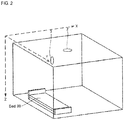
- Fig. 2 is a cubic diagram illustrating the inside of the room.
- the upper image sensor 2 is disposed in an upper portion of the inside of the room, and the side image sensor 3 is disposed in a side portion of the inside of the room.
- a bed 90 is provided in the room.
- An indoor coordinate system X-Y-Z is illustrated in Fig. 2 .
- Figs. 3 and 4 are views for describing the first image data and the test area of the first image data.
- the first image data is made up of 16 pixels in an X-direction and 16 pixels in a Y-direction.
- An area RV1 is a whole area of the first image data, namely, an area having a range of 0 ⁇ X ⁇ 15 and 0 ⁇ Y ⁇ 15.
- An area RV2 is an area having a predetermined width (3 pixels) from a position adjacent to a boundary in a longitudinal direction of an area corresponding to the bed, namely, an area having a range of 7 ⁇ X ⁇ 9 and 3 ⁇ Y ⁇ 10.
- An area RV3 is the area corresponding to the bed, namely, an area having a range of 3 ⁇ X ⁇ 6 and 3 ⁇ Y ⁇ 10.
- An area RV4 is an area except for the area RV3, and is made up of four areas.
- a first area is an area having a range of 0 ⁇ X ⁇ 2 and 0 ⁇ Y ⁇ 15.
- a second area is an area having a range of 7 ⁇ X ⁇ 15 and 0 ⁇ Y ⁇ 15.
- a third area is an area having a range of 3 ⁇ X ⁇ 6 and 0 ⁇ Y ⁇ 2.
- a fourth area is an area having a range of 3 ⁇ X ⁇ 6 and 11 ⁇ Y ⁇ 15.
- Figs. 5 and 6 are views for describing the second image data and the test area of the second image data.
- the second image data is made up of 16 pixels in the X-direction and 16 pixels in a Z-direction.
- An area RH1 is a whole area of the second image data, namely, an area having a range of 0 ⁇ X ⁇ 15 and 0 ⁇ Z ⁇ 15.
- a range in a vertical direction (Z-direction) of an area RH2 is a whole range.
- a range in a horizontal direction (X-direction) of the area RH2 is a range having a predetermined width (3 pixels) from a position adjacent to a range (11 ⁇ X ⁇ 15) corresponding to the bed. Accordingly, the area RH2 is an area having a range of 8 ⁇ X ⁇ 10 and 0 ⁇ Z ⁇ 15.
- a range in the vertical direction (Z-direction) of an area RH3 is a range having a predetermined width (5 pixels) from a position adjacent to an upper boundary of the range corresponding to the bed.
- a range in the horizontal direction (X-direction) of the area RH3 is equal to the range corresponding to the bed. Accordingly, the area RH3 is an area having a range of 11 ⁇ X ⁇ 15 and 5 ⁇ Z ⁇ 9.
- a range in the vertical direction (Z-direction) of an area RH4 is a range having a predetermined width (3 pixels) from the position adjacent to the upper boundary of the range corresponding to the bed.
- a range in the horizontal direction (X-direction) of the area RH4 is equal to the range corresponding to the bed. Accordingly, the area RH4 is an area having a range of 11 ⁇ X ⁇ 15 and 7 ⁇ Z ⁇ 9.
- a range in the horizontal direction of an area RH5 is a range where the range corresponding to the bed is excluded from the whole range.
- a range in the horizontal direction of an area RH6 is a range where the range corresponding to the bed is excluded from the whole range.
- Fig. 7 is a view illustrating the transition model of the human body posture.
- Fig. 8 is a view illustrating the transition model information.
- a state in which the monitoring target person is absent in the room (A) is assumed as an initial state.
- the next posture of the posture (A) is presence in the room (B) or the original posture (A).
- the next posture of the posture (B) is standing beside the bed (C), falling down (X), absence in the room (A), or the original posture (B).
- the next posture of the posture (C) is lying on the bed (D), sitting on the bed (E), sitting on an edge of the bed (F), falling down (X), presence in the room (B), or the original posture (C).
- the next posture of the posture (D) is sitting on the bed (E), sitting on the edge of the bed (F), standing beside the bed (C), falling from the bed (first pattern) (Y1), or the original posture (D).
- the next posture of the posture (E) is lying on the bed (D), sitting on the edge of the bed (F), standing beside the bed (C), falling from the bed (first pattern) (Y1), or the original posture (E).
- the next posture of the posture (F) is lying on the bed (D), sitting on the bed (E), standing beside the bed (C), falling from the bed (second pattern) (Y2), or the original posture (F).
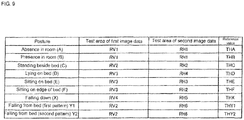
- Fig. 9 is a view illustrating the area information indicating the test area of the first image data and the test area of the second image data in each posture of the transition model, and the reference value information indicating the reference value used to determine the transition to each posture.
- the sum of the statistic in the area RV1 of the first image data and the statistic in the area RH1 of the second image data is calculated in order to determine the transition to the absence in the room (A).
- THA a reference value
- the sum of the statistic in the area RV1 of the first image data and the statistic in the area RH1 of the second image data is calculated in order to determine the transition to the presence in the room (B).
- THB a reference value
- the sum of the statistic in the area RV2 of the first image data and the statistic in the area RH2 of the second image data is calculated in order to determine the transition to the posture of standing beside the bed (C).
- the sum of the statistics is greater than or equal to a reference value THC, it is determined that the current posture is changed to the posture (C).
- the sum of the statistic in the area RV3 of the first image data and the statistic in the area RH4 of the second image data is calculated in order to determine the transition to the posture of lying on the bed (D).
- THD a reference value
- the sum of the statistic in the area RV3 of the first image data and the statistic in the area RH3 of the second image data is calculated in order to determine the transition to the posture of sitting on the bed (E).
- the sum of the statistics is greater than or equal to a reference value THE, it is determined that the current posture is changed to the posture (E).
- the sum of the statistic in the area RV3 of the first image data and the statistic in the area RH2 of the second image data is calculated in order to determine the transition to the posture of sitting on the edge of the bed (F).
- the sum of the statistics is greater than or equal to a reference value THF, it is determined that the current posture is changed to the posture (F).
- the sum of the statistic in the area RV4 of the first image data and the statistic in the area RH5 of the second image data is calculated in order to determine the transition to the posture of falling down (X).
- a reference value THX it is determined that the current posture is changed to the posture (X).
- the sum of the statistic in the area RV2 of the first image data and the statistic in the area RH6 of the second image data is calculated in order to determine the transition to the posture of falling from the bed (first pattern) (Y1).
- the sum of the statistics is greater than or equal to a reference value THY1, it is determined that the current posture is changed to the posture (Y1).
- THY1 a reference value
- the sum of the statistic in the area RV2 of the first image data and the statistic in the area RH6 of the second image data is calculated in order to determine the transition to the posture of falling from the bed (second pattern) (Y2).
- the sum of the statistics is greater than or equal to a reference value THY2, it is determined that the current posture is changed to the posture (Y2).
- the reason the area RH6 is used is the same as the reason in the case for the posture of falling from the bed (first pattern).
- Fig. 10 is a flowchart illustrating a procedure to determine a transition destination from the posture (A).
- step S100 the processing proceeds to step S101 when the posture before one point of time is the absence in the room (A).
- the candidate specifying part 8 refers to sequence information shown in Fig. 8 to specify the posture (B) and the posture (A) as candidates of the transition destination from the posture (A).
- the test area specifying part 9 refers to the test information shown in Fig. 9 to specify the area RV1 as the test area of the first image data for the posture (B).
- the statistic calculator 10 calculates a total sum PV of the pixel values of the pixels in the area RV1 of the first image data.
- the test area specifying part 9 refers to the test information shown in Fig. 9 to specify the area RH1 as the test area of the second image data for the posture (B).
- the statistic calculator 10 calculates a total sum PH of the pixel values of the pixels in the area RH1 of the second image data.
- step S104 the statistic calculator 10 calculates a sum PB of the total sum PV and the total sum PH.
- step S105 the determinator 11 compares the sum PB to the reference value THB. When the sum PB is greater than or equal to the reference value THB, the processing proceeds to step S106. When the sum PB is less than the reference value THB, the processing proceeds to step S107.
- step S106 the determinator 11 determines that the current posture is the presence in the room (B).
- step S107 the determinator 11 determines that the current posture is not the posture (B) but the posture before one point of time (A) that is a remaining candidate.
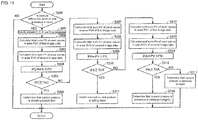
- Fig. 11 is a flowchart illustrating a procedure to determine the transition destination from the posture (B).
- step S200 the processing proceeds to step S201 when the posture before one point of time is the presence in the room (B).
- the candidate specifying part 8 refers to the sequence information shown in Fig. 8 to specify the posture (C), the posture (X), the posture (A), and the posture (B) as the candidates of the transition destination from the posture (B).
- the test area specifying part 9 refers to the test information shown in Fig. 9 to specify the area RV2 as the test area of the first image data for the posture (C).
- the statistic calculator 10 calculates the total sum PV of the pixel values of the pixels in the area RV2 of the first image data.
- the test area specifying part 9 refers to the test information shown in Fig. 9 to specify the area RH2 as the test area of the second image data for the posture (C).
- the statistic calculator 10 calculates the total sum PH of the pixel values of the pixels in the area RH2 of the second image data.
- step S204 the statistic calculator 10 calculates a sum PC of the total sum PV and the total sum PH.
- step S205 the determinator 11 compares the sum PC to the reference value THC. When the sum PC is greater than or equal to the reference value THC, the processing proceeds to step S206. When the sum PC is less than the reference value THC, the processing proceeds to step S207.
- step S206 the determinator 11 determines that the current posture is standing beside the bed (C).
- the test area specifying part 9 refers to the test information shown in Fig. 9 to specify the area RV4 as the test area of the first image data for the posture (X).
- the statistic calculator 10 calculates the total sum PV of the pixel values of the pixels in the area RV4 of the first image data.
- the test area specifying part 9 refers to the test information shown in Fig. 9 to specify the area RH5 as the test area of the second image data for the posture (X).
- the statistic calculator 10 calculates the total sum PH of the pixel values of the pixels in the area RH5 of the second image data.
- step S209 the statistic calculator 10 calculates a sum PX of the total sum PV and the total sum PH.
- step S210 the determinator 11 compares the sum PX to the reference value THX. When the sum PX is greater than or equal to the reference value THX, the processing proceeds to step S211. When the sum PX is less than the reference value THX, the processing proceeds to step S212.
- step S211 the determinator 11 determines that the current posture is falling down (X).
- the test area specifying part 9 refers to the test information in Fig. 9 to specify the area RV1 as the test area of the first image data for the posture (A).
- the statistic calculator 10 calculates a total sum PV of the pixel values of the pixels in the area RV1 of the first image data.
- the test area specifying part 9 refers to the test information shown in Fig. 9 to specify the area RH1 as the test area of the second image data for the posture (A).
- the statistic calculator 10 calculates a total sum PH of the pixel values of the pixels in the area RH1 of the second image data.
- step S214 the statistic calculator 10 calculates a sum PA of the total sum PV and the total sum PH.
- step S215 the determinator 11 compares the sum PA to the reference value THA. When the sum PA is greater than or equal to the reference value THA, the processing proceeds to step S216. When the sum PA is less than the reference value THA, the processing proceeds to step S217.
- step S216 the determinator 11 determines that the current posture is not the posture (C), the posture (X), or the posture (A), but the posture before one point of time (B) (presence in the room) that is the remaining candidate.
- step S217 the determinator 11 determines that the current posture is the absence in the room (A).
- Fig. 12 is a flowchart illustrating a procedure to determine the transition destination from the posture (C).
- step S300 the processing proceeds to step S301 when the posture before one point of time is standing beside the bed (C).
- the candidate specifying part 8 refers to the sequence information shown in Fig. 8 to specify the posture (D), the posture (E), the posture (F), the posture (X), the posture (B), and the posture (C) as the candidates of the transition destination from the posture (C).
- the test area specifying part 9 refers to the test information shown in Fig. 9 to specify the area RV3 as the test area of the first image data for the posture (D).
- the statistic calculator 10 calculates the total sum PV of the pixel values of the pixels in the area RV3 of the first image data.
- the test area specifying part 9 refers to the test information shown in Fig. 9 to specify the area RH4 as the test area of the second image data for the posture (D).
- the statistic calculator 10 calculates the total sum PH of the pixel values of the pixels in the area RH4 of the second image data.
- step S304 the statistic calculator 10 calculates a sum PD of the total sum PV and the total sum PH.
- step S305 the determinator 11 compares the sum PD to the reference value THD. When the sum PD is greater than or equal to the reference value THD, the processing proceeds to step S306. When the sum PD is less than the reference value THD, the processing proceeds to step S307.
- step S306 the determinator 11 determines that the current posture is lying on the bed (D).
- the test area specifying part 9 refers to the test information shown in Fig. 9 to specify the area RV3 as the test area of the first image data for the posture (E).
- the statistic calculator 10 calculates the total sum PV of the pixel values of the pixels in the area RV3 of the first image data.
- the test area specifying part 9 refers to the test information shown in Fig. 9 to specify the area RH3 as the test area of the second image data for the posture (E).
- the statistic calculator 10 calculates the total sum PH of the pixel values of the pixels in the area RH3 of the second image data.
- step S309 the statistic calculator 10 calculates a sum PE of the total sum PV and the total sum PH.
- step S310 the determinator 11 compares the sum PE to the reference value THE. When the sum PE is greater than or equal to the reference value THE, the processing proceeds to step S311. When the sum PE is less than the reference value THE, the processing proceeds to step S312.
- step S311 the determinator 11 determines that the current posture is sitting on the bed (E).
- the test area specifying part 9 refers to the test information shown in Fig. 9 to specify the area RV3 as the test area of the first image data for the posture (F).
- the statistic calculator 10 calculates the total sum PV of the pixel values of the pixels in the area RV3 of the first image data.
- the test area specifying part 9 refers to the test information shown in Fig. 9 to specify the area RH2 as the test area of the second image data for the posture (F).
- the statistic calculator 10 calculates the total sum PH of the pixel values of the pixels in the area RH2 of the second image data.
- step S314 the statistic calculator 10 calculates a sum PF of the total sum PV and the total sum PH.
- step S315 the determinator 11 compares the sum PF to the reference value THF. When the sum PF is greater than or equal to the reference value THF, the processing proceeds to step S316. When the sum PF is less than the reference value THF, the processing proceeds to step S317.
- step S316 the determinator 11 determines that the current posture is sitting on the edge of the bed (F).
- the test area specifying part 9 refers to the test information shown in Fig. 9 to specify the area RV4 as the test area of the first image data for the posture (X).
- the statistic calculator 10 calculates the total sum PV of the pixel values of the pixels in the area RV4 of the first image data.
- the test area specifying part 9 refers to the test information shown in Fig. 9 to specify the area RH5 as the test area of the second image data for the posture (X).
- the statistic calculator 10 calculates the total sum PH of the pixel values of the pixels in the area RH5 of the second image data.
- step S319 the statistic calculator 10 calculates the sum PX of the total sum PV and the total sum PH.
- step S320 the determinator 11 compares the sum PX to the reference value THX. When the sum PX is greater than or equal to the reference value THX, the processing proceeds to step S321. When the sum PX is less than the reference value THX, the processing proceeds to step S322.
- step S321 the determinator 11 determines that the current posture is falling down (X).
- the test area specifying part 9 refers to the test information shown in Fig. 9 to specify the area RV2 as the test area of the first image data for the posture (B).
- the statistic calculator 10 calculates the total sum PV of the pixel values of the pixels in the area RV2 of the first image data.
- the test area specifying part 9 refers to the test information shown in Fig. 9 to specify the area RH2 as the test area of the second image data for the posture (X).
- the statistic calculator 10 calculates the total sum PH of the pixel values of the pixels in the area RH2 of the second image data.
- step S324 the statistic calculator 10 calculates the sum PC of the total sum PV and the total sum PH.
- step S325 the determinator 11 compares the sum PC to the reference value THC. When the sum PC is less than the reference value THC, the processing proceeds to step S326. When the sum PC is greater than or equal to the reference value THC, the processing proceeds to step S327.
- step S326 the determinator 11 determines that the current posture is the presence in the room (B).
- step S327 the determinator 11 determines that the current posture is not the posture (D), the posture (E), the posture (F), the posture (X), or the posture (B), but the posture before one point of time (C) (standing beside the bed) that is the remaining candidate.
- Fig. 13 is a flowchart illustrating a procedure to determine the transition destination from the posture (D).
- step S400 the processing proceeds to step S401 when the posture before one point of time is lying on the bed (D).
- the candidate specifying part 8 refers to the sequence information shown in Fig. 8 to specify the posture (E), the posture (F), the posture (C), the posture (Y1), and the posture (D) as the candidates of the transition destination from the posture (D).
- the test area specifying part 9 refers to the test information shown in Fig. 9 to specify the area RV3 as the test area of the first image data for the posture (E).
- the statistic calculator 10 calculates the total sum PV of the pixel values of the pixels in the area RV3 of the first image data.
- the test area specifying part 9 refers to the test information shown in Fig. 9 to specify the area RH3 as the test area of the second image data for the posture (E).
- the statistic calculator 10 calculates the total sum PH of the pixel values of the pixels in the area RH3 of the second image data.
- step S404 the statistic calculator 10 calculates the sum PE of the total sum PV and the total sum PH.
- step S405 the determinator 11 compares the sum PE to the reference value THE. When the sum PE is greater than or equal to the reference value THE, the processing proceeds to step S406. When the sum PE is less than the reference value THE, the processing proceeds to step S407.
- step S406 the determinator 11 determines that the current posture is sitting on the bed (E).
- the test area specifying part 9 refers to the test information shown in Fig. 9 to specify the area RV3 as the test area of the first image data for the posture (F).
- the statistic calculator 10 calculates the total sum PV of the pixel values of the pixels in the area RV3 of the first image data.
- the test area specifying part 9 refers to the test information shown in Fig. 9 to specify the area RH2 as the test area of the second image data for the posture (F).
- the statistic calculator 10 calculates the total sum PH of the pixel values of the pixels in the area RH2 of the second image data.
- step S409 the statistic calculator 10 calculates the sum PF of the total sum PV and the total sum PH.
- step S410 the determinator 11 compares the sum PF to the reference value THF. When the sum PF is greater than or equal to the reference value THF, the processing proceeds to step S411. When the sum PF is less than the reference value THF, the processing proceeds to step S412.
- step S411 the determinator 11 determines that the current posture is sitting on the edge of the bed (F).
- the test area specifying part 9 refers to the test information shown in Fig. 9 to specify the area RV2 as the test area of the first image data for the posture (C).
- the statistic calculator 10 calculates the total sum PV of the pixel values of the pixels in the area RV2 of the first image data.
- the test area specifying part 9 refers to the test information shown in Fig. 9 to specify the area RH2 as the test area of the second image data for the posture (C).
- the statistic calculator 10 calculates the total sum PH of the pixel values of the pixels in the area RH2 of the second image data.
- step S414 the statistic calculator 10 calculates the sum PC of the total sum PV and the total sum PH.
- step S415 the determinator 11 compares the sum PC to the reference value THC. When the sum PC is greater than or equal to the reference value THC, the processing proceeds to step S416. When the sum PC is less than the reference value THC, the processing proceeds to step S417.
- step S416 the determinator 11 determines that the current posture is standing beside the bed (C).
- the test area specifying part 9 refers to the test information shown in Fig. 9 to specify the area RV2 as the test area of the first image data for the posture (Y1).
- the statistic calculator 10 calculates the total sum PV of the pixel values of the pixels in the area RV2 of the first image data.
- the test area specifying part 9 refers to the test information shown in Fig. 9 to specify the area RH6 as the test area of the second image data for the posture (Y1).
- the statistic calculator 10 calculates the total sum PH of the pixel values of the pixels in the area RH6 of the second image data.
- step S419 the statistic calculator 10 calculates a sum PY1 of the total sum PV and the total sum PH.
- step S420 the determinator 11 compares the sum PY1 to the reference value THY1. When the sum PY1 is greater than or equal to the reference value THY1, the processing proceeds to step S421. When the sum PY1 is less than the reference value THY1, the processing proceeds to step S422.
- step S421 the determinator 11 determines that the current posture is falling from the bed (first pattern) (Y1).
- step S422 the determinator 11 determines that the current posture is not the posture (E), the posture (F), the posture (C), or the posture (Y1), but the posture before one point of time (D) that is the remaining candidate.
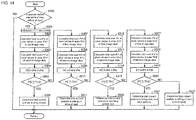
- Fig. 14 is a flowchart illustrating a procedure to determine the transition destination from the posture (E).
- step S500 the processing proceeds to step S501 when the posture before one point of time is sitting on the bed (E).
- the candidate specifying part 8 refers to the sequence information shown in Fig. 8 to specify the posture (D), the posture (F), the posture (C), the posture (Y1), and the posture (E) as the candidates of the transition destination from the posture (E).
- the test area specifying part 9 refers to the test information shown in Fig. 9 to specify the area RV3 as the test area of the first image data for the posture (D).
- the statistic calculator 10 calculates the total sum PV of the pixel values of the pixels in the area RV3 of the first image data.
- the test area specifying part 9 refers to the test information shown in Fig. 9 to specify the area RH4 as the test area of the second image data for the posture (D).
- the statistic calculator 10 calculates the total sum PH of the pixel values of the pixels in the area RH4 of the second image data.
- step S504 the statistic calculator 10 calculates the sum PD of the total sum PV and the total sum PH.
- step S505 the determinator 11 compares the sum PD to the reference value THD. When the sum PD is greater than or equal to the reference value THD, the processing proceeds to step S506. When the sum PD is less than the reference value THD, the processing proceeds to step S507.
- step S506 the determinator 11 determines that the current posture is lying on the bed (D).
- the test area specifying part 9 refers to the test information shown in Fig. 9 to specify the area RV3 as the test area of the first image data for the posture (F).
- the statistic calculator 10 calculates the total sum PV of the pixel values of the pixels in the area RV3 of the first image data.
- the test area specifying part 9 refers to the test information shown in Fig. 9 to specify the area RH2 as the test area of the second image data for the posture (F).
- the statistic calculator 10 calculates the total sum PH of the pixel values of the pixels in the area RH2 of the second image data.
- step S509 the statistic calculator 10 calculates the sum PF of the total sum PV and the total sum PH.
- step S510 the determinator 11 compares the sum PF to the reference value THF. When the sum PF is greater than or equal to the reference value THF, the processing proceeds to step S511. When the sum PF is less than the reference value THF, the processing proceeds to step S512.
- step S511 the determinator 11 determines that the current posture is sitting on the edge of the bed (F).
- the test area specifying part 9 refers to the test information shown in Fig. 9 to specify the area RV2 as the test area of the first image data for the posture (C).
- the statistic calculator 10 calculates the total sum PV of the pixel values of the pixels in the area RV2 of the first image data.
- the test area specifying part 9 refers to the test information shown in Fig. 9 to specify the area RH2 as the test area of the second image data for the posture (C).
- the statistic calculator 10 calculates the total sum PH of the pixel values of the pixels in the area RH2 of the second image data.
- step S514 the statistic calculator 10 calculates the sum PC of the total sum PV and the total sum PH.
- step S515 the determinator 11 compares the sum PC to the reference value THC. When the sum PC is greater than or equal to the reference value THC, the processing proceeds to step S516. When the sum PC is less than the reference value THC, the processing proceeds to step S517.
- step S5166 the determinator 11 determines that the current posture is standing beside the bed (C).
- the test area specifying part 9 refers to the test information shown in Fig. 9 to specify the area RV2 as the test area of the first image data for the posture (Y1).
- the statistic calculator 10 calculates the total sum PV of the pixel values of the pixels in the area RV2 of the first image data.
- the test area specifying part 9 refers to the test information shown in Fig. 9 to specify the area RH6 as the test area of the second image data for the posture (Y1).
- the statistic calculator 10 calculates the total sum PH of the pixel values of the pixels in the area RH6 of the second image data.
- step S519 the statistic calculator 10 calculates the sum PY1 of the total sum PV and the total sum PH.
- step S520 the determinator 11 compares the sum PY1 to the reference value THY1. When the sum PY1 is greater than or equal to the reference value THY1, the processing proceeds to step S521. When the sum PY1 is less than the reference value THY1, the processing proceeds to step S522.
- step S521 the determinator 11 determines that the current posture is falling from the bed (first pattern) (Y1).
- step S522 the determinator 11 determines that the current posture is not the posture (D), the posture (F), the posture (C), or the posture (Y1), but the posture before one point of time (E) that is the remaining candidate.
- Fig. 15 is a flowchart illustrating a procedure to determine the transition destination from the posture (F).
- step S600 the processing proceeds to step S601 when the posture before one point of time is sitting on the edge of the bed (F).
- the candidate specifying part 8 refers to the sequence information shown in Fig. 8 to specify the posture (D), the posture (E), the posture (C), the posture (Y2), and the posture (F) as the candidates of the transition destination from the posture (F).
- the test area specifying part 9 refers to the test information shown in Fig. 9 to specify the area RV3 as the test area of the first image data for the posture (D).
- the statistic calculator 10 calculates the total sum PV of the pixel values of the pixels in the area RV3 of the first image data.
- the test area specifying part 9 refers to the test information shown in Fig. 9 to specify the area RH4 as the test area of the second image data for the posture (D).
- the statistic calculator 10 calculates the total sum PH of the pixel values of the pixels in the area RH4 of the second image data.
- step S604 the statistic calculator 10 calculates the sum PD of the total sum PV and the total sum PH.
- step S605 the determinator 11 compares the sum PD to the reference value THD. When the sum PD is greater than or equal to the reference value THD, the processing proceeds to step S606. When the sum PD is less than the reference value THD, the processing proceeds to step S607.
- step S606 the determinator 11 determines that the current posture is lying on the bed (D).
- the test area specifying part 9 refers to the test information shown in Fig. 9 to specify the area RV3 as the test area of the first image data for the posture (E).
- the statistic calculator 10 calculates the total sum PV of the pixel values of the pixels in the area RV3 of the first image data.
- the test area specifying part 9 refers to the test information shown in Fig. 9 to specify the area RH3 as the test area of the second image data for the posture (E).
- the statistic calculator 10 calculates the total sum PH of the pixel values of the pixels in the area RH2 of the second image data.
- step S609 the statistic calculator 10 calculates the sum PE of the total sum PV and the total sum PH.
- step S610 the determinator 11 compares the sum PE to the reference value THE. When the sum PE is greater than or equal to the reference value THE, the processing proceeds to step S611. When the sum PE is less than the reference value THE, the processing proceeds to step S612.
- step S611 the determinator 11 determines that the current posture is sitting on the bed (E).
- the test area specifying part 9 refers to the test information shown in Fig. 9 to specify the area RV2 as the test area of the first image data for the posture (C).
- the statistic calculator 10 calculates the total sum PV of the pixel values of the pixels in the area RV2 of the first image data.
- the test area specifying part 9 refers to the test information shown in Fig. 9 to specify the area RH2 as the test area of the second image data for the posture (C).
- the statistic calculator 10 calculates the total sum PH of the pixel values of the pixels in the area RH2 of the second image data.
- step S614 the statistic calculator 10 calculates the sum PC of the total sum PV and the total sum PH.
- step S615 the determinator 11 compares the sum PC to the reference value THC. When the sum PC is greater than or equal to the reference value THC, the processing proceeds to step S616. When the sum PC is less than the reference value THC, the processing proceeds to step S617.
- step S616 the determinator 11 determines that the current posture is standing beside the bed (C).
- the test area specifying part 9 refers to the test information shown in Fig. 9 to specify the area RV2 as the test area of the first image data for the posture (Y2).
- the statistic calculator 10 calculates the total sum PV of the pixel values of the pixels in the area RV2 of the first image data.
- the test area specifying part 9 refers to the test information shown in Fig. 9 to specify the area RH6 as the test area of the second image data for the posture (Y2).
- the statistic calculator 10 calculates the total sum PH of the pixel values of the pixels in the area RH6 of the second image data.
- step S619 the statistic calculator 10 calculates a sum PY2 of the total sum PV and the total sum PH.
- step S620 the determinator 11 compares the sum PY2 to the reference value THY2. When the sum PY2 is greater than or equal to the reference value THY2, the processing proceeds to step S621. When the sum PY2 is less than the reference value THY2, the processing proceeds to step S622.
- step S621 the determinator 11 determines that the current posture is falling from the bed (second pattern) (Y2).
- step S622 the determinator 11 determines that the current posture is not the posture (D), the posture (E), the posture (C), or the posture (Y2), but the posture before one point of time (F) that is the remaining candidate.
- the human body posture can be estimated in real time with a small calculation processing amount. According to the embodiment, by the use of the posture transition model, it is possible to estimate not only the behavior of rising from the bed as disclosed in Patent Document 1, but also more postures.
- the total sum of the pixel values in the test area is used as the statistic, but the present invention is not limited thereto.
- a mean or a variance of the pixel values in the test area may be used as the statistic.
- the pixel value of standard image data or the pixel value of the image data in a preceding frame and the pixel value of current image data are subtracted, and the total sum, the average value, or the variance of the subtracted value may be used as the statistic. Therefore, the statistic increases immediately after the posture changes, timing immediately after the posture changes can be detected.
- the total sum of the pixels having a predetermined pixel value or more may be used as the statistic.
- the pixel values having predetermined bits or more are added, so that a calculation amount can further be reduced.
- calculation amount may be reduced not by calculating the statistic from all the pixel values in the test area, but by calculating the statistic from the pixel values randomly sampled from the test area.
- the sum of the statistic in the test area of the first image data and the statistic in the test area of the second image data is calculated, and the candidate is estimated as the current posture when the sum is greater than or equal to the reference value.
- the candidate when the statistic in the test area of the first image data is greater than or equal to a first reference value, and when the statistic in the test area of the second image data is greater than or equal to a second reference value, the candidate may be estimated as the current posture.
- the human body posture is estimated with two image sensors.
- the human body posture can be estimated with one image sensor.
- the posture of falling from the bed may be estimated using only the image data obtained from the upper image sensor.
- the change in posture on the bed may be estimated using only the image data obtained from the side image sensor.
- the upper image sensor and the side image sensor are composed of the infrared array sensor.
- the upper image sensor and the side image sensor may be composed of another sensor such as a visible-light camera.
- the human body posture relative to the bed is estimated, but the present invention is not limited thereto.
- the human body posture relative to a chair or a wheel chair may be estimated.
- the plural candidates at the current time are sequentially selected one by one, and the selected candidate is estimated as the current posture when the statistic is greater than or equal to the reference value.
- the present invention is not limited thereto.
- the statistic is calculated for all the plural candidates at the current time, an optimum statistic is determined from the calculated plural statistics according to a predetermined criterion, and the candidate having the optimum statistic may be estimated as the current posture.
Landscapes
- Health & Medical Sciences (AREA)
- Engineering & Computer Science (AREA)
- Life Sciences & Earth Sciences (AREA)
- Physics & Mathematics (AREA)
- General Health & Medical Sciences (AREA)
- Medical Informatics (AREA)
- Veterinary Medicine (AREA)
- Molecular Biology (AREA)
- Pathology (AREA)
- Biophysics (AREA)
- Public Health (AREA)
- Animal Behavior & Ethology (AREA)
- Surgery (AREA)
- Biomedical Technology (AREA)
- Oral & Maxillofacial Surgery (AREA)
- Heart & Thoracic Surgery (AREA)
- Dentistry (AREA)
- Physiology (AREA)
- Computer Vision & Pattern Recognition (AREA)
- Theoretical Computer Science (AREA)
- General Physics & Mathematics (AREA)
- Radiology & Medical Imaging (AREA)
- Nuclear Medicine, Radiotherapy & Molecular Imaging (AREA)
- Human Computer Interaction (AREA)
- Evolutionary Biology (AREA)
- Probability & Statistics with Applications (AREA)
- Bioinformatics & Cheminformatics (AREA)
- Multimedia (AREA)
- Bioinformatics & Computational Biology (AREA)
- Quality & Reliability (AREA)
- Geometry (AREA)
- Social Psychology (AREA)
- Psychiatry (AREA)
- Measurement Of The Respiration, Hearing Ability, Form, And Blood Characteristics Of Living Organisms (AREA)
- Image Analysis (AREA)
- Alarm Systems (AREA)
- Measuring And Recording Apparatus For Diagnosis (AREA)
Abstract
Description
- The present invention relates to a posture estimation device, a posture estimation system, a posture estimation method, and a posture estimation program for estimating a posture of a human body in a room, and a computer-readable recording medium on which the posture estimation program is recorded.
- Conventionally, there is known a device that monitors a behavior of a person, such as an elderly person, who needs nursing care.
- For example, Patent Document 1 (Japanese Unexamined Patent Publication No.
2006-175082 - Patent Document 1: Japanese Unexamined Patent Publication No.
2006-175082 - However, in the device of
Patent Document 1, it is necessary to perform image processing to specify the image area of the care receiver because the device estimates that the care receiver performs the rising behavior when the ratio of the image area of the care receiver to the watching area is a predetermined value or more. Resultantly, a data processing amount increases, and a change in posture cannot be estimated in real time. - An object of the present invention is to provide a posture estimation device, a posture estimation system, a posture estimation method, and a posture estimation program for estimating a posture of a human body in a room with a small data processing amount, and a computer-readable recording medium on which the posture estimation program is recorded.
- According to an aspect of the present invention, a posture estimation device includes: an acquisition part configured to acquire image data from an image sensor provided in a room; a storage configured to store information indicating a transition model of a human body posture and test information indicating a test area of the image data in each posture of the transition model; and an estimator configured to calculate a statistic in the test area of the image data by referring to the information indicating the transition model and the test information, and to estimate a current human body posture from the human body posture before one point of time based on the statistic.
- Preferably, the estimator includes: a candidate specifying part configured to specify a candidate of a posture that can be changed from the human body posture before one point of time by referring to the information indicating the transition model; a test area specifying part configured to specify the test area of the image data by referring to the test information with respect to the specified candidate of the posture; a statistic calculator configured to calculate the statistic in the specified test area of the image data; and a determinator configured to determine whether the specified candidate of the posture is estimated as a current posture based on the calculated statistic.
- Preferably, the statistic is a total value or an average value of pixel values in the test area.
- Preferably, the determinator estimates the specified candidate of the posture as the current posture when the calculated statistic is greater than or equal to a reference value that is fixed according to the specified candidate of the posture.
- Preferably, the image sensor is an infrared array sensor.
- Preferably, a bed is disposed in the room, and the transition model of the posture includes the human body posture with respect to the bed.
- Preferably, the acquisition part acquires first image data from a first image sensor provided in an upper portion of the room and second image data from a second image sensor provided in a side portion of the room, the storage stores test information indicating a test area of the first image data and a test area of the second image data in each posture of the transition model, and the estimator calculates statistics in the test area of the first image data and the test area of the second image data by referring to the information indicating the transition model and the test information, and estimates the current human body posture from the human body posture before one point of time using the calculated statistics.
- Preferably, when the human body posture before one point of time is absence in the room in the transition model of the posture, a candidate of a posture that can be changed from the human body posture includes presence in the room.
- Preferably, when the human body posture before one point of time is presence in the room in the transition model of the posture, a candidate of a posture that can be changed from the human body posture includes at least one of standing beside the bed, falling down, and absence in the room.
- Preferably, when the human body posture before one point of time is standing beside the bed in the transition model of the posture, a candidate of a posture that can be changed from the human body posture includes at least one of lying on the bed, sitting on the bed, sitting on an edge of the bed, falling down, and presence in the room.
- Preferably, when the human body posture before one point of time is lying on the bed in the transition model of the posture, a candidate of a posture that can be changed from the human body posture includes at least one of sitting on the bed, sitting on an edge of the bed, standing beside the bed, and falling from the bed.
- Preferably, when the human body posture before one point of time is sitting on the bed in the transition model of the posture, a candidate of a posture that can be changed from the human body posture includes at least one of lying on the bed, sitting on an edge of the bed, standing beside the bed, and falling from the bed.
- Preferably, when the human body posture before one point of time is sitting on an edge of the bed in the transition model of the posture, a candidate of a posture that can be changed from the human body posture includes at least one of lying on the bed, sitting on the bed, standing beside the bed, and falling from the bed.
- Preferably, a posture identical to the human body posture before one point of time is included as the candidate of the posture that can be changed from the human body posture before one point of time in the transition model of the posture.
- Preferably, when the candidate of the posture is absence in the room, the test area of the first image data is a whole area of the first image data, and the test area of the second image data is a whole area of the second image data.
- Preferably, when the candidate of the posture is presence in the room, the test area of the first image data is a whole area of the first image data, and the test area of the second image data is a whole area of the second image data.
- Preferably, when the candidate of the posture is standing beside the bed, the test area of the first image data is an area having a predetermined width from a position adjacent to a boundary in a longitudinal direction of an area corresponding to the bed, and a range in a vertical direction of the test area of the second image data is a whole range, and a range in a horizontal direction is a range having a predetermined width from a position adjacent to a range corresponding to the bed.
- Preferably, when the candidate of the posture is falling down, the test area of the first image data is an area where an area corresponding to the bed is excluded from a whole area, and a range in a horizontal direction of the test area of the second image data is an area where a range corresponding to the bed is excluded from a whole range, and a range in a vertical direction is a range having a predetermined width upward from a lowest position.
- Preferably, when the candidate of the posture is lying on the bed, the test area of the first image data is an area corresponding to the bed, and a range in a vertical direction of the test area of the second image data is a range having a predetermined first width from a position adjacent to a boundary above a range corresponding to the bed, and a range in a vertical direction is a range identical to a range corresponding to the bed.
- Preferably, when the candidate of the posture is sitting on the bed, the test area of the first image data is an area corresponding to the bed, and a range in a vertical direction of the test area of the second image data is a range having a predetermined second width from a position adjacent to a boundary above a range corresponding to the bed, and a range in a vertical direction is a range identical to a range corresponding to the bed.
- Preferably, when the candidate of the posture is sitting on an edge of the bed, the test area of the first image data is an area corresponding to the bed, and a range in a vertical direction of the test area of the second image data is a whole range, and a range in a horizontal direction is a range having a predetermined width from a position adjacent to a range corresponding to the bed.
- Preferably, when the candidate of the posture is falling from the bed, the test area of the first image data is an area having a predetermined width from a position adjacent to a boundary in a longitudinal direction of an area corresponding to the bed, and a range in a horizontal direction of the test area of the second image data is a range where a range corresponding to the bed is excluded from a whole range, and a range in a vertical direction is a range having a predetermined width upward from a predetermined position.
- According to another aspect of the present invention, a posture estimation system includes: an image sensor provided in a room; an acquisition part configured to acquire image data from the image sensor; a storage configured to store information indicating a transition model of a human body posture and test information indicating a test area of the image data in each posture of the transition model; and an estimator configured to calculate a statistic in the test area of the image data by referring to the information indicating the transition model and the test information, and to estimate a current human body posture from the human body posture before one point of time based on the statistic.
- According to still another aspect of the present invention, a posture estimation method includes the steps of: generating image data by capturing an image of an inside of a room with an image sensor provided in the room; and calculating a statistic in a test area of the image data by referring to information indicating a transition model of a human body posture and test information indicating a test area of the image data in each posture of the transition model to estimate a current human body posture from the human body posture before one point of time based on the statistic.
- According to still another aspect of the present invention, a posture estimation program causes a computer to function as: an acquisition part configured to acquire image data from an image sensor provided in a room; a storage configured to store information indicating a transition model of a human body posture and test information indicating a test area of the image data in each posture of the transition model; and an estimator configured to calculate a statistic in the test area of the image data by referring to the information indicating the transition model and the test information, and to estimate a current human body posture from the human body posture before one point of time based on the statistic.
- According to still another aspect of the present invention, a computer-readable recording medium on which a posture estimation program is recorded, the posture estimation program causes a computer to function as: an acquisition part configured to acquire image data from an image sensor provided in a room; a storage configured to store information indicating a transition model of a human body posture and test information indicating a test area of the image data in each posture of the transition model; and an estimator configured to calculate a statistic in the test area of the image data by referring to the information indicating the transition model and the test information, and to estimate a current human body posture from the human body posture before one point of time based on the statistic.
- According to the present invention, a posture of a human body can be estimated with a small data processing amount.
-
-
Fig. 1 is a view illustrating a configuration of a posture estimation system according to an embodiment of the present invention. -
Fig. 2 is a cubic diagram illustrating an inside of a room. -
Fig. 3 is a view for describing first image data and a test area of the first image data. -
Fig. 4 is a view for describing the first image data and the test area of the first image data. -
Fig. 5 is a view for describing second image data and the test area of the first image data. -
Fig. 6 is a view for describing the second image data and the test area of the first image data. -
Fig. 7 is a view illustrating a transition model of a human body posture. -
Fig. 8 is a view illustrating transition model information. -
Fig. 9 is a view illustrating area information indicating the test area of the first image data and the test area of the second image data in each posture of the transition model, and reference value information indicating a reference value used to determine a transition to each posture. -
Fig. 10 is a flowchart illustrating a procedure to determine a transition destination from a posture (A). -
Fig. 11 is a flowchart illustrating a procedure to determine a transition destination from a posture (B). -
Fig. 12 is a flowchart illustrating a procedure to determine a transition destination from a posture (C). -
Fig. 13 is a flowchart illustrating a procedure to determine a transition destination from a posture (D). -
Fig. 14 is a flowchart illustrating a procedure to determine a transition destination from a posture (E). -
Fig. 15 is a flowchart illustrating a procedure to determine a transition destination from a posture (F). - Hereinafter, an embodiment of the present invention will be described with reference to the drawings.
- In the following description, a monitoring target person means a resident, such as an elderly person, who needs nursing care, and an inside of a room means a space in which the monitoring target person resides.
-
Fig. 1 is a view illustrating a configuration of aposture estimation system 1 according to an embodiment of the present invention. - As illustrated in
Fig. 1 , theposture estimation system 1 includes anupper image sensor 2, aside image sensor 3, and a posture estimation device 4. - The
upper image sensor 2 is attached to an indoor ceiling to capture an indoor image from above. Theside image sensor 3 is attached to an indoor side surface to capture an indoor image from the side. In the embodiment, theupper image sensor 2 and theside image sensor 3 are composed of an infrared array sensor. First image data output from theupper image sensor 2 is transmitted to the posture estimation device 4. Second image data output from theside image sensor 3 is transmitted to the posture estimation device 4. - In image data generated with the infrared array sensor, a temperature in an area where an image is captured increases with an increase of a pixel value, and the temperature decreases with a decrease of the pixel value. Because the temperature in an area where a human body is present is high, a pixel value in the area where the image of the human body is captured is high. Accordingly, the area where the human body is present can be specified by finding the area having the high pixel value from the image data.
- The posture estimation device 4 includes an
image acquisition part 15, aposture estimator 5, astorage 6, and adisplay 7. Theposture estimator 5 includes acandidate specifying part 8, a testarea specifying part 9, astatistic calculator 10, and adeterminator 11. Thestorage 6 includes a transitionmodel information storage 12 and atest information storage 13. - The
image acquisition part 15 acquires the first image data from theupper image sensor 2 and the second image data from theside image sensor 3. - The transition
model information storage 12 stores transition model information indicating the transition model of the human body posture. Thetest information storage 13 stores test information that includes area information and reference value information. The area information indicates the test area of the first image data and the test area of the second image data in each posture of the transition model. The reference value information indicates a reference value used to determine a transition to each posture. The transition model information and the test information are used to estimate a current human body posture. The transition model information and the test information will be described in detail later. - The
candidate specifying part 8 refers to the transition model information to specify a candidate of a posture that can be changed from the human body posture before one point of time. - The test
area specifying part 9 refers to the area information about the specified posture candidate to specify the test area of the first image data and the test area of the second image data. - The
statistic calculator 10 calculates a statistic in the specified test area of the first image data and a statistic of the first image data. - The
determinator 11 refers to the reference value information to determine whether the specified posture candidate is estimated as a current posture based on the calculated statistics. - A computer (not illustrated) executes a posture estimation program to implement the posture estimation device 4. In other words, the posture estimation program causes the computer to function as the
image acquisition part 15, theposture estimator 5, thestorage 6, and thedisplay 7. The posture estimation program is recorded on the computer-readable recording medium such as a memory card, a CD-ROM, or a DVD, and is installed in the computer. -
Fig. 2 is a cubic diagram illustrating the inside of the room. - As illustrated in
Fig. 2 , theupper image sensor 2 is disposed in an upper portion of the inside of the room, and theside image sensor 3 is disposed in a side portion of the inside of the room. Abed 90 is provided in the room. An indoor coordinate system X-Y-Z is illustrated inFig. 2 . -
Figs. 3 and 4 are views for describing the first image data and the test area of the first image data. The first image data is made up of 16 pixels in an X-direction and 16 pixels in a Y-direction. - An area RV1 is a whole area of the first image data, namely, an area having a range of 0 ≤ X ≤ 15 and 0 ≤ Y ≤ 15.
- An area RV2 is an area having a predetermined width (3 pixels) from a position adjacent to a boundary in a longitudinal direction of an area corresponding to the bed, namely, an area having a range of 7 ≤ X ≤ 9 and 3 ≤ Y ≤ 10.
- An area RV3 is the area corresponding to the bed, namely, an area having a range of 3 ≤ X ≤ 6 and 3 ≤ Y ≤ 10.
- An area RV4 is an area except for the area RV3, and is made up of four areas. A first area is an area having a range of 0 ≤ X ≤2 and 0 ≤ Y≤ 15. A second area is an area having a range of 7 ≤ X ≤ 15 and 0 ≤ Y ≤ 15. A third area is an area having a range of 3 ≤ X ≤ 6 and 0 ≤ Y ≤ 2. A fourth area is an area having a range of 3 ≤ X ≤ 6 and 11 ≤ Y ≤ 15.
-
Figs. 5 and 6 are views for describing the second image data and the test area of the second image data. The second image data is made up of 16 pixels in the X-direction and 16 pixels in a Z-direction. - An area RH1 is a whole area of the second image data, namely, an area having a range of 0 ≤ X ≤ 15 and 0 ≤ Z ≤ 15.
- A range in a vertical direction (Z-direction) of an area RH2 is a whole range. A range in a horizontal direction (X-direction) of the area RH2 is a range having a predetermined width (3 pixels) from a position adjacent to a range (11 ≤ X ≤ 15) corresponding to the bed. Accordingly, the area RH2 is an area having a range of 8 ≤ X ≤ 10 and 0 ≤ Z ≤ 15.
- A range in the vertical direction (Z-direction) of an area RH3 is a range having a predetermined width (5 pixels) from a position adjacent to an upper boundary of the range corresponding to the bed. A range in the horizontal direction (X-direction) of the area RH3 is equal to the range corresponding to the bed. Accordingly, the area RH3 is an area having a range of 11 ≤ X ≤ 15 and 5 ≤ Z ≤ 9.
- A range in the vertical direction (Z-direction) of an area RH4 is a range having a predetermined width (3 pixels) from the position adjacent to the upper boundary of the range corresponding to the bed. A range in the horizontal direction (X-direction) of the area RH4 is equal to the range corresponding to the bed. Accordingly, the area RH4 is an area having a range of 11 ≤ X ≤ 15 and 7 ≤ Z ≤ 9.
- A range in the horizontal direction of an area RH5 is a range where the range corresponding to the bed is excluded from the whole range. A range in the vertical direction of the area RH5 is a range having a predetermined width (6 pixels) upward from the lowest position (Z = 15). Accordingly, the area RH5 is an area having a range of 0 ≤ X ≤ 10 and 10 ≤ Z ≤ 15.
- A range in the horizontal direction of an area RH6 is a range where the range corresponding to the bed is excluded from the whole range. A range in the vertical direction of the area RH6 is a range having a predetermined width (3 pixels) upward from a predetermined position (Z = 12). Accordingly, the area RH6 is an area having a range of 0 ≤ X ≤ 10 and 10 ≤ Z ≤ 12.
-
Fig. 7 is a view illustrating the transition model of the human body posture.Fig. 8 is a view illustrating the transition model information. - A state in which the monitoring target person is absent in the room (A) is assumed as an initial state.
- The next posture of the posture (A) is presence in the room (B) or the original posture (A).
- The next posture of the posture (B) is standing beside the bed (C), falling down (X), absence in the room (A), or the original posture (B).
- The next posture of the posture (C) is lying on the bed (D), sitting on the bed (E), sitting on an edge of the bed (F), falling down (X), presence in the room (B), or the original posture (C).
- The next posture of the posture (D) is sitting on the bed (E), sitting on the edge of the bed (F), standing beside the bed (C), falling from the bed (first pattern) (Y1), or the original posture (D).
- The next posture of the posture (E) is lying on the bed (D), sitting on the edge of the bed (F), standing beside the bed (C), falling from the bed (first pattern) (Y1), or the original posture (E).
- The next posture of the posture (F) is lying on the bed (D), sitting on the bed (E), standing beside the bed (C), falling from the bed (second pattern) (Y2), or the original posture (F).
-
Fig. 9 is a view illustrating the area information indicating the test area of the first image data and the test area of the second image data in each posture of the transition model, and the reference value information indicating the reference value used to determine the transition to each posture. - The sum of the statistic in the area RV1 of the first image data and the statistic in the area RH1 of the second image data is calculated in order to determine the transition to the absence in the room (A). When the sum of the statistics is greater than or equal to a reference value THA, it is determined that the current posture is changed to the posture (A).
- The sum of the statistic in the area RV1 of the first image data and the statistic in the area RH1 of the second image data is calculated in order to determine the transition to the presence in the room (B). When the sum of the statistics is greater than or equal to a reference value THB, it is determined that the current posture is changed to the posture (B).
- The sum of the statistic in the area RV2 of the first image data and the statistic in the area RH2 of the second image data is calculated in order to determine the transition to the posture of standing beside the bed (C). When the sum of the statistics is greater than or equal to a reference value THC, it is determined that the current posture is changed to the posture (C).
- The sum of the statistic in the area RV3 of the first image data and the statistic in the area RH4 of the second image data is calculated in order to determine the transition to the posture of lying on the bed (D). When the sum of the statistics is greater than or equal to a reference value THD, it is determined that the current posture is changed to the posture (D).
- The sum of the statistic in the area RV3 of the first image data and the statistic in the area RH3 of the second image data is calculated in order to determine the transition to the posture of sitting on the bed (E). When the sum of the statistics is greater than or equal to a reference value THE, it is determined that the current posture is changed to the posture (E).
- The sum of the statistic in the area RV3 of the first image data and the statistic in the area RH2 of the second image data is calculated in order to determine the transition to the posture of sitting on the edge of the bed (F). When the sum of the statistics is greater than or equal to a reference value THF, it is determined that the current posture is changed to the posture (F).
- The sum of the statistic in the area RV4 of the first image data and the statistic in the area RH5 of the second image data is calculated in order to determine the transition to the posture of falling down (X). When the sum of the statistics is greater than or equal to a reference value THX, it is determined that the current posture is changed to the posture (X).
- The sum of the statistic in the area RV2 of the first image data and the statistic in the area RH6 of the second image data is calculated in order to determine the transition to the posture of falling from the bed (first pattern) (Y1). When the sum of the statistics is greater than or equal to a reference value THY1, it is determined that the current posture is changed to the posture (Y1). The reason the area RH6 is used is that, because of a short distance between a place where the
side image sensor 3 is disposed and a place where the monitoring target person falls from the bed, a portion where the image of the monitoring target person who falls from the bed is captured is positioned higher than the lowest line (Y = 15) in the second image data. - The sum of the statistic in the area RV2 of the first image data and the statistic in the area RH6 of the second image data is calculated in order to determine the transition to the posture of falling from the bed (second pattern) (Y2). When the sum of the statistics is greater than or equal to a reference value THY2, it is determined that the current posture is changed to the posture (Y2). The reason the area RH6 is used is the same as the reason in the case for the posture of falling from the bed (first pattern).
-
Fig. 10 is a flowchart illustrating a procedure to determine a transition destination from the posture (A). - In step S100, the processing proceeds to step S101 when the posture before one point of time is the absence in the room (A).
- In step S101, the
candidate specifying part 8 refers to sequence information shown inFig. 8 to specify the posture (B) and the posture (A) as candidates of the transition destination from the posture (A). - In step S102, the test
area specifying part 9 refers to the test information shown inFig. 9 to specify the area RV1 as the test area of the first image data for the posture (B). Thestatistic calculator 10 calculates a total sum PV of the pixel values of the pixels in the area RV1 of the first image data. - In step S103, the test
area specifying part 9 refers to the test information shown inFig. 9 to specify the area RH1 as the test area of the second image data for the posture (B). Thestatistic calculator 10 calculates a total sum PH of the pixel values of the pixels in the area RH1 of the second image data. - In step S104, the
statistic calculator 10 calculates a sum PB of the total sum PV and the total sum PH. - In step S105, the
determinator 11 compares the sum PB to the reference value THB. When the sum PB is greater than or equal to the reference value THB, the processing proceeds to step S106. When the sum PB is less than the reference value THB, the processing proceeds to step S107. - In step S106, the
determinator 11 determines that the current posture is the presence in the room (B). - In step S107, the
determinator 11 determines that the current posture is not the posture (B) but the posture before one point of time (A) that is a remaining candidate. -
Fig. 11 is a flowchart illustrating a procedure to determine the transition destination from the posture (B). - In step S200, the processing proceeds to step S201 when the posture before one point of time is the presence in the room (B).
- In step S201, the
candidate specifying part 8 refers to the sequence information shown inFig. 8 to specify the posture (C), the posture (X), the posture (A), and the posture (B) as the candidates of the transition destination from the posture (B). - In step S202, the test
area specifying part 9 refers to the test information shown inFig. 9 to specify the area RV2 as the test area of the first image data for the posture (C). Thestatistic calculator 10 calculates the total sum PV of the pixel values of the pixels in the area RV2 of the first image data. - In step S203, the test
area specifying part 9 refers to the test information shown inFig. 9 to specify the area RH2 as the test area of the second image data for the posture (C). Thestatistic calculator 10 calculates the total sum PH of the pixel values of the pixels in the area RH2 of the second image data. - In step S204, the
statistic calculator 10 calculates a sum PC of the total sum PV and the total sum PH. - In step S205, the
determinator 11 compares the sum PC to the reference value THC. When the sum PC is greater than or equal to the reference value THC, the processing proceeds to step S206. When the sum PC is less than the reference value THC, the processing proceeds to step S207. - In step S206, the
determinator 11 determines that the current posture is standing beside the bed (C). - In step S207, the test
area specifying part 9 refers to the test information shown inFig. 9 to specify the area RV4 as the test area of the first image data for the posture (X). Thestatistic calculator 10 calculates the total sum PV of the pixel values of the pixels in the area RV4 of the first image data. - In step S208, the test
area specifying part 9 refers to the test information shown inFig. 9 to specify the area RH5 as the test area of the second image data for the posture (X). Thestatistic calculator 10 calculates the total sum PH of the pixel values of the pixels in the area RH5 of the second image data. - In step S209, the
statistic calculator 10 calculates a sum PX of the total sum PV and the total sum PH. - In step S210, the
determinator 11 compares the sum PX to the reference value THX. When the sum PX is greater than or equal to the reference value THX, the processing proceeds to step S211. When the sum PX is less than the reference value THX, the processing proceeds to step S212. - In step S211, the
determinator 11 determines that the current posture is falling down (X). - In step S212, the test
area specifying part 9 refers to the test information inFig. 9 to specify the area RV1 as the test area of the first image data for the posture (A). Thestatistic calculator 10 calculates a total sum PV of the pixel values of the pixels in the area RV1 of the first image data. - In step S213, the test
area specifying part 9 refers to the test information shown inFig. 9 to specify the area RH1 as the test area of the second image data for the posture (A). Thestatistic calculator 10 calculates a total sum PH of the pixel values of the pixels in the area RH1 of the second image data. - In step S214, the
statistic calculator 10 calculates a sum PA of the total sum PV and the total sum PH. - In step S215, the
determinator 11 compares the sum PA to the reference value THA. When the sum PA is greater than or equal to the reference value THA, the processing proceeds to step S216. When the sum PA is less than the reference value THA, the processing proceeds to step S217. - In step S216, the
determinator 11 determines that the current posture is not the posture (C), the posture (X), or the posture (A), but the posture before one point of time (B) (presence in the room) that is the remaining candidate. - In step S217, the
determinator 11 determines that the current posture is the absence in the room (A). -
Fig. 12 is a flowchart illustrating a procedure to determine the transition destination from the posture (C). - In step S300, the processing proceeds to step S301 when the posture before one point of time is standing beside the bed (C).
- In step S301, the
candidate specifying part 8 refers to the sequence information shown inFig. 8 to specify the posture (D), the posture (E), the posture (F), the posture (X), the posture (B), and the posture (C) as the candidates of the transition destination from the posture (C). - In step S302, the test
area specifying part 9 refers to the test information shown inFig. 9 to specify the area RV3 as the test area of the first image data for the posture (D). Thestatistic calculator 10 calculates the total sum PV of the pixel values of the pixels in the area RV3 of the first image data. - In step S303, the test
area specifying part 9 refers to the test information shown inFig. 9 to specify the area RH4 as the test area of the second image data for the posture (D). Thestatistic calculator 10 calculates the total sum PH of the pixel values of the pixels in the area RH4 of the second image data. - In step S304, the
statistic calculator 10 calculates a sum PD of the total sum PV and the total sum PH. - In step S305, the
determinator 11 compares the sum PD to the reference value THD. When the sum PD is greater than or equal to the reference value THD, the processing proceeds to step S306. When the sum PD is less than the reference value THD, the processing proceeds to step S307. - In step S306, the
determinator 11 determines that the current posture is lying on the bed (D). - In step S307, the test
area specifying part 9 refers to the test information shown inFig. 9 to specify the area RV3 as the test area of the first image data for the posture (E). Thestatistic calculator 10 calculates the total sum PV of the pixel values of the pixels in the area RV3 of the first image data. - In step S308, the test
area specifying part 9 refers to the test information shown inFig. 9 to specify the area RH3 as the test area of the second image data for the posture (E). Thestatistic calculator 10 calculates the total sum PH of the pixel values of the pixels in the area RH3 of the second image data. - In step S309, the
statistic calculator 10 calculates a sum PE of the total sum PV and the total sum PH. - In step S310, the
determinator 11 compares the sum PE to the reference value THE. When the sum PE is greater than or equal to the reference value THE, the processing proceeds to step S311. When the sum PE is less than the reference value THE, the processing proceeds to step S312. - In step S311, the
determinator 11 determines that the current posture is sitting on the bed (E). - In step S312, the test
area specifying part 9 refers to the test information shown inFig. 9 to specify the area RV3 as the test area of the first image data for the posture (F). Thestatistic calculator 10 calculates the total sum PV of the pixel values of the pixels in the area RV3 of the first image data. - In step S313, the test
area specifying part 9 refers to the test information shown inFig. 9 to specify the area RH2 as the test area of the second image data for the posture (F). Thestatistic calculator 10 calculates the total sum PH of the pixel values of the pixels in the area RH2 of the second image data. - In step S314, the
statistic calculator 10 calculates a sum PF of the total sum PV and the total sum PH. - In step S315, the
determinator 11 compares the sum PF to the reference value THF. When the sum PF is greater than or equal to the reference value THF, the processing proceeds to step S316. When the sum PF is less than the reference value THF, the processing proceeds to step S317. - In step S316, the
determinator 11 determines that the current posture is sitting on the edge of the bed (F). - In step S317, the test
area specifying part 9 refers to the test information shown inFig. 9 to specify the area RV4 as the test area of the first image data for the posture (X). Thestatistic calculator 10 calculates the total sum PV of the pixel values of the pixels in the area RV4 of the first image data. - In step S318, the test
area specifying part 9 refers to the test information shown inFig. 9 to specify the area RH5 as the test area of the second image data for the posture (X). Thestatistic calculator 10 calculates the total sum PH of the pixel values of the pixels in the area RH5 of the second image data. - In step S319, the
statistic calculator 10 calculates the sum PX of the total sum PV and the total sum PH. - In step S320, the
determinator 11 compares the sum PX to the reference value THX. When the sum PX is greater than or equal to the reference value THX, the processing proceeds to step S321. When the sum PX is less than the reference value THX, the processing proceeds to step S322. - In step S321, the
determinator 11 determines that the current posture is falling down (X). - In step S322, the test
area specifying part 9 refers to the test information shown inFig. 9 to specify the area RV2 as the test area of the first image data for the posture (B). Thestatistic calculator 10 calculates the total sum PV of the pixel values of the pixels in the area RV2 of the first image data. - In step S323, the test
area specifying part 9 refers to the test information shown inFig. 9 to specify the area RH2 as the test area of the second image data for the posture (X). Thestatistic calculator 10 calculates the total sum PH of the pixel values of the pixels in the area RH2 of the second image data. - In step S324, the
statistic calculator 10 calculates the sum PC of the total sum PV and the total sum PH. - In step S325, the
determinator 11 compares the sum PC to the reference value THC. When the sum PC is less than the reference value THC, the processing proceeds to step S326. When the sum PC is greater than or equal to the reference value THC, the processing proceeds to step S327. - In step S326, the
determinator 11 determines that the current posture is the presence in the room (B). - In step S327, the
determinator 11 determines that the current posture is not the posture (D), the posture (E), the posture (F), the posture (X), or the posture (B), but the posture before one point of time (C) (standing beside the bed) that is the remaining candidate. -
Fig. 13 is a flowchart illustrating a procedure to determine the transition destination from the posture (D). - In step S400, the processing proceeds to step S401 when the posture before one point of time is lying on the bed (D).
- In step S401, the
candidate specifying part 8 refers to the sequence information shown inFig. 8 to specify the posture (E), the posture (F), the posture (C), the posture (Y1), and the posture (D) as the candidates of the transition destination from the posture (D). - In step S402, the test
area specifying part 9 refers to the test information shown inFig. 9 to specify the area RV3 as the test area of the first image data for the posture (E). Thestatistic calculator 10 calculates the total sum PV of the pixel values of the pixels in the area RV3 of the first image data. - In step S403, the test
area specifying part 9 refers to the test information shown inFig. 9 to specify the area RH3 as the test area of the second image data for the posture (E). Thestatistic calculator 10 calculates the total sum PH of the pixel values of the pixels in the area RH3 of the second image data. - In step S404, the
statistic calculator 10 calculates the sum PE of the total sum PV and the total sum PH. - In step S405, the
determinator 11 compares the sum PE to the reference value THE. When the sum PE is greater than or equal to the reference value THE, the processing proceeds to step S406. When the sum PE is less than the reference value THE, the processing proceeds to step S407. - In step S406, the
determinator 11 determines that the current posture is sitting on the bed (E). - In step S407, the test
area specifying part 9 refers to the test information shown inFig. 9 to specify the area RV3 as the test area of the first image data for the posture (F). Thestatistic calculator 10 calculates the total sum PV of the pixel values of the pixels in the area RV3 of the first image data. - In step S408, the test
area specifying part 9 refers to the test information shown inFig. 9 to specify the area RH2 as the test area of the second image data for the posture (F). Thestatistic calculator 10 calculates the total sum PH of the pixel values of the pixels in the area RH2 of the second image data. - In step S409, the
statistic calculator 10 calculates the sum PF of the total sum PV and the total sum PH. - In step S410, the
determinator 11 compares the sum PF to the reference value THF. When the sum PF is greater than or equal to the reference value THF, the processing proceeds to step S411. When the sum PF is less than the reference value THF, the processing proceeds to step S412. - In step S411, the
determinator 11 determines that the current posture is sitting on the edge of the bed (F). - In step S412, the test
area specifying part 9 refers to the test information shown inFig. 9 to specify the area RV2 as the test area of the first image data for the posture (C). Thestatistic calculator 10 calculates the total sum PV of the pixel values of the pixels in the area RV2 of the first image data. - In step S413, the test
area specifying part 9 refers to the test information shown inFig. 9 to specify the area RH2 as the test area of the second image data for the posture (C). Thestatistic calculator 10 calculates the total sum PH of the pixel values of the pixels in the area RH2 of the second image data. - In step S414, the
statistic calculator 10 calculates the sum PC of the total sum PV and the total sum PH. - In step S415, the
determinator 11 compares the sum PC to the reference value THC. When the sum PC is greater than or equal to the reference value THC, the processing proceeds to step S416. When the sum PC is less than the reference value THC, the processing proceeds to step S417. - In step S416, the
determinator 11 determines that the current posture is standing beside the bed (C). - In step S417, the test
area specifying part 9 refers to the test information shown inFig. 9 to specify the area RV2 as the test area of the first image data for the posture (Y1). Thestatistic calculator 10 calculates the total sum PV of the pixel values of the pixels in the area RV2 of the first image data. - In step S418, the test
area specifying part 9 refers to the test information shown inFig. 9 to specify the area RH6 as the test area of the second image data for the posture (Y1). Thestatistic calculator 10 calculates the total sum PH of the pixel values of the pixels in the area RH6 of the second image data. - In step S419, the
statistic calculator 10 calculates a sum PY1 of the total sum PV and the total sum PH. - In step S420, the
determinator 11 compares the sum PY1 to the reference value THY1. When the sum PY1 is greater than or equal to the reference value THY1, the processing proceeds to step S421. When the sum PY1 is less than the reference value THY1, the processing proceeds to step S422. - In step S421, the
determinator 11 determines that the current posture is falling from the bed (first pattern) (Y1). - In step S422, the
determinator 11 determines that the current posture is not the posture (E), the posture (F), the posture (C), or the posture (Y1), but the posture before one point of time (D) that is the remaining candidate. -
Fig. 14 is a flowchart illustrating a procedure to determine the transition destination from the posture (E). - In step S500, the processing proceeds to step S501 when the posture before one point of time is sitting on the bed (E).
- In step S501, the
candidate specifying part 8 refers to the sequence information shown inFig. 8 to specify the posture (D), the posture (F), the posture (C), the posture (Y1), and the posture (E) as the candidates of the transition destination from the posture (E). - In step S502, the test
area specifying part 9 refers to the test information shown inFig. 9 to specify the area RV3 as the test area of the first image data for the posture (D). Thestatistic calculator 10 calculates the total sum PV of the pixel values of the pixels in the area RV3 of the first image data. - In step S503, the test
area specifying part 9 refers to the test information shown inFig. 9 to specify the area RH4 as the test area of the second image data for the posture (D). Thestatistic calculator 10 calculates the total sum PH of the pixel values of the pixels in the area RH4 of the second image data. - In step S504, the
statistic calculator 10 calculates the sum PD of the total sum PV and the total sum PH. - In step S505, the
determinator 11 compares the sum PD to the reference value THD. When the sum PD is greater than or equal to the reference value THD, the processing proceeds to step S506. When the sum PD is less than the reference value THD, the processing proceeds to step S507. - In step S506, the
determinator 11 determines that the current posture is lying on the bed (D). - In step S507, the test
area specifying part 9 refers to the test information shown inFig. 9 to specify the area RV3 as the test area of the first image data for the posture (F). Thestatistic calculator 10 calculates the total sum PV of the pixel values of the pixels in the area RV3 of the first image data. - In step S508, the test
area specifying part 9 refers to the test information shown inFig. 9 to specify the area RH2 as the test area of the second image data for the posture (F). Thestatistic calculator 10 calculates the total sum PH of the pixel values of the pixels in the area RH2 of the second image data. - In step S509, the
statistic calculator 10 calculates the sum PF of the total sum PV and the total sum PH. - In step S510, the
determinator 11 compares the sum PF to the reference value THF. When the sum PF is greater than or equal to the reference value THF, the processing proceeds to step S511. When the sum PF is less than the reference value THF, the processing proceeds to step S512. - In step S511, the
determinator 11 determines that the current posture is sitting on the edge of the bed (F). - In step S512, the test
area specifying part 9 refers to the test information shown inFig. 9 to specify the area RV2 as the test area of the first image data for the posture (C). Thestatistic calculator 10 calculates the total sum PV of the pixel values of the pixels in the area RV2 of the first image data. - In step S513, the test
area specifying part 9 refers to the test information shown inFig. 9 to specify the area RH2 as the test area of the second image data for the posture (C). Thestatistic calculator 10 calculates the total sum PH of the pixel values of the pixels in the area RH2 of the second image data. - In step S514, the
statistic calculator 10 calculates the sum PC of the total sum PV and the total sum PH. - In step S515, the
determinator 11 compares the sum PC to the reference value THC. When the sum PC is greater than or equal to the reference value THC, the processing proceeds to step S516. When the sum PC is less than the reference value THC, the processing proceeds to step S517. - In step S516, the
determinator 11 determines that the current posture is standing beside the bed (C). - In step S517, the test
area specifying part 9 refers to the test information shown inFig. 9 to specify the area RV2 as the test area of the first image data for the posture (Y1). Thestatistic calculator 10 calculates the total sum PV of the pixel values of the pixels in the area RV2 of the first image data. - In step S518, the test
area specifying part 9 refers to the test information shown inFig. 9 to specify the area RH6 as the test area of the second image data for the posture (Y1). Thestatistic calculator 10 calculates the total sum PH of the pixel values of the pixels in the area RH6 of the second image data. - In step S519, the
statistic calculator 10 calculates the sum PY1 of the total sum PV and the total sum PH. - In step S520, the
determinator 11 compares the sum PY1 to the reference value THY1. When the sum PY1 is greater than or equal to the reference value THY1, the processing proceeds to step S521. When the sum PY1 is less than the reference value THY1, the processing proceeds to step S522. - In step S521, the
determinator 11 determines that the current posture is falling from the bed (first pattern) (Y1). - In step S522, the
determinator 11 determines that the current posture is not the posture (D), the posture (F), the posture (C), or the posture (Y1), but the posture before one point of time (E) that is the remaining candidate. -
Fig. 15 is a flowchart illustrating a procedure to determine the transition destination from the posture (F). - In step S600, the processing proceeds to step S601 when the posture before one point of time is sitting on the edge of the bed (F).
- In step S601, the
candidate specifying part 8 refers to the sequence information shown inFig. 8 to specify the posture (D), the posture (E), the posture (C), the posture (Y2), and the posture (F) as the candidates of the transition destination from the posture (F). - In step S602, the test
area specifying part 9 refers to the test information shown inFig. 9 to specify the area RV3 as the test area of the first image data for the posture (D). Thestatistic calculator 10 calculates the total sum PV of the pixel values of the pixels in the area RV3 of the first image data. - In step S603, the test
area specifying part 9 refers to the test information shown inFig. 9 to specify the area RH4 as the test area of the second image data for the posture (D). Thestatistic calculator 10 calculates the total sum PH of the pixel values of the pixels in the area RH4 of the second image data. - In step S604, the
statistic calculator 10 calculates the sum PD of the total sum PV and the total sum PH. - In step S605, the
determinator 11 compares the sum PD to the reference value THD. When the sum PD is greater than or equal to the reference value THD, the processing proceeds to step S606. When the sum PD is less than the reference value THD, the processing proceeds to step S607. - In step S606, the
determinator 11 determines that the current posture is lying on the bed (D). - In step S607, the test
area specifying part 9 refers to the test information shown inFig. 9 to specify the area RV3 as the test area of the first image data for the posture (E). Thestatistic calculator 10 calculates the total sum PV of the pixel values of the pixels in the area RV3 of the first image data. - In step S608, the test
area specifying part 9 refers to the test information shown inFig. 9 to specify the area RH3 as the test area of the second image data for the posture (E). Thestatistic calculator 10 calculates the total sum PH of the pixel values of the pixels in the area RH2 of the second image data. - In step S609, the
statistic calculator 10 calculates the sum PE of the total sum PV and the total sum PH. - In step S610, the
determinator 11 compares the sum PE to the reference value THE. When the sum PE is greater than or equal to the reference value THE, the processing proceeds to step S611. When the sum PE is less than the reference value THE, the processing proceeds to step S612. - In step S611, the
determinator 11 determines that the current posture is sitting on the bed (E). - In step S612, the test
area specifying part 9 refers to the test information shown inFig. 9 to specify the area RV2 as the test area of the first image data for the posture (C). Thestatistic calculator 10 calculates the total sum PV of the pixel values of the pixels in the area RV2 of the first image data. - In step S613, the test
area specifying part 9 refers to the test information shown inFig. 9 to specify the area RH2 as the test area of the second image data for the posture (C). Thestatistic calculator 10 calculates the total sum PH of the pixel values of the pixels in the area RH2 of the second image data. - In step S614, the
statistic calculator 10 calculates the sum PC of the total sum PV and the total sum PH. - In step S615, the
determinator 11 compares the sum PC to the reference value THC. When the sum PC is greater than or equal to the reference value THC, the processing proceeds to step S616. When the sum PC is less than the reference value THC, the processing proceeds to step S617. - In step S616, the
determinator 11 determines that the current posture is standing beside the bed (C). - In step S617, the test
area specifying part 9 refers to the test information shown inFig. 9 to specify the area RV2 as the test area of the first image data for the posture (Y2). Thestatistic calculator 10 calculates the total sum PV of the pixel values of the pixels in the area RV2 of the first image data. - In step S618, the test
area specifying part 9 refers to the test information shown inFig. 9 to specify the area RH6 as the test area of the second image data for the posture (Y2). Thestatistic calculator 10 calculates the total sum PH of the pixel values of the pixels in the area RH6 of the second image data. - In step S619, the
statistic calculator 10 calculates a sum PY2 of the total sum PV and the total sum PH. - In step S620, the
determinator 11 compares the sum PY2 to the reference value THY2. When the sum PY2 is greater than or equal to the reference value THY2, the processing proceeds to step S621. When the sum PY2 is less than the reference value THY2, the processing proceeds to step S622. - In step S621, the
determinator 11 determines that the current posture is falling from the bed (second pattern) (Y2). - In step S622, the
determinator 11 determines that the current posture is not the posture (D), the posture (E), the posture (C), or the posture (Y2), but the posture before one point of time (F) that is the remaining candidate. - According to the embodiment, because the presence of the human body is detected only by obtaining the sum of the pixel values in the test area, it is not necessary to perform the image processing of specifying the area of the human body, unlike
Patent Document 1. Resultantly, in the embodiment, the human body posture can be estimated in real time with a small calculation processing amount. According to the embodiment, by the use of the posture transition model, it is possible to estimate not only the behavior of rising from the bed as disclosed inPatent Document 1, but also more postures. - The present invention is not limited to the above embodiment, but the following modifications can be made.
- In the embodiment of the present invention, the total sum of the pixel values in the test area is used as the statistic, but the present invention is not limited thereto. For example, a mean or a variance of the pixel values in the test area may be used as the statistic.
- Alternatively, the pixel value of standard image data or the pixel value of the image data in a preceding frame and the pixel value of current image data are subtracted, and the total sum, the average value, or the variance of the subtracted value may be used as the statistic. Therefore, the statistic increases immediately after the posture changes, timing immediately after the posture changes can be detected.
- Alternatively, the total sum of the pixels having a predetermined pixel value or more (that is, the imaging target has a predetermined temperature or more) may be used as the statistic. In this case, the pixel values having predetermined bits or more are added, so that a calculation amount can further be reduced.
- Further, the calculation amount may be reduced not by calculating the statistic from all the pixel values in the test area, but by calculating the statistic from the pixel values randomly sampled from the test area.
- In the embodiment of the present invention, the sum of the statistic in the test area of the first image data and the statistic in the test area of the second image data is calculated, and the candidate is estimated as the current posture when the sum is greater than or equal to the reference value.
- For example, when the statistic in the test area of the first image data is greater than or equal to a first reference value, and when the statistic in the test area of the second image data is greater than or equal to a second reference value, the candidate may be estimated as the current posture.
- In the embodiment of the present invention, the human body posture is estimated with two image sensors. Alternatively, the human body posture can be estimated with one image sensor.
- For example, the posture of falling from the bed may be estimated using only the image data obtained from the upper image sensor. Alternatively, the change in posture on the bed may be estimated using only the image data obtained from the side image sensor.
- In the embodiment of the present invention, the upper image sensor and the side image sensor are composed of the infrared array sensor. However, the upper image sensor and the side image sensor may be composed of another sensor such as a visible-light camera.
- In the embodiment of the present invention, the human body posture relative to the bed is estimated, but the present invention is not limited thereto. For example, the human body posture relative to a chair or a wheel chair may be estimated.
- In the embodiment of the present invention, the plural candidates at the current time are sequentially selected one by one, and the selected candidate is estimated as the current posture when the statistic is greater than or equal to the reference value. However, the present invention is not limited thereto.
- Alternatively, for example, the statistic is calculated for all the plural candidates at the current time, an optimum statistic is determined from the calculated plural statistics according to a predetermined criterion, and the candidate having the optimum statistic may be estimated as the current posture.
- It is noted that the disclosed embodiment is not restrictive but illustrative in every respect. The scope of the present invention is indicated not by the above description but by the claims, and is intended to include all meanings equivalent to the claims and all modifications within the scope of the claims.
-
- 1
- posture estimation system
- 2
- upper image sensor
- 3
- side image sensor
- 4
- posture estimation device
- 5
- posture estimator
- 6
- storage
- 7
- display
- 8
- candidate specifying part
- 9
- test area specifying part
- 10
- statistic calculator
- 11
- determinator
- 12
- transition model information storage
- 13
- test information storage
Claims (26)
- A posture estimation device comprising:an acquisition part configured to acquire image data from an image sensor provided in a room;a storage configured to store information indicating a transition model of a human body posture and test information indicating a test area of the image data in each posture of the transition model; andan estimator configured to calculate a statistic in the test area of the image data by referring to the information indicating the transition model and the test information, and to estimate a current human body posture from the human body posture before one point of time based on the statistic.
- The posture estimation device according to claim 1, wherein the estimator comprises:a candidate specifying part configured to specify a candidate of a posture that can be changed from the human body posture before one point of time by referring to the information indicating the transition model;a test area specifying part configured to specify the test area of the image data by referring to the test information with respect to the specified candidate of the posture;a statistic calculator configured to calculate the statistic in the specified test area of the image data; anda determinator configured to determine whether the specified candidate of the posture is estimated as a current posture based on the calculated statistic.
- The posture estimation device according to claim 2, wherein the statistic is a total value or an average value of pixel values in the test area.
- The posture estimation device according to claim 2, wherein the determinator estimates the specified candidate of the posture as the current posture when the calculated statistic is greater than or equal to a reference value that is fixed according to the specified candidate of the posture.
- The posture estimation device according to claim 1, wherein the image sensor is an infrared array sensor.
- The posture estimation device according to claim 1, wherein
a bed is disposed in the room, and
the transition model of the posture includes the human body posture with respect to the bed. - The posture estimation device according to claim 1, wherein
the acquisition part acquires first image data from a first image sensor provided in an upper portion of the room and second image data from a second image sensor provided in a side portion of the room,
the storage stores test information indicating a test area of the first image data and a test area of the second image data in each posture of the transition model, and
the estimator calculates statistics in the test area of the first image data and the test area of the second image data by referring to the information indicating the transition model and the test information, and estimates the current human body posture from the human body posture before one point of time using the calculated statistics. - The posture estimation device according to claim 7, wherein when the human body posture before one point of time is absence in the room in the transition model of the posture, a candidate of a posture that can be changed from the human body posture includes presence in the room.
- The posture estimation device according to claim 7, wherein when the human body posture before one point of time is presence in the room in the transition model of the posture, a candidate of a posture that can be changed from the human body posture includes at least one of standing beside a bed, falling down, and absence in the room.
- The posture estimation device according to claim 7, wherein when the human body posture before one point of time is standing beside a bed in the transition model of the posture, a candidate of a posture that can be changed from the human body posture includes at least one of lying on the bed, sitting on the bed, sitting on an edge of the bed, falling down, and presence in the room.
- The posture estimation device according to claim 7, wherein when the human body posture before one point of time is lying on a bed in the transition model of the posture, a candidate of a posture that can be changed from the human body posture includes at least one of sitting on the bed, sitting on an edge of the bed, standing beside the bed, and falling from the bed.
- The posture estimation device according to claim 7, wherein when the human body posture before one point of time is sitting on a bed in the transition model of the posture, a candidate of a posture that can be changed from the human body posture includes at least one of lying on the bed, sitting on an edge of the bed, standing beside the bed, and falling from the bed.
- The posture estimation device according to claim 7, wherein when the human body posture before one point of time is sitting on an edge of a bed in the transition model of the posture, a candidate of a posture that can be changed from the human body posture includes at least one of lying on the bed, sitting on the bed, standing beside the bed, and falling from the bed.
- The posture estimation device according to any one of claims 8 to 13, wherein a posture identical to the human body posture before one point of time is comprised as the candidate of the posture that can be changed from the human body posture before one point of time in the transition model of the posture.
- The posture estimation device according to claim 7, wherein when a candidate of the posture is absence in the room,
the test area of the first image data is a whole area of the first image data, and
the test area of the second image data is a whole area of the second image data. - The posture estimation device according to claim 7, wherein when a candidate of the posture is presence in the room,
the test area of the first image data is a whole area of the first image data, and
the test area of the second image data is a whole area of the second image data. - The posture estimation device according to claim 7, wherein when a candidate of the posture is standing beside the bed,
the test area of the first image data is an area having a predetermined width from a position adjacent to a boundary in a longitudinal direction of an area corresponding to a bed, and
a range in a vertical direction of the test area of the second image data is a whole range, and a range in a horizontal direction is a range having a predetermined width from a position adjacent to a range corresponding to the bed. - The posture estimation device according to claim 7, wherein when a candidate of the posture is falling down,
the test area of the first image data is an area where an area corresponding to a bed is excluded from a whole area, and
a range in a horizontal direction of the test area of the second image data is an area where a range corresponding to the bed is excluded from a whole range, and a range in a vertical direction is a range having a predetermined width upward from a lowest position. - The posture estimation device according to claim 7, wherein when a candidate of the posture is lying on a bed,
the test area of the first image data is an area corresponding to the bed, and
a range in a vertical direction of the test area of the second image data is a range having a predetermined first width from a position adjacent to a boundary above a range corresponding to the bed, and a range in a vertical direction is a range identical to a range corresponding to the bed. - The posture estimation device according to claim 7, wherein when a candidate of the posture is sitting on a bed,
the test area of the first image data is an area corresponding to the bed, and
a range in a vertical direction of the test area of the second image data is a range having a predetermined second width from a position adjacent to a boundary above a range corresponding to the bed, and a range in a vertical direction is a range identical to a range corresponding to the bed. - The posture estimation device according to claim 7, wherein when a candidate of the posture is sitting on an edge of a bed,
the test area of the first image data is an area corresponding to the bed, and
a range in a vertical direction of the test area of the second image data is a whole range, and a range in a horizontal direction is a range having a predetermined width from a position adjacent to a range corresponding to the bed. - The posture estimation device according to claim 7, wherein when a candidate of the posture is falling from a bed,
the test area of the first image data is an area having a predetermined width from a position adjacent to a boundary in a longitudinal direction of an area corresponding to the bed, and
a range in a horizontal direction of the test area of the second image data is a range where a range corresponding to the bed is excluded from a whole range, and a range in a vertical direction is a range having a predetermined width upward from a predetermined position. - A posture estimation system comprising:an image sensor provided in a room;an acquisition part configured to acquire image data from the image sensor;a storage configured to store information indicating a transition model of a human body posture and test information indicating a test area of the image data in each posture of the transition model; andan estimator configured to calculate a statistic in the test area of the image data by referring to the information indicating the transition model and the test information, and to estimate a current human body posture from the human body posture before one point of time based on the statistic.
- A posture estimation method comprising the steps of:generating image data by capturing an image of an inside of a room with an image sensor provided in the room; andcalculating a statistic in a test area of the image data by referring to information indicating a transition model of a human body posture and test information indicating a test area of the image data in each posture of the transition model to estimate a current human body posture from the human body posture before one point of time based on the statistic.
- A posture estimation program causing a computer to function as:an acquisition part configured to acquire image data from an image sensor provided in a room;a storage configured to store information indicating a transition model of a human body posture and test information indicating a test area of the image data in each posture of the transition model; andan estimator configured to calculate a statistic in the test area of the image data by referring to the information indicating the transition model and the test information, and to estimate a current human body posture from the human body posture before one point of time based on the statistic.
- A computer-readable recording medium on which a posture estimation program is recorded, the posture estimation program causing a computer to function as:an acquisition part configured to acquire image data from an image sensor provided in a room;a storage configured to store information indicating a transition model of a human body posture and test information indicating a test area of the image data in each posture of the transition model; andan estimator configured to calculate a statistic in the test area of the image data by referring to the information indicating the transition model and the test information, and to estimate a current human body posture from the human body posture before one point of time based on the statistic.
Applications Claiming Priority (2)
| Application Number | Priority Date | Filing Date | Title |
|---|---|---|---|
| JP2014099347 | 2014-05-13 | ||
| PCT/JP2015/062215 WO2015174228A1 (en) | 2014-05-13 | 2015-04-22 | Attitude estimation device, attitude estimation system, attitude estimation method, attitude estimation program, and computer-readable recording medium whereupon attitude estimation program is recorded |
Publications (3)
| Publication Number | Publication Date |
|---|---|
| EP3143931A1 true EP3143931A1 (en) | 2017-03-22 |
| EP3143931A4 EP3143931A4 (en) | 2018-02-07 |
| EP3143931B1 EP3143931B1 (en) | 2020-12-09 |
Family
ID=54479772
Family Applications (1)
| Application Number | Title | Priority Date | Filing Date |
|---|---|---|---|
| EP15793626.1A Active EP3143931B1 (en) | 2014-05-13 | 2015-04-22 | Posture estimation device and posture estimation method |
Country Status (5)
| Country | Link |
|---|---|
| US (1) | US10198813B2 (en) |
| EP (1) | EP3143931B1 (en) |
| JP (1) | JP6731600B2 (en) |
| CN (1) | CN106413545B (en) |
| WO (1) | WO2015174228A1 (en) |
Families Citing this family (17)
| Publication number | Priority date | Publication date | Assignee | Title |
|---|---|---|---|---|
| US11864926B2 (en) | 2015-08-28 | 2024-01-09 | Foresite Healthcare, Llc | Systems and methods for detecting attempted bed exit |
| US10206630B2 (en) | 2015-08-28 | 2019-02-19 | Foresite Healthcare, Llc | Systems for automatic assessment of fall risk |
| JP6520831B2 (en) * | 2016-06-07 | 2019-05-29 | オムロン株式会社 | Display control apparatus, display control system, display control method, display control program, recording medium |
| WO2018005513A1 (en) * | 2016-06-28 | 2018-01-04 | Foresite Healthcare, Llc | Systems and methods for use in detecting falls utilizing thermal sensing |
| JP6717235B2 (en) * | 2017-03-02 | 2020-07-01 | オムロン株式会社 | Monitoring support system and control method thereof |
| JP6406371B2 (en) * | 2017-03-02 | 2018-10-17 | オムロン株式会社 | Watch support system and control method thereof |
| US10553099B2 (en) * | 2017-08-07 | 2020-02-04 | Ricoh Company, Ltd. | Information providing apparatus and information providing system |
| CN111522429A (en) * | 2019-02-01 | 2020-08-11 | 北京市商汤科技开发有限公司 | Interaction method and device based on human body posture and computer equipment |
| CN110638461A (en) * | 2019-09-17 | 2020-01-03 | 山东省肿瘤防治研究院(山东省肿瘤医院) | A method and system for recognizing human body posture on an electric hospital bed |
| CN111428564A (en) * | 2020-02-25 | 2020-07-17 | 浙江口碑网络技术有限公司 | Method and device for acquiring call prompt information, storage medium and terminal |
| CN113128336A (en) * | 2021-03-10 | 2021-07-16 | 恒鸿达科技有限公司 | Pull-up test counting method, device, equipment and medium |
| US12144608B2 (en) | 2021-06-22 | 2024-11-19 | Hill-Rom Services, Inc. | Three-mode patient chair exit sensing |
| CN113673517B (en) * | 2021-08-23 | 2025-04-04 | 平安科技(深圳)有限公司 | Data enhancement method, device, equipment and medium based on posture detection |
| JP7667990B1 (en) | 2022-03-30 | 2025-04-24 | バトラー テクノロジーズ, インコーポレイテッド | Pose detection using thermal data |
| US12495881B2 (en) * | 2022-04-22 | 2025-12-16 | B/E Aerospace, Inc. | Inadvertent operations in touchless lavatory |
| CN117859697A (en) * | 2023-12-13 | 2024-04-12 | 安徽师范大学 | A tension test device and method for young Chinese alligator |
| JP7768274B2 (en) * | 2024-03-19 | 2025-11-12 | 株式会社村田製作所 | Fall detection device and fall detection method |
Family Cites Families (22)
| Publication number | Priority date | Publication date | Assignee | Title |
|---|---|---|---|---|
| JPH0792369B2 (en) * | 1993-01-14 | 1995-10-09 | 株式会社エイ・ティ・アール通信システム研究所 | Image measuring device |
| JP2005128967A (en) * | 2003-10-27 | 2005-05-19 | Sozo Gijutsu Kenkyusho:Kk | Medical device, method and program for detecting movement and computer readable recording medium |
| JP2006175082A (en) * | 2004-12-24 | 2006-07-06 | Hitachi Engineering & Services Co Ltd | Uprising monitoring method and device |
| CN1939215B (en) * | 2005-09-27 | 2010-08-04 | 刘星 | A human body marking image monitoring system and application system |
| JP2007310707A (en) | 2006-05-19 | 2007-11-29 | Toshiba Corp | Attitude estimation apparatus and method |
| JP4579865B2 (en) * | 2006-06-05 | 2010-11-10 | 日本電信電話株式会社 | Rise detection device |
| JP4579870B2 (en) * | 2006-06-13 | 2010-11-10 | 日本電信電話株式会社 | Wake up sign detection device |
| WO2008139399A2 (en) * | 2007-05-15 | 2008-11-20 | Philips Intellectual Property & Standards Gmbh | Method of determining motion-related features and method of performing motion classification |
| US20090044334A1 (en) * | 2007-08-13 | 2009-02-19 | Valence Broadband, Inc. | Automatically adjusting patient platform support height in response to patient related events |
| JP4254892B1 (en) * | 2007-11-01 | 2009-04-15 | オムロン株式会社 | Feature quantity candidate creation device and feature quantity candidate creation method |
| SG178270A1 (en) * | 2009-08-05 | 2012-03-29 | Agency Science Tech & Res | Condition detection methods and condition detection devices |
| JP5771778B2 (en) | 2010-06-30 | 2015-09-02 | パナソニックIpマネジメント株式会社 | Monitoring device, program |
| JP5682203B2 (en) * | 2010-09-29 | 2015-03-11 | オムロンヘルスケア株式会社 | Safety nursing system and method for controlling safety nursing system |
| JP5771413B2 (en) * | 2011-03-02 | 2015-08-26 | パナソニック株式会社 | Posture estimation apparatus, posture estimation system, and posture estimation method |
| JP5813413B2 (en) * | 2011-08-22 | 2015-11-17 | 株式会社日立ハイテクノロジーズ | Pre-shrink shape estimation method and CD-SEM apparatus |
| NL2008359C2 (en) * | 2012-02-27 | 2013-08-28 | Nightbalance B V | Sleep posture alerting apparatus and method. |
| JP6018803B2 (en) * | 2012-05-31 | 2016-11-02 | 株式会社日立ハイテクノロジーズ | Measuring method, image processing apparatus, and charged particle beam apparatus |
| WO2014012070A1 (en) | 2012-07-12 | 2014-01-16 | Flir Systems, Inc. | Infant monitoring systems and methods using thermal imaging |
| TWI469098B (en) * | 2013-01-25 | 2015-01-11 | Hon Hai Prec Ind Co Ltd | Security monitor system and method thereof |
| JP6189170B2 (en) | 2013-10-16 | 2017-08-30 | セコム株式会社 | Posture estimation device |
| US10152788B2 (en) * | 2014-05-14 | 2018-12-11 | Sync-Rx Ltd. | Object identification |
| CN104284240B (en) * | 2014-09-17 | 2018-02-02 | 小米科技有限责任公司 | Video browsing approach and device |
-
2015
- 2015-04-22 US US15/307,594 patent/US10198813B2/en active Active
- 2015-04-22 WO PCT/JP2015/062215 patent/WO2015174228A1/en not_active Ceased
- 2015-04-22 CN CN201580022460.7A patent/CN106413545B/en active Active
- 2015-04-22 EP EP15793626.1A patent/EP3143931B1/en active Active
- 2015-05-11 JP JP2015096261A patent/JP6731600B2/en active Active
Also Published As
| Publication number | Publication date |
|---|---|
| EP3143931B1 (en) | 2020-12-09 |
| EP3143931A4 (en) | 2018-02-07 |
| CN106413545B (en) | 2019-07-05 |
| JP6731600B2 (en) | 2020-07-29 |
| WO2015174228A1 (en) | 2015-11-19 |
| US20170053401A1 (en) | 2017-02-23 |
| US10198813B2 (en) | 2019-02-05 |
| CN106413545A (en) | 2017-02-15 |
| JP2015231517A (en) | 2015-12-24 |
Similar Documents
| Publication | Publication Date | Title |
|---|---|---|
| EP3143931B1 (en) | Posture estimation device and posture estimation method | |
| US11030464B2 (en) | Privacy processing based on person region depth | |
| JP6554169B2 (en) | Object recognition device and object recognition system | |
| JP6646854B2 (en) | Projection instruction device, luggage sorting system and projection instruction method | |
| JP4848312B2 (en) | Height estimating apparatus and height estimating method | |
| US20230162397A1 (en) | Temperature correction method, device and system | |
| JP6584123B2 (en) | Image processing apparatus, image processing method, and program | |
| US20190186981A1 (en) | Animal weight estimation system, animal weight estimation method, and program | |
| JP6417670B2 (en) | Monitoring device, monitoring system, monitoring method, monitoring program, and computer-readable recording medium recording the monitoring program | |
| JP2014236896A (en) | Information processor, information processing method, and program | |
| EP3430897A1 (en) | Monitoring device, monitoring method, and monitoring program | |
| JP2009081714A (en) | Imaging device and face region determination method thereof | |
| EP3920531A1 (en) | Livestock house monitoring method and livestock house monitoring system | |
| CN107038402B (en) | Detection method and detection device for patient movement detection | |
| EP2860970A1 (en) | Information processing device, information processing method, program, and surveillance camera system | |
| JPWO2016021147A1 (en) | Image processing system, image processing method, and recording medium for detecting stay of moving object from image | |
| KR20170001448A (en) | Apparatus for measuring position of camera using stereo camera and method using the same | |
| JP2012057974A (en) | Photographing object size estimation device, photographic object size estimation method and program therefor | |
| EP2791865B1 (en) | System and method for estimating target size | |
| JP6452738B2 (en) | Image processing apparatus, image processing method, and program | |
| JP6720585B2 (en) | Information processing system, information processing terminal, and program | |
| JP6104066B2 (en) | Image processing apparatus and image processing method | |
| US20190104972A1 (en) | Information processing device, information processing method, program, and watching system | |
| JP2016162409A (en) | Image processing device, image processing system, image processing method and program | |
| JP4434689B2 (en) | Object counting method and object counting apparatus |
Legal Events
| Date | Code | Title | Description |
|---|---|---|---|
| STAA | Information on the status of an ep patent application or granted ep patent |
Free format text: STATUS: THE INTERNATIONAL PUBLICATION HAS BEEN MADE |
|
| PUAI | Public reference made under article 153(3) epc to a published international application that has entered the european phase |
Free format text: ORIGINAL CODE: 0009012 |
|
| STAA | Information on the status of an ep patent application or granted ep patent |
Free format text: STATUS: REQUEST FOR EXAMINATION WAS MADE |
|
| 17P | Request for examination filed |
Effective date: 20161203 |
|
| AK | Designated contracting states |
Kind code of ref document: A1 Designated state(s): AL AT BE BG CH CY CZ DE DK EE ES FI FR GB GR HR HU IE IS IT LI LT LU LV MC MK MT NL NO PL PT RO RS SE SI SK SM TR |
|
| AX | Request for extension of the european patent |
Extension state: BA ME |
|
| RIN1 | Information on inventor provided before grant (corrected) |
Inventor name: TSUCHIYA, NAOKI Inventor name: TANAKA, JUNICHI Inventor name: NAKAJIMA, HIROSHI Inventor name: AITA, FUMIJI Inventor name: TANIGUCHI, YUSUKE Inventor name: HATA, YUTAKA |
|
| DAV | Request for validation of the european patent (deleted) | ||
| DAX | Request for extension of the european patent (deleted) | ||
| RIC1 | Information provided on ipc code assigned before grant |
Ipc: A61B 5/107 20060101AFI20171221BHEP Ipc: A61B 5/11 20060101ALI20171221BHEP Ipc: G06T 7/60 20170101ALI20171221BHEP |
|
| A4 | Supplementary search report drawn up and despatched |
Effective date: 20180108 |
|
| GRAP | Despatch of communication of intention to grant a patent |
Free format text: ORIGINAL CODE: EPIDOSNIGR1 |
|
| STAA | Information on the status of an ep patent application or granted ep patent |
Free format text: STATUS: GRANT OF PATENT IS INTENDED |
|
| INTG | Intention to grant announced |
Effective date: 20200703 |
|
| RIN1 | Information on inventor provided before grant (corrected) |
Inventor name: TANIGUCHI, YUSUKE Inventor name: NAKAJIMA, HIROSHI Inventor name: HATA, YUTAKA Inventor name: AITA, FUMIJI Inventor name: TANAKA, JUNICHI Inventor name: TSUCHIYA, NAOKI |
|
| GRAS | Grant fee paid |
Free format text: ORIGINAL CODE: EPIDOSNIGR3 |
|
| GRAA | (expected) grant |
Free format text: ORIGINAL CODE: 0009210 |
|
| STAA | Information on the status of an ep patent application or granted ep patent |
Free format text: STATUS: THE PATENT HAS BEEN GRANTED |
|
| RIN1 | Information on inventor provided before grant (corrected) |
Inventor name: NAKAJIMA, HIROSHI Inventor name: TANAKA, JUNICHI Inventor name: TANIGUCHI, YUSUKE Inventor name: TSUCHIYA, NAOKI Inventor name: AITA, FUMIJI Inventor name: HATA, YUTAKA |
|
| AK | Designated contracting states |
Kind code of ref document: B1 Designated state(s): AL AT BE BG CH CY CZ DE DK EE ES FI FR GB GR HR HU IE IS IT LI LT LU LV MC MK MT NL NO PL PT RO RS SE SI SK SM TR |
|
| REG | Reference to a national code |
Ref country code: GB Ref legal event code: FG4D |
|
| REG | Reference to a national code |
Ref country code: DE Ref legal event code: R083 Ref document number: 602015063298 Country of ref document: DE |
|
| REG | Reference to a national code |
Ref country code: AT Ref legal event code: REF Ref document number: 1342526 Country of ref document: AT Kind code of ref document: T Effective date: 20201215 Ref country code: CH Ref legal event code: EP |
|
| RIN2 | Information on inventor provided after grant (corrected) |
Inventor name: TANIGUCHI, YUSUKE Inventor name: NAKAJIMA, HIROSHI Inventor name: TSUCHIYA, NAOKI Inventor name: AITA, FUMIJI Inventor name: HATA, YUTAKA Inventor name: TANAKA, JUNICHI |
|
| REG | Reference to a national code |
Ref country code: DE Ref legal event code: R096 Ref document number: 602015063298 Country of ref document: DE |
|
| REG | Reference to a national code |
Ref country code: IE Ref legal event code: FG4D |
|
| PG25 | Lapsed in a contracting state [announced via postgrant information from national office to epo] |
Ref country code: RS Free format text: LAPSE BECAUSE OF FAILURE TO SUBMIT A TRANSLATION OF THE DESCRIPTION OR TO PAY THE FEE WITHIN THE PRESCRIBED TIME-LIMIT Effective date: 20201209 Ref country code: FI Free format text: LAPSE BECAUSE OF FAILURE TO SUBMIT A TRANSLATION OF THE DESCRIPTION OR TO PAY THE FEE WITHIN THE PRESCRIBED TIME-LIMIT Effective date: 20201209 Ref country code: NO Free format text: LAPSE BECAUSE OF FAILURE TO SUBMIT A TRANSLATION OF THE DESCRIPTION OR TO PAY THE FEE WITHIN THE PRESCRIBED TIME-LIMIT Effective date: 20210309 Ref country code: GR Free format text: LAPSE BECAUSE OF FAILURE TO SUBMIT A TRANSLATION OF THE DESCRIPTION OR TO PAY THE FEE WITHIN THE PRESCRIBED TIME-LIMIT Effective date: 20210310 |
|
| REG | Reference to a national code |
Ref country code: AT Ref legal event code: MK05 Ref document number: 1342526 Country of ref document: AT Kind code of ref document: T Effective date: 20201209 |
|
| PG25 | Lapsed in a contracting state [announced via postgrant information from national office to epo] |
Ref country code: SE Free format text: LAPSE BECAUSE OF FAILURE TO SUBMIT A TRANSLATION OF THE DESCRIPTION OR TO PAY THE FEE WITHIN THE PRESCRIBED TIME-LIMIT Effective date: 20201209 Ref country code: LV Free format text: LAPSE BECAUSE OF FAILURE TO SUBMIT A TRANSLATION OF THE DESCRIPTION OR TO PAY THE FEE WITHIN THE PRESCRIBED TIME-LIMIT Effective date: 20201209 Ref country code: BG Free format text: LAPSE BECAUSE OF FAILURE TO SUBMIT A TRANSLATION OF THE DESCRIPTION OR TO PAY THE FEE WITHIN THE PRESCRIBED TIME-LIMIT Effective date: 20210309 |
|
| REG | Reference to a national code |
Ref country code: NL Ref legal event code: MP Effective date: 20201209 |
|
| PG25 | Lapsed in a contracting state [announced via postgrant information from national office to epo] |
Ref country code: NL Free format text: LAPSE BECAUSE OF FAILURE TO SUBMIT A TRANSLATION OF THE DESCRIPTION OR TO PAY THE FEE WITHIN THE PRESCRIBED TIME-LIMIT Effective date: 20201209 Ref country code: HR Free format text: LAPSE BECAUSE OF FAILURE TO SUBMIT A TRANSLATION OF THE DESCRIPTION OR TO PAY THE FEE WITHIN THE PRESCRIBED TIME-LIMIT Effective date: 20201209 |
|
| REG | Reference to a national code |
Ref country code: LT Ref legal event code: MG9D |
|
| PG25 | Lapsed in a contracting state [announced via postgrant information from national office to epo] |
Ref country code: SM Free format text: LAPSE BECAUSE OF FAILURE TO SUBMIT A TRANSLATION OF THE DESCRIPTION OR TO PAY THE FEE WITHIN THE PRESCRIBED TIME-LIMIT Effective date: 20201209 Ref country code: EE Free format text: LAPSE BECAUSE OF FAILURE TO SUBMIT A TRANSLATION OF THE DESCRIPTION OR TO PAY THE FEE WITHIN THE PRESCRIBED TIME-LIMIT Effective date: 20201209 Ref country code: CZ Free format text: LAPSE BECAUSE OF FAILURE TO SUBMIT A TRANSLATION OF THE DESCRIPTION OR TO PAY THE FEE WITHIN THE PRESCRIBED TIME-LIMIT Effective date: 20201209 Ref country code: PT Free format text: LAPSE BECAUSE OF FAILURE TO SUBMIT A TRANSLATION OF THE DESCRIPTION OR TO PAY THE FEE WITHIN THE PRESCRIBED TIME-LIMIT Effective date: 20210409 Ref country code: RO Free format text: LAPSE BECAUSE OF FAILURE TO SUBMIT A TRANSLATION OF THE DESCRIPTION OR TO PAY THE FEE WITHIN THE PRESCRIBED TIME-LIMIT Effective date: 20201209 Ref country code: SK Free format text: LAPSE BECAUSE OF FAILURE TO SUBMIT A TRANSLATION OF THE DESCRIPTION OR TO PAY THE FEE WITHIN THE PRESCRIBED TIME-LIMIT Effective date: 20201209 Ref country code: LT Free format text: LAPSE BECAUSE OF FAILURE TO SUBMIT A TRANSLATION OF THE DESCRIPTION OR TO PAY THE FEE WITHIN THE PRESCRIBED TIME-LIMIT Effective date: 20201209 |
|
| PG25 | Lapsed in a contracting state [announced via postgrant information from national office to epo] |
Ref country code: AT Free format text: LAPSE BECAUSE OF FAILURE TO SUBMIT A TRANSLATION OF THE DESCRIPTION OR TO PAY THE FEE WITHIN THE PRESCRIBED TIME-LIMIT Effective date: 20201209 Ref country code: PL Free format text: LAPSE BECAUSE OF FAILURE TO SUBMIT A TRANSLATION OF THE DESCRIPTION OR TO PAY THE FEE WITHIN THE PRESCRIBED TIME-LIMIT Effective date: 20201209 |
|
| REG | Reference to a national code |
Ref country code: DE Ref legal event code: R097 Ref document number: 602015063298 Country of ref document: DE |
|
| PG25 | Lapsed in a contracting state [announced via postgrant information from national office to epo] |
Ref country code: IS Free format text: LAPSE BECAUSE OF FAILURE TO SUBMIT A TRANSLATION OF THE DESCRIPTION OR TO PAY THE FEE WITHIN THE PRESCRIBED TIME-LIMIT Effective date: 20210409 |
|
| PLBE | No opposition filed within time limit |
Free format text: ORIGINAL CODE: 0009261 |
|
| STAA | Information on the status of an ep patent application or granted ep patent |
Free format text: STATUS: NO OPPOSITION FILED WITHIN TIME LIMIT |
|
| PG25 | Lapsed in a contracting state [announced via postgrant information from national office to epo] |
Ref country code: AL Free format text: LAPSE BECAUSE OF FAILURE TO SUBMIT A TRANSLATION OF THE DESCRIPTION OR TO PAY THE FEE WITHIN THE PRESCRIBED TIME-LIMIT Effective date: 20201209 Ref country code: IT Free format text: LAPSE BECAUSE OF FAILURE TO SUBMIT A TRANSLATION OF THE DESCRIPTION OR TO PAY THE FEE WITHIN THE PRESCRIBED TIME-LIMIT Effective date: 20201209 |
|
| 26N | No opposition filed |
Effective date: 20210910 |
|
| PG25 | Lapsed in a contracting state [announced via postgrant information from national office to epo] |
Ref country code: ES Free format text: LAPSE BECAUSE OF FAILURE TO SUBMIT A TRANSLATION OF THE DESCRIPTION OR TO PAY THE FEE WITHIN THE PRESCRIBED TIME-LIMIT Effective date: 20201209 Ref country code: DK Free format text: LAPSE BECAUSE OF FAILURE TO SUBMIT A TRANSLATION OF THE DESCRIPTION OR TO PAY THE FEE WITHIN THE PRESCRIBED TIME-LIMIT Effective date: 20201209 Ref country code: MC Free format text: LAPSE BECAUSE OF FAILURE TO SUBMIT A TRANSLATION OF THE DESCRIPTION OR TO PAY THE FEE WITHIN THE PRESCRIBED TIME-LIMIT Effective date: 20201209 Ref country code: SI Free format text: LAPSE BECAUSE OF FAILURE TO SUBMIT A TRANSLATION OF THE DESCRIPTION OR TO PAY THE FEE WITHIN THE PRESCRIBED TIME-LIMIT Effective date: 20201209 |
|
| GBPC | Gb: european patent ceased through non-payment of renewal fee |
Effective date: 20210422 |
|
| PG25 | Lapsed in a contracting state [announced via postgrant information from national office to epo] |
Ref country code: LU Free format text: LAPSE BECAUSE OF NON-PAYMENT OF DUE FEES Effective date: 20210422 |
|
| REG | Reference to a national code |
Ref country code: BE Ref legal event code: MM Effective date: 20210430 |
|
| PG25 | Lapsed in a contracting state [announced via postgrant information from national office to epo] |
Ref country code: FR Free format text: LAPSE BECAUSE OF NON-PAYMENT OF DUE FEES Effective date: 20210430 Ref country code: GB Free format text: LAPSE BECAUSE OF NON-PAYMENT OF DUE FEES Effective date: 20210422 Ref country code: LI Free format text: LAPSE BECAUSE OF NON-PAYMENT OF DUE FEES Effective date: 20210430 Ref country code: CH Free format text: LAPSE BECAUSE OF NON-PAYMENT OF DUE FEES Effective date: 20210430 |
|
| PG25 | Lapsed in a contracting state [announced via postgrant information from national office to epo] |
Ref country code: IE Free format text: LAPSE BECAUSE OF NON-PAYMENT OF DUE FEES Effective date: 20210422 |
|
| PG25 | Lapsed in a contracting state [announced via postgrant information from national office to epo] |
Ref country code: IS Free format text: LAPSE BECAUSE OF FAILURE TO SUBMIT A TRANSLATION OF THE DESCRIPTION OR TO PAY THE FEE WITHIN THE PRESCRIBED TIME-LIMIT Effective date: 20210409 |
|
| PG25 | Lapsed in a contracting state [announced via postgrant information from national office to epo] |
Ref country code: BE Free format text: LAPSE BECAUSE OF NON-PAYMENT OF DUE FEES Effective date: 20210430 |
|
| PG25 | Lapsed in a contracting state [announced via postgrant information from national office to epo] |
Ref country code: HU Free format text: LAPSE BECAUSE OF FAILURE TO SUBMIT A TRANSLATION OF THE DESCRIPTION OR TO PAY THE FEE WITHIN THE PRESCRIBED TIME-LIMIT; INVALID AB INITIO Effective date: 20150422 |
|
| PG25 | Lapsed in a contracting state [announced via postgrant information from national office to epo] |
Ref country code: CY Free format text: LAPSE BECAUSE OF FAILURE TO SUBMIT A TRANSLATION OF THE DESCRIPTION OR TO PAY THE FEE WITHIN THE PRESCRIBED TIME-LIMIT Effective date: 20201209 |
|
| PG25 | Lapsed in a contracting state [announced via postgrant information from national office to epo] |
Ref country code: MK Free format text: LAPSE BECAUSE OF FAILURE TO SUBMIT A TRANSLATION OF THE DESCRIPTION OR TO PAY THE FEE WITHIN THE PRESCRIBED TIME-LIMIT Effective date: 20201209 |
|
| PG25 | Lapsed in a contracting state [announced via postgrant information from national office to epo] |
Ref country code: MT Free format text: LAPSE BECAUSE OF FAILURE TO SUBMIT A TRANSLATION OF THE DESCRIPTION OR TO PAY THE FEE WITHIN THE PRESCRIBED TIME-LIMIT Effective date: 20201209 |
|
| PG25 | Lapsed in a contracting state [announced via postgrant information from national office to epo] |
Ref country code: TR Free format text: LAPSE BECAUSE OF FAILURE TO SUBMIT A TRANSLATION OF THE DESCRIPTION OR TO PAY THE FEE WITHIN THE PRESCRIBED TIME-LIMIT Effective date: 20201209 |
|
| PGFP | Annual fee paid to national office [announced via postgrant information from national office to epo] |
Ref country code: DE Payment date: 20260305 Year of fee payment: 12 |