EP3141894A1 - Method, column, and device for analyzing organic acid by mass spectrometry - Google Patents
Method, column, and device for analyzing organic acid by mass spectrometry Download PDFInfo
- Publication number
- EP3141894A1 EP3141894A1 EP15789114.4A EP15789114A EP3141894A1 EP 3141894 A1 EP3141894 A1 EP 3141894A1 EP 15789114 A EP15789114 A EP 15789114A EP 3141894 A1 EP3141894 A1 EP 3141894A1
- Authority
- EP
- European Patent Office
- Prior art keywords
- organic acid
- mass spectrometry
- water
- acid
- anion
- Prior art date
- Legal status (The legal status is an assumption and is not a legal conclusion. Google has not performed a legal analysis and makes no representation as to the accuracy of the status listed.)
- Withdrawn
Links
- 150000007524 organic acids Chemical class 0.000 title claims abstract description 70
- 238000000034 method Methods 0.000 title claims abstract description 37
- 238000004949 mass spectrometry Methods 0.000 title claims abstract description 33
- 238000005349 anion exchange Methods 0.000 claims abstract description 26
- 239000007788 liquid Substances 0.000 claims abstract description 26
- 229920001477 hydrophilic polymer Polymers 0.000 claims abstract description 23
- 239000003960 organic solvent Substances 0.000 claims abstract description 23
- XLYOFNOQVPJJNP-UHFFFAOYSA-N water Substances O XLYOFNOQVPJJNP-UHFFFAOYSA-N 0.000 claims abstract description 19
- 239000011259 mixed solution Substances 0.000 claims abstract description 13
- 239000004696 Poly ether ether ketone Substances 0.000 claims abstract description 10
- 229920002530 polyetherether ketone Polymers 0.000 claims abstract description 10
- 238000004811 liquid chromatography Methods 0.000 claims abstract description 9
- 229920005989 resin Polymers 0.000 claims abstract description 8
- 239000011347 resin Substances 0.000 claims abstract description 8
- 239000000463 material Substances 0.000 claims description 36
- 238000000926 separation method Methods 0.000 claims description 24
- WEVYAHXRMPXWCK-UHFFFAOYSA-N Acetonitrile Chemical compound CC#N WEVYAHXRMPXWCK-UHFFFAOYSA-N 0.000 claims description 21
- 238000012856 packing Methods 0.000 claims description 19
- 238000004458 analytical method Methods 0.000 claims description 14
- CSCPPACGZOOCGX-UHFFFAOYSA-N Acetone Chemical compound CC(C)=O CSCPPACGZOOCGX-UHFFFAOYSA-N 0.000 claims description 12
- LFQSCWFLJHTTHZ-UHFFFAOYSA-N Ethanol Chemical compound CCO LFQSCWFLJHTTHZ-UHFFFAOYSA-N 0.000 claims description 12
- OKKJLVBELUTLKV-UHFFFAOYSA-N Methanol Chemical compound OC OKKJLVBELUTLKV-UHFFFAOYSA-N 0.000 claims description 12
- 238000004255 ion exchange chromatography Methods 0.000 claims description 10
- ZWEHNKRNPOVVGH-UHFFFAOYSA-N 2-Butanone Chemical compound CCC(C)=O ZWEHNKRNPOVVGH-UHFFFAOYSA-N 0.000 claims description 9
- 125000001453 quaternary ammonium group Chemical group 0.000 claims description 9
- WYURNTSHIVDZCO-UHFFFAOYSA-N Tetrahydrofuran Chemical compound C1CCOC1 WYURNTSHIVDZCO-UHFFFAOYSA-N 0.000 claims description 8
- KFZMGEQAYNKOFK-UHFFFAOYSA-N Isopropanol Chemical compound CC(C)O KFZMGEQAYNKOFK-UHFFFAOYSA-N 0.000 claims description 7
- 239000004372 Polyvinyl alcohol Substances 0.000 claims description 7
- 229920002451 polyvinyl alcohol Polymers 0.000 claims description 7
- 238000002013 hydrophilic interaction chromatography Methods 0.000 claims description 6
- 238000004895 liquid chromatography mass spectrometry Methods 0.000 claims description 5
- 239000000243 solution Substances 0.000 claims description 4
- YLQBMQCUIZJEEH-UHFFFAOYSA-N tetrahydrofuran Natural products C=1C=COC=1 YLQBMQCUIZJEEH-UHFFFAOYSA-N 0.000 claims description 4
- 230000035945 sensitivity Effects 0.000 abstract description 14
- 239000000126 substance Substances 0.000 abstract description 13
- 235000005985 organic acids Nutrition 0.000 description 23
- AEMRFAOFKBGASW-UHFFFAOYSA-N Glycolic acid Chemical compound OCC(O)=O AEMRFAOFKBGASW-UHFFFAOYSA-N 0.000 description 16
- OFOBLEOULBTSOW-UHFFFAOYSA-N Propanedioic acid Natural products OC(=O)CC(O)=O OFOBLEOULBTSOW-UHFFFAOYSA-N 0.000 description 16
- KDYFGRWQOYBRFD-UHFFFAOYSA-N Succinic acid Natural products OC(=O)CCC(O)=O KDYFGRWQOYBRFD-UHFFFAOYSA-N 0.000 description 16
- JVTAAEKCZFNVCJ-UHFFFAOYSA-N lactic acid Chemical compound CC(O)C(O)=O JVTAAEKCZFNVCJ-UHFFFAOYSA-N 0.000 description 16
- 150000002500 ions Chemical class 0.000 description 11
- BJEPYKJPYRNKOW-REOHCLBHSA-N (S)-malic acid Chemical compound OC(=O)[C@@H](O)CC(O)=O BJEPYKJPYRNKOW-REOHCLBHSA-N 0.000 description 9
- BJEPYKJPYRNKOW-UHFFFAOYSA-N alpha-hydroxysuccinic acid Natural products OC(=O)C(O)CC(O)=O BJEPYKJPYRNKOW-UHFFFAOYSA-N 0.000 description 9
- 239000001630 malic acid Substances 0.000 description 9
- 235000011090 malic acid Nutrition 0.000 description 9
- 239000004310 lactic acid Substances 0.000 description 8
- 235000014655 lactic acid Nutrition 0.000 description 8
- 239000002904 solvent Substances 0.000 description 7
- -1 aromatic carboxylic acids Chemical class 0.000 description 6
- 239000001384 succinic acid Substances 0.000 description 6
- 235000011044 succinic acid Nutrition 0.000 description 6
- 239000002245 particle Substances 0.000 description 5
- 125000006850 spacer group Chemical group 0.000 description 5
- VZCYOOQTPOCHFL-OWOJBTEDSA-N Fumaric acid Chemical compound OC(=O)\C=C\C(O)=O VZCYOOQTPOCHFL-OWOJBTEDSA-N 0.000 description 4
- 239000007864 aqueous solution Substances 0.000 description 4
- KDYFGRWQOYBRFD-NUQCWPJISA-N butanedioic acid Chemical compound O[14C](=O)CC[14C](O)=O KDYFGRWQOYBRFD-NUQCWPJISA-N 0.000 description 4
- 238000001514 detection method Methods 0.000 description 4
- 238000000132 electrospray ionisation Methods 0.000 description 4
- 235000013305 food Nutrition 0.000 description 4
- 230000003993 interaction Effects 0.000 description 4
- 238000001032 ion-exclusion chromatography Methods 0.000 description 4
- 230000014759 maintenance of location Effects 0.000 description 4
- BDAGIHXWWSANSR-UHFFFAOYSA-N methanoic acid Natural products OC=O BDAGIHXWWSANSR-UHFFFAOYSA-N 0.000 description 4
- VZCYOOQTPOCHFL-UHFFFAOYSA-N trans-butenedioic acid Natural products OC(=O)C=CC(O)=O VZCYOOQTPOCHFL-UHFFFAOYSA-N 0.000 description 4
- ZMXDDKWLCZADIW-UHFFFAOYSA-N N,N-Dimethylformamide Chemical compound CN(C)C=O ZMXDDKWLCZADIW-UHFFFAOYSA-N 0.000 description 3
- HEMHJVSKTPXQMS-UHFFFAOYSA-M Sodium hydroxide Chemical compound [OH-].[Na+] HEMHJVSKTPXQMS-UHFFFAOYSA-M 0.000 description 3
- 150000007933 aliphatic carboxylic acids Chemical class 0.000 description 3
- 229910001420 alkaline earth metal ion Inorganic materials 0.000 description 3
- VZTDIZULWFCMLS-UHFFFAOYSA-N ammonium formate Chemical compound [NH4+].[O-]C=O VZTDIZULWFCMLS-UHFFFAOYSA-N 0.000 description 3
- BVKZGUZCCUSVTD-UHFFFAOYSA-N carbonic acid Chemical compound OC(O)=O BVKZGUZCCUSVTD-UHFFFAOYSA-N 0.000 description 3
- 238000005341 cation exchange Methods 0.000 description 3
- 230000000052 comparative effect Effects 0.000 description 3
- 229920000642 polymer Polymers 0.000 description 3
- 230000000717 retained effect Effects 0.000 description 3
- 238000001179 sorption measurement Methods 0.000 description 3
- 229910001220 stainless steel Inorganic materials 0.000 description 3
- 239000010935 stainless steel Substances 0.000 description 3
- 229910001428 transition metal ion Inorganic materials 0.000 description 3
- OSWFIVFLDKOXQC-UHFFFAOYSA-N 4-(3-methoxyphenyl)aniline Chemical compound COC1=CC=CC(C=2C=CC(N)=CC=2)=C1 OSWFIVFLDKOXQC-UHFFFAOYSA-N 0.000 description 2
- FEWJPZIEWOKRBE-JCYAYHJZSA-N Dextrotartaric acid Chemical compound OC(=O)[C@H](O)[C@@H](O)C(O)=O FEWJPZIEWOKRBE-JCYAYHJZSA-N 0.000 description 2
- RTZKZFJDLAIYFH-UHFFFAOYSA-N Diethyl ether Chemical compound CCOCC RTZKZFJDLAIYFH-UHFFFAOYSA-N 0.000 description 2
- IAZDPXIOMUYVGZ-UHFFFAOYSA-N Dimethylsulphoxide Chemical compound CS(C)=O IAZDPXIOMUYVGZ-UHFFFAOYSA-N 0.000 description 2
- 230000005526 G1 to G0 transition Effects 0.000 description 2
- CDBYLPFSWZWCQE-UHFFFAOYSA-L Sodium Carbonate Chemical compound [Na+].[Na+].[O-]C([O-])=O CDBYLPFSWZWCQE-UHFFFAOYSA-L 0.000 description 2
- FEWJPZIEWOKRBE-UHFFFAOYSA-N Tartaric acid Natural products [H+].[H+].[O-]C(=O)C(O)C(O)C([O-])=O FEWJPZIEWOKRBE-UHFFFAOYSA-N 0.000 description 2
- KKEYFWRCBNTPAC-UHFFFAOYSA-N Terephthalic acid Chemical compound OC(=O)C1=CC=C(C(O)=O)C=C1 KKEYFWRCBNTPAC-UHFFFAOYSA-N 0.000 description 2
- 239000002253 acid Substances 0.000 description 2
- 150000007513 acids Chemical class 0.000 description 2
- 230000009471 action Effects 0.000 description 2
- WPYMKLBDIGXBTP-UHFFFAOYSA-N benzoic acid Chemical compound OC(=O)C1=CC=CC=C1 WPYMKLBDIGXBTP-UHFFFAOYSA-N 0.000 description 2
- 125000004432 carbon atom Chemical group C* 0.000 description 2
- 150000001732 carboxylic acid derivatives Chemical class 0.000 description 2
- 229920001577 copolymer Polymers 0.000 description 2
- 239000002537 cosmetic Substances 0.000 description 2
- JXTHNDFMNIQAHM-UHFFFAOYSA-N dichloroacetic acid Chemical compound OC(=O)C(Cl)Cl JXTHNDFMNIQAHM-UHFFFAOYSA-N 0.000 description 2
- 239000003814 drug Substances 0.000 description 2
- 230000000694 effects Effects 0.000 description 2
- 235000019253 formic acid Nutrition 0.000 description 2
- 239000001530 fumaric acid Substances 0.000 description 2
- 239000012535 impurity Substances 0.000 description 2
- 239000012770 industrial material Substances 0.000 description 2
- 238000005342 ion exchange Methods 0.000 description 2
- QQVIHTHCMHWDBS-UHFFFAOYSA-N isophthalic acid Chemical compound OC(=O)C1=CC=CC(C(O)=O)=C1 QQVIHTHCMHWDBS-UHFFFAOYSA-N 0.000 description 2
- VZCYOOQTPOCHFL-UPHRSURJSA-N maleic acid Chemical compound OC(=O)\C=C/C(O)=O VZCYOOQTPOCHFL-UPHRSURJSA-N 0.000 description 2
- 239000011976 maleic acid Substances 0.000 description 2
- 239000000203 mixture Substances 0.000 description 2
- 150000002825 nitriles Chemical class 0.000 description 2
- XNGIFLGASWRNHJ-UHFFFAOYSA-N phthalic acid Chemical compound OC(=O)C1=CC=CC=C1C(O)=O XNGIFLGASWRNHJ-UHFFFAOYSA-N 0.000 description 2
- YGSDEFSMJLZEOE-UHFFFAOYSA-N salicylic acid Chemical compound OC(=O)C1=CC=CC=C1O YGSDEFSMJLZEOE-UHFFFAOYSA-N 0.000 description 2
- 238000002098 selective ion monitoring Methods 0.000 description 2
- 239000011975 tartaric acid Substances 0.000 description 2
- 235000002906 tartaric acid Nutrition 0.000 description 2
- 235000019583 umami taste Nutrition 0.000 description 2
- CHRJZRDFSQHIFI-UHFFFAOYSA-N 1,2-bis(ethenyl)benzene;styrene Chemical compound C=CC1=CC=CC=C1.C=CC1=CC=CC=C1C=C CHRJZRDFSQHIFI-UHFFFAOYSA-N 0.000 description 1
- UWFRVQVNYNPBEF-UHFFFAOYSA-N 1-(2,4-dimethylphenyl)propan-1-one Chemical compound CCC(=O)C1=CC=C(C)C=C1C UWFRVQVNYNPBEF-UHFFFAOYSA-N 0.000 description 1
- IVIDDMGBRCPGLJ-UHFFFAOYSA-N 2,3-bis(oxiran-2-ylmethoxy)propan-1-ol Chemical compound C1OC1COC(CO)COCC1CO1 IVIDDMGBRCPGLJ-UHFFFAOYSA-N 0.000 description 1
- SHKUUQIDMUMQQK-UHFFFAOYSA-N 2-[4-(oxiran-2-ylmethoxy)butoxymethyl]oxirane Chemical compound C1OC1COCCCCOCC1CO1 SHKUUQIDMUMQQK-UHFFFAOYSA-N 0.000 description 1
- USFZMSVCRYTOJT-UHFFFAOYSA-N Ammonium acetate Chemical compound N.CC(O)=O USFZMSVCRYTOJT-UHFFFAOYSA-N 0.000 description 1
- 239000005695 Ammonium acetate Substances 0.000 description 1
- 239000005711 Benzoic acid Substances 0.000 description 1
- LSNNMFCWUKXFEE-UHFFFAOYSA-M Bisulfite Chemical compound OS([O-])=O LSNNMFCWUKXFEE-UHFFFAOYSA-M 0.000 description 1
- BRLQWZUYTZBJKN-UHFFFAOYSA-N Epichlorohydrin Chemical compound ClCC1CO1 BRLQWZUYTZBJKN-UHFFFAOYSA-N 0.000 description 1
- CERQOIWHTDAKMF-UHFFFAOYSA-M Methacrylate Chemical compound CC(=C)C([O-])=O CERQOIWHTDAKMF-UHFFFAOYSA-M 0.000 description 1
- ZMANZCXQSJIPKH-UHFFFAOYSA-N Triethylamine Chemical group CCN(CC)CC ZMANZCXQSJIPKH-UHFFFAOYSA-N 0.000 description 1
- 239000005456 alcohol based solvent Substances 0.000 description 1
- 150000001298 alcohols Chemical class 0.000 description 1
- 150000001408 amides Chemical class 0.000 description 1
- 150000001413 amino acids Chemical class 0.000 description 1
- 235000019257 ammonium acetate Nutrition 0.000 description 1
- 229940043376 ammonium acetate Drugs 0.000 description 1
- 238000000065 atmospheric pressure chemical ionisation Methods 0.000 description 1
- 125000004429 atom Chemical group 0.000 description 1
- 235000010233 benzoic acid Nutrition 0.000 description 1
- 150000001720 carbohydrates Chemical class 0.000 description 1
- 125000003178 carboxy group Chemical group [H]OC(*)=O 0.000 description 1
- FOCAUTSVDIKZOP-UHFFFAOYSA-N chloroacetic acid Chemical compound OC(=O)CCl FOCAUTSVDIKZOP-UHFFFAOYSA-N 0.000 description 1
- 239000012459 cleaning agent Substances 0.000 description 1
- 229920006026 co-polymeric resin Polymers 0.000 description 1
- 150000001875 compounds Chemical class 0.000 description 1
- 238000011161 development Methods 0.000 description 1
- 229960005215 dichloroacetic acid Drugs 0.000 description 1
- 238000009792 diffusion process Methods 0.000 description 1
- XXBDWLFCJWSEKW-UHFFFAOYSA-N dimethylbenzylamine Chemical group CN(C)CC1=CC=CC=C1 XXBDWLFCJWSEKW-UHFFFAOYSA-N 0.000 description 1
- 239000012776 electronic material Substances 0.000 description 1
- 238000010828 elution Methods 0.000 description 1
- 239000004210 ether based solvent Substances 0.000 description 1
- 150000002170 ethers Chemical class 0.000 description 1
- 230000007717 exclusion Effects 0.000 description 1
- 125000002887 hydroxy group Chemical group [H]O* 0.000 description 1
- 230000006872 improvement Effects 0.000 description 1
- 230000002401 inhibitory effect Effects 0.000 description 1
- 238000005040 ion trap Methods 0.000 description 1
- 239000005453 ketone based solvent Substances 0.000 description 1
- 150000002576 ketones Chemical class 0.000 description 1
- 238000005259 measurement Methods 0.000 description 1
- 229910052751 metal Inorganic materials 0.000 description 1
- 239000002184 metal Substances 0.000 description 1
- VAOCPAMSLUNLGC-UHFFFAOYSA-N metronidazole Chemical compound CC1=NC=C([N+]([O-])=O)N1CCO VAOCPAMSLUNLGC-UHFFFAOYSA-N 0.000 description 1
- 239000012046 mixed solvent Substances 0.000 description 1
- 150000002894 organic compounds Chemical class 0.000 description 1
- FJKROLUGYXJWQN-UHFFFAOYSA-N papa-hydroxy-benzoic acid Natural products OC(=O)C1=CC=C(O)C=C1 FJKROLUGYXJWQN-UHFFFAOYSA-N 0.000 description 1
- 150000002989 phenols Chemical class 0.000 description 1
- 229920000193 polymethacrylate Polymers 0.000 description 1
- 238000001556 precipitation Methods 0.000 description 1
- 230000008569 process Effects 0.000 description 1
- BDERNNFJNOPAEC-UHFFFAOYSA-N propan-1-ol Chemical compound CCCO BDERNNFJNOPAEC-UHFFFAOYSA-N 0.000 description 1
- 150000003242 quaternary ammonium salts Chemical group 0.000 description 1
- 229960004889 salicylic acid Drugs 0.000 description 1
- 150000003839 salts Chemical class 0.000 description 1
- 229910000029 sodium carbonate Inorganic materials 0.000 description 1
- 125000000020 sulfo group Chemical group O=S(=O)([*])O[H] 0.000 description 1
- 150000003462 sulfoxides Chemical class 0.000 description 1
- YNJBWRMUSHSURL-UHFFFAOYSA-N trichloroacetic acid Chemical compound OC(=O)C(Cl)(Cl)Cl YNJBWRMUSHSURL-UHFFFAOYSA-N 0.000 description 1
- GETQZCLCWQTVFV-UHFFFAOYSA-N trimethylamine Chemical group CN(C)C GETQZCLCWQTVFV-UHFFFAOYSA-N 0.000 description 1
Images
Classifications
-
- G—PHYSICS
- G01—MEASURING; TESTING
- G01N—INVESTIGATING OR ANALYSING MATERIALS BY DETERMINING THEIR CHEMICAL OR PHYSICAL PROPERTIES
- G01N30/00—Investigating or analysing materials by separation into components using adsorption, absorption or similar phenomena or using ion-exchange, e.g. chromatography or field flow fractionation
- G01N30/02—Column chromatography
- G01N30/50—Conditioning of the sorbent material or stationary liquid
- G01N30/52—Physical parameters
-
- G—PHYSICS
- G01—MEASURING; TESTING
- G01N—INVESTIGATING OR ANALYSING MATERIALS BY DETERMINING THEIR CHEMICAL OR PHYSICAL PROPERTIES
- G01N27/00—Investigating or analysing materials by the use of electric, electrochemical, or magnetic means
- G01N27/62—Investigating or analysing materials by the use of electric, electrochemical, or magnetic means by investigating the ionisation of gases, e.g. aerosols; by investigating electric discharges, e.g. emission of cathode
-
- B—PERFORMING OPERATIONS; TRANSPORTING
- B01—PHYSICAL OR CHEMICAL PROCESSES OR APPARATUS IN GENERAL
- B01D—SEPARATION
- B01D15/00—Separating processes involving the treatment of liquids with solid sorbents; Apparatus therefor
- B01D15/08—Selective adsorption, e.g. chromatography
- B01D15/26—Selective adsorption, e.g. chromatography characterised by the separation mechanism
- B01D15/30—Partition chromatography
- B01D15/305—Hydrophilic interaction chromatography [HILIC]
-
- B—PERFORMING OPERATIONS; TRANSPORTING
- B01—PHYSICAL OR CHEMICAL PROCESSES OR APPARATUS IN GENERAL
- B01D—SEPARATION
- B01D15/00—Separating processes involving the treatment of liquids with solid sorbents; Apparatus therefor
- B01D15/08—Selective adsorption, e.g. chromatography
- B01D15/26—Selective adsorption, e.g. chromatography characterised by the separation mechanism
- B01D15/36—Selective adsorption, e.g. chromatography characterised by the separation mechanism involving ionic interaction, e.g. ion-exchange, ion-pair, ion-suppression or ion-exclusion
- B01D15/361—Ion-exchange
- B01D15/363—Anion-exchange
-
- B—PERFORMING OPERATIONS; TRANSPORTING
- B01—PHYSICAL OR CHEMICAL PROCESSES OR APPARATUS IN GENERAL
- B01D—SEPARATION
- B01D15/00—Separating processes involving the treatment of liquids with solid sorbents; Apparatus therefor
- B01D15/08—Selective adsorption, e.g. chromatography
- B01D15/26—Selective adsorption, e.g. chromatography characterised by the separation mechanism
- B01D15/38—Selective adsorption, e.g. chromatography characterised by the separation mechanism involving specific interaction not covered by one or more of groups B01D15/265 and B01D15/30 - B01D15/36, e.g. affinity, ligand exchange or chiral chromatography
- B01D15/3847—Multimodal interactions
-
- G—PHYSICS
- G01—MEASURING; TESTING
- G01N—INVESTIGATING OR ANALYSING MATERIALS BY DETERMINING THEIR CHEMICAL OR PHYSICAL PROPERTIES
- G01N30/00—Investigating or analysing materials by separation into components using adsorption, absorption or similar phenomena or using ion-exchange, e.g. chromatography or field flow fractionation
- G01N30/02—Column chromatography
-
- G—PHYSICS
- G01—MEASURING; TESTING
- G01N—INVESTIGATING OR ANALYSING MATERIALS BY DETERMINING THEIR CHEMICAL OR PHYSICAL PROPERTIES
- G01N30/00—Investigating or analysing materials by separation into components using adsorption, absorption or similar phenomena or using ion-exchange, e.g. chromatography or field flow fractionation
- G01N30/02—Column chromatography
- G01N30/26—Conditioning of the fluid carrier; Flow patterns
-
- G—PHYSICS
- G01—MEASURING; TESTING
- G01N—INVESTIGATING OR ANALYSING MATERIALS BY DETERMINING THEIR CHEMICAL OR PHYSICAL PROPERTIES
- G01N30/00—Investigating or analysing materials by separation into components using adsorption, absorption or similar phenomena or using ion-exchange, e.g. chromatography or field flow fractionation
- G01N30/02—Column chromatography
- G01N30/50—Conditioning of the sorbent material or stationary liquid
- G01N30/56—Packing methods or coating methods
-
- G—PHYSICS
- G01—MEASURING; TESTING
- G01N—INVESTIGATING OR ANALYSING MATERIALS BY DETERMINING THEIR CHEMICAL OR PHYSICAL PROPERTIES
- G01N30/00—Investigating or analysing materials by separation into components using adsorption, absorption or similar phenomena or using ion-exchange, e.g. chromatography or field flow fractionation
- G01N30/02—Column chromatography
- G01N30/60—Construction of the column
- G01N30/6052—Construction of the column body
-
- G—PHYSICS
- G01—MEASURING; TESTING
- G01N—INVESTIGATING OR ANALYSING MATERIALS BY DETERMINING THEIR CHEMICAL OR PHYSICAL PROPERTIES
- G01N30/00—Investigating or analysing materials by separation into components using adsorption, absorption or similar phenomena or using ion-exchange, e.g. chromatography or field flow fractionation
- G01N30/02—Column chromatography
- G01N30/62—Detectors specially adapted therefor
- G01N30/72—Mass spectrometers
-
- G—PHYSICS
- G01—MEASURING; TESTING
- G01N—INVESTIGATING OR ANALYSING MATERIALS BY DETERMINING THEIR CHEMICAL OR PHYSICAL PROPERTIES
- G01N30/00—Investigating or analysing materials by separation into components using adsorption, absorption or similar phenomena or using ion-exchange, e.g. chromatography or field flow fractionation
- G01N30/02—Column chromatography
- G01N30/62—Detectors specially adapted therefor
- G01N30/72—Mass spectrometers
- G01N30/7233—Mass spectrometers interfaced to liquid or supercritical fluid chromatograph
-
- G—PHYSICS
- G01—MEASURING; TESTING
- G01N—INVESTIGATING OR ANALYSING MATERIALS BY DETERMINING THEIR CHEMICAL OR PHYSICAL PROPERTIES
- G01N30/00—Investigating or analysing materials by separation into components using adsorption, absorption or similar phenomena or using ion-exchange, e.g. chromatography or field flow fractionation
- G01N30/02—Column chromatography
- G01N30/88—Integrated analysis systems specially adapted therefor, not covered by a single one of the groups G01N30/04 - G01N30/86
-
- G—PHYSICS
- G01—MEASURING; TESTING
- G01N—INVESTIGATING OR ANALYSING MATERIALS BY DETERMINING THEIR CHEMICAL OR PHYSICAL PROPERTIES
- G01N30/00—Investigating or analysing materials by separation into components using adsorption, absorption or similar phenomena or using ion-exchange, e.g. chromatography or field flow fractionation
- G01N30/96—Investigating or analysing materials by separation into components using adsorption, absorption or similar phenomena or using ion-exchange, e.g. chromatography or field flow fractionation using ion-exchange
Definitions
- the present invention relates to a mass spectrometry method for an organic acid by a liquid chromatograph-mass spectrometer, wherein a column using, as a packing material, a hydrophilic polymer having an anion-exchange group is used, an analytical column packed with the packing material, and an analytical device.
- Organic acids are added to foods as umami together with amino acid, saccharides, etc., and for example, succinic acid, malic acid and the like are used. In recent years, further, organic acids are used also as cleaning agents for electronic materials, etc. A demand for analysis of the organic acids has been increasing.
- ion-exclusion chromatography In a separation part of a liquid chromatograph for the analysis of an organic acid, ion-exclusion chromatography has been widely used in the past.
- JP-A 1996-201365 patent literature 1
- a packing material in which a cation-exchange group has been introduced into a styrene/divinylbenzene copolymer that is a base material is used, and an organic acid can be retained in column and separated from a sample by a Donnan exclusion effect between a stationary phase and a mobile phase.
- addition of an alkaline earth metal ion or a transition metal ion has been also carried out in order to control retention of the organic acid.
- the cation-exchange group has low chemical stability and is liable to be detached from the base material. Therefore, in order to prevent detached, the mobile phase needs to be restricted particularly on the organic solvent concentration, and this sometimes becomes disadvantageous in increasing sensitivity of the mass spectrometry.
- ion chromatography As a separation part of a liquid chromatograph for the analysis of an organic acid, ion chromatography is also known.
- a column packed with a packing material in which a styrene/divinylbenzene copolymer, polyvinyl alcohol, polymethacrylate or the like is used as a base material and an anion-exchange group has been introduced into the base material is used.
- a nonvolatile substance such as sodium carbonate or sodium hydroxide has to be added to the mobile phase, and therefore, when the ion chromatography is used in combination with a mass spectrometer, the nonvolatile substance sometimes exerts evil influence on the mass spectrometry because of lowering of ionization efficiency or clogging due to precipitation of a salt of an ion source.
- a suppressor is arranged on the downstream of a column, the nonvolatile substance is converted into a volatile substance such as carbonic acid or water.
- a mobile phase having a high ratio of an organic solvent is generally necessary for increasing sensitivity, and therefore, there is complicatedness that an organic solvent has to be added immediately before the mass spectrometry is carried out.
- JP-A 2006-242944 (patent literature 3), a packing material for ion chromatography in which a quaternary ammonium salt group has been introduced into a base material composed of a polyvinyl alcohol-based resin is disclosed, but application of such a technique to a separation part of a liquid chromatograph-mass spectrometer for the analysis of an organic acid is not suggested.
- the present invention has been made in the light of such circumstances as above, and it is an object of the present invention to provide a mass spectrometry method wherein in a separation part for mass spectrometry of an organic acid by a liquid chromatograph-mass spectrometer, addition of a nonvolatile substance to a mobile phase is not necessary, the selectively of a water-soluble organic solvent ratio is flexible, and the organic acid can be retained, separated and eluted and as a result the organic acid can be detected with high sensitivity, and to provide an analytical column.
- the present inventors have earnestly studied, and as a result, have found that the above problem can be solved by using, as a packing material, a hydrophilic polymer having an anion-exchange group, using this packing material as a stationary phase and using a water-soluble organic solvent-water mixed solution as a mobile phase, in a separation part for mass spectrometry of an organic acid by a liquid chromatograph-mass spectrometer.
- the present inventors have found that by using, as a separation mode in liquid chromatography, a mixed mode of a combination of a hydrophilic interaction chromatography and ion-exchange chromatography and by retaining and separating various organic acids by means of a mobile phase containing a water-soluble organic solvent, the organic acids can be detected with high sensitivity in the mass spectrometry part, and they have accomplished the present invention.
- the hydrophilic interaction chromatography is a separation mode utilizing a difference in affinity between a packing material and a sample
- the ion-exchange chromatography is a separation mode utilizing a difference in ion exchangeability between a packing material and a sample
- a preferred separation mode in the present application is a mixed mode simultaneously utilizing interaction due to affinity and interaction due to ion exchangeability.
- the present invention relates to the following matters.
- the mass spectrometry method for an organic acid according to the present invention is excellent in retention and separation of various organic acids because a column packed with a specific hydrophilic polymer is combined with a mobile phase, and in the mass spectrometry part, the organic acids can be detected with high sensitivity. Therefore, this mass spectrometry method is useful in a wide range of fields such as fields of foods, cosmetics, environment, agriculture, medicine and industrial materials, and particularly in the field of foods, this method is preferable as an analytical method for umami such as succinic acid and malic acid.
- An embodiment of the present invention is a mass spectrometry method for an organic acid by a liquid chromatograph-mass spectrometer, wherein by using a column using, as a packing material, a hydrophilic polymer having an anion-exchange group, by using a water-soluble organic solvent-water mixed solution as a mobile phase, and preferably in a mixed mode of hydrophilic interaction chromatography and ion-exchange chromatography, an organic acid is sufficiently retained, separated and eluted to analyze the organic acid with high sensitivity.
- the organic acid is an organic compound having a property of acidity, and such organic acids include carboxylic acid, sulfonic acid and phenols.
- carboxylic acid is preferable.
- Examples of the organic acids that can be analyzed by the present invention include aliphatic carboxylic acids, aromatic carboxylic acids, hydroxycarboxylic acids and haloacetic acids.
- Specific examples of the aliphatic carboxylic acids include fumaric acid, maleic acid, malonic acid and succinic acid.
- Specific examples of the aromatic carboxylic acids include benzoic acid, phthalic acid, isophthalic acid, terephthalic acid and salicylic acid.
- Specific examples of the hydroxycarboxylic acids include aliphatic hydroxycarboxylic acids, such as lactic acid, glycolic acid, malic acid and tartaric acid.
- Specific examples of the haloacetic acids include monochloroacetic acid, dichloroacetic acid and trichloroacetic acid.
- the method of the present invention can be preferably used for mass spectrometry of carboxyl group-containing compounds, e.g., aliphatic carboxylic acids and aliphatic hydroxycarboxylic acids, such as lactic acid, glycolic acid, fumaric acid, maleic acid, malonic acid, succinic acid, malic acid and tartaric acid.
- the present invention is a method comprising separating various organic acids by liquid chromatography and then mass-separating ions having been produced in an ion source of a mass spectrometer, in the mass separation part on the basis of a mass-to-charge ratio to detect the organic acids.
- the method of the present invention can be used as a high-sensitivity analytical method in various fields such as fields of foods, cosmetics, environment, agriculture, medicine and industrial materials.
- ion sources ion sources corresponding to an electrospray ionization method, an atmospheric pressure chemical ionization method, etc. can be mentioned.
- mass separation part a mass separation part of quadrupole type, ion trap type, time of flight type or the like can be mentioned.
- any types of the ion sources and the mass separation parts can be used without any restriction.
- an electrospray ionization method is suitable, and in order to carry out measurement with higher sensitivity, it is preferable to raise the water-soluble organic solvent ratio (described later) in a mobile phase and to regulate at a flow rate of 0.1 to 1.0 ml/min of mix solution of the mobile phase.
- hydrophilic polymer having an anion-exchange group for use as the packing material in the present invention, there can be mentioned a hydrophilic polymer in which a polymer having hydrophilicity, such as polyvinyl alcohol or polyhydroxy methacrylate, preferably polyvinyl alcohol, is used as a base material and into the base material an anion-exchange group such as a quaternary ammonium group has been introduced in an amount of, for example, 0.01 to 0.1 meq, preferably 0.01 to 0.07 meq, more preferably 0.01 to 0.05 meq, based on 1 g of the polymer, directly or through a spacer, such as epichlorohydrin, 1,4-butanediol diglycidyl ether, ethylene glycol diglycidyl ether or glycerol diglycidyl ether.
- a polymer having hydrophilicity such as polyvinyl alcohol or polyhydroxy methacrylate, preferably polyvinyl alcohol
- the amount of the anion-exchange group is less than 0.01 meq, the ion exchange action is sometimes lowered. If the amount thereof is more than 0.1 meq, the ion exchange action becomes too strong, and there is a possibility of adsorption of an organic acid by the column.
- the hydrophilic polymer having an anion-exchange group can be prepared in accordance with a process described in, for example, JP-A 2006-242944 (patent literature 3).
- the spacer refers to a site of chemical bonding used for adjusting a distance between the base material and the anion-exchange group such as a quaternary ammonium group.
- the spacer is used for imparting functions to inhibit interference between an ion and the base material and to inhibit peak diffusion.
- the base material is a substance having a hydroxyl group
- the spacer is preferably a divalent organic residue having ether linkages at both ends, and examples of such spacers include the aforesaid ones.
- quaternary ammonium groups include trimethylammonium group, triethylammonium group, N,N-dimethylallylammonium group and N,N-dimethylbenzylammonium group.
- the shape of the packing material is preferably a spherical shape having a volume-average particle diameter of 1 to 30 ⁇ m, and is more preferably a spherical shape having a volume-average particle diameter of 3 to 10 ⁇ m. Further, the packing material preferably has a strength to withstand a pressure of 1 to 30 MPa. The volume-average particle diameter is measured by a Coulter counter.
- a water-soluble organic solvent-water mixed solution that is, a mixture of water and an organic solvent, can be used.
- the water-soluble organic solvent in the present application is not specifically restricted as long as it is an organic solvent having compatibility with water, and for example, an organic solvent of 1 to 5 carbons atoms having compatibility with water, etc. can be mentioned.
- the organic solvent of 1 to 5 carbon atoms means that the number of carbon atoms in the solvent molecule is 1 to 5.
- the solvent is, for example, a solvent selected from the group consisting of alcohol-based solvents, such as methanol, ethanol and propanol, ether-based solvents, such as tetrahydrofuran, nitrile-based solvents, such as acetonitrile, ketone-based solvents, such as acetone, amide-based solvents, such as dimethylformamide, and sulfoxide-based solvent, such as dimethyl sulfoxide.
- alcohol-based solvents such as methanol, ethanol and propanol
- ether-based solvents such as tetrahydrofuran
- nitrile-based solvents such as acetonitrile
- ketone-based solvents such as acetone
- amide-based solvents such as dimethylformamide
- sulfoxide-based solvent such as dimethyl sulfoxide.
- water-soluble organic solvents nitriles, such as acetonitrile, alcohols, such as methanol, ethanol and isopropyl alcohol, ethers, such as tetrahydrofuran, and ketones, such as acetone and methyl ethyl ketone, can be used.
- Water and the water-soluble organic solvent can be mixed in an arbitrary ratio. However, in order to achieve improvement in retention force due to hydrophilic interaction and increase in sensitivity in the mass spectrometer, the ratio of the water-soluble organic solvent mixed is preferably 50 to 95% byvolume, more preferably 55 to 95% byvolume, most preferably 60 to 90% by volume, in the total amount of the mixed solution. If the ratio of the water-soluble organic solvent is lower than 50% by volume, the hydrophilic interaction is sometimes lowered, and if the ratio thereof is higher than 95% byvolume, the organic acid is sometimes adsorbed in the column.
- a substance having volatility such as ammonium formate or ammonium acetate
- a substance having volatility can be added in an arbitrary ratio, and for example, such a substance can be added in an amount of 1 to 100 mmol based on 1 L of the mixed solution.
- the column for liquid chromatography analysis of an organic acid is a column packed with a hydrophilic polymer having an anion-exchange group.
- the material of the column housing is preferably a polyether ether ketone (PEEK) resin.
- the inner diameter is preferably 1.0 to 4.6 mm, and the length is preferably 100 to 250 mm.
- the analytical device includes a liquid chromatographic column having a packing material containing a hydrophilic polymer having an anion-exchange group and a mobile phase using a mixed solution of a water-soluble organic solvent and water, and includes a mass spectrometer.
- LCMS-8030 manufactured by Shimadzu Corporation having, as an ion source, an electrospray ionization ion source and having a mass separation part of quadrupole type was used.
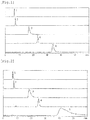
- a mixed liquid of an ammonium formate aqueous solution of 100 mmol/L and acetonitrile in a ratio by volume of 30/70 (ammonium formate aqueous solution/acetonitrile) was passed through the column, and 5 ⁇ L of a liquid obtained by adding lactic acid, glycolic acid, malonic acid, succinic acid and malic acid in each amount of 5 ⁇ g/ml to a mixed liquid of water/acetonitrile in a ratio by volume of 50/50 was injected into the aforesaid liquid chromatograph-mass spectrometer. The resulting mass chromatograms are shown in Fig. 1 . Five kinds of the organic acids were each distinctly separated.
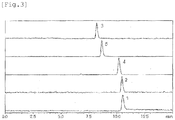
- an aqueous solution obtained by mixing water with formic acid in a ratio by volume of 100/0.1 (water/formic acid) was passed through the column at a rate of 0.8 ml/min, and 5 ⁇ L of an aqueous solution containing lactic acid, glycolic acid, malonic acid, succinic acid and malic acid in each amount of 5 ⁇ g/ml was injected into the aforesaid liquid chromatograph-mass spectrometer. Chromatograms obtained by the mass spectrometer are shown in Fig. 3 . Separation of succinic acid, glycolic acid and lactic acid was more insufficient than in the examples, and besides, a result of lowering of a signal/noise ratio, that is, detection sensitivity, was observed.
- numeral 1 designates a peak of lactic acid
- numeral 2 designates apeak of glycolic acid
- numeral 3 designates a peak of malonic acid
- numeral 4 designates a peak of succinic acid
- numeral 5 designates a peak of malic acid.
- the examples and the comparative example differ from each other in the technique for separation, and therefore, they differ from each other in the order of elution.
Landscapes
- Chemical & Material Sciences (AREA)
- Analytical Chemistry (AREA)
- Biochemistry (AREA)
- Physics & Mathematics (AREA)
- Health & Medical Sciences (AREA)
- Life Sciences & Earth Sciences (AREA)
- General Health & Medical Sciences (AREA)
- General Physics & Mathematics (AREA)
- Immunology (AREA)
- Pathology (AREA)
- Chemical Kinetics & Catalysis (AREA)
- Electrochemistry (AREA)
- Other Investigation Or Analysis Of Materials By Electrical Means (AREA)
Abstract
Description
- The present invention relates to a mass spectrometry method for an organic acid by a liquid chromatograph-mass spectrometer, wherein a column using, as a packing material, a hydrophilic polymer having an anion-exchange group is used, an analytical column packed with the packing material, and an analytical device.
- Organic acids are added to foods as umami together with amino acid, saccharides, etc., and for example, succinic acid, malic acid and the like are used. In recent years, further, organic acids are used also as cleaning agents for electronic materials, etc. A demand for analysis of the organic acids has been increasing.
- As an analytical device for organic acids, a liquid chromatograph has been used in the past, but development of a mass spectrometry method having higher sensitivity and having high identification ability has been desired.
- In a separation part of a liquid chromatograph for the analysis of an organic acid, ion-exclusion chromatography has been widely used in the past. For example, in
JP-A 1996-201365 - However, when the ion-exclusion chromatography is used in combination with a mass spectrometer, the cation-exchange group has low chemical stability and is liable to be detached from the base material. Therefore, in order to prevent detached, the mobile phase needs to be restricted particularly on the organic solvent concentration, and this sometimes becomes disadvantageous in increasing sensitivity of the mass spectrometry. Further, there are problems that in a sample containing plural organic acids, separation of the organic acids is difficult; control of a concentration of an alkaline earth metal ion or a transition metal ion added is not easy; addition of an alkaline earth metal ion or a transition metal ion is unsuitable for mass spectrometry; and moreover, impurities contained in a sample are not separated from an organic acid, and in the detection by a mass spectrometer, sensitivity is liable to be lowered by an ionization inhibitory effect of the impurities.
- As a separation part of a liquid chromatograph for the analysis of an organic acid, ion chromatography is also known. For example, in
JP-A 2009-192241 - If a suppressor is arranged on the downstream of a column, the nonvolatile substance is converted into a volatile substance such as carbonic acid or water. However, not only does the device become complicated but also there is a problem that the suppressor that is an expensive consumable part has to be exchanged periodically. In the case of mass spectrometry by an electrospray ionization method, further, a mobile phase having a high ratio of an organic solvent is generally necessary for increasing sensitivity, and therefore, there is complicatedness that an organic solvent has to be added immediately before the mass spectrometry is carried out.
- In
JP-A 2006-242944 -
- Patent literature 1:
JP-A 1996-201365 - Patent literature 2:
JP-A 2009-192241 - Patent literature 3:
JP-A 2006-242944 - The present invention has been made in the light of such circumstances as above, and it is an object of the present invention to provide a mass spectrometry method wherein in a separation part for mass spectrometry of an organic acid by a liquid chromatograph-mass spectrometer, addition of a nonvolatile substance to a mobile phase is not necessary, the selectively of a water-soluble organic solvent ratio is flexible, and the organic acid can be retained, separated and eluted and as a result the organic acid can be detected with high sensitivity, and to provide an analytical column.
- In order to solve the above problem, the present inventors have earnestly studied, and as a result, have found that the above problem can be solved by using, as a packing material, a hydrophilic polymer having an anion-exchange group, using this packing material as a stationary phase and using a water-soluble organic solvent-water mixed solution as a mobile phase, in a separation part for mass spectrometry of an organic acid by a liquid chromatograph-mass spectrometer. Further, the present inventors have found that by using, as a separation mode in liquid chromatography, a mixed mode of a combination of a hydrophilic interaction chromatography and ion-exchange chromatography and by retaining and separating various organic acids by means of a mobile phase containing a water-soluble organic solvent, the organic acids can be detected with high sensitivity in the mass spectrometry part, and they have accomplished the present invention.
- Here, the hydrophilic interaction chromatography is a separation mode utilizing a difference in affinity between a packing material and a sample, the ion-exchange chromatography is a separation mode utilizing a difference in ion exchangeability between a packing material and a sample, and a preferred separation mode in the present application is a mixed mode simultaneously utilizing interaction due to affinity and interaction due to ion exchangeability.
- That is to say, the present invention relates to the following matters.
- [1] A mass spectrometry method for an organic acid by liquid chromatography-mass spectrometry using a liquid chromatograph-mass spectrometer, wherein a column using, as a packing material, a hydrophilic polymer having an anion-exchange group is used, and as a mobile phase, a water-soluble organic solvent-water mixed solution is used.
- [2] The mass spectrometry method for an organic acid of [1], wherein a base material of the hydrophilic polymer having an anion-exchange group is polyvinyl alcohol.
- [3] The mass spectrometry method for an organic acid of [1] or [2], wherein the anion-exchange group of the hydrophilic polymer having an anion-exchange group is a quaternary ammonium group, and the content of the quaternary ammonium group is 0.01 to 0.1 meq based on 1 g of the hydrophilic polymer.
- [4] The mass spectrometry method for an organic acid of any one of [1] to [3], wherein the water-soluble organic solvent-water mixed solution is a solution containing the water-soluble organic solvent in an amount of 50 to 95% in terms of volume ratio.
- [5] The mass spectrometry method for an organic acid of any one of [1] to [4], wherein the water-soluble organic solvent is at least one kind selected from the group consisting of acetonitrile, methanol, ethanol, isopropanol, acetone, methyl ethyl ketone and tetrahydrofuran.
- [6] The mass spectrometry method for an organic acid of any one of [1] to [5], wherein the separation mode in the liquid chromatography is a mixed mode of a combination of hydrophilic interaction chromatography and ion-exchange chromatography, said method comprising detecting the organic acid by a mass spectrometer.
- [7] A liquid chromatographic column for organic acid analysis, having a polyether ether ketone (PEEK) resin housing for liquid chromatography, said housing being packed with a hydrophilic polymer having an anion-exchange group.
- [8] An analytical device comprising a liquid chromatographic column and a mass spectrometer, said liquid chromatographic column having a packing material containing a hydrophilic polymer having an anion-exchange group and a mobile phase using a mixed solution of a water-soluble organic solvent and water.
- The mass spectrometry method for an organic acid according to the present invention is excellent in retention and separation of various organic acids because a column packed with a specific hydrophilic polymer is combined with a mobile phase, and in the mass spectrometry part, the organic acids can be detected with high sensitivity. Therefore, this mass spectrometry method is useful in a wide range of fields such as fields of foods, cosmetics, environment, agriculture, medicine and industrial materials, and particularly in the field of foods, this method is preferable as an analytical method for umami such as succinic acid and malic acid.
-
- [
Fig. 1] Fig. 1 shows mass chromatograms of organic acids in Example 1 obtained by liquid chromatography-mass spectrometry. - [
Fig. 2] Fig. 2 shows mass chromatograms of organic acids in Example 2 obtained by liquid chromatography-mass spectrometry. - [
Fig. 3] Fig. 3 shows mass chromatograms of organic acids in Comparative Example obtained by liquid chromatography-mass spectrometry. - The present invention will be described in more detail hereinafter.
- An embodiment of the present invention is a mass spectrometry method for an organic acid by a liquid chromatograph-mass spectrometer, wherein by using a column using, as a packing material, a hydrophilic polymer having an anion-exchange group, by using a water-soluble organic solvent-water mixed solution as a mobile phase, and preferably in a mixed mode of hydrophilic interaction chromatography and ion-exchange chromatography, an organic acid is sufficiently retained, separated and eluted to analyze the organic acid with high sensitivity.
- In the present application, the organic acid is an organic compound having a property of acidity, and such organic acids include carboxylic acid, sulfonic acid and phenols. As the organic acid that becomes an object substance of the present invention, carboxylic acid is preferable.
- Examples of the organic acids that can be analyzed by the present invention include aliphatic carboxylic acids, aromatic carboxylic acids, hydroxycarboxylic acids and haloacetic acids. Specific examples of the aliphatic carboxylic acids include fumaric acid, maleic acid, malonic acid and succinic acid. Specific examples of the aromatic carboxylic acids include benzoic acid, phthalic acid, isophthalic acid, terephthalic acid and salicylic acid. Specific examples of the hydroxycarboxylic acids include aliphatic hydroxycarboxylic acids, such as lactic acid, glycolic acid, malic acid and tartaric acid. Specific examples of the haloacetic acids include monochloroacetic acid, dichloroacetic acid and trichloroacetic acid.
- The method of the present invention can be preferably used for mass spectrometry of carboxyl group-containing compounds, e.g., aliphatic carboxylic acids and aliphatic hydroxycarboxylic acids, such as lactic acid, glycolic acid, fumaric acid, maleic acid, malonic acid, succinic acid, malic acid and tartaric acid. The present invention is a method comprising separating various organic acids by liquid chromatography and then mass-separating ions having been produced in an ion source of a mass spectrometer, in the mass separation part on the basis of a mass-to-charge ratio to detect the organic acids. The method of the present invention can be used as a high-sensitivity analytical method in various fields such as fields of foods, cosmetics, environment, agriculture, medicine and industrial materials.
- As the ion sources, ion sources corresponding to an electrospray ionization method, an atmospheric pressure chemical ionization method, etc. can be mentioned. As the mass separation part, a mass separation part of quadrupole type, ion trap type, time of flight type or the like can be mentioned.
- In the organic acid analysis in the present invention, any types of the ion sources and the mass separation parts can be used without any restriction. For ionization of organic acids, an electrospray ionization method is suitable, and in order to carry out measurement with higher sensitivity, it is preferable to raise the water-soluble organic solvent ratio (described later) in a mobile phase and to regulate at a flow rate of 0.1 to 1.0 ml/min of mix solution of the mobile phase.
- As the hydrophilic polymer having an anion-exchange group for use as the packing material in the present invention, there can be mentioned a hydrophilic polymer in which a polymer having hydrophilicity, such as polyvinyl alcohol or polyhydroxy methacrylate, preferably polyvinyl alcohol, is used as a base material and into the base material an anion-exchange group such as a quaternary ammonium group has been introduced in an amount of, for example, 0.01 to 0.1 meq, preferably 0.01 to 0.07 meq, more preferably 0.01 to 0.05 meq, based on 1 g of the polymer, directly or through a spacer, such as epichlorohydrin, 1,4-butanediol diglycidyl ether, ethylene glycol diglycidyl ether or glycerol diglycidyl ether. If the amount of the anion-exchange group is less than 0.01 meq, the ion exchange action is sometimes lowered. If the amount thereof is more than 0.1 meq, the ion exchange action becomes too strong, and there is a possibility of adsorption of an organic acid by the column.
- The hydrophilic polymer having an anion-exchange group can be prepared in accordance with a process described in, for example,
JP-A 2006-242944 - In the present invention, the spacer refers to a site of chemical bonding used for adjusting a distance between the base material and the anion-exchange group such as a quaternary ammonium group. The spacer is used for imparting functions to inhibit interference between an ion and the base material and to inhibit peak diffusion. When the base material is a substance having a hydroxyl group, the spacer is preferably a divalent organic residue having ether linkages at both ends, and examples of such spacers include the aforesaid ones.
- Examples of the quaternary ammonium groups include trimethylammonium group, triethylammonium group, N,N-dimethylallylammonium group and N,N-dimethylbenzylammonium group.
- There is no limitation on the material, the size and the shape of the packing material of the present invention. However, in order to obtain sufficient separation performance and high sensitivity, the shape of the packing material is preferably a spherical shape having a volume-average particle diameter of 1 to 30 µm, and is more preferably a spherical shape having a volume-average particle diameter of 3 to 10 µm. Further, the packing material preferably has a strength to withstand a pressure of 1 to 30 MPa. The volume-average particle diameter is measured by a Coulter counter.
- As the mobile phase for use in the mass spectrometry method for an organic acid according to the present invention, a water-soluble organic solvent-water mixed solution, that is, a mixture of water and an organic solvent, can be used.
- The water-soluble organic solvent in the present application is not specifically restricted as long as it is an organic solvent having compatibility with water, and for example, an organic solvent of 1 to 5 carbons atoms having compatibility with water, etc. can be mentioned. The organic solvent of 1 to 5 carbon atoms means that the number of carbon atoms in the solvent molecule is 1 to 5.
- The solvent is, for example, a solvent selected from the group consisting of alcohol-based solvents, such as methanol, ethanol and propanol, ether-based solvents, such as tetrahydrofuran, nitrile-based solvents, such as acetonitrile, ketone-based solvents, such as acetone, amide-based solvents, such as dimethylformamide, and sulfoxide-based solvent, such as dimethyl sulfoxide. These low-molecular weight solvents may be used singly, or may be used as a mixed solvent of two or more kinds.
- As preferred water-soluble organic solvents, nitriles, such as acetonitrile, alcohols, such as methanol, ethanol and isopropyl alcohol, ethers, such as tetrahydrofuran, and ketones, such as acetone and methyl ethyl ketone, can be used. Water and the water-soluble organic solvent can be mixed in an arbitrary ratio. However, in order to achieve improvement in retention force due to hydrophilic interaction and increase in sensitivity in the mass spectrometer, the ratio of the water-soluble organic solvent mixed is preferably 50 to 95% byvolume, more preferably 55 to 95% byvolume, most preferably 60 to 90% by volume, in the total amount of the mixed solution. If the ratio of the water-soluble organic solvent is lower than 50% by volume, the hydrophilic interaction is sometimes lowered, and if the ratio thereof is higher than 95% byvolume, the organic acid is sometimes adsorbed in the column.
- To the mobile phase, a substance having volatility, such as ammonium formate or ammonium acetate, can be added in an arbitrary ratio, and for example, such a substance can be added in an amount of 1 to 100 mmol based on 1 L of the mixed solution.
- By the addition of such a substance, control of the retention time becomes possible.
- The column for liquid chromatography analysis of an organic acid according to the present invention is a column packed with a hydrophilic polymer having an anion-exchange group. In order to sufficiently suppress adsorption of an organic acid by a metal, the material of the column housing is preferably a polyether ether ketone (PEEK) resin.
- There is no specific limitation on the size of the housing. However, because of flow rate limitation in the mass spectrometer and in order to carry out analysis with higher separation performance and higher sensitivity, the inner diameter is preferably 1.0 to 4.6 mm, and the length is preferably 100 to 250 mm.
- The analytical device according to the present invention includes a liquid chromatographic column having a packing material containing a hydrophilic polymer having an anion-exchange group and a mobile phase using a mixed solution of a water-soluble organic solvent and water, and includes a mass spectrometer.
- The present invention is described in more detail with reference to the following examples, but is should be construed that the present invention is in no way limited to those examples.
- As a liquid chromatograph-mass spectrometer, LCMS-8030 (manufactured by Shimadzu Corporation) having, as an ion source, an electrospray ionization ion source and having a mass separation part of quadrupole type was used.
- Analysis of various organic acids was carried out in a mixed mode of a combination of hydrophilic interaction chromatography and ion-exchange chromatography, as a separation mode. As a detection mode, selective ion monitoring was used, and a deprotonated molecule of each organic acid was detected.
- As a column, Shodex RSpak JJ-50 2D (inner diameter: 2.0 mm, length: 150 mm, housing material: polyether ether ketone resin) packed with a polyvinyl alcohol resin (particle diameter: 5 µm) in which a quaternary ammonium group had been introduced as an anion-exchange group in such a manner that the content of the quaternary ammonium group had become 0.03 meq/g (polymer) was used, and the column temperature was set at 30°C.
- As a mobile phase, a mixed liquid of an ammonium formate aqueous solution of 100 mmol/L and acetonitrile in a ratio by volume of 30/70 (ammonium formate aqueous solution/acetonitrile) was passed through the column, and 5 µL of a liquid obtained by adding lactic acid, glycolic acid, malonic acid, succinic acid and malic acid in each amount of 5 µg/ml to a mixed liquid of water/acetonitrile in a ratio by volume of 50/50 was injected into the aforesaid liquid chromatograph-mass spectrometer. The resulting mass chromatograms are shown in
Fig. 1 . Five kinds of the organic acids were each distinctly separated. - Five kinds of organic acids of lactic acid, glycolic acid, malonic acid, succinic acid and malic acid were analyzed under the same conditions as in Example 1, except that stainless steel was used as a housing material instead of the polyether ether ketone resin. The resulting mass chromatograms are shown in
Fig. 2 . Five kinds of the organic acids were each distinctly separated, but as compared with Example 1, influence of adsorption by the stainless steel was observed on the peak shape. - Using the liquid chromatograph-mass spectrometer used in Examples and using ion-exclusion chromatography as a separation mode, analysis of various organic acids was carried out. As a detection mode, selective ion monitoring was used, and a deprotonated molecule of each organic acid was detected. As a column, a column for organic acid analysis, Shodex RSpak KC-811 (inner diameter: 8.0 mm, length: 300 mm, housing material: stainless steel) (manufactured by Show a Denko K.K.) packed with a styrene/divinylbenzene copolymer resin (particle diameter: 6 µm) into which a sulfo group had been introduced as a cation-exchange group was used, and the column temperature was set at 40°C.
- As a mobile phase, an aqueous solution obtained by mixing water with formic acid in a ratio by volume of 100/0.1 (water/formic acid) was passed through the column at a rate of 0.8 ml/min, and 5 µL of an aqueous solution containing lactic acid, glycolic acid, malonic acid, succinic acid and malic acid in each amount of 5 µg/ml was injected into the aforesaid liquid chromatograph-mass spectrometer. Chromatograms obtained by the mass spectrometer are shown in
Fig. 3 . Separation of succinic acid, glycolic acid and lactic acid was more insufficient than in the examples, and besides, a result of lowering of a signal/noise ratio, that is, detection sensitivity, was observed. - In each of
Figs. 1 to 3 , numeral 1 designates a peak of lactic acid, numeral 2 designates apeak of glycolic acid, numeral 3 designates a peak of malonic acid, numeral 4 designates a peak of succinic acid, and numeral 5 designates a peak of malic acid. The examples and the comparative example differ from each other in the technique for separation, and therefore, they differ from each other in the order of elution. -
- 1: peak of lactic acid
- 2: peak of glycolic acid
- 3: peak of malonic acid
- 4: peak of succinic acid
- 5: peak of malic acid
Claims (8)
- A mass spectrometry method for an organic acid by liquid chromatography-mass spectrometry using a liquid chromatograph-mass spectrometer, wherein a column using, as a packing material, a hydrophilic polymer having an anion-exchange group is used, and as a mobile phase, a water-soluble organic solvent-water mixed solution is used.
- The mass spectrometry method for an organic acid as claimed in claim 1, wherein a base material of the hydrophilic polymer having an anion-exchange group is polyvinyl alcohol.
- The mass spectrometry method for an organic acid as claimed in claim 1 or 2, wherein the anion-exchange group of the hydrophilic polymer having an anion-exchange group is a quaternary ammonium group, and the content of the quaternary ammonium group is 0.01 to 0.1 meq based on 1 g of the hydrophilic polymer.
- The mass spectrometry method for an organic acid as claimed in any one of claims 1 to 3, wherein the water-soluble organic solvent-water mixed solution is a solution containing the water-soluble organic solvent in an amount of 50 to 95% in terms of volume ratio.
- The mass spectrometry method for an organic acid as claimed in any one of claims 1 to 4, wherein the water-soluble organic solvent is at least one kind selected from the group consisting of acetonitrile, methanol, ethanol, isopropanol, acetone, methyl ethyl ketone and tetrahydrofuran.
- The mass spectrometry method for an organic acid as claimed in any one of claims 1 to 5, wherein the separation mode in the liquid chromatography is a mixed mode of a combination of hydrophilic interaction chromatography and ion-exchange chromatography, said method comprising detecting the organic acid by a mass spectrometer.
- A liquid chromatographic column for organic acid analysis, having a polyether ether ketone (PEEK) resin housing for liquid chromatography, said housing being packed with a hydrophilic polymer having an anion-exchange group.
- An analytical device comprising a liquid chromatographic column and a mass spectrometer, said liquid chromatographic column having a packing material containing a hydrophilic polymer having an anion-exchange group and a mobile phase using a mixed solution of a water-soluble organic solvent and water.
Applications Claiming Priority (2)
| Application Number | Priority Date | Filing Date | Title |
|---|---|---|---|
| JP2014096646 | 2014-05-08 | ||
| PCT/JP2015/058195 WO2015170516A1 (en) | 2014-05-08 | 2015-03-19 | Method, column, and device for analyzing organic acid by mass spectrometry |
Publications (2)
| Publication Number | Publication Date |
|---|---|
| EP3141894A1 true EP3141894A1 (en) | 2017-03-15 |
| EP3141894A4 EP3141894A4 (en) | 2017-11-15 |
Family
ID=54392370
Family Applications (1)
| Application Number | Title | Priority Date | Filing Date |
|---|---|---|---|
| EP15789114.4A Withdrawn EP3141894A4 (en) | 2014-05-08 | 2015-03-19 | Method, column, and device for analyzing organic acid by mass spectrometry |
Country Status (4)
| Country | Link |
|---|---|
| US (1) | US20170108474A1 (en) |
| EP (1) | EP3141894A4 (en) |
| JP (1) | JPWO2015170516A1 (en) |
| WO (1) | WO2015170516A1 (en) |
Families Citing this family (10)
| Publication number | Priority date | Publication date | Assignee | Title |
|---|---|---|---|---|
| JP6706497B2 (en) * | 2015-12-24 | 2020-06-10 | 昭和電工株式会社 | Method for separating and analyzing hydrophilic compounds |
| EP3444607A1 (en) | 2017-08-17 | 2019-02-20 | BP Exploration Operating Company Limited | Quantitative method for determining the organic acid content of crude oil |
| CN110133124A (en) * | 2019-04-29 | 2019-08-16 | 天津中医药大学 | The content assaying method of 18 kinds of amino acid in SHUXUETONG ZHUSHEYE |
| CN110632243B (en) * | 2019-10-23 | 2021-10-12 | 中国日用化学研究院有限公司 | Method for simultaneously determining contents of glycolic acid, monochloroacetic acid and dichloroacetic acid in alcohol ether carboxylate |
| KR102731294B1 (en) * | 2019-11-13 | 2024-11-18 | 주식회사 엘지화학 | Method and system for content analysis of residual organic acid in polymer |
| CN110967432B (en) * | 2019-12-25 | 2021-03-30 | 江南大学 | A method for determining the content of organic acids in root exudates |
| CN111841515B (en) * | 2020-07-21 | 2023-03-28 | 镇江海关综合技术中心 | Ionic liquid bridged hybrid silicon oxide as water-rich chromatographic stationary phase and preparation method and application thereof |
| CN112326839B (en) * | 2020-11-16 | 2022-08-02 | 山东华熙海御生物医药有限公司 | Method for detecting residual quantity of lactic acid |
| CN114778735B (en) * | 2022-04-24 | 2024-04-02 | 四川汇宇制药股份有限公司 | Separation detection method for chloroacetic acid or salt thereof and related substances |
| CN114994194B (en) * | 2022-05-09 | 2024-04-09 | 广东安纳检测技术有限公司 | Method and device for measuring malonic acid in water |
Family Cites Families (6)
| Publication number | Priority date | Publication date | Assignee | Title |
|---|---|---|---|---|
| JP4207362B2 (en) * | 1999-05-27 | 2009-01-14 | 昭和電工株式会社 | Alkali-resistant high-strength anion exchanger and method for producing the same |
| EP1657261A1 (en) * | 2000-05-29 | 2006-05-17 | Showa Denko K.K. | Porous polymer particle, anion exchanger, producing method thereof, column for ion chromatography, and method for measuring anions |
| JP2004125453A (en) * | 2002-09-30 | 2004-04-22 | Shimadzu Corp | Organic acid analysis method |
| TW200639190A (en) * | 2005-02-04 | 2006-11-16 | Showa Denko Kk | Packing material for ion chromatography |
| JP4860419B2 (en) * | 2006-10-11 | 2012-01-25 | 昭和電工株式会社 | Simultaneous analysis of anions using ion chromatography |
| JP5696787B2 (en) * | 2011-08-12 | 2015-04-08 | 株式会社島津製作所 | Analytical method of halogen oxyacid |
-
2015
- 2015-03-19 EP EP15789114.4A patent/EP3141894A4/en not_active Withdrawn
- 2015-03-19 WO PCT/JP2015/058195 patent/WO2015170516A1/en not_active Ceased
- 2015-03-19 US US15/128,310 patent/US20170108474A1/en not_active Abandoned
- 2015-03-19 JP JP2016517834A patent/JPWO2015170516A1/en active Pending
Also Published As
| Publication number | Publication date |
|---|---|
| JPWO2015170516A1 (en) | 2017-04-20 |
| US20170108474A1 (en) | 2017-04-20 |
| WO2015170516A1 (en) | 2015-11-12 |
| EP3141894A4 (en) | 2017-11-15 |
Similar Documents
| Publication | Publication Date | Title |
|---|---|---|
| US20170108474A1 (en) | Mass spectrometry method for organic acid, analytical column and analytical device | |
| Trufelli et al. | An overview of matrix effects in liquid chromatography–mass spectrometry | |
| Niessen et al. | Matrix effects in quantitative pesticide analysis using liquid chromatography–mass spectrometry | |
| Melmer et al. | Comparison of hydrophilic-interaction, reversed-phase and porous graphitic carbon chromatography for glycan analysis | |
| Zwiener et al. | LC-MS analysis in the aquatic environment and in water treatment–a critical review: part i: instrumentation and general aspects of analysis and detection | |
| Fujito et al. | Importance of optimizing chromatographic conditions and mass spectrometric parameters for supercritical fluid chromatography/mass spectrometry | |
| Xian et al. | Dispersive micro solid phase extraction (DMSPE) using polymer anion exchange (PAX) as the sorbent followed by UPLC–MS/MS for the rapid determination of four bisphenols in commercial edible oils | |
| Du et al. | Miniaturized solid-phase extraction of macrolide antibiotics in honey and bovine milk using mesoporous MCM-41 silica as sorbent | |
| Farré et al. | Analysis of biologically active compounds in water by ultra‐performance liquid chromatography quadrupole time‐of‐flight mass spectrometry | |
| Chen et al. | Application of nanoring amino-functionalized magnetic polymer dispersive micro-solid-phase extraction and ultra fast liquid chromatography–tandem mass spectrometry in dicyandiamide residue analysis of powdered milk | |
| Bratkowska et al. | Hypercrosslinked strong anion‐exchange resin for extraction of acidic pharmaceuticals from environmental water | |
| Van Hout et al. | Ion suppression in the determination of clenbuterol in urine by solid‐phase extraction atmospheric pressure chemical ionisation ion‐trap mass spectrometry | |
| Gilchrist et al. | Organic solvent and temperature-enhanced ion chromatography-high resolution mass spectrometry for the determination of low molecular weight organic and inorganic anions | |
| da Silva et al. | Evaluation of ionic liquids supported on silica as a sorbent for fully automated online solid‐phase extraction with LC–MS determination of sulfonamides in bovine milk samples | |
| Gonçalves et al. | New method for determination of (E)‐resveratrol in wine based on microextraction using packed sorbent and ultra‐performance liquid chromatography | |
| Karu et al. | Use of suppressors for signal enhancement of weakly-acidic analytes in ion chromatography with universal detection methods | |
| Ahrer et al. | Analysis of low-molecular-mass inorganic and organic anions by ion chromatography–atmospheric pressure ionization mass spectrometry | |
| Kosjek et al. | The use of quadrupole-time-of-flight mass spectrometer for the elucidation of diclofenac biotransformation products in wastewater | |
| Seitz et al. | Advantage of liquid chromatography with high‐resolution mass spectrometry for the detection of the small and polar molecules trifluoroacetic acid and sulfamic acid | |
| Meermann et al. | Capillary electrophoresis with inductively coupled plasma‐mass spectrometric and electrospray time of flight mass spectrometric detection for the determination of arsenic species in fish samples | |
| Dussault et al. | Matrix effects on mass spectrometric determinations of four pharmaceuticals and personal care products in water, sediments, and biota | |
| Dear et al. | Use of directly coupled ion-exchange liquid chromatography–mass spectrometry and liquid chromatography–nuclear magnetic resonance spectroscopy as a strategy for polar metabolite identification | |
| Alberts et al. | Development of a Fast, Sensitive and Robust LC-MS/MS Method for the Analysis of Natamycin in Wine. | |
| Tang et al. | Observation and confirmation of oxidation reactions occurring on ultra‐high‐performance liquid chromatography columns | |
| Buchberger et al. | Trace analysis of biocidal oligoguanidines in environmental water samples |
Legal Events
| Date | Code | Title | Description |
|---|---|---|---|
| STAA | Information on the status of an ep patent application or granted ep patent |
Free format text: STATUS: THE INTERNATIONAL PUBLICATION HAS BEEN MADE |
|
| PUAI | Public reference made under article 153(3) epc to a published international application that has entered the european phase |
Free format text: ORIGINAL CODE: 0009012 |
|
| STAA | Information on the status of an ep patent application or granted ep patent |
Free format text: STATUS: REQUEST FOR EXAMINATION WAS MADE |
|
| 17P | Request for examination filed |
Effective date: 20161017 |
|
| AK | Designated contracting states |
Kind code of ref document: A1 Designated state(s): AL AT BE BG CH CY CZ DE DK EE ES FI FR GB GR HR HU IE IS IT LI LT LU LV MC MK MT NL NO PL PT RO RS SE SI SK SM TR |
|
| AX | Request for extension of the european patent |
Extension state: BA ME |
|
| DAV | Request for validation of the european patent (deleted) | ||
| DAX | Request for extension of the european patent (deleted) | ||
| STAA | Information on the status of an ep patent application or granted ep patent |
Free format text: STATUS: THE APPLICATION HAS BEEN WITHDRAWN |
|
| A4 | Supplementary search report drawn up and despatched |
Effective date: 20171013 |
|
| RIC1 | Information provided on ipc code assigned before grant |
Ipc: G01N 30/26 20060101ALI20171009BHEP Ipc: G01N 27/62 20060101ALI20171009BHEP Ipc: G01N 30/02 20060101ALI20171009BHEP Ipc: G01N 30/56 20060101ALI20171009BHEP Ipc: B01D 15/36 20060101ALI20171009BHEP Ipc: G01N 30/72 20060101AFI20171009BHEP Ipc: B01D 15/38 20060101ALI20171009BHEP Ipc: G01N 30/88 20060101ALI20171009BHEP |
|
| 18W | Application withdrawn |
Effective date: 20171109 |