EP3141618A1 - Procédé de traitement d'une ou plusieurs pièces en acier - Google Patents
Procédé de traitement d'une ou plusieurs pièces en acier Download PDFInfo
- Publication number
- EP3141618A1 EP3141618A1 EP16185860.0A EP16185860A EP3141618A1 EP 3141618 A1 EP3141618 A1 EP 3141618A1 EP 16185860 A EP16185860 A EP 16185860A EP 3141618 A1 EP3141618 A1 EP 3141618A1
- Authority
- EP
- European Patent Office
- Prior art keywords
- parts
- pieces
- preheating
- treatment method
- surface treatment
- Prior art date
- Legal status (The legal status is an assumption and is not a legal conclusion. Google has not performed a legal analysis and makes no representation as to the accuracy of the status listed.)
- Withdrawn
Links
- 238000000034 method Methods 0.000 title claims abstract description 25
- 229910000831 Steel Inorganic materials 0.000 title abstract description 11
- 239000010959 steel Substances 0.000 title abstract description 11
- 230000006698 induction Effects 0.000 claims abstract description 25
- 238000010438 heat treatment Methods 0.000 claims abstract description 21
- 238000011282 treatment Methods 0.000 claims abstract description 18
- 238000004381 surface treatment Methods 0.000 claims abstract description 14
- 238000005256 carbonitriding Methods 0.000 claims description 5
- 230000005855 radiation Effects 0.000 claims description 4
- 230000000295 complement effect Effects 0.000 claims description 2
- IJGRMHOSHXDMSA-UHFFFAOYSA-N Atomic nitrogen Chemical compound N#N IJGRMHOSHXDMSA-UHFFFAOYSA-N 0.000 description 9
- 238000005255 carburizing Methods 0.000 description 4
- 229910052757 nitrogen Inorganic materials 0.000 description 4
- OKKJLVBELUTLKV-UHFFFAOYSA-N Methanol Chemical compound OC OKKJLVBELUTLKV-UHFFFAOYSA-N 0.000 description 3
- OKTJSMMVPCPJKN-UHFFFAOYSA-N Carbon Chemical compound [C] OKTJSMMVPCPJKN-UHFFFAOYSA-N 0.000 description 2
- ATUOYWHBWRKTHZ-UHFFFAOYSA-N Propane Chemical compound CCC ATUOYWHBWRKTHZ-UHFFFAOYSA-N 0.000 description 2
- 229910052799 carbon Inorganic materials 0.000 description 2
- 125000004432 carbon atom Chemical group C* 0.000 description 2
- 238000009792 diffusion process Methods 0.000 description 2
- 239000000463 material Substances 0.000 description 2
- GQPLMRYTRLFLPF-UHFFFAOYSA-N nitrous oxide Inorganic materials [O-][N+]#N GQPLMRYTRLFLPF-UHFFFAOYSA-N 0.000 description 2
- 238000010791 quenching Methods 0.000 description 2
- 239000004246 zinc acetate Substances 0.000 description 2
- QGZKDVFQNNGYKY-UHFFFAOYSA-N Ammonia Chemical compound N QGZKDVFQNNGYKY-UHFFFAOYSA-N 0.000 description 1
- VGGSQFUCUMXWEO-UHFFFAOYSA-N Ethene Chemical compound C=C VGGSQFUCUMXWEO-UHFFFAOYSA-N 0.000 description 1
- 239000005977 Ethylene Substances 0.000 description 1
- 150000001335 aliphatic alkanes Chemical class 0.000 description 1
- HSFWRNGVRCDJHI-UHFFFAOYSA-N alpha-acetylene Natural products C#C HSFWRNGVRCDJHI-UHFFFAOYSA-N 0.000 description 1
- 238000012550 audit Methods 0.000 description 1
- 230000000593 degrading effect Effects 0.000 description 1
- 238000010586 diagram Methods 0.000 description 1
- 229910001873 dinitrogen Inorganic materials 0.000 description 1
- 238000004090 dissolution Methods 0.000 description 1
- 125000002534 ethynyl group Chemical group [H]C#C* 0.000 description 1
- 229930195733 hydrocarbon Natural products 0.000 description 1
- 150000002430 hydrocarbons Chemical class 0.000 description 1
- 238000009434 installation Methods 0.000 description 1
- 238000004519 manufacturing process Methods 0.000 description 1
- 239000002184 metal Substances 0.000 description 1
- 125000004433 nitrogen atom Chemical group N* 0.000 description 1
- 238000013021 overheating Methods 0.000 description 1
- 239000001294 propane Substances 0.000 description 1
- 230000000171 quenching effect Effects 0.000 description 1
- 230000000087 stabilizing effect Effects 0.000 description 1
Images
Classifications
-
- C—CHEMISTRY; METALLURGY
- C21—METALLURGY OF IRON
- C21D—MODIFYING THE PHYSICAL STRUCTURE OF FERROUS METALS; GENERAL DEVICES FOR HEAT TREATMENT OF FERROUS OR NON-FERROUS METALS OR ALLOYS; MAKING METAL MALLEABLE, e.g. BY DECARBURISATION OR TEMPERING
- C21D1/00—General methods or devices for heat treatment, e.g. annealing, hardening, quenching or tempering
- C21D1/06—Surface hardening
- C21D1/09—Surface hardening by direct application of electrical or wave energy; by particle radiation
- C21D1/10—Surface hardening by direct application of electrical or wave energy; by particle radiation by electric induction
-
- C—CHEMISTRY; METALLURGY
- C21—METALLURGY OF IRON
- C21D—MODIFYING THE PHYSICAL STRUCTURE OF FERROUS METALS; GENERAL DEVICES FOR HEAT TREATMENT OF FERROUS OR NON-FERROUS METALS OR ALLOYS; MAKING METAL MALLEABLE, e.g. BY DECARBURISATION OR TEMPERING
- C21D1/00—General methods or devices for heat treatment, e.g. annealing, hardening, quenching or tempering
- C21D1/34—Methods of heating
- C21D1/42—Induction heating
-
- C—CHEMISTRY; METALLURGY
- C21—METALLURGY OF IRON
- C21D—MODIFYING THE PHYSICAL STRUCTURE OF FERROUS METALS; GENERAL DEVICES FOR HEAT TREATMENT OF FERROUS OR NON-FERROUS METALS OR ALLOYS; MAKING METAL MALLEABLE, e.g. BY DECARBURISATION OR TEMPERING
- C21D9/00—Heat treatment, e.g. annealing, hardening, quenching or tempering, adapted for particular articles; Furnaces therefor
- C21D9/0006—Details, accessories not peculiar to any of the following furnaces
- C21D9/0018—Details, accessories not peculiar to any of the following furnaces for charging, discharging or manipulation of charge
-
- C—CHEMISTRY; METALLURGY
- C21—METALLURGY OF IRON
- C21D—MODIFYING THE PHYSICAL STRUCTURE OF FERROUS METALS; GENERAL DEVICES FOR HEAT TREATMENT OF FERROUS OR NON-FERROUS METALS OR ALLOYS; MAKING METAL MALLEABLE, e.g. BY DECARBURISATION OR TEMPERING
- C21D9/00—Heat treatment, e.g. annealing, hardening, quenching or tempering, adapted for particular articles; Furnaces therefor
- C21D9/0068—Heat treatment, e.g. annealing, hardening, quenching or tempering, adapted for particular articles; Furnaces therefor for particular articles not mentioned below
-
- C—CHEMISTRY; METALLURGY
- C23—COATING METALLIC MATERIAL; COATING MATERIAL WITH METALLIC MATERIAL; CHEMICAL SURFACE TREATMENT; DIFFUSION TREATMENT OF METALLIC MATERIAL; COATING BY VACUUM EVAPORATION, BY SPUTTERING, BY ION IMPLANTATION OR BY CHEMICAL VAPOUR DEPOSITION, IN GENERAL; INHIBITING CORROSION OF METALLIC MATERIAL OR INCRUSTATION IN GENERAL
- C23C—COATING METALLIC MATERIAL; COATING MATERIAL WITH METALLIC MATERIAL; SURFACE TREATMENT OF METALLIC MATERIAL BY DIFFUSION INTO THE SURFACE, BY CHEMICAL CONVERSION OR SUBSTITUTION; COATING BY VACUUM EVAPORATION, BY SPUTTERING, BY ION IMPLANTATION OR BY CHEMICAL VAPOUR DEPOSITION, IN GENERAL
- C23C8/00—Solid state diffusion of only non-metal elements into metallic material surfaces; Chemical surface treatment of metallic material by reaction of the surface with a reactive gas, leaving reaction products of surface material in the coating, e.g. conversion coatings, passivation of metals
- C23C8/02—Pretreatment of the material to be coated
-
- C—CHEMISTRY; METALLURGY
- C23—COATING METALLIC MATERIAL; COATING MATERIAL WITH METALLIC MATERIAL; CHEMICAL SURFACE TREATMENT; DIFFUSION TREATMENT OF METALLIC MATERIAL; COATING BY VACUUM EVAPORATION, BY SPUTTERING, BY ION IMPLANTATION OR BY CHEMICAL VAPOUR DEPOSITION, IN GENERAL; INHIBITING CORROSION OF METALLIC MATERIAL OR INCRUSTATION IN GENERAL
- C23C—COATING METALLIC MATERIAL; COATING MATERIAL WITH METALLIC MATERIAL; SURFACE TREATMENT OF METALLIC MATERIAL BY DIFFUSION INTO THE SURFACE, BY CHEMICAL CONVERSION OR SUBSTITUTION; COATING BY VACUUM EVAPORATION, BY SPUTTERING, BY ION IMPLANTATION OR BY CHEMICAL VAPOUR DEPOSITION, IN GENERAL
- C23C8/00—Solid state diffusion of only non-metal elements into metallic material surfaces; Chemical surface treatment of metallic material by reaction of the surface with a reactive gas, leaving reaction products of surface material in the coating, e.g. conversion coatings, passivation of metals
- C23C8/06—Solid state diffusion of only non-metal elements into metallic material surfaces; Chemical surface treatment of metallic material by reaction of the surface with a reactive gas, leaving reaction products of surface material in the coating, e.g. conversion coatings, passivation of metals using gases
- C23C8/08—Solid state diffusion of only non-metal elements into metallic material surfaces; Chemical surface treatment of metallic material by reaction of the surface with a reactive gas, leaving reaction products of surface material in the coating, e.g. conversion coatings, passivation of metals using gases only one element being applied
- C23C8/20—Carburising
- C23C8/22—Carburising of ferrous surfaces
-
- C—CHEMISTRY; METALLURGY
- C23—COATING METALLIC MATERIAL; COATING MATERIAL WITH METALLIC MATERIAL; CHEMICAL SURFACE TREATMENT; DIFFUSION TREATMENT OF METALLIC MATERIAL; COATING BY VACUUM EVAPORATION, BY SPUTTERING, BY ION IMPLANTATION OR BY CHEMICAL VAPOUR DEPOSITION, IN GENERAL; INHIBITING CORROSION OF METALLIC MATERIAL OR INCRUSTATION IN GENERAL
- C23C—COATING METALLIC MATERIAL; COATING MATERIAL WITH METALLIC MATERIAL; SURFACE TREATMENT OF METALLIC MATERIAL BY DIFFUSION INTO THE SURFACE, BY CHEMICAL CONVERSION OR SUBSTITUTION; COATING BY VACUUM EVAPORATION, BY SPUTTERING, BY ION IMPLANTATION OR BY CHEMICAL VAPOUR DEPOSITION, IN GENERAL
- C23C8/00—Solid state diffusion of only non-metal elements into metallic material surfaces; Chemical surface treatment of metallic material by reaction of the surface with a reactive gas, leaving reaction products of surface material in the coating, e.g. conversion coatings, passivation of metals
- C23C8/06—Solid state diffusion of only non-metal elements into metallic material surfaces; Chemical surface treatment of metallic material by reaction of the surface with a reactive gas, leaving reaction products of surface material in the coating, e.g. conversion coatings, passivation of metals using gases
- C23C8/28—Solid state diffusion of only non-metal elements into metallic material surfaces; Chemical surface treatment of metallic material by reaction of the surface with a reactive gas, leaving reaction products of surface material in the coating, e.g. conversion coatings, passivation of metals using gases more than one element being applied in one step
- C23C8/30—Carbo-nitriding
- C23C8/32—Carbo-nitriding of ferrous surfaces
-
- H—ELECTRICITY
- H05—ELECTRIC TECHNIQUES NOT OTHERWISE PROVIDED FOR
- H05B—ELECTRIC HEATING; ELECTRIC LIGHT SOURCES NOT OTHERWISE PROVIDED FOR; CIRCUIT ARRANGEMENTS FOR ELECTRIC LIGHT SOURCES, IN GENERAL
- H05B6/00—Heating by electric, magnetic or electromagnetic fields
- H05B6/02—Induction heating
- H05B6/06—Control, e.g. of temperature, of power
-
- H—ELECTRICITY
- H05—ELECTRIC TECHNIQUES NOT OTHERWISE PROVIDED FOR
- H05B—ELECTRIC HEATING; ELECTRIC LIGHT SOURCES NOT OTHERWISE PROVIDED FOR; CIRCUIT ARRANGEMENTS FOR ELECTRIC LIGHT SOURCES, IN GENERAL
- H05B6/00—Heating by electric, magnetic or electromagnetic fields
- H05B6/02—Induction heating
- H05B6/10—Induction heating apparatus, other than furnaces, for specific applications
- H05B6/101—Induction heating apparatus, other than furnaces, for specific applications for local heating of metal pieces
-
- C—CHEMISTRY; METALLURGY
- C21—METALLURGY OF IRON
- C21D—MODIFYING THE PHYSICAL STRUCTURE OF FERROUS METALS; GENERAL DEVICES FOR HEAT TREATMENT OF FERROUS OR NON-FERROUS METALS OR ALLOYS; MAKING METAL MALLEABLE, e.g. BY DECARBURISATION OR TEMPERING
- C21D9/00—Heat treatment, e.g. annealing, hardening, quenching or tempering, adapted for particular articles; Furnaces therefor
- C21D9/32—Heat treatment, e.g. annealing, hardening, quenching or tempering, adapted for particular articles; Furnaces therefor for gear wheels, worm wheels, or the like
-
- C—CHEMISTRY; METALLURGY
- C21—METALLURGY OF IRON
- C21D—MODIFYING THE PHYSICAL STRUCTURE OF FERROUS METALS; GENERAL DEVICES FOR HEAT TREATMENT OF FERROUS OR NON-FERROUS METALS OR ALLOYS; MAKING METAL MALLEABLE, e.g. BY DECARBURISATION OR TEMPERING
- C21D9/00—Heat treatment, e.g. annealing, hardening, quenching or tempering, adapted for particular articles; Furnaces therefor
- C21D9/38—Heat treatment, e.g. annealing, hardening, quenching or tempering, adapted for particular articles; Furnaces therefor for roll bodies
-
- C—CHEMISTRY; METALLURGY
- C21—METALLURGY OF IRON
- C21D—MODIFYING THE PHYSICAL STRUCTURE OF FERROUS METALS; GENERAL DEVICES FOR HEAT TREATMENT OF FERROUS OR NON-FERROUS METALS OR ALLOYS; MAKING METAL MALLEABLE, e.g. BY DECARBURISATION OR TEMPERING
- C21D9/00—Heat treatment, e.g. annealing, hardening, quenching or tempering, adapted for particular articles; Furnaces therefor
- C21D9/40—Heat treatment, e.g. annealing, hardening, quenching or tempering, adapted for particular articles; Furnaces therefor for rings; for bearing races
-
- Y—GENERAL TAGGING OF NEW TECHNOLOGICAL DEVELOPMENTS; GENERAL TAGGING OF CROSS-SECTIONAL TECHNOLOGIES SPANNING OVER SEVERAL SECTIONS OF THE IPC; TECHNICAL SUBJECTS COVERED BY FORMER USPC CROSS-REFERENCE ART COLLECTIONS [XRACs] AND DIGESTS
- Y02—TECHNOLOGIES OR APPLICATIONS FOR MITIGATION OR ADAPTATION AGAINST CLIMATE CHANGE
- Y02P—CLIMATE CHANGE MITIGATION TECHNOLOGIES IN THE PRODUCTION OR PROCESSING OF GOODS
- Y02P10/00—Technologies related to metal processing
- Y02P10/25—Process efficiency
Definitions
- the invention is in the field of surface treatment of steel parts.
- Steel parts for the metal trades such as the automotive industry, the machine tool industry, the railway industry or the aerospace industry, often require surface treatment to improve their mechanical strength, such as their hardness or their fatigue behavior.
- the treatment is a thermochemical treatment.
- the surface treatment can be a carburizing, that is to say the introduction by diffusion into the steel, from the surface of the parts, carbon atoms, or carbonitriding, that is to say the introduction into the steel, always by diffusion from the surface of the parts, carbon atoms and nitrogen atoms.
- the nitrogen is derived for example from ammonia gas, while the carbon is derived from ethylene, acetylene, methanol, and / or from alkanes or other hydrocarbons, such as propane.
- the parts to be treated are first heated before being treated with carbon or nitrogen gas in an oven.
- Processes are known at a pressure close to atmospheric pressure or a bar, and at a temperature of the order of 800 ° C.
- Low pressure processes known at lower pressure for example 0.1 bar or 0.01 bar, are also known and at similar temperatures, lower or higher, for example of the order of 940 ° C., or even 1000 ° C or 1050 ° C. In these latter cases we speak of high temperature processes. They can be used inter alia in a continuous furnace, or in a so-called “multi-cell” system.
- FR2884523 discloses a low pressure carbonitriding process. It first requires a step of heating the enclosure, in which the temperature is set by heating means which causes a rise in the temperature in the enclosure. Raising the temperature in the enclosure takes time and increases the duration of the treatment cycle.
- the time of preheating, or dissolution of the parts is about 40 minutes to 1:15 depending on the massiveness of the parts.
- a surface treatment method comprising a preliminary step of preheating at least one workpiece and a step of thermochemical treatment of said at least one piece once it preheated, characterized in that the preliminary preheating step comprises heating the at least one part by induction.
- This method allows a considerable time saving, retaining the mechanical properties of the at least one part.
- the process is therefore improved in terms of productivity.
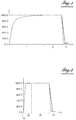
- the temperature curve as a function of time of a surface treatment method according to the prior art is shown.
- heating is carried out in a nitrous radiation cell at 1 bar, or 1.5 bar.
- the curve shows the temperature of the rooms, with the temperature setpoint in dotted lines. It is heated for 30 minutes so that the pieces reach 1000 ° C (phase 1), then the cementation is then conducted for 15 minutes (phase 2), before it is carried out with nitrogen quenching at 10 bar, carried out in masked time (phase 3).
- the temperature curve as a function of time of a surface treatment method is shown.
- preheating is carried out by induction under nitrogen at 1 bar.
- the curve shows the temperature of the parts, with the temperature setpoint in dashed line.
- Preliminary induction heating is thus carried out for 2 minutes so that the parts reach a temperature close to 1000 ° C. (phase 10), then a supplementary heating is carried out with the same set point in a nitrous radiation cell at 1 bar for 5 minutes. minutes (phase 20), the temperature stabilizing at 1000 ° C.
- the cementation is then carried out for 15 minutes (phase 30), before it is carried out with a nitrogen quench at 10 bar, carried out in masked time (phase 40).
- Induction heating is adapted in duration and intensity so that the parts heat quickly without there being a local overheating of the room degrading the functional behavior of the latter.
- the example presented includes an induction heating time of 2 minutes, but this time can for example be 2 seconds or 20 minutes depending on the parts.
- the cycle time passes between the process of figure 1 and that of the figure 2 from 45 minutes to 22 minutes, a reduction of 50%.
- the preheat time changes from 30 minutes of radiant heating to 2 minutes of induction heating plus 5 minutes of radiant heating, and is reduced by 23 minutes, evening 76%.
- Induction preheating can be carried out according to the diagrams of Figures 3 and 4 , but also according to other architectures.
- the carburizing can be replaced by carbonitriding.
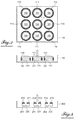
- figure 3 there is shown a first architecture of the induction preheating installation, seen from above in the upper part of the figure, and profile in the lower part of the figure.
- the parts 100 to 108 treated in this example are parts having the geometry of cylinders of low height (or thick discs). They are disposed on the surface of a treatment tray 150 for high temperature processing, next to each other in a square mesh network arrangement (for example).
- the pieces 100 to 108 can be held by centering and wedging supports 120, 121, 122, etc. which wedge them and center them on the treatment plate 150.
- Means for generating eddy currents 110 to 118 hollow cylindrical shapes are placed around each of the parts concentrically with them, concentrically also with the centering and wedging supports 120, 121, 122, ....
- a retractable support makes it possible to move all the means to generate Eddy currents 110 to 118, put them in place around the parts and then release the parts once preheating done.
- the means for generating eddy currents 110 to 118 are retractable.
- the pieces 100 to 108 each have a surface facing a surface of at least one other adjacent piece, and the means for generating eddy currents 110 to 118 are disposed between respective surfaces of facing pieces.
- figure 4 there is shown a second architecture of the induction preheating plant, seen in profile.
- the parts 200 to 208 treated in this example are parts having the geometry of cylinders of low height (or thick discs), as in the previous figure. They are disposed on the surface of a treatment tray 250 for high temperature processing, next to each other in a square mesh network arrangement. They all have the same height, and therefore all have a free surface in the same plane, opposite the surface of the treatment plate 250.
- the parts 200 to 208 can be held by centering and wedging supports 220, 221, 222, etc ... which wedge and center on the processing plate 250.
- Means for generating eddy currents 210, 211, 212 ... etc are placed facing the free surface of each of the parts opposite the tray 250.
- a retractable support makes it possible to move all the means to generate eddy currents 210, 211, 212, etc., to place them face to the free surface of the parts and then to release the parts once the preheating done.
- the means for generating eddy currents 210, 211, 212, etc. are retractable.
- the invention can be implemented with a single piece of treated steel, or several pieces of steel treated simultaneously.
Landscapes
- Chemical & Material Sciences (AREA)
- Engineering & Computer Science (AREA)
- Mechanical Engineering (AREA)
- Materials Engineering (AREA)
- Metallurgy (AREA)
- Organic Chemistry (AREA)
- Physics & Mathematics (AREA)
- Thermal Sciences (AREA)
- Crystallography & Structural Chemistry (AREA)
- Chemical Kinetics & Catalysis (AREA)
- Electromagnetism (AREA)
- Heat Treatment Of Articles (AREA)
Abstract
Description
- L'invention s'inscrit dans le domaine du traitement de surface des pièces en acier.
- Les pièces en acier destinées aux industries mécaniques, comme l'industrie automobile, l'industrie des machines-outils, l'industrie ferroviaire ou l'industrie aéronautique, requièrent très souvent un traitement de surface pour améliorer leur résistance mécanique, telle leur dureté ou leur tenue en fatigue. Le traitement est un traitement thermochimique.
- Le traitement de surface peut être une cémentation, c'est-à-dire l'introduction par diffusion dans l'acier, à partir de la surface des pièces, d'atomes de carbone, ou une carbonitruration, c'est-à-dire l'introduction dans l'acier, toujours par diffusion à partir de la surface des pièces, d'atomes de carbone et d'atomes d'azote.
- L'azote est issu par exemple du gaz ammoniac, alors que le carbone est issu d'éthylène, acétylène, méthanol, et/ou d'alcanes ou autres hydrocarbures, comme par exemple le propane.
- Les pièces à traiter sont tout d'abord chauffées avant d'être traitées à l'aide de gaz carbonés ou azotés dans un four.
- On connait des procédés réalisés à une pression proche de la pression atmosphérique ou d'un bar, et à une température de l'ordre de 800 °C.
- On connait aussi des procédés dits « basse pression » réalisés à une pression plus faible par exemple 0,1 bar ou 0.01 bar et à des températures similaires, plus faibles ou plus élevées, par exemple de l'ordre de 940°C, voire 1000°C ou 1050°C. Dans ces derniers cas on parle de procédés à haute température. Ils peuvent être mis en oeuvre entre autres dans un four continu, ou dans un système dit « multi-cellules ».
-
FR2884523 - Typiquement, pour les traitements à haute température, le temps de préchauffe, ou mise en solution des pièces, est d'environ 40 minutes à 1 h15 selon la massivité des pièces.
- Pour résoudre ce problème de durée de préchauffage, il est proposé un procédé de traitement de surface, comprenant une étape préliminaire de préchauffe d'au moins une pièce à traiter et une étape de traitement thermochimique de ladite au moins une pièce une fois celle-ci préchauffée, caractérisé en ce que l'étape préliminaire de préchauffe comprend un chauffage de la au moins une pièce par induction.
- Ce procédé permet un gain de temps considérable, en conservant les propriétés mécaniques de la au moins une pièce. Le procédé est donc amélioré sur le plan de la productivité.
- D'autres caractéristiques, optionnelles et avantageuses de l'invention sont les suivantes :
- l'étape de préchauffe et l'étape de traitement thermochimique portent sur une pluralité de pièces et les pièces de la pluralité de pièces sont disposées, aux fins de la préchauffe, pour présenter chacune au moins une surface libre dans un même plan, et des moyens pour générer des courants de Foucault sont disposés en faisant face audites surfaces libres pour procéder au chauffage par induction desdites pièces ;
- l'étape de préchauffe et l'étape de traitement thermochimique portent sur une pluralité de pièces et les pièces de la pluralité de pièces sont disposées, aux fins de la préchauffe, pour présenter chacune une surface faisant face à une surface d'au moins une autre pièce de la pluralité, et des moyens pour générer des courants de Foucault sont disposés entre les surfaces de pièces de la pluralité se faisant face pour procéder au chauffage par induction desdites pièces ;
- les pièces de la pluralité de pièces sont disposées, aux fins de la préchauffe, sur un plateau pour traitement haute température ;
- le traitement thermochimique comprend une carbonitruration ou une cémentation ;
- le chauffage par induction comprend une induction pendant une durée comprise entre 2 s et 20 min ;
- le chauffage par induction est suivi, avant l'étape de traitement thermochimique, d'une étape de chauffage complémentaire par rayonnement ; et
- le procédé met en oeuvre des moyens pour générer des courants de Foucault qui sont des moyens rétractables.
- L'invention sera mieux comprise en relation avec les figures, présentées à titre d'exemples.
- la
figure 1 présente le profil de température au cours de la mise en oeuvre d'un procédé selon l'art antérieur ; - la
figure 2 présente le profil de température au cours de la mise en oeuvre d'un procédé selon un mode de réalisation de l'invention ; - la
figure 3 présente un arrangement matériel pour la mise en oeuvre d'un procédé selon l'invention ; - la
figure 4 présente un autre arrangement matériel pour la mise en oeuvre d'un procédé selon l'invention. - En relation avec la
figure 1 , on a représenté la courbe de température en fonction du temps d'un procédé de traitement de surface selon l'art antérieur. Typiquement, pour une cémentation de 15 minutes menée à 1000 °C sous basse pression pour obtenir un acier E650 à 0.35 mm, on réalise un chauffage dans une cellule à rayonnement sous diazote à 1 bar, ou 1,5 bars. La courbe montre la température des pièces, avec en pointillés la consigne de température. On chauffe 30 minutes pour que les pièces atteignent 1000°C (phase 1), puis la cémentation est ensuite menée pendant 15 minutes (phase 2), avant que l'on procède à une trempe au diazote à 10 bars, réalisée en temps masqué (phase 3). - En relation avec la
figure 2 , on a représenté la courbe de température en fonction du temps d'un procédé de traitement de surface selon un mode de réalisation de l'invention. Pour une cémentation de 15 minutes menée à 1000 °C sous basse pression pour obtenir un acier E650 à 0.35 mm, on réalise un préchauffage par induction sous diazote à 1 bar. La courbe montre encore la température des pièces, avec en pointillés la consigne de température. On réalise ainsi un chauffage préliminaire par induction pendant 2 minutes pour que les pièces atteignent une température proche de 1000°C (phase 10), puis on réalise un chauffage complémentaire avec la même consigne dans une cellule à rayonnement sous diazote à 1 bar pendant 5 minutes (phase 20), la température se stabilisant à 1000°C. La cémentation est menée ensuite pendant 15 minutes (phase 30), avant que l'on procède à une trempe au diazote à 10 bars, réalisée en temps masqué (phase 40). - Le chauffage par induction est adapté en durée et intensité pour que les pièces chauffent rapidement sans qu'il y ait une surchauffe locale de la pièce dégradant la tenue fonctionnelle de celle-ci.
- L'exemple présenté comprend une durée de chauffage par induction de 2 minutes, mais cette durée peut par exemple être de 2 secondes ou de 20 minutes en fonction des pièces.
- Le temps de cycle passe, entre le procédé de la
figure 1 et celui de lafigure 2 de 45 minutes à 22 minutes, soit une réduction de 50%. Le temps de préchauffe passe de 30 minutes de chauffage par rayonnement à 2 minutes de chauffage par induction plus 5 minutes de chauffage par rayonnement, et est donc réduit de 23 minutes, soir 76%. - La préchauffe par induction peut être réalisée selon les schémas des
figures 3 et 4 , mais aussi selon d'autres architectures. - La cémentation peut être remplacée par une carbonitruration.
- En
figure 3 , on a représenté une première architecture de l'installation de préchauffe par induction, vue de dessus en partie haute de la figure, et de profil en partie inférieure de la figure. - Les pièces 100 à 108 traitées dans cet exemple, purement illustratif et non limitatif, sont des pièces ayant la géométrie de cylindres de faible hauteur (ou des disques épais). Elles sont disposées sur la surface d'un plateau de traitement 150 pour le traitement à haute température, les unes à côté des autres dans un arrangement en réseau de maille carrée (par exemple). Les pièces 100 à 108 peuvent être maintenues par des supports de centrage et de calage 120, 121, 122, etc... qui les calent et les centrent sur le plateau de traitement 150. Des moyens pour générer des courants de Foucault 110 à 118 de forme cylindrique creuse sont placés autour de chacune des pièces concentriquement avec celles-ci, concentriquement également avec les supports de centrage et calage 120, 121, 122, .... Un support rétractable permet de déplacer l'ensemble des moyens pour générer des courants de Foucault 110 à 118, les mettre en place autour des pièces et libérer ensuite les pièces une fois le préchauffage effectué. Ainsi les moyens pour générer des courants de Foucault 110 à 118 sont rétractables.
- Les pièces 100 à 108 présentent chacune une surface faisant face à une surface d'au moins une autre pièce voisine, et les moyens pour générer des courants de Foucault 110 à 118 sont disposés entre les surfaces respectives de pièces se faisant face.
- En
figure 4 , on a représenté une deuxième architecture de l'installation de préchauffe par induction, vue de profil. - Les pièces 200 à 208 traitées dans cet exemple, purement illustratif et non limitatif, sont des pièces ayant la géométrie de cylindres de faible hauteur (ou des disques épais), comme dans la figure précédente. Elles sont disposées sur la surface d'un plateau de traitement 250 pour le traitement à haute température, les unes à côté des autres dans un arrangement en réseau de maille carrée. Elles ont toutes la même hauteur, et présentent par conséquent toutes une surface libre dans un même plan, opposé à la surface du plateau de traitement 250. Les pièces 200 à 208 peuvent être maintenues par des supports de centrage et de calage 220, 221, 222, etc... qui les calent et les centrent sur le plateau de traitement 250. Des moyens pour générer des courants de Foucault 210, 211, 212...etc sont placés face à la surface libre de chacune des pièces opposée au plateau de traitement 250. Un support rétractable permet de déplacer l'ensemble des moyens pour générer des courants de Foucault 210, 211, 212...etc, les mettre en place face à la surface libres des pièces et libérer ensuite les pièces une fois le préchauffage effectué. Ainsi les moyens pour générer des courants de Foucault 210, 211, 212...etc sont rétractables.
- Il n'y a pas de moyen plus rapide que l'induction pour chauffer une pièce en acier. Le procédé présenté permet de doubler la productivité des fours, réduire le coût d'investissement des fours et augmenter l'efficacité des chaînes de production.
- L'invention peut être mise en oeuvre avec une seule pièce en acier traitée, ou plusieurs pièces en acier traitées simultanément.
Claims (7)
- Procédé de traitement de surface, comprenant une étape préliminaire de préchauffe (10, 20) d'une pluralité de pièces (100-108,200-202) à traiter et une étape de traitement thermochimique (30) de ladite pluralité de pièces (100-108,200-202) une fois celles-ci préchauffées, l'étape préliminaire de préchauffe comprenant un chauffage de de ladite pluralité de pièces (100-108,200-202) par induction (10), caractérisé en ce que les pièces de la pluralité de pièces (100-108,200-202) sont disposées, aux fins de la préchauffe, sur un plateau (150 ; 250) pour traitement haute température.
- Procédé de traitement de surface selon la revendication 1, caractérisé en ce que lesdites pièces de la pluralité de pièces (200-202) sont disposées, aux fins de la préchauffe pour présenter chacune au moins une surface libre dans un même plan, et des moyens pour générer des courants de Foucault (210-215) sont disposés en faisant face audites surfaces libres pour procéder au chauffage par induction desdites pièces.
- Procédé de traitement de surface selon la revendication 1, caractérisé en ce que lesdites pièces de la pluralité de pièces (100-108) sont disposées, aux fins de la préchauffe pour présenter chacune une surface faisant face à une surface d'au moins une autre pièce de la pluralité, et des moyens pour générer des courants de Foucault (110-118) sont disposés entre les surfaces de pièces de la pluralité se faisant face pour procéder au chauffage par induction desdites pièces (100-108).
- Procédé de traitement de surface selon l'une des revendications 1 à 3, dans lequel le traitement thermochimique (30) comprend une carbonitruration ou une cémentation.
- Procédé de traitement de surface selon l'une des revendications 1 à 4, dans lequel le chauffage par induction (10) comprend une induction pendant une durée comprise entre 2 s et 20 min.
- Procédé de traitement de surface selon l'une des revendications 1 à 5, dans lequel le chauffage par induction (10) est suivi, avant l'étape de traitement thermochimique (30), d'une étape de chauffage complémentaire par rayonnement (20).
- Procédé de traitement de surface selon l'une des revendications 1 à 6, mettant en oeuvre des moyens rétractables pour générer des courants de Foucault (110-118 ; 210-215).
Applications Claiming Priority (1)
| Application Number | Priority Date | Filing Date | Title |
|---|---|---|---|
| FR1558532A FR3041000A1 (fr) | 2015-09-14 | 2015-09-14 | Procede de traitement d’une ou plusieurs pieces en acier |
Publications (1)
| Publication Number | Publication Date |
|---|---|
| EP3141618A1 true EP3141618A1 (fr) | 2017-03-15 |
Family
ID=54545313
Family Applications (1)
| Application Number | Title | Priority Date | Filing Date |
|---|---|---|---|
| EP16185860.0A Withdrawn EP3141618A1 (fr) | 2015-09-14 | 2016-08-26 | Procédé de traitement d'une ou plusieurs pièces en acier |
Country Status (2)
| Country | Link |
|---|---|
| EP (1) | EP3141618A1 (fr) |
| FR (1) | FR3041000A1 (fr) |
Citations (4)
| Publication number | Priority date | Publication date | Assignee | Title |
|---|---|---|---|---|
| EP0309354A1 (fr) * | 1987-09-24 | 1989-03-29 | Stein Heurtey | Installation automatique de traitement thermochimique rapide |
| JP2005113217A (ja) * | 2003-10-08 | 2005-04-28 | Ntn Corp | 熱処理システム |
| FR2884523A1 (fr) | 2005-04-19 | 2006-10-20 | Const Mecaniques Sa Et | Procede et four de carbonitruration a basse pression |
| US20070295428A1 (en) * | 2004-08-23 | 2007-12-27 | Koyo Thermo Systems Co., Ltd. | Carburizing Apparatus and Carburizing Method |
-
2015
- 2015-09-14 FR FR1558532A patent/FR3041000A1/fr not_active Withdrawn
-
2016
- 2016-08-26 EP EP16185860.0A patent/EP3141618A1/fr not_active Withdrawn
Patent Citations (4)
| Publication number | Priority date | Publication date | Assignee | Title |
|---|---|---|---|---|
| EP0309354A1 (fr) * | 1987-09-24 | 1989-03-29 | Stein Heurtey | Installation automatique de traitement thermochimique rapide |
| JP2005113217A (ja) * | 2003-10-08 | 2005-04-28 | Ntn Corp | 熱処理システム |
| US20070295428A1 (en) * | 2004-08-23 | 2007-12-27 | Koyo Thermo Systems Co., Ltd. | Carburizing Apparatus and Carburizing Method |
| FR2884523A1 (fr) | 2005-04-19 | 2006-10-20 | Const Mecaniques Sa Et | Procede et four de carbonitruration a basse pression |
Also Published As
| Publication number | Publication date |
|---|---|
| FR3041000A1 (fr) | 2017-03-17 |
Similar Documents
| Publication | Publication Date | Title |
|---|---|---|
| KR101959985B1 (ko) | 금속부품 가스침탄 열처리방법 | |
| Klocke et al. | Laser-assisted metal spinning of challenging materials | |
| EP0465333A1 (fr) | Procédé et installation de cémentation de pièces en alliage métallique à basse pression | |
| EP1482060A1 (fr) | Four de cémentation continu sous vide | |
| Korecki et al. | Single-piece, high-volume, low-distortion case hardening of gears | |
| FR3041000A1 (fr) | Procede de traitement d’une ou plusieurs pieces en acier | |
| US7559995B2 (en) | Method for heat treatment of metal workpieces as well as a heat-treated workpiece | |
| WO2022218831A9 (fr) | Procédé de traitement thermique de pièces métalliques | |
| JP5740698B2 (ja) | めっき部品の脱水素処理方法 | |
| KR101738503B1 (ko) | 냉간가공 제품 변형 저감 열처리 방법 | |
| RU2748353C1 (ru) | Способ зонального отжига сварных кольцевых соединений трубопровода из тонколистового титанового сплава | |
| RU2677908C1 (ru) | Способ химико-термической обработки детали из легированной стали | |
| AU2015293772B2 (en) | Method for treating a nitrided/nitrocarburised part | |
| EP1598440A1 (fr) | Procede de cementation gazeuse | |
| RU2291227C1 (ru) | Способ упрочнения поверхностного слоя деталей из конструкционных сталей | |
| CN108139160A (zh) | 热处理系统 | |
| CN101993992A (zh) | 轮毂单元表面的热处理方法 | |
| RU2629127C1 (ru) | Способ индукционной термической обработки сварного соединения | |
| JP4858071B2 (ja) | 鋼材の表面処理方法及び表面処理された鋼材 | |
| WO1990007583A1 (fr) | Installations automatiques de traitement thermique | |
| Loeser et al. | Low pressure carburizing of large transmission parts | |
| RU2605394C1 (ru) | Способ химико-термической обработки детали из сплава на основе кобальта | |
| JPS63759Y2 (fr) | ||
| Hosmani et al. | Influence of Process Parameters in Plasma-Nitriding, Gas-Nitriding, and Nitro-Carburizing on Microstructure and Properties of 4330V Steel | |
| Offley | Thru-Process Temperature Profiling and Surveying |
Legal Events
| Date | Code | Title | Description |
|---|---|---|---|
| PUAI | Public reference made under article 153(3) epc to a published international application that has entered the european phase |
Free format text: ORIGINAL CODE: 0009012 |
|
| AK | Designated contracting states |
Kind code of ref document: A1 Designated state(s): AL AT BE BG CH CY CZ DE DK EE ES FI FR GB GR HR HU IE IS IT LI LT LU LV MC MK MT NL NO PL PT RO RS SE SI SK SM TR |
|
| AX | Request for extension of the european patent |
Extension state: BA ME |
|
| RIC1 | Information provided on ipc code assigned before grant |
Ipc: C23C 8/32 20060101ALI20170303BHEP Ipc: C21D 1/42 20060101ALI20170303BHEP Ipc: H05B 6/10 20060101ALI20170303BHEP Ipc: C21D 1/10 20060101AFI20170303BHEP Ipc: C23C 8/22 20060101ALI20170303BHEP Ipc: C21D 9/00 20060101ALI20170303BHEP Ipc: C23C 8/34 20060101ALI20170303BHEP |
|
| RAP1 | Party data changed (applicant data changed or rights of an application transferred) |
Owner name: PSA AUTOMOBILES SA |
|
| 17P | Request for examination filed |
Effective date: 20170801 |
|
| RBV | Designated contracting states (corrected) |
Designated state(s): AL AT BE BG CH CY CZ DE DK EE ES FI FR GB GR HR HU IE IS IT LI LT LU LV MC MK MT NL NO PL PT RO RS SE SI SK SM TR |
|
| GRAP | Despatch of communication of intention to grant a patent |
Free format text: ORIGINAL CODE: EPIDOSNIGR1 |
|
| INTG | Intention to grant announced |
Effective date: 20180315 |
|
| STAA | Information on the status of an ep patent application or granted ep patent |
Free format text: STATUS: THE APPLICATION IS DEEMED TO BE WITHDRAWN |
|
| 18D | Application deemed to be withdrawn |
Effective date: 20180726 |