EP3140362B1 - Low gwp heat transfer compositions - Google Patents
Low gwp heat transfer compositions Download PDFInfo
- Publication number
- EP3140362B1 EP3140362B1 EP15789817.2A EP15789817A EP3140362B1 EP 3140362 B1 EP3140362 B1 EP 3140362B1 EP 15789817 A EP15789817 A EP 15789817A EP 3140362 B1 EP3140362 B1 EP 3140362B1
- Authority
- EP
- European Patent Office
- Prior art keywords
- systems
- refrigeration
- temperature
- composition
- refrigerant
- Prior art date
- Legal status (The legal status is an assumption and is not a legal conclusion. Google has not performed a legal analysis and makes no representation as to the accuracy of the status listed.)
- Active
Links
Images

Classifications
-
- C—CHEMISTRY; METALLURGY
- C09—DYES; PAINTS; POLISHES; NATURAL RESINS; ADHESIVES; COMPOSITIONS NOT OTHERWISE PROVIDED FOR; APPLICATIONS OF MATERIALS NOT OTHERWISE PROVIDED FOR
- C09K—MATERIALS FOR MISCELLANEOUS APPLICATIONS, NOT PROVIDED FOR ELSEWHERE
- C09K5/00—Heat-transfer, heat-exchange or heat-storage materials, e.g. refrigerants; Materials for the production of heat or cold by chemical reactions other than by combustion
- C09K5/02—Materials undergoing a change of physical state when used
- C09K5/04—Materials undergoing a change of physical state when used the change of state being from liquid to vapour or vice versa
-
- C—CHEMISTRY; METALLURGY
- C09—DYES; PAINTS; POLISHES; NATURAL RESINS; ADHESIVES; COMPOSITIONS NOT OTHERWISE PROVIDED FOR; APPLICATIONS OF MATERIALS NOT OTHERWISE PROVIDED FOR
- C09K—MATERIALS FOR MISCELLANEOUS APPLICATIONS, NOT PROVIDED FOR ELSEWHERE
- C09K5/00—Heat-transfer, heat-exchange or heat-storage materials, e.g. refrigerants; Materials for the production of heat or cold by chemical reactions other than by combustion
- C09K5/02—Materials undergoing a change of physical state when used
- C09K5/04—Materials undergoing a change of physical state when used the change of state being from liquid to vapour or vice versa
- C09K5/041—Materials undergoing a change of physical state when used the change of state being from liquid to vapour or vice versa for compression-type refrigeration systems
- C09K5/044—Materials undergoing a change of physical state when used the change of state being from liquid to vapour or vice versa for compression-type refrigeration systems comprising halogenated compounds
- C09K5/045—Materials undergoing a change of physical state when used the change of state being from liquid to vapour or vice versa for compression-type refrigeration systems comprising halogenated compounds containing only fluorine as halogen
-
- C—CHEMISTRY; METALLURGY
- C09—DYES; PAINTS; POLISHES; NATURAL RESINS; ADHESIVES; COMPOSITIONS NOT OTHERWISE PROVIDED FOR; APPLICATIONS OF MATERIALS NOT OTHERWISE PROVIDED FOR
- C09K—MATERIALS FOR MISCELLANEOUS APPLICATIONS, NOT PROVIDED FOR ELSEWHERE
- C09K2205/00—Aspects relating to compounds used in compression type refrigeration systems
- C09K2205/10—Components
- C09K2205/106—Carbon dioxide
-
- C—CHEMISTRY; METALLURGY
- C09—DYES; PAINTS; POLISHES; NATURAL RESINS; ADHESIVES; COMPOSITIONS NOT OTHERWISE PROVIDED FOR; APPLICATIONS OF MATERIALS NOT OTHERWISE PROVIDED FOR
- C09K—MATERIALS FOR MISCELLANEOUS APPLICATIONS, NOT PROVIDED FOR ELSEWHERE
- C09K2205/00—Aspects relating to compounds used in compression type refrigeration systems
- C09K2205/10—Components
- C09K2205/12—Hydrocarbons
- C09K2205/122—Halogenated hydrocarbons
-
- C—CHEMISTRY; METALLURGY
- C09—DYES; PAINTS; POLISHES; NATURAL RESINS; ADHESIVES; COMPOSITIONS NOT OTHERWISE PROVIDED FOR; APPLICATIONS OF MATERIALS NOT OTHERWISE PROVIDED FOR
- C09K—MATERIALS FOR MISCELLANEOUS APPLICATIONS, NOT PROVIDED FOR ELSEWHERE
- C09K2205/00—Aspects relating to compounds used in compression type refrigeration systems
- C09K2205/10—Components
- C09K2205/12—Hydrocarbons
- C09K2205/126—Unsaturated fluorinated hydrocarbons
-
- C—CHEMISTRY; METALLURGY
- C09—DYES; PAINTS; POLISHES; NATURAL RESINS; ADHESIVES; COMPOSITIONS NOT OTHERWISE PROVIDED FOR; APPLICATIONS OF MATERIALS NOT OTHERWISE PROVIDED FOR
- C09K—MATERIALS FOR MISCELLANEOUS APPLICATIONS, NOT PROVIDED FOR ELSEWHERE
- C09K2205/00—Aspects relating to compounds used in compression type refrigeration systems
- C09K2205/22—All components of a mixture being fluoro compounds
-
- C—CHEMISTRY; METALLURGY
- C09—DYES; PAINTS; POLISHES; NATURAL RESINS; ADHESIVES; COMPOSITIONS NOT OTHERWISE PROVIDED FOR; APPLICATIONS OF MATERIALS NOT OTHERWISE PROVIDED FOR
- C09K—MATERIALS FOR MISCELLANEOUS APPLICATIONS, NOT PROVIDED FOR ELSEWHERE
- C09K2205/00—Aspects relating to compounds used in compression type refrigeration systems
- C09K2205/40—Replacement mixtures
Definitions
- This invention relates to compositions, and to the use of these compositions in systems that typically utilize the refrigerant R-404A for heating and/or refrigeration (cooling) applications.
- Fluorocarbon based fluids have found widespread use in many commercial and industrial applications, including as the working fluid in systems such as air conditioning, heat pump and refrigeration systems, among other uses such as aerosol propellants, as blowing agents, and as gaseous dielectrics.
- Heat transfer fluids to be commercially viable, must satisfy certain very specific and in certain cases very stringent combinations of physical, chemical and economic properties. Moreover, there are many different types of heat transfer systems and heat transfer equipment, and in many cases it is important that the heat transfer fluid used in such systems possess a particular combination of properties that match the needs of the individual system. For example, systems based on the vapor compression cycle usually involve the phase change of the refrigerant from the liquid to the vapor phase through heat absorption at a relatively low pressure and compressing the vapor to a relatively elevated pressure, condensing the vapor to the liquid phase through heat removal at this relatively elevated pressure and temperature, and then reducing the pressure to start the cycle over again.
- fluorocarbons have been a preferred component in many heat exchange fluids, such as refrigerants, for many years in many applications.
- Fluoroalkanes such as chlorofluoromethanes and chlorofluoroethanes
- many of the refrigerants commonly utilized in vapor compression systems are either single components fluids, or zeotropic, azeotropic mixtures.
- GWP global warming potential
- REFRIGERANT GWP IPCC AR5
- any potential substitute refrigerant must also possess those properties present in many of the most widely used fluids, such as excellent heat transfer properties, chemical stability, low- or no- toxicity, low or non-flammability and lubricant compatibility, among others.
- thermodynamic performance or energy efficiency may have secondary environmental impacts through increased fossil fuel usage arising from an increased demand for electrical energy.
- refrigerant substitutes it is generally considered desirable for refrigerant substitutes to be effective without major engineering changes to conventional vapor compression technology currently used with existing refrigerants, such as CFC-containing refrigerants.
- Flammability is another important property for many applications. That is, it is considered either important or essential in many applications, including particularly in heat transfer applications, to use compositions which are non-flammable or of relatively low flammability.
- nonflammable refers to compounds or compositions which are determined to be nonflammable as determined in accordance with ASTM standard E-681, dated 2002.
- HFC-152a the fluoroalkane difluoroethane
- compositions that are potentially useful in numerous applications, including vapor compression heating and cooling systems and methods, while avoiding one or more of the disadvantages noted above.
- EP2149592A2 discloses compositions comprising multi-fluorinated olefins and HFC-32, for use in stationary refrigeration and air conditioning equipment.
- WO2013146683 discloses refrigerant compositions having a global warming potential (GWP) of 500 or less comprising difluoromethane and/or tetrafluoropropene, carbon dioxide and/or a hydrocarbon having 3 to 4 carbon atoms; and a refrigerating machine oil comprising at least one of a polyol ester, a polyvinyl ether and a polyalkylene glycol.
- GWP global warming potential
- the present invention relates to a composition
- a composition comprising (a) 21.5% by weight of HFC-32; (b) 75.5% by weight of 2,3,3,3-tetrafluoropropene; and (c) 3% by weight of CO2.
- composition of the present application may be used as a replacement for R-404A.
- composition of the present invention may be used in automotive air conditioning systems, residential air conditioning systems, commercial air conditioning systems, residential refrigerator systems, residential freezer systems, commercial refrigerator systems, commercial freezer systems, chiller air conditioning systems, chiller refrigeration systems, transport refrigeration systems, heat pump systems, and combinations of two or more of these.
- the composition of the present invention may be used as an R-404A replacement in low and medium temperature refrigeration systems.
- such systems may be used for storage of frozen or refrigerated goods, such as self-contained or "plug-in" type refrigerators or freezers or "reach-in” type of refrigerators or freezers.
- Non-limiting examples of such systems include those typically used for indoors or outdoors in places such as restaurants, convenience stores, gas stations, grocery stores, and the like.
- R-404A is commonly used in refrigeration systems, particularly low and medium temperature refrigeration systems such as those defined below. It has an estimated Global Warming Potential (GWP) of 3943, which is much higher than is desired or required. Applicants have found that the composition of the present invention satisfies in an exceptional and unexpected way the need for a new composition for such applications, particularly though not exclusively refrigeration systems, having improved performance with respect to environmental impact while at the same time providing other important performance characteristics, such as capacity, efficiency, discharge temperature, discharge pressure, energy consumption, flammability and/or toxicity.
- GWP Global Warming Potential
- the present composition is provided as an alternative and/or replacement for refrigerants currently used in such applications, particularly and preferably R-404A, that at once has a lower GWP value and has a close match in heating and cooling capacity to R-404A in such systems.
- composition of the present invention is generally adaptable for use in heat transfer applications, that is, as a heating and/or cooling medium, but is particularly well adapted for use, as mentioned above, in refrigeration systems (particularly, though not exclusively, low and medium temperature refrigeration systems) that have heretofore used R-404A.
- refrigeration systems particularly, though not exclusively, low and medium temperature refrigeration systems
- the composition exhibits improved capacity, efficiency, discharge pressure, discharge temperature, and/or energy consumption, as compared to R-404A in such systems and under the same conditions.
- composition of the present invention results in surprisingly and unexpected improvement in the use of such a composition with low and medium temperature refrigeration systems, as compared to R-404A and/or compositions that lack CO2.
- data herein demonstrate surprisingly and unexpected empirical improvement in one or more of the following properties, as compared to expected values using thermodynamic calculations: capacity, efficiency, discharge pressure, discharge temperature, energy consumption and combinations thereof.
- composition of the present invention is capable of achieving low GWP.
- Table 1 illustrates the substantial GWP superiority of certain compositions, which are described in parenthesis in terms of weight fraction of each component, in comparison to the GWP of R-404A, which has a GWP of3943.
- the present composition is adaptable for use in connection with a wide variety of heat transfer systems in general and refrigeration systems in particular, such as air-conditioning, refrigeration, heat-pump systems, and the like.
- refrigeration systems contemplated in accordance with the present invention include, but are not limited to, automotive air conditioning systems, residential air conditioning systems, commercial air conditioning systems, residential refrigerator systems, residential freezer systems, commercial refrigeration systems, small refrigeration systems, commercial freezer systems, transport refrigeration, chiller air conditioning systems, chiller refrigeration systems, heat pump systems, and combinations of two or more of these.
- composition of the present invention may be used in refrigeration systems originally designed for use with an HFC refrigerant, such as, for example, R-404A.
- refrigeration systems may include, but are not limited to, low and medium temperature refrigeration systems, particularly vapor compression refrigeration systems.
- such systems may be used for storage of frozen or refrigerated goods, such as self-contained, "plug-in” or hermetic type refrigerators or freezers or "reach-in” type of refrigerators or freezers.
- Non-limiting examples of such systems include those typically used for indoors or outdoors in places such as restaurants, convenience stores, gas stations, grocery stores, and the like.
- composition of the present invention tends to exhibit many of the desirable characteristics of R-404A but has a GWP that is substantially lower than that of R-404A while at the same time having a capacity, efficiency, energy consumption, discharge temperature and/or discharge pressure that is substantially similar to or substantially matches, and preferably is as high as or higher than R-404A.
- a low temperature refrigeration system is used herein to refer to a refrigeration system that utilizes one or more compressors and operates under or within the following conditions:
- a medium temperature refrigeration system is used herein to refer to a refrigeration system that utilizes one or more compressors and operates under or within the following conditions:
- Examples of such refrigeration systems are provided in Examples 1-3, below.
- such systems may include low temperature refrigeration applications (Examples 1 and 2), including commercial freezers or systems that may be used for the storage and maintenance of frozen goods. They may also include medium-temperature commercial applications (Example 3), such as commercial refrigerators, including systems for the storage of fresh goods.
- Examples below provide typical conditions and parameters that are used for such applications. These conditions, however, are not considered limiting to the invention, as one of skill in the art will appreciate that they may be varied based on one or more of a myriad of factors, including but not limited to, ambient conditions, intended application, time of year, and the like.
- refrigeration system refers generally to any system or apparatus, or any part or portion of such a system or apparatus, which employs a refrigerant to provide heating or cooling.
- air refrigeration systems include, for example, air conditioners, electric refrigerators, chillers, or any of the systems identified herein or otherwise known in the art.
- Such operating parameters include:
- This example illustrates the COP and capacity performance of compositions labeled A0 - A3 when used as a replacement for R404A in a low-temperature refrigeration system.
- the coefficient of performance (COP) is a universally accepted measure of refrigerant performance, especially useful in representing the relative thermodynamic efficiency of a refrigerant in a specific cooling cycle involving evaporation or condensation of the refrigerant. In refrigeration engineering, this term expresses the ratio of useful refrigeration to the energy applied by the compressor in compressing the vapor and by fans (when applicable).
- the capacity of a refrigerant represents the amount of cooling or heating it provides and provides some measure of the capability of a compressor to pump quantities of heat for a given volumetric flow rate of refrigerant.
- a refrigerant with a higher capacity will deliver more cooling power.
- One means for estimating COP of a refrigerant at specific operating conditions is from the thermodynamic properties of the refrigerant using standard refrigeration cycle analysis techniques (see for example, R.C. Downing, FLUOROCARBON REFRIGERANTS HANDBOOK, Chapter 3, Prentice-Hall, 1988).
- a commercially available low temperature refrigeration "reach-in freezer” used for refrigeration of frozen food was evaluated with the baseline refrigerant R404A and mixtures A0, A1, A2 to A3.
- the condenser temperature operated around 34°C, which generally corresponded to an indoor room temperature of about 25°C.
- the evaporating temperature was about -35°C, which corresponded to a product temperature of about -18°C.
- the degree of superheat at evaporator outlet was about 5°C.
- Such low temperature refrigeration systems are usually equipped with a suction-line/liquid-line heat exchanger.
- the amount of degree of subcooling and superheat provided by the suction-line/liquid-line heat exchanger typically depends upon the refrigerant thermodynamic properties and the heat transfer goodness of the heat exchanger.
- a measure of the heat transfer goodness of a suction-line/liquid-line heat exchanger is given by its effectiveness which varies from 0% (minimum heat transfer) to 100% (maximum heat transfer). For this particular example, the effectiveness of the suction-line/liquid-line heat exchanger was about 50%.
- An additional refrigerant temperature gain along the refrigerant line between the suction-line/liquid-line heat exchanger and the compressor inlet is typically 2°C.
- Table 2 shows side-by-side both the expected values, calculated through thermodynamic properties applied to refrigeration cycle, and the "experimental" values, obtained experimentally through the standardized tests, for both Capacity and COP.
- Figure 1 illustrates the results of Table 2 in the form of a chart, as a function of the % amount of CO2 in the mixture.
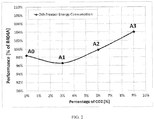
- Table 3 and Figure 2 show the performance results in terms of 24h system energy consumption. All results are referenced to R-404A being at 100% for capacity and COP.
- the expected capacity should increase linearly with the amount of CO2.
- the actual capacity increases with the first 3% of CO2 then remains nearly unchanged with higher amounts of CO2.
- the expected COP should slightly decrease with the increase in the amount of CO2.
- the actual COP increases upon the addition of CO2 and peaks at around 3% of CO2. It then drops sharply with CO2 amounts above 3%.
- Such operating parameters include:
- Discharge pressure and temperature were estimated for R404A (baseline) and mixtures A0-A3 by the same methods and under the same operating conditions described in Example 1. Those parameters were also measured experimentally using the same reach-in freezer, procedures and standard described in Example 1.
- Table 4 shows side-by-side both the expected values, calculated through thermodynamic properties applied to refrigeration cycle, and the experimental values, obtained experimentally, for discharge pressure and compressor discharge temperature.
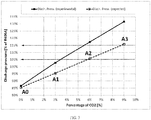
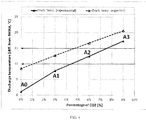
- Figure 3 and 4 illustrates the results of Table 4 in the form of a chart, as a function of the % amount of CO2 in the mixture.
- Table 4 Results of discharge pressure and compressor discharge temperature Discharge Pressure [% of R404A] Discharge Temp.
- both the expected and the actual (experimental) discharge pressures increased linearly with the amount of CO2. Applicants found unexpectedly, however, that the actual discharge pressure was significantly more sensitive to the amount of CO2 than estimated. The actual discharge pressure reached 105% with CO2 amounts around 3-4% and 115% between 5-6% of CO2.
- both the expected and the actual (experimental) discharge temperature increased steadily with the amount of CO2. Applicants found unexpectedly, however, that the actual discharge temperature was between 7-4°C lower than the estimated values.
- the actual discharge temperatures are within 10°C of R404A with CO2 amounts below around 4% and within 15°C below around 7% of CO2.
- compositions A0 - A3 when used as a replacement for R-404A in a medium temperature refrigeration system.
- a typical medium temperature refrigeration application was evaluated with the baseline refrigerant R-404A and mixtures A0, A1, A2 to A3 using the same methods described to estimate the performance in low-temperature application, as described in Example 1.
- the condenser temperature operated around 35°C, which generally corresponded to an indoor room temperature of about 25°C.
- the evaporating temperature was -10°C, which corresponded to a product temperature of about 0°C.
- the degree of superheat at evaporator outlet was about 5°C.
- Such medium temperature refrigeration systems are usually equipped a suction-line/liquid-line heat exchanger as described in Example 1.
- the effectiveness of the suction-line/liquid-line heat exchanger is about 50%.
- An additional refrigerant temperature gain along the refrigerant line between the suction-line/liquid-line heat exchanger and the compressor inlet is typically 2°C.
- the compressor efficiency was about 70%.
- Table 5 shows capacity, COP, discharge pressure and temperature with for the 4 mixtures with respect to R404A values, estimated through thermodynamic properties applied to refrigeration cycle.
- Table 5 Capacity, COP, discharge pressure and temperature at medium temperature Amount of CO2 (%) Name Capacity [% of R404A] COP [% of R404A] Discharge Pressure [% of R404A] Discharge Temp. [Diff.
- R404A in °C, from R404A] - R404A (baseline) 100% 100% 100% 0 0% A0 * R32/R1234yf (0.215/0.755) 88% 103% 84% +5 3% A1 R32/R1234yf/CO2 (0.215/0.755/0.03) 98% 102% 95% +7 6% A2 * R32/R1234yf/CO2 (0.215/0.725/0.06) 108% 102% 106% +10 9% * R32/R1234yf/CO2 (0.215/0.695/0.09) 118% 101% 117% +12 * Reference Example
Landscapes
- Chemical & Material Sciences (AREA)
- Engineering & Computer Science (AREA)
- Physics & Mathematics (AREA)
- Chemical Kinetics & Catalysis (AREA)
- Combustion & Propulsion (AREA)
- Thermal Sciences (AREA)
- Materials Engineering (AREA)
- Organic Chemistry (AREA)
- Lubricants (AREA)
- Organic Low-Molecular-Weight Compounds And Preparation Thereof (AREA)
Description
- This invention relates to compositions, and to the use of these compositions in systems that typically utilize the refrigerant R-404A for heating and/or refrigeration (cooling) applications.
- Fluorocarbon based fluids have found widespread use in many commercial and industrial applications, including as the working fluid in systems such as air conditioning, heat pump and refrigeration systems, among other uses such as aerosol propellants, as blowing agents, and as gaseous dielectrics.
- Heat transfer fluids, to be commercially viable, must satisfy certain very specific and in certain cases very stringent combinations of physical, chemical and economic properties. Moreover, there are many different types of heat transfer systems and heat transfer equipment, and in many cases it is important that the heat transfer fluid used in such systems possess a particular combination of properties that match the needs of the individual system. For example, systems based on the vapor compression cycle usually involve the phase change of the refrigerant from the liquid to the vapor phase through heat absorption at a relatively low pressure and compressing the vapor to a relatively elevated pressure, condensing the vapor to the liquid phase through heat removal at this relatively elevated pressure and temperature, and then reducing the pressure to start the cycle over again.
- Certain fluorocarbons, for example, have been a preferred component in many heat exchange fluids, such as refrigerants, for many years in many applications. Fluoroalkanes, such as chlorofluoromethanes and chlorofluoroethanes, have gained widespread use as refrigerants in applications including air conditioning and heat pump applications owing to their unique combination of chemical and physical properties, such as heat capacity, flammability, stability under the conditions of operation, and miscibility with the lubricant (if any) used in the system. Moreover, many of the refrigerants commonly utilized in vapor compression systems are either single components fluids, or zeotropic, azeotropic mixtures.
- Concern has increased in recent years about potential damage to the earth's atmosphere and climate, and certain chlorine-based compounds have been identified as particularly problematic in this regard. The use of chlorine-containing compositions (such as chlorofluorocarbons (CFCs), hydrochlorofluorocarbons (HCFCs) and the like) as refrigerants in air-conditioning and refrigeration systems has become disfavored because of the ozone-depleting properties associated with many of such compounds. There has thus been an increasing need for new fluorocarbon and hydrofluorocarbon compounds that offer alternatives for refrigeration and heat pump applications. By way of example, in certain aspects, it has become desirable to retrofit chlorine-containing refrigeration systems by replacing chlorine-containing refrigerants with non-chlorine-containing refrigerant compounds that will not deplete the ozone layer, such as hydrofluorocarbons (HFCs).
- Another concern surrounding many existing refrigerants is the tendency of many such products to cause global warming. This characteristic is commonly measured as global warming potential (GWP). The GWP of a compound is a measure of the potential contribution to the green house effect of the chemical against a known reference molecule, namely, CO2 which has a GWP = 1. For example, the following known refrigerants possess the following Global Warming Potentials:
REFRIGERANT GWP (IPCC AR5) R410A 2088 R-507 3985 R404A 3943 R407C 1774 - While each of the above-noted refrigerants has proven effective in many respects, these materials are become increasingly less preferred since it is frequently undesirable to use materials having relatively high GWP. A need exists, therefore, for substitutes for these and other existing refrigerants having undesirable GWPs.
- There has thus been an increasing need for new fluorocarbon and hydrofluorocarbon compounds and compositions that are attractive alternatives to the compositions heretofore used in these and other applications. For example, it has become desirable to retrofit certain systems, including chlorine-containing and certain HFC-containing refrigeration systems by replacing the existing refrigerants with refrigerant compositions that will not deplete the ozone layer, will not cause unwanted levels of global warming, and at the same time will satisfy all of the other stringent requirements of such systems for the materials used as the heat transfer material.
- With respect to performance properties, the present applicants have come to appreciate that that any potential substitute refrigerant must also possess those properties present in many of the most widely used fluids, such as excellent heat transfer properties, chemical stability, low- or no- toxicity, low or non-flammability and lubricant compatibility, among others.
- With regard to efficiency in use, it is important to note that a loss in refrigerant thermodynamic performance or energy efficiency may have secondary environmental impacts through increased fossil fuel usage arising from an increased demand for electrical energy.
- Furthermore, it is generally considered desirable for refrigerant substitutes to be effective without major engineering changes to conventional vapor compression technology currently used with existing refrigerants, such as CFC-containing refrigerants.
- Flammability is another important property for many applications. That is, it is considered either important or essential in many applications, including particularly in heat transfer applications, to use compositions which are non-flammable or of relatively low flammability. As used herein, the term "nonflammable" refers to compounds or compositions which are determined to be nonflammable as determined in accordance with ASTM standard E-681, dated 2002. Unfortunately, many HFC's which might otherwise be desirable for used in refrigerant compositions are highly flammable. For example, the fluoroalkane difluoroethane (HFC-152a) is flammable and therefore not viable for use alone in many applications.
- Applicants have thus come to appreciate a need for compositions that are potentially useful in numerous applications, including vapor compression heating and cooling systems and methods, while avoiding one or more of the disadvantages noted above.
-
EP2149592A2 discloses compositions comprising multi-fluorinated olefins and HFC-32, for use in stationary refrigeration and air conditioning equipment. -
WO2013146683 discloses refrigerant compositions having a global warming potential (GWP) of 500 or less comprising difluoromethane and/or tetrafluoropropene, carbon dioxide and/or a hydrocarbon having 3 to 4 carbon atoms; and a refrigerating machine oil comprising at least one of a polyol ester, a polyvinyl ether and a polyalkylene glycol. - The present invention relates to a composition comprising (a) 21.5% by weight of HFC-32; (b) 75.5% by weight of 2,3,3,3-tetrafluoropropene; and (c) 3% by weight of CO2.
- The composition of the present application may be used as a replacement for R-404A.
- The composition of the present invention may be used in automotive air conditioning systems, residential air conditioning systems, commercial air conditioning systems, residential refrigerator systems, residential freezer systems, commercial refrigerator systems, commercial freezer systems, chiller air conditioning systems, chiller refrigeration systems, transport refrigeration systems, heat pump systems, and combinations of two or more of these. In certain non-limiting aspects, the composition of the present invention may be used as an R-404A replacement in low and medium temperature refrigeration systems. In certain aspects, such systems may be used for storage of frozen or refrigerated goods, such as self-contained or "plug-in" type refrigerators or freezers or "reach-in" type of refrigerators or freezers. Non-limiting examples of such systems include those typically used for indoors or outdoors in places such as restaurants, convenience stores, gas stations, grocery stores, and the like.
- Additional embodiments, use, and advantages will be readily apparent to the skilled artisan on the basis of the disclosure provided herein.
-
-
Figure 1 provides a graphic illustration of expected versus measured (experimental) capacity and efficiency (COP) in systems having increasing amounts of CO2 between 0% and 9%. -
Figure 2 provides a graphic illustration of the results of experimental energy consumption versus the amount of CO2 in the mixture. -
Figure 3 provides a graphic illustration of the expected versus measured (experimental) compressor discharge pressure versus the amount of CO2 in the mixture. -
Figure 4 provides a graphic illustration of the compressor discharge temperature versus the amount of CO2 in the mixture. - R-404A is commonly used in refrigeration systems, particularly low and medium temperature refrigeration systems such as those defined below. It has an estimated Global Warming Potential (GWP) of 3943, which is much higher than is desired or required. Applicants have found that the composition of the present invention satisfies in an exceptional and unexpected way the need for a new composition for such applications, particularly though not exclusively refrigeration systems, having improved performance with respect to environmental impact while at the same time providing other important performance characteristics, such as capacity, efficiency, discharge temperature, discharge pressure, energy consumption, flammability and/or toxicity. In preferred embodiments the present composition is provided as an alternative and/or replacement for refrigerants currently used in such applications, particularly and preferably R-404A, that at once has a lower GWP value and has a close match in heating and cooling capacity to R-404A in such systems.
- The composition of the present invention is generally adaptable for use in heat transfer applications, that is, as a heating and/or cooling medium, but is particularly well adapted for use, as mentioned above, in refrigeration systems (particularly, though not exclusively, low and medium temperature refrigeration systems) that have heretofore used R-404A.
In particular, and as demonstrated herein, applicants have surprisingly and unexpectedly discovered that the composition exhibits improved capacity, efficiency, discharge pressure, discharge temperature, and/or energy consumption, as compared to R-404A in such systems and under the same conditions. - Applicants have found that the inclusion of CO2 in the composition of the present invention results in surprisingly and unexpected improvement in the use of such a composition with low and medium temperature refrigeration systems, as compared to R-404A and/or compositions that lack CO2. In particular, the data herein demonstrate surprisingly and unexpected empirical improvement in one or more of the following properties, as compared to expected values using thermodynamic calculations: capacity, efficiency, discharge pressure, discharge temperature, energy consumption and combinations thereof.
- Applicants have also found that the composition of the present invention is capable of achieving low GWP. By way of non-limiting example, the following Table 1 illustrates the substantial GWP superiority of certain compositions, which are described in parenthesis in terms of weight fraction of each component, in comparison to the GWP of R-404A, which has a GWP of3943.
TABLE 1 Amount of CO2 (%) Composition Name GWP (AR5 values) GWP (% of R404A) - R125/R143a/R134a (0.44/0.52/0.04) R404A (Baseline) 3943 100% 0% R32/R1234yf (0.215/0.785) A0 146 4% 3% R32/R1234yf/CO2 (0.215/0.755/0.03) A1 146 4% 6% R32/R1234yf/CO2 (0.215/0.725/0.06) A2 146 4% 9% R32/R1234yf/CO2 (0.215/0.695/0.09) A3 146 4% - The present composition is adaptable for use in connection with a wide variety of heat transfer systems in general and refrigeration systems in particular, such as air-conditioning, refrigeration, heat-pump systems, and the like. Generally speaking, such refrigeration systems contemplated in accordance with the present invention include, but are not limited to, automotive air conditioning systems, residential air conditioning systems, commercial air conditioning systems, residential refrigerator systems, residential freezer systems, commercial refrigeration systems, small refrigeration systems, commercial freezer systems, transport refrigeration, chiller air conditioning systems, chiller refrigeration systems, heat pump systems, and combinations of two or more of these.
- The composition of the present invention may be used in refrigeration systems originally designed for use with an HFC refrigerant, such as, for example, R-404A. Such refrigeration systems may include, but are not limited to, low and medium temperature refrigeration systems, particularly vapor compression refrigeration systems. In certain aspects, such systems may be used for storage of frozen or refrigerated goods, such as
self-contained, "plug-in" or hermetic type refrigerators or freezers or "reach-in" type of refrigerators or freezers. Non-limiting examples of such systems include those typically used for indoors or outdoors in places such as restaurants, convenience stores, gas stations, grocery stores, and the like. - The composition of the present invention tends to exhibit many of the desirable characteristics of R-404A but has a GWP that is substantially lower than that of R-404A while at the same time having a capacity, efficiency, energy consumption, discharge temperature and/or discharge pressure that is substantially similar to or substantially matches, and preferably is as high as or higher than R-404A.
- A low temperature refrigeration system is used herein to refer to a refrigeration system that utilizes one or more compressors and operates under or within the following conditions:
- a. Condenser temperature from about 20°C to about 50°C, in certain preferred aspects from about 25°C to about 45°C;
- b. Evaporator temperature from about -45°C to about or less than about -10°C, in certain preferred aspects from about -40°C to about -25°C, with an evaporator temperature preferably of about -32°C;
- c. Degree of superheat at evaporator outlet of from about 0°C to about 10°C, with a degree of superheat at evaporator outlet of from about 1°C to about 6°C;
- d. System with a degree of superheat in the suction line of from about 15°C to about 40°C, with a degree of superheat in the suction line of from about 20°C to about 30°C. The superheat along the suction line may also (or alternatively be generated by a heat exchanger between the liquid-line (refrigerant line between condenser and expansion device) and the suction-line (refrigerant line between compressor and evaporator), typically known as suction-line/liquid-line heat exchanger, in order to improve system performance. The suction-line/liquid line heat exchanger provides substantial degree of subcooling at the inlet of the expansion device and degree of superheat at the compressor inlet.
- A medium temperature refrigeration system is used herein to refer to a refrigeration system that utilizes one or more compressors and operates under or within the following conditions:
- a. Condenser temperature of from about 20°C to about 60°C, in certain preferred aspects from 25°C to 45°C;
- b. Evaporator temperature of from about -25°C to about or less than about 0°C, n certain preferred aspects from about -20°C to about -5°C, with an evaporator temperature of about -10°C;
- c. Degree of superheat at evaporator outlet of from about 0°C to about 10°C, with a degree of superheat at evaporator outlet of from about 1°C to about 6°C; and
- d. System with a degree of superheat in the suction line of from about 5°C to about 40°C, with a degree of superheat in the suction line preferably of from about 15°C to about 30°C. The superheat along the suction line may also be generated by a heat exchanger as described in item 3).
- Examples of such refrigeration systems are provided in Examples 1-3, below. To this end, such systems may include low temperature refrigeration applications (Examples 1 and 2), including commercial freezers or systems that may be used for the storage and maintenance of frozen goods. They may also include medium-temperature commercial applications (Example 3), such as commercial refrigerators, including systems for the storage of fresh goods. The examples below provide typical conditions and parameters that are used for such applications. These conditions, however, are not considered limiting to the invention, as one of skill in the art will appreciate that they may be varied based on one or more of a myriad of factors, including but not limited to, ambient conditions, intended application, time of year, and the like.
- As used herein the term "refrigeration system" refers generally to any system or apparatus, or any part or portion of such a system or apparatus, which employs a refrigerant to provide heating or cooling. Such air refrigeration systems include, for example, air conditioners, electric refrigerators, chillers, or any of the systems identified herein or otherwise known in the art.
- The following examples are provided for the purpose of illustrating the present invention but without limiting the scope thereof.
- Due to certain characteristics of refrigeration systems, including particularly low temperature refrigeration systems containing or designed to contain R404A refrigerant, it is important in certain embodiments that such systems are capable of exhibiting adequate performance parameters system with respect to R404A. Such operating parameters include:
- Capacity of at least 90%, and even more preferably greater than 95% of the capacity of the system operating with R404A. This parameter allows the use of existing compressors and components designed for R404A.
- Equal or better efficiency than R404A leading to energy savings with new mixture.
- Equal or lower energy consumption
- This example illustrates the COP and capacity performance of compositions labeled A0 - A3 when used as a replacement for R404A in a low-temperature refrigeration system. The coefficient of performance (COP) is a universally accepted measure of refrigerant performance, especially useful in representing the relative thermodynamic efficiency of a refrigerant in a specific cooling cycle involving evaporation or condensation of the refrigerant. In refrigeration engineering, this term expresses the ratio of useful refrigeration to the energy applied by the compressor in compressing the vapor and by fans (when applicable). The capacity of a refrigerant represents the amount of cooling or heating it provides and provides some measure of the capability of a compressor to pump quantities of heat for a given volumetric flow rate of refrigerant. In other words, given a specific compressor, a refrigerant with a higher
capacity will deliver more cooling power. One means for estimating COP of a refrigerant at specific operating conditions is from the thermodynamic properties of the refrigerant using standard refrigeration cycle analysis techniques (see for example, R.C. Downing, FLUOROCARBON REFRIGERANTS HANDBOOK,Chapter 3, Prentice-Hall, 1988). - A commercially available low temperature refrigeration "reach-in freezer" used for refrigeration of frozen food was evaluated with the baseline refrigerant R404A and mixtures A0, A1, A2 to A3. In the case of such a system illustrated in this Example, the condenser temperature operated around 34°C, which generally corresponded to an indoor room temperature of about 25°C. The evaporating temperature was about -35°C, which corresponded to a product temperature of about -18°C. The degree of superheat at evaporator outlet was about 5°C. Such low temperature refrigeration systems are usually equipped with a suction-line/liquid-line heat exchanger. The amount of degree of subcooling and superheat provided by the suction-line/liquid-line heat exchanger typically depends upon the refrigerant thermodynamic properties and the heat transfer goodness of the heat exchanger. A measure of the heat transfer goodness of a suction-line/liquid-line heat exchanger is given by its effectiveness which varies from 0% (minimum heat transfer) to 100% (maximum heat transfer). For this particular example, the effectiveness of the suction-line/liquid-line heat exchanger was about 50%. An additional refrigerant temperature gain along the refrigerant line between the suction-line/liquid-line heat exchanger and the compressor inlet is typically 2°C.
- The performance evaluations were done using standardized tests as described in ASHRAE standard 72-2005 "Method of Testing Commercial Refrigerators and Freezers" which established requirements and operating conditions for testing those systems. During these tests, cycle pressures and temperatures are measured, as well as power consumption for compressor and fans. These test have a duration of at least 24-h, during which the system cycles ON and OFF. The system also experiences defrost cycles.
- From these tests, two sets of results were obtained:
- 1) Taking a data for single cycle, average capacity and COP were obtained by integrating for the duration of the cycle.
- 2) Another mean of evaluating performance is by measuring the overall energy consumption over a 24 h period, which may include effects of ON/OFF operation as well as defrost cycles.
- The Table 2 below shows side-by-side both the expected values, calculated through thermodynamic properties applied to refrigeration cycle, and the "experimental" values, obtained experimentally through the standardized tests, for both Capacity and COP.
Figure 1 illustrates the results of Table 2 in the form of a chart, as a function of the % amount of CO2 in the mixture. Table 3 andFigure 2 show the performance results in terms of 24h system energy consumption. All results are referenced to R-404A being at 100% for capacity and COP.Table 2: Capacity and COP results Capacity [% of R404A] COP [% of R404A] Amount of CO2 (%) Name Expected Experimental Expected Experimental - R404A 100% 100% 100% 100% 0% A0 * R32/R1234yf (0.215/0.785) 86% 93% 104% 101% 3% A1 * R32/R1234yf/CO2 (0.215/0.755/0.03) 96% 96% 103% 102% 6% A2 * R32/R1234yf/CO2 (0.215/0.725/0.06) 105% 97% 102% 98% 9% A3 * R32/R1234yf/CO2 (0.215/0.695/0.09) 115% 97% 101% 95% * Reference Example Table 3: Experimental energy consumption results Amount of CO2 (%) Name Experimental 24h Energy Consumption [% of R404A] - R404A (baseline) 100% 0% A0 * R32/R1234yf (0.215/0.785) 98% 3% A1 R32/R1234yf/CO2 (0.215/0.755/0.03) 97% 6% A2 * R32/R1234yf/CO2 (0.215/0.725/0.06) 100% 9% A3 * R32/R1234yf/CO2 (0.215/0.695/0.09) 104% * Reference Example - As illustrated in Table 2 and
Figure 1 , the expected capacity should increase linearly with the amount of CO2. However, applicants found unexpectedly that the actual capacity (experimental) increases with the first 3% of CO2 then remains nearly unchanged with higher amounts of CO2. As also illustrated in Table 2 andFigure 2 , the expected COP should slightly decrease with the increase in the amount of CO2. However, applicants found unexpectedly that the actual COP (experimental) increases upon the addition of CO2 and peaks at around 3% of CO2. It then drops sharply with CO2 amounts above 3%. - As illustrated in
Figure 3 and Table 2, the 24h energy consumption unexpectedly reaches a minimum with a mixture of around 3% of CO2. - Due to certain characteristics of refrigeration systems, including particularly low temperature refrigeration systems containing or designed to contain R404A refrigerant, it is important in certain embodiments that such systems are capable of exhibiting reliable system operating parameters with respect to R404A. Such operating parameters include:
- High-Side Pressure that is within about 115%, and even more preferably within about 105% of the high side pressure of the system using R404A. This parameter allows the use of existing compressors and components designed for R404A.
- Compressor discharge temperature that does not exceed R404A discharge temperature by more than 15°C, and no more than 10°C. The advantage of such a characteristic is that it permits the use of existing equipment without activation of the thermal protection aspects of the system, which is designed to protect compressor components.
- Discharge pressure and temperature were estimated for R404A (baseline) and mixtures A0-A3 by the same methods and under the same operating conditions described in Example 1. Those parameters were also measured experimentally using the same reach-in freezer, procedures and standard described in Example 1.
- The Table 4 below shows side-by-side both the expected values, calculated through thermodynamic properties applied to refrigeration cycle, and the experimental values, obtained experimentally, for discharge pressure and compressor discharge temperature.
Figure 3 and4 illustrates the results of Table 4 in the form of a chart, as a function of the % amount of CO2 in the mixture.Table 4: Results of discharge pressure and compressor discharge temperature Discharge Pressure [% of R404A] Discharge Temp. [Difference from R404A, in °C] Amount of CO2 (%) Name Expected Experimental Expected Experimental - R404A (baseline) 100% 100% 0 0 0% A0 * R32/R1234yf (0.215/0.785) 85% 87% +8 +1 3% A1 R32/R1234yf/CO2 (0.215/0.755/0.03) 96% 103% +13 +8 6% A2 * R32/R1234yf/CO2 (0.215/0.725/0.06) 106% 117% +17 +12 9% A3 * R32/R1234yf/CO2 (0.215/0.695/0.09) 116% 132% +21 +17 * Reference Example - As illustrated in Table 4 and
Figure 3 , both the expected and the actual (experimental) discharge pressures increased linearly with the amount of CO2. Applicants found unexpectedly, however, that the actual discharge pressure was significantly more sensitive to the amount of CO2 than estimated. The actual discharge pressure reached 105% with CO2 amounts around 3-4% and 115% between 5-6% of CO2. - As illustrated in Table 4 and
Figure 4 , both the expected and the actual (experimental) discharge temperature increased steadily with the amount of CO2. Applicants found unexpectedly, however, that the actual discharge temperature was between 7-4°C lower than the estimated values. The actual discharge temperatures are within 10°C of R404A with CO2 amounts below around 4% and within 15°C below around 7% of CO2. - This example illustrates the COP, capacity, discharge pressure and temperature of compositions A0 - A3 when used as a replacement for R-404A in a medium temperature refrigeration system.
- A typical medium temperature refrigeration application was evaluated with the baseline refrigerant R-404A and mixtures A0, A1, A2 to A3 using the same methods described to estimate the performance in low-temperature application, as described in Example 1. In the case of such a medium temperature refrigeration system illustrated in this Example, the condenser temperature operated around 35°C, which generally corresponded to an indoor room temperature of about 25°C. The evaporating temperature was -10°C, which corresponded to a product temperature of about 0°C. The degree of superheat at evaporator outlet was about 5°C. Such medium temperature refrigeration systems are usually equipped a suction-line/liquid-line heat exchanger as described in Example 1. For this particular example, the effectiveness of the suction-line/liquid-line heat exchanger is about 50%. An additional refrigerant temperature gain along the refrigerant line between the suction-line/liquid-line heat exchanger and the compressor inlet is typically 2°C. The compressor efficiency was about 70%.
- The Table 5 below shows capacity, COP, discharge pressure and temperature with for the 4 mixtures with respect to R404A values, estimated through thermodynamic properties applied to refrigeration cycle.
Table 5: Capacity, COP, discharge pressure and temperature at medium temperature Amount of CO2 (%) Name Capacity [% of R404A] COP [% of R404A] Discharge Pressure [% of R404A] Discharge Temp. [Diff. in °C, from R404A] - R404A (baseline) 100% 100% 100% 0 0% A0 * R32/R1234yf (0.215/0.755) 88% 103% 84% +5 3% A1 R32/R1234yf/CO2 (0.215/0.755/0.03) 98% 102% 95% +7 6% A2 * R32/R1234yf/CO2 (0.215/0.725/0.06) 108% 102% 106% +10 9% * R32/R1234yf/CO2 (0.215/0.695/0.09) 118% 101% 117% +12 * Reference Example - As illustrated in Table 5, the expected capacity and COP should increase linearly with the amount of CO2. A closer match in capacity with slightly better COP would happen around 3% of CO2. Both discharge pressure and temperature are also demonstrated to increase steadily with the amount of CO2. Discharge pressure is around a match of R-404A with CO2 amounts of about 3-6%. Discharge temperatures are within 10°C of R404A with CO2 amounts below 6%.
Claims (7)
- A composition comprising:(a) 21.5% by weight of HFC-32(b) 75.5% by weight of 2,3,3,3-tetrafluoropropene; and(c) 3% by weight of CO2,
- Use of a composition of claim 1 as a heating and/or cooling medium.
- Use of a composition of claim 1 in automotive air conditioning systems, residential air conditioning systems, commercial air conditioning systems, residential refrigerator systems, residential freezer systems, commercial refrigeration systems, small refrigeration systems, commercial freezer systems, transport refrigeration, chiller air conditioning systems, chiller refrigeration systems or heat pump systems.
- Use of a composition of claim 1 in low or medium temperature refrigeration systems.
- The use of claim 4, wherein the system is a low temperature refrigeration system, and wherein;a. The condenser temperature of the system is from about 20°C to about 50°C;b. The evaporator temperature of the system is from about -45°C to about or less than about -10°C;c. The degree of superheat at evaporator outlet of the system is from about 0°C to about 10°C;d. The degree of superheat in the suction line of the system is from about 15°C to about 40°C.
- The use of claim 4, wherein the system is a medium temperature refrigeration system, and wherein:a. The condenser temperature of the system is from about 20°C to about 60°C;b. The evaporator temperature of the system is from about -25°C to about or less than about 0°C;c. The degree of superheat at evaporator outlet of the system is from about 0°C to about 10°C;d. The degree of superheat in the suction line of the system is from about 5°C to about 40°C.
- Use of the composition of claim 1 as an R-404A replacement in low and medium temperature refrigeration systems.
Priority Applications (1)
| Application Number | Priority Date | Filing Date | Title |
|---|---|---|---|
| PL15789817T PL3140362T3 (en) | 2014-05-05 | 2015-05-05 | Low gwp heat transfer compositions |
Applications Claiming Priority (3)
| Application Number | Priority Date | Filing Date | Title |
|---|---|---|---|
| US201461988363P | 2014-05-05 | 2014-05-05 | |
| US14/703,128 US10035937B2 (en) | 2014-05-05 | 2015-05-04 | Low GWP heat transfer compositions |
| PCT/US2015/029131 WO2015171538A1 (en) | 2014-05-05 | 2015-05-05 | Low gwp heat transfer compositions |
Publications (3)
| Publication Number | Publication Date |
|---|---|
| EP3140362A1 EP3140362A1 (en) | 2017-03-15 |
| EP3140362A4 EP3140362A4 (en) | 2017-12-27 |
| EP3140362B1 true EP3140362B1 (en) | 2019-07-10 |
Family
ID=54354785
Family Applications (1)
| Application Number | Title | Priority Date | Filing Date |
|---|---|---|---|
| EP15789817.2A Active EP3140362B1 (en) | 2014-05-05 | 2015-05-05 | Low gwp heat transfer compositions |
Country Status (12)
| Country | Link |
|---|---|
| US (1) | US10035937B2 (en) |
| EP (1) | EP3140362B1 (en) |
| JP (1) | JP6678595B2 (en) |
| KR (2) | KR102525762B1 (en) |
| CN (1) | CN106459734B (en) |
| AU (1) | AU2015256314B2 (en) |
| CA (1) | CA2947965C (en) |
| ES (1) | ES2749916T3 (en) |
| MX (1) | MX380690B (en) |
| PL (1) | PL3140362T3 (en) |
| RU (1) | RU2690817C2 (en) |
| WO (1) | WO2015171538A1 (en) |
Families Citing this family (20)
| Publication number | Priority date | Publication date | Assignee | Title |
|---|---|---|---|---|
| CN108699428A (en) | 2016-02-29 | 2018-10-23 | 科慕埃弗西有限公司 | Refrigerant mixtures comprising difluoromethane, pentafluoroethane, tetrafluoroethane, tetrafluoropropene and carbon dioxide and uses thereof |
| GB201712813D0 (en) * | 2017-08-10 | 2017-09-27 | Mexichem Fluor Sa De Cv | Compositions |
| US20220195279A1 (en) * | 2017-10-12 | 2022-06-23 | The Chemours Company Fc, Llc | Compositions containing difluoromethane, tetrafluoropropene, and carbon dioxide and uses thereof |
| TWI794296B (en) * | 2017-10-12 | 2023-03-01 | 美商科慕Fc有限責任公司 | Compositions containing difluoromethane, tetrafluoropropene, and carbon dioxide and uses thereof |
| TWI791624B (en) * | 2017-10-12 | 2023-02-11 | 美商科慕Fc有限責任公司 | Compositions containing difluoromethane, tetrafluoropropene, and carbon dioxide and uses thereof |
| PT3704203T (en) * | 2017-11-27 | 2023-07-05 | Rpl Holdings Ltd | Low gwp refrigerant blends |
| GB2576328A (en) * | 2018-08-14 | 2020-02-19 | Mexichem Fluor Sa De Cv | Refrigerant composition |
| PL3870667T3 (en) * | 2018-10-26 | 2024-05-06 | The Chemours Company Fc, Llc | Compositions containing difluoromethane, tetrafluoropropene, and carbon dioxide and uses thereof |
| US11209196B2 (en) * | 2018-10-26 | 2021-12-28 | The Chemours Company Fc, Llc | HFO-1234ZE, HFO-1225ZC and HFO-1234YF compositions and processes for producing and using the compositions |
| CN109897607B (en) * | 2019-02-28 | 2020-12-25 | 浙江大学 | Heat pump mixed working medium and application |
| DE102019105682B4 (en) * | 2019-03-06 | 2022-11-10 | Weiss Technik Gmbh | Refrigerant and its use |
| DE102019105664A1 (en) * | 2019-03-06 | 2020-09-10 | Weiss Umwelttechnik Gmbh | Refrigerant |
| GB202002052D0 (en) | 2020-02-14 | 2020-04-01 | Mexichem Fluor Sa De Cv | Compositions |
| GB202002063D0 (en) * | 2020-02-14 | 2020-04-01 | Mexichem Fluor Sa De Cv | Compsitions |
| US11585575B2 (en) | 2020-07-08 | 2023-02-21 | Rheem Manufacturing Company | Dual-circuit heating, ventilation, air conditioning, and refrigeration systems and associated methods |
| US12092352B2 (en) | 2020-08-06 | 2024-09-17 | Rheem Manufacturing Company | Systems and methods of detecting an obstructed furnace air filter using a pressure sensor |
| US12013135B2 (en) | 2020-08-06 | 2024-06-18 | Rheem Manufacturing Company | Systems and methods of detecting an obstructed furnace air filter using a flame sensor |
| MX2023004622A (en) | 2020-10-22 | 2023-05-12 | Rpl Holdings Ltd | Thermal pump refrigerants. |
| US12209783B2 (en) | 2021-10-26 | 2025-01-28 | Rheem Manufacturing Company | Low ambient temperature heat pump water heater systems, heat exchangers, and methods thereto |
| KR102472290B1 (en) | 2022-06-08 | 2022-11-30 | 한화시스템 주식회사 | Supporting apparatus and bonding method using the same |
Family Cites Families (28)
| Publication number | Priority date | Publication date | Assignee | Title |
|---|---|---|---|---|
| US20110037016A1 (en) * | 2003-10-27 | 2011-02-17 | Honeywell International Inc. | Fluoropropene compounds and compositions and methods using same |
| US7655610B2 (en) * | 2004-04-29 | 2010-02-02 | Honeywell International Inc. | Blowing agent compositions comprising fluorinated olefins and carbon dioxide |
| US7524805B2 (en) * | 2004-04-29 | 2009-04-28 | Honeywell International Inc. | Azeotrope-like compositions of tetrafluoropropene and hydrofluorocarbons |
| US20110167841A1 (en) * | 2004-06-04 | 2011-07-14 | Brasscorp Limited | Compositions and methods for injection of sealants and/or drying agents into air conditioning and refrigeration systems |
| US20060243944A1 (en) * | 2005-03-04 | 2006-11-02 | Minor Barbara H | Compositions comprising a fluoroolefin |
| TWI657070B (en) * | 2005-06-24 | 2019-04-21 | 美商哈尼威爾國際公司 | Compositions containing fluorine substituted olefins and uses thereof |
| GB0611740D0 (en) * | 2006-06-14 | 2006-07-26 | Ineos Fluor Holdings Ltd | Refrigerant compositions |
| US8974688B2 (en) * | 2009-07-29 | 2015-03-10 | Honeywell International Inc. | Compositions and methods for refrigeration |
| WO2008027603A1 (en) * | 2006-09-01 | 2008-03-06 | E. I. Du Pont De Nemours And Company | A non-ignitable gaseous composition comprising difluoromethane and tetrafluoroethylene |
| US8333901B2 (en) * | 2007-10-12 | 2012-12-18 | Mexichem Amanco Holding S.A. De C.V. | Heat transfer compositions |
| US8512591B2 (en) * | 2007-10-12 | 2013-08-20 | Mexichem Amanco Holding S.A. De C.V. | Heat transfer compositions |
| US7736529B2 (en) * | 2007-10-12 | 2010-06-15 | Honeywell International Inc | Azeotrope-like compositions containing sulfur hexafluoride and uses thereof |
| WO2010002023A1 (en) * | 2008-07-01 | 2010-01-07 | Daikin Industries, Ltd. | REFRIGERANT COMPOSITION COMPRISING DIFLUOROMETHANE (HFC32), 2,3,3,3-TETRAFLUOROPROPENE (HFO1234yf) AND 1,1,1,2-TETRAFLUOROETHANE (HFC134a) |
| CN107739594B (en) * | 2008-07-30 | 2023-07-25 | 霍尼韦尔国际公司 | Compositions containing difluoromethane and fluorine-substituted olefins |
| PT3473691T (en) * | 2008-07-30 | 2025-12-19 | Solstice Advanced Mat Us Inc | Compositions containing difluoromethane and fluorine substituted olefins |
| CA2745531A1 (en) * | 2008-12-02 | 2010-06-10 | Mexichem Amanco Holding S.A. De C.V. | Heat transfer compositions |
| US8980118B2 (en) * | 2009-05-08 | 2015-03-17 | Honeywell International Inc. | Heat transfer compositions and methods |
| GB0915004D0 (en) * | 2009-08-28 | 2009-09-30 | Ineos Fluor Holdings Ltd | Heat transfer composition |
| WO2011028970A1 (en) * | 2009-09-04 | 2011-03-10 | E. I. Du Pont De Nemours And Company | Compositions comprising refrigerant and lubricant and methods for replacing cfc and hcfc refrigerants without flushingfield of the invention |
| AU2010339656B2 (en) * | 2009-12-21 | 2015-07-23 | The Chemours Company Fc, Llc. | Compositions comprising tetrafluoropropene and difluoromethane and uses thereof |
| AU2011211303B2 (en) | 2010-01-27 | 2014-07-17 | Daikin Industries, Ltd. | Refrigerant composition comprising difluoromethane (HFC32) and 2,3,3,3-tetrafluoropropene (HFO1234yf) |
| US20120211421A1 (en) * | 2010-05-14 | 2012-08-23 | Kyle Self | Systems and methods for processing co2 |
| AU2011254381C1 (en) * | 2010-05-20 | 2014-09-18 | Mexichem Amanco Holding S.A. De C.V. | Heat transfer compositions |
| GB2480513B (en) * | 2010-05-20 | 2013-01-02 | Mexichem Amanco Holding Sa | Heat transfer compositions |
| US20130096218A1 (en) * | 2010-06-22 | 2013-04-18 | Arkema Inc. | Heat transfer compositions of hydrofluorocarbons and a hydrofluoroolefin |
| TWI585065B (en) * | 2011-08-26 | 2017-06-01 | 杜邦股份有限公司 | Compositions comprising tetrafluoropropene and methods of use thereof |
| CN104145009B (en) * | 2012-03-27 | 2018-01-30 | 吉坤日矿日石能源株式会社 | Working fluid composition for refrigerating machine |
| US9982180B2 (en) * | 2013-02-13 | 2018-05-29 | Honeywell International Inc. | Heat transfer compositions and methods |
-
2015
- 2015-05-04 US US14/703,128 patent/US10035937B2/en active Active
- 2015-05-05 CN CN201580036583.6A patent/CN106459734B/en active Active
- 2015-05-05 KR KR1020227040514A patent/KR102525762B1/en active Active
- 2015-05-05 AU AU2015256314A patent/AU2015256314B2/en active Active
- 2015-05-05 PL PL15789817T patent/PL3140362T3/en unknown
- 2015-05-05 JP JP2016566694A patent/JP6678595B2/en active Active
- 2015-05-05 RU RU2016147222A patent/RU2690817C2/en active
- 2015-05-05 WO PCT/US2015/029131 patent/WO2015171538A1/en not_active Ceased
- 2015-05-05 EP EP15789817.2A patent/EP3140362B1/en active Active
- 2015-05-05 KR KR1020167033939A patent/KR20170003961A/en not_active Ceased
- 2015-05-05 CA CA2947965A patent/CA2947965C/en active Active
- 2015-05-05 MX MX2016014448A patent/MX380690B/en unknown
- 2015-05-05 ES ES15789817T patent/ES2749916T3/en active Active
Non-Patent Citations (1)
| Title |
|---|
| None * |
Also Published As
| Publication number | Publication date |
|---|---|
| CA2947965A1 (en) | 2015-11-12 |
| ES2749916T3 (en) | 2020-03-24 |
| WO2015171538A1 (en) | 2015-11-12 |
| KR102525762B1 (en) | 2023-04-26 |
| KR20170003961A (en) | 2017-01-10 |
| JP6678595B2 (en) | 2020-04-08 |
| CA2947965C (en) | 2023-03-21 |
| JP2017519060A (en) | 2017-07-13 |
| EP3140362A1 (en) | 2017-03-15 |
| MX380690B (en) | 2025-03-12 |
| US20150315446A1 (en) | 2015-11-05 |
| PL3140362T3 (en) | 2019-12-31 |
| US10035937B2 (en) | 2018-07-31 |
| RU2016147222A (en) | 2018-06-05 |
| KR20220160124A (en) | 2022-12-05 |
| CN106459734B (en) | 2019-08-06 |
| CN106459734A (en) | 2017-02-22 |
| RU2016147222A3 (en) | 2018-12-18 |
| RU2690817C2 (en) | 2019-06-05 |
| MX2016014448A (en) | 2017-02-23 |
| EP3140362A4 (en) | 2017-12-27 |
| AU2015256314A1 (en) | 2019-09-05 |
| AU2015256314B2 (en) | 2021-02-04 |
Similar Documents
| Publication | Publication Date | Title |
|---|---|---|
| EP3140362B1 (en) | Low gwp heat transfer compositions | |
| US9676985B2 (en) | Low GWP heat transfer compositions | |
| EP2928979B1 (en) | Low gwp heat transfer compositions | |
| US9783721B2 (en) | Low GWP heat transfer compositions | |
| EP4186958A1 (en) | Composition containing fluorohydrocarbon and preparation method therefor |
Legal Events
| Date | Code | Title | Description |
|---|---|---|---|
| STAA | Information on the status of an ep patent application or granted ep patent |
Free format text: STATUS: THE INTERNATIONAL PUBLICATION HAS BEEN MADE |
|
| PUAI | Public reference made under article 153(3) epc to a published international application that has entered the european phase |
Free format text: ORIGINAL CODE: 0009012 |
|
| STAA | Information on the status of an ep patent application or granted ep patent |
Free format text: STATUS: REQUEST FOR EXAMINATION WAS MADE |
|
| 17P | Request for examination filed |
Effective date: 20161102 |
|
| AK | Designated contracting states |
Kind code of ref document: A1 Designated state(s): AL AT BE BG CH CY CZ DE DK EE ES FI FR GB GR HR HU IE IS IT LI LT LU LV MC MK MT NL NO PL PT RO RS SE SI SK SM TR |
|
| AX | Request for extension of the european patent |
Extension state: BA ME |
|
| DAV | Request for validation of the european patent (deleted) | ||
| DAX | Request for extension of the european patent (deleted) | ||
| A4 | Supplementary search report drawn up and despatched |
Effective date: 20171123 |
|
| RIC1 | Information provided on ipc code assigned before grant |
Ipc: C09K 5/04 20060101AFI20171117BHEP |
|
| STAA | Information on the status of an ep patent application or granted ep patent |
Free format text: STATUS: EXAMINATION IS IN PROGRESS |
|
| 17Q | First examination report despatched |
Effective date: 20180620 |
|
| GRAP | Despatch of communication of intention to grant a patent |
Free format text: ORIGINAL CODE: EPIDOSNIGR1 |
|
| STAA | Information on the status of an ep patent application or granted ep patent |
Free format text: STATUS: GRANT OF PATENT IS INTENDED |
|
| INTG | Intention to grant announced |
Effective date: 20190129 |
|
| GRAS | Grant fee paid |
Free format text: ORIGINAL CODE: EPIDOSNIGR3 |
|
| GRAA | (expected) grant |
Free format text: ORIGINAL CODE: 0009210 |
|
| STAA | Information on the status of an ep patent application or granted ep patent |
Free format text: STATUS: THE PATENT HAS BEEN GRANTED |
|
| AK | Designated contracting states |
Kind code of ref document: B1 Designated state(s): AL AT BE BG CH CY CZ DE DK EE ES FI FR GB GR HR HU IE IS IT LI LT LU LV MC MK MT NL NO PL PT RO RS SE SI SK SM TR |
|
| REG | Reference to a national code |
Ref country code: GB Ref legal event code: FG4D |
|
| REG | Reference to a national code |
Ref country code: CH Ref legal event code: EP Ref country code: AT Ref legal event code: REF Ref document number: 1153562 Country of ref document: AT Kind code of ref document: T Effective date: 20190715 |
|
| REG | Reference to a national code |
Ref country code: DE Ref legal event code: R096 Ref document number: 602015033604 Country of ref document: DE |
|
| REG | Reference to a national code |
Ref country code: IE Ref legal event code: FG4D |
|
| REG | Reference to a national code |
Ref country code: NL Ref legal event code: FP |
|
| REG | Reference to a national code |
Ref country code: LT Ref legal event code: MG4D |
|
| PG25 | Lapsed in a contracting state [announced via postgrant information from national office to epo] |
Ref country code: FI Free format text: LAPSE BECAUSE OF FAILURE TO SUBMIT A TRANSLATION OF THE DESCRIPTION OR TO PAY THE FEE WITHIN THE PRESCRIBED TIME-LIMIT Effective date: 20190710 Ref country code: BG Free format text: LAPSE BECAUSE OF FAILURE TO SUBMIT A TRANSLATION OF THE DESCRIPTION OR TO PAY THE FEE WITHIN THE PRESCRIBED TIME-LIMIT Effective date: 20191010 Ref country code: NO Free format text: LAPSE BECAUSE OF FAILURE TO SUBMIT A TRANSLATION OF THE DESCRIPTION OR TO PAY THE FEE WITHIN THE PRESCRIBED TIME-LIMIT Effective date: 20191010 Ref country code: SE Free format text: LAPSE BECAUSE OF FAILURE TO SUBMIT A TRANSLATION OF THE DESCRIPTION OR TO PAY THE FEE WITHIN THE PRESCRIBED TIME-LIMIT Effective date: 20190710 Ref country code: HR Free format text: LAPSE BECAUSE OF FAILURE TO SUBMIT A TRANSLATION OF THE DESCRIPTION OR TO PAY THE FEE WITHIN THE PRESCRIBED TIME-LIMIT Effective date: 20190710 Ref country code: PT Free format text: LAPSE BECAUSE OF FAILURE TO SUBMIT A TRANSLATION OF THE DESCRIPTION OR TO PAY THE FEE WITHIN THE PRESCRIBED TIME-LIMIT Effective date: 20191111 Ref country code: LT Free format text: LAPSE BECAUSE OF FAILURE TO SUBMIT A TRANSLATION OF THE DESCRIPTION OR TO PAY THE FEE WITHIN THE PRESCRIBED TIME-LIMIT Effective date: 20190710 |
|
| PG25 | Lapsed in a contracting state [announced via postgrant information from national office to epo] |
Ref country code: AL Free format text: LAPSE BECAUSE OF FAILURE TO SUBMIT A TRANSLATION OF THE DESCRIPTION OR TO PAY THE FEE WITHIN THE PRESCRIBED TIME-LIMIT Effective date: 20190710 Ref country code: LV Free format text: LAPSE BECAUSE OF FAILURE TO SUBMIT A TRANSLATION OF THE DESCRIPTION OR TO PAY THE FEE WITHIN THE PRESCRIBED TIME-LIMIT Effective date: 20190710 Ref country code: GR Free format text: LAPSE BECAUSE OF FAILURE TO SUBMIT A TRANSLATION OF THE DESCRIPTION OR TO PAY THE FEE WITHIN THE PRESCRIBED TIME-LIMIT Effective date: 20191011 Ref country code: RS Free format text: LAPSE BECAUSE OF FAILURE TO SUBMIT A TRANSLATION OF THE DESCRIPTION OR TO PAY THE FEE WITHIN THE PRESCRIBED TIME-LIMIT Effective date: 20190710 Ref country code: IS Free format text: LAPSE BECAUSE OF FAILURE TO SUBMIT A TRANSLATION OF THE DESCRIPTION OR TO PAY THE FEE WITHIN THE PRESCRIBED TIME-LIMIT Effective date: 20191110 |
|
| REG | Reference to a national code |
Ref country code: ES Ref legal event code: FG2A Ref document number: 2749916 Country of ref document: ES Kind code of ref document: T3 Effective date: 20200324 |
|
| PG25 | Lapsed in a contracting state [announced via postgrant information from national office to epo] |
Ref country code: DK Free format text: LAPSE BECAUSE OF FAILURE TO SUBMIT A TRANSLATION OF THE DESCRIPTION OR TO PAY THE FEE WITHIN THE PRESCRIBED TIME-LIMIT Effective date: 20190710 Ref country code: EE Free format text: LAPSE BECAUSE OF FAILURE TO SUBMIT A TRANSLATION OF THE DESCRIPTION OR TO PAY THE FEE WITHIN THE PRESCRIBED TIME-LIMIT Effective date: 20190710 Ref country code: RO Free format text: LAPSE BECAUSE OF FAILURE TO SUBMIT A TRANSLATION OF THE DESCRIPTION OR TO PAY THE FEE WITHIN THE PRESCRIBED TIME-LIMIT Effective date: 20190710 |
|
| PG25 | Lapsed in a contracting state [announced via postgrant information from national office to epo] |
Ref country code: SK Free format text: LAPSE BECAUSE OF FAILURE TO SUBMIT A TRANSLATION OF THE DESCRIPTION OR TO PAY THE FEE WITHIN THE PRESCRIBED TIME-LIMIT Effective date: 20190710 Ref country code: CZ Free format text: LAPSE BECAUSE OF FAILURE TO SUBMIT A TRANSLATION OF THE DESCRIPTION OR TO PAY THE FEE WITHIN THE PRESCRIBED TIME-LIMIT Effective date: 20190710 Ref country code: SM Free format text: LAPSE BECAUSE OF FAILURE TO SUBMIT A TRANSLATION OF THE DESCRIPTION OR TO PAY THE FEE WITHIN THE PRESCRIBED TIME-LIMIT Effective date: 20190710 Ref country code: IS Free format text: LAPSE BECAUSE OF FAILURE TO SUBMIT A TRANSLATION OF THE DESCRIPTION OR TO PAY THE FEE WITHIN THE PRESCRIBED TIME-LIMIT Effective date: 20200224 |
|
| REG | Reference to a national code |
Ref country code: DE Ref legal event code: R097 Ref document number: 602015033604 Country of ref document: DE |
|
| REG | Reference to a national code |
Ref country code: AT Ref legal event code: UEP Ref document number: 1153562 Country of ref document: AT Kind code of ref document: T Effective date: 20190710 |
|
| PLBE | No opposition filed within time limit |
Free format text: ORIGINAL CODE: 0009261 |
|
| STAA | Information on the status of an ep patent application or granted ep patent |
Free format text: STATUS: NO OPPOSITION FILED WITHIN TIME LIMIT |
|
| PG2D | Information on lapse in contracting state deleted |
Ref country code: IS |
|
| 26N | No opposition filed |
Effective date: 20200603 |
|
| PG25 | Lapsed in a contracting state [announced via postgrant information from national office to epo] |
Ref country code: SI Free format text: LAPSE BECAUSE OF FAILURE TO SUBMIT A TRANSLATION OF THE DESCRIPTION OR TO PAY THE FEE WITHIN THE PRESCRIBED TIME-LIMIT Effective date: 20190710 |
|
| PG25 | Lapsed in a contracting state [announced via postgrant information from national office to epo] |
Ref country code: MC Free format text: LAPSE BECAUSE OF FAILURE TO SUBMIT A TRANSLATION OF THE DESCRIPTION OR TO PAY THE FEE WITHIN THE PRESCRIBED TIME-LIMIT Effective date: 20190710 Ref country code: CH Free format text: LAPSE BECAUSE OF NON-PAYMENT OF DUE FEES Effective date: 20200531 Ref country code: LI Free format text: LAPSE BECAUSE OF NON-PAYMENT OF DUE FEES Effective date: 20200531 |
|
| PG25 | Lapsed in a contracting state [announced via postgrant information from national office to epo] |
Ref country code: LU Free format text: LAPSE BECAUSE OF NON-PAYMENT OF DUE FEES Effective date: 20200505 |
|
| PG25 | Lapsed in a contracting state [announced via postgrant information from national office to epo] |
Ref country code: IE Free format text: LAPSE BECAUSE OF NON-PAYMENT OF DUE FEES Effective date: 20200505 |
|
| PG25 | Lapsed in a contracting state [announced via postgrant information from national office to epo] |
Ref country code: MT Free format text: LAPSE BECAUSE OF FAILURE TO SUBMIT A TRANSLATION OF THE DESCRIPTION OR TO PAY THE FEE WITHIN THE PRESCRIBED TIME-LIMIT Effective date: 20190710 Ref country code: CY Free format text: LAPSE BECAUSE OF FAILURE TO SUBMIT A TRANSLATION OF THE DESCRIPTION OR TO PAY THE FEE WITHIN THE PRESCRIBED TIME-LIMIT Effective date: 20190710 |
|
| PG25 | Lapsed in a contracting state [announced via postgrant information from national office to epo] |
Ref country code: MK Free format text: LAPSE BECAUSE OF FAILURE TO SUBMIT A TRANSLATION OF THE DESCRIPTION OR TO PAY THE FEE WITHIN THE PRESCRIBED TIME-LIMIT Effective date: 20190710 |
|
| P01 | Opt-out of the competence of the unified patent court (upc) registered |
Effective date: 20230414 |
|
| PGFP | Annual fee paid to national office [announced via postgrant information from national office to epo] |
Ref country code: NL Payment date: 20250526 Year of fee payment: 11 |
|
| PGFP | Annual fee paid to national office [announced via postgrant information from national office to epo] |
Ref country code: PL Payment date: 20250424 Year of fee payment: 11 Ref country code: DE Payment date: 20250528 Year of fee payment: 11 |
|
| PGFP | Annual fee paid to national office [announced via postgrant information from national office to epo] |
Ref country code: ES Payment date: 20250611 Year of fee payment: 11 Ref country code: GB Payment date: 20250520 Year of fee payment: 11 |
|
| PGFP | Annual fee paid to national office [announced via postgrant information from national office to epo] |
Ref country code: BE Payment date: 20250526 Year of fee payment: 11 Ref country code: IT Payment date: 20250522 Year of fee payment: 11 |
|
| PGFP | Annual fee paid to national office [announced via postgrant information from national office to epo] |
Ref country code: FR Payment date: 20250526 Year of fee payment: 11 |
|
| PGFP | Annual fee paid to national office [announced via postgrant information from national office to epo] |
Ref country code: AT Payment date: 20250520 Year of fee payment: 11 |
|
| PGFP | Annual fee paid to national office [announced via postgrant information from national office to epo] |
Ref country code: TR Payment date: 20250424 Year of fee payment: 11 |