EP3138839B1 - Pyridone or pyrimidone derivative, preparation method therefor and application thereof - Google Patents
Pyridone or pyrimidone derivative, preparation method therefor and application thereof Download PDFInfo
- Publication number
- EP3138839B1 EP3138839B1 EP15748809.9A EP15748809A EP3138839B1 EP 3138839 B1 EP3138839 B1 EP 3138839B1 EP 15748809 A EP15748809 A EP 15748809A EP 3138839 B1 EP3138839 B1 EP 3138839B1
- Authority
- EP
- European Patent Office
- Prior art keywords
- alkyl
- substituted
- alkoxy
- independently selected
- amino
- Prior art date
- Legal status (The legal status is an assumption and is not a legal conclusion. Google has not performed a legal analysis and makes no representation as to the accuracy of the status listed.)
- Not-in-force
Links
- 238000002360 preparation method Methods 0.000 title description 3
- LVWZTYCIRDMTEY-UHFFFAOYSA-N metamizole Chemical compound O=C1C(N(CS(O)(=O)=O)C)=C(C)N(C)N1C1=CC=CC=C1 LVWZTYCIRDMTEY-UHFFFAOYSA-N 0.000 title description 2
- 150000008318 pyrimidones Chemical class 0.000 title 1
- -1 cyano, formyl Chemical group 0.000 claims description 135
- 150000001875 compounds Chemical class 0.000 claims description 84
- 229910052801 chlorine Inorganic materials 0.000 claims description 53
- 229910052731 fluorine Inorganic materials 0.000 claims description 53
- 229910052794 bromium Inorganic materials 0.000 claims description 51
- 229910052740 iodine Inorganic materials 0.000 claims description 50
- 229910052739 hydrogen Inorganic materials 0.000 claims description 48
- 125000000217 alkyl group Chemical group 0.000 claims description 47
- 125000001424 substituent group Chemical group 0.000 claims description 37
- 125000004178 (C1-C4) alkyl group Chemical group 0.000 claims description 32
- 125000003545 alkoxy group Chemical group 0.000 claims description 32
- 125000000623 heterocyclic group Chemical group 0.000 claims description 32
- 125000002887 hydroxy group Chemical group [H]O* 0.000 claims description 25
- 239000013078 crystal Substances 0.000 claims description 19
- 125000001495 ethyl group Chemical group [H]C([H])([H])C([H])([H])* 0.000 claims description 19
- 150000003839 salts Chemical class 0.000 claims description 19
- 125000000229 (C1-C4)alkoxy group Chemical group 0.000 claims description 18
- 102000015081 Blood Coagulation Factors Human genes 0.000 claims description 18
- 108010039209 Blood Coagulation Factors Proteins 0.000 claims description 18
- 239000003114 blood coagulation factor Substances 0.000 claims description 18
- 125000002496 methyl group Chemical group [H]C([H])([H])* 0.000 claims description 18
- 229940019700 blood coagulation factors Drugs 0.000 claims description 17
- 125000005842 heteroatom Chemical group 0.000 claims description 13
- 229910052760 oxygen Inorganic materials 0.000 claims description 13
- 239000012453 solvate Substances 0.000 claims description 13
- 229910052717 sulfur Inorganic materials 0.000 claims description 13
- 125000003178 carboxy group Chemical group [H]OC(*)=O 0.000 claims description 12
- 208000001435 Thromboembolism Diseases 0.000 claims description 10
- 125000002777 acetyl group Chemical group [H]C([H])([H])C(*)=O 0.000 claims description 10
- 125000001449 isopropyl group Chemical group [H]C([H])([H])C([H])(*)C([H])([H])[H] 0.000 claims description 10
- 206010047249 Venous thrombosis Diseases 0.000 claims description 9
- 201000010099 disease Diseases 0.000 claims description 8
- 208000037265 diseases, disorders, signs and symptoms Diseases 0.000 claims description 8
- 125000002924 primary amino group Chemical group [H]N([H])* 0.000 claims description 8
- 125000002023 trifluoromethyl group Chemical group FC(F)(F)* 0.000 claims description 8
- 206010014513 Embolism arterial Diseases 0.000 claims description 6
- 125000000956 methoxy group Chemical group [H]C([H])([H])O* 0.000 claims description 6
- 206010051055 Deep vein thrombosis Diseases 0.000 claims description 5
- 208000004476 Acute Coronary Syndrome Diseases 0.000 claims description 4
- 206010002388 Angina unstable Diseases 0.000 claims description 4
- 206010003210 Arteriosclerosis Diseases 0.000 claims description 4
- 201000001320 Atherosclerosis Diseases 0.000 claims description 4
- 206010008088 Cerebral artery embolism Diseases 0.000 claims description 4
- 206010008092 Cerebral artery thrombosis Diseases 0.000 claims description 4
- 206010011091 Coronary artery thrombosis Diseases 0.000 claims description 4
- 208000030831 Peripheral arterial occlusive disease Diseases 0.000 claims description 4
- 208000010378 Pulmonary Embolism Diseases 0.000 claims description 4
- 206010063544 Renal embolism Diseases 0.000 claims description 4
- 208000007814 Unstable Angina Diseases 0.000 claims description 4
- 230000001154 acute effect Effects 0.000 claims description 4
- 208000011775 arteriosclerosis disease Diseases 0.000 claims description 4
- 208000026106 cerebrovascular disease Diseases 0.000 claims description 4
- 208000002528 coronary thrombosis Diseases 0.000 claims description 4
- 230000034994 death Effects 0.000 claims description 4
- 125000001301 ethoxy group Chemical group [H]C([H])([H])C([H])([H])O* 0.000 claims description 4
- 201000004332 intermediate coronary syndrome Diseases 0.000 claims description 4
- 201000010849 intracranial embolism Diseases 0.000 claims description 4
- 208000028867 ischemia Diseases 0.000 claims description 4
- 230000000302 ischemic effect Effects 0.000 claims description 4
- 208000010125 myocardial infarction Diseases 0.000 claims description 4
- 208000011580 syndromic disease Diseases 0.000 claims description 4
- 201000005060 thrombophlebitis Diseases 0.000 claims description 4
- 230000001052 transient effect Effects 0.000 claims description 4
- 125000004429 atom Chemical group 0.000 claims description 3
- 208000023516 stroke disease Diseases 0.000 claims description 3
- 125000004008 6 membered carbocyclic group Chemical group 0.000 claims description 2
- 125000002485 formyl group Chemical group [H]C(*)=O 0.000 claims description 2
- 125000001041 indolyl group Chemical group 0.000 claims description 2
- XEKOWRVHYACXOJ-UHFFFAOYSA-N Ethyl acetate Chemical compound CCOC(C)=O XEKOWRVHYACXOJ-UHFFFAOYSA-N 0.000 description 120
- 238000006243 chemical reaction Methods 0.000 description 110
- YMWUJEATGCHHMB-UHFFFAOYSA-N Dichloromethane Chemical compound ClCCl YMWUJEATGCHHMB-UHFFFAOYSA-N 0.000 description 90
- IAZDPXIOMUYVGZ-UHFFFAOYSA-N Dimethylsulphoxide Chemical compound CS(C)=O IAZDPXIOMUYVGZ-UHFFFAOYSA-N 0.000 description 86
- 239000000243 solution Substances 0.000 description 77
- OKKJLVBELUTLKV-UHFFFAOYSA-N Methanol Chemical compound OC OKKJLVBELUTLKV-UHFFFAOYSA-N 0.000 description 51
- WYURNTSHIVDZCO-UHFFFAOYSA-N Tetrahydrofuran Chemical compound C1CCOC1 WYURNTSHIVDZCO-UHFFFAOYSA-N 0.000 description 48
- 239000007787 solid Substances 0.000 description 40
- 238000005160 1H NMR spectroscopy Methods 0.000 description 38
- PMZURENOXWZQFD-UHFFFAOYSA-L Sodium Sulfate Chemical compound [Na+].[Na+].[O-]S([O-])(=O)=O PMZURENOXWZQFD-UHFFFAOYSA-L 0.000 description 35
- XLYOFNOQVPJJNP-UHFFFAOYSA-N water Substances O XLYOFNOQVPJJNP-UHFFFAOYSA-N 0.000 description 35
- 239000000460 chlorine Substances 0.000 description 34
- 238000004895 liquid chromatography mass spectrometry Methods 0.000 description 31
- QTBSBXVTEAMEQO-UHFFFAOYSA-N Acetic acid Chemical compound CC(O)=O QTBSBXVTEAMEQO-UHFFFAOYSA-N 0.000 description 30
- ZMXDDKWLCZADIW-UHFFFAOYSA-N N,N-Dimethylformamide Chemical compound CN(C)C=O ZMXDDKWLCZADIW-UHFFFAOYSA-N 0.000 description 30
- HEDRZPFGACZZDS-MICDWDOJSA-N Trichloro(2H)methane Chemical compound [2H]C(Cl)(Cl)Cl HEDRZPFGACZZDS-MICDWDOJSA-N 0.000 description 27
- 239000012074 organic phase Substances 0.000 description 27
- RTZKZFJDLAIYFH-UHFFFAOYSA-N Diethyl ether Chemical compound CCOCC RTZKZFJDLAIYFH-UHFFFAOYSA-N 0.000 description 26
- 238000010898 silica gel chromatography Methods 0.000 description 25
- ZMANZCXQSJIPKH-UHFFFAOYSA-N Triethylamine Chemical compound CCN(CC)CC ZMANZCXQSJIPKH-UHFFFAOYSA-N 0.000 description 24
- YLQBMQCUIZJEEH-UHFFFAOYSA-N tetrahydrofuran Natural products C=1C=COC=1 YLQBMQCUIZJEEH-UHFFFAOYSA-N 0.000 description 24
- 125000003118 aryl group Chemical group 0.000 description 22
- VEXZGXHMUGYJMC-UHFFFAOYSA-N Hydrochloric acid Chemical compound Cl VEXZGXHMUGYJMC-UHFFFAOYSA-N 0.000 description 17
- CTSLXHKWHWQRSH-UHFFFAOYSA-N oxalyl chloride Chemical compound ClC(=O)C(Cl)=O CTSLXHKWHWQRSH-UHFFFAOYSA-N 0.000 description 16
- DTQVDTLACAAQTR-UHFFFAOYSA-N Trifluoroacetic acid Chemical compound OC(=O)C(F)(F)F DTQVDTLACAAQTR-UHFFFAOYSA-N 0.000 description 15
- 125000003342 alkenyl group Chemical group 0.000 description 15
- 125000000304 alkynyl group Chemical group 0.000 description 15
- DLFVBJFMPXGRIB-UHFFFAOYSA-N Acetamide Chemical compound CC(N)=O DLFVBJFMPXGRIB-UHFFFAOYSA-N 0.000 description 14
- 125000001072 heteroaryl group Chemical group 0.000 description 14
- 230000002829 reductive effect Effects 0.000 description 14
- DPBAPNBJGZEJER-UHFFFAOYSA-N tert-butyl 5-[[2-[5-chloro-2-(tetrazol-1-yl)phenyl]-4-oxo-7,8-dihydro-6H-pyrrolo[1,2-a]pyrimidine-6-carbonyl]amino]-1H-indole-2-carboxylate Chemical compound C(C)(C)(C)OC(=O)C=1NC2=CC=C(C=C2C=1)NC(=O)C1CCC=2N1C(C=C(N=2)C1=C(C=CC(=C1)Cl)N1N=NN=C1)=O DPBAPNBJGZEJER-UHFFFAOYSA-N 0.000 description 14
- 239000003208 petroleum Substances 0.000 description 13
- HPALAKNZSZLMCH-UHFFFAOYSA-M sodium;chloride;hydrate Chemical class O.[Na+].[Cl-] HPALAKNZSZLMCH-UHFFFAOYSA-M 0.000 description 13
- LFQSCWFLJHTTHZ-UHFFFAOYSA-N Ethanol Chemical compound CCO LFQSCWFLJHTTHZ-UHFFFAOYSA-N 0.000 description 12
- 108010074864 Factor XI Proteins 0.000 description 12
- 108090000190 Thrombin Proteins 0.000 description 12
- 229960004072 thrombin Drugs 0.000 description 12
- 239000012295 chemical reaction liquid Substances 0.000 description 11
- 125000000753 cycloalkyl group Chemical group 0.000 description 11
- 108010080805 Factor XIa Proteins 0.000 description 10
- 235000011054 acetic acid Nutrition 0.000 description 10
- 125000003282 alkyl amino group Chemical group 0.000 description 10
- 125000004414 alkyl thio group Chemical group 0.000 description 10
- 125000004432 carbon atom Chemical group C* 0.000 description 10
- 150000007942 carboxylates Chemical class 0.000 description 10
- 125000000000 cycloalkoxy group Chemical group 0.000 description 10
- 125000002768 hydroxyalkyl group Chemical group 0.000 description 10
- 239000012299 nitrogen atmosphere Substances 0.000 description 10
- 238000012360 testing method Methods 0.000 description 10
- 208000032843 Hemorrhage Diseases 0.000 description 9
- WMFOQBRAJBCJND-UHFFFAOYSA-M Lithium hydroxide Chemical compound [Li+].[OH-] WMFOQBRAJBCJND-UHFFFAOYSA-M 0.000 description 9
- 208000007536 Thrombosis Diseases 0.000 description 9
- 125000005366 cycloalkylthio group Chemical group 0.000 description 9
- 239000000126 substance Substances 0.000 description 9
- IJGRMHOSHXDMSA-UHFFFAOYSA-N Atomic nitrogen Chemical compound N#N IJGRMHOSHXDMSA-UHFFFAOYSA-N 0.000 description 8
- VYPSYNLAJGMNEJ-UHFFFAOYSA-N Silicium dioxide Chemical compound O=[Si]=O VYPSYNLAJGMNEJ-UHFFFAOYSA-N 0.000 description 8
- PXIPVTKHYLBLMZ-UHFFFAOYSA-N Sodium azide Chemical compound [Na+].[N-]=[N+]=[N-] PXIPVTKHYLBLMZ-UHFFFAOYSA-N 0.000 description 8
- UIIMBOGNXHQVGW-UHFFFAOYSA-M Sodium bicarbonate Chemical compound [Na+].OC([O-])=O UIIMBOGNXHQVGW-UHFFFAOYSA-M 0.000 description 8
- 108010000499 Thromboplastin Proteins 0.000 description 8
- 102000002262 Thromboplastin Human genes 0.000 description 8
- 230000000740 bleeding effect Effects 0.000 description 8
- 230000037361 pathway Effects 0.000 description 8
- 239000000741 silica gel Substances 0.000 description 8
- 229910002027 silica gel Inorganic materials 0.000 description 8
- 125000000999 tert-butyl group Chemical group [H]C([H])([H])C(*)(C([H])([H])[H])C([H])([H])[H] 0.000 description 8
- PYOKUURKVVELLB-UHFFFAOYSA-N trimethyl orthoformate Chemical compound COC(OC)OC PYOKUURKVVELLB-UHFFFAOYSA-N 0.000 description 8
- 230000004913 activation Effects 0.000 description 7
- 230000023555 blood coagulation Effects 0.000 description 7
- 229910052799 carbon Inorganic materials 0.000 description 7
- 201000007219 factor XI deficiency Diseases 0.000 description 7
- 229910052736 halogen Inorganic materials 0.000 description 7
- 150000002367 halogens Chemical class 0.000 description 7
- 238000000034 method Methods 0.000 description 7
- SEFJBTVZQJNCGN-UHFFFAOYSA-N methyl N-[4-[[7-[5-chloro-2-(tetrazol-1-yl)phenyl]-5-oxo-2,3-dihydro-1H-indolizine-3-carbonyl]amino]phenyl]carbamate Chemical compound C1=CC(N2C=NN=N2)=C(C=2C=C3CCC(C(=O)NC4=CC=C(C=C4)NC(=O)OC)N3C(=O)C=2)C=C1Cl SEFJBTVZQJNCGN-UHFFFAOYSA-N 0.000 description 7
- XKVBOLQEFGLHPV-UHFFFAOYSA-N 7-(2-amino-5-chlorophenyl)-5-oxo-2,3-dihydro-1h-indolizine-3-carboxylic acid Chemical compound NC1=CC=C(Cl)C=C1C1=CC(=O)N2C(C(O)=O)CCC2=C1 XKVBOLQEFGLHPV-UHFFFAOYSA-N 0.000 description 6
- HUFICPZUGMCVGN-UHFFFAOYSA-N 7-hydroxy-5-oxo-2,3-dihydro-1H-indolizine-3,8-dicarboxylic acid Chemical compound OC1=CC(N2C(CCC2=C1C(=O)O)C(=O)O)=O HUFICPZUGMCVGN-UHFFFAOYSA-N 0.000 description 6
- KXPARYIOMWVPPP-UHFFFAOYSA-N 7-hydroxy-5-oxo-2,3-dihydro-1h-indolizine-3-carboxylic acid Chemical compound OC1=CC(=O)N2C(C(=O)O)CCC2=C1 KXPARYIOMWVPPP-UHFFFAOYSA-N 0.000 description 6
- JUJWROOIHBZHMG-UHFFFAOYSA-N Pyridine Chemical compound C1=CC=NC=C1 JUJWROOIHBZHMG-UHFFFAOYSA-N 0.000 description 6
- FAPWRFPIFSIZLT-UHFFFAOYSA-M Sodium chloride Chemical class [Na+].[Cl-] FAPWRFPIFSIZLT-UHFFFAOYSA-M 0.000 description 6
- HEMHJVSKTPXQMS-UHFFFAOYSA-M Sodium hydroxide Chemical compound [OH-].[Na+] HEMHJVSKTPXQMS-UHFFFAOYSA-M 0.000 description 6
- YXFVVABEGXRONW-UHFFFAOYSA-N Toluene Chemical compound CC1=CC=CC=C1 YXFVVABEGXRONW-UHFFFAOYSA-N 0.000 description 6
- 210000004369 blood Anatomy 0.000 description 6
- 239000008280 blood Substances 0.000 description 6
- 230000000694 effects Effects 0.000 description 6
- 239000003112 inhibitor Substances 0.000 description 6
- 230000005764 inhibitory process Effects 0.000 description 6
- LZHWBVGDXHYDLX-UHFFFAOYSA-N methyl 2-(4-bromo-2-oxopyridin-1-yl)-3-phenylpropanoate Chemical compound BrC1=CC(N(C=C1)C(C(=O)OC)CC1=CC=CC=C1)=O LZHWBVGDXHYDLX-UHFFFAOYSA-N 0.000 description 6
- XXOCMLJXYUPXMO-UHFFFAOYSA-N methyl 2-[4-(2-amino-5-chlorophenyl)-2-oxopyridin-1-yl]-3-phenylpropanoate Chemical compound NC1=C(C=C(C=C1)Cl)C1=CC(N(C=C1)C(C(=O)OC)CC1=CC=CC=C1)=O XXOCMLJXYUPXMO-UHFFFAOYSA-N 0.000 description 6
- XFMNYRKEHCMITR-UHFFFAOYSA-N methyl 3-phenyl-2-(trifluoromethylsulfonyloxy)propanoate Chemical compound FC(F)(F)S(=O)(=O)OC(C(=O)OC)CC1=CC=CC=C1 XFMNYRKEHCMITR-UHFFFAOYSA-N 0.000 description 6
- 229910052757 nitrogen Inorganic materials 0.000 description 6
- 125000001997 phenyl group Chemical group [H]C1=C([H])C([H])=C(*)C([H])=C1[H] 0.000 description 6
- 229940002612 prodrug Drugs 0.000 description 6
- 239000000651 prodrug Substances 0.000 description 6
- 230000001681 protective effect Effects 0.000 description 6
- 239000000758 substrate Substances 0.000 description 6
- USCKCZRAULQBHR-UHFFFAOYSA-N tert-butyl 1-methyl-5-nitroindole-2-carboxylate Chemical compound [O-][N+](=O)C1=CC=C2N(C)C(C(=O)OC(C)(C)C)=CC2=C1 USCKCZRAULQBHR-UHFFFAOYSA-N 0.000 description 6
- GPUUPVRCMWIPOV-UHFFFAOYSA-N tert-butyl 5-amino-1-methylindole-2-carboxylate Chemical compound NC1=CC=C2N(C)C(C(=O)OC(C)(C)C)=CC2=C1 GPUUPVRCMWIPOV-UHFFFAOYSA-N 0.000 description 6
- 239000012224 working solution Substances 0.000 description 6
- HSXDXDHQSCPTMI-UHFFFAOYSA-N 2-[5-chloro-2-(tetrazol-1-yl)phenyl]-4-oxo-7,8-dihydro-6H-pyrrolo[1,2-a]pyrimidine-6-carboxylic acid Chemical compound ClC=1C=CC(=C(C=1)C=1N=C2N(C(C=1)=O)C(CC2)C(=O)O)N1N=NN=C1 HSXDXDHQSCPTMI-UHFFFAOYSA-N 0.000 description 5
- FOAKEOPDNAGJFH-UHFFFAOYSA-N 3-O-ethyl 8-O-methyl 7-hydroxy-5-oxo-2,3-dihydro-1H-indolizine-3,8-dicarboxylate Chemical compound OC1=CC(N2C(CCC2=C1C(=O)OC)C(=O)OCC)=O FOAKEOPDNAGJFH-UHFFFAOYSA-N 0.000 description 5
- GVJZHGCVSYBPIM-UHFFFAOYSA-N 4-chloro-2-(4,4,5,5-tetramethyl-1,3,2-dioxaborolan-2-yl)aniline Chemical compound O1C(C)(C)C(C)(C)OB1C1=CC(Cl)=CC=C1N GVJZHGCVSYBPIM-UHFFFAOYSA-N 0.000 description 5
- 208000009292 Hemophilia A Diseases 0.000 description 5
- 239000003146 anticoagulant agent Substances 0.000 description 5
- 230000010100 anticoagulation Effects 0.000 description 5
- 239000007864 aqueous solution Substances 0.000 description 5
- 230000015271 coagulation Effects 0.000 description 5
- 238000005345 coagulation Methods 0.000 description 5
- UQLOAHVZWWXAKX-UHFFFAOYSA-N diethyl 2-[(5-chloro-2-nitrophenyl)-hydroxymethylidene]propanedioate Chemical compound ClC=1C=CC(=C(C=1)C(=C(C(=O)OCC)C(=O)OCC)O)[N+](=O)[O-] UQLOAHVZWWXAKX-UHFFFAOYSA-N 0.000 description 5
- ISUPIJQPCPWDMW-UHFFFAOYSA-N ethyl 2-(5-chloro-2-nitrophenyl)-4-oxo-7,8-dihydro-6H-pyrrolo[1,2-a]pyrimidine-6-carboxylate Chemical compound CCOC(=O)C1CCc2nc(cc(=O)n12)-c1cc(Cl)ccc1[N+]([O-])=O ISUPIJQPCPWDMW-UHFFFAOYSA-N 0.000 description 5
- NHVKBWWWJNULDO-UHFFFAOYSA-N ethyl 3-(5-chloro-2-nitrophenyl)-3-oxopropanoate Chemical compound CCOC(=O)CC(=O)C1=CC(Cl)=CC=C1[N+]([O-])=O NHVKBWWWJNULDO-UHFFFAOYSA-N 0.000 description 5
- MXMDYVHVUCAGFH-UHFFFAOYSA-N ethyl 5-methoxy-3,4-dihydro-2h-pyrrole-2-carboxylate Chemical compound CCOC(=O)C1CCC(OC)=N1 MXMDYVHVUCAGFH-UHFFFAOYSA-N 0.000 description 5
- LDWKFHVOPWRNJT-UHFFFAOYSA-N ethyl 7-(2-amino-5-chlorophenyl)-5-oxo-2,3-dihydro-1H-indolizine-3-carboxylate Chemical compound C(C)OC(=O)C1CCC2=CC(=CC(N12)=O)C1=C(C=CC(=C1)Cl)N LDWKFHVOPWRNJT-UHFFFAOYSA-N 0.000 description 5
- SMFGCRCXOJAUTP-UHFFFAOYSA-N ethyl 7-hydroxy-5-oxo-2,3-dihydro-1h-indolizine-3-carboxylate Chemical compound OC1=CC(=O)N2C(C(=O)OCC)CCC2=C1 SMFGCRCXOJAUTP-UHFFFAOYSA-N 0.000 description 5
- 239000001257 hydrogen Substances 0.000 description 5
- 238000000338 in vitro Methods 0.000 description 5
- 239000007788 liquid Substances 0.000 description 5
- KDLHZDBZIXYQEI-UHFFFAOYSA-N palladium Substances [Pd] KDLHZDBZIXYQEI-UHFFFAOYSA-N 0.000 description 5
- 230000002265 prevention Effects 0.000 description 5
- 239000002904 solvent Substances 0.000 description 5
- GCWJCRGDJZCBNI-UHFFFAOYSA-N 2-[4-[5-chloro-2-(tetrazol-1-yl)phenyl]-2-oxopyridin-1-yl]-3-phenylpropanoic acid Chemical compound OC(=O)C(Cc1ccccc1)n1ccc(cc1=O)-c1cc(Cl)ccc1-n1cnnn1 GCWJCRGDJZCBNI-UHFFFAOYSA-N 0.000 description 4
- ALYNCZNDIQEVRV-UHFFFAOYSA-N 4-aminobenzoic acid Chemical compound NC1=CC=C(C(O)=O)C=C1 ALYNCZNDIQEVRV-UHFFFAOYSA-N 0.000 description 4
- WZZLEVNLUGKSFY-UHFFFAOYSA-N 5-[[7-[5-chloro-2-(tetrazol-1-yl)phenyl]-5-oxo-2,3-dihydro-1H-indolizine-3-carbonyl]amino]-1H-indole-2-carboxylic acid Chemical compound C(=O)(O)C=1NC2=CC=C(C=C2C=1)NC(=O)C1CCC2=CC(=CC(N12)=O)C1=C(C=CC(=C1)Cl)N1N=NN=C1 WZZLEVNLUGKSFY-UHFFFAOYSA-N 0.000 description 4
- 0 CC1(CC*CCCCC1)*(C(C(C(CC=*)CC1)*1C(I*(CCC*1N)CCCC1(C)O)=O)=O)N=C Chemical compound CC1(CC*CCCCC1)*(C(C(C(CC=*)CC1)*1C(I*(CCC*1N)CCCC1(C)O)=O)=O)N=C 0.000 description 4
- OKTJSMMVPCPJKN-UHFFFAOYSA-N Carbon Chemical compound [C] OKTJSMMVPCPJKN-UHFFFAOYSA-N 0.000 description 4
- OKKJLVBELUTLKV-MZCSYVLQSA-N Deuterated methanol Chemical compound [2H]OC([2H])([2H])[2H] OKKJLVBELUTLKV-MZCSYVLQSA-N 0.000 description 4
- 238000005481 NMR spectroscopy Methods 0.000 description 4
- 229940126214 compound 3 Drugs 0.000 description 4
- 208000011664 congenital factor XI deficiency Diseases 0.000 description 4
- 239000003814 drug Substances 0.000 description 4
- HGHNFNOPUOLUAG-UHFFFAOYSA-N ethyl 2-(4-bromo-2-oxopyridin-1-yl)acetate Chemical compound CCOC(=O)CN1C=CC(Br)=CC1=O HGHNFNOPUOLUAG-UHFFFAOYSA-N 0.000 description 4
- 230000002401 inhibitory effect Effects 0.000 description 4
- 238000004519 manufacturing process Methods 0.000 description 4
- 125000006574 non-aromatic ring group Chemical group 0.000 description 4
- BWHMMNNQKKPAPP-UHFFFAOYSA-L potassium carbonate Chemical compound [K+].[K+].[O-]C([O-])=O BWHMMNNQKKPAPP-UHFFFAOYSA-L 0.000 description 4
- 230000008569 process Effects 0.000 description 4
- FYJMLBSKCKPKGN-UHFFFAOYSA-N tert-butyl 5-[[2-[4-[5-chloro-2-(tetrazol-1-yl)phenyl]-2-oxopyridin-1-yl]acetyl]amino]-1H-indole-2-carboxylate Chemical compound CC(C)(C)OC(=O)c1cc2cc(NC(=O)Cn3ccc(cc3=O)-c3cc(Cl)ccc3-n3cnnn3)ccc2[nH]1 FYJMLBSKCKPKGN-UHFFFAOYSA-N 0.000 description 4
- HDFURGNQILLYMQ-UHFFFAOYSA-N tert-butyl 5-nitro-1h-indole-2-carboxylate Chemical compound [O-][N+](=O)C1=CC=C2NC(C(=O)OC(C)(C)C)=CC2=C1 HDFURGNQILLYMQ-UHFFFAOYSA-N 0.000 description 4
- 238000004809 thin layer chromatography Methods 0.000 description 4
- JOXIMZWYDAKGHI-UHFFFAOYSA-N toluene-4-sulfonic acid Chemical compound CC1=CC=C(S(O)(=O)=O)C=C1 JOXIMZWYDAKGHI-UHFFFAOYSA-N 0.000 description 4
- RYHBNJHYFVUHQT-UHFFFAOYSA-N 1,4-Dioxane Chemical compound C1COCCO1 RYHBNJHYFVUHQT-UHFFFAOYSA-N 0.000 description 3
- VOXXWSYKYCBWHO-UHFFFAOYSA-N 3-phenyllactic acid Chemical compound OC(=O)C(O)CC1=CC=CC=C1 VOXXWSYKYCBWHO-UHFFFAOYSA-N 0.000 description 3
- FVOVMVAMFMQDRZ-UHFFFAOYSA-N 4-[[2-[5-chloro-2-(tetrazol-1-yl)phenyl]-4-oxo-7,8-dihydro-6H-pyrrolo[1,2-a]pyrimidine-6-carbonyl]amino]benzoic acid Chemical compound C(=O)(O)C1=CC=C(C=C1)NC(=O)C1CCC=2N1C(C=C(N=2)C1=C(C=CC(=C1)Cl)N1N=NN=C1)=O FVOVMVAMFMQDRZ-UHFFFAOYSA-N 0.000 description 3
- 102100022641 Coagulation factor IX Human genes 0.000 description 3
- IAZDPXIOMUYVGZ-WFGJKAKNSA-N Dimethyl sulfoxide Chemical compound [2H]C([2H])([2H])S(=O)C([2H])([2H])[2H] IAZDPXIOMUYVGZ-WFGJKAKNSA-N 0.000 description 3
- 201000003542 Factor VIII deficiency Diseases 0.000 description 3
- 108010074860 Factor Xa Proteins 0.000 description 3
- UFHFLCQGNIYNRP-UHFFFAOYSA-N Hydrogen Chemical compound [H][H] UFHFLCQGNIYNRP-UHFFFAOYSA-N 0.000 description 3
- 108010094028 Prothrombin Proteins 0.000 description 3
- 102100027378 Prothrombin Human genes 0.000 description 3
- NINIDFKCEFEMDL-UHFFFAOYSA-N Sulfur Chemical compound [S] NINIDFKCEFEMDL-UHFFFAOYSA-N 0.000 description 3
- 239000002253 acid Substances 0.000 description 3
- 239000008186 active pharmaceutical agent Substances 0.000 description 3
- 230000002785 anti-thrombosis Effects 0.000 description 3
- QVGXLLKOCUKJST-UHFFFAOYSA-N atomic oxygen Chemical compound [O] QVGXLLKOCUKJST-UHFFFAOYSA-N 0.000 description 3
- 238000010523 cascade reaction Methods 0.000 description 3
- 229940125904 compound 1 Drugs 0.000 description 3
- 229940125773 compound 10 Drugs 0.000 description 3
- 229940125782 compound 2 Drugs 0.000 description 3
- 229940125898 compound 5 Drugs 0.000 description 3
- 229940079593 drug Drugs 0.000 description 3
- GGHGHNCIHLDLGS-UHFFFAOYSA-N ethyl 2-[4-(2-amino-5-chlorophenyl)-2-oxopyridin-1-yl]acetate Chemical compound ClC=1C=CC(=C(C=1)C1=CC(N(C=C1)CC(=O)OCC)=O)N GGHGHNCIHLDLGS-UHFFFAOYSA-N 0.000 description 3
- 208000009429 hemophilia B Diseases 0.000 description 3
- 230000023597 hemostasis Effects 0.000 description 3
- 125000004435 hydrogen atom Chemical group [H]* 0.000 description 3
- ZLVXBBHTMQJRSX-VMGNSXQWSA-N jdtic Chemical compound C1([C@]2(C)CCN(C[C@@H]2C)C[C@H](C(C)C)NC(=O)[C@@H]2NCC3=CC(O)=CC=C3C2)=CC=CC(O)=C1 ZLVXBBHTMQJRSX-VMGNSXQWSA-N 0.000 description 3
- 230000000670 limiting effect Effects 0.000 description 3
- 125000005647 linker group Chemical group 0.000 description 3
- 238000004949 mass spectrometry Methods 0.000 description 3
- 238000005259 measurement Methods 0.000 description 3
- 239000001301 oxygen Substances 0.000 description 3
- 238000005192 partition Methods 0.000 description 3
- 239000008194 pharmaceutical composition Substances 0.000 description 3
- 229940126155 plasma kallikrein inhibitor Drugs 0.000 description 3
- 229940039716 prothrombin Drugs 0.000 description 3
- UMJSCPRVCHMLSP-UHFFFAOYSA-N pyridine Natural products COC1=CC=CN=C1 UMJSCPRVCHMLSP-UHFFFAOYSA-N 0.000 description 3
- 238000010791 quenching Methods 0.000 description 3
- 239000011535 reaction buffer Substances 0.000 description 3
- 238000010992 reflux Methods 0.000 description 3
- 239000011550 stock solution Substances 0.000 description 3
- 239000011593 sulfur Substances 0.000 description 3
- FCJIKGNQSVQATI-UHFFFAOYSA-N tert-butyl 4-[[2-[4-[5-chloro-2-(tetrazol-1-yl)phenyl]-2-oxopyridin-1-yl]acetyl]amino]benzoate Chemical compound C1=C(C=C(C(=C1)N1N=NN=C1)C=1C=CN(C(=O)C=1)CC(=O)NC1=CC=C(C=C1)C(=O)OC(C)(C)C)Cl FCJIKGNQSVQATI-UHFFFAOYSA-N 0.000 description 3
- JSTGULOCVMYUNP-UHFFFAOYSA-N tert-butyl 5-amino-1h-indole-2-carboxylate Chemical compound NC1=CC=C2NC(C(=O)OC(C)(C)C)=CC2=C1 JSTGULOCVMYUNP-UHFFFAOYSA-N 0.000 description 3
- WNXJIVFYUVYPPR-UHFFFAOYSA-N 1,3-dioxolane Chemical compound C1COCO1 WNXJIVFYUVYPPR-UHFFFAOYSA-N 0.000 description 2
- LMDZBCPBFSXMTL-UHFFFAOYSA-N 1-ethyl-3-(3-dimethylaminopropyl)carbodiimide Chemical compound CCN=C=NCCCN(C)C LMDZBCPBFSXMTL-UHFFFAOYSA-N 0.000 description 2
- GQHTUMJGOHRCHB-UHFFFAOYSA-N 2,3,4,6,7,8,9,10-octahydropyrimido[1,2-a]azepine Chemical compound C1CCCCN2CCCN=C21 GQHTUMJGOHRCHB-UHFFFAOYSA-N 0.000 description 2
- JKMHFZQWWAIEOD-UHFFFAOYSA-N 2-[4-(2-hydroxyethyl)piperazin-1-yl]ethanesulfonic acid Chemical compound OCC[NH+]1CCN(CCS([O-])(=O)=O)CC1 JKMHFZQWWAIEOD-UHFFFAOYSA-N 0.000 description 2
- ZKUYSJHXBFFGPU-UHFFFAOYSA-N 2516-95-2 Chemical compound OC(=O)C1=CC(Cl)=CC=C1[N+]([O-])=O ZKUYSJHXBFFGPU-UHFFFAOYSA-N 0.000 description 2
- 125000000474 3-butynyl group Chemical group [H]C#CC([H])([H])C([H])([H])* 0.000 description 2
- SSLMGOKTIUIZLY-UHFFFAOYSA-N 4-bromo-1h-pyridin-2-one Chemical compound OC1=CC(Br)=CC=N1 SSLMGOKTIUIZLY-UHFFFAOYSA-N 0.000 description 2
- BSYNRYMUTXBXSQ-UHFFFAOYSA-N Aspirin Chemical compound CC(=O)OC1=CC=CC=C1C(O)=O BSYNRYMUTXBXSQ-UHFFFAOYSA-N 0.000 description 2
- HEDRZPFGACZZDS-UHFFFAOYSA-N Chloroform Chemical compound ClC(Cl)Cl HEDRZPFGACZZDS-UHFFFAOYSA-N 0.000 description 2
- 102100026735 Coagulation factor VIII Human genes 0.000 description 2
- YZCKVEUIGOORGS-OUBTZVSYSA-N Deuterium Chemical compound [2H] YZCKVEUIGOORGS-OUBTZVSYSA-N 0.000 description 2
- 208000005189 Embolism Diseases 0.000 description 2
- 108010014173 Factor X Proteins 0.000 description 2
- 108010088842 Fibrinolysin Proteins 0.000 description 2
- 239000007995 HEPES buffer Substances 0.000 description 2
- 208000031220 Hemophilia Diseases 0.000 description 2
- HTTJABKRGRZYRN-UHFFFAOYSA-N Heparin Chemical compound OC1C(NC(=O)C)C(O)OC(COS(O)(=O)=O)C1OC1C(OS(O)(=O)=O)C(O)C(OC2C(C(OS(O)(=O)=O)C(OC3C(C(O)C(O)C(O3)C(O)=O)OS(O)(=O)=O)C(CO)O2)NS(O)(=O)=O)C(C(O)=O)O1 HTTJABKRGRZYRN-UHFFFAOYSA-N 0.000 description 2
- 101000911390 Homo sapiens Coagulation factor VIII Proteins 0.000 description 2
- CTQNGGLPUBDAKN-UHFFFAOYSA-N O-Xylene Chemical group CC1=CC=CC=C1C CTQNGGLPUBDAKN-UHFFFAOYSA-N 0.000 description 2
- 108091005804 Peptidases Proteins 0.000 description 2
- 102000035195 Peptidases Human genes 0.000 description 2
- 229920002594 Polyethylene Glycol 8000 Polymers 0.000 description 2
- 239000004365 Protease Substances 0.000 description 2
- XSQUKJJJFZCRTK-UHFFFAOYSA-N Urea Chemical compound NC(N)=O XSQUKJJJFZCRTK-UHFFFAOYSA-N 0.000 description 2
- 229960001138 acetylsalicylic acid Drugs 0.000 description 2
- 230000009471 action Effects 0.000 description 2
- 239000012190 activator Substances 0.000 description 2
- 229960004050 aminobenzoic acid Drugs 0.000 description 2
- 230000003321 amplification Effects 0.000 description 2
- 229940127219 anticoagulant drug Drugs 0.000 description 2
- 239000008346 aqueous phase Substances 0.000 description 2
- 125000004618 benzofuryl group Chemical group O1C(=CC2=C1C=CC=C2)* 0.000 description 2
- WPYMKLBDIGXBTP-UHFFFAOYSA-N benzoic acid Chemical compound OC(=O)C1=CC=CC=C1 WPYMKLBDIGXBTP-UHFFFAOYSA-N 0.000 description 2
- 125000002619 bicyclic group Chemical group 0.000 description 2
- 210000004204 blood vessel Anatomy 0.000 description 2
- XJHCXCQVJFPJIK-UHFFFAOYSA-M caesium fluoride Chemical compound [F-].[Cs+] XJHCXCQVJFPJIK-UHFFFAOYSA-M 0.000 description 2
- 239000011203 carbon fibre reinforced carbon Substances 0.000 description 2
- 238000004587 chromatography analysis Methods 0.000 description 2
- NXQGGXCHGDYOHB-UHFFFAOYSA-L cyclopenta-1,4-dien-1-yl(diphenyl)phosphane;dichloropalladium;iron(2+) Chemical compound [Fe+2].Cl[Pd]Cl.[CH-]1C=CC(P(C=2C=CC=CC=2)C=2C=CC=CC=2)=C1.[CH-]1C=CC(P(C=2C=CC=CC=2)C=2C=CC=CC=2)=C1 NXQGGXCHGDYOHB-UHFFFAOYSA-L 0.000 description 2
- 230000001419 dependent effect Effects 0.000 description 2
- 238000001035 drying Methods 0.000 description 2
- 230000002255 enzymatic effect Effects 0.000 description 2
- MXVWFIRTCWDKOB-UHFFFAOYSA-N ethyl 5-oxo-7-(trifluoromethylsulfonyloxy)-2,3-dihydro-1H-indolizine-3-carboxylate Chemical compound C(C)OC(=O)C1CCC2=CC(=CC(N12)=O)OS(=O)(=O)C(F)(F)F MXVWFIRTCWDKOB-UHFFFAOYSA-N 0.000 description 2
- QYJOOVQLTTVTJY-UHFFFAOYSA-N ethyl 5-oxopyrrolidine-2-carboxylate Chemical compound CCOC(=O)C1CCC(=O)N1 QYJOOVQLTTVTJY-UHFFFAOYSA-N 0.000 description 2
- 229940012414 factor viia Drugs 0.000 description 2
- 230000020764 fibrinolysis Effects 0.000 description 2
- 125000000524 functional group Chemical group 0.000 description 2
- 125000002541 furyl group Chemical group 0.000 description 2
- 229960002897 heparin Drugs 0.000 description 2
- 229920000669 heparin Polymers 0.000 description 2
- 125000000592 heterocycloalkyl group Chemical group 0.000 description 2
- 238000004128 high performance liquid chromatography Methods 0.000 description 2
- 150000002431 hydrogen Chemical class 0.000 description 2
- 125000002883 imidazolyl group Chemical group 0.000 description 2
- 238000000099 in vitro assay Methods 0.000 description 2
- 208000014674 injury Diseases 0.000 description 2
- 230000006623 intrinsic pathway Effects 0.000 description 2
- 125000000959 isobutyl group Chemical group [H]C([H])([H])C([H])(C([H])([H])[H])C([H])([H])* 0.000 description 2
- BDAGIHXWWSANSR-UHFFFAOYSA-N methanoic acid Natural products OC=O BDAGIHXWWSANSR-UHFFFAOYSA-N 0.000 description 2
- 239000011259 mixed solution Substances 0.000 description 2
- 230000004048 modification Effects 0.000 description 2
- 238000012986 modification Methods 0.000 description 2
- 125000002950 monocyclic group Chemical group 0.000 description 2
- VLKZOEOYAKHREP-UHFFFAOYSA-N n-Hexane Chemical compound CCCCCC VLKZOEOYAKHREP-UHFFFAOYSA-N 0.000 description 2
- 125000004108 n-butyl group Chemical group [H]C([H])([H])C([H])([H])C([H])([H])C([H])([H])* 0.000 description 2
- 125000001624 naphthyl group Chemical group 0.000 description 2
- 230000007935 neutral effect Effects 0.000 description 2
- 125000001400 nonyl group Chemical group [H]C([*])([H])C([H])([H])C([H])([H])C([H])([H])C([H])([H])C([H])([H])C([H])([H])C([H])([H])C([H])([H])[H] 0.000 description 2
- 238000003199 nucleic acid amplification method Methods 0.000 description 2
- 125000004430 oxygen atom Chemical group O* 0.000 description 2
- NFHFRUOZVGFOOS-UHFFFAOYSA-N palladium;triphenylphosphane Chemical compound [Pd].C1=CC=CC=C1P(C=1C=CC=CC=1)C1=CC=CC=C1.C1=CC=CC=C1P(C=1C=CC=CC=1)C1=CC=CC=C1.C1=CC=CC=C1P(C=1C=CC=CC=1)C1=CC=CC=C1.C1=CC=CC=C1P(C=1C=CC=CC=1)C1=CC=CC=C1 NFHFRUOZVGFOOS-UHFFFAOYSA-N 0.000 description 2
- 230000004962 physiological condition Effects 0.000 description 2
- 229940012957 plasmin Drugs 0.000 description 2
- SCVFZCLFOSHCOH-UHFFFAOYSA-M potassium acetate Chemical compound [K+].CC([O-])=O SCVFZCLFOSHCOH-UHFFFAOYSA-M 0.000 description 2
- 229910000027 potassium carbonate Inorganic materials 0.000 description 2
- 125000003373 pyrazinyl group Chemical group 0.000 description 2
- 125000002098 pyridazinyl group Chemical group 0.000 description 2
- 125000004076 pyridyl group Chemical group 0.000 description 2
- VTGOHKSTWXHQJK-UHFFFAOYSA-N pyrimidin-2-ol Chemical class OC1=NC=CC=N1 VTGOHKSTWXHQJK-UHFFFAOYSA-N 0.000 description 2
- 125000000714 pyrimidinyl group Chemical group 0.000 description 2
- 229920006395 saturated elastomer Polymers 0.000 description 2
- 235000017557 sodium bicarbonate Nutrition 0.000 description 2
- 229910000030 sodium bicarbonate Inorganic materials 0.000 description 2
- 239000011780 sodium chloride Substances 0.000 description 2
- 239000007858 starting material Substances 0.000 description 2
- QAOWNCQODCNURD-UHFFFAOYSA-N sulfuric acid Substances OS(O)(=O)=O QAOWNCQODCNURD-UHFFFAOYSA-N 0.000 description 2
- 239000006228 supernatant Substances 0.000 description 2
- 230000008685 targeting Effects 0.000 description 2
- 150000003526 tetrahydroisoquinolines Chemical class 0.000 description 2
- 238000002560 therapeutic procedure Methods 0.000 description 2
- 125000001544 thienyl group Chemical group 0.000 description 2
- 125000003396 thiol group Chemical group [H]S* 0.000 description 2
- FWPIDFUJEMBDLS-UHFFFAOYSA-L tin(II) chloride dihydrate Chemical compound O.O.Cl[Sn]Cl FWPIDFUJEMBDLS-UHFFFAOYSA-L 0.000 description 2
- 238000005406 washing Methods 0.000 description 2
- PGOHTUIFYSHAQG-LJSDBVFPSA-N (2S)-6-amino-2-[[(2S)-5-amino-2-[[(2S)-2-[[(2S)-2-[[(2S)-2-[[(2S)-4-amino-2-[[(2S)-2-[[(2S)-2-[[(2S)-2-[[(2S)-2-[[(2S)-5-amino-2-[[(2S)-5-amino-2-[[(2S)-2-[[(2S)-2-[[(2S)-2-[[(2S,3R)-2-[[(2S)-5-amino-2-[[(2S)-2-[[(2S)-2-[[(2S,3R)-2-[[(2S)-2-[[(2S)-2-[[(2S)-2-[[(2S)-2-[[(2S)-5-amino-2-[[(2S)-1-[(2S,3R)-2-[[(2S)-2-[[(2S)-2-[[(2R)-2-[[(2S)-2-[[(2S)-2-[[2-[[(2S)-2-[[(2S)-2-[[(2S)-2-[[(2S)-1-[(2S)-2-[[(2S)-2-[[(2S)-2-[[(2S)-2-amino-4-methylsulfanylbutanoyl]amino]-3-(1H-indol-3-yl)propanoyl]amino]-5-carbamimidamidopentanoyl]amino]propanoyl]pyrrolidine-2-carbonyl]amino]-3-methylbutanoyl]amino]-4-methylpentanoyl]amino]-4-methylpentanoyl]amino]acetyl]amino]-3-hydroxypropanoyl]amino]-4-methylpentanoyl]amino]-3-sulfanylpropanoyl]amino]-4-methylsulfanylbutanoyl]amino]-5-carbamimidamidopentanoyl]amino]-3-hydroxybutanoyl]pyrrolidine-2-carbonyl]amino]-5-oxopentanoyl]amino]-3-hydroxypropanoyl]amino]-3-hydroxypropanoyl]amino]-3-(1H-imidazol-5-yl)propanoyl]amino]-4-methylpentanoyl]amino]-3-hydroxybutanoyl]amino]-3-(1H-indol-3-yl)propanoyl]amino]-5-carbamimidamidopentanoyl]amino]-5-oxopentanoyl]amino]-3-hydroxybutanoyl]amino]-3-hydroxypropanoyl]amino]-3-carboxypropanoyl]amino]-3-hydroxypropanoyl]amino]-5-oxopentanoyl]amino]-5-oxopentanoyl]amino]-3-phenylpropanoyl]amino]-5-carbamimidamidopentanoyl]amino]-3-methylbutanoyl]amino]-4-methylpentanoyl]amino]-4-oxobutanoyl]amino]-5-carbamimidamidopentanoyl]amino]-3-(1H-indol-3-yl)propanoyl]amino]-4-carboxybutanoyl]amino]-5-oxopentanoyl]amino]hexanoic acid Chemical compound CSCC[C@H](N)C(=O)N[C@@H](Cc1c[nH]c2ccccc12)C(=O)N[C@@H](CCCNC(N)=N)C(=O)N[C@@H](C)C(=O)N1CCC[C@H]1C(=O)N[C@@H](C(C)C)C(=O)N[C@@H](CC(C)C)C(=O)N[C@@H](CC(C)C)C(=O)NCC(=O)N[C@@H](CO)C(=O)N[C@@H](CC(C)C)C(=O)N[C@@H](CS)C(=O)N[C@@H](CCSC)C(=O)N[C@@H](CCCNC(N)=N)C(=O)N[C@@H]([C@@H](C)O)C(=O)N1CCC[C@H]1C(=O)N[C@@H](CCC(N)=O)C(=O)N[C@@H](CO)C(=O)N[C@@H](CO)C(=O)N[C@@H](Cc1cnc[nH]1)C(=O)N[C@@H](CC(C)C)C(=O)N[C@@H]([C@@H](C)O)C(=O)N[C@@H](Cc1c[nH]c2ccccc12)C(=O)N[C@@H](CCCNC(N)=N)C(=O)N[C@@H](CCC(N)=O)C(=O)N[C@@H]([C@@H](C)O)C(=O)N[C@@H](CO)C(=O)N[C@@H](CC(O)=O)C(=O)N[C@@H](CO)C(=O)N[C@@H](CCC(N)=O)C(=O)N[C@@H](CCC(N)=O)C(=O)N[C@@H](Cc1ccccc1)C(=O)N[C@@H](CCCNC(N)=N)C(=O)N[C@@H](C(C)C)C(=O)N[C@@H](CC(C)C)C(=O)N[C@@H](CC(N)=O)C(=O)N[C@@H](CCCNC(N)=N)C(=O)N[C@@H](Cc1c[nH]c2ccccc12)C(=O)N[C@@H](CCC(O)=O)C(=O)N[C@@H](CCC(N)=O)C(=O)N[C@@H](CCCCN)C(O)=O PGOHTUIFYSHAQG-LJSDBVFPSA-N 0.000 description 1
- KZPYGQFFRCFCPP-UHFFFAOYSA-N 1,1'-bis(diphenylphosphino)ferrocene Chemical compound [Fe+2].C1=CC=C[C-]1P(C=1C=CC=CC=1)C1=CC=CC=C1.C1=CC=C[C-]1P(C=1C=CC=CC=1)C1=CC=CC=C1 KZPYGQFFRCFCPP-UHFFFAOYSA-N 0.000 description 1
- VDFVNEFVBPFDSB-UHFFFAOYSA-N 1,3-dioxane Chemical compound C1COCOC1 VDFVNEFVBPFDSB-UHFFFAOYSA-N 0.000 description 1
- 125000004972 1-butynyl group Chemical group [H]C([H])([H])C([H])([H])C#C* 0.000 description 1
- 125000000530 1-propynyl group Chemical group [H]C([H])([H])C#C* 0.000 description 1
- HYZJCKYKOHLVJF-UHFFFAOYSA-N 1H-benzimidazole Chemical group C1=CC=C2NC=NC2=C1 HYZJCKYKOHLVJF-UHFFFAOYSA-N 0.000 description 1
- LTMRRSWNXVJMBA-UHFFFAOYSA-L 2,2-diethylpropanedioate Chemical compound CCC(CC)(C([O-])=O)C([O-])=O LTMRRSWNXVJMBA-UHFFFAOYSA-L 0.000 description 1
- SYTBIFURTZACKR-UHFFFAOYSA-N 2-bromo-4-chloroaniline Chemical compound NC1=CC=C(Cl)C=C1Br SYTBIFURTZACKR-UHFFFAOYSA-N 0.000 description 1
- RGHQKFQZGLKBCF-UHFFFAOYSA-N 2-bromoethyl acetate Chemical compound CC(=O)OCCBr RGHQKFQZGLKBCF-UHFFFAOYSA-N 0.000 description 1
- 125000004974 2-butenyl group Chemical group C(C=CC)* 0.000 description 1
- 125000000069 2-butynyl group Chemical group [H]C([H])([H])C#CC([H])([H])* 0.000 description 1
- 125000006040 2-hexenyl group Chemical group 0.000 description 1
- 125000003903 2-propenyl group Chemical group [H]C([*])([H])C([H])=C([H])[H] 0.000 description 1
- 125000001494 2-propynyl group Chemical group [H]C#CC([H])([H])* 0.000 description 1
- FPQQSJJWHUJYPU-UHFFFAOYSA-N 3-(dimethylamino)propyliminomethylidene-ethylazanium;chloride Chemical compound Cl.CCN=C=NCCCN(C)C FPQQSJJWHUJYPU-UHFFFAOYSA-N 0.000 description 1
- 125000004975 3-butenyl group Chemical group C(CC=C)* 0.000 description 1
- 125000006041 3-hexenyl group Chemical group 0.000 description 1
- RNJOKCPFLQMDEC-UHFFFAOYSA-N 4(R),8-dimethyl-trans-2-nonenoyl-CoA Chemical compound COC(=O)CC(=O)CC(=O)OC RNJOKCPFLQMDEC-UHFFFAOYSA-N 0.000 description 1
- OSWFIVFLDKOXQC-UHFFFAOYSA-N 4-(3-methoxyphenyl)aniline Chemical compound COC1=CC=CC(C=2C=CC(N)=CC=2)=C1 OSWFIVFLDKOXQC-UHFFFAOYSA-N 0.000 description 1
- NKFIBMOQAPEKNZ-UHFFFAOYSA-N 5-amino-1h-indole-2-carboxylic acid Chemical compound NC1=CC=C2NC(C(O)=O)=CC2=C1 NKFIBMOQAPEKNZ-UHFFFAOYSA-N 0.000 description 1
- LHFOJSCXLFKDIR-UHFFFAOYSA-N 5-nitro-1h-indole-2-carboxylic acid Chemical compound [O-][N+](=O)C1=CC=C2NC(C(=O)O)=CC2=C1 LHFOJSCXLFKDIR-UHFFFAOYSA-N 0.000 description 1
- 239000005711 Benzoic acid Substances 0.000 description 1
- WKBOTKDWSSQWDR-UHFFFAOYSA-N Bromine atom Chemical compound [Br] WKBOTKDWSSQWDR-UHFFFAOYSA-N 0.000 description 1
- 208000007257 Budd-Chiari syndrome Diseases 0.000 description 1
- WVHZPBBXXPJYFX-LFIBNONCSA-N C/C(/C(O)=O)=C\C1C#CC(NC(C(CC2)N3C2=CC(c2cc(Cl)ccc2-[n]2nnnc2)=CC3O)=O)=CC=C1NC Chemical compound C/C(/C(O)=O)=C\C1C#CC(NC(C(CC2)N3C2=CC(c2cc(Cl)ccc2-[n]2nnnc2)=CC3O)=O)=CC=C1NC WVHZPBBXXPJYFX-LFIBNONCSA-N 0.000 description 1
- 208000024172 Cardiovascular disease Diseases 0.000 description 1
- KZBUYRJDOAKODT-UHFFFAOYSA-N Chlorine Chemical compound ClCl KZBUYRJDOAKODT-UHFFFAOYSA-N 0.000 description 1
- ZAMOUSCENKQFHK-UHFFFAOYSA-N Chlorine atom Chemical compound [Cl] ZAMOUSCENKQFHK-UHFFFAOYSA-N 0.000 description 1
- 101100114697 Danio rerio cpeb1 gene Proteins 0.000 description 1
- SNRUBQQJIBEYMU-UHFFFAOYSA-N Dodecane Natural products CCCCCCCCCCCC SNRUBQQJIBEYMU-UHFFFAOYSA-N 0.000 description 1
- 206010062608 Endocarditis noninfective Diseases 0.000 description 1
- 108010076282 Factor IX Proteins 0.000 description 1
- 206010016077 Factor IX deficiency Diseases 0.000 description 1
- 108010014172 Factor V Proteins 0.000 description 1
- YCKRFDGAMUMZLT-UHFFFAOYSA-N Fluorine atom Chemical compound [F] YCKRFDGAMUMZLT-UHFFFAOYSA-N 0.000 description 1
- 208000012671 Gastrointestinal haemorrhages Diseases 0.000 description 1
- 206010019713 Hepatic vein thrombosis Diseases 0.000 description 1
- 208000024369 Libman-Sacks endocarditis Diseases 0.000 description 1
- FYYHWMGAXLPEAU-UHFFFAOYSA-N Magnesium Chemical compound [Mg] FYYHWMGAXLPEAU-UHFFFAOYSA-N 0.000 description 1
- 241001465754 Metazoa Species 0.000 description 1
- 229940122791 Plasmin inhibitor Drugs 0.000 description 1
- 201000009454 Portal vein thrombosis Diseases 0.000 description 1
- YZCKVEUIGOORGS-IGMARMGPSA-N Protium Chemical compound [1H] YZCKVEUIGOORGS-IGMARMGPSA-N 0.000 description 1
- 241000720974 Protium Species 0.000 description 1
- KEAYESYHFKHZAL-UHFFFAOYSA-N Sodium Chemical compound [Na] KEAYESYHFKHZAL-UHFFFAOYSA-N 0.000 description 1
- UIIMBOGNXHQVGW-DEQYMQKBSA-M Sodium bicarbonate-14C Chemical class [Na+].O[14C]([O-])=O UIIMBOGNXHQVGW-DEQYMQKBSA-M 0.000 description 1
- 108010023197 Streptokinase Proteins 0.000 description 1
- 208000006011 Stroke Diseases 0.000 description 1
- OKJPEAGHQZHRQV-UHFFFAOYSA-N Triiodomethane Natural products IC(I)I OKJPEAGHQZHRQV-UHFFFAOYSA-N 0.000 description 1
- YZCKVEUIGOORGS-NJFSPNSNSA-N Tritium Chemical compound [3H] YZCKVEUIGOORGS-NJFSPNSNSA-N 0.000 description 1
- 102000003990 Urokinase-type plasminogen activator Human genes 0.000 description 1
- 108090000435 Urokinase-type plasminogen activator Proteins 0.000 description 1
- 208000027418 Wounds and injury Diseases 0.000 description 1
- 230000002159 abnormal effect Effects 0.000 description 1
- 238000002835 absorbance Methods 0.000 description 1
- 230000002378 acidificating effect Effects 0.000 description 1
- 125000001931 aliphatic group Chemical group 0.000 description 1
- 125000004183 alkoxy alkyl group Chemical group 0.000 description 1
- HSFWRNGVRCDJHI-UHFFFAOYSA-N alpha-acetylene Natural products C#C HSFWRNGVRCDJHI-UHFFFAOYSA-N 0.000 description 1
- 150000008064 anhydrides Chemical class 0.000 description 1
- 238000010171 animal model Methods 0.000 description 1
- 230000000692 anti-sense effect Effects 0.000 description 1
- 229960004676 antithrombotic agent Drugs 0.000 description 1
- 229940127217 antithrombotic drug Drugs 0.000 description 1
- 238000013459 approach Methods 0.000 description 1
- 238000003556 assay Methods 0.000 description 1
- 230000008901 benefit Effects 0.000 description 1
- 125000003785 benzimidazolyl group Chemical group N1=C(NC2=C1C=CC=C2)* 0.000 description 1
- 235000010233 benzoic acid Nutrition 0.000 description 1
- 125000001164 benzothiazolyl group Chemical group S1C(=NC2=C1C=CC=C2)* 0.000 description 1
- 125000001797 benzyl group Chemical group [H]C1=C([H])C([H])=C(C([H])=C1[H])C([H])([H])* 0.000 description 1
- 230000000975 bioactive effect Effects 0.000 description 1
- 230000015572 biosynthetic process Effects 0.000 description 1
- IPWKHHSGDUIRAH-UHFFFAOYSA-N bis(pinacolato)diboron Chemical compound O1C(C)(C)C(C)(C)OB1B1OC(C)(C)C(C)(C)O1 IPWKHHSGDUIRAH-UHFFFAOYSA-N 0.000 description 1
- GDTBXPJZTBHREO-UHFFFAOYSA-N bromine Substances BrBr GDTBXPJZTBHREO-UHFFFAOYSA-N 0.000 description 1
- 239000004202 carbamide Substances 0.000 description 1
- 125000002837 carbocyclic group Chemical group 0.000 description 1
- 150000001721 carbon Chemical group 0.000 description 1
- 229950005499 carbon tetrachloride Drugs 0.000 description 1
- 125000002915 carbonyl group Chemical group [*:2]C([*:1])=O 0.000 description 1
- 239000003795 chemical substances by application Substances 0.000 description 1
- 125000004218 chloromethyl group Chemical group [H]C([H])(Cl)* 0.000 description 1
- 230000001684 chronic effect Effects 0.000 description 1
- 125000001995 cyclobutyl group Chemical group [H]C1([H])C([H])([H])C([H])(*)C1([H])[H] 0.000 description 1
- 125000002188 cycloheptatrienyl group Chemical group C1(=CC=CC=CC1)* 0.000 description 1
- 125000000582 cycloheptyl group Chemical group [H]C1([H])C([H])([H])C([H])([H])C([H])([H])C([H])(*)C([H])([H])C1([H])[H] 0.000 description 1
- 125000003678 cyclohexadienyl group Chemical group C1(=CC=CCC1)* 0.000 description 1
- UKJLNMAFNRKWGR-UHFFFAOYSA-N cyclohexatrienamine Chemical group NC1=CC=C=C[CH]1 UKJLNMAFNRKWGR-UHFFFAOYSA-N 0.000 description 1
- 125000000596 cyclohexenyl group Chemical group C1(=CCCCC1)* 0.000 description 1
- 125000000113 cyclohexyl group Chemical group [H]C1([H])C([H])([H])C([H])([H])C([H])(*)C([H])([H])C1([H])[H] 0.000 description 1
- 125000002433 cyclopentenyl group Chemical group C1(=CCCC1)* 0.000 description 1
- 125000001511 cyclopentyl group Chemical group [H]C1([H])C([H])([H])C([H])([H])C([H])(*)C1([H])[H] 0.000 description 1
- 125000001559 cyclopropyl group Chemical group [H]C1([H])C([H])([H])C1([H])* 0.000 description 1
- 230000009089 cytolysis Effects 0.000 description 1
- 230000006378 damage Effects 0.000 description 1
- 230000007812 deficiency Effects 0.000 description 1
- 230000002950 deficient Effects 0.000 description 1
- 239000008367 deionised water Substances 0.000 description 1
- 229910021641 deionized water Inorganic materials 0.000 description 1
- 238000001514 detection method Methods 0.000 description 1
- 229910052805 deuterium Inorganic materials 0.000 description 1
- 125000004852 dihydrofuranyl group Chemical group O1C(CC=C1)* 0.000 description 1
- 125000005043 dihydropyranyl group Chemical group O1C(CCC=C1)* 0.000 description 1
- 208000009190 disseminated intravascular coagulation Diseases 0.000 description 1
- 125000003438 dodecyl group Chemical group [H]C([H])([H])C([H])([H])C([H])([H])C([H])([H])C([H])([H])C([H])([H])C([H])([H])C([H])([H])C([H])([H])C([H])([H])C([H])([H])C([H])([H])* 0.000 description 1
- 231100000673 dose–response relationship Toxicity 0.000 description 1
- 239000012154 double-distilled water Substances 0.000 description 1
- 239000003937 drug carrier Substances 0.000 description 1
- 230000002526 effect on cardiovascular system Effects 0.000 description 1
- 230000009982 effect on human Effects 0.000 description 1
- 125000005448 ethoxyethyl group Chemical group [H]C([H])([H])C([H])([H])OC([H])([H])C([H])([H])* 0.000 description 1
- 125000005745 ethoxymethyl group Chemical group [H]C([H])([H])C([H])([H])OC([H])([H])* 0.000 description 1
- 125000002534 ethynyl group Chemical group [H]C#C* 0.000 description 1
- 210000003414 extremity Anatomy 0.000 description 1
- 201000007382 factor V deficiency Diseases 0.000 description 1
- 208000005376 factor X deficiency Diseases 0.000 description 1
- 229960004222 factor ix Drugs 0.000 description 1
- 239000003527 fibrinolytic agent Substances 0.000 description 1
- 239000000706 filtrate Substances 0.000 description 1
- 239000011737 fluorine Substances 0.000 description 1
- 235000019253 formic acid Nutrition 0.000 description 1
- 208000030304 gastrointestinal bleeding Diseases 0.000 description 1
- 230000002439 hemostatic effect Effects 0.000 description 1
- 125000003707 hexyloxy group Chemical group [H]C([H])([H])C([H])([H])C([H])([H])C([H])([H])C([H])([H])C([H])([H])O* 0.000 description 1
- 125000001183 hydrocarbyl group Chemical group 0.000 description 1
- 238000005984 hydrogenation reaction Methods 0.000 description 1
- 238000001727 in vivo Methods 0.000 description 1
- 208000018592 inherited blood coagulation disease Diseases 0.000 description 1
- INQOMBQAUSQDDS-UHFFFAOYSA-N iodomethane Chemical compound IC INQOMBQAUSQDDS-UHFFFAOYSA-N 0.000 description 1
- 238000010829 isocratic elution Methods 0.000 description 1
- 210000003141 lower extremity Anatomy 0.000 description 1
- 239000011777 magnesium Substances 0.000 description 1
- 229910052749 magnesium Inorganic materials 0.000 description 1
- 238000012423 maintenance Methods 0.000 description 1
- 201000007261 marantic endocarditis Diseases 0.000 description 1
- 230000007246 mechanism Effects 0.000 description 1
- 230000005906 menstruation Effects 0.000 description 1
- 125000004184 methoxymethyl group Chemical group [H]C([H])([H])OC([H])([H])* 0.000 description 1
- UFDGMXHPQNDESO-UHFFFAOYSA-N methyl n-(4-aminophenyl)carbamate Chemical compound COC(=O)NC1=CC=C(N)C=C1 UFDGMXHPQNDESO-UHFFFAOYSA-N 0.000 description 1
- 239000011859 microparticle Substances 0.000 description 1
- 150000007522 mineralic acids Chemical class 0.000 description 1
- 239000000203 mixture Substances 0.000 description 1
- 210000001616 monocyte Anatomy 0.000 description 1
- 125000002757 morpholinyl group Chemical group 0.000 description 1
- 230000035772 mutation Effects 0.000 description 1
- 125000000740 n-pentyl group Chemical group [H]C([H])([H])C([H])([H])C([H])([H])C([H])([H])C([H])([H])* 0.000 description 1
- 125000004123 n-propyl group Chemical group [H]C([H])([H])C([H])([H])C([H])([H])* 0.000 description 1
- 229930014626 natural product Natural products 0.000 description 1
- 208000016135 nonbacterial thrombotic endocarditis Diseases 0.000 description 1
- 231100000252 nontoxic Toxicity 0.000 description 1
- 230000003000 nontoxic effect Effects 0.000 description 1
- 239000002773 nucleotide Substances 0.000 description 1
- 125000003729 nucleotide group Chemical group 0.000 description 1
- 229940078552 o-xylene Drugs 0.000 description 1
- 125000002347 octyl group Chemical group [H]C([*])([H])C([H])([H])C([H])([H])C([H])([H])C([H])([H])C([H])([H])C([H])([H])C([H])([H])[H] 0.000 description 1
- 230000003287 optical effect Effects 0.000 description 1
- 150000007524 organic acids Chemical class 0.000 description 1
- 230000003647 oxidation Effects 0.000 description 1
- 238000007254 oxidation reaction Methods 0.000 description 1
- 230000036961 partial effect Effects 0.000 description 1
- 230000032696 parturition Effects 0.000 description 1
- 230000001575 pathological effect Effects 0.000 description 1
- 239000000546 pharmaceutical excipient Substances 0.000 description 1
- 239000012071 phase Substances 0.000 description 1
- 125000003386 piperidinyl group Chemical group 0.000 description 1
- 239000002806 plasmin inhibitor Substances 0.000 description 1
- 239000000106 platelet aggregation inhibitor Substances 0.000 description 1
- 229920001184 polypeptide Polymers 0.000 description 1
- 235000011056 potassium acetate Nutrition 0.000 description 1
- CHKVPAROMQMJNQ-UHFFFAOYSA-M potassium bisulfate Chemical compound [K+].OS([O-])(=O)=O CHKVPAROMQMJNQ-UHFFFAOYSA-M 0.000 description 1
- 229910000343 potassium bisulfate Inorganic materials 0.000 description 1
- LPNYRYFBWFDTMA-UHFFFAOYSA-N potassium tert-butoxide Chemical compound [K+].CC(C)(C)[O-] LPNYRYFBWFDTMA-UHFFFAOYSA-N 0.000 description 1
- 230000035935 pregnancy Effects 0.000 description 1
- 108090000765 processed proteins & peptides Proteins 0.000 description 1
- 102000004196 processed proteins & peptides Human genes 0.000 description 1
- 239000000047 product Substances 0.000 description 1
- 125000006225 propoxyethyl group Chemical group [H]C([H])([H])C([H])([H])C([H])([H])OC([H])([H])C([H])([H])* 0.000 description 1
- 125000005767 propoxymethyl group Chemical group [H]C([H])([H])C([H])([H])C([H])([H])[#8]C([H])([H])* 0.000 description 1
- 125000001436 propyl group Chemical group [H]C([*])([H])C([H])([H])C([H])([H])[H] 0.000 description 1
- 108090000623 proteins and genes Proteins 0.000 description 1
- 102000004169 proteins and genes Human genes 0.000 description 1
- 239000012264 purified product Substances 0.000 description 1
- 125000004309 pyranyl group Chemical group O1C(C=CC=C1)* 0.000 description 1
- UBQKCCHYAOITMY-UHFFFAOYSA-N pyridin-2-ol Chemical class OC1=CC=CC=N1 UBQKCCHYAOITMY-UHFFFAOYSA-N 0.000 description 1
- 150000003235 pyrrolidines Chemical class 0.000 description 1
- 230000001105 regulatory effect Effects 0.000 description 1
- 239000013557 residual solvent Substances 0.000 description 1
- 230000004044 response Effects 0.000 description 1
- 239000011369 resultant mixture Substances 0.000 description 1
- 238000000926 separation method Methods 0.000 description 1
- 239000001509 sodium citrate Substances 0.000 description 1
- NLJMYIDDQXHKNR-UHFFFAOYSA-K sodium citrate Chemical compound O.O.[Na+].[Na+].[Na+].[O-]C(=O)CC(O)(CC([O-])=O)C([O-])=O NLJMYIDDQXHKNR-UHFFFAOYSA-K 0.000 description 1
- 239000012312 sodium hydride Substances 0.000 description 1
- 229910000104 sodium hydride Inorganic materials 0.000 description 1
- LMUMMJCCZMWLEN-UHFFFAOYSA-N spiro[3.3]heptyl Chemical group [CH]1CCC11CCC1 LMUMMJCCZMWLEN-UHFFFAOYSA-N 0.000 description 1
- 238000003756 stirring Methods 0.000 description 1
- 229960005202 streptokinase Drugs 0.000 description 1
- 238000006467 substitution reaction Methods 0.000 description 1
- 230000001502 supplementing effect Effects 0.000 description 1
- 238000001356 surgical procedure Methods 0.000 description 1
- 238000001308 synthesis method Methods 0.000 description 1
- KYORUZMJUKHKFS-UHFFFAOYSA-N tert-butyl 4-aminobenzoate Chemical compound CC(C)(C)OC(=O)C1=CC=C(N)C=C1 KYORUZMJUKHKFS-UHFFFAOYSA-N 0.000 description 1
- VZGDMQKNWNREIO-UHFFFAOYSA-N tetrachloromethane Chemical compound ClC(Cl)(Cl)Cl VZGDMQKNWNREIO-UHFFFAOYSA-N 0.000 description 1
- 125000003718 tetrahydrofuranyl group Chemical group 0.000 description 1
- 125000001412 tetrahydropyranyl group Chemical group 0.000 description 1
- 125000003554 tetrahydropyrrolyl group Chemical group 0.000 description 1
- CZDYPVPMEAXLPK-UHFFFAOYSA-N tetramethylsilane Chemical compound C[Si](C)(C)C CZDYPVPMEAXLPK-UHFFFAOYSA-N 0.000 description 1
- 230000001225 therapeutic effect Effects 0.000 description 1
- 125000004568 thiomorpholinyl group Chemical group 0.000 description 1
- FYSNRJHAOHDILO-UHFFFAOYSA-N thionyl chloride Chemical compound ClS(Cl)=O FYSNRJHAOHDILO-UHFFFAOYSA-N 0.000 description 1
- 230000008733 trauma Effects 0.000 description 1
- 125000003866 trichloromethyl group Chemical group ClC(Cl)(Cl)* 0.000 description 1
- 229910052722 tritium Inorganic materials 0.000 description 1
- 210000002229 urogenital system Anatomy 0.000 description 1
- 229960005356 urokinase Drugs 0.000 description 1
- 210000003462 vein Anatomy 0.000 description 1
- 125000000391 vinyl group Chemical group [H]C([*])=C([H])[H] 0.000 description 1
- 229920002554 vinyl polymer Polymers 0.000 description 1
- 229960005080 warfarin Drugs 0.000 description 1
- PJVWKTKQMONHTI-UHFFFAOYSA-N warfarin Chemical compound OC=1C2=CC=CC=C2OC(=O)C=1C(CC(=O)C)C1=CC=CC=C1 PJVWKTKQMONHTI-UHFFFAOYSA-N 0.000 description 1
Classifications
-
- C—CHEMISTRY; METALLURGY
- C07—ORGANIC CHEMISTRY
- C07D—HETEROCYCLIC COMPOUNDS
- C07D471/00—Heterocyclic compounds containing nitrogen atoms as the only ring hetero atoms in the condensed system, at least one ring being a six-membered ring with one nitrogen atom, not provided for by groups C07D451/00 - C07D463/00
- C07D471/02—Heterocyclic compounds containing nitrogen atoms as the only ring hetero atoms in the condensed system, at least one ring being a six-membered ring with one nitrogen atom, not provided for by groups C07D451/00 - C07D463/00 in which the condensed system contains two hetero rings
- C07D471/04—Ortho-condensed systems
-
- A—HUMAN NECESSITIES
- A61—MEDICAL OR VETERINARY SCIENCE; HYGIENE
- A61P—SPECIFIC THERAPEUTIC ACTIVITY OF CHEMICAL COMPOUNDS OR MEDICINAL PREPARATIONS
- A61P7/00—Drugs for disorders of the blood or the extracellular fluid
-
- A—HUMAN NECESSITIES
- A61—MEDICAL OR VETERINARY SCIENCE; HYGIENE
- A61P—SPECIFIC THERAPEUTIC ACTIVITY OF CHEMICAL COMPOUNDS OR MEDICINAL PREPARATIONS
- A61P7/00—Drugs for disorders of the blood or the extracellular fluid
- A61P7/02—Antithrombotic agents; Anticoagulants; Platelet aggregation inhibitors
-
- A—HUMAN NECESSITIES
- A61—MEDICAL OR VETERINARY SCIENCE; HYGIENE
- A61P—SPECIFIC THERAPEUTIC ACTIVITY OF CHEMICAL COMPOUNDS OR MEDICINAL PREPARATIONS
- A61P9/00—Drugs for disorders of the cardiovascular system
-
- C—CHEMISTRY; METALLURGY
- C07—ORGANIC CHEMISTRY
- C07D—HETEROCYCLIC COMPOUNDS
- C07D401/00—Heterocyclic compounds containing two or more hetero rings, having nitrogen atoms as the only ring hetero atoms, at least one ring being a six-membered ring with only one nitrogen atom
- C07D401/02—Heterocyclic compounds containing two or more hetero rings, having nitrogen atoms as the only ring hetero atoms, at least one ring being a six-membered ring with only one nitrogen atom containing two hetero rings
- C07D401/04—Heterocyclic compounds containing two or more hetero rings, having nitrogen atoms as the only ring hetero atoms, at least one ring being a six-membered ring with only one nitrogen atom containing two hetero rings directly linked by a ring-member-to-ring-member bond
-
- C—CHEMISTRY; METALLURGY
- C07—ORGANIC CHEMISTRY
- C07D—HETEROCYCLIC COMPOUNDS
- C07D401/00—Heterocyclic compounds containing two or more hetero rings, having nitrogen atoms as the only ring hetero atoms, at least one ring being a six-membered ring with only one nitrogen atom
- C07D401/02—Heterocyclic compounds containing two or more hetero rings, having nitrogen atoms as the only ring hetero atoms, at least one ring being a six-membered ring with only one nitrogen atom containing two hetero rings
- C07D401/10—Heterocyclic compounds containing two or more hetero rings, having nitrogen atoms as the only ring hetero atoms, at least one ring being a six-membered ring with only one nitrogen atom containing two hetero rings linked by a carbon chain containing aromatic rings
-
- C—CHEMISTRY; METALLURGY
- C07—ORGANIC CHEMISTRY
- C07D—HETEROCYCLIC COMPOUNDS
- C07D401/00—Heterocyclic compounds containing two or more hetero rings, having nitrogen atoms as the only ring hetero atoms, at least one ring being a six-membered ring with only one nitrogen atom
- C07D401/14—Heterocyclic compounds containing two or more hetero rings, having nitrogen atoms as the only ring hetero atoms, at least one ring being a six-membered ring with only one nitrogen atom containing three or more hetero rings
-
- C—CHEMISTRY; METALLURGY
- C07—ORGANIC CHEMISTRY
- C07D—HETEROCYCLIC COMPOUNDS
- C07D487/00—Heterocyclic compounds containing nitrogen atoms as the only ring hetero atoms in the condensed system, not provided for by groups C07D451/00 - C07D477/00
- C07D487/02—Heterocyclic compounds containing nitrogen atoms as the only ring hetero atoms in the condensed system, not provided for by groups C07D451/00 - C07D477/00 in which the condensed system contains two hetero rings
- C07D487/04—Ortho-condensed systems
Definitions
- the present invention relates to pyridone or pyrimidone derivative(s)represented by general formula (I) or a stereoisomer, an oxynitride, a hydrate, a solvate, or a pharmaceutically acceptable salt thereof, a preparation method therefor, a pharmaceutical composition containing the same, and use thereof as an inhibitor of blood-coagulation factor XIa.
- Blood coagulation is the result of coordinated activation of various plasma proteases, their co-factors, and platelets. This cascade reaction is divided into the intrinsic (contact activation) pathway, the extrinsic (tissue factor activation) pathway, and the common pathway (prothrombin and thrombin generation) pathway ( Gailani and Renne, 2007, Arterioscler Thromb Vasc Biol, 27,2507-2513 ; Gailani and Renne, 2007, J Thromb Haemost, 5,1106-1112 ; Mackman, Tilley et al., 2007, Arterioscler Thromb Vasc Biol, 27,1687-1693 ). In the blood coagulation process, the most important physiological activator is tissue factor.
- tissue factor Under physiological conditions, tissue factor is expressed on the vessel wall, while under pathological conditions tissue factor is expressed in circulating monocytes and microparticles.
- the tissue factor-factor VIIa complex catalyzes the formation of factor Xa, and factor Xa in turn cleaves prothrombin to produce thrombin.
- factor XIa In the intrinsic blood-coagulation pathway, factor XIa is catalytically produced by contact with activator XIIa, which in turn leads to the activation of factor IX and factor X.
- Factor XIa is only involved in the intrinsic pathway. In the absence of an injury, abnormal thrombosis at the base of the vessel wall is achieved by the intrinsic pathway.
- thrombin and the tissue factor-factor VIIa complex can also activate intrinsic coagulation proteases, resulting in pathways closely related to blood-coagulation. Blood-coagulation and activation of platelets lead to thrombosis and hemostasis, and are regulated by local plasmin ( Schumacher, Luettgen et al., 2010, Arterioscler Thromb Vasc Biol, 30,388-392 ).
- Hemostasis is an advantageous process for the maintenance of the liquid state of blood and protection of the integrity of blood vessels.
- Thrombosis is a disadvantageous process that causes blood vessel occlusion, and is the major cause of cardiovascular morbidity and mortality.
- drugs for treatment of thromboembolism including anticoagulants (such as heparin and warfarin), fibrinolytic agents (such as streptokinase and urokinase), and platelet inhibitors (such as aspirin) as commonly used in clinical settings.
- anticoagulants such as heparin and warfarin
- fibrinolytic agents such as streptokinase and urokinase
- platelet inhibitors such as aspirin
- heparin as an antithrombotic agent has a highly variable dose-dependent response, and its anticoagulation action must be closely monitored to avoid the risk of severe bleeding.
- the platelet inhibitor aspirin given at high doses will cause the risk of gastrointestinal bleeding. This necessitates selecting a molecular target to distinguish between hemostasis and thrombosis, such that the thrombin is reduced to a level enough to prevent thrombosis while the hemostatic function of the mechanism can be maintained with a sufficient level of thrombin remained ( Schumacher, Luettgen et al., 2010, Arterioscler Thromb Vasc Biol, 30, 388-392 ).
- Factor XIa can improve the production of blood clots and their stability in vitro.
- Factor XIa can increase production of thrombin during coagulation that is activated by a low level of tissue factor or thrombin.
- the prothrombin time (TP) is not affected by the inhibition of factor XIa
- the activated partial thromboplastin time (aPTT) in the contact activation pathway is affected by the inhibition of factor XIa.
- factor XIa can limit the amplification by thrombin resulting from the intrinsic cascade reaction, but has only a limited effect on the coagulation cascade reaction activated by tissue factor ( von dem Borne, Cox et al., 2006, Blood Coagul Fibrinolysis, 17, 251-257 ).
- factor XI In addition to affecting the production of thrombin, factor XI also plays a role in anti-fibrinolysis.
- the factor XI-dependent amplification by thrombin also leads to activation of the thrombin-activated plasmin inhibitor, and this inhibitor renders blood clots resistant to plasmin. That is, inhibition of factor XI may directly increase lysis of blood clots ( Bouma, Marx et al., 2001, Thromb Res, 101, 329-354 ).
- factor XI as a safe therapeutic target is convincingly demonstrated in hemophilia C patients.
- Factor XI-deficient hemophilia C patients have only a minor bleeding phenotype as compared to patients with hemophilia A (factor VIII deficiency) or hemophilia B (factor IX deficiency) ( Gomez and Bolton-Maggs, 2008, Haemophilia, 14, 1183-1189 ; Duga and Salomon, 2009, Semin Thromb Hemost, 35, 416-425 ; Seligsohn, 2009, J Thromb Haemost, 7 Suppl 1, 84-87 ).
- hemophilia C occurs in both genders.
- haemophilia C patients with over 180 mutation types have a low frequency of haemorrhage and rarely bleed spontaneously, and mild to moderate bleeding is more likely to occur in tissues particularly prone to fibrinolysis (such as the oral or urogenital system) generally after surgery or trauma.
- hemophilia C patients have an extended aPTT, the bleeding and coagulation levels are less related to each other.
- Severe factor XI deficiency can cause excessive bleeding in women during menstruation, but does not necessarily affect pregnancy and parturition of female patients. Bleeding associated with factor XI deficiency can be treated by the factor XI substitutive therapy with recombinant coagulation factors.
- Severe factor XI deficiency is usually a genetically inherited coagulation disorder, thus patients of this type are rare, and the phenotype is variable.
- blood-coagulation factor V deficiency shows poor tolerability ( Asselta and Peyvandi, 2009, Semin Thromb Hemost, 35, 382-389 )
- blood-coagulation factor X deficiency shows very serious phenotypes ( Menegatti and Peyvandi, 2009, Semin Thromb Hemost, 35, 407-415 ).
- factor XI/factor XIa may reduce the risk of certain thromboembolic diseases, and shows a much lower bleeding frequency as compared to the factors in the blood coagulation pathway that are currently targeted for an antithrombotic purpose (such as factor Xa, thrombin, etc.), despite the potential side effect of bleeding. Therefore, inhibiting factor XI may be now one of effective approaches to antithrombotic treatment of patients who may bleed.
- factor XI ASOs include factor XI antibodies, factor XI antisense nucleotides (ASOs), proteins or polypeptides, small chemical molecules, and a natural product isolated from sponges.
- factor XI ASOs are advantageous in that the deficiency of factor XIa caused by the ASOs therapy may be easily reversed by supplementing concentrated plasma-derived factor XIa ( Zhang, Lowenberg et al., 2010, Blood, 116, 4684-4692 ), they take effect relatively slowly, and their antithrombotic effect is relatively weak.
- Small-molecule organic compounds have many advantages, such as good bioavailability upon oral administration and better patient compliance.
- WO2013056034 describes novel substituted tetrahydroisoquinolines and derivatives thereof, as a blood-coagulation factor FXIa or plasma kallikrein inhibitor, is useful for treatment and prevention of thromboembolic diseases and has the following structural formula: where A is a carbocycle; L is a linking group, such as a direct bond, alkyl, alkenyl, or alkynyl; and R 1 to R 5 are halogen, alkyl, alkoxy, and the like. It is not to be construed that the specific disclosure in this patent document is a part of the present invention.
- WO2013055984 describes novel substituted tetrahydroisoquinolines and derivatives thereof, as a blood-coagulation factor FXIa or plasma kallikrein inhibitor, is useful for treatment and prevention of thromboembolic diseases and has the following structural formula: where A is a carbocycle, B is a heterocycle, Q is C or N, L is a linking group such as a direct bond, alkyl, alkenyl or alkynyl, and R 1 to R 5 are halogen, alkyl, alkoxy, and the like. It is not to be construed that the specific disclosure in this patent document is a part of the present invention.
- WO2013056060 describes novel substituted heterocyclic derivatives, as a blood-coagulation factor FXIa or plasma kallikrein inhibitor, is useful for treatment and prevention of thromboembolic diseases and has the following structural formula: where A is a carbocycle, B is a heterocycle, L is a linking group such as a direct bond, alkyl, alkenyl or alkynyl, and R 1 to R 5 are halogen, alkyl, alkoxy, and the like. It is not to be construed that the specific disclosure in this patent document is a part of the present invention.
- WO2013093484 describes pyrimidone or pyridone derivatives as a blood-coagulation factor FXIa inhibitor having the following structural formula, and use thereof for treatment and prevention of thromboembolic diseases: where Cyc 1 , Cyc 2 and Cyc 3 are each a carbocycle or a heterocycle, and the substituents may be halogen, alkyl, alkoxy, and the like. It is not to be construed that the specific disclosure in this patent document is a part of the present invention.
- WO2013118805 describes pyrrolidine derivatives as a blood-coagulation factor FXIa inhibitor having the following structural formula, and use thereof for treatment and prevention of thromboembolism and associated diseases: where D and Q are each a carbocycle or a heterocycle, and the substituents may be halogen, alkyl, alkoxy, carbocycle, heterocycle and the like. It is not to be construed that the specific disclosure in this patent document is a part of the present invention.
- the present invention aims to provide a novel bioactive compound as an inhibitor of blood-coagulation factor FXIa, which is useful for treatment of various diseases and complications caused by thrombosis, such as venous thrombosis, deep vein thrombosis, deep vein thrombosis of lower extremity, thrombophlebitis, cerebral arterial thrombosis, arterial embolism, coronary thrombosis, pulmonary embolism, cerebral embolism, renal embolism, hepatic vein thrombosis, portal vein thrombosis, chronic disseminated intravascular coagulation, limb and central microvascular arterial embolism, atherosclerosis, acute coronary syndrome, unstable angina, acute coronary arterial syndrome, myocardial infarction, arteriosclerosis, sudden ischemic death, transient ischemia, peripheral arterial occlusive disease, stroke, non-bacterial thrombotic endocarditis with arterial embolism, cerebrovascular disease and the like.
- thrombosis such as
- the present invention relates to a compound represented by general formula (I) which is selected from the compounds represented by general formula (II), wherein,
- the present invention also relates to a compound represented by general formula (II) : wherein
- the present disclosure relates to use of the compound as described above, or a stereoisomer, an oxynitride, a hydrate, a solvate, a pharmaceutically acceptable salt, or co-crystal thereof; in the manufacture of a medicament for treatment of diseases associated with blood-coagulation factor XIa, wherein the diseases associated with blood-coagulation factor Xia are selected from thromboembolic diseases, including venous thrombosis, deep vein thrombosis, thrombophlebitis, cerebral arterial thrombosis, arterial embolism, coronary thrombosis, pulmonary embolism, renal embolism, cerebral embolism, atherosclerosis, acute coronary syndrome, unstable angina, acute coronary arterial syndrome, myocardial infarction, arteriosclerosis, sudden ischemic death, transient ischemia, peripheral arterial occlusive disease, stroke, or cerebrovascular diseases.
- thromboembolic diseases including venous thrombosis, deep vein thrombo
- the present invention provides a compound as defined herein for use in the treatment of diseases associated with blood-coagulation factor XIa, wherein the diseases associated with blood-coagulation factor Xia are selected from thromboembolic diseases, including venous thrombosis, deep vein thrombosis, thrombophlebitis, cerebral arterial thrombosis, arterial embolism, coronary thrombosis, pulmonary embolism, renal embolism, cerebral embolism, atherosclerosis, acute coronary syndrome, unstable angina, acute coronary arterial syndrome, myocardial infarction, arteriosclerosis, sudden ischemic death, transient ischemia, peripheral arterial occlusive disease, stroke, or cerebrovascular diseases.
- thromboembolic diseases including venous thrombosis, deep vein thrombosis, thrombophlebitis, cerebral arterial thrombosis, arterial embolism, coronary thrombosis, pulmonary embolism, renal embolism, cerebral embolism,
- the substituents may be the same as or different from each other.
- heteroatoms When referring to inclusion of more heteroatoms, the heteroatoms may be the same as or different from each other.
- All of the carbon, hydrogen, oxygen, sulfur, nitrogen or halogen involved in the groups and compounds according to the present invention include their isotopes. All of the carbon, hydrogen, oxygen, sulfur, nitrogen or halogen involved in the groups and compounds according to the present invention are optionally further replaced by one or more of their corresponding isotopes, wherein the carbon isotopes include 12 C, 13 C and 14 C, the hydrogen isotopes include protium (H), deuterium (D, also known as heavy hydrogen) and tritium (T, also known as superheavy hydrogen), the oxygen isotopes include 16 O, 17 O and 18 O, the sulfur isotopes include 32 S, 33 S, 34 S and 36 S, the nitrogen isotopes include 14 N and 15 N, the fluorine isotopes include 19 F, the chlorine isotopes include 35 Cl and 37 Cl, and the bromine isotopes include 79 Br and 81 Br.
- the carbon isotopes include 12 C, 13 C and 14
- alkyl means a saturated aliphatic hydrocarbyl group, including a linear or branched saturated aliphatic hydrocarbyl having 1 to 20 carbon atoms, preferably 1 to 10 carbon atoms. Non-limiting examples thereof include methyl, ethyl, n-propyl, isopropyl, n-butyl, isobutyl, t-butyl, n-pentyl, n-nonyl, and various branched isomers thereof.
- lower alkyls having 1 to 4 carbon atoms More preferred are lower alkyls having 1 to 4 carbon atoms, and non-limiting examples thereof include methyl, ethyl, propyl, isopropyl, n-butyl, isobutyl or t-butyl.
- Alkoxy means -O-alkyl, wherein the alkyl is as defined above. Alkoxy may be substituted or not, and non-limiting examples thereof include methoxy, ethoxy, propoxy, isopropoxy, butoxy, t-butoxy, pentyloxy, or hexyloxy, and preferably have 1 to 12 carbon atoms.
- Alkoxyalkyl means an alkyl attached to an alkoxy, and may be substituted or non-substituted. Non-limiting examples thereof include methoxymethyl, methoxyethyl, ethoxymethyl, ethoxyethyl, propoxymethyl, propoxyethyl, isopropoxymethyl, butoxypropyl, t-butoxyethyl, pentyloxyethyl, hexyloxyethyl, cyclopropoxymethyl, cyclopropoxyethyl, cyclopropoxypropyl, or cyclohexyloxymethyl.
- Alkenyl means an alkyl as defined herein having at least one carbon-carbon double bond, and it has preferably 2 to 20 carbon atoms and more preferably 2 to 12 carbon atoms, and even more preferably has 2 to 8 carbon atoms.
- Non-limiting examples of the alkenyl include substituted or non-substituted vinyl, 2-propenyl, 2-butenyl, 3-butenyl, 3-pentenyl, 4-pentenyl, 2-hexenyl, 3-hexenyl, 2-heptenyl, 3-heptenyl, 4-heptenyl, 3-octenyl, 3-nonenyl, or 4-decenyl, and the like.
- Alkynyl means an alkyl as defined herein having at least one carbon-carbon triple bond, and it has preferably 2 to 20 carbon atoms and more preferably 2 to 12 carbon atoms, and even more preferably has 2 to 8 carbon atoms.
- Non-limiting examples of the alkynyl include substituted or non-substituted ethynyl, 1-propynyl, 2-propynyl, 1-butynyl, 2-butynyl, 3-butynyl, 4-pentynyl, 3-pentynyl, 2-hexynyl, 3-hexynyl, 3-butynyl, 2-heptynyl, 3-heptynyl, 4-heptynyl, 3-octynyl, 3-nonynyl, or 4-decynyl, and the like.
- a “carbocycle” means a saturated or unsaturated aromatic or non-aromatic ring, and the aromatic or non-aromatic ring may be a 3- to 8-membered monocyclic, a 4- to 12-membered bicyclic or a 10- to 15-membered tricyclic system.
- the carbocyclic group may have bridge rings or spiral rings attached thereon.
- Non-limiting examples thereof include cyclopropyl, cyclobutyl, cyclopentyl, cyclohexyl, cyclohexenyl, cycloheptyl, cyclopentenyl, cyclohexadienyl, cycloheptatrienyl, phenyl, naphthyl, benzocyclopentyl, bicyclo[3.2.1]octyl, bicycle[5.2.0]nonyl, tricycle[5.3.1.1]dodecanyl, adamantanyl, or spiro[3.3]heptyl.
- a “heterocycle” means a substituted or unsubstituted, saturated or unsaturated, aromatic or non-aromatic ring, and the aromatic or non-aromatic ring may be a 3- to 8-membered monocyclic, a 4- to 12-membered bicyclic or a 10- to 15-membered tricyclic system, and contains at least one heteroatom selected from N, O or S.
- a 3- to 10-membered heterocycle is preferred.
- the optionally substituted N or S on the ring of a heterocycle may be oxidized into various oxidation states.
- the carbocycle may be attached via a heteroatom or a carbon atom, and may have bridge rings or spiral rings attached thereon.
- Non-limiting examples thereof include epoxyethyl, azacyclopropyl, oxzcyclobutyl, azacyclobutyl, 1,3-dioxolane, 1,4-dioxolane, 1,3-dioxane, azacycloheptyl, pyridinyl, furyl, thiophenyl, pyranyl, N-alkylpyrrolyl, pyrimidinyl, pyrazinyl, pyridazinyl, imidazolyl, piperidinyl, hexahydropyridinyl, morpholinyl, thiomorpholinyl, 1,3-dithiaalkyl, dihydrofuryl, dihydropyranyl, dithiacyclopentyl, tetrahydrofuryl, tetrahydropyrrolyl, tetrahydroimidazolyl, tetrahydrothiazolyl, tetrahydropyrany
- Amino means -HN 2 , which may be substituted or non-substituted. If substituted, the substituents are preferably 1 to 3 groups, which are independently selected from alkyl, alkenyl, alkynyl, alkoxy, alkylthio, hydroxyl, amino, alkylamino, alkylacylamino, heterocycloalkyl, cycloalkyl, aryl, heteroaryl, cycloalkoxy, heterocycloalkoxy, hydroxylalkyl, carboxyl, or carboxylate.
- Aryl means a substituted or non-substituted 6- to 14-membered full-carbon monocyclic or fused multi-cyclic group, having a conjugated ⁇ electron system. It is preferably a 6- to 10-membered aromatic ring. Non-limiting examples thereof include phenyl or naphthyl.
- the aryl ring may be fused to a heteroaryl, a heterocycloalkyl or a cycloalkyl, wherein the ring attached to the core structure is the aryl ring, and non-limiting examples thereof include benzofuryl, benzocyclopentyl or benzothiazolyl.
- Heteroaryl means a substituted or non-substituted 5- to 15-membered aromatic ring containing 1 to 3 heteroatoms selected form N, O, or S. It is preferably a 5- to 10-membered heteroaromatic ring.
- Non-limiting examples of heteroaryl include pyridinyl, furyl, thiophenyl, N-alkylpyrrolyl, pyrimidinyl, pyrazinyl, pyridazinyl, imidazolyl, benzofuryl, benzimidazole, benzopyridinyl, pyrropyridinyl, or the like.
- a “pharmaceutically acceptable salt” refers to a salt of a pharmaceutically acceptable non-toxic acid or base, including salts of inorganic or organic acid and bases.
- a “co-crystal” refers to a crystal formed by an active pharmaceutical ingredient (API) and a cocrystal former (CCF) combined by hydrogen bonds or other non-covalent bonds, wherein both API and CCF when in their pure form are solid at room temperature and these components are present in a fixed stoichiometric ratio therebetween.
- a co-crystal is a multi-component crystal, including both a binary co-crystal formed by two neutral solids and a multiple co-crystal formed by a neutral solid and a salt or solvate.
- a “stereoisomer” refers to an isomer of a molecule having its atoms in a different spatial arrangement, including cis-trans -isomer, enantiomer, and conformer.
- a “pharmaceutical composition” refers to a mixture formed by one or more compounds according to the present invention or a pharmaceutically acceptable salt or prodrug thereof and additional chemical components, wherein the "additional chemical components" refer to, for example, physiologically/pharmaceutically acceptable carriers and excipient.
- a pharmaceutical composition serves to facilitate administration of the compound to an organism.
- a prodrug means a compound that can be converted under physiological conditions or under the action of solvent into the biologically active compound of the present invention.
- a prodrug of the present invention is prepared by modification of a functional group in the compound of the present invention. Such a modification can be removed in vivo or by conventional operations, so as to produce the parent compound.
- a prodrug includes compounds formed by attaching any group to a hydroxyl, amino or mercapto group in the compound of the present invention. When a prodrug of the compound of the present invention is administered to a mammalian individual, it is cleaved to give free hydroxyl, free amino or free mercapto groups. Examples of a prodrug include, but are not limited to, compounds formed by reaction of the hydroxyl or amino functional groups in the compound of the present invention with formic acid, acetic acid or benzoic acid.
- aryl optionally substituted with alkyl means that the alkyl may be present but is not necessarily present, including both the case where the aryl is substituted with alkyl and the case where the aryl is not substituted with alkyl.
- substituted or non-substituted means that a group may or may not be substituted. In the case where “substituted” is not indicated for a group, it means that the group is not substituted.
- Substituted refers to the case where one or more hydrogen atoms in a group are replaced with other group(s), and if the group is substituted with a hydrogen atom, the resultant group is the same as that before being substituted with the hydrogen atom.
- a group is substituted, for example, amino, a C 1-4 alkyl, a C 1-4 alkoxy, a C 3-6 carbocycle, or a 3- to 6-membered heterocycle is optionally further substituted with 0, 1, 2, 3, or 4 substituents selected from H, F, Cl, Br, I, hydroxyl, cyano, amino, a C 1-4 alkyl, or a C 1-4 alkoxy, resulting in groups including but not limited to methyl, chloromethyl, trichloromethyl, hydroxylmethyl, -CH 2 OCH 3 , -CH 2 SH, -CH 2 CH 2 CN, -CH 2 NH 2 , -NHOH, -NHCH 3 , -OCH 2 Cl, -OCH 2 OCH 2 CH 3 , -OCH 2 CH 2 NH 2 , -OCH 2 CH 2 SH, -OCH 2 CH 2 OH, 1-hydroxylcyclopropyl, 2-hydroxylcyclopropyl, 2-a
- the compound according to the present invention may be synthesized by the following route: wherein A, B, X, R 1 , R 2 and R 3 have the same definition as those for general formula (I);
- Compound (I-A) and the amine compound may be prepared by a conventional synthesis method or purchased; the reaction of Compound (I-A) with an amine compound under acidic or alkaline conditions can produce a compound of general formula (I).
- NMR nuclear magnetic resonance
- MS mass spectroscopy
- HPLC measurements were performed with Agilent 1260 DAD High-pressure Liquid Chromatograph (Zorba x SB-C18 100 x 4.6 mm).
- Thin-layer chromatography silica gel plate used was: HSGF254 silica gel plate (Huanghai, Yantai) or GF254 silica gel plate (Qingdao).
- the specification of the silica gel plate used for thin-layer chromatography (TLC) was 0.15 mm to 0.20 mm, while the specification of isolated and purified product by TLC was 0.4 mm to 0.5 mm.
- the chromatography column generally used the silica gel (Huanghai, Yantai) of 200 to 300 mesh as a carrier.
- Known starting materials used in connection with the present invention can be synthesized following or using methods known in the art, or can be purchased from companies such as Titansci, Energy Chemical, Demochem (Shanghai), Kelong Chemical (Chengdu), Accela ChemBio, and J&K Scientific.
- a nitrogen atmosphere means that the reaction vessel is connected to a N 2 balloon of about 1 L in volume.
- a hydrogenatmosphere means that the reaction vessel is connected to a H 2 balloon of about 1 L in volume.
- Hydrogenation reactions generally involve a vacuuming and H 2 -charging operation, repeating 3 times.
- solutions refer to aqueous solutions.
- reaction temperatures are room temperature.
- the room temperature as the most suitable reaction temperature is 20°C to 30°C.
- reaction liquid 1 5-chloro-2-nitrobenzoic acid (1a) (10.12 g, 50.2 mmol) and dichlorosulfoxide (7.17 g, 60.3 mmol) were dissolved in an anhydrous toluene (40 mL), urea (0.30 g, 5 mmol) was added thereto, the temperature was raised to 100°C to allow the reaction to proceed for 3 hours, and then cooled to room temperature, to obtain reaction liquid 1; diethyl malonate (8.05 g, 50.2 mmol), magnesium (1.30 g, 53.4 mmol), ethanol (7.6 g, 165 mmol) and tetrachloromethane (21 mL) were added to toluene (80 mL), the reaction was allowed to proceed for 1 hour at room temperature, the temperature was raised to reflux for 1 hour, and cooled to 5°C, to obtain reaction liquid 2; reaction liquid 1 was added to reaction solution 2 and allowed to react at room temperature for 1 hour; a
- Step 3 ethyl 2-(5-chloro-2-nitrophenyl)-4-oxo-4,6,7,8-tetrahydropyrrolo[1,2-a]pyrimidine-6-car boxylate (1d)
- Step 4 ethyl 2-(5-chloro-2-aminophenyl)-4-oxo-4,6,7,8-tetrahydropyrrolo[1,2-a]pyrimidine-6-car boxylate (1e)
- Step 5 ethyl 2-(5-chloro-2-(1H-tetrazol-1-yl)phenyl)-4-oxo-4,6,7,8-tetrahydropyrrolo[1,2-a]pyr imidine-6-carboxylate (1f)
- Step 6 2-(5-chloro-2-(1H-tetrazol-1-yl)phenyl)-4-oxo-4,6,7,8-tetrahydropyrrolo[1,2-a]pyrimidi ne-6-carboxylic acid (Intermediate 1)
- Ethyl 5-methoxy-3,4-dihydro-2H-pyrrole-2-carboxylate (2b) (1.0 g, 5.8 mmol) and dimethyl acetone dicarboxylate (1.02 g, 5.8 mmol) were mixed, triethylamine (0.06 mL, 0.4 mmol) was added thereto, and the temperature was raised to 120°C to allow the reaction to proceed for 3 hours.
- Step 6 ethyl 5-oxo-7-(((trifluoromethyl)sulfonyl)oxy)-1,2,3,5-tetrahydroindolizine-3-carboxylate (2g)
- Ethyl 7-hydroxy-5-oxo-1,2,3,5-tetrahydroindolizine-3-carboxylate (2f) (480 mg, 2.1 mmol) was dissolved in N,N-dimethylformamide (10 mL), triethylamine (0.6 mL, 4.6 mmol) and N-phenyl-p-bis(trifluoromethanesulfonimide) (900 mg, 2.5 mmol) were added thereto, and the reaction was allowed to proceed at room temperature for 1 hour.
- Step 7 4-chloro-2-(4,4,5,5-tetramethyl-1,3,2-dioxaborolan-2-yl)aniline (2i)
- Step 8 ethyl 7-(2-amino-5-chlorophenyl)-5-oxo-1,2,3,5-tetrahydroindolizine-3-carboxylate (2j)
- Step 9 7-(2-amino-5-chlorophenyl)-5-oxo-1,2,3,5-tetrahydroindolizine-3-carboxylic acid (2k)
- Step 10 7-(5-chloro-2-(1H-tetrazol-1-yl)phenyl)-5-oxo-1,2,3,5-tetrahydroindolizine-3-carboxy lic acid (Intermediate 2)
- Step 3 ethyl 2-(4-(5-chloro-2-(1H-tetrazol-1-yl)phenyl))-2-oxo-pyridin-1-yl)acetate (3d)
- Ethyl 2-(4-(5-chloro-2-aminophenyl)-2-oxo-pyridin-1(2H)-yl)acetate (3c) (0.05 g, 0.16 mmol) and trimethyl orthoformate (51.9 mg, 0.49 mmol) were dissolved in acetic acid (10 mL), and allowed to react at room temperature for 10 min. Sodium azide (31.8 g, 0.49 mmol) was added thereto, and the temperature was raised to 80°C to allow reaction to proceed overnight. Water (50 ml) was added to the reaction solution, which was extracted with ethyl acetate (50 ml ⁇ 3).
- Step 4 2-(4-(5-chloro-2-(1H-tetrazol-1-yl)phenyl))-2-oxo-pyridin-1-yl)acetic acid (intermediate 3)
- Step 1 N-(4-carboxyphenyl)-2-(5-chloro-2-(1H-tetrazol-1-yl)phenyl)-4-oxo-4,6,7,8-tetrahydr opyrrolo[1,2-a]pyrimidine-6-carboxamide (Compound 1)
- Step 1 N-(4-carboxyphenyl)-7-(5-chloro-2-(1H-tetrazol-1-yl)phenyl)-5-oxo-1,2,3,5-tetrahydr oindolizine-3-carboxamide (Compound 2)
- reaction liquid 1 Tetrahydrofuran was removed under reduced pressure to obtain reaction liquid 1; p-aminobenzoic acid (46 mg, 0.33 mmol) was dissolved in tetrahydrofuran (5 ml), triethylamine (85 mg, 0.84 mmol) and reaction liquid 1 prepared above were added thereto, and the reaction was allowed to proceed for 1 hour at room temperature. Water (80 ml) was added to the reaction solution, which was extracted with ethyl acetate (80 ml ⁇ 2). The organic phases were combined, washed with saturated brine (80 mL), dried over anhydrous sodium sulfate, and concentrated.
- Step 1 N-(2-carboxyindol-5-yl)-7-(5-chloro-2-(1H-tetrazol-1-yl)phenyl)-5-oxo-1,2,3,5-tetrah ydroindolizine-3-carboxamide (Compound 3)
- Step 1 N-(2-tert-butoxycarbonylindol-5-yl)-2-(5-chloro-2-(1H-tetrazol-1-yl)phenyl)-4-oxo-4, 6,7,8-tetrahydropyrrolo[1,2-a]pyrimidine-6-carboxamide (4B)
- Step 2 N-(2-carboxyindol-5-yl)-2-(5-chloro-2-(1H-tetrazol-1-yl)phenyl)-4-oxo-4,6,7,8-tetrah ydropyrrolo[1,2-a]pyrimidine-6-carboxamide (Compound 4)
- Step 1 N-(4-tert-butoxycarboxylphenyl)-2-(4-(5-chloro-2-(1H-tetrazol-1-yl)phenyl))-2-oxo-p yridin-1-yl)acetamide (5B)
- Step 2 N-(4-carboxyphenyl)-2-(4-(5-chloro-2-(1H-tetrazol-1-yl)phenyl))-2-oxo-pyridin-1-yl) acetamide (Compound 5)
- N-(4-tert-butoxycarboxylphenyl)-2-(4-(5-chloro-2-(1H-tetrazol-1-yl)phenyl))-2-oxo-p yridin-1-yl)acetamide (5B) (170 mg, 0.33 mmol) was dissolved in dichloromethane (5 mL), trifluoroacetic acid (0.5 ml, 6.6 mmol) was added thereto, and the reaction was allowed to proceed at room temperature for 2 hours.
- Trifluoroacetic acid was removed under reduced pressure from the reaction solution, and the residue was dissolved with dichloromethane, water (20 ml) was added thereto, and the solution pH was adjusted to 6 to 7 with a saturated sodium bicarbonate solution, followed by washing with saturated brine (20 ml ⁇ 3), drying over anhydrous sodium sulfate, and concentration, to give the title compound N-(4-carboxyphenyl)-2-(4-(5-chloro-2-(1H-tetrazol-1-yl)phenyl))-2-oxo-pyridin-1-yl) acetamide (Compound 5) as an off-white solid (80 mg, yield 54%).
- Step 1 N-(2-tert-butoxycarboxylindol-5-yl)-2-(4-(5-chloro-2-(1H-tetrazol-1-yl)phenyl))-2-ox o-pyridin-1-yl)acetamide (6B)
- Step 2 N-(2-carboxyindol-5-yl)-2-(4-(5-chloro-2-(1H-tetrazol-1-yl)phenyl))-2-oxo-pyridin-1( 2H)-yl)acetamide (Compound 6)
- Step 1 N-(4-methoxycarboxylaminophenyl)-7-(5-chloro-2-(1H-tetrazol-1-yl)phenyl)-5-oxo-1 ,2,3,5-tetrahydroindolizine-3-carboxamide (Compound 7)
- reaction liquid 1 Tetrahydrofuran was removed under reduced pressure to obtain reaction liquid 1; p-methoxycarbonylaminoaniline (56.5 mg, 0.34 mmol) was dissolved in tetrahydrofuran (5 ml), triethylamine (85 mg, 0.84 mmol) and reaction liquid 1 prepared above were added thereto, and the reaction was allowed to proceed for 2 hours at room temperature. Water (30 ml) was added to the reaction solution, which was extracted with ethyl acetate (50 ml ⁇ 2). The organic phases were combined, washed with saturated brine (50 mL), dried over anhydrous sodium sulfate, and concentrated.
- Methyl 2-hydroxy-3-phenylpropanonate (9B) (1 g, 5.5 mmol) was dissolved in chloroform (20 mL); under the protection of nitrogen, triethylamine (0.67 g, 6.6 mmol) and trifluoromethanesufonyl anhydride (1.7 g, 6.1 mmol) were added at -78°C; the temperature was allowed to spontaneously rise to room temperature and the reaction was allowed to proceed for 2 hours.
- Step 4 methyl 2-(4-(2-amino-5-chlorophenyl)-2-oxopyridin-1(2H)-yl)-3-phenylpropanoate (9E)
- Step 5 methyl 2-(4-(5-chloro-2-(1H-tetrazol-1-yl)phenyl)-2-oxopyridin-1(2H)-yl)-3-phenylpropanoa te (9F)
- Step 7 tert-butyl 5-(2-(4-(5-chloro-2-(1H-tetrazol-1-yl)phenyl)-2-oxopyridin-1(2H)-yl)-3-phenylpropa namido)-1H-indole-2-carboxylate (9K)
- Step 8 5-[[2-[4-[5-chloro-2-(tetrazol-1-yl)phenyl]-2-oxo-1-pyridyl]-3-phenyl-propanoyl]ami no]-1H-indole-2-carboxylic acid (Compound 9)
- t-butyl 5-nitro-1H-indole-2-carboxylate (10B) (0.5 g, 1.9 mmol) was dissolved in N,N-dimethylformamide (5 mL), and potassium carbonate (0.525 g, 3.8 mmol) and iodomethane (0.295 g, 2.1 mmol) were added thereto, followed by reaction at room temperature for 2 hours.
- tert-butyl 1-methyl-5-nitro-1H-indole-2-carboxylate (10C) (1.5 g, 5.4 mmol) was dissolved in methanol (30 mL), Pd/C (0.45 g) was added thereto, and hydrogen gas was introduced, followed by reaction at room temperature for 2 hours. The Pd/C was filtered off, and the filtrate was concentrated under reduced pressure to obtain tert-butyl 5-amino-1-methyl-1H-indole-2-carboxylate (10D) as a yellow solid (0.9 g, yield 69.2%).
- Step 4 tert-butyl 5-(7-(5-chloro-2-(1H-tetrazol-1-yl)phenyl)-5-oxo-1,2,3,5-tetrahydroindolizine-3-carb oxamido)-1-methyl-1H-indole-2-carboxylate (10E)
- Step 5 5-(7-(5-chloro-2-(1H-tetrazol-1-yl)phenyl)-5-oxo-1,2,3,5-tetrahydroindolizine-3-carb oxamido)-1-methyl-1H-indole-2-carboxylic acid (Compound 10)
- Test Example 1 In vitro inhibitory effect of the compounds of the present invention on the enzymatic activity of blood-coagulation factor XIa.
- S2366 substrate stock solution (2 mM): a volume of substrate (25 ml) was dissolved in 23 ml sterile deionized water, aliquoted, and stored at 4°C in darkness.
- S2366 substrate working solution the stock solution was diluted by 4 folds with the reaction buffer before use.
- FXIa working solution 1 ⁇ l FXIa stock solution was added to 10 ml reaction buffer and thoroughly mixed before use.
- test sample working solution 15 ⁇ l DMSO for the control group
- 75 ⁇ l FXIa working solution 75 ⁇ l
- the absorbance at 405 nm for the test compounds was continually assayed once every 3 minutes, and a ⁇ A-time curve was plotted to calculate the slope as the reaction rate.
- IC50 of each test sample when the substrate concentration was 200 ⁇ M was calculated with spss16.0.
- Inhibition (I%) and Ki of the test samples were calculated in accordance with the follow equations, and the results are shown in Table 1.
- Table 1 Experimental results of in vitro assays of enzymatic activity of blood-coagulation factor XIa Compound No. Ki ( ⁇ M) 1 0.249 2 0.068 3 0.009 4 0.017 5 0.146 6 0.014 7 0.344 8-1 0.002 8-2 1.030 9 0.004 Conclusion: the compounds of the present invention have a significant in vitro inhibitory effect on the activity of human blood-coagulation factor XIa.
- Test Example 2 In vitro assay of the blood coagulation function of human plasma
- 20 ml blood was taken by venipuncture from the ulnar vein of each of 20 healthy volunteers aged 25 to 35 years who had not taken any medicines within last one week, and was collected in a sodium citrate anticoagulation tube, with the ratio of anticoagulant to blood being 1:9 (v/v).
- Anticoagulation blood was taken and centrifuged at 200g for 15 min, the supernatant therefrom was taken and centrifuged at 2000g for 15 min, and then the supernatant therefrom was collected, well mixed, separated into 4 to 5 ml aliquots, and stored at -80°C.
Landscapes
- Organic Chemistry (AREA)
- Chemical & Material Sciences (AREA)
- Health & Medical Sciences (AREA)
- Engineering & Computer Science (AREA)
- Bioinformatics & Cheminformatics (AREA)
- Veterinary Medicine (AREA)
- Chemical Kinetics & Catalysis (AREA)
- General Chemical & Material Sciences (AREA)
- Nuclear Medicine, Radiotherapy & Molecular Imaging (AREA)
- Medicinal Chemistry (AREA)
- Life Sciences & Earth Sciences (AREA)
- Pharmacology & Pharmacy (AREA)
- Public Health (AREA)
- Animal Behavior & Ethology (AREA)
- General Health & Medical Sciences (AREA)
- Hematology (AREA)
- Diabetes (AREA)
- Cardiology (AREA)
- Heart & Thoracic Surgery (AREA)
- Pharmaceuticals Containing Other Organic And Inorganic Compounds (AREA)
Description
- The present invention relates to pyridone or pyrimidone derivative(s)represented by general formula (I) or a stereoisomer, an oxynitride, a hydrate, a solvate, or a pharmaceutically acceptable salt thereof, a preparation method therefor, a pharmaceutical composition containing the same, and use thereof as an inhibitor of blood-coagulation factor XIa.
- Blood coagulation is the result of coordinated activation of various plasma proteases, their co-factors, and platelets. This cascade reaction is divided into the intrinsic (contact activation) pathway, the extrinsic (tissue factor activation) pathway, and the common pathway (prothrombin and thrombin generation) pathway (Gailani and Renne, 2007, Arterioscler Thromb Vasc Biol, 27,2507-2513; Gailani and Renne, 2007, J Thromb Haemost, 5,1106-1112; Mackman, Tilley et al., 2007, Arterioscler Thromb Vasc Biol, 27,1687-1693). In the blood coagulation process, the most important physiological activator is tissue factor. Under physiological conditions, tissue factor is expressed on the vessel wall, while under pathological conditions tissue factor is expressed in circulating monocytes and microparticles. The tissue factor-factor VIIa complex catalyzes the formation of factor Xa, and factor Xa in turn cleaves prothrombin to produce thrombin. In the intrinsic blood-coagulation pathway, factor XIa is catalytically produced by contact with activator XIIa, which in turn leads to the activation of factor IX and factor X. Factor XIa is only involved in the intrinsic pathway. In the absence of an injury, abnormal thrombosis at the base of the vessel wall is achieved by the intrinsic pathway. In addition, thrombin and the tissue factor-factor VIIa complex can also activate intrinsic coagulation proteases, resulting in pathways closely related to blood-coagulation. Blood-coagulation and activation of platelets lead to thrombosis and hemostasis, and are regulated by local plasmin (Schumacher, Luettgen et al., 2010, Arterioscler Thromb Vasc Biol, 30,388-392).
- Hemostasis is an advantageous process for the maintenance of the liquid state of blood and protection of the integrity of blood vessels. Thrombosis is a disadvantageous process that causes blood vessel occlusion, and is the major cause of cardiovascular morbidity and mortality. Currently there are many drugs for treatment of thromboembolism, including anticoagulants (such as heparin and warfarin), fibrinolytic agents (such as streptokinase and urokinase), and platelet inhibitors (such as aspirin) as commonly used in clinical settings. However, these antithrombotic drugs for treatment of cardiovascular diseases have the drug-related side effectbleeding. For example, heparin as an antithrombotic agent has a highly variable dose-dependent response, and its anticoagulation action must be closely monitored to avoid the risk of severe bleeding. The platelet inhibitor aspirin given at high doses will cause the risk of gastrointestinal bleeding. This necessitates selecting a molecular target to distinguish between hemostasis and thrombosis, such that the thrombin is reduced to a level enough to prevent thrombosis while the hemostatic function of the mechanism can be maintained with a sufficient level of thrombin remained (Schumacher, Luettgen et al., 2010, Arterioscler Thromb Vasc Biol, 30, 388-392).
- Factor XIa can improve the production of blood clots and their stability in vitro. Factor XIa can increase production of thrombin during coagulation that is activated by a low level of tissue factor or thrombin. During coagulation activated by a higher level of tissue factor, the prothrombin time (TP) is not affected by the inhibition of factor XIa, whereas the activated partial thromboplastin time (aPTT) in the contact activation pathway is affected by the inhibition of factor XIa. Thus, inhibition of factor XIa can limit the amplification by thrombin resulting from the intrinsic cascade reaction, but has only a limited effect on the coagulation cascade reaction activated by tissue factor (von dem Borne, Cox et al., 2006, Blood Coagul Fibrinolysis, 17, 251-257).
- In addition to affecting the production of thrombin, factor XI also plays a role in anti-fibrinolysis. The factor XI-dependent amplification by thrombin also leads to activation of the thrombin-activated plasmin inhibitor, and this inhibitor renders blood clots resistant to plasmin. That is, inhibition of factor XI may directly increase lysis of blood clots (Bouma, Marx et al., 2001, Thromb Res, 101, 329-354).
- The potential of factor XI as a safe therapeutic target is convincingly demonstrated in hemophilia C patients. Factor XI-deficient hemophilia C patients have only a minor bleeding phenotype as compared to patients with hemophilia A (factor VIII deficiency) or hemophilia B (factor IX deficiency) (Gomez and Bolton-Maggs, 2008, Haemophilia, 14, 1183-1189; Duga and Salomon, 2009, Semin Thromb Hemost, 35, 416-425; Seligsohn, 2009, J Thromb Haemost, 7 Suppl 1, 84-87). Unlike hemophilia A or B, hemophilia C occurs in both genders. Patients with over 180 mutation types of haemophilia C have a low frequency of haemorrhage and rarely bleed spontaneously, and mild to moderate bleeding is more likely to occur in tissues particularly prone to fibrinolysis (such as the oral or urogenital system) generally after surgery or trauma. Although hemophilia C patients have an extended aPTT, the bleeding and coagulation levels are less related to each other. Severe factor XI deficiency can cause excessive bleeding in women during menstruation, but does not necessarily affect pregnancy and parturition of female patients. Bleeding associated with factor XI deficiency can be treated by the factor XI substitutive therapy with recombinant coagulation factors. Severe factor XI deficiency is usually a genetically inherited coagulation disorder, thus patients of this type are rare, and the phenotype is variable. In contrast, blood-coagulation factor V deficiency shows poor tolerability (Asselta and Peyvandi, 2009, Semin Thromb Hemost, 35, 382-389), and blood-coagulation factor X deficiency shows very serious phenotypes (Menegatti and Peyvandi, 2009, Semin Thromb Hemost, 35, 407-415).
- Many findings on human and laboratory animals indicate that targeting factor XI/factor XIa may reduce the risk of certain thromboembolic diseases, and shows a much lower bleeding frequency as compared to the factors in the blood coagulation pathway that are currently targeted for an antithrombotic purpose (such as factor Xa, thrombin, etc.), despite the potential side effect of bleeding. Therefore, inhibiting factor XI may be now one of effective approaches to antithrombotic treatment of patients who may bleed.
- Currently there are a limited number of candidate agents targeting factor XI, including factor XI antibodies, factor XI antisense nucleotides (ASOs), proteins or polypeptides, small chemical molecules, and a natural product isolated from sponges. Although factor XI ASOs are advantageous in that the deficiency of factor XIa caused by the ASOs therapy may be easily reversed by supplementing concentrated plasma-derived factor XIa (Zhang, Lowenberg et al., 2010, Blood, 116, 4684-4692), they take effect relatively slowly, and their antithrombotic effect is relatively weak. Small-molecule organic compounds have many advantages, such as good bioavailability upon oral administration and better patient compliance.
-
WO2013056034 describes novel substituted tetrahydroisoquinolines and derivatives thereof, as a blood-coagulation factor FXIa or plasma kallikrein inhibitor, is useful for treatment and prevention of thromboembolic diseases and has the following structural formula:
-
WO2013055984 describes novel substituted tetrahydroisoquinolines and derivatives thereof, as a blood-coagulation factor FXIa or plasma kallikrein inhibitor, is useful for treatment and prevention of thromboembolic diseases and has the following structural formula:
-
WO2013056060 describes novel substituted heterocyclic derivatives, as a blood-coagulation factor FXIa or plasma kallikrein inhibitor, is useful for treatment and prevention of thromboembolic diseases and has the following structural formula:
-
WO2013093484 describes pyrimidone or pyridone derivatives as a blood-coagulation factor FXIa inhibitor having the following structural formula, and use thereof for treatment and prevention of thromboembolic diseases:
-
WO2013118805 describes pyrrolidine derivatives as a blood-coagulation factor FXIa inhibitor having the following structural formula, and use thereof for treatment and prevention of thromboembolism and associated diseases:
- The present invention aims to provide a novel bioactive compound as an inhibitor of blood-coagulation factor FXIa, which is useful for treatment of various diseases and complications caused by thrombosis, such as venous thrombosis, deep vein thrombosis, deep vein thrombosis of lower extremity, thrombophlebitis, cerebral arterial thrombosis, arterial embolism, coronary thrombosis, pulmonary embolism, cerebral embolism, renal embolism, hepatic vein thrombosis, portal vein thrombosis, chronic disseminated intravascular coagulation, limb and central microvascular arterial embolism, atherosclerosis, acute coronary syndrome, unstable angina, acute coronary arterial syndrome, myocardial infarction, arteriosclerosis, sudden ischemic death, transient ischemia, peripheral arterial occlusive disease, stroke, non-bacterial thrombotic endocarditis with arterial embolism, cerebrovascular disease and the like.
- The compounds according to the present invention are defined in the claims.
- The present invention relates to a compound represented by general formula (I) which is selected from the compounds represented by general formula (II),

- Ra1 or Ra2 is each independently selected from H, F, Cl, Br, I, cyano, formyl, acetyl, a C1-4 alkyl, a C1-4 alkoxy, -C(=O)C1-4alkyl or a 5-membered heterocycle, wherein the heterocycle contains 1 to 4 heteroatoms selected from N, O or S, and the alkyl, alkoxy or heterocycle is optionally further substituted with 0 to 5 substituents selected from H, F, Cl, Br or I; Ra3 is selected from formyl, acetyl, -C(=O)C1-4alkyl or a 5-membered heterocycle, wherein the heterocycle contains 1 to 4 heteroatoms selected from N, O or S, and the alkyl, alkoxy or heterocycle is optionally further substituted with 0 to 5 substituents selected from H, F, Cl, Br or I;
- X is selected from N or CH; wherein
- if X is selected from CH;
- B is selected from the following structure which is substituted or unsubstituted:

- if X is selected from N;
- B is selected from one of the following structures, which is substituted or unsubstituted:

- the Rb1s are each independently selected from H, hydroxyl, amino, or a C1-4 alkyl, wherein the alkyl is optionally further substituted with 0 to 4 substituents selected from H, F, Cl, Br, I or hydroxyl;
- the Rb2s are each independently selected from H, hydroxy, amino, a C1-4 alkyl or a C1-4 alkoxy, wherein the alkyl or alkoxy is optionally further substituted with 0 to 4 substituents selected from H, F, Cl, Br, I or hydroxyl;
- R2 is selected from H, F, Cl, Br, I or a C1-4 alkyl;
- R3 is selected from H, a C1-4 alkyl or -(CH2)n-(5- or 6-membered carbocycle), wherein the carbocycle is optionally further substituted with 0 to 5 substituents selected from H, F, Cl, Br, I, hydroxy, amino, carboxy, a C1-4 alkyl or a C1-4 alkoxy;
- with the proviso that when R3 is -(CH2)n-(C5-6carbocycle), B is selected from indolyl non-substituted or substituted optionally with 1 to 5 Rbs;
- n is selected from 0, 1, 2, 3, or 4,
- In a preferred embodiment of the present invention, provided is a compound represented by general formula (II) which is selected from the compounds represented by general formula (III)

- Ra1 or Ra2 is each independently selected from H, F, Cl, Br, I, cyano, formyl, acetyl, a C1-4 alkyl, or a C1-4alkoxy, wherein the alkyl or alkoxy is optionally further substituted with 0 to 5 substituents selected from H, F, Cl, Br or I;
- if X is selected from CH; B is selected from

- if X is selected from N;
- B is selected from

- Rb1s are each independently selected from H, hydroxy, amino, trifluoromethyl, methyl, ethyl or isopropyl;
- Rb2s are each independently selected from H, hydroxy, amino, trifluoromethyl, methyl, ethyl, isopropyl, methoxy or ethoxy;
- The present invention also relates to a compound represented by general formula (II) :

- Ra1, Ra2 or Ra3 is each independently selected from H, F, Cl, Br, I, cyano, formyl, acetyl, a C1-4 alkyl, a C1-4 alkoxy, -C(=O)C1-4 alkyl or a 5-membered heterocycle, wherein the heterocycle contains 1 to 4 heteroatoms selected from N, O or S, and the alkyl, alkoxy or heterocycle is optionally further substituted with 0 to 5 substituents selected from H, F, Cl, Br or I;
- B is selected from one of the following structures, which is substituted or unsubstituted:

- the Rbs are each independently selected from H, F, Cl, Br, I, hydroxyl, amino, carboxy, -NHC(=O)Rb2, -C(=O)NRb1Rb2 or -C(=O)Rb1;
- Rb1s are each independently selected from H, hydroxy, amino or a C1-4 alkyl, wherein the alkyl is optionally further substituted with 0 to 4 substituents selected from H, F, Cl, Br, I or hydroxyl;
- Rb2s are each independently selected from H, hydroxy, amino, a C1-4 alkyl or a C1-4alkoxy, wherein the alkyl or alkoxy is optionally further substituted with 0 to 4 substituents selected from H, F, Cl, Br, I or hydroxyl;
- R2 and R3 form, together with the atoms attached thereto, a 5- to 6-membered heterocycle, containing 1 to 4 heteroatoms selected from N, O or S, wherein the heterocycle is optionally further substituted with 0 to 3 substituents selected from H, F,
- Cl, Br, I, hydroxy, a C1-4 alkyl or a C1-4 alkoxy;
- X is selected from N or CH; and
- n is selected from 0, 2, 3, or 4,
- In a preferred embodiment of the present invention, provided is a compound represented by general formula (II) which is selected from the compounds represented by general formula (IV)

- Ra1 or Ra2 is each independently selected from H, F, Cl, Br, I, cyano, formyl, acetyl, a C1-4 alkyl, or a C1-4alkoxy, wherein the alkyl or alkoxy is optionally further substituted with 0 to 5 substituents selected from H, F, Cl, Br or I;
- B is selected from one of

- Rb1s are each independently selected from H, hydroxy, amino, trifluoromethyl, methyl, ethyl, or isopropyl;
- Rb2s are each independently selected from H, hydroxy, amino, trifluoromethyl, methyl, ethyl, isopropyl, methoxy or ethoxy;
- In a preferred embodiment of the present invention, provided is a compound selected from:


- Other preferred compounds are defined in the dependent claims.
- The present disclosure relates to use of the compound as described above, or a stereoisomer, an oxynitride, a hydrate, a solvate, a pharmaceutically acceptable salt, or co-crystal thereof; in the manufacture of a medicament for treatment of diseases associated with blood-coagulation factor XIa, wherein the diseases associated with blood-coagulation factor Xia are selected from thromboembolic diseases, including venous thrombosis, deep vein thrombosis, thrombophlebitis, cerebral arterial thrombosis, arterial embolism, coronary thrombosis, pulmonary embolism, renal embolism, cerebral embolism, atherosclerosis, acute coronary syndrome, unstable angina, acute coronary arterial syndrome, myocardial infarction, arteriosclerosis, sudden ischemic death, transient ischemia, peripheral arterial occlusive disease, stroke, or cerebrovascular diseases.
- The present invention provides a compound as defined herein for use in the treatment of diseases associated with blood-coagulation factor XIa, wherein the diseases associated with blood-coagulation factor Xia are selected from thromboembolic diseases, including venous thrombosis, deep vein thrombosis, thrombophlebitis, cerebral arterial thrombosis, arterial embolism, coronary thrombosis, pulmonary embolism, renal embolism, cerebral embolism, atherosclerosis, acute coronary syndrome, unstable angina, acute coronary arterial syndrome, myocardial infarction, arteriosclerosis, sudden ischemic death, transient ischemia, peripheral arterial occlusive disease, stroke, or cerebrovascular diseases.
- Unless otherwise indicated, the terms used throughout the specification and claims have the following meanings.
- When referring to substitution with more substituents, the substituents may be the same as or different from each other.
- When referring to inclusion of more heteroatoms, the heteroatoms may be the same as or different from each other.
- All of the carbon, hydrogen, oxygen, sulfur, nitrogen or halogen involved in the groups and compounds according to the present invention include their isotopes. All of the carbon, hydrogen, oxygen, sulfur, nitrogen or halogen involved in the groups and compounds according to the present invention are optionally further replaced by one or more of their corresponding isotopes, wherein the carbon isotopes include 12C, 13C and 14C, the hydrogen isotopes include protium (H), deuterium (D, also known as heavy hydrogen) and tritium (T, also known as superheavy hydrogen), the oxygen isotopes include 16O, 17O and 18O, the sulfur isotopes include 32S, 33S, 34S and 36S, the nitrogen isotopes include 14N and 15N, the fluorine isotopes include 19F, the chlorine isotopes include 35Cl and 37Cl, and the bromine isotopes include 79Br and 81Br.
- The term "alkyl" means a saturated aliphatic hydrocarbyl group, including a linear or branched saturated aliphatic hydrocarbyl having 1 to 20 carbon atoms, preferably 1 to 10 carbon atoms. Non-limiting examples thereof include methyl, ethyl, n-propyl, isopropyl, n-butyl, isobutyl, t-butyl, n-pentyl, n-nonyl, and various branched isomers thereof. More preferred are lower alkyls having 1 to 4 carbon atoms, and non-limiting examples thereof include methyl, ethyl, propyl, isopropyl, n-butyl, isobutyl or t-butyl. The alkyl may be substituted or not, and if substituted, it is preferably substituted with 1 to 5 substituents, which are independently selected from F, Cl, Br, I, =O, alkyl, alkenyl, alkynyl, alkoxy, alkylthio, alkylamino, mercapto, hydroxyl, nitro, cyano, amino, alkylacylamino, cycloalkyl, aryl, heteroaryl, cycloalkoxy, heterocycloalkoxy, cycloalkylthio, hydroxylalkyl, carboxyl, carboxylate, heterocycloalkylthio, S(=O)pR6, alkenyl-R6 or alkynyl-R6.
- "Alkoxy" means -O-alkyl, wherein the alkyl is as defined above. Alkoxy may be substituted or not, and non-limiting examples thereof include methoxy, ethoxy, propoxy, isopropoxy, butoxy, t-butoxy, pentyloxy, or hexyloxy, and preferably have 1 to 12 carbon atoms. If substituted, it is preferably substituted with 1 to 5 substituents, which are independently selected from F, Cl, Br, I, =O, alkyl, alkenyl, alkynyl, alkoxy, alkylthio, alkylamino, mercapto, hydroxyl, nitro, cyano, amino, alkylacylamino, cycloalkyl, aryl, heteroaryl, cycloalkoxy, heterocycloalkoxy, cycloalkylthio, hydroxylalkyl, carboxyl, carboxylate, or heterocycloalkylthio.
- "Alkoxyalkyl" means an alkyl attached to an alkoxy, and may be substituted or non-substituted. Non-limiting examples thereof include methoxymethyl, methoxyethyl, ethoxymethyl, ethoxyethyl, propoxymethyl, propoxyethyl, isopropoxymethyl, butoxypropyl, t-butoxyethyl, pentyloxyethyl, hexyloxyethyl, cyclopropoxymethyl, cyclopropoxyethyl, cyclopropoxypropyl, or cyclohexyloxymethyl. If substituted, the substituents are preferably 1 to 5 groups, which are independently selected from F, Cl, Br, I, =O, alkyl, alkenyl, alkynyl, alkoxy, alkylthio, alkylamino, mercapto, hydroxyl, nitro, cyano, amino, alkylacylamino, cycloalkyl, aryl, heteroaryl, cycloalkoxy, heterocycloalkoxy, cycloalkylthio, hydroxylalkyl, carboxyl, carboxylate, or heterocycloalkylthio.
- "Alkenyl" means an alkyl as defined herein having at least one carbon-carbon double bond, and it has preferably 2 to 20 carbon atoms and more preferably 2 to 12 carbon atoms, and even more preferably has 2 to 8 carbon atoms. Non-limiting examples of the alkenyl include substituted or non-substituted vinyl, 2-propenyl, 2-butenyl, 3-butenyl, 3-pentenyl, 4-pentenyl, 2-hexenyl, 3-hexenyl, 2-heptenyl, 3-heptenyl, 4-heptenyl, 3-octenyl, 3-nonenyl, or 4-decenyl, and the like. If substituted, the substituents are preferably 1 to 5 groups, which are independently selected from F, Cl, Br, I, =O, alkyl, alkenyl, alkynyl, alkoxy, alkylthio, alkylamino, mercapto, hydroxyl, nitro, cyano, amino, alkylacylamino, cycloalkyl, aryl, heteroaryl, cycloalkoxy, heterocycloalkoxy, cycloalkylthio, hydroxylalkyl, carboxyl, carboxylate, or heterocycloalkylthio.
- "Alkynyl" means an alkyl as defined herein having at least one carbon-carbon triple bond, and it has preferably 2 to 20 carbon atoms and more preferably 2 to 12 carbon atoms, and even more preferably has 2 to 8 carbon atoms. Non-limiting examples of the alkynyl include substituted or non-substituted ethynyl, 1-propynyl, 2-propynyl, 1-butynyl, 2-butynyl, 3-butynyl, 4-pentynyl, 3-pentynyl, 2-hexynyl, 3-hexynyl, 3-butynyl, 2-heptynyl, 3-heptynyl, 4-heptynyl, 3-octynyl, 3-nonynyl, or 4-decynyl, and the like. If substituted, the substituents are preferably 1 to 5 groups, which are independently selected from F, Cl, Br, I, =O, alkyl, alkenyl, alkynyl, alkoxy, alkylthio, alkylamino, mercapto, hydroxyl, nitro, cyano, amino, alkylacylamino, cycloalkyl, aryl, heteroaryl, cycloalkoxy, heterocycloalkoxy, cycloalkylthio, hydroxylalkyl, carboxyl, carboxylate, or heterocycloalkylthio.
- A "carbocycle" means a saturated or unsaturated aromatic or non-aromatic ring, and the aromatic or non-aromatic ring may be a 3- to 8-membered monocyclic, a 4- to 12-membered bicyclic or a 10- to 15-membered tricyclic system. The carbocyclic group may have bridge rings or spiral rings attached thereon. Non-limiting examples thereof include cyclopropyl, cyclobutyl, cyclopentyl, cyclohexyl, cyclohexenyl, cycloheptyl, cyclopentenyl, cyclohexadienyl, cycloheptatrienyl, phenyl, naphthyl, benzocyclopentyl, bicyclo[3.2.1]octyl, bicycle[5.2.0]nonyl, tricycle[5.3.1.1]dodecanyl, adamantanyl, or spiro[3.3]heptyl. The carbocycle may be substituted, preferably with 1 to 5 substituents, which are independently selected from F, Cl, Br, I, =O, alkyl, alkenyl, alkynyl, alkoxy, alkylthio, alkylamino, mercapto, hydroxyl, nitro, cyano, amino, alkylacylamino, cycloalkyl, aryl, heteroaryl, cycloalkoxy, heterocycloalkoxy, cycloalkylthio, hydroxylalkyl, carboxyl, carboxylate, or heterocycloalkylthio.
- A "heterocycle" means a substituted or unsubstituted, saturated or unsaturated, aromatic or non-aromatic ring, and the aromatic or non-aromatic ring may be a 3- to 8-membered monocyclic, a 4- to 12-membered bicyclic or a 10- to 15-membered tricyclic system, and contains at least one heteroatom selected from N, O or S. A 3- to 10-membered heterocycle is preferred. The optionally substituted N or S on the ring of a heterocycle may be oxidized into various oxidation states. The carbocycle may be attached via a heteroatom or a carbon atom, and may have bridge rings or spiral rings attached thereon. Non-limiting examples thereof include epoxyethyl, azacyclopropyl, oxzcyclobutyl, azacyclobutyl, 1,3-dioxolane, 1,4-dioxolane, 1,3-dioxane, azacycloheptyl, pyridinyl, furyl, thiophenyl, pyranyl, N-alkylpyrrolyl, pyrimidinyl, pyrazinyl, pyridazinyl, imidazolyl, piperidinyl, hexahydropyridinyl, morpholinyl, thiomorpholinyl, 1,3-dithiaalkyl, dihydrofuryl, dihydropyranyl, dithiacyclopentyl, tetrahydrofuryl, tetrahydropyrrolyl, tetrahydroimidazolyl, tetrahydrothiazolyl, tetrahydropyranyl, benzimidazolyl, benzopyridinyl, pyrrolopyridinyl, benzodihydrofuryl, azabicyclo[3.2.1]octyl, azabicyclo[5.2.0]nonyl, azatricyclo[5.3.1.1]dodecyl, aza-adamantanyl, oxaspiro[3.3]heptyl, or the like. If substituted, the substituents are preferably 1 to 5 groups, which are independently selected from F, Cl, Br, I, =O, alkyl, alkenyl, alkynyl, alkoxy, alkylthio, alkylamino, mercapto, hydroxyl, nitro, cyano, amino, alkylacylamino, cycloalkyl, aryl, heteroaryl, cycloalkoxy, heterocycloalkoxy, cycloalkylthio, hydroxylalkyl, carboxyl, carboxylate, or heterocycloalkylthio.
- "Amino" means -HN2, which may be substituted or non-substituted. If substituted, the substituents are preferably 1 to 3 groups, which are independently selected from alkyl, alkenyl, alkynyl, alkoxy, alkylthio, hydroxyl, amino, alkylamino, alkylacylamino, heterocycloalkyl, cycloalkyl, aryl, heteroaryl, cycloalkoxy, heterocycloalkoxy, hydroxylalkyl, carboxyl, or carboxylate.
- "Aryl" means a substituted or non-substituted 6- to 14-membered full-carbon monocyclic or fused multi-cyclic group, having a conjugated π electron system. It is preferably a 6- to 10-membered aromatic ring. Non-limiting examples thereof include phenyl or naphthyl. The aryl ring may be fused to a heteroaryl, a heterocycloalkyl or a cycloalkyl, wherein the ring attached to the core structure is the aryl ring, and non-limiting examples thereof include benzofuryl, benzocyclopentyl or benzothiazolyl. If substituted, the substituents are preferably 1 to 5 groups, which are independently selected from F, Cl, Br, I, =O, alkyl, alkenyl, alkynyl, alkoxy, alkylthio, alkylamino, mercapto, hydroxyl, nitro, cyano, amino, alkylacylamino, cycloalkyl, aryl, heteroaryl, cycloalkoxy, heterocycloalkoxy, cycloalkylthio, hydroxylalkyl, carboxyl, carboxylate, or heterocycloalkylthio.
- "Heteroaryl" means a substituted or non-substituted 5- to 15-membered aromatic ring containing 1 to 3 heteroatoms selected form N, O, or S. It is preferably a 5- to 10-membered heteroaromatic ring. Non-limiting examples of heteroaryl include pyridinyl, furyl, thiophenyl, N-alkylpyrrolyl, pyrimidinyl, pyrazinyl, pyridazinyl, imidazolyl, benzofuryl, benzimidazole, benzopyridinyl, pyrropyridinyl, or the like. If substituted, the substituents are preferably 1 to 5 groups, which are independently selected from F, Cl, Br, I, =O, alkyl, alkenyl, alkynyl, alkoxy, alkylthio, alkylamino, mercapto, hydroxyl, nitro, cyano, amino, alkylacylamino, cycloalkyl, aryl, heteroaryl, cycloalkoxy, heterocycloalkoxy, cycloalkylthio, hydroxylalkyl, carboxyl, carboxylate, or heterocycloalkylthio.
- The "=O" used herein has the conventional meaning in the art, referring to an oxygen atom attached via a double bond, for example the oxygen atom attached to a carbon via a double bond in carbonyl.
- A "pharmaceutically acceptable salt" refers to a salt of a pharmaceutically acceptable non-toxic acid or base, including salts of inorganic or organic acid and bases.
- A "co-crystal" refers to a crystal formed by an active pharmaceutical ingredient (API) and a cocrystal former (CCF) combined by hydrogen bonds or other non-covalent bonds, wherein both API and CCF when in their pure form are solid at room temperature and these components are present in a fixed stoichiometric ratio therebetween. A co-crystal is a multi-component crystal, including both a binary co-crystal formed by two neutral solids and a multiple co-crystal formed by a neutral solid and a salt or solvate.
- A "stereoisomer" refers to an isomer of a molecule having its atoms in a different spatial arrangement, including cis-trans-isomer, enantiomer, and conformer.
- A "pharmaceutical composition" refers to a mixture formed by one or more compounds according to the present invention or a pharmaceutically acceptable salt or prodrug thereof and additional chemical components, wherein the "additional chemical components" refer to, for example, physiologically/pharmaceutically acceptable carriers and excipient. A pharmaceutical composition serves to facilitate administration of the compound to an organism.
- A "prodrug" means a compound that can be converted under physiological conditions or under the action of solvent into the biologically active compound of the present invention. A prodrug of the present invention is prepared by modification of a functional group in the compound of the present invention. Such a modification can be removed in vivo or by conventional operations, so as to produce the parent compound. A prodrug includes compounds formed by attaching any group to a hydroxyl, amino or mercapto group in the compound of the present invention. When a prodrug of the compound of the present invention is administered to a mammalian individual, it is cleaved to give free hydroxyl, free amino or free mercapto groups. Examples of a prodrug include, but are not limited to, compounds formed by reaction of the hydroxyl or amino functional groups in the compound of the present invention with formic acid, acetic acid or benzoic acid.
- The term "optional" or "optionally" means the event or situation modified by this term may but does not certainly happen, including both the case where the event or situation occurs and the case not. For example, "aryl optionally substituted with alkyl" means that the alkyl may be present but is not necessarily present, including both the case where the aryl is substituted with alkyl and the case where the aryl is not substituted with alkyl.
- The term "substituted or non-substituted" means that a group may or may not be substituted. In the case where "substituted" is not indicated for a group, it means that the group is not substituted.
- "Alternatively" means that the "alternative" embodiment is parallel and alternative to a previous embodiment, and is not a subspecies selected from the previous embodiment.
- "Substituted" refers to the case where one or more hydrogen atoms in a group are replaced with other group(s), and if the group is substituted with a hydrogen atom, the resultant group is the same as that before being substituted with the hydrogen atom. In a case that a group is substituted, for example, amino, a C1-4 alkyl, a C1-4alkoxy, a C3-6 carbocycle, or a 3- to 6-membered heterocycle is optionally further substituted with 0, 1, 2, 3, or 4 substituents selected from H, F, Cl, Br, I, hydroxyl, cyano, amino, a C1-4 alkyl, or a C1-4alkoxy, resulting in groups including but not limited to methyl, chloromethyl, trichloromethyl, hydroxylmethyl, -CH2OCH3, -CH2SH, -CH2CH2CN, -CH2NH2, -NHOH, -NHCH3, -OCH2Cl, -OCH2OCH2CH3, -OCH2CH2NH2, -OCH2CH2SH, -OCH2CH2OH, 1-hydroxylcyclopropyl, 2-hydroxylcyclopropyl, 2-aminocyclopropyl, 4-methylfuryl, 2-hydroxylphenyl, 4-aminophenyl, or phenyl.
- The compound according to the present invention may be synthesized by the following route:

- Hereinafter the technical solutions of the present invention will be described in details in conjunction with the drawings and examples. However, the scope of the present invention includes but is not limited to these.
- The structures of compounds were determined by nuclear magnetic resonance (NMR) and/or mass spectroscopy (MS).NMR shifts (δ) are presented in 10-6 ppm.NMR measurements were performed with an NMR device (Bruker ADVANCE III 400 and Bruker ADVANCE 300), wherein the measurement solvents were hexadeuterodimethylsulfoxide (DMSO-d6 ), deuteron chloroform (CDCl3), and deuteratedmethanol (CD3OD), and the internal reference was tetramethylsilane (TMS).
- MS measurements were performed with Agilent 6120B(ESI) and Agilent 6120B(APCI).
- HPLC measurements were performed with Agilent 1260 DAD High-pressure Liquid Chromatograph (Zorba x SB-C18 100 x 4.6 mm).
- Thin-layer chromatography silica gel plate used was: HSGF254 silica gel plate (Huanghai, Yantai) or GF254 silica gel plate (Qingdao). The specification of the silica gel plate used for thin-layer chromatography (TLC) was 0.15 mm to 0.20 mm, while the specification of isolated and purified product by TLC was 0.4 mm to 0.5 mm.
- The chromatography column generally used the silica gel (Huanghai, Yantai) of 200 to 300 mesh as a carrier.
- Known starting materials used in connection with the present invention can be synthesized following or using methods known in the art, or can be purchased from companies such as Titansci, Energy Chemical, Demochem (Shanghai), Kelong Chemical (Chengdu), Accela ChemBio, and J&K Scientific.
- A nitrogen atmosphere means that the reaction vessel is connected to a N2 balloon of about 1 L in volume.
- A hydrogenatmosphere means that the reaction vessel is connected to a H2 balloon of about 1 L in volume.
- Hydrogenation reactions generally involve a vacuuming and H2-charging operation, repeating 3 times.
- In the Example, unless particularly specified, reactions were carried out under a N2 atmosphere.
- In the Example, unless particularly specified, solutions refer to aqueous solutions.
- In the Example, unless particularly specified, reaction temperatures are room temperature.
- The room temperature as the most suitable reaction temperature is 20°C to 30°C.
- Et: ethyl;
- Me: methyl;
- Bn: benzyl;
- Bz: benzyol.
-

-

1H NMR (400 MHz, CDCl3) δ 14.21 (s, 1H), 8.14 (d, 1H), 7.58 (m, 1H), 7.40 (d, 1H), 4.22 (m, 4H), 1.27 (dt, 6H). -

- Diethyl 2-((5-chloro-2-nitrophenyl)(hydroxy)methylene)malonate (1b) (4.0 g, 11.6 mmol) was dissolved in water (40 mL), p-toluenesulfonic acid (0.11 g, 0.66 mmol) was added thereto, and the temperature was raised to reflux for 6 hours. The reaction solution was cooled to room temperature and extracted with ethyl acetate (50 ml×2); the organic phases were combined, dried over anhydrous sodium sulfate, and concentrated; the residue was purified by silica gel column chromatography (petroleum ether : ethyl acetate = 50:1 to 3:1) to give the title compound ethyl 3-(5-chloro-2-nitrophenyl)-3-oxopropanoate (1c) as a light brown solid (2.5 g, yield 79%).
1H NMR (400 MHz, CDCl3) δ 8.13 (d, 1H), 7.59 (dd, 1H), 7.49 (d, 1H), 4.17 (q, 2H), 3.86 (s, 2H), 1.25 (t, 3H). -

- Ethyl 3-(5-chloro-2-nitrophenyl)-3-oxopropanoate (1c) (0.45 g, 1.65 mmol) was dissolved in o-xylene (5 mL), then ethyl 5-amino-2H-3,4-dihydropyrazole-2-carboxylate (0.27 g, 1.73 mmol) and 1,8-diazabicyclo[5.4.0]undec-7-ene (0.924 g, 6.07 mmol) were added thereto, and the temperature was raised to 130°C at which the reaction was allowed to proceed for half an hour. The reaction solution was concentrated, and the residue was purified by silica gel column chromatography (petroleum ether : ethyl acetate = 5:1 to 3:1) to give the title compound ethyl 2-(5-chloro-2-nitrophenyl)-4-oxo-4,6,7,8-tetrahydropyrrolo[1,2-a]pyrimidine-6-car boxylate (1d) as a light yellow solid (50 mg, yield 9%).
1H NMR (400 MHz, DMSO) δ 8.05 (d, 1H), 7.88 (d, 1H), 7.81 (dd, 1H), 6.72 (s, 1H), 5.09 (dd, 1H), 4.19 (q, 2H), 3.08 (m, 2H), 2.59 (m, 1H), 2.18 (m, 1H), 1.23 (m, 3H). -

- Ethyl 2-(5-chloro-2-nitrophenyl)-4-oxo-4,6,7,8-tetrahydropyrrolo[1,2-a]pyrimidine-6-car boxylate (1d) (70 mg, 0.19 mmol) was dissolved in ethyl acetate (3 ml), and stannous chloride dihydrate (148 mg, 0.65 mmol) and hydrochloric acid (6M, 43.7 mg, 1.2 mmol) were added thereto, and the temperature was raised to reflux for 4 hours. The reaction solution was concentrated, and the residue was purified by silica gel column chromatography (petroleum ether : ethyl acetate : methanol = 20:20:1) to give the title compound ethyl 2-(5-chloro-2-aminophenyl)-4-oxo-4,6,7,8-tetrahydropyrrolo[1,2-a]pyrimidine-6-car boxylate (1e) as a yellow solid (140 mg, yield 110%, the product contains some residual solvent).
1H NMR (400 MHz, DMSO) δ 7.44 (d, 1H), 7.14 (dd, 1H), 6.76 (d, 1H), 6.54 (s, 1H), 6.29 (s, 2H), 5.04 (dd, 1H), 4.03 (q, 2H), 3.17 (m, 2H), 2.62 (m, 1H), 2.18 (m, 1H), 1.18 (m, 3H). -

- Ethyl 2-(5-chloro-2-aminophenyl)-4-oxo-4,6,7,8-tetrahydropyrrolo[1,2-a]pyrimidine-6-car boxylate (1e) (140 g, 0.42 mmol) was dissolved in acetic acid (3 mL), trimethyl orthoformate (223.3 mg, 2.1 mmol) was added thereto, and the reaction was allowed to proceed for 30 min. Sodium azide (115.5 g, 2.1 mmol) was added thereto, and the temperature was raised to 75°C to allow the reaction to proceed for 3 hours. The reaction solution was concentrated, and water (10 ml) and dichloromethane (10 ml) were added thereto to partition the liquid. The aqueous phase was extracted with dichloromethane (10 ml×2); the organic phases were combined, dried over anhydrous sodium sulfate, and concentrated; the residue was purified by silica gel column chromatography (dichloromethane:methanol = 99:1 to 98:2) to give the title compound ethyl 2-(5-chloro-2-(1H-tetrazol-1-yl)phenyl)-4-oxo-4,6,7,8-tetrahydropyrrolo[1,2-a]pyr imidine-6-carboxylate (1f) as a light yellow solid (140 mg, yield 86%).
1H NMR (400 MHz, CDCl3) δ 8.76 (s, 1H), 7.70 (d, 1H), 7.63 (dd, 1H), 7.50 (d, 1H), 6.42 (s, 1H), 5.03 (dd, 1H), 4.26 (m, 2H), 3.02 (m, 1H), 2.84 (m, 1H), 2.51 (m, 1H), 2.25 (m, 1H), 1.31 (t, 3H). -

- Ethyl 2-(5-chloro-2-(1H-tetrazol-1-yl)phenyl)-4-oxo-4,6,7,8-tetrahydropyrrolo[1,2-a]pyr imidine-6-carboxylate (1f) (140 mg, 0.36 mmol) was dissolved in tetrahydrofuran (3 mL), lithium hydroxide (30.2 mg, 0.72 mmol) was added thereto, and the reaction was allowed to proceed at room temperature for 3 hours. Potassium hydrogen sulfate was added to the reaction solution, and the solution was adjusted to pH = 5 to 6 and extracted with ethyl acetate (20 ml×3); the organic phases were combined, dried over anhydrous sodium sulfate, and concentrated; the residue was purified by silica gel column chromatography (dichloromethane:methanol = 9:1) to give the title compound 2-(5-chloro-2-(1H-tetrazol-1-yl)phenyl)-4-oxo-4,6,7,8-tetrahydropyrrolo[1,2-a]pyrimidi ne-6-carboxylic acid (Intermediate 1) as a light yellow solid (120 mg, yield 93%).
1H NMR (400 MHz, CDCl3) δ 8.83 (s, 1H), 7.72 (d, 1H), 7.64 (dd, 1H), 7.53 (dd, 1H), 6.47 (s, 1H), 5.10 (dd, 1H), 3.07 (m, 1H), 2.87 (m, 1H), 2.48 (m, 2H). -

-

- Ethyl 5-oxo-3,4-dihydro-2H-pyrrole-2-carboxylate (2a) (5.0 g, 31.8 mmol) was dissolved in dichloromethane (100 mL), and under a nitrogen atmosphere a solution of trimethyloxonium tetrafluoroborate (6.7 g, 45.2 mmol) in dichloromethane (20 mL) was added thereto, and the reaction was allowed to proceed at room temperature for 2 hours. The reaction solution was cooled to 0°C, and the reaction was quenched by addition of a protective sodium bicarbonate solution. The resultant mixture was extracted with dichloromethane (100 ml×2); the organic phases were combined, dried over anhydrous sodium sulfate, and concentrated; the residue was purified by silica gel column chromatography (ethyl acetate : petroleum ether = 1:50 to 1:10) to give the title compound ethyl 5-methoxy-3,4-dihydro-2H-pyrrole-2-carboxylate (2b) as a colorless oily substance (3.0 g, yield 55.6%).
1H NMR (400 MHz, CDCl3) δ 4.56 - 4.47 (m, 1H), 4.19 (q, 2H), 3.86 (s, 3H), 2.64 - 2.55 (m, 1H), 2.48 (m, 1H), 2.39 - 2.26 (m, 1H), 2.21 - 2.11 (m, 1H), 1.27 (t, 3H).
LCMS m/z =172.1 [M+1]. -

- Ethyl 5-methoxy-3,4-dihydro-2H-pyrrole-2-carboxylate (2b) (1.0 g, 5.8 mmol) and dimethyl acetone dicarboxylate (1.02 g, 5.8 mmol) were mixed, triethylamine (0.06 mL, 0.4 mmol) was added thereto, and the temperature was raised to 120°C to allow the reaction to proceed for 3 hours. The reaction solution was separated and purified by silica gel column chromatography (ethyl acetate : petroleum ether = 1:10 to 1:2) to give the title compound 3-ethyl 8-methyl 7-hydroxy-5-oxo-1,2,3,5-tetrahydroindolizine-3,8-dicarboxylate (2c) as a light yellow oily substance (1.0 g, yield 63%).
1H NMR (400 MHz, CDCl3) δ 11.29 (s, 1H), 5.83 (s, 1H), 5.13 (dd, 1H), 4.24 (q, 2H), 3.92 (s, 3H), 3.55 (dd, 1H), 3.47 (dd, 1H), 2.49 (dd, 1H), 2.34 - 2.22 (m, 1H), 1.29 (t, 3H).
LCMS m/z =281.9 [M+1]. -

- 3-ethyl 8-methyl 7-hydroxy-5-oxo-1,2,3,5-tetrahydroindolizine-3,8-dicarboxylate (2c) (1.0 g, 3.55 mmol) was dissolved in ethanol (5 ml), a solution of NaOH (0.6 g, 14.91 mmol) in water (7.5 mL) was added thereto, and the reaction was allowed to proceed at room temperature overnight. Hydrochloric acid (4 mol/l) was added to the reaction solution to adjust the solution to pH=2. The reaction solution was extracted with dichloromethane (80 ml × 3). The organic phases were combined, washed with saturated brine (100 mL), dried over anhydrous sodium sulfate, and concentrated to give the title compound 7-hydroxy-5-oxo-1,2,3,5-tetrahydroindolizine-3,8-dicarboxylic acid (2d) as an off-while solid (0.6 g, yield 71%).
1H NMR (400 MHz, DMSO) δ 5.54 (s, 1H), 4.93 (dd, 1H), 3.61 - 3.50 (m, 1H), 3.34 (m, 1H), 2.54 - 2.42 (m, 1H), 2.15 (m, 1H).
LCMS m/z =239.9 [M+1]. -

- 7-hydroxy-5-oxo-1,2,3,5-tetrahydroindolizine-3,8-dicarboxylic acid (2d) (0.5 g, 2.1 mmol) was dissolved in dichloromethane (5 mL), p-toluenesulfonic acid (20.6 mg, 0.12 mmol) was added thereto, and the temperature was raised to 100°C to allow the reaction to proceed for 4 hours. The reaction solution was concentrated, and the residue was dissolved in dichloromethane and methanol, dried over anhydrous sodium sulfate, and concentrated to give the title compound 7-hydroxy-5-oxo-1,2,3,5-tetrahydroindolizine-3-carboxylic acid (2e) as an off-while solid (0.3 g, yield 73%).
δ (400 MHz, DMSO) 6.20 (s, 1H), 5.93 (s, 1H), 5.07 - 4.93 (m, 1H), 3.17 (s, 1H), 3.09 (m, 2H), 2.50 - 2.43 (m, 1H), 2.28 - 2.12 (m, 1H).
LCMS m/z =195.9 [M+1]. -

- 7-hydroxy-5-oxo-1,2,3,5-tetrahydroindolizine-3-carboxylic acid (2e) (0.3 g, 1.5 mmol) was dissolved in ethanol (20 mL), concentrated sulfuric acid (0.2 mL) was added thereto, and the temperature was raised to 100°C to allow the reaction to proceed for 4 hours. The reaction solution was separated and purified by silica gel column chromatography (dichloromethane : methanol = 100:1 to 10:1 to give the title compound ethyl 7-hydroxy-5-oxo-1,2,3,5-tetrahydroindolizine-3-carboxylate (2f) as a light yellow oily substance (480 mg, yield>100%).
1H NMR (400 MHz, CDCl3) δ 10.10 (s, 1H), 6.65 (s, 1H), 6.58 (s, 1H), 5.28 (m, 1H), 4.13 (q, 2H), 3.24 (m, 2H), 2.76 (m, 1H), 2.41 (m, 1H), 1.33 (t, 3H).
LCMS m/z =224.0 [M+1]. -
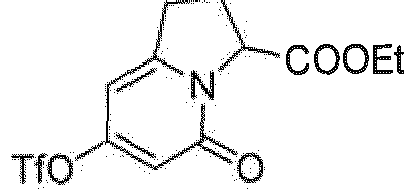
- Ethyl 7-hydroxy-5-oxo-1,2,3,5-tetrahydroindolizine-3-carboxylate (2f) (480 mg, 2.1 mmol) was dissolved in N,N-dimethylformamide (10 mL), triethylamine (0.6 mL, 4.6 mmol) and N-phenyl-p-bis(trifluoromethanesulfonimide) (900 mg, 2.5 mmol) were added thereto, and the reaction was allowed to proceed at room temperature for 1 hour. Ethyl acetate (100 mL) was added to the reaction solution, which was washed with water (60 mL × 3) and then saturated brine (60 mL), dried over anhydrous sodium sulfate, and concentrated; the residue was purified by silica gel column chromatography (ethyl acetate : petroleum ether = 1:10 to 1:2) to give the title compound ethyl 5-oxo-7-(((trifluoromethyl)sulfonyl)oxy)-1,2,3,5-tetrahydroindolizine-3-carboxylate (2g) as a yellow oily substance (0.4 g, yield 54%).
1H NMR (400 MHz, CDCl3) δ 6.31 (d, 1H), 6.15 (d, 1H), 5.10 (dd, 1H), 4.23 (q, 2H), 3.24 (m, 1H), 3.12 (m, 1H), 2.57 (m, 1H), 2.35 (m, 1H), 1.30 (t, 3H).
LCMS m/z =355.8 [M+1]. -

- 4-chloro-2-bromo-aniline (206 mg, 0.01 mmol) was dissolved in dimethylsulfoxide (20 mL). Under a nitrogen atmosphere, bis(pinacolato)diboron (3.8 g, 15 mmol), potassium acetate (2.5 g, 25.7 mmol) and [1,1'-bis(diphenylphosphino)ferrocene] dichloropalladium (218 mg, 0.3 mmol) were added thereto, and the temperature was raised to 80°C to allow the reaction to proceed for 24 hours. Water (100 ml) was added to the reaction solution, which was extracted with ethyl acetate (80 ml×2). The organic phases were combined, washed with saturated brine (100 mL), dried over anhydrous sodium sulfate, and concentrated. The residue was purified by silica gel column chromatography (ethyl acetate : petroleum ether = 1:100 to 1:30) to give the title compound 4-chloro-2-(4,4,5,5-tetramethyl-1,3,2-dioxaborolan-2-yl)aniline (2i) as a white solid (2.0 g, yield 79%).
1H NMR (400 MHz, CDCl3) δ 7.54 (s, 1H), 7.19 - 7.08 (m, 1H), 6.55 (d, 1H), 4.86 (s, 2H), 1.34 (s, 12H).
LCMS m/z =254.0 [M+1]. -

- Ethyl 5-oxo-7-(((trifluoromethyl)sulfonyl)oxy)-1,2,3,5-tetrahydroindolizine-3-carboxylate (2g) (355 mg, 0.1 mmol) and 4-chloro-2-(4,4,5,5-tetramethyl-1,3,2-dioxaborolan-2-yl)aniline (2i) (253 g, 0.1 mmol) were dissolved in 1,4-dioxane (30 mL). Under a nitrogen atmosphere, cesium fluoride (380 mg, 0.25 mmol) and tetrakis(triphenylphosphine)palladium (28.9 mg, 0.025 mmol) were added thereto, and the temperature was raised to 105°C to allow the reaction to proceed for 1 hour. Ethyl acetate (100 mL) was added to the reaction solution, which was washed with water (50 mL × 2) and then saturated brine (50 mL), dried over anhydrous sodium sulfate, and concentrated; the residue was purified by silica gel column chromatography (ethyl acetate : petroleum ether = 1:20 to 1:1) to give the title compound 7-(2-amino-5-chlorophenyl)-5-oxo-1,2,3,5-tetrahydroindolizine-3-carboxylate (2j) as a light yellow solid (120 g, yield 36%).
1H NMR (400 MHz, CDCl3) δ 7.11 (dd, 1H), 7.08 (d, 1H), 6.67 (d, 1H), 6.50 (s, 1H), 6.23 (s, 1H), 5.16 (dd, 1H), 4.27 (q, 2H), 3.51 (s, 2H), 3.23 (m, 1H), 3.12 (m, 1H), 2.54 (m, 1H), 2.39 - 2.27 (m, 1H), 1.31 (t, 3H).
LCMS m/z =332.9 [M+1]. -
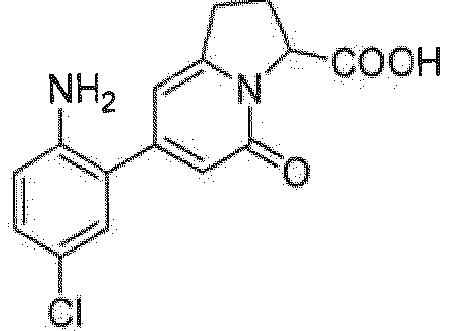
- Ethyl 7-(2-amino-5-chlorophenyl)-5-oxo-1,2,3,5-tetrahydroindolizine-3-carboxylate (2j) (600 mg, 1.8 mmol) was dissolved in ethanol (10 mL), sodium hydroxide (288 mg, 7.2 mmol) was added thereto, and the reaction was allowed to proceed at room temperature for 4 hours. A hydrochloric acid solution (4 mol/L) was added to the reaction solution to adjust it to pH=3 to 4. The reaction solution was extracted with dichloromethane (60 ml × 3). The organic phases were combined, washed with saturated brine (60 mL), dried over anhydrous sodium sulfate, concentrated, and recrystallized to give the title compound 7-(2-amino-5-chlorophenyl)-5-oxo-1,2,3,5-tetrahydroindolizine-3-carboxylic acid (2k) as a yellow solid (400 mg, yield 73%).
1H NMR (400 MHz, DMSO) δ 7.16 (dd, 1H), 7.09 (d, 1H), 6.86 (d, 1H), 6.29 (d, 1H), 6.25 (d, 1H), 4.92 (dd, 1H), 3.11 (m, 2H), 2.50 - 2.45 (m, 1H), 2.27 - 2.14 (m, 1H).
LCMS m/z =304.9 [M+1]. -

- 7-(2-amino-5-chlorophenyl)-5-oxo-1,2,3,5-tetrahydroindolizine-3-carboxylic acid (2k) (400 mg, 1.3 mmol) was dissolved in acetic acid (5 mL), trimethyl orthoformate (414 mg, 3.9 mmol) and sodium azide (214.5 g, 3.9 mmol) were added thereto, the reaction was allowed to proceed at room temperature for half an hour, and further for 2 hours at 75°C. The reaction solution was cooled to room temperature, water (100 ml) was added thereto, and the reaction solution was extracted with dichloromethane (60 ml×3). The organic phases were combined, washed with saturated brine (60 ml×2), dried over anhydrous sodium sulfate, and concentrated to give the title compound 7-(5-chloro-2-(1H-tetrazol-1-yl)phenyl)-5-oxo-1,2,3,5-tetrahydroindolizine-3-carboxy lic acid (Intermediate 2) as a yellow solid (400 mg, yield 86%).
1H NMR (400 MHz, DMSO) δ 9.68 (s, 1H), 7.80 (m, 2H), 7.79 - 7.76 (m, 1H), 5.97 (d, 1H), 5.90 (d, 1H), 4.85 (dd, 1H), 2.97 (m, 2H), 2.44 (m, 1H), 2.19 - 2.05 (m, 1H).
LCMS m/z =357.8 [M+1]. -


-

- 4-bromopyridin-2-one (1 g, 5.7 mmol), bromoethyl acetate (1.06 g, 6.3 mmol) and potassium carbonate (0.95 g, 6.9 mmol) were dissolved in N,N-dimethylformamide (20 mL), and allowed to react overnight at room temperature. The reaction solution was introduced into water (50 mL) and extracted with ethyl acetate (50 mL×2). The organic phases were combined, dried over anhydrous sodium sulfate, and concentrated to obtain the title compound ethyl 2-(4-bromo-2-oxo-pyridin-1(2H)-yl)acetate (3b) as a white solid (1.5 g, yield 100%).
1H NMR (400 MHz, CDCl3) δ 7.09 (d, 1H), 6.86 (d, 1H), 6.37 (dd, 1H), 4.60 (s, 2H), 4.25 (q, 2H), 1.45 -1.11 (m, 3H).
LCMS m/z =260.0 [M+1]. -
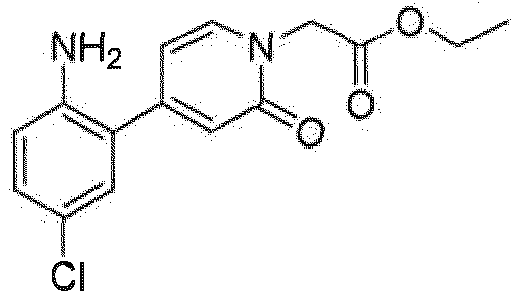
- 4-chloro-2-(4,4,5,5-tetramethyl-1,3,2-dioxaborolan-2-yl)aniline (2i) (0.1 g, 0.39 mmol), ethyl 2-(4-bromo-2-oxo-pyridin-1(2H)-yl)acetate (0.15 g, 0.59 mmol) and an aqueous solution of sodium bicarbonate (2 mL, 0.39 mmol) were dissolved in dioxane (10 mL), and the temperature was raised to 110°C to allow the reaction to proceed overnight. Water (50 ml) was added to the reaction solution, which was extracted with ethyl acetate (50 ml×3). The organic phases were combined, dried over anhydrous sodium sulfate, and concentrated. The residue was purified by silica gel column chromatography (petroleum ether : ethyl acetate = 1:1) to give the title compound ethyl 2-(4-(5-chloro-2-aminophenyl)-2-oxo-pyridin-1(2H)-yl)acetate (3c) as a white solid (13 mg, yield 11%).
1H NMR (400 MHz, DMSO) δ 7.71 (d, 1H), 7.12 (dd, 1H), 7.06 (d, 1H), 6.77 (d, 1H), 6.45 (d, 1H), 6.35 (dd, 1H), 5.20 (s, 2H), 4.71 (s, 2H), 4.16 (q, 2H), 1.23 (t, 3H).
LCMS m/z =307.1 [M+1]. -

- Ethyl 2-(4-(5-chloro-2-aminophenyl)-2-oxo-pyridin-1(2H)-yl)acetate (3c) (0.05 g, 0.16 mmol) and trimethyl orthoformate (51.9 mg, 0.49 mmol) were dissolved in acetic acid (10 mL), and allowed to react at room temperature for 10 min. Sodium azide (31.8 g, 0.49 mmol) was added thereto, and the temperature was raised to 80°C to allow reaction to proceed overnight. Water (50 ml) was added to the reaction solution, which was extracted with ethyl acetate (50 ml×3). The organic phases were combined, dried over anhydrous sodium sulfate, and concentrated to give the title compound ethyl 2-(4-(5-chloro-2-(1H-tetrazol-1-yl)phenyl))-2-oxo-pyridin-1-yl)acetate (3d) as a white solid (46 mg, yield 80%).
1H NMR (400 MHz, DMSO) δ 9.68 (s, 1H), 7.92 - 7.75 (m, 3H), 7.57 (d, 1H), 6.30 (d, 1H), 5.84 (dd, 1H), 4.64 (s, 2H), 4.13 (q, 2H), 1.20 (t, 3H).
LCMS m/z =360.1 [M+1]. -

- Ethyl 2-(4-(5-chloro-2-(1H-tetrazol-1-yl)phenyl))-2-oxo-pyridin-1-yl)acetate (3d) (0.37 g, 1.0 mmol) was dissolved in tetrahydrofuran (10 mL), and lithium hydroxide (0.17 g, 4.12 mmol) was added thereto, followed by reaction at room temperature for 2 hours. The reaction solution was added to water (10 mL), adjusted to pH=2 with hydrochloric acid (4 mol/L), and extracted with ethyl acetate (10 ml×2). The organic phases were combined, dried over anhydrous sodium sulfate, and concentrated to give the title compound 2-(4-(5-chloro-2-(1H-tetrazol-1-yl)phenyl))-2-oxo-pyridin-1-yl)acetic acid (intermediate 3) as a yellow solid (0.2 g, yield 58%).
1H NMR (400 MHz, DMSO) δ 9.69 (s, 1H), 7.88 - 7.72 (m, 3H), 7.56 (d, 1H), 6.28 (d, 1H), 5.81 (dd, 1H), 4.56 (s, 2H).
LCMS m/z =332.0 [M+1]. -
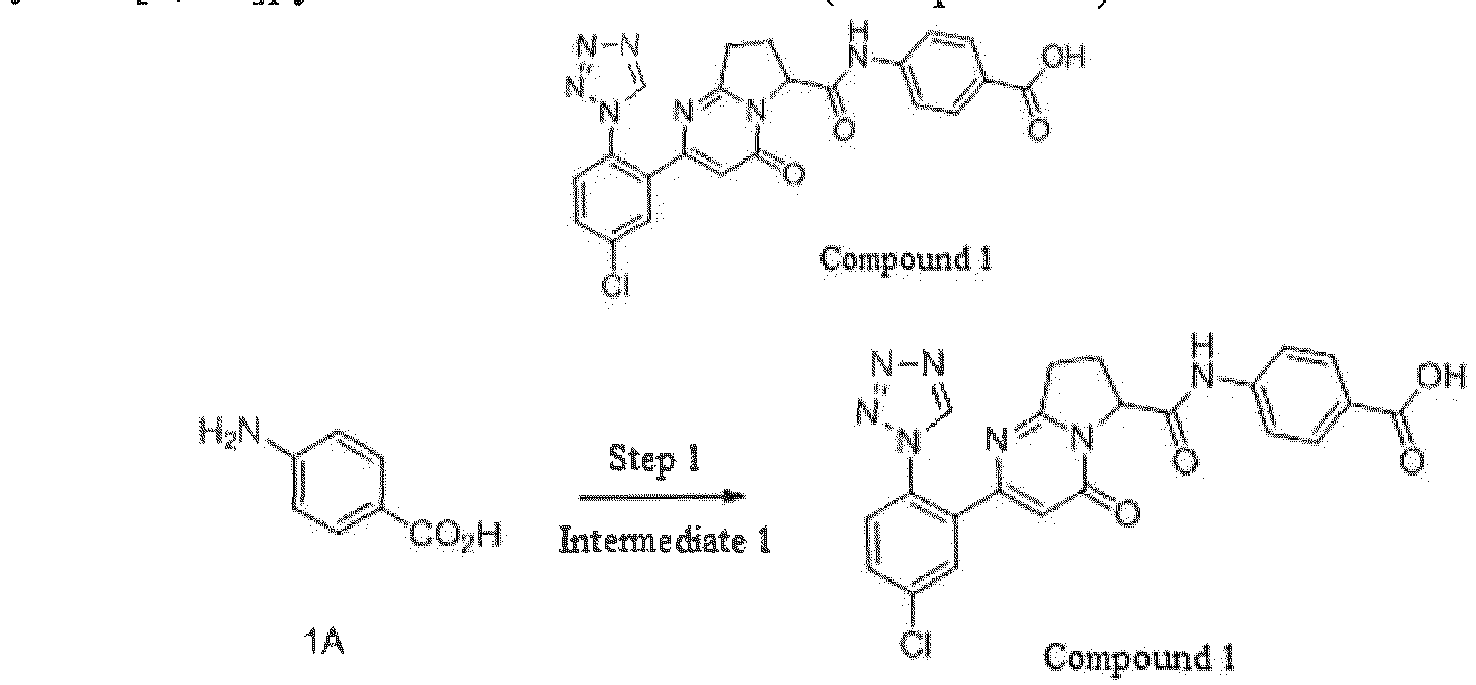
-

- 2-(5-chloro-2-(1H-tetrazol-1-yl)phenyl)-4-oxo-4,6,7,8-tetrahydropyrrolo[1,2-a]pyrimi dine-6-carboxylic acid (Intermediate 1) (130 mg, 0.36 mmol) was dissolved in tetrahydrofuran (6 ml), and under a protective nitrogen atmosphere, the solution was cooled to 0°C, a solution of oxalyl chloride (137 mg, 1.08 mmol) in N,N-dimethylformamide (2 drops) was added dropwise thereto, and the reaction was allowed to proceed at room temperature for 2 hours, then tetrahydrofuran was removed under reduced pressure to obtain reaction liquid 1; p-aminobenzoic acid (60 mg, 0.43 mmol) was dissolved in tetrahydrofuran (5 ml), triethylamine (109.3 mg, 108 mmol) and reaction liquid 1 prepared above were added thereto, and the reaction was allowed to proceed for 3 hours at room temperature. Water (10 ml) was added to the reaction solution to quench the reaction, and the reaction solution was extracted with ethyl acetate (10 ml×2). The organic phases were combined, dried over anhydrous sodium sulfate, and concentrated. The residue was purified by silica gel column chromatography (dichloromethane : methanol = 49:1 to 9:1) to give the title compound N-(4-carboxyphenyl)-2-(5-chloro-2-(1H-tetrazol-1-yl)phenyl)-4-oxo-4,6,7,8-tetrahydr opyrrolo[1,2-a]pyrimidine-6-carboxamide (Compound 1) as a light gray solid (30 mg, yield 17%).
1H NMR (400 MHz, DMSO) δ 12.50 (s, 1H), 10.94 (s, 1H), 9.73 (s, 1H), 7.98 (d, 1H), 7.86 (m, 4H), 7.72 (d, 2H), 6.38 (s, 1H), 5.17 (dd, 1H), 2.93 (m, 1H), 2.79 (m, 1H), 2.54 (m, 1H), 2.15 (m, 1H).
LCMS m/z =477.8 [M+1]. -


-

- 7-(5-chloro-2-(1H-tetrazol-1-yl)phenyl)-5-oxo-1,2,3,5-tetrahydroindolizine-3-carboxy lic acid (Intermediate 2) (100 mg, 0.28 mmol) was dissolved in tetrahydrofuran (10 ml), and under a protective nitrogen atmosphere, the solution was cooled to 0°C, a solution of oxalyl chloride (0.07 ml, 0.84 mmol) in N,N-dimethylformamide (2 drops) was added dropwise thereto, and the reaction was allowed to proceed for 2 hours at room temperature. Tetrahydrofuran was removed under reduced pressure to obtain reaction liquid 1; p-aminobenzoic acid (46 mg, 0.33 mmol) was dissolved in tetrahydrofuran (5 ml), triethylamine (85 mg, 0.84 mmol) and reaction liquid 1 prepared above were added thereto, and the reaction was allowed to proceed for 1 hour at room temperature. Water (80 ml) was added to the reaction solution, which was extracted with ethyl acetate (80 ml×2). The organic phases were combined, washed with saturated brine (80 mL), dried over anhydrous sodium sulfate, and concentrated. The residue was purified by silica gel column chromatography (dichloromethane : methanol = 100:1 to 100:3) to give the title compound N-(4-carboxyphenyl)-7-(5-chloro-2-(1H-tetrazol-1-yl)phenyl)-5-oxo-1,2,3,5-tetrahydr oindolizine-3-carboxamide (Compound 2) as a light yellow solid (35 mg, yield 26%).
1H NMR (400 MHz, DMSO) δ 12.72 (s, 1H), 10.74 (s, 1H), 9.69 (s, 1H), 7.90 (d, 2H), 7.80 (m, 3H), 7.70 (d, 2H), 5.99 (s, 1H), 5.94 (s, 1H), 5.11 (dd, 1H), 3.16 - 2.90 (m, 3H), 2.18 (m, 1H).
LCMS m/z =476.8 [M+1]. -

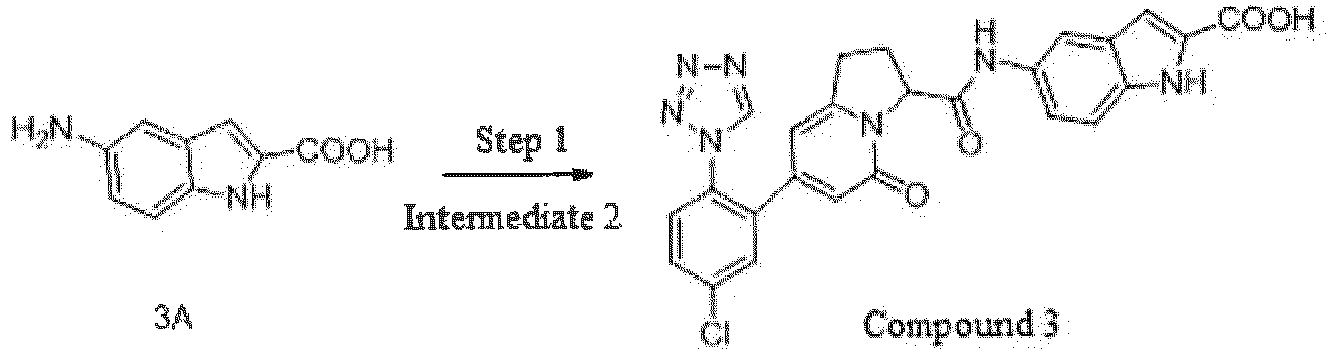
-

- 7-(5-chloro-2-(1H-tetrazol-1-yl)phenyl)-5-oxo-1,2,3,5-tetrahydroindolizine-3-carboxy lic acid (Intermediate 2) (100 mg, 0.28 mmol) was dissolved in tetrahydrofuran (10 ml), and under a protective nitrogen atmosphere, the solution was cooled to 0°C, a solution of oxalyl chloride (0.07 ml, 0.84 mmol) in N,N-dimethylformamide (2 drops) was added dropwise thereto, and the reaction was allowed to proceed for 2 hours at room temperature, to obtain reaction liquid 1; 5-aminoindole-2-carboxylic acid (59.2 mg, 0.34 mmol) was dissolved in tetrahydrofuran (10 ml), triethylamine (85 mg, 0.84 mmol) was added thereto, the solution pH was adjusted to 9 to 10, reaction liquid 1 prepared above was added, and the reaction was allowed to proceed for 2 hours at room temperature. Dilute hydrochloric acid at 4 mol/l was added to the reaction solution to adjust the solution to pH=4, and the solution was extracted with ethyl acetate (80 ml×2). The organic phases were combined, washed with saturated brine (100 mL), dried over anhydrous sodium sulfate, and concentrated. The residue was purified by silica gel column chromatography (dichloromethane : methanol = 100:1 to 20:1) to give the title compound N-(2-carboxyindol-5-yl)-7-(5-chloro-2-(1H-tetrazol-1-yl)phenyl)-5-oxo-1,2,3,5-tetrah ydroindolizine-3-carboxamide (Compound 3) as a khaki solid (10 mg, yield 7%).
1H NMR (400 MHz, DMSO) δ 11.69 (s, 1H), 10.31 (s, 1H), 9.69 (s, 1H), 8.00 (s, 1H), 7.80 (d, 3H), 7.36 (m, 2H), 7.03 (s, 1H), 5.98 (s, 1H), 5.93 (s, 1H), 5.11 (dd, 1H), 3.03 (m, 3H), 2.18 (m, 1H).
LCMS m/z =515.8 [M+1]. -
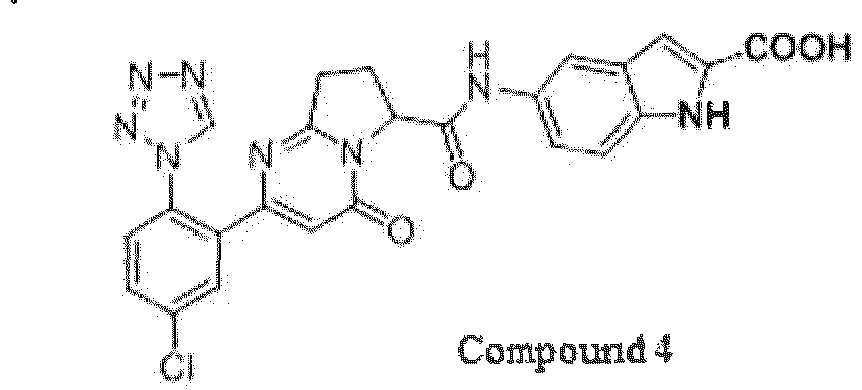

-

- 2-(5-chloro-2-(1H-tetrazol-1-yl)phenyl)-4-oxo-4,6,7,8-tetrahydropyrrolo[1,2-a]pyrimi dine-6-carboxylic acid (Intermediate 1) (100 mg, 0.28 mmol) was dissolved in tetrahydrofuran (5 ml) and cooled to 0°C. Under a protective nitrogen atmosphere, oxalyl chloride (107 mg, 0.84 mmol) and N,N-dimethylformamide (2 drops) were added dropwise thereto, the temperature was raised to room temperature at which the reaction was allowed to proceed for 2 hours. The solvent was removed under reduced pressure, tetrahydrofuran (5 ml) was added to the residue, the solution was cooled to 0°C, a solution of t-butyl 5-aminoindole-2-carboxylate (79.2 mg, 0.34 mmol) in tetrahydrofuran (3 ml) was added dropwise thereto, and the reaction was allowed to proceed for 3 hours at room temperature. Water (10 ml) was added to the reaction solution to quench the reaction, and the reaction solution was extracted with ethyl acetate (10 ml×3). The organic phases were combined, dried over anhydrous sodium sulfate, and concentrated. The residue was purified by silica gel column chromatography (dichloromethane : methanol = 49:1 to 9:1) to give the title compound N-(2-tert-butoxycarbonylindol-5-yl)-2-(5-chloro-2-(1H-tetrazol-1-yl)phenyl)-4-oxo-4, 6,7,8-tetrahydropyrrolo[1,2-a]pyrimidine-6-carboxamide (4B) as a light yellow solid (80 mg, yield 50%).
-

- N-(2-tert-butoxycarbonylindol-5-yl)-2-(5-chloro-2-(1H-tetrazol-1-yl)phenyl)-4-oxo-4, 6,7,8-tetrahydropyrrolo[1,2-a]pyrimidine-6-carboxamide (4B) (80 mg, 0.14 mmol) was dissolved in tetrahydrofuran (5 ml), trifluoroacetic acid (638 mg, 5.6 mmol) was added thereto, and the temperature was raised to 80°C to allow the reaction to proceed for 4 hours. Water (10 ml) was added to the reaction solution to quench the reaction, and the reaction solution was extracted with ethyl acetate (10 ml×3). The organic phases were combined, dried over anhydrous sodium sulfate, and concentrated. The residue was purified by silica gel column chromatography (dichloromethane : methanol = 49:1 to 9:1) to give the title compound N-(2-carboxyindol-5-yl)-2-(5-chloro-2-(1H-tetrazol-1-yl)phenyl)-4-oxo-4,6,7,8-tetrah ydropyrrolo[1,2-a]pyrimidine-6-carboxamide (Compound 4) as a light yellow solid (46 mg, yield 64%).
1H NMR (400 MHz, DMSO) δ 11.19 (s, 1H), 10.39 (s, 1H), 9.74 (s, 1H), 7.98 (d, 1H), 7.81-7.90 (m, 3H), 7.29 (dd, 2H), 6.74 (s, 1H), 6.37 (s, 1H), 5.16 (d, 1H), 2.99-2.90 (m, 1H), 2.80-2.74 (m, 1H), 2.49-2.46 (m, 1H), 2.16-2.11 (m, 1H).
LCMS m/z =517.1 [M+1]. -

-

- 2-(4-(5-chloro-2-(1H-tetrazol-1-yl)phenyl))-2-oxo-pyridin-1-yl)acetic acid (Intermediate 3) (0.15 g, 0.45 mmol) and t-butyl p-aminobenzoate (0.34 g, 1.8 mmol) were dissolved in pyridine (20 ml), and 1-(3-dimethylaminopropyl)-3-ethyl-carbodiimide (0.69 g, 3.6 mmol) was added thereto, and the reaction was allowed to proceed at room temperature for 4 hours. The reaction solution was added to water (50 mL) and extracted with ethyl acetate (50 mL×2). The organic phases were combined, dried over anhydrous sodium sulfate, and concentrated to obtain the title compound N-(4-tert-butoxycarboxylphenyl)-2-(4-(5-chloro-2-(1H-tetrazol-1-yl)phenyl))-2-oxo-p yridin-1-yl)acetamide (5B) as a white solid (175 mg, yield 77%).
1H NMR (400 MHz, DMSO) δ 10.66 (s, 1H), 9.70 (s, 1H), 7.86 (d, 2H), 7.82 (m, 3H), 7.68 (d, 2H), 7.58 (d, 1H), 6.29 (d, 1H), 5.84 (dd, 1H), 4.74 (s, 2H), 1.53 (s, 9H).
LCMS m/z =507.3 [M+1]. -

- N-(4-tert-butoxycarboxylphenyl)-2-(4-(5-chloro-2-(1H-tetrazol-1-yl)phenyl))-2-oxo-p yridin-1-yl)acetamide (5B) (170 mg, 0.33 mmol) was dissolved in dichloromethane (5 mL), trifluoroacetic acid (0.5 ml, 6.6 mmol) was added thereto, and the reaction was allowed to proceed at room temperature for 2 hours. Trifluoroacetic acid was removed under reduced pressure from the reaction solution, and the residue was dissolved with dichloromethane, water (20 ml) was added thereto, and the solution pH was adjusted to 6 to 7 with a saturated sodium bicarbonate solution, followed by washing with saturated brine (20 ml×3), drying over anhydrous sodium sulfate, and concentration, to give the title compound N-(4-carboxyphenyl)-2-(4-(5-chloro-2-(1H-tetrazol-1-yl)phenyl))-2-oxo-pyridin-1-yl) acetamide (Compound 5) as an off-white solid (80 mg, yield 54%).
1H NMR (400 MHz, DMSO) δ 12.69 (s, 1H), 10.72 (s, 1H), 9.71 (s, 1H), 7.90 (d, 2H), 7.85 - 7.79 (m, 3H), 7.69 (d, 2H), 7.59 (d, 1H), 6.30 (d, 1H), 5.84 (dd, 1H), 4.75 (s, 2H).
LCMS m/z =451.1 [M+1]. -

- 2-(4-(5-chloro-2-(1H-tetrazol-1-yl)phenyl))-2-oxo-pyridin-1-yl)acetic acid (Intermediate 3) (0.2 g, 0.6 mmol), t-butyl 5-aminoindole-2-carboxylate (174 mg, 0.72 mmol) and 1-(3-dimethylaminopropyl)-3-ethyl-carbodiimide (460 mg, 2.4 mmol) were added in pyridine (10 mL), and allowed to react at room temperature for 2 hours. The reaction solution was added to water (50 ml), adjusted to pH = 2 with hydrochloric acid (6 mol/L), and extracted with ethyl acetate (20 ml×2); the organic phases were combined, dried over anhydrous sodium sulfate, and concentrated; the residue was purified by silica gel column chromatography (dichloromethane : methanol = 50:1) to give the title compound N-(2-tert-butoxycarboxylindol-5-yl)-2-(4-(5-chloro-2-(1H-tetrazol-1-yl)phenyl))-2-ox o-pyridin-1-yl)acetamide (6B) as a red solid (170 mg, yield 85%).
1H NMR (400 MHz, DMSO) δ 11.61 (s, 1H), 10.21 (s, 1H), 9.70 (s, 1H), 7.96 (d, 1H), 7.91 - 7.75 (m, 3H), 7.59 (d, 1H), 7.37 (m, 2H), 6.99 (d, 1H), 6.29 (d, 1H), 5.83 (dd, 1H), 4.71 (s, 2H), 1.56 (s, 9H). - N-(2-tert-butoxycarboxylindol-5-yl)-2-(4-(5-chloro-2-(1H-tetrazol-1-yl)phenyl))-2-ox o-pyridin-1-yl)acetamide (6B) (0.17 g, 0.25 mmol) was dissolved in dichloromethane (2 ml), trifluoroacetic acid (1 ml) was added thereto, and the reaction was allowed to proceed at room temperature for 5 hours. The reaction solution was concentrated, and the residue was washed with dichloromethane/methanol (v/v=1:1) and dried, to give the title compound as a pink solid (70 mg, yield 58%).
1H NMR (400 MHz, DMSO) δ 11.68 (s, 1H), 10.21 (s, 1H), 9.70 (s, 1H), 7.97 (s, 1H), 7.82 (m, 3H), 7.59 (d, 1H), 7.36 (m, 2H), 7.03 (d, 1H), 6.29 (d, 1H), 5.83 (dd, 1H), 4.71 (s, 2H).
LCMS m/z =490.2 [M+1]. -

-

- 7-(5-chloro-2-(1H-tetrazol-1-yl)phenyl)-5-oxo-1,2,3,5-tetrahydroindolizine-3-carboxy lic acid (Intermediate 2) (100 mg, 0.28 mmol) was dissolved in tetrahydrofuran (10 ml), and under a protective nitrogen atmosphere, the solution was cooled to 0°C, oxalyl chloride (0.07 ml, 0.84 mmol) and N,N-dimethylformamide (2 drops) were added dropwise thereto, and the reaction was allowed to proceed for 1.5 hours at room temperature. Tetrahydrofuran was removed under reduced pressure to obtain reaction liquid 1; p-methoxycarbonylaminoaniline (56.5 mg, 0.34 mmol) was dissolved in tetrahydrofuran (5 ml), triethylamine (85 mg, 0.84 mmol) and reaction liquid 1 prepared above were added thereto, and the reaction was allowed to proceed for 2 hours at room temperature. Water (30 ml) was added to the reaction solution, which was extracted with ethyl acetate (50 ml×2). The organic phases were combined, washed with saturated brine (50 mL), dried over anhydrous sodium sulfate, and concentrated. The residue was purified by silica gel column chromatography (dichloromethane : methanol = 100:1 to 100:3) to give the title compound N-(4-methoxycarboxylaminophenyl)-7-(5-chloro-2-(1H-tetrazol-1-yl)phenyl)-5-oxo-1 ,2,3,5-tetrahydroindolizine-3-carboxamide(Compound 7) as an off-white solid (90 mg, yield 64%).
1H NMR (400 MHz, DMSO) δ 10.32 (s, 1H), 9.69 (s, 1H), 9.55 (s, 1H), 7.80 (m, 3H), 7.49 (d, 2H), 7.38 (d, 2H), 5.97 (s, 1H), 5.93 (s, 1H), 5.06 (dd, 1H), 3.65 (s, 3H), 3.04 (m, 1H), 3.01 - 2.91 (m, 1H), 2.48 - 2.39 (m, 1H), 2.19 - 2.10 (m, 1H).
LCMS m/z =506.3 [M+1]. - N-(2-carboxyindol-5-yl)-7-(5-chloro-2-(1H-tetrazol-1-yl)phenyl)-5-oxo-1,2,3,5-tetrah ydroindolizine-3-carboxamide (Compound 3) (45 mg) was further separated by HPLC using Glison GX-281 (No. CH-Y-C0630) under the following chiral separation condition: Chromatography column: CHIRALPAK IC, 20×250 mm, 5 µm; Mobile phase: A: n-hexane (0.1% TFA), and B: tetrahydrofuran; Process: isocratic elution with A:B=40:60 (v/v) for 20 min; Flow rate: 9 ml/min; Detection wavelength: UV 251 nm; Syringe numbers: 2 syringes (about 20 mg/syringe). Two optical isomers Compound 8-1 (Peak 1, 5 mg, 95.74% pure) and Compound 8-2 (Peak 2, 16 mg, 99.59%pure) were obtained.
-

-

- 2-hydroxy-3-phenylpropanoic acid (9A) (5 g, 30.1 mmol) was dissolved in methanol (100 mL), concentrated sulfuric acid (1 mL) was added thereto, and the reaction was allowed to proceed at 30°C overnight. The reaction solution was concentrated, then dissolved with ethyl acetate (50 ml), washed once with saturated sodium bicarbonate (50 ml) and then once with saturated sodium chloride (50 ml), dried over anhydrous sodium sulfate, and concentrated to give methyl 2-hydroxy-3-phenylpropanonate (9B) as a white solid (6 g, 100%).
1H NMR (400 MHz, DMSO) δ 7.30 - 7.23 (m, 2H), 7.23 - 7.15 (m, 3H), 5.53 (d, 1H), 4.27-4.22 (m, 1H), 3.60 (s, 3H), 2.95 (dd, 1H), 2.82 (dd, 1H). -

- Methyl 2-hydroxy-3-phenylpropanonate (9B) (1 g, 5.5 mmol) was dissolved in chloroform (20 mL); under the protection of nitrogen, triethylamine (0.67 g, 6.6 mmol) and trifluoromethanesufonyl anhydride (1.7 g, 6.1 mmol) were added at -78°C; the temperature was allowed to spontaneously rise to room temperature and the reaction was allowed to proceed for 2 hours. Saturated sodium bicarbonate (10 mL) was added to the reaction solution to partition the mixed solution; the organic phase was washed once with saturated sodium chloride (10 mL), dried over anhydrous sodium sulfate, and concentrated; the residue was purified by silica gel column chromatography (petroleum ether : ethyl acetate (v/v) = 100:1 to 10:1) to give methyl 2-((trifluoromethylsulfonyl)oxy)-3-phenylpropanoate (9C) as a colorless liquid (1.0 g, yield 62.5%).
1H NMR (400 MHz, DMSO) δ 7.38 - 7.21 (m, 5H), 5.53 (dd, 1H), 3.77 (s, 3H), 3.30 (dd, 1H), 3.14 (dd, 1H). -

- 4-bromopyridin-2(1H)-one (77.8 mg, 0.45 mmol) was dissolved in tetrahydrofuran (10 mL), sodium hydride (2 mg, 0.55 mmol) was added at room temperature, and the reaction was allowed to proceed for 10 min. Methyl 2-((trifluoromethylsulfonyl)oxy)-3-phenylpropanoate (9C) (0.15 g, 0.5 mmol) was added thereto and the reaction was allowed to proceed at 30°C overnight. The reaction solution was added to water (10 ml), and extracted with ethyl acetate (10 ml×3). The organic phases were combined, washed with water (50 ml × 2), dried over anhydrous sodium sulfate, and concentrated. The residue was purified by silica gel column chromatography (petroleum ether : ethyl acetate (v/v) = 10:1 to 2:1) to give methyl 2-(4-bromo-2-oxopyridin-1(2H)-yl)-3-phenylpropanoate (9D) as a white solid (50 mg, yield 33.0%).
1H NMR (400 MHz, DMSO) δ 7.34 (d, 1H), 7.28 - 7.13 (m, 3H), 7.09 (d, 2H), 6.68 (d, 1H), 6.31 (dd, 1H), 5.37 (dd, 1H), 3.67 (s, 3H), 3.39 (ddd, 2H). LCMS m/z =336.1 [M-1]. -

- Methyl 2-(4-bromo-2-oxopyridin-1(2H)-yl)-3-phenylpropanoate (9D) (5.7g, 17.0 mmol) was dissolved in dioxane (100 mL), then 4-chloro-2-(4,4,5,5-tetramethyl-1,3,2-dioxaborolan-2-yl)aniline (8.6g, 34.0 mmol) and [1,1'-bis(diphenylphosphino)ferrocene]dichloropalladium (Pd(dppf)Cl2) (0.31g, 0.42 mmol) and an aqueous solution of saturated sodium bicarbonate (30 mL) were added thereto, and the reaction was allowed to proceed at 110°C overnight under N2 protection. The reaction solution was added to 100 ml water, and extracted with ethyl acetate (100 ml×3). The organic phases were combined, washed with water (50 ml × 2), dried over anhydrous sodium sulfate, and concentrated. The residue was purified by silica gel column chromatography (petroleum ether : ethyl acetate (v/v) = 10:1 to 5:1) to give methyl 2-(4-(2-amino-5-chlorophenyl)-2-oxopyridin-1(2H)-yl)-3-phenylpropanoate (9E) as a yellow solid (1.4 g, yield 21.5%).
LCMS m/z =383.2[M-1]. -

- Methyl 2-(4-(2-amino-5-chlorophenyl)-2-oxopyridin-1(2H)-yl)-3-phenylpropanoate (9E) (0.7 g, 2.0 mmol) was dissolved in 20 ml anhydrous acetic acid, and trimethyl orthoformate (1.3 g, 12.5 mmol) was added thereto, followed by stirring at room temperature for 5 min. Sodium azide (0.8 g, 12.5 mmol) was added, and the reaction was allowed to proceed at 80°C overnight. The reaction solution was added to water (50 mL) and extracted with ethyl acetate (10 mL×3). The organic phases were combined, washed with water (10 ml×2), dried over anhydrous sodium sulfate, and concentrated to give methyl 2-(4-(5-chloro-2-(1H-tetrazol-1-yl)phenyl)-2-oxopyridin-1(2H)-yl)-3-phenylpropanoa te (9F) as a yellow solid (0.7 g, yield 77.7%).
1H NMR (400 MHz, DMSO) δ 9.59 (s, 1H), 8.00 - 7.55 (m, 3H), 7.26 (t, 2H), 7.21-7.19 (m, 2H), 6.96 (d, 2H), 6.24 (d, 1H), 5.66 (dd, 1H), 5.20 (dd, 1H), 3.65 (s, 3H), 3.35 (d, 1H), 3.33 - 3.27 (m, 1H).
LCMS m/z =458.3[M+23]. -

- Methyl 2-(4-(5-chloro-2-(1H-tetrazol-1-yl)phenyl)-2-oxopyridin-1(2H)-yl)-3-phenylpropanoa te (9F) (0.7 g, 1.6 mmol) was dissolved in 10 ml tetrahydrofuran, and a 2 ml aqueous solution of lithium hydroxide (0.2 g, 4.8 mmol) was added thereto, followed by reaction at room temperature for 5 hours. The reaction solution was added to water (20 mL), adjusted to a pH of about 2 with a 6 mol/L hydrochloric acid solution, and extracted with ethyl acetate (50 mL×3). The organic phases were combined, wash with water (50 ml×2), dried over anhydrous sodium sulfate, and concentrated to give2-(4-(5-chloro-2-(1H-tetrazol-1-yl)phenyl)-2-oxopyridin-1(2H)-yl)-3-phenylprop anoic acid (9G) as a red solid (0.6 g, yield 89.6%).
LCMS m/z =522.2[M+1]. -

- 2-(4-(5-chloro-2-(1H-tetrazol-1-yl)phenyl)-2-oxopyridin-1(2H)-yl)-3-phenylpropanoi c acid (9G) (0.7 g, 1.67 mmol), t-butyl 5-amino-1H-indole-2-carboxylate (0.38 g, 1.67 mmol) and 1-(3-dimethylaminopropyl)-3-ethyl-carbodiimide hydrochloride (1.27 g, 6.6 mmol) were added to 10 ml pyridine, and allowed to react at room temperature for 4 hours. The reaction solution was added to a 1 mol/L HCl solution to pH=2, water (50 ml) was added thereto, and the solution was extracted with ethyl acetate (50 ml×3). The organic phases were combined, washed with water (50 ml×2), dried over anhydrous sodium sulfate, and concentrated. The residue was purified by silica gel column chromatography (dichloromethane : methanol (v/v) = 100:1 to 50:1) to give tert-butyl 5-(2-(4-(5-chloro-2-(1H-tetrazol-1-yl)phenyl)-2-oxopyridin-1(2H)-yl)-3-phenylpropa namido)-1H-indole-2-carboxylate (9K) as a yellow solid (0.7 g, yield 66.7%).
-

- Tert-butyl 5-(2-(4-(5-chloro-2-(1H-tetrazol-1-yl)phenyl)-2-oxopyridin-1(2H)-yl)-3-phenylpropa namido)-1H-indole-2-carboxylate (9K) (0.5 g, 0.78 mmol) was dissolved in dichloromethane (10 ml) and trifluoroacetic acid (5 ml), and the reaction was allowed to proceed at room temperature for 8 hours. The reaction solution was concentrated, and the residue was purified by silica gel column chromatography (dichloromethane : methanol (v/v) = 100:1 to 20:1) to give 5-[[2-[4-[5-chloro-2-(tetrazol-1-yl)phenyl]-2-oxo-1-pyridyl]-3-phenyl-propanoyl]ami no]-1H-indole-2-carboxylic acid (Compound 9) as a yellow solid (20 mg, yield 4.4%).
1H NMR (400 MHz, DMSO) δ 11.71 (s, 1H), 10.42 (s, 1H), 9.60 (s, 1H), 7.99 (s, 1H), 7.90 (d, 1H), 7.79-7.76 (m, 3H), 7.39-7.26 (m, 4H), 7.21-7.15 (m, 3H), 7.05 (s, 1H), 6.20 (s, 1H), 5.95-5.94 (m, 1H), 5.81 (d, 2H), 3.37 - 3.23 (m, 2H).
LCMS m/z =578.2[M-1]. -

- The starting material 5-nitro-1H-indole-2-carboxylic acid (5.0 g, 24.2 mmol) was dissolved in tetrahydrofuran (100 mL), oxalyl chloride (5.5 mL, 60.5 mmol) was added, and 2 drops of N,N-dimethylformamide were added dropwise, followed by reaction at room temperature for 2 hours. The solvent and excess oxalyl chloride were removed under reduced pressure, the residue was dissolved by addition of tetrahydrofuran (100 mL), and potassium t-butoxide (8.1g, 72.6 mmol) was added, followed by reaction at room temperature overnight. The reaction solution was directly concentrated under reduced pressure, and passed through a silica gel column to obtain t-butyl 5-nitro-1H-indole-2-carboxylate (10B) as a yellow solid (4.0 g, yield 62.5%).
1H NMR (400 MHz, DMSO) δ 12.39 (s, 1H), 8.71 (d, 1H), 8.12 (dd, 1H), 7.61 (d, 1H), 7.34 (d, 1H), 1.59 (s, 9H). -

- t-butyl 5-nitro-1H-indole-2-carboxylate (10B) (0.5 g, 1.9 mmol) was dissolved in N,N-dimethylformamide (5 mL), and potassium carbonate (0.525 g, 3.8 mmol) and iodomethane (0.295 g, 2.1 mmol) were added thereto, followed by reaction at room temperature for 2 hours. Ethyl acetate (60 mL) was added, followed by washing with water (60 ml×2) and saturated brine (60 mL), drying over anhydrous sodium sulfate, and concentration under reduced pressure, to obtain tert-butyl 1-methyl-5-nitro-1H-indole-2-carboxylate (10C) as a yellow solid (0.5 g, yield 95.2%).
1H NMR (400 MHz, DMSO) δ 8.70 (d, 1H), 8.15 (dd, 1H), 7.78 (d, 1H), 7.44 (d, 1H), 4.06 (s, 3H), 1.59 (s, 9H).
LCMS m/z =277.1 [M+1]. -
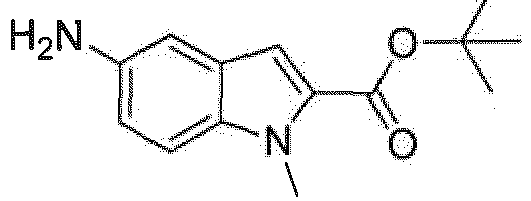
- tert-butyl 1-methyl-5-nitro-1H-indole-2-carboxylate (10C) (1.5 g, 5.4 mmol) was dissolved in methanol (30 mL), Pd/C (0.45 g) was added thereto, and hydrogen gas was introduced, followed by reaction at room temperature for 2 hours. The Pd/C was filtered off, and the filtrate was concentrated under reduced pressure to obtain tert-butyl 5-amino-1-methyl-1H-indole-2-carboxylate (10D) as a yellow solid (0.9 g, yield 69.2%).
1H NMR (400 MHz, CDCl3) δ 7.18 (d, 1H), 7.02 (s, 1H), 6.93 (d, 1H), 6.83 (dd, , 1H), 3.99 (s, 3H), 1.60 (s, 9H).
LCMS m/z =247.1 [M+1]. -

- 7-(5-chloro-2-(1H-tetrazol-1-yl)phenyl)-5-oxo-1,2,3,5-tetrahydroindolizine-3-carboxy lie acid (Intermediate 2) (1.3 g, 3.6 mmol) was dissolved in tetrahydrofuran (20 mL), and under N2 protection, oxalyl chloride (1 mL, 10.8 mmol) and 2 drops of N,N-dimethylformamide were added dropwise thereto, and the reaction was allowed to proceed for 1 hour at room temperature. The solvent was removed under reduced pressure, and the resultant solution was ready for use. Tert-butyl 5-amino-1-methyl-1H-indole-2-carboxylate (10D) (0.9 g, 3.6 mmol) was dissolved in tetrahydrofuran (20 ml), triethylamine (1.5 mL, 10.8 mmol) was added thereto, and the above solution ready for use (20 ml) was added dropwise, followed by reaction at room temperature for 2 hours. Ethyl acetate (100 ml) was added to the reaction solution, which was washed sequentially with water (100 ml) and saturated brine (100 ml), dried over anhydrous sodium sulfate, concentrated under reduced pressure, and passed through a silica gel column, to obtain tert-butyl 5-(7-(5-chloro-2-(1H-tetrazol-1-yl)phenyl)-5-oxo-1,2,3,5-tetrahydroindolizine-3-carb oxamido)-1-methyl-1H-indole-2-carboxylate (10E) as a light tan solid (1.3 g, yield 61.9%).
1H NMR (400 MHz, CDCl3) δ 10.06 (s, 1H), 8.58 (s, 1H), 7.93 (d, 1H), 7.61 (dd, 1H), 7.57 - 7.51 (m, 2H), 7.24 (dd, 1H), 7.10 (d, 1H), 7.02 (s, 1H), 6.36 (s, 1H), 5.74 (s, 1H), 5.44 (d, 1H), 3.94 (s, 3H), 3.44 - 3.22 (m, 1H), 2.87 (ddd, 2H), 2.39 - 2.24 (m, 1H), 1.60 (s, 9H).
LCMS m/z =586.2 [M+1]. -

- Tert-butyl 5-(7-(5-chloro-2-(1H-tetrazol-1-yl)phenyl)-5-oxo-1,2,3,5-tetrahydroindolizine-3-carb oxamido)-1-methyl-1H-indole-2-carboxylate (10E) (1.3 g, 2.2 mmol) was dissolved in dichloromethane (10 mL), and trifluoroacetic acid (2.5 g, 22 mmol) was added, followed by reaction at room temperature for 4 hours. Dichloromethane and trifluoroacetic acid were removed under reduced pressure, and the residue was dissolved by addition of dichloromethane (100 mL). The solution was adjusted to a pH of about 7 with an aqueous solution of saturated sodium bicarbonate, washed sequentially with water (60 mL) and saturated brine (60 mL), dried over anhydrous sodium sulfate, concentrated under reduced pressure, and passed through a silica gel column, to obtain 5-(7-(5-chloro-2-(1H-tetrazol-1-yl)phenyl)-5-oxo-1,2,3,5-tetrahydroindolizine-3-carb oxamido)-1-methyl-1H-indole-2-carboxylic acid (Compound 10) as a yellow solid (0.56 g, yield 51%).
1H NMR (400 MHz, DMSO) δ 10.44 (s, 1H), 9.71 (s, 1H), 8.04 (d, 1H), 7.81 (dd, 3H), 7.53 (d, 1H), 7.44 (dd, 1H), 7.16 (s, 1H), 5.99 (s, 1H), 5.94 (s, 1H), 5.14 (dd, 1H), 4.00 (s, 3H), 3.09 (dt, 1H), 3.04 - 2.93 (m, 1H), 2.49 - 2.41 (m, 1H), 2.26 - 2.14 (m, 1H).
LCMS m/z =530.1 [M+1]. - Test Example 1. In vitro inhibitory effect of the compounds of the present invention on the enzymatic activity of blood-coagulation factor XIa.
- The following method was used to test the in vitro inhibitory effect of the compounds of the present invention on the activity of human blood-coagulation factor XIa, expressed by the Inhibition constant Ki.
Solution preparation: reaction buffer: 0.03M HEPES acid, 0.145M NaCl, 0.005 M KCl, 0.1% PEG-8000, pH=7.5;
HEPES 8.499 g, NaCl 8.47 g, KCl 0.3725, PEG 8000 1 g, plus ddH2O 800 ml; the pH was adjusted to 7.4 with HCl, and the volume was metered to 1 L. - S2366 substrate stock solution (2 mM): a volume of substrate (25 ml) was dissolved in 23 ml sterile deionized water, aliquoted, and stored at 4°C in darkness.
- S2366 substrate working solution: the stock solution was diluted by 4 folds with the reaction buffer before use.
- FXIa working solution: 1 µl FXIa stock solution was added to 10 ml reaction buffer and thoroughly mixed before use.
- Method: 15 µl test sample working solution (15 µl DMSO for the control group) and 75 µl FXIa working solution were added to a 96-well plate, and incubated at room temperature for 15 min. Then 60 µl S2366 substrate working solution was added to initiate the reaction. The absorbance at 405 nm for the test compounds was continually assayed once every 3 minutes, and a ΔA-time curve was plotted to calculate the slope as the reaction rate. In accordance with the following equation, IC50 of each test sample when the substrate concentration was 200 µM was calculated with spss16.0. Inhibition (I%) and Ki of the test samples were calculated in accordance with the follow equations, and the results are shown in Table 1.


Table 1: Experimental results of in vitro assays of enzymatic activity of blood-coagulation factor XIa Compound No. Ki (µM) 1 0.249 2 0.068 3 0.009 4 0.017 5 0.146 6 0.014 7 0.344 8-1 0.002 8-2 1.030 9 0.004 Conclusion: the compounds of the present invention have a significant in vitro inhibitory effect on the activity of human blood-coagulation factor XIa. - 20 ml blood was taken by venipuncture from the ulnar vein of each of 20 healthy volunteers aged 25 to 35 years who had not taken any medicines within last one week, and was collected in a sodium citrate anticoagulation tube, with the ratio of anticoagulant to blood being 1:9 (v/v). Anticoagulation blood was taken and centrifuged at 200g for 15 min, the supernatant therefrom was taken and centrifuged at 2000g for 15 min, and then the supernatant therefrom was collected, well mixed, separated into 4 to 5 ml aliquots, and stored at -80°C. For APTT and PT assays, a plasma sample was taken and rapidly thawed in a 37°C water bath, and 6 µl test compound working solution was added per 294 µl plasma, while 6 µl DMSO was added for the blank control. The compounds and plasma were well mixed, and assayed in a coagulometer. The concentration of the compounds (EC2×) required to double the plasma APTT was determined with origin 8.5, and the results are shown in Table 2.
Table 2. Anti-coagulation effect of the compounds of the present invention on human plasma (represented by PT EC2× and aPTT EC2×) Example No. aPTT EC2×(µM) 3 6.1 4 9.5 6 9.0 8-1 2.3 9 6.4 Conclusion: the compounds of the present invention have a significant in vitro anti-coagulation effect on human plasma.
Claims (8)
- A compound represented by general formula (II):
 Ra1 or Ra2 is each independently selected from H, F, Cl, Br, I, cyano, formyl, acetyl, a C1-4 alkyl, a C1-4 alkoxy, -C(=O)C1-4alkyl or a 5-membered heterocycle, wherein the heterocycle contains 1 to 4 heteroatoms selected from N, O or S, and the alkyl, alkoxy or heterocycle is optionally further substituted with 0 to 5 substituents selected from H, F, Cl, Br or I; Ra3 is selected from formyl, acetyl, -C(=O)C1-4alkyl or a 5-membered heterocycle, wherein the heterocycle contains 1 to 4 heteroatoms selected from N, O or S, and the alkyl, alkoxy or heterocycle is optionally further substituted with 0 to 5 substituents selected from H, F, Cl, Br or I;X is selected from N or CH; whereinif X is selected from CH;B is selected from the following structure, which is substituted or unsubstituted:
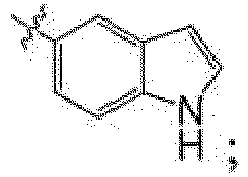 if X is selected from N;B is selected from one of the following structures, which is substituted or unsubstituted:
 the Rb1s are each independently selected from H, hydroxyl, amino, or a C1-4 alkyl, wherein the alkyl is optionally further substituted with 0 to 4 substituents selected from H, F, Cl, Br, I or hydroxyl;the Rb2s are each independently selected from H, hydroxy, amino, a C1-4 alkyl or a C1-4 alkoxy, wherein the alkyl or alkoxy is optionally further substituted with 0 to 4 substituents selected from H, F, Cl, Br, I or hydroxyl;R2 is selected from H, F, Cl, Br, I or a C1-4 alkyl;R3 is selected from H, a C1-4 alkyl or -(CH2)n-(5- or 6-membered carbocycle), wherein the carbocycle is optionally further substituted with 0 to 5 substituents selected from H, F, Cl, Br, I, hydroxy, amino, carboxy, a C1-4 alkyl or a C1-4 alkoxy;with the proviso that when R3 is -(CH2)n-(C5-6carbocycle), B is selected from indolyl non-substituted or substituted optionally with 1 to 5 Rbs;n is selected from 0, 1, 2, 3, or 4,or a stereoisomer, an oxynitride, a hydrate, a solvate, a pharmaceutically acceptable salt, or co-crystal thereof.
 - The compound according to claim 1, wherein the compound is selected from the compounds represented by general formula (III):
 Ra1 or Ra2 is each independently selected from H, F, Cl, Br, I, cyano, formyl, acetyl, a C1-4 alkyl, or a C1-4alkoxy, wherein the alkyl or alkoxy is optionally further substituted with 0 to 5 substituents selected from H, F, Cl, Br or I;if X is selected from CH;B is selected from
 if X is selected from N;B is selected from
 Rb1s are each independently selected from H, hydroxy, amino, trifluoromethyl, methyl, ethyl or isopropyl;Rb2s are each independently selected from H, hydroxy, amino, trifluoromethyl, methyl, ethyl, isopropyl, methoxy or ethoxy;or a stereoisomer, an oxynitride, a hydrate, a solvate, a pharmaceutically acceptable salt, or co-crystal thereof.
 - A compound represented by general formula (II)':
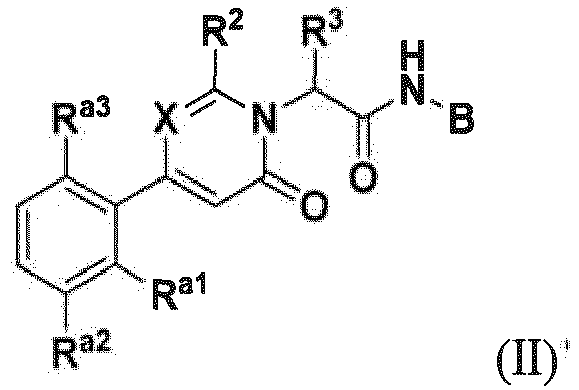 Ra1, Ra2 or Ra3 is each independently selected from H, F, Cl, Br, I, cyano, formyl, acetyl, a C1-4 alkyl, a C1-4 alkoxy, -C(=O)C1-4 alkyl or a 5-membered heterocycle, wherein the heterocycle contains 1 to 4 heteroatoms selected from N, O or S, and the alkyl, alkoxy or heterocycle is optionally further substituted with 0 to 5 substituents selected from H, F, Cl, Br or I;B is selected from one of the following structures which is substituted or unsubstituted:
 the Rbs are each independently selected from H, F, Cl, Br, I, hydroxyl, amino, carboxy,-NHC(=O)Rb2, -C(=O)NRb1Rb2 or -C(=O)Rb1;Rb1s are each independently selected from H, hydroxy, amino or a C1-4 alkyl, wherein the alkyl is optionally further substituted with 0 to 4 substituents selected from H, F, Cl, Br, I or hydroxyl;Rb2s are each independently selected from H, hydroxy, amino, a C1-4 alkyl or a C1-4alkoxy, wherein the alkyl or alkoxy is optionally further substituted with 0 to 4 substituents selected from H, F, Cl, Br, I or hydroxyl;R2 and R3 form, together with the atoms attached thereto, a 5- to 6-membered heterocycle, containing 1 to 4 heteroatoms selected from N, O or S, wherein the heterocycle is optionally further substituted with 0 to 3 substituents selected from H, F, Cl, Br, I, hydroxy, a C1-4 alkyl or a C1-4 alkoxy;X is selected from N or CH; andn is selected from 0, 2, 3, or 4,or a stereoisomer, an oxynitride, a pharmaceutically acceptable salt or co-crystal thereof.
 - The compound according to claim 3, wherein the compound is selected from the compounds represented by general formula (IV):
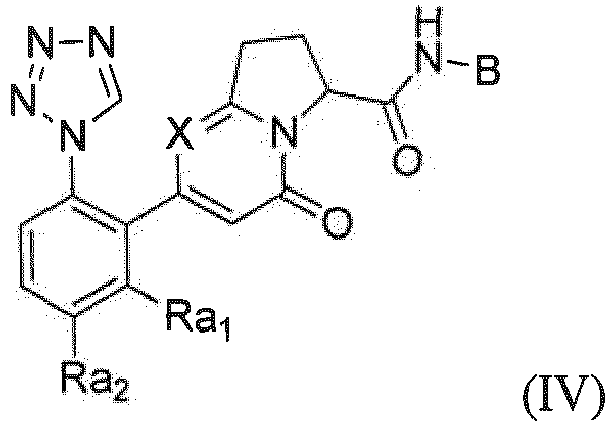 Ra1 or Ra2 is each independently selected from H, F, Cl, Br, I, cyano, formyl, acetyl, a C1-4 alkyl, or a C1-4alkoxy, wherein the alkyl or alkoxy is optionally further substituted with 0 to 5 substituents selected from H, F, Cl, Br or I;B is selected from one of
 Rb1s are each independently selected from H, hydroxy, amino, trifluoromethyl, methyl, ethyl, or isopropyl;Rb2s are each independently selected from H, hydroxy, amino, trifluoromethyl, methyl, ethyl, isopropyl, methoxy or ethoxy;or a stereoisomer, an oxynitride, a hydrate, a solvate, a pharmaceutically acceptable salt, or co-crystal thereof.
 - The compound according to claim 2, wherein:Ra1 or Ra2 is each independently selected from H, F, Cl, or Br; andRbs are each independently selected from H, carboxy, -C(=O)NH2 or -NHC(=O)OCH3,or a stereoisomer, an oxynitride, a hydrate, a solvate, a pharmaceutically acceptable salt, or co-crystal thereof.
- The compound according to claim 4, wherein:Ra1 or Ra2 is each independently selected from H, F, Cl, or Br; andRbs are each independently selected from H, carboxy, -C(=O)NH2 or -NHC(=O)OCH3,or a stereoisomer, an oxynitride, a hydrate, a solvate, a pharmaceutically acceptable salt, or co-crystal thereof.
- The compound according to claim 1 or 3, wherein the compound is selected from:


- A compound according to anyone of the preceding claims,
or a stereoisomer, an oxynitride, a hydrate, a solvate, a pharmaceutically acceptable salt, or co-crystal thereof
for use in the treatment of diseases associated with blood-coagulation factor XIa in a subject, wherein the diseases associated with blood-coagulation factor XIa are selected from thromboembolic diseases, including venous thrombosis, deep vein thrombosis, thrombophlebitis, cerebral arterial thrombosis, arterial embolism, coronary thrombosis, pulmonary embolism, renal embolism, cerebral embolism, atherosclerosis, acute coronary syndrome, unstable angina, acute coronary arterial syndrome, myocardial infarction, arteriosclerosis, sudden ischemic death, transient ischemia, peripheral arterial occlusive disease, stroke, or cerebrovascular diseases.
Applications Claiming Priority (2)
| Application Number | Priority Date | Filing Date | Title |
|---|---|---|---|
| CN201410052381 | 2014-02-14 | ||
| PCT/CN2015/072236 WO2015120777A1 (en) | 2014-02-14 | 2015-02-04 | Pyridone or pyrimidone derivative, preparation method therefor and application thereof |
Publications (3)
| Publication Number | Publication Date |
|---|---|
| EP3138839A1 EP3138839A1 (en) | 2017-03-08 |
| EP3138839A4 EP3138839A4 (en) | 2018-01-03 |
| EP3138839B1 true EP3138839B1 (en) | 2020-10-28 |
Family
ID=53799589
Family Applications (1)
| Application Number | Title | Priority Date | Filing Date |
|---|---|---|---|
| EP15748809.9A Not-in-force EP3138839B1 (en) | 2014-02-14 | 2015-02-04 | Pyridone or pyrimidone derivative, preparation method therefor and application thereof |
Country Status (4)
| Country | Link |
|---|---|
| US (1) | US10174020B2 (en) |
| EP (1) | EP3138839B1 (en) |
| CN (1) | CN105829298B (en) |
| WO (1) | WO2015120777A1 (en) |
Families Citing this family (24)
| Publication number | Priority date | Publication date | Assignee | Title |
|---|---|---|---|---|
| EP2978751B1 (en) | 2013-03-25 | 2018-12-05 | Bristol-Myers Squibb Company | Tetrahydroisoquinolines containing substituted azoles as factor xia inhibitors |
| KR20240017118A (en) | 2014-01-31 | 2024-02-06 | 브리스톨-마이어스 스큅 컴퍼니 | Macrocycles with hetrocyclic p2' groups as factor xia inhibitors |
| NO2760821T3 (en) | 2014-01-31 | 2018-03-10 | ||
| WO2016011940A1 (en) * | 2014-07-25 | 2016-01-28 | 江苏恒瑞医药股份有限公司 | Indole-amide derivative, preparation method therefor and application thereof in medicine |
| EP3189047B1 (en) | 2014-09-04 | 2018-12-26 | Bristol-Myers Squibb Company | Diamide macrocycles that are fxia inhibitors |
| US10414731B2 (en) | 2014-09-24 | 2019-09-17 | Bayer Pharma Aktiengesellschaft | Substituted oxopyridine derivatives |
| ES2722425T3 (en) * | 2014-09-24 | 2019-08-12 | Bayer Pharma AG | (2H) -2-Oxopyridines as inhibitors of factor XIa for the treatment of thrombotic diseases |
| EP3197896B1 (en) * | 2014-09-24 | 2019-01-30 | Bayer Pharma Aktiengesellschaft | Substituted oxopyridine derivatives |
| US9453018B2 (en) | 2014-10-01 | 2016-09-27 | Bristol-Myers Squibb Company | Pyrimidinones as factor XIa inhibitors |
| MX385021B (en) | 2014-12-10 | 2025-03-14 | Ono Pharmaceutical Co | DIHYDROINDOLIZINONE DERIVATIVE. |
| JO3703B1 (en) | 2015-07-09 | 2021-01-31 | Bayer Pharma AG | Substituted oxopyridine derivatives |
| EP3371162B1 (en) | 2015-10-29 | 2022-01-26 | Merck Sharp & Dohme Corp. | Macrocyclic spirocarbamate derivatives as factor xia inhibitors, pharmaceutically acceptable compositions and their use |
| EP3500556B1 (en) | 2016-08-22 | 2023-08-02 | Merck Sharp & Dohme LLC | Pyridine-1-oxide derivatives and their use as factor xia inhibitors |
| CA3031592A1 (en) * | 2016-08-31 | 2018-03-08 | Jiangsu Hengrui Medicine Co., Ltd. | Oxopicolinamide derivative, preparation method therefor and pharmaceutical use thereof |
| CN110193012B (en) * | 2018-02-27 | 2022-02-08 | 江苏恒瑞医药股份有限公司 | Pharmaceutical composition of oxopyridine amide derivatives and preparation method thereof |
| AU2019227332A1 (en) * | 2018-02-27 | 2020-08-27 | Jiangsu Hengrui Medicine Co., Ltd. | Crystal form of oxopicolinamide derivative and preparation method therefor |
| MX2020010635A (en) | 2018-04-10 | 2020-10-28 | Bayer Pharma AG | A SUBSTITUTED OXOPYRIDINE DERIVATIVE. |
| CA3123324A1 (en) * | 2018-12-17 | 2020-06-25 | Bayer Aktiengesellschaft | Substituted oxopyridine derivatives for the treatment and/or prophylaxis of thrombotic or thromboembolic disorders and/or thrombotic or thromboembolic complications |
| CN113135929B (en) * | 2020-01-17 | 2024-04-19 | 江西济民可信集团有限公司 | Furopyridone amide compound, preparation method and application thereof |
| CN112062950B (en) * | 2020-03-28 | 2021-06-29 | 成都肆零壹科技有限公司 | A kind of continuous nylon polymerization process |
| CN116283750B (en) * | 2021-09-09 | 2025-02-07 | 成都泰和伟业生物科技有限公司 | A kind of heterocyclic amide derivative and its preparation method and use |
| JP2025513455A (en) | 2022-04-22 | 2025-04-24 | バーテックス ファーマシューティカルズ インコーポレイテッド | Heteroaryl compounds for the treatment of pain - Patents.com |
| CN116082303B (en) * | 2022-12-21 | 2025-02-25 | 成都施贝康生物医药科技有限公司 | Novel oxopyridine compounds and their intermediates and applications |
| CN117186073B (en) * | 2023-09-08 | 2025-06-06 | 成都施贝康生物医药科技有限公司 | Oxo pyrimidine compound and preparation method and application thereof |
Family Cites Families (6)
| Publication number | Priority date | Publication date | Assignee | Title |
|---|---|---|---|---|
| CN1222909A (en) * | 1996-04-23 | 1999-07-14 | 麦克公司 | pyrazinone thrombin inhibitor |
| TWI330183B (en) * | 2001-10-22 | 2010-09-11 | Eisai R&D Man Co Ltd | |
| JP5419706B2 (en) * | 2006-12-20 | 2014-02-19 | タケダ カリフォルニア インコーポレイテッド | Glucokinase activator |
| DK2794597T3 (en) * | 2011-12-21 | 2018-01-15 | Ono Pharmaceutical Co | PYRIDINON AND PYRIMIDINON DERIVATIVES AS FACTOR XIA INHIBITORS |
| US9809545B2 (en) * | 2013-03-27 | 2017-11-07 | Merck Sharp & Dohme Corp. | Factor XIa inhibitors |
| TWI633089B (en) * | 2013-03-28 | 2018-08-21 | 拜耳製藥股份有限公司 | Substituted oxopyridine derivatives |
-
2015
- 2015-02-04 CN CN201580003159.1A patent/CN105829298B/en not_active Expired - Fee Related
- 2015-02-04 EP EP15748809.9A patent/EP3138839B1/en not_active Not-in-force
- 2015-02-04 WO PCT/CN2015/072236 patent/WO2015120777A1/en not_active Ceased
-
2016
- 2016-10-14 US US15/293,815 patent/US10174020B2/en not_active Expired - Fee Related
Non-Patent Citations (1)
| Title |
|---|
| None * |
Also Published As
| Publication number | Publication date |
|---|---|
| WO2015120777A1 (en) | 2015-08-20 |
| US20170029423A1 (en) | 2017-02-02 |
| EP3138839A1 (en) | 2017-03-08 |
| CN105829298A (en) | 2016-08-03 |
| EP3138839A4 (en) | 2018-01-03 |
| US10174020B2 (en) | 2019-01-08 |
| CN105829298B (en) | 2019-02-01 |
Similar Documents
| Publication | Publication Date | Title |
|---|---|---|
| US10174020B2 (en) | Pyridone or pyrimidone derivative, preparation method therefor and application thereof | |
| KR20250117700A (en) | Novel oxo-pyridine compounds, methods for preparing the same, and uses thereof | |
| JP7450024B2 (en) | FXIa inhibitor and its preparation method and pharmaceutical use | |
| KR101921436B1 (en) | Pyrimidinones as factor xia inhibitors | |
| EP4606427A2 (en) | Tricyclic fused heterocyclic pde3/4 dual inhibitor and use thereof | |
| CN112028877B (en) | Alkoxy pyridone compound and preparation method and application thereof | |
| US11518766B2 (en) | Tricyclic compound, preparation method therefor and use thereof | |
| WO2014044107A1 (en) | Pyrazol[3,4-c] pyridine derivative, preparation method and use in medicine thereof | |
| KR20230008742A (en) | (9R,135S)-13-{4-[5-chloro-2-(4-chloro-1H,2,3-triazol-1-yl)phenyl]-6-oxo-1,6-dihydropyryl Midin-1-yl} -3-(difluoromethyl)-9-methyl-3,4,7,15-tetraazatricyclo[12.3.1.02 6]octadeca-1(18),2(6 ),4,14,16-pentaen-8-one crystalline form | |
| CN113135929B (en) | Furopyridone amide compound, preparation method and application thereof | |
| CN112778273B (en) | Cyclic ketopyridone compounds and preparation method and application thereof | |
| CN105324382B (en) | Spirocyclic derivatives, its preparation method and the application of the ketone of 4,5 dihydro-pyrazolos [3,4 c] pyridine 2 | |
| CN113135930B (en) | Furopyridone imidazole compounds and preparation methods and uses thereof | |
| CN112778277B (en) | Cyclic ketone pyridone biaryl compound, preparation method and application thereof | |
| KR20260032556A (en) | Polysubstituted macrocyclic compounds and their preparation methods and uses | |
| EP3957638B1 (en) | Macrocyclic derivatives acting as xia factor inhibitor | |
| KR20200127196A (en) | Crystalline form of oxophicolinamide derivative and method for preparing same | |
| CN116947818B (en) | Oxo-pyridine compound, intermediate, preparation method and application thereof | |
| WO2014202027A1 (en) | Spirocyclic derivative of 4,5-dihydropyrazolo[3,4-c]pyridine-2-one, preparation method and use thereof | |
| JP2025503082A (en) | Cathepsin K inhibitor, its manufacturing method and application | |
| CN105745212B (en) | Spiro derivatives and applications of substituted 4,5-dihydropyrazolo[3,4-c]pyridin-2-one | |
| HK40062339B (en) | Three fused ring compound, preparation method therefor and use | |
| CN118852163A (en) | A macrocyclic compound containing heteroatoms and its preparation method and application | |
| JP2021516664A (en) | Tetrahydroisoquinoline derivative, its manufacturing method and application |
Legal Events
| Date | Code | Title | Description |
|---|---|---|---|
| STAA | Information on the status of an ep patent application or granted ep patent |
Free format text: STATUS: THE INTERNATIONAL PUBLICATION HAS BEEN MADE |
|
| PUAI | Public reference made under article 153(3) epc to a published international application that has entered the european phase |
Free format text: ORIGINAL CODE: 0009012 |
|
| STAA | Information on the status of an ep patent application or granted ep patent |
Free format text: STATUS: REQUEST FOR EXAMINATION WAS MADE |
|
| 17P | Request for examination filed |
Effective date: 20161221 |
|
| AK | Designated contracting states |
Kind code of ref document: A1 Designated state(s): AL AT BE BG CH CY CZ DE DK EE ES FI FR GB GR HR HU IE IS IT LI LT LU LV MC MK MT NL NO PL PT RO RS SE SI SK SM TR |
|
| AX | Request for extension of the european patent |
Extension state: BA ME |
|
| DAX | Request for extension of the european patent (deleted) | ||
| RIN1 | Information on inventor provided before grant (corrected) |
Inventor name: LEI, BOLIN Inventor name: QIU, GUANPENG Inventor name: CHEN, YASHU Inventor name: WEI, YONGGANG Inventor name: YU, YAN Inventor name: ZHENG, SUXIN |
|
| REG | Reference to a national code |
Ref country code: DE Ref legal event code: R079 Ref document number: 602015061145 Country of ref document: DE Free format text: PREVIOUS MAIN CLASS: C07D0401140000 Ipc: C07D0487040000 |
|
| A4 | Supplementary search report drawn up and despatched |
Effective date: 20171130 |
|
| RIC1 | Information provided on ipc code assigned before grant |
Ipc: C07D 487/04 20060101AFI20171124BHEP Ipc: A61K 31/519 20060101ALI20171124BHEP Ipc: C07D 471/04 20060101ALI20171124BHEP Ipc: A61K 31/437 20060101ALI20171124BHEP Ipc: A61P 7/02 20060101ALI20171124BHEP Ipc: A61K 31/4427 20060101ALI20171124BHEP Ipc: C07D 401/10 20060101ALI20171124BHEP Ipc: C07D 401/14 20060101ALI20171124BHEP |
|
| STAA | Information on the status of an ep patent application or granted ep patent |
Free format text: STATUS: EXAMINATION IS IN PROGRESS |
|
| 17Q | First examination report despatched |
Effective date: 20191113 |
|
| GRAP | Despatch of communication of intention to grant a patent |
Free format text: ORIGINAL CODE: EPIDOSNIGR1 |
|
| STAA | Information on the status of an ep patent application or granted ep patent |
Free format text: STATUS: GRANT OF PATENT IS INTENDED |
|
| INTG | Intention to grant announced |
Effective date: 20200421 |
|
| GRAS | Grant fee paid |
Free format text: ORIGINAL CODE: EPIDOSNIGR3 |
|
| GRAJ | Information related to disapproval of communication of intention to grant by the applicant or resumption of examination proceedings by the epo deleted |
Free format text: ORIGINAL CODE: EPIDOSDIGR1 |
|
| GRAL | Information related to payment of fee for publishing/printing deleted |
Free format text: ORIGINAL CODE: EPIDOSDIGR3 |
|
| STAA | Information on the status of an ep patent application or granted ep patent |
Free format text: STATUS: EXAMINATION IS IN PROGRESS |
|
| GRAR | Information related to intention to grant a patent recorded |
Free format text: ORIGINAL CODE: EPIDOSNIGR71 |
|
| STAA | Information on the status of an ep patent application or granted ep patent |
Free format text: STATUS: GRANT OF PATENT IS INTENDED |
|
| INTC | Intention to grant announced (deleted) | ||
| GRAA | (expected) grant |
Free format text: ORIGINAL CODE: 0009210 |
|
| STAA | Information on the status of an ep patent application or granted ep patent |
Free format text: STATUS: THE PATENT HAS BEEN GRANTED |
|
| AK | Designated contracting states |
Kind code of ref document: B1 Designated state(s): AL AT BE BG CH CY CZ DE DK EE ES FI FR GB GR HR HU IE IS IT LI LT LU LV MC MK MT NL NO PL PT RO RS SE SI SK SM TR |
|
| INTG | Intention to grant announced |
Effective date: 20200918 |
|
| REG | Reference to a national code |
Ref country code: GB Ref legal event code: FG4D |
|
| REG | Reference to a national code |
Ref country code: CH Ref legal event code: EP |
|
| REG | Reference to a national code |
Ref country code: AT Ref legal event code: REF Ref document number: 1328107 Country of ref document: AT Kind code of ref document: T Effective date: 20201115 |
|
| REG | Reference to a national code |
Ref country code: DE Ref legal event code: R096 Ref document number: 602015061145 Country of ref document: DE |
|
| REG | Reference to a national code |
Ref country code: IE Ref legal event code: FG4D |
|
| REG | Reference to a national code |
Ref country code: AT Ref legal event code: MK05 Ref document number: 1328107 Country of ref document: AT Kind code of ref document: T Effective date: 20201028 |
|
| REG | Reference to a national code |
Ref country code: NL Ref legal event code: MP Effective date: 20201028 |
|
| PG25 | Lapsed in a contracting state [announced via postgrant information from national office to epo] |
Ref country code: PT Free format text: LAPSE BECAUSE OF FAILURE TO SUBMIT A TRANSLATION OF THE DESCRIPTION OR TO PAY THE FEE WITHIN THE PRESCRIBED TIME-LIMIT Effective date: 20210301 Ref country code: RS Free format text: LAPSE BECAUSE OF FAILURE TO SUBMIT A TRANSLATION OF THE DESCRIPTION OR TO PAY THE FEE WITHIN THE PRESCRIBED TIME-LIMIT Effective date: 20201028 Ref country code: FI Free format text: LAPSE BECAUSE OF FAILURE TO SUBMIT A TRANSLATION OF THE DESCRIPTION OR TO PAY THE FEE WITHIN THE PRESCRIBED TIME-LIMIT Effective date: 20201028 Ref country code: NO Free format text: LAPSE BECAUSE OF FAILURE TO SUBMIT A TRANSLATION OF THE DESCRIPTION OR TO PAY THE FEE WITHIN THE PRESCRIBED TIME-LIMIT Effective date: 20210128 Ref country code: NL Free format text: LAPSE BECAUSE OF FAILURE TO SUBMIT A TRANSLATION OF THE DESCRIPTION OR TO PAY THE FEE WITHIN THE PRESCRIBED TIME-LIMIT Effective date: 20201028 Ref country code: GR Free format text: LAPSE BECAUSE OF FAILURE TO SUBMIT A TRANSLATION OF THE DESCRIPTION OR TO PAY THE FEE WITHIN THE PRESCRIBED TIME-LIMIT Effective date: 20210129 |
|
| REG | Reference to a national code |
Ref country code: LT Ref legal event code: MG4D |
|
| PG25 | Lapsed in a contracting state [announced via postgrant information from national office to epo] |
Ref country code: IS Free format text: LAPSE BECAUSE OF FAILURE TO SUBMIT A TRANSLATION OF THE DESCRIPTION OR TO PAY THE FEE WITHIN THE PRESCRIBED TIME-LIMIT Effective date: 20210228 Ref country code: PL Free format text: LAPSE BECAUSE OF FAILURE TO SUBMIT A TRANSLATION OF THE DESCRIPTION OR TO PAY THE FEE WITHIN THE PRESCRIBED TIME-LIMIT Effective date: 20201028 Ref country code: LV Free format text: LAPSE BECAUSE OF FAILURE TO SUBMIT A TRANSLATION OF THE DESCRIPTION OR TO PAY THE FEE WITHIN THE PRESCRIBED TIME-LIMIT Effective date: 20201028 Ref country code: SE Free format text: LAPSE BECAUSE OF FAILURE TO SUBMIT A TRANSLATION OF THE DESCRIPTION OR TO PAY THE FEE WITHIN THE PRESCRIBED TIME-LIMIT Effective date: 20201028 Ref country code: BG Free format text: LAPSE BECAUSE OF FAILURE TO SUBMIT A TRANSLATION OF THE DESCRIPTION OR TO PAY THE FEE WITHIN THE PRESCRIBED TIME-LIMIT Effective date: 20210128 Ref country code: AT Free format text: LAPSE BECAUSE OF FAILURE TO SUBMIT A TRANSLATION OF THE DESCRIPTION OR TO PAY THE FEE WITHIN THE PRESCRIBED TIME-LIMIT Effective date: 20201028 Ref country code: ES Free format text: LAPSE BECAUSE OF FAILURE TO SUBMIT A TRANSLATION OF THE DESCRIPTION OR TO PAY THE FEE WITHIN THE PRESCRIBED TIME-LIMIT Effective date: 20201028 |
|
| PG25 | Lapsed in a contracting state [announced via postgrant information from national office to epo] |
Ref country code: HR Free format text: LAPSE BECAUSE OF FAILURE TO SUBMIT A TRANSLATION OF THE DESCRIPTION OR TO PAY THE FEE WITHIN THE PRESCRIBED TIME-LIMIT Effective date: 20201028 |
|
| REG | Reference to a national code |
Ref country code: DE Ref legal event code: R097 Ref document number: 602015061145 Country of ref document: DE |
|
| PG25 | Lapsed in a contracting state [announced via postgrant information from national office to epo] |
Ref country code: SK Free format text: LAPSE BECAUSE OF FAILURE TO SUBMIT A TRANSLATION OF THE DESCRIPTION OR TO PAY THE FEE WITHIN THE PRESCRIBED TIME-LIMIT Effective date: 20201028 Ref country code: RO Free format text: LAPSE BECAUSE OF FAILURE TO SUBMIT A TRANSLATION OF THE DESCRIPTION OR TO PAY THE FEE WITHIN THE PRESCRIBED TIME-LIMIT Effective date: 20201028 Ref country code: LT Free format text: LAPSE BECAUSE OF FAILURE TO SUBMIT A TRANSLATION OF THE DESCRIPTION OR TO PAY THE FEE WITHIN THE PRESCRIBED TIME-LIMIT Effective date: 20201028 Ref country code: SM Free format text: LAPSE BECAUSE OF FAILURE TO SUBMIT A TRANSLATION OF THE DESCRIPTION OR TO PAY THE FEE WITHIN THE PRESCRIBED TIME-LIMIT Effective date: 20201028 Ref country code: CZ Free format text: LAPSE BECAUSE OF FAILURE TO SUBMIT A TRANSLATION OF THE DESCRIPTION OR TO PAY THE FEE WITHIN THE PRESCRIBED TIME-LIMIT Effective date: 20201028 Ref country code: EE Free format text: LAPSE BECAUSE OF FAILURE TO SUBMIT A TRANSLATION OF THE DESCRIPTION OR TO PAY THE FEE WITHIN THE PRESCRIBED TIME-LIMIT Effective date: 20201028 |
|
| PG25 | Lapsed in a contracting state [announced via postgrant information from national office to epo] |
Ref country code: DK Free format text: LAPSE BECAUSE OF FAILURE TO SUBMIT A TRANSLATION OF THE DESCRIPTION OR TO PAY THE FEE WITHIN THE PRESCRIBED TIME-LIMIT Effective date: 20201028 |
|
| PLBE | No opposition filed within time limit |
Free format text: ORIGINAL CODE: 0009261 |
|
| STAA | Information on the status of an ep patent application or granted ep patent |
Free format text: STATUS: NO OPPOSITION FILED WITHIN TIME LIMIT |
|
| PG25 | Lapsed in a contracting state [announced via postgrant information from national office to epo] |
Ref country code: MC Free format text: LAPSE BECAUSE OF FAILURE TO SUBMIT A TRANSLATION OF THE DESCRIPTION OR TO PAY THE FEE WITHIN THE PRESCRIBED TIME-LIMIT Effective date: 20201028 |
|
| 26N | No opposition filed |
Effective date: 20210729 |
|
| GBPC | Gb: european patent ceased through non-payment of renewal fee |
Effective date: 20210204 |
|
| REG | Reference to a national code |
Ref country code: BE Ref legal event code: MM Effective date: 20210228 |
|
| PG25 | Lapsed in a contracting state [announced via postgrant information from national office to epo] |
Ref country code: LI Free format text: LAPSE BECAUSE OF NON-PAYMENT OF DUE FEES Effective date: 20210228 Ref country code: LU Free format text: LAPSE BECAUSE OF NON-PAYMENT OF DUE FEES Effective date: 20210204 Ref country code: IT Free format text: LAPSE BECAUSE OF FAILURE TO SUBMIT A TRANSLATION OF THE DESCRIPTION OR TO PAY THE FEE WITHIN THE PRESCRIBED TIME-LIMIT Effective date: 20201028 Ref country code: AL Free format text: LAPSE BECAUSE OF FAILURE TO SUBMIT A TRANSLATION OF THE DESCRIPTION OR TO PAY THE FEE WITHIN THE PRESCRIBED TIME-LIMIT Effective date: 20201028 Ref country code: CH Free format text: LAPSE BECAUSE OF NON-PAYMENT OF DUE FEES Effective date: 20210228 |
|
| PG25 | Lapsed in a contracting state [announced via postgrant information from national office to epo] |
Ref country code: SI Free format text: LAPSE BECAUSE OF FAILURE TO SUBMIT A TRANSLATION OF THE DESCRIPTION OR TO PAY THE FEE WITHIN THE PRESCRIBED TIME-LIMIT Effective date: 20201028 |
|
| PG25 | Lapsed in a contracting state [announced via postgrant information from national office to epo] |
Ref country code: IE Free format text: LAPSE BECAUSE OF NON-PAYMENT OF DUE FEES Effective date: 20210204 Ref country code: GB Free format text: LAPSE BECAUSE OF NON-PAYMENT OF DUE FEES Effective date: 20210204 |
|
| PGFP | Annual fee paid to national office [announced via postgrant information from national office to epo] |
Ref country code: FR Payment date: 20211224 Year of fee payment: 8 |
|
| PGFP | Annual fee paid to national office [announced via postgrant information from national office to epo] |
Ref country code: DE Payment date: 20211222 Year of fee payment: 8 |
|
| PG25 | Lapsed in a contracting state [announced via postgrant information from national office to epo] |
Ref country code: IS Free format text: LAPSE BECAUSE OF FAILURE TO SUBMIT A TRANSLATION OF THE DESCRIPTION OR TO PAY THE FEE WITHIN THE PRESCRIBED TIME-LIMIT Effective date: 20210228 |
|
| PG25 | Lapsed in a contracting state [announced via postgrant information from national office to epo] |
Ref country code: BE Free format text: LAPSE BECAUSE OF NON-PAYMENT OF DUE FEES Effective date: 20210228 |
|
| PG25 | Lapsed in a contracting state [announced via postgrant information from national office to epo] |
Ref country code: HU Free format text: LAPSE BECAUSE OF FAILURE TO SUBMIT A TRANSLATION OF THE DESCRIPTION OR TO PAY THE FEE WITHIN THE PRESCRIBED TIME-LIMIT; INVALID AB INITIO Effective date: 20150204 |
|
| PG25 | Lapsed in a contracting state [announced via postgrant information from national office to epo] |
Ref country code: CY Free format text: LAPSE BECAUSE OF FAILURE TO SUBMIT A TRANSLATION OF THE DESCRIPTION OR TO PAY THE FEE WITHIN THE PRESCRIBED TIME-LIMIT Effective date: 20201028 |
|
| REG | Reference to a national code |
Ref country code: DE Ref legal event code: R119 Ref document number: 602015061145 Country of ref document: DE |
|
| PG25 | Lapsed in a contracting state [announced via postgrant information from national office to epo] |
Ref country code: FR Free format text: LAPSE BECAUSE OF NON-PAYMENT OF DUE FEES Effective date: 20230228 Ref country code: DE Free format text: LAPSE BECAUSE OF NON-PAYMENT OF DUE FEES Effective date: 20230901 |
|
| PG25 | Lapsed in a contracting state [announced via postgrant information from national office to epo] |
Ref country code: MK Free format text: LAPSE BECAUSE OF FAILURE TO SUBMIT A TRANSLATION OF THE DESCRIPTION OR TO PAY THE FEE WITHIN THE PRESCRIBED TIME-LIMIT Effective date: 20201028 |
|
| PG25 | Lapsed in a contracting state [announced via postgrant information from national office to epo] |
Ref country code: TR Free format text: LAPSE BECAUSE OF FAILURE TO SUBMIT A TRANSLATION OF THE DESCRIPTION OR TO PAY THE FEE WITHIN THE PRESCRIBED TIME-LIMIT Effective date: 20201028 |
|
| PG25 | Lapsed in a contracting state [announced via postgrant information from national office to epo] |
Ref country code: MT Free format text: LAPSE BECAUSE OF FAILURE TO SUBMIT A TRANSLATION OF THE DESCRIPTION OR TO PAY THE FEE WITHIN THE PRESCRIBED TIME-LIMIT Effective date: 20201028 |