EP3138021B1 - Vorrichtungssynchronisation - Google Patents
Vorrichtungssynchronisation Download PDFInfo
- Publication number
- EP3138021B1 EP3138021B1 EP15723854.4A EP15723854A EP3138021B1 EP 3138021 B1 EP3138021 B1 EP 3138021B1 EP 15723854 A EP15723854 A EP 15723854A EP 3138021 B1 EP3138021 B1 EP 3138021B1
- Authority
- EP
- European Patent Office
- Prior art keywords
- signal
- confidence value
- companion
- media content
- media
- Prior art date
- Legal status (The legal status is an assumption and is not a legal conclusion. Google has not performed a legal analysis and makes no representation as to the accuracy of the status listed.)
- Active
Links
Images



Classifications
-
- H—ELECTRICITY
- H04—ELECTRIC COMMUNICATION TECHNIQUE
- H04N—PICTORIAL COMMUNICATION, e.g. TELEVISION
- H04N21/00—Selective content distribution, e.g. interactive television or video on demand [VOD]
- H04N21/40—Client devices specifically adapted for the reception of or interaction with content, e.g. set-top-box [STB]; Operations thereof
- H04N21/43—Processing of content or additional data, e.g. demultiplexing additional data from a digital video stream; Elementary client operations, e.g. monitoring of home network or synchronising decoder's clock; Client middleware
- H04N21/4302—Content synchronisation processes, e.g. decoder synchronisation
- H04N21/4305—Synchronising client clock from received content stream, e.g. locking decoder clock with encoder clock, extraction of the PCR packets
-
- H—ELECTRICITY
- H04—ELECTRIC COMMUNICATION TECHNIQUE
- H04N—PICTORIAL COMMUNICATION, e.g. TELEVISION
- H04N21/00—Selective content distribution, e.g. interactive television or video on demand [VOD]
- H04N21/40—Client devices specifically adapted for the reception of or interaction with content, e.g. set-top-box [STB]; Operations thereof
- H04N21/43—Processing of content or additional data, e.g. demultiplexing additional data from a digital video stream; Elementary client operations, e.g. monitoring of home network or synchronising decoder's clock; Client middleware
- H04N21/4302—Content synchronisation processes, e.g. decoder synchronisation
- H04N21/4307—Synchronising the rendering of multiple content streams or additional data on devices, e.g. synchronisation of audio on a mobile phone with the video output on the TV screen
- H04N21/43079—Synchronising the rendering of multiple content streams or additional data on devices, e.g. synchronisation of audio on a mobile phone with the video output on the TV screen of additional data with content streams on multiple devices
-
- G—PHYSICS
- G06—COMPUTING OR CALCULATING; COUNTING
- G06F—ELECTRIC DIGITAL DATA PROCESSING
- G06F16/00—Information retrieval; Database structures therefor; File system structures therefor
- G06F16/40—Information retrieval; Database structures therefor; File system structures therefor of multimedia data, e.g. slideshows comprising image and additional audio data
- G06F16/48—Retrieval characterised by using metadata, e.g. metadata not derived from the content or metadata generated manually
- G06F16/489—Retrieval characterised by using metadata, e.g. metadata not derived from the content or metadata generated manually using time information
-
- H—ELECTRICITY
- H04—ELECTRIC COMMUNICATION TECHNIQUE
- H04N—PICTORIAL COMMUNICATION, e.g. TELEVISION
- H04N21/00—Selective content distribution, e.g. interactive television or video on demand [VOD]
- H04N21/20—Servers specifically adapted for the distribution of content, e.g. VOD servers; Operations thereof
- H04N21/23—Processing of content or additional data; Elementary server operations; Server middleware
- H04N21/242—Synchronisation processes, e.g. processing of PCR [Programme Clock References]
-
- H—ELECTRICITY
- H04—ELECTRIC COMMUNICATION TECHNIQUE
- H04N—PICTORIAL COMMUNICATION, e.g. TELEVISION
- H04N21/00—Selective content distribution, e.g. interactive television or video on demand [VOD]
- H04N21/40—Client devices specifically adapted for the reception of or interaction with content, e.g. set-top-box [STB]; Operations thereof
- H04N21/41—Structure of client; Structure of client peripherals
- H04N21/4104—Peripherals receiving signals from specially adapted client devices
- H04N21/4126—The peripheral being portable, e.g. PDAs or mobile phones
-
- H—ELECTRICITY
- H04—ELECTRIC COMMUNICATION TECHNIQUE
- H04N—PICTORIAL COMMUNICATION, e.g. TELEVISION
- H04N21/00—Selective content distribution, e.g. interactive television or video on demand [VOD]
- H04N21/40—Client devices specifically adapted for the reception of or interaction with content, e.g. set-top-box [STB]; Operations thereof
- H04N21/43—Processing of content or additional data, e.g. demultiplexing additional data from a digital video stream; Elementary client operations, e.g. monitoring of home network or synchronising decoder's clock; Client middleware
- H04N21/439—Processing of audio elementary streams
- H04N21/4394—Processing of audio elementary streams involving operations for analysing the audio stream, e.g. detecting features or characteristics in audio streams
-
- H—ELECTRICITY
- H04—ELECTRIC COMMUNICATION TECHNIQUE
- H04N—PICTORIAL COMMUNICATION, e.g. TELEVISION
- H04N21/00—Selective content distribution, e.g. interactive television or video on demand [VOD]
- H04N21/40—Client devices specifically adapted for the reception of or interaction with content, e.g. set-top-box [STB]; Operations thereof
- H04N21/43—Processing of content or additional data, e.g. demultiplexing additional data from a digital video stream; Elementary client operations, e.g. monitoring of home network or synchronising decoder's clock; Client middleware
- H04N21/443—OS processes, e.g. booting an STB, implementing a Java virtual machine in an STB or power management in an STB
-
- H—ELECTRICITY
- H04—ELECTRIC COMMUNICATION TECHNIQUE
- H04N—PICTORIAL COMMUNICATION, e.g. TELEVISION
- H04N21/00—Selective content distribution, e.g. interactive television or video on demand [VOD]
- H04N21/80—Generation or processing of content or additional data by content creator independently of the distribution process; Content per se
- H04N21/85—Assembly of content; Generation of multimedia applications
- H04N21/854—Content authoring
- H04N21/8547—Content authoring involving timestamps for synchronizing content
-
- H—ELECTRICITY
- H04—ELECTRIC COMMUNICATION TECHNIQUE
- H04N—PICTORIAL COMMUNICATION, e.g. TELEVISION
- H04N21/00—Selective content distribution, e.g. interactive television or video on demand [VOD]
- H04N21/80—Generation or processing of content or additional data by content creator independently of the distribution process; Content per se
- H04N21/85—Assembly of content; Generation of multimedia applications
- H04N21/858—Linking data to content, e.g. by linking an URL to a video object, by creating a hotspot
-
- H—ELECTRICITY
- H04—ELECTRIC COMMUNICATION TECHNIQUE
- H04N—PICTORIAL COMMUNICATION, e.g. TELEVISION
- H04N5/00—Details of television systems
- H04N5/04—Synchronising
-
- H—ELECTRICITY
- H04—ELECTRIC COMMUNICATION TECHNIQUE
- H04N—PICTORIAL COMMUNICATION, e.g. TELEVISION
- H04N21/00—Selective content distribution, e.g. interactive television or video on demand [VOD]
- H04N21/80—Generation or processing of content or additional data by content creator independently of the distribution process; Content per se
- H04N21/81—Monomedia components thereof
- H04N21/8166—Monomedia components thereof involving executable data, e.g. software
-
- H—ELECTRICITY
- H04—ELECTRIC COMMUNICATION TECHNIQUE
- H04N—PICTORIAL COMMUNICATION, e.g. TELEVISION
- H04N21/00—Selective content distribution, e.g. interactive television or video on demand [VOD]
- H04N21/80—Generation or processing of content or additional data by content creator independently of the distribution process; Content per se
- H04N21/83—Generation or processing of protective or descriptive data associated with content; Content structuring
- H04N21/845—Structuring of content, e.g. decomposing content into time segments
- H04N21/8456—Structuring of content, e.g. decomposing content into time segments by decomposing the content in the time domain, e.g. in time segments
-
- H—ELECTRICITY
- H04—ELECTRIC COMMUNICATION TECHNIQUE
- H04N—PICTORIAL COMMUNICATION, e.g. TELEVISION
- H04N7/00—Television systems
- H04N7/24—Systems for the transmission of television signals using pulse code modulation
- H04N7/52—Systems for transmission of a pulse code modulated video signal with one or more other pulse code modulated signals, e.g. an audio signal or a synchronizing signal
Definitions
- An ever-increasing quantity of media content is being produced that can be consumed (e.g. viewed) by a content consuming user (content consumer) on a media (e.g. viewing) device, such as a television (“TV”) or similar.
- a content consuming user content consumer
- a media (e.g. viewing) device such as a television (“TV") or similar.
- TV television
- a companion user device is equivalently referred to herein as “companion device” and "user device”.
- the user may be finding more information about a show or movie; they may be commenting about it on social media or they might be looking for other things to watch next.
- Existing ACR Automatic Content Recognition
- existing “audio watermark” techniques can be used to provide synchronization signals for use by the companion device.
- Such known watermarking techniques rely on encoding information into audio of the media content in a way that is inaudible to a human ear but which can be decoded from the audio when received via a microphone of the companion device.
- One such watermarking technique involves encoding information in the media content audio at a particular (temporal) point which conveys an expected action intended to be performed by the companion device at that point.
- the point may be a point at which a goal is scored and the information may be a "goal event" identifier, intended to trigger a goal-related companion device action at that point.
- EP2602760 discloses the technique for providing synchronous supplemental experiences.
- a sink signal is transmitted to another device in addition to a video signal transmitted to a display device.
- the sink signal may cause the other device to access content synchronisation data, which may result in presenting a supplemental experience to a user.
- US 2006/0031914 discloses a technique for embedding a synchronisation trigger into a television signal or stream at regular intervals.
- the triggers include an accurate representation of the time in which the triggers were embedded.
- a receiving device may decode the trigger and synchronise an internal timer based on the triggers.
- US 2012/001150 discloses a technique for providing companion content on a device that downloads content associated with a media presentation playing on a media player, and displays the downloaded content at times synchronised to time-offsets.
- the inventor has recognized that existing companion device synchronization techniques rely upon the device being able to consistently detect synchronization signals to function properly, and also that synchronization signals are often by their very nature sporadic. The inventor has further recognized that both of these factors can limit the synchronization accuracy achievable using existing synchronization techniques, such as existing ACR.
- the subject matter is directed to a computer-implemented method of triggering an instance of companion software to perform an expected action related to a piece of media content during a delivery of that media content by a media device to a content consuming user, according to claim 1.
- the companion device By supplementing the received timing information about the delivery of the media content with current measurements performed at the companion device, the companion device is able to accurately track the delivery of the media content by the media device in a manner that is robust to sporadic and/or lost synchronization signals.
- the synchronization signal may be the most recent of a plurality of synchronization signals received by the instance of the companion software at different times.
- the media content may comprise audio data and the synchronization signal may be embedded in the audio data of the media content; the instance of the companion software executed on the media device may receive the audio data of the media content containing the embedded synchronization signal.
- the method may comprise: the instance of the companion software receiving, after the synchronization signal, another synchronization signal conveying a time instant of another reference point; and triggering a skip action by the instance of the companion software if the current elapsed time does not substantially match the time instant of the other reference point.
- the time instant of the other reference point may be substantially earlier than the current elapsed time, and the skip action may be a rewind action.
- the time instant of the other reference point may be substantially later than the current elapsed time, and the skip action may be a fast-forward action.
- Performing the expected action may comprise the instance of the companion software delivering auxiliary content to the content consuming user.
- the step of delivering the auxiliary content comprises displaying the auxiliary content on a display screen of the companion device or a display screen of the media device.
- the subject matter is directed to a computer system for performing an expected action related to a piece of media content during a delivery of that media content by a media device to a content consuming user, according to claim 14.
- the computer system may be embodied in a companion device for associating with the content consuming user, the input being an input device of the companion device.
- the computer system may be embodied in a media device.
- a described first example is directed to a computer-implemented method of synchronizing a companion device, in a network of companion devices, with a delivery of a piece of media content by a media device, the method comprising: detecting whether a master synchronization source is available to the companion device and selecting a first mode of operation if so, wherein operating in the first mode comprises: receiving at the companion device synchronization signals from the master synchronization source, the synchronization signals transmitted when, in delivering the media content, the media device reaches respective reference points in the media content, wherein the synchronisation signals convey respective time instants of those reference points, determining timing information relating to a current point in the delivery of the media content based on the received reference signals, and transmitting the determined timing information for use by other companion devices in the network.
- the method may comprise the companion device transmitting a distance measure which indicates that master synchronization source is available to the companion device, the transmitted distance measure for use by other companion devices in the network in selecting that companion device as a synchronization source.
- the method may comprise the companion device transmitting a device identifier of the companion device for use by other companion devices in the network in selecting that companion device as a synchronization source.
- a described second example is directed to a computer-implemented method of synchronizing a companion device, in a network of companion devices, with a delivery of a piece of media content by a media device, the method comprising: detecting whether a master synchronization source is available to the companion device and selecting a second mode of operation if not, wherein operating in the second mode comprises: receiving from another companion device in the network timing information relating to a current point in the delivery of the media content, accessing computer storage holding an association of an expected action with a time instant of a trigger point in the media content, and triggering the companion device to perform the expected action when the received timing information indicates that the media device, in delivering the media content, has reached the trigger point.
- the method may comprise retransmitting the received timing information for use by other companion devices in the network.
- the method may comprise selecting the other companion device for receiving the timing information from a plurality of other companion devices in the network that also transmit respective timing information.
- the method may comprise receiving, from each of the plurality of other companion devices, a respective distance measure indicative of a distance from that companion device to the master synchronization source, wherein the other companion device is indicated to be closest to the master synchronization source and is selected on that basis.
- the respective distance measure may convey a respective number of intermediate companion devices via which that companion device is connected to the master synchronization source, the other companion device being connected to the master synchronization source via the smallest number of intermediate companion devices and being selected on that basis.
- the smallest number of intermediate companion devices may be zero.
- the companion device may transmit a further distance measure for use by further companion devices in the network in selecting that companion device as a synchronization source, the further distance measure based on the respective distance measure received from the other companion device.
- the method may comprise receiving a respective device identifier transmitted by each of the plurality of other companion devices, wherein the step of selecting is based on the respective device identifier of the other companion device.
- the companion device may transmit a device identifier of the companion device for use by other companion devices in the network in selecting that companion device as a synchronization source.
- a described third example is directed to a network of companion devices wherein each companion device in the network is operable to implement the methods of the first and second examples.
- a fourth example is directed to a companion device for use in a network of companion devices, the companion device comprising: a network interface; a processor configured to detect whether a master synchronization source is available to the companion device and to select a first mode of operation if so; and an input configured when operating in the first mode to receive from the master synchronization source synchronization signals transmitted when, in delivering a piece of media content, a media device reaches respective reference points in the media content, wherein the synchronisation signals convey respective time instants of those reference points; wherein the processor is configured when operating in the first mode to determine timing information relating a current point in the delivery of the media content based on the received reference signals; and wherein the network interface is configured to transmit the determined timing information for use by other companion devices in the network.
- a fifth example is directed to a companion device for use in a network of companion devices, the companion device comprising: a processor configured to detect whether a master synchronization source is available to the companion device and to select a second mode of operation if not; and a network interface configured when operating in the second mode to receive from another companion device in the network timing information relating to a current point in a delivery by a media device of a piece of media content; wherein the processor is configured when operating in the second mode to access computer storage holding an association of an expected action with a time instant of a trigger point in the media content, and to trigger the companion device to perform the expected action when the received timing information indicates that the media device, in delivering the media content, has reached the trigger point.
- a sixth example is directed to a computer program product comprising executable code stored on a computer readable storage medium, the code configured when executed to implement any of the methods disclosed herein.
- the subject matter is directed to a computer-implemented method of triggering a companion device, associated with a content consuming user, to perform an expected action related to a piece of media content during a delivery of that media content by the media device to the content consuming user, the method comprising: receiving at the companion device a synchronization signal transmitted when, in delivering the media content, the media device reaches a reference point in the media content, wherein the synchronisation signal conveys a time instant of that reference point; measuring a current elapsed time from the time instant of the reference point; accessing computer storage holding an association of the expected action with a time instant of a trigger point in the media content; and triggering the expected action when the current elapsed time substantially matches the time instant of the trigger point.
- Figure 1 shows two devices which can be provided for a content consuming user 102 in a particular location.
- Figure 1 illustrates a media device for delivering media content to the user 102, such as a viewing device in the form of a television 110 with a display screen 111 and a loudspeaker 112 for outputting video and audio of the media content respectively.
- the loudspeaker 112 outputs audio of the media content which includes embedded synchronization signals.
- the user 102 also has, and is associated with, a companion user device 104 which is available to the user 102.
- This user device can take the form of any kind of computer device including but not limited to tablets, mobile phones, smartphones, laptops, etc.
- the user device 104 has a display screen 103 for displaying elements to the user and a microphone 108 for receiving audio, such as the audio of the media content when delivered by the viewing device 110 which includes receiving the synchronization signals embedded in that audio.
- the user device 104 also has a network interface 105 for establishing a network connection to allow the user device 104 to communicate with a control server 112 via a network 106 such as the Internet.
- the network connection can be wired such as Ethernet or wireless (e.g. WiFi or GSM), or any suitable interface which allows the user device 104 to communicate with the control server 122.
- a content source server 120 is also provided which is connected to the network 106 and can deliver content to the media device 110.
- the content source can be part of the network and accessible accordingly (see line 109).
- the dotted line in Figure 1 denotes the fact that the user device 104 and media device 110 are likely to be in the same physical location, such as a room, while the servers 120 and 122 are likely to be in a remote location.
- the servers 120 and 122 are shown as separate computer devices, but their functions could be carried out in a single server, and/or at least some of their respective functions could be distributed across multiple servers.
- FIG. 2 is a schematic block diagram of the user device 104.
- the user device 104 comprises the display screen 103 which is an output device of the companion device, the microphone 108 which is an input device of the companion device, and a network interface 105 which acts as both an input and an output device of the companion device.
- the user device also comprises a processor 204, comprising one or more Central Processing Units (CPUs), which is connected to a memory 206.
- the memory is a non-transitory computer-readable storage medium such as a magnetic or electronic memory which holds code for execution by the processor and includes applications which can be executed by the processor 204.
- the applications include companion software which, in this embodiment, is in the form of a companion application 202.
- the memory 206 also holds a set of associations 208, each association associating a time instant of a (temporal) trigger point in a particular piece of media content (comprising both audio and video data in this embodiment) with an expected action intended to be performed by the companion device, as discussed below.
- the user device may comprise further components, such as other output devices e.g. one or more loudspeakers or similar for outputting audio, or other input devices. Further, whilst one only microphone is shown, alternative user devices may comprise one or more microphones.
- Examples of expected actions to be performed at trigger points include the companion device delivering auxiliary content to the user 102 at the associated trigger point which the companion device obtains from the control server 122, for instance related audio, video and/or text-based auxiliary content that is relevant to the primary media content at that point. This includes, for example, displaying a play-along question that is related to a particular event in the media content occurring at an associated trigger point, revealing the answer to that question at a later trigger point, displaying a selectable replay option at a trigger point occurring at the end of a section of the media content which the user can select to replay that section of the media content on the companion or viewing device etc.
- FIG 4B shows the media device 110 and the companion device 104 during a delivery of a piece of media content at a particular time instant of a trigger point in that media content.
- This trigger point is a point at which a bicycle 402 becomes visible in the video of the media content.
- the processor 204 is configured to display, at that time instant, a synchronization element 404 so as to coincide with the display of the bicycle 402 on the screen 111 of the media device 110 e.g. a selectable notification which includes information about the bicycle 402 (from server 122) which the user 102 can select to obtain more information.
- ACR Automatic Content Recognition
- the companion device is thus configured to supplement these heartbeat signals with time measurements, thereby increasing the accuracy and robustness of the companion device synchronization, as described hereinbelow.
- Figure 3 is a flow chart for a method of synchronizing companion device actions with a current delivery of a piece of media content by a media device, in which timing information conveyed by synchronization signals is supplemented with time measurements.
- the method is performed during the delivery of the media content by the media device, and enables the companion device to track that delivery.
- the method is a computer-implemented method, implemented by executing the companion application 202 on the processor 204.
- Each synchronization signal is transmitted by the media device when, in delivering the piece of media content, the media device reaches a respective reference point in the piece of media content, and each conveys respective time instant of that reference point.
- each synchronization signal is embedded as an audio watermark in the media content audio at its respective reference point, such that each synchronization signal is transmitted via the loudspeaker 112 as part of the delivery when the media device reaches that reference point, and each watermark encodes the respective time instant of that reference point.
- the synchronization signals may be transmitted and received using an underlying technology other than ACR - e.g. Bluetooth or Wifi.
- Time instants are encoded as values (e.g. hh::mm:ss.sss - that is, hours, minutes, seconds, and fractions of a second) relative to a predetermined global reference time.
- the global reference time may, for instance, be defined by the start of the piece of media content e.g. a timestamp coded into a point 3 minutes and 23 seconds from the start of the media content may have a value of "0:03.23" indicating that a media device delivering the media content is expected to reach that point 3 minutes and 23 seconds from commencing that delivery.
- the global reference time may be a time of day - for instance, for media content that is to be broadcast on a particular day, the reference time may be 12 AM that day e.g. if the media content is scheduled to be broadcast at 10 AM that day, a timestamp coded into a point 3 minutes and 23 seconds from the start of the media content may have a value of "10:03.23" indicating that a media device delivering the broadcast media content is expected to reach that point at 3 minutes and 23 seconds past 10 AM that day.
- the stored association may be between the timestamp as it is encoded in the synchronization signal (e.g. 0:03.23 or 10:03.23) and an associated expected action to be performed by the companion device.
- the companion device 104 is able to keep track of a playback offset (current media time instant) of the piece of content being delivered by the media device 110 so that, were the current offset to be displayed on both devices, the readouts would match.
- a remote timeline is effectively recreated on the companion device.
- This is referred to as a "synthetic timeline". It is synthesised from information the companion device receives from the media device. This can be achieved using a heartbeat signal sent from the playback device to the handheld device together with the handheld device's own built-in forecasting logic (implemented by the companion application 202 in this embodiment), which is discussed in detail below. Between heartbeat signals, the synthetic timeline adjusts its view of the current playback time automatically and makes this available to the companion device for tracking the delivery of the media content between heartbeat signals. The synthetic timeline is further adjusted whenever the companion device successfully detects a heartbeat signal.
- the companion device maintains, in memory 206, a current media time instant value and a confidence value (local confidence value).
- the current media time instant is an estimated time instant of a point in the media content which the media device, in delivering the media content, is currently at (that is, an estimated time instant of a current point in the delivery of the media content).
- the local confidence value is indicative of the reliability of that estimate.
- the confidence value lies between a lower limit (here, zero/0%) and an upper limit (here, one/100%), with lower (resp. higher) confidence values indicating less (resp. more) reliable estimates.
- This signal confidence value measure is available not only when a synchronization signal is received but also between signals as well. This measure can be extremely erratic in nature. If the underlying signal is ACR, the continuous signal confidence value can drop rapidly when there is a quiet section of content or when the user brushes against the microphone. With a Bluetooth or other wireless link signal, signal strength can vary markedly if the signal is obstructed or the user leaves the room. That is, ACR technologies, and other technologies such as Bluetooth, generally only provide an instantaneous measure of confidence - in contrast, here an ongoing confidence value is derived based on the trend of this changing figure, missing heartbeats and so on e.g. based on a moving average of the measured signal confidence.
- the companion software When the underlying technology does not provide any continuous confidence (e.g. signal-strength) value, the companion software simply decays its calculated local confidence value evenly until either the next signal is heard or the value decays below a lower threshold (see below).
- any continuous confidence e.g. signal-strength
- the companion software can augment the calculated confidence value with a smoothed, measured continuous confidence value to make a better/quicker assessment of when an item of content has stopped. For instance, if the inter-signal signal confidence drops to zero and stays there, the companion software can pause the synthetic timeline sooner than the next synchronization signal (that is, before the anticipated arrival time of the expected next synchronization signal) e.g. by increasing a decay rate of the local confidence value.
- a continuous confidence e.g. signal-strength
- the method of figure 3 begins with the companion device operating in a listening mode (S300).
- the companion device When operating in the listening mode, the companion device processes audio signals received via the microphone 108 to detect, when present, synchronization signals embedded in that audio as watermarks. Expected actions are intentionally not triggered in the listening mode.
- step S302 in the listening mode, if an initial synchronization signal is received at the companion device from the media device and decoded to obtain an initial reference time of a reference point in the media content, which is an initial reference point from the companion device's perspective, then the method proceeds to step S303.
- the initial reference point may for instance be the earliest reference point in the media content which is output by the media device upon, or shortly after, instigation of the delivery of the media content.
- the initial reference point may be any reference point in the media content which just happens to be the first reference point observed by the companion device e.g. because the delivery has commenced part way through the media content, the user has just walked into the room in which the media device is located with their companion device, or the user 102 has only just instigated execution of the companion application 202.
- step S304-S306 which may still result in the device entering the tracking mode; that is, the device may enter the tracking mode from the listening mode even without first receiving a synchronization signal - this is discussed below.
- the companion device Whilst operating in the tracking mode (S308), the companion device continues to monitor the microphone audio for new reference signals and also tracks the delivery of the media content by the media device for the purpose of triggering expected actions.
- both the media time value and the confidence value are continually updated by the companion device based on received reference signals and based on measurements of elapsed time between the companion device receiving those reference signals (see below).
- the media time value is continually updated to track the delivery of the media content by the media device and the confidence value is continually updated to reflect the current reliability of that tracking.
- the triggering of expected actions is conditional on the device being in the tracking mode (expected actions are not triggered in the listening mode).
- FIG. 5 An exemplary set of associations 208 is shown in figure 5 .
- each of a plurality of time instants 502 of trigger points in the media content is associated with a respective identifier 504 of a respective expected action intended to be performed by the companion device at that trigger point in the delivery (that is when the media device, in delivering the media content, reaches that trigger point).
- the current media time instant does correspond to (e.g. is equal or substantially equal to) a time instant of a trigger point
- the method proceeds to step S314, at which the companion device is triggered to perform the expected action associated with that trigger point, and the method proceeds to step S316.
- the associated expected action identifier 504 associated with the time instant 502 of the trigger point may comprise an auxiliary content identifier
- the expected action may comprise obtaining the identified auxiliary content from the control server 122 and delivering (e.g. displaying) it to the user 102.
- step S316 the method proceeds straight to step S316, without an expected action being triggered.
- the set of associations may contain additional information which is used to determine how the method proceeds at S312.
- the set of associations may comprise associations for different pieces of media content.
- each association comprises information that identifies the piece of media content to which it relates such as a content identifier or a channel identifier of a channel (e.g. broadcast channel) on which that piece of media content is expected to be transmitted.
- the synchronization signals also identify the content to which they relate (e.g. by conveying a content or channel identifier)
- the method proceeds to S314 to trigger the expected action only if the content identified by the association matched the content identified by the most recent (i.e. most recently received) reference signal.
- the associations may be user-dependent.
- the companion application 202 may have a user interface (e.g. display interface) by which the user can enter preference settings for different types of desired expected actions. These can then be stored by the companion application e.g. locally in memory 206 and/or at a server of network 106.
- each expected action could be assigned to one or more categories by storing one or more category identifiers as part of each association.
- One category could relate, for instance, to expected actions related to objects/items in the media content, whereas another might relate to particular characters portrayed in the media content.
- the user's preferences can then be stored as a set of one or more user-preference category identifiers of categories in which they are interested, and an expected action triggered (S314) only if a category identifier associated therewith matches a user-preference category identifier.
- step S316 the method branches depending on whether or not a new synchronization signal has been received and successfully decoded to obtain a new reference time instant.
- step S317 at which a current elapsed time from receiving the most recent synchronization signal is measured. It is assumed that the transit time of the synchronization signals from the media device to the companion device, and any time taken to decode or otherwise process the received synchronization signal, is negligible, and that the measured elapsed time thus substantially represents the current elapsed time from the time instant of the reference point as conveyed by the most recent synchronization signal.
- the elapsed time may be measured using a clock signal for measuring time at the companion device e.g. provided by a real-time clock of the companion device 104.
- the confidence value is decremented by an amount that is determined based on the measured current elapsed time and/or the measured signal confidence value where applicable. The manner in which that amount is determined is discussed below.
- step S320 it is determined whether or not the local confidence value has dropped below a lower threshold (e.g. of substantially 60%); that is, whether or not the local confidence value is within a first confidence value limit define by the range [0.6,1]. If so, the companion device stops tracking the media content and re-enters the listening mode (that is, the method returns to S300). If not, the method proceeds to step S322, at which the current media time instant is incremented based on the measured current elapsed time from receiving the most recent synchronization signal by an amount that substantially matches that elapsed time.
- a lower threshold e.g. of substantially 60%
- the delivery of the media content by the media device has progressed linearly by an amount that substantially matches the measured elapsed time from the most recent synchronization signal, and that by so incrementing the current media time instant, the incremented media time instant is substantially that of the current point in the delivery of the media content by the media device.
- the method then returns to step S312 where it is determined whether or not the incremented media time instant matches the time instant of a trigger point (that is, it is determined whether the measured elapsed time, as reflected in the incremented media time instant, substantially matches a time instant of a trigger point), with the associated expected action being performed at S314 if (and only if) so.
- the method continued to loop recursively though steps S316-S312 (and S314 where applicable) until a new synchronization signal is received.
- the media time instant is continually progressed to track the delivery of the media content (due to repeating S322) and the confidence value continually decays (due to repeating S318) to reflect the fact that the reliability of the media time instant is decreasing in the absence of further synchronization signals. That recursion is terminated either by the confidence value eventually falling below the lower threshold (S320), or responsive to receiving a new synchronization signal (S316).
- the companion device When the local confidence value drops below the threshold (determined at S320), it is assumed that the delivery of the media content has been terminated, and the companion device returns to the listening mode. That is, in addition to providing an ongoing timer to track the media content, in this embodiment a confidence value is also provided which is used to determine whether or not the media content is actually still being delivered by the media device. If the confidence drops below the lower threshold level (e.g. 60%), this is taken to mean that the delivery of the media content has stopped or has been paused and, consequently the companion device halts its own ticking and returns to the listening mode.
- the lower threshold level e.g. 60%
- the forecasting logic of the companion device maintains history of past synchronization signals is maintained and that history is used to predict when the companion device can be expected receive the next synchronization signal.
- An ACR signal may have a known frequency that can be anticipated. Alternatively, if this information is not known, a frequency can be inferred by calculating an ongoing average signal separation and a standard deviation.
- the amount by which the confidence value is decremented at S318 is determined by a confidence value decay rate that is tuned so that the confidence value decays from, say, the upper limit (e.g. 100%) to the lower threshold value (e.g. 60%) over the duration of an acceptable wait interval. If no other synchronization signal is received during the acceptable wait interval, tracking is terminated and the companion device returns to the listening mode as a result of the recursion of S316-S312, if no other synchronization signal is received by then.
- the upper limit e.g. 100%
- the lower threshold value e.g. 60%
- the acceptable wait interval (the period over which the confidence value decays from 100% to the lower threshold in this embodiment) is selected as the larger of the typical interruption duration (e.g. 20s) and the signal period.
- the current confidence value indicates a likelihood of the expected action being correctly triggered, as intended, when the media device, in delivering the media content, actually reaches the trigger point (which may not be the case if there is too much synchronization drift due to e.g. a sustained period of lost synchronization signals).
- the step of triggering is conditional on the confidence value being within a first confidence value limit (in this case, above the lower threshold) which defines an acceptable range of different confidence values that all indicate a sufficient likelihood of the expected action being triggered at the intended point in the delivery of the media content.
- the synthetic timeline is protected against occasionally missed signals in a manner that allows it to continue ticking without interruption in all but the clearest cases of the delivery of the media content by the media device having paused or stopped.
- tuning the acceptable wait interval over which tracking continues in the absence of received synchronization signals
- poor quality signals do not affect the timeline immediately. Rather it is only after a trend of missed or poorly received signals that it is determined that the synthetic timeline should pause.
- a signal confidence value (e.g. signal strength) is determined (that is, measured), and this measured signal confidence value is used to boost the timeline's own local confidence value between expected ACR signals - that is, in some embodiments, the decay rate of the local confidence value is lower (slower decay) if the measured signal confidence (e.g. signal strength) is currently at a higher level. If the carrier drops out between signals, then the timeline's confidence similarly drops more rapidly - that is, the decay rate of the local confidence value is higher (faster decay) if the measured signal confidence (e.g. signal strength) is currently at a lower level. For systems that do not provide these features, the value starts falling immediately after each heartbeat's reception at a predetermined 'default' decay rate.
- the measured signal confidence value may fluctuate erratically.
- the local confidence value may be adjusted based on (e.g. be set substantially equal to, or otherwise based on) a smoothed out moving (temporal) average of the measured signal confidence value (e.g. with a window size of order seconds).
- an increase in the signal confidence value can in fact result in an increase (rather than a decay) in the local confidence value if the local confidence value is tracking the signal confidence value in this or some other manner, even if no new synchronization signal is received to reset the local confidence value to the upper limit (e.g. 100%).
- the device 104 can in fact enter the tracking mode from the listening mode (e.g. when the device has re-entered the listening mode due to the delivery of the content having been paused) before receiving any synchronization signal. This is because, in embodiments where the signal confidence value is tracked by the local confidence value, high signal confidences value may bring the device 104 out of the listening mode before any such signal is received, as will now be explained.
- step S302 is no synchronization signal has been received at step S302, the method proceeds to S304 where the local confidence value is adjusted based on the measured signal confidence.
- Step S302 performed in the listening mode is equivalent to step S318 performed in the tracking mode, and the measured signal confidence value is adjusted in the same way.
- an upper threshold e.g. 70%
- a second confidence value limit defined by the range e.g. [0.7,1].
- the device 104 If, however, the local confidence value does exceed the upper threshold (e.g. 70%), then the device 104 returns to the tracking mode even though no synchronization signal has been received to trigger that change of mode.
- the upper threshold e.g. 70%
- steps S304 and S306 may be omitted.
- the tracking may resume (e.g. when the local confidence exceeds the upper threshold) with the current media time updated based on the elapsed time since receipt of the most recent synchronization signal (as a new reference time will not be available at that point as no new synchronization signal has been received at that point).
- step S316 when (and if) a new synchronization signal is received and successfully decoded to obtain a new reference time instant in the tracking mode, the method proceeds to S324, at which the local confidence value is adjusted by resetting it to the upper limit (e.g. 100%) at S324.
- the upper limit e.g. 100%
- Scenarios A and B serve to illustrate synthetic timeline behaviour embodiments in which no signal confidence value is used; in contrast, scenarios C, D and E serve to illustrate synthetic timeline behaviour in which a measured signal confidence value is used.
- Scenarios A-E are illustrated in figures 8A-8E respectively, which show graphs of exemplary changes in the local confidence value and the signal confidence value where applicable (on the horizontal axes) as a function of time (on the vertical axes).
- the local signal confidence value is shown as a solid line 802 in each of figures 8A-8E ; the signal confidence value is shown as a dotted line 804 in each of figures 8C-8E ; a dashed line 806 is used to illustrate whether the device is operating in the tracking mode (logical high) or the listening mode (logical low).
- a system that simply receives periodic signals or not is considered; there is no signal strength or confidence value provided by the underlying technology of the system.
- a first signal is received at time t1 at which point the synthetic timeline starts to play (see the dashed line 806).
- the signal is always received at the expected times (t2, t3, t4, t5,%), never missed.
- the local confidence value 802 is decayed evenly between each one and is reset to 100% each time the signal is heard. The local confidence never falls below the lower threshold (e.g. 60%), so the synthetic timeline which began playing at the first signal (t1) continues playing throughout.
- a system that simply receives periodic signals or not is again considered; again, there is no signal strength or confidence value provided by the underlying technology of the system.
- a first signal is received at time t1 at which point the synthetic timeline starts to play (see the dashed line 806).
- the local confidence 802 decays at the same rate as in scenario A.
- a second expected synchronization signal is not received at t2 (for whatever reason). This gives the local confidence value time to decay below the lower threshold (e.g. 60%).
- time t6 the synthetic timeline is paused (that is, the device leaves the tracking mode and enters the listening mode to prevent expected actions from being triggered).
- the local confidence resets to 100% and the synthetic timeline resumes (that is, the device re-enters the tracking mode).
- a system is provided with an underlying technology which gives us periodic signals and does also provide a signal confidence value 804 (e.g. signal strength) of its own.
- the local confidence value 802 is a smoothed out moving average of this value which resets to 100% when a signal is successfully heard.
- the signal confidence value 804 e.g. signal strength
- the signal confidence value 804 affects the local confidence value 802 but not enough to make it drop below the lower threshold (e.g. 60%) despite the second signal being missed at time t2.
- the smoothing out of this erratic signal strength/confidence value keeps the synthetic timeline going (that is, keeps the device in the tracking mode) because the presence of some signal confidence (e.g. signal strength) suggests that there's still a chance of hearing the next periodic signal.
- This scenario is similar to D except the signal confidence 804 (e.g. signal strength) drops off more definitely after the first received signal at t1. This drags the smoothed out local confidence 802 down more directly and, as such, causes it to drop below the lower threshold (e.g. 60%) sooner (at time t7) than the time t2 at which the second signal would be heard.
- the synthetic timeline i.e. the tracking mode to be exited
- the low signal confidence e.g. signal strength
- the signal confidence 804 (e.g. signal strength) drops quickly and causes the synthetic timeline to be paused at time t8. However, the signal confidence 802 (e.g. signal strength) recovers enough for it to rise above the upper threshold (e.g. 70%) at timet9 even before the next signal is detected at time t4. The synthetic timeline therefore resumes (i.e. the device enters the tracking mode) at time t7. At this point the synthetic timeline may be slightly out of sync, but this is adjusted when the next signal is successfully received at t4.
- the upper threshold e.g. 70%
- step S328 it is determined whether or not the change in media time instant (if any) at S326 is within a limit.
- a limit may be a range of times e.g. [x,y] and it may be determined whether the change falls outside of that limit. If so, the method proceeds to S330 at which a skip action is triggered as the change being outside of this limit indicates that the delivery of the media content has been skipped e.g. rewound or fast-forwarded.
- the skip action that is triggered is a rewind action; if the signalling technology indicates the delivery to be ahead of the tracking by more than one signal gap , the skip action that is triggered is a fast-forward action.
- An additional feature of this embodiment is to perform a rewind action whenever this is detected at step S328 e.g. to send an event within the device to indicate a rewind event. This allows the device to refresh its current state to the one it would have had had it arrived at this new offset normally. The same behaviour applies to fast-forward events as well so no matter how the viewer jogs the playback, the device is able to keep in step.
- the skip action may comprise displaying auxiliary content at the companion device to match the new current point in the delivery (reached by skipping).
- the companion device may be used to show quiz questions in time with the questions being asked on the show.
- the theme is Sports questions and the companion app has a corresponding sports-related background image.
- the theme is Movies with a different background image.
- the user watches through to Round 2 but then uses their DVR functionality on whatever their playback device is and skips back to Round 1.
- the companion app detects the rewind and raises this as an event within the companion app.
- the companion app display screen resets whatever it had on screen to what it would have been had the user played to the new cue point from the start.
- At S312 is determined whether the current media time instant (as updated in response to the new synchronization signal) is that of a trigger point, and the associated expected action is triggered if so (S314).
- the method continues to repeat in the tracking mode until the confidence value drops below the lower threshold, and the method returns to S300 with the companion device in the listening mode.
- Figure 4A shows a synchronization signal 400 conveying a reference time instant transmitted when the media device, in delivering the media content, reaches a reference point.
- that reference point is not a trigger point so no expected action by the companion device is triggered.
- Figure 4A shows the companion device and media device at a later time at which the media device does reach a trigger point (when the bicycle 402 becomes visible - see above).
- the behaviour of the companion device during the delivery of the media content can be adapted without having to adapt the manner in which synchronization signals are transmitted. For instance, if a content provider wishes to trigger a new companion device action at a new trigger point for an existing piece of media content, they do not have to e.g. modify the audio of that content to transmit any new synchronization signals (indeed, it may be that the creator of the media content has control over the manner in which synchronization signals are embedded in the audio therefore, but that the content provider does not), but can simply convey (e.g. over network 106) to the companion device a new association between the new trigger point and the new expected action.
- a content provider wishes to trigger a new companion device action at a new trigger point for an existing piece of media content, they do not have to e.g. modify the audio of that content to transmit any new synchronization signals (indeed, it may be that the creator of the media content has control over the manner in which synchronization signals are embedded in the audio therefore, but that the content provider does not
- the transmission of synchronization signals resumes and when the next one is received the synthetic timeline offset adjusts appropriately and resumes ticking.
- that resumption may be conditional on receiving a synchronization signal with a signal confidence value above the upper threshold e.g. 70% (by virtue of S304).
- this upper threshold value e.g. 70%
- the lower threshold value e.g. 60%
- a first local confidence value limit e.g. [0.6,1]
- the second signal confidence value limit e.g. [0.7,1]
- ACR For a Wi-Fi connection delivering a heartbeat over IP or a broadcast Bluetooth signal, as with ACR, there is no guarantee that such signals will be received consistently, thus the various advantages of the invention and particular embodiments thereof are still realized. Further, as discussed, ACR technologies provide instantaneous signal confidence values which may be used to inform the decay process of the local confidence value - Bluetooth LE uses a signal strength value which can be used in a similar way if the synchronization signals are received as Bluetooth signals.
- the disclosure has considered one device (media device) driving the synthetic (slave) timeline on another device (companion device): a master time source with a slave timeline that is linked to it via heartbeat signals.
- This concept can be extended in the following manner.
- timing data could be used for creating timeline accuracy within large groups of users where not all of them have direct access to the origin time-source e.g. where they are too far from a loudspeaker transmitting embedded synchronization signals. Examples here are sporting events that users attend in person, but also music events, conventions and conferences, and so on.
- Figure 6 shows a system of companion devices comprising a collection of companion devices 104A-H and a master synchronization source, such as a loudspeaker 112 of a media device or some other synchronization signal source (e.g. transmitting Bluetooth/WiFi/other NFC synchronization signals), in the same location (e.g. in a room).
- the master synchronization source is configured to transmit synchronization signals of the kind described above, which are embedded in the media content audio as watermarks in this embodiment.
- the master source 112 has a location that defines an origin of a coordinate system in which the companion devices 104A-I are located at different distances from the origin.
- Companion devices A-D are shown able to receive synchronization signals, and the timing information that they convey, directly from the loudspeaker 112. These devices can thus implement the method of figure 3 , described above, in order to track the delivery of the media content.
- Companion devices E and F are shown as being unable to receive synchronization signals directly from the loudspeaker 112, but are able to receive data from companion device A, and companion devices B and C, respectively via some other communication channel e.g. Wi-Fi or Bluetooth.
- Companion device E is also able to receive data from companion device F over such a channel.
- Companion devices G, H and I are not able to receive data from companion devices A, B or C e.g. because they are too far away.
- device G can receiver data from device F
- device H can receive data from devices F
- G and J an device J can receive data from device E over respective wireless communication channels.
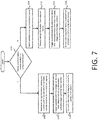
- FIG 7 is a flow chart for the method. This method is performed separately by each of the companion devices 104A-I in figure 6 .
- Each companion device 104A-I has a constitution as shown figure 2 , and each executes a respective instance of the companion application 202 which is configured to implement the method of figure 7 in this embodiment.
- Connections in the wireless network, by which data can be transmitted and received between companion devices, are via the network interface 105 and/or another network interface (e.g. Bluetooth interface) not shown in figure 2A .
- the companion device determines whether the master synchronization source (e.g. the loudspeaker 112) is available to the companion device; that is, whether the companion device is able to receive the synchronization signals from the master source. If the master source is available (as is the case for companion devices A-D), the companion device selects a first mode of operation (direct synchronization mode) wherein the method proceeds to step S704, at which the companion device determines timing information relating to a current point in the delivery of the media content based on the reference signals from the master source. At step S706, when the determined timing information indicates that the media device, in delivering the media content, has reached a trigger point, this triggers the companion device to performs an expected action associated with that trigger point.
- the master synchronization source e.g. the loudspeaker 112
- Steps S704-S706 may be implemented by carrying out the method of figure 3 , described above, wherein the current media time instant determined in performing the method of figure 3 constitutes the timing information as determined at step S706 of the method of figure 7 .
- using the method of figure 3 ensures that a companion device is able to act as a sufficiently accurate source of timing information for other companion devices, thereby minimizing the propagation of timing inaccuracies throughout the network.
- steps S704-S706 may be implemented in some other way e.g. using known ACR techniques such as those described above.
- the companion device transmits the determined timing information for use by other devices, in particular other devices to which the master synchronization source 112 is not available e.g. companion devices 104E-I.
- step S706 when the received timing information indicates that the media device, in delivering the media content, has reached a trigger point, this triggers the companion device to perform an expected action associated with that trigger point. For instance, where the received information is the current media time instant determined by another companion device in performing the method of figure 3 , the expected action is triggered when the received current media time instant corresponds to that of the trigger point.
- the companion device e.g. E, F
- the companion device retransmits the timing information for use by other devices e.g. devices which are not in range of the selected synchronization source by are in range of the retransmitting companion device (e.g. G, H, I).
- those companion devices A-D which do achieve synchronisation using the method of figure 3 can then be used to drive the synchronisation of those devices E,F that are further away from the origin by broadcasting timing information derived using the method of figure 3 , e.g. by rebroadcasting the current media time instant as determined at each iteration of steps S310, S322, and S326 as applicable.
- the devices E, F can, in turn, rebroadcast that timing information to those device G, H, I that are further away still from the origin.
- device E is capable of also receiving data from device F as well as devices B and C, it can also see that it is capable of receiving timing information from a device with an assigned distance measure of "1" (device F). However, because it can also receive information from devices closer to the origin i.e. with a distance measure of 0 (B and C), it selects one of these devices B, C in preference over F as device E can obtain more direct synchronization information from device C. Similarly, device H will elect (at S710) to receive timing information from device F as opposed to device G or H as device has the lowest distance metric visible to device H.
- an immediate upstream provider identity is useful too e.g. where device G receives timing information from device F (which itself receives timing information from device A), an identifier of device F; where device H also receives timing information from device F, again, the identifier of F.
- the concept of synchronising a timeline on one device based on signals on another can be extended beyond video playback.
- the ticking progress along a video timeline is just one application. Timers; progress indicators; ordered sequences of interactivity or presentation can also be similarly synchronised.
- the companion software may be executed on the media device itself. That is, the media device may comprise a processor corresponding to the processor 202 and a memory corresponding to the processor 206 holding companion device software (e.g. the companion app 202) for execution on the processor.
- the synchronization signals may be received via an input device (e.g. microphone) of the media device, or they may be received via some other input such as an internal software interface (e.g. as provided by sound card driver software) of the media device. That is, the synchronization signals may be transmitted and received internally within the media device.
- the disclosed techniques can be implemented by any suitable computer system, which may for instance be embodied in the companion device or in the media device itself.
- companion software e.g. companion app
- playback software e.g. playback app
- the companion software may not have direct access to each other's playback state or synthetic timeline directly (e.g. which may be the case if the two sets of software are provided by different vendors).
- the companion software runs on the media device are particularly useful where such direct access is unavailable.
- a return to the listening mode in the method of figure 3 is triggered by a confidence value falling below a threshold
- this mode switch may be triggered when the measured elapsed time from the most recent synchronization signal excess a time threshold, that threshold defining the acceptable wait interval and corresponding to e.g. the expected time it would take for the companion device to receive, say, 3 to 5 synchronization signals.
- this set of association between trigger points and expected actions in other embodiment this set may be stored remotely e.g. at a server of network 106, and access remotely via the network 106 by the companion application.
- a confidence value in the range [0,1] is used, in other embodiment the confidence value may lie in any desired range.
- higher (resp. lower) confidence values indicate higher (resp. lower) reliabilities
- this may be revered in other embodiments such that lower (resp. higher) values indicate higher (resp. lower) reliabilities.
- the method of figure 3 is implemented by the companion device, in other embodiments at least some of the steps of figure 3 may be implemented remotely e.g. at a server (e.g. 122) of the network 106 with which the companion device can communicate.
Landscapes
- Engineering & Computer Science (AREA)
- Multimedia (AREA)
- Signal Processing (AREA)
- Theoretical Computer Science (AREA)
- Data Mining & Analysis (AREA)
- Physics & Mathematics (AREA)
- General Engineering & Computer Science (AREA)
- General Physics & Mathematics (AREA)
- Databases & Information Systems (AREA)
- Library & Information Science (AREA)
- Software Systems (AREA)
- Computer Security & Cryptography (AREA)
- Two-Way Televisions, Distribution Of Moving Picture Or The Like (AREA)
- Information Transfer Between Computers (AREA)
Claims (14)
- Computerimplementiertes Verfahren zum Triggern einer Instanz von Companion-Software, um eine erwartete Funktion bezüglich eines Stücks von Media-Inhalt während Lieferung jenes Media-Inhalts durch eine Media-Vorrichtung (110) an einen Inhalt verbrauchenden Benutzer (102) auszuführen, wobei das Verfahren, durch die Instanz der Companion-Software, umfasst:Empfangen (S302, S316) eines Synchronisationssignals, das gesendet wird, wenn, beim Liefern des Media-Inhalts, die Media-Vorrichtung (110) einen Referenzpunkt im Media-Inhalt erreicht, wobei das Synchronisationssignal einen Zeitpunkt jenes Referenzpunkts übermittelt;Zugreifen auf Computerspeicherung, die eine Assoziation der erwarteten Funktion mit einem Zeitpunkt eines Auslösepunkts im Media-Inhalt enthält;Messen (S317) einer aktuellen Durchlaufzeit ab dem Zeitpunkt des Referenzpunkts;Ermitteln eines lokalen Vertrauenswerts auf Basis der aktuellen Durchlaufzeit, wobei der lokale Vertrauenswert, der auf die Wahrscheinlichkeit der erwarteten Funktion hindeutet, zu einer richtigen Zeit getriggert wird, wobei die richtige Zeit ist, wenn die Media-Vorrichtung, beim Liefern des Media-Inhalts, den Auslösepunkt erreicht (S304), wobei der lokale Vertrauenswert ab einem ersten Wert, der bei Empfang des Synchronisationssignals festgelegt wurde, über die Dauer eines Warteintervalls abklingt;Messen eines Signalvertrauenswertes, der eine Fähigkeit repräsentiert in der Lage zu sein ein zugrunde liegendes Trägersignal zu detektieren, das zum Übermitteln des empfangenen Synchronisationssignals verwendet wurde, Ergänzen des lokalen Vertrauenswertes mit dem Signalvertrauenswert, wobei die Abklingrate des lokalen Vertrauenswertes reduziert wird, wenn der Signalvertrauenswert auf einem höheren Niveau ist und die Abklingrate des lokalen Vertrauenswertes vergrößert wird, wenn der Signalvertrauenswert auf einem niedrigeren Niveau ist; undTriggern der erwarteten Funktion, wenn die aktuelle Durchlaufzeit dem Zeitpunkt des Auslösepunkts, abhängig vom lokalen Vertrauenswert wie ergänzt, innerhalb eines ersten Grenzwerts des Vertrauenswerts liegt.
- Verfahren nach Anspruch 1, wobei die Instanz der Companion-Software entweder auf einer Companion-Vorrichtung (104), die mit dem Inhalt verbrauchenden Benutzer assoziiert ist, wobei das Synchronisationssignal an der Companion-Vorrichtung empfangen wird oder an der Media-Vorrichtung (110) ausgeführt wird.
- Verfahren nach Anspruch 1 oder Anspruch 2, wobei kein weiteres Synchronisationssignal vor dem Schritt der Auslösung empfangen wird, und der Schritt der Auslösung davon abhängt, dass die aktuelle Durchlaufzeit innerhalb eines akzeptablen Warteintervalls ab dem Zeitpunkt des Referenzpunkts liegt.
- Verfahren nach Anspruch 3, dass den Empfang eines oder mehrerer vorheriger Synchronisationssignale vor dem Synchronisationssignal umfasst, wobei das akzeptable Warteintervall eine Dauer aufweist, die von einer vorherigen Dauer abhängt, die sich auf ein oder mehrere der empfangenen vorherigen Synchronisationssignale bezieht.
- Verfahren nach Anspruch 3 oder Anspruch 4, wobei das Warteintervall eine Dauer aufweist, die vom ermittelten Signal-Vertrauenswert abhängt.
- Verfahren nach einem vorhergehenden Anspruch, wobei das Synchronisationssignal das neueste einer Vielzahl von Synchronisationssignalen ist, die von der Instanz der Companion-Software zu verschiedenen Zeiten empfangen wurde.
- Verfahren nach einem vorhergehenden Anspruch, wobei das Synchronisationssignal den Zeitpunkt des Referenzpunkts encodiert, und das Verfahren das Decodieren des Synchronisationssignals umfasst, um den Zeitpunkt des Referenzpunkts zu erhalten.
- Verfahren nach einem der Ansprüche 2 bis 7, wobei der Media-Inhalt Audiodaten umfasst und das Synchronisationssignal in die Audiodaten des Media-Inhalts eingebettet ist, das eingebettete Synchronisationssignal wird folglich von der Media-Vorrichtung beim Liefern des Media-Inhalts übertragen; und
wobei das eingebettete Synchronisationssignal über eine Mikrofonkomponente der Companion-Vorrichtung empfangen wird. - Verfahren nach einem der Ansprüche 2 bis 8, wobei das Synchronisationssignal über eine Kommunikationsverbindung über eine Netzwerkschnittstelle der Companion-Vorrichtung empfangen wird.
- Verfahren nach einem der Ansprüche 1 bis 9, umfassend:Die Instanz der Companion-Software empfängt, nach dem Synchronisationssignal, ein weiteres Synchronisationssignal, das einen Zeitpunkt eines weiteren Referenzpunkts übermittelt, der früher als die aktuelle Durchlaufzeit ist; undTriggern einer Rücklauffunktion durch die Instanz der Companion-Software.
- Verfahren nach einem der Ansprüche 1 bis 9, umfassend:Die Instanz der Companion-Software empfängt, nach dem Synchronisationssignal, ein weiteres Synchronisationssignal, das einen Zeitpunkt eines weiteren Referenzpunkts übermittelt, der später als die aktuelle Durchlaufzeit ist; undTriggern einer schnellen Vorspulungsfunktion durch die Instanz der Companion-Software.
- Verfahren nach einem vorhergehenden Anspruch, wobei die Durchführung der erwarteten Funktion umfasst, dass die Instanz der Companion-Software dem Inhalt verbrauchenden Benutzer (102) zusätzlichen Inhalt liefert, wobei der Schritt der Lieferung des zusätzlichen Inhalts das Anzeigen des zusätzlichen Inhalts auf einem Bildschirm der Companion-Vorrichtung (104) oder einem Anzeigebildschirm der Media-Vorrichtung (110) umfasst.
- Computerprogrammprodukt, das ausführbaren Code umfasst, der auf einem computerlesbaren Speichermedium gespeichert ist, wobei der Code, wenn ausgeführt, konfiguriert ist, das Verfahren nach irgendeinem vorhergehenden Anspruch zu implementieren.
- Computersystem zur Durchführung einer erwarteten Funktion bezüglich eines Stücks von Media-Inhalt während einer Lieferung jenes Media-Inhalts durch eine Media-Vorrichtung (110) an einen Inhalt verbrauchenden Benutzer (102), wobei das Computersystem umfasst:Eine Eingabe, die konfiguriert ist, ein Synchronisationssignal zu empfangen, das gesendet wird, wenn, beim Liefern des Media-Inhalts, die Media-Vorrichtung (110) einen Referenzpunkt im Media-Inhalt erreicht, wobei das Synchronisationssignal einen Zeitpunkt jenes Referenzpunkts übermittelt; undeinen Prozessor (204), der konfiguriert ist, Folgendes zu tun:Zugreifen auf Computerspeicherung, die eine Assoziation der erwarteten Funktion mit einem Zeitpunkt eines Auslösepunkts im Media-Inhalt enthält;Messen einer aktuellen Durchlaufzeit ab dem Zeitpunkt des Referenzpunkts;Ermitteln eines lokalen Vertrauenswerts auf Basis der aktuellen Durchlaufzeit, wobei der lokale Vertrauenswert auf die Wahrscheinlichkeit hindeutet, dass die erwartete Funktion zu einer richtigen Zeit getriggert wird, wobei die richtige Zeit ist, wenn die Media-Vorrichtung, beim Liefern des Media-Inhalts, den Auslösepunkt erreicht, wobei der lokale Vertrauenswert ab einem ersten Wert, abklingt (S304), der bei Empfang des Synchronisationssignals über die Dauer eines Warteintervalls festgelegt wurde;Messen eines Signal-Vertrauenswerts, der eine Fähigkeit repräsentiert, ein zugrunde liegendes Trägersignal detektieren zu können, das zur Übermittlung des empfangenen Synchronisationssignals verwendet wird,Ergänzen des lokalen Vertrauenswertes mit dem Signalvertrauenswert, wobei die Abklingrate des lokalen Vertrauenssignals reduziert wird, wenn der Signalvertrauenswert auf einem höheren Niveau ist und die Abklingrate des lokalen Vertrauenswertes vergrößert wird, wenn der Signalvertrauenswert auf einem niedrigeren Niveau ist; undTriggern der erwarteten Funktion, wenn die aktuelle Durchlaufzeit dem Zeitpunkt des Auslösepunkts, abhängig vom lokalen Vertrauenswert wie ergänzt, innerhalb eines ersten Grenzwerts des Vertrauenswerts liegt.
Applications Claiming Priority (2)
| Application Number | Priority Date | Filing Date | Title |
|---|---|---|---|
| GB1407618.6A GB2527734A (en) | 2014-04-30 | 2014-04-30 | Device synchronization |
| PCT/EP2015/059600 WO2015166087A2 (en) | 2014-04-30 | 2015-04-30 | Device synchronization |
Publications (2)
| Publication Number | Publication Date |
|---|---|
| EP3138021A2 EP3138021A2 (de) | 2017-03-08 |
| EP3138021B1 true EP3138021B1 (de) | 2020-01-08 |
Family
ID=50972121
Family Applications (1)
| Application Number | Title | Priority Date | Filing Date |
|---|---|---|---|
| EP15723854.4A Active EP3138021B1 (de) | 2014-04-30 | 2015-04-30 | Vorrichtungssynchronisation |
Country Status (4)
| Country | Link |
|---|---|
| US (2) | US10057625B2 (de) |
| EP (1) | EP3138021B1 (de) |
| GB (1) | GB2527734A (de) |
| WO (1) | WO2015166087A2 (de) |
Families Citing this family (16)
| Publication number | Priority date | Publication date | Assignee | Title |
|---|---|---|---|---|
| GB2526154B (en) * | 2014-05-16 | 2020-12-30 | Intrasonics Sarl | Broadcast media synchronisation system |
| US20160294484A1 (en) * | 2015-03-31 | 2016-10-06 | Qualcomm Technologies International, Ltd. | Embedding codes in an audio signal |
| US10575042B2 (en) | 2015-11-27 | 2020-02-25 | British Telecommunications Public Limited Company | Media content synchronization |
| CN108781347B (zh) | 2016-03-31 | 2022-01-04 | 英国电讯有限公司 | 移动通信网络的基站、操作移动通信网络的基站的方法 |
| WO2017167838A1 (en) | 2016-03-31 | 2017-10-05 | British Telecommunications Public Limited Company | Mobile communications network |
| CN108886761B (zh) | 2016-03-31 | 2023-04-28 | 英国电讯有限公司 | 移动通信网络 |
| US11510116B2 (en) | 2016-06-29 | 2022-11-22 | British Telecommunications Public Limited Company | Multicast-broadcast mobile communications network |
| WO2018024395A1 (en) | 2016-08-04 | 2018-02-08 | British Telecommunications Public Limited Company | Mobile communications network |
| US9775069B1 (en) * | 2016-08-24 | 2017-09-26 | Amazon Technologies, Inc. | System for configuring distributed audio output using a designated audio device |
| US9998294B1 (en) | 2016-08-24 | 2018-06-12 | Amazon Technologies, Inc. | System for distributed audio output using designated audio devices |
| US10158440B1 (en) | 2016-08-24 | 2018-12-18 | Amazon Technologies, Inc. | System for configuring distributed audio output using an access point |
| US10149056B1 (en) | 2016-12-09 | 2018-12-04 | Amazon Technologies, Inc. | System for configuring audio devices to distribute audio data |
| CN106529607B (zh) * | 2016-12-09 | 2019-06-18 | 国家测绘地理信息局四川测绘产品质量监督检验站 | 图像的同名点获取方法及装置 |
| CN110581727A (zh) | 2018-06-08 | 2019-12-17 | 英国电讯有限公司 | 无线电信网络 |
| US10609441B1 (en) | 2018-12-10 | 2020-03-31 | Broadsign Serv Llc | Master computing device and method for synchronizing display of a digital content |
| US11107121B2 (en) | 2018-12-10 | 2021-08-31 | Broadsign Serv, Inc. | Master computing device and method for determining an actual number of impressions provided by a synchronized group of devices |
Family Cites Families (31)
| Publication number | Priority date | Publication date | Assignee | Title |
|---|---|---|---|---|
| US6098106A (en) * | 1998-09-11 | 2000-08-01 | Digitalconvergence.Com Inc. | Method for controlling a computer with an audio signal |
| US8479251B2 (en) * | 1999-03-31 | 2013-07-02 | Microsoft Corporation | System and method for synchronizing streaming content with enhancing content using pre-announced triggers |
| US8214741B2 (en) * | 2002-03-19 | 2012-07-03 | Sharp Laboratories Of America, Inc. | Synchronization of video and data |
| US8555313B2 (en) * | 2002-04-09 | 2013-10-08 | Ericsson Television Inc. | System and method for coordinating interactive television programs |
| WO2004077436A1 (en) * | 2003-02-25 | 2004-09-10 | Koninklijke Philips Electronics N.V. | Data medium |
| US10664138B2 (en) * | 2003-03-14 | 2020-05-26 | Comcast Cable Communications, Llc | Providing supplemental content for a second screen experience |
| WO2005076961A2 (en) * | 2004-02-04 | 2005-08-25 | Goldpocket Interactive | Synchronization and automation in an itv environment |
| CN101982982B (zh) * | 2007-01-08 | 2013-09-25 | Sk电信有限公司 | 使广播内容与补充信息同步的系统和方法 |
| US8875212B2 (en) * | 2008-04-15 | 2014-10-28 | Shlomo Selim Rakib | Systems and methods for remote control of interactive video |
| US8489774B2 (en) * | 2009-05-27 | 2013-07-16 | Spot411 Technologies, Inc. | Synchronized delivery of interactive content |
| US20130097632A1 (en) * | 2009-05-27 | 2013-04-18 | Ajay Shah | Synchronization to broadcast media |
| US20110063503A1 (en) * | 2009-07-06 | 2011-03-17 | Brand Steven M | Synchronizing secondary content to a multimedia presentation |
| US9043829B2 (en) * | 2009-10-07 | 2015-05-26 | At&T Intellectual Property I, Lp | Synchronization of user interactive events with on-screen events during playback of multimedia stream |
| US20110177774A1 (en) * | 2010-01-13 | 2011-07-21 | Qualcomm Incorporated | Dynamic generation, delivery, and execution of interactive applications over a mobile broadcast network |
| DE102010002409A1 (de) * | 2010-02-26 | 2011-09-01 | Robert Bosch Gmbh | Verfahren zur Unterstützung eines Einparkvorgangs |
| US9009339B2 (en) * | 2010-06-29 | 2015-04-14 | Echostar Technologies L.L.C. | Apparatus, systems and methods for accessing and synchronizing presentation of media content and supplemental media rich content |
| US8763060B2 (en) * | 2010-07-11 | 2014-06-24 | Apple Inc. | System and method for delivering companion content |
| US8898698B2 (en) * | 2011-01-21 | 2014-11-25 | Bluefin Labs, Inc. | Cross media targeted message synchronization |
| JP5982359B2 (ja) * | 2011-03-04 | 2016-08-31 | 株式会社電通 | シンクロコンテンツ放送配信システム |
| WO2012174301A1 (en) * | 2011-06-14 | 2012-12-20 | Related Content Database, Inc. | System and method for presenting content with time based metadata |
| US9473574B2 (en) * | 2011-11-18 | 2016-10-18 | Apple Inc. | Synchronization of devices in a peer-to-peer network environment |
| US10142121B2 (en) * | 2011-12-07 | 2018-11-27 | Comcast Cable Communications, Llc | Providing synchronous content and supplemental experiences |
| US8997169B2 (en) * | 2012-03-23 | 2015-03-31 | Sony Corporation | System, method, and infrastructure for synchronized streaming of content |
| US20130304243A1 (en) * | 2012-05-09 | 2013-11-14 | Vyclone, Inc | Method for synchronizing disparate content files |
| US20130347018A1 (en) * | 2012-06-21 | 2013-12-26 | Amazon Technologies, Inc. | Providing supplemental content with active media |
| CA2880254C (en) * | 2012-09-12 | 2017-09-19 | Lg Electronics Inc. | Apparatus and method for processing an interactive service |
| AU2013332537B2 (en) * | 2012-10-18 | 2016-06-16 | Lg Electronics Inc. | Apparatus and method for processing an interactive service |
| US9313440B2 (en) * | 2013-03-14 | 2016-04-12 | Comcast Cable Communications, Llc | Remote control activation based on predicted events |
| WO2015021251A1 (en) * | 2013-08-07 | 2015-02-12 | AudioStreamTV Inc. | Systems and methods for providing synchronized content |
| US9374606B2 (en) * | 2013-10-04 | 2016-06-21 | Nbcuniversal Media, Llc | Synchronization of supplemental digital content |
| US9942622B2 (en) * | 2014-01-24 | 2018-04-10 | Hiperwall, Inc. | Methods and systems for synchronizing media stream presentations |
-
2014
- 2014-04-30 GB GB1407618.6A patent/GB2527734A/en not_active Withdrawn
-
2015
- 2015-04-30 WO PCT/EP2015/059600 patent/WO2015166087A2/en not_active Ceased
- 2015-04-30 EP EP15723854.4A patent/EP3138021B1/de active Active
- 2015-04-30 US US15/307,536 patent/US10057625B2/en active Active
-
2018
- 2018-08-20 US US16/105,879 patent/US10511880B2/en active Active
Non-Patent Citations (1)
| Title |
|---|
| None * |
Also Published As
| Publication number | Publication date |
|---|---|
| EP3138021A2 (de) | 2017-03-08 |
| US10057625B2 (en) | 2018-08-21 |
| US10511880B2 (en) | 2019-12-17 |
| WO2015166087A3 (en) | 2016-02-18 |
| US20170055020A1 (en) | 2017-02-23 |
| US20180359514A1 (en) | 2018-12-13 |
| GB2527734A (en) | 2016-01-06 |
| GB201407618D0 (en) | 2014-06-11 |
| WO2015166087A2 (en) | 2015-11-05 |
Similar Documents
| Publication | Publication Date | Title |
|---|---|---|
| US10511880B2 (en) | Device synchronization | |
| US10805894B2 (en) | Synchronizing media presentation at multiple devices | |
| US11502517B2 (en) | Remote shared content experience systems | |
| KR101434204B1 (ko) | 복수의 방송 네트워크들과 연관된 텔레비전 신호들을동기화하기 위한 시스템 및 방법 | |
| US8583555B1 (en) | Synchronizing multiple playback device timing utilizing DRM encoding | |
| US8074251B2 (en) | Limited social TV apparatus | |
| US11711231B2 (en) | Providing synchronous content and supplemental experiences | |
| US7424545B2 (en) | Methods, apparatus, and program products for providing supplemental content to a recorded experiential data stream | |
| US7873983B2 (en) | Method and apparatus for controlling an experiential data stream in a social space | |
| US7870589B2 (en) | Method for providing commentary audio and additional or replacement video content | |
| US9654758B2 (en) | Synchronizing external data to video playback | |
| US8082571B2 (en) | Methods, apparatus, and program products to close interaction loops for social tv | |
| US7814517B2 (en) | Method and apparatus for associating commentary audio with a position in an experiential data stream | |
| EP3304924A1 (de) | Techniken zur nahtlosen medieninhaltsumschaltung während pausen von fester dauer | |
| WO2019134293A1 (zh) | 一种直播方法、装置、服务器及介质 | |
| US7882530B2 (en) | Method, apparatus, and program products for socially synchronizing an experiential data stream | |
| CN106303672A (zh) | 一种基于录播视频的同步播放方法及装置 | |
| US7814518B2 (en) | Methods, apparatus, and program products for presenting replacement content instead of a portion of a recorded content | |
| US7818771B2 (en) | Methods, apparatus, and program products for controlling presentation of an experiential data stream responsive to conversations in a shared social space | |
| WO2017076009A1 (zh) | 一种节目回看方法、一种播放器及一种终端 | |
| US11881930B2 (en) | System and methods of real-time creation of electronic programming guides for radio broadcasts |
Legal Events
| Date | Code | Title | Description |
|---|---|---|---|
| STAA | Information on the status of an ep patent application or granted ep patent |
Free format text: STATUS: THE INTERNATIONAL PUBLICATION HAS BEEN MADE |
|
| PUAI | Public reference made under article 153(3) epc to a published international application that has entered the european phase |
Free format text: ORIGINAL CODE: 0009012 |
|
| STAA | Information on the status of an ep patent application or granted ep patent |
Free format text: STATUS: REQUEST FOR EXAMINATION WAS MADE |
|
| 17P | Request for examination filed |
Effective date: 20161130 |
|
| AK | Designated contracting states |
Kind code of ref document: A2 Designated state(s): AL AT BE BG CH CY CZ DE DK EE ES FI FR GB GR HR HU IE IS IT LI LT LU LV MC MK MT NL NO PL PT RO RS SE SI SK SM TR |
|
| AX | Request for extension of the european patent |
Extension state: BA ME |
|
| DAV | Request for validation of the european patent (deleted) | ||
| DAX | Request for extension of the european patent (deleted) | ||
| STAA | Information on the status of an ep patent application or granted ep patent |
Free format text: STATUS: EXAMINATION IS IN PROGRESS |
|
| 17Q | First examination report despatched |
Effective date: 20180118 |
|
| RIC1 | Information provided on ipc code assigned before grant |
Ipc: H04N 21/41 20110101ALI20190329BHEP Ipc: H04N 21/845 20110101ALI20190329BHEP Ipc: G06F 16/48 20190101AFI20190329BHEP Ipc: H04N 21/858 20110101ALI20190329BHEP Ipc: H04N 21/439 20110101ALI20190329BHEP |
|
| REG | Reference to a national code |
Ref country code: DE Ref legal event code: R079 Ref document number: 602015045122 Country of ref document: DE Free format text: PREVIOUS MAIN CLASS: G06F0017300000 Ipc: H04N0021430000 |
|
| RIC1 | Information provided on ipc code assigned before grant |
Ipc: H04N 21/845 20110101ALI20190520BHEP Ipc: G06F 16/48 20190101ALI20190520BHEP Ipc: H04N 21/41 20110101ALI20190520BHEP Ipc: H04N 21/858 20110101ALI20190520BHEP Ipc: H04N 21/43 20110101AFI20190520BHEP Ipc: H04N 21/439 20110101ALI20190520BHEP Ipc: H04N 21/443 20110101ALI20190520BHEP |
|
| GRAP | Despatch of communication of intention to grant a patent |
Free format text: ORIGINAL CODE: EPIDOSNIGR1 |
|
| STAA | Information on the status of an ep patent application or granted ep patent |
Free format text: STATUS: GRANT OF PATENT IS INTENDED |
|
| INTG | Intention to grant announced |
Effective date: 20190801 |
|
| GRAS | Grant fee paid |
Free format text: ORIGINAL CODE: EPIDOSNIGR3 |
|
| GRAA | (expected) grant |
Free format text: ORIGINAL CODE: 0009210 |
|
| STAA | Information on the status of an ep patent application or granted ep patent |
Free format text: STATUS: THE PATENT HAS BEEN GRANTED |
|
| AK | Designated contracting states |
Kind code of ref document: B1 Designated state(s): AL AT BE BG CH CY CZ DE DK EE ES FI FR GB GR HR HU IE IS IT LI LT LU LV MC MK MT NL NO PL PT RO RS SE SI SK SM TR |
|
| REG | Reference to a national code |
Ref country code: GB Ref legal event code: FG4D |
|
| REG | Reference to a national code |
Ref country code: CH Ref legal event code: EP |
|
| REG | Reference to a national code |
Ref country code: DE Ref legal event code: R096 Ref document number: 602015045122 Country of ref document: DE |
|
| REG | Reference to a national code |
Ref country code: IE Ref legal event code: FG4D |
|
| REG | Reference to a national code |
Ref country code: AT Ref legal event code: REF Ref document number: 1224179 Country of ref document: AT Kind code of ref document: T Effective date: 20200215 |
|
| REG | Reference to a national code |
Ref country code: NL Ref legal event code: MP Effective date: 20200108 |
|
| REG | Reference to a national code |
Ref country code: LT Ref legal event code: MG4D |
|
| PG25 | Lapsed in a contracting state [announced via postgrant information from national office to epo] |
Ref country code: NL Free format text: LAPSE BECAUSE OF FAILURE TO SUBMIT A TRANSLATION OF THE DESCRIPTION OR TO PAY THE FEE WITHIN THE PRESCRIBED TIME-LIMIT Effective date: 20200108 Ref country code: LT Free format text: LAPSE BECAUSE OF FAILURE TO SUBMIT A TRANSLATION OF THE DESCRIPTION OR TO PAY THE FEE WITHIN THE PRESCRIBED TIME-LIMIT Effective date: 20200108 Ref country code: NO Free format text: LAPSE BECAUSE OF FAILURE TO SUBMIT A TRANSLATION OF THE DESCRIPTION OR TO PAY THE FEE WITHIN THE PRESCRIBED TIME-LIMIT Effective date: 20200408 Ref country code: FI Free format text: LAPSE BECAUSE OF FAILURE TO SUBMIT A TRANSLATION OF THE DESCRIPTION OR TO PAY THE FEE WITHIN THE PRESCRIBED TIME-LIMIT Effective date: 20200108 Ref country code: RS Free format text: LAPSE BECAUSE OF FAILURE TO SUBMIT A TRANSLATION OF THE DESCRIPTION OR TO PAY THE FEE WITHIN THE PRESCRIBED TIME-LIMIT Effective date: 20200108 Ref country code: PT Free format text: LAPSE BECAUSE OF FAILURE TO SUBMIT A TRANSLATION OF THE DESCRIPTION OR TO PAY THE FEE WITHIN THE PRESCRIBED TIME-LIMIT Effective date: 20200531 |
|
| PG25 | Lapsed in a contracting state [announced via postgrant information from national office to epo] |
Ref country code: LV Free format text: LAPSE BECAUSE OF FAILURE TO SUBMIT A TRANSLATION OF THE DESCRIPTION OR TO PAY THE FEE WITHIN THE PRESCRIBED TIME-LIMIT Effective date: 20200108 Ref country code: SE Free format text: LAPSE BECAUSE OF FAILURE TO SUBMIT A TRANSLATION OF THE DESCRIPTION OR TO PAY THE FEE WITHIN THE PRESCRIBED TIME-LIMIT Effective date: 20200108 Ref country code: HR Free format text: LAPSE BECAUSE OF FAILURE TO SUBMIT A TRANSLATION OF THE DESCRIPTION OR TO PAY THE FEE WITHIN THE PRESCRIBED TIME-LIMIT Effective date: 20200108 Ref country code: BG Free format text: LAPSE BECAUSE OF FAILURE TO SUBMIT A TRANSLATION OF THE DESCRIPTION OR TO PAY THE FEE WITHIN THE PRESCRIBED TIME-LIMIT Effective date: 20200408 Ref country code: GR Free format text: LAPSE BECAUSE OF FAILURE TO SUBMIT A TRANSLATION OF THE DESCRIPTION OR TO PAY THE FEE WITHIN THE PRESCRIBED TIME-LIMIT Effective date: 20200409 Ref country code: IS Free format text: LAPSE BECAUSE OF FAILURE TO SUBMIT A TRANSLATION OF THE DESCRIPTION OR TO PAY THE FEE WITHIN THE PRESCRIBED TIME-LIMIT Effective date: 20200508 |
|
| REG | Reference to a national code |
Ref country code: DE Ref legal event code: R097 Ref document number: 602015045122 Country of ref document: DE |
|
| PG25 | Lapsed in a contracting state [announced via postgrant information from national office to epo] |
Ref country code: SK Free format text: LAPSE BECAUSE OF FAILURE TO SUBMIT A TRANSLATION OF THE DESCRIPTION OR TO PAY THE FEE WITHIN THE PRESCRIBED TIME-LIMIT Effective date: 20200108 Ref country code: SM Free format text: LAPSE BECAUSE OF FAILURE TO SUBMIT A TRANSLATION OF THE DESCRIPTION OR TO PAY THE FEE WITHIN THE PRESCRIBED TIME-LIMIT Effective date: 20200108 Ref country code: EE Free format text: LAPSE BECAUSE OF FAILURE TO SUBMIT A TRANSLATION OF THE DESCRIPTION OR TO PAY THE FEE WITHIN THE PRESCRIBED TIME-LIMIT Effective date: 20200108 Ref country code: RO Free format text: LAPSE BECAUSE OF FAILURE TO SUBMIT A TRANSLATION OF THE DESCRIPTION OR TO PAY THE FEE WITHIN THE PRESCRIBED TIME-LIMIT Effective date: 20200108 Ref country code: CZ Free format text: LAPSE BECAUSE OF FAILURE TO SUBMIT A TRANSLATION OF THE DESCRIPTION OR TO PAY THE FEE WITHIN THE PRESCRIBED TIME-LIMIT Effective date: 20200108 Ref country code: ES Free format text: LAPSE BECAUSE OF FAILURE TO SUBMIT A TRANSLATION OF THE DESCRIPTION OR TO PAY THE FEE WITHIN THE PRESCRIBED TIME-LIMIT Effective date: 20200108 Ref country code: DK Free format text: LAPSE BECAUSE OF FAILURE TO SUBMIT A TRANSLATION OF THE DESCRIPTION OR TO PAY THE FEE WITHIN THE PRESCRIBED TIME-LIMIT Effective date: 20200108 |
|
| PLBE | No opposition filed within time limit |
Free format text: ORIGINAL CODE: 0009261 |
|
| STAA | Information on the status of an ep patent application or granted ep patent |
Free format text: STATUS: NO OPPOSITION FILED WITHIN TIME LIMIT |
|
| REG | Reference to a national code |
Ref country code: AT Ref legal event code: MK05 Ref document number: 1224179 Country of ref document: AT Kind code of ref document: T Effective date: 20200108 |
|
| PG25 | Lapsed in a contracting state [announced via postgrant information from national office to epo] |
Ref country code: MC Free format text: LAPSE BECAUSE OF FAILURE TO SUBMIT A TRANSLATION OF THE DESCRIPTION OR TO PAY THE FEE WITHIN THE PRESCRIBED TIME-LIMIT Effective date: 20200108 |
|
| REG | Reference to a national code |
Ref country code: CH Ref legal event code: PL |
|
| 26N | No opposition filed |
Effective date: 20201009 |
|
| PG25 | Lapsed in a contracting state [announced via postgrant information from national office to epo] |
Ref country code: LU Free format text: LAPSE BECAUSE OF NON-PAYMENT OF DUE FEES Effective date: 20200430 Ref country code: AT Free format text: LAPSE BECAUSE OF FAILURE TO SUBMIT A TRANSLATION OF THE DESCRIPTION OR TO PAY THE FEE WITHIN THE PRESCRIBED TIME-LIMIT Effective date: 20200108 Ref country code: LI Free format text: LAPSE BECAUSE OF NON-PAYMENT OF DUE FEES Effective date: 20200430 Ref country code: IT Free format text: LAPSE BECAUSE OF FAILURE TO SUBMIT A TRANSLATION OF THE DESCRIPTION OR TO PAY THE FEE WITHIN THE PRESCRIBED TIME-LIMIT Effective date: 20200108 Ref country code: CH Free format text: LAPSE BECAUSE OF NON-PAYMENT OF DUE FEES Effective date: 20200430 |
|
| REG | Reference to a national code |
Ref country code: BE Ref legal event code: MM Effective date: 20200430 |
|
| PG25 | Lapsed in a contracting state [announced via postgrant information from national office to epo] |
Ref country code: BE Free format text: LAPSE BECAUSE OF NON-PAYMENT OF DUE FEES Effective date: 20200430 Ref country code: PL Free format text: LAPSE BECAUSE OF FAILURE TO SUBMIT A TRANSLATION OF THE DESCRIPTION OR TO PAY THE FEE WITHIN THE PRESCRIBED TIME-LIMIT Effective date: 20200108 Ref country code: SI Free format text: LAPSE BECAUSE OF FAILURE TO SUBMIT A TRANSLATION OF THE DESCRIPTION OR TO PAY THE FEE WITHIN THE PRESCRIBED TIME-LIMIT Effective date: 20200108 |
|
| PG25 | Lapsed in a contracting state [announced via postgrant information from national office to epo] |
Ref country code: IE Free format text: LAPSE BECAUSE OF NON-PAYMENT OF DUE FEES Effective date: 20200430 |
|
| PG25 | Lapsed in a contracting state [announced via postgrant information from national office to epo] |
Ref country code: TR Free format text: LAPSE BECAUSE OF FAILURE TO SUBMIT A TRANSLATION OF THE DESCRIPTION OR TO PAY THE FEE WITHIN THE PRESCRIBED TIME-LIMIT Effective date: 20200108 Ref country code: MT Free format text: LAPSE BECAUSE OF FAILURE TO SUBMIT A TRANSLATION OF THE DESCRIPTION OR TO PAY THE FEE WITHIN THE PRESCRIBED TIME-LIMIT Effective date: 20200108 Ref country code: CY Free format text: LAPSE BECAUSE OF FAILURE TO SUBMIT A TRANSLATION OF THE DESCRIPTION OR TO PAY THE FEE WITHIN THE PRESCRIBED TIME-LIMIT Effective date: 20200108 |
|
| REG | Reference to a national code |
Ref country code: DE Ref legal event code: R081 Ref document number: 602015045122 Country of ref document: DE Owner name: PRJ HOLDING COMPANY, LLC, WILMINGTON, US Free format text: FORMER OWNER: PIKSEL, INC., WILMINGTON, DE, US |
|
| PG25 | Lapsed in a contracting state [announced via postgrant information from national office to epo] |
Ref country code: MK Free format text: LAPSE BECAUSE OF FAILURE TO SUBMIT A TRANSLATION OF THE DESCRIPTION OR TO PAY THE FEE WITHIN THE PRESCRIBED TIME-LIMIT Effective date: 20200108 Ref country code: AL Free format text: LAPSE BECAUSE OF FAILURE TO SUBMIT A TRANSLATION OF THE DESCRIPTION OR TO PAY THE FEE WITHIN THE PRESCRIBED TIME-LIMIT Effective date: 20200108 |
|
| REG | Reference to a national code |
Ref country code: GB Ref legal event code: 732E Free format text: REGISTERED BETWEEN 20220609 AND 20220615 |
|
| PGFP | Annual fee paid to national office [announced via postgrant information from national office to epo] |
Ref country code: GB Payment date: 20240412 Year of fee payment: 10 |
|
| PGFP | Annual fee paid to national office [announced via postgrant information from national office to epo] |
Ref country code: DE Payment date: 20240418 Year of fee payment: 10 |
|
| PGFP | Annual fee paid to national office [announced via postgrant information from national office to epo] |
Ref country code: FR Payment date: 20240430 Year of fee payment: 10 |
|
| REG | Reference to a national code |
Ref country code: DE Ref legal event code: R119 Ref document number: 602015045122 Country of ref document: DE |
|
| GBPC | Gb: european patent ceased through non-payment of renewal fee |
Effective date: 20250430 |
|
| PG25 | Lapsed in a contracting state [announced via postgrant information from national office to epo] |
Ref country code: DE Free format text: LAPSE BECAUSE OF NON-PAYMENT OF DUE FEES Effective date: 20251104 |
|
| PG25 | Lapsed in a contracting state [announced via postgrant information from national office to epo] |
Ref country code: GB Free format text: LAPSE BECAUSE OF NON-PAYMENT OF DUE FEES Effective date: 20250430 |
|
| PG25 | Lapsed in a contracting state [announced via postgrant information from national office to epo] |
Ref country code: FR Free format text: LAPSE BECAUSE OF NON-PAYMENT OF DUE FEES Effective date: 20250430 |