EP3137540B1 - Stabilizing compositions for stabilizing materials against ultraviolet light and thermal degradation - Google Patents
Stabilizing compositions for stabilizing materials against ultraviolet light and thermal degradation Download PDFInfo
- Publication number
- EP3137540B1 EP3137540B1 EP15724414.6A EP15724414A EP3137540B1 EP 3137540 B1 EP3137540 B1 EP 3137540B1 EP 15724414 A EP15724414 A EP 15724414A EP 3137540 B1 EP3137540 B1 EP 3137540B1
- Authority
- EP
- European Patent Office
- Prior art keywords
- bis
- triazine
- tetramethyl
- hydroxy
- compound
- Prior art date
- Legal status (The legal status is an assumption and is not a legal conclusion. Google has not performed a legal analysis and makes no representation as to the accuracy of the status listed.)
- Active
Links
Images


Classifications
-
- C—CHEMISTRY; METALLURGY
- C08—ORGANIC MACROMOLECULAR COMPOUNDS; THEIR PREPARATION OR CHEMICAL WORKING-UP; COMPOSITIONS BASED THEREON
- C08K—Use of inorganic or non-macromolecular organic substances as compounding ingredients
- C08K5/00—Use of organic ingredients
- C08K5/0008—Organic ingredients according to more than one of the "one dot" groups of C08K5/01 - C08K5/59
- C08K5/005—Stabilisers against oxidation, heat, light, ozone
-
- C—CHEMISTRY; METALLURGY
- C08—ORGANIC MACROMOLECULAR COMPOUNDS; THEIR PREPARATION OR CHEMICAL WORKING-UP; COMPOSITIONS BASED THEREON
- C08J—WORKING-UP; GENERAL PROCESSES OF COMPOUNDING; AFTER-TREATMENT NOT COVERED BY SUBCLASSES C08B, C08C, C08F, C08G or C08H
- C08J3/00—Processes of treating or compounding macromolecular substances
- C08J3/20—Compounding polymers with additives, e.g. colouring
- C08J3/22—Compounding polymers with additives, e.g. colouring using masterbatch techniques
-
- C—CHEMISTRY; METALLURGY
- C08—ORGANIC MACROMOLECULAR COMPOUNDS; THEIR PREPARATION OR CHEMICAL WORKING-UP; COMPOSITIONS BASED THEREON
- C08K—Use of inorganic or non-macromolecular organic substances as compounding ingredients
- C08K13/00—Use of mixtures of ingredients not covered by one single of the preceding main groups, each of these compounds being essential
- C08K13/02—Organic and inorganic ingredients
-
- C—CHEMISTRY; METALLURGY
- C08—ORGANIC MACROMOLECULAR COMPOUNDS; THEIR PREPARATION OR CHEMICAL WORKING-UP; COMPOSITIONS BASED THEREON
- C08K—Use of inorganic or non-macromolecular organic substances as compounding ingredients
- C08K3/00—Use of inorganic substances as compounding ingredients
- C08K3/01—Use of inorganic substances as compounding ingredients characterized by their specific function
-
- C—CHEMISTRY; METALLURGY
- C08—ORGANIC MACROMOLECULAR COMPOUNDS; THEIR PREPARATION OR CHEMICAL WORKING-UP; COMPOSITIONS BASED THEREON
- C08K—Use of inorganic or non-macromolecular organic substances as compounding ingredients
- C08K3/00—Use of inorganic substances as compounding ingredients
- C08K3/18—Oxygen-containing compounds, e.g. metal carbonyls
- C08K3/20—Oxides; Hydroxides
- C08K3/22—Oxides; Hydroxides of metals
-
- C—CHEMISTRY; METALLURGY
- C08—ORGANIC MACROMOLECULAR COMPOUNDS; THEIR PREPARATION OR CHEMICAL WORKING-UP; COMPOSITIONS BASED THEREON
- C08K—Use of inorganic or non-macromolecular organic substances as compounding ingredients
- C08K3/00—Use of inorganic substances as compounding ingredients
- C08K3/18—Oxygen-containing compounds, e.g. metal carbonyls
- C08K3/24—Acids; Salts thereof
- C08K3/26—Carbonates; Bicarbonates
-
- C—CHEMISTRY; METALLURGY
- C08—ORGANIC MACROMOLECULAR COMPOUNDS; THEIR PREPARATION OR CHEMICAL WORKING-UP; COMPOSITIONS BASED THEREON
- C08K—Use of inorganic or non-macromolecular organic substances as compounding ingredients
- C08K5/00—Use of organic ingredients
- C08K5/04—Oxygen-containing compounds
- C08K5/10—Esters; Ether-esters
- C08K5/101—Esters; Ether-esters of monocarboxylic acids
- C08K5/105—Esters; Ether-esters of monocarboxylic acids with phenols
-
- C—CHEMISTRY; METALLURGY
- C08—ORGANIC MACROMOLECULAR COMPOUNDS; THEIR PREPARATION OR CHEMICAL WORKING-UP; COMPOSITIONS BASED THEREON
- C08K—Use of inorganic or non-macromolecular organic substances as compounding ingredients
- C08K5/00—Use of organic ingredients
- C08K5/04—Oxygen-containing compounds
- C08K5/13—Phenols; Phenolates
-
- C—CHEMISTRY; METALLURGY
- C08—ORGANIC MACROMOLECULAR COMPOUNDS; THEIR PREPARATION OR CHEMICAL WORKING-UP; COMPOSITIONS BASED THEREON
- C08K—Use of inorganic or non-macromolecular organic substances as compounding ingredients
- C08K5/00—Use of organic ingredients
- C08K5/04—Oxygen-containing compounds
- C08K5/13—Phenols; Phenolates
- C08K5/132—Phenols containing keto groups, e.g. benzophenones
-
- C—CHEMISTRY; METALLURGY
- C08—ORGANIC MACROMOLECULAR COMPOUNDS; THEIR PREPARATION OR CHEMICAL WORKING-UP; COMPOSITIONS BASED THEREON
- C08K—Use of inorganic or non-macromolecular organic substances as compounding ingredients
- C08K5/00—Use of organic ingredients
- C08K5/04—Oxygen-containing compounds
- C08K5/13—Phenols; Phenolates
- C08K5/134—Phenols containing ester groups
- C08K5/1345—Carboxylic esters of phenolcarboxylic acids
-
- C—CHEMISTRY; METALLURGY
- C08—ORGANIC MACROMOLECULAR COMPOUNDS; THEIR PREPARATION OR CHEMICAL WORKING-UP; COMPOSITIONS BASED THEREON
- C08K—Use of inorganic or non-macromolecular organic substances as compounding ingredients
- C08K5/00—Use of organic ingredients
- C08K5/16—Nitrogen-containing compounds
- C08K5/20—Carboxylic acid amides
-
- C—CHEMISTRY; METALLURGY
- C08—ORGANIC MACROMOLECULAR COMPOUNDS; THEIR PREPARATION OR CHEMICAL WORKING-UP; COMPOSITIONS BASED THEREON
- C08K—Use of inorganic or non-macromolecular organic substances as compounding ingredients
- C08K5/00—Use of organic ingredients
- C08K5/16—Nitrogen-containing compounds
- C08K5/34—Heterocyclic compounds having nitrogen in the ring
- C08K5/3412—Heterocyclic compounds having nitrogen in the ring having one nitrogen atom in the ring
- C08K5/3432—Six-membered rings
- C08K5/3435—Piperidines
-
- C—CHEMISTRY; METALLURGY
- C08—ORGANIC MACROMOLECULAR COMPOUNDS; THEIR PREPARATION OR CHEMICAL WORKING-UP; COMPOSITIONS BASED THEREON
- C08K—Use of inorganic or non-macromolecular organic substances as compounding ingredients
- C08K5/00—Use of organic ingredients
- C08K5/16—Nitrogen-containing compounds
- C08K5/34—Heterocyclic compounds having nitrogen in the ring
- C08K5/3442—Heterocyclic compounds having nitrogen in the ring having two nitrogen atoms in the ring
- C08K5/3462—Six-membered rings
-
- C—CHEMISTRY; METALLURGY
- C08—ORGANIC MACROMOLECULAR COMPOUNDS; THEIR PREPARATION OR CHEMICAL WORKING-UP; COMPOSITIONS BASED THEREON
- C08K—Use of inorganic or non-macromolecular organic substances as compounding ingredients
- C08K5/00—Use of organic ingredients
- C08K5/16—Nitrogen-containing compounds
- C08K5/34—Heterocyclic compounds having nitrogen in the ring
- C08K5/3467—Heterocyclic compounds having nitrogen in the ring having more than two nitrogen atoms in the ring
- C08K5/3477—Six-membered rings
- C08K5/3492—Triazines
-
- C—CHEMISTRY; METALLURGY
- C08—ORGANIC MACROMOLECULAR COMPOUNDS; THEIR PREPARATION OR CHEMICAL WORKING-UP; COMPOSITIONS BASED THEREON
- C08K—Use of inorganic or non-macromolecular organic substances as compounding ingredients
- C08K5/00—Use of organic ingredients
- C08K5/36—Sulfur-, selenium-, or tellurium-containing compounds
- C08K5/37—Thiols
- C08K5/375—Thiols containing six-membered aromatic rings
-
- C—CHEMISTRY; METALLURGY
- C08—ORGANIC MACROMOLECULAR COMPOUNDS; THEIR PREPARATION OR CHEMICAL WORKING-UP; COMPOSITIONS BASED THEREON
- C08K—Use of inorganic or non-macromolecular organic substances as compounding ingredients
- C08K5/00—Use of organic ingredients
- C08K5/49—Phosphorus-containing compounds
- C08K5/51—Phosphorus bound to oxygen
- C08K5/52—Phosphorus bound to oxygen only
- C08K5/524—Esters of phosphorous acids, e.g. of H3PO3
-
- C—CHEMISTRY; METALLURGY
- C08—ORGANIC MACROMOLECULAR COMPOUNDS; THEIR PREPARATION OR CHEMICAL WORKING-UP; COMPOSITIONS BASED THEREON
- C08K—Use of inorganic or non-macromolecular organic substances as compounding ingredients
- C08K5/00—Use of organic ingredients
- C08K5/49—Phosphorus-containing compounds
- C08K5/51—Phosphorus bound to oxygen
- C08K5/52—Phosphorus bound to oxygen only
- C08K5/527—Cyclic esters
-
- C—CHEMISTRY; METALLURGY
- C08—ORGANIC MACROMOLECULAR COMPOUNDS; THEIR PREPARATION OR CHEMICAL WORKING-UP; COMPOSITIONS BASED THEREON
- C08L—COMPOSITIONS OF MACROMOLECULAR COMPOUNDS
- C08L23/00—Compositions of homopolymers or copolymers of unsaturated aliphatic hydrocarbons having only one carbon-to-carbon double bond; Compositions of derivatives of such polymers
- C08L23/02—Compositions of homopolymers or copolymers of unsaturated aliphatic hydrocarbons having only one carbon-to-carbon double bond; Compositions of derivatives of such polymers not modified by chemical after-treatment
- C08L23/04—Homopolymers or copolymers of ethene
- C08L23/06—Polyethylene
-
- C—CHEMISTRY; METALLURGY
- C08—ORGANIC MACROMOLECULAR COMPOUNDS; THEIR PREPARATION OR CHEMICAL WORKING-UP; COMPOSITIONS BASED THEREON
- C08L—COMPOSITIONS OF MACROMOLECULAR COMPOUNDS
- C08L23/00—Compositions of homopolymers or copolymers of unsaturated aliphatic hydrocarbons having only one carbon-to-carbon double bond; Compositions of derivatives of such polymers
- C08L23/02—Compositions of homopolymers or copolymers of unsaturated aliphatic hydrocarbons having only one carbon-to-carbon double bond; Compositions of derivatives of such polymers not modified by chemical after-treatment
- C08L23/10—Homopolymers or copolymers of propene
- C08L23/12—Polypropene
-
- C—CHEMISTRY; METALLURGY
- C09—DYES; PAINTS; POLISHES; NATURAL RESINS; ADHESIVES; COMPOSITIONS NOT OTHERWISE PROVIDED FOR; APPLICATIONS OF MATERIALS NOT OTHERWISE PROVIDED FOR
- C09K—MATERIALS FOR MISCELLANEOUS APPLICATIONS, NOT PROVIDED FOR ELSEWHERE
- C09K15/00—Anti-oxidant compositions; Compositions inhibiting chemical change
- C09K15/04—Anti-oxidant compositions; Compositions inhibiting chemical change containing organic compounds
- C09K15/30—Anti-oxidant compositions; Compositions inhibiting chemical change containing organic compounds containing heterocyclic ring with at least one nitrogen atom as ring member
-
- C—CHEMISTRY; METALLURGY
- C08—ORGANIC MACROMOLECULAR COMPOUNDS; THEIR PREPARATION OR CHEMICAL WORKING-UP; COMPOSITIONS BASED THEREON
- C08K—Use of inorganic or non-macromolecular organic substances as compounding ingredients
- C08K3/00—Use of inorganic substances as compounding ingredients
- C08K3/18—Oxygen-containing compounds, e.g. metal carbonyls
- C08K3/20—Oxides; Hydroxides
- C08K3/22—Oxides; Hydroxides of metals
- C08K2003/2217—Oxides; Hydroxides of metals of magnesium
- C08K2003/222—Magnesia, i.e. magnesium oxide
-
- C—CHEMISTRY; METALLURGY
- C08—ORGANIC MACROMOLECULAR COMPOUNDS; THEIR PREPARATION OR CHEMICAL WORKING-UP; COMPOSITIONS BASED THEREON
- C08K—Use of inorganic or non-macromolecular organic substances as compounding ingredients
- C08K3/00—Use of inorganic substances as compounding ingredients
- C08K3/18—Oxygen-containing compounds, e.g. metal carbonyls
- C08K3/20—Oxides; Hydroxides
- C08K3/22—Oxides; Hydroxides of metals
- C08K2003/2227—Oxides; Hydroxides of metals of aluminium
Definitions
- the instant invention relates to stabilizing compositions.
- the instant invention relates to compositions that stabilize materials against ultraviolet light degradation and thermal degradation.
- UV radiation also referred to as UV light
- polymeric materials such as plastics often discolor, lose gloss and/or become brittle as a result of prolonged exposure to UV light due primarily to a reduction in the molecular weight of the polymer.
- compositions such as UV light absorbers and stabilizers, which are capable of inhibiting such degradation in polymeric articles.
- US 6843939 discloses stabilizing compositions for protecting materials from degradation only against UV light. There remains an unmet need in the market for a stabilizer composition that can protect materials from degradation due to both UV light and thermal exposure. This invention is believed to be an answer to the foregoing need.
- the invention is directed to thermal and ultraviolet (UV) light stabilizing compositions that include an ortho-hydroxyl tris-aryl-s-triazine compound; a hindered amine light stabilizer compound; a hindered hydroxybenzoate compound; an acid scavenger; a phosphite compound; a hindered phenol antioxidant compound comprising a molecular fragment according to one or more of Formula (IVa), (IVb), or (IVc): wherein
- the invention is directed to stabilized compositions that include any of the thermal and UV light stabilizing compositions described herein and a material to be stabilized.
- the invention is directed to a process for achieving stability against thermal and UV light degradation of a material selected from the group consisting of polyolefins, polyesters, polyethers, polyketones, polyamides, natural and synthetic rubbers, polyurethanes, polystyrenes, high-impact polystyrenes, polyacrylates, polymethacrylates, polyacetals, polyacrylonitriles, polybutadienes, polystyrenes, acrylonitrile-butadiene-styrene, styrene acrylonitrile, acrylate styrene acrylonitrile, cellulosic acetate butyrate, cellulosic polymers, polyimides, polyamideimides, polyetherimides, polyphenylsulfides, polyphenyloxidepolysulfones, polyethersulfones, polyvinylchlorides, polycarbonates, polyketones, aliphatic polyket
- compositions and processes using the same that have now been discovered and disclosed herein for the first time are surprisingly useful for achieving optimal stability against thermal and UV light degradation compared to current commercially available stabilizer packages.
- processes and compositions disclosed herein additionally (and surprisingly) provide a stabilizer package that has a low release of volatile organic compounds (VOCs), low odor and low blooming as compared to current commercially available polymer stabilizer packages.
- VOCs volatile organic compounds
- hydrocarbyl is a generic term encompassing aliphatic, alicyclic and aromatic groups having an all-carbon backbone and consisting of carbon and hydrogen atoms.
- one or more of the carbon atoms making up the carbon backbone may be replaced or interrupted by a specified atom or group of atoms, such as by one or more heteroatom of N, O, and/or S.
- hydrocarbyl groups include alkyl, cycloalkyl, cycloalkenyl, carbocyclic aryl, alkenyl, alkynyl, alkylcycloalkyl, cycloalkylalkyl, cycloalkenylalkyl, and carbocyclic aralkyl, alkaryl, aralkenyl and aralkynyl groups.
- Such hydrocarbyl groups can also be optionally substituted by one or more substituents as defined herein. Accordingly, the chemical groups or moieties discussed in the specification and claims should be understood to include the substituted or unsubstituted forms.
- the examples and preferences expressed below also apply to each of the hydrocarbyl substituent groups or hydrocarbyl-containing substituent groups referred to in the various definitions of substituents for compounds of the formulas described herein unless the context indicates otherwise.
- Preferred non-aromatic hydrocarbyl groups are saturated groups such as alkyl and cycloalkyl groups.
- the hydrocarbyl groups can have up to fifty carbon atoms, unless the context requires otherwise.
- Hydrocarbyl groups with from 1 to 30 carbon atoms are preferred.
- C 1-20 hydrocarbyl groups such as C 1-12 hydrocarbyl groups (e.g. C 1-6 hydrocarbyl groups or C 1-4 hydrocarbyl groups), specific examples being any individual value or combination of values selected from C 1 through C 30 hydrocarbyl groups.
- Alkyl is intended to include linear, branched, or cyclic hydrocarbon structures and combinations thereof.
- Lower alkyl refers to alkyl groups of from 1 to 6 carbon atoms. Examples of lower alkyl groups include methyl, ethyl, propyl, isopropyl, butyl, s-and t-butyl and the like.
- Preferred alkyl groups are those of C 30 or below.
- Alkoxy or alkoxyalkyl refers to groups of from 1 to 20 carbon atoms of a straight, branched, cyclic configuration and combinations thereof attached to the parent structure through an oxygen. Examples include methoxy, ethoxy, propoxy, isopropoxy, cyclopropyloxy, cyclohexyloxy and the like.
- Acyl refers to formyl and to groups of 1, 2, 3, 4, 5, 6, 7, 8, 9, 10, 11 and 12 carbon atoms of a straight, branched, cyclic configuration, saturated, unsaturated and aromatic and combinations thereof, attached to the parent structure through a carbonyl functionality. Examples include acetyl, benzoyl, propionyl, isobutyryl, t-butoxycarbonyl, benzyloxycarbonyl and the like. Lower-acyl refers to groups containing one to six carbons.
- references to "carbocyclic” or “cycloalkyl” groups as used herein shall, unless the context indicates otherwise, include both aromatic and non-aromatic ring systems.
- the term includes within its scope aromatic, non-aromatic, unsaturated, partially saturated and fully saturated carbocyclic ring systems.
- such groups may be monocyclic or bicyclic and may contain, for example, 3 to 12 ring members, more usually 5 to 10 ring members.
- Examples of monocyclic groups are groups containing 3, 4, 5, 6, 7, and 8 ring members, more usually 3 to 7, and preferably 5 or 6 ring members.
- Examples of bicyclic groups are those containing 8, 9, 10, 11 and 12 ring members, and more usually 9 or 10 ring members.
- non-aromatic carbocycle/cycloalkyl groups include c-propyl, c-butyl, c-pentyl, c-hexyl, and the like.
- C 7 to C 10 polycyclic hydrocarbons include ring systems such as norbornyl and adamantyl.
- Aryl refers to a 5- or 6-membered aromatic carbocycle ring containing; a bicyclic 9- or 10-membered aromatic ring system; or a tricyclic 13- or 14-membered aromatic ring system.
- the aromatic 6- to 14-membered carbocyclic rings include, e.g., substituted or unsubstituted phenyl groups, benzene, naphthalene, indane, tetralin, and fluorene.
- Substituted hydrocarbyl, alkyl, aryl, cycloalkyl, alkoxy, etc. refer to the specific substituent wherein up to three H atoms in each residue are replaced with alkyl, halogen, haloalkyl, hydroxy, alkoxy, carboxy, carboalkoxy (also referred to as alkoxycarbonyl), carboxamido (also referred to as alkylaminocarbonyl), cyano, carbonyl, nitro, amino, alkylamino, dialkylamino, mercapto, alkylthio, sulfoxide, sulfone, acylamino, amidino, phenyl, benzyl, halobenzyl, heteroaryl, phenoxy, benzyloxy, heteroaryloxy, benzoyl, halobenzoyl, or lower alkylhydroxy.
- this invention relates to a thermal and ultraviolet (UV) light stabilizing composition that includes an ortho-hydroxyl tris-aryl-s-triazine compound, a hindered amine light stabilizer (HALS) compound, a hindered hydroxybenzoate compound, a phosphite compound, an acid scavenger, a hindered phenol antioxidant compound comprising a molecular fragment according to one or more of Formula (IVa), (IVb), or (IVc): wherein
- HALS hindered amine light stabilizer
- the ortho-hydroxy tris-aryl-s-triazine compound is 2-(2'-hydroxyphenyl)-1,3,5-triazine compound according to Formula (I): wherein each of R 34 and R 35 in Formula (I) is independently chosen from C 6 -C 10 aryl optionally substituted, C 1 -C 10 hydrocarbyl-substituted amino, C 1 -C 10 acyl and C 1 -C 10 alkoxyl; and wherein R 36 in Formula (I) is a substituent that is the same or different at from 0 to 4 positions of the phenoxy portion of Formula I and is independently chosen from hydroxyl, C 1 -C 12 hydrocarbyl, C 1 -C 12 alkoxyl, C 1 -C 12 alkoxyester, and C 1 -C 12 acyl.
- R 34 and R 35 in Formula (I) is independently chosen from C 6 -C 10 aryl optionally substituted, C 1 -C 10 hydrocarbyl-substituted amino
- Examples of the 2-(2'-hydroxyphenyl)-1,3,5-triazine include 4,6-bis-(2,4-dimethylphenyl)-2-(2-hydroxy-4-octyloxyphenyl)-s-triazine; 4,6-bis-(2,4-dimethylphenyl)-2-(2,4-- dihydroxyphenyl)-s-triazine; 2,4-bis(2,4-dihydroxyphenyl)-6-(4-chlorophenyl)-s-triazine; 2,4-bis[2-hydroxy-4-(2-hydroxy-ethoxy)phenyl]-6-(4-chlorophenyl)-s-triazine; 2,4-bis[2-hydroxy-4-(2-hydroxy-4-(2-hydroxy-ethoxy)phenyl]-6-(2,4-dimethylphenyl)-s-triazine; 2,4-bis[2-hydroxy-4-(2-hydroxyethoxy)phenyl]-6-(4-bromopheny
- the HALS compound includes a molecular fragment according to Formula (II):
- HALS compound examples include bis(2,2,6,6-tetramethylpiperidin-4-yl) sebacate; bis(2,2,6,6-tetramethylpiperidin-4-yl)succinate; bis(1,2,2,6,6-pentamethylpiperidin-4-yl)sebacate; bis(1-octyloxy-2,2,6,6-tetramethylpiperidin-4-yl)sebacate; bis(1,2,2,6,6-pentamethylpiperidin-4-yl) n-butyl 3,5-di-tert-butyl-4-hydroxybenzylmalonate; a condensate of 1-(2-hydroxyethyl)-2,2,6,6-tetramethyl-4-hydroxypiperidine and succinic acid; 2,2,6,6-tetramethylpiperidin-4-yl stearate; 2,2,6,6-tetramethylpiperidin-4-yl dodecanate; 1,2,2,6,6-pentamethylpiperidin-4-yl
- the hindered hydroxybenzoate compound is a compound according to Formula (III): wherein R 17 in Formula (III) is a C 1 -C 8 alkyl and R 18 in Formula (III) is a C 1 -C 24 alkyl or substituted or unsubstituted C 6 -C 24 aryl.
- the hindered hydroxybenzoate compound is 2,4-di-tert-butylphenyl 3,5-di-tert-butyl-4-hydroxybenzoate; hexadecyl 3,5-di-tert-butyl-4-hydroxybenzoate; octadecyl 3,5-di-tert-butyl-4-hydroxybenzoate; octyl 3,5-di-tert-butyl-4-hydroxybenzoate; tetradecyl 3,5-di-tert-butyl-4-hydroxybenzoate; behenylyl 3,5-di-tert-butyl-4-hydroxybenzoate; 2-methyl-4,6-di-tert-butylphenyl 3,5-di-tert-butyl-4-hydroxybenzoate or butyl 3-[3-t-butyl-4-(3,5-di-t-butyl-4-hydroxybenzoyloxy)phenyl]propionate
- the acid scavenger used in the thermal and UV light stabilizing composition may include one or more of the following compounds: zinc oxide, calcium lactate, natural and synthetic hydrotalcites, natural and synthetic hydrocalumites, alkali metal salts and alkaline earth metal salts of higher fatty acids, calcium stearate, zinc stearate, magnesium behenate, magnesium stearate, sodium stearate, sodium ricinoleate and potassium palmitate, antimony pyrocatecholate, zinc pyrocatecholate.
- the acid scavenger includes magnesium oxide, aluminum oxide, magnesium hydroxide, aluminum hydroxide, carbonates thereof or mixtures thereof.
- a specific example of an acid scavenger includes DHT-4A ( CAS No. 11097-59-9 ), a magnesium aluminum hydroxide carbonate hydrate that is a synthetic hydrotalcite compound.
- the hindered phenol antioxidant compound includes a molecular fragment according to one or more of Formula (IVa), (IVb), or (IVc): wherein R 18 in Formulae (IVa), (IVb) and (IVc) is chosen from hydrogen and a C 1-4 hydrocarbyl; R 19 and R 20 in Formulae (IVa), (IVb) and (IVc) are each individually chosen from hydrogen and a C 1 -C 20 hydrocarbyl; and R 37 in Formulae (IVa), (IVb) and (IVc) is chosen from C 1 -C 12 hydrocarbyl. In one embodiment, R 18 in Formulae (IVa), (IVb) and (IVc) and R 37 are chosen from methyl and t-butyl.
- hindered phenol antioxidant compound examples include (1,3,5-Tris(4-t-butyl-3-hydroxy-2,6-dimethylbenzyl)-1,3,5-triazine-2,4,6-(1H,3H,5H)-trione; 1,3,5-tris(3,5-di-tert-butyl-4-hydroxybenzyl)-1,3,5-triazine-2,4,6(1H,3H,SH)-trione; 1,1,3-Tris(2'-methyl-4'-hydroxy-5'-t-butylphenyl)butane; Triethylene glycol bis[3-(3- t -butyl-4-hydroxy-5-methylphenyl)propionate]; 4,4'-Thiobis(2- t -butyl-5-methylphenol); 2,2'-Thiodiethylene bis[3-(3- t -butyl-4-hydroxyl-5-methylphenyl)propionate]; Octadecyl 3-(3
- the phosphite used in the thermal and UV light stabilizing composition may be a hindered arylalkyl phosphite or a trisarylphosphite, or mixtures thereof.
- the hindered arylalkyl phosphite is a compound according to Formula (V): wherein R 1 , R 2 , R 3 , R 4 , R 5 , R 6 , R 7 , R 8 , R 9 , and R 10 in Formula (V) are each individually selected from hydrogen, C 1 -C 12 alkyl, C 3 -C 12 cycloalkyl, C 4 -C 12 alkyl cycloalkyl, C 6 -C 10 aryl, and C 7 -C 12 alkylaryl, wherein R 1 and R 5 together comprise at least 5 carbons and at least one of R 1 and R 5 comprises a tertiary carbon, wherein R 6 and R 10 together comprise at least 5 carbons and at least one of R 6 and R
- hindered arylalkyl phosphite examples include: bis-(2,6-di-t-butyl-4-methlphenyl)pentaerythritol diphosphite, (bis-(2,4-dicumylphenyl)pentaerythritol diphosphite, bis-(2,4-di-t-butyl-phenyl)pentaerythritol diphosphite, and bis-(2,4,6-tri-t-butyl-phenyl)pentaerythritol diphosphate.
- the trisarylphosphite is a compound according to Formula (VI): wherein R 16 , R 17 , R 40 , R 41 , and R 42 in Formula (VI) are each individually selected from hydrogen, C 1 -C 20 alkyl, C 3 -C 20 cycloalkyl, C 4 -C 20 alkyl cycloalkyl, C 6 -C 10 aryl, and C 7 -C 20 alkylaryl.
- Examples of the trisarylphosphite include: tris-(2,4-di-t-butylphenyl)phosphite, tris(4-nonylphenyl) phosphite and triphenyl phosphite.
- the thioester compound is dilauryl thiodipropionate, distearyl thiodipropionate, pentaerythrithol tetrakis-(3-dodecylthipropionate), tetra-alkyl thioethyl thiodisuccinate, 2,12-dihydroxy-4,10-dithia-7-oxatridecamethylene bis[3-(dodecylthio)propionate], polyalkanol esters of alkylthio-alkanoic acids, or dialkyl 3,3'-thiodipropionate.
- a formulation of the thermal and UV light stabilizing composition includes between about 1.00 wt.% to about 10.00 wt.% (preferably about 2.00 wt.% to about 6.00 wt.%) of the ortho-hydroxyl tris-aryl-s-triazine compound, between about 20.00 wt.% to about 50.00 wt.% (preferably about 30.00 wt.% to about 40.00 wt.%) of the hindered amine light stabilizer compound, between about 20.00 wt.% to about 50.00 wt.% (preferably about 30.00 wt.% to about 40.00 wt.%) of the hindered hydroxybenzoate compound, between 1 wt.% to about 10 wt.% (preferably about 2.00 wt.% to about 8.00 wt.
- the acid scavenger between about 1 wt.% to about 10 wt.% (preferably about 2.00 wt.% to about 6.00 wt. %) of the hindered phenol antioxidant compound, between about 5.00 wt.% to about 25.00 wt.% (preferably about 6.00 wt.% to about 12.00 wt.%) of the phosphite compound, and between about 1.00 wt.% to about 15.00 wt.% (preferably about 5.00 wt.% to 10.00 wt. %) of the thioester compound, where the wt.% of each component is based on the total weight of the thermal and UV light stabilizing composition.
- a formulation of the thermal and UV light stabilizing composition includes about 4 wt.% of the ortho-hydroxyl tris-aryl-s-triazine compound, about 34 wt.% of the hindered amine light stabilizer compound, about 34 wt.% of the hindered hydroxybenzoate compound, about 7 wt.% of the acid scavenger, about 4 wt.% of the hindered phenol antioxidant compound, about 10 wt.% of the phosphite compound and about 7 wt.% of the thioester compound, where the wt.% of each component is based on the total weight of the thermal and UV light stabilizing composition.
- the thermal and UV light stabilizing composition can be combined with a material to be stabilized, e.g., a polymer, in any manner known in the art, thus forming a composition that is a stabilized material (also referred to herein as a stabilized composition or a composition).
- a material to be stabilized e.g., a polymer
- Materials to be stabilized, to which the thermal and UV light stabilizing composition may be combined with include, but are not limited to, polymers such as polyolefins, polyesters, polyethers, polyketones, polyamides, natural and synthetic rubbers, polyurethanes, polystyrenes, high-impact polystyrenes, polyacrylates, polymethacrylates, polyacetals, polyacrylonitriles, polybutadienes, polystyrenes, acrylonitrile-butadiene-styrene, styrene acrylonitrile, acrylate styrene acrylonitrile, cellulosic acetate butyrate, cellulosic polymers, polyimides, polyamideimides, polyetherimides, polyphenylsulfides, polyphenyloxidepolysulfones, polyethersulfones, polyvinylchlorides, polycarbonates, polyketones, aliphatic polyketones,
- the material to be stabilized is a polymer, such as thermoplastic olefins, acrylonitrile-butadiene-styrene, polyesters, polyvinylchloride, polyamides, polyurethanes, or homo- and copolymers of propylene, isobutylene, butene, methylpentene, hexene, heptene, octene, isoprene, butadiene, hexadiene, dicyclopentadiene, ethylidene, cyclopentene and norbornene. More preferably, the material to be stabilized is polypropylene and thermoplastic olefins.
- the material to be stabilized may be a material or item used in the construction or renovation of buildings, e.g., homes, offices, warehouses, and the like.
- the material to be stabilized may include vinyl siding, vinyl siding trim, shutters, gable vents, eaves, fascia, soffits, moldings, roofing shingles, roofing underlayment or base sheets, roofing membranes, batten systems, batten extenders, flashing, tile pans, ridge vents, weather blocks, hip and ridge systems (also known as hip and ridge shingles), eave risers, taper strips, gable end wedges, rake trim, geomembranes, composite deck materials, railings, window frames, and other materials and items used in the construction or renovation of buildings.
- the material to be stabilized, and thermal and UV light stabilizing composition are combined to form a "master batch" composition.
- the master batch composition includes between 10 wt.% to about 80 wt.% of the thermal and UV light stabilizing compound, based on the total weight of the master batch composition, with the remainder being the material to be stabilized.
- the master batch composition includes between 30 wt. % to about 60 wt.% of the thermal and UV light stabilizing composition, based on the total weight of the master batch composition, with the remainder being the material to be stabilized.
- the master batch composition includes between 40 wt. % to about 50 wt.% of the thermal and UV light stabilizing composition, based on the total weight of the master batch composition, with the remainder being the material to be stabilized.
- One embodiment includes a masterbatch concentrate comprising a stabilizing composition according to any of the embodiments described herein and at least one organic material identical or compatible with a material to be stabilized, wherein the stabilizing composition is present in an amount from 10 wt. % to 90 wt.% based on the total weight of the master batch concentrate.
- the amount of thermal and UV stabilizing composition as described herein in the stabilized composition for end-use is present at any point in the range from 0.01 wt. % to 5 wt. %, based on the total weight of the material to be stabilized. In a particular embodiment, the amount of thermal and UV stabilizing composition in the stabilized composition for end-use is present at any point in the range from 0.05 wt. % to 2 wt. %, based on the total weight of the material to be stabilized.
- the specific components of the thermal and UV stabilizing composition as described herein can be present in the stabilized composition in various amounts depending on the material to be stabilized and/or the level of desired protection.
- the amount of the ortho-hydroxyl tris-aryl-s-triazine compound in the stabilized composition for end-use can range from about 0.002 wt.% to about 0.50 wt.%, preferably 0.004 wt.% to about 0.20 wt.%, more preferably 0.005 wt.% to about 0.1 wt.% based on the total weight of stabilized composition.
- the amount of the hindered amine light stabilizer compound in the stabilized composition is from about 0.01 wt.% to about 1.20 wt.%, preferably from about 0.02 wt.% to about 0.80 wt.%, more preferably from 0.03 wt.% to about 0.62 wt.%, based on the total weight of the stabilized composition.
- the amount of the hindered hydroxybenzoate compound in the stabilized composition is from about 0.01 wt.% to about 1.20 wt.%, preferably from about 0.02 wt.% to about 0.80 wt.%, more preferably from about 0.03 wt.% to about 0.62 wt.%, based on the total weight of the stabilized composition.
- the amount of the acid scavenger in the stabilized composition is from about 0.001 wt.% to about 0.50 wt.%, preferably from about 0.003 wt.% to about 0.25 wt.%, more preferably from 0.006 wt.% to about 0.14 wt.%, based on the total weight of the stabilized composition.
- the amount of the hindered phenol antioxidant compound in the stabilized composition is from about 0.001 wt.% to about 0.50 wt.%, preferably from about 0.002 wt.% to about 0.25 wt.%, more preferably from about 0.004 wt.% to about 0.085 wt.%, based on the total weight of the stabilized composition.
- the amount of the phosphite compound in the stabilized composition is from about 0.005 wt.% to about 1.00 wt.%, preferably from about 0.01 wt.% to about 0.80 wt.%, more preferably from about 0.02 wt.% to about 0.5 wt.%, based on the total weight of the stabilized composition.
- the amount of the thioester compound in the stabilized composition is from about 0.001 wt.% to about 0.80 wt.%, preferably from about 0.003 wt.% to about 0.4 wt.%, more preferably from about 0.006 wt.% to about 0.2 wt.%, based on the total weight of the stabilized composition.
- This application also contemplates a method of preparing the composition above by combining the thermal and UV light stabilizing composition with the material to be stabilized.
- the term "combining" or “combined” is intended to include all manners in which the thermal and UV light stabilizing compositions can be combined, and includes, for example, intermixing, admixing, integrating, mixing, blending, and the like. Additionally, it is noted that the thermal and UV light stabilizing composition and the material to be stabilized may be combined in any order, i.e. , the thermal and UV light stabilizing composition can be added to the material to be stabilized, or vice versa , or the thermal and UV light stabilizing composition and the material to be stabilized can be simultaneously added to a vessel.
- the material to be stabilized and the thermal and UV light stabilizing composition can be combined by blending or compounding the components in a kneading apparatus such as a single or twin screw extruder, Banbury mixer, or hot rollers.
- a kneading apparatus such as a single or twin screw extruder, Banbury mixer, or hot rollers.
- the processing parameters and the use of such kneading apparatus are well known to those skilled in the art.
- the composition of the present invention may also include conventional additives including, but not limited to, metal deactivators, nitrones, lactones, co-stabilizers, nucleating agents, clarifying agents, neutralizers, metallic stearates, metal oxides, hydrotalcites, fillers and reinforcing agents, plasticizers, lubricants, emulsifiers, pigments, rheological additives, catalysts, level agents, optical brighteners, flame retardant agents, anti-static agents and blowing agents.
- conventional additives including, but not limited to, metal deactivators, nitrones, lactones, co-stabilizers, nucleating agents, clarifying agents, neutralizers, metallic stearates, metal oxides, hydrotalcites, fillers and reinforcing agents, plasticizers, lubricants, emulsifiers, pigments, rheological additives, catalysts, level agents, optical brighteners, flame retardant agents, anti-static agents and blowing agents.
- compositions disclosed herein may be used in a variety of applications, including, but not limited to automotive applications such as air vents, instrument panels, control consoles, battery house, and exterior parts such as bumpers, side moldings and mirror housings.
- automotive applications such as air vents, instrument panels, control consoles, battery house, and exterior parts such as bumpers, side moldings and mirror housings.
- the compositions may also be used in geomembrane applications such as, for example, pond liners, ground covers, underlayment, water barriers, erosion control membranes, and the like.
- Other applications that would benefit from thermal and UV stabilization are also contemplated herein.
- Thermoplastic olefin (TPO) number AHXPT053A1100NT101 from Asahi Kasei Corporation is used as base polymer.
- the various additives (designated A - H) and their wt. % loading are listed in Table 1 below, which will be used henceforth. The additives are used as received.
- a CYASORB ® UV 3853 is Fatty acids, C 12 -C 21 , C 18 unsaturated 2,2,6,6,-tetramethyl - 4- Piperidinyl esters (a hindered amine) (available from Cytec Industries Inc., NJ) 0.5500
- B CYASORB ® UV 2908 is 3,5 - di -tert-butyl-4-hydroxybenzoic acid, hexadecyl ester (a hindered hydroxybenzoate) (available from Cytec Industries Inc., NJ) 0.1800
- C CYASORB ® UV 1164 is 2-[4,6-bis(2,4-dimethylphenyl)-1,3,5-triazin-2-yl]-5-(octyloxy) phenol (a ortho-hydroxyl tris-aryl-s-triazine compound) (available from Cytec Industries Inc., NJ) 0.0700
- D DOVERPHOS ® 9228 is bis(2,4
- CYANOX ® STDP is Distearyl thiodipropionate (Stearyl chloride, stearyl alcohol, 3, 3' - Thiodipropione acid, distearyl easter) (Thioester) (available from Cytec Industries Inc., NJ)
- 0.0548 H SEENOX 412S is Pentaerythrithol tetrakis-(3-dodecylthiopropionate) (Thioester) (available from Shipro Kasei Kaisha) 0.0548
- the additives are weighed and mixed with polymer pellets.
- the solid mixture is vigorously shaken to achieve uniform mixing of additives.
- the solid mixture is then fed into the twin screw extruder hopper.
- the compounding of additives is performed using a Twin Screw extruder.
- the conditions during compounding are as follows: rotor speed: 130 rpm; melt temperature: 232°C; feed rate: 800 rpm; temperature profile range: 171-230 °C.
- the average pressure reading during compounding is 36-40 %.
- Compounded samples are pelletized using a Conair pelletizer. The pellets are air dried for 24 hrs. before further use.
- Samples for thermal and weathering tests are prepared using an Arburg injection molder. The conditions during injection molding are as follows: nozzle temperature: 230 °C; injection pressure: 60, shot size: 14.5. For tensile testing, tensile bars according to ASTM638-Type 5 are prepared. Plaques having standard 2 x 2 x 0.125 inch dimension are used for both thermal and weathering tests.
- Thermal and Weathering Test Conditions For thermal performance, samples (Tensile bars and plaques) are kept at 150 °C for a total of 1000 hrs. Samples are analyzed for gloss retention, Delta E, and mechanical strength (stress at break) at 200 hr. intervals. Surface gloss is measured using micro-TRI-Gloss from BYK-Gardner under ASTM Test Procedure D523 with a 60° angle. The gloss retention value is calculated based on unexposed sample. Change in sample color is measured using a Macbeth Color Eye Colorimeter using ASTM D2244-79 with 1" view and D65/10° observer. From the raw data, Delta E, which is the difference between total color change before and after exposure, is calculated.
- samples are exposed to Xenon Weather-ometer under ASTM-G-155 testing conditions, PV1303, SAEJ1885 (J2412) and SAEJ1960 (J2527). Samples are analyzed for gloss retention and Delta E after set exposure interval.
- Examples 1C - 4C performed poorly with regard to retaining tensile strength under extreme thermal conditions as compared to certain compositions as described herein (e.g., Examples 5-14).
- Table 3 Extreme Thermal Performance of Examples 1 to 14 : Percentage Gloss Retention and Total Color Change Examples Description of Stabilizer Composition added to Polymer % Gloss Retention (60°) Total Color Change ( ⁇ E) 1200 hr. 1200 hr.
- compositions according to the invention as described herein provide the best extreme thermal performance in terms of highest gloss retention and lowest color change as compared to control samples and samples containing formulations known to those skilled in the art (i.e., Examples 1C - 4C). This result is also visually demonstrated by Figures 1A - 1E . Plaques with no stabilizer composition ( FIG. 1A ) or with stabilizer composition based on US 6,843,939 ( FIG. 1B ) show blooming under extreme thermal conditions, whereas plaques with stabilizing compositions according to the invention as described herein ( FIGS. 1C, 1D, and 1E ) show significantly less, or no blooming under the same conditions.
- Table 4 Extreme Weathering Performance of examples 1 to 14 Percentage Gloss Retention Examples Description of Stabilizer Composition added to Polymer % Gloss Retention Interior Exterior PV1303 2500 kJ 2500kJ 10th Cycle 1C No stabilizer composition Surface crack surface crack 0 2C A+B+C 95 89 93 3C A+B+C+D 98 92 92 4C A+B+C+D+E 99 89 94 5 (reference example) A+B+C+D+G 99 90 96 6 (reference example) A + B + C + D + H 100 91 94 7 (reference example) A+B+C+D+F 100 91 94 8 (reference example) A+B+C+D+E+H 101 89 92 9 (reference example) A+B+C+D+E+G 100 95 95 10 (reference example) A+B+C+D+E+F 100 92 90 11 (reference example) A+B+C+D+F+G 100 90 94
- compositions according to the invention as described herein do not adversely affect the good weathering performance in terms of highest gloss retention when compared to control samples and samples containing formulations known to those skilled in the art (i.e., Examples 1C - 4C).
- compositions according to the invention as described herein do not adversely affect the good weathering performance in terms of lowest color change when compared to control samples and samples containing formulations known to those skilled in the art (i.e., Examples 1C - 4C).
- compositions according to the invention as described herein not only display a synergistic effect and provide enhanced thermal performance in terms of retaining tensile strength under extreme conditions as compared to control samples and samples containing formulations known to those skilled in the art, but the compositions according to the invention as described herein also do not have any antagonistic effect against the good weathering performance demonstrated by samples containing formulations known to those skilled in the art.
- Multipass Extrusion Processing The pellets are passed through the single screw extruder five times and about 200g of sample are collected from the first, third, and fifth passes. To determine the processing characteristics, the relative melt flow of the compounded polypropylene pellets are measured using the Dynisco Melt Flow Indexer (MFI). This procedure is specific for ASTM D1238 Method B - Automatically Timed Flow Rate Measurement. A lower Melt flow rate (MFR - g/10 min) indicates higher viscosity properties, demonstrating better stability performance of the polymer. The results are shown in Table 6 below as well as in a graph presented in FIG. 2 .
- MFI Dynisco Melt Flow Indexer
- Table 6 Processing stabilization performance: Melt Flow Index (g/ 10 min) Examples Description Melt Flow Index (g/ 10 min) Pass 1 Pass 3 Pass 5 15C No stabilizer composition 16.90 22.08 26.21 16C A+B+C 16.27 19.93 23.45 17 (reference example) A+B+C+D+E+F 14.91 14.66 15.62 18 (inventive example) A+B+C+D+E+F+G 14.20 13.74 14.29 19 (inventive example) A+B+C+D+E+F+H 13.96 13.71 14.33
- compositions according to the invention as described herein have improved processability, i.e. , remain stabilized and maintain low melt flow rates, as compared to other compositions.
Landscapes
- Chemical & Material Sciences (AREA)
- Organic Chemistry (AREA)
- Health & Medical Sciences (AREA)
- Chemical Kinetics & Catalysis (AREA)
- Medicinal Chemistry (AREA)
- Polymers & Plastics (AREA)
- Engineering & Computer Science (AREA)
- Materials Engineering (AREA)
- Compositions Of Macromolecular Compounds (AREA)
- Anti-Oxidant Or Stabilizer Compositions (AREA)
Description
- The instant invention relates to stabilizing compositions. In particular, the instant invention relates to compositions that stabilize materials against ultraviolet light degradation and thermal degradation.
- Exposure to sunlight and other sources of ultraviolet (UV) radiation (also referred to as UV light) is known to cause degradation of a wide variety of materials. For example, polymeric materials such as plastics often discolor, lose gloss and/or become brittle as a result of prolonged exposure to UV light due primarily to a reduction in the molecular weight of the polymer. Accordingly, a large body of art has been developed directed towards compositions such as UV light absorbers and stabilizers, which are capable of inhibiting such degradation in polymeric articles.
- Exposure to heat is also known to cause degradation of materials, especially polymeric materials. While compositions that reduce or prevent degradation caused by heat have been developed, combining these compositions with UV light stabilizer systems has not always yielded the desired result since the UV light stabilization properties are often hindered or completely relinquished (i.e., antagonistic) when combined with the heat stabilizer composition(s).
US 5214084 relates to stabilizing compositions suitable for protecting materials from degradation against UV light and thermal exposure. However, the compositions disclosed therein do not include ortho-hydroxy tris-aryl-triazines.
US 2009/149581 refers to blends of phosphites and phenols and their use as stabilizer compositions for polymer compositions.
US 6843939 discloses stabilizing compositions for protecting materials from degradation only against UV light.
There remains an unmet need in the market for a stabilizer composition that can protect materials from degradation due to both UV light and thermal exposure. This invention is believed to be an answer to the foregoing need. - In one aspect, the invention is directed to thermal and ultraviolet (UV) light stabilizing compositions that include an ortho-hydroxyl tris-aryl-s-triazine compound; a hindered amine light stabilizer compound; a hindered hydroxybenzoate compound; an acid scavenger; a phosphite compound; a hindered phenol antioxidant compound comprising a molecular fragment according to one or more of Formula (IVa), (IVb), or (IVc):

- R18 in Formulae (IVa), (IVb) and (IVc) is chosen from hydrogen and a C1-4 hydrocarbyl;
- R19 and R20 in Formulae (IVa), (IVb) and (IVc) are each individually chosen from hydrogen and a C1-C20 hydrocarbyl; and
- R37 in Formulae (IVa), (IVb) and (IVc) is chosen from C1-C12 hydrocarbyl; and
- a thioester compound.
- In another aspect, the invention is directed to stabilized compositions that include any of the thermal and UV light stabilizing compositions described herein and a material to be stabilized.
- In yet a further aspect, the invention is directed to a process for achieving stability against thermal and UV light degradation of a material selected from the group consisting of polyolefins, polyesters, polyethers, polyketones, polyamides, natural and synthetic rubbers, polyurethanes, polystyrenes, high-impact polystyrenes, polyacrylates, polymethacrylates, polyacetals, polyacrylonitriles, polybutadienes, polystyrenes, acrylonitrile-butadiene-styrene, styrene acrylonitrile, acrylate styrene acrylonitrile, cellulosic acetate butyrate, cellulosic polymers, polyimides, polyamideimides, polyetherimides, polyphenylsulfides, polyphenyloxidepolysulfones, polyethersulfones, polyvinylchlorides, polycarbonates, polyketones, aliphatic polyketones, thermoplastic olefins, aminoresin cross-linked polyacrylates and polyesters, polyisocyanate cross-linked polyesters and polyacrylates, phenol/formaldehyde, urea/formaldehyde and melamine/formaldehyde resins, drying and non-drying alkyd resins, alkyd resins, polyester resins, acrylate resins cross-linked with melamine resins, urea resins, isocyanates, isocyanurates, carbamates, and epoxy resins, cross-linked epoxy resins derived from aliphatic, cycloaliphatic, heterocyclic and aromatic glycidyl compounds, which are cross-linked with anhydrides or amines, polysiloxanes, Michael addition polymers, amines, blocked amines with activated unsaturated and methylene compounds, ketimines with activated unsaturated and methylene compounds, polyketimines in combination with unsaturated acrylic polyacetoacetate resins, polyketimines in combination with unsaturated acrylic resins, radiation curable compositions, epoxymelamine resins, organic dyes, cosmetic products, cellulose-based paper formulations, photographic film paper, fibers, waxes, inks, and blends thereof, the process comprising adding a stabilizing amount of a stabilizing composition as described herein to the material.
- These and other aspects of the invention are described in more detail herein.
-
-
FIGS. 1A-1E are photographs (corresponding to Table 3, Examples 1C, 2C, 10, 13, and 14, respectively) showing percentage of gloss retention of plaques containing a thermoplastic olefin blended with or without light stabilizing compositions following exposure to extreme thermal conditions. -
FIG. 2 is a graph illustrating the results of Examples 15-19. - As summarized above, the compositions and processes using the same that have now been discovered and disclosed herein for the first time are surprisingly useful for achieving optimal stability against thermal and UV light degradation compared to current commercially available stabilizer packages. Furthermore, the processes and compositions disclosed herein additionally (and surprisingly) provide a stabilizer package that has a low release of volatile organic compounds (VOCs), low odor and low blooming as compared to current commercially available polymer stabilizer packages.
- As employed above and throughout the disclosure, the following terms and definitions are provided to assist the reader. Unless otherwise defined, all terms of art, notations and other scientific terminology used herein are intended to have the meanings commonly understood by those of skill in the chemical arts. As used herein and in the appended claims, the singular forms include plural referents unless the context clearly dictates otherwise. Additionally, as used herein and in the appended claims, the disclosure of any ranges of amounts or concentrations includes the disclosure of any amount or value in the given range.
- Throughout this specification the terms and substituents retain their definitions. A comprehensive list of abbreviations utilized by organic chemists (i.e. persons of ordinary skill in the art) appears in the first issue of each volume of the Journal of Organic Chemistry. The list, which is typically presented in a table entitled "Standard List of Abbreviations", is incorporated herein by reference.
- The term "hydrocarbyl" is a generic term encompassing aliphatic, alicyclic and aromatic groups having an all-carbon backbone and consisting of carbon and hydrogen atoms. In certain cases, as defined herein, one or more of the carbon atoms making up the carbon backbone may be replaced or interrupted by a specified atom or group of atoms, such as by one or more heteroatom of N, O, and/or S. Examples of hydrocarbyl groups include alkyl, cycloalkyl, cycloalkenyl, carbocyclic aryl, alkenyl, alkynyl, alkylcycloalkyl, cycloalkylalkyl, cycloalkenylalkyl, and carbocyclic aralkyl, alkaryl, aralkenyl and aralkynyl groups. Such hydrocarbyl groups can also be optionally substituted by one or more substituents as defined herein. Accordingly, the chemical groups or moieties discussed in the specification and claims should be understood to include the substituted or unsubstituted forms. The examples and preferences expressed below also apply to each of the hydrocarbyl substituent groups or hydrocarbyl-containing substituent groups referred to in the various definitions of substituents for compounds of the formulas described herein unless the context indicates otherwise.
- Preferred non-aromatic hydrocarbyl groups are saturated groups such as alkyl and cycloalkyl groups. Generally, and by way of example, the hydrocarbyl groups can have up to fifty carbon atoms, unless the context requires otherwise. Hydrocarbyl groups with from 1 to 30 carbon atoms are preferred. Within the sub-set of hydrocarbyl groups having 1 to 30 carbon atoms, particular examples are C1-20 hydrocarbyl groups, such as C1-12 hydrocarbyl groups (e.g. C1-6 hydrocarbyl groups or C1-4 hydrocarbyl groups), specific examples being any individual value or combination of values selected from C1 through C30 hydrocarbyl groups.
- Alkyl is intended to include linear, branched, or cyclic hydrocarbon structures and combinations thereof. Lower alkyl refers to alkyl groups of from 1 to 6 carbon atoms. Examples of lower alkyl groups include methyl, ethyl, propyl, isopropyl, butyl, s-and t-butyl and the like. Preferred alkyl groups are those of C30 or below.
- Alkoxy or alkoxyalkyl refers to groups of from 1 to 20 carbon atoms of a straight, branched, cyclic configuration and combinations thereof attached to the parent structure through an oxygen. Examples include methoxy, ethoxy, propoxy, isopropoxy, cyclopropyloxy, cyclohexyloxy and the like.
- Acyl refers to formyl and to groups of 1, 2, 3, 4, 5, 6, 7, 8, 9, 10, 11 and 12 carbon atoms of a straight, branched, cyclic configuration, saturated, unsaturated and aromatic and combinations thereof, attached to the parent structure through a carbonyl functionality. Examples include acetyl, benzoyl, propionyl, isobutyryl, t-butoxycarbonyl, benzyloxycarbonyl and the like. Lower-acyl refers to groups containing one to six carbons.
- References to "carbocyclic" or "cycloalkyl" groups as used herein shall, unless the context indicates otherwise, include both aromatic and non-aromatic ring systems. Thus, for example, the term includes within its scope aromatic, non-aromatic, unsaturated, partially saturated and fully saturated carbocyclic ring systems. In general, such groups may be monocyclic or bicyclic and may contain, for example, 3 to 12 ring members, more usually 5 to 10 ring members. Examples of monocyclic groups are groups containing 3, 4, 5, 6, 7, and 8 ring members, more usually 3 to 7, and preferably 5 or 6 ring members. Examples of bicyclic groups are those containing 8, 9, 10, 11 and 12 ring members, and more usually 9 or 10 ring members. Examples of non-aromatic carbocycle/cycloalkyl groups include c-propyl, c-butyl, c-pentyl, c-hexyl, and the like. Examples of C7 to C10 polycyclic hydrocarbons include ring systems such as norbornyl and adamantyl.
- Aryl (carbocyclic aryl) refers to a 5- or 6-membered aromatic carbocycle ring containing; a bicyclic 9- or 10-membered aromatic ring system; or a tricyclic 13- or 14-membered aromatic ring system. The aromatic 6- to 14-membered carbocyclic rings include, e.g., substituted or unsubstituted phenyl groups, benzene, naphthalene, indane, tetralin, and fluorene.
- Substituted hydrocarbyl, alkyl, aryl, cycloalkyl, alkoxy, etc. refer to the specific substituent wherein up to three H atoms in each residue are replaced with alkyl, halogen, haloalkyl, hydroxy, alkoxy, carboxy, carboalkoxy (also referred to as alkoxycarbonyl), carboxamido (also referred to as alkylaminocarbonyl), cyano, carbonyl, nitro, amino, alkylamino, dialkylamino, mercapto, alkylthio, sulfoxide, sulfone, acylamino, amidino, phenyl, benzyl, halobenzyl, heteroaryl, phenoxy, benzyloxy, heteroaryloxy, benzoyl, halobenzoyl, or lower alkylhydroxy.
- As summarized above, this invention relates to a thermal and ultraviolet (UV) light stabilizing composition that includes an ortho-hydroxyl tris-aryl-s-triazine compound, a hindered amine light stabilizer (HALS) compound, a hindered hydroxybenzoate compound, a phosphite compound, an acid scavenger, a hindered phenol antioxidant compound comprising a molecular fragment according to one or more of Formula (IVa), (IVb), or (IVc):

- R18 in Formulae (IVa), (IVb) and (IVc) is chosen from hydrogen and a C1-4 hydrocarbyl;
- R19 and R20 in Formulae (IVa), (IVb) and (IVc) are each individually chosen from hydrogen and a C1-C20 hydrocarbyl; and
- R37 in Formulae (IVa), (IVb) and (IVc) is chosen from C1-C12 hydrocarbyl, and
- a thioester compound.
- Preferably, the ortho-hydroxy tris-aryl-s-triazine compound is 2-(2'-hydroxyphenyl)-1,3,5-triazine compound according to Formula (I):

- Examples of the 2-(2'-hydroxyphenyl)-1,3,5-triazine include 4,6-bis-(2,4-dimethylphenyl)-2-(2-hydroxy-4-octyloxyphenyl)-s-triazine; 4,6-bis-(2,4-dimethylphenyl)-2-(2,4-- dihydroxyphenyl)-s-triazine; 2,4-bis(2,4-dihydroxyphenyl)-6-(4-chlorophenyl)-s-triazine; 2,4-bis[2-hydroxy-4-(2-hydroxy-ethoxy)phenyl]-6-(4-chlorophenyl)-s-triazine; 2,4-bis[2-hydroxy-4-(2-hydroxy-4-(2-hydroxy-ethoxy)phenyl]-6-(2,4-dimethylphenyl)-s-triazine; 2,4-bis[2-hydroxy-4-(2-hydroxyethoxy)phenyl]-6-(4-bromophenyl)-s-triazine; 2,4-bis[2-hydroxy-4-(2-acetoxyethoxy)phenyl]-6-(4-chlorophenyl)-s-triazine; 2,4-bis(2,4-dihydroxyphenyl)-6-(2,4-dimethylphenyl)-s-triazine; 2,4-bis(4-biphenylyl)-6-[2-hydroxy-4-[(octyloxycarbonyl)ethylideneoxy]phenyl]-s-triazine; 2,4-bis(4-biphenylyl)-6-[2-hydroxy-4-(2-ethylhexyloxy)phenyl]-s-triazine; 2-phenyl-4-[2-hydroxy-4-(3-sec-butyloxy-2-hydroxypropyloxy)phenyl]-6-[2-hydroxy-4-(3-sec-amyloxy-2-hydroxypropyloxy)phenyl]-s-triazine; 2,4-bis(2,4-dimethylphenyl)-6-[2-hydroxy-4(- 3-benzyloxy-2-hydroxypropyloxy)phenyl]-s-triazine; 2,4-bis(2-hydroxy-4-n-butyloxyphenyl)-6-(2,4-di-n-butyloxyphenyl)-s-triazine; 2,4-bis(2,4-dimethylphenyl)-6-[2-hydroxy-4-(3-nonyloxy-2-hydroxypropylox- y)-5-α-cumylphenyl]-s-triazine; methylenebis-{2,4-bis(2,4-dimethylphenyl)-6-[2-hydroxy-4-(3-butyloxy-2-hydroxypropoxy)phenyl]-s-triazine}; methylene bridged dimer mixture bridged in the 3:5', 5:5' and 3:3' positions in a 5:4:1 ratio; 2,4,6-tris(2-hydroxy-4-isooctyloxycarbonyliso-propylideneoxy-phenyl)-s-triazine; 2,4-bis(2,4-dimethylphenyl)-6-(2-bydroxy-4-hexyloxy-5-α-cumylphenyl)-s-triazine; 2-(2,4,6-trimethylphenyl)-4,6-bis[2-hydroxy-4-(3-butyloxy-2-hydroxypropyloxy)phenyl]-s-triazine; 2,4,6-tris[2-hydroxy-4-(3-sec-butyloxy-2-hydroxypropyloxy)-phenyl]-s-triazine; mixture of 4,6-bis-(2,4-dimethylphenyl)-2-(2-hydroxy-4-(3-dodecyloxy-2-hydroxypropoxy)phenyl)-s-triazine and 4,6-bis-(2,4-dimethylphenyl)-2-(2-hydroxy-4-(3-tridecyloxy-2-hydroxypropoxy)phenyl)-s-triazine; 4,6-bis-(2,4-dimethylphenyl)-2-(2-hydroxy-4(3-(2-ethylhexyloxy)-2-hydroxypropoxy)-phenyl)-s-triazine; 4,6-diphenyl-2-(4-hexyloxy-2-hydroxyphenyl)-s-triazine; 2-(4,6-Diphenyl-1,3,5-triazin-2-yl)-5-[2-(2-ethylhexanoyloxy)ethoxy]phenol; 2,4,6-tris(2-hydroxy-4-octyloxyphenyl)-1,3,5-triazine; propanoic acid, 2,2',2"-[1,3,5-triazine-2,4,6-triyltris[(3-hydroxy-4, 1-phenylene)oxy]]tris-1,1',1" -trioctyl ester; propanoic acid, 2-[4-[4,6-bis([1,1'-biphenyl]-4-yl)-1,3,5-triazin-2y1]-3-hydroxyphenoxyl]-isooctyl ester; and combinations thereof.
- The HALS compound includes a molecular fragment according to Formula (II):

- wherein R31 in Formula (II) is chosen from: hydrogen; OH; C1-C20 hydrocarbyl; -CH2CN; C1-C12 acyl; and C1-C18 alkoxy; R38 in Formula (II) is chosen from: hydrogen; and C1-C8 hydrocarbyl; and each of R29, R30, R32, and R33 in Formula (II) is independently chosen from C1-C20 hydrocarbyl, or R29 and R30 and/or R32 and R33 in Formula (II) taken together with the carbon to which they are attached form a C5-C10 cycloalkyl; or Formula (IIa)

- wherein m in Formula (IIa) is an integer from 1 to 2; R39 is chosen from: hydrogen; OH; C1-C20 hydrocarbyl; -CH2CN; C1-C12 acyl; and C1-C18 alkoxy; and each of G1-G4 in Formula (IIa) is independently chosen from C1-C20 hydrocarbyl.
- Examples of the HALS compound include bis(2,2,6,6-tetramethylpiperidin-4-yl) sebacate; bis(2,2,6,6-tetramethylpiperidin-4-yl)succinate; bis(1,2,2,6,6-pentamethylpiperidin-4-yl)sebacate; bis(1-octyloxy-2,2,6,6-tetramethylpiperidin-4-yl)sebacate; bis(1,2,2,6,6-pentamethylpiperidin-4-yl) n-butyl 3,5-di-tert-butyl-4-hydroxybenzylmalonate; a condensate of 1-(2-hydroxyethyl)-2,2,6,6-tetramethyl-4-hydroxypiperidine and succinic acid; 2,2,6,6-tetramethylpiperidin-4-yl stearate; 2,2,6,6-tetramethylpiperidin-4-yl dodecanate; 1,2,2,6,6-pentamethylpiperidin-4-yl stearate; 1,2,2,6,6-pentamethylpiperidin-4-yl dodecanate; a condensate of N,N'-bis(2,2,6,6-tetramethylpiperidin-4-yl)hexamethylenediamine and 4-tert-octylamino-2,6-dichloro-1,3,5-triazine; tris(2,2,6,6-tetramethylpiperidin-4-yl) nitrilotriacetate; tetrakis(2,2,6,6-tetramethylpiperidin-4-yl)- 1,2,3,4-butanetetracarboxylate; 4-benzoyl-2,2,6,6-tetramethylpiperidine; 4-stearyloxy-2,2,6,6-tetramethylpiperidine; bis(1,2,2,6,6-pentamethylpiperidyl)-2-n-butyl-2-(2-hydroxy-3,5-di-tert-butylbenzyl)malonate; 3-n-octyl-7,7,9,9-tetramethyl-1,3,8-triazaspiro[4.5]decan-2,4-dione; bis(1-octyloxy-2,2,6,6-tetramethylpiperidyl)sebacate; bis(1-octyloxy-2,2,6,6-tetramethylpiperidyl)succinate; a condensate of N,N'-bis(2,2,6,6-tetramethylpiperidin-4-yl)hexamethylenediamine and 4-morpholino-2,6-dichloro-1,3,5-triazine; a condensate of N,N'-bis(2,2,6,6-tetramethylpiperidin-4-yl)hexamethylenediamine and 4-morpholino-2,6-dichloro-1,3,5-triazine, methylated; a condensate of 2-chloro-4,6-bis(4-n-butylamino-2,2,6,6-tetramethylpiperidyl)-1,3,5-triazine and 1,2-bis(3-aminopropylamino)ethane; a condensate of 2-chloro-4,6-bis(4-n-butylamino-1,2,2,6,6-pentamethylpiperidyl)-1,3,5-triazine and 1,2-bis-(3- aminopropylamino)ethane; 8-acetyl-3-dodecyl-7,7,9,9-tetramethyl-1,3,8-triazaspiro[4.5]decane-2,4-dione; 3-dodecyl-1-(2,2,6,6-tetramethylpiperidin-4-yl)pyrrolidin-2,5-dione; 3-dodecyl-1-(1-ethanoyl-2,2,6,6-tetramethylpiperidin-4-yl)pyrrolidin-2,5-dione; 3-dodecyl-1-(1,2,2,6,6-pentamethylpiperidin-4-yl)pyrrolidine-2,5-dione; a mixture of 4-hexadecyloxy- and 4-stearyloxy-2,2,6,6-tetramethylpiperidine; a condensate of N,N'-bis(2,2,6,6-tetramethylpiperidin-4-yl)hexamethylenediamine and 4-cyclohexylamino-2,6-dichloro-1,3,5-triazine; a condensate of 1,2-bis(3-aminopropylamino)ethane, 2,4,6-trichloro-1,3,5-triazine and 4-butylamino-2,2,6,6-tetramethylpiperidine; 2-undecyl-7,7,9,9-tetramethyl-1-oxa-3,8-diaza-4-oxospiro[4.5]decane; oxo-piperanzinyl-triazines; a reaction product of 7,7,9,9-tetramethyl-2-cycloundecyl-1-oxa-3,8-diaza-4-oxospiro[4.5]decane and epichlorohydrin; tetrakis(2,2,6,6-tetramethyl-4-piperidyl) butane-1,2,3,4-tetracarboxylate; 1,2,3,4-butanetetracarboxylic acid, tetrakis(1,2,2,6,6-pentamethyl-4-piperidinyl)ester; 1,2,3,4-butanetetracarboxylic acid, 1,2,2,6,6-pentamethyl-4-piperdinyl tridecyl ester; 1,2,3,4-butanetetracarboxylic acid, 2,2,6,6-tetramethyl-4-piperidinyl tridecyl ester; 1,2,3,4-butanetetracarboxylic acid, polymer with 2,2,6,6-tetramethyl-2,4,8,10-tetraoxaspiro[5.5]-undecane-3,9-diethanol,1,2,2,6,6-pentamethyl-4-piperdinyl ester; 1,2,3,4-butanetetracarboxylic acid, polymer with 2,2,6,6-tetramethyl-2,4,8,10-tetraoxaspiro[5.5]-undecane-3,9-diethanol, 2,2,6,6-tetramethyl-4-piperdinyl ester; bis(1-undecanoxy-2,2,6,6-tetramethylpiperidin-4-yl)carbonate; 1-(2-hydroxy-2-methylpropoxy)-2,2,6,6-tetramethyl-4-piperdinol; 1-(2-hydroxy-2-methylpropoxy)-4-octadecanoyloxy-2,2,6,6-tetramethylpiperidine; 1-(4-octadecanoyloxy-2,2,6,6-tetramethylpiperidin-1-yloxy)-2-octadecanoyloxy-2-methylpropane; 1-(2-hydroxyethyl)-2,2,6,6-tetramethyl-4-piperdinol; a reaction product of 1-(2-hydroxyethyl)-2,2,6,6-tetramethyl-4-piperdinol and dimethylsuccinate; 2,2,4,4-tetramethyl-7-oxa-3,20-diazadispiro[5.1.11.2]heneicosan-21-one; the ester of 2,2,6,6-tetramethyl-4-piperidinol with higher fatty acids; 3-dodecyl-1-(2,2,6,6-tetramethyl-4-piperidyl)pyrrolidine-2,5-dione; 1H-Pyrrole-2,5-dione, 1-octadecyl-, polymer with (1-methylethenyl)benzene and 1-(2,2,6,6-tetramethyl-4-piperidinyl)-1H-pyrrole-2,5-dione; piperazinone, 1,1',1"-[1,3,5-triazine-2,4,6-triyltris[(cyclohexylimino)-2,1-ethanediyl]]tris[3,3,5,5-tetramethyl-; piperazinone, 1,1',1"-[1,3,5-triazine-2,4,6-triyltris[(cyclohexylimino)-2,1-ethanediyl]]tris[3,3,4,5,5-pentamethyl-; the reaction product of 7,7,9,9-tetramethyl-2-cycloundecyl-1-oxa-3,8-diaza-4-oxospiro[4.5]decane and epichlorohydrin; the condensate of N,N'-bis(2,2,6,6-tetramethylpiperidin-4-yl)hexamethylenediamine and 4-cyclohexylamino-2,6-dichloro-1,3,5-triazine; the condensate of 1,2-bis(3-aminopropylamino)ethane, 2,4,6-trichloro-1,3,5-triazine and 4-butylamino-2,2,6,6-tetramethylpiperidine; the condensate of N,N'-bis(2,2,6,6-tetramethylpiperidin-4-yl)hexamethylenediamine and 4-morpholino-2,6-dichloro-1,3,5-triazine; the condensate of 2-chloro-4,6-bis(4-n-butylamino-2,2,6,6-tetramethylpiperidyl)-1,3,5-triazine and 1,2-bis(3-aminopropylamino)ethane; the condensate of 2-chloro-4,6-bis(4-n-butylamino-1,2,2,6,6-pentamethylpiperidyl)-1,3,5-triazine and 1,2-bis-(3-aminopropylamino)ethane; 2-[(2-hydroxyethyl)amino]-4,6-bis[N-(1-cyclohexyloxy-2,2,6,6-tetramethylpiperidin-4-yl)butylamino-1,3,5-triazine; propanedioic acid, [(4-methoxyphenyl)-methylene]-bis-(1,2,2,6,6-pentamethyl-4-piperidinyl) ester; tetrakis(2,2,6,6-tetramethylpiperidin-4-yl)-1,2,3,4-butanetetracarboxylate; benzenepropanoic acid, 3,5-bis(1,1-dimethylethyl)-4-hydroxy-, 1-[2-[3-[3,5-bis(1,1-dimethylethyl)-4-hydroxyphenyl]-1-oxopropoxy]ethyl]-2,2,6,6-tetramethyl-4-piperidinyl ester; N-(1-octyloxy-2,2,6,6-tetramethylpiperidin-4-yl)-N'-dodecyloxalamide; tris(2,2,6,6-tetramethylpiperidin-4-yl) nitrilotriacetate; 1,5-dioxaspiro{5,5}undecane-3,3-dicarboxylic acid, bis(1,2,2,6,6-pentamethyl-4-piperidinyl): 1,5-dioxaspiro{5,5}undecane-3,3-dicarboxylic acid, bis(2,2,6,6-tetramethyl-4-piperidinyl); the condensate of 1-(2-hydroxyethyl)-2,2,6,6-tetramethyl-4-hydroxypiperidine and succinic acid; the condensate of N,N'-bis(2,2,6,6-tetramethylpiperidin-4-yl)hexamethylenediamine and 4-tert-octylamino-2,6-dichloro-1,3,5-triazine; 1,2,3,4-butanetetracarboxylic acid, 1,2,2,6,6-pentamethyl-4-piperidinyl tridecyl ester; tetrakis(2,2,6,6-tetramethylpiperidin-4-yl)-1,2,3,4-butanetetracarboxylate; 1,2,3,4-butanetetracarboxylic acid, 2,2,6,6-tetramethyl-4-piperidinyl tridecyl ester; tetrakis(1,2,2,6,6-pentamethylpiperidin-4-yl)-1,2,3,4-butanetetracarboxylate; mixture of 2,2,4,4-tetramethyl-21-oxo-7-oxa-3.20-diazaspiro(5.1.11.2)-heneicosane-20-propanoic acid-dodecylester and 2,2,4,4-tetramethyl-21-oxo-7-oxa-3.20-diazaspiro(5.1.11.2)-heneicosane-20-propanoic acid-tetradecylester; 1H,4H,5H,8H-2,3a,4a,6,7a,8a-hexaazacyclopenta[def]fluorene-4,8-dione, hexahydro-2,6-bis(2,2,6,6-tetramethyl-4-piperidinyl)-; polymethyl[propyl-3-oxy(2',2',6',6'-tetramethyl-4,4'-piperidinyl)]siloxane; polymethyl[propyl-3-oxy(1',2',2',6',6'-pentamethyl-4,4'-piperidinyl)]siloxane; copolymer of methylmethacrylate with ethyl acrylate and 2,2,6,6-tetramethylpiperidin-4-yl acrylate; copolymer of mixed C20 to C24 alpha-olefins and (2,2,6,6-tetramethylpiperidin-4-yl)succinimide; 1,2,3,4-butanetetracarboxylic acid, polymer with β,β,β',β'-tetramethyl-2,4,8,10-tetraoxaspiro[5.5]undecane-3,9-diethanol, 1,2,2,6,6-pentamethyl-4-piperidinyl ester; 1,2,3,4-butanetetracarboxylic acid, polymer with β,β,β',β'-tetramethyl-2,4,8,10-tetraoxaspiro[5.5]undecane-3,9-diethanol, 2,2,6,6-tetramethyl-4-piperidinyl ester copolymer; 1,3-benzenedicarboxamide, N,N'-bis(2,2,6,6-tetramethyl-4-piperidinyl; 1,1'-(1,10-dioxo-1,10-decanediyl)-bis(hexahydro-2,2,4,4,6-pentamethylpyrimidine; ethane diamide, N-(1-acetyl-2,2,6,6-tetramethylpiperidinyl)-N'-dodecyl; formamide, N,N'-1,6-hexanediylbis[N-(2,2,6,6-tetramethyl-4-piperidinyl); D-glucitol, 1,3:2,4-bis-O-(2,2,6,6-tetramethyl-4-piperidinylidene)-; 2,2,4,4-tetramethyl-7-oxa-3,20-diaza-21-oxo-dispiro[5.1.11.2]heneicosane; propanamide, 2-methyl-N-(2,2,6,6-tetramethyl-4-piperidinyl)-2-[(2,2,6,6-tetramethyl-4-piperidinyl)amino]-; 7-oxa-3,20-diazadispiro[5.1.11.2]heneicosane-20-propanoic acid, 2,2,4,4-tetramethyl-21-oxo-, dodecyl ester; N-(2,2,6,6-tetramethylpiperidin-4-yl)-β-aminopropionic acid dodecyl ester; N-(2,2,6,6-tetramethylpiperidin-4-yl)-N'-aminooxalamide; propanamide, N-(2,2,6,6-tetramethyl-4-piperidinyl)-3-[(2,2,6,6-tetramethyl-4-piperidinyl)amino]-; mixture of 4-hexadecyloxy- and 4-stearyloxy-2,2,6,6-tetramethylpiperidine; 3-dodecyl-1-(1,2,2,6,6-pentamethylpiperidin-4-yl)pyrrolidine-2,5-dione; 3-dodecyl-1-(1-ethanoyl-2,2,6,6-pentamethylpiperidin-4-yl)pyrrolidine-2,5-dione; bis(2,2,6,6-tetramethylpiperidin-4-yl)succinate; bis(1,2,2,6,6-pentamethylpiperidin-4-yl) n-butyl 3,5-di-tert-butyl-4-hydroxybenzylmalonate; tris(2,2,6,6-tetramethylpiperidin-4-yl) nitrilotriacetate; 1,1'-(1,2-ethanediyl)bis(3,3,5,5-tetramethylpiperazinone); 4-benzoyl-2,2,6,6-tetramethylpiperidine; 4-stearyloxy-2,2,6,6-tetramethylpiperidine; bis(1,2,2,6,6-pentamethylpiperidyl)-2-n-butyl-2-(2-hydroxy-3,5-di-tert-butylbenzyl)malonate; 3-n-octyl-7,7,9,9-tetramethyl-1,3,8-triazaspiro[4.5]decan-2,4-dione; bis(1-octyloxy-2,2,6,6-tetramethylpiperidyl)sebacate; bis(1-octyloxy-2,2,6,6-tetramethylpiperidyl)succinate; 8-acetyl-3-dodecyl-7,7,9,9-tetramethyl-1,3,8-triazaspiro[4.5]decane-2,4-dione; 3-dodecyl-1-(2,2,6,6-tetramethylpiperidin-4-yl)pyrrolidin-2,5-dione; 3-dodecyl-1-(1-ethanoyl-2,2,6,6-tetramethylpiperidin-4-yl)pyrrolidin-2,5-dione; 3-dodecyl-1-(1,2,2,6,6-pentamethylpiperidin-4-yl)pyrrolidine-2,5-dione; a mixture of 4-hexadecyloxy- and 4-stearyloxy-2,2,6,6-tetramethylpiperidine; 2-undecyl-7,7,9,9-tetramethyl-1-oxa-3,8-diaza-4-oxospiro[4.5]decane; 1,5-dioxaspiro{5,5}undecane-3,3-dicarboxylic acid, bis(2,2,6,6-tetramethyl-4-piperidinyl) and 1,5-dioxaspiro{5,5}undecane-3,3-dicarboxylic acid, bis(1,2,2,6,6-pentamethyl-4-piperidinyl); N1-(β-hydroxyethyl)3,3-pentamethylene-5,5-dimethylpiperazin-2-one; N1-tert-octyl-3,3,5,5-tetramethyl-diazepin-2-one; N1-tert-octyl-3,3-pentamethylene-5,5-hexamethylene-diazepin-2-one; N1-tert-octyl-3,3-pentamethylene-5,5-dimethylpiperazin-2-one; trans-1,2-cyclohexane-bis-(N1-5,5-dimethyl-3,3-pentamethylene-2-piperazinone; trans-1,2-cyclohexane-bis-(N1-3,3,5,5-dispiropentamethylene-2-piperazinone); N1-isopropyl-1,4-diazadispiro-(3,3,5,5)pentamethylene-2-piperazinone; N1-isopropyl-1,4-diazadispiro-3,3-pentamethylene-5,5-tetramethylene-2-piperazinone; N1-isopropyl-5,5-dimethyl-3,3-pentamethylene-2-piperazinone; trans-1,2-cyclohexane-bis-N1-(dimethyl-3,3-pentamethylene-2-piperazinone); N1-octyl-5,5-dimethyl-3,3-pentamethylene-1,4-diazepin-2-one; N1-octyl-1,4-diazadispiro-(3,3,5,5)pentamethylene-1,5-diazepin-2-one; and mixtures thereof.
- The hindered hydroxybenzoate compound is a compound according to Formula (III):

butylphenyl 3,5-di-tert-butyl-4-hydroxybenzoate;hexadecyl 3,5-di-tert-butyl-4-hydroxybenzoate;octadecyl 3,5-di-tert-butyl-4-hydroxybenzoate;octyl 3,5-di-tert-butyl-4-hydroxybenzoate;tetradecyl 3,5-di-tert-butyl-4-hydroxybenzoate; behenylyl 3,5-di-tert-butyl-4-hydroxybenzoate; 2-methyl-4,6-di-tert-butylphenyl 3,5-di-tert-butyl-4-hydroxybenzoate or butyl 3-[3-t-butyl-4-(3,5-di-t-butyl-4-hydroxybenzoyloxy)phenyl]propionate - The acid scavenger used in the thermal and UV light stabilizing composition may include one or more of the following compounds: zinc oxide, calcium lactate, natural and synthetic hydrotalcites, natural and synthetic hydrocalumites, alkali metal salts and alkaline earth metal salts of higher fatty acids, calcium stearate, zinc stearate, magnesium behenate, magnesium stearate, sodium stearate, sodium ricinoleate and potassium palmitate, antimony pyrocatecholate, zinc pyrocatecholate. In one example, the acid scavenger includes magnesium oxide, aluminum oxide, magnesium hydroxide, aluminum hydroxide, carbonates thereof or mixtures thereof. A specific example of an acid scavenger includes DHT-4A (CAS No. 11097-59-9), a magnesium aluminum hydroxide carbonate hydrate that is a synthetic hydrotalcite compound.
- The hindered phenol antioxidant compound includes a molecular fragment according to one or more of Formula (IVa), (IVb), or (IVc):

- The phosphite used in the thermal and UV light stabilizing composition may be a hindered arylalkyl phosphite or a trisarylphosphite, or mixtures thereof. The hindered arylalkyl phosphite is a compound according to Formula (V):

- The trisarylphosphite is a compound according to Formula (VI):

- The thioester compound is dilauryl thiodipropionate, distearyl thiodipropionate, pentaerythrithol tetrakis-(3-dodecylthipropionate), tetra-alkyl thioethyl thiodisuccinate, 2,12-dihydroxy-4,10-dithia-7-oxatridecamethylene bis[3-(dodecylthio)propionate], polyalkanol esters of alkylthio-alkanoic acids, or
dialkyl 3,3'-thiodipropionate. - In anembodiment, a formulation of the thermal and UV light stabilizing composition includes between about 1.00 wt.% to about 10.00 wt.% (preferably about 2.00 wt.% to about 6.00 wt.%) of the ortho-hydroxyl tris-aryl-s-triazine compound, between about 20.00 wt.% to about 50.00 wt.% (preferably about 30.00 wt.% to about 40.00 wt.%) of the hindered amine light stabilizer compound, between about 20.00 wt.% to about 50.00 wt.% (preferably about 30.00 wt.% to about 40.00 wt.%) of the hindered hydroxybenzoate compound, between 1 wt.% to about 10 wt.% (preferably about 2.00 wt.% to about 8.00 wt. %) of the acid scavenger, between about 1 wt.% to about 10 wt.% (preferably about 2.00 wt.% to about 6.00 wt. %) of the hindered phenol antioxidant compound, between about 5.00 wt.% to about 25.00 wt.% (preferably about 6.00 wt.% to about 12.00 wt.%) of the phosphite compound, and between about 1.00 wt.% to about 15.00 wt.% (preferably about 5.00 wt.% to 10.00 wt. %) of the thioester compound, where the wt.% of each component is based on the total weight of the thermal and UV light stabilizing composition.
- In a particular embodiment, a formulation of the thermal and UV light stabilizing composition includes about 4 wt.% of the ortho-hydroxyl tris-aryl-s-triazine compound, about 34 wt.% of the hindered amine light stabilizer compound, about 34 wt.% of the hindered hydroxybenzoate compound, about 7 wt.% of the acid scavenger, about 4 wt.% of the hindered phenol antioxidant compound, about 10 wt.% of the phosphite compound and about 7 wt.% of the thioester compound, where the wt.% of each component is based on the total weight of the thermal and UV light stabilizing composition.
- The thermal and UV light stabilizing composition can be combined with a material to be stabilized, e.g., a polymer, in any manner known in the art, thus forming a composition that is a stabilized material (also referred to herein as a stabilized composition or a composition). Materials to be stabilized, to which the thermal and UV light stabilizing composition may be combined with, include, but are not limited to, polymers such as polyolefins, polyesters, polyethers, polyketones, polyamides, natural and synthetic rubbers, polyurethanes, polystyrenes, high-impact polystyrenes, polyacrylates, polymethacrylates, polyacetals, polyacrylonitriles, polybutadienes, polystyrenes, acrylonitrile-butadiene-styrene, styrene acrylonitrile, acrylate styrene acrylonitrile, cellulosic acetate butyrate, cellulosic polymers, polyimides, polyamideimides, polyetherimides, polyphenylsulfides, polyphenyloxidepolysulfones, polyethersulfones, polyvinylchlorides, polycarbonates, polyketones, aliphatic polyketones, thermoplastic olefins, aminoresin cross-linked polyacrylates and polyesters, polyisocyanate cross-linked polyesters and polyacrylates, phenol/formaldehyde, urea/formaldehyde and melamine/formaldehyde resins, drying and non-drying alkyd resins, alkyd resins, polyester resins, acrylate resins cross-linked with melamine resins, urea resins, isocyanates, isocyanurates, carbamates, and epoxy resins, cross-linked epoxy resins derived from aliphatic, cycloaliphatic, heterocyclic and aromatic glycidyl compounds, which are cross-linked with anhydrides or amines, polysiloxanes, Michael addition polymers, amines, blocked amines with activated unsaturated and methylene compounds, ketimines with activated unsaturated and methylene compounds, polyketimines in combination with unsaturated acrylic polyacetoacetate resins, polyketimines in combination with unsaturated acrylic resins, radiation curable compositions, epoxymelamine resins, as well as organic dyes, cosmetic products, cellulose-based paper formulations, photographic film paper, fibers, waxes, inks, and blends thereof.
- Preferably, the material to be stabilized is a polymer, such as thermoplastic olefins, acrylonitrile-butadiene-styrene, polyesters, polyvinylchloride, polyamides, polyurethanes, or homo- and copolymers of propylene, isobutylene, butene, methylpentene, hexene, heptene, octene, isoprene, butadiene, hexadiene, dicyclopentadiene, ethylidene, cyclopentene and norbornene. More preferably, the material to be stabilized is polypropylene and thermoplastic olefins.
- In one embodiment, it is contemplated that the material to be stabilized may be a material or item used in the construction or renovation of buildings, e.g., homes, offices, warehouses, and the like. For example, the material to be stabilized may include vinyl siding, vinyl siding trim, shutters, gable vents, eaves, fascia, soffits, moldings, roofing shingles, roofing underlayment or base sheets, roofing membranes, batten systems, batten extenders, flashing, tile pans, ridge vents, weather blocks, hip and ridge systems (also known as hip and ridge shingles), eave risers, taper strips, gable end wedges, rake trim, geomembranes, composite deck materials, railings, window frames, and other materials and items used in the construction or renovation of buildings.
- In one embodiment, the material to be stabilized, and thermal and UV light stabilizing composition are combined to form a "master batch" composition. In one embodiment, the master batch composition includes between 10 wt.% to about 80 wt.% of the thermal and UV light stabilizing compound, based on the total weight of the master batch composition, with the remainder being the material to be stabilized. In a more preferred embodiment, the master batch composition includes between 30 wt. % to about 60 wt.% of the thermal and UV light stabilizing composition, based on the total weight of the master batch composition, with the remainder being the material to be stabilized. In another embodiment, the master batch composition includes between 40 wt. % to about 50 wt.% of the thermal and UV light stabilizing composition, based on the total weight of the master batch composition, with the remainder being the material to be stabilized.
- One embodiment includes a masterbatch concentrate comprising a stabilizing composition according to any of the embodiments described herein and at least one organic material identical or compatible with a material to be stabilized, wherein the stabilizing composition is present in an amount from 10 wt. % to 90 wt.% based on the total weight of the master batch concentrate.
- In certain embodiments, the amount of thermal and UV stabilizing composition as described herein in the stabilized composition for end-use is present at any point in the range from 0.01 wt. % to 5 wt. %, based on the total weight of the material to be stabilized. In a particular embodiment, the amount of thermal and UV stabilizing composition in the stabilized composition for end-use is present at any point in the range from 0.05 wt. % to 2 wt. %, based on the total weight of the material to be stabilized.
- The specific components of the thermal and UV stabilizing composition as described herein can be present in the stabilized composition in various amounts depending on the material to be stabilized and/or the level of desired protection. For example, the amount of the ortho-hydroxyl tris-aryl-s-triazine compound in the stabilized composition for end-use can range from about 0.002 wt.% to about 0.50 wt.%, preferably 0.004 wt.% to about 0.20 wt.%, more preferably 0.005 wt.% to about 0.1 wt.% based on the total weight of stabilized composition.
- The amount of the hindered amine light stabilizer compound in the stabilized composition is from about 0.01 wt.% to about 1.20 wt.%, preferably from about 0.02 wt.% to about 0.80 wt.%, more preferably from 0.03 wt.% to about 0.62 wt.%, based on the total weight of the stabilized composition.
- The amount of the hindered hydroxybenzoate compound in the stabilized composition is from about 0.01 wt.% to about 1.20 wt.%, preferably from about 0.02 wt.% to about 0.80 wt.%, more preferably from about 0.03 wt.% to about 0.62 wt.%, based on the total weight of the stabilized composition.
- The amount of the acid scavenger in the stabilized composition is from about 0.001 wt.% to about 0.50 wt.%, preferably from about 0.003 wt.% to about 0.25 wt.%, more preferably from 0.006 wt.% to about 0.14 wt.%, based on the total weight of the stabilized composition.
- The amount of the hindered phenol antioxidant compound in the stabilized composition is from about 0.001 wt.% to about 0.50 wt.%, preferably from about 0.002 wt.% to about 0.25 wt.%, more preferably from about 0.004 wt.% to about 0.085 wt.%, based on the total weight of the stabilized composition.
- The amount of the phosphite compound in the stabilized composition is from about 0.005 wt.% to about 1.00 wt.%, preferably from about 0.01 wt.% to about 0.80 wt.%, more preferably from about 0.02 wt.% to about 0.5 wt.%, based on the total weight of the stabilized composition.
- The amount of the thioester compound in the stabilized composition is from about 0.001 wt.% to about 0.80 wt.%, preferably from about 0.003 wt.% to about 0.4 wt.%, more preferably from about 0.006 wt.% to about 0.2 wt.%, based on the total weight of the stabilized composition.
- This application also contemplates a method of preparing the composition above by combining the thermal and UV light stabilizing composition with the material to be stabilized. The term "combining" or "combined" is intended to include all manners in which the thermal and UV light stabilizing compositions can be combined, and includes, for example, intermixing, admixing, integrating, mixing, blending, and the like. Additionally, it is noted that the thermal and UV light stabilizing composition and the material to be stabilized may be combined in any order, i.e., the thermal and UV light stabilizing composition can be added to the material to be stabilized, or vice versa, or the thermal and UV light stabilizing composition and the material to be stabilized can be simultaneously added to a vessel.
- The material to be stabilized and the thermal and UV light stabilizing composition can be combined by blending or compounding the components in a kneading apparatus such as a single or twin screw extruder, Banbury mixer, or hot rollers. The processing parameters and the use of such kneading apparatus are well known to those skilled in the art.
- As would be apparent to those skilled in the art of making plastic materials, in addition to the material to be stabilized and the thermal and UV light stabilizing composition, the composition of the present invention may also include conventional additives including, but not limited to, metal deactivators, nitrones, lactones, co-stabilizers, nucleating agents, clarifying agents, neutralizers, metallic stearates, metal oxides, hydrotalcites, fillers and reinforcing agents, plasticizers, lubricants, emulsifiers, pigments, rheological additives, catalysts, level agents, optical brighteners, flame retardant agents, anti-static agents and blowing agents.
- The invention includes at least the following embodiments:
-
Embodiment 1. A thermal and ultraviolet (UV) light stabilizing composition comprising:- an ortho-hydroxyl tris-aryl-s-triazine compound;
- a hindered amine light stabilizer compound;
- a hindered hydroxybenzoate compound;
- an acid scavenger;
- a phosphite compound; and
a hindered phenol antioxidant compound comprising a molecular fragment according to one or more of Formula (IVa), (IVb), or (IVc):
- R18 in Formulae (IVa), (IVb) and (IVc) is chosen from hydrogen and a C1-4 hydrocarbyl;
- R19 and R20 in Formulae (IVa), (IVb) and (IVc) are each individually chosen from hydrogen and a C1-C20 hydrocarbyl; and
- R37 in Formulae (IVa), (IVb) and (IVc) is chosen from C1-C12 hydrocarbyl, and
- a thioester compound.
- Embodiment 2. The thermal and UV light stabilizing composition according to
embodiment 1, wherein the ortho-hydroxyl tris-aryl-s-triazine compound is a 2-(2'-hydroxyphenyl)-1,3,5-triazine compound according to Formula (I):
-
Embodiment 3. The thermal and UV light stabilizing composition according to embodiment 2, wherein the 2-(2'-hydroxyphenyl)-1,3,5-triazine compound is chosen from: 4,6-bis-(2,4-dimethylphenyl)-2-(2-hydroxy-4-octyloxyphenyl)-s-triazine; 4,6-bis-(2,4-dimethylphenyl)-2-(2,4-- dihydroxyphenyl)-s-triazine; 2,4-bis(2,4-dihydroxyphenyl)-6-(4-chlorophenyl)-s-triazine; 2,4-bis[2-hydroxy-4-(2-hydroxy-ethoxy)phenyl]-6-(4-chlorophenyl)-s-triazine; 2,4-bis[2-hydroxy-4-(2-hydroxy-4-(2-hydroxy-ethoxy)phenyl]-6-(2,4-dimethylphenyl)-s-triazine; 2,4-bis[2-hydroxy-4-(2-hydroxyethoxy)phenyl]-6-(4-bromophenyl)-s-triazine; 2,4-bis[2-hydroxy-4-(2-acetoxyethoxy)phenyl]-6-(4-chlorophenyl)-s-triazine; 2,4-bis(2,4-dihydroxyphenyl)-6-(2,4-dimethylphenyl)-s-triazine; 2,4-bis(4-biphenylyl)-6-[2-hydroxy-4-[(octyloxycarbonyl)ethylideneoxy]phenyl]-s-triazine; 2,4-bis(4-biphenylyl)-6-[2-hydroxy-4-(2-ethylhexyloxy)phenyl]-s-triazine; 2-phenyl-4-[2-hydroxy-4-(3-sec-butyloxy-2-hydroxypropyloxy)phenyl]-6-[2-hydroxy-4-(3-sec-amyloxy-2-hydroxypropyloxy)phenyl]-s-triazine; 2,4-bis(2,4-dimethylphenyl)-6-[2-hydroxy-4(- 3-benzyloxy-2-hydroxypropyloxy)phenyl]-s-triazine; 2,4-bis(2-hydroxy-4-n-butyloxyphenyl)-6-(2,4-di-n-butyloxyphenyl)-s-triazine; 2,4-bis(2,4-dimethylphenyl)-6-[2-hydroxy-4-(3-nonyloxy-2-hydroxypropylox- y)-5-α-cumylphenyl]-s-triazine; methylenebis-{2,4-bis(2,4-dimethylphenyl)-6-[2-hydroxy-4-(3-butyloxy-2-hydroxypropoxy)phenyl]-s-triazine}; methylene bridged dimer mixture bridged in the 3:5', 5:5' and 3:3' positions in a 5:4:1 ratio; 2,4,6-tris(2-hydroxy-4-isooctyloxycarbonyliso-propylideneoxy-phenyl)-s-triazine; 2,4-bis(2,4-dimethylphenyl)-6-(2-hydroxy-4-hexyloxy-5-α-cumylphenyl)-s-triazine; 2-(2,4,6-trimethylphenyl)-4,6-bis[2-hydroxy-4-(3-butyloxy-2-hydroxypropyloxy)phenyl]-s-triazine; 2,4,6-tris[2-hydroxy-4-(3-sec-butyloxy-2-hydroxypropyloxy)-phenyl]-s-triazine; mixture of 4,6-bis-(2,4-dimethylphenyl)-2-(2-hydroxy-4-(3-dodecyloxy-2-hydroxypropoxy)phenyl)-s-triazine and 4,6-bis-(2,4-dimethylphenyl)-2-(2-hydroxy-4-(3-tridecyloxy-2-hydroxypropoxy)phenyl)-s-triazine; 4,6-bis-(2,4-dimethylphenyl)-2-(2-hydroxy-4(3-(2-ethylhexyloxy)-2-hydroxypropoxy)-phenyl)-s-triazine; 4,6-diphenyl-2-(4-hexyloxy-2-hydroxyphenyl)-s-triazine; 2-(4,6-Diphenyl-1,3,5-triazin-2-yl)-5-[2-(2-ethylhexanoyloxy)ethoxy]phenol; 2,4,6-tris(2-hydroxy-4-octyloxyphenyl)-1,3,5-triazine; propanoic acid, 2,2',2"-[1,3,5-triazine-2,4,6-triyltris[(3-hydroxy-4, 1-phenylene)oxy]]tris-1,1',1" -trioctyl ester; propanoic acid, 2-[4-[4,6-bis([1,1'-biphenyl]-4-yl)-1,3,5-triazin-2yl]-3-hydroxyphenoxyl]-isooctyl ester; and combinations thereof. - Embodiment 4. The thermal and UV light stabilizing composition according to any one of the preceding embodiments, wherein the hindered amine light stabilizer compound comprises a molecular fragment according to Formula (II):

- R31 in Formula (II) is chosen from: hydrogen; OH; C1-C20 hydrocarbyl; -CH2CN; C1-C12 acyl; and Ci-Cis alkoxy;
- R38 in Formula (II) is chosen from: hydrogen; and C1-C8 hydrocarbyl; and
- each of R29, R30, R32, and R33 in Formula (II) is independently chosen from C1-C20 hydrocarbyl, or R29 and R30 and/or R32 and R33 in Formula (II) taken together with the carbon to which they are attached form a C5-C10 cycloalkyl;
- or Formula (IIa)

- m in Formula (IIa) is an integer from 1 to 2; R39 in Formula (IIa) is chosen from: hydrogen; OH; C1-C20 hydrocarbyl; -CH2CN; C1-C12 acyl; and C1-C18 alkoxy; and each of G1-G4 in Formula (IIa) is independently chosen from C1-C20 hydrocarbyl.
-
Embodiment 5. The thermal and UV light stabilizing composition according to any one of the preceding embodiments, wherein the hindered amine light stabilizer is chosen from: bis(2,2,6,6-tetramethylpiperidin-4-yl) sebacate; bis(2,2,6,6-tetramethylpiperidin-4-yl)succinate; bis(1,2,2,6,6-pentamethylpiperidin-4-yl)sebacate; bis(1-octyloxy-2,2,6,6-tetramethylpiperidin-4-yl)sebacate; bis(1,2,2,6,6-pentamethylpiperidin-4-yl) n-butyl 3,5-di-tert-butyl-4-hydroxybenzylmalonate; a condensate of 1-(2-hydroxyethyl)-2,2,6,6-tetramethyl-4-hydroxypiperidine and succinic acid; 2,2,6,6-tetramethylpiperidin-4-yl stearate; 2,2,6,6-tetramethylpiperidin-4-yl dodecanate; 1,2,2,6,6-pentamethylpiperidin-4-yl stearate; 1,2,2,6,6-pentamethylpiperidin-4-yl dodecanate; a condensate of N,N'-bis(2,2,6,6-tetramethylpiperidin-4-yl)hexamethylenediamine and 4-tert-octylamino-2,6-dichloro-1,3,5-triazine; tris(2,2,6,6-tetramethylpiperidin-4-yl) nitrilotriacetate; tetrakis(2,2,6,6-tetramethylpiperidin-4-yl)- 1,2,3,4-butanetetracarboxylate; 4-benzoyl-2,2,6,6-tetramethylpiperidine; 4-stearyloxy-2,2,6,6-tetramethylpiperidine; bis(1,2,2,6,6-pentamethylpiperidyl)-2-n-butyl-2-(2-hydroxy-3,5-di-tert-butylbenzyl)malonate; 3-n-octyl-7,7,9,9-tetramethyl-1,3,8-triazaspiro[4.5]decan-2,4-dione; bis(1-octyloxy-2,2,6,6-tetramethylpiperidyl)sebacate; bis(1-octyloxy-2,2,6,6-tetramethylpiperidyl)succinate; a condensate of N,N'-bis(2,2,6,6-tetramethylpiperidin-4-yl)hexamethylenediamine and 4-morpholino-2,6-dichloro-1,3,5-triazine; a condensate of N,N'-bis(2,2,6,6-tetramethylpiperidin-4-yl)hexamethylenediamine and 4-morpholino-2,6-dichloro-1,3,5-triazine, methylated; a condensate of 2-chloro-4,6-bis(4-n-butylamino-2,2,6,6-tetramethylpiperidyl)-1,3,5-triazine and 1,2-bis(3-aminopropylamino)ethane; a condensate of 2-chloro-4,6-bis(4-n-butylamino-1,2,2,6,6-pentamethylpiperidyl)-1,3,5-triazine and 1,2-bis-(3-aminopropylamino)ethane; 8-acetyl-3-dodecyl-7,7,9,9-tetramethyl-1,3,8-triazaspiro[4.5]decane-2,4-dione; 3-dodecyl-1-(2,2,6,6-tetramethylpiperidin-4-yl)pyrrolidin-2,5-dione; 3-dodecyl-1-(1-ethanoyl-2,2,6,6-tetramethylpiperidin-4-yl)pyrrolidin-2,5-dione; 3-dodecyl-1-(1,2,2,6,6-pentamethylpiperidin-4-yl)pyrrolidine-2,5-dione; a mixture of 4-hexadecyloxy- and 4-stearyloxy-2,2,6,6-tetramethylpiperidine; a condensate of N,N'-bis(2,2,6,6-tetramethylpiperidin-4-yl)hexamethylenediamine and 4-cyclohexylamino-2,6-dichloro-1,3,5-triazine; a condensate of 1,2-bis(3-aminopropylamino)ethane, 2,4,6-trichloro-1,3,5-triazine and 4-butylamino-2,2,6,6-tetramethylpiperidine; 2-undecyl-7,7,9,9-tetramethyl-1-oxa-3,8-diaza-4-oxospiro[4.5]decane; oxo-piperanzinyl-triazines; a reaction product of 7,7,9,9-tetramethyl-2-cycloundecyl-1-oxa-3,8-diaza-4-oxospiro[4.5]decane and epichlorohydrin; tetrakis(2,2,6,6-tetramethyl-4-piperidyl) butane-1,2,3,4-tetracarboxylate; 1,2,3,4-butanetetracarboxylic acid, tetrakis(1,2,2,6,6-pentamethyl-4-piperidinyl)ester; 1,2,3,4-butanetetracarboxylic acid, 1,2,2,6,6-pentamethyl-4-piperdinyl tridecyl ester; 1,2,3,4-butanetetracarboxylic acid, 2,2,6,6-tetramethyl-4-piperidinyl tridecyl ester; 1,2,3,4-butanetetracarboxylic acid, polymer with 2,2,6,6-tetramethyl-2,4,8,10-tetraoxaspiro[5.5]-undecane-3,9-diethanol,1,2,2,6,6-pentamethyl-4-piperdinyl ester; 1,2,3,4-butanetetracarboxylic acid, polymer with 2,2,6,6-tetramethyl-2,4,8,10-tetraoxaspiro[5.5]-undecane-3,9-diethanol, 2,2,6,6-tetramethyl-4-piperdinyl ester; bis(1-undecanoxy-2,2,6,6-tetramethylpiperidin-4-yl)carbonate; 1-(2-hydroxy-2-methylpropoxy)-2,2,6,6-tetramethyl-4-piperdinol; 1-(2-hydroxy-2-methylpropoxy)-4-octadecanoyloxy-2,2,6,6-tetramethylpiperidine; 1-(4-octadecanoyloxy-2,2,6,6-tetramethylpiperidin-1-yloxy)-2-octadecanoyloxy-2-methylpropane; 1-(2-hydroxyethyl)-2,2,6,6-tetramethyl-4-piperdinol; a reaction product of 1-(2-hydroxyethyl)-2,2,6,6-tetramethyl-4-piperdinol and dimethylsuccinate; 2,2,4,4-tetramethyl-7-oxa-3,20-diazadispiro[5.1.11.2]heneicosan-21-one; the ester of 2,2,6,6-tetramethyl-4-piperidinol with higher fatty acids; 3-dodecyl-1-(2,2,6,6-tetramethyl-4-piperidyl)pyrrolidine-2,5-dione; 1H-Pyrrole-2,5-dione, 1-octadecyl-, polymer with (1-methylethenyl)benzene and 1-(2,2,6,6-tetramethyl-4-piperidinyl)-1H-pyrrole-2,5-dione; piperazinone, 1,1',1"-[1,3,5-triazine-2,4,6-triyltris[(cyclohexylimino)-2,1-ethanediyl]]tris[3,3,5,5-tetramethyl-; piperazinone, 1,1',1"-[1,3,5-triazine-2,4,6-triyltris[(cyclohexylimino)-2,1-ethanediyl]]tris[3,3,4,5,5-pentamethyl-; the reaction product of 7,7,9,9-tetramethyl-2-cycloundecyl-1-oxa-3,8-diaza-4-oxospiro[4.5]decane and epichlorohydrin; the condensate of N,N'-bis(2,2,6,6-tetramethylpiperidin-4-yl)hexamethylenediamine and 4-cyclohexylamino-2,6-dichloro-1,3,5-triazine; the condensate of 1,2-bis(3-aminopropylamino)ethane, 2,4,6-trichloro-1,3,5-triazine and 4-butylamino-2,2,6,6-tetramethylpiperidine; the condensate of N,N'-bis(2,2,6,6-tetramethylpiperidin-4-yl)hexamethylenediamine and 4-morpholino-2,6-dichloro-1,3,5-triazine; the condensate of 2-chloro-4,6-bis(4-n-butylamino-2,2,6,6-tetramethylpiperidyl)-1,3,5-triazine and 1,2-bis(3-aminopropylamino)ethane; the condensate of 2-chloro-4,6-bis(4-n-butylamino-1,2,2,6,6-pentamethylpiperidyl)-1,3,5-triazine and 1,2-bis-(3-aminopropylamino)ethane; 2-[(2-hydroxyethyl)amino]-4,6-bis[N-(1-cyclohexyloxy-2,2,6,6-tetramethylpiperidin-4-yl)butylamino-1,3,5-triazine; propanedioic acid, [(4-methoxyphenyl)-methylene]-bis-(1,2,2,6,6-pentamethyl-4-piperidinyl) ester; tetrakis(2,2,6,6-tetramethylpiperidin-4-yl)-1,2,3,4-butanetetracarboxylate; benzenepropanoic acid, 3,5-bis(1,1-dimethylethyl)-4-hydroxy-, 1-[2-[3-[3,5-bis(1,1-dimethylethyl)-4-hydroxyphenyl]-1-oxopropoxy]ethyl]-2,2,6,6-tetramethyl-4-piperidinyl ester; N-(1-octyloxy-2,2,6,6-tetramethylpiperidin-4-yl)-N'-dodecyloxalamide; tris(2,2,6,6-tetramethylpiperidin-4-yl) nitrilotriacetate; 1,5-dioxaspiro{5,5}undecane-3,3-dicarboxylic acid, bis(1,2,2,6,6-pentamethyl-4-piperidinyl): 1,5-dioxaspiro {5,5} undecane-3,3 -dicarboxylic acid, bis(2,2,6,6-tetramethyl-4-piperidinyl); the condensate of 1-(2-hydroxyethyl)-2,2,6,6-tetramethyl-4-hydroxypiperidine and succinic acid; the condensate of N,N'-bis(2,2,6,6-tetramethylpiperidin-4-yl)hexamethylenediamine and 4-tert-octylamino-2,6-dichloro-1,3,5-triazine; 1,2,3,4-butanetetracarboxylic acid, 1,2,2,6,6-pentamethyl-4-piperidinyl tridecyl ester; tetrakis(2,2,6,6-tetramethylpiperidin-4-yl)-1,2,3,4-butanetetracarboxylate; 1,2,3,4-butanetetracarboxylic acid, 2,2,6,6-tetramethyl-4-piperidinyl tridecyl ester; tetrakis(1,2,2,6,6-pentamethylpiperidin-4-yl)-1,2,3,4-butanetetracarboxylate; mixture of 2,2,4,4-tetramethyl-21-oxo-7-oxa-3.20-diazaspiro(5.1.11.2)-heneicosane-20-propanoic acid-dodecylester and 2,2,4,4-tetramethyl-21-oxo-7-oxa-3.20-diazaspiro(5.1.11.2)-heneicosane-20-propanoic acid-tetradecylester; 1H,4H,5H,8H-2,3a,4a,6,7a,8a-hexaazacyclopenta[def]fluorene-4,8-dione, hexahydro-2,6-bis(2,2,6,6-tetramethyl-4-piperidinyl)-; polymethyl[propyl-3-oxy(2',2',6',6'-tetramethyl-4,4'-piperidinyl)]siloxane; polymethyl[propyl-3-oxy(1',2',2',6',6'-pentamethyl-4,4'-piperidinyl)]siloxane; copolymer of methylmethacrylate with ethyl acrylate and 2,2,6,6-tetramethylpiperidin-4-yl acrylate; copolymer of mixed C20 to C24 alpha-olefins and (2,2,6,6-tetramethylpiperidin-4-yl)succinimide; 1,2,3,4-butanetetracarboxylic acid, polymer with β,β,β',β'-tetramethyl-2,4,8,10-tetraoxaspiro[5.5]undecane-3,9-diethanol, 1,2,2,6,6-pentamethyl-4-piperidinyl ester; 1,2,3,4-butanetetracarboxylic acid, polymer with β,β,β',β'-tetramethyl-2,4,8,10-tetraoxaspiro[5.5]undecane-3,9-diethanol, 2,2,6,6-tetramethyl-4-piperidinyl ester copolymer; 1,3-benzenedicarboxamide, N,N'-bis(2,2,6,6-tetramethyl-4-piperidinyl; 1,1'-(1,10-dioxo-1,10-decanediyl)-bis(hexahydro-2,2,4,4,6-pentamethylpyrimidine; ethane diamide, N-(1-acetyl-2,2,6,6-tetramethylpiperidinyl)-N'-dodecyl; formamide, N,N'-1,6-hexanediylbis[N-(2,2,6,6-tetramethyl-4-piperidinyl); D-glucitol, 1,3:2,4-bis-O-(2,2,6,6-tetramethyl-4-piperidinylidene)-; 2,2,4,4-tetramethyl-7-oxa-3,20-diaza-21-oxo-dispiro[5.1.11.2]heneicosane; propanamide, 2-methyl-N-(2,2,6,6-tetramethyl-4-piperidinyl)-2-[(2,2,6,6-tetramethyl-4-piperidinyl)amino]-; 7-oxa-3,20-diazadispiro[5.1.11.2]heneicosane-20-propanoic acid, 2,2,4,4-tetramethyl-21-oxo-, dodecyl ester; N-(2,2,6,6-tetramethylpiperidin-4-yl)-β-aminopropionic acid dodecyl ester; N-(2,2,6,6-tetramethylpiperidin-4-yl)-N'-aminooxalamide; propanamide, N-(2,2,6,6-tetramethyl-4-piperidinyl)-3-[(2,2,6,6-tetramethyl-4-piperidinyl)amino]-; mixture of 4-hexadecyloxy- and 4-stearyloxy-2,2,6,6-tetramethylpiperidine; 3-dodecyl-1-(1,2,2,6,6-pentamethylpiperidin-4-yl)pyrrolidine-2,5-dione; 3-dodecyl-1-(1-ethanoyl-2,2,6,6-pentamethylpiperidin-4-yl)pyrrolidine-2,5-dione; bis(2,2,6,6-tetramethylpiperidin-4-yl)succinate; bis(1,2,2,6,6-pentamethylpiperidin-4-yl) n-butyl 3,5-di-tert-butyl-4-hydroxybenzylmalonate; tris(2,2,6,6-tetramethylpiperidin-4-yl) nitrilotriacetate; 1,1'-(1,2-ethanediyl)bis(3,3,5,5-tetramethylpiperazinone); 4-benzoyl-2,2,6,6-tetramethylpiperidine; 4-stearyloxy-2,2,6,6-tetramethylpiperidine; bis(1,2,2,6,6-pentamethylpiperidyl)-2-n-butyl-2-(2-hydroxy-3,5-di-tert-butylbenzyl)malonate; 3-n-octyl-7,7,9,9-tetramethyl-1,3,8-triazaspiro[4.5]decan-2,4-dione; bis(1-octyloxy-2,2,6,6-tetramethylpiperidyl)sebacate; bis(1-octyloxy-2,2,6,6-tetramethylpiperidyl)succinate; 8-acetyl-3-dodecyl-7,7,9,9-tetramethyl-1,3,8-triazaspiro[4.5]decane-2,4-dione; 3-dodecyl-1-(2,2,6,6-tetramethylpiperidin-4-yl)pyrrolidin-2,5-dione; 3-dodecyl-1-(1-ethanoyl-2,2,6,6-tetramethylpiperidin-4-yl)pyrrolidin-2,5-dione; 3-dodecyl-1-(1,2,2,6,6-pentamethylpiperidin-4-yl)pyrrolidine-2,5-dione; a mixture of 4-hexadecyloxy- and 4-stearyloxy-2,2,6,6-tetramethylpiperidine; 2-undecyl-7,7,9,9-tetramethyl-1-oxa-3,8-diaza-4-oxospiro[4.5]decane; 1,5-dioxaspiro{5,5}undecane-3,3-dicarboxylic acid, bis(2,2,6,6-tetramethyl-4-piperidinyl) and 1,5-dioxaspiro{5,5}undecane-3,3-dicarboxylic acid, bis(1,2,2,6,6-pentamethyl-4-piperidinyl); N1-(β-hydroxyethyl)3,3-pentamethylene-5,5-dimethylpiperazin-2-one; N1-tert-octyl-3,3,5,5-tetramethyl-diazepin-2-one; N1-tert-octyl-3,3-pentamethylene-5,5-hexamethylene-diazepin-2-one; N1-tert-octyl-3,3-pentamethylene-5,5-dimethylpiperazin-2-one; trans-1,2-cyclohexane-bis-(N1-5,5-dimethyl-3,3-pentamethylene-2-piperazinone; trans-1,2-cyclohexane-bis-(N1-3,3,5,5-dispiropentamethylene-2-piperazinone); N1-isopropyl-1,4-diazadispiro-(3,3,5,5)pentamethylene-2-piperazinone; N1-isopropyl-1,4-diazadispiro-3,3-pentamethylene-5,5-tetramethylene-2-piperazinone; N1-isopropyl-5,5-dimethyl-3,3-pentamethylene-2-piperazinone; trans-1,2-cyclohexane-bis-N1-(dimethyl-3,3-pentamethylene-2-piperazinone); N1-octyl-5,5-dimethyl-3,3-pentamethylene-1,4-diazepin-2-one; N1-octyl-1,4-diazadispiro-(3,3,5,5)pentamethylene-1,5-diazepin-2-one; and mixtures thereof. - Embodiment 6. The thermal and UV light stabilizing composition according to any one of the preceding embodiments, wherein the hindered hydroxybenzoate compound is according to Formula (III):

- Embodiment 7. The thermal and UV light stabilizing composition according to any one of the preceding embodiments, wherein the hindered hydroxybenzoate compound is selected from the group consisting of 2,4-di-tert-
butylphenyl 3,5-di-tert-butyl-4-hydroxybenzoate;hexadecyl 3,5-di-tert-butyl-4-hydroxybenzoate;octadecyl 3,5-di-tert-butyl-4-hydroxybenzoate;octyl 3,5-di-tert-butyl-4-hydroxybenzoate;tetradecyl 3,5-di-tert-butyl-4-hydroxybenzoate; behenylyl 3,5-di-tert-butyl-4-hydroxybenzoate; 2-methyl-4,6-di-tert-butylphenyl 3,5-di-tert-butyl-4-hydroxybenzoate and butyl 3-[3-t-butyl-4-(3,5-di-t-butyl-4-hydroxybenzoyloxy)phenyl]propionate; and mixtures thereof. - Embodiment 8. The thermal and UV light stabilizing composition according to any one of the preceding embodiments, wherein the acid scavenger is selected from the group consisting of zinc oxide, calcium lactate, natural and synthetic hydrotalcites, natural and synthetic hydrocalumites, alkali metal salts and alkaline earth metal salts of higher fatty acids, calcium stearate, zinc stearate, magnesium behenate, magnesium stearate, sodium stearate, sodium ricinoleate and potassium palmitate, antimony pyrocatecholate, zinc pyrocatecholate and mixtures thereof.
- Embodiment 9. The thermal and UV light stabilizing composition according to any one of the preceding embodiments, wherein R18 and R37 in Formulae (IVa), (IVb) and (IVc) are chosen from methyl and t-butyl.
-
Embodiment 10. The thermal and UV light stabilizing composition according to any one of the preceding embodiments, wherein the at least one hindered phenol compound is chosen from: (1,3,5-Tris(4-t-butyl-3-hydroxy-2,6-dimethylbenzyl)-1,3,5-triazine-2,4,6-(1H,3H,5H)-trione; 1,3,5-tris(3,5-di-tert-butyl-4-hydroxybenzyl)-1,3,5-triazine-2,4,6(1H,3H,SH)-trione; 1,1,3-Tris(2'-methyl-4'-hydroxy-5'-t-butylphenyl)butane; Triethylene glycol bis[3-(3-t-butyl-4-hydroxy-5-methylphenyl)propionate]; 4,4'-Thiobis(2-t-butyl-5-methylphenol); 2,2'-Thiodiethylene bis[3-(3-t-butyl-4-hydroxyl-5-methylphenyl)propionate]; Octadecyl 3-(3'-t-butyl-4'-hydroxy-5'-methylphenyl)propionate; Tetrakismethylene(3-t-butyl-4-hydroxy-5-methylhydrocinnamate)methane; N,N'-Hexamethylene bis[3-(3-t-butyl-4-hydroxy-5-methylphenyl)propionamide]; Di(4-tertiarybutyl-3-hydroxy-2,6-dimethyl benzyl) thiodipropionate; and octadecyl 3,5-di-(tert)-butyl-4-hydroxyhydrocinnamate; and mixtures thereof. - Embodiment 11. The thermal and UV light stabilizing composition according to any one of the preceding embodiments, wherein the phosphite compound is a hindered arylalkyl phosphite compound according to Formula (V):

- wherein R1, R2, R3, R4, R5, R6, R7, R8, R9, and R10 in Formula (V) are each individually selected from hydrogen, C1-C12 alkyl, C3-C12 cycloalkyl, C4-C12 alkyl cycloalkyl, C6-C10 aryl, and C7-C12 alkylaryl, wherein R1 and R5 together comprise at least 5 carbons and at least one of R1 and R5 comprises a tertiary carbon, wherein R6 and R10 together comprise at least 5 carbons and at least one of R6 and R10 comprises a tertiary carbon; or
- a trisarylphosphite according to Formula (VI):

- wherein R16, R17, R40, R41, and R42 in Formula (VI) are each individually selected from hydrogen, C1-C20 alkyl, C3-C20 cycloalkyl, C4-C20 alkyl cycloalkyl, C6-C10 aryl, and C7-C20 alkylaryl;
- or mixtures thereof.
- Embodiment 12. The thermal and UV light stabilizing composition according to embodiment 11, wherein the hindered arylalkyl phosphite is selected from the group consisting of bis-(2,6-di-t-butyl-4-methlphenyl)pentaerythritol diphosphite, (bis-(2,4-dicumylphenyl)pentaerythritol diphosphite, bis-(2,4-di-t-butyl-phenyl)pentaerythritol diphosphite, and bis-(2,4,6-tri-t-butyl-phenyl)pentaerythritol diphosphite; and mixtures thereof.
- Embodiment 13. The thermal and UV light stabilizing composition according to embodiment 11, wherein the trisarylphosphite is selected from the group consisting of tris-(2,4-di-t-butylphenyl)phosphite, tris(4-nonylphenyl) phosphite and triphenyl phosphite; and mixtures thereof.
- Embodiment 14. The thermal and UV light stabilizing composition according to any one of embodiments 2-15, wherein the thioester compound is selected from the group consisting of dilauryl thiodipropionate, distearyl thiodipropionate, pentaerythrithol tetrakis-(3-dodecylthipropionate), tetra-alkyl thioethyl thiodisuccinate, 2,12-dihydroxy-4,10-dithia-7-oxatridecamethylene bis[3-(dodecylthio)propionate], polyalkanol esters of alkylthio-alkanoic acids, and
dialkyl 3,3'-thiodipropionates; and mixtures thereof. - Embodiment 15. The thermal and UV light stabilizing composition according to any one of embodiments 2-16, wherein:
- the ortho-hydroxyl tris-aryl-s-triazine compound is 2-[4,6-bis(2,4-dimethylphenyl)-1,3,5-triazin-2-yl]-5-(octyloxy) phenol;
- the hindered amine light stabilizer compound is a mixture of fatty acids, and C12 - C21, C18 unsaturated 2,2,6,6,-tetramethyl - 4- piperidinyl esters;
- the hindered hydroxybenzoate compound is 3,5 - di -tert-butyl-4-hydroxybenzoic acid, hexadecyl ester;
- the acid scavenger is selected from the group consisting of magnesium oxide, aluminum oxide, magnesium hydroxide, aluminum hydroxide, carbonates thereof and mixtures thereof;
- the phosphite compound is bis(2,4-dicumylphenyl) pentaerythritol diphosphite);
- the hindered phenol antioxidant compound is 1,3,5 - Tris (4-tert-butyl-3-hydroxy-2,6-dimethylbenzyl)-1,3,5-triazine-2,4,6-(1H, 3H, 5H)-trione; and
- the thioester is pentaerythrithol tetrakis-(3-dodecylthiopropionate) or Distearyl thiodipropionate.
- Embodiment 16. A composition comprising:
a thermal and UV light stabilizing composition according to any one ofembodiments 1 to 15; and a material to be stabilized. - Embodiment 17. A composition according to embodiment 16, wherein the material to be stabilized is selected from the group consisting of: polyolefins, polyesters, polyethers, polyketones, polyamides, natural and synthetic rubbers, polyurethanes, polystyrenes, high-impact polystyrenes, polyacrylates, polymethacrylates, polyacetals, polyacrylonitriles, polybutadienes, polystyrenes, acrylonitrile-butadiene-styrene, styrene acrylonitrile, acrylate styrene acrylonitrile, cellulosic acetate butyrate, cellulosic polymers, polyimides, polyamideimides, polyetherimides, polyphenylsulfides, polyphenyloxidepolysulfones, polyethersulfones, polyvinylchlorides, polycarbonates, polyketones, aliphatic polyketones, thermoplastic olefins, aminoresin cross-linked polyacrylates and polyesters, polyisocyanate cross-linked polyesters and polyacrylates, phenol/formaldehyde, urea/formaldehyde and melamine/formaldehyde resins, drying and non-drying alkyd resins, alkyd resins, polyester resins, acrylate resins cross-linked with melamine resins, urea resins, isocyanates, isocyanurates, carbamates, and epoxy resins, cross-linked epoxy resins derived from aliphatic, cycloaliphatic, heterocyclic and aromatic glycidyl compounds, which are cross-linked with anhydrides or amines, polysiloxanes, Michael addition polymers, amines, blocked amines with activated unsaturated and methylene compounds, ketimines with activated unsaturated and methylene compounds, polyketimines in combination with unsaturated acrylic polyacetoacetate resins, polyketimines in combination with unsaturated acrylic resins, radiation curable compositions, epoxymelamine resins, organic dyes, cosmetic products, cellulose-based paper formulations, photographic film paper, fibers, waxes, inks, and blends thereof.
- Embodiment 18. The composition according to embodiment 16 or embodiment 17, wherein the material to be stabilized is selected from the group consisting of thermoplastic olefins, acrylonitrile-butadiene-styrene, polyesters, polyvinylchloride, polyamides, polyurethanes, or homo- and copolymers of propylene, isobutylene, butene, methylpentene, hexene, heptene, octene, isoprene, butadiene, hexadiene, dicyclopentadiene, ethylidene cyclopentene and norbornene.
- Embodiment 19. The composition according to any one of embodiments 16-18, wherein the material to be stabilized is polypropylene or polyethylene.
- Embodiment 20. The composition according to embodiment 16, wherein the material to be stabilized is vinyl siding, vinyl siding trim, a shutter, a gable vent, an eave, fascia, a soffit, a molding, a roofing shingle, a roofing underlayment, a roofing membrane, a batten systems, a batten extender, flashing, a tile pan, a ridge vent, a weather block, a hip and ridge system, an eave riser, a taper strip, a gable end wedge, rake trim, a geomembrane, a composite deck material, a railing or a window frame.
- Embodiment 21. The composition according to any one of embodiments 16-19, wherein the composition is a master batch and the thermal and UV light stabilizing composition is present in an amount from about 10 wt.% to about 80 wt. % based on a total weight of the master batch composition, and the material to be stabilized is present in an amount from about 20 wt.% to about 90 wt.% based on the total weight of the master batch composition.
- Embodiment 22. The composition according to embodiment 21, wherein the composition is a master batch and the thermal and UV light stabilizing composition is present in an amount from about 30 wt.% to about 60 wt. % based on a total weight of the master batch composition, and the material to be stabilized is present in an amount from about 40 wt.% to about 70 wt.% based on the total weight of the master batch composition.
- Embodiment 23. The composition according to any one of embodiments 21-22, wherein the composition is a master batch and the thermal and UV light stabilizing composition is present in an amount between about 40 wt.% to about 50 wt. % based on a total weight of the master batch composition, and the material to be stabilized is present in an amount between about 50 wt.% to about 60 wt.% based on the total weight of the master batch composition.
- Embodiment 24. The composition according to any one of embodiments 16-20, wherein the thermal and UV light stabilizing composition is present in an amount from 0.01 wt. % to 5 wt. % based on a total weight of the stabilized composition.
- Embodiment 25. The composition according to embodiment 24, wherein the thermal and UV light stabilizing composition is present in an amount from 0.05 wt. % to 2 wt. % based on a total weight of the stabilized composition.
- Embodiment 26. The composition according to any one of embodiments 24-25, wherein an amount of the ortho-hydroxyl tris-aryl-s-triazine compound is from about 0.002 wt.% to about 0.50 wt.%, an amount of the hindered amine light stabilizer compound is from about 0.01 wt.% to about 1.20 wt.%, an amount of the hindered hydroxybenzoate compound is from about 0.01 wt.% to about 1.20 wt.%, an amount of the acid scavenger is from about 0.001 wt.% to about 0.50 wt.%, an amount of the hindered phenol antioxidant compound is from about 0.001 wt.% to about 0.50 wt.%, and an amount of the phosphite compound is from about 0.005 wt.% to about 1.00 wt.%, and an amount of the thioester compound is from about 0.001 wt.% to about 0.80 wt.%, based on the total weight of the stabilized composition.
- Embodiment 27. The composition according to embodiment 26,wherein the amount of the ortho-hydroxyl tris-aryl-s-triazine compound is from about 0.004 wt.% to about 0.20 wt.%, the amount of the hindered amine light stabilizer compound is from about 0.02 wt.% to about 0.80 wt.%, the amount of the hindered hydroxybenzoate compound is from about 0.02 wt.% to about 0.80 wt.%, the amount of the acid scavenger is from about 0.003 wt.% to about 0.25 wt.%, the amount of the hindered phenol antioxidant compound is from about 0.002 wt.% to about 0.25 wt.%, and the amount of the phosphite composition is from about 0.01 wt.% to about 0.80 wt.%, and an amount of the thioester compound is from about 0.001 wt.% to about 0.80 wt.%, based on a total weight of the stabilized composition.
- Embodiment 28. The composition according to any one of the embodiments 22-27, wherein the amount of the thioester compound is from about 0.003 wt.% to about 0.4 wt. %, based on a total weight of the stabilized composition.
- Embodiment 29. A process for preparing a composition according to any one of embodiments 16-28, wherein the material to be stabilized is combined with the thermal and UV light stabilizing composition.
- Embodiment 30. The process according to embodiment 29, wherein the material to be stabilized is selected from the group consisting of thermoplastic olefins, acrylonitrile-butadiene-styrene, polyesters, polyvinylchloride, polyamides, polyurethanes, or homo- and copolymers of propylene, isobutylene, butene, methylpentene, hexene, heptene, octene, isoprene, butadiene, hexadiene, dicyclopentadiene, ethylidene cyclopentene and norbornene.
- Embodiment 31. The process according to embodiment 29 or embodiment 30, wherein the material to be stabilized is polypropylene or polyethylene.
- Embodiment 32. The process according to embodiment 29, wherein the material to be stabilized is vinyl siding, vinyl siding trim, a shutter, a gable vent, an eave, fascia, a soffit, a molding, a roofing shingle, a roofing underlayment, a roofing membrane, a batten systems, a batten extender, flashing, a tile pan, a ridge vent, a weather block, a hip and ridge system, an eave riser, a taper strip, a gable end wedge, rake trim, a geomembrane, a composite deck material, a railing or a window frame.
- The compositions disclosed herein may be used in a variety of applications, including, but not limited to automotive applications such as air vents, instrument panels, control consoles, battery house, and exterior parts such as bumpers, side moldings and mirror housings. The compositions may also be used in geomembrane applications such as, for example, pond liners, ground covers, underlayment, water barriers, erosion control membranes, and the like. Other applications that would benefit from thermal and UV stabilization are also contemplated herein.
- The invention will now be illustrated by the following examples. The examples are not intended to limit the scope of the present invention. In conjunction with the general and detailed descriptions above, the examples provide further understanding of the present invention.
- Materials: Thermoplastic olefin (TPO) number AHXPT053A1100NT101 from Asahi Kasei Corporation is used as base polymer. The various additives (designated A - H) and their wt. % loading are listed in Table 1 below, which will be used henceforth. The additives are used as received.
Table 1 Additive Designation Additives Loading (wt%) A CYASORB® UV 3853 is Fatty acids, C12-C21, C18 unsaturated 2,2,6,6,-tetramethyl - 4- Piperidinyl esters (a hindered amine) (available from Cytec Industries Inc., NJ) 0.5500 B CYASORB® UV 2908 is 3,5 - di -tert-butyl-4-hydroxybenzoic acid, hexadecyl ester (a hindered hydroxybenzoate) (available from Cytec Industries Inc., NJ) 0.1800 C CYASORB® UV 1164 is 2-[4,6-bis(2,4-dimethylphenyl)-1,3,5-triazin-2-yl]-5-(octyloxy) phenol (a ortho-hydroxyl tris-aryl-s-triazine compound) (available from Cytec Industries Inc., NJ) 0.0700 D DOVERPHOS® 9228 is bis(2,4-dicumylphenyl) pentaerythritol diphosphite) from Dover Chemical Corporation (a phosphite) (available from Dover Chemical Corporation) 0.0548 E CYANOX® 1790 is 1,3,5 - Tris (4-tert-butyl-3-hydroxy-2,6-dimethyl benzyl)-1,3,5-triazine-2,4,6-(1H, 3H, 5H)-trione (a hindered phenol Antioxidant) (available from Cytec Industries Inc., NJ) 0.0328 F DHT-4A is a mixture of MgO/Al2O3 (1:4.5) (an Acid scavenger) (available from Kyowa Chemical Industry Co. Ltd.) 0.0548 G CYANOX® STDP is Distearyl thiodipropionate (Stearyl chloride, stearyl alcohol, 3, 3' - Thiodipropione acid, distearyl easter) (Thioester) (available from Cytec Industries Inc., NJ) 0.0548 H SEENOX 412S is Pentaerythrithol tetrakis-(3-dodecylthiopropionate) (Thioester) (available from Shipro Kasei Kaisha) 0.0548 - Melt Mixing of Polymer Additives: First, the additives are weighed and mixed with polymer pellets. The solid mixture is vigorously shaken to achieve uniform mixing of additives. The solid mixture is then fed into the twin screw extruder hopper. The compounding of additives is performed using a Twin Screw extruder. The conditions during compounding are as follows: rotor speed: 130 rpm; melt temperature: 232°C; feed rate: 800 rpm; temperature profile range: 171-230 °C. The average pressure reading during compounding is 36-40 %. Compounded samples are pelletized using a Conair pelletizer. The pellets are air dried for 24 hrs. before further use.
- Sample Preparation: Samples for thermal and weathering tests are prepared using an Arburg injection molder. The conditions during injection molding are as follows: nozzle temperature: 230 °C; injection pressure: 60, shot size: 14.5. For tensile testing, tensile bars according to ASTM638-
Type 5 are prepared. Plaques having standard 2 x 2 x 0.125 inch dimension are used for both thermal and weathering tests. - Thermal and Weathering Test Conditions: For thermal performance, samples (Tensile bars and plaques) are kept at 150 °C for a total of 1000 hrs. Samples are analyzed for gloss retention, Delta E, and mechanical strength (stress at break) at 200 hr. intervals. Surface gloss is measured using micro-TRI-Gloss from BYK-Gardner under ASTM Test Procedure D523 with a 60° angle. The gloss retention value is calculated based on unexposed sample. Change in sample color is measured using a Macbeth Color Eye Colorimeter using ASTM D2244-79 with 1" view and D65/10° observer. From the raw data, Delta E, which is the difference between total color change before and after exposure, is calculated. Lower Delta E indicates less color change respectively, indicating better performance. For tensile strength, five tensile bars for each data point are tested on an Instron Engineering Company Tensile Tester (Model TTB). The average tensile strength of the five test samples are measured using ASTM D638 type-5 method. The cross-head speed of the tensile tester is 2 inch (0.508 cm.) per minute.
- For UV weathering, samples are exposed to Xenon Weather-ometer under ASTM-G-155 testing conditions, PV1303, SAEJ1885 (J2412) and SAEJ1960 (J2527). Samples are analyzed for gloss retention and Delta E after set exposure interval.
- Thirteen samples with various stabilizer additive combinations are formulated as described above and then tested for extreme thermal performance (tensile strength, gloss and color change) and extreme weathering performance (gloss and color change) against a control sample (no stabilizer composition added). Those samples denoted by a "C" are comparative and represent control samples (i.e., no stabilizing compositions added), or samples containing formulations previously known to those skilled in the art. Example 2C, for example, is based on a formulation described in
U.S. Patent No. 6,843,939 . Results of the thermal and weathering tests for the samples as prepared above are presented in Tables 2-5 below.Table 2: Extreme Thermal Performance of Examples 1 to 14: Tensile strength Examples Description of Stabilizer Composition added to Polymer Tensile Strength Tensile Strength % Retained Tensile Strength 0 hr. 1000 hr. 1000 hr. 1C No stabilizer composition 4005 16 0.4 2C A+B+C 4125 79 1.9 3C A+B+C+D 4162 41 1.0 4C A+B+C+D+E 4209 9 0.2 5 (reference example) A+B+C+D+G 4251 79 1.9 6 (reference example) A+B+C+D+H 4318 18 0.4 7 (reference example) A+B+C+D+F 4424 23 0.5 8 (reference example) A+B+C+D+E+H 4204 309 7.3 9 (reference example) A+B+C+D+E+G 4277 175 4.1 10 (reference example) A+B+C+D+E+F 4273 369 8.6 11 (reference example) A+B+C+D+F+G 4247 249 5.9 12 (reference example) A+B+C+D+F+H 4391 113 2.6 13 (inventive example) A+B+C+D+E+F+G 4282 1519 35.5 14 (inventive example) A+B+C+D+E+F+H 4249 3330 78.4 - Examples 1C - 4C performed poorly with regard to retaining tensile strength under extreme thermal conditions as compared to certain compositions as described herein (e.g., Examples 5-14).
Table 3: Extreme Thermal Performance of Examples 1 to 14 : Percentage Gloss Retention and Total Color Change Examples Description of Stabilizer Composition added to Polymer % Gloss Retention (60°) Total Color Change (ΔE) 1200 hr. 1200 hr. 1C No stabilizer composition 15 47.1 2C A+B+C 16 46.8 3C A+B+C+D 7 47.2 4C A+B+C+D+E 17 46.9 5 (reference example) A+B+C+D+G 22 46.7 6 (reference example) A+B+C+D+H 23 49. 8 7 (reference example) A+B+C+D+F 15 47.7 8 (reference example) A+B+C+D+E+H 25 35.3 9 (reference example) A+B+C+D+E+G 44 26.2 10 (reference example) A+B+C+D+E+F 34 50.0 11 (reference example) A+B+C+D+F+G 23 24.6 12 (reference example) A+B+C+D+F+H 19 46.5 13 (inventive example) A+B+C+D+E+F+G 69 15.0 14 (inventive example) A+B+C+D+E+F+H 65 13.8 - Compositions according to the invention as described herein (e.g., Examples 13 and 14) provide the best extreme thermal performance in terms of highest gloss retention and lowest color change as compared to control samples and samples containing formulations known to those skilled in the art (i.e., Examples 1C - 4C). This result is also visually demonstrated by
Figures 1A - 1E . Plaques with no stabilizer composition (FIG. 1A ) or with stabilizer composition based onUS 6,843,939 (FIG. 1B ) show blooming under extreme thermal conditions, whereas plaques with stabilizing compositions according to the invention as described herein (FIGS. 1C, 1D, and 1E ) show significantly less, or no blooming under the same conditions.Table 4: Extreme Weathering Performance of examples 1 to 14 Percentage Gloss Retention Examples Description of Stabilizer Composition added to Polymer % Gloss Retention Interior Exterior PV1303 2500 kJ 2500kJ 10th Cycle 1C No stabilizer composition Surface crack surface crack 0 2C A+B+C 95 89 93 3C A+B+C+D 98 92 92 4C A+B+C+D+E 99 89 94 5 (reference example) A+B+C+D+G 99 90 96 6 (reference example) A + B + C + D + H 100 91 94 7 (reference example) A+B+C+D+F 100 91 94 8 (reference example) A+B+C+D+E+H 101 89 92 9 (reference example) A+B+C+D+E+G 100 95 95 10 (reference example) A+B+C+D+E+F 100 92 90 11 (reference example) A+B+C+D+F+G 100 90 94 12 (reference example) A+B+C+D+F+H 99 91 94 13 (inventive example) A+B+C+D+E+F+G 99 94 93 14 (inventive example) A+B+C+D+E+F+H 98 95 94 - Compositions according to the invention as described herein (Examples 13, and 14) do not adversely affect the good weathering performance in terms of highest gloss retention when compared to control samples and samples containing formulations known to those skilled in the art (i.e., Examples 1C - 4C).
Table 5: Extreme Weathering Performance of Examples 1 to 14: Total Color Change (Delta E) Examples Description of Stabilizer Composition added to Polymer Total Color Change (ΔE) Interior Exterior PV1303 2500 kJ 2500kJ 10th Cycle 1C No stabilizer composition Surface Crack Surface crack 13.7 2C A+B+C 5.6 1.9 3.8 3C A+B+C+D 5.7 1.8 4.0 4C A+B+C+D+E 5.9 1.8 4.3 5 (reference example) A+B+C+D+G 6.4 1.8 4.6 6 (reference example) A+B+C+D+H 6.4 1.7 4.7 7 (reference example) A+B+C+D+F 6.5 2.0 4.8 8 (reference example) A+B+C+D+E+H 6.2 1.8 4.4 9 (reference example) A+B+C+D+E+G 5.7 1.6 4.4 10 (reference example) A+B+C+D+E+F 6.1 1.9 4.2 11 (reference example) A + B + C + D + F + G 6.5 1.9 4.6 12 (reference example) A+B+C+D+F+H 6.5 1.9 4.9 13 (inventive example) A+B+C+D+E+F+G 5.7 1.7 4.0 14 (inventive example) A+B+C+D+E+F+H 5.9 1.7 4.0 - Compositions according to the invention as described herein (Examples 13, and 14) do not adversely affect the good weathering performance in terms of lowest color change when compared to control samples and samples containing formulations known to those skilled in the art (i.e., Examples 1C - 4C).
- Thus, based on the results above, it is surprisingly shown that compositions according to the invention as described herein not only display a synergistic effect and provide enhanced thermal performance in terms of retaining tensile strength under extreme conditions as compared to control samples and samples containing formulations known to those skilled in the art, but the compositions according to the invention as described herein also do not have any antagonistic effect against the good weathering performance demonstrated by samples containing formulations known to those skilled in the art.
- In Examples 15-19, the additives listed in Table 1 are utilized to conduct a multipass processing stabilization study.
- Melt Mixing of Polymer Additives: First, the additives are weighed and mixed with polypropylene (Profax 6301) resin. The solid mixture is vigorously shaken to achieve uniform mixing of additives. The solid mixture is fed into the single screw extruder hopper. The compounding of additives is performed using a single screw extruder. The conditions during compounding are as follows: rotor speed: 100 rpm; melt temperature: 230°C; feed rate: 70-100 rpm; temperature profile range: 215-230°C. The average pressure reading during compounding is 36-40%. Compounded samples are pelletized using a Conair pelletizer.
- Multipass Extrusion Processing: The pellets are passed through the single screw extruder five times and about 200g of sample are collected from the first, third, and fifth passes. To determine the processing characteristics, the relative melt flow of the compounded polypropylene pellets are measured using the Dynisco Melt Flow Indexer (MFI). This procedure is specific for ASTM D1238 Method B - Automatically Timed Flow Rate Measurement. A lower Melt flow rate (MFR - g/10 min) indicates higher viscosity properties, demonstrating better stability performance of the polymer. The results are shown in Table 6 below as well as in a graph presented in
FIG. 2 .Table 6: Processing stabilization performance: Melt Flow Index (g/ 10 min) Examples Description Melt Flow Index (g/ 10 min) Pass 1Pass 3Pass 515C No stabilizer composition 16.90 22.08 26.21 16C A+B+C 16.27 19.93 23.45 17 (reference example) A+B+C+D+E+F 14.91 14.66 15.62 18 (inventive example) A+B+C+D+E+F+G 14.20 13.74 14.29 19 (inventive example) A+B+C+D+E+F+H 13.96 13.71 14.33 - As show in Table 6 and in the graph of
FIG. 2 , compositions according to the invention as described herein (Examples 18 and 19) have improved processability, i.e., remain stabilized and maintain low melt flow rates, as compared to other compositions.
Claims (15)
- A thermal and ultraviolet (UV) light stabilizer composition comprising :an ortho-hydroxyl tris-aryl-s-triazine compound;a hindered amine light stabilizer compound;a hindered hydroxybenzoate compound;an acid scavenger;a phosphite compound;a hindered phenol antioxidant compound comprising a molecular fragment according to one or more of Formula (IVa), (IVb), or (IVc):
 whereinR18 in Formulae (IVa), (IVb) and (IVc) is chosen from hydrogen and a C1-4 hydrocarbyl;R19 and R20 in Formulae (IVa), (IVb) and (IVc) are each individually chosen from hydrogen and a C1-C20 hydrocarbyl; andR37 in Formulae (IVa), (IVb) and (IVc) is chosen from C1-C12 hydrocarbyl, anda thioester compound.
 - The thermal and UV light stabilizer composition according to claim 1, wherein the ortho-hydroxyl tris-aryl-s-triazine compound is a 2-(2'-hydroxyphenyl)-1,3,5-triazine compound according to Formula (I):

- The thermal and UV light stabilizer composition according to any one of the preceding claims, wherein the hindered amine light stabilizer compound comprises a molecular fragment according to Formula (II):
 R31 in Formula (II) is chosen from: hydrogen; OH; C1-C20 hydrocarbyl; - CH2CN; C1-C12 acyl; and C1-C18 alkoxy;R38 in Formula (II) is chosen from: hydrogen; and C1-C8 hydrocarbyl; andeach of R29, R30, R32, and R33 in Formula (II) is independently chosen from C1-C20 hydrocarbyl, or R29 and R30 and/or R32 and R33 in Formula (II) taken together with the carbon to which they are attached form a C5-C10 cycloalkyl;or Formula (IIa)
 whereinm in Formula (IIa) is an integer from 1 to 2; R39 in Formula (IIa) is chosen from: hydrogen; OH; C1-C20 hydrocarbyl; -CH2CN; C1-C12 acyl; and C1-C18 alkoxy; and each of G1-G4 in Formula (IIa) is independently chosen from C1-C20 hydrocarbyl;and preferably wherein the hindered amine light stabilizer is chosen from: bis(2,2,6,6-tetramethylpiperidin-4-yl) sebacate; bis(2,2,6,6-tetramethylpiperidin-4-yl)succinate; bis(1,2,2,6,6-pentamethylpiperidin-4-yl)sebacate; bis(1-octyloxy-2,2,6,6-tetramethylpiperidin-4-yl)sebacate; bis(1,2,2,6,6-pentamethylpiperidin-4-yl) n-butyl 3,5-di-tert-butyl-4-hydroxybenzylmalonate; a condensate of 1-(2-hydroxyethyl)-2,2,6,6-tetramethyl-4-hydroxypiperidine and succinic acid; 2,2,6,6-tetramethylpiperidin-4-yl stearate; 2,2,6,6-tetramethylpiperidin-4-yl dodecanate; 1,2,2,6,6-pentamethylpiperidin-4-yl stearate; 1,2,2,6,6-pentamethylpiperidin-4-yl dodecanate; a condensate of N,N'-bis(2,2,6,6-tetramethylpiperidin-4-yl)hexamethylenediamine and 4-tert-octylamino-2,6-dichloro-1,3,5-triazine; tris(2,2,6,6-tetramethylpiperidin-4-yl) nitrilotriacetate; tetrakis(2,2,6,6-tetramethylpiperidin-4-yl)- 1,2,3,4-butanetetracarboxylate; 4-benzoyl-2,2,6,6-tetramethylpiperidine; 4-stearyloxy-2,2,6,6-tetramethylpiperidine; bis(1,2,2,6,6-pentamethylpiperidyl)-2-n-butyl-2-(2-hydroxy-3,5-di-tert-butylbenzyl)malonate; 3-n-octyl-7,7,9,9-tetramethyl-1,3,8-triazaspiro[4. 5]decan-2,4-dione; bis(1-octyloxy-2,2,6,6-tetramethylpiperidyl)sebacate; bis(1-octyloxy-2,2,6,6-tetramethylpiperidyl)succinate; a condensate of N,N'-bis(2,2,6,6-tetramethylpiperidin-4-yl)hexamethylenediamine and 4-morpholino-2,6-dichloro-1,3,5-triazine; a condensate of N,N'-bis(2,2,6,6-tetramethylpiperidin-4-yl)hexamethylenediamine and 4-morpholino-2,6-dichloro-1,3,5-triazine, methylated; a condensate of 2-chloro-4,6-bis(4-n-butylamino-2,2,6,6-tetramethylpiperidyl)-1,3,5-triazine and 1,2-bis(3-aminopropylamino)ethane; a condensate of 2-chloro-4,6-bis(4-n-butylamino-1,2,2,6,6-pentamethylpiperidyl)-1,3,5-triazine and 1,2-bis-(3- aminopropylamino)ethane; 8-acetyl-3-dodecyl-7,7,9,9-tetramethyl-1,3,8-triazaspiro[4.5]decane-2,4-dione; 3-dodecyl-1-(2,2,6,6-tetramethylpiperidin-4-yl)pyrrolidin-2,5-dione; 3-dodecyl-1-(1-ethanoyl-2,2,6,6-tetramethylpiperidin-4-yl)pyrrolidin-2,5-dione; 3-dodecyl-1-(1,2,2,6,6-pentamethylpiperidin-4-yl)pyrrolidine-2,5-dione; a mixture of 4-hexadecyloxy- and 4-stearyloxy-2,2,6,6-tetramethylpiperidine; a condensate of N,N'-bis(2,2,6,6-tetramethylpiperidin-4-yl)hexamethylenediamine and 4-cyclohexylamino-2,6-dichloro-1,3,5-triazine; a condensate of 1,2-bis(3-aminopropylamino)ethane, 2,4,6-trichloro-1,3,5-triazine and 4-butylamino-2,2,6,6-tetramethylpiperidine; 2-undecyl-7,7,9,9-tetramethyl-1-oxa-3,8-diaza-4-oxospiro[4.5]decane; oxo-piperanzinyl-triazines; a reaction product of 7,7,9,9-tetramethyl-2-cycloundecyl-1-oxa-3,8-diaza-4-oxospiro[4.5]decane and epichlorohydrin; tetrakis(2,2,6,6-tetramethyl-4-piperidyl) butane-1,2,3,4-tetracarboxylate; 1,2,3,4-butanetetracarboxylic acid, tetrakis(1,2,2,6,6-pentamethyl-4-piperidinyl)ester; 1,2,3,4-butanetetracarboxylic acid, 1,2,2,6,6-pentamethyl-4-piperdinyl tridecyl ester; 1,2,3,4-butanetetracarboxylic acid, 2,2,6,6-tetramethyl-4-piperidinyl tridecyl ester; 1,2,3,4-butanetetracarboxylic acid, polymer with 2,2,6,6-tetramethyl-2,4,8,10-tetraoxaspiro[5.5]-undecane-3,9-diethanol,1,2,2,6,6-pentamethyl-4-piperdinyl ester; 1,2,3,4-butanetetracarboxylic acid, polymer with 2,2,6,6-tetramethyl-2,4,8,10-tetraoxaspiro[5.5]-undecane-3,9-diethanol, 2,2,6,6-tetramethyl-4-piperdinyl ester; bis(1-undecanoxy-2,2,6,6-tetramethylpiperidin-4-yl)carbonate; 1-(2-hydroxy-2-methylpropoxy)-2,2,6,6-tetramethyl-4-piperdinol; 1-(2-hydroxy-2-methylpropoxy)-4-octadecanoyloxy-2,2,6,6-tetramethylpiperidine; 1-(4-octadecanoyloxy-2,2,6,6-tetramethylpiperidin-1-yloxy)-2-octadecanoyloxy-2-methylpropane; 1-(2-hydroxyethyl)-2,2,6,6-tetramethyl-4-piperdinol; a reaction product of 1-(2-hydroxyethyl)-2,2,6,6-tetramethyl-4-piperdinol and dimethylsuccinate; 2,2,4,4-tetramethyl-7-oxa-3,20-diazadispiro[5.1.11.2]heneicosan-21-one; the ester of 2,2,6,6-tetramethyl-4-piperidinol with higher fatty acids; 3-dodecyl-1-(2,2,6,6-tetramethyl-4-piperidyl)pyrrolidine-2,5-dione; 1H-Pyrrole-2,5-dione, 1-octadecyl-, polymer with (1-methylethenyl)benzene and 1-(2,2,6,6-tetramethyl-4-piperidinyl)-1H-pyrrole-2,5-dione; piperazinone, 1,1',1"-[1,3,5-triazine-2,4,6-triyltris[(cyclohexylimino)-2,1-ethanediyl]]tris[3,3,5,5-tetramethyl-; piperazinone, 1,1',1"-[1,3,5-triazine-2,4,6-triyltris[(cyclohexylimino)-2,1 - ethanediyl]]tris[3,3,4,5,5-pentamethyl-; the reaction product of 7,7,9,9-tetramethyl-2-cycloundecyl-1-oxa-3,8-diaza-4-oxospiro[4.5]decane and epichlorohydrin; the condensate of N,N'-bis(2,2,6,6-tetramethylpiperidin-4-yl)hexamethylenediamine and 4-cyclohexylamino-2,6-dichloro-1,3,5-triazine; the condensate of 1,2-bis(3-aminopropylamino)ethane, 2,4,6-trichloro-1,3,5-triazine and 4-butylamino-2,2,6,6-tetramethylpiperidine; the condensate of N,N'-bis(2,2,6,6-tetramethylpiperidin-4-yl)hexamethylenediamine and 4-morpholino-2,6-dichloro-1,3,5-triazine; the condensate of 2-chloro-4,6-bis(4-n-butylamino-2,2,6,6-tetramethylpiperidyl)-1,3,5-triazine and 1,2-bis(3-aminopropylamino)ethane; the condensate of 2-chloro-4,6-bis(4-n-butylamino-1,2,2,6,6-pentamethylpiperidyl)-1,3,5-triazine and 1,2-bis-(3-aminopropylamino)ethane; 2-[(2-hydroxyethyl)amino]-4,6-bis[N-(1-cyclohexyloxy-2,2,6,6-tetramethylpiperidin-4-yl)butylamino-1,3,5-triazine; propanedioic acid, [(4-methoxyphenyl)-methylene]-bis-(1,2,2,6,6-pentamethyl-4-piperidinyl) ester; tetrakis(2,2,6,6-tetramethylpiperidin-4-yl)-1,2,3,4-butanetetracarboxylate; benzenepropanoic acid, 3,5-bis(1,1-dimethylethyl)-4-hydroxy-, 1-[2-[3-[3,5-bis(1,1-dimethylethyl)-4-hydroxyphenyl]-1-oxopropoxy]ethyl]-2,2,6,6-tetramethyl-4-piperidinyl ester; N-(1-octyloxy-2,2,6,6-tetramethylpiperidin-4-yl)-N'-dodecyloxalamide; tris(2,2,6,6-tetramethylpiperidin-4-yl) nitrilotriacetate; 1,5-dioxaspiro{5,5}undecane-3,3-dicarboxylic acid, bis(1,2,2,6,6-pentamethyl-4-piperidinyl): 1,5-dioxaspiro{ 5,5}undecane-3,3-dicarboxylic acid, bis(2,2,6,6-tetramethyl-4-piperidinyl); the condensate of 1-(2-hydroxyethyl)-2,2,6,6-tetramethyl-4-hydroxypiperidine and succinic acid; the condensate of N,N'-bis(2,2,6,6-tetramethylpiperidin-4-yl)hexamethylenediamine and 4-tert-octylamino-2,6-dichloro-1,3,5-triazine; 1,2,3,4-butanetetracarboxylic acid, 1,2,2,6,6-pentamethyl-4-piperidinyl tridecyl ester; tetrakis(2,2,6,6-tetramethylpiperidin-4-yl)-1,2,3,4-butanetetracarboxylate; 1,2,3,4-butanetetracarboxylic acid, 2,2,6,6-tetramethyl-4-piperidinyl tridecyl ester; tetrakis(1,2,2,6,6-pentamethylpiperidin-4-yl)-1,2,3,4-butanetetracarboxylate; mixture of 2,2,4,4-tetramethyl-21-oxo-7-oxa-3.20-diazaspiro(5.1.11.2)-heneicosane-20-propanoic acid-dodecylester and 2,2,4,4-tetramethyl-21-oxo-7-oxa-3 .20-diazaspiro(5.1.11.2)-heneicosane-20-propanoic acid-tetradecylester; 1H,4H,5H,8H-2,3a,4a,6,7a,8a-hexaazacyclopenta[def]fluorene-4,8-dione, hexahydro-2,6-bis(2,2,6,6-tetramethyl-4-piperidinyl)-; polymethyl[propyl-3-oxy(2',2',6',6'-tetramethyl-4,4'-piperidinyl)]siloxane; polymethyl[propyl-3-oxy(1',2',2',6',6'-pentamethyl-4,4'-piperidinyl)]siloxane; copolymer of methylmethacrylate with ethyl acrylate and 2,2,6,6-tetramethylpiperidin-4-yl acrylate; copolymer of mixed C20 to C24 alphaolefins and (2,2,6,6-tetramethylpiperidin-4-yl)succinimide; 1,2,3,4-butanetetracarboxylic acid, polymer with β,β,β',β'-tetramethyl-2,4,8,10-tetraoxaspiro[5.5]undecane-3,9-diethanol, 1,2,2,6,6-pentamethyl-4-piperidinyl ester; 1,2,3,4-butanetetracarboxylic acid, polymer with β,β,β',β'-tetramethyl-2,4,8,10-tetraoxaspiro[5.5]undecane-3,9-diethanol, 2,2,6,6-tetramethyl-4-piperidinyl ester copolymer; 1,3-benzenedicarboxamide, N,N'-bis(2,2,6,6-tetramethyl-4-piperidinyl; 1,1'-(1,10-dioxo-1,10-decanediyl)-bis(hexahydro-2,2,4,4,6-pentamethylpyrimidine; ethane diamide, N-(1-acetyl-2,2,6,6-tetramethylpiperidinyl)-N'-dodecyl; formamide, N,N'-1,6-hexanediylbis[N-(2,2,6,6-tetramethyl-4-piperidinyl); D-glucitol, 1,3:2,4-bis-O-(2,2,6,6-tetramethyl-4-piperidinylidene)-; 2,2,4,4-tetramethyl-7-oxa-3,20-diaza-21-oxo-dispiro[5.1.11.2]heneicosane; propanamide, 2-methyl-N-(2,2,6,6-tetramethyl-4-piperidinyl)-2-[(2,2,6,6-tetramethyl-4-piperidinyl)amino]-; 7-oxa-3,20-diazadispiro[5.1.11.2]heneicosane-20-propanoic acid, 2,2,4,4-tetramethyl-21-oxo-, dodecyl ester; N-(2,2,6,6-tetramethylpiperidin-4-yl)-β-aminopropionic acid dodecyl ester; N-(2,2,6,6-tetramethylpiperidin-4-yl)-N'-aminooxalamide; propanamide, N-(2,2,6,6-tetramethyl-4-piperidinyl)-3-[(2,2,6,6-tetramethyl-4-piperidinyl)amino]-; mixture of 4-hexadecyloxy- and 4-stearyloxy-2,2,6,6-tetramethylpiperidine; 3-dodecyl-1-(1,2,2,6,6-pentamethylpiperidin-4-yl)pyrrolidine-2,5-dione; 3-dodecyl-1-(1-ethanoyl-2,2,6,6-pentamethylpiperidin-4-yl)pyrrolidine-2,5-dione; bis(2,2,6,6-tetramethylpiperidin-4-yl)succinate; bis(1,2,2,6,6-pentamethylpiperidin-4-yl) n-butyl 3,5-di-tert-butyl-4-hydroxybenzylmalonate; tris(2,2,6,6-tetramethylpiperidin-4-yl) nitrilotriacetate; 1,1'-(1,2-ethanediyl)bis(3,3,5,5-tetramethylpiperazinone); 4-benzoyl-2,2,6,6-tetramethylpiperidine; 4-stearyloxy-2,2,6,6-tetramethylpiperidine; bis(1,2,2,6,6-pentamethylpiperidyl)-2-n-butyl-2-(2-hydroxy-3,5-di-tert-butylbenzyl)malonate; 3-n-octyl-7,7,9,9-tetramethyl-1,3,8-triazaspiro[4.5]decan-2,4-dione; bis(1-octyloxy-2,2,6,6-tetramethylpiperidyl)sebacate; bis(1-octyloxy-2,2,6,6-tetramethylpiperidyl)succinate; 8-acetyl-3-dodecyl-7,7,9,9-tetramethyl-1,3,8-triazaspiro[4.5]decane-2,4-dione; 3-dodecyl-1-(2,2,6,6-tetramethylpiperidin-4-yl)pyrrolidin-2,5-dione; 3-dodecyl-1-(1-ethanoyl-2,2,6,6-tetramethylpiperidin-4-yl)pyrrolidin-2,5-dione; 3-dodecyl-1-(1,2,2,6,6-pentamethylpiperidin-4-yl)pyrrolidine-2,5-dione; a mixture of 4-hexadecyloxy- and 4-stearyloxy-2,2,6,6-tetramethylpiperidine; 2-undecyl-7,7,9,9-tetramethyl-1-oxa-3,8-diaza-4-oxospiro[4.5]decane; 1,5-dioxaspiro{ 5,5}undecane-3,3-dicarboxylic acid, bis(2,2,6,6-tetramethyl-4-piperidinyl) and 1,5-dioxaspiro{ 5,5}undecane-3,3-dicarboxylic acid, bis(1,2,2,6,6-pentamethyl-4-piperidinyl); N1-(β-hydroxyethyl)3,3-pentamethylene-5,5-dimethylpiperazin-2-one; N1-tert-octyl-3,3,5,5-tetramethyl-diazepin-2-one; N1-tert-octyl-3,3-pentamethylene-5,5-hexamethylene-diazepin-2-one; N1-tert-octyl-3,3-pentamethylene-5,5-dimethylpiperazin-2-one; trans-1,2-cyclohexane-bis-(N1-5,5-dimethyl-3,3-pentamethylene-2-piperazinone; trans-1,2-cyclohexane-bis-(N1-3,3,5,5-dispiropentamethylene-2-piperazinone); N1-isopropyl-1,4-diazadispiro-(3,3,5,5)pentamethylene-2-piperazinone; N1-isopropyl-1,4-diazadispiro-3,3-pentamethylene-5,5-tetramethylene-2-piperazinone; N1-isopropyl-5,5-dimethyl-3,3-pentamethylene-2-piperazinone; trans-1,2-cyclohexane-bis-N1-(dimethyl-3,3-pentamethylene-2-piperazinone); N1-octyl-5,5-dimethyl-3,3-pentamethylene-1,4-diazepin-2-one; N1-octyl-1,4-diazadispiro-(3,3,5,5)pentamethylene-1,5-diazepin-2-one; and mixtures thereof.
 - The thermal and UV light stabilizer composition according to any one of the preceding claims, wherein the hindered hydroxybenzoate compound is according to Formula (III):
 wherein R17 in Formula (III) is a C1-C8 alkyl and R18 in Formula (III) is a C1-C24 alkyl or substituted or unsubstituted C6-C24 aryl;and preferably wherein the hindered hydroxybenzoate compound is selected from the group consisting of 2,4-di-tert-butylphenyl 3,5-di-tert-butyl-4-hydroxybenzoate; hexadecyl 3,5-di-tert-butyl-4-hydroxybenzoate; octadecyl 3,5-di-tert-butyl-4-hydroxybenzoate; octyl 3,5-di-tert-butyl-4-hydroxybenzoate; tetradecyl 3,5-di-tert-butyl-4-hydroxybenzoate; behenylyl 3,5-di-tert-butyl-4-hydroxybenzoate; 2-methyl-4,6-di-tert-butylphenyl 3,5-di-tert-butyl-4-hydroxybenzoate and butyl 3-[3-t-butyl-4-(3,5-di-t-butyl-4-hydroxybenzoyloxy)phenyl]propionate; and mixtures thereof.
 - The thermal and UV light stabilizer composition according to any one of the preceding claims, wherein the acid scavenger is selected from the group consisting of zinc oxide, calcium lactate, natural and synthetic hydrotalcites, natural and synthetic hydrocalumites, alkali metal salts and alkaline earth metal salts of higher fatty acids, calcium stearate, zinc stearate, magnesium behenate, magnesium stearate, sodium stearate, sodium ricinoleate and potassium palmitate, antimony pyrocatecholate, zinc pyrocatecholate and mixtures thereof.
- The thermal and UV light stabilizer composition according to any one of the preceding claims,
wherein R18 and R37 in Formulae (IVa), (IVb) and (IVc) are chosen from methyl and t-butyl;
and preferably wherein the at least one hindered phenol compound is chosen from: (1,3,5-Tris(4-t-butyl-3-hydroxy-2,6-dimethylbenzyl)-1,3,5-triazine-2,4,6-(1H,3H,5H)-trione; 1,3,5-tris(3,5-di-tert-butyl-4-hydroxybenzyl)-1,3,5-triazine-2,4,6(1H,3H,SH)-trione; 1,1,3-Tris(2'-methyl-4'-hydroxy-5'-t-butylphenyl)butane; Triethylene glycol bis[3-(3-t-butyl-4-hydroxy-5-methylphenyl)propionate]; 4,4'-Thiobis(2-t-butyl-5-methylphenol); 2,2'-Thiodiethylene bis[3-(3-t-butyl-4-hydroxyl-5-methylphenyl)propionate]; Octadecyl 3-(3'-t-butyl-4' -hydroxy-5' -methylphenyl)propionate; Tetrakismethylene(3-t-butyl-4-hydroxy-5-methylhydrocinnamate)methane; N,N'-Hexamethylene bis[3-(3-t-butyl-4-hydroxy-5-methylphenyl)propionamide]; Di(4-tertiarybutyl-3-hydroxy-2,6-dimethyl benzyl) thiodipropionate; and octadecyl 3,5-di-(tert)-butyl-4-hydroxyhydrocinnamate; and mixtures thereof. - The thermal and UV light stabilizer composition according to any one of the preceding claims, wherein the phosphite compound is a hindered arylalkyl phosphite compound according to Formula (V):
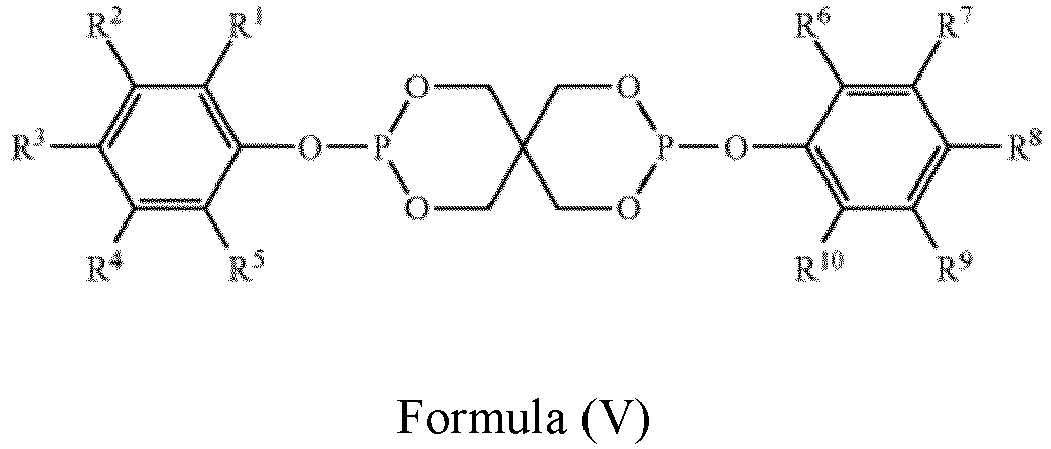 wherein R1, R2, R3, R4, R5, R6, R7, R8, R9, and R10 in Formula (V) are each individually selected from hydrogen, C1-C12 alkyl, C3-C12 cycloalkyl, C4-C12 alkyl cycloalkyl, C6-C10 aryl, and C7-C12 alkylaryl, wherein R1 and R5 together comprise at least 5 carbons and at least one of R1 and R5 comprises a tertiary carbon, wherein R6 and R10 together comprise at least 5 carbons and at least one of R6 and R10 comprises a tertiary carbon; preferably selected from the group consisting of bis-(2,6-di-t-butyl-4-methlphenyl)pentaerythritol diphosphite, (bis-(2,4-dicumylphenyl)pentaerythritol diphosphite, bis-(2,4-di-t-butylphenyl)pentaerythritol diphosphite, and bis-(2,4,6-tri-t-butylphenyl)pentaerythritol diphosphite; and mixtures thereof;
ora trisarylphosphite according to Formula (VI): wherein R16, R17, R40, R41, and R42 in Formula (VI) are each individually selected from hydrogen, C1-C20 alkyl, C3-C20 cycloalkyl, C4-C20 alkyl cycloalkyl, C6-C10 aryl, and C7-C20 alkylaryl; preferably selected from the group consisting of tris-(2,4-di-t-butylphenyl)phosphite, tris(4-nonylphenyl) phosphite and triphenyl phosphite; and mixtures thereof;or mixtures thereof.
 - The thermal and UV light stabilizer composition according to any one of the preceding claims, wherein the thioester compound is selected from the group consisting of dilauryl thiodipropionate, distearyl thiodipropionate, pentaerythrithol tetrakis-(3-dodecylthipropionate), tetra-alkyl thioethyl thiodisuccinate, 2,12-dihydroxy-4,10-dithia-7-oxatridecamethylene bis[3-(dodecylthio)propionate], polyalkanol esters of alkylthio-alkanoic acids, and dialkyl 3,3'-thiodipropionates; and mixtures thereof.
- The thermal and UV light stabilizer composition according to any one of the preceding claims, wherein:the ortho-hydroxyl tris-aryl-s-triazine compound is 2-[4,6-bis(2,4-dimethylphenyl)-1,3,5-triazin-2-yl]-5-(octyloxy) phenol;the hindered amine light stabilizer compound is a mixture of fatty acids, and C12-C21, C18 unsaturated 2,2,6,6,-tetramethyl - 4- piperidinyl esters;the hindered hydroxybenzoate compound is 3,5 - di -tert-butyl-4-hydroxybenzoic acid, hexadecyl ester;the acid scavenger is selected from the group consisting of magnesium oxide, aluminum oxide, magnesium hydroxide, aluminum hydroxide, carbonates thereof and mixtures thereof;the phosphite compound is bis(2,4-dicumylphenyl) pentaerythritol diphosphite);the hindered phenol antioxidant compound is 1,3,5 - Tris (4-tert-butyl-3-hydroxy-2,6-dimethyl benzyl)-1,3,5-triazine-2,4,6-(1H, 3H, 5H)-trione; andthe thioester is pentaerythrithol tetrakis-(3-dodecylthiopropionate) or Distearyl thiodipropionate.
- The thermal and UV light stabilizer composition according to any one of the preceding claims, wherein:the ortho-hydroxyl tris-aryl-s-triazine compound is present in an amount from 1 wt. % to 10 wt.% based on a total wt. % of the thermal and UV light stabilizer composition;the hindered amine light stabilizer compound is present in an amount from 20 wt. % to 50 wt.% based on the total wt. % of the thermal and UV light stabilizer composition;the hindered hydroxybenzoate compound is present in an amount from 20 wt. % to 50 wt. % based on the total wt. % of the thermal and UV light stabilizer composition;the acid scavenger is present in an amount from 1 wt. % to 10 wt. % based on the total wt. % of the thermal and UV light stabilizer composition;the phosphite compound is present in an amount from 5 wt. % to 40 wt.% based on the total wt. % of the thermal and UV light stabilizer composition; andthe hindered phenol antioxidant compound is present in an amount from 1 wt. % to 10 wt.% based on the total wt. % of the thermal and UV light stabilizer composition.
- The thermal and UV light stabilizer composition according to any one of claims 1-9, whereinthe ortho-hydroxyl tris-aryl-s-triazine compound is present in an amount from 1 wt. % to 10 wt.% based on a total wt. % of the thermal and UV light stabilizer composition;the hindered amine light stabilizer compound is present in an amount from 20 wt. % to 50 wt.% based on the total wt. % of the thermal and UV light stabilizer composition;the hindered hydroxybenzoate compound is present in an amount from 20 wt. % to 50 wt. % based on the total wt. % of the thermal and UV light stabilizer composition;the acid scavenger is present in an amount from 1 wt. % to 10 wt. % based on the total wt. % of the thermal and UV light stabilizer composition;the phosphite compound is present in an amount from 5 wt. % to 25 wt.% based on the total wt. % of the thermal and UV light stabilizer composition;the hindered phenol antioxidant compound is present in an amount from 1 wt. % to 10 wt.% based on the total wt. % of the thermal and UV light stabilizer composition; andthe thioester compound is present in an amount from 1 wt. % to 15 wt. % based on the total wt. % of the thermal and UV light stabilizer composition.
- A composition comprising:a thermal and UV light stabilizer composition according to any one of claims 1 to 11; anda material to be stabilized; preferably selected from the group consisting of: polyolefins, polyesters, polyethers, polyketones, polyamides, natural and synthetic rubbers, polyurethanes, polystyrenes, high-impact polystyrenes, polyacrylates, polymethacrylates, polyacetals, polyacrylonitriles, polybutadienes, polystyrenes, acrylonitrile-butadiene-styrene, styrene acrylonitrile, acrylate styrene acrylonitrile, cellulosic acetate butyrate, cellulosic polymers, polyimides, polyamideimides, polyetherimides, polyphenyl sulfides, polyphenyloxidepolysulfones, polyethersulfones, polyvinylchlorides, polycarbonates, polyketones, aliphatic polyketones, thermoplastic olefins, aminoresin cross-linked polyacrylates and polyesters, polyisocyanate cross-linked polyesters and polyacrylates, phenol/formaldehyde, urea/formaldehyde and melamine/formaldehyde resins, drying and non-drying alkyd resins, alkyd resins, polyester resins, acrylate resins cross-linked with melamine resins, urea resins, isocyanates, isocyanurates, carbamates, and epoxy resins, cross-linked epoxy resins derived from aliphatic, cycloaliphatic, heterocyclic and aromatic glycidyl compounds, which are cross-linked with anhydrides or amines, polysiloxanes, Michael addition polymers, amines, blocked amines with activated unsaturated and methylene compounds, ketimines with activated unsaturated and methylene compounds, polyketimines in combination with unsaturated acrylic polyacetoacetate resins, polyketimines in combination with unsaturated acrylic resins, radiation curable compositions, epoxymelamine resins, organic dyes, cosmetic products, cellulose-based paper formulations, photographic film paper, fibers, waxes, inks, and blends thereof; more preferably selected from the group consisting of thermoplastic olefins, acrylonitrile-butadiene-styrene, polyesters, polyvinylchloride, polyamides, polyurethanes, or homo- and copolymers of propylene, isobutylene, butene, methylpentene, hexene, heptene, octene, isoprene, butadiene, hexadiene, dicyclopentadiene, ethylidene cyclopentene and norbornene; and most preferably the material to be stabilized is polypropylene or polyethylene;preferably wherein the composition is a master batch and the thermal and UV light stabilizer composition is present in an amount from about 10 wt.% to about 80 wt. %, preferably in an amount from about 30 wt.% to about 60 wt. % and more preferably in an amount between about 40 wt.% to about 50 wt. %, based on a total weight of the master batch composition, and the material to be stabilized is present in an amount from about 20 wt.% to about 90 wt.%, preferably in an amount from about 40 wt.% to about 70 wt.% and more preferably in an amount between about 50 wt.% to about 60 wt.%, based on the total weight of the master batch composition.
- A composition according to claim 12, wherein the material to be stabilized is used in the construction or renovation of buildings, and is preferably chosen from vinyl siding, vinyl siding trim, a shutter, a gable vent, an eave, fascia, a soffit, a molding, a roofing shingle, a roofing underlayment, a roofing membrane, a batten system, a batten extender, flashing, a tile pan, a ridge vent, a weather block, a hip and ridge system, an eave riser, a taper strip, a gable end wedge, rake trim, a geomembrane, a composite deck material, a railing or a window frame.
- The composition according to either one of claim 12 or 13, wherein the thermal and UV light stabilizer composition is present in an amount from 0.01 wt. % to 5 wt. % based on a total weight of the stabilized composition;preferably wherein the thermal and UV light stabilizer composition is present in an amount from 0.05 wt. % to 2 wt. % based on a total weight of the stabilized composition;more preferablywherein an amount of the ortho-hydroxyl tris-aryl-s-triazine compound is from about 0.002 wt.% to about 0.50 wt.%, an amount of the hindered amine light stabilizer compound is from about 0.01 wt.% to about 1.20 wt.%, an amount of the hindered hydroxybenzoate compound is from about 0.01 wt.% to about 1.20 wt.%, an amount of the acid scavenger is from about 0.001 wt.% to about 0.50 wt.%, an amount of the hindered phenol antioxidant compound is from about 0.001 wt.% to about 0.50 wt.%, and an amount of the phosphite compound is from about 0.005 wt.% to about 1.00 wt.%, based on the total weight of the stabilized composition;most preferably wherein the amount of the ortho-hydroxyl tris-aryl-s-triazine compound is from about 0.004 wt.% to about 0.20 wt.%, the amount of the hindered amine light stabilizer compound is from about 0.02 wt.% to about 0.80 wt.%, the amount of the hindered hydroxybenzoate compound is from about 0.02 wt.% to about 0.80 wt.%, the amount of the acid scavenger is from about 0.003 wt.% to about 0.25 wt.%, the amount of the hindered phenol antioxidant compound is from about 0.002 wt.% to about 0.25 wt.%, and the amount of the phosphite composition is from about 0.01 wt.% to about 0.80 wt.%, based on a total weight of the stabilized composition;and particulary most preferably wherein the thermal and UV light stabilizer composition further comprises a thioester compound, wherein an amount of the thioester compound is from about 0.001 wt.% to about 0.80 wt.%, preferably from about 0.003 wt.% to about 0.4 wt. %, based on a total weight of the stabilized composition.
- A process for achieving stability against thermal and UV light degradation of a material selected from the group consisting of polyolefins, polyesters, polyethers, polyketones, polyamides, natural and synthetic rubbers, polyurethanes, polystyrenes, high-impact polystyrenes, polyacrylates, polymethacrylates, polyacetals, polyacrylonitriles, polybutadienes, polystyrenes, acrylonitrile-butadiene-styrene, styrene acrylonitrile, acrylate styrene acrylonitrile, cellulosic acetate butyrate, cellulosic polymers, polyimides, polyamideimides, polyetherimides, polyphenyl sulfides, polyphenyloxidepolysulfones, polyethersulfones, polyvinylchlorides, polycarbonates, polyketones, aliphatic polyketones, thermoplastic olefins, aminoresin cross-linked polyacrylates and polyesters, polyisocyanate cross-linked polyesters and polyacrylates, phenol/formaldehyde, urea/formaldehyde and melamine/formaldehyde resins, drying and non-drying alkyd resins, alkyd resins, polyester resins, acrylate resins cross-linked with melamine resins, urea resins, isocyanates, isocyanurates, carbamates, and epoxy resins, cross-linked epoxy resins derived from aliphatic, cycloaliphatic, heterocyclic and aromatic glycidyl compounds, which are cross-linked with anhydrides or amines, polysiloxanes, Michael addition polymers, amines, blocked amines with activated unsaturated and methylene compounds, ketimines with activated unsaturated and methylene compounds, polyketimines in combination with unsaturated acrylic polyacetoacetate resins, polyketimines in combination with unsaturated acrylic resins, radiation curable compositions, epoxymelamine resins, organic dyes, cosmetic products, cellulose-based paper formulations, photographic film paper, fibers, waxes, inks, and blends thereof, the process comprising adding a stabilizing amount of a stabilizer composition according to any one of claims 1-11 to the material.
Applications Claiming Priority (2)
| Application Number | Priority Date | Filing Date | Title |
|---|---|---|---|
| US201461987133P | 2014-05-01 | 2014-05-01 | |
| PCT/US2015/028484 WO2015168389A1 (en) | 2014-05-01 | 2015-04-30 | Stabilizing compositions for stabilizing materials against ultraviolet light and thermal degradation |
Publications (2)
| Publication Number | Publication Date |
|---|---|
| EP3137540A1 EP3137540A1 (en) | 2017-03-08 |
| EP3137540B1 true EP3137540B1 (en) | 2024-10-30 |
Family
ID=53264744
Family Applications (1)
| Application Number | Title | Priority Date | Filing Date |
|---|---|---|---|
| EP15724414.6A Active EP3137540B1 (en) | 2014-05-01 | 2015-04-30 | Stabilizing compositions for stabilizing materials against ultraviolet light and thermal degradation |
Country Status (11)
| Country | Link |
|---|---|
| US (2) | US9725579B2 (en) |
| EP (1) | EP3137540B1 (en) |
| JP (1) | JP6731910B2 (en) |
| KR (1) | KR101915874B1 (en) |
| CN (1) | CN106471049B (en) |
| BR (1) | BR112016025445B1 (en) |
| ES (1) | ES3004696T3 (en) |
| MX (1) | MX390673B (en) |
| SA (1) | SA516380205B1 (en) |
| TW (1) | TWI685558B (en) |
| WO (1) | WO2015168389A1 (en) |
Families Citing this family (54)
| Publication number | Priority date | Publication date | Assignee | Title |
|---|---|---|---|---|
| JP6846340B2 (en) * | 2014-09-03 | 2021-03-24 | ソルベイ スペシャルティ ポリマーズ ユーエスエー, エルエルシー | Sulfone polymer composition |
| CN105482100B (en) * | 2015-12-28 | 2018-07-13 | 北京服装学院 | A kind of fast light heat-resistant polyamide and preparation method thereof |
| CN105693641A (en) * | 2015-12-29 | 2016-06-22 | 新秀化学(烟台)有限公司 | Preparation method of triazine ultraviolet absorbent |
| EP3789455A1 (en) | 2016-06-09 | 2021-03-10 | Adeka Corporation | Resin composition |
| TWI746587B (en) * | 2016-06-29 | 2021-11-21 | 日商迪愛生股份有限公司 | Hollow fiber membrane module and manufacturing method thereof |
| WO2018070438A1 (en) * | 2016-10-12 | 2018-04-19 | 日産化学工業株式会社 | Light-fast hard coat material |
| US11001698B2 (en) | 2016-10-14 | 2021-05-11 | Basf Se | Stabilizer composition |
| FR3063082B1 (en) * | 2017-02-17 | 2019-04-05 | Societe Bic | NOVEL THERMOCHROME PIGMENT COMPOSITION COMPRISING A COMPOUND OF FORMULA (I) AS A REACTIONAL MEDIUM |
| EP3601428A1 (en) * | 2017-03-28 | 2020-02-05 | Basf Se | Light stabilizer mixture |
| FR3065729B1 (en) | 2017-04-27 | 2020-12-18 | SOCIéTé BIC | NEW COMPOUNDS OF FORMULA (I) AND THEIR USE IN THERMOCHROME PIGMENT COMPOSITIONS |
| CN107082936A (en) * | 2017-06-02 | 2017-08-22 | 苏州新区特氟龙塑料制品厂 | A kind of antiultraviolet plastic |
| EP3645616A1 (en) * | 2017-06-26 | 2020-05-06 | SABIC Global Technologies B.V. | Uv and heat stable flame-retardant glass filled polymer composition and reinforced articles therefrom |
| EP3421529A1 (en) * | 2017-06-29 | 2019-01-02 | Songwon Industrial Co., Ltd. | Polyolefin articles with improved resistance against chlorine dioxide |
| CN110809600A (en) * | 2017-07-06 | 2020-02-18 | 巴斯夫欧洲公司 | Polyethylene pipe |
| EP3556748A1 (en) * | 2018-04-20 | 2019-10-23 | Basf Se | Hydroxyphenyl-triazine uv absorbers |
| KR102602854B1 (en) * | 2018-06-05 | 2023-11-16 | 주식회사 동진쎄미켐 | The polyimide composition and a polyimide film having excellent ultraviolet stability prepared therefrom |
| PL3841166T5 (en) | 2018-08-22 | 2025-08-18 | Basf Se | Stabilized polyolefin produced by rotational molding |
| EP3898816A1 (en) | 2018-12-19 | 2021-10-27 | SABIC Global Technologies B.V. | Polymer composition, article comprising said composition and use of said article |
| CN111471241A (en) | 2019-01-24 | 2020-07-31 | Sabic环球技术有限责任公司 | Antenna housing with improved drop-weight shock resistance |
| US11753566B2 (en) | 2019-01-31 | 2023-09-12 | Synthomer Adhesive Technologies Llc | Low volatile tackifier compositions |
| WO2020217482A1 (en) * | 2019-04-26 | 2020-10-29 | 株式会社ユポ・コーポレーション | Resin composition and resin sheet |
| JP6602501B1 (en) * | 2019-05-10 | 2019-11-06 | 株式会社Adeka | Agricultural film and plant growing method |
| US20220282064A1 (en) * | 2019-07-30 | 2022-09-08 | Basf Se | Stabilizer composition |
| CN110452349A (en) * | 2019-07-30 | 2019-11-15 | 清远市美佳乐环保新材股份有限公司 | It is a kind of to be soaked certainly from thickened aqueous surface treating agent and preparation method thereof |
| EP4072354A1 (en) * | 2019-12-10 | 2022-10-19 | Ticona LLC | Low emission cellulose ester composition and articles made therefrom |
| GB2590910A (en) | 2019-12-24 | 2021-07-14 | Si Group Switzerland Chaa Gmbh | Composition |
| CN111038057A (en) * | 2019-12-31 | 2020-04-21 | 潍坊友容实业有限公司 | Multilayer composite geomembrane for saline-alkali soil remediation and preparation method thereof |
| EP4171220A1 (en) | 2020-06-30 | 2023-05-03 | Texas Tech University System | Method and apparatus for collection of fluid samples |
| US11992101B2 (en) * | 2020-07-31 | 2024-05-28 | Johnson & Johnson Vision Care, Inc. | Nucleated polypropylene resin for primary lens package |
| DE102020124036A1 (en) * | 2020-09-15 | 2022-03-17 | Bruno Bock Chemische Fabrik GmbH & Co. Kommanditgesellschaft | Stabilizer system containing sulfide for thiol-ene and thiol-yne compositions |
| WO2022075445A1 (en) * | 2020-10-08 | 2022-04-14 | 株式会社Adeka | Polyolefin resin composition, molded article using same, and method for producing polyolefin resin composition |
| JPWO2022075441A1 (en) * | 2020-10-08 | 2022-04-14 | ||
| JPWO2022075442A1 (en) * | 2020-10-08 | 2022-04-14 | ||
| CN116745353A (en) * | 2020-11-27 | 2023-09-12 | 塞特工业公司 | Compositions and methods for protecting organic polymeric materials from harmful effects of exposure to UV-C light |
| EP4251696B1 (en) * | 2020-11-30 | 2024-11-20 | INEOS Styrolution Group GmbH | Uv resistant smma copolymers with low haze and high clarity |
| US20220185995A1 (en) * | 2020-12-16 | 2022-06-16 | Ticona Llc | Fiber-Reinforced Polymer Composition having an Improved Surface Appearance |
| WO2022207787A1 (en) * | 2021-04-01 | 2022-10-06 | Basf Se | Stabilizer mixture |
| CN114044938B (en) * | 2021-09-28 | 2023-07-11 | 天津金发新材料有限公司 | Anti-short wave ultraviolet stabilizer and preparation method and application thereof |
| CN113735711A (en) * | 2021-10-12 | 2021-12-03 | 山东省临沂市三丰化工有限公司 | Novel hindered phenol antioxidant and preparation method thereof |
| KR20240115328A (en) * | 2021-12-10 | 2024-07-25 | 셀라니즈 인터내셔날 코포레이션 | Acid-resistant polyoxymethylene composition and articles made therefrom |
| CN116693938A (en) * | 2022-02-24 | 2023-09-05 | 天津利安隆新材料股份有限公司 | Reactive composite light stabilizer, application thereof and light-stable modified polymer material |
| WO2023200914A1 (en) * | 2022-04-15 | 2023-10-19 | Kisuma Americas, Inc. | Method for extending shelf life of polymeric isocyanate with composition containing hydrotalcite |
| CN114978036A (en) * | 2022-06-13 | 2022-08-30 | 上海玻纳电子科技有限公司 | Experimental evaluation method for ultraviolet light aging stability of photovoltaic module |
| CN115340709B (en) * | 2022-08-10 | 2023-11-10 | 山东省临沂市三丰化工有限公司 | Antioxidant stabilizer composition, polypropylene special material and preparation method of polypropylene special material |
| CN121057776A (en) * | 2023-01-31 | 2025-12-02 | 塞特工业公司 | Stabilizer Compositions and Methods for High-Definition Random Polypropylene Copolymers |
| CN116120631B (en) * | 2023-02-03 | 2025-06-13 | 天津利安隆新材料股份有限公司 | Anti-aging agent composition and its application and anti-aging polymer material |
| TWI868640B (en) * | 2023-03-25 | 2025-01-01 | 南亞塑膠工業股份有限公司 | Long fiber reinforced thermoplastics for solar module |
| EP4688913A1 (en) | 2023-04-05 | 2026-02-11 | Basf Se | Uv light stabilizers |
| AU2024376202A1 (en) | 2023-11-10 | 2026-05-14 | Cytec Industries Inc. | Compositions for stabilizing polymeric materials against uv light thermal and gas fading degradation |
| AU2024374617A1 (en) | 2023-11-10 | 2026-05-14 | Cytec Industries Inc. | Stabilizing compositions for polymeric materials |
| WO2025172192A1 (en) | 2024-02-15 | 2025-08-21 | Basf Se | Uv light stabilizers |
| WO2025219501A1 (en) * | 2024-04-17 | 2025-10-23 | Cytec Industries Inc. | Stabilizing compositions for polymeric materials |
| WO2026088945A1 (en) * | 2024-10-21 | 2026-04-30 | 株式会社Adeka | Resin composition, molded article, light stabilizer composition, method for producing resin composition, method for suppressing decrease in molecular weight of synthetic resin under light irradiation, and hindered amine compound |
| KR102945301B1 (en) * | 2025-04-16 | 2026-03-30 | 국방과학연구소 | Epoxy resin composition for space environment and method for producing modified epoxy resin using the same |
Citations (2)
| Publication number | Priority date | Publication date | Assignee | Title |
|---|---|---|---|---|
| US6051164A (en) * | 1998-04-30 | 2000-04-18 | Cytec Technology Corp. | Methods and compositions for protecting polymers from UV light |
| US6843939B2 (en) * | 2001-12-27 | 2005-01-18 | Cytec Technology Corp. | UV stabilizing additive composition |
Family Cites Families (12)
| Publication number | Priority date | Publication date | Assignee | Title |
|---|---|---|---|---|
| US4985479A (en) * | 1986-11-27 | 1991-01-15 | Sumitomo Chemical Company, Ltd. | Stabilized polyolefin composition |
| US5214084A (en) * | 1990-03-14 | 1993-05-25 | Sumitomo Chemical Company, Ltd. | Stabilized polypropylene resin composition |
| JP2803300B2 (en) * | 1990-03-14 | 1998-09-24 | 住友化学工業株式会社 | Stabilized polypropylene resin composition |
| US6727300B2 (en) * | 2000-11-03 | 2004-04-27 | Cytec Technology Corp. | Polymeric articles containing hindered amine light stabilizers based on multi-functional carbonyl compounds |
| KR20060015627A (en) * | 2003-05-27 | 2006-02-17 | 시바 스페셜티 케미칼스 홀딩 인크. | Aminoaryl-1,3,5-triazines and their use as ultraviolet absorbers |
| KR101104780B1 (en) * | 2003-11-03 | 2012-01-13 | 시바 홀딩 인코포레이티드 | Stabilizer Compositions for Halogen Containing Polymers |
| US7291669B2 (en) * | 2004-03-16 | 2007-11-06 | Ciba Specialty Chemicals Corporation | Stabilized polyolefin compositions |
| US7582690B2 (en) * | 2004-11-19 | 2009-09-01 | Eastman Chemical Company | Stabilized aliphatic polyester compositions |
| US20070105992A1 (en) * | 2005-11-07 | 2007-05-10 | Hayder Zahalka | Cycloalkyl phosphites as stabilizers for thermoplastic resins |
| CN102417611B (en) * | 2006-05-17 | 2014-07-02 | 氰特技术公司 | Stabilizer compositions |
| CN102010520A (en) * | 2010-11-10 | 2011-04-13 | 大连化工研究设计院 | Triazine light stabilizers containing hindered amine groups |
| EP2647664A1 (en) * | 2012-04-04 | 2013-10-09 | Cytec Technology Corp. | Method for stabilizing polyolefin films against UV degradation |
-
2015
- 2015-04-30 CN CN201580035907.4A patent/CN106471049B/en active Active
- 2015-04-30 JP JP2017510441A patent/JP6731910B2/en active Active
- 2015-04-30 KR KR1020167033488A patent/KR101915874B1/en active Active
- 2015-04-30 US US14/700,560 patent/US9725579B2/en active Active
- 2015-04-30 EP EP15724414.6A patent/EP3137540B1/en active Active
- 2015-04-30 BR BR112016025445-7A patent/BR112016025445B1/en active IP Right Grant
- 2015-04-30 TW TW104113983A patent/TWI685558B/en active
- 2015-04-30 ES ES15724414T patent/ES3004696T3/en active Active
- 2015-04-30 MX MX2016014351A patent/MX390673B/en unknown
- 2015-04-30 WO PCT/US2015/028484 patent/WO2015168389A1/en not_active Ceased
-
2016
- 2016-11-01 SA SA516380205A patent/SA516380205B1/en unknown
-
2017
- 2017-06-15 US US15/624,229 patent/US10407563B2/en active Active
Patent Citations (2)
| Publication number | Priority date | Publication date | Assignee | Title |
|---|---|---|---|---|
| US6051164A (en) * | 1998-04-30 | 2000-04-18 | Cytec Technology Corp. | Methods and compositions for protecting polymers from UV light |
| US6843939B2 (en) * | 2001-12-27 | 2005-01-18 | Cytec Technology Corp. | UV stabilizing additive composition |
Also Published As
| Publication number | Publication date |
|---|---|
| CN106471049A (en) | 2017-03-01 |
| MX390673B (en) | 2025-03-21 |
| JP6731910B2 (en) | 2020-07-29 |
| ES3004696T3 (en) | 2025-03-12 |
| KR101915874B1 (en) | 2018-11-06 |
| US20150315465A1 (en) | 2015-11-05 |
| BR112016025445A2 (en) | 2017-08-15 |
| US20170349730A1 (en) | 2017-12-07 |
| JP2017518430A (en) | 2017-07-06 |
| TW201546242A (en) | 2015-12-16 |
| KR20160147279A (en) | 2016-12-22 |
| TWI685558B (en) | 2020-02-21 |
| US10407563B2 (en) | 2019-09-10 |
| CA2947699A1 (en) | 2015-11-05 |
| US9725579B2 (en) | 2017-08-08 |
| BR112016025445B1 (en) | 2022-08-02 |
| BR112016025445A8 (en) | 2021-05-04 |
| SA516380205B1 (en) | 2020-12-31 |
| WO2015168389A1 (en) | 2015-11-05 |
| EP3137540A1 (en) | 2017-03-08 |
| CN106471049B (en) | 2018-12-14 |
| MX2016014351A (en) | 2017-05-30 |
Similar Documents
| Publication | Publication Date | Title |
|---|---|---|
| US10407563B2 (en) | Processes for producing molded articles stabilized against ultraviolet light and thermal degradation | |
| JP2017518430A5 (en) | ||
| JP4587488B2 (en) | A synthetic resin composition containing a low basic hindered amine compound having a carbonate skeleton and a coating composition containing the same. | |
| EP2450401B1 (en) | Flame-resistant compound containing a phosphoric acid derivative | |
| EP1481024B1 (en) | Uv stabilized thermoplastic olefins | |
| US11267951B2 (en) | Stabilizer compositions containing substituted chroman compounds and methods of use | |
| DE10116305A1 (en) | Synergistic mixtures of UV absorbers in polyolefins | |
| CZ255695A3 (en) | 2-hydroxyphenyltriazines, process of their preparation and their use as uv radiation absorbing substances in organic materials | |
| FR2733502A1 (en) | STABILIZED SYNTHETIC ORGANIC POLYMER COMPOSITION, METHOD FOR STABILIZING THE POLYMER, AND USE OF THE COMPOSITION | |
| EP0415887B1 (en) | 3-Phenyl-benzofuran-3-ones | |
| DE69816851T2 (en) | 2- (2'-HYDROXYPHENYL) BENZOTRIAZOLE CAN BE USED AS UV STABILIZERS | |
| KR100351202B1 (en) | How to clean HDPE | |
| CA2876063C (en) | Stabilizer compositions containing substituted chroman compounds and methods of use | |
| CA2947699C (en) | Stabilizing compositions for stabilizing materials against ultraviolet light and thermal degradation | |
| WO2025099141A1 (en) | Stabilizing compositions for polymeric materials | |
| WO2025099143A1 (en) | Compositions for stabilizing polymeric materials against uv light thermal and gas fading degradation | |
| CN115368632A (en) | Phosphite antioxidant composition and synthetic resin composition using same | |
| JP4421326B2 (en) | Stabilized synthetic resin composition and agricultural film | |
| WO2025219501A1 (en) | Stabilizing compositions for polymeric materials | |
| ITMI971064A1 (en) | ORGANIC POLYMERS STABILIZED IN THE LIGHT |
Legal Events
| Date | Code | Title | Description |
|---|---|---|---|
| STAA | Information on the status of an ep patent application or granted ep patent |
Free format text: STATUS: THE INTERNATIONAL PUBLICATION HAS BEEN MADE |
|
| PUAI | Public reference made under article 153(3) epc to a published international application that has entered the european phase |
Free format text: ORIGINAL CODE: 0009012 |
|
| STAA | Information on the status of an ep patent application or granted ep patent |
Free format text: STATUS: REQUEST FOR EXAMINATION WAS MADE |
|
| 17P | Request for examination filed |
Effective date: 20161201 |
|
| AK | Designated contracting states |
Kind code of ref document: A1 Designated state(s): AL AT BE BG CH CY CZ DE DK EE ES FI FR GB GR HR HU IE IS IT LI LT LU LV MC MK MT NL NO PL PT RO RS SE SI SK SM TR |
|
| AX | Request for extension of the european patent |
Extension state: BA ME |
|
| DAV | Request for validation of the european patent (deleted) | ||
| DAX | Request for extension of the european patent (deleted) | ||
| STAA | Information on the status of an ep patent application or granted ep patent |
Free format text: STATUS: EXAMINATION IS IN PROGRESS |
|
| 17Q | First examination report despatched |
Effective date: 20200220 |
|
| REG | Reference to a national code |
Ref country code: DE Ref legal event code: R079 Free format text: PREVIOUS MAIN CLASS: C08K0003000000 Ipc: C08K0003020000 Ref country code: DE Ref legal event code: R079 Ref document number: 602015090251 Country of ref document: DE Free format text: PREVIOUS MAIN CLASS: C08K0003000000 Ipc: C08K0003020000 |
|
| GRAP | Despatch of communication of intention to grant a patent |
Free format text: ORIGINAL CODE: EPIDOSNIGR1 |
|
| STAA | Information on the status of an ep patent application or granted ep patent |
Free format text: STATUS: GRANT OF PATENT IS INTENDED |
|
| RIC1 | Information provided on ipc code assigned before grant |
Ipc: C08K 3/01 20180101ALI20240507BHEP Ipc: C09K 15/30 20060101ALI20240507BHEP Ipc: C08K 13/02 20060101ALI20240507BHEP Ipc: C08K 5/524 20060101ALI20240507BHEP Ipc: C08K 5/375 20060101ALI20240507BHEP Ipc: C08K 5/3492 20060101ALI20240507BHEP Ipc: C08K 5/3462 20060101ALI20240507BHEP Ipc: C08K 5/3435 20060101ALI20240507BHEP Ipc: C08K 5/20 20060101ALI20240507BHEP Ipc: C08K 5/134 20060101ALI20240507BHEP Ipc: C08K 5/132 20060101ALI20240507BHEP Ipc: C08K 5/13 20060101ALI20240507BHEP Ipc: C08K 3/26 20060101ALI20240507BHEP Ipc: C08K 3/22 20060101ALI20240507BHEP Ipc: C08K 5/527 20060101ALI20240507BHEP Ipc: C08K 3/02 20060101AFI20240507BHEP |
|
| INTG | Intention to grant announced |
Effective date: 20240529 |
|
| RAP3 | Party data changed (applicant data changed or rights of an application transferred) |
Owner name: CYTEC INDUSTRIES INC. |
|
| P01 | Opt-out of the competence of the unified patent court (upc) registered |
Free format text: CASE NUMBER: APP_44973/2024 Effective date: 20240802 |
|
| GRAS | Grant fee paid |
Free format text: ORIGINAL CODE: EPIDOSNIGR3 |
|
| GRAA | (expected) grant |
Free format text: ORIGINAL CODE: 0009210 |
|
| STAA | Information on the status of an ep patent application or granted ep patent |
Free format text: STATUS: THE PATENT HAS BEEN GRANTED |
|
| AK | Designated contracting states |
Kind code of ref document: B1 Designated state(s): AL AT BE BG CH CY CZ DE DK EE ES FI FR GB GR HR HU IE IS IT LI LT LU LV MC MK MT NL NO PL PT RO RS SE SI SK SM TR |
|
| REG | Reference to a national code |
Ref country code: GB Ref legal event code: FG4D |
|
| REG | Reference to a national code |
Ref country code: CH Ref legal event code: EP |
|
| REG | Reference to a national code |
Ref country code: DE Ref legal event code: R096 Ref document number: 602015090251 Country of ref document: DE |
|
| REG | Reference to a national code |
Ref country code: IE Ref legal event code: FG4D |
|
| REG | Reference to a national code |
Ref country code: NL Ref legal event code: FP |
|
| REG | Reference to a national code |
Ref country code: LT Ref legal event code: MG9D |
|
| REG | Reference to a national code |
Ref country code: ES Ref legal event code: FG2A Ref document number: 3004696 Country of ref document: ES Kind code of ref document: T3 Effective date: 20250312 |
|
| PG25 | Lapsed in a contracting state [announced via postgrant information from national office to epo] |
Ref country code: IS Free format text: LAPSE BECAUSE OF FAILURE TO SUBMIT A TRANSLATION OF THE DESCRIPTION OR TO PAY THE FEE WITHIN THE PRESCRIBED TIME-LIMIT Effective date: 20250228 Ref country code: HR Free format text: LAPSE BECAUSE OF FAILURE TO SUBMIT A TRANSLATION OF THE DESCRIPTION OR TO PAY THE FEE WITHIN THE PRESCRIBED TIME-LIMIT Effective date: 20241030 Ref country code: PT Free format text: LAPSE BECAUSE OF FAILURE TO SUBMIT A TRANSLATION OF THE DESCRIPTION OR TO PAY THE FEE WITHIN THE PRESCRIBED TIME-LIMIT Effective date: 20250228 |
|
| PG25 | Lapsed in a contracting state [announced via postgrant information from national office to epo] |
Ref country code: FI Free format text: LAPSE BECAUSE OF FAILURE TO SUBMIT A TRANSLATION OF THE DESCRIPTION OR TO PAY THE FEE WITHIN THE PRESCRIBED TIME-LIMIT Effective date: 20241030 |
|
| PG25 | Lapsed in a contracting state [announced via postgrant information from national office to epo] |
Ref country code: BG Free format text: LAPSE BECAUSE OF FAILURE TO SUBMIT A TRANSLATION OF THE DESCRIPTION OR TO PAY THE FEE WITHIN THE PRESCRIBED TIME-LIMIT Effective date: 20241030 |
|
| PG25 | Lapsed in a contracting state [announced via postgrant information from national office to epo] |
Ref country code: NO Free format text: LAPSE BECAUSE OF FAILURE TO SUBMIT A TRANSLATION OF THE DESCRIPTION OR TO PAY THE FEE WITHIN THE PRESCRIBED TIME-LIMIT Effective date: 20250130 |
|
| PG25 | Lapsed in a contracting state [announced via postgrant information from national office to epo] |
Ref country code: LV Free format text: LAPSE BECAUSE OF FAILURE TO SUBMIT A TRANSLATION OF THE DESCRIPTION OR TO PAY THE FEE WITHIN THE PRESCRIBED TIME-LIMIT Effective date: 20241030 Ref country code: GR Free format text: LAPSE BECAUSE OF FAILURE TO SUBMIT A TRANSLATION OF THE DESCRIPTION OR TO PAY THE FEE WITHIN THE PRESCRIBED TIME-LIMIT Effective date: 20250131 |
|
| PG25 | Lapsed in a contracting state [announced via postgrant information from national office to epo] |
Ref country code: PL Free format text: LAPSE BECAUSE OF FAILURE TO SUBMIT A TRANSLATION OF THE DESCRIPTION OR TO PAY THE FEE WITHIN THE PRESCRIBED TIME-LIMIT Effective date: 20241030 |
|
| PG25 | Lapsed in a contracting state [announced via postgrant information from national office to epo] |
Ref country code: RS Free format text: LAPSE BECAUSE OF FAILURE TO SUBMIT A TRANSLATION OF THE DESCRIPTION OR TO PAY THE FEE WITHIN THE PRESCRIBED TIME-LIMIT Effective date: 20250130 |
|
| PG25 | Lapsed in a contracting state [announced via postgrant information from national office to epo] |
Ref country code: SM Free format text: LAPSE BECAUSE OF FAILURE TO SUBMIT A TRANSLATION OF THE DESCRIPTION OR TO PAY THE FEE WITHIN THE PRESCRIBED TIME-LIMIT Effective date: 20241030 |
|
| PGFP | Annual fee paid to national office [announced via postgrant information from national office to epo] |
Ref country code: DE Payment date: 20250305 Year of fee payment: 11 |
|
| PG25 | Lapsed in a contracting state [announced via postgrant information from national office to epo] |
Ref country code: DK Free format text: LAPSE BECAUSE OF FAILURE TO SUBMIT A TRANSLATION OF THE DESCRIPTION OR TO PAY THE FEE WITHIN THE PRESCRIBED TIME-LIMIT Effective date: 20241030 |
|
| PGFP | Annual fee paid to national office [announced via postgrant information from national office to epo] |
Ref country code: ES Payment date: 20250506 Year of fee payment: 11 |
|
| PG25 | Lapsed in a contracting state [announced via postgrant information from national office to epo] |
Ref country code: EE Free format text: LAPSE BECAUSE OF FAILURE TO SUBMIT A TRANSLATION OF THE DESCRIPTION OR TO PAY THE FEE WITHIN THE PRESCRIBED TIME-LIMIT Effective date: 20241030 |
|
| PG25 | Lapsed in a contracting state [announced via postgrant information from national office to epo] |
Ref country code: RO Free format text: LAPSE BECAUSE OF FAILURE TO SUBMIT A TRANSLATION OF THE DESCRIPTION OR TO PAY THE FEE WITHIN THE PRESCRIBED TIME-LIMIT Effective date: 20241030 |
|
| PGFP | Annual fee paid to national office [announced via postgrant information from national office to epo] |
Ref country code: AT Payment date: 20250325 Year of fee payment: 11 |
|
| PG25 | Lapsed in a contracting state [announced via postgrant information from national office to epo] |
Ref country code: SK Free format text: LAPSE BECAUSE OF FAILURE TO SUBMIT A TRANSLATION OF THE DESCRIPTION OR TO PAY THE FEE WITHIN THE PRESCRIBED TIME-LIMIT Effective date: 20241030 |
|
| PGFP | Annual fee paid to national office [announced via postgrant information from national office to epo] |
Ref country code: TR Payment date: 20250424 Year of fee payment: 11 |
|
| PG25 | Lapsed in a contracting state [announced via postgrant information from national office to epo] |
Ref country code: CZ Free format text: LAPSE BECAUSE OF FAILURE TO SUBMIT A TRANSLATION OF THE DESCRIPTION OR TO PAY THE FEE WITHIN THE PRESCRIBED TIME-LIMIT Effective date: 20241030 |
|
| REG | Reference to a national code |
Ref country code: DE Ref legal event code: R097 Ref document number: 602015090251 Country of ref document: DE |
|
| RAP4 | Party data changed (patent owner data changed or rights of a patent transferred) |
Owner name: CYTEC INDUSTRIES INC. |
|
| PLBE | No opposition filed within time limit |
Free format text: ORIGINAL CODE: 0009261 |
|
| STAA | Information on the status of an ep patent application or granted ep patent |
Free format text: STATUS: NO OPPOSITION FILED WITHIN TIME LIMIT |
|
| PG25 | Lapsed in a contracting state [announced via postgrant information from national office to epo] |
Ref country code: SE Free format text: LAPSE BECAUSE OF FAILURE TO SUBMIT A TRANSLATION OF THE DESCRIPTION OR TO PAY THE FEE WITHIN THE PRESCRIBED TIME-LIMIT Effective date: 20241030 |
|
| 26N | No opposition filed |
Effective date: 20250731 |
|
| REG | Reference to a national code |
Ref country code: CH Ref legal event code: H13 Free format text: ST27 STATUS EVENT CODE: U-0-0-H10-H13 (AS PROVIDED BY THE NATIONAL OFFICE) Effective date: 20251125 |
|
| PG25 | Lapsed in a contracting state [announced via postgrant information from national office to epo] |
Ref country code: LU Free format text: LAPSE BECAUSE OF NON-PAYMENT OF DUE FEES Effective date: 20250430 |
|
| PG25 | Lapsed in a contracting state [announced via postgrant information from national office to epo] |
Ref country code: MC Free format text: LAPSE BECAUSE OF FAILURE TO SUBMIT A TRANSLATION OF THE DESCRIPTION OR TO PAY THE FEE WITHIN THE PRESCRIBED TIME-LIMIT Effective date: 20241030 |
|
| PG25 | Lapsed in a contracting state [announced via postgrant information from national office to epo] |
Ref country code: CH Free format text: LAPSE BECAUSE OF NON-PAYMENT OF DUE FEES Effective date: 20250430 |
|
| PGFP | Annual fee paid to national office [announced via postgrant information from national office to epo] |
Ref country code: GB Payment date: 20260310 Year of fee payment: 12 |
|
| PG25 | Lapsed in a contracting state [announced via postgrant information from national office to epo] |
Ref country code: IE Free format text: LAPSE BECAUSE OF NON-PAYMENT OF DUE FEES Effective date: 20250430 |
|
| PGFP | Annual fee paid to national office [announced via postgrant information from national office to epo] |
Ref country code: BE Payment date: 20260317 Year of fee payment: 12 Ref country code: IT Payment date: 20260320 Year of fee payment: 12 |
|
| PGFP | Annual fee paid to national office [announced via postgrant information from national office to epo] |
Ref country code: NL Payment date: 20260317 Year of fee payment: 12 |
|
| PGFP | Annual fee paid to national office [announced via postgrant information from national office to epo] |
Ref country code: FR Payment date: 20260309 Year of fee payment: 12 |