EP3137449B1 - Process for the preparation of substituted cycloserines - Google Patents
Process for the preparation of substituted cycloserines Download PDFInfo
- Publication number
- EP3137449B1 EP3137449B1 EP15722685.3A EP15722685A EP3137449B1 EP 3137449 B1 EP3137449 B1 EP 3137449B1 EP 15722685 A EP15722685 A EP 15722685A EP 3137449 B1 EP3137449 B1 EP 3137449B1
- Authority
- EP
- European Patent Office
- Prior art keywords
- ch2cf3
- ch2ch3
- formula
- aryl
- compound
- Prior art date
- Legal status (The legal status is an assumption and is not a legal conclusion. Google has not performed a legal analysis and makes no representation as to the accuracy of the status listed.)
- Active
Links
- 0 *CC(C(O1)=O)NC1=O Chemical compound *CC(C(O1)=O)NC1=O 0.000 description 5
- NZUGGTIAEZIRAB-GSVOUGTGSA-N N[C@H](CON1CC(F)(F)F)C1=O Chemical compound N[C@H](CON1CC(F)(F)F)C1=O NZUGGTIAEZIRAB-GSVOUGTGSA-N 0.000 description 1
Classifications
-
- C—CHEMISTRY; METALLURGY
- C07—ORGANIC CHEMISTRY
- C07D—HETEROCYCLIC COMPOUNDS
- C07D261/00—Heterocyclic compounds containing 1,2-oxazole or hydrogenated 1,2-oxazole rings
- C07D261/02—Heterocyclic compounds containing 1,2-oxazole or hydrogenated 1,2-oxazole rings not condensed with other rings
- C07D261/04—Heterocyclic compounds containing 1,2-oxazole or hydrogenated 1,2-oxazole rings not condensed with other rings having one double bond between ring members or between a ring member and a non-ring member
-
- C—CHEMISTRY; METALLURGY
- C07—ORGANIC CHEMISTRY
- C07C—ACYCLIC OR CARBOCYCLIC COMPOUNDS
- C07C259/00—Compounds containing carboxyl groups, an oxygen atom of a carboxyl group being replaced by a nitrogen atom, this nitrogen atom being further bound to an oxygen atom and not being part of nitro or nitroso groups
- C07C259/04—Compounds containing carboxyl groups, an oxygen atom of a carboxyl group being replaced by a nitrogen atom, this nitrogen atom being further bound to an oxygen atom and not being part of nitro or nitroso groups without replacement of the other oxygen atom of the carboxyl group, e.g. hydroxamic acids
- C07C259/06—Compounds containing carboxyl groups, an oxygen atom of a carboxyl group being replaced by a nitrogen atom, this nitrogen atom being further bound to an oxygen atom and not being part of nitro or nitroso groups without replacement of the other oxygen atom of the carboxyl group, e.g. hydroxamic acids having carbon atoms of hydroxamic groups bound to hydrogen atoms or to acyclic carbon atoms
-
- C—CHEMISTRY; METALLURGY
- C07—ORGANIC CHEMISTRY
- C07D—HETEROCYCLIC COMPOUNDS
- C07D261/00—Heterocyclic compounds containing 1,2-oxazole or hydrogenated 1,2-oxazole rings
- C07D261/02—Heterocyclic compounds containing 1,2-oxazole or hydrogenated 1,2-oxazole rings not condensed with other rings
- C07D261/06—Heterocyclic compounds containing 1,2-oxazole or hydrogenated 1,2-oxazole rings not condensed with other rings having two or more double bonds between ring members or between ring members and non-ring members
- C07D261/10—Heterocyclic compounds containing 1,2-oxazole or hydrogenated 1,2-oxazole rings not condensed with other rings having two or more double bonds between ring members or between ring members and non-ring members with hetero atoms or with carbon atoms having three bonds to hetero atoms with at the most one bond to halogen, e.g. ester or nitrile radicals, directly attached to ring carbon atoms
- C07D261/12—Oxygen atoms
-
- C—CHEMISTRY; METALLURGY
- C07—ORGANIC CHEMISTRY
- C07D—HETEROCYCLIC COMPOUNDS
- C07D263/00—Heterocyclic compounds containing 1,3-oxazole or hydrogenated 1,3-oxazole rings
- C07D263/02—Heterocyclic compounds containing 1,3-oxazole or hydrogenated 1,3-oxazole rings not condensed with other rings
- C07D263/08—Heterocyclic compounds containing 1,3-oxazole or hydrogenated 1,3-oxazole rings not condensed with other rings having one double bond between ring members or between a ring member and a non-ring member
- C07D263/16—Heterocyclic compounds containing 1,3-oxazole or hydrogenated 1,3-oxazole rings not condensed with other rings having one double bond between ring members or between a ring member and a non-ring member with hetero atoms or with carbon atoms having three bonds to hetero atoms with at the most one bond to halogen, e.g. ester or nitrile radicals, directly attached to ring carbon atoms
- C07D263/18—Oxygen atoms
- C07D263/20—Oxygen atoms attached in position 2
- C07D263/24—Oxygen atoms attached in position 2 with hydrocarbon radicals, substituted by oxygen atoms, attached to other ring carbon atoms
Definitions
- the present invention relates to novel methods of producing 2-substituted cycloserines (4-amino-isoxazolidin-3-one) and intermediates useful in the preparation of 2-substituted cycloserines.
- 2-substituted cycloserines are useful intermediates in the preparation of certain insecticidally active compounds, for example those described in WO2011/067272 and WO2012/163959 . Some cycloserines are also used as broad spectrum antibiotics.
- 2-substituted cycloserines are prepared in WO2011/067272 according to the method described in Chem. Pharm. Bull. 2002, 50(4) 554-557 , which involves alkylation of the parent cycloserine or cycloserine derivative such as a tert -butyloxycarbonyl. Similar procedures are described in Tet. Lett. 2012, 2564-2567 .
- the main drawbacks of the known methods of alkylating cycloserines include the formation of isomeric by-products arising from O-alkylation instead of the desired N-alkylation, and possible epimerisation of the cycloserine stereo-centre, particularly when strongly basic conditions are employed. There are also limitations imposed by the low reactivity and accessibility of the corresponding alkylation reagents.
- the invention provides a process for the preparation of a compound of formula (I) wherein
- the invention provides a process for the preparation of a compound of formula (I) wherein
- Examples of suitable acids used in the step a-1 and preferred acids used in the step a-1 are given below.
- Examples of suitable bases used in the step a-2 and preferred bases used in the step a-2 are given below.
- the invention provides a process for the preparation of a compound of formula (IV) comprising performing step a-1 as defined above.
- the invention provides a process for the preparation of a compound of formula (I) wherein
- the invention provides a process for the preparation of a compound of formula (I) comprising performing step a-2. as defined above.
- the invention provides a process for the preparation of a compound of formula (IV) wherein R 1 and R 2 are as defined for the compound of formula (I) and formula (III) comprising reacting according to the step a-1. the compound of formula (II) with the compound of formula (III) to produce the compound of formula (IV)
- the present invention relates to a process for the preparation of a compound of formula (I) wherein
- the present invention relates to a process for the preparation of a compound of formula (I) wherein
- the present invention relates to a process for the preparation of a compound of formula (IV) comprising a-1. reacting the compound of formula (II) with the compound of formula (III) in the presence of a suitable acid wherein
- the present invention relates to a process for the preparation of a compound of formula (I) comprising the step a-2 a-2. converting the compound of formula (IV) to the compound of formula (I) in the presence of a suitable base wherein
- the present invention relates to a compound of formula (IV) wherein
- the present invention relates to a compound of formula (I) wherein R 1 is aryl or aryl substituted by one to five R 11 ; each R 11 is independently C 1 -C 4 alkyl, C 1 -C 4 haloalkyl, C 1 -C 4 alkoxy, C 1 -C 4 haloalkoxy, cyano or halogen
- the compounds of formula (I), (III) and (IV) are preferably compounds of formula (I*), (III*) and (IV*) or enriched mixtures thereof wherein R 1 is as defined for the compound of formula (I) and R 2 is a leaving group, or a salt or N-oxide thereof.
- the invention provides a compound of formula (IV) wherein R 1 is as defined for the compound of formula (I) and R 2 is a leaving group as defined below, or a salt or N-oxide thereof.
- the compound of formula (IV) is a compound of formula (IV*).
- the invention provides a compound of formula (I) wherein R 1 is aryl or aryl substituted by one to five R 11 .
- each R 11 is independently C 1 -C 4 alkyl, C 1 -C 4 haloalkyl, C 1 -C 4 alkoxy, C 1 -C 4 haloalkoxy, cyano or halogen
- the compounds of the invention may exist in different geometric or optical isomers or tautomeric forms.
- the compounds of the invention may contain one or more asymmetric carbon atoms and may exist as enantiomers (or as pairs of diastereoisomers) or as mixtures of such.
- This invention covers all such isomers and tautomers and mixtures thereof in all proportions as well as isotopic forms such as deuterated compounds.
- the compounds and processes of the invention include N-oxides and salts where possible.
- Alkyl groups can be in the form of a straight or branched chain and are, for example, methyl, ethyl, propyl, prop-2-yl, butyl, but-2-yl, 2-methyl-prop-1-yl or 2-methyl-prop-2-yl.
- the alkyl groups are preferably C 1 -C 6 , more preferably C 1 -C 4 , most preferably C 1 -C 3 alkyl groups. Where an alkyl moiety is said to be substituted, the alkyl moiety is preferably substituted by one to four substituents, most preferably by one to three substituents.
- Alkylene groups can be in the form of a straight or branched chain and are, for example, -CH 2 -, -CH 2 -CH 2 -, -CH(CH 3 )-, -CH 2 -CH 2 -CH 2 -, -CH(CH 3 )-CH 2 -, or -CH(CH 2 CH 3 )-.
- the alkylene groups are preferably C 1 -C 3 , more preferably C 1 -C 2 , most preferably C 1 alkylene groups.
- the alkyl moiety is preferably substituted by one to four substituents, most preferably by one to three substituents.
- Alkenyl groups can be in the form of straight or branched chains, and can be, where appropriate, of either the ( E )- or ( Z )-configuration. Examples are vinyl and allyl.
- the alkenyl groups are preferably C 2 -C 6 , more preferably C 2 -C 4 , most preferably C 2 -C 3 alkenyl groups. Where an alkenyl moiety is said to be substituted, the alkyl moiety is preferably substituted by one to four substituents, most preferably by one to three substituents.
- Alkynyl groups can be in the form of straight or branched chains. Examples are ethynyl and propargyl.
- the alkynyl groups are preferably C 2 -C 6 , more preferably C 2 -C 4 , most preferably C 2 -C 3 alkynyl groups. Where an alkynyl moiety is said to be substituted, the alkyl moiety is preferably substituted by one to four substituents, most preferably by one to three substituents.
- Halogen is fluorine, chlorine, bromine or iodine.
- Haloalkyl groups are alkyl groups which are substituted by one or more of the same or different halogen atoms and are, for example, difluoromethyl, trifluoromethyl, chlorodifluoromethyl or 2,2,2-trifluoro-ethyl.
- Haloalkenyl groups are alkenyl groups which are substituted by one or more of the same or different halogen atoms and are, for example, 2,2-difluoro-vinyl or 1,2-dichloro-2-fluoro-vinyl.
- Haloalkynyl groups are alkynyl groups which are substituted by one or more of the same or different halogen atoms and are, for example, 1-chloro-prop-2-ynyl.
- Cycloalkyl groups or carbocyclic rings can be in mono- or bi-cyclic form and are, for example, cyclopropyl, cyclobutyl, cyclohexyl and bicyclo[2.2.1]heptan-2-yl.
- the cycloalkyl groups are preferably C 3 -C 8 , more preferably C 3 -C 6 cycloalkyl groups.
- the cycloalkyl moiety is preferably substituted by one to four substituents, most preferably by one to three substituents.
- Aryl groups are aromatic ring systems which can be in mono-, bi- or tricyclic form. Examples of such rings include phenyl, naphthyl, anthracenyl, indenyl or phenanthrenyl. Preferred aryl groups are phenyl and naphthyl, phenyl being most preferred. Where an aryl moiety is said to be substituted, the aryl moiety is preferably substituted by one to four substituents, most preferably by one to three substituents.
- Heteroaryl groups are aromatic ring systems containing at least one heteroatom and consisting either of a single ring or of two or more fused rings.
- single rings will contain up to three heteroatoms and bicyclic systems up to four heteroatoms which will preferably be chosen from nitrogen, oxygen and sulfur.
- monocyclic groups include pyridyl, pyridazinyl, pyrimidinyl, pyrazinyl, pyrrolyl, pyrazolyl, imidazolyl, triazolyl (e.g.
- bicyclic groups include purinyl, quinolinyl, cinnolinyl, quinoxalinyl, indolyl, indazolyl, benzimidazolyl, benzothiophenyl and benzothiazolyl.
- Monocyclic heteroaryl groups are preferred, pyridyl being most preferred. Where a heteroaryl moiety is said to be substituted, the heteroaryl moiety is preferably substituted by one to four substituents, most preferably by one to three substituents.
- Heterocyclyl groups or heterocyclic rings are defined to include heteroaryl groups and in addition their unsaturated or partially unsaturated analogues.
- monocyclic groups include isoxazolyl, thietanyl, pyrrolidinyl, dihydrofuranyl, tetrahydrofuranyl, dihydropyranyl, tetrahydropyranyl, dihydrothiophene, [1,3]dioxolanyl, piperidinyl, piperazinyl, [1,4]dioxanyl, morpholinyl, thiophene, oxetanyl, tetrahydropyranyl, 3-oxo-isoxazolidinyl-, 2,5-dioxo-1-pyrrolidinyl-, 2-oxo-1-pyrrolidinyl-, 4-oxo-1,3-o
- bicyclic groups examples include 2,3-dihydro-benzofuranyl, benzo[1,4]dioxolanyl, benzo[1,3]dioxolanyl, chromenyl, and 2,3-dihydro-benzo[1,4]dioxinyl.
- a heterocyclyl moiety is said to be substituted, the heterocyclyl moiety is preferably substituted by one to four substituents, most preferably by one to three substituents.
- Heterocyclyl groups (and heteroaryl groups) according to the present invention do not contain adjacent oxygen atoms, adjacent sulphur atoms, or adjacent sulphur and oxygen atoms.
- Preferred heterocyclyl groups are thiophene, thiophene 1-oxide, thiophene 1,1-dioxide, dihydrothiophene, dihydrothiophene 1-oxide, dihydrothiophene 1,1-dioxide, pyridyl, pyrazinyl, pyrimidinyl, pyrrolyl, imidazolyl, pyrazolyl, triazolyl, and tetrazoyl, Leaving groups according to the invention include halogen, C 1 -C 8 alkylsulfonyloxy, C 1 -Cshaloalkylsulfonyloxy, C 1 -C 8 arylsulfonyloxy or C 1 -C 8 arylsulfonyloxy substituted by one to five R 11 , wherein each R 11 is independently C 1 -C 4 alkyl, C 1 -C 4 haloalkyl, C 1 -C 4 alkoxy
- a 1 is C-R 5 .
- a 2 , A 3 , A 4 are each CH.
- R 1 is C 1 -C 8 alkyl, C 1 -C 8 haloalkyl, more preferably ethyl or trifluoroethyl, even more preferably ethyl or 2,2,2-trifluoroethyl.
- R 2 is chloro or bromo, more preferably chloro.
- R 3 is trifluoromethyl, difluoromethyl or chlorodifluoromethyl, most preferably trifluoromethyl.
- R 4 is group (B) wherein X 2 is C-X 4 or nitrogen (preferably C-X 4 ); X 1 , X 3 and X 4 are independently hydrogen, halogen or trihalomethyl, e.g. wherein at least two of X 1 , X 3 and X 4 are not hydrogen.
- R 4 is 3,5-dichlorophenyl, 3-chloro-4-fluorophenyl, 3-fluoro-4-chlorophenyl, 3,4-dichlorophenyl, 3-chloro-4-bromophenyl, 3,5-dichloro-4-fluorophenyl, 3,4,5-trichlorophenyl, 3,5-dichloro-4-iodophenyl, 3,4,5-trifluorophenyl, 3-chloro-5-bromophenyl, 3-chloro-5-fluorophenyl, 3-chloro-5-(trifluoromethyl)phenyl, 3-bromo-5-(trifluoromethyl)phenyl,3,4-dichloro-5-(trifluoromethyl)phenyl, 3,5-bis(trifluoromethyl)phenyl, 4-chloro-3,5-bis(trifluoromethyl)phenyl, 3-(trifluoromethyl)phenyl, 2,6-dichloro-4-pyr
- R 4 is 3,5-dichloro-phenyl. In one group of compounds R 4 is 3,5-dichloro-4-fluorophenyl-. In one group of compounds R 4 is 3,4,5-trichlorophenyl-. In one group of compounds R 4 is 3,5-bis(trifluoromethyl)phenyl.
- each R 5 is independently halogen, cyano, methyl, halomethyl, methoxy or halomethoxy, more preferably chloro, fluoro, cyano or methyl.
- each R 6 is independently halogen, C 1 -C 8 alkyl, C 1 -C 8 haloalkyl, C 1 -C 8 alkoxy, C 1 -Cshaloalkoxy, C 1 -C 8 alkylthio, or C 1 -C 8 haloalkylthio, more preferably bromo, chloro, fluoro, trifluoromethyl, methoxy, or methylthio, most preferably trifluoromethyl, fluoro or chloro.
- R 8 is hydroxy, chloro or bromo, more preferably chloro.
- R 9 is hydrogen or C 1 -C 6 alkyl, more preferably methyl.
- the compounds of formula (I), (II) and (III) and (IV) are compounds wherein R 1 is ethyl or trifluoroethyl (preferably 2,2,2-trifluoroethyl) and R 2 is chloro or bromo, preferably chloro.
- the compound of formula (IV) is a compound wherein R 1 is ethyl or trifluoroethyl (preferably 2,2,2-trifluoroethyl) and R 2 is chloro or bromo, preferably chloro.
- the molar proportion of the compound of formula (I*), (III*) and/or (IV*), in the mixture is for example greater than 50%, e.g. at least 60, 70, 80, 90 or at least 95% of the total molar amount of the pair of enantiomers.
- Compounds of formula (I) can be prepared by reacting a compound of formula (III) with a compound of formula (II) or salt thereof.
- Suitable salts of compounds of formula (II) include, but are not limited to halides, organic acids, and sulphur based salts, e.g. chloride, oxalate, sulfate, trifluoroacetate, mesylate and bromide.
- Suitable bases include, but are not limited to nitrogen-based organic bases such as amines, pyridines and derivatives thereof, e.g. triethylamine, tri-n-propylamine, pyridine and diisopropylethylamine.
- Suitable solvents include, but are not limited to organic solvents, e.g. halogenated organic solvents or alcohols such as chloroform, dichloromethane, dichloroethane, monochlorobenzene, dichlorobenzene, trichlorobenzene, 4-fluorotoluene, methanol, ethanol, isopropanol, t-butanol, cyclohexanol, heptanol, octanol, or longer chain alcohols, and diethyleneglycol, preferably chloroform, dichloromethane, isopropyl alcohol and ethanol. It is also possible to conduct the reaction in a mixture of an organic solvent and water.
- the reaction can be carried out at a temperature from -20°C to 100°C, preferably from 0°C to 30°C (e.g. no lower than -20°C, preferably no lower than 0°C, e.g. no more than 100°C, preferably no more than 30°C).
- Suitable catalysts include, but are not limited to nucleophilic catalysts capable of promoting acyl transfer reactions such as 4-dialkylaminopyridines, N-alkylimidazoles, phosphines, imidazolylidene carbenes, 1,2-diamines, bicyclic amidines, isothioureas and guanidines, triazoles, suitable alcohols, iodide and cyanide salts, preferably 4-dimethylaminopyridine.
- nucleophilic catalysts capable of promoting acyl transfer reactions such as 4-dialkylaminopyridines, N-alkylimidazoles, phosphines, imidazolylidene carbenes, 1,2-diamines, bicyclic amidines, isothioureas and guanidines, triazoles, suitable alcohols, iodide and cyanide salts, preferably 4-dimethylaminopyridine.
- Compounds of formula (IV) can be prepared by reacting a compound of formula (III) with a compound of formula (II) or salt thereof as described under step a.
- the reaction is preferably carried out in the presence of a solvent.
- Suitable solvents include, but are not limited to polar organic solvents, e.g. acetic acid, propanoic acid or longer chain carboxylic acids, trifluoroacetic acid, methanol, ethanol, isopropanol, t-butanol, cyclohenxanol, heptanol, octanol, or longer chain alcohols, trifluoroethanol, ethyleneglycol, acetonitrile and propionitrile, preferably acetic acid. It is also possible to conduct the reaction in a mixture of organic solvents or in a mixture of organic solvents and water.
- the reaction is preferably carried out in the presence of a suitable acid.
- suitable acids include, but are not limited to organic acids, e.g acetic acid, propanoic acid or longer chain carboxylic acids, trifluoroacetic acid.
- a preferred acid is acetic acid.
- the reaction can be carried out at a temperature from -20°C to 100°C, preferably from 0°C to 30°C (e.g. no lower than -20°C, preferably no lower than 0°C, e.g. no more than 100°C, preferably no more than 30°C).
- the salt may be formed with an acid already present in the reaction mixture or formed by adding an additional acid to the reaction mixture.
- Suitable acids include mineral acids and organic acids such as HCl, HBr, H 2 SO 4 , acetic acid and trifluoroacetic acid.
- Suitable bases include carbonates, hydroxides, nitrogen-based organic bases such as amines, pyridines and derivatives thereof, e.g. Na 2 CO 3 , K 2 CO 3 , NaHCO 3 , NaOH, triethylamine, pyridine and diisopropylethylamine.
- Suitable solvents include, but are not limited to organic solvents such as diethylether, 1,2-dimethoxyethane, diethoxymethane, diglyme, t-butyl methyl ether, THF, 2-methyl-THF, dioxane; halogenated solvents such as chloroform, dichloromethane, dichloroethane, monochlorobenzene, dichlorobenzene, trichlorobenzene, 4-fluorotoluene; esters and ketones such as ethyl acetate, acetone 2-butanone, methylisobutylketone; ethers such as anisole, polar aprotic solvents such as acetonitrile, dimethylsulfoxide, dimethylformamide, N-methylpyrrolidone, dimethylacetamide; and alcohols, such as methanol, ethanol, isopropanol, t-BuOH,
- the reaction can be carried out at a temperature from -20°C to 100°C, preferably from 0°C to 30°C.
- Compounds of formula (I) can be isolated in a free form or as salts formed by adding an acid to compounds of formula (I) in a free base form.
- Suitable acids include mineral acids and organic acids such as HCl, HBr, H 2 SO 4 , acetic acid and trifluoroacetic acid.
- Steps a and 1-1, 1-2 and 1-3 can be conducted in the same reaction vessel (one-pot reaction) without isolation of the compound of formula (I), e.g. when the solvent is chloroform.
- compounds of formula (VIII), (IX) and (X) can be prepared from the compound of formula (III) without isolation of the compound of formula (I) or (IV).
- steps a-2 and 1-1, 1-2 and 1-3 can be conducted in the same reaction vessel (one-pot reaction) without isolation of the compound of formula (I).
- Suitable bases include carbonates, hydroxides, nitrogen-based organic bases such as amines, pyridines and derivatives thereof, e.g. Na 2 CO 3 , K 2 CO 3 , NaHCO 3 , NaOH, triethylamine, pyridine, N-methyl morpholine and diisopropylethylamine.
- Suitable solvents include, but are not limited to polar organic solvents, e.g. halogenated organic solvents or ethers such as chloroform, dichloromethane, dichloroethane, monochlorobenzene, dichlorobenzene, trichlorobenzene, 4-fluorotoluene, THF, 2-methyl THF, dioxane, dimethoxyethane, toluene, acetonitrile and xylenes preferably chloroform, dichloromethane or THF.
- polar organic solvents e.g. halogenated organic solvents or ethers
- halogenated organic solvents or ethers such as chloroform, dichloromethane, dichloroethane, monochlorobenzene, dichlorobenzene, trichlorobenzene, 4-fluorotoluene, THF, 2-methyl THF, dioxane, dimethoxyethane, tol
- R 8 is chloro such reactions are usually carried out in the presence of a base, and optionally in the presence of a nucleophilic catalyst such as 4-dimethylamino pyridine ("DMAP").
- a nucleophilic catalyst such as 4-dimethylamino pyridine (“DMAP").
- Suitable bases include carbonates, hydroxides, nitrogen-based organic bases such as amines, pyridines and derivatives thereof, e.g. Na 2 CO 3 , K 2 CO 3 , NaHCO 3 , NaOH, triethylamine, pyridine, N-methyl morpholine and diisopropylethylamine.
- solvents include ethers, such as diethylether, 1,2-dimethoxyethane, diethoxymethane, diglyme, t-butyl methyl ether, THF, 2-methyl-THF, dioxane; halogenated solvents such as chloroform, dichloromethane, dichloroethane, monochlorobenzene, dichlorobenzene, trichlorobenzene, 4-fluorotoluene; esters and ketones such as ethyl acetate, acetone 2-butanone, methylisobutylketone; anisole, polar aprotic solvents such as acetonitrile, dimethylsulfoxide, dimethylformamide, N-methylpyrrolidone and dimethylacetamide, aromatic hydrocarbons such as toluene and xylenes both as pure isomers and as a mixture of isomers.
- Preferred solvents are dichloromethane, dichloroethane
- a biphasic system comprising an organic solvent, preferably ethyl acetate, toluene, xylenes as single isomers or as a mixture of isomers or dichloromethane, and an aqueous solvent, preferably a solution of sodium hydrogen carbonate or sodium carbonate or an organic amine such as triethylamine or diisopropylethyl amine.
- the reaction can be carried out at a temperature from 0°C to 100°C, preferably from 15°C to 30°C, in particular at ambient temperature (e.g. no lower than 0°C, preferably no lower than 15°C, e.g. no more than 100°C, preferably no more than 30°C).
- Compounds of formula X can be prepared by reacting compounds of formula (I) with a compound according to formula (XIVa) or (XIVb).
- bases include carbonates, hydroxides, nitrogen-based organic bases such as amines, pyridines and derivatives thereof, e.g. Na 2 CO 3 , K 2 CO 3 , NaHCO 3 , NaOH, triethylamine, pyridine, N-methyl morpholine and diisopropylethylamine.
- solvents include ethers, such as diethylether, 1,2-dimethoxyethane, diethoxymethane, diglyme, t-butyl methyl ether, THF, 2-methyl-THF, dioxane; halogenated solvents such as chloroform, dichloromethane, dichloroethane, monochlorobenzene, dichlorobenzene, trichlorobenzene, 4-fluorotoluene; esters and ketones such as ethyl acetate, acetone 2-butanone, methylisobutylketone; anisole, polar aprotic solvents such as acetonitrile, dimethylsulfoxide, dimethylformamide, N-methylpyrrolidone, dimethylacetamide; and alcohols, such as methanol, ethanol, isopropanol, t-BuOH, cyclohenxanol, heptanol, octanol, or
- reaction in a biphasic system comprising an organic solvent as described above under 1-3, preferably ethyl acetate, toluene, xylene or dichloromethane, and an aqueous base, preferably a solution of sodium hydrogen carbonate or sodium carbonate.
- organic solvent as described above under 1-3, preferably ethyl acetate, toluene, xylene or dichloromethane, and an aqueous base, preferably a solution of sodium hydrogen carbonate or sodium carbonate.
- the reaction can be carried out at a temperature from -20 °C to 100°C, preferably from 0°C to 40°C, in particular at ambient temperature (e.g. no lower than -20°C, preferably no lower than 0°C, e.g. no more than 100°C, preferably no more than 40°C).
- Scheme 3 illustrates how compounds of formula (VIII) may be reacted to produce insecticidally active compounds as described in WO2011/067272 and WO2013/069731 , with reaction conditions described therein.
- Other methods of arriving at compounds of formula (VIIIc) using the present invention will be apparent to the person skilled in the art, and are also described in WO2011/067272 .
- the pressure is preferably atmospheric pressure unless stated otherwise.
Landscapes
- Chemical & Material Sciences (AREA)
- Organic Chemistry (AREA)
- Organic Low-Molecular-Weight Compounds And Preparation Thereof (AREA)
- Saccharide Compounds (AREA)
- Heterocyclic Carbon Compounds Containing A Hetero Ring Having Nitrogen And Oxygen As The Only Ring Hetero Atoms (AREA)
- Low-Molecular Organic Synthesis Reactions Using Catalysts (AREA)
Description
- The present invention relates to novel methods of producing 2-substituted cycloserines (4-amino-isoxazolidin-3-one) and intermediates useful in the preparation of 2-substituted cycloserines.
- 2-substituted cycloserines are useful intermediates in the preparation of certain insecticidally active compounds, for example those described in
WO2011/067272 andWO2012/163959 . Some cycloserines are also used as broad spectrum antibiotics. - 2-substituted cycloserines are prepared in
WO2011/067272 according to the method described in Chem. Pharm. Bull. 2002, 50(4) 554-557, which involves alkylation of the parent cycloserine or cycloserine derivative such as a tert-butyloxycarbonyl. Similar procedures are described in Tet. Lett. 2012, 2564-2567. - The main drawbacks of the known methods of alkylating cycloserines include the formation of isomeric by-products arising from O-alkylation instead of the desired N-alkylation, and possible epimerisation of the cycloserine stereo-centre, particularly when strongly basic conditions are employed. There are also limitations imposed by the low reactivity and accessibility of the corresponding alkylation reagents.
- It has been found that the insecticides described in
WO2011/067272 andWO2012/163959 are more efficacious when the cycloserine moiety is present in the molecule with the D stereo-configuration, making it particularly desirable to find methods of derivatising cycloserine that reduce epimerisation. - Although regioselective derivatisation of cycloserine has been described in Tet. Lett. 2012, 2564-2567, special equipment was needed and this method is not appropriate for commercial scale production.
- Methods of derivatising cycloserines have now surprisingly been found that allow preparation of 2-substituted cycloserines without requiring cycloserine starting material. These methods also provide further advantages by avoiding the need for protecting groups and allowing preparation of 2-substituted cycloserines with a defined stereo configuration.
- In an aspect the invention provides a process for the preparation of a compound of formula (I)

- R1 is C1-C8alkyl, C1-C8haloalkyl, aryl or aryl substituted by one to five R11, or aryl-C1-C4alkylene or aryl-C1-C4alkylene substituted by one to five R11; and
- each R11 is independently C1-C4alkyl, C1-C4haloalkyl, C1-C4alkoxy, C1-C4haloalkoxy, cyano or halogen;
- a. reacting a compound of formula (II) or a salt thereof

with a compound of formula (III)
- Examples of suitable and preferred bases for performing the step a. are given below.
- In an aspect the invention provides a process for the preparation of a compound of formula (I)

- R1 is C1-C8alkyl, C1-C8haloalkyl, aryl or aryl substituted by one to five R11, or aryl-C1-C4alkylene or aryl-C1-C4alkylene substituted by one to five R11; and
- each R11 is independently C1-C4alkyl, C1-C4haloalkyl, C1-C4alkoxy, C1-C4haloalkoxy, cyano or halogen; comprising
- a-1. reacting the compound of formula (II) with the compound of formula (III) to produce the compound of formula (IV) or a salt thereof

- a-2. converting the compound of formula (IV) to the compound of formula (I) in the presence of a suitable base.
- Examples of suitable acids used in the step a-1 and preferred acids used in the step a-1 are given below. Examples of suitable bases used in the step a-2 and preferred bases used in the step a-2 are given below.
- In a further aspect the invention provides a process for the preparation of a compound of formula (IV) comprising performing step a-1 as defined above. In a further aspect the invention provides a process for the preparation of a compound of formula (I)

- R1 is C1-C8alkyl, C1-C8haloalkyl, aryl or aryl substituted by one to five R11, or aryl-C1-C4alkylene or aryl-C1-C4alkylene substituted by one to five R11; and
- each R11 is independently C1-C4alkyl, C1-C4haloalkyl, C1-C4alkoxy, C1-C4haloalkoxy, cyano or halogen; comprising the step a-2
- a-2. converting the compound of formula (IV)

- R1 is C1-C8alkyl, C1-C8haloalkyl, aryl or aryl substituted by one to five R11, or aryl-C1-C4alkylene or aryl-C1-C4alkylene substituted by one to five R11;
- R2 is C1-C8alkylsulfonyloxy, C1-C8haloalkylsulfonyloxy, C1-C8arylsulfonyloxy or C1-C8arylsulfonyloxy substituted by one to five R11, or a phosphonate ester; and
- each R11 is independently C1-C4alkyl, C1-C4haloalkyl, C1-C4alkoxy, C1-C4haloalkoxy, cyano or halogen; to the compound of formula (I) in the presence of a suitable base.
- In a further aspect the invention provides a process for the preparation of a compound of formula (I) comprising performing step a-2. as defined above. In a further aspect the invention provides a process for the preparation of a compound of formula (IV)

comprising reacting according to the step a-1. the compound of formula (II) with the compound of formula (III) to produce the compound of formula (IV) - In one aspect the present invention relates to a process for the preparation of a compound of formula (I)
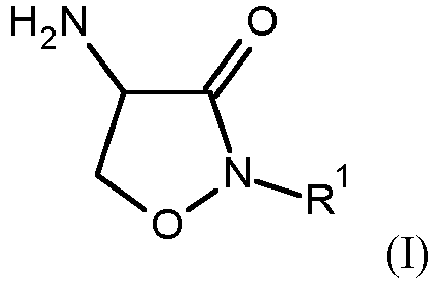
- R1 is C1-C8alkyl, C1-C8haloalkyl, aryl or aryl substituted by one to five R11, or aryl-C1-C4alkylene or aryl-C1-C4alkylene substituted by one to five R11; and
- each R11 is independently C1-C4alkyl, C1-C4haloalkyl, C1-C4alkoxy, C1-C4haloalkoxy, cyano or halogen;
- In one aspect the present invention relates to a process for the preparation of a compound of formula (I)

- R1 is C1-C8alkyl, C1-C8haloalkyl, aryl or aryl substituted by one to five R11, or aryl-C1-C4alkylene or aryl-C1-C4alkylene substituted by one to five R11; and
- each R11 is independently C1-C4alkyl, C1-C4haloalkyl, C1-C4alkoxy, C1-C4haloalkoxy, cyano or halogen; comprising
- a-1. reacting the compound of formula (II)


wherein
R2 is a leaving group selected from halogen, C1-C8alkylsulfonyloxy, C1-C8haloalkylsulfonyloxy, C1-Csarylsulfonyloxy or C1-C8arylsulfonyloxy substituted by one to five R11, or a phosphonate ester; and each R11 is independently C1-C4alkyl, C1-C4haloalkyl, C1-C4alkoxy, C1-C4haloalkoxy, cyano or halogen; to produce the compound of formula (IV) or a salt thereof
and - a-2. converting the compound of formula (IV) to the compound of formula (I) in the presence of a suitable base.
- In one aspect the present invention relates to a process for the preparation of a compound of formula (IV)

a-1. reacting the compound of formula (II)

wherein - R1 is C1-C8alkyl, C1-C8haloalkyl, aryl or aryl substituted by one to five R11, or aryl-C1-C4alkylene or aryl-C1-C4alkylene substituted by one to five R11;
- R2 is a leaving group selected from halogen, C1-C8alkylsulfonyloxy, C1-C8haloalkylsulfonyloxy, C1-Csarylsulfonyloxy or C1-C8arylsulfonyloxy substituted by one to five R11, or a phosphonate ester;
- each R11 is independently C1-C4alkyl, C1-C4haloalkyl, C1-C4alkoxy, C1-C4haloalkoxy, cyano or halogen.
- In one aspect the present invention relates to a process for the preparation of a compound of formula (I)

a-2. converting the compound of formula (IV)
wherein - R1 is C1-C8alkyl, C1-C8haloalkyl, aryl or aryl substituted by one to five R11, or aryl-C1-C4alkylene or aryl-C1-C4alkylene substituted by one to five R11;
- R2 is C1-C8alkylsulfonyloxy, C1-C8haloalkylsulfonyloxy, C1-C8arylsulfonyloxy or C1-C8arylsulfonyloxy substituted by one to five R11, or a phosphonate ester; and
- each R11 is independently C1-C4alkyl, C1-C4haloalkyl, C1-C4alkoxy, C1-C4haloalkoxy, cyano or halogen.
- In one aspect the present invention relates to a compound of formula (IV)

- R1 is C1-C8alkyl, C1-C8haloalkyl, aryl or aryl substituted by one to five R11, or aryl-C1-C4alkylene or aryl-C1-C4alkylene substituted by one to five R11;
- R2 is C1-C8alkylsulfonyloxy, C1-C8haloalkylsulfonyloxy, C1-C8arylsulfonyloxy or C1-C8arylsulfonyloxy substituted by one to five R11, or a phosphonate ester; and
- each R11 is independently C1-C4alkyl, C1-C4haloalkyl, C1-C4alkoxy, C1-C4haloalkoxy, cyano or halogen; or a salt or N-oxide thereof.
- In one aspect the present invention relates to a compound of formula (I)

each R11 is independently C1-C4alkyl, C1-C4haloalkyl, C1-C4alkoxy, C1-C4haloalkoxy, cyano or halogen - In the processes above the compounds of formula (I), (III) and (IV) are preferably compounds of formula (I*), (III*) and (IV*) or enriched mixtures thereof

- In a further aspect the invention provides a compound of formula (IV)
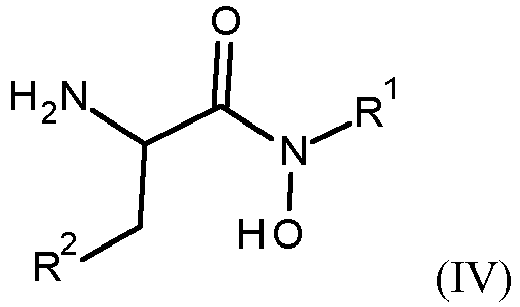
- Preferably the compound of formula (IV) is a compound of formula (IV*).
- In a further aspect the invention provides a compound of formula (I)

each R11 is independently C1-C4alkyl, C1-C4haloalkyl, C1-C4alkoxy, C1-C4haloalkoxy, cyano or halogen - In a further aspect the invention provides a process for the preparation of a compound of formula (VIII) or a salt or N-oxide thereof


X is a leaving group selected from halogen, C1-C8alkylsulfonyloxy, C1-C8haloalkylsulfonyloxy, C1-Csarylsulfonyloxy or C1-C8arylsulfonyloxy substituted by one to five R11, or a phosphonate ester, cyano, formyl, acetyl, C(O)CH=C(R3)R4, C(O)CH2C(OH)(R3)R4 or group A
A1, A2, A3 and A4 are independently of one another C-H, C-R5, or nitrogen;
R3 is C1-C8haloalkyl;
R4 is aryl or aryl substituted by one to three R6, or R4 is heterocyclyl or heterocyclyl substituted by one to three R6;
each R5 is independently halogen, cyano, nitro, C1-C8alkyl, C3-C8cycloalkyl, C1-C8haloalkyl, C2-Csalkenyl, C2-C8haloalkenyl, C2-C8alkynyl, C2-C8haloalkynyl, C1-C8alkoxy, C1-C8haloalkoxy, C1-Csalkoxycarbonyl-, or two R5 on adjacent carbon atoms together form a -CH=CH-CH=CH- bridge or a-N=CH-CH=CH- bridge;
each R6 is independently halogen, cyano, nitro, C1-C8alkyl, C1-C8haloalkyl, C1-C8alkoxy, or C1-Cshaloalkoxy;
R8 is hydroxy, C1-C6alkoxy, chloro, cluoro, bromo, or SRx wherein Rx is H, C1-C6alkyl, imidazole or pyrrole;
R1 is C1-C8alkyl, C1-C8haloalkyl, aryl or aryl substituted by one to five R11, or aryl-C1-C4alkylene or aryl-C1-C4alkylene substituted by one to five R11; and
each R11 is independently C1-C4alkyl, C1-C4haloalkyl, C1-C4alkoxy, C1-C4haloalkoxy, cyano or halogen. - The compounds of the invention may exist in different geometric or optical isomers or tautomeric forms. In particular, the compounds of the invention may contain one or more asymmetric carbon atoms and may exist as enantiomers (or as pairs of diastereoisomers) or as mixtures of such. This invention covers all such isomers and tautomers and mixtures thereof in all proportions as well as isotopic forms such as deuterated compounds. The compounds and processes of the invention include N-oxides and salts where possible.
- Alkyl groups (either alone or as part of a larger group, such as alkoxy-, alkylthio-, alkylsulfinyl-, alkylsulfonyl-, alkylcarbonyl- or alkoxycarbonyl-) can be in the form of a straight or branched chain and are, for example, methyl, ethyl, propyl, prop-2-yl, butyl, but-2-yl, 2-methyl-prop-1-yl or 2-methyl-prop-2-yl. The alkyl groups are preferably C1-C6, more preferably C1-C4, most preferably C1-C3 alkyl groups. Where an alkyl moiety is said to be substituted, the alkyl moiety is preferably substituted by one to four substituents, most preferably by one to three substituents.
- Alkylene groups can be in the form of a straight or branched chain and are, for example, -CH2-, -CH2-CH2-, -CH(CH3)-, -CH2-CH2-CH2-, -CH(CH3)-CH2-, or -CH(CH2CH3)-. The alkylene groups are preferably C1-C3, more preferably C1-C2, most preferably C1 alkylene groups.Where an alkylene moiety is said to be substituted, the alkyl moiety is preferably substituted by one to four substituents, most preferably by one to three substituents.
- Alkenyl groups can be in the form of straight or branched chains, and can be, where appropriate, of either the (E)- or (Z)-configuration. Examples are vinyl and allyl. The alkenyl groups are preferably C2-C6, more preferably C2-C4, most preferably C2-C3 alkenyl groups. Where an alkenyl moiety is said to be substituted, the alkyl moiety is preferably substituted by one to four substituents, most preferably by one to three substituents.
- Alkynyl groups can be in the form of straight or branched chains. Examples are ethynyl and propargyl. The alkynyl groups are preferably C2-C6, more preferably C2-C4, most preferably C2-C3 alkynyl groups. Where an alkynyl moiety is said to be substituted, the alkyl moiety is preferably substituted by one to four substituents, most preferably by one to three substituents.
- Halogen is fluorine, chlorine, bromine or iodine.
- Haloalkyl groups (either alone or as part of a larger group, such as haloalkoxy-, haloalkylthio-, haloalkylsulfinyl- or haloalkylsulfonyl-) are alkyl groups which are substituted by one or more of the same or different halogen atoms and are, for example, difluoromethyl, trifluoromethyl, chlorodifluoromethyl or 2,2,2-trifluoro-ethyl.
- Haloalkenyl groups are alkenyl groups which are substituted by one or more of the same or different halogen atoms and are, for example, 2,2-difluoro-vinyl or 1,2-dichloro-2-fluoro-vinyl.
- Haloalkynyl groups are alkynyl groups which are substituted by one or more of the same or different halogen atoms and are, for example, 1-chloro-prop-2-ynyl.
- Cycloalkyl groups or carbocyclic rings can be in mono- or bi-cyclic form and are, for example, cyclopropyl, cyclobutyl, cyclohexyl and bicyclo[2.2.1]heptan-2-yl. The cycloalkyl groups are preferably C3-C8, more preferably C3-C6 cycloalkyl groups. Where a cycloalkyl moiety is said to be substituted, the cycloalkyl moiety is preferably substituted by one to four substituents, most preferably by one to three substituents.
- Aryl groups (either alone or as part of a larger group, such as aryl-alkylene-) are aromatic ring systems which can be in mono-, bi- or tricyclic form. Examples of such rings include phenyl, naphthyl, anthracenyl, indenyl or phenanthrenyl. Preferred aryl groups are phenyl and naphthyl, phenyl being most preferred. Where an aryl moiety is said to be substituted, the aryl moiety is preferably substituted by one to four substituents, most preferably by one to three substituents.
- Heteroaryl groups (either alone or as part of a larger group, such as heteroaryl-alkylene-) are aromatic ring systems containing at least one heteroatom and consisting either of a single ring or of two or more fused rings. Preferably, single rings will contain up to three heteroatoms and bicyclic systems up to four heteroatoms which will preferably be chosen from nitrogen, oxygen and sulfur. Examples of monocyclic groups include pyridyl, pyridazinyl, pyrimidinyl, pyrazinyl, pyrrolyl, pyrazolyl, imidazolyl, triazolyl (e.g. 1.2.4 triazoyl), furanyl, thiophenyl, oxazolyl, isoxazolyl, oxadiazolyl, thiazolyl, isothiazolyl, tetrazolyl and thiadiazolyl. Examples of bicyclic groups include purinyl, quinolinyl, cinnolinyl, quinoxalinyl, indolyl, indazolyl, benzimidazolyl, benzothiophenyl and benzothiazolyl. Monocyclic heteroaryl groups are preferred, pyridyl being most preferred. Where a heteroaryl moiety is said to be substituted, the heteroaryl moiety is preferably substituted by one to four substituents, most preferably by one to three substituents.
- Heterocyclyl groups or heterocyclic rings (either alone or as part of a larger group, such as heterocyclyl-alkylene-) are defined to include heteroaryl groups and in addition their unsaturated or partially unsaturated analogues. Examples of monocyclic groups include isoxazolyl, thietanyl, pyrrolidinyl, dihydrofuranyl, tetrahydrofuranyl, dihydropyranyl, tetrahydropyranyl, dihydrothiophene, [1,3]dioxolanyl, piperidinyl, piperazinyl, [1,4]dioxanyl, morpholinyl, thiophene, oxetanyl, tetrahydropyranyl, 3-oxo-isoxazolidinyl-, 2,5-dioxo-1-pyrrolidinyl-, 2-oxo-1-pyrrolidinyl-, 4-oxo-1,3-oxazinanyl, 1-oxa-3,4-diazolyl, including their oxidised versions such as 1-oxo-thietanyl and 1,1-dioxo-thietanyl, thiophene 1-oxide, thiophene 1,1-dioxide, dihydrothiophene, dihydrothiophene 1-oxide, or dihydrothiophene 1,1-dioxide. Examples of bicyclic groups include 2,3-dihydro-benzofuranyl, benzo[1,4]dioxolanyl, benzo[1,3]dioxolanyl, chromenyl, and 2,3-dihydro-benzo[1,4]dioxinyl. Where a heterocyclyl moiety is said to be substituted, the heterocyclyl moiety is preferably substituted by one to four substituents, most preferably by one to three substituents. Heterocyclyl groups (and heteroaryl groups) according to the present invention do not contain adjacent oxygen atoms, adjacent sulphur atoms, or adjacent sulphur and oxygen atoms. Preferred heterocyclyl groups are thiophene, thiophene 1-oxide, thiophene 1,1-dioxide, dihydrothiophene, dihydrothiophene 1-oxide, dihydrothiophene 1,1-dioxide, pyridyl, pyrazinyl, pyrimidinyl, pyrrolyl, imidazolyl, pyrazolyl, triazolyl, and tetrazoyl,
Leaving groups according to the invention include halogen, C1-C8alkylsulfonyloxy, C1-Cshaloalkylsulfonyloxy, C1-C8arylsulfonyloxy or C1-C8arylsulfonyloxy substituted by one to five R11, wherein each R11 is independently C1-C4alkyl, C1-C4haloalkyl, C1-C4alkoxy, C1-C4haloalkoxy, cyano or halogen (aryl is preferably phenyl), and phosphonate esters (e.g. -OP(O)(OR)2, wherein R is methyl or ethyl). A preferred leaving group is halogen, in particular chloro or bromo. - Preferred definitions are, in any combination, as set out below.
- Preferably A1 is C-R5.
- Preferably A2, A3, A4 are each CH.
- Preferably -B1-B2-B3- is -C=N-O-.
- Preferably R1 is C1-C8alkyl, C1-C8haloalkyl, more preferably ethyl or trifluoroethyl, even more preferably ethyl or 2,2,2-trifluoroethyl.
- Preferably R2 is chloro or bromo, more preferably chloro.
- Preferably R3 is trifluoromethyl, difluoromethyl or chlorodifluoromethyl, most preferably trifluoromethyl.
- Preferably R4 is group (B)

- Preferably R4 is 3,5-dichlorophenyl, 3-chloro-4-fluorophenyl, 3-fluoro-4-chlorophenyl, 3,4-dichlorophenyl, 3-chloro-4-bromophenyl, 3,5-dichloro-4-fluorophenyl, 3,4,5-trichlorophenyl, 3,5-dichloro-4-iodophenyl, 3,4,5-trifluorophenyl, 3-chloro-5-bromophenyl, 3-chloro-5-fluorophenyl, 3-chloro-5-(trifluoromethyl)phenyl, 3-bromo-5-(trifluoromethyl)phenyl,3,4-dichloro-5-(trifluoromethyl)phenyl, 3,5-bis(trifluoromethyl)phenyl, 4-chloro-3,5-bis(trifluoromethyl)phenyl, 3-(trifluoromethyl)phenyl, 2,6-dichloro-4-pyridyl, 2,6-bis(trifluoromethyl)-4-pyridyl, 2-chloro-4-pyridyl-, 2-trifluoromethyl-4-pyridyl, more preferably 3,5-dichloro-phenyl, 3-chloro-5-bromophenyl, 3-chloro-5-(trifluoromethyl)phenyl, 3,5-dichloro-4-fluorophenyl, 3,4,5-trichlorophenyl, 3,5-bis(trifluoromethyl)phenyl, 3-(trifluoromethyl)phenyl, 2,6-dichloro-4-pyridyl, 2,6-bis(trifluoromethyl)-4-pyridyl, 3,5-dichloro-4-bromophenyl, 3-bromo-5-(trifluoromethyl)phenyl, 3,5-dibromophenyl, or 3,4-dichlorophenyl, 2-chloro-4-pyridyl-, 2-trifluoromethyl-4-pyridyl, even more preferably 3,5-dichloro-phenyl, 3,5-dichloro-4-fluorophenyl, 3,4,5-trichlorophenyl, 3-(trifluoromethyl)phenyl, 3,5-bis(trifluoromethyl)phenyl, most preferably 3,5-dichloro-phenyl, 3,5-dichloro-4-fluorophenyl, or 3,4,5-trichlorophenyl-. In one group of compounds R4 is 3,5-dichloro-phenyl. In one group of compounds R4 is 3,5-dichloro-4-fluorophenyl-. In one group of compounds R4 is 3,4,5-trichlorophenyl-. In one group of compounds R4 is 3,5-bis(trifluoromethyl)phenyl.
- Preferably each R5 is independently halogen, cyano, methyl, halomethyl, methoxy or halomethoxy, more preferably chloro, fluoro, cyano or methyl.
- Preferably each R6 is independently halogen, C1-C8alkyl, C1-C8haloalkyl, C1-C8alkoxy, C1-Cshaloalkoxy, C1-C8alkylthio, or C1-C8haloalkylthio, more preferably bromo, chloro, fluoro, trifluoromethyl, methoxy, or methylthio, most preferably trifluoromethyl, fluoro or chloro.
- Preferably R8 is hydroxy, chloro or bromo, more preferably chloro.
- Preferably R9 is hydrogen or C1-C6alkyl, more preferably methyl.
- In one preferred embodiment the compounds of formula (I), (II) and (III) and (IV) are compounds wherein R1 is ethyl or trifluoroethyl (preferably 2,2,2-trifluoroethyl) and R2 is chloro or bromo, preferably chloro.
- In a further preferred embodiment the compound of formula (IV) is a compound wherein R1 is ethyl or trifluoroethyl (preferably 2,2,2-trifluoroethyl) and R2 is chloro or bromo, preferably chloro.
- In a further preferred embodiment the compounds of formula (VIII) and (XII) are compounds wherein
A1 is C-R5;
A2, A3, A4 are each CH;
R3 is trifluoromethyl, difluoromethyl or chlorodifluoromethyl;
X is chloro, bromo, cyano, formyl, acetyl, C(O)CH=C(R3)R4, C(O)CH2C(OH)(R3)R4 or group (A) as defined above;
R4 is group (B) as defined above;
X2 is C-X4 or nitrogen (preferably C-X4); X1, X3 and X4 are independently hydrogen, halogen or trihalomethyl;
each R5 is independently halogen, cyano, methyl, halomethyl, methoxy or halomethoxy, more preferably chloro, fluoro, cyano or methyl. - In a further preferred embodiment the compounds of formula (VIII) and (XII) are compounds wherein
X is acetyl, C(O)CH=C(R3)R4, C(O)CH2C(OH)(R3)R4 or group (A);
A1 is C-R5;
A2, A3, A4 are each CH;
X is group (A)
R1 is C1-C8alkyl, C1-C8haloalkyl, aryl or aryl substituted by one to five R11, or aryl-C1-C4alkylene or aryl-C1-C4alkylene substituted by one to five R11;
R3 is trifluoromethyl, difluoromethyl or chlorodifluoromethyl;
R4 is group (B)
R5 is halogen, cyano, methyl, halomethyl, methoxy or halomethoxy;
each R11 is independently C1-C4alkyl, C1-C4haloalkyl, C1-C4alkoxy, C1-C4haloalkoxy, cyano or halogen. - In enriched mixtures of the invention, the molar proportion of the compound of formula (I*), (III*) and/or (IV*), in the mixture is for example greater than 50%, e.g. at least 60, 70, 80, 90 or at least 95% of the total molar amount of the pair of enantiomers.
- The following schemes describe the reactions of the invention in more detail. The substituent definitions are the same as defined above.

- Compounds of formula (I) can be prepared by reacting a compound of formula (III) with a compound of formula (II) or salt thereof. Suitable salts of compounds of formula (II) include, but are not limited to halides, organic acids, and sulphur based salts, e.g. chloride, oxalate, sulfate, trifluoroacetate, mesylate and bromide.
- The reactions of compounds of formula (III) and II are preferably carried out in the presence of a suitable base. Suitable bases include, but are not limited to nitrogen-based organic bases such as amines, pyridines and derivatives thereof, e.g. triethylamine, tri-n-propylamine, pyridine and diisopropylethylamine.
- The reactions of compounds of III and II are preferably carried out in the presence of a solvent. Suitable solvents include, but are not limited to organic solvents, e.g. halogenated organic solvents or alcohols such as chloroform, dichloromethane, dichloroethane, monochlorobenzene, dichlorobenzene, trichlorobenzene, 4-fluorotoluene, methanol, ethanol, isopropanol, t-butanol, cyclohexanol, heptanol, octanol, or longer chain alcohols, and diethyleneglycol, preferably chloroform, dichloromethane, isopropyl alcohol and ethanol. It is also possible to conduct the reaction in a mixture of an organic solvent and water.
- The reaction can be carried out at a temperature from -20°C to 100°C, preferably from 0°C to 30°C (e.g. no lower than -20°C, preferably no lower than 0°C, e.g. no more than 100°C, preferably no more than 30°C).
- The reactions of compounds of formula (III) and II are preferably carried out in the presence of a catalyst. Suitable catalysts include, but are not limited to nucleophilic catalysts capable of promoting acyl transfer reactions such as 4-dialkylaminopyridines, N-alkylimidazoles, phosphines, imidazolylidene carbenes, 1,2-diamines, bicyclic amidines, isothioureas and guanidines, triazoles, suitable alcohols, iodide and cyanide salts, preferably 4-dimethylaminopyridine.
- Compounds of formula (IV) can be prepared by reacting a compound of formula (III) with a compound of formula (II) or salt thereof as described under step a.
The reaction is preferably carried out in the presence of a solvent. Suitable solvents include, but are not limited to polar organic solvents, e.g. acetic acid, propanoic acid or longer chain carboxylic acids, trifluoroacetic acid, methanol, ethanol, isopropanol, t-butanol, cyclohenxanol, heptanol, octanol, or longer chain alcohols, trifluoroethanol, ethyleneglycol, acetonitrile and propionitrile, preferably acetic acid. It is also possible to conduct the reaction in a mixture of organic solvents or in a mixture of organic solvents and water. - The reaction is preferably carried out in the presence of a suitable acid. Suitable acids include, but are not limited to organic acids, e.g acetic acid, propanoic acid or longer chain carboxylic acids, trifluoroacetic acid. A preferred acid is acetic acid.
- The reaction can be carried out at a temperature from -20°C to 100°C, preferably from 0°C to 30°C (e.g. no lower than -20°C, preferably no lower than 0°C, e.g. no more than 100°C, preferably no more than 30°C).
- Depending on the conditions used, it may be advantageous to isolate compound IV as the corresponding salt. The salt may be formed with an acid already present in the reaction mixture or formed by adding an additional acid to the reaction mixture. Suitable acids include mineral acids and organic acids such as HCl, HBr, H2SO4, acetic acid and trifluoroacetic acid.
- Compounds of formula (I) can be prepared by treating a compound of formula (IV) or a salt thereof as described under step a-1 with a base. Suitable bases include carbonates, hydroxides, nitrogen-based organic bases such as amines, pyridines and derivatives thereof, e.g. Na2CO3, K2CO3, NaHCO3, NaOH, triethylamine, pyridine and diisopropylethylamine.
- The reaction is preferably carried out in the presence of a solvent. Suitable solvents include, but are not limited to organic solvents such as diethylether, 1,2-dimethoxyethane, diethoxymethane, diglyme, t-butyl methyl ether, THF, 2-methyl-THF, dioxane; halogenated solvents such as chloroform, dichloromethane, dichloroethane, monochlorobenzene, dichlorobenzene, trichlorobenzene, 4-fluorotoluene; esters and ketones such as ethyl acetate, acetone 2-butanone, methylisobutylketone; ethers such as anisole, polar aprotic solvents such as acetonitrile, dimethylsulfoxide, dimethylformamide, N-methylpyrrolidone, dimethylacetamide; and alcohols, such as methanol, ethanol, isopropanol, t-BuOH, cyclohexanol, heptanol, octanol, or longer chain alcohols, and diethyleneglycol. Preferred organic solvents include tetrahydrofuran, dioxane and acetonitrile.
- The reaction can be carried out at a temperature from -20°C to 100°C, preferably from 0°C to 30°C.
- Compounds of formula (I) can be isolated in a free form or as salts formed by adding an acid to compounds of formula (I) in a free base form. Suitable acids include mineral acids and organic acids such as HCl, HBr, H2SO4, acetic acid and trifluoroacetic acid.
- When compounds of formula (II) and formula (III) are reacted under acidic conditions as described for step a-1 a compound of formula (IV) is isolated. Treating the compound of formula (IV) in a compound under basic conditions as described for step a-2 a compound of formula (I) is formed.
- When compounds of formula (II) and formula (III) are reacted under basic conditions as described for step a intermediate compound of formula (IV) cannot be isolated and compound of formula (I) is formed directly.
- This is described under scheme 2 below. Steps a and 1-1, 1-2 and 1-3 can be conducted in the same reaction vessel (one-pot reaction) without isolation of the compound of formula (I), e.g. when the solvent is chloroform. In other words, compounds of formula (VIII), (IX) and (X) can be prepared from the compound of formula (III) without isolation of the compound of formula (I) or (IV). Alternatively, steps a-2 and 1-1, 1-2 and 1-3 can be conducted in the same reaction vessel (one-pot reaction) without isolation of the compound of formula (I).

- Compounds of formula (VIII) can be prepared by reacting a compound of formula (I) with a compound of formula (XII) wherein the substituents are defined as herein disclosed. When R8 is hydroxy such reactions are usually carried out in the presence of a coupling reagent, such as N,N'-dicyclohexylcarbodiimide ("DCC"), 1-ethyl-3-(3-dimethylamino-propyl)carbodiimide hydrochloride ("EDC") or bis(2-oxo-3-oxazolidinyl)phosphonic chloride ("BOP-Cl"), in the presence of a base, and optionally in the presence of a nucleophilic catalyst, such as hydroxybenzotriazole ("HOBT").
- Suitable bases include carbonates, hydroxides, nitrogen-based organic bases such as amines, pyridines and derivatives thereof, e.g. Na2CO3, K2CO3, NaHCO3, NaOH, triethylamine, pyridine, N-methyl morpholine and diisopropylethylamine.
- Suitable solvents include, but are not limited to polar organic solvents, e.g. halogenated organic solvents or ethers such as chloroform, dichloromethane, dichloroethane, monochlorobenzene, dichlorobenzene, trichlorobenzene, 4-fluorotoluene, THF, 2-methyl THF, dioxane, dimethoxyethane, toluene, acetonitrile and xylenes preferably chloroform, dichloromethane or THF.
- When R8 is chloro such reactions are usually carried out in the presence of a base, and optionally in the presence of a nucleophilic catalyst such as 4-dimethylamino pyridine ("DMAP").
- Suitable bases include carbonates, hydroxides, nitrogen-based organic bases such as amines, pyridines and derivatives thereof, e.g. Na2CO3, K2CO3, NaHCO3, NaOH, triethylamine, pyridine, N-methyl morpholine and diisopropylethylamine.
- Examples of solvents include ethers, such as diethylether, 1,2-dimethoxyethane, diethoxymethane, diglyme, t-butyl methyl ether, THF, 2-methyl-THF, dioxane; halogenated solvents such as chloroform, dichloromethane, dichloroethane, monochlorobenzene, dichlorobenzene, trichlorobenzene, 4-fluorotoluene; esters and ketones such as ethyl acetate, acetone 2-butanone, methylisobutylketone; anisole, polar aprotic solvents such as acetonitrile, dimethylsulfoxide, dimethylformamide, N-methylpyrrolidone and dimethylacetamide, aromatic hydrocarbons such as toluene and xylenes both as pure isomers and as a mixture of isomers. Preferred solvents are dichloromethane, dichloroethane, ethyl acetate, THF, 2-methyl tetrahydrofuran or dioxane.
- Alternatively, it is possible to conduct the reaction in a biphasic system comprising an organic solvent, preferably ethyl acetate, toluene, xylenes as single isomers or as a mixture of isomers or dichloromethane, and an aqueous solvent, preferably a solution of sodium hydrogen carbonate or sodium carbonate or an organic amine such as triethylamine or diisopropylethyl amine.
- The reaction can be carried out at a temperature from 0°C to 100°C, preferably from 15°C to 30°C, in particular at ambient temperature (e.g. no lower than 0°C, preferably no lower than 15°C, e.g. no more than 100°C, preferably no more than 30°C).
- Compounds of formula (IX), wherein R9 is as defined above, can be prepared under the conditions as described under 1-1 by reacting a compound of formula (I) with a compound of formula (XIII) wherein the substituents are defined as herein disclosed..
- Compounds of formula X can be prepared by reacting compounds of formula (I) with a compound according to formula (XIVa) or (XIVb). An example of a compound according to formula (XIVa) di-tert-butyl dicarbonate in a presence of base. Suitable bases include carbonates, hydroxides, nitrogen-based organic bases such as amines, pyridines and derivatives thereof, e.g. Na2CO3, K2CO3, NaHCO3, NaOH, triethylamine, pyridine, N-methyl morpholine and diisopropylethylamine.
- Examples of solvents include ethers, such as diethylether, 1,2-dimethoxyethane, diethoxymethane, diglyme, t-butyl methyl ether, THF, 2-methyl-THF, dioxane; halogenated solvents such as chloroform, dichloromethane, dichloroethane, monochlorobenzene, dichlorobenzene, trichlorobenzene, 4-fluorotoluene; esters and ketones such as ethyl acetate, acetone 2-butanone, methylisobutylketone; anisole, polar aprotic solvents such as acetonitrile, dimethylsulfoxide, dimethylformamide, N-methylpyrrolidone, dimethylacetamide; and alcohols, such as methanol, ethanol, isopropanol, t-BuOH, cyclohenxanol, heptanol, octanol, or longer chain alcohols, and diethyleneglycol; aromatic hydrocarbons such as toluene and xylenes both as pure isomers and as a mixture of isomers. Preferred solvents are dichloromethane, dichloroethane, ethyl acetate, THF, or dioxane. Alternatively it is possible to conduct the reaction in the mixture of these solvents and water.
- Alternatively it is possible to conduct the reaction in a biphasic system comprising an organic solvent as described above under 1-3, preferably ethyl acetate, toluene, xylene or dichloromethane, and an aqueous base, preferably a solution of sodium hydrogen carbonate or sodium carbonate.
- The reaction can be carried out at a temperature from -20 °C to 100°C, preferably from 0°C to 40°C, in particular at ambient temperature (e.g. no lower than -20°C, preferably no lower than 0°C, e.g. no more than 100°C, preferably no more than 40°C).


- Scheme 3 illustrates how compounds of formula (VIII) may be reacted to produce insecticidally active compounds as described in
WO2011/067272 andWO2013/069731 , with reaction conditions described therein. Other methods of arriving at compounds of formula (VIIIc) using the present invention will be apparent to the person skilled in the art, and are also described inWO2011/067272 . - Possible combinations of substituents are shown in Table 1.
Table 1 X1 X4 X3 R5 R1 X1 X4 X3 R5 R1 1 Br H H CH3 CH2CF3 397 Br H H CH3 CH2CH3 2 Cl H H CH3 CH2CF3 398 Cl H H CH3 CH2CH3 3 F H H CH3 CH2CF3 399 F H H CH3 CH2CH3 4 CF3 H H CH3 CH2CF3 400 CF3 H H CH3 CH2CH3 5 H Br H CH3 CH2CF3 401 H Br H CH3 CH2CH3 6 Br Br H CH3 CH2CF3 402 Br Br H CH3 CH2CH3 7 Cl Br H CH3 CH2CF3 403 Cl Br H CH3 CH2CH3 8 F Br H CH3 CH2CF3 404 F Br H CH3 CH2CH3 9 CF3 Br H CH3 CH2CF3 405 CF3 Br H CH3 CH2CH3 10 H Cl H CH3 CH2CF3 406 H Cl H CH3 CH2CH3 11 Br Cl H CH3 CH2CF3 407 Br Cl H CH3 CH2CH3 12 Cl Cl H CH3 CH2CF3 408 Cl Cl H CH3 CH2CH3 13 F Cl H CH3 CH2CF3 409 F Cl H CH3 CH2CH3 14 CF3 Cl H CH3 CH2CF3 410 CF3 Cl H CH3 CH2CH3 15 H F H CH3 CH2CF3 411 H F H CH3 CH2CH3 16 Br F H CH3 CH2CF3 412 Br F H CH3 CH2CH3 17 Cl F H CH3 CH2CF3 413 Cl F H CH3 CH2CH3 18 F F H CH3 CH2CF3 414 F F H CH3 CH2CH3 19 CF3 F H CH3 CH2CF3 415 CF3 F H CH3 CH2CH3 20 H H Br CH3 CH2CF3 416 H H Br CH3 CH2CH3 21 Br H Br CH3 CH2CF3 417 Br H Br CH3 CH2CH3 22 Cl H Br CH3 CH2CF3 418 Cl H Br CH3 CH2CH3 23 F H Br CH3 CH2CF3 419 F H Br CH3 CH2CH3 24 CF3 H Br CH3 CH2CF3 420 CF3 H Br CH3 CH2CH3 25 H Br Br CH3 CH2CF3 421 H Br Br CH3 CH2CH3 26 Br Br Br CH3 CH2CF3 422 Br Br Br CH3 CH2CH3 27 Cl Br Br CH3 CH2CF3 423 Cl Br Br CH3 CH2CH3 28 F Br Br CH3 CH2CF3 424 F Br Br CH3 CH2CH3 29 CF3 Br Br CH3 CH2CF3 425 CF3 Br Br CH3 CH2CH3 30 H Cl Br CH3 CH2CF3 426 H Cl Br CH3 CH2CH3 31 Br Cl Br CH3 CH2CF3 427 Br Cl Br CH3 CH2CH3 32 Cl Cl Br CH3 CH2CF3 428 Cl Cl Br CH3 CH2CH3 33 F Cl Br CH3 CH2CF3 429 F Cl Br CH3 CH2CH3 34 CF3 Cl Br CH3 CH2CF3 430 CF3 Cl Br CH3 CH2CH3 35 H F Br CH3 CH2CF3 431 H F Br CH3 CH2CH3 36 Br F Br CH3 CH2CF3 432 Br F Br CH3 CH2CH3 37 Cl F Br CH3 CH2CF3 433 Cl F Br CH3 CH2CH3 38 F F Br CH3 CH2CF3 434 F F Br CH3 CH2CH3 39 CF3 F Br CH3 CH2CF3 435 CF3 F Br CH3 CH2CH3 40 H H Cl CH3 CH2CF3 436 H H Cl CH3 CH2CH3 41 Br H Cl CH3 CH2CF3 437 Br H Cl CH3 CH2CH3 42 Cl H Cl CH3 CH2CF3 438 Cl H Cl CH3 CH2CH3 43 F H Cl CH3 CH2CF3 439 F H Cl CH3 CH2CH3 44 CF3 H Cl CH3 CH2CF3 440 CF3 H Cl CH3 CH2CH3 45 H Br Cl CH3 CH2CF3 441 H Br Cl CH3 CH2CH3 46 Br Br Cl CH3 CH2CF3 442 Br Br Cl CH3 CH2CH3 47 Cl Br Cl CH3 CH2CF3 443 Cl Br Cl CH3 CH2CH3 48 F Br Cl CH3 CH2CF3 444 F Br Cl CH3 CH2CH3 49 CF3 Br Cl CH3 CH2CF3 445 CF3 Br Cl CH3 CH2CH3 50 H Cl Cl CH3 CH2CF3 446 H Cl Cl CH3 CH2CH3 51 Br Cl Cl CH3 CH2CF3 447 Br Cl Cl CH3 CH2CH3 52 Cl Cl Cl CH3 CH2CF3 448 Cl Cl Cl CH3 CH2CH3 53 F Cl Cl CH3 CH2CF3 449 F Cl Cl CH3 CH2CH3 54 CF3 Cl Cl CH3 CH2CF3 450 CF3 Cl Cl CH3 CH2CH3 55 H F Cl CH3 CH2CF3 451 H F Cl CH3 CH2CH3 56 Br F Cl CH3 CH2CF3 452 Br F Cl CH3 CH2CH3 57 Cl F Cl CH3 CH2CF3 453 Cl F Cl CH3 CH2CH3 58 F F Cl CH3 CH2CF3 454 F F Cl CH3 CH2CH3 59 CF3 F Cl CH3 CH2CF3 455 CF3 F Cl CH3 CH2CH3 60 H H F CH3 CH2CF3 456 H H F CH3 CH2CH3 61 Br H F CH3 CH2CF3 457 Br H F CH3 CH2CH3 62 Cl H F CH3 CH2CF3 458 Cl H F CH3 CH2CH3 63 F H F CH3 CH2CF3 459 F H F CH3 CH2CH3 64 CF3 H F CH3 CH2CF3 460 CF3 H F CH3 CH2CH3 65 H Br F CH3 CH2CF3 461 H Br F CH3 CH2CH3 66 Br Br F CH3 CH2CF3 462 Br Br F CH3 CH2CH3 67 Cl Br F CH3 CH2CF3 463 Cl Br F CH3 CH2CH3 68 F Br F CH3 CH2CF3 464 F Br F CH3 CH2CH3 69 CF3 Br F CH3 CH2CF3 465 CF3 Br F CH3 CH2CH3 70 H Cl F CH3 CH2CF3 466 H Cl F CH3 CH2CH3 71 Br Cl F CH3 CH2CF3 467 Br Cl F CH3 CH2CH3 72 Cl Cl F CH3 CH2CF3 468 Cl Cl F CH3 CH2CH3 73 F Cl F CH3 CH2CF3 469 F Cl F CH3 CH2CH3 74 CF3 Cl F CH3 CH2CF3 470 CF3 Cl F CH3 CH2CH3 75 H F F CH3 CH2CF3 471 H F F CH3 CH2CH3 76 Br F F CH3 CH2CF3 472 Br F F CH3 CH2CH3 77 Cl F F CH3 CH2CF3 473 Cl F F CH3 CH2CH3 78 F F F CH3 CH2CF3 474 F F F CH3 CH2CH3 79 CF3 F F CH3 CH2CF3 475 CF3 F F CH3 CH2CH3 80 H H CF3 CH3 CH2CF3 476 H H CF3 CH3 CH2CH3 81 Br H CF3 CH3 CH2CF3 477 Br H CF3 CH3 CH2CH3 82 Cl H CF3 CH3 CH2CF3 478 Cl H CF3 CH3 CH2CH3 83 F H CF3 CH3 CH2CF3 479 F H CF3 CH3 CH2CH3 84 CF3 H CF3 CH3 CH2CF3 480 CF3 H CF3 CH3 CH2CH3 85 H Br CF3 CH3 CH2CF3 481 H Br CF3 CH3 CH2CH3 86 Br Br CF3 CH3 CH2CF3 482 Br Br CF3 CH3 CH2CH3 87 Cl Br CF3 CH3 CH2CF3 483 Cl Br CF3 CH3 CH2CH3 88 F Br CF3 CH3 CH2CF3 484 F Br CF3 CH3 CH2CH3 89 CF3 Br CF3 CH3 CH2CF3 485 CF3 Br CF3 CH3 CH2CH3 90 H Cl CF3 CH3 CH2CF3 486 H Cl CF3 CH3 CH2CH3 91 Br Cl CF3 CH3 CH2CF3 487 Br Cl CF3 CH3 CH2CH3 92 Cl Cl CF3 CH3 CH2CF3 488 Cl Cl CF3 CH3 CH2CH3 93 F Cl CF3 CH3 CH2CF3 489 F Cl CF3 CH3 CH2CH3 94 CF3 Cl CF3 CH3 CH2CF3 490 CF3 Cl CF3 CH3 CH2CH3 95 H F CF3 CH3 CH2CF3 491 H F CF3 CH3 CH2CH3 96 Br F CF3 CH3 CH2CF3 492 Br F CF3 CH3 CH2CH3 97 Cl F CF3 CH3 CH2CF3 493 Cl F CF3 CH3 CH2CH3 98 F F CF3 CH3 CH2CF3 494 F F CF3 CH3 CH2CH3 99 CF3 F CF3 CH3 CH2CF3 495 CF3 F CF3 CH3 CH2CH3 100 Br H H Br CH2CF3 496 Br H H Br CH2CH3 101 Cl H H Br CH2CF3 497 Cl H H Br CH2CH3 102 F H H Br CH2CF3 498 F H H Br CH2CH3 103 CF3 H H Br CH2CF3 499 CF3 H H Br CH2CH3 104 H Br H Br CH2CF3 500 H Br H Br CH2CH3 105 Br Br H Br CH2CF3 501 Br Br H Br CH2CH3 106 Cl Br H Br CH2CF3 502 Cl Br H Br CH2CH3 107 F Br H Br CH2CF3 503 F Br H Br CH2CH3 108 CF3 Br H Br CH2CF3 504 CF3 Br H Br CH2CH3 109 H Cl H Br CH2CF3 505 H Cl H Br CH2CH3 110 Br Cl H Br CH2CF3 506 Br Cl H Br CH2CH3 111 Cl Cl H Br CH2CF3 507 Cl Cl H Br CH2CH3 112 F Cl H Br CH2CF3 508 F Cl H Br CH2CH3 113 CF3 Cl H Br CH2CF3 509 CF3 Cl H Br CH2CH3 114 H F H Br CH2CF3 510 H F H Br CH2CH3 115 Br F H Br CH2CF3 511 Br F H Br CH2CH3 116 Cl F H Br CH2CF3 512 Cl F H Br CH2CH3 117 F F H Br CH2CF3 513 F F H Br CH2CH3 118 CF3 F H Br CH2CF3 514 CF3 F H Br CH2CH3 119 H H Br Br CH2CF3 515 H H Br Br CH2CH3 120 Br H Br Br CH2CF3 516 Br H Br Br CH2CH3 121 Cl H Br Br CH2CF3 517 Cl H Br Br CH2CH3 122 F H Br Br CH2CF3 518 F H Br Br CH2CH3 123 CF3 H Br Br CH2CF3 519 CF3 H Br Br CH2CH3 124 H Br Br Br CH2CF3 520 H Br Br Br CH2CH3 125 Br Br Br Br CH2CF3 521 Br Br Br Br CH2CH3 126 Cl Br Br Br CH2CF3 522 Cl Br Br Br CH2CH3 127 F Br Br Br CH2CF3 523 F Br Br Br CH2CH3 128 CF3 Br Br Br CH2CF3 524 CF3 Br Br Br CH2CH3 129 H Cl Br Br CH2CF3 525 H Cl Br Br CH2CH3 130 Br Cl Br Br CH2CF3 526 Br Cl Br Br CH2CH3 131 Cl Cl Br Br CH2CF3 527 Cl Cl Br Br CH2CH3 132 F Cl Br Br CH2CF3 528 F Cl Br Br CH2CH3 133 CF3 Cl Br Br CH2CF3 529 CF3 Cl Br Br CH2CH3 134 H F Br Br CH2CF3 530 H F Br Br CH2CH3 135 Br F Br Br CH2CF3 531 Br F Br Br CH2CH3 136 Cl F Br Br CH2CF3 532 Cl F Br Br CH2CH3 137 F F Br Br CH2CF3 533 F F Br Br CH2CH3 138 CF3 F Br Br CH2CF3 534 CF3 F Br Br CH2CH3 139 H H Cl Br CH2CF3 535 H H Cl Br CH2CH3 140 Br H Cl Br CH2CF3 536 Br H Cl Br CH2CH3 141 Cl H Cl Br CH2CF3 537 Cl H Cl Br CH2CH3 142 F H Cl Br CH2CF3 538 F H Cl Br CH2CH3 143 CF3 H Cl Br CH2CF3 539 CF3 H Cl Br CH2CH3 144 H Br Cl Br CH2CF3 540 H Br Cl Br CH2CH3 145 Br Br Cl Br CH2CF3 541 Br Br Cl Br CH2CH3 146 Cl Br Cl Br CH2CF3 542 Cl Br Cl Br CH2CH3 147 F Br Cl Br CH2CF3 543 F Br Cl Br CH2CH3 148 CF3 Br Cl Br CH2CF3 544 CF3 Br Cl Br CH2CH3 149 H Cl Cl Br CH2CF3 545 H Cl Cl Br CH2CH3 150 Br Cl Cl Br CH2CF3 546 Br Cl Cl Br CH2CH3 151 Cl Cl Cl Br CH2CF3 547 Cl Cl Cl Br CH2CH3 152 F Cl Cl Br CH2CF3 548 F Cl Cl Br CH2CH3 153 CF3 Cl Cl Br CH2CF3 549 CF3 Cl Cl Br CH2CH3 154 H F Cl Br CH2CF3 550 H F Cl Br CH2CH3 155 Br F Cl Br CH2CF3 551 Br F Cl Br CH2CH3 156 Cl F Cl Br CH2CF3 552 Cl F Cl Br CH2CH3 157 F F Cl Br CH2CF3 553 F F Cl Br CH2CH3 158 CF3 F Cl Br CH2CF3 554 CF3 F Cl Br CH2CH3 159 H H F Br CH2CF3 555 H H F Br CH2CH3 160 Br H F Br CH2CF3 556 Br H F Br CH2CH3 161 Cl H F Br CH2CF3 557 Cl H F Br CH2CH3 162 F H F Br CH2CF3 558 F H F Br CH2CH3 163 CF3 H F Br CH2CF3 559 CF3 H F Br CH2CH3 164 H Br F Br CH2CF3 560 H Br F Br CH2CH3 165 Br Br F Br CH2CF3 561 Br Br F Br CH2CH3 166 Cl Br F Br CH2CF3 562 Cl Br F Br CH2CH3 167 F Br F Br CH2CF3 563 F Br F Br CH2CH3 168 CF3 Br F Br CH2CF3 564 CF3 Br F Br CH2CH3 169 H Cl F Br CH2CF3 565 H Cl F Br CH2CH3 170 Br Cl F Br CH2CF3 566 Br Cl F Br CH2CH3 171 Cl Cl F Br CH2CF3 567 Cl Cl F Br CH2CH3 172 F Cl F Br CH2CF3 568 F Cl F Br CH2CH3 173 CF3 Cl F Br CH2CF3 569 CF3 Cl F Br CH2CH3 174 H F F Br CH2CF3 570 H F F Br CH2CH3 175 Br F F Br CH2CF3 571 Br F F Br CH2CH3 176 Cl F F Br CH2CF3 572 Cl F F Br CH2CH3 177 F F F Br CH2CF3 573 F F F Br CH2CH3 178 CF3 F F Br CH2CF3 574 CF3 F F Br CH2CH3 179 H H CF3 Br CH2CF3 575 H H CF3 Br CH2CH3 180 Br H CF3 Br CH2CF3 576 Br H CF3 Br CH2CH3 181 Cl H CF3 Br CH2CF3 577 Cl H CF3 Br CH2CH3 182 F H CF3 Br CH2CF3 578 F H CF3 Br CH2CH3 183 CF3 H CF3 Br CH2CF3 579 CF3 H CF3 Br CH2CH3 184 H Br CF3 Br CH2CF3 580 H Br CF3 Br CH2CH3 185 Br Br CF3 Br CH2CF3 581 Br Br CF3 Br CH2CH3 186 Cl Br CF3 Br CH2CF3 582 Cl Br CF3 Br CH2CH3 187 F Br CF3 Br CH2CF3 583 F Br CF3 Br CH2CH3 188 CF3 Br CF3 Br CH2CF3 584 CF3 Br CF3 Br CH2CH3 189 H Cl CF3 Br CH2CF3 585 H Cl CF3 Br CH2CH3 190 Br Cl CF3 Br CH2CF3 586 Br Cl CF3 Br CH2CH3 191 Cl Cl CF3 Br CH2CF3 587 Cl Cl CF3 Br CH2CH3 192 F Cl CF3 Br CH2CF3 588 F Cl CF3 Br CH2CH3 193 CF3 Cl CF3 Br CH2CF3 589 CF3 Cl CF3 Br CH2CH3 194 H F CF3 Br CH2CF3 590 H F CF3 Br CH2CH3 195 Br F CF3 Br CH2CF3 591 Br F CF3 Br CH2CH3 196 Cl F CF3 Br CH2CF3 592 Cl F CF3 Br CH2CH3 197 F F CF3 Br CH2CF3 593 F F CF3 Br CH2CH3 198 CF3 F CF3 Br CH2CF3 594 CF3 F CF3 Br CH2CH3 199 Br H H Cl CH2CF3 595 Br H H Cl CH2CH3 200 Cl H H Cl CH2CF3 596 Cl H H Cl CH2CH3 201 F H H Cl CH2CF3 597 F H H Cl CH2CH3 202 CF3 H H Cl CH2CF3 598 CF3 H H Cl CH2CH3 203 H Br H Cl CH2CF3 599 H Br H Cl CH2CH3 204 Br Br H Cl CH2CF3 600 Br Br H Cl CH2CH3 205 Cl Br H Cl CH2CF3 601 Cl Br H Cl CH2CH3 206 F Br H Cl CH2CF3 602 F Br H Cl CH2CH3 207 CF3 Br H Cl CH2CF3 603 CF3 Br H Cl CH2CH3 208 H Cl H Cl CH2CF3 604 H Cl H Cl CH2CH3 209 Br Cl H Cl CH2CF3 605 Br Cl H Cl CH2CH3 210 Cl Cl H Cl CH2CF3 606 Cl Cl H Cl CH2CH3 211 F Cl H Cl CH2CF3 607 F Cl H Cl CH2CH3 212 CF3 Cl H Cl CH2CF3 608 CF3 Cl H Cl CH2CH3 213 H F H Cl CH2CF3 609 H F H Cl CH2CH3 214 Br F H Cl CH2CF3 610 Br F H Cl CH2CH3 215 Cl F H Cl CH2CF3 611 Cl F H Cl CH2CH3 216 F F H Cl CH2CF3 612 F F H Cl CH2CH3 217 CF3 F H Cl CH2CF3 613 CF3 F H Cl CH2CH3 218 H H Br Cl CH2CF3 614 H H Br Cl CH2CH3 219 Br H Br Cl CH2CF3 615 Br H Br Cl CH2CH3 220 Cl H Br Cl CH2CF3 616 Cl H Br Cl CH2CH3 221 F H Br Cl CH2CF3 617 F H Br Cl CH2CH3 222 CF3 H Br Cl CH2CF3 618 CF3 H Br Cl CH2CH3 223 H Br Br Cl CH2CF3 619 H Br Br Cl CH2CH3 224 Br Br Br Cl CH2CF3 620 Br Br Br Cl CH2CH3 225 Cl Br Br Cl CH2CF3 621 Cl Br Br Cl CH2CH3 226 F Br Br Cl CH2CF3 622 F Br Br Cl CH2CH3 227 CF3 Br Br Cl CH2CF3 623 CF3 Br Br Cl CH2CH3 228 H Cl Br Cl CH2CF3 624 H Cl Br Cl CH2CH3 229 Br Cl Br Cl CH2CF3 625 Br Cl Br Cl CH2CH3 230 Cl Cl Br Cl CH2CF3 626 Cl Cl Br Cl CH2CH3 231 F Cl Br Cl CH2CF3 627 F Cl Br Cl CH2CH3 232 CF3 Cl Br Cl CH2CF3 628 CF3 Cl Br Cl CH2CH3 233 H F Br Cl CH2CF3 629 H F Br Cl CH2CH3 234 Br F Br Cl CH2CF3 630 Br F Br Cl CH2CH3 235 Cl F Br Cl CH2CF3 631 Cl F Br Cl CH2CH3 236 F F Br Cl CH2CF3 632 F F Br Cl CH2CH3 237 CF3 F Br Cl CH2CF3 633 CF3 F Br Cl CH2CH3 238 H H Cl Cl CH2CF3 634 H H Cl Cl CH2CH3 239 Br H Cl Cl CH2CF3 635 Br H Cl Cl CH2CH3 240 Cl H Cl Cl CH2CF3 636 Cl H Cl Cl CH2CH3 241 F H Cl Cl CH2CF3 637 F H Cl Cl CH2CH3 242 CF3 H Cl Cl CH2CF3 638 CF3 H Cl Cl CH2CH3 243 H Br Cl Cl CH2CF3 639 H Br Cl Cl CH2CH3 244 Br Br Cl Cl CH2CF3 640 Br Br Cl Cl CH2CH3 245 Cl Br Cl Cl CH2CF3 641 Cl Br Cl Cl CH2CH3 246 F Br Cl Cl CH2CF3 642 F Br Cl Cl CH2CH3 247 CF3 Br Cl Cl CH2CF3 643 CF3 Br Cl Cl CH2CH3 248 H Cl Cl Cl CH2CF3 644 H Cl Cl Cl CH2CH3 249 Br Cl Cl Cl CH2CF3 645 Br Cl Cl Cl CH2CH3 250 Cl Cl Cl Cl CH2CF3 646 Cl Cl Cl Cl CH2CH3 251 F Cl Cl Cl CH2CF3 647 F Cl Cl Cl CH2CH3 252 CF3 Cl Cl Cl CH2CF3 648 CF3 Cl Cl Cl CH2CH3 253 H F Cl Cl CH2CF3 649 H F Cl Cl CH2CH3 254 Br F Cl Cl CH2CF3 650 Br F Cl Cl CH2CH3 255 Cl F Cl Cl CH2CF3 651 Cl F Cl Cl CH2CH3 256 F F Cl Cl CH2CF3 652 F F Cl Cl CH2CH3 257 CF3 F Cl Cl CH2CF3 653 CF3 F Cl Cl CH2CH3 258 H H F Cl CH2CF3 654 H H F Cl CH2CH3 259 Br H F Cl CH2CF3 655 Br H F Cl CH2CH3 260 Cl H F Cl CH2CF3 656 Cl H F Cl CH2CH3 261 F H F Cl CH2CF3 657 F H F Cl CH2CH3 262 CF3 H F Cl CH2CF3 658 CF3 H F Cl CH2CH3 263 H Br F Cl CH2CF3 659 H Br F Cl CH2CH3 264 Br Br F Cl CH2CF3 660 Br Br F Cl CH2CH3 265 Cl Br F Cl CH2CF3 661 Cl Br F Cl CH2CH3 266 F Br F Cl CH2CF3 662 F Br F Cl CH2CH3 267 CF3 Br F Cl CH2CF3 663 CF3 Br F Cl CH2CH3 268 H Cl F Cl CH2CF3 664 H Cl F Cl CH2CH3 269 Br Cl F Cl CH2CF3 665 Br Cl F Cl CH2CH3 270 Cl Cl F Cl CH2CF3 666 Cl Cl F Cl CH2CH3 271 F Cl F Cl CH2CF3 667 F Cl F Cl CH2CH3 272 CF3 Cl F Cl CH2CF3 668 CF3 Cl F Cl CH2CH3 273 H F F Cl CH2CF3 669 H F F Cl CH2CH3 274 Br F F Cl CH2CF3 670 Br F F Cl CH2CH3 275 Cl F F Cl CH2CF3 671 Cl F F Cl CH2CH3 276 F F F Cl CH2CF3 672 F F F Cl CH2CH3 277 CF3 F F Cl CH2CF3 673 CF3 F F Cl CH2CH3 278 H H CF3 Cl CH2CF3 674 H H CF3 Cl CH2CH3 279 Br H CF3 Cl CH2CF3 675 Br H CF3 Cl CH2CH3 280 Cl H CF3 Cl CH2CF3 676 Cl H CF3 Cl CH2CH3 281 F H CF3 Cl CH2CF3 677 F H CF3 Cl CH2CH3 282 CF3 H CF3 Cl CH2CF3 678 CF3 H CF3 Cl CH2CH3 283 H Br CF3 Cl CH2CF3 679 H Br CF3 Cl CH2CH3 284 Br Br CF3 Cl CH2CF3 680 Br Br CF3 Cl CH2CH3 285 Cl Br CF3 Cl CH2CF3 681 Cl Br CF3 Cl CH2CH3 286 F Br CF3 Cl CH2CF3 682 F Br CF3 Cl CH2CH3 287 CF3 Br CF3 Cl CH2CF3 683 CF3 Br CF3 Cl CH2CH3 288 H Cl CF3 Cl CH2CF3 684 H Cl CF3 Cl CH2CH3 289 Br Cl CF3 Cl CH2CF3 685 Br Cl CF3 Cl CH2CH3 290 Cl Cl CF3 Cl CH2CF3 686 Cl Cl CF3 Cl CH2CH3 291 F Cl CF3 Cl CH2CF3 687 F Cl CF3 Cl CH2CH3 292 CF3 Cl CF3 Cl CH2CF3 688 CF3 Cl CF3 Cl CH2CH3 293 H F CF3 Cl CH2CF3 689 H F CF3 Cl CH2CH3 294 Br F CF3 Cl CH2CF3 690 Br F CF3 Cl CH2CH3 295 Cl F CF3 Cl CH2CF3 691 Cl F CF3 Cl CH2CH3 296 F F CF3 Cl CH2CF3 692 F F CF3 Cl CH2CH3 297 CF3 F CF3 Cl CH2CF3 693 CF3 F CF3 Cl CH2CH3 298 Br H H CF3 CH2CF3 694 Br H H CF3 CH2CH3 299 Cl H H CF3 CH2CF3 695 Cl H H CF3 CH2CH3 300 F H H CF3 CH2CF3 696 F H H CF3 CH2CH3 301 CF3 H H CF3 CH2CF3 697 CF3 H H CF3 CH2CH3 302 H Br H CF3 CH2CF3 698 H Br H CF3 CH2CH3 303 Br Br H CF3 CH2CF3 699 Br Br H CF3 CH2CH3 304 Cl Br H CF3 CH2CF3 700 Cl Br H CF3 CH2CH3 305 F Br H CF3 CH2CF3 701 F Br H CF3 CH2CH3 306 CF3 Br H CF3 CH2CF3 702 CF3 Br H CF3 CH2CH3 307 H Cl H CF3 CH2CF3 703 H Cl H CF3 CH2CH3 308 Br Cl H CF3 CH2CF3 704 Br Cl H CF3 CH2CH3 309 Cl Cl H CF3 CH2CF3 705 Cl Cl H CF3 CH2CH3 310 F Cl H CF3 CH2CF3 706 F Cl H CF3 CH2CH3 311 CF3 Cl H CF3 CH2CF3 707 CF3 Cl H CF3 CH2CH3 312 H F H CF3 CH2CF3 708 H F H CF3 CH2CH3 313 Br F H CF3 CH2CF3 709 Br F H CF3 CH2CH3 314 Cl F H CF3 CH2CF3 710 Cl F H CF3 CH2CH3 315 F F H CF3 CH2CF3 711 F F H CF3 CH2CH3 316 CF3 F H CF3 CH2CF3 712 CF3 F H CF3 CH2CH3 317 H H Br CF3 CH2CF3 713 H H Br CF3 CH2CH3 318 Br H Br CF3 CH2CF3 714 Br H Br CF3 CH2CH3 319 Cl H Br CF3 CH2CF3 715 Cl H Br CF3 CH2CH3 320 F H Br CF3 CH2CF3 716 F H Br CF3 CH2CH3 321 CF3 H Br CF3 CH2CF3 717 CF3 H Br CF3 CH2CH3 322 H Br Br CF3 CH2CF3 718 H Br Br CF3 CH2CH3 323 Br Br Br CF3 CH2CF3 719 Br Br Br CF3 CH2CH3 324 Cl Br Br CF3 CH2CF3 720 Cl Br Br CF3 CH2CH3 325 F Br Br CF3 CH2CF3 721 F Br Br CF3 CH2CH3 326 CF3 Br Br CF3 CH2CF3 722 CF3 Br Br CF3 CH2CH3 327 H Cl Br CF3 CH2CF3 723 H Cl Br CF3 CH2CH3 328 Br Cl Br CF3 CH2CF3 724 Br Cl Br CF3 CH2CH3 329 Cl Cl Br CF3 CH2CF3 725 Cl Cl Br CF3 CH2CH3 330 F Cl Br CF3 CH2CF3 726 F Cl Br CF3 CH2CH3 331 CF3 Cl Br CF3 CH2CF3 727 CF3 Cl Br CF3 CH2CH3 332 H F Br CF3 CH2CF3 728 H F Br CF3 CH2CH3 333 Br F Br CF3 CH2CF3 729 Br F Br CF3 CH2CH3 334 Cl F Br CF3 CH2CF3 730 Cl F Br CF3 CH2CH3 335 F F Br CF3 CH2CF3 731 F F Br CF3 CH2CH3 336 CF3 F Br CF3 CH2CF3 732 CF3 F Br CF3 CH2CH3 337 H H Cl CF3 CH2CF3 733 H H Cl CF3 CH2CH3 338 Br H Cl CF3 CH2CF3 734 Br H Cl CF3 CH2CH3 339 Cl H Cl CF3 CH2CF3 735 Cl H Cl CF3 CH2CH3 340 F H Cl CF3 CH2CF3 736 F H Cl CF3 CH2CH3 341 CF3 H Cl CF3 CH2CF3 737 CF3 H Cl CF3 CH2CH3 342 H Br Cl CF3 CH2CF3 738 H Br Cl CF3 CH2CH3 343 Br Br Cl CF3 CH2CF3 739 Br Br Cl CF3 CH2CH3 344 Cl Br Cl CF3 CH2CF3 740 Cl Br Cl CF3 CH2CH3 345 F Br Cl CF3 CH2CF3 741 F Br Cl CF3 CH2CH3 346 CF3 Br Cl CF3 CH2CF3 742 CF3 Br Cl CF3 CH2CH3 347 H Cl Cl CF3 CH2CF3 743 H Cl Cl CF3 CH2CH3 348 Br Cl Cl CF3 CH2CF3 744 Br Cl Cl CF3 CH2CH3 349 Cl Cl Cl CF3 CH2CF3 745 Cl Cl Cl CF3 CH2CH3 350 F Cl Cl CF3 CH2CF3 746 F Cl Cl CF3 CH2CH3 351 CF3 Cl Cl CF3 CH2CF3 747 CF3 Cl Cl CF3 CH2CH3 352 H F Cl CF3 CH2CF3 748 H F Cl CF3 CH2CH3 353 Br F Cl CF3 CH2CF3 749 Br F Cl CF3 CH2CH3 354 Cl F Cl CF3 CH2CF3 750 Cl F Cl CF3 CH2CH3 355 F F Cl CF3 CH2CF3 751 F F Cl CF3 CH2CH3 356 CF3 F Cl CF3 CH2CF3 752 CF3 F Cl CF3 CH2CH3 357 H H F CF3 CH2CF3 753 H H F CF3 CH2CH3 358 Br H F CF3 CH2CF3 754 Br H F CF3 CH2CH3 359 Cl H F CF3 CH2CF3 755 Cl H F CF3 CH2CH3 360 F H F CF3 CH2CF3 756 F H F CF3 CH2CH3 361 CF3 H F CF3 CH2CF3 757 CF3 H F CF3 CH2CH3 362 H Br F CF3 CH2CF3 758 H Br F CF3 CH2CH3 363 Br Br F CF3 CH2CF3 759 Br Br F CF3 CH2CH3 364 Cl Br F CF3 CH2CF3 760 Cl Br F CF3 CH2CH3 365 F Br F CF3 CH2CF3 761 F Br F CF3 CH2CH3 366 CF3 Br F CF3 CH2CF3 762 CF3 Br F CF3 CH2CH3 367 H Cl F CF3 CH2CF3 763 H Cl F CF3 CH2CH3 368 Br Cl F CF3 CH2CF3 764 Br Cl F CF3 CH2CH3 369 Cl Cl F CF3 CH2CF3 765 Cl Cl F CF3 CH2CH3 370 F Cl F CF3 CH2CF3 766 F Cl F CF3 CH2CH3 371 CF3 Cl F CF3 CH2CF3 767 CF3 Cl F CF3 CH2CH3 372 H F F CF3 CH2CF3 768 H F F CF3 CH2CH3 373 Br F F CF3 CH2CF3 769 Br F F CF3 CH2CH3 374 Cl F F CF3 CH2CF3 770 Cl F F CF3 CH2CH3 375 F F F CF3 CH2CF3 771 F F F CF3 CH2CH3 376 CF3 F F CF3 CH2CF3 772 CF3 F F CF3 CH2CH3 377 H H CF3 CF3 CH2CF3 773 H H CF3 CF3 CH2CH3 378 Br H CF3 CF3 CH2CF3 774 Br H CF3 CF3 CH2CH3 379 Cl H CF3 CF3 CH2CF3 775 Cl H CF3 CF3 CH2CH3 380 F H CF3 CF3 CH2CF3 776 F H CF3 CF3 CH2CH3 381 CF3 H CF3 CF3 CH2CF3 777 CF3 H CF3 CF3 CH2CH3 382 H Br CF3 CF3 CH2CF3 778 H Br CF3 CF3 CH2CH3 383 Br Br CF3 CF3 CH2CF3 779 Br Br CF3 CF3 CH2CH3 384 Cl Br CF3 CF3 CH2CF3 780 Cl Br CF3 CF3 CH2CH3 385 F Br CF3 CF3 CH2CF3 781 F Br CF3 CF3 CH2CH3 386 CF3 Br CF3 CF3 CH2CF3 782 CF3 Br CF3 CF3 CH2CH3 387 H Cl CF3 CF3 CH2CF3 783 H Cl CF3 CF3 CH2CH3 388 Br Cl CF3 CF3 CH2CF3 784 Br Cl CF3 CF3 CH2CH3 389 Cl Cl CF3 CF3 CH2CF3 785 Cl Cl CF3 CF3 CH2CH3 390 F Cl CF3 CF3 CH2CF3 786 F Cl CF3 CF3 CH2CH3 391 CF3 Cl CF3 CF3 CH2CF3 787 CF3 Cl CF3 CF3 CH2CH3 392 H F CF3 CF3 CH2CF3 788 H F CF3 CF3 CH2CH3 393 Br F CF3 CF3 CH2CF3 789 Br F CF3 CF3 CH2CH3 394 Cl F CF3 CF3 CH2CF3 790 Cl F CF3 CF3 CH2CH3 395 F F CF3 CF3 CH2CF3 791 F F CF3 CF3 CH2CH3 396 CF3 F CF3 CF3 CH2CF3 792 CF3 F CF3 CF3 CH2CH3 - In an all reactions the pressure is preferably atmospheric pressure unless stated otherwise.
- Where a temperature is stated as from X to Y, X and Y are included in the temperature range.
- The reactions conditions described above are also applicable when the compounds of formula (I), (III) and (IV) are compounds of formula (I*), (III*) and (IV*).
- The invention will now be described by way of non-limiting Examples.
-

- To a solution of N-ethyl(hydroxy)ammonium oxalate (5.5g, 25.7 mmol) in a mixture of ethanol (70 ml) and water (14 ml), was added dropwise triethylamine (9.8 ml, 70.2 mmol) at ambient temperature and the solution was stirred for 15 min. To this solution (S)-4-(chloromethyl)oxazolidine-2,5-dione (7.0 g, 46.8 mmol) was added in several portions. The resulting reaction mixture was stirred at room temperature for 12 h. The reaction mixture was evaporated under reduced pressure to afford a residue which was purified by trituration with DCM (300 ml) to afford (R)-4-amino-2-ethylisoxazolidin-3-one (3.6g) as a white solid.
1H NMR (400MHz, CD3OD) δ 4.6 (t, 1H), 4.2-3.9 (m, 2H), 3.7-3.5 (m, 2H), 1.2 (t, 3H). -

- To a solution of N-ethyl(hydroxy)ammonium oxalate (0.42 g, 1.8 mmol) and triethylamine (0.7 ml, 5.0 mmol) in chloroform (3 ml) was added (S)-4-(chloromethyl)oxazolidine-2,5-dione (0.50 g, 3.34 mmol) slowly (in several portions) at room temperature. The resulting reaction mixture was stirred at room temperature for 1 h and then at 50°C for 1.5 h. The reaction mixture was evaporated under reduced pressure and the desired product was isolated by trituration with DCM to afford (R)-4-amino-2-ethylisoxazolidin-3-one (196 mg) as a white solid. 1H NMR (400MHz, CD3OD) δ 4.6 (t, 1H), 4.2-3.9 (m, 2H), 3.7-3.5 (m, 2H), 1.2 (t, 3H).
-

- To a suspension of 4-acetyl-2-methyl-benzoic acid (5.0 g, 28 mmol) in dichloromethane (20 ml) was added dimethylformamide (0.2 ml) followed by a dropwise addition of oxalyl chloride (4.6 g, 36.48 mmol). The reaction mixture was stirred at ambient temperature until the end of gas evolution (ca. 4 h). The solvent was evaporated under reduced pressure to afford crude 4-acetyl-2-methyl-benzoyl chloride and it was diluted with acetonitrile (20 ml). The above prepared solution was added dropwise to a solution of (R)-4-amino-2-ethylisoxazolidin-3-one (4.6 g, 36 mmol) and potassium carbonate (15.0 g, 110 mmol) in acetonitrile (80 ml) at 0 °C. The reaction mixture was allowed to warm to room temperature and stirred for further 2 h before being evaporated under reduced pressure. Additional water was added and the aqueous phase was extracted with DCM (3x 50 ml). The organic phase was evaporated under reduced pressure. The crude product was purified by silica gel chromatography (0-40% ethyl acetate in hexane) to afford 4-acetyl-N-[(4R)-2-ethyl-3-oxo-isoxazolidin-4-yl)]-2-methyl-benzamide (4.3 g) as a pale yellow solid. Chiral HPLC analysis (Chiralpack IA, acetonitrile:THF:water = 58:2:40, 0.8 1 ml/min, retention time 5.29 minutes (major enantiomer 98.3%) and 4.67 minutes (minor enantiomer 1.7%)
1H NMR (400MHz, CDCl3) δ 7.8 (s, 1H), 7.76 (d, 1H), 7.54 (d, 1H), 6.54 (brs, 1H), 4.97 (t, 1H), 4.90-4.80 (m, 1H),4.10-4.00 (m, 1H), 3.80-3.60 (m, 2H), 2.60 (s, 3H), 2.5 (s, 3H), 1.25 (t, 3H). LC-MS (methanol, ESI): m/z = 291 (M+H, RT=1.33). -

- Acetic acid (2 ml) was added to a mixture of (S)-4-(chloromethyl)oxazolidine-2,5-dione (0.50 g, 3.34 mmol) and N-(2,2,2-trifluoroethyl)hydroxylamine hydrochloride (0.56 g, 3.68 mmol). The reaction mixture was stirred at room temperature for 12 h and evaporated under reduced pressure to afford 985mg of the title compound (75% Quantitative NMR mass purity) as white solid.
1H NMR (400MHz, CD3OD)δ = 4.88-4.85 (m, 1H), 4.51-4.48 (m, 2H), 4.21-4.09 (m, 2H) ppm.
19F NMR (400MHz, DMSO)δ = -71.5 ppm. -

- (2S)-2-amino-3-chloro-N-hydroxy-N-(2,2,2-trifluoroethyl)propanamide hydrochloride (0.10 g, 0.27 mmol, 75 mass% purity), potassium carbonate (0.11 g, 0.80 mmol) and acetonitrile (1 ml) was stirred at 0°C for 1 h and at room temperature for 12 h. The reaction mixture was filtered and evaporated evaporated under reduced pressure giving 25mg of the title compound (60% Quantitative NMR mass purity) as a white solid.
1H NMR (400MHz, CD3CN) δ 4.48 (t, 1H), 4.23-4.05 (m, 2H), 3.92-3.81 (m, 2H).
19F NMR (400MHz, DMSO)δ = -69.2 ppm. -

- (2S)-2-amino-3-chloro-N-hydroxy-N-(2,2,2-trifluoroethyl)propanamide hydrochloride (150 mg, 0.43 mmol, 75 mass% purity), potassium carbonate (0.28 g, 2.0 mmol) and acetonitrile (2ml) was stirred at 0°C for 1 h. A solution of 4-acetyl-2-methyl-benzoyl chloride (138 mg, 0.70 mmol) in acetonitrile (2 ml) was added dropwise at 0°C, and then the reaction mixture was allowed to warm up to room temperature and stirred at this temperature for 1 h. The reaction mixture was filtered and evaporated under reduced pressure. The crude product was purified by silica gel chromatography (0-100% ethyl acetate in hexane) to afford 4-acetyl-2-methyl-N-[(4R)-3-oxo-2-(2,2,2-trifluoroethyl)isoxazolidin-4-yl]benzamide (107 mg) as a white solid. Chiral HPLC analysis (Chiralpack IA, hexane:2-propanol = 90:10, 1 ml/min, retention time 13.2 minutes (major 98%) and 15.1 minutes (minor 2%).
1HNMR (CDCl3): δ 7.82 (s, 1H), 7.79 (d, 1H, 8Hz), 7.52 (d, 1H, 8Hz), 6.46 (bs, 1H), 5.06-4.93 (m, 1H), 4.31-4.06 (m, 2H), 2.52 (s,3H) ppm.
19F NMR (CDCl3): δ -70.28 ppm
reacting a compound of formula (II) or a salt thereof

with a compound of formula (III)

wherein
R2 is a leaving group selected from halogen, C1-C8alkylsulfonyloxy, C1-C8haloalkylsulfonyloxy, C1-Csarylsulfonyloxy or C1-C8arylsulfonyloxy substituted by one to five R11, or a phosphonate ester; and each R11 is independently C1-C4alkyl, C1-C4haloalkyl, C1-C4alkoxy, C1-C4haloalkoxy, cyano or halogen.
Claims (7)
- A process for the preparation of a compound of formula (I)
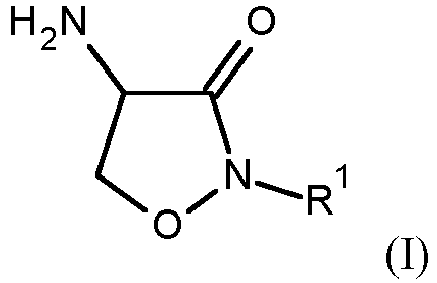 R1 is C1-C8alkyl, C1-C8haloalkyl, aryl or aryl substituted by one to five R11, or aryl-C1-C4alkylene or aryl-C1-C4alkylene substituted by one to five R11; andeach R11 is independently C1-C4alkyl, C1-C4haloalkyl, C1-C4alkoxy, C1-C4haloalkoxy, cyano or halogen; comprisingreacting a compound of formula (II) or a salt thereof
with a compound of formula (III)
wherein
R2 is a leaving group selected from halogen, C1-C8alkylsulfonyloxy, C1-C8haloalkylsulfonyloxy, C1-Csarylsulfonyloxy or C1-C8arylsulfonyloxy substituted by one to five R11, or a phosphonate ester; and each R11 is independently C1-C4alkyl, C1-C4haloalkyl, C1-C4alkoxy, C1-C4haloalkoxy, cyano or halogen. - A process for the preparation of a compound of formula (I)
 R1 is C1-C8alkyl, C1-C8haloalkyl, aryl or aryl substituted by one to five R11, or aryl-C1-C4alkylene or aryl-C1-C4alkylene substituted by one to five R11; andeach R11 is independently C1-C4alkyl, C1-C4haloalkyl, C1-C4alkoxy, C1-C4haloalkoxy, cyano or halogen; comprisinga-1. reacting the compound of formula (II)

wherein
R2 is a leaving group selected from halogen, C1-C8alkylsulfonyloxy, C1-C8haloalkylsulfonyloxy, C1-Csarylsulfonyloxy or C1-C8arylsulfonyloxy substituted by one to five R11, or a phosphonate ester; and each R11 is independently C1-C4alkyl, C1-C4haloalkyl, C1-C4alkoxy, C1-C4haloalkoxy, cyano or halogen; to produce the compound of formula (IV) or a salt thereof
anda-2. converting the compound of formula (IV) to the compound of formula (I) in the presence of a suitable base. - A process for the preparation of a compound of formula (IV)


wherein
R1 is C1-C8alkyl, C1-C8haloalkyl, aryl or aryl substituted by one to five R11, or aryl-C1-C4alkylene or aryl-C1-C4alkylene substituted by one to five R11;
R2 is a leaving group selected from halogen, C1-C8alkylsulfonyloxy, C1-C8haloalkylsulfonyloxy, C1-Csarylsulfonyloxy or C1-C8arylsulfonyloxy substituted by one to five R11, or a phosphonate ester;
each R11 is independently C1-C4alkyl, C1-C4haloalkyl, C1-C4alkoxy, C1-C4haloalkoxy, cyano or halogen. - A process for the preparation of a compound of formula (I)

a-2. converting the compound of formula (IV)
wherein
R1 is C1-C8alkyl, C1-C8haloalkyl, aryl or aryl substituted by one to five R11, or aryl-C1-C4alkylene or aryl-C1-C4alkylene substituted by one to five R11;
R2 is C1-C8alkylsulfonyloxy, C1-C8haloalkylsulfonyloxy, C1-C8arylsulfonyloxy or C1-C8arylsulfonyloxy substituted by one to five R11, or a phosphonate ester; and
each R11 is independently C1-C4alkyl, C1-C4haloalkyl, C1-C4alkoxy, C1-C4haloalkoxy, cyano or halogen. - A compound of formula (IV)

R1 is C1-C8alkyl, C1-C8haloalkyl, aryl or aryl substituted by one to five R11, or aryl-C1-C4alkylene or aryl-C1-C4alkylene substituted by one to five R11;
R2 is C1-C8alkylsulfonyloxy, C1-C8haloalkylsulfonyloxy, C1-C8arylsulfonyloxy or C1-C8arylsulfonyloxy substituted by one to five R11, or a phosphonate ester; and
each R11 is independently C1-C4alkyl, C1-C4haloalkyl, C1-C4alkoxy, C1-C4haloalkoxy, cyano or halogen; or a salt or N-oxide thereof. - A compound of formula (I)

each R11 is independently C1-C4alkyl, C1-C4haloalkyl, C1-C4alkoxy, C1-C4haloalkoxy, cyano or halogen - A process for the preparation of a compound of formula (VIII) or a salt or N-oxide thereof


X is a leaving group selected from halogen, C1-C8alkylsulfonyloxy, C1-C8haloalkylsulfonyloxy, C1-Csarylsulfonyloxy or C1-C8arylsulfonyloxy substituted by one to five R11, or a phosphonate ester, cyano, formyl, acetyl, C(O)CH=C(R3)R4, C(O)CH2C(OH)(R3)R4 or group A
A1, A2, A3 and A4 are independently of one another C-H, C-R5, or nitrogen;
R3 is C1-C8haloalkyl;
R4 is aryl or aryl substituted by one to three R6, or R4 is heterocyclyl or heterocyclyl substituted by one to three R6;
each R5 is independently halogen, cyano, nitro, C1-C8alkyl, C3-C8cycloalkyl, C1-C8haloalkyl, C2-Csalkenyl, C2-C8haloalkenyl, C2-C8alkynyl, C2-C8haloalkynyl, C1-C8alkoxy, C1-C8haloalkoxy, C1-Csalkoxycarbonyl-, or two R5 on adjacent carbon atoms together form a -CH=CH-CH=CH- bridge or a - N=CH-CH=CH- bridge;
each R6 is independently halogen, cyano, nitro, C1-C8alkyl, C1-C8haloalkyl, C1-C8alkoxy, or C1-Cshaloalkoxy;
R8 is hydroxy, C1-C6alkoxy, chloro, cluoro, bromo, or SRx wherein Rx is H, C1-C6alkyl, imidazole or pyrrole;
R1 is C1-C8alkyl, C1-C8haloalkyl, aryl or aryl substituted by one to five R11, or aryl-C1-C4alkylene or aryl-C1-C8alkylene substituted by one to five R11; and
each R11 is independently C1-C4alkyl, C1-C4haloalkyl, C1-C4alkoxy, C1-C4haloalkoxy, cyano or halogen.
Priority Applications (2)
| Application Number | Priority Date | Filing Date | Title |
|---|---|---|---|
| SI201531115T SI3137449T1 (en) | 2014-04-30 | 2015-04-30 | Process for the preparation of substituted cycloserines |
| PL15722685T PL3137449T3 (en) | 2014-04-30 | 2015-04-30 | Process for the preparation of substituted cycloserines |
Applications Claiming Priority (2)
| Application Number | Priority Date | Filing Date | Title |
|---|---|---|---|
| EP14166654 | 2014-04-30 | ||
| PCT/EP2015/059612 WO2015166094A1 (en) | 2014-04-30 | 2015-04-30 | Process for the preparation of substituted cycloserines |
Publications (2)
| Publication Number | Publication Date |
|---|---|
| EP3137449A1 EP3137449A1 (en) | 2017-03-08 |
| EP3137449B1 true EP3137449B1 (en) | 2019-12-18 |
Family
ID=50693448
Family Applications (1)
| Application Number | Title | Priority Date | Filing Date |
|---|---|---|---|
| EP15722685.3A Active EP3137449B1 (en) | 2014-04-30 | 2015-04-30 | Process for the preparation of substituted cycloserines |
Country Status (13)
| Country | Link |
|---|---|
| US (2) | US9643938B2 (en) |
| EP (1) | EP3137449B1 (en) |
| JP (1) | JP6523334B2 (en) |
| CN (3) | CN108822053A (en) |
| BR (2) | BR122021004312B1 (en) |
| DK (1) | DK3137449T3 (en) |
| ES (1) | ES2774363T3 (en) |
| HU (1) | HUE049170T2 (en) |
| IL (1) | IL248267B (en) |
| MX (2) | MX388328B (en) |
| PL (1) | PL3137449T3 (en) |
| SI (1) | SI3137449T1 (en) |
| WO (1) | WO2015166094A1 (en) |
Families Citing this family (9)
| Publication number | Priority date | Publication date | Assignee | Title |
|---|---|---|---|---|
| CN108822053A (en) * | 2014-04-30 | 2018-11-16 | 先正达参股股份有限公司 | The method for being used to prepare substituted seromycin |
| MX2022007455A (en) | 2019-12-18 | 2022-08-15 | Elanco Tiergesundheit Ag | ISOXAZOLINE DERIVATIVES AS PESTICIDES. |
| CN114014776B (en) * | 2021-12-09 | 2024-03-12 | 西安鸿钧睿泽新材料科技有限公司 | Compound with low global warming potential value, preparation method and application thereof |
| AU2023279074A1 (en) | 2022-05-30 | 2024-11-28 | Syngenta Crop Protection Ag | Process for the preparation of 4-substituted 2-oxazolidinones |
| WO2024033374A1 (en) | 2022-08-11 | 2024-02-15 | Syngenta Crop Protection Ag | Novel arylcarboxamide or arylthioamide compounds |
| WO2024089216A1 (en) | 2022-10-27 | 2024-05-02 | Syngenta Crop Protection Ag | Novel sulfur-containing heteroaryl carboxamide compounds |
| EP4634152A1 (en) | 2022-12-15 | 2025-10-22 | Syngenta Crop Protection AG | Novel bicyclic-carboxamide compounds useful as pesticides |
| KR20250151434A (en) | 2023-02-24 | 2025-10-21 | 신젠타 크롭 프로텍션 아게 | Manufacturing process of isoxazoline derivatives |
| WO2026021962A1 (en) | 2024-07-26 | 2026-01-29 | Basf Se | Process for the preparation of an aqueous solution comprising n-alkylhydroxylamine |
Family Cites Families (10)
| Publication number | Priority date | Publication date | Assignee | Title |
|---|---|---|---|---|
| GB799066A (en) * | 1955-11-17 | 1958-07-30 | Hoffmann La Roche | Process for the manufacture of isoxazolidone compounds |
| CH488719A (en) * | 1967-06-26 | 1970-04-15 | Eprova Ag | Process for the preparation of cycloserine (D-4-amino-3-isoxazolidinone) |
| JPS5714337B2 (en) | 1973-02-23 | 1982-03-24 | ||
| WO1996030381A1 (en) | 1995-03-28 | 1996-10-03 | Novo Nordisk A/S | Immunosuppressive agents |
| CA2689607A1 (en) * | 2007-06-06 | 2008-12-18 | Tyrogenex, Inc. | Kinase inhibitor compounds |
| EP2172462A4 (en) * | 2007-06-27 | 2010-12-15 | Nissan Chemical Ind Ltd | Method for production of 3-hydroxypropan-1-one compound, method for production of 2-propen-1-one compound, and method for production of isoxazoline compound |
| TWI487486B (en) * | 2009-12-01 | 2015-06-11 | Syngenta Participations Ag | Insecticidal compound based on isoxazoline derivatives |
| KR20120131646A (en) * | 2011-05-26 | 2012-12-05 | 주식회사 참조아 | A process for the preparation of isoxazolidinone derivative, D-cycloserine |
| UY34104A (en) * | 2011-05-31 | 2013-01-03 | Syngenta Participations Ag | ? HETEROCYCLIC BENZAMID DERIVATIVE COMPOUNDS, PROCESSES AND INTERMEDIATES FOR PREPARATION, COMPOSITIONS AND METHODS FOR USE. |
| CN108822053A (en) * | 2014-04-30 | 2018-11-16 | 先正达参股股份有限公司 | The method for being used to prepare substituted seromycin |
-
2015
- 2015-04-30 CN CN201810808594.7A patent/CN108822053A/en active Pending
- 2015-04-30 BR BR122021004312-4A patent/BR122021004312B1/en active IP Right Grant
- 2015-04-30 HU HUE15722685A patent/HUE049170T2/en unknown
- 2015-04-30 EP EP15722685.3A patent/EP3137449B1/en active Active
- 2015-04-30 MX MX2016014119A patent/MX388328B/en unknown
- 2015-04-30 BR BR112016025076-1A patent/BR112016025076B1/en active IP Right Grant
- 2015-04-30 SI SI201531115T patent/SI3137449T1/en unknown
- 2015-04-30 US US15/307,386 patent/US9643938B2/en active Active
- 2015-04-30 CN CN202111372808.9A patent/CN114031572B/en active Active
- 2015-04-30 WO PCT/EP2015/059612 patent/WO2015166094A1/en not_active Ceased
- 2015-04-30 PL PL15722685T patent/PL3137449T3/en unknown
- 2015-04-30 CN CN201580022794.4A patent/CN106255681B/en active Active
- 2015-04-30 JP JP2016565167A patent/JP6523334B2/en active Active
- 2015-04-30 DK DK15722685.3T patent/DK3137449T3/en active
- 2015-04-30 ES ES15722685T patent/ES2774363T3/en active Active
-
2016
- 2016-10-09 IL IL248267A patent/IL248267B/en active IP Right Grant
- 2016-10-27 MX MX2021011971A patent/MX2021011971A/en unknown
-
2017
- 2017-04-03 US US15/477,159 patent/US9815803B2/en active Active
Non-Patent Citations (1)
| Title |
|---|
| None * |
Also Published As
| Publication number | Publication date |
|---|---|
| CN108822053A (en) | 2018-11-16 |
| BR112016025076A2 (en) | 2018-07-10 |
| CN114031572B (en) | 2025-07-08 |
| PL3137449T3 (en) | 2020-07-27 |
| US20170204072A1 (en) | 2017-07-20 |
| HUE049170T2 (en) | 2020-09-28 |
| IL248267B (en) | 2019-07-31 |
| BR122021004312B1 (en) | 2022-02-08 |
| CN106255681A (en) | 2016-12-21 |
| US9815803B2 (en) | 2017-11-14 |
| JP2017518272A (en) | 2017-07-06 |
| JP6523334B2 (en) | 2019-05-29 |
| SI3137449T1 (en) | 2020-04-30 |
| US9643938B2 (en) | 2017-05-09 |
| IL248267A0 (en) | 2016-11-30 |
| ES2774363T3 (en) | 2020-07-20 |
| EP3137449A1 (en) | 2017-03-08 |
| DK3137449T3 (en) | 2020-03-02 |
| MX388328B (en) | 2025-03-19 |
| MX2016014119A (en) | 2017-02-09 |
| BR112016025076B1 (en) | 2022-03-03 |
| CN114031572A (en) | 2022-02-11 |
| WO2015166094A1 (en) | 2015-11-05 |
| CN106255681B (en) | 2019-11-22 |
| US20170044116A1 (en) | 2017-02-16 |
| MX2021011971A (en) | 2021-11-03 |
Similar Documents
| Publication | Publication Date | Title |
|---|---|---|
| US9815803B2 (en) | Process for the preparation of substituted cycloserines | |
| TW202317520A (en) | Substituted pyrazole amides | |
| KR20180032645A (en) | Novel compounds as ROR gamma modifiers | |
| TW200825065A (en) | Pyrazine-2-carboxamide derivatives | |
| EP2981519B1 (en) | Process for the preparation of amides from hindered anilines containing a perhaloalkyl group | |
| ES2245690T3 (en) | PROCEDURE TO PREPARE ARILACETILAMINOTIAZOLES. | |
| Edwards et al. | Efficient one-pot synthesis of 1-arylcycloprop-2-ene-1-carboxamides | |
| JP5787727B2 (en) | Pyrazino [2,3-d] isoxazole derivatives | |
| KR20200074128A (en) | Method for producing benzothiophen-2-yl boronate | |
| CN108137505B (en) | nitrogen-containing heterocyclic compounds | |
| JP2006525320A (en) | COX inhibitor | |
| RU2731618C2 (en) | Nonsteroidal modulators of glucocorticoid receptors for local drug delivery | |
| AU2012334068A1 (en) | Substituted pyrazolyl-based carboxamide and urea derivatives bearing a phenyl moiety substituted with an S02-containing group as vanilloid receptor ligands | |
| JP7279134B2 (en) | Method for producing prolinamide compound | |
| Voss et al. | Efficient synthesis of enantiomerically pure (S)-δ-azaproline starting from (R)-α-hydroxy-γ-butyrolactone via the Mitsunobu reaction | |
| JP6705111B2 (en) | Triazinone compound | |
| García-Aranda et al. | Tetramic acids and indole derivatives from amino acid β-keto esters. Fine-tuning the conditions of the key Cu-catalyzed reaction | |
| EP3584241B1 (en) | Method for producing indazole compound, and indazole compound | |
| JP2021516665A (en) | Method for producing 2-chloro-4-nitroimidazole derivative | |
| WO2010116121A1 (en) | Processes for making isoxazoline derivatives | |
| JP2023100917A (en) | Method for producing prolinamide compound | |
| JP2017105778A (en) | Method for producing 5-pyridyl-oxy-methyl-1,2-oxazol-3-yl pyrrolidine derivative | |
| HK1193607A (en) | Aromatic amides as inhibitors of c-fms kinase |
Legal Events
| Date | Code | Title | Description |
|---|---|---|---|
| STAA | Information on the status of an ep patent application or granted ep patent |
Free format text: STATUS: THE INTERNATIONAL PUBLICATION HAS BEEN MADE |
|
| PUAI | Public reference made under article 153(3) epc to a published international application that has entered the european phase |
Free format text: ORIGINAL CODE: 0009012 |
|
| STAA | Information on the status of an ep patent application or granted ep patent |
Free format text: STATUS: REQUEST FOR EXAMINATION WAS MADE |
|
| 17P | Request for examination filed |
Effective date: 20161130 |
|
| AK | Designated contracting states |
Kind code of ref document: A1 Designated state(s): AL AT BE BG CH CY CZ DE DK EE ES FI FR GB GR HR HU IE IS IT LI LT LU LV MC MK MT NL NO PL PT RO RS SE SI SK SM TR |
|
| AX | Request for extension of the european patent |
Extension state: BA ME |
|
| DAV | Request for validation of the european patent (deleted) | ||
| DAX | Request for extension of the european patent (deleted) | ||
| STAA | Information on the status of an ep patent application or granted ep patent |
Free format text: STATUS: EXAMINATION IS IN PROGRESS |
|
| 17Q | First examination report despatched |
Effective date: 20181120 |
|
| GRAP | Despatch of communication of intention to grant a patent |
Free format text: ORIGINAL CODE: EPIDOSNIGR1 |
|
| STAA | Information on the status of an ep patent application or granted ep patent |
Free format text: STATUS: GRANT OF PATENT IS INTENDED |
|
| INTG | Intention to grant announced |
Effective date: 20190724 |
|
| RIN1 | Information on inventor provided before grant (corrected) |
Inventor name: SMITS, HELMARS Inventor name: LOTHSCHUETZ, CHRISTIAN Inventor name: TERINEK, MIROSLAV Inventor name: SMEJKAL, TOMAS |
|
| RAP1 | Party data changed (applicant data changed or rights of an application transferred) |
Owner name: SYNGENTA PARTICIPATIONS AG |
|
| GRAS | Grant fee paid |
Free format text: ORIGINAL CODE: EPIDOSNIGR3 |
|
| GRAA | (expected) grant |
Free format text: ORIGINAL CODE: 0009210 |
|
| STAA | Information on the status of an ep patent application or granted ep patent |
Free format text: STATUS: THE PATENT HAS BEEN GRANTED |
|
| AK | Designated contracting states |
Kind code of ref document: B1 Designated state(s): AL AT BE BG CH CY CZ DE DK EE ES FI FR GB GR HR HU IE IS IT LI LT LU LV MC MK MT NL NO PL PT RO RS SE SI SK SM TR |
|
| REG | Reference to a national code |
Ref country code: CH Ref legal event code: EP |
|
| REG | Reference to a national code |
Ref country code: IE Ref legal event code: FG4D |
|
| REG | Reference to a national code |
Ref country code: DE Ref legal event code: R096 Ref document number: 602015043838 Country of ref document: DE |
|
| REG | Reference to a national code |
Ref country code: AT Ref legal event code: REF Ref document number: 1214470 Country of ref document: AT Kind code of ref document: T Effective date: 20200115 |
|
| REG | Reference to a national code |
Ref country code: DK Ref legal event code: T3 Effective date: 20200228 Ref country code: FI Ref legal event code: FGE |
|
| REG | Reference to a national code |
Ref country code: SE Ref legal event code: TRGR |
|
| REG | Reference to a national code |
Ref country code: GB Ref legal event code: 732E Free format text: REGISTERED BETWEEN 20200220 AND 20200226 |
|
| REG | Reference to a national code |
Ref country code: NL Ref legal event code: FP |
|
| PG25 | Lapsed in a contracting state [announced via postgrant information from national office to epo] |
Ref country code: LV Free format text: LAPSE BECAUSE OF FAILURE TO SUBMIT A TRANSLATION OF THE DESCRIPTION OR TO PAY THE FEE WITHIN THE PRESCRIBED TIME-LIMIT Effective date: 20191218 Ref country code: BG Free format text: LAPSE BECAUSE OF FAILURE TO SUBMIT A TRANSLATION OF THE DESCRIPTION OR TO PAY THE FEE WITHIN THE PRESCRIBED TIME-LIMIT Effective date: 20200318 Ref country code: GR Free format text: LAPSE BECAUSE OF FAILURE TO SUBMIT A TRANSLATION OF THE DESCRIPTION OR TO PAY THE FEE WITHIN THE PRESCRIBED TIME-LIMIT Effective date: 20200319 Ref country code: NO Free format text: LAPSE BECAUSE OF FAILURE TO SUBMIT A TRANSLATION OF THE DESCRIPTION OR TO PAY THE FEE WITHIN THE PRESCRIBED TIME-LIMIT Effective date: 20200318 Ref country code: LT Free format text: LAPSE BECAUSE OF FAILURE TO SUBMIT A TRANSLATION OF THE DESCRIPTION OR TO PAY THE FEE WITHIN THE PRESCRIBED TIME-LIMIT Effective date: 20191218 |
|
| REG | Reference to a national code |
Ref country code: LT Ref legal event code: MG4D |
|
| REG | Reference to a national code |
Ref country code: EE Ref legal event code: FG4A Ref document number: E018775 Country of ref document: EE Effective date: 20200226 |
|
| PG25 | Lapsed in a contracting state [announced via postgrant information from national office to epo] |
Ref country code: RS Free format text: LAPSE BECAUSE OF FAILURE TO SUBMIT A TRANSLATION OF THE DESCRIPTION OR TO PAY THE FEE WITHIN THE PRESCRIBED TIME-LIMIT Effective date: 20191218 Ref country code: HR Free format text: LAPSE BECAUSE OF FAILURE TO SUBMIT A TRANSLATION OF THE DESCRIPTION OR TO PAY THE FEE WITHIN THE PRESCRIBED TIME-LIMIT Effective date: 20191218 |
|
| REG | Reference to a national code |
Ref country code: SK Ref legal event code: T3 Ref document number: E 33655 Country of ref document: SK |
|
| PG25 | Lapsed in a contracting state [announced via postgrant information from national office to epo] |
Ref country code: AL Free format text: LAPSE BECAUSE OF FAILURE TO SUBMIT A TRANSLATION OF THE DESCRIPTION OR TO PAY THE FEE WITHIN THE PRESCRIBED TIME-LIMIT Effective date: 20191218 |
|
| REG | Reference to a national code |
Ref country code: ES Ref legal event code: FG2A Ref document number: 2774363 Country of ref document: ES Kind code of ref document: T3 Effective date: 20200720 |
|
| PG25 | Lapsed in a contracting state [announced via postgrant information from national office to epo] |
Ref country code: PT Free format text: LAPSE BECAUSE OF FAILURE TO SUBMIT A TRANSLATION OF THE DESCRIPTION OR TO PAY THE FEE WITHIN THE PRESCRIBED TIME-LIMIT Effective date: 20200513 Ref country code: RO Free format text: LAPSE BECAUSE OF FAILURE TO SUBMIT A TRANSLATION OF THE DESCRIPTION OR TO PAY THE FEE WITHIN THE PRESCRIBED TIME-LIMIT Effective date: 20191218 |
|
| REG | Reference to a national code |
Ref country code: AT Ref legal event code: UEP Ref document number: 1214470 Country of ref document: AT Kind code of ref document: T Effective date: 20191218 |
|
| PG25 | Lapsed in a contracting state [announced via postgrant information from national office to epo] |
Ref country code: IS Free format text: LAPSE BECAUSE OF FAILURE TO SUBMIT A TRANSLATION OF THE DESCRIPTION OR TO PAY THE FEE WITHIN THE PRESCRIBED TIME-LIMIT Effective date: 20200418 Ref country code: SM Free format text: LAPSE BECAUSE OF FAILURE TO SUBMIT A TRANSLATION OF THE DESCRIPTION OR TO PAY THE FEE WITHIN THE PRESCRIBED TIME-LIMIT Effective date: 20191218 |
|
| REG | Reference to a national code |
Ref country code: DE Ref legal event code: R097 Ref document number: 602015043838 Country of ref document: DE |
|
| REG | Reference to a national code |
Ref country code: HU Ref legal event code: AG4A Ref document number: E049170 Country of ref document: HU |
|
| PLBE | No opposition filed within time limit |
Free format text: ORIGINAL CODE: 0009261 |
|
| STAA | Information on the status of an ep patent application or granted ep patent |
Free format text: STATUS: NO OPPOSITION FILED WITHIN TIME LIMIT |
|
| 26N | No opposition filed |
Effective date: 20200921 |
|
| PG25 | Lapsed in a contracting state [announced via postgrant information from national office to epo] |
Ref country code: MC Free format text: LAPSE BECAUSE OF FAILURE TO SUBMIT A TRANSLATION OF THE DESCRIPTION OR TO PAY THE FEE WITHIN THE PRESCRIBED TIME-LIMIT Effective date: 20191218 |
|
| PG25 | Lapsed in a contracting state [announced via postgrant information from national office to epo] |
Ref country code: LU Free format text: LAPSE BECAUSE OF NON-PAYMENT OF DUE FEES Effective date: 20200430 |
|
| REG | Reference to a national code |
Ref country code: BE Ref legal event code: MM Effective date: 20200430 |
|
| PG25 | Lapsed in a contracting state [announced via postgrant information from national office to epo] |
Ref country code: BE Free format text: LAPSE BECAUSE OF NON-PAYMENT OF DUE FEES Effective date: 20200430 |
|
| PG25 | Lapsed in a contracting state [announced via postgrant information from national office to epo] |
Ref country code: IE Free format text: LAPSE BECAUSE OF NON-PAYMENT OF DUE FEES Effective date: 20200430 |
|
| PG25 | Lapsed in a contracting state [announced via postgrant information from national office to epo] |
Ref country code: TR Free format text: LAPSE BECAUSE OF FAILURE TO SUBMIT A TRANSLATION OF THE DESCRIPTION OR TO PAY THE FEE WITHIN THE PRESCRIBED TIME-LIMIT Effective date: 20191218 Ref country code: MT Free format text: LAPSE BECAUSE OF FAILURE TO SUBMIT A TRANSLATION OF THE DESCRIPTION OR TO PAY THE FEE WITHIN THE PRESCRIBED TIME-LIMIT Effective date: 20191218 Ref country code: CY Free format text: LAPSE BECAUSE OF FAILURE TO SUBMIT A TRANSLATION OF THE DESCRIPTION OR TO PAY THE FEE WITHIN THE PRESCRIBED TIME-LIMIT Effective date: 20191218 |
|
| PG25 | Lapsed in a contracting state [announced via postgrant information from national office to epo] |
Ref country code: MK Free format text: LAPSE BECAUSE OF FAILURE TO SUBMIT A TRANSLATION OF THE DESCRIPTION OR TO PAY THE FEE WITHIN THE PRESCRIBED TIME-LIMIT Effective date: 20191218 |
|
| PGFP | Annual fee paid to national office [announced via postgrant information from national office to epo] |
Ref country code: SI Payment date: 20250414 Year of fee payment: 11 |
|
| PGFP | Annual fee paid to national office [announced via postgrant information from national office to epo] |
Ref country code: NL Payment date: 20250424 Year of fee payment: 11 |
|
| PGFP | Annual fee paid to national office [announced via postgrant information from national office to epo] |
Ref country code: FI Payment date: 20250424 Year of fee payment: 11 |
|
| PGFP | Annual fee paid to national office [announced via postgrant information from national office to epo] |
Ref country code: PL Payment date: 20250417 Year of fee payment: 11 Ref country code: DE Payment date: 20250428 Year of fee payment: 11 |
|
| PGFP | Annual fee paid to national office [announced via postgrant information from national office to epo] |
Ref country code: DK Payment date: 20250424 Year of fee payment: 11 Ref country code: ES Payment date: 20250513 Year of fee payment: 11 Ref country code: GB Payment date: 20250422 Year of fee payment: 11 |
|
| PGFP | Annual fee paid to national office [announced via postgrant information from national office to epo] |
Ref country code: HU Payment date: 20250424 Year of fee payment: 11 |
|
| PGFP | Annual fee paid to national office [announced via postgrant information from national office to epo] |
Ref country code: IT Payment date: 20250422 Year of fee payment: 11 |
|
| PGFP | Annual fee paid to national office [announced via postgrant information from national office to epo] |
Ref country code: FR Payment date: 20250424 Year of fee payment: 11 Ref country code: EE Payment date: 20250429 Year of fee payment: 11 |
|
| PGFP | Annual fee paid to national office [announced via postgrant information from national office to epo] |
Ref country code: CH Payment date: 20250501 Year of fee payment: 11 |
|
| PGFP | Annual fee paid to national office [announced via postgrant information from national office to epo] |
Ref country code: AT Payment date: 20250417 Year of fee payment: 11 |
|
| PGFP | Annual fee paid to national office [announced via postgrant information from national office to epo] |
Ref country code: SK Payment date: 20250414 Year of fee payment: 11 |
|
| PGFP | Annual fee paid to national office [announced via postgrant information from national office to epo] |
Ref country code: CZ Payment date: 20250414 Year of fee payment: 11 |
|
| PGFP | Annual fee paid to national office [announced via postgrant information from national office to epo] |
Ref country code: SE Payment date: 20250424 Year of fee payment: 11 |
|
| REG | Reference to a national code |
Ref country code: SK Ref legal event code: PC4A Ref document number: E 33655 Country of ref document: SK Owner name: SYNGENTA CROP PROTECTION AG, BASEL, CH Free format text: FORMER OWNER: SYNGENTA PARTICIPATIONS AG, BASEL, CH Effective date: 20251031 |
|
| REG | Reference to a national code |
Ref country code: AT Ref legal event code: PC Ref document number: 1214470 Country of ref document: AT Kind code of ref document: T Owner name: SYNGENTA CROP PROTECTION AG, CH Effective date: 20260114 |
|
| REG | Reference to a national code |
Ref country code: DE Ref legal event code: R081 Ref document number: 602015043838 Country of ref document: DE Owner name: SYNGENTA CROP PROTECTION AG, CH Free format text: FORMER OWNER: SYNGENTA PARTICIPATIONS AG, BASEL, CH |
|
| REG | Reference to a national code |
Ref country code: NL Ref legal event code: PD Owner name: SYNGENTA CROP PROTECTION AG; CH Free format text: DETAILS ASSIGNMENT: CHANGE OF OWNER(S), MERGE; FORMER OWNER NAME: SYNGENTA PARTICIPATIONS AG Effective date: 20260206 |
|
| REG | Reference to a national code |
Ref country code: CH Ref legal event code: R14 Free format text: ST27 STATUS EVENT CODE: U-0-0-R10-R14 (AS PROVIDED BY THE NATIONAL OFFICE) Effective date: 20260323 |
|
| REG | Reference to a national code |
Ref country code: FI Ref legal event code: PCE Owner name: SYNGENTA CROP PROTECTION AG |
|
| REG | Reference to a national code |
Ref country code: CH Ref legal event code: U11 Free format text: ST27 STATUS EVENT CODE: U-0-0-U10-U11 (AS PROVIDED BY THE NATIONAL OFFICE) Effective date: 20260501 |