EP3135786A1 - Wire material for high strength steel cord - Google Patents
Wire material for high strength steel cord Download PDFInfo
- Publication number
- EP3135786A1 EP3135786A1 EP15783324.5A EP15783324A EP3135786A1 EP 3135786 A1 EP3135786 A1 EP 3135786A1 EP 15783324 A EP15783324 A EP 15783324A EP 3135786 A1 EP3135786 A1 EP 3135786A1
- Authority
- EP
- European Patent Office
- Prior art keywords
- less
- content
- wire
- wire rod
- steel cord
- Prior art date
- Legal status (The legal status is an assumption and is not a legal conclusion. Google has not performed a legal analysis and makes no representation as to the accuracy of the status listed.)
- Granted
Links
Images

Classifications
-
- C—CHEMISTRY; METALLURGY
- C21—METALLURGY OF IRON
- C21D—MODIFYING THE PHYSICAL STRUCTURE OF FERROUS METALS; GENERAL DEVICES FOR HEAT TREATMENT OF FERROUS OR NON-FERROUS METALS OR ALLOYS; MAKING METAL MALLEABLE, e.g. BY DECARBURISATION OR TEMPERING
- C21D9/00—Heat treatment, e.g. annealing, hardening, quenching or tempering, adapted for particular articles; Furnaces therefor
- C21D9/52—Heat treatment, e.g. annealing, hardening, quenching or tempering, adapted for particular articles; Furnaces therefor for wires; for strips ; for rods of unlimited length
-
- C—CHEMISTRY; METALLURGY
- C22—METALLURGY; FERROUS OR NON-FERROUS ALLOYS; TREATMENT OF ALLOYS OR NON-FERROUS METALS
- C22C—ALLOYS
- C22C38/00—Ferrous alloys, e.g. steel alloys
-
- C—CHEMISTRY; METALLURGY
- C22—METALLURGY; FERROUS OR NON-FERROUS ALLOYS; TREATMENT OF ALLOYS OR NON-FERROUS METALS
- C22C—ALLOYS
- C22C38/00—Ferrous alloys, e.g. steel alloys
- C22C38/001—Ferrous alloys, e.g. steel alloys containing N
-
- C—CHEMISTRY; METALLURGY
- C22—METALLURGY; FERROUS OR NON-FERROUS ALLOYS; TREATMENT OF ALLOYS OR NON-FERROUS METALS
- C22C—ALLOYS
- C22C38/00—Ferrous alloys, e.g. steel alloys
- C22C38/002—Ferrous alloys, e.g. steel alloys containing In, Mg, or other elements not provided for in one single group C22C38/001 - C22C38/60
-
- C—CHEMISTRY; METALLURGY
- C22—METALLURGY; FERROUS OR NON-FERROUS ALLOYS; TREATMENT OF ALLOYS OR NON-FERROUS METALS
- C22C—ALLOYS
- C22C38/00—Ferrous alloys, e.g. steel alloys
- C22C38/005—Ferrous alloys, e.g. steel alloys containing rare earths, i.e. Sc, Y, Lanthanides
-
- C—CHEMISTRY; METALLURGY
- C22—METALLURGY; FERROUS OR NON-FERROUS ALLOYS; TREATMENT OF ALLOYS OR NON-FERROUS METALS
- C22C—ALLOYS
- C22C38/00—Ferrous alloys, e.g. steel alloys
- C22C38/02—Ferrous alloys, e.g. steel alloys containing silicon
-
- C—CHEMISTRY; METALLURGY
- C22—METALLURGY; FERROUS OR NON-FERROUS ALLOYS; TREATMENT OF ALLOYS OR NON-FERROUS METALS
- C22C—ALLOYS
- C22C38/00—Ferrous alloys, e.g. steel alloys
- C22C38/04—Ferrous alloys, e.g. steel alloys containing manganese
-
- C—CHEMISTRY; METALLURGY
- C22—METALLURGY; FERROUS OR NON-FERROUS ALLOYS; TREATMENT OF ALLOYS OR NON-FERROUS METALS
- C22C—ALLOYS
- C22C38/00—Ferrous alloys, e.g. steel alloys
- C22C38/06—Ferrous alloys, e.g. steel alloys containing aluminium
-
- C—CHEMISTRY; METALLURGY
- C22—METALLURGY; FERROUS OR NON-FERROUS ALLOYS; TREATMENT OF ALLOYS OR NON-FERROUS METALS
- C22C—ALLOYS
- C22C38/00—Ferrous alloys, e.g. steel alloys
- C22C38/18—Ferrous alloys, e.g. steel alloys containing chromium
- C22C38/22—Ferrous alloys, e.g. steel alloys containing chromium with molybdenum or tungsten
-
- C—CHEMISTRY; METALLURGY
- C22—METALLURGY; FERROUS OR NON-FERROUS ALLOYS; TREATMENT OF ALLOYS OR NON-FERROUS METALS
- C22C—ALLOYS
- C22C38/00—Ferrous alloys, e.g. steel alloys
- C22C38/18—Ferrous alloys, e.g. steel alloys containing chromium
- C22C38/24—Ferrous alloys, e.g. steel alloys containing chromium with vanadium
-
- C—CHEMISTRY; METALLURGY
- C22—METALLURGY; FERROUS OR NON-FERROUS ALLOYS; TREATMENT OF ALLOYS OR NON-FERROUS METALS
- C22C—ALLOYS
- C22C38/00—Ferrous alloys, e.g. steel alloys
- C22C38/18—Ferrous alloys, e.g. steel alloys containing chromium
- C22C38/26—Ferrous alloys, e.g. steel alloys containing chromium with niobium or tantalum
-
- C—CHEMISTRY; METALLURGY
- C22—METALLURGY; FERROUS OR NON-FERROUS ALLOYS; TREATMENT OF ALLOYS OR NON-FERROUS METALS
- C22C—ALLOYS
- C22C38/00—Ferrous alloys, e.g. steel alloys
- C22C38/18—Ferrous alloys, e.g. steel alloys containing chromium
- C22C38/28—Ferrous alloys, e.g. steel alloys containing chromium with titanium or zirconium
-
- C—CHEMISTRY; METALLURGY
- C22—METALLURGY; FERROUS OR NON-FERROUS ALLOYS; TREATMENT OF ALLOYS OR NON-FERROUS METALS
- C22C—ALLOYS
- C22C38/00—Ferrous alloys, e.g. steel alloys
- C22C38/18—Ferrous alloys, e.g. steel alloys containing chromium
- C22C38/30—Ferrous alloys, e.g. steel alloys containing chromium with cobalt
-
- C—CHEMISTRY; METALLURGY
- C22—METALLURGY; FERROUS OR NON-FERROUS ALLOYS; TREATMENT OF ALLOYS OR NON-FERROUS METALS
- C22C—ALLOYS
- C22C38/00—Ferrous alloys, e.g. steel alloys
- C22C38/18—Ferrous alloys, e.g. steel alloys containing chromium
- C22C38/32—Ferrous alloys, e.g. steel alloys containing chromium with boron
-
- C—CHEMISTRY; METALLURGY
- C21—METALLURGY OF IRON
- C21D—MODIFYING THE PHYSICAL STRUCTURE OF FERROUS METALS; GENERAL DEVICES FOR HEAT TREATMENT OF FERROUS OR NON-FERROUS METALS OR ALLOYS; MAKING METAL MALLEABLE, e.g. BY DECARBURISATION OR TEMPERING
- C21D2211/00—Microstructure comprising significant phases
- C21D2211/003—Cementite
-
- C—CHEMISTRY; METALLURGY
- C21—METALLURGY OF IRON
- C21D—MODIFYING THE PHYSICAL STRUCTURE OF FERROUS METALS; GENERAL DEVICES FOR HEAT TREATMENT OF FERROUS OR NON-FERROUS METALS OR ALLOYS; MAKING METAL MALLEABLE, e.g. BY DECARBURISATION OR TEMPERING
- C21D2211/00—Microstructure comprising significant phases
- C21D2211/009—Pearlite
-
- C—CHEMISTRY; METALLURGY
- C21—METALLURGY OF IRON
- C21D—MODIFYING THE PHYSICAL STRUCTURE OF FERROUS METALS; GENERAL DEVICES FOR HEAT TREATMENT OF FERROUS OR NON-FERROUS METALS OR ALLOYS; MAKING METAL MALLEABLE, e.g. BY DECARBURISATION OR TEMPERING
- C21D8/00—Modifying the physical properties of ferrous metals or ferrous alloys by deformation combined with, or followed by, heat treatment
- C21D8/06—Modifying the physical properties of ferrous metals or ferrous alloys by deformation combined with, or followed by, heat treatment during manufacturing of rods or wires
Definitions
- the present invention relates to a wire rod for a high strength steel cord, which is used as a reinforcing material of a rubber product such as a tire for a vehicle, a high pressure rubber hose, or a conveyor belt.
- a rubber product such as a tire for a vehicle
- chemical fibers made of rayon, nylon, polyester, or the like; or steel cords produced from a wire rod may be used as a reinforcing material.
- a reinforcing material is used for the frame of a tire for a vehicle and has a significant effect on the fuel efficiency, high speed durability, and steering stability of the vehicle in which the tire for a vehicle is mounted.
- the frequency of use of steel cords as the reinforcing material has increased.
- the steel cord using these filaments is produced through the following process.
- dry drawing is performed on a wire rod having a wire diameter of 3.5 mm to 8.0 mm to produce a steel wire having a wire diameter of about 1.0 mm to 4.0 mm, and a heat treatment called a patenting treatment is performed on the steel wire to soften the steel wire.
- a brass plating is formed on the surface of the softened steel wire to ensure the adhesion between rubber and the steel cord, and the resultant is subjected to wet drawing (finish drawing), thereby forming filaments having a wire diameter of 0.15 mm to 0.35 mm.
- the filaments obtained as described above are twisted to produce a steel cord having a twisted structure.
- high-strengthening is necessary after the patenting treatment, and high-strengthening is achieved through composition adjustment, such as increasing the C content.
- Patent Document 1 discloses, for the purpose of inexpensively providing a high carbon steel wire rod having excellent drawability, in which wire breaking does not occur even when drawing is performed with a true strain amount of more than 2.60, and which is thus appropriate for use in a steel cord or the like, a wire rod in which the average value of C content in a region from the outer circumference to a position at a depth of 1/50 of the radius of the steel wire rod in a transverse section of a steel wire rod is 0.6 ⁇ C% to 0.9 ⁇ C% of the C content of the wire rod.
- Patent Document 2 discloses, for the purpose of providing a wire rod which is less likely to cause wire breaking caused by flaws due to handling or the like during transportation, a high strength directly patented wire rod having a diameter of 4.0 mm to 16 mm, in which the carbon content of a layer at a depth of 300 ⁇ m from the surface layer is 0.97 times or less of the average carbon content of the entire cross section, and the surface layer having an average lamellar spacing of 95 nm or more in the above-mentioned layer is the layer where chafing martensite is less likely to be formed.
- Patent Document 3 discloses, for the purpose of providing a wire rod which has excellent cold workability and is thus appropriate as a production material of a steel cord or the like, a wire rod in which the size of pearlite blocks is controlled to be austenite grain size numbers 6 to 8 in the steel, the amount of generated proeutectoid cementite is controlled to be 0.2% or less by volume fraction, the thickness of cementite in pearlite is controlled to be 20 nm or less, and the Cr content of the cementite is controlled to be 1.5% or less.
- Patent Document 4 discloses a high carbon steel wire rod for drawing, in which, when the diameter of the high carbon steel wire rod is referred to as D, a region ranging from the surface of the high carbon steel wire rod to a depth of 0.05D or less is referred to as a surface part, a region deeper than 0.20D from the surface is referred to as an inside part, 90% or more of the structure of the surface part is a coarse lamellar pearlite structure having a lamellar spacing of 0.10 ⁇ m or more, and 95% or more of the structure of the inside part is a fine pearlite structure or a degenerate-pearlite structure having a lamellar spacing of less than 0.10 ⁇ m.
- Patent Document 5 discloses a high carbon steel wire rod in which the area fraction of pearlite in a cross-section perpendicular to a longitudinal direction is 95% or more, the remainder therein has a non-pearlite structure including one or more of bainite, degenerate-pearlite, proeutectoid ferrite, and proeutectoid cementite, the average block grain size of pearlite is 15 ⁇ m to 35 ⁇ m, the area fraction of pearlite having a block grain size of 50 ⁇ m or more is 20% or less, and a region having a lamellar spacing of 150 nm or less in the pearlite is 20% or less in a region ranging from the surface to a depth of 1 mm.
- a delamination phenomenon is a phenomenon in which longitudinal cracks that cause cracking in a longitudinal direction are generated when a steel wire or a filament is twisted and deformed, and easily occurs when the strength of the steel wire or the filament increases.
- An object of the present invention is to provide a wire rod for a steel cord in which cracking or the like caused by a delamination phenomenon can be prevented while high strength and workability are maintained after a finish drawing process.
- a wire rod for a steel cord has the following chemical composition, and has a surface part and a central part, and the surface part has a lower C content than that of the central part, and when thinning the lamellar cementite, lamellar cementite of the surface part of the filament for a steel cord is thinned, and cracks in cementite that become an origin of wire breaking become finer, and the ductility of the surface part can be significantly improved while ensuring the strength of the central part.
- the present invention has been made on the basis of the above-described knowledge, and the gist is as follows.
- the ductility of the surface part is improved, the strength of the central part is ensured and the tensile strength of the wire rod for a high strength steel cord is 1100 MPa or more, therefore, after the wire rod for a high strength steel cord is subjected to wire drawing so that the wire diameter is 0.15 mm to 0.35 mm, a significant effect of suppressing the occurrence of a delamination phenomenon, preventing the occurrence of a twisting defect, and achieving a tensile strength of 3200 MPa or more can be exhibited.
- a wire rod for a high strength steel cord described in the following (A) or (B).
- a wire diameter R as its diameter (hereinafter, referred to as a "wire diameter") R satisfies 3.5 mm ⁇ R ⁇ 8.0 mm and a surface part 21 and a central part 22 are included.
- 4.5 mm ⁇ R ⁇ 7.0 mm is satisfied.
- the inventors Since the surface part of the steel wire or the filament is mainly deformed during finish drawing performed in the process that the filament is produced by using the wire rod or during twisting performed when a steel cord is produced from the filament, the inventors have focused on that it is necessary for the surface part of the wire rod for a steel cord, which is a material of the steel wire or the filament, to have a good workability.
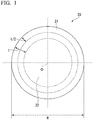
- the surface part 21 is a part having a thickness t from the outer circumferential surface of the wire rod 20 for a high strength steel cord.
- the thickness (hereinafter, referred to as the "thickness of the surface part") t of the surface part 21 is a region in a range of 50 ⁇ m ⁇ t ⁇ 0.20 ⁇ R
- the wire diameter R of the wire rod 20 for a high strength steel cord Preferably, 80 ⁇ m ⁇ t ⁇ 0.15 ⁇ R is satisfied.
- the surface part 21 has a lower C content than that of the central part 22 and has a C content of 40% to 95% of the C content of the center O of the wire rod 20 for a high strength steel cord.
- the reason that the thickness t of the surface part is set to 50 ⁇ m to 0.2 ⁇ R of the wire diameter R will be described.
- the thickness t of the surface part is set to 50 ⁇ m or more, workability can be sufficiently ensured, and the generation of defects such as cracks during finish drawing and twisting can be suppressed.
- the thickness t of the surface part is set to 0.2 ⁇ R or less, the strength of the steel cord can be sufficiently ensured.
- a position at a depth of t/2 from the outer circumferential surface which is indicated by a dotted line in FIG. 1 is defined as the center of the thickness of the surface part (hereinafter, referred to as the "center of the surface part").
- the thickness of lamellar cementite at the center of the surface part is 95% or less of the thickness of lamellar cementite in the central part, which will be described later.
- the lamellar cementite means cementite having layered structure in the pearlite structure.
- the central part 22 includes the center O of the wire rod 20 for a high strength steel cord and is a part excluding the surface part.
- the central part 22 has a substantially constant C content and is a region having a metallographic structure including a pearlite structure in a proportion of 95% to 100% by area%.
- the strength of the central part 22 is sufficiently ensured, and it becomes possible to achieve a reduction in the weight of the steel cord.
- the transverse section of the wire rod is etched with picral to reveal the pearlite structure, eight points at every central angle of 45° in the cross section of a wire rod at the same depth from the surface layer were photographed with a FE-SEM at a magnification of 10,000-fold, the thickness of lamellar cementite was obtained in each visual field from lamellar cementite perpendicularly intersecting a line segment of 2 ⁇ m in the minimum lamellar spacing part of the observation photograph, and the average value of the eight points was determined.
- the ratio (%) of the thickness of lamellar cementite in the surface part obtained as described above to the thickness of lamellar cementite in the central part of the filament was obtained.
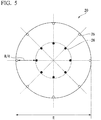
- FIG. 5 is a view illustrating a method of measuring the thickness of lamellar cementite of the wire rod for a high strength steel cord in the embodiment of the present invention using a cross-sectional view of the wire rod for a high strength steel cord in the embodiment of the present invention.
- the feature of the wire rod for a high strength steel cord in the embodiment of the present invention is that p is 95% or less and the lower limit of p is 50% or preferably 60%.
- the wire rod for a high strength steel cord in the embodiment of the present invention has a significant effect of achieving excellent workability during finish drawing performed in the process that a filament is produced by using the wire rod or during twisting performed when a steel cord is produced from the filament.
- the wire rod includes, in the chemical composition, by mass%, C: 0.70% to 1.20%, Si: 0.15% to 0.60%, Mn: 0.10% to 1.00%, N: 0.0010% to 0.0050%, Al: more than 0% and 0.0100% or less, and a remainder of Fe and impurities.
- the wire rod may further include, in the chemical composition, by mass%, one or two or more of Ti: more than 0% and 0.1000% or less, Cr: more than 0% and 0.5000% or less, Co: more than 0% and 0.5000% or less, V: more than 0% and 0.5000% or less, Cu: more than 0% and 0.2000% or less, Nb: more than 0% and 0.1000% or less, Mo: more than 0% and 0.2000% or less, W: more than 0% and 0.200% or less, B: more than 0% and 0.0030% or less, REM: more than 0% and 0.0050% or less, Ca: more than 0.0005% and 0.0050% or less, Mg: more than 0.0005% and 0.0050% or less, and Zr: more than 0.0005% and 0.0100% or less.
- the C content is an element that improves the strength of steel.
- the C content is preferably set to about 0.8%.
- the C content is less than 0.70%, a hypoeutectoid structure is formed, and a non-pearlite structure is present in a large proportion.
- the C content is more than 1.20%, proeutectoid cementite is precipitated, and there is concern that the workabilities of the wire rod, the steel wire manufactured from the wire rod and the filament may be deteriorated. Therefore, the C content is set to be in a range of 0.70% to 1.20%.
- Si is an element that is effective in deoxidizing the steel, and is an element having a function of improving strength by being solid-solutionized in ferrite.
- the Si content is less than 0.15%, there is concern that the above-described operational effect cannot be sufficiently exhibited.
- the Si content is more than 0.60%, there is concern that workability may be deteriorated. Therefore, the Si content is set to be in a range of 0.15% to 0.60%.
- Mn is an element that is effective in deoxidizing the steel and has an operational effect of fixing S in the steel and thus suppressing the embrittlement of the steel.
- Mn content is less than 0.10%, there is concern that the above-described effect cannot be sufficiently exhibited.
- Mn content is more than 1.00%, there is concern that workability may be deteriorated.
- the Mn content is set to be in a range of 0.10% to 1.00%.
- N is an element that forms nitrides of Al and Ti and has an operational effect of suppressing coarsening of an austenite grain size.
- the N content is less than 0.0010%, there is concern that the above-described operational effect cannot be sufficiently exhibited.
- the N content is more than 0.0050%, there is concern that ductility may be deteriorated.
- the N content is set to be in a range of 0.0010% to 0.0050%.
- Al is an element having a deoxidizing action.
- the Al content is set to be more than 0% and 0.010% or less so as not to allow the generation of hard and non-deformable alumina-based inclusions, which may cause the deterioration in the ductility of the wire rod and the deterioration in drawability.
- the limit of detection of Al is less than 0.001%.
- the amounts of P and S which are impurities are not particularly specified and are preferably set to 0.0200% or less from the viewpoint of ensuring ductility to the same degree as that of a filament in the related art.
- a wire rod 20 for a high strength steel cord may further contain, as selective elements, at least one of Ti, Cr, Co, V, Cu, Nb, Mo, W, B, REM, Ca, Mg, and Zr.
- selective elements at least one of Ti, Cr, Co, V, Cu, Nb, Mo, W, B, REM, Ca, Mg, and Zr.
- Ti is an element having a deoxidizing action.
- Ti has an operational effect of forming nitrides and suppressing coarsening of the austenite grain size.
- TiCN coarse carbonitrides
- the Ti content is typically set to 0.005% or more.
- the Ti content may be set to be less than 0.0050%.
- the Ti content is set to be in a range of more than 0% and 0.1000% or less.
- the Ti content is more preferably in a range of 0.0050% to 0.1000%.
- the Cr content is preferably more than 0% and 0.5000% or less.
- the Cr content is more preferably 0.0010% to 0.5000%.
- the Cr content is more than 0.5000%, pearlitic transformation is excessively suppressed, and there is concern that austenite may remain in the metallographic structure of the wire rod during a patenting treatment and supercooled structures such as martensite and bainite may be generated in the metallographic structure of the wire rod after the patenting treatment.
- austenite may remain in the metallographic structure of the wire rod during a patenting treatment and supercooled structures such as martensite and bainite may be generated in the metallographic structure of the wire rod after the patenting treatment.
- Co is an element that suppresses precipitation of proeutectoid cementite.
- the Co content is preferably more than 0% and 0.5000% or less.
- the Co content is more preferably 0.0010% to 0.5000%. When the Co content is more than 0.5000%, this effect is saturated, and there may be cases where the cost for the inclusion of Co outweighs the benefits.
- V is an element that forms fine carbonitrides, suppresses coarsening of austenite grains in a high temperature range, and improves the strength of the wire rod.
- the V content is preferably more than 0% and 0.5000% or less.
- the V content is more preferably 0.0010% to 0.5000%.
- the amount of formed carbonitrides increases, and the particle size of the carbonitrides increases, therefore, there may be cases where the ductility of the wire rod is deteriorated.
- the Cu is an element that improves corrosion resistance.
- the Cu content is preferably more than 0% and 0.2000% or less.
- the Cu content is more preferably 0.0001% to 0.2000%.
- Cu content is more than 0.2000%, Cu reacts with S and is segregated in the grain boundaries as CuS, and there may be cases where flaws occur in the wire rod.
- Nb has an effect of improving corrosion resistance.
- Nb is an element that forms carbides or nitrides, and suppresses coarsening of austenite grains in a high temperature range.
- the Nb content is preferably more than 0% and 0.1000% or less.
- the Nb content is more preferably 0.0005% to 0.1000%.
- Mo is an element that is concentrated at the pearlite growth interface and suppresses the growth of pearlite due to a so-called solute drag effect.
- Mo is an element that suppresses the generation of ferrite and reduces the non-pearlite structure.
- the Mo content is preferably more than 0% and 0.2000% or less.
- the Mo content is more preferably 0.0010% to 0.2000%.
- the Mo content is even more preferably 0.005% to 0.0600%.
- W is an element that is concentrated at the pearlite growth interface and suppresses the growth of pearlite due to the so-called solute drag effect.
- W is an element that suppresses the generation of ferrite and reduces the non-pearlite structure.
- the W content is preferably more than 0% and 0.2000% or less.
- the W content is more preferably 0.0005% to 0.2000%.
- the W content is even more preferably 0.0050% to 0.0600%.
- the W content is more than 0.20%, the growth of pearlite is suppressed, and it takes a long time to perform the patenting treatment, therefore, there may be cases where productivity may be deteriorated.
- the W content is more than 0.2000%, coarse W 2 C carbides are precipitated, and there may be cases where drawability is deteriorated.
- B is an element that suppresses the generation of non-pearlite such as ferrite, degenerate-pearlite, and bainite.
- B is an element that forms carbides or nitrides, and suppresses coarsening of austenite grains in a high temperature range.
- the B content is preferably more than 0% and 0.0030% or less.
- the B content is more preferably 0.0004% to 0.0025%.
- the B content is even more preferably 0.0004% to 0.0015%.
- the B content is most preferably 0.0006% to 0.0012%.
- Rare earth metal is a deoxidizing element.
- REM is an element that forms sulfides and detoxifies S which is an impurity.
- the REM content is preferably more than 0% and 0.0050% or less.
- the REM content is more preferably 0.0005% to 0.0050%.
- REM is a generic term for a total of 17 elements including 15 elements from lanthanum with atomic number 57 to lutetium with atomic number 71, scandium with atomic number 21, and yttrium with atomic number 39.
- REM is supplied in the form of mischmetal which is a mixture of these elements and is added to the steel.
- Ca is an element that reduces hard alumina-based inclusions.
- Ca is an element that forms fine oxides.
- the pearlite block size of the wire rod becomes finer, and the ductility of the wire rod is improved.
- the Ca content is preferably more than 0.0005% and 0.0050% or less.
- the Ca content is more preferably 0.0005% to 0.0040%.
- Ca is unavoidably contained at an amount of about 0.0003%.
- Mg is an element that forms fine oxides in the steel. As a result, the pearlite block size of the wire rod becomes finer, and the ductility of the wire rod is improved. In order to obtain this effect, the Mg content is preferably more than 0.0005% and 0.0050% or less.
- the Mg content is more preferably more than 0.0005% and 0.0040% or less.
- the Mg content is more than 0.0050%, coarse oxides are formed, and there may be cases where wire breaking occurs during drawing.
- Mg is unavoidably contained at an amount of about 0.0001 %.
- Zr is crystallized as ZrO and becomes the crystallization nucleus of austenite and is thus an element that increases the equiaxed austenite ratio and makes austenite grains finer.
- the pearlite block size of the wire rod becomes finer, and the ductility of the wire rod is improved.
- the Zr content is preferably more than 0.0005% and 0.0100% or less.
- the Zr content is more preferably 0.0005% to 0.0050%.
- the central part of the wire rod for a high strength steel cord in the embodiment includes the pearlite structure in a proportion of 95% to 100% by area%, and thus the central part ensures sufficient strength and has excellent ductility.
- the occurrence of a delamination phenomenon is suppressed, the occurrence of a twisting defect can be prevented, and a reduction in the weight of the steel cord can be achieved.
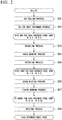
- a production method of the wire rod for a high strength steel cord in the embodiment of the present invention and a method for producing the filament for a high strength steel cord using the wire rod will be described with reference mainly to FIG. 2 .
- the billet contains, in the chemical composition, by mass%, C: 0.70% to 1.20%, Si: 0.15% to 0.60%, Mn: 0.10% to 1.00%, N: 0.0010% to 0.0050%, Al: more than 0% and 0.0100% or less, and a remainder of Fe and impurities.
- the billet may further contain, in the chemical composition, by mass%, one or two or more of Ti: more than 0% and 0.1000% or less, Cr: more than 0% and 0.5000% or less, Co: more than 0% and 0.5000% or less, V: more than 0% and 0.5000% or less, Cu: more than 0% and 0.2000% or less, Nb: more than 0% and 0.1000% or less, Mo: more than 0% and 0.2000% or less, W: more than 0% and 0.200% or less, B: more than 0% and 0.0030% or less, REM: more than 0% and 0.0050% or less, Ca: more than 0.0005% and 0.0050% or less, Mg: more than 0.0005% and 0.0050% or less, and Zr: more than 0.0005% and 0.0100% or less.
- Ti more than 0% and 0.1000% or less
- Cr more than 0% and 0.5000% or less
- Co more than 0% and 0.5000% or less
- V more than 0% and 0.5000% or
- the billet is heated to 950°C to 1250°C in a heating furnace and is subjected to hot finish rolling to a wire diameter of 3.5 mm to 8.0 mm in this process.
- the finish rolling temperature is 950°C to 1050°C, and a time needed for the finish rolling to a wire diameter of ⁇ 8 mm or less is 0.1 seconds to 10 seconds.
- the amount of decarburization from the surface layer is controlled by the heating furnace atmosphere, heating temperature, and heating time so that the C content in the vicinity of the surface layer of the wire rod after being rolled is 40% to 95% of the C content at the center O.
- FIG. 3 is a conceptual diagram showing the relationship between the C content of drawn pearlite steel and the thickness of lamellar cementite.
- the horizontal axis represents the C content
- the vertical axis represents the thickness of lamellar cementite.
- the C content increases toward the right in the horizontal axis
- the thickness of lamellar cementite increases upward in the vertical axis.
- the C content becomes different between the vicinity of the center of the wire rod and the surface part 21 after the hot rolling by controlling the decarburization content such that the central part 22 and the surface part 21 are formed.
- the finish rolled wire rod is wound at 900°C ⁇ 100°C, is air-cooled to 500°C to 600°C at 10 °C/s to 20 °C/s, and is held or subjected to DLP at 500°C to 600°C. While being held or subjected to DLP at 500°C to 600°C, the temperature of the center of the wire rod is 530°C to 630°C.
- the wire rod for a high strength steel cord in the embodiment of the present invention is produced.
- the wire rod for a high strength steel cord in the embodiment of the present invention which is produced through the hot rolling, is subjected to a chemical treatment such as pickling or a mechanical treatment to remove oxide scale formed on the surface thereof.
- the wire rod for a high strength steel cord in the embodiment of the present invention from which oxide scale has been removed is subjected to dry drawing, and therefore, a steel wire having a wire diameter of 1.0 mm to 3.5 mm is formed.
- Brass plating is performed on the surface of the steel wire for a high strength steel cord.
- a brass plating is formed to ensure the adhesion between rubber and a steel cord.
- FIG. 4 is a conceptual diagram showing the relationship between the wire drawing strain and the hardness.
- the horizontal axis represents the wire drawing strain
- the vertical axis represents the hardness.
- the wire drawing strain increases toward the right in the horizontal axis, and the hardness increases upward in the vertical axis.
- the wire rod for a high strength steel cord in the embodiment of the present invention has high strength and a significant effect of achieving excellent workability during twisting performed when a steel cord is produced.
- the wire diameter of the hot rolled wire rod or the wire diameter of the filament for a high strength steel cord are not limited to the following Examples as long as the wire diameters and the like are within the ranges of the embodiment.
- the description "---" indicates that the Al content is less than the limit of detection of Al.
- Wire rods for a high strength steel cord of Examples 1 to 24 of the present invention and Comparative Examples 25 to 34 were produced by the methods described in the hot rolling process S01 and the in-line heat treatment process S02.
- the center pearlite area fraction (%), the wire diameter R (mm), the thickness ( ⁇ m) of the surface part, the ratio (%) between the lamellar cementite thicknesses of the surface part and the central part, the tensile strength (MPa), the presence or absence of delamination after finish drawing, and the tensile strength (MPa) were evaluated.
- wet drawing was performed on the steel wire for a high strength steel cord subjected to the brass plating to achieve a wire diameter of 0.15 mm to 0.35 mm.
- the presence or absence of delamination was determined by conducting a torsion test on the filament.
- a torsion test is conducted on the filament, when delamination occurs, a fracture surface generated due to torsional fracture is not a shear fracture surface but a fractured surface generated along longitudinal cracks. Therefore, the presence or absence of delamination can be determined by visually determining the fractured shape of the steel wire formed due to torsional fracture.
- the tensile strength TS was obtained by a tensile test based on "Method of tensile test for metallic materials" in JIS Z 2241.
- the tensile strength of the wire rod was 1100 MPa or more, the delamination phenomenon had not occurred after the wire drawing was performed so that the wire diameter was 0.15 mm to 0.35 mm, and the tensile strength thereof was 3200 MPa or more, and therefore, the comprehensive evaluation was graded as good (G).
- Comparative Example 25 since the C content was 0.68% that is less than the lower limit, the center pearlite area fraction of the wire rod was 93% that is less than the lower limit, and the tensile strength of the wire rod was 1080 MPa that is a value less than 1100 MPa. In addition, the tensile strength was 3136 MPa that is a value less than 3200 MPa, after wire drawing was performed such that a wire diameter was 0.30 mm.
- Comparative Example 26 since the C content was 1.23% that is more than the upper limit, the tensile strength of the wire rod was 1530 MPa. However, delamination had occurred, after wire drawing was performed such that a wire diameter was 0.18 mm.
- Comparative Example 27 since the Si content was 0.12% that is less than the lower limit and the tensile strength of the wire rod was 1092 MPa that is a value less than 1100 MPa. In addition, the tensile strength was 3146 MPa that is a value less than 3200 MPa, after wire drawing was performed such that a wire diameter was 0.20 mm.
- the thickness of the surface part was 43 ⁇ m that is less than the lower limit and the ratio between the lamellar cementite thicknesses reached 96% that is a value more than 95%. As a result, delamination had occurred, after wire drawing was performed such that a wire diameter was 0.21 mm.
- the tensile strength of the wire rod was 1060 MPa that is a value less than 1100 MPa.
- the tensile strength was 3105 MPa that is a value less than 3200 MPa, after wire drawing was performed such that a wire diameter was 0.21 mm.
- the description "---" indicates that the Al content is less than the limit of detection of Al.
- Wire rods for a high strength steel cord of Examples 35 to 58 of the present invention and Comparative Examples 59 to 68 were produced by the methods described in the hot rolling process S01 and the in-line heat treatment process S02.
- the center pearlite area fraction (%), the wire diameter R (mm), the thickness ( ⁇ m) of the surface part, the ratio (%) between the lamellar cementite thicknesses of the surface part and the central part, the tensile strength (MPa), the presence or absence of delamination after finish drawing, and the tensile strength were evaluated.
- wet drawing was performed on the steel wire for a high strength steel cord subjected to the brass plating to achieve a wire diameter of 0.15 mm to 0.35 mm.
- the presence or absence of delamination was determined by conducting a torsion test on the steel wire.
- a fracture surface generated due to torsional fracture is not a shear fracture surface but a fractured surface generated along longitudinal cracks. Therefore, the presence or absence of delamination can be determined by visually determining the fractured shape of the steel wire formed due to torsional fracture.
- the tensile strength TS was obtained by a tensile test based on "Method of tensile test for metallic materials" in JIS Z 2241.
- the tensile strength of the wire rod was 1100 MPa or more, the delamination phenomenon had not occurred after the wire drawing was performed so that the wire diameter was 0.15 mm to 0.35 mm, and the tensile strength thereof was 3200 MPa or more, and therefore, the comprehensive evaluation was graded as good (G).
- Comparative Example 60 since the C content was 1.23% that is more than the upper limit, the tensile strength of the wire rod was 1650 MPa. However, delamination had occurred, after wire drawing was performed such that a wire diameter was 0.18 mm.
- the wire rod for a high strength steel cord of the present invention can be used to produce a filament for steel cord and a steel cord.
Landscapes
- Chemical & Material Sciences (AREA)
- Engineering & Computer Science (AREA)
- Organic Chemistry (AREA)
- Mechanical Engineering (AREA)
- Materials Engineering (AREA)
- Metallurgy (AREA)
- Thermal Sciences (AREA)
- Physics & Mathematics (AREA)
- Crystallography & Structural Chemistry (AREA)
- Manufacturing & Machinery (AREA)
- Heat Treatment Of Steel (AREA)
- Ropes Or Cables (AREA)
- Heat Treatment Of Strip Materials And Filament Materials (AREA)
Abstract
Description
- The present invention relates to a wire rod for a high strength steel cord, which is used as a reinforcing material of a rubber product such as a tire for a vehicle, a high pressure rubber hose, or a conveyor belt.
- Priority is claimed on Japanese Patent Application No.
2014-090601, filed on April 24, 2014 - For example, for a rubber product such as a tire for a vehicle; chemical fibers made of rayon, nylon, polyester, or the like; or steel cords produced from a wire rod may be used as a reinforcing material. Such a reinforcing material is used for the frame of a tire for a vehicle and has a significant effect on the fuel efficiency, high speed durability, and steering stability of the vehicle in which the tire for a vehicle is mounted. In recent years, from the viewpoint of improving these characteristics, the frequency of use of steel cords as the reinforcing material has increased.
- Here, for example, as disclosed in Patent Documents 6 and 7, a steel cord having a twisted structure made by twisting a plurality of steel wires (hereinafter, referred to as "filaments") has been widely proposed.
- The steel cord using these filaments is produced through the following process.
- First, dry drawing is performed on a wire rod having a wire diameter of 3.5 mm to 8.0 mm to produce a steel wire having a wire diameter of about 1.0 mm to 4.0 mm, and a heat treatment called a patenting treatment is performed on the steel wire to soften the steel wire.
- Next, a brass plating is formed on the surface of the softened steel wire to ensure the adhesion between rubber and the steel cord, and the resultant is subjected to wet drawing (finish drawing), thereby forming filaments having a wire diameter of 0.15 mm to 0.35 mm.
- The filaments obtained as described above are twisted to produce a steel cord having a twisted structure.
- In recent years, from the viewpoint of a reduction in environmental load, tires for vehicles have been reduced in weight in order to promote fuel economy in vehicles, and high-strengthening is required in the steel cord. Therefore, high-strengthening is required in the wire rod for the steel cord as a material.
- In order to form a high strength steel cord, high-strengthening is necessary after the patenting treatment, and high-strengthening is achieved through composition adjustment, such as increasing the C content.
- However, when high-strengthening is performed only through composition adjustment by increasing the C content, the ductility is insufficient during drawing after patenting, and thus workability deteriorates. Therefore, during wet drawing (finish drawing) and twisting, defects such as cracks are generated.
- Patent Document 1 discloses, for the purpose of inexpensively providing a high carbon steel wire rod having excellent drawability, in which wire breaking does not occur even when drawing is performed with a true strain amount of more than 2.60, and which is thus appropriate for use in a steel cord or the like, a wire rod in which the average value of C content in a region from the outer circumference to a position at a depth of 1/50 of the radius of the steel wire rod in a transverse section of a steel wire rod is 0.6 × C% to 0.9 × C% of the C content of the wire rod.
-
Patent Document 2 discloses, for the purpose of providing a wire rod which is less likely to cause wire breaking caused by flaws due to handling or the like during transportation, a high strength directly patented wire rod having a diameter of 4.0 mm to 16 mm, in which the carbon content of a layer at a depth of 300 µm from the surface layer is 0.97 times or less of the average carbon content of the entire cross section, and the surface layer having an average lamellar spacing of 95 nm or more in the above-mentioned layer is the layer where chafing martensite is less likely to be formed. -
Patent Document 3 discloses, for the purpose of providing a wire rod which has excellent cold workability and is thus appropriate as a production material of a steel cord or the like, a wire rod in which the size of pearlite blocks is controlled to be austenite grain size numbers 6 to 8 in the steel, the amount of generated proeutectoid cementite is controlled to be 0.2% or less by volume fraction, the thickness of cementite in pearlite is controlled to be 20 nm or less, and the Cr content of the cementite is controlled to be 1.5% or less. -
Patent Document 4 discloses a high carbon steel wire rod for drawing, in which, when the diameter of the high carbon steel wire rod is referred to as D, a region ranging from the surface of the high carbon steel wire rod to a depth of 0.05D or less is referred to as a surface part, a region deeper than 0.20D from the surface is referred to as an inside part, 90% or more of the structure of the surface part is a coarse lamellar pearlite structure having a lamellar spacing of 0.10 µm or more, and 95% or more of the structure of the inside part is a fine pearlite structure or a degenerate-pearlite structure having a lamellar spacing of less than 0.10 µm. - Patent Document 5 discloses a high carbon steel wire rod in which the area fraction of pearlite in a cross-section perpendicular to a longitudinal direction is 95% or more, the remainder therein has a non-pearlite structure including one or more of bainite, degenerate-pearlite, proeutectoid ferrite, and proeutectoid cementite, the average block grain size of pearlite is 15 µm to 35 µm, the area fraction of pearlite having a block grain size of 50 µm or more is 20% or less, and a region having a lamellar spacing of 150 nm or less in the pearlite is 20% or less in a region ranging from the surface to a depth of 1 mm.
-
- [Patent Document 1] Japanese Unexamined Patent Application, First Publication No.
2000-119805 - [Patent Document 2] Japanese Unexamined Patent Application, First Publication No.
2001-181793 - [Patent Document 3] Japanese Unexamined Patent Application, First Publication No.
2004-091912 - [Patent Document 4] Japanese Unexamined Patent Application, First Publication No.
2011-219829 - [Patent Document 5] PCT International Publication No.
WO2014/208492 - [Patent Document 6] Japanese Unexamined Patent Application, First Publication No.
2005-054260 - [Patent Document 7] Japanese Unexamined Patent Application, First Publication No.
2005-036356 - However, in a case where a steel cord is produced by using filaments produced using the wire rod disclosed in Patent Documents 1 to 5 or filaments disclosed in Patent Documents 6 and 7, there is a problem that a delamination phenomenon occurs in the filaments.
- A delamination phenomenon is a phenomenon in which longitudinal cracks that cause cracking in a longitudinal direction are generated when a steel wire or a filament is twisted and deformed, and easily occurs when the strength of the steel wire or the filament increases.
- Particularly, when the strength thereof increases, a twisting defect caused by the delamination phenomenon occurs, and the twisting cannot be properly performed.
- As described above, in the related art, a wire rod for a steel cord in which cracking or the like caused by the delamination phenomenon can be prevented while high strength and workability are maintained after the finish drawing process cannot be obtained.
- An object of the present invention is to provide a wire rod for a steel cord in which cracking or the like caused by a delamination phenomenon can be prevented while high strength and workability are maintained after a finish drawing process.
- The inventors conducted intensive research and development, and as a result, discovered the following. That is, when a wire rod for a steel cord has the following chemical composition, and has a surface part and a central part, and the surface part has a lower C content than that of the central part, and when thinning the lamellar cementite, lamellar cementite of the surface part of the filament for a steel cord is thinned, and cracks in cementite that become an origin of wire breaking become finer, and the ductility of the surface part can be significantly improved while ensuring the strength of the central part.
- The present invention has been made on the basis of the above-described knowledge, and the gist is as follows.
- (1) According to a first aspect of the present invention, there is provided a wire rod for a high strength steel cord, which has a wire diameter R of 3.5 mm to 8.0 mm and includes, in a chemical composition, by mass%: C: 0.70% to 1.20%; Si: 0.15% to 0.60%; Mn: 0.10% to 1.00%; N: 0.0010% to 0.0050%; Al: more than 0% and 0.0100% or less; and a remainder of Fe and impurities, in which a surface part and a central part are included, the surface part covers the central part, a thickness of the surface part is 50 µm to 0.20 × R, the central part includes a pearlite structure in a proportion of 95% to 100% by area%, a C content of the surface part is 40% to 95% of a C content of the central part, and a ratio of a thickness of lamellar cementite at the center of the thickness of the surface part to a thickness of lamellar cementite in the central part is 95% or less.
- (2) In the aspect of (1), the wire rod may further include, in the chemical composition, by mass%, one or two or more of Ti: more than 0% and 0.1000% or less, Cr: more than 0% and 0.5000% or less, Co: more than 0% and 0.5000% or less, V: more than 0% and 0.5000% or less, Cu: more than 0% and 0.2000% or less, Nb: more than 0% and 0.1000% or less, Mo: more than 0% and 0.2000% or less, W: more than 0% and 0.200% or less, B: more than 0% and 0.0030% or less, REM: more than 0% and 0.0050% or less, Ca: more than 0.0005% and 0.0050% or less, Mg: more than 0.0005% and 0.0050% or less, and Zr: more than 0.0005% and 0.0100% or less.
- In the wire rod for a high strength steel cord according to the aspect of the present invention, the ductility of the surface part is improved, the strength of the central part is ensured and the tensile strength of the wire rod for a high strength steel cord is 1100 MPa or more, therefore, after the wire rod for a high strength steel cord is subjected to wire drawing so that the wire diameter is 0.15 mm to 0.35 mm, a significant effect of suppressing the occurrence of a delamination phenomenon, preventing the occurrence of a twisting defect, and achieving a tensile strength of 3200 MPa or more can be exhibited.
-
-
FIG. 1 is a view illustrating a cross section of a wire rod for a high strength steel cord in an embodiment of the present invention. -
FIG. 2 is a flowchart illustrating a production method of the wire rod for a high strength steel cord in the embodiment of the present invention. -
FIG. 3 is a conceptual diagram showing the relationship between the C content of drawn pearlite steel and the thickness of lamellar cementite. -
FIG. 4 is a conceptual diagram showing the relationship between the wire drawing strain and the hardness. -
FIG. 5 is a view showing a method of measuring the thickness of lamellar cementite of the wire rod for a high strength steel cord in the embodiment of the present invention using a cross-sectional view of the wire rod for a high strength steel cord in the embodiment of the present invention. - In an embodiment of the present invention, there is provided a wire rod for a high strength steel cord described in the following (A) or (B).
- (A) A first aspect of the present invention is a wire rod for a high strength steel cord, which has a wire diameter R of 3.5 mm to 8.0 mm and includes, in a chemical composition, by mass%: C: 0.70% to 1.20%; Si: 0.15% to 0.60%; Mn: 0.10% to 1.00%; N: 0.0010% to 0.0050%; Al: more than 0% and 0.0100% or less; and a remainder of Fe and impurities, in which a surface part and a central part are included, the surface part covers the central part, a thickness of the surface part is 50 µm to 0.20 × R, the central part includes a pearlite structure in a proportion of 95% to 100% by area%, a C content of the surface part is 40% to 95% of a C content of the central part, and a ratio of a thickness of lamellar cementite at the center of the thickness of the surface part to a thickness of lamellar cementite in the central part is 95% or less.
- (B) In the aspect of (A) described above, the wire rod may further include, in the chemical composition, by mass%, one or two or more of Ti: more than 0% and 0.1000% or less, Cr: more than 0% and 0.5000% or less, Co: more than 0% and 0.5000% or less, V: more than 0% and 0.5000% or less, Cu: more than 0% and 0.2000% or less, Nb: more than 0% and 0.1000% or less, Mo: more than 0% and 0.2000% or less, W: more than 0% and 0.200% or less, B: more than 0% and 0.0030% or less, REM: more than 0% and 0.0050% or less, Ca: more than 0.0005% and 0.0050% or less, Mg: more than 0.0005% and 0.0050% or less, and Zr: more than 0.0005% and 0.0100% or less.
- The properties of the metallographic structure of the wire rod for a high strength steel cord in the embodiment will be described with reference to
FIG. 1 . - In a
wire rod 20 for a high strength steel cord in the embodiment of the present invention, a wire diameter R as its diameter (hereinafter, referred to as a "wire diameter") R satisfies
surface part 21 and acentral part 22 are included. Preferably,
- Since the surface part of the steel wire or the filament is mainly deformed during finish drawing performed in the process that the filament is produced by using the wire rod or during twisting performed when a steel cord is produced from the filament, the inventors have focused on that it is necessary for the surface part of the wire rod for a steel cord, which is a material of the steel wire or the filament, to have a good workability.
- As illustrated in
FIG. 1 , thesurface part 21 is a part having a thickness t from the outer circumferential surface of thewire rod 20 for a high strength steel cord. In addition, the thickness (hereinafter, referred to as the "thickness of the surface part") t of thesurface part 21 is a region in a range of
- with respect to the wire diameter R of the
wire rod 20 for a high strength steel cord. Preferably,
- The
surface part 21 has a lower C content than that of thecentral part 22 and has a C content of 40% to 95% of the C content of the center O of thewire rod 20 for a high strength steel cord. - The reason that the thickness t of the surface part is set to 50 µm to 0.2 × R of the wire diameter R will be described.
- First, when the thickness t of the surface part is set to 50 µm or more, workability can be sufficiently ensured, and the generation of defects such as cracks during finish drawing and twisting can be suppressed.
- Second, when the thickness t of the surface part is set to 0.2 × R or less, the strength of the steel cord can be sufficiently ensured.
- Next, a position at a depth of t/2 from the outer circumferential surface, which is indicated by a dotted line in
FIG. 1 is defined as the center of the thickness of the surface part (hereinafter, referred to as the "center of the surface part"). - The thickness of lamellar cementite at the center of the surface part is 95% or less of the thickness of lamellar cementite in the central part, which will be described later.
- The lamellar cementite means cementite having layered structure in the pearlite structure.
- The
central part 22 includes the center O of thewire rod 20 for a high strength steel cord and is a part excluding the surface part. - The
central part 22 has a substantially constant C content and is a region having a metallographic structure including a pearlite structure in a proportion of 95% to 100% by area%. - Accordingly, the strength of the
central part 22 is sufficiently ensured, and it becomes possible to achieve a reduction in the weight of the steel cord. - Regarding the thickness of lamellar cementite, the transverse section of the wire rod is etched with picral to reveal the pearlite structure, eight points at every central angle of 45° in the cross section of a wire rod at the same depth from the surface layer were photographed with a FE-SEM at a magnification of 10,000-fold, the thickness of lamellar cementite was obtained in each visual field from lamellar cementite perpendicularly intersecting a line segment of 2 µm in the minimum lamellar spacing part of the observation photograph, and the average value of the eight points was determined.
- In addition, the ratio (%) of the thickness of lamellar cementite in the surface part obtained as described above to the thickness of lamellar cementite in the central part of the filament was obtained.
- Hereinafter, measurement points will be described with reference to
FIG. 5 . -
FIG. 5 is a view illustrating a method of measuring the thickness of lamellar cementite of the wire rod for a high strength steel cord in the embodiment of the present invention using a cross-sectional view of the wire rod for a high strength steel cord in the embodiment of the present invention. - In the cross-sectional view of the
wire rod 20 for a high strength steel cord in the embodiment of the present invention, eight dotted lines are drawn in a radial direction from the center at every central angle of 45°, eightblack circles 26 are measurement points of the central part, and eightwhite circles 25 are measurement points of the surface part. - When it is assumed that the average value of the thicknesses of lamellar cementite of the surface part is ds and the average value of the thicknesses of lamellar cementite in the central part is di, the ratio p of the thickness of lamellar cementite at the center of the thickness of the surface part to the thickness of lamellar cementite in the central part is obtained as below.

- The feature of the wire rod for a high strength steel cord in the embodiment of the present invention is that p is 95% or less and the lower limit of p is 50% or preferably 60%.
- In the wire rod for a high strength steel cord in the embodiment of the present invention, the ductility of the surface part is improved and the strength of the central part is ensured, therefore, the wire rod for a high strength steel cord in the embodiment of the present invention has a significant effect of achieving excellent workability during finish drawing performed in the process that a filament is produced by using the wire rod or during twisting performed when a steel cord is produced from the filament.
- The wire rod includes, in the chemical composition, by mass%, C: 0.70% to 1.20%, Si: 0.15% to 0.60%, Mn: 0.10% to 1.00%, N: 0.0010% to 0.0050%, Al: more than 0% and 0.0100% or less, and a remainder of Fe and impurities.
- The wire rod may further include, in the chemical composition, by mass%, one or two or more of Ti: more than 0% and 0.1000% or less, Cr: more than 0% and 0.5000% or less, Co: more than 0% and 0.5000% or less, V: more than 0% and 0.5000% or less, Cu: more than 0% and 0.2000% or less, Nb: more than 0% and 0.1000% or less, Mo: more than 0% and 0.2000% or less, W: more than 0% and 0.200% or less, B: more than 0% and 0.0030% or less, REM: more than 0% and 0.0050% or less, Ca: more than 0.0005% and 0.0050% or less, Mg: more than 0.0005% and 0.0050% or less, and Zr: more than 0.0005% and 0.0100% or less.
- It will be described in detail chemical composition as below. Hereinafter, it will be described in terms of mass%.
- C is an element that improves the strength of steel. In order to obtain a pearlite structure which is a eutectoid structure, the C content is preferably set to about 0.8%. Here, when the C content is less than 0.70%, a hypoeutectoid structure is formed, and a non-pearlite structure is present in a large proportion. On the other hand, when the C content is more than 1.20%, proeutectoid cementite is precipitated, and there is concern that the workabilities of the wire rod, the steel wire manufactured from the wire rod and the filament may be deteriorated. Therefore, the C content is set to be in a range of 0.70% to 1.20%.
- Si is an element that is effective in deoxidizing the steel, and is an element having a function of improving strength by being solid-solutionized in ferrite. Here, when the Si content is less than 0.15%, there is concern that the above-described operational effect cannot be sufficiently exhibited. On the other hand, when the Si content is more than 0.60%, there is concern that workability may be deteriorated. Therefore, the Si content is set to be in a range of 0.15% to 0.60%.
- Mn is an element that is effective in deoxidizing the steel and has an operational effect of fixing S in the steel and thus suppressing the embrittlement of the steel. Here, when the Mn content is less than 0.10%, there is concern that the above-described effect cannot be sufficiently exhibited. On the other hand, when the Mn content is more than 1.00%, there is concern that workability may be deteriorated.
- Therefore, the Mn content is set to be in a range of 0.10% to 1.00%.
- N is an element that forms nitrides of Al and Ti and has an operational effect of suppressing coarsening of an austenite grain size. Here, when the N content is less than 0.0010%, there is concern that the above-described operational effect cannot be sufficiently exhibited. On the other hand, when the N content is more than 0.0050%, there is concern that ductility may be deteriorated.
- Therefore, the N content is set to be in a range of 0.0010% to 0.0050%.
- Al is an element having a deoxidizing action. The Al content is set to be more than 0% and 0.010% or less so as not to allow the generation of hard and non-deformable alumina-based inclusions, which may cause the deterioration in the ductility of the wire rod and the deterioration in drawability.
- In addition, the limit of detection of Al is less than 0.001%.
- In addition, the amounts of P and S which are impurities are not particularly specified and are preferably set to 0.0200% or less from the viewpoint of ensuring ductility to the same degree as that of a filament in the related art.
- In addition to the base elements and impurity elements mentioned above, a
wire rod 20 for a high strength steel cord according to the embodiment may further contain, as selective elements, at least one of Ti, Cr, Co, V, Cu, Nb, Mo, W, B, REM, Ca, Mg, and Zr. Hereinafter, the range limits of the numerical values of the selective elements and the reason for the limitation will be described. Here, % described herein indicates mass%. - Ti is an element having a deoxidizing action. In addition, Ti has an operational effect of forming nitrides and suppressing coarsening of the austenite grain size.
- Here, when the Ti content is more than 0.1000%, there is concern that workability may be deteriorated due to coarse carbonitrides (TiCN and the like).
- When the Ti content is less than 0.005%, there is concern that the above-described operational effect cannot be sufficiently exhibited, therefore, the Ti content is typically set to 0.005% or more. However, in a case where Al is contained, the Ti content may be set to be less than 0.0050%.
- Therefore, the Ti content is set to be in a range of more than 0% and 0.1000% or less. The Ti content is more preferably in a range of 0.0050% to 0.1000%.
- Cr makes the lamellar spacing of pearlite finer and improves the strength of the wire rod. In order to obtain this effect, the Cr content is preferably more than 0% and 0.5000% or less.
- The Cr content is more preferably 0.0010% to 0.5000%. When the Cr content is more than 0.5000%, pearlitic transformation is excessively suppressed, and there is concern that austenite may remain in the metallographic structure of the wire rod during a patenting treatment and supercooled structures such as martensite and bainite may be generated in the metallographic structure of the wire rod after the patenting treatment. In addition, there may be cases where it becomes difficult to remove surface oxides by mechanical descaling.
- Co is an element that suppresses precipitation of proeutectoid cementite. In order to obtain this effect, the Co content is preferably more than 0% and 0.5000% or less. The Co content is more preferably 0.0010% to 0.5000%. When the Co content is more than 0.5000%, this effect is saturated, and there may be cases where the cost for the inclusion of Co outweighs the benefits.
- V is an element that forms fine carbonitrides, suppresses coarsening of austenite grains in a high temperature range, and improves the strength of the wire rod. In order to obtain these effects, the V content is preferably more than 0% and 0.5000% or less.
- The V content is more preferably 0.0010% to 0.5000%. When the V content is more than 0.5000%, the amount of formed carbonitrides increases, and the particle size of the carbonitrides increases, therefore, there may be cases where the ductility of the wire rod is deteriorated.
- Cu is an element that improves corrosion resistance. In order to obtain this effect, the Cu content is preferably more than 0% and 0.2000% or less.
- The Cu content is more preferably 0.0001% to 0.2000%. When the Cu content is more than 0.2000%, Cu reacts with S and is segregated in the grain boundaries as CuS, and there may be cases where flaws occur in the wire rod.
- Nb has an effect of improving corrosion resistance. In addition, Nb is an element that forms carbides or nitrides, and suppresses coarsening of austenite grains in a high temperature range. In order to obtain these effects, the Nb content is preferably more than 0% and 0.1000% or less.
- The Nb content is more preferably 0.0005% to 0.1000%.
- When the Nb content is more than 0.1000%, there may be cases where pearlitic transformation is suppressed during the patenting treatment.
- Mo is an element that is concentrated at the pearlite growth interface and suppresses the growth of pearlite due to a so-called solute drag effect. In addition, Mo is an element that suppresses the generation of ferrite and reduces the non-pearlite structure. In order to obtain these effects, the Mo content is preferably more than 0% and 0.2000% or less.
- The Mo content is more preferably 0.0010% to 0.2000%.
- The Mo content is even more preferably 0.005% to 0.0600%.
- When the Mo content is more than 0.2000%, the growth of pearlite is suppressed, and it takes a long time to perform the patenting treatment, therefore, there may be cases where productivity may be deteriorated.
- In addition, when the Mo content is more than 0.2000%, coarse Mo2C carbides are precipitated, and there may be cases where drawability is deteriorated.
- Like Mo, W is an element that is concentrated at the pearlite growth interface and suppresses the growth of pearlite due to the so-called solute drag effect. In addition, W is an element that suppresses the generation of ferrite and reduces the non-pearlite structure. In order to obtain these effects, the W content is preferably more than 0% and 0.2000% or less.
- The W content is more preferably 0.0005% to 0.2000%.
- The W content is even more preferably 0.0050% to 0.0600%.
- When the W content is more than 0.20%, the growth of pearlite is suppressed, and it takes a long time to perform the patenting treatment, therefore, there may be cases where productivity may be deteriorated. In addition, when the W content is more than 0.2000%, coarse W2C carbides are precipitated, and there may be cases where drawability is deteriorated.
- B is an element that suppresses the generation of non-pearlite such as ferrite, degenerate-pearlite, and bainite. In addition, B is an element that forms carbides or nitrides, and suppresses coarsening of austenite grains in a high temperature range. In order to obtain these effects, the B content is preferably more than 0% and 0.0030% or less.
- The B content is more preferably 0.0004% to 0.0025%.
- The B content is even more preferably 0.0004% to 0.0015%.
- The B content is most preferably 0.0006% to 0.0012%.
- When the B content is more than 0.0030%, the precipitation of coarse Fe23(CB)6 carbides is promoted, and there may be cases where ductility is adversely affected.
- Rare earth metal (REM) is a deoxidizing element. In addition, REM is an element that forms sulfides and detoxifies S which is an impurity. In order to obtain this effect, the REM content is preferably more than 0% and 0.0050% or less.
- The REM content is more preferably 0.0005% to 0.0050%.
- When the REM content is more than 0.0050%, coarse oxides are formed, and there may be cases where wire breaking occurs during drawing. In addition, REM is a generic term for a total of 17 elements including 15 elements from lanthanum with atomic number 57 to lutetium with atomic number 71, scandium with
atomic number 21, and yttrium with atomic number 39. Typically, REM is supplied in the form of mischmetal which is a mixture of these elements and is added to the steel. - Ca is an element that reduces hard alumina-based inclusions. In addition, Ca is an element that forms fine oxides. As a result, the pearlite block size of the wire rod becomes finer, and the ductility of the wire rod is improved. In order to obtain these effects, the Ca content is preferably more than 0.0005% and 0.0050% or less.
- The Ca content is more preferably 0.0005% to 0.0040%.
- When the Ca content is more than 0.0050%, coarse oxides are formed, and there may be cases where wire breaking occurs during drawing. In addition, in typical operational conditions, Ca is unavoidably contained at an amount of about 0.0003%.
- Mg is an element that forms fine oxides in the steel. As a result, the pearlite block size of the wire rod becomes finer, and the ductility of the wire rod is improved. In order to obtain this effect, the Mg content is preferably more than 0.0005% and 0.0050% or less.
- The Mg content is more preferably more than 0.0005% and 0.0040% or less.
- When the Mg content is more than 0.0050%, coarse oxides are formed, and there may be cases where wire breaking occurs during drawing.
- In addition, in typical operational conditions, Mg is unavoidably contained at an amount of about 0.0001 %.
- Zr is crystallized as ZrO and becomes the crystallization nucleus of austenite and is thus an element that increases the equiaxed austenite ratio and makes austenite grains finer.
- As a result, the pearlite block size of the wire rod becomes finer, and the ductility of the wire rod is improved. In order to obtain this effect, the Zr content is preferably more than 0.0005% and 0.0100% or less.
- The Zr content is more preferably 0.0005% to 0.0050%.
- When the Zr content is more than 0.010%, coarse oxides are formed, and there may be cases where wire breaking occurs during drawing.
- Since the chemical composition and the metallographic structure are employed, the central part of the wire rod for a high strength steel cord in the embodiment includes the pearlite structure in a proportion of 95% to 100% by area%, and thus the central part ensures sufficient strength and has excellent ductility.
- As a result, for example, after wire drawing is performed so that the wire diameter is 0.15 mm to 0.35 mm, the occurrence of a delamination phenomenon is suppressed, the occurrence of a twisting defect can be prevented, and a reduction in the weight of the steel cord can be achieved.
- A production method of the wire rod for a high strength steel cord in the embodiment of the present invention and a method for producing the filament for a high strength steel cord using the wire rod will be described with reference mainly to
FIG. 2 . - In order to produce the wire rod for a high strength steel cord in the embodiment of the present invention, a billet adjusted to the following chemical composition is used.
- For example, the billet contains, in the chemical composition, by mass%, C: 0.70% to 1.20%, Si: 0.15% to 0.60%, Mn: 0.10% to 1.00%, N: 0.0010% to 0.0050%, Al: more than 0% and 0.0100% or less, and a remainder of Fe and impurities.
- The billet may further contain, in the chemical composition, by mass%, one or two or more of Ti: more than 0% and 0.1000% or less, Cr: more than 0% and 0.5000% or less, Co: more than 0% and 0.5000% or less, V: more than 0% and 0.5000% or less, Cu: more than 0% and 0.2000% or less, Nb: more than 0% and 0.1000% or less, Mo: more than 0% and 0.2000% or less, W: more than 0% and 0.200% or less, B: more than 0% and 0.0030% or less, REM: more than 0% and 0.0050% or less, Ca: more than 0.0005% and 0.0050% or less, Mg: more than 0.0005% and 0.0050% or less, and Zr: more than 0.0005% and 0.0100% or less.
- The billet is heated to 950°C to 1250°C in a heating furnace and is subjected to hot finish rolling to a wire diameter of 3.5 mm to 8.0 mm in this process. The finish rolling temperature is 950°C to 1050°C, and a time needed for the finish rolling to a wire diameter of ϕ 8 mm or less is 0.1 seconds to 10 seconds.
- During heating in the heating furnace, the amount of decarburization from the surface layer is controlled by the heating furnace atmosphere, heating temperature, and heating time so that the C content in the vicinity of the surface layer of the wire rod after being rolled is 40% to 95% of the C content at the center O.
-
FIG. 3 is a conceptual diagram showing the relationship between the C content of drawn pearlite steel and the thickness of lamellar cementite. InFIG. 3 , the horizontal axis represents the C content, and the vertical axis represents the thickness of lamellar cementite. The C content increases toward the right in the horizontal axis, and the thickness of lamellar cementite increases upward in the vertical axis. - In the the filament for a high strength steel cord in the embodiment of the present invention, as illustrated in
FIG. 3 , the C content becomes different between the vicinity of the center of the wire rod and thesurface part 21 after the hot rolling by controlling the decarburization content such that thecentral part 22 and thesurface part 21 are formed. - The finish rolled wire rod is wound at 900°C ± 100°C, is air-cooled to 500°C to 600°C at 10 °C/s to 20 °C/s, and is held or subjected to DLP at 500°C to 600°C. While being held or subjected to DLP at 500°C to 600°C, the temperature of the center of the wire rod is 530°C to 630°C.
- The inventors found that in this in-line heat treatment process, the ratio of the thickness of lamellar cementite at the center of the thickness of the surface part of the wire rod to the thickness of lamellar cementite in the central part of the wire rod reaches 95% or less.
- As described above, in the hot rolling process S01 and the in-line heat treatment process S02, the wire rod for a high strength steel cord in the embodiment of the present invention is produced.
- Although subsequent processes are the process that produces the filament for a high strength steel cord by using the wire rod for a high strength steel cord in the embodiment of the present invention, it will be described so as to understand the influence that the feature of the
central part 22 and thesurface part 21 of the wire rod for a high strength steel cord in the embodiment of the present invention affects the filament for a high strength steel cord. - Next, the wire rod for a high strength steel cord in the embodiment of the present invention, which is produced through the hot rolling, is subjected to a chemical treatment such as pickling or a mechanical treatment to remove oxide scale formed on the surface thereof.
- Next, the wire rod for a high strength steel cord in the embodiment of the present invention from which oxide scale has been removed is subjected to dry drawing, and therefore, a steel wire having a wire diameter of 1.0 mm to 3.5 mm is formed.
- Next, after the steel wire formed through the rough drawing process S04 is heated to 850°C to 1000°C, and a patenting treatment is immediately performed under a temperature condition of 530°C to 580°C so that the steel wire is high-strengthened.
- Even after the patenting process, a state in which the C content of the surface part of the wire rod for a high strength steel cord in the embodiment of the present invention is low continues, and the C content of the surface part of the steel wire for a high strength steel cord is low and lamellar cementite of the surface part is fine even in the steel wire for a high strength steel cord.
- Brass plating is performed on the surface of the steel wire for a high strength steel cord. A brass plating is formed to ensure the adhesion between rubber and a steel cord.
- Then, wet drawing is performed on the steel wire for a high strength steel cord subjected to the brass plating to achieve a wire diameter of 0.15 mm to 0.35 mm. Accordingly, the filament for a high strength steel cord is produced.
-
FIG. 4 is a conceptual diagram showing the relationship between the wire drawing strain and the hardness. InFIG. 4 , the horizontal axis represents the wire drawing strain, and the vertical axis represents the hardness. The wire drawing strain increases toward the right in the horizontal axis, and the hardness increases upward in the vertical axis. - As shown in
FIG. 4 , in a case where the steel wire produced by using the wire rod for a high strength steel cord in the embodiment of the present invention having acentral part 22 and asurface part 21 is subjected to the finish drawing, the difference in the hardness between the central part and the surface part is increased. - Next, twisting is performed using a plurality of filaments for a high strength steel cord. Accordingly, a high strength steel cord having a twisted structure is produced.
- In the wire rod for a high strength steel cord in the embodiment of the present invention, the ductility of the surface part is improved and the strength of the central part is ensured, therefore, the wire rod for a high strength steel cord in the embodiment of the present invention has high strength and a significant effect of achieving excellent workability during twisting performed when a steel cord is produced.
- While the wire rod for a high strength steel cord in the embodiment of the present invention has been described above, the wire diameter of the hot rolled wire rod or the wire diameter of the filament for a high strength steel cord are not limited to the following Examples as long as the wire diameters and the like are within the ranges of the embodiment.
- In a case where C: 0.70% to 1.20%, Si: 0.15% to 0.60%, Mn: 0.10% to 1.00%, N: 0.0010% to 0.0050%, Al: more than 0% and 0.0100% or less, and a remainder of Fe and impurities are included in the chemical composition by mass%, the effects of the present invention will be described using Examples of the present invention and Comparative Examples.
- In Table 1, the chemical compositions of Examples of the present invention and Comparative Examples are shown.
- Regarding the Al composition in Table 1, the description "---" indicates that the Al content is less than the limit of detection of Al.

- Wire rods for a high strength steel cord of Examples 1 to 24 of the present invention and Comparative Examples 25 to 34 were produced by the methods described in the hot rolling process S01 and the in-line heat treatment process S02.
- For the obtained wire rod for a high strength steel cord, the center pearlite area fraction (%), the wire diameter R (mm), the thickness (µm) of the surface part, the ratio (%) between the lamellar cementite thicknesses of the surface part and the central part, the tensile strength (MPa), the presence or absence of delamination after finish drawing, and the tensile strength (MPa) were evaluated.
- During the finish drawing, wet drawing was performed on the steel wire for a high strength steel cord subjected to the brass plating to achieve a wire diameter of 0.15 mm to 0.35 mm.
- In addition, the presence or absence of delamination was determined by conducting a torsion test on the filament. In a case where a torsion test is conducted on the filament, when delamination occurs, a fracture surface generated due to torsional fracture is not a shear fracture surface but a fractured surface generated along longitudinal cracks. Therefore, the presence or absence of delamination can be determined by visually determining the fractured shape of the steel wire formed due to torsional fracture.
- In addition, the tensile strength TS was obtained by a tensile test based on "Method of tensile test for metallic materials" in JIS Z 2241.

- The evaluation results are shown in Table 2.
- In Examples 1 to 24 of the present invention, the tensile strength of the wire rod was 1100 MPa or more, the delamination phenomenon had not occurred after the wire drawing was performed so that the wire diameter was 0.15 mm to 0.35 mm, and the tensile strength thereof was 3200 MPa or more, and therefore, the comprehensive evaluation was graded as good (G).
- The comprehensive evaluation of Comparative Examples 25 to 34 was graded as bad (B). Hereinafter, the reason that the comprehensive evaluation of Comparative Examples 25 to 34 was graded as bad (B) will be described.
- In Comparative Example 25, since the C content was 0.68% that is less than the lower limit, the center pearlite area fraction of the wire rod was 93% that is less than the lower limit, and the tensile strength of the wire rod was 1080 MPa that is a value less than 1100 MPa. In addition, the tensile strength was 3136 MPa that is a value less than 3200 MPa, after wire drawing was performed such that a wire diameter was 0.30 mm.
- In Comparative Example 26, since the C content was 1.23% that is more than the upper limit, the tensile strength of the wire rod was 1530 MPa. However, delamination had occurred, after wire drawing was performed such that a wire diameter was 0.18 mm.
- In Comparative Example 27, since the Si content was 0.12% that is less than the lower limit and the tensile strength of the wire rod was 1092 MPa that is a value less than 1100 MPa. In addition, the tensile strength was 3146 MPa that is a value less than 3200 MPa, after wire drawing was performed such that a wire diameter was 0.20 mm.
- In Comparative Example 28, since the Si content was 0.65% that is more than the upper limit, delamination had occurred, after wire drawing was performed such that a wire diameter was 0.20 mm.
- In Comparative Example 29, since the Mn content was 0.09% that is less than the lower limit, delamination had occurred, after wire drawing was performed such that a wire diameter was 0.23 mm.
- In Comparative Example 30, since the Mn content was 1.05% that is more than the upper limit, delamination had occurred, after wire drawing was performed such that a wire diameter was 0.25 mm.
- In Comparative Example 31, since the Al content was 0.012% that is more than the upper limit, delamination had occurred, after wire drawing was performed such that a wire diameter was 0.21 mm.
- In Comparative Example 32, since the N content was 0.0055% that is more than the upper limit, delamination had occurred, after wire drawing was performed such that a wire diameter was 0.18 mm.
- In Comparative Example 33, the thickness of the surface part was 43 µm that is less than the lower limit and the ratio between the lamellar cementite thicknesses reached 96% that is a value more than 95%. As a result, delamination had occurred, after wire drawing was performed such that a wire diameter was 0.21 mm.
- In Comparative Example 34, since the thickness of the surface part was 1125 µm that is more than the upper limit, the tensile strength of the wire rod was 1060 MPa that is a value less than 1100 MPa. As a result, the tensile strength was 3105 MPa that is a value less than 3200 MPa, after wire drawing was performed such that a wire diameter was 0.21 mm.
- In a case where one or two or more of Ti: more than 0% and 0.1000% or less, Cr: more than 0% and 0.5000% or less, Co: more than 0% and 0.5000% or less, V: more than 0% and 0.5000% or less, Cu: more than 0% and 0.2000% or less, Nb: more than 0% and 0.1000% or less, Mo: more than 0% and 0.2000% or less, W: more than 0% and 0.200% or less, B: more than 0% and 0.0030% or less, REM: more than 0% and 0.0050% or less, Ca: more than 0.0005% and 0.0050% or less, Mg: more than 0.0005% and 0.0050% or less, and Zr: more than 0.0005% and 0.0100% or less are further included in the chemical composition by mass%, the effects of the present invention will be described using Examples of the present invention and Comparative Examples.
- In Table 3, the chemical compositions of Examples of the present invention and Comparative Examples are shown.
- Regarding the Al composition in Table 3, the description "---" indicates that the Al content is less than the limit of detection of Al.
- In Table 3, in the chemical composition other than Al, the description "---" indicates that the corresponding element is not contained.

- Wire rods for a high strength steel cord of Examples 35 to 58 of the present invention and Comparative Examples 59 to 68 were produced by the methods described in the hot rolling process S01 and the in-line heat treatment process S02.
- For the obtained wire rod for a high strength steel cord, the center pearlite area fraction (%), the wire diameter R (mm), the thickness (µm) of the surface part, the ratio (%) between the lamellar cementite thicknesses of the surface part and the central part, the tensile strength (MPa), the presence or absence of delamination after finish drawing, and the tensile strength were evaluated.
- During the finish drawing, wet drawing was performed on the steel wire for a high strength steel cord subjected to the brass plating to achieve a wire diameter of 0.15 mm to 0.35 mm.
- In addition, the presence or absence of delamination was determined by conducting a torsion test on the steel wire. In a case where a torsion test is conducted on the steel wire in which delamination occurs, a fracture surface generated due to torsional fracture is not a shear fracture surface but a fractured surface generated along longitudinal cracks. Therefore, the presence or absence of delamination can be determined by visually determining the fractured shape of the steel wire formed due to torsional fracture.
- In addition, the tensile strength TS was obtained by a tensile test based on "Method of tensile test for metallic materials" in JIS Z 2241.

- The evaluation results are shown in Table 4.
- In Examples 35 to 58 of the present invention, the tensile strength of the wire rod was 1100 MPa or more, the delamination phenomenon had not occurred after the wire drawing was performed so that the wire diameter was 0.15 mm to 0.35 mm, and the tensile strength thereof was 3200 MPa or more, and therefore, the comprehensive evaluation was graded as good (G).
- The comprehensive evaluation of Comparative Examples 59 to 68 was graded as bad (B). Hereinafter, the reason that the comprehensive evaluation of Comparative Examples 59 to 68 was graded as bad (B) will be described.
- In Comparative Example 59, since the C content was 0.68% that is less than the lower limit, the center pearlite area fraction of the wire rod was 94% that is less than the lower limit and the tensile strength of the wire rod was 1080 MPa that is a value less than 1100 MPa. As a result, the tensile strength was 3156 MPa that is a value less than 3200 MPa, after wire drawing was performed such that a wire diameter was 0.30 mm.
- In Comparative Example 60, since the C content was 1.23% that is more than the upper limit, the tensile strength of the wire rod was 1650 MPa. However, delamination had occurred, after wire drawing was performed such that a wire diameter was 0.18 mm.
- In Comparative Example 61, since the Si content was 0.12% that is less than the lower limit, the tensile strength of the wire rod was 1095 MPa that is a value less than 1100 MPa. As a result, the tensile strength was 3166 MPa that is a value less than 3200 MPa, after wire drawing was performed such that a wire diameter was 0.20 mm.
- In Comparative Example 62, since the Si content was 0.65% that is more than the upper limit, delamination had occurred, after wire drawing was performed such that a wire diameter was 0.20 mm.
- In Comparative Example 63, since the Mn content was 0.09% that is less than the lower limit, delamination had occurred, after wire drawing was performed such that a wire diameter was 0.23 mm.
- In Comparative Example 64, since the Mn content was 1.05% that is more than the upper limit, delamination had occurred, after wire drawing was performed such that a wire diameter was 0.25 mm.
- In Comparative Example 65, since the Al content was 0.012% that is more than the upper limit, delamination had occurred, after wire drawing was performed such that a wire diameter was 0.21 mm.
- In Comparative Example 66, since the N content was 0.0055% that is more than the upper limit, the ratio between the lamellar cementite thicknesses reached 96% that is a value more than 95%. As a result, delamination had occurred, after wire drawing was performed such that a wire diameter was 0.18 mm.
- In Comparative Example 67, since the thickness of the surface part was 45 µm that is less than the lower limit, delamination had occurred, after wire drawing was performed such that a wire diameter was 0.21 mm.
- In Comparative Example 68, since the thickness of the surface part was 1128 µm that is more than the upper limit, the tensile strength of the wire rod was 1070 MPa that is a value less than 1100 MPa. As a result, the tensile strength was 3125 MPa that is a value less than 3200 MPa, after wire drawing was performed such that a wire diameter was 0.21 mm.
- The wire rod for a high strength steel cord of the present invention can be used to produce a filament for steel cord and a steel cord.
-
- 20:
- WIRE ROD FOR HIGH STRENGTH STEEL CORD
- 21:
- SURFACE PART
- 22:
- CENTRAL PART
- 25:
- MEASUREMENT POINT OF SURFACE PART
- 26:
- MEASUREMENT POINT OF CENTRAL PART
Claims (2)
- A wire rod for a high strength steel cord, which has a wire diameter R of 3.5 mm to 8.0 mm, comprising, in a chemical composition, by mass%:C: 0.70% to 1.20%;Si: 0.15% to 0.60%;Mn: 0.10% to 1.00%;N: 0.0010% to 0.0050%;Al: more than 0% and 0.0100% or less; anda remainder of Fe and impurities,
wherein a surface part and a central part are included, the surface part covers the central part,
a thickness of the surface part is 50 µm to 0.20 × R,
the central part includes a pearlite structure in a proportion of 95% to 100% by area%,
a C content of the surface part is 40% to 95% of a C content of the central part,
and
a ratio of a thickness of a lamellar cementite at a center of the thickness of the surface part to a thickness of a lamellar cementite in the central part is 95% or less. - The wire rod for a high strength steel cord according to claim 1, further comprising, in the chemical composition, by mass%,
one or two or more of
Ti: more than 0% and 0.1000% or less,
Cr: more than 0% and 0.5000% or less,
Co: more than 0% and 0.5000% or less,
V: more than 0% and 0.5000% or less,
Cu: more than 0% and 0.2000% or less, Nb: more than 0% and 0.1000% or less, Mo: more than 0% and 0.2000% or less,
W: more than 0% and 0.200% or less,
B: more than 0% and 0.0030% or less,
REM: more than 0% and 0.0050% or less,
Ca: more than 0.0005% and 0.0050% or less,
Mg: more than 0.0005% and 0.0050% or less, and
Zr: more than 0.0005% and 0.0100% or less.
Applications Claiming Priority (2)
| Application Number | Priority Date | Filing Date | Title |
|---|---|---|---|
| JP2014090601 | 2014-04-24 | ||
| PCT/JP2015/062367 WO2015163407A1 (en) | 2014-04-24 | 2015-04-23 | Wire material for high strength steel cord |
Publications (3)
| Publication Number | Publication Date |
|---|---|
| EP3135786A1 true EP3135786A1 (en) | 2017-03-01 |
| EP3135786A4 EP3135786A4 (en) | 2017-10-04 |
| EP3135786B1 EP3135786B1 (en) | 2019-03-20 |
Family
ID=54332569
Family Applications (1)
| Application Number | Title | Priority Date | Filing Date |
|---|---|---|---|
| EP15783324.5A Not-in-force EP3135786B1 (en) | 2014-04-24 | 2015-04-23 | Wire rod for high strength steel cord |
Country Status (6)
| Country | Link |
|---|---|
| US (1) | US10435765B2 (en) |
| EP (1) | EP3135786B1 (en) |
| JP (1) | JP6229792B2 (en) |
| KR (1) | KR101869633B1 (en) |
| CN (1) | CN106460110B (en) |
| WO (1) | WO2015163407A1 (en) |
Cited By (1)
| Publication number | Priority date | Publication date | Assignee | Title |
|---|---|---|---|---|
| EP3144404A4 (en) * | 2014-04-24 | 2018-01-17 | Nippon Steel & Sumitomo Metal Corporation | Filament for high strength steel cord |
Families Citing this family (11)
| Publication number | Priority date | Publication date | Assignee | Title |
|---|---|---|---|---|
| JP6528920B2 (en) * | 2017-05-18 | 2019-06-12 | 日本製鉄株式会社 | Wire rod and method of manufacturing steel wire |
| WO2019054448A1 (en) * | 2017-09-13 | 2019-03-21 | 新日鐵住金株式会社 | Steel material having excellent rolling fatigue characteristics |
| CN108823490A (en) * | 2018-06-01 | 2018-11-16 | 张家港保税区恒隆钢管有限公司 | A kind of Automotive Stabilizer Bar seamless steel pipe |
| KR102079550B1 (en) * | 2018-08-09 | 2020-02-21 | 주식회사 포스코 | Steel wire with excellent kink properties, steel wire rod for steel wire, and methods for manufacturing thereof |
| JP7534603B2 (en) * | 2020-06-09 | 2024-08-15 | 日本製鉄株式会社 | High carbon steel wire rod |
| CN112359277B (en) * | 2020-10-15 | 2021-12-17 | 中天钢铁集团有限公司 | Control method for segregation and net carbon of 86-level high-strength cord steel wire rod |
| CN114892101B (en) * | 2022-06-06 | 2023-04-25 | 武汉钢铁有限公司 | Hot-rolled wire rod for 70-grade steel cord, preparation method of hot-rolled wire rod and automobile tire |
| CN115161558B (en) * | 2022-07-12 | 2024-04-16 | 鞍钢股份有限公司 | Wire rod for ultra-high strength steel wire cord, steel wire, cord and manufacturing method |
| KR20250003174A (en) * | 2023-06-30 | 2025-01-07 | 현대제철 주식회사 | Steel wire rod for tirecord with advanced drawability and method for manufacturing thereof, and tirecord manufactured using the same steel wire rod |
| KR20250102818A (en) * | 2023-12-28 | 2025-07-07 | 현대제철 주식회사 | Steel wire rod, method for manufacturing thereof, and tirecord manufactured using the same steel wire rod |
| CN119464956A (en) * | 2024-10-24 | 2025-02-18 | 鞍钢股份有限公司 | A high carbon steel wire rod for 3600MPa and above grade steel wire and its production method |
Family Cites Families (21)
| Publication number | Priority date | Publication date | Assignee | Title |
|---|---|---|---|---|
| JP3536684B2 (en) * | 1998-08-12 | 2004-06-14 | 住友金属工業株式会社 | Steel wire with excellent wire drawing workability |
| JP4392093B2 (en) | 1999-12-27 | 2009-12-24 | 新日本製鐵株式会社 | High-strength direct patenting wire and method for producing the same |
| JP4464511B2 (en) * | 2000-02-08 | 2010-05-19 | 新日本製鐵株式会社 | Method for producing high-strength ultrafine steel wire with excellent ductility and fatigue properties |
| JP3997867B2 (en) | 2002-09-04 | 2007-10-24 | 住友金属工業株式会社 | Steel wire, method for producing the same, and method for producing steel wire using the steel wire |
| JP3777166B2 (en) * | 2003-03-31 | 2006-05-24 | 新日本製鐵株式会社 | Manufacturing method of high strength extra fine steel wire |
| JP4313623B2 (en) | 2003-07-16 | 2009-08-12 | 東京製綱株式会社 | Steel cord strands, belts and tires with steel cord strands |
| JP2005054260A (en) | 2003-08-07 | 2005-03-03 | Kobe Steel Ltd | Method of producing extra fine steel wire for steel cord, and steel cord |
| CN101208445B (en) | 2005-06-29 | 2014-11-26 | 新日铁住金株式会社 | High-strength wire rod with excellent drawing performance and manufacturing method thereof |
| JP4393467B2 (en) * | 2006-02-28 | 2010-01-06 | 株式会社神戸製鋼所 | Hot rolled wire rod for strong wire drawing and manufacturing method thereof |
| JP4970562B2 (en) * | 2009-04-21 | 2012-07-11 | 新日本製鐵株式会社 | High strength steel wire rod excellent in ductility and method for manufacturing steel wire |
| US8470099B2 (en) | 2009-04-21 | 2013-06-25 | Nippon Steel & Sumitomo Metal Corporation | Wire rod, steel wire, and manufacturing method thereof |
| TWI412608B (en) | 2009-06-22 | 2013-10-21 | 新日鐵住金股份有限公司 | High-strength ultra-fine steel wire and manufacturing method thereof |
| WO2011089782A1 (en) * | 2010-01-25 | 2011-07-28 | 新日本製鐵株式会社 | Wire material, steel wire, and process for production of wire material |
| CN102301024B (en) * | 2010-02-01 | 2014-03-05 | 新日铁住金株式会社 | Wire material, steel wire, and processes for production of those products |
| EP2557191B1 (en) * | 2010-04-08 | 2016-07-27 | Nippon Steel & Sumitomo Metal Corporation | Wire material for saw wire and method for producing same |
| JP5553384B2 (en) | 2010-04-12 | 2014-07-16 | 株式会社ブリヂストン | Manufacturing method of high carbon steel wire |
| JP5503515B2 (en) | 2010-12-15 | 2014-05-28 | 株式会社神戸製鋼所 | High carbon steel wire rod excellent in dry drawing and method for producing the same |
| JP5224009B2 (en) * | 2011-03-14 | 2013-07-03 | 新日鐵住金株式会社 | Steel wire rod and manufacturing method thereof |
| CN105324503B (en) | 2013-06-24 | 2017-03-15 | 新日铁住金株式会社 | Carbon steel wire rod with high and its manufacture method |
| EP3144404A4 (en) * | 2014-04-24 | 2018-01-17 | Nippon Steel & Sumitomo Metal Corporation | Filament for high strength steel cord |
| JP6416708B2 (en) * | 2015-07-21 | 2018-10-31 | 新日鐵住金株式会社 | High strength PC steel wire |
-
2015
- 2015-04-23 WO PCT/JP2015/062367 patent/WO2015163407A1/en not_active Ceased
- 2015-04-23 KR KR1020167029609A patent/KR101869633B1/en not_active Expired - Fee Related
- 2015-04-23 JP JP2016515198A patent/JP6229792B2/en not_active Expired - Fee Related
- 2015-04-23 EP EP15783324.5A patent/EP3135786B1/en not_active Not-in-force
- 2015-04-23 US US15/305,295 patent/US10435765B2/en not_active Expired - Fee Related
- 2015-04-23 CN CN201580020662.8A patent/CN106460110B/en not_active Expired - Fee Related
Cited By (2)
| Publication number | Priority date | Publication date | Assignee | Title |
|---|---|---|---|---|
| EP3144404A4 (en) * | 2014-04-24 | 2018-01-17 | Nippon Steel & Sumitomo Metal Corporation | Filament for high strength steel cord |
| US10156001B2 (en) | 2014-04-24 | 2018-12-18 | Nippon Steel & Sumitomo Metal Corporation | Filament for high strength steel cord |
Also Published As
| Publication number | Publication date |
|---|---|
| KR20160137604A (en) | 2016-11-30 |
| CN106460110B (en) | 2019-01-01 |
| CN106460110A (en) | 2017-02-22 |
| JP6229792B2 (en) | 2017-11-15 |
| WO2015163407A1 (en) | 2015-10-29 |
| KR101869633B1 (en) | 2018-06-20 |
| JPWO2015163407A1 (en) | 2017-04-20 |
| US20170037491A1 (en) | 2017-02-09 |
| EP3135786A4 (en) | 2017-10-04 |
| US10435765B2 (en) | 2019-10-08 |
| EP3135786B1 (en) | 2019-03-20 |
Similar Documents
| Publication | Publication Date | Title |
|---|---|---|
| EP3135786B1 (en) | Wire rod for high strength steel cord | |
| EP3144404A1 (en) | Filament for high strength steel cord | |
| JP6264461B2 (en) | High carbon steel wire rod with excellent wire drawing workability | |
| EP3103891B1 (en) | Steel wire | |
| EP3103890B1 (en) | Steel filament | |
| CN113710821B (en) | Steel wire and hot rolled wire rod | |
| CA2980886A1 (en) | High-carbon steel wire material with excellent wire drawability, and steel wire |
Legal Events
| Date | Code | Title | Description |
|---|---|---|---|
| STAA | Information on the status of an ep patent application or granted ep patent |
Free format text: STATUS: THE INTERNATIONAL PUBLICATION HAS BEEN MADE |
|
| PUAI | Public reference made under article 153(3) epc to a published international application that has entered the european phase |
Free format text: ORIGINAL CODE: 0009012 |
|
| STAA | Information on the status of an ep patent application or granted ep patent |
Free format text: STATUS: REQUEST FOR EXAMINATION WAS MADE |
|
| 17P | Request for examination filed |
Effective date: 20161121 |
|
| AK | Designated contracting states |
Kind code of ref document: A1 Designated state(s): AL AT BE BG CH CY CZ DE DK EE ES FI FR GB GR HR HU IE IS IT LI LT LU LV MC MK MT NL NO PL PT RO RS SE SI SK SM TR |
|
| AX | Request for extension of the european patent |
Extension state: BA ME |
|
| DAV | Request for validation of the european patent (deleted) | ||
| DAX | Request for extension of the european patent (deleted) | ||
| A4 | Supplementary search report drawn up and despatched |
Effective date: 20170906 |
|
| RIC1 | Information provided on ipc code assigned before grant |
Ipc: C22C 38/30 20060101ALI20170831BHEP Ipc: C22C 38/28 20060101ALI20170831BHEP Ipc: C22C 38/00 20060101AFI20170831BHEP Ipc: C22C 38/26 20060101ALI20170831BHEP Ipc: C22C 38/32 20060101ALI20170831BHEP Ipc: C22C 38/24 20060101ALI20170831BHEP Ipc: C22C 38/02 20060101ALI20170831BHEP Ipc: C22C 38/04 20060101ALI20170831BHEP Ipc: C21D 8/06 20060101ALI20170831BHEP Ipc: C22C 38/06 20060101ALI20170831BHEP Ipc: C22C 38/22 20060101ALI20170831BHEP Ipc: C21D 9/52 20060101ALI20170831BHEP |
|
| GRAP | Despatch of communication of intention to grant a patent |
Free format text: ORIGINAL CODE: EPIDOSNIGR1 |
|
| STAA | Information on the status of an ep patent application or granted ep patent |
Free format text: STATUS: GRANT OF PATENT IS INTENDED |
|
| INTG | Intention to grant announced |
Effective date: 20180919 |
|
| GRAS | Grant fee paid |
Free format text: ORIGINAL CODE: EPIDOSNIGR3 |
|
| GRAA | (expected) grant |
Free format text: ORIGINAL CODE: 0009210 |
|
| STAA | Information on the status of an ep patent application or granted ep patent |
Free format text: STATUS: THE PATENT HAS BEEN GRANTED |
|
| AK | Designated contracting states |
Kind code of ref document: B1 Designated state(s): AL AT BE BG CH CY CZ DE DK EE ES FI FR GB GR HR HU IE IS IT LI LT LU LV MC MK MT NL NO PL PT RO RS SE SI SK SM TR |
|
| REG | Reference to a national code |
Ref country code: GB Ref legal event code: FG4D |
|
| REG | Reference to a national code |
Ref country code: CH Ref legal event code: EP |
|
| REG | Reference to a national code |
Ref country code: DE Ref legal event code: R096 Ref document number: 602015026829 Country of ref document: DE |
|
| REG | Reference to a national code |
Ref country code: AT Ref legal event code: REF Ref document number: 1110596 Country of ref document: AT Kind code of ref document: T Effective date: 20190415 |
|
| REG | Reference to a national code |
Ref country code: IE Ref legal event code: FG4D |
|
| RAP2 | Party data changed (patent owner data changed or rights of a patent transferred) |
Owner name: NIPPON STEEL CORPORATION |
|
| REG | Reference to a national code |
Ref country code: NL Ref legal event code: MP Effective date: 20190320 |
|
| PG25 | Lapsed in a contracting state [announced via postgrant information from national office to epo] |
Ref country code: NO Free format text: LAPSE BECAUSE OF FAILURE TO SUBMIT A TRANSLATION OF THE DESCRIPTION OR TO PAY THE FEE WITHIN THE PRESCRIBED TIME-LIMIT Effective date: 20190620 Ref country code: LT Free format text: LAPSE BECAUSE OF FAILURE TO SUBMIT A TRANSLATION OF THE DESCRIPTION OR TO PAY THE FEE WITHIN THE PRESCRIBED TIME-LIMIT Effective date: 20190320 Ref country code: SE Free format text: LAPSE BECAUSE OF FAILURE TO SUBMIT A TRANSLATION OF THE DESCRIPTION OR TO PAY THE FEE WITHIN THE PRESCRIBED TIME-LIMIT Effective date: 20190320 Ref country code: FI Free format text: LAPSE BECAUSE OF FAILURE TO SUBMIT A TRANSLATION OF THE DESCRIPTION OR TO PAY THE FEE WITHIN THE PRESCRIBED TIME-LIMIT Effective date: 20190320 |
|
| REG | Reference to a national code |
Ref country code: LT Ref legal event code: MG4D |
|
| PG25 | Lapsed in a contracting state [announced via postgrant information from national office to epo] |
Ref country code: HR Free format text: LAPSE BECAUSE OF FAILURE TO SUBMIT A TRANSLATION OF THE DESCRIPTION OR TO PAY THE FEE WITHIN THE PRESCRIBED TIME-LIMIT Effective date: 20190320 Ref country code: RS Free format text: LAPSE BECAUSE OF FAILURE TO SUBMIT A TRANSLATION OF THE DESCRIPTION OR TO PAY THE FEE WITHIN THE PRESCRIBED TIME-LIMIT Effective date: 20190320 Ref country code: NL Free format text: LAPSE BECAUSE OF FAILURE TO SUBMIT A TRANSLATION OF THE DESCRIPTION OR TO PAY THE FEE WITHIN THE PRESCRIBED TIME-LIMIT Effective date: 20190320 Ref country code: BG Free format text: LAPSE BECAUSE OF FAILURE TO SUBMIT A TRANSLATION OF THE DESCRIPTION OR TO PAY THE FEE WITHIN THE PRESCRIBED TIME-LIMIT Effective date: 20190620 Ref country code: LV Free format text: LAPSE BECAUSE OF FAILURE TO SUBMIT A TRANSLATION OF THE DESCRIPTION OR TO PAY THE FEE WITHIN THE PRESCRIBED TIME-LIMIT Effective date: 20190320 Ref country code: GR Free format text: LAPSE BECAUSE OF FAILURE TO SUBMIT A TRANSLATION OF THE DESCRIPTION OR TO PAY THE FEE WITHIN THE PRESCRIBED TIME-LIMIT Effective date: 20190621 |
|
| REG | Reference to a national code |
Ref country code: AT Ref legal event code: MK05 Ref document number: 1110596 Country of ref document: AT Kind code of ref document: T Effective date: 20190320 |
|
| PG25 | Lapsed in a contracting state [announced via postgrant information from national office to epo] |
Ref country code: EE Free format text: LAPSE BECAUSE OF FAILURE TO SUBMIT A TRANSLATION OF THE DESCRIPTION OR TO PAY THE FEE WITHIN THE PRESCRIBED TIME-LIMIT Effective date: 20190320 Ref country code: PT Free format text: LAPSE BECAUSE OF FAILURE TO SUBMIT A TRANSLATION OF THE DESCRIPTION OR TO PAY THE FEE WITHIN THE PRESCRIBED TIME-LIMIT Effective date: 20190720 Ref country code: SK Free format text: LAPSE BECAUSE OF FAILURE TO SUBMIT A TRANSLATION OF THE DESCRIPTION OR TO PAY THE FEE WITHIN THE PRESCRIBED TIME-LIMIT Effective date: 20190320 Ref country code: AL Free format text: LAPSE BECAUSE OF FAILURE TO SUBMIT A TRANSLATION OF THE DESCRIPTION OR TO PAY THE FEE WITHIN THE PRESCRIBED TIME-LIMIT Effective date: 20190320 Ref country code: ES Free format text: LAPSE BECAUSE OF FAILURE TO SUBMIT A TRANSLATION OF THE DESCRIPTION OR TO PAY THE FEE WITHIN THE PRESCRIBED TIME-LIMIT Effective date: 20190320 Ref country code: IT Free format text: LAPSE BECAUSE OF FAILURE TO SUBMIT A TRANSLATION OF THE DESCRIPTION OR TO PAY THE FEE WITHIN THE PRESCRIBED TIME-LIMIT Effective date: 20190320 Ref country code: CZ Free format text: LAPSE BECAUSE OF FAILURE TO SUBMIT A TRANSLATION OF THE DESCRIPTION OR TO PAY THE FEE WITHIN THE PRESCRIBED TIME-LIMIT Effective date: 20190320 Ref country code: RO Free format text: LAPSE BECAUSE OF FAILURE TO SUBMIT A TRANSLATION OF THE DESCRIPTION OR TO PAY THE FEE WITHIN THE PRESCRIBED TIME-LIMIT Effective date: 20190320 |
|
| PG25 | Lapsed in a contracting state [announced via postgrant information from national office to epo] |
Ref country code: SM Free format text: LAPSE BECAUSE OF FAILURE TO SUBMIT A TRANSLATION OF THE DESCRIPTION OR TO PAY THE FEE WITHIN THE PRESCRIBED TIME-LIMIT Effective date: 20190320 Ref country code: PL Free format text: LAPSE BECAUSE OF FAILURE TO SUBMIT A TRANSLATION OF THE DESCRIPTION OR TO PAY THE FEE WITHIN THE PRESCRIBED TIME-LIMIT Effective date: 20190320 |
|
| REG | Reference to a national code |
Ref country code: CH Ref legal event code: PL |
|
| PG25 | Lapsed in a contracting state [announced via postgrant information from national office to epo] |
Ref country code: AT Free format text: LAPSE BECAUSE OF FAILURE TO SUBMIT A TRANSLATION OF THE DESCRIPTION OR TO PAY THE FEE WITHIN THE PRESCRIBED TIME-LIMIT Effective date: 20190320 Ref country code: IS Free format text: LAPSE BECAUSE OF FAILURE TO SUBMIT A TRANSLATION OF THE DESCRIPTION OR TO PAY THE FEE WITHIN THE PRESCRIBED TIME-LIMIT Effective date: 20190720 Ref country code: LU Free format text: LAPSE BECAUSE OF NON-PAYMENT OF DUE FEES Effective date: 20190423 |
|
| REG | Reference to a national code |
Ref country code: DE Ref legal event code: R097 Ref document number: 602015026829 Country of ref document: DE |
|
| PLBE | No opposition filed within time limit |
Free format text: ORIGINAL CODE: 0009261 |
|
| STAA | Information on the status of an ep patent application or granted ep patent |
Free format text: STATUS: NO OPPOSITION FILED WITHIN TIME LIMIT |
|
| PG25 | Lapsed in a contracting state [announced via postgrant information from national office to epo] |
Ref country code: LI Free format text: LAPSE BECAUSE OF NON-PAYMENT OF DUE FEES Effective date: 20190430 Ref country code: DK Free format text: LAPSE BECAUSE OF FAILURE TO SUBMIT A TRANSLATION OF THE DESCRIPTION OR TO PAY THE FEE WITHIN THE PRESCRIBED TIME-LIMIT Effective date: 20190320 Ref country code: CH Free format text: LAPSE BECAUSE OF NON-PAYMENT OF DUE FEES Effective date: 20190430 Ref country code: MC Free format text: LAPSE BECAUSE OF FAILURE TO SUBMIT A TRANSLATION OF THE DESCRIPTION OR TO PAY THE FEE WITHIN THE PRESCRIBED TIME-LIMIT Effective date: 20190320 |
|
| 26N | No opposition filed |
Effective date: 20200102 |
|
| GBPC | Gb: european patent ceased through non-payment of renewal fee |
Effective date: 20190620 |
|
| PG25 | Lapsed in a contracting state [announced via postgrant information from national office to epo] |
Ref country code: SI Free format text: LAPSE BECAUSE OF FAILURE TO SUBMIT A TRANSLATION OF THE DESCRIPTION OR TO PAY THE FEE WITHIN THE PRESCRIBED TIME-LIMIT Effective date: 20190320 |
|
| PG25 | Lapsed in a contracting state [announced via postgrant information from national office to epo] |
Ref country code: TR Free format text: LAPSE BECAUSE OF FAILURE TO SUBMIT A TRANSLATION OF THE DESCRIPTION OR TO PAY THE FEE WITHIN THE PRESCRIBED TIME-LIMIT Effective date: 20190320 |
|
| PG25 | Lapsed in a contracting state [announced via postgrant information from national office to epo] |
Ref country code: GB Free format text: LAPSE BECAUSE OF NON-PAYMENT OF DUE FEES Effective date: 20190620 Ref country code: IE Free format text: LAPSE BECAUSE OF NON-PAYMENT OF DUE FEES Effective date: 20190423 |
|
| PGFP | Annual fee paid to national office [announced via postgrant information from national office to epo] |
Ref country code: BE Payment date: 20200316 Year of fee payment: 6 |
|
| PGFP | Annual fee paid to national office [announced via postgrant information from national office to epo] |
Ref country code: FR Payment date: 20200312 Year of fee payment: 6 |
|
| PGFP | Annual fee paid to national office [announced via postgrant information from national office to epo] |
Ref country code: DE Payment date: 20200408 Year of fee payment: 6 |
|
| PG25 | Lapsed in a contracting state [announced via postgrant information from national office to epo] |
Ref country code: CY Free format text: LAPSE BECAUSE OF FAILURE TO SUBMIT A TRANSLATION OF THE DESCRIPTION OR TO PAY THE FEE WITHIN THE PRESCRIBED TIME-LIMIT Effective date: 20190320 |
|
| PG25 | Lapsed in a contracting state [announced via postgrant information from national office to epo] |
Ref country code: MT Free format text: LAPSE BECAUSE OF FAILURE TO SUBMIT A TRANSLATION OF THE DESCRIPTION OR TO PAY THE FEE WITHIN THE PRESCRIBED TIME-LIMIT Effective date: 20190320 Ref country code: HU Free format text: LAPSE BECAUSE OF FAILURE TO SUBMIT A TRANSLATION OF THE DESCRIPTION OR TO PAY THE FEE WITHIN THE PRESCRIBED TIME-LIMIT; INVALID AB INITIO Effective date: 20150423 |
|
| REG | Reference to a national code |
Ref country code: DE Ref legal event code: R119 Ref document number: 602015026829 Country of ref document: DE |
|
| REG | Reference to a national code |
Ref country code: BE Ref legal event code: MM Effective date: 20210430 |
|
| PG25 | Lapsed in a contracting state [announced via postgrant information from national office to epo] |
Ref country code: FR Free format text: LAPSE BECAUSE OF NON-PAYMENT OF DUE FEES Effective date: 20210430 Ref country code: DE Free format text: LAPSE BECAUSE OF NON-PAYMENT OF DUE FEES Effective date: 20211103 |
|
| PG25 | Lapsed in a contracting state [announced via postgrant information from national office to epo] |
Ref country code: MK Free format text: LAPSE BECAUSE OF FAILURE TO SUBMIT A TRANSLATION OF THE DESCRIPTION OR TO PAY THE FEE WITHIN THE PRESCRIBED TIME-LIMIT Effective date: 20190320 |
|
| PG25 | Lapsed in a contracting state [announced via postgrant information from national office to epo] |
Ref country code: BE Free format text: LAPSE BECAUSE OF NON-PAYMENT OF DUE FEES Effective date: 20210430 |