EP3133818A2 - Method and apparatus for controlling device, and smart mat - Google Patents
Method and apparatus for controlling device, and smart mat Download PDFInfo
- Publication number
- EP3133818A2 EP3133818A2 EP16184958.3A EP16184958A EP3133818A2 EP 3133818 A2 EP3133818 A2 EP 3133818A2 EP 16184958 A EP16184958 A EP 16184958A EP 3133818 A2 EP3133818 A2 EP 3133818A2
- Authority
- EP
- European Patent Office
- Prior art keywords
- user
- information
- smart mat
- identity information
- determining
- Prior art date
- Legal status (The legal status is an assumption and is not a legal conclusion. Google has not performed a legal analysis and makes no representation as to the accuracy of the status listed.)
- Granted
Links
Images




Classifications
-
- A—HUMAN NECESSITIES
- A63—SPORTS; GAMES; AMUSEMENTS
- A63F—CARD, BOARD, OR ROULETTE GAMES; INDOOR GAMES USING SMALL MOVING PLAYING BODIES; VIDEO GAMES; GAMES NOT OTHERWISE PROVIDED FOR
- A63F13/00—Video games, i.e. games using an electronically generated display having two or more dimensions
- A63F13/20—Input arrangements for video game devices
- A63F13/21—Input arrangements for video game devices characterised by their sensors, purposes or types
- A63F13/214—Input arrangements for video game devices characterised by their sensors, purposes or types for locating contacts on a surface, e.g. floor mats or touch pads
-
- G—PHYSICS
- G06—COMPUTING OR CALCULATING; COUNTING
- G06F—ELECTRIC DIGITAL DATA PROCESSING
- G06F3/00—Input arrangements for transferring data to be processed into a form capable of being handled by the computer; Output arrangements for transferring data from processing unit to output unit, e.g. interface arrangements
- G06F3/01—Input arrangements or combined input and output arrangements for interaction between user and computer
- G06F3/011—Arrangements for interaction with the human body, e.g. for user immersion in virtual reality
-
- A—HUMAN NECESSITIES
- A47—FURNITURE; DOMESTIC ARTICLES OR APPLIANCES; COFFEE MILLS; SPICE MILLS; SUCTION CLEANERS IN GENERAL
- A47C—CHAIRS; SOFAS; BEDS
- A47C31/00—Details or accessories for chairs, beds, or the like, not provided for in other groups of this subclass, e.g. upholstery fasteners, mattress protectors, stretching devices for mattress nets
-
- A—HUMAN NECESSITIES
- A61—MEDICAL OR VETERINARY SCIENCE; HYGIENE
- A61B—DIAGNOSIS; SURGERY; IDENTIFICATION
- A61B5/00—Measuring for diagnostic purposes; Identification of persons
- A61B5/01—Measuring temperature of body parts ; Diagnostic temperature sensing, e.g. for malignant or inflamed tissue
-
- A—HUMAN NECESSITIES
- A61—MEDICAL OR VETERINARY SCIENCE; HYGIENE
- A61B—DIAGNOSIS; SURGERY; IDENTIFICATION
- A61B5/00—Measuring for diagnostic purposes; Identification of persons
- A61B5/103—Measuring devices for testing the shape, pattern, colour, size or movement of the body or parts thereof, for diagnostic purposes
-
- A—HUMAN NECESSITIES
- A61—MEDICAL OR VETERINARY SCIENCE; HYGIENE
- A61B—DIAGNOSIS; SURGERY; IDENTIFICATION
- A61B5/00—Measuring for diagnostic purposes; Identification of persons
- A61B5/117—Identification of persons
- A61B5/1171—Identification of persons based on the shapes or appearances of their bodies or parts thereof
- A61B5/1172—Identification of persons based on the shapes or appearances of their bodies or parts thereof using fingerprinting
-
- A—HUMAN NECESSITIES
- A61—MEDICAL OR VETERINARY SCIENCE; HYGIENE
- A61B—DIAGNOSIS; SURGERY; IDENTIFICATION
- A61B5/00—Measuring for diagnostic purposes; Identification of persons
- A61B5/68—Arrangements of detecting, measuring or recording means, e.g. sensors, in relation to patient
- A61B5/6887—Arrangements of detecting, measuring or recording means, e.g. sensors, in relation to patient mounted on external non-worn devices, e.g. non-medical devices
- A61B5/6892—Mats
-
- G—PHYSICS
- G06—COMPUTING OR CALCULATING; COUNTING
- G06F—ELECTRIC DIGITAL DATA PROCESSING
- G06F3/00—Input arrangements for transferring data to be processed into a form capable of being handled by the computer; Output arrangements for transferring data from processing unit to output unit, e.g. interface arrangements
- G06F3/01—Input arrangements or combined input and output arrangements for interaction between user and computer
- G06F3/03—Arrangements for converting the position or the displacement of a member into a coded form
- G06F3/041—Digitisers, e.g. for touch screens or touch pads, characterised by the transducing means
- G06F3/0414—Digitisers, e.g. for touch screens or touch pads, characterised by the transducing means using force sensing means to determine a position
-
- G—PHYSICS
- G06—COMPUTING OR CALCULATING; COUNTING
- G06F—ELECTRIC DIGITAL DATA PROCESSING
- G06F3/00—Input arrangements for transferring data to be processed into a form capable of being handled by the computer; Output arrangements for transferring data from processing unit to output unit, e.g. interface arrangements
- G06F3/14—Digital output to display device ; Cooperation and interconnection of the display device with other functional units
-
- H—ELECTRICITY
- H04—ELECTRIC COMMUNICATION TECHNIQUE
- H04N—PICTORIAL COMMUNICATION, e.g. TELEVISION
- H04N21/00—Selective content distribution, e.g. interactive television or video on demand [VOD]
- H04N21/20—Servers specifically adapted for the distribution of content, e.g. VOD servers; Operations thereof
- H04N21/25—Management operations performed by the server for facilitating the content distribution or administrating data related to end-users or client devices, e.g. end-user or client device authentication, learning user preferences for recommending movies
- H04N21/258—Client or end-user data management, e.g. managing client capabilities, user preferences or demographics, processing of multiple end-users preferences to derive collaborative data
- H04N21/25866—Management of end-user data
-
- H—ELECTRICITY
- H04—ELECTRIC COMMUNICATION TECHNIQUE
- H04N—PICTORIAL COMMUNICATION, e.g. TELEVISION
- H04N21/00—Selective content distribution, e.g. interactive television or video on demand [VOD]
- H04N21/40—Client devices specifically adapted for the reception of or interaction with content, e.g. set-top-box [STB]; Operations thereof
- H04N21/41—Structure of client; Structure of client peripherals
- H04N21/422—Input-only peripherals, i.e. input devices connected to specially adapted client devices, e.g. global positioning system [GPS]
- H04N21/42201—Input-only peripherals, i.e. input devices connected to specially adapted client devices, e.g. global positioning system [GPS] biosensors, e.g. heat sensor for presence detection, EEG sensors or any limb activity sensors worn by the user
-
- H—ELECTRICITY
- H04—ELECTRIC COMMUNICATION TECHNIQUE
- H04N—PICTORIAL COMMUNICATION, e.g. TELEVISION
- H04N21/00—Selective content distribution, e.g. interactive television or video on demand [VOD]
- H04N21/40—Client devices specifically adapted for the reception of or interaction with content, e.g. set-top-box [STB]; Operations thereof
- H04N21/43—Processing of content or additional data, e.g. demultiplexing additional data from a digital video stream; Elementary client operations, e.g. monitoring of home network or synchronising decoder's clock; Client middleware
- H04N21/442—Monitoring of processes or resources, e.g. detecting the failure of a recording device, monitoring the downstream bandwidth, the number of times a movie has been viewed, the storage space available from the internal hard disk
- H04N21/44213—Monitoring of end-user related data
- H04N21/44218—Detecting physical presence or behaviour of the user, e.g. using sensors to detect if the user is leaving the room or changes his face expression during a TV programme
-
- H—ELECTRICITY
- H04—ELECTRIC COMMUNICATION TECHNIQUE
- H04N—PICTORIAL COMMUNICATION, e.g. TELEVISION
- H04N21/00—Selective content distribution, e.g. interactive television or video on demand [VOD]
- H04N21/40—Client devices specifically adapted for the reception of or interaction with content, e.g. set-top-box [STB]; Operations thereof
- H04N21/45—Management operations performed by the client for facilitating the reception of or the interaction with the content or administrating data related to the end-user or to the client device itself, e.g. learning user preferences for recommending movies, resolving scheduling conflicts
- H04N21/466—Learning process for intelligent management, e.g. learning user preferences for recommending movies
- H04N21/4668—Learning process for intelligent management, e.g. learning user preferences for recommending movies for recommending content, e.g. movies
-
- A—HUMAN NECESSITIES
- A61—MEDICAL OR VETERINARY SCIENCE; HYGIENE
- A61B—DIAGNOSIS; SURGERY; IDENTIFICATION
- A61B5/00—Measuring for diagnostic purposes; Identification of persons
- A61B5/103—Measuring devices for testing the shape, pattern, colour, size or movement of the body or parts thereof, for diagnostic purposes
- A61B5/11—Measuring movement of the entire body or parts thereof, e.g. head or hand tremor or mobility of a limb
- A61B5/1118—Determining activity level
-
- G—PHYSICS
- G06—COMPUTING OR CALCULATING; COUNTING
- G06F—ELECTRIC DIGITAL DATA PROCESSING
- G06F2203/00—Indexing scheme relating to G06F3/00 - G06F3/048
- G06F2203/01—Indexing scheme relating to G06F3/01
- G06F2203/011—Emotion or mood input determined on the basis of sensed human body parameters such as pulse, heart rate or beat, temperature of skin, facial expressions, iris, voice pitch, brain activity patterns
Definitions
- the embodiments of the present disclosure relate to the technical field of smart homes, particularly to a method and apparatus for controlling a device, and an smart mat.
- a user is used to opening a device to view and select information that the user prefers when lying or sitting on a mat in daily life, wherein the mat may be a mattress, a seat cushion, a sofa cushion and so on.
- the mat may be a mattress, a seat cushion, a sofa cushion and so on.
- the user usually gets used to opening a device to play contents such as a television show, a movie, an electronic book and so on that the user prefers when lying on a mattress.
- a mat is a place where content playing frequently happens.
- the embodiments of the present disclosure are presented to solve the problem of the lack of solution enabling improving the content playing which frequently happens on a mat in the related art.
- the present disclosure provides a method and an apparatus for controlling a device, in accordance with claims which follow.
- a method for controlling a device implemented by a terminal is provided according to a first aspect of the embodiments of the present disclosure.
- the method includes that:
- the recommended content for the user who is situated on the smart mat is automatically played. Therefore the content playing which happens on the mat is improved specially for the user of the mat, thus improving playing efficiency and bringing more convenience to the user.
- the step that the identify information of the user on the smart mat is determined may include that:
- the step that whether the object on the smart mat is a user is detected may include that:
- the step that whether the object on the smart mat is a user is detected may include that:
- the step that whether the object on the smart mat is a user is detected may include that:
- the step that the identity information of the user is determined may include that:
- a manner for creating the data list may include that:
- a manner for determining the allowable fluctuation range may include that:
- the allowable fluctuation range is adjusted according to the exercise parameter, which considers a fact that the physiological parameters change with the exerciseof a user, thereby improving the accuracy of the allowable fluctuation range and further improving the accuracy in determining the identity information.
- the step that the identity information of the user is determined may include that:
- the identity information of the user is determined by comparing acquired biologic characteristic information with pre-stored biologic characteristic information of a valid user, thereby improving the determining accuracy.
- the step that the identity information of the user is determined may include that:
- the step that the recommended content for the user is determined according to the identity information of the user may include that:
- the step that the recommended content for the user is determined according to the identity information of the user may include that:
- a sequence of recommended content is determined according to a sequence that users contact the smart mat, a user who contacts the mat first has the priority to view his/her recommended content, thus improving user experience.
- the step that the instruction for playing the recommended content is sent to the device associated with the smart mat may include that:
- a terminal for controlling a device is provided according to a second aspect of the embodiments of the present disclosure.
- the terminal includes:
- the identity information determining unit may include:
- the object judging sub-unit may include:
- the object judging sub-unit may include:
- the object judging sub-unit may include:
- the information determining sub-unit may include:
- the information determining sub-unit may further include:
- the information determining sub-unit may further include:
- the information determining sub-unit may include:
- the information determining sub-unit may include:
- the recommended content determining unit may include:
- the recommended content determining unit may include:
- the instruction sending unit may include:
- the apparatus includes:
- a smart mat is provided according to a fourth aspect of the embodiments of the present disclosure, including:
- the steps of the method for controlling a device are determined by computer program instructions.
- the invention is also directed to a computer program for executing the steps of the method for controlling a device as described above when this program is executed by a computer.
- This program can use any programming language and take the form of source code, object code or a code intermediate between source code and object code, such as a partially compiled form, or any other desirable form.
- the invention is also directed to a computer-readable information medium containing instructions of a computer program as described above.
- the information medium can be any entity or device capable of storing the program.
- the support can include storage means such as a ROM, for example a CD ROM or a microelectronic circuit ROM, or magnetic storage means, for example a diskette (floppy disk) or a hard disk.
- the information medium can be an integrated circuit in which the program is incorporated, the circuit being adapted to execute the method in question or to be used in its execution. It is to be understood that the general description above and the detail description hereinafter are only exemplary and explanatory, but can not limited the present disclosure.
- first, second, third and so on may apply terms including first, second, third and so on to describe various information, these information should not be limited to these terms. These terms are only used for distinguishing information of the same type from each other.
- first information may be also called second information without departing from the scope of the embodiments of the present disclosure, and similarly, second information may be also called first information, which depends on context.
- the word "if” used here may be interpreted as "at the moment when «" or "when whilising” or "in response to confirmation".
- Fig. 1A is a flowchart of a method for controlling a device according to an exemplary embodiment.
- the method may be implemented by a terminal, and may be also applied to an smart mat.
- a smart mat means a mat which can communicate with a terminal and can implement data transmission and control.
- the present embodiment illustrates an implementation of the method by a terminal as an example. The method may include the following steps.
- Step 101 Identity information of a user situated on an smart mat is determined.
- Step 101 an optional step of determining whether an object situated on a smart mat is a user can be carried out. This step will be explained hereinafter.
- the terminal in the present disclosure may be any smart terminal having an Internet access function.
- the terminal may be a smart phone, a tablet computer, a Personal Digital Assistant (PDA) and so on, wherein the terminal may access a router by a wireless local area network, and access a server in a public network through the router.
- An Application (App) is installed on the terminal.
- a device e.g. a personal computer or a mobile phone
- a network communication module capable of communicating with the terminal is provided in the smart mat and the device.
- the smart mat in the embodiments of the present disclosure may be realized in the form of a mattress, a seat cushion, a sofa cushion and so on, and the embodiments of the present disclosure mainly illustrate a mattress as an example.
- the optional step mentionned above aims to determine that an object on the smart mat is a user, but not an animal or another object, such as a pillow, a quilt and so on. For example, when a user lies on a mattress or sits on a sofa cushion. it may be first detected whether the object on the smart mat is a user, and when a user is detected, identity information of the user is determined. It should be noted that the step of detecting whether the object on the smart mat is a user is optional but not necessary.
- temperature sensors may be arranged on the smart mat in the embodiments of the present disclosure, and several pressure sensors may be also arranged thereon.
- the temperature sensors and the pressure sensors may be arranged uniformly in a mesh pattern on the smart mat.
- the temperature sensors are configured to detect the temperature of the object on the smart mat, and the pressure sensors are configured to detect a received pressure.
- Each pressure sensor corresponds to a detection point.
- whether the object on the smart mat is a user may be detected by one or more of the following manners.
- the terminal uses pressure sensors arranged on the smart mat to acquire pressure information on the smart mat, and determines the shape of the object on the smart mat according to points where the pressure information is acquired on the smart mat.
- the shape of the object may be determined based on outermost pressure sensors among the pressure sensors which acquire the pressure information.
- the determined shape is compared with a pre-stored shape of human body, so as to obtain a first similarity, and if the first similarity is larger than a first preset threshold, it is determined that the object is a user, and otherwise, it is determined that the object is not a user.
- the pre-stored shape of human body here may be a shape of a whole human body, or may be a shape of a part of a human body.
- an determined shape is usually a shape of a part of a human body, for example, the buttocks and legs of the user sitting on the seat cushion.
- the shape of the object on the smart mat is determined according to the pressure information, and whether the object is a user is judged according to the shape
- the terminal uses pressure sensors to acquire pressure information of the object on the smart mat and determines a pressure area (i.e. the area composed by pressure sensors which receive pressure information) according to points where the pressure information is acquired on the smart mat, then calculates the ratio of the pressure information to the pressure area so as to obtain a density of the object on the smart mat, then compares the density of the object with a pre-stored density range of human body, and if the calculated density is in the pre-stored density range of human body, then determines that the object is a user, and otherwise, determines that the object is not a user.
- a pressure area i.e. the area composed by pressure sensors which receive pressure information
- the pre-stored density range of human body may be determined according to history data.
- history data comprises one or more set of pressure information and pressure area(s) on the mattress where users lie on his/her back.A density range of a human body lying on his/her back is thus acquired according to a ratio or an average of ratios of the pressure information to the pressure area(s) obtained from the history data.
- History data may also comprises one or more set of pressure information and pressure area(s) of a mattress on which users sit, so as to acquire a density range of a sitting human body.
- the terminal uses temperature sensors to acquire temperature data of the object on the smart mat, and compares the acquired temperature data with a pre-stored temperature range of human body. If the temperature data is in the pre-stored temperature range of human body, the terminal determines that the object on the smart mat is a user, and otherwise, determines that the object on the smart mat is not a human body.
- temperature data acquired by some temperature sensors only may be compared with the temperature range of human body. Some temperature data may be respectively compared with the temperature range of human body.
- the temperature data of the object may be also calculated to be an average of the temperature data acquired by the temprature sensors, which is compared with the prestored temperature range of human body. Alternativly, the temperature data of the object is calculated based on a certain algorithm known in the art to reflect an overall temperature of the object, the calculated temprature data being compared with the prestored temperature range of human body.
- manners for detecting whether an object on the smart mat is a user are not limited to the manners described above, which may be manners for determining a user in the related art. Besides, whether the object is a user may be judged by only one manner so as to improve the judgment efficiency, or may be judged by combining a plurality of manners, so as to improve the judgment accuracy. For example, the judgment is performed by combining the first manner and the second manner, or by combining the first manner and the third manner, and so on.
- identity information of the user situated on the smart mat may be determined.
- a plurality of users may use the smart mat in a family, and the users who have used the smart mat may be called valid users.
- Identity information of a valid user may be pre-stored in the terminal, for example information identifying the user such as a name, a username, an account, a body height, a body weight, face image information and a mobile phone number and so on.
- the identity information of the user may be determined by the following modes.
- Mode 1 The identity information of the user is determined according to physiological parameters.
- the physiological parameters are those calculated in real-time for the user who is currently using the smart mat while the sample physiological parameters are those recorded in the data list for valid users.
- the difference value between a physiological parameter and a sample physiological parameter is for example a difference of pressure, pressure area, density, height of a user, etc.
- the physiological parameters may include pressure information, pressure area, the density of a user, the height of the user and so on.
- the physiological parameters are information (such as pressure information, pressure area, and the density of a user) acquired during a previous step of determining whether the object is a user, the physiological parameters may be acquired directly., The physiological parameters may be otherwise acquired.
- the terminal may determine the body length (body height) of a user lying on the smart mattress based on points (e.g. pressure sensors) between which the distance is the longest along the length of the smart mattress.
- points e.g. pressure sensors
- a user usually lies along the length of the smart mat.
- points between which the distance is the longest along the length of the smart mat correspond to the head and the feet of the user.
- An approximate height of the user may be determined by this mode.
- a data list records correspondance relationships between sample physiological parameters and identity information of users. Different sample physiological parameters correspond to different valid users, thus the identity of a corresponding user may be determined according to sample physiological parameters.
- each of the difference values is compared with an allowable fluctuation range.
- a target difference value that falls in the allowable fluctuation range is selected from the difference values, and a target sample physiological parameter corresponding to the target difference value is determined.
- the identity information of a user corresponding to the target sample physiological parameter is acquired from the data list.
- a physiological parameter of a user may change as time goes by, a body weight may change, for example, thereby resulting in a change in pressure information and a pressure area; therefore, physiological parameters corresponding to difference values within the allowable fluctuation range may belong to the same user.
- the identity information of the user may be determined by only one physiological parameter.
- the identity information of the user may be determined by a plurality of physiological parameters so as to improve the accuracy in the determining of the identity information.
- the identity information of the user is determined by both the pressure information and the pressure area. If a difference value between pressure information and sample pressure information falls in an allowable fluctuation range, and if a difference value between a pressure area and a sample pressure area is in an allowable fluctuation range, the corresponding identity information is determined.
- pressure information of a user situated on the smart mat is acquired, a pressure area is determined based on points where the pressure information is acquired on the smart mat.
- a pressure difference value between the acquired pressure information and sample pressure information recorded in the data list is calculated.
- An pressure area difference value between the acquired pressure area and a sample pressure area recorded in the data list is calculated, wherein the data list records correspondance relationships regarding sample pressure information, sample pressure areas and identity information of users.
- a group of target sample pressure information and target sample pressure areas is selected, the group having a pressure difference value and a pressure area difference value within allowable fluctuation ranges.
- Identity information of the user is determined according to the target sample pressure information and the target sample pressure area recorded in the data list.
- a manner for creating the data list may include the following steps.
- history physiological parameters of a user during a first history period are acquired from a database.
- the first history period is a preset recent period of time.
- the first history period may be the last one week, or the last one month, which may be specifically set as required.
- Current physical conditions of the user may be truly reflected by history physiological parameters within a recent period of time, thereby improving the reliability of the sample physiological parameters in the data list.
- history physiological parameters of a user are averaged to obtain a sample physiological parameter of the user.
- a user has a plurality of history physiological parameters. Physical conditions of a user may be reflected comprehensively by an average of the plurality of physiological parameters of the user, thereby improving the reliability of the sample physiological parameters in the data list.
- the identity information of the user may be determined according to sample physiological parameters by checking the established correspondance relationships.
- the allowable fluctuation range may be also determined by the following way.
- an exercise parameter (e.g. a running distance, steps, and the number of stairs that a user climb) of a user within a second history period is acquired.
- the second history period is a preset recent period of time.
- the second history period may be the last one week, or the last one month, which may be specifically set as required.
- the second history period may be the same as the first period, or may be different.
- an exercise parameter of the user may be acquired by a portable device associated with the terminal.
- an exercise parameter of the user in the last one week may be acquired through a smart wrist band.
- the exercise parameter is compared with an upper exercise limit and a lower exercise limit of the user, wherein the upper exercise limit means a preset upper threshold value, and the lower exercise limit means a preset lower threshold value.
- the allowable fluctuation range of the exercise parameter of the user is determined according to a comparison result of the above comparison.
- the upper exercise limit and the lower exercise limit of the user may be preset.
- the upper exercise limit and the lower exercise limit may be used for measuring a possible changing trend of physiological parameters of the user. For example, when the exercise parameter is larger than the upper exercise limit, it is considered that there is a large amount of exercise, which may result in a decrease in the pressure information and the pressure area (e.g. the user has lost weight), and the allowable fluctuation range may be adjusted accordingly.
- the exercise parameter is smaller than the lower exercise limit, it is considered that there is a small amount of exercise, which may result in an increase in the pressure information and the stressed area (e.g. the user has gained weight), and the allowable fluctuation range may be adjusted accordingly.
- the allowable fluctuation range may be determined according to a comparison result of comparing the exercise parameter of the user with the upper exercise limit and the lower exercise limit. Alternatively, a specific value of the fluctuation range may be designated.
- a default allowable fluctuation range is (-10% w 0 ,+10%w 0 ), wherein w 0 is a sample pressure information of the user.
- the allowable fluctuation range may be increased if a user has an extremely small exercise amount recently according to an exercise amount recorded by a wrist band of the user in the last one week.
- the fluctuation range of pressure information (W) is adjusted to (-10% w 0 +20% w 0 ).
- the allowable fluctuation range may be adjusted to (- 20% w 0 ,+11)% w 0 ), for example, if the user has an extremely large exercise amount recently.
- This solution adjusts the allowable fluctuation range according to the exercise parameter, which takes into account the fact that a physiological parameter changes with the exercise activities of the user, thereby improving the accuracy in determining the identity information.
- a fluctuation range may be preset.
- the fluctuation range may be a proportion, and may be also a specific value.
- a fluctuation range of the pressure information may be set as (-10% w 0 ,+10% w 0 ), wherein w 0 is a sample pressure information of the user.
- a fluctuation range of the pressure information is set as ( - 5 kg ,+5 kg ).
- Mode 2 The identity information of the user is determined according to biologic characteristic information.
- biologic characteristic information of the user is acquired.
- the biologic characteristic information may include for example fingerprint information, palm print information, face information and so on.
- the terminal may recognize the face of the user by a built-in camera, or may recognize the fingerprint of the user by a built-in fingerprint recognition module.
- the acquired biologic characteristic information is compared with pre-stored biologic characteristic information of a valid user.
- Biologic characteristic information may change as time goes. Accordingly, the acquired biologic characteristic information may be directly compared with pre-stored biologic characteristic information of a valid user.
- the acquired biologic characteristic information is similar to biologic characteristic information of a valid user, it may be determined that the object on the smart mat is the valid user, thus the pre-stored identity information is determined to be the identity information of the object.
- biologic characteristic information and the corresponding identity information of a valid user are pre-stored in the terminal. After a user currently situated on the smart mat is determined according to biologic characteristic information, corresponding identity information may be read from a database.
- Mode 3 The identity information of the user is determined according to account information used by the user to log in an App on the terminal.
- Account information used by the user to log in an App on the terminal is read. Before using the smart mat, the user may log in any App on the terminal, and account information for logging in the App may be acquired to determine the identity information of the user according to the account information.
- the account information may be directly determined as the identity information.
- the identity information is in the form of the account information.
- identity information may be determined according to a pre-created relationship between account information and identity information of a user.
- the account information is an account number
- the identity information is a name. A relationship between the account number and the name is created in advance. After the account number is acquired, the corresponding name may be determined according to the account number.
- Step 102 Recommended content for the user is determined according to the identity information of the user.
- the recommended content is data to be played to the user.
- the recommended content may include an audio, a video, an image, a webpage, an electronic book and so on.
- history watching information of the user in a third history period may be obtained according to the identity information of the user.
- the history watching information is analyzed to acquire the recommended content for the user, wherein the third history period is a preset recent period of time.
- the third history period may be the last one week, or the last one month, which may be specifically set as required.
- the third history period may be the same as the first history period or the second history period, or may be different from the first history period or the second history period.
- a preset strategy may be applied in the analyzing of the history watching information to determine the recommended content. For example, information that is not completely played to the user has the highest priority to play. For example, the user shuts down without finishing playing a movie "XXX" when watching the movie last time, then the playing progress of the movie may be acquired this time to continue playing the movie "XXX".
- information may be prioritized to play according to playing frequencies of the information. Thus information are determined to be sequencely played according to their priorities.. For example, it is analyzed according to a statistics of the history watching information that the user prefers to watch American television series. The recommended content is thus determined to be American television series.
- the recommended content is determined as follows: the electronic book E, the television play B, the television play A, the television play C and the webpage D.
- a sequence that the at least two users contact the smart mat is acquired; recommended content corresponding to each of the at least two users is determined according to identity information of the at least two users; the recommended content is sorted according to the sequence to acquire a recommended content list.
- the present embodiment illustrates the situation where there is a plurality of users on the smart mat. Each user corresponds to recommended content, the users may be sorted according to a sequence of contact with the smart mat, and recommended content corresponding to the users is accordingly sorted, thus recommended content of a user who contacts the smart mat first will be played first.
- Step 103 An instruction for playing the recommended content is sent to a device associated with the smart mat.
- the present step may send an instruction for playing the recommended content to a device associated with the smart mat so that the device can play the recommended content.
- the device may be a television, a large screen display, a projector and so on.
- the device may locally acquire, according to the instruction, data corresponding to the recommended content, may also acquire data corresponding to the recommended content from a cloud, and may also acquire data corresponding to the recommended content from a terminal.
- the device may acquire data corresponding to the recommended content from a terminal, including a mobile phone, a tablet computer, a laptop computer and so on of the user.
- the instruction for playing the recommended content may be an instruction for directly playing data corresponding to the recommended content. For example, when there is a plurality of pieces of recommended content, specific data corresponding to the recommended content may be played in turn. For example, American television series A may be played first according to the recommended content, American television series B are played when a switching instruction is received or a preset moment arrives, and so on.
- the instruction for playing the recommended content may be an instruction for playing the recommended content list.
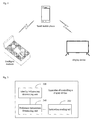
- Fig. 1B shows a schematic diagram of playing recommended content according to an exemplary embodiment of the present disclosure.
- a prompt box pops up on the device, and a recommended content list "electronic book E, television play B, television play A, television play C and webpage D" is played in the prompt box.
- the user may select corresponding information by touch, gesture control, eyeball control and so on. For example, the user touches a control button on the desktop of the terminal to select "up", “down” or "enter".
- a wireless connection with the device associated with the smart mat may be created; and then a booting instruction and the instruction for playing the recommended content are sent to the device through the wireless connection, so as to implement automatic booting and play the recommended content.
- the embodiments of the present disclosure determine identity information of a user on an smart mat, determines recommended content of the user according to the identity information of the user, and then sends an instruction for playing the recommended content to a device associated with the smart mat, so that the recommended content of the user on the smart mat can be played and the user does not need to select preferred content manually from a large amount of data, thus enabling an automatic content recommendation and bringing more use convenience for the user.
- the method may be also applied to an smart mat besides a terminal.
- the smart mat determines identity information of a user on the mat, determines recommended content of the user according to the identity information of the user, and then sends an instruction for playing the recommended content to a device associated with the smart mat.
- a specific implementation method is similar to the embodiments above, and will not be described repeatedly in details here.
- the method when the device is a projector, the method further includes that: a posture of the user on the smart mat is determined according to the pressure area and pre-stored correspondance relationships between pressure areas and postures, wherein the posture may include a sitting posture, a supine position and so on, a projection direction of the projector is determined according to the determined posture and pre-stored corresponding relationships between pre-stored projection directions and postures; and then the projection direction is sent to the projector associated with the smart mat, thus enabling automatically controlling a direction of the projector and improving user experience.
- the identity information of the user when the identity information of the user cannot be determined, information on the top of a recent playing list may be dedtermined as the preference content to be played or recommended.
- the content played last time is determined as the preference content to be continued by default.
- Fig. 2 is a schematic diagram of an application scenario of a method for controlling a device according to an exemplary embodiment of the present disclosure.
- the scenario as shown in Fig. 2 includes: a smart phone functioning as a terminal, a smart mat, and a device associated with the smart mat.
- a user lies on the smart mattress.
- Several pressure sensors and temperature sensors are arranged on the smart mattress, which are at the intersections of the mesh in Fig. 2 .
- a network communication module capable of communicating with the smart phone is provided in the smart mattress.
- a network communication module capable of communicating with the smart phone is also provided in the device.
- the terminal controls the pressure sensors on the smart mattress to acquire pressure information, the shape of an object on the smart mat is determined according to points where the pressure information is acquired on the smart mat, the shape is compared with a pre-stored shape of human body to determine that the object lying on the mattress is a user, then the terminal reads network account information used by the user to log in an App, and pre-stored identity information of the user is read based on the network account information, and recomended content is determined for the user according to the identity information of the user, and an instruction for playing the recommended content is sent to the device associated with the smart mat.
- This solution thus enables the device to automatically play the recommended content for the user and improving the efficiency in acquiring the recomended content.
- a specific process for controlling the device may refer to the description of Fig. 1A , and will not be described repeatedly here.
- the embodiments of the present disclosure further provide embodiments of an apparatus for controlling a device, an apparatus and an smart mat.
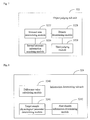
- Fig. 3 is a block diagram of an apparatus for controlling a device according to an exemplary embodiment of the present disclosure.
- the apparatus includes: an identity information determining unit 320, a recomended content determining unit 340 and an instruction sending unit 360.
- the identity information determining unit 320 is configured to determine identity information of a user on an smart mat; the recomended content determining unit 340 is configured to determine recomended content for the user according to the identity information of the user; and the instruction sending unit 360 is configured to send an instruction for playing the recomended content to a device associated with the smart mat.
- the embodiment of the present disclosure determines identity information of a user on an smart mat, determines recomended content for the user according to the identity information of the user, and then sends an instruction for playing the recomended content to a play device associated with the smart mat, so that the recomended content for the user situated on the smart mat is automatically played for the user of the mat, thus improving the content playing happening on the mat and bringing more use convenience for the user.
- Fig. 4 is a block diagram of another apparatus for controlling a device according to an exemplary embodiment of the present disclosure.
- the embodiment is based on the embodiment as shown in Fig. 3 , the identity information determining unit 320 includes an object judging sub-unit 322 and an information determining sub-unit 324.
- the object judging sub-unit 322 is configured to detect whether an object on the smart mat is a user; and the information determining sub-unit 324 is configured to determine, when a user is detected, identity information of the user.
- the embodiment of the present disclosure first determines whether an object on the smart mat is a user, and when the object is a user, determines identity information of the user, so that other objects which are not human bodies are filtered, only a user is identified to determine identity information, thus improving the efficiency in determining identity information.
- Fig. 5 is a block diagram of still another apparatus for controlling a device according to an exemplary embodiment of the present disclosure.
- the embodiment is based on the embodiment as shown in Fig. 4 , the object judging sub-unit 322 includes a temperature data acquiring module 3220 and a first judging module 3221.
- the temperature data acquiring module 3220 is configured to acquire temperature data of the object on the smart mat; and the first judging module 3221 is configured to determine that the object on the smart mat is a user when the temperature data is in a pre-stored range of human body temperature.
- temperature data of the object on the smart mat is acquired and compared with a pre-stored range of human body temperature, and the object is determined to be a user only when the temperature data is in the pre-stored range of human body temperature, thereby improving the judgment efficiency.
- Fig. 6 is a block diagram of still another apparatus for controlling a device according to an exemplary embodiment of the present disclosure.
- the object judging sub-unit 322 includes a first pressure information acquiring module 3222, a shape determining module 3223, a first similarity determining module 3224 and a second judging module 3225.
- the first pressure information acquiring module 3222 is configured to acquire pressure information on the smart mat; the shape determining module 3223 is configured to determine the shape of the object on the smart mat according to points where the pressure information can be acquired on the smart mat; the first similarity determining module 3224 is configured to compare the determined shape with a pre-stored shape of a human body, so as to obtain a first similarity; and the second judging module 3225 is configured to determine that the object is a user when the first similarity is larger than a first preset threshold.
- pressure information on the smart mat is acquired, and the shape of the object on the smart mat is determined according to points where the pressure information can be acquired on the smart mat, so that the determined shape can be compared with a pre-stored shape of a human body to judge whether the object on the smart mat is a user, thus improving the judgment efficiency.
- Fig. 7 is a block diagram of still another apparatus for controlling a device according to an exemplary embodiment of the present disclosure.
- the object judging sub-unit 322 includes a second pressure information acquiring module 3226, a pressure area determining module 3227, a density determining module 3228 and a third judging module 3229.
- the second pressure information acquiring module 3226 is configured to acquire pressure information on the smart mat; the pressure area determining module 3227 is configured to determine a pressure area according to points where the pressure information is acquired on the smart mat; the density determining module 3228 is configured to calculate the ratio of the pressure information to the pressure area to obtain the density of the object on the smart mat; and the third judging module 3229 is configured to determine that the object is a user when the calculated density is in a pre-stored density range of human body.
- pressure information on the smart mat is acquired, a pressure area is determined according to points where the pressure information can be acquired on the smart mat, the ratio of the pressure information to the pressure area is calculated so as to obtain the density of the object on the smart mat, and the object is determined to be a user when the calculated density is in a pre-stored density range of human body. Whether the object on the smart mat is a user is determined according to the density, thus improving the judgment accuracy.
- Fig. 8 is a block diagram of still another apparatus for controlling a device according to an exemplary embodiment of the present disclosure.
- the information determining sub-unit 324 includes a difference value calculating module 3240, a target sample physiological parameter determining module 3241, and a first identity information determining module 3242.
- the difference value calculating module 3240 is configured to calculate difference values between physiological parameters and sample physiological parameters in a data list, wherein the physiological parameters include the pressure information, the pressure area or the density; the target sample physiological parameter determining module 3241 is configured to select a target difference value in an allowable fluctuation range from the difference values, and determine a target sample physiological parameter corresponding to the target difference value; and the first identity information determining module 3242 is configured to acquire identity information of a user corresponding to the target sample physiological parameter from the data list, wherein the data list records correspondance relationships between sample physiological parameters and identity information of users.
- difference values between physiological parameters and sample physiological parameters in a data list are calculated, a target difference value in an allowable fluctuation range is selected from the difference values, so as to determine the identity information of the user, thus determining the identity information according to the physiological parameters. Since the physiological parameters have been determined when the user is determined, it is unnecessary to acquire other data when the identity information is determined, thus saving resources.
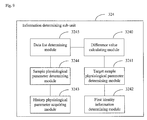
- Fig. 9 is a block diagram of still another apparatus for controlling a device according to an exemplary embodiment of the present disclosure.
- the information determining sub-unit 324 further includes a history physiological parameter acquiring module 3243, a sample physiological parameter determining module 3244 and a data list determining module 3245.
- the history physiological parameter acquiring module 3243 is configured to acquire history physiological parameters of each user in a first history period from a database; the sample physiological parameter determining module 3244 is configured to average the history physiological parameters of the each user to obtain sample physiological parameters of the each user; and the data list determining module 3245 is configured to create correspondance relationships between identity information of users and sample physiological parameters and obtain the data list.
- history physiological parameters are averaged to obtain sample physiological parameters and correspondance relationships between identity information of users and sample physiological parameters are created so as to obtain the data list, thereby improving the reliability of the sample physiological parameters.
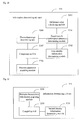
- Fig. 10 is a block diagram of still another apparatus for controlling a device according to an exemplary embodiment of the present disclosure.
- the information determining sub-unit 324 further includes an exercise parameter acquiring module 3246, a comparing module 3247 and a fluctuation range determining unit 3248.
- the exercise parameter acquiring module 3246 is configured to acquire an exercise parameter of the user within a second history period; the comparing module 3247 is configured to compare the exercise parameter with an upper exercise limit and a lower exercise limit of the user; and the fluctuation range determining unit 3248 is configured to determine an allowable fluctuation range of the exercise parameter of the user according to a comparison result.
- an exercise parameter of the user within a second history period is acquired, the exercise parameter is compared with an upper exercise limit and a lower exercise limit of the user; and an allowable fluctuation range of the exercise parameter of the user is determined according to a comparison result.
- the allowable fluctuation range is adjusted according to the exercise parameter, which considers a fact that the physiological parameters change with the exercise parameter, thereby improving the accuracy of the allowable fluctuation range and further improving the accuracy in determining the identity information.
- Fig. 11 is a block diagram of still another apparatus for controlling a device according to an exemplary embodiment of the present disclosure.
- the information determining sub-unit 324 includes a biologic characteristic information acquiring module 3249, a comparing unit 3250 and a second identity information determining module 3251.
- the biologic characteristic information acquiring module 3249 is configured to acquire biologic characteristic information of the user, wherein the biologic characteristic information includes fingerprint information, palm print information and face information; the comparing unit 3250 is configured to compare the acquired biologic characteristic information with pre-stored biologic characteristic information of at least one valid user; and the second identity information determining module 3251 is configured to read, when a second similarity of the acquired biologic characteristic information to biologic characteristic information of one valid user is larger than a second preset threshold, pre-stored identity information of the one valid user.
- the identity information of the user is determined by comparing acquired biologic characteristic information with pre-stored biologic characteristic information of a valid user, thereby improving the determining accuracy.
- Fig. 12 is a block diagram of still another apparatus for controlling a device according to an exemplary embodiment of the present disclosure.
- the embodiment is based on the embodiment as shown in Fig. 4 , the information determining sub-unit 324 includes an account information reading module 3252 and a third identity information determining module 3253.
- the account information reading module 3252 is configured to read account information used by the user to log in an App on a terminal; and the third identity information determining module 3253 is configured to determine the identity information of the user according to the account information.
- account information used by the user to log in an App on a terminal is read; and the identity information of the user is determined according to the account information, thereby improving the determining efficiency and accuracy.
- Fig. 13 is a block diagram of still another apparatus for controlling a device according to an exemplary embodiment of the present disclosure.
- the embodiment is based on the embodiment as shown in Fig. 3 , the recommended content determining unit 340 includes a history playing information acquiring sub-unit 341 and a first recommended content determining sub-unit 342.
- the history playing information acquiring sub-unit 341 is configured to read history playing information of the user in a third history period according to the identity information of the user; and the first recommended content determining sub-unit 342 is configured to analyze the history playing information to acquire the recommended content for the user.
- history playing information of the user in a third history period is read according to the identity information of the user; and the history playing information is analyzed to acquire the recommended content for the user, thereby improving the accuracy in acquiring the recommended content.
- Fig. 14 is a block diagram of still another apparatus for controlling a device according to an exemplary embodiment of the present disclosure.
- the recommended content determining unit 340 includes a sequence obtaining sub-unit 343, a second recommended content determining sub-unit 344 and a recommended content list determining sub-unit 345.
- the sequence obtaining sub-unit 343 is configured to acquire, when there are at least two users on the smart mat, a sequence that the at least two users contact the smart mat; the second recommended content determining sub-unit 344 is configured to determine recommended content corresponding to each of the at least two users according to the identity information of the at least two users; and the recommended content list determining sub-unit 345 is configured to sort the recommended content of the at least two users according to the sequence to acquire a recommended content list.
- a sequence of recommended content is determined according to a sequence that users contact the smart mat, so that a user who contacts the mat first has the priority to view his/her recommended content, thus improving user experience.
- Fig. 15 is a block diagram of still another apparatus for controlling a device according to an exemplary embodiment of the present disclosure.
- the embodiment is based on the embodiment as shown in Fig. 3 , the instruction sending unit 360 includes a connection creating sub-unit 361 and an instruction sending sub-unit 362.
- connection creating sub-unit 361 is configured to create a wireless connection with the device associated with the smart mat; and the instruction sending sub-unit 362 is configured to send a booting instruction and the instruction for playing the recommended content to the device through the wireless connection.
- a booting instruction and the instruction for playing the recommended content are sent to the device so as to implement automatic booting, play recommended content and improve user experience.
- the present disclosure further provides an apparatus, the apparatus includes a processor, and a memory configured to store an instruction executable by the processor, wherein the processor is configured to:
- the apparatus may be a terminal.
- the apparatus may be specifically a smart phone, a tablet computer, a Personal Digital Assistant (PDA) and so on, or may be also an smart mat, that is, a chip or a device for processing information is arranged in the smart mat.
- the smart mat may determine identity information of a user on the smart mat, determines recommended content of the user according to the identity information of the user, and sends an instruction for playing the recommended content to a device, thus controlling the device.
- the embodiments of the present disclosure further provides an smart mat, the smart mat includes:
- the sensors may be pressure sensors or temperature sensors.
- the sensors are pressure sensors, the pressure sensors detect pressure information on the smart mat and each pressure sensor corresponds to a detection point.
- the sensors are temperature sensors, the temperature sensors detect the temperature of the object on the smart mat.
- the data acquired by the smart mat is transmitted to the terminal (such as a mobile phone, a tablet computer and so on) and the terminal may run the method for controlling the device of the embodiments of the present disclosure.
- the terminal such as a mobile phone, a tablet computer and so on
- the terminal may run the method for controlling the device of the embodiments of the present disclosure.
- Fig. 16 is a structural diagram of a control apparatus 1600 applied to a device according to an exemplary embodiment of the present disclosure.
- the apparatus 1600 may be a mobile phone, a computer, a digital broadcasting terminal, a message transceiver, a games console, a tablet device, a medical device, fitness equipment, a personal digital assistant and so on having a routing function.
- the apparatus 1600 may include one or more of the following components: a processing component 1602, a memory 1604, a power source component 1606, a multimedia component 1608, an audio component 1610, an Input/Output (I/O) interface 1612, a sensor component 1614 and a communication component 1616.
- a processing component 1602 a memory 1604, a power source component 1606, a multimedia component 1608, an audio component 1610, an Input/Output (I/O) interface 1612, a sensor component 1614 and a communication component 1616.
- the processing component 1602 controls overall operations of the apparatus 1600, such as operations associated with display, a telephone call, data communication, a camera operation and a recording operation.
- the processing component 1602 may include one or more processors 1620 to execute instructions so as to perform all or part of the steps of the method.
- the processing component 1602 may include one or more modules which facilitate interaction between the processing component 1602 and other components.
- the processing component 1602 may include a multimedia module to facilitate interaction between the multimedia component 1608 and the processing component 1602.
- the memory 1604 is configured to store various types of data so as to support operations in the apparatus 1600. Examples of these data include an instruction of any App or method operated on the apparatus 1600, data of contacts, data of a telephone directory, a message, a picture, a video and so on.
- the memory 1604 may be implemented by a volatile or non-volatile storage apparatus of any type or a combination thereof, such as a Static Random-Access Memory (SRAM), an Electrically Erasable Programmable Read-Only Memory (EEPROM), an Erasable Programmable Read-Only Memory (EPROM), a Programmable Read-Only Memory (PROM), a Read-Only Memory (ROM), a magnetic memory, a flash memory, a magnetic disk or an optical disk.
- SRAM Static Random-Access Memory
- EEPROM Electrically Erasable Programmable Read-Only Memory
- EPROM Erasable Programmable Read-Only Memory
- PROM Programmable Read-Only Memory
- ROM Read-Only Memory
- magnetic memory
- the power source component 1606 provides power for various components of the apparatus 1600.
- the power source component 1606 may include a power source management system, one or more power sources, and other components associated with power generation, management and distribution of the apparatus 1600.
- the multimedia component 1608 includes a screen providing an output interface between the apparatus 1600 and a user.
- the screen may include a Liquid Crystal Display (LCD) and a Touch Panel (TP). If the screen includes a TP, the screen may be implemented as a touch screen to receive an input signal from the user.
- the TP includes one or more touch sensors so as to sense a touch, a slide, and a gesture on the TP.
- the touch sensor may not only sense a touch or a boundary of a slide, but also detect a duration and a pressure related to the touch or the slide.
- the multimedia component 1608 includes a front camera and/or a rear camera.
- the front camera and/or the rear camera may receive external multimedia data.
- Each front camera and each rear camera may be a fixed optical lens system or may be provided with a focal distance or an optical zooming capability.
- the audio component 1610 is configured to output and/or input an audio signal.
- the audio component 1610 includes a Microphone (MIC).
- MIC Microphone
- the apparatus 1600 is in an operation mode, such as a calling mode, a recording mode and a voice recognition mode, the MIC is configured to receive an external audio signal.
- the received audio signal may be further stored in the memory 1604 or sent by the communication component 1616.
- the audio component 1610 further includes a loudspeaker, configured to output the audio signal.
- the I/O interface 1612 provides an interface between the processing component 1602 and a peripheral interface module.
- the peripheral interface module may be a keyboard, a click wheel, a button and so on. These buttons may include, but are not limited to a homepage button, a volume button, a start button and a lock button.
- the sensor component 1614 includes one or more sensors configured to provide evaluation of states of various aspects for the apparatus 1600.
- the sensor component 1614 may detect an on/off state of the apparatus 1600, and the relative locations of the components.
- the components are a display and a keypad of the apparatus 1600.
- the sensor component 1614 may further detect a change of the location of the apparatus 1600 or a change of the location of a component of the apparatus 1600, the existence or absence of contact between the user and the apparatus 1600, the orientation or acceleration/deceleration of the apparatus 1600 and a change in the temperature of the apparatus 1600.
- the sensor component 1614 may include a proximity sensor, configured to detect the existence of a nearby object when there is no any physical contact.
- the sensor component 1614 may further include an optical sensor, such as a Complementary Metal Oxide Semiconductor (CMOS) or Charge Coupled Device (CCD) image sensor used in an imaging App.
- CMOS Complementary Metal Oxide Semiconductor
- CCD Charge Coupled Device
- the sensor component 1614 may further include an acceleration sensor, a gyro sensor, a magnetic sensor, a pressure sensor or a temperature sensor.
- the communication component 1616 is configured to facilitate wired or wireless communication between the apparatus 1600 and other apparatuses.
- the apparatus 1600 may access a wireless network based on a communication standard, such as Wireless Fidelity (WiFi), the second Generation (2G) or the third Generation (3G), or a combination thereof.
- the communication component 1616 receives a broadcast signal from an external broadcast management system or broadcast related information through a broadcast channel.
- the communication component 1616 further includes a Near Field Communication (NFC) module so as to promote short distance communication.
- the NFC module may be implemented based on a Radio-frequency Identification (RFID) technology, an Infrared Data Association (IrDA) technology, an Ultra Wide Band (UWB) technology, a Bluetooth (BT) technology and other technologies.
- RFID Radio-frequency Identification
- IrDA Infrared Data Association
- UWB Ultra Wide Band
- BT Bluetooth
- the apparatus 1600 may be implemented by one or more Application Specific Integrated Circuits (ASIC), Digital Signal Processors (DSP), Digital Signal Processing Apparatuss (DSPD), Programmable Logic Apparatuss (PLD), Field Programmable Gate Arrays (FPGA), controllers, microcontrollers, microprocessors, or other electronic components, so as to execute the method above.
- ASIC Application Specific Integrated Circuits
- DSP Digital Signal Processors
- DSPD Digital Signal Processing Apparatuss
- PLD Programmable Logic Apparatuss
- FPGA Field Programmable Gate Arrays
- controllers microcontrollers, microprocessors, or other electronic components, so as to execute the method above.
- a non-temporary computer readable storage medium including an instruction is further provided in an exemplary embodiment, such as the memory 1604 including an instruction.
- the instruction may be executed by the processor 1620 of the apparatus 1600 so as to implement the methods above.
- the non-temporary computer readable storage medium may be a ROM, a Random-Access Memory (RAM), a Compact Disc-ROM (CD-ROM), a magnetic tape, a floppy disk, an optical data memory and so on.
- a non-temporary computer readable storage medium enables a terminal to execute a method for controlling an apparatus when an instruction in the storage medium is executed by a processor of the terminal.
- the method includes that identity information of a user on an smart mat is determined; recommended content for the user is determined according to the identity information of the user; and an instruction for playing the recommended content is sent to a device associated with the smart mat.
Landscapes
- Engineering & Computer Science (AREA)
- Health & Medical Sciences (AREA)
- Life Sciences & Earth Sciences (AREA)
- Multimedia (AREA)
- General Health & Medical Sciences (AREA)
- Databases & Information Systems (AREA)
- Physics & Mathematics (AREA)
- Signal Processing (AREA)
- Biomedical Technology (AREA)
- Biophysics (AREA)
- Theoretical Computer Science (AREA)
- Human Computer Interaction (AREA)
- Animal Behavior & Ethology (AREA)
- Veterinary Medicine (AREA)
- Public Health (AREA)
- Pathology (AREA)
- Heart & Thoracic Surgery (AREA)
- Medical Informatics (AREA)
- Molecular Biology (AREA)
- Surgery (AREA)
- General Engineering & Computer Science (AREA)
- Social Psychology (AREA)
- General Physics & Mathematics (AREA)
- Neurosurgery (AREA)
- Analytical Chemistry (AREA)
- Computer Networks & Wireless Communication (AREA)
- Chemical & Material Sciences (AREA)
- Computer Graphics (AREA)
- Oral & Maxillofacial Surgery (AREA)
- Dentistry (AREA)
- User Interface Of Digital Computer (AREA)
- Information Transfer Between Computers (AREA)
- Telephonic Communication Services (AREA)
- Selective Calling Equipment (AREA)
Abstract
Description
- The embodiments of the present disclosure relate to the technical field of smart homes, particularly to a method and apparatus for controlling a device, and an smart mat.
- Generally, a user is used to opening a device to view and select information that the user prefers when lying or sitting on a mat in daily life, wherein the mat may be a mattress, a seat cushion, a sofa cushion and so on. Taking a mattress for example, the user usually gets used to opening a device to play contents such as a television show, a movie, an electronic book and so on that the user prefers when lying on a mattress. In other words, nowadays, a mat is a place where content playing frequently happens. However, in the related art, there is rarely a solution which addresses improving the content playing in such a place.
- The embodiments of the present disclosure are presented to solve the problem of the lack of solution enabling improving the content playing which frequently happens on a mat in the related art.
- Accordingly, the present disclosure provides a method and an apparatus for controlling a device, in accordance with claims which follow.
- A method for controlling a device implemented by a terminal is provided according to a first aspect of the embodiments of the present disclosure. The method includes that:
- identity information of a user situated on an smart mat is determined;
- recommended content for the user is determined according to the identity information of the user; and
- an instruction for playing the recommended content is sent to a device associated with the smart mat.
- In this way, the recommended content for the user who is situated on the smart mat is automatically played. Therefore the content playing which happens on the mat is improved specially for the user of the mat, thus improving playing efficiency and bringing more convenience to the user.
- Alternatively, the step that the identify information of the user on the smart mat is determined may include that:
- whether an object on the smart mat is a user is detected; and
- if a user is detected, identity information of the user is determined.
- In this way, other objects which are not human bodies are filtered, only a user is identified to determine identity information thereof while other objects are not identified, thus improving the efficiency in determining identity information.
- Alternatively, the step that whether the object on the smart mat is a user is detected may include that:
- temperature data of the object on the smart mat is acquired; and
- if the temperature data is within a pre-stored temperature range of human body, it is determined that the object on the smart mat is a user.
- In this way, the judgment efficiency is improved.
- Alternatively, the step that whether the object on the smart mat is a user is detected may include that:
- pressure information of the object on the smart mat is acquired;
- a shape of the object on the smart mat is determined according to points where the pressure information is acquired on the smart mat;
- the determined shape is compared with a pre-stored shape of a human body to obtain a first similarity; and
- when the first similarity is larger than a first preset threshold, it is determined that the object is a user.
- In this way, the judgment efficiency is improved.
- Alternatively, the step that whether the object on the smart mat is a user is detected may include that:
- pressure information of the object on the smart mat is acquired;
- a pressure area is determined according to points where the pressure information is acquired on the smart mat;
- according to a ratio of the pressure information to the pressure area, density of the object on the smart mat is acquired; and
- if the density is within a pre-stored density range of human body, it is determined that the object is a user.
- In this way, whether the object on the smart mat is a user is determined according to the density, thus improving the judgment accuracy.
- Alternatively, the step that the identity information of the user is determined may include that:
- difference values between physiological parameters and sample physiological parameters in a data list are determined, wherein the physiological parameters include the pressure information, the pressure area or the density and the data list records corresponding relations between sample physiological parameters and identity information of users;
- a target difference value within an allowable fluctuation range is selected from the difference values, and a target sample physiological parameter corresponding to the target difference value is determined; and
- the identity information of the user corresponding to the target sample physiological parameter is acquired from the data list, wherein the data list records correspondence relationships between sample physiological parameters and identity information of users.
- Since the physiological parameters have been determined when the user is determined, it is unnecessary to acquire other data when the identity information is determined, thus saving resources.
- Alternatively, a manner for creating the data list may include that:
- history physiological parameters of a user in a first history period are acquired from a database;
- history physiological parameters of the user are averaged to obtain sample physiological parameters of the user; and
- correspondence relationships between identity information of the user and sample physiological parameters are established so as to create the data list.
- In this way, the reliability of the sample physiological parameters is improved.
- Alternatively, a manner for determining the allowable fluctuation range may include that:
- an exercise parameter of the user within a second history period is acquired;
- the exercise parameter is compared with an upper exercise limit and a lower exercise limit of the user; and
- the allowable fluctuation range is determined according to a comparison result of the comparison.
- The allowable fluctuation range is adjusted according to the exercise parameter, which considers a fact that the physiological parameters change with the exerciseof a user, thereby improving the accuracy of the allowable fluctuation range and further improving the accuracy in determining the identity information.
- Alternatively, the step that the identity information of the user is determined may include that:
- biologic characteristic information of the user is acquired, wherein the biologic characteristic information includes fingerprint information, palm print information or face information;
- the acquired biologic characteristic information is compared with pre-stored biologic characteristic information of at least one valid user; and
- if a second similarity of the acquired biologic characteristic information to biologic characteristic information of at least one valid user is larger than a second preset threshold, pre-stored identity information of the one valid user is determined as the identity information of the user.
- The identity information of the user is determined by comparing acquired biologic characteristic information with pre-stored biologic characteristic information of a valid user, thereby improving the determining accuracy.
- Alternatively, the step that the identity information of the user is determined may include that:
- account information used by the user to log in an Application (APP) on a terminal is read; and
- the identity information of the user is determined according to the account information.
- In this way, the determining efficiency and accuracy is improved.
- Alternatively, the step that the recommended content for the user is determined according to the identity information of the user may include that:
- history playing information of the user during a third history period is read according to the identity information of the user; and
- the history playing information is analyzed to acquire the recommended content for the user.
- In this way, the accuracy in acquiring the recommended content is improved.
- Alternatively, the step that the recommended content for the user is determined according to the identity information of the user may include that:
- when there are at least two users on the smart mat, a sequence that the at least two users contact the smart mat is acquired;
- recommended content corresponding to each of the at least two users is determined according to the identity information of the at least two users; and
- the recommended content of the at least two users is sorted according to the sequence to acquire a recommended content list.
- Since a sequence of recommended content is determined according to a sequence that users contact the smart mat, a user who contacts the mat first has the priority to view his/her recommended content, thus improving user experience.
- Alternatively, the step that the instruction for playing the recommended content is sent to the device associated with the smart mat may include that:
- a wireless connection with the device associated with the smart mat is created ; and
- a booting instruction and the instruction for playing the recommended content are sent to the device through the wireless connection.
- In this way, automatic booting can be implemented, recommended content can be played and user experience are improved.
- A terminal for controlling a device is provided according to a second aspect of the embodiments of the present disclosure. The terminal includes:
- an identity information determining unit, configured to determine identity information of a user situated on an smart mat;
- a recommended content determining unit, configured to determine recommended content of the user according to the identity information of the user; and
- an instruction sending unit, configured to send an instruction for playing the recommended content to a device associated with the smart mat.
- Alternatively, the identity information determining unit may include:
- an object judging sub-unit, configured to detect whether an object on the smart mat is a user; and
- an information determining sub-unit configured to determine, when a user is detected, identity information of the user.
- Alternatively, the object judging sub-unit may include:
- a temperature data acquiring module, configured to acquire temperature data of the object on the smart mat; and
- a first judging module configured to determine that the object on the smart mat is a user when the temperature data is in a pre-stored temperature range of human body.
- Alternatively, the object judging sub-unit may include:
- a first pressure information acquiring module, configured to acquire pressure information on the smart mat;
- a shape determining module, configured to determine a shape of the object on the smart mat according to points where the pressure information is capable of being acquired on the smart mat;
- a first similarity determining module, configured to compare the determined shape with a pre-stored shape of a human body to obtain a first similarity; and
- a second judging module, configured to determine that the object is a user when the first similarity is larger than a first preset threshold.
- Alternatively, the object judging sub-unit may include:
- a second pressure information acquiring module, configured to acquire pressure information on the smart mat;
- a pressure area determining module, configured to determine a pressure area according to points where the pressure information is capable of being acquired on the smart mat;
- a density determining module, configured to according to a ratio of the pressure information to the pressure area, acquire density of the object on the smart mat; and
- a third judging module, configured to determine that the object is a user when the density is in a pre-stored density range of human body.
- Alternatively, the information determining sub-unit may include:
- a difference value calculating module, configured to calculate difference values between physiological parameters and sample physiological parameters in a data list, wherein the physiological parameters include the pressure information, the pressure area or the density;
- a target sample physiological parameter determining module, configured to select a target difference value in an allowable fluctuation range from the difference values, and determine a target sample physiological parameter corresponding to the target difference value; and
- a first identity information determining module, configured to acquire identity information of a user corresponding to the target sample physiological parameter from the data list, wherein the data list records corresponding relations between sample physiological parameters and identity information of users.
- Alternatively, the information determining sub-unit may further include:
- a history physiological parameter acquiring module, configured to acquire history physiological parameters of each user in a first history period from a database;
- a sample physiological parameter determining module, configured to average the history physiological parameters of the each user to obtain sample physiological parameters of the each user; and
- a data list determining module, configured to create corresponding relations between identity information of users and sample physiological parameters and obtain the data list.
- Alternatively, the information determining sub-unit may further include:
- an exercise parameter acquiring module, configured to acquire an exercise parameter of the user within a second history period;
- a comparing module, configured to compare the exercise parameter with an upper exercise limit and a lower exercise limit of the user; and
- a fluctuation range determining unit, configured to determine the allowable fluctuation range of the exercise parameter of the user according to a comparison result.
- Alternatively, the information determining sub-unit may include:
- a biologic characteristic information acquiring module, configured to acquire biologic characteristic information of the user, wherein the biologic characteristic information includes fingerprint information, palm print information and face information;
- a comparing unit, configured to compare the acquired biologic characteristic information with pre-stored biologic characteristic information of at least one valid user; and
- a second identity information determining module configured to read, when a second similarity of the acquired biologic characteristic information to biologic characteristic information of one valid user is larger than a second preset threshold, pre-stored identity information of the one valid user.
- Alternatively, the information determining sub-unit may include:
- an account information reading module, configured to read account information used by the user to log in an App on a terminal; and
- a third identity information determining module, configured to determine the identity information of the user according to the account information.
- Alternatively, the recommended content determining unit may include:
- a history watching information acquiring sub-unit, configured to read history watching information of the user in a third history period according to the identity information of the user; and
- a first recommended content determining sub-unit, configured to analyze the history watching information to acquire the recommended content of the user.
- Alternatively, the recommended content determining unit may include:
- a sequence obtaining sub-unit configured to acquire, when there are at least two users on the smart mat, a sequence that the at least two users contact the smart mat;
- a second recommended content determining sub-unit, configured to determine recommended content corresponding to each of the at least two users according to the identity information of the at least two users; and
- a recommended content list determining sub-unit, configured to sort the recommended content of the at least two users according to the sequence to acquire a recommended content list.
- Alternatively, the instruction sending unit may include:
- a connection creating sub-unit, configured to create a wireless connection with the device associated with the smart mat; and
- an instruction sending sub-unit, configured to send a booting instruction and the instruction for playing the recommended content to the device through the wireless connection.
- An apparatus is provided according to a third aspect of the embodiments of the present disclosure. The apparatus includes:
- a processor; and
- a memory configured to store an instruction executable by the processor,
- wherein the processor is configured to:
- determine identity information of a user on an smart mat;
- determine recommended content of the user according to the identity information of the user; and
- send an instruction for playing the recommended content to a device associated with the smart mat.
- A smart mat is provided according to a fourth aspect of the embodiments of the present disclosure, including:
- sensors and a transmitting apparatus, wherein the sensors are uniformly arranged in a network pattern on the smart mat;
- the sensors are configured to acquire data on the smart mat;
- the transmitting apparatus is configured to transmit the data acquired by the sensors to a terminal so as to enable the terminal to determine that an object on the smart mat is a user according to the data, and control a device associated with the smart mat to play recommended content of the user.
- The advantages and features of the apparatus and the smart mat according to the embodiments of the present disclosure are the same with those of the above described method and will not be repeated here.
- Alternatively, the steps of the method for controlling a device are determined by computer program instructions.
- Consequently, according to a fifth aspect, the invention is also directed to a computer program for executing the steps of the method for controlling a device as described above when this program is executed by a computer.
- This program can use any programming language and take the form of source code, object code or a code intermediate between source code and object code, such as a partially compiled form, or any other desirable form.
- The invention is also directed to a computer-readable information medium containing instructions of a computer program as described above.
- The information medium can be any entity or device capable of storing the program. For example, the support can include storage means such as a ROM, for example a CD ROM or a microelectronic circuit ROM, or magnetic storage means, for example a diskette (floppy disk) or a hard disk.
- Alternatively, the information medium can be an integrated circuit in which the program is incorporated, the circuit being adapted to execute the method in question or to be used in its execution. It is to be understood that the general description above and the detail description hereinafter are only exemplary and explanatory, but can not limited the present disclosure.
- The accompanying drawings herein, which are incorporated into the specification and constitute a part of the specification, illustrate embodiments consistent with the present disclosure, and serve to explain the principles of the embodiments of the present disclosure together with the specification.
-
Fig. 1A is a flowchart of a method for controlling a device according to an exemplary embodiment of the present disclosure; -
Fig. 1B is a schematic diagram of playing recommended content according to an exemplary embodiment of the present disclosure; -
Fig. 2 is a schematic diagram of an application scenario of a method for controlling a device according to an exemplary embodiment of the present disclosure; -
Fig. 3 to Fig. 15 are block diagrams of an apparatus for controlling a device according to an exemplary embodiment of the present disclosure; and -
Fig. 16 is a structural diagram of a control apparatus applied to a device according to an exemplary embodiment of the present disclosure. - The exemplary embodiments will be described in details herein, examples of which are illustrated in the accompanying drawings. Unless otherwise expressed, the same numbers in different accompanying drawings represent the same or similar elements when the accompanying drawings are described hereinafter. The implementation modes described in the following exemplary embodiments do not represent all implementation modes consistent with the present disclosure. On the contrary, they are merely examples of apparatuses and methods as described in details in the appended claims and consistent with some aspects of the present disclosure.
- Terms used in the present disclosure are only intended to describe specific embodiments, but are not intended to limit the present disclosure. Singular forms "a", "said" and "the" used in the present disclosure and the appended claims also aim to include plural forms except that the context clearly indicates other meanings. It it also to be understood that, the term "and/or" used herein indicates and includes any or all possible combinations of one or more listed items that are associated.
- It is to be understood that although the embodiments of the present disclosure may apply terms including first, second, third and so on to describe various information, these information should not be limited to these terms. These terms are only used for distinguishing information of the same type from each other. For example, first information may be also called second information without departing from the scope of the embodiments of the present disclosure, and similarly, second information may be also called first information, which depends on context. For example, the word "if" used here may be interpreted as "at the moment when......" or "when......" or "in response to confirmation".
- As shown in
Fig. 1A, Fig. 1A is a flowchart of a method for controlling a device according to an exemplary embodiment. The method may be implemented by a terminal, and may be also applied to an smart mat. Herein, a smart mat means a mat which can communicate with a terminal and can implement data transmission and control. The present embodiment illustrates an implementation of the method by a terminal as an example. The method may include the following steps. - Step 101: Identity information of a user situated on an smart mat is determined.
- Beofre this
step 101, an optional step of determining whether an object situated on a smart mat is a user can be carried out. This step will be explained hereinafter. - The terminal in the present disclosure may be any smart terminal having an Internet access function. For example, the terminal may be a smart phone, a tablet computer, a Personal Digital Assistant (PDA) and so on, wherein the terminal may access a router by a wireless local area network, and access a server in a public network through the router. An Application (App) is installed on the terminal. A device (e.g. a personal computer or a mobile phone) may be associated with (e.g, via Wireless Fidelity or a mobile network) the smart mat and may be controlled by the App on the terminal. A network communication module capable of communicating with the terminal is provided in the smart mat and the device. The smart mat in the embodiments of the present disclosure may be realized in the form of a mattress, a seat cushion, a sofa cushion and so on, and the embodiments of the present disclosure mainly illustrate a mattress as an example.
- The optional step mentionned above aims to determine that an object on the smart mat is a user, but not an animal or another object, such as a pillow, a quilt and so on. For example, when a user lies on a mattress or sits on a sofa cushion. it may be first detected whether the object on the smart mat is a user, and when a user is detected, identity information of the user is determined. It should be noted that the step of detecting whether the object on the smart mat is a user is optional but not necessary.
- Several temperature sensors may be arranged on the smart mat in the embodiments of the present disclosure, and several pressure sensors may be also arranged thereon. The temperature sensors and the pressure sensors may be arranged uniformly in a mesh pattern on the smart mat. The temperature sensors are configured to detect the temperature of the object on the smart mat, and the pressure sensors are configured to detect a received pressure. Each pressure sensor corresponds to a detection point.
- In the step of the embodiments of the present disclosure, whether the object on the smart mat is a user may be detected by one or more of the following manners.
- The terminal uses pressure sensors arranged on the smart mat to acquire pressure information on the smart mat, and determines the shape of the object on the smart mat according to points where the pressure information is acquired on the smart mat. In an embodiment of the present disclosure, the shape of the object may be determined based on outermost pressure sensors among the pressure sensors which acquire the pressure information. The determined shape is compared with a pre-stored shape of human body, so as to obtain a first similarity, and if the first similarity is larger than a first preset threshold, it is determined that the object is a user, and otherwise, it is determined that the object is not a user. The pre-stored shape of human body here may be a shape of a whole human body, or may be a shape of a part of a human body. For mats such as a seat cushion, an determined shape is usually a shape of a part of a human body, for example, the buttocks and legs of the user sitting on the seat cushion.
- In the manner of the pressure information on the smart mat present disclosure, the shape of the object on the smart mat is determined according to the pressure information, and whether the object is a user is judged according to the shape This solution is simple to realize and thus improves the judgment efficiency.
- The terminal uses pressure sensors to acquire pressure information of the object on the smart mat and determines a pressure area (i.e. the area composed by pressure sensors which receive pressure information) according to points where the pressure information is acquired on the smart mat, then calculates the ratio of the pressure information to the pressure area so as to obtain a density of the object on the smart mat, then compares the density of the objet with a pre-stored density range of human body, and if the calculated density is in the pre-stored density range of human body, then determines that the object is a user, and otherwise, determines that the object is not a user.
- In the manner of the embodiments of the present disclosure, whether the object on the smart mat is a user is judged according to density. Since the density of a human body is significantly different from the density of other objects, the judgment accuracy can be improved.
- Additionally, the pre-stored density range of human body may be determined according to history data. For example, history data comprises one or more set of pressure information and pressure area(s) on the mattress where users lie on his/her back.A density range of a human body lying on his/her back is thus acquired according to a ratio or an average of ratios of the pressure information to the pressure area(s) obtained from the history data. History data may also comprises one or more set of pressure information and pressure area(s) of a mattress on which users sit, so as to acquire a density range of a sitting human body.
- The terminal uses temperature sensors to acquire temperature data of the object on the smart mat, and compares the acquired temperature data with a pre-stored temperature range of human body. If the temperature data is in the pre-stored temperature range of human body, the terminal determines that the object on the smart mat is a user, and otherwise, determines that the object on the smart mat is not a human body. Herein, since various parts of a human body have roughly the same temperature, temperature data acquired by some temperature sensors only may be compared with the temperature range of human body. Some temperature data may be respectively compared with the temperature range of human body. The temperature data of the object may be also calculated to be an average of the temperature data acquired by the temprature sensors, which is compared with the prestored temperature range of human body. Alternativly, the temperature data of the object is calculated based on a certain algorithm known in the art to reflect an overall temperature of the object, the calculated temprature data being compared with the prestored temperature range of human body.
- In the method according to this embodiment, whether the object is a user is judged according to temperature. This solution is also simple to implement, thereby improving the judgment efficiency.
- It is to be understood that manners for detecting whether an object on the smart mat is a user are not limited to the manners described above, which may be manners for determining a user in the related art. Besides, whether the object is a user may be judged by only one manner so as to improve the judgment efficiency, or may be judged by combining a plurality of manners, so as to improve the judgment accuracy. For example, the judgment is performed by combining the first manner and the second manner, or by combining the first manner and the third manner, and so on.
- Subsequently, identity information of the user situated on the smart mat may be determined.
- A plurality of users may use the smart mat in a family, and the users who have used the smart mat may be called valid users. Identity information of a valid user may be pre-stored in the terminal, for example information identifying the user such as a name, a username, an account, a body height, a body weight, face image information and a mobile phone number and so on. The identity information of the user may be determined by the following modes.
- Mode 1: The identity information of the user is determined according to physiological parameters.
- First, difference values between physiological parameters and sample physiological parameters in a data list are calculated.
- Herein, the physiological parameters are those calculated in real-time for the user who is currently using the smart mat while the sample physiological parameters are those recorded in the data list for valid users. The difference value between a physiological parameter and a sample physiological parameter is for example a difference of pressure, pressure area, density, height of a user, etc.The physiological parameters may include pressure information, pressure area, the density of a user, the height of the user and so on. When the physiological parameters are information (such as pressure information, pressure area, and the density of a user) acquired during a previous step of determining whether the objet is a user, the physiological parameters may be acquired directly., The physiological parameters may be otherwise acquired. For example, in the case of a smart mattress, the terminal may determine the body length (body height) of a user lying on the smart mattress based on points (e.g. pressure sensors) between which the distance is the longest along the length of the smart mattress. A user usually lies along the length of the smart mat. Generally, points between which the distance is the longest along the length of the smart mat correspond to the head and the feet of the user. An approximate height of the user may be determined by this mode. A data list records correspondance relationships between sample physiological parameters and identity information of users. Different sample physiological parameters correspond to different valid users, thus the identity of a corresponding user may be determined according to sample physiological parameters.
- Secondly, each of the difference values is compared with an allowable fluctuation range. A target difference value that falls in the allowable fluctuation range is selected from the difference values, and a target sample physiological parameter corresponding to the target difference value is determined. The identity information of a user corresponding to the target sample physiological parameter is acquired from the data list. A physiological parameter of a user may change as time goes by, a body weight may change, for example, thereby resulting in a change in pressure information and a pressure area; therefore, physiological parameters corresponding to difference values within the allowable fluctuation range may belong to the same user.
- It may be understood that the identity information of the user may be determined by only one physiological parameter. Alternatively, the identity information of the user may be determined by a plurality of physiological parameters so as to improve the accuracy in the determining of the identity information. For example, the identity information of the user is determined by both the pressure information and the pressure area. If a difference value between pressure information and sample pressure information falls in an allowable fluctuation range, and if a difference value between a pressure area and a sample pressure area is in an allowable fluctuation range, the corresponding identity information is determined.
- For example, pressure information of a user situated on the smart mat is acquired, a pressure area is determined based on points where the pressure information is acquired on the smart mat. A pressure difference value between the acquired pressure information and sample pressure information recorded in the data list is calculated. An pressure area difference value between the acquired pressure area and a sample pressure area recorded in the data list is calculated, wherein the data list records correspondance relationships regarding sample pressure information, sample pressure areas and identity information of users. A group of target sample pressure information and target sample pressure areas is selected, the group having a pressure difference value and a pressure area difference value within allowable fluctuation ranges. Identity information of the user is determined according to the target sample pressure information and the target sample pressure area recorded in the data list.
- Additionally, a manner for creating the data list may include the following steps.
- Firstly, history physiological parameters of a user during a first history period are acquired from a database. The first history period is a preset recent period of time. For example, the first history period may be the last one week, or the last one month, which may be specifically set as required. Current physical conditions of the user may be truly reflected by history physiological parameters within a recent period of time, thereby improving the reliability of the sample physiological parameters in the data list.
- Secondly, history physiological parameters of a user are averaged to obtain a sample physiological parameter of the user. A user has a plurality of history physiological parameters. Physical conditions of a user may be reflected comprehensively by an average of the plurality of physiological parameters of the user, thereby improving the reliability of the sample physiological parameters in the data list.
- Finally, correspondance relationships between identity information of users and sample physiological parameters are established and the data list is created.
- The identity information of the user may be determined according to sample physiological parameters by checking the established correspondance relationships.
- Additionally, the allowable fluctuation range may be also determined by the following way.
- Firstly, an exercise parameter (e.g. a running distance, steps, and the number of stairs that a user climb) of a user within a second history period is acquired. The second history period is a preset recent period of time. For example, the second history period may be the last one week, or the last one month, which may be specifically set as required. The second history period may be the same as the first period, or may be different. In the present step, an exercise parameter of the user may be acquired by a portable device associated with the terminal. For example, an exercise parameter of the user in the last one week may be acquired through a smart wrist band.
- Secondly, the exercise parameter is compared with an upper exercise limit and a lower exercise limit of the user, wherein the upper exercise limit means a preset upper threshold value, and the lower exercise limit means a preset lower threshold value.
- Finally, the allowable fluctuation range of the exercise parameter of the user is determined according to a comparison result of the above comparison.
- The upper exercise limit and the lower exercise limit of the user may be preset. The upper exercise limit and the lower exercise limit may be used for measuring a possible changing trend of physiological parameters of the user. For example, when the exercise parameter is larger than the upper exercise limit, it is considered that there is a large amount of exercise, which may result in a decrease in the pressure information and the pressure area (e.g. the user has lost weight), and the allowable fluctuation range may be adjusted accordingly. When the exercise parameter is smaller than the lower exercise limit, it is considered that there is a small amount of exercise, which may result in an increase in the pressure information and the stressed area (e.g. the user has gained weight), and the allowable fluctuation range may be adjusted accordingly. Thus, the allowable fluctuation range may be determined according to a comparison result of comparing the exercise parameter of the user with the upper exercise limit and the lower exercise limit. Alternatively, a specific value of the fluctuation range may be designated.
- For example provided that a default allowable fluctuation range is (-10%w 0,+10%w0), wherein w 0 is a sample pressure information of the user. The allowable fluctuation range may be increased if a user has an extremely small exercise amount recently according to an exercise amount recorded by a wrist band of the user in the last one week. For example, the fluctuation range of pressure information (W) is adjusted to (-10%w 0+20%w 0). The allowable fluctuation range may be adjusted to (- 20%w 0,+11)%w 0), for example, if the user has an extremely large exercise amount recently.
- This solution adjusts the allowable fluctuation range according to the exercise parameter, which takes into account the fact that a physiological parameter changes with the exercise activities of the user, thereby improving the accuracy in determining the identity information.
- In another alternative implementation mode, a fluctuation range may be preset. The fluctuation range may be a proportion, and may be also a specific value. For example, a fluctuation range of the pressure information may be set as (-10%w 0,+10%w 0), wherein w 0 is a sample pressure information of the user. For another example, a fluctuation range of the pressure information is set as (-5kg,+5kg).
- Mode 2: The identity information of the user is determined according to biologic characteristic information.
- Firstly, biologic characteristic information of the user is acquired. The biologic characteristic information may include for example fingerprint information, palm print information, face information and so on. For example, the terminal may recognize the face of the user by a built-in camera, or may recognize the fingerprint of the user by a built-in fingerprint recognition module.
- Secondly, the acquired biologic characteristic information is compared with pre-stored biologic characteristic information of a valid user.
- Biologic characteristic information may change as time goes. Accordingly, the acquired biologic characteristic information may be directly compared with pre-stored biologic characteristic information of a valid user.
- Finally, when a second similarity of the acquired biologic characteristic information to pre-stored biologic characteristic information of a valid user is larger than a second preset threshold, the pre-stored identity information of the valid user is read.
- When the acquired biologic characteristic information is similar to biologic characteristic information of a valid user, it may be determined that the object on the smart mat is the valid user, thus the pre-stored identity information is determined to be the identity information of the object.
- In an embodiment of the present disclosure, biologic characteristic information and the corresponding identity information of a valid user are pre-stored in the terminal. After a user currently situated on the smart mat is determined according to biologic characteristic information, corresponding identity information may be read from a database.
- Mode 3: The identity information of the user is determined according to account information used by the user to log in an App on the terminal.
- Account information used by the user to log in an App on the terminal is read. Before using the smart mat, the user may log in any App on the terminal, and account information for logging in the App may be acquired to determine the identity information of the user according to the account information. In an embodiment, the account information may be directly determined as the identity information. In other words, the identity information is in the form of the account information. Alternatively, identity information may be determined according to a pre-created relationship between account information and identity information of a user. For example, the account information is an account number, and the identity information is a name. A relationship between the account number and the name is created in advance. After the account number is acquired, the corresponding name may be determined according to the account number.
- Step 102: Recommended content for the user is determined according to the identity information of the user.
- Herein, the recommended content is data to be played to the user. The recommended content may include an audio, a video, an image, a webpage, an electronic book and so on.
- In an alternative implementation mode, history watching information of the user in a third history period may be obtained according to the identity information of the user. The history watching information is analyzed to acquire the recommended content for the user, wherein the third history period is a preset recent period of time. For example, the third history period may be the last one week, or the last one month, which may be specifically set as required. The third history period may be the same as the first history period or the second history period, or may be different from the first history period or the second history period.
- A preset strategy may be applied in the analyzing of the history watching information to determine the recommended content. For example, information that is not completely played to the user has the highest priority to play. For example, the user shuts down without finishing playing a movie "XXX" when watching the movie last time, then the playing progress of the movie may be acquired this time to continue playing the movie "XXX". Alternatively, information may be prioritized to play according to playing frequencies of the information. Thus information are determined to be sequencely played according to their priorities.. For example, it is analyzed according to a statistics of the history watching information that the user prefers to watch American television series. The recommended content is thus determined to be American television series. For another example, it is analyzed according to a statistics of the history watching information that, within one week, the user watched a television show A for 5 times, watched a television show B for 6 times, watched a television show C for 3 times, browsed a webpage D twice, and read an electronic book E for 7 times, then the recommended content is determined as follows: the electronic book E, the television play B, the television play A, the television play C and the webpage D.
- In another alternative implementation mode, when there are at least two users on the smart mat, a sequence that the at least two users contact the smart mat is acquired; recommended content corresponding to each of the at least two users is determined according to identity information of the at least two users; the recommended content is sorted according to the sequence to acquire a recommended content list. The present embodiment illustrates the situation where there is a plurality of users on the smart mat. Each user corresponds to recommended content, the users may be sorted according to a sequence of contact with the smart mat, and recommended content corresponding to the users is accordingly sorted, thus recommended content of a user who contacts the smart mat first will be played first.
- Step 103: An instruction for playing the recommended content is sent to a device associated with the smart mat.
- The present step may send an instruction for playing the recommended content to a device associated with the smart mat so that the device can play the recommended content. The device may be a television, a large screen display, a projector and so on. The device may locally acquire, according to the instruction, data corresponding to the recommended content, may also acquire data corresponding to the recommended content from a cloud, and may also acquire data corresponding to the recommended content from a terminal. For example, the device may acquire data corresponding to the recommended content from a terminal, including a mobile phone, a tablet computer, a laptop computer and so on of the user.
- In an alternative implementation mode, the instruction for playing the recommended content may be an instruction for directly playing data corresponding to the recommended content. For example, when there is a plurality of pieces of recommended content, specific data corresponding to the recommended content may be played in turn. For example, American television series A may be played first according to the recommended content, American television series B are played when a switching instruction is received or a preset moment arrives, and so on.
- In another alternative implementation mode, the instruction for playing the recommended content may be an instruction for playing the recommended content list. For example,
Fig. 1B shows a schematic diagram of playing recommended content according to an exemplary embodiment of the present disclosure. A prompt box pops up on the device, and a recommended content list "electronic book E, television play B, television play A, television play C and webpage D" is played in the prompt box. The user may select corresponding information by touch, gesture control, eyeball control and so on. For example, the user touches a control button on the desktop of the terminal to select "up", "down" or "enter". - Further, a wireless connection with the device associated with the smart mat may be created; and then a booting instruction and the instruction for playing the recommended content are sent to the device through the wireless connection, so as to implement automatic booting and play the recommended content.
- It may be seen from the foregoing embodiments that the embodiments of the present disclosure determine identity information of a user on an smart mat, determines recommended content of the user according to the identity information of the user, and then sends an instruction for playing the recommended content to a device associated with the smart mat, so that the recommended content of the user on the smart mat can be played and the user does not need to select preferred content manually from a large amount of data, thus enabling an automatic content recommendation and bringing more use convenience for the user.
- It is to be noted that the method may be also applied to an smart mat besides a terminal. The smart mat determines identity information of a user on the mat, determines recommended content of the user according to the identity information of the user, and then sends an instruction for playing the recommended content to a device associated with the smart mat. A specific implementation method is similar to the embodiments above, and will not be described repeatedly in details here.
- In an alternative implementation mode, when the device is a projector, the method further includes that: a posture of the user on the smart mat is determined according to the pressure area and pre-stored correspondance relationships between pressure areas and postures, wherein the posture may include a sitting posture, a supine position and so on, a projection direction of the projector is determined according to the determined posture and pre-stored corresponding relationships between pre-stored projection directions and postures; and then the projection direction is sent to the projector associated with the smart mat, thus enabling automatically controlling a direction of the projector and improving user experience.
- In an alternative implementation mode, when the identity information of the user cannot be determined, information on the top of a recent playing list may be dedtermined as the preference content to be played or recommended. Alternatively, the content played last time is determined as the preference content to be continued by default.
- As shown in
Fig. 2, Fig. 2 is a schematic diagram of an application scenario of a method for controlling a device according to an exemplary embodiment of the present disclosure. The scenario as shown inFig. 2 includes: a smart phone functioning as a terminal, a smart mat, and a device associated with the smart mat. A user lies on the smart mattress. Several pressure sensors and temperature sensors are arranged on the smart mattress, which are at the intersections of the mesh inFig. 2 . A network communication module capable of communicating with the smart phone is provided in the smart mattress. A network communication module capable of communicating with the smart phone is also provided in the device. - The terminal controls the pressure sensors on the smart mattress to acquire pressure information, the shape of an object on the smart mat is determined according to points where the pressure information is acquired on the smart mat, the shape is compared with a pre-stored shape of human body to determine that the object lying on the mattress is a user, then the terminal reads network account information used by the user to log in an App, and pre-stored identity information of the user is read based on the network account information, and recomended content is determined for the user according to the identity information of the user, and an instruction for playing the recommended content is sent to the device associated with the smart mat. This solution thus enables the device to automatically play the recommended content for the user and improving the efficiency in acquiring the recomended content.
- In the application scenario as shown in
Fig. 2 , a specific process for controlling the device may refer to the description ofFig. 1A , and will not be described repeatedly here. - Corresponding to the embodiments of the method for controlling the device, the embodiments of the present disclosure further provide embodiments of an apparatus for controlling a device, an apparatus and an smart mat.
- As shown in
Fig. 3, Fig. 3 is a block diagram of an apparatus for controlling a device according to an exemplary embodiment of the present disclosure. The apparatus includes: an identityinformation determining unit 320, a recomendedcontent determining unit 340 and aninstruction sending unit 360. - The identity
information determining unit 320 is configured to determine identity information of a user on an smart mat;
the recomendedcontent determining unit 340 is configured to determine recomended content for the user according to the identity information of the user; and
theinstruction sending unit 360 is configured to send an instruction for playing the recomended content to a device associated with the smart mat. - It may be seen from the embodiment above that the embodiment of the present disclosure determines identity information of a user on an smart mat, determines recomended content for the user according to the identity information of the user, and then sends an instruction for playing the recomended content to a play device associated with the smart mat, so that the recomended content for the user situated on the smart mat is automatically played for the user of the mat, thus improving the content playing happening on the mat and bringing more use convenience for the user.
- As shown in
Fig. 4, Fig. 4 is a block diagram of another apparatus for controlling a device according to an exemplary embodiment of the present disclosure. The embodiment is based on the embodiment as shown inFig. 3 , the identityinformation determining unit 320 includes an object judging sub-unit 322 and aninformation determining sub-unit 324. - The object judging sub-unit 322 is configured to detect whether an object on the smart mat is a user; and
theinformation determining sub-unit 324 is configured to determine, when a user is detected, identity information of the user. - It may be seen from the embodiment above that the embodiment of the present disclosure first determines whether an object on the smart mat is a user, and when the object is a user, determines identity information of the user, so that other objects which are not human bodies are filtered, only a user is identified to determine identity information, thus improving the efficiency in determining identity information.
- As shown in
Fig. 5, Fig. 5 is a block diagram of still another apparatus for controlling a device according to an exemplary embodiment of the present disclosure. The embodiment is based on the embodiment as shown inFig. 4 , the object judging sub-unit 322 includes a temperaturedata acquiring module 3220 and afirst judging module 3221. - The temperature
data acquiring module 3220 is configured to acquire temperature data of the object on the smart mat; and
thefirst judging module 3221 is configured to determine that the object on the smart mat is a user when the temperature data is in a pre-stored range of human body temperature. - It may be seen from the embodiment above that, in the embodiment of the present disclosure, temperature data of the object on the smart mat is acquired and compared with a pre-stored range of human body temperature, and the object is determined to be a user only when the temperature data is in the pre-stored range of human body temperature, thereby improving the judgment efficiency.
- As shown in
Fig. 6, Fig. 6 is a block diagram of still another apparatus for controlling a device according to an exemplary embodiment of the present disclosure. The embodiment is based on the embodiment as shown inFig. 4 , the object judging sub-unit 322 includes a first pressureinformation acquiring module 3222, ashape determining module 3223, a firstsimilarity determining module 3224 and asecond judging module 3225. - The first pressure
information acquiring module 3222 is configured to acquire pressure information on the smart mat;
theshape determining module 3223 is configured to determine the shape of the object on the smart mat according to points where the pressure information can be acquired on the smart mat;
the firstsimilarity determining module 3224 is configured to compare the determined shape with a pre-stored shape of a human body, so as to obtain a first similarity; and
thesecond judging module 3225 is configured to determine that the object is a user when the first similarity is larger than a first preset threshold. - It may be seen from the embodiment above that, in the embodiment of the present disclosure, pressure information on the smart mat is acquired, and the shape of the object on the smart mat is determined according to points where the pressure information can be acquired on the smart mat, so that the determined shape can be compared with a pre-stored shape of a human body to judge whether the object on the smart mat is a user, thus improving the judgment efficiency.
- As shown in
Fig. 7, Fig. 7 is a block diagram of still another apparatus for controlling a device according to an exemplary embodiment of the present disclosure. The embodiment is based on the embodiment as shown inFig. 4 , the object judging sub-unit 322 includes a second pressureinformation acquiring module 3226, a pressurearea determining module 3227, adensity determining module 3228 and athird judging module 3229. - The second pressure
information acquiring module 3226 is configured to acquire pressure information on the smart mat;
the pressurearea determining module 3227 is configured to determine a pressure area according to points where the pressure information is acquired on the smart mat;
thedensity determining module 3228 is configured to calculate the ratio of the pressure information to the pressure area to obtain the density of the object on the smart mat; and
thethird judging module 3229 is configured to determine that the object is a user when the calculated density is in a pre-stored density range of human body. - It may be seen from the embodiment above that, in the embodiment of the present disclosure, pressure information on the smart mat is acquired, a pressure area is determined according to points where the pressure information can be acquired on the smart mat, the ratio of the pressure information to the pressure area is calculated so as to obtain the density of the object on the smart mat, and the object is determined to be a user when the calculated density is in a pre-stored density range of human body. Whether the object on the smart mat is a user is determined according to the density, thus improving the judgment accuracy.
- As shown in
Fig. 8, Fig. 8 is a block diagram of still another apparatus for controlling a device according to an exemplary embodiment of the present disclosure. The embodiment is based on the embodiment as shown inFig. 7 , theinformation determining sub-unit 324 includes a differencevalue calculating module 3240, a target sample physiologicalparameter determining module 3241, and a first identityinformation determining module 3242. - The difference
value calculating module 3240 is configured to calculate difference values between physiological parameters and sample physiological parameters in a data list, wherein the physiological parameters include the pressure information, the pressure area or the density;
the target sample physiologicalparameter determining module 3241 is configured to select a target difference value in an allowable fluctuation range from the difference values, and determine a target sample physiological parameter corresponding to the target difference value; and
the first identityinformation determining module 3242 is configured to acquire identity information of a user corresponding to the target sample physiological parameter from the data list, wherein the data list records correspondance relationships between sample physiological parameters and identity information of users. - It may be seen from the embodiment above that, in the embodiment of the present disclosure, difference values between physiological parameters and sample physiological parameters in a data list are calculated, a target difference value in an allowable fluctuation range is selected from the difference values, so as to determine the identity information of the user, thus determining the identity information according to the physiological parameters. Since the physiological parameters have been determined when the user is determined, it is unnecessary to acquire other data when the identity information is determined, thus saving resources.
- As shown in
Fig. 9, Fig. 9 is a block diagram of still another apparatus for controlling a device according to an exemplary embodiment of the present disclosure. The embodiment is based on the embodiment as shown inFig. 8 , the information determining sub-unit 324 further includes a history physiologicalparameter acquiring module 3243, a sample physiologicalparameter determining module 3244 and a datalist determining module 3245. - The history physiological
parameter acquiring module 3243 is configured to acquire history physiological parameters of each user in a first history period from a database;
the sample physiologicalparameter determining module 3244 is configured to average the history physiological parameters of the each user to obtain sample physiological parameters of the each user; and
the datalist determining module 3245 is configured to create correspondance relationships between identity information of users and sample physiological parameters and obtain the data list. - It may be seen from the embodiment above that, in the embodiment of the present disclosure, history physiological parameters are averaged to obtain sample physiological parameters and correspondance relationships between identity information of users and sample physiological parameters are created so as to obtain the data list, thereby improving the reliability of the sample physiological parameters.
- As shown in
Fig. 10, Fig. 10 is a block diagram of still another apparatus for controlling a device according to an exemplary embodiment of the present disclosure. The embodiment is based on the embodiment as shown inFig. 8 , the information determining sub-unit 324 further includes an exerciseparameter acquiring module 3246, a comparingmodule 3247 and a fluctuationrange determining unit 3248. - The exercise
parameter acquiring module 3246 is configured to acquire an exercise parameter of the user within a second history period;
the comparingmodule 3247 is configured to compare the exercise parameter with an upper exercise limit and a lower exercise limit of the user; and
the fluctuationrange determining unit 3248 is configured to determine an allowable fluctuation range of the exercise parameter of the user according to a comparison result. - It may be seen from the embodiment above that, in the embodiment of the present disclosure, an exercise parameter of the user within a second history period is acquired, the exercise parameter is compared with an upper exercise limit and a lower exercise limit of the user; and an allowable fluctuation range of the exercise parameter of the user is determined according to a comparison result. The allowable fluctuation range is adjusted according to the exercise parameter, which considers a fact that the physiological parameters change with the exercise parameter, thereby improving the accuracy of the allowable fluctuation range and further improving the accuracy in determining the identity information.
- As shown in
Fig. 11, Fig. 11 is a block diagram of still another apparatus for controlling a device according to an exemplary embodiment of the present disclosure. The embodiment is based on the embodiment as shown inFig. 4 , theinformation determining sub-unit 324 includes a biologic characteristicinformation acquiring module 3249, a comparingunit 3250 and a second identityinformation determining module 3251. - The biologic characteristic
information acquiring module 3249 is configured to acquire biologic characteristic information of the user, wherein the biologic characteristic information includes fingerprint information, palm print information and face information;
the comparingunit 3250 is configured to compare the acquired biologic characteristic information with pre-stored biologic characteristic information of at least one valid user; and
the second identityinformation determining module 3251 is configured to read, when a second similarity of the acquired biologic characteristic information to biologic characteristic information of one valid user is larger than a second preset threshold, pre-stored identity information of the one valid user. - It may be seen from the embodiment above that, in the embodiment of the present disclosure, the identity information of the user is determined by comparing acquired biologic characteristic information with pre-stored biologic characteristic information of a valid user, thereby improving the determining accuracy.
- As shown in
Fig. 12, Fig. 12 is a block diagram of still another apparatus for controlling a device according to an exemplary embodiment of the present disclosure. The embodiment is based on the embodiment as shown inFig. 4 , theinformation determining sub-unit 324 includes an accountinformation reading module 3252 and a third identityinformation determining module 3253. - The account
information reading module 3252 is configured to read account information used by the user to log in an App on a terminal; and
the third identityinformation determining module 3253 is configured to determine the identity information of the user according to the account information. - It may be seen from the embodiment above that, in the embodiment of the present disclosure, account information used by the user to log in an App on a terminal is read; and the identity information of the user is determined according to the account information, thereby improving the determining efficiency and accuracy.
- As shown in
Fig. 13, Fig. 13 is a block diagram of still another apparatus for controlling a device according to an exemplary embodiment of the present disclosure. The embodiment is based on the embodiment as shown inFig. 3 , the recommendedcontent determining unit 340 includes a history playinginformation acquiring sub-unit 341 and a first recommendedcontent determining sub-unit 342. - The history playing
information acquiring sub-unit 341 is configured to read history playing information of the user in a third history period according to the identity information of the user; and
the first recommended content determining sub-unit 342 is configured to analyze the history playing information to acquire the recommended content for the user. - It may be seen from the embodiment above that, in the present disclosure, history playing information of the user in a third history period is read according to the identity information of the user; and the history playing information is analyzed to acquire the recommended content for the user, thereby improving the accuracy in acquiring the recommended content.
- As shown in
Fig. 14, Fig. 14 is a block diagram of still another apparatus for controlling a device according to an exemplary embodiment of the present disclosure. The embodiment is based on the embodiment as shown inFig. 3 , the recommendedcontent determining unit 340 includes a sequence obtaining sub-unit 343, a second recommended content determining sub-unit 344 and a recommended contentlist determining sub-unit 345. - The sequence obtaining sub-unit 343 is configured to acquire, when there are at least two users on the smart mat, a sequence that the at least two users contact the smart mat;
the second recommended content determining sub-unit 344 is configured to determine recommended content corresponding to each of the at least two users according to the identity information of the at least two users; and
the recommended content list determining sub-unit 345 is configured to sort the recommended content of the at least two users according to the sequence to acquire a recommended content list. - It may be seen from the embodiment above that, in the embodiment of the present disclosure, a sequence of recommended content is determined according to a sequence that users contact the smart mat, so that a user who contacts the mat first has the priority to view his/her recommended content, thus improving user experience.
- As shown in
Fig. 15, Fig. 15 is a block diagram of still another apparatus for controlling a device according to an exemplary embodiment of the present disclosure. The embodiment is based on the embodiment as shown inFig. 3 , theinstruction sending unit 360 includes a connection creating sub-unit 361 and aninstruction sending sub-unit 362. - The connection creating sub-unit 361 is configured to create a wireless connection with the device associated with the smart mat; and
theinstruction sending sub-unit 362 is configured to send a booting instruction and the instruction for playing the recommended content to the device through the wireless connection. - It may be seen from the embodiment above that, in the embodiment of the present disclosure, a booting instruction and the instruction for playing the recommended content are sent to the device so as to implement automatic booting, play recommended content and improve user experience.
- Accordingly, the present disclosure further provides an apparatus, the apparatus includes a processor, and a memory configured to store an instruction executable by the processor, wherein the processor is configured to:
- determine identity information of a user on an smart mat;
- determine recommended content for the user according to the identity information of the user; and
- send an instruction for playing the recommended content to a play device associated with the smart mat.
- For details of processes for implementing functions and effect of each unit in the apparatus above, please specifically refer to processes for implementing corresponding steps in the method above, and repeated description will not be provided here, wherein the apparatus may be a terminal. For example, the apparatus may be specifically a smart phone, a tablet computer, a Personal Digital Assistant (PDA) and so on, or may be also an smart mat, that is, a chip or a device for processing information is arranged in the smart mat. The smart mat may determine identity information of a user on the smart mat, determines recommended content of the user according to the identity information of the user, and sends an instruction for playing the recommended content to a device, thus controlling the device.
- Related parts of the apparatus embodiments substantially corresponding to the method embodiments may refer to the some description of the method embodiments. The apparatus embodiments described above are only schematic, wherein the units described as separate components may be or may not be physically separate. Components shown as units may be or may not be physical units, that is, may be located in one place, or may also be distributed on multiple network units. Some or all of the modules may be selected to achieve the objectives of the solutions of the embodiments of the present disclosure according to an actual requirement. A person of ordinary skills in the art can understand implement the embodiments of the present disclosure without any innovative effort.
- Accordingly, the embodiments of the present disclosure further provides an smart mat, the smart mat includes:
- sensors and a transmitting apparatus, wherein the sensors are uniformly arranged in a mesh pattern on the smart mat;
- the sensors are configured to acquire data on the smart mat;
- the transmitting apparatus is configured to transmit the data acquired by the sensors to a terminal so as to enable the terminal to determine that an object on the smart mat is a user according to the data, and control a device associated with the smart mat to play recommended content for the user.
- The sensors may be pressure sensors or temperature sensors. When the sensors are pressure sensors, the pressure sensors detect pressure information on the smart mat and each pressure sensor corresponds to a detection point. When the sensors are temperature sensors, the temperature sensors detect the temperature of the object on the smart mat.
- The data acquired by the smart mat is transmitted to the terminal (such as a mobile phone, a tablet computer and so on) and the terminal may run the method for controlling the device of the embodiments of the present disclosure.
- As shown in
Fig. 16, Fig. 16 is a structural diagram of acontrol apparatus 1600 applied to a device according to an exemplary embodiment of the present disclosure. For example, theapparatus 1600 may be a mobile phone, a computer, a digital broadcasting terminal, a message transceiver, a games console, a tablet device, a medical device, fitness equipment, a personal digital assistant and so on having a routing function. - Referring to
Fig. 16 , theapparatus 1600 may include one or more of the following components: aprocessing component 1602, amemory 1604, apower source component 1606, amultimedia component 1608, anaudio component 1610, an Input/Output (I/O)interface 1612, asensor component 1614 and acommunication component 1616. - Generally, the
processing component 1602 controls overall operations of theapparatus 1600, such as operations associated with display, a telephone call, data communication, a camera operation and a recording operation. Theprocessing component 1602 may include one ormore processors 1620 to execute instructions so as to perform all or part of the steps of the method. Besides, theprocessing component 1602 may include one or more modules which facilitate interaction between theprocessing component 1602 and other components. For example, theprocessing component 1602 may include a multimedia module to facilitate interaction between themultimedia component 1608 and theprocessing component 1602. - The
memory 1604 is configured to store various types of data so as to support operations in theapparatus 1600. Examples of these data include an instruction of any App or method operated on theapparatus 1600, data of contacts, data of a telephone directory, a message, a picture, a video and so on. Thememory 1604 may be implemented by a volatile or non-volatile storage apparatus of any type or a combination thereof, such as a Static Random-Access Memory (SRAM), an Electrically Erasable Programmable Read-Only Memory (EEPROM), an Erasable Programmable Read-Only Memory (EPROM), a Programmable Read-Only Memory (PROM), a Read-Only Memory (ROM), a magnetic memory, a flash memory, a magnetic disk or an optical disk. - The
power source component 1606 provides power for various components of theapparatus 1600. Thepower source component 1606 may include a power source management system, one or more power sources, and other components associated with power generation, management and distribution of theapparatus 1600. - The
multimedia component 1608 includes a screen providing an output interface between theapparatus 1600 and a user. In some embodiments, the screen may include a Liquid Crystal Display (LCD) and a Touch Panel (TP). If the screen includes a TP, the screen may be implemented as a touch screen to receive an input signal from the user. The TP includes one or more touch sensors so as to sense a touch, a slide, and a gesture on the TP. The touch sensor may not only sense a touch or a boundary of a slide, but also detect a duration and a pressure related to the touch or the slide. In some embodiments, themultimedia component 1608 includes a front camera and/or a rear camera. When theapparatus 1600 is in an operation mode, such as a camera mode or a video mode, the front camera and/or the rear camera may receive external multimedia data. Each front camera and each rear camera may be a fixed optical lens system or may be provided with a focal distance or an optical zooming capability. - The
audio component 1610 is configured to output and/or input an audio signal. For example, theaudio component 1610 includes a Microphone (MIC). When theapparatus 1600 is in an operation mode, such as a calling mode, a recording mode and a voice recognition mode, the MIC is configured to receive an external audio signal. The received audio signal may be further stored in thememory 1604 or sent by thecommunication component 1616. In some embodiments, theaudio component 1610 further includes a loudspeaker, configured to output the audio signal. - The I/
O interface 1612 provides an interface between theprocessing component 1602 and a peripheral interface module. The peripheral interface module may be a keyboard, a click wheel, a button and so on. These buttons may include, but are not limited to a homepage button, a volume button, a start button and a lock button. - The
sensor component 1614 includes one or more sensors configured to provide evaluation of states of various aspects for theapparatus 1600. For example, thesensor component 1614 may detect an on/off state of theapparatus 1600, and the relative locations of the components. For example, the components are a display and a keypad of theapparatus 1600. Thesensor component 1614 may further detect a change of the location of theapparatus 1600 or a change of the location of a component of theapparatus 1600, the existence or absence of contact between the user and theapparatus 1600, the orientation or acceleration/deceleration of theapparatus 1600 and a change in the temperature of theapparatus 1600. Thesensor component 1614 may include a proximity sensor, configured to detect the existence of a nearby object when there is no any physical contact. Thesensor component 1614 may further include an optical sensor, such as a Complementary Metal Oxide Semiconductor (CMOS) or Charge Coupled Device (CCD) image sensor used in an imaging App. In some embodiments, thesensor component 1614 may further include an acceleration sensor, a gyro sensor, a magnetic sensor, a pressure sensor or a temperature sensor. - The
communication component 1616 is configured to facilitate wired or wireless communication between theapparatus 1600 and other apparatuses. Theapparatus 1600 may access a wireless network based on a communication standard, such as Wireless Fidelity (WiFi), the second Generation (2G) or the third Generation (3G), or a combination thereof. In an exemplary embodiment, thecommunication component 1616 receives a broadcast signal from an external broadcast management system or broadcast related information through a broadcast channel. In an exemplary embodiment, thecommunication component 1616 further includes a Near Field Communication (NFC) module so as to promote short distance communication. For example, the NFC module may be implemented based on a Radio-frequency Identification (RFID) technology, an Infrared Data Association (IrDA) technology, an Ultra Wide Band (UWB) technology, a Bluetooth (BT) technology and other technologies. - In an exemplary embodiment, the
apparatus 1600 may be implemented by one or more Application Specific Integrated Circuits (ASIC), Digital Signal Processors (DSP), Digital Signal Processing Apparatuss (DSPD), Programmable Logic Apparatuss (PLD), Field Programmable Gate Arrays (FPGA), controllers, microcontrollers, microprocessors, or other electronic components, so as to execute the method above. - A non-temporary computer readable storage medium including an instruction is further provided in an exemplary embodiment, such as the
memory 1604 including an instruction. The instruction may be executed by theprocessor 1620 of theapparatus 1600 so as to implement the methods above. For example, the non-temporary computer readable storage medium may be a ROM, a Random-Access Memory (RAM), a Compact Disc-ROM (CD-ROM), a magnetic tape, a floppy disk, an optical data memory and so on. - A non-temporary computer readable storage medium enables a terminal to execute a method for controlling an apparatus when an instruction in the storage medium is executed by a processor of the terminal. The method includes that identity information of a user on an smart mat is determined; recommended content for the user is determined according to the identity information of the user; and an instruction for playing the recommended content is sent to a device associated with the smart mat.
Claims (17)
- A method for controlling a device implemented by a terminal, comprising steps of:determining (101) identity information of a user situated on an smart mat;determining (102) recommended content for the user according to the identity information of the user; andsending (103) an instruction for playing the recommended content to a device associated with the smart mat.
- The method according to claim 1, wherein the step of determining (101) identity information of a user situated on an smart mat comprises steps of:detecting whether an object on the smart mat is a user; andif a user is detected, determining identity information of the user.
- The method according to claim 2, wherein the step of detecting whether an object on the smart mat is a user comprises steps of:acquiring temperature data of the object on the smart mat; andif the temperature data is within a pre-stored temperature range of human body, determining that the object on the smart mat is a user.
- The method according to claim 2 or 3, wherein the step of detecting whether an object on the smart mat is a user comprises steps of:acquiring pressure information of the object on the smart mat;determining a shape of the object on the smart mat according to points where the pressure information is acquired on the smart mat;comparing the determined shape with a pre-stored shape of a human body to obtain a first similarity; andwhen the first similarity is larger than a first preset threshold, determining that the object is a user.
- The method according to any one of claims 2-4, wherein the step of detecting whether an object on the smart mat is a user comprises:acquiring pressure information of the object on the smart mat;determining a pressure area according to points where the pressure information is acquired on the smart mat;according to a ratio of the pressure information to the pressure area, acquiring density of the object on the smart mat; andif the density is within a pre-stored density range of human body, determining that the object is a user.
- The method according to any one of claims 1-5, wherein the step of determining (101) identity information of the user comprises steps of:calculating difference values between physiological parameters and sample physiological parameters in a data list, wherein the physiological parameters comprise pressure information, pressure area or density;selecting a target difference value within an allowable fluctuation range from the difference values, and determining a target sample physiological parameter corresponding to the target difference value; andacquiring the identity information of the user corresponding to the target sample physiological parameter from the data list, wherein the data list records correspondence relationships between sample physiological parameters and identity information of users.
- The method according to claim 6, wherein a manner for creating the data list comprises steps of:acquiring history physiological parameters of a user in a first history period from a database;averaging the history physiological parameters of the user to obtain sample physiological parameters of the user; andestablishing correspondence relationships between identity information of the user and sample physiological parameters and creating the data list.
- The method according to claim 6 or 7, wherein a manner for determining the allowable fluctuation range comprises steps of:acquiring an exercise parameter of the user within a second history period;comparing the exercise parameter with an upper exercise limit and a lower exercise limit of the user; anddetermining the allowable fluctuation range according to a comparison result of the comparison.
- The method according to any one of claims 1-8, wherein the step of determining (101) identity information of the user comprises steps of:acquiring biologic characteristic information of the user, wherein the biologic characteristic information comprises fingerprint information, palm print information or face information;comparing the acquired biologic characteristic information with pre-stored biologic characteristic information of at least one valid user; andif a second similarity of the acquired biologic characteristic information to biologic characteristic information of one valid user is larger than a second preset threshold, determining pre-stored identity information of the at least one valid user as the identity information of the user.
- The method according to any one of claims 1-9, wherein the step of determining identity information of the user comprises steps of:reading account information used by the user to log in an Application (APP) on a terminal; anddetermining the identity information of the user according to the account information.
- The method according to any one of claims 1-10, wherein the step of determining recommended content for the user according to the identity information of the user comprises steps of:reading history playing information of the user during a third history period according to the identity information of the user; andanalyzing the history playing information to acquire the recommended content for the user.
- The method according to any one of claims 1-11, wherein the step of determining recommended content for the user according to the identity information of the user comprises steps of:when there are at least two users on the smart mat, acquiring a sequence that the at least two users contact the smart mat;determining recommended content corresponding to each of the at least two users according to the identity information of the at least two users; andsorting the recommended content of the at least two users according to the sequence to acquire a recommended content list.
- The method according to any one of claims 1-12, wherein the step of sending an instruction for playing the recommended content to a device associated with the smart mat comprises steps of:creating a wireless connection with the device associated with the smart mat; andsending a booting instruction and the instruction for playing the recommended content to the device through the wireless connection.
- A terminal for controlling a device, comprising:an identity information determining unit (320), configured to determine identity information of a user situated on an smart mat;a recommended content determining unit (340), configured to determine recommended content for the user according to the identity information of the user; andan instruction sending unit(360), configured to send an instruction for playing the recommended content to a device associated with the smart mat.
- A smart mat comprising sensors and a transmitting apparatus, wherein the sensors are uniformly arranged in a meth pattern on the smart mat;
the sensors are configured to acquire data on the smart mat;
the transmitting apparatus is configured to transmit the data acquired by the sensors to a terminal to enable the terminal to determine that an object on the smart mat is a user according to the data and control a device associated with the smart mat to play recommended content for the user. - A computer program including instructions for executing the steps of a method for controlling a device according to any one of claims 1 to 13 when said program is executed by a terminal.
- A recording medium readable by a terminal and having recorded thereon a computer program including instructions for executing the steps of a method for controlling a device according to any one of claims 1 to 13.
Applications Claiming Priority (1)
| Application Number | Priority Date | Filing Date | Title |
|---|---|---|---|
| CN201510515888.7A CN105117007B (en) | 2015-08-20 | 2015-08-20 | Show control method, device and the intelligent pad of equipment |
Publications (3)
| Publication Number | Publication Date |
|---|---|
| EP3133818A2 true EP3133818A2 (en) | 2017-02-22 |
| EP3133818A3 EP3133818A3 (en) | 2017-04-19 |
| EP3133818B1 EP3133818B1 (en) | 2018-10-17 |
Family
ID=54665022
Family Applications (1)
| Application Number | Title | Priority Date | Filing Date |
|---|---|---|---|
| EP16184958.3A Active EP3133818B1 (en) | 2015-08-20 | 2016-08-19 | Method and apparatus for controlling device, and smart mat |
Country Status (8)
| Country | Link |
|---|---|
| US (1) | US10228891B2 (en) |
| EP (1) | EP3133818B1 (en) |
| JP (1) | JP6329634B2 (en) |
| KR (1) | KR101844704B1 (en) |
| CN (1) | CN105117007B (en) |
| MX (1) | MX359025B (en) |
| RU (1) | RU2666278C2 (en) |
| WO (1) | WO2017028448A1 (en) |
Cited By (1)
| Publication number | Priority date | Publication date | Assignee | Title |
|---|---|---|---|---|
| DE202022104014U1 (en) | 2022-07-15 | 2022-08-16 | Uttaranchal University | A mobile temperature detection system using Xgbee and IoT |
Families Citing this family (20)
| Publication number | Priority date | Publication date | Assignee | Title |
|---|---|---|---|---|
| CN105117007B (en) | 2015-08-20 | 2019-02-12 | 小米科技有限责任公司 | Show control method, device and the intelligent pad of equipment |
| CN105468144B (en) * | 2015-11-17 | 2019-02-12 | 小米科技有限责任公司 | Intelligent device control method and device |
| CN105491427B (en) * | 2015-11-24 | 2019-01-29 | 深圳创维-Rgb电子有限公司 | A kind of control system and its implementation of smart television |
| CN105678142A (en) * | 2015-12-30 | 2016-06-15 | 魅族科技(中国)有限公司 | Operating method and system and terminal |
| CN105534189A (en) * | 2015-12-31 | 2016-05-04 | 贵州七十二弯信息科技有限公司 | Modeled display device |
| JOP20190074A1 (en) * | 2016-10-11 | 2019-04-07 | Enfant Terrible Design AB | Monitoring system |
| CN107485828A (en) * | 2017-09-22 | 2017-12-19 | 四川长虹电器股份有限公司 | Family fitness system |
| JP7656424B2 (en) * | 2017-10-06 | 2025-04-03 | テルース ユー ケア インコーポレーション | Non-contact activity detection network for elderly care |
| CN111026042A (en) * | 2018-10-10 | 2020-04-17 | 北京奇虎科技有限公司 | A family intelligent situational control system and method |
| CN111913398A (en) * | 2020-07-13 | 2020-11-10 | 芜湖美的厨卫电器制造有限公司 | Control method of household appliance, first and second household appliances, and storage medium |
| TWI759847B (en) * | 2020-09-04 | 2022-04-01 | 星陶科技股份有限公司 | Smart mat |
| CN112190419A (en) * | 2020-09-11 | 2021-01-08 | 深圳数联天下智能科技有限公司 | Sleep management method and device |
| CN113848733A (en) * | 2021-08-24 | 2021-12-28 | 天翼数字生活科技有限公司 | A method for automatically setting preference attributes of intelligent terminal equipment |
| US20250125057A1 (en) * | 2021-11-04 | 2025-04-17 | Omron Corporation | Biological information processing device, biological information processing method, and program |
| CN114594694A (en) * | 2022-03-10 | 2022-06-07 | 慕思健康睡眠股份有限公司 | Equipment control method and device, intelligent pad and storage medium |
| CN115047797A (en) * | 2022-05-27 | 2022-09-13 | 青岛海尔科技有限公司 | Equipment operation method and device combined with behavior preference and storage medium |
| CN115191781B (en) * | 2022-07-28 | 2023-07-21 | 慕思健康睡眠股份有限公司 | Picture grabbing method based on intelligent mattress and related products |
| CN115379273B (en) * | 2022-08-11 | 2023-09-26 | 慕思健康睡眠股份有限公司 | Video playing control method based on intelligent mattress and related products |
| CN115227069B (en) * | 2022-08-31 | 2023-10-10 | 慕思健康睡眠股份有限公司 | Interaction method based on intelligent mattress and related products |
| CN116595388A (en) * | 2023-04-19 | 2023-08-15 | 爱梦睡眠(珠海)智能科技有限公司 | A person recognition system and method |
Family Cites Families (37)
| Publication number | Priority date | Publication date | Assignee | Title |
|---|---|---|---|---|
| US20080278408A1 (en) | 1999-05-04 | 2008-11-13 | Intellimat, Inc. | Floor display systems and additional display systems, and methods and computer program products for using floor display systems and additional display system |
| US20020184500A1 (en) | 2001-05-29 | 2002-12-05 | Michael Maritzen | System and method for secure entry and authentication of consumer-centric information |
| US20040172290A1 (en) * | 2002-07-15 | 2004-09-02 | Samuel Leven | Health monitoring device |
| US8052580B2 (en) * | 2006-07-04 | 2011-11-08 | Firstbeat Technologies Oy | Method and system for guiding a person in physical exercise |
| JP5265141B2 (en) * | 2007-06-15 | 2013-08-14 | オリンパス株式会社 | Portable electronic device, program and information storage medium |
| US20090091529A1 (en) | 2007-10-09 | 2009-04-09 | International Business Machines Corporation | Rendering Display Content On A Floor Surface Of A Surface Computer |
| CN101499106B (en) * | 2008-01-30 | 2010-11-10 | 蒲卫 | Digitized hospital bed monitoring network system |
| BRPI0822374A2 (en) * | 2008-02-14 | 2017-12-12 | Kingsdown Inc | Devices And Methods To Evaluate A Person For A Sleep System |
| US20100045609A1 (en) * | 2008-08-20 | 2010-02-25 | International Business Machines Corporation | Method for automatically configuring an interactive device based on orientation of a user relative to the device |
| CN101744693A (en) * | 2008-12-02 | 2010-06-23 | 株式会社M.I.研究所 | Bed device and human body movement judgment method thereof |
| WO2012039467A1 (en) * | 2010-09-22 | 2012-03-29 | パナソニック株式会社 | Exercise assistance system |
| US8640021B2 (en) * | 2010-11-12 | 2014-01-28 | Microsoft Corporation | Audience-based presentation and customization of content |
| CN102523401B (en) * | 2011-12-29 | 2015-09-30 | 深圳Tcl新技术有限公司 | Smart Home TV set control system and method |
| CN102591303A (en) * | 2012-03-06 | 2012-07-18 | 上海理工大学 | Knocking induction type-based bedridden home barrier-free control system |
| US9939963B2 (en) * | 2012-08-14 | 2018-04-10 | Christopher V. Beckman | Techniques improving displays |
| CN102824052A (en) * | 2012-09-15 | 2012-12-19 | 赖香琴 | Automatic induction type air-conditioning chair |
| US9852266B2 (en) * | 2012-09-21 | 2017-12-26 | Md Revolution, Inc. | Interactive graphical user interfaces for implementing personalized health and wellness programs |
| US20140148709A1 (en) * | 2012-11-23 | 2014-05-29 | Pixart Imaging Incorporation | System and method for integrating heart rate measurement and identity recognition |
| US9591339B1 (en) * | 2012-11-27 | 2017-03-07 | Apple Inc. | Agnostic media delivery system |
| US20140359647A1 (en) * | 2012-12-14 | 2014-12-04 | Biscotti Inc. | Monitoring, Trend Estimation, and User Recommendations |
| GB2523682A (en) * | 2012-12-20 | 2015-09-02 | Hitachi Ltd | Exercise effect analysis system |
| CN105473021B (en) * | 2013-03-15 | 2018-01-19 | 智能专利有限责任公司 | wearable device and related system |
| WO2014151577A1 (en) | 2013-03-15 | 2014-09-25 | Stryker Corporation | Patient support apparatus with patient information sensors |
| CN103142219B (en) * | 2013-03-28 | 2014-09-10 | 江苏晓山信息产业股份有限公司 | Unrestraint type vital sign monitoring mattress |
| JP6232746B2 (en) * | 2013-05-24 | 2017-11-22 | セイコーエプソン株式会社 | Information processing system, information processing apparatus, program, and information processing method |
| KR102060129B1 (en) | 2013-08-05 | 2019-12-27 | 삼성전자주식회사 | A activity motion recognition method and device using a multifacted sensing |
| WO2015037186A1 (en) * | 2013-09-13 | 2015-03-19 | パナソニック インテレクチュアル プロパティ コーポレーション オブ アメリカ | Advertisement data provision method |
| KR20150058745A (en) * | 2013-11-21 | 2015-05-29 | 한국전자통신연구원 | Mashup service managing system based on context contained in content and mashup service managing method based on context contained in content thereof |
| JP2015109891A (en) * | 2013-12-06 | 2015-06-18 | セイコーエプソン株式会社 | Information processing apparatus and information processing method |
| EP3111180A1 (en) * | 2014-02-26 | 2017-01-04 | 3M Innovative Properties Company | Force responsive inductors for force sensors |
| US10335091B2 (en) * | 2014-03-19 | 2019-07-02 | Tactonic Technologies, Llc | Method and apparatus to infer object and agent properties, activity capacities, behaviors, and intents from contact and pressure images |
| CN103932798A (en) * | 2014-05-16 | 2014-07-23 | 陈桂芳 | System and method for achieving non-contact sleep monitoring based on big data analysis |
| CN104108393A (en) * | 2014-07-30 | 2014-10-22 | 上海工程技术大学 | Intelligent cushion system for automobile driver |
| US9921678B2 (en) * | 2014-08-05 | 2018-03-20 | Georgia Tech Research Corporation | Self-powered, ultra-sensitive, flexible tactile sensors based on contact electrification |
| CN105592272B (en) * | 2014-10-20 | 2018-09-28 | 光宝电子(广州)有限公司 | Physiological single processing devices and methods therefor |
| CN104622476A (en) * | 2015-01-28 | 2015-05-20 | 杨松 | Mattress, analyzer, method and system for detecting physiological signals of human bodies |
| CN105117007B (en) * | 2015-08-20 | 2019-02-12 | 小米科技有限责任公司 | Show control method, device and the intelligent pad of equipment |
-
2015
- 2015-08-20 CN CN201510515888.7A patent/CN105117007B/en active Active
- 2015-12-25 WO PCT/CN2015/098920 patent/WO2017028448A1/en not_active Ceased
- 2015-12-25 KR KR1020167022227A patent/KR101844704B1/en active Active
- 2015-12-25 MX MX2016006400A patent/MX359025B/en active IP Right Grant
- 2015-12-25 JP JP2016552904A patent/JP6329634B2/en active Active
- 2015-12-25 RU RU2016121391A patent/RU2666278C2/en active
-
2016
- 2016-04-21 US US15/135,260 patent/US10228891B2/en active Active
- 2016-08-19 EP EP16184958.3A patent/EP3133818B1/en active Active
Non-Patent Citations (1)
| Title |
|---|
| None |
Cited By (1)
| Publication number | Priority date | Publication date | Assignee | Title |
|---|---|---|---|---|
| DE202022104014U1 (en) | 2022-07-15 | 2022-08-16 | Uttaranchal University | A mobile temperature detection system using Xgbee and IoT |
Also Published As
| Publication number | Publication date |
|---|---|
| CN105117007B (en) | 2019-02-12 |
| WO2017028448A1 (en) | 2017-02-23 |
| CN105117007A (en) | 2015-12-02 |
| EP3133818B1 (en) | 2018-10-17 |
| EP3133818A3 (en) | 2017-04-19 |
| RU2016121391A (en) | 2018-07-18 |
| US20170049360A1 (en) | 2017-02-23 |
| KR101844704B1 (en) | 2018-04-02 |
| MX359025B (en) | 2018-09-11 |
| JP6329634B2 (en) | 2018-05-23 |
| RU2016121391A3 (en) | 2018-07-18 |
| JP2017537359A (en) | 2017-12-14 |
| US10228891B2 (en) | 2019-03-12 |
| RU2666278C2 (en) | 2018-09-06 |
| MX2016006400A (en) | 2017-04-27 |
Similar Documents
| Publication | Publication Date | Title |
|---|---|---|
| EP3133818B1 (en) | Method and apparatus for controlling device, and smart mat | |
| US10110395B2 (en) | Control method and control device for smart home device | |
| JP6143975B1 (en) | System and method for providing haptic feedback to assist in image capture | |
| US10242168B2 (en) | Methods and apparatuses for controlling smart device | |
| US10102361B2 (en) | Method and apparatus for implementing touch key and fingerprint identification, and terminal device | |
| US9049983B1 (en) | Ear recognition as device input | |
| CN104932455B (en) | The group technology and apparatus for grouping of smart machine in intelligent domestic system | |
| CN105258773B (en) | A kind of method and apparatus of weight change prompting | |
| US20150074786A1 (en) | Method of automatically authenticating a user and electronic device therefor | |
| CN104090735B (en) | The projecting method and device of a kind of picture | |
| US10230891B2 (en) | Method, device and medium of photography prompts | |
| CN104159360A (en) | Illumination control method, device and equipment | |
| CN106774815B (en) | Touch gestures determine method and device | |
| CN110083266B (en) | Information processing method, device and storage medium | |
| JP2021516501A (en) | Information acquisition method and equipment based on video | |
| CN106506810A (en) | Method and device for limiting usage time of terminal equipment | |
| CN111698600A (en) | Processing execution method and device and readable medium | |
| CN105635573B (en) | Camera visual angle regulating method and device | |
| CN108459814A (en) | Using startup method, mobile terminal and computer readable storage medium | |
| CN104539497B (en) | Method for connecting network and device | |
| CN109753220A (en) | False-touch prevention method, mobile terminal and computer readable storage medium | |
| CN108241843A (en) | Fingerprint identification method and device | |
| CN109194820A (en) | A kind of image pickup method and mobile terminal | |
| CN105468194B (en) | Touch-control response method and device | |
| CN105045510B (en) | Realize that video checks the method and device of operation |
Legal Events
| Date | Code | Title | Description |
|---|---|---|---|
| PUAI | Public reference made under article 153(3) epc to a published international application that has entered the european phase |
Free format text: ORIGINAL CODE: 0009012 |
|
| STAA | Information on the status of an ep patent application or granted ep patent |
Free format text: STATUS: REQUEST FOR EXAMINATION WAS MADE |
|
| 17P | Request for examination filed |
Effective date: 20160819 |
|
| AK | Designated contracting states |
Kind code of ref document: A2 Designated state(s): AL AT BE BG CH CY CZ DE DK EE ES FI FR GB GR HR HU IE IS IT LI LT LU LV MC MK MT NL NO PL PT RO RS SE SI SK SM TR |
|
| AX | Request for extension of the european patent |
Extension state: BA ME |
|
| PUAL | Search report despatched |
Free format text: ORIGINAL CODE: 0009013 |
|
| AK | Designated contracting states |
Kind code of ref document: A3 Designated state(s): AL AT BE BG CH CY CZ DE DK EE ES FI FR GB GR HR HU IE IS IT LI LT LU LV MC MK MT NL NO PL PT RO RS SE SI SK SM TR |
|
| AX | Request for extension of the european patent |
Extension state: BA ME |
|
| RIC1 | Information provided on ipc code assigned before grant |
Ipc: H04N 21/442 20110101ALI20170311BHEP Ipc: H04N 21/422 20110101ALI20170311BHEP Ipc: H04N 21/466 20110101ALI20170311BHEP Ipc: H04N 21/258 20110101AFI20170311BHEP |
|
| GRAP | Despatch of communication of intention to grant a patent |
Free format text: ORIGINAL CODE: EPIDOSNIGR1 |
|
| STAA | Information on the status of an ep patent application or granted ep patent |
Free format text: STATUS: GRANT OF PATENT IS INTENDED |
|
| INTG | Intention to grant announced |
Effective date: 20180308 |
|
| GRAS | Grant fee paid |
Free format text: ORIGINAL CODE: EPIDOSNIGR3 |
|
| GRAA | (expected) grant |
Free format text: ORIGINAL CODE: 0009210 |
|
| STAA | Information on the status of an ep patent application or granted ep patent |
Free format text: STATUS: THE PATENT HAS BEEN GRANTED |
|
| AK | Designated contracting states |
Kind code of ref document: B1 Designated state(s): AL AT BE BG CH CY CZ DE DK EE ES FI FR GB GR HR HU IE IS IT LI LT LU LV MC MK MT NL NO PL PT RO RS SE SI SK SM TR |
|
| REG | Reference to a national code |
Ref country code: GB Ref legal event code: FG4D |
|
| REG | Reference to a national code |
Ref country code: CH Ref legal event code: EP |
|
| REG | Reference to a national code |
Ref country code: IE Ref legal event code: FG4D |
|
| REG | Reference to a national code |
Ref country code: DE Ref legal event code: R096 Ref document number: 602016006476 Country of ref document: DE Ref country code: AT Ref legal event code: REF Ref document number: 1055427 Country of ref document: AT Kind code of ref document: T Effective date: 20181115 |
|
| REG | Reference to a national code |
Ref country code: NL Ref legal event code: MP Effective date: 20181017 |
|
| REG | Reference to a national code |
Ref country code: LT Ref legal event code: MG4D |
|
| REG | Reference to a national code |
Ref country code: AT Ref legal event code: MK05 Ref document number: 1055427 Country of ref document: AT Kind code of ref document: T Effective date: 20181017 |
|
| PG25 | Lapsed in a contracting state [announced via postgrant information from national office to epo] |
Ref country code: NL Free format text: LAPSE BECAUSE OF FAILURE TO SUBMIT A TRANSLATION OF THE DESCRIPTION OR TO PAY THE FEE WITHIN THE PRESCRIBED TIME-LIMIT Effective date: 20181017 |
|
| PG25 | Lapsed in a contracting state [announced via postgrant information from national office to epo] |
Ref country code: LV Free format text: LAPSE BECAUSE OF FAILURE TO SUBMIT A TRANSLATION OF THE DESCRIPTION OR TO PAY THE FEE WITHIN THE PRESCRIBED TIME-LIMIT Effective date: 20181017 Ref country code: HR Free format text: LAPSE BECAUSE OF FAILURE TO SUBMIT A TRANSLATION OF THE DESCRIPTION OR TO PAY THE FEE WITHIN THE PRESCRIBED TIME-LIMIT Effective date: 20181017 Ref country code: PL Free format text: LAPSE BECAUSE OF FAILURE TO SUBMIT A TRANSLATION OF THE DESCRIPTION OR TO PAY THE FEE WITHIN THE PRESCRIBED TIME-LIMIT Effective date: 20181017 Ref country code: LT Free format text: LAPSE BECAUSE OF FAILURE TO SUBMIT A TRANSLATION OF THE DESCRIPTION OR TO PAY THE FEE WITHIN THE PRESCRIBED TIME-LIMIT Effective date: 20181017 Ref country code: ES Free format text: LAPSE BECAUSE OF FAILURE TO SUBMIT A TRANSLATION OF THE DESCRIPTION OR TO PAY THE FEE WITHIN THE PRESCRIBED TIME-LIMIT Effective date: 20181017 Ref country code: BG Free format text: LAPSE BECAUSE OF FAILURE TO SUBMIT A TRANSLATION OF THE DESCRIPTION OR TO PAY THE FEE WITHIN THE PRESCRIBED TIME-LIMIT Effective date: 20190117 Ref country code: IS Free format text: LAPSE BECAUSE OF FAILURE TO SUBMIT A TRANSLATION OF THE DESCRIPTION OR TO PAY THE FEE WITHIN THE PRESCRIBED TIME-LIMIT Effective date: 20190217 Ref country code: NO Free format text: LAPSE BECAUSE OF FAILURE TO SUBMIT A TRANSLATION OF THE DESCRIPTION OR TO PAY THE FEE WITHIN THE PRESCRIBED TIME-LIMIT Effective date: 20190117 Ref country code: AT Free format text: LAPSE BECAUSE OF FAILURE TO SUBMIT A TRANSLATION OF THE DESCRIPTION OR TO PAY THE FEE WITHIN THE PRESCRIBED TIME-LIMIT Effective date: 20181017 Ref country code: FI Free format text: LAPSE BECAUSE OF FAILURE TO SUBMIT A TRANSLATION OF THE DESCRIPTION OR TO PAY THE FEE WITHIN THE PRESCRIBED TIME-LIMIT Effective date: 20181017 |
|
| PG25 | Lapsed in a contracting state [announced via postgrant information from national office to epo] |
Ref country code: SE Free format text: LAPSE BECAUSE OF FAILURE TO SUBMIT A TRANSLATION OF THE DESCRIPTION OR TO PAY THE FEE WITHIN THE PRESCRIBED TIME-LIMIT Effective date: 20181017 Ref country code: GR Free format text: LAPSE BECAUSE OF FAILURE TO SUBMIT A TRANSLATION OF THE DESCRIPTION OR TO PAY THE FEE WITHIN THE PRESCRIBED TIME-LIMIT Effective date: 20190118 Ref country code: AL Free format text: LAPSE BECAUSE OF FAILURE TO SUBMIT A TRANSLATION OF THE DESCRIPTION OR TO PAY THE FEE WITHIN THE PRESCRIBED TIME-LIMIT Effective date: 20181017 Ref country code: RS Free format text: LAPSE BECAUSE OF FAILURE TO SUBMIT A TRANSLATION OF THE DESCRIPTION OR TO PAY THE FEE WITHIN THE PRESCRIBED TIME-LIMIT Effective date: 20181017 Ref country code: PT Free format text: LAPSE BECAUSE OF FAILURE TO SUBMIT A TRANSLATION OF THE DESCRIPTION OR TO PAY THE FEE WITHIN THE PRESCRIBED TIME-LIMIT Effective date: 20190217 |
|
| REG | Reference to a national code |
Ref country code: DE Ref legal event code: R097 Ref document number: 602016006476 Country of ref document: DE |
|
| PG25 | Lapsed in a contracting state [announced via postgrant information from national office to epo] |
Ref country code: DK Free format text: LAPSE BECAUSE OF FAILURE TO SUBMIT A TRANSLATION OF THE DESCRIPTION OR TO PAY THE FEE WITHIN THE PRESCRIBED TIME-LIMIT Effective date: 20181017 Ref country code: IT Free format text: LAPSE BECAUSE OF FAILURE TO SUBMIT A TRANSLATION OF THE DESCRIPTION OR TO PAY THE FEE WITHIN THE PRESCRIBED TIME-LIMIT Effective date: 20181017 Ref country code: CZ Free format text: LAPSE BECAUSE OF FAILURE TO SUBMIT A TRANSLATION OF THE DESCRIPTION OR TO PAY THE FEE WITHIN THE PRESCRIBED TIME-LIMIT Effective date: 20181017 |
|
| PLBE | No opposition filed within time limit |
Free format text: ORIGINAL CODE: 0009261 |
|
| STAA | Information on the status of an ep patent application or granted ep patent |
Free format text: STATUS: NO OPPOSITION FILED WITHIN TIME LIMIT |
|
| PG25 | Lapsed in a contracting state [announced via postgrant information from national office to epo] |
Ref country code: SK Free format text: LAPSE BECAUSE OF FAILURE TO SUBMIT A TRANSLATION OF THE DESCRIPTION OR TO PAY THE FEE WITHIN THE PRESCRIBED TIME-LIMIT Effective date: 20181017 Ref country code: RO Free format text: LAPSE BECAUSE OF FAILURE TO SUBMIT A TRANSLATION OF THE DESCRIPTION OR TO PAY THE FEE WITHIN THE PRESCRIBED TIME-LIMIT Effective date: 20181017 Ref country code: EE Free format text: LAPSE BECAUSE OF FAILURE TO SUBMIT A TRANSLATION OF THE DESCRIPTION OR TO PAY THE FEE WITHIN THE PRESCRIBED TIME-LIMIT Effective date: 20181017 Ref country code: SM Free format text: LAPSE BECAUSE OF FAILURE TO SUBMIT A TRANSLATION OF THE DESCRIPTION OR TO PAY THE FEE WITHIN THE PRESCRIBED TIME-LIMIT Effective date: 20181017 |
|
| 26N | No opposition filed |
Effective date: 20190718 |
|
| PG25 | Lapsed in a contracting state [announced via postgrant information from national office to epo] |
Ref country code: SI Free format text: LAPSE BECAUSE OF FAILURE TO SUBMIT A TRANSLATION OF THE DESCRIPTION OR TO PAY THE FEE WITHIN THE PRESCRIBED TIME-LIMIT Effective date: 20181017 |
|
| PG25 | Lapsed in a contracting state [announced via postgrant information from national office to epo] |
Ref country code: TR Free format text: LAPSE BECAUSE OF FAILURE TO SUBMIT A TRANSLATION OF THE DESCRIPTION OR TO PAY THE FEE WITHIN THE PRESCRIBED TIME-LIMIT Effective date: 20181017 |
|
| PG25 | Lapsed in a contracting state [announced via postgrant information from national office to epo] |
Ref country code: LI Free format text: LAPSE BECAUSE OF NON-PAYMENT OF DUE FEES Effective date: 20190831 Ref country code: CH Free format text: LAPSE BECAUSE OF NON-PAYMENT OF DUE FEES Effective date: 20190831 Ref country code: MC Free format text: LAPSE BECAUSE OF FAILURE TO SUBMIT A TRANSLATION OF THE DESCRIPTION OR TO PAY THE FEE WITHIN THE PRESCRIBED TIME-LIMIT Effective date: 20181017 Ref country code: LU Free format text: LAPSE BECAUSE OF NON-PAYMENT OF DUE FEES Effective date: 20190819 |
|
| REG | Reference to a national code |
Ref country code: BE Ref legal event code: MM Effective date: 20190831 |
|
| PG25 | Lapsed in a contracting state [announced via postgrant information from national office to epo] |
Ref country code: IE Free format text: LAPSE BECAUSE OF NON-PAYMENT OF DUE FEES Effective date: 20190819 |
|
| PG25 | Lapsed in a contracting state [announced via postgrant information from national office to epo] |
Ref country code: BE Free format text: LAPSE BECAUSE OF NON-PAYMENT OF DUE FEES Effective date: 20190831 |
|
| PG25 | Lapsed in a contracting state [announced via postgrant information from national office to epo] |
Ref country code: CY Free format text: LAPSE BECAUSE OF FAILURE TO SUBMIT A TRANSLATION OF THE DESCRIPTION OR TO PAY THE FEE WITHIN THE PRESCRIBED TIME-LIMIT Effective date: 20181017 |
|
| PG25 | Lapsed in a contracting state [announced via postgrant information from national office to epo] |
Ref country code: HU Free format text: LAPSE BECAUSE OF FAILURE TO SUBMIT A TRANSLATION OF THE DESCRIPTION OR TO PAY THE FEE WITHIN THE PRESCRIBED TIME-LIMIT; INVALID AB INITIO Effective date: 20160819 Ref country code: MT Free format text: LAPSE BECAUSE OF FAILURE TO SUBMIT A TRANSLATION OF THE DESCRIPTION OR TO PAY THE FEE WITHIN THE PRESCRIBED TIME-LIMIT Effective date: 20181017 |
|
| PG25 | Lapsed in a contracting state [announced via postgrant information from national office to epo] |
Ref country code: MK Free format text: LAPSE BECAUSE OF FAILURE TO SUBMIT A TRANSLATION OF THE DESCRIPTION OR TO PAY THE FEE WITHIN THE PRESCRIBED TIME-LIMIT Effective date: 20181017 |
|
| REG | Reference to a national code |
Ref country code: DE Ref legal event code: R082 Ref document number: 602016006476 Country of ref document: DE Representative=s name: CBDL PATENTANWAELTE GBR, DE Ref country code: DE Ref legal event code: R082 Ref document number: 602016006476 Country of ref document: DE Representative=s name: CBDL PATENTANWAELTE EGBR, DE |
|
| P01 | Opt-out of the competence of the unified patent court (upc) registered |
Effective date: 20230523 |
|
| PGFP | Annual fee paid to national office [announced via postgrant information from national office to epo] |
Ref country code: DE Payment date: 20250820 Year of fee payment: 10 |
|
| PGFP | Annual fee paid to national office [announced via postgrant information from national office to epo] |
Ref country code: GB Payment date: 20250820 Year of fee payment: 10 |
|
| PGFP | Annual fee paid to national office [announced via postgrant information from national office to epo] |
Ref country code: FR Payment date: 20250829 Year of fee payment: 10 |