EP3133076A1 - Alkoxysilyl-vinylene group-containing silicon compound - Google Patents
Alkoxysilyl-vinylene group-containing silicon compound Download PDFInfo
- Publication number
- EP3133076A1 EP3133076A1 EP15780042.6A EP15780042A EP3133076A1 EP 3133076 A1 EP3133076 A1 EP 3133076A1 EP 15780042 A EP15780042 A EP 15780042A EP 3133076 A1 EP3133076 A1 EP 3133076A1
- Authority
- EP
- European Patent Office
- Prior art keywords
- group
- silicon compound
- compound
- alkoxysilyl
- carbon atoms
- Prior art date
- Legal status (The legal status is an assumption and is not a legal conclusion. Google has not performed a legal analysis and makes no representation as to the accuracy of the status listed.)
- Granted
Links
Images


Classifications
-
- C—CHEMISTRY; METALLURGY
- C07—ORGANIC CHEMISTRY
- C07F—ACYCLIC, CARBOCYCLIC OR HETEROCYCLIC COMPOUNDS CONTAINING ELEMENTS OTHER THAN CARBON, HYDROGEN, HALOGEN, OXYGEN, NITROGEN, SULFUR, SELENIUM OR TELLURIUM
- C07F7/00—Compounds containing elements of Groups 4 or 14 of the Periodic Table
- C07F7/02—Silicon compounds
- C07F7/08—Compounds having one or more C—Si linkages
- C07F7/18—Compounds having one or more C—Si linkages as well as one or more C—O—Si linkages
- C07F7/1804—Compounds having Si-O-C linkages
Definitions
- the present invention relates to a novel organic silicon compound, especially to a novel alkoxysilyl-vinylene group-containing silicon compound useful as, for example, a silane coupling agent, a silylating agent and an adhesion aid.
- Room temperature curable organopolysiloxanes have been widely used in, for example, the architecture field, the transportation field and the field of electrical and electronic parts, because they are safe and superior in durability and adhesion as rubbers.
- Such room temperature curable organopolysiloxane is often required to have high adhesion for its intended purposes. Adhesion or adhesiveness of the room temperature curable organopolysiloxane to a base material has been improved by adding a carbon functional silane compound (so-called silane coupling agent) having an organic functional group(s) such as an amino group, an epoxy group, a methacryl group and a mercapto group.
- a carbon functional silane compound si-called silane coupling agent having an organic functional group(s) such as an amino group, an epoxy group, a methacryl group and a mercapto group.
- amino group-containing alkoxysilane compound there have been conventionally known, for example, ⁇ -aminopropyltriethoxysilane, ⁇ -aminopropyltrimethoxysilane, ⁇ -aminopropylmethyl dimethoxysilane, ⁇ -aminopropylmethyldiethoxysilane, N- ⁇ -aminoethyl- ⁇ -aminopropylmethyl dimethoxysilane, N-benzyl- ⁇ -aminopropyltrimethoxysilane, N-phenyl- ⁇ -aminopropylmethoxysilane, ⁇ -aminoethylaminomethyl phenethyl trimethoxysilane and N-[m-aminomethylphenylmethyl]- ⁇ -aminopropyltrimethoxysilane (Patent document 1).
- an epoxy group-containing alkoxysilane compound there have been known, for example, 2-(3,4-epoxycyclohexyl) ethyltrimethoxysilane, 3-glycidoxypropyltrimethoxysilane, 3-glycidoxypropylmethyldiethoxysilane and 3-glycidoxypropyltriethoxysilane (Patent document 2).
- methacryl group-containing alkoxysilane compound there have been known, for example, 3-methacryloxypropyltrimethoxysilane, 3-methacryloxypropyltriethoxysilane, 3-methacryloxypropylmethyldimethoxysilane and 3-methacryloxypropylmethyldiethoxysilane (Patent document 3).
- a mercapto group-containing alkoxysilane compound there have been known, for example, 3-mercaptopropyltrimethoxysilane and 3-mercaptopropylmethyldimethoxysilane (Patent document 4).
- alkoxysilane compounds have been used as adhesion aids, there has been an increasing need, year after year, for improvement of the adhesion or adhesiveness to a base material.
- the present invention has been made in view of the aforementioned concerns, and it is an object of the present invention to provide a novel organic silicon compound useful as, for example, a silane coupling agent, a silylating agent or an adhesion aid that is capable of improving the adhesion or adhesiveness to a base material.
- the inventors of the present invention diligently conducted a series of studies to achieve the above objective, and completed the invention as follows. That is, the inventors found that the hydrolyzability of alkoxy groups could be dramatically improved provided that the linking group adjacent to an alkoxysilyl group was a vinylene group, and that the adhesion or adhesiveness to a base material could be improved by using an organic silicon compound containing an alkoxysilyl-vinylene group(s), as represented by the following formula (1).
- the invention is to provide the following organic silicon compound.
- each of R 1 and R 2 independently represent a monovalent hydrocarbon group having 1 to 20 carbon atoms; R represents a monovalent hydrocarbon group having an organic functional group(s) and 1 to 30 carbon atoms; and n represents an integer of 1 to 3.
- an organooxy group and an organooxysilyl group that are respectively represented by R 1 O- and R 1 O-Si may be described as an alkoxy group and an alkoxysilyl group hereunder.
- R 1 represents a monovalent hydrocarbon group having 1 to 20 carbon atoms
- R 1 represents a monovalent hydrocarbon group having 1 to 20 carbon atoms
- the novel organic silicon compound of the present invention exhibits a dramatically improved hydrolyzability of alkoxy groups due to the fact that the linking group adjacent to an alkoxysilyl group is a vinylene group. Moreover, a high adhesion or adhesiveness; and a fast adhesiveness can be exhibited by adding the novel organic silicon compound of the invention to a room temperature curable organopolysiloxane.
- each of R 1 and R 2 independently represents a monovalent hydrocarbon group having 1 to 20 carbon atoms; R represents a monovalent hydrocarbon group having an organic functional group(s) and 1 to 30 carbon atoms; and n represents an integer of 1 to 3.
- examples of the monovalent hydrocarbon group having 1 to 20 carbon atoms include an alkyl group such as a methyl group, an ethyl group, a propyl group, an isopropyl group, a butyl group, an isobutyl group, a tert-butyl group, a pentyl group, a hexyl group, a heptyl group, an octyl group, a 2-ethylhexyl group, a nonyl group, a decyl group, an undecyl group, a dodecyl group, a tridecyl group, a tetradecyl group, a pentadecyl group, a hexadecyl group, a heptadecyl group, an octadecyl group, a nonadecyl group and an e
- each of R 1 and R 2 may also be a linear hydrocarbon group having an alicyclic hydrocarbon group(s) or an aromatic hydrocarbon group(s).
- a group having 1 to 10 carbon atoms is preferred, a group having 1 to 6 carbon atoms is more preferred, and a group having 1 or 2 carbon atom(s) (a lower alkyl group such as a methyl and an ethyl group or a lower alkenyl group such as a vinyl group) is particularly preferred.
- examples of the organic functional group(s) contained in the monovalent hydrocarbon group that have 1 to 30, preferably 1 to 22 carbon atoms, as represented by R include a (substituted) amino group, a glycidyl group, a mercapto group and a (metha) acryl group.
- Examples of the group R include those represented by the following general formulae (2) to (9).
- each of R 3 and R 3' independently represents a divalent hydrocarbon group having 1 to 10, preferably 1 to 6, and more preferably 1 to 4 carbon atoms, and they may be the same or different;
- R 4 represents a divalent hydrocarbon group having 6 to 10 carbon atoms and having an aromatic ring(s); and Ph represents a phenyl group.
- examples of the divalent hydrocarbon group represented by R 3 and R 3' include linear or branched alkylene groups such as -CH 2 -, -CH 2 -CH 2 -, -CH(CH 3 )-, -CH 2 -CH 2 -CH 2 -, -CH(CH 3 )-CH 2 -, -C(CH 3 ) 2 -, -CH 2 -CH 2 -CH 2 -CH 2 -, -CH(CH 3 )-CH 2 -CH 2 -,-(CH 2 ) 5 -, -(CH 2 ) 6 -, -(CH 2 ) 7 -, -(CH 2 ) 8 -, -(CH 2 ) 9 -, -(CH 2 ) 10 -, -CH(CH 3 )(CH 2 ) 4 -,-CH(CH 3 )(CH 2 ) 6 - and -CH(CH 3 )(CH 2 ) 8 .
- examples of the divalent hydrocarbon group having 6 to 10 carbon atoms and having an aromatic ring(s), as represented by R 4 include a phenylene group and a group represented by the following formula (10).
- R 4 include the following groups.
- the compound of the present invention having an amino group at its terminal end can be synthesized as follows.
- such compound of the invention can be obtained by reacting a halogenoalkoxysilane represented by the general formula bellow and a diamine represented by the general formula H 2 N-R 3' -NH 2 or H 2 N-R 4 -NH 2 at a molar ratio of diamine to silane of not smaller than 0.5, more preferably not smaller than 1.0, at a temperature of 50 to 200°C, preferably 80 to 150°C for about 30 min to 30 hours.
- R 3' and R 4 are identical to those defined earlier.
- R 1 , R 2 and R 3 are identical to those defined earlier; and X represents a halogen atom
- the diamine component may be used as a hydrogen halide scavenger, and tertiary amine compounds such as trimethylamine, triethylamine, tributylamine and pyridine may be used as other hydrogen halide scavenger. Further, the resulting hydrogen halide salt may also be neutralized by a sodium alkoxide.
- the compound of the present invention having a mercapto group at its terminal end can be synthesized as follows.
- such compound of the invention can be obtained by reacting a halogenoalkoxysilane represented by the general formula bellow and a thiourea at a molar ratio of thiourea to silane of not smaller than 0.5, more preferably not smaller than 1.0, at a temperature of 50 to 200°C, preferably 80 to 150°C for about 30 min to 30 hours, and then by reacting an isothiourea salt thus generated and a base for 1 to 10 hours.
- the base used here be that having a low reactivity with alkoxysilane.
- this base include an amine compound such as trimethylamine, triethylamine, tributylamine, pyridine, N, N-diethylamine, N, N-dimethylamine and ammonia; and an alkoxide compound such as sodium methoxide and sodium ethoxide.
- the compound of the present invention having a glycidyl group at its terminal end can be synthesized as follows.
- such compound of the invention can be obtained by reacting an alkoxysilyl compound (alkoxyhydrosilane) and a glycidyl compound which are represented by the general formulae bellow, under the presence of a platinum-group metal catalyst.
- the reaction be performed at a molar ratio of the alkoxysilyl compound to the glycidyl compound of 0.5 to 2.0, more preferably 1.0 to 1.5, at a temperature of 40 to 200°C, preferably 60 to 120°C for about 30 min to 15 hours.
- platinum-group metal catalyst examples include a chloroplatinic acid; an alcohol solution of a chloroplatinic acid; a reactant of a chloroplatinic acid and an alcohol; a platinum-olefin complex compound; a platinum-vinyl group-containing siloxane complex; and a platinum-supported carbon.
- the compound of the present invention having a (metha) acrylic group i.e. acrylic group or methacrylic group
- a (metha) acrylic group i.e. acrylic group or methacrylic group
- such compound of the invention can be obtained by reacting an alkoxysilyl compound (alkoxyhydrosilane) and a (metha) acrylic compound (referred to as methacrylic compound) which are represented by the general formulae bellow, under the presence of a platinum-group metal catalyst.
- the reaction be performed at a molar ratio of the alkoxysilyl compound to the methacrylic compound of 0.5 to 2.0, more preferably 1.0 to 1.5, at a temperature of 40 to 200°C, preferably 60 to 120°C for about 30 min to 15 hours.
- a polymerization inhibitor may also be added at the time of performing the above reaction in order to prevent polymerization of methacrylic groups.
- examples of such polymerization inhibitor include 1,3,5-trimethyl-2,4,6-tris (3,5-di-t-butyl-4-hydroxybenzyl) benzene (product name: IRGANOX 1330); 2,6-di-t-butyl-4-methylphenol (product name: Sumilizer BHT); 2,5-di-t-butyl-hydroquinone (product name: Nocrac NS-7); 2,6-di-t-butyl-4-ethylphenol (product name: Nocrac M-17); 2,5-di-t-amylhydroquinone (product name: Nocrac DAH); 2,2'-methylenebis (4-methyl-6-t-butylphenol) (product name: Nocrac NS-6); 3,5-di-t-butyl-4-hydroxy-benzyl phosphonate-diethyl ester
- a solvent may be added at the time of reaction.
- this solvent include aromatic hydrocarbons such as toluene, xylene and benzene; aliphatic hydrocarbons such as pentane, hexane, heptane, nonane, octane and decane; ethers such as dimethylether, methylethyl ether, tetrahydrofuran and dioxane; alcohols such as methanol and ethanol; halogenated hydrocarbons such as perchloroethane, perchloroethylene, trichloroethane, chloroform and carbon tetrachloride; amides such as dimethylformamide; and esters such as ethyl acetate, methyl acetate and butyl acetate.
- a 80% propargyl chloride toluene solution of an amount of 250 mL (2.3 mol) and a 0.5 wt% chloroplatinic acid toluene solution of an amount of 5.0 g were placed in a 1L separable flask having a stirrer, a thermometer, a reflux condenser and a dispensing device, followed by heating the same to 70°C under a nitrogen atmosphere. Trimethoxysilane of 337.0 g (2.76 mol) was placed in the dispensing device, and was then delivered by drops while controlling a dropping rate in a way such that the solution temperature became 70 to 80°C.
- FIG.1 is a 1 H-NMR spectrum chart of the synthesized 3-chloropropa-1-enyltrimethoxysilane.
- An ethylenediamine of an amount of 121.6 g (2.0 mol) was placed in a 500 mL three-necked flask having a stirrer, a thermometer, a reflux condenser and a dispensing device, followed by heating the same to 100°C under a nitrogen atmosphere.
- a 3-chloropropa-1-enyltrimethoxysilane of 100 g (0.5 mol) was placed in the dispensing device, and was then delivered by drops while controlling a dropping rate in a way such that the solution temperature was within a range of 100 to 105°C.
- the temperature of the reaction solution was maintained at 100°C for two hours, followed by cooling the same.
- the reaction solution was then moved to a separating funnel to eliminate a triethylamine hydrochloride in a lower layer, followed by distilling the reaction solution at 150°C under 15 mmHg into 78 g (yield 60%) of a final product as a mixture of multiple isomers.
- FIG.2 is a 1 H-NMR spectrum chart of the synthesized N-2-(aminoethyl)-3-aminopropa-1-enylmethoxysilane.
- An m-xylenediamine of an amount of 272.4 g (2.0 mol) and a xylene of 200 mL were placed in a 1L three-necked flask having a stirrer, a thermometer, a reflux condenser and a dispensing device, followed by heating the same to 100°C under a nitrogen atmosphere.
- a 3-chloropropa-1-enyltrimethoxysilane of 100 g (0.5 mol) was placed in the dispensing device, and was then delivered by drops while controlling a dropping rate in a way such that the solution temperature was within a range of 110 to 120°C.
- FIG.3 is a 1 H-NMR spectrum chart of the synthesized N-[m-(aminomethylphenyl) methyl)]- ⁇ -aminopropa-1-enylmethoxysilane.
- a propargyl alcohol of an amount of 166.2 g (3.0 mol) and a tin chloride of 0.7 g (0.01 mol) were placed in a 1L three-necked flask having a stirrer, a thermometer, a reflux condenser and a dispensing device, followed by heating the same to 100°C under a nitrogen atmosphere.
- An epichlorohydrin of 92.5 g (1.0 mol) was placed in the dispensing device, and was then delivered by drops while controlling a dropping rate in a way such that the solution temperature was within a range of 95 to 105°C. After completing dropping the epichlorohydrin, the solution was reacted for 20 hours while being maintained at 100°C.
- FIG.4 is a 1 H-NMR spectrum chart of the synthesized propargyl glycidyl ether.
- a propargyl glycidyl ether of an amount of 45 g (0.4 mol) and a 0.5 wt% chloroplatinic acid toluene solution of an amount of 0.1 g were placed in a 200 mL three-necked flask having a stirrer, a thermometer, a reflux condenser and a dispensing device, followed by heating the same to 70°C under a nitrogen atmosphere.
- a trimethoxysilane of 58 g (0.48 mol) was placed in the dispensing device, and was then delivered by drops while controlling a dropping rate in a way such that the solution temperature was within a range of 70 to 80°C.
- FIG.5 is a 1 H-NMR spectrum chart of the synthesized 3-glycidoxypropa-1-enyltrimethoxysilane.
- a dimethylpolysiloxane of an amount of 100 parts and an atomized silica of an amount of 15 parts were homogenously mixed together, such dimethylpolysiloxane having a viscosity of 20,000 mPa ⁇ s and a molecular chain whose terminal ends are both blocked by silanol groups, and such atomized silica being surface-treated by dimethyldichlorosilane.
- a composition was prepared in a similar manner as reference example 1 except that 0.5 parts of an N-[m-(aminomethylphenyl) methyl)]- ⁇ -amino-2-propenyltrimethoxysilane were used (working example 2) instead of the N-2-(aminoethyl)-3-amino-2-propenyltrimethoxysilane.
- a composition was prepared in a similar manner as reference example 1 except that 0.5 parts of an N-2-(aminoethyl)-3-aminopropyltrimethoxysilane were used instead of the N-2-(aminoethyl)-3-amino-2-propenyltrimethoxysilane.
- a composition was prepared in a similar manner as reference example 1 except that 0.5 parts of an N-[m-(aminomethylphenyl) methyl)]- ⁇ -aminopropyltrimethoxysilane were used instead of the N-2-(aminoethyl)-3-amino-2-propenyltrimethoxysilane.
- a specimen was then prepared as follows. That is, a spatula was used to form each composition into a shape of W 10 mm ⁇ L 50 mm ⁇ T 2 mm on an adherend, immediately after the composition had been prepared in each reference example and each comparative reference example. After keeping this specimen under the following conditions, a cured product thereof was cut by a knife, followed by peeling off the cut portion by hand (nipped and then pulled by hand), and then observing the peeling state (hand peeling test via knife cuts). In this way, an adhesive interface between the adherend and the composition was able to be evaluated.
Landscapes
- Chemical & Material Sciences (AREA)
- Organic Chemistry (AREA)
- Adhesives Or Adhesive Processes (AREA)
Abstract
Description
- The present invention relates to a novel organic silicon compound, especially to a novel alkoxysilyl-vinylene group-containing silicon compound useful as, for example, a silane coupling agent, a silylating agent and an adhesion aid.
- Room temperature curable organopolysiloxanes have been widely used in, for example, the architecture field, the transportation field and the field of electrical and electronic parts, because they are safe and superior in durability and adhesion as rubbers.
- Such room temperature curable organopolysiloxane is often required to have high adhesion for its intended purposes. Adhesion or adhesiveness of the room temperature curable organopolysiloxane to a base material has been improved by adding a carbon functional silane compound (so-called silane coupling agent) having an organic functional group(s) such as an amino group, an epoxy group, a methacryl group and a mercapto group.
- As an amino group-containing alkoxysilane compound, there have been conventionally known, for example, γ-aminopropyltriethoxysilane, γ-aminopropyltrimethoxysilane, γ-aminopropylmethyl dimethoxysilane, γ-aminopropylmethyldiethoxysilane, N-β-aminoethyl-γ-aminopropylmethyl dimethoxysilane, N-benzyl-γ-aminopropyltrimethoxysilane, N-phenyl-γ-aminopropylmethoxysilane, β-aminoethylaminomethyl phenethyl trimethoxysilane and N-[m-aminomethylphenylmethyl]-γ-aminopropyltrimethoxysilane (Patent document 1). As an epoxy group-containing alkoxysilane compound, there have been known, for example, 2-(3,4-epoxycyclohexyl) ethyltrimethoxysilane, 3-glycidoxypropyltrimethoxysilane, 3-glycidoxypropylmethyldiethoxysilane and 3-glycidoxypropyltriethoxysilane (Patent document 2). As a methacryl group-containing alkoxysilane compound, there have been known, for example, 3-methacryloxypropyltrimethoxysilane, 3-methacryloxypropyltriethoxysilane, 3-methacryloxypropylmethyldimethoxysilane and 3-methacryloxypropylmethyldiethoxysilane (Patent document 3). As a mercapto group-containing alkoxysilane compound, there have been known, for example, 3-mercaptopropyltrimethoxysilane and 3-mercaptopropylmethyldimethoxysilane (Patent document 4). As described above, although many alkoxysilane compounds have been used as adhesion aids, there has been an increasing need, year after year, for improvement of the adhesion or adhesiveness to a base material.
-
- Patent document 1:
JP-A-2008-163143 - Patent document 2:
JP-A-2004-307723 - Patent document 3:
JP-A-2006-156964 - Patent document 4:
JP-A-Hei-9-12861 - The present invention has been made in view of the aforementioned concerns, and it is an object of the present invention to provide a novel organic silicon compound useful as, for example, a silane coupling agent, a silylating agent or an adhesion aid that is capable of improving the adhesion or adhesiveness to a base material.
- The inventors of the present invention diligently conducted a series of studies to achieve the above objective, and completed the invention as follows. That is, the inventors found that the hydrolyzability of alkoxy groups could be dramatically improved provided that the linking group adjacent to an alkoxysilyl group was a vinylene group, and that the adhesion or adhesiveness to a base material could be improved by using an organic silicon compound containing an alkoxysilyl-vinylene group(s), as represented by the following formula (1).
- In short, the invention is to provide the following organic silicon compound.
-
- <1> An alkoxysilyl-vinylene group-containing silicon compound represented by the following general formula (1):

- (In the above formula, each of R1 and R2 independently represent a monovalent hydrocarbon group having 1 to 20 carbon atoms; R represents a monovalent hydrocarbon group having an organic functional group(s) and 1 to 30 carbon atoms; and n represents an integer of 1 to 3.)
- In addition, an organooxy group and an organooxysilyl group that are respectively represented by R1O- and R1O-Si (R1 represents a monovalent hydrocarbon group having 1 to 20 carbon atoms) may be described as an alkoxy group and an alkoxysilyl group hereunder. Further, an ethenylene represented by -CH=CH- may, for example, be described as a vinylene group hereunder.
- The novel organic silicon compound of the present invention exhibits a dramatically improved hydrolyzability of alkoxy groups due to the fact that the linking group adjacent to an alkoxysilyl group is a vinylene group. Moreover, a high adhesion or adhesiveness; and a fast adhesiveness can be exhibited by adding the novel organic silicon compound of the invention to a room temperature curable organopolysiloxane.
-
-
FIG.1 is a diagram showing a 1H-NMR spectrum of a compound obtained in working example 1 (1). -
FIG.2 is a diagram showing a 1H-NMR spectrum of a compound obtained in working example 1 (2) of the present invention. -
FIG.3 is a diagram showing a 1H-NMR spectrum of a compound obtained in working example 2 of the present invention. -
FIG.4 is a diagram showing a 1H-NMR spectrum of a compound obtained in working example 3 (1). -
FIG.5 is a diagram showing a 1H-NMR spectrum of a compound obtained in working example 3 (2) of the present invention. - The present invention is described in greater detail hereunder.
- <1> A compound of the present invention is an alkoxysilyl-vinylene group-containing organic silicon compound represented by the following general formula (1)
- (In the above formula, each of R1 and R2 independently represents a monovalent hydrocarbon group having 1 to 20 carbon atoms; R represents a monovalent hydrocarbon group having an organic functional group(s) and 1 to 30 carbon atoms; and n represents an integer of 1 to 3.)
- In the general formula (1), examples of the monovalent hydrocarbon group having 1 to 20 carbon atoms, as represented by R1 and R2, include an alkyl group such as a methyl group, an ethyl group, a propyl group, an isopropyl group, a butyl group, an isobutyl group, a tert-butyl group, a pentyl group, a hexyl group, a heptyl group, an octyl group, a 2-ethylhexyl group, a nonyl group, a decyl group, an undecyl group, a dodecyl group, a tridecyl group, a tetradecyl group, a pentadecyl group, a hexadecyl group, a heptadecyl group, an octadecyl group, a nonadecyl group and an eicosyl group; a cycloalkyl group such as a cyclopentyl group and a cyclohexyl group; an alkenyl group such as a vinyl group, an allyl group, a propenyl group and an isopropenyl group; an aryl group such as a phenyl group; and an aralkyl group such as a benzyl group and a phenylethyl group. Further, each of R1 and R2 may also be a linear hydrocarbon group having an alicyclic hydrocarbon group(s) or an aromatic hydrocarbon group(s). With regard to such monovalent hydrocarbon group represented by R1 and R2, a group having 1 to 10 carbon atoms is preferred, a group having 1 to 6 carbon atoms is more preferred, and a group having 1 or 2 carbon atom(s) (a lower alkyl group such as a methyl and an ethyl group or a lower alkenyl group such as a vinyl group) is particularly preferred.
- Moreover, in general formula (1), examples of the organic functional group(s) contained in the monovalent hydrocarbon group that have 1 to 30, preferably 1 to 22 carbon atoms, as represented by R, include a (substituted) amino group, a glycidyl group, a mercapto group and a (metha) acryl group.
- Examples of the group R include those represented by the following general formulae (2) to (9).


- (In the above formulae each of R3 and R3' independently represents a divalent hydrocarbon group having 1 to 10, preferably 1 to 6, and more preferably 1 to 4 carbon atoms, and they may be the same or different; R4 represents a divalent hydrocarbon group having 6 to 10 carbon atoms and having an aromatic ring(s); and Ph represents a phenyl group.)
- Here, examples of the divalent hydrocarbon group represented by R3 and R3' include linear or branched alkylene groups such as -CH2-, -CH2-CH2-, -CH(CH3)-, -CH2-CH2-CH2-, -CH(CH3)-CH2-, -C(CH3)2-, -CH2-CH2-CH2-CH2-, -CH(CH3)-CH2-CH2-,-(CH2)5-, -(CH2)6-, -(CH2)7-, -(CH2)8-, -(CH2)9-, -(CH2)10-, -CH(CH3)(CH2)4-,-CH(CH3)(CH2)6- and -CH(CH3)(CH2)8.
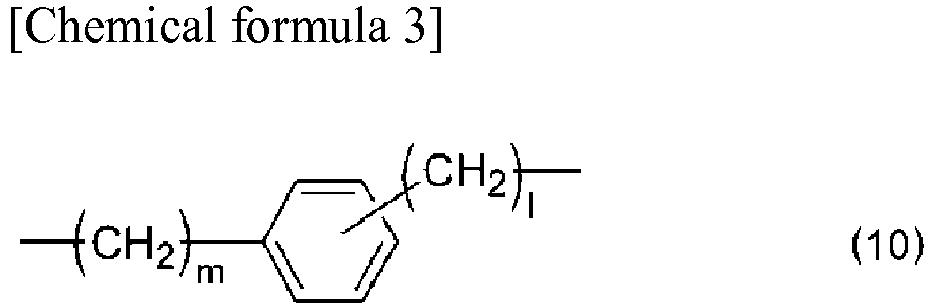
- In the above general formula (4), examples of the divalent hydrocarbon group having 6 to 10 carbon atoms and having an aromatic ring(s), as represented by R4, include a phenylene group and a group represented by the following formula (10).

- (Each of m and 1 independently represents an integer of 1 to 3)
- Specific examples of R4 include the following groups.

- Following are specific examples of the composition of the present invention.


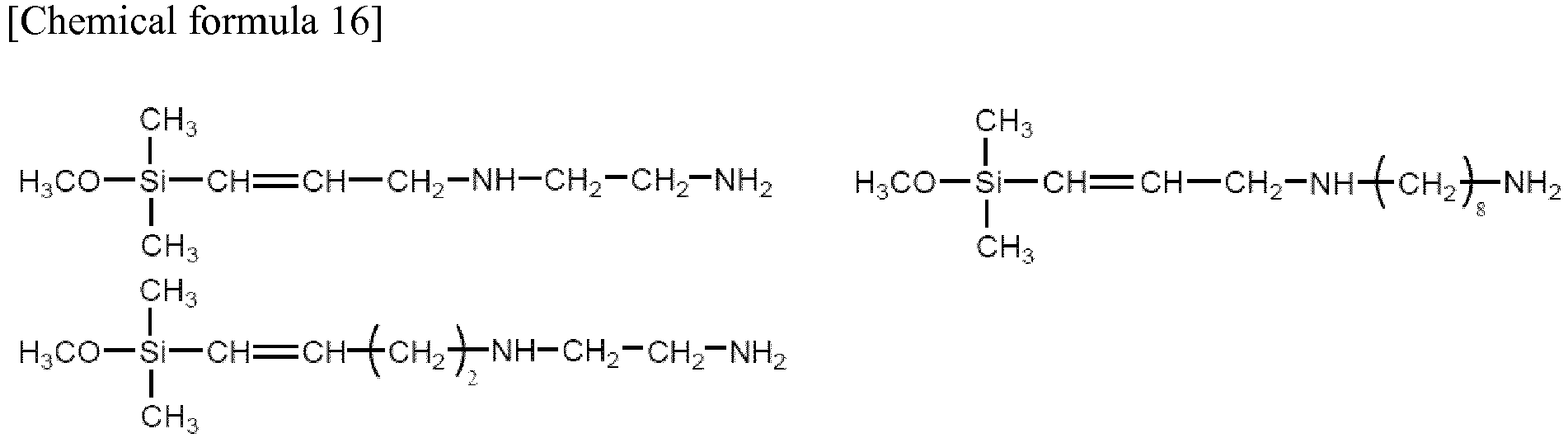

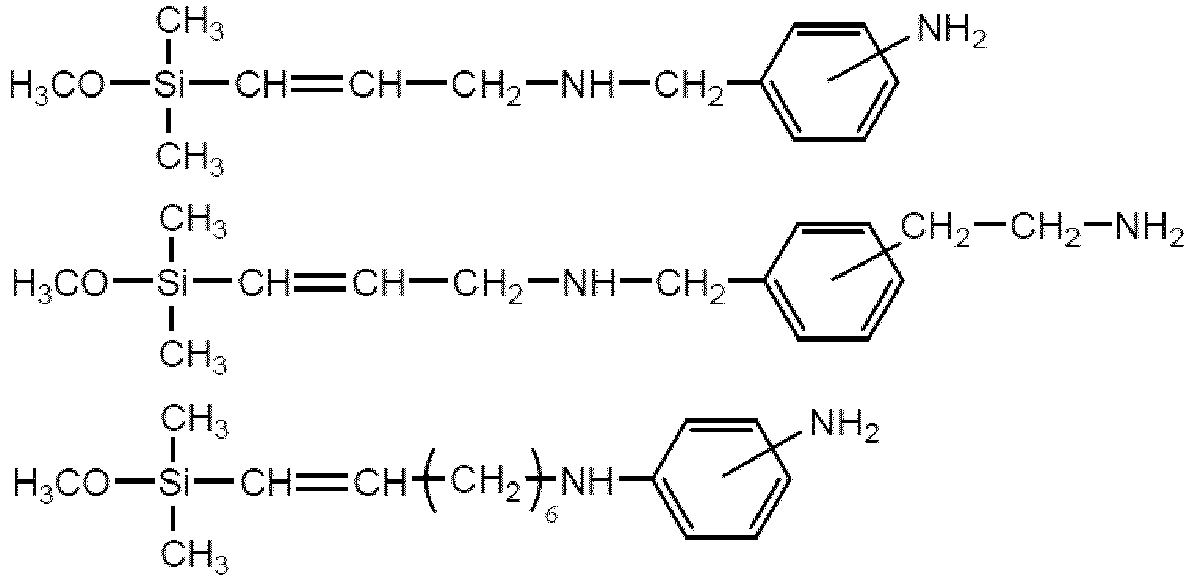


- The compound of the present invention having an amino group at its terminal end can be synthesized as follows.
- That is, such compound of the invention can be obtained by reacting a halogenoalkoxysilane represented by the general formula bellow and a diamine represented by the general formula H2N-R3'-NH2 or H2N-R4-NH2 at a molar ratio of diamine to silane of not smaller than 0.5, more preferably not smaller than 1.0, at a temperature of 50 to 200°C, preferably 80 to 150°C for about 30 min to 30 hours. Here, R3' and R4 are identical to those defined earlier.
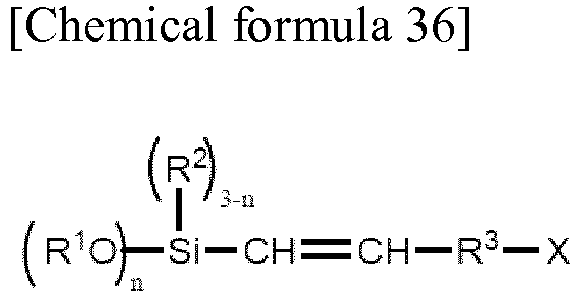
- (In the above formula, R1, R2 and R3 are identical to those defined earlier; and X represents a halogen atom)
- There, the diamine component may be used as a hydrogen halide scavenger, and tertiary amine compounds such as trimethylamine, triethylamine, tributylamine and pyridine may be used as other hydrogen halide scavenger. Further, the resulting hydrogen halide salt may also be neutralized by a sodium alkoxide.
- The compound of the present invention having a mercapto group at its terminal end can be synthesized as follows.
- That is, such compound of the invention can be obtained by reacting a halogenoalkoxysilane represented by the general formula bellow and a thiourea at a molar ratio of thiourea to silane of not smaller than 0.5, more preferably not smaller than 1.0, at a temperature of 50 to 200°C, preferably 80 to 150°C for about 30 min to 30 hours, and then by reacting an isothiourea salt thus generated and a base for 1 to 10 hours.

- (In the above formula, R1, R2, R3 and X are identical to those defined earlier.)
- It is preferred that the base used here be that having a low reactivity with alkoxysilane. Examples of this base include an amine compound such as trimethylamine, triethylamine, tributylamine, pyridine, N, N-diethylamine, N, N-dimethylamine and ammonia; and an alkoxide compound such as sodium methoxide and sodium ethoxide.
- The compound of the present invention having a glycidyl group at its terminal end can be synthesized as follows.
- That is, such compound of the invention can be obtained by reacting an alkoxysilyl compound (alkoxyhydrosilane) and a glycidyl compound which are represented by the general formulae bellow, under the presence of a platinum-group metal catalyst. There, it is preferred that the reaction be performed at a molar ratio of the alkoxysilyl compound to the glycidyl compound of 0.5 to 2.0, more preferably 1.0 to 1.5, at a temperature of 40 to 200°C, preferably 60 to 120°C for about 30 min to 15 hours.

- (In the above formula, R1, R2 and n are identical to those defined earlier.)

- (In the above formula, R3 and R3 are identical to those define earlier.)
- Examples of the platinum-group metal catalyst used here include a chloroplatinic acid; an alcohol solution of a chloroplatinic acid; a reactant of a chloroplatinic acid and an alcohol; a platinum-olefin complex compound; a platinum-vinyl group-containing siloxane complex; and a platinum-supported carbon.
- Further, the compound of the present invention having a (metha) acrylic group (i.e. acrylic group or methacrylic group) at its terminal end can, for example, be synthesized as follows.
- That is, such compound of the invention can be obtained by reacting an alkoxysilyl compound (alkoxyhydrosilane) and a (metha) acrylic compound (referred to as methacrylic compound) which are represented by the general formulae bellow, under the presence of a platinum-group metal catalyst.
- There, it is preferred that the reaction be performed at a molar ratio of the alkoxysilyl compound to the methacrylic compound of 0.5 to 2.0, more preferably 1.0 to 1.5, at a temperature of 40 to 200°C, preferably 60 to 120°C for about 30 min to 15 hours.

- (In the above formula, R1, R2 and n are identical to those defined earlier.)

- (In the above formula, R3 is identical to that defined earlier.)
- A polymerization inhibitor may also be added at the time of performing the above reaction in order to prevent polymerization of methacrylic groups. Examples of such polymerization inhibitor include 1,3,5-trimethyl-2,4,6-tris (3,5-di-t-butyl-4-hydroxybenzyl) benzene (product name: IRGANOX 1330); 2,6-di-t-butyl-4-methylphenol (product name: Sumilizer BHT); 2,5-di-t-butyl-hydroquinone (product name: Nocrac NS-7); 2,6-di-t-butyl-4-ethylphenol (product name: Nocrac M-17); 2,5-di-t-amylhydroquinone (product name: Nocrac DAH); 2,2'-methylenebis (4-methyl-6-t-butylphenol) (product name: Nocrac NS-6); 3,5-di-t-butyl-4-hydroxy-benzyl phosphonate-diethyl ester (product name: IRGANOX 1222); 4,4'-thiobis (3-methyl-6-t-butylphenol) (product name: Nocrac 300); 2,2'-methylenebis (4-ethyl-6-t-butylphenol) (product name: Nocrac NS-5); 4,4'-butylidenebis (3-methyl-6-t-butylphenol) (product name ADK STAB AO-40); and 2-t-butyl-6-(3-t-butyl-2-hydroxy-5-methylbenzyl)-4-methylphenylacrylate (product name: Sumilizer GM).
Further, catalysts similar to those used in the above reactions may be used as platinum-group metal catalysts. - Further, in any one of the above synthetic methods, a solvent may be added at the time of reaction. Here, there are no particular restrictions on such solvent. Examples of this solvent include aromatic hydrocarbons such as toluene, xylene and benzene; aliphatic hydrocarbons such as pentane, hexane, heptane, nonane, octane and decane; ethers such as dimethylether, methylethyl ether, tetrahydrofuran and dioxane; alcohols such as methanol and ethanol; halogenated hydrocarbons such as perchloroethane, perchloroethylene, trichloroethane, chloroform and carbon tetrachloride; amides such as dimethylformamide; and esters such as ethyl acetate, methyl acetate and butyl acetate.
- A synthetic method of the compound of the present invention is described in detail hereunder with reference to working examples (synthetic examples). However, the compound of the invention is not limited to the following examples.
- A 80% propargyl chloride toluene solution of an amount of 250 mL (2.3 mol) and a 0.5 wt% chloroplatinic acid toluene solution of an amount of 5.0 g were placed in a 1L separable flask having a stirrer, a thermometer, a reflux condenser and a dispensing device, followed by heating the same to 70°C under a nitrogen atmosphere. Trimethoxysilane of 337.0 g (2.76 mol) was placed in the dispensing device, and was then delivered by drops while controlling a dropping rate in a way such that the solution temperature became 70 to 80°C. After completing dropping the trimethoxysilane, the temperature of the reaction solution was maintained at 80°C for two hours. By distilling the reaction solution at 80°C under 15 mmHg, there was obtained 269 g (yield 58%) of a final product as a mixture of multiple isomers. These isomers were then analyzed through 1H-NMR spectrum measurement, and it was confirmed that the final product was a 3-chloropropa-1-enyltrimethoxysilane having two isomers at a molar ratio of 1 : 0.08.
FIG.1 is a 1H-NMR spectrum chart of the synthesized 3-chloropropa-1-enyltrimethoxysilane. - An ethylenediamine of an amount of 121.6 g (2.0 mol) was placed in a 500 mL three-necked flask having a stirrer, a thermometer, a reflux condenser and a dispensing device, followed by heating the same to 100°C under a nitrogen atmosphere. A 3-chloropropa-1-enyltrimethoxysilane of 100 g (0.5 mol) was placed in the dispensing device, and was then delivered by drops while controlling a dropping rate in a way such that the solution temperature was within a range of 100 to 105°C.
- After completing dropping the 3-chloropropa-1-enyltrimethoxysilane, the temperature of the reaction solution was maintained at 100°C for two hours, followed by cooling the same. The reaction solution was then moved to a separating funnel to eliminate a triethylamine hydrochloride in a lower layer, followed by distilling the reaction solution at 150°C under 15 mmHg into 78 g (yield 60%) of a final product as a mixture of multiple isomers. These isomers were then analyzed through 1H-NMR spectrum measurement, and it was confirmed that the final product was an N-2-(aminoethyl)-3-aminopropa-1-enylmethoxysilane having two isomers at a molar ratio of 1 : 0.08.
FIG.2 is a 1H-NMR spectrum chart of the synthesized N-2-(aminoethyl)-3-aminopropa-1-enylmethoxysilane. - An m-xylenediamine of an amount of 272.4 g (2.0 mol) and a xylene of 200 mL were placed in a 1L three-necked flask having a stirrer, a thermometer, a reflux condenser and a dispensing device, followed by heating the same to 100°C under a nitrogen atmosphere. A 3-chloropropa-1-enyltrimethoxysilane of 100 g (0.5 mol) was placed in the dispensing device, and was then delivered by drops while controlling a dropping rate in a way such that the solution temperature was within a range of 110 to 120°C. After completing dropping the 3-chloropropa-1-enyltrimethoxysilane, the temperature of the reaction solution was maintained at 120°C for 5 hours, followed by cooling the same to 60°C. Next, a 28% sodium methoxide methanol solution of 91.6 g (0.48 mol) was delivered by drops thereinto, and the solution was continuously stirred for an hour while maintaining the solution temperature at 60°C. After completing stirring, the solution was cooled and then filtrated so as to separate therefrom a sodium chloride as a by-product. As a result of vacuum concentrating such filtrated solution at 150°C under 3 mmHg, there was obtained a yellow and transparent liquid of 134.4 g (yield 80%). This compound was then analyzed through 1H-NMR spectrum measurement, and it was confirmed that the compound was an N-[m-(aminomethylphenyl) methyl)]-γ-aminopropa-1-enylmethoxysilane. having two isomers at a molar ratio of 1 : 0.08.
FIG.3 is a 1H-NMR spectrum chart of the synthesized N-[m-(aminomethylphenyl) methyl)]-γ-aminopropa-1-enylmethoxysilane. - A propargyl alcohol of an amount of 166.2 g (3.0 mol) and a tin chloride of 0.7 g (0.01 mol) were placed in a 1L three-necked flask having a stirrer, a thermometer, a reflux condenser and a dispensing device, followed by heating the same to 100°C under a nitrogen atmosphere. An epichlorohydrin of 92.5 g (1.0 mol) was placed in the dispensing device, and was then delivered by drops while controlling a dropping rate in a way such that the solution temperature was within a range of 95 to 105°C. After completing dropping the epichlorohydrin, the solution was reacted for 20 hours while being maintained at 100°C. Next, after cooling the reaction solution to 90°C, a 16 wt% sodium hydroxide aqueous solution of 325 g (3 mol) was added thereto, followed by reacting the solution for 6 hours. After the reaction had been finished, the solution was cooled, and then moved to a separating funnel. After washing the solution three times with a pure water of 100 mL, an anhydrous sodium sulfate was used to perform dehydration. The anhydrous sodium sulfate was them eliminated by filtration, followed by performing distillation at 110°C under 15 mmHg to obtain 45 g (yield 40%) of a transparent liquid. This compound was then analyzed through 1H-NMR spectrum measurement, and it was confirmed that the compound was propargyl glycidyl ether.
FIG.4 is a 1H-NMR spectrum chart of the synthesized propargyl glycidyl ether. - A propargyl glycidyl ether of an amount of 45 g (0.4 mol) and a 0.5 wt% chloroplatinic acid toluene solution of an amount of 0.1 g were placed in a 200 mL three-necked flask having a stirrer, a thermometer, a reflux condenser and a dispensing device, followed by heating the same to 70°C under a nitrogen atmosphere. A trimethoxysilane of 58 g (0.48 mol) was placed in the dispensing device, and was then delivered by drops while controlling a dropping rate in a way such that the solution temperature was within a range of 70 to 80°C. After completing dropping the trimethoxysilane, the temperature of the reaction solution was maintained at 80°C for 5 hours. Distillation was then performed at 150°C under 15 mmHg to obtain 56.2 g (yield 60%) of a final product as a mixture of multiple isomers. These isomers were then analyzed through 1H-NMR spectrum measurement, and it was confirmed that the final product was a 3-glycidoxypropa-1-enyltrimethoxysilane having two isomers at a molar ratio of 1 : 0.22.
FIG.5 is a 1H-NMR spectrum chart of the synthesized 3-glycidoxypropa-1-enyltrimethoxysilane. - Described hereunder are reference examples where the organic silicon compound of the invention was used as an adhesion aid. Hereunder, "parts" means "parts by mass".
- A dimethylpolysiloxane of an amount of 100 parts and an atomized silica of an amount of 15 parts were homogenously mixed together, such dimethylpolysiloxane having a viscosity of 20,000 mPa·s and a molecular chain whose terminal ends are both blocked by silanol groups, and such atomized silica being surface-treated by dimethyldichlorosilane. Further added thereto were 0.6 parts of a tetramethylguanidylpropyltrimethoxysilane; 5 parts of ethylhexyl 2-(dimethoxymethylsilyl) propanoate; 0.6 parts of dibutyltin dilaurate; and 0.5 parts of N-2-(aminoethyl)-3-amino-2-propenyltrimethoxysilane (working example 1 (2)), followed by performing mixing under no moisture condition until the components had been uniformly mixed together. A composition was thus prepared.
- A composition was prepared in a similar manner as reference example 1 except that 0.5 parts of an N-[m-(aminomethylphenyl) methyl)]-γ-amino-2-propenyltrimethoxysilane were used (working example 2) instead of the N-2-(aminoethyl)-3-amino-2-propenyltrimethoxysilane.
- A composition was prepared in a similar manner as reference example 1 except that 0.5 parts of an N-2-(aminoethyl)-3-aminopropyltrimethoxysilane were used instead of the N-2-(aminoethyl)-3-amino-2-propenyltrimethoxysilane.
- A composition was prepared in a similar manner as reference example 1 except that 0.5 parts of an N-[m-(aminomethylphenyl) methyl)]-γ-aminopropyltrimethoxysilane were used instead of the N-2-(aminoethyl)-3-amino-2-propenyltrimethoxysilane.
- A specimen was then prepared as follows. That is, a spatula was used to form each composition into a shape of
W 10 mm × L 50 mm ×T 2 mm on an adherend, immediately after the composition had been prepared in each reference example and each comparative reference example. After keeping this specimen under the following conditions, a cured product thereof was cut by a knife, followed by peeling off the cut portion by hand (nipped and then pulled by hand), and then observing the peeling state (hand peeling test via knife cuts). In this way, an adhesive interface between the adherend and the composition was able to be evaluated. - An initial adhesion was evaluated after completing keeping at a temperature of 23°C and a relative humidity of 50% for 48 hours.
- The evaluation was performed based on a percentage of an area of the composition where cohesive failure had occurred. When such percentage was 100%, the specimens were marked "⊚"; when such percentage was not lower than 80% but lower than 100%, the specimens were marked "○"; when such percentage was not lower than 50% but lower than 80%, the specimens were marked "Δ"; and when such percentage was lower than 50%, the specimens were marked "×." The results thereof are shown in Table 1.
[Table 1] Reference example 1 Reference example 2 Comparative reference example 1 Comparative reference example 2 ABS ○ ⊚ × Δ PBT Δ ○ × ○ SUS ⊚ ○ Δ × - According to the results of the above simple adhesion test, it was confirmed that an adhesion or adhesiveness to a base material could be exhibited in a short period of time by adding the alkoxysilyl-vinylene group-containing silicon compound of the invention to a room temperature curable organopolysiloxane, and that the alkoxysilyl-vinylene group-containing silicon compound of the invention was significantly useful as an adhesion aid to a room temperature curable organopolysiloxane.

Claims (3)
- An alkoxysilyl-vinylene group-containing silicon compound represented by the following general formula (1):

- The alkoxysilyl-vinylene group-containing silicon compound according to claim 1, wherein R in the general formula (1) represents a group selected from the groups expressed by the following general formulae (2) to (9):


- The alkoxysilyl-vinylene group-containing silicon compound according to claim 2, wherein R4 in the general formula (4) is represented by the following formula (10):
Applications Claiming Priority (2)
| Application Number | Priority Date | Filing Date | Title |
|---|---|---|---|
| JP2014083341 | 2014-04-15 | ||
| PCT/JP2015/052808 WO2015159569A1 (en) | 2014-04-15 | 2015-02-02 | Alkoxysilyl-vinylene group-containing silicon compound |
Publications (3)
| Publication Number | Publication Date |
|---|---|
| EP3133076A1 true EP3133076A1 (en) | 2017-02-22 |
| EP3133076A4 EP3133076A4 (en) | 2017-08-30 |
| EP3133076B1 EP3133076B1 (en) | 2019-10-02 |
Family
ID=54323787
Family Applications (1)
| Application Number | Title | Priority Date | Filing Date |
|---|---|---|---|
| EP15780042.6A Active EP3133076B1 (en) | 2014-04-15 | 2015-02-02 | Alkoxysilyl-vinylene group-containing silicon compound |
Country Status (6)
| Country | Link |
|---|---|
| US (1) | US9920080B2 (en) |
| EP (1) | EP3133076B1 (en) |
| JP (1) | JP6202481B2 (en) |
| KR (1) | KR102383951B1 (en) |
| CN (1) | CN106232609B (en) |
| WO (1) | WO2015159569A1 (en) |
Family Cites Families (11)
| Publication number | Priority date | Publication date | Assignee | Title |
|---|---|---|---|---|
| US3555051A (en) | 1968-01-30 | 1971-01-12 | Union Carbide Corp | Gamma-methacryloxy-alpha,beta-epoxy-propyltrimethoxysilane |
| JPS5145296B2 (en) * | 1973-05-01 | 1976-12-03 | ||
| JPS62149687A (en) * | 1985-12-25 | 1987-07-03 | Toray Ind Inc | Production of alkenyltrialkoxysilane containing unsaturated ester group |
| US4668812A (en) * | 1985-12-31 | 1987-05-26 | Union Carbide Corporation | Process for the preparation of olefinic silanes and siloxanes |
| US5030746A (en) * | 1990-05-29 | 1991-07-09 | Union Carbide Chemicals And Plastics Technology Corporation | Sterically hindered aminohydrocarbylsilanes and process of preparation |
| JPH0912861A (en) | 1995-06-30 | 1997-01-14 | Asahi Glass Co Ltd | Curable composition |
| JP2004307723A (en) | 2003-04-09 | 2004-11-04 | Shin Etsu Chem Co Ltd | Room temperature fast-curing saturated hydrocarbon polymer composition and double glazing |
| US7381359B2 (en) | 2004-10-14 | 2008-06-03 | Yazaki Corporation | Method for making filled epoxy resin compositions |
| JP4570547B2 (en) | 2004-10-14 | 2010-10-27 | 矢崎総業株式会社 | Filled epoxy resin composition and method for producing the same |
| US7311972B2 (en) | 2004-10-14 | 2007-12-25 | Yazaki Corporation | Filled epoxy resin compositions |
| JP2008163143A (en) | 2006-12-27 | 2008-07-17 | Momentive Performance Materials Japan Kk | Room temperature curable polyorganosiloxane composition |
-
2015
- 2015-02-02 JP JP2016513653A patent/JP6202481B2/en active Active
- 2015-02-02 CN CN201580019848.1A patent/CN106232609B/en active Active
- 2015-02-02 US US15/302,136 patent/US9920080B2/en active Active
- 2015-02-02 EP EP15780042.6A patent/EP3133076B1/en active Active
- 2015-02-02 KR KR1020167028594A patent/KR102383951B1/en active Active
- 2015-02-02 WO PCT/JP2015/052808 patent/WO2015159569A1/en not_active Ceased
Also Published As
| Publication number | Publication date |
|---|---|
| EP3133076A4 (en) | 2017-08-30 |
| US20170190721A1 (en) | 2017-07-06 |
| KR20160146704A (en) | 2016-12-21 |
| KR102383951B1 (en) | 2022-04-08 |
| CN106232609A (en) | 2016-12-14 |
| JP6202481B2 (en) | 2017-09-27 |
| EP3133076B1 (en) | 2019-10-02 |
| CN106232609B (en) | 2019-08-20 |
| US9920080B2 (en) | 2018-03-20 |
| JPWO2015159569A1 (en) | 2017-04-13 |
| WO2015159569A1 (en) | 2015-10-22 |
Similar Documents
| Publication | Publication Date | Title |
|---|---|---|
| US10100068B2 (en) | Amidine group—or guanidine group—containing silane | |
| US8314264B2 (en) | Photopolymerizable functional radical-containing organosilicon compound and making method | |
| EP3009440B1 (en) | Silicone compound having a radical-polymerizable group and a method for the preparation thereof | |
| US20180037596A1 (en) | Novel bis (alkoxysilyl-vinylene) group-containing silicon compound and production method of same | |
| PL360360A1 (en) | Organosilicone compounds, method of their obtaining, their application and rubber compositions | |
| EP3663304A1 (en) | Surface treatment agent and surface treatment method using the same | |
| US10336866B2 (en) | Method for producing organosilicon compounds having amino groups | |
| US20100160588A1 (en) | Organic silicone compound | |
| KR20150003202A (en) | Process for preparing (meth)acrylamido-functional silanes by the reaction of aminoalkyl alkoxysilanes with acrylic acid anhydride | |
| JP2017043560A (en) | Nitrogen-containing organosilicon compound and resin composition | |
| EP2289898A1 (en) | Melamine-Functional organosilicon compound and making method | |
| EP2876111B1 (en) | Composition containing nitrogen-containing organoxysilane compound and method for making the same | |
| JP2025183384A (en) | Method for producing alkoxysilyl-containing thiocarboxylic acid esters | |
| EP3133076B1 (en) | Alkoxysilyl-vinylene group-containing silicon compound | |
| KR101922256B1 (en) | Alkoxysilane compounds having fluoroalkyl group and method of preparing the same | |
| EP3015471B1 (en) | Novel bisalkoxysilane compound and its production method | |
| US8461368B2 (en) | Process for preparing organic silane compounds having beta-cyano ester group | |
| US7432387B2 (en) | Process for producing organosilicon compound | |
| US9862735B2 (en) | Organosilicon compound having diphenylethyl and methoxysilyl and making method | |
| JP2011246391A (en) | Silane compound having carboxylate ester group and amino group protected with silyl group, and method for producing the same | |
| US11279718B2 (en) | Method for producing ureido group-containing organosilicon compound | |
| TWI680980B (en) | Sulfur-containing amine-based organic oxysilane compound and manufacturing method thereof | |
| EP4660271A1 (en) | Composition containing linear aminosilane compound having carboxylic ester group and cyclic silazane compound having carboxylic ester group, and method for producing same |
Legal Events
| Date | Code | Title | Description |
|---|---|---|---|
| STAA | Information on the status of an ep patent application or granted ep patent |
Free format text: STATUS: THE INTERNATIONAL PUBLICATION HAS BEEN MADE |
|
| PUAI | Public reference made under article 153(3) epc to a published international application that has entered the european phase |
Free format text: ORIGINAL CODE: 0009012 |
|
| STAA | Information on the status of an ep patent application or granted ep patent |
Free format text: STATUS: REQUEST FOR EXAMINATION WAS MADE |
|
| 17P | Request for examination filed |
Effective date: 20161010 |
|
| AK | Designated contracting states |
Kind code of ref document: A1 Designated state(s): AL AT BE BG CH CY CZ DE DK EE ES FI FR GB GR HR HU IE IS IT LI LT LU LV MC MK MT NL NO PL PT RO RS SE SI SK SM TR |
|
| AX | Request for extension of the european patent |
Extension state: BA ME |
|
| DAX | Request for extension of the european patent (deleted) | ||
| A4 | Supplementary search report drawn up and despatched |
Effective date: 20170802 |
|
| RIC1 | Information provided on ipc code assigned before grant |
Ipc: C07F 7/18 20060101AFI20170724BHEP |
|
| STAA | Information on the status of an ep patent application or granted ep patent |
Free format text: STATUS: EXAMINATION IS IN PROGRESS |
|
| 17Q | First examination report despatched |
Effective date: 20180918 |
|
| GRAP | Despatch of communication of intention to grant a patent |
Free format text: ORIGINAL CODE: EPIDOSNIGR1 |
|
| STAA | Information on the status of an ep patent application or granted ep patent |
Free format text: STATUS: GRANT OF PATENT IS INTENDED |
|
| INTG | Intention to grant announced |
Effective date: 20190423 |
|
| GRAS | Grant fee paid |
Free format text: ORIGINAL CODE: EPIDOSNIGR3 |
|
| GRAA | (expected) grant |
Free format text: ORIGINAL CODE: 0009210 |
|
| STAA | Information on the status of an ep patent application or granted ep patent |
Free format text: STATUS: THE PATENT HAS BEEN GRANTED |
|
| AK | Designated contracting states |
Kind code of ref document: B1 Designated state(s): AL AT BE BG CH CY CZ DE DK EE ES FI FR GB GR HR HU IE IS IT LI LT LU LV MC MK MT NL NO PL PT RO RS SE SI SK SM TR |
|
| REG | Reference to a national code |
Ref country code: GB Ref legal event code: FG4D |
|
| REG | Reference to a national code |
Ref country code: CH Ref legal event code: EP Ref country code: AT Ref legal event code: REF Ref document number: 1186059 Country of ref document: AT Kind code of ref document: T Effective date: 20191015 |
|
| REG | Reference to a national code |
Ref country code: DE Ref legal event code: R096 Ref document number: 602015039128 Country of ref document: DE |
|
| REG | Reference to a national code |
Ref country code: IE Ref legal event code: FG4D |
|
| REG | Reference to a national code |
Ref country code: NL Ref legal event code: FP |
|
| REG | Reference to a national code |
Ref country code: LT Ref legal event code: MG4D |
|
| REG | Reference to a national code |
Ref country code: AT Ref legal event code: MK05 Ref document number: 1186059 Country of ref document: AT Kind code of ref document: T Effective date: 20191002 |
|
| PG25 | Lapsed in a contracting state [announced via postgrant information from national office to epo] |
Ref country code: ES Free format text: LAPSE BECAUSE OF FAILURE TO SUBMIT A TRANSLATION OF THE DESCRIPTION OR TO PAY THE FEE WITHIN THE PRESCRIBED TIME-LIMIT Effective date: 20191002 Ref country code: SE Free format text: LAPSE BECAUSE OF FAILURE TO SUBMIT A TRANSLATION OF THE DESCRIPTION OR TO PAY THE FEE WITHIN THE PRESCRIBED TIME-LIMIT Effective date: 20191002 Ref country code: LV Free format text: LAPSE BECAUSE OF FAILURE TO SUBMIT A TRANSLATION OF THE DESCRIPTION OR TO PAY THE FEE WITHIN THE PRESCRIBED TIME-LIMIT Effective date: 20191002 Ref country code: PT Free format text: LAPSE BECAUSE OF FAILURE TO SUBMIT A TRANSLATION OF THE DESCRIPTION OR TO PAY THE FEE WITHIN THE PRESCRIBED TIME-LIMIT Effective date: 20200203 Ref country code: FI Free format text: LAPSE BECAUSE OF FAILURE TO SUBMIT A TRANSLATION OF THE DESCRIPTION OR TO PAY THE FEE WITHIN THE PRESCRIBED TIME-LIMIT Effective date: 20191002 Ref country code: NO Free format text: LAPSE BECAUSE OF FAILURE TO SUBMIT A TRANSLATION OF THE DESCRIPTION OR TO PAY THE FEE WITHIN THE PRESCRIBED TIME-LIMIT Effective date: 20200102 Ref country code: GR Free format text: LAPSE BECAUSE OF FAILURE TO SUBMIT A TRANSLATION OF THE DESCRIPTION OR TO PAY THE FEE WITHIN THE PRESCRIBED TIME-LIMIT Effective date: 20200103 Ref country code: BG Free format text: LAPSE BECAUSE OF FAILURE TO SUBMIT A TRANSLATION OF THE DESCRIPTION OR TO PAY THE FEE WITHIN THE PRESCRIBED TIME-LIMIT Effective date: 20200102 Ref country code: PL Free format text: LAPSE BECAUSE OF FAILURE TO SUBMIT A TRANSLATION OF THE DESCRIPTION OR TO PAY THE FEE WITHIN THE PRESCRIBED TIME-LIMIT Effective date: 20191002 Ref country code: AT Free format text: LAPSE BECAUSE OF FAILURE TO SUBMIT A TRANSLATION OF THE DESCRIPTION OR TO PAY THE FEE WITHIN THE PRESCRIBED TIME-LIMIT Effective date: 20191002 Ref country code: LT Free format text: LAPSE BECAUSE OF FAILURE TO SUBMIT A TRANSLATION OF THE DESCRIPTION OR TO PAY THE FEE WITHIN THE PRESCRIBED TIME-LIMIT Effective date: 20191002 |
|
| PG25 | Lapsed in a contracting state [announced via postgrant information from national office to epo] |
Ref country code: IS Free format text: LAPSE BECAUSE OF FAILURE TO SUBMIT A TRANSLATION OF THE DESCRIPTION OR TO PAY THE FEE WITHIN THE PRESCRIBED TIME-LIMIT Effective date: 20200224 Ref country code: RS Free format text: LAPSE BECAUSE OF FAILURE TO SUBMIT A TRANSLATION OF THE DESCRIPTION OR TO PAY THE FEE WITHIN THE PRESCRIBED TIME-LIMIT Effective date: 20191002 Ref country code: HR Free format text: LAPSE BECAUSE OF FAILURE TO SUBMIT A TRANSLATION OF THE DESCRIPTION OR TO PAY THE FEE WITHIN THE PRESCRIBED TIME-LIMIT Effective date: 20191002 Ref country code: CZ Free format text: LAPSE BECAUSE OF FAILURE TO SUBMIT A TRANSLATION OF THE DESCRIPTION OR TO PAY THE FEE WITHIN THE PRESCRIBED TIME-LIMIT Effective date: 20191002 |
|
| PG25 | Lapsed in a contracting state [announced via postgrant information from national office to epo] |
Ref country code: AL Free format text: LAPSE BECAUSE OF FAILURE TO SUBMIT A TRANSLATION OF THE DESCRIPTION OR TO PAY THE FEE WITHIN THE PRESCRIBED TIME-LIMIT Effective date: 20191002 |
|
| REG | Reference to a national code |
Ref country code: DE Ref legal event code: R097 Ref document number: 602015039128 Country of ref document: DE |
|
| PG2D | Information on lapse in contracting state deleted |
Ref country code: IS |
|
| PG25 | Lapsed in a contracting state [announced via postgrant information from national office to epo] |
Ref country code: DK Free format text: LAPSE BECAUSE OF FAILURE TO SUBMIT A TRANSLATION OF THE DESCRIPTION OR TO PAY THE FEE WITHIN THE PRESCRIBED TIME-LIMIT Effective date: 20191002 Ref country code: EE Free format text: LAPSE BECAUSE OF FAILURE TO SUBMIT A TRANSLATION OF THE DESCRIPTION OR TO PAY THE FEE WITHIN THE PRESCRIBED TIME-LIMIT Effective date: 20191002 Ref country code: RO Free format text: LAPSE BECAUSE OF FAILURE TO SUBMIT A TRANSLATION OF THE DESCRIPTION OR TO PAY THE FEE WITHIN THE PRESCRIBED TIME-LIMIT Effective date: 20191002 Ref country code: IS Free format text: LAPSE BECAUSE OF FAILURE TO SUBMIT A TRANSLATION OF THE DESCRIPTION OR TO PAY THE FEE WITHIN THE PRESCRIBED TIME-LIMIT Effective date: 20200202 |
|
| PLBE | No opposition filed within time limit |
Free format text: ORIGINAL CODE: 0009261 |
|
| STAA | Information on the status of an ep patent application or granted ep patent |
Free format text: STATUS: NO OPPOSITION FILED WITHIN TIME LIMIT |
|
| PG25 | Lapsed in a contracting state [announced via postgrant information from national office to epo] |
Ref country code: SK Free format text: LAPSE BECAUSE OF FAILURE TO SUBMIT A TRANSLATION OF THE DESCRIPTION OR TO PAY THE FEE WITHIN THE PRESCRIBED TIME-LIMIT Effective date: 20191002 Ref country code: SM Free format text: LAPSE BECAUSE OF FAILURE TO SUBMIT A TRANSLATION OF THE DESCRIPTION OR TO PAY THE FEE WITHIN THE PRESCRIBED TIME-LIMIT Effective date: 20191002 Ref country code: IT Free format text: LAPSE BECAUSE OF FAILURE TO SUBMIT A TRANSLATION OF THE DESCRIPTION OR TO PAY THE FEE WITHIN THE PRESCRIBED TIME-LIMIT Effective date: 20191002 |
|
| REG | Reference to a national code |
Ref country code: DE Ref legal event code: R119 Ref document number: 602015039128 Country of ref document: DE |
|
| 26N | No opposition filed |
Effective date: 20200703 |
|
| REG | Reference to a national code |
Ref country code: CH Ref legal event code: PL |
|
| GBPC | Gb: european patent ceased through non-payment of renewal fee |
Effective date: 20200202 |
|
| REG | Reference to a national code |
Ref country code: BE Ref legal event code: MM Effective date: 20200229 |
|
| PG25 | Lapsed in a contracting state [announced via postgrant information from national office to epo] |
Ref country code: LU Free format text: LAPSE BECAUSE OF NON-PAYMENT OF DUE FEES Effective date: 20200202 Ref country code: MC Free format text: LAPSE BECAUSE OF FAILURE TO SUBMIT A TRANSLATION OF THE DESCRIPTION OR TO PAY THE FEE WITHIN THE PRESCRIBED TIME-LIMIT Effective date: 20191002 |
|
| PG25 | Lapsed in a contracting state [announced via postgrant information from national office to epo] |
Ref country code: LI Free format text: LAPSE BECAUSE OF NON-PAYMENT OF DUE FEES Effective date: 20200229 Ref country code: SI Free format text: LAPSE BECAUSE OF FAILURE TO SUBMIT A TRANSLATION OF THE DESCRIPTION OR TO PAY THE FEE WITHIN THE PRESCRIBED TIME-LIMIT Effective date: 20191002 Ref country code: CH Free format text: LAPSE BECAUSE OF NON-PAYMENT OF DUE FEES Effective date: 20200229 |
|
| PG25 | Lapsed in a contracting state [announced via postgrant information from national office to epo] |
Ref country code: FR Free format text: LAPSE BECAUSE OF NON-PAYMENT OF DUE FEES Effective date: 20200229 Ref country code: GB Free format text: LAPSE BECAUSE OF NON-PAYMENT OF DUE FEES Effective date: 20200202 Ref country code: IE Free format text: LAPSE BECAUSE OF NON-PAYMENT OF DUE FEES Effective date: 20200202 Ref country code: DE Free format text: LAPSE BECAUSE OF NON-PAYMENT OF DUE FEES Effective date: 20200901 |
|
| PG25 | Lapsed in a contracting state [announced via postgrant information from national office to epo] |
Ref country code: BE Free format text: LAPSE BECAUSE OF NON-PAYMENT OF DUE FEES Effective date: 20200229 |
|
| PG25 | Lapsed in a contracting state [announced via postgrant information from national office to epo] |
Ref country code: TR Free format text: LAPSE BECAUSE OF FAILURE TO SUBMIT A TRANSLATION OF THE DESCRIPTION OR TO PAY THE FEE WITHIN THE PRESCRIBED TIME-LIMIT Effective date: 20191002 Ref country code: MT Free format text: LAPSE BECAUSE OF FAILURE TO SUBMIT A TRANSLATION OF THE DESCRIPTION OR TO PAY THE FEE WITHIN THE PRESCRIBED TIME-LIMIT Effective date: 20191002 Ref country code: CY Free format text: LAPSE BECAUSE OF FAILURE TO SUBMIT A TRANSLATION OF THE DESCRIPTION OR TO PAY THE FEE WITHIN THE PRESCRIBED TIME-LIMIT Effective date: 20191002 |
|
| PG25 | Lapsed in a contracting state [announced via postgrant information from national office to epo] |
Ref country code: MK Free format text: LAPSE BECAUSE OF FAILURE TO SUBMIT A TRANSLATION OF THE DESCRIPTION OR TO PAY THE FEE WITHIN THE PRESCRIBED TIME-LIMIT Effective date: 20191002 |
|
| PGFP | Annual fee paid to national office [announced via postgrant information from national office to epo] |
Ref country code: NL Payment date: 20260218 Year of fee payment: 12 |