EP3129389B1 - Group ivb transition metal catalyst containing at least one pentalene ring as polymerization catalyst for lactide polymers - Google Patents
Group ivb transition metal catalyst containing at least one pentalene ring as polymerization catalyst for lactide polymers Download PDFInfo
- Publication number
- EP3129389B1 EP3129389B1 EP15717122.4A EP15717122A EP3129389B1 EP 3129389 B1 EP3129389 B1 EP 3129389B1 EP 15717122 A EP15717122 A EP 15717122A EP 3129389 B1 EP3129389 B1 EP 3129389B1
- Authority
- EP
- European Patent Office
- Prior art keywords
- lactide
- polymerisation
- benzene
- obs
- nmr
- Prior art date
- Legal status (The legal status is an assumption and is not a legal conclusion. Google has not performed a legal analysis and makes no representation as to the accuracy of the status listed.)
- Not-in-force
Links
- JJTUDXZGHPGLLC-UHFFFAOYSA-N lactide Chemical compound CC1OC(=O)C(C)OC1=O JJTUDXZGHPGLLC-UHFFFAOYSA-N 0.000 title claims description 147
- GUVXZFRDPCKWEM-UHFFFAOYSA-N pentalene group Chemical group C1=CC=C2C=CC=C12 GUVXZFRDPCKWEM-UHFFFAOYSA-N 0.000 title claims description 5
- 239000003054 catalyst Substances 0.000 title description 7
- 229920000642 polymer Polymers 0.000 title description 6
- 229910052723 transition metal Inorganic materials 0.000 title description 3
- 150000003624 transition metals Chemical class 0.000 title description 2
- 239000002685 polymerization catalyst Substances 0.000 title 1
- JJTUDXZGHPGLLC-IMJSIDKUSA-N 4511-42-6 Chemical group C[C@@H]1OC(=O)[C@H](C)OC1=O JJTUDXZGHPGLLC-IMJSIDKUSA-N 0.000 claims description 53
- 239000000178 monomer Substances 0.000 claims description 34
- 150000001875 compounds Chemical class 0.000 claims description 33
- 239000003999 initiator Substances 0.000 claims description 31
- 238000000034 method Methods 0.000 claims description 17
- 229920000747 poly(lactic acid) Polymers 0.000 claims description 17
- -1 2,6-dimethylphenyl Chemical group 0.000 claims description 13
- 229910052751 metal Inorganic materials 0.000 claims description 13
- 239000002184 metal Substances 0.000 claims description 13
- 239000003446 ligand Substances 0.000 claims description 11
- VNEACLJMGRLSEJ-UHFFFAOYSA-N CC1=C(C)C2=C(C)C(C)=C(C)C2=C1C Chemical compound CC1=C(C)C2=C(C)C(C)=C(C)C2=C1C VNEACLJMGRLSEJ-UHFFFAOYSA-N 0.000 claims description 9
- 229910052719 titanium Inorganic materials 0.000 claims description 9
- 229910052726 zirconium Inorganic materials 0.000 claims description 9
- 125000000217 alkyl group Chemical group 0.000 claims description 8
- 125000001997 phenyl group Chemical group [H]C1=C([H])C([H])=C(*)C([H])=C1[H] 0.000 claims description 8
- ZZUFCTLCJUWOSV-UHFFFAOYSA-N furosemide Chemical compound C1=C(Cl)C(S(=O)(=O)N)=CC(C(O)=O)=C1NCC1=CC=CO1 ZZUFCTLCJUWOSV-UHFFFAOYSA-N 0.000 claims description 7
- 229910052735 hafnium Inorganic materials 0.000 claims description 7
- 230000008569 process Effects 0.000 claims description 7
- 239000000539 dimer Substances 0.000 claims description 3
- 125000005843 halogen group Chemical group 0.000 claims description 3
- 229910052736 halogen Inorganic materials 0.000 claims description 2
- RMSGQZDGSZOJMU-UHFFFAOYSA-N 1-butyl-2-phenylbenzene Chemical group CCCCC1=CC=CC=C1C1=CC=CC=C1 RMSGQZDGSZOJMU-UHFFFAOYSA-N 0.000 claims 1
- YXFVVABEGXRONW-UHFFFAOYSA-N Toluene Chemical compound CC1=CC=CC=C1 YXFVVABEGXRONW-UHFFFAOYSA-N 0.000 description 75
- UHOVQNZJYSORNB-UHFFFAOYSA-N Benzene Chemical compound C1=CC=CC=C1 UHOVQNZJYSORNB-UHFFFAOYSA-N 0.000 description 57
- 239000010936 titanium Substances 0.000 description 55
- UHOVQNZJYSORNB-MZWXYZOWSA-N benzene-d6 Chemical compound [2H]C1=C([2H])C([2H])=C([2H])C([2H])=C1[2H] UHOVQNZJYSORNB-MZWXYZOWSA-N 0.000 description 54
- 239000000243 solution Substances 0.000 description 48
- HEDRZPFGACZZDS-MICDWDOJSA-N Trichloro(2H)methane Chemical compound [2H]C(Cl)(Cl)Cl HEDRZPFGACZZDS-MICDWDOJSA-N 0.000 description 44
- 125000002496 methyl group Chemical group [H]C([H])([H])* 0.000 description 37
- 238000004009 13C{1H}-NMR spectroscopy Methods 0.000 description 29
- 238000005160 1H NMR spectroscopy Methods 0.000 description 28
- 230000015572 biosynthetic process Effects 0.000 description 27
- VLKZOEOYAKHREP-UHFFFAOYSA-N n-Hexane Chemical compound CCCCCC VLKZOEOYAKHREP-UHFFFAOYSA-N 0.000 description 27
- 238000003786 synthesis reaction Methods 0.000 description 26
- 239000013078 crystal Substances 0.000 description 22
- 239000002904 solvent Substances 0.000 description 20
- 238000006243 chemical reaction Methods 0.000 description 19
- IJGRMHOSHXDMSA-UHFFFAOYSA-N Atomic nitrogen Chemical compound N#N IJGRMHOSHXDMSA-UHFFFAOYSA-N 0.000 description 18
- DKGAVHZHDRPRBM-UHFFFAOYSA-N Tert-Butanol Chemical compound CC(C)(C)O DKGAVHZHDRPRBM-UHFFFAOYSA-N 0.000 description 17
- YBYIRNPNPLQARY-UHFFFAOYSA-N 1H-indene Natural products C1=CC=C2CC=CC2=C1 YBYIRNPNPLQARY-UHFFFAOYSA-N 0.000 description 15
- OFBQJSOFQDEBGM-UHFFFAOYSA-N Pentane Chemical compound CCCCC OFBQJSOFQDEBGM-UHFFFAOYSA-N 0.000 description 14
- 241001289753 Graphium sarpedon Species 0.000 description 12
- 238000001035 drying Methods 0.000 description 12
- 239000002244 precipitate Substances 0.000 description 12
- 238000005481 NMR spectroscopy Methods 0.000 description 11
- 239000000706 filtrate Substances 0.000 description 11
- 238000007151 ring opening polymerisation reaction Methods 0.000 description 11
- 230000000694 effects Effects 0.000 description 10
- 238000001914 filtration Methods 0.000 description 10
- 239000000843 powder Substances 0.000 description 10
- 229910007928 ZrCl2 Inorganic materials 0.000 description 8
- 229910007930 ZrCl3 Inorganic materials 0.000 description 8
- 125000001449 isopropyl group Chemical group [H]C([H])([H])C([H])(*)C([H])([H])[H] 0.000 description 8
- 229910052757 nitrogen Inorganic materials 0.000 description 8
- 238000003756 stirring Methods 0.000 description 8
- 230000003247 decreasing effect Effects 0.000 description 7
- 125000000999 tert-butyl group Chemical group [H]C([H])([H])C(*)(C([H])([H])[H])C([H])([H])[H] 0.000 description 7
- 229910006400 μ-Cl Inorganic materials 0.000 description 7
- NXXYKOUNUYWIHA-UHFFFAOYSA-N 2,6-Dimethylphenol Chemical compound CC1=CC=CC(C)=C1O NXXYKOUNUYWIHA-UHFFFAOYSA-N 0.000 description 6
- QCWXUUIWCKQGHC-UHFFFAOYSA-N Zirconium Chemical compound [Zr] QCWXUUIWCKQGHC-UHFFFAOYSA-N 0.000 description 6
- 230000004913 activation Effects 0.000 description 6
- 239000012298 atmosphere Substances 0.000 description 6
- 229910052739 hydrogen Inorganic materials 0.000 description 6
- 230000006698 induction Effects 0.000 description 6
- 125000002524 organometallic group Chemical group 0.000 description 6
- 239000011541 reaction mixture Substances 0.000 description 6
- 239000007787 solid Substances 0.000 description 6
- OKTJSMMVPCPJKN-UHFFFAOYSA-N Carbon Chemical group [C] OKTJSMMVPCPJKN-UHFFFAOYSA-N 0.000 description 5
- RTAQQCXQSZGOHL-UHFFFAOYSA-N Titanium Chemical compound [Ti] RTAQQCXQSZGOHL-UHFFFAOYSA-N 0.000 description 5
- 238000004458 analytical method Methods 0.000 description 5
- 125000001797 benzyl group Chemical group [H]C1=C([H])C([H])=C(C([H])=C1[H])C([H])([H])* 0.000 description 5
- 229910052799 carbon Inorganic materials 0.000 description 5
- 230000000977 initiatory effect Effects 0.000 description 5
- 238000000655 nuclear magnetic resonance spectrum Methods 0.000 description 5
- LFQSCWFLJHTTHZ-UHFFFAOYSA-N Ethanol Chemical compound CCO LFQSCWFLJHTTHZ-UHFFFAOYSA-N 0.000 description 4
- 125000004432 carbon atom Chemical group C* 0.000 description 4
- ZSWFCLXCOIISFI-UHFFFAOYSA-N cyclopentadiene Chemical compound C1C=CC=C1 ZSWFCLXCOIISFI-UHFFFAOYSA-N 0.000 description 4
- 238000000921 elemental analysis Methods 0.000 description 4
- VBJZVLUMGGDVMO-UHFFFAOYSA-N hafnium atom Chemical compound [Hf] VBJZVLUMGGDVMO-UHFFFAOYSA-N 0.000 description 4
- 238000004519 manufacturing process Methods 0.000 description 4
- 230000007246 mechanism Effects 0.000 description 4
- VNWKTOKETHGBQD-UHFFFAOYSA-N methane Chemical group C VNWKTOKETHGBQD-UHFFFAOYSA-N 0.000 description 4
- 239000000203 mixture Substances 0.000 description 4
- 239000003921 oil Substances 0.000 description 4
- 235000019198 oils Nutrition 0.000 description 4
- 238000006116 polymerization reaction Methods 0.000 description 4
- 238000002360 preparation method Methods 0.000 description 4
- 239000002002 slurry Substances 0.000 description 4
- 238000001228 spectrum Methods 0.000 description 4
- 229910052717 sulfur Inorganic materials 0.000 description 4
- 239000003039 volatile agent Substances 0.000 description 4
- YMWUJEATGCHHMB-UHFFFAOYSA-N Dichloromethane Chemical compound ClCCl YMWUJEATGCHHMB-UHFFFAOYSA-N 0.000 description 3
- 229910010062 TiCl3 Inorganic materials 0.000 description 3
- 238000013480 data collection Methods 0.000 description 3
- 239000002274 desiccant Substances 0.000 description 3
- 230000009977 dual effect Effects 0.000 description 3
- 125000003454 indenyl group Chemical group C1(C=CC2=CC=CC=C12)* 0.000 description 3
- 239000011159 matrix material Substances 0.000 description 3
- QSHDDOUJBYECFT-UHFFFAOYSA-N mercury Chemical compound [Hg] QSHDDOUJBYECFT-UHFFFAOYSA-N 0.000 description 3
- 229910052753 mercury Inorganic materials 0.000 description 3
- 239000010702 perfluoropolyether Substances 0.000 description 3
- 230000005855 radiation Effects 0.000 description 3
- YONPGGFAJWQGJC-UHFFFAOYSA-K titanium(iii) chloride Chemical compound Cl[Ti](Cl)Cl YONPGGFAJWQGJC-UHFFFAOYSA-K 0.000 description 3
- 238000002424 x-ray crystallography Methods 0.000 description 3
- AGBQKNBQESQNJD-ZETCQYMHSA-N (S)-lipoic acid Chemical compound OC(=O)CCCC[C@H]1CCSS1 AGBQKNBQESQNJD-ZETCQYMHSA-N 0.000 description 2
- RTZKZFJDLAIYFH-UHFFFAOYSA-N Diethyl ether Chemical compound CCOCC RTZKZFJDLAIYFH-UHFFFAOYSA-N 0.000 description 2
- 208000034530 PLAA-associated neurodevelopmental disease Diseases 0.000 description 2
- YZCKVEUIGOORGS-IGMARMGPSA-N Protium Chemical compound [1H] YZCKVEUIGOORGS-IGMARMGPSA-N 0.000 description 2
- 238000004639 Schlenk technique Methods 0.000 description 2
- 229910007932 ZrCl4 Inorganic materials 0.000 description 2
- 150000001336 alkenes Chemical class 0.000 description 2
- 150000004703 alkoxides Chemical class 0.000 description 2
- 150000001555 benzenes Chemical class 0.000 description 2
- 230000003197 catalytic effect Effects 0.000 description 2
- 125000004122 cyclic group Chemical group 0.000 description 2
- ZMMRKRFMSDTOLV-UHFFFAOYSA-N cyclopenta-1,3-diene zirconium Chemical compound [Zr].C1C=CC=C1.C1C=CC=C1 ZMMRKRFMSDTOLV-UHFFFAOYSA-N 0.000 description 2
- 229910001873 dinitrogen Inorganic materials 0.000 description 2
- USIUVYZYUHIAEV-UHFFFAOYSA-N diphenyl ether Chemical compound C=1C=CC=CC=1OC1=CC=CC=C1 USIUVYZYUHIAEV-UHFFFAOYSA-N 0.000 description 2
- 238000004090 dissolution Methods 0.000 description 2
- 238000009826 distribution Methods 0.000 description 2
- 239000007789 gas Substances 0.000 description 2
- 239000003365 glass fiber Substances 0.000 description 2
- 238000003780 insertion Methods 0.000 description 2
- 230000010354 integration Effects 0.000 description 2
- KWGKDLIKAYFUFQ-UHFFFAOYSA-M lithium chloride Chemical compound [Li+].[Cl-] KWGKDLIKAYFUFQ-UHFFFAOYSA-M 0.000 description 2
- 229920002521 macromolecule Polymers 0.000 description 2
- 230000001404 mediated effect Effects 0.000 description 2
- 239000002808 molecular sieve Substances 0.000 description 2
- JRZJOMJEPLMPRA-UHFFFAOYSA-N olefin Natural products CCCCCCCC=C JRZJOMJEPLMPRA-UHFFFAOYSA-N 0.000 description 2
- 229910052700 potassium Inorganic materials 0.000 description 2
- 239000011591 potassium Substances 0.000 description 2
- 239000013557 residual solvent Substances 0.000 description 2
- URGAHOPLAPQHLN-UHFFFAOYSA-N sodium aluminosilicate Chemical compound [Na+].[Al+3].[O-][Si]([O-])=O.[O-][Si]([O-])=O URGAHOPLAPQHLN-UHFFFAOYSA-N 0.000 description 2
- 238000004611 spectroscopical analysis Methods 0.000 description 2
- 239000000126 substance Substances 0.000 description 2
- 125000001424 substituent group Chemical group 0.000 description 2
- OGIDPMRJRNCKJF-UHFFFAOYSA-N titanium oxide Inorganic materials [Ti]=O OGIDPMRJRNCKJF-UHFFFAOYSA-N 0.000 description 2
- 230000007704 transition Effects 0.000 description 2
- DUNKXUFBGCUVQW-UHFFFAOYSA-J zirconium tetrachloride Chemical compound Cl[Zr](Cl)(Cl)Cl DUNKXUFBGCUVQW-UHFFFAOYSA-J 0.000 description 2
- QWBBPBRQALCEIZ-UHFFFAOYSA-N 2,3-dimethylphenol Chemical compound CC1=CC=CC(O)=C1C QWBBPBRQALCEIZ-UHFFFAOYSA-N 0.000 description 1
- NXFFJDQHYLNEJK-UHFFFAOYSA-N 2-[4-[(4-chlorophenyl)methyl]-7-fluoro-5-methylsulfonyl-2,3-dihydro-1h-cyclopenta[b]indol-3-yl]acetic acid Chemical compound C1=2C(S(=O)(=O)C)=CC(F)=CC=2C=2CCC(CC(O)=O)C=2N1CC1=CC=C(Cl)C=C1 NXFFJDQHYLNEJK-UHFFFAOYSA-N 0.000 description 1
- SDTMFDGELKWGFT-UHFFFAOYSA-N 2-methylpropan-2-olate Chemical compound CC(C)(C)[O-] SDTMFDGELKWGFT-UHFFFAOYSA-N 0.000 description 1
- XDTMQSROBMDMFD-UHFFFAOYSA-N C1CCCCC1 Chemical compound C1CCCCC1 XDTMQSROBMDMFD-UHFFFAOYSA-N 0.000 description 1
- 229910003865 HfCl4 Inorganic materials 0.000 description 1
- DGAQECJNVWCQMB-PUAWFVPOSA-M Ilexoside XXIX Chemical compound C[C@@H]1CC[C@@]2(CC[C@@]3(C(=CC[C@H]4[C@]3(CC[C@@H]5[C@@]4(CC[C@@H](C5(C)C)OS(=O)(=O)[O-])C)C)[C@@H]2[C@]1(C)O)C)C(=O)O[C@H]6[C@@H]([C@H]([C@@H]([C@H](O6)CO)O)O)O.[Na+] DGAQECJNVWCQMB-PUAWFVPOSA-M 0.000 description 1
- 235000019502 Orange oil Nutrition 0.000 description 1
- 239000004743 Polypropylene Substances 0.000 description 1
- 239000004793 Polystyrene Substances 0.000 description 1
- ZLMJMSJWJFRBEC-UHFFFAOYSA-N Potassium Chemical compound [K] ZLMJMSJWJFRBEC-UHFFFAOYSA-N 0.000 description 1
- 229910000831 Steel Inorganic materials 0.000 description 1
- 229910003074 TiCl4 Inorganic materials 0.000 description 1
- 229910010252 TiO3 Inorganic materials 0.000 description 1
- 239000007983 Tris buffer Substances 0.000 description 1
- 238000002441 X-ray diffraction Methods 0.000 description 1
- 229910007926 ZrCl Inorganic materials 0.000 description 1
- YBGCOFSXTRUWOR-UHFFFAOYSA-N [Th]CC1=CC=CC=C1 Chemical compound [Th]CC1=CC=CC=C1 YBGCOFSXTRUWOR-UHFFFAOYSA-N 0.000 description 1
- 238000010521 absorption reaction Methods 0.000 description 1
- 125000003545 alkoxy group Chemical group 0.000 description 1
- 150000001450 anions Chemical class 0.000 description 1
- 230000004888 barrier function Effects 0.000 description 1
- 125000001743 benzylic group Chemical group 0.000 description 1
- 229920001400 block copolymer Polymers 0.000 description 1
- 125000000484 butyl group Chemical group [H]C([*])([H])C([H])([H])C([H])([H])C([H])([H])[H] 0.000 description 1
- 229910002091 carbon monoxide Inorganic materials 0.000 description 1
- 125000002915 carbonyl group Chemical group [*:2]C([*:1])=O 0.000 description 1
- 239000007810 chemical reaction solvent Substances 0.000 description 1
- 238000013267 controlled drug release Methods 0.000 description 1
- 238000001816 cooling Methods 0.000 description 1
- 238000002447 crystallographic data Methods 0.000 description 1
- 239000011903 deuterated solvents Substances 0.000 description 1
- 229920000359 diblock copolymer Polymers 0.000 description 1
- 125000000118 dimethyl group Chemical group [H]C([H])([H])* 0.000 description 1
- UBHZUDXTHNMNLD-UHFFFAOYSA-N dimethylsilane Chemical compound C[SiH2]C UBHZUDXTHNMNLD-UHFFFAOYSA-N 0.000 description 1
- 150000002148 esters Chemical class 0.000 description 1
- 238000001704 evaporation Methods 0.000 description 1
- 230000008020 evaporation Effects 0.000 description 1
- 239000011521 glass Substances 0.000 description 1
- PDPJQWYGJJBYLF-UHFFFAOYSA-J hafnium tetrachloride Chemical compound Cl[Hf](Cl)(Cl)Cl PDPJQWYGJJBYLF-UHFFFAOYSA-J 0.000 description 1
- 125000005842 heteroatom Chemical group 0.000 description 1
- 238000002347 injection Methods 0.000 description 1
- 239000007924 injection Substances 0.000 description 1
- 230000037431 insertion Effects 0.000 description 1
- 238000001840 matrix-assisted laser desorption--ionisation time-of-flight mass spectrometry Methods 0.000 description 1
- 229910001510 metal chloride Inorganic materials 0.000 description 1
- 150000002739 metals Chemical class 0.000 description 1
- 239000002048 multi walled nanotube Substances 0.000 description 1
- 230000007935 neutral effect Effects 0.000 description 1
- 229910052758 niobium Inorganic materials 0.000 description 1
- 239000010502 orange oil Substances 0.000 description 1
- LXWBMENBONGPSB-UHFFFAOYSA-J oxolane;tetrachlorotitanium Chemical compound C1CCOC1.C1CCOC1.Cl[Ti](Cl)(Cl)Cl LXWBMENBONGPSB-UHFFFAOYSA-J 0.000 description 1
- 229910052760 oxygen Inorganic materials 0.000 description 1
- 239000001301 oxygen Substances 0.000 description 1
- 150000002968 pentalenes Chemical class 0.000 description 1
- ISWSIDIOOBJBQZ-UHFFFAOYSA-M phenolate Chemical compound [O-]C1=CC=CC=C1 ISWSIDIOOBJBQZ-UHFFFAOYSA-M 0.000 description 1
- 229940031826 phenolate Drugs 0.000 description 1
- NZHJLRWUJOWAES-UHFFFAOYSA-N phenoxybenzene;potassium Chemical compound [K].C=1C=CC=CC=1OC1=CC=CC=C1 NZHJLRWUJOWAES-UHFFFAOYSA-N 0.000 description 1
- 230000000704 physical effect Effects 0.000 description 1
- 229920000728 polyester Polymers 0.000 description 1
- 229920013716 polyethylene resin Polymers 0.000 description 1
- 229920000098 polyolefin Polymers 0.000 description 1
- 229920001155 polypropylene Polymers 0.000 description 1
- 229920002223 polystyrene Polymers 0.000 description 1
- IUBQJLUDMLPAGT-UHFFFAOYSA-N potassium bis(trimethylsilyl)amide Chemical compound C[Si](C)(C)N([K])[Si](C)(C)C IUBQJLUDMLPAGT-UHFFFAOYSA-N 0.000 description 1
- LPNYRYFBWFDTMA-UHFFFAOYSA-N potassium tert-butoxide Chemical compound [K+].CC(C)(C)[O-] LPNYRYFBWFDTMA-UHFFFAOYSA-N 0.000 description 1
- 239000000047 product Substances 0.000 description 1
- 238000000425 proton nuclear magnetic resonance spectrum Methods 0.000 description 1
- 238000000746 purification Methods 0.000 description 1
- JUJWROOIHBZHMG-RALIUCGRSA-N pyridine-d5 Chemical compound [2H]C1=NC([2H])=C([2H])C([2H])=C1[2H] JUJWROOIHBZHMG-RALIUCGRSA-N 0.000 description 1
- 238000010992 reflux Methods 0.000 description 1
- 239000011342 resin composition Substances 0.000 description 1
- 239000002109 single walled nanotube Substances 0.000 description 1
- 229910052708 sodium Inorganic materials 0.000 description 1
- 239000011734 sodium Substances 0.000 description 1
- 239000010959 steel Substances 0.000 description 1
- 238000003860 storage Methods 0.000 description 1
- 239000000725 suspension Substances 0.000 description 1
- 150000003608 titanium Chemical class 0.000 description 1
- GWEVSGVZZGPLCZ-UHFFFAOYSA-N titanium dioxide Inorganic materials O=[Ti]=O GWEVSGVZZGPLCZ-UHFFFAOYSA-N 0.000 description 1
- XJDNKRIXUMDJCW-UHFFFAOYSA-J titanium tetrachloride Chemical compound Cl[Ti](Cl)(Cl)Cl XJDNKRIXUMDJCW-UHFFFAOYSA-J 0.000 description 1
- 238000012546 transfer Methods 0.000 description 1
- 229910000045 transition metal hydride Inorganic materials 0.000 description 1
- QKHVIZGJYSQPCU-UHFFFAOYSA-N trimethylstannanylium Chemical compound C[Sn+](C)C QKHVIZGJYSQPCU-UHFFFAOYSA-N 0.000 description 1
Images





Classifications
-
- C—CHEMISTRY; METALLURGY
- C07—ORGANIC CHEMISTRY
- C07F—ACYCLIC, CARBOCYCLIC OR HETEROCYCLIC COMPOUNDS CONTAINING ELEMENTS OTHER THAN CARBON, HYDROGEN, HALOGEN, OXYGEN, NITROGEN, SULFUR, SELENIUM OR TELLURIUM
- C07F17/00—Metallocenes
-
- B—PERFORMING OPERATIONS; TRANSPORTING
- B01—PHYSICAL OR CHEMICAL PROCESSES OR APPARATUS IN GENERAL
- B01J—CHEMICAL OR PHYSICAL PROCESSES, e.g. CATALYSIS OR COLLOID CHEMISTRY; THEIR RELEVANT APPARATUS
- B01J31/00—Catalysts comprising hydrides, coordination complexes or organic compounds
-
- B—PERFORMING OPERATIONS; TRANSPORTING
- B29—WORKING OF PLASTICS; WORKING OF SUBSTANCES IN A PLASTIC STATE IN GENERAL
- B29C—SHAPING OR JOINING OF PLASTICS; SHAPING OF MATERIAL IN A PLASTIC STATE, NOT OTHERWISE PROVIDED FOR; AFTER-TREATMENT OF THE SHAPED PRODUCTS, e.g. REPAIRING
- B29C65/00—Joining or sealing of preformed parts, e.g. welding of plastics materials; Apparatus therefor
- B29C65/48—Joining or sealing of preformed parts, e.g. welding of plastics materials; Apparatus therefor using adhesives, i.e. using supplementary joining material; solvent bonding
-
- C—CHEMISTRY; METALLURGY
- C07—ORGANIC CHEMISTRY
- C07F—ACYCLIC, CARBOCYCLIC OR HETEROCYCLIC COMPOUNDS CONTAINING ELEMENTS OTHER THAN CARBON, HYDROGEN, HALOGEN, OXYGEN, NITROGEN, SULFUR, SELENIUM OR TELLURIUM
- C07F7/00—Compounds containing elements of Groups 4 or 14 of the Periodic Table
-
- C—CHEMISTRY; METALLURGY
- C07—ORGANIC CHEMISTRY
- C07F—ACYCLIC, CARBOCYCLIC OR HETEROCYCLIC COMPOUNDS CONTAINING ELEMENTS OTHER THAN CARBON, HYDROGEN, HALOGEN, OXYGEN, NITROGEN, SULFUR, SELENIUM OR TELLURIUM
- C07F7/00—Compounds containing elements of Groups 4 or 14 of the Periodic Table
- C07F7/22—Tin compounds
- C07F7/2208—Compounds having tin linked only to carbon, hydrogen and/or halogen
-
- C—CHEMISTRY; METALLURGY
- C07—ORGANIC CHEMISTRY
- C07F—ACYCLIC, CARBOCYCLIC OR HETEROCYCLIC COMPOUNDS CONTAINING ELEMENTS OTHER THAN CARBON, HYDROGEN, HALOGEN, OXYGEN, NITROGEN, SULFUR, SELENIUM OR TELLURIUM
- C07F7/00—Compounds containing elements of Groups 4 or 14 of the Periodic Table
- C07F7/28—Titanium compounds
-
- C—CHEMISTRY; METALLURGY
- C08—ORGANIC MACROMOLECULAR COMPOUNDS; THEIR PREPARATION OR CHEMICAL WORKING-UP; COMPOSITIONS BASED THEREON
- C08G—MACROMOLECULAR COMPOUNDS OBTAINED OTHERWISE THAN BY REACTIONS ONLY INVOLVING UNSATURATED CARBON-TO-CARBON BONDS
- C08G63/00—Macromolecular compounds obtained by reactions forming a carboxylic ester link in the main chain of the macromolecule
- C08G63/02—Polyesters derived from hydroxycarboxylic acids or from polycarboxylic acids and polyhydroxy compounds
- C08G63/06—Polyesters derived from hydroxycarboxylic acids or from polycarboxylic acids and polyhydroxy compounds derived from hydroxycarboxylic acids
- C08G63/08—Lactones or lactides
-
- C—CHEMISTRY; METALLURGY
- C08—ORGANIC MACROMOLECULAR COMPOUNDS; THEIR PREPARATION OR CHEMICAL WORKING-UP; COMPOSITIONS BASED THEREON
- C08G—MACROMOLECULAR COMPOUNDS OBTAINED OTHERWISE THAN BY REACTIONS ONLY INVOLVING UNSATURATED CARBON-TO-CARBON BONDS
- C08G63/00—Macromolecular compounds obtained by reactions forming a carboxylic ester link in the main chain of the macromolecule
- C08G63/78—Preparation processes
- C08G63/82—Preparation processes characterised by the catalyst used
- C08G63/823—Preparation processes characterised by the catalyst used for the preparation of polylactones or polylactides
-
- C—CHEMISTRY; METALLURGY
- C08—ORGANIC MACROMOLECULAR COMPOUNDS; THEIR PREPARATION OR CHEMICAL WORKING-UP; COMPOSITIONS BASED THEREON
- C08G—MACROMOLECULAR COMPOUNDS OBTAINED OTHERWISE THAN BY REACTIONS ONLY INVOLVING UNSATURATED CARBON-TO-CARBON BONDS
- C08G65/00—Macromolecular compounds obtained by reactions forming an ether link in the main chain of the macromolecule
- C08G65/02—Macromolecular compounds obtained by reactions forming an ether link in the main chain of the macromolecule from cyclic ethers by opening of the heterocyclic ring
- C08G65/32—Polymers modified by chemical after-treatment
- C08G65/329—Polymers modified by chemical after-treatment with organic compounds
- C08G65/336—Polymers modified by chemical after-treatment with organic compounds containing silicon
-
- C—CHEMISTRY; METALLURGY
- C08—ORGANIC MACROMOLECULAR COMPOUNDS; THEIR PREPARATION OR CHEMICAL WORKING-UP; COMPOSITIONS BASED THEREON
- C08K—Use of inorganic or non-macromolecular organic substances as compounding ingredients
- C08K5/00—Use of organic ingredients
- C08K5/0008—Organic ingredients according to more than one of the "one dot" groups of C08K5/01 - C08K5/59
- C08K5/0016—Plasticisers
-
- C—CHEMISTRY; METALLURGY
- C08—ORGANIC MACROMOLECULAR COMPOUNDS; THEIR PREPARATION OR CHEMICAL WORKING-UP; COMPOSITIONS BASED THEREON
- C08L—COMPOSITIONS OF MACROMOLECULAR COMPOUNDS
- C08L101/00—Compositions of unspecified macromolecular compounds
- C08L101/02—Compositions of unspecified macromolecular compounds characterised by the presence of specified groups, e.g. terminal or pendant functional groups
- C08L101/10—Compositions of unspecified macromolecular compounds characterised by the presence of specified groups, e.g. terminal or pendant functional groups containing hydrolysable silane groups
-
- C—CHEMISTRY; METALLURGY
- C08—ORGANIC MACROMOLECULAR COMPOUNDS; THEIR PREPARATION OR CHEMICAL WORKING-UP; COMPOSITIONS BASED THEREON
- C08L—COMPOSITIONS OF MACROMOLECULAR COMPOUNDS
- C08L83/00—Compositions of macromolecular compounds obtained by reactions forming in the main chain of the macromolecule a linkage containing silicon with or without sulfur, nitrogen, oxygen or carbon only; Compositions of derivatives of such polymers
-
- C—CHEMISTRY; METALLURGY
- C09—DYES; PAINTS; POLISHES; NATURAL RESINS; ADHESIVES; COMPOSITIONS NOT OTHERWISE PROVIDED FOR; APPLICATIONS OF MATERIALS NOT OTHERWISE PROVIDED FOR
- C09J—ADHESIVES; NON-MECHANICAL ASPECTS OF ADHESIVE PROCESSES IN GENERAL; ADHESIVE PROCESSES NOT PROVIDED FOR ELSEWHERE; USE OF MATERIALS AS ADHESIVES
- C09J11/00—Features of adhesives not provided for in group C09J9/00, e.g. additives
- C09J11/02—Non-macromolecular additives
- C09J11/04—Non-macromolecular additives inorganic
-
- C—CHEMISTRY; METALLURGY
- C09—DYES; PAINTS; POLISHES; NATURAL RESINS; ADHESIVES; COMPOSITIONS NOT OTHERWISE PROVIDED FOR; APPLICATIONS OF MATERIALS NOT OTHERWISE PROVIDED FOR
- C09J—ADHESIVES; NON-MECHANICAL ASPECTS OF ADHESIVE PROCESSES IN GENERAL; ADHESIVE PROCESSES NOT PROVIDED FOR ELSEWHERE; USE OF MATERIALS AS ADHESIVES
- C09J183/00—Adhesives based on macromolecular compounds obtained by reactions forming in the main chain of the macromolecule a linkage containing silicon, with or without sulfur, nitrogen, oxygen, or carbon only; Adhesives based on derivatives of such polymers
- C09J183/14—Adhesives based on macromolecular compounds obtained by reactions forming in the main chain of the macromolecule a linkage containing silicon, with or without sulfur, nitrogen, oxygen, or carbon only; Adhesives based on derivatives of such polymers in which at least two but not all the silicon atoms are connected by linkages other than oxygen atoms
-
- C—CHEMISTRY; METALLURGY
- C09—DYES; PAINTS; POLISHES; NATURAL RESINS; ADHESIVES; COMPOSITIONS NOT OTHERWISE PROVIDED FOR; APPLICATIONS OF MATERIALS NOT OTHERWISE PROVIDED FOR
- C09J—ADHESIVES; NON-MECHANICAL ASPECTS OF ADHESIVE PROCESSES IN GENERAL; ADHESIVE PROCESSES NOT PROVIDED FOR ELSEWHERE; USE OF MATERIALS AS ADHESIVES
- C09J201/00—Adhesives based on unspecified macromolecular compounds
- C09J201/02—Adhesives based on unspecified macromolecular compounds characterised by the presence of specified groups, e.g. terminal or pendant functional groups
- C09J201/10—Adhesives based on unspecified macromolecular compounds characterised by the presence of specified groups, e.g. terminal or pendant functional groups containing hydrolysable silane groups
-
- C—CHEMISTRY; METALLURGY
- C08—ORGANIC MACROMOLECULAR COMPOUNDS; THEIR PREPARATION OR CHEMICAL WORKING-UP; COMPOSITIONS BASED THEREON
- C08G—MACROMOLECULAR COMPOUNDS OBTAINED OTHERWISE THAN BY REACTIONS ONLY INVOLVING UNSATURATED CARBON-TO-CARBON BONDS
- C08G77/00—Macromolecular compounds obtained by reactions forming a linkage containing silicon with or without sulfur, nitrogen, oxygen or carbon in the main chain of the macromolecule
- C08G77/70—Siloxanes defined by use of the MDTQ nomenclature
-
- C—CHEMISTRY; METALLURGY
- C08—ORGANIC MACROMOLECULAR COMPOUNDS; THEIR PREPARATION OR CHEMICAL WORKING-UP; COMPOSITIONS BASED THEREON
- C08K—Use of inorganic or non-macromolecular organic substances as compounding ingredients
- C08K3/00—Use of inorganic substances as compounding ingredients
- C08K3/18—Oxygen-containing compounds, e.g. metal carbonyls
- C08K3/24—Acids; Salts thereof
- C08K3/26—Carbonates; Bicarbonates
- C08K2003/265—Calcium, strontium or barium carbonate
-
- C—CHEMISTRY; METALLURGY
- C08—ORGANIC MACROMOLECULAR COMPOUNDS; THEIR PREPARATION OR CHEMICAL WORKING-UP; COMPOSITIONS BASED THEREON
- C08K—Use of inorganic or non-macromolecular organic substances as compounding ingredients
- C08K3/00—Use of inorganic substances as compounding ingredients
- C08K3/18—Oxygen-containing compounds, e.g. metal carbonyls
- C08K3/24—Acids; Salts thereof
- C08K3/26—Carbonates; Bicarbonates
-
- C—CHEMISTRY; METALLURGY
- C08—ORGANIC MACROMOLECULAR COMPOUNDS; THEIR PREPARATION OR CHEMICAL WORKING-UP; COMPOSITIONS BASED THEREON
- C08K—Use of inorganic or non-macromolecular organic substances as compounding ingredients
- C08K9/00—Use of pretreated ingredients
- C08K9/04—Ingredients treated with organic substances
Definitions
- the present invention relates to the production of poly(lactic acids). It, further, relates to metal complexes that are useful as catalysts/initiators in lactide polymerisation.
- PLAs Poly(lactic acids)
- ROP Ring opening polymerisation
- S , S )-LA lactide
- L -LA lactide
- R , R )-LA lactide
- D -LA D -LA
- R , S )-LA meso )-LA.
- the 1:1 mixture of ( S , S )-LA and ( R,R )-LA is referred to as rac -LA.
- the present invention is based on the discovery of a different class of compounds which have use as initiators for the polymerisation of lactide monomers.
- the present invention provides a compound having the formula L a M(OR 1 ) b R 2 c X d wherein
- Pentalenes referred to above, have the structures shown below:
- the silane-bridge can be optionally substituted with a range of alkyl groups.
- the SBI ligand refers to the di-methyl silane bridged indenyl ligand.
- the present invention provides the use of a compound of the invention as an initiator in the polymerisation of a lactide monomer.
- the present invention yet further, provides a process for producing a polylactide which comprises contacting a lactide monomer with a compound of the invention.
- compounds of the present invention have the general formula L a M(OR 1 ) b R 2 c X d where L, M, R 1 , R 2 , X, a, b, c and d are as defined above, and dimers thereof.
- M is a Group IV transition metal selected from titanium, zirconium and hafnium. According to one preferred embodiment, M is titanium. According to another preferred embodiment, M is zirconium. According to a different embodiment, M is hafnium.
- L is a ligand selected from permethylpentalene(Pn*), (hydro)permethylpentalene(Pn*(H)) and (hydro)pentalene(Pn(H)).
- the ligand group L is permethylpentalene.
- L is a ligand selected from cyclopentadiene (Cp), indene and ethylene-bridged indene (EBI) and dimethylsilane-bridged indene (SBI).
- Cp cyclopentadiene
- EBI ethylene-bridged indene
- SBI dimethylsilane-bridged indene
- compounds in which the ligand group L is indene or EBI when M is Zr.
- the compounds of the present invention are alkoxide, phenyloxide or phenylalkyleneoxide metal complexes based on the ligand group L.
- R 1 of the OR 1 group attached to the metal M is selected from 1-6C alkyl, substituted or unsubstituted phenyl and substituted or unsubstituted phenylalkylene.
- the 1-6C alkyl group, for R 1 is a tertiary butyl group.
- R 1 is a phenyloxide group
- it is a dialkylphenyloxide group of the formula -C 6 H 3 (R 3 ) 2 where R 3 is a 1-4C alkyl group, especially Me, i Pr or t Bu.
- R 1 is selected from 2,6-dimethylphenyl, 2,6-diisopropylphenyl and 2,6-ditertiarybutylphenyl.
- R 1 may, according to a different embodiment, be a substituted or unsubstituted phenylalkylene group as mentioned above. Examples include -CH 2 C 6 H 5 and -CH(Me)C 6 H 5 .
- the metal complexes of the invention may contain one R 2 group attached to the metal M. If present, R 2 is selected from Me and Et. If R 2 is present in the complex, it is preferably methyl.
- the metal complexes of the invention may contain a halogen group X attached to M.
- X is Cl.
- d is 1 or 2.
- the compound of the invention is a (half)metallocene complex being ⁇ 5 -Pn*(H)Ti(O t Bu) 3 ; or ⁇ 5 -Pn*(H)Zr(O t Bu) 3 ; or ⁇ 5 -Pn*(H)Zr(O-CH 2 C 6 H 5 ) 3 ; or ⁇ 5 -Pn*(H)Zr(O- S -CH(CH 3 )C 6 H 5 ) 3 ; or rac - ⁇ 5 -Pn*(H)Zr(O- rac -CH(CH 3 )C 6 H 5 ) 3 ; or ⁇ 5 -Pn*(H)Zr(O-2,6-Me-C 6 H 3 ) 3 ; or ⁇ 5 -Pn*(H)Zr(O-2,6-Me-C 6 H 3 ) 3 ; or ⁇ 5 -Pn*(H)Zr(O-2,6- i Pr-C
- the compounds above may be made, for instance, by the reaction of ⁇ 5 -Pn*(H)SnMe 3 with the corresponding metal chloride, e.g. TiCl 4 , ZrCl 4 or HfCl 4 , in benzene at 80°C for 2-72 h and then with the appropriate potassium alkoxide, potassium phenyloxide or potassium phenylalkyleneoxide at room temperature in benzene or toluene.
- the corresponding metal chloride e.g. TiCl 4 , ZrCl 4 or HfCl 4
- any suitable process for preparing the compounds known in the art may be used for preparation thereof.
- the (half)metallocene complex of the invention is [(Pn*)Ti(O-2,6-Me-C 6 H 3 )Cl] ; or [ ⁇ 8 -(Pn*)Ti(O-2,4- t Bu-C 6 H 3 )Cl] ; or [ ⁇ 8 -(Pn*)Ti(O-2,6-Me-C 6 H 3 ) 2 ] ; or [ ⁇ 8 -(Pn*)Ti(O t Bu)Cl] ; or [ ⁇ 8 -(Pn*)Ti(O t Bu) 2 ; or [ ⁇ 5 -(Pn*H)Ti(O-2,6-Me-C 6 H 3 )Cl 2 ] ; or [ ⁇ 5 -(Pn*H)Ti(O-2,6-Me-C 6 H 3 ) 3 ].
- KOR 2,6-MeC 6 H 3 or 2,4- t BuC 6 H 3
- any suitable process for preparing the compounds known in the art may be used for preparation thereof.
- EBI Zr compounds may be produced by reacting stoichiometric amounts of [K(O-2,6-Me-C 6 H 3 )] and rac -[(EBI)ZrCl 2 ] in toluene with stirring for 18 h at room temperature.
- a modified procedure for preparing [(Ind) 2 Zr(O t Bu)Me] involves reacting stoichiometric amounts of [(Ind) 2 ZrMe 2 ] and tert -butanol in toluene with stirring at room temperature for 18 h, followed by concentration in vacuum.
- [(Ind) 2 Zr(O-2,6-Me-C 6 H 3 )Me] can be prepared by reacting stoichiometric amounts of [(Ind) 2 ZrMe] and 2,6-dimethylphenol in toluene with stirring at room temperature for 18 h, followed by concentration in vacuo.
- any suitable process for preparing the compounds known in the art may be used for preparation thereof.
- the compounds of the invention are useful as initiators in the polymerisation of a lactide monomer. Accordingly, the present invention also relates to the use of a compound as hereinbefore described as an initiator in the polymerisation of a lactide monomer.
- the invention provides a process for producing a polylactide which comprises contacting a lactide monomer with a compound as hereinbefore described.
- the lactide monomer is L-lactide and the resulting polylactide is isotactic polylactide. In another preferred embodiment of the process, the lactide monomer is rac -lactide and the resulting polylactide is atactic polylactide.
- NMR spectra were recorded using Young's tap NMR tubes on a Varian Mercury VX-Works 300 MHz spectrometer. 1 H and 13 C ⁇ 1 H ⁇ NMR spectra were referenced via the residual protio-solvent peak.
- Potassium tert -butoxide was purchased from Sigma-Aldrich and used as received.
- L - and rac- lactide were purchased from Alfa Aesar and re-crystallized and sublimed (10 -2 mbar, 50°C) prior to use.
- [K(O-2,6-Me-C 6 H 3 )] and [K(O-2,4- t Bu-C 6 H 3 )] were prepared by stirring potassium bis(trimethylsilyl)amide with the appropriate alcohol in THF at room temperature.
- Deuterated NMR solvents were dried over NaK (benzene- d 6 , toluene- d 8 ) or CaH 2 (pyridine- d 5 ), vacuum transferred and freeze-pump-thaw-degassed three times prior to use. Elemental analyses were conducted by Mr Stephen Boyer at the elemental analysis service at London Metropolitan University. NMR spectra were recorded using Young's tap NMR tubes on a Varian Mercury VX-Works 300 MHz spectrometer. 1 H and 13 C ⁇ 1 H ⁇ NMR spectra were referenced to the residual protio-solvent peak.
- Diastereomer 2 148.7 142.7 135.3 133.2 ( q -Pn*(H)), 128.5 (3,5-C 6 H 5 ), 126.9 (2,6-C 6 H 5 ), 125.9 (4-C 6 H 5 ), 125.5 ( q -Pn*(H)), 121.8 116.4 111.1 ( q -Pn*(H)), 77.0 (CHMe), 43.3 (1- Pn *(H)), 28.4 (CH Me ), 16.1 (1-CH 3- Pn*(H)), 12.2 11.8 11.7 11.2 10.5 (CH 3- Pn*(H)).
- Air and moisture sensitive compounds were manipulated under an inert atmosphere of nitrogen, using standard Schlenk line techniques on a dual manifold vacuum/nitrogen line or a Braun Unilab glove box.
- Reaction solvents (pentane, hexane, and toluene) were dried using an MBraun SPS-800 solvent purification system. Hexane, toluene, and pentane were stored over pre-activated 3 ⁇ molecular sieves. Dry solvents were stored in oven-dried ampoules under an atmosphere of nitrogen, sealed with either Rotoflo or Young's taps.
- the polydispersities are relatively high (1.45 ⁇ M w / M n ⁇ 1.74) certainly due to high temperature of polymerisation.
- the molecular weights are slightly higher than the theoretical ones (7,547 ⁇ Mn ⁇ 11,680 g/mol).
- the effect of variation of the alkoxide group substituent on the polymerisation of L -lactide has been studied at 100°C, with a monomer:initiator: ratio of 50 in chloroform- d 1 .
- complexes ⁇ 5 -Pn*(H)Ti(O t Bu) 3 , 1 , and ⁇ 5 -Pn*(H)Zr(O t Bu) 3 3 , were used no conversion was achieved after 1 h.
- the observed propagation rates when using rac- ⁇ 5 -Pn*(H)Zr(O-CH ⁇ CH 3 ⁇ C 6 H 5 ) 3 , 6 are around 70% faster ( k obs of 0.850 h -1 for L- lactide and 0.767 h -1 for rac- lactide) than when ⁇ 5 -Pn*(H)Zr(O- S- CH ⁇ CH 3 ⁇ C 6 H 6 ) 3 5 was used ( k obs of 0.484 h -1 for L -lactide and 0.491 h -1 for rac -lactide).
- L - and rac -lactide appears to be polymerised at similar rates of polymerisation.
- the polydispersities decreased with decreasing temperature (1.27 ⁇ M w / M n ⁇ 1.44 for 100°C and 1.15 ⁇ M w / M n ⁇ 1.24 for 80°C).
- the molecular weight experimental are half of the theoretical (2,693 ⁇ M n ⁇ 4,549 g/mol).
- Figure 4 is an Eyring plot of L -lactide polymerisation using ⁇ 5 -Pn*(H)Zr(O- S- CH ⁇ CH 3 ⁇ C 6 H 5 ) 3 , 5 .
- the polydispersities, M w / M n are varying between 1.40 ⁇ M w / M n ⁇ 1.74.
- the observed rate of the propagation of L -lactide using ⁇ 5 -Pn*(H)Zr(O-2,6-Pr-C 6 H 3 ) 3, 8 demonstrated a pseudo first-order kinetic as a function of the initiator ( Figure 6 ).
- Figure 6 shows a plot of Ln( k obs ) vs Ln([ZR] 0 ) using ⁇ 5 -Pn*(H)Zr(O-2,6-Pr-C 6 H 3 ) 3 , 8 .
- Polymerisation conditions: chloroform- d 1 at 100°C and [LA] 0 0.5 M.
- the rate of the polymerisations of L -lactide in chloroform- d 1 decreased with decreasing temperature ( k obs of 0.391, 0.151 and 0.092 h -1 for T of 100, 90 and 80 respectively).
- the molecular weights, M n remain constant between 6,348 to 7,751 g/mol which are very close to the theoretical ones.
- the polydispersities, M w / M n decreased with decreasing temperature from 1.72 to 1.58 for 100 to 80°C respectively.
- Figure 8 shows an Eyring plot of L-lactide polymerisation using ⁇ 5 -Pn*(H)Zr(O-2,6-Pr 2 C 6 H 3 ) 3, 8 .
- Pseudo-first order kinetic data of the polymerisation of L -lactide at 80°C in beneze- d 6 , with an initiator:monomer ratio of 1:50, using selected permethylpentalene complexes are shown in Figure 9 .
- the kinetic data for all polymerisations displayed an induction period that varied depending on the initiating complex. As such, the data in Figure 9 is given from 32 h, by which time all induction periods had ended.
- the complex that exhibited by far the highest activity towards the ring-opening polymerisation of lactide isomers was [ ⁇ 8 -(Pn*)Ti(O-2,6-Me-C 6 H 3 ) 2 ].
- Figure 10 shows semi-logarithmic plots of lactide monomers conversion vs time. Induction period omitted.
- [LA] 0 0.104 M
- [LA] 0 /[Init] 0 50
- T 90°C
- benzene- d 6 Polymerisation using [ ⁇ 8 -(Pn*)Ti(O-2,6-Me-C 6 H 3 ) 2 ], L -lactide (red line) and rac -lactide (black dashed line).
- the rate of [(EBI)Zr(O-2,6-Me-C 6 H 3 )Cl] is two orders of magnitude less than [(lnd) 2 Zr(O t Bu)Me] and [(lnd) 2 Zr(O-2,6-Me-C 6 H 3 )Me], probably due to both the increased bulk of the aryloxide compared to the tert -butoxide and the increased rigidity conferred by the ansa-bridged ligand, preventing reorientation of the indenyl moieties.
- the rate of polymerisation for L -LA without alcohol is similar to the one with ( k obs of 0.24 h -1 and 0.23 h -1 respectively).
- the rates for the polymerisations of rac -LA were (k obs of 0.11 h -1 and 0.10 h -1 respectively).
- the molecular weights and polydispersities of the polymerisation of L -LA and rac -LA with and without tert -butanol are collated in Table 5.
- [(lnd) 2 Zr(O t Bu)Me] demonstrated highly controlled polymerisation of L -LA and rac -LA at 80°C with a LA : initiator ratio of 50 : 1 in chloroform- d 1 , as shown by low polydispersities (1.08 ⁇ M w / M n ⁇ 1.12).
- the addition of tert -butanol does not affect the polydispersities; however, the experimental molecular weights appear more controlled in the presence of the alcohol, as expected of immortal polymerisation. Table 5.
Landscapes
- Chemical & Material Sciences (AREA)
- Organic Chemistry (AREA)
- Chemical Kinetics & Catalysis (AREA)
- Health & Medical Sciences (AREA)
- Medicinal Chemistry (AREA)
- Polymers & Plastics (AREA)
- General Chemical & Material Sciences (AREA)
- Engineering & Computer Science (AREA)
- Mechanical Engineering (AREA)
- Inorganic Chemistry (AREA)
- Materials Engineering (AREA)
- Polyesters Or Polycarbonates (AREA)
- Organic Low-Molecular-Weight Compounds And Preparation Thereof (AREA)
Description
- The present invention relates to the production of poly(lactic acids). It, further, relates to metal complexes that are useful as catalysts/initiators in lactide polymerisation.
- Poly(lactic acids) (PLAs) have been studied intensely during the past few decades because of their biodegradability and biocompatibility, PLA possesses versatile physical properties and has been used in medical applications and tissue engineering such as media for controlled drug release. Ring opening polymerisation (ROP) of lactide (LA) by single-site initiators is the most efficient route to PLAs with controlled molecular weight and narrow molecular weight distribution. The two stereogenic centres in one lactide molecule results in three distinct configurational isomers (S,S)-LA, (L-LA); (R,R)-LA, (D-LA) and (R,S)-LA, (meso)-LA. The 1:1 mixture of (S,S)-LA and (R,R)-LA is referred to as rac-LA.
- Metal complexes useful for initiating ring opening polymerisation of lactides are known.
- Wenshan Ren et al, Inorganic Chemistry Communications, 30, (2013), 26-28 report that benzyl thorium metallocenes [η5-1,3-(Me3C)2C5H3]2 Th(CH2Ph)2 (1) and [η5-1,2,4-(Me3C)3C5H2]2 Th(CH2Ph)2 (2) can initiate the ring opening polymerisation (ROP) of racemic-factide (rac-LA) under mild conditions. Complete conversion of 500 equiv of lactide occurs within 5h at 40°C in dichloromethane at [rac-LA]=1.0 mol L-1, and the molecular weight distribution is very narrow (ca.1.15) over the entire monomer-to-initiator range, indicating a single-site catalyst system.
- Yalan Ning et al, Organometallics 2008, 27, 5632-5640 report four neutral zirconocene bis(ester enolate) and non-zirconocene bis(alkoxy) complexes employed for ring-opening polymerisations and chain transfer polymerisations of L-lactide (L-LA) and ε-caprofactone (ε-CL).
- A J Chmura et al, Chem. Commun. 2008, 1293, found that zirconium and hafnium amine tris(phenolate) alkoxides are extremely active, yielding highly heterotactic polylactide.
-
US2005/0009687 describes titanium alkoxide catalysts for polymerization of cyclic esters. -
US2008/249255 describes the polymerisation of cyclic esters using a catalytic amount of a Group IV transition metal hydride. - Youngjo Kim et al, Inorg. Chem., 2003, 42 (5), pp 1437-1447 describes titanium alkoxides as initiators for the controlled polymerisation of lactide.
- Emmanuel Saridis et al, Journal of Polymer Science, Part A: Polymer Chemistry, Volume 51, describes the ring-opening polymerisation of L-lactide using half-titanocene complexes of the ATiCl2Nu type.
- Nikolaos Petzetakis et al, Journal of Polymer Science, Part A: Polymer Chemistry, Volume 48, describes the titanium-mediated [CpTiCl2(OEt)] ring-opening polymerisation of lactide.
- Priftis et al, Macromolecules, 2009, 42 (9) pp 3340-3346 describes the surface-initiated titanium-mediated coordination polymerisation from catalyst-fuctionalised single and multiwalled carbon nanotubes.
- Hsiao et al, Macromolecules, 2009, 42 (8) pp 3073-3085 describes stereoregular diblock copolymers of syndiotactic polypropylene and polyesters.
- Jun Okuda et al, Journal of Organometallic Chemistry, 501 (1-2) 37-39 describes the indenyl effect in dO-transition metal complexes.
-
JP2012-153795 -
JP2005-126627 - Metz et al, Organometallics, vol. 21, no. 18 ,2002, pages 3691-3702 describes weakly coordinating AI-, Nb, Ta, Y- and La-based perfluoroaryloxymetalate anions as cocatalyst components for single-site olefin polymerisation.
-
CN1566170A describes a method for the preparation of a functional polyolefin block copolymer. -
WO2006/065809 describes heteroatom bridged metallocenes compounds for olefin polymerisation. - The following documents all disclose Pentalene Sandwich or half-Sandwich complexes with group IVB metals:
EP0897926 ; K. Jonas et al in Angew. Chem. IEE 1007, 36(16), 1714-1718;WO2008/110774 ; H. F. Schaefer in New J. chem. 2011, 35, 1718-1729;EP0749985 . - The present invention is based on the discovery of a different class of compounds which have use as initiators for the polymerisation of lactide monomers.
- The present invention provides a compound having the formula
LaM(OR1)bR2 cXd
wherein - M is a metal selected from Ti, Zr and Hf;
- L is a ligand selected from permethylpentalene (Pn*=C8Me6), (hydro)permethylpentalene(Pn*(H)=C8Me6H) and (hydro)pentalene (Pn(H)=C8H8);
- R1 is a 1-6 C alkyl, substituted or unsubstituted phenyl, or a substituted or unsubstituted phenylalkylene group;
- R2 is Me or Et
- X is halogen
- a = 1 to 3, b = 1 to 3, c = 0 or 1 and d = 0, 1, 2 or 3
- and dimers thereof.
- Pentalenes, referred to above, have the structures shown below:

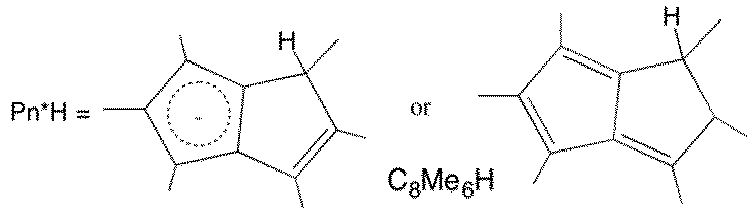


- The present invention, further, provides the use of a compound of the invention as an initiator in the polymerisation of a lactide monomer.
- The present invention, yet further, provides a process for producing a polylactide which comprises contacting a lactide monomer with a compound of the invention.
- As stated above, compounds of the present invention have the general formula
LaM(OR1)bR2 cXd
where L, M, R1, R2, X, a, b, c and d are as defined above, and dimers thereof. - M is a Group IV transition metal selected from titanium, zirconium and hafnium. According to one preferred embodiment, M is titanium. According to another preferred embodiment, M is zirconium. According to a different embodiment, M is hafnium.
- L is a ligand selected from permethylpentalene(Pn*), (hydro)permethylpentalene(Pn*(H)) and (hydro)pentalene(Pn(H)). According to one preferred embodiment, the ligand group L is permethylpentalene. Also described herein, but not belonging to the invention, are compounds where L is a ligand selected from cyclopentadiene (Cp), indene and ethylene-bridged indene (EBI) and dimethylsilane-bridged indene (SBI). Also described herein, but not belonging to the invention, are compounds in which the ligand group L is indene or EBI when M is Zr.
- The compounds of the present invention are alkoxide, phenyloxide or phenylalkyleneoxide metal complexes based on the ligand group L. R1 of the OR1 group attached to the metal M is selected from 1-6C alkyl, substituted or unsubstituted phenyl and substituted or unsubstituted phenylalkylene. Preferably, the 1-6C alkyl group, for R1, is a tertiary butyl group. Preferably, when R1 is a phenyloxide group, it is a dialkylphenyloxide group of the formula -C6H3(R3)2 where R3 is a 1-4C alkyl group, especially Me, iPr or tBu. According to a preferred embodiment, R1 is selected from 2,6-dimethylphenyl, 2,6-diisopropylphenyl and 2,6-ditertiarybutylphenyl.
- R1 may, according to a different embodiment, be a substituted or unsubstituted phenylalkylene group as mentioned above. Examples include -CH2C6H5 and -CH(Me)C6H5.
- The metal complexes of the invention may contain one R2 group attached to the metal M. If present, R2 is selected from Me and Et. If R2 is present in the complex, it is preferably methyl.
- The metal complexes of the invention may contain a halogen group X attached to M. Preferably, if present, X is Cl. Typically, if X is present in the complex, the value of d is 1 or 2.
- According to a preferred embodiment, the compound of the invention is a (half)metallocene complex being
η5-Pn*(H)Ti(OtBu)3; or
η5-Pn*(H)Zr(OtBu)3 ; or
η5-Pn*(H)Zr(O-CH2C6H5)3 ; or
η5-Pn*(H)Zr(O-S-CH(CH3)C6H5)3; or
rac-η5-Pn*(H)Zr(O-rac-CH(CH3)C6H5)3 ; or
η5-Pn*(H)Zr(O-2,6-Me-C6H3)3; or
η5-Pn*(H)Zr(O-2,6-iPr-C6H3)3 ; or
η5-Pn*(H)ZrCl2(O-2,6-tBu-C6H3) ; or
η5-Pn*(H)Hf(O-2,6-Me-C6H3)3 ; or
η5-Pn*(H)HfCl(O-2,6-iPr-C6H3)2 ; or
η5-Pn*(H)HfCl2(O-2,6-tBu-C6H3). - The compounds above may be made, for instance, by the reaction of η5-Pn*(H)SnMe3 with the corresponding metal chloride, e.g. TiCl4, ZrCl4 or HfCl4, in benzene at 80°C for 2-72 h and then with the appropriate potassium alkoxide, potassium phenyloxide or potassium phenylalkyleneoxide at room temperature in benzene or toluene. However, any suitable process for preparing the compounds known in the art may be used for preparation thereof.
- According to a different preferred embodiment, the (half)metallocene complex of the invention is
[(Pn*)Ti(O-2,6-Me-C6H3)Cl] ; or
[η8-(Pn*)Ti(O-2,4-tBu-C6H3)Cl] ; or
[η8-(Pn*)Ti(O-2,6-Me-C6H3)2] ; or
[η8-(Pn*)Ti(OtBu)Cl] ; or
[η8-(Pn*)Ti(OtBu)2 ; or
[η5-(Pn*H)Ti(O-2,6-Me-C6H3)Cl2] ; or
[η5-(Pn*H)Ti(O-2,6-Me-C6H3)3]. - The above compounds may be produced, for example, by the reaction of one equivalent of [η8-(Pn*)TiCl(µ-Cl)]2 with two equivalents of KOR (where R = 2,6-MeC6H3 or 2,4-tBuC6H3) at room temperature in toluene for 24-48 h. However, any suitable process for preparing the compounds known in the art may be used for preparation thereof.
- Also described herein, but not belonging to the invention, are the (half)metallocene complexes:
- [(EBI)Zr(O-2,6-Me-C6H3)Cl] ;
- [Ind2Zr(O-2,6-Me-C6H3)Me];
- [Ind2Zr(O-2,6-Me-C6H3)CI];
- [Ind2Zr(O-2,6-Me-C6H3)2];
- [Cp2Zr(O-2,6-Me-C6H3)2];
- [Cp2Zr(O-2,6-Me-C6H3)Cl];
- [Cp2Zr(O-2,6-Me-C6H3)Me].
- The above EBI Zr compounds may be produced by reacting stoichiometric amounts of [K(O-2,6-Me-C6H3)] and rac-[(EBI)ZrCl2] in toluene with stirring for 18 h at room temperature. A modified procedure for preparing [(Ind)2Zr(OtBu)Me] involves reacting stoichiometric amounts of [(Ind)2ZrMe2] and tert-butanol in toluene with stirring at room temperature for 18 h, followed by concentration in vacuum. [(Ind)2Zr(O-2,6-Me-C6H3)Me] can be prepared by reacting stoichiometric amounts of [(Ind)2ZrMe] and 2,6-dimethylphenol in toluene with stirring at room temperature for 18 h, followed by concentration in vacuo. However, any suitable process for preparing the compounds known in the art may be used for preparation thereof.
- The compounds of the invention are useful as initiators in the polymerisation of a lactide monomer. Accordingly, the present invention also relates to the use of a compound as hereinbefore described as an initiator in the polymerisation of a lactide monomer.
- According to a further aspect, the invention provides a process for producing a polylactide which comprises contacting a lactide monomer with a compound as hereinbefore described.
- In a preferred embodiment of the process, the lactide monomer is L-lactide and the resulting polylactide is isotactic polylactide. In another preferred embodiment of the process, the lactide monomer is rac-lactide and the resulting polylactide is atactic polylactide.
- All organometallic syntheses were performed under an inert atmosphere of nitrogen gas, utilizing standard Schlenk techniques on a dual vacuum-inlet gas manifold or Braun glove box. Where necessary, solvents were dried SPS drying system (hexane, pentane, toluene). Deuterated NMR solvents were dried over NaK (benzene-d 6, toluene-d 8) or CaH2 (chloroform-d 1), vacuum transferred and free-pump-thaw-degassed three times prior to use. Elemental analyses were conducted by Mr Stephen Boyer at the elemental analysis service at London Metropolitan University. NMR spectra were recorded using Young's tap NMR tubes on a Varian Mercury VX-Works 300 MHz spectrometer. 1H and 13C{1H} NMR spectra were referenced via the residual protio-solvent peak. Potassium tert-butoxide was purchased from Sigma-Aldrich and used as received. L- and rac- lactide were purchased from Alfa Aesar and re-crystallized and sublimed (10-2 mbar, 50°C) prior to use. [K(O-2,6-Me-C6H3)] and [K(O-2,4- t Bu-C6H3)] were prepared by stirring potassium bis(trimethylsilyl)amide with the appropriate alcohol in THF at room temperature.
- Crystals were mounted on glass fibres using perfluoropolyether oil, transferred to a goniometer head on the diffractometer and cooled rapidly to 150K in a stream of cold nitrogen using an Oxford Cryosystems CRYOSTREAM unit. Data collections were performed using an Enraf-Nonium FR590 KappaCCD diffractometer, utilising graphite-monochromated Mo Kα X-ray radiation (λ = 0.71073 Å). Intensity data were processed using the DENZO-SMN package. Structures were solved using the direct-methods program SIR92, and refined using full-matrix least squares refinement on all F2 data using the CRYSTALS program suite.
- All polymerizations were carried out in Young's tap NMR tubes containing 0.4 mL of a benzene-d 6 solution of lactide with an initial lactide concentration of [LA]0 = 0.104 M and 0.1 mL of a benzene-d 6 solution of catalyst (of a concentration to ensure [LA]0/[init.]0 = 50). Lactide conversion was subsequently calculated by comparing the integration values of the methane signal of PLA and lactide monomer in the 1H NMR spectrum. The temperature at which a given polymerisation was carried out varied in the temperature range 80 to 100°C and is noted in the appropriate section.
- Further advantages and features of the subject-matter of the present invention can be taken from the following detailed description taking in conjunction with the drawing, in which;
-
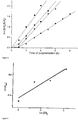
Figure 1 : L-lactide polymerization using the complexes: η5-Pn*(H)Ti(O-2,6-Me2C6H3)3, 2 (black square, k obs = 0.113±0.014 h-1), η5-Pn*(H)Zr(O-2,6-Me2C6H3)3, 7 (red circle, k obs= 0,479±0.032 h-1), η5-Pn*(H)Zr(O-2,6-iPr2C6H3)3, 8 (pink triangle, k obs= 0.391±0.022 h-1), η5-Pn*(H)ZrCl2(O-2,6-iBu2C6H3), 9 (dark blue triangle, kobs= 0.043±0.003 h-1), η5-Pn*(H)Hf(O-2,6-Me2C6H3)3, 10 (blue triangle, k obs= 0.364±0.027 h-1), η5-Pn*(H)HfCl (O-2,6-iPr2C6H3)2, 11 (green losange, k obs= 0.463±0.029 h-1) -and η5-Pn*(H)HfCl2(O-2,6-iBuC6H3), 12 (purple triangle, k obs= 0.086±0.020 h-1). Polymerisation conditions:chloroform-d 1 at 100 °C with [LA]0/[M]0 = 50, [LA]0 = 0.5M. -
Figure 2 : Lactide polymerisation: L-lactide and S-η5-Pn*(H)Zr(O-CH{CH3}C6H5)3, 5 (black square, k obs= 1,166±0068 h-1); L-lactide and rac-η5-Pn*(H)Zr(O-CH{CH3}C6H5)3, 6 (red circle, k obs= 1.954±0.063 h-1); rac-lactide and rac-η5-Pn*(H)Zr(O-CH{CH3}C6H5)3, 6 (pink triangle, k obs= 1.667±0.053 h-1); rac-lactide and S-η5-Pn*(H)Zr(O-CH{CH3}C6H5)3, 5 (blue triangle, k obs= 1.342±0.055 h-1). Polymerisation conditions:chloroform-d 1 at 80 °C with [LA] 0/[M]0 = 50, [LA]0 = 0.5 M. -
Figure 3 : Lactide polymerisation: L-lactide and S-η5-Pn*(H)Zr(O-CH{CH3}C6H5)3, 5 (black square, k obs= 0.484±0.037 h-1); L-actide and rac-η5-Pn*(H)Zr(O-CH{CH3}C6H5)3, 6 (red circle, k obs= 0.850±0.063 h-1); rac-lactide and rac-η5-Pn*(H)Zr(O-CH{CH3}C6H5)3 6 (pink triangle, k obs= 0.767±0.037 h-1); rac-lactide and S-n5-Pn*(H)Zr(O-CH{CH3}C6H5)3, 5 (blue triangle, k obs= 0.491±0.031 h-1). Polymerisation conditions:chloroform-d 1 at 60 °C with [LA] 0/[M]0 = 50, [LA]0 = 0.5 M. -
Figure 4 : Eyring plot of L-lactide polymerisation using S-η5-Pn*(H)Zr(O-CH{CH3}C6H5)3. 5. Slope = -5610±488 with R 2= 0.993. Polymerisation conditions: chloroform-d 1 with [LA]0/[Zr]0 = 50 and [LA]0 = 0.5 M. -
Figure 5 : L-lactide polymerisation using η5-Pn*(H)Zr(O-2,6-iPr2C6H3)3, 8: [LA]0/[Zr]0 = 25 (black square, k obs= 0.521±0.021 h-1); [LA]0/[Zr]0 = 50 (red circle, k obs= 0.391±0.02.2 h-1); [LA]0/[Zr]0 = 100 (blue triangle, k obs= 0.377±0.015 h-1); [LA]0/[Zr]0 = 200 (pink triangle, k obs= 0.235±0.004 h-1). Polymerisation conditions:chloroform-d 1 at 100 °C with [LA]0 = 0.5 M. -
Figure 6 : Plot of Ln(k obs) vs Ln([Zr]0) using η5-Pn*(H)Zr(O-2,6-iPr2C6H3)3, 8. Slope = 0.350±82 with R 2 = 0.901. Polymerisation conditions: chloroform-d 1 at 100 °C and [LA]0 = 0.5 M. -
Figure 7 : L-lactide polymerisation using η5-Pn*(H)Zr(O-2,6-iPr2C6H3)3, 8: T = 100 °C (black square, k obs = 0,391±0.022 h-1); T = 90 °C (red circle, k obs = 0.151±0.008 h-1); T = 80 °C (blue triangle, k obs = 0.092±0.006 h-1). Polymerisation conditions: chloroform-d 1 with [LA]0/[M]0 = 50, [LA]0 = 0.5 M. -
Figure 8 : Eyring plot of polymerisation using η5-Pn*(H)Zr(O-2,6-iPr2C6H3)3, 8. Slope = -9133±1881 with R 2 = 0.959. Polymerisation conditions: chloroform-d 1 with [LA]0/[Zr]0 = 50 and [LA]0 = 0.5 M. -
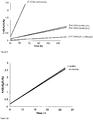
Figure 9 : Semi-logarithmic plots of L-iactide conversion us time, [LA]0/[Init]0 = 50, [LA]0 = 0.104 M, T = 80 °C, benzene-d 6 (0.5 mL), using [η 8-(Pn*)Ti(O-2,6-Me2C6H3)Cl], (green dotted line), [η 8-(Pn*)Ti(O-2,4-tBu2C6H3)Cl] (black dashed line), [η 8-(Pn*)Ti(O-2,-6-Me2C6H3)2], (red line) and [η 5-(Pn*H)Ti(O-2,6-Me2C6H3)Cl2] (blue dot-dashed line). Induction period omitted. -
Figure 10 : Semi-logarithmic plots of lactide monomers conversion us time. Induction period omitted. [LA]0 = 0.104 M, [LA]0/[init.]0 = 50, T = 90 °C, benzene-d 6. Polymerization using [η 8-(Pn*)Ti(O-2,6-Me2C6H3)2], L-lactide (red line) and rac-lactide (black dashed line). -
Figure 11 : Semi-logarithmic plots of L-lactide conversion vs time, [LA]0/[Init]0 = 50, [LA]0 = 0.50 M, T = 80 °C, chloroform-d 1, (0.5 mL), polymerisation using [(EBI)Zr(OC6H3Me2-2,6)Cl], 1 (dotted line), [(Ind)2Zr(OtBu)Me], 2 (solid line), [(Ind)2Zr(OC6H3Me2-2,6)Me], 3 (dashed line). -
Figure 12 : Semi-logarithmic plots of the rate of propagation vs. the inverse of the temperature, [LA]0/[2]0 = 50, [LA]0 = 0.50M, chloroform-d 1, ΔH‡ = 46.9 kJ.mol-1 and ΔS‡ = -193.9 J.K-1.mol-1. -
Figure 13 : Semi-logarithmic plots of lactide conversion vs time, [LA]0/[2]0 = 50, [LA]0 = 0.50 M, T = 80 °C, chloroform-d 1 (0.5 mL); L-lactide (solid line), rac-lactide (dashed line). - Synthesis of [(Pn*)Ti(O-2,6-Me-C6Me2)Cl] [η8-(Pn*)TiCl(µ-Cl)]2 (150 mg, 0.26 mmol) and [K(O-2,6-MeC6H3)] (78 mg, 0.50 mmol) were combined in toluene (30 mL) and left to stir for 25 h at room temperature. The resultant solution was filtered before being concentrated in vacuo. X-ray quality single crystals were obtained on storing the toluene concentrated solution at -35°C for 24 h. Yield = 52%. 1H NMR (benzene-d 6, 25°C, 300 MHz): δ 7.04 (d, 2H, 3 J HH = 7.3 Hz, Ar-H), 6.82 (t, 1H, 3 J HH = 7.4 Hz, Ar-H), 2.11, 2.06, 1.68 (s, 6H each, Pn-CH 3), 1.61 (s, 6H, Ar-CH 3). 13C{1H} NMR (toluene-d 8, 25°C, 75.1 MHz): δ 130.69, 126.16, 14.36, 123.41, 120.41 (Quaternary Carbons), 18.09 (Ar-CH3) 13.20, 12.47, 11.11 (Pn-CH3). The quaternary bridgehead carbon atoms were not observable and certain quaternary carbon signals were obscured by solvent resonances. Analysis calculated for C22H27ClTiO (%): C, 67.62, H, 6.98; found: C, 67.70; H, 7.03.
- Synthesis of [η8-(Pn*)Ti(O-2,4-Bu-C6H3)Cl] [η8-(Pn*)TiCl(µ-Cl)]2 (150 mg, 0.25 mmol) and [K(O-2,4- t Bu-C6H3)] (120 mg, 0.50 mmol) were stirred in toluene (30 mL) at room temperature for 48 h. The resultant solution was filtered and the solvent removed in vacuo. Subsequent dissolution in minimal hot benzene and storing at room temperature for 24 h led to the formation of X-ray quality single crystals. Yield = 55%. 1H NMR (benzene-d 6, 25°C, 300 MHz): δ 7.54 (d, 1H, 4 J HH = 2.4 Hz, meta-Ar-H), 7.18 (dd, 1 H, 3 J HH = 8.1 Hz, 4 J HH = 2.4 Hz, meta-Ar-H), 6.41 (d, 1H, 3 J HH = 8.3 Hz, ortho-Ar-H), 2.07, 1.80, 1.64 (s, 6H each, Pn-CH 3), 1.59 (s, 9H, C(CH 3)), 1.35 (s, 9H, C(CH 3)). 13C{1H} NMR (benzene-d 6, 25°C, 75.1 MHz): δ 161.21 (ipso-Ar), 142.66, 140.76, 139.1,0 135.5,7 130.28, 124.62 (quaternary carbons), 123.82, 123.77 (meta-Ar) 122.82 (quaternary carbon) 121.22 (ortho-Ar), 35.55, 34.55 (Ar-CM3), 31.95, 30.88 (Ar-CH3), 13.04, 12.48, 10.84 (Pn-CH3). Analysis calculated for C28H39TiClO (%): C, 70.8; H, 8.29; found: C, 70.65; H, 8.23.
- Synthesis of [η8-(Pn*)Ti(O-2,6-Me-C6H3)2] [η8-Pn*TiCl(µ-Cl)]2 (150 mg, 0.25 mmol) and [K(O-2,6-Me-C6H3)] (160 mg, 0.50 mmol) were stirred in toluene (30 mL) for 24 h at 25°C. The resultant solution was filtered and subsequently concentrated in vacuo. X-ray quality single crystals were obtained on storing the toluene concentrated solution at -35°C for 24 h. Yield = 62%. 1H NMR (benzene-d 6, 25°C, 300 MHz): δ 6.96 (d, 4H, 3 J HH = 7.5 Hz, meta-Ar-H), 6.69 (t, 2H, 3 J HH = 7.3 Hz, para-Ar-H), 2.13 (s, 12H, Pn-CH 3), 1.81 (s, 12H, ArCH 3), 1.77 (s, 6H, Pn-CH 3). 13C{1H} NMR (benzene-d 6, 25°C, 75.1 MHz): δ 162.52 (ipso-Ar), 139.73 130.97 125.22 120.47 118.89 (quaternary carbons), 17.73 (Ar-CH3), 11.90 10.89 The quaternary bridgehead carbon atoms were not observable. Analysis calculated for C30H36TiO2 (%): C, 75.62; H, 7.63; Found: C, 75.48; H, 7.77.
- Synthesis of [η8-(Pn*)Ti(O t Bu)Cl] [η8-(Pn*)TiCl(µ-Cl)]2 (150 mg, 0.25 mmol) and [K(O t Bu)] (53 mg, 0.50 mmol) were combined in toluene (30 mL) and left to stir for 2 h at room temperature. The resultant solution was filtered and the solvent was removed under reduced pressure. Minimal hot hexane was added and X-ray quality single crystals were obtained on cooling to room temperature and storing at -35°C for 24 h. Yield = 54%. 1H NMR (benzene-d 6, 25°C, 300 MHz): δ 2.09, 1.90, 1.62 (s, 6H each, Pn-CH 3), 1.31 (s, 9H, C(CH 3)). 13C{1H} NMR (benzene-d 6, 25°C, 75.1 MHz): δ 138.41, 136.38 (Pn-bridgehead), 128.86, 122.16, 121.91 (Pn), 81.16 (C(CH3)), 32.48 (C(CH3)), 13.09, 12.85, 10.86 (Pn-CH3).
- Synthesis of [η8-(Pn*)Ti(O t Bu)2] [η8-(Pn*)TiCl(µ-Cl)]2 (20 mg, 0.035 mmol) and [K(O t Bu)] (16 mg, 0.14 mmol) were combined in benzene-d 6 (1 mL). The resulting dark red solution was filtered and allowed to undergo a slow evaporation, which led to the formation of X-ray quality single crystals. 1H NMR (benzene-d 6, 25°C, 300 MHz): δ 2.08 (s, 12H, Pn-CH 3), 1.76 (s, 6H, Pn-CH3), 1.31 (s, 18H, C(CH 3)). 13C{1H} NMR (benzene-d 6, 25°C, 75.1 MHz): 134.38, 128.71, 116.58 (Pn) 76.44 (C(CH 3)) 33.60 (C(CH 3)) 13.07, 10.81 (Pn-CH3). The quaternary bridgehead carbon atoms were not observable.
- Synthesis of [η5-(Pn*H)Ti(O-2,6-Me-C6H3)Cl)2] [η8-Pn*TiCl(µ-Cl)]2 (350 mg, 0.57 mmol) and [H(O-2,6-Me-C6H3)] (139 mg, 1.14 mmol) were stirred in toluene (50 mL) at 85°C for 24 h, before being filtered and concentrated under vacuum. X-ray quality single crystals were formed on storing the concentrated solution at -35°C for 24 h. Yield = 68%. 1H NMR (benzene-d 6, 25°C, 300 MHz): δ 6.82-6.72 (m, 3H, Ar-H), 3.19 (q, 1H, 3 J HH = 7.3 Hz, Pn-H), 2.24 (s, 6H, Ar-CH 3), 2.23, 2.12, 2.08, 1.79, 1.44 (s, 3H each, Pn-CH 3), 0.84 (d, 3H, 3 J HH = 7.5 Hz, Pn-CH 3). 13C{1H} NMR (benzene-d 6, 25°C, 75.1 MHz) δ 162.73 (ipso-Ar), 150.62, 147.79, 141.18, 136.86, 129.80, 129.07 (Quaternary Carbons), 128.13 (meta-Ar) 123.70 (Quaternary Carbons) 123.06 (para-Ar), 44.19 (sp3 Pn), 17.22 (Ar-CH3), 15.53, 14.08, 13.53, 13.23, 11.75, 11.59 (Pn-CH3). The quaternary bridgehead carbon atoms were not observable. Analysis calculated for C22H28Cl2TiO (%): C, 61.84; H, 6.62; Found: C, 61.71; H, 6.70.
- Synthesis of [η5-(Pn*H)Ti(O-2,6-Me-C6H3)3] A solution of [η5-(Pn*H)Ti(OC6H3Me2-2,6)Cl2] (50 mg, 0.12 mmol) and [K(O-2,6-Me2C6H3)] (37.5 mg, 0.24 mmol) in toluene (10 mL) was stirred for 30 minutes at 100°C. The resultant bright orange solution was filtered and the solvent removed under reduced pressure. Subsequent dissolution in minimal hot hexane followed by storage at -35°C for 24 h led to the formation of X-ray quality single crystals. Yield = 65%. 1H NMR (benzene-d 6, 25°C, 300 MHz): δ 6.90 (d, 6H, 3 J HH = 7.2 Hz, meta-Ar-H), 6.73 (t, 3H, 3 J HH = 7.3 Hz, para-Ar-H) 3.59 (q, 1H, 3 J HH = 7.7 Hz, Pn-H) 2.28 (s, 18H, Ar-CH 3) 2.21, 2.14, 1.96, 1.58, 1.53 (s, 3H each, Pn-CH 3) 1.08 (d, 3H, 3 J HH = 7.32 Hz, Pn-CH 3). 13C{1H} NMR (benzene-d 6, 25°C, 75.1 MHz) δ 164.05 (ipso-Ar), 147.30, 144.11, 138.88, 130.71 (Pn), 129.06 (Ar), 128.93 (Pn), 127.41 (Ar), 122.49 (Pn), 120.79 (Ar), 116.96 (Pn), 44.46 (sp3 Pn), 18.15 (sp3 Pn-CH 3), 15.33, 13.37, 12.49, 11.99, 11.75, 11.58 (Pn-CH3).
- [η8-(Pn*)Ti(O-2,6-Me-C6H3)Cl] Single crystals were grown from a toluene solution at -35°C, C22H27ClOTi, M r = 390.81, triclinic, P-1, a=11.2997(2) A, b=11.6154(2) Å, c=15.7437(3) Å, α=77.0104(7)°, β=89.3195(7)°. γ=85.2957(8)°, V=2006.66(6)Å3, Z=4, T=150 K, prism, red brown, 9129 independent reflections, R(int)=0.038, R1=0.046 wR2=0.133 [l>2σ(l)].
- [η8-(Pn*)Ti(O-2,4-tBu-C6H3)Cl] Single crystals were grown from a benzene solution at -35°C, C28H39ClOTi, M r = 474.97, monoclinic, P 21/n, a=11.7910(1) Å, b=9.5199(1) Å, c=23.5743(3) Å, α=102.4652(5)°, β=90° γ=90°, V=2583.82(5) Å3, Z=4, T=150 K, block, purple, 5884 independent reflections, R(int) = 0.029, R1 = 0.038 wR2 = 0.091 [l>2σ(l)].
- [η8-(Pn*)Ti(O-2,6-Me-C6H3)2] Single crystals were grown from a toluene solution at -35°C, C30H36O2Ti, M r = 476.51, Orthorhombic, Pbca, a=9.2631(1) Å, b=15.4563(1) Å, c=35.7542(3) Å, α=90°, β=90° γ=90°, V=5.119.32(8)Å3, Z=8, T=150 K, block, dark red, 5807 independent reflections, R(int) = 0.036, R1 = 0.047 wR2 = 0.092 [l>2σ(l)].
- [η8-(Pn*)Ti(OtBu)Cl] Single crystals were grown from a hexane solution at -35°C, C18H27ClOTi, M r = 342.76, triclinic, P-1, a=8.8527(1)Å, b=10.1475(2)Å, c=10.7183(2)Å, α=79.8812(7)°, β=78.4070(7)°, γ=73.9368(7)°, V=898.98(3)Å3, Z=2, T-150 K, block, dark red, 4073 independent reflections, R(int)=0.016, R1=0.034 wR2=0.085 [l>2σ(l)].
- [η8-(Pn*)Ti(OtBu)2] Single crystals were grown from a benzene solution at -35°C, C22H36O2Ti, M r = 380.43, monoclinic, P21/n, a=12.7185(2)A, b=10.9762(1)Å, c=15.9690(2)Å, α=90°, β=93.2853(6)°, γ=90°, V= 2225.62(5)Å3, Z=4, T=150 K, prism, red brown, 5062 independent reflections, R(int) = 0.022, R1 = 0.075 wR2=0.188 [l>2σ(l)].
- [η5-(Pn*H)Ti(O-2,6-Me-C6H3)Cl2] Single crystals were grown from hexane solution at -35°C, C22H28Cl2TiO, M = 427.27, monoclinic, P21/c, a= 8.5552(2)A, b=17.7148(5)Å, c=14.6706(4)Å, α = γ = 90.00°, β=106.6445(11), V=2130.22(10)Å3, T=150(2) K, Z=4, 4844 independent reflections, R(int) = 0.019 R1 = 0.054 wR2 = 0.119 [l>2σ(l)].
- [η5-(Pn*H)Ti(O-2,6-Me-C6H3)3] Single crystals were grown from hexane solution at -35°C, C38H46TiO3, M = 598.68, monoclinic, P21/n, a=8,9702(2)Å, b=24.3863(6)Å, c=14.6936(4)A, α = γ = 90.00°, β=91.352(2), V=3213(14)Å3, T=150(2) K, Z=4, 6634 independent reflections, R(int) = 0.060 R1 = 0.056 wR2 = 0.141 [l>2σ(l)].
- All organometallic syntheses were performed under an inert atmosphere of nitrogen gas, utilizing standard Schlenk techniques on a dual vacuum-inlet gas manifold or Braun glove box. Where necessary, solvents were dried by reflux over the appropriate drying agent: NaK (Et2O), sodium (THF) and SPS drying system (hexane, pentane, soluene). Solvents were distilled from the desiccant under a flowing stream of nitrogen and transferred using a siphoning technique via steel cannulae and stored in flame-dried glass ampoules under an atmosphere of nitrogen. Deuterated NMR solvents were dried over NaK (benzene-d 6, toluene-d 8) or CaH2 (pyridine-d 5), vacuum transferred and freeze-pump-thaw-degassed three times prior to use. Elemental analyses were conducted by Mr Stephen Boyer at the elemental analysis service at London Metropolitan University. NMR spectra were recorded using Young's tap NMR tubes on a Varian Mercury VX-Works 300 MHz spectrometer. 1H and 13C{1H} NMR spectra were referenced to the residual protio-solvent peak.
- Crystals were mounted on glass fibres using perfluoropolyether oil, transferred to a goniometer head on the diffractometer and cooled rapidly to 150 K in a stream of cold nitrogen using an Oxford Cryosystems CRYOSTREAM unit. Data collections were performed using an Enraf-Nonius FR590 KappaCCD diffractometer, utilising graphite-monochromated Mo Kα X-ray radiation (A = 0.71073 Å). Intensity data were processed using the DENZO-SMN package. Structures were solved using the direct-methods program SIR92, and refined using full-matrix least squares refinement on all F2 data using the CRYSTALS program suite.
- The lactide monomer (40 mg) and the complex were introduced in an NMR tube following the desired monomer:initiator ratio. Then 0.57 mL of chloroform-d 1 was added to the compounds, leading to an initial monomer concentration of [LA]0 = 0.5 M. The solution was monitored by 1H NMR spectroscopy. The conversion was determined by integration of the methane area of the polymer versus the monomer.
- Synthesis of Pn*(H)SnMe3. To a slurry of Pn*(H)Li (2.09 g, 10.7 mmol) in pentane (20 mL) at -78°C was added a solution of SnMe3Cl (2.14 g, 10.7 mmol) in pentane (10 mL). The reaction mixture was warmed to room temperature and stirred for 3 h to afford an orange solution and colourless precipitate of LiCl. This was filtered and the volatiles were removed in vacuo to afford Pn*(H)SnMe3 (50:50 mixture of diastereomers judged by 1H NMR spectroscopy) as an orange oil. Yield: 3.56 g (97%). 1H NMR (benzene-d 6, 23°C): δ 2.98 (q, 1H, 3 J HH=7.2 Hz, Pn*(H)), 2.09 2.05 2.00 (s, 3H each, CH 3-Pn*(H)), 1.95 (overlapping s, 3H each, CH 3-Pn*(H)) 1.93 1.83 (s, 3H each, CH 3Pn*(H)), 1.70 (overlapping s, 3H each, CH 3Pn*(H), 1.59 (s, 3H, CH 3-Pn*(H)), 1.18 (d, 3H 3 J HH=7.2 Hz, 1-CH 3-Pn*(H)), 0.94 (d, 3H, 3 J HH=6.9 Hz, 1-CH 3-Pn*(H)), -0.01 (s, 9H, 2 J 1H-119Sn = 25.2 Hz, 2 J 1H-117Sn = 24.2 Hz, 5-SnMe3-Pn*(H)) -0.03 (s, 9H, 2 J 1H-119Sn = 25.3 Hz, 2 J 1H-117Sn = 24.3 Hz, 5-SnMe3-Pn*(H)). 13C{1H} NMR (benzene-d 6, 23°C): 150.2 147.2 144.6 144.4 129.8 129.4 121.3 119.6 (6 x overlapping resonances, (q-Pn*(H)), 44.3 41.8 (1-Pn*(H)), 13.5 13.4 12.8 12.4 121.3 12.2 12.1 12.0 (2 x overlapping resonances CH3-Pn*(H)), 18.2 17.6 (1-CH3-Pn*(H)), -8.8 (5-SnMe 3-Pn*(H), 2 J 1H-119Sn = 153 Hz, 2 J 1H-117Sn = 148 Hz), -9.2 (5-SnMe3-Pn*(H), 2 J 1H-119Sn = 157 Hz, 2 J 1H-117Sn = 150 Hz).
- Synthesis of Pn*(H)TiCl3 . To a slurry of TiCl4(thf)2 (0.408 g, 1.44 mmol) in benzene (2 mL) was added a solution of Pn*(H)SnMe3 (0.505 g, 1.44 mmol) in benzene (2 mL) to afford a dark-purple solution. The reaction mixture was heated to 80°C for 4 hr. The volatiles were removed in vacuo to afford Pn*(H)TiCl3, as a purple powder. Yield: 0.363 g (74%). Single crystals suitable for an X-ray diffraction study were grown from saturated Et2O solution at -35°C. 1H NMR (benzene-d 6, 23°C): δ 0.85 (d, 3H, 3 J HH = 7.5 Hz, 1-CH 3-Pn*(H)), 1.57 1.89 2.02 2.03 2.14 (s, 3H each, CH 3-Pn*(H)), 3.80 (q, 1H, 3 J HH = 8.5 Hz, Pn*(H)). 13C{1H} NMR (benzene-d 6, 23°C): δ 153.6 152.7 147.4 140.6 133.3 131.3 127.4 (q-Pn*(H)), 46.8 (1-Pn*(H)), 15.4 (1-CH 3-Pn*(H)), 14.5, 14.4, 14.2, 12.2, 11.6 (CH 3-Pn*(H).
- Synthesis of [Pn*(H)ZrCl3]2 . To a slurry of ZrCl4 (0.995 g, 4.27 mmol) in benzene (5 mL) was added a solution of Pn*(H)SnMe3 (1.50 g, 4.27 mmol) in benzene (5 mL). The reaction mixture was heated to 80°C for 72 h to afford a dark-green solution. The volatiles were removed in vacuo to yield a green solid. To this was added pentane (15 mL) and the reaction mixture was sonicated for 15 minutes to afford a fine, olive-green powder and a pale-yellow solution. The reaction mixture was filtered and the filtrate was dried under reduced pressure to afford [Pn*(H)ZrCl3]2, as an olive-green powder. Yield: 1.42 g (87%). Single crystals were grown from a saturated benzene solution at 23°C. 1H NMR (benzene-d 6, 23°C): δ 0.92 (d, 3H, 3 J HH = 7.5 Hz, 1-CH3-Pn*(H)), 1.81 2.01 2.06 2.17 2.19 (s, 3H each, CH 3-Pn*(H)), 3.50 (q, 3 J HH = 7.5 Hz, Pn*(H)). 13C{1H} NMR (benzene-d 6, 23°C): δ 151.0 147.0 142.1 133.5 129.5 127.4 120.7 (q-Pn*(H), 46.0 (1-Pn*(H)), 15.6 (1-CH 3-Pn*(H)), 14.2 13.6 13.5 12.3 12.2 (CH 3-Pn*(H)).
- Synthesis of [Pn*(H)HfCl3]2. To a slurry of HfCL4 (0.164 g, 0.467 mmol) in benzene (2 mL) was added a solution of Pn*(H)SnMe3 (0.149 g, 0.467 mmol) in benzene (2 mL). The reaction mixture was heated to 80°C for 2 h to afford an orange solution. The volatiles were removed in vacuo to yield [Pn*(H)HfCL3]2, as a pale-yellow solid. Single crystals were grown from a saturated benzene solution at room temperature. 1H NMR (benzene-d 6, 23°C): δ 0.93 (d, 3H, 3 J HH = 7.4 Hz, 1-CH 3-Pn*(H)), 1.62 184 2.01 2.01 2.10 (s, 3H each, CH 3-Pn*(H)), 3.42 (q, 3 J HH = 7.4 Hz, Pn*(H)). 13C{1H} NMR (benzene-d 6, 23°C): δ 150.0, 142.3, 137.2, 123.9, 117.4 (q-Pn*(H)), 45.5 (1-Pn*(H)), 15.9 (1-CH 3-Pn*(H)) 12.2 12.1 12.0 11.9 11.6 (CH 3-Pn*(H)).
- Synthesis of η5-Pn*{H)Ti(O t Bu)3. Pn*(H)TiCl3 (0.020 g, 0.059 mmol) and KO t Bu (0.020 g, 0.18 mmol) were combined in benzene-d 6 (0.5 mL) and sonicated for 5 minutes to afford a clear, pale-yellow solution and colourless precipitate. Filtration followed by drying of the filtrate in vacuo afforded Pn*(H)Ti(O t Bu)3, 1, as a pale-yellow powder. 1H NMR (benzene-d 6, 23°C): δ 3.35 (q, 3 J HH = 7.2 Hz, Pn*(H)), 2.27 2.24 2.12 2.08 1.84 (s, 3H each, CH 3-Pn*(H)), 1.30 (s, 27H, OC(CH 3)3), 1.25 (d, 3H 3 J HH = 7.3 Hz, 1-CH 3-Pn*(H)). 13C{1H} NMR (benzene-d 6, 23°C): δ 141.5 135.1 132.9 128.6 121.0 115.6 110.5 (q-Pn*(H)), 75.4 (OC(CH3)3), 43.7 (1-Pn*(H)), 33.4 (OC(CH 3)3), 16.2 (1-CH 3-Pn*(H)), 12.7 12.6 12.1 12.1 11.4 (CH 3-Pn*(H)).
- Synthesis of η5-Pn*{H)Zr(O t Bu)3. [Pn*IH)ZrCl3]2 (0.028 g, 0.036 mmol) and KO t Bu (0.024 g, 0,22 mmol) were combined in benzene-d 6 (0.5 mL) and sonicated for 5 minutes to afford a clear pale-yellow solution and colourless precipitate. Filtration followed by drying of the filtrate in vacuo afforded Pn*(H)Zr(O'Bu)3 as a pale-yellow powder. 1H NMR (benzene-d 6, 23°C): δ 3.33 (q, 3 J HH = 6.9 Hz, Pn*(H)), 2.25 2.22 2.09 2.05 1.83 (s, 3H each, CH 3- Pn*(H)), 1.35 (s, 27H, OC(CH 3)3), 1.23 (d, 3H, 3 J HH = 6.9 Hz, 1-CH 3-Pn*(H)). 13C{1H} NMR (benzene-d 6, 23°C): δ 142.8 137.5 134.4 129.3 123.4 117.8 112.9 (q-Pn*(H)), 80.2 (OC(CH 3)3), 43.8 (1-Pn*(H)), 33.1 (OC(CH 3)3), 15.9 (1-CH 3-Pn*(H)), 13.7, 12.8, 12.7, 12.3 12.2 (CH 3-Pn*(H)).
- Synthesis of η 5 -Pn*(H)Zr(O-CH 2 C 6 H 5 ) 3. [Pn*(H)ZrCl3]2 (0.100 g, 0.131 mmol) and KO-CH2C6H5 (0.115 g, 0.786 mmol) were combined in C6H6 (5 mL) and stirred for 10 minutes to afford a clear, pale-yellow solution and colourless precipitate. Filtration followed by drying of the filtrate in vacuo afforded Pn*(H)Zr(O-CH2C6H5)3 as a pale-yellow oily solid at room temperature. 1H NMR (benzene-d 6, 23°C); δ 7.37 - 7.03 (overlapping m, 15H, CH 2C6H5), 5.10 (s, 6H, CH2C6H5), 3.12 (q, 1H, 3 J HH = 7.3 Hz, Pn*(H)), 2.13 2.09 1.99 1.90 1.68 (s, 3H each CH 3-Pn*(H)), 1.13 (d, 3H 3 J HH = 7.3 Hz, 1-CH 3-Pn*(H)). 13C{1H} NMR (benzene-d 6, 23°C): δ 143.9 (CH2-1-C6H5), 143.0 135.4 133.2 (q-Pn*(H)), 128.5 (
CH CH - Synthesis of η 5 -Pn*(H)Zr(O-S-CH(CH 3 }C 6 H 5 ) 3. Pn*(H)ZrCl3 and S-KOCH{CH3}C6H5 were combined in benzene (5 mL) and stirred for 10 minutes to afford a clear, pale-yellow solution and colourless precipitate. Filtration followed by drying of the filtrate in vacuo afforded η5-Pn*(H}Zr(O-S-CH{CH3}C6H5)3, as a pale-yellow oily solid at room temperature. 1H NMR (benzene-d 6, 23°C): Two diastereomers: δ 7.40 (d, 6H, 3 J HH = 7.3 Hz, 2,6-C6 H 5), 7.11 (m, 3H, 4-C6H5), 5.30 (q, 3H, 3 J HH = 6.1 Hz, CHMe), 3.14 3.09 (q, 3 J HH = 6.9 Hz, Pn*(H)), 2.11 2.11 2.08 2.05 1.97 1.97 1.89 1.88 1.70 1.65 (overlapping s, 3H each, CH 3-Pn*(H)), 1.44 (d, 9H, 3 J HH = 6.1 Hz, CHMe), 1.12 (d, 3H, 3 J HH = 6.9 Hz, 1-CH 3-Pn*(H)). 13C{1H} NMR (benzene-d 6, 23°C): Diastereomer 1: δ 148.7 142.7 135.5 133.3 (q-Pn*(H)), 128.6 (3,5-C6H5), 126.9 (2,6-C6H5), 125.7 (q-Pn*(H)), 125.7 (4-C6H5), 122.0 116.4 111.4 (q-Pn*(H)), 77.0 (CHMe), 43.4 (1-Pn*(H)), 28.4 (CHMe), 16.1 (1-CH3-Pn*(H)), 12.2 11.8 11.8 11.2 10.6 (CH3-Pn*(H)). Diastereomer 2: 148.7 142.7 135.3 133.2 (q-Pn*(H)), 128.5 (3,5-C6H5), 126.9 (2,6-C6H5), 125.9 (4-C6H5), 125.5 (q-Pn*(H)), 121.8 116.4 111.1 (q-Pn*(H)), 77.0 (CHMe), 43.3 (1-Pn*(H)), 28.4 (CHMe), 16.1 (1-CH3-Pn*(H)), 12.2 11.8 11.7 11.2 10.5 (CH3-Pn*(H)).
- Synthesis of η 5 -Pn*(H)Zr(O-rac-{CH 3 }C 6 H 5 ) 3. Pn*(H)ZrCL3 and rac-KOCH{CH3}C6H5 were combined in benzene (5 mL) and stirred for 10 minutes to afford a clear, pale-yellow solution and colourless precipitate. Filtration followed by drying of the filtrate in vacuo afforded η5-Pn*(H)Zr(O-rac-CH{CH3}C6H5)3, as a pale-yellow oily solid at room temperature. 1H NMR (benzene-d 6, 23°C): Mixture of diastereomers: δ 7.48 - 7.10 (overlapping m, 15H, C6H5), 5.24 (overlapping q, 3H, CHMe), 3.06 (q, 1H, 3 J HH = 7.3 Hz, Pn&(H)), 2.12 2.12 2.08 2.07 1.98 1.98 1.90 1.69 1.67 (overlapping s, 3H each, CH 3-Pn*(H)), 1.50 1.45 1.44 1.41 (overlapping d, 9H 3 J HH = 6.4 Hz, CHMe), 1.12 (d, 3H, 3 J HH = 7.3 Hz, 1-CH 3-Pn*(H)). 13C{1H} NMR (benzene-d 6, 23°C): Mixture of diastereomers: δ 148.7 142.7 135.5 133.3 (q-Pn*(H)), 128.4 (3,5-C6H5), 127.3 (q-Pn*(H)), 126.9 (2,6-C6H5), 125.6 (4-C6H5), 122.0 116.4 111.4 (q-Pn*(H)), 77.0 (CHMe), 43.3 (1-Pn*(H)), 28.4 (CHMe), 16.1 (1-CH 3-Pn*(H)), 12.2 11.8 11.7 11.2 10.6 (CH3-Pn*(H)). Values reported in the 13C{1H} NMR spectrum are the central values of the multiple overlapping resonances observed.
- Synthesis of η 5 -Pn*(H)Zr(O-2,6-Me-C 6 H 3 ) 3 . [Pn*(H)ZrCl3]2 and KO-2,6-Me2C6H3 were combined in benzene (5 mL) and stirred for 10 minutes to afford a clear, pale-yellow solution and colourless precipitate. Filtration followed by drying of the filtrate in vacuo afforded Pn*(H)Zr(O-2,6-Me-C6H3)3, as a pale-yellow powder. 1H NMR (benzene-d 6, 23°C): δ 6.93 (d, 6H, 3 J HH = 7.4 Hz, 3,5-C6 H 3), 6.75 (t, 3H, 3 J HH = 7.3 Hz, 4-C6 H 3, 3.31 (q, 3 J HH = 7.4 Hz, Pn*(H)), 2.25 (s, 18H, O-2,6-CH 3-C6H3), 2.20 2.12 1.96 1.69 1.54 (s, 3H each, CH 3-Pn*(H)), 1.09 (d, 3H, 3 J HH = 7.4 Hz, 1-CH 3-Pn*(H)). 13C{1H} NMR (benzene-d 6, 23°C): δ 159.7 (1-C6H3), 145.3 139.7 135.6 (q-Pn*(H)), 128.9 (3,5-C6H3), 128.0 (q-Pn*(H)), 126.6 (2,6-C6H3), 125.7 (q-Pn*(H)), 120.4 (4-C6H3), 119.0 113.7 (q-Pn*(H)), 43.9 (q-Pn*(H)), 17.9 (O-2,6-CH3-C6H3), 15.7 (1-CH3-Pn*(H)), 12.5 11.8 11.7 11.0 (CH3-Pn*(H)).
- Synthesis of η 5 -Pn*(H)Zr(O-2,6- i Pr-C 6 H 3 ) 3 . [Pn*(H)ZrCl3]2 (0.174 g, 0.225 mmol) and KO-2,6-iPr2C6H3 (0.2925 g, 1.35 mmol) were combined in benzene (5 mL) and stirred for 10 minutes to afford a clear, pale-yellow solution and colourless precipitate. Filtration followed by drying of the filtrate in vacuo afforded η5-Pn*(H)Zr(O-2,6 i Pr-C6H3)3, as a yellow-green powder. Anal. Calcd for C50H70O3Zr: C, 74.11; H, 8.71. Found: C, 67.68; H, 8.60. 1H NMR (benzene-d 6, 23°C): δ 7.11 - 7.03 (overlapping d, 6H, 3,5-C6 H 3), 6.96 (app. t, 3H, 3 J HH = 6.7 Hz, 4-C6 H 3), 3.52 (overlapping sept., 6H 3 J HH = 6.7 Hz, CH(CH3)2), 3.11 (q, 1H, 3 J HH = 7.4 Hz, Pn*(H)), 2.17 2.13 1.93 1.85 1.44 (s, 3H each, CH 3-Pn*(H)), 1.32 (d, 12H, 3 J HH = 6.7 Hz, CH(CH3)2, 1.01 (d, 3H, 3 J HH = 7.4 Hz, 1-CH 3-Pn*(H)). 13C{1H} NMR (benzene-d 6, 23°C): δ 155.9 155.8 (1-C6H3), 146.8 (q-Pn*(H)), 140.6 (q-Pn*(H)), 137.9 137.7 (2,6-C 6H3), 136.4 127.4 (q-Pn*(H)), 123.6 123.5 (3,5-C 6H3), 122.1 122.1 (4-C 6H3) 120.5 116.2 (q-Pn*(H)), 43.3 (1-Pn*(H)), 27.3 27.2 (CH(CH3)2), 24.9 24.8 24.0 23.9 (CH(CH3)2), 15.6 (1-CH3-Pn*(H)), 12.1 12.0 12.0 11.8 10.9 (CH3-Pn*(H)). One quaternary resonance accounting for a Pn*(H) carbon was overlapping with the residual protio solvent resonance.
- Synthesis of η 5 -Pn*(H)ZrCl 2 (O-2,6- t Bu-C 6 H 3 ). [Pn*(H)ZrCl3]2 (0.239 g, 0.310 mmol) and KO-2,6- t Bu2C6H3 (0.152 g, 0.62 mmol) were combined in benzene (5 mL) and stirred for 10 minutes to afford a clear, pale-yellow solution and colourless precipitate. Filtration followed by drying of the filtrate in vacuo afforded η5-Pn*(H)ZrCl2(O-2,6- t Bu-C6H3), as a yellow-green powder. Yield: 0.072 g (42%). 1H NMR (benzene-d 6, 23°C): δ 7.13 (d, 2H, 3 J HH = 7.7 Hz, 3,5-C6 H 3), 6.78 (t, 1H, 3 J HH = 7.7 Hz, 4-C6 H 3), 2.96 (q, 1H, 3 J HH = 7.4 Hz, Pn*(H)), 2.20 2.05 1.98 1.69 (s, 3H each, CH 3-Pn*(H)), 1.41 (br. s, 18H, C(CH 3)3), 1.32 (s, 3H, CH 3-Pn*(H)), 0.86 (d, 6H, 3 J HH = 7.4 Hz, CH(CH 3)2). 13C{1H} NMR (benzene-d 6, 23°C): δ 161.0 (1-C 6H3), 148.2 145.9 134.4 132.3 (q-Pn*(H)), 125.4 (3,5-C6H3), 125.2 (q-Pn*(H)), 121.4 (4-C6H3), 119.6 (q-Pn*(H)), 44.7 (1-Pn*(H)), 35.6 (C(CH3)3), 32.1 (C(CH3)3), 15.5 (1-CH3-Pn*(H)), 14.0 12.9 12.4 12.4 116 (CH3-Pn*(H)). Two quaternary resonances accounting for the 2,6-C6H3 and a Pn*(H) carbon were overlapping with the residual protio solvent resonance.
- Synthesis of η 5 -Pn*(H)Hf(O-2,6-Me-C 6 H 3 ) 3 . [Pn*(H)HfCl3]2 and KO-2,6-Me2C6H3 were combined in benzene (5 mL) and stirred for 10 minutes to afford a clear, pale-yellow solution and colourless precipitate. Filtration followed by drying of the filtrate in vacuo afforded Pn*(H)Hf(O-2,6-Me-C6H3)3, as a pale-yellow powder. 1H NMR (benzene-d 6, 23°C): δ 6.93 (d, 6H, 3 J HH = 7.4 Hz, 3,5-C6H3), 6.74 (t, 3H, 3 J HH = 7.4 Hz, 4-C6H3), 3.27 (q, 1H, 3 J HH = 7.4 Hz, 4-C6H3), 3.27 (q, 1H, 3 J HH = 7.4 Hz, Pn*(H)), 2.24 (s, 18H, O-2,6-CH 3-C6H3), 2.24 2.16 1.99 1.68 1.56 (s, 3H each, CH3-Pn*(H)), 1.10 (d, 3H, 3 J HH = 7.4 Hz, 1-CH 3-Pn*(H)). 13C{1H} NMR (benzene-d 6, 23°C): δ 159.4 (1-C 6H3), 145.1138.7 134.0 (q-Pn*(H)), 129.0 (3,5-C 6H3), 127.8 (q-Pn*(H)), 126.9 (2,6-C6H3), 124.1 (q-Pn*(H)), 120.4 (4-C6H3), 117.6 112.1 (q-Pn*(H)), 43.9 (1-Pn*(H)), 17.8 (O-2,6-CH3-C6H3), 15.5 (1-CH3-Pn*(H)), 12.4 11.8 11.6 11.4 10.9 (CH3-Pn*(H)).
- Synthesis of η 5 -Pn*(H)HfCl(O-2,6- i Pr-C 6 H 3 ) 2 . [Pn*(H)HfCl3]2 and KO-2,6- i Pr2C6H3 were combined in benzene (5 mL) and stirred for 10 minutes to afford a clear, pale-yellow solution and colourless precipitate. Filtration followed by drying of the filtrate in vacuo afforded η5-Pn*(H)HfCl(O-2,6- i Pr-C6H3)2, as a pale-yellow powder. 1H NMR (benzene-d 6, 23°C): δ 7.10 - 6.86 (overlapping m, 6H, 3,4,5-C6 H 3), 3.52 (overlapping sept., 4H, CH(CH3)2), 3.11 (q, 1H, 3 J HH = 7.4 Hz, Pn*(H)), 2.25 2.20 1.92 1.92 1.49 (s, 3H each, CH 3-Pn*(H)), 1.30 (d, 12H, 3 J HH =6.5 Hz, CH(CH 3)2), 1.24 1.23 (overlapping d, 6H each, 3 J HH = 6.5 Hz, CH(CH 3)2) 1.05 (d, 3H, 3 J HH = 7.4 Hz, 1-CH 3-Pn*(H)). 13C{1H} NMR (benzene-d 6, 23°C): δ 155.7 155.6 (1-C6H3), 146.3 139.1 (q-Pn*(H)), 137.9 137.8 (2,6-C6H3), 134.7 127.6 125.6 (q-Pn*(H)), 123.9 123.5 (3,5-C6H3), 122.1 122.0 (4-C6H3), 118.5 114.5 (q-Pn*(H)), 43.5 (1-Pn*(H)), 27.1 27.0 (CH(CH3)2), 24.9 24.9 24.1 24.0 (CH(CH3)2), 15.5 (1-CH3-Pn*(H)), 11.9 11.8 10.8 (CH3-Pn*(H)).
- Synthesis of η 5 -Pn*(H)HfCl 2 (O-2,6- t Bu-C 6 H 3 ). [Pn*(H)HfCl3]2 and KO-2,6- t Bu-C6H3 were combined in benzene (5 mL) and stirred for 10 minutes to afford a clear, pale-yellow solution and colourless precipitate. η5-Pn*(H)HfCl2(O-2,6- t Bu-C6H3), was identified as the sole product by NMR spectroscopy. NMR yield: (99.5%). 1H NMR (benzene-d 6, 23°C): δ 7.19 (d, 2H, 3 J HH = 7.7 Hz, 3,5-C6 H 3), 6.80 (t, 1H, 3 J HH = 7.7 Hz, 4-C6 H 3), 2.95 (q, 1H, 3 J HH = 7.4 Hz, Pn*(H)), 2.29 2.16 2.06 1.71 (s, 3H each, CH 3-Pn*(H)), 1.42 and 1.44 (br. overlapping s, 18H, C(CH 3)3), 1.36 (s, 3H, CH 3-Pn*(H)), 0.91 (d, 3H, 3 J HH = 7.4 Hz 1-CH 3-Pn*(H)). 13C{1H} NMR (benzene-d 6, 23°C): δ 160.7 (1-C6H3),147.5 143.3 133.0 129.6 127.6 (q-Pn*(H) or 2,6-C 6H3), 125.4 (3,5-C6H3), 123.0 (q-Pn*(H) or 2,6-C6H3), 121.2 (4-C6H3), 117.7 (q-Pn*(H) or 2,6-C6H3), 44.5 (1-Pn*(H)), 35.6 (C(CH3)3), 32.1 (C(CH3)3, 15.5 (1-CH3-Pn*(H)), 13.7, 12.6 12.0 11.4 (CH3-Pn*(H)). One quaternary resonance accounting for either the 2,6-C6H3 or a Pn*(H) carbon was overlapping with the residual solvent resonance.
- Air and moisture sensitive compounds were manipulated under an inert atmosphere of nitrogen, using standard Schlenk line techniques on a dual manifold vacuum/nitrogen line or a Braun Unilab glove box. Reaction solvents (pentane, hexane, and toluene) were dried using an MBraun SPS-800 solvent purification system. Hexane, toluene, and pentane were stored over pre-activated 3 Å molecular sieves. Dry solvents were stored in oven-dried ampoules under an atmosphere of nitrogen, sealed with either Rotoflo or Young's taps. Deuterated solvents used in NMR analysis of air-sensitive compounds were dried over the appropriate drying agent, freeze-thaw degassed and vacuum transferred prior to use: chloroform-d 1 (Sigma-Aldrich) was stored over pre-activated 3 Å molecular sieves. NMR spectra were recorded on a 300 MHz Varian Mercury VX-Works spectrometer. 1H (300.27 MHz) and 13C{1H} (75.50 MHz) spectra were recorded at 25°C unless otherwise stated, and referenced internally to the residual protio-solvent peak in the deuterated solvent used. 1H and 13C{1H} chemical shifts, δ, are given in parts per million (ppm), are given relative to the residual solvent peaks. Air sensitive samples were prepared under an inert atmosphere in a glove box, using dried solvents in Young's taps NMR tubes. [(Ind)2ZrMe2], and complex were synthesised according to literature procedures. [(EBI)ZrCl2] (Strem Chemicals) was hot re-crystallised in toluene.
- All polymerisations were carried out in Young's tap NMR tubes containing 40 mg of lactide in a chloroform-d 1 solution of initiator (20 mg initiator in 4 mL chloroform-d 1), ensuring that the lactide : initiator ratio was 50 : 1. chloroform-d 1 was then added to ensure the initial lactide concentration was [LA]0 = 0.50 M. Polymerisations involving addition tert-butanol were prepared as usual, and tert-butanol was added to the chloroform-d 1 solution via microsyringe, ensuring the lactide : initiator: tert-butanol ratio was 50 : 1 : 1.
- Crystals were mounted on MiTeGen MicroMants using perfluoropolyether oil, and cooled rapidly to 150 K in a stream of cold nitrogen using an Oxford Cryosystems CRYOSTREAM unit. Data collections were performed using an Enraf-Nonius FR590 KappaCCD diffractometer, utilising graphite-monochromated Mo Kα X-ray radiation (λ = 0.71073 Å). Raw frame data were collected at 150(2) K using a Nonius KappaCCD diffractometer, reduced using DENZO-SMN and corrected for absorption using SORTAV. The structure was solved using SuperFlip and refined using full matrix least-squares using CRYSTALS.
- Single crystals were grown from a toluene solution at room temperature, C28H25BClOZr, M r = 504.17, orthorhombic, Pcab, a = 15.7733(2) Å, b = 23.7683(3) Å, c = 23.9207(4) Å, α = 90°, β = 90°, γ = 90°, V = 8968.0(2) Å3, Z = 6, T = 150 K, block, yellow, 10201 independent reflections, R(int) = 0.070, R1 = 0.057 wR2 = 0.137 [I>2σ(I)].
- To one equivalent of [EBI)ZrCl2] (100 mg, 0.24 mmol) in toluene (10 mL), one equivalent of 2,6-dimethylphenol (29 mg, 0.24 mmol) in toluene (10 mL) was added at room temperature. The yellow suspension was left stirring for 18 h, resulting in a clear, yellow solution. Solvent was removed in vacuo to afford [(EBI)Zr(O-2,6-Me-C6H3)Cl], as a yellow crystalline solid with a yield of 80% (96 mg, 0.19 mmol). 1H NMR (chloroform-d 1, 25°C, 300 MHz): δ 7.84 (1H, dd, ArH, 3 J HH = 8.7 Hz, 4 J HH = 0.9 Hz), 7.61 (1H, dd, ArH, 3 J HH = 8.6 Hz, 4 J HH = 0.9 Hz), 7.30-7.27 (2H, m, ArH), 7.20-7.10 (2H, m, ArH), 7.03 (1H, t, ArMe2 H, 3 J HH = 7.5 Hz), 6.78 (2H, d, ArMe2 H, 3 J HH = 7.4 Hz), 6.63-6.55 (2H, m, ArH), 6.54 (1H, d, CpH, 3 J HH = 3.2 Hz), 6.41 (1H, d, CpH, 3 J HH = 3.2 Hz), 6.15 (1H, d, CpH, 3 J HH = 3.2 Hz), 6.02 (1H, d, CpH, 3 J HH = 3.2 Hz), 3.88-3.62 (4H, m, bridge), 1.91 (6H, s, ArMe 2). 13C{1H} NMR (chloroform-d 1, 25°C, 75.5 Mhz): δ 128.2, 126.6, 125.7 125.6, 125.4, 123.7, 123.6, 122.7 121.7, 120.9, 119.5, 115.7, 113.2, 108.4, 106.1 (all non-quaternary ring carbons) 29.6 (C 2H4), 28.7 (C 2H4), 18.0 (2 x ArMe 2). Quaternary carbons unassigned.
- To one equivalent of [Ind2ZrMe2] (100 mg, 0.28 mmol) in toluene (5 mL), one equivalent of 2,6-dimethylphenol (34 mg, 0.28 mmol) in toluene (5 mL) was added at room temperature. The clear, straw-coloured solution was left stirring for 18 h. Solvent was removed in vacuum to afford [(Ind)2Zr(O-2,6-Me-C6H3)Me], as a colourless oil with a yield of 75% (0.21 mmol, 96 mg). 1H NMR (chloroform-d 1, 25°C, 300 Mhz): δ 7.48-7.43 (2H, m, ArH), 7.34-7.29 (2H, m, ArH), 7.07-7.00 (2H, m, ArH), 6.92-6.85 (2H, m, ArH), 6.82 (2H, d, ArMe2 H, 3 J HH = 7.4 Hz), 6.59 (1H, t, ArMe2 H, 3 J HH = 7.4 Hz), 6.20 (2H, m, CpH), 5.91 (2H, m, CpH), 5.76 (2H, t, CpH, 3 J HH = 3.4 Hz), 1.86 (6H, s, ArMe 2), 0.22 (3H, s, ZrMe). 13C{1H} NMR (chloroform-d 1, 25°C, 75.5 Mhz): δ 159.4 (CO, Ar), 128.0 (2 x CH, Ar), 125.7 (2 x C quaternary, Ar), 124.6 (2 x CH, Ar), 124.3 (2 x CH, Ar), 124.0 (2 x C quaternary, Ar), 123.9 (2 x CH, Ar), 123.8 (2 x C quaternary, Ar), 123.6 (2 x CH, Ar), 118.9 (CH, Ar), 117.6 (2 x CH, Cp), 100.6 (2 x CH, Cp), 99.0 (2 x CH, Cp), 27.8 (ZrMe), 17.6 (2 x ArMe 2).
-

- To study the difference between the aryloxide group, pseudo-first order kinetic data of the polymerisation of lactide monomers were carried out with a monomer:initiator: ratio of 50 at 100°C in chloroform-d 1. The results are shown in Table 1 and illustrated in
Figure 1 . The observed propagation rates, k obs, were determined by analysis of a semi-logarithmic plot of 1n([LA]0/[LA]t) vs. time, where [LA]0 = 0.50 mol/L.Table 1. L-lactide polymerisation: Variation of the aryloxide substitutent Complex T (°C) k obs (h-1) M n (g.mol) M w/ M n2 100 0.113±0.014 - - 7 100 0.479±0.032 - - 8 100 0.391±0.022 7,547 1.74 9 100 0.043±0.003 - - 10 100 0.364±0.027 9,176 1.45 11 100 0.463±0.029 11,680 1.60 12 100 0.086±0.020 7,669 1.53 Polymerisation conditions: 100°C, [LA]0 = 50, [LA]0 = 0.5 M, chloroform-d 1. -
Figure 1 illustrates L-lactide polymerisation using the complexes: [η5-Pn*(H)Ti(O-2,6-Me-C6H3)3, 2 (black square, k obs = 0.113±0.014 h-1), η5-Pn*(H)Zr(O-2,6-Me-C6H3)3, 7 (red circle, k obs = 0.479±0.032 h-1), η5-Pn*(H)Zr(O-2,6-iPr-C6H3)3, 8 (pink triangle, k obs = 0.391±0.022 h-1), η5-Pn*(H)ZrCl2(O-2,6-tBu-C6H3), 9 (dark blue triangle, k obs = 0.043±0.003 h-1), η5-Pn*(H)Hf(O-2,6-Me-C6H3)3, 10 (blue triangle, k obs = 0.364±0.027 h-1), η5-Pn*(H)HfCl(O-2,6iPr-C6H3)2, 11 (green losange, k obs = 0.463±0.029 h-1) and η5-Pn*(H)HfCl2()-2,6 t Bu-C6H3), 12 (purple triangle, k obs = 0.086±0.020 h-1). Polymerisation conditions:chloroform-d 1 at 100°C with [LA]0/[M]0 = 50, [LA)0 = 0.5 M. - As can be seen in
Figure 1 , the four complexes based on dimethyl and diisopropyl aromatic group with zirconium and hafnium (7, 8, 10 and 11) led to the highest constant of propagation (0.364 < k obs<0.479 h-1). Both tert-butyl complexes (9 and 12) demonstrated the lowest rate of polymerisation (with k obs of 0.043 h-1 for η5-Pn*(H)ZrCl2(O-2,6- t Bu-C6H3) and k obs of 0.086 h-1 for η5-Pn*(H)HfCl2(O-2,6- t Bu-C6H3)). When varying the metal using dimethylphenoxide type complexes, it appears that zirconium is faster than hafnium than titanium (k obs of 0.479, 0.391 and 0.113 h-1 respectively). These rates are within the literature range.
The polydispersities are relatively high (1.45 < M w/M n < 1.74) certainly due to high temperature of polymerisation. The molecular weights are slightly higher than the theoretical ones (7,547 < Mn < 11,680 g/mol).
The effect of variation of the alkoxide group substituent on the polymerisation of L-lactide has been studied at 100°C, with a monomer:initiator: ratio of 50 in chloroform-d 1. When complexes η5-Pn*(H)Ti(O t Bu)3, 1, and η5-Pn*(H)Zr(O t Bu)3 3, were used no conversion was achieved after 1 h. However, changing the tert-butyl group for a benzylic type substituent dramatically increased the rate of the polymerisation with conversion above 90% for η5-Pn*(H)Ti(O-CH2Ph)3, 4, η5-Pn*(H)Zr(O-S-CH{CH3)C6H5)3, 5, η5-Pn*(H)Zr(O-rac-CH{CH3}C6H5)3, 6, (93, 96 and 97% respectively).
To study the effect of the chirality on the initiating group, pseudo-first order kinetic data of the polymerisation of lactide monomers were carried out with a monomer: initiator: ratio of 50 at 100°C in chloroform-d 1, The results are shown in Table 2 and illustrated inFigures 2-3 and SI.Complex T (°C) LA k obs (h-1) M n (g/mol) M w/ M n5 100 L- 3.319±0.754 4,549 1.37 6 100 L- 3.442±0.000 4,313 1.37 5 100 rac- 1.885±0.268 3,056 1.44 6 100 rac- 2.782±0.168 2,693 1.36 5 80 L- 1.166±0.068 3,993 1.15 6 80 L- 1.954±0.063 4,106 1.18 5 80 rac- 1.342±0.055 3,109 1.18 6 80 rac- 1.667±0.053 3,856 1.24 5 60 L- 0.484±0.037 - - 6 60 L- 0.850±0.063 - - 5 60 rac- 0.491±0.031 - - 6 60 rac- 0.767±0.037 - - Polymerisation conditions: [LA]0/[M]0 = 50, [LA]0 = 0.5 M, chloroform-d 1. -
Figure 2 shows lactide polymerisation: L-lactide and η5-Pn*(H)Zr(O-S-CH{CH3}C6H5)3, 5 (black square, k obs = 1.166±0.068 h-1); L-lactide and η5-Pn*(H)Zr(O-rac-CH{CH3}C6H5)3, 6 (red circle, k obs = 1.954±0.063 h-1); rac-lactide and η5-Pn*(H)Zr(O-rac-CH{CH3}C6H5)3, 6 (pink triangle, k obs = 1.667±0.053 h-1); rac-lactide and η5-Pn*(H)Zr(O-S-CH{CH3}C6H5)3, 5 (blue triangle, k obs = 1.342±0.055 h-1). Polymerisation conditions:chloroform-d 1 at 80°C with [LA]0/[M]0 = 50, [LA]0 = 0.5 M. -
Figure 3 shows lactide polymerisation: L-lactide and η5-Pn*(H)Zr(O-S-CH{CH3}C6H5)3, 5 (black square, k obs = 0.484±0.037 h-1); L-lactide and η5-Pn*(H)Zr(O-rac-CH{CH3}C6H5)3, 6 (red circle, k obs = 0.850±0.063 h-1); rac-lactide and η5-Pn*(H)Zr(O-rac-CH{CH3}C6H5)3, 6 (pink triangle, k obs = 0.767±0.037 h-1); rac-lactide and η5-Pn*(H)Zr(O-S-CH{CH3}C6H5)3, 5 (blue triangle, k obs = 0.491±0.031 h-1). Polymerisation conditions:chloroform-d 1 at 60°C with [LA]0/[M]0 = 50, [LA]0 = 0.5 M.
Both complexes η5-Pn*(H)Zr(O-S-CH{CH3}C6H5)3, 5, η5-Pn*(H)Zr(O-rac-CH{CH3}C6H5)3, 6 demonstrated very high rate of polymerisation for L- and rac-lactide (1.885 < k obs < 3.442 h-1) at 100°C. Over the three temperatures (60, 80 and 100°C), the racemic complex polymerised faster both lactide monomers. At 60°C, the observed propagation rates when using rac-η5-Pn*(H)Zr(O-CH{CH3}C6H5)3, 6 are around 70% faster (k obs of 0.850 h-1 for L-lactide and 0.767 h-1 for rac-lactide) than when η5-Pn*(H)Zr(O-S-CH{CH3}C6H6)3 5 was used (k obs of 0.484 h-1 for L-lactide and 0.491 h-1 for rac-lactide). L- and rac-lactide appears to be polymerised at similar rates of polymerisation.
The polydispersities decreased with decreasing temperature (1.27 < M w/M n < 1.44 for 100°C and 1.15 < M w/M n < 1.24 for 80°C). The molecular weight experimental are half of the theoretical (2,693 < M n < 4,549 g/mol).
The activation parameters for the ring-opening polymerisation of L- and rac-lactide initiated using η5-Pn*(H)Zr(O-S-CH{CH3}C6H5)3, 5, η5-Pn*(H)Zr(O-rac-CH{CH3}C6H5)3, 6 were determined using Eyring plots and found to be 30.4 < ΔH# < 46.6 kJ/mol and 411.4 < ΔS# < 640 J/(mol K),Figure 4 and SI. -
Figure 4 is an Eyring plot of L-lactide polymerisation using η5-Pn*(H)Zr(O-S-CH{CH3}C6H5)3, 5. Slope = -5610±488 with R 2 = 0.993. Polymerisation conditions: chloroform-d 1 with [LA]0/[Zr]0 = 50 and [LA]0 = 0.5 M.
Pseudo-first order kinetic data of the polymerisation of L-lactide to study the effect of variation of the concentration of the monomer:initiator ratio at 100°C in chloroform-d 1 using η5-Pn*(H)Zr(O-2,6 i Pr-C6H3)3, 8. The results are collated in Table 3 and illustratedFigure 5 .Table 3. L-lactide polymerisation: Variation of the concentration Complex [LA]0/ [Zr]0 k obs (h-1) M n (g/mol) M w/ M n8 25 0.521±0.021 6,920 1.72 8 50 0.391±0.022 7,547 1.74 8 100 0.377±0.015 9,870 1.40 8 200 0.235±0.004 17,042 1.54 Polymerisation conditions: 100°C, [LA]0 = 0.5 M, chloroform-d 1. -
Figure 5 shows L-lactide polymerisation using η5-Pn*(H)Zr(O-2,6-Pr-C6H3)3, 8: [LA]0/[Zr]0 - 25 (black square, k obs = 0.521±0.021 h-1); [LA]0/[Zr]0 = 50 (red circle, k obs = 0.391±0.022 h-1); [LA]0/[Zr]0 = 100 (blue triangle, k obs = 0.377±0.015 h-1); [LA]0/[Zr]0 = 200 (pink triangle, k obs = 0.235±0.004 h-1). Polymerisation conditions:chloroform-d 1 at 100°C with [LA]0 = 0.5 M.
As expected the rate of the polymerisations of L-lactide at 100°C in chloroform-d 1 increased with decreasing monomer:initiator ratio (k obs of 0.235, 0.377, 0.391 and 0.521 h-1 for [LA]0/[Zr]0 of 200, 100, 50 and 25 respectively). Furthermore, the molecular weights, M n, increased with increasing concentration from 6,920 to 17,042 g/mol for initial monomer:initiator ratio of 25 to 200 respectively. The polydispersities, M w/M n, are varying between 1.40 < M w/M n < 1.74.
The observed rate of the propagation of L-lactide using η5-Pn*(H)Zr(O-2,6-Pr-C6H3)3, 8, demonstrated a pseudo first-order kinetic as a function of the initiator (Figure 6 ). -
Figure 6 shows a plot of Ln(k obs) vs Ln([ZR]0) using η5-Pn*(H)Zr(O-2,6-Pr-C6H3)3, 8. Slope = 0.350±82 with R 2 = 0.901. Polymerisation conditions: chloroform-d 1 at 100°C and [LA]0 = 0.5 M.
Pseudo-first order kinetic data of the polymerisation of L-lactide to study the effect of temperature with monomer:initiator ratio of 50 in chloroform-d 1 using η5-Pn*(H)Zr(O-2,6-Pr-C6H3)3, 8. The results are collated in Table 4 and illustratedFigure 7 .Table 4. L-lactide polymerisation: Variation of the temperature Complex T (°C) k obs (h-1) M n (g/mol) M w/ M n8 100 0.391±0.022 6,920 1.72 8 90 0.151±0.008 7,751 1.59 8 80 0.092±0.006 6,348 1.58 Polymerisation conditions: [LA]0/[M]0 = 50, [LA]0 = 0.5 M, chloroform-d 1. -
Figure 7 shows L-lactide polymerisation using η5-Pn*(H)Zr(O-2,6-Pr-C6H3)3, 8: T = 100°C (black square, k obs = 0.391±0.022 h-1); T = 90°C (red circle, k obs = 0.151±0.008 h-1); T = 80°C (blue triangle, k obs - 0.092±0.006 h-1). Polymerisation conditions: chloroform-d 1 with [LA]0/[M]0 = 50, [LA]0 - 0.5 M. - As expected the rate of the polymerisations of L-lactide in chloroform-d 1 decreased with decreasing temperature (k obs of 0.391, 0.151 and 0.092 h-1 for T of 100, 90 and 80 respectively). The molecular weights, M n, remain constant between 6,348 to 7,751 g/mol which are very close to the theoretical ones. However, the polydispersities, M w/M n , decreased with decreasing temperature from 1.72 to 1.58 for 100 to 80°C respectively.
The activation parameters for the ring-opening polymerisation of L- initiated using η5-Pn*(H)Zr(O-2,6-Pr-C6H3)3, 8 were determined using Eyring plots and found to be ΔH# = 75.9 kJ/mol and ΔS# = 1847 J/(mol K),Figure 8 . -
Figure 8 shows an Eyring plot of L-lactide polymerisation using η5-Pn*(H)Zr(O-2,6-Pr2C6H3)3, 8. Slope = -9133±1881 with R 2 = 0.959. - Polymerisation conditions: chloroform-d 1 with [LA]0/[Zr]0 = 50 and [LA]0 = 0.5 M.
The synthesized polylactides were characterised by 1H, 1H{1H} and 13C{1H} NMR spectroscopy. The NMR spectra demonstrated no epimerisation when L-lactide was polymerised and an isotactic biased PLA when rac-lactide was polymerised.
They have also been characterised by MALDI-TOF and 13C{1H} NMR spectroscopy to determine the end of chains. It was shown that the lactide monomers inserted in the metal-oxygen bond. - Pseudo-first order kinetic data of the polymerisation of L-lactide at 80°C in beneze-d 6, with an initiator:monomer ratio of 1:50, using selected permethylpentalene complexes are shown in
Figure 9 . The kinetic data for all polymerisations displayed an induction period that varied depending on the initiating complex. As such, the data inFigure 9 is given from 32 h, by which time all induction periods had ended.
The complex that exhibited by far the highest activity towards the ring-opening polymerisation of lactide isomers was [η8-(Pn*)Ti(O-2,6-Me-C6H3)2]. It demonstrates a rate of polymerisation similar to published titanium complexes (k obs = 69.9 x 10⁻³ h-1)37 and ten times faster than the complexes [η8-(Pn*)Ti(O-2,6-Me-C6H3)Cl] and [η8-(Pn*)Ti(O-2,4-Bu-C6H3)Cl] at 80°C which demonstrated similar rates of propagation, (k obs = 7.2 x 10⁻³ h-1 and 7.0 x 10⁻³ h-1 respectively). These rates of propagation being 3.5 times faster than when [η5-(Pn*)Ti(O-2,6-Me-C6H3)Cl2] was used (k obs = 1.9 x 10⁻³ h-1). -
Figure 9 shows semi-logarithmic plots of L-lactide conversion vs time, [LA]0/[Init]0 = 50, [LA]0 = 0.104 M, T = 80°C, benzene-d 6 (0.5 mL), using [η8-(Pn*)Ti(O-2,6-Me-C6H3)Cl], (green dotted line), [η8-(Pn*)Ti(O-2,4- t Bu-C6H3)Cl], (black dashed line) [η8-(Pn*)Ti(O-2,6-Me-C6H3)2] (red line) and [η5-(Pn*H)Ti(O-2,6-Me-C6H3)Cl2] (blue dot-dashed line). Induction period omitted. - As is shown in
Figure 10 , at 90°C, when initiated by [η8-(Pn*)Ti(O-2,6-Me-C6H3)2], rac- and L-lactide polymerise at the same rate (k obs ≈ 110 x 10-3 h-1). This is presumably because the achiral initiator cannot distinguish between both lactide enantiomers and has incorporated each at the same rate. This absence of stereochemical preference suggests that the polymerisation goes by a chain-end controlled mechanism. -
Figure 10 shows semi-logarithmic plots of lactide monomers conversion vs time. Induction period omitted. [LA]0 = 0.104 M, [LA]0/[Init]0 = 50, T = 90°C, benzene-d 6. Polymerisation using [η8-(Pn*)Ti(O-2,6-Me-C6H3)2], L-lactide (red line) and rac-lactide (black dashed line). - Polymerisations of L-lactide using [η8-(Pn*)Ti(O-2,6-Me-C6H3)2] were carried out in the temperature range of 80 to 100°C and the results were collated to an Eyring plot. From the Eyring plot an estimation of the activation parameters were obtained: ΔH# = 75.15 kJ mol-1, ΔS# = -125.85 J K-1 mol-1, ΔG# (100°C) = 87.74 kJ mol-1. The modest value of ΔH# is typical for attack on a carbonyl group coordinated to a metal centre and the negative and relatively high value of ΔS# implies a high degree of order in the transition state. As such, all parameters are consistent with a coordination insertion mechanism displaying a highly ordered transition state. The polymerisation of L-lactide leads to isotactic PLA and rac-lactide to atactic PLA.
- Pseudo-first order kinetic data of the polymerisation of L-lactide using [(EBI)Zr(O-2,6-Me-C6H3)Cl], [(Ind)2Zr(O t Bu)Me], and [(Ind)2Zr(O-2,6-Me-C6H3)Me] are shown in
Figure 11 . All initial polymerisation studies were carried out at 80°C in chloroform-d 1, with an L-LA : initiator ratio of 50:1, ensuring [LA]0 - 0.50 M. -
Figure 12 shows semi-logarithmic plots of L-lactide conversion vs time, [LA]0/[Init]0 = 50, [LA]0 = 0.50 M, T = 80°C, chloroform-d 1 (0.5 mL), polymerisation using [(EBI)Zr(O-2,6-Me-C6H3)Cl], (dotted line), [(lnd)2Zr(O t Bu)Me], (solid line), [(lnd)2Zr(O-2,6-Me-C6H3)Me], (dashed line).
Figure 12 shows that complex [(lnd)2Zr(O t Bu)Me] displayed the highest activity with 84% conversion in eight hours (k obs = 0.24 h-1) and no initiation period. This is comparable to moderate activities of zirconium initiators in the literature. A significantly lower activity was displayed by [(lnd)2Zr(O-2,6-Me-C6H3)Me] which achieved 74% conversion after 28 h (k obs = 0.05 h-1), at a rate 4.5 times slower than [(lnd)2Zr((O t Bu)Me]. Interestingly, [(Ind)2Zr(O-2,6-Me-C6H3)Me] displayed an initiation period of around half an hour. These observations are rationalised by the increased bulk of the aryl-oxide substituent of [(lnd)2Zr(O-2,6-Me-C6H3Me] compared to the tert-butoxide substituent of [(lnd)2Zr(O t Bu)Me]. In comparison, [(EBI)Zr(O-2,6-Me-C6H3)Cl] exhibited the lowest catalytic activity, managing 4.2% conversion in 28 h (k obs = 0.002 h-1) which is comparable to rac-[(EBI)Zr(OC{O i Pr}=CMe2)] (7% conversion in 18 h at 80°C in toluene) synthesised by Ning et al, Organometallics, 2008, 27, 5632. The rate of [(EBI)Zr(O-2,6-Me-C6H3)Cl] is two orders of magnitude less than [(lnd)2Zr(O t Bu)Me] and [(lnd)2Zr(O-2,6-Me-C6H3)Me], probably due to both the increased bulk of the aryloxide compared to the tert-butoxide and the increased rigidity conferred by the ansa-bridged ligand, preventing reorientation of the indenyl moieties. - As [(lnd)2Zr(O t Bu)Me] showed the highest rate of polymerisation, further studies were carried out to investigate its stereoselectivity and estimate its activation. Polymerisations using [(lnd)2Zr(O t Bu)Me] as the initiator were carried out between 60°C and 100°C, with the same LA : initiator ratios and [LA]0 as used previously. The enthalpy of activation (ΔH‡) and the entropy of activation (ΔS‡) were calculated from a plot of ln(k obs/T) vs. (1/T) (
Fig.12 ), giving ΔH‡ = 46.9 kJ.mol-1 and ΔS‡ = -193.9 J.K-1.mol-1. These values are consistent with the literature; typical for a bimolecular reaction, and a coordination-insertion mechanism.
Furthermore, it was found that polymerisation of L-LA (k obs = 0.24 h-1) was twice as fast as rac-LA (k obs = 0.11 h-1) with [(lnd)2Zr(O t Bu)Me] at 80°C with similar [LA]0:[2]0 ratio of 50:1 (Fig.13 ). This is probably due to the energy barrier required to invert the chiral configuration at the metal centre, which is indicative of a chain-end control mechanism.
The 1H{1H} NMR spectrum of the polymerisation of rac-LA using [(lnd)2Zr(O t Bu)Mel as initiator demonstrated a bias towards isotactic PLA, P i of 72%.
Polymerisations of L-LA and rac-LA were repeated at 80°C with the addition of tert-butanol in stoichiometric amounts with [(lnd)2Zr(O t Bu)Me]. The addition of tert-butanol has little effect on k obs for both L-LA and rac-LA. The rate of polymerisation for L-LA without alcohol is similar to the one with (k obs of 0.24 h-1 and 0.23 h-1 respectively). Similarly the rates for the polymerisations of rac-LA were (kobs of 0.11 h-1 and 0.10 h-1 respectively). The molecular weights and polydispersities of the polymerisation of L-LA and rac-LA with and without tert-butanol are collated in Table 5. As an initiator, [(lnd)2Zr(O t Bu)Me] demonstrated highly controlled polymerisation of L-LA and rac-LA at 80°C with a LA : initiator ratio of 50 : 1 in chloroform-d 1, as shown by low polydispersities (1.08 < M w/M n < 1.12). The addition of tert-butanol does not affect the polydispersities; however, the experimental molecular weights appear more controlled in the presence of the alcohol, as expected of immortal polymerisation.Table 5. Polymerisation data for L- and rac-lactide using 2a Alcohol M n,theo/ M n,exp M n,exp b (g.mol-1) M w/M n b rac-La no 1.96 11171 1.08 rac-LA yes 0.96 5779 1.10 S, S-LA no 2.19 13813 1.12 S, S-LA yes 1.45 9065 1.09 Polymerisation conditions; [LA]0/[2]0 = 50, [LA]0 = 0.5M, 80°C.
Claims (14)
- A compound having the formula
LaM(OR1)bR2 cXd
whereinM is a metal selected from Ti, Zr and Hf;L is a ligand selected from permethylpentalene, (hydro)permethylPentalene and (hydro)pentalene;R1 is a 1-6C alkyl, substituted or unsubstituted phenyl, or a substituted or unsubstituted phenylalkylene group;R2 is Me or Et;X is halogen;a = 1 to 3, b = 1 to 3, c = 0 or 1 and d = 0, 1, 2 or 3;and dimers thereof. - The compound according to claim 1, wherein L is permethylpentalene and X is Cl.
- The compound according to either claim 1 or claim 2, wherein R1 is a group selected from -tBu, -C6H3(R3)2, where R3 is 1-4C alkyl, and -CH(R4)Ph, where R4 is H or 1-4C alkyl.
- The compound according to claim 3, wherein R1 is selected from 2,6-dimethylphenyl, 2,6-diisopropylphenyl and 2,6-di t butylphenyl.
- The compound according to claim 3 or claim 4, wherein R4 is Me.
- The compound according to any one of claims 1 to 5, wherein M is Ti.
- The compound according to any one of claims 1 to 5, wherein M is Zr.
- The compound according to any one of claims 1 to 5, wherein M is Hf.
- A use of a compound according to any one of claims 1 to 8 as an initiator in the polymerisation of a lactide monomer.
- The use according to claim 9, wherein the lactide monomer is L-lactide.
- The use according to claim 9, wherein the lactide monomer is rac-lactide.
- A process for producing a polylactide which comprises contacting a lactide monomer with a compound according to any one of claims 1 to 8.
- The process according to claim 12, wherein the lactide monomer is L-lactide and the polylactide is isotactic polylactide.
- The process according to claim 12, wherein the lactide monomer is rac-lactide and the polylactide is atactic polylactide.
Applications Claiming Priority (2)
| Application Number | Priority Date | Filing Date | Title |
|---|---|---|---|
| GB201406406A GB201406406D0 (en) | 2014-04-09 | 2014-04-09 | Lactide polymerisation |
| PCT/EP2015/057581 WO2015155214A2 (en) | 2014-04-09 | 2015-04-08 | Lactide polymerisation |
Publications (2)
| Publication Number | Publication Date |
|---|---|
| EP3129389A2 EP3129389A2 (en) | 2017-02-15 |
| EP3129389B1 true EP3129389B1 (en) | 2018-06-06 |
Family
ID=50777082
Family Applications (1)
| Application Number | Title | Priority Date | Filing Date |
|---|---|---|---|
| EP15717122.4A Not-in-force EP3129389B1 (en) | 2014-04-09 | 2015-04-08 | Group ivb transition metal catalyst containing at least one pentalene ring as polymerization catalyst for lactide polymers |
Country Status (7)
| Country | Link |
|---|---|
| US (1) | US10035878B2 (en) |
| EP (1) | EP3129389B1 (en) |
| JP (1) | JP6668252B2 (en) |
| CN (1) | CN106459115B (en) |
| AU (1) | AU2015243328B2 (en) |
| GB (1) | GB201406406D0 (en) |
| WO (1) | WO2015155214A2 (en) |
Families Citing this family (13)
| Publication number | Priority date | Publication date | Assignee | Title |
|---|---|---|---|---|
| GB201406406D0 (en) | 2014-04-09 | 2014-05-21 | Isis Innovation | Lactide polymerisation |
| GB201408615D0 (en) * | 2014-05-15 | 2014-06-25 | Scg Chemicals Co Ltd | Oligomerisation of ethylene |
| CN107107025A (en) | 2015-01-06 | 2017-08-29 | Scg化学有限公司 | SiO2Layered double-hydroxide microballoon and their preparation method |
| GB201517653D0 (en) * | 2015-10-06 | 2015-11-18 | Scg Chemicals Co Ltd | Use of compounds in polymerisation reactions |
| KR101806987B1 (en) | 2016-02-03 | 2017-12-08 | 주식회사 유피케미칼 | Group 4 metal element-containing compound, preparing method thereof, precursor composition including the same for layer deposition, and depositing method of layer using the same |
| GB201608384D0 (en) | 2016-05-12 | 2016-06-29 | Scg Chemicals Co Ltd | Unsymmetrical metallocene catalysts and uses thereof |
| US10202489B2 (en) | 2017-03-08 | 2019-02-12 | International Business Machines Corporation | Lactide copolymers and ring-opened lactide copolymers |
| US10570252B2 (en) | 2017-03-08 | 2020-02-25 | International Business Machines Corporation | Flame retardant lactide monomors for polylactide synthesis |
| GB201720775D0 (en) * | 2017-12-13 | 2018-01-24 | Scg Chemicals Co Ltd | Catalysts for polymerisation of polar monomers |
| GB201720778D0 (en) * | 2017-12-13 | 2018-01-24 | Scg Chemicals Co Ltd | Polymerisation of cyclic esters and cyclic amines |
| GB201803210D0 (en) * | 2018-02-27 | 2018-04-11 | Scg Chemicals Co Ltd | Polymerisation of cyclic esters and cyclic amides |
| GB201803208D0 (en) * | 2018-02-27 | 2018-04-11 | Scg Chemicals Co Ltd | Catalysts |
| KR20220104190A (en) * | 2019-11-15 | 2022-07-26 | 토탈에너지스 콜비온 비.브이. | Lactide Polymerization Method Using Liquid Catalyst Formulation |
Family Cites Families (14)
| Publication number | Priority date | Publication date | Assignee | Title |
|---|---|---|---|---|
| DE19522105A1 (en) * | 1995-06-19 | 1997-01-02 | Hoechst Ag | Stereorigid metallocene compound |
| JPH10316694A (en) * | 1997-03-18 | 1998-12-02 | Idemitsu Petrochem Co Ltd | Transition metal compound, polymerization catalyst using the same and production of polymer in presence of the polymerization catalyst |
| DE19735259A1 (en) * | 1997-08-14 | 1999-02-18 | Studiengesellschaft Kohle Mbh | Mononuclear and multinuclear transition metal complexes with pentalen ligands bound to individual metal atoms |
| JP2003012682A (en) * | 2001-06-27 | 2003-01-15 | Sumitomo Chem Co Ltd | Zirconium compound, its production method and its use |
| JP2003231693A (en) * | 2002-02-04 | 2003-08-19 | Kanto Chem Co Inc | Method for producing aryloxymetallocene compound |
| DE10250062A1 (en) * | 2002-10-25 | 2004-05-06 | Basell Polyolefine Gmbh | New racemic metallocene complexes are useful as catalysts or catalyst components for the polymerization of olefinically unsaturated compounds or as reagents or catalysts in stereoselective syntheses |
| US20050009687A1 (en) | 2003-05-02 | 2005-01-13 | Verkade John G. | Titanium alkoxide catalysts for polymerization of cyclic esters and methods of polymerization |
| CN1271102C (en) | 2003-06-12 | 2006-08-23 | 中国科学院化学研究所 | Method for preparation of functional polyolefin block copolymer |
| JP5062543B2 (en) * | 2003-10-27 | 2012-10-31 | 住友化学株式会社 | Catalyst for addition polymerization and method for producing addition polymer |
| US7557171B2 (en) * | 2004-12-16 | 2009-07-07 | Exxonmobil Chemical Patents Inc. | Halogen substituted metallocene compounds for olefin polymerization |
| GB0704569D0 (en) * | 2007-03-09 | 2007-04-18 | Isis Innovation | Pentalenes |
| US7671140B2 (en) * | 2007-04-09 | 2010-03-02 | The University Of Connecticut | Ring-opening polymerization of cyclic esters, polyesters formed thereby, and articles comprising the polyesters |
| JP2012153795A (en) * | 2011-01-26 | 2012-08-16 | Sumitomo Chemical Co Ltd | Injection molding |
| GB201406406D0 (en) | 2014-04-09 | 2014-05-21 | Isis Innovation | Lactide polymerisation |
-
2014
- 2014-04-09 GB GB201406406A patent/GB201406406D0/en not_active Ceased
-
2015
- 2015-04-08 EP EP15717122.4A patent/EP3129389B1/en not_active Not-in-force
- 2015-04-08 CN CN201580018896.9A patent/CN106459115B/en not_active Expired - Fee Related
- 2015-04-08 WO PCT/EP2015/057581 patent/WO2015155214A2/en not_active Ceased
- 2015-04-08 US US15/302,581 patent/US10035878B2/en not_active Expired - Fee Related
- 2015-04-08 JP JP2016561783A patent/JP6668252B2/en not_active Expired - Fee Related
- 2015-04-08 AU AU2015243328A patent/AU2015243328B2/en not_active Ceased
Non-Patent Citations (1)
| Title |
|---|
| None * |
Also Published As
| Publication number | Publication date |
|---|---|
| US10035878B2 (en) | 2018-07-31 |
| WO2015155214A3 (en) | 2016-02-11 |
| GB201406406D0 (en) | 2014-05-21 |
| AU2015243328B2 (en) | 2018-07-26 |
| WO2015155214A2 (en) | 2015-10-15 |
| JP6668252B2 (en) | 2020-03-18 |
| CN106459115A (en) | 2017-02-22 |
| JP2017515805A (en) | 2017-06-15 |
| US20170022320A1 (en) | 2017-01-26 |
| EP3129389A2 (en) | 2017-02-15 |
| CN106459115B (en) | 2019-08-02 |
| AU2015243328A1 (en) | 2016-10-20 |
Similar Documents
| Publication | Publication Date | Title |
|---|---|---|
| US10035878B2 (en) | Lactide polymerisation | |
| Gornshtein et al. | Titanium and zirconium complexes for polymerization of propylene and cyclic esters | |
| Chen et al. | Synthesis and structural studies of heterobimetallic alkoxide complexes supported by bis (phenolate) ligands: Efficient catalysts for ring-opening polymerization of L-lactide | |
| Redshaw et al. | Tridentate ligands and beyond in group IV metal α-olefin homo-/co-polymerization catalysis | |
| Kan et al. | Aluminum methyl, alkoxide and α-alkoxy ester complexes supported by 6, 6′-dimethylbiphenyl-bridged salen ligands: synthesis, characterization and catalysis for rac-lactide polymerization | |
| Kratsch et al. | Chiral rare earth borohydride complexes supported by amidinate ligands: synthesis, structure, and catalytic activity in the ring-opening polymerization of rac-lactide | |
| Honrado et al. | New racemic and single enantiopure hybrid scorpionate/cyclopentadienyl magnesium and zinc initiators for the stereoselective ROP of lactides | |
| Zhang et al. | Dimethylaluminium aldiminophenolates: Synthesis, characterization and ring-opening polymerization behavior towards lactides | |
| Nie et al. | Synthesis and characterization of amine bridged bis (phenolate) lanthanide aryloxides and their application in the polymerization of lactide | |
| JP6306150B2 (en) | Breakthrough precursor catalyst using transition metal and its preparation process | |
| D'Auria et al. | New homoleptic bis (pyrrolylpyridiylimino) Mg (II) and Zn (II) complexes as catalysts for the ring opening polymerization of cyclic esters via an “activated monomer” mechanism | |
| Kottalanka et al. | Group 1 and group 2 metal complexes supported by a bidentate bulky iminopyrrolyl ligand: synthesis, structural diversity, and ε-caprolactone polymerization study | |
| WO2013134877A1 (en) | Salen indium catalysts and methods of manufacture and use thereof | |
| Ikpo et al. | Ring-opening polymerization of ε-caprolactone by lithium piperazinyl-aminephenolate complexes: synthesis, characterization and kinetic studies | |
| Gowda et al. | Chiral and achiral (imino) phenoxy-based cationic group 4 non-metallocene complexes as catalysts for polymerization of renewable α-methylene-γ-butyrolactones | |
| Walton et al. | Zinc calixarene complexes for the ring opening polymerization of cyclic esters | |
| JP2008520813A (en) | Polymer containing isotactic polypropylene | |
| Lamb et al. | Group 4 permethylindenyl complexes for the polymerisation of l-, d-and rac-lactide monomers | |
| CN108137795A (en) | The purposes of compound in the polymerization | |
| Zhang et al. | N, O‐chelate aluminum and zinc complexes: synthesis and catalysis in the ring‐opening polymerization of ε‐caprolactone | |
| Turner et al. | Ring-opening polymerisation of L-and rac-lactide using group 4 permethylpentalene aryloxides and alkoxides | |
| Ayala et al. | Chemistry of BDI* M (2+) complexes (M= Mg, Zn) and their role in lactide polymerization where BDI* is the anion derived from methylenebis (C-tBu, N-2, 6-diisopropylphenyl) imine BDI* H | |
| Diteepeng et al. | Constrained geometry scandium permethylindenyl complexes for the ring-opening polymerisation of l-and rac-lactide | |
| Buffet et al. | Zirconocene alkoxides and aryloxides for the polymerization of L-and rac-lactide | |
| Wang et al. | Tandem vinyl insertion-/ring-opening metathesis copolymerization with ansa-6-[2-(dimesitylboryl)-phenyl] pyrid-2-ylamido zirconium complexes: role of trialkylaluminum and MAO |
Legal Events
| Date | Code | Title | Description |
|---|---|---|---|
| STAA | Information on the status of an ep patent application or granted ep patent |
Free format text: STATUS: THE INTERNATIONAL PUBLICATION HAS BEEN MADE |
|
| PUAI | Public reference made under article 153(3) epc to a published international application that has entered the european phase |
Free format text: ORIGINAL CODE: 0009012 |
|
| STAA | Information on the status of an ep patent application or granted ep patent |
Free format text: STATUS: REQUEST FOR EXAMINATION WAS MADE |
|
| 17P | Request for examination filed |
Effective date: 20160928 |
|
| AK | Designated contracting states |
Kind code of ref document: A2 Designated state(s): AL AT BE BG CH CY CZ DE DK EE ES FI FR GB GR HR HU IE IS IT LI LT LU LV MC MK MT NL NO PL PT RO RS SE SI SK SM TR |
|
| AX | Request for extension of the european patent |
Extension state: BA ME |
|
| DAV | Request for validation of the european patent (deleted) | ||
| DAX | Request for extension of the european patent (deleted) | ||
| REG | Reference to a national code |
Ref country code: DE Ref legal event code: R079 Ref document number: 602015011875 Country of ref document: DE Free format text: PREVIOUS MAIN CLASS: C07F0017000000 Ipc: C08G0063080000 |
|
| GRAP | Despatch of communication of intention to grant a patent |
Free format text: ORIGINAL CODE: EPIDOSNIGR1 |
|
| STAA | Information on the status of an ep patent application or granted ep patent |
Free format text: STATUS: GRANT OF PATENT IS INTENDED |
|
| RIC1 | Information provided on ipc code assigned before grant |
Ipc: C08G 63/82 20060101ALI20170911BHEP Ipc: C07F 17/00 20060101ALI20170911BHEP Ipc: B01J 31/00 20060101ALI20170911BHEP Ipc: C08G 63/08 20060101AFI20170911BHEP |
|
| INTG | Intention to grant announced |
Effective date: 20170927 |
|
| GRAJ | Information related to disapproval of communication of intention to grant by the applicant or resumption of examination proceedings by the epo deleted |
Free format text: ORIGINAL CODE: EPIDOSDIGR1 |
|
| STAA | Information on the status of an ep patent application or granted ep patent |
Free format text: STATUS: REQUEST FOR EXAMINATION WAS MADE |
|
| GRAP | Despatch of communication of intention to grant a patent |
Free format text: ORIGINAL CODE: EPIDOSNIGR1 |
|
| STAA | Information on the status of an ep patent application or granted ep patent |
Free format text: STATUS: GRANT OF PATENT IS INTENDED |
|
| INTC | Intention to grant announced (deleted) | ||
| INTG | Intention to grant announced |
Effective date: 20180228 |
|
| GRAS | Grant fee paid |
Free format text: ORIGINAL CODE: EPIDOSNIGR3 |
|
| GRAA | (expected) grant |
Free format text: ORIGINAL CODE: 0009210 |
|
| STAA | Information on the status of an ep patent application or granted ep patent |
Free format text: STATUS: THE PATENT HAS BEEN GRANTED |
|
| AK | Designated contracting states |
Kind code of ref document: B1 Designated state(s): AL AT BE BG CH CY CZ DE DK EE ES FI FR GB GR HR HU IE IS IT LI LT LU LV MC MK MT NL NO PL PT RO RS SE SI SK SM TR |
|
| REG | Reference to a national code |
Ref country code: GB Ref legal event code: FG4D |
|
| REG | Reference to a national code |
Ref country code: CH Ref legal event code: EP Ref country code: AT Ref legal event code: REF Ref document number: 1005993 Country of ref document: AT Kind code of ref document: T Effective date: 20180615 |
|
| REG | Reference to a national code |
Ref country code: IE Ref legal event code: FG4D |
|
| REG | Reference to a national code |
Ref country code: DE Ref legal event code: R096 Ref document number: 602015011875 Country of ref document: DE |
|
| REG | Reference to a national code |
Ref country code: NL Ref legal event code: FP |
|
| REG | Reference to a national code |
Ref country code: LT Ref legal event code: MG4D |
|
| REG | Reference to a national code |
Ref country code: NO Ref legal event code: T2 Effective date: 20180606 |
|
| PG25 | Lapsed in a contracting state [announced via postgrant information from national office to epo] |
Ref country code: BG Free format text: LAPSE BECAUSE OF FAILURE TO SUBMIT A TRANSLATION OF THE DESCRIPTION OR TO PAY THE FEE WITHIN THE PRESCRIBED TIME-LIMIT Effective date: 20180906 Ref country code: FI Free format text: LAPSE BECAUSE OF FAILURE TO SUBMIT A TRANSLATION OF THE DESCRIPTION OR TO PAY THE FEE WITHIN THE PRESCRIBED TIME-LIMIT Effective date: 20180606 Ref country code: LT Free format text: LAPSE BECAUSE OF FAILURE TO SUBMIT A TRANSLATION OF THE DESCRIPTION OR TO PAY THE FEE WITHIN THE PRESCRIBED TIME-LIMIT Effective date: 20180606 Ref country code: CY Free format text: LAPSE BECAUSE OF FAILURE TO SUBMIT A TRANSLATION OF THE DESCRIPTION OR TO PAY THE FEE WITHIN THE PRESCRIBED TIME-LIMIT Effective date: 20180606 Ref country code: SE Free format text: LAPSE BECAUSE OF FAILURE TO SUBMIT A TRANSLATION OF THE DESCRIPTION OR TO PAY THE FEE WITHIN THE PRESCRIBED TIME-LIMIT Effective date: 20180606 Ref country code: ES Free format text: LAPSE BECAUSE OF FAILURE TO SUBMIT A TRANSLATION OF THE DESCRIPTION OR TO PAY THE FEE WITHIN THE PRESCRIBED TIME-LIMIT Effective date: 20180606 |
|
| PG25 | Lapsed in a contracting state [announced via postgrant information from national office to epo] |
Ref country code: RS Free format text: LAPSE BECAUSE OF FAILURE TO SUBMIT A TRANSLATION OF THE DESCRIPTION OR TO PAY THE FEE WITHIN THE PRESCRIBED TIME-LIMIT Effective date: 20180606 Ref country code: LV Free format text: LAPSE BECAUSE OF FAILURE TO SUBMIT A TRANSLATION OF THE DESCRIPTION OR TO PAY THE FEE WITHIN THE PRESCRIBED TIME-LIMIT Effective date: 20180606 Ref country code: GR Free format text: LAPSE BECAUSE OF FAILURE TO SUBMIT A TRANSLATION OF THE DESCRIPTION OR TO PAY THE FEE WITHIN THE PRESCRIBED TIME-LIMIT Effective date: 20180907 Ref country code: HR Free format text: LAPSE BECAUSE OF FAILURE TO SUBMIT A TRANSLATION OF THE DESCRIPTION OR TO PAY THE FEE WITHIN THE PRESCRIBED TIME-LIMIT Effective date: 20180606 |
|
| REG | Reference to a national code |
Ref country code: AT Ref legal event code: MK05 Ref document number: 1005993 Country of ref document: AT Kind code of ref document: T Effective date: 20180606 |
|
| PG25 | Lapsed in a contracting state [announced via postgrant information from national office to epo] |
Ref country code: RO Free format text: LAPSE BECAUSE OF FAILURE TO SUBMIT A TRANSLATION OF THE DESCRIPTION OR TO PAY THE FEE WITHIN THE PRESCRIBED TIME-LIMIT Effective date: 20180606 Ref country code: SK Free format text: LAPSE BECAUSE OF FAILURE TO SUBMIT A TRANSLATION OF THE DESCRIPTION OR TO PAY THE FEE WITHIN THE PRESCRIBED TIME-LIMIT Effective date: 20180606 Ref country code: PL Free format text: LAPSE BECAUSE OF FAILURE TO SUBMIT A TRANSLATION OF THE DESCRIPTION OR TO PAY THE FEE WITHIN THE PRESCRIBED TIME-LIMIT Effective date: 20180606 Ref country code: CZ Free format text: LAPSE BECAUSE OF FAILURE TO SUBMIT A TRANSLATION OF THE DESCRIPTION OR TO PAY THE FEE WITHIN THE PRESCRIBED TIME-LIMIT Effective date: 20180606 Ref country code: IS Free format text: LAPSE BECAUSE OF FAILURE TO SUBMIT A TRANSLATION OF THE DESCRIPTION OR TO PAY THE FEE WITHIN THE PRESCRIBED TIME-LIMIT Effective date: 20181006 Ref country code: AT Free format text: LAPSE BECAUSE OF FAILURE TO SUBMIT A TRANSLATION OF THE DESCRIPTION OR TO PAY THE FEE WITHIN THE PRESCRIBED TIME-LIMIT Effective date: 20180606 Ref country code: EE Free format text: LAPSE BECAUSE OF FAILURE TO SUBMIT A TRANSLATION OF THE DESCRIPTION OR TO PAY THE FEE WITHIN THE PRESCRIBED TIME-LIMIT Effective date: 20180606 |
|
| PG25 | Lapsed in a contracting state [announced via postgrant information from national office to epo] |
Ref country code: IT Free format text: LAPSE BECAUSE OF FAILURE TO SUBMIT A TRANSLATION OF THE DESCRIPTION OR TO PAY THE FEE WITHIN THE PRESCRIBED TIME-LIMIT Effective date: 20180606 Ref country code: SM Free format text: LAPSE BECAUSE OF FAILURE TO SUBMIT A TRANSLATION OF THE DESCRIPTION OR TO PAY THE FEE WITHIN THE PRESCRIBED TIME-LIMIT Effective date: 20180606 |
|
| REG | Reference to a national code |
Ref country code: DE Ref legal event code: R097 Ref document number: 602015011875 Country of ref document: DE |
|
| PLBE | No opposition filed within time limit |
Free format text: ORIGINAL CODE: 0009261 |
|
| STAA | Information on the status of an ep patent application or granted ep patent |
Free format text: STATUS: NO OPPOSITION FILED WITHIN TIME LIMIT |
|
| 26N | No opposition filed |
Effective date: 20190307 |
|
| PG25 | Lapsed in a contracting state [announced via postgrant information from national office to epo] |
Ref country code: DK Free format text: LAPSE BECAUSE OF FAILURE TO SUBMIT A TRANSLATION OF THE DESCRIPTION OR TO PAY THE FEE WITHIN THE PRESCRIBED TIME-LIMIT Effective date: 20180606 Ref country code: SI Free format text: LAPSE BECAUSE OF FAILURE TO SUBMIT A TRANSLATION OF THE DESCRIPTION OR TO PAY THE FEE WITHIN THE PRESCRIBED TIME-LIMIT Effective date: 20180606 |
|
| REG | Reference to a national code |
Ref country code: DE Ref legal event code: R119 Ref document number: 602015011875 Country of ref document: DE |
|
| REG | Reference to a national code |
Ref country code: NO Ref legal event code: MMEP |
|
| PG25 | Lapsed in a contracting state [announced via postgrant information from national office to epo] |
Ref country code: AL Free format text: LAPSE BECAUSE OF FAILURE TO SUBMIT A TRANSLATION OF THE DESCRIPTION OR TO PAY THE FEE WITHIN THE PRESCRIBED TIME-LIMIT Effective date: 20180606 |
|
| REG | Reference to a national code |
Ref country code: CH Ref legal event code: PL |
|
| REG | Reference to a national code |
Ref country code: BE Ref legal event code: MM Effective date: 20190430 |
|
| GBPC | Gb: european patent ceased through non-payment of renewal fee |
Effective date: 20190408 |
|
| PG25 | Lapsed in a contracting state [announced via postgrant information from national office to epo] |
Ref country code: LU Free format text: LAPSE BECAUSE OF NON-PAYMENT OF DUE FEES Effective date: 20190408 Ref country code: MC Free format text: LAPSE BECAUSE OF FAILURE TO SUBMIT A TRANSLATION OF THE DESCRIPTION OR TO PAY THE FEE WITHIN THE PRESCRIBED TIME-LIMIT Effective date: 20180606 |
|
| PG25 | Lapsed in a contracting state [announced via postgrant information from national office to epo] |
Ref country code: GB Free format text: LAPSE BECAUSE OF NON-PAYMENT OF DUE FEES Effective date: 20190408 Ref country code: DE Free format text: LAPSE BECAUSE OF NON-PAYMENT OF DUE FEES Effective date: 20191101 Ref country code: NO Free format text: LAPSE BECAUSE OF NON-PAYMENT OF DUE FEES Effective date: 20190430 Ref country code: CH Free format text: LAPSE BECAUSE OF NON-PAYMENT OF DUE FEES Effective date: 20190430 Ref country code: LI Free format text: LAPSE BECAUSE OF NON-PAYMENT OF DUE FEES Effective date: 20190430 |
|
| PG25 | Lapsed in a contracting state [announced via postgrant information from national office to epo] |
Ref country code: FR Free format text: LAPSE BECAUSE OF NON-PAYMENT OF DUE FEES Effective date: 20190430 Ref country code: BE Free format text: LAPSE BECAUSE OF NON-PAYMENT OF DUE FEES Effective date: 20190430 |
|
| PG25 | Lapsed in a contracting state [announced via postgrant information from national office to epo] |
Ref country code: TR Free format text: LAPSE BECAUSE OF FAILURE TO SUBMIT A TRANSLATION OF THE DESCRIPTION OR TO PAY THE FEE WITHIN THE PRESCRIBED TIME-LIMIT Effective date: 20180606 |
|
| PG25 | Lapsed in a contracting state [announced via postgrant information from national office to epo] |
Ref country code: IE Free format text: LAPSE BECAUSE OF NON-PAYMENT OF DUE FEES Effective date: 20190408 |
|
| PG25 | Lapsed in a contracting state [announced via postgrant information from national office to epo] |
Ref country code: PT Free format text: LAPSE BECAUSE OF FAILURE TO SUBMIT A TRANSLATION OF THE DESCRIPTION OR TO PAY THE FEE WITHIN THE PRESCRIBED TIME-LIMIT Effective date: 20181008 |
|
| PGFP | Annual fee paid to national office [announced via postgrant information from national office to epo] |
Ref country code: NL Payment date: 20200406 Year of fee payment: 6 |
|
| PG25 | Lapsed in a contracting state [announced via postgrant information from national office to epo] |
Ref country code: HU Free format text: LAPSE BECAUSE OF FAILURE TO SUBMIT A TRANSLATION OF THE DESCRIPTION OR TO PAY THE FEE WITHIN THE PRESCRIBED TIME-LIMIT; INVALID AB INITIO Effective date: 20150408 Ref country code: MT Free format text: LAPSE BECAUSE OF FAILURE TO SUBMIT A TRANSLATION OF THE DESCRIPTION OR TO PAY THE FEE WITHIN THE PRESCRIBED TIME-LIMIT Effective date: 20180606 |
|
| REG | Reference to a national code |
Ref country code: NL Ref legal event code: MM Effective date: 20210501 |
|
| PG25 | Lapsed in a contracting state [announced via postgrant information from national office to epo] |
Ref country code: NL Free format text: LAPSE BECAUSE OF NON-PAYMENT OF DUE FEES Effective date: 20210501 |
|
| PG25 | Lapsed in a contracting state [announced via postgrant information from national office to epo] |
Ref country code: MK Free format text: LAPSE BECAUSE OF FAILURE TO SUBMIT A TRANSLATION OF THE DESCRIPTION OR TO PAY THE FEE WITHIN THE PRESCRIBED TIME-LIMIT Effective date: 20180606 |