-
The present invention relates to mononuclear and polynuclear
complex compounds of transition metals with complex-bound pentalene
or complex-bound pentalene derivatives, their preparation
and their use as catalysts or catalyst precursors. The materials
according to the invention are characterized by comprising at
least one pentalene or substituted pentalene ligand which is
coordinated to only one single metal atom. In addition, the
present invention relates to novel transition metal complexes
which can be prepared from mononuclear pentalene-transition
metal complexes, and their use as catalysts.
-
It is well-known that the five-membered carbocycle cyclopentadienyl
(Cp) is one of the most commonly used ligands in organometallic
chemistry, together with its most important variants,
pentamethylcyclopentadienyl (Cp*) and indenyl (Ind). In connection
with the homogeneously catalyzed stereo-specific olefin
polymerization, the metallocene derivatives which have gained
essential importance as catalyst components have been those, in
particular, the five-membered ring ligands of which are linked
together via a CH2-CH2 or Si(CH3)2 bridge (Angew. Chem. 107, 1255
(1995); Chem. Unserer Zeit 28, 197 (1994)).
-
To date, transition metal complexes with coordinated pentalene,
a bicyclic ligand having two five-membered carbocyclic rings,
have been known only of the transition metals of groups 8 to 10
(iron, ruthenium, cobalt, rhodium, nickel). These compounds are
polynuclear complexes, and the metal-coordinated bicyclic rings
in these compounds exclusively function as planar or essentially
planar bridging ligands (J. Am. Chem. Soc. 117, 6182 (1995);
Acc. Chem. Res. 7, 321 (1974)).
-
In contrast, transition metal complexes in which pentalene or
substituted pentalene is coordinated to one single metal atom
have not been known. Therefore, it has been the object of the
present invention to provide such complex compounds.
-
It has been found that this is possible by the process claimed
in this invention. This does not only mean an enrichment of
organometallic complex chemistry by a variety of novel
compounds, but also opens the gate to novel catalysts.
-
In the metal complexes according to the invention, coordination
of pentalene to one single metal atom can take place through all
eight ring carbon atoms (coordination type A), but coordination
through less carbon atoms, e.g. through only four carbon atoms
(coordination type B), is also possible. Numerous single-crystal
structural analyses provided evidence that the first coordination
type, A, is characterized by the strong folding of
the pentalene ligand or substituted pentalene ligand along the
bond between the two bridging carbon atoms.
-
The following drawing shows the molecular structure of the
mononuclear pentalene vanadium complex cyclopentadienylpentalenevanadium
(20a) as revealed by X-ray cristallography.
Molecular structure of Cp(η
8-C
8H
6)V (20a) in the crystal
-
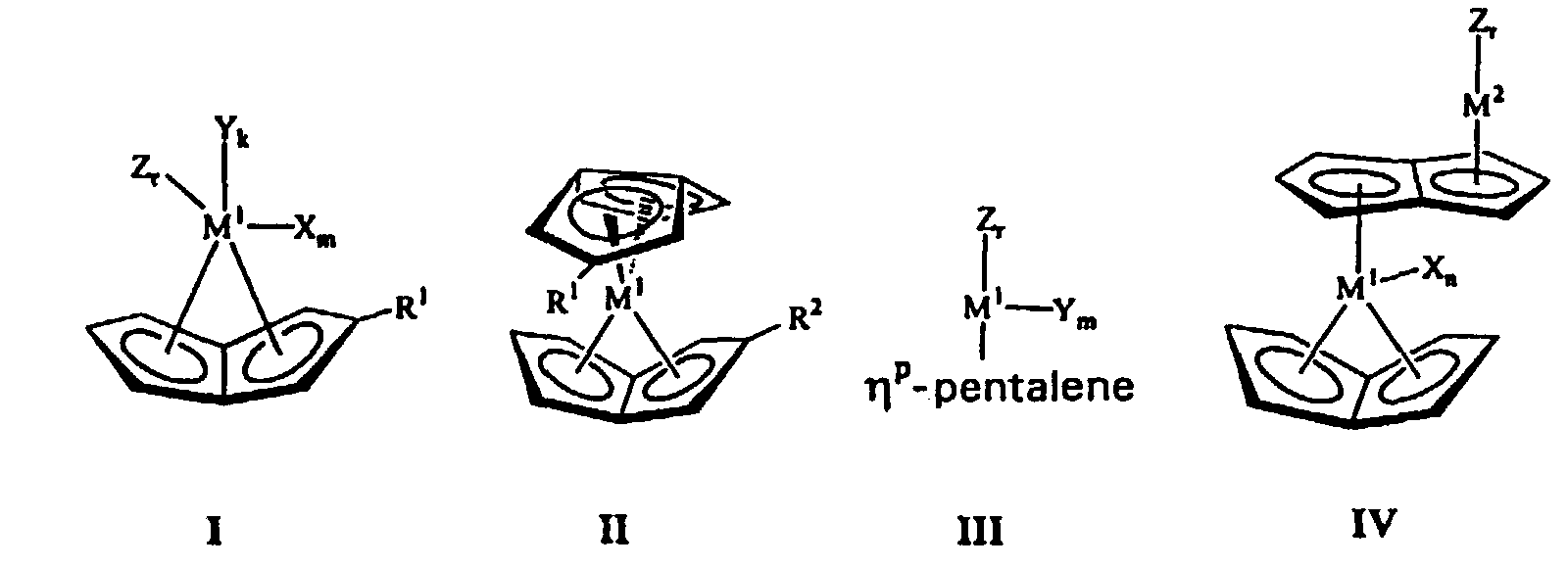
In particular, the invention relates to complex compounds of
general formulae I, II, III or IV,
wherein
- M1 and M2 are the same or different metal atoms, at least one of
the atoms being from the groups 3 to 6,
- R1, R2 are independently H or methyl,
- X is halogen, alkyl, aryl or H,
- Y is THF, amine, phosphane or CO,
- Z is a π-ligand, preferably cyclopentadienyl, pentamethylcyclopentadienyl,
dihydropentalenyl, indenyl or allyl,
- k is 0, 1 or 2,
- m is 0, 1, 2 or 3,
- n is 0 or 1,
- r is 0, 1 or 2, and
- 2 ≤ p ≤ 8.
-
-
The complex compounds may also be present as a cation or anion.
-
Preferred metals are scandium, titanium, zirconium, hafnium,
vanadium, niobium and chromium.
-
In addition to the unsubstituted pentalene ligand, 2-methylpentalene,
for example, may also be used as a ligand.
-
The complex compounds according to the invention are useful as
catalysts for olefin polymerization, e.g., for the
polymerization of ethene, especially certain pentalene zirconium
complexes.
-
In addition, there is claimed a process for the preparation of a
large part of the pentalene complexes according to the
invention. This process is characterized in that a transition
metal compound which has both at least one halogeno and at least
one cyclopentadienyl, substituted cyclopentadienyl, or indenyl
ligand is used as the starting material, and that said starting
material is reacted with a pentalene dianion or a substituted
pentalene dianion which replaces one halogeno ligand and one
cyclopentadienyl, substituted cyclopentadienyl, or indenyl
ligand. The dihydropentalenes required for the synthesis of the
dianions can be prepared by methods known from the literature
(Synthesis 144 (1990)), and their conversion to the
corresponding dianions is achieved, as with other CH-acidic
compounds, by metallation, e.g., with butyllithium in tetrahydrofuran.
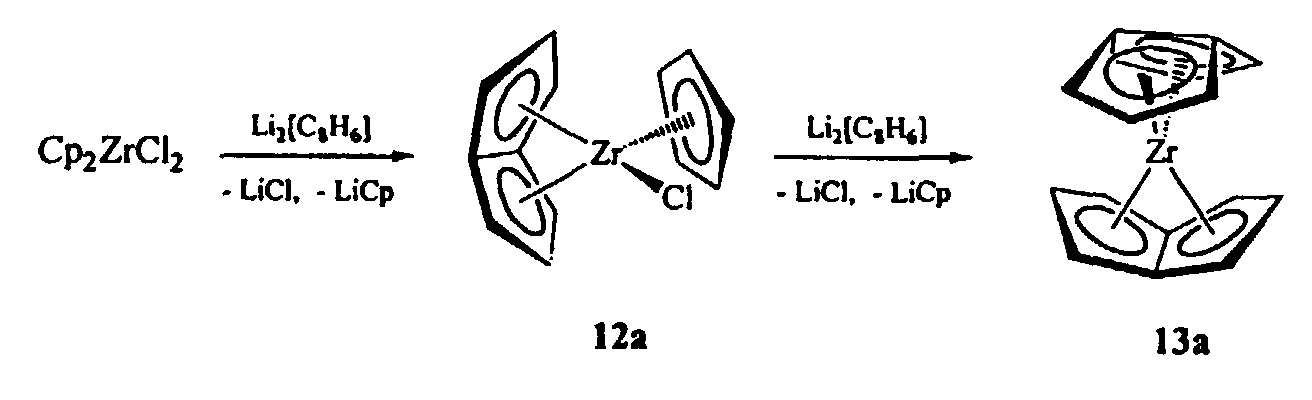
The preparation of the pentalene-transition metal
complexes obtainable by the process according to the invention
will be illustrated by the synthesis of the zirconium complexes
Cp(C
8H
6)ZrCl (12a) and (C
8H
6)
2Zr (13a) as examples according to the
following reaction scheme.
-
Some of the complex compounds according to the invention can be
prepared from other compounds according to the invention by
appropriate chemical reactions. Suitable types of reaction for
such conversions are oxidation, e.g., with halogenated hydrocarbons,
metallation, e.g., with butyllithium, or reduction with
alkali metals, optionally followed by reaction with electrophiles,
addition of unsaturated organic coumponds, e. g.
aldehydes or ketones, addition of electrophiles, e.g., addition
of HX, (CH3)3SiCl or (C2H5)2BCl, or of nucleophiles, e.g.,
organometallic compounds of the main group metals, especially
the alkali metals, optionally followed by reaction with electrophiles,
metathetical reactions with organometallic compounds of
the main group metals, optionally followed by protolysis with
Brønsted acids of weakly coordinating anions, e.g., in the form
of [R3NH][B(C6H5)4], as well as comproportionation by reaction
with a suitable transition metal compound.
-
In addition, another group of novel transition metal complexes
is also made available by such reactions. These are also useful
as catalyst components, e.g., for the polymerization of ethene;
however, they no longer have a pentalene ligand bound to one
single metal atom, but contain at least one dihydropentalenyl or
substituted dihydropentalenyl ligand, or a bridging pentalene or
bridging substituted pentalene ligand. Four selected compounds
from this group are schematically depicted below.
Examples
1. Examples of transition metal complexes according to the
invention
a) The following transition metal complexes according to the
invention having pentalene ligands or substituted pentalene
ligands bound to single metal atoms have been prepared:
-
- Cp(η8-C8H6)(thf)Sc (1a), Cp*(η8-C8H6)(thf)Sc (1b), Ind(η8-C8H6)(thf)Sc (1c)
- Cp(η8-C8H6)Ti (2a), Cp*(η8-C8H6)Ti (2b), Ind(η8-C8H6)Ti (2c), (η5-C8H7)(η8-C8H6)Ti (2d),
- Cp(η8-C8H5CH3)Ti (2e)
- (η8-C8H6)2Ti (3a), (η8-C8H5CH3)2Ti (3b)
- Cp(η8-C8H6)TiCl (4a), Cp(η8-C8H6)TiBr (4b), Ind(η8-C8H6)TiCl (4c), Ind(η8-C8H6)TiBr (4d),
- (η5-C8H7)(η8-C8H6)TiCl (4e), (η5-C8H7)(η8-C8H6)TiBr (4f), (η8-C8H6)((CH3)2PCH2CH2P(CH3)2)TiCl2 (4g),
- Cp(η8-C8H5CH3)TiCl (4h), Cp(η8-C8H5CH3)TiBr (4i), (η8-C8H6)TiCl2(thf) (4j)
- Li[(µ-C8H6)Ti(η8-C8H6)] (5)
- (η5-C8H6D)(η8-C8H6)Ti (6a), (η8-C8H6)Ti(µ-η5:η5-C8H6)FeCp* (6b),
- (η8-C8H6)Ti(µ-η5:η5-C8H6)CoCp* (6c), (η8-C8H6)TiCl(µ-η5:η5-C8H6)Co(η4-1,5-cyclooctadien) (6d),
- (η8-C8H6)Ti(µ-η5:η5-C8H6)Co((C3H7)2P(CH2)3P(C3H7)2) (6e)
- (η5-C8H6Si(CH3)3)(η8-C8H6)TiCl (7a), (η5-C8H6Si(CH3)3)(η8-C8H6)TiBr (7b),
- (η8-C8H6)TiCl(µ-η5:η5-C8H6)FeCp* (7c), (η8-C8H6)TiCl(µ-η5:η5-C8H6)Ti(C5H4(Si(CH3)3)Cl2 (7d)
- Li[(µ-C8H6)Ti(η8-C8H6)(CH3)] (8)
- (η5-C8H6D)(η8-C8H6)(CH3)Ti (9a), (η8-C8H6)(CH3)Ti(µ-η5:η5-C8H6)FeCp* (9b),
- (η8-C8H6)(CH3)Ti(µ-η5:η5-C8H6)Co((C3H7)2P(CH2)3P(C3H7)2) (9c)
- [Cp(η8-C8H6)(thf)Ti][B(C6H5)4] (10a), [Ind(η8-C8H6)(thf)Ti][B(C6H5)4] (10b),
- [(η5-C8H7)(η8-C8H6)(thf)Ti][B(C6H5)4] (10c)
- Li[(µ-C8H6)Zr(η8-C8H6)(CH3)] (11)
- Cp(η8-C8H6)ZrCl (12a), Cp*(η8-C8H6)ZrCl (12b), Cp(η8-C8H5CH3)ZrCl (12c)
- (η8-C8H5)2Zr (13a), (η8-C8H5CH3)2Zr (13b)
- (η8-C8H6)(CH3)Zr(µ-η5:η5-C8H6)FeCp* (14)
- Cp(η8-C8H6)ZrH (15a), Cp(η8-C8H6)(CH3)Zr (15b), Cp(η8-C8H6)(C6H5)Zr (15c), Ind(η8-C8H6)ZrCl (15d),
- Ind(η8-C8H6)(CH3)Zr (15e), (η8-C8H6)(η3-C3H5)2Zr (15f), (η8-C8H6)(η4-C4H6)(thf)Zr (15g)
- [Cp(η8-C8H6)Zr(thf)][B(C6H5)4] (16a), [(η8-C8H6)(η3-C3H5)(thf)2Zr][B(C6H5)4] (16b),
- [(η5-C8H7)(η8-C8H6)(thf)Zr][B(C6H5)4] (16c)
- (η8-C8H6)(thf)2ZrCl2 (17a), (η8-C8H6)(η3-C3H5)ZrCl (17b)
- Cp(η8-C8H6)HfCl (18)
- (η8-C8H6)2Hf (19a), (η8-C8H5CH3)2Hf (19b)
- Cp(η8-C8H6)V (20a), Cp*(η8-C8H6)V (20b), Ind(η8-C8H6)V (20c), Cp(η8-C8H5CH3)V (20d),
- (η5-C5H4Si(CH3)3)(η8-C8H6)V (20e)
- (η5-C5H4Si(CH3)3)(η8-C8H6)Nb (21a), (η5-C5H4Si(CH3)3)(η4-C8H6)(CO)2Nb (21b),
- (η5-C5H4Si(CH3)3)(η8-C8H6)((CH3)2PCH2CH2P(CH3)2)Nb (21c)
- Cp*(η5-C8H6)Cr (22)
-
-
Procedures for the preparation of some transition metal
complexes having pentalene ligands bound to single metal atoms:
-
The preparation and handling of organometallic compounds were
done with exclusion of air and moisture under argon as the
protective gas (Schlenk technique). All required solvents were
made anhydrous before use by refluxing over a desiccant for
several hours followed by distillation under argon.
-
The 1,5-dihydropentalenes C8H8 and C8H7CH3, required for the
synthesis of the dilithium compounds Li2[C8H6] and Li2[C8H5CH3] and
the monolithium compound Li[C8H7], were prepared according to
methods known from the literature (Synthesis 144 (1990)), and
conversion to the corresponding anions was achieved by
metallation with n-butyllithium in tetrahydrofuran.
-
The metallocene dichlorides Cp2MCl2 (M = Ti, Zr, Hf) and
NbCl3 (CH3OCH2CH2OCH3) as well as the employed transition metal
halides ScCl3, TiCl3, ZrCl4, VCl3, VBr3 and CrCl3 are commercially
available. Conversion of these halides to the corresponding
tetrahydrofuran complexes was effected according to known
procedures (J. Inorg. Nucl. Chem. 24, 1105 (1962); Inorg. Synth.
21, 135 (1982)); the preparation of CpTiCl2 (J. Am. Chem. Soc.
83, 581 (1961)), (η8-C5H4Si(CH3)3)TiCl3 (J. Chem. Soc., Dalton Trans. (1980)),
Cp2VX, Cp*CpVX, Ind2VX (X = Cl, Br) (Recl. Trav. Chim. Pays-Bas
80, 831 (1961); Angew.Chem. 98, 902 (1986)), η-(C5H4Si(CH3)3)2NbCl
(Organometallics 12, 1845 (1993)), and Cp*((CH3)2NCH2CH2N(CH3)2)FeCl
(Z. Naturforschung 50b, 394 (1995)) is also described in the
literature.
Example 1: Preparation of Cp(η8-C8H6) (thf)Sc (1a)
-
ScCl3 (466.5 mg, 3.1 mmol) was heated in tetrahydrofuran (THF)
(50 ml) at 50°C with stirring until a substantially clear
solution was obtained. After addition of solid Li2[C8H6] (372 mg,
3.2 mmol) at 0°C, the reaction mixture was heated at 50°C, cooled
at 0°C after about 1 h, and solid LiCp (237 mg, 3.3 mmol) was
added. After heating at 50°C, the mixture was concentrated to
dryness under oil-pump vacuum, the residue was taken up in toluene,
and insoluble material was filtered off. After concentration
of the filtrate, 1a precipitated at -30°C in the form
of yellow crystals which were separated, washed with pentane and
of yellow crystals which were separated, washed with pentane and
dried at room temperature under oil-pump vacuum. Yield: 520 mg
(59% of theory); MS (70 eV) m/z: 212 (M+-THF), 72 (THF+). The
molecular structure of 1a was determined by X-ray
cristallography.
Example 2: Preparation of Cp(η8-C8H6)Ti (2a)
-
To CpTiCl2 (4.96 g, 26.9 mmol) in THF (100 ml) was added solid
Li2[C8H6] (3.13 g, 26.9 mmol) at -40°C. The mixture was stirred
until it reached room temperature, the THF was distilled off
under oil-pump vacuum after 3 h, the residue was taken up in
toluene, and the LiCl was filtered off. After concentration of
the filtrate, 2a precipitated at -30°C in the form of large dark
crystals which were separated, washed with pentane and dried at
room temperature under oil-pump vacuum. Yield: 3.86 g (66% of
theory); MS (70 eV) m/z [%]: 215 (M+) [100], 150 (M+-Cp) [25].
The molecular structure of 2a was determined by X-ray
cristallography.
Example 3: Preparation of Cp(η8-C8H6)TiBr (4b)
-
To a purple solution of Cp(η8-C8H6)Ti (2a) (3.32 g, 15.4 mmol) in
THF (100 ml) was added 1,2-dibromoethane (0.67 ml, 7.7 mmol) at
-20°C. The solution turned orange after a short period of time,
and 4b crystallized. 4b was filtered off, washed with diethyl
ether and dried at room temperature under oil-pump vacuum.
Yield: 3.62 g (80% of theory). MS (70 eV) m/z [%]: 294 (M+)
[26], 229 (M+-Cp) [54], 215 (M+-Br) [100], 192 (M+-C8H6) [7],
150 (M+-Cp-Br) [30].
-
The molecular structure of 4b was determined by X-ray
cristallography.
Example 4: Preparation of (η8-C8H6)(thf)TiCl2 (4j)
-
7d, synthesized from (η8-C8H6)2Ti (3a) (5.5 g, 21.8 mmol) and
(η5-C5H4Si(CH3)3)TiCl3 (7.3 g, 25.1 mmol) as described in example
10, was added to stirred THF at room temperature. A clear
solution was immediately formed, and after half an hour the
THF was removed by distillation under oil pump vacuum. The
residue was taken up in toluene. A yellow-green solid was
separated by filtration and recrystallized from a mixture of
THF and diethyl ether. Yield: 4.13 g (65 % d. Th) MS (70 eV)
m/z [%]: 220 (M+-THF) [90], 185 (M+-THF-Cl) [100], 102 (M+-TiCl2)
[75]. Elemental analysis: calcd. Ti (16.34 %), Cl (24.20
%), found Ti (16.65 %), Cl (24.38 %). 1H-NMR (200 MHz, [D8]THF,
27 °C): 6.51, 5.94 (6H, η8-C8H6).
-
The molecular structure of 4j was determined by X-ray
cristallography.
Example 5: Preparation of Cp(η8-C8H6)ZrCl (12a) by the claimed
process
-
To Cp2ZrCl2 (10.67 g, 36.54 mmol) in THF (100 ml) was added solid
Li2[C8H6] (4.278 g, 36.87 mmol) at -5°C with stirring whereupon
the color turned yellow immediately. The reaction mixture was
kept at room temperature for 6 h with stirring, followed by
concentration at 35°C under oil-pump vacuum until crystallisation
of 12a began. Then, the mixture was heated at about 40°C, and the
resultant clear solution was allowed to stand at -30°C. The
precipitated crystals were separated from the mother liquor,
washed at -78°C with a small amount of precooled THF and diethyl
ether and dried at room temperature under oil pump vacuum.
Yield: 6.18 g (58% of theory). MS (70 eV) m/z [%]: 292 (M+)
[65], 257 (M+-Cl) [10], 227 (M+-Cp) [100]. 1H-NMR (200 MHz,
[D8]THF, 27 °C): 6.03 (5H, Cp); 6.60, 5.76, 5.25 (6H, η8-C8H6).
-
The molecular structure of 12a was determined by X-ray
cristallography.
Example 6: Preparation of (η8-C8H6)2Zr (13a) by the claimed
process
-
To Cp2ZrCl2 (9.96 g, 34.1 mmol) in THF (200 ml) was added solid
Li2[C8H6] (8.03 g, 69.2 mmol) at 0°C with stirring. The reaction
was allowed to continue for 10 h at room temperature, and the
precipitated yellow product was filtered off. It was washed
several times with THF and dried under oil pump vacuum. Yield:
8.8 g (88% of theory). MS (70 eV) m/z [%]: 294 (M+) [100], 192
(M+-C8H6) [19]. 1H-NMR (200 MHz, [D8]THF, 27 °C) : 5.67, 5.24
(12H, η8-C8H6).
Example 7: Preparation of Cp(η8-C8H6) (CH3)Zr (15b)
-
To Cp(η8-C8H6)ZrCl (12a) (2.03 g, 6.9 mmol) in THF (15 ml) was
added a solution of methyl lithium (6.9 mmol) in ether at -20°C.
The reaction solution turned red. After warming at room temperature,
the mixture was concentrated to dryness, the residue was
taken up in diethyl ether, and insoluble material was separated
off by filtration. Crystals precipitated from the filtrate at
-30°C and were separated from the mother liquor, washed with
pentane and dried at room temperature under oil pump vacuum.
Yield: 1.09 g (58% of theory). MS (70 eV) m/z [%]: 272 (M+) [7],
257 (M+-CH3) [100], 205 (M+-Cp) [11], 192 (M+-Cp-CH3)
[11].1H-NMR (200 MHz, [D8]THF, 27 °C): -0.79 (3H, CH3); 6.12,
5.53, 5.18 (6H, η8-C8H6); 5.79 (5H, Cp).
Example 8: Preparation of (η8-C8H6)(thf)2ZrCl2 (17a) by comproportionation
of 13a with ZrCl4(thf)2
-
To (η8-C8H6)2Zr (13a) (7.11 g, 24.1 mmol) in THF (500 ml) was
added dropwise a solution of ZrCl4(thf)2 (9.73 g, 25.8 mmol) in
THF (200 ml) in the course of 15 h with stirring at room
temperature. Subsequent heating at 45°C yielded a clear yellow
solution from which 17a crystallized at -30°C in the form of
colorless needles. They were separated from the mother liquor,
washed twice with a small amount of THF at -78°C and dried at
room temperature under oil pump vacuum. Yield: 14.8 g (75% of
theory). 1H-NMR (200 MHz, [D8]THF, 27 °C): 6.50, 5.58 (6H, η8-C8H6).
-
The molecular structure of 17a was determined by X-ray
cristallography.
Example 9: Preparation of Cp(η8-C8H6)V (20a) by the claimed
process
-
To Cp2VCl (14.89 g, 68.8 mmol) in THF (200 ml) was added solid
Li2[C8H6] (8.16 g, 70.3 mmol) at -78°C with stirring. The initially
blue solution turned purple upon warming at room temperature.
After 2 h, the THF was removed by distillation under oil
pump vacuum, the residue was taken up in toluene, and the LiCl
and LiCp were filtered off. After concentration of the filtrate,
20 a precipitated at -30°C in the form of large crystals which
were separated, washed with pentane and dried at room
temperature under oil pump vacuum. Yield: 13.2 g (88% of
theory). MS (70 eV) m/z [%]: 218 (M+) [100], 153 (M+-Cp) [27],
116 (M+-C8H6) [13]. 1H-NMR (200 MHz, [D8]THF, 27 °C): 4.47 (5H,
Cp), 5.14, 5.02 (6H, η8-C8H6).
-
The molecular structure of 20a was determined by X-ray
cristallography.
b) The following novel transition metal complexes having no
pentalene ligands bound to single metal atoms have been prepared
from complexes having pentalene ligands bound to single metal atoms:
-
- (η5-C8H7)2TiCl2 (23 a), (η5-C8H6C(CH3)2-η1-O)TiCl2 (23b))
- (η5-C8H7)2ZrCl2 (24a), (η5-C8H6Si(CH3)3)2ZrCl2 (24b), (η5-C8H6B(C2H5)2)2ZrCl2 (24c)
- [((CH3)2NCH2CH2N(CH3)2)Li][(µ-C8H6)ZrCp(CH3)2] (25)
- Cp(CH3)2Zr(µ-η5:η5-C8H6)FeCp* (26a),
- Cp(CH3)2Zr(µ-η5:η5-C8H6)Co(η4-1,5-cyclooctadien) (26b)
- Li2[(µ-C8H6)2Zr(CH3)2] (27)
- (η5-C8H6D)2(CH3)2Zr (28)
-
Procedure for the synthesis of 26a as an example of a dinuclear
transition metal complex having a pentalene bridge:
Example 10: Preparation of
(η8-C8H6)TiCl(µ-η5:η5-C8H6)Ti(C5H4(Si(CH3)3)Cl2 (7d)
-
To (η8-C8H6) 2Ti (3a) (461 mg, 1.8 mmol), vigorously stirred in
toluene (30 ml), a solution of (η5-C5H4Si(CH3)3)TiCl3 (569 mg,
1.8 mmol) in toluene (15 ml) was added at room temperature.
Within minutes 3a dissolved and 7d precipitated as a brown
solid. 7d was separated by filtration, washed with toluene and
pentane and dried under oil pump vacuum at room temperature.
Yield: 865 mg (85 % d. Th.). Elemental analysis: calcd. Ti
(17.61 %), Cl (19.56 %), found Ti (17.54 %), Cl (19.45 %).
Example 11: Preparation of Cp(CH3)2Zr (µ-η5:η5-C8H6) FeCp* (26a)
-
To Cp(η8-C8H6) (CH3)Zr (15b) (1.31 g, 4.8 mmol) in THF (30 ml) was
added dropwise a solution of methyl lithium (4.8 mmol) in ether
at -78°C with stirring. The reaction solution was allowed to warm
to room temperature, and the reaction to continue for 1 h. To
this red solution of Li[(µ-η5:η5-C8H6)ZrCp(CH3)2] (25) in THF was
added solid Cp*((CH3)2NCH2CH2N(CH3)2)FeCl (1.64 g, 4.8 mmol) at
-78°C. The reaction was allowed to continue at room temperature
for 1 h, the solution was then concentrated to dryness, and the
residue was taken up in hexane. After separating insoluble
material by filtration, crystals precipitated from the filtrate
at -30°C. They were separated from the mother liquor, washed
twice with pentane at -78°C and dried at room temperature under
oil pump vacuum. Yield: 1.66 g (72% of theory). MS (70 eV) m/z
[%]: 478 (M+) [50] , 463 (M+-CH3) [46]. 1H-NMR (200 MHz,
[D8]Toluol, 27 °C) : 5.81, 5.30, 3.97, 3.32 (6H, η8-C8H6); 1.66
(15H, Cp*);-0.39 (6H, CH3).
Procedure for the synthesis of 23b as an example of a
mononuclear transition metal complex having a substituted
dihydropentalenyl ligand:
Example 12: Preparation of (η5-C8H6C (CH3)2-η1-O)TiCl2 (23b) by
addition of acetone to (η8-C8H6) (thf)TiCl2 (4j)
-
To a green solution of (η8-C8H6)TiCl2 (1.8 g, 4.0 mmol) in THF
(25 ml) acetone (0.3 ml, 4.1 mmol) was added at 0°C. The
solution, which turned orange immediately, was warmed to room
temperature and concentrated under oil pump vacuum after half
an hour. 23b, which precipitated at -30°C as a yellow-orange
solid, was separated from the mother liquor, washed with
diethyl ether at -30°C and dried at room temperature under oil
pump vacuum. Yield: 0.8 g (71 % d. Th.) MS (70 eV) m/z [%]: 278
(M+ ) [13], 263 (M+ -Me) [7], 243 (M+ -Cl) [4], 220 (M+ -C3H6O) [100],
185 (M+ -C3H6O-Cl) [46], 102 (M+ -C3H6O-Ti-2Cl) [43]. 1H-NMR (200
MHz, [D8]THF, 27 °C): 1.3, 1.8 (je 3H, 2 CH3); 6.76-6.67, 4.13
(6H, η5-C8H6).
2. Catalytic polymerization of ethene
-
For experiments 10-12, a 500 ml glass autoclave equipped with an
agitator was used. The stirring rate was 1500 rpm. The methylaluminoxane
was dissolved in toluene (10%, corresponding to CAl =
1.7 mol/l, average degree of oligomerization n = 17.2).
Example 13
-
Toluene (300 ml) was saturated with ethene (2 bar) at 30°C, and
to initiate the polymerization, a solution was added which had
been prepared previously by reaction of the zirconium compound
17a (20.0 mg, 49 µmol) with methylaluminoxane (8.64 ml, 12.99
mmol of Al) dissolved in toluene for half an hour (Zr:Al =
1:400). The polymerization proceeded at 30°C with a constant
pressure of ethene and was quenched after 1 h by addition of
methanol. After washing with methanol and drying under oil-pump
vacuum, a polymer (2.17 g) was obtained as the product which was
linear polyethylene as revealed by the infrared spectrum. The
amount of isolated polymer corresponded to a catalyst activity
of 458 g of polyethylene per g of zirconium and per hour.
Example 14
-
In analogy to Example 10 with: toluene (200 ml), 15f as the
zirconium compound (20.8 mg, 75 µmol), methylaluminoxane (46.87
ml, 75 mmol of Al), Zr:Al = 1:1000, 25 min reaction time. The
amount of isolated polymer (19.46 g) corresponded to a catalyst
activity of 6474 g of linear polyethylene per g of zirconium and
per hour.
Example 15
-
A mixture of methylaluminoxane (5.95 ml, 10.16 mmol of Al)
dissolved in toluene and toluene (100 ml) was charged into an
autoclave and saturated with ethene (2 bar) at 30°C; otherwise,
the procedure was in analogy to Examples 10 and 11 with: 15d as
the zirconium compound (5 mg, 14.5 µmol), methylaluminoxane
(2.6 ml, 4.42 mmol of Al), 30 min reaction time. The amount of
isolated polymer (10.29 g) corresponded to a catalyst activity
of 31,531 g of linear polyethylene per g of zirconium and per
hour.



 M1 and M2 are the same or different metal atoms, at least one of the atoms being from the groups 3 to 6,R1, R2 are independently H or methyl,X is halogen, alkyl, aryl or H,Y is THF, amine, phosphane or CO,Z is a π-ligand, preferably cyclopentadienyl, pentamethylcyclopentadienyl, dihydropentalenyl, indenyl or allyl,k is 0, 1 or 2,m is 0, 1, 2 or 3,n is 0 or 1,r is 0, 1 or 2, and2 ≤ p ≤ 8.