EP3127632A1 - MOLD FLUX FOR CONTINUOUS CASTING OF Ti-CONTAINING SUB-PERITECTIC STEEL AND CONTINUOUS CASTING METHOD - Google Patents
MOLD FLUX FOR CONTINUOUS CASTING OF Ti-CONTAINING SUB-PERITECTIC STEEL AND CONTINUOUS CASTING METHOD Download PDFInfo
- Publication number
- EP3127632A1 EP3127632A1 EP15807275.1A EP15807275A EP3127632A1 EP 3127632 A1 EP3127632 A1 EP 3127632A1 EP 15807275 A EP15807275 A EP 15807275A EP 3127632 A1 EP3127632 A1 EP 3127632A1
- Authority
- EP
- European Patent Office
- Prior art keywords
- mold flux
- mass
- mold
- casting
- content
- Prior art date
- Legal status (The legal status is an assumption and is not a legal conclusion. Google has not performed a legal analysis and makes no representation as to the accuracy of the status listed.)
- Granted
Links
Images

Classifications
-
- B—PERFORMING OPERATIONS; TRANSPORTING
- B22—CASTING; POWDER METALLURGY
- B22D—CASTING OF METALS; CASTING OF OTHER SUBSTANCES BY THE SAME PROCESSES OR DEVICES
- B22D11/00—Continuous casting of metals, i.e. casting in indefinite lengths
- B22D11/001—Continuous casting of metals, i.e. casting in indefinite lengths of specific alloys
-
- B—PERFORMING OPERATIONS; TRANSPORTING
- B22—CASTING; POWDER METALLURGY
- B22D—CASTING OF METALS; CASTING OF OTHER SUBSTANCES BY THE SAME PROCESSES OR DEVICES
- B22D11/00—Continuous casting of metals, i.e. casting in indefinite lengths
- B22D11/10—Supplying or treating molten metal
- B22D11/108—Feeding additives, powders, or the like
-
- B—PERFORMING OPERATIONS; TRANSPORTING
- B22—CASTING; POWDER METALLURGY
- B22C—FOUNDRY MOULDING
- B22C3/00—Selection of compositions for coating the surfaces of moulds, cores, or patterns
-
- B—PERFORMING OPERATIONS; TRANSPORTING
- B22—CASTING; POWDER METALLURGY
- B22D—CASTING OF METALS; CASTING OF OTHER SUBSTANCES BY THE SAME PROCESSES OR DEVICES
- B22D11/00—Continuous casting of metals, i.e. casting in indefinite lengths
- B22D11/04—Continuous casting of metals, i.e. casting in indefinite lengths into open-ended moulds
- B22D11/049—Continuous casting of metals, i.e. casting in indefinite lengths into open-ended moulds for direct chill casting, e.g. electromagnetic casting
-
- B—PERFORMING OPERATIONS; TRANSPORTING
- B22—CASTING; POWDER METALLURGY
- B22D—CASTING OF METALS; CASTING OF OTHER SUBSTANCES BY THE SAME PROCESSES OR DEVICES
- B22D11/00—Continuous casting of metals, i.e. casting in indefinite lengths
- B22D11/10—Supplying or treating molten metal
- B22D11/11—Treating the molten metal
- B22D11/111—Treating the molten metal by using protecting powders
-
- B—PERFORMING OPERATIONS; TRANSPORTING
- B22—CASTING; POWDER METALLURGY
- B22D—CASTING OF METALS; CASTING OF OTHER SUBSTANCES BY THE SAME PROCESSES OR DEVICES
- B22D11/00—Continuous casting of metals, i.e. casting in indefinite lengths
- B22D11/16—Controlling or regulating processes or operations
-
- C—CHEMISTRY; METALLURGY
- C22—METALLURGY; FERROUS OR NON-FERROUS ALLOYS; TREATMENT OF ALLOYS OR NON-FERROUS METALS
- C22C—ALLOYS
- C22C38/00—Ferrous alloys, e.g. steel alloys
- C22C38/002—Ferrous alloys, e.g. steel alloys containing In, Mg, or other elements not provided for in one single group C22C38/001 - C22C38/60
-
- C—CHEMISTRY; METALLURGY
- C22—METALLURGY; FERROUS OR NON-FERROUS ALLOYS; TREATMENT OF ALLOYS OR NON-FERROUS METALS
- C22C—ALLOYS
- C22C38/00—Ferrous alloys, e.g. steel alloys
- C22C38/02—Ferrous alloys, e.g. steel alloys containing silicon
-
- C—CHEMISTRY; METALLURGY
- C22—METALLURGY; FERROUS OR NON-FERROUS ALLOYS; TREATMENT OF ALLOYS OR NON-FERROUS METALS
- C22C—ALLOYS
- C22C38/00—Ferrous alloys, e.g. steel alloys
- C22C38/04—Ferrous alloys, e.g. steel alloys containing manganese
-
- C—CHEMISTRY; METALLURGY
- C22—METALLURGY; FERROUS OR NON-FERROUS ALLOYS; TREATMENT OF ALLOYS OR NON-FERROUS METALS
- C22C—ALLOYS
- C22C38/00—Ferrous alloys, e.g. steel alloys
- C22C38/06—Ferrous alloys, e.g. steel alloys containing aluminium
-
- C—CHEMISTRY; METALLURGY
- C22—METALLURGY; FERROUS OR NON-FERROUS ALLOYS; TREATMENT OF ALLOYS OR NON-FERROUS METALS
- C22C—ALLOYS
- C22C38/00—Ferrous alloys, e.g. steel alloys
- C22C38/14—Ferrous alloys, e.g. steel alloys containing titanium or zirconium
Definitions
- This invention relates to mold flux that is used for continuous-casting Ti-containing hypo-peritectic steel, and a method for continuous-casting hypo-peritectic steel containing 0.1 to 1 mass% of Ti, using the mold flux.
- hypo-peritectic steel containing 0.08 to 0.18 mass% of C When hypo-peritectic steel containing 0.08 to 0.18 mass% of C is continuous-cast, a solidified shell that is formed by solidification of molten steel in a mold tends to be unequal in thickness, which causes longitudinal cracks to easily form on a surface of a slab.
- melt cooling it is effective to mildly cooling the solidified shell (hereinafter, may be referred to as "mild cooling") in order to make the solidified shell in the mold equal in thickness. It is relatively easy to use mold flux for mild cooling.
- the mold flux is supplied on molten steel in the mold, and melts with heat supplied from the molten steel.
- the mold flux in a melting state flows along the mold, to come into a gap between the mold and the solidified shell, and to form a mold flux film (hereinafter may be referred to as "film").
- this film is cooled by the mold, to solidify like glass. Crystals are educed from the glass as time passes.
- the roughness of the surface of the film in the mold side increases, which causes the thermal resistance at the interface between the mold and the film (hereinafter may be referred to as "interfacial thermal resistance") to increase. Radiative heat transfer in the film is also suppressed.
- cuspidine (Ca 4 Si 2 O 7 F 2 ) that is common composition of crystals educed from the film.
- a method for controlling components in mold flux specifically, a method for increasing the ratio of the contents of CaO to SiO 2 (hereinafter may be referred to as "basicity") is also effective for promoting crystallization of the film.
- a method for reducing the MgO content in mold flux is also effective for promoting crystallization of the film.
- Patent Literature 2 discloses it is effective for crystallization of a film that in mold flux, the basicity is specified by 1.2 to 1.6 and the MgO content is specified by no more than 1.5 mass%.
- the highest temperature where the mold flux forms crystals disclosed in Patent Literature 2 is about 1150°C at most, and only an effect of mild cooling corresponding to this is obtained. That is, the effect of mild cooling is insufficient.
- Patent Literature 3 discloses a method for suppressing radiative heat transfer in a film by adding an iron oxide or a transition metal oxide to mold flux.
- the solidification point shown in Examples of Patent Literature 3 is about 1050°C, which is lower than that in Patent Literature 1 by no less than 100°C considering that the solidification point of the mold flux for hypo-peritectic steel suggested in Patent Literature 1 is about 1150 to 1250°C. As a result, crystallization of the film is blocked. Thus, with the art of Patent Literature 3, an effect of mild cooling obtained from increase of interfacial thermal resistance and the like according to the crystallization is marred.
- Patent Literature 4 discloses a range of the composition of mold flux of the quaternary system of CaO-SiO 2 -CaF 2 -NaF where cuspidine is easily educed.
- the range of the composition is substantially same as a primary crystallization field of cuspidine as published in Non-Patent Literature 1 thereafter.
- the mold flux of Patent Literature 4 as described above, longitudinal cracks do not form on a surface of a slab when hypo-peritectic steel is rapidly cast, which makes it possible to obtain the slab which has a good surface quality.
- Patent Literature 5 discloses a method for adding a transition metal oxide to the basic composition prepared within the range of Patent Literature 4, to drop the solidification point without marring an effect of mild cooling.
- Patent Literature 5 is aimed at the problem that when the Mn content in molten steel is high, crystallization of cuspidine is blocked because the MnO content in the film increases due to oxidation reaction of Mn, and thus the effect of mild cooling cannot be sufficiently obtained.
- a necessary content of MnO is contained in advance, to suppress oxidation reaction of Mn, and then the solidification point is raised to a desired level. Whereby, it is possible to prevent longitudinal cracks on high-strength steel of the high Mn content from forming, according to Patent Literature 5.
- Non-Patent Literature 1 ISIJ International, Vol. 42 (2002), pp. 489 to 497
- Patent Literatures 1 to 3 as described above has the problems that the lubricity is disturbed and breakout cannot be prevented, and that the effect of mild cooling is insufficient.
- One of steel grades of hypo-peritectic steel is of no less than 0.1 mass% of the Ti content.
- TiO 2 forms in mold flux in a melting state through the influence of oxidation reaction of Ti in molten steel.
- This TiO 2 not only dilutes cuspidine in the solidified film, but also forms another new crystal phase, perovskite (CaTiO 3 ).
- perovskite grows up in the film unilaterally, and a glass phase (cuspidine) necessary for lubrication is marred.
- stable casting gets difficult, and the problem of forming longitudinal cracks on a surface of a slab rises.
- An object of this invention is, in continuous casting of Ti-containing hypo-peritectic steel, to provide mold flux that can prevent longitudinal cracks from forming on a surface of a slab and to provide a method for continuous-casting hypo-peritectic steel containing 0.1 to 1 mass% of Ti, using this mold flux.
- the inventors of this invention found that in continuous casting of Ti-containing hypo-peritectic steel, the composition of mold flux in a melting state changes according to oxidation reaction of Ti in molten steel. Specifically, they found that the MnO and TiO 2 contents of the mold flux increase in its melting state from less than 0.1 mass% in its initial composition.
- the ratio of the first peak height of perovskite to the first peak height of cuspidine (hereinafter may be merely referred to as "strength") which is obtained from X-ray diffraction analysis of powder obtained by pulverizing the film of the mold flux in a solidifying state after the casting takes a value more than 1.0, formation of cuspidine is blocked, and evaluation of continuous casting and longitudinal cracks becomes "failure".
- a second aspect of this invention is a method for continuous-casting Ti-containing hypo-peritectic steel, the method comprising: continuous-casting hypo-peritectic steel containing 0.1 to 1 mass% of Ti, using the mold flux of the above first aspect of this invention.
- ... contains CaO, SiO 2 , an alkali metal oxide and a fluorine compound as major components in this invention means that the content of each object component is no less than 5 mass%, and the total content thereof is no less than 70 mass%.
- mold flux of this invention Each of the indexes (f(1), f(2) and f(3)) of the mold flux for continuous-casting Ti-containing hypo-peritectic steel of this invention (hereinafter may be referred to as "mold flux of this invention") is prepared within a predetermined range; these indexes are calculated from the chemical composition before the mold flux is supplied into a mold (hereinafter may be referred to as "initial chemical composition"). Moreover, the TiO 2 content in the melting state during the casting is no more than 20 mass% and the strength ratio of the film in the solidifying state after the casting is no more than 1.0.
- the method for continuous-casting Ti-containing hypo-peritectic steel of this invention uses the above described mold flux of this invention.
- cuspidine stabilizes in a crystal phase in the film that is formed in the mold, and the state where cuspidine is dominant over perovskite can be kept.
- the effects of lubricity and mild cooling in the mold are stable, to prevent longitudinal cracks on a surface of a slab from forming.
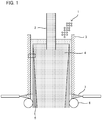
- Fig. 1 is a view showing this invention.
- Fig. 2 is a cross-sectional view showing a part of Fig. 1 surrounded by a dashed line enlarged. This invention will be described below with reference to Figs. 1 and 2 when demanded.
- "X to Y" means "no less than X and no more than Y" unless there is any special mention.
- mold flux 1 of this invention is supplied on the surface of molten steel 4 that is poured into a mold 3 via a submerged nozzle 2.
- the mold flux 1 of this invention supplied in this way melts with heat supplied from the molten steel 4.
- the mold flux 1 flows along the mold 3, and comes into a gap between the mold 3 and a solidified shell 5, to form a film 8.
- the solidified shell 5, which is formed by cooling from the side of the mold 3 that is cooled by cooling means not shown, is withdrawn toward a lower part of the mold 3 with rolls 6, and is cooled by cooling water 7.
- hypo-peritectic steel containing 0.1 to 1 mass% of Ti is continuous-cast in this way.
- the mold flux of this invention contains CaO, SiO 2 , an alkali metal oxide and a fluorine compound as major components.
- CaO, SiO 2 and a fluorine compound are contained as essential components for cuspidine that bears crystallization.
- An alkali metal oxide is contained as a component for controlling the solidification point of the flux relatively easily.
- the chemical composition of the mold flux changes according to oxidation reaction of Ti in the molten steel in the mold.
- each of the indexes (f(1), f(2) and f(3), hereinafter the same will be referred to) of the mold flux of this invention which is calculated from the initial chemical composition, is prepared within a predetermined range.
- "initial chemical composition” means the composition before the supply into the mold for continuous casting. The intention is to exclude the composition changes in the mold flux according to oxidation reaction of Ti in the molten steel.
- the preparation of the indexes makes cuspidine stabilize in a crystal phase in the film even if the composition of the mold flux in the melting state (hereinafter may be referred to as "melting mold flux”) changes according to oxidation reaction of Ti in the molten steel.
- melting mold flux changes according to oxidation reaction of Ti in the molten steel.
- the initial chemical composition satisfies the following formulas (1), (2) and (3). That is, the indexes (f(1), f(2) and f(3)), which are calculated from the initial chemical composition using the following formulas (A) to (H), satisfy the following formulas (1), (2) and (3), respectively.
- the indexes (f(1), f(2) and f(3)) which are calculated from the initial chemical composition using the following formulas (A) to (H), satisfy the following formulas (1), (2) and (3), respectively.
- indexes f(1) to f(3) are specified by the following formulas (A) to (G).
- f 1 CaO h / SiO 2 h
- f 2 CaF 2 h / ( CaO ) h + ( SiO 2 ) h + ( CaF 2 ) h
- T is the Ti content in the molten steel (mass%)
- W CaO is the CaO content in the mold flux (mass%)
- W SiO2 is the SiO 2 content in the mold flux (mass%)
- W F is the F content in the mold flux (mass%)
- W Li2O W Na2O and W K2O are the contents of Li 2 O, Na 2 O and K 2 O respectively, which are alkali metal oxides, in the mold flux (mass%).
- the index f(1) which is calculated using the formula (A), is a ratio of the CaO content to the SiO 2 content in view of CaF 2 , and is an important index to promote crystallization of cuspidine.
- the value of f(1) has to take 1.1 to 1.9 in order to keep the composition of the melting mold flux within the range of the composition of a primary crystal of cuspidine.
- f(1) of the mold flux of this invention has to be (1.1 - 0.5 ⁇ T) to (1.9 - 0.5 ⁇ T).
- the upper limit of f(1) is preferably (1.7 - 0.5 ⁇ T), and more preferably (1.5 - 0.5 ⁇ T).
- the lower limit of f(1) is preferably (1.2 - 0.5 ⁇ T), and more preferably (1.3 - 0.5 ⁇ T).
- the index f(2) calculated using the formula (B) indicates a proportion of CaF 2 for the total content of CaO, SiO 2 and CaF 2 , and is an important index to promote crystallization of cuspidine.
- Setting f(2) in 0.05 to 0.40 makes it possible to keep the composition of the melting mold flux within the range of the composition of a primary crystal of cuspidine.
- the upper limit of f(2) is preferably 0.3, and more preferably 0.25.
- the lower limit of f(2) is preferably 0.1, and more preferably 0.15.
- the index f(3) calculated using the formula (C) indicates a proportion of a component that plays a role like a solvent for cuspidine. Setting f(3) in no more than 0.4 makes it possible to keep crystallization of cuspidine.
- the lower limit of f(3) is 0 according to the definition of the formula (C).
- the upper limit of f(3) is preferably 0.20, and more preferably 0.15.
- the lower limit of f(3) is preferably 0.05, and more preferably 0.10.
- the f(1), f(2) and (3) of the mold flux of this invention from the initial chemical composition satisfy the formulas (1), (2) and (3), respectively.
- the TiO 2 content of the mold flux of this invention in the melting state in the casting is no more than 20 mass%, and the strength ratio of the film of the mold flux of this invention in the solidifying state after the casting is no more than 1.0.
- No more than 20 mass% of the TiO 2 content of the melting mold flux makes it possible to suppress composition changes in the melting mold flux.
- cuspidine stabilizes in a crystal phase in the film, and the state where cuspidine is dominant over perovskite can be kept.
- No more than 1.0 of the strength ratio of the film of the mold flux in the solidifying state after the casting makes it possible not to block formation of cuspidine.
- No more than 20 mass% of the TiO 2 content of the melting mold flux and no more than 1.0 of the strength ratio of the film of the mold flux in the solidifying state after the casting in addition to the satisfaction of the formulas (1), (2) and (3) makes it possible to prevent longitudinal cracks from forming on a surface of a slab.
- the solidification point of the mold flux is preferably 1150 to 1400°C. If the solidification point is under 1150°C, crystallization of cuspidine might be poor. It is technically difficult to make the solidification point over 1400°C.
- the solidification point of 1150 to 1400°C improves the effect of mild cooling by film. Thus, longitudinal cracks can be surely prevented from forming.
- hypo-peritectic steel When the Ti content of hypo-peritectic steel is no less than 0.1 mass%, the problem is outstanding that longitudinal cracks form on a surface of a slab through the influence of oxidation reaction of Ti in the steel. In contrast, when the Ti content of hypo-peritectic steel exceeds 1 mass%, composition changes in the melting mold flux in the mold through the influence of oxidation reaction of Ti in the molten steel become large. As a result, it becomes difficult to keep the composition of the melting mold flux within the range of the composition of a primary crystal of cuspidine. Therefore, the hypo-peritectic steel continuous-cast using the mold flux of this invention is specified as hypo-peritectic steel containing 0.1 to 1 mass% of Ti.
- At least one of Li 2 O, Na 2 O and K 2 O can be used as an alkali metal oxide.
- fluorite that contains CaF 2 as a major component, or NaF can be used as a fluorine compound.
- Al 2 O 3 may be contained in the mold flux of this invention in order to adjust physical properties such as the solidification point and the viscosity.
- Al 2 O 3 has the functions of dropping the solidification point and increasing the viscosity.
- the Al 2 O 3 content is preferably low in order to promote crystallization of cuspidine.
- the Al 2 O 3 content is preferably no more than 5 mass%.
- the Al 2 O 3 content can be less than 0.5 mass% by using artificial raw materials like a pre-melting base material, it might be accompanied by a rise in raw material costs. Therefore, the Al 2 O 3 content is preferably no less than 0.5 mass%.
- the continuous casting method of this invention is directed to hypo-peritectic steel containing 0.1 to 1 mass% of Ti.
- the method uses the above described mold flux of this invention as mold flux. Whereby, the composition of a crystal phase in the film formed in the mold is maintained during the casting. That is, the state where cuspidine is dominant over perovskite in a crystal phase in the film can be kept during the casting. Thus, the effects of lubricity and mild cooling in the mold can be stable, and longitudinal cracks on a surface of a slab can be prevented.
- the continuous casting method of this invention has no specific limitation to the casting conditions other than the mold flux. That is, the casting conditions can be properly set as well as a conventional continuous casting method.
- a slab was continuous-cast from 2.5 ton of molten steel while the mold flux was supplied onto the molten steel in a mold.
- the withdrawal rate was 1.0 m/min
- the size of the slab was: 500 mm in width, 84 mm in thickness and 7000 mm in length.
- Table 1 shows grades (symbol), initial chemical composition (mass%), basicities, solidification points (°C) and viscosities (poise) at 1300°C of the mold flux used for the tests.
- Table 2 shows the chemical composition (mass%) of the molten steel used for the tests.
- Test numbers 1 to 7 were set in the tests. The grade of the mold flux and the chemical composition of the molten steel were changed in each test. Table 3 shows grades of the mold flux, the Ti contents in the molten steel (mass%), values of f(1), f(2) and f(3) calculated using the initial chemical composition (hereinafter may be referred to as "initial composition"), and test categories used in the tests.
- Table 4 shows the chemical composition of the mold flux in the melting state, and values of f(1), f(2) and f(3) calculated using the composition in the melting state.
- the film in a solidifying state was taken out of the mold when the casting was ended, and pulverizing was carried out on the film to obtain powder.
- the obtained powder underwent X-ray diffraction analysis. From the results of the diffraction analysis, the strength of cuspidine and the strength of perovskite were obtained, to calculate the ratio (X2/X1) of the strength of perovskite (X2) to the strength of cuspidine (XI).
- the strength of cuspidine was the first peak height, specifically, the strength of an angle (29.2°), which was twice as wide as a Bragg angle when Co was a source.
- the strength of perovskite was the first peak height, specifically, the strength of an angle (33.2°), which was twice as wide as a Bragg angle when Co was a source.
- Table 5 shows test numbers, grades of the mold flux, the Ti contents (mass%) in the molten steel, the ratio of the strength of perovskite to the strength of cuspidine (strength ratio) and evaluations of continuous casting and longitudinal cracks.
- Test Number Grade of Mold Flux Ti Content in Molten Steel (mass%) Strength Ratio Evaluation of Continuous Casting and Longitudinal Cracks 1 A1 0.19 0.6 ⁇ 2 A1 0.42 0.8 ⁇ 3 A2 0.41 0.6 ⁇ 4 A1 1.12 1.5 ⁇ 5 R1 0.20 2.1 ⁇ 6 R2 0.18 1.6 ⁇ 7 R3 0.19 1.2 ⁇
- each MnO and TiO 2 content of the mold flux of all the test numbers 1 to 7 was less than 0.1 mass% in the initial composition.
- each MnO and TiO 2 content increased. From these results, it was confirmed that in the continuous casting of Ti-containing hypo-peritectic steel, the composition of the mold flux in the melting state changed according to oxidation reaction of Ti in the molten steel.
- the strength ratio of the film took a value larger than 1.0, that is, formation of cuspidine was blocked. Therefore, the evaluation of continuous casting and longitudinal cracks was "failure".
- the Ti content of the molten steel was over 1.0 mass%, and thus the TiO 2 content of the melting mold flux was over 20 mass%.
- the composition change in the melting mold flux was large.
- the strength ratio of the film took a value larger than 1.0, that is, formation of cuspidine was blocked. Therefore, the evaluation of continuous casting and longitudinal cracks was "failure".
- the effect of lubricity and mild cooling in the mold is stable, and longitudinal cracks on a surface of a slab can be prevented from forming.
- they can be effectively used in continuous casting of hypo-peritectic steel containing 0.1 to 1 mass% ofTi.
Landscapes
- Engineering & Computer Science (AREA)
- Mechanical Engineering (AREA)
- Chemical & Material Sciences (AREA)
- Materials Engineering (AREA)
- Metallurgy (AREA)
- Organic Chemistry (AREA)
- Continuous Casting (AREA)
- Treatment Of Steel In Its Molten State (AREA)
Abstract
Description
- This invention relates to mold flux that is used for continuous-casting Ti-containing hypo-peritectic steel, and a method for continuous-casting hypo-peritectic steel containing 0.1 to 1 mass% of Ti, using the mold flux.
- When hypo-peritectic steel containing 0.08 to 0.18 mass% of C is continuous-cast, a solidified shell that is formed by solidification of molten steel in a mold tends to be unequal in thickness, which causes longitudinal cracks to easily form on a surface of a slab.
- It is effective to mildly cooling the solidified shell (hereinafter, may be referred to as "mild cooling") in order to make the solidified shell in the mold equal in thickness. It is relatively easy to use mold flux for mild cooling.
- The mold flux is supplied on molten steel in the mold, and melts with heat supplied from the molten steel. The mold flux in a melting state flows along the mold, to come into a gap between the mold and the solidified shell, and to form a mold flux film (hereinafter may be referred to as "film"). Just after the casting starts, this film is cooled by the mold, to solidify like glass. Crystals are educed from the glass as time passes. When crystallization of this film is promoted, the roughness of the surface of the film in the mold side increases, which causes the thermal resistance at the interface between the mold and the film (hereinafter may be referred to as "interfacial thermal resistance") to increase. Radiative heat transfer in the film is also suppressed. These effects allows the molten steel and the solidified shell touching the film to be mildly cooled down.
- It is cuspidine (Ca4Si2O7F2) that is common composition of crystals educed from the film.
- The following methods have been worked out as means for promoting crystallization of films:
- A method for controlling fluid physical properties of mold flux, specifically, a method for raising the solidification point is effective for promoting crystallization of the film. About this method,
Patent Literature 1 describes that crystallinity of a film is improved by raising the solidification point of mold flux to the range of 1150 to 1250°C. However, it is said there is a problem that if the solidification point of the mold flux is raised to 1250°C or over, the lubricity is disturbed and breakout cannot be prevented. - A method for controlling components in mold flux, specifically, a method for increasing the ratio of the contents of CaO to SiO2 (hereinafter may be referred to as "basicity") is also effective for promoting crystallization of the film. A method for reducing the MgO content in mold flux is also effective for promoting crystallization of the film. Concerning these methods,
Patent Literature 2 discloses it is effective for crystallization of a film that in mold flux, the basicity is specified by 1.2 to 1.6 and the MgO content is specified by no more than 1.5 mass%. However, the highest temperature where the mold flux forms crystals disclosed inPatent Literature 2 is about 1150°C at most, and only an effect of mild cooling corresponding to this is obtained. That is, the effect of mild cooling is insufficient. - On the other hand,
Patent Literature 3 discloses a method for suppressing radiative heat transfer in a film by adding an iron oxide or a transition metal oxide to mold flux. - However, CaO, SiO2, and CaF2 in the mold flux are diluted by the addition of any of these oxides. Specifically, in
Patent Literature 3, no less than 10 mass% of an iron oxide or a transition metal oxide in total has to be added as shown in its Examples in order to obtain a sufficient effect of suppressing radiative heat transfer. In this case, cuspidine is difficult to be educed when the composition has about 1.0 of the basicity shown in Examples ofPatent Literature 3, and the solidification point of the mold flux drops. The solidification point shown in Examples ofPatent Literature 3 is about 1050°C, which is lower than that inPatent Literature 1 by no less than 100°C considering that the solidification point of the mold flux for hypo-peritectic steel suggested inPatent Literature 1 is about 1150 to 1250°C. As a result, crystallization of the film is blocked. Thus, with the art ofPatent Literature 3, an effect of mild cooling obtained from increase of interfacial thermal resistance and the like according to the crystallization is marred. -
Patent Literature 4 discloses a range of the composition of mold flux of the quaternary system of CaO-SiO2-CaF2-NaF where cuspidine is easily educed. The range of the composition is substantially same as a primary crystallization field of cuspidine as published inNon-Patent Literature 1 thereafter. According to the mold flux ofPatent Literature 4 as described above, longitudinal cracks do not form on a surface of a slab when hypo-peritectic steel is rapidly cast, which makes it possible to obtain the slab which has a good surface quality. -
Patent Literature 5 discloses a method for adding a transition metal oxide to the basic composition prepared within the range ofPatent Literature 4, to drop the solidification point without marring an effect of mild cooling.Patent Literature 5 is aimed at the problem that when the Mn content in molten steel is high, crystallization of cuspidine is blocked because the MnO content in the film increases due to oxidation reaction of Mn, and thus the effect of mild cooling cannot be sufficiently obtained. For this problem, a necessary content of MnO is contained in advance, to suppress oxidation reaction of Mn, and then the solidification point is raised to a desired level. Whereby, it is possible to prevent longitudinal cracks on high-strength steel of the high Mn content from forming, according toPatent Literature 5. -
- Patent Literature 1:
JP H8-197214A - Patent Literature 2:
JP H8-141713A - Patent Literature 3:
JP H7-185755A - Patent Literature 4:
JP2001-179408A - Patent Literature 5:
JP2006-289383A - Non-Patent Literature 1: ISIJ International, Vol. 42 (2002), pp. 489 to 497
- As described above, in continuous casting of hypo-peritectic steel, longitudinal cracks easily form on a surface of a slab. It is effective for preventing the formation of longitudinal cracks to carry out mild cooling on the solidified shell, and mold flux can be used for this mild cooling.
- However, the mold flux of
Patent Literatures 1 to 3 as described above has the problems that the lubricity is disturbed and breakout cannot be prevented, and that the effect of mild cooling is insufficient. - On the other hand, according to the mold flux of
Patent Literature 4, longitudinal cracks do not form on a surface of a slab when hypo-peritectic steel is rapidly cast, which makes it possible to obtain the slab which has a good surface quality. According to the mold flux ofPatent Literature 5, it is possible to prevent longitudinal cracks on high-strength steel of the high Mn content from forming. - One of steel grades of hypo-peritectic steel is of no less than 0.1 mass% of the Ti content. In casting of this Ti-containing hypo-peritectic steel, TiO2 forms in mold flux in a melting state through the influence of oxidation reaction of Ti in molten steel. This TiO2 not only dilutes cuspidine in the solidified film, but also forms another new crystal phase, perovskite (CaTiO3). Therefor, this perovskite grows up in the film unilaterally, and a glass phase (cuspidine) necessary for lubrication is marred. As a result, stable casting gets difficult, and the problem of forming longitudinal cracks on a surface of a slab rises.
- Therefore, there is a case in the casting of Ti-containing hypo-peritectic steel that longitudinal cracks form on a surface of a slab through the influence of TiO2 forming in the mold flux even if the mold flux of any of
Patent Literatures - This invention was made in view of these problems. An object of this invention is, in continuous casting of Ti-containing hypo-peritectic steel, to provide mold flux that can prevent longitudinal cracks from forming on a surface of a slab and to provide a method for continuous-casting hypo-peritectic steel containing 0.1 to 1 mass% of Ti, using this mold flux.
- The inventors of this invention found that in continuous casting of Ti-containing hypo-peritectic steel, the composition of mold flux in a melting state changes according to oxidation reaction of Ti in molten steel. Specifically, they found that the MnO and TiO2 contents of the mold flux increase in its melting state from less than 0.1 mass% in its initial composition.
- Further, they found that even if f(1), f(2) and f(3) described below, which are calculated from the initial composition of the mold flux, satisfy the formulas (1), (2) and (3) described below as well, composition changes in the mold flux in the melting state become large when the TiO2 content of the mold flux in the melting state during casting exceeds 20 mass%. If the composition changes in the mold flux in the melting state become large, the ratio of the first peak height of perovskite to the first peak height of cuspidine (hereinafter may be merely referred to as "strength") which is obtained from X-ray diffraction analysis of powder obtained by pulverizing the film of the mold flux in a solidifying state after the casting takes a value more than 1.0, formation of cuspidine is blocked, and evaluation of continuous casting and longitudinal cracks becomes "failure". Thus, it is important for preventing longitudinal cracks on a surface of a slab from forming in continuous casting of Ti-containing hypo-peritectic steel that the TiO2 content of mold flux in the melting state during the casting is less than 20 mass% and the strength ratio is no more than 1.0. This invention was made based on these findings. The gist of this invention is as follows.
- A first aspect of this invention is mold flux for continuous-casting Ti-containing hypo-peritectic steel, wherein in continuous casting of Ti-containing hypo-peritectic steel, the mold flux contains CaO, SiO2, an alkali metal oxide and a fluorine compound as major components, chemical composition of the mold flux before the mold flux is put into a mold satisfies the formulas (1), (2) and (3), a TiO2 content of the mold flux in a melting state during the casting is no more than 20 mass%, and a strength ratio of a film of the mold flux in a solidifying state after the casting is no more than 1.0:





wherein the strength ratio of the film means a ratio of a first peak height of perovskite (strength of an angle (33.2°), which is twice as wide as a Bragg angle when Co was a source, X2) to a first peak height of cuspidine (strength of an angle (29.2°), which is twice as wide as a Bragg angle when Co was a source, XI), the ratio (X2/X1) being obtained from X-ray diffraction analysis of powder obtained by pulverizing the film of the mold flux. - A second aspect of this invention is a method for continuous-casting Ti-containing hypo-peritectic steel, the method comprising: continuous-casting hypo-peritectic steel containing 0.1 to 1 mass% of Ti, using the mold flux of the above first aspect of this invention.
- "... contains CaO, SiO2, an alkali metal oxide and a fluorine compound as major components" in this invention means that the content of each object component is no less than 5 mass%, and the total content thereof is no less than 70 mass%.
- Each of the indexes (f(1), f(2) and f(3)) of the mold flux for continuous-casting Ti-containing hypo-peritectic steel of this invention (hereinafter may be referred to as "mold flux of this invention") is prepared within a predetermined range; these indexes are calculated from the chemical composition before the mold flux is supplied into a mold (hereinafter may be referred to as "initial chemical composition"). Moreover, the TiO2 content in the melting state during the casting is no more than 20 mass% and the strength ratio of the film in the solidifying state after the casting is no more than 1.0. Whereby, even if the composition of the mold flux in the melting state changes according to oxidation reaction of Ti in molten steel, cuspidine stabilizes in a crystal phase in the film, and a state where cuspidine is dominant over perovskite can be kept. As a result, effects of lubricity and mild cooling in the mold are stable, to prevent longitudinal cracks on a surface of a slab from forming.
- The method for continuous-casting Ti-containing hypo-peritectic steel of this invention (hereinafter may be referred to as "continuous casting method of this invention") uses the above described mold flux of this invention. Whereby, cuspidine stabilizes in a crystal phase in the film that is formed in the mold, and the state where cuspidine is dominant over perovskite can be kept. As a result, the effects of lubricity and mild cooling in the mold are stable, to prevent longitudinal cracks on a surface of a slab from forming.
-
- [
Fig. 1 ] is a view showing the mold flux and the continuous casting method of this invention. - [
Fig. 2 ] is a cross-sectional view showing partially enlargedFig. 1 . -
Fig. 1 is a view showing this invention.Fig. 2 is a cross-sectional view showing a part ofFig. 1 surrounded by a dashed line enlarged. This invention will be described below with reference toFigs. 1 and2 when demanded. "X to Y" means "no less than X and no more than Y" unless there is any special mention. - As shown in
Fig. 1 ,mold flux 1 of this invention is supplied on the surface ofmolten steel 4 that is poured into amold 3 via a submergednozzle 2. Themold flux 1 of this invention supplied in this way melts with heat supplied from themolten steel 4. After that, as shown inFig. 2 , themold flux 1 flows along themold 3, and comes into a gap between themold 3 and a solidifiedshell 5, to form afilm 8. The solidifiedshell 5, which is formed by cooling from the side of themold 3 that is cooled by cooling means not shown, is withdrawn toward a lower part of themold 3 withrolls 6, and is cooled by coolingwater 7. In the continuous casting method of this invention, hypo-peritectic steel containing 0.1 to 1 mass% of Ti is continuous-cast in this way. - The reasons why the mold flux and continuous casting method of this invention are specified like the above, and preferred embodiments thereof will be described below.
- The mold flux of this invention contains CaO, SiO2, an alkali metal oxide and a fluorine compound as major components. CaO, SiO2 and a fluorine compound are contained as essential components for cuspidine that bears crystallization. An alkali metal oxide is contained as a component for controlling the solidification point of the flux relatively easily.
- As described above, in the continuous casting of hypo-peritectic steel containing 0.1 to 1 mass% of Ti, the chemical composition of the mold flux changes according to oxidation reaction of Ti in the molten steel in the mold. Thus, each of the indexes (f(1), f(2) and f(3), hereinafter the same will be referred to) of the mold flux of this invention, which is calculated from the initial chemical composition, is prepared within a predetermined range. Here, "initial chemical composition" means the composition before the supply into the mold for continuous casting. The intention is to exclude the composition changes in the mold flux according to oxidation reaction of Ti in the molten steel.
- The preparation of the indexes makes cuspidine stabilize in a crystal phase in the film even if the composition of the mold flux in the melting state (hereinafter may be referred to as "melting mold flux") changes according to oxidation reaction of Ti in the molten steel. Thus, a state where cuspidine is dominant over perovskite is easily kept. As a result, the effects of lubricity and mild cooling in the mold can be stable, and longitudinal cracks on a surface of a slab can be prevented from forming.
- Specifically, the initial chemical composition satisfies the following formulas (1), (2) and (3). That is, the indexes (f(1), f(2) and f(3)), which are calculated from the initial chemical composition using the following formulas (A) to (H), satisfy the following formulas (1), (2) and (3), respectively.



- The indexes f(1) to f(3) are specified by the following formulas (A) to (G).


- Here T is the Ti content in the molten steel (mass%), WCaO is the CaO content in the mold flux (mass%), WSiO2 is the SiO2 content in the mold flux (mass%), WF is the F content in the mold flux (mass%), and WLi2O WNa2O and WK2O are the contents of Li2O, Na2O and K2O respectively, which are alkali metal oxides, in the mold flux (mass%).
- The index f(1), which is calculated using the formula (A), is a ratio of the CaO content to the SiO2 content in view of CaF2, and is an important index to promote crystallization of cuspidine.
- Here, in the case of hypo-peritectic steel whose Ti content is less than 0.1 mass%, the value of f(1) has to take 1.1 to 1.9 in order to keep the composition of the melting mold flux within the range of the composition of a primary crystal of cuspidine.
- In the case of hypo-peritectic steel containing 0.1 to 1 mass% of Ti, SiO2 in the melting mold flux is reduced by reaction with Ti in the molten steel in the mold. Therefore, such a situation arises that even if f(1) from the initial chemical component is within the above described range (1.1 to 1.9), the value of f(1) from the composition of the melting mold flux is far beyond the preferred state. Thus, f(1) from the initial chemical composition is prepared so as to be low according to the Ti content of the molten steel, and thereby the value of f(1) from the composition of the melting mold flux is set within the above described range (1.1 to 1.9). As a result, the value of f(1) from the composition of the melting mold flux increases because of the reaction in the mold, and the composition of the melting mold flux can be kept within the range of the composition of a primary crystal of cuspidine.
- Specifically, f(1) of the mold flux of this invention has to be (1.1 - 0.5 × T) to (1.9 - 0.5 × T). In view of more stable crystallization of cuspidine, the upper limit of f(1) is preferably (1.7 - 0.5 × T), and more preferably (1.5 - 0.5 × T). In the same view, the lower limit of f(1) is preferably (1.2 - 0.5 × T), and more preferably (1.3 - 0.5 × T).
- The index f(2) calculated using the formula (B) indicates a proportion of CaF2 for the total content of CaO, SiO2 and CaF2, and is an important index to promote crystallization of cuspidine. Setting f(2) in 0.05 to 0.40 makes it possible to keep the composition of the melting mold flux within the range of the composition of a primary crystal of cuspidine. In view of more stable crystallization of cuspidine, the upper limit of f(2) is preferably 0.3, and more preferably 0.25. In the same view, the lower limit of f(2) is preferably 0.1, and more preferably 0.15.
- The index f(3) calculated using the formula (C) indicates a proportion of a component that plays a role like a solvent for cuspidine. Setting f(3) in no more than 0.4 makes it possible to keep crystallization of cuspidine. The lower limit of f(3) is 0 according to the definition of the formula (C). In view of more stable crystallization of cuspidine, the upper limit of f(3) is preferably 0.20, and more preferably 0.15. In the same view, the lower limit of f(3) is preferably 0.05, and more preferably 0.10.
- The f(1), f(2) and (3) of the mold flux of this invention from the initial chemical composition satisfy the formulas (1), (2) and (3), respectively. Whereby, even if the composition changes according to reaction with the molten steel, cuspidine stabilizes in a crystal phase in the film, and the state where cuspidine is dominant over perovskite can be kept.
- The TiO2 content of the mold flux of this invention in the melting state in the casting is no more than 20 mass%, and the strength ratio of the film of the mold flux of this invention in the solidifying state after the casting is no more than 1.0. No more than 20 mass% of the TiO2 content of the melting mold flux makes it possible to suppress composition changes in the melting mold flux. Thus, cuspidine stabilizes in a crystal phase in the film, and the state where cuspidine is dominant over perovskite can be kept. No more than 1.0 of the strength ratio of the film of the mold flux in the solidifying state after the casting makes it possible not to block formation of cuspidine. No more than 20 mass% of the TiO2 content of the melting mold flux and no more than 1.0 of the strength ratio of the film of the mold flux in the solidifying state after the casting in addition to the satisfaction of the formulas (1), (2) and (3) makes it possible to prevent longitudinal cracks from forming on a surface of a slab.
- The solidification point of the mold flux is preferably 1150 to 1400°C. If the solidification point is under 1150°C, crystallization of cuspidine might be poor. It is technically difficult to make the solidification point over 1400°C. The solidification point of 1150 to 1400°C improves the effect of mild cooling by film. Thus, longitudinal cracks can be surely prevented from forming.
- The viscosity of the mold flux is preferably no more than 2 poises (= 0.2 Pa·s) at 1300°C. If the viscosity is over 2 poises, the crystallization rate might be down. If the viscosity is no more than 2 poises, the effect of mild cooling by film is improved and longitudinal cracks can be surely prevented from forming. On the other hand, concerning the lower limit of the viscosity, there arises no problem due to low viscosity. However, it is difficult to make the viscosity of generally used mold flux less than 0.1 poise (= 0.01 Pa·s). Thus, no less than 0.1 poise is preferable.
- When the Ti content of hypo-peritectic steel is no less than 0.1 mass%, the problem is outstanding that longitudinal cracks form on a surface of a slab through the influence of oxidation reaction of Ti in the steel. In contrast, when the Ti content of hypo-peritectic steel exceeds 1 mass%, composition changes in the melting mold flux in the mold through the influence of oxidation reaction of Ti in the molten steel become large. As a result, it becomes difficult to keep the composition of the melting mold flux within the range of the composition of a primary crystal of cuspidine. Therefore, the hypo-peritectic steel continuous-cast using the mold flux of this invention is specified as hypo-peritectic steel containing 0.1 to 1 mass% of Ti.
- In this invention, for example, at least one of Li2O, Na2O and K2O can be used as an alkali metal oxide. For example, fluorite that contains CaF2 as a major component, or NaF can be used as a fluorine compound.
- In addition, Al2O3 may be contained in the mold flux of this invention in order to adjust physical properties such as the solidification point and the viscosity. Al2O3 has the functions of dropping the solidification point and increasing the viscosity. However, the Al2O3 content is preferably low in order to promote crystallization of cuspidine. The Al2O3 content is preferably no more than 5 mass%. In contrast, when general raw materials for mold flux are used, about 0.5 mass% or more of Al2O3 is inevitably contained therein. While the Al2O3 content can be less than 0.5 mass% by using artificial raw materials like a pre-melting base material, it might be accompanied by a rise in raw material costs. Therefore, the Al2O3 content is preferably no less than 0.5 mass%.
- The continuous casting method of this invention is directed to hypo-peritectic steel containing 0.1 to 1 mass% of Ti. The method uses the above described mold flux of this invention as mold flux. Whereby, the composition of a crystal phase in the film formed in the mold is maintained during the casting. That is, the state where cuspidine is dominant over perovskite in a crystal phase in the film can be kept during the casting. Thus, the effects of lubricity and mild cooling in the mold can be stable, and longitudinal cracks on a surface of a slab can be prevented.
- The continuous casting method of this invention has no specific limitation to the casting conditions other than the mold flux. That is, the casting conditions can be properly set as well as a conventional continuous casting method.
- For confirming effects of the mold flux and continuous casting method of this invention, continuous casting tests were carried out and results thereof were evaluated.
- In these tests, a slab was continuous-cast from 2.5 ton of molten steel while the mold flux was supplied onto the molten steel in a mold. At this time, the withdrawal rate was 1.0 m/min, and the size of the slab was: 500 mm in width, 84 mm in thickness and 7000 mm in length.
- Table 1 shows grades (symbol), initial chemical composition (mass%), basicities, solidification points (°C) and viscosities (poise) at 1300°C of the mold flux used for the tests. Table 2 shows the chemical composition (mass%) of the molten steel used for the tests.
[Table1] Mold Flux Grade (Symbol) Initial Chemical Composition (mass%) Basicity (-) Solidification Point (°C) Viscosity (poise) SiO2 CaO Al2O3 MgO Na2O MnO TiO2 F A1 29.2 49.7 3.9 0.6 5.8 < 0.1 < 0.1 10.8 1.7 1245 0.5 A2 33.5 46.8 2.5 0.5 6.1 < 0.1 < 0.1 10.6 1.4 1228 0.7 R1 33.8 39.5 7.2 0.6 10.8 < 0.1 < 0.1 8.1 1.2 1210 2.3 R2 38.0 38.0 2.8 0.4 12.8 < 0.1 < 0.1 8.0 1.0 1190 1.5 R3 39.2 27.4 2.2 0.5 19.0 < 0.1 < 0.1 10.0 0.7 1050 1.5 [Table 2] Chemical Composition of Molten Steel (unit: mass%) Remainder: Fe and Impurities C Si Mn P S Ti Al 0.09-0.11 0.10-0.20 1.30-1.40 0.010-0.015 0.002-0.005 0.1-1.2 0.01-0.04 -
Test numbers 1 to 7 were set in the tests. The grade of the mold flux and the chemical composition of the molten steel were changed in each test. Table 3 shows grades of the mold flux, the Ti contents in the molten steel (mass%), values of f(1), f(2) and f(3) calculated using the initial chemical composition (hereinafter may be referred to as "initial composition"), and test categories used in the tests.[Table 3] Test Number Ti Content in Molten Steel (mass%) Mold Flux Test Category Grade f(1) from Initial Composition f(2) from Initial Composition f(3) from Initial Composition 1 0.19 A1 1.34 0.18 0.10 Ex. of This Invention 2 0.42 A1 1.34 0.18 0.10 Ex. of This Invention 3 0.41 A2 1.10 0.06 0.10 Ex. of This Invention 4 1.12 A1 1.34 0.18 0.10 Comp. Ex. 5 0.20 R1 1.11 0.04 0.17 Comp. Ex. 6 0.18 R2 0.99 0 0.19 Comp. Ex. 7 0.19 R3 0.70 0 0.28 Comp. Ex. - In each test, the mold flux in the melting state was taken out of the mold during the casting, and its components were analyzed. Table 4 shows the chemical composition of the mold flux in the melting state, and values of f(1), f(2) and f(3) calculated using the composition in the melting state.
[Table 4] Test Number Mold Flux Grade Chemical Composition in Melting State (mass%) f(1) in Melting State f(2) in Melting State f(3) in Melting State SiO2 CaO Al2O3 MgO Na2O MnO TiO2 F 1 A1 24.1 47.1 5.4 0.5 5.6 1.3 5.8 10.2 1.5 0.18 0.11 2 A1 19.8 45.6 6.8 0.5 5.7 1.4 9.7 10.5 1.8 0.21 0.12 3 A2 21.6 43.2 7.1 0.4 5.8 1.3 10.2 10.4 1.5 0.20 0.13 4 A1 13.0 37.7 10.3 0.5 5.2 1.6 21.9 9.8 2.2 0.25 0.15 5 R1 18.1 41.6 4.5 0.5 11.1 2.1 13.6 8.5 2.2 0.06 0.21 6 R2 17.7 35.8 8.6 0.4 11.4 1.9 17.1 7.1 2.0 0.00 0.22 7 R3 25.4 26.6 4.9 0.5 16.2 2.3 13.6 10.5 1.0 0.02 0.30 - The film in a solidifying state was taken out of the mold when the casting was ended, and pulverizing was carried out on the film to obtain powder. The obtained powder underwent X-ray diffraction analysis. From the results of the diffraction analysis, the strength of cuspidine and the strength of perovskite were obtained, to calculate the ratio (X2/X1) of the strength of perovskite (X2) to the strength of cuspidine (XI). At this time, the strength of cuspidine was the first peak height, specifically, the strength of an angle (29.2°), which was twice as wide as a Bragg angle when Co was a source. The strength of perovskite was the first peak height, specifically, the strength of an angle (33.2°), which was twice as wide as a Bragg angle when Co was a source.
- Longitudinal cracks on a surface of a slab was checked. In this check, a surface of a cast slab was observed visually, and the length of an observed crack in a longitudinal direction was measured. At this time, if a crack of no less than 10 mm was detected, it was determined to form longitudinal cracks. In addition, temperature of a copper plate of the mold was measured upon continuous casting, and its temperature change was observed. From them, continuous casting and longitudinal cracks were evaluated for each test.
- The symbols in the "Evaluation of Continuous Casting and Longitudinal Cracks" column in Table 5 represent the following:
- ○: represents that the temperature of a copper plate of the mold was stable upon continuous casting, the continuous casting was able to be completed, and no longitudinal crack formed on a surface of the cast slab; that is, "excellent".
- Δ: represents that while the temperature of a copper plate of the mold changed upon continuous casting, the continuous casting was able to be completed, and longitudinal crack formed on a surface of the cast slab; that is, "failure".
- ×: represents that the temperature of a copper plate of the mold considerably changed upon continuous casting, and the continuous casting was stopped in the middle; that is, "failure".
- Table 5 shows test numbers, grades of the mold flux, the Ti contents (mass%) in the molten steel, the ratio of the strength of perovskite to the strength of cuspidine (strength ratio) and evaluations of continuous casting and longitudinal cracks.
[Table 5] Test Number Grade of Mold Flux Ti Content in Molten Steel (mass%) Strength Ratio Evaluation of Continuous Casting and Longitudinal Cracks 1 A1 0.19 0.6 ○ 2 A1 0.42 0.8 ○ 3 A2 0.41 0.6 ○ 4 A1 1.12 1.5 × 5 R1 0.20 2.1 × 6 R2 0.18 1.6 Δ 7 R3 0.19 1.2 Δ - As seen from Tables 1 to 5, each MnO and TiO2 content of the mold flux of all the
test numbers 1 to 7 was less than 0.1 mass% in the initial composition. On the other hand, in the melting state, each MnO and TiO2 content increased. From these results, it was confirmed that in the continuous casting of Ti-containing hypo-peritectic steel, the composition of the mold flux in the melting state changed according to oxidation reaction of Ti in the molten steel. - The index f(2) of the mold flux used in the
test number 5, which was calculated from the initial composition, did not satisfy the formula (2). The indexes f(1) and f(2) of the mold flux used in thetest numbers 6 to 7, which were calculated from the initial chemical composition, did not satisfy the formulas (1) and (2), respectively. As a result, in eachtest number 5 to 7, the strength ratio of the film took a value larger than 1.0, that is, formation of cuspidine was blocked. Therefore, the evaluation of continuous casting and longitudinal cracks was "failure". - In contrast, f(1), f(2) and f(3)of the mold flux used in each
test number 1 to 3, which were calculated from the initial composition, satisfied the formulas (1), (2) and (3), respectively. In addition, the TiO2 content of the melting mold flux was no more than 20 mass%, and the strength ratio of the film was less than 1.0. As a result, a state where cuspidine was dominant over perovskite was kept during the casting in eachtest number 1 to 3. Therefore, the evaluation of continuous casting and longitudinal cracks was "excellent". - The indexes f(1), f(2) and f(3) of the mold flux used in the
test number 4, which were calculated from the initial composition, satisfied the formulas (1), (2) and (3), respectively. However, in thetest number 4, the Ti content of the molten steel was over 1.0 mass%, and thus the TiO2 content of the melting mold flux was over 20 mass%. Thus, the composition change in the melting mold flux was large. As a result, the strength ratio of the film took a value larger than 1.0, that is, formation of cuspidine was blocked. Therefore, the evaluation of continuous casting and longitudinal cracks was "failure". - From these results, it was made clear that according to the mold flux and the continuous casting method of this invention, the state where cuspidine was dominant over perovskite was able to be kept in a crystal phase of the film, and longitudinal cracks on a surface of a slab was able to be prevented.
- While this invention has been described concerning the embodiments that are considered to be the most practical and preferable at present, this invention is not limited to the embodiments disclosed in this description, and can be properly modified within the scope not contrary to the gist and ideas of this invention readable from the claims and whole of the description, and it should be understood that mold flux for continuous-casting Ti-containing hypo-peritectic steel and a continuous casting method with such modification are also encompassed within the technical range of this invention.
- According to the mold flux and the continuous casting method of this invention, the effect of lubricity and mild cooling in the mold is stable, and longitudinal cracks on a surface of a slab can be prevented from forming. Thus, they can be effectively used in continuous casting of hypo-peritectic steel containing 0.1 to 1 mass% ofTi.
-
- 1 ...mold flux for continuous-casting Ti-containing hypo-peritectic steel
- 2 ... submerged nozzle
- 3 ... mold
- 4 ... molten steel
- 5 ... solidified shell
- 6 ... rolls
- 7 ... cooling water
- 8 ... film
Claims (2)
- Mold flux for continuous-casting Ti-containing hypo-peritectic steel, wherein in continuous casting of Ti-containing hypo-peritectic steel,
the mold flux contains CaO, SiO2, an alkali metal oxide and a fluorine compound as major components,
chemical composition of the mold flux before the mold flux is put into a mold satisfies the formulas (1), (2) and (3),
a TiO2 content of the mold flux in a melting state during the casting is no more than 20 mass%, and
a strength ratio of a film of the mold flux in a solidifying state after the casting is no more than 1.0:





wherein the strength ratio of the film means a ratio of a first peak height of perovskite to a first peak height of cuspidine, the ratio being obtained from X-ray diffraction analysis of powder obtained by pulverizing the film of the mold flux. - A method for continuous-casting Ti- containing hypo-peritectic steel, the method comprising: continuous-casting hypo-peritectic steel containing 0.1 to 1 mass% of Ti, using the mold flux according to claim 1.
Priority Applications (1)
| Application Number | Priority Date | Filing Date | Title |
|---|---|---|---|
| PL15807275T PL3127632T3 (en) | 2014-06-10 | 2015-06-02 | Method of continuous casting ti-containing sub-peritectic steel using mold flux |
Applications Claiming Priority (2)
| Application Number | Priority Date | Filing Date | Title |
|---|---|---|---|
| JP2014119918 | 2014-06-10 | ||
| PCT/JP2015/065859 WO2015190347A1 (en) | 2014-06-10 | 2015-06-02 | MOLD FLUX FOR CONTINUOUS CASTING OF Ti-CONTAINING SUB-PERITECTIC STEEL AND CONTINUOUS CASTING METHOD |
Publications (3)
| Publication Number | Publication Date |
|---|---|
| EP3127632A1 true EP3127632A1 (en) | 2017-02-08 |
| EP3127632A4 EP3127632A4 (en) | 2017-11-29 |
| EP3127632B1 EP3127632B1 (en) | 2018-09-12 |
Family
ID=54833443
Family Applications (1)
| Application Number | Title | Priority Date | Filing Date |
|---|---|---|---|
| EP15807275.1A Not-in-force EP3127632B1 (en) | 2014-06-10 | 2015-06-02 | Method of continuous casting ti-containing sub-peritectic steel using mold flux |
Country Status (8)
| Country | Link |
|---|---|
| US (1) | US10328488B2 (en) |
| EP (1) | EP3127632B1 (en) |
| JP (1) | JP6269831B2 (en) |
| KR (1) | KR101898367B1 (en) |
| CN (1) | CN106457369B (en) |
| ES (1) | ES2700353T3 (en) |
| PL (1) | PL3127632T3 (en) |
| WO (1) | WO2015190347A1 (en) |
Cited By (2)
| Publication number | Priority date | Publication date | Assignee | Title |
|---|---|---|---|---|
| CN112813355A (en) * | 2019-11-15 | 2021-05-18 | 上海梅山钢铁股份有限公司 | Method for reducing corner cracks of titanium-containing peritectic steel continuous casting slab |
| US20220226886A1 (en) * | 2019-06-04 | 2022-07-21 | Jfe Steel Corporation | MOLD POWDER FOR CONTINUOUS CASTING OF Al-CONTAINING SUB-PERITECTIC STEEL AND CONTINUOUS CASTING METHOD |
Families Citing this family (9)
| Publication number | Priority date | Publication date | Assignee | Title |
|---|---|---|---|---|
| CN109351928A (en) * | 2018-10-10 | 2019-02-19 | 北京首钢股份有限公司 | A method of preventing hypo-peritectic steel surface longitudinal crack of slab |
| CN109967705B (en) * | 2019-04-10 | 2021-08-24 | 华北理工大学 | Mold powder for continuous casting of titanium-containing high-strength welding wire steel and its manufacturing method |
| CN111036868B (en) * | 2019-11-19 | 2022-05-17 | 中南大学 | Application of covering slag in high-pulling-speed continuous casting peritectic steel |
| CN112570672A (en) * | 2020-11-20 | 2021-03-30 | 新疆八一钢铁股份有限公司 | LS steel continuous casting pouring method |
| CN113102702B (en) * | 2021-04-09 | 2022-05-31 | 东北大学 | High-basicity low-reactivity continuous casting covering slag for high-titanium steel and preparation method thereof |
| CN113560514A (en) * | 2021-06-29 | 2021-10-29 | 江苏沙钢集团有限公司 | A Method for Controlling Surface Cracks of Bridge Steel Billets |
| CN114082909A (en) * | 2021-10-22 | 2022-02-25 | 邯郸钢铁集团有限责任公司 | Continuous casting mold flux for low-alloy high-strength beam steel |
| CN113857448B (en) * | 2021-11-29 | 2022-02-22 | 东北大学 | Low-alkalinity coating-free protective slag for continuous casting of hot forming steel |
| JP7885636B2 (en) * | 2022-08-29 | 2026-07-07 | 大同特殊鋼株式会社 | Molten steel coating powder |
Family Cites Families (15)
| Publication number | Priority date | Publication date | Assignee | Title |
|---|---|---|---|---|
| JPH07185755A (en) | 1993-12-28 | 1995-07-25 | Kawasaki Steel Corp | Continuous casting method for medium carbon steel |
| JP3142216B2 (en) | 1994-11-11 | 2001-03-07 | 日本鋼管株式会社 | Mold powder for continuous casting of steel |
| JP3390281B2 (en) | 1995-01-18 | 2003-03-24 | 新日本製鐵株式会社 | Powder for continuous casting of steel |
| JP3463567B2 (en) * | 1997-08-26 | 2003-11-05 | 住友金属工業株式会社 | Mold powder for continuous casting and continuous casting method |
| JP3019859B1 (en) * | 1999-06-11 | 2000-03-13 | 住友金属工業株式会社 | Continuous casting method |
| JP3427804B2 (en) | 1999-12-24 | 2003-07-22 | 住友金属工業株式会社 | Mold powder and continuous casting method |
| JP4483662B2 (en) | 2005-04-06 | 2010-06-16 | 住友金属工業株式会社 | Mold flux for continuous casting of steel. |
| JP4646849B2 (en) * | 2006-04-25 | 2011-03-09 | 株式会社神戸製鋼所 | Mold powder for continuous casting of high aluminum steel |
| US8146649B2 (en) * | 2006-04-25 | 2012-04-03 | Kobe Steel, Ltd. | Method of continuous casting of high-aluminum steel and mold powder |
| CN101219466B (en) * | 2007-11-30 | 2011-06-08 | 西峡龙成冶金材料有限公司 | Crystallizer casting powder special for high-strength steel containing vanadium, niobium, titanium of plate blank continuous casting and manufacturing technique thereof |
| CN101586205B (en) * | 2008-05-22 | 2012-06-13 | 鞍钢股份有限公司 | Method for producing low-alloy peritectic steel by medium-thickness slab caster |
| JP5142294B2 (en) * | 2009-03-13 | 2013-02-13 | 新日鐵住金株式会社 | Mold flux for continuous casting and continuous casting method |
| JP5370929B2 (en) * | 2010-01-22 | 2013-12-18 | 新日鐵住金株式会社 | Mold flux for continuous casting of steel |
| JP5704030B2 (en) * | 2011-09-22 | 2015-04-22 | 新日鐵住金株式会社 | Mold flux for continuous casting of steel |
| US10315245B2 (en) * | 2014-09-11 | 2019-06-11 | Nippon Steel & Sumitomo Metal Corporation | Mold flux for continuous-casting steel |
-
2015
- 2015-06-02 WO PCT/JP2015/065859 patent/WO2015190347A1/en not_active Ceased
- 2015-06-02 JP JP2016527751A patent/JP6269831B2/en active Active
- 2015-06-02 KR KR1020167034198A patent/KR101898367B1/en active Active
- 2015-06-02 EP EP15807275.1A patent/EP3127632B1/en not_active Not-in-force
- 2015-06-02 ES ES15807275T patent/ES2700353T3/en active Active
- 2015-06-02 CN CN201580027211.7A patent/CN106457369B/en active Active
- 2015-06-02 US US15/311,910 patent/US10328488B2/en active Active
- 2015-06-02 PL PL15807275T patent/PL3127632T3/en unknown
Cited By (4)
| Publication number | Priority date | Publication date | Assignee | Title |
|---|---|---|---|---|
| US20220226886A1 (en) * | 2019-06-04 | 2022-07-21 | Jfe Steel Corporation | MOLD POWDER FOR CONTINUOUS CASTING OF Al-CONTAINING SUB-PERITECTIC STEEL AND CONTINUOUS CASTING METHOD |
| US11945028B2 (en) * | 2019-06-04 | 2024-04-02 | Jfe Steel Corporation | Mold powder for continuous casting of A1-containing sub-peritectic steel and continuous casting method |
| CN112813355A (en) * | 2019-11-15 | 2021-05-18 | 上海梅山钢铁股份有限公司 | Method for reducing corner cracks of titanium-containing peritectic steel continuous casting slab |
| CN112813355B (en) * | 2019-11-15 | 2022-05-10 | 上海梅山钢铁股份有限公司 | Method for reducing corner cracks of titanium-containing peritectic steel continuous casting slab |
Also Published As
| Publication number | Publication date |
|---|---|
| EP3127632B1 (en) | 2018-09-12 |
| CN106457369B (en) | 2018-09-28 |
| US10328488B2 (en) | 2019-06-25 |
| US20170087624A1 (en) | 2017-03-30 |
| JP6269831B2 (en) | 2018-01-31 |
| CN106457369A (en) | 2017-02-22 |
| ES2700353T3 (en) | 2019-02-15 |
| EP3127632A4 (en) | 2017-11-29 |
| KR20170003642A (en) | 2017-01-09 |
| PL3127632T3 (en) | 2019-02-28 |
| JPWO2015190347A1 (en) | 2017-04-20 |
| WO2015190347A1 (en) | 2015-12-17 |
| KR101898367B1 (en) | 2018-09-12 |
Similar Documents
| Publication | Publication Date | Title |
|---|---|---|
| EP3127632B1 (en) | Method of continuous casting ti-containing sub-peritectic steel using mold flux | |
| CN108348992B (en) | Mold powder for continuous casting and continuous casting method | |
| EP1063035B1 (en) | Molding powder for continuous casting of steel and method for continuous casting of steel | |
| JP5370929B2 (en) | Mold flux for continuous casting of steel | |
| CN102006950B (en) | Method for producing mold flux for continuous casting of steel and method for continuous casting of steel using the mold flux | |
| US11945028B2 (en) | Mold powder for continuous casting of A1-containing sub-peritectic steel and continuous casting method | |
| JP6674093B2 (en) | Mold powder for continuous casting of steel and continuous casting method | |
| EP3192594B1 (en) | Mold flux for continuous casting of steel | |
| KR102210204B1 (en) | Mold flux and casting method using the same | |
| JP6510342B2 (en) | Continuous casting powder for Al-containing steel and continuous casting method | |
| JP3610885B2 (en) | Mold powder and continuous casting method | |
| JP7723255B2 (en) | Mold powder for continuous casting and method for continuous casting of steel | |
| JP6769344B2 (en) | Continuous casting method of mold powder and steel for continuous casting | |
| JP2000167650A (en) | Mold powder for continuous casting | |
| KR20160141122A (en) | Mold flux and method of continuous casting of steel using the same |
Legal Events
| Date | Code | Title | Description |
|---|---|---|---|
| STAA | Information on the status of an ep patent application or granted ep patent |
Free format text: STATUS: THE INTERNATIONAL PUBLICATION HAS BEEN MADE |
|
| PUAI | Public reference made under article 153(3) epc to a published international application that has entered the european phase |
Free format text: ORIGINAL CODE: 0009012 |
|
| STAA | Information on the status of an ep patent application or granted ep patent |
Free format text: STATUS: REQUEST FOR EXAMINATION WAS MADE |
|
| 17P | Request for examination filed |
Effective date: 20161101 |
|
| AK | Designated contracting states |
Kind code of ref document: A1 Designated state(s): AL AT BE BG CH CY CZ DE DK EE ES FI FR GB GR HR HU IE IS IT LI LT LU LV MC MK MT NL NO PL PT RO RS SE SI SK SM TR |
|
| AX | Request for extension of the european patent |
Extension state: BA ME |
|
| DAV | Request for validation of the european patent (deleted) | ||
| DAX | Request for extension of the european patent (deleted) | ||
| A4 | Supplementary search report drawn up and despatched |
Effective date: 20171102 |
|
| RIC1 | Information provided on ipc code assigned before grant |
Ipc: C22C 38/06 20060101ALI20171025BHEP Ipc: B22D 11/00 20060101ALI20171025BHEP Ipc: B22C 3/00 20060101ALI20171025BHEP Ipc: C22C 38/04 20060101ALI20171025BHEP Ipc: B22D 11/111 20060101ALI20171025BHEP Ipc: C22C 38/00 20060101ALI20171025BHEP Ipc: C22C 38/02 20060101ALI20171025BHEP Ipc: C22C 38/14 20060101ALI20171025BHEP Ipc: B22D 11/108 20060101AFI20171025BHEP |
|
| REG | Reference to a national code |
Ref country code: DE Ref legal event code: R079 Ref document number: 602015016320 Country of ref document: DE Free format text: PREVIOUS MAIN CLASS: B22D0011108000 Ipc: B22D0011111000 |
|
| GRAP | Despatch of communication of intention to grant a patent |
Free format text: ORIGINAL CODE: EPIDOSNIGR1 |
|
| STAA | Information on the status of an ep patent application or granted ep patent |
Free format text: STATUS: GRANT OF PATENT IS INTENDED |
|
| RIC1 | Information provided on ipc code assigned before grant |
Ipc: B22D 11/00 20060101ALI20180417BHEP Ipc: C22C 38/02 20060101ALI20180417BHEP Ipc: C22C 38/06 20060101ALI20180417BHEP Ipc: C22C 38/04 20060101ALI20180417BHEP Ipc: C22C 38/00 20060101ALI20180417BHEP Ipc: B22D 11/111 20060101AFI20180417BHEP Ipc: C22C 38/14 20060101ALI20180417BHEP Ipc: B22D 11/049 20060101ALI20180417BHEP |
|
| INTG | Intention to grant announced |
Effective date: 20180507 |
|
| GRAS | Grant fee paid |
Free format text: ORIGINAL CODE: EPIDOSNIGR3 |
|
| GRAA | (expected) grant |
Free format text: ORIGINAL CODE: 0009210 |
|
| STAA | Information on the status of an ep patent application or granted ep patent |
Free format text: STATUS: THE PATENT HAS BEEN GRANTED |
|
| AK | Designated contracting states |
Kind code of ref document: B1 Designated state(s): AL AT BE BG CH CY CZ DE DK EE ES FI FR GB GR HR HU IE IS IT LI LT LU LV MC MK MT NL NO PL PT RO RS SE SI SK SM TR |
|
| REG | Reference to a national code |
Ref country code: GB Ref legal event code: FG4D |
|
| REG | Reference to a national code |
Ref country code: CH Ref legal event code: EP |
|
| REG | Reference to a national code |
Ref country code: IE Ref legal event code: FG4D |
|
| REG | Reference to a national code |
Ref country code: NL Ref legal event code: FP |
|
| REG | Reference to a national code |
Ref country code: DE Ref legal event code: R096 Ref document number: 602015016320 Country of ref document: DE |
|
| REG | Reference to a national code |
Ref country code: AT Ref legal event code: REF Ref document number: 1039942 Country of ref document: AT Kind code of ref document: T Effective date: 20181015 |
|
| REG | Reference to a national code |
Ref country code: SE Ref legal event code: TRGR |
|
| REG | Reference to a national code |
Ref country code: LT Ref legal event code: MG4D |
|
| PG25 | Lapsed in a contracting state [announced via postgrant information from national office to epo] |
Ref country code: FI Free format text: LAPSE BECAUSE OF FAILURE TO SUBMIT A TRANSLATION OF THE DESCRIPTION OR TO PAY THE FEE WITHIN THE PRESCRIBED TIME-LIMIT Effective date: 20180912 Ref country code: LT Free format text: LAPSE BECAUSE OF FAILURE TO SUBMIT A TRANSLATION OF THE DESCRIPTION OR TO PAY THE FEE WITHIN THE PRESCRIBED TIME-LIMIT Effective date: 20180912 Ref country code: BG Free format text: LAPSE BECAUSE OF FAILURE TO SUBMIT A TRANSLATION OF THE DESCRIPTION OR TO PAY THE FEE WITHIN THE PRESCRIBED TIME-LIMIT Effective date: 20181212 Ref country code: RS Free format text: LAPSE BECAUSE OF FAILURE TO SUBMIT A TRANSLATION OF THE DESCRIPTION OR TO PAY THE FEE WITHIN THE PRESCRIBED TIME-LIMIT Effective date: 20180912 Ref country code: GR Free format text: LAPSE BECAUSE OF FAILURE TO SUBMIT A TRANSLATION OF THE DESCRIPTION OR TO PAY THE FEE WITHIN THE PRESCRIBED TIME-LIMIT Effective date: 20181213 Ref country code: NO Free format text: LAPSE BECAUSE OF FAILURE TO SUBMIT A TRANSLATION OF THE DESCRIPTION OR TO PAY THE FEE WITHIN THE PRESCRIBED TIME-LIMIT Effective date: 20181212 |
|
| REG | Reference to a national code |
Ref country code: ES Ref legal event code: FG2A Ref document number: 2700353 Country of ref document: ES Kind code of ref document: T3 Effective date: 20190215 |
|
| PG25 | Lapsed in a contracting state [announced via postgrant information from national office to epo] |
Ref country code: HR Free format text: LAPSE BECAUSE OF FAILURE TO SUBMIT A TRANSLATION OF THE DESCRIPTION OR TO PAY THE FEE WITHIN THE PRESCRIBED TIME-LIMIT Effective date: 20180912 Ref country code: AL Free format text: LAPSE BECAUSE OF FAILURE TO SUBMIT A TRANSLATION OF THE DESCRIPTION OR TO PAY THE FEE WITHIN THE PRESCRIBED TIME-LIMIT Effective date: 20180912 Ref country code: LV Free format text: LAPSE BECAUSE OF FAILURE TO SUBMIT A TRANSLATION OF THE DESCRIPTION OR TO PAY THE FEE WITHIN THE PRESCRIBED TIME-LIMIT Effective date: 20180912 |
|
| PG25 | Lapsed in a contracting state [announced via postgrant information from national office to epo] |
Ref country code: CZ Free format text: LAPSE BECAUSE OF FAILURE TO SUBMIT A TRANSLATION OF THE DESCRIPTION OR TO PAY THE FEE WITHIN THE PRESCRIBED TIME-LIMIT Effective date: 20180912 Ref country code: RO Free format text: LAPSE BECAUSE OF FAILURE TO SUBMIT A TRANSLATION OF THE DESCRIPTION OR TO PAY THE FEE WITHIN THE PRESCRIBED TIME-LIMIT Effective date: 20180912 Ref country code: EE Free format text: LAPSE BECAUSE OF FAILURE TO SUBMIT A TRANSLATION OF THE DESCRIPTION OR TO PAY THE FEE WITHIN THE PRESCRIBED TIME-LIMIT Effective date: 20180912 Ref country code: IS Free format text: LAPSE BECAUSE OF FAILURE TO SUBMIT A TRANSLATION OF THE DESCRIPTION OR TO PAY THE FEE WITHIN THE PRESCRIBED TIME-LIMIT Effective date: 20190112 |
|
| REG | Reference to a national code |
Ref country code: DE Ref legal event code: R082 Ref document number: 602015016320 Country of ref document: DE Representative=s name: ZIMMERMANN & PARTNER PATENTANWAELTE MBB, DE Ref country code: DE Ref legal event code: R081 Ref document number: 602015016320 Country of ref document: DE Owner name: NIPPON STEEL CORPORATION, JP Free format text: FORMER OWNER: NIPPON STEEL & SUMITOMO METAL CORPORATION, TOKYO, JP |
|
| PG25 | Lapsed in a contracting state [announced via postgrant information from national office to epo] |
Ref country code: PT Free format text: LAPSE BECAUSE OF FAILURE TO SUBMIT A TRANSLATION OF THE DESCRIPTION OR TO PAY THE FEE WITHIN THE PRESCRIBED TIME-LIMIT Effective date: 20190112 Ref country code: SK Free format text: LAPSE BECAUSE OF FAILURE TO SUBMIT A TRANSLATION OF THE DESCRIPTION OR TO PAY THE FEE WITHIN THE PRESCRIBED TIME-LIMIT Effective date: 20180912 Ref country code: SM Free format text: LAPSE BECAUSE OF FAILURE TO SUBMIT A TRANSLATION OF THE DESCRIPTION OR TO PAY THE FEE WITHIN THE PRESCRIBED TIME-LIMIT Effective date: 20180912 |
|
| REG | Reference to a national code |
Ref country code: DE Ref legal event code: R097 Ref document number: 602015016320 Country of ref document: DE |
|
| REG | Reference to a national code |
Ref country code: AT Ref legal event code: UEP Ref document number: 1039942 Country of ref document: AT Kind code of ref document: T Effective date: 20180912 |
|
| PLBE | No opposition filed within time limit |
Free format text: ORIGINAL CODE: 0009261 |
|
| STAA | Information on the status of an ep patent application or granted ep patent |
Free format text: STATUS: NO OPPOSITION FILED WITHIN TIME LIMIT |
|
| PG25 | Lapsed in a contracting state [announced via postgrant information from national office to epo] |
Ref country code: DK Free format text: LAPSE BECAUSE OF FAILURE TO SUBMIT A TRANSLATION OF THE DESCRIPTION OR TO PAY THE FEE WITHIN THE PRESCRIBED TIME-LIMIT Effective date: 20180912 |
|
| 26N | No opposition filed |
Effective date: 20190613 |
|
| PG25 | Lapsed in a contracting state [announced via postgrant information from national office to epo] |
Ref country code: SI Free format text: LAPSE BECAUSE OF FAILURE TO SUBMIT A TRANSLATION OF THE DESCRIPTION OR TO PAY THE FEE WITHIN THE PRESCRIBED TIME-LIMIT Effective date: 20180912 |
|
| PG25 | Lapsed in a contracting state [announced via postgrant information from national office to epo] |
Ref country code: MC Free format text: LAPSE BECAUSE OF FAILURE TO SUBMIT A TRANSLATION OF THE DESCRIPTION OR TO PAY THE FEE WITHIN THE PRESCRIBED TIME-LIMIT Effective date: 20180912 |
|
| REG | Reference to a national code |
Ref country code: CH Ref legal event code: PL |
|
| PG25 | Lapsed in a contracting state [announced via postgrant information from national office to epo] |
Ref country code: TR Free format text: LAPSE BECAUSE OF FAILURE TO SUBMIT A TRANSLATION OF THE DESCRIPTION OR TO PAY THE FEE WITHIN THE PRESCRIBED TIME-LIMIT Effective date: 20180912 |
|
| PG25 | Lapsed in a contracting state [announced via postgrant information from national office to epo] |
Ref country code: IE Free format text: LAPSE BECAUSE OF NON-PAYMENT OF DUE FEES Effective date: 20190602 |
|
| PG25 | Lapsed in a contracting state [announced via postgrant information from national office to epo] |
Ref country code: LI Free format text: LAPSE BECAUSE OF NON-PAYMENT OF DUE FEES Effective date: 20190630 Ref country code: CH Free format text: LAPSE BECAUSE OF NON-PAYMENT OF DUE FEES Effective date: 20190630 Ref country code: LU Free format text: LAPSE BECAUSE OF NON-PAYMENT OF DUE FEES Effective date: 20190602 |
|
| PGFP | Annual fee paid to national office [announced via postgrant information from national office to epo] |
Ref country code: DE Payment date: 20200618 Year of fee payment: 6 Ref country code: FR Payment date: 20200619 Year of fee payment: 6 |
|
| PGFP | Annual fee paid to national office [announced via postgrant information from national office to epo] |
Ref country code: GB Payment date: 20200625 Year of fee payment: 6 Ref country code: PL Payment date: 20200525 Year of fee payment: 6 Ref country code: BE Payment date: 20200625 Year of fee payment: 6 Ref country code: NL Payment date: 20200625 Year of fee payment: 6 Ref country code: SE Payment date: 20200625 Year of fee payment: 6 |
|
| PGFP | Annual fee paid to national office [announced via postgrant information from national office to epo] |
Ref country code: AT Payment date: 20200619 Year of fee payment: 6 |
|
| PGFP | Annual fee paid to national office [announced via postgrant information from national office to epo] |
Ref country code: ES Payment date: 20200825 Year of fee payment: 6 |
|
| PGFP | Annual fee paid to national office [announced via postgrant information from national office to epo] |
Ref country code: IT Payment date: 20200625 Year of fee payment: 6 |
|
| PG25 | Lapsed in a contracting state [announced via postgrant information from national office to epo] |
Ref country code: CY Free format text: LAPSE BECAUSE OF FAILURE TO SUBMIT A TRANSLATION OF THE DESCRIPTION OR TO PAY THE FEE WITHIN THE PRESCRIBED TIME-LIMIT Effective date: 20180912 |
|
| PG25 | Lapsed in a contracting state [announced via postgrant information from national office to epo] |
Ref country code: HU Free format text: LAPSE BECAUSE OF FAILURE TO SUBMIT A TRANSLATION OF THE DESCRIPTION OR TO PAY THE FEE WITHIN THE PRESCRIBED TIME-LIMIT; INVALID AB INITIO Effective date: 20150602 Ref country code: MT Free format text: LAPSE BECAUSE OF FAILURE TO SUBMIT A TRANSLATION OF THE DESCRIPTION OR TO PAY THE FEE WITHIN THE PRESCRIBED TIME-LIMIT Effective date: 20180912 |
|
| REG | Reference to a national code |
Ref country code: DE Ref legal event code: R119 Ref document number: 602015016320 Country of ref document: DE |
|
| REG | Reference to a national code |
Ref country code: SE Ref legal event code: EUG |
|
| REG | Reference to a national code |
Ref country code: NL Ref legal event code: MM Effective date: 20210701 |
|
| REG | Reference to a national code |
Ref country code: AT Ref legal event code: MM01 Ref document number: 1039942 Country of ref document: AT Kind code of ref document: T Effective date: 20210602 |
|
| GBPC | Gb: european patent ceased through non-payment of renewal fee |
Effective date: 20210602 |
|
| REG | Reference to a national code |
Ref country code: BE Ref legal event code: MM Effective date: 20210630 |
|
| PG25 | Lapsed in a contracting state [announced via postgrant information from national office to epo] |
Ref country code: GB Free format text: LAPSE BECAUSE OF NON-PAYMENT OF DUE FEES Effective date: 20210602 Ref country code: DE Free format text: LAPSE BECAUSE OF NON-PAYMENT OF DUE FEES Effective date: 20220101 Ref country code: AT Free format text: LAPSE BECAUSE OF NON-PAYMENT OF DUE FEES Effective date: 20210602 |
|
| PG25 | Lapsed in a contracting state [announced via postgrant information from national office to epo] |
Ref country code: SE Free format text: LAPSE BECAUSE OF NON-PAYMENT OF DUE FEES Effective date: 20210603 Ref country code: NL Free format text: LAPSE BECAUSE OF NON-PAYMENT OF DUE FEES Effective date: 20210701 Ref country code: FR Free format text: LAPSE BECAUSE OF NON-PAYMENT OF DUE FEES Effective date: 20210630 |
|
| PG25 | Lapsed in a contracting state [announced via postgrant information from national office to epo] |
Ref country code: MK Free format text: LAPSE BECAUSE OF FAILURE TO SUBMIT A TRANSLATION OF THE DESCRIPTION OR TO PAY THE FEE WITHIN THE PRESCRIBED TIME-LIMIT Effective date: 20180912 |
|
| PG25 | Lapsed in a contracting state [announced via postgrant information from national office to epo] |
Ref country code: IT Free format text: LAPSE BECAUSE OF NON-PAYMENT OF DUE FEES Effective date: 20210602 Ref country code: BE Free format text: LAPSE BECAUSE OF NON-PAYMENT OF DUE FEES Effective date: 20210630 |
|
| REG | Reference to a national code |
Ref country code: ES Ref legal event code: FD2A Effective date: 20220803 |
|
| PG25 | Lapsed in a contracting state [announced via postgrant information from national office to epo] |
Ref country code: ES Free format text: LAPSE BECAUSE OF NON-PAYMENT OF DUE FEES Effective date: 20210603 |
|
| PG25 | Lapsed in a contracting state [announced via postgrant information from national office to epo] |
Ref country code: PL Free format text: LAPSE BECAUSE OF NON-PAYMENT OF DUE FEES Effective date: 20210602 |