EP3121133A1 - Vessel - Google Patents
Vessel Download PDFInfo
- Publication number
- EP3121133A1 EP3121133A1 EP15764863.5A EP15764863A EP3121133A1 EP 3121133 A1 EP3121133 A1 EP 3121133A1 EP 15764863 A EP15764863 A EP 15764863A EP 3121133 A1 EP3121133 A1 EP 3121133A1
- Authority
- EP
- European Patent Office
- Prior art keywords
- layer
- container
- oxygen
- innermost layer
- opening part
- Prior art date
- Legal status (The legal status is an assumption and is not a legal conclusion. Google has not performed a legal analysis and makes no representation as to the accuracy of the status listed.)
- Withdrawn
Links
- 238000007789 sealing Methods 0.000 claims abstract description 74
- 239000010410 layer Substances 0.000 claims description 251
- 239000000463 material Substances 0.000 claims description 19
- -1 polyethylene Polymers 0.000 claims description 9
- 239000004698 Polyethylene Substances 0.000 claims description 6
- 229920000573 polyethylene Polymers 0.000 claims description 6
- 229920001684 low density polyethylene Polymers 0.000 claims description 5
- 239000004702 low-density polyethylene Substances 0.000 claims description 5
- 239000002344 surface layer Substances 0.000 claims description 2
- QVGXLLKOCUKJST-UHFFFAOYSA-N atomic oxygen Chemical compound [O] QVGXLLKOCUKJST-UHFFFAOYSA-N 0.000 description 40
- 239000001301 oxygen Substances 0.000 description 40
- 229910052760 oxygen Inorganic materials 0.000 description 40
- 239000000843 powder Substances 0.000 description 35
- 239000000047 product Substances 0.000 description 18
- 229920000092 linear low density polyethylene Polymers 0.000 description 16
- 239000004707 linear low-density polyethylene Substances 0.000 description 16
- 230000004888 barrier function Effects 0.000 description 14
- XEEYBQQBJWHFJM-UHFFFAOYSA-N Iron Chemical compound [Fe] XEEYBQQBJWHFJM-UHFFFAOYSA-N 0.000 description 13
- 229920005989 resin Polymers 0.000 description 13
- 239000011347 resin Substances 0.000 description 13
- XLYOFNOQVPJJNP-UHFFFAOYSA-N water Substances O XLYOFNOQVPJJNP-UHFFFAOYSA-N 0.000 description 11
- 238000007254 oxidation reaction Methods 0.000 description 10
- 239000008188 pellet Substances 0.000 description 10
- 240000007594 Oryza sativa Species 0.000 description 9
- 235000007164 Oryza sativa Nutrition 0.000 description 9
- GWEVSGVZZGPLCZ-UHFFFAOYSA-N Titan oxide Chemical compound O=[Ti]=O GWEVSGVZZGPLCZ-UHFFFAOYSA-N 0.000 description 9
- 230000003647 oxidation Effects 0.000 description 9
- 230000002745 absorbent Effects 0.000 description 8
- 239000002250 absorbent Substances 0.000 description 8
- 235000009566 rice Nutrition 0.000 description 8
- 229910018084 Al-Fe Inorganic materials 0.000 description 7
- 229910018192 Al—Fe Inorganic materials 0.000 description 7
- 235000013305 food Nutrition 0.000 description 7
- 229910000420 cerium oxide Inorganic materials 0.000 description 6
- 239000007789 gas Substances 0.000 description 6
- 239000000203 mixture Substances 0.000 description 6
- BMMGVYCKOGBVEV-UHFFFAOYSA-N oxo(oxoceriooxy)cerium Chemical compound [Ce]=O.O=[Ce]=O BMMGVYCKOGBVEV-UHFFFAOYSA-N 0.000 description 6
- 238000002360 preparation method Methods 0.000 description 6
- 239000000126 substance Substances 0.000 description 6
- 239000004840 adhesive resin Substances 0.000 description 5
- 229920006223 adhesive resin Polymers 0.000 description 5
- 229910045601 alloy Inorganic materials 0.000 description 5
- 239000000956 alloy Substances 0.000 description 5
- 229910052782 aluminium Inorganic materials 0.000 description 5
- XAGFODPZIPBFFR-UHFFFAOYSA-N aluminium Chemical compound [Al] XAGFODPZIPBFFR-UHFFFAOYSA-N 0.000 description 5
- 229910052751 metal Inorganic materials 0.000 description 5
- 239000002184 metal Substances 0.000 description 5
- 235000014347 soups Nutrition 0.000 description 5
- XLOMVQKBTHCTTD-UHFFFAOYSA-N Zinc monoxide Chemical compound [Zn]=O XLOMVQKBTHCTTD-UHFFFAOYSA-N 0.000 description 4
- 239000007864 aqueous solution Substances 0.000 description 4
- 239000002274 desiccant Substances 0.000 description 4
- 229920001903 high density polyethylene Polymers 0.000 description 4
- 239000004700 high-density polyethylene Substances 0.000 description 4
- 229910052742 iron Inorganic materials 0.000 description 4
- 238000004519 manufacturing process Methods 0.000 description 4
- 229940127554 medical product Drugs 0.000 description 4
- 238000000034 method Methods 0.000 description 4
- 235000012149 noodles Nutrition 0.000 description 4
- 239000006072 paste Substances 0.000 description 4
- 239000000825 pharmaceutical preparation Substances 0.000 description 4
- 229940127557 pharmaceutical product Drugs 0.000 description 4
- 230000002829 reductive effect Effects 0.000 description 4
- 239000013589 supplement Substances 0.000 description 4
- IJGRMHOSHXDMSA-UHFFFAOYSA-N Atomic nitrogen Chemical compound N#N IJGRMHOSHXDMSA-UHFFFAOYSA-N 0.000 description 3
- 229920000219 Ethylene vinyl alcohol Polymers 0.000 description 3
- HEMHJVSKTPXQMS-UHFFFAOYSA-M Sodium hydroxide Chemical compound [OH-].[Na+] HEMHJVSKTPXQMS-UHFFFAOYSA-M 0.000 description 3
- 239000012790 adhesive layer Substances 0.000 description 3
- 238000000071 blow moulding Methods 0.000 description 3
- 235000013409 condiments Nutrition 0.000 description 3
- 230000007547 defect Effects 0.000 description 3
- 239000007788 liquid Substances 0.000 description 3
- CIWBSHSKHKDKBQ-JLAZNSOCSA-N Ascorbic acid Chemical compound OC[C@H](O)[C@H]1OC(=O)C(O)=C1O CIWBSHSKHKDKBQ-JLAZNSOCSA-N 0.000 description 2
- PXHVJJICTQNCMI-UHFFFAOYSA-N Nickel Chemical compound [Ni] PXHVJJICTQNCMI-UHFFFAOYSA-N 0.000 description 2
- 238000010521 absorption reaction Methods 0.000 description 2
- PNEYBMLMFCGWSK-UHFFFAOYSA-N aluminium oxide Inorganic materials [O-2].[O-2].[O-2].[Al+3].[Al+3] PNEYBMLMFCGWSK-UHFFFAOYSA-N 0.000 description 2
- 239000011324 bead Substances 0.000 description 2
- 150000001875 compounds Chemical class 0.000 description 2
- 235000009508 confectionery Nutrition 0.000 description 2
- 238000005520 cutting process Methods 0.000 description 2
- 238000011156 evaluation Methods 0.000 description 2
- 238000011049 filling Methods 0.000 description 2
- 239000011888 foil Substances 0.000 description 2
- 239000011521 glass Substances 0.000 description 2
- 239000008187 granular material Substances 0.000 description 2
- 238000010438 heat treatment Methods 0.000 description 2
- 150000002484 inorganic compounds Chemical class 0.000 description 2
- 229910010272 inorganic material Inorganic materials 0.000 description 2
- 238000007689 inspection Methods 0.000 description 2
- 150000002506 iron compounds Chemical class 0.000 description 2
- MRELNEQAGSRDBK-UHFFFAOYSA-N lanthanum(3+);oxygen(2-) Chemical compound [O-2].[O-2].[O-2].[La+3].[La+3] MRELNEQAGSRDBK-UHFFFAOYSA-N 0.000 description 2
- 239000002346 layers by function Substances 0.000 description 2
- 239000002075 main ingredient Substances 0.000 description 2
- 238000002156 mixing Methods 0.000 description 2
- 230000004048 modification Effects 0.000 description 2
- 238000012986 modification Methods 0.000 description 2
- 230000003287 optical effect Effects 0.000 description 2
- 230000002093 peripheral effect Effects 0.000 description 2
- 239000000049 pigment Substances 0.000 description 2
- BASFCYQUMIYNBI-UHFFFAOYSA-N platinum Chemical compound [Pt] BASFCYQUMIYNBI-UHFFFAOYSA-N 0.000 description 2
- 238000003825 pressing Methods 0.000 description 2
- 239000007787 solid Substances 0.000 description 2
- 239000000243 solution Substances 0.000 description 2
- 235000013599 spices Nutrition 0.000 description 2
- 239000003826 tablet Substances 0.000 description 2
- 239000004408 titanium dioxide Substances 0.000 description 2
- 229910052723 transition metal Inorganic materials 0.000 description 2
- 150000003624 transition metals Chemical class 0.000 description 2
- 238000005406 washing Methods 0.000 description 2
- 238000003466 welding Methods 0.000 description 2
- 239000012463 white pigment Substances 0.000 description 2
- 239000011787 zinc oxide Substances 0.000 description 2
- 241000251468 Actinopterygii Species 0.000 description 1
- 244000144730 Amygdalus persica Species 0.000 description 1
- 244000099147 Ananas comosus Species 0.000 description 1
- 235000007119 Ananas comosus Nutrition 0.000 description 1
- XUKUURHRXDUEBC-KAYWLYCHSA-N Atorvastatin Chemical compound C=1C=CC=CC=1C1=C(C=2C=CC(F)=CC=2)N(CC[C@@H](O)C[C@@H](O)CC(O)=O)C(C(C)C)=C1C(=O)NC1=CC=CC=C1 XUKUURHRXDUEBC-KAYWLYCHSA-N 0.000 description 1
- XUKUURHRXDUEBC-UHFFFAOYSA-N Atorvastatin Natural products C=1C=CC=CC=1C1=C(C=2C=CC(F)=CC=2)N(CCC(O)CC(O)CC(O)=O)C(C(C)C)=C1C(=O)NC1=CC=CC=C1 XUKUURHRXDUEBC-UHFFFAOYSA-N 0.000 description 1
- 229920002799 BoPET Polymers 0.000 description 1
- UXVMQQNJUSDDNG-UHFFFAOYSA-L Calcium chloride Chemical compound [Cl-].[Cl-].[Ca+2] UXVMQQNJUSDDNG-UHFFFAOYSA-L 0.000 description 1
- 240000008620 Fagopyrum esculentum Species 0.000 description 1
- 235000009419 Fagopyrum esculentum Nutrition 0.000 description 1
- 244000068988 Glycine max Species 0.000 description 1
- 235000010469 Glycine max Nutrition 0.000 description 1
- XUIIKFGFIJCVMT-LBPRGKRZSA-N L-thyroxine Chemical compound IC1=CC(C[C@H]([NH3+])C([O-])=O)=CC(I)=C1OC1=CC(I)=C(O)C(I)=C1 XUIIKFGFIJCVMT-LBPRGKRZSA-N 0.000 description 1
- FYYHWMGAXLPEAU-UHFFFAOYSA-N Magnesium Chemical compound [Mg] FYYHWMGAXLPEAU-UHFFFAOYSA-N 0.000 description 1
- 244000070406 Malus silvestris Species 0.000 description 1
- 235000007189 Oryza longistaminata Nutrition 0.000 description 1
- 244000046052 Phaseolus vulgaris Species 0.000 description 1
- 235000010627 Phaseolus vulgaris Nutrition 0.000 description 1
- 244000018633 Prunus armeniaca Species 0.000 description 1
- 235000009827 Prunus armeniaca Nutrition 0.000 description 1
- 235000006040 Prunus persica var persica Nutrition 0.000 description 1
- 241000220324 Pyrus Species 0.000 description 1
- ATJFFYVFTNAWJD-UHFFFAOYSA-N Tin Chemical compound [Sn] ATJFFYVFTNAWJD-UHFFFAOYSA-N 0.000 description 1
- 235000021307 Triticum Nutrition 0.000 description 1
- 244000098338 Triticum aestivum Species 0.000 description 1
- HCHKCACWOHOZIP-UHFFFAOYSA-N Zinc Chemical compound [Zn] HCHKCACWOHOZIP-UHFFFAOYSA-N 0.000 description 1
- 239000011358 absorbing material Substances 0.000 description 1
- 239000002253 acid Substances 0.000 description 1
- 230000002378 acidificating effect Effects 0.000 description 1
- 239000000654 additive Substances 0.000 description 1
- 239000000853 adhesive Substances 0.000 description 1
- 230000001070 adhesive effect Effects 0.000 description 1
- 239000003905 agrochemical Substances 0.000 description 1
- 125000001931 aliphatic group Chemical group 0.000 description 1
- 235000021016 apples Nutrition 0.000 description 1
- 229960005070 ascorbic acid Drugs 0.000 description 1
- 235000010323 ascorbic acid Nutrition 0.000 description 1
- 239000011668 ascorbic acid Substances 0.000 description 1
- 239000012298 atmosphere Substances 0.000 description 1
- 229960005370 atorvastatin Drugs 0.000 description 1
- 238000005452 bending Methods 0.000 description 1
- 235000013361 beverage Nutrition 0.000 description 1
- 230000000903 blocking effect Effects 0.000 description 1
- 239000001110 calcium chloride Substances 0.000 description 1
- 229910001628 calcium chloride Inorganic materials 0.000 description 1
- WUKWITHWXAAZEY-UHFFFAOYSA-L calcium difluoride Chemical compound [F-].[F-].[Ca+2] WUKWITHWXAAZEY-UHFFFAOYSA-L 0.000 description 1
- CREMABGTGYGIQB-UHFFFAOYSA-N carbon carbon Chemical compound C.C CREMABGTGYGIQB-UHFFFAOYSA-N 0.000 description 1
- 239000011203 carbon fibre reinforced carbon Substances 0.000 description 1
- 230000015556 catabolic process Effects 0.000 description 1
- 239000003054 catalyst Substances 0.000 description 1
- 235000013339 cereals Nutrition 0.000 description 1
- 239000003795 chemical substances by application Substances 0.000 description 1
- 235000019219 chocolate Nutrition 0.000 description 1
- 239000011362 coarse particle Substances 0.000 description 1
- 238000004040 coloring Methods 0.000 description 1
- 238000007906 compression Methods 0.000 description 1
- 230000003750 conditioning effect Effects 0.000 description 1
- 150000004696 coordination complex Chemical class 0.000 description 1
- 239000002537 cosmetic Substances 0.000 description 1
- 239000008278 cosmetic cream Substances 0.000 description 1
- 239000008271 cosmetic emulsion Substances 0.000 description 1
- 239000008341 cosmetic lotion Substances 0.000 description 1
- 239000006071 cream Substances 0.000 description 1
- 235000021438 curry Nutrition 0.000 description 1
- 238000006731 degradation reaction Methods 0.000 description 1
- 239000000001 dental powder Substances 0.000 description 1
- 239000003599 detergent Substances 0.000 description 1
- 229910001873 dinitrogen Inorganic materials 0.000 description 1
- 239000012153 distilled water Substances 0.000 description 1
- 239000003651 drinking water Substances 0.000 description 1
- 235000020188 drinking water Nutrition 0.000 description 1
- 239000003814 drug Substances 0.000 description 1
- 229940079593 drug Drugs 0.000 description 1
- 239000000428 dust Substances 0.000 description 1
- 235000013399 edible fruits Nutrition 0.000 description 1
- 230000000694 effects Effects 0.000 description 1
- UFRKOOWSQGXVKV-UHFFFAOYSA-N ethene;ethenol Chemical compound C=C.OC=C UFRKOOWSQGXVKV-UHFFFAOYSA-N 0.000 description 1
- 239000004715 ethylene vinyl alcohol Substances 0.000 description 1
- 238000001125 extrusion Methods 0.000 description 1
- 235000019688 fish Nutrition 0.000 description 1
- 239000000796 flavoring agent Substances 0.000 description 1
- 235000019634 flavors Nutrition 0.000 description 1
- 239000012530 fluid Substances 0.000 description 1
- 239000010436 fluorite Substances 0.000 description 1
- 239000000118 hair dye Substances 0.000 description 1
- 150000004820 halides Chemical class 0.000 description 1
- 235000013402 health food Nutrition 0.000 description 1
- 230000006698 induction Effects 0.000 description 1
- 239000003317 industrial substance Substances 0.000 description 1
- 235000015110 jellies Nutrition 0.000 description 1
- 239000008274 jelly Substances 0.000 description 1
- 239000002650 laminated plastic Substances 0.000 description 1
- 239000011133 lead Substances 0.000 description 1
- 229950008325 levothyroxine Drugs 0.000 description 1
- 235000021056 liquid food Nutrition 0.000 description 1
- 229910052749 magnesium Inorganic materials 0.000 description 1
- 239000011777 magnesium Substances 0.000 description 1
- WPBNNNQJVZRUHP-UHFFFAOYSA-L manganese(2+);methyl n-[[2-(methoxycarbonylcarbamothioylamino)phenyl]carbamothioyl]carbamate;n-[2-(sulfidocarbothioylamino)ethyl]carbamodithioate Chemical compound [Mn+2].[S-]C(=S)NCCNC([S-])=S.COC(=O)NC(=S)NC1=CC=CC=C1NC(=S)NC(=O)OC WPBNNNQJVZRUHP-UHFFFAOYSA-L 0.000 description 1
- 235000010746 mayonnaise Nutrition 0.000 description 1
- 239000008268 mayonnaise Substances 0.000 description 1
- 235000013372 meat Nutrition 0.000 description 1
- 238000002844 melting Methods 0.000 description 1
- 230000008018 melting Effects 0.000 description 1
- 239000011259 mixed solution Substances 0.000 description 1
- 238000000465 moulding Methods 0.000 description 1
- 229910052759 nickel Inorganic materials 0.000 description 1
- 229910052757 nitrogen Inorganic materials 0.000 description 1
- 235000016709 nutrition Nutrition 0.000 description 1
- 239000002245 particle Substances 0.000 description 1
- 235000011837 pasties Nutrition 0.000 description 1
- 235000021017 pears Nutrition 0.000 description 1
- 239000012466 permeate Substances 0.000 description 1
- 239000000575 pesticide Substances 0.000 description 1
- 150000002989 phenols Chemical class 0.000 description 1
- 235000021110 pickles Nutrition 0.000 description 1
- 229910052697 platinum Inorganic materials 0.000 description 1
- 229920005672 polyolefin resin Polymers 0.000 description 1
- 239000002244 precipitate Substances 0.000 description 1
- 235000011962 puddings Nutrition 0.000 description 1
- 238000000275 quality assurance Methods 0.000 description 1
- 230000009467 reduction Effects 0.000 description 1
- 235000021067 refined food Nutrition 0.000 description 1
- 239000011342 resin composition Substances 0.000 description 1
- 150000003839 salts Chemical class 0.000 description 1
- 239000002453 shampoo Substances 0.000 description 1
- 229910052710 silicon Inorganic materials 0.000 description 1
- 239000010703 silicon Substances 0.000 description 1
- 239000000344 soap Substances 0.000 description 1
- 238000001179 sorption measurement Methods 0.000 description 1
- 238000005507 spraying Methods 0.000 description 1
- 235000013547 stew Nutrition 0.000 description 1
- 150000005846 sugar alcohols Polymers 0.000 description 1
- 229920005992 thermoplastic resin Polymers 0.000 description 1
- XUIIKFGFIJCVMT-UHFFFAOYSA-N thyroxine-binding globulin Natural products IC1=CC(CC([NH3+])C([O-])=O)=CC(I)=C1OC1=CC(I)=C(O)C(I)=C1 XUIIKFGFIJCVMT-UHFFFAOYSA-N 0.000 description 1
- 229910052718 tin Inorganic materials 0.000 description 1
- 239000011135 tin Substances 0.000 description 1
- OGIDPMRJRNCKJF-UHFFFAOYSA-N titanium oxide Inorganic materials [Ti]=O OGIDPMRJRNCKJF-UHFFFAOYSA-N 0.000 description 1
- 238000001291 vacuum drying Methods 0.000 description 1
- 235000013311 vegetables Nutrition 0.000 description 1
- 239000011701 zinc Substances 0.000 description 1
- 229910052725 zinc Inorganic materials 0.000 description 1
- 229910052984 zinc sulfide Inorganic materials 0.000 description 1
Images



Classifications
-
- B—PERFORMING OPERATIONS; TRANSPORTING
- B65—CONVEYING; PACKING; STORING; HANDLING THIN OR FILAMENTARY MATERIAL
- B65D—CONTAINERS FOR STORAGE OR TRANSPORT OF ARTICLES OR MATERIALS, e.g. BAGS, BARRELS, BOTTLES, BOXES, CANS, CARTONS, CRATES, DRUMS, JARS, TANKS, HOPPERS, FORWARDING CONTAINERS; ACCESSORIES, CLOSURES, OR FITTINGS THEREFOR; PACKAGING ELEMENTS; PACKAGES
- B65D81/00—Containers, packaging elements, or packages, for contents presenting particular transport or storage problems, or adapted to be used for non-packaging purposes after removal of contents
- B65D81/24—Adaptations for preventing deterioration or decay of contents; Applications to the container or packaging material of food preservatives, fungicides, pesticides or animal repellants
- B65D81/26—Adaptations for preventing deterioration or decay of contents; Applications to the container or packaging material of food preservatives, fungicides, pesticides or animal repellants with provision for draining away, or absorbing, or removing by ventilation, fluids, e.g. exuded by contents; Applications of corrosion inhibitors or desiccators
- B65D81/266—Adaptations for preventing deterioration or decay of contents; Applications to the container or packaging material of food preservatives, fungicides, pesticides or animal repellants with provision for draining away, or absorbing, or removing by ventilation, fluids, e.g. exuded by contents; Applications of corrosion inhibitors or desiccators for absorbing gases, e.g. oxygen absorbers or desiccants
- B65D81/267—Adaptations for preventing deterioration or decay of contents; Applications to the container or packaging material of food preservatives, fungicides, pesticides or animal repellants with provision for draining away, or absorbing, or removing by ventilation, fluids, e.g. exuded by contents; Applications of corrosion inhibitors or desiccators for absorbing gases, e.g. oxygen absorbers or desiccants the absorber being in sheet form
-
- A—HUMAN NECESSITIES
- A61—MEDICAL OR VETERINARY SCIENCE; HYGIENE
- A61J—CONTAINERS SPECIALLY ADAPTED FOR MEDICAL OR PHARMACEUTICAL PURPOSES; DEVICES OR METHODS SPECIALLY ADAPTED FOR BRINGING PHARMACEUTICAL PRODUCTS INTO PARTICULAR PHYSICAL OR ADMINISTERING FORMS; DEVICES FOR ADMINISTERING FOOD OR MEDICINES ORALLY; BABY COMFORTERS; DEVICES FOR RECEIVING SPITTLE
- A61J1/00—Containers specially adapted for medical or pharmaceutical purposes
- A61J1/03—Containers specially adapted for medical or pharmaceutical purposes for pills or tablets
-
- A—HUMAN NECESSITIES
- A61—MEDICAL OR VETERINARY SCIENCE; HYGIENE
- A61J—CONTAINERS SPECIALLY ADAPTED FOR MEDICAL OR PHARMACEUTICAL PURPOSES; DEVICES OR METHODS SPECIALLY ADAPTED FOR BRINGING PHARMACEUTICAL PRODUCTS INTO PARTICULAR PHYSICAL OR ADMINISTERING FORMS; DEVICES FOR ADMINISTERING FOOD OR MEDICINES ORALLY; BABY COMFORTERS; DEVICES FOR RECEIVING SPITTLE
- A61J1/00—Containers specially adapted for medical or pharmaceutical purposes
- A61J1/14—Details; Accessories therefor
- A61J1/1412—Containers with closing means, e.g. caps
- A61J1/1418—Threaded type
-
- B—PERFORMING OPERATIONS; TRANSPORTING
- B65—CONVEYING; PACKING; STORING; HANDLING THIN OR FILAMENTARY MATERIAL
- B65D—CONTAINERS FOR STORAGE OR TRANSPORT OF ARTICLES OR MATERIALS, e.g. BAGS, BARRELS, BOTTLES, BOXES, CANS, CARTONS, CRATES, DRUMS, JARS, TANKS, HOPPERS, FORWARDING CONTAINERS; ACCESSORIES, CLOSURES, OR FITTINGS THEREFOR; PACKAGING ELEMENTS; PACKAGES
- B65D1/00—Rigid or semi-rigid containers having bodies formed in one piece, e.g. by casting metallic material, by moulding plastics, by blowing vitreous material, by throwing ceramic material, by moulding pulped fibrous material or by deep-drawing operations performed on sheet material
- B65D1/02—Bottles or similar containers with necks or like restricted apertures, designed for pouring contents
- B65D1/0207—Bottles or similar containers with necks or like restricted apertures, designed for pouring contents characterised by material, e.g. composition, physical features
- B65D1/0215—Bottles or similar containers with necks or like restricted apertures, designed for pouring contents characterised by material, e.g. composition, physical features multilayered
-
- B—PERFORMING OPERATIONS; TRANSPORTING
- B65—CONVEYING; PACKING; STORING; HANDLING THIN OR FILAMENTARY MATERIAL
- B65D—CONTAINERS FOR STORAGE OR TRANSPORT OF ARTICLES OR MATERIALS, e.g. BAGS, BARRELS, BOTTLES, BOXES, CANS, CARTONS, CRATES, DRUMS, JARS, TANKS, HOPPERS, FORWARDING CONTAINERS; ACCESSORIES, CLOSURES, OR FITTINGS THEREFOR; PACKAGING ELEMENTS; PACKAGES
- B65D55/00—Accessories for container closures not otherwise provided for
- B65D55/02—Locking devices; Means for discouraging or indicating unauthorised opening or removal of closure
- B65D55/026—Locking devices; Means for discouraging or indicating unauthorised opening or removal of closure initial opening or unauthorised access being indicated by a visual change using indicators other than tearable means, e.g. change of colour, pattern or opacity
-
- B—PERFORMING OPERATIONS; TRANSPORTING
- B65—CONVEYING; PACKING; STORING; HANDLING THIN OR FILAMENTARY MATERIAL
- B65D—CONTAINERS FOR STORAGE OR TRANSPORT OF ARTICLES OR MATERIALS, e.g. BAGS, BARRELS, BOTTLES, BOXES, CANS, CARTONS, CRATES, DRUMS, JARS, TANKS, HOPPERS, FORWARDING CONTAINERS; ACCESSORIES, CLOSURES, OR FITTINGS THEREFOR; PACKAGING ELEMENTS; PACKAGES
- B65D77/00—Packages formed by enclosing articles or materials in preformed containers, e.g. boxes, cartons, sacks or bags
- B65D77/10—Container closures formed after filling
- B65D77/20—Container closures formed after filling by applying separate lids or covers, i.e. flexible membrane or foil-like covers
- B65D77/2024—Container closures formed after filling by applying separate lids or covers, i.e. flexible membrane or foil-like covers the cover being welded or adhered to the container
- B65D77/2028—Means for opening the cover other than, or in addition to, a pull tab
- B65D77/2032—Means for opening the cover other than, or in addition to, a pull tab by peeling or tearing the cover from the container
- B65D77/2044—Means for opening the cover other than, or in addition to, a pull tab by peeling or tearing the cover from the container whereby a layer of the container or cover fails, e.g. cohesive failure
-
- B—PERFORMING OPERATIONS; TRANSPORTING
- B65—CONVEYING; PACKING; STORING; HANDLING THIN OR FILAMENTARY MATERIAL
- B65D—CONTAINERS FOR STORAGE OR TRANSPORT OF ARTICLES OR MATERIALS, e.g. BAGS, BARRELS, BOTTLES, BOXES, CANS, CARTONS, CRATES, DRUMS, JARS, TANKS, HOPPERS, FORWARDING CONTAINERS; ACCESSORIES, CLOSURES, OR FITTINGS THEREFOR; PACKAGING ELEMENTS; PACKAGES
- B65D81/00—Containers, packaging elements, or packages, for contents presenting particular transport or storage problems, or adapted to be used for non-packaging purposes after removal of contents
- B65D81/24—Adaptations for preventing deterioration or decay of contents; Applications to the container or packaging material of food preservatives, fungicides, pesticides or animal repellants
- B65D81/26—Adaptations for preventing deterioration or decay of contents; Applications to the container or packaging material of food preservatives, fungicides, pesticides or animal repellants with provision for draining away, or absorbing, or removing by ventilation, fluids, e.g. exuded by contents; Applications of corrosion inhibitors or desiccators
- B65D81/264—Adaptations for preventing deterioration or decay of contents; Applications to the container or packaging material of food preservatives, fungicides, pesticides or animal repellants with provision for draining away, or absorbing, or removing by ventilation, fluids, e.g. exuded by contents; Applications of corrosion inhibitors or desiccators for absorbing liquids
Definitions
- the present invention relates to an oxygen-absorbing container, a water-absorbing container, or a container having an oxygen-absorbing function and a water-absorbing function.
- This type of container typically has a multilayer structure having, in general, an innermost layer, an outermost layer, and an intermediate layer providing the above-mentioned functions between the innermost and outermost layers (Patent Document 1).
- Such container is sealed by sealing an opening part on an upper part with a sealing member after the container is filled with content during production.
- Patent Document 1 JP 4622097 B
- a mark indicating that the sealing member has been unsealed i.e., a so-called "unsealed mark.”
- the reason for this is that, if someone has unsealed the container, such fact should be recognized in order to secure the quality and safety of the content of the container.
- the present invention has been made in light of the above circumstances and an object of the invention is to provide a container having a function of leaving an unsealed mark at low cost.
- the present invention provides a container, comprising: a container body having a multilayer structure constituted by an innermost layer, an outermost layer and at least one intermediate layer therebetween, the container body having an opening part on an upper part thereof; and a sealing member bonded to an upper end surface of the opening part of the container body to seal an opening of the opening part, wherein: the innermost layer and at least a layer, which is adjacent to the innermost layer, in the intermediate layer are bent outward at an upper end of the opening part and form a flat part, and a surface of the flat part forms the upper end surface of the opening part; and when the sealing member is unsealed, part of the innermost layer on the upper end surface of the opening part is configured to be peeled off so as to leave an unsealed mark.
- the flat part constituted by the innermost layer and at least the layer adjacent to the innermost layer in the intermediate layer is formed at the upper end surface of the opening part and the innermost layer on the surface of such flat part is peeled off when the sealing member is stripped off.
- the intermediate layer may have an oxygen-absorbing layer and/or a water-absorbing layer.
- the innermost layer at the flat part may have a thickness of 200 ⁇ m or less.
- the sealing member may be bonded in an annular shape to the surface of the flat part that constitutes the upper end surface of the opening part.
- the innermost layer may have a smaller thickness than the outermost layer
- the innermost layer may be made of a material having a lower strength than the outermost layer.
- the innermost layer may contain low density polyethylene and/or linear short-chain branched polyethylene.
- Distal end surfaces of the innermost layer and the intermediate layer in the flat part may be covered by the outermost layer.
- the flat part may have a width that is 50% or more of a width of the upper end surface of the opening part.
- At least one layer of the intermediate layer at the flat part may be colored.
- the innermost layer may be colored and have a color different from that of the colored layer in the intermediate layer.
- a plurality of layers including a surface layer in the intermediate layer may be colored.
- the sealing member may be transparent.
- the present invention can provide a container provided with a function of leaving an unsealed mark at low cost.
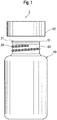
- Fig. 1 is a front view showing an outline of the configuration of an oxygen-absorbing container 1, being a container of the present embodiment.
- a lid side of the oxygen-absorbing container 1 is defined as an upper side.
- the oxygen-absorbing container 1 includes, for example, a container body 10, a sealing member 11 and a lid 12.
- the container body 10 has a hollow, substantially cylindrical shape with a bottom, and an upper part of the container body 10 is provided with an opening part 20 having a smaller diameter than the other part.
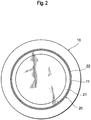
- An upper end surface 21 of the opening part 20 is provided with an annular flat surface as shown in Fig. 2 .
- An outer peripheral surface of the opening part 20 is provided with a threaded part (e.g., a male thread) 22.
- the sealing member 11 is, for example, a circular transparent sheet made of a thermoplastic resin and the sealing member 11 is bonded to the upper end surface 21 of the opening part 20 of the container body 10 by thermal-compression bonding, thermal welding, or using an adhesive, etc.
- the lid 12 is provided with a threaded part (e.g., a female thread) (not shown) on an inner peripheral surface, which can be engaged with the threaded part 22 on the opening part 20 of the container body 10.
- a threaded part e.g., a female thread
- the container body 10 has a multilayer structure.
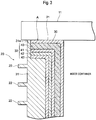
- the opening part 20 of the container body 10 has an innermost layer 30, an outermost layer 31 and an intermediate layer 32 therebetween as shown in, for example, Fig. 3 .
- the container body 10 is molded by so-called blow molding, in which a multilayer body having, for example, a tube-like shape (a multilayer parison) is molded by extrusion, the parison is clamped from both sides by a mold, and gas is blown into the multilayer body so as to expand the multilayer body.
- blow molding in which a multilayer body having, for example, a tube-like shape (a multilayer parison) is molded by extrusion, the parison is clamped from both sides by a mold, and gas is blown into the multilayer body so as to expand the multilayer body.
- the intermediate layer 32 is constituted by, for example, four layers having an oxygen-absorbing layer 40 (a functional layer), a bonding layer 41, a barrier layer 42 and a bonding layer 43, in the order mentioned, form the inner side toward the outer side.
- the oxygen-absorbing layer 40 is made of, for example, LLDPE (linear low density polyethylene) and a material to be oxidized and has a function of absorbing oxygen.
- the oxygen-absorbing layer 40 may further contain a desiccant and other known additives.
- the material to be oxidized is not particularly limited, as long as it is a composition having a function of removing oxygen from the air by oxidation reaction, adsorption, etc.
- Examples of the material to be oxidized may include: an oxygen absorbent, described in WO2012/105457 , comprising metal which is obtained by subjecting, to acidic or alkaline aqueous solution, an alloy comprising (A) at least one transition metal selected from the group consisting of manganese, iron, platinum, and copper group metals and (B) at least one metal selected from the group consisting of aluminum, zinc, tin, lead, magnesium, and silicon to elute and remove at least part of the component (B); metal powder such as iron powder; a reductive inorganic substance such as an iron compound; polyhydric phenols; polyhydric alcohols; an unsaturated aliphatic acid compound; a reductive organic substance such as ascorbic acid or the salt thereof; a resin composition comprising a resin having a carbon-carbon
- the material to be oxidized may be an inorganic compound with an oxygen defect formed therein, which may be obtained by heating and reduction in an oxygen-free atmosphere or by ultraviolet irradiation, although the production process thereof is not particularly limited.
- examples of such inorganic compound with an oxygen defect formed therein may include titanium dioxide, zinc oxide and cerium oxide, in which examples of the titanium oxide may include those having a crystalline system such as an anatase type, a rutile type and a brookite type, examples of the zinc oxide include a wurtzite type, examples of the cerium oxide include those having a crystalline system such as a lanthanum oxide type or a fluorite type.
- titanium dioxide having an anatase type is preferable as an oxygen absorbing material of the present invention.
- a cerium oxide having a lattice defect such as, for example, the cerium oxide described in JP4001614 B , can be preferably used.
- the oxygen-absorbing layer 40 is used as-is if it is colored due to its composition or is used after being colored using a pigment, etc. if it is colorless due to its composition.
- the color of the oxygen-absorbing layer 40 is preferably different from the color of the innermost layer 30.
- the container 1 can be provided with a function of allowing the oxidation of the material to be oxidized to be recognizable, i.e., the function of allowing the state wherein the container 1 has absorbed oxygen to be recognizable.
- the material to be oxidized which changes color after oxidation for example, if the oxygen absorbent described in WO2012/105457 comprises nickel as a main ingredient, the color of the oxygen absorbent is red before oxidation and changes to a bluish black color after oxidation.
- the color of the oxygen absorbent changes from a bluish gray color to black due to oxidation.
- an oxygen-absorbing composition comprising iron powder and a metallic halide
- the color thereof changes from black to brown.
- cerium oxide the color thereof is navy blue before oxidation and changes to light yellow after oxidation.
- the oxygen-absorbing layer 40 has a thickness of from 1 ⁇ m to 600 ⁇ m, preferably about from 5 ⁇ m to 200 ⁇ m, and more preferably from 10 ⁇ m to 150 ⁇ m.
- the bonding layer 41 and the bonding layer 43 are made of an adhesive resin and bond the barrier layer 42 to the other layers.
- the barrier layer 42 is made of an oxygen impermeable barrier resin such as EVOH (ethylene vinyl alcohol copolymer resin) and has a function of blocking oxygen.
- the bonding layers 41, 43 have a thickness of about from 1 ⁇ m to 100 ⁇ m and preferably from 5 ⁇ m to 50 ⁇ m.
- the barrier layer 42 has a thickness of about from 1 ⁇ m to 100 ⁇ m and preferably from 5 ⁇ m to 50 ⁇ m.
- the innermost layer 30 is made of, for example, low density polyethylene (LDPE) and/or linear short-chain branched polyethylene and colored white by a white pigment being added thereto.
- the outermost layer 31 is made of, for example, HDPE (high density polyethylene).
- the innermost layer 30 is made of a material having a lower strength (mechanical strength) than the outermost layer 31.
- the materials of these layers 30, 31 are not limited to those described above, and they may be selected arbitrarily.
- the innermost layer 30 may be colorless (transparent), it is preferable for the color thereof to be different from the color of the oxygen-absorbing layer 40.
- the innermost layer 30 has a thickness of 200 ⁇ m or less, preferably 100 ⁇ m or less, and more preferably 50 ⁇ m or less.
- the outermost layer 31 has a thickness of about from 500 ⁇ m to 10,000 ⁇ m and preferably from 1,000 ⁇ m to 5,000 ⁇ m. Accordingly, the innermost layer 30 is formed to be relatively thin with a thickness of about 40% to 0.5% of the outermost layer 31 (excluding an upper end 31 a).
- the innermost layer 30 and, for example, all layers in the intermediate layer 32 are bent outward at the upper end of the opening part 20 and form a flat part A.
- An upper surface of the flat part A i.e., the surface of the innermost layer 30, forms an upper end surface 21 of the opening part 20.
- the flat part A may have a width of 50% or more, preferably 70% or more, and more preferably 90% or more of the width of the upper end surface 21 of the opening part 20.
- the flat part A may have a width of from 0.5 mm to 10 mm.
- An outer distal end surface of the flat part A i.e., distal end surfaces of the innermost layer 30 and the intermediate layer 32 are covered by the upper end 31 a of the outermost layer 31.
- the upper end 31 a of the outermost layer 31 covering the distal end of the flat part A has a thickness of about from 1 ⁇ m to 100 ⁇ m.
- the flat part A can be formed by, in a state in which fins (i.e., portions that extend out of a mold of the container) of the innermost layer 30 and the intermediate layer 32 which are projected upward from the vicinity of an entrance of the opening part 20 during the above-mentioned blow molding of the container body 10 are extended outward, cutting the fins of the innermost layer 30 and the intermediate layer 32 while pressing the fins from the upper side of the opening part 20 toward the bottom side using a press-cutting die.
- the upper end 31 a of the outermost layer 31 remains on the outer side of the distal ends of the innermost layer 30 and the intermediate layer 32 and the upper end 31 a of the outermost layer 31 covers the distal end surfaces of the innermost layer 30 and the intermediate layer 32.
- the content such as a pharmaceutical product
- the sealing member 11 is bonded to the upper end surface 21 of the opening part 20. This bonding is performed by, for example, placing the sealing member 11 on the upper end surface 21 of the opening part 20 as shown in Fig. 4 , and pressing a hot sealing board 50 on to the sealing member 11 to perform thermal welding.
- the sealing board 50 has an annular projection 51 on its lower surface as shown in, for example, Fig.
- the sealing member 11 is annularly bonded onto the surface of the flat part A so as to cover the opening part and the container is sealed.
- the oxygen inside the container is then absorbed by the oxygen-absorbing layer 40 of the container body 10 and the oxygen inside the container is removed.
- the lid 12 is attached to the opening part 20 after the sealing.
- the configuration of the sealing board 50 is not limited to the configuration described above.
- an induction sealing method can preferably be used when aluminum foil or the like is used for the sealing member.
- the innermost layer 30 and the intermediate layer 32 of the container body 10 are bent outward at the upper end of the opening part 20 and form the flat part A, and a surface of the flat part A constitutes the upper end surface 21 of the opening part 20.
- a surface of the flat part A constitutes the upper end surface 21 of the opening part 20.
- the container 1 with a function of leaving the unsealed mark B and to secure a tamper evidence function. Furthermore, since the innermost layer 30 and the intermediate layer 32 are bent outward and form the flat part A and the unsealed mark is formed in the flat part A, the function of leaving the unsealed mark can be provided in a simple manner at low cost. In addition, by bending the innermost layer 30 and the intermediate layer 32 to form the flat part A, a sufficient width can be secured for the unsealed mark, which allows the unsealed mark to be easily and reliably recognized.
- the thickness of the innermost layer 30 in the flat part A is 200 ⁇ m or less, when the sealing member 11 is peeled, the innermost layer 30 is easily peeled and the oxygen-absorbing layer 40 is easily exposed or can be seen through the peeled part. Thus, the fact that someone has unsealed the sealing member 11 can be more securely and easily recognized.
- the innermost layer 30 is thin, the oxygen inside the container easily permeates the oxygen-absorbing layer 40 and the rate of oxygen absorption is significantly rapid. Accordingly, in a situation in which a medical product or a supplement is accommodated in the container, such content can be prevented from being degraded.
- the innermost layer 30 is thinner than the outermost layer 31, the innermost layer 30 is more easily pealed due to the sealing member 11 and the fact that the sealing member 11 has been unsealed can be easily recognized.
- the innermost layer 30 is made of a material having a lower strength than the outermost layer 31, the innermost layer 30 can be more easily peeled due to the sealing member 11 and the fact that the sealing member 11 has been unsealed can be easily recognized.
- the innermost layer 30 is made of a low density polyethylene and/or a linear short-chain branched polyethylene, which is different from the outermost layer 31, the innermost layer 30 has a low mechanical strength and can therefore be easily peeled due to the sealing member 11. Accordingly, the unsealed mark can be left in a secure manner.
- the appearance of the container 1 is preferable.
- the intermediate layer 32 is not exposed, a chemical substance in the container can be prevented from unintentionally contaminating a medical product or a supplement due to direct contact between the intermediate layer and the medical product or supplement.
- the flat part A has a width of 50% or more of the width of the upper end surface 21 of the opening part 20, the width of the flat part A is sufficiently secured and the unsealed mark which is left after the peeling of the innermost layer 30 can be visually observed in a clearer and more secure manner.
- the innermost layer 30 in the flat part A is thin and the sealing member 11 is transparent and is annularly bonded to the surface of the flat part A constituting the upper end surface 21 of the opening part 20. In this case, it is easy to check whether or not the sealing member is appropriately bonded to the flat part A and provides sealing. Specifically, since the innermost layer 30 is thin, if the sealing member 11 is appropriately bonded to the flat part A, the colored oxygen-absorbing layer 40 underneath the bonded part C can be seen through the innermost layer 30 and the sealing member 11 as shown in Fig. 7 .
- the sealing member 11 is not appropriately bonded to the flat part A with dust or the like being introduced therebetween, the oxygen-absorbing layer 40 is seen with part of its ring-like shape missing. Accordingly, the appropriateness of the sealing provided by the sealing member 11 can be easily checked.
- the oxygen-absorbing layer 40 of the intermediate layer 32 in the flat part A is colored, if someone has stripped off the sealing member 11 and part of the innermost layer 31 on the upper end surface 21 of the opening part 20 is peeled off and broken, part of the colored oxygen-absorbing layer 40 underneath the peeled part is exposed or can be seen through the peeled part. Accordingly, the unsealed mark becomes easily visible and recognizable. In addition, if the innermost layer 30 is colored and its color is different from the color of the oxygen-absorbing layer 40, the unsealed mark becomes even more visible and the unsealed mark can be visually observed in a clearer and more secure manner.
- the configuration of the container body 10 of the oxygen-absorbing container 1 is not limited to the configuration in the embodiment above.
- the types and functions of the intermediate layer 32, the number of layers and the thickness of the layers of the container body 10 may be different.
- some of the bonding layers 41, 43 and the barrier layer 42, other than the oxygen-absorbing layer 40, in the intermediate layer 32 may be colored. In such case, the color is preferably a vivid color such as black. More than one layer in the intermediate layer 32 may be colored. In such case, if the oxygen-absorbing layer 40, being the outermost layer in the intermediate layer 32, is peeled off due to the sealing member 11, the colored layer underneath the peeled part is exposed and the unsealed mark can be clearly left.
- the barrier layer 42 may not be provided.
- the sealing member 11 may be opaque and may be made of a material having excellent barrier property against oxygen and water, such as aluminum.
- the container 1 may be a water-absorbing container having a water-absorbing layer.
- the intermediate layer 32 may be constituted by one layer as shown in, for example, Fig. 8 and may include a water-absorbing layer 70 serving as a functional layer.
- the innermost layer 30 may be made of LLDPE or HDPE and may have a thickness of 200 ⁇ m or less, preferably from 1 ⁇ m to 100 ⁇ m, and more preferably from 5 ⁇ m to 50 ⁇ m. When LLDPE is used, for example, a white pigment may be added.
- the water-absorbing layer 70 may be made of, for example, PE, and a colored desiccant and may also contain a pigment.
- Such water-absorbing layer 70 may have a thickness of from 10 ⁇ m to 600 ⁇ m and preferably about from 50 ⁇ m to 400 ⁇ m and the outermost layer may have a thickness of 500 ⁇ m or more, preferably about 2,000 ⁇ m.
- the thicknesses should be designed in accordance with the volume of a product to be accommodated.
- the multilayer structure of the container body of the water-absorbing container is not limited thereto and may be selected in an arbitrary manner.
- the present invention is also applicable to a container having both an oxygen-absorbing layer and a water-absorbing layer in the intermediate layer 32.
- the configurations of the above container are also applicable to an oxygen-impermeable container having an oxygen-impermeable layer in the intermediate layer.
- the innermost layer 30 is peeled off when the sealing member 11 is stripped off and part of the oxygen-absorbing layer 40 is exposed, allowing the unsealed mark to be left.
- an oxygen-absorbing container which employs the oxygen absorbent described in WO2012/105457 as the material to be oxidized can accommodate a low-water content product which is preferably stored at 0 to 30% RH and a product containing no water, and can absorb oxygen.
- the low-water content product include: foods such as powdered soup, powdered beverages, powdered confectionery, condiments, grain powder, nutritional foods, health foods, food colorings, flavors and spices; as well as drugs such as medicinal powder, washing power, dental powder and industrial chemicals, and examples of the shape of such products may include powder, granules, and tablets molded from such powder and granules.
- the products containing no water may include industrial components and pharmaceutical products such as atorvastatin and levothyroxine.
- an oxygen-absorbing container which employs metal powder such as iron powder or a reductive inorganic substance, such as an iron compound, as the material to be oxidized can accommodate a middle-water content product which is preferably stored at 30 to 50% RH and a high-water content product such as drinking water.
- Such container can accommodate various types of articles including high-water content foods represented by: confectionary such as jelly with pulp, sweet jellied bean paste and pudding; fruit such as pineapples, oranges, peaches, apricots, pears and apples; condiments such as liquefied soup stock, mayonnaise, soy bean paste and grated spice; pasty foods such as jam, cream and chocolate paste; liquid foods represented by liquid processed foods such as curry, liquid soup, simmered foods, pickles and stew; raw and cooked noodles such as buckwheat noodles, wheat noodles and ramen noodles; uncooked rice such as milled rice, moisture-conditioned rice and non-washing rice; processed rice products such as boiled rice, boiled rice with fish, meat and vegetables, festive red rice and rice gruel; and powder condiments such as powdered soup and powdered soup stock, as well as solid or solution type chemicals such as agricultural chemicals and pesticides; pharmaceutical products in a liquid, paste, solid, powder, pellet or tablet form; and articles such as cosmetic lotion, cosmetic cream, cosmetic emul
- Al-Fe alloy was obtained by mixing Al (aluminum) powder and Fe (iron) powder at a ratio of 50 mass% each and melting them in nitrogen.
- the resulting Al-Fe alloy was crushed using a jaw crusher, a roll crusher and a ball mill, the crushed product was sieved using a 200-mesh screen (0.075 mm), and Al-Fe alloy having a size of 200-mesh or less was obtained.
- 150 grams of the resulting Al-Fe alloy powder was added to a 30 mass%-aqueous solution of sodium hydroxide and stirred and mixed at 50° for 1 hour. Then the mixed solution was left at rest and an upper-layer fluid was removed therefrom. The remaining precipitate was washed with distilled water until its pH became 10 or less and metallic powder 1, being an Al-Fe porous metallic powder, was obtained.
- the metallic powder 1 was stored in an aqueous solution in order to avoid contact with oxygen.
- the resulting porous metallic powder was subjected to vacuum drying under the condition of 200 Pa or lower and 80 °C until its water content became 1 mass% or less to obtain dried Al-Fe porous metallic powder (hereinafter this dried Al-Fe porous metallic powder will be referred to as "the metallic powder 1 ").
- the bulk density of the resulting metallic powder 1 was 1.3g/cm 3 (measured in compliance with JIS Z 2504) and the iron content was 97.3 wt%.
- the LLDPE was introduced into the main feeder and the metallic powder 1 was added to the melted LLDPE through the side feeder.
- the density of the oxygen-absorbing resin pellet 1 was 1.2 g/cm 3 .
- An oxygen-absorbing hollow container 1 having a capacity of 120 mL and a six-layer structure of, from the inner side toward the outer side of the container, innermost layer (30) / intermediate layer (oxygen-absorbing layer / adhesive layer / gas barrier layer / adhesive resin layer) (32) / outermost layer (31) was prepared using a 5-type, 6-layer direct blow molding machine at a molding temperature of 180°C.
- LLDPE was used for the innermost layer (30), and the oxygen-absorbing resin pellet 1, ethylene-vinyl alcohol copolymer resin (product name "EVAL F101B” manufactured by KURARAY CO., LTD.) and carboxylic acid-modified polyolefin resin (product name "H511” manufactured by Mitsubishi Chemical Corporation) were used for the oxygen-absorbing layer, the gas barrier layer and the adhesive resin layer, respectively, which constitute the intermediate layer.
- HDPE having a density of 0.948 product name "B5203" manufactured by KEIYO POLYETHYLENE CO., LTD. was used for the outermost layer (31).
- the hollow container 1 was prepared so as to have an upper end surface 21 having a width of 2 mm and the hollow container 1 had a dimension in which the height was 83.5 mm, the outer diameter of a bottom of the container was 48 mm, and the inner diameter of a mouth part was 25.2 mm.
- the surface area of the innermost layer was 0.013 m 2 .
- the thickness of the innermost layer (30) was 150 ⁇ m
- the thickness of the oxygen-absorbing layer was 300 ⁇ m
- the thickness of the adhesive layer was 50 ⁇ m
- the thickness of the gas barrier layer was 50 ⁇ m
- the thickness of the adhesive resin layer was 50 ⁇ m in the intermediate layer (32)
- the thickness of the outermost layer (31) was 800 ⁇ m.
- the upper end flat part A of the opening part was formed, in which 1.9 mm out of 2 mm of the upper end surface 21 was covered by the LLDPE of the innermost layer 30 and the thickness of the innermost layer 30 on the upper end surface 21 was slightly thinner than thickness of the innermost layer 30 on the body part, with the thickness of the innermost layer (30) on the upper end surface 21 being 100 ⁇ m.
- the number of days required for deoxidation of the hollow container 1 (i.e., the number of days required until the oxygen concentration inside the container became 0.1 vol% or less) was measured by the following procedure.
- glass beads were introduced into the hollow container 1 so that the filling factor in the hollow container 1 became about 50 vol% of the total volume, a desiccant was added thereto so that the humidity inside the container became 5% RH or less, and an oxygen concentration sensor was also introduced into the hollow container 1 and the hollow container 1 was then sealed.
- the amount of air (head space) inside the hollow container was adjusted so as to be 60 mL.
- the hollow container 1 and the cover 1 were sealed using a package sealer (EPK manufactured by ESHIN PACK IND. CO., LTD.)
- a sealing board having a shape capable of providing sealing in a ring shape having a width of 1 mm a sealing having a width of 1 mm was provided at the center of the upper end flat part A having a width of 2 mm in the container.
- a black oxygen-absorbing layer having the metallic powder 1 incorporated therein could be observed through the cover 1 and it could be confirmed that the sealing was provided in an appropriate manner.
- the container after sealing was stored at 25 °C and the oxygen concentration per elapsed day was measured by an optical oxygen meter (product name "Fibox 3") manufactured by TAITEC CORPORATION. As a result, the oxygen concentration reached 0.1 vol% after 14 days. The color of the sealing part was jet black and the exertion of the oxygen-absorbing performance could be confirmed.
- the LLDPE was introduced into the main feeder and the metallic powder 2 was added to the melted LLDPE through the side feeder.
- the density of the oxygen-absorbing resin pellet 2 was 1.3 g/cm 3 .
- An oxygen-absorbing hollow container 2 was prepared in the same way as in Example 1, except that the oxygen-absorbing resin pellet 2 was used instead of the oxygen-absorbing resin pellet 1.
- the hollow container 2 was prepared so as to have an upper end surface 21 having a width of 2 mm and the hollow container 2 had a dimension in which the height was 83.5 mm, the outer diameter of a bottom of the container was 48 mm, and the inner diameter of a mouth part was 25.2 mm.
- the surface area of the innermost layer was 0.013 m 2 .
- the thickness of the innermost layer (30) was 150 ⁇ m
- the thickness of the oxygen-absorbing layer was 300 ⁇ m
- the thickness of the adhesive layer was 50 ⁇ m
- the thickness of the gas barrier layer was 50 ⁇ m
- the thickness of the adhesive resin layer was 50 ⁇ m in the intermediate layer (32)
- the thickness of the outermost layer (31) was 800 ⁇ m.
- the upper end flat part A of the opening part was formed, in which 1.9 mm out of 2 mm of the upper end surface 21 was covered by the LLDPE of the innermost layer 30 and the thickness of innermost layer 30 on the upper end surface 21 was slightly thinner than the thickness of innermost layer 30 on the body part, with the thickness of the innermost layer (30) being 100 ⁇ m.
- the number of days required for deoxidation of the hollow container 2 (i.e., the number of days required until the oxygen concentration inside the container became 0.1 vol% or less) was measured by the following procedure.
- glass beads were introduced into the hollow container 2 so that the filling factor of the hollow container 2 became about 50 vol% of the total volume, a humidity conditioning agent which causes the humidity inside the container to be 50% RH or less was added thereto, and an oxygen concentration sensor was also introduced into the hollow container 2 and the hollow container 2 was then sealed.
- the amount of air (head space) inside the hollow container was adjusted so as to be 60 mL.
- the hollow container 2 and the cover 1 were sealed using a package sealer (EPK manufactured by ESHIN PACK IND. CO., LTD.)
- a sealing board having a shape capable of providing sealing in a ring shape having a width of 1 mm a sealing having a width of 1 mm was provided at the center of the upper end flat part A having a width of 2 mm in the container.
- a black oxygen-absorbing layer having the metallic powder 2 incorporated therein could be observed through the cover 1 and it could be confirmed that the sealing was provided in an appropriate manner.
- the container after sealing was stored at 25 °C and the oxygen concentration per elapsed day was measured by an optical oxygen meter (product name "Fibox 3") manufactured by TAITEC CORPORATION. As a result, the oxygen concentration reached 0.1 vol% after 60 days. The color of the sealing part was reddish black and the exertion of the oxygen-absorbing performance could be confirmed.
- the present invention is useful in providing a container having a function of leaving an unsealed mark.
Landscapes
- Engineering & Computer Science (AREA)
- Mechanical Engineering (AREA)
- Health & Medical Sciences (AREA)
- General Health & Medical Sciences (AREA)
- Life Sciences & Earth Sciences (AREA)
- Animal Behavior & Ethology (AREA)
- Pharmacology & Pharmacy (AREA)
- Public Health (AREA)
- Veterinary Medicine (AREA)
- Food Science & Technology (AREA)
- Ceramic Engineering (AREA)
- Packages (AREA)
- Containers Having Bodies Formed In One Piece (AREA)
- Laminated Bodies (AREA)
- Wrappers (AREA)
Abstract
Description
- The present invention relates to an oxygen-absorbing container, a water-absorbing container, or a container having an oxygen-absorbing function and a water-absorbing function.
- Some containers for accommodating pharmaceutical products, medical products, foods (such as supplements), cosmetic products, metallic products, electronic products, etc., have functions, depending on the application of the containers, such as an oxygen-absorbing property for absorbing oxygen inside the container and a water-absorbing property for absorbing water inside the container. This type of container typically has a multilayer structure having, in general, an innermost layer, an outermost layer, and an intermediate layer providing the above-mentioned functions between the innermost and outermost layers (Patent Document 1).
- Such container is sealed by sealing an opening part on an upper part with a sealing member after the container is filled with content during production.
- Patent Document 1:
JP 4622097 B - In the above-mentioned container, a mark indicating that the sealing member has been unsealed, i.e., a so-called "unsealed mark," is preferably recognizable. The reason for this is that, if someone has unsealed the container, such fact should be recognized in order to secure the quality and safety of the content of the container.
- However, providing the above-mentioned container with a function of leaving such unsealed mark has not been considered. In addition, it is not easy, in terms of cost, to provide containers with the function of leaving the unsealed mark.
- The present invention has been made in light of the above circumstances and an object of the invention is to provide a container having a function of leaving an unsealed mark at low cost.
- In order to achieve the above object, the present invention provides a container, comprising: a container body having a multilayer structure constituted by an innermost layer, an outermost layer and at least one intermediate layer therebetween, the container body having an opening part on an upper part thereof; and a sealing member bonded to an upper end surface of the opening part of the container body to seal an opening of the opening part, wherein: the innermost layer and at least a layer, which is adjacent to the innermost layer, in the intermediate layer are bent outward at an upper end of the opening part and form a flat part, and a surface of the flat part forms the upper end surface of the opening part; and when the sealing member is unsealed, part of the innermost layer on the upper end surface of the opening part is configured to be peeled off so as to leave an unsealed mark.
- With the above configuration, the flat part constituted by the innermost layer and at least the layer adjacent to the innermost layer in the intermediate layer is formed at the upper end surface of the opening part and the innermost layer on the surface of such flat part is peeled off when the sealing member is stripped off. As a result, it is possible to provide the container with a function of leaving an unsealed mark at low cost
- In the above container, the intermediate layer may have an oxygen-absorbing layer and/or a water-absorbing layer. The innermost layer at the flat part may have a thickness of 200 µm or less.
- The sealing member may be bonded in an annular shape to the surface of the flat part that constitutes the upper end surface of the opening part.
- The innermost layer may have a smaller thickness than the outermost layer
- The innermost layer may be made of a material having a lower strength than the outermost layer.
- The innermost layer may contain low density polyethylene and/or linear short-chain branched polyethylene.
- Distal end surfaces of the innermost layer and the intermediate layer in the flat part may be covered by the outermost layer.
- The flat part may have a width that is 50% or more of a width of the upper end surface of the opening part.
- At least one layer of the intermediate layer at the flat part may be colored. The innermost layer may be colored and have a color different from that of the colored layer in the intermediate layer.
- A plurality of layers including a surface layer in the intermediate layer may be colored.
- The sealing member may be transparent.
- The present invention can provide a container provided with a function of leaving an unsealed mark at low cost.
-
-
Fig. 1 is a perspective view schematically showing an oxygen-absorbing container. -
Fig. 2 is a top view showing a container body of the oxygen-absorbing container. -
Fig. 3 is a cross-sectional view showing an example of a layer structure of an opening part in the oxygen-absorbing container. -
Fig. 4 is an illustration showing how the container body is sealed with a sealing member using a sealing board. -
Fig. 5 is an illustration showing a projection in the sealing board. -
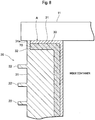
Fig. 6 is a cross-sectional view showing the opening part in a state in which an unsealed mark is formed on an upper end surface of the opening part. -
Fig. 7 is an illustration showing a ring in a bonded part which is formed when the sealing member has been appropriately sealed. -
Fig. 8 is a cross-sectional view showing an example of a layer structure of an opening part of a water-absorbing container. -
Fig. 9 is a cross-sectional view showing a state in which an unsealed mark is formed when only a layer, which is adjacent to the innermost layer, in an intermediate layer is bent. - Preferred embodiments of the present invention will now be described with reference to the attached drawings. It should be noted that the same element is denoted with the same reference symbol and redundant description thereof will be omitted. The positional relationship such as upper, lower, right and left is based on the positional relationship shown in the drawings, unless otherwise indicated. Furthermore, the dimensional ratios in the drawings are not limited to those shown in the drawings. The following embodiments are intended to be illustrative for explaining the present invention and the present invention is not limited to such embodiments.
-
Fig. 1 is a front view showing an outline of the configuration of an oxygen-absorbingcontainer 1, being a container of the present embodiment. In the specification of the present application, a lid side of the oxygen-absorbingcontainer 1 is defined as an upper side. - As shown in
Fig .1 , the oxygen-absorbingcontainer 1 includes, for example, acontainer body 10, a sealingmember 11 and alid 12. - The
container body 10 has a hollow, substantially cylindrical shape with a bottom, and an upper part of thecontainer body 10 is provided with anopening part 20 having a smaller diameter than the other part. Anupper end surface 21 of theopening part 20 is provided with an annular flat surface as shown inFig. 2 . An outer peripheral surface of theopening part 20 is provided with a threaded part (e.g., a male thread) 22. - The sealing
member 11 is, for example, a circular transparent sheet made of a thermoplastic resin and the sealingmember 11 is bonded to theupper end surface 21 of theopening part 20 of thecontainer body 10 by thermal-compression bonding, thermal welding, or using an adhesive, etc. - The
lid 12 is provided with a threaded part (e.g., a female thread) (not shown) on an inner peripheral surface, which can be engaged with the threadedpart 22 on theopening part 20 of thecontainer body 10. - The
container body 10 has a multilayer structure. Theopening part 20 of thecontainer body 10 has aninnermost layer 30, anoutermost layer 31 and anintermediate layer 32 therebetween as shown in, for example,Fig. 3 . Thecontainer body 10 is molded by so-called blow molding, in which a multilayer body having, for example, a tube-like shape (a multilayer parison) is molded by extrusion, the parison is clamped from both sides by a mold, and gas is blown into the multilayer body so as to expand the multilayer body. - The
intermediate layer 32 is constituted by, for example, four layers having an oxygen-absorbing layer 40 (a functional layer), abonding layer 41, abarrier layer 42 and abonding layer 43, in the order mentioned, form the inner side toward the outer side. - The oxygen-absorbing
layer 40 is made of, for example, LLDPE (linear low density polyethylene) and a material to be oxidized and has a function of absorbing oxygen. The oxygen-absorbinglayer 40 may further contain a desiccant and other known additives. - The material to be oxidized (oxygen absorbent) is not particularly limited, as long as it is a composition having a function of removing oxygen from the air by oxidation reaction, adsorption, etc. Examples of the material to be oxidized may include: an oxygen absorbent, described in
WO2012/105457 , comprising metal which is obtained by subjecting, to acidic or alkaline aqueous solution, an alloy comprising (A) at least one transition metal selected from the group consisting of manganese, iron, platinum, and copper group metals and (B) at least one metal selected from the group consisting of aluminum, zinc, tin, lead, magnesium, and silicon to elute and remove at least part of the component (B); metal powder such as iron powder; a reductive inorganic substance such as an iron compound; polyhydric phenols; polyhydric alcohols; an unsaturated aliphatic acid compound; a reductive organic substance such as ascorbic acid or the salt thereof; a resin composition comprising a resin having a carbon-carbon unsaturated bond and/or oligomer and a transition metal catalyst; and an oxygen-absorbing composition comprising a metal complex, etc., as a base compound for an oxygen absorption reaction. Alternatively, the material to be oxidized may be an inorganic compound with an oxygen defect formed therein, which may be obtained by heating and reduction in an oxygen-free atmosphere or by ultraviolet irradiation, although the production process thereof is not particularly limited. Examples of such inorganic compound with an oxygen defect formed therein may include titanium dioxide, zinc oxide and cerium oxide, in which examples of the titanium oxide may include those having a crystalline system such as an anatase type, a rutile type and a brookite type, examples of the zinc oxide include a wurtzite type, examples of the cerium oxide include those having a crystalline system such as a lanthanum oxide type or a fluorite type. In particular, titanium dioxide having an anatase type is preferable as an oxygen absorbing material of the present invention. As the cerium oxide, a cerium oxide having a lattice defect such as, for example, the cerium oxide described inJP4001614 B - The oxygen-absorbing
layer 40 is used as-is if it is colored due to its composition or is used after being colored using a pigment, etc. if it is colorless due to its composition. The color of the oxygen-absorbinglayer 40 is preferably different from the color of theinnermost layer 30. - By selecting a material to be oxidized whose color changes after oxidation as the material to be oxidized contained in the oxygen-absorbing
layer 40, thecontainer 1 can be provided with a function of allowing the oxidation of the material to be oxidized to be recognizable, i.e., the function of allowing the state wherein thecontainer 1 has absorbed oxygen to be recognizable. As the material to be oxidized which changes color after oxidation, for example, if the oxygen absorbent described inWO2012/105457 comprises nickel as a main ingredient, the color of the oxygen absorbent is red before oxidation and changes to a bluish black color after oxidation. If the oxygen absorbent described inWO2012/105457 comprises iron as a main ingredient, the color of the oxygen absorbent changes from a bluish gray color to black due to oxidation. In an oxygen-absorbing composition comprising iron powder and a metallic halide, the color thereof changes from black to brown. In the case of cerium oxide, the color thereof is navy blue before oxidation and changes to light yellow after oxidation. If thecontainer body 10 is sealed using atransparent sealing member 11, such as an alumina vapor-deposited film in the present invention, the state in which thecontainer 1 has absorbed oxygen can be checked by observing the color of the material to be oxidized contained in the oxygen-absorbinglayer 40, which facilitates quality assurance. Even if an opaque material such as an aluminum foil is used as the sealingmember 11, it is still possible to check that the oxygen absorbent has worked by checking the color of the material to be oxidized which is exposed when the container is unsealed. Since a portion with which oxygen entering the container first contacts is an end surface of a sealed part of theopening part 20 of the container, such portion is most effective as a portion to be provided with such indicator function. The oxygen-absorbinglayer 40 has a thickness of from 1 µm to 600 µm, preferably about from 5 µm to 200 µm, and more preferably from 10 µm to 150 µm. - The
bonding layer 41 and thebonding layer 43 are made of an adhesive resin and bond thebarrier layer 42 to the other layers. Thebarrier layer 42 is made of an oxygen impermeable barrier resin such as EVOH (ethylene vinyl alcohol copolymer resin) and has a function of blocking oxygen. The bonding layers 41, 43 have a thickness of about from 1 µm to 100 µm and preferably from 5 µm to 50 µm. Thebarrier layer 42 has a thickness of about from 1 µm to 100 µm and preferably from 5 µm to 50 µm. - The
innermost layer 30 is made of, for example, low density polyethylene (LDPE) and/or linear short-chain branched polyethylene and colored white by a white pigment being added thereto. Theoutermost layer 31 is made of, for example, HDPE (high density polyethylene). As such, theinnermost layer 30 is made of a material having a lower strength (mechanical strength) than theoutermost layer 31. The materials of theselayers innermost layer 30 may be colorless (transparent), it is preferable for the color thereof to be different from the color of the oxygen-absorbinglayer 40. - The
innermost layer 30 has a thickness of 200 µm or less, preferably 100 µm or less, and more preferably 50 µm or less. Theoutermost layer 31 has a thickness of about from 500 µm to 10,000 µm and preferably from 1,000 µm to 5,000 µm. Accordingly, theinnermost layer 30 is formed to be relatively thin with a thickness of about 40% to 0.5% of the outermost layer 31 (excluding anupper end 31 a). - The
innermost layer 30 and, for example, all layers in theintermediate layer 32 are bent outward at the upper end of theopening part 20 and form a flat part A. An upper surface of the flat part A, i.e., the surface of theinnermost layer 30, forms anupper end surface 21 of theopening part 20. The flat part A may have a width of 50% or more, preferably 70% or more, and more preferably 90% or more of the width of theupper end surface 21 of theopening part 20. The flat part A may have a width of from 0.5 mm to 10 mm. - An outer distal end surface of the flat part A, i.e., distal end surfaces of the
innermost layer 30 and theintermediate layer 32 are covered by theupper end 31 a of theoutermost layer 31. Theupper end 31 a of theoutermost layer 31 covering the distal end of the flat part A has a thickness of about from 1 µm to 100 µm. The flat part A can be formed by, in a state in which fins (i.e., portions that extend out of a mold of the container) of theinnermost layer 30 and theintermediate layer 32 which are projected upward from the vicinity of an entrance of theopening part 20 during the above-mentioned blow molding of thecontainer body 10 are extended outward, cutting the fins of theinnermost layer 30 and theintermediate layer 32 while pressing the fins from the upper side of theopening part 20 toward the bottom side using a press-cutting die. At this time, theupper end 31 a of theoutermost layer 31 remains on the outer side of the distal ends of theinnermost layer 30 and theintermediate layer 32 and theupper end 31 a of theoutermost layer 31 covers the distal end surfaces of theinnermost layer 30 and theintermediate layer 32. - When the oxygen-absorbing
container 1 having the configurations as described above is manufactured, the content, such as a pharmaceutical product, is first introduced into thecontainer body 10 from an opening of theopening part 20. Then, the sealingmember 11 is bonded to theupper end surface 21 of theopening part 20. This bonding is performed by, for example, placing the sealingmember 11 on theupper end surface 21 of theopening part 20 as shown inFig. 4 , and pressing ahot sealing board 50 on to the sealingmember 11 to perform thermal welding. The sealingboard 50 has anannular projection 51 on its lower surface as shown in, for example,Fig. 5 and thehot projection 50 is pressed onto the sealingmember 11 and the pressed and heated portion in the sealingmember 11 is thermally welded onto theinnermost layer 30 on theupper end surface 21 of theopening part 20. In this way, the sealingmember 11 is annularly bonded onto the surface of the flat part A so as to cover the opening part and the container is sealed. The oxygen inside the container is then absorbed by the oxygen-absorbinglayer 40 of thecontainer body 10 and the oxygen inside the container is removed. Thelid 12 is attached to theopening part 20 after the sealing. It should be noted that the configuration of the sealingboard 50 is not limited to the configuration described above. In addition, as an example sealing method, an induction sealing method can preferably be used when aluminum foil or the like is used for the sealing member. - According to the present embodiment, the
innermost layer 30 and theintermediate layer 32 of thecontainer body 10 are bent outward at the upper end of theopening part 20 and form the flat part A, and a surface of the flat part A constitutes theupper end surface 21 of theopening part 20. With such configuration, if someone strips off the sealingmember 11, part of theinnermost layer 30 on theupper end surface 21 of theopening part 20 is peeled off and broken, as shown in, for example,Fig. 6 , and part of the oxygen-absorbinglayer 40 underneath the peeled part is exposed or can be seen through the peeled part. This serves as a so-called unsealed mark B. Accordingly, it is possible to provide thecontainer 1 with a function of leaving the unsealed mark B and to secure a tamper evidence function. Furthermore, since theinnermost layer 30 and theintermediate layer 32 are bent outward and form the flat part A and the unsealed mark is formed in the flat part A, the function of leaving the unsealed mark can be provided in a simple manner at low cost. In addition, by bending theinnermost layer 30 and theintermediate layer 32 to form the flat part A, a sufficient width can be secured for the unsealed mark, which allows the unsealed mark to be easily and reliably recognized. - In the present embodiment, since the thickness of the
innermost layer 30 in the flat part A is 200 µm or less, when the sealingmember 11 is peeled, theinnermost layer 30 is easily peeled and the oxygen-absorbinglayer 40 is easily exposed or can be seen through the peeled part. Thus, the fact that someone has unsealed the sealingmember 11 can be more securely and easily recognized. In addition, since theinnermost layer 30 is thin, the oxygen inside the container easily permeates the oxygen-absorbinglayer 40 and the rate of oxygen absorption is significantly rapid. Accordingly, in a situation in which a medical product or a supplement is accommodated in the container, such content can be prevented from being degraded. - Since the
innermost layer 30 is thinner than theoutermost layer 31, theinnermost layer 30 is more easily pealed due to the sealingmember 11 and the fact that the sealingmember 11 has been unsealed can be easily recognized. - Since the
innermost layer 30 is made of a material having a lower strength than theoutermost layer 31, theinnermost layer 30 can be more easily peeled due to the sealingmember 11 and the fact that the sealingmember 11 has been unsealed can be easily recognized. - Further, since the
innermost layer 30 is made of a low density polyethylene and/or a linear short-chain branched polyethylene, which is different from theoutermost layer 31, theinnermost layer 30 has a low mechanical strength and can therefore be easily peeled due to the sealingmember 11. Accordingly, the unsealed mark can be left in a secure manner. - Since the distal end surfaces of the
innermost layer 30 and theintermediate layer 32 are covered by theoutermost layer 31, the appearance of thecontainer 1 is preferable. In addition, since theintermediate layer 32 is not exposed, a chemical substance in the container can be prevented from unintentionally contaminating a medical product or a supplement due to direct contact between the intermediate layer and the medical product or supplement. When the sealingmember 11 is stripped off and part of theinnermost layer 30 is peeled off, the upper end surface of the annularoutermost layer 31 is clearly left on the outermost circumference of the upper surface of theopening part 20. With such configuration, the unsealed mark which is an irregularly peeled part becomes more visible and the tamper evidence function can be secured. - Since the flat part A has a width of 50% or more of the width of the
upper end surface 21 of theopening part 20, the width of the flat part A is sufficiently secured and the unsealed mark which is left after the peeling of theinnermost layer 30 can be visually observed in a clearer and more secure manner. - In the present embodiment, the
innermost layer 30 in the flat part A is thin and the sealingmember 11 is transparent and is annularly bonded to the surface of the flat part A constituting theupper end surface 21 of theopening part 20. In this case, it is easy to check whether or not the sealing member is appropriately bonded to the flat part A and provides sealing. Specifically, since theinnermost layer 30 is thin, if the sealingmember 11 is appropriately bonded to the flat part A, the colored oxygen-absorbinglayer 40 underneath the bonded part C can be seen through theinnermost layer 30 and the sealingmember 11 as shown inFig. 7 . On the other hand, if the sealingmember 11 is not appropriately bonded to the flat part A with dust or the like being introduced therebetween, the oxygen-absorbinglayer 40 is seen with part of its ring-like shape missing. Accordingly, the appropriateness of the sealing provided by the sealingmember 11 can be easily checked. - Since the oxygen-absorbing
layer 40 of theintermediate layer 32 in the flat part A is colored, if someone has stripped off the sealingmember 11 and part of theinnermost layer 31 on theupper end surface 21 of theopening part 20 is peeled off and broken, part of the colored oxygen-absorbinglayer 40 underneath the peeled part is exposed or can be seen through the peeled part. Accordingly, the unsealed mark becomes easily visible and recognizable. In addition, if theinnermost layer 30 is colored and its color is different from the color of the oxygen-absorbinglayer 40, the unsealed mark becomes even more visible and the unsealed mark can be visually observed in a clearer and more secure manner. - Although the preferred embodiments of the present invention have been described above with reference to the attached drawings, the present invention is not limited to those examples. It is obvious that a person skilled in the art could conceive of various changes or modifications within the scope of the ideas described in the scope of the claims and such changes and modifications should obviously be understood as belonging to the technical scope of the present invention.
- For example, the configuration of the
container body 10 of the oxygen-absorbingcontainer 1 is not limited to the configuration in the embodiment above. For example, the types and functions of theintermediate layer 32, the number of layers and the thickness of the layers of thecontainer body 10 may be different. For example, some of the bonding layers 41, 43 and thebarrier layer 42, other than the oxygen-absorbinglayer 40, in theintermediate layer 32 may be colored. In such case, the color is preferably a vivid color such as black. More than one layer in theintermediate layer 32 may be colored. In such case, if the oxygen-absorbinglayer 40, being the outermost layer in theintermediate layer 32, is peeled off due to the sealingmember 11, the colored layer underneath the peeled part is exposed and the unsealed mark can be clearly left. Thebarrier layer 42 may not be provided. The sealingmember 11 may be opaque and may be made of a material having excellent barrier property against oxygen and water, such as aluminum. - The
container 1 may be a water-absorbing container having a water-absorbing layer. In such case, theintermediate layer 32 may be constituted by one layer as shown in, for example,Fig. 8 and may include a water-absorbinglayer 70 serving as a functional layer. In this case, for example, theinnermost layer 30 may be made of LLDPE or HDPE and may have a thickness of 200 µm or less, preferably from 1 µm to 100 µm, and more preferably from 5 µm to 50 µm. When LLDPE is used, for example, a white pigment may be added. The water-absorbinglayer 70 may be made of, for example, PE, and a colored desiccant and may also contain a pigment. Such water-absorbinglayer 70 may have a thickness of from 10 µm to 600 µm and preferably about from 50 µm to 400 µm and the outermost layer may have a thickness of 500 µm or more, preferably about 2,000 µm. The thicknesses should be designed in accordance with the volume of a product to be accommodated. The multilayer structure of the container body of the water-absorbing container is not limited thereto and may be selected in an arbitrary manner. - The present invention is also applicable to a container having both an oxygen-absorbing layer and a water-absorbing layer in the
intermediate layer 32. For reference, the configurations of the above container are also applicable to an oxygen-impermeable container having an oxygen-impermeable layer in the intermediate layer. - Although all the layers in the
intermediate layer 32 are bent in the above embodiment, it is only necessary for at least a layer adjacent to theinnermost layer 30 to be bent and the other layers may not be bent. For example, as shown inFig. 9 , only theinnermost layer 30 and the oxygen-absorbinglayer 40 in theintermediate layer 32 may be bent and theother bonding layer 41,barrier layer 42 andbonding layer 43 may not be bent. In such case as well, theinnermost layer 30 is peeled off when the sealingmember 11 is stripped off and part of the oxygen-absorbinglayer 40 is exposed, allowing the unsealed mark to be left. - In containers according to the present invention, an oxygen-absorbing container which employs the oxygen absorbent described in
WO2012/105457 as the material to be oxidized can accommodate a low-water content product which is preferably stored at 0 to 30% RH and a product containing no water, and can absorb oxygen. Examples of the low-water content product include: foods such as powdered soup, powdered beverages, powdered confectionery, condiments, grain powder, nutritional foods, health foods, food colorings, flavors and spices; as well as drugs such as medicinal powder, washing power, dental powder and industrial chemicals, and examples of the shape of such products may include powder, granules, and tablets molded from such powder and granules. Examples of the products containing no water may include industrial components and pharmaceutical products such as atorvastatin and levothyroxine. - In the containers according to the present invention, an oxygen-absorbing container which employs metal powder such as iron powder or a reductive inorganic substance, such as an iron compound, as the material to be oxidized can accommodate a middle-water content product which is preferably stored at 30 to 50% RH and a high-water content product such as drinking water. Such container can accommodate various types of articles including high-water content foods represented by: confectionary such as jelly with pulp, sweet jellied bean paste and pudding; fruit such as pineapples, oranges, peaches, apricots, pears and apples; condiments such as liquefied soup stock, mayonnaise, soy bean paste and grated spice; pasty foods such as jam, cream and chocolate paste; liquid foods represented by liquid processed foods such as curry, liquid soup, simmered foods, pickles and stew; raw and cooked noodles such as buckwheat noodles, wheat noodles and ramen noodles; uncooked rice such as milled rice, moisture-conditioned rice and non-washing rice; processed rice products such as boiled rice, boiled rice with fish, meat and vegetables, festive red rice and rice gruel; and powder condiments such as powdered soup and powdered soup stock, as well as solid or solution type chemicals such as agricultural chemicals and pesticides; pharmaceutical products in a liquid, paste, solid, powder, pellet or tablet form; and articles such as cosmetic lotion, cosmetic cream, cosmetic emulsion, hair dye, hair dressing, shampoo, soap and detergent. Since such container can prevent oxygen from entering from the outside the container and allows the oxygen inside the container to be absorbed by a deoxidizer composition, it is possible to prevent oxidation degradation of the articles inside and to maintain a good quality for a long period of time.
- The present invention will now be described by way of Examples. However, the present invention is not limited to such Examples. Examples according to the present invention will be described below.
- An Al-Fe alloy was obtained by mixing Al (aluminum) powder and Fe (iron) powder at a ratio of 50 mass% each and melting them in nitrogen. The resulting Al-Fe alloy was crushed using a jaw crusher, a roll crusher and a ball mill, the crushed product was sieved using a 200-mesh screen (0.075 mm), and Al-Fe alloy having a size of 200-mesh or less was obtained. 150 grams of the resulting Al-Fe alloy powder was added to a 30 mass%-aqueous solution of sodium hydroxide and stirred and mixed at 50° for 1 hour. Then the mixed solution was left at rest and an upper-layer fluid was removed therefrom. The remaining precipitate was washed with distilled water until its pH became 10 or less and
metallic powder 1, being an Al-Fe porous metallic powder, was obtained. Themetallic powder 1 was stored in an aqueous solution in order to avoid contact with oxygen. - The resulting porous metallic powder was subjected to vacuum drying under the condition of 200 Pa or lower and 80 °C until its water content became 1 mass% or less to obtain dried Al-Fe porous metallic powder (hereinafter this dried Al-Fe porous metallic powder will be referred to as "the
metallic powder 1 "). The bulk density of the resultingmetallic powder 1 was 1.3g/cm3 (measured in compliance with JIS Z 2504) and the iron content was 97.3 wt%. One gram of suchmetallic powder 1 was placed in an air-permeable small bag, which was further placed in a gas-barrier bag (an Al foil-laminated plastic bag) with a desiccant, and the gas barrier bag was filled with 500 mL of air (oxygen concentration of 20.9 vol%) and sealed. In such state, themetallic powder 1 was stored at 25°C for 7 days. The specific surface area of themetallic powder 1 was measured using an automatic specific surface area measuring apparatus ("Gemini VII2390" manufactured by Shimadzu Corporation) and the specific surface area of themetallic powder 1 was 101.0 m2/g. - The
metallic powder 1 and linear low density polyethylene (NF384A (density 0.926) manufactured by Japan Polyethylene Corporation; hereinafter referred to as "LLDPE" in some contexts) were melted and kneaded at a ratio of the metallic powder 1 : LLDPE = 30:70 (mass ratio), extruded into a strand shape using a twin screw extruder having two types of feeders - a main feeder and a side feeder - which were subjected to nitrogen gas replacement and cut by a pelletizer to thereby obtain an oxygen-absorbingresin pellet 1. The LLDPE was introduced into the main feeder and themetallic powder 1 was added to the melted LLDPE through the side feeder. The density of the oxygen-absorbingresin pellet 1 was 1.2 g/cm3. - An oxygen-absorbing
hollow container 1 having a capacity of 120 mL and a six-layer structure of, from the inner side toward the outer side of the container, innermost layer (30) / intermediate layer (oxygen-absorbing layer / adhesive layer / gas barrier layer / adhesive resin layer) (32) / outermost layer (31) was prepared using a 5-type, 6-layer direct blow molding machine at a molding temperature of 180°C. LLDPE was used for the innermost layer (30), and the oxygen-absorbingresin pellet 1, ethylene-vinyl alcohol copolymer resin (product name "EVAL F101B" manufactured by KURARAY CO., LTD.) and carboxylic acid-modified polyolefin resin (product name "H511" manufactured by Mitsubishi Chemical Corporation) were used for the oxygen-absorbing layer, the gas barrier layer and the adhesive resin layer, respectively, which constitute the intermediate layer. HDPE having a density of 0.948 (product name "B5203" manufactured by KEIYO POLYETHYLENE CO., LTD.) was used for the outermost layer (31). - The
hollow container 1 was prepared so as to have anupper end surface 21 having a width of 2 mm and thehollow container 1 had a dimension in which the height was 83.5 mm, the outer diameter of a bottom of the container was 48 mm, and the inner diameter of a mouth part was 25.2 mm. The surface area of the innermost layer was 0.013 m2. - As to the thickness of each layer in a body part of the container, the thickness of the innermost layer (30) was 150 µm, the thickness of the oxygen-absorbing layer was 300 µm, the thickness of the adhesive layer was 50 µm, the thickness of the gas barrier layer was 50 µm, the thickness of the adhesive resin layer was 50 µm in the intermediate layer (32), and the thickness of the outermost layer (31) was 800 µm.
- Using the above-mentioned production process, the upper end flat part A of the opening part was formed, in which 1.9 mm out of 2 mm of the
upper end surface 21 was covered by the LLDPE of theinnermost layer 30 and the thickness of theinnermost layer 30 on theupper end surface 21 was slightly thinner than thickness of theinnermost layer 30 on the body part, with the thickness of the innermost layer (30) on theupper end surface 21 being 100 µm. - A
cover 1 having the configuration of alumina vapor-deposited PET film (being the sealing member) 12 µm / Ny 15 µm /LL 50 µm was prepared. - The number of days required for deoxidation of the hollow container 1 (i.e., the number of days required until the oxygen concentration inside the container became 0.1 vol% or less) was measured by the following procedure.
- First, glass beads were introduced into the
hollow container 1 so that the filling factor in thehollow container 1 became about 50 vol% of the total volume, a desiccant was added thereto so that the humidity inside the container became 5% RH or less, and an oxygen concentration sensor was also introduced into thehollow container 1 and thehollow container 1 was then sealed. The amount of air (head space) inside the hollow container was adjusted so as to be 60 mL. - The
hollow container 1 and thecover 1 were sealed using a package sealer (EPK manufactured by ESHIN PACK IND. CO., LTD.) - Using a sealing board having a shape capable of providing sealing in a ring shape having a width of 1 mm, a sealing having a width of 1 mm was provided at the center of the upper end flat part A having a width of 2 mm in the container. As a result, a black oxygen-absorbing layer having the
metallic powder 1 incorporated therein could be observed through thecover 1 and it could be confirmed that the sealing was provided in an appropriate manner. - The container after sealing was stored at 25 °C and the oxygen concentration per elapsed day was measured by an optical oxygen meter (product name "Fibox 3") manufactured by TAITEC CORPORATION. As a result, the oxygen concentration reached 0.1 vol% after 14 days. The color of the sealing part was jet black and the exertion of the oxygen-absorbing performance could be confirmed.
- When the sealing member was stripped off, part of the oxygen-absorbing layer of the container body was left on the
cover 1, which was easily detectable even after the container was resealed. Therefore, tamper evidence for suppressing tampering could be provided. - 500 kg of reduced iron powder having an average particle size of 30 µm was introduced into a vacuum mixing dryer equipped with a heating jacket, then heated under a reduced pressure of -720 mmHg at 110 °C while being subjected to spraying of 5 kg of a 50 wt% aqueous solution of calcium chloride, then dried for 2 hours and sieved to remove coarse particles of 50 µm or larger to thereby obtain the metallic powder 2.
- Metallic powder 2 and LLDPE were melted and kneaded at a ratio of the metallic powder 2 : LLDPE = 30:70 (mass ratio), extruded into a strand shape using a twin screw extruder having two types of feeders - a main feeder and a side feeder - and cut by a pelletizer to thereby obtain an oxygen-absorbing resin pellet 2. The LLDPE was introduced into the main feeder and the metallic powder 2 was added to the melted LLDPE through the side feeder. The density of the oxygen-absorbing resin pellet 2 was 1.3 g/cm3.
- An oxygen-absorbing hollow container 2 was prepared in the same way as in Example 1, except that the oxygen-absorbing resin pellet 2 was used instead of the oxygen-absorbing
resin pellet 1. - The hollow container 2 was prepared so as to have an
upper end surface 21 having a width of 2 mm and the hollow container 2 had a dimension in which the height was 83.5 mm, the outer diameter of a bottom of the container was 48 mm, and the inner diameter of a mouth part was 25.2 mm. The surface area of the innermost layer was 0.013 m2. - As to the thickness of each layer in a body part of the container, the thickness of the innermost layer (30) was 150 µm, the thickness of the oxygen-absorbing layer was 300 µm, the thickness of the adhesive layer was 50 µm, the thickness of the gas barrier layer was 50 µm, and the thickness of the adhesive resin layer was 50 µm in the intermediate layer (32), and the thickness of the outermost layer (31) was 800 µm.
- Using the above-mentioned production process, the upper end flat part A of the opening part was formed, in which 1.9 mm out of 2 mm of the
upper end surface 21 was covered by the LLDPE of theinnermost layer 30 and the thickness ofinnermost layer 30 on theupper end surface 21 was slightly thinner than the thickness ofinnermost layer 30 on the body part, with the thickness of the innermost layer (30) being 100 µm. - The number of days required for deoxidation of the hollow container 2 (i.e., the number of days required until the oxygen concentration inside the container became 0.1 vol% or less) was measured by the following procedure.
- First, glass beads were introduced into the hollow container 2 so that the filling factor of the hollow container 2 became about 50 vol% of the total volume, a humidity conditioning agent which causes the humidity inside the container to be 50% RH or less was added thereto, and an oxygen concentration sensor was also introduced into the hollow container 2 and the hollow container 2 was then sealed. The amount of air (head space) inside the hollow container was adjusted so as to be 60 mL.
- The hollow container 2 and the
cover 1 were sealed using a package sealer (EPK manufactured by ESHIN PACK IND. CO., LTD.) - Using a sealing board having a shape capable of providing sealing in a ring shape having a width of 1 mm, a sealing having a width of 1 mm was provided at the center of the upper end flat part A having a width of 2 mm in the container. As a result, a black oxygen-absorbing layer having the metallic powder 2 incorporated therein could be observed through the
cover 1 and it could be confirmed that the sealing was provided in an appropriate manner. - The container after sealing was stored at 25 °C and the oxygen concentration per elapsed day was measured by an optical oxygen meter (product name "Fibox 3") manufactured by TAITEC CORPORATION. As a result, the oxygen concentration reached 0.1 vol% after 60 days. The color of the sealing part was reddish black and the exertion of the oxygen-absorbing performance could be confirmed.
- When the sealing member was stripped off, part of the oxygen-absorbing layer of the container body was left on the
cover 1, which was easily detectable even after the container was resealed. Therefore, a tamper evidence function for suppressing tampering could be provided. - The present invention is useful in providing a container having a function of leaving an unsealed mark.
-
- 1:
- container
- 10:
- container body
- 11:
- sealing member
- 12:
- lid
- 20:
- opening part
- 21:
- upper end surface
- 30:
- innermost layer
- 31:
- outermost layer
- 32:
- intermediate layer
- 40:
- oxygen-absorbing layer
- 50:
- sealing board
- A:
- flat part
Claims (13)
- A container, comprising:a container body having a multilayer structure constituted by an innermost layer, an outermost layer and at least one intermediate layer therebetween, the container body having an opening part on an upper part thereof; anda sealing member bonded to an upper end surface of the opening part of the container body to seal an opening of the opening part, wherein:the innermost layer and at least a layer, which is adjacent to the innermost layer, in the intermediate layer are bent outward at an upper end of the opening part and form a flat part, and a surface of the flat part forms the upper end surface of the opening part; andwhen the sealing member is unsealed, part of the innermost layer on the upper end surface of the opening part is configured to be peeled off so as to leave an unsealed mark.
- The container according to claim 1, wherein the intermediate layer has an oxygen-absorbing layer and/or a water-absorbing layer.
- The container according to claim 1 or 2, wherein the innermost layer at the flat part has a thickness of 200 µm or less.
- The container according to any one of claims 1 to 3, wherein the sealing member is bonded in an annular shape to the surface of the flat part that constitutes the upper end surface of the opening part.
- The container according to any one of claims 1 to 4, wherein the innermost layer has a smaller thickness than the outermost layer.
- The container according to any one of claims 1 to 5, wherein the innermost layer is made of a material having a lower strength than the outermost layer.
- The container according to any one of claims 1 to 6, wherein the innermost layer contains low density polyethylene and/or linear short-chain branched polyethylene.
- The container according to any one of claims 1 to 7, wherein distal end surfaces of the innermost layer and the intermediate layer in the flat part are covered by the outermost layer.
- The container according to any one of claims 1 to 8, wherein the flat part has a width that is 50% or more of a width of the upper end surface of the opening part.
- The container according to any one of claims 1 to 9, wherein at least one layer of the intermediate layer in the flat part is colored.
- The container according to claim 10, wherein the innermost layer is colored and has a color different from the colored layer in the intermediate layer.
- The container according to claim 10 or 11, wherein a plurality of layers including a surface layer in the intermediate layer is colored.
- The container according to any one of claims 1 to 12, wherein the sealing member is transparent.
Applications Claiming Priority (2)
| Application Number | Priority Date | Filing Date | Title |
|---|---|---|---|
| JP2014054123 | 2014-03-17 | ||
| PCT/JP2015/057356 WO2015141558A1 (en) | 2014-03-17 | 2015-03-12 | Vessel |
Publications (2)
| Publication Number | Publication Date |
|---|---|
| EP3121133A1 true EP3121133A1 (en) | 2017-01-25 |
| EP3121133A4 EP3121133A4 (en) | 2017-10-25 |
Family
ID=54144528
Family Applications (1)
| Application Number | Title | Priority Date | Filing Date |
|---|---|---|---|
| EP15764863.5A Withdrawn EP3121133A4 (en) | 2014-03-17 | 2015-03-12 | Vessel |
Country Status (6)
| Country | Link |
|---|---|
| US (1) | US10081480B2 (en) |
| EP (1) | EP3121133A4 (en) |
| JP (1) | JP6562385B2 (en) |
| CN (1) | CN106103303A (en) |
| TW (1) | TWI648202B (en) |
| WO (1) | WO2015141558A1 (en) |
Families Citing this family (6)
| Publication number | Priority date | Publication date | Assignee | Title |
|---|---|---|---|---|
| WO2017115847A1 (en) * | 2015-12-28 | 2017-07-06 | 日本合成化学工業株式会社 | Ethylene-vinyl alcohol copolymer composition and multilayer structure |
| JP6929068B2 (en) * | 2017-01-20 | 2021-09-01 | 共同印刷株式会社 | Packaging bag and its manufacturing method |
| JP7336834B2 (en) * | 2018-04-26 | 2023-09-01 | 株式会社吉野工業所 | extrusion blow container |
| CN108992717B (en) * | 2018-07-18 | 2024-06-04 | 深圳市迈德生物科技有限公司 | Thoracic cavity closed drainage device |
| KR102167086B1 (en) * | 2019-09-24 | 2020-10-16 | 주식회사 연우케미칼 | Internal films of container main body made of synthetic resin and manufacturing method thereof |
| CN119343302A (en) * | 2022-04-05 | 2025-01-21 | F&S工具公司 | Anti-contaminant packaging |
Family Cites Families (8)
| Publication number | Priority date | Publication date | Assignee | Title |
|---|---|---|---|---|
| FR2648433B1 (en) * | 1989-06-16 | 1991-10-31 | Mecaplastic | PROCESS FOR PACKAGING ANY PRODUCT, FOR EXAMPLE A FOOD PRODUCT AND PACKAGING THEREFORE |
| JP4120712B2 (en) | 1997-08-06 | 2008-07-16 | 三菱瓦斯化学株式会社 | Deoxidizing multilayer container |
| JP4622097B2 (en) * | 2000-12-20 | 2011-02-02 | 東洋製罐株式会社 | Oxygen-absorbing multilayer container and method for producing the same |
| JP2004106878A (en) | 2002-09-18 | 2004-04-08 | Dainippon Ink & Chem Inc | Containers and reclosable packaging containers |
| US7185780B2 (en) | 2003-12-15 | 2007-03-06 | Sonoco Develpoment, Inc. | Container overcap with drying agent layer |
| JP4649335B2 (en) | 2006-01-06 | 2011-03-09 | 出光ユニテック株式会社 | Multilayer sheet manufacturing method |
| EP2606959B1 (en) | 2011-01-31 | 2017-06-07 | Mitsubishi Gas Chemical Company, Inc. | Use of an oxygen absorber and method for storing the same |
| EP2683620B1 (en) * | 2011-03-10 | 2018-10-31 | Vinventions USA, LLC | combination of a closure and a product retaining container |
-
2015
- 2015-03-12 WO PCT/JP2015/057356 patent/WO2015141558A1/en not_active Ceased
- 2015-03-12 US US15/110,223 patent/US10081480B2/en not_active Expired - Fee Related
- 2015-03-12 CN CN201580014003.3A patent/CN106103303A/en active Pending
- 2015-03-12 EP EP15764863.5A patent/EP3121133A4/en not_active Withdrawn
- 2015-03-12 JP JP2016508685A patent/JP6562385B2/en active Active
- 2015-03-16 TW TW104108324A patent/TWI648202B/en not_active IP Right Cessation
Also Published As
| Publication number | Publication date |
|---|---|
| JP6562385B2 (en) | 2019-08-21 |
| TWI648202B (en) | 2019-01-21 |
| US20160325909A1 (en) | 2016-11-10 |
| US10081480B2 (en) | 2018-09-25 |
| JPWO2015141558A1 (en) | 2017-04-06 |
| WO2015141558A1 (en) | 2015-09-24 |
| EP3121133A4 (en) | 2017-10-25 |
| TW201607847A (en) | 2016-03-01 |
| CN106103303A (en) | 2016-11-09 |
Similar Documents
| Publication | Publication Date | Title |
|---|---|---|
| US10081480B2 (en) | Container | |
| EP2749604B1 (en) | Oxygen-absorbing resin composition, oxygen-absorbing multilayer laminate, and oxygen-absorbing hollow container | |
| US5820956A (en) | Multi-layer structural body | |
| EP3552822B1 (en) | Multilayer body, packaging container, and food storing method | |
| EP3552823B1 (en) | Multilayer body, packaging container, and method for preserving food | |
| EP0884173B1 (en) | Oxygen absorbing multi-layer film and oxygen absorbing packaging container | |
| JP3496427B2 (en) | Oxygen-absorbing resin composition and packaging material, multilayer packaging material, package, or packaging method using the same | |
| JP2004315035A (en) | Oxygen-absorbing lid material and oxygen-absorbing sealed container | |
| KR20080086498A (en) | Beverage systems | |
| JP2000198164A (en) | Oxygen-absorbing multilayer film and packaging container | |
| JP5376145B2 (en) | Distribution packing products | |
| JP4429710B2 (en) | Heat sealing method and sealed container for deoxidized sealed container | |
| JP5376148B2 (en) | Distribution packing products | |
| JP3783115B2 (en) | Dry food packaging | |
| US20170127711A1 (en) | Packaged food product and method | |
| JP2000202952A (en) | Oxygen absorbing multilayer body and manufacturing method |
Legal Events
| Date | Code | Title | Description |
|---|---|---|---|
| PUAI | Public reference made under article 153(3) epc to a published international application that has entered the european phase |
Free format text: ORIGINAL CODE: 0009012 |
|
| 17P | Request for examination filed |
Effective date: 20160719 |
|
| AK | Designated contracting states |
Kind code of ref document: A1 Designated state(s): AL AT BE BG CH CY CZ DE DK EE ES FI FR GB GR HR HU IE IS IT LI LT LU LV MC MK MT NL NO PL PT RO RS SE SI SK SM TR |
|
| AX | Request for extension of the european patent |
Extension state: BA ME |
|
| DAV | Request for validation of the european patent (deleted) | ||
| DAX | Request for extension of the european patent (deleted) | ||
| A4 | Supplementary search report drawn up and despatched |
Effective date: 20170921 |
|
| RIC1 | Information provided on ipc code assigned before grant |
Ipc: B65D 1/02 20060101ALI20170915BHEP Ipc: B65D 77/20 20060101AFI20170915BHEP Ipc: B65D 81/26 20060101ALI20170915BHEP Ipc: B65D 55/02 20060101ALI20170915BHEP |
|
| 17Q | First examination report despatched |
Effective date: 20180626 |
|
| GRAP | Despatch of communication of intention to grant a patent |
Free format text: ORIGINAL CODE: EPIDOSNIGR1 |
|
| INTG | Intention to grant announced |
Effective date: 20191021 |
|
| STAA | Information on the status of an ep patent application or granted ep patent |
Free format text: STATUS: THE APPLICATION IS DEEMED TO BE WITHDRAWN |
|
| 18D | Application deemed to be withdrawn |
Effective date: 20200303 |