EP3118784A1 - Method and system for enabling dynamic capacity planning - Google Patents
Method and system for enabling dynamic capacity planning Download PDFInfo
- Publication number
- EP3118784A1 EP3118784A1 EP16157616.0A EP16157616A EP3118784A1 EP 3118784 A1 EP3118784 A1 EP 3118784A1 EP 16157616 A EP16157616 A EP 16157616A EP 3118784 A1 EP3118784 A1 EP 3118784A1
- Authority
- EP
- European Patent Office
- Prior art keywords
- capacity planning
- dynamic capacity
- operational inputs
- server
- schedule
- Prior art date
- Legal status (The legal status is an assumption and is not a legal conclusion. Google has not performed a legal analysis and makes no representation as to the accuracy of the status listed.)
- Ceased
Links
Images



Classifications
-
- G—PHYSICS
- G06—COMPUTING OR CALCULATING; COUNTING
- G06Q—INFORMATION AND COMMUNICATION TECHNOLOGY [ICT] SPECIALLY ADAPTED FOR ADMINISTRATIVE, COMMERCIAL, FINANCIAL, MANAGERIAL OR SUPERVISORY PURPOSES; SYSTEMS OR METHODS SPECIALLY ADAPTED FOR ADMINISTRATIVE, COMMERCIAL, FINANCIAL, MANAGERIAL OR SUPERVISORY PURPOSES, NOT OTHERWISE PROVIDED FOR
- G06Q10/00—Administration; Management
- G06Q10/06—Resources, workflows, human or project management; Enterprise or organisation planning; Enterprise or organisation modelling
- G06Q10/063—Operations research, analysis or management
- G06Q10/0631—Resource planning, allocation, distributing or scheduling for enterprises or organisations
- G06Q10/06311—Scheduling, planning or task assignment for a person or group
- G06Q10/063116—Schedule adjustment for a person or group
-
- G—PHYSICS
- G06—COMPUTING OR CALCULATING; COUNTING
- G06F—ELECTRIC DIGITAL DATA PROCESSING
- G06F11/00—Error detection; Error correction; Monitoring
- G06F11/30—Monitoring
- G06F11/34—Recording or statistical evaluation of computer activity, e.g. of down time, of input/output operation ; Recording or statistical evaluation of user activity, e.g. usability assessment
- G06F11/3442—Recording or statistical evaluation of computer activity, e.g. of down time, of input/output operation ; Recording or statistical evaluation of user activity, e.g. usability assessment for planning or managing the needed capacity
-
- G—PHYSICS
- G06—COMPUTING OR CALCULATING; COUNTING
- G06F—ELECTRIC DIGITAL DATA PROCESSING
- G06F11/00—Error detection; Error correction; Monitoring
- G06F11/30—Monitoring
- G06F11/34—Recording or statistical evaluation of computer activity, e.g. of down time, of input/output operation ; Recording or statistical evaluation of user activity, e.g. usability assessment
- G06F11/3447—Performance evaluation by modeling
-
- G—PHYSICS
- G06—COMPUTING OR CALCULATING; COUNTING
- G06Q—INFORMATION AND COMMUNICATION TECHNOLOGY [ICT] SPECIALLY ADAPTED FOR ADMINISTRATIVE, COMMERCIAL, FINANCIAL, MANAGERIAL OR SUPERVISORY PURPOSES; SYSTEMS OR METHODS SPECIALLY ADAPTED FOR ADMINISTRATIVE, COMMERCIAL, FINANCIAL, MANAGERIAL OR SUPERVISORY PURPOSES, NOT OTHERWISE PROVIDED FOR
- G06Q10/00—Administration; Management
- G06Q10/04—Forecasting or optimisation specially adapted for administrative or management purposes, e.g. linear programming or "cutting stock problem"
-
- G—PHYSICS
- G06—COMPUTING OR CALCULATING; COUNTING
- G06Q—INFORMATION AND COMMUNICATION TECHNOLOGY [ICT] SPECIALLY ADAPTED FOR ADMINISTRATIVE, COMMERCIAL, FINANCIAL, MANAGERIAL OR SUPERVISORY PURPOSES; SYSTEMS OR METHODS SPECIALLY ADAPTED FOR ADMINISTRATIVE, COMMERCIAL, FINANCIAL, MANAGERIAL OR SUPERVISORY PURPOSES, NOT OTHERWISE PROVIDED FOR
- G06Q10/00—Administration; Management
- G06Q10/06—Resources, workflows, human or project management; Enterprise or organisation planning; Enterprise or organisation modelling
- G06Q10/063—Operations research, analysis or management
-
- G—PHYSICS
- G06—COMPUTING OR CALCULATING; COUNTING
- G06Q—INFORMATION AND COMMUNICATION TECHNOLOGY [ICT] SPECIALLY ADAPTED FOR ADMINISTRATIVE, COMMERCIAL, FINANCIAL, MANAGERIAL OR SUPERVISORY PURPOSES; SYSTEMS OR METHODS SPECIALLY ADAPTED FOR ADMINISTRATIVE, COMMERCIAL, FINANCIAL, MANAGERIAL OR SUPERVISORY PURPOSES, NOT OTHERWISE PROVIDED FOR
- G06Q10/00—Administration; Management
- G06Q10/06—Resources, workflows, human or project management; Enterprise or organisation planning; Enterprise or organisation modelling
- G06Q10/063—Operations research, analysis or management
- G06Q10/0631—Resource planning, allocation, distributing or scheduling for enterprises or organisations
-
- G—PHYSICS
- G06—COMPUTING OR CALCULATING; COUNTING
- G06Q—INFORMATION AND COMMUNICATION TECHNOLOGY [ICT] SPECIALLY ADAPTED FOR ADMINISTRATIVE, COMMERCIAL, FINANCIAL, MANAGERIAL OR SUPERVISORY PURPOSES; SYSTEMS OR METHODS SPECIALLY ADAPTED FOR ADMINISTRATIVE, COMMERCIAL, FINANCIAL, MANAGERIAL OR SUPERVISORY PURPOSES, NOT OTHERWISE PROVIDED FOR
- G06Q10/00—Administration; Management
- G06Q10/10—Office automation; Time management
- G06Q10/105—Human resources
Definitions
- the embodiments herein generally relate to capacity planning for a plurality of human resources, and more particularly, to facilitating dynamic capacity planning at an organization level in a precise and accurate manner.
- Human resource allocation is a method for using available human resources to assign and ensure completion of pre-defined tasks to meet service level agreements which is considered to be of utmost importance. Human resource allocation is typically performed by a Project manager exercising the Project manager's knowledge of the skills of the team members and their current tasks to determine optimal ways of allocating new or additional tasks within the team.
- a forecasting engine and a scheduling engine are utilized along with the static and dynamic human resource data of the organization.
- the static and dynamic human resource data is available in a manpower management system and the data is computed to arrive at approximate manpower hours using forecasted business volumes.
- the approach also provides for modifying, distributing and adjusting the generated manpower plan and schedule and is quite fundamental in nature.
- an embodiment herein provides a computer implemented method for enabling a dynamic capacity planning mechanism where the method comprises configuring a plurality of operational inputs to forecast a demand volume and generate a dynamic capacity planning schedule, wherein the plurality of operational inputs comprise raw data received from a server, processing historical data based on the plurality of operational inputs to create a plurality of contextual data elements.
- the method comprises forecasting the demand volume and generating the dynamic capacity planning schedule using at least a part of the historical data and a current capacity planning requirement, wherein the current capacity planning requirement is being generated by the server, and rendering said dynamic capacity planning schedule based on the forecasted demand volume, wherein the rendered dynamic capacity planning schedule is clustered into a plurality of work reports associated with the plurality of contextual data elements.
- a computer implemented system for enabling a dynamic capacity planning mechanism comprising a computing unit communicatively coupled to a server via a network.
- the computing unit configures a plurality of operational inputs to forecast a demand volume and generate a dynamic capacity planning schedule, wherein said plurality of operational inputs comprise raw data received from a server.
- the computing unit processes historical data based on said plurality of operational inputs to create a plurality of contextual data elements.
- the computing unit forecasts said demand volume and generates said dynamic capacity planning schedule using at least a part of the historical data and a current capacity planning requirement, wherein said current capacity planning requirement is being generated dynamically by said server.
- the computing unit renders said dynamic capacity planning schedule based on said forecasted demand volume, wherein said rendered dynamic capacity planning schedule is clustered into a plurality of work reports associated with said plurality of contextual data elements.
- FIG. 1 through FIG. 4 where similar reference characters denote corresponding features consistently throughout the figures, there are shown preferred embodiments and these embodiments are described in the context of the following exemplary system and/or method.
- the embodiments herein disclose a method and a system to generate an optimal human resource planning schedule in a dynamic manner by using decision tree models, regression analysis techniques, seasonal impact models, and neural network intelligence.
- resource planning schedule and “capacity planning schedule” are used interchangeably.
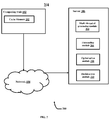
- FIG. 1 illustrates a block diagram depicting the architecture of the dynamic capacity planning system 100 according to the embodiments as disclosed herein.
- the dynamic capacity planning system 100 comprises of a computing unit 102 connected to a network 104 which is in turn connected to a server 106.
- a computing unit 102 is connected to the server 106 through the network 104.
- the computing unit 102 may be implemented as any of a variety of conventional computing devices including but not limited to a desktop PC, a notebook or a portable computer, a mainframe computer, a mobile computing device and so on.
- the computing unit 102 is connected over the network 104 through one or more communication links.
- the communication links between the computing unit 102 and the network 104 are enabled through a desired form of communication for example via dial-up modem connections, cable links, digital subscriber lines, wireless or satellite links or any other suitable form of communication.
- the network 104 may be a wireless network, a wired network, or a combination thereof.
- the network 104 can also be an individual network or a collection of many such individual networks, interconnected with each other and functioning as a single large network, e.g., the Internet or an intranet.
- the network 104 can be implemented as one of the different types of networks, such as intranet, Local Area Network (LAN), Wide Area Network (WAN), the internet, and such.
- the network 104 may either be a dedicated network or a shared network, which represents an association of the different types of networks that use a variety of protocols, for example, Hypertext Transfer Protocol (HTTP), Transmission Control Protocol/Internet Protocol (TCP/IP), Wireless Application Protocol (WAP), etc., to communicate with each other.
- the network 104 may include network devices, such as network switches, hubs, routers, Host Bus Adapters (HBAs), for providing a link between the computing unit 102 and the server 106.
- HBAs Host Bus Adapters
- the network environment 104 can be a company network, including a plurality of office personal computers, laptops, and other computing devices connected over the network 104.
- FIG. 2 with reference to FIG. 1 illustrates a detailed component diagram of the computer architecture, according to the embodiments as disclosed herein.
- the computing unit 102 comprises a cache memory 202 and the server 106 include one or more processors and a memory communicatively coupled to the processors. Further, the memory includes a multi-threaded processing module 204, a forecasting module 206, an optimization module 208 and a decision tree module 210.
- processors may be implemented as one or more microprocessors, microcomputers, microcontrollers, digital signal processors, central processing units, state machines, logic circuitries, and/or any devices that manipulate signals based on operational instructions.
- processors are configured to fetch and execute non-transitory computer-readable instructions stored in the memory.
- the cache memory 202 caches one or more outputs of a plurality of data patterns which serve as analytical models. These data patterns are stored in a high-performance unit (not shown in FIG. 2 ) in the cache memory 202 to optimize the speed and functioning of the dynamic capacity planning system 100. By using the high-performance unit in the cache memory 202, redundant processing of the data patterns is avoided since the cache memory 202 only stores outputs based on given operational inputs.
- operational inputs comprises a set of similar values or parameters
- these similar values or parameters can be cached.
- the values can be similar in nature depending upon the characteristics of average handling times, shift timings, nature of work allocation and so on. Therefore, when certain data-points of the successive set of operational inputs match with existing data patterns stored in the high-performance unit of the cache memory 202, the output can directly be fetched from the cache memory 202 and given for further processing, thereby utilizing and populating a skeletal resource allocation schedule stored in the cache memory 202 in order to avoid intensive computational processing.
- the skeletal resource allocation schedule can be in the form of a pre-defined resource allocation template which comprises details about basic organization related parameters for creating a capacity planning schedule.
- 10 operational inputs for generating the dynamic capacity planning schedule and the total time taken for processing the 10 operational inputs is 5 seconds.
- 5 operational inputs possess similar characteristics, then, when these 10 operational inputs are cached, and considering the time taken as 500 minutes of execution time per input and 5 minutes of cache fetch time for each input, a total of 2.65 seconds are spent for processing 10 operational inputs, thereby achieving 47% optimization in the whole operation.
- the multi-threaded processing module 204 facilitates simultaneous computation of multiple operational inputs which results a considerably faster computation of one or more outputs for further processing.
- static data refers to incoming state of data where an available capacity is lower than the needed capacity for a defined time span.
- Dynamic capacity refers to an incoming state of data where the needed capacity is lower than the available capacity in total, but during a certain period there may be a higher load than the required capacity.
- a regression model stored in the multi-threaded processing module 204 connects to a neural network model to help predict one or more forecasts.
- Neural network models in artificial intelligence are usually referred to as artificial neural networks (ANNs); these are essentially mathematical models defining a function f: X->Y or a distribution over X or both X and Y.
- ANNs artificial neural networks
- the multi-threaded processing module 204 detects a task loading pattern of an individual thread to dynamically allocate a set of work units.
- Case analysis 1- Consider a dual core processor processing 4 operational inputs, with 2 operational inputs being executed on 2 different cores. Thus, the time taken for executing an operational input is reduced to one fourth of the time taken in conventional techniques, where conventional techniques execute 4 operational inputs sequentially on a single core. Essentially, multiple cores can run multiple instructions at the same time, increasing overall speed for programs amenable to parallel computing.
- Case analysis 2 Consider the computing unit 102 having a memory of 4 GB RAM, dual core processor at 1.7 GHz and 2 million records getting executed in 5 minutes in a single threaded model.
- the multi-threaded processing module 204 By implementing the multi-threaded processing module 204, the 2 million records can be simultaneously processed by multi-threaded models in the multi-threaded processing module in 2.5 minutes thus achieving 2.5 minutes of throughput.
- dual core processors are explained although the above example intends to refer to other multi-core processors such as Octa core processors.
- the forecasting module 206 uses a seasonal impact model along with regression analysis techniques to analyze interactions between at least one independent and one dependent variable.
- the independent variables refer to parameters such as shift span time, number of resources, transaction volume of previous years, a service level agreement and a forecast, while the dependent variable is the optimal resource utilization.
- forecasting module 206 is able to indicate when one or more independent variables go through a significant amount of interaction with one or more dependent variables and can also indicate a relative strength of different independent variables' effects on a dependent variable.
- the optimization module 208 facilitates parallel execution of a plurality of tasks on individual cores.
- the decision tree module 210 facilitates scalability of historical data wherein new data patterns can be plugged in the decision tree module 210 and therefore data patterns are appropriately selected according to dynamic capacity planning requirements.
- Data patterns refers to the type, amount, and characteristic of data received at a particular period of time. For example, 1.5 GB of static data comprising certain operational inputs may be received at 6pm on Tuesday to create a service level agreement on Wednesday.
- FIG. 3 illustrates a flow diagram for method 300 depicting the high-level process flow of the dynamic capacity planning system100 of FIG. 1 according to the embodiments as disclosed herein.
- a plurality of operational inputs are configured dynamically to forecast a demand volume and generate a capacity planning schedule.
- the operational inputs could include raw data received from the server 106.
- the operational inputs may vary in volume when received at specific time intervals thus resulting in a dynamic resource capacity requirement. For example, the volume of a first set of operational inputs received at 10.00 AM may be different from the volume of a second set of operational inputs received at 1.00 PM and so on.
- the operational inputs include a pre-defined service level agreement but are not limited to the below mentioned features:
- a service level agreement is a contract between a service provider (either internal or external) and the end user that defines the level of service expected from the service provider. Every SLA is unique and time bound in nature.
- SLAs are used to define the necessary Quality of Service (Qos) for an application or users in an IT system. Varying demand of resources, skill sets, and task requirements require either fixed SLAs or Dynamic SLAs where the dynamic capacity planning system 100 monitors, detects, and responds interactively to ensure that process requirements are met.
- historical data is processed based on the plurality of operational inputs to primarily create a plurality of contextual data elements.
- the contextual data elements refer to different clusters in which the output gets aggregated.
- the dynamic capacity planning system 100 gainfully takes advantage of a core processing logic to organize the historical data into multiple contextual data elements.
- the multiple contextual data elements are preferentially loaded into an inmemory database alternatively referred as to as the cache memory 202, thereby enabling discrete execution of the core processing logic based on the multiple data elements eventually leading to a contextual aggregation of the output.
- historical data comprises transaction logs of the past few years.
- Historical data resides in the cache memory 202 and serves as reference data by creating certain data patterns which are in the form of a skeletal resource allocation schedule. As and when a continuous stream of operational inputs are received by the computing unit 102, a particular skeletal resource allocation schedule is intelligently chosen and fine-tuned to enable forecasting of a finished dynamic resource allocation schedule.
- a forecast is generated simultaneously at the computing unit 102 using the skeletal resource allocation schedule.
- one or more forecasts can be generated simultaneously for different capacity planning requirements.
- the different capacity planning requirements may be fed to the server 106 in intervals ranging from (for example) 5 to 10 minutes.
- a ready to implement capacity planning schedule is rendered on the computing unit 102.
- the capacity planning schedule is clustered into a plurality of work reports associated with multiple contextual data elements.
- the work reports are intelligently displayed to provide a comprehensive coverage of the capacity planning schedule.
- the work report may comprise data indicating number and identity of resources to map an identified resource to a particular task based on at least one of skillset, average time taken for the particular task, availability during the given shift.
- the dynamic capacity planning system 100 can also recommend a suitable alternative resource with similar skill sets to work on a given task.
- FIG. 4 is an exemplary schematic diagram 400 depicting the process flow according to the embodiments as disclosed herein.
- the server 106 receives certain operational inputs in the form of a quarterly or monthly forecast or a previous year's actual work demand for a month. Based on these inputs, the decision tree module 210 in the server 106 categorizes the operational inputs into a plurality of contextual clusters. Thereafter, the multi-threaded processing module 204 applies a regression analysis based on the data received from the decision tree module.
- the operational inputs which were initially received in the form of historical data is categorized into at least three forms of different inputs such as a previous years monthly demand volume, a previous years weekly demand volume, a previous years daily demand volume and demand volume forecasted for a 15 minute duration upon performing a decision tree modelling process and a regression analysis. Therefore, the mechanism of the dynamic capacity planning system 100 can be sub-divided into two stages as defined below:
- Stage 1 At this stage number of resources needed for the next one month at a fifteen minute granularity level are forecasted using the regression analysis technique to primarily determine the relationship between a provider's forecasted quarterly demand and the actual quarterly demand.
- regression analysis technique is additionally used to forecast the actual quarter demand volume and this forecast is smoothed by fitting inputs obtained after performing regression analysis to filter out the noise data.
- the embodiments herein also perform a data caching process where a map of input data and output data is created. This mapping is primarily done to check if similar patterns of data exist in cache memory 202. Once the check is done and it is found that similar patterns of data exist in the cache memory 202, the existing input data is used to generate a fifteen minute output data segmented into time periods of a month, week, day or a minute.
- an output shift schedule is generated to meet the pre-defined service level agreement.
- the output shift schedule primarily indicates the number of resources estimated after performing the forecasting, and optimization techniques, to meet the service level agreements.
- the output shift schedule also highlights surplus or deficit resources in case a resource cap is set as compared to the actual number of resources (estimated by using the steady state equation) required. Thereby an additional amount of accuracy is achieved.
- the embodiments use the hardware modules with the ability to perform parallel processing such as multithreading for managing huge datasets.
- Parallel processing exploits Multi Cores, by adopting divide and conquer policy, to optimally run the forecasting algorithm to improve the performance.
- the performance of the core processing logic gets further enhanced by organizing the historical data into multiple contextual clusters, which gets loaded into the cache memory 202, thereby enabling discrete execution based on these clusters, and then the output gets contextually aggregated.
- the dynamic capacity planning system 100 is designed for effective human resource planning considering different skill types/average handling times and SLAs.
- the dynamic capacity planning system 100 is configured to meet both fixed SLAs and dynamic SLAs by automating the resource allocation/capacity planning processes for multiple transaction types having fixed SLAs (for about 15 minutes) and varying SLAs as per multiple skill based cut offs.
- Skill X has a cut-off at 18:30 IST and when a transaction comes in a queue of the server 106 at 14:30 IST, then the SLA is effectively 4 hours. Similarly, when a transaction comes in at 17:30 IST, then the SLA is effectively 1 hour. It can be inferred that the dynamic capacity planning system 100 generates the resource allocation schedule (for various transaction types having different AHTs) to satisfy fixed SLAs as well as variable SLAs for different transaction types.
Landscapes
- Business, Economics & Management (AREA)
- Engineering & Computer Science (AREA)
- Human Resources & Organizations (AREA)
- Strategic Management (AREA)
- Economics (AREA)
- Entrepreneurship & Innovation (AREA)
- Theoretical Computer Science (AREA)
- Quality & Reliability (AREA)
- General Physics & Mathematics (AREA)
- Physics & Mathematics (AREA)
- Tourism & Hospitality (AREA)
- Marketing (AREA)
- General Business, Economics & Management (AREA)
- Operations Research (AREA)
- Game Theory and Decision Science (AREA)
- Development Economics (AREA)
- Educational Administration (AREA)
- General Engineering & Computer Science (AREA)
- Computer Hardware Design (AREA)
- Data Mining & Analysis (AREA)
- Life Sciences & Earth Sciences (AREA)
- Bioinformatics & Cheminformatics (AREA)
- Bioinformatics & Computational Biology (AREA)
- Evolutionary Biology (AREA)
- Management, Administration, Business Operations System, And Electronic Commerce (AREA)
Abstract
Description
- This patent application claims priority to India Application No.
2661/MUM/2015, filed on July 14, 2015 - The embodiments herein generally relate to capacity planning for a plurality of human resources, and more particularly, to facilitating dynamic capacity planning at an organization level in a precise and accurate manner.
- Managing the allocation of human resources and planning the optimal team capacity in the services sector is becoming increasingly complex because of the dynamic nature of allocating work schedules. Operations are often challenged with managing seemingly unmanageable work volumes with available staff. At times, the staff may feel overwhelmed with high work volumes, or underutilized during periods of low work volumes. Considerable amount of manual effort is spent on creating resource allocation schedules on a day to day basis.
- Implementing human resource allocation schedule is of paramount importance as this allows organization to plan, assign and serve client needs in an optimal manner without exploitation or wastage of resources. Small scale organization usually make use of manual techniques or rough ratio-proportion methods to come up with a resource allocation or a capacity planning schedule. Certain other organizations use certain computational techniques by means of a heuristic approach and often equate human resource planning with material requirement planning techniques that do not quite scale up to the demands of a human resource requirement sector which is usually unpredictable and constantly changing in nature.
- Human resource allocation, alternatively referred to as capacity planning is a method for using available human resources to assign and ensure completion of pre-defined tasks to meet service level agreements which is considered to be of utmost importance. Human resource allocation is typically performed by a Project manager exercising the Project manager's knowledge of the skills of the team members and their current tasks to determine optimal ways of allocating new or additional tasks within the team.
- In one existing approach, a forecasting engine and a scheduling engine are utilized along with the static and dynamic human resource data of the organization. The static and dynamic human resource data is available in a manpower management system and the data is computed to arrive at approximate manpower hours using forecasted business volumes. The approach also provides for modifying, distributing and adjusting the generated manpower plan and schedule and is quite fundamental in nature.
- Generally, it still continues to be quite a laborious and computationally intensive task to generate an optimal and dynamic resource allocation schedule which also satisfies the Service Level Agreements (SLAs) of varying nature such as fixed or constant SLAs and dynamic or variable SLAs. Therefore, current manual as well as automated techniques used in capacity planning have several inherent limitations pertaining to (a) the historical volume of data that can be processed (b) inability to perform real-time dynamic and an artificial intelligence embedded data analysis.
- In view of the foregoing, an embodiment herein provides a computer implemented method for enabling a dynamic capacity planning mechanism where the method comprises configuring a plurality of operational inputs to forecast a demand volume and generate a dynamic capacity planning schedule, wherein the plurality of operational inputs comprise raw data received from a server, processing historical data based on the plurality of operational inputs to create a plurality of contextual data elements. Further, the method comprises forecasting the demand volume and generating the dynamic capacity planning schedule using at least a part of the historical data and a current capacity planning requirement, wherein the current capacity planning requirement is being generated by the server, and rendering said dynamic capacity planning schedule based on the forecasted demand volume, wherein the rendered dynamic capacity planning schedule is clustered into a plurality of work reports associated with the plurality of contextual data elements.
- In one aspect, a computer implemented system for enabling a dynamic capacity planning mechanism is disclosed, where the system comprises a computing unit communicatively coupled to a server via a network. In an embodiment, the computing unit configures a plurality of operational inputs to forecast a demand volume and generate a dynamic capacity planning schedule, wherein said plurality of operational inputs comprise raw data received from a server. Further, the computing unit processes historical data based on said plurality of operational inputs to create a plurality of contextual data elements. Furthermore, the computing unit forecasts said demand volume and generates said dynamic capacity planning schedule using at least a part of the historical data and a current capacity planning requirement, wherein said current capacity planning requirement is being generated dynamically by said server. In addition, the computing unit renders said dynamic capacity planning schedule based on said forecasted demand volume, wherein said rendered dynamic capacity planning schedule is clustered into a plurality of work reports associated with said plurality of contextual data elements.
- The embodiments herein will be better understood from the following detailed description with reference to the drawings, in which:
-
FIG. 1 illustrates a schematic diagram depicting the architecture of a dynamic capacity planning system, according to the embodiments as disclosed herein; -
FIG. 2 illustrates a detailed component diagram of the computer architecture, according to the embodiments as disclosed herein; -
FIG. 3 illustrates a flow diagram for method depicting the high-level process flow of the dynamic capacity planning system ofFIG. 1 according to the embodiments as disclosed herein; and -
FIG. 4 is an exemplary schematic diagram depicting the process flow according to the embodiments as disclosed herein. - The embodiments herein and the various features and advantageous details thereof are explained more fully with reference to the non-limiting embodiments that are illustrated in the accompanying drawings and detailed in the following description. The examples used herein are intended merely to facilitate an understanding of ways in which the embodiments herein may be practiced and to further enable those of skill in the art to practice the embodiments herein. Accordingly, the examples should not be construed as limiting the scope of the embodiments herein.
- Referring now to the drawings, and more particularly to
FIG. 1 through FIG. 4 , where similar reference characters denote corresponding features consistently throughout the figures, there are shown preferred embodiments and these embodiments are described in the context of the following exemplary system and/or method. - The written description describes the subject matter herein to enable any person skilled in the art to make and use the embodiments. The scope of the subject matter embodiments is defined by the claims and may include other modifications that occur to those skilled in the art. Such other modifications are intended to be within the scope of the claims if they have similar elements that do not differ from the literal language of the claims or if they include equivalent elements with insubstantial differences from the literal language of the claims.
- The embodiments herein disclose a method and a system to generate an optimal human resource planning schedule in a dynamic manner by using decision tree models, regression analysis techniques, seasonal impact models, and neural network intelligence.
- Throughout, the specification the terms "resource planning schedule" and "capacity planning schedule" are used interchangeably.
-
FIG. 1 illustrates a block diagram depicting the architecture of the dynamiccapacity planning system 100 according to the embodiments as disclosed herein. As depicted inFIG. 1 , the dynamiccapacity planning system 100 comprises of acomputing unit 102 connected to anetwork 104 which is in turn connected to aserver 106. In an embodiment, a computing unit 102is connected to theserver 106 through thenetwork 104. Thecomputing unit 102 may be implemented as any of a variety of conventional computing devices including but not limited to a desktop PC, a notebook or a portable computer, a mainframe computer, a mobile computing device and so on. - Further the
computing unit 102 is connected over thenetwork 104 through one or more communication links. The communication links between thecomputing unit 102 and thenetwork 104 are enabled through a desired form of communication for example via dial-up modem connections, cable links, digital subscriber lines, wireless or satellite links or any other suitable form of communication. - The
network 104 may be a wireless network, a wired network, or a combination thereof. Thenetwork 104 can also be an individual network or a collection of many such individual networks, interconnected with each other and functioning as a single large network, e.g., the Internet or an intranet. Thenetwork 104 can be implemented as one of the different types of networks, such as intranet, Local Area Network (LAN), Wide Area Network (WAN), the internet, and such. Thenetwork 104 may either be a dedicated network or a shared network, which represents an association of the different types of networks that use a variety of protocols, for example, Hypertext Transfer Protocol (HTTP), Transmission Control Protocol/Internet Protocol (TCP/IP), Wireless Application Protocol (WAP), etc., to communicate with each other. Further, thenetwork 104 may include network devices, such as network switches, hubs, routers, Host Bus Adapters (HBAs), for providing a link between thecomputing unit 102 and theserver 106. - In one implementation, the
network environment 104 can be a company network, including a plurality of office personal computers, laptops, and other computing devices connected over thenetwork 104. -
FIG. 2 with reference toFIG. 1 illustrates a detailed component diagram of the computer architecture, according to the embodiments as disclosed herein. - As depicted in
FIG. 2 , thecomputing unit 102 comprises acache memory 202 and theserver 106 include one or more processors and a memory communicatively coupled to the processors. Further, the memory includes a multi-threaded processing module 204, a forecasting module 206, anoptimization module 208 and adecision tree module 210. - Further, the processors may be implemented as one or more microprocessors, microcomputers, microcontrollers, digital signal processors, central processing units, state machines, logic circuitries, and/or any devices that manipulate signals based on operational instructions. Among other capabilities, the processors are configured to fetch and execute non-transitory computer-readable instructions stored in the memory.
- The
cache memory 202 caches one or more outputs of a plurality of data patterns which serve as analytical models. These data patterns are stored in a high-performance unit (not shown inFIG. 2 ) in thecache memory 202 to optimize the speed and functioning of the dynamiccapacity planning system 100. By using the high-performance unit in thecache memory 202, redundant processing of the data patterns is avoided since thecache memory 202 only stores outputs based on given operational inputs. - In an embodiment, when operational inputs comprises a set of similar values or parameters, these similar values or parameters can be cached. The values can be similar in nature depending upon the characteristics of average handling times, shift timings, nature of work allocation and so on. Therefore, when certain data-points of the successive set of operational inputs match with existing data patterns stored in the high-performance unit of the
cache memory 202, the output can directly be fetched from thecache memory 202 and given for further processing, thereby utilizing and populating a skeletal resource allocation schedule stored in thecache memory 202 in order to avoid intensive computational processing. The skeletal resource allocation schedule can be in the form of a pre-defined resource allocation template which comprises details about basic organization related parameters for creating a capacity planning schedule. - For example, certain key values can be stored in the
cache memory 202 as key values indicate quarterly forecast parameter, such as for example (Value=15 min demand data) - Consider there are 10 operational inputs for generating the dynamic capacity planning schedule and the total time taken for processing the 10 operational inputs is 5 seconds. In case, out of 10 operational inputs, 5 operational inputs possess similar characteristics, then, when these 10 operational inputs are cached, and considering the time taken as 500 minutes of execution time per input and 5 minutes of cache fetch time for each input, a total of 2.65 seconds are spent for processing 10 operational inputs, thereby achieving 47% optimization in the whole operation. - The multi-threaded processing module 204 facilitates simultaneous computation of multiple operational inputs which results a considerably faster computation of one or more outputs for further processing. Additionally, static data refers to incoming state of data where an available capacity is lower than the needed capacity for a defined time span. Dynamic capacity refers to an incoming state of data where the needed capacity is lower than the available capacity in total, but during a certain period there may be a higher load than the required capacity.
- A regression model stored in the multi-threaded processing module 204, connects to a neural network model to help predict one or more forecasts. Neural network models in artificial intelligence are usually referred to as artificial neural networks (ANNs); these are essentially mathematical models defining a function f: X->Y or a distribution over X or both X and Y. In an embodiment, the multi-threaded processing module 204 detects a task loading pattern of an individual thread to dynamically allocate a set of work units.
- Case analysis 1- Consider a dual core processor processing 4 operational inputs, with 2 operational inputs being executed on 2 different cores. Thus, the time taken for executing an operational input is reduced to one fourth of the time taken in conventional techniques, where conventional techniques execute 4 operational inputs sequentially on a single core. Essentially, multiple cores can run multiple instructions at the same time, increasing overall speed for programs amenable to parallel computing.
- Case analysis 2: Consider the
computing unit 102 having a memory of 4 GB RAM, dual core processor at 1.7 GHz and 2 million records getting executed in 5 minutes in a single threaded model. By implementing the multi-threaded processing module 204, the 2 million records can be simultaneously processed by multi-threaded models in the multi-threaded processing module in 2.5 minutes thus achieving 2.5 minutes of throughput. For sake of consistency, dual core processors are explained although the above example intends to refer to other multi-core processors such as Octa core processors. - The forecasting module 206 uses a seasonal impact model along with regression analysis techniques to analyze interactions between at least one independent and one dependent variable. For example, the independent variables refer to parameters such as shift span time, number of resources, transaction volume of previous years, a service level agreement and a forecast, while the dependent variable is the optimal resource utilization.
- Further the forecasting module 206 is able to indicate when one or more independent variables go through a significant amount of interaction with one or more dependent variables and can also indicate a relative strength of different independent variables' effects on a dependent variable.
- The
optimization module 208 facilitates parallel execution of a plurality of tasks on individual cores. Thedecision tree module 210 facilitates scalability of historical data wherein new data patterns can be plugged in thedecision tree module 210 and therefore data patterns are appropriately selected according to dynamic capacity planning requirements. Data patterns refers to the type, amount, and characteristic of data received at a particular period of time. For example, 1.5 GB of static data comprising certain operational inputs may be received at 6pm on Tuesday to create a service level agreement on Wednesday. -
FIG. 3 illustrates a flow diagram formethod 300 depicting the high-level process flow of the dynamic capacity planning system100 ofFIG. 1 according to the embodiments as disclosed herein. Atstep 302, a plurality of operational inputs are configured dynamically to forecast a demand volume and generate a capacity planning schedule. The operational inputs could include raw data received from theserver 106. The operational inputs may vary in volume when received at specific time intervals thus resulting in a dynamic resource capacity requirement. For example, the volume of a first set of operational inputs received at 10.00 AM may be different from the volume of a second set of operational inputs received at 1.00 PM and so on. - The operational inputs include a pre-defined service level agreement but are not limited to the below mentioned features:
- a) Previous year's historical transactional volume data such as a one year transaction log which include the information about number of transactions received for the past one year. These transactions indicate users logging in different time periods at multiple shifts.
- b) Shift start and shift end time that specify Start and End Time of various Shifts. A shift is a pre-defined time duration during which a resource is utilized. The shift may be overlapping or successive in nature.
- c) Break start time/ End time: Each Shift may have multiple breaks. Break Start and break end Time specify the predefined time duration during which resources may avail a break in a particular shift.
- d) Average handling time (AHT): AHT may specify a pre-defined average time required to finish a particular type of work by the resource.
- In the context of the embodiments herein, a service level agreement (SLA) is a contract between a service provider (either internal or external) and the end user that defines the level of service expected from the service provider. Every SLA is unique and time bound in nature. In the dynamic
capacity planning system 100, SLAs are used to define the necessary Quality of Service (Qos) for an application or users in an IT system. Varying demand of resources, skill sets, and task requirements require either fixed SLAs or Dynamic SLAs where the dynamiccapacity planning system 100 monitors, detects, and responds interactively to ensure that process requirements are met. - At
step 304, historical data is processed based on the plurality of operational inputs to primarily create a plurality of contextual data elements. The contextual data elements refer to different clusters in which the output gets aggregated. The dynamiccapacity planning system 100 gainfully takes advantage of a core processing logic to organize the historical data into multiple contextual data elements. The multiple contextual data elements are preferentially loaded into an inmemory database alternatively referred as to as thecache memory 202, thereby enabling discrete execution of the core processing logic based on the multiple data elements eventually leading to a contextual aggregation of the output. For example historical data comprises transaction logs of the past few years. - Historical data resides in the
cache memory 202 and serves as reference data by creating certain data patterns which are in the form of a skeletal resource allocation schedule. As and when a continuous stream of operational inputs are received by thecomputing unit 102, a particular skeletal resource allocation schedule is intelligently chosen and fine-tuned to enable forecasting of a finished dynamic resource allocation schedule. - At
step 306 when at least one current capacity planning requirement is fed to the server 106 a forecast is generated simultaneously at thecomputing unit 102 using the skeletal resource allocation schedule. In an embodiment one or more forecasts can be generated simultaneously for different capacity planning requirements. The different capacity planning requirements may be fed to theserver 106 in intervals ranging from (for example) 5 to 10 minutes. - At step 308, based on the generated forecast a ready to implement capacity planning schedule is rendered on the
computing unit 102. The capacity planning schedule is clustered into a plurality of work reports associated with multiple contextual data elements. For example, the work reports are intelligently displayed to provide a comprehensive coverage of the capacity planning schedule. The work report may comprise data indicating number and identity of resources to map an identified resource to a particular task based on at least one of skillset, average time taken for the particular task, availability during the given shift. In certain cases when a particular resource is unavailable, the dynamiccapacity planning system 100 can also recommend a suitable alternative resource with similar skill sets to work on a given task. - It will be noted herein that various actions/steps in
method 300 may be performed in the order presented, in a different order or simultaneously. Further, in some embodiments, some actions listed inFIG. 3 may be omitted. -
FIG. 4 is an exemplary schematic diagram 400 depicting the process flow according to the embodiments as disclosed herein. As depicted inFIG. 4 , initially theserver 106 receives certain operational inputs in the form of a quarterly or monthly forecast or a previous year's actual work demand for a month. Based on these inputs, thedecision tree module 210 in theserver 106 categorizes the operational inputs into a plurality of contextual clusters. Thereafter, the multi-threaded processing module 204 applies a regression analysis based on the data received from the decision tree module. - At this point, the operational inputs which were initially received in the form of historical data is categorized into at least three forms of different inputs such as a previous years monthly demand volume, a previous years weekly demand volume, a previous years daily demand volume and demand volume forecasted for a 15 minute duration upon performing a decision tree modelling process and a regression analysis. Therefore, the mechanism of the dynamic
capacity planning system 100 can be sub-divided into two stages as defined below: - Stage 1: At this stage number of resources needed for the next one month at a fifteen minute granularity level are forecasted using the regression analysis technique to primarily determine the relationship between a provider's forecasted quarterly demand and the actual quarterly demand.
- Further, the regression analysis technique is additionally used to forecast the actual quarter demand volume and this forecast is smoothed by fitting inputs obtained after performing regression analysis to filter out the noise data.
- Stage 2: At this stage an optimal number of resources is determined for the next one month on a shift level basis. This is achieved by using a steady state queueing theory approach where the (actual) number of resources can be estimated at a five minute interval by using the equation Rtp = (λtp / µp + α * (λtp / µp where α is confidence level.
- During the forecasting process the embodiments herein also perform a data caching process where a map of input data and output data is created. This mapping is primarily done to check if similar patterns of data exist in
cache memory 202. Once the check is done and it is found that similar patterns of data exist in thecache memory 202, the existing input data is used to generate a fifteen minute output data segmented into time periods of a month, week, day or a minute. Finally by using theoptimization module 208, an output shift schedule is generated to meet the pre-defined service level agreement. The output shift schedule primarily indicates the number of resources estimated after performing the forecasting, and optimization techniques, to meet the service level agreements. The output shift schedule also highlights surplus or deficit resources in case a resource cap is set as compared to the actual number of resources (estimated by using the steady state equation) required. Thereby an additional amount of accuracy is achieved. - The embodiments use the hardware modules with the ability to perform parallel processing such as multithreading for managing huge datasets. Parallel processing exploits Multi Cores, by adopting divide and conquer policy, to optimally run the forecasting algorithm to improve the performance.
- The performance of the core processing logic gets further enhanced by organizing the historical data into multiple contextual clusters, which gets loaded into the
cache memory 202, thereby enabling discrete execution based on these clusters, and then the output gets contextually aggregated. - Essentially, the dynamic
capacity planning system 100 is designed for effective human resource planning considering different skill types/average handling times and SLAs. The dynamiccapacity planning system 100 is configured to meet both fixed SLAs and dynamic SLAs by automating the resource allocation/capacity planning processes for multiple transaction types having fixed SLAs (for about 15 minutes) and varying SLAs as per multiple skill based cut offs. - For example, assume Skill X has a cut-off at 18:30 IST and when a transaction comes in a queue of the
server 106 at 14:30 IST, then the SLA is effectively 4 hours. Similarly, when a transaction comes in at 17:30 IST, then the SLA is effectively 1 hour. It can be inferred that the dynamiccapacity planning system 100 generates the resource allocation schedule (for various transaction types having different AHTs) to satisfy fixed SLAs as well as variable SLAs for different transaction types. - As will be understood by those familiar with the art, the invention may be embodied in other specific forms without departing from the spirit or essential characteristics thereof. Likewise, the particular naming and division of the portions, modules, agents, managers, components, functions, procedures, actions, layers, features, attributes, methodologies and other aspects are not mandatory or significant, and the mechanisms that implement the invention or its features may have different names, divisions and/or formats.
- The preceding description has been presented with reference to various embodiments. Persons having ordinary skill in the art and technology to which this application pertains will appreciate that alterations and changes in the described structures and methods of operation can be practiced without meaningfully departing from the principle, spirit and scope.
Claims (11)
- A computer implemented method for enabling dynamic capacity planning, said method comprising:configuring a plurality of operational inputs to forecast a demand volume and generate a dynamic capacity planning schedule, wherein said plurality of operational inputs comprise raw data received from a server (106);processing historical data based on said plurality of operational inputs to create a plurality of contextual data elements;forecasting said demand volume and generating said dynamic capacity planning schedule using at least a part of the historical data and a current capacity planning requirement, wherein said current capacity planning requirement is being generated dynamically by said server (106); andrendering said dynamic capacity planning schedule based on said forecasted demand volume, wherein said rendered dynamic capacity planning schedule is clustered into a plurality of work reports associated with said plurality of contextual data elements.
- The computer implemented method according to claim 1, wherein said processing includes fetching a data pattern from a cache memory (202) based on said plurality of operational inputs received from said server (106).
- The computer implemented method according to claim 1, further comprising a step of parallel execution of said plurality of operational inputs.
- The computer implemented method according to claim 1, further comprising creating a data pattern dynamically upon configuring said plurality of operational inputs based on a decision model.
- The computer implemented method according to claim 1, further comprising performing a regression analysis on said set of operational inputs using a seasonal impact model, wherein said seasonal impact model analyzes an interaction between at least one of an independent variable and a dependent variable, wherein said independent variable is at least one of a shift span time, number of resources, one year transaction volume data, a service level agreement, and a forecast, and wherein said dependent variable is an optimal resource utilization schedule.
- A computer implemented system (100) for enabling dynamic capacity planning, the system comprising:a computing unit (102); anda server (106) communicatively coupled to said computing unit (102)via a network (104), wherein said the computing unit (102) is to:configure a plurality of operational inputs to forecast a demand volume and generate a dynamic capacity planning schedule, wherein said plurality of operational inputs comprise raw data received from said server (106);process historical data based on said plurality of operational inputs to create a plurality of contextual data elements;forecast said demand volume and generate said dynamic capacity planning schedule using at least a part of the historical data and a current capacity planning requirement, wherein said current capacity planning requirement is being generated dynamically by said server (106); andrender said dynamic capacity planning schedule based on said forecasted demand volume, wherein said rendered dynamic capacity planning schedule is clustered into a plurality of work reports associated with said plurality of contextual data elements.
- The computer implemented system according to claim 6, wherein said plurality of contextual clusters are segregated into at least one of an Average Handling Time (AHT), Shift Span Time (SST) and Service Level Agreement (SLA).
- The computer implemented system according to claim 6, wherein said computing unit (102) further comprises a cache memory (202) configured to store a plurality of analytical models, wherein said plurality of analytical models serve as reference data to dynamically predict said optimal resource allocation schedule.
- The computer implemented system according to claim 6, wherein said server (106) is further configured to detect a task loading pattern of an individual thread to dynamically allocate a set of work units.
- The computer implemented system according to claim 6, wherein said server (106) is further configured to connect to a neural network model to predict a forecast upon performing said regression analysis.
- The computer implemented system according to claim 10, wherein said neural network is configured to utilize artificial intelligence to dynamically load at least one thread sequentially in said server (106).
Applications Claiming Priority (1)
| Application Number | Priority Date | Filing Date | Title |
|---|---|---|---|
| IN2661MU2015 | 2015-07-14 |
Publications (1)
| Publication Number | Publication Date |
|---|---|
| EP3118784A1 true EP3118784A1 (en) | 2017-01-18 |
Family
ID=55442725
Family Applications (1)
| Application Number | Title | Priority Date | Filing Date |
|---|---|---|---|
| EP16157616.0A Ceased EP3118784A1 (en) | 2015-07-14 | 2016-02-26 | Method and system for enabling dynamic capacity planning |
Country Status (2)
| Country | Link |
|---|---|
| US (1) | US10628766B2 (en) |
| EP (1) | EP3118784A1 (en) |
Cited By (2)
| Publication number | Priority date | Publication date | Assignee | Title |
|---|---|---|---|---|
| WO2019156930A2 (en) | 2018-02-08 | 2019-08-15 | Roblox Corporation | Using machine learning to estimate or forecast resource use with time-varying demand in gaming platforms |
| US20220092442A1 (en) * | 2020-09-21 | 2022-03-24 | Arizona Board Of Regents On Behalf Of Arizona State University | Systems, methods, and apparatuses for evaluating wait times and queue lengths at multi-station and multi-stage screening zones via a determinisitc decision support algorithm |
Families Citing this family (7)
| Publication number | Priority date | Publication date | Assignee | Title |
|---|---|---|---|---|
| US10627808B2 (en) * | 2017-06-24 | 2020-04-21 | Daniel T. Hamling | Managing manufacturing capacity plan performance |
| KR102045540B1 (en) * | 2018-08-28 | 2019-11-15 | 윤성민 | An Employment Creation System and Its Method through Work Forms Set by Collective Intelligence Convergence |
| CN111385800B (en) * | 2018-12-29 | 2024-07-19 | 北京亿阳信通科技有限公司 | Carrier scheduling method and device for LTE capacity equalization |
| US11348047B2 (en) * | 2019-06-20 | 2022-05-31 | Walmart Apollo, Llc | Systems and methods for safety stock settings using a parallel processing computing architecture |
| CN111143966B (en) * | 2019-11-26 | 2024-11-01 | 中国电力科学研究院有限公司 | A method and system for generating regional power grid maintenance plan |
| US12014196B2 (en) * | 2021-03-22 | 2024-06-18 | Kyndryl, Inc. | Architecture generation for standard applications |
| CN120264333B (en) * | 2025-04-14 | 2026-04-07 | 中国长江电力股份有限公司 | Dynamic load test method and system for short message communication system |
Citations (2)
| Publication number | Priority date | Publication date | Assignee | Title |
|---|---|---|---|---|
| US20050240465A1 (en) * | 2004-04-27 | 2005-10-27 | Kiran Ali S | System and method for workforce requirements management |
| US20150120371A1 (en) * | 2013-10-31 | 2015-04-30 | Steelwedge Software, Inc. | Automotive manufacturing optimization through advanced planning and forecasting through massively parallel processing of data using a distributed computing environment |
Family Cites Families (14)
| Publication number | Priority date | Publication date | Assignee | Title |
|---|---|---|---|---|
| US6587831B1 (en) | 1999-10-21 | 2003-07-01 | Workforce Logistics Inc. | System and method for online scheduling and shift management |
| US20030236961A1 (en) * | 2000-11-07 | 2003-12-25 | Qiu Chaoxin C. | Systems and methods for management of memory in information delivery environments |
| US20020184074A1 (en) * | 2001-05-31 | 2002-12-05 | Shou-Chung Chen | Method for planning product groups |
| CA2514824A1 (en) | 2002-12-02 | 2004-06-17 | Pershing Investments, Llc | Capacity planning method and system |
| US7822630B1 (en) * | 2003-12-11 | 2010-10-26 | Teradata Us, Inc. | Forecasting with parallel processing |
| JP2005234852A (en) | 2004-02-19 | 2005-09-02 | Hns:Kk | Work shift management device and work shift management program |
| US20050222884A1 (en) | 2004-03-31 | 2005-10-06 | Ralf Ehret | Capacity planning of resources |
| ATE479287T1 (en) | 2004-10-28 | 2010-09-15 | Telecom Italia Spa | METHOD FOR MANAGING EQUIPMENT IN A TELECOMMUNICATIONS SERVICE AND/OR NETWORK MANAGEMENT PLATFORM, CORRESPONDING PLATFORM AND COMPUTER PROGRAM PRODUCT THEREOF |
| US20070101000A1 (en) | 2005-11-01 | 2007-05-03 | Childress Rhonda L | Method and apparatus for capacity planning and resourse availability notification on a hosted grid |
| JP4732327B2 (en) | 2006-12-27 | 2011-07-27 | 株式会社日立製作所 | Automatic call distribution system |
| US20080167930A1 (en) * | 2007-01-10 | 2008-07-10 | Heng Cao | Method and structure for end-to-end workforce management |
| US20080167929A1 (en) * | 2007-01-10 | 2008-07-10 | Heng Cao | Method and structure for generic architecture f0r integrated end-to-end workforce management |
| US7953681B2 (en) * | 2007-12-12 | 2011-05-31 | Xerox Corporation | System and method of forecasting print job related demand |
| US9274838B2 (en) * | 2011-12-22 | 2016-03-01 | Netapp, Inc. | Dynamic instantiation and management of virtual caching appliances |
-
2016
- 2016-02-26 EP EP16157616.0A patent/EP3118784A1/en not_active Ceased
- 2016-03-01 US US15/057,714 patent/US10628766B2/en active Active - Reinstated
Patent Citations (2)
| Publication number | Priority date | Publication date | Assignee | Title |
|---|---|---|---|---|
| US20050240465A1 (en) * | 2004-04-27 | 2005-10-27 | Kiran Ali S | System and method for workforce requirements management |
| US20150120371A1 (en) * | 2013-10-31 | 2015-04-30 | Steelwedge Software, Inc. | Automotive manufacturing optimization through advanced planning and forecasting through massively parallel processing of data using a distributed computing environment |
Non-Patent Citations (3)
| Title |
|---|
| ANONYMOUS: "Artificial neural network - Wikipedia, the free encyclopedia", 11 July 2015 (2015-07-11), XP055267846, Retrieved from the Internet <URL:https://en.wikipedia.org/w/index.php?title=Artificial_neural_network&oldid=670995295> [retrieved on 20160422] * |
| ANONYMOUS: "Multi-core processor - Wikipedia, the free encyclopedia", 7 July 2015 (2015-07-07), XP055267841, Retrieved from the Internet <URL:https://en.wikipedia.org/w/index.php?title=Multi-core_processor&oldid=670326718> [retrieved on 20160422] * |
| ANONYMOUS: "Parallel computing - Wikipedia, the free encyclopedia", 10 July 2015 (2015-07-10), XP055267845, Retrieved from the Internet <URL:https://en.wikipedia.org/w/index.php?title=Parallel_computing&oldid=670828500> [retrieved on 20160422] * |
Cited By (6)
| Publication number | Priority date | Publication date | Assignee | Title |
|---|---|---|---|---|
| WO2019156930A2 (en) | 2018-02-08 | 2019-08-15 | Roblox Corporation | Using machine learning to estimate or forecast resource use with time-varying demand in gaming platforms |
| CN111699500A (en) * | 2018-02-08 | 2020-09-22 | 罗布乐思公司 | Estimating or predicting resource usage with time-varying requirements in a gaming platform using machine learning |
| EP3750116A4 (en) * | 2018-02-08 | 2021-11-10 | Roblox Corporation | USING AUTOMATIC LEARNING TO ESTIMATE OR PREDICT THE USE OF RESOURCES WITH A VARIABLE DEMAND OVER TIME IN GAME PLATFORMS |
| US11537933B2 (en) | 2018-02-08 | 2022-12-27 | Roblox Corporation | Using machine learning to estimate or forecast resource use with time-varying demand in gaming platforms |
| CN111699500B (en) * | 2018-02-08 | 2024-02-09 | 罗布乐思公司 | Estimating or predicting resource usage with time-varying demand in a gaming platform using machine learning |
| US20220092442A1 (en) * | 2020-09-21 | 2022-03-24 | Arizona Board Of Regents On Behalf Of Arizona State University | Systems, methods, and apparatuses for evaluating wait times and queue lengths at multi-station and multi-stage screening zones via a determinisitc decision support algorithm |
Also Published As
| Publication number | Publication date |
|---|---|
| US10628766B2 (en) | 2020-04-21 |
| US20170017918A1 (en) | 2017-01-19 |
Similar Documents
| Publication | Publication Date | Title |
|---|---|---|
| US10628766B2 (en) | Method and system for enabling dynamic capacity planning | |
| Bhattacharjee et al. | Barista: Efficient and scalable serverless serving system for deep learning prediction services | |
| Herbst et al. | Self-adaptive workload classification and forecasting for proactive resource provisioning | |
| Van den Bossche et al. | Cost-efficient scheduling heuristics for deadline constrained workloads on hybrid clouds | |
| US8752059B2 (en) | Computer data processing capacity planning using dependency relationships from a configuration management database | |
| CN104298550B (en) | A kind of dynamic dispatching method towards Hadoop | |
| US12277445B2 (en) | Predictive resource allocation and scheduling for a distributed workload | |
| US11360822B2 (en) | Intelligent resource allocation agent for cluster computing | |
| WO2013082119A1 (en) | Cloud provisioning accelerator | |
| US10445209B2 (en) | Prescriptive analytics based activation timetable stack for cloud computing resource scheduling | |
| CN102611622A (en) | Dispatching method for working load of elastic cloud computing platform | |
| Sniezynski et al. | VM reservation plan adaptation using machine learning in cloud computing | |
| EP3049959A1 (en) | Processing a hybrid flow associated with a service class | |
| CN118819870B (en) | Method and system for realizing resource scheduling based on cloud computing | |
| CN109614227A (en) | Task resource allocation method, apparatus, electronic device, and computer-readable medium | |
| CN117234693A (en) | Task scheduling method, device, electronic equipment, storage medium and program product | |
| Castellano et al. | Scheduling multi-component applications across federated edge clusters with phare | |
| US20260017110A1 (en) | Managing gpu resources on a container orchestration platform | |
| US20220100564A1 (en) | Preventing deployment failures of information technology workloads | |
| Beni et al. | Infracomposer: Policy-driven adaptive and reflective middleware for the cloudification of simulation & optimization workflows | |
| Vennu et al. | A performance study for autoscaling big data analytics containerized applications: Scalability of Apache Spark on Kubernetes | |
| Gulenko et al. | Bitflow: An in situ stream processing framework | |
| CN108052378B (en) | A Profit-Sensitive Task Scheduling Method for Complex Simulation Workflow Applications | |
| US20240143369A1 (en) | Using rule engine with push mechanism for configuration data of a containerized computing cluster | |
| US11233738B1 (en) | Dynamic performance configuration for data traffic workflows |
Legal Events
| Date | Code | Title | Description |
|---|---|---|---|
| PUAI | Public reference made under article 153(3) epc to a published international application that has entered the european phase |
Free format text: ORIGINAL CODE: 0009012 |
|
| STAA | Information on the status of an ep patent application or granted ep patent |
Free format text: STATUS: THE APPLICATION HAS BEEN PUBLISHED |
|
| AK | Designated contracting states |
Kind code of ref document: A1 Designated state(s): AL AT BE BG CH CY CZ DE DK EE ES FI FR GB GR HR HU IE IS IT LI LT LU LV MC MK MT NL NO PL PT RO RS SE SI SK SM TR |
|
| AX | Request for extension of the european patent |
Extension state: BA ME |
|
| STAA | Information on the status of an ep patent application or granted ep patent |
Free format text: STATUS: REQUEST FOR EXAMINATION WAS MADE |
|
| 17P | Request for examination filed |
Effective date: 20170717 |
|
| RBV | Designated contracting states (corrected) |
Designated state(s): AL AT BE BG CH CY CZ DE DK EE ES FI FR GB GR HR HU IE IS IT LI LT LU LV MC MK MT NL NO PL PT RO RS SE SI SK SM TR |
|
| STAA | Information on the status of an ep patent application or granted ep patent |
Free format text: STATUS: EXAMINATION IS IN PROGRESS |
|
| 17Q | First examination report despatched |
Effective date: 20190821 |
|
| STAA | Information on the status of an ep patent application or granted ep patent |
Free format text: STATUS: THE APPLICATION HAS BEEN REFUSED |
|
| 18R | Application refused |
Effective date: 20210226 |