EP3118048A1 - Funktionsauswahl über gestik-steuerung mit haptischer rückmeldung - Google Patents
Funktionsauswahl über gestik-steuerung mit haptischer rückmeldung Download PDFInfo
- Publication number
- EP3118048A1 EP3118048A1 EP16001429.6A EP16001429A EP3118048A1 EP 3118048 A1 EP3118048 A1 EP 3118048A1 EP 16001429 A EP16001429 A EP 16001429A EP 3118048 A1 EP3118048 A1 EP 3118048A1
- Authority
- EP
- European Patent Office
- Prior art keywords
- gesture
- haptic feedback
- person
- air flow
- feedback
- Prior art date
- Legal status (The legal status is an assumption and is not a legal conclusion. Google has not performed a legal analysis and makes no representation as to the accuracy of the status listed.)
- Granted
Links
Images

Classifications
-
- B—PERFORMING OPERATIONS; TRANSPORTING
- B60—VEHICLES IN GENERAL
- B60K—ARRANGEMENT OR MOUNTING OF PROPULSION UNITS OR OF TRANSMISSIONS IN VEHICLES; ARRANGEMENT OR MOUNTING OF PLURAL DIVERSE PRIME-MOVERS IN VEHICLES; AUXILIARY DRIVES FOR VEHICLES; INSTRUMENTATION OR DASHBOARDS FOR VEHICLES; ARRANGEMENTS IN CONNECTION WITH COOLING, AIR INTAKE, GAS EXHAUST OR FUEL SUPPLY OF PROPULSION UNITS IN VEHICLES
- B60K35/00—Instruments specially adapted for vehicles; Arrangement of instruments in or on vehicles
- B60K35/10—Input arrangements, i.e. from user to vehicle, associated with vehicle functions or specially adapted therefor
-
- G—PHYSICS
- G06—COMPUTING OR CALCULATING; COUNTING
- G06F—ELECTRIC DIGITAL DATA PROCESSING
- G06F3/00—Input arrangements for transferring data to be processed into a form capable of being handled by the computer; Output arrangements for transferring data from processing unit to output unit, e.g. interface arrangements
- G06F3/01—Input arrangements or combined input and output arrangements for interaction between user and computer
- G06F3/016—Input arrangements with force or tactile feedback as computer generated output to the user
-
- G—PHYSICS
- G06—COMPUTING OR CALCULATING; COUNTING
- G06F—ELECTRIC DIGITAL DATA PROCESSING
- G06F3/00—Input arrangements for transferring data to be processed into a form capable of being handled by the computer; Output arrangements for transferring data from processing unit to output unit, e.g. interface arrangements
- G06F3/01—Input arrangements or combined input and output arrangements for interaction between user and computer
- G06F3/017—Gesture based interaction, e.g. based on a set of recognized hand gestures
Definitions
- the invention relates to a method for use in a vehicle, preferably a motor vehicle, in particular a commercial vehicle, for. As a truck or a bus.
- the method is used in particular for contactless operation by gestural control (eg actuation, function selection, function activation, etc.) of a vehicle device.
- the invention also relates to a corresponding device.
- gesture control gradually finds its way into motor vehicles.
- individual functions in the motor vehicle are selected by means of certain finger or hand gestures, which brings with it a number of advantages, eg. B. the driver (operator) hardly distracts from its central task, the driving of the motor vehicle.
- the driver receives in the control of the gesture in the air, without physical contact with a control element, no direct feedback, so no feedback on the finger or on the hand, but at most indirect feedback on, for example, displays on a display.
- Another disadvantage is that the driver can not perceive which possible gestures are available for the gesture control, unlike, for example, a touch display in which various buttons are available and can be selected.
- An object of the invention is to provide a way by which the gesture control in a vehicle can be improved, for. B. to increase user acceptance.
- the invention provides a method for use in a vehicle, preferably a motor vehicle, in particular a commercial vehicle, for. As a truck or a bus.
- the method is in particular designed for non-contact actuation, in particular operation, of a vehicle device (for example an audio device, a sliding roof, a hazard warning light, a vehicle window, a vehicle door, a switching element, etc.).
- a vehicle device for example an audio device, a sliding roof, a hazard warning light, a vehicle window, a vehicle door, a switching element, etc.
- the method is characterized in particular in that a gesture of a person (eg vehicle driver and / or operator) for non-contact operation of a vehicle device is detected (eg via a camera system or another suitable detection model) and at least to the gesture a haptic feedback, so at least a haptic feedback, for the person is generated to preferably at least a part of the operation, so in particular the gesture, haptic and thus expedient to accompany noticeably.
- a virtual operating element eg a virtual pushbutton
- the person's method information may preferably be transmitted haptically, preferably for intuitive guidance (eg explanation, pointing out, clearing, etc.), which gesture is to be executed for non-contact actuation of the vehicle device and is thus suitably stored.
- intuitive guidance eg explanation, pointing out, clearing, etc.
- the gesture may include one or more gestures.
- the gesture is preferably a hand and / or finger gesture, z. As a sliding, wiping and / or finger tip gestures.
- the gesture corresponds in particular at least in sections to the operation. So z. B. a termination of the gesture at the same time correspond to a termination of the operation.
- the non-contact actuation z As an operation, a selection of a function and / or activation of a function of a vehicle device include.
- the non-contact operation comprises in particular an actuation without physical contact of the person, in particular their hand, with a physical and / or mechanical operating element.
- the haptic feedback may include a single haptic feedback or multiple haptic feedbacks, e.g. B. at the same time and / or consecutively executed feedbacks.
- a haptic feedback is expediently carried out during the gestures of the person.
- a haptic feedback may be appropriate at the beginning of the operation, z. B. as a start signal.
- haptic feedbacks can be performed for the person, the z. B. at the same time and can overlap appropriately and / or can be done sequentially.
- a haptic feedback haptically mimics a force-displacement curve and / or an actuation of a physical, quasi-real and / or mechanical operating element, eg. B. by means of a counterforce.
- a counterforce e.g. B.
- at least one air flow can be used, which is preferably designed such that a force-displacement curve and / or an actuation of a physical control element are haptically imitated.
- an air flow as haptic feedback can be carried out substantially counter to the direction of the movement of the person, in particular their hand, during the gesture, so that in particular a counter force can be generated, appropriately analogous to the counterforce when pressing a physical (real or mechanical) control element.
- an air flow as haptic feedback substantially in the direction of gestural movement of the person, in particular their hand are generated, whereby z. B. afterglow, z. B. a return and / or moving back, a physical (real or mechanical) control element can be haptically imitated.
- a physical (real or mechanical) control element in particular a pushbutton, can be haptically imitated.
- the feature feedback may comprise not only a feedback in the form of a feedback, but preferably also a guidance or influencing of the gestures of the person.
- the air flow can be formed as a changing air flow.
- the airflow is preferably a steady but variable airflow.
- Air flows can be performed at the same time and thus superimpose expedient and / or carried out sequentially.
- An air flow can be z. B. change continuously. Alternatively or additionally, an air flow can be performed intermittently, z. B. by means of several successive air blasts.
- the air flow may comprise at least one threshold, expediently at least one high and / or low point.
- an airflow changes its strength, its direction (eg up and down, from left to right or vice versa, from front to back or vice versa, etc. or a combination thereof) and / or its temperature.
- a haptic feedback includes a temperature change, e.g. B. a change in the temperature of a vehicle seat, a steering wheel or other vehicle interior part.
- the haptic feedback can thus work expediently with different temperature ranges.
- a haptic feedback is generated via a magnetic field:
- the person would have a z.
- haptic which gesture is to be executed for non-contact operation, in particular operation, of the vehicle device.
- the information may conveniently be intuitive, z. B. air flow to the left, gesture to be executed to the right, air flow to the left, gesture to be executed left, etc.
- the information to the person is transmitted haptically, in particular by means of at least one air flow.
- the information can be executed in the same way as the haptic feedback, so that the disclosure of haptic feedback also applies mutatis mutandis to the haptic information and, to that extent, is likewise suitably claimable.
- the information can also be provided by means of acoustic voice output and / or visually, expediently on a display, for example, on a display.
- acoustic voice output and / or visually, expediently on a display, for example, on a display.
- the request for information can be made via a person's gestures and / or via an acoustic voice input by the person.
- a noise feedback z.
- a click-sound conveniently similar to a mechanical control and / or button element, a voice output feedback and / or visual feedback, z. B. generated on a display.
- the haptic feedback and / or the haptic information are directed in particular to the hand of the person.
- the invention is not limited to a method but also includes a device for a vehicle, e.g. As a motor vehicle, in particular a commercial vehicle, such as a truck or a bus.
- the device preferably serves for gesture-controlled contactless operation of a vehicle device and / or for carrying out the method as disclosed herein.
- the apparatus suitably includes a plurality of devices configured to carry out the method as disclosed herein. It thus comprises a device designed to detect a gesture of a person for non-contact operation of a vehicle device, and a device designed to generate at least a haptic feedback for the person to the gesture, and / or a device executed to to provide the person with information by haptic means, preferably for intuitive guidance (eg explanation, pointing out, clearing, etc.), which gesture is to be executed for non-contact operation of the vehicle device and is therefore stored in particular.
- haptic means preferably for intuitive guidance (eg explanation, pointing out, clearing, etc.), which gesture is to be executed for non-contact operation of the vehicle device and is therefore stored in particular.
- the invention further includes a vehicle having a device as disclosed herein.
- the vehicle may be a motor vehicle, preferably a commercial vehicle, in particular a truck or bus.
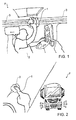
- FIG. 1 illustrates a method of use in a vehicle F according to an embodiment of the invention. The method is used for gesture-control contactless operation of a vehicle device in the form of a sunroof.
- an operator 2 namely preferably the driver, the sunroof is operated without contact, z.
- a hand gesture 1 an operator 2, namely preferably the driver, the sunroof is operated without contact, z.
- z For opening and closing.
- a haptic feedback 3 in the form of two directed in opposite directions air currents on the gesture 1 executing hand of the operator 2 is generated.
- the operator 2 can be given a haptic feedback 3 in the form of a short air blast, which on the successful execution of the gesture 1 and the successful operation, for. B. triggering and / or termination of the function informed.
- the operator 2 for non-contact operation of the sunroof can guide their hand substantially vertically upwards in the direction of the sunroof and then substantially horizontally forward or backward to open or close the sunroof.
- the gesture 1 thus comprises two gestures or a two-step gesture.
- a continuous stream of air is generated as a counterforce and haptic, perceptible feedback 3 on the operator's hand 2, with the benefit that the gesture becomes "more navigable” and the operator 2 receives feedback during the execution of the gesture 1 or receives the operation.
- an additional feedback 3 z. B in the form of a short puff of air that informs that the operation was successful and / or the function was successfully performed.
- the operator 2 may also experience a continuous flow of air and receive additional haptic feedback 3 at the point where the function is triggered.
- a kind of force-displacement curve can be modeled similar to that of a physical, mechanical and thus real button.
- the non-contact actuation can be made haptically perceptible, preferably in such a way that an actuation of a physical, mechanical and therefore real operating element, in particular a probe, is haptically imitated.
- the air stream (s) can be modeled to simulate the operation, e.g. B. by variation, in particular variable air flow strength, superposition and / or sequence of air streams, etc.
- a logic can be used, which recognizes, for example, when the sunroof is already completely closed, the operator 2 but still executes the "closing gesture", in which case another haptic feedback 3, z. As an air blast, can be generated to inform the operator 2 haptic about this.
- the operator 2 If the operator 2 is initially uncertain as to how the sunroof can be operated via a gesture 1, it can request information about this, that is to say information as to which gesture 1 is to be performed to operate the sunroof. For this purpose, the operator 2 can lead their hand to the sunroof and z. B. request by voice input the information. Then the operator 2 haptic, z. B. by means of one or more air streams, be conveyed which gesture 1 is to be executed for non-contact operation of the sunroof. So z. B. an airflow are generated to the front to intuitively show the operator 2 that a backward gesture is a gesture to open the sunroof.
- a haptic feedback preferably an air flow, is used to guide the hand of the operator 2 during the gesture 1 and to actively influence the gesture 1, so that haptic corrective and Spotify einsangnd in the gesture 1 and the operation can be intervened.
- the feature feedback is thus to be interpreted broadly in the context of the invention.
- FIG. 2 illustrates a method of use in a vehicle F according to another embodiment of the invention. The method is used for gesture-control contactless operation of a vehicle device in the form of a hazard warning lights.
- the operator 2 can trigger or deactivate the hazard warning light by a finger tap as a gesture 1, analogous to the actuation when pressing a mechanical, physical button.
- Operator 2 may experience continuous airflow as haptic feedback 3 during gesture 1, and additional feedback 3 at the location where the function is triggered. This may model a type of force-displacement curve similar to that of a true physical probe to haptically simulate an actuation of a real, physical control.
- a click sound such B. at a physical, mechanical button, are issued.
- FIG. 3 illustrates a method of use in a vehicle F according to another embodiment of the invention.
- the method is used for gesture-controlled contactless operation of a vehicle device in the form of an audio device, eg. B. music player, radio, CD player, etc.
- an audio device eg. B. music player, radio, CD player, etc.
- the operator 2 can with a gesture 1 z. For example, select an audio track, jump forward and / or backward.
- the gesture 1 is z.
- a swipe gesture with the whole of your hand or a finger to the right to jump an audio title forward.
- the operator 2 during the swiping gesture 1 can sense a continuous airflow 3 as a counterforce, with the advantage that the gesture becomes more "perceptible” and the operator 2 receives a haptic feedback 3 during the gesture 1.
- a feedback 3 z. B. in the form of a short puff of air, inform the operator 2 that their operation (gesture 1) was successful and the function is now triggered.
- the operator 2 can experience a continuous air flow as haptic feedback 3 and receive additional feedback 3 at the point at which the function is triggered.
- a kind of force-displacement curve similar to that of a button can be modeled.
- the operator 2 If the operator 2 initially does not know which gesture 1 is to be performed to operate the audio device, she can hold her hand in front of the audio device and request, for example via voice input, the information as to which gesture 1 can be executed. Then the operator 2 z. B. a puff of air from the left and thus obtained haptic information to intuitively show the operator 2 that a movement to the right is a possible gesture 1 in this context (the hand is guided by the air flow).
- a suitably direct, haptic feedback 3 can preferably be presented to the hand of an operator 2, in particular via one or more air streams, alternatively or additionally but also by means of a magnetic field and / or temperature changes ,
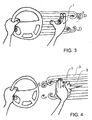
- FIGS. 4 to 6 illustrate in particular different haptic feedbacks 3 to the hand of the operator 2, which are also analogous to the haptic information transmission available.
- the haptic feedbacks 3 can be carried out individually or in combination successively and / or simultaneously and thus overlapping.
- FIG. 4 z. B illustrates a continuous air flow as a haptic feedback 3 and in addition a puff of air as haptic feedback 3, so that the two feedbacks 3 superimpose appropriate.
- FIG. 5 illustrates a lateral air blast 3 as haptic feedback 3.
- FIG. 6 illustrates a substantially vertical continuous airflow 3 as haptic feedback 3.
- the haptic feedbacks 3, in particular the air stream (s), can be used to convey to the operator 2 a haptic feedback 3 to the gesture 1.
- the operator 3 can haptically be provided with information by means of at least one air flow, which gesture 1 is to be executed for non-contact actuation of the vehicle device.
- the at least one air stream disclosed herein may be used to convey to the operator 2 a haptic feedback 3 to the gesture 1 and / or to inform the operator 2 as to which gesture 1 to perform for non-contact operation of the vehicle device.
- the herein disclosed at least one air flow can be used as a haptic feedback 3 for guiding the hand of the person during the gesture 1 and / or for the haptic influence of the gesture 1 to intervene corrective or Spotify einancend in the operation / gesture.
Landscapes
- Engineering & Computer Science (AREA)
- General Engineering & Computer Science (AREA)
- Theoretical Computer Science (AREA)
- Human Computer Interaction (AREA)
- Physics & Mathematics (AREA)
- General Physics & Mathematics (AREA)
- Chemical & Material Sciences (AREA)
- Combustion & Propulsion (AREA)
- Transportation (AREA)
- Mechanical Engineering (AREA)
- User Interface Of Digital Computer (AREA)
Abstract
Description
- Die Erfindung betrifft ein Verfahren zur Anwendung in einem Fahrzeug, vorzugsweise einem Kraftfahrzeug, insbesondere einem Nutzfahrzeug, z. B. einem Lastkraftwagen oder einem Omnibus. Das Verfahren dient insbesondere zur durch Gestik-Steuerung berührungslosen Bedienung (z. B. Betätigung, Funktionsauswahl, Funktionsaktivierung, etc.) einer Fahrzeugeinrichtung. Die Erfindung betrifft ebenfalls eine entsprechende Vorrichtung.
- Als einfache Möglichkeit der Bedienung hält die Gestensteuerung allmählich Einzug in Kraftfahrzeuge. Hierzu wird z. B. auf die
DE 10 2009 057 739 A1 verwiesen. Bei der Gestensteuerung werden einzelne Funktionen im Kraftfahrzeug mittels bestimmter Finger- oder Handgesten ausgewählt, was etliche Vorteile mit sich bringt, z. B. den Fahrzeugführer (Bediener) kaum von seiner zentralen Aufgabe, dem Fahren des Kraftfahrzeugs, ablenkt. Allerdings erhält der Fahrzeugführer bei der Gestensteuerung in der Luft, also ohne physischen Kontakt mit einem Bedienelement, kein direktes Feedback, also kein Feedback am Finger oder an der Hand, sondern allenfallsein indirektes Feedback über beispielsweise Anzeigen auf einem Display. Ein weiterer Nachteil ist, dass der Fahrzeugführer nicht wahrnehmen kann, welche möglichen Gesten für die Gestensteuerung zur Verfügung stehen, anders als beispielsweise bei einem Touch-Display, bei welchem verschiedene Buttons zur Verfügung stehen und ausgewählt werden können. - Eine Aufgabe der Erfindung ist es, eine Möglichkeit zu schaffen, mittels der die Gestik-Steuerung in einem Fahrzeug verbessert werden kann, z. B. um die Nutzerakzeptanz zu steigern.
- Diese Aufgabe kann mit den Merkmalen der unabhängigen Ansprüche gelöst werden. Vorteilhafte Weiterbildungen der Erfindungen können den Unteransprüchen und der folgenden Beschreibung bevorzugter Ausführungsformen der Erfindung entnommen werden.
- Die Erfindung schafft ein Verfahren zur Anwendung in einem Fahrzeug, vorzugsweise einem Kraftfahrzeug, insbesondere einem Nutzfahrzeug, z. B. einem Lastkraftwagen oder einem Omnibus. Das Verfahren ist insbesondere zur durch Gestik-Steuerung berührungslosen Betätigung, insbesondere Bedienung, einer Fahrzeugeinrichtung (z. B. eine Audio-Einrichtung, ein Schiebedach, ein Warnblinker, ein Fahrzeugfenster, eine Fahrzeugtüre, ein Schaltelement, etc.) ausgeführt.
- Das Verfahren zeichnet sich insbesondere dadurch aus, dass eine Gestik einer Person (z. B. Fahrzeugführer und/oder Bedienperson) zur berührungslosen Betätigung einer Fahrzeugeinrichtung erfasst wird (z. B. über ein Kamerasystem oder ein anderes geeignetes Erfassungsmodell) und zu der Gestik zumindest ein haptisches Feedback, also zumindest eine haptische Rückmeldung, für die Person erzeugt wird, um vorzugsweise zumindest einen Teil der Betätigung, also insbesondere der Gestik, haptisch und somit zweckmäßig spürbar zu begleiten. Dadurch kann zweckmäßig ein virtuelles Bedienelement (z. B. ein virtueller Taster) geschaffen werden und/oder eine Betätigung eines physischen, insbesondere mechanischen bzw. realen, Bedienelements (z. B. eines Tasters) haptisch imitiert werden. Alternativ oder ergänzend kann bei dem Verfahren der Person vorzugsweise haptisch eine Information übermittelt werden, vorzugsweise zur intuitiven Anleitung (z. B. Erklärung, Aufzeigen, Klarmachung, etc.), welche Gestik zur berührungslosen Betätigung der Fahrzeugeinrichtung auszuführen ist und somit zweckmäßig hinterlegt ist.
- Die Gestik kann eine oder mehrere Gesten umfassen.
- Die Gestik ist vorzugsweise eine Hand- und/oder Fingergestik, z. B. eine Schiebe-, Wisch- und/oder Fingertipp-Gestik.
- Die Gestik entspricht insbesondere zumindest abschnittsweise der Betätigung. So kann z. B. eine Beendigung der Gestik zugleich eine Beendigung der Betätigung entsprechen.
- Die berührungslose Betätigung kann z. B. eine Bedienung, eine Auswahl einer Funktion und/oder eine Aktivierung einer Funktion einer Fahrzeugeinrichtung umfassen.
- Die berührungslose Betätigung umfasst insbesondere eine Betätigung ohne physischen Kontakt der Person, insbesondere deren Hand, mit einem physischen und/oder mechanischen Bedienelement.
- Das haptische Feedback kann ein einzelnes haptisches Feedback oder mehrere haptische Feedbacks umfassen, z. B. zeitgleich und/oder nacheinander ausgeführte Feedbacks.
- Ein haptisches Feedback wird zweckmäßig während der Gestik der Person ausgeführt.
- Es ist ebenfalls möglich, dass ein haptisches Feedback bei Beendigung der Betätigung und/oder zweckmäßig unmittelbar danach erfolgt.
- Ein haptisches Feedback kann zweckmäßig zu Beginn der Betätigung erfolgen, z. B. als Startsignal.
- Während der Gestik der Person können vorzugsweise unterschiedliche haptische Feedbacks für die Person ausgeführt werden, die z. B. zeitgleich erfolgen und sich zweckgemäß überlagern können und/oder nacheinander erfolgen können.
- Es ist möglich, dass ein haptisches Feedback während der Gestik variiert und sich somit zweckmäßig verändert.
- Es ist möglich, dass ein haptisches Feedback über eine erfolgreiche Ausführung der Gestik und somit zweckmäßig über eine erfolgreiche Betätigung der Fahrzeugeinrichtung erzeugt wird und dadurch zweckmäßig die Person hierüber haptisch informiert wird.
- Es ist möglich, dass ein haptisches Feedback einen Kraft-Weg-Verlauf und/oder eine Betätigung eines physischen, quasi realen und/oder mechanischen Bedienelements, haptisch imitiert, z. B. mittels einer Gegenkraft. Dazu kann insbesondere zumindest ein Luftstrom genutzt werden, der vorzugsweise so gestaltet ist, dass ein Kraft-Weg-Verlauf und/oder eine Betätigung eines physischen Bedienelements haptisch imitiert werden.
- Insbesondere kann ein Luftstrom als haptisches Feedback im Wesentlichen entgegen der Richtung der Bewegung der Person, insbesondere deren Hand, während der Gestik ausgeführt werden, so dass insbesondere eine Gegenkraft erzeugt werden kann, zweckmäßig analog der Gegenkraft beim Drücken eines physischen (realen bzw. mechanischen) Bedienelements. Alternativ oder ergänzend kann ein Luftstrom als haptisches Feedback im Wesentlichen in Richtung der Gestik-Bewegung der Person, insbesondere deren Hand, erzeugt werden, wodurch z. B. ein Nachlaufen, z. B. ein Rückspringen und/oder Rückbewegen, eines physischen (realen bzw. mechanischen) Bedienelements haptisch imitiert werden kann. Dadurch kann vorzugsweise die Betätigung eines (echten bzw. physischen) Bedienelements, insbesondere Tasters, haptisch imitiert werden.
- Im Rahmen der Erfindung kann das Merkmal Feedback nicht nur ein Feedback in Form einer Rückmeldung umfassen, sondern vorzugsweise auch eine Führung bzw. Beeinflussung der Gestik der Person.
- So ist es z. B. möglich, dass ein Luftstrom insbesondere als haptisches Feedback zur Führung der Hand der Person während der Gestik und/oder zur aktiven Beeinflussung der Gestik ausgeführt wird, wodurch haptisch korrigierend oder hilfestellungsleistend in die Betätigung eingegriffen werden kann.
- Der hierin offenbarte Luftstrom kann einen stetigen, insbesondere kontinuierlichen Luftstrom und/oder einen oder mehrere Luftstöße umfassen.
- Der Luftstrom kann als sich verändernder Luftstrom ausgebildet werden.
- Der Luftstrom ist vorzugsweise ein stetiger, aber sich veränderlicher Luftstrom.
- Luftströme können zeitgleich ausgeführt werden und sich somit zweckmäßig überlagern und/oder nacheinander ausgeführt werden.
- Ein Luftstrom kann sich z. B. kontinuierlich verändern. Alternativ oder ergänzend kann ein Luftstrom intermittierend ausgeführt werden, z. B. mittels mehrerer nacheinander erfolgender Luftstöße.
- Der Luftstrom kann zumindest eine Schwelle, zweckmäßig zumindest einen Hoch- und/oder Tiefpunkt, umfassen.
- Es ist möglich, dass ein Luftstrom seine Stärke, seine Richtung (z. B. auf und ab, von links nach rechts oder umgekehrt, von vorne nach hinten oder umgekehrt, etc. oder eine Kombination hiervon) und/oder seine Temperatur ändert.
- Es ist möglich, dass allgemein ein haptisches Feedback eine Temperaturänderung umfasst, z. B. eine Änderung der Temperatur eines Fahrzeugsitzes, eines Lenkrads oder eines anderen Fahrzeuginnenteils. Das haptische Feedback kann somit zweckmäßig mit unterschiedliche Temperaturbereichen arbeiten.
- Es ist möglich, dass ein haptisches Feedback über ein Magnetfeld erzeugt wird: In diesem Fall hätte die Person ein z. B. metallisches, ferromagnetisches und/oder magnetisches Teil zu tragen, vorzugsweise an der Hand, einem Finger oder am Arm.
- Zuvor wurde bereits erwähnt, dass für die Person eine Information haptisch zur Verfügung gestellt werden kann, welche Gestik zur berührungslosen Betätigung, insbesondere Bedienung, der Fahrzeugeinrichtung auszuführen ist. Die Information kann zweckmäßig intuitiv erfolgen, z. B. Luftstrom nach links, auszuführende Gestik-Bewegung nach rechts, Luftstrom nach links, auszuführende Gestik-Bewegung nach links, etc.
- Die Information an die Person wird haptisch übermittelt, insbesondere mittels zumindest eines Luftstroms. Die Information kann grundsätzlich wie das haptische Feedback ausgeführt werden, so dass die Offenbarung zum haptischen Feedback sinngemäß auch für die haptische Information gilt und insoweit ebenfalls zweckmäßig beanspruchbar ist.
- Die Information kann zusätzlich zum zumindest einen Luftstroms allerdings auch mittels akustischer Sprachausgabe erfolgen und/oder visuell, zweckmäßig auf einem Display, z. B. mittels eines oder mehrerer Bilder oder sogar eines Films.
- Die Anforderung der Information kann über eine Gestik der Person und/oder über eine akustische Spracheingabe der Person erfolgen.
- Zusätzlich und somit als Ergänzung zu dem haptischen Feedback kann ein Geräusch-Feedback, z. B. ein Klick-Geräusch, zweckmäßig ähnlich einem mechanischen Bedien- und/oder Tasterelement, ein Sprachausgabe-Feedback und/oder ein visuelles Feedback, z. B. auf einem Display erzeugt werden.
- Das haptische Feedback und/oder die haptische Information sind insbesondere auf die Hand der Person gerichtet.
- Die Erfindung ist nicht auf ein Verfahren beschränkt, sondern umfasst auch eine Vorrichtung für ein Fahrzeug, z. B. ein Kraftfahrzeug, insbesondere ein Nutzfahrzeug, wie etwa einen Lastkraftwagen oder einen Omnibus. Die Vorrichtung dient vorzugsweise zur durch Gestik-Steuerung berührungslosen Bedienung einer Fahrzeugeinrichtung und/oder zur Durchführung des Verfahrens wie hierin offenbart.
- Die Vorrichtung umfasst zweckgemäß mehrere Einrichtungen, die zur Ausführung des Verfahrens wie hierin offenbart ausgeführt sind. Sie umfasst somit eine Einrichtung, ausgeführt, um eine Gestik einer Person zur berührungslosen Betätigung einer Fahrzeugeinrichtung zu erfassen, und eine Einrichtung, ausgeführt, um zu der Gestik zumindest ein haptisches Feedback für die Person zu erzeugen, und/oder eine Einrichtung, ausgeführt, um der Person eine Information haptisch zu übermitteln, vorzugsweise zur intuitiven Anleitung (z. B. Erklärung, Aufzeigen, Klarmachung, etc.), welche Gestik zur berührungslosen Betätigung der Fahrzeugeinrichtung auszuführen ist und somit insbesondere hinterlegt ist.
- Weitere Vorrichtungsmerkmale ergeben sich aus der Offenbarung zum Verfahren, auf die verwiesen wird, um Wiederholungen zu vermeiden.
- Die hierin zum Verfahren gemachte Offenbarung bzw. Beschreibung gilt sinngemäß auch für die Vorrichtung und ist insoweit ebenfalls zweckmäßig beanspruchbar.
- Die Erfindung umfasst ferner ein Fahrzeug mit einer Vorrichtung wie hierin offenbart.
- Das Fahrzeug kann ein Kraftfahrzeug sein, vorzugsweise ein Nutzfahrzeug, insbesondere ein Lastkraftwagen oder Omnibus.
- Die zuvor beschriebenen Ausführungsformen und Merkmale der Erfindung sind miteinander kombinierbar. Andere vorteilhafte Weiterbildungen der Erfindung sind in den Unteransprüchen offenbart oder ergeben sich aus der folgenden Beschreibung bevorzugter Ausführungsformen der Erfindung in Verbindung mit den beigefügten Figuren.
- Figur 1
- illustriert ein Verfahren mit einer Gestik zur Bedienung eines Schiebedachs und haptischem Feedback gemäß einer Ausführungsform der Erfindung,
- Figur 2
- illustriert ein Verfahren mit einer Gestik zur Bedienung eines Warnblinkers und haptischem Feedback gemäß einer Ausführungsform der Erfindung,
- Figur 3
- illustriert ein Verfahren mit einer Gestik zur Bedienung einer Audio-Einrichtung und haptischem Feedback gemäß einer Ausführungsform der Erfindung,
- Figur 4
- illustriert eine Gestik und ein haptisches Feedback gemäß einer Ausführungsform der Erfindung;
- Figur 5
- illustriert eine Gestik und ein haptisches Feedback gemäß einer anderen Ausführungsform der Erfindung, und
- Figur 6
- illustriert eine Gestik und ein haptisches Feedback gemäß einer wiederum anderen Ausführungsform der Erfindung.
- Die unter Bezugnahme auf die Figuren beschriebenen Ausführungsformen stimmen teilweise überein, so dass ähnliche oder identische Teile mit den gleichen Bezugszeichen versehen sind und zu deren Erläuterung auch auf die Beschreibung der anderen Figuren bzw. Ausführungsformen verwiesen wird, um Wiederholungen zu vermeiden.
-
Figur 1 illustriert ein Verfahren zur Anwendung in einem Fahrzeug F gemäß einer Ausführungsform der Erfindung. Das Verfahren dient zur durch Gestensteuerung berührungslosen Bedienung einer Fahrzeugeinrichtung in Form eines Schiebedachs. - Mittels einer Hand-Gestik 1 einer Bedienperson 2, nämlich vorzugsweise des Fahrzeugführers, wird das Schiebedach berührungslos betätigt, z. B. zum Öffnen und Schließen.
- Zu der Gestik 1, also insbesondere auf die Gestik 1 hin, und insbesondere während der Gestik 1 wird ein haptisches Feedback 3 in Form zweier in entgegengesetzte Richtungen gerichteter Luftströme auf die die Gestik 1 ausführende Hand der Bedienperson 2 erzeugt.
- Darüber hinaus kann der Bedienperson 2 ein haptisches Feedback 3 in Form eines kurzen Luftstoßes gegeben werden, welches über die erfolgreiche Ausführung der Gestik 1 bzw. die erfolgreiche Betätigung, z. B. Auslösung und/oder Beendigung der Funktion, informiert.
- Im Speziellen kann die Bedienperson 2 zur berührungslosen Bedienung des Schiebedachs ihre Hand im Wesentlichen senkrecht nach oben in Richtung Schiebedach führen und dann im Wesentlichen waagrecht nach vorne oder hinten zum Öffnen oder Schließen des Schiebedachs. Die Gestik 1 umfasst somit zwei Gesten bzw. eine 2-stufige Geste.
- Während der zweiten Geste nach vorne oder hinten wird ein kontinuierlicher Luftstrom als Gegenkraft und haptisches, spürbares Feedback 3 auf die Hand der Bedienperson 2 erzeugt, mit dem Vorteil, dass die Geste "erfahrbarer" wird und die Bedienperson 2 ein Feedback während der Ausführung der Gestik 1 bzw. der Betätigung erhält.
- Am Ende der Gestik 1 bzw. an der Stelle, an der die Funktion ausgelöst oder beendet wird, kann ein zusätzliches Feedback 3 z. B. in Form eines kurzen Luftstoßes erzeugt werden, das darüber informiert, dass die Betätigung erfolgreich war und/oder die Funktion erfolgreich ausgeführt wurde.
- Die Bedienperson 2 kann des Weiteren einen kontinuierlichen Luftstrom erfahren und an der Stelle, an der die Funktion ausgelöst wird, ein zusätzliches haptisches Feedback 3 erhalten. So kann eine Art Kraft-Weg-Verlauf ähnlich dem eines physischen, mechanischen und somit realen Tasters modelliert werden.
- Dadurch kann die berührungslose Betätigung haptisch spürbar gestaltet werden und zwar vorzugsweise so, dass eine Betätigung eines physischen, mechanischen und somit realen Bedienelements, insbesondere Tasters, haptisch imitiert wird. Der oder die Luftströme können zur Imitation der Betätigung modelliert werden, z. B. durch Variation, insbesondere sich veränderlicher Luftstromstärke, Überlagerung und/oder Abfolge von Luftströmen, etc.
- Ferner kann eine Logik verwendet werden, die beispielsweise erkennt, wenn das Schiebedach bereits komplett geschlossen ist, die Bedienperson 2 aber dennoch die "Schließen-Geste" ausführt, wobei dann ein weiteres haptisches Feedback 3, z. B. ein Luftstoß, erzeugt werden kann, um die Bedienperson 2 hierüber haptisch zu informieren.
- Ist die Bedienperson 2 zunächst im Ungewissen, wie das Schiebedach über eine Gestik 1 bedienbar ist, kann sie eine Information hierüber anfordern, also eine Information, welche Gestik 1 zur Bedienung des Schiebedachs auszuführen ist. Dazu kann die Bedienperson 2 ihre Hand zum Schiebedach führen und z. B. mittels Spracheingabe die Information anfordern. Daraufhin kann der Bedienperson 2 haptisch, z. B. mittels eines oder mehrere Luftströme, vermittelt werden, welche Gestik 1 zur berührungslosen Betätigung des Schiebedachs auszuführen ist. So könnte z. B. ein Luftstrom nach vorne erzeugt werden, um der Bedienperson 2 intuitiv zu zeigen, dass eine Handbewegung nach hinten eine Geste ist, um das Schiebedach zu öffnen.
- Es ist sogar möglich, dass ein haptisches Feedback 3, vorzugsweise ein Luftstrom, zur Führung der Hand der Bedienperson 2 während der Gestik 1 und zur aktiven Beeinflussung der Gestik 1 genutzt wird, so dass haptisch korrigierend und hilfestellungsleistend in die Gestik 1 bzw. die Betätigung eingegriffen werden kann. Das Merkmal Feedback ist somit im Rahmen der Erfindung breit auszulegen.
-
Figur 2 illustriert ein Verfahren zur Anwendung in einem Fahrzeug F gemäß einer anderen Ausführungsform der Erfindung. Das Verfahren dient zur durch Gestensteuerung berührungslosen Bedienung einer Fahrzeugeinrichtung in Form eines Warnblinkers. - Die Bedienperson 2 kann durch ein Fingertippen als Gestik 1, analog der Betätigung beim Drücken eines mechanischen, physischen Tasters, den Warnblinker auslösen oder deaktivieren.
- Die Bedienperson 2 kann während der Gestik 1 einen kontinuierlichen Luftstrom als haptisches Feedback 3 erfahren und an der Stelle, an der die Funktion ausgelöst wird, ein zusätzliches Feedback 3. Dadurch kann eine Art Kraft-Weg-Verlauf ähnlich dem eines echten, physischen Tasters modelliert werden, um eine Betätigung eines echten, physischen Bedienelements haptisch zu imitieren. Zur Unterstützung des Eindrucks des virtuellen Tasters bzw. der haptischen Imitation könnte zusätzlich zu einer Schwelle im Luftstrom ein Klickgeräusch, wie z. B. bei einem physischen, mechanischen Taster, ausgegeben werden.
-
Figur 3 illustriert ein Verfahren zur Anwendung in einem Fahrzeug F gemäß einer anderen Ausführungsform der Erfindung. Das Verfahren dient zur durch Gestensteuerung berührungslosen Bedienung einer Fahrzeugeinrichtung in Form einer Audio-Einrichtung, z. B. Musikabspieleinrichtung, Radio, CD-Player, etc. - Die Bedienperson 2 kann mit einer Gestik 1 z. B. einen Audio-Titel auswählen, vor und/oder zurückspringen. Die Gestik 1 ist z. B. eine Wischgeste mit der ganzen Hand oder einem Finger nach rechts, um einen Audio-Titel nach vorne zu springen.
- Dabei kann die Bedienperson 2 während der Wischgeste 1 einen kontinuierlichen Luftstrom 3 als Gegenkraft spüren, mit dem Vorteil, dass die Geste "erfahrbarer" wird und die Bedienperson 2 ein haptisches Feedback 3 während der Gestik 1 erhält.
- Am Ende der Gestik 1 bzw. an der Stelle, an der die Funktion ausgelöst wird, kann ein Feedback 3, z. B. in Form eines kurzen Luftstoßes, die Bedienperson 2 darüber informieren, dass ihre Betätigung (Gestik 1) erfolgreich war und die Funktion nun ausgelöst wird.
- Des Weiteren kann die Bedienperson 2 als haptisches Feedback 3 einen kontinuierlichen Luftstrom erfahren und an der Stelle, an der die Funktion ausgelöst wird, ein zusätzliches Feedback 3 erhalten. So kann eine Art Kraft-Weg-Verlauf ähnlich dem eines Tasters modelliert werden.
- Sofern die Bedienperson 2 zunächst nicht weiß, welche Gestik 1 zur Bedienung der Audio-Einrichtung auszuführen ist, kann sie ihre Hand vor die Audio-Einrichtung halten und beispielsweise über Spracheingabe die Information anfordern, welche Gestik 1 ausgeführt werden kann. Darauf kann die Bedienperson 2 z. B. einen Luftstoß von links und somit eine haptische Information erhalten, um der Bedienperson 2 intuitiv zu zeigen, dass eine Bewegung nach rechts eine mögliche Gestik 1 in diesem Kontext ist (die Hand wird durch den Luftstrom geführt).
- Aus den Ausführungsformen der
Figuren 1 bis 3 wird ersichtlich, dass zur Erleichterung bzw. Verbesserung der Interaktion mittels Gestik 1 ein zweckmäßig direktes, haptisches Feedback 3 vorzugsweise an die Hand einer Bedienperson 2 darstellbar ist, insbesondere über einen oder mehrere Luftströme, alternativ oder ergänzend aber auch mittels eines Magnetfelds und/oder Temperaturänderungen. - Damit kann während der Betätigung bzw. während der Gestik 1 ein haptisches Feedback 3 gegeben werden (vorzugsweise analog zu der Gegenkraft beim Drücken eines Tasters), ein haptisches Feedback 3 über eine erfolgreiche Ausführung der Gestik 1 bzw. Auslösung und/oder Beendigung der ausgewählten Funktion gegeben werden, und/oder eine Information gegeben werden, welche Gestik 1 im entsprechenden Kontext ausgeführt werden kann.
- Die
Figuren 4 bis 6 illustrieren insbesondere unterschiedliche haptische Feedbacks 3 an die Hand der Bedienperson 2, die analog ebenfalls für die haptische Informationsübermittlung nutzbar sind. Die haptischen Feedbacks 3 können einzeln oder in Kombination nacheinander und/oder zeitgleich und sich somit überlagernd ausgeführt werden. -
Figur 4 z. B. illustriert einen kontinuierlichen Luftstrom als haptisches Feedback 3 und zusätzlich einen Luftstoß als haptisches Feedback 3, so dass sich die zwei Feedbacks 3 zweckmäßig überlagern. -
Figur 5 illustriert einen seitlichen Luftstoß 3 als haptisches Feedback 3. -
Figur 6 illustriert einen im Wesentlichen senkrechten kontinuierlichen Luftstrom 3 als haptisches Feedback 3. - Im Rahmen der Erfindung sind ebenfalls z. B. Luftströme von vorne nach hinten oder umgekehrt oder schräge Luftströme möglich.
- Die haptischen Feedbacks 3, insbesondere der oder die Luftströme, können genutzt werden, um der Bedienperson 2 ein haptisches Feedback 3 zu der Gestik 1 zu vermitteln. Alternativ oder ergänzend kann der Bedienperson 3 haptisch mittels zumindest eines Luftstroms eine Information verschafft werden, welche Gestik 1 zur berührungslosen Betätigung der Fahrzeugeinrichtung auszuführen ist.
- Der hierin offenbarte zumindest eine Luftstrom kann genutzt werden, um der Bedienperson 2 ein haptisches Feedback 3 zu der Gestik 1 zu vermitteln und/oder um die Bedienperson 2 darüber zu informieren, welche Gestik 1 zur berührungslosen Betätigung der Fahrzeugeinrichtung auszuführen ist.
- Der hierin offenbarte zumindest eine Luftstrom kann als haptisches Feedback 3 zur Führung der Hand der Person während der Gestik 1 und/oder zur haptischen Beeinflussung der Gestik 1 genutzt werden, um korrigierend bzw. hilfestellungleistend in die Betätigung/Gestik einzugreifen.
- Die Erfindung ist nicht auf die oben beschriebenen bevorzugten Ausführungsformen beschränkt. Vielmehr ist eine Vielzahl von Varianten und Abwandlungen möglich, die ebenfalls von dem Erfindungsgedanken Gebrauch machen und deshalb in den Schutzbereich fallen. Darüber hinaus beansprucht die Erfindung auch Schutz für den Gegenstand und die Merkmale der Unteransprüche unabhängig von den in Bezug genommenen Merkmalen und Ansprüchen.
-
- 1
- Gestik, z. B. eine oder mehrere Gesten, insbesondere Hand-/Fingergestik
- 2
- Person, z. B. Bedienperson und/oder Fahrzeugführer
- 3
- Haptisches Feedback
- F
- Fahrzeug
Claims (15)
- Verfahren zur Anwendung in einem Fahrzeug (F), insbesondere zur über Gestik (1) berührungslosen Bedienung einer Fahrzeugeinrichtung, wobei- eine Gestik (1) einer Person (2) zur berührungslosen Betätigung einer Fahrzeugeinrichtung erfasst wird, und- zu der Gestik (1) zumindest ein haptisches Feedback (3) für die Person (2) erzeugt wird, vorzugsweise um zumindest einen Teil der Betätigung haptisch zu begleiten, und/oder- der Person (2) eine Information haptisch übermittelt wird, welche Gestik (1) zur berührungslosen Betätigung der Fahrzeugeinrichtung auszuführen ist.
- Verfahren nach Anspruch 1, wobei ein haptisches Feedback (3) während der Gestik (1) erfolgt.
- Verfahren nach Anspruch 1 oder 2, wobei ein haptisches Feedback (3) bei Beendigung, nach Beendigung und/oder zu Beginn der Betätigung erfolgt.
- Verfahren nach einem der vorhergehenden Ansprüche, wobei ein haptisches Feedback (3) über eine erfolgreiche Ausführung der Betätigung erfolgt.
- Verfahren nach einem der vorhergehenden Ansprüche, wobei ein haptisches Feedback (3) einen Kraft-Weg-Verlauf und/oder eine Betätigung eines physischen Bedienelements haptisch imitiert.
- Verfahren nach einem der vorhergehenden Ansprüche, wobei ein Luftstrom als haptisches Feedback (3) entgegen der Richtung der Gestik-Bewegung der Person (2) erzeugt wird und/oder wobei ein Luftstrom als haptisches Feedback (3) in Richtung der Gestik-Bewegung der Person (2) erzeugt wird.
- Verfahren nach einem der vorhergehenden Ansprüche, wobei ein Luftstrom als haptisches Feedback (3) zur Führung der Hand der Person während der Gestik (1) und/oder zur Beeinflussung der Gestik (1) erfolgt.
- Verfahren nach einem der vorhergehenden Ansprüche, wobei ein haptisches Feedback (3) zumindest einen Luftstrom umfasst und vorzugsweise der Luftstrom ausgebildet ist, um einen Kraft-Weg-Verlauf und/oder eine Betätigung eines physischen Bedienelements zu imitieren, und/oder wobei der Luftstrom einen stetigen und/oder variierenden Luftstrom mit zumindest einer Schwelle umfasst.
- Verfahren nach Anspruch 8, wobei der Luftstrom seine Stärke, seine Richtung und/oder seine Temperatur ändert.
- Verfahren nach einem der vorhergehenden Ansprüche, wobei ein haptisches Feedback (3) eine Temperaturänderung umfasst und/oder wobei ein haptisches Feedback (3) über zumindest ein Magnetfeld erfolgt
- Verfahren nach einem der vorhergehenden Ansprüche, wobei die Information mittels zumindest eines Luftstroms übermittelt wird, wobei die Information zusätzlich auf einem Display übermittelt wird und/oder über eine akustische Sprachausgabe übermittelt wird.
- Verfahren nach einem der vorhergehenden Ansprüche, wobei die Anforderung der Information über eine Gestik (3) und/oder über eine akustische Spracheingabe der Person (2) erfolgt.
- Verfahren nach einem der vorhergehenden Ansprüche, wobei zusätzlich zu einem haptischen Feedback (3) ein Geräusch-Feedback, ein Sprachausgabe-Feedback und/oder ein visuelles Feedback erzeugt werden.
- Vorrichtung für ein Fahrzeug (F), vorzugsweise zur durch Gestik (1) berührungslosen Bedienung einer Fahrzeugeinrichtung und insbesondere zur Durchführung des Verfahrens nach einem der vorhergehenden Ansprüche, mit- einer Einrichtung, ausgeführt, um eine Gestik (1) einer Person (2) zur berührungslosen Betätigung einer Fahrzeugeinrichtung zu erfassen, und- einer Einrichtung, ausgeführt, um zu der Gestik (1) zumindest ein haptisches Feedback (3) für die Person (2) zu erzeugen, vorzugsweise so dass zumindest ein Teil der Betätigung haptisch begleitet wird, und/oder- einer Einrichtung, ausgeführt, um der Person (2) eine Information haptisch zu übermitteln, welche Gestik (1) zur berührungslosen Betätigung der Fahrzeugeinrichtung auszuführen ist.
- Fahrzeug, mit einer Vorrichtung nach Anspruch 14.
Priority Applications (1)
| Application Number | Priority Date | Filing Date | Title |
|---|---|---|---|
| EP21186870.8A EP3919309A1 (de) | 2015-07-11 | 2016-06-24 | Funktionsauswahl über gestik-steuerung mit haptischer rückmeldung |
Applications Claiming Priority (1)
| Application Number | Priority Date | Filing Date | Title |
|---|---|---|---|
| DE102015009031.3A DE102015009031A1 (de) | 2015-07-11 | 2015-07-11 | Funktionsauswahl über Gestik-Steuerung mit haptischer Rückmeldung |
Related Child Applications (2)
| Application Number | Title | Priority Date | Filing Date |
|---|---|---|---|
| EP21186870.8A Division-Into EP3919309A1 (de) | 2015-07-11 | 2016-06-24 | Funktionsauswahl über gestik-steuerung mit haptischer rückmeldung |
| EP21186870.8A Division EP3919309A1 (de) | 2015-07-11 | 2016-06-24 | Funktionsauswahl über gestik-steuerung mit haptischer rückmeldung |
Publications (2)
| Publication Number | Publication Date |
|---|---|
| EP3118048A1 true EP3118048A1 (de) | 2017-01-18 |
| EP3118048B1 EP3118048B1 (de) | 2021-09-01 |
Family
ID=56296449
Family Applications (2)
| Application Number | Title | Priority Date | Filing Date |
|---|---|---|---|
| EP21186870.8A Withdrawn EP3919309A1 (de) | 2015-07-11 | 2016-06-24 | Funktionsauswahl über gestik-steuerung mit haptischer rückmeldung |
| EP16001429.6A Active EP3118048B1 (de) | 2015-07-11 | 2016-06-24 | Funktionsauswahl über gestik-steuerung mit haptischer rückmeldung |
Family Applications Before (1)
| Application Number | Title | Priority Date | Filing Date |
|---|---|---|---|
| EP21186870.8A Withdrawn EP3919309A1 (de) | 2015-07-11 | 2016-06-24 | Funktionsauswahl über gestik-steuerung mit haptischer rückmeldung |
Country Status (2)
| Country | Link |
|---|---|
| EP (2) | EP3919309A1 (de) |
| DE (1) | DE102015009031A1 (de) |
Cited By (3)
| Publication number | Priority date | Publication date | Assignee | Title |
|---|---|---|---|---|
| EP3360737A1 (de) * | 2017-02-08 | 2018-08-15 | MAN Truck & Bus AG | Verfahren und vorrichtung zum steuern einer elektrischen parkbremse |
| CN113085870A (zh) * | 2021-04-02 | 2021-07-09 | 淮南联合大学 | 一种基于毫米波雷达的手势识别系统 |
| DE102019216411B4 (de) | 2019-10-24 | 2022-09-29 | Volkswagen Aktiengesellschaft | Vorrichtung zum Erfassen einer Eingabe mittels eines Betätigungsobjekts und Verfahren zum Betreiben einer Vorrichtung zum Erfassen einer Eingabe |
Families Citing this family (3)
| Publication number | Priority date | Publication date | Assignee | Title |
|---|---|---|---|---|
| DE102017200717B4 (de) * | 2016-12-23 | 2024-12-19 | Audi Ag | Berührungslos bedienbare Bedienvorrichtung für ein Kraftfahrzeug sowie Kraftfahrzeug und Betriebsverfahren für die Bedienvorrichtung |
| DE102017218718A1 (de) * | 2017-10-19 | 2019-04-25 | Bayerische Motoren Werke Aktiengesellschaft | Verfahren, Vorrichtung und Fortbewegungsmittel zur Unterstützung einer Gestensteuerung für ein virtuelles Display |
| DE102018209400A1 (de) * | 2018-06-13 | 2019-12-19 | Audi Ag | Verfahren zum Betreiben einer Anzeige- und Bedienvorrichtung, Anzeige- und Bedienvorrichtung, und Kraftfahrzeug |
Citations (2)
| Publication number | Priority date | Publication date | Assignee | Title |
|---|---|---|---|---|
| DE102009057739A1 (de) | 2009-12-10 | 2010-07-22 | Daimler Ag | Bedienvorrichtung für ein Fahrzeug mit Druck- oder Gestenerfassung |
| DE102013201675A1 (de) * | 2013-02-01 | 2014-08-07 | Bayerische Motoren Werke Aktiengesellschaft | Bedienschnittstelle und Verfahren zum Bedienen eines Multimediageräts |
Family Cites Families (3)
| Publication number | Priority date | Publication date | Assignee | Title |
|---|---|---|---|---|
| DE102013019570A1 (de) * | 2013-11-22 | 2015-05-28 | Audi Ag | Bedieneinrichtung mit berührungsloser Schrifteingabefunktion für ein Kraftfahrzeug, Kraftfahrzeug und Verfahren zum Betreiben einer Bedieneinrichtung |
| KR101720655B1 (ko) * | 2013-12-13 | 2017-04-11 | 한국전자통신연구원 | 사용자 동작 인식 기반의 햅틱 피드백 제공 장치 및 그 동작 방법 |
| US9248840B2 (en) * | 2013-12-20 | 2016-02-02 | Immersion Corporation | Gesture based input system in a vehicle with haptic feedback |
-
2015
- 2015-07-11 DE DE102015009031.3A patent/DE102015009031A1/de not_active Ceased
-
2016
- 2016-06-24 EP EP21186870.8A patent/EP3919309A1/de not_active Withdrawn
- 2016-06-24 EP EP16001429.6A patent/EP3118048B1/de active Active
Patent Citations (2)
| Publication number | Priority date | Publication date | Assignee | Title |
|---|---|---|---|---|
| DE102009057739A1 (de) | 2009-12-10 | 2010-07-22 | Daimler Ag | Bedienvorrichtung für ein Fahrzeug mit Druck- oder Gestenerfassung |
| DE102013201675A1 (de) * | 2013-02-01 | 2014-08-07 | Bayerische Motoren Werke Aktiengesellschaft | Bedienschnittstelle und Verfahren zum Bedienen eines Multimediageräts |
Cited By (4)
| Publication number | Priority date | Publication date | Assignee | Title |
|---|---|---|---|---|
| EP3360737A1 (de) * | 2017-02-08 | 2018-08-15 | MAN Truck & Bus AG | Verfahren und vorrichtung zum steuern einer elektrischen parkbremse |
| DE102019216411B4 (de) | 2019-10-24 | 2022-09-29 | Volkswagen Aktiengesellschaft | Vorrichtung zum Erfassen einer Eingabe mittels eines Betätigungsobjekts und Verfahren zum Betreiben einer Vorrichtung zum Erfassen einer Eingabe |
| CN113085870A (zh) * | 2021-04-02 | 2021-07-09 | 淮南联合大学 | 一种基于毫米波雷达的手势识别系统 |
| CN113085870B (zh) * | 2021-04-02 | 2024-02-06 | 淮南联合大学 | 一种基于毫米波雷达的手势识别系统 |
Also Published As
| Publication number | Publication date |
|---|---|
| EP3118048B1 (de) | 2021-09-01 |
| DE102015009031A1 (de) | 2017-01-12 |
| EP3919309A1 (de) | 2021-12-08 |
Similar Documents
| Publication | Publication Date | Title |
|---|---|---|
| EP3118048B1 (de) | Funktionsauswahl über gestik-steuerung mit haptischer rückmeldung | |
| EP3067244B1 (de) | Kraftfahrzeug mit situationsadaptivem automatischem fahrmodus | |
| WO2010031454A1 (de) | Anzeige- und bediensystem in einem kraftfahrzeug mit nutzerbeeinflussbarer darstellung von anzeigeobjekten sowie verfahren zum betreiben eines solchen anzeige- und bediensystems | |
| EP3096969B1 (de) | Anwenderschnittstelle und verfahren zum steuern einer lautstärke mittels einer berührungssensitiven anzeigeeinheit | |
| EP3097468A1 (de) | Anwenderschnittstelle und verfahren zur anpassung einer ansicht auf einer anzeigeeinheit | |
| DE102018100197A1 (de) | Verfahren zum Betreiben einer Mensch-Maschinen-Schnittstelle sowie Mensch-Maschinen-Schnittstelle | |
| DE102014222195A1 (de) | Fahrzeugbedienung abhängig vom Fahrmodus | |
| EP3508967A1 (de) | Verfahren zum betreiben einer mensch-maschinen-schnittstelle sowie mensch-maschinen-schnittstelle | |
| EP3347804B1 (de) | Bedienvorrichtung mit zeicheneingabe und löschfunktion | |
| DE102009034871A1 (de) | Bediensystem und Bedienverfahren zum Erfassen von Nutzereingaben in einem Kraftfahrzeug mit verbessertem haptischem Bedienfeedback | |
| EP3366434A1 (de) | Verfahren zur überprüfung einer funktion eines fahrzeuges und/oder zumindest einer bedieneinrichtung | |
| DE102012011179A1 (de) | Vorrichtung zur Bedienung einesKraftfahrzeuges | |
| DE102014207637A1 (de) | Gesteninteraktion mit einem Fahrerinformationssystem eines Fahrzeuges | |
| EP3393842A1 (de) | Verfahren und system zum bereitstellen einer benutzerschnittstelle für zumindest eine einrichtung eines fahrzeugs | |
| WO2017140569A1 (de) | Kraftfahrzeug-bedienvorrichtung und verfahren zum betreiben einer bedienvorrichtung, um eine wechselwirkung zwischen einer virtuellen darstellungsebene und einer hand zu bewirken | |
| DE102007040288A1 (de) | Multimodales Bediensystem und Verfahren zum Bedienen von Komponenten und Funktionen in einem Kraftfahrzeug | |
| DE102013019570A1 (de) | Bedieneinrichtung mit berührungsloser Schrifteingabefunktion für ein Kraftfahrzeug, Kraftfahrzeug und Verfahren zum Betreiben einer Bedieneinrichtung | |
| WO2024046612A1 (de) | Steuern einer funktion an bord eines kraftfahrzeugs | |
| EP3108332A1 (de) | Anwenderschnittstelle und verfahren zum wechseln von einem ersten bedienmodus einer anwenderschnittstelle in einen 3d-gesten-modus | |
| DE102015222682A1 (de) | Verfahren zum Aktivieren eines Bedienelements eines Kraftfahrzeugs und Bediensystem für ein Kraftfahrzeug | |
| EP3140147A1 (de) | Anwenderschnittstelle und verfahren zum wechseln zwischen bildschirmansichten einer anwenderschnittstelle | |
| DE102011116312A1 (de) | Verfahren und Eingabevorrichtung zum Steuern eines elektronischen Geräts | |
| DE102018202668A1 (de) | Bedienvorrichtung sowie Verfahren zum Ansteuern zumindest einer Funktionseinheit für ein Kraftfahrzeug mit einer optischen Verlagerung eines Bediensymbols | |
| WO2017178089A1 (de) | Werkzeugmaschine sowie verwendung eines berührempfindlichen displays zur ansteuerung eines maschinenteils einer werkzeugmaschine | |
| DE102014209477A1 (de) | Verfahren zum Betreiben eines Parkassistenzsystems in einem Fahrzeug |
Legal Events
| Date | Code | Title | Description |
|---|---|---|---|
| PUAI | Public reference made under article 153(3) epc to a published international application that has entered the european phase |
Free format text: ORIGINAL CODE: 0009012 |
|
| STAA | Information on the status of an ep patent application or granted ep patent |
Free format text: STATUS: THE APPLICATION HAS BEEN PUBLISHED |
|
| AK | Designated contracting states |
Kind code of ref document: A1 Designated state(s): AL AT BE BG CH CY CZ DE DK EE ES FI FR GB GR HR HU IE IS IT LI LT LU LV MC MK MT NL NO PL PT RO RS SE SI SK SM TR |
|
| AX | Request for extension of the european patent |
Extension state: BA ME |
|
| STAA | Information on the status of an ep patent application or granted ep patent |
Free format text: STATUS: REQUEST FOR EXAMINATION WAS MADE |
|
| 17P | Request for examination filed |
Effective date: 20170613 |
|
| RBV | Designated contracting states (corrected) |
Designated state(s): AL AT BE BG CH CY CZ DE DK EE ES FI FR GB GR HR HU IE IS IT LI LT LU LV MC MK MT NL NO PL PT RO RS SE SI SK SM TR |
|
| RAP1 | Party data changed (applicant data changed or rights of an application transferred) |
Owner name: MAN TRUCK & BUS SE |
|
| STAA | Information on the status of an ep patent application or granted ep patent |
Free format text: STATUS: EXAMINATION IS IN PROGRESS |
|
| 17Q | First examination report despatched |
Effective date: 20200804 |
|
| GRAP | Despatch of communication of intention to grant a patent |
Free format text: ORIGINAL CODE: EPIDOSNIGR1 |
|
| STAA | Information on the status of an ep patent application or granted ep patent |
Free format text: STATUS: GRANT OF PATENT IS INTENDED |
|
| INTG | Intention to grant announced |
Effective date: 20210330 |
|
| GRAS | Grant fee paid |
Free format text: ORIGINAL CODE: EPIDOSNIGR3 |
|
| GRAA | (expected) grant |
Free format text: ORIGINAL CODE: 0009210 |
|
| STAA | Information on the status of an ep patent application or granted ep patent |
Free format text: STATUS: THE PATENT HAS BEEN GRANTED |
|
| AK | Designated contracting states |
Kind code of ref document: B1 Designated state(s): AL AT BE BG CH CY CZ DE DK EE ES FI FR GB GR HR HU IE IS IT LI LT LU LV MC MK MT NL NO PL PT RO RS SE SI SK SM TR |
|
| REG | Reference to a national code |
Ref country code: GB Ref legal event code: FG4D Free format text: NOT ENGLISH |
|
| REG | Reference to a national code |
Ref country code: CH Ref legal event code: EP Ref country code: AT Ref legal event code: REF Ref document number: 1425876 Country of ref document: AT Kind code of ref document: T Effective date: 20210915 |
|
| REG | Reference to a national code |
Ref country code: DE Ref legal event code: R096 Ref document number: 502016013728 Country of ref document: DE |
|
| REG | Reference to a national code |
Ref country code: IE Ref legal event code: FG4D Free format text: LANGUAGE OF EP DOCUMENT: GERMAN |
|
| REG | Reference to a national code |
Ref country code: SE Ref legal event code: TRGR |
|
| REG | Reference to a national code |
Ref country code: NL Ref legal event code: FP |
|
| REG | Reference to a national code |
Ref country code: LT Ref legal event code: MG9D |
|
| PG25 | Lapsed in a contracting state [announced via postgrant information from national office to epo] |
Ref country code: LT Free format text: LAPSE BECAUSE OF FAILURE TO SUBMIT A TRANSLATION OF THE DESCRIPTION OR TO PAY THE FEE WITHIN THE PRESCRIBED TIME-LIMIT Effective date: 20210901 Ref country code: BG Free format text: LAPSE BECAUSE OF FAILURE TO SUBMIT A TRANSLATION OF THE DESCRIPTION OR TO PAY THE FEE WITHIN THE PRESCRIBED TIME-LIMIT Effective date: 20211201 Ref country code: ES Free format text: LAPSE BECAUSE OF FAILURE TO SUBMIT A TRANSLATION OF THE DESCRIPTION OR TO PAY THE FEE WITHIN THE PRESCRIBED TIME-LIMIT Effective date: 20210901 Ref country code: FI Free format text: LAPSE BECAUSE OF FAILURE TO SUBMIT A TRANSLATION OF THE DESCRIPTION OR TO PAY THE FEE WITHIN THE PRESCRIBED TIME-LIMIT Effective date: 20210901 Ref country code: NO Free format text: LAPSE BECAUSE OF FAILURE TO SUBMIT A TRANSLATION OF THE DESCRIPTION OR TO PAY THE FEE WITHIN THE PRESCRIBED TIME-LIMIT Effective date: 20211201 Ref country code: RS Free format text: LAPSE BECAUSE OF FAILURE TO SUBMIT A TRANSLATION OF THE DESCRIPTION OR TO PAY THE FEE WITHIN THE PRESCRIBED TIME-LIMIT Effective date: 20210901 Ref country code: HR Free format text: LAPSE BECAUSE OF FAILURE TO SUBMIT A TRANSLATION OF THE DESCRIPTION OR TO PAY THE FEE WITHIN THE PRESCRIBED TIME-LIMIT Effective date: 20210901 |
|
| PG25 | Lapsed in a contracting state [announced via postgrant information from national office to epo] |
Ref country code: PL Free format text: LAPSE BECAUSE OF FAILURE TO SUBMIT A TRANSLATION OF THE DESCRIPTION OR TO PAY THE FEE WITHIN THE PRESCRIBED TIME-LIMIT Effective date: 20210901 Ref country code: LV Free format text: LAPSE BECAUSE OF FAILURE TO SUBMIT A TRANSLATION OF THE DESCRIPTION OR TO PAY THE FEE WITHIN THE PRESCRIBED TIME-LIMIT Effective date: 20210901 Ref country code: GR Free format text: LAPSE BECAUSE OF FAILURE TO SUBMIT A TRANSLATION OF THE DESCRIPTION OR TO PAY THE FEE WITHIN THE PRESCRIBED TIME-LIMIT Effective date: 20211202 |
|
| PG25 | Lapsed in a contracting state [announced via postgrant information from national office to epo] |
Ref country code: IS Free format text: LAPSE BECAUSE OF FAILURE TO SUBMIT A TRANSLATION OF THE DESCRIPTION OR TO PAY THE FEE WITHIN THE PRESCRIBED TIME-LIMIT Effective date: 20220101 Ref country code: SM Free format text: LAPSE BECAUSE OF FAILURE TO SUBMIT A TRANSLATION OF THE DESCRIPTION OR TO PAY THE FEE WITHIN THE PRESCRIBED TIME-LIMIT Effective date: 20210901 Ref country code: SK Free format text: LAPSE BECAUSE OF FAILURE TO SUBMIT A TRANSLATION OF THE DESCRIPTION OR TO PAY THE FEE WITHIN THE PRESCRIBED TIME-LIMIT Effective date: 20210901 Ref country code: RO Free format text: LAPSE BECAUSE OF FAILURE TO SUBMIT A TRANSLATION OF THE DESCRIPTION OR TO PAY THE FEE WITHIN THE PRESCRIBED TIME-LIMIT Effective date: 20210901 Ref country code: PT Free format text: LAPSE BECAUSE OF FAILURE TO SUBMIT A TRANSLATION OF THE DESCRIPTION OR TO PAY THE FEE WITHIN THE PRESCRIBED TIME-LIMIT Effective date: 20220103 Ref country code: EE Free format text: LAPSE BECAUSE OF FAILURE TO SUBMIT A TRANSLATION OF THE DESCRIPTION OR TO PAY THE FEE WITHIN THE PRESCRIBED TIME-LIMIT Effective date: 20210901 Ref country code: CZ Free format text: LAPSE BECAUSE OF FAILURE TO SUBMIT A TRANSLATION OF THE DESCRIPTION OR TO PAY THE FEE WITHIN THE PRESCRIBED TIME-LIMIT Effective date: 20210901 Ref country code: AL Free format text: LAPSE BECAUSE OF FAILURE TO SUBMIT A TRANSLATION OF THE DESCRIPTION OR TO PAY THE FEE WITHIN THE PRESCRIBED TIME-LIMIT Effective date: 20210901 |
|
| REG | Reference to a national code |
Ref country code: DE Ref legal event code: R097 Ref document number: 502016013728 Country of ref document: DE |
|
| PLBE | No opposition filed within time limit |
Free format text: ORIGINAL CODE: 0009261 |
|
| STAA | Information on the status of an ep patent application or granted ep patent |
Free format text: STATUS: NO OPPOSITION FILED WITHIN TIME LIMIT |
|
| PG25 | Lapsed in a contracting state [announced via postgrant information from national office to epo] |
Ref country code: DK Free format text: LAPSE BECAUSE OF FAILURE TO SUBMIT A TRANSLATION OF THE DESCRIPTION OR TO PAY THE FEE WITHIN THE PRESCRIBED TIME-LIMIT Effective date: 20210901 |
|
| 26N | No opposition filed |
Effective date: 20220602 |
|
| PG25 | Lapsed in a contracting state [announced via postgrant information from national office to epo] |
Ref country code: SI Free format text: LAPSE BECAUSE OF FAILURE TO SUBMIT A TRANSLATION OF THE DESCRIPTION OR TO PAY THE FEE WITHIN THE PRESCRIBED TIME-LIMIT Effective date: 20210901 |
|
| PG25 | Lapsed in a contracting state [announced via postgrant information from national office to epo] |
Ref country code: MC Free format text: LAPSE BECAUSE OF FAILURE TO SUBMIT A TRANSLATION OF THE DESCRIPTION OR TO PAY THE FEE WITHIN THE PRESCRIBED TIME-LIMIT Effective date: 20210901 |
|
| REG | Reference to a national code |
Ref country code: CH Ref legal event code: PL |
|
| REG | Reference to a national code |
Ref country code: BE Ref legal event code: MM Effective date: 20220630 |
|
| GBPC | Gb: european patent ceased through non-payment of renewal fee |
Effective date: 20220624 |
|
| PG25 | Lapsed in a contracting state [announced via postgrant information from national office to epo] |
Ref country code: LU Free format text: LAPSE BECAUSE OF NON-PAYMENT OF DUE FEES Effective date: 20220624 Ref country code: LI Free format text: LAPSE BECAUSE OF NON-PAYMENT OF DUE FEES Effective date: 20220630 Ref country code: IE Free format text: LAPSE BECAUSE OF NON-PAYMENT OF DUE FEES Effective date: 20220624 Ref country code: CH Free format text: LAPSE BECAUSE OF NON-PAYMENT OF DUE FEES Effective date: 20220630 |
|
| PG25 | Lapsed in a contracting state [announced via postgrant information from national office to epo] |
Ref country code: GB Free format text: LAPSE BECAUSE OF NON-PAYMENT OF DUE FEES Effective date: 20220624 Ref country code: BE Free format text: LAPSE BECAUSE OF NON-PAYMENT OF DUE FEES Effective date: 20220630 |
|
| REG | Reference to a national code |
Ref country code: AT Ref legal event code: MM01 Ref document number: 1425876 Country of ref document: AT Kind code of ref document: T Effective date: 20220624 |
|
| PG25 | Lapsed in a contracting state [announced via postgrant information from national office to epo] |
Ref country code: AT Free format text: LAPSE BECAUSE OF NON-PAYMENT OF DUE FEES Effective date: 20220624 |
|
| REG | Reference to a national code |
Ref country code: DE Ref legal event code: R079 Ref document number: 502016013728 Country of ref document: DE Free format text: PREVIOUS MAIN CLASS: B60K0037060000 Ipc: B60K0035100000 |
|
| PG25 | Lapsed in a contracting state [announced via postgrant information from national office to epo] |
Ref country code: HU Free format text: LAPSE BECAUSE OF FAILURE TO SUBMIT A TRANSLATION OF THE DESCRIPTION OR TO PAY THE FEE WITHIN THE PRESCRIBED TIME-LIMIT; INVALID AB INITIO Effective date: 20160624 |
|
| PG25 | Lapsed in a contracting state [announced via postgrant information from national office to epo] |
Ref country code: MK Free format text: LAPSE BECAUSE OF FAILURE TO SUBMIT A TRANSLATION OF THE DESCRIPTION OR TO PAY THE FEE WITHIN THE PRESCRIBED TIME-LIMIT Effective date: 20210901 Ref country code: CY Free format text: LAPSE BECAUSE OF FAILURE TO SUBMIT A TRANSLATION OF THE DESCRIPTION OR TO PAY THE FEE WITHIN THE PRESCRIBED TIME-LIMIT Effective date: 20210901 |
|
| PG25 | Lapsed in a contracting state [announced via postgrant information from national office to epo] |
Ref country code: MT Free format text: LAPSE BECAUSE OF FAILURE TO SUBMIT A TRANSLATION OF THE DESCRIPTION OR TO PAY THE FEE WITHIN THE PRESCRIBED TIME-LIMIT Effective date: 20210901 |
|
| PGFP | Annual fee paid to national office [announced via postgrant information from national office to epo] |
Ref country code: DE Payment date: 20250626 Year of fee payment: 10 |
|
| PGFP | Annual fee paid to national office [announced via postgrant information from national office to epo] |
Ref country code: NL Payment date: 20250624 Year of fee payment: 10 |
|
| PGFP | Annual fee paid to national office [announced via postgrant information from national office to epo] |
Ref country code: FR Payment date: 20250624 Year of fee payment: 10 |
|
| PGFP | Annual fee paid to national office [announced via postgrant information from national office to epo] |
Ref country code: SE Payment date: 20250619 Year of fee payment: 10 |
|
| PGFP | Annual fee paid to national office [announced via postgrant information from national office to epo] |
Ref country code: IT Payment date: 20250623 Year of fee payment: 10 |
|
| PG25 | Lapsed in a contracting state [announced via postgrant information from national office to epo] |
Ref country code: TR Free format text: LAPSE BECAUSE OF FAILURE TO SUBMIT A TRANSLATION OF THE DESCRIPTION OR TO PAY THE FEE WITHIN THE PRESCRIBED TIME-LIMIT Effective date: 20210901 |