EP3110850B1 - Deep eutectic solvents and their use - Google Patents
Deep eutectic solvents and their use Download PDFInfo
- Publication number
- EP3110850B1 EP3110850B1 EP15755150.8A EP15755150A EP3110850B1 EP 3110850 B1 EP3110850 B1 EP 3110850B1 EP 15755150 A EP15755150 A EP 15755150A EP 3110850 B1 EP3110850 B1 EP 3110850B1
- Authority
- EP
- European Patent Office
- Prior art keywords
- deep eutectic
- water
- eutectic solvent
- cellulose
- mixture
- Prior art date
- Legal status (The legal status is an assumption and is not a legal conclusion. Google has not performed a legal analysis and makes no representation as to the accuracy of the status listed.)
- Not-in-force
Links
- 230000005496 eutectics Effects 0.000 title claims description 41
- 239000002904 solvent Substances 0.000 title claims description 41
- 229920002678 cellulose Polymers 0.000 claims description 106
- 239000001913 cellulose Substances 0.000 claims description 106
- XLYOFNOQVPJJNP-UHFFFAOYSA-N water Substances O XLYOFNOQVPJJNP-UHFFFAOYSA-N 0.000 claims description 95
- 238000000034 method Methods 0.000 claims description 79
- 239000000203 mixture Substances 0.000 claims description 63
- KWIUHFFTVRNATP-UHFFFAOYSA-N Betaine Natural products C[N+](C)(C)CC([O-])=O KWIUHFFTVRNATP-UHFFFAOYSA-N 0.000 claims description 60
- 150000004676 glycans Chemical class 0.000 claims description 49
- 229920001282 polysaccharide Polymers 0.000 claims description 49
- 239000005017 polysaccharide Substances 0.000 claims description 49
- 238000004519 manufacturing process Methods 0.000 claims description 42
- 229960003237 betaine Drugs 0.000 claims description 38
- 239000000463 material Substances 0.000 claims description 38
- KGBXLFKZBHKPEV-UHFFFAOYSA-N boric acid Chemical compound OB(O)O KGBXLFKZBHKPEV-UHFFFAOYSA-N 0.000 claims description 33
- -1 alkyl borates Chemical class 0.000 claims description 30
- 239000011324 bead Substances 0.000 claims description 30
- 239000004327 boric acid Substances 0.000 claims description 29
- SGMZJAMFUVOLNK-UHFFFAOYSA-M choline chloride Chemical group [Cl-].C[N+](C)(C)CCO SGMZJAMFUVOLNK-UHFFFAOYSA-M 0.000 claims description 29
- 239000001763 2-hydroxyethyl(trimethyl)azanium Substances 0.000 claims description 27
- 235000019743 Choline chloride Nutrition 0.000 claims description 27
- 229960003178 choline chloride Drugs 0.000 claims description 27
- 150000003839 salts Chemical class 0.000 claims description 26
- 238000002156 mixing Methods 0.000 claims description 24
- 239000002841 Lewis acid Substances 0.000 claims description 21
- 239000002250 absorbent Substances 0.000 claims description 21
- 230000002745 absorbent Effects 0.000 claims description 21
- 150000007517 lewis acids Chemical class 0.000 claims description 21
- 150000008442 polyphenolic compounds Chemical class 0.000 claims description 20
- 235000013824 polyphenols Nutrition 0.000 claims description 20
- 239000000725 suspension Substances 0.000 claims description 18
- 238000005406 washing Methods 0.000 claims description 13
- 150000001642 boronic acid derivatives Chemical class 0.000 claims description 12
- UYANAUSDHIFLFQ-UHFFFAOYSA-N borinic acid Chemical compound OB UYANAUSDHIFLFQ-UHFFFAOYSA-N 0.000 claims description 9
- ZADPBFCGQRWHPN-UHFFFAOYSA-N boronic acid Chemical compound OBO ZADPBFCGQRWHPN-UHFFFAOYSA-N 0.000 claims description 9
- VGTPKLINSHNZRD-UHFFFAOYSA-N oxoborinic acid Chemical compound OB=O VGTPKLINSHNZRD-UHFFFAOYSA-N 0.000 claims description 9
- GRYLNZFGIOXLOG-UHFFFAOYSA-N Nitric acid Chemical compound O[N+]([O-])=O GRYLNZFGIOXLOG-UHFFFAOYSA-N 0.000 claims description 8
- 229910017604 nitric acid Inorganic materials 0.000 claims description 8
- 239000000126 substance Substances 0.000 claims description 8
- 125000004185 ester group Chemical group 0.000 claims description 7
- 229910052736 halogen Inorganic materials 0.000 claims description 7
- 150000002367 halogens Chemical class 0.000 claims description 7
- SXKNCCSPZDCRFD-UHFFFAOYSA-N betaine aldehyde Chemical compound C[N+](C)(C)CC=O SXKNCCSPZDCRFD-UHFFFAOYSA-N 0.000 claims description 6
- 238000001556 precipitation Methods 0.000 claims description 6
- JUGOREOARAHOCO-UHFFFAOYSA-M acetylcholine chloride Chemical compound [Cl-].CC(=O)OCC[N+](C)(C)C JUGOREOARAHOCO-UHFFFAOYSA-M 0.000 claims description 5
- 229960004266 acetylcholine chloride Drugs 0.000 claims description 5
- 125000003917 carbamoyl group Chemical group [H]N([H])C(*)=O 0.000 claims description 5
- 125000001033 ether group Chemical group 0.000 claims description 5
- 238000004108 freeze drying Methods 0.000 claims description 5
- QTBSBXVTEAMEQO-UHFFFAOYSA-M Acetate Chemical compound CC([O-])=O QTBSBXVTEAMEQO-UHFFFAOYSA-M 0.000 claims description 4
- FERIUCNNQQJTOY-UHFFFAOYSA-M Butyrate Chemical compound CCCC([O-])=O FERIUCNNQQJTOY-UHFFFAOYSA-M 0.000 claims description 4
- FERIUCNNQQJTOY-UHFFFAOYSA-N Butyric acid Natural products CCCC(O)=O FERIUCNNQQJTOY-UHFFFAOYSA-N 0.000 claims description 4
- BDAGIHXWWSANSR-UHFFFAOYSA-M Formate Chemical compound [O-]C=O BDAGIHXWWSANSR-UHFFFAOYSA-M 0.000 claims description 4
- JVTAAEKCZFNVCJ-UHFFFAOYSA-M Lactate Chemical compound CC(O)C([O-])=O JVTAAEKCZFNVCJ-UHFFFAOYSA-M 0.000 claims description 4
- UHZZMRAGKVHANO-UHFFFAOYSA-M chlormequat chloride Chemical compound [Cl-].C[N+](C)(C)CCCl UHZZMRAGKVHANO-UHFFFAOYSA-M 0.000 claims description 4
- 150000007529 inorganic bases Chemical class 0.000 claims description 4
- 150000007530 organic bases Chemical class 0.000 claims description 4
- 239000011343 solid material Substances 0.000 claims description 4
- 229920002488 Hemicellulose Polymers 0.000 claims description 3
- 239000012978 lignocellulosic material Substances 0.000 claims description 3
- QGZKDVFQNNGYKY-UHFFFAOYSA-N Ammonia Chemical compound N QGZKDVFQNNGYKY-UHFFFAOYSA-N 0.000 claims description 2
- VHUUQVKOLVNVRT-UHFFFAOYSA-N Ammonium hydroxide Chemical compound [NH4+].[OH-] VHUUQVKOLVNVRT-UHFFFAOYSA-N 0.000 claims description 2
- 229920001661 Chitosan Polymers 0.000 claims description 2
- 229920002307 Dextran Polymers 0.000 claims description 2
- 229920002774 Maltodextrin Polymers 0.000 claims description 2
- 229920000881 Modified starch Polymers 0.000 claims description 2
- 229920002472 Starch Polymers 0.000 claims description 2
- 150000008044 alkali metal hydroxides Chemical group 0.000 claims description 2
- 239000000908 ammonium hydroxide Substances 0.000 claims description 2
- 239000002585 base Substances 0.000 claims description 2
- TWNIBLMWSKIRAT-VFUOTHLCSA-N levoglucosan Chemical group O[C@@H]1[C@@H](O)[C@H](O)[C@H]2CO[C@@H]1O2 TWNIBLMWSKIRAT-VFUOTHLCSA-N 0.000 claims description 2
- 229920005610 lignin Polymers 0.000 claims description 2
- BFXIKLCIZHOAAZ-UHFFFAOYSA-N methyltrimethoxysilane Chemical compound CO[Si](C)(OC)OC BFXIKLCIZHOAAZ-UHFFFAOYSA-N 0.000 claims description 2
- 235000019426 modified starch Nutrition 0.000 claims description 2
- 239000001814 pectin Substances 0.000 claims description 2
- 229920001277 pectin Polymers 0.000 claims description 2
- 235000010987 pectin Nutrition 0.000 claims description 2
- 239000008107 starch Substances 0.000 claims description 2
- 235000019698 starch Nutrition 0.000 claims description 2
- 229920001864 tannin Polymers 0.000 claims description 2
- 235000018553 tannin Nutrition 0.000 claims description 2
- 239000001648 tannin Substances 0.000 claims description 2
- WYXIGTJNYDDFFH-UHFFFAOYSA-Q triazanium;borate Chemical compound [NH4+].[NH4+].[NH4+].[O-]B([O-])[O-] WYXIGTJNYDDFFH-UHFFFAOYSA-Q 0.000 claims description 2
- 229920001221 xylan Polymers 0.000 claims description 2
- 229910052783 alkali metal Inorganic materials 0.000 claims 1
- 229910052751 metal Inorganic materials 0.000 claims 1
- 239000002184 metal Substances 0.000 claims 1
- 229910000000 metal hydroxide Inorganic materials 0.000 claims 1
- 150000004692 metal hydroxides Chemical class 0.000 claims 1
- 239000000243 solution Substances 0.000 description 47
- 235000010338 boric acid Nutrition 0.000 description 28
- 239000003921 oil Substances 0.000 description 27
- 229960002645 boric acid Drugs 0.000 description 26
- 239000000835 fiber Substances 0.000 description 23
- 238000004090 dissolution Methods 0.000 description 20
- 239000000047 product Substances 0.000 description 20
- SNRUBQQJIBEYMU-UHFFFAOYSA-N dodecane Chemical compound CCCCCCCCCCCC SNRUBQQJIBEYMU-UHFFFAOYSA-N 0.000 description 18
- HEMHJVSKTPXQMS-UHFFFAOYSA-M Sodium hydroxide Chemical compound [OH-].[Na+] HEMHJVSKTPXQMS-UHFFFAOYSA-M 0.000 description 12
- IJGRMHOSHXDMSA-UHFFFAOYSA-N Atomic nitrogen Chemical compound N#N IJGRMHOSHXDMSA-UHFFFAOYSA-N 0.000 description 10
- 229920000875 Dissolving pulp Polymers 0.000 description 10
- 235000018185 Betula X alpestris Nutrition 0.000 description 8
- 235000018212 Betula X uliginosa Nutrition 0.000 description 8
- LFQSCWFLJHTTHZ-UHFFFAOYSA-N Ethanol Chemical compound CCO LFQSCWFLJHTTHZ-UHFFFAOYSA-N 0.000 description 8
- VYPSYNLAJGMNEJ-UHFFFAOYSA-N Silicium dioxide Chemical compound O=[Si]=O VYPSYNLAJGMNEJ-UHFFFAOYSA-N 0.000 description 8
- 239000012153 distilled water Substances 0.000 description 8
- XSQUKJJJFZCRTK-UHFFFAOYSA-N Urea Chemical compound NC(N)=O XSQUKJJJFZCRTK-UHFFFAOYSA-N 0.000 description 6
- 239000004202 carbamide Substances 0.000 description 6
- 150000001875 compounds Chemical class 0.000 description 6
- 229920001592 potato starch Polymers 0.000 description 6
- 239000002002 slurry Substances 0.000 description 6
- 238000010521 absorption reaction Methods 0.000 description 5
- 239000002608 ionic liquid Substances 0.000 description 5
- 229910052757 nitrogen Inorganic materials 0.000 description 5
- 229920001131 Pulp (paper) Polymers 0.000 description 4
- 229920000297 Rayon Polymers 0.000 description 4
- 125000002777 acetyl group Chemical group [H]C([H])([H])C(*)=O 0.000 description 4
- 150000001450 anions Chemical class 0.000 description 4
- 230000003247 decreasing effect Effects 0.000 description 4
- 238000001035 drying Methods 0.000 description 4
- 125000002485 formyl group Chemical group [H]C(*)=O 0.000 description 4
- 125000002887 hydroxy group Chemical group [H]O* 0.000 description 4
- 239000007788 liquid Substances 0.000 description 4
- 230000008018 melting Effects 0.000 description 4
- 238000002844 melting Methods 0.000 description 4
- 239000004627 regenerated cellulose Substances 0.000 description 4
- 239000000377 silicon dioxide Substances 0.000 description 4
- 239000002594 sorbent Substances 0.000 description 4
- 238000003756 stirring Methods 0.000 description 4
- 239000002023 wood Substances 0.000 description 4
- PEDCQBHIVMGVHV-UHFFFAOYSA-N Glycerine Chemical compound OCC(O)CO PEDCQBHIVMGVHV-UHFFFAOYSA-N 0.000 description 3
- ZMANZCXQSJIPKH-UHFFFAOYSA-N Triethylamine Chemical compound CCN(CC)CC ZMANZCXQSJIPKH-UHFFFAOYSA-N 0.000 description 3
- 229960003403 betaine hydrochloride Drugs 0.000 description 3
- HOPSCVCBEOCPJZ-UHFFFAOYSA-N carboxymethyl(trimethyl)azanium;chloride Chemical compound [Cl-].C[N+](C)(C)CC(O)=O HOPSCVCBEOCPJZ-UHFFFAOYSA-N 0.000 description 3
- 239000000374 eutectic mixture Substances 0.000 description 3
- RAXXELZNTBOGNW-UHFFFAOYSA-N imidazole Natural products C1=CNC=N1 RAXXELZNTBOGNW-UHFFFAOYSA-N 0.000 description 3
- 239000012528 membrane Substances 0.000 description 3
- 239000002245 particle Substances 0.000 description 3
- 230000007928 solubilization Effects 0.000 description 3
- 238000005063 solubilization Methods 0.000 description 3
- 239000008399 tap water Substances 0.000 description 3
- 235000020679 tap water Nutrition 0.000 description 3
- 238000004448 titration Methods 0.000 description 3
- 238000010792 warming Methods 0.000 description 3
- HRSYWPMGIIAQIW-UHFFFAOYSA-N 5-bromo-2,3-dihydro-1,4-benzodioxine-7-carbaldehyde Chemical compound O1CCOC2=C1C=C(C=O)C=C2Br HRSYWPMGIIAQIW-UHFFFAOYSA-N 0.000 description 2
- 244000198134 Agave sisalana Species 0.000 description 2
- 235000017166 Bambusa arundinacea Nutrition 0.000 description 2
- 235000017491 Bambusa tulda Nutrition 0.000 description 2
- 240000008564 Boehmeria nivea Species 0.000 description 2
- ZOXJGFHDIHLPTG-UHFFFAOYSA-N Boron Chemical compound [B] ZOXJGFHDIHLPTG-UHFFFAOYSA-N 0.000 description 2
- 244000025254 Cannabis sativa Species 0.000 description 2
- 235000012766 Cannabis sativa ssp. sativa var. sativa Nutrition 0.000 description 2
- 235000012765 Cannabis sativa ssp. sativa var. spontanea Nutrition 0.000 description 2
- OKTJSMMVPCPJKN-UHFFFAOYSA-N Carbon Chemical compound [C] OKTJSMMVPCPJKN-UHFFFAOYSA-N 0.000 description 2
- 244000146553 Ceiba pentandra Species 0.000 description 2
- 235000003301 Ceiba pentandra Nutrition 0.000 description 2
- 240000000491 Corchorus aestuans Species 0.000 description 2
- 235000011777 Corchorus aestuans Nutrition 0.000 description 2
- 235000010862 Corchorus capsularis Nutrition 0.000 description 2
- 240000000797 Hibiscus cannabinus Species 0.000 description 2
- 240000006240 Linum usitatissimum Species 0.000 description 2
- 235000004431 Linum usitatissimum Nutrition 0.000 description 2
- OFOBLEOULBTSOW-UHFFFAOYSA-N Malonic acid Chemical compound OC(=O)CC(O)=O OFOBLEOULBTSOW-UHFFFAOYSA-N 0.000 description 2
- LFTLOKWAGJYHHR-UHFFFAOYSA-N N-methylmorpholine N-oxide Chemical compound CN1(=O)CCOCC1 LFTLOKWAGJYHHR-UHFFFAOYSA-N 0.000 description 2
- 229910019142 PO4 Inorganic materials 0.000 description 2
- 244000082204 Phyllostachys viridis Species 0.000 description 2
- 235000015334 Phyllostachys viridis Nutrition 0.000 description 2
- 235000008331 Pinus X rigitaeda Nutrition 0.000 description 2
- 241000018646 Pinus brutia Species 0.000 description 2
- 235000011613 Pinus brutia Nutrition 0.000 description 2
- 239000004965 Silica aerogel Substances 0.000 description 2
- QAOWNCQODCNURD-UHFFFAOYSA-L Sulfate Chemical compound [O-]S([O-])(=O)=O QAOWNCQODCNURD-UHFFFAOYSA-L 0.000 description 2
- 239000004809 Teflon Substances 0.000 description 2
- 229920006362 Teflon® Polymers 0.000 description 2
- 229940023579 anhydrous betaine Drugs 0.000 description 2
- 239000011425 bamboo Substances 0.000 description 2
- 230000015572 biosynthetic process Effects 0.000 description 2
- 229910052796 boron Inorganic materials 0.000 description 2
- 125000004063 butyryl group Chemical group O=C([*])C([H])([H])C([H])([H])C([H])([H])[H] 0.000 description 2
- 235000009120 camo Nutrition 0.000 description 2
- 235000005607 chanvre indien Nutrition 0.000 description 2
- 150000003841 chloride salts Chemical class 0.000 description 2
- 238000004587 chromatography analysis Methods 0.000 description 2
- 230000015271 coagulation Effects 0.000 description 2
- 238000005345 coagulation Methods 0.000 description 2
- 230000000052 comparative effect Effects 0.000 description 2
- 238000001212 derivatisation Methods 0.000 description 2
- 238000001704 evaporation Methods 0.000 description 2
- 230000008020 evaporation Effects 0.000 description 2
- 239000010408 film Substances 0.000 description 2
- 238000009472 formulation Methods 0.000 description 2
- 239000010439 graphite Substances 0.000 description 2
- 229910002804 graphite Inorganic materials 0.000 description 2
- 239000011121 hardwood Substances 0.000 description 2
- 238000010438 heat treatment Methods 0.000 description 2
- 239000011487 hemp Substances 0.000 description 2
- 239000011346 highly viscous material Substances 0.000 description 2
- 229910017053 inorganic salt Inorganic materials 0.000 description 2
- 150000002500 ions Chemical class 0.000 description 2
- 125000001449 isopropyl group Chemical group [H]C([H])([H])C([H])(*)C([H])([H])[H] 0.000 description 2
- 238000010907 mechanical stirring Methods 0.000 description 2
- 230000007935 neutral effect Effects 0.000 description 2
- 239000003305 oil spill Substances 0.000 description 2
- NBIIXXVUZAFLBC-UHFFFAOYSA-K phosphate Chemical compound [O-]P([O-])([O-])=O NBIIXXVUZAFLBC-UHFFFAOYSA-K 0.000 description 2
- 239000010452 phosphate Substances 0.000 description 2
- 229920000642 polymer Polymers 0.000 description 2
- 238000002203 pretreatment Methods 0.000 description 2
- 238000012545 processing Methods 0.000 description 2
- 102000004169 proteins and genes Human genes 0.000 description 2
- 108090000623 proteins and genes Proteins 0.000 description 2
- 239000011122 softwood Substances 0.000 description 2
- 239000007787 solid Substances 0.000 description 2
- 238000001179 sorption measurement Methods 0.000 description 2
- 239000010902 straw Substances 0.000 description 2
- 229910021653 sulphate ion Inorganic materials 0.000 description 2
- 238000003786 synthesis reaction Methods 0.000 description 2
- WADSJYLPJPTMLN-UHFFFAOYSA-N 3-(cycloundecen-1-yl)-1,2-diazacycloundec-2-ene Chemical compound C1CCCCCCCCC=C1C1=NNCCCCCCCC1 WADSJYLPJPTMLN-UHFFFAOYSA-N 0.000 description 1
- 241000251468 Actinopterygii Species 0.000 description 1
- 229920003043 Cellulose fiber Polymers 0.000 description 1
- 229920000742 Cotton Polymers 0.000 description 1
- 241000196324 Embryophyta Species 0.000 description 1
- 229920000433 Lyocell Polymers 0.000 description 1
- 239000004976 Lyotropic liquid crystal Substances 0.000 description 1
- 241001465754 Metazoa Species 0.000 description 1
- GQBHWCWBCDMLOS-UHFFFAOYSA-N N1=CC=CC=C1.C1(=NNCCCCCCCC1)C1=CCCCCCCCCC1 Chemical compound N1=CC=CC=C1.C1(=NNCCCCCCCC1)C1=CCCCCCCCCC1 GQBHWCWBCDMLOS-UHFFFAOYSA-N 0.000 description 1
- 239000004743 Polypropylene Substances 0.000 description 1
- 239000004793 Polystyrene Substances 0.000 description 1
- 238000005903 acid hydrolysis reaction Methods 0.000 description 1
- 230000002378 acidificating effect Effects 0.000 description 1
- 239000003463 adsorbent Substances 0.000 description 1
- 229910001860 alkaline earth metal hydroxide Inorganic materials 0.000 description 1
- 150000001412 amines Chemical class 0.000 description 1
- 239000007864 aqueous solution Substances 0.000 description 1
- 238000010923 batch production Methods 0.000 description 1
- 239000002775 capsule Substances 0.000 description 1
- 150000001735 carboxylic acids Chemical class 0.000 description 1
- 206010061592 cardiac fibrillation Diseases 0.000 description 1
- 230000015556 catabolic process Effects 0.000 description 1
- 239000003795 chemical substances by application Substances 0.000 description 1
- 231100000481 chemical toxicant Toxicity 0.000 description 1
- 238000004140 cleaning Methods 0.000 description 1
- 235000009508 confectionery Nutrition 0.000 description 1
- 238000013267 controlled drug release Methods 0.000 description 1
- 238000007796 conventional method Methods 0.000 description 1
- 239000002537 cosmetic Substances 0.000 description 1
- 238000006731 degradation reaction Methods 0.000 description 1
- 239000003599 detergent Substances 0.000 description 1
- 239000002270 dispersing agent Substances 0.000 description 1
- 238000004821 distillation Methods 0.000 description 1
- 238000012377 drug delivery Methods 0.000 description 1
- 238000005538 encapsulation Methods 0.000 description 1
- 230000002708 enhancing effect Effects 0.000 description 1
- 230000007613 environmental effect Effects 0.000 description 1
- 239000003344 environmental pollutant Substances 0.000 description 1
- ZOOODBUHSVUZEM-UHFFFAOYSA-N ethoxymethanedithioic acid Chemical class CCOC(S)=S ZOOODBUHSVUZEM-UHFFFAOYSA-N 0.000 description 1
- 238000001125 extrusion Methods 0.000 description 1
- 230000002600 fibrillogenic effect Effects 0.000 description 1
- 239000007888 film coating Substances 0.000 description 1
- 238000009501 film coating Methods 0.000 description 1
- 230000009970 fire resistant effect Effects 0.000 description 1
- 239000000834 fixative Substances 0.000 description 1
- 239000008394 flocculating agent Substances 0.000 description 1
- 230000008014 freezing Effects 0.000 description 1
- 238000007710 freezing Methods 0.000 description 1
- JEGUKCSWCFPDGT-UHFFFAOYSA-N h2o hydrate Chemical compound O.O JEGUKCSWCFPDGT-UHFFFAOYSA-N 0.000 description 1
- 238000000265 homogenisation Methods 0.000 description 1
- 239000000852 hydrogen donor Substances 0.000 description 1
- 238000011065 in-situ storage Methods 0.000 description 1
- 150000002484 inorganic compounds Chemical class 0.000 description 1
- 229910010272 inorganic material Inorganic materials 0.000 description 1
- 229910052500 inorganic mineral Inorganic materials 0.000 description 1
- 230000003993 interaction Effects 0.000 description 1
- 230000002262 irrigation Effects 0.000 description 1
- 238000003973 irrigation Methods 0.000 description 1
- 231100000053 low toxicity Toxicity 0.000 description 1
- 239000008204 material by function Substances 0.000 description 1
- 239000000155 melt Substances 0.000 description 1
- 238000012986 modification Methods 0.000 description 1
- 230000004048 modification Effects 0.000 description 1
- 150000002894 organic compounds Chemical class 0.000 description 1
- 239000003960 organic solvent Substances 0.000 description 1
- 125000001181 organosilyl group Chemical group [SiH3]* 0.000 description 1
- 239000003973 paint Substances 0.000 description 1
- 239000004033 plastic Substances 0.000 description 1
- 231100000719 pollutant Toxicity 0.000 description 1
- 229920001155 polypropylene Polymers 0.000 description 1
- 229920002223 polystyrene Polymers 0.000 description 1
- 238000002360 preparation method Methods 0.000 description 1
- 238000003825 pressing Methods 0.000 description 1
- SSOLNOMRVKKSON-UHFFFAOYSA-N proguanil Chemical compound CC(C)\N=C(/N)N=C(N)NC1=CC=C(Cl)C=C1 SSOLNOMRVKKSON-UHFFFAOYSA-N 0.000 description 1
- 239000008213 purified water Substances 0.000 description 1
- 150000003242 quaternary ammonium salts Chemical class 0.000 description 1
- 239000002994 raw material Substances 0.000 description 1
- 238000012827 research and development Methods 0.000 description 1
- 238000007493 shaping process Methods 0.000 description 1
- 238000007086 side reaction Methods 0.000 description 1
- 238000004513 sizing Methods 0.000 description 1
- 230000003381 solubilizing effect Effects 0.000 description 1
- 239000011877 solvent mixture Substances 0.000 description 1
- 239000012798 spherical particle Substances 0.000 description 1
- 238000009987 spinning Methods 0.000 description 1
- 239000007858 starting material Substances 0.000 description 1
- 239000013501 sustainable material Substances 0.000 description 1
- 230000008961 swelling Effects 0.000 description 1
- 239000004753 textile Substances 0.000 description 1
- 231100000331 toxic Toxicity 0.000 description 1
- 230000002588 toxic effect Effects 0.000 description 1
- 239000003440 toxic substance Substances 0.000 description 1
- 239000003643 water by type Substances 0.000 description 1
Images
Classifications
-
- B—PERFORMING OPERATIONS; TRANSPORTING
- B01—PHYSICAL OR CHEMICAL PROCESSES OR APPARATUS IN GENERAL
- B01J—CHEMICAL OR PHYSICAL PROCESSES, e.g. CATALYSIS OR COLLOID CHEMISTRY; THEIR RELEVANT APPARATUS
- B01J20/00—Solid sorbent compositions or filter aid compositions; Sorbents for chromatography; Processes for preparing, regenerating or reactivating thereof
- B01J20/22—Solid sorbent compositions or filter aid compositions; Sorbents for chromatography; Processes for preparing, regenerating or reactivating thereof comprising organic material
- B01J20/24—Naturally occurring macromolecular compounds, e.g. humic acids or their derivatives
-
- C—CHEMISTRY; METALLURGY
- C08—ORGANIC MACROMOLECULAR COMPOUNDS; THEIR PREPARATION OR CHEMICAL WORKING-UP; COMPOSITIONS BASED THEREON
- C08B—POLYSACCHARIDES; DERIVATIVES THEREOF
- C08B1/00—Preparatory treatment of cellulose for making derivatives thereof, e.g. pre-treatment, pre-soaking, activation
- C08B1/003—Preparation of cellulose solutions, i.e. dopes, with different possible solvents, e.g. ionic liquids
-
- B—PERFORMING OPERATIONS; TRANSPORTING
- B01—PHYSICAL OR CHEMICAL PROCESSES OR APPARATUS IN GENERAL
- B01J—CHEMICAL OR PHYSICAL PROCESSES, e.g. CATALYSIS OR COLLOID CHEMISTRY; THEIR RELEVANT APPARATUS
- B01J20/00—Solid sorbent compositions or filter aid compositions; Sorbents for chromatography; Processes for preparing, regenerating or reactivating thereof
- B01J20/28—Solid sorbent compositions or filter aid compositions; Sorbents for chromatography; Processes for preparing, regenerating or reactivating thereof characterised by their form or physical properties
- B01J20/28014—Solid sorbent compositions or filter aid compositions; Sorbents for chromatography; Processes for preparing, regenerating or reactivating thereof characterised by their form or physical properties characterised by their form
- B01J20/28042—Shaped bodies; Monolithic structures
- B01J20/28045—Honeycomb or cellular structures; Solid foams or sponges
-
- B—PERFORMING OPERATIONS; TRANSPORTING
- B01—PHYSICAL OR CHEMICAL PROCESSES OR APPARATUS IN GENERAL
- B01J—CHEMICAL OR PHYSICAL PROCESSES, e.g. CATALYSIS OR COLLOID CHEMISTRY; THEIR RELEVANT APPARATUS
- B01J20/00—Solid sorbent compositions or filter aid compositions; Sorbents for chromatography; Processes for preparing, regenerating or reactivating thereof
- B01J20/30—Processes for preparing, regenerating, or reactivating
- B01J20/3078—Thermal treatment, e.g. calcining or pyrolizing
-
- C—CHEMISTRY; METALLURGY
- C01—INORGANIC CHEMISTRY
- C01B—NON-METALLIC ELEMENTS; COMPOUNDS THEREOF; METALLOIDS OR COMPOUNDS THEREOF NOT COVERED BY SUBCLASS C01C
- C01B35/00—Boron; Compounds thereof
- C01B35/08—Compounds containing boron and nitrogen, phosphorus, oxygen, sulfur, selenium or tellurium
- C01B35/10—Compounds containing boron and oxygen
-
- C—CHEMISTRY; METALLURGY
- C02—TREATMENT OF WATER, WASTE WATER, SEWAGE, OR SLUDGE
- C02F—TREATMENT OF WATER, WASTE WATER, SEWAGE, OR SLUDGE
- C02F1/00—Treatment of water, waste water, or sewage
- C02F1/28—Treatment of water, waste water, or sewage by sorption
- C02F1/286—Treatment of water, waste water, or sewage by sorption using natural organic sorbents or derivatives thereof
-
- C—CHEMISTRY; METALLURGY
- C07—ORGANIC CHEMISTRY
- C07C—ACYCLIC OR CARBOCYCLIC COMPOUNDS
- C07C211/00—Compounds containing amino groups bound to a carbon skeleton
- C07C211/62—Quaternary ammonium compounds
- C07C211/63—Quaternary ammonium compounds having quaternised nitrogen atoms bound to acyclic carbon atoms
-
- C—CHEMISTRY; METALLURGY
- C07—ORGANIC CHEMISTRY
- C07C—ACYCLIC OR CARBOCYCLIC COMPOUNDS
- C07C215/00—Compounds containing amino and hydroxy groups bound to the same carbon skeleton
- C07C215/02—Compounds containing amino and hydroxy groups bound to the same carbon skeleton having hydroxy groups and amino groups bound to acyclic carbon atoms of the same carbon skeleton
- C07C215/40—Compounds containing amino and hydroxy groups bound to the same carbon skeleton having hydroxy groups and amino groups bound to acyclic carbon atoms of the same carbon skeleton with quaternised nitrogen atoms bound to carbon atoms of the carbon skeleton
-
- C—CHEMISTRY; METALLURGY
- C07—ORGANIC CHEMISTRY
- C07C—ACYCLIC OR CARBOCYCLIC COMPOUNDS
- C07C219/00—Compounds containing amino and esterified hydroxy groups bound to the same carbon skeleton
- C07C219/02—Compounds containing amino and esterified hydroxy groups bound to the same carbon skeleton having esterified hydroxy groups and amino groups bound to acyclic carbon atoms of the same carbon skeleton
- C07C219/04—Compounds containing amino and esterified hydroxy groups bound to the same carbon skeleton having esterified hydroxy groups and amino groups bound to acyclic carbon atoms of the same carbon skeleton the carbon skeleton being acyclic and saturated
- C07C219/06—Compounds containing amino and esterified hydroxy groups bound to the same carbon skeleton having esterified hydroxy groups and amino groups bound to acyclic carbon atoms of the same carbon skeleton the carbon skeleton being acyclic and saturated having the hydroxy groups esterified by carboxylic acids having the esterifying carboxyl groups bound to hydrogen atoms or to acyclic carbon atoms of an acyclic saturated carbon skeleton
-
- C—CHEMISTRY; METALLURGY
- C08—ORGANIC MACROMOLECULAR COMPOUNDS; THEIR PREPARATION OR CHEMICAL WORKING-UP; COMPOSITIONS BASED THEREON
- C08J—WORKING-UP; GENERAL PROCESSES OF COMPOUNDING; AFTER-TREATMENT NOT COVERED BY SUBCLASSES C08B, C08C, C08F, C08G or C08H
- C08J9/00—Working-up of macromolecular substances to porous or cellular articles or materials; After-treatment thereof
- C08J9/28—Working-up of macromolecular substances to porous or cellular articles or materials; After-treatment thereof by elimination of a liquid phase from a macromolecular composition or article, e.g. drying of coagulum
-
- B—PERFORMING OPERATIONS; TRANSPORTING
- B01—PHYSICAL OR CHEMICAL PROCESSES OR APPARATUS IN GENERAL
- B01J—CHEMICAL OR PHYSICAL PROCESSES, e.g. CATALYSIS OR COLLOID CHEMISTRY; THEIR RELEVANT APPARATUS
- B01J2220/00—Aspects relating to sorbent materials
- B01J2220/40—Aspects relating to the composition of sorbent or filter aid materials
- B01J2220/48—Sorbents characterised by the starting material used for their preparation
- B01J2220/4812—Sorbents characterised by the starting material used for their preparation the starting material being of organic character
- B01J2220/4825—Polysaccharides or cellulose materials, e.g. starch, chitin, sawdust, wood, straw, cotton
- B01J2220/4831—Polysaccharides or cellulose materials, e.g. starch, chitin, sawdust, wood, straw, cotton having been subjected to further processing, e.g. paper, cellulose pulp
-
- C—CHEMISTRY; METALLURGY
- C02—TREATMENT OF WATER, WASTE WATER, SEWAGE, OR SLUDGE
- C02F—TREATMENT OF WATER, WASTE WATER, SEWAGE, OR SLUDGE
- C02F2101/00—Nature of the contaminant
- C02F2101/30—Organic compounds
- C02F2101/32—Hydrocarbons, e.g. oil
-
- C—CHEMISTRY; METALLURGY
- C08—ORGANIC MACROMOLECULAR COMPOUNDS; THEIR PREPARATION OR CHEMICAL WORKING-UP; COMPOSITIONS BASED THEREON
- C08J—WORKING-UP; GENERAL PROCESSES OF COMPOUNDING; AFTER-TREATMENT NOT COVERED BY SUBCLASSES C08B, C08C, C08F, C08G or C08H
- C08J2201/00—Foams characterised by the foaming process
- C08J2201/04—Foams characterised by the foaming process characterised by the elimination of a liquid or solid component, e.g. precipitation, leaching out, evaporation
- C08J2201/048—Elimination of a frozen liquid phase
- C08J2201/0484—Elimination of a frozen liquid phase the liquid phase being aqueous
-
- C—CHEMISTRY; METALLURGY
- C08—ORGANIC MACROMOLECULAR COMPOUNDS; THEIR PREPARATION OR CHEMICAL WORKING-UP; COMPOSITIONS BASED THEREON
- C08J—WORKING-UP; GENERAL PROCESSES OF COMPOUNDING; AFTER-TREATMENT NOT COVERED BY SUBCLASSES C08B, C08C, C08F, C08G or C08H
- C08J2201/00—Foams characterised by the foaming process
- C08J2201/04—Foams characterised by the foaming process characterised by the elimination of a liquid or solid component, e.g. precipitation, leaching out, evaporation
- C08J2201/054—Precipitating the polymer by adding a non-solvent or a different solvent
- C08J2201/0542—Precipitating the polymer by adding a non-solvent or a different solvent from an organic solvent-based polymer composition
- C08J2201/0544—Precipitating the polymer by adding a non-solvent or a different solvent from an organic solvent-based polymer composition the non-solvent being aqueous
-
- C—CHEMISTRY; METALLURGY
- C08—ORGANIC MACROMOLECULAR COMPOUNDS; THEIR PREPARATION OR CHEMICAL WORKING-UP; COMPOSITIONS BASED THEREON
- C08J—WORKING-UP; GENERAL PROCESSES OF COMPOUNDING; AFTER-TREATMENT NOT COVERED BY SUBCLASSES C08B, C08C, C08F, C08G or C08H
- C08J2205/00—Foams characterised by their properties
- C08J2205/02—Foams characterised by their properties the finished foam itself being a gel or a gel being temporarily formed when processing the foamable composition
- C08J2205/022—Hydrogel, i.e. a gel containing an aqueous composition
-
- C—CHEMISTRY; METALLURGY
- C08—ORGANIC MACROMOLECULAR COMPOUNDS; THEIR PREPARATION OR CHEMICAL WORKING-UP; COMPOSITIONS BASED THEREON
- C08J—WORKING-UP; GENERAL PROCESSES OF COMPOUNDING; AFTER-TREATMENT NOT COVERED BY SUBCLASSES C08B, C08C, C08F, C08G or C08H
- C08J2301/00—Characterised by the use of cellulose, modified cellulose or cellulose derivatives
- C08J2301/02—Cellulose; Modified cellulose
Definitions
- the present invention relates to deep eutectic solvents, to their manufacture and use in the dissolution of polysaccharides, in the manufacture of cellulose beads, in the manufacture of cellulose absorbent, and to a method for dissolving polysaccharides and/or natural polyphenols, to a method for the manufacture of cellulose beads and to a method for the manufacture of cellulose absorbent.
- ionic liquid is a salt in the liquid state.
- ionic liquids refer to salts having melting point below 100°C.
- Ordinary liquids, such as water and gasoline are predominantly composed of neutral molecules, but ionic liquids are made of ions and short lived ion-pairs.
- Deep eutectic solvents are a sub-class of ionic liquids with special properties. DES is composed of a mixture which forms a eutectic with a melting point much lower than any of the individual components.
- the first generation eutectic solvents were based on mixtures of quaternary ammonium salts with hydrogen donors, such as amines and carboxylic acids.
- the deep eutectic phenomenon was first described in 2003 for a mixture of choline chloride and urea in a 1:2 mole ratio, respectively. Choline chloride has a melting point of 302°C and that of urea is 133°C. The eutectic mixture melts at 12°C.
- a eutectic mixture formed of choline chloride and urea has been studied in cellulose modifications and dissolution, however only modest concentrations of cellulose of less than 4 wt% were dissolved in said mixture. Also combinations of choline chloride with malonic acid or glycerol have been tested, but so far no mixtures have been reported, which are able to dissolve more than 5 wt% of cellulose.
- polysaccharides are difficult to dissolve.
- An example of such polysaccharides is cellulose, which is used for example as starting material in the manufacture of regenerated cellulose. Particularly homogeneous processing of cellulose is challenging due to low or negligible solubility of cellulose in water or most organic solvents.
- Various methods have been developed for dissolving cellulose and the main industrial processes for the manufacture of regenerated cellulose via cellulose dissolution are the traditional derivatization viscose process based cellulose xanthate derivative, and the non-derivatization (Lyocell) process based on interaction with NMMO (N-methyl-morpholine-N-oxide). Both of these methods are associated with environmental, technical and/or economical disadvantages.
- ionic solvents have been proposed for dissolving lignocellulosic materials, but they are often harmful or toxic and very expensive for industrial use on a larger scale. Thus improved methods and solvent systems for dissolving cellulose are needed.
- Cellulose beads are spherical particles with diameters in the micro- to millimeter scale. Cellulose beads are used in many advanced applications ranging from chromatography over solid supported synthesis and protein immobilization to controlled drug release. Over the last decades, various procedures for the preparation of cellulose beads have been reported, including the use of different solvents, shaping techniques, and technical devices for large batch production. Functional materials for specific applications have been prepared by introducing numerous chemical functionalities or blending cellulose with organic and inorganic compounds. In addition, commercial cellulose bead products with defined properties are available. However, the methods for producing the beads have involved the use of complicated solubilization processes for cellulose, such as freezing the material and solubilizing in NaOH/urea mixtures or ionic liquids. Additionally, these methods have demanded laborious pre-treatment methods such as acid hydrolysis, homogenization etc. The price of cellulose beads manufactured by these methods is typically very high, thus limiting their use.
- a material to be used as an oil absorbent including high oil absorption capacity and oil/water selectivity, fast oil sorption rate, high floatability (hence a low density), low cost, environmentally friendliness, and recyclability.
- An object of the invention is to provide new deep eutectic solvents.
- Another object of the invention is to provide a method for the manufacture of the deep eutectic solvents.
- Another object of the invention is to provide uses of said new deep eutectic solvents, particularly in the field of dissolution of polysaccharides and/or natural polyphenols.
- a still another object of the invention is to provide a method where polysaccharides can be dissolved effectively and economically.
- the present invention relates to new deep eutectic solvents comprising a (2-R-ethyl)-trimethylammonium salt or a mixture of said salts, and a Lewis acid selected from boric acid, meta-boric acid, boronic acid, borinic acid, alkyl borates and hydrated borate salts.
- the present invention also relates to the method for the manufacture of the deep eutectic solvents.
- the present invention also relates to the use of the new deep eutectic solvents in the dissolution of polysaccharides and/or natural polyphenols.
- the present invention also relates to a method for dissolving polysaccharides and/or natural polyphenols.
- the present invention also relates to a method for the manufacture of cellulose beads, which method comprises the steps where 0.1 - 50 wt% of cellulosic material is mixed with the deep eutectic solvent according to any one of claims 1-7, to obtain a cellulosic suspension, followed by adding 1-10 wt% of water and mixing to obtain an aqueous mixture, followed by forcing the aqueous mixture through a nozzle drop-wise to an aqueous nitric acid solution whereby cellulose beads are formed, and washing the cellulose beads with water.
- the present invention also relates to a method for the manufacture of cellulose absorbent, which method comprises the steps where 1-50 wt% of cellulosic material is mixed with the deep eutectic solvent according to any one of claims 1-7, to obtain a homogeneous cellulosic suspension, followed by adding water to the suspension, whereby a mixture comprising precipitation is formed, followed by filtrating the mixture and washing with water and freeze-drying the obtained solid material.
- (2-R-ethyl)-trimethylammonium salt refers here to compound having chemical formula I below, including inorganic and organic salts of said compound.
- R is selected from OH, halogens, ester groups, ether groups and carbamoyl group.
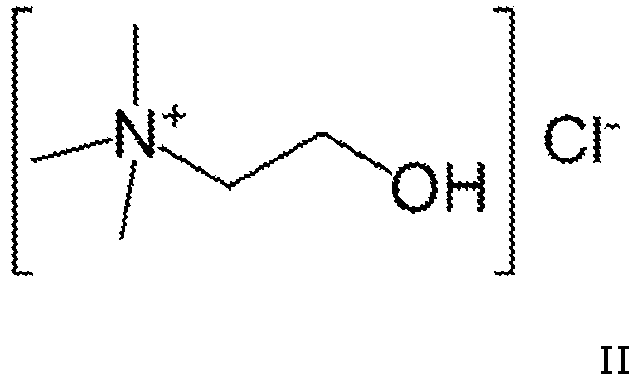
- Choline chloride known also as 2-hydroxy- N , N , N -trimethylethanaminium chloride or 2-hydroxyethyl-trimethylammonium chloride, is an example of said compounds and it has the following chemical formula II:
- boric acid refers here to H 3 BO 3 , an inorganic Lewis acid having melting point of 170.9°C. It is also called as hydrogen borate, boracic acid, ortho-boric acid and acidum boricum .
- betaine refers here to N,N,N-trimethyl glycine and salts thereof, having the following chemical formula III:
- cellulose or polysaccharide or polyphenol “dissolution” refers here to solubilization or dissolving of cellulose or polysaccharide or polyphenol, where at least part of said cellulose or polysaccharide or polyphenol is solubilized or dissolved and a solution and/or suspension is formed.
- cellulose solution refers here to cellulose dope or cellulose suspension or homogeneous viscoelastic suspension or specific lyotropic liquid crystal solution or isotropic solution.
- a (2-R-ethyl)-trimethylammonium salt forms a DES with a Lewis acid selected from boric acid, meta-boric acid, boronic acid, borinic acid, alkyl borates and hydrated borate salts and any combinations thereof, even without any added water.
- the DES comprises (2-R-ethyl)-trimethylammonium salt, or a mixture of said salts, and a Lewis acid selected from boric acid, meta-boric acid, boronic acid, borinic acid, alkyl borates and hydrated borate salts, and any combinations thereof.
- the group R is selected from OH, halogens, ester groups, ether groups and carbamoyl group.
- the halogens are selected from F, CI, I and Br; the ester groups are suitably selected form formyl, acetyl, isopropyl and butyryl groups.
- the R is OH, CI, acetyl or formyl group.
- the counter anion (X) in the salt can be an inorganic or organic counter anion.
- the inorganic salt is suitably a halogenide, sulphate or phosphate, preferably chloride salt.
- the organic salt is suitably acetate, lactate, butyrate or formiate.
- the (2-R-ethyl)-trimethylammonium salt is selected from choline chloride, acetylcholine chloride, and chlorocholine chloride.
- Choline chloride is a widely available material and it is used for example as low cost animal feed.
- the DES comprises a mol ratio from 5:1 to 1:1, preferably from 3:1 to 1:1 of the (2-R-ethyl)-trimethylammonium salt, or a mixture of said salts, and a Lewis acid, respectively.
- the DES may comprise water and/or betaine compound.
- the DES may comprise 0-50 wt%, preferably 0.01-50 wt%, more preferably 2-15 wt% of water, calculated from the total weight of the DES.
- the amount of water may be decreased for example by distillation, evaporation etc. or it may be increased during the manufacture of DES.
- the DES may comprise 0-50 wt%, preferably 0.01-50 wt%, more preferably 0.1-10 wt% and particularly preferably 0.1-3 wt% of a betaine compound, calculated from the total weight of the DES.
- Said betaine compound is selected from betaine and betaine aldehyde.
- the betaine compound may also be used as salt, such as betaine hydrochloride, and as betaine monohydrate and as anhydrous betaine..
- the pH of the DES is suitably at least 7.
- the method for the manufacture of said DES comprises the steps, where a (2-R-ethyl)-trimethylammonium salt or a mixture of said salts is mixed with a Lewis acid selected from boric acid, , meta-boric acid, boronic acid, borinic acid, alkyl borates and hydrated borate salts, and any combinations thereof.
- a Lewis acid selected from boric acid, , meta-boric acid, boronic acid, borinic acid, alkyl borates and hydrated borate salts, and any combinations thereof.
- the group R is selected from OH, halogens, ester groups, ether groups and carbamoyl group.
- the halogens are selected from F, CI, I and Br; the ester groups are suitably selected form formyl, acetyl, isopropyl and butyryl groups.
- the R is OH, CI, acetyl or formyl group.
- the counter anion (X) in the salt can be an inorganic or organic counter anion.
- the inorganic salt is suitably a halogenide, sulphate or phosphate, preferably chloride salt.
- the organic salt is suitably acetate, lactate, butyrate or formiate.
- the (2-R-ethyl)-trimethylammonium salt is selected from choline chloride, acetylcholine chloride, and chlorocholine chloride.
- the amounts of the components are selected to provide a mol ratio from 5:1 to 1:1, preferably from 3:1 to 1:1 of the (2-R-ethyl)-trimethylammonium salt and the Lewis acid, respectively.
- water may be added at any stage of the method, before or after mixing the (2-R-ethyl)-trimethylammonium salt with the Lewis acid. 0-50 wt%, preferably 0.01-50 wt%, more preferably 2-15 wt% of water, calculated from the total weight of the DES is added.
- the water may be tap water, ion exchanged water or purified water.
- Water may optionally be added in step-wise manner, preferably 50 wt% of water is added in the first step followed by mixing and adding the remaining 50 wt% in at least one step followed by mixing. The last added amount of water may be 2 wt%.
- a betaine compound is added to the mixture of the (2-R-ethyl)-trimethylammonium salt with a Lewis acid.
- Said betaine compound is selected from betaine and betaine aldehyde. 0-50 wt%, preferably 0.01-50 wt%, more preferably 0.1-10 wt% and particularly preferably 0.1-3 wt% of the betaine compound, calculated from the total weight of the DES is added.
- Betaine may be used as betaine hydrochloride or betaine monohydrate or as betaine anhydrate.
- the mixing may be carried out at a temperature of 20-100°C, preferably 40-95°C, particularly preferably 50-90°C. If no water is used, it may be necessary to use temperatures of at least 50°C, particularly when the moe ratio of the (2-R-ethyl)-trimethylammonium salt and the Lewis acid is from 3:2 to 1:1, respectively. It may also be necessary to keep the obtained DES at the temperature of at least 40°C for maintaining it in solution.
- the mixing may be carried out under a pressure from 100 mbar to 10 bar, suitably normal atmospheric pressure is used.
- the pH of the DES may optionally be adjusted with an organic or inorganic base to pH at least 7.
- the DES of the invention can be used for dissolving polysaccharides and/or natural polyphenols.
- Said DES based on (2-R-ethyl)-trimethylammonium salt or a mixture of said salts, and a Lewis acid selected from boric acid, meta-boric acid, boronic acid, borinic acid, alkyl borates and hydrated borate salts, and any combinations thereof, is cost effective and it has good dissolving efficiency.
- Dissolving of polysaccharides and/or natural polyphenols refers here to dissolving in general, but it includes also opening of the fiber structure, swelling, fibrillation and selective removal of hemicellulose. Thus some fibrilles may also be found in the dissolved polysaccharide product.
- Polysaccharides such as cellulose can be dissolved using the DES according to the invention, whereby regenerated cellulose can be produced without the need to use the NNMO or viscose processes.
- Man-made fiber from wood-based cellulose is considered as a sustainable alternative for cotton.
- the use of wood-based raw materials reduces sweet water consumption, particularly for irrigation, as well as occupation of agricultural land and the use of plant protection chemicals.
- This method for dissolving cellulose is environmentally friendly, economic and efficient way of providing dissolved cellulose.
- the dissolved cellulose may be further processed to various products, for example to cellulose fibers with methods known from viscose processing. Cellulose may be restored from the solution by adding water to the solution whereby cellulose is precipitated.
- the obtained solutions may be isotropic or anisotropic, depending on the temperature and the content of the polysaccharide, such as cellulose contained in the solution.
- the method for dissolving polysaccharides comprises the steps, where 0.1 - 50 wt% of a polysaccharide is mixed with 99.9 - 50 wt% of a DES according to the invention comprising (2-R-ethyl)-trimethylammonium salt or a mixture of said salts, and a Lewis acid selected from boric acid, meta-boric acid, boronic acid, borinic acid, alkyl borates and hydrated borate salts, and any combinations thereof, at a temperature of 20-150°C to obtain a polysaccharide solution.
- Said dissolving may be carried out under the pressure from 100 mbar to 10 bar. Typically a clear solution is obtained.
- Preferably 0.5-30 wt% of the polysaccharide is used in the method.
- the polysaccharide may comprise water. After or during the solubilization of the polysaccharide in the DES at least part of water may be removed using methods known in the art, such as evaporation.
- the DES may comprise 0-50 wt%, preferably 0.01-50 wt%, more preferably 2-15 wt% of water, calculated from the total weight of the DES. Water may prevent potential side reactions. The amount of water can be varied during the dissolution process.
- the DES may comprise 0-50 wt%, preferably 0.01-50 wt%, more preferably 0.1-10 wt% and particularly preferably 0.1-3 wt% of a betaine compound selected from betaine and betaine aldehyde, calculated from the total weight of the DES.
- chlorocholine chloride is used as an additional (2-R-ethyl)-trimethylammonium salt, it may be used in molar excess of 300-400% with respect to the polysaccharide.
- the mixing temperature is 50-90°C.
- the mixing is carried out for 15 min - 24 hours.
- the polysaccharide is suitably ground or milled prior to the dissolution step to obtain smaller particles, where by the dissolution time is shorter.
- the polysaccharide is suitably selected from cellulose, cellulose derivatives, starch, starch derivatives, xylanes, hemicelluloses, chitosans, pectins, maltodextrines, dextranes and lignocellulosic materials. Preferably polysaccharides are dissolved.
- Natural polyphenols are selected from lignins and tannins.
- the betaine compound may be added to the mixture of the DES and the polysaccharide, particularly in cases where the DES does not contain a betaine compound.
- the amount of the added betaine compound is 0.1-20 wt%, preferably 0.1 - 10 wt%, calculated from the mixture.
- betaine may be added as dry substance or as aqueous solution before or after the addition of the polysaccharide.
- the betaine compound may be used for enhancing the dissolution of the polysaccharide.
- the dissolved polysaccharide and/or natural polyphenols may be separated by precipitation with lower alcohol (C1-C5 alcohol), at temperatures below 25°C, suitably less than 10°C, whereby a precipitated product is obtained. Said product may be dried to obtain a powdery product.
- lower alcohol C1-C5 alcohol
- the pH of the mixture comprising the DES and polysaccharide and/or natural polyphenols, and optionally water and/or betaine may be adjusted to about 7-9 with an organic or inorganic base, such as alkali metal hydroxides or borates, alkaline earth metal hydroxides or borates, ammonium hydroxide, ammonium borate, ammonia gas, DBU (diazabicyclo undecene) pyridine, triethylamine or imidazole.
- an organic or inorganic base such as alkali metal hydroxides or borates, alkaline earth metal hydroxides or borates, ammonium hydroxide, ammonium borate, ammonia gas, DBU (diazabicyclo undecene) pyridine, triethylamine or imidazole.
- the betaine compound is used as a salt (hydrochloride), it is advantageous to liberate betaine with a base.
- water or a lower alcohol (C1-C5 alcohol) or mixtures thereof may be added for adjusting the viscosity of the polysaccharide and/or natural polyphenols solution.
- the DES according to the invention is particularly suitable for dissolving polysaccharides whereby the dissolved polysaccharides may be further used for the manufacture of regenerated cellulose products, fibers, films, flocculants, cosmetics, sizing compounds, fixatives, cleaning aids, detergents etc. Examples of such applications are film coatings, capsules and devices in drug delivery. Also special fibers comprising boron and suitable for the manufacture of fire-resistant structures and textiles may be obtained with the invention.
- the present invention provides several advantages.
- the new DES is an effective, low cost and environmentally acceptable solvent, which is particularly suitable for dissolving polysaccharides.
- the manufacture of said DES is simple, no residues are left and no specific equipment is needed.
- the boron component is stable, inert and easily recyclable.
- the dissolution process for dissolving polysaccharides and/or natural polyphenols may be carried out in a simple manner and it takes place rapidly.
- the components are recyclable, no harmful emissions are released.
- the method provides a new concept for providing dissolved cellulose, which may be utilized for example instead of the conventional viscose processes.
- the use of the DES of the invention incorporates nitrogen into the polysaccharide, and when additionally a betaine compound is used the nitrogen content in the dissolved polysaccharide may be even 3.4 wt%.
- solutions comprising the dissolved polysaccharides may also be obtained as highly viscous materials, which are particularly suitable for extrusion processes, film manufacture spinning of fibers and the like, where highly viscous materials are processed.
- the DES of the invention is also particularly useful in the manufacture of cellulose beads.
- the method of the invention for the manufacture of cellulose beads comprises the steps, where 0.1 - 50 wt% of cellulosic material is mixed with the deep eutectic solvent of the invention, to obtain a cellulosic suspension, followed by adding 1-10 wt% of water and mixing to obtain an aqueous mixture, followed by forcing the aqueous mixture through a nozzle drop-wise to an aqueous nitric acid solution whereby cellulose beads are formed, and washing the cellulose beads with water.
- the method for the manufacture of cellulose beads comprises the steps, where 0.1 - 50 wt% of cellulosic material is mixed with the DES of the invention, at a temperature of 20-150°C.
- a cellulosic suspension is obtained, which is followed by adding 1-10 wt% of water and mixing at a temperature of 20-150°C to obtain an aqueous mixture.
- the mixture is forced through a nozzle having an inner diameter in the range of 0.5-2 mm, drop-wise to an aqueous nitric acid solution whereby cellulose beads are formed, and washing the cellulose beads with water.
- Nitric acid solution is suitably 0.1-5 M solution.
- the cellulosic material is solubilized in the DES by warming the mixture at elevated temperature for 5-30 hours. After the water is added the mixture is suitably stirred for 10 min to 5 hours.
- the mixture is forced using increased pressure of 0.1-10 bar.
- the method is carried out at the temperature of 10 - 40°C.
- the cellulose beads are suitably left in nitric acid for 30 min to 5 h to ensure complete coagulation, followed by washing.
- the washing is suitably carried out using tap water and then with distilled water until the pH of the mixture remains constant. After the washing procedure the cellulose beads remain inert to mixing and are not dissociated upon mechanical stirring.
- the cellulosic material may comprise a wide variety of cellulose based materials. Pulp derived from wood pulp and pulp from other natural sources may be used, such as kenaf, straw, acaba, coir, flax, jute, kapok, raffia, bamboo, hemp, modal, pine, ramie, sisal etc. may be used. Softwood pulps and hardwood pulps and mixtures thereof are suitable for the present process.
- Mechanically treated pulp fibers such as chemithermomechanical pulp fibers (CTMP), bleached chemithermomechanical pulp fibers (BCTMP), thermomechanical pulp fibers (TMP), refiner groundwood pulp fibers, groundwood pulp fibers, enzymatically treated pulp, cellulose, cellulose derivatives, enzymatically treated cellulose, and combinations thereof may be used.
- CMP chemithermomechanical pulp fibers
- BCTMP bleached chemithermomechanical pulp fibers
- TMP thermomechanical pulp fibers
- refiner groundwood pulp fibers groundwood pulp fibers
- groundwood pulp fibers enzymatically treated pulp
- cellulose cellulose derivatives
- enzymatically treated cellulose and combinations thereof
- wood-based lignocellulose materials are used.
- the method for the manufacture of cellulose beads according to the invention does not require any acidic pre-treatments, because boric acid is already present in the deep eutectic solvent mixture.
- the price of the DES is low, and the mixture is environmentally friendly.
- the method is also economic and simple.
- the obtained cellulose beads find use in chromatography, solid supported synthesis and protein immobilization, as well as in encapsulation applications in the field of agricultural products and paint applications.
- the DES of the invention is also particularly useful in the manufacture of cellulose absorbent.
- the method according to the invention for the manufacture of cellulose absorbent comprises the steps where 1-50 wt% of cellulosic material is mixed with the deep eutectic solvent according to the invention, to obtain a homogeneous cellulosic suspension, followed by adding water to the suspension, whereby a mixture comprising precipitation is formed, followed by filtrating the mixture and washing with water and freeze-drying the obtained solid material.
- the method for the manufacture of cellulose absorbent comprises the steps where 1-50 wt% of cellulosic material is mixed with the deep eutectic according to the invention, at a temperature of 50-120°C to obtain a homogeneous cellulosic suspension. This is followed by adding water to the suspension to disrupt the formulation and to hydrate the cellulose polymers and DES components, whereby a mixture comprising precipitation is formed, followed by filtrating the mixture and washing with water and freeze-drying the obtained solid material.
- the cellulosic material may comprise a wide variety of cellulose based materials. Pulp derived from wood pulp and pulp from other natural sources is suitably used, such as kenaf, straw, acaba, coir, flax, jute, kapok, raffia, bamboo, hemp, modal, pine, ramie, sisal etc. may be used. Softwood pulps and hardwood pulps and mixtures thereof are suitable for the present process.
- Mechanically treated pulp fibers such as chemithermomechanical pulp fibers (CTMP), bleached chemithermomechanical pulp fibers (BCTMP), thermomechanical pulp fibers (TMP), refiner groundwood pulp fibers, groundwood pulp fibers, enzymatically treated pulp, cellulose, cellulose derivatives, enzymatically treated cellulose, and combinations thereof may be used.
- CMP chemithermomechanical pulp fibers
- BCTMP bleached chemithermomechanical pulp fibers
- TMP thermomechanical pulp fibers
- refiner groundwood pulp fibers groundwood pulp fibers
- groundwood pulp fibers enzymatically treated pulp
- cellulose cellulose derivatives
- enzymatically treated cellulose and combinations thereof
- wood-based lignocellulose materials are used.
- the cellulose material is preferably washed with water prior to drying.
- the drying is preferably carried out using freeze-drying, whereby the dry product comprises a porous and spongy structure.
- the spongy product is insoluble in water.
- methyltrimethoxysilane in a molar ratio of 0-10 with regard to anhydroglucose units may be added to the cellulosic suspension prior to the water addition.
- a cellulose absorbent with surprisingly good oil adsorbing qualities is obtained.
- Dodecane and silica oil are generally used as suitable model compounds for oil adsorbency. Samples of the cellulose absorbent product were tested and the oil absorption capacity was calculated from the mass of the oil adsorbed into the sample. The highest value for absorption capacity was 43.2g (dodecane) and 39.4g (silica oil), with silyl treated sample 50.8g (dodecane).
- Oil can be removed from the cellulose absorbent by squeezing or pressing.
- the cellulose absorbent retains its form, and this can be enhanced with additional drying.
- the cellulose absorbent material can be used for absorbing water-immiscible or water insoluble liquids, particularly oils and oily materials. It is reusable, cost-effective and environmentally sustainable material.
- the cellulose absorbent material can be also used to collect oil from water and from the surface of water. Water is typically initially slightly adsorbed into the material, but when the material is squeezed lightly, water drips away but oil is mostly still attached in to the sample.
- the method for the manufacture of the cellulose absorbent material is cost efficient and simple, there is no need for the use of toxic chemicals or multistep processes.
- the cellulose absorbent material is highly porous, cellulose-based and biodegradable, and causes no difficulties if used in natural waters.
- DES was manufactured as instructed in example 1. 14.77 g (0.24 mol) of boric acid and 100.0 g of choline chloride (0.72 mol) were mixed thoroughly with a mechanical laboratory mixer. 5 ml of water was added to the mixture and the temperature increased to 60°C. A clear DES solution was formed in 1-2 hours.
- DES consisting of 2:3 boric acid: choline chloride
- choline chloride was prepared by combining 22.2 g of boric acid and 100g of choline chloride and heating the mixture at 80°C for 4-6 hours. 5 weight% of dissolving pulppulp was then solubilized to the DES by warming the mixture at 80°C for 8 hours. Then 5 weight% of water was added to this mixture and stirring continued at 80°C for one hour. The mixture was then forced using increased pressure dropwise through a 50 mm long needle with inner diameter of 0.8 mm into 2 M nitric acid at room temperature to obtain cellulose beads.
- the beads were left in nitric acid for 2 h to ensure complete coagulation and washed at least 4 h under running tap water and with several washing cycles using distilled water until the pH of the mixture was neutral. After the washing procedure, the beads remained inert to mixing and were not dissociated upon mechanical stirring.
- DES consisting of 2:3 (or 1:3) boric acid: choline chloride was prepared by combining 22.2 g of boric acid and 100g of choline chloride and heating the mixture at 80°C for 4-6 hours. 5 weight% of dissolving pulp was then solubilized to the DES by warming the mixture at 80°C for 8 hours. Then excess of water weight% of water was added to this mixture and stirred, whereby the cellulose material was precipitated, rinsed with water and then freeze-dried, and a water-insoluble "sponge" is obtained.
- the material was also used to "fish" dodecane from water. It could be clearly seen that dodecane was attached into the material and water has no strong adsorption. Water is initially slightly adsorbed into the material, but when the material is squeezed lightly, water drips away but dodecane is mostly still attached in to the sample.
Landscapes
- Chemical & Material Sciences (AREA)
- Organic Chemistry (AREA)
- Chemical Kinetics & Catalysis (AREA)
- Engineering & Computer Science (AREA)
- Polymers & Plastics (AREA)
- Analytical Chemistry (AREA)
- Materials Engineering (AREA)
- Medicinal Chemistry (AREA)
- Life Sciences & Earth Sciences (AREA)
- Health & Medical Sciences (AREA)
- Biochemistry (AREA)
- Inorganic Chemistry (AREA)
- Hydrology & Water Resources (AREA)
- Environmental & Geological Engineering (AREA)
- Water Supply & Treatment (AREA)
- Physics & Mathematics (AREA)
- Thermal Sciences (AREA)
- Processes Of Treating Macromolecular Substances (AREA)
- Polysaccharides And Polysaccharide Derivatives (AREA)
Description
- The present invention relates to deep eutectic solvents, to their manufacture and use in the dissolution of polysaccharides, in the manufacture of cellulose beads, in the manufacture of cellulose absorbent, and to a method for dissolving polysaccharides and/or natural polyphenols, to a method for the manufacture of cellulose beads and to a method for the manufacture of cellulose absorbent.
- An ionic liquid is a salt in the liquid state. Typically ionic liquids refer to salts having melting point below 100°C. Ordinary liquids, such as water and gasoline are predominantly composed of neutral molecules, but ionic liquids are made of ions and short lived ion-pairs.
- Deep eutectic solvents (DES) are a sub-class of ionic liquids with special properties. DES is composed of a mixture which forms a eutectic with a melting point much lower than any of the individual components. The first generation eutectic solvents were based on mixtures of quaternary ammonium salts with hydrogen donors, such as amines and carboxylic acids. The deep eutectic phenomenon was first described in 2003 for a mixture of choline chloride and urea in a 1:2 mole ratio, respectively. Choline chloride has a melting point of 302°C and that of urea is 133°C. The eutectic mixture melts at 12°C.
- A eutectic mixture formed of choline chloride and urea has been studied in cellulose modifications and dissolution, however only modest concentrations of cellulose of less than 4 wt% were dissolved in said mixture. Also combinations of choline chloride with malonic acid or glycerol have been tested, but so far no mixtures have been reported, which are able to dissolve more than 5 wt% of cellulose.
- Typically many polysaccharides are difficult to dissolve. An example of such polysaccharides is cellulose, which is used for example as starting material in the manufacture of regenerated cellulose. Particularly homogeneous processing of cellulose is challenging due to low or negligible solubility of cellulose in water or most organic solvents. Various methods have been developed for dissolving cellulose and the main industrial processes for the manufacture of regenerated cellulose via cellulose dissolution are the traditional derivatization viscose process based cellulose xanthate derivative, and the non-derivatization (Lyocell) process based on interaction with NMMO (N-methyl-morpholine-N-oxide). Both of these methods are associated with environmental, technical and/or economical disadvantages.
- Also ionic solvents have been proposed for dissolving lignocellulosic materials, but they are often harmful or toxic and very expensive for industrial use on a larger scale. Thus improved methods and solvent systems for dissolving cellulose are needed.
- Cellulose beads are spherical particles with diameters in the micro- to millimeter scale. Cellulose beads are used in many advanced applications ranging from chromatography over solid supported synthesis and protein immobilization to controlled drug release. Over the last decades, various procedures for the preparation of cellulose beads have been reported, including the use of different solvents, shaping techniques, and technical devices for large batch production. Functional materials for specific applications have been prepared by introducing numerous chemical functionalities or blending cellulose with organic and inorganic compounds. In addition, commercial cellulose bead products with defined properties are available. However, the methods for producing the beads have involved the use of complicated solubilization processes for cellulose, such as freezing the material and solubilizing in NaOH/urea mixtures or ionic liquids. Additionally, these methods have demanded laborious pre-treatment methods such as acid hydrolysis, homogenization etc. The price of cellulose beads manufactured by these methods is typically very high, thus limiting their use.
- Because of the growth of offshore oil production and transportation, the probability of oil spill accidents has dramatically increased over the past several decades. Conventional methods currently employed for oil spill cleanup typically involve (i) dispersing the oil phase in water with the help of dispersing agents to facilitate natural degradation, (ii) burning the floating oil in situ, and (iii) extracting the oil phase from the water surface using a sorbent. Among these alternatives, the removal of oil by sorbent materials is considered to be the most efficient, economical, and ecological as the pollutant can be properly discarded and no secondary pollution is created. Several criteria should be met for a material to be used as an oil absorbent, including high oil absorption capacity and oil/water selectivity, fast oil sorption rate, high floatability (hence a low density), low cost, environmentally friendliness, and recyclability.
- A wide range of sorbents have been proposed so far, from organic synthetic products elaborated from polypropylene or polystyrene to inorganic mineral materials, including organophilic clays, silica aerogels, and exfoliated graphite. However, the oil absorption capacity of organic absorbents is generally limited, and the production costs associated with inorganic sorbents, such as silica aerogels and exfoliated graphite remain too high to envisage their widespread application as depolluting agents. Moreover, none of these materials is biodegradable. There is a clear need for cheap and biodegradable oil adsorbents that are water-insoluble.
- Despite the ongoing research and development there is a need for more effective solvent systems and particularly eutectic solvents, having improved dissolving properties, low toxicity and low cost. There is also a need for improved processes for improved processes for the dissolution of polysaccharides.
- An object of the invention is to provide new deep eutectic solvents.
- Another object of the invention is to provide a method for the manufacture of the deep eutectic solvents.
- Another object of the invention is to provide uses of said new deep eutectic solvents, particularly in the field of dissolution of polysaccharides and/or natural polyphenols.
- A still another object of the invention is to provide a method where polysaccharides can be dissolved effectively and economically.
- Thus the present invention relates to new deep eutectic solvents comprising a (2-R-ethyl)-trimethylammonium salt or a mixture of said salts, and a Lewis acid selected from boric acid, meta-boric acid, boronic acid, borinic acid, alkyl borates and hydrated borate salts.
- The present invention also relates to the method for the manufacture of the deep eutectic solvents.
- The present invention also relates to the use of the new deep eutectic solvents in the dissolution of polysaccharides and/or natural polyphenols.
- The present invention also relates to a method for dissolving polysaccharides and/or natural polyphenols.
- The present invention also relates to a method for the manufacture of cellulose beads, which method comprises the steps where 0.1 - 50 wt% of cellulosic material is mixed with the deep eutectic solvent according to any one of claims 1-7, to obtain a cellulosic suspension, followed by adding 1-10 wt% of water and mixing to obtain an aqueous mixture, followed by forcing the aqueous mixture through a nozzle drop-wise to an aqueous nitric acid solution whereby cellulose beads are formed, and washing the cellulose beads with water.
- The present invention also relates to a method for the manufacture of cellulose absorbent, which method comprises the steps where 1-50 wt% of cellulosic material is mixed with the deep eutectic solvent according to any one of claims 1-7, to obtain a homogeneous cellulosic suspension, followed by adding water to the suspension, whereby a mixture comprising precipitation is formed, followed by filtrating the mixture and washing with water and freeze-drying the obtained solid material.
- Characteristic features of the invention are presented in the appended claims.
- The term "(2-R-ethyl)-trimethylammonium salt" refers here to compound having chemical formula I below, including inorganic and organic salts of said compound. R is selected from OH, halogens, ester groups, ether groups and carbamoyl group.

- Choline chloride, known also as 2-hydroxy-N,N,N-trimethylethanaminium chloride or 2-hydroxyethyl-trimethylammonium chloride, is an example of said compounds and it has the following chemical formula II:
- The term "boric acid" refers here to H3BO3, an inorganic Lewis acid having melting point of 170.9°C. It is also called as hydrogen borate, boracic acid, ortho-boric acid and acidum boricum.
- The term "betaine" refers here to N,N,N-trimethyl glycine and salts thereof, having the following chemical formula III:

- The term cellulose or polysaccharide or polyphenol "dissolution" refers here to solubilization or dissolving of cellulose or polysaccharide or polyphenol, where at least part of said cellulose or polysaccharide or polyphenol is solubilized or dissolved and a solution and/or suspension is formed.
- The term "cellulose solution" refers here to cellulose dope or cellulose suspension or homogeneous viscoelastic suspension or specific lyotropic liquid crystal solution or isotropic solution.
- It was surprisingly found that a (2-R-ethyl)-trimethylammonium salt, or a mixture of said salts, forms a DES with a Lewis acid selected from boric acid, meta-boric acid, boronic acid, borinic acid, alkyl borates and hydrated borate salts and any combinations thereof, even without any added water.
- The DES comprises (2-R-ethyl)-trimethylammonium salt, or a mixture of said salts, and a Lewis acid selected from boric acid, meta-boric acid, boronic acid, borinic acid, alkyl borates and hydrated borate salts, and any combinations thereof.
- In the (2-R-ethyl)-trimethylammonium salt the group R is selected from OH, halogens, ester groups, ether groups and carbamoyl group. The halogens are selected from F, CI, I and Br; the ester groups are suitably selected form formyl, acetyl, isopropyl and butyryl groups. Preferably the R is OH, CI, acetyl or formyl group.
- The counter anion (X) in the salt can be an inorganic or organic counter anion. The inorganic salt is suitably a halogenide, sulphate or phosphate, preferably chloride salt. The organic salt is suitably acetate, lactate, butyrate or formiate.
- Preferably the (2-R-ethyl)-trimethylammonium salt is selected from choline chloride, acetylcholine chloride, and chlorocholine chloride. Choline chloride is a widely available material and it is used for example as low cost animal feed.
- The DES comprises a mol ratio from 5:1 to 1:1, preferably from 3:1 to 1:1 of the (2-R-ethyl)-trimethylammonium salt, or a mixture of said salts, and a Lewis acid, respectively.
- Optionally the DES may comprise water and/or betaine compound.
- The DES may comprise 0-50 wt%, preferably 0.01-50 wt%, more preferably 2-15 wt% of water, calculated from the total weight of the DES. The amount of water may be decreased for example by distillation, evaporation etc. or it may be increased during the manufacture of DES.
- The DES may comprise 0-50 wt%, preferably 0.01-50 wt%, more preferably 0.1-10 wt% and particularly preferably 0.1-3 wt% of a betaine compound, calculated from the total weight of the DES. Said betaine compound is selected from betaine and betaine aldehyde. The betaine compound may also be used as salt, such as betaine hydrochloride, and as betaine monohydrate and as anhydrous betaine..
- The pH of the DES is suitably at least 7.
- The method for the manufacture of said DES comprises the steps, where a (2-R-ethyl)-trimethylammonium salt or a mixture of said salts is mixed with a Lewis acid selected from boric acid, , meta-boric acid, boronic acid, borinic acid, alkyl borates and hydrated borate salts, and any combinations thereof.
- In the (2-R-ethyl)-trimethylammonium salt the group R is selected from OH, halogens, ester groups, ether groups and carbamoyl group. The halogens are selected from F, CI, I and Br; the ester groups are suitably selected form formyl, acetyl, isopropyl and butyryl groups. Preferably the R is OH, CI, acetyl or formyl group.
- The counter anion (X) in the salt can be an inorganic or organic counter anion. The inorganic salt is suitably a halogenide, sulphate or phosphate, preferably chloride salt. The organic salt is suitably acetate, lactate, butyrate or formiate.
- Preferably the (2-R-ethyl)-trimethylammonium salt is selected from choline chloride, acetylcholine chloride, and chlorocholine chloride.
- In the method the amounts of the components are selected to provide a mol ratio from 5:1 to 1:1, preferably from 3:1 to 1:1 of the (2-R-ethyl)-trimethylammonium salt and the Lewis acid, respectively.
- Optionally water may be added at any stage of the method, before or after mixing the (2-R-ethyl)-trimethylammonium salt with the Lewis acid. 0-50 wt%, preferably 0.01-50 wt%, more preferably 2-15 wt% of water, calculated from the total weight of the DES is added. The water may be tap water, ion exchanged water or purified water. Water may optionally be added in step-wise manner, preferably 50 wt% of water is added in the first step followed by mixing and adding the remaining 50 wt% in at least one step followed by mixing. The last added amount of water may be 2 wt%.
- Optionally a betaine compound is added to the mixture of the (2-R-ethyl)-trimethylammonium salt with a Lewis acid. Said betaine compound is selected from betaine and betaine aldehyde. 0-50 wt%, preferably 0.01-50 wt%, more preferably 0.1-10 wt% and particularly preferably 0.1-3 wt% of the betaine compound, calculated from the total weight of the DES is added.
- Betaine may be used as betaine hydrochloride or betaine monohydrate or as betaine anhydrate.
- In the method the mixing may be carried out at a temperature of 20-100°C, preferably 40-95°C, particularly preferably 50-90°C. If no water is used, it may be necessary to use temperatures of at least 50°C, particularly when the moe ratio of the (2-R-ethyl)-trimethylammonium salt and the Lewis acid is from 3:2 to 1:1, respectively. It may also be necessary to keep the obtained DES at the temperature of at least 40°C for maintaining it in solution. The mixing may be carried out under a pressure from 100 mbar to 10 bar, suitably normal atmospheric pressure is used.
- The pH of the DES may optionally be adjusted with an organic or inorganic base to pH at least 7.
- The present inventors found that the DES of the invention can be used for dissolving polysaccharides and/or natural polyphenols. Said DES, based on (2-R-ethyl)-trimethylammonium salt or a mixture of said salts, and a Lewis acid selected from boric acid, meta-boric acid, boronic acid, borinic acid, alkyl borates and hydrated borate salts, and any combinations thereof, is cost effective and it has good dissolving efficiency.
- Dissolving of polysaccharides and/or natural polyphenols refers here to dissolving in general, but it includes also opening of the fiber structure, swelling, fibrillation and selective removal of hemicellulose. Thus some fibrilles may also be found in the dissolved polysaccharide product.
- Polysaccharides, such as cellulose can be dissolved using the DES according to the invention, whereby regenerated cellulose can be produced without the need to use the NNMO or viscose processes. Man-made fiber from wood-based cellulose is considered as a sustainable alternative for cotton. The use of wood-based raw materials reduces sweet water consumption, particularly for irrigation, as well as occupation of agricultural land and the use of plant protection chemicals. This method for dissolving cellulose is environmentally friendly, economic and efficient way of providing dissolved cellulose. The dissolved cellulose may be further processed to various products, for example to cellulose fibers with methods known from viscose processing. Cellulose may be restored from the solution by adding water to the solution whereby cellulose is precipitated.
- The obtained solutions may be isotropic or anisotropic, depending on the temperature and the content of the polysaccharide, such as cellulose contained in the solution.
- The method for dissolving polysaccharides comprises the steps, where 0.1 - 50 wt% of a polysaccharide is mixed with 99.9 - 50 wt% of a DES according to the invention comprising (2-R-ethyl)-trimethylammonium salt or a mixture of said salts, and a Lewis acid selected from boric acid, meta-boric acid, boronic acid, borinic acid, alkyl borates and hydrated borate salts, and any combinations thereof, at a temperature of 20-150°C to obtain a polysaccharide solution. Said dissolving may be carried out under the pressure from 100 mbar to 10 bar. Typically a clear solution is obtained.
- Preferably 0.5-30 wt% of the polysaccharide is used in the method.
- The polysaccharide may comprise water. After or during the solubilization of the polysaccharide in the DES at least part of water may be removed using methods known in the art, such as evaporation.
- The DES may comprise 0-50 wt%, preferably 0.01-50 wt%, more preferably 2-15 wt% of water, calculated from the total weight of the DES. Water may prevent potential side reactions. The amount of water can be varied during the dissolution process.
- The DES may comprise 0-50 wt%, preferably 0.01-50 wt%, more preferably 0.1-10 wt% and particularly preferably 0.1-3 wt% of a betaine compound selected from betaine and betaine aldehyde, calculated from the total weight of the DES.
- In the case chlorocholine chloride is used as an additional (2-R-ethyl)-trimethylammonium salt, it may be used in molar excess of 300-400% with respect to the polysaccharide.
- Preferably the mixing temperature is 50-90°C.
- Preferably the mixing is carried out for 15 min - 24 hours.
- The polysaccharide is suitably ground or milled prior to the dissolution step to obtain smaller particles, where by the dissolution time is shorter.
- The polysaccharide is suitably selected from cellulose, cellulose derivatives, starch, starch derivatives, xylanes, hemicelluloses, chitosans, pectins, maltodextrines, dextranes and lignocellulosic materials. Preferably polysaccharides are dissolved.
- Natural polyphenols are selected from lignins and tannins.
- Optionally the betaine compound may be added to the mixture of the DES and the polysaccharide, particularly in cases where the DES does not contain a betaine compound. The amount of the added betaine compound is 0.1-20 wt%, preferably 0.1 - 10 wt%, calculated from the mixture.
- Alternatively betaine may be added as dry substance or as aqueous solution before or after the addition of the polysaccharide.
- The betaine compound may be used for enhancing the dissolution of the polysaccharide.
- The dissolved polysaccharide and/or natural polyphenols may be separated by precipitation with lower alcohol (C1-C5 alcohol), at temperatures below 25°C, suitably less than 10°C, whereby a precipitated product is obtained. Said product may be dried to obtain a powdery product.
- Optionally the pH of the mixture comprising the DES and polysaccharide and/or natural polyphenols, and optionally water and/or betaine, may be adjusted to about 7-9 with an organic or inorganic base, such as alkali metal hydroxides or borates, alkaline earth metal hydroxides or borates, ammonium hydroxide, ammonium borate, ammonia gas, DBU (diazabicyclo undecene) pyridine, triethylamine or imidazole. When the betaine compound is used as a salt (hydrochloride), it is advantageous to liberate betaine with a base.
Optionally the pH of the mixture comprising the DES and optionally water and/or betaine may be adjusted to about 7-9 with an organic or inorganic base prior to the addition of the polysaccharide and/or natural polyphenols. - Optionally water or a lower alcohol (C1-C5 alcohol) or mixtures thereof may be added for adjusting the viscosity of the polysaccharide and/or natural polyphenols solution.
- The DES according to the invention is particularly suitable for dissolving polysaccharides whereby the dissolved polysaccharides may be further used for the manufacture of regenerated cellulose products, fibers, films, flocculants, cosmetics, sizing compounds, fixatives, cleaning aids, detergents etc. Examples of such applications are film coatings, capsules and devices in drug delivery. Also special fibers comprising boron and suitable for the manufacture of fire-resistant structures and textiles may be obtained with the invention.
- The present invention provides several advantages. The new DES is an effective, low cost and environmentally acceptable solvent, which is particularly suitable for dissolving polysaccharides.
- The manufacture of said DES is simple, no residues are left and no specific equipment is needed. The boron component is stable, inert and easily recyclable.
- The dissolution process for dissolving polysaccharides and/or natural polyphenols may be carried out in a simple manner and it takes place rapidly. The components are recyclable, no harmful emissions are released. The method provides a new concept for providing dissolved cellulose, which may be utilized for example instead of the conventional viscose processes.
- The use of the DES of the invention incorporates nitrogen into the polysaccharide, and when additionally a betaine compound is used the nitrogen content in the dissolved polysaccharide may be even 3.4 wt%.
- The solutions comprising the dissolved polysaccharides may also be obtained as highly viscous materials, which are particularly suitable for extrusion processes, film manufacture spinning of fibers and the like, where highly viscous materials are processed.
- The DES of the invention is also particularly useful in the manufacture of cellulose beads.
- The method of the invention for the manufacture of cellulose beads comprises the steps, where 0.1 - 50 wt% of cellulosic material is mixed with the deep eutectic solvent of the invention, to obtain a cellulosic suspension, followed by adding 1-10 wt% of water and mixing to obtain an aqueous mixture, followed by forcing the aqueous mixture through a nozzle drop-wise to an aqueous nitric acid solution whereby cellulose beads are formed, and washing the cellulose beads with water.
- The method for the manufacture of cellulose beads comprises the steps, where 0.1 - 50 wt% of cellulosic material is mixed with the DES of the invention, at a temperature of 20-150°C. A cellulosic suspension is obtained, which is followed by adding 1-10 wt% of water and mixing at a temperature of 20-150°C to obtain an aqueous mixture. The mixture is forced through a nozzle having an inner diameter in the range of 0.5-2 mm, drop-wise to an aqueous nitric acid solution whereby cellulose beads are formed, and washing the cellulose beads with water. Nitric acid solution is suitably 0.1-5 M solution. Suitably the cellulosic material is solubilized in the DES by warming the mixture at elevated temperature for 5-30 hours. After the water is added the mixture is suitably stirred for 10 min to 5 hours.
- According to a preferable embodiment the mixture is forced using increased pressure of 0.1-10 bar.
- According to a preferable embodiment the method is carried out at the temperature of 10 - 40°C.
- The cellulose beads are suitably left in nitric acid for 30 min to 5 h to ensure complete coagulation, followed by washing. The washing is suitably carried out using tap water and then with distilled water until the pH of the mixture remains constant. After the washing procedure the cellulose beads remain inert to mixing and are not dissociated upon mechanical stirring.
- The cellulosic material may comprise a wide variety of cellulose based materials. Pulp derived from wood pulp and pulp from other natural sources may be used, such as kenaf, straw, acaba, coir, flax, jute, kapok, raffia, bamboo, hemp, modal, pine, ramie, sisal etc. may be used. Softwood pulps and hardwood pulps and mixtures thereof are suitable for the present process. Mechanically treated pulp fibers, chemically treated pulp fibers and chemimechanically treated pulp fibers, such as chemithermomechanical pulp fibers (CTMP), bleached chemithermomechanical pulp fibers (BCTMP), thermomechanical pulp fibers (TMP), refiner groundwood pulp fibers, groundwood pulp fibers, enzymatically treated pulp, cellulose, cellulose derivatives, enzymatically treated cellulose, and combinations thereof may be used.
- Preferably wood-based lignocellulose materials are used.
- The method for the manufacture of cellulose beads according to the invention does not require any acidic pre-treatments, because boric acid is already present in the deep eutectic solvent mixture. The price of the DES is low, and the mixture is environmentally friendly. The method is also economic and simple.
- The obtained cellulose beads find use in chromatography, solid supported synthesis and protein immobilization, as well as in encapsulation applications in the field of agricultural products and paint applications.
- The DES of the invention is also particularly useful in the manufacture of cellulose absorbent.
- The method according to the invention for the manufacture of cellulose absorbent comprises the steps where 1-50 wt% of cellulosic material is mixed with the deep eutectic solvent according to the invention, to obtain a homogeneous cellulosic suspension, followed by adding water to the suspension, whereby a mixture comprising precipitation is formed, followed by filtrating the mixture and washing with water and freeze-drying the obtained solid material.
- The method for the manufacture of cellulose absorbent comprises the steps where 1-50 wt% of cellulosic material is mixed with the deep eutectic according to the invention, at a temperature of 50-120°C to obtain a homogeneous cellulosic suspension. This is followed by adding water to the suspension to disrupt the formulation and to hydrate the cellulose polymers and DES components, whereby a mixture comprising precipitation is formed, followed by filtrating the mixture and washing with water and freeze-drying the obtained solid material.
- The cellulosic material may comprise a wide variety of cellulose based materials. Pulp derived from wood pulp and pulp from other natural sources is suitably used, such as kenaf, straw, acaba, coir, flax, jute, kapok, raffia, bamboo, hemp, modal, pine, ramie, sisal etc. may be used. Softwood pulps and hardwood pulps and mixtures thereof are suitable for the present process. Mechanically treated pulp fibers, chemically treated pulp fibers and chemimechanically treated pulp fibers, such as chemithermomechanical pulp fibers (CTMP), bleached chemithermomechanical pulp fibers (BCTMP), thermomechanical pulp fibers (TMP), refiner groundwood pulp fibers, groundwood pulp fibers, enzymatically treated pulp, cellulose, cellulose derivatives, enzymatically treated cellulose, and combinations thereof may be used.
- Preferably wood-based lignocellulose materials are used.
- In the method excess of water is added to the homogeneous cellulosic suspension to disrupt the formulation and to hydrate the cellulose polymers and DES components, whereby a precipitation is formed. The aqueous mixture is then filtrated and cellulose is subsequently carefully washed to remove residual DES components. Finally, the cellulose material is freeze-dried to obtain cellulose absorbent material.
- The cellulose material is preferably washed with water prior to drying.
- The drying is preferably carried out using freeze-drying, whereby the dry product comprises a porous and spongy structure. The spongy product is insoluble in water.
- Optionally, methyltrimethoxysilane in a molar ratio of 0-10 with regard to anhydroglucose units may be added to the cellulosic suspension prior to the water addition.
- A cellulose absorbent with surprisingly good oil adsorbing qualities is obtained.
- Dodecane and silica oil are generally used as suitable model compounds for oil adsorbency. Samples of the cellulose absorbent product were tested and the oil absorption capacity was calculated from the mass of the oil adsorbed into the sample. The highest value for absorption capacity was 43.2g (dodecane) and 39.4g (silica oil), with silyl treated sample 50.8g (dodecane).
- Oil can be removed from the cellulose absorbent by squeezing or pressing. The cellulose absorbent retains its form, and this can be enhanced with additional drying.
- The cellulose absorbent material can be used for absorbing water-immiscible or water insoluble liquids, particularly oils and oily materials. It is reusable, cost-effective and environmentally sustainable material.
- The cellulose absorbent material can be also used to collect oil from water and from the surface of water. Water is typically initially slightly adsorbed into the material, but when the material is squeezed lightly, water drips away but oil is mostly still attached in to the sample.
- The method for the manufacture of the cellulose absorbent material is cost efficient and simple, there is no need for the use of toxic chemicals or multistep processes. The cellulose absorbent material is highly porous, cellulose-based and biodegradable, and causes no difficulties if used in natural waters.
- The invention will now be illustrated with the following examples.
- 14.77 g (0.24 mol) of boric acid and 100.0 g of choline chloride (0.72 mol) were mixed thoroughly with a mechanical laboratory mixer. 5 ml of water (4 wt%) was added to the mixture and the temperature was increased to 60°C. A clear DES solution was formed in 1-2 hours.
- 5.0 g (4 wt%) of freeze-dried birch pulp cellulose (0.03 mol of OH groups) was added to the DES solution obtained in example 1 and temperature was increased to 80°C. A viscous cellulose dope was formed during 3-4 hours.
- To the cellulose solution obtained in example 2, 1.0 g of sodium hydroxide (25 mmol) dissolved in 1.0 ml of water and 2.0 g of betaine hydrochloride (13 mmol) were added. Viscosity of the solution decreased after one hour of the addition. The product was precipitated using 500ml of cold ethanol, filtered and dialyzed against water for 48 hours with a membrane (cutoff 3000) and freeze-dried, the final cellulose product contained 2.4 wt% of nitrogen as analysed by using Kjehldahl titration.
- 29.54 g (0.48 mol) of boric acid and 100.0 g of choline chloride (0.72 mol) were mixed thoroughly with a mechanical laboratory mixer. The temperature was increased to 80°C. A clear DES solution was formed during one hour.
- 5.0 g (4 wt%) of freeze-dried birch pulp cellulose (0.03 mol of OH groups) was added to the DES solution obtained in example 4 at 80°C. A viscous solution was formed during 3-4 hours.
- 10.0 g (7 wt%) of cellulose was added to the DES obtained in example 4 and temperature was increased to 80°C. A viscous gel was formed during 3-4 hours. 0.35 g of sodium hydroxide (8.75 mmol) dissolved in 0.5 ml of water and 1.0 g of betaine (8.5 mmol) were added to the mixture. After one hour of mixing at ambient temperature, the viscosity decreased and mixing enhanced remarkably when examined visually. The product was precipitated using 500ml of cold ethanol, filtered and dialyzed against water for 48 hours with a membrane (cutoff 3000) and freeze-dried, the final cellulose product contained 1.57 wt% of nitrogen as analysed by using Kjehldahl titration.
- DES was manufactured as instructed in example 1. 14.77 g (0.24 mol) of boric acid and 100.0 g of choline chloride (0.72 mol) were mixed thoroughly with a mechanical laboratory mixer. 5 ml of water was added to the mixture and the temperature increased to 60°C. A clear DES solution was formed in 1-2 hours.
- 5.0 g (4 wt%) of potato starch (0.03 mol of OH groups) was added to the obtained DES solution and temperature was increased to 80°C. A viscous, clear potato starch solution was formed during 3-4 hours.
- To the potato starch solution obtained in example 7, 1.0 g of sodium hydroxide (25.0 mmol) dissolved in 1.0 ml of water and 5.0 g of betaine (42.5 mmol) were added to the mixture. After one hour of mixing at ambient temperature, the viscosity decreased and mixing enhanced remarkably when examined visually. The product was precipitated using 500ml of cold ethanol, filtered and dialyzed against water for 48 hours with a membrane (cutoff 3000) and freeze-dried, the final potato starch product contained 1.3 wt% of nitrogen as analyzed by using Kjehldahl titration.
- 53.1 g (0.86 mol) of boric acid and 200.0 g of choline chloride (1.43 mol) were put into teflon vessel and mixed thoroughly with a mechanical laboratory mixer at 80°C. A clear DES solution was formed in 1 hour.
- 3.8 g of anhydrous betaine (0.028 mol) was dissolved in 4.2 g (0.23 mol) of distilled water. 16.0 g of dried dissolving pulp (dry-matter content∼94 %) was immersed in 16.0 g of distilled water to activate the dry pulp. The betaine solution and activated pulp were added into the DES solution described in example 9. The open vessel was kept in a water-bath at 80°C and the slurry was vigorously stirred. Water was evaporated from the slurry until the water content was approximately 5 wt-% of the total DES solution weight (net weight of water, choline chloride and boric acid). This took approximately 2 hours. The cellulose concentration was approximately 5.3 wt-% of the total mass weight. After this the vessel was sealed and the stirring was continued during 2 hour. A turbid viscous dope containing some fibre particles was formed. In
Figure 1 a photo of the obtained dope is shown. - 86.0 g (1.43 mol) of urea and 100.0 g of choline chloride (0.72 mol) were put into plastic vessel and mixed thoroughly with a mechanical laboratory mixer at 80°C. A clear DES solution was formed in 1 hour.
- 2.79 g of anhydroys betaine (0.02 mol) was dissolved in 3.2 g (0.18 mol) of distilled water. 12.0 g of dried dissolving pulp (dry-matter content∼94 %) was immersed in 12.0 g of distilled water to activate the dry pulp. The betaine solution and activated pulp were added into the solution described in example 11. The open vessel was kept in a water-bath at 80°C and the slurry was vigorously stirred. Water was evaporated from the slurry until the water content was approximately 5 wt-% of the total DES solution weight (net weight of water, choline chloride and boric acid). This took approximately 2 hours. The cellulose concentration was approximately 5.3 wt-% of the total mass weight. After this the vessel was sealed and the stirring was continued during 2 hour. The final sample still contained separate phases of fibres and liquid and extensive cellulose dissolution was not observed. In
Figure 2 a photo of the final sample is shown. - 59.1 g (0.96 mol) of boric acid and 200.0 g of choline chloride (1.43 mol) were put into teflon vessel placed in a water-bath and mixed thoroughly with a mechanical laboratory mixer at 80°C. A clear DES solution was formed in 1 hour.
- 2.6 g of anhydroys betaine (0.019 mol) was dissolved in 3.4 g (0.19 mol) of distilled water. 30.0 g of dried dissolving pulp (dry-matter content∼94 %) was immersed in 30.0 g of distilled water to activate the dry pulp. The betaine solution and activated pulp were added into the solution described in example 13. The open vessel was kept in a water-bath at 80°C and the slurry was vigorously stirred. Water was evaporated from the slurry until the water content was approximately 5 wt-% of the total DES solution weight (net weight of water, choline chloride and boric acid). This took approximately 2 hours. The cellulose concentration was approximately 9.3 wt-% of the total mass weight. After this the vessel was sealed and the stirring was continued during 3 hour. A turbid very viscous dope containing some fibre particles was formed.
- 5.67 g (0.091 mol) of boric acid and 25.0 g (0.137 mol) of acetylcholine chloride were mixed thoroughly with a mechanical laboratory mixer. 1 ml of water (3% w/w) was added to the mixture and the temperature raised to 50°C. A clear solution is formed in 1-2 hours. 1.0g of birch pulp cellulose (0.031 mol of OH groups, 3% w/w) is added to the solution and temperature raised to 80 °C. A viscous solution is formed during 3-4 hours.
- DES consisting of 2:3 boric acid: choline chloride was prepared by combining 22.2 g of boric acid and 100g of choline chloride and heating the mixture at 80°C for 4-6 hours. 5 weight% of dissolving pulppulp was then solubilized to the DES by warming the mixture at 80°C for 8 hours. Then 5 weight% of water was added to this mixture and stirring continued at 80°C for one hour. The mixture was then forced using increased pressure dropwise through a 50 mm long needle with inner diameter of 0.8 mm into 2 M nitric acid at room temperature to obtain cellulose beads. The beads were left in nitric acid for 2 h to ensure complete coagulation and washed at least 4 h under running tap water and with several washing cycles using distilled water until the pH of the mixture was neutral. After the washing procedure, the beads remained inert to mixing and were not dissociated upon mechanical stirring.
- DES consisting of 2:3 (or 1:3) boric acid: choline chloride was prepared by combining 22.2 g of boric acid and 100g of choline chloride and heating the mixture at 80°C for 4-6 hours. 5 weight% of dissolving pulp was then solubilized to the DES by warming the mixture at 80°C for 8 hours. Then excess of water weight% of water was added to this mixture and stirred, whereby the cellulose material was precipitated, rinsed with water and then freeze-dried, and a water-insoluble "sponge" is obtained.
- Product "sponge" samples were cut into specimens (∼5 mm × 5 mm × 5 mm) and dipped into 20 mL of dodecane for 5 s. Dodecane and silica oil are generally used as suitable model compounds for oil absorbency. The samples were then shaken manually for 5s, and the oil absorption capacity was then calculated from the mass of the oil adsorbed into the sample. The highest values were 43.2g (dodecane) and 39.4g (silica oil) using the eutectic mixture 2:3. When the material was squeezed, oil slowly drips away from the sample. The sample retains its form (2-3h), which could be enhanced with drying.
- The material was also used to "fish" dodecane from water. It could be clearly seen that dodecane was attached into the material and water has no strong adsorption. Water is initially slightly adsorbed into the material, but when the material is squeezed lightly, water drips away but dodecane is mostly still attached in to the sample.
- The present invention has been described herein with reference to specific embodiments. It is, however clear to those skilled in the art that the methods and products may be varied within the scope of the claims.
Claims (25)
- A deep eutectic solvent, characterized in that the deep eutectic comprises a (2-R-ethyl)-trimethylammonium salt having chemical formula I

- The deep eutectic solvent according to claim 1, characterized in that the salt is an inorganic or organic salt, preferably a halogenide, acetate, lactate, butyrate or formiate.
- The deep eutectic solvent according to claim 1 or 2, characterized in that the (2-R-ethyl)-trimethylammonium salt is selected from choline chloride, acetylcholine chloride, and chlorocholine chloride.
- The deep eutectic solvent according to any one of claims 1-3, characterized in that the deep eutectic solvent comprises molar ratio from 3:1 to 1:1 of the (2-R-ethyl)-trimethylammonium salt and the Lewis acid, respectively.
- The deep eutectic solvent according to any one of claims 1-4, characterized in that the deep eutectic solvent comprises 0-50 wt%, preferably 0.01-50 wt%, more preferably 2-15 wt% of water, calculated from the total weight of the deep eutectic solvent.
- The deep eutectic solvent according to any one of claims 1-5, characterized in that the deep eutectic solvent comprises 0-50 wt%, preferably 0.01-50 wt%, more preferably 0.1-10 wt% and particularly preferably 0.1-3 wt% of a betaine compound, calculated from the total weight of the deep eutectic solvent.
- The deep eutectic solvent according to claim 6, characterized in that the betaine compound is selected from betaine and betaine aldehyde.
- A method for the manufacture of a deep eutectic solvent, characterized in that the method comprises the steps, where (2-R-ethyl)-trimethylammonium salt having chemical formula I

- The method according to claim 8, characterized in that the (2-R-ethyl)-trimethylammonium salt or a mixture of said salts is mixed with a Lewis acid selected from boric acid, meta-boric acid, boronic acid, borinic acid, alkyl borates and hydrated borate salts, and any combinations thereof, in molar ratio from 3:1 to 1:1 of the (2-R-ethyl)-trimethylammonium salt and the Lewis acid, respectively.
- The method according to claim 8 or 9, characterized in that the salt is an inorganic or organic salt, preferably a halogenide, acetate, lactate, butyrate or formiate.
- The method according to any one claims 8-10, characterized in that water is added before or after mixing (2-R-ethyl)-trimethylammonium salt or a mixture of said salts with the Lewis acid to obtain the water content of 0.01-50 wt%, preferably 2-15 wt% of water, calculated from the total weight of the deep eutectic solvent.
- The method according to claim 11, characterized in that water is added in step-wise manner, preferably 50 wt% of water is added in the first step followed by mixing and adding the remaining 50 wt% in at least one step, followed by mixing.
- The method according to any one claims 8-12, characterized in that 0.01-50 wt%, preferably 0.1-10 wt% and particularly preferably 0.1-3 wt% of a betaine compound, calculated from the total weight of the deep eutectic solvent, is added before or after mixing (2-R-ethyl)-trimethylammonium salt or a mixture of said salts with the Lewis acid.
- The method according to claim 13, characterized in that the betaine compound is selected from betaine and betaine aldehyde.
- The method according to any one claims 8-14, characterized in that the mixing is carried out at a temperature of 20-100°C, preferably 40-95°C, particularly preferably 50-90°C.
- A method for dissolving polysaccharides and/or natural polyphenols, characterized in that the method comprises the steps, where 0.1 - 50 wt% of polysaccharide and/or natural polyphenol is mixed with 99.9 - 50 wt% of a deep eutectic solvent according to any one of claims 1-7, at a temperature of 20-150°C to obtain a polysaccharide solution.
- The method according to claim 16, characterized in that 0.5-30 wt% of the polysaccharide and/or natural polyphenols is used.
- The method according to claim 16 or 17, characterized in that the mixing temperature is 50-90°C.
- The method according to any one of claims 16-18, characterized in that the polysaccharide is selected from cellulose, cellulose derivatives, starch, starch derivatives, xylanes, hemicelluloses, chitosans, pectins, maltodextrines, dextranes and lignocellulosic materials and combinations thereof.
- The method according to any one of claims 16-19, characterized in that the natural polyphenol is selected from lignins and tannins and combinations thereof.
- The method according to any one of claims 16-20, characterized in that a deep eutectic solvent according to any one of claims 1-5 is used and a betaine compounds selected from betaine and betaine aldehyde is added to the polysaccharide solution.
- The method according to any one of claims 16-21, characterized in that the pH of the polysaccharide solution or the pH of the deep eutectic solvent according to any one of claims 1-7 is adjusted to the at least 7 with an organic or inorganic base, preferably the base is selected from alkali metal hydroxides, alkali metal borates, earth alkaline metal hydroxides, earth alkaline metal borates, ammonium hydroxide, ammonium borate and ammonia gas.
- A method for the manufacture of cellulose beads, characterized in that the method comprises the steps where 0.1 - 50 wt% of cellulosic material is mixed with the deep eutectic solvent according to any one of claims 1-7, to obtain a cellulosic suspension, followed by adding 1-10 wt% of water and mixing to obtain an aqueous mixture, followed by forcing the aqueous mixture through a nozzle drop-wise to an aqueous nitric acid solution whereby cellulose beads are formed, and washing the cellulose beads with water.
- A method for the manufacture of cellulose absorbent, characterized in that the method comprises the steps where 1-50 wt% of cellulosic material is mixed with the deep eutectic solvent according to any one of claims 1-7, to obtain a homogeneous cellulosic suspension, followed by adding water to the suspension, whereby a mixture comprising precipitation is formed, followed by filtrating the mixture and washing with water and freeze-drying the obtained solid material.
- The method for the manufacture of cellulose absorbent according to claim 24, characterized in that methyltrimethoxysilane in a molar ratio of 0-10 with regard to anhydroglucose units is added to the cellulosic suspension prior to water addition.
Applications Claiming Priority (2)
| Application Number | Priority Date | Filing Date | Title |
|---|---|---|---|
| FI20145195A FI126757B (en) | 2014-02-28 | 2014-02-28 | EUTECTIVE SOLVENT MIXTURES AND USE OF THESE |
| PCT/FI2015/050122 WO2015128550A1 (en) | 2014-02-28 | 2015-02-27 | Deep eutectic solvents and their use |
Publications (3)
| Publication Number | Publication Date |
|---|---|
| EP3110850A1 EP3110850A1 (en) | 2017-01-04 |
| EP3110850A4 EP3110850A4 (en) | 2017-11-08 |
| EP3110850B1 true EP3110850B1 (en) | 2018-11-21 |
Family
ID=54008230
Family Applications (1)
| Application Number | Title | Priority Date | Filing Date |
|---|---|---|---|
| EP15755150.8A Not-in-force EP3110850B1 (en) | 2014-02-28 | 2015-02-27 | Deep eutectic solvents and their use |
Country Status (3)
| Country | Link |
|---|---|
| EP (1) | EP3110850B1 (en) |
| FI (1) | FI126757B (en) |
| WO (1) | WO2015128550A1 (en) |
Families Citing this family (24)
| Publication number | Priority date | Publication date | Assignee | Title |
|---|---|---|---|---|
| MY182605A (en) * | 2014-09-05 | 2021-01-26 | Petroliam Nasional Berhad Petronas | Selective extraction and conversion of a cellulosic feedstock to ethylene glycol |
| EP3341520A2 (en) * | 2015-08-27 | 2018-07-04 | Teknologian tutkimuskeskus VTT Oy | Process for converting biomass by using deep eutectic solvents |
| JP2017082063A (en) * | 2015-10-26 | 2017-05-18 | 日本化薬株式会社 | Light wavelength conversion element comprising deep eutectic solvent and article comprising the light wavelength conversion element |
| CN105439911B (en) * | 2015-11-27 | 2017-09-19 | 盐城师范学院 | A deep eutectic substance based on hydroxyethyl inner salt |
| CN105713100A (en) * | 2016-03-16 | 2016-06-29 | 东北林业大学 | Method for rapidly preparing cellulose nanocrystalline |
| AU2017302283B2 (en) | 2016-07-29 | 2021-06-10 | Tyco Fire Products Lp | Firefighting foam compositions containing deep eutectic solvents |
| CN106290689B (en) * | 2016-09-27 | 2018-01-02 | 深圳市计量质量检测研究院 | Method for rapidly determining aflatoxin B1, basic orange II and basic light yellow O by eutectic solvent extraction liquid chromatography |
| CN106474873B (en) * | 2016-11-16 | 2019-04-23 | 浙江大学 | A kind of method for absorbing and separating ammonia gas from ammonia-containing waste gas |
| EP3409691B1 (en) * | 2017-05-31 | 2019-10-02 | SAPPI Biochemtech B.V. | Process for the production of a nanocellulose material |
| CN108503719B (en) * | 2018-03-05 | 2020-05-22 | 华南理工大学 | Method for extracting dendrobium officinale polysaccharide |
| US11608462B2 (en) | 2020-08-12 | 2023-03-21 | Saudi Arabian Oil Company | Drilling fluids comprising deep eutectic solvents and methods for drilling wells in subterranean formations |
| EP4243952A1 (en) * | 2020-11-13 | 2023-09-20 | Universidade do Minho | Eutectic compositions, methods and uses thereof |
| JP7646180B2 (en) * | 2020-11-27 | 2025-03-17 | 国立大学法人山形大学 | Porous resin, its manufacturing method, and functional film |
| JP7646181B2 (en) * | 2020-11-27 | 2025-03-17 | 国立大学法人山形大学 | Conductive resin, its manufacturing method, and sensor |
| CN113214082B (en) * | 2021-04-30 | 2022-06-21 | 华东理工大学 | Preparation method of lauric acid monoglyceride |
| CN115710382A (en) * | 2021-08-23 | 2023-02-24 | 中国科学院化学研究所 | Regenerated cellulose and/or starch film and preparation method and application thereof |
| MX2024006060A (en) * | 2021-11-23 | 2024-05-31 | Energy Solutions Us Llc | Environmentally friendly aqueous polymer suspensions. |
| CN114454280B (en) * | 2022-02-15 | 2023-05-23 | 浙江农林大学 | Method for adjusting chromatic aberration of wood veneer |
| CN114672065A (en) * | 2022-04-19 | 2022-06-28 | 石河子大学 | Preparation method of porous crystal glue using deep eutectic solvent as crystal porogen |
| CN115089630B (en) * | 2022-05-25 | 2023-11-03 | 江苏大学 | Ultrasonic coupling DESs extraction process for tuber fleeceflower stem polyphenols |
| CN115505049B (en) * | 2022-09-27 | 2023-12-08 | 福建农林大学 | Porphyra haitanensis polysaccharide and Porphyra haitanensis polysaccharide effervescent tablet with blood lipid reducing effect and preparation method thereof |
| CN115819631B (en) * | 2022-12-13 | 2024-01-30 | 珠海市德海生物科技有限公司 | Preparation method of pregelatinized starch and its application in aquatic feed |
| CN117607314A (en) * | 2023-11-23 | 2024-02-27 | 大连大学 | An enhanced microdialysis method and application based on deep eutectic solvent |
| CN119391490B (en) * | 2024-10-11 | 2025-10-17 | 广元市中心医院 | Medical instrument cleaning agent and preparation method and application thereof |
Family Cites Families (6)
| Publication number | Priority date | Publication date | Assignee | Title |
|---|---|---|---|---|
| JP2000063463A (en) * | 1998-08-12 | 2000-02-29 | Asahi Chem Ind Co Ltd | Stabilization of polyoxymethylene copolymer |
| WO2009085574A2 (en) * | 2007-12-28 | 2009-07-09 | Spring Bioscience Corporation | Microwave antigen retrieval in non-aqueous solvents |
| US8022014B2 (en) * | 2008-03-26 | 2011-09-20 | Shrieve Chemical Products, Inc. | Deep eutectic solvents and applications |
| WO2012145522A2 (en) * | 2011-04-19 | 2012-10-26 | Georgia Tech Research Corporation | Deep eutectic solvent systems and methods |
| US20150094459A1 (en) * | 2012-04-12 | 2015-04-02 | Maaike Christine Kroon | Pretreatment of Lignocellulosic Biomass and Recovery of Substituents using Natural Deep Eutectic Solvents/Compound Mixtures with Low Transition Temperatures |
| GB201303666D0 (en) * | 2013-03-01 | 2013-04-17 | Goldsborough Andrew S | Sample fixation and stabilisation |
-
2014
- 2014-02-28 FI FI20145195A patent/FI126757B/en not_active IP Right Cessation
-
2015
- 2015-02-27 EP EP15755150.8A patent/EP3110850B1/en not_active Not-in-force
- 2015-02-27 WO PCT/FI2015/050122 patent/WO2015128550A1/en not_active Ceased
Non-Patent Citations (1)
| Title |
|---|
| None * |
Also Published As
| Publication number | Publication date |
|---|---|
| FI20145195A7 (en) | 2015-08-29 |
| EP3110850A1 (en) | 2017-01-04 |
| EP3110850A4 (en) | 2017-11-08 |
| FI126757B (en) | 2017-05-15 |
| WO2015128550A1 (en) | 2015-09-03 |
Similar Documents
| Publication | Publication Date | Title |
|---|---|---|
| WO2015128550A1 (en) | Deep eutectic solvents and their use | |
| Raza et al. | Cellulose nanocrystals from lignocellulosic feedstock: a review of production technology and surface chemistry modification | |
| Nguyen et al. | Natural deep eutectics as a “green” cellulose cosolvent | |
| US9394375B2 (en) | Compositions containing recyclable ionic liquids for use in biomass processing | |
| Twu et al. | Preparation and sorption activity of chitosan/cellulose blend beads | |
| Yang et al. | Cellulose dissolution in aqueous lithium bromide solutions | |
| FI127918B (en) | Process for dewatering water-soluble polymers | |
| Zhang et al. | Synthesis of lignocellulose-based composite hydrogel as a novel biosorbent for Cu2+ removal | |
| JP5190277B2 (en) | Method for producing fine fibers of cellulose and chitin | |
| CA3062261A1 (en) | Cellulose derivatives | |
| Duri et al. | Supramolecular composite materials from cellulose, chitosan, and cyclodextrin: facile preparation and their selective inclusion complex formation with endocrine disruptors | |
| Walther et al. | Chitin foils and coatings prepared from ionic liquids | |
| US4401807A (en) | Shaped material comprising acylated product of mixture of chitin derivatives | |
| Lin et al. | Dissolution of cellulose in the mixed solvent of [bmim] Cl–DMAc and its application | |
| Heinze et al. | Cellulose activation and dissolution | |
| Basumatary et al. | Isolation of cellulose and synthesis of nanocellulose from banana (Musa acuminata) rachis fibre and their utilization and characterization as bioactive aerogels | |
| Ochica et al. | Obtention of cellulose acetate nanofiberes from sugar cane bagasse | |
| JP6195896B2 (en) | Lignocellulose spinning solution, lignocellulose regenerated fiber and method for producing the same | |
| TR201816478T4 (en) | Fiber-containing, moisture-resistant substrate with adjustable moisture and wet strength, and a method for the production thereof. | |
| Alessandro et al. | Characterization of porous cellulose triacetate derived from kapok fibres (Ceiba pentandra) as a tool to enhance crude oil absorption | |
| WO2015144991A1 (en) | Method for cationization of polysaccharides, eutectic mixtures and their use for cationization of polysaccharides | |
| Suvachittanont et al. | Development of Porous Spherical Cellulose Bead Production from Corn Cob as an Exfoliating Agent for Cosmetic Industries | |
| Fan et al. | Superadsorption of LiOH solution on chitosan as a new type of solvent for chitosan by freezing/blasting | |
| Choi et al. | Preparation of bamboo lignocellulose-based hydrogels dissolved in NaOH | |
| Shamsuri et al. | The Effect of Imidazolium-Based Ionic Liquids on the Tensile Properties of Gellan Gum/KCF Biocomposite Films-A Prelude Study |
Legal Events
| Date | Code | Title | Description |
|---|---|---|---|
| STAA | Information on the status of an ep patent application or granted ep patent |
Free format text: STATUS: THE INTERNATIONAL PUBLICATION HAS BEEN MADE |
|
| PUAI | Public reference made under article 153(3) epc to a published international application that has entered the european phase |
Free format text: ORIGINAL CODE: 0009012 |
|
| STAA | Information on the status of an ep patent application or granted ep patent |
Free format text: STATUS: REQUEST FOR EXAMINATION WAS MADE |
|
| 17P | Request for examination filed |
Effective date: 20160926 |
|
| AK | Designated contracting states |
Kind code of ref document: A1 Designated state(s): AL AT BE BG CH CY CZ DE DK EE ES FI FR GB GR HR HU IE IS IT LI LT LU LV MC MK MT NL NO PL PT RO RS SE SI SK SM TR |
|
| AX | Request for extension of the european patent |
Extension state: BA ME |
|
| DAX | Request for extension of the european patent (deleted) | ||
| A4 | Supplementary search report drawn up and despatched |
Effective date: 20171011 |
|
| RIC1 | Information provided on ipc code assigned before grant |
Ipc: C08B 1/00 20060101AFI20171005BHEP Ipc: C08J 9/28 20060101ALI20171005BHEP Ipc: C01B 35/10 20060101ALI20171005BHEP Ipc: C07C 211/63 20060101ALI20171005BHEP Ipc: B01J 20/24 20060101ALI20171005BHEP |
|
| GRAP | Despatch of communication of intention to grant a patent |
Free format text: ORIGINAL CODE: EPIDOSNIGR1 |
|
| STAA | Information on the status of an ep patent application or granted ep patent |
Free format text: STATUS: GRANT OF PATENT IS INTENDED |
|
| INTG | Intention to grant announced |
Effective date: 20180815 |
|
| GRAS | Grant fee paid |
Free format text: ORIGINAL CODE: EPIDOSNIGR3 |
|
| GRAA | (expected) grant |
Free format text: ORIGINAL CODE: 0009210 |
|
| STAA | Information on the status of an ep patent application or granted ep patent |
Free format text: STATUS: THE PATENT HAS BEEN GRANTED |
|
| AK | Designated contracting states |
Kind code of ref document: B1 Designated state(s): AL AT BE BG CH CY CZ DE DK EE ES FI FR GB GR HR HU IE IS IT LI LT LU LV MC MK MT NL NO PL PT RO RS SE SI SK SM TR |
|
| REG | Reference to a national code |
Ref country code: CH Ref legal event code: EP |
|
| REG | Reference to a national code |
Ref country code: IE Ref legal event code: FG4D |
|
| REG | Reference to a national code |
Ref country code: DE Ref legal event code: R096 Ref document number: 602015020048 Country of ref document: DE |
|
| REG | Reference to a national code |
Ref country code: AT Ref legal event code: REF Ref document number: 1067409 Country of ref document: AT Kind code of ref document: T Effective date: 20181215 |
|
| REG | Reference to a national code |
Ref country code: SE Ref legal event code: TRGR |
|
| REG | Reference to a national code |
Ref country code: NL Ref legal event code: MP Effective date: 20181121 |
|
| REG | Reference to a national code |
Ref country code: AT Ref legal event code: MK05 Ref document number: 1067409 Country of ref document: AT Kind code of ref document: T Effective date: 20181121 |
|
| PG25 | Lapsed in a contracting state [announced via postgrant information from national office to epo] |
Ref country code: LT Free format text: LAPSE BECAUSE OF FAILURE TO SUBMIT A TRANSLATION OF THE DESCRIPTION OR TO PAY THE FEE WITHIN THE PRESCRIBED TIME-LIMIT Effective date: 20181121 Ref country code: BG Free format text: LAPSE BECAUSE OF FAILURE TO SUBMIT A TRANSLATION OF THE DESCRIPTION OR TO PAY THE FEE WITHIN THE PRESCRIBED TIME-LIMIT Effective date: 20190221 Ref country code: AT Free format text: LAPSE BECAUSE OF FAILURE TO SUBMIT A TRANSLATION OF THE DESCRIPTION OR TO PAY THE FEE WITHIN THE PRESCRIBED TIME-LIMIT Effective date: 20181121 Ref country code: HR Free format text: LAPSE BECAUSE OF FAILURE TO SUBMIT A TRANSLATION OF THE DESCRIPTION OR TO PAY THE FEE WITHIN THE PRESCRIBED TIME-LIMIT Effective date: 20181121 Ref country code: FI Free format text: LAPSE BECAUSE OF FAILURE TO SUBMIT A TRANSLATION OF THE DESCRIPTION OR TO PAY THE FEE WITHIN THE PRESCRIBED TIME-LIMIT Effective date: 20181121 Ref country code: LV Free format text: LAPSE BECAUSE OF FAILURE TO SUBMIT A TRANSLATION OF THE DESCRIPTION OR TO PAY THE FEE WITHIN THE PRESCRIBED TIME-LIMIT Effective date: 20181121 Ref country code: ES Free format text: LAPSE BECAUSE OF FAILURE TO SUBMIT A TRANSLATION OF THE DESCRIPTION OR TO PAY THE FEE WITHIN THE PRESCRIBED TIME-LIMIT Effective date: 20181121 Ref country code: NO Free format text: LAPSE BECAUSE OF FAILURE TO SUBMIT A TRANSLATION OF THE DESCRIPTION OR TO PAY THE FEE WITHIN THE PRESCRIBED TIME-LIMIT Effective date: 20190221 Ref country code: IS Free format text: LAPSE BECAUSE OF FAILURE TO SUBMIT A TRANSLATION OF THE DESCRIPTION OR TO PAY THE FEE WITHIN THE PRESCRIBED TIME-LIMIT Effective date: 20190321 |
|
| PG25 | Lapsed in a contracting state [announced via postgrant information from national office to epo] |
Ref country code: GR Free format text: LAPSE BECAUSE OF FAILURE TO SUBMIT A TRANSLATION OF THE DESCRIPTION OR TO PAY THE FEE WITHIN THE PRESCRIBED TIME-LIMIT Effective date: 20190222 Ref country code: PT Free format text: LAPSE BECAUSE OF FAILURE TO SUBMIT A TRANSLATION OF THE DESCRIPTION OR TO PAY THE FEE WITHIN THE PRESCRIBED TIME-LIMIT Effective date: 20190321 Ref country code: NL Free format text: LAPSE BECAUSE OF FAILURE TO SUBMIT A TRANSLATION OF THE DESCRIPTION OR TO PAY THE FEE WITHIN THE PRESCRIBED TIME-LIMIT Effective date: 20181121 Ref country code: RS Free format text: LAPSE BECAUSE OF FAILURE TO SUBMIT A TRANSLATION OF THE DESCRIPTION OR TO PAY THE FEE WITHIN THE PRESCRIBED TIME-LIMIT Effective date: 20181121 Ref country code: AL Free format text: LAPSE BECAUSE OF FAILURE TO SUBMIT A TRANSLATION OF THE DESCRIPTION OR TO PAY THE FEE WITHIN THE PRESCRIBED TIME-LIMIT Effective date: 20181121 |
|
| PG25 | Lapsed in a contracting state [announced via postgrant information from national office to epo] |
Ref country code: DK Free format text: LAPSE BECAUSE OF FAILURE TO SUBMIT A TRANSLATION OF THE DESCRIPTION OR TO PAY THE FEE WITHIN THE PRESCRIBED TIME-LIMIT Effective date: 20181121 Ref country code: PL Free format text: LAPSE BECAUSE OF FAILURE TO SUBMIT A TRANSLATION OF THE DESCRIPTION OR TO PAY THE FEE WITHIN THE PRESCRIBED TIME-LIMIT Effective date: 20181121 Ref country code: CZ Free format text: LAPSE BECAUSE OF FAILURE TO SUBMIT A TRANSLATION OF THE DESCRIPTION OR TO PAY THE FEE WITHIN THE PRESCRIBED TIME-LIMIT Effective date: 20181121 Ref country code: IT Free format text: LAPSE BECAUSE OF FAILURE TO SUBMIT A TRANSLATION OF THE DESCRIPTION OR TO PAY THE FEE WITHIN THE PRESCRIBED TIME-LIMIT Effective date: 20181121 |
|
| REG | Reference to a national code |
Ref country code: DE Ref legal event code: R097 Ref document number: 602015020048 Country of ref document: DE |
|
| PG25 | Lapsed in a contracting state [announced via postgrant information from national office to epo] |
Ref country code: SK Free format text: LAPSE BECAUSE OF FAILURE TO SUBMIT A TRANSLATION OF THE DESCRIPTION OR TO PAY THE FEE WITHIN THE PRESCRIBED TIME-LIMIT Effective date: 20181121 Ref country code: SM Free format text: LAPSE BECAUSE OF FAILURE TO SUBMIT A TRANSLATION OF THE DESCRIPTION OR TO PAY THE FEE WITHIN THE PRESCRIBED TIME-LIMIT Effective date: 20181121 Ref country code: EE Free format text: LAPSE BECAUSE OF FAILURE TO SUBMIT A TRANSLATION OF THE DESCRIPTION OR TO PAY THE FEE WITHIN THE PRESCRIBED TIME-LIMIT Effective date: 20181121 Ref country code: RO Free format text: LAPSE BECAUSE OF FAILURE TO SUBMIT A TRANSLATION OF THE DESCRIPTION OR TO PAY THE FEE WITHIN THE PRESCRIBED TIME-LIMIT Effective date: 20181121 |
|
| PLBE | No opposition filed within time limit |
Free format text: ORIGINAL CODE: 0009261 |
|
| STAA | Information on the status of an ep patent application or granted ep patent |
Free format text: STATUS: NO OPPOSITION FILED WITHIN TIME LIMIT |
|
| REG | Reference to a national code |
Ref country code: CH Ref legal event code: PL |
|
| 26N | No opposition filed |
Effective date: 20190822 |
|
| PG25 | Lapsed in a contracting state [announced via postgrant information from national office to epo] |
Ref country code: MC Free format text: LAPSE BECAUSE OF FAILURE TO SUBMIT A TRANSLATION OF THE DESCRIPTION OR TO PAY THE FEE WITHIN THE PRESCRIBED TIME-LIMIT Effective date: 20181121 Ref country code: LU Free format text: LAPSE BECAUSE OF NON-PAYMENT OF DUE FEES Effective date: 20190227 Ref country code: SI Free format text: LAPSE BECAUSE OF FAILURE TO SUBMIT A TRANSLATION OF THE DESCRIPTION OR TO PAY THE FEE WITHIN THE PRESCRIBED TIME-LIMIT Effective date: 20181121 |
|
| REG | Reference to a national code |
Ref country code: BE Ref legal event code: MM Effective date: 20190228 |
|
| REG | Reference to a national code |
Ref country code: IE Ref legal event code: MM4A |
|
| PG25 | Lapsed in a contracting state [announced via postgrant information from national office to epo] |
Ref country code: CH Free format text: LAPSE BECAUSE OF NON-PAYMENT OF DUE FEES Effective date: 20190228 Ref country code: LI Free format text: LAPSE BECAUSE OF NON-PAYMENT OF DUE FEES Effective date: 20190228 |
|
| PG25 | Lapsed in a contracting state [announced via postgrant information from national office to epo] |
Ref country code: IE Free format text: LAPSE BECAUSE OF NON-PAYMENT OF DUE FEES Effective date: 20190227 |
|
| PG25 | Lapsed in a contracting state [announced via postgrant information from national office to epo] |
Ref country code: BE Free format text: LAPSE BECAUSE OF NON-PAYMENT OF DUE FEES Effective date: 20190228 |
|
| PG25 | Lapsed in a contracting state [announced via postgrant information from national office to epo] |
Ref country code: TR Free format text: LAPSE BECAUSE OF FAILURE TO SUBMIT A TRANSLATION OF THE DESCRIPTION OR TO PAY THE FEE WITHIN THE PRESCRIBED TIME-LIMIT Effective date: 20181121 |
|
| PG25 | Lapsed in a contracting state [announced via postgrant information from national office to epo] |
Ref country code: MT Free format text: LAPSE BECAUSE OF NON-PAYMENT OF DUE FEES Effective date: 20190227 |
|
| PGFP | Annual fee paid to national office [announced via postgrant information from national office to epo] |
Ref country code: FR Payment date: 20210226 Year of fee payment: 7 |
|
| PG25 | Lapsed in a contracting state [announced via postgrant information from national office to epo] |
Ref country code: CY Free format text: LAPSE BECAUSE OF FAILURE TO SUBMIT A TRANSLATION OF THE DESCRIPTION OR TO PAY THE FEE WITHIN THE PRESCRIBED TIME-LIMIT Effective date: 20181121 |
|
| PGFP | Annual fee paid to national office [announced via postgrant information from national office to epo] |
Ref country code: DE Payment date: 20210217 Year of fee payment: 7 Ref country code: SE Payment date: 20210217 Year of fee payment: 7 Ref country code: GB Payment date: 20210224 Year of fee payment: 7 |
|
| PG25 | Lapsed in a contracting state [announced via postgrant information from national office to epo] |
Ref country code: HU Free format text: LAPSE BECAUSE OF FAILURE TO SUBMIT A TRANSLATION OF THE DESCRIPTION OR TO PAY THE FEE WITHIN THE PRESCRIBED TIME-LIMIT; INVALID AB INITIO Effective date: 20150227 |
|
| PG25 | Lapsed in a contracting state [announced via postgrant information from national office to epo] |
Ref country code: MK Free format text: LAPSE BECAUSE OF FAILURE TO SUBMIT A TRANSLATION OF THE DESCRIPTION OR TO PAY THE FEE WITHIN THE PRESCRIBED TIME-LIMIT Effective date: 20181121 |
|
| REG | Reference to a national code |
Ref country code: DE Ref legal event code: R119 Ref document number: 602015020048 Country of ref document: DE |
|
| REG | Reference to a national code |
Ref country code: SE Ref legal event code: EUG |
|
| GBPC | Gb: european patent ceased through non-payment of renewal fee |
Effective date: 20220227 |
|
| PG25 | Lapsed in a contracting state [announced via postgrant information from national office to epo] |
Ref country code: SE Free format text: LAPSE BECAUSE OF NON-PAYMENT OF DUE FEES Effective date: 20220228 |
|
| PG25 | Lapsed in a contracting state [announced via postgrant information from national office to epo] |
Ref country code: FR Free format text: LAPSE BECAUSE OF NON-PAYMENT OF DUE FEES Effective date: 20220228 |
|
| PG25 | Lapsed in a contracting state [announced via postgrant information from national office to epo] |
Ref country code: GB Free format text: LAPSE BECAUSE OF NON-PAYMENT OF DUE FEES Effective date: 20220227 Ref country code: DE Free format text: LAPSE BECAUSE OF NON-PAYMENT OF DUE FEES Effective date: 20220901 |