EP3109260B1 - Aminosilane terminal modifier to which functional group has been introduced, method for producing terminal-modified conjugated diene polymer using the aminosilane terminal modifier, and terminal-modified conjugated diene polymer produced according to the method - Google Patents
Aminosilane terminal modifier to which functional group has been introduced, method for producing terminal-modified conjugated diene polymer using the aminosilane terminal modifier, and terminal-modified conjugated diene polymer produced according to the method Download PDFInfo
- Publication number
- EP3109260B1 EP3109260B1 EP15873459.0A EP15873459A EP3109260B1 EP 3109260 B1 EP3109260 B1 EP 3109260B1 EP 15873459 A EP15873459 A EP 15873459A EP 3109260 B1 EP3109260 B1 EP 3109260B1
- Authority
- EP
- European Patent Office
- Prior art keywords
- conjugated diene
- chemical formula
- hydrocarbon
- modified conjugated
- terminal
- Prior art date
- Legal status (The legal status is an assumption and is not a legal conclusion. Google has not performed a legal analysis and makes no representation as to the accuracy of the status listed.)
- Active
Links
- 0 CCOC(CCN(CCC[*+]=C)CCC(OCC)=O)=O Chemical compound CCOC(CCN(CCC[*+]=C)CCC(OCC)=O)=O 0.000 description 4
Classifications
-
- C—CHEMISTRY; METALLURGY
- C08—ORGANIC MACROMOLECULAR COMPOUNDS; THEIR PREPARATION OR CHEMICAL WORKING-UP; COMPOSITIONS BASED THEREON
- C08C—TREATMENT OR CHEMICAL MODIFICATION OF RUBBERS
- C08C19/00—Chemical modification of rubber
- C08C19/25—Incorporating silicon atoms into the molecule
-
- C—CHEMISTRY; METALLURGY
- C07—ORGANIC CHEMISTRY
- C07F—ACYCLIC, CARBOCYCLIC OR HETEROCYCLIC COMPOUNDS CONTAINING ELEMENTS OTHER THAN CARBON, HYDROGEN, HALOGEN, OXYGEN, NITROGEN, SULFUR, SELENIUM OR TELLURIUM
- C07F7/00—Compounds containing elements of Groups 4 or 14 of the Periodic Table
- C07F7/02—Silicon compounds
- C07F7/08—Compounds having one or more C—Si linkages
- C07F7/18—Compounds having one or more C—Si linkages as well as one or more C—O—Si linkages
- C07F7/1804—Compounds having Si-O-C linkages
-
- C—CHEMISTRY; METALLURGY
- C08—ORGANIC MACROMOLECULAR COMPOUNDS; THEIR PREPARATION OR CHEMICAL WORKING-UP; COMPOSITIONS BASED THEREON
- C08C—TREATMENT OR CHEMICAL MODIFICATION OF RUBBERS
- C08C19/00—Chemical modification of rubber
- C08C19/22—Incorporating nitrogen atoms into the molecule
-
- C—CHEMISTRY; METALLURGY
- C08—ORGANIC MACROMOLECULAR COMPOUNDS; THEIR PREPARATION OR CHEMICAL WORKING-UP; COMPOSITIONS BASED THEREON
- C08C—TREATMENT OR CHEMICAL MODIFICATION OF RUBBERS
- C08C19/00—Chemical modification of rubber
- C08C19/26—Incorporating metal atoms into the molecule
-
- C—CHEMISTRY; METALLURGY
- C08—ORGANIC MACROMOLECULAR COMPOUNDS; THEIR PREPARATION OR CHEMICAL WORKING-UP; COMPOSITIONS BASED THEREON
- C08C—TREATMENT OR CHEMICAL MODIFICATION OF RUBBERS
- C08C19/00—Chemical modification of rubber
- C08C19/30—Addition of a reagent which reacts with a hetero atom or a group containing hetero atoms of the macromolecule
- C08C19/42—Addition of a reagent which reacts with a hetero atom or a group containing hetero atoms of the macromolecule reacting with metals or metal-containing groups
- C08C19/44—Addition of a reagent which reacts with a hetero atom or a group containing hetero atoms of the macromolecule reacting with metals or metal-containing groups of polymers containing metal atoms exclusively at one or both ends of the skeleton
-
- C—CHEMISTRY; METALLURGY
- C08—ORGANIC MACROMOLECULAR COMPOUNDS; THEIR PREPARATION OR CHEMICAL WORKING-UP; COMPOSITIONS BASED THEREON
- C08F—MACROMOLECULAR COMPOUNDS OBTAINED BY REACTIONS ONLY INVOLVING CARBON-TO-CARBON UNSATURATED BONDS
- C08F236/00—Copolymers of compounds having one or more unsaturated aliphatic radicals, at least one having two or more carbon-to-carbon double bonds
- C08F236/02—Copolymers of compounds having one or more unsaturated aliphatic radicals, at least one having two or more carbon-to-carbon double bonds the radical having only two carbon-to-carbon double bonds
- C08F236/04—Copolymers of compounds having one or more unsaturated aliphatic radicals, at least one having two or more carbon-to-carbon double bonds the radical having only two carbon-to-carbon double bonds conjugated
- C08F236/06—Butadiene
-
- C—CHEMISTRY; METALLURGY
- C08—ORGANIC MACROMOLECULAR COMPOUNDS; THEIR PREPARATION OR CHEMICAL WORKING-UP; COMPOSITIONS BASED THEREON
- C08F—MACROMOLECULAR COMPOUNDS OBTAINED BY REACTIONS ONLY INVOLVING CARBON-TO-CARBON UNSATURATED BONDS
- C08F236/00—Copolymers of compounds having one or more unsaturated aliphatic radicals, at least one having two or more carbon-to-carbon double bonds
- C08F236/02—Copolymers of compounds having one or more unsaturated aliphatic radicals, at least one having two or more carbon-to-carbon double bonds the radical having only two carbon-to-carbon double bonds
- C08F236/04—Copolymers of compounds having one or more unsaturated aliphatic radicals, at least one having two or more carbon-to-carbon double bonds the radical having only two carbon-to-carbon double bonds conjugated
- C08F236/10—Copolymers of compounds having one or more unsaturated aliphatic radicals, at least one having two or more carbon-to-carbon double bonds the radical having only two carbon-to-carbon double bonds conjugated with vinyl-aromatic monomers
-
- C—CHEMISTRY; METALLURGY
- C08—ORGANIC MACROMOLECULAR COMPOUNDS; THEIR PREPARATION OR CHEMICAL WORKING-UP; COMPOSITIONS BASED THEREON
- C08F—MACROMOLECULAR COMPOUNDS OBTAINED BY REACTIONS ONLY INVOLVING CARBON-TO-CARBON UNSATURATED BONDS
- C08F36/00—Homopolymers and copolymers of compounds having one or more unsaturated aliphatic radicals, at least one having two or more carbon-to-carbon double bonds
- C08F36/02—Homopolymers and copolymers of compounds having one or more unsaturated aliphatic radicals, at least one having two or more carbon-to-carbon double bonds the radical having only two carbon-to-carbon double bonds
- C08F36/04—Homopolymers and copolymers of compounds having one or more unsaturated aliphatic radicals, at least one having two or more carbon-to-carbon double bonds the radical having only two carbon-to-carbon double bonds conjugated
- C08F36/06—Butadiene
-
- C—CHEMISTRY; METALLURGY
- C08—ORGANIC MACROMOLECULAR COMPOUNDS; THEIR PREPARATION OR CHEMICAL WORKING-UP; COMPOSITIONS BASED THEREON
- C08K—Use of inorganic or non-macromolecular organic substances as compounding ingredients
- C08K3/00—Use of inorganic substances as compounding ingredients
- C08K3/34—Silicon-containing compounds
- C08K3/36—Silica
-
- C—CHEMISTRY; METALLURGY
- C08—ORGANIC MACROMOLECULAR COMPOUNDS; THEIR PREPARATION OR CHEMICAL WORKING-UP; COMPOSITIONS BASED THEREON
- C08L—COMPOSITIONS OF MACROMOLECULAR COMPOUNDS
- C08L15/00—Compositions of rubber derivatives
-
- C—CHEMISTRY; METALLURGY
- C08—ORGANIC MACROMOLECULAR COMPOUNDS; THEIR PREPARATION OR CHEMICAL WORKING-UP; COMPOSITIONS BASED THEREON
- C08F—MACROMOLECULAR COMPOUNDS OBTAINED BY REACTIONS ONLY INVOLVING CARBON-TO-CARBON UNSATURATED BONDS
- C08F2500/00—Characteristics or properties of obtained polyolefins; Use thereof
- C08F2500/03—Narrow molecular weight distribution, i.e. Mw/Mn < 3
-
- C—CHEMISTRY; METALLURGY
- C08—ORGANIC MACROMOLECULAR COMPOUNDS; THEIR PREPARATION OR CHEMICAL WORKING-UP; COMPOSITIONS BASED THEREON
- C08F—MACROMOLECULAR COMPOUNDS OBTAINED BY REACTIONS ONLY INVOLVING CARBON-TO-CARBON UNSATURATED BONDS
- C08F2810/00—Chemical modification of a polymer
- C08F2810/40—Chemical modification of a polymer taking place solely at one end or both ends of the polymer backbone, i.e. not in the side or lateral chains
Definitions
- the present invention relates to a functionalized aminosilane-based end modifier, a method of preparing an end-modified conjugated diene-based polymer using the same, and an end-modified conjugated diene-based polymer prepared thereby.
- the rubber composition for a vehicle tire contains a conjugated diene-based polymer, such as polybutadiene or butadiene-styrene copolymer.
- An object of the present invention is to provide an end modifier for a conjugated diene-based polymer to increase the processability and mechanical strength, including wear resistance, of the conjugated diene-based polymer, which is contained in a rubber composition.
- Another object of the present invention is to provide a method of preparing an end-modified conjugated diene-based polymer using the end modifier.
- Still another object of the present invention is to provide an end-modified conjugated diene-based polymer prepared by the method.
- an aspect of the present invention provides an end-modified conjugated diene-based polymer configured such that the end of a conjugated diene-based polymer is coupled with an aminosilane-based end modifier represented by Chemical Formula 1 below: in Chemical Formula 1, R 1 and R 2 are a C1-C20 hydrocarbon, or a C1-C20 hydrocarbon containing a heteroatom, R 3 is a C1-C10 hydrocarbon, R 4 and R 5 are a C1-C20 hydrocarbon, and n is an integer of 1 to 3.
- another aspect of the present invention provides a method of preparing an end-modified conjugated diene-based polymer, comprising: a) polymerizing a conjugated diene monomer or a conjugated diene monomer and an aromatic vinyl monomer using a hydrocarbon solvent in the presence of an organometallic compound, thus forming an active polymer having an alkali metal end; and b) modifying the active polymer having the alkali metal end with a compound represented by Chemical Formula 1 below: in Chemical Formula 1, R 1 and R 2 are a C1-C20 hydrocarbon, or a C1-C20 hydrocarbon containing a heteroatom, R 3 is a C1-C10 hydrocarbon, R 4 and R 5 are a C1-C20 hydrocarbon, and n is an integer of 1 to 3.
- Still another aspect of the present invention provides an aminosilane-based end modifier represented by Chemical Formula 1 below: in Chemical Formula 1, R 1 and R 2 are a C1-C20 hydrocarbon, or a C1-C20 hydrocarbon containing a heteroatom, R 3 is a C1-C10 hydrocarbon, R 4 and R 5 are a C1-C20 hydrocarbon, and n is an integer of 1 to 3.
- an end-modified conjugated diene-based polymer includes an aminosilane end modifier that is substituted with a group including not only a tertiary amine group, but also a silica-compatible group or a hexane-compatible group.
- the tertiary amine group can prevent aggregation due to hydrogen bonding between hydroxyl groups on the surface of the silica, thus increasing the dispersion of the silica, and the silica-compatible group can increase wear resistance and processability by virtue of interactions with the silica.
- the hexane-compatible group is effective at increasing modification efficiency by increasing solubility in hexane.
- the aminosilane-based modifier according to the present invention when the number of alkoxy groups that react with silica is increased to achieve high molecular weight and high modification efficiency, Mooney viscosity is increased through hydrolysis and condensation.
- two carbonyl groups having high reactivity are introduced to the anionic end, thereby preventing Mooney viscosity from increasing due to hydrolysis and condensation and further increasing the end anion reactivity to thus enable selective reaction with the carbonyl groups.
- An aspect of the present invention addresses an end-modified conjugated diene-based polymer configured such that the end of a conjugated diene-based polymer is coupled with the aminosilane-based end modifier represented by Chemical Formula 1 below: in Chemical Formula 1, R 1 and R 2 are a C1-C20 hydrocarbon, or a C1-C20 hydrocarbon containing a heteroatom, R 3 is a C1-C10 hydrocarbon, R 4 and R 5 are a C1-C20 hydrocarbon, and n is an integer of 1 to 3.
- the heteroatom may be N, S or O.
- R 1 and R 2 may be a C1-C10 alkyl group, or a C1-C10 alkyl group containing a heteroatom.
- R 3 maybe a C1-C10 alkylene group.
- R 4 and R 5 may be a C1-C20 alkyl group.
- the end-modified conjugated diene-based polymer has a number average molecular weight (Mn) of 1,000 to 2,000,000 g/mol, preferably 10,000 to 2,000,000 g/mol, and more preferably 100,000 to 2,000,000 g/mol.
- the end-modified conjugated diene-based polymer has a molecular weight distribution (Mw/Mn) of 1.05 to 10, preferably 1.1 to 5, and more preferably 1.1 to 4.
- Mw/Mn molecular weight distribution
- the resulting rubber composition may be imparted with improved mechanical properties, fuel economy and wear resistance.
- the end-modified conjugated diene-based polymer has a vinyl content of 5 wt% or more, preferably 10 wt% or more, and more preferably 15 to 70 wt%.
- the vinyl content refers to the amount of a monomer having a vinyl group, or the amount not of 1,4-added conjugated diene monomer but of 1,2-added conjugated diene monomer, based on 100 wt% of the conjugated diene monomer.
- the glass transition temperature of the polymer may be elevated.
- the properties required of tires such as running resistance and braking force, may be satisfied, and superior fuel economy may result.
- the end-modified conjugated diene-based polymer may include a conjugated diene-based polymer chain, corresponding to a polymer chain comprising the aromatic vinyl monomer in an amount of 1 to 60 wt%, 10 to 50 wt%, or 15 to 40 wt%, based on 100 wt% in total of the conjugated diene monomer and the aromatic vinyl monomer.
- the polymer chain may be, for example, a random polymer chain.
- the conjugated diene monomer may include at least one selected from the group consisting of 1,3-butadiene, 2,3-dimethyl-1,3-butadiene, piperylene, 3-butyl-1,3-octadiene, isoprene, and 2-phenyl-1,3-butadiene.
- the aromatic vinyl monomer may include at least one selected from the group consisting of styrene, ⁇ -methylstyrene, 3-methylstyrene, 4-methylstyrene, 4-propylstyrene, 1-vinylnaphthalene, 4-cyclohexylstyrene, 4-(p-methylphenyl)styrene, and 1-vinyl-5-hexylnaphthalene.
- styrene or ⁇ -methylstyrene.
- Another aspect of the present invention addresses a method of preparing an end-modified conjugated diene-based polymer, comprising: a) polymerizing a conjugated diene monomer or a conjugated diene monomer and an aromatic vinyl monomer using a hydrocarbon solvent in the presence of an organometallic compound, thus forming an active polymer having an alkali metal end; and b) modifying the active polymer having the alkali metal end with a compound represented by Chemical Formula 1 below: in Chemical Formula 1, R 1 and R 2 are a C1-C20 hydrocarbon, or a C1-C20 hydrocarbon containing a heteroatom, R 3 is a C1-C10 hydrocarbon, R 4 and R 5 are a C1-C20 hydrocarbon, and n is an integer of 1 to 3.
- the conjugated diene monomer and the aromatic vinyl monomer are as described above.
- the solvent is not particularly limited, so long as it may be applied in the polymerization or copolymerization of the conjugated diene monomer, and may be exemplified by a hydrocarbon, or may include at least one selected from the group consisting of n-pentane, n-hexane, n-heptane, isooctane, cyclohexane, toluene, benzene, and xylene.
- the organometallic compound may be exemplified by an organo-alkali metal compound, or may include at least one selected from the group consisting of an organolithium compound, an organosodium compound, an organopotassium compound, an organorubidium compound, and an organocesium compound.
- the organometallic compound may include at least one selected from the group consisting of methyllithium, ethyllithium, isopropyllithium, n-butyllithium, sec-butyllithium, tert-butyllithium, n-decyllithium, tert-octyllithium, phenyllithium, 1-naphthyllithium, n-eicosyllithium, 4-butylphenyllithium, 4-tolyllithium, cyclohexyllithium, 3,5-di-n-heptylcyclohexyllithium, and 4-cyclopentyllithium.
- the organometallic compound is n-butyllithium, sec-butyllithium or a mixture thereof.
- the organometallic compound may include at least one selected from the group consisting of naphthyl sodium, naphthyl potassium, lithium alkoxide, sodium alkoxide, potassium alkoxide, lithium sulfonate, sodium sulfonate, potassium sulfonate, lithium amide, sodium amide, and potassium amide, and may be used in combination with another organometallic compound.
- the organometallic compound may be used in an amount of 0.01 to 10 mmol, 0.05 to 5 mmol, 0.1 to 2 mmol, or 0.1 to 1 mmol, based on 100 g in total of the monomer.
- the amount of the organometallic compound falls in the above range, a conjugated diene-based polymer optimal for use in the preparation of an end-modified conjugated diene-based polymer may be obtained.
- the molar ratio of the organometallic compound and the compound represented by Chemical Formula 1 may range from 1:0.1 to 1:10, and preferably 1:0.3 to 1:2. When the molar ratio thereof falls in the above range, the conjugated diene-based polymer may be subjected to a modification reaction to ensure optimal performance.
- the active polymer having the metal end refers to a polymer comprising a polymer anion and a metal cation, which are coupled with each other.
- the polymerizing in a) may be performed with the additional use of a polar additive.
- the reason why the polar additive is further added is that the reaction rates of the conjugated diene monomer and the aromatic vinyl monomer are controlled by the polar additive.
- the polar additive may be a base, or may include ether, amine or mixtures thereof. Specifically, it may be selected from the group consisting of tetrahydrofuran, ditetrahydrofurylpropane, diethylether, cycloamylether, dipropylether, ethylenedimethylether, ethylenedimethylether, diethyleneglycol, dimethylether, tert-butoxyethoxyethane bis(2-dimethylaminoethyl)ether, (dimethylaminoethyl)ethylether, trimethylamine, triethylamine, tripropylamine, and tetramethylethylenediamine.
- the polar additive may be used in an amount of 0.001 to 50 g, 0.001 to 10 g, 0.005 to 1 g, or 0.005 to 0.1 g, based on 100 g in total of the added monomer.
- the polar additive may be used in an amount of 0.001 to 10 g, 0.005 to 1 g, or 0.005 to 0.1 g, based on 1 mmol in total of the added organometallic compound.
- a block copolymer may be readily prepared due to the difference in the reaction rates therebetween.
- the polar additive is added, the low reaction rate of the aromatic vinyl monomer may be increased to thus obtain the microstructure of the corresponding copolymer, for example, a random polymer.
- the polymerization may be exemplified by anionic polymerization.
- the polymerization in a) may be living anionic polymerization in which an active end is obtained through a growth reaction involving anions.
- the polymerization in a) may be either high-temperature polymerization or room-temperature polymerization.
- High-temperature polymerization is a polymerization process that comprises adding the organometallic compound and then applying heat to increase the reaction temperature
- room-temperature polymerization is a polymerization process that takes place in such a way that heat is not applied after the organometallic compound is added.
- the polymerization in a) may take place at a temperature ranging from -20 to 200°C, 0 to 150°C, or 10 to 120°C.
- At least one, or two or three, selected from among compounds represented by Chemical Formula 1, may be added.
- b) may be carried out at 0 to 90°C for 1 min to 5 hr.
- the method of preparing the end-modified conjugated diene-based polymer according to an embodiment of the present invention may be carried out in a batch manner, or alternatively in a continuous manner using at least one reactor.
- Still another aspect of the present invention addresses an aminosilane-based end modifier represented by Chemical Formula 1 below: in Chemical Formula 1, R 1 and R 2 are a C1-C20 hydrocarbon, or a C1-C20 hydrocarbon containing a heteroatom, R 3 is a C1-C10 hydrocarbon, R 4 and R 5 are a C1-C20 hydrocarbon, and n is an integer of 1 to 3.
- the heteroatom may be N, S or O.
- R 1 and R 2 may be a C1-C10 alkyl group, or a C1-C10 alkyl group containing a heteroatom.
- R 3 maybe a C1-C10 alkylene group.
- R 4 and R 5 may be a C1-C20 alkyl group.
- the end modifier according to the present invention is an aminosilane-based end modifier, in which an aminosilane derivative is substituted with a group including not only a tertiary amine group, but also a silica-compatible group such as an ethyleneglycol group or a hexane-compatible group such as an alkyl group or aryl group.
- the tertiary amine group may increase the dispersion of silica and function as a catalyst for the reaction, and the silica-compatible group may play a role in increasing the wear resistance and processability of the polymer by reacting with silica.
- the modifier including a hexane-compatible group may increase the solubility of the polymer in hexane, ultimately increasing the modification efficiency of the polymer.
- Chemical Formula 1 is represented by Chemical Formula 1a below.
- styrene 710 g of 1,3-butadiene, 5 kg of n-hexane, and 1.1 g of DTP (2,2-di(2-tetrahydrofuryl)propane) as a polar additive were placed in a 20 L autoclave reactor, and the temperature inside the reactor was elevated to 40°C. When the temperature inside the reactor reached 40°C, 27 g (2.62 wt% in hexane, 33% activation) of n-butyllithium was added to the reactor, followed by an adiabatic heating reaction. After about 30 min, 20 g of 1,3-butadiene was added so that the end of SSBR was capped with butadiene.
- DTP 2,2-di(2-tetrahydrofuryl)propane
- the modifier of Preparation Example 1 that is, 1.64 g of diethyl 3,3'-((3-(triethoxysilyl)propyl)azanediyl)dipropionate was added, and the reaction was carried out for 15 min. Thereafter, the polymerization was stopped using ethanol, and 33 g of a solution of a Wingstay K antioxidant dissolved at 30 wt% in hexane was added. The resulting polymer was added to water warmed with steam, stirred to remove the solvent, and then roll-dried to remove the remaining solvent and water, yielding an end-modified conjugated diene-based polymer. The sample was dried and measured via GPC.
- the coupling efficiency was increased.
- the number of triethoxysilanes was less than the number of N,N-bis(triethoxysilylpropyl)piperazines of Comparative Example 1, but the coupling efficiency of the polymer component was increased (62%), the reason for which is considered to be that the number of ester groups having high reactivity was increased by 1 in the end anion of rubber.
Landscapes
- Chemical & Material Sciences (AREA)
- Organic Chemistry (AREA)
- Health & Medical Sciences (AREA)
- Chemical Kinetics & Catalysis (AREA)
- Medicinal Chemistry (AREA)
- Polymers & Plastics (AREA)
- General Chemical & Material Sciences (AREA)
- Addition Polymer Or Copolymer, Post-Treatments, Or Chemical Modifications (AREA)
Description
- This application claims the benefit of Korean Patent Application Nos.
KR 10-2014-0186008, filed December 22, 2014 KR 10-2015-0104528, filed July 23, 2015 - The present invention relates to a functionalized aminosilane-based end modifier, a method of preparing an end-modified conjugated diene-based polymer using the same, and an end-modified conjugated diene-based polymer prepared thereby.
- Recently, in the vehicle industry, the demand for the durability, stability and fuel economy of vehicles is continuously increasing, and much effort is directed to satisfying the demand.
- In particular, many attempts have been made to enhance the properties of rubber, as a material for vehicle tires, especially tire treads, which are in contact with roads. The rubber composition for a vehicle tire contains a conjugated diene-based polymer, such as polybutadiene or butadiene-styrene copolymer.
- Thorough research is currently ongoing into the addition of various reinforcing agents to conjugated diene-based rubber compositions to increase the performance of vehicle tires. Specifically, as vehicles are required to exhibit stability, durability and fuel economy, rubber compositions having high processability and mechanical strength, including wear resistance, are being developed as material for vehicle tires, especially tire treads, which are in contact with roads.
- An object of the present invention is to provide an end modifier for a conjugated diene-based polymer to increase the processability and mechanical strength, including wear resistance, of the conjugated diene-based polymer, which is contained in a rubber composition.
- Another object of the present invention is to provide a method of preparing an end-modified conjugated diene-based polymer using the end modifier.
- Still another object of the present invention is to provide an end-modified conjugated diene-based polymer prepared by the method.
- In order to accomplish the above objects, an aspect of the present invention provides an end-modified conjugated diene-based polymer configured such that the end of a conjugated diene-based polymer is coupled with an aminosilane-based end modifier represented by Chemical Formula 1 below:

- In addition, another aspect of the present invention provides a method of preparing an end-modified conjugated diene-based polymer, comprising: a) polymerizing a conjugated diene monomer or a conjugated diene monomer and an aromatic vinyl monomer using a hydrocarbon solvent in the presence of an organometallic compound, thus forming an active polymer having an alkali metal end; and b) modifying the active polymer having the alkali metal end with a compound represented by Chemical Formula 1 below:

- In addition, still another aspect of the present invention provides an aminosilane-based end modifier represented by Chemical Formula 1 below:
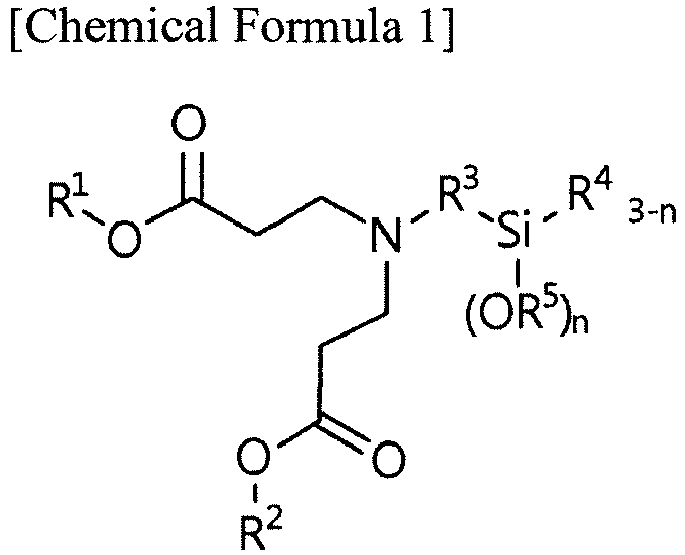
- According to the present invention, an end-modified conjugated diene-based polymer includes an aminosilane end modifier that is substituted with a group including not only a tertiary amine group, but also a silica-compatible group or a hexane-compatible group. The tertiary amine group can prevent aggregation due to hydrogen bonding between hydroxyl groups on the surface of the silica, thus increasing the dispersion of the silica, and the silica-compatible group can increase wear resistance and processability by virtue of interactions with the silica. Furthermore, the hexane-compatible group is effective at increasing modification efficiency by increasing solubility in hexane.
- Also, in the aminosilane-based modifier according to the present invention, when the number of alkoxy groups that react with silica is increased to achieve high molecular weight and high modification efficiency, Mooney viscosity is increased through hydrolysis and condensation. In order to solve the problem whereby viscosity increases during storage of the polymer, two carbonyl groups having high reactivity are introduced to the anionic end, thereby preventing Mooney viscosity from increasing due to hydrolysis and condensation and further increasing the end anion reactivity to thus enable selective reaction with the carbonyl groups.
- Hereinafter, a detailed description will be given of the present invention.
- An aspect of the present invention addresses an end-modified conjugated diene-based polymer configured such that the end of a conjugated diene-based polymer is coupled with the aminosilane-based end modifier represented by Chemical Formula 1 below:
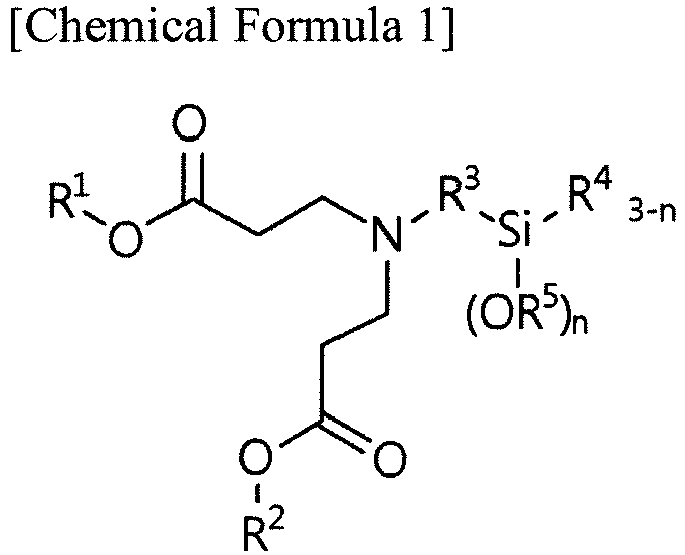
- In Chemical Formula 1, the heteroatom may be N, S or O.
- In Chemical Formula 1, R1 and R2 may be a C1-C10 alkyl group, or a C1-C10 alkyl group containing a heteroatom.
- In Chemical Formula 1, R3 maybe a C1-C10 alkylene group.
- In Chemical Formula 1, R4 and R5 may be a C1-C20 alkyl group.
- The end-modified conjugated diene-based polymer has a number average molecular weight (Mn) of 1,000 to 2,000,000 g/mol, preferably 10,000 to 2,000,000 g/mol, and more preferably 100,000 to 2,000,000 g/mol.
- The end-modified conjugated diene-based polymer has a molecular weight distribution (Mw/Mn) of 1.05 to 10, preferably 1.1 to 5, and more preferably 1.1 to 4. When the molecular weight distribution of the end-modified conjugated diene-based polymer falls in the above range, the resulting rubber composition may be imparted with improved mechanical properties, fuel economy and wear resistance.
- The end-modified conjugated diene-based polymer has a vinyl content of 5 wt% or more, preferably 10 wt% or more, and more preferably 15 to 70 wt%.
- The vinyl content refers to the amount of a monomer having a vinyl group, or the amount not of 1,4-added conjugated diene monomer but of 1,2-added conjugated diene monomer, based on 100 wt% of the conjugated diene monomer.
- When the vinyl content of the end-modified conjugated diene-based polymer falls in the above range, the glass transition temperature of the polymer may be elevated. Thus, when such a polymer is applied to tires, the properties required of tires, such as running resistance and braking force, may be satisfied, and superior fuel economy may result.
- The end-modified conjugated diene-based polymer may include a conjugated diene-based polymer chain, corresponding to a polymer chain comprising the aromatic vinyl monomer in an amount of 1 to 60 wt%, 10 to 50 wt%, or 15 to 40 wt%, based on 100 wt% in total of the conjugated diene monomer and the aromatic vinyl monomer.
- The polymer chain may be, for example, a random polymer chain.
- The conjugated diene monomer may include at least one selected from the group consisting of 1,3-butadiene, 2,3-dimethyl-1,3-butadiene, piperylene, 3-butyl-1,3-octadiene, isoprene, and 2-phenyl-1,3-butadiene.
- The aromatic vinyl monomer may include at least one selected from the group consisting of styrene, α-methylstyrene, 3-methylstyrene, 4-methylstyrene, 4-propylstyrene, 1-vinylnaphthalene, 4-cyclohexylstyrene, 4-(p-methylphenyl)styrene, and 1-vinyl-5-hexylnaphthalene. Preferably useful is styrene or α-methylstyrene.
- Another aspect of the present invention addresses a method of preparing an end-modified conjugated diene-based polymer, comprising: a) polymerizing a conjugated diene monomer or a conjugated diene monomer and an aromatic vinyl monomer using a hydrocarbon solvent in the presence of an organometallic compound, thus forming an active polymer having an alkali metal end; and b) modifying the active polymer having the alkali metal end with a compound represented by Chemical Formula 1 below:

- The conjugated diene monomer and the aromatic vinyl monomer are as described above.
- The solvent is not particularly limited, so long as it may be applied in the polymerization or copolymerization of the conjugated diene monomer, and may be exemplified by a hydrocarbon, or may include at least one selected from the group consisting of n-pentane, n-hexane, n-heptane, isooctane, cyclohexane, toluene, benzene, and xylene.
- The organometallic compound may be exemplified by an organo-alkali metal compound, or may include at least one selected from the group consisting of an organolithium compound, an organosodium compound, an organopotassium compound, an organorubidium compound, and an organocesium compound.
- For example, the organometallic compound may include at least one selected from the group consisting of methyllithium, ethyllithium, isopropyllithium, n-butyllithium, sec-butyllithium, tert-butyllithium, n-decyllithium, tert-octyllithium, phenyllithium, 1-naphthyllithium, n-eicosyllithium, 4-butylphenyllithium, 4-tolyllithium, cyclohexyllithium, 3,5-di-n-heptylcyclohexyllithium, and 4-cyclopentyllithium. Preferably, the organometallic compound is n-butyllithium, sec-butyllithium or a mixture thereof.
- Alternatively, the organometallic compound may include at least one selected from the group consisting of naphthyl sodium, naphthyl potassium, lithium alkoxide, sodium alkoxide, potassium alkoxide, lithium sulfonate, sodium sulfonate, potassium sulfonate, lithium amide, sodium amide, and potassium amide, and may be used in combination with another organometallic compound.
- In an embodiment of the present invention, the organometallic compound may be used in an amount of 0.01 to 10 mmol, 0.05 to 5 mmol, 0.1 to 2 mmol, or 0.1 to 1 mmol, based on 100 g in total of the monomer. When the amount of the organometallic compound falls in the above range, a conjugated diene-based polymer optimal for use in the preparation of an end-modified conjugated diene-based polymer may be obtained.
- The molar ratio of the organometallic compound and the compound represented by Chemical Formula 1 may range from 1:0.1 to 1:10, and preferably 1:0.3 to 1:2. When the molar ratio thereof falls in the above range, the conjugated diene-based polymer may be subjected to a modification reaction to ensure optimal performance.
- As used herein, the active polymer having the metal end refers to a polymer comprising a polymer anion and a metal cation, which are coupled with each other.
- In the method of preparing the end-modified conjugated diene-based polymer according to an embodiment of the present invention, the polymerizing in a) may be performed with the additional use of a polar additive. The reason why the polar additive is further added is that the reaction rates of the conjugated diene monomer and the aromatic vinyl monomer are controlled by the polar additive.
- The polar additive may be a base, or may include ether, amine or mixtures thereof. Specifically, it may be selected from the group consisting of tetrahydrofuran, ditetrahydrofurylpropane, diethylether, cycloamylether, dipropylether, ethylenedimethylether, ethylenedimethylether, diethyleneglycol, dimethylether, tert-butoxyethoxyethane bis(2-dimethylaminoethyl)ether, (dimethylaminoethyl)ethylether, trimethylamine, triethylamine, tripropylamine, and tetramethylethylenediamine. Preferably useful is ditetrahydropropylpropane, triethylamine, or tetramethylethylenediamine.
- The polar additive may be used in an amount of 0.001 to 50 g, 0.001 to 10 g, 0.005 to 1 g, or 0.005 to 0.1 g, based on 100 g in total of the added monomer.
- The polar additive may be used in an amount of 0.001 to 10 g, 0.005 to 1 g, or 0.005 to 0.1 g, based on 1 mmol in total of the added organometallic compound.
- When the conjugated diene monomer and the aromatic vinyl monomer are copolymerized, a block copolymer may be readily prepared due to the difference in the reaction rates therebetween. However, when the polar additive is added, the low reaction rate of the aromatic vinyl monomer may be increased to thus obtain the microstructure of the corresponding copolymer, for example, a random polymer.
- In a), the polymerization may be exemplified by anionic polymerization. Specifically, the polymerization in a) may be living anionic polymerization in which an active end is obtained through a growth reaction involving anions.
- Also, the polymerization in a) may be either high-temperature polymerization or room-temperature polymerization.
- High-temperature polymerization is a polymerization process that comprises adding the organometallic compound and then applying heat to increase the reaction temperature, and room-temperature polymerization is a polymerization process that takes place in such a way that heat is not applied after the organometallic compound is added.
- The polymerization in a) may take place at a temperature ranging from -20 to 200°C, 0 to 150°C, or 10 to 120°C.
- In b), at least one, or two or three, selected from among compounds represented by Chemical Formula 1, may be added.
- Also, b) may be carried out at 0 to 90°C for 1 min to 5 hr.
- The method of preparing the end-modified conjugated diene-based polymer according to an embodiment of the present invention may be carried out in a batch manner, or alternatively in a continuous manner using at least one reactor.
- Still another aspect of the present invention addresses an aminosilane-based end modifier represented by Chemical Formula 1 below:


- In Chemical Formula 1, the heteroatom may be N, S or O.
- In Chemical Formula 1, R1 and R2 may be a C1-C10 alkyl group, or a C1-C10 alkyl group containing a heteroatom.
- In Chemical Formula 1, R3 maybe a C1-C10 alkylene group.
- In Chemical Formula 1, R4 and R5 may be a C1-C20 alkyl group.
- The end modifier according to the present invention is an aminosilane-based end modifier, in which an aminosilane derivative is substituted with a group including not only a tertiary amine group, but also a silica-compatible group such as an ethyleneglycol group or a hexane-compatible group such as an alkyl group or aryl group. In the end modifier, the tertiary amine group may increase the dispersion of silica and function as a catalyst for the reaction, and the silica-compatible group may play a role in increasing the wear resistance and processability of the polymer by reacting with silica. Also, the modifier including a hexane-compatible group may increase the solubility of the polymer in hexane, ultimately increasing the modification efficiency of the polymer.
- Preferably, Chemical Formula 1 is represented by Chemical Formula 1a below.

- A better understanding of the present invention may be obtained via the following examples, which are merely set forth to illustrate the present invention, and those skilled in the art will appreciate that various changes and modifications are possible, without departing from the scope and spirit of the invention as disclosed in the accompanying claims.
- 23.26 mmol of (3-aminopropyl)triethoxysilane was dissolved in 10 mL of ethanol in a 50 mL round-bottom flask, 46.53 mmol of ethyl acrylate was added, and the resulting mixture was stirred at 80°C for 24 hr in a nitrogen atmosphere. After termination of the reaction, the solvent was removed under reduced pressure, followed by vacuum distillation at 80°C, yielding 22.36 mmol (yield 96.1%) of diethyl 3,3'-((3-(triethoxysilyl)propyl)azanediyl)dipropionate. The 1H NMR data of the purified diethyl 3,3'-((3-(triethoxysilyl)propyl)azanediyl)dipropionate is as follows:
- 1H-NMR (500 MHz, CDCl3) δ 4.07-4.03 (m, 4H), δ 3.77-3.72 (m, 6H), δ 2.72-2.69 (t, 4H), δ 2.37-2.34 (t, 6H), δ 1.49-1.43 (m, 2H), δ 1.20-1.14 (m, 15H), δ 0.52-0.49 (t, 2H).
- 270 g of styrene, 710 g of 1,3-butadiene, 5 kg of n-hexane, and 1.1 g of DTP (2,2-di(2-tetrahydrofuryl)propane) as a polar additive were placed in a 20 L autoclave reactor, and the temperature inside the reactor was elevated to 40°C. When the temperature inside the reactor reached 40°C, 27 g (2.62 wt% in hexane, 33% activation) of n-butyllithium was added to the reactor, followed by an adiabatic heating reaction. After about 30 min, 20 g of 1,3-butadiene was added so that the end of SSBR was capped with butadiene. After 5 min, the modifier of Preparation Example 1, that is, 1.64 g of diethyl 3,3'-((3-(triethoxysilyl)propyl)azanediyl)dipropionate was added, and the reaction was carried out for 15 min. Thereafter, the polymerization was stopped using ethanol, and 33 g of a solution of a Wingstay K antioxidant dissolved at 30 wt% in hexane was added. The resulting polymer was added to water warmed with steam, stirred to remove the solvent, and then roll-dried to remove the remaining solvent and water, yielding an end-modified conjugated diene-based polymer. The sample was dried and measured via GPC.
- An end-modified conjugated diene-based polymer was prepared in the same manner as in Example 1, with the exception that N,N-bis(triethoxysilylpropyl)piperazine was used as the end modifier.
[Table 1] GPC (x104) Mn Mw Mp Coupling efficiency Molecular weight distribution (Mw/Mn) (%) Ex.1 41 64 Mp1 23 38 1.5 Mp2 68 62 C.Ex.1 34 45 Mp1 25 43 1.3 Mp2 53 57 - When the polymerization was performed using the end modifier of Example 1 according to the present invention, the coupling efficiency was increased. The number of triethoxysilanes was less than the number of N,N-bis(triethoxysilylpropyl)piperazines of Comparative Example 1, but the coupling efficiency of the polymer component was increased (62%), the reason for which is considered to be that the number of ester groups having high reactivity was increased by 1 in the end anion of rubber.
Claims (12)
- An end-modified conjugated diene-based polymer configured such that an end of a conjugated diene-based polymer is coupled with an aminosilane-based end modifier represented by Chemical Formula 1 below:

- The end-modified conjugated diene-based polymer of claim 1, wherein the Chemical Formula 1 is represented by Chemical Formula 1a below.

- The end-modified conjugated diene-based polymer of claim 1, wherein the end-modified conjugated diene-based polymer has a number average molecular weight (Mn) of 1,000 to 2,000,000 g/mol.
- The end-modified conjugated diene-based polymer of claim 1, wherein the end-modified conjugated diene-based polymer comprises 1 to 60 wt% of an aromatic vinyl monomer based on 100 wt% in total of a conjugated diene monomer and the aromatic vinyl monomer.
- A method of preparing an end-modified conjugated diene-based polymer, comprising:a) polymerizing a conjugated diene monomer or a conjugated diene monomer and an aromatic vinyl monomer using a hydrocarbon solvent in presence of an organometallic compound, thus forming an active polymer having an alkali metal end; andb) modifying the active polymer having the alkali metal end with a compound represented by Chemical Formula 1 below:

- The method of claim 5, wherein the Chemical Formula 1 is represented by Chemical Formula 1a below.

- The method of claim 5, wherein the organometallic compound is used in an amount of 0.01 to 10 mmol based on 100 g in total of the monomer.
- The method of claim 5, wherein a molar ratio of the organometallic compound and the compound represented by Chemical Formula 1 ranges from 1:0.1 to 1:10.
- The method of claim 5, wherein the polymerizing in a) is performed with additional use of a polar additive.
- The method of claim 9, wherein the polar additive is added in an amount of 0.001 to 10 g based on 1 mmol in total of the organometallic compound.
- An aminosilane-based end modifier represented by Chemical Formula 1 below:

- The aminosilane-based end modifier of claim 11, wherein the Chemical Formula 1 is represented by Chemical Formula 1a below.


Applications Claiming Priority (3)
| Application Number | Priority Date | Filing Date | Title |
|---|---|---|---|
| KR20140186008 | 2014-12-22 | ||
| KR1020150104528A KR101726949B1 (en) | 2014-12-22 | 2015-07-23 | Terminal modifier of functionalized aminosilane, method for preparing modified conjugated diene polymer using the same, and modified conjugated diene polymer prepared using the same |
| PCT/KR2015/011233 WO2016104931A1 (en) | 2014-12-22 | 2015-10-22 | Aminosilane terminal modifier to which functional group has been introduced, method for producing terminal-modified conjugated diene polymer using the aminosilane terminal modifier, and terminal-modified conjugated diene polymer produced according to the method |
Publications (3)
| Publication Number | Publication Date |
|---|---|
| EP3109260A1 EP3109260A1 (en) | 2016-12-28 |
| EP3109260A4 EP3109260A4 (en) | 2017-05-03 |
| EP3109260B1 true EP3109260B1 (en) | 2017-10-18 |
Family
ID=56352861
Family Applications (2)
| Application Number | Title | Priority Date | Filing Date |
|---|---|---|---|
| EP15873458.2A Active EP3103817B1 (en) | 2014-12-22 | 2015-10-22 | Aminosilane terminal modifier to which functional group has been introduced, method for producing terminal-modified conjugated diene polymer using the aminosilane terminal modifier, and terminal-modified conjugated diene polymer produced according to the method |
| EP15873459.0A Active EP3109260B1 (en) | 2014-12-22 | 2015-10-22 | Aminosilane terminal modifier to which functional group has been introduced, method for producing terminal-modified conjugated diene polymer using the aminosilane terminal modifier, and terminal-modified conjugated diene polymer produced according to the method |
Family Applications Before (1)
| Application Number | Title | Priority Date | Filing Date |
|---|---|---|---|
| EP15873458.2A Active EP3103817B1 (en) | 2014-12-22 | 2015-10-22 | Aminosilane terminal modifier to which functional group has been introduced, method for producing terminal-modified conjugated diene polymer using the aminosilane terminal modifier, and terminal-modified conjugated diene polymer produced according to the method |
Country Status (4)
| Country | Link |
|---|---|
| US (2) | US9951150B2 (en) |
| EP (2) | EP3103817B1 (en) |
| JP (2) | JP6317477B2 (en) |
| KR (2) | KR101726949B1 (en) |
Families Citing this family (10)
| Publication number | Priority date | Publication date | Assignee | Title |
|---|---|---|---|---|
| KR101877100B1 (en) * | 2015-06-19 | 2018-07-10 | 주식회사 엘지화학 | method for preparing rubber composition using terminal modifier of functionalized aminosilane, and rubber composition prepared using the same |
| US11230618B2 (en) | 2016-11-01 | 2022-01-25 | Lg Chem, Ltd. | Modified conjugated diene-based polymer and method of preparing the same |
| WO2018105920A1 (en) * | 2016-12-08 | 2018-06-14 | 주식회사 엘지화학 | Modifier and modified conjugated diene-based polymer containing functional group derived therefrom |
| KR102122470B1 (en) * | 2016-12-08 | 2020-06-12 | 주식회사 엘지화학 | Modified agent and modified conjugated diene polymer comprising functional group derived from the same |
| KR102102986B1 (en) * | 2017-09-29 | 2020-04-21 | 주식회사 엘지화학 | Both ends-modified diene polymer and preparation method thereof |
| FR3088333A3 (en) * | 2018-11-08 | 2020-05-15 | Michelin & Cie | RUBBER COMPOSITION BASED ON A MODIFIED DIENE ELASTOMER |
| KR102685989B1 (en) * | 2019-10-31 | 2024-07-18 | 주식회사 엘지화학 | Novel compound, preparing method thereof, modified conjugated diene polymer comprising fuctional group derived vy the same and preparing method for the polymer |
| JPWO2023074773A1 (en) * | 2021-10-29 | 2023-05-04 | ||
| US20250163251A1 (en) | 2023-11-21 | 2025-05-22 | The Goodyear Tire & Rubber Company | Tread composition for all-season tire |
| US20250163252A1 (en) | 2023-11-21 | 2025-05-22 | The Goodyear Tire & Rubber Company | Tread composition for all-season tire |
Family Cites Families (23)
| Publication number | Priority date | Publication date | Assignee | Title |
|---|---|---|---|---|
| DE1114326B (en) | 1956-10-12 | 1961-09-28 | Union Carbide Corp | Process for the preparation of organopolysiloxanes |
| DE1171235B (en) | 1958-12-02 | 1964-05-27 | Union Carbide Corp | Corrosion inhibitor |
| US3033815A (en) * | 1959-08-28 | 1962-05-08 | Union Carbide Corp | Organosilicon compounds and process for producing same |
| US3746738A (en) | 1972-03-28 | 1973-07-17 | Union Carbide Corp | Silicon containing polyazimides |
| US4067844A (en) * | 1976-12-22 | 1978-01-10 | Tremco Incorporated | Urethane polymers and sealant compositions containing the same |
| CA1338805C (en) | 1988-05-02 | 1996-12-17 | Akio Imai | Modified diene polymer rubbers |
| WO2003087171A1 (en) * | 2002-04-12 | 2003-10-23 | Bridgestone Corporation | Process for producing modified polymer, modified polymer obtained by the process, and rubber composition |
| JP4088481B2 (en) | 2002-06-13 | 2008-05-21 | コニシ株式会社 | Curable resin |
| TWI385182B (en) | 2004-03-15 | 2013-02-11 | Jsr Corp | Conjugated diene (co) poly rubber and method for producing the same |
| KR100580789B1 (en) | 2004-08-03 | 2006-05-16 | 금호석유화학 주식회사 | Rubber compounds for tire tread |
| US7858690B2 (en) * | 2006-10-06 | 2010-12-28 | Bridgestone Corporation | Functional coupling agents and polymers prepared therewith |
| US8378094B2 (en) * | 2008-01-08 | 2013-02-19 | Johns Manville | Polymerization initiators for fiber-reinforced polymer composites and materials made from the composites |
| JP5956556B2 (en) | 2011-03-29 | 2016-07-27 | 株式会社ブリヂストン | Polymers functionalized with carboxylic acid or thiocarboxylic acid ester containing silylated amino groups |
| JP5959172B2 (en) * | 2011-09-13 | 2016-08-02 | 旭化成株式会社 | Modified conjugated diene polymer and production method thereof, modified conjugated diene polymer composition and production method thereof, and tire and production method thereof |
| JP5964570B2 (en) | 2011-10-12 | 2016-08-03 | 旭化成株式会社 | Method for producing modified conjugated diene polymer, modified conjugated diene polymer, modified conjugated diene polymer composition, and tire |
| JP5951973B2 (en) | 2011-12-06 | 2016-07-13 | 住友ゴム工業株式会社 | Copolymer, rubber composition and pneumatic tire |
| KR101455508B1 (en) | 2012-02-06 | 2014-10-27 | 주식회사 엘지화학 | Modified Conjugated Diene Polymer And Method For Preparing The Same |
| JP6041530B2 (en) | 2012-05-23 | 2016-12-07 | 旭化成株式会社 | Modified butadiene polymer, method for producing modified butadiene polymer, rubber composition, and tire |
| JP6105336B2 (en) * | 2013-03-13 | 2017-03-29 | 旭化成株式会社 | Modified conjugated diene polymer composition, tread, sidewall and tire |
| WO2014175561A1 (en) | 2013-04-25 | 2014-10-30 | (주) 엘지화학 | Method for preparing conjugated diene-based polymer, composition containing polymer, and tire comprising composition |
| KR101614989B1 (en) | 2013-04-25 | 2016-04-22 | 주식회사 엘지화학 | Method of preparing conjugated-diene polymer, composition comprising the polymer and tires comprising the composition |
| KR101461416B1 (en) | 2013-08-05 | 2014-11-19 | 한양대학교 산학협력단 | Chitosan functionalized magnetic-cored dendrimer and method for manufacturing thereof |
| JP6296876B2 (en) * | 2014-03-31 | 2018-03-20 | 株式会社松風 | Novel long-chain silane coupling agent and dental composition containing the same |
-
2015
- 2015-07-23 KR KR1020150104528A patent/KR101726949B1/en active Active
- 2015-07-23 KR KR1020150104520A patent/KR101672645B1/en active Active
- 2015-10-22 US US15/125,809 patent/US9951150B2/en active Active
- 2015-10-22 EP EP15873458.2A patent/EP3103817B1/en active Active
- 2015-10-22 JP JP2016573453A patent/JP6317477B2/en active Active
- 2015-10-22 US US15/124,993 patent/US9822192B2/en active Active
- 2015-10-22 EP EP15873459.0A patent/EP3109260B1/en active Active
- 2015-10-22 JP JP2016556286A patent/JP6317468B2/en active Active
Non-Patent Citations (1)
| Title |
|---|
| None * |
Also Published As
| Publication number | Publication date |
|---|---|
| KR20160076417A (en) | 2016-06-30 |
| US20170002104A1 (en) | 2017-01-05 |
| JP2017510688A (en) | 2017-04-13 |
| JP2017509752A (en) | 2017-04-06 |
| KR20160076418A (en) | 2016-06-30 |
| KR101726949B1 (en) | 2017-04-13 |
| US9822192B2 (en) | 2017-11-21 |
| EP3103817A1 (en) | 2016-12-14 |
| JP6317477B2 (en) | 2018-04-25 |
| EP3103817B1 (en) | 2018-04-18 |
| EP3109260A4 (en) | 2017-05-03 |
| JP6317468B2 (en) | 2018-04-25 |
| EP3109260A1 (en) | 2016-12-28 |
| US9951150B2 (en) | 2018-04-24 |
| US20170022297A1 (en) | 2017-01-26 |
| KR101672645B1 (en) | 2016-11-03 |
| EP3103817A4 (en) | 2016-12-14 |
Similar Documents
| Publication | Publication Date | Title |
|---|---|---|
| EP3103817B1 (en) | Aminosilane terminal modifier to which functional group has been introduced, method for producing terminal-modified conjugated diene polymer using the aminosilane terminal modifier, and terminal-modified conjugated diene polymer produced according to the method | |
| US9969832B2 (en) | Modified conjugated diene-based polymer, method for preparing same, and rubber composition comprising same | |
| EP3091040B1 (en) | Anionic polymerization initiator having anionic terminal comprising amine group, production method for modified conjugated diene-based copolymer using same, and rubber composition comprising modified conjugated diene-based copolymer produced in accordance therewith | |
| EP3101036B1 (en) | Modified conjugated diene polymer, a modified rubber composition containing same, and method for preparing modified conjugated diene polymer | |
| US9644045B2 (en) | End-functionalized conjugated diene-based polymer and process for producing same | |
| EP3341424B1 (en) | Elastomeric copolymers based on [bis(trihydrocarbylsilyl)aminosilyl]-functionalized styrene and their use in the preparation of rubbers | |
| EP3093297B1 (en) | Modified conjugated diene polymer, method for preparing same, and rubber composition containing same | |
| CN104271608B (en) | The method preparing conjugated diolefin polymer, the compositions comprising described conjugated diolefin polymer and the tire comprising described compositions | |
| KR102021844B1 (en) | Modified diene polymer and preparation method thereof | |
| EP3103816B1 (en) | End-functional conjugated diene-based polymer and method of preparing same | |
| US10030079B2 (en) | End-functional conjugated diene-based polymer and manufacturing method therefor | |
| US10351635B2 (en) | Method for preparing rubber composition using aminosilane-based terminal modifier introducing functional group, and rubber composition prepared thereby | |
| EP3091041B1 (en) | Modified conjugated diene polymer, modified rubber composition comprising same, and method for producing modified conjugated diene polymer | |
| EP3101037B1 (en) | Modified conjugated diene-based polymer, preparation method therefor, and rubber composition containing same | |
| US10266614B2 (en) | Modified conjugated diene polymer, modified rubber composition comprising same, and method for preparing modified conjugated diene polymer | |
| EP3255070B1 (en) | Modified polymer and method for producing same | |
| KR20140127726A (en) | Method of preparing conjugated-diene polymer, composition comprising the polymer and tires comprising the composition | |
| WO2016104931A1 (en) | Aminosilane terminal modifier to which functional group has been introduced, method for producing terminal-modified conjugated diene polymer using the aminosilane terminal modifier, and terminal-modified conjugated diene polymer produced according to the method | |
| KR20250082190A (en) | Modified conjugated dien and aromatic vinyl based copolymer, method for producing the same, composition comprising the same and tire comprising the same | |
| CN121079306A (en) | Novel compounds and process for their preparation |
Legal Events
| Date | Code | Title | Description |
|---|---|---|---|
| PUAI | Public reference made under article 153(3) epc to a published international application that has entered the european phase |
Free format text: ORIGINAL CODE: 0009012 |
|
| 17P | Request for examination filed |
Effective date: 20160912 |
|
| AK | Designated contracting states |
Kind code of ref document: A1 Designated state(s): AL AT BE BG CH CY CZ DE DK EE ES FI FR GB GR HR HU IE IS IT LI LT LU LV MC MK MT NL NO PL PT RO RS SE SI SK SM TR |
|
| AX | Request for extension of the european patent |
Extension state: BA ME |
|
| A4 | Supplementary search report drawn up and despatched |
Effective date: 20170405 |
|
| RIC1 | Information provided on ipc code assigned before grant |
Ipc: C08F 36/06 20060101ALI20170330BHEP Ipc: C08K 3/36 20060101ALI20170330BHEP Ipc: C08C 19/44 20060101ALI20170330BHEP Ipc: C08L 15/00 20060101ALI20170330BHEP Ipc: C08C 19/26 20060101ALI20170330BHEP Ipc: C08C 19/25 20060101AFI20170330BHEP Ipc: C08C 19/22 20060101ALI20170330BHEP Ipc: C08K 5/544 20060101ALI20170330BHEP Ipc: C08F 236/10 20060101ALI20170330BHEP |
|
| GRAP | Despatch of communication of intention to grant a patent |
Free format text: ORIGINAL CODE: EPIDOSNIGR1 |
|
| RIC1 | Information provided on ipc code assigned before grant |
Ipc: C08K 3/36 20060101ALI20170706BHEP Ipc: C08C 19/44 20060101ALI20170706BHEP Ipc: C08C 19/26 20060101ALI20170706BHEP Ipc: C08C 19/25 20060101AFI20170706BHEP Ipc: C08L 15/00 20060101ALI20170706BHEP Ipc: C08C 19/22 20060101ALI20170706BHEP |
|
| DAV | Request for validation of the european patent (deleted) | ||
| DAX | Request for extension of the european patent (deleted) | ||
| INTG | Intention to grant announced |
Effective date: 20170727 |
|
| GRAS | Grant fee paid |
Free format text: ORIGINAL CODE: EPIDOSNIGR3 |
|
| GRAA | (expected) grant |
Free format text: ORIGINAL CODE: 0009210 |
|
| AK | Designated contracting states |
Kind code of ref document: B1 Designated state(s): AL AT BE BG CH CY CZ DE DK EE ES FI FR GB GR HR HU IE IS IT LI LT LU LV MC MK MT NL NO PL PT RO RS SE SI SK SM TR |
|
| REG | Reference to a national code |
Ref country code: GB Ref legal event code: FG4D |
|
| REG | Reference to a national code |
Ref country code: FR Ref legal event code: PLFP Year of fee payment: 3 |
|
| REG | Reference to a national code |
Ref country code: CH Ref legal event code: EP |
|
| REG | Reference to a national code |
Ref country code: AT Ref legal event code: REF Ref document number: 937877 Country of ref document: AT Kind code of ref document: T Effective date: 20171115 Ref country code: IE Ref legal event code: FG4D |
|
| REG | Reference to a national code |
Ref country code: DE Ref legal event code: R096 Ref document number: 602015005484 Country of ref document: DE |
|
| REG | Reference to a national code |
Ref country code: NL Ref legal event code: MP Effective date: 20171018 |
|
| REG | Reference to a national code |
Ref country code: LT Ref legal event code: MG4D |
|
| REG | Reference to a national code |
Ref country code: AT Ref legal event code: MK05 Ref document number: 937877 Country of ref document: AT Kind code of ref document: T Effective date: 20171018 |
|
| PG25 | Lapsed in a contracting state [announced via postgrant information from national office to epo] |
Ref country code: NL Free format text: LAPSE BECAUSE OF FAILURE TO SUBMIT A TRANSLATION OF THE DESCRIPTION OR TO PAY THE FEE WITHIN THE PRESCRIBED TIME-LIMIT Effective date: 20171018 |
|
| PG25 | Lapsed in a contracting state [announced via postgrant information from national office to epo] |
Ref country code: LT Free format text: LAPSE BECAUSE OF FAILURE TO SUBMIT A TRANSLATION OF THE DESCRIPTION OR TO PAY THE FEE WITHIN THE PRESCRIBED TIME-LIMIT Effective date: 20171018 Ref country code: SE Free format text: LAPSE BECAUSE OF FAILURE TO SUBMIT A TRANSLATION OF THE DESCRIPTION OR TO PAY THE FEE WITHIN THE PRESCRIBED TIME-LIMIT Effective date: 20171018 Ref country code: FI Free format text: LAPSE BECAUSE OF FAILURE TO SUBMIT A TRANSLATION OF THE DESCRIPTION OR TO PAY THE FEE WITHIN THE PRESCRIBED TIME-LIMIT Effective date: 20171018 Ref country code: ES Free format text: LAPSE BECAUSE OF FAILURE TO SUBMIT A TRANSLATION OF THE DESCRIPTION OR TO PAY THE FEE WITHIN THE PRESCRIBED TIME-LIMIT Effective date: 20171018 Ref country code: NO Free format text: LAPSE BECAUSE OF FAILURE TO SUBMIT A TRANSLATION OF THE DESCRIPTION OR TO PAY THE FEE WITHIN THE PRESCRIBED TIME-LIMIT Effective date: 20180118 |
|
| PG25 | Lapsed in a contracting state [announced via postgrant information from national office to epo] |
Ref country code: IS Free format text: LAPSE BECAUSE OF FAILURE TO SUBMIT A TRANSLATION OF THE DESCRIPTION OR TO PAY THE FEE WITHIN THE PRESCRIBED TIME-LIMIT Effective date: 20180218 Ref country code: LV Free format text: LAPSE BECAUSE OF FAILURE TO SUBMIT A TRANSLATION OF THE DESCRIPTION OR TO PAY THE FEE WITHIN THE PRESCRIBED TIME-LIMIT Effective date: 20171018 Ref country code: AT Free format text: LAPSE BECAUSE OF FAILURE TO SUBMIT A TRANSLATION OF THE DESCRIPTION OR TO PAY THE FEE WITHIN THE PRESCRIBED TIME-LIMIT Effective date: 20171018 Ref country code: RS Free format text: LAPSE BECAUSE OF FAILURE TO SUBMIT A TRANSLATION OF THE DESCRIPTION OR TO PAY THE FEE WITHIN THE PRESCRIBED TIME-LIMIT Effective date: 20171018 Ref country code: BG Free format text: LAPSE BECAUSE OF FAILURE TO SUBMIT A TRANSLATION OF THE DESCRIPTION OR TO PAY THE FEE WITHIN THE PRESCRIBED TIME-LIMIT Effective date: 20180118 Ref country code: HR Free format text: LAPSE BECAUSE OF FAILURE TO SUBMIT A TRANSLATION OF THE DESCRIPTION OR TO PAY THE FEE WITHIN THE PRESCRIBED TIME-LIMIT Effective date: 20171018 Ref country code: GR Free format text: LAPSE BECAUSE OF FAILURE TO SUBMIT A TRANSLATION OF THE DESCRIPTION OR TO PAY THE FEE WITHIN THE PRESCRIBED TIME-LIMIT Effective date: 20180119 |
|
| REG | Reference to a national code |
Ref country code: DE Ref legal event code: R097 Ref document number: 602015005484 Country of ref document: DE |
|
| REG | Reference to a national code |
Ref country code: IE Ref legal event code: MM4A |
|
| PG25 | Lapsed in a contracting state [announced via postgrant information from national office to epo] |
Ref country code: CZ Free format text: LAPSE BECAUSE OF FAILURE TO SUBMIT A TRANSLATION OF THE DESCRIPTION OR TO PAY THE FEE WITHIN THE PRESCRIBED TIME-LIMIT Effective date: 20171018 Ref country code: SK Free format text: LAPSE BECAUSE OF FAILURE TO SUBMIT A TRANSLATION OF THE DESCRIPTION OR TO PAY THE FEE WITHIN THE PRESCRIBED TIME-LIMIT Effective date: 20171018 Ref country code: DK Free format text: LAPSE BECAUSE OF FAILURE TO SUBMIT A TRANSLATION OF THE DESCRIPTION OR TO PAY THE FEE WITHIN THE PRESCRIBED TIME-LIMIT Effective date: 20171018 Ref country code: EE Free format text: LAPSE BECAUSE OF FAILURE TO SUBMIT A TRANSLATION OF THE DESCRIPTION OR TO PAY THE FEE WITHIN THE PRESCRIBED TIME-LIMIT Effective date: 20171018 Ref country code: LU Free format text: LAPSE BECAUSE OF NON-PAYMENT OF DUE FEES Effective date: 20171022 Ref country code: MC Free format text: LAPSE BECAUSE OF FAILURE TO SUBMIT A TRANSLATION OF THE DESCRIPTION OR TO PAY THE FEE WITHIN THE PRESCRIBED TIME-LIMIT Effective date: 20171018 |
|
| REG | Reference to a national code |
Ref country code: BE Ref legal event code: MM Effective date: 20171031 |
|
| PLBE | No opposition filed within time limit |
Free format text: ORIGINAL CODE: 0009261 |
|
| STAA | Information on the status of an ep patent application or granted ep patent |
Free format text: STATUS: NO OPPOSITION FILED WITHIN TIME LIMIT |
|
| PG25 | Lapsed in a contracting state [announced via postgrant information from national office to epo] |
Ref country code: SM Free format text: LAPSE BECAUSE OF FAILURE TO SUBMIT A TRANSLATION OF THE DESCRIPTION OR TO PAY THE FEE WITHIN THE PRESCRIBED TIME-LIMIT Effective date: 20171018 Ref country code: BE Free format text: LAPSE BECAUSE OF NON-PAYMENT OF DUE FEES Effective date: 20171031 Ref country code: PL Free format text: LAPSE BECAUSE OF FAILURE TO SUBMIT A TRANSLATION OF THE DESCRIPTION OR TO PAY THE FEE WITHIN THE PRESCRIBED TIME-LIMIT Effective date: 20171018 |
|
| 26N | No opposition filed |
Effective date: 20180719 |
|
| REG | Reference to a national code |
Ref country code: FR Ref legal event code: PLFP Year of fee payment: 4 |
|
| PG25 | Lapsed in a contracting state [announced via postgrant information from national office to epo] |
Ref country code: MT Free format text: LAPSE BECAUSE OF NON-PAYMENT OF DUE FEES Effective date: 20171022 |
|
| PG25 | Lapsed in a contracting state [announced via postgrant information from national office to epo] |
Ref country code: IE Free format text: LAPSE BECAUSE OF NON-PAYMENT OF DUE FEES Effective date: 20171022 |
|
| REG | Reference to a national code |
Ref country code: CH Ref legal event code: PL |
|
| PG25 | Lapsed in a contracting state [announced via postgrant information from national office to epo] |
Ref country code: HU Free format text: LAPSE BECAUSE OF FAILURE TO SUBMIT A TRANSLATION OF THE DESCRIPTION OR TO PAY THE FEE WITHIN THE PRESCRIBED TIME-LIMIT; INVALID AB INITIO Effective date: 20151022 |
|
| PG25 | Lapsed in a contracting state [announced via postgrant information from national office to epo] |
Ref country code: LI Free format text: LAPSE BECAUSE OF NON-PAYMENT OF DUE FEES Effective date: 20181031 Ref country code: CH Free format text: LAPSE BECAUSE OF NON-PAYMENT OF DUE FEES Effective date: 20181031 Ref country code: RO Free format text: LAPSE BECAUSE OF FAILURE TO SUBMIT A TRANSLATION OF THE DESCRIPTION OR TO PAY THE FEE WITHIN THE PRESCRIBED TIME-LIMIT Effective date: 20171018 |
|
| PG25 | Lapsed in a contracting state [announced via postgrant information from national office to epo] |
Ref country code: SI Free format text: LAPSE BECAUSE OF FAILURE TO SUBMIT A TRANSLATION OF THE DESCRIPTION OR TO PAY THE FEE WITHIN THE PRESCRIBED TIME-LIMIT Effective date: 20171018 |
|
| PG25 | Lapsed in a contracting state [announced via postgrant information from national office to epo] |
Ref country code: CY Free format text: LAPSE BECAUSE OF FAILURE TO SUBMIT A TRANSLATION OF THE DESCRIPTION OR TO PAY THE FEE WITHIN THE PRESCRIBED TIME-LIMIT Effective date: 20171018 |
|
| PG25 | Lapsed in a contracting state [announced via postgrant information from national office to epo] |
Ref country code: MK Free format text: LAPSE BECAUSE OF FAILURE TO SUBMIT A TRANSLATION OF THE DESCRIPTION OR TO PAY THE FEE WITHIN THE PRESCRIBED TIME-LIMIT Effective date: 20171018 |
|
| PG25 | Lapsed in a contracting state [announced via postgrant information from national office to epo] |
Ref country code: TR Free format text: LAPSE BECAUSE OF FAILURE TO SUBMIT A TRANSLATION OF THE DESCRIPTION OR TO PAY THE FEE WITHIN THE PRESCRIBED TIME-LIMIT Effective date: 20171018 |
|
| PG25 | Lapsed in a contracting state [announced via postgrant information from national office to epo] |
Ref country code: PT Free format text: LAPSE BECAUSE OF FAILURE TO SUBMIT A TRANSLATION OF THE DESCRIPTION OR TO PAY THE FEE WITHIN THE PRESCRIBED TIME-LIMIT Effective date: 20171018 |
|
| PG25 | Lapsed in a contracting state [announced via postgrant information from national office to epo] |
Ref country code: AL Free format text: LAPSE BECAUSE OF FAILURE TO SUBMIT A TRANSLATION OF THE DESCRIPTION OR TO PAY THE FEE WITHIN THE PRESCRIBED TIME-LIMIT Effective date: 20171018 |
|
| PGFP | Annual fee paid to national office [announced via postgrant information from national office to epo] |
Ref country code: IT Payment date: 20250924 Year of fee payment: 11 |
|
| PGFP | Annual fee paid to national office [announced via postgrant information from national office to epo] |
Ref country code: GB Payment date: 20250922 Year of fee payment: 11 |
|
| PGFP | Annual fee paid to national office [announced via postgrant information from national office to epo] |
Ref country code: FR Payment date: 20250925 Year of fee payment: 11 |
|
| PGFP | Annual fee paid to national office [announced via postgrant information from national office to epo] |
Ref country code: DE Payment date: 20250922 Year of fee payment: 11 |