EP3108700B1 - Auswahl von kapillarnetzwerk-gateway an ein zellulares netzwerk - Google Patents
Auswahl von kapillarnetzwerk-gateway an ein zellulares netzwerk Download PDFInfo
- Publication number
- EP3108700B1 EP3108700B1 EP14780642.6A EP14780642A EP3108700B1 EP 3108700 B1 EP3108700 B1 EP 3108700B1 EP 14780642 A EP14780642 A EP 14780642A EP 3108700 B1 EP3108700 B1 EP 3108700B1
- Authority
- EP
- European Patent Office
- Prior art keywords
- cgw
- network
- cgws
- capillary
- rbs
- Prior art date
- Legal status (The legal status is an assumption and is not a legal conclusion. Google has not performed a legal analysis and makes no representation as to the accuracy of the status listed.)
- Active
Links
- 230000001413 cellular effect Effects 0.000 title claims description 141
- 201000001718 Roberts syndrome Diseases 0.000 claims description 136
- 208000012474 Roberts-SC phocomelia syndrome Diseases 0.000 claims description 136
- 238000000034 method Methods 0.000 claims description 49
- 238000005516 engineering process Methods 0.000 claims description 45
- 238000005001 rutherford backscattering spectroscopy Methods 0.000 claims description 29
- 238000004891 communication Methods 0.000 claims description 27
- 238000004590 computer program Methods 0.000 claims description 8
- 238000003860 storage Methods 0.000 claims description 4
- 230000006870 function Effects 0.000 description 12
- 238000007726 management method Methods 0.000 description 10
- 238000012545 processing Methods 0.000 description 9
- 230000007246 mechanism Effects 0.000 description 8
- 238000012423 maintenance Methods 0.000 description 7
- 230000005540 biological transmission Effects 0.000 description 5
- 230000004048 modification Effects 0.000 description 5
- 238000012986 modification Methods 0.000 description 5
- 230000008569 process Effects 0.000 description 5
- 230000009286 beneficial effect Effects 0.000 description 4
- 230000008859 change Effects 0.000 description 4
- 238000010586 diagram Methods 0.000 description 4
- 230000008901 benefit Effects 0.000 description 3
- 230000011664 signaling Effects 0.000 description 3
- 230000009471 action Effects 0.000 description 2
- 230000015556 catabolic process Effects 0.000 description 2
- 230000007812 deficiency Effects 0.000 description 2
- 238000006731 degradation reaction Methods 0.000 description 2
- 238000009826 distribution Methods 0.000 description 2
- 230000000694 effects Effects 0.000 description 2
- 230000006872 improvement Effects 0.000 description 2
- 230000006978 adaptation Effects 0.000 description 1
- 238000013475 authorization Methods 0.000 description 1
- 230000001419 dependent effect Effects 0.000 description 1
- 230000005611 electricity Effects 0.000 description 1
- 238000005265 energy consumption Methods 0.000 description 1
- 238000003306 harvesting Methods 0.000 description 1
- 230000003116 impacting effect Effects 0.000 description 1
- 230000000977 initiatory effect Effects 0.000 description 1
- 230000007774 longterm Effects 0.000 description 1
- 238000004519 manufacturing process Methods 0.000 description 1
- 238000005259 measurement Methods 0.000 description 1
- 230000003287 optical effect Effects 0.000 description 1
- 230000002085 persistent effect Effects 0.000 description 1
- 238000013442 quality metrics Methods 0.000 description 1
- 230000009467 reduction Effects 0.000 description 1
- 230000004044 response Effects 0.000 description 1
- 238000010187 selection method Methods 0.000 description 1
- 239000007787 solid Substances 0.000 description 1
- 230000007480 spreading Effects 0.000 description 1
- 238000003892 spreading Methods 0.000 description 1
- 238000012360 testing method Methods 0.000 description 1
- 238000012546 transfer Methods 0.000 description 1
- XLYOFNOQVPJJNP-UHFFFAOYSA-N water Substances O XLYOFNOQVPJJNP-UHFFFAOYSA-N 0.000 description 1
Images



Classifications
-
- H—ELECTRICITY
- H04—ELECTRIC COMMUNICATION TECHNIQUE
- H04W—WIRELESS COMMUNICATION NETWORKS
- H04W76/00—Connection management
- H04W76/10—Connection setup
- H04W76/15—Setup of multiple wireless link connections
- H04W76/16—Involving different core network technologies, e.g. a packet-switched [PS] bearer in combination with a circuit-switched [CS] bearer
-
- H—ELECTRICITY
- H04—ELECTRIC COMMUNICATION TECHNIQUE
- H04W—WIRELESS COMMUNICATION NETWORKS
- H04W28/00—Network traffic management; Network resource management
- H04W28/02—Traffic management, e.g. flow control or congestion control
- H04W28/08—Load balancing or load distribution
- H04W28/086—Load balancing or load distribution among access entities
- H04W28/0861—Load balancing or load distribution among access entities between base stations
-
- H—ELECTRICITY
- H04—ELECTRIC COMMUNICATION TECHNIQUE
- H04W—WIRELESS COMMUNICATION NETWORKS
- H04W28/00—Network traffic management; Network resource management
- H04W28/02—Traffic management, e.g. flow control or congestion control
- H04W28/10—Flow control between communication endpoints
-
- H—ELECTRICITY
- H04—ELECTRIC COMMUNICATION TECHNIQUE
- H04W—WIRELESS COMMUNICATION NETWORKS
- H04W4/00—Services specially adapted for wireless communication networks; Facilities therefor
- H04W4/70—Services for machine-to-machine communication [M2M] or machine type communication [MTC]
-
- H—ELECTRICITY
- H04—ELECTRIC COMMUNICATION TECHNIQUE
- H04W—WIRELESS COMMUNICATION NETWORKS
- H04W48/00—Access restriction; Network selection; Access point selection
- H04W48/17—Selecting a data network PoA [Point of Attachment]
Definitions
- the present invention relates to capillary network gateway selection in a capillary network.
- Future wireless communication systems are likely to comprise a large number of autonomous devices, which devices more or less infrequently transmit, receive, or are polled for small amounts of data. These devices are assumed to not necessarily be associated with humans but are rather sensors or actuators of different kinds, which communicate with application servers or similar network entities within or outside a cellular network.
- M2M machine-to-machine
- MDs machine devices
- M2M applications are almost countless, e.g., in private cars for communicating service needs, in water or electricity meters for remote control and/or remote meter reading, in street-side vending machines for communicating when goods are out-of-stock or when enough coins are present to justify a visit for emptying, in taxi cars for validating credit cards, or in surveillance cameras for home or corporate security purposes.
- MTC Machine Type Communication
- MTC Machine Type Communication
- MTC devices With the nature of MTC devices and their assumed typical uses follow that they will often have to be very energy efficient, since external power supplies will often not be available and since it is neither practically nor economically feasible to frequently replace or recharge their batteries.
- the MTC devices may not even be battery powered, but may instead rely on energy harvesting, i.e., gathering energy from the environment, opportunistically utilizing the often very limited energy that may be tapped from sun light, temperature gradients, vibrations, and the like.
- the gateway acts like a UE towards the cellular network while also maintaining a local network, typically based on a short range radio technology, towards the MTC devices.
- the gateways are often equipped with communication modules or units which support both the radio access technology of the cellular network and the access technology of the local network, e.g. a radio access technology.
- a local network which extends the reach of the cellular network to other radios outside the cellular network, has been coined capillary network.
- the gateway connecting or linking the capillary network to the cellular network will be herein referred to as a Capillary Network Gateway, CGW.
- EP 2590470 A1 discloses a machine type communication, MTC, device configured to access a a gateway through a short-range wireless communication network. A selection or reselection of the gateway is executed by the MTC device. The selection or reselection may be performed in response to receipt of cell information received in a broadcast message from the gateway itself.
- Radio technologies that are expected to be common in capillary networks include e.g. IEEE 802.15.4, e.g. with 6LoWPAN or ZigBee as the higher layers, Bluetooth Low Energy or low energy versions of the IEEE 802.11 family, i.e. Wi-Fi.
- a capillary network may be single hop, i.e. all MDs have a direct link to the CGW, e.g. a Wi-Fi network with the CGW as the access point, or multi-hop, i.e. some MDs may have to communicate via one or more other MDs to reach the CGW, e.g. an IEEE 802.15.4+ZigBee network with the CGW being a controller for a personal area network, PAN.
- the Routing Protocol for Low-Power and Lossy Networks may be used.
- the MD commonly selects CGW based only on propagation conditions between the MD and the CGW. That is, a measure of signal-to-noise ratio, SNR, or the like, is used to decide on a suitable CGW. Since present selection mechanisms based only on propagation conditions between the MD and the CGW can result in sub-optimal network traffic processing and overall degradation of aspects such as network control, improvements in the selection mechanism of CGWs are desired. Further, there is a need of external control of the CGW selection. Furthermore, reduction of control signaling in the cellular network is required.
- US 2013/0188515 A1 describes method and apparatus for supporting machine to machine (M2M) communications in a hierarchical network architecture including an M2M gateway.
- M2M machine to machine
- CGW capillary network gateway
- control mechanisms for selection of one out of multiple CGWs that are available to a MD is an area in which solutions have been lacking.
- a connection in the local area network is presented as a local area connection.
- This type of connection is typically a radio connection, i.e. a local area radio connection, but could also be established by non-radio means, e.g. by infrared light or by physical wires.
- a local area access technology is used in the capillary network.
- the local area access technology is usually a local area radio access technology, but other access technologies are also within the scope of the disclosure.
- traffic load may comprise any of user data traffic traffic load, i.e. user plane load, signaling traffic load, i.e. control plane load, or any combination thereof.
- a machine device represents a device that sporadically transmits, receives, or is polled for small amounts of data.
- machine devices have been exemplified by non-manually operated sensor or actuator of different kinds, which communicate with application servers or similar network entities within or outside a cellular network.
- the term machine device does not exclude manually operated devices, e.g. devices that are temporarily introduced into the capillary network by a service technician temporarily connecting a laptop or other entity to a capillary network during maintenance tasks.
- a policy implies a proposed or suggested principle of action
- a rule implies a mandatory principle of action
- Figure 1 schematically discloses a basic LTE architecture where a plurality of RBSs, here shown as eNBs, is connected to MME/S-GW entities via S1 interfaces.
- the eNBs are connected to each other via X2 interfaces.
- the architecture shown in Figure 1 may, e.g., be used for transporting data from machine devices, MDs, in a capillary network to an application server.
- FIG. 2 schematically discloses a capillary network principle wherein machine type devices 11 operate in a local area network 10.
- the local area network hereinafter also denominated as a capillary network, has an interface to a cellular network 20, e.g. a 3GPP cellular network, by means of one or more capillary network gateways, CGWs 12, here illustrated as one CGW 12.
- the CGWs each provides a link from the capillary network to the cellular network and consequently also a link from a machine device, MD, 11 to the cellular network 20 via the CGW 12.
- the CGW has a communication link to a radio base station, RBS, 21 of the cellular network 20.
- the CGW communicates with the RBS in the same manner as any other type of user equipment, UE, having a radio link connection to the RBS.
- a connected UE is, according to aspects of the disclosure, configured to act as a CGW in the capillary network, whereupon the CGW properties are included as a capability in UE capability information elements provided to the RBS.
- the CGW also maintains a local area network connection toward the MDs 11, typically based on short range radio technology, e.g. Wi-Fi.
- An application server 22 connected to the cellular network e.g. directly connected to the cellular network (for example operated by the operator of the cellular network) or connected to the cellular network via the Internet, receives messages from the machine devices 11, e.g.
- the cellular network is capable of controlling the CGWs, irrespective of whether the cellular network operator or some other party, such as the owner/operator of the capillary network, owns the CGW.
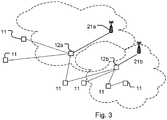
- Figure 3 exemplifies a capillary network deployment including a plurality of MDs 11 connected via a local area access technology, RAT, of the capillary network to the CGWs 12a, 12b which in turn are connected to respective radio base stations, RBSs, 21a, 21b of a cellular network.
- RAT local area access technology
- the following disclosure is based on the assumption of a capillary network according to the basic principles illustrated in Figure 3 , where a MD, at least from a capillary network deployment perspective, is capable of setting up a link to the cellular network by means of multiple CGWs and where a selection of CGW should be performed prior to establishing the link.
- a MD 11 is capable of having multiple local area connections, e.g.
- the following disclosure is applicable to the situation of selecting one CGW for linking the MD to a cellular network, but also to the situation of selecting two or more CGWs for providing the link.
- the CGWs are equipped to communicate using the two different radio access technologies in parallel.
- the CGWs are equipped to only communicate using one radio access technology at the time, communication hardware of the CGW such as power amplifiers being used for both radio access technologies in order to conserve any of footprint, energy consumption, or production cost.
- Figures 4 schematically disclose a capillary network application example.
- at least one machine device 11 is used for reading temperature.
- the MDs are either connected directly, or, in the case several MDs are present, both directly and indirectly via another MD, to CGWs 12a, 12b.
- the CGWs are connected to RBSs 21a, 21b, of a cellular network.
- CNF Capillary Network Function
- Radio technologies that are expected to be common in capillary networks such as the capillary networks shown in Figures 2-4 include e.g. IEEE 802.15.4, with 6LoWPAN or ZigBee as the higher layers, Bluetooth Low Energy or low energy versions of the IEEE 802.11 family, i.e., Wi-Fi.
- a capillary network may be single hop where all MDs have a direct link to a CGW, e.g., a Wi-Fi network with the CGW as the access point, or multi-hop where some MDs may have to communicate via one or more other MD(s) to reach the CGW, e.g., an IEEE 802.15.4+ZigBee network with the CGW being a PAN controller.
- the Routing Protocol for Low-Power and Lossy Networks, RPL is, according to aspects, used. In principle RPL may be used also in single hop networks, but there is no need for a routing protocol in such networks.
- some MDs 11 has a choice between at least two CGWs 12a, 12b, which can both be used to link to the cellular access network, possibly also to different RBSs 21a, 21b, or different cells belonging to the same RBS, in the cellular network. Consequently, there can arise a need to choose between the at least two CGWs. Furthermore, this choice of CGW is likely to affect performance of the overall communication system, including both capillary and cellular network.
- the MD commonly selects CGW based on propagation conditions between the MD and the CGW alone, e.g. signal-to-noise ratio, SNR, or a measure of received power.
- SNR signal-to-noise ratio
- this type of channel quality metric only reflects the state of the link between MD and CGW, and not the state of the overall communication system.
- present selection mechanisms can result in sub-optimal traffic processing and overall degradation of aspects such as network control.
- the present disclosure proposes to also take radio base station, RBS, cell related information into account when selecting a CGW for the purpose of linking an MD to a cellular network.
- RBS cell related information is the traffic load in the cellular network cell to which the CGW is connected, i.e., the cell traffic load experienced by the RBS with which the CGW is connected. This will allow the MD to select or to be directed to a CGW which is connected to the least loaded cell among a group of cells.
- load balancing can be achieved by distributing or re-distributing MD to CGW connections in order to reduce or increase the number of MDs linking into a cellular network via a given CGW and RBS.
- CGW selection can be made by the CNF, the CGW, by the MD alone, or by the MD under the influence of policies and/or rules set by a network operator.
- aspects of the present disclosure detailed below further comprises mechanisms by which the network can exercise direct or indirect control over the MD's selection of CGW to use for linking with a cellular network, either through explicit instructions or indirectly through policies and contextual parameters.
- a plurality of different properties which may be associated with a CGW are relevant for impacting the choice of CGW for a MD.
- One such property is the traffic load in the cellular network cell with which the CGW is connected, i.e., the traffic load experienced by the RBS to which the CGW maintains a connection using the radio access technology of the cellular network.
- the network is according to aspects operable to maintain a level of control over the MD's choice.
- this control comprises use of explicit instructions, use of policies/rules based on contextual input parameters, and use of modification of contextual parameters that indirectly affect the MD's choice of CGW.
- the above listed information i.e., the data related to cells of the respective RBSs or the RBS cell related information that is to serve as input data to the CGW selection has to be gathered somehow before an informed selection of CGW can be made.
- the information gathering may be performed in different ways and by different entities according to different aspects of the present teaching.
- FIG 5 is a flowchart schematically illustrating embodiments of method steps performed in a network node for selecting a capillary network gateway, CGW, for linking a machine device, MD, to a cellular network.
- the MD is arranged to operate according to a local area access technology in a capillary network including a plurality of CGWs, in Figure 3 illustrated as two CGWs.
- Each CGW is arranged to operate according to a local area access technology in the capillary network and to operate according to a radio access technology in the cellular network.
- each CGW has a cellular radio connection to a radio base station, RBS, of the cellular network.
- radio access technology is not limited to one of the "main types" of radio access technologies, such as LTE, HSPA, WCDMA, 2G/GPRS, CDMA2000 or Wi-Fi, but may also include more granular information, such as supported 3GPP release, maximum data rate, etc.
- the network node performing the disclosed method could be a CGW, a new logical network entity, here denoted Capillary Network Function, CNF, an Operation and Maintenance, O&M, entity, any combination of these entities or any other type of node entity capable of observing traffic related metrics in the capillary network, the interface between a capillary network and a cellular network or in the cellular network.
- CNF Capillary Network Function
- O&M Operation and Maintenance
- the network node gathers in step S51, for at least two CGWs of the plurality of CGWs, data related to cells of RBSs having a cellular radio connection to a respective CGW in the capillary network. Based on the gathered data, the network node controls selection in step S52 of the at least one CGW out of the at least two CGWs.
- the at least two CGWs can be connected to the same RBS, or to different RBSs. It is also noted that a CGW can be connected to more than one RBS. It is further noted that all CGWs are not necessarily connected to any RBS at all.
- the disclosure further comprises selecting, in step S52a, the at least one CGW out of the at least two CGWs based on the gathered data and providing information to the MD on the selected at least one CGW.
- the step of controlling selection of the at least one CGW comprises configuring a set of policies and/or rules governing CGW selection in the MD, so that the MD following the configuration has a capability to perform the selection of CGW.
- the selecting in the MD is further assisted by data received from the network node, i.e. the network node sending in step S52c at least a subset of the gathered data to the MD to use in the selection process, and/or data retrieved by the MD to use as input to the configured policies and/or rules.
- Another optional step S53 comprises sending an instruction to the MD to connect to or associate with the determined at least one CGW.
- the step of controlling selection of the at least one CGW includes causing the MD to link to the cellular network via the at least one selected CGW based on the gathered data; using a set of policies and/or rules configured in the MD and governing CGW selection by the MD.
- the network node is a capillary network function, CNF, arranged to control CGWs of one or more capillary networks.
- the CNF may also be used to control the one or more capillary networks and/or machine devices, MDs, of the capillary networks.
- CNF Capillary Network Function
- the CNF is according to one aspect arranged above the SGi interface of the cellular network, which cellular network here is exemplified by an LTE cellular network, and is further assumed to be reachable from the CGW via the user plane.
- the CNF also, according to aspects, has one or more interfaces to one or more Operation and Maintenance, O&M, entities, e.g. O&M entities dedicated for the CGWs, the MDs and/or the capillary networks.
- O&M Operation and Maintenance
- the location of the CNF is in the services capability server, SCS.
- the CNF is a part of the SCS standardized by 3GPP 29.368, version 11.4.0.
- the CNF is assumed to be part of the cellular network, or, according to an alternative, to be part of the capillary network.
- the CNF is deployed as a separate entity, i.e., not part of an existing entity such as the SCS.
- the CNF is configured to handle tasks related to the capillary network, in particular configuration and/or control of the CGW or CGWs.
- the CNF is further configured to participate in processing of traffic related to the capillary network or networks.
- the network node is an O&M entity, which may be dedicated for CGWs, MDs, and/or for capillary networks, or may be a more generic O&M entity used for operation and maintenance of other entities too, in addition to CGWs, MDs and/or capillary networks.
- O&M entity may be dedicated for CGWs, MDs, and/or for capillary networks, or may be a more generic O&M entity used for operation and maintenance of other entities too, in addition to CGWs, MDs and/or capillary networks.
- the network node is a CGW.
- the data related to cells of the respective RBSs comprises RBS traffic load, e.g. the traffic load experienced by the RBS in the cell in which the CGW is connected or the total traffic load experienced by the RBS in all the cells it serves.
- the MD is arranged to operate according to a local area access technology in the capillary network and each CGW is arranged to operate according to a local area access technology in the capillary network and to operate according to a cellular radio access technology in the cellular network.
- Each CGW also has a cellular radio connection to a radio base station, RBS, of the cellular network.
- the step of gathering S51 data comprises the step of, for each CGW, determining RBS cell related information for an RBS having a cellular radio connection to the CGW, in particular information related to the cell in which the CGW is connected to the RBS, and also the step of providing determined RBS cell related information of at least the other CGWs in the capillary network to each CGW.
- the network exercises its control over the CGW selection process through explicit instructions to the MD.
- the network exercises its control over the MD's choice of CGW through explicit instructions to the MD, such as an instruction to the MD to connect/associate with another CGW, or to remain with the current CGW.
- the instruction may be sent to the MD by the MD's current CGW or possibly by the CNF directly to the MD, for example addressed directly to the MD but forwarded by intermediate entities such as the RBS and the CGW, or even indirectly via some other network node of the capillary or cellular network.
- a network entity other than the MD is configured to control selection of at least one CGW, i.e. a CGW eligible for linking the MD to the cellular network, based on the gathered data.
- the network entity configured to execute the step of controlling selection S52 is the CGW currently selected by the MD, i.e. the CGW the MD is currently connected to/associated with.
- Providing information to the MD about the selected at least one CGW during step S52a comprises providing information based on the determined RBS cell related information.
- the network entity configured to execute the step of selecting S52 is the CNF.
- the information that is relevant for the CGW selection has to be gathered.
- the cell traffic load is inherently known by the RBS in control of the cell (and the RNC in case of a 3G/WCDMA/HSPA network).
- the RBS or possibly RNC
- the methods for the actual acquisition and/or distribution of this information depend on the solution variants and the involved nodes/entities.
- the relevant information for CGW selection i.e., the data related to a cell of an RBS having a cellular radio connection to a CGW in the capillary network, is obtained directly from the RBS.
- the CNF gathers the cell traffic load information from the RBSs (e.g. LTE eNBs).
- RBSs e.g. LTE eNBs
- the CNF may have a direct interface to the RBSs, e.g. an O&M interface, or may retrieve the information via the MTC-IWF and the MME/SGSN/MSC.
- the CNF is configured to gather the cell traffic load information, in particular information related to the load in each cell to which at least one of the selectable CGWs is connected (e.g. at least one of the CGWs in the capillary network), from the RBSs having a cellular radio connection to at least one CGW in the capillary network;
- the CNF knows which RBSs and which cells to request the load information from based on prior information. For instance, the CNF may have received this information from the respective CGW, e.g., in conjunction with the deployment of the CGW and/or possibly later in the form of update messages. The CNF may also have received the information about the cell and RBS a CGW is connected to from an O&M entity, e.g. an O&M entity dedicated for management of capillary networks or CGWs. The information may also be pre-configured, e.g. manually, in the CNF in conjunction with deployment of the respective CGW.
- O&M entity e.g. an O&M entity dedicated for management of capillary networks or CGWs.
- the information may also be pre-configured, e.g. manually, in the CNF in conjunction with deployment of the respective CGW.
- the CNF acquires the information about which cells to request load information for from the respective RBS, or possibly RNC, that is in control of at least one cell in which at least one of the CGWs in the capillary network is connected.
- RBS provides this information
- an option is that the RBS, or possibly RNC, proactively and unsolicited sends the load information to the CNF, i.e. without a preceding request.
- the CNF sends a single request to the RBS, or possibly RNC, requesting it to regularly provide the load information, or to provide it whenever it changes significantly, e.g. changes more than a specified amount, possibly rate limited to prevent too excessive signaling.
- a UE connected to the RBS is acting as a CGW.
- One means to make a RBS, or RNC where applicable, aware of that the connected UE is acting as a CGW involves including the CGW role, and possibly even information about the capillary network to which it is connected, as one of the UE capabilities that the CGW sends to the network, i.e. extending the currently existing means for a UE to provide capability information to the network, e.g. UE radio network capabilities or UE network capabilities.
- the CNF is pre-configured with information relating to which RBSs and which cells to request the load information from, or the CNF is arranged to receive information about the cell and RBS a CGW is connected to from an O&M entity.
- the CNF is arranged to receive information about the cell and RBS a CGW is connected to from the respective CGW or, alternatively, from the respective RBS.
- this O&M entity may in turn have acquired the information in conjunction with deployment of the CGW, or from the CGW at a later occasion, or through configuration.
- an alternative way for the CNF to retrieve cell traffic load information is that it is pre-configured with this information.
- the CNF would distribute the gathered cell traffic load information to CGWs connected to the capillary network.
- the CNF is adapted to distribute the gathered cell traffic load information to CGWs connected to the same capillary network.
- an O&M entity e.g., an O&M entity dedicated for management of capillary networks or CGWs gather the cell traffic load information from the RBSs and distribute it to the CGWs connected to the same capillary network.
- the RBS transmits cell traffic load information to the CGW. This may be done as part of the system information, which is broadcast to all UEs in the cell, or as a dedicated message to the CGW, e.g. on request from the CGW. The CGWs would then exchange the cell traffic load information with each other, e.g. across the capillary network.
- the step of gathering S51 data related to cells of RBSs having a cellular radio connection to a CGW in the capillary network further comprises any of;
- the cell traffic load information associated with each CGW of a capillary network is spread to all the other CGWs of the same capillary network and hence a result, or technical effect, is that all the CGWs connected to the same capillary network will be aware of the cell traffic load of the cellular network cell that each of the other CGWs are connected in.
- any of the CGWs can, in principle, determine which CGW the MD should connect/associate with, i.e., use for linking with the cellular network.
- the CGW also takes into account information about the MD, its channel quality and/or the application the MD is currently running.
- the CGW is, according to aspects, adapted to derive such information from observing and/or sniffing data traffic originating from the MD or from explicit information received from the MD.
- the step of gathering data related to cells of the respective RBSs having a cellular radio connection to the at least two CGWs further comprises spreading or distributing said data to all, or at least a subset of all, the other CGWs of the same capillary network.
- step of controlling S52 selection of at least one CGW out of the at least two CGWs based on the gathered data comprises any of
- the CGW to which the MD is currently connected sends an instruction to the MD to connect/associate with a certain alternative CGW, provided that it is not determined that the MD should remain with the current CGW.
- the CGW sends the instruction in the form of a field in a Routing Protocol for Low-Power and Lossy Networks, RPL, message, as a link layer (management) message or as a parameter in a unicast IPv6 router advertisement.
- RPL Routing Protocol for Low-Power and Lossy Networks
- Other possibilities include sending the instruction in a CoAP message or an OMA-LWM2M message.
- the MD has a relation with the CNF, meaning that the MD and CNF are communicatively coupled, or at least the MD is visible and reachable from the CNF.
- the CNF here gathers the cell traffic load information, as described above, and based on this information and possibly information about the MD and/or the application it is running, the CNF determines whether an MD should change to another CGW and, if so selects in step S53a the determined CGW and sends an explicit instruction to the MD in order to cause the linking to be established.
- the CNF may acquire information about the MD and/or its application from the MD or the Application Server or by observing and sniffing the MD's traffic, provided that the MD's user data traffic passes through the CNF.
- the CNF sends the instruction to the MD's current CGW instead of directly to the MD, requesting the CGW to send an instruction to the MD.
- This i.e. gathering cell traffic load information and instructing the MD
- the decision making entity may, depending on the scenario, have to be provided with the CGWs that are currently reachable for the MD and possibly also other contextual parameters such as the MD's channel quality to different CGWs and/or the application the MD is running.
- the MD obeys a received CGW selection instruction only if the CGW it is directed to is available to the MD or reachable with a reasonable channel quality.
- the instruction has the form of a number of CGWs listed in priority order so that if the first CGW in the list is unavailable, or has too poor channel quality, the MD chooses the next CGW in the list, and so on.
- the step of sending S53 an instruction to the MD to link, i.e., connect or associate, to the cellular network via at least one CGW determined based on the gathered data further comprises any of
- the network exercises its control over the CGW selection process through policies and/or rules related to contextual parameters, and not necessarily by using direct instructions sent to the MD.
- the network exercises its control over the MD's CGW choice indirectly through policies and/or rules.
- policies and/or rules are preferably configured in the MD by an O&M entity, possibly via the CNF.
- the step S52 of controlling selection of at least one CGW comprises setting or configuring S52b a set of policies and/or rules by the MD, which policies and/or rules indirectly determines the CGW choice made by an MD.
- the configuration data is according to aspects sent to the CGW to be forwarded to the MD.
- the configuration data is according to aspects sent to the CGW to be forwarded to the MD.
- all MDs in the capillary network are configured with the same policies and/or rules, but individually adapted policies and/or rules are preferable in order to allow different kinds of MDs/applications in the same capillary network.
- One way to achieve individual policy and/or rule adaptation without sending individual policies and/or rules to different MDs in a capillary network is to take the type of MD/application into account in the policies and/or rules, i.e. making the type of MD/application a contextual parameter that is part of the input data to the policies and/or rules.
- the step of selecting at least one CGW out of the at least two CGWs based on the gathered data comprises configuring the MD with policies and/or rules by which the MD selects CGW.
- the step of gathering data related to cells of the respective RBSs having a cellular radio connection to the at least two CGWs comprising forwarding configuration data to the MD via a CGW.
- the policies and/or rules take contextual parameters as input data to an algorithm that outputs a CGW choice.
- the network node sends, in step S52c, at least a subset of gathered data to the MD.
- the MD uses the received data and/or data retrieved by the MD itself as input to the configured policies and rules.
- the input data includes the available CGWs and information reflecting the cell traffic load of their respective cellular network cell, but the contextual parameters may according to aspects also include other aspects, such as the current application or software run by an MD, channel quality between the MD and the respective CGW, required transmission power, battery/energy status, location or capillary network technology used by the various CGWs.
- policies and/or rules may be formulated such that the MD should switch to a certain CGW which is connected in a less loaded cellular network cell, but only if the channel quality between the MD and this CGW is good enough according to some pre-determined criterion. If the battery/energy status is poor, a policy and/or rule may also state that any change of CGW is subject to the required transmission power (e.g. not allowing increased required transmission power).
- Information about the cell traffic load of the cellular network cell to which each CGW is connected is according to aspects sent from the CGW to the MD in the form of a field in an RPL message, as a link layer message, e.g. a field in a beacon message, or as a parameter in a broadcast or unicast IPv6 router advertisement.
- This information may be explicit descriptions of the QoS class/parameters of each EPS bearer, or corresponding type of bearer in other cellular systems than EPS, associated with the CGW or information about the load on these bearers, but it may also be information in more condensed forms, e.g. a preference value.
- preference value is to be construed as a generic designation for a parameter, whose purpose is to reflect how attractive a CGW should be considered in a CGW selection procedure.
- the preference value thus summarizes one or more properties/capabilities of the CGW. In this context certainly including the load of the cellular network cell the CGW is connected in and possibly also other properties.
- Each CGW creates the cell traffic load information and/or derivatives thereof independently of the other CGWs, including setting of a possible preference value.
- the CGWs are made aware of the load of each other's cellular network cell, in any of the manners described above, and derives cell traffic load information and/or derivatives thereof to be sent to the MD(s), e.g. preference values, in a process where the concerned cell traffic load of all CGWs are taken into account, e.g., to derive relative preference values.
- the CNF or an O&M entity
- the CNF or O&M entity
- providing information to the MD about a CGW determined to be eligible for linking the MD to the cellular network based on the gathered data further, comprises any of
- any of the methods further comprises the step of load balancing by a central or a distributed network entity, by providing information to the MD on a load balance state of the cellular network, the information relevant for the determined at least one CGW.
- improvements in the CGW selection in capillary networks is achieved by taking additional information into account when making the decision, such as RBS cell traffic load, in particular the load of the cells in which the selectable CGWs are connected.
- the current teaching further enables the network to have more control of the MD's choice of CGW.
- FIG. 6 shows a flowchart schematically illustrating embodiments of method steps performed in a network node.
- a method performed in a network node, of selecting a capillary network gateway, CGW, for linking a machine device, MD, arranged to operate according to a local area access technology in a capillary network, to a cellular network.
- the capillary network includes at least two CGWs, wherein each CGW is arranged to operate according to a local area access technology in the capillary network and to operate according to a cellular radio access technology in the cellular network.
- Each CGW has a cellular radio connection to a radio base station, RBS, of the cellular network.
- the method comprises the steps of, for each CGW, determining S61 RBS cell related information for an RBS having a cellular radio connection to the CGW and providing S62 the determined RBS cell related information of the CGW to the other CGWs in the capillary network.
- the method also comprises providing information S63 to the MD based on the determined RBS cell related information.
- the RBS cell related information is a component of the data gathered in step S51.
- the RBS cell related information includes RBS cell traffic load, e.g. traffic load of the cell in which the CGW is connected to an RBS.
- the present teaching proposes taking traffic load in the cellular network cell in which the CGW is connected into account in the CGW selection, advantageous effects are obtained.
- the present teaching allows an MD to select or be directed to a CGW which is connected to the least loaded cell among a group of cells, or to a cell with excess capacity, i.e., a cell which is not already fully loaded or has a load low enough to allow ample CGW transmission resources.
- this feature of taking traffic load in the cellular network cell in which the CGW is connected into account in the CGW selection process may also be used for load balancing between cells in the cellular network.
- the step of determining RBS cell traffic load includes receiving RBS cell traffic load information from an operation and maintenance, O&M, entity.
- the RBS cell traffic load information may include traffic load pertaining only to a cell or cells in which at least one CGW of the capillary network is connected in each of the cell(s) or, alternatively, the RBS cell information of an RBS may include traffic load pertaining to all the cells controlled by the RBS, such that the traffic load from a combination of the cells constitute the total traffic load experienced by the RBS.
- control mechanism which enables the O&M entity to influence CGW selection, which is an advantage.
- the method further includes determining one or more dynamic properties for each CGW and providing the determined one or more dynamic properties for at least the other CGWs in the capillary network to each CGW; as well as selecting at least one CGW out of the at least two CGWs based on a combination of the RBS cell related information and the determined one or more dynamic properties.
- the method optionally also comprises the step S63 of providing information to the MD to link to the cellular network via the at least one selected CGW by setting up a local area connection to the selected CGW.
- the MD select or be directed to the CGW which will provide the most efficient traffic processing and forwarding or which is the most beneficial from some other aspect, e.g. MD battery/energy efficiency or cost of transmission resources.
- the one or more dynamic properties comprises any of traffic load experienced by each CGW, channel quality of the cellular radio connection for the CGW, and cellular radio access technology of the cellular network.
- the present disclosure improves on the CGW selection mechanisms in capillary networks by taking additional information into account when making the CGW selection decision. It also enables the network to have more control of the MD's choice of CGW, enabling steering of MDs to CGWs with suitable combination of load, cellular radio channel quality and/or cellular RAT, which will enable more efficient processing and forwarding of traffic.
- the method further includes the step of calculating a preference value for each CGW based on the combination of RBS cell related information and the determined one or more dynamic properties, and the step of selecting at least one CGW out of the at least two CGWs also comprises selecting at least one CGW out of the at least two CGWs based on the calculated preference value.
- the step of causing the MD to link to the cellular network via the at least one selected CGW by setting up a local area connection to the selected CGW comprises instructing the MD to set up a local area connection to a specified CGW.
- the step of causing the MD to link to the cellular network via the at least one selected CGW by setting up a local area connection to the selected CGW further comprises instructing the MD to predict a channel quality of the local area connection.
- the step of selecting at least one CGW out of the at least two CGWs comprises instructing the MD to perform a selection of a CGW.
- the step of selecting at least one CGW out of the at least two CGWs comprises providing one or more policies and/or rules for CGW selection to the MD.
- all MDs of the capillary network are provided with the same policies and/or rules.
- a policy and/or rule for CGW selection is based on MD application parameters.
- the network node is a capillary network function, CNF, arranged to control CGWs of one or more capillary networks.
- the step of causing the MD to link to the cellular network via the at least one selected CGW includes providing instructions in a field in an RPL message in a link layer message, such as a beacon message, in a unicast Ipv6 router advertisement, in a CoAP message or in an OMA-LWM2M message.
- a link layer message such as a beacon message
- a unicast Ipv6 router advertisement in a CoAP message or in an OMA-LWM2M message.
- FIG. 7 is a block diagram schematically illustrating a network node for performing method steps.
- a network node 70 arranged to select a capillary network gateway, CGW, for linking a machine device, MD, arranged to operate according to a local area access technology in a capillary network, to a cellular network.
- the network node comprising a processor 71, a communication interface 72 and a memory 73.
- the memory containing instructions executable by said processor whereby the network node is operative to: for each CGW, determining RBS cell related information for the RBS having a cellular radio connection to the CGW and providing the determined RBS cell related information of the CGW to the other CGWs in the capillary network, as well as to cause the MD to set up a local area connection to a CGW based on the determined RBS cell related information.
- the RBS cell related information may include traffic load pertaining only to a cell or cells in which at least one CGW of the capillary network is connected in each of the cell(s) or, alternatively, the RBS cell related information may include traffic load pertaining to all the cells controlled by the RBS, such that the traffic load from the all the cells combined, constitute the total traffic load experienced by the RBS.
- the network node 70 shown in Figure 7 is arranged to select a capillary network gateway, CGW, for linking of a machine device, MD, arranged to operate in a capillary network, to a cellular network, the capillary network including at least two CGWs, each of which CGWs being adapted to forward traffic between the capillary network and a respective radio base station, RBS, of the cellular network.
- the network node comprising a processor 71, a communications interface 72 and a memory 73.
- the memory containing instructions executable by said processor whereby the network node is operative to: gather data related to cells of the respective RBSs having a cellular radio connection to the at least two CGWs; and select at least one CGW out of the at least two CGWs based on the gathered data; and also cause the MD to link to the cellular network via the at least one selected CGW.
- the data may include traffic load pertaining only to a cell or cells in which at least one CGW of the capillary network is connected in each of the cell(s) or, alternatively, traffic load pertaining to all the cells controlled by the RBS.
- the processor comprises one or several of:
- the modules 711 to 713 are implemented in hardware or in software or in a combination thereof.
- the modules 711 to 713 are according to one aspect implemented as a computer program stored in the memory 73 which runs on the processor 71.
- the network node 70 is further configured to implement all the aspects of the disclosure as described in relation to the methods above.
- the network node is a capillary network function, CNF, and the network node further includes a communication interface to at least one operation and maintenance, O&M, entity.
- FIG. 8 shows a flowchart schematically illustrating embodiments of method steps performed in a machine device.
- a method performed in a machine device, MD, arranged to operate according to a local area access technology in a capillary network of selecting a capillary network gateway, CGW, for linking the MD to a cellular network.
- the capillary network includes at least two CGWs, wherein each CGW is arranged to operate according to a local area access technology in the capillary network and to operate according to a cellular radio access technology in the cellular network and each CGW has a cellular radio connection to a radio base station, RBS, of the cellular network.
- RBS radio base station
- the method comprises the steps of receiving S81 an instruction from a network node to select at least one CGW based on gathered data related to cells of the RBSs having a cellular connection to the respective CGW in the capillary network.
- the MD is configured with a set of policies and/or rules governing CGW selection; the policies and/or rules received from the network node.
- the MD receives at least a subset of the data gathered related to the cells of RBSs having a cellular radio connection to the respective CGW.
- the MD is also capable of retrieving RBS cell related information, e.g. from the network node or from the
- the above disclosed network node exercises control over the MDs choice of CGW through explicit instructions to the MD, such as an instruction to the MD to connect/associate with a selected CGW.
- the instruction could be sent to the MD from a currently connected CGW or possibly by a capillary network function, CNF, as previously disclosed.
- the CGW to which the MD is currently connected sends the instruction to the MD to connect/associate with a certain selected CGW.
- the CGW could send the instruction in the form of a field in an RPL message, such as a link layer message or as a parameter in a unicast IPv6 router advertisement, in a CoAP message or in an OMA LWM2M message.
- the network exercises its control over the CGW selection indirectly through policies and/or rules.
- policies and/or rules are preferably configured in the MD by an O&M entity, possibly via the CNF.
- the CGW selection related information of each CGW is sent from the CGW to the MD in the form of a field in an RPL message, as a link layer message, e.g. a field in a beacon message, or as a parameter in a broadcast or unicast IPv6 router advertisement, as a parameter in a CoAP message or as a parameter in an OMA LWM2M message.
- This information may be explicit descriptions of the load, cellular radio channel quality and/or cellular RAT associated with the CGW that the MD retrieves upon reception, but it may also be information in more condensed forms, e.g. a preference value.
- the MD may receive explicit instructions to select a certain CGW, it is the MD itself that executes the CGW selection. Consequently, in step S83, the MD selects the at least one CGW, either based on explicit instructions from the network, or based on applying the policies and/or rules. As illustrated in the optional step S82, the MD retrieves RBS cell related information for the RBS having a cellular connection to the CGW.
- the cell related information for the RBS is the cell traffic load of the cell in which the CGW is connected to the RBS.
- the cell related information for the RBS is the combined cell traffic load of all the cells controlled by the RBS, thus constituting the total traffic load experienced by the RBS.
- the step S82 of retrieving cell related information further includes retrieving one or more dynamic properties for the CGW.
- the one or more dynamic properties comprises load experienced by each CGW, channel quality of the cellular radio connection for the CGW, and/or cellular radio access technology of the cellular network.
- the step of setting up a local area connection to a CGW comprises receiving instructions from a network node to set up the connection to a specified CGW.
- the step of setting up a local area connection to a CGW comprises receiving instructions from a network node on how to select a CGW.
- the step of setting up a local area connection to a CGW is based on one or more policies and/or rules for CGW selection stored in the MD.
- the one or more policies for CGW selection include a policy and/or rule based on MD application parameters.
- the MD has a relation with the CNF, or at least the MD is visible and reachable from the CNF.
- the CNF either retrieves the RBS cell related information, also known as CGW choice related information, from the CGWs or is inherently aware of it. Based on this information and possibly information about the MD and/or the application it is running, the CNF determines whether the MD should change to another CGW and, if so, sends an explicit instruction to the MD.
- the CNF may acquire information about the MD and/or its application from the MD or the Application Server or by observing and sniffing the MD's traffic, provided that the MD's user data traffic passes through the CNF.
- the CNF sends the instruction to the MD's current CGW instead of directly to the MD, requesting the CGW to send an instruction to the MD.
- the CNF may also be replaced with a pure O&M entity, such as an O&M entity dedicated for management of MDs, CGWs and/or capillary networks.
- a pure O&M entity such as an O&M entity dedicated for management of MDs, CGWs and/or capillary networks.
- Both the CNF and an O&M entity may also be involved simultaneously.
- an O&M entity may gather the CGW choice related information and pass it to the CNF, so that the CNF may distribute the information to the CGWs of the capillary network.
- the CNF may use the CGW choice related information received from the O&M entity to determine the most suitable CGW and/or send an instruction accordingly to the MD or the MD's current CGW.
- the CNF and the O&M entity would have the opposite roles in such a cooperation, i.e. the CNF gathering the CGW choice related information and passing it to the O&M for further distribution or CGW selection triggering.
- the RBS cell related information could be retrieved from the RBS. If so, the O&M entity may use a management interface towards the RBS.
- the CNF could also have a direct interface towards the RBS, but if the CNF is integrated with the SCS, then a more likely path for the information retrieval could be via the MTC-IWF and the MME, SGSN and/or MSC.
- the MD performs the step S84 of setting up a local area connection to a selected CGW.
- the MD could of course have more than one local area connection.
- the MD may set up two or more local area connections, e.g. to respective CGWs.
- the step S84 of setting up a local area connection to a CGW comprises receiving instructions from a network node to set up the connection to a selected CGW, but could also comprise receiving instructions from a network node on how to select a CGW, e.g. based on one or more policies and/or rules for CGW selection stored in the MD.
- policies and/or rules for CGW selection includes a policy and/or rule based on MD application parameters.
- the decision making entity is provided with the CGWs that are currently reachable for the MD and possibly also other contextual parameters such as the MD's channel quality to different CGWs, the CGWs' channel quality to their respective RBS and/or the application the MD is running.
- the MD obeys a received CGW selection instruction only if the CGW it is directed to is available to the MD or reachable with a reasonable channel quality.
- the instruction has the form of a number of CGWs listed in priority order so that if the first CGW in the list is unavailable, or has too poor channel quality, the MD chooses the next CGW in the list, and so on.
- FIG. 9 is a block diagram schematically illustrating some modules of an exemplary embodiment of a machine device, MD, 90 for performing the method steps.
- the machine device 90 comprises a processor or processing circuitry 91 that may be constituted by any suitable Central Processing Unit, CPU, microcontroller, Digital Signal Processor, DSP, etc. capable of executing computer program code.
- the computer program may be stored in a memory, 92.
- the memory 92 can be any combination of a Random Access Memory, RAM, and a Read Only Memory, ROM.
- the memory 92 may also comprise persistent storage, which, for example, can be any single one or combination of magnetic memory, optical memory, or solid state memory or even remotely mounted memory.
- the MD 90 further comprises radio circuitry 93.
- the radio circuitry 93 is configured to provide a radio communication interface for wireless communication with gateways of a capillary network providing a link between the capillary network and a cellular network.
- the radio circuitry 93 is adapted to receive an instruction from a network node to select at least one capillary network gateway CGW for setting up a local area connection. The received instruction is processed in the processor 91.
- the disclosure further relates to a computer-readable storage medium, having stored thereon a computer program which when run in an MD 90 causes the MD to perform any of the aspects of the method described above.
- the computer readable code When the computer readable code is run in the processor 91 of the MD 90, it causes the MD 90, to determine one or more dynamic properties to perform the received instruction, to select S83 at least one CGW based on the determined one or more dynamic properties, and to set up S84 a local area connection to the at least one selected CGW.
- the processor comprises one or several of:
- the modules 911 and 912 are implemented in hardware or in software or in a combination thereof.
- the modules 911 and 912 are according to one aspect implemented as a computer program stored in the memory 93 which runs on the processor 91.
- the machine device 90 is further configured to implement all the aspects of the disclosure as described in relation to the methods above.
Landscapes
- Engineering & Computer Science (AREA)
- Computer Networks & Wireless Communication (AREA)
- Signal Processing (AREA)
- Computer Security & Cryptography (AREA)
- Mobile Radio Communication Systems (AREA)
Claims (14)
- Verfahren, das von einem Netzwerkknoten (70) durchgeführt wird, zum Auswählen eines Kapillarnetzwerk-Gateways (CGW) zum Verknüpfen einer Maschineneinrichtung (MD, 90), die dazu ausgelegt ist, in einem Kapillarnetzwerk zu arbeiten, mit einem zellularen Netzwerk, das dazu ausgelegt ist, gemäß einer Funkzugangstechnologie, die sich von der Funkzugangstechnologie des Kapillarnetzwerks unterscheidet, zu arbeiten, wobei das Kapillarnetzwerk eine Vielzahl von CGWs beinhaltet, wobei jedes des CGWs dazu angepasst ist, einen Verkehr zwischen dem Kapillarnetzwerk und einer Funkbasisstation (RBS) des zellularen Netzwerks weiterzuleiten, wobei das Verfahren Folgendes umfasst:- für mindestens zwei CGW der Vielzahl von CGWs, Sammeln (S51) von Daten, die sich auf Zellen von RBS beziehen, die eine zellulare Funkverbindung mit dem jeweiligen CGW in dem Kapillarnetzwerk aufweisen; und- Steuern (S52) einer Auswahl von mindestens einem CGW aus den mindestens zwei CGWs auf Grundlage der gesammelten Daten, wobei der Schritt des Steuerns (S52) der Auswahl des mindestens einen CGW ein Konfigurieren (S52b) eines Satzes von Richtlinien und/oder Regeln in der MD (90), die eine CGW-Auswahl durch die MD (90) regeln, umfasst.
- Verfahren nach Anspruch 1, wobei der Schritt des Steuerns (S52) der Auswahl des mindestens einen CGW ferner ein Auswählen (S52a) des mindestens einen CGW aus den mindestens zwei CGWs auf Grundlage der gesammelten Daten und ein Bereitstellen von Informationen an die MD (90) auf dem ausgewählten mindestens einen CGW umfasst.
- Verfahren nach Anspruch 1, wobei der Schritt des Steuerns (S52) der Auswahl des mindestens einen CGW ferner ein Senden (S52c) von mindestens einem Teilsatz der gesammelten Daten an die MD (90) umfasst, woraufhin die MD (90) die Auswahl des mindestens einen CGW aus den mindestens zwei CGWs unter Verwendung des Teilsatzes der gesammelten Daten und/oder von Daten, die durch die MD (90) abgerufen wurden, als Eingabedaten an den Satz von Richtlinien und/oder Regeln durchführt.
- Verfahren nach einem der Ansprüche 2 und 3, ferner umfassend ein Senden (S53) einer Anweisung an die MD (90), sich mit dem mindestens einen CGW zu verbinden oder zu assoziieren.
- Verfahren nach einem der vorhergehenden Ansprüche, wobei die MD (90) dazu ausgelegt ist, gemäß einer lokalen Zugangstechnologie in dem Kapillarnetzwerk zu arbeiten, wobei jedes CGW dazu ausgelegt ist, gemäß einer lokalen Zugangstechnologie in dem Kapillarnetzwerk zu arbeiten und gemäß einer zellularen Funkzugangstechnologie in dem zellularen Netzwerk zu arbeiten, wobei jedes CGW eine zellulare Verbindung zu einer RBS des zellularen Netzwerks aufweist, und wobei der Schritt des Sammelns (S51) von Daten für jedes CGW den Schritt eines Bestimmens (S61) von RBS-Zellen-bezogenen Informationen für die RBS, die die zellulare Verbindung mit dem CGW aufweist, umfasst.
- Verfahren nach Anspruch 5, ferner umfassend den Schritt des Bereitstellens (S62) der bestimmten RBS-Zellen-bezogenen Informationen von mindestens dem anderen CGW in dem Kapillarnetzwerk an jedes CGW.
- Verfahren nach Anspruch 6, ferner umfassend ein Bereitstellen (S63) von Anweisungen an die MD (90), eine lokale Verbindung mit dem mindestens einen CGW auf Grundlage der bestimmten RBS-Zellen-bezogenen Informationen aufzubauen.
- Netzwerkknoten (70), der dazu ausgelegt ist, ein Kapillarnetzwerk-Gateway (CGW) zur Verknüpfung einer Maschineneinrichtung (MD, 90), die gemäß einer lokalen Zugangstechnologie in einem Kapillarnetzwerk, das eine Vielzahl von CGW beinhaltet, arbeitet, mit einem zellularen Netzwerk (70) auszuwählen, wobei der Netzwerkknoten Folgendes umfasst: einen Prozessor (71), eine Kommunikationsschnittstelle (72) und einen Speicher (73), wobei der Speicher (73) Anweisungen enthält, die durch den Prozessor (71) ausführbar sind, wodurch der Netzwerkknoten (70) zu Folgendem konfiguriert ist:- für mindestens zwei CGWs der Vielzahl von CGWs, Sammeln von Daten, die sich auf Zellen von RBS beziehen, die eine zellulare Funkverbindung zu dem jeweiligen CGW in dem Kapillarnetzwerk aufweisen; und- Steuern der Auswahl des mindestens einen CGW aus den mindestens zwei CGWs auf Grundlage der gesammelten Daten, wobei zum Steuern der Auswahl des mindestens einen CGW der Netzwerkknoten (70) ferner dazu konfiguriert ist, in der MD (90) einen Satz von Richtlinien und/oder Regeln, die eine CGW-Auswahl durch die MD (90) regeln, zu konfigurieren.
- Computerlesbares Speichermedium, das ein darauf gespeichertes Computerprogramm aufweist, das, wenn es in einem Netzwerkknoten (70) ausgeführt wird, bewirkt, dass der Netzwerkknoten (70) das Verfahren nach einem der Ansprüche 1-7 ausführt.
- Verfahren, das von einer Maschineneinrichtung (MD, 90) ausgeführt wird, zum Auswählen eines Kapillarnetzwerk-Gateways (CGW) zur Verknüpfung der MD (90) mit einem zellularen Netzwerk, wobei die MD (90) gemäß einer lokalen Zugangstechnologie in einem Kapillarnetzwerk arbeitet, und wobei das Kapillarnetzwerk eine Vielzahl von CGWs umfasst, von denen jedes eine Verbindung zu dem zellularen Netzwerk aufweist, wobei das Verfahren Folgendes umfasst:- Empfangen (S81) einer Anweisung von einem Netzwerkknoten (70), mindestens ein CGW auf Grundlage von gesammelten Daten auszuwählen, die sich auf Zellen von RBS beziehen, die eine zellulare Funkverbindung zu dem jeweiligen CGW in dem Kapillarnetzwerk aufweisen, wobei der Schritt des Empfangens (S81) einer Anweisung von dem Netzwerkknoten (70) ein Empfangen (S81a) eines Satzes von Richtlinien und/oder Regeln, die eine CGW-Auswahl durch die MD (90) regeln, umfasst;- Auswählen (S83) des mindestens einen CGW; und- Aufbauen (S84) einer lokalen Verbindung mit dem mindestens einen ausgewählten CGW.
- Verfahren nach Anspruch 10, wobei der Schritt des Empfangens (S81) einer Anweisung von dem Netzwerkknoten (70) ein Empfangen (S81b) von mindestens einem Teilsatz der gesammelten Daten von dem Netzwerkknoten (70) umfasst.
- Verfahren nach Anspruch 11, ferner umfassend den Folgenden Schritt:- für jedes CGW, Abrufen (S82) von RBS-Zellen-bezogenen Informationen für die RBS, die die zellulare Funkverbindung mit dem CGW aufweist.
- Maschineneinrichtung (MD, 90), die dazu ausgelegt ist, ein Kapillarnetzwerk-Gateway (CGW) zum Verknüpfen der MD (90) mit einem zellularen Netzwerk auszuwählen, wobei die MD (90) gemäß einer lokalen Zugangstechnologie in einem Kapillarnetzwerk, das eine Vielzahl von CGWs umfasst, arbeitet, wobei die MD (90) Folgendes umfasst: einen Prozessor (91), eine Funkschaltungsanordnung (93) und einen Speicher (92), wobei der Speicher (92) Anweisungen enthält, die durch den Prozessor (91) ausführbar sind, wodurch die MD (90) zu Folgendem konfiguriert ist:- Empfangen einer Anweisung von einem Netzwerkknoten (70), mindestens ein CGW auf Grundlage von gesammelten Daten, die sich auf Zellen von RBS beziehen, die eine zellulare Funkverbindung zu dem jeweiligen CGW in dem Kapillarnetzwerk aufweisen, auszuwählen, wobei das Empfangen der Anweisung von dem Netzwerkknoten (70) das Empfangen eines Satzes von Richtlinien und/oder Regeln, die eine CGW-Auswahl durch die MD (90) regeln, umfasst;- Auswählen des mindestens einen CGW; und- Aufbauen einer lokalen Verbindung mit dem zellularen Netzwerk über das mindestens eine ausgewählte CGW.
- Computerlesbares Speichermedium, das ein darauf gespeichertes Computerprogramm aufweist, das, wenn es in einer Maschineneinrichtung (MD, 90) ausgeführt wird, bewirkt, dass die MD (90) das Verfahren nach einem der Ansprüche 10-12 durchführt.
Applications Claiming Priority (2)
| Application Number | Priority Date | Filing Date | Title |
|---|---|---|---|
| US201461942769P | 2014-02-21 | 2014-02-21 | |
| PCT/SE2014/051069 WO2015126302A1 (en) | 2014-02-21 | 2014-09-16 | Selection of capillary network gateway to a cellular network |
Publications (2)
| Publication Number | Publication Date |
|---|---|
| EP3108700A1 EP3108700A1 (de) | 2016-12-28 |
| EP3108700B1 true EP3108700B1 (de) | 2019-12-18 |
Family
ID=51659990
Family Applications (1)
| Application Number | Title | Priority Date | Filing Date |
|---|---|---|---|
| EP14780642.6A Active EP3108700B1 (de) | 2014-02-21 | 2014-09-16 | Auswahl von kapillarnetzwerk-gateway an ein zellulares netzwerk |
Country Status (3)
| Country | Link |
|---|---|
| US (1) | US10362616B2 (de) |
| EP (1) | EP3108700B1 (de) |
| WO (1) | WO2015126302A1 (de) |
Families Citing this family (4)
| Publication number | Priority date | Publication date | Assignee | Title |
|---|---|---|---|---|
| EP3108699B1 (de) | 2014-02-21 | 2019-06-26 | Telefonaktiebolaget LM Ericsson (publ) | Verfahren und apparat zur cgw auswahl |
| EP3108696B1 (de) * | 2014-02-21 | 2019-07-17 | Telefonaktiebolaget LM Ericsson (publ) | Verfahren und apparat zur auswahl einer kapillarnetzübergangseinheit |
| WO2015126296A1 (en) * | 2014-02-21 | 2015-08-27 | Telefonaktiebolaget L M Ericsson (Publ) | A method and nodes for selecting a capillary network gateway |
| WO2015178648A1 (ko) * | 2014-05-18 | 2015-11-26 | 엘지전자 주식회사 | 무선 통신 시스템에서 장치 대 장치 단말의 신호 송수신 방법 및 장치 |
Family Cites Families (10)
| Publication number | Priority date | Publication date | Assignee | Title |
|---|---|---|---|---|
| US5726984A (en) * | 1989-01-31 | 1998-03-10 | Norand Corporation | Hierarchical data collection network supporting packetized voice communications among wireless terminals and telephones |
| US6522881B1 (en) * | 2000-03-08 | 2003-02-18 | Lucent Technologies Inc. | Method and apparatus for selecting an access point in a wireless network |
| US7499460B2 (en) * | 2002-04-26 | 2009-03-03 | Samsung Electronics Co., Ltd. | Integrated WI-FI and wireless public network and method of operation |
| BR112012022204B1 (pt) * | 2010-03-01 | 2022-04-19 | IOT Holdings, Inc | Gateway entre máquinas |
| CN104935669B (zh) | 2010-03-09 | 2020-02-14 | Iot控股公司 | 一种机器对机器(m2m)通信的方法及网关 |
| CN102348207B (zh) | 2010-07-29 | 2015-06-17 | 华为技术有限公司 | 无线通信系统、mtc器件 |
| US20130242966A1 (en) | 2012-03-19 | 2013-09-19 | Qualcomm Incorporated | Initiating access terminal communication based on access point loading |
| JP5771862B2 (ja) * | 2012-04-19 | 2015-09-02 | シャープ株式会社 | 端末装置、移動管理装置、通信システム、及び通信方法 |
| US9210645B2 (en) * | 2012-05-18 | 2015-12-08 | Industrial Technology Reseach Institute | Method for dynamically controlling data paths, MTC gateway and network device using the same |
| US9900832B2 (en) * | 2012-11-07 | 2018-02-20 | Lg Electronics Inc. | Method and an apparatus for access network selection in a wireless communication system |
-
2014
- 2014-09-16 EP EP14780642.6A patent/EP3108700B1/de active Active
- 2014-09-16 US US15/119,907 patent/US10362616B2/en not_active Expired - Fee Related
- 2014-09-16 WO PCT/SE2014/051069 patent/WO2015126302A1/en not_active Ceased
Non-Patent Citations (1)
| Title |
|---|
| None * |
Also Published As
| Publication number | Publication date |
|---|---|
| EP3108700A1 (de) | 2016-12-28 |
| US20170071024A1 (en) | 2017-03-09 |
| WO2015126302A1 (en) | 2015-08-27 |
| US10362616B2 (en) | 2019-07-23 |
Similar Documents
| Publication | Publication Date | Title |
|---|---|---|
| US11317329B2 (en) | Method and apparatus for providing services of network to terminal by using slice | |
| US11589208B2 (en) | Method for transmitting data in CIoT system and device therefor | |
| CN104823478A (zh) | 在无线通信系统中用于管理ran资源的方法和设备 | |
| US10349248B2 (en) | Merging proxy | |
| EP3298826B1 (de) | Konnektivitätsverwaltungsmechanismus für multihop-kapillarnetzwerke | |
| US10362616B2 (en) | Selection of capillary network gateway to a cellular network | |
| CN105393638A (zh) | 网络管理 | |
| US20170055310A1 (en) | Selection of Capillary Network Gateway to a Cellular Network | |
| CN106031246B (zh) | 用于cgw选择的方法和装置 | |
| EP3108696B1 (de) | Verfahren und apparat zur auswahl einer kapillarnetzübergangseinheit | |
| EP3108697B1 (de) | Verfahren und apparat zur auswahl einer kapillarnetzübergangseinheit | |
| US10511660B2 (en) | Method and node for selecting a message box | |
| WO2025088989A1 (en) | Method of a communication apparatus, method of another communication apparatus, a communication apparatus and another communication apparatus | |
| WO2025089126A1 (en) | Method of communication apparatus, amf, ran, gnb cu-cp, gnb du, gnb cu-cp, gnb cu-up, udm, pcf, ue, and communication apparatus, amf, ran, gnb cu-cp, gnb du, gnb cu-cp, gnb cu-up, udm, pcf and ue | |
| WO2025089109A1 (en) | Method of user equipment (ue), method of communication apparatus, ue and communication apparatus | |
| US20200404543A1 (en) | Technique for configuring an overload function in a cellular network |
Legal Events
| Date | Code | Title | Description |
|---|---|---|---|
| PUAI | Public reference made under article 153(3) epc to a published international application that has entered the european phase |
Free format text: ORIGINAL CODE: 0009012 |
|
| STAA | Information on the status of an ep patent application or granted ep patent |
Free format text: STATUS: REQUEST FOR EXAMINATION WAS MADE |
|
| 17P | Request for examination filed |
Effective date: 20160816 |
|
| AK | Designated contracting states |
Kind code of ref document: A1 Designated state(s): AL AT BE BG CH CY CZ DE DK EE ES FI FR GB GR HR HU IE IS IT LI LT LU LV MC MK MT NL NO PL PT RO RS SE SI SK SM TR |
|
| AX | Request for extension of the european patent |
Extension state: BA ME |
|
| DAX | Request for extension of the european patent (deleted) | ||
| STAA | Information on the status of an ep patent application or granted ep patent |
Free format text: STATUS: EXAMINATION IS IN PROGRESS |
|
| 17Q | First examination report despatched |
Effective date: 20180821 |
|
| RIC1 | Information provided on ipc code assigned before grant |
Ipc: H04W 4/70 20180101AFI20190812BHEP Ipc: H04W 48/00 20090101ALI20190812BHEP Ipc: H04W 28/08 20090101ALN20190812BHEP |
|
| REG | Reference to a national code |
Ref country code: DE Ref legal event code: R079 Ref document number: 602014058630 Country of ref document: DE Free format text: PREVIOUS MAIN CLASS: H04W0048200000 Ipc: H04W0004700000 |
|
| GRAP | Despatch of communication of intention to grant a patent |
Free format text: ORIGINAL CODE: EPIDOSNIGR1 |
|
| STAA | Information on the status of an ep patent application or granted ep patent |
Free format text: STATUS: GRANT OF PATENT IS INTENDED |
|
| RIC1 | Information provided on ipc code assigned before grant |
Ipc: H04W 4/70 20180101AFI20190910BHEP Ipc: H04W 48/00 20090101ALI20190910BHEP Ipc: H04W 28/08 20090101ALN20190910BHEP |
|
| RIC1 | Information provided on ipc code assigned before grant |
Ipc: H04W 4/70 20180101AFI20190925BHEP Ipc: H04W 28/08 20090101ALN20190925BHEP Ipc: H04W 48/00 20090101ALI20190925BHEP |
|
| RIC1 | Information provided on ipc code assigned before grant |
Ipc: H04W 28/08 20090101ALN20190930BHEP Ipc: H04W 4/70 20180101AFI20190930BHEP Ipc: H04W 48/00 20090101ALI20190930BHEP |
|
| GRAS | Grant fee paid |
Free format text: ORIGINAL CODE: EPIDOSNIGR3 |
|
| INTG | Intention to grant announced |
Effective date: 20191014 |
|
| GRAA | (expected) grant |
Free format text: ORIGINAL CODE: 0009210 |
|
| STAA | Information on the status of an ep patent application or granted ep patent |
Free format text: STATUS: THE PATENT HAS BEEN GRANTED |
|
| AK | Designated contracting states |
Kind code of ref document: B1 Designated state(s): AL AT BE BG CH CY CZ DE DK EE ES FI FR GB GR HR HU IE IS IT LI LT LU LV MC MK MT NL NO PL PT RO RS SE SI SK SM TR |
|
| REG | Reference to a national code |
Ref country code: CH Ref legal event code: EP |
|
| REG | Reference to a national code |
Ref country code: IE Ref legal event code: FG4D |
|
| REG | Reference to a national code |
Ref country code: DE Ref legal event code: R096 Ref document number: 602014058630 Country of ref document: DE |
|
| REG | Reference to a national code |
Ref country code: AT Ref legal event code: REF Ref document number: 1215940 Country of ref document: AT Kind code of ref document: T Effective date: 20200115 |
|
| REG | Reference to a national code |
Ref country code: NL Ref legal event code: MP Effective date: 20191218 |
|
| PG25 | Lapsed in a contracting state [announced via postgrant information from national office to epo] |
Ref country code: LV Free format text: LAPSE BECAUSE OF FAILURE TO SUBMIT A TRANSLATION OF THE DESCRIPTION OR TO PAY THE FEE WITHIN THE PRESCRIBED TIME-LIMIT Effective date: 20191218 Ref country code: GR Free format text: LAPSE BECAUSE OF FAILURE TO SUBMIT A TRANSLATION OF THE DESCRIPTION OR TO PAY THE FEE WITHIN THE PRESCRIBED TIME-LIMIT Effective date: 20200319 Ref country code: NO Free format text: LAPSE BECAUSE OF FAILURE TO SUBMIT A TRANSLATION OF THE DESCRIPTION OR TO PAY THE FEE WITHIN THE PRESCRIBED TIME-LIMIT Effective date: 20200318 Ref country code: LT Free format text: LAPSE BECAUSE OF FAILURE TO SUBMIT A TRANSLATION OF THE DESCRIPTION OR TO PAY THE FEE WITHIN THE PRESCRIBED TIME-LIMIT Effective date: 20191218 Ref country code: SE Free format text: LAPSE BECAUSE OF FAILURE TO SUBMIT A TRANSLATION OF THE DESCRIPTION OR TO PAY THE FEE WITHIN THE PRESCRIBED TIME-LIMIT Effective date: 20191218 Ref country code: BG Free format text: LAPSE BECAUSE OF FAILURE TO SUBMIT A TRANSLATION OF THE DESCRIPTION OR TO PAY THE FEE WITHIN THE PRESCRIBED TIME-LIMIT Effective date: 20200318 Ref country code: FI Free format text: LAPSE BECAUSE OF FAILURE TO SUBMIT A TRANSLATION OF THE DESCRIPTION OR TO PAY THE FEE WITHIN THE PRESCRIBED TIME-LIMIT Effective date: 20191218 |
|
| REG | Reference to a national code |
Ref country code: LT Ref legal event code: MG4D |
|
| PG25 | Lapsed in a contracting state [announced via postgrant information from national office to epo] |
Ref country code: RS Free format text: LAPSE BECAUSE OF FAILURE TO SUBMIT A TRANSLATION OF THE DESCRIPTION OR TO PAY THE FEE WITHIN THE PRESCRIBED TIME-LIMIT Effective date: 20191218 Ref country code: HR Free format text: LAPSE BECAUSE OF FAILURE TO SUBMIT A TRANSLATION OF THE DESCRIPTION OR TO PAY THE FEE WITHIN THE PRESCRIBED TIME-LIMIT Effective date: 20191218 |
|
| PG25 | Lapsed in a contracting state [announced via postgrant information from national office to epo] |
Ref country code: AL Free format text: LAPSE BECAUSE OF FAILURE TO SUBMIT A TRANSLATION OF THE DESCRIPTION OR TO PAY THE FEE WITHIN THE PRESCRIBED TIME-LIMIT Effective date: 20191218 |
|
| PG25 | Lapsed in a contracting state [announced via postgrant information from national office to epo] |
Ref country code: EE Free format text: LAPSE BECAUSE OF FAILURE TO SUBMIT A TRANSLATION OF THE DESCRIPTION OR TO PAY THE FEE WITHIN THE PRESCRIBED TIME-LIMIT Effective date: 20191218 Ref country code: NL Free format text: LAPSE BECAUSE OF FAILURE TO SUBMIT A TRANSLATION OF THE DESCRIPTION OR TO PAY THE FEE WITHIN THE PRESCRIBED TIME-LIMIT Effective date: 20191218 Ref country code: PT Free format text: LAPSE BECAUSE OF FAILURE TO SUBMIT A TRANSLATION OF THE DESCRIPTION OR TO PAY THE FEE WITHIN THE PRESCRIBED TIME-LIMIT Effective date: 20200513 Ref country code: CZ Free format text: LAPSE BECAUSE OF FAILURE TO SUBMIT A TRANSLATION OF THE DESCRIPTION OR TO PAY THE FEE WITHIN THE PRESCRIBED TIME-LIMIT Effective date: 20191218 Ref country code: RO Free format text: LAPSE BECAUSE OF FAILURE TO SUBMIT A TRANSLATION OF THE DESCRIPTION OR TO PAY THE FEE WITHIN THE PRESCRIBED TIME-LIMIT Effective date: 20191218 |
|
| PG25 | Lapsed in a contracting state [announced via postgrant information from national office to epo] |
Ref country code: SM Free format text: LAPSE BECAUSE OF FAILURE TO SUBMIT A TRANSLATION OF THE DESCRIPTION OR TO PAY THE FEE WITHIN THE PRESCRIBED TIME-LIMIT Effective date: 20191218 Ref country code: IS Free format text: LAPSE BECAUSE OF FAILURE TO SUBMIT A TRANSLATION OF THE DESCRIPTION OR TO PAY THE FEE WITHIN THE PRESCRIBED TIME-LIMIT Effective date: 20200418 Ref country code: SK Free format text: LAPSE BECAUSE OF FAILURE TO SUBMIT A TRANSLATION OF THE DESCRIPTION OR TO PAY THE FEE WITHIN THE PRESCRIBED TIME-LIMIT Effective date: 20191218 |
|
| REG | Reference to a national code |
Ref country code: DE Ref legal event code: R097 Ref document number: 602014058630 Country of ref document: DE |
|
| REG | Reference to a national code |
Ref country code: AT Ref legal event code: MK05 Ref document number: 1215940 Country of ref document: AT Kind code of ref document: T Effective date: 20191218 |
|
| PLBE | No opposition filed within time limit |
Free format text: ORIGINAL CODE: 0009261 |
|
| STAA | Information on the status of an ep patent application or granted ep patent |
Free format text: STATUS: NO OPPOSITION FILED WITHIN TIME LIMIT |
|
| PG25 | Lapsed in a contracting state [announced via postgrant information from national office to epo] |
Ref country code: DK Free format text: LAPSE BECAUSE OF FAILURE TO SUBMIT A TRANSLATION OF THE DESCRIPTION OR TO PAY THE FEE WITHIN THE PRESCRIBED TIME-LIMIT Effective date: 20191218 Ref country code: ES Free format text: LAPSE BECAUSE OF FAILURE TO SUBMIT A TRANSLATION OF THE DESCRIPTION OR TO PAY THE FEE WITHIN THE PRESCRIBED TIME-LIMIT Effective date: 20191218 |
|
| 26N | No opposition filed |
Effective date: 20200921 |
|
| PG25 | Lapsed in a contracting state [announced via postgrant information from national office to epo] |
Ref country code: AT Free format text: LAPSE BECAUSE OF FAILURE TO SUBMIT A TRANSLATION OF THE DESCRIPTION OR TO PAY THE FEE WITHIN THE PRESCRIBED TIME-LIMIT Effective date: 20191218 Ref country code: SI Free format text: LAPSE BECAUSE OF FAILURE TO SUBMIT A TRANSLATION OF THE DESCRIPTION OR TO PAY THE FEE WITHIN THE PRESCRIBED TIME-LIMIT Effective date: 20191218 |
|
| PG25 | Lapsed in a contracting state [announced via postgrant information from national office to epo] |
Ref country code: IT Free format text: LAPSE BECAUSE OF FAILURE TO SUBMIT A TRANSLATION OF THE DESCRIPTION OR TO PAY THE FEE WITHIN THE PRESCRIBED TIME-LIMIT Effective date: 20191218 |
|
| PG25 | Lapsed in a contracting state [announced via postgrant information from national office to epo] |
Ref country code: PL Free format text: LAPSE BECAUSE OF FAILURE TO SUBMIT A TRANSLATION OF THE DESCRIPTION OR TO PAY THE FEE WITHIN THE PRESCRIBED TIME-LIMIT Effective date: 20191218 |
|
| PG25 | Lapsed in a contracting state [announced via postgrant information from national office to epo] |
Ref country code: MC Free format text: LAPSE BECAUSE OF FAILURE TO SUBMIT A TRANSLATION OF THE DESCRIPTION OR TO PAY THE FEE WITHIN THE PRESCRIBED TIME-LIMIT Effective date: 20191218 |
|
| REG | Reference to a national code |
Ref country code: CH Ref legal event code: PL |
|
| REG | Reference to a national code |
Ref country code: BE Ref legal event code: MM Effective date: 20200930 |
|
| PG25 | Lapsed in a contracting state [announced via postgrant information from national office to epo] |
Ref country code: LU Free format text: LAPSE BECAUSE OF NON-PAYMENT OF DUE FEES Effective date: 20200916 |
|
| PG25 | Lapsed in a contracting state [announced via postgrant information from national office to epo] |
Ref country code: FR Free format text: LAPSE BECAUSE OF NON-PAYMENT OF DUE FEES Effective date: 20200930 |
|
| PG25 | Lapsed in a contracting state [announced via postgrant information from national office to epo] |
Ref country code: BE Free format text: LAPSE BECAUSE OF NON-PAYMENT OF DUE FEES Effective date: 20200930 Ref country code: CH Free format text: LAPSE BECAUSE OF NON-PAYMENT OF DUE FEES Effective date: 20200930 Ref country code: IE Free format text: LAPSE BECAUSE OF NON-PAYMENT OF DUE FEES Effective date: 20200916 Ref country code: LI Free format text: LAPSE BECAUSE OF NON-PAYMENT OF DUE FEES Effective date: 20200930 |
|
| PGFP | Annual fee paid to national office [announced via postgrant information from national office to epo] |
Ref country code: GB Payment date: 20210927 Year of fee payment: 8 |
|
| PG25 | Lapsed in a contracting state [announced via postgrant information from national office to epo] |
Ref country code: TR Free format text: LAPSE BECAUSE OF FAILURE TO SUBMIT A TRANSLATION OF THE DESCRIPTION OR TO PAY THE FEE WITHIN THE PRESCRIBED TIME-LIMIT Effective date: 20191218 Ref country code: MT Free format text: LAPSE BECAUSE OF FAILURE TO SUBMIT A TRANSLATION OF THE DESCRIPTION OR TO PAY THE FEE WITHIN THE PRESCRIBED TIME-LIMIT Effective date: 20191218 Ref country code: CY Free format text: LAPSE BECAUSE OF FAILURE TO SUBMIT A TRANSLATION OF THE DESCRIPTION OR TO PAY THE FEE WITHIN THE PRESCRIBED TIME-LIMIT Effective date: 20191218 |
|
| PG25 | Lapsed in a contracting state [announced via postgrant information from national office to epo] |
Ref country code: MK Free format text: LAPSE BECAUSE OF FAILURE TO SUBMIT A TRANSLATION OF THE DESCRIPTION OR TO PAY THE FEE WITHIN THE PRESCRIBED TIME-LIMIT Effective date: 20191218 |
|
| PGFP | Annual fee paid to national office [announced via postgrant information from national office to epo] |
Ref country code: DE Payment date: 20220629 Year of fee payment: 9 |
|
| GBPC | Gb: european patent ceased through non-payment of renewal fee |
Effective date: 20220916 |
|
| PG25 | Lapsed in a contracting state [announced via postgrant information from national office to epo] |
Ref country code: GB Free format text: LAPSE BECAUSE OF NON-PAYMENT OF DUE FEES Effective date: 20220916 |
|
| REG | Reference to a national code |
Ref country code: DE Ref legal event code: R119 Ref document number: 602014058630 Country of ref document: DE |
|
| PG25 | Lapsed in a contracting state [announced via postgrant information from national office to epo] |
Ref country code: DE Free format text: LAPSE BECAUSE OF NON-PAYMENT OF DUE FEES Effective date: 20240403 |