EP3107302A1 - Verfahren und vorrichtung zum austausch eines teils einer videosequenz - Google Patents
Verfahren und vorrichtung zum austausch eines teils einer videosequenz Download PDFInfo
- Publication number
- EP3107302A1 EP3107302A1 EP16174489.1A EP16174489A EP3107302A1 EP 3107302 A1 EP3107302 A1 EP 3107302A1 EP 16174489 A EP16174489 A EP 16174489A EP 3107302 A1 EP3107302 A1 EP 3107302A1
- Authority
- EP
- European Patent Office
- Prior art keywords
- sequence
- substitution
- content
- audiovisual
- time range
- Prior art date
- Legal status (The legal status is an assumption and is not a legal conclusion. Google has not performed a legal analysis and makes no representation as to the accuracy of the status listed.)
- Granted
Links
Images


Classifications
-
- H—ELECTRICITY
- H04—ELECTRIC COMMUNICATION TECHNIQUE
- H04N—PICTORIAL COMMUNICATION, e.g. TELEVISION
- H04N21/00—Selective content distribution, e.g. interactive television or video on demand [VOD]
- H04N21/20—Servers specifically adapted for the distribution of content, e.g. VOD servers; Operations thereof
- H04N21/23—Processing of content or additional data; Elementary server operations; Server middleware
- H04N21/233—Processing of audio elementary streams
-
- G—PHYSICS
- G11—INFORMATION STORAGE
- G11B—INFORMATION STORAGE BASED ON RELATIVE MOVEMENT BETWEEN RECORD CARRIER AND TRANSDUCER
- G11B27/00—Editing; Indexing; Addressing; Timing or synchronising; Monitoring; Measuring tape travel
- G11B27/02—Editing, e.g. varying the order of information signals recorded on, or reproduced from, record carriers
- G11B27/031—Electronic editing of digitised analogue information signals, e.g. audio or video signals
- G11B27/034—Electronic editing of digitised analogue information signals, e.g. audio or video signals on discs
-
- G—PHYSICS
- G10—MUSICAL INSTRUMENTS; ACOUSTICS
- G10L—SPEECH ANALYSIS TECHNIQUES OR SPEECH SYNTHESIS; SPEECH RECOGNITION; SPEECH OR VOICE PROCESSING TECHNIQUES; SPEECH OR AUDIO CODING OR DECODING
- G10L15/00—Speech recognition
- G10L15/08—Speech classification or search
- G10L15/18—Speech classification or search using natural language modelling
- G10L15/1815—Semantic context, e.g. disambiguation of the recognition hypotheses based on word meaning
-
- G—PHYSICS
- G10—MUSICAL INSTRUMENTS; ACOUSTICS
- G10L—SPEECH ANALYSIS TECHNIQUES OR SPEECH SYNTHESIS; SPEECH RECOGNITION; SPEECH OR VOICE PROCESSING TECHNIQUES; SPEECH OR AUDIO CODING OR DECODING
- G10L17/00—Speaker identification or verification techniques
-
- G—PHYSICS
- G10—MUSICAL INSTRUMENTS; ACOUSTICS
- G10L—SPEECH ANALYSIS TECHNIQUES OR SPEECH SYNTHESIS; SPEECH RECOGNITION; SPEECH OR VOICE PROCESSING TECHNIQUES; SPEECH OR AUDIO CODING OR DECODING
- G10L25/00—Speech or voice analysis techniques not restricted to a single one of groups G10L15/00 - G10L21/00
- G10L25/48—Speech or voice analysis techniques not restricted to a single one of groups G10L15/00 - G10L21/00 specially adapted for particular use
-
- G—PHYSICS
- G11—INFORMATION STORAGE
- G11B—INFORMATION STORAGE BASED ON RELATIVE MOVEMENT BETWEEN RECORD CARRIER AND TRANSDUCER
- G11B27/00—Editing; Indexing; Addressing; Timing or synchronising; Monitoring; Measuring tape travel
- G11B27/10—Indexing; Addressing; Timing or synchronising; Measuring tape travel
- G11B27/19—Indexing; Addressing; Timing or synchronising; Measuring tape travel by using information detectable on the record carrier
- G11B27/28—Indexing; Addressing; Timing or synchronising; Measuring tape travel by using information detectable on the record carrier by using information signals recorded by the same method as the main recording
-
- H—ELECTRICITY
- H04—ELECTRIC COMMUNICATION TECHNIQUE
- H04N—PICTORIAL COMMUNICATION, e.g. TELEVISION
- H04N21/00—Selective content distribution, e.g. interactive television or video on demand [VOD]
- H04N21/20—Servers specifically adapted for the distribution of content, e.g. VOD servers; Operations thereof
- H04N21/23—Processing of content or additional data; Elementary server operations; Server middleware
- H04N21/234—Processing of video elementary streams, e.g. splicing of video streams or manipulating encoded video stream scene graphs
- H04N21/23424—Processing of video elementary streams, e.g. splicing of video streams or manipulating encoded video stream scene graphs involving splicing one content stream with another content stream, e.g. for inserting or substituting an advertisement
-
- H—ELECTRICITY
- H04—ELECTRIC COMMUNICATION TECHNIQUE
- H04N—PICTORIAL COMMUNICATION, e.g. TELEVISION
- H04N21/00—Selective content distribution, e.g. interactive television or video on demand [VOD]
- H04N21/40—Client devices specifically adapted for the reception of or interaction with content, e.g. set-top-box [STB]; Operations thereof
- H04N21/43—Processing of content or additional data, e.g. demultiplexing additional data from a digital video stream; Elementary client operations, e.g. monitoring of home network or synchronising decoder's clock; Client middleware
- H04N21/439—Processing of audio elementary streams
- H04N21/4394—Processing of audio elementary streams involving operations for analysing the audio stream, e.g. detecting features or characteristics in audio streams
-
- H—ELECTRICITY
- H04—ELECTRIC COMMUNICATION TECHNIQUE
- H04N—PICTORIAL COMMUNICATION, e.g. TELEVISION
- H04N21/00—Selective content distribution, e.g. interactive television or video on demand [VOD]
- H04N21/40—Client devices specifically adapted for the reception of or interaction with content, e.g. set-top-box [STB]; Operations thereof
- H04N21/43—Processing of content or additional data, e.g. demultiplexing additional data from a digital video stream; Elementary client operations, e.g. monitoring of home network or synchronising decoder's clock; Client middleware
- H04N21/44—Processing of video elementary streams, e.g. splicing a video clip retrieved from local storage with an incoming video stream or rendering scenes according to encoded video stream scene graphs
- H04N21/44016—Processing of video elementary streams, e.g. splicing a video clip retrieved from local storage with an incoming video stream or rendering scenes according to encoded video stream scene graphs involving splicing one content stream with another content stream, e.g. for substituting a video clip
-
- H—ELECTRICITY
- H04—ELECTRIC COMMUNICATION TECHNIQUE
- H04N—PICTORIAL COMMUNICATION, e.g. TELEVISION
- H04N21/00—Selective content distribution, e.g. interactive television or video on demand [VOD]
- H04N21/80—Generation or processing of content or additional data by content creator independently of the distribution process; Content per se
- H04N21/83—Generation or processing of protective or descriptive data associated with content; Content structuring
- H04N21/845—Structuring of content, e.g. decomposing content into time segments
- H04N21/8456—Structuring of content, e.g. decomposing content into time segments by decomposing the content in the time domain, e.g. in time segments
-
- H—ELECTRICITY
- H04—ELECTRIC COMMUNICATION TECHNIQUE
- H04N—PICTORIAL COMMUNICATION, e.g. TELEVISION
- H04N21/00—Selective content distribution, e.g. interactive television or video on demand [VOD]
- H04N21/80—Generation or processing of content or additional data by content creator independently of the distribution process; Content per se
- H04N21/85—Assembly of content; Generation of multimedia applications
- H04N21/854—Content authoring
- H04N21/8549—Creating video summaries, e.g. movie trailer
-
- H—ELECTRICITY
- H04—ELECTRIC COMMUNICATION TECHNIQUE
- H04N—PICTORIAL COMMUNICATION, e.g. TELEVISION
- H04N21/00—Selective content distribution, e.g. interactive television or video on demand [VOD]
- H04N21/80—Generation or processing of content or additional data by content creator independently of the distribution process; Content per se
- H04N21/85—Assembly of content; Generation of multimedia applications
- H04N21/858—Linking data to content, e.g. by linking an URL to a video object, by creating a hotspot
- H04N21/8586—Linking data to content, e.g. by linking an URL to a video object, by creating a hotspot by using a URL
Definitions
- the present invention relates to the field of digital audiovisual services and relates in particular to an automated video editing method for training and online presentations.
- distance learning refers to all distance learning devices, whether they are correspondence courses, Massive Open Online Courses (MOOCs) or online courses. It applies to both continuing education and initial training, both individually and collectively. These trainings use more and more digital tools and means of the Internet.
- MOOCs Massive Open Online Courses
- distance learning can respond to situations of geographical distance with the desired training, it is also useful in situations of disability, time or financial constraints.
- This type of training is aimed at a very wide audience of students, students, people inactive or people in activity.
- MOOCs are online courses open to all. This type of education makes all courses offered by the best schools and universities in the world accessible to all, thus profoundly transforming access to knowledge and knowledge in most fields.
- MOOCs The success of MOOCs is linked to their very simple way of working: teachers give lectures that are filmed before being broadcast via the Internet. Courses are most often cut into short sections and associated with a discussion forum where students can get clarification, explore a topic or ask questions. When broadcast live courses, or during question-and-answer sessions organized following a course, teachers can answer questions directly from students. This interactivity between students and teachers is a strong feature of the MOOCs and contributes greatly to their success.
- MOOCS are recorded and accessible on dedicated sites, on university or school sites through a simple Internet browser. In this way, the courses are searchable from anywhere in the world and at any time.
- the existing techniques do not allow to completely automate the assembly step.
- the intervention of a technician remains necessary to identify the parts of the course corresponding to interventions and extract them from the main video.
- the invention relates to a method for substituting audiovisual content of part of the content defined by a time range, by an audiovisual substitution sequence, the method being remarkable in that the substitution sequence is representative of the party to replace.
- the transition sequence is such that it is representative of the replaced part.
- the transition sequence may comprise a message composed of key words relating to the replaced part, said message being able for example to be vocalized during said transition sequence, or to be included in at least one image generated for this purpose, image displayed during said transition.
- the method is such that the substitution sequence is generated from a semantic analysis of the part of the content defined by the time range.
- the semantic analysis of the replaced sequence makes it possible to extract concepts that make it possible to generate a substitution sequence that is representative of the extracted sequence.
- the method is such that the start and end times of the time range are determined by the detection of a first and a second particular event in the audiovisual stream.
- the time range corresponding to the part to be replaced is automatically identified by detection of a start event and an end event. In this way, the intervention of a technician is not necessary to determine the part or parts to be replaced in the video content.
- a video sequence corresponding for example to an online course can thus be put online more quickly and cheaply.
- the method is such that the extracted part is stored and in that the replacement sequence comprises an interactive link adapted to trigger the return of the extracted part.
- the replacement sequence can then include a link to this part.
- the replacement sequence may include an interactive hypertext link pointing to the storage location of the replaced portion.
- the method is such that the audiovisual content resulting from the substitution comprises an index indicating the beginning of the replacement sequence.
- a sequence When a sequence is replaced in an audiovisual content, its location is indexed at the level of the audiovisual content from which the sequence is excreted. In this way, a user can access a list of replaced sequences in the content.
- the index can also be used to mark a mark corresponding to the parts replaced on a timeline typically displaying the progress of reading. A user can easily locate the replaced time ranges in the content and access it by moving a reading cursor.
- the method is such that at least one of the first and second particular events is identified by recognition of at least one key word in an audio component of the audiovisual content.
- the method automatically selects a sequence to be replaced based on one or more key words detected in an audio component of the content. For example, the beginning of a question / answer type of intervention between a student and a teacher in a MOOC class can be detected when the teacher pronounces, an expression such as "you can ask your question". Such expression can be detected by conventional speech recognition techniques. Similarly, the end of an intervention can be detected by the recognition of an expression such as "let's take the course". The teacher can thus control the beginning and the end of the sequences to be replaced by pronouncing at the appropriate moment appropriate words or expressions.
- the method is such that at least one of the first and second particular events is identified by a change of speaker in an audio component of the audiovisual content.
- the method can detect the beginning of a sequence to be replaced. For example, in a MOOC-type course, the method may determine that a student is speaking through known speech analysis techniques to determine the beginning of a time range corresponding to a sequence to be replaced. The method thus makes it possible to automatically determine the beginning and / or the end of a time range to be replaced.
- the method is such that at least one of the first and second particular events is identified by a change of audio source in an audio component of the audiovisual content.
- the method makes it possible to detect the beginning or the end of a time range according to the audio source used. For example, in an amphitheater whose benches are equipped with individual microphones, the method may determine that an individual speaks when a microphone other than that of the teacher is activated. The method thus makes it possible to automatically determine the beginning and / or the end of a time range to be replaced. This embodiment is particularly appropriate when at least a portion of the video editing is done during the initial shooting of the audiovisual document.
- the method is such that at least one of the first and second particular events is identified by image analysis in a video component of the audiovisual content.
- the beginning and / or end of the time range corresponding to a part of the content to be replaced is determined by an analysis of the images of the video component of the audiovisual content.
- the invention can implement a gesture recognition algorithm to detect, for example, a student raising their hand in a student assembly to ask for the speech, or a face recognition of the speaker to distinguish the face presenter of other faces including students. The method thus automatically detects the beginning of a portion of content to be replaced.
- the method is such that the substitution sequence is representative of the extracted sequence in that it comprises a summary of the extracted part.
- the substitution sequence is composed following a semantic analysis of the part to be replaced allowing the generation of a summary.
- the audio component of the content is subject to a speech recognition algorithm to determine key words representative of the substituted content. These key words can be integrated into the substitution sequence so as to give synthetic information on the replaced part.
- the summary may also consist of a textual answer to a question asked by a student.
- the summary may be integrated into the replacement video sequence, for example in the form of a voice message during said transition sequence, or text included in at least one image of the sequence generated for this purpose. In this way, a student viewing an online course can immediately have an idea of the interest that can constitute an intervention before deciding whether or not to view it.
- the invention also relates to a substitution device in an audiovisual content, a portion of the content defined by a time range, a substitution audiovisual sequence, the device comprising a processing unit adapted to generate a representative substitution sequence part of said content.
- the invention also relates to a terminal comprising a substitution device as described above.
- the invention also relates to a computer program comprising the instructions for executing the substitution method, when the program is executed by a processor.
- the invention also relates to a processor-readable information medium on which a computer program is recorded including instructions for executing the steps of the substitution method.
- the terminals, devices, programs and information media have at least advantages similar to those conferred by the substitution method described above.
- the invention will now be described by taking the example of a course given by a teacher in front of a student assembly, the course being filmed for online distribution as a MOOC.
- the invention may, however, find application in other contexts.
- the invention may be used to replace an advertising sequence detected in an audiovisual program by an information screen listing in list form the different advertising spots contained in the original sequence, the information screen being able to furthermore contain links to the different spots, or in a product presentation video.
- the figure 1a represents a video sequence 100 recorded during a MOOC class taught by a teacher in front of a student assembly.
- the video includes a video component 101 and an audio component 102.
- a first step 200 represented on the figure 2 The audiovisual content is analyzed so as to detect a first and a second special events. These first and second particular events constitute the beginning and the end of a time range corresponding to a part of the content to be replaced.
- the analysis aims at determining a time range corresponding to a student's intervention during the course. This analysis can be implemented according to different techniques.
- the audio component is analyzed so as to locate one or more keywords signaling the beginning or the end of an intervention.
- the method can use a suitable speech recognition algorithm.
- the voice recognition algorithm can be trained beforehand to recognize particular keywords.
- the algorithm can be trained from a corpus of users uttering different keywords.
- a filter adapted to filter the voice frequencies and suppress the background noise can be applied to the audio component of the sequence.
- the audio component is presented at the input of the algorithm to detect key words signaling the beginning and the end of an intervention.
- key words can for example be pronounced by the teacher when he gives the floor to a pupil and when he resumes his course. It is thus possible to delimit part of the content corresponding to an interruption of the course.
- the audio component is analyzed to identify a speaker change.
- Such an arrangement can detect for example a moment when an individual other than the teacher speaks.
- a conventional algorithm adapted to the recognition of the timbre of the voice can be used.
- This algorithm can be trained beforehand to recognize the voice of the teacher.
- the audio component of the sequence is presented at the input of the algorithm, it can detect an instant corresponding to the speech by an individual other than the teacher.
- Such an arrangement allows the detection of a start time of a course interruption.
- the audio component of the sequence is analyzed so as to detect a change of audio source characteristic of a speaker change.
- the method interprets a microphone change as a change of speaker to signal the beginning and / or end of the speech. 'an intervention.
- the method can implement an algorithm adapted to recognize in the audio signal a characteristic signature of a particular microphone.
- the algorithm can first undergo training from audio signals captured from different microphones to determine a characteristic signature of each of the microphones.
- the signature may include the width of the frequency band captured by a microphone, gain, or noise level specific to the microphone. It is thus possible, following the analysis of the audio component by such an algorithm, to determine a moment in the sequence corresponding to the activation or deactivation of a particular microphone. Such an arrangement allows the detection of a start or end time of an interruption of the course.
- At least one event marking the beginning or the end of a time range corresponding to a part of the sequence to be replaced is determined by an analysis of the image.
- the image analysis may consist of looking for a change of plan, a change of camera or a particular gesture or a particular face in the sequence.
- the method can implement a movement characterization algorithm to detect a particular gesture performed for example by a student or a teacher participating in a MOOC type course.
- the movement characterization algorithm may determine that a student asks for the floor by raising his hand in the assembly.
- a video sequence showing assistance during a course can be presented at the input of the algorithm so that an analysis of the images is performed.
- the algorithm determines different time ranges corresponding to interruptions of the course.
- the various analysis methods described above can be combined in such a way as to use, for example, an analysis of the video to detect the beginning or end of a time range corresponding to a sequence to be replaced, and an analysis of the audio component to detect the end.
- a first event 103 and a second event 104 can be detected in the sequence 100. These two events make it possible to define a time range located between the event 103 and 104 corresponding to a part of the sequence to be replaced.
- the Figure 1b illustrates the sequence 100 from which was extracted part 105 corresponding to the time range defined by events 103 and 104.
- Part 105 corresponds for example to the intervention of a student during a course followed by a response of 'teacher.
- This part is analyzed in step 201 illustrated on the figure 1 .
- This analysis is for example performed by a voice recognition algorithm working on the audio component of the part 105 after extraction of the sequence and application of a denoising filter for example.
- the implemented algorithm is adapted to produce a list of key words representative of the student's intervention.
- the step comprises for example the implementation of a speech to text conversion algorithm (English, or TTS) so as to obtain the text of the intervention.
- a second algorithm can produce a summary of the intervention, for example using key sentences, the question of the pupil and / or the answer given by the teacher.
- Such algorithms are known to those skilled in the art and are not discussed here in more detail.
- a replacement sequence 106 representative of the sequence 105 is generated in step 202.
- a representative sequence can be generated by video incrementing key words identified in step 201 or a summary.
- the duration of the generated sequence may be different from the duration of the sequence to be replaced.
- the generated sequence may be a short sequence including a message indicating that an intervention has taken place.
- a "text mining" software is applied to the text of the intervention obtained from a speech recognition, in order to define a relevance of the interruption.
- Such algorithms are known to those skilled in the art and are not discussed here in detail.
- a replacement sequence 106 may be generated in step 202 instead of the sequence 105, but without content representative of said sequence 105 if the content has not been deemed relevant.
- the sequence 106 is then a simple plan transition.
- a series of replacement sequences 106 may be generated and positioned successively in step 202 instead of the sequence 105, in the case where a series of representative representative contents distinct from said sequence 105 have been identified.
- the generated sequence 106 includes a succession of messages each indicating that an intervention has occurred.
- the sequence 106 comprises only one replacement message, said message indicating that several different interventions have taken place.
- the replacement sequence comprises at least one interactive link 107 making it possible to access the replaced sequence, such as for example a hypertext link.
- the sequence may include several interactive links to access the various parts replaced.
- hypertext links when selected by a user, can trigger the reading of a replaced part stored in a storage space. Thus, a user can view the course without being interrupted by interventions and access the replaced sequence if necessary by simply interacting on the replacement sequence or from the index.
- the figure 1c represents the initial video sequence 100 in which the part 105 has been replaced by the generated sequence 106.
- This replacement is carried out at the step 203 of the substitution process illustrated on the figure 2 .
- Replacement can be done using standard video editing techniques.
- the audiovisual content resulting from the substitution includes an index indicating the beginning of the replacement sequence. For example, timestamp information relating to different parts replaced in a video sequence can be indexed so that a user can immediately access one of the replaced sequences. For example, when the video is viewed from a suitable media player, the different entries of the index may appear as visual cues embedded in a progress bar of the reading.
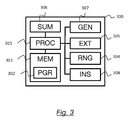
- the figure 3 illustrates a device 300 implementing the substitution method, according to a particular embodiment of the invention.
- the device comprises a storage space 301, for example a memory MEM, a processing unit 303 equipped for example with a processor PROC.
- the processing unit may be driven by a program 302, for example a PGR computer program, implementing the substitution method as described in the invention with reference to the figure 2 , and in particular the steps of determining the start and end times of a time range by detecting a first and a second particular event in the audiovisual stream, of extracting the portion of the audiovisual content comprised between the beginning and the end of the temporal range, semantic analysis of the extracted part and generation of a substitution sequence from the result of the analysis, and insertion of the substitution sequence in place of the extracted part.
- a program 302 for example a PGR computer program
- the instructions of the computer program 302 are for example loaded into a RAM (Random Access Memory in English) before being executed by the processor of the processing unit 303.
- the processor of the unit processing 303 implements the steps of the substitution method according to the instructions of the computer program 302.
- the device comprises, in addition to the memory 301, a processing unit adapted to determine start and end times of a time range by detecting a first and a second particular event in the audiovisual stream.
- a processing unit adapted to determine start and end times of a time range by detecting a first and a second particular event in the audiovisual stream.
- processing can be performed by a detection module 304 (RNG) implementing for example a gesture characterization algorithm and / or a speech recognition algorithm.
- the device also comprises a processing unit adapted to extract the portion of the audiovisual content between the beginning and the end of the time range identified by the detection module 304.
- the extraction can be performed by an extraction module 305 (EXT ) implementing a video processing algorithm capable of identifying video frames and audio samples within the time range to extract them from the sequence.
- EXT extraction module 305
- the device also comprises a processing unit capable of performing a semantic analysis of the extracted part, such as a module 306 (SUM) implementing an algorithm adapted to create a summary from an audio component of a video.
- the device also comprises a generation module 307 (GEN) of a substitution sequence from the result of the semantic analysis, the module 307 being able to correspond, for example, to a video processing unit adapted to perform the embedding of a summary or keywords in a video.
- the device comprises an insertion module 308 (INS) of the substitution sequence in place of the part extracted in the video sequence.
- the device can be integrated into a video processing equipment or a terminal such as a computer.
Landscapes
- Engineering & Computer Science (AREA)
- Multimedia (AREA)
- Signal Processing (AREA)
- Audiology, Speech & Language Pathology (AREA)
- Health & Medical Sciences (AREA)
- Human Computer Interaction (AREA)
- Physics & Mathematics (AREA)
- Acoustics & Sound (AREA)
- Computational Linguistics (AREA)
- Marketing (AREA)
- Business, Economics & Management (AREA)
- Databases & Information Systems (AREA)
- Computer Security & Cryptography (AREA)
- Artificial Intelligence (AREA)
- Information Retrieval, Db Structures And Fs Structures Therefor (AREA)
- Electrically Operated Instructional Devices (AREA)
Applications Claiming Priority (1)
| Application Number | Priority Date | Filing Date | Title |
|---|---|---|---|
| FR1555577A FR3037760A1 (fr) | 2015-06-18 | 2015-06-18 | Procede et dispositif de substitution d'une partie d'une sequence video |
Publications (2)
| Publication Number | Publication Date |
|---|---|
| EP3107302A1 true EP3107302A1 (de) | 2016-12-21 |
| EP3107302B1 EP3107302B1 (de) | 2023-09-06 |
Family
ID=54260891
Family Applications (1)
| Application Number | Title | Priority Date | Filing Date |
|---|---|---|---|
| EP16174489.1A Active EP3107302B1 (de) | 2015-06-18 | 2016-06-15 | Verfahren und vorrichtung zum austausch eines teils einer videosequenz |
Country Status (3)
| Country | Link |
|---|---|
| US (1) | US10593366B2 (de) |
| EP (1) | EP3107302B1 (de) |
| FR (1) | FR3037760A1 (de) |
Families Citing this family (2)
| Publication number | Priority date | Publication date | Assignee | Title |
|---|---|---|---|---|
| US11527265B2 (en) * | 2018-11-02 | 2022-12-13 | BriefCam Ltd. | Method and system for automatic object-aware video or audio redaction |
| CN110211590B (zh) * | 2019-06-24 | 2021-12-03 | 新华智云科技有限公司 | 一种会议热点的处理方法、装置、终端设备及存储介质 |
Citations (5)
| Publication number | Priority date | Publication date | Assignee | Title |
|---|---|---|---|---|
| FR2811111A1 (fr) * | 2000-06-30 | 2002-01-04 | Question D Image | Procede de detection de changement de plan, au sein d'une sequence video, programme informatique et dispositif correspondants |
| EP2575341A1 (de) * | 2011-09-29 | 2013-04-03 | France Télécom | Verfahren und Vorrichtung zum Anhören einer Sprachmitteilung |
| US20140278308A1 (en) * | 2013-03-15 | 2014-09-18 | Yahoo! Inc. | Method and system for measuring user engagement using click/skip in content stream |
| CN104065977A (zh) * | 2014-06-06 | 2014-09-24 | 百度在线网络技术(北京)有限公司 | 音/视频文件的处理方法及装置 |
| US20140310342A1 (en) * | 2007-12-21 | 2014-10-16 | Amdocs Software Systems Limited | Method for synchronizing a rich media® action with an audiovisual change, corresponding device and computer software, method for generating a rich media® presentation and corresponding computer software |
Family Cites Families (12)
| Publication number | Priority date | Publication date | Assignee | Title |
|---|---|---|---|---|
| US7512622B2 (en) * | 2003-06-11 | 2009-03-31 | Yahoo! Inc. | Method and apparatus for organizing and playing data |
| WO2005076594A1 (en) * | 2004-02-06 | 2005-08-18 | Agency For Science, Technology And Research | Automatic video event detection and indexing |
| GB2430101A (en) * | 2005-09-09 | 2007-03-14 | Mitsubishi Electric Inf Tech | Applying metadata for video navigation |
| US8099386B2 (en) * | 2006-12-27 | 2012-01-17 | Research In Motion Limited | Method and apparatus for synchronizing databases connected by wireless interface |
| US9177209B2 (en) * | 2007-12-17 | 2015-11-03 | Sinoeast Concept Limited | Temporal segment based extraction and robust matching of video fingerprints |
| US9015741B2 (en) * | 2009-04-17 | 2015-04-21 | Gracenote, Inc. | Method and system for remotely controlling consumer electronic devices |
| US10116972B2 (en) * | 2009-05-29 | 2018-10-30 | Inscape Data, Inc. | Methods for identifying video segments and displaying option to view from an alternative source and/or on an alternative device |
| US8731373B2 (en) * | 2009-06-30 | 2014-05-20 | Rovi Technologies Corporation | Managing and editing stored media assets |
| US20120236201A1 (en) * | 2011-01-27 | 2012-09-20 | In The Telling, Inc. | Digital asset management, authoring, and presentation techniques |
| US9014540B1 (en) * | 2012-07-17 | 2015-04-21 | Time Warner Cable Enterprises Llc | Techniques for provisioning local media players with content |
| US9496000B2 (en) * | 2014-05-16 | 2016-11-15 | Comcast Cable Communications, Llc | Audio modification for adjustable playback rate |
| US20150363156A1 (en) * | 2014-06-13 | 2015-12-17 | International Business Machines Corporation | Media splitting and reduction in storage requirements based on common content |
-
2015
- 2015-06-18 FR FR1555577A patent/FR3037760A1/fr active Pending
-
2016
- 2016-06-13 US US15/181,315 patent/US10593366B2/en active Active
- 2016-06-15 EP EP16174489.1A patent/EP3107302B1/de active Active
Patent Citations (6)
| Publication number | Priority date | Publication date | Assignee | Title |
|---|---|---|---|---|
| FR2811111A1 (fr) * | 2000-06-30 | 2002-01-04 | Question D Image | Procede de detection de changement de plan, au sein d'une sequence video, programme informatique et dispositif correspondants |
| US20140310342A1 (en) * | 2007-12-21 | 2014-10-16 | Amdocs Software Systems Limited | Method for synchronizing a rich media® action with an audiovisual change, corresponding device and computer software, method for generating a rich media® presentation and corresponding computer software |
| EP2575341A1 (de) * | 2011-09-29 | 2013-04-03 | France Télécom | Verfahren und Vorrichtung zum Anhören einer Sprachmitteilung |
| US20140278308A1 (en) * | 2013-03-15 | 2014-09-18 | Yahoo! Inc. | Method and system for measuring user engagement using click/skip in content stream |
| CN104065977A (zh) * | 2014-06-06 | 2014-09-24 | 百度在线网络技术(北京)有限公司 | 音/视频文件的处理方法及装置 |
| EP2953132A1 (de) * | 2014-06-06 | 2015-12-09 | Baidu Online Network Technology (Beijing) Co., Ltd | Verfahren und Vorrichtung zur Verarbeitung einer Audio-/Videodatei |
Also Published As
| Publication number | Publication date |
|---|---|
| US20160372154A1 (en) | 2016-12-22 |
| US10593366B2 (en) | 2020-03-17 |
| EP3107302B1 (de) | 2023-09-06 |
| FR3037760A1 (fr) | 2016-12-23 |
Similar Documents
| Publication | Publication Date | Title |
|---|---|---|
| Wagner | Are they watching? Test-taker viewing behavior during an L2 video listening test | |
| TW202145131A (zh) | 視訊處理方法及裝置、電子設備和電腦可讀儲存介質 | |
| Jelani et al. | Examining incidental vocabulary acquisition from captioned video: Does test modality matter? | |
| Smith et al. | Match-action: The role of motion and audio in creating global change blindness in film | |
| US10719696B2 (en) | Generation of interrelationships among participants and topics in a videoconferencing system | |
| US12342042B2 (en) | System and methods for providing and consuming online media content | |
| EP3506829A1 (de) | Vorhersage der aufmerksamkeit eines publikums während einer präsentation | |
| Lakshmiprabha et al. | [Poster] An augmented and virtual reality system for training autistic children | |
| US20170154264A1 (en) | Autonomous collaboration agent for meetings | |
| Lempert | From small talk to microaggression: A history of scale | |
| Huang et al. | Investigating an application of speech‐to‐text recognition: a study on visual attention and learning behaviour | |
| Boudreault-Fournier | Recording and editing | |
| Lempert | Fine-grained analysis: Talk therapy, media, and the microscopic science of the face-to-face | |
| EP3107302B1 (de) | Verfahren und vorrichtung zum austausch eines teils einer videosequenz | |
| US20170083633A1 (en) | System for suggesting search terms | |
| US12468504B2 (en) | Communication skills training for private feedback in multi-user collaboration tools and live events | |
| Charnigo | Lights! camera! action! producing library instruction video tutorials using camtasia studio | |
| Kolb | Evaluation of the Interaction with a Digital 3D Testimony | |
| WO2023094371A1 (fr) | Procédé et système pour produire des micro-contenus vidéo dédiés à l'apprentissage d'une langue étrangère, et procédé d'apprentissage implémentant ces contenus vidéo | |
| Munfangati | Investigating the listening needs of English education department students at Universitas Ahmad Dahlan | |
| US11716215B2 (en) | Dynamic note generation with capturing of communication session content | |
| Harrington | You Already Know: Professionalizing Corrections through Instructional Film, 1976–1981 | |
| Gudgel | A mixed-methods study of the use of film by American secondary school educators in teaching about the Holocaust | |
| Agrawal et al. | Real-time contextual searches to assist speakers | |
| Mapes | Speaking Online |
Legal Events
| Date | Code | Title | Description |
|---|---|---|---|
| PUAI | Public reference made under article 153(3) epc to a published international application that has entered the european phase |
Free format text: ORIGINAL CODE: 0009012 |
|
| STAA | Information on the status of an ep patent application or granted ep patent |
Free format text: STATUS: THE APPLICATION HAS BEEN PUBLISHED |
|
| AK | Designated contracting states |
Kind code of ref document: A1 Designated state(s): AL AT BE BG CH CY CZ DE DK EE ES FI FR GB GR HR HU IE IS IT LI LT LU LV MC MK MT NL NO PL PT RO RS SE SI SK SM TR |
|
| AX | Request for extension of the european patent |
Extension state: BA ME |
|
| STAA | Information on the status of an ep patent application or granted ep patent |
Free format text: STATUS: REQUEST FOR EXAMINATION WAS MADE |
|
| 17P | Request for examination filed |
Effective date: 20170615 |
|
| RBV | Designated contracting states (corrected) |
Designated state(s): AL AT BE BG CH CY CZ DE DK EE ES FI FR GB GR HR HU IE IS IT LI LT LU LV MC MK MT NL NO PL PT RO RS SE SI SK SM TR |
|
| RAP1 | Party data changed (applicant data changed or rights of an application transferred) |
Owner name: ORANGE |
|
| STAA | Information on the status of an ep patent application or granted ep patent |
Free format text: STATUS: EXAMINATION IS IN PROGRESS |
|
| 17Q | First examination report despatched |
Effective date: 20200708 |
|
| RAP3 | Party data changed (applicant data changed or rights of an application transferred) |
Owner name: ORANGE |
|
| REG | Reference to a national code |
Ref legal event code: R079 Ipc: H04N0021233000 Ref country code: DE Ref legal event code: R079 Ref document number: 602016082482 Country of ref document: DE Free format text: PREVIOUS MAIN CLASS: H04N0021234000 Ipc: H04N0021233000 |
|
| RIC1 | Information provided on ipc code assigned before grant |
Ipc: H04N 21/44 20110101ALI20221102BHEP Ipc: H04N 21/234 20110101ALI20221102BHEP Ipc: H04N 21/858 20110101ALI20221102BHEP Ipc: H04N 21/8549 20110101ALI20221102BHEP Ipc: H04N 21/845 20110101ALI20221102BHEP Ipc: H04N 21/439 20110101ALI20221102BHEP Ipc: H04N 21/233 20110101AFI20221102BHEP |
|
| GRAP | Despatch of communication of intention to grant a patent |
Free format text: ORIGINAL CODE: EPIDOSNIGR1 |
|
| STAA | Information on the status of an ep patent application or granted ep patent |
Free format text: STATUS: GRANT OF PATENT IS INTENDED |
|
| INTG | Intention to grant announced |
Effective date: 20230104 |
|
| GRAJ | Information related to disapproval of communication of intention to grant by the applicant or resumption of examination proceedings by the epo deleted |
Free format text: ORIGINAL CODE: EPIDOSDIGR1 |
|
| STAA | Information on the status of an ep patent application or granted ep patent |
Free format text: STATUS: EXAMINATION IS IN PROGRESS |
|
| INTC | Intention to grant announced (deleted) | ||
| GRAP | Despatch of communication of intention to grant a patent |
Free format text: ORIGINAL CODE: EPIDOSNIGR1 |
|
| STAA | Information on the status of an ep patent application or granted ep patent |
Free format text: STATUS: GRANT OF PATENT IS INTENDED |
|
| INTG | Intention to grant announced |
Effective date: 20230511 |
|
| GRAS | Grant fee paid |
Free format text: ORIGINAL CODE: EPIDOSNIGR3 |
|
| GRAA | (expected) grant |
Free format text: ORIGINAL CODE: 0009210 |
|
| STAA | Information on the status of an ep patent application or granted ep patent |
Free format text: STATUS: THE PATENT HAS BEEN GRANTED |
|
| AK | Designated contracting states |
Kind code of ref document: B1 Designated state(s): AL AT BE BG CH CY CZ DE DK EE ES FI FR GB GR HR HU IE IS IT LI LT LU LV MC MK MT NL NO PL PT RO RS SE SI SK SM TR |
|
| REG | Reference to a national code |
Ref country code: GB Ref legal event code: FG4D Free format text: NOT ENGLISH |
|
| REG | Reference to a national code |
Ref country code: CH Ref legal event code: EP |
|
| REG | Reference to a national code |
Ref country code: IE Ref legal event code: FG4D Free format text: LANGUAGE OF EP DOCUMENT: FRENCH |
|
| REG | Reference to a national code |
Ref country code: DE Ref legal event code: R096 Ref document number: 602016082482 Country of ref document: DE |
|
| REG | Reference to a national code |
Ref country code: LT Ref legal event code: MG9D |
|
| REG | Reference to a national code |
Ref country code: NL Ref legal event code: MP Effective date: 20230906 |
|
| PG25 | Lapsed in a contracting state [announced via postgrant information from national office to epo] |
Ref country code: GR Free format text: LAPSE BECAUSE OF FAILURE TO SUBMIT A TRANSLATION OF THE DESCRIPTION OR TO PAY THE FEE WITHIN THE PRESCRIBED TIME-LIMIT Effective date: 20231207 |
|
| PG25 | Lapsed in a contracting state [announced via postgrant information from national office to epo] |
Ref country code: SE Free format text: LAPSE BECAUSE OF FAILURE TO SUBMIT A TRANSLATION OF THE DESCRIPTION OR TO PAY THE FEE WITHIN THE PRESCRIBED TIME-LIMIT Effective date: 20230906 Ref country code: RS Free format text: LAPSE BECAUSE OF FAILURE TO SUBMIT A TRANSLATION OF THE DESCRIPTION OR TO PAY THE FEE WITHIN THE PRESCRIBED TIME-LIMIT Effective date: 20230906 Ref country code: NO Free format text: LAPSE BECAUSE OF FAILURE TO SUBMIT A TRANSLATION OF THE DESCRIPTION OR TO PAY THE FEE WITHIN THE PRESCRIBED TIME-LIMIT Effective date: 20231206 Ref country code: LV Free format text: LAPSE BECAUSE OF FAILURE TO SUBMIT A TRANSLATION OF THE DESCRIPTION OR TO PAY THE FEE WITHIN THE PRESCRIBED TIME-LIMIT Effective date: 20230906 Ref country code: LT Free format text: LAPSE BECAUSE OF FAILURE TO SUBMIT A TRANSLATION OF THE DESCRIPTION OR TO PAY THE FEE WITHIN THE PRESCRIBED TIME-LIMIT Effective date: 20230906 Ref country code: HR Free format text: LAPSE BECAUSE OF FAILURE TO SUBMIT A TRANSLATION OF THE DESCRIPTION OR TO PAY THE FEE WITHIN THE PRESCRIBED TIME-LIMIT Effective date: 20230906 Ref country code: GR Free format text: LAPSE BECAUSE OF FAILURE TO SUBMIT A TRANSLATION OF THE DESCRIPTION OR TO PAY THE FEE WITHIN THE PRESCRIBED TIME-LIMIT Effective date: 20231207 Ref country code: FI Free format text: LAPSE BECAUSE OF FAILURE TO SUBMIT A TRANSLATION OF THE DESCRIPTION OR TO PAY THE FEE WITHIN THE PRESCRIBED TIME-LIMIT Effective date: 20230906 |
|
| REG | Reference to a national code |
Ref country code: AT Ref legal event code: MK05 Ref document number: 1610114 Country of ref document: AT Kind code of ref document: T Effective date: 20230906 |
|
| PG25 | Lapsed in a contracting state [announced via postgrant information from national office to epo] |
Ref country code: NL Free format text: LAPSE BECAUSE OF FAILURE TO SUBMIT A TRANSLATION OF THE DESCRIPTION OR TO PAY THE FEE WITHIN THE PRESCRIBED TIME-LIMIT Effective date: 20230906 |
|
| PG25 | Lapsed in a contracting state [announced via postgrant information from national office to epo] |
Ref country code: IS Free format text: LAPSE BECAUSE OF FAILURE TO SUBMIT A TRANSLATION OF THE DESCRIPTION OR TO PAY THE FEE WITHIN THE PRESCRIBED TIME-LIMIT Effective date: 20240106 |
|
| PG25 | Lapsed in a contracting state [announced via postgrant information from national office to epo] |
Ref country code: AT Free format text: LAPSE BECAUSE OF FAILURE TO SUBMIT A TRANSLATION OF THE DESCRIPTION OR TO PAY THE FEE WITHIN THE PRESCRIBED TIME-LIMIT Effective date: 20230906 |
|
| PG25 | Lapsed in a contracting state [announced via postgrant information from national office to epo] |
Ref country code: ES Free format text: LAPSE BECAUSE OF FAILURE TO SUBMIT A TRANSLATION OF THE DESCRIPTION OR TO PAY THE FEE WITHIN THE PRESCRIBED TIME-LIMIT Effective date: 20230906 |
|
| PG25 | Lapsed in a contracting state [announced via postgrant information from national office to epo] |
Ref country code: SM Free format text: LAPSE BECAUSE OF FAILURE TO SUBMIT A TRANSLATION OF THE DESCRIPTION OR TO PAY THE FEE WITHIN THE PRESCRIBED TIME-LIMIT Effective date: 20230906 Ref country code: RO Free format text: LAPSE BECAUSE OF FAILURE TO SUBMIT A TRANSLATION OF THE DESCRIPTION OR TO PAY THE FEE WITHIN THE PRESCRIBED TIME-LIMIT Effective date: 20230906 Ref country code: IS Free format text: LAPSE BECAUSE OF FAILURE TO SUBMIT A TRANSLATION OF THE DESCRIPTION OR TO PAY THE FEE WITHIN THE PRESCRIBED TIME-LIMIT Effective date: 20240106 Ref country code: ES Free format text: LAPSE BECAUSE OF FAILURE TO SUBMIT A TRANSLATION OF THE DESCRIPTION OR TO PAY THE FEE WITHIN THE PRESCRIBED TIME-LIMIT Effective date: 20230906 Ref country code: EE Free format text: LAPSE BECAUSE OF FAILURE TO SUBMIT A TRANSLATION OF THE DESCRIPTION OR TO PAY THE FEE WITHIN THE PRESCRIBED TIME-LIMIT Effective date: 20230906 Ref country code: CZ Free format text: LAPSE BECAUSE OF FAILURE TO SUBMIT A TRANSLATION OF THE DESCRIPTION OR TO PAY THE FEE WITHIN THE PRESCRIBED TIME-LIMIT Effective date: 20230906 Ref country code: AT Free format text: LAPSE BECAUSE OF FAILURE TO SUBMIT A TRANSLATION OF THE DESCRIPTION OR TO PAY THE FEE WITHIN THE PRESCRIBED TIME-LIMIT Effective date: 20230906 Ref country code: PT Free format text: LAPSE BECAUSE OF FAILURE TO SUBMIT A TRANSLATION OF THE DESCRIPTION OR TO PAY THE FEE WITHIN THE PRESCRIBED TIME-LIMIT Effective date: 20240108 Ref country code: SK Free format text: LAPSE BECAUSE OF FAILURE TO SUBMIT A TRANSLATION OF THE DESCRIPTION OR TO PAY THE FEE WITHIN THE PRESCRIBED TIME-LIMIT Effective date: 20230906 |
|
| PG25 | Lapsed in a contracting state [announced via postgrant information from national office to epo] |
Ref country code: PL Free format text: LAPSE BECAUSE OF FAILURE TO SUBMIT A TRANSLATION OF THE DESCRIPTION OR TO PAY THE FEE WITHIN THE PRESCRIBED TIME-LIMIT Effective date: 20230906 Ref country code: IT Free format text: LAPSE BECAUSE OF FAILURE TO SUBMIT A TRANSLATION OF THE DESCRIPTION OR TO PAY THE FEE WITHIN THE PRESCRIBED TIME-LIMIT Effective date: 20230906 |
|
| REG | Reference to a national code |
Ref country code: DE Ref legal event code: R097 Ref document number: 602016082482 Country of ref document: DE |
|
| PG25 | Lapsed in a contracting state [announced via postgrant information from national office to epo] |
Ref country code: DK Free format text: LAPSE BECAUSE OF FAILURE TO SUBMIT A TRANSLATION OF THE DESCRIPTION OR TO PAY THE FEE WITHIN THE PRESCRIBED TIME-LIMIT Effective date: 20230906 |
|
| PLBE | No opposition filed within time limit |
Free format text: ORIGINAL CODE: 0009261 |
|
| STAA | Information on the status of an ep patent application or granted ep patent |
Free format text: STATUS: NO OPPOSITION FILED WITHIN TIME LIMIT |
|
| PG25 | Lapsed in a contracting state [announced via postgrant information from national office to epo] |
Ref country code: DK Free format text: LAPSE BECAUSE OF FAILURE TO SUBMIT A TRANSLATION OF THE DESCRIPTION OR TO PAY THE FEE WITHIN THE PRESCRIBED TIME-LIMIT Effective date: 20230906 Ref country code: SI Free format text: LAPSE BECAUSE OF FAILURE TO SUBMIT A TRANSLATION OF THE DESCRIPTION OR TO PAY THE FEE WITHIN THE PRESCRIBED TIME-LIMIT Effective date: 20230906 |
|
| 26N | No opposition filed |
Effective date: 20240607 |
|
| PG25 | Lapsed in a contracting state [announced via postgrant information from national office to epo] |
Ref country code: BG Free format text: LAPSE BECAUSE OF FAILURE TO SUBMIT A TRANSLATION OF THE DESCRIPTION OR TO PAY THE FEE WITHIN THE PRESCRIBED TIME-LIMIT Effective date: 20230906 |
|
| PG25 | Lapsed in a contracting state [announced via postgrant information from national office to epo] |
Ref country code: BG Free format text: LAPSE BECAUSE OF FAILURE TO SUBMIT A TRANSLATION OF THE DESCRIPTION OR TO PAY THE FEE WITHIN THE PRESCRIBED TIME-LIMIT Effective date: 20230906 |
|
| PG25 | Lapsed in a contracting state [announced via postgrant information from national office to epo] |
Ref country code: MC Free format text: LAPSE BECAUSE OF FAILURE TO SUBMIT A TRANSLATION OF THE DESCRIPTION OR TO PAY THE FEE WITHIN THE PRESCRIBED TIME-LIMIT Effective date: 20230906 |
|
| REG | Reference to a national code |
Ref country code: CH Ref legal event code: PL |
|
| PG25 | Lapsed in a contracting state [announced via postgrant information from national office to epo] |
Ref country code: LU Free format text: LAPSE BECAUSE OF NON-PAYMENT OF DUE FEES Effective date: 20240615 |
|
| PG25 | Lapsed in a contracting state [announced via postgrant information from national office to epo] |
Ref country code: IE Free format text: LAPSE BECAUSE OF NON-PAYMENT OF DUE FEES Effective date: 20240615 |
|
| PG25 | Lapsed in a contracting state [announced via postgrant information from national office to epo] |
Ref country code: CH Free format text: LAPSE BECAUSE OF NON-PAYMENT OF DUE FEES Effective date: 20240630 Ref country code: BE Free format text: LAPSE BECAUSE OF NON-PAYMENT OF DUE FEES Effective date: 20240630 |
|
| REG | Reference to a national code |
Ref country code: BE Ref legal event code: MM Effective date: 20240630 |
|
| PGFP | Annual fee paid to national office [announced via postgrant information from national office to epo] |
Ref country code: DE Payment date: 20250520 Year of fee payment: 10 |
|
| PGFP | Annual fee paid to national office [announced via postgrant information from national office to epo] |
Ref country code: GB Payment date: 20250520 Year of fee payment: 10 |
|
| PGFP | Annual fee paid to national office [announced via postgrant information from national office to epo] |
Ref country code: FR Payment date: 20250520 Year of fee payment: 10 |
|
| PG25 | Lapsed in a contracting state [announced via postgrant information from national office to epo] |
Ref country code: CY Free format text: LAPSE BECAUSE OF FAILURE TO SUBMIT A TRANSLATION OF THE DESCRIPTION OR TO PAY THE FEE WITHIN THE PRESCRIBED TIME-LIMIT; INVALID AB INITIO Effective date: 20160615 |