EP3102364B1 - Spannvorrichtung - Google Patents
Spannvorrichtung Download PDFInfo
- Publication number
- EP3102364B1 EP3102364B1 EP14710046.5A EP14710046A EP3102364B1 EP 3102364 B1 EP3102364 B1 EP 3102364B1 EP 14710046 A EP14710046 A EP 14710046A EP 3102364 B1 EP3102364 B1 EP 3102364B1
- Authority
- EP
- European Patent Office
- Prior art keywords
- tensioner
- sleeve
- thread
- base
- body portion
- Prior art date
- Legal status (The legal status is an assumption and is not a legal conclusion. Google has not performed a legal analysis and makes no representation as to the accuracy of the status listed.)
- Active
Links
Images


Classifications
-
- B—PERFORMING OPERATIONS; TRANSPORTING
- B23—MACHINE TOOLS; METAL-WORKING NOT OTHERWISE PROVIDED FOR
- B23P—METAL-WORKING NOT OTHERWISE PROVIDED FOR; COMBINED OPERATIONS; UNIVERSAL MACHINE TOOLS
- B23P19/00—Machines for simply fitting together or separating metal parts or objects, or metal and non-metal parts, whether or not involving some deformation; Tools or devices therefor so far as not provided for in other classes
- B23P19/04—Machines for simply fitting together or separating metal parts or objects, or metal and non-metal parts, whether or not involving some deformation; Tools or devices therefor so far as not provided for in other classes for assembling or disassembling parts
- B23P19/06—Screw or nut setting or loosening machines
- B23P19/067—Bolt tensioners
-
- B—PERFORMING OPERATIONS; TRANSPORTING
- B25—HAND TOOLS; PORTABLE POWER-DRIVEN TOOLS; MANIPULATORS
- B25B—TOOLS OR BENCH DEVICES NOT OTHERWISE PROVIDED FOR, FOR FASTENING, CONNECTING, DISENGAGING OR HOLDING
- B25B29/00—Accessories
- B25B29/02—Bolt tensioners
-
- F—MECHANICAL ENGINEERING; LIGHTING; HEATING; WEAPONS; BLASTING
- F16—ENGINEERING ELEMENTS AND UNITS; GENERAL MEASURES FOR PRODUCING AND MAINTAINING EFFECTIVE FUNCTIONING OF MACHINES OR INSTALLATIONS; THERMAL INSULATION IN GENERAL
- F16B—DEVICES FOR FASTENING OR SECURING CONSTRUCTIONAL ELEMENTS OR MACHINE PARTS TOGETHER, e.g. NAILS, BOLTS, CIRCLIPS, CLAMPS, CLIPS OR WEDGES; JOINTS OR JOINTING
- F16B31/00—Screwed connections specially modified in view of tensile load; Break-bolts
- F16B31/04—Screwed connections specially modified in view of tensile load; Break-bolts for maintaining a tensile load
- F16B31/043—Prestressed connections tensioned by means of liquid, grease, rubber, explosive charge, or the like
-
- G—PHYSICS
- G01—MEASURING; TESTING
- G01L—MEASURING FORCE, STRESS, TORQUE, WORK, MECHANICAL POWER, MECHANICAL EFFICIENCY, OR FLUID PRESSURE
- G01L1/00—Measuring force or stress, in general
- G01L1/12—Measuring force or stress, in general by measuring variations in the magnetic properties of materials resulting from the application of stress
Definitions
- This invention relates to a tensioner of threaded members according to the preamble of claim 1.
- Tensioners are commonly used for, amongst other tasks, stretching items such as bolts or studs, so that a threaded nut can then be run down the stretched bolt, thus capturing the tension in the stretched bolt.
- they are used in any field that requires large loads to be secured by the use of threaded fasteners; one common use is in wind turbines, when such tensioners can be used to secure many fastenings, such as the turbine blades to their bearing, or the tower of such a turbine to its foundations.
- Hydraulic tensioners are well known in the art; examples of the same can be seen in the European Patent Application published as EP 2 522 465 and in the Japanese Patent Application published as JP3-204406 .
- the latter document discloses a tensioner for threaded members according to the preamble of claim 1.
- tensioners can be used to stretch a threaded member such as a stud, bolt or the like, and generally comprise inner and outer coaxial generally cylindrical annular bodies which are placed around the threaded member.
- the inner body threadedly engages the threaded member.
- a space between the inner and outer bodies defines a pressure space, into which fluid, typically hydraulic fluid, can be introduced to drive the bodies apart along their common axis.
- the piston on introduction of the fluid into the pressure space, will be urged away from the base along the threaded member, so as to place the threaded member in tension. If a nut is run along the threaded member to abut the fixed surface, the tension generated in the threaded member can be stored and applied to the fixed surface. The bolt tensioner can then be released and removed, leaving a fastened nut and threaded member.
- the threaded member and nut can be used to fasten a plurality of objects together; this can be most easily be seen in the case where the threaded member is a bolt where a number of objects of sheet form can be held between the nut and the head of the bolt.
- the displacement sensor may be a linear encoder, where one of the first and second parts comprises a scale that encodes a position and the other of the first and second parts is a transducer that reads the scale. Because the first and second parts are mounted on parts that move relative to one other, the transducer will see movement of the scale, and so be able to measure the relative movement.
- the scale will be a magnetic encoder, with the scale encoded magnetically, for example as a series of alternating magnetic poles along the scale or by varying the magnetic permeability of the scale along its length.
- the transducer will be a magnetic field sensor, such as a Hall effect sensor.
- the scale can be encoded optically, capacitively or inductively, with the transducer being capable of reading such encodings.
- thread-engaging member will comprise a sleeve surrounding the body portion, the sleeve carrying the second part of the displacement sensor (typically the scale).
- the sleeve may be free to rotate around the body portion, but provided with a stop such that linear movement along the axis relative to the sleeve is restricted.
- the stop may comprise a retaining ring protruding from an outer surface of the body portion.
- the sleeve will advantageously be fixed rotationally about the axis relative to the base. This will ensure that the two parts of the displacement sensor are appropriately rotationally located relative to one another as the thread-engaging member is screwed onto a threaded member, whilst still allowing the two parts to move linearly relative to one another along the axis, which is the displacement that it is desired to measure.
- the sleeve may be provided with at least one guide pin protruding from the sleeve and the base may have at least one slot formed therein running along the axis; each guide pin may be received in a corresponding slot.
- the pin working in the slot will allow linear movement along the axis, but restrict rotational movement of the sleeve relative to the base.
- the use of the sleeve ensures that the two parts of the displacement sensor are appropriately rotationally located relative to one another as the thread-engaging member is screwed onto a threaded member, whilst still allowing the two parts to move linearly relative to one another along the axis, which is the displacement that it is desired to measure.
- the relative movement of the two parts of the encoder is constrained to be one-dimensional, thus allowing a simpler, smaller and hence cheaper encoder arrangement to be used.
- storage of the sensor part is improved and risk of damage minimised.
- a sleeve will further facilitate the use of multiple different thread engaging members; only the sleeve will need to have the encoder mounted thereon, with multiple different thread engaging members enabling the use of the tensioner with different diameter threaded members, without the need for each thread-engaging member to have its own encoder.
- the displacement sensor may be provided with an output for the measured displacement.
- the output would comprise an output cable by means of which the measured displacement can be transmitted to a reader, display or other such terminal.
- the output may be provided with a wireless transmitter whereby the measured displacement can be transmitted to a remote location.
- the tensioner will be a hydraulic tensioner and will comprise a source of pressurised fluid in communication with the pressure space.
- the protrusion may be a flange on the thread-engaging member.
- the second portion of the displacement sensor will be positioned axially along the body portion on a portion of the body portion that is engaged with the thread of the threaded member. As such, this reduces further any errors due to elastic deformation of the tensioner itself.
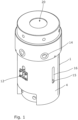
- a hydraulic tensioner 1 in accordance with an embodiment of the invention is shown in the accompanying drawings.
- the tension can act to tension and so extend a threaded member of the form of a bolt or stud 2; a nut 3 can then be run down the bolt 2 in order to capture that tension.
- the tensioner comprises a base 4, which forms a housing for the tensioner and will rest against a fixed surface.
- the tensioner also comprises a piston 6, which can move relative to base 4 along central axis 17 through a bore 20.
- a pressure space 13 Between the base 4 and the piston 6 there is defined a pressure space 13. Hydraulic fluid can be introduced into this space by means of a system of ports 14. By doing so, the piston 6 can be forced away from the base 4; the piston 6 will move along axis 17, vertically in the sense of the Figures.
- the piston 6 has a central through bore 20, coaxial with the axis 17.
- a thread-engaging member 7 comprises a body portion 8 of the form of a cylindrical sleeve that fits within the bore 20.
- the interior of the sleeve defines a threaded bore 30, which engages the threaded member 2.
- the thread-engaging member 7 has a piston engaging portion 9 positioned at the end of the body portion 8. It forms a protrusion of the form of a flange, which abuts the piston 6 such that the force generated by the piston 6 being urged away from the base 4 is transmitted to the piston engaging portion 9, through body portion 8 and then through the threaded bore 20 to the threaded member 2.
- the nut 3 can then be run down threaded member 2 to keep the member 2 in tension and cause the nut 3 to press against the fixed surface once the tension due to the fluid in the pressure space 13 has been released.
- a sleeve 10 is provided around the external surface 5 of the body portion 8 of the thread-engaging member 7.
- the sleeve 10 is of the form of a cylindrical shell, coaxial with the axis 17. It is free to rotate relative to the thread-engaging member 7, but is retained against linear movement along the axis 17 by a retaining ring 27 protruding from the outer surface 5.
- This sleeve 10 carries a magnetic encoder strip 11 along its length, mounted in a recess 21 in the outer surface of the sleeve 10.
- the magnetic encoder is of the form of a pattern of magnetic poles, so that a pattern of magnetic fields projection axially outwards from the sleeve 10 is created.
- the length of the magnetic encoder 11 is aligned parallel to the axis 17.
- These magnetic fields can be read by a magnetic sensor 12 mounted in the base 4, which will typically be a Hall effect sensor.
- the magnetic sensor 12 is fixed relative to the base 4 by means of clamps 18.
- the magnetic encoder 11 will move past the magnetic sensor 12; by appropriate processing of the output (through output cable 19) it will be possible to measure the movement of the thread-engaging member 7 relative to the base 4 and from that determine the elongation of the threaded member 2.
- the measurement can involve simple counting of the reversals of the magnetic field as poles past, but the skilled man will appreciate that there are multiple ways in which position can be encoded magnetically.
- the encoder is mounted low down on the body 8 of the thread-engaging member 7, fewer errors are introduced into the measurement due to the elastic elongation of parts of the tensioner 1 such as the thread-engaging member. It can be seen that the magnetic encoder 11 is fitted on a portion of the body portion 8 that is engaging the threaded member, and so by measuring at that point these errors can be minimised.
- the sleeve 10 is provided with two protruding pins 15. These are received within corresponding elongate slots 16 in the base 4, the slots running parallel to the axis 17. As such, this substantially prevents the sleeve 10 from rotating about the axis 17 relative to the base 4 (although it can rotate relative to the thread-engaging member 7) whilst allowing the linear movement along the axis that it is desired to measure.
- the thread-engaging member 7 can be screwed onto the threaded member 2 without having to be concerned about the angular orientation of the magnetic encoder 11 relative to the magnetic sensor 12, as the pins 15 will ensure that that alignment is correct. If the magnetic encoder were directly carried on the body portion 8 of the thread-engaging member 7, then it would be necessary to ensure that the thread-engaging member was rotated to the correct position relative to the base on every installation, which would be labour-intensive and prone to inaccuracy.
- the output signal from the magnetic sensor 12 can be read out from output cable 19 and directed to a suitable processor. Whilst the processor, or the processed results, can be located local to the tensioner 1, it is also possible that the raw output signals or the processed results, or any intermediate results, could be transmitted wirelessly to a base station remote from the tensioner. This would be particularly useful where several tensioners were being used together (as such may be used in the bolts securing a wind turbine to the ground, or securing the turbine blades onto the nacelle) and it allows monitoring of several operations simultaneously, and also more flexibly recording the results for traceability's sake.
- the sleeve of this embodiment is fixed rotationally relative to the base, in another embodiment, it is possible to have the sleeve not rotationally fixed, so that the sleeve is free to rotate around the base.
- the encoder would encompass the entire circumferential surface of the sleeve, so that the elongation measurement could be taken regardless of the rotational relationship between the sleeve and the magnetic sensor.
- the sleeve would provide the advantage that it the sleeve could be used with multiple different thread-engaging members, rather than requiring each thread-engaging member (or each puller bar) for different sized threads having to be provided with the encoder; thus, only one item needs to be encoded, rather than multiple items.
Landscapes
- Engineering & Computer Science (AREA)
- Mechanical Engineering (AREA)
- General Engineering & Computer Science (AREA)
- Physics & Mathematics (AREA)
- General Physics & Mathematics (AREA)
- Force Measurement Appropriate To Specific Purposes (AREA)
- Measurement Of Length, Angles, Or The Like Using Electric Or Magnetic Means (AREA)
Claims (11)
- Spannvorrichtung (1) für Gewindeelemente (2), wobei die Spannvorrichtung (1) umfasst:eine Basis (4) und einen Kolben (6), die einen Druckraum (13) dazwischen definieren, wobei die Basis (4) und der Kolben (6) dazu eingerichtet sind, bei der Einführung eines Fluids in den Druckraum (13) entlang einer Achse (17) auseinandergedrückt zu werden; undein Gewindeeingriffselement (7), das einen Körperabschnitt (8) in Hülsenform umfasst und ein Innengewinde (30) zum Eingriff mit einem Gewindeelement (2) und einen Kolbeneingriffsabschnitt (9), der einen Vorsprung trägt, aufweist;wobei sich der Kolben (6) an dem Vorsprung abstützt, so dass der Kolben (6) eine Kraft auf den Vorsprung ausübt, wenn er durch die Einführung von Fluid in den Druckraum (13) von der Basis (4) weggedrückt wird;dadurch gekennzeichnet, dass die Spannvorrichtung (1) ferner einen Wegsensor umfasst, der dazu eingerichtet ist, die relative Position des Körperabschnitts (8) des Gewindeeingriffselements (7) und der Basis (4) zu bestimmen, wobei der Wegsensor einen ersten Teil (12), der auf der Basis (4) getragen wird, und einen zweiten Teil (11), der auf dem Körperabschnitt (8) getragen wird, umfasst.
- Spannvorrichtung nach Anspruch 1, wobei das Gewindeeingriffselement (7) eine Hülse (10) umfasst, die den Körperabschnitt (8) umgibt, wobei die Hülse (10) den zweiten Teil (11) des Wegsensors trägt.
- Spannvorrichtung nach Anspruch 2, wobei sich die Hülse (10) frei um den Körperabschnitt (8) herum drehen kann, jedoch mit einem Anschlag (27) versehen ist, so dass eine lineare Bewegung entlang der Achse (17) im Verhältnis zu der Hülse (10) eingeschränkt ist.
- Spannvorrichtung nach Anspruch 3, wobei die Hülse (10) um die Achse (17) herum im Verhältnis zur Basis (4) drehfest ist.
- Spannvorrichtung nach Anspruch 4, wobei die Hülse (10) mit mindestens einem Führungsstift (15) versehen ist, der aus der Hülse (10) vorsteht, und die Basis (4) mindestens einen darin gebildeten Schlitz (16) aufweist, der entlang der Achse (17) verläuft, wobei jeder Führungsstift (15) in einem entsprechenden Schlitz (16) aufgenommen ist.
- Spannvorrichtung nach einem der Ansprüche 2 bis 5, wobei der Wegsensor ein linearer Messgeber ist, bei dem der zweite Teil (11) eine Skala umfasst, die eine Position codiert, und der erste Teil (12) ein Messwandler ist, der die Skala abliest.
- Spannvorrichtung nach Anspruch 6, wobei die Skala ein magnetischer Messgeber ist, bei dem die Skala magnetisch codiert ist, und bei dem der Messwandler (12) ein Magnetfeldsensor ist.
- Spannvorrichtung nach einem der vorhergehenden Ansprüche, wobei der Wegsensor mit einem Ausgang (19) für den gemessenen Weg versehen ist, wobei der Ausgang (14) mit einem drahtlosen Sender versehen ist, mit dem der gemessene Weg an einen entfernten Standort gesendet werden kann.
- Spannvorrichtung nach einem der vorhergehenden Ansprüche, die eine hydraulische Spannvorrichtung ist, die eine Druckfluidquelle in Kommunikation mit dem Druckraum umfasst.
- Kombination aus der Spannvorrichtung (1) nach einem der vorhergehenden Ansprüche und einem Gewindeelement (2), wobei das Gewindeeingriffselement (7) mit einem Gewinde des Gewindeelements (2) in Eingriff steht.
- Kombination nach Anspruch 10, wobei der zweite Teil (11) des Wegsensors axial entlang des Körperabschnitts (8) auf einem Abschnitt des Körperabschnitts (8) positioniert ist, der mit dem Gewinde des Gewindeelements (2) in Eingriff steht.
Applications Claiming Priority (1)
| Application Number | Priority Date | Filing Date | Title |
|---|---|---|---|
| PCT/GB2014/050349 WO2015118283A1 (en) | 2014-02-06 | 2014-02-06 | Tensioner |
Publications (4)
| Publication Number | Publication Date |
|---|---|
| EP3102364A1 EP3102364A1 (de) | 2016-12-14 |
| EP3102364B1 true EP3102364B1 (de) | 2024-08-14 |
| EP3102364C0 EP3102364C0 (de) | 2024-08-14 |
| EP3102364B8 EP3102364B8 (de) | 2024-09-25 |
Family
ID=50277256
Family Applications (1)
| Application Number | Title | Priority Date | Filing Date |
|---|---|---|---|
| EP14710046.5A Active EP3102364B8 (de) | 2014-02-06 | 2014-02-06 | Spannvorrichtung |
Country Status (6)
| Country | Link |
|---|---|
| US (1) | US10500685B2 (de) |
| EP (1) | EP3102364B8 (de) |
| CN (1) | CN106102991B (de) |
| ES (1) | ES2994100T3 (de) |
| PL (1) | PL3102364T3 (de) |
| WO (1) | WO2015118283A1 (de) |
Families Citing this family (12)
| Publication number | Priority date | Publication date | Assignee | Title |
|---|---|---|---|---|
| US10800020B2 (en) | 2016-05-19 | 2020-10-13 | Enerpac Tool Group Corp. | Tensioning device and method for tensioning a workpiece |
| CN106181888B (zh) * | 2016-08-30 | 2018-04-20 | 成都西华升腾科技有限公司 | 可长距离传动的螺栓松紧器 |
| GB2556099A (en) * | 2016-11-21 | 2018-05-23 | Caterpillar Energy Solutions Gmbh | Screw tensioning device |
| GB2579578A (en) * | 2018-12-04 | 2020-07-01 | Tentec Ltd | Hydraulic tensioner and method of tensioning |
| GB2579661A (en) | 2018-12-11 | 2020-07-01 | Tentec Ltd | Hydraulic tensioning apparatus |
| GB2580102B (en) * | 2018-12-21 | 2021-08-25 | Caterpillar Energy Solutions Gmbh | System for tensioning at least one connecting element |
| GB2580111B (en) * | 2018-12-21 | 2021-04-28 | Caterpillar Energy Solutions Gmbh | Device for tensioning a connecting element |
| WO2020230081A1 (en) * | 2019-05-16 | 2020-11-19 | Advmet (Pty) Ltd | A mechanical tensioning system and method |
| WO2020230082A1 (en) * | 2019-05-16 | 2020-11-19 | Advmet (Pty) Ltd | A mechanical tensioning device and method |
| EP4126459A1 (de) | 2020-03-25 | 2023-02-08 | Milwaukee Electric Tool Corporation | Bolzenspannwerkzeug |
| CN113441940B (zh) * | 2021-06-30 | 2022-09-27 | 哈尔滨工业大学 | 沿螺栓轴向加载的压电换能器预紧装配装置及装配方法 |
| CN121514882B (zh) * | 2026-01-14 | 2026-04-10 | 宁波竤远船舶动力设备有限公司 | 船用气缸盖拉伸器 |
Family Cites Families (24)
| Publication number | Priority date | Publication date | Assignee | Title |
|---|---|---|---|---|
| US3722332A (en) * | 1971-06-01 | 1973-03-27 | Transfer Systems | Apparatus for securing the bolts of the reactor pressure vessel head to the reactor pressure vessel |
| DE2455788A1 (de) * | 1974-11-26 | 1976-08-12 | Horst Schenk | Hydraulisches spannelement fuer zugankervorspannung |
| US3995828A (en) * | 1975-09-16 | 1976-12-07 | Biach Industries, Inc. | Bolt tensioning apparatus |
| US4535656A (en) * | 1981-03-12 | 1985-08-20 | Orban Joseph N | Integral tensioner assembly for tensioning, inserting and removing a stud |
| FR2615776B1 (fr) * | 1987-05-27 | 1989-09-22 | Framatome Sa | Dispositif de vissage et de devissage de goujons ou boulons de grandes dimensions |
| US4914389A (en) * | 1988-10-24 | 1990-04-03 | Eaton Corporation | Multiturn shaft position sensor with backlash compensation |
| JPH03204406A (ja) | 1990-01-08 | 1991-09-06 | Hitachi Ltd | ボルト引張装置及び方法 |
| US5398574A (en) * | 1992-12-23 | 1995-03-21 | Unex Corporation | Fluid operating tool |
| DE4313778A1 (de) * | 1993-04-27 | 1994-11-03 | Westfalia Becorit Ind Tech | Schraubenspannvorrichtung |
| US5842263A (en) * | 1996-01-11 | 1998-12-01 | Westinghouse Electric Corporation | Method and manufacture of an axial tensioned bolt |
| US6851324B2 (en) * | 2002-12-16 | 2005-02-08 | Delphi Technologies, Inc. | Non-contacting compliant torque sensor |
| US20040129118A1 (en) * | 2003-01-02 | 2004-07-08 | Junkers John K. | Fluid-operated torque tool |
| FR2905460B1 (fr) * | 2006-09-01 | 2009-08-07 | Skf Ab | Procede et dispositif de controle de serrage hydraulique d'un ou plusieurs boulons. |
| NL1033069C2 (nl) * | 2006-12-15 | 2008-06-17 | Ind Bolting Technology And Sup | Inrichting en werkwijze voor het aantrekken van een op een draadeind gedraaide moer en samengestelde onderlegring en moer voor een dergelijke inrichting. |
| GB0720972D0 (en) * | 2007-10-25 | 2007-12-05 | Renishaw Plc | Magnetic encoder |
| DK2361722T3 (da) * | 2010-02-18 | 2013-04-15 | Skf Ab | Stang-spændeindretning |
| DE102011075807A1 (de) | 2011-05-13 | 2012-11-15 | Amtec Advanced Measurement Messtechnischer Service Gmbh | Vorrichtung zum kontrollierten Verspannen von Flanschverbindungen |
| CN102497088B (zh) * | 2011-12-15 | 2014-06-25 | 矽力杰半导体技术(杭州)有限公司 | 一种mos管的自适应串联电路 |
| FI124931B (fi) | 2012-02-09 | 2015-03-31 | Wärtsilä Finland Oy | Esikiristystyökalu ja menetelmä mutterin kiristämiseksi |
| DE102012102855A1 (de) | 2012-04-02 | 2013-10-02 | Asg Luftfahrttechnik Und Sensorik Gmbh | Verfahren und Anordnung zur Positionsbestimmung eines Bauteils sowie Sensor |
| US9035647B2 (en) * | 2012-07-02 | 2015-05-19 | Leine & Linde Ab | Encoder |
| DE102012106503B4 (de) * | 2012-07-18 | 2023-03-16 | Jörg Hohmann | Spannvorrichtung zum Dehnen eines Gewindebolzens |
| US9375959B2 (en) * | 2012-08-29 | 2016-06-28 | Hewlett-Packard Development Company, L.P. | Locking mechanism for an encoder strip |
| DE102014106215A1 (de) * | 2014-05-05 | 2015-11-05 | Frank Hohmann | Spannvorrichtung zum Dehnen eines Gewindebolzens |
-
2014
- 2014-02-06 CN CN201480074956.4A patent/CN106102991B/zh active Active
- 2014-02-06 EP EP14710046.5A patent/EP3102364B8/de active Active
- 2014-02-06 ES ES14710046T patent/ES2994100T3/es active Active
- 2014-02-06 WO PCT/GB2014/050349 patent/WO2015118283A1/en not_active Ceased
- 2014-02-06 PL PL14710046.5T patent/PL3102364T3/pl unknown
- 2014-02-06 US US15/116,988 patent/US10500685B2/en active Active
Also Published As
| Publication number | Publication date |
|---|---|
| US20170203397A1 (en) | 2017-07-20 |
| CN106102991A (zh) | 2016-11-09 |
| US10500685B2 (en) | 2019-12-10 |
| EP3102364B8 (de) | 2024-09-25 |
| EP3102364C0 (de) | 2024-08-14 |
| ES2994100T3 (en) | 2025-01-17 |
| WO2015118283A1 (en) | 2015-08-13 |
| EP3102364A1 (de) | 2016-12-14 |
| CN106102991B (zh) | 2020-04-24 |
| PL3102364T3 (pl) | 2025-02-17 |
Similar Documents
| Publication | Publication Date | Title |
|---|---|---|
| EP3102364B1 (de) | Spannvorrichtung | |
| US8646339B2 (en) | Thread clamping device including internal sensing and reporting | |
| Pan et al. | A vision-based monitoring method for the looseness of high-strength bolt | |
| US8245411B2 (en) | Surface geometry characters measuring gauge | |
| EP3299331B1 (de) | Faserseil, hebesystem mit solch einem faserseil, und verfahren zum betrieb dieses hebesystems | |
| US20170370803A1 (en) | Improvements in conveyor and components therefor, monitoring methods and communication systems | |
| US20210355766A1 (en) | Riser tools and methods | |
| DE112013007631T5 (de) | Vorrichtung und Verfahren der Lagerüberwachung | |
| SE1750050A1 (en) | Deformation measurement method and apparatus | |
| US20220032434A1 (en) | Hydraulic tensioning apparatus | |
| Yi et al. | Wireless strain and crack sensing using a folded patch antenna | |
| EP2902584A2 (de) | Offshore-Rohrüberwachungssystem | |
| WO2009070845A1 (en) | An optical component and wear sensor | |
| US20150198463A1 (en) | Method and apparatus for wire rope distance measurement | |
| CN203629528U (zh) | 外回转面圆度检测器 | |
| US9140530B2 (en) | Method and device for inspecting a threading of a tubular connection used in the oil industry | |
| US20240011946A1 (en) | Ultrasonic Sensor Arrangement | |
| EP1764596A2 (de) | Anordnung zur Erfassung von Messgrössen in Schraubverbindungen | |
| EP2270452A3 (de) | Vorrichtung zur Temparaturüberwachung in elektrischen Anlagen, elektrische Anlage mit einer derartigen Vorrichtung sowie Verfahren zum Betrieb derselben | |
| EP3100008B1 (de) | Verfahren und vorrichtung für eine strukturüberwachungsvorrichtung zur lokalisierbarkeit in einer röhrenförmigen struktur | |
| GB2527864A (en) | Sensing device | |
| CN202903737U (zh) | 一种便携式钢丝绳损伤探测装置 | |
| CA3174363A1 (en) | Bolt transducer | |
| EP2196829A3 (de) | Ortungsgerät | |
| CN107153183B (zh) | 一种车载激光测距仪 |
Legal Events
| Date | Code | Title | Description |
|---|---|---|---|
| PUAI | Public reference made under article 153(3) epc to a published international application that has entered the european phase |
Free format text: ORIGINAL CODE: 0009012 |
|
| STAA | Information on the status of an ep patent application or granted ep patent |
Free format text: STATUS: REQUEST FOR EXAMINATION WAS MADE |
|
| 17P | Request for examination filed |
Effective date: 20160812 |
|
| AK | Designated contracting states |
Kind code of ref document: A1 Designated state(s): AL AT BE BG CH CY CZ DE DK EE ES FI FR GB GR HR HU IE IS IT LI LT LU LV MC MK MT NL NO PL PT RO RS SE SI SK SM TR |
|
| AX | Request for extension of the european patent |
Extension state: BA ME |
|
| DAX | Request for extension of the european patent (deleted) | ||
| STAA | Information on the status of an ep patent application or granted ep patent |
Free format text: STATUS: EXAMINATION IS IN PROGRESS |
|
| 17Q | First examination report despatched |
Effective date: 20211104 |
|
| GRAP | Despatch of communication of intention to grant a patent |
Free format text: ORIGINAL CODE: EPIDOSNIGR1 |
|
| STAA | Information on the status of an ep patent application or granted ep patent |
Free format text: STATUS: GRANT OF PATENT IS INTENDED |
|
| INTG | Intention to grant announced |
Effective date: 20240311 |
|
| GRAS | Grant fee paid |
Free format text: ORIGINAL CODE: EPIDOSNIGR3 |
|
| GRAA | (expected) grant |
Free format text: ORIGINAL CODE: 0009210 |
|
| STAA | Information on the status of an ep patent application or granted ep patent |
Free format text: STATUS: THE PATENT HAS BEEN GRANTED |
|
| AK | Designated contracting states |
Kind code of ref document: B1 Designated state(s): AL AT BE BG CH CY CZ DE DK EE ES FI FR GB GR HR HU IE IS IT LI LT LU LV MC MK MT NL NO PL PT RO RS SE SI SK SM TR |
|
| REG | Reference to a national code |
Ref country code: GB Ref legal event code: FG4D |
|
| REG | Reference to a national code |
Ref country code: CH Ref legal event code: EP |
|
| REG | Reference to a national code |
Ref country code: DE Ref legal event code: R081 Ref document number: 602014090688 Country of ref document: DE Owner name: TENTEC LTD., GB Free format text: FORMER OWNER: TENTEC LTD., WEST BROMWICH, GB |
|
| REG | Reference to a national code |
Ref country code: CH Ref legal event code: PK Free format text: BERICHTIGUNG B8 |
|
| REG | Reference to a national code |
Ref country code: DE Ref legal event code: R096 Ref document number: 602014090688 Country of ref document: DE |
|
| RAP4 | Party data changed (patent owner data changed or rights of a patent transferred) |
Owner name: TENTEC LIMITED |
|
| REG | Reference to a national code |
Ref country code: IE Ref legal event code: FG4D |
|
| U01 | Request for unitary effect filed |
Effective date: 20240906 |
|
| U07 | Unitary effect registered |
Designated state(s): AT BE BG DE DK EE FI FR IT LT LU LV MT NL PT RO SE SI Effective date: 20240924 |
|
| U20 | Renewal fee for the european patent with unitary effect paid |
Year of fee payment: 12 Effective date: 20241203 |
|
| PG25 | Lapsed in a contracting state [announced via postgrant information from national office to epo] |
Ref country code: NO Free format text: LAPSE BECAUSE OF FAILURE TO SUBMIT A TRANSLATION OF THE DESCRIPTION OR TO PAY THE FEE WITHIN THE PRESCRIBED TIME-LIMIT Effective date: 20241114 |
|
| PG25 | Lapsed in a contracting state [announced via postgrant information from national office to epo] |
Ref country code: GR Free format text: LAPSE BECAUSE OF FAILURE TO SUBMIT A TRANSLATION OF THE DESCRIPTION OR TO PAY THE FEE WITHIN THE PRESCRIBED TIME-LIMIT Effective date: 20241115 |
|
| REG | Reference to a national code |
Ref country code: ES Ref legal event code: FG2A Ref document number: 2994100 Country of ref document: ES Kind code of ref document: T3 Effective date: 20250117 |
|
| PG25 | Lapsed in a contracting state [announced via postgrant information from national office to epo] |
Ref country code: IS Free format text: LAPSE BECAUSE OF FAILURE TO SUBMIT A TRANSLATION OF THE DESCRIPTION OR TO PAY THE FEE WITHIN THE PRESCRIBED TIME-LIMIT Effective date: 20241214 |
|
| PG25 | Lapsed in a contracting state [announced via postgrant information from national office to epo] |
Ref country code: HR Free format text: LAPSE BECAUSE OF FAILURE TO SUBMIT A TRANSLATION OF THE DESCRIPTION OR TO PAY THE FEE WITHIN THE PRESCRIBED TIME-LIMIT Effective date: 20240814 |
|
| PG25 | Lapsed in a contracting state [announced via postgrant information from national office to epo] |
Ref country code: RS Free format text: LAPSE BECAUSE OF FAILURE TO SUBMIT A TRANSLATION OF THE DESCRIPTION OR TO PAY THE FEE WITHIN THE PRESCRIBED TIME-LIMIT Effective date: 20241114 |
|
| PG25 | Lapsed in a contracting state [announced via postgrant information from national office to epo] |
Ref country code: RS Free format text: LAPSE BECAUSE OF FAILURE TO SUBMIT A TRANSLATION OF THE DESCRIPTION OR TO PAY THE FEE WITHIN THE PRESCRIBED TIME-LIMIT Effective date: 20241114 Ref country code: NO Free format text: LAPSE BECAUSE OF FAILURE TO SUBMIT A TRANSLATION OF THE DESCRIPTION OR TO PAY THE FEE WITHIN THE PRESCRIBED TIME-LIMIT Effective date: 20241114 Ref country code: IS Free format text: LAPSE BECAUSE OF FAILURE TO SUBMIT A TRANSLATION OF THE DESCRIPTION OR TO PAY THE FEE WITHIN THE PRESCRIBED TIME-LIMIT Effective date: 20241214 Ref country code: HR Free format text: LAPSE BECAUSE OF FAILURE TO SUBMIT A TRANSLATION OF THE DESCRIPTION OR TO PAY THE FEE WITHIN THE PRESCRIBED TIME-LIMIT Effective date: 20240814 Ref country code: GR Free format text: LAPSE BECAUSE OF FAILURE TO SUBMIT A TRANSLATION OF THE DESCRIPTION OR TO PAY THE FEE WITHIN THE PRESCRIBED TIME-LIMIT Effective date: 20241115 |
|
| PG25 | Lapsed in a contracting state [announced via postgrant information from national office to epo] |
Ref country code: SM Free format text: LAPSE BECAUSE OF FAILURE TO SUBMIT A TRANSLATION OF THE DESCRIPTION OR TO PAY THE FEE WITHIN THE PRESCRIBED TIME-LIMIT Effective date: 20240814 |
|
| PG25 | Lapsed in a contracting state [announced via postgrant information from national office to epo] |
Ref country code: CZ Free format text: LAPSE BECAUSE OF FAILURE TO SUBMIT A TRANSLATION OF THE DESCRIPTION OR TO PAY THE FEE WITHIN THE PRESCRIBED TIME-LIMIT Effective date: 20240814 |
|
| PGFP | Annual fee paid to national office [announced via postgrant information from national office to epo] |
Ref country code: PL Payment date: 20250109 Year of fee payment: 12 |
|
| PG25 | Lapsed in a contracting state [announced via postgrant information from national office to epo] |
Ref country code: SK Free format text: LAPSE BECAUSE OF FAILURE TO SUBMIT A TRANSLATION OF THE DESCRIPTION OR TO PAY THE FEE WITHIN THE PRESCRIBED TIME-LIMIT Effective date: 20240814 |
|
| PLBE | No opposition filed within time limit |
Free format text: ORIGINAL CODE: 0009261 |
|
| STAA | Information on the status of an ep patent application or granted ep patent |
Free format text: STATUS: NO OPPOSITION FILED WITHIN TIME LIMIT |
|
| 26N | No opposition filed |
Effective date: 20250515 |
|
| PG25 | Lapsed in a contracting state [announced via postgrant information from national office to epo] |
Ref country code: MC Free format text: LAPSE BECAUSE OF FAILURE TO SUBMIT A TRANSLATION OF THE DESCRIPTION OR TO PAY THE FEE WITHIN THE PRESCRIBED TIME-LIMIT Effective date: 20240814 |
|
| REG | Reference to a national code |
Ref country code: CH Ref legal event code: PL |
|
| PG25 | Lapsed in a contracting state [announced via postgrant information from national office to epo] |
Ref country code: CH Free format text: LAPSE BECAUSE OF NON-PAYMENT OF DUE FEES Effective date: 20250228 |
|
| U20 | Renewal fee for the european patent with unitary effect paid |
Year of fee payment: 13 Effective date: 20251203 |
|
| PGFP | Annual fee paid to national office [announced via postgrant information from national office to epo] |
Ref country code: GB Payment date: 20251202 Year of fee payment: 13 |
|
| PG25 | Lapsed in a contracting state [announced via postgrant information from national office to epo] |
Ref country code: IE Free format text: LAPSE BECAUSE OF NON-PAYMENT OF DUE FEES Effective date: 20250206 |
|
| PGFP | Annual fee paid to national office [announced via postgrant information from national office to epo] |
Ref country code: ES Payment date: 20260317 Year of fee payment: 13 |