EP3100492B1 - Distributed clustering of wireless network nodes - Google Patents
Distributed clustering of wireless network nodes Download PDFInfo
- Publication number
- EP3100492B1 EP3100492B1 EP15704888.5A EP15704888A EP3100492B1 EP 3100492 B1 EP3100492 B1 EP 3100492B1 EP 15704888 A EP15704888 A EP 15704888A EP 3100492 B1 EP3100492 B1 EP 3100492B1
- Authority
- EP
- European Patent Office
- Prior art keywords
- cluster
- aps
- cost
- node
- access point
- Prior art date
- Legal status (The legal status is an assumption and is not a legal conclusion. Google has not performed a legal analysis and makes no representation as to the accuracy of the status listed.)
- Active
Links
Images





Classifications
-
- H—ELECTRICITY
- H04—ELECTRIC COMMUNICATION TECHNIQUE
- H04W—WIRELESS COMMUNICATION NETWORKS
- H04W40/00—Communication routing or communication path finding
- H04W40/24—Connectivity information management, e.g. connectivity discovery or connectivity update
- H04W40/32—Connectivity information management, e.g. connectivity discovery or connectivity update for defining a routing cluster membership
-
- H—ELECTRICITY
- H04—ELECTRIC COMMUNICATION TECHNIQUE
- H04W—WIRELESS COMMUNICATION NETWORKS
- H04W24/00—Supervisory, monitoring or testing arrangements
- H04W24/02—Arrangements for optimising operational condition
-
- H—ELECTRICITY
- H04—ELECTRIC COMMUNICATION TECHNIQUE
- H04W—WIRELESS COMMUNICATION NETWORKS
- H04W84/00—Network topologies
- H04W84/18—Self-organising networks, e.g. ad-hoc networks or sensor networks
Definitions
- aspects of the present disclosure relate generally to wireless communication systems, and more particularly, to apparatus systems and methods for clustering network nodes.
- Wireless communication networks are widely deployed to provide various communication services such as telephony, video, data, messaging, broadcasts, and so on.
- Such networks which are usually multiple access networks, support communications for multiple users by sharing the available network resources.
- UTRAN UMTS Terrestrial Radio Access Network
- the UTRAN is the radio access network (RAN) defined as a part of the Universal Mobile Telecommunications System (UMTS), a third generation (3G) mobile phone technology supported by the 3rd Generation Partnership Project (3GPP).
- UMTS Universal Mobile Telecommunications System
- 3GPP 3rd Generation Partnership Project
- the UMTS which is the successor to Global System for Mobile Communications (GSM) technologies, currently supports various air interface standards, such as Wideband-Code Division Multiple Access (WCDMA), Time Division-Code Division Multiple Access (TD-CDMA), and Time Division-Synchronous Code Division Multiple Access (TD-SCDMA).
- WCDMA Wideband-Code Division Multiple Access
- TD-CDMA Time Division-Code Division Multiple Access
- TD-SCDMA Time Division-Synchronous Code Division Multiple Access
- the UMTS also supports enhanced 3G data communications protocols, such as High Speed Packet Access (HSPA), which provides higher data transfer speeds and capacity to associated UMTS networks.
- High Speed Uplink Packet Access HSPA is a data service offered on the uplink of UMTS networks.
- base stations may be broadly categorized as "macro" cells or small cells.
- Femto cells and pico cells are examples of small cells.
- a small cell means a cell characterized by having a transmit power substantially less than each macro cell in the network with the small cell, for example low-power access nodes such as defined in 3GPP Technical Report (T.R.) 36.932 V12.1.0, Section 4 ("Introduction").
- Wireless networks have seen increasing addition of small cells. Many small cells are deployed on an ad hoc basis and are interconnected with macrocells making up planned wireless infrastructure. Eventually, such trends may create a need for scalable, distributed control schemes to handle coordination with core networks, for example schemes using a hierarchy of control nodes including small cells. Such schemes may include clusters of small cells at least partly controlled by one of their members. Methods of clustering small cells presently rely on knowledge of network nodes and conditions over multiple clusters at a single control point. Because heterogeneous networks are unplanned, such knowledge may not be readily available. There is therefore a need to enable distributed clustering of wireless nodes without any need to centralize data collection over multiple clusters. US2013/077494 describes a method and apparatus for performing relay node configuration in relay enhanced networks.
- a method for participating in a distributed clustering process directed at defining clusters of access points (APs) wherein each of the clusters comprises a cluster head (CH) and associated member nodes may include, determining a marginal cost of associating an access point to each of distinct clusters of APs, based on a defined cost function. The method may further include associating the access point to one of the clusters of APs for which the marginal cost is minimized.
- the method may further include iterating the determining and associating steps until membership, and/or CH identity, of the clusters stabilizes.
- the method may further include re-initiating the iterating in response to determining a change in cluster state, or in the alternative, periodically re-initiating the iterating.
- the method may further include determining, at the access point, whether the access point is designated as a CH. For embodiments wherein the access point is not designated as a CH for a cluster, the method may further include determining, by the access point, whether the access point is associated with any cluster. In such embodiments, the method may further include, in response to determining that the access point is not associated with any cluster, identifying a nearest access point that is associated with a cluster, and associating the access point with the cluster.
- determining the marginal cost may include computing a first value of a cost function for a cluster including the access point, a second value of the cost function for the cluster excluding the access point, and computing a difference between the first value and the second value.
- the cost function may be based on one or more of a frequency of handovers between APs of a cluster, inter-cell interference between the APs of the cluster, path loss between the APs of the cluster, Euclidian distance between the APs of the cluster, and cell loads at APs of the cluster.
- the access point may request respective values of the marginal cost from respective ones of the clusters of APs.
- the access point may compare the respective values, and associate itself to one of the clusters of APs from which the least of the respective values is received.
- the method may further include computing a total cluster cost for respective configurations having different CHs, and appointing a new CH node based on the one of the configurations having the lowest total cost.
- the method may further include transferring cluster membership information from the access point to the new CH node.
- the total cluster cost may be based on one or more of a frequency of handovers between APs of a cluster, inter-cell interference between the APs of the cluster, path loss between the APs of the cluster, Euclidian distance between the APs of the cluster, and cell loads at APs of the cluster.
- a wireless communication apparatus may be provided for performing any of the methods and aspects of the methods summarized above.
- An apparatus may include, for example, a processor coupled to a memory, wherein the memory holds instructions for execution by the processor to cause the apparatus to perform operations as described above.
- Certain aspects of such apparatus e.g., hardware aspects
- a network entity for example, an access point, a picocell, femtocell, Home Node B, or other small cell, or a Node B.
- several network entities may operate interactively in a peer-to-peer fashion to perform aspects of the technology as described herein.
- an article of manufacture may be provided, including a computer-readable storage medium holding encoded instructions, which when executed by a processor, cause a network entity to perform the methods and aspects of the methods as summarized
- wireless nodes of a wireless communication system are configured with a functionality (e.g., via, hardware, software, firmware, or a combination of the foregoing) to enable distributed (decentralized or self-organizing) clustering of wireless nodes.
- the distributed clustering methods and apparatus may avoid the need to centralize collection of network information over multiple clusters, enabling efficient, autonomous cluster formation.
- Distributed (self-organizing) clustering of wireless nodes may be based on comparisons of marginal cost or total cost of a cluster state, wherein marginal cost refers to a change in a cost function caused by an associated change in a cluster membership, and total cost refers to the value of a cost function for an entire cluster in a given state.
- Cluster state may be determined by parameters such as cluster membership and identity of the node that functions as cluster head.
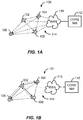
- each node 102, 104, 106, 108 generally acts independently of its neighbor nodes, although coordination between nodes may be enabled by action of an external node, for example a node of the core network 112.
- the independent nodes may be in communication with each other via wireless connections, indicated by the double-headed dashed arrows, while being connected via respective backhaul connections 114 to core network components 112 via a wide-area network 110.
- a cluster means a set of wireless nodes including at least one head (controlling) node and at least one member (controlled) node, wherein the set is organized according to a defined command structure wherein the operation of each member node of the cluster is controlled at least in part by a parameter set by a cluster head node.
- FIG. 1B shows a clustered system 101, identical to system 100 except that node coordination determinations that may have formerly been handled by the core network, or other determinations, are now handled by node 102.
- the node 102 is the controlling node, also referred to herein as the "cluster head.”
- the other nodes 104, 106 and 108 are the controlled nodes, also referred to as the members of the cluster.
- Using the cluster head 102 for control purposes may reduce control signal traffic over backhaul links 114 and corresponding overhead required at the core network 112 for making control determinations.
- the control functions of the cluster head with respect to its member nodes may be limited to specified purposes, for example, to coordinating wireless resources for the cluster members.
- the cluster members may operate autonomously and/or also receive control signals from core network entities, for other purposes.
- the present operation concerns methods and apparatus for distributed organization of a cluster and not with details of how a cluster is operated after it is organized.
- To organize a cluster it is necessary to designate at least one, or only one, cluster head, and identify member nodes that are controlled at least partly by the cluster head.
- the nodes are peer entities, for example, all of the nodes may be small cells, and m,ay communicate in a peer-to-peer fashion and/or via the core network.
- APs access points
- the surge in the number of APs has a potential to overwhelm the core network.
- a majority of the actions can be taken at a local level, in a hierarchical order that pushes decisions to lower levels, when possible.
- Grouping the nodes that share a similar goal, for example, mobility robustness optimization or resource scheduling, into smaller clusters is one way of achieving hierarchical organization at a local level.
- a distributed clustering algorithm for use in a heterogeneous network may include certain features.
- the algorithm may operate in a distributed (de-centralized) manner, such that there is no central authority that organizes the clusters. Instead, the clustering decisions may be made locally.
- interaction among the APs may be based on peer-to-peer communications.
- the clustering algorithm may be adaptive, so that it responds to changes in the system such as the activation or inactivation of APs in a self organized way.
- the algorithm may make use of various similarity (proximity) metrics when forming the clusters, including but not limited to a frequency of handovers between the APs, intercell interference between the APs, pathloss between the APs, Euclidian distance between the APs, and cell loads.
- similarity proximity
- FIG. 1 shows a wireless communication network 200, which may be an LTE network.
- the wireless network 200 may include a number of eNBs 210 and other network entities.
- An eNB may be a station that communicates with the UEs and may also be referred to as a base station, a Node B, an access point, or other term.
- Each eNB 210a, 210b, 210c may provide communication coverage for a particular geographic area.
- the term "cell" can refer to a coverage area of an eNB and/or an eNB subsystem serving this coverage area, depending on the context in which the term is used.
- An eNB may provide communication coverage for a macro cell, a pico cell, a femto cell, and/or other types of cell.
- a macro cell may cover a relatively large geographic area (e.g., several kilometers in radius) and may allow unrestricted access by UEs with service subscription.
- a pico cell may cover a relatively small geographic area and may allow unrestricted access by UEs with service subscription.
- a femto cell may cover a relatively small geographic area (e.g., a home) and may allow restricted access by UEs having association with the femto cell (e.g., UEs in a Closed Subscriber Group (CSG), UEs for users in the home, etc.).
- CSG Closed Subscriber Group
- An eNB for a macro cell may be referred to as a macro eNB.
- An eNB for a pico cell may be referred to as a pico eNB.
- An eNB for a femto cell may be referred to as a femto eNB or a home eNB (HNB).
- the eNBs 210a, 210b and 210c may be macro eNBs for the macro cells 202a, 202b and 202c, respectively.
- the eNB 210x may be a pico eNB for a pico cell 202x.
- the eNBs 210y and 210z may be femto eNBs for the femto cells 202y and 202z, respectively.
- An eNB may support one or multiple (e.g., three) cells.
- the femto cells and pico cells are examples of small cells.
- a small cell means a cell characterized by having a transmit power substantially less than each macro cell in the network with the small cell, for example low-power access points such as defined in 3GPP Technical Report (T.R.) 36.932 section 4.
- the wireless network 200 may also include relay stations 210r.
- a relay station is a station that receives a transmission of data and/or other information from an upstream station (e.g., an eNB or a UE) and sends a transmission of the data and/or other information to a downstream station (e.g., a UE or an eNB).
- a relay station may also be a UE that relays transmissions for other UEs.
- a relay station 210r may communicate with the eNB 210a and a UE 220r in order to facilitate communication between the eNB 210a and the UE 220r.
- a relay station may also be referred to as a relay eNB, a relay, etc.
- the wireless network 200 may be a heterogeneous network that includes eNBs of different types, e.g., macro eNBs, pico eNBs, femto eNBs, relays, or other base stations. These different types of eNBs may have different transmit power levels, different coverage areas, and different impact on interference in the wireless network 200.
- macro eNBs may have a high transmit power level (e.g., 5 to 20 Watts) whereas pico eNBs, femto eNBs and relays may have a lower transmit power level (e.g., 0.1 to 2 Watts).
- the wireless network 200 may support synchronous or asynchronous operation.
- the eNBs may have similar frame timing, and transmissions from different eNBs may be approximately aligned in time.
- the eNBs may have different frame timing, and transmissions from different eNBs may not be aligned in time.
- the techniques described herein may be used for both synchronous and asynchronous operation.
- a network controller 230 may couple to a set of eNBs and provide coordination and control for these eNBs.
- the network controller 230 may communicate with the eNBs 210 via a backhaul.
- the eNBs 210 may also communicate with one another, e.g., directly or indirectly via wireless or wireline backhaul.
- at least a portion of coordination and control for small cell eNB's may be performed by the cluster head, and not by the network controller 230.
- femto eNB 210y may act as a cluster head for a cluster comprising the femto eNB's 201y, 210z.
- the UEs 220 may be dispersed throughout the wireless network 100, and each UE may be stationary or mobile.
- a UE may also be referred to as a terminal, a mobile station, a subscriber unit, a station, a smart phone, etc.
- a UE may be a cellular phone, a personal digital assistant (PDA), a wireless modem, a wireless communication device, a handheld device, a laptop computer, a cordless phone, a wireless local loop (WLL) station, or other mobile entities.
- PDA personal digital assistant
- a UE may be able to communicate with macro eNBs, pico eNBs, femto eNBs, relays, or other network entities.
- a solid line with double arrows indicates desired transmissions between a UE and a serving eNB, which is an eNB designated to serve the UE on the downlink and/or uplink.
- a dashed line with double arrows indicates interfering transmissions between a UE and an eNB.
- LTE utilizes orthogonal frequency division multiplexing (OFDM) on the downlink and single-carrier frequency division multiplexing (SC-FDM) on the uplink.
- OFDM and SC-FDM partition the system bandwidth into multiple (K) orthogonal subcarriers, which are also commonly referred to as tones, bins, etc.
- K orthogonal subcarriers
- Each subcarrier may be modulated with data.
- modulation symbols are sent in the frequency domain with OFDM and in the time domain with SC-FDM.
- the spacing between adjacent subcarriers may be fixed, and the total number of subcarriers (K) may be dependent on the system bandwidth.
- K may be equal to 128, 256, 512, 1024 or 2048 for system bandwidth of 1.25, 2.5, 5, 10 or 20 megahertz (MHz), respectively.
- the system bandwidth may also be partitioned into subbands.
- a subband may cover 1.08 MHz, and there may be 1, 2, 4, 8 or 16 subbands for system bandwidth of 1.25, 2.5, 5, 10 or 20 MHz, respectively.
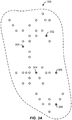
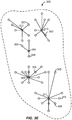
- a distributed clustering method may include at least the following operations distributed over a set of network nodes 300, as shown in FIGS. 3A-3E .
- FIGS. 3A-3E Consider a large heterogenous network of APs 300 that is a mixture of macro, pico and femto stations as depicted in Fig 1 .
- each dot represents an AP.
- APs may be able to carry on peer to peer communication between some or all of their neighbors through a backhaul protocol such as X2 or over the air.
- the amount of separation between the APs in FIGS. 3A-3E may stand for the physical distances between them, or for some other affinity measure such as, for example, the path loss or the frequency of the handovers between the APs, intercell interference, some similar measure, or a combination of the foregoing measures.
- a node designates initial cluster head (CH) nodes 302-306 over a set of nodes 300.
- the initial cluster heads may be determined using a distributed random process, or a distributed polling process.
- the CH nodes may comprise a small percentage of total nodes in the set 300, and once designated, may operate as control nodes of a hierarchical control scheme.
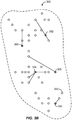
- FIG. 3B shows an early stage of the clustering process, in which the initially designated cluster heads 301-306 have been associated, via operation of the distributed clustering algorithm.
- the solid lines between the respective cluster heads 301-306 and other nodes in the set of nodes 300 represent these clustering associations.
- Each member node may request that a respective one of the CH nodes compute the "marginal cost" of the member node's membership in the CH node's cluster, based on a defined cost function.
- cost functions may be used, including those known in the art.
- cost may be computed as an aggregation of factors such as proximity, intercell path loss, frequency of intercell handovers, intercell interference, Euclidean distance, relative cell loading or other.
- Marginal cost is defined as the cost function for the cluster including the requesting member node, minus the cost function for the cluster omitting the requesting member node.
- Each member node once knowing its own marginal cost, contacts any available neighbor clusters and requests a computation of the marginal cost were it to join each of the neighbor clusters, respectively (the "neighbor marginal cost). If any of the neighbor marginal costs are less than the node's current marginal cost, the node quits its current cluster and joins the cluster having the lowest marginal cost.
- the foregoing algorithm steps may be iterated until the cluster arrangement converges to a stable solution.
- each cluster head may compute the total cost of having different members of the cluster as the CH, and appoints the node resulting in the minimum cost, if any, as a new CH node. This process may be iterated until converging to a stable solution.
- the CH may store information defining members of its cluster in its context memory. If the CH is switched from one cluster member AP to another, such as when the clustering algorithm determines that a different node would make a more optimal cluster head, the context information may also transferred to the new CH.
- Any AP that is not associated with a CH node may be configured to initiate a process of identifying the nearest AP that is associated with a cluster and registers itself with that cluster's head. For example, referring the FIG. 3B , the unassociated AP 320 may contact its nearest neighbor AP to be added to the cluster headed by CH node 310. The information for node 320 may then be added to the CH node's context memory.
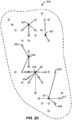
- FIG. 3C shows the set 300 at a later point in time after further distributed clustering.
- the former CH nodes 305, 303, 304, and 306 have relinquished their CH status to new CH nodes 307, 308, 309 and 310, respectively.
- a greater number of associations have formed between the CH nodes 302, 304, 307, 308 and the remaining members of the set 300, although many node remain unassociated.
- former CH node 30 has relinquished its CH status to node 311, and the CH status of node 309 has reverted to node 304.
- the number of associated nodes has increased.
- the clustering process for the set 300 has converged to a stable solution. All of the nodes 300 are now associated with a CH. CH status has shifted from former CH nodes 304, 302 and 308 to CH nodes 309 313 and 314. The solution may remain stable until the distance function between the nodes or the membership of the set 300 changes.
- the dist( ) operator refers to a measure of similarity (or dissimilarity).
- the dist( ) operator may yield a small number for APs for which relatively frequent handovers take place, and a very large number when few or no handovers take place between the APs.
- the algorithm the operator may represent a pathloss between the two relevant Aps, or any other desired distance measure.
- the weights w i may be operator-defined scaling factors that are used to emphasize or deemphasize the importance of particular APs in the cluster selection. Their choice may depend on various factors - such as the number of users that are served by the AP, the overall load of the AP, or any other desired parameter.
- the weights may be statically assigned or may be updated in a dynamic fashion.
- the CH of each cluster may periodically, or in response to a defined event, report to individual members ASC i their marginal costs ⁇ (C m , CH m , ASC i ) to the cluster.
- Each member ASC i of the cluster C m may identify the nearest associated access point ASC k that is a member of another cluster C q and requests its marginal cost ⁇ (C q , CH q , ASC i ) to that cluster. If the marginal cost of ASC i to the new cluster C q is less than its current cluster, it may switch to that cluster, such as: if ⁇ (C q , CH q , ASC i ) ⁇ ⁇ (C m , CH m , ASC i ) then ASC i sends request to ASC k to join its cluster C q .
- FIG. 4 is a flow diagram summarizing aspects of a method 400, by one or more access points of a wireless communication network participating in a distributed clustering process directed at defining clusters of access points (APs) wherein each of the clusters comprises a cluster head (CH) and associated member nodes.
- the method 400 may include, at 410, determining a marginal cost of associating an access point to each of distinct clusters of APs, based on a defined cost function.
- the method may further include, at 420, associating the access point to one of the clusters of APs for which the marginal cost is minimized.
- Each of the operation 410 and 420 may be performed by each and every access point participating in the clustering process, without intervention by a core network node, and without access to predetermined information defining the respective proximities of the access points to each other, under the chosen cost function.
- the method 400 may further include additional operations or execution of algorithms, for example, one or more of operations 500, 600, 700 or 800 illustrated in FIGS. 5-8 . Any one of these operations may be included as part of method 400, without necessarily requiring other upstream or downstream operations to also be included. Operations are grouped into different figures merely for illustrative convenience, and useful applications of the concepts disclosed herein are not limited to the illustrated groupings.
- the method 400 may include one or more of the additional operations 500, shown in FIG. 5 .
- the method 400 may include, at 510, iterating the determining and associating steps until membership, and/or CH identity, of the clusters stabilizes. Stability may be detected using one or more thresholds applied to changes between iteration cycles; for example, if cluster membership changes by less than a threshold amount between a specified number of iterations, the iterations may be terminated.
- Cluster formation and duster head (CH) selection may use the same, or different, thresholds for stabilization of an iteration cycle.
- the method 400 may further include, at 520, re-initiating the iterating process until a new stable solution is obtained, in response to determining a change in cluster state, for example, when an access point in the cluster is activated or de-activated, or the value of the cost function changes by more than a threshold amount.
- cluster formation and cluster head (CH) selection may use the same, or different, thresholds for triggering the initiation of an iteration cycle.
- the method may include, at 530, periodically re-initiating the iterating process.
- the method 400 may include one or more of the additional operations 600, shown in FIG. 6 .
- the method 400 may further include, at 610, determining at the access point whether the access point is designated as a CH.
- the method 400 may further include, at 620, determining by the access point whether the access point is associated with any cluster.
- the method 400 may further include, at 630, in response to determining that the access point is not associated with any cluster, identifying a nearest access point that is associated with a cluster, and associating the access point with the cluster.
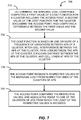
- the method 400 may include one or more of the additional operations 700, shown in FIG. 7 .
- Determining the marginal cost in the method 400 may include, at 710, computing a first value of a cost function for a cluster including the access point, a second value of the cost function for the cluster excluding the access point, and computing a difference between the first value and the second value.
- the cost function may be based on one or more of a frequency of handovers between APs of a cluster, inter-cell interference between the APs of the cluster, path loss between the APs of the cluster, Euclidian distance between the APs of the cluster, and cell loads at APs of the cluster.
- the access point may request respective values of the marginal cost from respective ones of the clusters of APs.
- the access point may compare the respective values, and associate itself to one of the clusters of APs from which the least of the respective values is received.
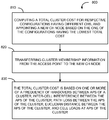
- the method 400 may include one or more of the additional operations 800, shown in FIG. 8.
- the method 400 may further include, at 810, computing a total cluster cost for respective configurations having different CHs, and appointing a new CH node based on the one of the configurations having the lowest total cost.
- the method 400 may further include, at 820, transferring cluster membership information from the access point to the new CH node.
- the total cluster cost may be based on one or more of a frequency of handovers between APs of a cluster, inter-cell interference between the APs of the cluster, path loss between the APs of the cluster, Euclidian distance between the APs of the cluster, and cell loads at APs of the cluster. Further details of cost functions as described herein above may likewise apply.
- FIG. 9 is a block diagram of a Node B 910 in communication with a UE 950, where the Node B 910 may be a small cell such as node 102 in FIG. 1A , or any of the access point in the set of nodes 300 shown in FIGS. 3A-E , such as may participate in a distributed clustering process.
- the UE 950 may not participate in clustering, but is described for technical context. However, if operating as an access point, the UE 950 may also participate in clustering, in a manner as described for non-UE access points herein.
- access points may communicate with one another in a manner similar to communications between the Node B 910 and the UE 950, albeit adapted for peer-to-peer communications.
- the Node B 910 may communication with other Node Bs/access points using other wired or wireless communication modes or interfaces, also.
- a transmit processor 970 may receive data from a data source 912 and control signals from a controller/processor 940.
- the transmit processor 970 provides various signal processing functions for the data and control signals, as well as reference signals (e.g., pilot signals).
- the transmit processor 970 may provide cyclic redundancy check (CRC) codes for error detection, coding and interleaving to facilitate forward error correction (FEC), mapping to signal constellations based on various modulation schemes (e.g., binary phase-shift keying (BPSK), quadrature phase-shift keying (QPSK), M-phase-shift keying (M-PSK), M-quadrature amplitude modulation (M-QAM), and the like), spreading with orthogonal variable spreading factors (OVSF), and multiplying with scrambling codes to produce a series of symbols.
- BPSK binary phase-shift keying
- QPSK quadrature phase-shift keying
- M-PSK M-phase-shift keying
- M-QAM M-quadrature amplitude modulation
- OVSF orthogonal variable spreading factors
- channel estimates may be derived from a reference signal transmitted by the UE 950 or from feedback from the UE 950.
- the symbols generated by the transmit processor 970 are provided to a transmit frame processor 980 to create a frame structure.
- the transmit frame processor 980 creates this frame structure by multiplexing the symbols with information from the controller/processor 940, resulting in a series of frames.
- the frames are then provided to a transmitter 932, which provides various signal conditioning functions including amplifying, filtering, and modulating the frames onto a carrier for downlink transmission over the wireless medium through antenna 934.
- the antenna 934 may include one or more antennas, for example, including beam steering bidirectional adaptive antenna arrays or other similar beam technologies.
- a receiver 954 receives the downlink transmission through an antenna 952 and processes the transmission to recover the information modulated onto the carrier.
- the information recovered by the receiver 954 is provided to a receive frame processor 960, which parses each frame, and provides information from the frames to a channel processor 994 and the data, control, and reference signals to a receive processor 970.
- the receive processor 970 then performs the inverse of the processing performed by the transmit processor 970 in the Node B 910. More specifically, the receive processor 970 descrambles and despreads the symbols, and then determines the most likely signal constellation points transmitted by the Node B 910 based on the modulation scheme. These soft decisions may be based on channel estimates computed by the channel processor 994.
- the soft decisions are then decoded and deinterleaved to recover the data, control, and reference signals.
- the CRC codes are then checked to determine whether the frames were successfully decoded.
- the data carried by the successfully decoded frames will then be provided to a data sink 972, which represents applications running in the UE 950 and/or various user interfaces (e.g., display).
- Control signals carried by successfully decoded frames will be provided to a controller/processor 990.
- the controller/processor 990 may also use an acknowledgement (ACK) and/or negative acknowledgement (NACK) protocol to support retransmission requests for those frames.
- ACK acknowledgement
- NACK negative acknowledgement
- a transmit processor 980 In the uplink, data from a data source 978 and control signals from the controller/processor 990 are provided to a transmit processor 980.
- the data source 978 may represent applications running in the UE 950 and various user interfaces (e.g., keyboard). Similar to the functionality described in connection with the downlink transmission by the Node B 910, the transmit processor 980 provides various signal processing functions including CRC codes, coding and interleaving to facilitate FEC, mapping to signal constellations, spreading with OVSFs, and scrambling to produce a series of symbols.
- Channel estimates may be used to select the appropriate coding, modulation, spreading, and/or scrambling schemes.
- the symbols produced by the transmit processor 980 will be provided to a transmit frame processor 982 to create a frame structure.
- the transmit frame processor 982 creates this frame structure by multiplexing the symbols with information from the controller/processor 990, resulting in a series of frames.
- the frames are then provided to a transmitter 956, which provides various signal conditioning functions including amplification, filtering, and modulating the frames onto a carrier for uplink transmission over the wireless medium through the antenna 952.
- the uplink transmission is processed at the Node B 910 in a manner similar to that described in connection with the receiver function at the UE 950.
- a receiver 935 receives the uplink transmission through the antenna 934 and processes the transmission to recover the information modulated onto the carrier.
- the information recovered by the receiver 935 is provided to a receive frame processor 936, which parses each frame, and provides information from the frames to the channel processor 944 and the data, control, and reference signals to a receive processor 938.
- the receive processor 938 performs the inverse of the processing performed by the transmit processor 980 in the UE 950.
- the data and control signals carried by the successfully decoded frames may then be provided to a data sink 939 and the controller/processor, respectively. If some of the frames were unsuccessfully decoded by the receive processor, the controller/processor 940 may also use an acknowledgement (ACK) and/or negative acknowledgement (NACK) protocol to support retransmission requests for those frames.
- ACK acknowledgement
- NACK negative acknowledgement
- the controller/processors 940 and 990 may be used to direct the operation at the Node B 910 and the UE 950, respectively.
- the controller/processors 940 and 990 may provide various functions including timing, peripheral interfaces, voltage regulation, power management, and other control functions.
- the computer readable media of memories 942 and 992 may store data and software for the Node B 910 and the UE 950, respectively.
- a scheduler/processor 946 at the Node B 910 may be used to allocate resources to the UEs and schedule downlink and/or uplink transmissions for the UEs.
- TD-SCDMA High Speed Downlink Packet Access
- HSDPA High Speed Downlink Packet Access
- HSUPA High Speed Uplink Packet Access
- HSPA+ High Speed Packet Access Plus
- LTE Long Term Evolution
- LTE-A LTE-Advanced
- CDMA7000 Evolution-Data Optimized
- UMB Ultra Mobile Broadband
- IEEE 802.11 Wi-Fi
- IEEE 802.16 WiMAX
- IEEE 802.70 Ultra-Wideband
- Bluetooth Bluetooth
- the actual telecommunication standard, network architecture, and/or communication standard employed will depend on the specific application and the overall design constraints imposed on the system.
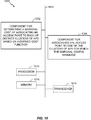
- an apparatus 1000 that may be configured as a cell in a wireless network, or as a processor or similar device for use within the cell, disposed as an aggressor cell.
- the apparatus 1000 may include functional blocks that can represent functions implemented by a processor, software, hardware, or combination thereof (e.g., firmware).
- the apparatus 1000 may include an electrical component or module 1002 for determining a marginal cost of associating an access point to each of distinct clusters of APs, based on a defined cost function.
- the electrical component 1002 may include at least one control processor coupled to a transceiver or the like and to a memory with instructions for determining the marginal cost.
- the component 1002 may be, or may include, a means for determining a marginal cost of associating an access point to each of distinct clusters of APs, based on a defined cost function.
- Said means may include the control processor executing any one or more of algorithms for computing a first value of a cost function for a cluster including the access point, a second value of the cost function for the cluster excluding the access point, and computing a difference between the first value and the second value, wherein the cost function is based on one or more of a frequency of handovers between APs of a cluster, inter-cell interference between the APs of the cluster, path loss between the APs of the cluster, Euclidian distance between the APs of the cluster, and cell loads at APs of the cluster.
- the apparatus 1000 may include an electrical component 1004 for associating the access point to one of the clusters of APs for which the marginal cost is minimized.
- the electrical component 1004 may include at least one control processor coupled to a transceiver or the like and to a memory holding instructions for the associating.
- the component 1004 may be, or may include, a means for associating the access point to one of the clusters of APs for which the marginal cost is minimized.
- Said means may include the control processor executing any one or more of algorithms for identifying a cluster having a minimal (lowest) marginal cost, identifying a cluster head of the the lowest marginal cost cluster, and sending a message to the cluster head requesting, or providing notification of, addition of the access point to the cluster.
- the apparatus 1000 may optionally include a processor component 1010 having at least one processor, in the case of the apparatus 1000 configured as a network entity.
- the processor 1010 in such case, may be in operative communication with the components 1002-1004 or similar components via a bus 1012 or similar communication coupling.
- the processor 1010 may effect initiation and scheduling of the processes or functions performed by electrical components 1002-1004.
- the processor 1010 may encompass the components 1002-1004, in whole or in part. In the alternative, the processor 1010 may be separate from the components 1002-1004, which may include one or more separate processors.
- the apparatus 1000 may include a radio transceiver component 1014.
- a stand alone receiver and/or stand alone transmitter may be used in lieu of or in conjunction with the transceiver 1014.
- the apparatus 1000 may include multiple transceivers or transmitter/receiver pairs, which may be used to transmit and receive on different carriers.
- the apparatus 1000 may optionally include a component for storing information, such as, for example, a memory device/component 1016.
- the computer readable medium or the memory component 1016 may be operatively coupled to the other components of the apparatus 1000 via the bus 1012 or the like.
- the memory component 1016 may be adapted to store computer readable instructions and data for performing the activity of the components 1002-1004, and subcomponents thereof, or the processor 1010, or the methods disclosed herein.
- the memory component 1016 may retain instructions for executing functions associated with the components 1002-1004. While shown as being external to the memory 1016, it is to be understood that the components 1002-1004 can exist within the memory 1016.
- processors include microprocessors, microcontrollers, digital signal processors (DSPs), field programmable gate arrays (FPGAs), programmable logic devices (PLDs), state machines, gated logic, discrete hardware circuits, such as a custom application-specific integrated circuit (ASIC), and other suitable hardware configured to perform the various functionality described throughout this disclosure.
- DSPs digital signal processors
- FPGAs field programmable gate arrays
- PLDs programmable logic devices
- state machines gated logic, discrete hardware circuits, such as a custom application-specific integrated circuit (ASIC), and other suitable hardware configured to perform the various functionality described throughout this disclosure.
- ASIC application-specific integrated circuit
- Software shall be construed broadly to mean instructions, instruction sets, code, code segments, program code, programs, subprograms, software modules, applications, software applications, software packages, routines, subroutines, objects, executables, threads of execution, procedures, functions, etc., whether referred to as software, firmware, middleware, microcode, hardware description language, or otherwise.
- the software may reside on a computer-readable medium.
- the computer-readable medium may be a non-transitory computer-readable medium.
- a non-transitory computer-readable medium includes, by way of example, a magnetic storage device (e.g., hard disk, floppy disk, magnetic strip), an optical disk (e.g., compact disk (CD), digital versatile disk (DVD)), a smart card, a flash memory device (e.g., card, stick, key drive), random access memory (RAM), read only memory (ROM), programmable ROM (PROM), erasable PROM (EPROM), electrically erasable PROM (EEPROM), a register, a removable disk, and any other suitable medium for storing software and/or instructions that may be accessed and read by a computer.
- a magnetic storage device e.g., hard disk, floppy disk, magnetic strip
- an optical disk e.g., compact disk (CD), digital versatile disk (DVD)
- a smart card e.g., a flash memory device (e.g., card, stick, key drive), random access memory (RAM), read only memory (ROM), programmable ROM
- the computer-readable medium may also include, by way of example, a carrier wave, a transmission line, and any other suitable medium for transmitting software and/or instructions that may be accessed and read by a computer.
- the computer-readable medium may be resident in the processing system, external to the processing system, or distributed across multiple entities including the processing system.
- the computer-readable medium may be implemented in a computer-program product.
- a computer-program product may include a computer-readable medium in packaging materials.
Landscapes
- Engineering & Computer Science (AREA)
- Computer Networks & Wireless Communication (AREA)
- Signal Processing (AREA)
- Mobile Radio Communication Systems (AREA)
Applications Claiming Priority (2)
| Application Number | Priority Date | Filing Date | Title |
|---|---|---|---|
| US14/170,408 US10327197B2 (en) | 2014-01-31 | 2014-01-31 | Distributed clustering of wireless network nodes |
| PCT/US2015/013331 WO2015116704A1 (en) | 2014-01-31 | 2015-01-28 | Distributed clustering of wireless network nodes |
Publications (2)
| Publication Number | Publication Date |
|---|---|
| EP3100492A1 EP3100492A1 (en) | 2016-12-07 |
| EP3100492B1 true EP3100492B1 (en) | 2020-02-26 |
Family
ID=52474088
Family Applications (1)
| Application Number | Title | Priority Date | Filing Date |
|---|---|---|---|
| EP15704888.5A Active EP3100492B1 (en) | 2014-01-31 | 2015-01-28 | Distributed clustering of wireless network nodes |
Country Status (7)
| Country | Link |
|---|---|
| US (1) | US10327197B2 (enExample) |
| EP (1) | EP3100492B1 (enExample) |
| JP (1) | JP6505725B2 (enExample) |
| KR (1) | KR20160117476A (enExample) |
| CN (1) | CN105940703B (enExample) |
| BR (1) | BR112016017285A2 (enExample) |
| WO (1) | WO2015116704A1 (enExample) |
Families Citing this family (16)
| Publication number | Priority date | Publication date | Assignee | Title |
|---|---|---|---|---|
| US10382979B2 (en) * | 2014-12-09 | 2019-08-13 | Futurewei Technologies, Inc. | Self-learning, adaptive approach for intelligent analytics-assisted self-organizing-networks (SONs) |
| US10327159B2 (en) | 2014-12-09 | 2019-06-18 | Futurewei Technologies, Inc. | Autonomous, closed-loop and adaptive simulated annealing based machine learning approach for intelligent analytics-assisted self-organizing-networks (SONs) |
| EP3384723B1 (en) * | 2015-11-30 | 2023-06-14 | Telefonaktiebolaget LM Ericsson (publ) | Methods and apparatus for configuring a cluster |
| CN105846856B (zh) * | 2015-12-31 | 2018-05-18 | 北京邮电大学 | 电力通信网组网方式评价方法及装置 |
| CN106936614B (zh) * | 2015-12-31 | 2020-02-14 | 华为技术有限公司 | 集群系统的自组织方法、设备及系统 |
| US20190045583A1 (en) * | 2016-02-03 | 2019-02-07 | Nokia Solutions And Networks Oy | Multiconnectivity cluster |
| EP3445104B1 (en) * | 2016-05-11 | 2020-08-26 | Huawei Technologies Co., Ltd. | Base station clustering and base station control method and device |
| GB2555610B (en) | 2016-11-04 | 2020-01-15 | Samsung Electronics Co Ltd | Data traffic management in a telecommunication network |
| CN110050332A (zh) * | 2016-12-31 | 2019-07-23 | 英特尔公司 | 电子器件封装 |
| CN107302772B (zh) * | 2017-07-27 | 2020-11-27 | 台州市吉吉知识产权运营有限公司 | 一种无线接入节点负载均衡集群方法及系统 |
| US11350381B2 (en) * | 2017-10-26 | 2022-05-31 | Benchmark Electronics, Inc. | Mesh ranging and network message and slot structure for ad-hoc networks and method therefor |
| US11218943B2 (en) * | 2017-12-20 | 2022-01-04 | Sony Network Communications Europe B.V. | System and method for sharing cluster head assistance data in a device cluster |
| US11330401B2 (en) * | 2019-02-06 | 2022-05-10 | At&T Intellectual Property I, L.P. | Centrally assisted associations with a local manager by peers in a peer to peer wireless network |
| CN112533215B (zh) * | 2019-09-17 | 2024-01-23 | 华为技术有限公司 | 一种无线接入点分组调优方法、设备及计算机存储介质 |
| CN112637924B (zh) * | 2020-12-17 | 2023-02-28 | 中国联合网络通信集团有限公司 | 传感器网络的获取方法、装置、设备以及存储介质 |
| CN113572820B (zh) * | 2021-07-01 | 2024-02-02 | 西安震有信通科技有限公司 | 一种集群构建方法、装置、终端设备及存储介质 |
Family Cites Families (21)
| Publication number | Priority date | Publication date | Assignee | Title |
|---|---|---|---|---|
| GB2367970B (en) * | 2000-10-09 | 2004-01-21 | Ericsson Telefon Ab L M | Network topologies |
| US6807158B2 (en) * | 2001-08-07 | 2004-10-19 | Hrl Laboratories, Llc | Method and apparatus for determining position and trajectory of gateways to optimize performance in hybrid non-terrestrial-terrestrial multi-hop mobile networks |
| US20030151513A1 (en) | 2002-01-10 | 2003-08-14 | Falk Herrmann | Self-organizing hierarchical wireless network for surveillance and control |
| US7975035B2 (en) * | 2003-12-01 | 2011-07-05 | International Business Machines Corporation | Method and apparatus to support application and network awareness of collaborative applications using multi-attribute clustering |
| JP5109250B2 (ja) | 2005-11-08 | 2012-12-26 | 横河電機株式会社 | 分散システム |
| US8364515B1 (en) | 2005-12-30 | 2013-01-29 | At&T Intellectual Property Ii, L.P. | Method and system for facility location optimization |
| EP2057807A1 (fr) * | 2006-08-30 | 2009-05-13 | France Telecom | Procede de routage de donnees dans un reseau comprenant des noeuds organises en groupements |
| WO2008081381A1 (en) | 2006-12-27 | 2008-07-10 | Koninklijke Philips Electronics, N.V. | Wireless station clustering in cooperative communications |
| US8582470B2 (en) * | 2007-03-12 | 2013-11-12 | Telefonaktiebolaget L M Ericsson (Publ) | Arrangement and method relating to network management |
| US8660071B2 (en) | 2009-03-19 | 2014-02-25 | Qualcomm Incorporated | Adaptive resource partitioning in a wireless communication network |
| FR2960375B1 (fr) | 2010-05-21 | 2012-07-27 | Thales Sa | Architecture pour reseau ad-hoc multi-formes d'onde |
| FI20105658L (fi) * | 2010-06-10 | 2011-12-11 | Defendec Inc | Laite ja menetelmä liikkuvaa ad hoc -monijänneverkkoa varten |
| EP2445246A1 (en) | 2010-10-22 | 2012-04-25 | NTT DoCoMo, Inc. | Apparatus and method for determining a core network configuration of a wireless communication system |
| EP2550756B1 (en) | 2011-03-31 | 2015-11-25 | Nec Corporation | Method and apparatus for performing relay node configuration and re-configuration in relay enhanced networks |
| CN102300229B (zh) | 2011-09-20 | 2014-01-29 | 北京富国鸿信科技有限公司 | 自组织的无线局域网及其实现方法 |
| US9575809B2 (en) | 2012-01-10 | 2017-02-21 | Microsoft Technology Licensing, Llc | Distributed stochastic clustering for automated formation of connected networks of agents |
| US8798021B2 (en) | 2012-03-16 | 2014-08-05 | Nokia Siemens Networks Oy | Hierarchical network and interference management |
| CN102907052A (zh) | 2012-08-02 | 2013-01-30 | 华为技术有限公司 | 拓扑信息处理方法及设备 |
| CN103167586B (zh) | 2013-03-01 | 2015-08-12 | 北京傲天动联技术股份有限公司 | 一种基于ap集群的无线终端接入和重选方法 |
| US9317393B2 (en) * | 2013-06-13 | 2016-04-19 | Oracle International Corporation | Memory leak detection using transient workload detection and clustering |
| CN103415058B (zh) | 2013-09-03 | 2017-01-18 | 西安电子科技大学 | 一种基于时延受限的低频段低功耗无线局域网的分簇方法 |
-
2014
- 2014-01-31 US US14/170,408 patent/US10327197B2/en active Active
-
2015
- 2015-01-28 EP EP15704888.5A patent/EP3100492B1/en active Active
- 2015-01-28 KR KR1020167021664A patent/KR20160117476A/ko not_active Ceased
- 2015-01-28 CN CN201580006313.0A patent/CN105940703B/zh not_active Expired - Fee Related
- 2015-01-28 WO PCT/US2015/013331 patent/WO2015116704A1/en not_active Ceased
- 2015-01-28 BR BR112016017285A patent/BR112016017285A2/pt not_active IP Right Cessation
- 2015-01-28 JP JP2016548344A patent/JP6505725B2/ja not_active Expired - Fee Related
Non-Patent Citations (1)
| Title |
|---|
| None * |
Also Published As
| Publication number | Publication date |
|---|---|
| JP6505725B2 (ja) | 2019-04-24 |
| CN105940703A (zh) | 2016-09-14 |
| CN105940703B (zh) | 2020-03-03 |
| WO2015116704A1 (en) | 2015-08-06 |
| US20150223143A1 (en) | 2015-08-06 |
| BR112016017285A2 (pt) | 2017-08-08 |
| US10327197B2 (en) | 2019-06-18 |
| JP2017505059A (ja) | 2017-02-09 |
| KR20160117476A (ko) | 2016-10-10 |
| EP3100492A1 (en) | 2016-12-07 |
Similar Documents
| Publication | Publication Date | Title |
|---|---|---|
| EP3100492B1 (en) | Distributed clustering of wireless network nodes | |
| US10111123B2 (en) | Relaxed measurement reporting with control plane dual connectivity | |
| CN116965097A (zh) | 支持通信系统中切换管理的机器学习或人工智能技术的方法和装置 | |
| US20140073317A1 (en) | Ue-assisted network optimization methods | |
| US20130235759A1 (en) | Methods and apparatus for adapting femtocell properties based on changes detected in network topology | |
| CN105612784A (zh) | 自组织网络(son)中的混合越区切换管理 | |
| CN105993193A (zh) | 宏小区辅助的小小区发现和资源激活 | |
| CN110710250A (zh) | 限制小区重新选择中所需要的波束测量的方法 | |
| US9479896B2 (en) | Small cell activation control of portable multi-purpose wireless device | |
| WO2022195600A1 (en) | Prediction of cell traffic in a network | |
| CN105993196A (zh) | 宏小区辅助的小小区发现和资源激活 | |
| CN114342476A (zh) | 无线多跳网络中的以上行链路为中心的切换 | |
| Ferng et al. | Handover scheme with enode-B pre-selection and parameter self-optimization for LTE-A heterogeneous networks | |
| WO2025037585A1 (ja) | 通信方法、ユーザ装置、及びネットワークノード | |
| WO2025037584A1 (ja) | 通信方法、ユーザ装置、及びネットワークノード | |
| Gao et al. | Mobility robustness improvement through transport parameter optimization in HetNets | |
| CN106688269B (zh) | 用于确定无线设备是否是由于负载平衡原因而切换到目标小区的合适候选者的无线电网络节点和方法 | |
| TW201713155A (zh) | 使用使用者設備(ue)歷史資訊來進行無線網路中的細胞發現 | |
| US12418844B2 (en) | Methods, system and access point of a WLAN for handling a wireless device connected to an access point | |
| CN116762404A (zh) | 用于独立模式的候选小区检测 | |
| Kawser et al. | Versatile controllability over cell switching for speedy users in LTE HetNets | |
| CN121753425A (zh) | 与环境物联网设备的无线通信 | |
| US9338671B2 (en) | Method and apparatus for handling primary scrambling codes | |
| CN116349276A (zh) | 人工智能供电的无线电超温处理 | |
| Xenakis | Localization and Mobility M Wireless Networks wi |
Legal Events
| Date | Code | Title | Description |
|---|---|---|---|
| PUAI | Public reference made under article 153(3) epc to a published international application that has entered the european phase |
Free format text: ORIGINAL CODE: 0009012 |
|
| STAA | Information on the status of an ep patent application or granted ep patent |
Free format text: STATUS: REQUEST FOR EXAMINATION WAS MADE |
|
| 17P | Request for examination filed |
Effective date: 20160630 |
|
| AK | Designated contracting states |
Kind code of ref document: A1 Designated state(s): AL AT BE BG CH CY CZ DE DK EE ES FI FR GB GR HR HU IE IS IT LI LT LU LV MC MK MT NL NO PL PT RO RS SE SI SK SM TR |
|
| AX | Request for extension of the european patent |
Extension state: BA ME |
|
| DAX | Request for extension of the european patent (deleted) | ||
| STAA | Information on the status of an ep patent application or granted ep patent |
Free format text: STATUS: EXAMINATION IS IN PROGRESS |
|
| 17Q | First examination report despatched |
Effective date: 20190214 |
|
| GRAP | Despatch of communication of intention to grant a patent |
Free format text: ORIGINAL CODE: EPIDOSNIGR1 |
|
| STAA | Information on the status of an ep patent application or granted ep patent |
Free format text: STATUS: GRANT OF PATENT IS INTENDED |
|
| INTG | Intention to grant announced |
Effective date: 20190911 |
|
| GRAS | Grant fee paid |
Free format text: ORIGINAL CODE: EPIDOSNIGR3 |
|
| GRAA | (expected) grant |
Free format text: ORIGINAL CODE: 0009210 |
|
| STAA | Information on the status of an ep patent application or granted ep patent |
Free format text: STATUS: THE PATENT HAS BEEN GRANTED |
|
| AK | Designated contracting states |
Kind code of ref document: B1 Designated state(s): AL AT BE BG CH CY CZ DE DK EE ES FI FR GB GR HR HU IE IS IT LI LT LU LV MC MK MT NL NO PL PT RO RS SE SI SK SM TR |
|
| REG | Reference to a national code |
Ref country code: GB Ref legal event code: FG4D |
|
| REG | Reference to a national code |
Ref country code: CH Ref legal event code: EP |
|
| REG | Reference to a national code |
Ref country code: AT Ref legal event code: REF Ref document number: 1239198 Country of ref document: AT Kind code of ref document: T Effective date: 20200315 |
|
| REG | Reference to a national code |
Ref country code: IE Ref legal event code: FG4D |
|
| REG | Reference to a national code |
Ref country code: DE Ref legal event code: R096 Ref document number: 602015047656 Country of ref document: DE |
|
| PG25 | Lapsed in a contracting state [announced via postgrant information from national office to epo] |
Ref country code: NO Free format text: LAPSE BECAUSE OF FAILURE TO SUBMIT A TRANSLATION OF THE DESCRIPTION OR TO PAY THE FEE WITHIN THE PRESCRIBED TIME-LIMIT Effective date: 20200526 Ref country code: FI Free format text: LAPSE BECAUSE OF FAILURE TO SUBMIT A TRANSLATION OF THE DESCRIPTION OR TO PAY THE FEE WITHIN THE PRESCRIBED TIME-LIMIT Effective date: 20200226 Ref country code: RS Free format text: LAPSE BECAUSE OF FAILURE TO SUBMIT A TRANSLATION OF THE DESCRIPTION OR TO PAY THE FEE WITHIN THE PRESCRIBED TIME-LIMIT Effective date: 20200226 |
|
| REG | Reference to a national code |
Ref country code: NL Ref legal event code: MP Effective date: 20200226 |
|
| REG | Reference to a national code |
Ref country code: LT Ref legal event code: MG4D |
|
| PG25 | Lapsed in a contracting state [announced via postgrant information from national office to epo] |
Ref country code: HR Free format text: LAPSE BECAUSE OF FAILURE TO SUBMIT A TRANSLATION OF THE DESCRIPTION OR TO PAY THE FEE WITHIN THE PRESCRIBED TIME-LIMIT Effective date: 20200226 Ref country code: LV Free format text: LAPSE BECAUSE OF FAILURE TO SUBMIT A TRANSLATION OF THE DESCRIPTION OR TO PAY THE FEE WITHIN THE PRESCRIBED TIME-LIMIT Effective date: 20200226 Ref country code: IS Free format text: LAPSE BECAUSE OF FAILURE TO SUBMIT A TRANSLATION OF THE DESCRIPTION OR TO PAY THE FEE WITHIN THE PRESCRIBED TIME-LIMIT Effective date: 20200626 Ref country code: SE Free format text: LAPSE BECAUSE OF FAILURE TO SUBMIT A TRANSLATION OF THE DESCRIPTION OR TO PAY THE FEE WITHIN THE PRESCRIBED TIME-LIMIT Effective date: 20200226 Ref country code: GR Free format text: LAPSE BECAUSE OF FAILURE TO SUBMIT A TRANSLATION OF THE DESCRIPTION OR TO PAY THE FEE WITHIN THE PRESCRIBED TIME-LIMIT Effective date: 20200527 Ref country code: BG Free format text: LAPSE BECAUSE OF FAILURE TO SUBMIT A TRANSLATION OF THE DESCRIPTION OR TO PAY THE FEE WITHIN THE PRESCRIBED TIME-LIMIT Effective date: 20200526 |
|
| PG25 | Lapsed in a contracting state [announced via postgrant information from national office to epo] |
Ref country code: NL Free format text: LAPSE BECAUSE OF FAILURE TO SUBMIT A TRANSLATION OF THE DESCRIPTION OR TO PAY THE FEE WITHIN THE PRESCRIBED TIME-LIMIT Effective date: 20200226 |
|
| PG25 | Lapsed in a contracting state [announced via postgrant information from national office to epo] |
Ref country code: LT Free format text: LAPSE BECAUSE OF FAILURE TO SUBMIT A TRANSLATION OF THE DESCRIPTION OR TO PAY THE FEE WITHIN THE PRESCRIBED TIME-LIMIT Effective date: 20200226 Ref country code: ES Free format text: LAPSE BECAUSE OF FAILURE TO SUBMIT A TRANSLATION OF THE DESCRIPTION OR TO PAY THE FEE WITHIN THE PRESCRIBED TIME-LIMIT Effective date: 20200226 Ref country code: CZ Free format text: LAPSE BECAUSE OF FAILURE TO SUBMIT A TRANSLATION OF THE DESCRIPTION OR TO PAY THE FEE WITHIN THE PRESCRIBED TIME-LIMIT Effective date: 20200226 Ref country code: PT Free format text: LAPSE BECAUSE OF FAILURE TO SUBMIT A TRANSLATION OF THE DESCRIPTION OR TO PAY THE FEE WITHIN THE PRESCRIBED TIME-LIMIT Effective date: 20200719 Ref country code: RO Free format text: LAPSE BECAUSE OF FAILURE TO SUBMIT A TRANSLATION OF THE DESCRIPTION OR TO PAY THE FEE WITHIN THE PRESCRIBED TIME-LIMIT Effective date: 20200226 Ref country code: SK Free format text: LAPSE BECAUSE OF FAILURE TO SUBMIT A TRANSLATION OF THE DESCRIPTION OR TO PAY THE FEE WITHIN THE PRESCRIBED TIME-LIMIT Effective date: 20200226 Ref country code: DK Free format text: LAPSE BECAUSE OF FAILURE TO SUBMIT A TRANSLATION OF THE DESCRIPTION OR TO PAY THE FEE WITHIN THE PRESCRIBED TIME-LIMIT Effective date: 20200226 Ref country code: EE Free format text: LAPSE BECAUSE OF FAILURE TO SUBMIT A TRANSLATION OF THE DESCRIPTION OR TO PAY THE FEE WITHIN THE PRESCRIBED TIME-LIMIT Effective date: 20200226 Ref country code: SM Free format text: LAPSE BECAUSE OF FAILURE TO SUBMIT A TRANSLATION OF THE DESCRIPTION OR TO PAY THE FEE WITHIN THE PRESCRIBED TIME-LIMIT Effective date: 20200226 |
|
| REG | Reference to a national code |
Ref country code: AT Ref legal event code: MK05 Ref document number: 1239198 Country of ref document: AT Kind code of ref document: T Effective date: 20200226 |
|
| REG | Reference to a national code |
Ref country code: DE Ref legal event code: R097 Ref document number: 602015047656 Country of ref document: DE |
|
| PLBE | No opposition filed within time limit |
Free format text: ORIGINAL CODE: 0009261 |
|
| STAA | Information on the status of an ep patent application or granted ep patent |
Free format text: STATUS: NO OPPOSITION FILED WITHIN TIME LIMIT |
|
| PG25 | Lapsed in a contracting state [announced via postgrant information from national office to epo] |
Ref country code: IT Free format text: LAPSE BECAUSE OF FAILURE TO SUBMIT A TRANSLATION OF THE DESCRIPTION OR TO PAY THE FEE WITHIN THE PRESCRIBED TIME-LIMIT Effective date: 20200226 Ref country code: AT Free format text: LAPSE BECAUSE OF FAILURE TO SUBMIT A TRANSLATION OF THE DESCRIPTION OR TO PAY THE FEE WITHIN THE PRESCRIBED TIME-LIMIT Effective date: 20200226 |
|
| PGFP | Annual fee paid to national office [announced via postgrant information from national office to epo] |
Ref country code: GB Payment date: 20201231 Year of fee payment: 7 Ref country code: FR Payment date: 20201223 Year of fee payment: 7 |
|
| 26N | No opposition filed |
Effective date: 20201127 |
|
| PG25 | Lapsed in a contracting state [announced via postgrant information from national office to epo] |
Ref country code: PL Free format text: LAPSE BECAUSE OF FAILURE TO SUBMIT A TRANSLATION OF THE DESCRIPTION OR TO PAY THE FEE WITHIN THE PRESCRIBED TIME-LIMIT Effective date: 20200226 Ref country code: SI Free format text: LAPSE BECAUSE OF FAILURE TO SUBMIT A TRANSLATION OF THE DESCRIPTION OR TO PAY THE FEE WITHIN THE PRESCRIBED TIME-LIMIT Effective date: 20200226 |
|
| REG | Reference to a national code |
Ref country code: DE Ref legal event code: R119 Ref document number: 602015047656 Country of ref document: DE |
|
| PG25 | Lapsed in a contracting state [announced via postgrant information from national office to epo] |
Ref country code: MC Free format text: LAPSE BECAUSE OF FAILURE TO SUBMIT A TRANSLATION OF THE DESCRIPTION OR TO PAY THE FEE WITHIN THE PRESCRIBED TIME-LIMIT Effective date: 20200226 |
|
| REG | Reference to a national code |
Ref country code: CH Ref legal event code: PL |
|
| PG25 | Lapsed in a contracting state [announced via postgrant information from national office to epo] |
Ref country code: LU Free format text: LAPSE BECAUSE OF NON-PAYMENT OF DUE FEES Effective date: 20210128 |
|
| REG | Reference to a national code |
Ref country code: BE Ref legal event code: MM Effective date: 20210131 |
|
| PG25 | Lapsed in a contracting state [announced via postgrant information from national office to epo] |
Ref country code: CH Free format text: LAPSE BECAUSE OF NON-PAYMENT OF DUE FEES Effective date: 20210131 Ref country code: DE Free format text: LAPSE BECAUSE OF NON-PAYMENT OF DUE FEES Effective date: 20210803 Ref country code: LI Free format text: LAPSE BECAUSE OF NON-PAYMENT OF DUE FEES Effective date: 20210131 |
|
| PG25 | Lapsed in a contracting state [announced via postgrant information from national office to epo] |
Ref country code: IE Free format text: LAPSE BECAUSE OF NON-PAYMENT OF DUE FEES Effective date: 20210128 |
|
| PG25 | Lapsed in a contracting state [announced via postgrant information from national office to epo] |
Ref country code: BE Free format text: LAPSE BECAUSE OF NON-PAYMENT OF DUE FEES Effective date: 20210131 |
|
| GBPC | Gb: european patent ceased through non-payment of renewal fee |
Effective date: 20220128 |
|
| PG25 | Lapsed in a contracting state [announced via postgrant information from national office to epo] |
Ref country code: GB Free format text: LAPSE BECAUSE OF NON-PAYMENT OF DUE FEES Effective date: 20220128 |
|
| PG25 | Lapsed in a contracting state [announced via postgrant information from national office to epo] |
Ref country code: FR Free format text: LAPSE BECAUSE OF NON-PAYMENT OF DUE FEES Effective date: 20220131 |
|
| PG25 | Lapsed in a contracting state [announced via postgrant information from national office to epo] |
Ref country code: HU Free format text: LAPSE BECAUSE OF FAILURE TO SUBMIT A TRANSLATION OF THE DESCRIPTION OR TO PAY THE FEE WITHIN THE PRESCRIBED TIME-LIMIT; INVALID AB INITIO Effective date: 20150128 |
|
| PG25 | Lapsed in a contracting state [announced via postgrant information from national office to epo] |
Ref country code: CY Free format text: LAPSE BECAUSE OF FAILURE TO SUBMIT A TRANSLATION OF THE DESCRIPTION OR TO PAY THE FEE WITHIN THE PRESCRIBED TIME-LIMIT Effective date: 20200226 |
|
| PG25 | Lapsed in a contracting state [announced via postgrant information from national office to epo] |
Ref country code: MK Free format text: LAPSE BECAUSE OF FAILURE TO SUBMIT A TRANSLATION OF THE DESCRIPTION OR TO PAY THE FEE WITHIN THE PRESCRIBED TIME-LIMIT Effective date: 20200226 |
|
| PG25 | Lapsed in a contracting state [announced via postgrant information from national office to epo] |
Ref country code: MT Free format text: LAPSE BECAUSE OF FAILURE TO SUBMIT A TRANSLATION OF THE DESCRIPTION OR TO PAY THE FEE WITHIN THE PRESCRIBED TIME-LIMIT Effective date: 20200226 |
|
| PG25 | Lapsed in a contracting state [announced via postgrant information from national office to epo] |
Ref country code: TR Free format text: LAPSE BECAUSE OF FAILURE TO SUBMIT A TRANSLATION OF THE DESCRIPTION OR TO PAY THE FEE WITHIN THE PRESCRIBED TIME-LIMIT Effective date: 20200226 |