EP3099664B1 - Ionic liquids - Google Patents
Ionic liquids Download PDFInfo
- Publication number
- EP3099664B1 EP3099664B1 EP15702684.0A EP15702684A EP3099664B1 EP 3099664 B1 EP3099664 B1 EP 3099664B1 EP 15702684 A EP15702684 A EP 15702684A EP 3099664 B1 EP3099664 B1 EP 3099664B1
- Authority
- EP
- European Patent Office
- Prior art keywords
- linear
- carbon atoms
- formula
- ionic liquid
- branched alkyl
- Prior art date
- Legal status (The legal status is an assumption and is not a legal conclusion. Google has not performed a legal analysis and makes no representation as to the accuracy of the status listed.)
- Active
Links
Classifications
-
- C—CHEMISTRY; METALLURGY
- C10—PETROLEUM, GAS OR COKE INDUSTRIES; TECHNICAL GASES CONTAINING CARBON MONOXIDE; FUELS; LUBRICANTS; PEAT
- C10M—LUBRICATING COMPOSITIONS; USE OF CHEMICAL SUBSTANCES EITHER ALONE OR AS LUBRICATING INGREDIENTS IN A LUBRICATING COMPOSITION
- C10M129/00—Lubricating compositions characterised by the additive being an organic non-macromolecular compound containing oxygen
- C10M129/02—Lubricating compositions characterised by the additive being an organic non-macromolecular compound containing oxygen having a carbon chain of less than 30 atoms
- C10M129/26—Carboxylic acids; Salts thereof
- C10M129/28—Carboxylic acids; Salts thereof having carboxyl groups bound to acyclic or cycloaliphatic carbon atoms
- C10M129/38—Carboxylic acids; Salts thereof having carboxyl groups bound to acyclic or cycloaliphatic carbon atoms having 8 or more carbon atoms
- C10M129/40—Carboxylic acids; Salts thereof having carboxyl groups bound to acyclic or cycloaliphatic carbon atoms having 8 or more carbon atoms monocarboxylic
-
- C—CHEMISTRY; METALLURGY
- C07—ORGANIC CHEMISTRY
- C07C—ACYCLIC OR CARBOCYCLIC COMPOUNDS
- C07C209/00—Preparation of compounds containing amino groups bound to a carbon skeleton
- C07C209/68—Preparation of compounds containing amino groups bound to a carbon skeleton from amines, by reactions not involving amino groups, e.g. reduction of unsaturated amines, aromatisation, or substitution of the carbon skeleton
-
- C—CHEMISTRY; METALLURGY
- C07—ORGANIC CHEMISTRY
- C07C—ACYCLIC OR CARBOCYCLIC COMPOUNDS
- C07C211/00—Compounds containing amino groups bound to a carbon skeleton
- C07C211/62—Quaternary ammonium compounds
- C07C211/63—Quaternary ammonium compounds having quaternised nitrogen atoms bound to acyclic carbon atoms
-
- C—CHEMISTRY; METALLURGY
- C07—ORGANIC CHEMISTRY
- C07C—ACYCLIC OR CARBOCYCLIC COMPOUNDS
- C07C51/00—Preparation of carboxylic acids or their salts, halides or anhydrides
- C07C51/41—Preparation of salts of carboxylic acids
- C07C51/412—Preparation of salts of carboxylic acids by conversion of the acids, their salts, esters or anhydrides with the same carboxylic acid part
-
- C—CHEMISTRY; METALLURGY
- C07—ORGANIC CHEMISTRY
- C07C—ACYCLIC OR CARBOCYCLIC COMPOUNDS
- C07C59/00—Compounds having carboxyl groups bound to acyclic carbon atoms and containing any of the groups OH, O—metal, —CHO, keto, ether, groups, groups, or groups
- C07C59/125—Saturated compounds having only one carboxyl group and containing ether groups, groups, groups, or groups
-
- C—CHEMISTRY; METALLURGY
- C10—PETROLEUM, GAS OR COKE INDUSTRIES; TECHNICAL GASES CONTAINING CARBON MONOXIDE; FUELS; LUBRICANTS; PEAT
- C10M—LUBRICATING COMPOSITIONS; USE OF CHEMICAL SUBSTANCES EITHER ALONE OR AS LUBRICATING INGREDIENTS IN A LUBRICATING COMPOSITION
- C10M105/00—Lubricating compositions characterised by the base-material being a non-macromolecular organic compound
- C10M105/56—Lubricating compositions characterised by the base-material being a non-macromolecular organic compound containing nitrogen
- C10M105/58—Amines, e.g. polyalkylene polyamines, quaternary amines
- C10M105/60—Amines, e.g. polyalkylene polyamines, quaternary amines having amino groups bound to an acyclic or cycloaliphatic carbon atom
-
- C—CHEMISTRY; METALLURGY
- C10—PETROLEUM, GAS OR COKE INDUSTRIES; TECHNICAL GASES CONTAINING CARBON MONOXIDE; FUELS; LUBRICANTS; PEAT
- C10M—LUBRICATING COMPOSITIONS; USE OF CHEMICAL SUBSTANCES EITHER ALONE OR AS LUBRICATING INGREDIENTS IN A LUBRICATING COMPOSITION
- C10M129/00—Lubricating compositions characterised by the additive being an organic non-macromolecular compound containing oxygen
- C10M129/02—Lubricating compositions characterised by the additive being an organic non-macromolecular compound containing oxygen having a carbon chain of less than 30 atoms
- C10M129/26—Carboxylic acids; Salts thereof
-
- C—CHEMISTRY; METALLURGY
- C10—PETROLEUM, GAS OR COKE INDUSTRIES; TECHNICAL GASES CONTAINING CARBON MONOXIDE; FUELS; LUBRICANTS; PEAT
- C10M—LUBRICATING COMPOSITIONS; USE OF CHEMICAL SUBSTANCES EITHER ALONE OR AS LUBRICATING INGREDIENTS IN A LUBRICATING COMPOSITION
- C10M2207/00—Organic non-macromolecular hydrocarbon compounds containing hydrogen, carbon and oxygen as ingredients in lubricant compositions
- C10M2207/10—Carboxylix acids; Neutral salts thereof
- C10M2207/12—Carboxylix acids; Neutral salts thereof having carboxyl groups bound to acyclic or cycloaliphatic carbon atoms
- C10M2207/125—Carboxylix acids; Neutral salts thereof having carboxyl groups bound to acyclic or cycloaliphatic carbon atoms having hydrocarbon chains of eight up to twenty-nine carbon atoms, i.e. fatty acids
- C10M2207/126—Carboxylix acids; Neutral salts thereof having carboxyl groups bound to acyclic or cycloaliphatic carbon atoms having hydrocarbon chains of eight up to twenty-nine carbon atoms, i.e. fatty acids monocarboxylic
-
- C—CHEMISTRY; METALLURGY
- C10—PETROLEUM, GAS OR COKE INDUSTRIES; TECHNICAL GASES CONTAINING CARBON MONOXIDE; FUELS; LUBRICANTS; PEAT
- C10N—INDEXING SCHEME ASSOCIATED WITH SUBCLASS C10M RELATING TO LUBRICATING COMPOSITIONS
- C10N2020/00—Specified physical or chemical properties or characteristics, i.e. function, of component of lubricating compositions
- C10N2020/01—Physico-chemical properties
- C10N2020/069—Linear chain compounds
-
- C—CHEMISTRY; METALLURGY
- C10—PETROLEUM, GAS OR COKE INDUSTRIES; TECHNICAL GASES CONTAINING CARBON MONOXIDE; FUELS; LUBRICANTS; PEAT
- C10N—INDEXING SCHEME ASSOCIATED WITH SUBCLASS C10M RELATING TO LUBRICATING COMPOSITIONS
- C10N2020/00—Specified physical or chemical properties or characteristics, i.e. function, of component of lubricating compositions
- C10N2020/01—Physico-chemical properties
- C10N2020/071—Branched chain compounds
-
- C—CHEMISTRY; METALLURGY
- C10—PETROLEUM, GAS OR COKE INDUSTRIES; TECHNICAL GASES CONTAINING CARBON MONOXIDE; FUELS; LUBRICANTS; PEAT
- C10N—INDEXING SCHEME ASSOCIATED WITH SUBCLASS C10M RELATING TO LUBRICATING COMPOSITIONS
- C10N2020/00—Specified physical or chemical properties or characteristics, i.e. function, of component of lubricating compositions
- C10N2020/01—Physico-chemical properties
- C10N2020/077—Ionic Liquids
-
- C—CHEMISTRY; METALLURGY
- C10—PETROLEUM, GAS OR COKE INDUSTRIES; TECHNICAL GASES CONTAINING CARBON MONOXIDE; FUELS; LUBRICANTS; PEAT
- C10N—INDEXING SCHEME ASSOCIATED WITH SUBCLASS C10M RELATING TO LUBRICATING COMPOSITIONS
- C10N2030/00—Specified physical or chemical properties which is improved by the additive characterising the lubricating composition, e.g. multifunctional additives
- C10N2030/02—Pour-point; Viscosity index
-
- C—CHEMISTRY; METALLURGY
- C10—PETROLEUM, GAS OR COKE INDUSTRIES; TECHNICAL GASES CONTAINING CARBON MONOXIDE; FUELS; LUBRICANTS; PEAT
- C10N—INDEXING SCHEME ASSOCIATED WITH SUBCLASS C10M RELATING TO LUBRICATING COMPOSITIONS
- C10N2030/00—Specified physical or chemical properties which is improved by the additive characterising the lubricating composition, e.g. multifunctional additives
- C10N2030/06—Oiliness; Film-strength; Anti-wear; Resistance to extreme pressure
-
- C—CHEMISTRY; METALLURGY
- C10—PETROLEUM, GAS OR COKE INDUSTRIES; TECHNICAL GASES CONTAINING CARBON MONOXIDE; FUELS; LUBRICANTS; PEAT
- C10N—INDEXING SCHEME ASSOCIATED WITH SUBCLASS C10M RELATING TO LUBRICATING COMPOSITIONS
- C10N2030/00—Specified physical or chemical properties which is improved by the additive characterising the lubricating composition, e.g. multifunctional additives
- C10N2030/10—Inhibition of oxidation, e.g. anti-oxidants
-
- C—CHEMISTRY; METALLURGY
- C10—PETROLEUM, GAS OR COKE INDUSTRIES; TECHNICAL GASES CONTAINING CARBON MONOXIDE; FUELS; LUBRICANTS; PEAT
- C10N—INDEXING SCHEME ASSOCIATED WITH SUBCLASS C10M RELATING TO LUBRICATING COMPOSITIONS
- C10N2040/00—Specified use or application for which the lubricating composition is intended
- C10N2040/20—Metal working
- C10N2040/22—Metal working with essential removal of material, e.g. cutting, grinding or drilling
-
- C—CHEMISTRY; METALLURGY
- C10—PETROLEUM, GAS OR COKE INDUSTRIES; TECHNICAL GASES CONTAINING CARBON MONOXIDE; FUELS; LUBRICANTS; PEAT
- C10N—INDEXING SCHEME ASSOCIATED WITH SUBCLASS C10M RELATING TO LUBRICATING COMPOSITIONS
- C10N2040/00—Specified use or application for which the lubricating composition is intended
- C10N2040/20—Metal working
- C10N2040/24—Metal working without essential removal of material, e.g. forming, gorging, drawing, pressing, stamping, rolling or extruding; Punching metal
Definitions
- the present invention relates to novel ionic liquids comprising polyethercarboxylate groups as anions, alkyl ammonium groups as cations, a process of preparation of said ionic liquids and its use in high duty lubricant.
- Ionics liquids are generally understood to be organic salts, or mixtures of organic salts, having melting points below 100°C and being non-volatile, this is, with no detectable vapour pressure below the temperature of their thermal decomposition.
- ionic liquids are only comprised of cations and anions explains their distinctive properties, furthermore, the choice of ions will determine physical and chemical properties such as thermal stability, melting point, low vapour pressure, solubility, electric conductivity, solvent properties, electroelasticity, high heat capacity and non-flammability.
- ionic liquids are attracting attention in many fields, finding applications in electroelastic materials, analytics, solvents, liquids crystals, heat storage or electrolytes.
- lubricants Relevant properties for high performance lubricants are low viscosity, high thermal stability, low hygroscopicity, low evaporation loss and large liquid range between glass transition temperature and decomposition temperature.
- High thermal stability extends the lifetime of lubricants and reduces debris particle formation due to thermal decomposition.
- Low hygroscopicity reduces corrosion problems.
- Low viscosity is necessary to obtain good flowability and to avoid tribocorrosion in lubricants.
- Large liquid ranges and low evaporation loss permit the use of lubricants under high temperature conditions.
- the most common ionic liquids comprise anionic components such as halostannates, haloaluminates, hexafluorophosphates or tetrafluoroborates combined with substituted ammonium, phosphonium, pyridinium or imidazolium cations.
- anionic components such as halostannates, haloaluminates, hexafluorophosphates or tetrafluoroborates combined with substituted ammonium, phosphonium, pyridinium or imidazolium cations.
- US2010/0204074 describes ionic liquids, liquid at room temperature, wherein the cation can be chosen among tetra-alkyl ammonium salts, benzyl trialkyl ammonium salts, tetra-alkyl phosphonium salts and benzyl trialkyl phosphonium salts, wherein at least 2 alkyl groups are 8-10 carbon residues, and not all the carbon residues are identical.
- the ionic liquid is used as a solvent, extractant, phase transfer catalyst and as heat-exchange medium additive.
- An especially relevant piece of prior art relevant to the present invention is US2010/0137175 .
- ionic liquid comprising ethercarboxylate anion compounds
- the cations can be selected among alkali or alkaline earth metal ions, ammonium, oxonium, sulphonium or phosphonium groups, and the anions correspond to an ethercarboxylate group with a hydrocarbon group which has from 1 to 3 carbon atoms.
- the ionic liquids are mainly used as solvents and as extractants.
- the present invention provides a novel ionic liquid comprising polyethercarboxylates compounds as anions and alkyl ammonium compounds as cations, a process of preparation of said ionic liquids and its use in high duty lubricants, wherein the ionic liquids of the invention are liquid at room temperature, show excellent values of hygroscopicity, as well as high thermal stabilities and reduced values of viscosity.
- the first object of the present invention is an ionic liquid comprising ethercarboxylate compounds as anions and alkyl ammonium compounds as cations. Another object of the present invention is the process to obtain said ionic liquids.
- the third object of the present invention is the use of said ionic liquids in high duty lubricants.
- the main object of the present invention is an ionic liquid comprising at least a compound (a) wherein, compound (a) comprises one or more products of formula (I) X + Y - Formula (I) wherein the anion Y - is at least one ether carboxylate anion of formula (II), or a mixture thereof wherein P consists of
- the anion Y - consists of one or more ethercarboxylate anion compounds of formula (II), wherein R 1 represents a linear or branched alkyl having 6 to 22 carbon atoms or a linear alkenyl group having 6 to 22 carbon atoms; preferably the alkyl or alkenyl group contains from 8 to 18 carbon atoms, more preferably from 12 to 18 carbon atoms; n (-CH 2 CH 2 O- units) represents a number within the range from 2 to 8, more preferably from 2 to 6, and m (-CH 2 CHRO- and/or -CHRCH 2 O-units) represents a number within the range from 0 to 6, preferably from 0 to 3, more preferably 0, and the sum of n + m represents the average alkoxylation degree which corresponds to a number from 2 to 14, preferably from 2 to 9, more preferably from 2 to 6.
- R 1 represents a linear or branched alkyl having 6 to 22 carbon atoms or a linear alkenyl group having
- the anion Y - consists of one or more ethercarboxylate anion compounds of formula (II), wherein R 1 represents a linear or branched alkyl having 6 to 22 carbon atoms or a linear alkenyl group having 6 to 22 carbon atoms and up to 3 double bonds; preferably the alkyl or alkenyl group contains from 8 to 18 carbon atoms, more preferably from 12 to 18 carbon atoms; n (-CH 2 CH 2 O- units) represents a number from 2 to 8, more preferably from 2 to 6, and m (-CH 2 CHRO- and/or - CHRCH 2 O- units) represents a number from 0 to 6, preferably from 0 to 3, more preferably 0, and the sum of n + m represents the average alkoxylation degree which corresponds to a number from 2 to 14, preferably from 2 to 9, more preferably from 2 to 6.
- R 1 represents a linear or branched alkyl having 6 to 22 carbon atoms or a linear alkenyl group having 6
- the cation X + consists of one or more alkyl ammonium cation compounds of formula (III), wherein R 2 represents a linear or branched alkyl, a linear alkenyl or a linear alkynyl group having 6 to 24 carbon atoms, preferably 10 to 18 carbon atoms, R 3 represents a linear or branched alkyl group having 1 to 5 carbon atoms, preferably a methyl group, R 4 represents a linear or branched alkyl group having 1 to 5 carbon atoms, preferably a methyl group, or a linear or branched alkyl, a linear alkenyl or a linear alkynyl group having 6 to 24 carbon atoms, preferably from 10 to 18 carbon atoms.
- R 2 represents a linear or branched alkyl, a linear alkenyl or a linear alkynyl group having 6 to 24 carbon atoms, preferably 10 to 18 carbon atoms
- R 3 represents a linear or branched
- the ionic liquid of formula (I) preferably comprises an ether carboxylate anion of formula (II) wherein R 1 represents a linear or branched alkyl or a linear alkenyl group having 6 to 22 carbon atoms, preferably 8 to 18 carbon atoms, more preferably having 12 to 18 carbon atoms, the n in the -CH 2 CH 2 O- units represents a number from 2 to 8, more preferably from 2 to 6, and the m in the -CH 2 CHRO- and/or - CHRCH 2 O- units represents a number from 0 to 6, preferably from 0 to 3, more preferably 0, and the sum of n + m represents the average alkoxylation degree which corresponds to a number from 2 to 14, preferably from 2 to 9, more preferably from 2 to 6, and comprises an ammonium cation of formula (III) wherein R 2 represents a linear or branched alkyl, a linear alkenyl or a linear alkynyl group having 6 to
- the ionic liquid of formula (I) preferably comprises an ether carboxylate anion of formula (II) wherein R 1 represents a linear or branched alkyl or a linear alkenyl group having 6 to 22 carbon atoms, preferably 8 to 18 carbon atoms, more preferably having 12 to 18 carbon atoms, wherein the alkenyl has up to 3 double bonds, the n in the -CH 2 CH 2 O- units represents a number from 2 to 8, more preferably from 2 to 6, and the m in the -CH 2 CHRO- and/or -CHRCH 2 O- units represents a number from 0 to 6, preferably from 0 to 3, more preferably 0, and the sum of n + m represents the average alkoxylation degree which corresponds to a number from 2 to 14, preferably from 2 to 9, more preferably from 2 to 6, and comprises an ammonium cation of formula (III) wherein R 2 represents a linear or branched alkyl, a linear alkeny
- the ionic liquid of formula (I) preferably comprises an ether carboxylate anion of formula (II) wherein R 1 represents a linear or branched alkyl or a linear alkenyl group having 6 to 22 carbon atoms, preferably having 8 to 18 carbon atoms, more preferably having 12 to 18 carbon atoms, the n in the -CH 2 CH 2 O- units represents a number within the range from 2 to 8, more preferably from 2 to 6, and the m in the -CH 2 CHRO- and/or -CHRCH 2 O- units represents a number within the range from 0 to 6, preferably from 0 to 3, more preferably 0, and the sum of n + m represents the average alkoxylation degree which corresponds to a number from 2 to 14, preferably from 2 to 9, more preferably from 2 to 6 and comprises an ammonium cation of formula (III) wherein R 2 represents a linear or branched alkyl, a linear alkenyl or a linear alky
- the ionic liquid of formula (I) preferably comprises an ether carboxylate anion of formula (II) wherein R 1 represents a linear or branched alkyl or a linear alkenyl group having 6 to 22 carbon atoms, preferably having 8 to 18 carbon atoms, more preferably having 12 to 18 carbon atoms, wherein the alkenyl has up to 3 double bonds, the n (-CH 2 CH 2 O- units) represents a number from 2 to 8, more preferably from 2 to 6, and the m (-CH 2 CHRO- and/or -CHRCH 2 O- units) represents a number from 0 to 6, preferably from 0 to 3, more preferably 0, and the sum of n + m represents the average alkoxylation degree which corresponds to a number from 2 to 14, preferably from 2 to 9, more preferably from 2 to 6, and comprises an ammonium cation of formula (III) wherein R 2 represents a linear or branched alkyl, a linear alkenyl
- the anion Y - consists of at least one selected from Laureth-3 carboxylate, Laureth-4 carboxylate, Laureth-5 carboxylate, Laureth-6 carboxylate and Capryleth-6 carboxylate.
- the cation X + consists of at least one selected from dodecyldimethyl ammonium and didodecylmethyl ammonium.
- the anion Y - consists of at least one selected from Laureth-3 carboxylate, Laureth-4 carboxylate, Laureth-5 carboxylate, Laureth-6 carboxylate, Capryleth-6 carboxylate and the cation X + consists of at least one selected from dodecyldimethyl ammonium and didodecylmethyl ammonium.
- the ionic liquid according to the invention further comprises at least a compound (b).
- Compound (b) represents one or more impurities which may be present in the ionic liquid.
- Typical impurities (compound (b)) are unreacted substances in the process for obtaining the ether carboxylic acid as precursor of the ether carboxylate anion compound, such as not carboxymethylated fatty alcohol polyglycol ether, or by-products from the same reaction like sodium glycolate, sodium diglycolate, substances having a low vapour pressure, high boiling substances, oligomer and polymer as well as traces of inorganic halides like sodium chloride and traces of water.
- the presence of impurities can influence the properties of ionic liquids; therefore, the performance of the ionic liquid can also be affected by the impurities, which are in case of ionic liquids all non-ionic organic compounds, inorganic salts and water.
- the ionic liquid of the present invention comprises at least a compound (a) and optionally comprises at least a compound (b).
- Compound (b) represents one or more of the above mentioned impurities and can be present in the ionic liquid in an amount of less than 5% by weight based on the total amount of the ionic liquid.
- the ionic liquid of the present invention can be prepared by a one-pot process reaction by reacting an ether carboxylic acid as precursor for the ether carboxylate anion of formula (II) and an amine as precursor for the alkyl ammonium cation of formula (III) in the presence of a solvent, at 30°C.
- the second step of the process consists in the evaporation of the solvent under reduced pressure and drying under high vacuum conditions at 40°C for 24h.
- ether carboxylic acid as the precursor for the ether carboxylate anion component of the ionic liquid according to the invention is known by the person skilled in the art.
- Said ether carboxylic acid can be obtained by a Williamson reaction, this is, by the reaction of the corresponding alkylpolyoxyethylene alcohol with a halocarboxylic acid.
- the reaction can be carried out by the reaction of the alkylpolyoxyethylene alcohol with metallic sodium.
- the isolation and purification process is already known by the person skilled in the art, and can be performed, for example, by means of vacuum distillation.
- Suitable examples of ether carboxylic acids that can be used as precursors for the ether carboxylate anion of formula (II) according to the invention are commercially available ether carboxylic acids like AKYPO® RLM 45 CA (Laureth-6 carboxylic acid), AKYPO® LF 1 (Capryleth-6 carboxylic acid), AKYPO® RLM 25 (Laureth-4 carboxylic acid), AKYPO® RO 20 VG.
- ether carboxylic acid (Oleth-3 carboxylic acid), AKYPO® RO 50 VG (Oleth-6 carboxylic acid), AKYPO® LF 2 (Capryleth-9 carboxylic acid), AKYPO® LF 4 (Mixture of Capryleth-9 carboxylic acid and Hexeth-4 carboxylic acid), all of them marketed by KAO Chemicals Europe.
- a purification step of the ether carboxylic acid can be carried out if necessary due to NaCl content. How to obtain the alkylamine as precursor for the alkyl ammonium cation is known by the person skilled in the art.
- Suitable amine as precursor for the ammonium cation of formula (III) according to the invention are dimethyloctylamine, dimethyldecylamine, dimethyllaurylamine, dimethylmyristylamine, dimethylpalmitylamine, dimethylcetylamine, dimethylstearylamine, dimethylbehenylamine, coconut dimethylalkylamine, oleic dimethylalkylamine, tallow dimethylalkylamine, totally or partially hydrogenated tallow dimethyl-alkylamine, or mixtures thereof.
- Suitable amines are methyldioctylamine, methyldidecylamine, methyldilaurylamine, methyldimyristylamine, methyldipalmitylamine, methyldicetylamine, methyldistearylamine, methyldibehenylamine, coconut methyldialkylamine, oleic methyldialkylamine, tallow methyldialkylamine, totally or partially hydrogenated tallow methyldialkylamine, or mixtures thereof.
- Examples of commercially available amines are those corresponding to the commercial reference FARMIN® DM2098 (N,N-Dimethyldodecylamine), FARMIN® DM4098 (N,N-Dimethyltetradecylamine), FARMIN® DM6098 (N,N-Dimethylhexadecylamine), FARMIN® DM8098 (Octadecyldimethylamine), FARMIN® DM2471 (N,N-Dimethylalkylamine), FARMIN® DM-O (oleic dimethylalkylamine), FARMIN® M2-2095 (didodecylmonomethylamine), FARMIN® DM-T (tallow dimethylalkylamine, FARMIN® DM-TH (hydrogenated tallow dimethylalkylamine), FARMIN® M-D10 (methyldidecylamine), FARMIN® M-2TH (hydrogenated tallow methyldialkylamine), all of them marketed
- the ionic liquids of the present invention can be used in high-duty lubricants.
- the use of the ionic liquids of the present invention in high-duty lubricants can be explained due to their good values of thermal stability, viscosity, hygroscopicity and liquid range (all ionic liquids of the present invention are liquid at room temperature).
- Viscosity is one of the most important parameters of lubricant oils. Low viscosity means good flowability but a lubricant also needs to provide high load bearing capacity to enable hydrodynamic lubrication conditions. Due to their ionic nature, ionic liquids form a more stable lubricant film with higher load bearing capacity on metal surfaces than neutral paraffinic lube oils. Thermal stability is another key parameter for high duty lubricants: most petroleum based lubricants decompose at temperatures above 150°C, whereas the ionic liquids of the invention have decomposition temperatures significantly higher than 150°C. The limitation of use in a lubricant of a substance due to the water content is known. Low hygroscopicity values of the ionic liquids of the present invention reduce corrosion problems associated to lubricants.
- dodecanetetraoxyethylene alcohol was prepared. 0.2 eq NaOH-50%wt was dissolved in tetraethyleneglycol and heated while stirring to 100°C. Then 1-bromododecane (0.2 eq) was added dropwise within 20 minutes. After stirring overnight the reaction mixture was cooled down to room temperature and extracted 3 times with hexane. The organic phase subsequently was washed with saturated sodium chloride solution and dried 2 hours over sodium sulphate. Hexane was removed by rotational evaporation, and the raw product was distilled under high vacuum (10-7 mbar) for purification. The dodecanetetraoxyethylenealcohol was then dissolved in xylene and heated to 90°C.
- the crude N,N-dimethyldodecylamine was put in a 1-L four-necked flask, followed by the addition of 3 g of activated carbon and 3 g of Kyoward 600 S (a product of Kyowa Chemical Industry, main components: silica 64.9%, magnesia 13.5%).
- the contents were stirred at 90°C in a nitrogen atmosphere for about 2 hours and filtered to remove the adsorbent.
- the filtrate was purified by distillation (5 Torr) to obtain dodecyldimethylamine.
- Example 1 The procedure of Example 1 is repeated using diethyleneglycol and 1-bromododecane as starting materials of the synthesis.
- the dodecyldimethylamine has been prepared using the same procedure as in Example 1.
- Capryleth-6 carboxylic acid was prepared by the modified Williamson synthesis, which is nowadays the industrial standard process for alkyl ether carboxylic acid synthesis. 370g of the octyl alcohol was ethoxylated with 630g ethylene oxide in the presence of 2 g NaOH-50%. In order to remove the most difficult to eliminate carboxymethylate by-products, a distillation under high vacuum was done. The 820 g of ethoxylate were treated with SMCA, 370 g in the presence of 130 g NaOH solid.
- Table 2 summarizes the results obtained for the ionic liquids of the examples 1 to 5: Table 2 Lubricant type Liquid range Thermal stability Viscosity (mPas) Hygroscopicity Evaporation loss Dodecyldimethylammonium laureth-5 carboxylate Tg:-41.8°C Tdec:250°C 20°C:100 1.6% water after 48h 0% wt loss Tdec:250°C 40°C:40 ⁇ T:291.8°C 80°C:10 Dodecyldimethylammonium laureth-3 carboxylate Tg:-37.5°C Tdec:230°C 20°C:100 5.1% water after 48h 0% wt loss Tdec:230°C 40°C:40 ⁇ T:267.5°C 80°C:10 Didodecylmethylammonium capryleth-6 carboxylate Tdec:285°C Tdec:285°C 20°C:80 5.5% water after 48h 0% wt loss 80°C
- Glass transition temperature (Tg) is measured according to ISO-11357-2 by Differential Scanning Calorimetry (DSC).
- Decomposition temperature (Tdec) is measured according to ISO-11358 by Thermogravimetric analysis (TGA).
- Viscosity is measured according to ISO 3210 / DIN 53018 by use of rotational rheometer with cone/plate system.
- Hygroscopicity is measured by gravimetric method in % water absorption at 20°C within 48h.
- Evaporation loss is measured according to ASTM D 5800, during 1h at 250°C.
- Lubricating performance is measured according to Tapping Torque test: ASTM D5619 (2011). Test is performed by mimicking a thread cutting process, the torque is measured as a function of the respective thread depth in a test bar (made of aluminium 3.4365). Results are expressed by mean torque (arithmetic average of the instantaneous tapping torque values through the depth of the hole). Results shown in the reduction of friction during threading of the ionic liquids are better than results shown in conventional lubricants such as mineral refined oil and TMP trioleate.
- the ionic liquids of the present invention meet the necessary requirements for a good performance in a high duty lubricant.
Landscapes
- Chemical & Material Sciences (AREA)
- Organic Chemistry (AREA)
- Oil, Petroleum & Natural Gas (AREA)
- Chemical Kinetics & Catalysis (AREA)
- General Chemical & Material Sciences (AREA)
- Engineering & Computer Science (AREA)
- Organic Low-Molecular-Weight Compounds And Preparation Thereof (AREA)
- Lubricants (AREA)
Description
- The present invention relates to novel ionic liquids comprising polyethercarboxylate groups as anions, alkyl ammonium groups as cations, a process of preparation of said ionic liquids and its use in high duty lubricant.
- Ionics liquids are generally understood to be organic salts, or mixtures of organic salts, having melting points below 100°C and being non-volatile, this is, with no detectable vapour pressure below the temperature of their thermal decomposition.
The fact that ionic liquids are only comprised of cations and anions explains their distinctive properties, furthermore, the choice of ions will determine physical and chemical properties such as thermal stability, melting point, low vapour pressure, solubility, electric conductivity, solvent properties, electroelasticity, high heat capacity and non-flammability. - Because of their particular properties, ionic liquids are attracting attention in many fields, finding applications in electroelastic materials, analytics, solvents, liquids crystals, heat storage or electrolytes.
- One of the applications of ionic liquids is in lubricants as being advantageous regarding several performance requirements.
- Relevant properties for high performance lubricants are low viscosity, high thermal stability, low hygroscopicity, low evaporation loss and large liquid range between glass transition temperature and decomposition temperature. High thermal stability extends the lifetime of lubricants and reduces debris particle formation due to thermal decomposition. Low hygroscopicity reduces corrosion problems. Low viscosity is necessary to obtain good flowability and to avoid tribocorrosion in lubricants. Large liquid ranges and low evaporation loss permit the use of lubricants under high temperature conditions.
- The most common ionic liquids comprise anionic components such as halostannates, haloaluminates, hexafluorophosphates or tetrafluoroborates combined with substituted ammonium, phosphonium, pyridinium or imidazolium cations. The state of the art discloses the occurrence of relevant performance features in some specific combinations.
For instance,US2010/0204074 describes ionic liquids, liquid at room temperature, wherein the cation can be chosen among tetra-alkyl ammonium salts, benzyl trialkyl ammonium salts, tetra-alkyl phosphonium salts and benzyl trialkyl phosphonium salts, wherein at least 2 alkyl groups are 8-10 carbon residues, and not all the carbon residues are identical. The ionic liquid is used as a solvent, extractant, phase transfer catalyst and as heat-exchange medium additive.
An especially relevant piece of prior art relevant to the present invention isUS2010/0137175 . The use of ionic liquid comprising ethercarboxylate anion compounds is described, wherein the cations can be selected among alkali or alkaline earth metal ions, ammonium, oxonium, sulphonium or phosphonium groups, and the anions correspond to an ethercarboxylate group with a hydrocarbon group which has from 1 to 3 carbon atoms. The ionic liquids are mainly used as solvents and as extractants. - The present invention provides a novel ionic liquid comprising polyethercarboxylates compounds as anions and alkyl ammonium compounds as cations, a process of preparation of said ionic liquids and its use in high duty lubricants, wherein the ionic liquids of the invention are liquid at room temperature, show excellent values of hygroscopicity, as well as high thermal stabilities and reduced values of viscosity.
- The first object of the present invention is an ionic liquid comprising ethercarboxylate compounds as anions and alkyl ammonium compounds as cations.
Another object of the present invention is the process to obtain said ionic liquids.
The third object of the present invention is the use of said ionic liquids in high duty lubricants. - The main object of the present invention is an ionic liquid comprising at least a compound (a)
wherein,
compound (a) comprises one or more products of formula (I)
X+ Y- Formula (I)
wherein
the anion Y- is at least one ether carboxylate anion of formula (II), or a mixture thereof
- n units of -CH2CH2O- and m units of -CH2CHRO- and/or -CHRCH2O-, wherein n represents a number from 2 to 8, m represents a number from 0 to 6, and the sum of n + m represents the average alkoxylation degree which corresponds to a number from 2 to 14; and
- wherein
- R represents an alkyl group containing 1 to 2 carbon atoms;
- R1 represents a linear or branched alkyl having 6 to 22 carbon atoms or a linear alkenyl group having 6 to 22 carbon atoms;
- and the cation X+ is an alkyl ammonium cation of formula (III), or a mixture thereof
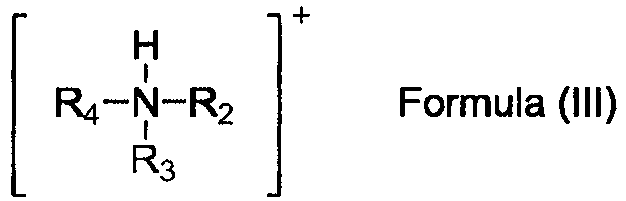
- R2 represents a linear or branched alkyl, a linear alkenyl or a linear alkynyl group having 6 to 24 carbon atoms;
- R3 represents a linear or branched alkyl group having 1 to 5 carbon atoms; R4 represents a linear or branched alkyl group having 1 to 5 carbon atoms, or a linear or branched alkyl, a linear alkenyl or a linear alkynyl group having 6 to 24 carbon atoms.
- In one embodiment of the present invention, the anion Y- consists of one or more ethercarboxylate anion compounds of formula (II), wherein R1 represents a linear or branched alkyl having 6 to 22 carbon atoms or a linear alkenyl group having 6 to 22 carbon atoms; preferably the alkyl or alkenyl group contains from 8 to 18 carbon atoms, more preferably from 12 to 18 carbon atoms; n (-CH2CH2O- units) represents a number within the range from 2 to 8, more preferably from 2 to 6, and m (-CH2CHRO- and/or -CHRCH2O-units) represents a number within the range from 0 to 6, preferably from 0 to 3, more preferably 0, and the sum of n + m represents the average alkoxylation degree which corresponds to a number from 2 to 14, preferably from 2 to 9, more preferably from 2 to 6.
- In one embodiment of the present invention, the anion Y- consists of one or more ethercarboxylate anion compounds of formula (II), wherein R1 represents a linear or branched alkyl having 6 to 22 carbon atoms or a linear alkenyl group having 6 to 22 carbon atoms and up to 3 double bonds; preferably the alkyl or alkenyl group contains from 8 to 18 carbon atoms, more preferably from 12 to 18 carbon atoms; n (-CH2CH2O- units) represents a number from 2 to 8, more preferably from 2 to 6, and m (-CH2CHRO- and/or - CHRCH2O- units) represents a number from 0 to 6, preferably from 0 to 3, more preferably 0, and the sum of n + m represents the average alkoxylation degree which corresponds to a number from 2 to 14, preferably from 2 to 9, more preferably from 2 to 6.
- The order or sequence of the -(CH2CH2O)- , -(CH2CHRO)- ,or -(CHRCH2O)-groups, wherein R represents an alkyl group containing 1 to 2 carbon atoms, is not critical for the invention. Thus, both ether carboxylate anions of the present invention comprising -(CH2CH2O)- and -(CH2CHRO)- or - (CHRCH2O) - groups in separated blocks and ether carboxylate anions of the present invention comprising randomly distributed -(CH2CH2O)- and -(CH2CHRO)- or - (CHRCH2O)- groups may be used according to the invention.
- In another embodiment of the present invention, the cation X+ consists of one or more alkyl ammonium cation compounds of formula (III), wherein R2 represents a linear or branched alkyl, a linear alkenyl or a linear alkynyl group having 6 to 24 carbon atoms, preferably 10 to 18 carbon atoms, R3 represents a linear or branched alkyl group having 1 to 5 carbon atoms, preferably a methyl group, R4 represents a linear or branched alkyl group having 1 to 5 carbon atoms, preferably a methyl group, or a linear or branched alkyl, a linear alkenyl or a linear alkynyl group having 6 to 24 carbon atoms, preferably from 10 to 18 carbon atoms.
- In another embodiment of the present invention, the ionic liquid of formula (I) preferably comprises an ether carboxylate anion of formula (II) wherein R1 represents a linear or branched alkyl or a linear alkenyl group having 6 to 22 carbon atoms, preferably 8 to 18 carbon atoms, more preferably having 12 to 18 carbon atoms, the n in the -CH2CH2O- units represents a number from 2 to 8, more preferably from 2 to 6, and the m in the -CH2CHRO- and/or - CHRCH2O- units represents a number from 0 to 6, preferably from 0 to 3, more preferably 0, and the sum of n + m represents the average alkoxylation degree which corresponds to a number from 2 to 14, preferably from 2 to 9, more preferably from 2 to 6, and comprises an ammonium cation of formula (III) wherein R2 represents a linear or branched alkyl, a linear alkenyl or a linear alkynyl group having 6 to 24 carbon atoms, preferably 10 to 18 carbon atoms, R3 represents a linear or branched alkyl group having 1 to 5 carbon atoms, preferably a methyl group, R4 represents a linear or branched alkyl group having 1 to 5 carbon atoms, preferably a methyl group.
- In another embodiment of the present invention, the ionic liquid of formula (I) preferably comprises an ether carboxylate anion of formula (II) wherein R1 represents a linear or branched alkyl or a linear alkenyl group having 6 to 22 carbon atoms, preferably 8 to 18 carbon atoms, more preferably having 12 to 18 carbon atoms, wherein the alkenyl has up to 3 double bonds, the n in the -CH2CH2O- units represents a number from 2 to 8, more preferably from 2 to 6, and the m in the -CH2CHRO- and/or -CHRCH2O- units represents a number from 0 to 6, preferably from 0 to 3, more preferably 0, and the sum of n + m represents the average alkoxylation degree which corresponds to a number from 2 to 14, preferably from 2 to 9, more preferably from 2 to 6, and comprises an ammonium cation of formula (III) wherein R2 represents a linear or branched alkyl, a linear alkenyl or a linear alkynyl group having 6 to 24 carbon atoms, preferably 10 to 18 carbon atoms, R3 represents a linear or branched alkyl group having 1 to 5 carbon atoms, preferably a methyl group, R4 represents a linear or branched alkyl group having 1 to 5 carbon atoms, preferably a methyl group.
- In another embodiment of the present invention, the ionic liquid of formula (I) preferably comprises an ether carboxylate anion of formula (II) wherein R1 represents a linear or branched alkyl or a linear alkenyl group having 6 to 22 carbon atoms, preferably having 8 to 18 carbon atoms, more preferably having 12 to 18 carbon atoms, the n in the -CH2CH2O- units represents a number within the range from 2 to 8, more preferably from 2 to 6, and the m in the -CH2CHRO- and/or -CHRCH2O- units represents a number within the range from 0 to 6, preferably from 0 to 3, more preferably 0, and the sum of n + m represents the average alkoxylation degree which corresponds to a number from 2 to 14, preferably from 2 to 9, more preferably from 2 to 6 and comprises an ammonium cation of formula (III) wherein R2 represents a linear or branched alkyl, a linear alkenyl or a linear alkynyl group having 6 to 24 carbon atoms, preferably 10 to 18 carbon atoms, R3 represents a linear or branched alkyl group having 1 to 5 carbon atoms, preferably a methyl group, R4 represents a linear or branched alkyl, a linear alkenyl or a linear alkynyl group having 6 to 24 carbon atoms, preferably 10 to 18 carbon atoms.
- In another embodiment of the present invention, the ionic liquid of formula (I) preferably comprises an ether carboxylate anion of formula (II) wherein R1 represents a linear or branched alkyl or a linear alkenyl group having 6 to 22 carbon atoms, preferably having 8 to 18 carbon atoms, more preferably having 12 to 18 carbon atoms, wherein the alkenyl has up to 3 double bonds, the n (-CH2CH2O- units) represents a number from 2 to 8, more preferably from 2 to 6, and the m (-CH2CHRO- and/or -CHRCH2O- units) represents a number from 0 to 6, preferably from 0 to 3, more preferably 0, and the sum of n + m represents the average alkoxylation degree which corresponds to a number from 2 to 14, preferably from 2 to 9, more preferably from 2 to 6, and comprises an ammonium cation of formula (III) wherein R2 represents a linear or branched alkyl, a linear alkenyl or a linear alkynyl group having 6 to 24 carbon atoms, preferably 10 to 18 carbon atoms, R3 represents a linear or branched alkyl group having 1 to 5 carbon atoms, preferably a methyl group, R4 represents a linear or branched alkyl, a linear alkenyl or a linear alkynyl group having 6 to 24 carbon atoms, preferably 10 to 18 carbon atoms.
- In one embodiment, the anion Y- consists of at least one selected from Laureth-3 carboxylate, Laureth-4 carboxylate, Laureth-5 carboxylate, Laureth-6 carboxylate and Capryleth-6 carboxylate.
- In one embodiment, the cation X+ consists of at least one selected from dodecyldimethyl ammonium and didodecylmethyl ammonium.
- In one embodiment, the anion Y- consists of at least one selected from Laureth-3 carboxylate, Laureth-4 carboxylate, Laureth-5 carboxylate, Laureth-6 carboxylate, Capryleth-6 carboxylate and the cation X+ consists of at least one selected from dodecyldimethyl ammonium and didodecylmethyl ammonium.
- In another embodiment of the invention, the ionic liquid according to the invention further comprises at least a compound (b). Compound (b) represents one or more impurities which may be present in the ionic liquid. Typical impurities (compound (b)) are unreacted substances in the process for obtaining the ether carboxylic acid as precursor of the ether carboxylate anion compound, such as not carboxymethylated fatty alcohol polyglycol ether, or by-products from the same reaction like sodium glycolate, sodium diglycolate, substances having a low vapour pressure, high boiling substances, oligomer and polymer as well as traces of inorganic halides like sodium chloride and traces of water.
- The presence of impurities can influence the properties of ionic liquids; therefore, the performance of the ionic liquid can also be affected by the impurities, which are in case of ionic liquids all non-ionic organic compounds, inorganic salts and water.
The ionic liquid of the present invention comprises at least a compound (a) and optionally comprises at least a compound (b). Compound (b) represents one or more of the above mentioned impurities and can be present in the ionic liquid in an amount of less than 5% by weight based on the total amount of the ionic liquid. - The ionic liquid of the present invention can be prepared by a one-pot process reaction by reacting an ether carboxylic acid as precursor for the ether carboxylate anion of formula (II) and an amine as precursor for the alkyl ammonium cation of formula (III) in the presence of a solvent, at 30°C. The second step of the process consists in the evaporation of the solvent under reduced pressure and drying under high vacuum conditions at 40°C for 24h.
- How to obtain an ether carboxylic acid as the precursor for the ether carboxylate anion component of the ionic liquid according to the invention is known by the person skilled in the art. Said ether carboxylic acid can be obtained by a Williamson reaction, this is, by the reaction of the corresponding alkylpolyoxyethylene alcohol with a halocarboxylic acid. In order to obtain a purified ether carboxylic acid, the reaction can be carried out by the reaction of the alkylpolyoxyethylene alcohol with metallic sodium. The isolation and purification process is already known by the person skilled in the art, and can be performed, for example, by means of vacuum distillation.
- Suitable examples of ether carboxylic acids that can be used as precursors for the ether carboxylate anion of formula (II) according to the invention are commercially available ether carboxylic acids like AKYPO® RLM 45 CA (Laureth-6 carboxylic acid), AKYPO® LF 1 (Capryleth-6 carboxylic acid), AKYPO® RLM 25 (Laureth-4 carboxylic acid), AKYPO® RO 20 VG. (Oleth-3 carboxylic acid), AKYPO® RO 50 VG (Oleth-6 carboxylic acid), AKYPO® LF 2 (Capryleth-9 carboxylic acid), AKYPO® LF 4 (Mixture of Capryleth-9 carboxylic acid and Hexeth-4 carboxylic acid), all of them marketed by KAO Chemicals Europe. A purification step of the ether carboxylic acid can be carried out if necessary due to NaCl content.
How to obtain the alkylamine as precursor for the alkyl ammonium cation is known by the person skilled in the art. It can be obtained by reacting fatty alcohols with NH3, with alkylamines (RNH2) or with dialkylamines (RR'NH), the suitable pressure, temperature conditions and catalysts being well known, as described in the patent applicationsEP-A-0500038 orEP-A-0908444 . - Suitable amine as precursor for the ammonium cation of formula (III) according to the invention are dimethyloctylamine, dimethyldecylamine, dimethyllaurylamine, dimethylmyristylamine, dimethylpalmitylamine, dimethylcetylamine, dimethylstearylamine, dimethylbehenylamine, coconut dimethylalkylamine, oleic dimethylalkylamine, tallow dimethylalkylamine, totally or partially hydrogenated tallow dimethyl-alkylamine, or mixtures thereof. Other suitable amines are methyldioctylamine, methyldidecylamine, methyldilaurylamine, methyldimyristylamine, methyldipalmitylamine, methyldicetylamine, methyldistearylamine, methyldibehenylamine, coconut methyldialkylamine, oleic methyldialkylamine, tallow methyldialkylamine, totally or partially hydrogenated tallow methyldialkylamine, or mixtures thereof.
- Examples of commercially available amines are those corresponding to the commercial reference FARMIN® DM2098 (N,N-Dimethyldodecylamine), FARMIN® DM4098 (N,N-Dimethyltetradecylamine), FARMIN® DM6098 (N,N-Dimethylhexadecylamine), FARMIN® DM8098 (Octadecyldimethylamine), FARMIN® DM2471 (N,N-Dimethylalkylamine), FARMIN® DM-O (oleic dimethylalkylamine), FARMIN® M2-2095 (didodecylmonomethylamine), FARMIN® DM-T (tallow dimethylalkylamine, FARMIN® DM-TH (hydrogenated tallow dimethylalkylamine), FARMIN® M-D10 (methyldidecylamine), FARMIN® M-2TH (hydrogenated tallow methyldialkylamine), all of them marketed by KAO Chemicals Europe.
- The ionic liquids of the present invention can be used in high-duty lubricants.
The use of the ionic liquids of the present invention in high-duty lubricants can be explained due to their good values of thermal stability, viscosity, hygroscopicity and liquid range (all ionic liquids of the present invention are liquid at room temperature). - Viscosity is one of the most important parameters of lubricant oils. Low viscosity means good flowability but a lubricant also needs to provide high load bearing capacity to enable hydrodynamic lubrication conditions. Due to their ionic nature, ionic liquids form a more stable lubricant film with higher load bearing capacity on metal surfaces than neutral paraffinic lube oils.
Thermal stability is another key parameter for high duty lubricants: most petroleum based lubricants decompose at temperatures above 150°C, whereas the ionic liquids of the invention have decomposition temperatures significantly higher than 150°C.
The limitation of use in a lubricant of a substance due to the water content is known. Low hygroscopicity values of the ionic liquids of the present invention reduce corrosion problems associated to lubricants. - The following examples are given in order to provide a person skilled in the art with a sufficiently clear and complete explanation of the present invention, but should not be considered as limiting the essential aspects of its subject, as set out in the preceding portions of this description.
- First, dodecanetetraoxyethylene alcohol was prepared. 0.2 eq NaOH-50%wt was dissolved in tetraethyleneglycol and heated while stirring to 100°C. Then 1-bromododecane (0.2 eq) was added dropwise within 20 minutes. After stirring overnight the reaction mixture was cooled down to room temperature and extracted 3 times with hexane.
The organic phase subsequently was washed with saturated sodium chloride solution and dried 2 hours over sodium sulphate. Hexane was removed by rotational evaporation, and the raw product was distilled under high vacuum (10-7 mbar) for purification.
The dodecanetetraoxyethylenealcohol was then dissolved in xylene and heated to 90°C. Metallic sodium (1 eq) was added in small portions within 30 minutes under nitrogen atmosphere. The mixture was stirred at 90°C for 4h. Dry, finely powdered sodium monochloroacetate(SMCA) (1eq) was added portionwise under nitrogen atmosphere. The reaction mixture was cooled to room temperature, 100 ml of water and 100 ml of diethylether were added. The mixture was acidified by dropwise addition of concentrated HCl to a pH<2. Phases were separated and the solvents (xylene and diethylether) were evaporated from the organic phase. The residue was dissolved in 100 ml of n-hexane and the product was crystallized in a refrigerator (4°C). Furthermore, recrystallization from n-hexane was repeated 5 times. Before the last crystallization, the organic phase was dried over sodium sulphate and then n-hexane was evaporated in vacuo. - 600 g of dodecyl alcohol and 3 g (corresponding to 0.5% by weight based on the alcohol used as the raw material) of a copper-nickel catalyst were fed into a 1-L four-necked flask. The system was purged with nitrogen while stirring and the temperature rise of the system was initiated. When the temperature of the system reached 100°C hydrogen gas was blown into the system at a flow rate of 40 1/hr with a flowmeter and the temperature of the system was raised to a reaction temperature, of 200°C. At this temperature, the introduction of dimethylamine gas was initiated and a reaction was conducted for 5 hours. After the completion of the reaction, the reaction mixture was filtered to remove the catalyst, thereby providing crude N,N-dimethyldodecylamine. The crude N,N-dimethyldodecylamine was put in a 1-L four-necked flask, followed by the addition of 3 g of activated carbon and 3 g of Kyoward 600 S (a product of Kyowa Chemical Industry, main components: silica 64.9%, magnesia 13.5%). The contents were stirred at 90°C in a nitrogen atmosphere for about 2 hours and filtered to remove the adsorbent. The filtrate was purified by distillation (5 Torr) to obtain dodecyldimethylamine.
- Equimolar amounts of laureth-5 carboxylic acid and ammonium base (dodecyldimethylamine) were dissolved in ethanol and stirred at room temperature for 30 min. Afterwards the solvent was evaporated under reduced pressure. The resulting ionic liquid was dried under high vacuum at 40°C for at least 24h.
- The procedure of Example 1 is repeated using diethyleneglycol and 1-bromododecane as starting materials of the synthesis.
- The dodecyldimethylamine has been prepared using the same procedure as in Example 1.
- The same procedure as in Example 1 has been performed.
- Capryleth-6 carboxylic acid was prepared by the modified Williamson synthesis, which is nowadays the industrial standard process for alkyl ether carboxylic acid synthesis.
370g of the octyl alcohol was ethoxylated with 630g ethylene oxide in the presence of 2 g NaOH-50%. In order to remove the most difficult to eliminate carboxymethylate by-products, a distillation under high vacuum was done. The 820 g of ethoxylate were treated with SMCA, 370 g in the presence of 130 g NaOH solid. For the separation of the water soluble by-products: water, HCl and some NaCl were added to the crude and the mixture was heated resulting in a good separation of the alkyl ether carboxylic acid (top layer) from the aqueous layer. For NaCl removal from the capryleth-6 carboxylic acid, these ether carboxylic acids were desalted by water removal under vacuum and removal of the precipitated NaCl by centrifugation followed by a decantation step. - 600 g of dodecyl alcohol and 3 g (corresponding to 0.5% by weight based on the alcohol used as the raw material) of a copper-nickel catalyst were fed into a 1 l four-necked flask. The system was purged with nitrogen while stirring and the temperature of the system was initiated to heat. When the temperature of the system reached 100°C, hydrogen gas was blown into the system at a flow rate of 40 1/hr with a flowmeter and the temperature of the system was raised to 200°C. At this temperature, the introduction of methylamine gas was initiated and the reaction was conducted for 7 hours. After the completion of the reaction, the reaction resultant was filtered to remove the catalyst, thereby providing crude N-methyldidodecylamine. 200g of the crude N-methyldidodecylamine was put in a 500 ml Hertz-flask. Using the other flask, KOH was weighed to be 0.2%, 0.5%, or 1.0% as compared with the crude N-methyldidodecylamine and dissolved by 1 g of deionized water. The solution of NaOH was put into the above-mentioned Hertz-flask. After setting on apparatus for a distillation (capillary distillation), a mixture in the Hertz-flask was conducted by bubbling with nitrogen gas under an atmospheric pressure at a temperature of 200°C for 2 hours. And then the pressure in the Hertz-flask was reduced to 5 to 10 Torr, and the mixture in the Hertz-flask was heated at 250°C. Further the mixture was distilled and separated at said temperature for 5 hours to obtain N-methyldidodecylamine.
- Same procedure as in Example 1.
- 655g of the lauryl alcohol was ethoxylated with 340g ethylene oxide in the presence of 2 g NaOH-50%. In order to remove the most difficult to eliminate carboxymethylate by-products, a distillation under high vacuum was done. The 830 g of ethoxylate were treated with SMCA, 460 g in the presence of 170 g NaOH solid. For separation of the water soluble by-products: water, HCl and some NaCl were added to the crude and the mixture was heated resulting in a good separation of the alkyl ether carboxylic acid (top layer) from the aqueous layer. For NaCl removal from the laureth-4 carboxylic acid, these ether carboxylic acids were desalted by water removal under vacuum and removal of the precipitated NaCl by centrifugation followed by a decantation step.
- Same procedure as in Example 3.
- Same procedure as in Example 1.
- 490g of the lauryl alcohol was ethoxylated with 510g ethylene oxide in the presence of 2 g NaOH-50%. The 810 g of ethoxylate were treated with SMCA, 340 g in the presence of 125 g NaOH solid. For separation of the water soluble by-products: water, HCl and some NaCl were added to the crude and the mixture was heated resulting in a good separation of the alkyl ether carboxylic acid (top layer) from the aqueous layer. For NaCl removal from the laureth-6 carboxylic acid, these ether carboxylic acids were desalted by water removal under vacuum and removal of the precipitated NaCl by centrifugation followed by a decantation step.
- Same procedure as in Example 3.
- Same procedure as in Example 1.
Table 1 summarizes all the synthesized ionic liquids: Example Ionic Liquid Ethercarboxylate anion (II) precursor Ammonium cation (III) precursor 1 Dodecyldimethylammonium laureth-5 carboxylate Laureth-5 carboxylic acid Dodecyldimethylamine 2 Dodecyldimethylammonium laureth-3 carboxylate Laureth-3 carboxylic acid Dodecyldimethylamine 3 Didodecylmethylammonium capryleth-6 carboxylate Capryleth-6 carboxylic acid Didodecyldimethylamine 4 Didodecylmethylammonium laureth-4 carboxylate Laureth-4 carboxylic acid Didodecyldimethylamine 5 Didodecylmethylammonium laureth-6 carboxylate Laureth-6 carboxylic acid Didodecyldimethylamine Relevant properties for high duty lubricants: liquid range, thermal stability, viscosity, hygroscopicity and evaporation loss were determined for the ionic liquids prepared in Examples 1 to 5. - Table 2 summarizes the results obtained for the ionic liquids of the examples 1 to 5:
Table 2 Lubricant type Liquid range Thermal stability Viscosity (mPas) Hygroscopicity Evaporation loss Dodecyldimethylammonium laureth-5 carboxylate Tg:-41.8°C Tdec:250°C 20°C:100 1.6% water after 48h 0% wt loss Tdec:250°C 40°C:40 ΔT:291.8°C 80°C:10 Dodecyldimethylammonium laureth-3 carboxylate Tg:-37.5°C Tdec:230°C 20°C:100 5.1% water after 48h 0% wt loss Tdec:230°C 40°C:40 ΔT:267.5°C 80°C:10 Didodecylmethylammonium capryleth-6 carboxylate Tdec:285°C Tdec:285°C 20°C:80 5.5% water after 48h 0% wt loss 80°C:10 Didodecylmethylammonium laureth-4 carboxylate Tdec:295°C Tdec:295°C 20°C: 110 1.6% water after 48h 0% wt loss 80°C:20 Didodecylmethylammonium laureth-6 carboxylate Tdec:295°C Tdec:295°C 20°C: 110 1.6% water after 48h 0% wt loss 80°C:20 - Glass transition temperature (Tg) is measured according to ISO-11357-2 by Differential Scanning Calorimetry (DSC).
Decomposition temperature (Tdec) is measured according to ISO-11358 by Thermogravimetric analysis (TGA).
Viscosity is measured according to ISO 3210 / DIN 53018 by use of rotational rheometer with cone/plate system.
Hygroscopicity is measured by gravimetric method in % water absorption at 20°C within 48h.
Evaporation loss is measured according to ASTM D 5800, during 1h at 250°C. - Results of the lubricating performance of the ionic liquids of examples 1 and 5 are described in Table 3.
Table 3 Lubricant type Friction reduction during threading (N·cm) Dodecyldimethylammonium laureth-5 carboxylate 105 Didodecylmethylammonium laureth - 6 carboxylate 104 - Lubricating performance is measured according to Tapping Torque test: ASTM D5619 (2011). Test is performed by mimicking a thread cutting process, the torque is measured as a function of the respective thread depth in a test bar (made of aluminium 3.4365). Results are expressed by mean torque (arithmetic average of the instantaneous tapping torque values through the depth of the hole).
Results shown in the reduction of friction during threading of the ionic liquids are better than results shown in conventional lubricants such as mineral refined oil and TMP trioleate. - From these results it can be seen that the ionic liquids of the present invention meet the necessary requirements for a good performance in a high duty lubricant.
Claims (10)
- An ionic liquid comprising:- at least a compound (a)
wherein
Compound (a) comprises one or more products of formula (I)
X+Y- Formula (I)
wherein
the anion Y- is an ether carboxylate anion or a mixture thereof of formula (II) n units of -CH2CH2O- and m units of -CH2CHRO- or -CHRCH2O- wherein n represents a number from 2 to 8, m represents a number from 0 to 6,and the sum of n+m represents the average alkoxylation degree which corresponds to a number from 2 to 14;andwhereinR represents an alkyl group having 1 to 2 carbon atoms;R1 represents a linear or branched alkyl having from 6 to 22 carbon atoms or a linear alkenyl group having 6 to 22 carbon atoms;and the cation X+ is an alkyl ammonium cation or a mixture thereof of formula (III)
 R2 represents a linear or branched alkyl, a linear alkenyl or a linear alkynyl group having 6 to 24 carbon atoms,R3 represents a linear or branched alkyl group having 1 to 5 carbon atoms,R4 represents a linear or branched alkyl group having 1 to 5 carbon atoms, or a linear or branched alkyl, a linear alkenyl or a linear alkynyl group having 6 to 24 carbon atoms.
 - The ionic liquid according to claim 1, characterized in that the anion Y- is an ether carboxylate anion of formula (II), wherein the alkenyl has up to 3 double bonds.
- The ionic liquid according to any one of claims 1-2 wherein R1 has 8 to 18 carbon atoms.
- The ionic liquid according to any one of claims 1-3 wherein P consists of
n units of -CH2CH2O- and m units of -CH2CHRO- or -CHRCH2O-, wherein n represents a number from 2 to 6, m represents a number from 0 to 3, and the sum of n+m represents the average alkoxylation degree which corresponds to a number from 2 to 9. - An ionic liquid according to any one of claims 1 to 4, characterized in that the cation X+ is an alkyl ammonium cation of formula (III), wherein
R2 represents a linear or branched alkyl, a linear alkenyl or a linear alkynyl group having 10 to 18 carbon atoms,
R3 represents a methyl group,
R4 represents a methyl group. - The ionic liquid according to any one of claims 1 to 4, characterized in that the cation X+ is an alkyl ammonium cation of formula (III), wherein
R2 represents a linear or branched alkyl, a linear alkenyl or a linear alkynyl group having 10 to 18 carbon atoms,
R3 represents a linear or branched alkyl group having 1 to 5 carbon atoms, preferably a methyl group,
R4 represents a linear or branched alkyl, a linear alkenyl or a linear alkynyl group having 10 to 18 carbon atoms. - The ionic liquid according to claim 1 wherein the anion Y- is at least one selected from Laureth-3 carboxylate, Laureth-4 carboxylate, Laureth-5 carboxylate, Laureth-6 carboxylate and Capryleth-6 carboxylate.
- The ionic liquid according to any one of claims 1 to 7 wherein the cation X+ is at least one selected from dodecyldimethyl ammonium and didodecylmethyl ammonium.
- A process for preparing the ionic liquid of formula (I) according to any one of claims 1 to 8, wherein the ionic liquid of formula (I) is prepared by a one-pot process reaction by reacting an ether carboxylic acid as precursor for the ether carboxylate anion of formula (II) and an alkyl amine as precursor for the alkyl ammonium cation of formula (III) in the presence of a solvent, followed by the evaporation of the solvent under reduced pressure and drying under high vacuum conditions.
- Use of an ionic liquid according to any one of claim 1 to 8 in a lubricant.
Priority Applications (1)
| Application Number | Priority Date | Filing Date | Title |
|---|---|---|---|
| PL15702684T PL3099664T3 (en) | 2014-01-30 | 2015-01-23 | Ionic liquids |
Applications Claiming Priority (2)
| Application Number | Priority Date | Filing Date | Title |
|---|---|---|---|
| EP14153215.0A EP2902381A1 (en) | 2014-01-30 | 2014-01-30 | Ionic liquids |
| PCT/EP2015/051347 WO2015113906A1 (en) | 2014-01-30 | 2015-01-23 | Ionic liquids |
Publications (2)
| Publication Number | Publication Date |
|---|---|
| EP3099664A1 EP3099664A1 (en) | 2016-12-07 |
| EP3099664B1 true EP3099664B1 (en) | 2018-04-18 |
Family
ID=50002629
Family Applications (2)
| Application Number | Title | Priority Date | Filing Date |
|---|---|---|---|
| EP14153215.0A Withdrawn EP2902381A1 (en) | 2014-01-30 | 2014-01-30 | Ionic liquids |
| EP15702684.0A Active EP3099664B1 (en) | 2014-01-30 | 2015-01-23 | Ionic liquids |
Family Applications Before (1)
| Application Number | Title | Priority Date | Filing Date |
|---|---|---|---|
| EP14153215.0A Withdrawn EP2902381A1 (en) | 2014-01-30 | 2014-01-30 | Ionic liquids |
Country Status (7)
| Country | Link |
|---|---|
| US (1) | US20170009172A1 (en) |
| EP (2) | EP2902381A1 (en) |
| JP (1) | JP6214795B2 (en) |
| ES (1) | ES2674905T3 (en) |
| NO (1) | NO3099664T3 (en) |
| PL (1) | PL3099664T3 (en) |
| WO (1) | WO2015113906A1 (en) |
Families Citing this family (11)
| Publication number | Priority date | Publication date | Assignee | Title |
|---|---|---|---|---|
| US10752856B2 (en) | 2017-05-24 | 2020-08-25 | Ingevity South Carolina, Llc | Fatty acid and rosin based ionic liquids |
| US11976248B2 (en) * | 2017-09-20 | 2024-05-07 | Dorf Ketal Energy Services Llc | Dispersions of polymeric oil additives |
| EP3556344B1 (en) | 2018-04-16 | 2025-04-16 | Kao Corporation, S.A. | Cosmetic compositions |
| CN110156827A (en) * | 2019-05-21 | 2019-08-23 | 淮海工学院 | Polyoxyethylene ether phosphoric acid gemini surfactant drag reducer and its preparation method and application |
| CN110105254A (en) * | 2019-05-21 | 2019-08-09 | 淮海工学院 | Polyoxyethylene ether sulfonic acid Gemini surface active agent class drag reducer and its preparation method and application |
| CN110156594A (en) * | 2019-05-21 | 2019-08-23 | 淮海工学院 | Polyoxyethylene ether carboxylic acid gemini surfactant drag reducer and its preparation method and application |
| ES3060444T3 (en) * | 2019-12-27 | 2026-03-26 | Kao Chemicals Gmbh | Process for the preparation of an ether carboxylic acid composition |
| US11879091B2 (en) * | 2020-01-28 | 2024-01-23 | Uti Limited Partnership | Reservoir emplacement of rheologically tuned and timed nanoparticle emulsions |
| JP2023522034A (en) * | 2020-04-16 | 2023-05-26 | トタルエナジーズ・ワンテック | Ammonium-based ionic liquids and their use as additives for lubricants |
| EP4219444A4 (en) * | 2020-09-25 | 2025-02-26 | Kao Corporation | PROCESS FOR PRODUCING A TERTIARY AMINE COMPOSITION |
| EP4215518A1 (en) | 2022-01-24 | 2023-07-26 | KAO CHEMICALS GmbH | Process for preparing amidated fatty acids and derivatives thereof |
Family Cites Families (7)
| Publication number | Priority date | Publication date | Assignee | Title |
|---|---|---|---|---|
| JPS62201980A (en) * | 1986-02-28 | 1987-09-05 | Pentel Kk | Water based ink composition for writing utensil |
| JPH04266858A (en) | 1991-02-22 | 1992-09-22 | Kao Corp | Production of aliphatic amine |
| JP3553335B2 (en) | 1997-10-07 | 2004-08-11 | 花王株式会社 | Method for producing high quality tertiary amine |
| JP2001081494A (en) * | 1999-09-14 | 2001-03-27 | Neos Co Ltd | Aqueous processing oil for magnetic disk substrates |
| DE102006009973A1 (en) | 2006-03-03 | 2007-09-06 | Cognis Ip Management Gmbh | At room temperature, liquid compounds |
| WO2008135482A2 (en) * | 2007-05-05 | 2008-11-13 | Basf Se | Ionic liquids comprising polyethercarboxylates as anions, production and use thereof |
| GB0718269D0 (en) * | 2007-09-12 | 2007-10-31 | Bioniqs Ltd | Purification of organic compounds |
-
2014
- 2014-01-30 EP EP14153215.0A patent/EP2902381A1/en not_active Withdrawn
-
2015
- 2015-01-23 EP EP15702684.0A patent/EP3099664B1/en active Active
- 2015-01-23 ES ES15702684.0T patent/ES2674905T3/en active Active
- 2015-01-23 JP JP2016567146A patent/JP6214795B2/en active Active
- 2015-01-23 WO PCT/EP2015/051347 patent/WO2015113906A1/en not_active Ceased
- 2015-01-23 US US15/115,281 patent/US20170009172A1/en not_active Abandoned
- 2015-01-23 PL PL15702684T patent/PL3099664T3/en unknown
- 2015-01-23 NO NO15702684A patent/NO3099664T3/no unknown
Non-Patent Citations (1)
| Title |
|---|
| None * |
Also Published As
| Publication number | Publication date |
|---|---|
| ES2674905T3 (en) | 2018-07-04 |
| PL3099664T3 (en) | 2018-09-28 |
| US20170009172A1 (en) | 2017-01-12 |
| WO2015113906A1 (en) | 2015-08-06 |
| JP6214795B2 (en) | 2017-10-18 |
| JP2017507173A (en) | 2017-03-16 |
| EP2902381A1 (en) | 2015-08-05 |
| EP3099664A1 (en) | 2016-12-07 |
| NO3099664T3 (en) | 2018-09-15 |
Similar Documents
| Publication | Publication Date | Title |
|---|---|---|
| EP2902381A1 (en) | Ionic liquids | |
| JP7079817B2 (en) | Heat transfer composition | |
| CN101675023B (en) | Ionic liquid comprising polyether carboxylate as anion, process for its preparation and use thereof | |
| JP5822100B2 (en) | Lubricant composition excellent in rust prevention property based on ionic liquid | |
| US11649202B2 (en) | Fluorinated esters as lubricants for heat transfer fluids | |
| CN110862356B (en) | Benzotriazole functionalized quaternary ammonium salt ionic liquid and preparation method and application thereof | |
| EP1449940B1 (en) | Corrosion and gas hydrates inhibitors with improved water solubilty and biodegradabilty | |
| Fan et al. | New ionic liquid lubricants derived from nonnutritive sweeteners | |
| WO2017210165A1 (en) | Methods for producing solvents derived from 1-chloro-3, 3, 3-trifluoro-propene (1233zd) | |
| CN105073964A (en) | Water-based metalworking oil | |
| US2727054A (en) | Method of preparing silicate esters | |
| US11718534B2 (en) | Slurry compositions containing mixed branched alkyl organoclay compositions | |
| JP2012518524A5 (en) | ||
| US20130099156A1 (en) | Use of liquid compositions comprising imidazolium salts as operating materials | |
| WO2003033451A1 (en) | Dibasic acid diester | |
| JPH0570789A (en) | Composition for refrigerator working fluid | |
| EP0148274B1 (en) | Composition for use in metal working | |
| KR20190092437A (en) | Refrigerator oil composition, and working fluid composition for refrigerator containing same | |
| EP0033181B1 (en) | Mixtures of branched-chain amines and derivatives thereof | |
| CN121537314A (en) | Ionic liquid additives and their preparation methods, as well as refrigeration oils and working fluid compositions for refrigeration equipment. | |
| JP6467908B2 (en) | Substrate for heat medium | |
| JP6501252B2 (en) | Ammonium cation containing organic salt | |
| WO2023176209A1 (en) | Tosylic acid anionic ionic liquid | |
| EP4544009A1 (en) | Composition comprising base oil and ashless ionic liquid | |
| CN121537313A (en) | Ionic liquid additives and their preparation methods, as well as refrigeration oils and working fluid compositions for refrigeration equipment. |
Legal Events
| Date | Code | Title | Description |
|---|---|---|---|
| PUAI | Public reference made under article 153(3) epc to a published international application that has entered the european phase |
Free format text: ORIGINAL CODE: 0009012 |
|
| STAA | Information on the status of an ep patent application or granted ep patent |
Free format text: STATUS: REQUEST FOR EXAMINATION WAS MADE |
|
| 17P | Request for examination filed |
Effective date: 20160712 |
|
| AK | Designated contracting states |
Kind code of ref document: A1 Designated state(s): AL AT BE BG CH CY CZ DE DK EE ES FI FR GB GR HR HU IE IS IT LI LT LU LV MC MK MT NL NO PL PT RO RS SE SI SK SM TR |
|
| AX | Request for extension of the european patent |
Extension state: BA ME |
|
| DAX | Request for extension of the european patent (deleted) | ||
| GRAP | Despatch of communication of intention to grant a patent |
Free format text: ORIGINAL CODE: EPIDOSNIGR1 |
|
| STAA | Information on the status of an ep patent application or granted ep patent |
Free format text: STATUS: GRANT OF PATENT IS INTENDED |
|
| RIC1 | Information provided on ipc code assigned before grant |
Ipc: C10M 129/26 20060101ALI20170907BHEP Ipc: C07C 51/41 20060101ALI20170907BHEP Ipc: C07C 211/63 20060101AFI20170907BHEP Ipc: C07C 59/125 20060101ALI20170907BHEP Ipc: C07C 209/68 20060101ALI20170907BHEP Ipc: C10M 129/40 20060101ALI20170907BHEP |
|
| INTG | Intention to grant announced |
Effective date: 20171010 |
|
| GRAS | Grant fee paid |
Free format text: ORIGINAL CODE: EPIDOSNIGR3 |
|
| GRAJ | Information related to disapproval of communication of intention to grant by the applicant or resumption of examination proceedings by the epo deleted |
Free format text: ORIGINAL CODE: EPIDOSDIGR1 |
|
| GRAL | Information related to payment of fee for publishing/printing deleted |
Free format text: ORIGINAL CODE: EPIDOSDIGR3 |
|
| STAA | Information on the status of an ep patent application or granted ep patent |
Free format text: STATUS: REQUEST FOR EXAMINATION WAS MADE |
|
| GRAR | Information related to intention to grant a patent recorded |
Free format text: ORIGINAL CODE: EPIDOSNIGR71 |
|
| STAA | Information on the status of an ep patent application or granted ep patent |
Free format text: STATUS: GRANT OF PATENT IS INTENDED |
|
| GRAA | (expected) grant |
Free format text: ORIGINAL CODE: 0009210 |
|
| STAA | Information on the status of an ep patent application or granted ep patent |
Free format text: STATUS: THE PATENT HAS BEEN GRANTED |
|
| INTC | Intention to grant announced (deleted) | ||
| INTG | Intention to grant announced |
Effective date: 20180228 |
|
| AK | Designated contracting states |
Kind code of ref document: B1 Designated state(s): AL AT BE BG CH CY CZ DE DK EE ES FI FR GB GR HR HU IE IS IT LI LT LU LV MC MK MT NL NO PL PT RO RS SE SI SK SM TR |
|
| REG | Reference to a national code |
Ref country code: GB Ref legal event code: FG4D |
|
| REG | Reference to a national code |
Ref country code: CH Ref legal event code: EP |
|
| REG | Reference to a national code |
Ref country code: DE Ref legal event code: R096 Ref document number: 602015010100 Country of ref document: DE |
|
| REG | Reference to a national code |
Ref country code: AT Ref legal event code: REF Ref document number: 990287 Country of ref document: AT Kind code of ref document: T Effective date: 20180515 |
|
| REG | Reference to a national code |
Ref country code: IE Ref legal event code: FG4D |
|
| REG | Reference to a national code |
Ref country code: NL Ref legal event code: FP |
|
| REG | Reference to a national code |
Ref country code: NO Ref legal event code: T2 Effective date: 20180418 |
|
| REG | Reference to a national code |
Ref country code: ES Ref legal event code: FG2A Ref document number: 2674905 Country of ref document: ES Kind code of ref document: T3 Effective date: 20180704 |
|
| REG | Reference to a national code |
Ref country code: LT Ref legal event code: MG4D |
|
| PG25 | Lapsed in a contracting state [announced via postgrant information from national office to epo] |
Ref country code: SE Free format text: LAPSE BECAUSE OF FAILURE TO SUBMIT A TRANSLATION OF THE DESCRIPTION OR TO PAY THE FEE WITHIN THE PRESCRIBED TIME-LIMIT Effective date: 20180418 Ref country code: LT Free format text: LAPSE BECAUSE OF FAILURE TO SUBMIT A TRANSLATION OF THE DESCRIPTION OR TO PAY THE FEE WITHIN THE PRESCRIBED TIME-LIMIT Effective date: 20180418 Ref country code: BG Free format text: LAPSE BECAUSE OF FAILURE TO SUBMIT A TRANSLATION OF THE DESCRIPTION OR TO PAY THE FEE WITHIN THE PRESCRIBED TIME-LIMIT Effective date: 20180718 Ref country code: FI Free format text: LAPSE BECAUSE OF FAILURE TO SUBMIT A TRANSLATION OF THE DESCRIPTION OR TO PAY THE FEE WITHIN THE PRESCRIBED TIME-LIMIT Effective date: 20180418 Ref country code: AL Free format text: LAPSE BECAUSE OF FAILURE TO SUBMIT A TRANSLATION OF THE DESCRIPTION OR TO PAY THE FEE WITHIN THE PRESCRIBED TIME-LIMIT Effective date: 20180418 |
|
| PG25 | Lapsed in a contracting state [announced via postgrant information from national office to epo] |
Ref country code: GR Free format text: LAPSE BECAUSE OF FAILURE TO SUBMIT A TRANSLATION OF THE DESCRIPTION OR TO PAY THE FEE WITHIN THE PRESCRIBED TIME-LIMIT Effective date: 20180719 Ref country code: LV Free format text: LAPSE BECAUSE OF FAILURE TO SUBMIT A TRANSLATION OF THE DESCRIPTION OR TO PAY THE FEE WITHIN THE PRESCRIBED TIME-LIMIT Effective date: 20180418 Ref country code: RS Free format text: LAPSE BECAUSE OF FAILURE TO SUBMIT A TRANSLATION OF THE DESCRIPTION OR TO PAY THE FEE WITHIN THE PRESCRIBED TIME-LIMIT Effective date: 20180418 Ref country code: HR Free format text: LAPSE BECAUSE OF FAILURE TO SUBMIT A TRANSLATION OF THE DESCRIPTION OR TO PAY THE FEE WITHIN THE PRESCRIBED TIME-LIMIT Effective date: 20180418 |
|
| PG25 | Lapsed in a contracting state [announced via postgrant information from national office to epo] |
Ref country code: PT Free format text: LAPSE BECAUSE OF FAILURE TO SUBMIT A TRANSLATION OF THE DESCRIPTION OR TO PAY THE FEE WITHIN THE PRESCRIBED TIME-LIMIT Effective date: 20180820 |
|
| REG | Reference to a national code |
Ref country code: DE Ref legal event code: R097 Ref document number: 602015010100 Country of ref document: DE |
|
| PG25 | Lapsed in a contracting state [announced via postgrant information from national office to epo] |
Ref country code: RO Free format text: LAPSE BECAUSE OF FAILURE TO SUBMIT A TRANSLATION OF THE DESCRIPTION OR TO PAY THE FEE WITHIN THE PRESCRIBED TIME-LIMIT Effective date: 20180418 Ref country code: SK Free format text: LAPSE BECAUSE OF FAILURE TO SUBMIT A TRANSLATION OF THE DESCRIPTION OR TO PAY THE FEE WITHIN THE PRESCRIBED TIME-LIMIT Effective date: 20180418 Ref country code: DK Free format text: LAPSE BECAUSE OF FAILURE TO SUBMIT A TRANSLATION OF THE DESCRIPTION OR TO PAY THE FEE WITHIN THE PRESCRIBED TIME-LIMIT Effective date: 20180418 Ref country code: EE Free format text: LAPSE BECAUSE OF FAILURE TO SUBMIT A TRANSLATION OF THE DESCRIPTION OR TO PAY THE FEE WITHIN THE PRESCRIBED TIME-LIMIT Effective date: 20180418 |
|
| PLBE | No opposition filed within time limit |
Free format text: ORIGINAL CODE: 0009261 |
|
| STAA | Information on the status of an ep patent application or granted ep patent |
Free format text: STATUS: NO OPPOSITION FILED WITHIN TIME LIMIT |
|
| PG25 | Lapsed in a contracting state [announced via postgrant information from national office to epo] |
Ref country code: SM Free format text: LAPSE BECAUSE OF FAILURE TO SUBMIT A TRANSLATION OF THE DESCRIPTION OR TO PAY THE FEE WITHIN THE PRESCRIBED TIME-LIMIT Effective date: 20180418 |
|
| 26N | No opposition filed |
Effective date: 20190121 |
|
| PG25 | Lapsed in a contracting state [announced via postgrant information from national office to epo] |
Ref country code: SI Free format text: LAPSE BECAUSE OF FAILURE TO SUBMIT A TRANSLATION OF THE DESCRIPTION OR TO PAY THE FEE WITHIN THE PRESCRIBED TIME-LIMIT Effective date: 20180418 |
|
| PG25 | Lapsed in a contracting state [announced via postgrant information from national office to epo] |
Ref country code: MC Free format text: LAPSE BECAUSE OF FAILURE TO SUBMIT A TRANSLATION OF THE DESCRIPTION OR TO PAY THE FEE WITHIN THE PRESCRIBED TIME-LIMIT Effective date: 20180418 |
|
| PG25 | Lapsed in a contracting state [announced via postgrant information from national office to epo] |
Ref country code: LU Free format text: LAPSE BECAUSE OF NON-PAYMENT OF DUE FEES Effective date: 20190123 |
|
| REG | Reference to a national code |
Ref country code: IE Ref legal event code: MM4A |
|
| PG25 | Lapsed in a contracting state [announced via postgrant information from national office to epo] |
Ref country code: IE Free format text: LAPSE BECAUSE OF NON-PAYMENT OF DUE FEES Effective date: 20190123 |
|
| PG25 | Lapsed in a contracting state [announced via postgrant information from national office to epo] |
Ref country code: MT Free format text: LAPSE BECAUSE OF NON-PAYMENT OF DUE FEES Effective date: 20190123 |
|
| REG | Reference to a national code |
Ref country code: AT Ref legal event code: UEP Ref document number: 990287 Country of ref document: AT Kind code of ref document: T Effective date: 20180418 |
|
| PG25 | Lapsed in a contracting state [announced via postgrant information from national office to epo] |
Ref country code: CY Free format text: LAPSE BECAUSE OF FAILURE TO SUBMIT A TRANSLATION OF THE DESCRIPTION OR TO PAY THE FEE WITHIN THE PRESCRIBED TIME-LIMIT Effective date: 20180418 |
|
| PG25 | Lapsed in a contracting state [announced via postgrant information from national office to epo] |
Ref country code: IS Free format text: LAPSE BECAUSE OF FAILURE TO SUBMIT A TRANSLATION OF THE DESCRIPTION OR TO PAY THE FEE WITHIN THE PRESCRIBED TIME-LIMIT Effective date: 20180818 |
|
| PG25 | Lapsed in a contracting state [announced via postgrant information from national office to epo] |
Ref country code: HU Free format text: LAPSE BECAUSE OF FAILURE TO SUBMIT A TRANSLATION OF THE DESCRIPTION OR TO PAY THE FEE WITHIN THE PRESCRIBED TIME-LIMIT; INVALID AB INITIO Effective date: 20150123 |
|
| PG25 | Lapsed in a contracting state [announced via postgrant information from national office to epo] |
Ref country code: MK Free format text: LAPSE BECAUSE OF FAILURE TO SUBMIT A TRANSLATION OF THE DESCRIPTION OR TO PAY THE FEE WITHIN THE PRESCRIBED TIME-LIMIT Effective date: 20180418 |
|
| P01 | Opt-out of the competence of the unified patent court (upc) registered |
Effective date: 20230418 |
|
| PGFP | Annual fee paid to national office [announced via postgrant information from national office to epo] |
Ref country code: GB Payment date: 20251210 Year of fee payment: 12 |
|
| PGFP | Annual fee paid to national office [announced via postgrant information from national office to epo] |
Ref country code: NO Payment date: 20251210 Year of fee payment: 12 |
|
| PGFP | Annual fee paid to national office [announced via postgrant information from national office to epo] |
Ref country code: FR Payment date: 20251210 Year of fee payment: 12 Ref country code: NL Payment date: 20251210 Year of fee payment: 12 |
|
| PGFP | Annual fee paid to national office [announced via postgrant information from national office to epo] |
Ref country code: BE Payment date: 20251209 Year of fee payment: 12 |
|
| PGFP | Annual fee paid to national office [announced via postgrant information from national office to epo] |
Ref country code: CZ Payment date: 20251126 Year of fee payment: 12 |
|
| PGFP | Annual fee paid to national office [announced via postgrant information from national office to epo] |
Ref country code: PL Payment date: 20251113 Year of fee payment: 12 |
|
| REG | Reference to a national code |
Ref country code: CH Ref legal event code: U11 Free format text: ST27 STATUS EVENT CODE: U-0-0-U10-U11 (AS PROVIDED BY THE NATIONAL OFFICE) Effective date: 20260201 |
|
| PGFP | Annual fee paid to national office [announced via postgrant information from national office to epo] |
Ref country code: ES Payment date: 20260220 Year of fee payment: 12 |
|
| PGFP | Annual fee paid to national office [announced via postgrant information from national office to epo] |
Ref country code: DE Payment date: 20251209 Year of fee payment: 12 |
|
| PGFP | Annual fee paid to national office [announced via postgrant information from national office to epo] |
Ref country code: AT Payment date: 20251209 Year of fee payment: 12 |
|
| PGFP | Annual fee paid to national office [announced via postgrant information from national office to epo] |
Ref country code: IT Payment date: 20251201 Year of fee payment: 12 |
|
| PGFP | Annual fee paid to national office [announced via postgrant information from national office to epo] |
Ref country code: TR Payment date: 20260121 Year of fee payment: 12 |
|
| PGFP | Annual fee paid to national office [announced via postgrant information from national office to epo] |
Ref country code: CH Payment date: 20260201 Year of fee payment: 12 |