EP3098930A1 - Detecting device and detecting method for detecting output impedance angle of inverter - Google Patents
Detecting device and detecting method for detecting output impedance angle of inverter Download PDFInfo
- Publication number
- EP3098930A1 EP3098930A1 EP16171228.6A EP16171228A EP3098930A1 EP 3098930 A1 EP3098930 A1 EP 3098930A1 EP 16171228 A EP16171228 A EP 16171228A EP 3098930 A1 EP3098930 A1 EP 3098930A1
- Authority
- EP
- European Patent Office
- Prior art keywords
- angle
- impedance angle
- value
- power
- determined
- Prior art date
- Legal status (The legal status is an assumption and is not a legal conclusion. Google has not performed a legal analysis and makes no representation as to the accuracy of the status listed.)
- Granted
Links
Images




Classifications
-
- G—PHYSICS
- G01—MEASURING; TESTING
- G01R—MEASURING ELECTRIC VARIABLES; MEASURING MAGNETIC VARIABLES
- G01R27/00—Arrangements for measuring resistance, reactance, impedance, or electric characteristics derived therefrom
- G01R27/02—Measuring real or complex resistance, reactance, impedance, or other two-pole characteristics derived therefrom, e.g. time constant
- G01R27/26—Measuring inductance or capacitance; Measuring quality factor, e.g. by using the resonance method; Measuring loss factor; Measuring dielectric constants ; Measuring impedance or related variables
-
- G—PHYSICS
- G01—MEASURING; TESTING
- G01R—MEASURING ELECTRIC VARIABLES; MEASURING MAGNETIC VARIABLES
- G01R21/00—Arrangements for measuring electric power or power factor
- G01R21/001—Measuring real or reactive component; Measuring apparent energy
- G01R21/003—Measuring reactive component
-
- G—PHYSICS
- G01—MEASURING; TESTING
- G01R—MEASURING ELECTRIC VARIABLES; MEASURING MAGNETIC VARIABLES
- G01R25/00—Arrangements for measuring phase angle between a voltage and a current or between voltages or currents
-
- H—ELECTRICITY
- H02—GENERATION; CONVERSION OR DISTRIBUTION OF ELECTRIC POWER
- H02J—ELECTRIC POWER NETWORKS; CIRCUIT ARRANGEMENTS OR SYSTEMS FOR SUPPLYING OR DISTRIBUTING ELECTRIC POWER; SYSTEMS FOR STORING ELECTRIC ENERGY
- H02J3/00—Circuit arrangements for AC mains or AC distribution networks
- H02J3/38—Arrangements for feeding a single network from two or more generators or sources in parallel; Arrangements for feeding already energised networks from additional generators or sources in parallel
- H02J3/40—Synchronisation of generators for connection to a network or to another generator
-
- H—ELECTRICITY
- H02—GENERATION; CONVERSION OR DISTRIBUTION OF ELECTRIC POWER
- H02M—APPARATUS FOR CONVERSION BETWEEN AC AND AC, BETWEEN AC AND DC, OR BETWEEN DC AND DC, AND FOR USE WITH MAINS OR SIMILAR POWER SUPPLY SYSTEMS; CONVERSION OF DC OR AC INPUT POWER INTO SURGE OUTPUT POWER; CONTROL OR REGULATION THEREOF
- H02M7/00—Conversion of AC power input into DC power output; Conversion of DC power input into AC power output
- H02M7/42—Conversion of DC power input into AC power output without possibility of reversal
- H02M7/44—Conversion of DC power input into AC power output without possibility of reversal by static converters
Definitions
- the present disclosure relates to detecting technology for performing detection with respect to inverters. More particularly, the present disclosure relates to a detecting device and a detecting method for detecting an output impedance angle of an inverter.
- Inverters are power converting devices employing power electronics technology. Power can be converted from DC to AC through suitable control by inverters. When an output impedance of an inverter is pure inductive, an active power and a reactive power are decoupled. The active power of the inverter is mainly controlled by a power angle of a voltage, and the reactive power of the inverter is mainly controlled by an amplitude of a voltage.
- voltage source control-type inverters that are grid-connected or inverters connected in parallel usually use droop control.
- the output impedance of the inverter is usually inductive and resistive.
- the active power and the reactive power are not decoupled. In this case, if a droop control is used, the coupling among the active power and the reactive power is high.
- One aspect of the present disclosure is directed to a detecting method for detecting an output impedance angle of an inverter, comprising (a) providing a first voltage signal, wherein the first voltage signal comprises an amplitude and a power angle, one of the amplitude and the power angle is a variable value, and the other one of the amplitude and the power angle is a constant value; (b) controlling an inverter to output a second voltage signal and a current signal based on the first voltage signal; (c) calculating and outputting a first active power, a second active power, a first reactive power, and a second reactive power based on the second voltage signal and the current signal; (d) setting an impedance angle to be an initial impedance angle; (e) setting a predetermined impedance angle to be the impedance angle; (f) calculating and outputting a third active power, a fourth active power, a third reactive power, and a fourth reactive power based on the first active power, the second active power, the first reactive power, the
- the detecting device for detecting the output impedance angle of the inverter comprises a voltage signal setting unit, a control unit, a calculation unit, a rotation changing unit, and a detection unit.
- the voltage signal setting unit is configured to provide a first voltage signal, wherein the first voltage signal comprises an amplitude and an power angle, one of the amplitude and the power angle is a variable value, and the other one of the amplitude and the power angle is a constant value.
- the control unit is configured to control an inverter to output a second voltage signal and a current signal based on the first voltage signal.
- the calculation unit is configured to calculate and output a first active power, a second active power, a first reactive power, and a second reactive power based on the second voltage signal and the current signal.
- the rotation changing unit is configured to calculate and output a third active power, a fourth active power, a third reactive power, and a fourth reactive power based on the first active power, the second active power, the first reactive power, the second reactive power, and a predetermined impedance angle.
- the detection unit is configured to calculate an impedance angle and an output impedance angle of the inverter based on the third active power, the fourth active power, the third reactive power, the fourth reactive power, and the first voltage signal, wherein the detection unit is configured to set the impedance angle to be an initial impedance angle, and set the predetermined impedance angle to be the impedance angle.
- the detection unit is configured to determine whether the amplitude is a constant value, if it is determined that the amplitude is a constant value, determining whether an absolute value of a first differential value of the third reactive power and the fourth reactive power is less than a first power reference value; if it is determined that the absolute value of the first differential value is less than the first power reference value, setting the output impedance angle of the inverter as the impedance angle; if it is determined that the absolute value of the first differential value is not less than the first power reference value, setting the impedance angle as a sum of the predetermined impedance angle and a compensation angle or as the predetermined impedance angle minus the compensation angle; if it is determined that the amplitude is not a constant value, determining whether an absolute value of a second differential value of the third active power and the fourth active power is less than a second power reference value; if it is determined that the absolute value of the second differential value is less than the second power reference value, setting the output impedance angle of the inverter
- embodiments of the present disclosure provide a detecting device and a detecting method for detecting an output impedance angle of an inverter so as to detect an output impedance angle of the inverter simply and precisely, thereby enabling efficient control of the inverter.
- the present disclosure provides a detecting device and a detecting method for detecting an output impedance angle of an inverter, which will be described below.
- Fig. 1 is a schematic diagram of a detecting device for detecting an output impedance angle of an inverter according to embodiments of the present disclosure.
- the detecting device 100 for detecting an output impedance angle of an inverter comprises a voltage signal setting unit 110, a digital control unit 120, an active power/reactive power (PQ) calculation unit 130, a rotation changing unit 140, and an impedance angle detection unit 150.
- PQ active power/reactive power
- the voltage signal setting unit 110 is configured to output a first voltage signal, and the first voltage signal comprises an amplitude U c and an power angle ⁇ .
- an output side of an inverter 900 is coupled to a grid.
- the power angle ⁇ can be a phase difference between the first voltage signal and a voltage of the grid, but is not limited thereto.
- One of the amplitude U c and the power angle ⁇ is a variable value, and the other one of the amplitude U c and the power angle ⁇ is a constant value.
- the digital control unit 120 is configured to control the inverter 900 to output a second voltage signal u 0 and a current signal i 0 based on the first voltage signal.
- the PQ calculation unit 130 is configured to calculate and output a first active power P 1 , a second active power P 2 , a first reactive power Q 1 and a second reactive power Q 2 based on the second voltage signal u 0 and the current signal i 0 .
- the rotation changing unit 140 is configured to calculate and output a third active power P 1 ', a fourth active power P 2 ', a third reactive power Q 1 ' and a fourth reactive power Q 2 ' based on the first active power P 1 , the second active power P 2 , the first reactive power Q 1 , the second reactive power Q 2 and a predetermined impedance angle ⁇ .
- the impedance angle detection unit 150 is configured to calculate the output impedance angle based on the third active power P 1 ', the fourth active power P 2 ', the third reactive power Q 1 ', the fourth reactive power Q 2 ' and the first voltage signal.
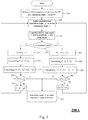
- Fig. 2A is a flow diagram illustrating the process steps of a detecting method for detecting an output impedance angle of an inverter according to embodiments of the present disclosure.
- an impedance angle ⁇ is set to be an initial impedance angle ⁇ 0 .
- a set predetermined impedance angle ⁇ is set to be an impedance angle ⁇ .
- the voltage signal setting unit 110 is used to output the first voltage signal, and the first voltage signal comprises the amplitude U c and the power angle ⁇ .
- steps 252-253 can be performed in advance, or performed after step 251.
- the PQ calculation unit 130 is used to calculate the first active power P 1 , the second active power P 2 , the first reactive power Q 1 and the second reactive power Q 2 based on the second voltage signal u 0 and the current signal i 0 .
- the first active power P 1 and the first reactive power Q 1 are calculation values when the power angle is ⁇ 1 .
- the second active power P 2 and the second reactive power Q 2 are calculation values when the power angle is ⁇ 2 .
- the third reactive power Q 1 ' is a calculation value of the first active power P 1 , the first reactive power Q 1 and the predetermined impedance angle ⁇ .
- the fourth reactive power Q 2 ' is a calculation value of the second active power P 2 , the second reactive power Q 2 and the predetermined impedance angle ⁇ .
- the impedance angle detection unit 150 is used to determine whether an absolute value of the first differential value ⁇ Q' of the third reactive power Q 1 ' and the fourth reactive power Q 2 ' is less than the first power reference value Q c . If it is determined that the absolute value of the first differential value ⁇ Q' is less than the first power reference value Q c , the impedance angle ⁇ is the output impedance angle of the inverter (step 270). If it is determined that the absolute value of the first differential value ⁇ Q' is not less than the first power reference value Q c , a direction of ⁇ Q' is further determined, that is, step 255 is performed. In one embodiment, approximately 5% of the inverter rated power is regarded as the first power reference value Q c . If a value of the first power reference value Q c is smaller, a higher accuracy of the detection result is achieved.
- step 255 the impedance angle detection unit 150 is used to determine whether a product of the first differential value ⁇ Q' and the variance ⁇ is larger than zero. If it is determined that the product of the first differential value ⁇ Q' and the variance ⁇ is larger than zero, this indicates that the direction of the first differential value ⁇ Q' and the direction of the variance ⁇ are the same.
- step 256 is performed, in which the impedance angle ⁇ is set equal to a sum of a predetermined impedance angle ⁇ and the compensation angle ⁇ 0 , after which the routine returns back to step 220 to perform the foregoing steps again until it is determined that the absolute value of the first differential value ⁇ Q' is less than the first power reference value Q c in step 254 , which indicates that the impedance angle ⁇ is the output impedance angle of the inverter. If it is determined that the absolute value of the first differential value ⁇ Q' is not less than the first power reference value Q c , this indicates that the direction of the first differential value ⁇ Q' and the direction of the variance ⁇ are different from each other.
- step 257 is performed, in which the impedance angle ⁇ is set equal to the predetermined impedance angle ⁇ minus the compensation angle ⁇ 0 , after which the routine returns back to step 220 to perform the foregoing steps again until it is determined that the absolute value of the first differential value ⁇ Q' is less than the first power reference value Qc in step 254, which indicates that the impedance angle ⁇ is the output impedance angle of the inverter.
- the compensation angle ⁇ 0 can be set to be 5°. If a value of the compensation angle ⁇ 0 is smaller, a higher accuracy of the detection result is achieved.
- step 240 if it is determined that the amplitude U c is not a constant value, step 261 is performed to calculate the variance ⁇ U c of the amplitude U c .
- the variance ⁇ U c U 2 -U i .
- steps 262-263 can be performed in advance, or performed after step 261.
- the PQ calculation unit 130 is used to calculate the first active power P 1 , the second active power P 2 , the first reactive power Q 1 and the second reactive power Q 2 based on the second voltage signal u 0 and the current signal i 0 .
- the first active power P 1 and the first reactive power Q 1 are calculation values when the amplitude is U 1 .
- the second active power P 2 and the second reactive power Q 2 are calculation values when the amplitude is U 2 .
- the third active power P 1 ' is a calculation value of the first active power P 1 , the first reactive power Q 1 and the predetermined impedance angle ⁇ .
- the fourth active power P 2 ' is a calculation value of the second active power P 2 , the second reactive power Q 2 and the predetermined impedance angle ⁇ .
- the impedance angle detection unit 150 is used to determine whether an absolute value of the second difference ⁇ P' of the third active power Q 1 ' and the fourth active power P 2 ' is less than a second power reference value P c . If it is determined that the absolute value of the second difference ⁇ P' is less than the second power reference value P c , the impedance angle ⁇ is the output impedance angle of the inverter (step 270). If it is determined that the absolute value of the second difference ⁇ P' is not less than the second power reference value P c , a direction of ⁇ P' is further determined, that is, step 265 is performed. In one embodiment, approximately 5% of the inverter rated power is regarded as the second power reference value P c . If a value of the second power reference value P c is smaller, a higher accuracy of the detection result is achieved.
- step 265 the impedance angle detection unit 150 is used to determine whether a product of the second difference ⁇ P' and the variance ⁇ U c is larger than zero. If the product of the second difference ⁇ P' and the variance ⁇ U c is larger than zero, this indicates that the direction of the second difference ⁇ P' and the direction of the variance ⁇ U c are the same.
- step 266 is performed, in which the impedance angle ⁇ is set equal to a predetermined impedance angle ⁇ minus the compensation angle ⁇ 0 , after which the routine returns back to step 220 to perform the foregoing steps again until it is determined that the absolute value of the second difference ⁇ P' is less than the second power reference value P c in step 264, which indicates that the impedance angle ⁇ is the output impedance angle of the inverter. If the product of the second difference ⁇ P' and the variance ⁇ U c is not larger than zero, this indicates that the direction of the second difference ⁇ P' and the direction of the variance ⁇ U c are different from each other.
- step 267 is performed, in which the impedance angle ⁇ is set equal to the sum of the predetermined impedance angle ⁇ and the compensation angle ⁇ 0 , after which the routine returns back to step 220 to perform the foregoing steps again until it is determined that the absolute value of the second difference ⁇ P' is less than the second power reference value P c in step 264, which indicates that the impedance angle ⁇ is the output impedance angle of the inverter.
- the detecting device 100 and the detecting method 200 for detecting an output impedance angle of an inverter can also employ binary search, which will be described below.
- the maximum value and the minimum value of the impedance angle ⁇ are ⁇ 2 and ⁇ 1 , respectively.
- the maximum value ⁇ 2 of the impedance angle can be 90°
- the minimum value ⁇ 1 of the impedance angle is 0°.
- Fig. 2B is a portion of the flow diagram illustrating the process steps of a detecting method for detecting an output impedance angle of an inverter as shown in Fig. 2A according to embodiments of the present disclosure. It is noted that Fig.
- step 255 if it is determined that the product of the first differential value ⁇ Q' and variance ⁇ is larger than zero, step 256A is performed, in which the minimum value ⁇ 1 of the impedance angle is set equal to the predetermined impedance angle ⁇ , an angle difference is obtained by subtracting the predetermined impedance angle ⁇ from the maximum value ⁇ 2 of the impedance angle, and the compensation angle ⁇ 0 is obtained by dividing the angle difference by two.
- step 255 if it is determined that the product of the first differential value ⁇ Q' and the variance ⁇ is not larger than zero, step 257A is performed, in which the maximum value ⁇ 2 of the impedance angle is set equal to the predetermined impedance angle ⁇ , an angle difference is obtained by subtracting the minimum value ⁇ 1 of the impedance angle from the predetermined impedance angle ⁇ , and the compensation angle ⁇ 0 is obtained by dividing the angle difference by two.
- Fig. 2C is a portion of the flow diagram illustrating the process steps of a detecting method for detecting an output impedance angle of an inverter as shown in Fig. 2A according to embodiments of the present disclosure. It is noted that Fig. 2C only depicts step 265 in Fig. 2A for introducing another embodiment of step 265, and therefore, Fig. 2C does not illustrate all steps of the detecting method 200 for detecting an output impedance angle of an inverter.
- step 265 if it is determined that the product of the second difference ⁇ P' and the variance ⁇ U c is larger than zero, step 266A is performed, in which the maximum value ⁇ 2 of the impedance angle is set equal to the predetermined impedance angle ⁇ , an angle difference is obtained by subtracting the minimum value ⁇ 1 of the impedance angle from the predetermined impedance angle ⁇ , and the compensation angle ⁇ 0 is obtained by dividing the angle difference by two.
- step 265 if it is determined that the product of the second difference ⁇ P' and the variance ⁇ U c is not larger than zero, step 267A is performed, in which the minimum value ⁇ 1 of the impedance angle is set equal to the predetermined impedance angle ⁇ , an angle difference is obtained by subtracting the predetermined impedance angle ⁇ from the maximum value ⁇ 2 of the impedance angle, and the compensation angle ⁇ 0 is obtained by dividing the angle difference by two.
- Fig. 3 is a flow diagram illustrating the process steps of a detecting method for detecting an output impedance angle of an inverter according to embodiments of the present disclosure.
- the difference between a detecting method 200A for detecting an output impedance angle of an inverter in Fig. 3 and the detecting method 200 for detecting an output impedance angle of an inverter in Fig. 2 is the steps 210, 254, 264.
- the initial impedance angle ⁇ 0 is set to be 90°
- the impedance angle ⁇ is also set to be 90°.
- the predetermined impedance angle ⁇ is set to be the impedance angle ⁇ .
- step 254 if it is determined that the absolute value of the first differential value ⁇ Q' is not less than the first power reference value Q c , the impedance angle ⁇ is set equal to the predetermined impedance angle ⁇ minus the compensation angle ⁇ 0 .
- step 264 if it is determined that the absolute value of the second difference ⁇ P' is not less than the second power reference value P c , the impedance angle ⁇ is set equal to the predetermined impedance angle ⁇ minus the compensation angle ⁇ 0 .
- steps in the detecting method 200A for detecting an output impedance angle of an inverter in Fig. 3 are the same as steps in the detecting method 200 for detecting an output impedance angle of an inverter in Fig. 2 , and a detailed description regarding such other steps in Fig. 3 will be omitted herein for the sake of brevity.
- Fig. 4 is a flow diagram illustrating the process steps of a detecting method for detecting an output impedance angle of an inverter according to embodiments of the present disclosure.
- the difference between a detecting method 200B for detecting an output impedance angle of an inverter in Fig. 4 and the detecting method 200 for detecting an output impedance angle of an inverter in Fig. 2 is the steps 210, 254, 264.
- the initial impedance angle ⁇ 0 is set to be 0°
- the impedance angle ⁇ is also set to be 0°.
- the predetermined impedance angle ⁇ is set to be the impedance angle ⁇ .
- step 254 if it is determined that the absolute value of the first differential value ⁇ Q' is not less than the first power reference value Q c , the impedance angle ⁇ is set equal to a sum of the predetermined impedance angle ⁇ and the compensation angle ⁇ 0 .
- step 264 if it is determined that the absolute value of the second difference ⁇ P' is not less than the second power reference value P c , the impedance angle ⁇ is set equal to a sum of the predetermined impedance angle ⁇ and the compensation angle ⁇ 0 .
- steps in the detecting method 200B for detecting an output impedance angle of an inverter in Fig. 4 are the same as steps in the detecting method 200 for detecting an output impedance angle of an inverter in Fig. 2 , and a detailed description regarding such other steps in Fig. 4 will be omitted herein for the sake of brevity.
- Figs. 5A-5C are operation diagrams illustrating the process steps of a detecting method for detecting an output impedance angle of an inverter according to embodiments of the present disclosure.
- ⁇ Qc, as shown in Fig. 5A , the impedance angle ⁇ is set as ⁇ ⁇ + ⁇ ⁇ 0 and the routine returns to step 220 until
- Fig. 5A-5C are operation diagrams illustrating the process steps of a detecting method for detecting an output impedance angle of an inverter according to embodiments of the present disclosure.
- the detection is completed, the impedance angle ⁇ is 60°, and the output impedance angle of the inverter is the impedance angle ⁇ .
- the impedance angle ⁇ is 60°, and the output impedance angle of the inverter is the impedance angle ⁇ .
- Figs. 6A-6C are operation diagrams illustrating the process steps of a detecting method for detecting an output impedance angle of an inverter according to embodiments of the present disclosure.
- a first voltage signal U c changes from U 1 to U 2 , and the value of the power angle ⁇ is a constant value. If it is detected that ⁇ P'* ⁇ Uc>0 and
- ⁇ P c , as shown in Fig. 6A , the impedance angle ⁇ is set as ⁇ ⁇ - ⁇ ⁇ 0 and the routine returns to step 220 until
- the detection is completed, the impedance angle ⁇ is 60°, and the output impedance angle of the inverter is the impedance angle ⁇ .
- the impedance angle ⁇ is 60°, and the output impedance angle of the inverter is the impedance angle ⁇ .
- the steps of the detecting method for detecting an output impedance angle of an inverter are named according to the function they perform, and such naming is provided to facilitate the understanding of the present disclosure but not to limit the steps. Combining the steps into a single step or dividing any one of the steps into multiple steps, or switching any step so as to be a part of another step falls within the scope of the embodiments of the present disclosure.
- Embodiments of the present disclosure provide a detecting device and a detecting method for detecting an output impedance angle of an inverter so as to detect an output impedance angle of the inverter simply and precisely, and ultimately enable efficient control of the inverter.
Landscapes
- Engineering & Computer Science (AREA)
- Power Engineering (AREA)
- Physics & Mathematics (AREA)
- General Physics & Mathematics (AREA)
- Inverter Devices (AREA)
Abstract
Description
- The present disclosure relates to detecting technology for performing detection with respect to inverters. More particularly, the present disclosure relates to a detecting device and a detecting method for detecting an output impedance angle of an inverter.
- Inverters are power converting devices employing power electronics technology. Power can be converted from DC to AC through suitable control by inverters. When an output impedance of an inverter is pure inductive, an active power and a reactive power are decoupled. The active power of the inverter is mainly controlled by a power angle of a voltage, and the reactive power of the inverter is mainly controlled by an amplitude of a voltage.
- Based on power-transmission principles, voltage source control-type inverters that are grid-connected or inverters connected in parallel usually use droop control. However, the output impedance of the inverter is usually inductive and resistive. Particularly when an inverter is connected to a low-voltage power grid, the active power and the reactive power are not decoupled. In this case, if a droop control is used, the coupling among the active power and the reactive power is high.
- If an output impedance of an inverter can be obtained and a rotation matrix is employed, the rotated active power and reactive power are decoupled; therefore, a droop control can be used directly. Hence, to control an inverter efficiently, the foregoing output impedance must be obtained. However, there is no method at present which can automatically detect output impedance angles of inverters simply and accurately.
- In view of the foregoing, problems and disadvantages are associated with existing products that require further improvement. However, those skilled in the art have yet to find a solution.
- The following presents a simplified summary of the disclosure in order to provide a basic understanding to the reader. This summary is not an extensive overview of the disclosure and it does not identify key/critical elements of the present disclosure or delineate the scope of the present disclosure.
- One aspect of the present disclosure is directed to a detecting method for detecting an output impedance angle of an inverter, comprising (a) providing a first voltage signal, wherein the first voltage signal comprises an amplitude and a power angle, one of the amplitude and the power angle is a variable value, and the other one of the amplitude and the power angle is a constant value; (b) controlling an inverter to output a second voltage signal and a current signal based on the first voltage signal; (c) calculating and outputting a first active power, a second active power, a first reactive power, and a second reactive power based on the second voltage signal and the current signal; (d) setting an impedance angle to be an initial impedance angle; (e) setting a predetermined impedance angle to be the impedance angle; (f) calculating and outputting a third active power, a fourth active power, a third reactive power, and a fourth reactive power based on the first active power, the second active power, the first reactive power, the second reactive power, and the predetermined impedance angle; (g) determining whether the amplitude is a constant value; (h) if it is determined that the amplitude is a constant value, determining whether an absolute value of a first differential value of the third reactive power and the fourth reactive power is less than a first power reference value; (i) if it is determined that the absolute value of the first differential value is less than the first power reference value, setting the output impedance angle of the inverter as the impedance angle; (j) if it is determined that the absolute value of the first differential value is not less than the first power reference value, setting the impedance angle equal to a sum of the predetermined impedance angle and a compensation angle or as the predetermined impedance angle minus the compensation angle, and repeating step (e) to step (h) until it is determined that the absolute value of the first differential value is less than the first power reference value in step (i); (k) if it is determined that the amplitude is not a constant value, determining whether an absolute value of the second differential value of the third active power and the fourth active power is less than a second power reference value; (I) if it is determined that the absolute value of the second differential value is less than the second power reference value, setting the output impedance angle of the inverter as the impedance angle; (m) if it is determined that the absolute value of the second differential value is not less than the second power reference value, setting the impedance angle equal to the sum of the predetermined impedance angle and the compensation angle or to the predetermined impedance angle minus the compensation angle, and repeating step (e), step (f), step (g), step (k) until it is determined that the absolute value of the second differential value is less than the second power reference value in step (I).
- Another aspect of the present disclosure is directed to a detecting device for detecting an output impedance angle of an inverter. The detecting device for detecting the output impedance angle of the inverter comprises a voltage signal setting unit, a control unit, a calculation unit, a rotation changing unit, and a detection unit. The voltage signal setting unit is configured to provide a first voltage signal, wherein the first voltage signal comprises an amplitude and an power angle, one of the amplitude and the power angle is a variable value, and the other one of the amplitude and the power angle is a constant value. The control unit is configured to control an inverter to output a second voltage signal and a current signal based on the first voltage signal. The calculation unit is configured to calculate and output a first active power, a second active power, a first reactive power, and a second reactive power based on the second voltage signal and the current signal. The rotation changing unit is configured to calculate and output a third active power, a fourth active power, a third reactive power, and a fourth reactive power based on the first active power, the second active power, the first reactive power, the second reactive power, and a predetermined impedance angle. The detection unit is configured to calculate an impedance angle and an output impedance angle of the inverter based on the third active power, the fourth active power, the third reactive power, the fourth reactive power, and the first voltage signal, wherein the detection unit is configured to set the impedance angle to be an initial impedance angle, and set the predetermined impedance angle to be the impedance angle. The detection unit is configured to determine whether the amplitude is a constant value, if it is determined that the amplitude is a constant value, determining whether an absolute value of a first differential value of the third reactive power and the fourth reactive power is less than a first power reference value; if it is determined that the absolute value of the first differential value is less than the first power reference value, setting the output impedance angle of the inverter as the impedance angle; if it is determined that the absolute value of the first differential value is not less than the first power reference value, setting the impedance angle as a sum of the predetermined impedance angle and a compensation angle or as the predetermined impedance angle minus the compensation angle; if it is determined that the amplitude is not a constant value, determining whether an absolute value of a second differential value of the third active power and the fourth active power is less than a second power reference value; if it is determined that the absolute value of the second differential value is less than the second power reference value, setting the output impedance angle of the inverter as the impedance angle; if it is determined that the absolute value of the second differential value is not less than the second power reference value, setting the impedance angle equal to the sum of the predetermined impedance angle and the compensation angle or to the predetermined impedance angle minus the compensation angle.
- In view of the foregoing, embodiments of the present disclosure provide a detecting device and a detecting method for detecting an output impedance angle of an inverter so as to detect an output impedance angle of the inverter simply and precisely, thereby enabling efficient control of the inverter.
- These and other features, aspects, and advantages of the present disclosure, as well as the technical means and embodiments employed by the present disclosure, will become better understood with reference to the following description in connection with the accompanying drawings and appended claims.
- The disclosure can be more fully understood by reading the following detailed description of the embodiment, with reference made to the accompanying drawings as follows:
-
Fig. 1 is a schematic diagram of a detecting device for detecting an output impedance angle of an inverter according to embodiments of the present disclosure. -
Fig. 2A is a flow diagram illustrating the process steps of a detecting method for detecting an output impedance angle of an inverter according to embodiments of the present disclosure. -
Fig. 2B is a portion of the flow diagram illustrating the process steps of a detecting method for detecting an output impedance angle of an inverter as shown inFig. 2A according to embodiments of the present disclosure. -
Fig. 2C is a portion of the flow diagram illustrating the process steps of a detecting method for detecting an output impedance angle of an inverter as shown inFig. 2A according to embodiments of the present disclosure. -
Fig. 3 is a flow diagram illustrating the process steps of a detecting method for detecting an output impedance angle of an inverter according to embodiments of the present disclosure. -
Fig. 4 is a flow diagram illustrating the process steps of a detecting method for detecting an output impedance angle of an inverter according to embodiments of the present disclosure. -
Fig. 5A is an operation diagram illustrating the process steps of a detecting method for detecting an output impedance angle of an inverter according to embodiments of the present disclosure. -
Fig. 5B is an operation diagram illustrating the process steps of a detecting method for detecting an output impedance angle of an inverter according to embodiments of the present disclosure. -
Fig. 5C is an operation diagram illustrating the process steps of a detecting method for detecting an output impedance angle of an inverter according to embodiments of the present disclosure. -
Fig. 6A is an operation diagram illustrating the process steps of a detecting method for detecting an output impedance angle of an inverter according to embodiments of the present disclosure. -
Fig. 6B is an operation diagram illustrating the process steps of a detecting method for detecting an output impedance angle of an inverter according to embodiments of the present disclosure. -
Fig. 6C is an operation diagram illustrating the process steps of a detecting method for detecting an output impedance angle of an inverter according to embodiments of the present disclosure. - In accordance with common practice, the various described features/elements are not drawn to scale but instead are drawn to best illustrate specific features/elements relevant to the present disclosure. Also, wherever possible, like or the same reference numerals are used in the drawings and the description to refer to the same or like parts.
- The detailed description provided below in connection with the appended drawings is intended as a description of the present examples and is not intended to represent the only forms in which the present example may be constructed or utilized. The description sets forth the functions of the example and the sequence of steps for constructing and operating the example. However, the same or equivalent functions and sequences may be accomplished by different examples.
- Unless otherwise defined herein, scientific and technical terminologies employed in the present disclosure shall have the meanings that are commonly understood and used by one of ordinary skill in the art. Unless otherwise required by context, it will be understood that singular terms shall include plural forms of the same and plural terms shall include singular forms of the same.
- For automatically detecting output impedance angles of inverters simply and accurately so as to enable efficient control of inverters, the present disclosure provides a detecting device and a detecting method for detecting an output impedance angle of an inverter, which will be described below.
-
Fig. 1 is a schematic diagram of a detecting device for detecting an output impedance angle of an inverter according to embodiments of the present disclosure. As shown in the figure, the detectingdevice 100 for detecting an output impedance angle of an inverter comprises a voltagesignal setting unit 110, adigital control unit 120, an active power/reactive power (PQ)calculation unit 130, arotation changing unit 140, and an impedanceangle detection unit 150. - In this embodiment, the voltage
signal setting unit 110 is configured to output a first voltage signal, and the first voltage signal comprises an amplitude Uc and an power angle δ. In one embodiment, an output side of aninverter 900 is coupled to a grid. The power angle δ can be a phase difference between the first voltage signal and a voltage of the grid, but is not limited thereto. One of the amplitude Uc and the power angle δ is a variable value, and the other one of the amplitude Uc and the power angle δ is a constant value. Thedigital control unit 120 is configured to control theinverter 900 to output a second voltage signal u0 and a current signal i 0 based on the first voltage signal. ThePQ calculation unit 130 is configured to calculate and output a first active power P1, a second active power P2, a first reactive power Q1 and a second reactive power Q2 based on the second voltage signal u0 and the current signal i 0. Therotation changing unit 140 is configured to calculate and output a third active power P1', a fourth active power P2', a third reactive power Q1' and a fourth reactive power Q2' based on the first active power P1, the second active power P2, the first reactive power Q1, the second reactive power Q2 and a predetermined impedance angle θ̂. The impedanceangle detection unit 150 is configured to calculate the output impedance angle based on the third active power P1', the fourth active power P2', the third reactive power Q1', the fourth reactive power Q2' and the first voltage signal. - For facilitating understanding of steps for detecting an output impedance angle of an inverter of the detecting
device 100, reference is now made toFig. 2A , which is a flow diagram illustrating the process steps of a detecting method for detecting an output impedance angle of an inverter according to embodiments of the present disclosure. As shown in the figure, instep 210, an impedance angle θ is set to be an initial impedance angle θ0. Instep 220, a set predetermined impedance angle θ̂ is set to be an impedance angle θ. Instep 230, the voltagesignal setting unit 110 is used to output the first voltage signal, and the first voltage signal comprises the amplitude Uc and the power angle δ. Instep 240, the impedanceangle detection unit 150 is used to determine whether a value of the amplitude Uc is a constant value. If it is determined that the value of the amplitude Uc is a constant value,step 251 is performed to calculate a variance Δδ of the power angle δ. For example, if the power angle δ changes from Q1 to δ2, the variance Δδ=δ2-δ1. - Subsequently, steps 252-253 can be performed in advance, or performed after
step 251. Instep 252, thePQ calculation unit 130 is used to calculate the first active power P1, the second active power P2, the first reactive power Q1 and the second reactive power Q2 based on the second voltage signal u0 and the current signal i 0. The first active power P1 and the first reactive power Q1 are calculation values when the power angle is δ1. The second active power P2 and the second reactive power Q2 are calculation values when the power angle is δ2. Instep 253, therotation changing unit 140 is used to calculate the third reactive power Q1' and the fourth reactive power Q2', and calculate a first differential value ΔQ' of the reactive power Q' (ΔQ'=Q2'-Q1') based on the first active power P1, the second active power P2, the first reactive power Q1, the second reactive power Q2 and the predetermined impedance angle θ̂. The third reactive power Q1' is a calculation value of the first active power P1, the first reactive power Q1 and the predetermined impedance angle θ̂. The fourth reactive power Q2' is a calculation value of the second active power P2, the second reactive power Q2 and the predetermined impedance angle θ̂. - In addition, in
step 254, the impedanceangle detection unit 150 is used to determine whether an absolute value of the first differential value ΔQ' of the third reactive power Q1' and the fourth reactive power Q2' is less than the first power reference value Qc. If it is determined that the absolute value of the first differential value ΔQ' is less than the first power reference value Qc, the impedance angle θ is the output impedance angle of the inverter (step 270). If it is determined that the absolute value of the first differential value ΔQ' is not less than the first power reference value Qc, a direction of ΔQ' is further determined, that is,step 255 is performed. In one embodiment, approximately 5% of the inverter rated power is regarded as the first power reference value Qc. If a value of the first power reference value Qc is smaller, a higher accuracy of the detection result is achieved. - In
step 255, the impedanceangle detection unit 150 is used to determine whether a product of the first differential value ΔQ' and the variance Δδ is larger than zero. If it is determined that the product of the first differential value ΔQ' and the variance Δδ is larger than zero, this indicates that the direction of the first differential value ΔQ' and the direction of the variance Δδ are the same. At this time,step 256 is performed, in which the impedance angle θ is set equal to a sum of a predetermined impedance angle θ̂ and the compensation angle Δθ0, after which the routine returns back to step 220 to perform the foregoing steps again until it is determined that the absolute value of the first differential value ΔQ' is less than the first power reference value Qc instep 254 , which indicates that the impedance angle θ is the output impedance angle of the inverter. If it is determined that the absolute value of the first differential value ΔQ' is not less than the first power reference value Qc, this indicates that the direction of the first differential value ΔQ' and the direction of the variance Δδ are different from each other. At this time,step 257 is performed, in which the impedance angle θ is set equal to the predetermined impedance angle θ̂ minus the compensation angle Δθ0, after which the routine returns back to step 220 to perform the foregoing steps again until it is determined that the absolute value of the first differential value ΔQ' is less than the first power reference value Qc instep 254, which indicates that the impedance angle θ is the output impedance angle of the inverter. In one embodiment, the compensation angle Δθ0 can be set to be 5°. If a value of the compensation angle Δθ0 is smaller, a higher accuracy of the detection result is achieved. - On the other hand, in
step 240, if it is determined that the amplitude Uc is not a constant value,step 261 is performed to calculate the variance ΔUc of the amplitude Uc. For example, if the amplitude Uc changes from U1 to U2, the value of the power angle δ is a constant value, and the variance ΔUc=U2-Ui. - Moreover, steps 262-263 can be performed in advance, or performed after
step 261. Instep 262, thePQ calculation unit 130 is used to calculate the first active power P1, the second active power P2, the first reactive power Q1 and the second reactive power Q2 based on the second voltage signal u0 and the current signal i 0. The first active power P1 and the first reactive power Q1 are calculation values when the amplitude is U1. The second active power P2 and the second reactive power Q2 are calculation values when the amplitude is U2. Instep 263, therotation changing unit 140 is used to calculate the third active power P1' and the fourth active power P2', and calculate a second difference ΔP' of the active power P' to be ΔP'=P2'-P1' based on the first active power P1, the second active power P2, the first reactive power Q1, the second reactive power Q2 and a predetermined impedance angle θ̂. The third active power P1' is a calculation value of the first active power P1, the first reactive power Q1 and the predetermined impedance angle θ̂. The fourth active power P2' is a calculation value of the second active power P2, the second reactive power Q2 and the predetermined impedance angle θ̂. - Subsequently, in
step 264, the impedanceangle detection unit 150 is used to determine whether an absolute value of the second difference ΔP' of the third active power Q1' and the fourth active power P2' is less than a second power reference value Pc. If it is determined that the absolute value of the second difference ΔP' is less than the second power reference value Pc, the impedance angle θ is the output impedance angle of the inverter (step 270). If it is determined that the absolute value of the second difference ΔP' is not less than the second power reference value Pc, a direction of ΔP' is further determined, that is,step 265 is performed. In one embodiment, approximately 5% of the inverter rated power is regarded as the second power reference value Pc. If a value of the second power reference value Pc is smaller, a higher accuracy of the detection result is achieved. - In
step 265, the impedanceangle detection unit 150 is used to determine whether a product of the second difference ΔP' and the variance ΔUc is larger than zero. If the product of the second difference ΔP' and the variance ΔUc is larger than zero, this indicates that the direction of the second difference ΔP' and the direction of the variance ΔUc are the same. At this time,step 266 is performed, in which the impedance angle θ is set equal to a predetermined impedance angle θ̂ minus the compensation angle Δθ0, after which the routine returns back to step 220 to perform the foregoing steps again until it is determined that the absolute value of the second difference ΔP' is less than the second power reference value Pc instep 264, which indicates that the impedance angle θ is the output impedance angle of the inverter. If the product of the second difference ΔP' and the variance ΔUc is not larger than zero, this indicates that the direction of the second difference ΔP' and the direction of the variance ΔUc are different from each other. At this time,step 267 is performed, in which the impedance angle θ is set equal to the sum of the predetermined impedance angle θ̂ and the compensation angle Δθ0, after which the routine returns back to step 220 to perform the foregoing steps again until it is determined that the absolute value of the second difference ΔP' is less than the second power reference value Pc instep 264, which indicates that the impedance angle θ is the output impedance angle of the inverter. - In another embodiment, the detecting
device 100 and the detectingmethod 200 for detecting an output impedance angle of an inverter can also employ binary search, which will be described below. It is noted that the maximum value and the minimum value of the impedance angle θ are θ2 and θ1, respectively. For example, the maximum value θ2 of the impedance angle can be 90°, and the minimum value θ1 of the impedance angle is 0°. For facilitating understanding of the binary search, reference is now made toFig. 2B , which is a portion of the flow diagram illustrating the process steps of a detecting method for detecting an output impedance angle of an inverter as shown inFig. 2A according to embodiments of the present disclosure. It is noted thatFig. 2B only depictsstep 255 inFig. 2A for introducing another embodiment ofstep 255, and therefore,Fig. 2B does not illustrate all steps of the detectingmethod 200 for detecting an output impedance angle of an inverter. Instep 255, if it is determined that the product of the first differential value ΔQ' and variance Δδ is larger than zero,step 256A is performed, in which the minimum value θ1 of the impedance angle is set equal to the predetermined impedance angle θ̂, an angle difference is obtained by subtracting the predetermined impedance angle θ̂ from the maximum value θ2 of the impedance angle, and the compensation angle Δθ0 is obtained by dividing the angle difference by two. In addition, instep 255, if it is determined that the product of the first differential value ΔQ' and the variance Δδ is not larger than zero,step 257A is performed, in which the maximum value θ2 of the impedance angle is set equal to the predetermined impedance angle θ̂, an angle difference is obtained by subtracting the minimum value θ1 of the impedance angle from the predetermined impedance angle θ̂, and the compensation angle Δθ0 is obtained by dividing the angle difference by two. - The binary search procedure will be further described in accordance with yet another embodiment. For facilitating understanding of the binary search, reference is now made to
Fig. 2C , which is a portion of the flow diagram illustrating the process steps of a detecting method for detecting an output impedance angle of an inverter as shown inFig. 2A according to embodiments of the present disclosure. It is noted thatFig. 2C only depictsstep 265 inFig. 2A for introducing another embodiment ofstep 265, and therefore,Fig. 2C does not illustrate all steps of the detectingmethod 200 for detecting an output impedance angle of an inverter. Instep 265, if it is determined that the product of the second difference ΔP' and the variance ΔUc is larger than zero,step 266A is performed, in which the maximum value θ2 of the impedance angle is set equal to the predetermined impedance angle θ̂, an angle difference is obtained by subtracting the minimum value θ1 of the impedance angle from the predetermined impedance angle θ̂, and the compensation angle Δθ0 is obtained by dividing the angle difference by two. In addition, instep 265, if it is determined that the product of the second difference ΔP' and the variance ΔUc is not larger than zero,step 267A is performed, in which the minimum value θ1 of the impedance angle is set equal to the predetermined impedance angle θ̂, an angle difference is obtained by subtracting the predetermined impedance angle θ̂ from the maximum value θ2 of the impedance angle, and the compensation angle Δθ0 is obtained by dividing the angle difference by two. -
Fig. 3 is a flow diagram illustrating the process steps of a detecting method for detecting an output impedance angle of an inverter according to embodiments of the present disclosure. The difference between a detectingmethod 200A for detecting an output impedance angle of an inverter inFig. 3 and the detectingmethod 200 for detecting an output impedance angle of an inverter inFig. 2 is thesteps step 210, the initial impedance angle θ0 is set to be 90°, and the impedance angle θ is also set to be 90°. Hence, instep 220, the predetermined impedance angle θ̂ is set to be the impedance angle θ. In this situation, referring to step 254, if it is determined that the absolute value of the first differential value ΔQ' is not less than the first power reference value Qc, the impedance angle θ is set equal to the predetermined impedance angle θ̂ minus the compensation angle Δθ0. In addition, referring to step 264, if it is determined that the absolute value of the second difference ΔP' is not less than the second power reference value Pc, the impedance angle θ is set equal to the predetermined impedance angle θ̂ minus the compensation angle Δθ0. It is noted that other steps in the detectingmethod 200A for detecting an output impedance angle of an inverter inFig. 3 are the same as steps in the detectingmethod 200 for detecting an output impedance angle of an inverter inFig. 2 , and a detailed description regarding such other steps inFig. 3 will be omitted herein for the sake of brevity. -
Fig. 4 is a flow diagram illustrating the process steps of a detecting method for detecting an output impedance angle of an inverter according to embodiments of the present disclosure. The difference between a detectingmethod 200B for detecting an output impedance angle of an inverter inFig. 4 and the detectingmethod 200 for detecting an output impedance angle of an inverter inFig. 2 is thesteps step 210, the initial impedance angle θ0 is set to be 0°, and the impedance angle θ is also set to be 0°. Hence, instep 220, the predetermined impedance angle θ̂ is set to be the impedance angle θ. In this situation, referring to step 254, if it is determined that the absolute value of the first differential value ΔQ' is not less than the first power reference value Qc, the impedance angle θ is set equal to a sum of the predetermined impedance angle θ̂ and the compensation angle Δθ0. In addition, referring to step 264, if it is determined that the absolute value of the second difference ΔP' is not less than the second power reference value Pc, the impedance angle θ is set equal to a sum of the predetermined impedance angle θ̂ and the compensation angle Δθ0. It is noted that other steps in the detectingmethod 200B for detecting an output impedance angle of an inverter inFig. 4 are the same as steps in the detectingmethod 200 for detecting an output impedance angle of an inverter inFig. 2 , and a detailed description regarding such other steps inFig. 4 will be omitted herein for the sake of brevity. -
Figs. 5A-5C are operation diagrams illustrating the process steps of a detecting method for detecting an output impedance angle of an inverter according to embodiments of the present disclosure. First of all, a first voltage signal Uc=U1 is input, and the power angle δ changes from δ1 to δ2. If it is detected that ΔQ'*Δδ>0 and |ΔQ'|≧Qc, as shown inFig. 5A , the impedance angle θ is set as θ = θ̂ + Δθ 0 and the routine returns to step 220 until |ΔQ'|<Qc. As shown inFig. 5B , the detection is completed, the impedance angle θ is 60°, and the output impedance angle of the inverter is the impedance angle θ. In addition, if it is detected that ΔQ'*Δδ<0 and |ΔQ'|≧Qc, as shown inFig. 5C , the impedance angle θ is set as θ = θ̂ - Δθ 0 Q1' and the routine returns to step 220 until |ΔQ'|<Qc. As shown inFig. 5B , the detection is completed, the impedance angle θ is 60°, and the output impedance angle of the inverter is the impedance angle θ. -
Figs. 6A-6C are operation diagrams illustrating the process steps of a detecting method for detecting an output impedance angle of an inverter according to embodiments of the present disclosure. First of all, a first voltage signal Uc changes from U1 to U2, and the value of the power angle δ is a constant value. If it is detected that ΔP'*ΔUc>0 and |ΔP'|≧Pc, as shown inFig. 6A , the impedance angle θ is set as θ = θ̂ - Δθ 0 and the routine returns to step 220 until |ΔP'|<Pc. As shown inFig. 6B , the detection is completed, the impedance angle θ is 60°, and the output impedance angle of the inverter is the impedance angle θ. In addition, if it is detected that ΔP'*ΔUc<0 and |ΔP'| ≧ Pc, as shown inFig. 6C , the impedance angle θ is set as θ = θ̂ + Δθ 0 and the routine returns to step 220 until |ΔP'|<Pc. As shown inFig. 6B , the detection is completed, the impedance angle θ is 60°, and the output impedance angle of the inverter is the impedance angle θ. - As may be appreciated by persons having ordinary skill in the art, the steps of the detecting method for detecting an output impedance angle of an inverter are named according to the function they perform, and such naming is provided to facilitate the understanding of the present disclosure but not to limit the steps. Combining the steps into a single step or dividing any one of the steps into multiple steps, or switching any step so as to be a part of another step falls within the scope of the embodiments of the present disclosure.
- In view of the above embodiments of the present disclosure, it is apparent that the application of the present disclosure has a number of advantages. Embodiments of the present disclosure provide a detecting device and a detecting method for detecting an output impedance angle of an inverter so as to detect an output impedance angle of the inverter simply and precisely, and ultimately enable efficient control of the inverter.
Claims (15)
- A detecting method for detecting an output impedance angle of an inverter, comprising:(a) providing a first voltage signal, wherein the first voltage signal comprises an amplitude and a power angle, one of the amplitude and the power angle is a variable value, and the other one of the amplitude and the power angle is a constant value;(b) controlling an inverter to output a second voltage signal and a current signal based on the first voltage signal;(c) calculating and outputting a first active power, a second active power, a first reactive power, and a second reactive power based on the second voltage signal and the current signal,;(d) setting an impedance angle to be an initial impedance angle;(e) setting a predetermined impedance angle to be the impedance angle;(f) calculating and outputting a third active power, a fourth active power, a third reactive power, and a fourth reactive power based on the first active power, the second active power, the first reactive power, the second reactive power, and the predetermined impedance angle;(g) determining whether the amplitude is a constant value;(h) if it is determined that the amplitude is a constant value, determining whether an absolute value of a first differential value of the third reactive power and the fourth reactive power is less than a first power reference value;(i) if it is determined that the absolute value of the first differential value is less than the first power reference value, setting the output impedance angle of the inverter as the impedance angle;(j) if it is determined that the absolute value of the first differential value is not less than the first power reference value, setting the impedance angle as a sum of the predetermined impedance angle and a compensation angle or as the predetermined impedance angle minus the compensation angle, and repeating step (e) to step (h) until it is determined that the absolute value of the first differential value is less than the first power reference value in step (i);(k) if it is determined the amplitude is not a constant value, determining whether an absolute value of the second differential value of the third active power and the fourth active power is less than a second power reference value;(l) if it is determined that the absolute value of the second differential value is less than the second power reference value, setting the output impedance angle of the inverter as the impedance angle;(m) if it is determined that the absolute value of the second differential value is not less than the second power reference value, setting the impedance angle equal to the sum of the predetermined impedance angle and the compensation angle or to the predetermined impedance angle minus the compensation angle, and repeating step (e), step (f), step (g), step (k) until it is determined that the absolute value of the second differential value is less than the second power reference value in step (I).
- The detecting method of claim 1, wherein if it is determined that the absolute value of the first differential value is not less than the first power reference value, setting the impedance angle equal to the sum of the predetermined impedance angle and the compensation angle or to the predetermined impedance angle minus the compensation angle comprises:if it is determined that the absolute value of the first differential value is not less than the first power reference value, calculating a first variance of the power angle, and determining whether a product of the first differential value and the first variance is larger than zero;if it is determined that the product of the first differential value and the first variance is larger than zero, setting the impedance angle equal to the sum of the predetermined impedance angle and the compensation angle;if it is determined that the product of the first differential value and the first variance is not larger than zero, setting the impedance angle equal to the predetermined impedance angle minus the compensation angle.
- The detecting method of claim 2, wherein if it is determined that the product of the first differential value and the first variance is larger than zero, setting the impedance angle equal to the sum of the predetermined impedance angle and the compensation angle comprises:if it is determined that the product of the first differential value and the first variance is larger than zero, setting a minimum value of the impedance angle as the predetermined impedance angle;obtaining an angle difference by subtracting the predetermined impedance angle from a maximum value of the impedance angle; andobtaining the compensation angle by dividing the angle difference by twowherein if it is determined that the product of the first differential value and the first variance is not larger than zero, setting the impedance angle equal to the predetermined impedance angle minus the compensation angle comprises:if it is determined that the product of the first differential value and the first variance is not larger than zero, setting the maximum value of the impedance angle as the predetermined impedance angle;obtaining the angle difference by subtracting the minimum value of the impedance angle from the predetermined impedance angle; andobtaining the compensation angle by dividing the angle difference by two.
- The detecting method of claim 1, wherein if it is determined that the absolute value of the second difference is not less than the second power reference value, setting the impedance angle equal to the sum of the predetermined impedance angle and the compensation angle or to the predetermined impedance angle minus the compensation angle comprises:if it is determined that the absolute value of the second difference is not less than the second power reference value, calculating a second variance of the amplitude, and determining whether a product of the second difference and the second variance is larger than zero;if it is determined that the product of the second difference and the second variance is larger than zero, setting the impedance angle equal to the predetermined impedance angle minus the compensation angle;if it is determined that the product of the second difference and the second variance is not larger than zero, setting the impedance angle equal to the sum of the predetermined impedance angle and the compensation angle.
- The detecting method of claim 4, wherein if it is determined that the product of the second difference and the second variance is larger than zero, setting the impedance angle equal to the predetermined impedance angle minus the compensation angle comprises:if it is determined that the product of the second difference and the second variance is larger than zero, setting a maximum value of the impedance angle as the predetermined impedance angle;obtaining an angle difference by subtracting a minimum value of the impedance angle from the predetermined impedance angle; andobtaining the compensation angle by dividing the angle difference by two;wherein if it is determined that the product of the second difference and the second variance is not larger than zero, setting the impedance angle equal to the sum of the predetermined impedance angle and the compensation angle comprises:if it is determined that the product of the second difference and the second variance is not larger than zero, setting the minimum value of the impedance angle as the predetermined impedance angle;obtaining the angle difference by subtracting the predetermined impedance angle from the maximum value of the impedance angle; andobtaining the compensation angle by dividing the angle difference by two.
- The detecting method of claim 1, wherein the initial impedance angle is set as a maximum value, and wherein if it is determined that the absolute value of the first differential value is not less than the first power reference value, setting the impedance angle equal to the sum of the predetermined impedance angle and the compensation angle or to the predetermined impedance angle minus the compensation angle comprises:if it is determined that the absolute value of the first differential value is not less than the first power reference value, setting the impedance angle equal to the predetermined impedance angle minus the compensation angle;wherein the initial impedance angle is set as the maximum value, and wherein if it is determined that the absolute value of the second difference is not less than the second power reference value, setting the impedance angle equal to the sum of the predetermined impedance angle and the compensation angle or to the predetermined impedance angle minus the compensation angle comprises:if it is determined that the absolute value of the second difference is not less than the second power reference value, setting the impedance angle equal to the predetermined impedance angle minus the compensation angle.
- The detecting method of claim 1, wherein the initial impedance angle is set as a minimum value, and wherein if it is determined that the absolute value of the first differential value is not less than the first power reference value, setting the impedance angle equal to the sum of the predetermined impedance angle and the compensation angle or to the predetermined impedance angle minus the compensation angle comprises:if it is determined that the absolute value of the first differential value is not less than the first power reference value, setting the impedance angle equal to the sum of the predetermined impedance angle and the compensation angle;wherein the initial impedance angle is set as the minimum value, and wherein if it is determined that the absolute value of the second difference is not less than the second power reference value, setting the impedance angle equal to the sum of the predetermined impedance angle and the compensation angle or to the predetermined impedance angle minus the compensation angle comprises:if it is determined that the absolute value of the second difference is not less than the second power reference value, setting the impedance angle equal to the sum of the predetermined impedance angle and the compensation angle.
- A detecting device (100) for detecting an output impedance angle of an inverter, comprising:a voltage signal setting unit (110) configured to provide a first voltage signal, wherein the first voltage signal comprises an amplitude and a power angle, one of the amplitude and the power angle is a variable value, and the other one of the amplitude and the power angle is a constant value;a control unit (120) configured to control an inverter to output a second voltage signal and a current signal based on the first voltage signal;a calculation unit (130) configured to calculate and output a first active power, a second active power, a first reactive power, and a second reactive power based on the second voltage signal and the current signal;a rotation changing unit (140) configured to calculate and output a third active power, a fourth active power, a third reactive power, and a fourth reactive power based on the first active power, the second active power, the first reactive power, the second reactive power, and a predetermined impedance angle; anda detection unit (150) configured to calculate an impedance angle and an output impedance angle of the inverter based on the third active power, the fourth active power, the third reactive power, the fourth reactive power, and the first voltage signal, wherein the detection unit (150) is configured to set the impedance angle to be an initial impedance angle, and set the predetermined impedance angle to be the impedance angle;wherein the detection unit (150) is configured to determine whether the amplitude is a constant value, if it is determined that the amplitude is a constant value, determining whether an absolute value of a first differential value of the third reactive power and the fourth reactive power is less than a first power reference value; if it is determined that the absolute value of the first differential value is less than the first power reference value, setting the output impedance angle of the inverter as the impedance angle; if it is determined that the absolute value of the first differential value is not less than the first power reference value, setting the impedance angle as a sum of the predetermined impedance angle and a compensation angle or as the predetermined impedance angle minus the compensation angle; if it is determined that the amplitude is not a constant value, determining whether an absolute value of a second differential value of the third active power and the fourth active power is less than a second power reference value; if it is determined that the absolute value of the second differential value is less than the second power reference value, setting the output impedance angle of the inverter as the impedance angle; if it is determined that the absolute value of the second differential value is not less than the second power reference value, setting the impedance angle equal to the sum of the predetermined impedance angle and the compensation angle or to the predetermined impedance angle minus the compensation angle.
- The detecting device (100) of claim 8, wherein the detecting device (100) for detecting an output impedance angle of an inverter is configured to perform steps of:(a) setting the impedance angle to be the initial impedance angle;(b) setting the predetermined impedance angle to be the impedance angle;(c) calculating and outputting the third active power, the fourth active power, the third reactive power, and the fourth reactive power based on the first active power, the second active power, the first reactive power, the second reactive power, and the predetermined impedance angle;(d) determining whether the amplitude is a constant value;(e) if it is determined the amplitude is a constant value, determining whether the absolute value of the first differential value is less than the first power reference value;(f) if it is determined that the absolute value of the first differential value is less than the first power reference value, setting the output impedance angle of the inverter as the impedance angle;(g) if it is determined that the absolute value of the first differential value is not less than the first power reference value, setting the impedance angle as the sum of the predetermined impedance angle and the compensation angle or as the predetermined impedance angle minus the compensation angle, and repeating step (b) to step (e) until it is determined that the absolute value of the first differential value is less than the first power reference value in step (f);(h) if it is determined that the amplitude is not a constant value, determining whether an absolute value of the second differential value of the third active power and the fourth active power is less than the second power reference value;(i) if it is determined that the absolute value of the second differential value is less than the second power reference value, setting the output impedance angle of the inverter as the impedance angle;(j) if it is determined that the absolute value of the second differential value is not less than the second power reference value, setting the impedance angle equal to the sum of the predetermined impedance angle and the compensation angle or to the predetermined impedance angle minus the compensation angle, and repeating step (b), step (c), step (d), step (h) until it is determined that the absolute value of the second differential value is less than the second power reference value in step (i).
- The detecting device (100) of claim 8, wherein if the detection unit (150) determines that the absolute value of the first differential value is not less than the first power reference value, calculating a first variance of the power angle, and determining whether a product of the first differential value and the first variance is larger than zero;
wherein if it is determined that the product of the first differential value and the first variance is larger than zero, setting the impedance angle equal to the sum of the predetermined impedance angle and the compensation angle, if it is determined that the product of the first differential value and the first variance is not larger than zero, setting the impedance angle equal to the predetermined impedance angle minus the compensation angle. - The detecting device (100) of claim 10, wherein if the detection unit (150) determines that the product of the first differential value and the first variance is larger than zero, setting a minimum value of the impedance angle as the predetermined impedance angle, obtaining an angle difference by subtracting the predetermined impedance angle from a maximum value of the impedance angle, and obtaining the compensation angle by dividing the angle difference by two;
wherein if the detection unit (150) determines that the product of the first differential value and the first variance is not larger than zero, setting the maximum value of the impedance angle as the predetermined impedance angle, obtaining the angle difference by subtracting the minimum value of the impedance angle from the predetermined impedance angle, and obtaining the compensation angle by dividing the angle difference by two. - The detecting device (100) of claim 8, wherein if the detection unit (150) determines that the absolute value of the second difference is not less than the second power reference value, calculating a second variance of the amplitude, and determining whether a product of the second difference and the second variance is larger than zero;
wherein if it is determined that the product of the second difference and the second variance is larger than zero, setting the impedance angle equal to the predetermined impedance angle minus the compensation angle, if it is determined that the product of the second difference and the second variance is not larger than zero, setting the impedance angle equal to the sum of the predetermined impedance angle and the compensation angle. - The detecting device (100) of claim 12, wherein if the detection unit (150) determines that the product of the second difference and the second variance is larger than zero, setting a maximum value of the impedance angle as the predetermined impedance angle, wherein the detection unit (150) obtains an angle difference by subtracting a minimum value of the impedance angle from the predetermined impedance angle, and obtains the compensation angle by dividing the angle difference by two;
wherein if the detection unit (150) determines that the product of the second difference and the second variance is not larger than zero, setting the minimum value of the impedance angle as the predetermined impedance angle, obtaining the angle difference by subtracting the predetermined impedance angle from the maximum value of the impedance angle, and obtaining the compensation angle by dividing the angle difference by two. - The detecting device (100) of claim 8, wherein the detection unit (150) sets the predetermined impedance angle as a maximum value of the initial impedance angle, wherein if the detection unit (150) determines that the absolute value of the first differential value is not less than the first power reference value or if the detection unit (150) determines that the absolute value of the second difference is not less than the second power reference value, the detection unit (150) sets the impedance angle equal to the predetermined impedance angle minus the compensation angle.
- The detecting device (100) of claim 8, wherein the detection unit (150) sets the predetermined impedance angle as a minimum value of the initial impedance angle, wherein if the detection unit (150) determines that an absolute value of the first differential value is not less than the first power reference value or if the detection unit (150) determines that the absolute value of the second difference is not less than the second power reference value, the detection unit (150) sets the impedance angle equal to the sum of the predetermined impedance angle and the compensation angle.
Applications Claiming Priority (1)
| Application Number | Priority Date | Filing Date | Title |
|---|---|---|---|
| CN201510288495.7A CN106291108B (en) | 2015-05-29 | 2015-05-29 | Device and method for detecting output impedance angle of inverter |
Publications (2)
| Publication Number | Publication Date |
|---|---|
| EP3098930A1 true EP3098930A1 (en) | 2016-11-30 |
| EP3098930B1 EP3098930B1 (en) | 2019-10-16 |
Family
ID=56801341
Family Applications (1)
| Application Number | Title | Priority Date | Filing Date |
|---|---|---|---|
| EP16171228.6A Active EP3098930B1 (en) | 2015-05-29 | 2016-05-25 | Detecting device and detecting method for detecting output impedance angle of inverter |
Country Status (4)
| Country | Link |
|---|---|
| US (1) | US9933468B2 (en) |
| EP (1) | EP3098930B1 (en) |
| CN (1) | CN106291108B (en) |
| TW (1) | TWI592668B (en) |
Families Citing this family (4)
| Publication number | Priority date | Publication date | Assignee | Title |
|---|---|---|---|---|
| CN105634310B (en) * | 2014-11-06 | 2018-09-04 | 台达电子工业股份有限公司 | Control signal generating system, inverter control device and related control circuit thereof |
| CN113489356B (en) * | 2021-04-07 | 2022-09-16 | 湖南大学 | Single-phase grid-connected inverter SISO amplitude-phase impedance calculation method and system under polar coordinate system |
| CN114720771B (en) * | 2022-06-08 | 2022-11-15 | 阳光电源股份有限公司 | Inverter and alternating current insulation impedance detection method thereof |
| US12449456B2 (en) | 2022-06-08 | 2025-10-21 | Sungrow Power Supply Co., Ltd. | Inverter and method for detecting insulation impedance of inverter |
Citations (1)
| Publication number | Priority date | Publication date | Assignee | Title |
|---|---|---|---|---|
| WO2014060065A2 (en) * | 2012-10-15 | 2014-04-24 | Universite Du Luxembourg | Electrical inverter and method of operation |
Family Cites Families (5)
| Publication number | Priority date | Publication date | Assignee | Title |
|---|---|---|---|---|
| TW242203B (en) | 1991-04-22 | 1995-03-01 | Mitsubishi Electric Machine | |
| US5842154A (en) | 1997-09-15 | 1998-11-24 | Eni Technologies, Inc. | Fuzzy logic tuning of RF matching network |
| US6603290B2 (en) | 2001-11-26 | 2003-08-05 | Visteon Global Technologies, Inc. | Anti-islanding detection scheme for distributed power generation |
| CN103983898A (en) * | 2014-05-19 | 2014-08-13 | 国网宁夏电力公司 | Island detection method based on combination of phase mutation and active frequency drift |
| CN104158222A (en) | 2014-08-29 | 2014-11-19 | 东南大学 | Grid-connected inverter direct power control method with voltage compensation |
-
2015
- 2015-05-29 CN CN201510288495.7A patent/CN106291108B/en active Active
- 2015-08-17 TW TW104126649A patent/TWI592668B/en active
-
2016
- 2016-05-25 EP EP16171228.6A patent/EP3098930B1/en active Active
- 2016-05-27 US US15/166,288 patent/US9933468B2/en active Active
Patent Citations (1)
| Publication number | Priority date | Publication date | Assignee | Title |
|---|---|---|---|---|
| WO2014060065A2 (en) * | 2012-10-15 | 2014-04-24 | Universite Du Luxembourg | Electrical inverter and method of operation |
Non-Patent Citations (2)
| Title |
|---|
| ADRIAN V TIMBUS ET AL: "Grid Impedance Identification Based on Active Power Variations and Grid Voltage Control", INDUSTRY APPLICATIONS CONFERENCE, 2007. 42ND IAS ANNUAL MEETING. CONFE RENCE RECORD OF THE 2007 IEEE, IEEE, PI, 1 September 2007 (2007-09-01), pages 949 - 954, XP031146038, ISBN: 978-1-4244-1259-4 * |
| JUAN C. VASQUEZ ET AL: "Adaptive droop control applied to distributed generation inverters connected to the grid", INDUSTRIAL ELECTRONICS, 2008. ISIE 2008. IEEE INTERNATIONAL SYMPOSIUM ON, 1 June 2008 (2008-06-01), Piscataway, NJ, USA, pages 2420 - 2425, XP055307514, ISBN: 978-1-4244-1665-3, DOI: 10.1109/ISIE.2008.4677215 * |
Also Published As
| Publication number | Publication date |
|---|---|
| TWI592668B (en) | 2017-07-21 |
| CN106291108A (en) | 2017-01-04 |
| US20160349299A1 (en) | 2016-12-01 |
| TW201641942A (en) | 2016-12-01 |
| US9933468B2 (en) | 2018-04-03 |
| CN106291108B (en) | 2019-02-12 |
| EP3098930B1 (en) | 2019-10-16 |
Similar Documents
| Publication | Publication Date | Title |
|---|---|---|
| EP3098930A1 (en) | Detecting device and detecting method for detecting output impedance angle of inverter | |
| Markovic et al. | Stability analysis of converter control modes in low-inertia power systems | |
| JP5985775B1 (en) | Isolated operation detection device and isolated operation detection method | |
| EP3663880B1 (en) | Power conversion device | |
| CN103197144B (en) | A kind of three-phase phase sequence detection method for inverter | |
| CN107782983B (en) | Method for detecting output phase loss of servo driver | |
| EP2874302A2 (en) | Apparatus for controlling paralleled inverter | |
| US9857406B2 (en) | Three-phase wiring detection device and coincidence phase detection method | |
| CN107223306B (en) | Power conversion device and control method thereof | |
| CN109075740B (en) | The Sun can generate system | |
| JP2016082709A (en) | Controller for induction motor | |
| JP2018057157A (en) | Electric power conversion system | |
| TW201834347A (en) | Bidirectional power conversion device enables normal one within the first and second micro-grids to generate the inversion zero-sequence current for compensating the zero-sequence current through the control module generating the set of pulse width modulation signal | |
| CN110739707A (en) | Reactive power closed-loop control method and device for single-phase grid-connected inverter | |
| CN114844076B (en) | A grid-connected inverter control method for energy storage system and a grid control system | |
| EP3098957A2 (en) | Detecting device and detecting method for detecting output impedance angle of inverter | |
| CN107482687B (en) | Distributed micro-source parallel operation decoupling and power distribution control method | |
| KR20160077350A (en) | Apparatus for controlling synchronization of microgrid and method thereof | |
| CN111030169B (en) | Calculation method of power grid parameters under phase-locked condition and readable storage medium | |
| KR101736531B1 (en) | Apparatus for restarting medium-voltage inverter | |
| CN118054686A (en) | Photovoltaic inverter, photovoltaic power generation system and control method thereof | |
| US11175316B2 (en) | Method for identifying the type of a grid automatically and inverter device thereof | |
| KR20180047462A (en) | Fault analysis method for power distribution grid | |
| KR102046920B1 (en) | Apparattus for monitoring of power system | |
| KR20140105360A (en) | Ac power supply apparatus |
Legal Events
| Date | Code | Title | Description |
|---|---|---|---|
| PUAI | Public reference made under article 153(3) epc to a published international application that has entered the european phase |
Free format text: ORIGINAL CODE: 0009012 |
|
| 17P | Request for examination filed |
Effective date: 20160701 |
|
| AK | Designated contracting states |
Kind code of ref document: A1 Designated state(s): AL AT BE BG CH CY CZ DE DK EE ES FI FR GB GR HR HU IE IS IT LI LT LU LV MC MK MT NL NO PL PT RO RS SE SI SK SM TR |
|
| AX | Request for extension of the european patent |
Extension state: BA ME |
|
| STAA | Information on the status of an ep patent application or granted ep patent |
Free format text: STATUS: EXAMINATION IS IN PROGRESS |
|
| 17Q | First examination report despatched |
Effective date: 20181023 |
|
| GRAP | Despatch of communication of intention to grant a patent |
Free format text: ORIGINAL CODE: EPIDOSNIGR1 |
|
| STAA | Information on the status of an ep patent application or granted ep patent |
Free format text: STATUS: GRANT OF PATENT IS INTENDED |
|
| INTG | Intention to grant announced |
Effective date: 20190506 |
|
| GRAS | Grant fee paid |
Free format text: ORIGINAL CODE: EPIDOSNIGR3 |
|
| GRAA | (expected) grant |
Free format text: ORIGINAL CODE: 0009210 |
|
| STAA | Information on the status of an ep patent application or granted ep patent |
Free format text: STATUS: THE PATENT HAS BEEN GRANTED |
|
| AK | Designated contracting states |
Kind code of ref document: B1 Designated state(s): AL AT BE BG CH CY CZ DE DK EE ES FI FR GB GR HR HU IE IS IT LI LT LU LV MC MK MT NL NO PL PT RO RS SE SI SK SM TR |
|
| REG | Reference to a national code |
Ref country code: GB Ref legal event code: FG4D |
|
| REG | Reference to a national code |
Ref country code: CH Ref legal event code: EP |
|
| REG | Reference to a national code |
Ref country code: DE Ref legal event code: R096 Ref document number: 602016022442 Country of ref document: DE |
|
| REG | Reference to a national code |
Ref country code: IE Ref legal event code: FG4D |
|
| REG | Reference to a national code |
Ref country code: AT Ref legal event code: REF Ref document number: 1192235 Country of ref document: AT Kind code of ref document: T Effective date: 20191115 |
|
| REG | Reference to a national code |
Ref country code: NL Ref legal event code: MP Effective date: 20191016 |
|
| REG | Reference to a national code |
Ref country code: LT Ref legal event code: MG4D |
|
| REG | Reference to a national code |
Ref country code: AT Ref legal event code: MK05 Ref document number: 1192235 Country of ref document: AT Kind code of ref document: T Effective date: 20191016 |
|
| PG25 | Lapsed in a contracting state [announced via postgrant information from national office to epo] |
Ref country code: NL Free format text: LAPSE BECAUSE OF FAILURE TO SUBMIT A TRANSLATION OF THE DESCRIPTION OR TO PAY THE FEE WITHIN THE PRESCRIBED TIME-LIMIT Effective date: 20191016 Ref country code: PL Free format text: LAPSE BECAUSE OF FAILURE TO SUBMIT A TRANSLATION OF THE DESCRIPTION OR TO PAY THE FEE WITHIN THE PRESCRIBED TIME-LIMIT Effective date: 20191016 Ref country code: LT Free format text: LAPSE BECAUSE OF FAILURE TO SUBMIT A TRANSLATION OF THE DESCRIPTION OR TO PAY THE FEE WITHIN THE PRESCRIBED TIME-LIMIT Effective date: 20191016 Ref country code: GR Free format text: LAPSE BECAUSE OF FAILURE TO SUBMIT A TRANSLATION OF THE DESCRIPTION OR TO PAY THE FEE WITHIN THE PRESCRIBED TIME-LIMIT Effective date: 20200117 Ref country code: NO Free format text: LAPSE BECAUSE OF FAILURE TO SUBMIT A TRANSLATION OF THE DESCRIPTION OR TO PAY THE FEE WITHIN THE PRESCRIBED TIME-LIMIT Effective date: 20200116 Ref country code: AT Free format text: LAPSE BECAUSE OF FAILURE TO SUBMIT A TRANSLATION OF THE DESCRIPTION OR TO PAY THE FEE WITHIN THE PRESCRIBED TIME-LIMIT Effective date: 20191016 Ref country code: PT Free format text: LAPSE BECAUSE OF FAILURE TO SUBMIT A TRANSLATION OF THE DESCRIPTION OR TO PAY THE FEE WITHIN THE PRESCRIBED TIME-LIMIT Effective date: 20200217 Ref country code: LV Free format text: LAPSE BECAUSE OF FAILURE TO SUBMIT A TRANSLATION OF THE DESCRIPTION OR TO PAY THE FEE WITHIN THE PRESCRIBED TIME-LIMIT Effective date: 20191016 Ref country code: SE Free format text: LAPSE BECAUSE OF FAILURE TO SUBMIT A TRANSLATION OF THE DESCRIPTION OR TO PAY THE FEE WITHIN THE PRESCRIBED TIME-LIMIT Effective date: 20191016 Ref country code: FI Free format text: LAPSE BECAUSE OF FAILURE TO SUBMIT A TRANSLATION OF THE DESCRIPTION OR TO PAY THE FEE WITHIN THE PRESCRIBED TIME-LIMIT Effective date: 20191016 Ref country code: BG Free format text: LAPSE BECAUSE OF FAILURE TO SUBMIT A TRANSLATION OF THE DESCRIPTION OR TO PAY THE FEE WITHIN THE PRESCRIBED TIME-LIMIT Effective date: 20200116 |
|
| PG25 | Lapsed in a contracting state [announced via postgrant information from national office to epo] |
Ref country code: RS Free format text: LAPSE BECAUSE OF FAILURE TO SUBMIT A TRANSLATION OF THE DESCRIPTION OR TO PAY THE FEE WITHIN THE PRESCRIBED TIME-LIMIT Effective date: 20191016 Ref country code: IS Free format text: LAPSE BECAUSE OF FAILURE TO SUBMIT A TRANSLATION OF THE DESCRIPTION OR TO PAY THE FEE WITHIN THE PRESCRIBED TIME-LIMIT Effective date: 20200224 Ref country code: HR Free format text: LAPSE BECAUSE OF FAILURE TO SUBMIT A TRANSLATION OF THE DESCRIPTION OR TO PAY THE FEE WITHIN THE PRESCRIBED TIME-LIMIT Effective date: 20191016 |
|
| PG25 | Lapsed in a contracting state [announced via postgrant information from national office to epo] |
Ref country code: AL Free format text: LAPSE BECAUSE OF FAILURE TO SUBMIT A TRANSLATION OF THE DESCRIPTION OR TO PAY THE FEE WITHIN THE PRESCRIBED TIME-LIMIT Effective date: 20191016 |
|
| REG | Reference to a national code |
Ref country code: DE Ref legal event code: R097 Ref document number: 602016022442 Country of ref document: DE |
|
| PG2D | Information on lapse in contracting state deleted |
Ref country code: IS |
|
| PG25 | Lapsed in a contracting state [announced via postgrant information from national office to epo] |
Ref country code: EE Free format text: LAPSE BECAUSE OF FAILURE TO SUBMIT A TRANSLATION OF THE DESCRIPTION OR TO PAY THE FEE WITHIN THE PRESCRIBED TIME-LIMIT Effective date: 20191016 Ref country code: DK Free format text: LAPSE BECAUSE OF FAILURE TO SUBMIT A TRANSLATION OF THE DESCRIPTION OR TO PAY THE FEE WITHIN THE PRESCRIBED TIME-LIMIT Effective date: 20191016 Ref country code: ES Free format text: LAPSE BECAUSE OF FAILURE TO SUBMIT A TRANSLATION OF THE DESCRIPTION OR TO PAY THE FEE WITHIN THE PRESCRIBED TIME-LIMIT Effective date: 20191016 Ref country code: RO Free format text: LAPSE BECAUSE OF FAILURE TO SUBMIT A TRANSLATION OF THE DESCRIPTION OR TO PAY THE FEE WITHIN THE PRESCRIBED TIME-LIMIT Effective date: 20191016 Ref country code: CZ Free format text: LAPSE BECAUSE OF FAILURE TO SUBMIT A TRANSLATION OF THE DESCRIPTION OR TO PAY THE FEE WITHIN THE PRESCRIBED TIME-LIMIT Effective date: 20191016 Ref country code: IS Free format text: LAPSE BECAUSE OF FAILURE TO SUBMIT A TRANSLATION OF THE DESCRIPTION OR TO PAY THE FEE WITHIN THE PRESCRIBED TIME-LIMIT Effective date: 20200216 |
|
| PLBE | No opposition filed within time limit |
Free format text: ORIGINAL CODE: 0009261 |
|
| STAA | Information on the status of an ep patent application or granted ep patent |
Free format text: STATUS: NO OPPOSITION FILED WITHIN TIME LIMIT |
|
| PG25 | Lapsed in a contracting state [announced via postgrant information from national office to epo] |
Ref country code: SM Free format text: LAPSE BECAUSE OF FAILURE TO SUBMIT A TRANSLATION OF THE DESCRIPTION OR TO PAY THE FEE WITHIN THE PRESCRIBED TIME-LIMIT Effective date: 20191016 Ref country code: SK Free format text: LAPSE BECAUSE OF FAILURE TO SUBMIT A TRANSLATION OF THE DESCRIPTION OR TO PAY THE FEE WITHIN THE PRESCRIBED TIME-LIMIT Effective date: 20191016 Ref country code: IT Free format text: LAPSE BECAUSE OF FAILURE TO SUBMIT A TRANSLATION OF THE DESCRIPTION OR TO PAY THE FEE WITHIN THE PRESCRIBED TIME-LIMIT Effective date: 20191016 |
|
| 26N | No opposition filed |
Effective date: 20200717 |
|
| PG25 | Lapsed in a contracting state [announced via postgrant information from national office to epo] |
Ref country code: SI Free format text: LAPSE BECAUSE OF FAILURE TO SUBMIT A TRANSLATION OF THE DESCRIPTION OR TO PAY THE FEE WITHIN THE PRESCRIBED TIME-LIMIT Effective date: 20191016 |
|
| PG25 | Lapsed in a contracting state [announced via postgrant information from national office to epo] |
Ref country code: CH Free format text: LAPSE BECAUSE OF NON-PAYMENT OF DUE FEES Effective date: 20200531 Ref country code: MC Free format text: LAPSE BECAUSE OF FAILURE TO SUBMIT A TRANSLATION OF THE DESCRIPTION OR TO PAY THE FEE WITHIN THE PRESCRIBED TIME-LIMIT Effective date: 20191016 Ref country code: LI Free format text: LAPSE BECAUSE OF NON-PAYMENT OF DUE FEES Effective date: 20200531 |
|
| REG | Reference to a national code |
Ref country code: BE Ref legal event code: MM Effective date: 20200531 |
|
| PG25 | Lapsed in a contracting state [announced via postgrant information from national office to epo] |
Ref country code: LU Free format text: LAPSE BECAUSE OF NON-PAYMENT OF DUE FEES Effective date: 20200525 |
|
| PG25 | Lapsed in a contracting state [announced via postgrant information from national office to epo] |
Ref country code: IE Free format text: LAPSE BECAUSE OF NON-PAYMENT OF DUE FEES Effective date: 20200525 Ref country code: FR Free format text: LAPSE BECAUSE OF NON-PAYMENT OF DUE FEES Effective date: 20200531 |
|
| PG25 | Lapsed in a contracting state [announced via postgrant information from national office to epo] |
Ref country code: BE Free format text: LAPSE BECAUSE OF NON-PAYMENT OF DUE FEES Effective date: 20200531 |
|
| PG25 | Lapsed in a contracting state [announced via postgrant information from national office to epo] |
Ref country code: TR Free format text: LAPSE BECAUSE OF FAILURE TO SUBMIT A TRANSLATION OF THE DESCRIPTION OR TO PAY THE FEE WITHIN THE PRESCRIBED TIME-LIMIT Effective date: 20191016 Ref country code: MT Free format text: LAPSE BECAUSE OF FAILURE TO SUBMIT A TRANSLATION OF THE DESCRIPTION OR TO PAY THE FEE WITHIN THE PRESCRIBED TIME-LIMIT Effective date: 20191016 Ref country code: CY Free format text: LAPSE BECAUSE OF FAILURE TO SUBMIT A TRANSLATION OF THE DESCRIPTION OR TO PAY THE FEE WITHIN THE PRESCRIBED TIME-LIMIT Effective date: 20191016 |
|
| PG25 | Lapsed in a contracting state [announced via postgrant information from national office to epo] |
Ref country code: MK Free format text: LAPSE BECAUSE OF FAILURE TO SUBMIT A TRANSLATION OF THE DESCRIPTION OR TO PAY THE FEE WITHIN THE PRESCRIBED TIME-LIMIT Effective date: 20191016 |
|
| PGFP | Annual fee paid to national office [announced via postgrant information from national office to epo] |
Ref country code: DE Payment date: 20250402 Year of fee payment: 10 |
|
| PGFP | Annual fee paid to national office [announced via postgrant information from national office to epo] |
Ref country code: GB Payment date: 20260313 Year of fee payment: 11 |