EP3096751B1 - 12-epi-pleuromutilins - Google Patents
12-epi-pleuromutilins Download PDFInfo
- Publication number
- EP3096751B1 EP3096751B1 EP15701513.2A EP15701513A EP3096751B1 EP 3096751 B1 EP3096751 B1 EP 3096751B1 EP 15701513 A EP15701513 A EP 15701513A EP 3096751 B1 EP3096751 B1 EP 3096751B1
- Authority
- EP
- European Patent Office
- Prior art keywords
- amino
- methyl
- acetyl
- epi
- mutilin
- Prior art date
- Legal status (The legal status is an assumption and is not a legal conclusion. Google has not performed a legal analysis and makes no representation as to the accuracy of the status listed.)
- Active
Links
- 0 *c1ccc(CN)cc1 Chemical compound *c1ccc(CN)cc1 0.000 description 5
- GODRGSBJTFNCPC-UHFFFAOYSA-N CCNCCCCCCN Chemical compound CCNCCCCCCN GODRGSBJTFNCPC-UHFFFAOYSA-N 0.000 description 2
- YYUMPAFYMFPBTA-UHFFFAOYSA-N CC(C)CNCCCCCCCCN Chemical compound CC(C)CNCCCCCCCCN YYUMPAFYMFPBTA-UHFFFAOYSA-N 0.000 description 1
- KZEVCRGCBNESNK-UHFFFAOYSA-N CC(C)CNCCCCCCN Chemical compound CC(C)CNCCCCCCN KZEVCRGCBNESNK-UHFFFAOYSA-N 0.000 description 1
- NLGBMJGHKURYSR-UHFFFAOYSA-N CC(C)CNCCCCCCNC(N)=N Chemical compound CC(C)CNCCCCCCNC(N)=N NLGBMJGHKURYSR-UHFFFAOYSA-N 0.000 description 1
- LYXHVPKKRUSDBU-UHFFFAOYSA-N CC(C)CNCCCCCN Chemical compound CC(C)CNCCCCCN LYXHVPKKRUSDBU-UHFFFAOYSA-N 0.000 description 1
- MBUAMOKJRSMXKM-UHFFFAOYSA-N CC(C)CNCCCN Chemical compound CC(C)CNCCCN MBUAMOKJRSMXKM-UHFFFAOYSA-N 0.000 description 1
- MCFFXEOWAFSQBM-UHFFFAOYSA-N CC(C)c(cc1)ccc1C(NCCCNC=O)=O Chemical compound CC(C)c(cc1)ccc1C(NCCCNC=O)=O MCFFXEOWAFSQBM-UHFFFAOYSA-N 0.000 description 1
- HWBZUXOEHJEPAV-UHFFFAOYSA-N CCCNCc1ccc(CN)cc1 Chemical compound CCCNCc1ccc(CN)cc1 HWBZUXOEHJEPAV-UHFFFAOYSA-N 0.000 description 1
- CDKHLIFQIBWFSZ-GZXIHTATSA-N C[C@H](CC[C@@](CC1)([C@H]2C1=O)[C@@H](C)[C@@H]([C@@](C)(CN)C1)O)[C@@]2(C)[C@@H]1OC(CSc1ccc(CC(NCCCN)=O)cc1)=O Chemical compound C[C@H](CC[C@@](CC1)([C@H]2C1=O)[C@@H](C)[C@@H]([C@@](C)(CN)C1)O)[C@@]2(C)[C@@H]1OC(CSc1ccc(CC(NCCCN)=O)cc1)=O CDKHLIFQIBWFSZ-GZXIHTATSA-N 0.000 description 1
- KHIQTVYYWZLPMF-NEFHNJEGSA-N C[C@H](CC[C@@](CC1)([C@H]2C1=O)[C@@H](C)[C@@H]([C@](C)(C1)C(NCCCN)=O)O)[C@@]2(C)[C@@H]1OC(CSc1ccc(CC(NCCCN)=O)cc1)=O Chemical compound C[C@H](CC[C@@](CC1)([C@H]2C1=O)[C@@H](C)[C@@H]([C@](C)(C1)C(NCCCN)=O)O)[C@@]2(C)[C@@H]1OC(CSc1ccc(CC(NCCCN)=O)cc1)=O KHIQTVYYWZLPMF-NEFHNJEGSA-N 0.000 description 1
Classifications
-
- C—CHEMISTRY; METALLURGY
- C07—ORGANIC CHEMISTRY
- C07C—ACYCLIC OR CARBOCYCLIC COMPOUNDS
- C07C323/00—Thiols, sulfides, hydropolysulfides or polysulfides substituted by halogen, oxygen or nitrogen atoms, or by sulfur atoms not being part of thio groups
- C07C323/50—Thiols, sulfides, hydropolysulfides or polysulfides substituted by halogen, oxygen or nitrogen atoms, or by sulfur atoms not being part of thio groups containing thio groups and carboxyl groups bound to the same carbon skeleton
- C07C323/51—Thiols, sulfides, hydropolysulfides or polysulfides substituted by halogen, oxygen or nitrogen atoms, or by sulfur atoms not being part of thio groups containing thio groups and carboxyl groups bound to the same carbon skeleton having the sulfur atoms of the thio groups bound to acyclic carbon atoms of the carbon skeleton
- C07C323/52—Thiols, sulfides, hydropolysulfides or polysulfides substituted by halogen, oxygen or nitrogen atoms, or by sulfur atoms not being part of thio groups containing thio groups and carboxyl groups bound to the same carbon skeleton having the sulfur atoms of the thio groups bound to acyclic carbon atoms of the carbon skeleton the carbon skeleton being acyclic and saturated
-
- C—CHEMISTRY; METALLURGY
- C07—ORGANIC CHEMISTRY
- C07C—ACYCLIC OR CARBOCYCLIC COMPOUNDS
- C07C323/00—Thiols, sulfides, hydropolysulfides or polysulfides substituted by halogen, oxygen or nitrogen atoms, or by sulfur atoms not being part of thio groups
- C07C323/50—Thiols, sulfides, hydropolysulfides or polysulfides substituted by halogen, oxygen or nitrogen atoms, or by sulfur atoms not being part of thio groups containing thio groups and carboxyl groups bound to the same carbon skeleton
- C07C323/62—Thiols, sulfides, hydropolysulfides or polysulfides substituted by halogen, oxygen or nitrogen atoms, or by sulfur atoms not being part of thio groups containing thio groups and carboxyl groups bound to the same carbon skeleton having the sulfur atom of at least one of the thio groups bound to a carbon atom of a six-membered aromatic ring of the carbon skeleton
- C07C323/63—Thiols, sulfides, hydropolysulfides or polysulfides substituted by halogen, oxygen or nitrogen atoms, or by sulfur atoms not being part of thio groups containing thio groups and carboxyl groups bound to the same carbon skeleton having the sulfur atom of at least one of the thio groups bound to a carbon atom of a six-membered aromatic ring of the carbon skeleton the carbon skeleton being further substituted by nitrogen atoms, not being part of nitro or nitroso groups
-
- A—HUMAN NECESSITIES
- A61—MEDICAL OR VETERINARY SCIENCE; HYGIENE
- A61K—PREPARATIONS FOR MEDICAL, DENTAL OR TOILETRY PURPOSES
- A61K31/00—Medicinal preparations containing organic active ingredients
- A61K31/21—Esters, e.g. nitroglycerine, selenocyanates
- A61K31/215—Esters, e.g. nitroglycerine, selenocyanates of carboxylic acids
- A61K31/216—Esters, e.g. nitroglycerine, selenocyanates of carboxylic acids of acids having aromatic rings, e.g. benactizyne, clofibrate
-
- A—HUMAN NECESSITIES
- A61—MEDICAL OR VETERINARY SCIENCE; HYGIENE
- A61K—PREPARATIONS FOR MEDICAL, DENTAL OR TOILETRY PURPOSES
- A61K31/00—Medicinal preparations containing organic active ingredients
- A61K31/21—Esters, e.g. nitroglycerine, selenocyanates
- A61K31/215—Esters, e.g. nitroglycerine, selenocyanates of carboxylic acids
- A61K31/22—Esters, e.g. nitroglycerine, selenocyanates of carboxylic acids of acyclic acids, e.g. pravastatin
-
- A—HUMAN NECESSITIES
- A61—MEDICAL OR VETERINARY SCIENCE; HYGIENE
- A61K—PREPARATIONS FOR MEDICAL, DENTAL OR TOILETRY PURPOSES
- A61K31/00—Medicinal preparations containing organic active ingredients
- A61K31/33—Heterocyclic compounds
- A61K31/395—Heterocyclic compounds having nitrogen as a ring hetero atom, e.g. guanethidine or rifamycins
- A61K31/41—Heterocyclic compounds having nitrogen as a ring hetero atom, e.g. guanethidine or rifamycins having five-membered rings with two or more ring hetero atoms, at least one of which being nitrogen, e.g. tetrazole
- A61K31/4196—1,2,4-Triazoles
-
- A—HUMAN NECESSITIES
- A61—MEDICAL OR VETERINARY SCIENCE; HYGIENE
- A61K—PREPARATIONS FOR MEDICAL, DENTAL OR TOILETRY PURPOSES
- A61K31/00—Medicinal preparations containing organic active ingredients
- A61K31/33—Heterocyclic compounds
- A61K31/395—Heterocyclic compounds having nitrogen as a ring hetero atom, e.g. guanethidine or rifamycins
- A61K31/435—Heterocyclic compounds having nitrogen as a ring hetero atom, e.g. guanethidine or rifamycins having six-membered rings with one nitrogen as the only ring hetero atom
- A61K31/44—Non condensed pyridines; Hydrogenated derivatives thereof
- A61K31/4409—Non condensed pyridines; Hydrogenated derivatives thereof only substituted in position 4, e.g. isoniazid, iproniazid
-
- A—HUMAN NECESSITIES
- A61—MEDICAL OR VETERINARY SCIENCE; HYGIENE
- A61K—PREPARATIONS FOR MEDICAL, DENTAL OR TOILETRY PURPOSES
- A61K31/00—Medicinal preparations containing organic active ingredients
- A61K31/33—Heterocyclic compounds
- A61K31/395—Heterocyclic compounds having nitrogen as a ring hetero atom, e.g. guanethidine or rifamycins
- A61K31/435—Heterocyclic compounds having nitrogen as a ring hetero atom, e.g. guanethidine or rifamycins having six-membered rings with one nitrogen as the only ring hetero atom
- A61K31/44—Non condensed pyridines; Hydrogenated derivatives thereof
- A61K31/445—Non condensed piperidines, e.g. piperocaine
- A61K31/4458—Non condensed piperidines, e.g. piperocaine only substituted in position 2, e.g. methylphenidate
-
- A—HUMAN NECESSITIES
- A61—MEDICAL OR VETERINARY SCIENCE; HYGIENE
- A61K—PREPARATIONS FOR MEDICAL, DENTAL OR TOILETRY PURPOSES
- A61K31/00—Medicinal preparations containing organic active ingredients
- A61K31/33—Heterocyclic compounds
- A61K31/395—Heterocyclic compounds having nitrogen as a ring hetero atom, e.g. guanethidine or rifamycins
- A61K31/435—Heterocyclic compounds having nitrogen as a ring hetero atom, e.g. guanethidine or rifamycins having six-membered rings with one nitrogen as the only ring hetero atom
- A61K31/44—Non condensed pyridines; Hydrogenated derivatives thereof
- A61K31/445—Non condensed piperidines, e.g. piperocaine
- A61K31/4465—Non condensed piperidines, e.g. piperocaine only substituted in position 4
-
- A—HUMAN NECESSITIES
- A61—MEDICAL OR VETERINARY SCIENCE; HYGIENE
- A61K—PREPARATIONS FOR MEDICAL, DENTAL OR TOILETRY PURPOSES
- A61K31/00—Medicinal preparations containing organic active ingredients
- A61K31/33—Heterocyclic compounds
- A61K31/395—Heterocyclic compounds having nitrogen as a ring hetero atom, e.g. guanethidine or rifamycins
- A61K31/435—Heterocyclic compounds having nitrogen as a ring hetero atom, e.g. guanethidine or rifamycins having six-membered rings with one nitrogen as the only ring hetero atom
- A61K31/44—Non condensed pyridines; Hydrogenated derivatives thereof
- A61K31/445—Non condensed piperidines, e.g. piperocaine
- A61K31/4468—Non condensed piperidines, e.g. piperocaine having a nitrogen directly attached in position 4, e.g. clebopride, fentanyl
-
- A—HUMAN NECESSITIES
- A61—MEDICAL OR VETERINARY SCIENCE; HYGIENE
- A61K—PREPARATIONS FOR MEDICAL, DENTAL OR TOILETRY PURPOSES
- A61K31/00—Medicinal preparations containing organic active ingredients
- A61K31/33—Heterocyclic compounds
- A61K31/395—Heterocyclic compounds having nitrogen as a ring hetero atom, e.g. guanethidine or rifamycins
- A61K31/495—Heterocyclic compounds having nitrogen as a ring hetero atom, e.g. guanethidine or rifamycins having six-membered rings with two or more nitrogen atoms as the only ring heteroatoms, e.g. piperazine or tetrazines
- A61K31/505—Pyrimidines; Hydrogenated pyrimidines, e.g. trimethoprim
- A61K31/519—Pyrimidines; Hydrogenated pyrimidines, e.g. trimethoprim ortho- or peri-condensed with heterocyclic rings
- A61K31/52—Purines, e.g. adenine
-
- A—HUMAN NECESSITIES
- A61—MEDICAL OR VETERINARY SCIENCE; HYGIENE
- A61K—PREPARATIONS FOR MEDICAL, DENTAL OR TOILETRY PURPOSES
- A61K31/00—Medicinal preparations containing organic active ingredients
- A61K31/33—Heterocyclic compounds
- A61K31/395—Heterocyclic compounds having nitrogen as a ring hetero atom, e.g. guanethidine or rifamycins
- A61K31/535—Heterocyclic compounds having nitrogen as a ring hetero atom, e.g. guanethidine or rifamycins having six-membered rings with at least one nitrogen and one oxygen as the ring hetero atoms, e.g. 1,2-oxazines
- A61K31/5375—1,4-Oxazines, e.g. morpholine
-
- A—HUMAN NECESSITIES
- A61—MEDICAL OR VETERINARY SCIENCE; HYGIENE
- A61K—PREPARATIONS FOR MEDICAL, DENTAL OR TOILETRY PURPOSES
- A61K45/00—Medicinal preparations containing active ingredients not provided for in groups A61K31/00 - A61K41/00
- A61K45/06—Mixtures of active ingredients without chemical characterisation, e.g. antiphlogistics and cardiaca
-
- A—HUMAN NECESSITIES
- A61—MEDICAL OR VETERINARY SCIENCE; HYGIENE
- A61P—SPECIFIC THERAPEUTIC ACTIVITY OF CHEMICAL COMPOUNDS OR MEDICINAL PREPARATIONS
- A61P31/00—Antiinfectives, i.e. antibiotics, antiseptics, chemotherapeutics
-
- A—HUMAN NECESSITIES
- A61—MEDICAL OR VETERINARY SCIENCE; HYGIENE
- A61P—SPECIFIC THERAPEUTIC ACTIVITY OF CHEMICAL COMPOUNDS OR MEDICINAL PREPARATIONS
- A61P31/00—Antiinfectives, i.e. antibiotics, antiseptics, chemotherapeutics
- A61P31/04—Antibacterial agents
-
- C—CHEMISTRY; METALLURGY
- C07—ORGANIC CHEMISTRY
- C07C—ACYCLIC OR CARBOCYCLIC COMPOUNDS
- C07C323/00—Thiols, sulfides, hydropolysulfides or polysulfides substituted by halogen, oxygen or nitrogen atoms, or by sulfur atoms not being part of thio groups
- C07C323/50—Thiols, sulfides, hydropolysulfides or polysulfides substituted by halogen, oxygen or nitrogen atoms, or by sulfur atoms not being part of thio groups containing thio groups and carboxyl groups bound to the same carbon skeleton
- C07C323/62—Thiols, sulfides, hydropolysulfides or polysulfides substituted by halogen, oxygen or nitrogen atoms, or by sulfur atoms not being part of thio groups containing thio groups and carboxyl groups bound to the same carbon skeleton having the sulfur atom of at least one of the thio groups bound to a carbon atom of a six-membered aromatic ring of the carbon skeleton
-
- C—CHEMISTRY; METALLURGY
- C07—ORGANIC CHEMISTRY
- C07D—HETEROCYCLIC COMPOUNDS
- C07D211/00—Heterocyclic compounds containing hydrogenated pyridine rings, not condensed with other rings
- C07D211/04—Heterocyclic compounds containing hydrogenated pyridine rings, not condensed with other rings with only hydrogen or carbon atoms directly attached to the ring nitrogen atom
- C07D211/06—Heterocyclic compounds containing hydrogenated pyridine rings, not condensed with other rings with only hydrogen or carbon atoms directly attached to the ring nitrogen atom having no double bonds between ring members or between ring members and non-ring members
- C07D211/08—Heterocyclic compounds containing hydrogenated pyridine rings, not condensed with other rings with only hydrogen or carbon atoms directly attached to the ring nitrogen atom having no double bonds between ring members or between ring members and non-ring members with hydrocarbon or substituted hydrocarbon radicals directly attached to ring carbon atoms
- C07D211/18—Heterocyclic compounds containing hydrogenated pyridine rings, not condensed with other rings with only hydrogen or carbon atoms directly attached to the ring nitrogen atom having no double bonds between ring members or between ring members and non-ring members with hydrocarbon or substituted hydrocarbon radicals directly attached to ring carbon atoms with substituted hydrocarbon radicals attached to ring carbon atoms
- C07D211/20—Heterocyclic compounds containing hydrogenated pyridine rings, not condensed with other rings with only hydrogen or carbon atoms directly attached to the ring nitrogen atom having no double bonds between ring members or between ring members and non-ring members with hydrocarbon or substituted hydrocarbon radicals directly attached to ring carbon atoms with substituted hydrocarbon radicals attached to ring carbon atoms with hydrocarbon radicals, substituted by singly bound oxygen or sulphur atoms
-
- C—CHEMISTRY; METALLURGY
- C07—ORGANIC CHEMISTRY
- C07D—HETEROCYCLIC COMPOUNDS
- C07D211/00—Heterocyclic compounds containing hydrogenated pyridine rings, not condensed with other rings
- C07D211/04—Heterocyclic compounds containing hydrogenated pyridine rings, not condensed with other rings with only hydrogen or carbon atoms directly attached to the ring nitrogen atom
- C07D211/06—Heterocyclic compounds containing hydrogenated pyridine rings, not condensed with other rings with only hydrogen or carbon atoms directly attached to the ring nitrogen atom having no double bonds between ring members or between ring members and non-ring members
- C07D211/08—Heterocyclic compounds containing hydrogenated pyridine rings, not condensed with other rings with only hydrogen or carbon atoms directly attached to the ring nitrogen atom having no double bonds between ring members or between ring members and non-ring members with hydrocarbon or substituted hydrocarbon radicals directly attached to ring carbon atoms
- C07D211/18—Heterocyclic compounds containing hydrogenated pyridine rings, not condensed with other rings with only hydrogen or carbon atoms directly attached to the ring nitrogen atom having no double bonds between ring members or between ring members and non-ring members with hydrocarbon or substituted hydrocarbon radicals directly attached to ring carbon atoms with substituted hydrocarbon radicals attached to ring carbon atoms
- C07D211/26—Heterocyclic compounds containing hydrogenated pyridine rings, not condensed with other rings with only hydrogen or carbon atoms directly attached to the ring nitrogen atom having no double bonds between ring members or between ring members and non-ring members with hydrocarbon or substituted hydrocarbon radicals directly attached to ring carbon atoms with substituted hydrocarbon radicals attached to ring carbon atoms with hydrocarbon radicals, substituted by nitrogen atoms
-
- C—CHEMISTRY; METALLURGY
- C07—ORGANIC CHEMISTRY
- C07D—HETEROCYCLIC COMPOUNDS
- C07D211/00—Heterocyclic compounds containing hydrogenated pyridine rings, not condensed with other rings
- C07D211/04—Heterocyclic compounds containing hydrogenated pyridine rings, not condensed with other rings with only hydrogen or carbon atoms directly attached to the ring nitrogen atom
- C07D211/06—Heterocyclic compounds containing hydrogenated pyridine rings, not condensed with other rings with only hydrogen or carbon atoms directly attached to the ring nitrogen atom having no double bonds between ring members or between ring members and non-ring members
- C07D211/36—Heterocyclic compounds containing hydrogenated pyridine rings, not condensed with other rings with only hydrogen or carbon atoms directly attached to the ring nitrogen atom having no double bonds between ring members or between ring members and non-ring members with hetero atoms or with carbon atoms having three bonds to hetero atoms with at the most one bond to halogen, e.g. ester or nitrile radicals, directly attached to ring carbon atoms
- C07D211/54—Sulfur atoms
-
- C—CHEMISTRY; METALLURGY
- C07—ORGANIC CHEMISTRY
- C07D—HETEROCYCLIC COMPOUNDS
- C07D211/00—Heterocyclic compounds containing hydrogenated pyridine rings, not condensed with other rings
- C07D211/04—Heterocyclic compounds containing hydrogenated pyridine rings, not condensed with other rings with only hydrogen or carbon atoms directly attached to the ring nitrogen atom
- C07D211/06—Heterocyclic compounds containing hydrogenated pyridine rings, not condensed with other rings with only hydrogen or carbon atoms directly attached to the ring nitrogen atom having no double bonds between ring members or between ring members and non-ring members
- C07D211/36—Heterocyclic compounds containing hydrogenated pyridine rings, not condensed with other rings with only hydrogen or carbon atoms directly attached to the ring nitrogen atom having no double bonds between ring members or between ring members and non-ring members with hetero atoms or with carbon atoms having three bonds to hetero atoms with at the most one bond to halogen, e.g. ester or nitrile radicals, directly attached to ring carbon atoms
- C07D211/56—Nitrogen atoms
- C07D211/58—Nitrogen atoms attached in position 4
-
- C—CHEMISTRY; METALLURGY
- C07—ORGANIC CHEMISTRY
- C07D—HETEROCYCLIC COMPOUNDS
- C07D213/00—Heterocyclic compounds containing six-membered rings, not condensed with other rings, with one nitrogen atom as the only ring hetero atom and three or more double bonds between ring members or between ring members and non-ring members
- C07D213/02—Heterocyclic compounds containing six-membered rings, not condensed with other rings, with one nitrogen atom as the only ring hetero atom and three or more double bonds between ring members or between ring members and non-ring members having three double bonds between ring members or between ring members and non-ring members
- C07D213/04—Heterocyclic compounds containing six-membered rings, not condensed with other rings, with one nitrogen atom as the only ring hetero atom and three or more double bonds between ring members or between ring members and non-ring members having three double bonds between ring members or between ring members and non-ring members having no bond between the ring nitrogen atom and a non-ring member or having only hydrogen or carbon atoms directly attached to the ring nitrogen atom
- C07D213/24—Heterocyclic compounds containing six-membered rings, not condensed with other rings, with one nitrogen atom as the only ring hetero atom and three or more double bonds between ring members or between ring members and non-ring members having three double bonds between ring members or between ring members and non-ring members having no bond between the ring nitrogen atom and a non-ring member or having only hydrogen or carbon atoms directly attached to the ring nitrogen atom with substituted hydrocarbon radicals attached to ring carbon atoms
- C07D213/28—Radicals substituted by singly-bound oxygen or sulphur atoms
- C07D213/32—Sulfur atoms
-
- C—CHEMISTRY; METALLURGY
- C07—ORGANIC CHEMISTRY
- C07D—HETEROCYCLIC COMPOUNDS
- C07D213/00—Heterocyclic compounds containing six-membered rings, not condensed with other rings, with one nitrogen atom as the only ring hetero atom and three or more double bonds between ring members or between ring members and non-ring members
- C07D213/02—Heterocyclic compounds containing six-membered rings, not condensed with other rings, with one nitrogen atom as the only ring hetero atom and three or more double bonds between ring members or between ring members and non-ring members having three double bonds between ring members or between ring members and non-ring members
- C07D213/04—Heterocyclic compounds containing six-membered rings, not condensed with other rings, with one nitrogen atom as the only ring hetero atom and three or more double bonds between ring members or between ring members and non-ring members having three double bonds between ring members or between ring members and non-ring members having no bond between the ring nitrogen atom and a non-ring member or having only hydrogen or carbon atoms directly attached to the ring nitrogen atom
- C07D213/24—Heterocyclic compounds containing six-membered rings, not condensed with other rings, with one nitrogen atom as the only ring hetero atom and three or more double bonds between ring members or between ring members and non-ring members having three double bonds between ring members or between ring members and non-ring members having no bond between the ring nitrogen atom and a non-ring member or having only hydrogen or carbon atoms directly attached to the ring nitrogen atom with substituted hydrocarbon radicals attached to ring carbon atoms
- C07D213/36—Radicals substituted by singly-bound nitrogen atoms
- C07D213/40—Acylated substituent nitrogen atom
-
- C—CHEMISTRY; METALLURGY
- C07—ORGANIC CHEMISTRY
- C07D—HETEROCYCLIC COMPOUNDS
- C07D213/00—Heterocyclic compounds containing six-membered rings, not condensed with other rings, with one nitrogen atom as the only ring hetero atom and three or more double bonds between ring members or between ring members and non-ring members
- C07D213/02—Heterocyclic compounds containing six-membered rings, not condensed with other rings, with one nitrogen atom as the only ring hetero atom and three or more double bonds between ring members or between ring members and non-ring members having three double bonds between ring members or between ring members and non-ring members
- C07D213/04—Heterocyclic compounds containing six-membered rings, not condensed with other rings, with one nitrogen atom as the only ring hetero atom and three or more double bonds between ring members or between ring members and non-ring members having three double bonds between ring members or between ring members and non-ring members having no bond between the ring nitrogen atom and a non-ring member or having only hydrogen or carbon atoms directly attached to the ring nitrogen atom
- C07D213/24—Heterocyclic compounds containing six-membered rings, not condensed with other rings, with one nitrogen atom as the only ring hetero atom and three or more double bonds between ring members or between ring members and non-ring members having three double bonds between ring members or between ring members and non-ring members having no bond between the ring nitrogen atom and a non-ring member or having only hydrogen or carbon atoms directly attached to the ring nitrogen atom with substituted hydrocarbon radicals attached to ring carbon atoms
- C07D213/54—Radicals substituted by carbon atoms having three bonds to hetero atoms with at the most one bond to halogen, e.g. ester or nitrile radicals
- C07D213/56—Amides
-
- C—CHEMISTRY; METALLURGY
- C07—ORGANIC CHEMISTRY
- C07D—HETEROCYCLIC COMPOUNDS
- C07D213/00—Heterocyclic compounds containing six-membered rings, not condensed with other rings, with one nitrogen atom as the only ring hetero atom and three or more double bonds between ring members or between ring members and non-ring members
- C07D213/02—Heterocyclic compounds containing six-membered rings, not condensed with other rings, with one nitrogen atom as the only ring hetero atom and three or more double bonds between ring members or between ring members and non-ring members having three double bonds between ring members or between ring members and non-ring members
- C07D213/04—Heterocyclic compounds containing six-membered rings, not condensed with other rings, with one nitrogen atom as the only ring hetero atom and three or more double bonds between ring members or between ring members and non-ring members having three double bonds between ring members or between ring members and non-ring members having no bond between the ring nitrogen atom and a non-ring member or having only hydrogen or carbon atoms directly attached to the ring nitrogen atom
- C07D213/60—Heterocyclic compounds containing six-membered rings, not condensed with other rings, with one nitrogen atom as the only ring hetero atom and three or more double bonds between ring members or between ring members and non-ring members having three double bonds between ring members or between ring members and non-ring members having no bond between the ring nitrogen atom and a non-ring member or having only hydrogen or carbon atoms directly attached to the ring nitrogen atom with hetero atoms or with carbon atoms having three bonds to hetero atoms with at the most one bond to halogen, e.g. ester or nitrile radicals, directly attached to ring carbon atoms
- C07D213/62—Oxygen or sulfur atoms
- C07D213/70—Sulfur atoms
-
- C—CHEMISTRY; METALLURGY
- C07—ORGANIC CHEMISTRY
- C07D—HETEROCYCLIC COMPOUNDS
- C07D223/00—Heterocyclic compounds containing seven-membered rings having one nitrogen atom as the only ring hetero atom
- C07D223/02—Heterocyclic compounds containing seven-membered rings having one nitrogen atom as the only ring hetero atom not condensed with other rings
- C07D223/06—Heterocyclic compounds containing seven-membered rings having one nitrogen atom as the only ring hetero atom not condensed with other rings with hetero atoms or with carbon atoms having three bonds to hetero atoms with at the most one bond to halogen, e.g. ester or nitrile radicals, directly attached to ring carbon atoms
-
- C—CHEMISTRY; METALLURGY
- C07—ORGANIC CHEMISTRY
- C07D—HETEROCYCLIC COMPOUNDS
- C07D249/00—Heterocyclic compounds containing five-membered rings having three nitrogen atoms as the only ring hetero atoms
- C07D249/02—Heterocyclic compounds containing five-membered rings having three nitrogen atoms as the only ring hetero atoms not condensed with other rings
- C07D249/08—1,2,4-Triazoles; Hydrogenated 1,2,4-triazoles
- C07D249/10—1,2,4-Triazoles; Hydrogenated 1,2,4-triazoles with hetero atoms or with carbon atoms having three bonds to hetero atoms with at the most one bond to halogen, e.g. ester or nitrile radicals, directly attached to ring carbon atoms
- C07D249/14—Nitrogen atoms
-
- C—CHEMISTRY; METALLURGY
- C07—ORGANIC CHEMISTRY
- C07D—HETEROCYCLIC COMPOUNDS
- C07D295/00—Heterocyclic compounds containing polymethylene-imine rings with at least five ring members, 3-azabicyclo [3.2.2] nonane, piperazine, morpholine or thiomorpholine rings, having only hydrogen atoms directly attached to the ring carbon atoms
- C07D295/04—Heterocyclic compounds containing polymethylene-imine rings with at least five ring members, 3-azabicyclo [3.2.2] nonane, piperazine, morpholine or thiomorpholine rings, having only hydrogen atoms directly attached to the ring carbon atoms with substituted hydrocarbon radicals attached to ring nitrogen atoms
- C07D295/12—Heterocyclic compounds containing polymethylene-imine rings with at least five ring members, 3-azabicyclo [3.2.2] nonane, piperazine, morpholine or thiomorpholine rings, having only hydrogen atoms directly attached to the ring carbon atoms with substituted hydrocarbon radicals attached to ring nitrogen atoms substituted by singly or doubly bound nitrogen atoms
- C07D295/125—Heterocyclic compounds containing polymethylene-imine rings with at least five ring members, 3-azabicyclo [3.2.2] nonane, piperazine, morpholine or thiomorpholine rings, having only hydrogen atoms directly attached to the ring carbon atoms with substituted hydrocarbon radicals attached to ring nitrogen atoms substituted by singly or doubly bound nitrogen atoms with the ring nitrogen atoms and the substituent nitrogen atoms attached to the same carbon chain, which is not interrupted by carbocyclic rings
- C07D295/13—Heterocyclic compounds containing polymethylene-imine rings with at least five ring members, 3-azabicyclo [3.2.2] nonane, piperazine, morpholine or thiomorpholine rings, having only hydrogen atoms directly attached to the ring carbon atoms with substituted hydrocarbon radicals attached to ring nitrogen atoms substituted by singly or doubly bound nitrogen atoms with the ring nitrogen atoms and the substituent nitrogen atoms attached to the same carbon chain, which is not interrupted by carbocyclic rings to an acyclic saturated chain
-
- C—CHEMISTRY; METALLURGY
- C07—ORGANIC CHEMISTRY
- C07D—HETEROCYCLIC COMPOUNDS
- C07D295/00—Heterocyclic compounds containing polymethylene-imine rings with at least five ring members, 3-azabicyclo [3.2.2] nonane, piperazine, morpholine or thiomorpholine rings, having only hydrogen atoms directly attached to the ring carbon atoms
- C07D295/16—Heterocyclic compounds containing polymethylene-imine rings with at least five ring members, 3-azabicyclo [3.2.2] nonane, piperazine, morpholine or thiomorpholine rings, having only hydrogen atoms directly attached to the ring carbon atoms acylated on ring nitrogen atoms
- C07D295/18—Heterocyclic compounds containing polymethylene-imine rings with at least five ring members, 3-azabicyclo [3.2.2] nonane, piperazine, morpholine or thiomorpholine rings, having only hydrogen atoms directly attached to the ring carbon atoms acylated on ring nitrogen atoms by radicals derived from carboxylic acids, or sulfur or nitrogen analogues thereof
- C07D295/182—Radicals derived from carboxylic acids
- C07D295/192—Radicals derived from carboxylic acids from aromatic carboxylic acids
-
- C—CHEMISTRY; METALLURGY
- C07—ORGANIC CHEMISTRY
- C07D—HETEROCYCLIC COMPOUNDS
- C07D473/00—Heterocyclic compounds containing purine ring systems
- C07D473/02—Heterocyclic compounds containing purine ring systems with oxygen, sulphur, or nitrogen atoms directly attached in positions 2 and 6
- C07D473/24—Heterocyclic compounds containing purine ring systems with oxygen, sulphur, or nitrogen atoms directly attached in positions 2 and 6 one nitrogen and one sulfur atom
-
- C—CHEMISTRY; METALLURGY
- C07—ORGANIC CHEMISTRY
- C07D—HETEROCYCLIC COMPOUNDS
- C07D473/00—Heterocyclic compounds containing purine ring systems
- C07D473/26—Heterocyclic compounds containing purine ring systems with an oxygen, sulphur, or nitrogen atom directly attached in position 2 or 6, but not in both
- C07D473/36—Sulfur atom
- C07D473/38—Sulfur atom attached in position 6
-
- A—HUMAN NECESSITIES
- A61—MEDICAL OR VETERINARY SCIENCE; HYGIENE
- A61K—PREPARATIONS FOR MEDICAL, DENTAL OR TOILETRY PURPOSES
- A61K2300/00—Mixtures or combinations of active ingredients, wherein at least one active ingredient is fully defined in groups A61K31/00 - A61K41/00
-
- C—CHEMISTRY; METALLURGY
- C07—ORGANIC CHEMISTRY
- C07C—ACYCLIC OR CARBOCYCLIC COMPOUNDS
- C07C2601/00—Systems containing only non-condensed rings
- C07C2601/02—Systems containing only non-condensed rings with a three-membered ring
-
- C—CHEMISTRY; METALLURGY
- C07—ORGANIC CHEMISTRY
- C07C—ACYCLIC OR CARBOCYCLIC COMPOUNDS
- C07C2601/00—Systems containing only non-condensed rings
- C07C2601/12—Systems containing only non-condensed rings with a six-membered ring
- C07C2601/14—The ring being saturated
-
- C—CHEMISTRY; METALLURGY
- C07—ORGANIC CHEMISTRY
- C07C—ACYCLIC OR CARBOCYCLIC COMPOUNDS
- C07C2603/00—Systems containing at least three condensed rings
- C07C2603/56—Ring systems containing bridged rings
- C07C2603/58—Ring systems containing bridged rings containing three rings
- C07C2603/76—Ring systems containing bridged rings containing three rings containing at least one ring with more than six ring members
- C07C2603/80—Ring systems containing bridged rings containing three rings containing at least one ring with more than six ring members containing eight-membered rings
- C07C2603/82—Ring systems containing bridged rings containing three rings containing at least one ring with more than six ring members containing eight-membered rings having three condensed rings with in total fourteen carbon atoms and having a having a [5.4.3.0(1,8)] ring structure, e.g. pleuromutiline
-
- Y—GENERAL TAGGING OF NEW TECHNOLOGICAL DEVELOPMENTS; GENERAL TAGGING OF CROSS-SECTIONAL TECHNOLOGIES SPANNING OVER SEVERAL SECTIONS OF THE IPC; TECHNICAL SUBJECTS COVERED BY FORMER USPC CROSS-REFERENCE ART COLLECTIONS [XRACs] AND DIGESTS
- Y02—TECHNOLOGIES OR APPLICATIONS FOR MITIGATION OR ADAPTATION AGAINST CLIMATE CHANGE
- Y02A—TECHNOLOGIES FOR ADAPTATION TO CLIMATE CHANGE
- Y02A50/00—TECHNOLOGIES FOR ADAPTATION TO CLIMATE CHANGE in human health protection, e.g. against extreme weather
- Y02A50/30—Against vector-borne diseases, e.g. mosquito-borne, fly-borne, tick-borne or waterborne diseases whose impact is exacerbated by climate change
Definitions
- the present invention relates to organic compounds, namely derivatives of pleuromutilins having an inverted configuration at the 12-position as defined in the claims, and to their uses in therapy.
- Pleuromutilin a compound of formula is a naturally occurring antibiotic, e.g. produced by the basidiomycetes Pleurotus mutilus and P. pasckerianus, see e.g. The Merck Index, 13th edition, item 7617 .
- a number of further pleuromutilins being substituted at the hydroxy group of the C-14 side chain and otherwise having the principle ring structure of pleuromutilin have been developed, e.g. as antimicrobials, such as
- epi-pleuromutilins wherein in addition to the inverted methyl group in C-12, the second substituent in C-12 comprising at least one nitrogen atom, do have interesting activity against Gram negative and Gram positive bacteria, in particular improved activity against Gram negative bacteria, in particular activity against Escherichia coli.
- the present invention provides a compound compound of formula wherein
- R 1 is aminomethyl, amino(-ethyl-, -propyl-, -butyl-, -pentyl-, -hexyl-, -octyl-, -decyl-)-aminomethyl, amino-propoxy-propyl-aminomethyl, guanidino(-butyl-, -hexyl-)-aminomethyl, dimethylamino-propyl-aminomethyl, amino(-propyl-, -hexyl-)-aminoethyl, guanidino-ethyl, bis-aminomethyl-methyl-aminomethyl, aminomethyl-phenyl-aminomethyl, aminophenyl-methyl-aminomethyl, aminomethyl-phenyl-methyl-aminomethyl wherein phenyl optionally is further substituted by one or more halogen, in particular by one or more fluoro, aminomethyl-phenyl-propyl-amino
- R 2 in a compound of formula I is (C 1-16 )alkyl, in particular (C 1-4 )alkyl, (C 3-12 )cycloalkyl, in particular (C 5-7 )cycloalkyl, in particular cyclohexyl, (C 1-13 )heterocyclyl, (C 6-14 )aryl, wherein heterocyclyl includes aliphatic and aromatic heterocyclyl comprising at least one heteroatom selected from N, O, S, and wherein alkyl, cycloalkyl, aryl, heterocyclyl is unsubstituted or substituted by substituents which optionally having a heteroatom selected from O, N, S, halogen.
- R 2 is alkyl, in particular (C 1-4 )alkyl, optionally substituted by
- R 2 is amido-phenyl, amido(C 1-4 )alkyl-phenyl, wherein the nitrogen of the amido group is unsubstituted or substituted by amino(C 1-8 )alkyl, in which alkyl optionally is further substituted.
- R 2 is amino (C 3-12 )cycloalkyl, amino(C 1-4 )alkyl(C 3-12 )cycloalkyl, amino(C 3-12 )cycloalkyl(C 1-4 )alkyl, or amino(C 1-4 )alkyl(C 3-12 )cycloalkyl(C 1-4 )alkyl, wherein the amino group is unsubstituted or substituted by amino(C 1-6 )alkylcarbonyl, or amino(C 1-6 )alkylcarbonyl and (C 1-4 )alkyl.
- R 2 is (C 2-11 )heterocyclyl, in particular aliphatic heterocyclyl, comprising 1 to 4 heteroatoms selected from N, O, S, in particular nitrogen, wherein a nitrogen in the ring as heteroatom is unsubstituted, or optionally further substituted by (C 1-6 )alkyl or amino(C 1-6 )alkylcarbonyl.
- R 1 is defined as above, X is S, and R 2 is selected from aminoethyl-amidomethyl-phenyl, aminopropyl-amidomethyl-phenyl, hydroxyphenyl-(amino)ethyl-amidomethyl-phenyl, aminomethyl-phenyl-(amino)ethyl-amidomethyl-phenyl, aminopropyl-amidophenyl, aminomethyl-phenylmethyl-amido-phenyl, aminomethyl-phenyl, aminoacetyl-aminomethyl-phenyl, bis(aminomethyl)phenyl, bisaminopropyl-amidomethyl-phenyl, (2-amino)-aminopropyl-amidomethyl-phenyl, aminoethyl-aminomethyl-phenyl, aminopropyl-aminomethyl-phenyl, allyl-aminomethyl-pheny
- the compound is of formula
- R 1 is aminomethylphenylpropyl, aminoethylaminomethylphenylethenyl, aminoethylaminomethylphenylethyl, aminomethylphenylethyl, aminomethylphenylethyl, pyridinylethenyl, aminoethylamino-fluorophenyl-ethenyl.
- the present invention provides a compound of the present invention which is of formula wherein R 1EX and R 2EX are as set out in Examples 1 to 160 below.
- any group (substituent) defined herein may comprise 1 to 22 carbon atoms, e.g. 1 to 18, such as 1 to 16, for example
- any group defined herein may be unsubstituted or substituted, e.g. one or morefold.
- any alkyl, alkenyl, cycloalkyl, aryl and heterocyclyl include unsubstituted or substituted alkyl, alkenyl, cycloalkyl, aryl and heterocyclyl, e.g. substituted by groups which are conventional in organic chemistry.
- Substituents include alkyl, alkenyl, alkoxy, hydroxy, oxo, carboxyl, alkylcarbonyl, amido, ureido, guanidino, thioureido, amino, halogen.
- a compound of the present invention includes a compound in free form, in the form of a salt, in the form of a solvate and in the form of a salt and a solvate.
- the present invention provides a compound of the present invention in the form of a salt; e.g. and/or solvate.
- the salts include preferably pharmaceutically acceptable salts, although pharmaceutically unacceptable salts are included, e.g. for preparation / isolation / purification purposes.
- a salt of a compound of the present invention includes an acid addition salt.
- Pharmaceutically acceptable acid addition salts include salts of a compound of the present invention with an acid, e.g. fumaric acid, tartaric acid, sulphuric acid, p-toluene sulphonic acid, methane sulphonic acid, phosphoric acid, citric acid, L-malic acid, hippuric acid, D-gluconic acid, L-lactic acid, benzoic acid, hydrogenmaleic acid, hydrogen sulphuric acid, hydrogenphosphoric acid, hydrogen tartaric acid, hydrogen fumaric acid, hydrogen malic acid, hydrogen succinic acid, ethane-1,2-disulphonic acid, maleic acid, naphthalin-1,5-sulphonic acid, acetic acid, succinic acid, salicylic acid, azelaic acid, 2-[(2,6-dichlorophenyl)amino]benzene acetic acid, trifluoro acetic acid, hydrochlor
- a compound of the present invention in free form may be converted into a corresponding compound in the form of a salt, and vice versa.
- a compound of the present invention in free form or in the form of a salt and/or in the form of a solvate may be converted into a corresponding compound in free form or in the form of a salt in non-solvated form, and vice versa.
- Any compound described herein, e.g. a compound of the present invention and intermediates may be prepared as appropriate, e.g. according, e.g. analogously, to a method as conventional, e.g. or as specified herein.
- a compound of the present invention e.g. may be prepared according to the following Reaction Scheme 1: wherein PG 1 and PG 2 are protecting groups.
- a process for the production of a compound of the present invention may comprise the steps
- An activated pleuromutilin according to step a), e.g. the pleuromutilin tosylate, is known or can easily be provided and the preparation of pleuromutilin tosylate is also described in Example 1 below.
- Epimerization according to step b) can e.g. be carried out by reacting the protected pleuromutilin of step a) with diethyl zinc in an organic solvent and isolating the desired product.
- Ozonolysis of a double bond according to step c) is a known procedure and can easily be carried out by a person skilled in the art. Numerous procedures for reacting an aldehyde in order to obtain a desired side chain in position 12 according to step d) are known, or described herein. Numerous procedures are known for step e) from prior art, or are described herein. Numerous methods for removing (e.g. selectively) protecting groups according to step f) are known as well.
- a compound of the present invention e.g. may be prepared according to the following Reaction Schemes 2-4: wherein PG 1 and PG 2 are protecting groups.
- a process for the production of a compound of the present invention may also comprise the steps
- Hydride shift according to step a) is a known procedure as e.g. disclosed in: Tetrahedron, 36, 1807 (1980 ), and can easily be carried out by a person skilled in the art. Numerous procedures for hydroxylating an olefin in order to obtain a desired alcohol according to step b) are known, or described herein. Numerous procedures are known for step c) from prior art, or are described herein. Numerous procedures for oxidizing an alcohol in order to obtain an aldehyde according to step d) are known, or described herein. Numerous procedures for reacting an aldehyde in order to obtain a desired side chain in position 12 according to step e) are known, or described herein. Numerous methods for removing (e.g.
- step f) selectively protecting groups according to step f) are known as well.
- the concomitant retro-hydride shift according to step f) is a known procedure as e.g. disclosed in: Tetrahedron, 36, 1807 (1980 ), and can easily be carried out by a person skilled in the art.
- reaction sequence [a ⁇ b ⁇ c ⁇ d ⁇ e ⁇ f] can be altered, e. g. [a ⁇ b ⁇ d ⁇ e ⁇ c ⁇ f].
- PG 1 and PG 2 are protecting groups.
- a process for the production of a compound of the present invention may comprise the steps
- step a) Numerous procedures are known for step a) from prior art, or are described herein. Numerous procedures for reacting an olefin in order to obtain a desired side chain in position 12 according to step b) are known, or described herein. Numerous procedures for hydrogenating an olefin in order to obtain a desired side chain in position 12 according to step c) are known, or described herein. Numerous methods for removing (e.g. selectively) protecting groups according to step d) are known as well. wherein PG 1 and PG 2 are protecting groups.
- a process for the production of a compound of the present invention may comprise the steps
- Hydrolysis of the side chain in position 14 of a Pleuromutilin derivative according to step a) is a known procedure as e.g. disclosed in: Tetrahedron, 36, 1807 (1980 ), and can easily be carried out by a person skilled in the art.
- Numerous procedures for protecting an OH-group in order to obtain a desired silyl ether according to step b) are known, or described herein.
- Numerous procedures for hydroxylating an olefin in order to obtain a desired alcohol according to step c) are known, or described herein.
- Numerous procedures for oxidizing an alcohol in order to obtain an aldehyde according to step d) are known, or described herein.
- Numerous procedures for reacting an aldehyde in order to obtain a desired side chain in position 12 according to step e) are known, or described herein.
- a compound of formula I thus obtained may be converted into another compound of formula I, e.g. or a compound of formula I obtained in free form may be converted into a salt of a compound of formula I and vice versa.
- the compounds of the present invention exhibit pharmacological activity and are therefore useful as pharmaceuticals.
- the compounds of the present invention show antimicrobial, e.g. antibacterial, activity against Gram-negative bacteria, such as Enterobacteriaceae, e.g. Escherichia coli, Salmonella typhimurium, Citrobacter freundii, Klebsiella pneumoniae, and Enterobacter cloacae, as well as Haemophilus influenzae, Haemophilus parainfluenzeae, Moraxella catarrhalis, Acinetobacter lwoffii and Acinetobacter baumannii and against Gram-positive bacteria such as staphylococci, e.g. Staphylococcus aureus, as well as streptococci, e.g.
- Gram-negative bacteria such as Enterobacteriaceae, e.g. Escherichia coli, Salmonella typhimurium, Citrobacter freundii, Klebsiella pneumoniae, and Enterobacter cloacae
- Haemophilus influenzae Ha
- Streptococcus pneumoniae and Enterococcus faecium.
- the compounds also show activity against Gram-positive obligatory anaerobes such as Clostridia e.g. Clostridium difficile and Clostridium perfringens, such as Eubacterium lentum, and Peptostreptococci, e.g. Peptostreptococcus anaerobius, Finegoldia magna, Anaerococcus prevotii, Peptoniphilus assaccharolyticus, as well as Gram-negative obligatory anaerobic organisms such as Fusobacteria e.g.
- Compounds of the present invention are therefore suitable for the treatment and prevention of diseases which are mediated by microbes, e.g. by bacteria, e.g. potential indications for the compounds of the present invention are acute bacterial skin and skin structure infections (ABSSSI), respiratory tract infections (RTI) such as community-acquired pneumonia (CABP), Hospital-Acquired Bacterial Pneumonia (HABP) and Ventilator-Associated Bacterial Pneumonia (VABP); urinary tract infections (UTI), complicated intra-abdominal infections (cIAI) and other indications which might include sexually transmitted infections (STI) such as gonorrhea or STI caused by Chlamydia, Mycoplasms or anaerobic organi, bone and joint infections, eye and blood stream infections.
- STI sexually transmitted infections
- Diseases which may also be treated include e.g. diseases mediated by Helicobacter, such as Helicobacter pylori, and diseases mediated by Mycobacterium tuberculosis. Diseases which may also be treated include in general inflammatory diseases, where microbes are mediating said inflammation, e.g. including acne.
- the present invention provides a compound for use as a medicament, preferably as an antimicrobial, such as an antibiotic, e.g. and an anti-anaerobic.
- an antimicrobial such as an antibiotic, e.g. and an anti-anaerobic.
- a compound of the present invention is also disclosed for use in acne treatment.
- the present invention provides a compound of the present invention for use in the treatment of diseases mediated by Gram negative bacteria, in particular Escherichia coli.
- a compound of the present invention is also disclosed for use in the preparation of a medicament for the treatment of diseases, mediated by microbes, such as bacterials, for example
- a method of treatment of diseases mediated by microbes comprises administering to a subject in need of such treatment an effective amount of a compound of the present invention e.g. in the form of a pharmaceutical composition.
- a method of treatment of acne comprises administering to a subject in need of such treatment an effective amount of a compound of the present invention e.g. in the form of a pharmaceutical composition.
- Treatment includes treatment and prophylaxis.
- an indicated daily dosage is in the range from about 0.5 mg to 3 g of a compound of the present invention conveniently administered, for example, in divided doses up to four times a day.
- Adminstration may also include continuous infusion if the compound is given intravenously.
- a compound of the present invention may be administered by any conventional route, for example enterally, e.g. including nasal, buccal, rectal, oral administration; parenterally, e.g. including intravenous, intramuscular, subcutaneous administration; or topically, e.g. including epicutaneous, intranasal, intratracheal administration, e.g. in form of coated or uncoated tablets, capsules, injectable solutions or suspensions, e.g. in the form of ampoules, vials, in the form of creams, gels, pastes, inhaler powder, foams, tinctures, lip sticks, drops, sprays, or in the form of suppositories, e.g. in analogous manner to macrolides, such as erythromycins, e.g. clarithromycin or azithromycin.
- macrolides such as erythromycins, e.g. clarithromycin or azithromycin.
- a compound of the present invention may be administered in the form of a pharmaceutically acceptable salt, e.g. an acid addition salt or in free form, optionally in the form of a solvate.
- a pharmaceutically acceptable salt e.g. an acid addition salt or in free form
- a compound of the present invention in the form of a salt exhibits the same order of activity as the compound in free form, optionally in the form of a solvate.
- a compound of the present invention may be used for pharmaceutical treatment according to the present invention alone or in combination with one or more other pharmaceutically active agents.
- Such other pharmaceutically active agents include e.g. other antibiotics and antiinflammatory agents, and, if a compound of the present invention is used in the treatment of acne, other pharmaceutically agents include furthermore agents which are active against acne.
- Combinations include fixed combinations, in which two or more pharmaceutically active agents are in the same formulation; kits, in which two or more pharmaceutically active agents in separate formulations are sold in the same package, e.g. with instruction for coadministration; and free combinations in which the pharmaceutically active agents are packaged separately, but instruction for simultaneous or sequential administration are given.
- the present invention provides a pharmaceutical composition
- a pharmaceutical composition comprising a compound of the present invention in free form or in the form of a pharmaceutically acceptable salt and/or in the form of a solvate in association with at least one pharmaceutical, excipient, e.g. carrier or diluent, e.g. including fillers, binders, disintegrators, flow conditioners, flow enhancers, glidants, lubricants, sugars and sweeteners, fragrances, taste maskers, preservatives, stabilizers, wetting agents and/or emulsifiers, solubilizers, salts for regulating osmotic pressure and/or buffers.
- excipient e.g. carrier or diluent
- the present invention provides a pharmaceutical composition according to the present invention, further comprising another pharmaceutically active agent.
- Such pharmaceutical compositions may be manufactured according, e.g. analogously, to a method as conventional, e.g. by mixing, granulating, coating, dissolving or lyophilizing processes.
- Unit dosage form may contain, for example, from about 0.5 mg to about 2000 mg, such as 10 mg to about 1500 mg.
- the compounds of the present invention are additionally suitable as veterinary agents, e.g. veterinary active compounds, e.g. in the prophylaxis and in the treatment of microbial, e.g. bacterial diseases, in animals, such as fowl, pigs and calves, e.g., and for diluting fluids for artificial insemination and for egg-dipping techniques.
- veterinary agents e.g. veterinary active compounds, e.g. in the prophylaxis and in the treatment of microbial, e.g. bacterial diseases, in animals, such as fowl, pigs and calves, e.g., and for diluting fluids for artificial insemination and for egg-dipping techniques.
- a compound of the present invention may be used as a veterinary agent.
- a compound of the present invention may be used for the preparation of a veterinary composition which is useful as a veterinary agent.
- a veterinary method for the prophylaxis and the treatment of microbial, e.g. bacterial diseases may comprise administering to a subject in need of such treatment an effective amount of a compound of the present invention, e.g. in the form of a veterinary composition.
- the inversion of the stereochemistry of the methyl group in position C-12 of the mutilin ring compared to the stereochemistry of the methyl group in position C-12 of the naturally occurring pleuromutilin and the introduction of a substituent in C-12 comprising at least one nitrogen atom increased surprisingly and remarkably the activity against Enterobacteriaceae, e.g. Escherichia coli.
- the compounds of the following Examples 1 to 160 exhibit surprising activity against Gram positive and Gram negative bacteria i.e. Staphylococcus aureus ATCC 49951 and Escherichia coli ATCC 25922.
- Staphylococcus aureus ATCC 49951 and Escherichia coli ATCC 25922.
- the improved activity against Gram negative bacteria, in particular Escherichia coli is very surprising which is linked in one aspect to the inversion of the stereochemistry of the methyl group in position C-12 of the mutilin ring compared to the stereochemistry of the methyl group in position C-12 of the naturally occurring pleuromutilin, and in another aspect to the second C-12 substituent comprises at least one nitrogen atom.
- the activity against Staphylococcus aureus was confirmed to be retained.
- the trivial name mutilin refers to the IUPAC systematic name (1S, 2R, 3S, 4S, 6R, 7R, 8R, 14R)-3,6-dihydroxy-2,4,7,14-tetramethyl-4-vinyl-tricyclo[5.4.3.0 1,8 ]tetradecan-9-one.
- pleuromutilin derivatives are numbered in analogy to the mutilin numbering system described by H. Berner ( Berner, H.; Schulz, G.; Schneider H. Tetrahedron 1980, 36, 1807-1811 ):
- the stereochemistry of the methyl group at position 12 (and in turn also the stereochemistry of the second group attached in position 12 of the mutilin ring) is inverted (epi-mutilin derivatives) and in addition the vinyl group is altered and various substituents instead of vinyl have been introduced:
- Pleuromutilin tosylate is a compound of formula:
- 12-Epi-pleuromutilin and 12-epi-pleuromutilin tosylate are compounds of formula: respectively.
- Pleuromutilin tosylate 20 g was dissolved in 100 mL of THF and the solution obtained was heated to reflux. 20 mL of Diethylzinc (1M in heptane) was carefully added during 10 minutes and the reaction was kept at reflux for 7 hours. HPLC showed then a 46:53 ratio of Pleuromutilin tosylate: 12-epi- Pleuromutilin tosylate by area. The batch was cooled to approx. 50°C, 2 mL of water was added; the resulting precipitate was filtered off and the organic phase was evaporated to dryness. The evaporation residue obtained was subjected to chromatography over silica gel using toluene / acetone 80:1 as eluent.
- Step 3 12-epi-12-desvinyl-14-O- ⁇ (Toluene-4-sulfonyloxy)-acetyl ⁇ -12-formyl mutilin
- Step 4 12-epi-12-desvinyl-14-O- ⁇ (Toluene-4-sulfonyloxy)-acetyl ⁇ -12-[(3-tert-butoxycarbonylamino-propylamino)-methyl] mutilin of formula
- Step 5 12-epi-12-desvinyl-14-O- ⁇ 4-[(3-tert-Butoxycarbonylamino-propylcarbamoyl)-methyl]-phenylsulfanyl ⁇ -acetyl ⁇ -12-[(3-tert-butoxycarbonylamino-propylamino)-methyl] mutilin
- Step 6 12-epi-12-desvinyl-14-O- ⁇ 4-[(3-Amino-propylcarbamoyl)-methyl]-phenylsulfanyl ⁇ -acetyl ⁇ -12-[(3-amino-propylamino)-methyl]mutilin trihydrochloride
- Step a 2-(4-Acetylsulfanylphenyl)-acetic acid
- Step b S-[4-[2-[3-(tert-Butoxycarbonylamino)-propylamino]-2-oxo-ethyl]-phenyl]-ethanethioate
- Step c tert-Butyl N-[3-[[2-(4-sulfanylphenyl)-acetyl]-amino]-propyl]-carbamate
- the aqueous phase was washed with dichloromethane (2x), the combined organic phases washed with 5% NaHCO 3 , dried over Na 2 SO 4 and evaporated to dryness.
- the title compound was obtained in the form of pale yellow crystals which were used in the next step without further purification.
- Step 1 12-epi-12-desvinyl-14-O- ⁇ 4-[(3-tert-Butoxycarbonylamino-propylcarbamoyl)-methylphenylsulfanyl] ⁇ -acetyl ⁇ -12-aminomethyl mutilin
- Step 2 12-epi-12-desvinyl-14-O- ⁇ 4-[(3-Amino-propylcarbamoyl)-methyl]-phenylsulfanyl ⁇ -acetyl ⁇ -12-aminomethyl mutilin dihydrochloride
- Step a Thioacetic acid S-(4-chlorocarbonyl-phenyl) ester
- Step b Thioacetic acid S- ⁇ 4-[4-(tert-butoxycarbonylamino-methyl)-benzylcarbamoyl]-phenyl ⁇ ester
- Step a Methanesulfonic acid 4-(tert-butoxycarbonylamino-methyl)-cyclohexyl ester
- Step b Thioacetic acid S-[4-(tert-butoxycarbonylamino-methyl)-cyclohexyl] ester
- Step 1 12-epi-12-desvinyl-14-O- ⁇ 4-[3-(2,2,2-Trifluoro-acetylamino)-propyl]-phenylsulfanyl ⁇ -acetyl ⁇ -12-[(6-tert-butoxycarbonylamino-hexylamino)-methyl]mutilin
- the compound was prepared in analogy to compound 1, step 5 using 2,2,2-Trifluoro-N-[3-(4-mercaptophenyl)-propyl]-acetamide as intermediate.
- Step 2 12-epi-12-desvinyl-14-O- ⁇ 4-[3-(2,2,2-Trifluoro-acetylamino)-propyl]-phenylsulfanyl ⁇ -acetyl ⁇ -12-[(6-amino-hexylamino)-methyl]mutilin dihydrochloride
- Step 3 12-epi-12-desvinyl-14-O- ⁇ [4-(3-Amino-propyl)-phenylsulfanyl]-acetyl)-12-[(6-amino-hexylamino)-methyl]mutilin trihydrochloride
- Step b 4-[3-(2,2,2-Trifluoro-acetylamino)-propyl]-benzenesulfonyl chloride
- Step c 2,2,2-Trifluoro-N-[3-(4-mercapto-phenyl)-propyl]-acetamide
- Step 1 Pleuromutilintosylate-12-epi-12-desvinyl-12-carboxylic acid
- Step 2 12-epi-12-desvinyl-14-O-[(Toluene-4-sulfonyloxy)-acetyl]-12-(3-tert-butoxycarbonylamino-propylcarbamoyl) mutilin
- Step 3 12-epi-14-O- ⁇ [(3-tert-Butoxycarbonylamino-propylcarbamoyl)-methyl]-phenylsulfanyl ⁇ -acetyl ⁇ -12-(3-tert-butoxycarbonylamino-propylcarbamoyl)mutilin
- Step 4 12-epi-12-desvinyl-14-O- ⁇ 4-[(3-Amino-propylcarbamoyl)-methyl]-phenylsulfanyl ⁇ -acetyl ⁇ -12- ⁇ (3-amino-propylcarbamoyl) mutilin dihydrochloride
- Step 1 4-epi-12-epi-3-deoxo-11-deoxy-3-methoxy-11-oxo-14-O-[(toluene-4-sulfonyloxy)-acetyll mutilin
- Step 2 4-epi-12-epi-3-deoxo-11-deoxy-12-desvinyl-12-(2-hydroxy-ethyl)-3-methoxy-11-oxo-14-O-[(toluene-4-sulfonyloxy)-acetyl] mutilin
- Step 3 4-epi-12-epi-14-O- ⁇ 4-[(3-tert-butoxycarbonylamino-propylcarbamoyl)-methyl]-phenylsulfanyl ⁇ -acetyl ⁇ -3-deoxo-11-deoxy-12-desvinyl-12-(2-hydroxy-ethyl)-3-methoxy-11-oxo mutilin
- Step 4 4-epi-12-epi-14-O- ⁇ 4-[(3-tert-butoxycarbonylamino-propylcarbamoyl)-methyl]-phenylsulfanyl ⁇ -acetyl ⁇ -3-deoxo-11-deoxy-12-desvinyl-3-methoxy-11-oxo-12-(2-oxo-ethyl) mutilin
- Step 5 4-epi-12-epi-14-O- ⁇ 4-[(3-tert-butoxycarbonylamino-propylcarbamoyl)-methyl]-phenylsulfanyl ⁇ -acetyl ⁇ -12-[2-(3-tert-butoxycarbonylamino-propylamino)-ethyl]-3-deoxo-11-deoxy-12-desvinyl-3-methoxy-11-oxo mutilin
- Step 6 12-epi-12-desvinyl-14-O- ⁇ 4-[(3-amino-propylcarbamoyl)-methyl]-phenylsulfanyl ⁇ -acetyl ⁇ -12-[2-(3-amino-propylamino)-ethyl] mutilin trihydrochloride
- Step b 4-Acetylsulfanyl-piperidrne-1-carboxylic acid tert-butyl ester
- Step d Thioacetic acid S-[1-(2-tert-butoxycarbonylamino-acetyl)-piperidin-4-yl] ester
- Step b ⁇ 2-[4-(Benzyloxycarbonylamino-methyl)-phenoxyl-ethyl ⁇ -carbamic acid tert-butyl ester
- Step c [2-(4-Aminomethyl-phenoxy)-ethyl]-carbamic acid tert.-butyl ester
- Step 1 12-epi-12-desvinyl-14-O-[(4-Azidomethyl-phenylsulfanyl)-acetyl]-12-[(3-tert-butoxycarbonylamino-propylamino)-methyl] mutilin
- Step 2 12-epi-12-desvinyl-14-O-[(4-Aminomethyl-phenylsulfanyl)-acetyl]-12-[(3-tert-butoxycarbonylamino-propylamino)-methyl] mutilin
- Step 3 12-epi-12-desvinyl-14-O-[(4-Aminomethyl-phenylsulfanyl)-acetyl]-12-[(3-amino-propylamino)-methyl] mutilin trihydrochloride
- Step a [3-(4-Cyanobenzoylamino)-propyl]-carbamic acid tert-butyl ester
- Step b [3-(4-Aminomethyl-benzoylamino)-propyl]-carbamic acid tert-butyl ester
- Step a A solution of 305 mg of Me 2 NH.HCl and 970 mg of DIPEA in 10 mL of DMF was stirred at rt for 30 min and 500 mg of N-benzyloxycarbonyl-6-aminocaproic acid and 1.07 g of HATU was added and the mixture obtained was stirred at rt overnight. The mixture obtained was extracted 3x with 10 mL EtOAc and the combined organic phases were washed with brine, dried and concentrated.
- Step b 400 mg of the crude product of step a was dissolved in 15 mL of MeOH and Pd/C (wet, 100 mg) was added. The mixture obtained was stirred at rt under 30 Psi H 2 -pressure overnight. TLC showed that the reaction was completed. The mixture obtained was filtered and the filtrate was concentrated. The title compound in the form of a white solid was obtained and used without further purification.
- Step b 2-tert-Butoxycarbonylamino-3-(4-cyano-phenyl)-propionic acid
- Step c [1-Carbamoyl-2-(4-cyano-phenyl)-ethyl]-carbamic acid tert-butyl ester
- Step d tert-butyl N-[2-Amino-1-[[4-(aminomethyl)-phenyl]-methyl]-2-oxo-ethyl]-carbamate
- Step a A solution of 305 mg Me 2 NH.HCl and 970 mg in 10 mL of DMF was stirred at rt for 30 min. To the mixture obtained 545 mg of 2-tert-butoxycarbonylamino-3-(4-cyano-phenyl)-propionic acid (see example 96) and 1.07 g of HATU were added and the mixture obtained was stirred at rt overnight. The mixture obtained was extracted 3x with 10 mL EtOAc, the combined organic phases were washed with brine, dried over Na 2 SO 4 , concentrated and used for the next step without further purification.
- Step b A mixture 458 mg of the residue of step a, 50 mg of Ni and 50 mg of NH 3 ⁇ H 2 O in 50 mL of MeOH was stirred at rt under H 2 for 4 h, filtered and concentrated to yield the title compound.
- Step a (6-Mercapto-pyridin-3-ylmethyl)-carbamic acid tert-butyl ester
- Step b Thioacetic acid S-[5-(tert-butoxycarbonylamino-methyl)-pyridin-2-yl] ester
- Step a (4-Cyano-2-fluoro-benzyl)-carbamic acid tert-butyl ester
- Step b (4-Aminomethyl-2-fluoro-benzyl)-carbamic acid tert-butyl ester
- Step a Thioacetic acid S-(4-methanesulfonyloxymethyl-cyclohexylmethyl) ester
- Step b Thioacetic acid S-(4-azidomethyl-cyclohexylmethyl) ester
- Step 1 12-epi-12-desvinyl-14-O- ⁇ (4-[(2-tert-Butoxycarbonylamino-acetylamino)-methyl]-phenylsulfanyl)-acetyl]-12-[(3-tert-butoxycarbonylamino-propylamino)-methyl] mutilin
- Step 2 12-epi-12-desvinyl-14-O- ⁇ (4-[(2-Amino-acetylamino)-methyl]-phenylsulfanyl)-acetyl ⁇ -12-[(3-amino-propylamino)-methyl] mutilin trihydrochloride
- Step b Methanesulfonic acid 3-(3-methanesulfonyloxymethyl-phenyldisulfanyl)-benzyl ester
- Step d N- ⁇ 3-[3-(Acetylamino-methyl)-phenyldisulfanyl]-benzyl ⁇ -acetamide
- Step b Ethyl 2-(tert-butoxycarbonylamino)-3-[4-[(tert-butoxycarbonylamino)-methyl]-phenyl] -propanoate
- Step 1 12-epi-12-desvinyl-14-O-[(4-Formyl-phenylsulfanyl)-acetyl]-12-[(3-tert-butoxycarbonylamino-propylamino)-methyl] mutilin
- Step 2 12-epi-12-desvinyl-14-O- ⁇ 4-[(3-tert-Butoxycarbonylamino-propylamino)-methyl]-phenylsulfanyl ⁇ -acetyl ⁇ -12-[(3-tert-butoxycarbonylamino-propylamino)-methyl] mutilin
- Step 3 12-epi-12-desvinyl-14-O- ⁇ 4-[(3-Amino-propylamino)-methyl]-phenylsulfanyl ⁇ -acetyl ⁇ -12-[(3-amino-propylamino)-methyl] mutilin tetrahydrochloride
- Step a 6-[(5-Chlorocarbonyl-2-pyridyl)-disulfanyl]-pyridine-3-carbonyl chloride
- Step b tert-Butyl N-[3-[[6-[[5-[3-(tert-butoxycarbonylamino)-propylcarbamoyl]-2-pyridyl]-disulfanyl]-pyridine-3-carbonyl]-amino]-propyl]-carbamate
- Step c tert-Butyl N-[3-[(6-sulfanylpyridine-3-carbonyl)-amino]-propyl]-carbamate
- Step 1 12-epi-12-desvinyl-14-O-[(2,5-Bis-hydroxymethyl-phenylsulfanyl)-acetyl]-12-[(3-tert-butoxycarbonylamino-propylamino)-methyl] mutilin
- Step 2 12-epi-12-desvinyl-14-O-[(2,5-Bis-azidomethyl-phenylsulfanyl)-acetyl]-12-[(3-tert-butoxycarbonylamino-propylamino)-methyl] mutilin
- Step 3 12-epi-12-desvinyl-14-O-[(2,5-Bis-aminomethyl-phenylsulfanyl)-acetyl]-12-[(3-tert-butoxycarbonylamino-propylamino)-methyl] mutilin
- Step 4 12-epi-12-desvinyl-14-O-[(2,5-Bis-aminomethyl-phenylsulfanyl)-acetyl)-12-[(3-amino-propylamino)-methyl] mutilin tetrahydrochloride
- Step 1 4-epi-12-epi-12-(2-Amino-ethyl)-14-O- ⁇ 4-[(3-tert-butoxycarbonylamino-propylcarbamoyl)-methyl]-phenylsulfanyl ⁇ -acetyl ⁇ -3-deoxo-11-deoxy-12-desvinyl-3-methoxy-11-oxo mutilin
- Step 2 4-epi-12-epi-12-(2-guanidino-ethyl)-14-O- ⁇ 4-[(3-tert-butoxycarbonylamino-propylcarbamoyl)-methyl]-phenylsulfanyl ⁇ -acetyl ⁇ -3-deoxo-11-deoxy-12-desvinyl-3-methoxy-11-oxo mutilin
- Step 3 12-epi-12-desvinyl-14-O- ⁇ [(3-Amino-propylcarbamoyl)-phenylsulfanyl]-acetyl ⁇ -12-[(2-guanidino-ethyl]mutilin dihydrochloride
- Step a Thioacetic acid S-(3-oxocyclohexyl) ester
- Step b Thioacetic acid S-[3-(2,2-difluoroethylamino)cyclohexyl] ester
- Step a 4-Oxo-azepane-1-carboxylic acid tert-butyl ester
- Step b 4-Hydroxy-azeyane-1-carboxylic acid tert-butyl ester
- Step c tert-Butvl 4-methylsulfonyloxy-azeyane-1-carboxylate
- Step d tert-Butyl4-acetylsulfanyl-azepane-1-carboxylate
- Step 1 4-epi-12-epi-3-deoxo-11-deoxy-12-desvinyl-3-methoxy-11-oxo-12-(2-oxo-ethyl)-14-O-[(toluene-4-sulfonyloxy)-acetyl] mutilin
- Example 52 was prepared by Dess-Martin oxidation from 4-epi-12-epi-3-deoxo-11-deoxy-12-desvinyl-12-(2-hydroxy-ethyl)-3-methoxy-11-oxo-14-O-[(toluene-4-sulfonyloxy)-acetyl] mutilin (Example 52, step 2) in analogy to the procedure described in Example 52, step 4.
- Step 2 4-epi-12-epi-3-deoxo-11-deoxv-12-desvinyl-3-methoxy-11-oxo-14-O-[(toluene-4-sulfonyloxy)-acetyl]-12-(2- ⁇ 4-[(2,2,2-trifluoro-acetylamino)-methyl]-phenylamino ⁇ -ethyl) mutilin
- Step 3 12-epi-12-desvinyl-14-O-[(Toluene-4-sulfonyloxy)-acetyl]-12-(2-14-[(2,2,2-trifluoro-acetylamino)-methyl]-phenylamino ⁇ -ethyl)mutilin
- Step 4 12-epi-12-desvinyl-14-O-[(Azeyan-4-ylsulfanyl)-acetyl]-12-[2-(4-aminomethyl-phenylamino)-ethyll mutilin trihydrochloride
- Example 82 was prepared in analogy to Example 1, step 5 and 6 and Example 82 from 12-epi-12-desvinyl-14-O-[(toluene-4-sulfonyloxy)-acetyl]-12-(2- ⁇ 4-[(2,2,2-Trifluoro-acetylamino)-methyl]-phenylamino ⁇ -ethyl) mutilin and Thioacetic acid S-azepan-4-yl ester.
- the reaction mixture was stirred an additional 20 min. at 40°C.
- the intermediate free amine was obtained as an off-white foam and converted into the hydrochloride salt without further purification.
- Step 1 4-epi-12-epi-12-(8-Azido-oct-2-enyl)-3-deoxo-11-deoxy-12-desvinyl-3-methoxy-11-oxo-14-O-triethylsilyl mutilin
- Step 2 4-epi-12-epi-12-(8-Amino-oct-2-enyl)-3-deoxo-11-deoxy-12-desvinyl-3-methoxy-11-oxo-14-O-triethylsilyl mutilin
- Step 3 4-epi-12-epi-12-(8-Amino-octyl)-3-deoxo-11-deoxy-12-desvinyl-3-methoxy-11-oxo-14-O-triethylsilyl mutilin
- Step 4 4-epi-12-epi-3-deoxo-11-deoxy-12-desvinyl-3-methoxy-11-oxo-14-O-triethylsilyl-12-[8-(2,2,2-trifluoro-acetylamino)-octyl] mutilin
- Step 5 4-epi-12-epi-3-deoxo-11-deoxy-12-desvinyl-3-methoxy-11-oxo-12-[8-(2,2,2-trifluoro-acetylaminol-octyl] mutilin
- Step 6 4-epi-12-epi-14-O-Bromoacetyl-3-deoxo-11-deoxy-12-desvinyl-3-methoxy-11-oxo- 12-8-222-trifluoro-acetlamino-oct]mutilin
- Step 7 4-epi-12-epi-14-O- ⁇ [1-(2-tert-Butoxycarbonylamino-acetyl)-piperidin-4-ylsulfanyl]-acetyl ⁇ -3-deoxo-11-deoxy-12-desvinyl-3-methoxy-11-oxo-12-[8-(2,2,2-trifluoro-acetylamino)-octyl] mutilin
- Step 8 4-epi-12-epi-12-(8-Amino-octyl)-14-O- ⁇ [1-(2-tert-Butoxycarbonylamino-acetyl)-piperidin-4-ylsulfanyl]-acetyl ⁇ -3-deoxo-11-deoxy-12-desvinyl-3-methoxy-11-oxo mutilin
- Step 9 12-epi-12-desvinyl-14-O- ⁇ [1-(2-Amino-acetyl)-piperidin-4-ylsulfanyl]-acetyl ⁇ -12-(8-amino-octyl)-mutilin dihydrochloride
- Step b 6-Bromohexyl-triphenylphosphonium iodide
- Step b 4-epi-12-epi-3-deoxo-11-deoxy-3-methoxy-11-oxo-14-O-triethylsilyl mutilin 140 g of 4-epi-12-epi-3-deoxo-11-deoxy-3-methoxy-11-oxo mutilin
- Step c 4-epi-12-epi-3-deoxo-11-deoxy-12-desvinyl-12-(2-hydroxy-ethyl)-3-methoxy-11-oxo-14-O-triethylsilyl mutilin
- Step d 4-epi-12-epi-3-deoxo-11-deoxy-12-desvinyl-3-methoxy-11-oxo-12-(2-oxo-ethyl)-14-O-triethylsilyl mutilin
- Step 1 12-epi-14-O-14-[(2-tert-Butoxycarbonylamino-acetylamino)-methyl]-cyclohexylsulfanyl ⁇ -acetyl mutilin
- Step 2 12-epi-12-desvinyl-14-O- ⁇ 14-[(2-tert-Butoxycarbonylamino-acetylamino)-methyl]-cyclohexylsulfanyl ⁇ -acetyl ⁇ -12-[(E)-2-(4- ⁇ tert-butoxycarbonyl-(2-tert-butoxycarbonylamino-ethyl)-aminol-methyl]-phenyl)-ethenyl] mutilin
- Step 3 12-epi-12-desvinyl-14-O- ⁇ 14-[(2-Amino-acetylamino)-methyl]-cyclohexylsulfanyl]-acetyl ⁇ -12-[2-14-[(2-amino-ethylamino)-methyl]-phenyl]-ethenyl) mutilin trihydrochloride
- the title compound was obtained following the general procedure as described in Example 1, step 6.
- the product was purified by reversed phase chromatography (eluant: acetonitrile in water 0-35%).
- Step 1 12-epi-12-desvinyl-14-O- ⁇ 4-[(2-tert-Butoxycarbonylamino-acetylamino)-methyl]-cyclohexylsulfanyl ⁇ -acetyl ⁇ -12-[(E)-2-(4- ⁇ [tert-butoxycarbonyl-(2-tert-butoxycarbonylamino-ethyl)-aminol-methyl)-phenyl)-ethyl] mutilin
- Step 2 12-epi-12-desvinyl-14-O- ⁇ 4-[(2-Amino-acetylamino)-methyl]-cyclohexylsulfanyl ⁇ -acetyl ⁇ -12- [2- ⁇ 4-[(2-amino-ethylamino)-methyl]-phenyl ⁇ -ethyl) mutilin trihydrochloride
- Step a [2-(4-Iodo-phenylamino)-ethyl]-carbamic acid tert-butyl ester
- 4-Iodobenzyl bromide in 100 mL of THF was added 11.4 g of (2-amino-ethyl)-carbamic acid tert-butyl ester and the reaction mixture was stirred for 12 h at rt.
- the title compound was obtained as yellow oil.
- Step b (2-tert-Butoxycarbonylamino-ethyl)-(4-iodo-phenyl)-carbamic acid tert-butyl ester 8.6 g of [2-(4-Iodo-phenylamino)-ethyl]-carbamic acid tert-butyl ester was dissolved in 200 mL of DCM, 5.4 g of BOC 2 O and 4.81 g of TEA was added and the reaction mixture stirred at rt for16 h. The reaction mixture was poured into water, extracted with EtOAc, washed with In HCl and water. After concentration the title compound was obtained as colorless crystals.
- Step 1 4-epi-12-epi-3-deoxo-11-deoxy-12-desvinyl-12-(hydroxyimino-ethyl)-3-methoxy-11-oxo-14-O-[(toluene-4-sulfonyloxy)-acetyl] mutilin
- Step 2 4-epi-12-epi-12-(2-Amino-ethyl)-3-deoxo-11-deoxy-12-desvinyl-3-methoxy-11-oxo-14-O-[(toluene-4-sulfonyloxy)-acetyl] mutilin
- Step 3 4-epi-12-epi-12- ⁇ 2- ⁇ 4-(tert-Butoxycarbonylamino-methyl)-benzoylamino]-ethyl ⁇ -3- deoxo-11-deoxy-12-desvinyl-3-methoxy-11-oxo-14-O-[(toluene-4-sulfonyloxy)-acetyl] mutilin
- Step 4 4-epi-12-epi-12- ⁇ 2-[4-(tert-Butoxvcarbonylamino-methyl)-benzoylamino]-ethyl ⁇ -14- O- ⁇ [5-(tert-Butoxycarbonylamino-methyl)-pyridin-2-ylsulfanyl]-acetyl ⁇ -3-deoxo-11-deoxy-12-desvinyl-3-methoxy-11-oxo mutilin
- Step 5 12-epi-12-desvinyl-14-O-[(5-Aminomethyl-pyridin-2-ylsulfanyl)-acetyl]-12-[2-(4-aminomethyl-benzoylamino)-ethyl] mutilin trihydrochloride
- the antibacterial activity expressed as minimal inhibitory concentration (MIC) was determined according to the approved standard reference recommendations of CLSI (former NCCLS) as described in the description of the application.
- Table 23 below presents the in vitro activity of further of compounds described in the present invention comprising surprising activity against Staphylococcus aureus and even more surprising activity against Escherichia coli.
- Antimicrobial activity of the compounds of further examples described in the present invention Compound of Example MIC [ ⁇ g/mL] Compound of Example MIC [ ⁇ g/mL] S. aureus E.coli S.
- Table 25 presents the in vitro activity of two compounds which are identical in structure with the only exception that the stereochemistry of the methyl substituent in position C-12 of the mutilin ring in a compound of the present invention is inverted whereas in the comparator compound the stereochemistry of said methyl group is the same as in the naturally occurring pleuromutilin.
- the C-12 epi compound of Example 62 exhibits significantly improved activity against Staphylococcus aureus and Escherichia coli compared to the comparator compound of Example C3 having the natural stereochemistry of the methyl group in position C-12 and otherwise is identical. Table 25.
- Table 26 shows the activity of tiamulin, econor and rumblemulin against Staphylococcus aureus and Escherichia coli. Whilst retaining good activity against Staphylococcus aureus the activity aginst Escherichia coli is significantly reduced with MIC > 16 ⁇ g/ml. Table 26. Antimicrobial activity of tiamulin, econor and rumblemulin Species ATCC number MIC [ ⁇ g/mL] Rumblemulin Tiamulin Econor Staphylococcus aureus ATCC 49951 0.5 ⁇ 0.03 ⁇ 0.03 Escherichia coli ATCC25922 >32 32 32
Landscapes
- Chemical & Material Sciences (AREA)
- Organic Chemistry (AREA)
- Health & Medical Sciences (AREA)
- General Health & Medical Sciences (AREA)
- Veterinary Medicine (AREA)
- Public Health (AREA)
- Medicinal Chemistry (AREA)
- Animal Behavior & Ethology (AREA)
- Life Sciences & Earth Sciences (AREA)
- Pharmacology & Pharmacy (AREA)
- Epidemiology (AREA)
- Emergency Medicine (AREA)
- General Chemical & Material Sciences (AREA)
- Oncology (AREA)
- Chemical Kinetics & Catalysis (AREA)
- Communicable Diseases (AREA)
- Nuclear Medicine, Radiotherapy & Molecular Imaging (AREA)
- Pharmaceuticals Containing Other Organic And Inorganic Compounds (AREA)
- Hydrogenated Pyridines (AREA)
- Organic Low-Molecular-Weight Compounds And Preparation Thereof (AREA)
- Acyclic And Carbocyclic Compounds In Medicinal Compositions (AREA)
- Nitrogen Condensed Heterocyclic Rings (AREA)
- Pyridine Compounds (AREA)
- Medicines That Contain Protein Lipid Enzymes And Other Medicines (AREA)
Description
- The present invention relates to organic compounds, namely derivatives of pleuromutilins having an inverted configuration at the 12-position as defined in the claims, and to their uses in therapy.
- Pleuromutilin, a compound of formula
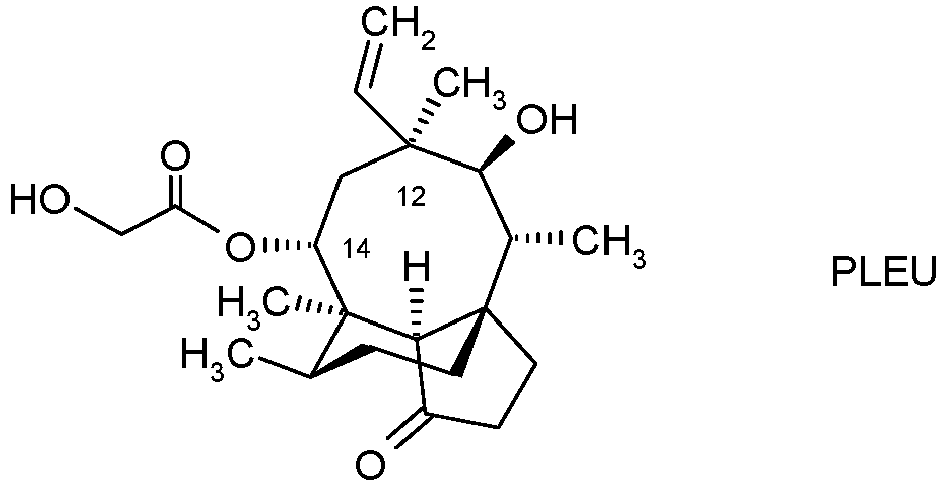


- From patent filings
JP2006306727 JP2008280297 JP2009040709 JP2010100582 US20080221330 ,US20100197909 ,WO2006070671 ,WO2008117796 ,WO2008143343 andWO2000071560 and from E. Bacqué et al. Chem. Comm., 2002, 20, 2312-2313 and S. Sato et al. Science of Synthesis, 2005, Vol 18, 821-968, compounds of formula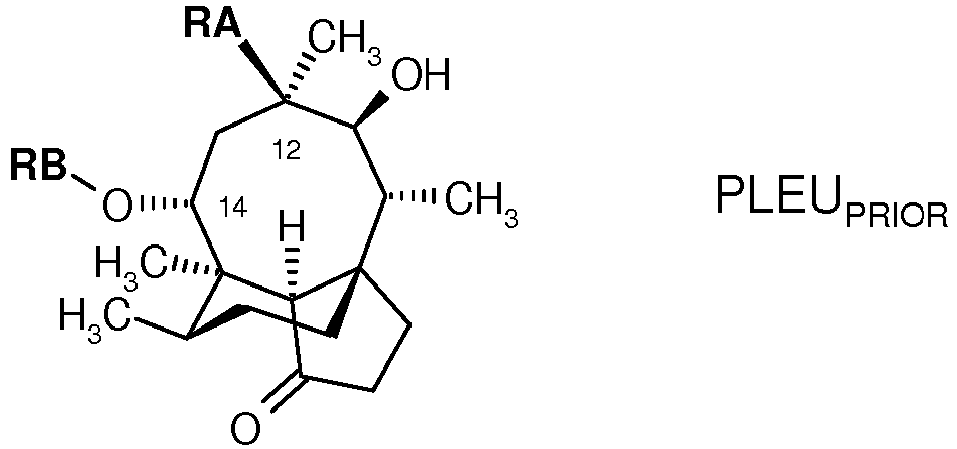
- In H. Berner et al., Monatshefte für Chemie, 1986, 117, 1073-1080, a pleuromutilin derivative is described in which the methyl at position 12 of the mutilin ring has the inverse stereochemistry than in the naturally occurring pleuromutilin. Mutilins in which the methyl at position 12 of the mutilin ring have the inverse stereochemistry than that in the naturally occurring pleuromutilin are herein also designated as "12-epi-mutilin(s)". The 12-epi mutilin of Berner et al. has as second substituent a vinyl group in position 12 of the mutilin ring.
- 12-epi-Mutilins are also disclosed in the Dissertation of S. Schindler, "Funktionalisierung des tricyclischen Gerüstes des Antibioticums Pleuromutilin", University of Vienna, 2003, page 26 and 31, namely the compounds of formula


- We have now found surprisingly that epi-pleuromutilins, wherein in addition to the inverted methyl group in C-12, the second substituent in C-12 comprising at least one nitrogen atom, do have interesting activity against Gram negative and Gram positive bacteria, in particular improved activity against Gram negative bacteria, in particular activity against Escherichia coli.
- In one aspect the present invention provides a compound compound of formula

- the methyl group at position 12 of the mutilin ring has the inverse stereochemistry compared with the stereochemistry of the methyl group at position 12 of the naturally occurring pleuromutilin ring,
- all other substituents of the mutilin ring having the same stereochemistry compared with the stereochemistry of the substituents at the corresponding positions in the naturally occurring pleuromutilin ring,
- (C1-16)alkyl-N(R3R4),
- (C1-16)alkyl-(C6-14)aryl-N(R3R4),
- (C1-16)alkyl-(C6-14)aryl-(C1-16)alkyl-N(R3R4),
- (C1-16)alkyl-(C1-13)heterocyclyl -N(R3R4),
- (C1-16)alkyl-(C1-13)heterocyclyl-(C1-16)alkyl-N(R3R4),
- carbonyl-N(R3R4),
- (C1-4)alkyl-carbonyl-N(R3R4),
- (C2-16)alkenyl-N(R3R4),
- (C2-16)alkenyl-(C6-14)aryl-N(R3R4),
- (C2-16)alkenyl-(C6-14)aryl-(C1-16)alkyl-N(R3R4),
- (C2-16)alkenyl-(C1-13)heterocyclyl-N(R3R4),
- (C2-16)alkenyl-(C1-13)heterocyclyl-(C1-16)alkyl-N(R3R4),
- hydrogen,
- (C1-16)alkyl,
- (C2-16)alkenyl,
- hydroxy(C1-16)alkyl,
- amino-(C1-16)alkyl,
- mono or di-(C1-6)alkylamino-(C1-16)alkyl,
- guanidino(C1-16)alkyl, ureido(C1-16)alkyl or thioureido(C1-16)alkyl,
- amino(C1-6)alkyl-(C6-14)aryl-(C1-6)alkyl,
- amino(C1-6)alkyl-(C6-14)aryl,
- guanidino(C1-6)alkyl-(C6-14)aryl-(C1-6)alkyl,
- amino-(C1-6)alkyloxy-(C1-6)alkyl,
- amino(C3-8)cycloalkyl,
- amino(C1-6)alkyl-(C3-8)cycloalkyl,
- amino(C3-8)cycloalkyl-(C1-6)alkyl,
- amino(C1-6)alkyl-(C3-8)cycloalkyl-(C1-6)alkyl,
- (C1-13)heterocyclyl-(C1-16)alkyl,
- (C6-14)aryl-(C1-16)alkyl,
- (C1-13)heterocyclyl,
- amino-(C6-14)aryl-(C1-16)alkyl,
- amino-(C1-6)alkyloxy-(C6-14)aryl-(C1-6)alkyl,
- amino(C1-6)alkyl-(C6-12)aryl-carbonyl,
- amino(C1-6)alkyl-amido-(C6-12)aryl(C1-6)alkyl,
- (C1-4)alkylcarbonyl,
- carbamimidoyl, carbamoyl, thiocarbamoyl,
- amino(C1-4)alkyl, amido, mono or di-(C1-4)alkyl-amido, (C1-6)alkyloxy-carbonyl, halogen, oxo, hydroxy
- Compounds provided by the present invention hereinafter also are referred to as "Compound(s) of (according to) the present invention".
- In particular R1 is
aminomethyl, amino(-ethyl-, -propyl-, -butyl-, -pentyl-, -hexyl-, -octyl-, -decyl-)-aminomethyl, amino-propoxy-propyl-aminomethyl, guanidino(-butyl-, -hexyl-)-aminomethyl, dimethylamino-propyl-aminomethyl, amino(-propyl-, -hexyl-)-aminoethyl, guanidino-ethyl, bis-aminomethyl-methyl-aminomethyl, aminomethyl-phenyl-aminomethyl, aminophenyl-methyl-aminomethyl, aminomethyl-phenyl-methyl-aminomethyl wherein phenyl optionally is further substituted by one or more halogen, in particular by one or more fluoro, aminomethyl-phenyl-propyl-aminomethyl, guanidino-methyl-phenyl-methyl-aminomethyl, amido-ethyl-phenyl-methyl-aminomethyl, optionally substituted by amino, wherein the amido nitrogen optionally is substituted by one or two (C1-4)alkyl, amido-phenyl-methyl-aminomethyl, aminopropyl-aminocarbonyl-phenyl-methyl-aminomethyl, aminomethyl-phenyl-methyl-aminoethyl wherein phenyl optionally is further substituted by one or more halogen, in particular by one or more fluoro, (aminoethoxy-phenyl-methyl-amino)-methyl and -ethyl, aminomethyl-phenyl-methyl-aminocarbonyl, aminopropyl-aminocarbonyl, phenyl-methyl-aminomethyl, pyridyl-ethyl-aminomethyl, hexyl-aminomethyl, allyl-aminomethyl, hydroxyhexyl-aminomethyl, dihydroxypropyl-aminomethyl, aminobutyl-aminomethyl wherein amino is substituted by (C1-4)alkylcarbonyl and aminobutyl, dimethylamido-pentyl-aminomethyl, ethoxycarbonyl-pentyl-aminomethyl optionally substituted by amino, piperidino-aminomethyl, morpholino-N-propyl-aminomethyl, aminocyclohexyl-aminomethyl, aminomethyl-cyclohexyl-methyl-aminomethyl, aminomethyl-phenyl-carbonyl-aminoethyl, aminomethyl-phenyl-propyl, aminohexyl, aminooctyl, aminoethyl-aminomethyl-phenyl-ethyl, aminomethyl-phenyl-ethyl, pyridinyl-ethenyl, aminoethyl-aminomethyl-phenyl-ethenyl wherein phenyl is optionally substituted by halogen, in particular by fluoro. - In a preferred embodiment R2 in a compound of formula I is (C1-16)alkyl, in particular (C1-4)alkyl, (C3-12)cycloalkyl, in particular (C5-7)cycloalkyl, in particular cyclohexyl, (C1-13)heterocyclyl, (C6-14)aryl,
wherein heterocyclyl includes aliphatic and aromatic heterocyclyl comprising at least one heteroatom selected from N, O, S, and wherein alkyl, cycloalkyl, aryl, heterocyclyl is unsubstituted or substituted by substituents which optionally having a heteroatom selected from O, N, S, halogen. - In another preferred embodiment of the present invention in a compound of formula I, R2 is alkyl, in particular (C1-4)alkyl, optionally substituted by
- hydroxy or amino,
- (C3-12)cycloalkyl wherein the cycloalkyl group is optionally further substituted by amino or amino(C1-4)alkyl wherein the amino or aminoalkyl group is optionally further substituted by amino(C1-6)alkylcarbonyl and optionally (C1-4)alkyl,
- (C1-13)heterocyclyl, wherein a nitrogen in the ring as a heteroatom optionally is further substituted by amino(C1-6)alkylcarbonyl,
cycloalkyl, in particular (C3-12)cycloalkyl, optionally substituted by - amino(C1-4)alkyl, wherein the amino group is optionally further substituted by amino(C1-6)alkylcarbonyl,
- hydroxy,
- amino, wherein the amino group is optionally further substituted by amino(C1-6)alkylcarbonyl and optionally (C1-4)alkyl,
- amino and hydroxy, wherein the amino group is optionally further substituted by amino(C1-6)alkylcarbonyl and optionally (C1-4)alkyl,
- (C1-4)alkylamino, wherein alkyl is optionally further substituted by one or more halogen; aliphatic heterocyclyl, in particular (C2-13)heterocyclyl, comprising 1 to 4 heteroatoms selected from N, O, S, in particular nitrogen,
wherein the nitrogen heteroatom optionally is further substituted by - (C1-4)alkyl,
- amino(C1-6)alkylcarbonyl,
aryl, in particular (C6-14)aryl, particularly phenyl, optionally substituted by - hydroxy, halogen, amino, hydroxy(C1-4)alkyl, bis-(hydroxy(C1-4)alkyl), amino(C1-4)alkyl, bis-(amino(C1-4)alkyl),
wherein the amino group in amino(C1-4)alkyl optionally is further substituted, particularly substituted by- (C3-6)cycloalkyl, (C2-6)alkenyl, amino(C1-6)alkyl, (C6-14)aryl(C1-4)alkyl, wherein aryl optionally is further substituted by amino(C1-4)alkyl,
- aminocarbonyl, wherein the nitrogen optionally is substituted by
- amino(C1-12)alkyl, bis-(amino(C1-12)alkyl), hydroxy(C1-6)alkyl, bis-(hydroxy(C1-6)alkyl) or diamino(C1-6)alkyl,
- (C1-12)alkyl, which alkyl optionally is substituted by
- amino, which amino optionally is acylated, particularly amino substituted by formyl, (C1-4)alkylcarbonyl, saturated or unsaturated heterocyclyl comprising 1 to 3 heteroatoms, particularly N, and 4 to 8, particularly 5 to 6 ring members, (C6-14)aryl, particularly phenyl, which aryl optionally is substituted by amino(C1-4)alkyl,
or - the nitrogen of the aminocarbonyl group is part of (C3-8)heterocyclyl, including aliphatic and aromatic heterocyclyl, comprising one or more heteroatoms selected from N,O,S preferably N, wherein the heterocycle is optionally further substituted by amino(C1-4)alkyl;
- (C1-6)alkyl, which (C1-6)alkyl group is optionally substituted by aminocarbonyl wherein the nitrogen of the aminocarbonyl group is optionally further substituted by amino(C1-12)alkyl, diamino-(C1-12)alkyl, bis-(amino(C1-12)alkyl), hydroxy(C1-6)alkyl, bis-(hydroxy(C1-6)alkyl) or the nitrogen of the aminocarbonyl group is acylated by amino(C1-4)alkyl, particularly wherein the acyl group includes (C1-4)alkylcarbonyl, wherein alkyl optionally is further substituted by amino, phenyl, particularly including amino(C1-4)alkylphenyl, hydroxyphenyl,
aromatic heterocyclyl, in particular (C1-13)heterocyclyl, comprising 1 to 4 heteroatoms, in particular N,
wherein the aromatic heterocyclyl is optionally substituted by (C1-6)alkyl, amino or hydroxy wherein the alkyl group is optionally further substituted by halogen or amino or the aromatic heterocyclyl is optionally substituted by aminocarbonyl wherein the amino group is optionally further substituted by amino(C1-12)alkyl, bis-(amino(C1-12)alkyl), hydroxy(C1-6)alkyl, bis-(hydroxy(C1-6)alkyl) or diamino(C1-6)alkyl. - In a further preferred embodiment of the present invention in compound of formula I, R2 is amido-phenyl, amido(C1-4)alkyl-phenyl, wherein the nitrogen of the amido group is unsubstituted or substituted by amino(C1-8)alkyl, in which alkyl optionally is further substituted.
- In a further preferred embodiment of the present invention in compound of formula I, R2 is amino (C3-12)cycloalkyl, amino(C1-4)alkyl(C3-12)cycloalkyl, amino(C3-12)cycloalkyl(C1-4)alkyl, or amino(C1-4)alkyl(C3-12)cycloalkyl(C1-4)alkyl, wherein the amino group is unsubstituted or substituted by amino(C1-6)alkylcarbonyl, or amino(C1-6)alkylcarbonyl and (C1-4)alkyl.
- In a further preferred embodiment of the present invention in compound of formula I, R2 is (C2-11)heterocyclyl, in particular aliphatic heterocyclyl, comprising 1 to 4 heteroatoms selected from N, O, S, in particular nitrogen, wherein a nitrogen in the ring as heteroatom is unsubstituted, or optionally further substituted by (C1-6)alkyl or amino(C1-6)alkylcarbonyl.
- In another preferred embodiment of the present invention in a compound of formula I, R1 is defined as above, X is S, and R2 is selected from aminoethyl-amidomethyl-phenyl, aminopropyl-amidomethyl-phenyl, hydroxyphenyl-(amino)ethyl-amidomethyl-phenyl, aminomethyl-phenyl-(amino)ethyl-amidomethyl-phenyl, aminopropyl-amidophenyl, aminomethyl-phenylmethyl-amido-phenyl, aminomethyl-phenyl, aminoacetyl-aminomethyl-phenyl, bis(aminomethyl)phenyl, bisaminopropyl-amidomethyl-phenyl, (2-amino)-aminopropyl-amidomethyl-phenyl, aminoethyl-aminomethyl-phenyl, aminopropyl-aminomethyl-phenyl, allyl-aminomethyl-phenyl, aminomethyl-phenylmethyl-aminomethyl-phenyl, hydroxymethyl-phenyl, bis(hydroxymethyl)-phenyl, (tetrafluoro-hydroxymethyl)-phenyl, amino-hydroxy-cyclohexyl, hydroxyethyl, aminoethyl, piperazinocarbonyl-phenyl, aminomethyl-piperidine-carbonyl-phenyl, piperidine-ylmethyl-amido-phenyl, pyridine-ylmethyl-amido-phenyl, acetyl-aminopropyl-amido-phenyl, formyl-aminopropyl-amido-phenyl, amido-phenyl, aminohexyl-amidophenyl, aminoethyl-amidophenyl, (5-Amino)-4H-[1,2,4]triazol-3-yl, pyridinyl, hydroxyphenyl, fluorophenyl, purinyl, aminophenyl, acetyl-aminomethyl-phenyl, cyclopropyl-aminomethyl-phenyl, aminopropyl-amidopyridinyl, hydroxypropyl-amidophenyl, amino-purinyl, difluoroethylamino-cyclohexyl, amino-hydroxy-cyclohexyl, azepanyl, aminomethylcyclohexylmethyl, N-methyl-piperidinyl, piperidinyl, aminomethylcyclohexyl, aminopropylphenyl, phenyl, N-aminomethylcarbonyl-piperidinyl, N-aminoethylcarbonyl-piperidinyl, N-aminomethylcarbonyl-piperidinylmethyl, aminomethylamidomethylcyclohexyl, aminomethyl-pyridinyl, aminomethylamidocyclohexyl.
- In another embodiment, the compound is of formula

- wherein R2 is as defined above, n is 1 to 12 and
- R3 is H, aminoethyl, aminopropyl, aminobutyl, aminopentyl, aminohexyl, aminooctyl, aminodecyl, dimethylaminopropyl, dimethylamidopentyl, guanidinobutyl, guanidinohexyl, carbamimidoyl, aminomethylcylcohexylmethyl, aminopropoxypropyl, aminocyclohexyl, hydroxyhexyl, dihydroxypropyl, aminomethylphenylmethyl, guanidinomethylphenylmethyl, phenylmethyl, morpholinopropyl, piperidinyl, hexyl, pyridinylethyl, allyl, amido-benzyl, aminopropyl-amidobenzyl, (2-amino)-amidoethyl-benzyl, (2-amino)-dimethylamidoethyl-benzyl, 2-amino-1-aminomethyl-ethyl, 5-amino-5-ethoxycarbonyl-pentyl, aminomethylphenylpropyl, aminomethylphenyl, aminophenymethyl, aminoethoxyphenylmethyl, aminomethyl-fluorophenyl-methyl, aminomethyl-difluorophenyl-methyl, and R4 is H, (C1-4)alkylcarbonyl or aminomethylphenylcarbonyl.
- In a further preferred embodiment of the present invention in compound of formula I, R1 is aminomethylphenylpropyl, aminoethylaminomethylphenylethenyl, aminoethylaminomethylphenylethyl, aminomethylphenylethyl, aminomethylphenylethyl, pyridinylethenyl, aminoethylamino-fluorophenyl-ethenyl.
- In one particular embodiment, the present invention provides a compound of the present invention which is of formula

- If not otherwise specifically defined, any group (substituent) defined herein may comprise 1 to 22 carbon atoms, e.g. 1 to 18, such as 1 to 16, for example
- alkyl e.g. includes (C1-16)alkyl, such as (C1-12)alkyl, e.g. (C1-4)alkyl;
- alkenyl e.g. includes (C2-16)alkenyl, such as (C2-12)alkenyl; e.g. (C2-6)alkenyl;
- cycloalkyl e.g. includes (C3-12)cycloalkyl, such as (C3-7)cycloalkyl, e.g. (C5-6)cycloalkyl;
- alkoxy e.g. includes (C1-16)alkoxy, such as (C1-12)alkoxy, e.g. (C1-4)alkoxy;
- aryl includes (C6-14)aryl, e.g. phenyl, naphthyl, phenanthrenyl, such as phenyl;
- alkylaryl e.g. includes (C1-16)alkyl(C6-14)aryl, such as (C1-12)alkylphenyl;
- arylalkyl e.g. includes (C6-14)aryl(C1-16)alkyl, such as phenyl(C1-12)alkyl; heterocyclyl includes
- aliphatic heterocyclyl and aromatic heterocyclyl,
- heterocyclyl having 1 to 13, such as 4 to 8 ring members,
- heterocyclyl having 1 to 4 heteroatoms selected from N, O and/or S,
- heterocyclyl optionally anellated with another ring (system), e.g. anellated with aryl; e.g. or anellated with a heterocyclic ring (system);
- halogen includes F, Cl, Br, I, such as F;
- amine includes unsubstituted amine and amine substituted by alkyl, alkenyl, cycloalkyl, aryl, arylalkyl, alkylaryl, heterocyclyl.
- If not otherwise specifically defined, any group defined herein may be unsubstituted or substituted, e.g. one or morefold.
- If not otherwise specifically defined, any alkyl, alkenyl, cycloalkyl, aryl and heterocyclyl include unsubstituted or substituted alkyl, alkenyl, cycloalkyl, aryl and heterocyclyl, e.g. substituted by groups which are conventional in organic chemistry. Substituents include alkyl, alkenyl, alkoxy, hydroxy, oxo, carboxyl, alkylcarbonyl, amido, ureido, guanidino, thioureido, amino, halogen.
- A compound of the present invention includes a compound in free form, in the form of a salt, in the form of a solvate and in the form of a salt and a solvate.
- According to another embodiment, the present invention provides a compound of the present invention in the form of a salt; e.g. and/or solvate.
- The salts include preferably pharmaceutically acceptable salts, although pharmaceutically unacceptable salts are included, e.g. for preparation / isolation / purification purposes.
- A salt of a compound of the present invention includes an acid addition salt. Pharmaceutically acceptable acid addition salts include salts of a compound of the present invention with an acid, e.g. fumaric acid, tartaric acid, sulphuric acid, p-toluene sulphonic acid, methane sulphonic acid, phosphoric acid, citric acid, L-malic acid, hippuric acid, D-gluconic acid, L-lactic acid, benzoic acid, hydrogenmaleic acid, hydrogen sulphuric acid, hydrogenphosphoric acid, hydrogen tartaric acid, hydrogen fumaric acid, hydrogen malic acid, hydrogen succinic acid, ethane-1,2-disulphonic acid, maleic acid, naphthalin-1,5-sulphonic acid, acetic acid, succinic acid, salicylic acid, azelaic acid, 2-[(2,6-dichlorophenyl)amino]benzene acetic acid, trifluoro acetic acid, hydrochloric acid, deuterochloric acid, preferably hydrochloric acid.
Pharmaceutically acceptable salts are described in e.g. Stahl, P. H., Wermuth, C. G, Handbook of Pharmaceutical Salts: Properties, Selection, and Use, Helvetica Chimica Acta / Wiley-VCH, 2001. - A compound of the present invention in free form may be converted into a corresponding compound in the form of a salt, and vice versa. A compound of the present invention in free form or in the form of a salt and/or in the form of a solvate may be converted into a corresponding compound in free form or in the form of a salt in non-solvated form, and vice versa.
- Any compound described herein, e.g. a compound of the present invention and intermediates may be prepared as appropriate, e.g. according, e.g. analogously, to a method as conventional, e.g. or as specified herein.
- A compound of the present invention e.g. may be prepared according to the following Reaction Scheme 1:

- A process for the production of a compound of the present invention, e.g. of formula I, may comprise the steps
- a) providing a pleuromutilin wherein the hydroxy group of the side chain in position 14 is activated e.g. activated as a tosylate,
- b) epimerizing the methyl group attached in position 12 of the mutilin ring in a mutilin obtained in step a) to obtain the inverse stereochemistry of said methyl group, e.g. and of the vinyl group at the same position,
- c) subjecting the epimerized mutilin of step b) to ozonolysis in order to obtain the aldehyde from the vinyl group,
- d) subjecting the aldehyde obtained in step c) to further reactions in order to obtain a desired side chain, e.g. wherein reactive groups are protected,
- e) reacting the activated hydroxy group of the side chain in position 14 with a desired side chain, optionally in protected and/or activated form, in order to replace the activated hydroxy group by the desired side chain,
- f) removing the protecting groups optionally present in the side chains attached in position 14 and in position 12, and
- g) isolating a compound of the present invention from the reaction mixture.
- An activated pleuromutilin according to step a), e.g. the pleuromutilin tosylate, is known or can easily be provided and the preparation of pleuromutilin tosylate is also described in Example 1 below.
Epimerization according to step b) can e.g. be carried out by reacting the protected pleuromutilin of step a) with diethyl zinc in an organic solvent and isolating the desired product.
Ozonolysis of a double bond according to step c) is a known procedure and can easily be carried out by a person skilled in the art.
Numerous procedures for reacting an aldehyde in order to obtain a desired side chain in position 12 according to step d) are known, or described herein.
Numerous procedures are known for step e) from prior art, or are described herein. Numerous methods for removing (e.g. selectively) protecting groups according to step f) are known as well. - Alternatively, a compound of the present invention e.g. may be prepared according to the following Reaction Schemes 2-4:
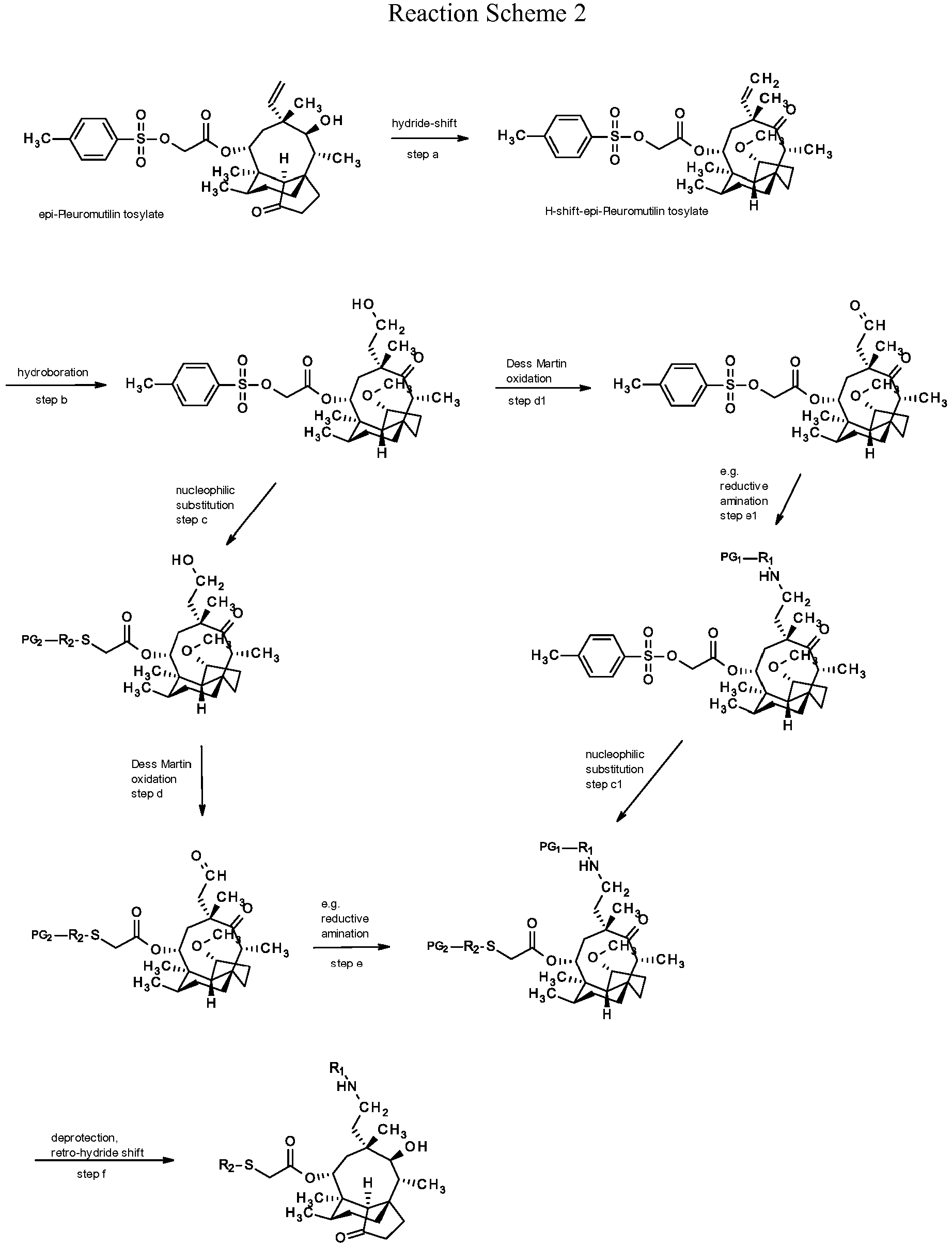
- A process for the production of a compound of the present invention, e.g. of formula I, may also comprise the steps
- a) subjecting the epimerized mutilin (Reaction Scheme 1) to acidic conditions resulting in a hydride-shifted 4-epi-3-methoxy-pleuromutilin derivative,
- b) hydroxylating the vinyl group of the product obtained in step c) via hydroboration,
- c) reacting the activated hydroxy group of the side chain in position 14 with a desired side chain, optionally in protected and/or activated form, in order to replace the activated hydroxy group by the desired side chain,
- d) oxidizing the primary hydroxyl group of the side chain in position 12 to the corresponding aldehyde using Dess-Martin conditions
- e) subjecting the aldehyde obtained in step f) to further reactions in order to obtain a desired side chain, e.g. wherein reactive groups are protected,
- f) removing the protecting groups optionally present in the side chains attached in position 14 and in position 12 together with concomitant retro-hydride shift, and
- g) isolating a compound of the present invention from the reaction mixture.
- Hydride shift according to step a) is a known procedure as e.g. disclosed in: Tetrahedron, 36, 1807 (1980), and can easily be carried out by a person skilled in the art.
Numerous procedures for hydroxylating an olefin in order to obtain a desired alcohol according to step b) are known, or described herein.
Numerous procedures are known for step c) from prior art, or are described herein.
Numerous procedures for oxidizing an alcohol in order to obtain an aldehyde according to step d) are known, or described herein.
Numerous procedures for reacting an aldehyde in order to obtain a desired side chain in position 12 according to step e) are known, or described herein.
Numerous methods for removing (e.g. selectively) protecting groups according to step f) are known as well. The concomitant retro-hydride shift according to step f) is a known procedure as e.g. disclosed in: Tetrahedron, 36, 1807 (1980), and can easily be carried out by a person skilled in the art. - Alternatively, the order of the reaction sequence [a → b →c → d → e → f] can be altered, e. g. [a → b → d → e → c → f].

- Alternatively, a process for the production of a compound of the present invention, e.g. of formula I, may comprise the steps
- a) reacting the activated hydroxy group of the side chain in position 14 (Reaction Scheme 1) with a desired side chain, optionally in protected and/or activated form, in order to replace the activated hydroxy group by the desired side chain,
- b) subjecting the product obtained in step a) to C-C bond forming conditions, e.g. Heck-type conditions, thus elongating the side chain at C-12,
- c) optionally hydrogenating the double bond of the side chain in position 12 of the product obtained in step b),
- d) removing the protecting groups optionally present in the side chains attached in position 14 and in position 12, and
- e) isolating a compound of the present invention from the reaction mixture.
- Numerous procedures are known for step a) from prior art, or are described herein.
Numerous procedures for reacting an olefin in order to obtain a desired side chain in position 12 according to step b) are known, or described herein.
Numerous procedures for hydrogenating an olefin in order to obtain a desired side chain in position 12 according to step c) are known, or described herein.
Numerous methods for removing (e.g. selectively) protecting groups according to step d) are known as well.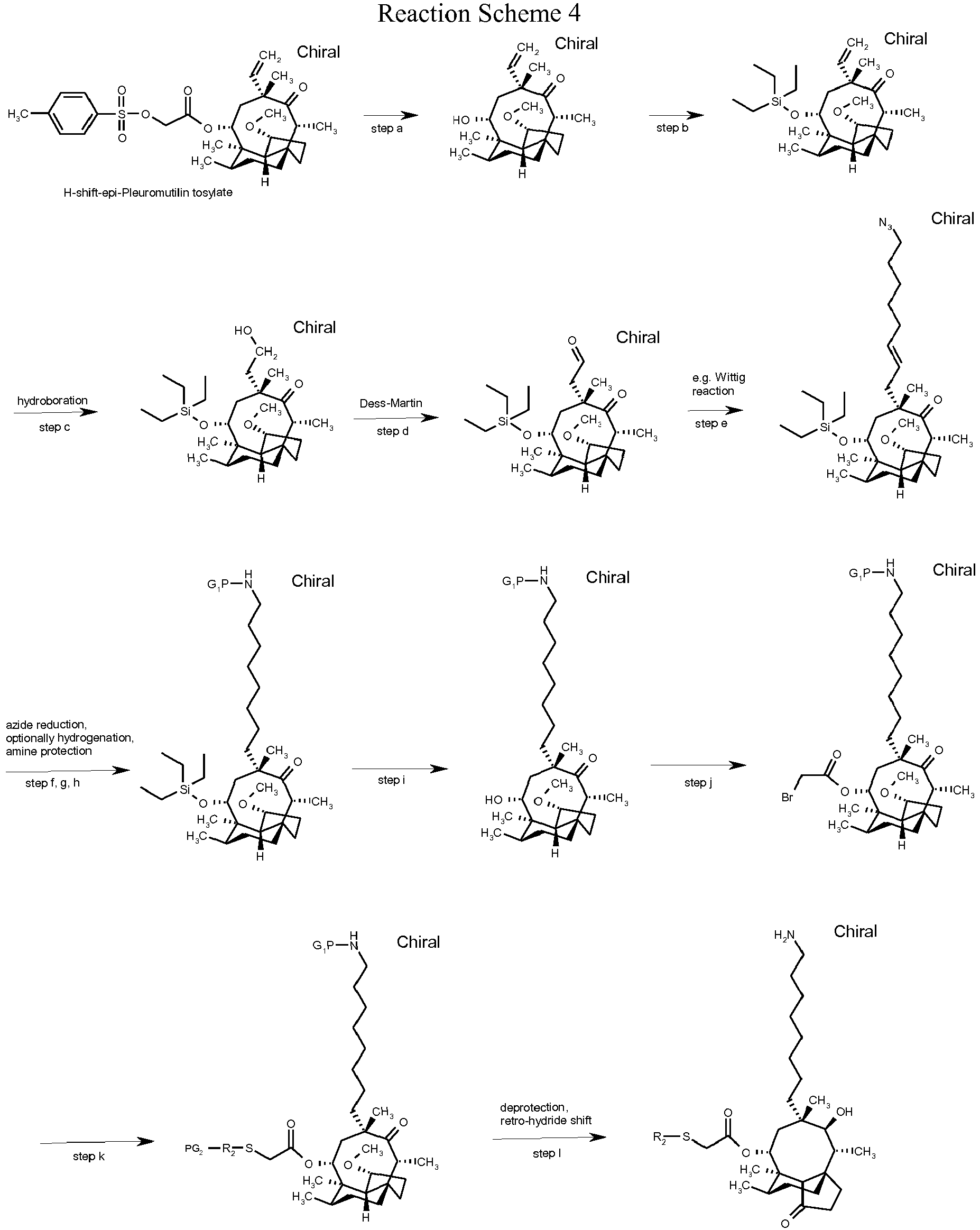
- Moreover, a process for the production of a compound of the present invention, e.g. of formula I, may comprise the steps
- a) hydrolyzing the side chain in position 14 of the epimerized H-shift mutilin (Reaction Scheme 2) resulting in a hydride-shifted mutilin derivative,
- b) protecting the OH-group of the mutilin derivative obtained in step a) as silyl ether,
- c) hydroxylating the vinyl group of the product obtained in step b) via hydroboration,
- d) oxidizing the primary hydroxyl group of the side chain in position 12 to the corresponding aldehyde using Dess-Martin conditions,
- e) subjecting the aldehyde obtained in step d) to further reactions in order to obtain a desired side chain, e.g. wherein reactive groups are protected or masked as azido,
- f) reducing the azido function of the side chain in position 12 of the product obtained in step e),
- g) optionally hydrogenating the double bond of the side chain in position 12 of the product obtained in step f),
- h) protecting the primary amine of the side chain in position 12 of the product obtained in step e or f),
- i) deprotecting the OH-group in position 14 of the product obtained in step h),
- j) substituting the OH-group in position 14 of the product obtained in step i) providing a pleuromutilin wherein the hydroxy group of the side chain in position 14 is activated e.g. activated as a bromide,
- k) reacting the bromide group of the side chain in position 14 of the product obtained in step j) with a desired side chain, optionally in protected and/or activated form, in order to replace the activated hydroxy group by the desired side chain,
- l) removing the protecting group optionally present in the side chain attached in position 14 and the protective group in position 12 together with concomitant retro-hydride shift, and
- g) isolating a compound of the present invention from the reaction mixture.
- Hydrolysis of the side chain in position 14 of a Pleuromutilin derivative according to step a) is a known procedure as e.g. disclosed in: Tetrahedron, 36, 1807 (1980), and can easily be carried out by a person skilled in the art.
Numerous procedures for protecting an OH-group in order to obtain a desired silyl ether according to step b) are known, or described herein.
Numerous procedures for hydroxylating an olefin in order to obtain a desired alcohol according to step c) are known, or described herein.
Numerous procedures for oxidizing an alcohol in order to obtain an aldehyde according to step d) are known, or described herein.
Numerous procedures for reacting an aldehyde in order to obtain a desired side chain in position 12 according to step e) are known, or described herein. - Numerous procedures for reducing an azido function according to step f) are known, or are described herein.
Numerous procedures for hydrogenating an olefin in order to obtain a desired side chain in position 12 according to step g) are known, or described herein.
Numerous procedures for protecting an amine in order to obtain a protected amino function in the side chain in position 12 according to step h) are known, or described herein.
Numerous methods for removing (e.g. selectively) a silyl ether according to step i) are known, or described herein.
Numerous procedures for substituting an OH-group in order to obtain an activated acetoxy derivative according to step j) are known, or described herein.
Numerous procedures are known for step k) from prior art, or are described herein. Numerous methods for removing (e.g. selectively) protecting groups according to step 1) are known as well. The concomitant retro-hydride shift is described in Reaction Scheme 2. - A compound of formula I thus obtained may be converted into another compound of formula I, e.g. or a compound of formula I obtained in free form may be converted into a salt of a compound of formula I and vice versa.
- Intermediates (starting materials) in the production of a compound of the present invention are known or may be prepared according, e.g. analogously, to a method as conventional or as specified herein.
- The compounds of the present invention exhibit pharmacological activity and are therefore useful as pharmaceuticals.
- For example, the compounds of the present invention show antimicrobial, e.g. antibacterial, activity against Gram-negative bacteria, such as Enterobacteriaceae, e.g. Escherichia coli, Salmonella typhimurium, Citrobacter freundii, Klebsiella pneumoniae, and Enterobacter cloacae, as well as Haemophilus influenzae, Haemophilus parainfluenzeae, Moraxella catarrhalis, Acinetobacter lwoffii and Acinetobacter baumannii and against Gram-positive bacteria such as staphylococci, e.g. Staphylococcus aureus, as well as streptococci, e.g. Streptococcus pneumoniae, and Enterococcus faecium. The compounds also show activity against Gram-positive obligatory anaerobes such as Clostridia e.g. Clostridium difficile and Clostridium perfringens, such as Eubacterium lentum, and Peptostreptococci, e.g. Peptostreptococcus anaerobius, Finegoldia magna, Anaerococcus prevotii, Peptoniphilus assaccharolyticus, as well as Gram-negative obligatory anaerobic organisms such as Fusobacteria e.g. Fusobacterium fusiforme, Fusobacterium necrophorum, Fusobacterium mortiferum and Fusobacterium varium, Prevotella spp., e.g. Prevotella buccae and Prevotella oris, and Porphyromonas spp., e.g. Porphyromonas gingivalis, Porphyromonas asaccharolytica.
- The in vitro activity against aerobic bacteria was determined by Broth Microdilution Test according to the Clinical and Laboratory Standards Institute (CLSI, former NCCLS) Document M7-A9 Vol.32, No. 2: "Methods for Dilution Antimicrobial Susceptibility Tests for Bacteria that Grow Aerobically; Approved Standard - Ninth Edition (2012)"; and the test against anaerobic bacteria was performed by Agar Dilution Test according to the Clinical and Laboratory Standards Institute (CLSI, former NCCLS), Document, M11-A8, Vol. 32, No. 5: "Methods for Antimicrobial Susceptibility Testing of Anaerobic Bacteria; Approved Standard - Eighth Edition (2012)". Performance standards and interpretive criteria followed the CLSI Document, M100-S23: "Performance Standards for Antimicrobial Susceptibility Testing; Twenty-Third Informational Supplement" (2013). The in vivo activity was tested by the septicaemia mouse model against Staphylococcus aureus and Escherichia coli.
- Compounds of the present invention are therefore suitable for the treatment and prevention of diseases which are mediated by microbes, e.g. by bacteria, e.g. potential indications for the compounds of the present invention are acute bacterial skin and skin structure infections (ABSSSI), respiratory tract infections (RTI) such as community-acquired pneumonia (CABP), Hospital-Acquired Bacterial Pneumonia (HABP) and Ventilator-Associated Bacterial Pneumonia (VABP); urinary tract infections (UTI), complicated intra-abdominal infections (cIAI) and other indications which might include sexually transmitted infections (STI) such as gonorrhea or STI caused by Chlamydia, Mycoplasms or anaerobic organi, bone and joint infections, eye and blood stream infections. Diseases which may also be treated include e.g. diseases mediated by Helicobacter, such as Helicobacter pylori, and diseases mediated by Mycobacterium tuberculosis. Diseases which may also be treated include in general inflammatory diseases, where microbes are mediating said inflammation, e.g. including acne.
- In another aspect the present invention provides a compound for use as a medicament, preferably as an antimicrobial, such as an antibiotic, e.g. and an anti-anaerobic.
- A compound of the present invention is also disclosed for use in acne treatment.
- In a further aspect the present invention provides a compound of the present invention for use in the treatment of diseases mediated by Gram negative bacteria, in particular Escherichia coli.
- Generally, a compound of the present invention is also disclosed for use in the preparation of a medicament for the treatment of diseases, mediated by microbes, such as bacterials, for example
- diseases mediated by bacteria, e.g. selected from staphylococci, streptococci, enterococci;
- diseases mediated by bacteria, e.g. selected from Moraxella, Haemophilus, Legionella, Neisseriaceae;
- diseases mediated by bacteria, e.g. Enterobacteriaceae
- diseases mediated by Helicobacter;
- diseases mediated by Mycobacterium tuberculosis;
- e.g. diseases mediated by Mycoplasma, Chlamydia and obligatory anaerobes; and for the treatment of acne.
- Further, a method of treatment of diseases mediated by microbes is disclosed, which comprises administering to a subject in need of such treatment an effective amount of a compound of the present invention e.g. in the form of a pharmaceutical composition.
- A method of treatment of acne is disclosed, which comprises administering to a subject in need of such treatment an effective amount of a compound of the present invention e.g. in the form of a pharmaceutical composition.
- Treatment includes treatment and prophylaxis.
- For antimicrobial and acne treatment, the appropriate dosage will, of course, vary depending upon, for example, the chemical nature and the pharmakokinetic data of a compound of the present invention employed, the individual host, the mode of administration and the nature and severity of the conditions being treated. However, in general, for satisfactory results in larger mammals, for example humans, an indicated daily dosage is in the range from about 0.5 mg to 3 g of a compound of the present invention conveniently administered, for example, in divided doses up to four times a day. Adminstration may also include continuous infusion if the compound is given intravenously.
- A compound of the present invention may be administered by any conventional route, for example enterally, e.g. including nasal, buccal, rectal, oral administration; parenterally, e.g. including intravenous, intramuscular, subcutaneous administration; or topically, e.g. including epicutaneous, intranasal, intratracheal administration, e.g. in form of coated or uncoated tablets, capsules, injectable solutions or suspensions, e.g. in the form of ampoules, vials, in the form of creams, gels, pastes, inhaler powder, foams, tinctures, lip sticks, drops, sprays, or in the form of suppositories, e.g. in analogous manner to macrolides, such as erythromycins, e.g. clarithromycin or azithromycin.
- A compound of the present invention may be administered in the form of a pharmaceutically acceptable salt, e.g. an acid addition salt or in free form, optionally in the form of a solvate. A compound of the present invention in the form of a salt exhibits the same order of activity as the compound in free form, optionally in the form of a solvate.
- A compound of the present invention may be used for pharmaceutical treatment according to the present invention alone or in combination with one or more other pharmaceutically active agents. Such other pharmaceutically active agents include e.g. other antibiotics and antiinflammatory agents, and, if a compound of the present invention is used in the treatment of acne, other pharmaceutically agents include furthermore agents which are active against acne.
- Combinations include fixed combinations, in which two or more pharmaceutically active agents are in the same formulation; kits, in which two or more pharmaceutically active agents in separate formulations are sold in the same package, e.g. with instruction for coadministration; and free combinations in which the pharmaceutically active agents are packaged separately, but instruction for simultaneous or sequential administration are given.
- In another aspect the present invention provides a pharmaceutical composition comprising a compound of the present invention in free form or in the form of a pharmaceutically acceptable salt and/or in the form of a solvate in association with at least one pharmaceutical, excipient, e.g. carrier or diluent, e.g. including fillers, binders, disintegrators, flow conditioners, flow enhancers, glidants, lubricants, sugars and sweeteners, fragrances, taste maskers, preservatives, stabilizers, wetting agents and/or emulsifiers, solubilizers, salts for regulating osmotic pressure and/or buffers.
- In another embodiment, the present invention provides a pharmaceutical composition according to the present invention, further comprising another pharmaceutically active agent.
- Such pharmaceutical compositions may be manufactured according, e.g. analogously, to a method as conventional, e.g. by mixing, granulating, coating, dissolving or lyophilizing processes. Unit dosage form may contain, for example, from about 0.5 mg to about 2000 mg, such as 10 mg to about 1500 mg.
- The compounds of the present invention are additionally suitable as veterinary agents, e.g. veterinary active compounds, e.g. in the prophylaxis and in the treatment of microbial, e.g. bacterial diseases, in animals, such as fowl, pigs and calves, e.g., and for diluting fluids for artificial insemination and for egg-dipping techniques.
- A compound of the present invention may be used as a veterinary agent.
- A compound of the present invention may be used for the preparation of a veterinary composition which is useful as a veterinary agent.
- A veterinary method for the prophylaxis and the treatment of microbial, e.g. bacterial diseases may comprise administering to a subject in need of such treatment an effective amount of a compound of the present invention, e.g. in the form of a veterinary composition.
- According to the present invention it was found that the inversion of the stereochemistry of the methyl group in position C-12 of the mutilin ring compared to the stereochemistry of the methyl group in position C-12 of the naturally occurring pleuromutilin and the introduction of a substituent in C-12 comprising at least one nitrogen atom increased surprisingly and remarkably the activity against Enterobacteriaceae, e.g. Escherichia coli.
- The compounds of the following Examples 1 to 160 exhibit surprising activity against Gram positive and Gram negative bacteria i.e. Staphylococcus aureus ATCC 49951 and Escherichia coli ATCC 25922. Especially the improved activity against Gram negative bacteria, in particular Escherichia coli, is very surprising which is linked in one aspect to the inversion of the stereochemistry of the methyl group in position C-12 of the mutilin ring compared to the stereochemistry of the methyl group in position C-12 of the naturally occurring pleuromutilin, and in another aspect to the second C-12 substituent comprises at least one nitrogen atom. Moreover, the activity against Staphylococcus aureus was confirmed to be retained. All exemplified compounds exihibit MICs ≤ 2 µg/mL against Staphylococcus aureus ATCCC 49951 and MICs ≤ 16 µg/mL against Escherichia coli ATCC 25922.
- Herein, also the following subject-matters A) to M) are disclosed:
- A) A compound selected from 14-O-[((Alkyl-, cycloalkyl-, heterocycloalkyl-, heteoroaryl-, or aryl)-sulfanyl)-acetyl]-12-epi-mutilins, or 14-O-[((Alkyl-, cycloalkyl-, heterocycloalkyl-, heteoroaryl-, or aryl)-oxy)-acetyl]-12-epi-mutilins, wherein 12-epi-mutilin is characterized in that
- there is a substituent other than the natural occurring vinyl group in position 12 of the mutilin ring;
- the methyl group in position 12 of the mutilin ring has the inverse stereochemistry compared with the methyl group in position 12 in the natural pleuromutilin ring,
and - all other substituents of the mutilin ring having the same stereochemistry compared with the stereochemistry of the corresponding substituents in the natural pleuromutilin ring,
- B) 14-O-[((Alkyl-, cycloalkyl-, heterocycloalkyl-, heteoroaryl-, or aryl)-sulfanyl)-acetyl]-12-epi-mutilins, or 14-O-[((Alkyl-, cycloalkyl-, heterocycloalkyl-, heteoroaryl-, or aryl)-oxy)-acetyl]-12-epi-mutilins, wherein 12-epi-mutilin is characterized in that
- there is a substituent other than the natural occurring vinyl group in position 12 of the mutilin ring;
- the methyl group in position 12 of the mutilin ring has the inverse stereochemistry compared with the methyl group in position 12 in the natural pleuromutilin ring,
and - all other substituents of the mutilin ring having the same stereochemistry compared with the stereochemistry of the corresponding substituents in the natural pleuromutilin ring,
with the proviso that the compounds

which compounds are designated herein also as "priority compounds".
- C) A priority compound as defined under B) wherein in the side chain attached to the mutilin ring in position 12 a nitrogen atom is present.
- D) A priority compound of formula

- wherein the methyl group in position 12 of the mutilin ring has the inverse stereochemistry compared with the methyl group in position 12 in the natural pleuromutilin ring,
- all other substituents of the mutilin ring having the same stereochemistry compared with the stereochemistry of the corresponding substituents in the natural pleuromutilin ring.
- R1PRIO is a hydrocarbon group comprising 1 to 16, in particular 1 to 12 carbon atoms, optionally comprising one or more heteroatoms selected from N, O, S, halogen, in particular N, and being other than the natural occurring vinyl group,
- XPRIO is sulfur or oxygen, preferably sulfur, and
- R2PRIO is a hydrocarbon group comprising 1 to 22 carbon atoms, optionally comprising heteroatoms selected from N, O, S, halogen, in particular N or O,
- with the proviso, that the compounds of formula SCH1 and SCH2 wherein RSCH is as defined above are excluded.
- E) A Priority compound of formula IPRIO as defined under D), wherein XPRIO is defined as under D), R1PRIO is a group of formula

- n is 1 to 12, R2PRIO is (C1-16)alkyl, (C3-12)cycloalkyl, (C6-12)aryl, heterocyclyl, comprising 3 to 12 ring members, including aliphatic and aromatic heterocyclyl, comprising a heteroatom selected from N, O, and/or S,
- wherein alkyl, aryl or cycloalkyl, heteroaryl or aliphatic heterocyclyl is substituted or unsubstituted, comprings substituents which optionally having a heteroatom selected from O, N, S, halogen, and
- R3PRIO and R4PRIO independently of each other are
- hydrogen,
- (C1-16)alkyl or (C2-16) alkenyl, optionally substituted by a hydrocarbon group comprising 1 to 12 carbon atoms,
which hydrocarbon group optionally comprises substituents, optionally having a heteroatom selected from N, O, S, halogen, - carbamimidoyl, carbamoyl, thiocarbamoyl,
- (C3-8)cycloalkyl,
- (C6-12)aryl, optionally comprising a heteroatom selected from N, O, S,
- aliphatic heterocyclyl comprising 3 to 8 ring members, and 1 to 3 heteroatoms selected from N, O, S,
- which cycloalkyl, aryl, heteroaryl or aliphatic heterocyclyl optionally comprises substituents, which optionally having a heteroatom selected from O, N, S, halogen.;
- F) A Priority compound of formula IPRIO as defined under D), wherein XPRIO and R2PRIO are as defined above, and R1PRIO is (C1-16)alkyl or (C1-16) alkenyl comprising at least one heteroatom selected from N, O, S, either within the chain, or in a terminal position, which alkyl or alkenyl optionally is substituted by
- (C3-8)cycloalkyl,
- aliphatic heterocyclyl comprising 3 to 8 ring members, in and 1 to 4 heteroatoms selected from N, O, S,
- (C6-12)aryl, optionally comprising a heteroatom selected from N, O, S,
which alkyl, alkenyl, cycloalkyl, aryl, heteroaryl or aliphatic heterocyclyl optionally comprises substituents, optionally having a heteroatom selected from N, O, S, halogen.
- G) A compound of formula I as defined under D),
wherein XPRIO and R1PRIO are as defined above,
R2PRIO is
alkyl, such as (C1-4)alkyl, optionally substituted by hydroxy, amino;
cycloalkyl, such as (C3-12)cycloalkyl, optionally substituted by amino, (C1-4)alkylamino, hydroxy, (C1-4)alkyl;
aryl, such as (C5-12)aryl, e.g. phenyl, optionally substituted by- hydroxy, halogen, amino, hydroxy(C1-4)alkyl, bis-(hydroxy(C1-4)alkyl), amino(C1-4)alkyl, bis-(amino(C1-4)alkyl),
- e.g. wherein the amino group in amino(C1-4)alkyl optionally is further substituted, e.g. by
- (C3-6)cycloalkyl, (C2-6)alkenyl, amino(C1-6)alkyl, (C5-12)aryl(C1-4)alkyl wherein aryl optionally is further substituted by amino(C1-4)alkyl,
- aminocarbonyl, wherein the nitrogen optionally is substituted by amino(C1-12)alkyl, bis-(amino(C1-12)alkyl), hydroxy(C1-6)alkyl, bis-(hydroxy(C1-6)alkyl),
(C1-6)alkyl, which alkyl optionally is substituted by- amino, which amino optionally is acylated, e.g. substituted by formyl, (C1-4)alkylcarbonyl,
- saturated or unsaturated heterocyclyl comprising 1 to 3 heteroatoms, e.g. N, and 4 to 8, such as 5 to 6 ring members,
- (C5-12)aryl, e.g. phenyl, which aryl optionally is substituted by amino(C1-4)alkyl or
- (C1-6)alkyl, which (C1-6)alkyl group is optionally subtstituted by aminocarbonyl wherein the nitrogen of the aminocarbonyl group is optionally further substituted by amino(C1-12)alkyl, bis-(amino(C1-12)alkyl), hydroxy(C1-6)alkyl, bis-(hydroxy(C1-6)alkyl)
- acylated amino(C1-4)alkyl, e.g. wherein the acyl group includes (C1-4)alkylcarbonyl, wherein alkyl optionally is further substituted by amino, phenyl, e.g. including amino(C1-4)alkylphenyl, hydroxyphenyl,
- hydroxy, halogen, amino, hydroxy(C1-4)alkyl, bis-(hydroxy(C1-4)alkyl), amino(C1-4)alkyl, bis-(amino(C1-4)alkyl),
- H) A compound of formula IPRIO as defined under D),
wherein XPRIO and R1PRIO are as defined in any one of the definitions under D) to G), R2PRIO is amido(C0-4)alkyl-phenyl, wherein the nitrogen of the amido group is unsubstituted or substituted by amino(C1-8)alkyl, in which alkyl optionally is further substituted. - J) A compound of formula XPRIO as defined under D),
wherein XPRIO is S and R1PRIO is as defined in any one of the definitions under D) to H), and
R2PRIO is
aminoethyl-amidomethyl-phenyl, aminopropyl-amidomethyl-phenyl, hydroxyphenyl-(amino)ethyl-amidomethyl-phenyl, aminomethyl-phenyl-(amino)ethyl-amidomethyl-phenyl, aminopropyl-amidophenyl, aminomethyl-phenylmethyl-amido-phenyl, aminomethyl-phenyl, aminoacetyl-aminomethyl-phenyl, bis(aminomethyl)phenyl, bisaminopropyl-amidomethyl-phenyl, (2-amino)-aminopropyl-amidomethyl-phenyl, aminoethyl-aminomethyl-phenyl, aminopropyl-aminomethyl-phenyl, allyl-aminomethyl-phenyl, aminomethyl-phenylmethyl-aminomethyl-phenyl, hydroxymethyl-phenyl, bis(hydroxymethyl)-phenyl, (tetrafluoro)(hydroxymethyl)-phenyl, amino-hydroxy-cyclohexyl, hydroxyethyl, aminoethyl, piperazincarbonyl-phenyl, aminomethyl-piperidine-carbonyl-phenyl, piperidine-ylmethyl-amido-phenyl, pyridine-ylmethyl-amido-phenyl, acetyl-aminopropyl-amido-phenyl, formyl-aminopropyl-amido-phenyl, amido-phenyl, aminohexyl-amidophenyl, aminoethyl-amidophenyl, (5-Amino)-4H-[1,2,4]triazol-3-yl, pyridinyl, hydroxyphenyl, fluorophenyl, purinyl, aminophenyl, acetyl-aminomethyl-phenyl, cyclopropyl-aminomethyl-phenyl, aminopropyl-amidopyridinyl, hydroxypropyl-amidophenyl, amino-purinyl, difluoroethylamino-cyclohexyl, amino-hydroxy-cyclohexyl, azepanyl. - K) A priority compound of formula

- wherein n and R2PRIO are is as defined in any one of the definitions under D) to J), R3PRIO is H, or aminoethyl, aminopropyl, aminobutyl, aminopentyl, aminohexyl, aminooctyl, aminodecyl, dimethylaminopropyl, dimethylamidopentyl, guanidinobutyl, guanidinohexyl, carbamimidoyl, aminomethylcylcohexylmethyl, aminopropoxypropyl, aminocyclohexyl, hydroxyhexyl, dihydroxypropyl, aminomethylphenylmethyl, guanidinomethylphenylmethyl, phenylmethyl, morpholinopropyl, piperidinyl, hexyl, pyridinylethyl, allyl, amido-benzyl, aminopropyl-amidobenzyl, (2-amino)-amidoethyl-benzyl, (2-amino)-dimethylamidoethyl-benzyl, 2-amino-1-aminomethyl-ethyl, 5-amino-5-ethoxycarbonyl-pentyl, and
- R4PRIO is H or (C1-4)alkylcarbonyl.
- L) A compound according to the definitions under D) which is of formula

- M) A Priority compound as defined under any one under A) to L)
- in the form of a salt and/or solvate,
- for use as a pharmaceutical drug substance,
- in a pharmaceutical composition, additionally comprising at least one pharmaceutical excipient, optionally further comprising another pharmaceutically active agent,
- in a method of treatment of diseases mediated by microbes.
- The trivial name mutilin refers to the IUPAC systematic name (1S, 2R, 3S, 4S, 6R, 7R, 8R, 14R)-3,6-dihydroxy-2,4,7,14-tetramethyl-4-vinyl-tricyclo[5.4.3.01,8]tetradecan-9-one.

- In the following examples, pleuromutilin derivatives are numbered in analogy to the mutilin numbering system described by H. Berner (Berner, H.; Schulz, G.; Schneider H. Tetrahedron 1980, 36, 1807-1811):

- In the compounds of the present invention, e.g. in the compounds of Examples 1 to 160, the stereochemistry of the methyl group at position 12 (and in turn also the stereochemistry of the second group attached in position 12 of the mutilin ring) is inverted (epi-mutilin derivatives) and in addition the vinyl group is altered and various substituents instead of vinyl have been introduced:

- Pleuromutilin tosylate is a compound of formula:

- 12-Epi-pleuromutilin and 12-epi-pleuromutilin tosylate are compounds of formula:

- Herein, including the examples and the reaction scheme the following abbreviations are used:
- 1H-NMR
- proton nuclear magnetic resonance spectroscopy
- approx.
- approximately
- °C
- degrees Celsius
- BOC
- tert-butoxycarbonyl
- conc.
- concentrated
- BOC2O
- di-tert-butyl dicarbonate
- d
- days
- DCM
- CH2Cl2
- DBU
- 1,8-diazabicyclo[5.4.0]undec-7-ene
- DCC
- N,N'-dicyclohexylcarbodiimide
- DIEA
- Diisopropylethylamine
- DIPEA
- Ethyl-diisopropyl-amine
- DMAP
- 4-dimethylaminopyridine
- DMA
- N,N-dimethylacetmamide
- DMF
- N,N-dimethylformamide
- DMSO
- dimethylsulfoxide
- DPPA
- diphenylphosphoryl azide
- dppf
- 1,1'-Bis(diphenylphosphino)ferrocene
- DTT
- 1,4-dithio-DL-threitol
- eq
- equivalents
- EtOAc
- ethyl acetate
- EtOH
- ethanol
- h
- hours
- HATU
- 1-[Bis(dimethylamino)methylene]-1H-1,2,3-triazolo[4,5-b]pyridinium 3-oxid hexafluorophosphate
- heptane
- n-heptane
- HOBt
- 1-hydroxybenzotriazol
- HPLC
- High Performance Liquid Chromatography
- LAH
- Lithium Aluminum Hydride
- M
- molarity
- MeOH
- methanol
- min
- minutes
- MS
- mass spectrometry
- MsCl
- methanesulfonyl chloride
- MTBE
- Methyl tert-butyl ether
- m/z
- mass/charge ratio
- Na2SO4
- sodium sulfate
- NMM
- N-Methylmorpholine
- Pd2(dba)3
- Tris(dibenzylideneacetone)dipalladium(0)
- PE
- Petroleum ether
- PG
- protecting group
- rt
- room temperature
- sat.
- saturated
- TLC
- thin layer chromatography
- TFA
- Trifluoroacetic acid
- TEA, Et3N
- triethylamine
- THF
- tetrahydrofuran
- TLC
- thin layer chromatography
- wt
- weight
- w/w
- weight/weight
- To a solution of 18.63 g of pleuromutilin and 9.39 g of toluenesulfonylchloride in 1400 mL of methylethylketone a solution of 4.98 g of triethylamine in 300 mL of methylethylketone is slowly added at rt. The mixture obtained is stirred for 24 h at rt, the formed precipitate is filtered off and to the filtrate obtained 2800 mL of water is added. The solution obtained is extracted 3 times with EtOAc and the organic phase obtained is dried over Na2SO4 and evaporated to dryness under reduced pressure. The crude product is used for the next step without further purification.
1H-NMR (400 MHz, DMSO-d6, δ, ppm, characteristic signals): 0.49 (d, 3H, J = 7Hz, CH3-16); 0.8 (d, 3H, J = 7Hz, CH3 - 17); 1.02 (s, 3H, CH3 - 18), 1.29 (s, 3H, CH3 - 15); AB-system (υA = 4.75, υB = 4.62, J = 50Hz, CH2 - 22); 5.00 (m, 2H, H - 20); 5.52 (d, 1H, J = 8Hz, H - 14); 6.04 (dd, 1H, J = 11, 18Hz, H - 19), 7.46 (d, 2H, J = 8Hz, arom.); 7.79 (d, 2H, J = 8Hz, arom.). - 20 g of Pleuromutilin tosylate was dissolved in 100 mL of THF and the solution obtained was heated to reflux. 20 mL of Diethylzinc (1M in heptane) was carefully added during 10 minutes and the reaction was kept at reflux for 7 hours. HPLC showed then a 46:53 ratio of Pleuromutilin tosylate: 12-epi- Pleuromutilin tosylate by area. The batch was cooled to approx. 50°C, 2 mL of water was added; the resulting precipitate was filtered off and the organic phase was evaporated to dryness. The evaporation residue obtained was subjected to chromatography over silica gel using toluene / acetone 80:1 as eluent.
1H-NMR (200 MHz, DMSO-d6): 7.79 (d, 2H, arom., J=8 Hz), 7.45 (d, 1H, arom., J=8 Hz), 5.9 (dd, 1 H, H-19, JE=18 Hz, JZ=12 HZ), 5.49 (d, 1H, H-14, J=7.8 Hz), 4.92 - 4.85 (m, 2H, H-20), AB (2H, H-22, vA=4.76, vB=4.61, J=16 Hz), 4.25 (d, 1H, 11-OH, J=5.8 Hz), 2.40 (s, 3H, -CH3), 1.31 (s, 3H, H-15), 0.99 (s, 3H, H-18), 0.80 (d, 3H, H-17, J=6.6 Hz), 0.52 (d, 3H, H-16, J=6.2 Hz).
MS m/e: 550 [M++NH4]. -

- 1g of 12-epi-Pleuromutilin tosylate was dissolved in 25 mL of MeOH and 10 mL of EtOAc, cooled to -78°C (carbon dioxide/acetone) and the mixture obtained was subjected to ozonisation at a flow rate of 70 L/h until a blue coloration persisted (ca. 10 minutes). To the still cold mixture was added 0.85 g of potassium iodide in 2.3 mL of water, 1.3 mL of acetic acid and 8 mL of MeOH in a manner that the internal temperature did not exceed -50°C. After addition the flask remained in the cooling bath and was left to warm up to about 0°C. At 0°C 10 mL of 20% aqueous sodium thiosulfate solution was added to the mixture obtained and stirring was continued for 30 min. The reaction mixture was poured on 100 mL of water and extracted with 3x 50 mL EtOAc. The combined organic layers obtained were washed with 5% NaHCO3 solution, dried over Na2SO4 and evaporated to dryness. The evaporation residue was subjected to chromatography over silica gel using cyclohexane / EtOAc 3 : 1 as eluent.
1H-NMR (200 MHz, DMSO-d6): 9.59 (s, 1H, -CHO), 7.80 (d, 2H, arom., J=8 Hz), 7.47 (d, 1H, arom., J=8 Hz), 5.34 (d, 1H, H-14, J=8.2 Hz), 4.83 (d, 1H, 11-OH, J=6.6 Hz), AB (2H, H-22, vA=4.76, vB=4.61, J=16 Hz), 3.57 - 3.5 (m, 1H, H-11), 2.41 (s, 3H, -CH3), 1.30 (s, 3H, H-15), 1.07 (s, 3H, H-18), 0.93 (d, 3H, H-17, J=6.6 Hz), 0.50 (d, 3H, H-16, J=6.6 Hz). MS m/e: 552 [M+ + NH4]. - The ozonolysis of 11-Oxo pleuromutilin to give 12-desvinyl-12-formyl-11-oxo pleuromutilin using the same procedure is e.g. disclosed in: Tetrahedron, 37, 915 (1981).
-

- 620 mg of 12-epi-12-desvinyl-14-O-{(toluene-4-sulfonyloxy)-acetyl}-12-formyl mutilin was dissolved in dichloroethane, 202 mg of N-BOC-diaminopropane dissolved in a minimum volume of dichloroethane was added and the mixture obtained was stirred at rt for one h. To the mixture obtained 541 mg of sodium trisacetoxyborohydride was added and the resulting slurry was stirred for another h at rt. HPLC then indicated the absence of the starting material. The mixture obtained was quenched with 5% aqueous NaHCO3 solution, the aqueous phase obtained was washed with DCM; the combined organic phases were dried over Na2SO4 and evaporated to dryness. The evaporation residue was subjected to chromatography over silica gel using EtOAc / triethylamine 100 : 1 as eluent.
1H-NMR (200 MHz, DMSO-d6): 7.80 (d, 2H, arom., J=8 Hz), 7.47 (d, 1H, arom., J=8.2 Hz), 6.87 (bs, 1H, BOC-NH), 5.50 (d, 1H, H-14, J=7.2 Hz), AB (2H, H-22, vA=4.74, vB=4.62, J=16 Hz), 3.66 (bs, 1H, H-11), 2.41 (s, 3H, -CH3), 1.36 (s, 9H, 3x CH3), 1.30 (s, 3H, H-15), 0.91 (s, 3H, H-18), 0.80 (d, 3H, H-17, J=5.6 Hz), 0.51 (d, 3H, H-16, J=5.8 Hz).
MS m/e: 693 [M+ + H]. -

- 440 mg of tert-Butyl N-{3-[2-(4-mercapto-phenyl)-acetylamino] -propyl } - carbamate was dissolved in 20 mL of acetonitrile, 152 mg of potassium tert-butoxide was added followed by addition of 892 mg of 12-epi-12-desvinyl-14-O-[(toluene-4-sulfonyloxy)-acetyl]-12-[(3-tert-butoxycarbonylamino-propylamino)-methyl] mutilin in one portion. The resulting slurry was stirred at rt for 1 h, diluted with 60 mL of water and extracted with DCM (4x). The combined organic phases were washed 2x with aqueous 2N NaOH solution, water, dried over Na2SO4 and evaporated to dryness. The evaporation residue obtained subjected to chromatography EtOAc/MeOH 8/1 to yield colourless crystals.
1H-NMR (200 MHz, DMSO-d6): 8.03 (t, 1H, CO-NH, J=6 Hz), 7.27 (d. 2H. arom. J=8 Hz), 7.17 (d, 1H, arom., J=8.2 Hz), 6.83 - 6.74 (m, 2H, 2x BOC-NH), 5.47 (d, 1H, H-14, J=7.2 Hz), 3.76 (s, 2H, H-22), 3.40 (bs, 1H, H-11), 1.36 (s, 9H, 3x CH3), 1.30 (s, 3H, H-15), 0.80 - 0.76 (m, 6H, H-18, H-17), 0.57 (d, 3H, H-16, J=5.6 Hz). -

- 654 mg of 12-epi-12-desvinyl-14-O-{{4-[(3-tert-butoxycarbonylamino-propylcarbamoyl)-methyl] -phenylsulfanyl}-acetyl} -12- [(3-tert-butoxycarbonylamino-propylamino)-methyl] mutilin was dissolved in 2 mL of DCM, 11.5 mL of IN HCl in diethyl ether was added and the mixture obtained was stirred at rt for 1 h. A precipitate formed and was collected with suction, washed 5x with diethyl ether and dried in a high vacuum overnight.
The title compound was obtained in the form of a trihydrochloride.
NMR: 1H-NMR (200 MHz, DMSO-d6): 7.29 (d, 2H, arom., J=8.4 Hz), 7.21 (d, 2H, arom., J=8.4 Hz), 5.44 (d, 1H, H-14, J=6 Hz), 5.36 (d, 11-OH, J=4 Hz), 1.35 (s, 3H, H-15), 0.57 (d, 3H, H-16, J=5.2 Hz).
MS m/e: 645 [M+ + H]. - 605 mg of 4-mercaptophenylacetic acid and 1.44 g of diisopropylethylamine was dissolved in 10 mL of DCM under an argon atmosphere, and the mixture obtained was cooled in an ice bath and treated with 532 mg of acetic anhydride. The mixture obtained was stirred 10 min with cooling and then 45 min at rt. To the mixture obtained 10 mL of IN HCl was added and vigorous stirring was maintained for 10 min, the phases obtained were separated, the aqueous phase obtained was washed once with DCM and the combined organic phases were dried over Na2SO4 and evaporated to dryness. The title compound was obtained in the form of pale yellow crystals (containing residual solvent).
- 770 mg of 2-(4-acetylsulfanylphenyl)-acetic acid, 638 mg of N-BOC-1,3-diaminopropane and 560 mg of HOBt was dissolved in 15 mL DCM, stirred for 20 min at rt, cooled in an ice bath and treated with 755 mg of DCC. The cooling bath was removed and resulting slurry was stirred at rt for 1 hour and filtered from dicyclohexylurea. The filtrate obtained was washed with aqueous 10% K2CO3, 0.1N HCl and 5% NaHCO3, dried over Na2SO4 and evaporated to dryness. The evaporation residue obtained was triturated with 10 mL of acetonitrile, filtered from insoluble material and brought to dryness. The title compound in the form of pale yellow soft crystals was obtained.
- 560 mg (1.53 mmol) of S-[4-[2-[3-(tert-butoxycarbonylamino)-propylamino]-2-oxo-ethyl]-phenyl]-ethanethioate was dissolved in 10 mL of MeOH, 422 mg (3.06 mmol) of potassium carbonate in 4 mL of water was added and the resulting yellow solution was stirred at ambient temperature for 1 hour, followed by dilution with 40 mL of water plus 7 mL of IN HCl and extraction with 10 mL of dichloromethane. The aqueous phase was washed with dichloromethane (2x), the combined organic phases washed with 5% NaHCO3, dried over Na2SO4 and evaporated to dryness. The title compound was obtained in the form of pale yellow crystals which were used in the next step without further purification.
- According, e.g. analogously, to a method as conventional, or according, e.g. analogously to a method as set out under Example 1 above, but using appropriate starting materials the compounds of formula

Table 1 Example R2EX R1EX 2 12-epi-12-desvinyl-14-O-{{4-[(2-Amino-ethylcarbamoyl)-methyl]-phenylsulfanyl}-acetyl}-12-[(3-amino-propylamino)-methyl] mutilin trihydrochloride 

1H-NMR (200 MHz, DMSO-d6): 7.29 (d, 2H, arom., J=7.2 Hz), 7.23 (d, 2H, arom., J = 9 Hz), 5.44 (d, 1H, H-14, J=8 Hz), 3.81 (s, 2H, H-22), 1.36 (s, 3H, H-15), 0.84 (s, 3H, H-18) 0.58 (d, 3H, H-16, J=4.8 Hz) MS m/e: 631 [M+ + H] 3 12-epi-12-desvinyl-14-O-{{4-([Bis-(3-amino-propyl)-carbamoyl]-methyl}-phenylsulfanyl)-acetyl}-12-[(3-amino-propylamino)-methyl] mutilin tetrahydrochloride 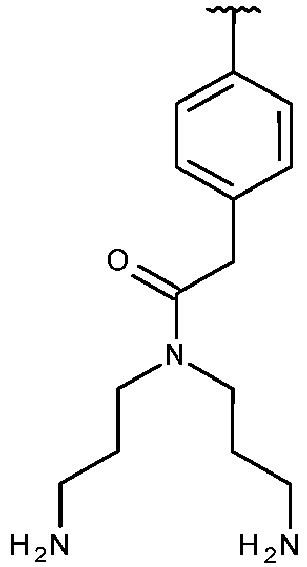

MS m/e: 702 [M+ + H] 4 12-epi-12-desvinyl-14-O-{{4-[(2,3-Diamino-propylcarbamoyl)-methyl]-phenylsulfanyl}-acetyl}-12-[(3-amino-propylamino)-methyl] mutilin tetrahydrochloride 

MS m/e: 694 [M- + Cl] The required [2-Amino-1-(tert-butoxycarbonylamino-methyl)-ethyl] -carbamic acid tert-butyl ester is e.g. described in US4933470 5 12-epi-12-desvinyl-14-O-{{4-[(2-Amino-ethylcarbamoyl)-methyl]-phenylsulfanyl}-acetyl}-12-[(2-amino-ethylamino)-methyl] mutilin trihydrochloride 
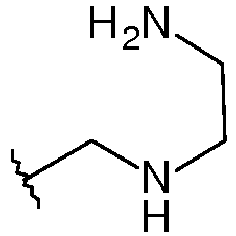
1H-NMR (200 MHz, DMSO-d6): 7.29 (d, 2H, arom., J=8 Hz), 7.22 (d, 2H, arom., J=8 Hz), 5.44 (d, 1H, H-14, J=5.6 Hz), 3.80 (s, 2H H-22), 1.36 (s, 3H, H-15), 0.82 (s, 3H, H-18), 0.80 (d, 3H, H-17, J=5.8 Hz), 0.57 (d, 3H, H-16, J=5.4 Hz) MS m/e: 617 [M+ + H]. 6 12-epi-12-desvinyl-14-O-{{4-[(3-Amino-propylcarbamoyl)-methyl]-phenylsulfanyl}-acetyl}-12-[(2-amino-ethylamino)-methyl] mutilin trihydrochloride 
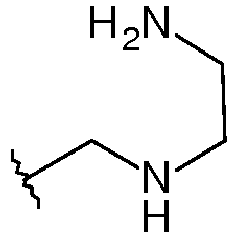
1H-NMR (200 MHz, DMSO-d6): 7.29 (d, 2H, arom., J=8 Hz), 7.21 (d, 2H, arom., J=8.2 Hz), 5.44 (d, 1H, H-14, J=5.8 Hz), 1.36 (s, 3H, H-15), 0.86 (s, 3H, H-18), 0.80 (d, 3H, H-17, J=5.4 Hz), 0.57 (d, 3H, H-16, J=5.8 Hz) MS m/e: 631 [M+ + H] 7 12-epi-12-desvinyl-14-O-{{4-[(3-Amino-propylcarbamoyl)-methyl]-phenylsulfanyl}-acetyl}-12-[(4-amino-butylamino)-methyl] mutilin trihydrochloride 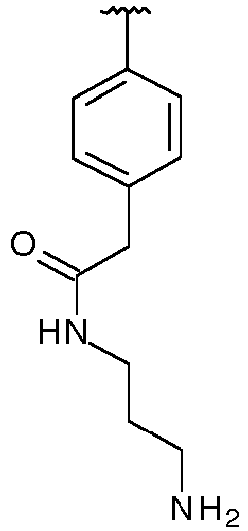

1H-NMR (200 MHz, DMSO-d6): 8.45 (t, 1H, CO-NH, J=6 Hz), 7.99 (bs, 6 H, NH3 +), 7.28 (d, 2H, arom., J=8 Hz), 7.21 (d, 2H, arom., J=8 Hz), 5.44 (d, 1H, H-14, J=6.4 Hz), 1.34 (s, 3H, H-15), 0.85 - 0.79 (m, 6H, H-17, H-18), 0.57 (d, 3H, H-16, J=5.2 Hz) MS m/e: 659 [M+ + H] 8 12-epi-12-desvinyl-14-O-{{4-[(3-Amino-propylcarbamoyl)-methyl]-phenylsulfanyl}-acetyl}-12-[(5-amino-pentylamino)-methyl] mutilin trihydrochloride 

1H-NMR (200 MHz, DMSO-d6): 8.41 (t, 1H, CO-NH, J=6 Hz), 8.0 (bs, 6 H, NH3 +), 7.29 (d, 2H, arom., J=8 Hz), 7.21 (d, 2H, arom., J=8 Hz), 5.42 (bs, 1H, H-14), 1.35 (s, 3H, H-15), 0.85 - 0.79 (m, 6H, H-17, H-18), 0.57 (d, 3H, H-16, J=5.4 Hz) MS m/e: 673 [M+ + H] 9 12-epi-12-desvinyl-14-O-{{4-[(3-Amino-propylcarbamoyl)-methyl]-phenylsulfanyl}-acetyl}-12-[(4-aminomethyl-benzylamino)-methyl] mutilin trihydrochloride 

1H-NMR (200 MHz, DMSO-d6): 7.68 (d, 2H, arom., J=8 Hz), 7.55 (d, 2H, arom., J=8.2 Hz), 7.26 (d, 2H, arom., J=8 Hz), 7.18 d, 2H, arom., J=8.2 Hz), 5.42 (d, 1H, H-14, J=7.2 Hz), 1.34 (s, 3H, H-15), 0.56 (d, 3H, H-16, J=5.6 Hz) MS m/e 707 [M+ + H] 10 12-epi-12-desvinyl-14-O-{{4-[(3-Amino-propylcarbamoyl)-methyl]-phenylsulfanyl}-acetyl}-12-[(6-amino-hexylamino)-methyl] mutilin trihydrochloride 

1H-NMR (200 MHz, DMSO-d6): 7.28 (d, 2H, arom., J=8 Hz), 7.21 (d, 2H, arom., J=8 Hz), 5.44 (d, 1H, H-14, J=7.2 Hz), 3.8 (s, 2H, H-22), 1.35 (s, 3H, H-15), 0.57 (d, 3H, H-16, J=4.6 Hz) MS m/e: 687 [M+ + H] 11 12-epi-12-desvinyl-14-O-{{4-[(3-Amino-propylcarbamoyl)-methyl]-phenylsulfanyl}-acetyl}-12-[(6-guanidino-hexylamino)-methyl] mutilin trihydrochloride 

1H-NMR (200 MHz, DMSO-d6): 7.28 (d, 2H, arom., J=8 Hz), 7.21 (d, 2H, arom., J=8 Hz), 5.44 (d, 1H, H-14, J=7 Hz), 1.35 (s, 3H, H-15), 0.85 (s, 3H, H-18), 0.80 (d, 3H, H-17, J=6.4 Hz), 0.57 (d, 3H, H-16, J=5.4 Hz) MS m/e: 730 [M+ + H] The required tert-Butyl (NE)-N-[(6-aminohexylamino)-(tert-butoxycarbonylamino)-methylene]-carbamate was prepared according to: Journal of Medicinal Chemistry, 44(18), 2950; 2001 12 12-epi-12-desvinyl-14-O-{{4-[(3-Amino-propylcarbamoyl)-methyl]-phenylsulfanyl}-acetyl}-12-[(4-guanidino-butylamino)-methyl] mutilin trihydrochloride 

1H-NMR (200 MHz, DMSO-d6): 7.32 (d, 2H, arom., J=8 Hz), 7.25 (d, 2H, arom., J=8 Hz), 5.43 (d, 1H, H-14, J=7.4 Hz), 4,44 (s, 2H, Ph-CH2), 3.87 (s, 2H H-22), 1.35 (s, 3H, H-15), 0.86 (s, 3H, H-18), 0.80 (d, 3H, H-17, J=5.8 Hz), 0.57 (d, 3H, H-16, J=5.8 Hz) MS m/e: 702 [M+ + 2H] 13 12-epi-12-desvinyl-14-O-{{4-[(3-Amino-propylcarbamoyl)-methyl]-phenylsulfanyl}-acetyl}-12-[(allylamino)-methyl] mutilin dihydrochloride 

MS m/e: 672 [M + formate] -

- 120 mg of N,N'-Dimethylbarbituric acid and 6 mg of tetrakis(triphenylphosphine) palladium (0) was placed under a positive argon stream in a three necked round bottom flask together with a stirrer. 187 mg (0.257 mmol) of 12-epi-12-desvinyl-14-O-{{4-[(3-tert-Butoxycarbonylamino-propylcarbamoyl)-methylphenylsulfanyl] }-acetyl}-12-[(allylamino)methyl] mutilin (compound of Example 13 prior to BOC-deprotection) was dissolved in 5 mL of DCM and degassed in a ultrasonic bath for 15 min and then added to the reaction flask via syringe and septum. The mixture was stirred for 6 hours under an inert atmosphere. HPLC indicated that there was still starting material left, hence 120 mg of N,N'-Dimethylbarbituric acid and 6 mg of tetrakis(triphenylphosphine) palladium (0) were added to the mixture obtained and stirring was continued overnight until the reaction was deemed complete. The mixture obtained was diluted with DCM and washed with 10% K2CO3 (2x), the combined aqueous phases were washed with DCM and the combined organic layers obtained were dried over Na2SO4 and evaporated to dryness. An orange residue was obtained which was subjected to column chromatography (EtOAc/Et3N 50:1 and EtOH). The title compound was obtained in the form of orange-red crystals.
- 100 mg of 12-epi-12-desvinyl-14-O-{{4-[(3-tert-Butoxycarbonylamino-propylcarbamoyl)-methylphenylsulfanyl] }-acetyl}-12-aminomethyl mutilin was dissolved in 0.5 mL of DCM, treated with 5 mL of IN HCl in diethyl ether and stirred at rt for 1 h. A precipitate formed and was collected with suction filtration, washed 5x with diethyl ether, dried 1 h at a rotary evaporator and purified via reverse chromatography with acetonitrile/ H2O (0-75%). The according fractions were identified by HPLC, freed from organic solvent and lyophilized overnight. The title compound was obtained in the form of colourless crystals.
MS m/e: 588 [M++H]. - According, e.g. analogously, to a method as conventional, or according, e.g. analogously to a method as set out under Example 1 above, but using appropriate starting materials, the compounds of formula IEX, wherein R1EX and R2EX are as defined in Table 2 are prepared. Chemical characterisation data are also set out in Table 2.
Table 2 Example R2EX R1EX 15 12-epi-12-desvinyl-14-O-{{4-[(3-Amino-propylcarbamoyl)-methyl]-phenylsulfanyl}-acetyl}-12-[(benzylamino)-methyl] mutilin dihydrochloride 

1H-NMR (200 MHz, DMSO-d6): 7.29 (d, 2H, arom., J=8 Hz), 7.21 (d, 2H, arom., J=8 Hz), 5.41 (d, 1H, H-14, J=7 Hz), 3.78 (s, 2H H-22), 1.34 (s, 3H, H-15), 0,86 (s, 3H, H-18), 0.80 (d, 3H, H-17, J=5.8 Hz), 0.56 (d, 3H, H-16, J=5.4 Hz) MS m/e: 678 [M+ + H] 16 12-epi-12-desvinyl-14-O-{{4-[(3-Amino-propylcarbamoyl)-methyl]-phenylsulfanyl}-acetyl}-12-[(4-guanidinomethyl-benzylamino)-methyl] mutilin trihydrochloride 

MS m/e: 750 [M+ + H] The required tert-Butyl (NE)-N-[[[4-(aminomethyl)phenyl]-methylamino]-(tert-butoxycarbonylamino)-methylene] -carbamate was prepared in analogy to: J.Med.Chem, 44(18), 2950; 2001 17 12-epi-12-desvinyl-14-O-{{4-[(3-Aminopropylcarbamoyl)-methyl]-phenylsulfanyl}-acetyl}-12-[(6-hydroxy-hexylamino)-methyl] mutilin dihydrochloride 

1H-NMR (200 MHz, DMSO-d6): 7.29 (d, 2H, arom., J=8 Hz), 7.20 (d, 2H, arom., J=8 Hz), 5.44 (d, 1H, H-14, J=7 Hz), 3.80 (s, 2H H-22), 1.35 (s, 3H, H-15), 0.85 (s, 3H, H-18), 0.80 (d, 3H, H-17, J=6.2 Hz), 0.58 (d, 3H, H-16, J=5.6 Hz) MS m/e: 688 [M+ + H] 18 12-epi-12-desvinyl-14-O-{{4-[(3-Amino-propylcarbamoyl)-methyl]-phenylsulfanyl}-acetyl}-12-[(2,3-dihydroxypropylamino)-methyl] mutilin dihydrochloride 

1H-NMR (200 MHz, DMSO-d6): 7.28 (d, 2H, arom., J=8 Hz), 7.18 (d, 2H, arom., J=8 Hz), 3.80 (s, 2H, H-22), 1.33 (s, 3H, H-15), 0.80 (d, 3H, H-17, J=5 Hz), 0.58 (d, 3H, H-16, J=5,6 Hz) MS m/e: 662 [M+ + H] (2,2-Dimethyl-[1,3]dioxolan-4-yl)-methylamine was used as intermediate for step 4 19 12-epi-12-desvinyl-14-O-{{4-[(3-Amino-propylcarbamoyl)-methyl]-phenylsulfanyl}-acetyl}-12-[(4-piperidylamino)-methyl] mutilin trihydrochloride 
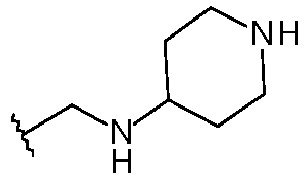
MS m/e: 671 [M+ + H] 20 12-epi-12-desvinyl-14-O-{{4-[(3-Amino-propylcarbamoyl)-methyl]-phenylsulfanyl}-acetyl}-12-[(3-morpholin-4-yl-propylamino)-methyl] mutilin trihydrochloride 

MS m/e: 715 [M+ + H] 21 12-epi-12-desvinyl-14-O-{{4-[(3-Aminopropylcarbamoyl)-methyl]-phenylsulfanyl}-acetyl}-12-[(3-dimethylamino-propylamino)-methyl] mutilin trihydrochloride 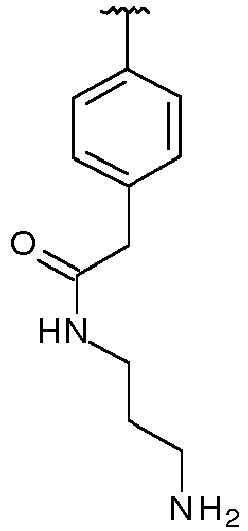

MS m/e: 673 [M+ + H] 22 12-epi-12-desvinyl-14-O-{{4-[(3-Amino-propylcarbamoyl)-methyl]-phenylsulfanyl}-acetyl}-12-[(S)-5-amino-5-ethoxycarbonyl-pentylamino-methyl] mutilin trihydrochloride 

MS m/e: 745 [M+ + H] The necessary Lysine-(N2-BOC)-ethyl ester was prepared from N2-BOC-Lysine using EtOH / 1.1 eq of sulfuric acid -
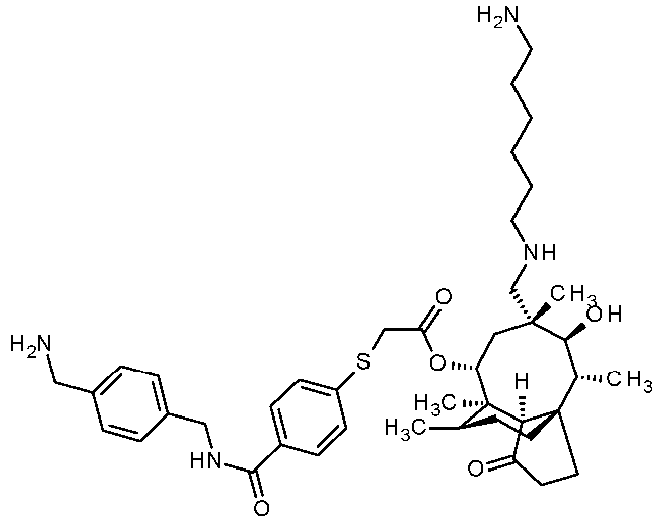
1H-NMR (200 MHz, DMSO-d6): 7.86 (d, 2H, arom., J=8 Hz), 7.44 - 7.31 (m, 6H, arom.), 5.46 (d, 1H, H-14, J=6.6 Hz), 5.36 (d, 1H, 11-OH, J=5.6 Hz), 4.44 (d, 2H, Ph-CH2-CO-, J=5.2 Hz), 3.97 (s, 2H, H-22), 1.35 (s, 3H, H-15), 0.87 (s, 3H, H-18), 0.80 (d, 3H, H-17, J=6.2 Hz), 0.59 (d, 3H, H-16, J=5.6 Hz).
MS m/e: 735 [M+ + H]. - 4.48 g of 4-acetylsulfanylbenzoic acid was dissolved in 50 mL of DCM, treated with 5.8 mL of oxalyl chloride and one drop of DMF and the mixture obtained was stirred at rt for 90 min. The volatiles were distilled off in vacuo leaving the title compound as residue.
- 820 mg of tert-butyl N-[[4-(aminomethyl)-phenyl]-methyl]-carbamate and 421 mg of TEA was dissolved in 10 mL of DCM, cooled in an ice bath and 725 mg of thioacetic acid S-(4-chlorocarbonyl-phenyl) ester, dissolved in 5 mL of DCM, was slowly added. The mixture obtained was stirred for 30 min at rt, the phases were separated, the organic phase obtained was washed successively with 2N HCl and 5% aqueous NaHCO3 solution, dried over Na2SO4 and evaporated to dryness. The title compound was obtained in the form of pale brown crystals.
- According, e.g. analogously, to a method as conventional, or according, e.g. analogously to a method as set out under Examples 1 and 23 above, but using appropriate starting materials, the compounds of formula IEX, wherein R1EX and R2EX are as defined in Table 3 are prepared. Chemical characterisation data are also set out in Table 3.
Table 3 Example R2EX R2EX 24 12-epi-12-desvinyl-14-O-{[4-(4-Aminomethylbenzylcarbamoyl)-phenylsulfanyl]-acetyl}-12-[(6-guanidino-hexylamino)-methyl] mutilin trihydrochloride 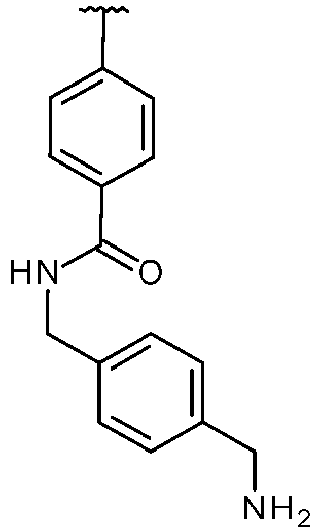

1H-NMR (200 MHz, DMSO-d6): 9.23 (t, 1H, NH, J=5.2 Hz), 7.86 (d, 2H, arom., J=8 Hz), 7.44 - 7.24 (m, 6H, arom.), 5.46 (d, 1H, H-14, J=6.8 Hz), 1.36 (s, 3H, H-15), 0.86 (s, 3H, H-18), 0.78 (d, 3H, H-17, J=6 Hz), 0.58 (d, 3H, H-16, J=5 Hz) MS m/e: 777 [M+ + H] 25 12-epi-12-desvinyl-14-O-{[(4-Piperazinylcarbamoyl)-phenylsulfanyl]-acetyl}-12-[(6-guanidino-hexylamino)-methyl] mutilin trihydrochloride 

MS m/e: 727 [M+ + H] 26 12-epi-12-desvinyl-14-O-{[4-(4-Aminomethyl-piperidine-1-carbonyl)-phenylsulfanyl]-acetyl}-12-[(6-guanidino-hexylamino)-methyl] mutilin trihydrochloride 

1H-NMR (200 MHz, DMSO-d6): 7.40 (d, 2H, arom., J=8 Hz), 7.38 (d, 2H, arom., J=8 Hz), 5.45 (d, 1H, H-14, J=7 Hz), 3.93 (s, 2H, H-22), 1.34 (s, 3H, H-15), 0.86 (s, 3H, H-18), 0.80 (d, 3H, H-17, J=6,4 Hz), 0.55 (d, 3H, H-16, J=5,6 Hz) MS m/e: 755 [M+ + H] 27 12-epi-12-desvinyl-14-O-{(4-[(Piperidin-4-ylmethyl)-carbamoyl]-phenylsulfanyl)-acetyl}-12-[(6-guanidino-hexylamino)-methyl] mutilin trihydrochloride 

1H-NMR (200 MHz, DMSO-d6): 7.82 (d, 2H, arom., J=8 Hz), 7.38 (d, 2H, arom., J=8 Hz), 4.95 (d, 1H, H-14, J=6.6 Hz), 5.37 (d, 1H, 11-OH, J=5.4 Hz), 1.35 (s, 3H, H-15), 0.87 (s, 3H, H-18), 0.80 (d, 3H, H-17, J=5.8 Hz), 0.58 (d, 3H, H-16, J=5.5 Hz) MS m/e: 755 [M+ + H] 28 12-epi-12-desvinyl-14-O-{(4-[(Pyridin-4-ylmethyl)-carbamoyl]-phenylsulfanyl)-acetyl}-12-[(6-amino-hexylamino)-methyl] mutilin trihydrochloride 

1H-NMR (200 MHz, DMSO-d6): 9.53 (bs, 1H, -CO-NH), 7.99 - 7.89 (m, 6H, arom.), 7.42 (d, 1H, arom., J=8 Hz), 5.47 (d, 1H, H-14, J=6.8 Hz), 3.98 (s, 2H, H-22), 1.36 (s, 3H, H-15), 0.90 (s, 3H, H-18), 0.80 (d, 3H, H-17, J=6 Hz), 0.59 (d, 3H, H-16, J=5.2 Hz) MS m/e: 707 [M+ + H] 29 12-epi-12-desvinyl-14-O-{[3-(3-Aminopropylcarbamoyl)-phenylsulfanyl]-acetyl}-12-[(6-guanidino-hexylamino)-methyl] mutilin trihydrochloride 

1H-NMR (200 MHz, DMSO-d6): 7.70 (d, 1H, arom., J=8 Hz), 7.50 - 7,37 (m, 3H, arom.), 5.45 (d, 1H, H-14, J=6.8 Hz), 5.34 (bs, 1H, 11-OH), 3.93 (s, 2H, H-22), 3.72 (bs, 1H, H-11), 1.33 (s, 3H, H-15), 0.86 (s, 3H, H-18), 0.80 (d, 3H, H-17, J=6.2 Hz), 0.56 (d, 3H, H-16, J=5.4 Hz) MS m/e: 715 [M+ + H] 30 12-epi-12-desvinyl-14-O-{[4-(3-Acetylamino-propylcarbamoyl)-phenylsulfanyl]-acetyl}-12-[(3-amino-propylamino)-methyl] mutilin dihydrochloride 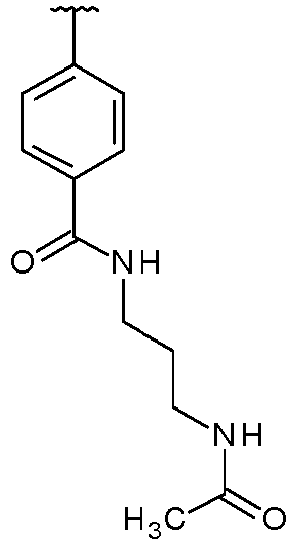

1H-NMR (200 MHz, DMSO-d6): 7.81 (d, 2H, arom., J=8 Hz), 7.39 (d, 2H, arom., J=8 Hz), 5.47 (d, 1H, H-14, J=8 Hz), 5.34 (bs, 1H, 11-OH), 3.96 (s, 2H, H-22), 1.36 (s, 3H, H-15), 0.89 (s, 3H, H-18), 0.81 (d, 3H, H-17, J=5.8 Hz), 0.59 (d, 3H, H-16, J=5.8 Hz) MS m/e: 673 [M+ + H] 31 12-epi-12-desvinyl-14-O-{[4-(3-Formylamino-propylcarbamoyl)-phenylsulfanyl]-acetyl}-12-[(3-amino-propylamino)-methyl] mutilin dihydrochloride 

1H-NMR (200 MHz, DMSO-d6): 8.82 (bs, 1H, -CO-NH), 7.81 (d, 2H, arom., J=8 Hz), 7.38 (d, 2H, arom., J=8 Hz), 5.46 (d, H, H-14, J=6.8 Hz), 5.36 (bs, 1H, 11-OH), 3.96 (s, 2H, H-22), 1.36 (s, 3H, H-15), 0.88 (s, 3H, H-18), 0.82 (bs, 3H, H-17), 0.59 (d, 3H, H-16, J=5.4 Hz). MS m/e: 659 [M+ + H] 32 12-epi-12-desvinyl-14-O-{[4-(3-Amino-propylcarbamoyl)-phenylsulfanyl]-acetyl}-12-[(3-amino-propylamino)-methyl] mutilin trihydrochloride 

1H-NMR (200 MHz, DMSO-d6): 7.85 (d, 2H, arom., J=8 Hz), 7.39 (d, 2H, arom., J=8 Hz), 5.46 (d, 1H, H-14, H=6 Hz), 1.36 (s, 3H, H-15), 0.88 (s, 3H, H-18), 0.81 (d, 3H, H-17, J=6 Hz), 0.59 (d, 3H, H-16, J=5.6 Hz) MS m/e: 665 [M- + Cl] 33 12-epi-12-desvinyl-14-O-{(4-[(3-Aminopropylcarbamoyl)-phenylsulfanyl)-acetyl}-12-[(4-aminomethyl-benzylamino)-methyl] mutilin trihydrochloride 

1H-NMR (200 MHz, DMSO-d6): 7.84 (d, 2H, arom., J=8 Hz), 7.68 (d, 2H, arom., J=6 Hz), 7.55 (d, 2 H, arom., J=10 Hz), 7.37 (d, 2H, arom., J=8 Hz), 5.43 (d, 1H, H-14, J=7 Hz), 5.31 (bs, 1H, 11-OH), 1.34 (s, 3H, H-15), 0.83 - 0.77 (m, 6H, H-17, H-18), 0.57 (d, 3H, H-16, J=5.4 Hz). MS m/e: 693 [M+ + H] 34 12-epi-12-desvinyl-14-O-{(4-[(3-Aminopropylcarbamoyl)-phenylsulfanyl)-acetyl}-12-[(6-amino-hexylamino)-methyl] mutilin trihydrochloride 

1H-NMR (200 MHz, DMSO-d6): 7.84 (d, 2H, arom., J=8 Hz), 7.38 (d, 2H, arom., J=8 Hz), 5.46 (d, 1H, H-14, J=6 Hz), 5.35 (bs, 1H, 11-OH), 1.35 (s, 3H, H-15), 0.88 (s, 3H, H-18), 0.80 (d, 3H, H-17, J=5.4 Hz), 0.58 (d, 3H, H-16, J=5.4 Hz). MS m/e: 673 [M+ + H] 35 12-epi-12-desvinyl-14-O-{[4-(3-Aminopropylcarbamoyl)-phenylsulfanyl]-acetyl}-12-[(6-guanidino-hexylamino)-methyl] mutilin trihydrochloride 

1H-NMR (200 MHz, DMSO-d6): 8.81 (t, 1H, CO-NH, J=5.4 Hz), 7.84 (d, 2H, arom., J=8 Hz), 7.38 (d, 2H, arom., J=8 Hz), 5.46 (d, 1H, H-14, J=6.8 Hz), 3.96 (s, 2H, H-22), 1.35 (s, 3H, H-15), 0.88 (s, 3H, H-18), 0.80 (d, 3H, H-17, J=5.8 Hz), 0.58 (d, 3H, H-16, J=5.6 Hz) MS m/e: 715 [M+ + H] 36 12-epi-12-desvinyl-14-O-{[4-(3-Aminopropylcarbamoyl)-phenylsulfanyl]-acetyl}-12-[(8-amino-octylamino)-methyl] mutilin trihydrochloride 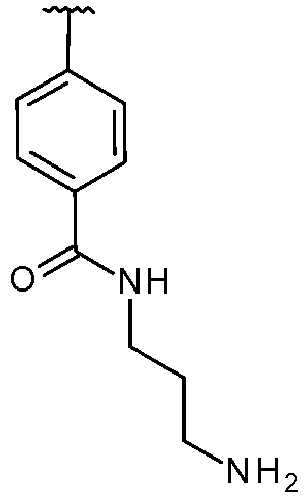

1H-NMR (200 MHz, DMSO-d6): 7.84 (d, 2H, arom., J=8 Hz), 7.38 (d, 2H, arom., J=8 Hz), 5.45 (d, 1H, H-14, J=6.6 Hz), 3.96 (s, 2H, H-22), 1.35 (s, 3H, H-15), 0.87 (s, 3H, H-18), 0.79 (d, 3H, H-17, J=5 Hz), 0.58 (d, 3H, H-16, J=5 Hz). MS m/e: 701 [M+ + H] The reductive amination was done as described in Example 1, step 4 using 10 eq of 1,8-diaminooctane 37 12-epi-12-desvinyl-14-O-{[4-(3-Aminopropylcarbamoyl)-phenylsulfanyl]-acetyl}-12-[(10-amino-decylamino)-methyl] mutilin trihydrochloride 

1H-NMR (200 MHz, DMSO-d6): 7.84 (d, 2H, arom., J=8 Hz), 7.38 (d, 2H, arom., J=8 Hz), 5.45 (d, 1H, H-14, J=7 Hz), 3.96 (s, 2H, H-22), 1.35 (s, 3H, H-15), 0.87 (s, 3H, H-18), 0.79 (d, 3H, H-17, J=5 Hz), 0.58 (d, 3H, H-16, J=5 Hz). MS m/e: 729 [M+ + H] The reductive amination was done as described in Example 1, step 4 using 10 eq of 1,10-diaminodecane 38 12-epi-12-desvinyl-14-O-{(4-Carbamoyl-phenylsulfanyl)-acetyl}-12-[(6-guanidino-hexylamino)-methyl] mutilin dihydrochloride 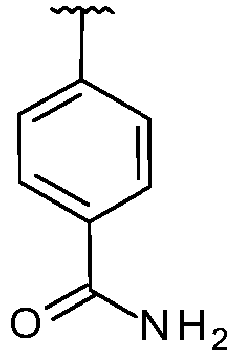
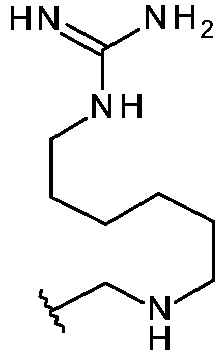
1H-NMR (200 MHz, DMSO-d6): 7.82 (d, 2H, arom., J=8 Hz), 7.37 (d, 2H, arom., J=8 Hz), 5.44 (d, 1H, H-14, J=7 Hz), 3.96 (s, 2H, H-22), 1.35 (s, 3H, H-15), 0.87 (s, 3H, H-18), 0.80 (d, 3H, H-17, J=6 Hz), 0.58 (d, 3H, H-16, J=5.6 Hz). MS m/e: 658 [M+ + H] The required 4-mercapto-benzamide is e.g. described in: WO 2003/062235 39 12-epi-12-desvinyl-14-O-{[4-(3-Amino-propylcarbamoyl)-phenylsulfanyl]-acetyl}-12-{[3-(3-amino-propoxy)-propylamino)]-methyl} mutilin trihydrochloride 

1H-NMR (200 MHz, DMSO-d6): 7.83 (d, 2H, arom., J=8 Hz), 7.38 (d, 2H, arom., J=8 Hz), 5.44 (bs, 2H, H-14, 11-OH), 3.96 (s, 2H, H-22), 1.35 (s, 3H, H-15), 0.91 (s, 3H, H-18), 0.80 (d, 3H, H-17, J=6 Hz), 0.58 (d, 3H, H-16, J=5.4 Hz); MS m/e: 689 [M+ + H] 40 12-epi-12-desvinyl-14-O-{[4-(3-Amino-propylcarbamoyl)-phenylsulfanyl]-acetyl}-12[(2-pyridin-4-yl-ethylamino)-methyl] mutilin trihydrochloride 

MS m/e: 679 [M+ + H] 41 12-epi-12-desvinyl-14-O-{[4-(6-Amino-hexylcarbamoyl)-phenylsulfanyl]-acetyl}-12-[(6-guanidino-hexylamino)-methyl] mutilin trihydrochloride 

1H-NMR (200 MHz, DMSO-d6): 7.76 (d, 2H, arom., J=8 Hz), 7.38 (d, 2H, arom., J=8 Hz), 5.45 (d, 1H, H-14, J=7.6 Hz), 3.95 (s, 2H, H-22), 1.34 (s, 3H, H-15), 0.87 (s, 3H, H-18), 0.81 (d, 3H, H-17, J=5.8 Hz), 0.58 (d, 3H, H-16, J=5.6 Hz). MS m/e: 757 [M+ + H] 42 12-epi-12-desvinyl-14-O-{[4-(2-Amino-ethylcarbamoyl)-phenylsulfanyl]-acetyl}-12-[(6-guanidino-hexylamino)-methyl] mutilin trihydrochloride 

1H-NMR (200 MHz, DMSO-d6): 7.79 (d, 2H, arom., J=8 Hz), 7.40 (d, 2H, arom., J=8 Hz), 5.46 (d, 1H, H-14, J=7.2 Hz), 3.96 (s, 2H, H-22), 1.34 (s, 3H, H-15), 0.94 (s, 3H, H-18), 0.81 (d, 3H, H-17, J=6.4 Hz), 0.58 (d, 3H, H-16, J=5.6 Hz). MS m/e: 701 [M+ + H] 43 12-epi-12-desvinyl-14-O-{[4-(3-Aminopropylcarbamoyl)-phenylsulfanyl]-acetyl}-12-{[3-(4-aminomethyl-phenyl)-propylamino]-methyl} mutilin trihydrochloride 

MS m/e: 721 [M+ + H] The required [4-(3-Amino-propyl)-benzyl]-carbamic acid tert-butyl ester is described in: Bioorganic & Medicinal Chemistry Letters, 16(11), 2986-2990; 2006 - According, e.g. analogously, to the method as set out under Example 100 below, but using appropriate starting materials, the compounds of formula IEX, wherein R1EX and R2EX are as defined in Table 4 are prepared. Chemical characterisation data are also set out in Table 4.
Table 4 Example R2EX R1EX 44 12-epi-12-desvinyl-14-O-{[(4-Aminomethyl-cyclohexyl)-methylsulfanyl]-acetyl}-12-[(6-aminohexylamino)-methyl] mutilin trihydrochloride 

1H-NMR (200 MHz, DMSO-d6): 5.46 (d, 1H, H-14, J=6.6 Hz), 5.39 (bs, 1H, 11-OH), 1.39 (s, 3H, H-15), 0.96 (s, 3H, H-18), 0.81 (d, 3H, H-17, J=5.8 Hz), 0,64 (d, 3H, H-16, J=5.2 Hz) MS m/e: 622 [M+ + H] 45 12-epi-14-O-[(1-Methyl-piperidin-4-ylsulfanyl)-acetyl}-12-[(6-guanidino-hexylamino)-methyl] mutilin trihydrochloride 

MS m/e: 638 [M + NH4 +] The required 1-Methyl-piperidine-4-thiol is described in: J.Med.Chem., 36(22), 3251-64; 1993 46 12-epi-14-O-[(Piperidin-4-ylsulfanyl)-acetyl]-12-[(6-amino-hexylamino)-methyl] mutilin trihydrochloride 

1H-NMR (200 MHz, DMSO-d6): 5.48 (d, 1H, H-14, J=6.2 Hz), 5.35 (bs, 1H, 11-OH), 1.41 (s, 3H, H-15), 0.99 (s, 3H, H-18), 0.83 (d, 3H, H-17, J=6 Hz), 0.65 (d, 3H, H-16, J=5 Hz) MS m/e: 580 [M+ + H] -

1H-NMR (200 MHz, DMSO-d6): 5.47 (d, 1H, H-14, J=7.8 Hz), 1.40 (s, 3H, H-15), 0.98 (s, 3H, H-18), 0.82 (d, 3H, H-17, J=5.8 Hz), 0.64 (d, 3H, H-16, J=5 Hz)
MS m/e: 608 [M+ + H] - To a solution of 71 g of (4-Hydroxy-cyclohexylmethyl)-carbamic acid tert-butyl ester and 93.9 g of TEA in 1500 mL of DCM was added dropwise 34.1 g of MsCl at 0°C over 30 min. After addition, the mixture was allowed to warm to rt and stirred at this temperature for 2.5 h. The reaction mixture was quenched by addition of water, the resulting mixture was extracted 3x with DCM. The combined organic layers were washed 3x with 0.5 M citric acid, 2x with a saturated solution of NaHCO3, water and dried over Na2SO4. After filtration, the filtrate was concentrated under reduced pressure to afford the title compound as yellow oil, and the crude product was used directly for the next step.
- A suspension of 52 g of methanesulfonic acid 4-(tert-butoxycarbonylamino-methyl)-cyclohexyl ester and 48.3 g of potassium thioacetate in 1 L of dry DMF was heated to 50°C under N2 and stirred for 16 h. TLC showed the reaction was completed. The reaction mixture was cooled to 25°C and poured into ice-water, the resulting mixture was extracted 5x with MTBE. The combined organic layers were washed 3x with citric acid, 2x with saturated solution of NaHCO3, 2x with brine and dried over Na2SO4. After filtration, the filtrate was concentrated under reduce pressure to afford the crude product as red oil. The crude product was purified by silica gel chromatography (PE/EtOAc = 40:1 to 15:1) to afford the title compound as red solid.
-

- The compound was prepared in analogy to compound 1, step 5 using 2,2,2-Trifluoro-N-[3-(4-mercaptophenyl)-propyl]-acetamide as intermediate.
-

- The compound was prepared in analogy to compound 1, step 6.
-

- 246 mg of 12-epi-12-desvinyl-14-O-{{4-[3-(2,2,2-Trifluoro-acetylamino)-propyl]-phenylsulfanyl } - acetyl}-12-[(6-amino-hexylamino)-methyl] mutilin was dissolved in 10 mL of MeOH/H2O under ice-cooling and 0.51 mL of IN NaOH was added. The reaction was stirred for 1h under ice-cooling, poured into water and extracted with 3x with EtOAc. The organic phase was washed with brine, dried over Na2SO4 and evaporated to dryness. The resulting colorless foam was purified by reversed phase chromatography (eluant: acetonitrile in IN HCl 0-35%) yielding the title compound. 1H-NMR (200 MHz, DMSO-d6): 7.,58 (d, 2H, arom., J=5.6 Hz), 7.49 (d, 2H, arom., J=14 Hz), 4.43 (d, 1H, H-14, J=6.6 Hz), 1.34 (s, 3H, H-15), 0.84 (s, 3H, H-18), 0.79 (d, 3H, H-17, J=5.4 Hz), 0.54 (d, 3H, H-16, J=5.6 Hz)
MS m/e: 630 [M+ + H] - To a solution of 50 g of benzenepropanamine in 600 mL of MeOH was added dropwise 300 mL of CF3COOEt over a period of 0.5 h at 0°C. After stirring at 20°C for 16 h, the solvent was removed under reduced pressure. The crude product was washed with PE to give the title compound as white solid.
- To a solution of 32 g of 2,2,2-Trifluoro-N-(3-phenyl-propyl)-acetamide in 32 mL of DCM was added dropwise 200 mL of ClSO3H below -10°C. Then the reaction mixture was warmed to 15°C and stirred for 20 h. The reaction mixture was poured into ice water at 0∼5 °C and extracted 2x with DCM . The organic phase was washed with brine, dried over Na2SO4 and concentrated to give the crude product which was purified by silica gel chromatography (PE/EtOAc = 10:1) to afford the title compound as yellow solid.
- To a solution of 100 mL of H2SO4 in 600 mL of water was added slowly at 0°C 102 g of Zinc dust and a solution of 49 g of 4-[3-(2,2,2-Trifluoro-acetylamino)-propyl]-benzenesulfonyl chloride in 50 mL of THF. Then the reaction mixture was heated to 60°C and stirred for 4 h after which it was cooled and poured into DCM. The mixture was filtered and separated. The organic phase was washed with brine, dried over Na2SO4 and concentrated to give the crude product which was washed with PE/EtOAc = 40:1 to afford the title compound as white solid.
-

MS m/e: 687 [M+ + H] - 500 mg of 12-epi-12-desvinyl-14-O-{([4-(3-tert-Butoxycarbonylamino-propylcarbamoyl)-methyl] -phenylsulfanyl)-acetyl} -12- [(3-tert-butoxycarbonylamino-propylamino)-methyl] mutilin (Example 1, step 5) was dissolved in 7 mL of DCM. To the mixture obtained 134 µl of diisopropylethylamine was added and the mixture obtained was cooled in an ice bath, treated with 61.5 µl of of acetic anhydride in 1 mL of DCM and stirring at rt was maintained for 1 h. To the mixture obtained 12 µl of base and 6 µl of acetic anhydride was added and stirring was continued for 30 min and the reaction was deemed to be complete. The mixture obtained was washed with 5% NaHCO3, the aqueous phase was back-extracted with DCM, the combined organic phases obtained were washed with water and brine, dried over Na2SO4 and evaporated to dryness to yield the title compound.
-

- 2.5 g of 12-epi-12-desvinyl-14-O-[(toluene-4-sulfonyloxy)-acetyl]- 12-formyl mutilin (Example 1, step 3) was dissolved in 50 mL of DMF, 14.4 g of oxone was added and the resulting slurry was stirred at rt for 4 d. The mixture obtained was diluted with 300 mL of water, 50 mL 2N HCl was added and the mixture obtained was extracted with EtOAc (2x). The phases obtained were separated and the combined organic phases were washed with water, dried over Na2SO4, brought to dryness (semisolid residue) and subjected to column chromatography (eluent: EtOAc/toluene = 2:1). The title compound was obtained in the form of colourless crystals.
1H-NMR (200 MHz, DMSO-d6): 7.79 (d, 2H, arom., J=8 Hz), 7.44 (d, 2H, arom., J=8 Hz), 5.41 (d, 1H, H-14, J=7.2 Hz), 4.70 AB-system (2H, H-22, vA=4.78, vB=4.70, J=16 Hz), 2.4 (s, 3H, tosyl-CH3), 1.30 (s, 3H, H-15), 1.08 (s, 3H, H-18), 0.80 (d, 3H, H-17, J=5 Hz), 0.52 (d, 3H, H-16, J=5.6 Hz). -

- 500 mg of pleuromutilintosylate-12-epi-12-desvinyl-12-carboxylic acid, 158 mg of N-BOC-1,3-diaminopropane, 139 mg of HOBt and 174 mg of N-(3-dimethylaminopropyl)-N'-ethylcarbodiimide hydrochloride was dissolved in 10 mL of DCM and the mixture obtained was stirred at rt for 2 h. From the mixture obtained the phases were separated and the organic phase obtained was washed successively with 10% aqueous K2CO3, (2x), IN HCl (1x) and 5% aqueous NaHCO3 solution (1x), dried over Na2SO4, evaporated to dryness and the evaporation residue obtained was subjected to chromatography over silica gel with toluene/EtOAc = 2:1, 1:1, 1:2, 1:5 and EtOAc. The title compound was obtained in the form of a colourless foam.
MS m/e: 729 [M + Na] -
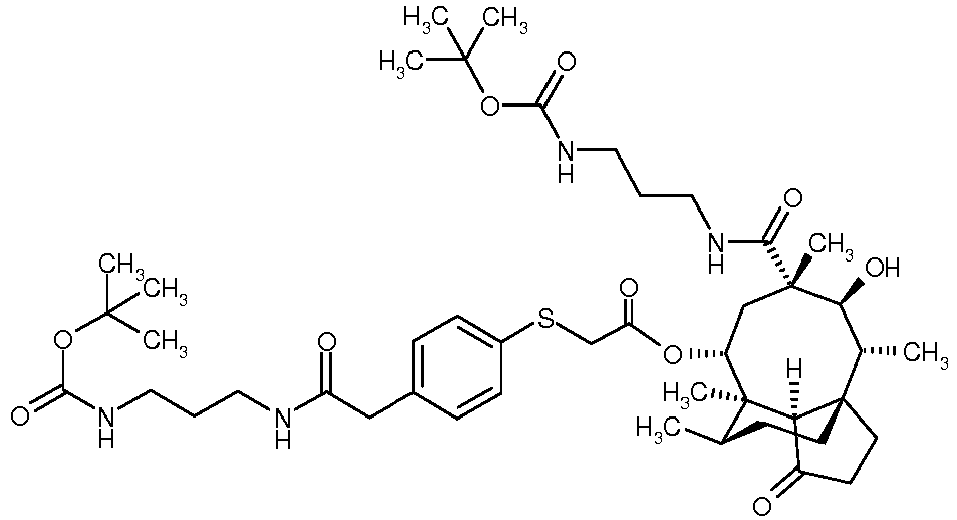
- 314 mg of S-{4-[(3-tert-butoxycarbonylamino-propylcarbamoyl)-methyl]-phenyl} thioacetic acid ester was dissolved in 10 mL of MeOH/H2O 4:1, 229 µl of 5 M aqueous K2CO3 solution was added and after 5 minutes 404 mg of 12-epi-12-desvinyl-14-O-[(Toluene-4-sulfonyloxy)-acetyl]-12-(3-tert-butoxycarbonylamino-propylcarbamoyl) mutilin. The mixture obtained was stirred for 15 min, diluted with 75 mL of water and extracted with EtOAc (2x). The combined organic layers obtained were washed with 2N NaOH (2x), IN HCl and 5% NaHCO3, dried over Na2SO4 and evaporated to dryness. Pale yellow crystals were obtained which were subjected to chromatography (eluent: EtOAc/toluene = 2:1). The title compound was obtained in the form of colourless crystals.
MS m/e: 859 [M++H]. -
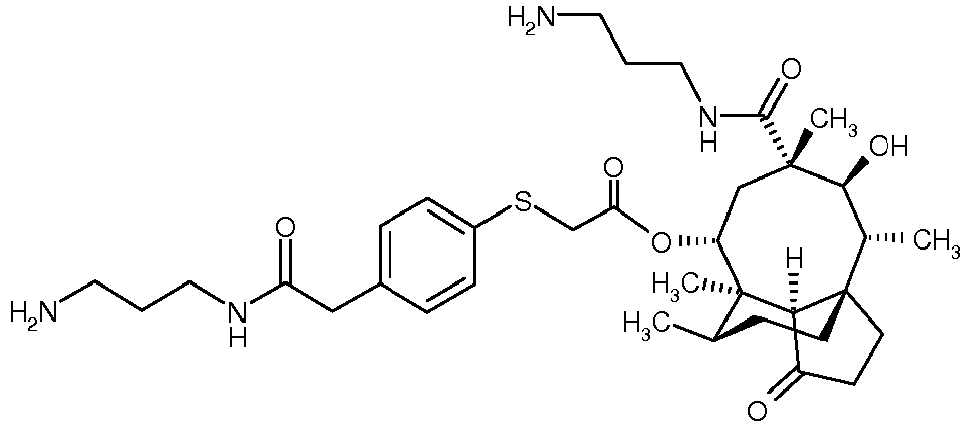
- BOC-deprotection was carried out as described in Example 1, Step 6. 1H-NMR (200 MHz, DMSO-d6): 8.38 (t, 1H, CO-NH, J=4 Hz), 7.25 (d, 2H, arom., J=8 Hz), 7.17 (d, 2H, arom., J=8 Hz), 5.39 (d, 1H, H-14, J=7.4 Hz), 1.31 (s, 3H, H-15), 1.04 (s, 3H, H-18), 0.79 (d, 3H, H-17, J=6 Hz), 0.57 (d, 3H, H-16, J=5.8 Hz);
MS m/e: 659 [M+ + H]. - According, e.g. analogously, to the method as set out under Example 50 above, but using appropriate starting materials, the compound of formula IEX, wherein R1EX and R2EX are as defined in Table 5 is prepared. Chemical characterisation data are also set out in Table 5.
Table 5 Example R2EX R1EX 51 12-epi-12-desvinyl-14-O-{[4-(3-Amino-propylcarbamoyl)-phenylsulfanyl]-acetyl}-12-(4-aminomethyl-benzylcarbamoyl) mutilin dihydrochloride 

1H-NMR (200 MHz, DMSO-d6): 8.74 (t, 1H, Ph-CO-NH, J=6 Hz), 8.17 (bs, 1H, -CO-NH), 7.79 (d, 2H, arom., J=8 Hz), 7.41 - 7.35 (m, 4H, arom.), 7.26 (d, 2H, arom., J=8 Hz), 5.44 (d, 1H, H-14, J=6.8 Hz), 4.62 (d, 1H, 11-OH, J=6.8 Hz), 4.40 - 4.04 (m, 2H, Ph-CH2), 1.31 (s, 3H, H-15), 1.12 (s, 3H, H-18), 0.81 (d, 3H, H-17, J=6 Hz), 0.59 (d, 3H, H-16, J=5.2 Hz) MS m/e: 707 [M+ + H] -

- 59.1 g of 12-epi-Pleuromutilintosylate was dissolved / suspended in 1 L of MeOH, 66.8 mL of trimethylorthoformate was added and the mixture obtained was cooled in an icebath. 13.15 mL of H2SO4 conc. was added while keeping the temperature below 10°C. The mixture obtained was stirred for further 30 min at this temperature, the ice bath was removed and the mixture obtained was stirred for a further 120 h. 21.5 g of solid NaHCO3 was added followed by addition of water until there was no more gas evolution. A precipitate formed and was filtered off, washed with water and the mother liquors obtained were extracted with DCM. The precipitate and the extracts were combined and dried.
The synthesis of 4-epi-3-methoxy-pleuromutilin is e.g. disclosed in: Tetrahedron, 36, 1807 (1980). -

- 1.5 g of 4-epi-12-epi-3-deoxo-11-deoxy-3-methoxy-11-oxo-14-O-[(toluene-4-sulfonyloxy)-acetyl] mutilin was dissolved in 15 mL of dry THF and 10.8 mL of 0.5 M 9-Borabicyclo[3.3.1]nonane was added at rt. The resulting mixture was refluxed for 5 min, cooled to rt over 30 min and, eventually in an ice bath; 600 µl of 35% H2O2 and 600 µl of 3N NaOH was added. The mixture obtained was allowed to warm to rt over 30 min and the resulting slurry was partitioned between water and EtOAc. The phases were separated, the organic phase obtained was washed with water, dried over Na2SO4, evaporated to dryness and the evaporation residue was subjected to chromatography (eluent: toluene/acetone = 10:1). The title compound in the form of a colourless solid was obtained.
1H-NMR (200 MHz, DMSO-d6): 7.83 (d, 2H, arom., J=8 Hz), 7.48 (d, 2H, arom., J=8 Hz), 4.76, AB-system (2H, H-22, vA=4.80, vB=4.71, J=16 Hz), 4.40 - 4,35 (m, -OH), 2.41 (s, 3H, tosyl-CH3), 1.18 (s, 3H, H-15), 1.08 (s, 3H, H-18), 0.88 (d, 3H, H-17, J=6 Hz), 0.63 (d, 3H, H-16, J=6.2 Hz). -

- 430 mg of S-{4-[(3-tert-butoxycarbonylamino-propylcarbamoyl)-methyl]-phenyl} thioacetic acid ester was dissolved in 10 mL of MeOH, 470 µl of 5 M aqueous K2CO3 solution was added and stirring was maintained for 10 min. To the mixture obtained 663 mg 4-epi-12-epi-3-deoxo-11-deoxy-12-desvinyl-12-(2-hydroxy-ethyl)-3-methoxy-11-oxo-14-O-[(toluene-4-sulfonyloxy)-acetyl] mutilin in 2 mL of MeOH was added and the resulting yellow mixture was stirred for 2 h. From the mixture obtained solvent was evaporated and the evaporation residue was partitioned between EtOAc and brine. The phases were separated, the organic phase obtained was dried over Na2SO4 and evaporated to dryness. The title compound was obtained in the form of a yellow foam.
1H-NMR (200 MHz, DMSO-d6): 8.06 - 8.02 (m, 1H, -CO-NH-), 7.29 (d, 2H, arom., J=8 Hz), 7.18 (d, 2H, arom., J=8 Hz), 5.63 (d, 1H, H-14, J=10 Hz), 4.39 - 4.35 (m, 1H, -OH), 3.84 (bs, 2H, H-22), 1.10 (s, 3H, H-18), 0.87 (d, 3H, H-17, J=5.8 Hz), 0.67 (d, 3H, H-16, J=6.4 Hz). -

- 200 mg of -4-epi-12-epi-14-O-{{4-[(3-tert-butoxycarbonylamino-propylcarbamoyl)-methyl]-phenylsulfanyl}-acetyl}-3-deoxo-11-deoxy-12-desvinyl-12-(2-hydroxy-ethyl)-3-methoxy-11-oxo mutilin was dissolved in 10 mL of DCM with stirring, 118 mg Dess-Martin-periodinane was added and stirring was maintained overnight. From the mixture obtained the phases were separated, the organic phase was washed with 5% aqueous NaHCO3 solution, dried over Na2SO4 and brought to dryness. The title compound in the form of colourless foamy crystals was obtained which was used without purification for the next step.
-

- 200 mg of 4-epi-12-epi-14-O-{{4-[(3-tert-butoxycarbonylamino-propylcarbamoyl)-methyl]-phenylsulfanyl}-acetyl}-3-deoxo-11-deoxy-12-desvinyl-3-methoxy-11-oxo-12-(2-oxo-ethyl) mutilin and 50 mg of N-BOC-1,3-diaminopropane were dissolved in 5 mL of DCM, 0.5 g of molecular sieves was added and stirring was maintained for 3 h. To the mixture obtained 150 mg of sodium triacetoxyborohydride was added and stirring was continued overnight. From the mixture obtained the phases were separated, the organic phase obtained was diluted with DCM, washed with 5% aqueous NaHCO3 solution, dried over Na2SO4 and evaporated to dryness. The title compound was obtained in the form of colourless crystals which were used without purification for the next step. MS m/e: 874 [M++H].
-
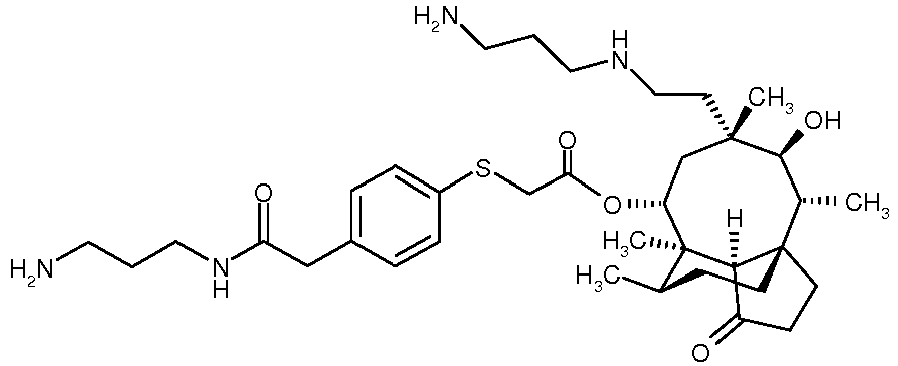
- BOC-deprotection of the product obtained in step 5, which resulted also in methyl ether cleavage and retro hydride shift as described in Tetrahedron, 36, 1807 (1980), was carried out as described in Example 1, Step 6.
1H-NMR (200 MHz, DMSO-d6): 7.28(d, 2H, arom., J=8 Hz), 7.23 (d, 2H, arom., J=8 Hz), 5.44 (d, 1H, H-14, J=7 Hz), 4.71 (d, 1H, 11-OH, J=4.4 Hz), 1.33 (s, 3H, H-15), 0.78 (bs, 6H, H-17, H-18), 0.58 (d, 3H, H-16, J=5.8 Hz); MS m/e: 659 [M+ + H]. - According, e.g. analogously, to a method as set out under Example 1, but using appropriate starting materials, the compounds of formula IEX, wherein R1EX and R2EX are as defined in Table 6 are prepared. Chemical characterisation data are also set out in Table 6.
Table 6 Example R2EX R1EX 53 12-epi-12-desvinyl-14-O-[(3-Hydroxymethyl-phenylsulfanyl)-acetyl]-12-[(3-amino-propylamino)-methyl] mutilin dihydrochloride 

1H-NMR (200 MHz, DMSO-d6): 7.31 - 7.12 (m, 4 H, arom.), 5.45 (d, 1H, H-14, J=6.6 Hz), 4.45 (s, 2H, Ph-CH2), 3.82 (s, 2H, H-22), 1.36 (s, 3H, H-15), 0.88 (s, 3H, H-18), 0.81 (d, 2H, H-17, J=5.6 Hz), 0.58 (d, 3H, H-16, J=4.8 Hz) MS m/e: 561 [M+ + H] 54 12-epi-12-desvinyl-14-O-[(3-Hydroxymethyl-phenylsulfanyl)-acetyl]-12-[(6-amino-hexylamino)-methyl] mutilin dihydrochloride 
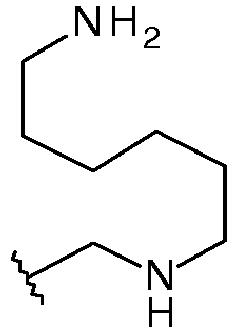
1H-NMR (200 MHz, DMSO-d6): 7.31 - 7.11 (m, 4 H, arom.), 5.44 (d, 1H, H-14, J=7.8 Hz), 4.45 (s, 2H, Ph-CH2), 3.82 (s, 2H, H-22), 1.36 (s, 3H, H-15), 0.87 (s, 3H, H-18), 0.78 (d, 2H, H-17, J=6.6 Hz), 0.58 (d, 3H, H-16, J=5.6 Hz) MS m/e: 603 [M+ + H] 55 12-epi-12-desvinyl-14-O-[(3-Hydroxymethyl-phenylsulfanyl)-acetyl]-12-[(4-aminomethyl-benzylamino)-methyl] mutilin dihydrochloride 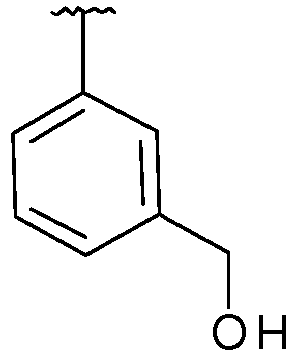

1H-NMR (200 MHz, DMSO-d6): 7.30 - 7.08 (m, 8H arom.), 5.47 (d, 1H, H-14, J=7 Hz), 4.42 (s, 2H, Ph-CH2-OH), 1.31 (s, 3H, H-15), 0.80 (s, 3H, H-18), 0.80 - 0.77 (6H, H-17, H-18), 0.59 (d. 3H, H-16, J=5.8 Hz) MS m/e: 623 [M+ + H] 56 12-epi-12-desvinyl-14-O-[(3-Hydroxymethyl-phenylsulfanyl)-acetyl]-12-[(6-guanidino-hexylamino)-methyl] mutilin dihydrochloride 

1H-NMR (200 MHz, DMSO-d6): 7.39 - 7.11 (m, 4 H, arom.), 5.44 (d, 1H, H-14, J=7.6 Hz), 4.45 (s, 2H, Ph-CH2), 3.82 (s, 2H, H-22), 1.36 (s, 3H, H-15), 0.87 (s, 3H, H-18), 0.80 (d, 2H, H-17, J=6,4 Hz), 0.58 (d, 3H, H-16, J=5.6 Hz). MS m/e: 645 [M+ + H] 57 12-epi-12-desvinyl-14-O-[(4-Hydroxymethyl-phenylsulfanyl)-acetyl]-12-[(3-amino-propylamino)-methyl]mutilin dihydrochloride 

1H-NMR (200 MHz, DMSO-d6): 7.32 (d, 2H, arom., J=8.4 Hz), 7.25 (d, 2H, J=8.4 Hz), 5.44 (d, 1H, H-14, J=6 Hz), 4.45 (s, 2H, Ph-CH2), 3.8 (s, 2H, H-22), 1.36 (s, 3H, H-15), 0.87 (s, 3H, H-18) 0.58 (d, 3H, H-16, J=5.4 Hz). MS m/e: 561 [M+ + H] 58 12-epi-12-desvinyl-14-O-[(4-Hydroxymethyl-phenylsulfanyl)-acetyl]-12-[(4-aminomethyl-benzylamino)-methyl] mutilin dihydrochloride 
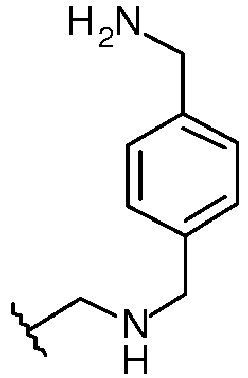
1H-NMR (200 MHz, DMSO-d6): 7.66 (d, 2H, arom., J=8 Hz), 7.53 (d, 2H, arom., J=8 Hz), 7.30 (d, 2H, arom., J=8 Hz), 7.23 (d, 2H, arom., J=8.2 Hz), 5.41 (d, 1H, H-14, J=6.8 Hz), 1.34 (s, 3H, H-15), 0.56 (d, 3H, H-16, J=5.8 Hz). MS m/e: 623 [M+ + H] 59 12-epi-12-desvinyl-14-O-[(4-Hydroxymethyl-phenylsulfanyl)-acetyl]-12-[(6-amino-hexylamino)-methyl] mutilin dihydrochloride 

1H-NMR (200 MHz, DMSO-d6): 7.32 (d, 2H, arom., J=8 Hz), 7.25 (d, 2H, arom., J=8 Hz), 5.43 (d, 1H, H-14, J=7.4 Hz), 4.44 (s, 2H, Ph-CH2), 3.87 (s, 2H H-22), 1.35 (s, 3H, H-15), 0.86 (s, 3H, H-18), 0.80 (d, 3H, H-17, J=5.8 Hz), 0.57 (d, 3H, H-16, J=5.8 Hz) MS m/e: 603 [M+ + H] 60 12-epi-12-desvinyl-14-O-[(3,5-Bis-hydroxymethyl-phenylsulfanyl)-acetyl]-12-[(3-amino-propylamino)-methyl] mutilin dihydrochloride 

1H-NMR (200 MHz, DMSO-d6): 5.45 (d, 1H, H-14, J=6.6 Hz), 4.44 (s, 4H, 2 Ph-CH2), 1.40 (s, 3H, H-15), 3.81 s (H-22), 1.37 (s, 3H, H-15), 0.90 (s, 3H, H-18), 0.81 (d, 2H, H-17, J=5.4 Hz), 0.59 (d, 3H, H-16, J=5.4 Hz). MS m/e: 591 [M+ + H] The required intermediate (3-Hydroxymethyl-5-mercapto-phenyl)-methanol was prepared in analogy to the synthesis of (3-Hydroxymethyl-4-mercapto-phenyl)-methanol as described in J. Antibiot. 51 (8), 722; (1998) 61 12-epi-12-desvinyl-14-O-{[(2,3,5,6-Tetrafluoro-4-hydroxymethyl)-phenylsulfanyl]-acetyl}-12-[(4-aminomethyl-benzylamino)-methyl]- mutilin dihydrochloride 

1H-NMR (200 MHz, DMSO-d6): 7.67 (d, 2H arom., H=8 Hz), 7.54 (d, 2H arom., J=8 Hz), 5.40 (d, 1H, H-14, J=6.4 Hz), 4.56 (s, 2H, Ph-CH2-OH), 1.33 (s, 3H, H-15), 0.86 (s, 3H, H-18), 0.80 (d, 3H, H-17, J=5.6 Hz), 0.53 (d, 3H, H-16, J=6.2 Hz). MS m/e: 695 [M+ + H] The required intermediate (2,3,5,6-Tetrafluoro-4-mercapto-phenyl)-methanol was prepared by LAH-reduction of 2, 3, 5, 6-Tetrafluoro-4-mercaptobenzoic acid 62 12-epi-12-desvinyl-14-O-{[(1R,2R,4R)-4-Amino-2-hydroxy-cyclohexylsulfanyl]-acetyl}-12-[(3-amino-propylamino)-methyl] mutilin trihydrochloride 

1H-NMR (200 MHz, DMSO-d6): 7.31 - 7.12 (m, 4 H, arom.), 5.48 (d, 1H, H-14, J=7.8 Hz), 1.40 (s, 3H, H-15), 1.00 (s, 3H, H-18), 0.83 (d, 2H, H-17, J=6.2 Hz), 0.64 (d, 3H, H-16, J=4.8 Hz). MS m/e: 568 [M+ + H] The required intermediate [3-((1R,3R,4R)-3-Hydroxy-4-mercapto-cyclohexylamino)-propyl]-carbamic acid tert-butyl ester is described in EP2399904 63 12-epi-12-desvinyl-14-O-{[(1R,2R,4R)-4-Amino-2-hydroxy-cyclohexylsulfanyl]-acetyl}-12-[(4-aminomethyl-benzylamino)-methyl]mutilin trihydrochloride 

1H-NMR (200 MHz, DMSO-d6): 7.67 (d, 2H, arom., J=8 Hz), 7.53 (d, 2H, arom., J=8 Hz), 5.45 (d, 1H, H-14, H=7.4 Hz), 1.39 (s, 3H, H-15), 0.93 (s, 3H, H-18), 0.81 (d, 3H, H-17, J=6 Hz), 0.63 (d, 3H, H-16, J=5.4 Hz) MS m/e: 630 [M+ + H] 64 12-epi-12-desvinyl-14-O-[(2-Hydroxy-ethylsulfanyl)-acetyl]-12-[(4-aminomethyl-benzylamino)-methyl] mutilin dihydrochloride 

1H-NMR (200 MHz, DMSO-d6): 7.67 (d, 2H arom., J=8 Hz), 7.54 (d, 2H arom., J=8 Hz), 5.46 (d, 1H, H-14, J=7 Hz), 1.40 (s, 3H, H-15), 0.93 (s, 3H, H-18), 0.82 (d, 3H, H-17, J=6.2 Hz), 0.65 (d, 3H, H-16, J=5.2 Hz) MS m/e: 561 [M+ + H] 65 12-epi-12-desvinyl-14-O-[(2-Amino-ethylsulfanyl)-acetyl]-12-[(4-aminomethyl-benzylamino)-methyl] mutilin trihydrochloride 

1H-NMR (200 MHz, DMSO-d6): 7.69 (d, 2H arom., J=8 Hz), 7.54 (d, 2H arom., J=8 Hz), 5.47 (d, 1H, H-14, J=6.8 Hz), 1.41 (s, 3H, H-15), 0.95 (s, 3H, H-18), 0.81 (d, 3H, H-17, J=5.8 Hz), 0.65 (d, 3H, H-16, J=5.6 Hz) MS m/e: 560 [M+ + H] 66 12-epi-12-desvinyl-14-O-{[(5-Amino-4H-1,2,4-triazol-3-yl)-sulfanyl]-acetyl}-12-[(6-amino-hexylamino)-methyl] mutilin trihydrochloride 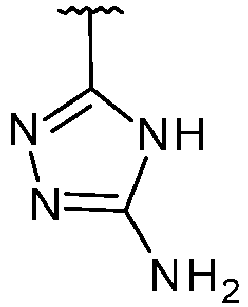
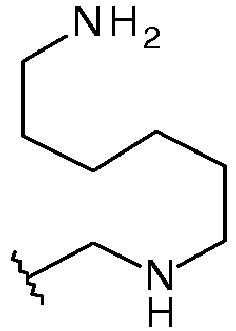
1H-NMR (200 MHz, DMSO-d6): 5.47 (d, 1H, H-14, J=7 Hz), 5.33 (bs, 1H, 11-OH), 3.93 (s, 2H, H-22), 1.38 (s, 3H, H-15), 0.90 (s, 3H, H-18), 0.81 (d, 3H, H-17, J=6.2 Hz), 0.60 (d, 3H, H-16, J=5.2 Hz). MS m/e: 579 [M+ + H] 67 12-epi-12-desvinyl-14-O-[(2-Amino-ethylsulfanyl)-acetyl]-12-[(6-amino-hexylamino)-methyl] mutilin trihydrochloride 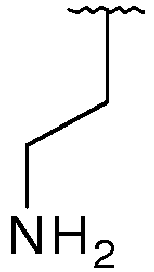

1H-NMR (200 MHz, DMSO-d6): 5.49 (d, 1H, H-14, J=6.6 Hz), 3.77 (s, 2H, H-22), 1.42 (s, 3H, H-15), 1.01 (s, 3H, H-18), 0.83 (d, 3H, H-17, J=6.2 Hz), 0.66 (d, 3H, H-16, J=5.6 Hz). MS m/e: 540 [M+ + H] 68 12-epi-12-desvinyl-14-O-[(Pyridin-4-ylsulfanyl)-acetyl]-12-[(6-amino-hexylamino)-methyl] mutilin trihydrochloride 

1H-NMR (200 MHz, DMSO-d6): 8.36 (d, 2H, arom., J=5.4 Hz), 7.27 (d, 2H, arom., J=5.2 Hz), 5.52 (d, 1H, H-14, J=6.6 Hz), 4.02 (s, 2H, H-22), 1.31 (s, 3H, H-15), 0.85 (s, 3H, H-18), 0.77 (d, 3H, H-17, J=6.2 Hz), 0.60 (d, 3H, H-16, J=5.4 Hz). MS m/e: 574 [M+ + H] 69 12-epi-12-desvinyl-14-O-[(Pyridin-4-ylsulfanyl)-acetyl]-12-[(6-guanidino-hexylamino)-methyl] mutilin trihydrochloride 

1H-NMR (200 MHz, DMSO-d6): 8.39 (d, 2H, arom., J=3.8 Hz), 7.29 (d, 2H, arom., J=5 Hz), 5.50 (d, 1H, H-14, J=6.8 Hz), 4.06 (s, 2H, H-22), 1.37 (s, 3H, H-15), 0.91 (s, 3H, H-18), 0.81 (d, 3H, H-17, J=6.4 Hz), 0.61 (d, 3H, H-16, J=5.4 Hz). MS m/e: 616 [M+ + H] 70 12-epi-12-desvinyl-14-O-[(3-Hydroxy-phenylsulfanyl)-acetyl]-12-[(6-amino-hexylamino)-methyl] mutilin dihydrochloride 

1H-NMR (200 MHz, DMSO-d6): 7.07 (m, 1H, arom.), 7.71 (m, 2H, arom.), 6.57 (m, 1H, arom.), 5.48 (d, 1H, H-14, J=7 Hz), 3.73 (s, 2H, H-22), 1.30 (s, 3H, H-15), 0.83 (s, 3H, H-18), 0.77 (d, 3H, H-17, J=6.6 Hz), 0.58 (d, 3H, H-16, J=5.2 Hz). MS m/e: 589 [M+ + H] 71 12-epi-12-desvinyl-14-O-[(4-Fluoro-phenylsulfanyl)-acetyl]-12-[(6-amino-hexylamino)-methyl] mutilin dihydrochloride 
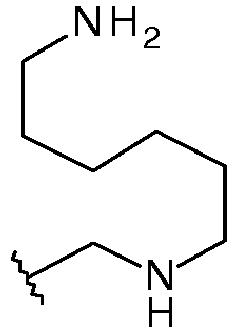
1H-NMR (200 MHz, DMSO-d6): 7.44 (m, 2H, arom.), 7.17 (m, 2H, arom.), 5.46 (d, 1H, H-14, J=7.8 Hz), 3.79 (m, 2H, H-22), 1.28 (s, 3H, H-15), 0.83 (s, 3H, H-18), 0.78 (d, 3H, H-17, J=6.6 Hz), 0.56 (d, 3H, H-16, J=5.6 Hz). MS m/e: 591 [M+ + H] 72 12-epi-12-desvinyl-14-O-{[(7H-Purin-6-yl)-sulfanyl]-acetyl}-12-[(6-amino-hexylamino)-methyl] mutilin dihydrochloride 

MS m/e: 615 [M+ + H] 73 12-epi-12-desvinyl-14-O-[(3-Amino-phenylsulfanyl)-acetyl]-12-[(3-amino-propylamino)-methyl] mutilin trihydrochloride 

MS m/e: 546 [M++H] 74 12-epi-12-desvinyl-14-O-(Phenylsulfanyl-acetyl)-12-[(4-aminomethyl-benzylamino)-methyl] mutilin trihydrochloride 

1H-NMR (200 MHz, DMSO-d6): 7.68 (d, 2H, arom., J=8 Hz), 7.56 (d, 2H, arom., J=8 Hz), 7.33 - 7.23 (m, 5H, arom.), 5.42 (d, 1H, H-14, J=6.4 Hz), 3.83 (bs, 2H, H-22), 1.34 (s, 3H, H-15), 0.79 (bs, 6H, H-18, H-17), 0.55 (d, 3H, H-16, J=5.8 Hz) MS m/e: 593 [M+ + H] 75 12-epi-12-desvinyl-14-O-[(4-Fluoro-phenylsulfanyl)-acetyl]-12-[(4-aminomethyl-benzylamino)-methyl] mutilin trihydrochloride 

MS m/e: 611 [M+ + H] 76 12-epi-12-desvinyl-14-O-[(Pyridin-2-ylsulfanyl)-acetyl]-12-[(4-aminomethyl-benzylamino)-methyl] mutilin trihydrochloride 

1H-NMR (200 MHz, DMSO-d6): 8.32 - 8.30 (m, 1H, arom., J=4.4 Hz), 7.70 - 7.54 (m, 5H, arom.), 7.36 - 7.32 (m, 1H, arom.), 7.12 - 7.06 (m, 1H, arom.), 5.45 (d, 1H, H-14, J=7.8 Hz), 5.31 (bs, 1H, 11-OH), 3.94 (bs, 2H, H-22), 1.37 (s, 3H, H-15), 0.84 - 0.78 (m, 6H, H-18, H-17), 0.62 (d, 3H, H-16, J=5.8 Hz) MS m/e: 594 [M+ + H] 77 12-epi-12-desvinyl-14-O-[(Pyridin-4-ylsulfanyl)-acetyl]-12-[(4-aminomethyl-benzylamino)-methyl] mutilin trihydrochloride 

1H-NMR (200 MHz, DMSO-d6): 8.56 (m, 2H, arom.), 7.67 (d, 2H, arom., J=8 Hz), 7.54 (d, 2H, arom., J=8 Hz), 7.48 - 7.45 (m, 2H, arom.), 5.46 (d. 1H, H-14, J=7.2 Hz), 5.28 (d, 1H 11-OH, J=4.8 Hz), 4.14 (bs, 2H, H-22), 1.34 (s, 3H, H-15), 0.85 (s, 3H, H-18), 0.78 (d, 3H, H-17, J=6.4 Hz), 0.58 (d, 3H, H-16, J=6 Hz) MS m/e: 594 [M+ + H] -

1H-NMR (200 MHz, DMSO-d6): 7.68 (d, 2H, arom., J=8 Hz), 7.54 (d, 2H, J=8 Hz), 5.46 (d, 1H, H-14, J=7.2 Hz), 5.32 (d, 1H, 11-OH, J=4Hz), 1.37 (s, 3H, H-15), 0.92 (s, 3H, H-18), 0.81, (d, 3H, H-17, J=6.2 Hz), 0.64 (d, 3H, H-16, J=6 Hz)
MS m/e: 657 [M+ + H] - To a mixture of 10 g of 4-hydroxy-piperidine-1-carboxylic acid tert-butyl ester nd 12.57 g of TEA in 100 mL of DCM was added 7.09 g of MsCl dropwise at 0°C under N2. After addition, the resulting mixture was stirred at 20 °C for 4 hours. TLC showed the reaction was complete. The mixture was washed 2x with brine, dried over Na2SO4, filtered and concentrated to afford the title compound as white solid.
- To a solution of 13.50 g of 4-methanesulfonyloxy-piperidine-1-carboxylic acid tert-butyl ester in 140 mL of DMF was added 11.04 g of potassium ethanethioate in one portion at 20 °C under N2. The mixture was stirred at 20 °C for 10 min. Then the reaction mixture heated to 60 °C and stirred for 16 hours. TLC showed the reaction was complete. The mixture was cooled to 20 °C and poured into ice-water and stirred for 20 min. The aqueous phase was extracted 2x with MTBE. The combined organic phase was washed 2x with brine, dried over Na2SO4, filtered and concentrated. The residue was purified by silica gel chromatography (PE/EtOAc = 30/1, 20/1) to afford the title compound as red oil.
- A solution of 6.5 g of 4-acetylsulfanyl-piperidine-1-carboxylic acid tert-butyl ester in 100 mL of EtOAc was acidified by adding a solution of HCl/EtOAc dropwise at 20 °C over a period of 30 min. under N2. The resulting mixture was stirred at 20°C for 0.5 h after which a solid formed. TLC (PE: EtOAc = 10:1) showed the reaction was complete. The reaction mixture was filtered to afford the title compound as off-white solid.
- To a mixture of 4.70 g of thioacetic acid S-piperidin-4-yl ester hydrochloride, 3.84 g of N-BOC-Glycine and 7.29 g of DIPEA in 50 mL DMF was added 10.96 g of HATU in one portion at 20°C under N2. The mixture was stirred at 20°C for 16 h. The residue was poured into ice-water and stirred for 20 min. The aqueous phase was extracted 3x with MTBE. The combined organic phase was washed 2x with brine , dried over Na2SO4, filtered and concentrated. The residue was purified by chromatography (PE/EtOAc = 30/1, 20/1) to give the title compound as yellow oil.
- According, e.g. analogously, to a method as set out under Example 78 above, but using appropriate starting materials, the compounds of formula IEX, wherein R1Ex and R2EX are as defined in Table 7 are prepared. Chemical characterisation data are also set out in Table 7.
Table 7 Example R2EX R1EX 79 12-epi-12-desvinyl-14-O-{[1-(3-Amino-propionyl)-piperidin-4-yl-sulfanyl)]-acetyl}-12-[(4-aminomethyl-benzylamino)-methyl]mutilin trihydrochloride 

1H-NMR (200 MHz, DMSO-d6): 7.67 (d, 2H, arom., J=8 Hz), 7.53 (d, 2H, arom., J=8 Hz), 5.46 (d, 1H, H-14, J=7 Hz), 5.31 (d, 1H 11-OH, J=4.6 Hz), 1.40 (s, 3H, H-15), 0.92 (s, 3H, H-18), 0.81 (d, 3H, H-17, J=5 Hz), 0.64 (d, 3H, H-16, J=5.4 Hz) MS m/e: 611 [M+ + H] The required Thioacetic acid S-[1-(3-tert-butoxycarbonylamino-propionyl)-piperidin-4-yl] ester was prepared in analogy to the procedure described in Example 78 using the appropriate starting materials 80 12-epi-12-desvinyl-14-O-{[1-(3-Amino-propionyl)-piperidin-4-yl-sulfanyl]-acetyl}-12-[(6-amino-hexylamino)-methyl]mutilin trihydrochloride 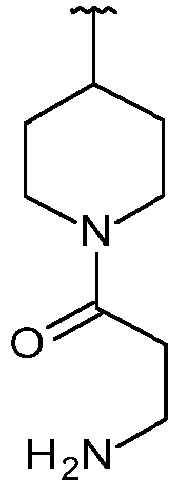

1H-NMR (200 MHz, DMSO-d6): 5.48 (d, 1H, H-14, J=7 Hz), 5.37 (bs, 11-OH), 1.41 (s, 3H, H-15), 0.98 (s, 3H, H-18), 0.83 (d, 3H, H-17, J=6 Hz), 0.65 (d, 3H, H-16, J=5,2 Hz) MS m/e: 325 [M/2+ + H] The required Thioacetic acid S-[1-(3-tert-butoxycarbonylamino-propionyl)-piperidin-4-yl] ester was prepared in analogy to the procedure described in Example 78 using the appropriate starting materials 81 12-epi-12-desvinyl-14-O-{[1-(2-Amino-acetyl)-piperidin-4-yl-methylsulfanyl]-acetyl}-12-[(4-aminomethyl-phenylamino)-methyl] mutilin trihydrochloride 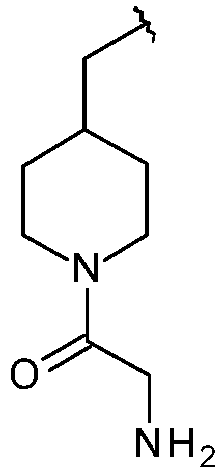

1H-NMR (200 MHz, DMSO-d6): 5.51 (d, 1H, H-14, J=5.8 Hz), 1.39 (s, 3H, H-15), 0.99 (s, 3H, H-18), 0.85 (d, 3H, H-17, J=6.4 Hz), 0.65 (d, 3H, H-16, J=6.4 Hz) MS m/e: 691 [M- + Cl] The required Thioacetic acid S-[1-(2-tert-butoxycarbonylamino-acetyl)-piperidin-4-ylmethyl] ester was prepared in analogy to the procedure described in Example 78 using the appropriate starting materials 82 12-epi-12-desvinyl-14-O-{[1-(2-Amino-acetyl)-piperidin-4-yl-methylsulfanyl]-acetyl}-12-[(4-amino-benzylamino)-methyl] mutilin trihydrochloride 

MS m/e: 656 [M+ + H] For the reductive amination N-(4-Aminomethylphenyl)-2,2,2-trifluoro-acetamide (obtained in 2 steps from (4-Amino-benzyl)-carbamic acid tert-butyl ester) was used. In the subsequent nucleophilic displacement reaction (e.g. Example 1, step 5) using K2CO3 instead of potassium tert-butoxide as base the N-trifluoroacetyl group was concomitantly cleaved -

- 10 g of 4-Aminomethyl-phenol was dissolved in 200 mL DMF, the solution was cooled to 0° C, 13.6 mL of triethylamine followed by 11.6 mL of benzyl chloroformate was added and stirring was continued at rt overnight. The reaction mixture was diluted with water and extracted 2x with EtOAc, the combined organic layers were washed 2x with 2N hydrochloric acid, 5% sodium bicarbonate solution, dried over Na2SO4 and evaporated to dryness to give an almost colourless oil. The product was chromatographed over silica gel (eluant: toluene/EtOAc = 10:1) and yielded the title compound as almost colourless oil.
- 3.25 g of (4-Hydroxy-benzyl)-carbamic acid benzyl ester, 3.11 g of (2-bromo-ethyl)-carbamic acid tert.-butylester, 4.10 g of cesium carbonate and 209 mg of potassium iodide was refluxed in 20 mL 2-butanone for 24 hours. The solvent was removed in vacuo, the residue partitioned between water and EtOAc. The aqueous phase was washed with EtOAc, the combined organic layers with 2N sodium hydroxide solution and finally with brine. After drying over anhydrous Na2SO4 and evaporation of the solvent a yellowish oil was obtained which was chromatographed over silica gel (eluant: toluene/EtOAc = 10:1) to yield an almost colorless viscous oil.
- 2.0 g of {2-[4-(Benzyloxycarbonylamino-methyl)-phenoxy]-ethyl}-carbamic acid tert-butyl ester, dissolved in 120 mL mL ethanol, was hydrogenated in an H-cube apparatus over 10% Pd/C at 10 bar and 50° C for 3 days. The solvent was evaporated and the title compound (containing residual solvent) was obtained as a slowly crystallizing oil.
-

MS m/e: 715 [M+ + H] - The required Thioacetic acid S-{4-[(2-tert-butoxycarbonylamino-acetylamino)-methyl]-cyclohexyl} ester was prepared in analogy to the procedure described in Example 78 using the appropriate starting materials.
-

- 264 mg of 12-epi-12-desvinyl-14-O-[(4-hydroxymethyl-phenylsulfanyl)-acetyl]-12-[(3-tert-butoxycarbonylamino-propylamino)-methyl] mutilin (Example 57, prior to BOC-deprotection) was dissolved in 4 mL of THF and the flask cooled in an ice bath. To the mixture obtained 122 mg of DPPA was added, followed by 76 mg of DBU in 3 mL of THF over five minutes. The cooling bath was removed, the mixture obtained was stirred at rt overnight and 45 mg of DPPA and 30.5 mg of DBU was further added.
- The mixture obtained was stirred for another 6 h. HPLC revealed still some starting material left; thus 56.8 mg of DPPA and 38.1 mg of DBU was again added, stirring was continued overnight and the reaction was deemed to be complete. About 40 mL of water was added and the mixture obtained was extracted with EtOAc (2x), the combined organic phases were washed with 2N NaOH and water, dried over Na2SO4, evaporated to dryness and subjected to column chromatography over silica gel (eluent: EtOAc/Et3N = 80:1). The title compound was obtained in the form of a foamy residue.
-

- 155 mg of 12-epi-12-desvinyl-14-O-[(4-azidomethyl-phenylsulfanyl)-acetyl]-12-[(3-tert-butoxycarbonylamino-propylamino)-methyl] mutilin was dissolved in 4 mL of EtOH and 1.3 mL of water in an ultrasonic bath and 32.3 mg of NH4Cl and 20 mg of zinc powder was added. The mixture obtained was refluxed for 10 min. Since the reaction was not complete, 164 mg of NH4Cl and 100 mg of zinc powder was added and the mixture obtained was stirred at rt overnight. To the mixture obtained 75 mL of EtOAc and 5 mL of 25% ammonia solution was added, the formed precipitate was filtered off and the filtrate obtained was treated with brine, stirred for 5 min and from the mixture obtained the phases were separated. The organic phase obtained was dried over Na2SO4, evaporated to dryness and the evaporation residue was subjected to silica gel chromatography (eluent: EtOAc/EtOH/25% ammonia = 100:2:0.5). The title compound was obtained in the form of colourless foamy crystals.
-
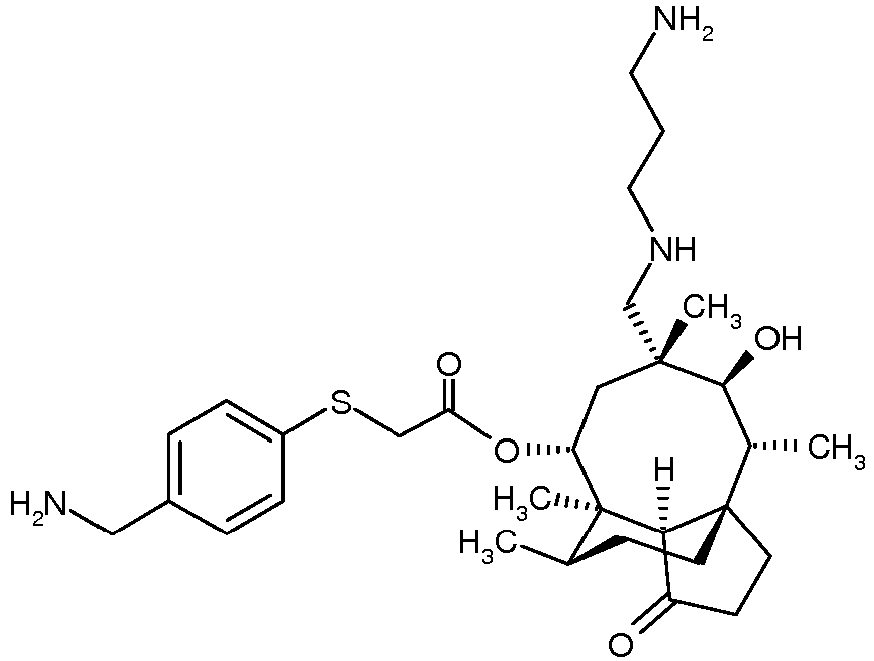
- BOC-deprotection of the product of step 2 above was carried out as described in Example 1, Step 6.
1H-NMR (200 MHz, DMSO-d6): 7.45 (d, 2H, arom., J=8.2 Hz), 7.23 (d,2H, arom., J=8.2 Hz), 5.46 (d, 1H, H-14, J=7 Hz), 3.88 (s, 2H, H-22), 1.37 (s, 3H, H-15), 0.89 (s, 3H, H-18), 0.81 (d, 3H, H-17, J=6.2 Hz), 0.59 (d, 3H, H-16, J=5.2 Hz)
MS m/e: 594 [M- + Cl] - According, e.g. analogously, to a method as set out under Example 85 above, but using appropriate starting materials, the compounds of formula IEX, wherein R1EX and R2Ex are as defined in Table 8 are prepared. Chemical characterisation data are also set out in Table 8.
Table 8 Example R2EX R1EX 86 12-epi-12-desvinyl-14-O-[(3-Aminomethyl-phenylsulfanyl)-acetyl]-12-[(3-amino-propylamino)-methyl] mutilin trihydrochloride 
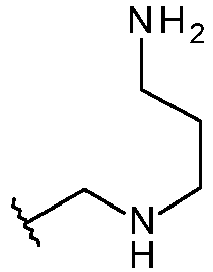
1H-NMR (200 MHz, DMSO-d6): 7.54 (s, 1H, arom.), 7.36 - 7.24 (m, 4H, 3H arom., 1H, -NH), 5.46 (d, 1H, H-14, J=6.4 Hz), 5.32 (bs, 1H, 11-OH), 3.93 (s, 2H, H-22), 1.35 (s, 3H, H-15), 0.90 (s, 3H, H-18), 0.81 (d, 3H, H-17, J=5.8 Hz), 0.59 (d, 3H, H-16, J=5.4 Hz) MS m/e: 560 [M+ + H] 87 12-epi-12-desvinyl-14-O-[(3-Aminomethyl-phenylsulfanyl)-acetyl]-12-[(6-guanidino-hexylamino)-methyl] mutilin trihydrochloride 

MS m/e: 645 [M+ + H] 88 12-epi-12-desvinyl-14-O-[(4-Aminomethyl-phenylsulfanyl)-acetyl]-12-[(4-aminomethyl-benzylamino)-methyl] mutilin trihydrochloride 

1H-NMR (200 MHz, DMSO-d6): 7.68 (d, 2H arom., J=8 Hz), 7.55 (d, 2H arom., J=8 Hz), 7.49 (d, 2H arom., J=8 Hz), 7.33 (d, 2 H arom., J=8 Hz), 1.36 (s, 3H, H-15), 0.83 (s, 3H, H-18), 0.57 (d, 3H, H-16, J=3.6 Hz) MS m/e: 622 [M+ + H] 89 12-epi-12-desvinyl-14-O-[(4-Aminomethyl-phenylsulfanyl)-acetyl]-12-[(6-amino-hexylamino)-methyl] mutilin trihydrochloride 

1H-NMR (200 MHz, DMSO-d6): 7.46 (d, 2H arom., J=8 Hz), 7.36 (d, 2H arom., J=8 Hz), 5.48 - 5.39 (m, 2H, H-14, 11-OH), 1.38 (s, 3H, H-15), 0.90 (s, 3H, H-18), 0.81 (d, 3H, H-17, J=6.2 Hz), 0.60 (d, 3H, H-16, J=5.4 Hz); MS m/e: 602 [M+ + H] 90 12-epi-12-desvinyl-14-O-[(3-Aminomethyl-phenylsulfanyl)-acetyl]-12-[((4-aminomethyl-cyclohexyl)-methylamino)-methyl] mutilin trihydrochloride 

1H-NMR (200 MHz, DMSO-d6): 7.54 (s, 1H arom.), 7.34 (bs, 3H arom.), 5.48 (d, 1H, H-14, J=7.2 Hz), 1.36 (s, 3H, H-15), 0.95 (s, 3H, H-18), 0.82 (d, 3H, H-17, J=6.2 Hz), 0.60 (d, 3H, H-16, J=5.6 Hz) MS m/e: 628 [M+ + H] 91 12-epi-12-desvinyl-14-O-[(4-Aminomethyl-phenylsulfanyl)-acetyl]-12-{[(4-aminocyclohexyl)-amino]-methyl} mutilin trihydrochloride 

1H-NMR (200 MHz, DMSO-d6): 7.30 - 7.16 (m, 4H arom.), 7.54 (d, 2H arom., J=8 Hz), 5.48 (d, 1H, H-14, J=7.4 Hz), AB (2H, H-22, vA=3.85, vB=3.76, J=16 Hz), 1.29 (s, 3H, H-15), 0.83 (s, 3H, H-18), 0.77 (d, 3H, H-17, J=6.4 Hz), 0.59 (d, 3H, H-16, J=5.8 Hz) MS m/e: 600 [M+ + H] 92 12-epi-12-desvinyl-14-O-[(4-Aminomethyl-phenylsulfanyl)-acetyl]-12-[(hexylamino)-methyl] mutilin dihydrochloride 

MS m/e: 587 [M+ + H] 93 12-epi-12-desvinyl-14-O-[(4-Aminomethyl-phenylsulfanyl)-acetyl]-12-[(4-carbamoylphenyl)-methylamino)-methyl] mutilin dihydrochloride 

1H-NMR (200 MHz, DMSO-d6): 7.83 (d, 2H, arom., J=8 Hz), 7.38 (d, 2H, arom., J=8 Hz), 7.32 - 7.13 (m, 4H, arom.), 5.49 (bs, 1H, H-14), 1.31 (s, 3H, H-15), 0.79 (bs, 6H, H-17, H-18), 0.60 (bs, 3H, H-16) MS m/e: 636 [M+ + H] -

MS m/e: 727 [M+ + H] - A mixture of 1.47 g of 4-cyanobenzoic acid, 5.7 g of HATU and 2.58 g DIEA in 25 mL of DMF was stirred at 25 °C for 45 min. To the mixture obtained 3.48 g (3-Amino-propyl)-carbamic acid tert-butyl ester was added slowly and the mixture obtained was stirred at rt for another 2 h. The mixture obtained was quenched with water and extracted with EtOAc (30 mL∗3). The phases obtained were separated and the organic phase was washed with water and brine, dried over Na2SO4, concentrated and the concentration residue was subjected to chromatography (DCM /MeOH=10:1) yielding the title compound.
- A mixture of 1 g of [3-(4-cyanobenzoylamino)-propyl]-carbamic acid tert-butyl ester and Pd/C (100 mg) in 25 mL of THF was stirred at 25 °C under hydrogen for 5 h. The mixture obtained was filtered and concentrated. The concentration residue was subjected to chromatography (DCM /MeOH =10:1) yielding the title compound.
-

1H-NMR (200 MHz, DMSO-d6): 7.45 (d, 2H, arom., J=8 Hz), 7.34 (d, 2H, arom., J=8 Hz), 5.46 (d, 1H, H-14, J=6.4 Hz), 1.37 (s, 3H, H-15), 0.88 (s, 3H, H-18), 0.80 (d, 3H, H-17, J=6.4 Hz), 0.59 (d, 3H, H-16, J=5.6 Hz)
MS m/e: 678 [M+ + H]. - Step a: A solution of 305 mg of Me2NH.HCl and 970 mg of DIPEA in 10 mL of DMF was stirred at rt for 30 min and 500 mg of N-benzyloxycarbonyl-6-aminocaproic acid and 1.07 g of HATU was added and the mixture obtained was stirred at rt overnight. The mixture obtained was extracted 3x with 10 mL EtOAc and the combined organic phases were washed with brine, dried and concentrated.
- Step b: 400 mg of the crude product of step a was dissolved in 15 mL of MeOH and Pd/C (wet, 100 mg) was added. The mixture obtained was stirred at rt under 30 Psi H2-pressure overnight. TLC showed that the reaction was completed. The mixture obtained was filtered and the filtrate was concentrated. The title compound in the form of a white solid was obtained and used without further purification.
-

MS m/e: 679 [M+ + H] - A mixture of 8.4 g of 4-cyano-phenylalanine methylester (prepared in analogy to JACS, 129(1), 14-15; 2007), 9g of BOC2O and 50 mg of DMAP in 150 mL of THF was stirred at rt for 3.5 h, diluted with water, extracted with EtOAc and subjected to column chromatography (DCM/MeOH = 100:4) yielding the title compound.
- A mixture of 1.91 g of 2-tert-butoxycarbonylamino-3-(4-cyano-phenyl)-propionic acid methyl ester and 0.38 g NaOH in 30 mL of THF and 15 mL of water was stirred at rt for 2 h, concentrated to removed THF, extracted with EtOAc, acidified by HCl to pH 3, extracted with EtOAc and concentrated to yield the title compound.
- A mixture of 0.9 g of 2-tert-Butoxycarbonylamino-3-(4-cyano-phenyl)-propionic acid, 1.413 g of HATU, and 1.6 g of DIPEA in 60 mL of DMF was stirred at rt for 2 h and 9.3 mmol of NH4Cl was added. The mixture was stirred at rt for 2 h, diluted with water, extracted with EtOAc and subjected to column chromatography (DCM/MeOH = 100:5) yielding the title compound.
- A mixture of 1.58 mmol [l-carbamoyl-2-(4-cyano-phenyl)-ethyl]-carbamic acid tert-butyl ester, 50 mg of Ni and 50 mg of NH3·H2O in 50 mL of MeOH was stirred at rt under H2 for 4 h, filtered and concentrated to yield the title compound.
-
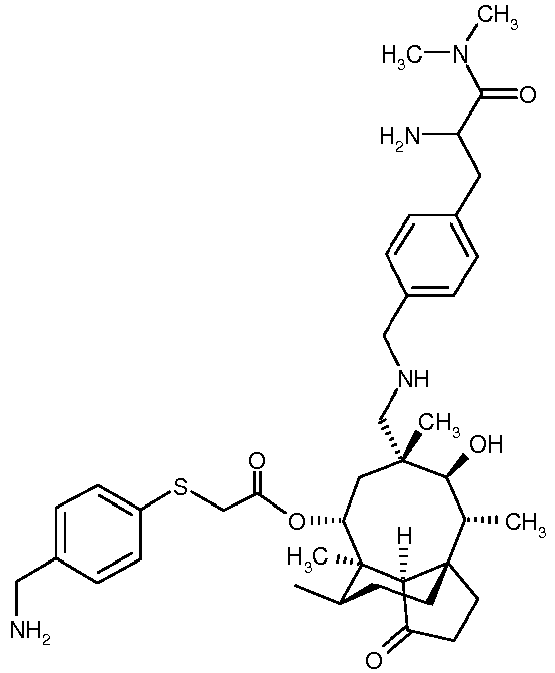
MS m/e: 707 [M+ + H] - Step a: A solution of 305 mg Me2NH.HCl and 970 mg in 10 mL of DMF was stirred at rt for 30 min. To the mixture obtained 545 mg of 2-tert-butoxycarbonylamino-3-(4-cyano-phenyl)-propionic acid (see example 96) and 1.07 g of HATU were added and the mixture obtained was stirred at rt overnight. The mixture obtained was extracted 3x with 10 mL EtOAc, the combined organic phases were washed with brine, dried over Na2SO4, concentrated and used for the next step without further purification.
- Step b: A mixture 458 mg of the residue of step a, 50 mg of Ni and 50 mg of NH3·H2O in 50 mL of MeOH was stirred at rt under H2 for 4 h, filtered and concentrated to yield the title compound.
-

1H-NMR (200 MHz, DMSO-d6): 7.83 - 7.78 (m, 1H, arom.), 7.70 (d, 2H, arom., J=8 Hz), 7.55 (d, 2H, arom., J=8 Hz), 7.41 - 7.37 (m, 1H, arom.), 5.45 (bs, 2H, H-14,11-OH), 3.92 (s, 2H, H-22), 1.37 (s, 3H, H-15), 0.89 (s, 3H, H-18), 0.79 (s, 3H, H-17, J=6 Hz), 0.64 (d, 3H, H-16, J=5.6 Hz)
MS m/e: 623 [M+ + H] - To a mixture of 12 g 6-mercapto-nicotinamide (described in PCT Int. Appl.,
2011039259 - A mixture of 2.5 g of (6-mercapto-pyridin-3-ylmethyl)-carbamic acid tert-butyl ester in 25 mL DCM, was added 4.21 g of TEA at 0 °C under N2. The reaction was stirred at 0°C for 10 min and 1.63 g of acetyl chloride was added drop-wise at 0°C under N2. The mixture was stirred at 0°C for 20 min. The mixture was poured into ice-water and stirred for 10 min. The aqueous phase was extracted 3x with DCM. The combined organic phase was washed with 2x brine, dried over Na2SO4, filtered and concentrated under reduced pressure. The residue was purified by silica gel chromatography (PE/EtOAc = 1:1) to afford the title compound as yellow solid.
-

- was obtained similarly and in analogy to a method as set out in Example 98, but using appropriate starting materials.
MS m/e: 641 [M+ + H] - To a mixture of 16 g of tert-butyl N-[(4-bromo-2-fluoro-phenyl)methyl]carbamate in 480 mL of DMF was added 12.35 g of Zn(CN), 5.83 g of dppf, 687.98 mg of Zn and 4.82 g of Pd2(dba)3 under N2. The reaction mixture was heated to 120-128°C and stirred for 5 hours. TLC showed the reaction was complete. The mixture was cooled to 25°C and poured into ice-water and stirred for 20 min. The aqueous phase was extracted 3x with EtOAc. The combined organic phase was washed 2x with brine, dried over Na2SO4, filtered and concentrated. The residue was purified by silica gel chromatography (silica gel, PE/EtOAc = 30/1 to 5/1) to afford the product as yellow solid.
- To a solution of 9.00 g tert-butyl N-[(4-cyano-2-fluoro-phenyl)methyl]carbamate in 150 mL of MeOH-NH3 was added 1.80 g of Raney Nickel under N2. The suspension was degassed in vacuum and purged with H2 several times. The mixture was stirred at 25°C under H2 (50 psi) for 8 hours. TLC (PE/EtOAc = 5:1) showed the starting material was consumed completely. The reaction mixture was filtered and the filtrate was concentrated in vacuum. The residue was purified by silica gel chromatography eluted with DCM/MeOH = 100:1 to 10:1 to give the title compound as brown solid.
-

1H-NMR (200 MHz, DMSO-d6): 7.69 (d, 2H, arom., J=7.6 Hz), 7.57 (d, 2H, arom., J=7,4 Hz), 5,47 (d, 1H, H-14, J=4,8 Hz), 5.34 (bs, 1H, 11-OH), 1.41 (s, 3H, H-15), 0.93 (s, 3H, H-18), 0.84 (bs, 3H, H-17), 0.66 (bs, 3H, H-16)
MS m/e: 642 [M+ + H] - 5 g of Methanesulfonic acid 4-methanesulfonyloxymethyl-cyclohexylmethyl ester (described in JOC, 22, 994-5; 1957) was dissoved in 100 mL of DMF, 2.9 g of potassium thioacetate was added and the reaction mixture heated to 110°C for 2h. The reaction was quenched by pouring into water, extracted 3x with EtOAc, the organic phase washed with brine, dried over Na2SO4 and evaporated to dryness yielding a brown oil which was chromatographed on silica using cyclohexane/EtOAc = 2:1 as eluent. The title compound was obtained as brown oil.
- 2.2 g of Thioacetic acid S-(4-methanesulfonyloxymethyl-cyclohexylmethyl) ester was dissolved in 100 mL of DMF, 2.1 g of sodium azide was added and the reaction mixture stirred at 70°C for 16 h. The reaction mixture was poured into water, extracted 3x with EtOAc, the organic phase washed with brine, dried over Na2SO4 and evaporated to dryness yielding a brown oil which was used for the next step without further purification.
- According, e.g. analogously, to a method as set out under Example 99 above, but using appropriate starting materials, the compounds of formula IEX, wherein R1EX and R2EX are as defined in Table 9 are prepared. Chemical characterisation data are also set out in Table 9
Table 9 Example R2EX R1EX 101 12-epi-12-desvinyl-14-O-{1-(2-Amino-acetyl)-piperidin-4-yl-sulfanyl]-acetyl}-12-[(4-aminomethyl-3-fluoro-benzylamino)-methyl] mutilin trihydrochloride 

MS m/e: 675 [M+ + H] 102 12-epi -12- Desvinyl-14-O-{{4-[(2-Amino-acetylamino)-methyl] -cyclohexylsulfanyl}-acetyl }-12- [(4-aminomethyl-3-fluoro-benzylamino)-methyl] mutilin tetrahydrochloride 

MS m/e: 703 [M+ + 2H] 103 12-epi-12-desvinyl-14-O-{[5-Aminomethyl-pyridin-2-yl-sulfanyl]-acetyl}-12-[(4-aminomethyl-2,5-difluoro-benzylamino)-methyl] mutilin tetrahydrochloride 
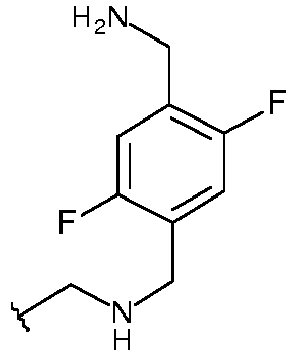
MS m/e: 659 [M+ + H] The required [4-(aminomethyl)-2,5-difluorophenyl]methanamine can be obtained by reaction of 1,4-bis(bromomethyl)-2,5-difluoro-benzene with excess NH3 / THF at rt. The reductive amination was done as described in Example 1, step 4 using 6 eq of the diamine - According, e.g. analogously, to a method as set out under Example 85 above, but using appropriate starting materials, the compounds of formula IEX, wherein R1EX and R2EX are as defined in Table 10 are prepared. Chemical characterisation data are also set out in Table 10
Table 10 Example R2EX R1EX 104 12-epi-12-desvinyl-14-O-[(4-Aminomethyl-phenylsulfanyl)-acetyl]-12-[(2-amino-1-aminomethyl-ethylamino)-methyl] mutilin tetrahydrochloride 

1H-NMR (200 MHz, DMSO-d6): 7.45 (d, 2H, arom., J=8 Hz), 7.36 (d, 2H, arom., J=8 Hz), 5.47 (d, 1H, H-14, J=7 Hz), 1.36 (s, 3H, H-15), 0.95 (s, 3H, H-18), 0.82 (d, 3H, H-17, J=5.8), 0.59 (d, 3H, H-16, J=5.6 Hz). MS m/e: 575 [M+ + H] The intermediate (2-Amino-3-tert-butoxycarbonylamino-propyl)-carbamic acid tert-butyl ester is e.g.described in ChemMedChem, 4(7), 1182-1188; 2009 105 12-epi-12-Desvinyl-14-O-[(5-aminomethyl-pyridin-2-yl-sulfanyl)-acetyl]-12-[(6-amino-hexylamino)-methyl] mutilin tetrahydrochloride 

1H-NMR (200 MHz, DMSO-d6): 7.82 - 7.77 (m, 1H, arom.), 7.42 - 7.38 (m, 1H, arom.), 5.47 (bs, 2H, H-14, 11-OH), 3.93 (s, 2H, H-22), 1.38 (s, 3H, H-15), 0.95 (s, 3H, H-18), 0.81 (d, 3H, H-17, J=6 Hz), 0.65 (d, 3H, H-16, J=5.6 Hz) MS m/e: 603 [M+ + H] -

- A mixture of 0.3 mmol of BOC-Glycine, 0.45 mmol of HATU and 0.6 mmol of DIPEA in 15 mL of THF was stirred at 25 °C for 45min. To the mixture obtained 0.3 mmol of 12-epi-12-desvinyl-14-O-[(4-Aminomethyl-phenylsulfanyl)-acetyl]-12-[(3-tert-butoxycarbonylamino-propylamino)-methyl] mutilin (Example 85, step 2) was added slowly. The mixture obtained was stirred at rt for another 2 h, quenched with water and extracted with EtOAc. The organic phase obtained was washed with water, brine, dried over Na2SO4, concentrated and the concentration residue was subjected to chromatography (DCM/MeOH = 10:1) yielding the title compound.
-

- BOC-deprotection of the compound obtained in step 1 was carried out as described in Example 1, Step 6.
1H-NMR (200 MHz, DMSO-d6): 7.32 (d, 2H, arom., J=8 Hz), 7.25 (d, 2H, arom., J=8 Hz), 5.45 (d, 1H, H-14, J=5.4 Hz), 1.37 (s, 3H, H-15), 0.88 (s, 3H, H-18), 0.82 (d, 3H, H-17, J=5 Hz), 0.59 (d, 3H, H-16, J=5.2 Hz);
MS m/e: 617 [M+ + H]. - According, e.g. analogously, to a method as set out under Example 106 above, but using appropriate starting materials, the compounds of formula IEX, wherein R1EX and R2EX are as defined in Table 11 are prepared. Chemical characterisation data are also set out in Table 11.
Table 11 Example R2EX R1EX 107 12-epi-12-desvinyl-14-O-{(4-[(2-Amino-3-(4-hydroxy-phenyl)-propionylamino)-methyl]-phenylsulfanyl)-acetyl}-12-[(3-amino-propylamino)-methyl] mutilin trihydrochloride 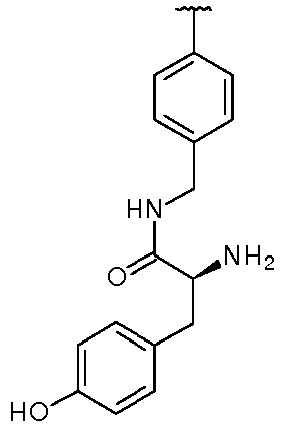

1H-NMR (200 MHz, DMSO-d6): 7.27 (d, 2H, arom., J=8 Hz), 6.70 (d, 2H, arom., J=8 Hz), 7.06 - 6.99 (m, 4H, arom.), 5.45 (d, 1H, H-14, J=4.6 Hz), 1.37 (s, 3H, H-15), 0.89 (s, 3H, H-18), 0.81 (d, 3H, H-17, J=4.6 Hz), 0.58 (d, 3H, H-16, J=3 Hz) MS m/e: 723 [M+ + H] 108 12-epi-12-desvinyl-14-O-{(4-[(3-Amino-propionylamino)-methyl]-phenylsulfanyl)-acetyl]-12-[(3-amino-propylamino)-methyl] mutilin trihydrochloride 

1H-NMR (200 MHz, DMSO-d6): 7.32 (d, 2H, arom., J=8 Hz), 7.22 (d, 2H, arom., J=8 Hz), 5.45 (d, 1H, H-14, J=6.2 Hz), 1.37 (s, 3H, H-15), 0.87 (s, 3H, H-18), 0.82 (d, 3H, H-17, J=5.2 Hz), 0.58 (d, 3H, H-16, J=5.4 Hz) MS m/e: 631 [M+ + H] 109 12-epi-12-desvinyl-14-O-{(4-[(2-Amino-acetylamino)-methyl]- phenylsulfanyl)-acetyl }-12-[4-aminomethyl-benzylamino-methyl] mutilin trihydrochloride 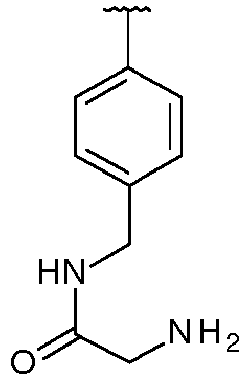

1H-NMR (200 MHz, DMSO-d6): 7.29 (d, 2H arom., J=8 Hz), 7.21 (d, 2H arom., J=8 Hz), 5.41 (bs, 2H, H-14, 11-OH), 1.35 (s, 3H, H-15), 0.82 (bs, 6H, H-17, H-18), 0.56 (d, 3H, H-16, J=3.2 Hz) MS m/e: 679 [M+ + H] 110 12-epi-12-desvinyl-14-O-{(4-[(2-Amino-acetylamino)-methyl]- phenylsulfanyl)-acetyl}-12-(6-amino-hexylamino-methyl) mutilin trihydrochloride 

MS m/e: 659 [M+ + H] -

MS m/e: 602 [M+ + H]. - 2 g of 3-mercaptobenzyl alcohol was dissolved in 20 mL of MeOH. 1.8 g of iodine was added in portions with cooling until the colour of iodine persisted. The mixture obtained was diluted with EtOAc, washed with brine; the organic phase was dried over Na2SO4, brought to dryness and the brown oil obtained was used without purification in the next step.
- 2 g of [3-(3-hydroxymethyl-phenyldisulfanyl)-phenyl]-methanol was dissolved in 20 mL of THF, 2.7 mL of N-methylmorpholine was added followed by 3.2 g of methanesulfonic anhydride and stirring was maintained overnight at rt. The mixture obtained was diluted with EtOAc, washed with brine, dried over Na2SO4, evaporated to dryness and dried in high vacuum for 30 min. The brown oil obtained was used without purification in the next step.
- 3.1 g of methanesulfonic acid 3-(3-methanesulfonyloxymethyl-phenyldisulfanyl)-benzyl ester was taken up in 50 mL of MeOH/25% ammonia solution 1 : 1 and stirred at rt overnight. The mixture obtained was partitioned between brine and DCM; the organic phase obtained was dried over Na2SO4 and brought to dryness. The colourless crystals obtained were used without purification in the next step.
- 1.2 g of 3-(3-aminomethyl-phenyldisulfanyl)-benzylamine was dissolved in 20 mL of DCM; cooled to 0 - 5°C and 3.1 mL of DIPEA and 1.7 mL of acetic anhydride were added. The mixture obtained was stirred at rt overnight, diluted with EtOAc and washed with IN HCl. The aqueous phase obtained was washed with EtOAc, and the combined organic layers were treated with brine, dried over Na2SO4 and evaporated to dryness. The colourless crystals obtained were used without purification in the next step.
- 1.55 g of N-{3-[3-(acetylamino-methyl)-phenyldisulfanyl]-benzyl}-acetamide was dissolved in 20 mL of DMF and 860 mg of DTT was added and stirring was maintained for 2 h. The mixture obtained was partitioned between EtOAc and brine, the organic phase was dried over Na2SO4, the solvent was evaporated to dryness and the residue obtained was dried in high vacuum for 10 min. The title compound was obtained in the form of a colourless oil.
-

1H-NMR (200 MHz, DMSO-d6): 7.44 (d, 2H arom., J=8 Hz), 7.28 (4H arom.), 7.12 (d, 2H arom. J=8 Hz), 5.46 (d, 1H, H-14, J=6.2 Hz), 1.37 (s, 3H, H-15), 0.89 (s, 3H, H-18), 0.81 (d, 3H, H-17, J=6.2 Hz), 0.58 (d, 3H, H-16, J=5.6 Hz); MS m/e: 736 [M+ + H]. - A mixture of 3.9 g of 4-bromomethyl-benzonitrile, 5.34 g of (benzhydrylidene-amino)-acetic acid ethyl ester, 522 mg of Bu4NBr and 5.16 g K2CO3 in 100 mL of CH3CN was stirred at 25°C for 24 h. The mixture obtained was filtered and the filtrate obtained was concentrated. The concentration residue obtained was treated with 50 mL of 2N HCl and 50mL THF within 12 h. The mixture obtained was extracted with EtOAc (50 mL∗3) and the pH of the aqueous phase was adjusted to pH = 8 with Na2CO3. The mixture obtained was extracted 3x with 50 mL EtOAc, the organic phase obtained was washed with water, brine, dried over Na2SO4 and concentrated. The crude product obtained was used without purification in the next step.
- A mixture of 3 g of 2-amino-3-(4-cyano-phenyl)-propanoic acid, 7.2 g of BOC2O and 500 mg of Pd/C in 100 mL of THF was stirred at rt for 16 h. The mixture obtained was filtered and the filtrate obtained was concentrated in vacuo. The crude product obtained was used without purification in the next step.
- A mixture of 6 g of ethyl 2-(tert-butoxycarbonylamino)-3-[4-[(tert-butoxycarbonylamino)-methyl]-phenyl]-propanoate and 1.1 g of NaOH in 40 mL of THF and 20 mL of water was stirred at rt for 16 h. From the mixture obtained THF was removed in vacuo and the residue was extracted 3x with 50 mL EtOAc. The aqueous phase's pH was adjusted to pH = 8 with Na2CO3. The mixture obtained was extracted 3x with 50 mL EtOAc. The organic phase obtained was washed with water, brine, dried over Na2SO4 and concentrated yielding the title compound.
-

- A mixture 0.92 g of 12-epi-12-desvinyl-14-O-[(4-Hydroxymethyl-phenylsulfanyl)-acetyl]-12- [(3-tert-butoxycarbonylamino-propylamino)-methyl] mutilin (Example 57 prior to BOC-deprotection) and 1.18 g of Dess-Martin reagent in 40 mL of DCM was stirred at rt for 2 h, diluted with water and extracted with DCM. The organic phase obtained was dried over Na2SO4, evaporated to dryness and subjected to column chromatography
(DCM/MeOH = 100/5). After concentration the title compound was obtained in the form of a white foam. -

- A mixture of 12-epi-12-desvinyl-14-O-[(4-Formyl-phenylsulfanyl)-acetyl]-12-[(3-tert-butoxycarbonylamino-propylamino)-methyl] mutilin (0.25 g) and (3-Amino-propyl)-carbamic acid tert-butyl ester (0.38 mmol) in dichloroethane (40 mL) was stirred at rt for 1 h. To the mixture obtained 161 mg of sodium triacetoxyborohydride was added and the mixture obtained was stirred at rt for 2 h, quenched with NaHCO3, and extracted with DCM. The organic phase obtained was dried over Na2SO4, evaporated to dryness and the evaporation residue obtained was subjected to column
chromatography (DCM /MeOH/aq. NH3 = 10:1:0.1). After concentration the title compound was obtained in the form of a white foam. -

- BOC-deprotection of the compound obtained in step 2 was carried out as described in Example 1, Step 6. 1H-NMR (200 MHz, DMSO-d6): 7.56 (d, 2H, arom., J=8 Hz), 7.37 (d, 2H, arom., J=8 Hz), 5.47 (d, 1H, H-14, J=7.2 Hz), 1.36 (s, 3H, H-15), 1.0 (s, 3H, H-18), 0.82 (d, 3H, H-17, J=4.8 Hz), 0.60 (d, 3H, H-16, J=4 Hz)
MS m/e: 614 [M+ + H]. - According, e.g. analogously, to a method as set out under Example 113 above, but using appropriate starting materials, the compounds of formula IEX, wherein R1EX and R2EX are as defined in Table 12 are prepared. Chemical characterisation data are also set out in Table 12.
Table 12 Example R2EX R1EX 114 12-epi-12-desvinyl-14-O-{{3-[(3-Amino-propylamino)-methyl]-phenylsulfanyl}-acetyl}-12-[(3-amino-propylamino)-methyl]mutilin tetrahydrochloride 

MS m/e: 617 [M+ + H] 115 12-epi-12-desvinyl-14-O-{{4-[(4-Aminomethyl-benzylamino)-methyl]-phenylsulfanyl}-acetyl}-12-[(3-amino-propylamino)-methyl]mutilin tetrahydrochloride 
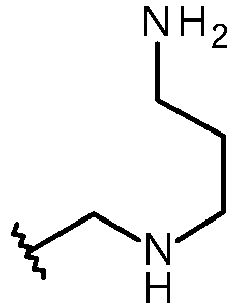
MS m/e: 679 [M+ + H] 116 12-epi-12-desvinyl-14-O-[(3-Allylaminomethyl-phenylsulfanyl)-acetyl]-12-[(3-amino-propylamino)-methyl] mutilin trihydrochloride 

1H-NMR (200 MHz, DMSO-d6): 7.38 (s, 4H, arom.), 1.35 (s, 3H, H-15), 0.90 (s, 3H, H-18), 0.81 (d, 3H, H-17, J=5.4 Hz), 0.59 (d, 3H, H-16, J=4.6 Hz) MS m/e: 600 [M+ + H] 117 12-epi-12-desvinyl-14-O-{{4-[(3-Amino-propylamino)-methyl]-phenylsulfanyl}-acetyl}-12-{[3-(3-amino-propoxy)-propylamino]-methyl} mutilin tetrahydrochloride 

1H-NMR (200 MHz, DMSO-d6): 7.56 (d, 2H arom., J=8 Hz), 7.37 (d, 2H arom., J=8 Hz), 5.46 (bs, 2H, H-14, 11-OH), 1.36 (s, 3H, H-15), 0.93 (s, 3H, H-18), 0.82 (d, 3H, H-17, J=6.2 Hz), 0.60 (d, 3H, H-16, J=5.6 Hz) MS m/e: 675 [M+ + H] 118 12-epi-12-desvinyl-14-O-[(4-Cyclopropylaminomethyl- phenylsulfanyl)-acetyl]-12- [(3-amino-propylamino)-methyl] mutilin trihydrochloride 

MS m/e: 600 [M+ + H] 119 12-epi-12-desvinyl-14-O-[(4-Cyclopropylaminomethyl- phenylsulfanyl)-acetyl]-12- [(6-amino-hexylamino)-methyl] mutilin trihydrochloride 

1H-NMR (200 MHz, DMSO-d6): 7.53 (d, 2H, arom., J=8 Hz), 7.36 (d, 2H, arom., J=8 Hz), 3.91 (s, 2H, H-22), 1.37 (s, 3H, H-15), 0.91 (s, 3H, H-18), 0.81 (d, 3H, H-17, J=6.4 Hz), 0.59 (d, 3H, H-16, J=5.6 Hz) MS m/e: 642 [M+ + H] 120 12-epi-12-desvinyl-14-O-{{4-[(4-Aminomethyl-benzylamino)-methyl]-phenylsulfanyl}-acetyl}-12-[(6-amino-hexylamino)-methyl] mutilin tetrahydrochloride 

1H-NMR (200 MHz, DMSO-d6): 7.64 - 7.54 m (6H arom.), 7.37 (d, 2H arom., J=8 Hz), 5.45 (bs, 2H, H-14, 11-OH), 1.38 (s, 3H, H-15), 0.89 (s, 3H, H-18), 0.81 (d, 3H, H-17, J=5.4 Hz), 0.60 (d, 3H, H-16, J=5.6 Hz) MS m/e: 721 [M+ + H] 121 12-epi-12-desvinyl-14-O-{{4-[(4-Aminomethyl-benzylamino)-methyl]-phenylsulfanyl}-acetyl}-12-[(4-aminomethyl-benzylamino)-methyl]-mutilin tetrahydrochloride 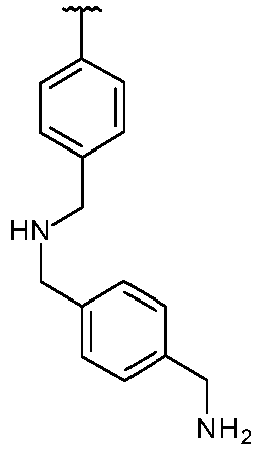

MS m/e: 741 [M+ + H] -

1H-NMR (200 MHz, DMSO-d6): 7.47 (d, 1H, arom., J=8.4 Hz), 5.47 (d, 1H, H-14, J=5.8 Hz), 4.01 (s, 2H, H-22), 1.37 (s, 3H, H-15), 0.92 (s, 3H, H-18), 0.81 (d, 3H, H-17, J=6 Hz), 0.64 (d, 3H, H-16, J=5.4 Hz)
MS m/e: 674 [M+ + H]. - 200 mg of 6,6'- dithiodinicotinic acid was refluxed in 5 mL of thionyl chloride for 1 h and the solvent was removed azeotropically with CHCl3 on a rotary evaporator. The crude dichloride obtained was used immediately in the next step.
- 222 mg of (3-Amino-propyl)-carbamic acid tert-butyl ester was dissolved in 10 mL of DCM, 445 µl of TEA was added followed by dropwise addition of 220 mg of 6-[(5-chlorocarbonyl-2-pyridyl)-disulfanyl]-pyridine-3-carbonyl chloride in 5 mL of DCM with external cooling (ice bath). After 30 min the mixture obtained was diluted with water and brine and filtered biphasically. The filter residue was sucked reasonably dry and dried in high vacuum overnight yielding the title compound as a light brown powder.
- 174 mg of tert-Butyl N-[3-[[6-[[5-[3-(tert-butoxycarbonylamino)-propylcarbamoyl]-2-pyridyl]-disulfanyl]-pyridine-3-carbonyl]-amino]-propyl]-carbamate and 58 mg of DTT were dissolved in 20 mL of DMF and the mixture obtained was stirred at rt for 30 min. The mixture obtained was diluted with EtOAc, washed with IN HCl and water, dried over Na2SO4 and brought to dryness yielding the title compound in the form of a pale brown powder.
-

- 81 mg of (4-hydroxymethyl-2-mercapto-phenyl)-methanol was dissolved in 4 mL of CH3CN, 53.4 mg of potassium tert-butoxide was added followed by 300 mg of 12-epi-12-desvinyl-14-O-[(toluene-4-yl-sulfonyloxy)-acetyl]-12-[(3-tert-butyloxycarbonylamino-propylamino)methyl] mutilin (Example 1, step 4) in 2 mL of CH3CN and stirring for 20 min. To the mixture obtained 5 mg of potassium tert-butoxide and 7 mg of the thiol was added and stirring was continued for another 35 min where upon the reaction was deemed to be complete by HPLC determination. The mixture obtained was diluted with water and extracted 4x with EtOAc, the combined organic phases were washed with 2N NaOH, water, dried over Na2SO4 and evaporated to dryness. The colourless foam obtained was used for the next step without further purification.
-

- 295 mg of 12-epi-12-desvinyl-14-O-[(2,5-Bis-hydroxymethyl-phenylsulfanyl)-acetyl]-12-[(3-tert-butoxycarbonylamino-propylamino)-methyl] mutilin was dissolved in 4.5 mL of THF, 267 mg of DPPA was added with external cooling, then 169 mg of DBU in 2 mL of CH3CN over 10 min. The cooling bath was removed and the mixture obtained was stirred at rt overnight. To the mixture obtained ca. 20 mL water was added, the resulting slurry was extracted with EtOAc (2x), the combined organic phases were washed with water (2x) and brine, dried over Na2SO4, brought to dryness and the dry residue obtained was subjected to chromatography (eluent: EtOAc/Et3N = 100:1). The title compound was obtained in the form of colourless foamy crystals.
-

- 184 mg of 12-epi-12-desvinyl-14-O-[(2,5-Bis-azidomethyl-phenylsulfanyl)-acetyl]-12-[(3-tert-butoxycarbonylamino-propylamino)-methyl] mutilin was dissolved in 4 mL of EtOH, 1.35 mL of water was added and the mixture obtained was sonicated to obtain a clear solution. To the solution obtained 62.1 mg of NH4Cl and 43.4 mg of zinc powder were added and the mixture
obtained was heated to reflux for 10 min and cooled to rt. To the mixture obtained 2 mL of 25% NH4OH was added and the phases were separated. The aqueous phase obtained was washed with EtOAc (2x), the combined organic phases were dried, brought to dryness and the dry residue was subjected to chromatography over silica gel (eluent: EtOAc/EtOH/NH4OH = 90:10:2). The title compound was obtained in the form of a colourless foam. -

- BOC-deprotection of the compound obtained in step 3 was carried out as described in Example 1, Step 6. 1H-NMR (200 MHz, DMSO-d6): 7.77 (s, 1H, H-2, arom.), AB-system (νA=7.54, 2H, arom., νB=7.44, 2H, J=8 Hz), 5.43 (d, 1H, H-14, J=6.4 Hz), 1.34 (s, 3H, H-15), 0.92 (s, 3H, H-18), 0.81 (d, 3H, H-17, J=5.4 Hz), 0.55 (d, 3H, H-16, J=5.4 Hz)
MS m/e: 623 [M- + Cl]. - 15.3 g of 2-sulfoterephthalic acid sodium salt and 49 g of phosphorous pentachloride were mixed and the mixture was heated to 80°C over night, cooled to rt and poured onto ice followed by extraction with diethyl ether. The organic phase obtained was washed successively with ice water until pH = 4, and optionally with brine, dried over Na2SO4 and evaporated to dryness. The product was obtained in the form of colourless crystals.
- 19 g of 2-chlorosulfonylterephthalic acid was dissolved in 200 mL of THF and with external cooling 66 g of triphenylphosphine was added, followed by 1 mL of water and heating to reflux for 1 h. The mixture obtained was cooled to rt and poured onto 2N NaOH. The mixture obtained was washed twice with EtOAc; the aqueous phase obtained was acidified with 36% HCl, extracted with EtOAc, the organic phase obtained dried over Na2SO4 and evaporated to dryness yielding the title compound in the form of colourless crystals.
- 11.5 g (303 mmol) of LAH was slurried in 100 mL of dry THF and brought to reflux. To that mixture 4.4 g of 2-mercaptoterephthalic acid, dissolved in 100 mL of dry THF, was added slowly and after complete addition the mixture obtained was refluxed overnight. The mixture obtained was cooled in an ice bath and rendered acidic by the cautious addition of conc. HCl. The acidic mixture obtained was extracted with EtOAc, the organic phase obtained was stirred with solid NaHCO3, the mixture obtained was decanted, the organic phase obtained was dried over Na2SO4, evaporated to dryness and dried in high vacuum overnight yielding the title compound.
- According, e.g. analogously, to a method as set out under Example 123 above, but using appropriate starting materials, the compound of formula IEX, wherein R1EX and R2EX are as defined in Table 13 is prepared. Chemical characterisation data are also set out in Table 13.
Table 13 Example R2EX R1EX 124 12-epi-12-desvinyl-14-O-[(3,5-Bis-aminomethyl-phenylsulfanyl)-acetyl]-12-[(3-amino-propylamino)-methyl] mutilin tetrahydrochloride 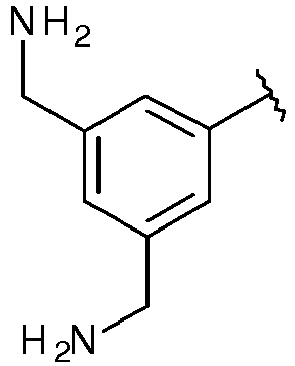

1H-NMR (200 MHz, DMSO-d6): 7.58 (s, 2H, H-2, H-6, arom.), 7.37 (s, 1H, H-4, arom.), 5.48 (d, 1H, H-14, J=6.2 Hz), 1.33 (s, 3H, H-15), 0.96 (s, 3H, H-18), 0.81 (d, 3H, H-17, J=5.6 Hz), 0.62 (d, 3H, H-16, J=5 Hz) MS m/e: 589 [M+ + H] - 305 mg of 4-epi-12-epi-12-(2-Allylamino-ethyl)-14-O-{{4-[(3-tert-butoxycarbonylamino-propylcarbamoyl)-methyl]-phenylsulfanyl}-acetyl}-3-deoxo-11-deoxy-12-desvinyl-3-methoxy-11-oxo mutilin (prepared from the intermediate of step 4, Example 52, via reductive amination with allylamine in analogy to Example 1, step 4) in 10 mL of DCM was degassed in an ultrasonic bath for 10 min and then added to a mixture of 382 mg of N,N'-dimethylbarbituric acid and 19 mg of tetrakis(triphenylphosphino) palladium (0) under an argon atmosphere. The mixture obtained was stirred at rt for 14 h. Since the reaction was not complete, the same amount of reagents was added and stirring was continued for another 24 h. The mixture obtained was diluted with DCM, washed with 10% K2CO3 solution (2x), the combined aqueous phases were washed with DCM, the combined organic layers were dried over Na2SO4 and evaporated to dryness. The residue in the form of orange foamy crystals was subjected to silica gel chromatography (eluent: EtOAc/Et3N = 100:1, 80:1, 60:1 and finally MeOH/Et3N = 10:1). The title compound of formula

-
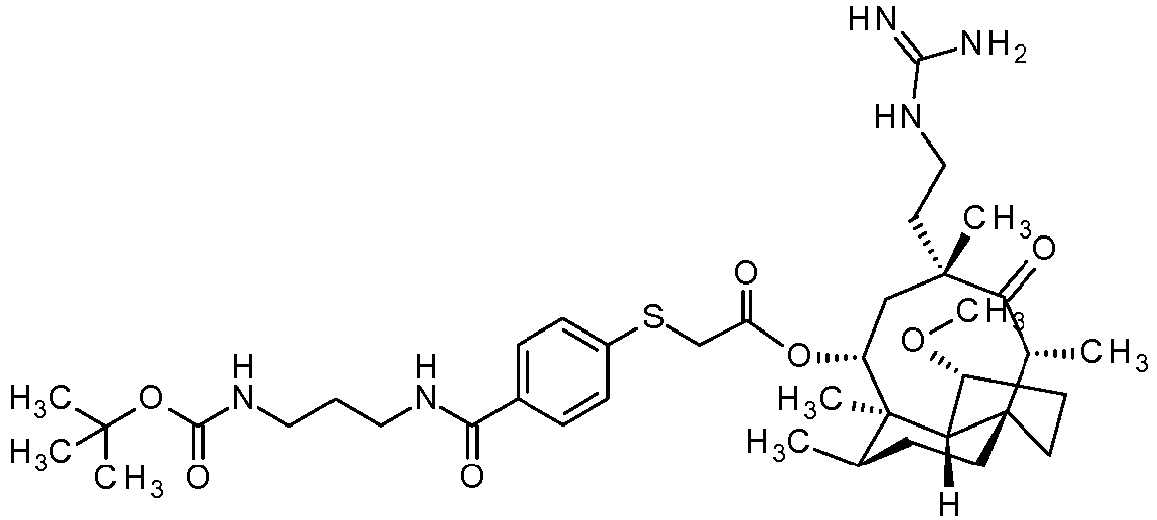
- 192 mg of 4-epi-12-epi-12-(2-Amino-ethyl)-14-O-{{4-[(3-tert-butoxycarbonylamino-propylcarbamoyl)-methyl]-phenylsulfanyl}-acetyl}-3-deoxo-11-deoxy-12-desvinyl-3-methoxy-11-oxo mutilin and 75 mg of S-methylisothiuronium iodide was dissolved in 10 mL of THF and the mixture obtained was stirred for 14 h at rt. Then again 75 mg of isothiuronium iodide was added and the mixture obtained was stirred for another 4 d, diluted with EtOAc, washed with 5% NaHCO3 (2x), dried over Na2SO4 and brought to dryness. The title compound was obtained in the form of pale orange crystals which were used without purification in the next step.
-

- 174 mg of 4-epi-3-Methoxy-12-epi-12-desvinyl-14-O-{[4-(3-tert-butoxycarbonylamino-propylcarbamoyl)-phenylsulfanyl]-acetyl}-12-(2-guanidino-ethyl) mutilin was dissolved in 0.5 mL of DCM, 2 mL of 4N HCl in dioxane was added and after 15 min 5 mL of diethyl ether. The mixture obtained was stirred for 1 h and the formed precipitate was filtered off with suction, washed 5x with ether and dried in a rotovap bulb under vacuum without heating for 1 h. The crude product (brown crystals) was subjected to reverse chromatography (LiChroprep RP-18 (40-63 µm)) with CH3CN/H2O = 0 - 30%. The title compound was obtained in the form of colourless crystals after lyophilisation.
MS m/e: 630 [M+ + H]. - According, e.g. analogously, to a method as set out under Examples 1 and 23 above, but using appropriate starting materials, the compounds of formula IEX, wherein R1EX and R2EX are as defined in Table 14 are prepared. Chemical characterisation data are also set out in Table 14.
Table 14 Example R2EX R1EX 126 12-epi-12-desvinyl-14-O-{[4-(3-Hydroxy-propylcarbamoyl)-phenylsulfanyl]-acetyl}-12-[(6-amino-hexylamino)-methyl]mutilin dihydrochloride 

1H-NMR (200 MHz, DMSO-d6): 8.57 (t, 1H, -CO-NH, J=6 Hz), 7.82 (d, 2H, arom., J=8 Hz), 7.38 (d, 2H, arom., J=8 Hz), 5.46 (d, 1H, H-14, J=6.8 Hz), 5.38 (bs, 1H, 11-OH), 3.96 (s, 2H, H-22), 1.36 (s, 3H, H-15), 0.87 (s, 3H, H-18), 0.80 (d, 3H, H-17, J=6.4 Hz), 0.59 (d, 3H, H-16, J=5.6 Hz) MS m/e: 674 [M+ + H] 127 12-epi-12-desvinyl-14-O-[(2-Hydroxy-ethylsulfanyl)-acetyl]-12-[(6-amino-hexylamino)-methyl] mutilin dihydrochloride 

1H-NMR (200 MHz, DMSO-d6): 5.48 (d, 1H, H-14, J=7.6 Hz), 1.41 (s, 3H, H-15), 0.99 (s, 3H, H-18), 0.83 (d, 3H, H-17, J=6 Hz), 0.65 (d, 3H, H-16, J=5.2 Hz) MS m/e: 541 [M + H] -

1H-NMR (200 MHz, DMSO-d6): 5.48 (d, 1H, H-14, J=6.8 Hz), 1.40 (s, 3H, H-15), 0.98 (s, 3H, H-18), 0.82 (d, 3H, H-17, J=6 Hz), 0.65 (d, 3H, H-16, J=5 Hz)
MS m/e: 658 [M + H]. - A mixture of 2.45 mL of 2-cyclohexene-1-one, 1.96 mL of thioacetic acid and 11 mL of water was stirred vigorously over 5 h at rt, extracted with DCM (2x); the combined organic phases were washed successively with 5% NaHCO3, 2N HCl and brine, dried over Na2SO4 and evaporated to dryness. The evaporation residue obtained was subjected to chromatography over silica gel (eluent: cyclohexane/EtOAc = 30:1). The title compound was obtained in the form of a pale yellow oil.
- 1 g of thioacetic acid S-(3-oxocyclohexyl) ester and 470 mg of 2,2-difluoroethylamine were dissolved with stirring in 20 mL of dichloroethane; 2.7 g of sodium triacetoxyborohydride and 498 µL of acetic acid was added and the mixture obtained was stirred overnight at rt followed by neutralisation with 5% aqueous NaHCO3 solution and extraction with EtOAc (2x). The combined organic phases obtained were dried over Na2SO4 and brought to dryness.
- The residue obtained was subjected to chromatography over silica gel (eluent: toluene/acetone = 8:1) to obtain the title compound in the form of a yellow oil.
- According, e.g. analogously, to a method as set out under Example 1 above, but using appropriate starting materials, the compound of formula IEX, wherein R1EX and R2EX are as defined in Table 15 is prepared. Chemical characterisation data are also set out in Table 15.
Table 15 Example R2EX R1EX 129 12-epi-12-desvinyl-14-O-[(2-Amino-7H-purin-6-ylsulfanyl)-acetyl]-12-[(6-amino-hexylamino)-methyl] mutilin dihydrochloride 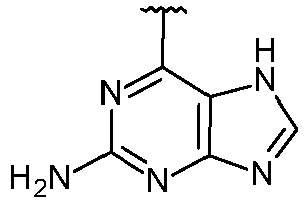

1H-NMR (200 MHz, DMSO-d6): 8.53 (s, 1H, arom.), 5.46 (d, 1H, H-14, J=6.8 Hz), AB (2H, H-22, νA=4.23, νB=4.13, J=16 Hz), 1.35 (s, 3H, H-15), 0.90 (s, 3H, H-18), 0.79 (d, 3H, H-17,J=6 Hz), 0.61 (d, 3H, H-16, J=5 Hz). MS m/e: 630 [M + H] -

1H-NMR (200 MHz, DMSO-d6): 5.47 (d, 1H, H-14, J=7 Hz), 5.35 (bs, 1H, 11-OH), 1.40 (s, 3H, H-15), 0.97 (s, 3H, H-18), 0.82 (d, 3H, H-17,J=5.8 Hz), 0.64 (d, 3H, H-16, J=5.2 Hz).
MS m/e: 594 [M + H] - 2,5 g of 4-Oxo-piperidine-1-carboxylic acid tert-butyl ester was dissolved in diethyl ether, cooled to -35°C, 2 mL of diazoacetic acid diethyl ester and 2,15 mL of borontrifluoride diethyl ether complex were added simultaneously and stirring at -35°C was continued for one h. The mixture obtained was allowed to warm to rt and was rendered alkaline with 30% K2CO3 solution. The mixture obtained was extracted with EtOAc, the organic phase obtained was dried over Na2SO4, evaporated to dryness and the residue was dried in high vacuum leaving a yellow oil. The oil was taken up in 12 mL of THF, treated with 1,8 g of LiOH in 4 mL of water and the mixture obtained was refluxed overnight, cooled to rt and partitioned between brine and EtOAc. The phases obtained were separated and the organic phase obtained was dried over Na2SO4, brought to dryness and dried in high vacuum. The title compound was obtained in the form of colourless crystals.
- 2.06 g of 4-Oxo-azepane-1-carboxylic acid tert-butyl ester was dissolved in 20 mL of THF/MeOH 4:1, treated with external cooling with 370 mg of sodium borohydride and stirred with cooling for 1 h. The cold solution obtained was quenched with 10 mL of MeOH/H2O 1:1, the organic solvents were removed in vacuo and the residue obtained was partitioned between DCM and water; the organic phase was separated, dried over Na2SO4 and evaporated to dryness. The title compound in the form of a colourless oil was obtained.
- 2.08 g of 4-Hydroxy-azepane-1-carboxylic acid tert-butyl ester, dissolved in 10 mL of DCM, was treated with external ice cooling with 2.02 g of methanesulfonic anhydride followed by 2.02 mL of TEA and stirred for one h. The phases obtained were separated, the organic phase obtained was washed with brine, dried over Na2SO4 and brought to dryness. The title compound in the form of a semicrystalline oil was obtained.
- 2.75 g of tert-Butyl 4-methylsulfonyloxy-azepane-1-carboxylate and 2.14 g of potassium thioacetate was dissolved in 10 mL of DMF and warmed to 70°C for 3 h. From the mixture obtained the solvent was partially removed in vacuo, the residue partitioned between EtOAc/n-heptane = 3:1 and water, the organic phase was separated, dried over Na2SO4 and evaporated to dryness. The title compound in the form of a dark orange oil was obtained.
- According, e.g. analogously, to a method as set out under Examples 1 and 130 above, but using appropriate starting materials, the compounds of formula IEX, wherein R1EX and R2EX are as defined in Table 16 are prepared. Chemical characterisation data are also set out in Table 16.
Table 16 Example R2EX R1EX 131 12-epi-12-desvinyl-14-O-[(Azepan-4-ylsulfanyl)-acetyl]-12-[(6-guanidino-hexylamino)-methyl] mutilin trihydrochloride 

1H-NMR (200 MHz, DMSO-d6): 5.47 (d, 1H, H-14, J=7.6 Hz), 5.37 (bs, 1H, 11-OH), 1.40 (s, 3H, H-15), 0.98 (s, 3H, H-18), 0.82 (d, 3H, H-17, J=6.4 Hz), 0.64 (d, 3H, H-16, J=4.8 Hz) MS m/e: 637 [M+ + H] 132 12-epi-12-desvinyl-14-O-[(Azepan-4-ylsulfanyl)-acetyl]-12-[(4-aminomethyl-benzylamino)-methyl] mutilin trihydrochloride 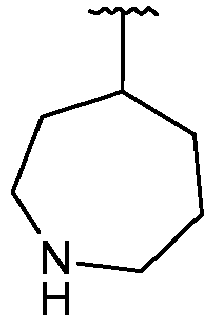

1H-NMR (200 MHz, DMSO-d6): 7.68 (d, 2H, arom., J=8Hz), 7,53 (d, 2H, arom., J=8 Hz), 5,45 (d, 1H, H-14, J=7.2 Hz), 5.30 (bs, 1H, 11-OH), 1.39 (s, 3H, H-15), 0.92 (s, 3H, H-18), 0.80 (d, 3H, H-17, J=6.4 Hz), 0.63 (d, 3H, H-16, J=5 Hz) MS m/e: 615 [M+ + H] 133 12-epi-12-desvinyl-14-O-[(Azepan-4-ylsulfanyl)-acetyl]-12-[(6-amino-octylamino)-methyl] mutilin trihydrochloride 

1H-NMR (200 MHz, DMSO-d6): 5.45 (d, 1H, H-14, J=5 Hz), 5.36 (bs, 1H, 11-OH), 1,39 (s, 3H, H-15), 0.96 (s, 3H, H-18), 0.81 (d, 3H, H-17, J=5 Hz), 0.63 (d, 3H, H-16, J=3.8 Hz) MS m/e: 622 [M+ + H] The reductive amination was done as described in Example 1, step 4 using 10 eq of 1,8-diaminooctane - According, e.g. analogously, to a method as set out under Example 52, but with altered order of events (step 2 → step 4 → step 5 → step 3 → step 6, cf. Reaction Scheme 2) and using appropriate starting materials, the compounds of formula IEX, wherein R1EX and R2EX are as defined in Table 17 are prepared. Chemical characterisation data are also set out in Table 17.
Table 17 Example R2EX R1EX 134 12-epi-12-desvinyl-14-O-{[1-(2-Amino-acetyl)-piperidin-4-yl-sulfanyl)]-acetyl}-12-[(6-amino-hexylamino)-ethyl]mutilin trihydrochloride 

1H-NMR (200 MHz, DMSO-d6): 5.47 (d, 1H, H-14, J=7.8 Hz), 1.40 (s, 3H, H-15), 0.98 (s, 3H, H-18), 0.82 (d, 3H, H-17, J=5.8 Hz), 0.64 (d, 3H, H-16, J=5 Hz) MS m/e: 608 [M+ + H] 135 12-epi-12-desvinyl-14-O-{[1-(2-Amino-acetyl)-piperidin-4-yl-sulfanyl)]-acetyl}-12-[(4-aminomethyl-benzylamino)-ethyl] mutilin triihydrochloride 

1H-NMR (200 MHz, DMSO-d6): 7.61 (d, 2H, arom., J=8 Hz), 7.52 (d, 2H, arom., J=8 Hz), 5.48 (d, 1H, H-14, J=5 Hz), 4.77 (bs, 1H, 11-OH), 1.38 (s, 3H, H-15), 0.92 (s, 3H, H-18), 0.82 (d, 3H, H-17, J=6 Hz), 0.64 (d, 3H, H-17, J=5.2 Hz), MS m/e: 671 [M+ + H] 136 12-epi-12-desvinyl-14-O-[5-Hydroxymethyl-pyridin-2-yl-sulfanylacetyl]-12-[(4-aminomethyl-3-fluoro-benzylamino)-ethyl] mutilin tetrahydrochloride 

MS m/e: 655 [M+ + H] 137 12-epi-12-desvinyl-14-O-{4-[(2-Amino-acetylamino)-cyclohexylsulfanyl]-acetyl}-12-[(4-aminomethyl-3-fluoro-benzylamino)-ethyl] mutilin trihydrochloride 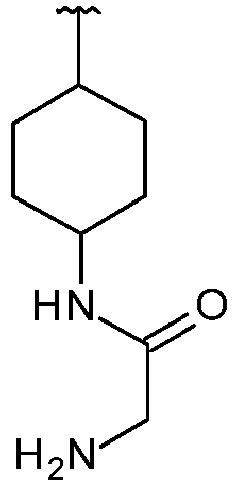

1H-NMR (200 MHz, DMSO-d6): 7.66 - 7.53 (m, 2H, arom.), 7.44 (d, 1H, arom., J=7.6 Hz, 5.48 (d, 1H, H-14, J=7.2 Hz), 4.72 (d, 1H, 11-OH, J=5.8 Hz), 1.38 (s, 3H, H-15), 1.37 (s, 3H, H-15), 0.92 (s, 3H, H-18), 0.83 (d, 2H, H-17, J=6.4 Hz), 0.65 (d, 3H, H-16, J=5.4 Hz) MS m/e: 703 [M+ + H] The required Thioacetic acid S-[4-(2-tert-butoxycarbonylamino-acetylamino)-cyclohexyl] ester was prepared in analogy to the procedure described in Example 78 using the appropriate starting materials 138 12-epi-12-desvinyl-14-O-{[1-(2-Amino-acetyl)-piperidin-4-yl-sulfanyl]-acetyl}-12-[(4-aminomethyl-3-fluoro-benzylamino)-ethyl] mutilin trihydrochloride 

MS m/e: 689 [M+ + H] 139 12-epi-12-desvinyl-14-O-[(5-Aminomethyl-pyridin-2-yl-sulfanyl)-acetyl]-12-[(4-aminomethyl-2,5-difluoro-benzylamino)-ethyl] mutilin tetrahydrochloride 

MS m/e: 673 [M+ + H] 140 12-epi-12-desvinyl-14-O-{[1-(2-Amino-acetyl)-piperidin-4-yl-sulfanyl]-acetyl}-12-[(4-aminomethyl-2,5-difluoro-benzylamino)-ethyl] mutilin trihydrochloride 

MS m/e: 707 [M+ + H] 141 12-epi-12-desvinyl-14-O-{[1-(2-Amino-acetyl)-piperidin-4-yl-sulfanyl]-acetyl}-12{2-[4-(2-amino-ethoxy)-benzylamino]-ethyl} mutilin trihydrochlorid 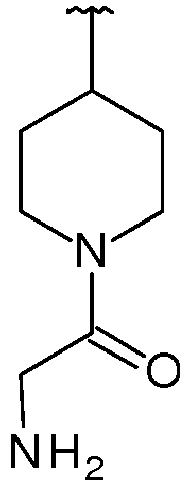

MS m/e: 701 [M+ + H] 142 12-epi-12-desvinyl-14-O-{{4-[(2-Amino-acetylamino)-methyl] -cyclohexylsulfanyl-acetyl}-12-[(4-aminomethyl-3-fluoro-benzylamino)-ethyl] mutilin trihydrochloride 

MS m/e: 717 [M+ + H] The required Thioacetic acid S-{4-[(2-tert-butoxycarbonylamino-acetylamino)-methyl]-cyclohexyl} ester was prepared in analogy to the procedure described in Example 78 using the appropriate starting materials -

-

-
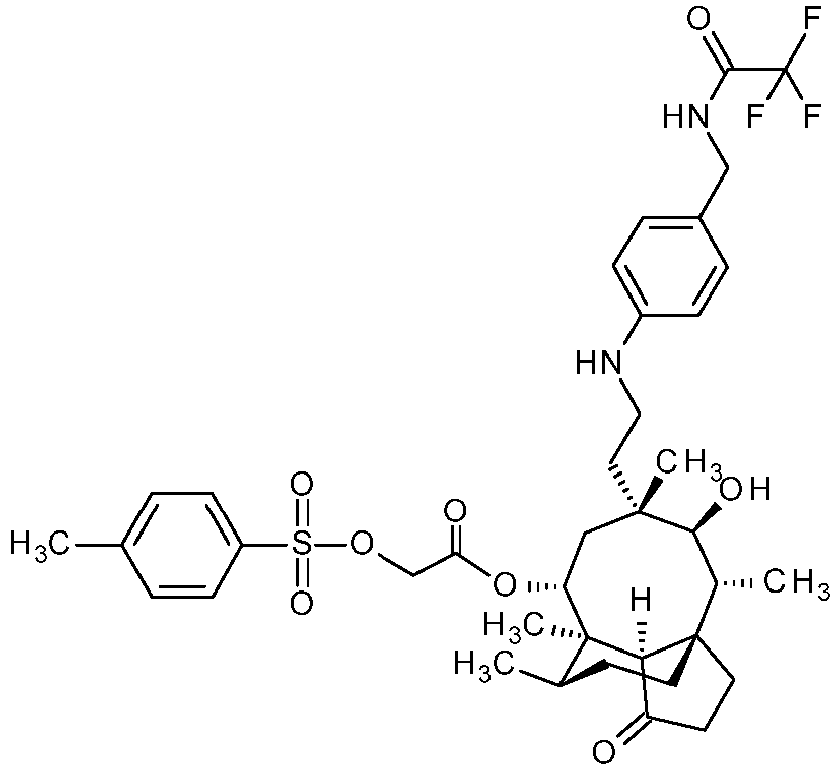
- 1.36 g of 4-epi-12-epi-3-deoxo-11-deoxy-12-desvinyl-3-methoxy-11-oxo-14-O-[(toluene-4-sulfonyloxy)-acetyl]-12-(2-{4-[(2,2,2-trifluoro-acetylamino)-methyl]-phenylamino}-ethyl) mutilin was dissolved in 10 mL of 1,4 dioxane and 2.5 mL of Lucas reagent was added. The mixture was stirred at ambient temperature for 2h, diluted with EtOAc and washed with 2x water , NaHCO3 and brine, dried over Na2SO4 and evaporated to dryness. The product was obtained as colorless foam and used for the next step without further purification.
-

H-NMR (200 MHz, DMSO-d6): 7.47 (m, 2H, arom.), 5.46 (d, 1H, H-14, J=6.6 Hz), 1.38 (s, 3H, H-15), 0.91 (s, 3H, H-18), 0,81 (d, 3H, H-17, J=6 Hz), 0.63 (d, 3H, H-16, J=5.2 Hz) MS m/e: 614 [M- + Cl] - To 1g of 4-(aminomethyl)-aniline in 50 mL of ethanol was slowly added 1.16 g of ethyl 2,2,2-trifluoroacetate at 4°C. The reaction mixture was allowed to warm to ambient temperature, diluted with EtOAc, washed with semi-saturated NaHCO3 solution and dried over Na2SO4. After evaporation the product was obtained as yellow crystals.
- Tert-Butyl 4-acetylsulfanyl-azepane-1-carboxylate (intermediate of Example 130, step d) was deprotected in analogy to Example 1, step 6 to give the title compound.
- According, e.g. analogously, to a method as set out under Example 143, but using appropriate starting materials, the compounds of formula IEX, wherein R1EX and R2EX are as defined in Table 18 are prepared. Chemical characterisation data are also set out in Table 18.
Table 18 Example R2EX R1EX 144 12-epi-12-desvinyl-14-O-{{4-[(2-Amino-acetylamino)]-cyclohexylsulfanyl}-acetyl}-12-[(4-aminomethyl-phenylamino)-ethyl] mutilin trihydrochloride 

1H-NMR (200 MHz, DMSO-d6): 5.48 (d, 1H, H-14, J=4.6 Hz), 1.38 (s, 3H, H-15), 0.91 (s, 3H, H-18), 0.82 (d, 3H, H-17, J=6.6 Hz), 0,64 (d, 3H, H-16, J=5 Hz) MS m/e: 705 [M- + Cl] Thioacetic acid S-[4-(2-amino-acetylamino)-cyclohexyl] ester (prepared by reaction of the corresponding intermediate of Example 137 with TFA in DCM) was used as intermediate in step 4 145 12-epi-12-desvinyl-14-O-{[1-(2-Amino-acetyl)-piperidin-4-yl-methylsulfanyl]-acetyl}-12-[(4-aminomethyl-phenylamino)-ethyl] mutilin trihydrochloride 

1H-NMR (200 MHz, DMSO-d6): 5.49 (d, 1H, H-14, J=7.6 Hz), 1.38 (s, 3H, H-15), 0.92 (s, 3H, H-18), 0.82 (d, 3H, H-17, J=6.6 Hz), 0.65 (d, 3H, H-16, J=4.4 Hz) MS m/e: 705 [M- + Cl] Thioacetic acid S-[1-(2-amino-acetyl)-piperidin-4-ylmethyl]ester (prepared by reaction of the corresponding intermediate of Example 81 with TFA in DCM) was used as intermediate in step 4 -

- 5.95 g of 6-Azidohexyl-triphenylphosphonium iodide was dissolved in 90 mL THF, 25 mL of 0,5M potassium hexamethyldisilazide in THF was added dropwise under argon at -78° C. After stirring at this temperature for 30 minutes 4.47 g of 4-epi-12-epi-3-deoxo-11-deoxy-12-desvinyl-3-methoxy-11-oxo-12-(2-oxo-ethyl)-14-O-triethylsilyl mutilin in 20 mL THF was added dropwise, the reaction mixture was left in the cooling bath and allowed to warm to ambient temperature overnight. The suspension was poured into 500 mL water/20 mL 2N HCl, extracted 3x with EtOAc, the combined organic layers were washed with 5% sodium bicarbonate solution, dried over Na2SO4 and evaporated to dryness, leaving a beige semi crystalline residue. Purification over silica gel (toluene/EtOAc = 20:1) yielded the product as pale yellow oil.
-

- 4.31 g of 4-epi-12-epi-12-(8-Azido-oct-2-enyl)-3-deoxo-11-deoxy-12-desvinyl-3-methoxy-11-oxo-14-O-triethylsilyl mutilin was hydrogenated in an H-cube apparatus at 50 bar over 10% Pd/C (flow 1 mL/min). After evaporation of the solvent the title compound was isolated.
-

- 2.9 g (5.29 mmol) of 4-epi-12-epi-12-(8-Amino-oct-2-enyl)-3-deoxo-11-deoxy-12-desvinyl-3-methoxy-11-oxo-14-O-triethylsilyl mutilin was dissolved in 200 mL THF/MeOH 1+1 and hydrogenated (balloon) over 290 mg of 10% Pd/C for 16 hours. The catalyst was filtered off and the solvent evaporated yielding the product as yellow oil containing some residual solvent.
-
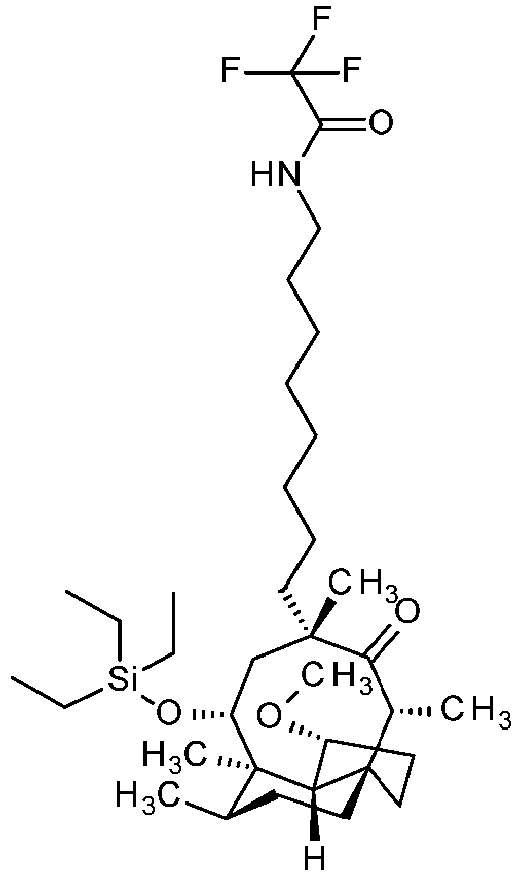
- 2.88 g of 4-epi-12-epi-12-(8-amino-octyl)-3-deoxo-11-deoxy-12-desvinyl-3-methoxy-11-oxo-14-O-triethylsilyl mutilin and 637 mg of triethylamine were dissolved in 25 mL dichloromethane, cooled in an ice bath, treated dropwise with 1.15 g of trifluoroacetic acid anhydride in 15 mL dichloromethane and then stirred at ambient temperature for 1 hour. The reaction mixture was washed with 1N HCl (20 mL), 5% sodium bicarbonate solution, dried over Na2SO4 and evaporated to dryness. The product was obtained as yellow oil.
-

- 3.26 g of 4-epi-12-epi-3-deoxo-11-deoxy-12-desvinyl-3-methoxy-11-oxo-14-O-triethylsilyl-12-[8-(2,2,2-trifluoro-acetylamino)-octyl] mutilin was suspended in 65 mL ethanol containing 2 wt.% hydrochloric acid (aq) and stirred at ambient temperature. After 3 hours the mixture was partitioned between 5% sodium bicarbonate solution and EtOAc, the aqueous phase washed with EtOAc, the combined organic layers were dried over Na2SO4 and evaporated to dryness to give a pale yellow oil which was chromatographed over silica gel (DCM/tert.-butyl methyl ether = 40:1) to give a colorless oil.
-

- 750 mg (1.41 mmol) of 4-epi-12-epi-3-deoxo-11-deoxy-12-desvinyl-3-methoxy-11-oxo-12-[8-(2,2,2-trifluoro-acetylamino)-octyl] mutilin was dissolved in 10 mL EtOAc, treated with 571 mg of triethylamine, 52 mg of 4-dimethylaminopyridine and warmed with stirring to 50° C. 854 mg of bromoacetic acid bromide in 10 mL EtOAc was added dropwise over 20 minutes, during which time the reaction mixture turned dark brown. After 15 minutes 0.79 mL of Et3N followed by 854 mg of bromoacetic acid bromide in 5 mL EtOAc and after further 15 minutes the same amount of Et3N and bromoacetic acid bromide was added after which no starting material could be detected by TLC (toluene/ EtOAc 5:1). 1 mL methanol was added to destroy residual acid bromide and stirring was continued for 45 minutes. Then the reaction solution was shaken with IN HClmL, filtered over celite biphasically, the organic layer washed with 5% sodium bicarbonate solution, dried over Na2SO4 and evaporated to dryness. The crude product (black oil) was purified by chromatography over silica gel (eluant: DCM) and yielded the title compound as yellow oil.
-

- 320 mg of 4-epi-12-epi-14-O-Bromoacetyl-3-deoxo-11-deoxy-12-desvinyl-3-methoxy-11-oxo-12-[8-(2,2,2-trifluoro-acetylamino)-octyl] mutilin and 233 mg of Thioacetic acid S-[1-(2-tert-butoxycarbonylamino-acetyl)-piperidin-4-yl] ester was dissolved in 10 mL methanol and treated with 294 µl 5M aqueous potassium carbonate solution, stirred 15 minutes at ambient temperature and 30 minutes in an ultrasonic bath. The reaction mixture was diluted with EtOAc, washed with 1N HCl, 2N NaOH, 5% sodium bicarbonate solution, dried over Na2SO4 and brought to dryness; the crude product was obtained as an orange oil.
-

- 134 mg of 4-epi-12-epi-14-O{[1(2-tert-Butoxycarbonylamino-acetyl)-piperidin-4-ylsulfanyl]-acetyl}-3-deoxo-11-deoxy-12-desvinyl-3-methoxy-11-oxo-12-[8-(2,2,2-trifluoro-acetylamino)-octyl] mutilin was dissolved in 10 mL methanol, treated with 1.6 mL 1N sodium hydroxide solution and stirred at ambient temperature. After 1 hour 1.6 mL 1N sodium hydroxide solution was added and stirring was continued for 1 h. The solution was diluted with EtOAc and washed 2x with water; the combined aqueous layers were washed with EtOAc, the organic phases dried over Na2SO4 and evaporated to dryness to give a light yellow oil containing some residual solvent.
-

- 129 mg of 4-epi-12-epi-12-(8-Amino-octyl)-14-O-{[1-(2-tert-Butoxycarbonylamino-acetyl)-piperidin-4-ylsulfanyl] -acetyl} -3-deoxo-11-deoxy-12-desvinyl-3-methoxy-11-oxo mutilin was dissolved in 0.5 mL dioxane, treated with 2 mL 4N HCl in dioxane and the homogeneous solution was stirred at ambient temperature overnight. Then the volatiles were removed in vacuo and the residue (yellow oil) was purified by reversed phase chromatography (eluant: acetonitrile in water 0-35%). The title compound was obtained as colourless crystals.
1H-NMR (200 MHz, DMSO-d6): 5.46 (d, 1H, H-14, J=7.4 Hz), 1.33 (s, 3H, H-15), 0.83 - 0.77 (m, 6H, H-18, H-17), 0.62 (d, 3H, H-16, J=5.4 Hz)
MS m/e: 636 [M+ + H] - 7.97 g of 6-iodohexanol and 9.17 g of triphenylphosphine was dissolved in 10 mL of acetonitrile and refluxed for 20 hours. The mixture was cooled to ambient temperature, treated with 150 mL diethyl ether, stirred for about 4 hours and left standing overnight. The resulting precipitate was filtered off, washed five times with diethyl ether and dried in high vacuum overnight; the product was obtained as colorless powder.
- 7.97 g of 6-iodohexanol and 9.17 g of triphenylphosphine was dissolved in 10 mL of acetonitrile and refluxed for 20 hours. The mixture was cooled to ambient temperature, treated with 150 mL diethyl ether, stirred for about 4 hours and left standing overnight. The resulting precipitate was filtered off, washed five times with diethyl ether and dried in high vacuum overnight; the product was obtained as colorless powder.
- 10.4 g of 6-Bromohexyl-triphenylphosphonium iodide was dissolved in 25 mL ethanol, 1.83 g of sodium azide in 25 mL water was added and the mixture was refluxed for ca. 16 hours. The volatiles were almost completely removed and the residue was stirred with 50 mL dichloromethane and 20 mL water for 30 minutes. After phase separation the aqueous layer was extracted with 3x dichloromethane, the combined organic layers were dried over Na2SO4 and brought to dryness yielding the title compound as a light brown resin
- 53 g of Sodium hydroxide was dissolved in 500 mL of methanol with boiling. The temperature was lowered by 5° C and then 240 g of 4-epi-12-epi-3-deoxo-11-deoxy-3-methoxy-11-oxo-14-O-[(toluene-4-sulfonyloxy)-acetyl] mutilin was charged and the mixture was refluxed for 1 hour. Almost 90% of the solvent was removed in vacuo, the residue was diluted with external cooling with water, and then extracted with EtOAc. The combined organic phases were washed with brine, dried over Na2SO4 and concentrated to give the title compound as yellow solid.
- 57 g of imidazole and 26 g of DMAP was dissolved in 2 L of DCM, then 126 g of Et3SiCl was added and the mixture stirred at rt overnight. The reaction was quenched with water, extracted with EtOAc, the organic phases were combined, dried over Na2SO4 and concentrated. The residue was purified by chromatography (PE/EtOAc = 10/1) to give the title compound as yellow solid.
- 140 g of 4-epi-12-epi-3-deoxo-11-deoxy-3-methoxy-11-oxo-14-0-triethylsilyl mutilin was dissolved in 1 L of THF, then 1.25 L of 9-BBN (0.5m in THF) was added and the reaction refluxed for 2h. The reaction is cooled in an ice-bath, slowly 350 g of H2O2 (30%) and 310 mL of 2N NaOH) were added and stirred for 30 min. After warming to room temperature water and EtOAc were added, the organic phase was washed with brine, dried over Na2SO4, concentrated and the residue was purified by chromatography (PE/EtOAc = 15/1) to give the title compound as white solid.
- 70 g of 4-epi-12-epi-3-deoxo-11-deoxy-12-desvinyl-12-(2-hydroxy-ethyl)-3-methoxy-11-oxo-14-O-triethylsilyl mutilin was dissolved in 1 L of DCM, then 64 g of Dess-Martin reagent was added and the reaction stirred at rt. After 2h the reaction was quenched by addition of sat. NaHCO3 solution, the organic phase was separated, dried over Na2SO4, concentrated and the residue was purified by chromatography (PE/EtOAc = 8/1) to give the title compound as white solid.
- According, e.g. analogously, to a method as set out under Example 1 and 146, but using appropriate starting materials, the compounds of formula IEX, wherein R1EX and R2EX are as defined in Table 19 are prepared. Chemical characterisation data are also set out in Table 19.
Table 19 Example R2EX R1EX 147 12-epi-12-desvinyl-14-O-{[1-(2-Amino-acetyl)-piperidin-4-yl-sulfanyl]-acetyl}-12-[3-(4-aminomethyl-phenyl)-propyl] mutilin dihydrochloride 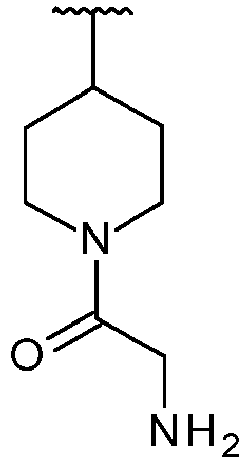
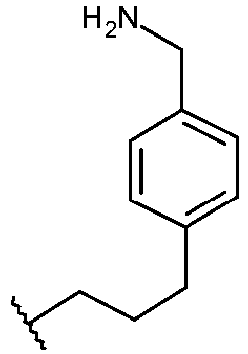
1H-NMR (200 MHz, DMSO-d6): 7.39 (d, 2H, arom., J=8 Hz), 7.21 (d, 2H, arom., J=8 Hz), 5.47 (d, 1H, H-14, J=7 Hz), 4.48 (bs, 1H, 11-OH), 1.35 (s, 3H, H-15), 0.84 (m, 6H, H-18, H-17), 0.63 (d, 3H, H-16, J=5.2 Hz) MS m/e: 656 [M+ + H] Azidomethyl-phenyl- methyl-triphosphonium bromide was used as intermediate in step 1 148 12-epi-12-desvinyl-14-O-[(Azepan-4-yl-sulfanyl)-acetyl]-12-[3-(4-aminomethyl-phenyl)-propyl] mutilin trihydrochloride 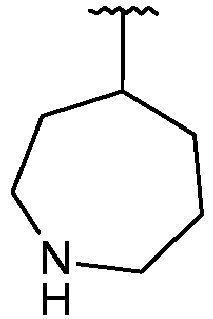

1H-NMR (200 MHz, DMSO-d6): 7.38 (d, 2H, arom., J=8 Hz), 7.22 (d, 2H, arom., J=8 Hz), 5.46 (d, 1H, H-14, J=5.6 Hz), 3.96 (bs, 1H, 11-OH), 1.35 (s, 3H, H-15), 0.81 (m, 6H, H-18, H-17), 0.62 (d, 3H, H-16, J=4.2 Hz) MS m/e: 613 [M+ + H] 149 12-epi-12-desvinyl-14-O-[(Azepan-4-yl-sulfanyl)-acetyl]-12-(6-amino-hexyl) mutilin dihydrochloride 

1H-NMR (200 MHz, DMSO-d6): 5.48 (d, 1H, H-14, J=7.6 Hz), 4.33 (d, 1H, 11-OH, J=5.8 Hz), 1.36 (s, 3H, H-15), 0.84 - 0.79 (m, 4H, H-18, H-17), 0.64 (d, 3H, H-16, J=5.6 Hz) MS m/e: 565 [M+ + H] 150 12-epi-12-desvinyl-14-O-[(Azepan-4-yl-sulfanyl)-acetyl]-12-(8-amino-octyl) mutilin dihydrochloride 

1H-NMR (200 MHz, DMSO-d6): 5.48 (d, 1H, H-14, J=7.6 Hz), 4.40 (d, 1H, 11-OH, J=5.38 Hz), 3.88 (s, 2H, H-22), 1.36 (s, 3H, H-15), 0.84 - 0.79 (m, 6H, H-18, H-17), 0.64 (d, 3H, H-16, J=5.6 Hz) MS m/e: 593 [M+ + Cl] -

- 2.5 g of 12-epi-Pleuromutilintosylate was coupled with thioacetic acid S-{4- [(2-tert-butoxycarbonylamino-acetylamino)-methyl] -cyclohexyl} ester (Example 84) following the general procedure as described in Example 1, step 5. The title compound was obtained as colorless foam.
-
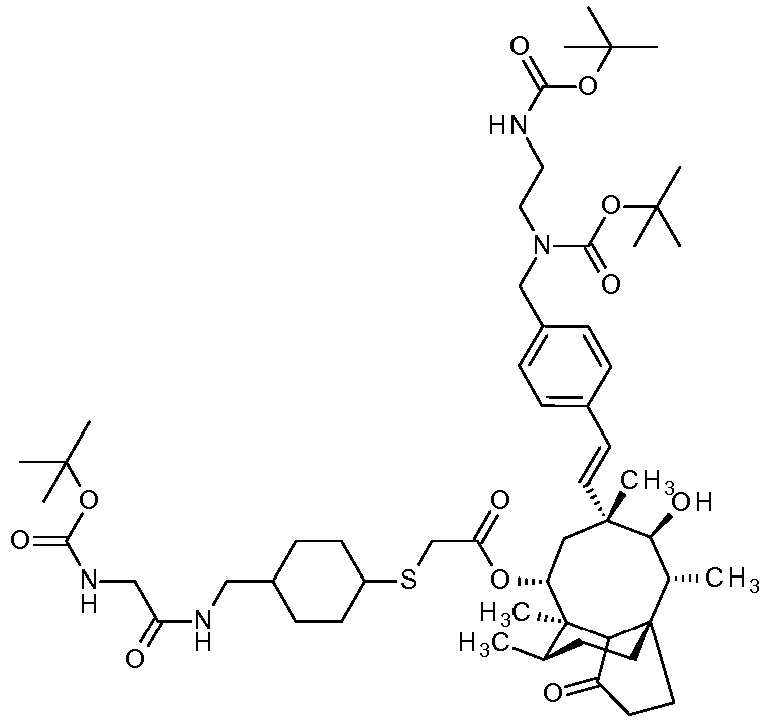
- 3.5 g of 12-epi-14-O-{4-[(2-tert-Butoxycarbonylamino-acetylamino)-methyl]-cyclohexylsulfanyl}-acetyl mutilin was dissolved in 20 mL of DMA, 5 g of (2-tert-Butoxycarbonylamino-ethyl)-(4-iodo-phenyl)-carbamic acid tert-butyl ester, 1.1 g of NMM and 223 mg of bis-(benzonitrile)-palladium(II)-chloride was added and the reaction mixture stirred at 100°C for 20h in a microwave synthesizer (Biotage). The reaction mixture was poured into water, extracted with EtOAc, washed with brine and water and concentrated to give the title product as colorless foam.
- The title compound was obtained following the general procedure as described in Example 1, step 6. The product was purified by reversed phase chromatography (eluant: acetonitrile in water 0-35%).
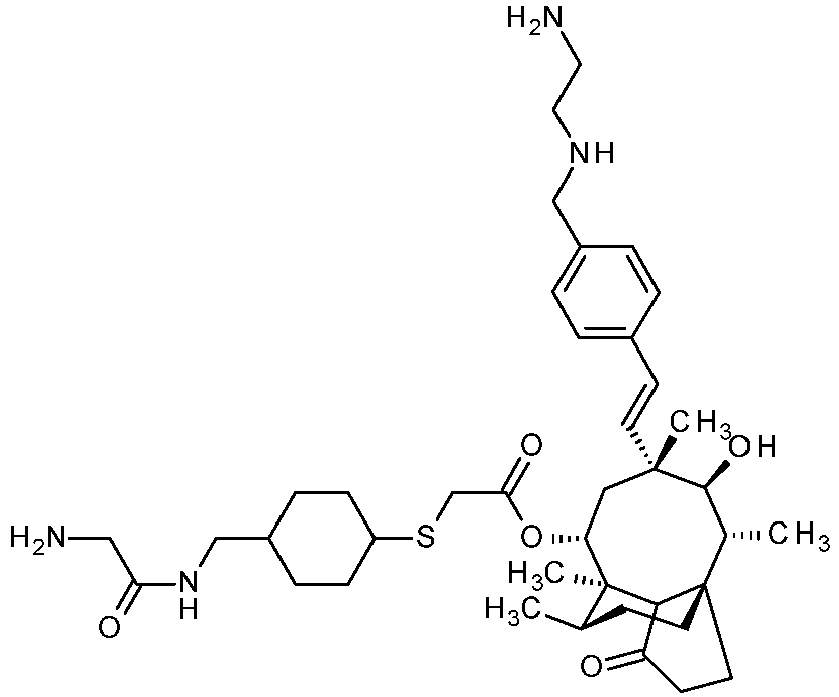
- 1H-NMR (200 MHz, DMSO-d6): 7.39 (d, 2H, arom., J=8 Hz), 7.49 (d, 2H, arom., J=8 Hz), 6.55 (d, 2H, J=16 Hz), 6.30 (d, 2H, J = 17 Hz), 5.57 (d, 1H, H-14, J=7 Hz), 1.41 (s, 3H, H-15), 1.19 (s, 3H, H-18), 0.88 (bs, 6H, H-17), 0.68 (bs, 3H, H-16)
MS m/e: 711 [M+ + H] -

- 2 g of 12-epi-12-desvinyl-14-O-{{4-[(2-tert-Butoxycarbonylamino-acetylamino)-methyl]-cyclohexylsulfanyl} -acetyl} -12- [(E)-2-(4- { [tert-butoxycarbonyl-(2-tert-butoxycarbonylamino-ethyl)-amino]-methyl}-phenyl)-ethenyl] mutilin was dissolved in 1250 mL of MeOH and hydrogenated in an H-Cube apparatus using 10% Pd/C as catalyst (50°C, 1 mL/min, 60bar). After concentration the product was obtained as yellow foam.
-

- The product was obtained following the general procedure as described in Example 1, step 6. The product was purified by reversed phase chromatography (eluant: acetonitrile in water 0-35%).
1H-NMR (200 MHz, DMSO-d6): 7.45 (m, 2H, arom.), 7.22 (m, 2H, arom.), 5.51 (d, 1H, H-14, J=5.8 Hz), 1.40 (s, 3H, H-15), 0.91 (s, 3H, H-18), 0.85 (bs, 3H, H-17), 0.66 (bs, 3H, H-16) MS m/e: 713 [M+ + H] - Step a: [2-(4-Iodo-phenylamino)-ethyl]-carbamic acid tert-butyl ester
To 10.5 g of 4-Iodobenzyl bromide in 100 mL of THF was added 11.4 g of (2-amino-ethyl)-carbamic acid tert-butyl ester and the reaction mixture was stirred for 12 h at rt. The reaction mixture was poured into water, extracted with EtOAc, washed with brine and water, dried over Na2SO4, concentrated and chromatographed on silica using DCM/MeOH = 30:1. The title compound was obtained as yellow oil. - Step b: (2-tert-Butoxycarbonylamino-ethyl)-(4-iodo-phenyl)-carbamic acid tert-butyl ester 8.6 g of [2-(4-Iodo-phenylamino)-ethyl]-carbamic acid tert-butyl ester was dissolved in 200 mL of DCM, 5.4 g of BOC2O and 4.81 g of TEA was added and the reaction mixture stirred at rt for16 h. The reaction mixture was poured into water, extracted with EtOAc, washed with In HCl and water. After concentration the title compound was obtained as colorless crystals.
- According, e.g. analogously, to a method as set out under Example 1, 151 and 152, but using appropriate starting materials, the compounds of formula IEX, wherein R1EX and R2EX are as defined in Table 20 are prepared. Chemical characterisation data are also set out in Table 20.
Table 20 Example R2EX R1EX 153 12-epi-12-desvinyl-14-O-[(Azepan-4-ylsulfanyl)-acetyl]-12-[2-(4-Aminomethyl-phenyl)-ethyl]-mutilin dihydrochloride 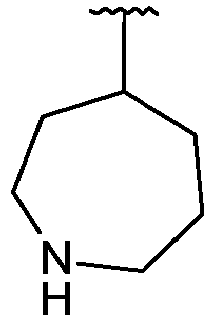

1H-NMR (200 MHz, DMSO-d6): 7.41 (bs, 2H, arom.), 7.23 (bs, 2H, arom.), 5.52 (bs, 1H, H-14), 4.63 (bs, 1H, 11-OH), 1.40 (s, 3H, H-15), 0.91 (s, 3H, H-18), 0.84 (bs, 3H, H-17), 0.65 (bs, 3H, H-16) MS m/e: 599 [M+ + H] 1-Azidomethyl-4-iodo-benzene (prepared from 1-Bromomethyl-4-iodo-benzene) was used as intermediate in step 1 154 12-epi-12-desvinyl-14-O-[(Azepan-4-ylsulfanyl)-acetyl]-12-((E)-2-pyridin-3-yl-ethenyl) mutilin hydrochloride 

1H-NMR (200 MHz, DMSO-d6): 8.88 (m, 1H, arom.), 8.67 (m, 1H, arom.), 8.45 (m, 1H, arom.), 7.91 (m, 1H, arom.), 6.81 (d, 2H, J=17 Hz), 6.48 (d, 2H, J=17 Hz), 5.52 (d, 1H, H-14, J=7.4 Hz), 1.38 (s, 3H, H-15), 1.17 (s, 3H, H-18), 0.83 (d, 3H, H-17, J= 6.6 Hz), 0.65 (d, 3H, H-16, J= 4.6 Hz), MS m/e: 569 [M+ + H] 3-Bromo-pyridine was used as intermediate in step 1 155 12-epi-12-desvinyl-14-O-[(Azepan-4-ylsulfanyl)-acetyl]-12-((E)-2-{4-[(2-Amino-ethylamino)-methyl]-phenyl}-ethenyl) mutilin trihydrochloride 
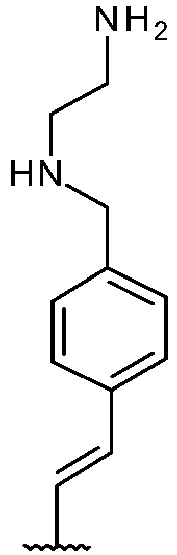
1H-NMR (200 MHz, DMSO-d6): 7.5 (d, 2H, arom., J=8.2 Hz), 7.42 (d, 2H, arom., J=8.2 Hz), 6.52 (d, 2H, J=16.4 Hz), 6.29 (d, 2H, J=16.4 Hz), 5.54 (d, 1H, H-14, J=7.2 Hz), 4.46 (bs, 1H, 11-OH), 1.39 (s, 3H, H-15), 1.16 (s, 6H, H-18), 0.84 (d, 3H, H-16, J=5.8 Hz), 0.67 (bs, 3H, H-16) MS m/e: 640 [M+ + H] 156 12-epi-12-desvinyl-14-O-[(Azepan-4-ylsulfanyl)-acetyl]-12-[2-{4-[(2-amino-ethylamino)-methyl]-phenyl}-ethyl) mutilin trihydrochloride 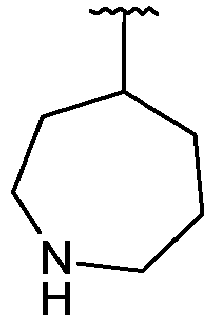

MS m/e: 642 [M+ + H] 157 12-epi-12-desvinyl-14-O-[(Azepan-4-ylsulfany|)-acetyl]-12-((E)-2-{4-[(2-amino-ethylamino)-methyl]-3-fluoro-phenyl}-ethenyl) mutilin trihydrochlorid 

1H-NMR (200 MHz, DMSO-d6): 7.68 - 7.6 (m, 1H, arom.), 7.34 - 7.26 (m, 2H, arom.), AB (2H, CH=CH, νA=6.59, νB=6.30, J=16 Hz), 5.53 (d, 1H, H-14, J=5.2 Hz), 1.39 (s, 3H, H-15), 1.08 (s, 3H, H-18), 0.84 (d, 3H, H-17, J=6,4 Hz), 0.66 (d, 3H, H-16, J=4.4 Hz) MS m/e: 658 [M+ + H] The required 1-Bromomethyl-2-fluoro-4-iodo-benzene is described in: PCT Int. Appl., 2011132051, 27 Oct 2011 158 12-epi-14-O-{[1-(2-Amino-acetyl)-piperidin-4-yl-sulfanyl]-acetyl}-12-((E)-2-{4-[(2-amino-ethylamino)-methyl]-phenyl}-ethenyl) mutilin trihydrochloride 

MS m/e: 683 [M+ + H] 159 12-epi-14-O-{[1-(2-Amino-acetyl)-piperidin-4-yl-sulfanyl]-acetyl}-12-[2-{4-[(2-amino-ethylamino)-methyl]-phenyl}-ethyl) mutilin trihydrochloride 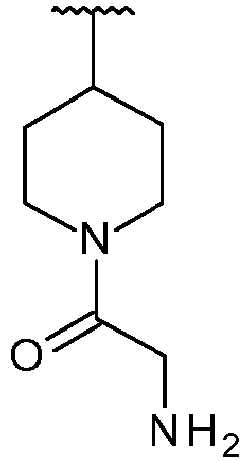
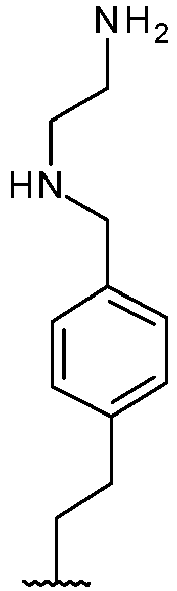
MS m/e: 685 [M+ + H] -

- 617 mg of NH2OH.HCl and 355 mg of NaOH was dissolved in 60 mL MeOH, the mixture was stirred at 25°C for 1h, then 5.0 g of 4-epi-12-epi-3-deoxo-11-deoxy-12-desvinyl-3-methoxy-11-oxo-12-(2-oxo-ethyl)-14-O-[(toluene-4-sulfonyloxy)-acetyl] mutilin (Example 143, step 1) was added and the mixture stirred at 25°C for 12 hours. The mixture was concentrated and the residue purified by chromatography (PE/EtOAc = 3:1) to give the title compound as colorless oil.
-

- 2.9 g of 4-epi-12-epi-3-deoxo-11-deoxy-12-desvinyl-12-(hydroxyimino-ethyl)-3-methoxy-11-oxo-14-O-[(toluene-4-sulfonyloxy)-acetyl] mutilin was dissolved in 50 mL of MeOH, then 672 mg of N1Cl2 and 196 mg of NaBH4 was added at -78°C, afterwards stirred at -78°C for 2h, warmed to 25°C and stirred for 2h. The reaction was filtered, concentrated, the residue was dissolved in DCM, washed with water, the organic phase was separated, dried over Na2SO4, concentrated to give the title compound as colorless oil.
-

- 440 mg of 4-epi-12-epi-12-(2-Amino-ethyl)-3-deoxo-11-deoxy-12-desvinyl-3-methoxy-11-oxo-14-O-[(toluene-4-sulfonyloxy)-acetyl] mutilin was dissolved in 10 mLof DCM, then 240 mg of 4-(tert-Butoxycarbonylamino-methyl) -benzoic acid, 364 mg of HATU and 242 mg of TEA was added and the mixture was stirred at 25 °C for 12 hours. Then the mixture was quenched with water, extracted with DCM, the organic phase was separated, dried over Na2SO4, concentrated and the residue was purified by chromatography (PE/EtOAc = 3:1) to give the title compound as white solid.
-

-

- The product was obtained following the general procedure as described in Example 1, step 6.
MS m/e: 651 [M+ + H] - According to a method as described in Monatshefte für Chemie 117, 1073 (1986) and a method as described in the examples, in particular in Examples 1 and 62 above, but using appropriate starting materials, compounds of formula IV are obtained

Table 21 Example R2EXC C-12 substitution C1 12-epi-14-O-{[(5-Amino-4H-1,2,4-triazol-3-yl)-sulfanyl]-acetyl} mutilin hydrochloride (comparator compound) 

1H-NMR (200 MHz, DMSO-d6): 5.91 (dd, 1H, H-19, JE=18 Hz, JZ=12 Hz), 5.48 (d, 1H, H-14, J=7.6 Hz), 4.96 - 4.84 (m, 2H, H-20), AB (2H, H-22, vA=3.99, vB=3.89, J=16 Hz), 3.46 (d, 1H, H-11, J=5.4 Hz), 1.32 (s, 3H, H-15), 0.99 (s, 3H, H-18), 0.80 (d, 3H, H-17, J=6.6 Hz), 0.59 (d, 3H, H-16, J=6 Hz) MS m/e: 477 [M+ + H] C2 14-O-{{4-[(2-Amino-propylcarbamoyl)-methyl]-phenylsulfanyl}-acetyl} mutilin hydrochloride (comparator compound) 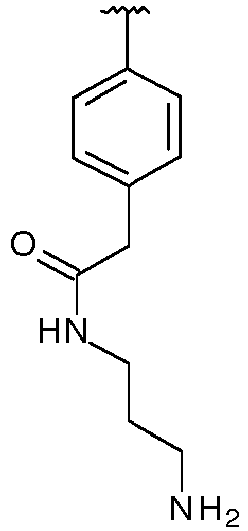

1H-NMR (200 MHz, DMSO-d6): 8.35 (t, 1H, -CO-NH, J=6 Hz), 8.01 (bs, 3H, NH3 +), 7.27 (d, 2H, arom., J=8 Hz), 7.18 (d, 2H, arom., J=8 Hz), 6.04 (dd, 1H, H-19, JE=18 Hz, JZ=10 Hz), 5.50 (d, 1H, H-14, J=7.6 Hz), 5.09 - 4.92 (m, 2H, H-20), AB (2H, H-22, vA=3.82, vB=3.72, J=16 Hz), 1.31 (s, 3H, H-15), 0.99 (s, 3H, H-18), 0.79 (d, 3H, H-17, J=6.8 Hz), 0.55 (d, 3H, H-16, J=5.8 Hz) MS m/e: 585 [M+ + H] C3 14-O-{[(1R,2R,4R)-4-Amino-2-hydroxy-cyclohexylsulfanyl]-acetyl}-12-desvinyl-12-[(3-amino-propylamino)-methyl] mutilin trihydrochlorid 

(comparator compound) MS m/e: 568 [M+ + H] - The antibacterial activity expressed as minimal inhibitory concentration (MIC) was determined according to the approved standard reference recommendations of CLSI (former NCCLS) as described in the description of the application.
- Compounds of the present invention exhibit very good activity against the clinical relevant bacterial pathogens Staphylococcus aureus and Escherichia coli. Surprisingly, the activity against Escherichia coli is significantly improved by introduction of C-12 substituents with inverted stereochemistry of the methyl group in position 12 of the mutilin ring (12-epi mutilins) according to the present invention compared with compounds wherein the stereochemistry of the methyl substituent in position 12 of the mutilin ring is as in the naturally occurring pleuromutilin. The in vitro activity against Escherichia coli of a compound of the present invention is significantly and surprisingly better than that of the comparator compound as set out in Table 22 below.
Table 22. Antimicrobial activity of the compound of Example 1 and of the comparator compound C2 Species ATCC number MIC [µg/mL] Compound of Example 1 Comparator Compound C2 Staphylococcus aureus ATCC 49951 ≤ 0.03 ≤ 0.03 Escherichia coli ATCC25922 0.5 32 - Table 23 below presents the in vitro activity of further of compounds described in the present invention comprising surprising activity against Staphylococcus aureus and even more surprising activity against Escherichia coli.
Table 23. Antimicrobial activity of the compounds of further examples described in the present invention Compound of Example MIC [µg/mL] Compound of Example MIC [µg/mL] S. aureus E.coli S. aureus E.coli ATCC 49951 ATCC25922 ATCC 49951 ATCC25922 9 ≤ 0.03 0.5 83 0.25 1 11 ≤ 0.03 0.25 86 0.06 0.5 23 ≤ 0.03 1 98 0.125 0.5 47 ≤ 0.03 0.5 99 0.25 0.5 48 ≤ 0.03 0.25 103 0.5 4 52 ≤ 0.03 0.5 115 ≤ 0.03 0.25 54 0.125 4 130 ≤ 0.03 0.5 64 0.5 4 131 0.06 0.125 65 0.5 2 143 0.125 4 68 0.25 4 146 ≤ 0.03 8 78 0.5 2 152 0.25 4 81 0.125 8 157 0.25 4 - Table 24 below presents the in vitro activity of
- the 12-epi-mutilin compound known from prior art (H. Berner et al, Monatshefte für Chemie, 1986, 117, 1073-1080) (compound of Example C1) with the naturally occurring vinyl group at position C-12 and the methyl group in epi position, and
- the C-12-epi substituted compound of Example 66 with identical side chain at position C-14 of the mutilin ring as the compound of Example C1. Evidently the replacement of the naturally ocurring vinyl group by a group according to the the present invention in a compound having the methyl group in position C-12 of the mutilin ring inverted, namely contrary to the stereochemistry of the methyl group in position 12 in the natural occurring pleuromutilin ring, significantly and surprisingly improves the activity against Escherichia coli.
- Table 25 below presents the in vitro activity of two compounds which are identical in structure with the only exception that the stereochemistry of the methyl substituent in position C-12 of the mutilin ring in a compound of the present invention is inverted whereas in the comparator compound the stereochemistry of said methyl group is the same as in the naturally occurring pleuromutilin. Thus, the C-12 epi compound of Example 62 exhibits significantly improved activity against Staphylococcus aureus and Escherichia coli compared to the comparator compound of Example C3 having the natural stereochemistry of the methyl group in position C-12 and otherwise is identical.
Table 25. Antimicrobial activity of the compound of Example 62 and comparator compound C3 Species ATCC number MIC [µg/mL] Compound of Example 62 Compound C3 Staphylococcus aureus ATCC 49951 0.25 16 Escherichia coli ATCC25922 4 >32 - Table 26 below shows the activity of tiamulin, econor and retapamulin against Staphylococcus aureus and Escherichia coli. Whilst retaining good activity against Staphylococcus aureus the activity aginst Escherichia coli is significantly reduced with MIC > 16 µg/ml.
Table 26. Antimicrobial activity of tiamulin, econor and retapamulin Species ATCC number MIC [µg/mL] Retapamulin Tiamulin Econor Staphylococcus aureus ATCC 49951 0.5 ≤0.03 ≤0.03 Escherichia coli ATCC25922 >32 32 32
R1 is a group of formula

R3 and R4 independently of each other are
wherein alkyl, cycloalkyl, heterocyclyl, alkenyl or aryl is optionally further substituted, by
R2 is a hydrocarbon group comprising 1 to 22 carbon atoms, optionally comprising
heteroatoms selected from N, O, S, halogen, in particular N or O,
optionally in the form of a salt and/or solvate, in particular in the form of a salt, wherein the naturally occurring pleuromutilin is of formula

| Species | ATCC number | MIC [µg/mL] | |
| Compound of Example 66 | Compound C1 | ||
| Staphylococcus aureus | ATCC 49951 | 0.5 | 0.5 |
| Escherichia coli | ATCC25922 | 4 | 128 |
Claims (14)
- A compound of formula
 - the methyl group at position 12 of the mutilin ring has the inverse stereochemistry compared with the stereochemistry of the methyl group at position 12 of the naturally occurring pleuromutilin ring,- all other substituents of the mutilin ring having the same stereochemistry compared with the stereochemistry of the substituents at the corresponding positions in the naturally occurring pleuromutilin ring,R1 is either (C1-16)alkyl or (C2-16)alkenyl, substituted by heterocyclyl, including aliphatic heterocyclyl and aromatic heterocyclyl comprising 1 to 4 heteroatoms selected from N, O, S, with the proviso that at least one heteroatom is a nitrogen atom, or
R1 is a group of formula - (C1-16)alkyl-N(R3R4),- (C1-16)alkyl-(C6-14)aryl-N(R3R4),- (C1-16)alkyl-(C6-14)aryl-(C1-16)alkyl-N(R3R4),- (C1-16)alkyl-(C1-13)heterocyclyl -N(R3R4),- (C1-16)alkyl-(C1-13)heterocyclyl-(C1-16)alkyl-N(R3R4),- carbonyl-N(R3R4),- (C1-4)alkyl-carbonyl-N(R3R4),- (C2-16)alkenyl-N(R3R4),- (C2-16)alkenyl-(C6-14)aryl-N(R3R4),- (C2-16)alkenyl-(C6-14)aryl-(C1-16)alkyl-N(R3R4),- (C2-16)alkenyl-(C1-13)heterocyclyl-N(R3R4),- (C2-16)alkenyl-(C1-13)heterocyclyl-(C1-16)alkyl-N(R3R4),wherein heterocyclyl includes aliphatic and aromatic heterocyclyl comprising at least one heteroatom selected from N, O, S and wherein alkyl, aryl, heterocyclyl or alkenyl is optionally substituted comprising substituents which optionally having heteroatoms selected from O, N, S, halogen;
R3 and R4 independently of each other are- hydrogen,- (C1-16)alkyl,- (C2-16)alkenyl,- hydroxy(C1-16)alkyl,- amino-(C1-16)alkyl,- mono or di-(C1-6)alkylamino-(C1-16)alkyl,- guanidino(C1-16)alkyl, ureido(C1-16)alkyl or thioureido(C1-16)alkyl,- amino(C1-6)alkyl-(C6-14)aryl-(C1-6)alkyl,- amino(C1-6)alkyl-(C6-14)aryl,- guanidino(C1-6)alkyl-(C6-14)aryl-(C1-6)alkyl,- amino-(C1-6)alkyloxy-(C1-6)alkyl,- amino(C3-8)cycloalkyl,- amino(C1-6)alkyl-(C3-8)cycloalkyl,- amino(C3-8)cycloalkyl-(C1-6)alkyl,- amino(C1-6)alkyl-(C3-8)cycloalkyl-(C1-6)alkyl,- (C1-13)heterocyclyl-(C1-16)alkyl,- (C6-14)aryl-(C1-16)alkyl,- (C1-13)heterocyclyl,- amino-(C6-14)aryl-(C1-16)alkyl,- amino-(C1-6)alkyloxy-(C6-14)aryl-(C1-6)alkyl,- amino(C1-6)alkyl-(C6-12)aryl-carbonyl,- amino(C1-6)alkyl-amido-(C6-12)aryl(C1-6)alkyl,- (C1-4)alkylcarbonyl,- carbamimidoyl, carbamoyl, thiocarbamoyl,wherein heterocyclyl includes aliphatic and aromatic heterocyclyl comprising at least one heteroatom selected from N, O, S,
and
wherein alkyl, cycloalkyl, heterocyclyl, alkenyl or aryl is optionally further substituted, by- amino(C1-4)alkyl, amido, mono or di-(C1-4)alkyl-amido, (C1-6)alkyloxy-carbonyl, halogen, oxo, hydroxyX is sulfur or oxygen, in particular sulfur, and
R2 is a hydrocarbon group comprising 1 to 22 carbon atoms, optionally comprising heteroatoms selected from N, O, S, halogen, in particular N or O, optionally- in the form of a salt and/or solvate, in particular in the form of a salt,wherein the naturally occurring pleuromutilin is of formula
- A compound according to claim 1, wherein
R2 is- (C1-16)alkyl,- (C3-12)cycloalkyl,- (C1-13)heterocyclyl,- (C6-14)aryl,wherein heterocyclyl includes aliphatic and aromatic heterocyclyl comprising at least one heteroatom selected from N, O, S, and wherein alkyl, cycloalkyl, aryl, heterocyclyl is unsubstituted or substituted by substituents optionally having a heteroatom selected from O, N, S, and halogen. - A compound according to claim 2,
wherein R2 is
alkyl,
optionally substituted by- hydroxy or amino,- (C3-12)cycloalkyl wherein the cycloalkyl group is optionally further substituted by amino or amino(C1-4)alkyl wherein the amino or aminoalkyl group is optionally further substituted by amino(C1-6)alkylcarbonyl and optionally (C1-4)alkyl,- (C2-11)heterocyclyl, wherein a nitrogen in the ring as a heteroatom optionally is further substituted by amino(C1-6)alkylcarbonyl,cycloalkyl,
optionally substituted by- amino(C1-4)alkyl, wherein the amino group is optionally further substituted by amino(C1-6)alkylcarbonyl,
hydroxy,
amino, wherein the amino group is optionally further substituted by amino(C1-6)alkylcarbonyl and optionally (C1-4)alkyl,- amino and hydroxy, wherein the amino group is optionally further substituted by amino(C1-6)alkylcarbonyl and optionally (C1-4)alkyl,- (C1-4)alkylamino, wherein alkyl is optionally further substituted by one or more halogen atoms;aliphatic (C2-11)heterocyclyl,
comprising 1 to 4 heteroatoms selected from N, O, S, wherein a nitrogen in the ring as heteroatom is optionally further substituted by- (C1-4)alkyl,- amino(C1-6)alkylcarbonyl,aryl,
optionally substituted by- hydroxy, halogen, amino, hydroxy(C1-4)alkyl, bis-(hydroxy(C1-4)alkyl), amino(C1-4)alkyl, bis-(amino(C1-4)alkyl), wherein the amino group in amino(C1-4)alkyl optionally is further substituted,- aminocarbonyl, wherein the nitrogen optionally is substituted byor- amino(C1-12)alkyl, bis-(amino(C1-12)alkyl), hydroxy(C1-6)alkyl, bis-(hydroxy(C1-6)alkyl) or diamino(C1-6)alkyl,- (C1-12)alkyl, which alkyl optionally is substituted by- amino, which amino optionally is acylated, particularly amino is substituted by formyl, (C1-4)alkylcarbonyl, saturated or unsaturated heterocyclyl comprising 1 to 3 heteroatoms, particularly N, and 4 to 8, particularly 5 to 6 ring members,(C6-14)aryl, particularly phenyl, which aryl optionally is substituted by amino(C1-4)alkyl,
the nitrogen of the aminocarbonyl group is part of (C3-8)heterocyclyl, including aliphatic and aromatic heterocyclyl, comprising one or more heteroatoms selected from N,O,S preferably N, wherein the heterocycle is optionally further substituted by amino(C1-4)alkyl;- (C1-6)alkyl, which (C1-6)alkyl group is optionally substituted by aminocarbonyl, wherein the nitrogen of the aminocarbonyl group is optionally further substituted by amino(C1-12)alkyl, diamino-(C1-12)alkyl, bis-(amino(C1-12)alkyl), hydroxy(C1-6)alkyl, bis-(hydroxy(C1-6)alkyl),aromatic (C1-13)heterocyclyl, comprising 1 to 4 heteroatoms,- acylated amino(C1-4)alkyl,
wherein the aromatic heterocyclyl is optionally substituted by (C1-6)alkyl, amino or hydroxy wherein the alkyl group is optionally further substituted by halogen or amino or the aromatic heterocyclyl is optionally substituted by aminocarbonyl wherein the amino group is optionally further substituted by amino(C1-12)alkyl, bis-(amino(C1-12)alkyl), hydroxy(C1-6)alkyl, bis-(hydroxy(C1-6)alkyl) or diamino(C1-6)alkyl. - A compound according to claim 1, wherein
R2 is amido-phenyl, amido(C1-4)alkyl-phenyl, wherein the nitrogen of the amido group is unsubstituted or substituted by amino(C1-8)alkyl, in which alkyl optionally is further substituted. - A compound according claim 1, wherein
R2 is- amino(C3-12)cycloalkyl,- amino(C1-4)alkyl(C3-12)cycloalkyl,- amino(C3-12)cycloalkyl(C1-4)alkyl, or- amino(C1-4)alkyl(C3-12)cycloalkyl(C1-4)alkyl,wherein the amino group is unsubstituted or substituted by amino(C1-6)alkylcarbonyl, or amino(C1-6)alkylcarbonyl and (C1-4)alkyl. - A compound according to claim 1, wherein
R2 is (C2-11)heterocyclyl comprising 1 to 4 heteroatoms selected from N, O, S, wherein, if a nitrogen in the ring as a heteroatom is present, said nitrogen is unsubstituted or optionally further substituted by- (C1-4)alkyl,- amino(C1-6)alkylcarbonyl. - A compound according to claim 1, wherein
X is S,
R1 is as defined in claim 1, and R2 is
aminoethyl-amidomethyl-phenyl, aminopropyl-amidomethyl-phenyl, hydroxyphenyl-(amino)ethyl-amidomethyl-phenyl, aminomethyl-phenyl-(amino)ethyl-amidomethyl-phenyl, aminopropyl-amidophenyl, aminomethyl-phenylmethyl-amido-phenyl, aminomethyl-phenyl, aminoacetyl-aminomethyl-phenyl, bis(aminomethyl)phenyl, bisaminopropyl-amidomethyl-phenyl, (2-amino)-aminopropyl-amidomethyl-phenyl, aminoethyl-aminomethyl-phenyl, aminopropyl-aminomethyl-phenyl, allyl-aminomethyl-phenyl, aminomethyl-phenylmethyl-aminomethyl-phenyl, hydroxymethyl-phenyl, bis(hydroxymethyl)-phenyl, (tetrafluoro-hydroxymethyl)-phenyl, amino-hydroxy-cyclohexyl, hydroxyethyl, aminoethyl, piperazinocarbonyl-phenyl, aminomethyl-piperidine-carbonyl-phenyl, piperidine-ylmethyl-amido-phenyl, pyridine-ylmethyl-amido-phenyl, acetyl-aminopropyl-amido-phenyl, formyl-aminopropyl-amido-phenyl, amido-phenyl, aminohexyl-amidophenyl, aminoethyl-amidophenyl, (5-Amino)-4H-[1,2,4]triazol-3-yl, pyridinyl, hydroxyphenyl, fluorophenyl, purinyl, aminophenyl, acetyl-aminomethyl-phenyl, cyclopropyl-aminomethyl-phenyl, aminopropyl-amidopyridinyl, hydroxypropyl-amidophenyl, amino-purinyl, difluoroethylamino-cyclohexyl, amino-hydroxy-cyclohexyl, azepanyl, aminomethylcyclohexylmethyl, N-methyl-piperidinyl, piperidinyl, aminomethylcyclohexyl, aminopropylphenyl, phenyl, N-aminomethylcarbonyl-piperidinyl, N-aminoethylcarbonyl-piperidinyl, N-aminomethylcarbonyl-piperidinylmethyl, aminomethylamidomethylcyclohexyl, aminomethyl-pyridinyl, aminomethylamidocyclohexyl. - A compound according to claim 1, which is of formula
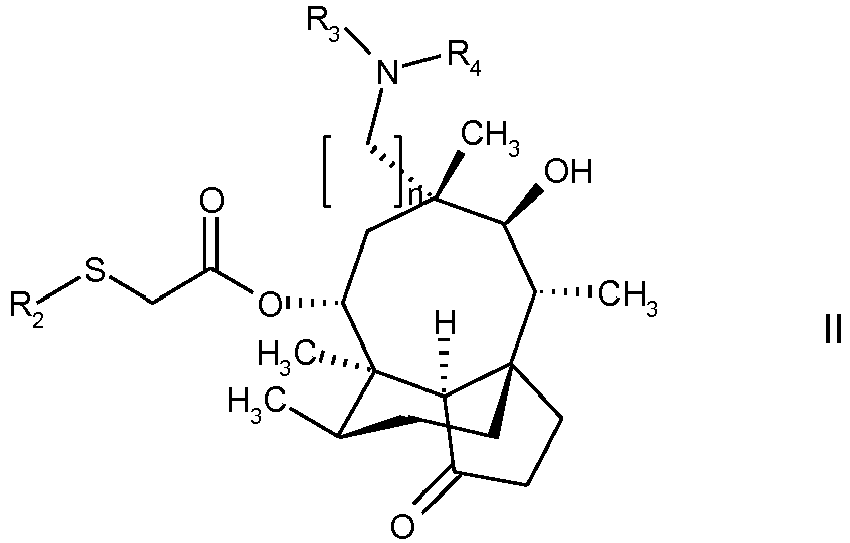 wherein R2 is as defined in any one of claims 1 to 7,n is 1 to 12R3 is H, aminoethyl, aminopropyl, aminobutyl, aminopentyl, aminohexyl, aminooctyl, aminodecyl, dimethylaminopropyl, dimethylamidopentyl, guanidinobutyl, guanidinohexyl, carbamimidoyl, aminomethylcylcohexylmethyl, aminopropoxypropyl, aminocyclohexyl, hydroxyhexyl, dihydroxypropyl, aminomethylphenylmethyl, guanidinomethylphenylmethyl, phenylmethyl, morpholinopropyl, piperidinyl, hexyl, pyridinylethyl, allyl, amido-benzyl, aminopropyl-amidobenzyl, (2-amino)-amidoethyl-benzyl, (2-amino)-dimethylamidoethyl-benzyl, 2-amino-1-aminomethyl-ethyl, 5-amino-5-ethoxycarbonyl-pentyl, aminomethylphenylpropyl, aminomethylphenyl, aminophenymethyl, aminoethoxyphenylmethyl, aminomethyl-fluorophenyl-methyl, aminomethyl-difluorophenyl-methyl, andR4 is H, (C1-4)alkylcarbonyl or aminomethylphenylcarbonyl.
- A compound according to claim 1, wherein
R2 is as defined as in any one of claims 1 to 7, and
R1 is aminomethylphenylpropyl, aminoethylaminomethylphenylethenyl, aminoethylaminomethylphenylethyl, aminomethylphenylethyl, aminomethylphenylethyl, pyridinylethenyl, aminoethylamino-fluorophenyl-ethenyl. - A compound according to any one of claims 1 to 9, selected from the group consisting of
12-epi-12-desvinyl-14-O-{{4-[(3-Amino-propylcarbamoyl)-methyl]-phenylsulfanyl}-acetyl}-12-[(3-amino-propylamino)-methyl] mutilin,
12-epi-12-desvinyl-14-O-{{4-[(2-Amino-ethylcarbamoyl)-methyl]-phenylsulfanyl}-acetyl}-12-[(3-amino-propylamino)-methyl] mutilin,
12-epi-12-desvinyl-14-O-{{4-([Bis-(3-amino-propyl)-carbamoyl]-methyl}-phenylsulfanyl)-acetyl}-12-[(3-amino-propylamino)-methyl] mutilin,
12-epi-12-desvinyl-14-O-{{4-[(2,3-Diamino-propylcarbamoyl)-methyl]-phenylsulfanyl}-acetyl}-12-[(3-amino-propylamino)-methyl] mutilin,
12-epi-12-desvinyl-14-O-{{4-[(2-Amino-ethylcarbamoyl)-methyl]-phenylsulfanyl}-acetyl}-12-[(2-amino-ethylamino)-methyl] mutilin,
12-epi-12-desvinyl-14-O-{{4-[(3-Amino-propylcarbamoyl)-methyl]-phenylsulfanyl}-acetyl}-12-[(2-amino-ethylamino)-methyl] mutilin,
12-epi-12-desvinyl-14-O-{{4-[(3-Ammo-propylcarbamoyl)-methyl]-phenylsulfanyl}-acetyl}-12-[(4-amino-butylamino)-methyl]mutilin,
12-epi-12-desvinyl-14-O-{{4-[(3-Amino-propylcarbamoyl)-methyl]-phenylsulfanyl}-acetyl}-12-[(5-amino-pentylamino)-methyl] mutilin,
12-epi-12-desvinyl-14-O-{{4-[(3-Amino-propylcarbamoyl)-methyl]-phenylsulfanyl}-acetyl}-12-[(4-aminomethyl-benzylamino)-methyl]mutilin,
12-epi-12-desvinyl-14-O-{{4-[(3-Amino-propylcarbamoyl)-methyl]-phenylsulfanyl}-acetyl}-12-[(6-amino-hexylamino)-methyl]mutilin,
12-epi-12-desvinyl-14-0-{{4-[(3-Amino-propylcarbamoyl)-methyl]-phenylsulfanyl}-acetyl} -12-[(6-guanidino-hexylamino)-methyl] mutilin,
12-epi-12-desvinyl-14-O-{{4-[(3-Amino-propylcarbamoyl)-methyl]-phenylsulfanyl}-acetyl}-12-[(4-guanidino-butylamino)-methyl]mutilin,
12-epi-12-desvinyl-14-O-{{4-[(3-Amino-propylcarbamoyl)-methyl]-phenylsulfanyl}-acetyl}-12-[(allylamino)-methyl] mutilin,
12-epi-12-desvinyl-14-O-{{4-[(3-Amino-propylcarbamoyl)-methyl]-phenylsulfanyl}-acetyl}-12-aminomethyl mutilin,
12-epi-12-desvinyl-14-O-{{4-[(3-Amino-propylcarbamoyl)-methyl]-phenylsulfanyl}-acetyl}-12-[(benzylamino)-methyl] mutilin,
12-epi-12-desvinyl-14-O-{{4-[(3-Amino-propylcarbamoyl)-methyl]-phenylsulfanyl}-acetyl}-12-[(4-guanidinomethyl-benzylamino)-methyl] mutilin,
12-epi-12-desvinyl-14-O-{{4-[(3-Amino-propylcarbamoyl)-methyl]-phenylsulfanyl}-acetyl} -12-[(6-hydroxy-hexylamino)-methyl] mutilin,
12-epi-12-desvinyl-14-O-{{4-[(3-Amino-propylcarbamoyl)-methyl]-phenylsulfanyl}-acetyl} -12-[(2,3-dihydroxypropylamino)-methyl] mutilin,
12-epi-12-desvinyl-14-O-{{4-[(3-Amino-propylcarbamoyl)-methyl]-phenylsulfanyl}-acetyl}-12-[(4-piperidylamino)-methyl] mutilin,
12-epi-12-desvinyl-14-O-{{4-[(3-Amino-propylcarbamoyl)-methyl]-phenylsulfanyl}-acetyl}-12-[(3-morpholin-4-yl-propylamino)-methyl] mutilin,
12-epi-12-desvinyl-14-O-{{4-[(3-Amino-propylcarbamoyl)-methyl]-phenylsulfanyl}-acetyl}-12-[(3-dimethylamino-propylamino)-methyl] mutilin,
12-epi-12-desvinyl-14-O-{{4-[(3-Amino-propylcarbamoyl)-methyl]-phenylsulfanyl}-acetyl}-12-[(S)-5-amino-5-ethoxycarbonyl-pentylamino-methyl] mutilin,
12-epi-12-desvinyl-14-O-{[4-(4-Aminomethyl-benzylcarbamoyl)-phenylsulfanyl]-acetyl}-12-[(6-amino-hexylamino)-methyl]mutilin,
12-epi-12-desvinyl-14-O-{[4-(4-Aminomethylbenzylcarbamoyl)-phenylsulfanyl]-acetyl}-12-[(6-guanidino-hexylamino)-methyl] mutilin,
12-epi-12-desvinyl-14-O-{[(4-Piperazinylcarbamoyl)-phenylsulfanyl]-acetyl}-12-[(6-guanidino-hexylamino)-methyl] mutilin,
12-epi-12-desvinyl-14-O-{[4-(4-Aminomethyl-piperidine-1-carbonyl)-phenylsulfanyl]-acetyl} -12-[(6-guanidino-hexylamino)-methyl] mutilin,
12-epi-12-desvinyl-14-O-{(4-[(Piperidin-4-ylmethyl)-carbamoyl]-phenylsulfanyl)-acetyl} -12-[(6-guanidino-hexylamino)-methyl] mutilin,
12-epi-12-desvinyl-14-O-{(4-[(Pyridin-4-ylmethyl)-carbamoyl]-phenylsulfanyl)-acetyl}-12- [(6-amino-hexylamino)-methyl] mutilin,
12-epi-12-desvinyl-14-O-{[3-(3-Aminopropylcarbamoyl)-phenylsulfanyl]-acetyl}-12-[(6-guanidino-hexylamino)-methyl] mutilin,
12-epi-12-desvinyl-14-O-{[4-(3-Acetylamino-propylcarbamoyl)-phenylsulfanyl]-acetyl}-12-[(3-amino-propylamino)-methyl]mutilin,
12-epi-12-desvinyl-14-O-{[4-(3-Formylamino-propylcarbamoyl)-phenylsulfanyl]-acetyl}-12-[(3-amino-propylamino)-methyl]mutilin,
12-epi-12-desvinyl-14-O-{[4-(3-Amino-propylcarbamoyl)-phenylsulfanyl]-acetyl}-12-[(3 -amino-propylamino)-methyl] mutilin,
12-epi-12-desvinyl-14-O-{(4-[(3-Aminopropylcarbamoyl)-phenylsulfanyl)-acetyl}-12-[(4-aminomethyl-benzylamino)-methyl] mutilin,
12-epi-12-desvinyl-14-O-{(4-[(3-Aminopropylcarbamoyl)-phenylsulfanyl)-acetyl}-12-[(6-amino-hexylamino)-methyl]mutilin,
12-epi-12-desvinyl-14-O-{[4-(3-Aminopropylcarbamoyl)-phenylsulfanyl]-acetyl}-12-[(6-guanidino-hexylamino)-methyl] mutilin,
12-epi-12-desvinyl-14-O-{[4-(3-Aminopropylcarbamoyl)-phenylsulfanyl]-acetyl}-12-[(8-amino-octylamino)-methyl] mutilin,
12-epi-12-desvinyl-14-O-{[4-(3-Aminopropylcarbamoyl)-phenylsulfanyl]-acetyl}-12-[(10-amino-decylamino)-methyl] mutilin,
12-epi-12-desvinyl-14-O-{(4-Carbamoyl-phenylsulfanyl)-acetyl}-12-[(6-guanidino-hexylamino)-methyl] mutilin,
12-epi-12-desvinyl-14-O-{[4-(3-Amino-propylcarbamoyl)-phenylsulfanyl]-acetyl}-12-{[3-(3-amino-propoxy)-propylamino)]-methyl}mutilin,
12-epi-12-desvinyl-14-O-{[4-(3-Amino-propylcarbamoyl)-phenylsulfanyl]-acetyl}-12[(2-pyridin-4-yl-ethylamino)-methyl] mutilin,
12-epi-12-desvinyl-14-O-{[4-(6-Amino-hexylcarbamoyl)-phenylsulfanyl]-acetyl}-12-[(6-guanidino-hexylamino)-methyl] mutilin,
12-epi-12-desvinyl-14-O-{[4-(2-Amino-ethylcarbamoyl)-phenylsulfanyl]-acetyl}-12-[(6-guanidino-hexylamino)-methyl] mutilin,
12-epi-12-desvinyl-14-O-{[4-(3-Aminopropylcarbamoyl)-phenylsulfanyl]-acetyl}-12-{[3-(4-aminomethyl-phenyl)-propylamino]-methyl} mutilin,
12-epi-12-desvinyl-14-O-{[(4-Aminomethyl-cyclohexyl)-methylsulfanyl]-acetyl}-12-[(6-amino-hexylamino)-methyl] mutilin,
12-epi-14-O-[(1-Methyl-piperidin-4-ylsulfanyl)-acetyl}-12-[(6-guanidino-hexylamino)-methyl] mutilin,
12-epi-14-O-[(Piperidin-4-ylsulfanyl)-acetyl]-12-[(6-amino-hexylamino)-methyl]mutilin,
12-epi-12-desvinyl-14-O-{[(4-Aminomethyl-cyclohexyl)-sulfanyl]-acetyl}-12-[(6-amino-hexylamino)-methyl] mutilin,
12-epi-12-desvinyl-14-O-{[4-(3-Amino-propyl)-phenylsulfanyl]-acetyl}-12-[(6-amino-hexylamino)-methyl] mutilin,
12-epi-12-desvinyl-14-O-{(4-[(3-Amino-propylcarbamoyl)-methyl]-phenylsulfanyl)-acetyl}-12-{[(3-amino-propyl)-acetylamino]-methyl}mutilin,
12-epi-12-desvinyl-14-O-{(4-[(3-Amino-propylcarbamoyl)-methyl]-phenylsulfanyl)-acetyl}-12-(3-amino-propylcarbamoyl) mutilin,
12-epi-12-desvinyl-14-O-{[4-(3-Amino-propylcarbamoyl)-phenylsulfanyl]-acetyl}-12-(4-aminomethyl-benzylcarbamoyl) mutilin,
12-epi-12-desvinyl-14-O-{{4-[(3-Amino-propylcarbamoyl)-methyl]-phenylsulfanyl}-acetyl} -12-[2-(3 -amino-propylamino)-ethyl] mutilin,
12-epi-12-desvinyl-14-O-[(3-Hydroxymethyl-phenylsulfanyl)-acetyl]-12-[(3-amino-propylamino)-methyl] mutilin,
12-epi-12-desvinyl-14-O-[(3-Hydroxymethyl-phenylsulfanyl)-acetyl]-12-[(6-amino-hexylamino)-methyl] mutilin,
12-epi-12-desvinyl-14-O-[(3-Hydroxymethyl-phenylsulfanyl)-acetyl]-12-[(4-aminomethyl-benzylamino)-methyl] mutilin,
12-epi-12-desvinyl-14-O-[(3-Hydroxymethyl-phenylsulfanyl)-acetyl]-12-[(6-guanidino-hexylamino)-methyl] mutilin,
12-epi-12-desvinyl-14-O-[(4-Hydroxymethyl-phenylsulfanyl)-acetyl]-12-[(3-amino-propylamino)-methyl]mutilin,
12-epi-12-desvinyl-14-O-[(4-Hydroxymethyl-phenylsulfanyl)-acetyl]-12-[(4-aminomethyl-benzylamino)-methyl] mutilin,
12-epi-12-desvinyl-14-O-[(4-Hydroxymethyl-phenylsulfanyl)-acetyl]-12-[(6-amino-hexylamino)-methyl] mutilin,
12-epi-12-desvinyl-14-O-[(3,5-Bis-hydroxymethyl-phenylsulfanyl)-acetyl]-12-[(3-amino-propylamino)-methyl] mutilin,
12-epi-12-desvinyl-14-O-{[(2,3,5,6-Tetrafluoro-4-hydroxymethyl)-phenylsulfanyl]-acetyl}-12-[(4-aminomethyl-benzylamino)-methyl]- mutilin,
12-epi-12-desvinyl-14-O-{[(1R,2R,4R)-4-Amino-2-hydroxy-cyclohexylsulfanyl]-acetyl}-12-[(3-amino-propylamino)-methyl]mutilin,
12-epi-12-desvinyl-14-O-{[(1R,2R,4R)-4-Amino-2-hydroxy-cyclohexylsulfanyl]-acetyl}-12-[(4-aminomethyl-benzylamino)-methyl]mutilin,
12-epi-12-desvinyl-14-O-[(2-Hydroxy-ethylsulfanyl)-acetyl]-12-[(4-aminomethyl-benzylamino)-methyl] mutilin,
12-epi-12-desvinyl-14-O-[(2-Amino-ethylsulfanyl)-acetyl]-12-[(4-aminomethyl-benzylamino)-methyl] mutilin,
12-epi-12-desvinyl-14-O-{[(5-Amino-4H-1,2,4-triazol-3-yl)-sulfanyl]-acetyl}-12-[(6-amino-hexylamino)-methyl] mutilin,
12-epi-12-desvinyl-14-O-[(2-Amino-ethylsulfanyl)-acetyl]-12-[(6-amino-hexylamino)-methyl] mutilin,
12-epi-12-desvinyl-14-O-[(Pyridin-4-ylsulfanyl)-acetyl]-12-[(6-amino-hexylamino)-methyl] mutilin,
12-epi-12-desvinyl-14-O-[(Pyridin-4-ylsulfanyl)-acetyl]-12-[(6-guanidino-hexylamino)-methyl] mutilin,
12-epi-12-desvinyl-14-O-[(3-Hydroxy-phenylsulfanyl)-acetyl]-12-[(6-amino-hexylamino)-methyl] mutilin,
12-epi-12-desvinyl-14-O-[(4-Fluoro-phenylsulfanyl)-acetyl]-12-[(6-amino-hexylamino)-methyl] mutilin,
12-epi-12-desvinyl-14-O-{[(7H-Purin-6-yl)-sulfanyl]-acetyl}-12-[(6-amino-hexylamino)-methyl] mutilin,
12-epi-12-desvinyl-14-O-[(3-Amino-phenylsulfanyl)-acetyl]-12-[(3-amino-propylamino)-methyl] mutilin,
12-epi-12-desvinyl-14-O-(Phenylsulfanyl-acetyl)-12-[(4-aminomethyl-benzylamino)-methyl] mutilin,
12-epi-12-desvinyl-14-O-[(4-Fluoro-phenylsulfanyl)-acetyl]-12-[(4-aminomethyl-benzylamino)-methyl] mutilin,
12-epi-12-desvinyl-14-O-[(Pyridin-2-ylsulfanyl)-acetyl]-12-[(4-aminomethyl-benzylamino)-methyl] mutilin,
12-epi-12-desvinyl-14-O-[(Pyridin-4-ylsulfanyl)-acetyl]-12-[(4-aminomethyl-benzylamino)-methyl] mutilin,
12-epi-12-desvinyl-14-O-{[1-(2-Amino-acetyl)-piperidin-4-yl-sulfanyl)]-acetyl}-12-[(4-aminomethyl-benzylamino)-methyl] mutilin,
12-epi-12-desvinyl-14-O-{[1-(3-Amino-propionyl)-piperidin-4-yl-sulfanyl)]-acetyl}-12-[(4-aminomethyl-benzylamino)-methyl] mutilin,
12-epi-12-desvinyl-14-O-{[1-(3-Amino-propionyl)-piperidin-4-yl-sulfanyl]-acetyl}-12-[(6-amino-hexylamino)-methyl]mutilin,
12-epi-12-desvinyl-14-O-{[1-(2-Amino-acetyl)-piperidin-4-yl-methylsulfanyl]-acetyl}-12-[(4-aminomethyl-phenylamino)-methyl] mutilin,
12-epi-12-desvinyl-14-O-{[1-(2-Amino-acetyl)-piperidin-4-yl-methylsulfanyl]-acetyl}-12-[(4-amino-benzylamino)-methyl]mutilin,
12-epi-12-desvinyl-14-O-{[1-(2-Amino-acetyl)-piperidin-4-yl-sulfanyl]-acetyl}-12{2-[4-(2-amino-ethoxy)-benzylamino]-methyl}mutilin,
12-epi-12-desvinyl-14-O-{{4-[(2-Amino-acetylamino)-methyl]-cyclohexylsulfanyl}-acetyl}-12-[{4-[(2-amino-ethoxy)-benzylamino]-methyl}mutilin,
12-epi-12-desvinyl-14-O-[(4-Aminomethyl-phenylsulfanyl)-acetyl]-12-[(3-amino-propylamino)-methyl] mutilin,
12-epi-12-desvinyl-14-O-[(3-Aminomethyl-phenylsulfanyl)-acetyl]-12-[(3-amino-propylamino)-methyl] mutilin,
12-epi-12-desvinyl-14-O-[(3-Aminomethyl-phenylsulfanyl)-acetyl]-12-[(6-guanidino-hexylamino)-methyl] mutilin,
12-epi-12-desvinyl-14-O-[(4-Aminomethyl-phenylsulfanyl)-acetyl]-12-[(4-aminomethyl-benzylamino)-methyl] mutilin,
12-epi-12-desvinyl-14-O-[(4-Aminomethyl-phenylsulfanyl)-acetyl]-12-[(6-amino-hexylamino)-methyl] mutilin,
12-epi-12-desvinyl-14-O-[(3-Aminomethyl-phenylsulfanyl)-acetyl]-12-[((4-aminomethylcyclohexyl)-methylamino)-methyl] mutilin,
12-epi-12-desvinyl-14-O-[(4-Aminomethyl-phenylsulfanyl)-acetyl]-12-{[(4-aminocyclohexyl)-amino]-methyl} mutilin,
12-epi-12-desvinyl-14-O-[(4-Aminomethyl-phenylsulfanyl)-acetyl]-12-[(hexylamino)-methyl] mutilin,
12-epi-12-desvinyl-14-O-[(4-Aminomethyl-phenylsulfanyl)-acetyl]-12-[(4-carbamoylphenyl)-methylamino)-methyl] mutilin,
12-epi-12-desvinyl-14-O-[(4-Aminomethyl-phenylsulfanyl)-acetyl]-12-{[4-(3-aminopropylcarbamoyl)-benzylamino]-methyl} mutilin,
12-epi-12-desvinyl-14-O-[(4-Aminomethyl-phenylsulfanyl)-acetyl]-12-[(5-dimethylcarbamoyl-pentylamino)-methyl] mutilin,
12-epi-12-desvinyl-14-O-[(4-Aminomethyl-phenylsulfanyl)-acetyl]-12-{[4-(2-amino-2-carbamoyl-ethyl)-benzylamino]-methyl} mutilin,
12-epi-12-desvinyl-14-O-[(4-Aminomethyl-phenylsulfanyl)-acetyl]-12-{[4-(2-amino-2-dimethylcarbamoyl-ethyl)-benzylamino]-methyl} mutilin,
12-epi-12-desvinyl-14-O-{[5-Aminomethyl-pyridin-2-yl-sulfanyl)]-acetyl}-12-[(4-aminomethyl-benzylamino)-methyl] mutilin,
12-epi-12-Desvinyl-14-O-{[5-aminomethyl-pyridin-2-yl-sulfanyl)]-acetyl}-12-[(4-aminomethyl-3-fluoro-benzylamino)-methyl]mutilin,
12-epi-12-desvinyl-14-O-{[(4-Aminomethyl-cyclohexyl)-methylsulfanyl)-acetyl]{[(4-Aminomethyl-cyclohexyl)-methylsulfanyl]-acetyl}-12-[(4-aminomethyl-benzylamino)-methyl] mutilin,
12-epi-12-desvinyl-14-O-{1-(2-Amino-acetyl)-piperidin-4-yl-sulfanyl]-acetyl}-12-[(4-aminomethyl-3-fluoro-benzylamino)-methyl] mutilin,
12-epi-12-Desvinyl-14-O-{{4-[(2-Amino-acetylamino)-methyl]-cyclohexylsulfanyl}-acetyl}-12-[(4-aminomethyl-3-fluoro-benzylamino)-methyl] mutilin,
12-epi-12-desvinyl-14-O-{[5-Aminomethyl-pyridin-2-yl-sulfanyl]-acetyl}-12-[(4-aminomethyl-2,5-difluoro-benzylamino)-methyl] mutilin,
12-epi-12-desvinyl-14-O-[(4-Aminomethyl-phenylsulfanyl)-acetyl]-12-[(2-amino-1-aminomethyl-ethylamino)-methyl] mutilin,
12-epi-12-Desvinyl-14-O-[(5-aminomethyl-pyridin-2-yl-sulfanyl)-acetyl]-12-[(6-amino-hexylamino)-methyl] mutilin,
12-epi-12-desvinyl-14-O-{(4-[(2-Amino-acetylamino)-methyl]-phenylsulfanyl)-acetyl}-12-[(3-amino-propylamino)-methyl] mutilin,
12-epi-12-desvinyl-14-O-{(4-[(2-Amino-3-(4-hydroxy-phenyl)-propionylamino)-methyl]-phenylsulfanyl)-acetyl}-12-[(3-amino-propylamino)-methyl] mutilin,
12-epi-12-desvinyl-14-O-{(4-[(3-Amino-propionylamino)-methyl]-phenylsulfanyl)-acetyl}-12-[(3-amino-propylamino)-methyl] mutilin,
12-epi-12-desvinyl-14-O-{(4-[(2-Amino-acetylamino)-methyl]-phenylsulfanyl)-acetyl}-12-[4-aminomethyl-benzylamino-methyl] mutilin,
12-epi-12-desvinyl-14-O-{(4-[(2-Amino-acetylamino)-methyl]-phenylsulfanyl)-acetyl}-12-(6-amino-hexylamino-methyl) mutilin,
12-epi-12-desvinyl-14-O-{[(3-Acetylamino-methyl)-phenylsulfanyl]-acetyl}-12-[(3-amino-propylamino)-methyl] mutilin,
12-epi-12-desvinyl-14-O-{(4-{[2-Amino-3-(4-aminomethyl-phenyl)-propionylamino]-methyl}-phenylsulfanyl)-acetyl}-12-[(3-amino-propylamino)-methyl] mutilin,
12-epi-12-desvinyl-14-O-{{4-[(3-Amino-propylamino)-methyl]-phenylsulfanyl}-acetyl}-12-[(3-amino-propylamino)-methyl] mutilin,
12-epi-12-desvinyl-14-O-{{3-[(3-Amino-propylamino)-methyl]-phenylsulfanyl}-acetyl}-12-[(3-amino-propylamino)-methyl] mutilin,
12-epi-12-desvinyl-14-O-{{4-[(4-Aminomethyl-benzylamino)-methyl]-phenylsulfanyl}-acetyl}-12-[(3-amino-propylamino)-methyl] mutilin,
12-epi-12-desvinyl-14-O-[(3-Allylaminomethyl-phenylsulfanyl)-acetyl]-12-[(3-amino-propylamino)-methyl] mutilin,
12-epi-12-desvinyl-14-O-{{4-[(3-Amino-propylamino)-methyl]-phenylsulfanyl}-acetyl}-12-{[3-(3-amino-propoxy)-propylamino]-methyl} mutilin,
12-epi-12-desvinyl-14-O-[(4-Cyclopropylaminomethyl-phenylsulfanyl)-acetyl]-12-[(3-amino-propylamino)-methyl] mutilin,
12-epi-12-desvinyl-14-O-[(4-Cyclopropylaminomethyl-phenylsulfanyl)-acetyl]-12-[(6-amino-hexylamino)-methyl] mutilin,
12-epi-12-desvinyl-14-O-{{4-[(4-Aminomethyl-benzylamino)-methyl]-phenylsulfanyl}-acetyl}-12-[(6-amino-hexylamino)-methyl] mutilin,
12-epi-12-desvinyl-14-O-{{4-[(4-Aminomethyl-benzylamino)-methyl]-phenylsulfanyl}-acetyl}-12-[(4-aminomethyl-benzylamino)-methyl]- mutilin,
12-epi-12-desvinyl-14-O-[5-(3-Amino-propylcarbamoyl)-pyridin-2-ylsulfanyl]-acetyl-12-[(6-amino-hexylamino)-methyl]mutilin,
12-epi-12-desvinyl-14-O-[(2,5-Bis-aminomethyl-phenylsulfanyl)-acetyl]-12-[(3-amino-propylamino)-methyl] mutilin,
12-epi-12-desvinyl-14-O-[(3,5-Bis-aminomethyl-phenylsulfanyl)-acetyl]-12-[(3-amino-propylamino)-methyl] mutilin,
12-epi-12-desvinyl-14-O-{[(3-Amino-propylcarbamoyl)-phenylsulfanyl]-acetyl}-12-[(2-guanidino-ethyl] mutilin,
12-epi-12-desvinyl-14-O-{[4-(3-Hydroxy-propylcarbamoyl)-phenylsulfanyl]-acetyl}-12-[(6-amino-hexylamino)-methyl]mutilin,
12-epi-12-desvinyl-14-O-[(2-Hydroxy-ethylsulfanyl)-acetyl]-12-[(6-amino-hexylamino)-methyl] mutilin,
12-epi-12-desvinyl-14-O-{[3-(2,2-Difluoro-ethylamino)-cyclohexylsulfanyl]-acetyl}-12-[(6-amino-hexylamino)-methyl]mutilin,
12-epi-12-desvinyl-14-O-[(2-Amino-7H-purin-6-ylsulfanyl)-acetyl]-12-[(6-amino-hexylamino)-methyl] mutilin,
12-epi-12-desvinyl-14-O-[(Azepan-4-ylsulfanyl)-acetyl]-12-[(6-amino-hexylamino)-methyl] mutilin,
12-epi-12-desvinyl-14-O-[(Azepan-4-ylsulfanyl)-acetyl]-12-[(6-guanidino-hexylamino)-methyl] mutilin,
12-epi-12-desvinyl-14-O-[(Azepan-4-ylsulfanyl)-acetyl]-12-[(4-aminomethyl-benzylamino)-methyl] mutilin,
12-epi-12-desvinyl-14-O-[(Azepan-4-ylsulfanyl)-acetyl]-12-[(6-amino-octylamino)-methyl] mutilin,
12-epi-12-desvinyl-14-O-{[1-(2-Amino-acetyl)-piperidin-4-yl-sulfanyl)]-acetyl}-12-[(6-amino-hexylamino)-ethyl] mutilin,
12-epi-12-desvinyl-14-O-{[1-(2-Amino-acetyl)-piperidin-4-yl-sulfanyl)]-acetyl}-12-[(4-aminomethyl-benzylamino)-ethyl]mutilin,
12-epi-12-desvinyl-14-O-[5-Hydroxymethyl-pyridin-2-yl-sulfanylacetyl]-12-[(4-aminomethyl-3 -fluoro-benzylamino)-ethyl] mutilin,
12-epi-12-desvinyl-14-O-{4-[(2-Amino-acetylamino)-cyclohexylsulfanyl]-acetyl}-12-[(4-aminomethyl-3 -fluoro-benzylamino)-ethyl] mutilin,
12-epi-12-desvinyl-14-O-{[1-(2-Amino-acetyl)-piperidin-4-yl-sulfanyl]-acetyl}-12-[(4-aminomethyl-3 -fluoro-benzylamino)-ethyl] mutilin,
12-epi-12-desvinyl-14-O-[(5-Aminomethyl-pyridin-2-yl-sulfanyl)-acetyl]-12-[(4-aminomethyl-2,5-difluoro-benzylamino)-ethyl] mutilin,
12-epi-12-desvinyl-14-O-{[1-(2-Amino-acetyl)-piperidin-4-yl-sulfanyl]-acetyl}-12-[(4-aminomethyl-2,5-difluoro-benzylamino)-ethyl] mutilin,
12-epi-12-desvinyl-14-O-{[1-(2-Amino-acetyl)-piperidin-4-yl-sulfanyl]-acetyl}-12{2-[4-(2-amino-ethoxy)-benzylamino]-ethyl} mutilin,
12-epi-12-desvinyl-14-O-{{4-[(2-Amino-acetylamino)-methyl]-cyclohexylsulfanyl}-acetyl}-12-[(4-aminomethyl-3-fluoro-benzylamino)-ethyl] mutilin,
12-epi-12-desvinyl-14-O-[(Azepan-4-ylsulfanyl)-acetyl]-12-[(4-aminomethyl-phenylamino)-ethyl] mutilin,
12-epi-12-desvinyl-14-O-{{4-[(2-Amino-acetylamino)]-cyclohexylsulfanyl}-acetyl}-12-[(4-aminomethyl-phenylamino)-ethyl] mutilin,
12-epi-12-desvinyl-14-O-{[1-(2-Amino-acetyl)-piperidin-4-yl-methylsulfanyl]-acetyl}-12-[(4-aminomethyl-phenylamino)-ethyl] mutilin,
12-epi-12-desvinyl-14-O-{[1-(2-Amino-acetyl)-piperidin-4-yl-sulfanyl]-acetyl}-12-(8-amino-octyl) mutilin,
12-epi-12-desvinyl-14-O-{[1-(2-Amino-acetyl)-piperidin-4-yl-sulfanyl]-acetyl}-12-[3-(4-aminomethyl-phenyl)-propyl] mutilin,
12-epi-12-desvinyl-14-O-[(Azepan-4-yl-sulfanyl)-acetyl]-12-[3-(4-aminomethyl-phenyl)-propyl] mutilin,
12-epi-12-desvinyl-14-O-[(Azepan-4-yl-sulfanyl)-acetyl]-12-(6-amino-hexyl)mutilin,
12-epi-12-desvinyl-14-O-[(Azepan-4-yl-sulfanyl)-acetyl]-12-(8-amino-octyl) mutilin,)
12-epi-12-desvinyl-14-O-{{4-[(2-Amino-acetylamino)-methyl]-cyclohexylsulfanyl}-acetyl}-12-[2-{4-[(2-amino-ethylamino)-methyl]-phenyl}-ethenyl) mutilin,
12-epi-12-desvinyl-14-O-{{4-[(2-Amino-acetylamino)-methyl]-cyclohexylsulfanyl}-acetyl}-12-[2-{4-[(2-amino-ethylamino)-methyl]-phenyl}-ethyl) mutilin,
12-epi-12-desvinyl-14-O-[(Azepan-4-ylsulfanyl)-acetyl]-12-[2-(4-Aminomethyl-phenyl)-ethyl]-mutilin,
12-epi-12-desvinyl-14-O-[(Azepan-4-ylsulfanyl)-acetyl]-12-((E)-2-pyridin-3-yl-ethenyl) mutilin,
12-epi-12-desvinyl-14-O-[(Azepan-4-ylsulfanyl)-acetyl]-12-((E)-2-{4-[(2-Aminoethylamino)-methyl]-phenyl} -ethenyl) mutilin,
12-epi-12-desvinyl-14-O-[(Azepan-4-ylsulfanyl)-acetyl]-12-[2-{4-[(2-amino-ethylamino)-methyl]-phenyl}-ethyl) mutilin,
12-epi-12-desvinyl-14-O-[(Azepan-4-ylsulfanyl)-acetyl]-12-((E)-2-{4-[(2-aminoethylamino)-methyl]-3-fluoro-phenyl}-ethenyl) mutilin,
12-epi-14-O-{[1-(2-Amino-acetyl)-piperidin-4-yl-sulfanyl]-acetyl}-12-((E)-2-{4-[(2-amino-ethylamino)-methyl]-phenyl}-ethenyl) mutilin,
12-epi-14-O-{[1-(2-Amino-acetyl)-piperidin-4-yl-sulfanyl]-acetyl}-12-[2-{4-[(2-aminoethylamino)-methyl]-phenyl}-ethyl) mutilin,
12-epi-12-desvinyl-14-O-[(5-Aminomethyl-pyridin-2-ylsulfanyl)-acetyl]-12-[2-(4-aminomethyl-benzoylamino)-ethyl] mutilin. - A compound according to any one of claims 1 to 10, in the form of a salt and/or solvate.
- A compound according to any one of claims 1 to 11, optionally in the form of a pharmaceutically acceptable salt, for use as a medicament.
- A compound according to claim 12 for use in the treatment of diseases mediated by Gram negative bacteria, in particular Escherichia coli.
- A pharmaceutical composition comprising a compound of any one of claims 1 to 11, optionally in the form of a pharmaceutically acceptable salt, in association with at least one pharmaceutical excipient, optionally further comprising another pharmaceutically active agent.
Priority Applications (1)
| Application Number | Priority Date | Filing Date | Title |
|---|---|---|---|
| EP15701513.2A EP3096751B1 (en) | 2014-01-22 | 2015-01-21 | 12-epi-pleuromutilins |
Applications Claiming Priority (3)
| Application Number | Priority Date | Filing Date | Title |
|---|---|---|---|
| EP14152107 | 2014-01-22 | ||
| EP15701513.2A EP3096751B1 (en) | 2014-01-22 | 2015-01-21 | 12-epi-pleuromutilins |
| PCT/EP2015/051159 WO2015110481A1 (en) | 2014-01-22 | 2015-01-21 | 12-epi-pleuromutilins |
Publications (2)
| Publication Number | Publication Date |
|---|---|
| EP3096751A1 EP3096751A1 (en) | 2016-11-30 |
| EP3096751B1 true EP3096751B1 (en) | 2021-01-06 |
Family
ID=49999754
Family Applications (1)
| Application Number | Title | Priority Date | Filing Date |
|---|---|---|---|
| EP15701513.2A Active EP3096751B1 (en) | 2014-01-22 | 2015-01-21 | 12-epi-pleuromutilins |
Country Status (11)
| Country | Link |
|---|---|
| US (1) | US9701628B2 (en) |
| EP (1) | EP3096751B1 (en) |
| JP (1) | JP6715772B2 (en) |
| KR (1) | KR102267807B1 (en) |
| CN (1) | CN105916499B (en) |
| BR (1) | BR112016015542B1 (en) |
| CA (1) | CA2935415C (en) |
| ES (1) | ES2861318T3 (en) |
| IL (1) | IL246454A0 (en) |
| MX (1) | MX368101B (en) |
| WO (1) | WO2015110481A1 (en) |
Families Citing this family (13)
| Publication number | Priority date | Publication date | Assignee | Title |
|---|---|---|---|---|
| TWI762573B (en) | 2017-02-10 | 2022-05-01 | 奧地利商納畢瓦治療有限責任公司 | Purification of pleuromutilin |
| CN107235971B (en) * | 2017-07-31 | 2019-11-12 | 重庆华邦胜凯制药有限公司 | A new method for preparing retapamulin |
| CN115197169B (en) * | 2018-11-02 | 2023-07-11 | 华南农业大学 | Preparation method and application of pleuromutilin derivative with 2-aminobenzene mercapto alcohol as connecting group |
| WO2020210158A1 (en) * | 2019-04-06 | 2020-10-15 | The Board Of Trustees Of The University Of Illinois | Compounds that induce ferroptic cell death |
| KR102806831B1 (en) | 2019-04-20 | 2025-05-14 | 광동 오포 모바일 텔레커뮤니케이션즈 코포레이션 리미티드 | Image coding method based on BDPCM and its device |
| US12630524B2 (en) | 2020-04-17 | 2026-05-19 | Ariva Med Gmbh | Pleuromutilin in derivatives for treating viral infections |
| WO2021219399A1 (en) | 2020-04-28 | 2021-11-04 | Nabriva Therapeutics GmbH | Novel 12-epi-mutilin compounds, process for preparing the same and uses thereof |
| EP4178955A1 (en) | 2020-07-11 | 2023-05-17 | Pfizer Inc. | Antiviral heteroaryl ketone derivatives |
| US11351149B2 (en) | 2020-09-03 | 2022-06-07 | Pfizer Inc. | Nitrile-containing antiviral compounds |
| US11117859B1 (en) * | 2021-02-12 | 2021-09-14 | Shaanxi University Of Science And Technology | Pleuromutilin hippuric acid ester with antibacterial activity and a method of preparing the same |
| CA3216665A1 (en) * | 2021-04-16 | 2022-10-20 | Nabriva Therapeutics GmbH | Novel 12-epi-mutilin compounds and uses thereof |
| CN116199690B (en) * | 2023-04-28 | 2023-07-07 | 西华大学 | Purine pleuromutilin derivative, stereoisomer or pharmaceutically acceptable salt, application thereof and pharmaceutical composition |
| WO2025081213A1 (en) | 2023-10-21 | 2025-04-24 | Ariva Med Gmbh | NOVEL USES OF 12-EPI-MUTILIN COMPOUNDs |
Family Cites Families (13)
| Publication number | Priority date | Publication date | Assignee | Title |
|---|---|---|---|---|
| WO2000071560A1 (en) | 1999-05-20 | 2000-11-30 | Smithkline Beecham Corporation | Methods of modulating activity of prokaryotic ribosomes |
| JPWO2006070671A1 (en) | 2004-12-27 | 2008-06-12 | 杏林製薬株式会社 | 12-substituted mutilin derivatives |
| JP2006306727A (en) | 2005-04-26 | 2006-11-09 | Kyorin Pharmaceut Co Ltd | 12-position substituted mutilin derivative having a pyridine ring as a 14-position substituent |
| GB0513058D0 (en) | 2005-06-27 | 2005-08-03 | Sandoz Ag | Organic compounds |
| EP1896404B1 (en) * | 2005-06-27 | 2014-09-17 | Nabriva Therapeutics AG | Pleuromutilin derivatives containing a hydroxyamino- or acyloxyaminocycloalkyl group |
| EP1808431A1 (en) * | 2006-01-16 | 2007-07-18 | Nabriva Therapeutics Forschungs GmbH | Mutilin derivatives and their use as pharmaceutical |
| WO2008117796A1 (en) | 2007-03-28 | 2008-10-02 | Dainippon Sumitomo Pharma Co., Ltd. | Novel mutilin derivatives |
| JP2008280297A (en) | 2007-05-11 | 2008-11-20 | Kyorin Pharmaceut Co Ltd | Hetero-substituted mutilin derivative at position 12 |
| JP5322927B2 (en) | 2007-05-24 | 2013-10-23 | 杏林製薬株式会社 | A mutilin derivative having a heteroaromatic carboxylic acid structure at the 14-position substituent. |
| EP2014640A1 (en) | 2007-07-13 | 2009-01-14 | Nabriva Therapeutics AG | Pleuromutilin derivatives |
| JP2009040709A (en) | 2007-08-08 | 2009-02-26 | Kyorin Pharmaceut Co Ltd | 12-substituted mutilin derivatives |
| EP2159220A1 (en) | 2008-09-02 | 2010-03-03 | Nabriva Therapeutics AG | Organic compounds |
| JP2010100582A (en) | 2008-10-24 | 2010-05-06 | Kyorin Pharmaceut Co Ltd | Mutilin derivative containing heteroaromatic ring carboxylic acid structure at 14-position substituent |
-
2015
- 2015-01-21 EP EP15701513.2A patent/EP3096751B1/en active Active
- 2015-01-21 MX MX2016008781A patent/MX368101B/en active IP Right Grant
- 2015-01-21 WO PCT/EP2015/051159 patent/WO2015110481A1/en not_active Ceased
- 2015-01-21 CN CN201580005582.5A patent/CN105916499B/en active Active
- 2015-01-21 BR BR112016015542-4A patent/BR112016015542B1/en not_active IP Right Cessation
- 2015-01-21 KR KR1020167022050A patent/KR102267807B1/en not_active Expired - Fee Related
- 2015-01-21 US US15/111,390 patent/US9701628B2/en active Active
- 2015-01-21 ES ES15701513T patent/ES2861318T3/en active Active
- 2015-01-21 JP JP2016547848A patent/JP6715772B2/en not_active Expired - Fee Related
- 2015-01-21 CA CA2935415A patent/CA2935415C/en active Active
-
2016
- 2016-06-26 IL IL246454A patent/IL246454A0/en active IP Right Grant
Non-Patent Citations (1)
| Title |
|---|
| None * |
Also Published As
| Publication number | Publication date |
|---|---|
| ES2861318T3 (en) | 2021-10-06 |
| CN105916499A (en) | 2016-08-31 |
| WO2015110481A8 (en) | 2016-03-03 |
| CN105916499B (en) | 2020-02-18 |
| CA2935415C (en) | 2023-05-16 |
| US20160332963A1 (en) | 2016-11-17 |
| BR112016015542A2 (en) | 2017-08-08 |
| JP6715772B2 (en) | 2020-07-01 |
| KR102267807B1 (en) | 2021-06-22 |
| WO2015110481A1 (en) | 2015-07-30 |
| CA2935415A1 (en) | 2015-07-30 |
| JP2017505304A (en) | 2017-02-16 |
| MX368101B (en) | 2019-09-19 |
| US9701628B2 (en) | 2017-07-11 |
| BR112016015542A8 (en) | 2020-06-02 |
| MX2016008781A (en) | 2017-03-23 |
| KR20160111417A (en) | 2016-09-26 |
| IL246454A0 (en) | 2016-08-31 |
| EP3096751A1 (en) | 2016-11-30 |
| BR112016015542B1 (en) | 2022-08-30 |
Similar Documents
| Publication | Publication Date | Title |
|---|---|---|
| US9701628B2 (en) | 12-epi pleuromutilins | |
| AU777472B2 (en) | Compounds and pharmaceutical compositions as cathepsin S inhibitors | |
| FI114911B (en) | Process for the preparation of novel therapeutically useful 7-substituted-9- (substituted amino) -6-demethyl-6-deoxytetracyclines and intermediates used in the process | |
| CA2412932C (en) | Pleuromutilin derivatives having antibacterial activity | |
| EA019579B1 (en) | Mutilin derivatives and their use as pharmaceuticals | |
| ES3056228T3 (en) | Antiviral use of pleuromutilins | |
| AU2001276389A1 (en) | Pleuromutilin derivatives having antibacterial activity | |
| CN107226782A (en) | It is a kind of that there is pleuromutilin analog derivative of alkaline parahelium side chain and its preparation method and application | |
| HK1226653B (en) | 12-epi-pleuromutilins | |
| US9278920B2 (en) | Pleuromutilin derivatives for use in the treatment of diseases mediated by microbes | |
| US6489364B2 (en) | Antiviral protease inhibitors | |
| AU2002301207B2 (en) | Antiviral protease inhibitors | |
| HK1021531B (en) | Nitric oxide synthase inhibitors | |
| HK1021531A1 (en) | Nitric oxide synthase inhibitors |
Legal Events
| Date | Code | Title | Description |
|---|---|---|---|
| PUAI | Public reference made under article 153(3) epc to a published international application that has entered the european phase |
Free format text: ORIGINAL CODE: 0009012 |
|
| 17P | Request for examination filed |
Effective date: 20160629 |
|
| AK | Designated contracting states |
Kind code of ref document: A1 Designated state(s): AL AT BE BG CH CY CZ DE DK EE ES FI FR GB GR HR HU IE IS IT LI LT LU LV MC MK MT NL NO PL PT RO RS SE SI SK SM TR |
|
| AX | Request for extension of the european patent |
Extension state: BA ME |
|
| DAX | Request for extension of the european patent (deleted) | ||
| REG | Reference to a national code |
Ref country code: HK Ref legal event code: DE Ref document number: 1226653 Country of ref document: HK |
|
| STAA | Information on the status of an ep patent application or granted ep patent |
Free format text: STATUS: EXAMINATION IS IN PROGRESS |
|
| 17Q | First examination report despatched |
Effective date: 20190424 |
|
| GRAP | Despatch of communication of intention to grant a patent |
Free format text: ORIGINAL CODE: EPIDOSNIGR1 |
|
| RIC1 | Information provided on ipc code assigned before grant |
Ipc: A61K 31/44 20060101ALI20200120BHEP Ipc: A61K 31/216 20060101ALI20200120BHEP Ipc: C07D 473/38 20060101ALI20200120BHEP Ipc: A61K 31/5375 20060101ALI20200120BHEP Ipc: A61K 31/52 20060101ALI20200120BHEP Ipc: A61K 31/4458 20060101ALI20200120BHEP Ipc: A61K 31/4409 20060101ALI20200120BHEP Ipc: C07D 223/06 20060101ALI20200120BHEP Ipc: A61P 31/00 20060101ALI20200120BHEP Ipc: C07C 323/62 20060101ALI20200120BHEP Ipc: A61K 31/22 20060101AFI20200120BHEP Ipc: C07D 249/14 20060101ALI20200120BHEP Ipc: A61K 31/445 20060101ALI20200120BHEP Ipc: C07D 473/24 20060101ALI20200120BHEP Ipc: A61K 31/4196 20060101ALI20200120BHEP Ipc: A61K 31/495 20060101ALI20200120BHEP Ipc: A61K 31/04 20060101ALI20200120BHEP Ipc: A61K 31/4468 20060101ALI20200120BHEP Ipc: C07C 323/52 20060101ALI20200120BHEP Ipc: A61K 31/4465 20060101ALI20200120BHEP |
|
| STAA | Information on the status of an ep patent application or granted ep patent |
Free format text: STATUS: GRANT OF PATENT IS INTENDED |
|
| INTG | Intention to grant announced |
Effective date: 20200227 |
|
| RIN1 | Information on inventor provided before grant (corrected) |
Inventor name: HEILMAYER, WERNER Inventor name: WICHA, WOLFGANG Inventor name: KOLLMANN, HERMANN Inventor name: IVEZIC-SCHOENFELD, ZRINKA Inventor name: PAUKNER, SUSANNE Inventor name: STRICKMANN, DIRK Inventor name: RIEDL, ROSEMARIE Inventor name: THIRRING, KLAUS |
|
| GRAJ | Information related to disapproval of communication of intention to grant by the applicant or resumption of examination proceedings by the epo deleted |
Free format text: ORIGINAL CODE: EPIDOSDIGR1 |
|
| STAA | Information on the status of an ep patent application or granted ep patent |
Free format text: STATUS: EXAMINATION IS IN PROGRESS |
|
| INTC | Intention to grant announced (deleted) | ||
| GRAP | Despatch of communication of intention to grant a patent |
Free format text: ORIGINAL CODE: EPIDOSNIGR1 |
|
| STAA | Information on the status of an ep patent application or granted ep patent |
Free format text: STATUS: GRANT OF PATENT IS INTENDED |
|
| RAP1 | Party data changed (applicant data changed or rights of an application transferred) |
Owner name: NABRIVA THERAPEUTICS GMBH |
|
| INTG | Intention to grant announced |
Effective date: 20200803 |
|
| GRAS | Grant fee paid |
Free format text: ORIGINAL CODE: EPIDOSNIGR3 |
|
| GRAA | (expected) grant |
Free format text: ORIGINAL CODE: 0009210 |
|
| STAA | Information on the status of an ep patent application or granted ep patent |
Free format text: STATUS: THE PATENT HAS BEEN GRANTED |
|
| AK | Designated contracting states |
Kind code of ref document: B1 Designated state(s): AL AT BE BG CH CY CZ DE DK EE ES FI FR GB GR HR HU IE IS IT LI LT LU LV MC MK MT NL NO PL PT RO RS SE SI SK SM TR |
|
| REG | Reference to a national code |
Ref country code: GB Ref legal event code: FG4D |
|
| REG | Reference to a national code |
Ref country code: AT Ref legal event code: REF Ref document number: 1351591 Country of ref document: AT Kind code of ref document: T Effective date: 20210115 Ref country code: CH Ref legal event code: EP |
|
| REG | Reference to a national code |
Ref country code: DE Ref legal event code: R096 Ref document number: 602015064377 Country of ref document: DE |
|
| REG | Reference to a national code |
Ref country code: IE Ref legal event code: FG4D |
|
| REG | Reference to a national code |
Ref country code: CH Ref legal event code: NV Representative=s name: SCHMAUDER AND PARTNER AG PATENT- UND MARKENANW, CH |
|
| REG | Reference to a national code |
Ref country code: NL Ref legal event code: MP Effective date: 20210106 |
|
| REG | Reference to a national code |
Ref country code: AT Ref legal event code: MK05 Ref document number: 1351591 Country of ref document: AT Kind code of ref document: T Effective date: 20210106 |
|
| REG | Reference to a national code |
Ref country code: LT Ref legal event code: MG9D |
|
| PG25 | Lapsed in a contracting state [announced via postgrant information from national office to epo] |
Ref country code: PT Free format text: LAPSE BECAUSE OF FAILURE TO SUBMIT A TRANSLATION OF THE DESCRIPTION OR TO PAY THE FEE WITHIN THE PRESCRIBED TIME-LIMIT Effective date: 20210506 Ref country code: LT Free format text: LAPSE BECAUSE OF FAILURE TO SUBMIT A TRANSLATION OF THE DESCRIPTION OR TO PAY THE FEE WITHIN THE PRESCRIBED TIME-LIMIT Effective date: 20210106 Ref country code: FI Free format text: LAPSE BECAUSE OF FAILURE TO SUBMIT A TRANSLATION OF THE DESCRIPTION OR TO PAY THE FEE WITHIN THE PRESCRIBED TIME-LIMIT Effective date: 20210106 Ref country code: GR Free format text: LAPSE BECAUSE OF FAILURE TO SUBMIT A TRANSLATION OF THE DESCRIPTION OR TO PAY THE FEE WITHIN THE PRESCRIBED TIME-LIMIT Effective date: 20210407 Ref country code: HR Free format text: LAPSE BECAUSE OF FAILURE TO SUBMIT A TRANSLATION OF THE DESCRIPTION OR TO PAY THE FEE WITHIN THE PRESCRIBED TIME-LIMIT Effective date: 20210106 Ref country code: BG Free format text: LAPSE BECAUSE OF FAILURE TO SUBMIT A TRANSLATION OF THE DESCRIPTION OR TO PAY THE FEE WITHIN THE PRESCRIBED TIME-LIMIT Effective date: 20210406 Ref country code: NL Free format text: LAPSE BECAUSE OF FAILURE TO SUBMIT A TRANSLATION OF THE DESCRIPTION OR TO PAY THE FEE WITHIN THE PRESCRIBED TIME-LIMIT Effective date: 20210106 Ref country code: NO Free format text: LAPSE BECAUSE OF FAILURE TO SUBMIT A TRANSLATION OF THE DESCRIPTION OR TO PAY THE FEE WITHIN THE PRESCRIBED TIME-LIMIT Effective date: 20210406 |
|
| PG25 | Lapsed in a contracting state [announced via postgrant information from national office to epo] |
Ref country code: SE Free format text: LAPSE BECAUSE OF FAILURE TO SUBMIT A TRANSLATION OF THE DESCRIPTION OR TO PAY THE FEE WITHIN THE PRESCRIBED TIME-LIMIT Effective date: 20210106 Ref country code: AT Free format text: LAPSE BECAUSE OF FAILURE TO SUBMIT A TRANSLATION OF THE DESCRIPTION OR TO PAY THE FEE WITHIN THE PRESCRIBED TIME-LIMIT Effective date: 20210106 Ref country code: RS Free format text: LAPSE BECAUSE OF FAILURE TO SUBMIT A TRANSLATION OF THE DESCRIPTION OR TO PAY THE FEE WITHIN THE PRESCRIBED TIME-LIMIT Effective date: 20210106 Ref country code: PL Free format text: LAPSE BECAUSE OF FAILURE TO SUBMIT A TRANSLATION OF THE DESCRIPTION OR TO PAY THE FEE WITHIN THE PRESCRIBED TIME-LIMIT Effective date: 20210106 Ref country code: LV Free format text: LAPSE BECAUSE OF FAILURE TO SUBMIT A TRANSLATION OF THE DESCRIPTION OR TO PAY THE FEE WITHIN THE PRESCRIBED TIME-LIMIT Effective date: 20210106 |
|
| PG25 | Lapsed in a contracting state [announced via postgrant information from national office to epo] |
Ref country code: LU Free format text: LAPSE BECAUSE OF NON-PAYMENT OF DUE FEES Effective date: 20210121 Ref country code: IS Free format text: LAPSE BECAUSE OF FAILURE TO SUBMIT A TRANSLATION OF THE DESCRIPTION OR TO PAY THE FEE WITHIN THE PRESCRIBED TIME-LIMIT Effective date: 20210506 |
|
| REG | Reference to a national code |
Ref country code: BE Ref legal event code: MM Effective date: 20210131 Ref country code: ES Ref legal event code: FG2A Ref document number: 2861318 Country of ref document: ES Kind code of ref document: T3 Effective date: 20211006 |
|
| REG | Reference to a national code |
Ref country code: DE Ref legal event code: R097 Ref document number: 602015064377 Country of ref document: DE |
|
| PG25 | Lapsed in a contracting state [announced via postgrant information from national office to epo] |
Ref country code: SM Free format text: LAPSE BECAUSE OF FAILURE TO SUBMIT A TRANSLATION OF THE DESCRIPTION OR TO PAY THE FEE WITHIN THE PRESCRIBED TIME-LIMIT Effective date: 20210106 Ref country code: MC Free format text: LAPSE BECAUSE OF FAILURE TO SUBMIT A TRANSLATION OF THE DESCRIPTION OR TO PAY THE FEE WITHIN THE PRESCRIBED TIME-LIMIT Effective date: 20210106 Ref country code: CZ Free format text: LAPSE BECAUSE OF FAILURE TO SUBMIT A TRANSLATION OF THE DESCRIPTION OR TO PAY THE FEE WITHIN THE PRESCRIBED TIME-LIMIT Effective date: 20210106 Ref country code: EE Free format text: LAPSE BECAUSE OF FAILURE TO SUBMIT A TRANSLATION OF THE DESCRIPTION OR TO PAY THE FEE WITHIN THE PRESCRIBED TIME-LIMIT Effective date: 20210106 |
|
| PLBE | No opposition filed within time limit |
Free format text: ORIGINAL CODE: 0009261 |
|
| STAA | Information on the status of an ep patent application or granted ep patent |
Free format text: STATUS: NO OPPOSITION FILED WITHIN TIME LIMIT |
|
| PG25 | Lapsed in a contracting state [announced via postgrant information from national office to epo] |
Ref country code: SK Free format text: LAPSE BECAUSE OF FAILURE TO SUBMIT A TRANSLATION OF THE DESCRIPTION OR TO PAY THE FEE WITHIN THE PRESCRIBED TIME-LIMIT Effective date: 20210106 Ref country code: RO Free format text: LAPSE BECAUSE OF FAILURE TO SUBMIT A TRANSLATION OF THE DESCRIPTION OR TO PAY THE FEE WITHIN THE PRESCRIBED TIME-LIMIT Effective date: 20210106 Ref country code: DK Free format text: LAPSE BECAUSE OF FAILURE TO SUBMIT A TRANSLATION OF THE DESCRIPTION OR TO PAY THE FEE WITHIN THE PRESCRIBED TIME-LIMIT Effective date: 20210106 |
|
| 26N | No opposition filed |
Effective date: 20211007 |
|
| PG25 | Lapsed in a contracting state [announced via postgrant information from national office to epo] |
Ref country code: AL Free format text: LAPSE BECAUSE OF FAILURE TO SUBMIT A TRANSLATION OF THE DESCRIPTION OR TO PAY THE FEE WITHIN THE PRESCRIBED TIME-LIMIT Effective date: 20210106 |
|
| PG25 | Lapsed in a contracting state [announced via postgrant information from national office to epo] |
Ref country code: SI Free format text: LAPSE BECAUSE OF FAILURE TO SUBMIT A TRANSLATION OF THE DESCRIPTION OR TO PAY THE FEE WITHIN THE PRESCRIBED TIME-LIMIT Effective date: 20210106 |
|
| PG25 | Lapsed in a contracting state [announced via postgrant information from national office to epo] |
Ref country code: IS Free format text: LAPSE BECAUSE OF FAILURE TO SUBMIT A TRANSLATION OF THE DESCRIPTION OR TO PAY THE FEE WITHIN THE PRESCRIBED TIME-LIMIT Effective date: 20210506 |
|
| PG25 | Lapsed in a contracting state [announced via postgrant information from national office to epo] |
Ref country code: BE Free format text: LAPSE BECAUSE OF NON-PAYMENT OF DUE FEES Effective date: 20210131 |
|
| PGFP | Annual fee paid to national office [announced via postgrant information from national office to epo] |
Ref country code: IE Payment date: 20230119 Year of fee payment: 9 Ref country code: FR Payment date: 20230123 Year of fee payment: 9 Ref country code: ES Payment date: 20230216 Year of fee payment: 9 Ref country code: CH Payment date: 20230130 Year of fee payment: 9 |
|
| PG25 | Lapsed in a contracting state [announced via postgrant information from national office to epo] |
Ref country code: HU Free format text: LAPSE BECAUSE OF FAILURE TO SUBMIT A TRANSLATION OF THE DESCRIPTION OR TO PAY THE FEE WITHIN THE PRESCRIBED TIME-LIMIT; INVALID AB INITIO Effective date: 20150121 |
|
| PGFP | Annual fee paid to national office [announced via postgrant information from national office to epo] |
Ref country code: IT Payment date: 20230131 Year of fee payment: 9 Ref country code: GB Payment date: 20230124 Year of fee payment: 9 Ref country code: DE Payment date: 20230119 Year of fee payment: 9 |
|
| PG25 | Lapsed in a contracting state [announced via postgrant information from national office to epo] |
Ref country code: CY Free format text: LAPSE BECAUSE OF FAILURE TO SUBMIT A TRANSLATION OF THE DESCRIPTION OR TO PAY THE FEE WITHIN THE PRESCRIBED TIME-LIMIT Effective date: 20210106 |
|
| PG25 | Lapsed in a contracting state [announced via postgrant information from national office to epo] |
Ref country code: MK Free format text: LAPSE BECAUSE OF FAILURE TO SUBMIT A TRANSLATION OF THE DESCRIPTION OR TO PAY THE FEE WITHIN THE PRESCRIBED TIME-LIMIT Effective date: 20210106 |
|
| REG | Reference to a national code |
Ref country code: DE Ref legal event code: R119 Ref document number: 602015064377 Country of ref document: DE |
|
| REG | Reference to a national code |
Ref country code: CH Ref legal event code: PL |
|
| GBPC | Gb: european patent ceased through non-payment of renewal fee |
Effective date: 20240121 |
|
| PG25 | Lapsed in a contracting state [announced via postgrant information from national office to epo] |
Ref country code: MT Free format text: LAPSE BECAUSE OF FAILURE TO SUBMIT A TRANSLATION OF THE DESCRIPTION OR TO PAY THE FEE WITHIN THE PRESCRIBED TIME-LIMIT Effective date: 20210106 |
|
| PG25 | Lapsed in a contracting state [announced via postgrant information from national office to epo] |
Ref country code: DE Free format text: LAPSE BECAUSE OF NON-PAYMENT OF DUE FEES Effective date: 20240801 |
|
| PG25 | Lapsed in a contracting state [announced via postgrant information from national office to epo] |
Ref country code: GB Free format text: LAPSE BECAUSE OF NON-PAYMENT OF DUE FEES Effective date: 20240121 |
|
| PG25 | Lapsed in a contracting state [announced via postgrant information from national office to epo] |
Ref country code: FR Free format text: LAPSE BECAUSE OF NON-PAYMENT OF DUE FEES Effective date: 20240131 |
|
| PG25 | Lapsed in a contracting state [announced via postgrant information from national office to epo] |
Ref country code: CH Free format text: LAPSE BECAUSE OF NON-PAYMENT OF DUE FEES Effective date: 20240131 |
|
| PG25 | Lapsed in a contracting state [announced via postgrant information from national office to epo] |
Ref country code: GB Free format text: LAPSE BECAUSE OF NON-PAYMENT OF DUE FEES Effective date: 20240121 Ref country code: FR Free format text: LAPSE BECAUSE OF NON-PAYMENT OF DUE FEES Effective date: 20240131 Ref country code: DE Free format text: LAPSE BECAUSE OF NON-PAYMENT OF DUE FEES Effective date: 20240801 Ref country code: CH Free format text: LAPSE BECAUSE OF NON-PAYMENT OF DUE FEES Effective date: 20240131 |
|
| PG25 | Lapsed in a contracting state [announced via postgrant information from national office to epo] |
Ref country code: IE Free format text: LAPSE BECAUSE OF NON-PAYMENT OF DUE FEES Effective date: 20240121 |
|
| PG25 | Lapsed in a contracting state [announced via postgrant information from national office to epo] |
Ref country code: IE Free format text: LAPSE BECAUSE OF NON-PAYMENT OF DUE FEES Effective date: 20240121 |
|
| PG25 | Lapsed in a contracting state [announced via postgrant information from national office to epo] |
Ref country code: IT Free format text: LAPSE BECAUSE OF NON-PAYMENT OF DUE FEES Effective date: 20240121 |
|
| REG | Reference to a national code |
Ref country code: ES Ref legal event code: FD2A Effective date: 20250304 |
|
| PG25 | Lapsed in a contracting state [announced via postgrant information from national office to epo] |
Ref country code: ES Free format text: LAPSE BECAUSE OF NON-PAYMENT OF DUE FEES Effective date: 20240122 |
|
| PG25 | Lapsed in a contracting state [announced via postgrant information from national office to epo] |
Ref country code: TR Free format text: LAPSE BECAUSE OF FAILURE TO SUBMIT A TRANSLATION OF THE DESCRIPTION OR TO PAY THE FEE WITHIN THE PRESCRIBED TIME-LIMIT Effective date: 20210106 |