EP3091286A1 - Method and apparatus for operating a combustion device - Google Patents
Method and apparatus for operating a combustion device Download PDFInfo
- Publication number
- EP3091286A1 EP3091286A1 EP15166262.4A EP15166262A EP3091286A1 EP 3091286 A1 EP3091286 A1 EP 3091286A1 EP 15166262 A EP15166262 A EP 15166262A EP 3091286 A1 EP3091286 A1 EP 3091286A1
- Authority
- EP
- European Patent Office
- Prior art keywords
- parameter
- pulsation
- flame
- predefined threshold
- nom
- Prior art date
- Legal status (The legal status is an assumption and is not a legal conclusion. Google has not performed a legal analysis and makes no representation as to the accuracy of the status listed.)
- Granted
Links
Images



Classifications
-
- F—MECHANICAL ENGINEERING; LIGHTING; HEATING; WEAPONS; BLASTING
- F02—COMBUSTION ENGINES; HOT-GAS OR COMBUSTION-PRODUCT ENGINE PLANTS
- F02M—SUPPLYING COMBUSTION ENGINES IN GENERAL WITH COMBUSTIBLE MIXTURES OR CONSTITUENTS THEREOF
- F02M25/00—Engine-pertinent apparatus for adding non-fuel substances or small quantities of secondary fuel to combustion-air, main fuel or fuel-air mixture
- F02M25/022—Adding fuel and water emulsion, water or steam
- F02M25/025—Adding water
-
- F—MECHANICAL ENGINEERING; LIGHTING; HEATING; WEAPONS; BLASTING
- F02—COMBUSTION ENGINES; HOT-GAS OR COMBUSTION-PRODUCT ENGINE PLANTS
- F02C—GAS-TURBINE PLANTS; AIR INTAKES FOR JET-PROPULSION PLANTS; CONTROLLING FUEL SUPPLY IN AIR-BREATHING JET-PROPULSION PLANTS
- F02C3/00—Gas-turbine plants characterised by the use of combustion products as the working fluid
- F02C3/20—Gas-turbine plants characterised by the use of combustion products as the working fluid using a special fuel, oxidant, or dilution fluid to generate the combustion products
- F02C3/30—Adding water, steam or other fluids for influencing combustion, e.g. to obtain cleaner exhaust gases
-
- F—MECHANICAL ENGINEERING; LIGHTING; HEATING; WEAPONS; BLASTING
- F23—COMBUSTION APPARATUS; COMBUSTION PROCESSES
- F23D—BURNERS
- F23D11/00—Burners using a direct spraying action of liquid droplets or vaporised liquid into the combustion space
- F23D11/10—Burners using a direct spraying action of liquid droplets or vaporised liquid into the combustion space the spraying being induced by a gaseous medium, e.g. water vapour
- F23D11/16—Burners using a direct spraying action of liquid droplets or vaporised liquid into the combustion space the spraying being induced by a gaseous medium, e.g. water vapour in which an emulsion of water and fuel is sprayed
-
- F—MECHANICAL ENGINEERING; LIGHTING; HEATING; WEAPONS; BLASTING
- F23—COMBUSTION APPARATUS; COMBUSTION PROCESSES
- F23L—SUPPLYING AIR OR NON-COMBUSTIBLE LIQUIDS OR GASES TO COMBUSTION APPARATUS IN GENERAL ; VALVES OR DAMPERS SPECIALLY ADAPTED FOR CONTROLLING AIR SUPPLY OR DRAUGHT IN COMBUSTION APPARATUS; INDUCING DRAUGHT IN COMBUSTION APPARATUS; TOPS FOR CHIMNEYS OR VENTILATING SHAFTS; TERMINALS FOR FLUES
- F23L7/00—Supplying non-combustible liquids or gases, other than air, to the fire, e.g. oxygen, steam
- F23L7/002—Supplying water
-
- F—MECHANICAL ENGINEERING; LIGHTING; HEATING; WEAPONS; BLASTING
- F23—COMBUSTION APPARATUS; COMBUSTION PROCESSES
- F23R—GENERATING COMBUSTION PRODUCTS OF HIGH PRESSURE OR HIGH VELOCITY, e.g. GAS-TURBINE COMBUSTION CHAMBERS
- F23R3/00—Continuous combustion chambers using liquid or gaseous fuel
- F23R3/28—Continuous combustion chambers using liquid or gaseous fuel characterised by the fuel supply
- F23R3/286—Continuous combustion chambers using liquid or gaseous fuel characterised by the fuel supply having fuel-air premixing devices
-
- F—MECHANICAL ENGINEERING; LIGHTING; HEATING; WEAPONS; BLASTING
- F23—COMBUSTION APPARATUS; COMBUSTION PROCESSES
- F23R—GENERATING COMBUSTION PRODUCTS OF HIGH PRESSURE OR HIGH VELOCITY, e.g. GAS-TURBINE COMBUSTION CHAMBERS
- F23R3/00—Continuous combustion chambers using liquid or gaseous fuel
- F23R3/28—Continuous combustion chambers using liquid or gaseous fuel characterised by the fuel supply
- F23R3/34—Feeding into different combustion zones
- F23R3/346—Feeding into different combustion zones for staged combustion
-
- F—MECHANICAL ENGINEERING; LIGHTING; HEATING; WEAPONS; BLASTING
- F05—INDEXING SCHEMES RELATING TO ENGINES OR PUMPS IN VARIOUS SUBCLASSES OF CLASSES F01-F04
- F05D—INDEXING SCHEME FOR ASPECTS RELATING TO NON-POSITIVE-DISPLACEMENT MACHINES OR ENGINES, GAS-TURBINES OR JET-PROPULSION PLANTS
- F05D2260/00—Function
- F05D2260/96—Preventing, counteracting or reducing vibration or noise
- F05D2260/962—Preventing, counteracting or reducing vibration or noise by means of "anti-noise"
-
- F—MECHANICAL ENGINEERING; LIGHTING; HEATING; WEAPONS; BLASTING
- F23—COMBUSTION APPARATUS; COMBUSTION PROCESSES
- F23L—SUPPLYING AIR OR NON-COMBUSTIBLE LIQUIDS OR GASES TO COMBUSTION APPARATUS IN GENERAL ; VALVES OR DAMPERS SPECIALLY ADAPTED FOR CONTROLLING AIR SUPPLY OR DRAUGHT IN COMBUSTION APPARATUS; INDUCING DRAUGHT IN COMBUSTION APPARATUS; TOPS FOR CHIMNEYS OR VENTILATING SHAFTS; TERMINALS FOR FLUES
- F23L2900/00—Special arrangements for supplying or treating air or oxidant for combustion; Injecting inert gas, water or steam into the combustion chamber
- F23L2900/07008—Injection of water into the combustion chamber
-
- F—MECHANICAL ENGINEERING; LIGHTING; HEATING; WEAPONS; BLASTING
- F23—COMBUSTION APPARATUS; COMBUSTION PROCESSES
- F23N—REGULATING OR CONTROLLING COMBUSTION
- F23N2237/00—Controlling
- F23N2237/22—Controlling water injection
-
- F—MECHANICAL ENGINEERING; LIGHTING; HEATING; WEAPONS; BLASTING
- F23—COMBUSTION APPARATUS; COMBUSTION PROCESSES
- F23R—GENERATING COMBUSTION PRODUCTS OF HIGH PRESSURE OR HIGH VELOCITY, e.g. GAS-TURBINE COMBUSTION CHAMBERS
- F23R2900/00—Special features of, or arrangements for continuous combustion chambers; Combustion processes therefor
- F23R2900/00013—Reducing thermo-acoustic vibrations by active means
Definitions
- the present invention generally relates to the field of combustion technology related to gas turbines. More in particular, the present invention refers to a method for operating a combustion device.
- Patent publication US 2012/0317986 discloses a method for operating a combustion device having a premix burner equipped with fuel staging and connected to a combustion chamber. The method includes continuously determining a pulsation level of the combustion-induced pulsations which occur in the combustion chamber and changing the fuel staging for lowering the pulsation level if the later exceeds a predetermined threshold. Furthermore, the fuel staging is reset to an undisturbed value corresponding to a respective operating point if the pulsation levels do not exceed the threshold for a predetermined time interval to achieve improved emission behaviour.
- the pulsation control logic is used to adapt the fuel gas distribution within the burner in case of too high pulsations.
- the ⁇ is adjusted to the normal operation set point ⁇ 2 (block 200).
- control logic just keeps a single operating point which does not ensure optimum combustion behaviour in terms of NO x emissions and pulsations. In fact, this way the NO x emissions are high during the complete warming up phase, and may be higher than the limit defined by law or local requirements. Moreover, after further warming up the pulsations may remain high and trigger protective events. In general, with such arrangement it has proven to be difficult to adjust the engine for different ambient conditions.
- this object is obtained by a method for operating a combustion device, the combustion device comprising a combustion chamber, a water injection system configured to mix water to fuel in the combustion chamber and to adjust a parameter ⁇ defined as a ratio between water and fuel, the parameter ⁇ having a normal operating set point value ⁇ nom and a minimum value ⁇ min ; and wherein the combustion device further comprises a controller for detecting flame-generated pulsations above a predefined threshold; wherein the method includes the steps of detecting a flame-generated pulsation event, calculating current parameter ⁇ and:
- the parameter ⁇ is adjusted based on a measured level of the detected flame-generated pulsation above the predefined threshold.
- the parameter ⁇ reduction is established substantially simultaneously with the detection of a flame-generated pulsation above the predefined threshold.
- the parameter ⁇ is increased as a linear function of time.
- an apparatus for operating a combustion device the combustion device being a combustion chamber, a water injection system configured to mix water to fuel in the combustion chamber and to adjust a parameter ⁇ defined as a ratio between water and fuel, the parameter ⁇ having a normal operating set point value ⁇ nom and a minimum value ⁇ min ; and wherein the combustion device further comprises a controller for detecting flame-generated pulsations above a predefined threshold; wherein the apparatus comprises a control unit, connected to said water injection system and said pulsations controller, and configured to:
- control unit is configured to adjust parameter ⁇ based on a measured level of the detected flame-generated pulsation above a predefined threshold.
- control unit is configured to reduce parameter ⁇ substantially simultaneously with the detection of a flame-generated pulsation above a predefined threshold.
- the control unit is configured such that parameter ⁇ is increased as a linear function of time.
- the ⁇ of the water/oil emulsion at the fuel oil lances is adapted, while optimum pulsation and NO x limits are guaranteed.
- a pulsation protective load shedding (PLS) is avoided by quickly adjusting the parameter ⁇ (water/oil ratio) in case of too high combustion pulsation levels from the standard operation set point.
- the dynamic pulsation control logic (P.C.L.) is activated in case the high frequency pulsation level exceeds a predetermined threshold value and a control unit adjusts the ⁇ , preferably in a stepwise manner, until acceptable and optimum pulsation levels are reached or a maximum reduction of the ⁇ is performed.
- the ⁇ reduction is limited in order to ensure that NO x emissions are not exceeding legal limits and because the pulsations may increase again due to too low ⁇ .
- the ⁇ may be ramped up slowly again to the standard operation set point, particularly as a linear function of time.
- the PCL controller may be triggered again and the process repeated.
- the ⁇ is reduced, preferably in one step, that is substantially simultaneously with the detection of the spike, and then slowly increased again (as a linear function of time having a predefined tilt) until reaching the normal operating set point. If during the ⁇ ramping up another pulsation is detected, then a subsequent ⁇ reduction will be carried out.
- a maximum reduction of the ⁇ (which defines a ⁇ min ) is ensured in order not to trigger other pulsation events.
- the ⁇ reduction involves a pulsation reduction but also a NO x increase.
- the warming up phase is advantageously taken into consideration in the new control logic, so several ⁇ settings won't be needed anymore.
- the engine is always adjusting to the lowest possible NO x , taking into account several ambient conditions.
- ⁇ min and ⁇ stepwise reduction are calculated/determined for a given relative load and ambient temperature, this way ensuring to remain below the NO x and pulsation limits.
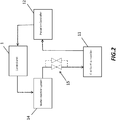
- the combustion device to which the apparatus 1 according to the invention is associated, comprises a combustion chamber 11.
- the combustion chamber may comprise a premix burner equipped with fuel stagings.
- the combustion device comprises a water injection system 14 configured to mix/adjust a quantity of water to the fuel in the combustion chamber 11, thus determining a parameter ⁇ which is defined as the ratio between water and fuel.
- the introduction of water into the combustion chamber may be operated by means of one or several intake valves 15.
- ⁇ in other words the amount of water introduced in the combustion for a given fuel quantity, is set to a normal operating set point ⁇ nom .
- the apparatus 1 comprises a control unit 1 which is connected to the pulsation controller 12 and the water injection system 14.
- the controller 12 detects a flame-generated pulsation increase occurring in the combustion chamber 11 having a level which is above a predefined threshold
- an input signal is sent to the control unit 1 corresponding to the detected pulsation, being above the threshold.
- the control unit calculates the current parameter ⁇ and sends an output signal to the water injection system 14 corresponding to a command for adjusting co. Particularly, if the current ⁇ is above a minimum value ⁇ min , then ⁇ is reduced and, subsequently, increased back to the operating set point ⁇ nom .
- the amount of ⁇ reduction after the detection of a pulsation event is correlated to the magnitude of the detected pulsation level.
- the reduction of ⁇ which follows the pulsation detection may be established substantially simultaneously with the occurrence of the detection of the pulsation being above the predetermined threshold.
- the new parameter ⁇ is imposed by the water injection system 14 in one step/operation. Once the ⁇ has been reduced, it is subsequently increased gradually, particularly as a linear function of time, thus ramp-shaped. In other words, the introduction of water carried out by the water injection system is increased. If, after the detection of a pulsation event, the current ⁇ has reached ⁇ min , then the ⁇ is only increased in a manner as above described. If during the ramping up of the ⁇ a further pulsation event is detected, then the process is repeated.
- figure 3 it is depicted a block diagram showing the method for operating a combustion device according to the present invention.
- block 2 identifies the normal operation. If a pulsation level above a predefined threshold is detected, then at block 3 the current value of ⁇ is calculated/verified. If ⁇ is above ⁇ min , then the amount of water introduced in the combustion chamber is reduced, as indicated by block 4 ( ⁇ reduction). Preferably, the amount of the reduction is based on the measured level of the detected pulsation. Furthermore, the ⁇ reduction is carried out substantially simultaneously to the detection of the pulsation, that means, that the new parameter ⁇ is achieved in one step/operation, as explained above. After the reduction of ⁇ , the latter is then increased, preferably stepwise, to the normal operating set point (block 5). If during the ramp up of the ⁇ , another pulsation event is registered, the process is then repeated (block 6).
- FIG 4 top it is depicted a correlation between parameter ⁇ and level of pulsations for two operating scenarios.
- the graph shows that pulsation has a parabolic trend as a function of co. In particular, the extent of the curve narrows for low ambient temperatures (or start-up phase, when the gas turbine is still cold) with respect to high ambient temperatures (or normal operating state).
- the dashed line identifies the ⁇ used in the normal operating set point, which is set as a compromise between an acceptable level of pulsation and NO x emissions. It is also clear from the graph that the ⁇ for the normal operating set point depends on the operating conditions, for example ambient temperature and start-up phase.
- FIG 4 bottom it is depicted a graph showing how ⁇ is adjusted as a function of time in the event of a detected pulsation having a level above a predefined threshold.
- the graph shows the level of registered pulsations occurring in the combustion chamber. Until pulsations remain below the threshold (indicated as "limit” in the graph), then the ⁇ is kept constant and equal to the normal operating set point.
- the ⁇ is reduced by the water injection system in one step, this way resulting in a vertical line on the ⁇ (t) function. After the ⁇ has been set to a new value, then it is slowly increased. This is indicated by the ramp-shaped line on the ⁇ (t) function.
- the graph shows that, during the ⁇ ramp-up, another pulsation event is detected, then the process is repeated.
- FIG. 5 depicts, similarly to figure 4 top, a graph better detailing the relationship between ⁇ and pulsations with reference to low ambient temperatures.
- last figure 6 shows the relationship between ⁇ and pulsations and between ⁇ and NO x emissions.
Landscapes
- Engineering & Computer Science (AREA)
- Chemical & Material Sciences (AREA)
- Combustion & Propulsion (AREA)
- Mechanical Engineering (AREA)
- General Engineering & Computer Science (AREA)
- Output Control And Ontrol Of Special Type Engine (AREA)
- Control Of Combustion (AREA)
Abstract
Description
- The present invention generally relates to the field of combustion technology related to gas turbines. More in particular, the present invention refers to a method for operating a combustion device.
- As well known, an indispensable requisite for achieving an efficient combustion process is the avoidance of combustion instabilities.
Patent publicationUS 2012/0317986 discloses a method for operating a combustion device having a premix burner equipped with fuel staging and connected to a combustion chamber. The method includes continuously determining a pulsation level of the combustion-induced pulsations which occur in the combustion chamber and changing the fuel staging for lowering the pulsation level if the later exceeds a predetermined threshold. Furthermore, the fuel staging is reset to an undisturbed value corresponding to a respective operating point if the pulsation levels do not exceed the threshold for a predetermined time interval to achieve improved emission behaviour.
In sum, inUS 2012/0317986 the pulsation control logic is used to adapt the fuel gas distribution within the burner in case of too high pulsations. - However, it is also important in the combustion process to monitor the total concentration of NO and NO2 (generally referred to as NOx), which cannot exceed predetermined values set by law or local requirements.
On fuel oil operation water injection technology is used for lowering NOx emissions, whereby water is introduced in the combustion chamber or, alternatively, is emulsified with fuel oil prior to being injected into the combustion chamber. The ratio between the quantity of water introduced and the fuel is generally referred to as parameter co.
With reference to the block diagram depicted inFigure 1 , it is shown a logic pertaining to the state of the art for the ω control during operation. Currently the ω is kept equal to a value ω1 for a predefined time period (block 100) after starting the engine for cold ambient temperatures. Then, the ω is adjusted to the normal operation set point ω2 (block 200). However, such control logic just keeps a single operating point which does not ensure optimum combustion behaviour in terms of NOx emissions and pulsations.
In fact, this way the NOx emissions are high during the complete warming up phase, and may be higher than the limit defined by law or local requirements. Moreover, after further warming up the pulsations may remain high and trigger protective events.
In general, with such arrangement it has proven to be difficult to adjust the engine for different ambient conditions. - It is an object of the present invention to solve the aforementioned technical problem by providing a method for operating a combustion device as substantially defined according to
independent claim 1. - It is a further object of the present invention to provide an apparatus for operating a combustion device as substantially defined in
independent claim 5. - According to an aspect of the invention, this object is obtained by a method for operating a combustion device, the combustion device comprising a combustion chamber, a water injection system configured to mix water to fuel in the combustion chamber and to adjust a parameter ω defined as a ratio between water and fuel, the parameter ω having a normal operating set point value ωnom and a minimum value ωmin; and wherein the combustion device further comprises a controller for detecting flame-generated pulsations above a predefined threshold; wherein the method includes the steps of detecting a flame-generated pulsation event, calculating current parameter ω and:
- if current ω is greater than ωmin, reducing parameter ω and subsequently increasing it to ωnom;
- if current ω is equal to ωmin, increasing parameter ω to ωnom.
- According to a preferred aspect of the invention, the parameter ω is adjusted based on a measured level of the detected flame-generated pulsation above the predefined threshold.
- According to a preferred aspect of the invention, the parameter ω reduction is established substantially simultaneously with the detection of a flame-generated pulsation above the predefined threshold.
- According to a preferred aspect of the invention, the parameter ω is increased as a linear function of time.
- According to a further aspect of the invention, it is provided an apparatus for operating a combustion device, the combustion device being a combustion chamber, a water injection system configured to mix water to fuel in the combustion chamber and to adjust a parameter ω defined as a ratio between water and fuel, the parameter ω having a normal operating set point value ωnom and a minimum value ωmin; and wherein the combustion device further comprises a controller for detecting flame-generated pulsations above a predefined threshold; wherein the apparatus comprises a control unit, connected to said water injection system and said pulsations controller, and configured to:
- receive an input signal from the controller correspondent to a level of a detected flame-generated pulsation above a predefined threshold;
- calculate current parameter ω;
- send an output signal to the water injection system, wherein the output signal corresponds to a command for reducing current parameter ω and subsequently increasing it to ωnom if current ω is greater than ωmin, or increasing parameter ω to ωnom if current ω has reached ωmin.
- According to a preferred aspect of the invention, the control unit is configured to adjust parameter ω based on a measured level of the detected flame-generated pulsation above a predefined threshold.
- According to a preferred aspect of the invention, the control unit is configured to reduce parameter ω substantially simultaneously with the detection of a flame-generated pulsation above a predefined threshold.
- According to a preferred aspect of the invention, the control unit is configured such that parameter ω is increased as a linear function of time.
As it will be clear by the description of exemplary embodiments of the invention, presented as non-limiting examples, with the innovative method and apparatus, involving dynamic pulsation control logic, the ω of the water/oil emulsion at the fuel oil lances is adapted, while optimum pulsation and NOx limits are guaranteed.
Advantageously, a pulsation protective load shedding (PLS) is avoided by quickly adjusting the parameter ω (water/oil ratio) in case of too high combustion pulsation levels from the standard operation set point. This implies that the dynamic pulsation control logic (P.C.L.) is activated in case the high frequency pulsation level exceeds a predetermined threshold value and a control unit adjusts the ω, preferably in a stepwise manner, until acceptable and optimum pulsation levels are reached or a maximum reduction of the ω is performed. The ω reduction is limited in order to ensure that NOx emissions are not exceeding legal limits and because the pulsations may increase again due to too low ω.
Additionally, in case the ω is reduced by a high pulsation spike, i.e. because of cold engine, low ambient temperature or after start-up in the morning, the ω may be ramped up slowly again to the standard operation set point, particularly as a linear function of time. In case the pulsation level exceeds the trigger limit again during the ω ramping up, the PCL controller may be triggered again and the process repeated.
When the engine is loaded up and the pulsation level exceeds a certain threshold, the ω is reduced, preferably in one step, that is substantially simultaneously with the detection of the spike, and then slowly increased again (as a linear function of time having a predefined tilt) until reaching the normal operating set point. If during the ω ramping up another pulsation is detected, then a subsequent ω reduction will be carried out. A maximum reduction of the ω (which defines a ωmin) is ensured in order not to trigger other pulsation events.
The ω reduction involves a pulsation reduction but also a NOx increase.
According to preferred embodiments of the present invention, the warming up phase is advantageously taken into consideration in the new control logic, so several ω settings won't be needed anymore.
The engine is always adjusting to the lowest possible NOx, taking into account several ambient conditions. Furthermore, ωmin and ω stepwise reduction are calculated/determined for a given relative load and ambient temperature, this way ensuring to remain below the NOx and pulsation limits. - The objects, advantages and other features of the present invention will become more apparent upon reading of the following non-restrictive description of preferred embodiments thereof, given for the purpose of exemplification only, with reference to the accompany drawing, through which similar reference numerals may be used to refer to similar elements, and in which:
-
Figure 1 shows a simplified block diagram for a method of operating a combustion device according to the prior art; -
Figure 2 shows a simplified diagram of an apparatus for operating a combustion device according to the present invention; -
Figure 3 shows a block diagram depicting a method for operating a combustion device according to the present invention; -
Figure 4 depicts on top view a graph showing correlations between parameter ω and pulsations level for different operating scenarios, and on bottom view a graph showing the adjustment of parameter ω as a function of time according the method of the present invention; -
Figure 5 and6 depict graphs illustrating the correlations between ω, pulsations and NOx emissions for different operating scenarios. - An exemplary preferred embodiment will be now described with reference to the aforementioned drawings.
- With reference to
figure 2 , it is shown a simplified diagram of anapparatus 1 for operating a combustion device according to the present invention.
The combustion device, to which theapparatus 1 according to the invention is associated, comprises acombustion chamber 11. The combustion chamber may comprise a premix burner equipped with fuel stagings.
Moreover, the combustion device comprises awater injection system 14 configured to mix/adjust a quantity of water to the fuel in thecombustion chamber 11, thus determining a parameter ω which is defined as the ratio between water and fuel. The introduction of water into the combustion chamber may be operated by means of one orseveral intake valves 15.
During normal operation parameter ω, in other words the amount of water introduced in the combustion for a given fuel quantity, is set to a normal operating set point ωnom. Theapparatus 1 according to the invention comprises acontrol unit 1 which is connected to thepulsation controller 12 and thewater injection system 14.
In the event that thecontroller 12 detects a flame-generated pulsation increase occurring in thecombustion chamber 11 having a level which is above a predefined threshold, an input signal is sent to thecontrol unit 1 corresponding to the detected pulsation, being above the threshold. Then, the control unit calculates the current parameter ω and sends an output signal to thewater injection system 14 corresponding to a command for adjusting co.
Particularly, if the current ω is above a minimum value ωmin, then ω is reduced and, subsequently, increased back to the operating set point ωnom.
Preferably, the amount of ω reduction after the detection of a pulsation event is correlated to the magnitude of the detected pulsation level.
According to preferred embodiments, the reduction of ω which follows the pulsation detection, may be established substantially simultaneously with the occurrence of the detection of the pulsation being above the predetermined threshold. In other words, the new parameter ω is imposed by thewater injection system 14 in one step/operation. Once the ω has been reduced, it is subsequently increased gradually, particularly as a linear function of time, thus ramp-shaped. In other words, the introduction of water carried out by the water injection system is increased.
If, after the detection of a pulsation event, the current ω has reached ωmin, then the ω is only increased in a manner as above described.
If during the ramping up of the ω a further pulsation event is detected, then the process is repeated. - Making now reference to
figure 3 , it is depicted a block diagram showing the method for operating a combustion device according to the present invention. - In particular,
block 2 identifies the normal operation. If a pulsation level above a predefined threshold is detected, then atblock 3 the current value of ω is calculated/verified. If ω is above ωmin, then the amount of water introduced in the combustion chamber is reduced, as indicated by block 4 (ω reduction). Preferably, the amount of the reduction is based on the measured level of the detected pulsation. Furthermore, the ω reduction is carried out substantially simultaneously to the detection of the pulsation, that means, that the new parameter ω is achieved in one step/operation, as explained above. After the reduction of ω, the latter is then increased, preferably stepwise, to the normal operating set point (block 5). If during the ramp up of the ω, another pulsation event is registered, the process is then repeated (block 6). - With reference to
figure 4 top, it is depicted a correlation between parameter ω and level of pulsations for two operating scenarios. The graph shows that pulsation has a parabolic trend as a function of co. In particular, the extent of the curve narrows for low ambient temperatures (or start-up phase, when the gas turbine is still cold) with respect to high ambient temperatures (or normal operating state).
The dashed line identifies the ω used in the normal operating set point, which is set as a compromise between an acceptable level of pulsation and NOx emissions. It is also clear from the graph that the ω for the normal operating set point depends on the operating conditions, for example ambient temperature and start-up phase. Turning tofigure 4 bottom, it is depicted a graph showing how ω is adjusted as a function of time in the event of a detected pulsation having a level above a predefined threshold.
In particular, the graph shows the level of registered pulsations occurring in the combustion chamber. Until pulsations remain below the threshold (indicated as "limit" in the graph), then the ω is kept constant and equal to the normal operating set point. When a pulsation going beyond the limit is detected, the ω is reduced by the water injection system in one step, this way resulting in a vertical line on the ω(t) function. After the ω has been set to a new value, then it is slowly increased. This is indicated by the ramp-shaped line on the ω(t) function. The graph shows that, during the ω ramp-up, another pulsation event is detected, then the process is repeated. - Next
figure 5 depicts, similarly tofigure 4 top, a graph better detailing the relationship between ω and pulsations with reference to low ambient temperatures. Finally, lastfigure 6 shows the relationship between ω and pulsations and between ω and NOx emissions. - While the invention has been described in detail in connection with only a limited number of embodiments, it should be readily understood that the invention is not limited to such disclosed embodiments. Rather, the invention can be modified to incorporate any number of variations, alterations, substitutions or equivalent arrangements not heretofore described, but which are commensurate with the spirit and scope of the invention. Additionally, while various embodiments of the invention have been described, it is to be understood that aspects of the invention may include only some of the described embodiments. Accordingly, the invention is not to be seen as limited by the foregoing description, but is only limited by the scope of the appended claims.
Claims (8)
- A method for operating a combustion device, the combustion device comprising:- a combustion chamber (11);- a water injection system (14) configured to mix water to fuel in the combustion chamber (11) and to adjust a parameter ω defined as a ratio between water and fuel, said parameter ω having an operating set point value ωnom and a minimum value ωmin; and- a controller (12) for detecting flame-generated pulsations above a predefined threshold;
the method being characterised in that it includes the following steps:- detecting a flame-generated pulsation event;- calculating parameter ω and:- if ω is greater than ωmin, reducing parameter ω and subsequently increasing it to ωnom;- if ω is equal to ωmin, increasing parameter ω to ωnom. - The method according to the preceding claim, wherein said parameter ω is adjusted based on a measured level of the detected flame-generated pulsation above a predefined threshold.
- The method according to any of the preceding claims, wherein said parameter ω reduction is established substantially simultaneously with the detection of a flame-generated pulsation above a predefined threshold.
- The method according to any of the preceding claims, wherein parameter ω is increased as a linear function of time.
- An apparatus (1) for operating a combustion device, the combustion device comprising:- a combustion chamber (11),- a water injection system (14) configured to mix water to fuel in the combustion chamber 11 and to adjust a parameter ω defined as a ratio between water and fuel, said parameter ω having an operating set point value ωnom and a minimum value ωmin; and- a controller (12) for detecting flame-generated pulsations above a predefined threshold;
wherein the apparatus (1) comprises a control unit (1) connected to said water injection system (14) and said controller (12), characterised in that said control unit (1) is configured to:- receive an input signal correspondent to a level of a detected flame-generated pulsation above a predefined threshold;- calculate current parameter ω;- send an output signal to said water injection system (14), wherein said output signal corresponds to a command for reducing parameter ω and subsequently increasing it to ωnom if ω is greater than ωmin, or increasing parameter ω to ωnom if ω is equal to ωmin. - Apparatus (1) according to the preceding claim, wherein said control unit (1) is configured to adjust parameter ω based on a measured level of the detected flame-generated pulsation above a predefined threshold.
- The apparatus (1) according to claims 5 or 6, wherein said control unit (1) is configured to reduce parameter ω substantially simultaneously with the detection of a flame-generated pulsation above a predefined threshold.
- The apparatus according to any of the claims 5-7, wherein said control unit (1) is configured such that parameter ω is increased as a linear function of time.
Priority Applications (3)
| Application Number | Priority Date | Filing Date | Title |
|---|---|---|---|
| EP15166262.4A EP3091286B1 (en) | 2015-05-04 | 2015-05-04 | Method and apparatus for operating a combustion device |
| US15/145,397 US20160326955A1 (en) | 2015-05-04 | 2016-05-03 | Method and apparatus for operating a combustion device |
| CN201610287634.9A CN106121868A (en) | 2015-05-04 | 2016-05-04 | For the method and apparatus operating burner |
Applications Claiming Priority (1)
| Application Number | Priority Date | Filing Date | Title |
|---|---|---|---|
| EP15166262.4A EP3091286B1 (en) | 2015-05-04 | 2015-05-04 | Method and apparatus for operating a combustion device |
Publications (2)
| Publication Number | Publication Date |
|---|---|
| EP3091286A1 true EP3091286A1 (en) | 2016-11-09 |
| EP3091286B1 EP3091286B1 (en) | 2021-01-13 |
Family
ID=53039342
Family Applications (1)
| Application Number | Title | Priority Date | Filing Date |
|---|---|---|---|
| EP15166262.4A Active EP3091286B1 (en) | 2015-05-04 | 2015-05-04 | Method and apparatus for operating a combustion device |
Country Status (3)
| Country | Link |
|---|---|
| US (1) | US20160326955A1 (en) |
| EP (1) | EP3091286B1 (en) |
| CN (1) | CN106121868A (en) |
Cited By (2)
| Publication number | Priority date | Publication date | Assignee | Title |
|---|---|---|---|---|
| US11156164B2 (en) | 2019-05-21 | 2021-10-26 | General Electric Company | System and method for high frequency accoustic dampers with caps |
| US11174792B2 (en) | 2019-05-21 | 2021-11-16 | General Electric Company | System and method for high frequency acoustic dampers with baffles |
Citations (5)
| Publication number | Priority date | Publication date | Assignee | Title |
|---|---|---|---|---|
| WO2004010052A1 (en) * | 2002-07-19 | 2004-01-29 | Alstom Technology Ltd | Method for controlling the introduction of inert media into a combustion chamber |
| US20040088997A1 (en) * | 2000-12-16 | 2004-05-13 | Alstom (Switzerland) Ltd. | Method for operating a premix burner |
| US20060266045A1 (en) * | 2005-02-03 | 2006-11-30 | Heinz Bollhalder | Protection process and control system for a gas turbine |
| US20120317986A1 (en) | 2011-06-20 | 2012-12-20 | Alstom Technology Ltd | Method for operating a combustion device and combustion device for implementing the method |
| EP2565539A1 (en) * | 2011-08-30 | 2013-03-06 | Alstom Technology Ltd | Method for operating a combustion device |
Family Cites Families (8)
| Publication number | Priority date | Publication date | Assignee | Title |
|---|---|---|---|---|
| CN1048431A (en) * | 1990-07-23 | 1991-01-09 | 王建雪 | High pressure water-vapour spraying system of internal-combustion engine |
| US5682842A (en) * | 1996-09-24 | 1997-11-04 | Caterpillar Inc. | Fuel control system for an internal combustion engine using an aqueous fuel emulsion |
| JP3861479B2 (en) * | 1998-01-21 | 2006-12-20 | 三菱ふそうトラック・バス株式会社 | Water injection amount control device for fuel / water injection engines |
| KR100482060B1 (en) * | 2002-01-29 | 2005-04-13 | 현대자동차주식회사 | A water injection device of an engine |
| KR100626403B1 (en) * | 2005-12-09 | 2006-09-20 | 송정헌 | Water Spray System for Internal Combustion Engines |
| KR101134674B1 (en) * | 2008-09-03 | 2012-04-09 | 주식회사 케이이엠 | Burning system for emulsified fuel |
| CA2870268C (en) * | 2011-04-11 | 2020-01-14 | Nostrum Energy Pte. Ltd. | Internally cooled high compression lean-burning internal combustion engine |
| US9212627B2 (en) * | 2012-09-19 | 2015-12-15 | Ford Global Technologies, Llc | Diesel engine water in fuel separator and reservoir automatic drain system and control strategy |
-
2015
- 2015-05-04 EP EP15166262.4A patent/EP3091286B1/en active Active
-
2016
- 2016-05-03 US US15/145,397 patent/US20160326955A1/en not_active Abandoned
- 2016-05-04 CN CN201610287634.9A patent/CN106121868A/en active Pending
Patent Citations (5)
| Publication number | Priority date | Publication date | Assignee | Title |
|---|---|---|---|---|
| US20040088997A1 (en) * | 2000-12-16 | 2004-05-13 | Alstom (Switzerland) Ltd. | Method for operating a premix burner |
| WO2004010052A1 (en) * | 2002-07-19 | 2004-01-29 | Alstom Technology Ltd | Method for controlling the introduction of inert media into a combustion chamber |
| US20060266045A1 (en) * | 2005-02-03 | 2006-11-30 | Heinz Bollhalder | Protection process and control system for a gas turbine |
| US20120317986A1 (en) | 2011-06-20 | 2012-12-20 | Alstom Technology Ltd | Method for operating a combustion device and combustion device for implementing the method |
| EP2565539A1 (en) * | 2011-08-30 | 2013-03-06 | Alstom Technology Ltd | Method for operating a combustion device |
Cited By (2)
| Publication number | Priority date | Publication date | Assignee | Title |
|---|---|---|---|---|
| US11156164B2 (en) | 2019-05-21 | 2021-10-26 | General Electric Company | System and method for high frequency accoustic dampers with caps |
| US11174792B2 (en) | 2019-05-21 | 2021-11-16 | General Electric Company | System and method for high frequency acoustic dampers with baffles |
Also Published As
| Publication number | Publication date |
|---|---|
| CN106121868A (en) | 2016-11-16 |
| EP3091286B1 (en) | 2021-01-13 |
| US20160326955A1 (en) | 2016-11-10 |
Similar Documents
| Publication | Publication Date | Title |
|---|---|---|
| US10287993B2 (en) | Method and device for combustion with pulsed fuel split | |
| JP5179143B2 (en) | Method for detecting the arrival of uncontrolled fuel in a gas turbine combustor. | |
| US8826671B2 (en) | Control system for a gas turbine power plant | |
| JP5336346B2 (en) | How to operate a turbine at base load to low temperature fuel with high temperature fuel combustor hardware | |
| JP2005509794A (en) | Method and apparatus for adaptive scheduling in gas turbine engine controllers | |
| US20190195133A1 (en) | Method and system for turbine engine temperature regulation | |
| KR20210145807A (en) | Combustion control device for gas turbine, combustion control method and program | |
| EP3091286B1 (en) | Method and apparatus for operating a combustion device | |
| EP3121419B1 (en) | Fuel control method for gas turbine, control device for executing said method, and gas turbine installation provided with said control device | |
| US11378019B2 (en) | Gas turbine control apparatus and gas turbine control method | |
| US9249979B2 (en) | Controlling a combustion device to lower combustion-induced pulsations by changing and resetting fuel stagings at different rates of change | |
| KR101518979B1 (en) | Boiler system | |
| CN105952542A (en) | Method for operating a gas turbine | |
| KR101143728B1 (en) | Automatic control device for NOx concentration and method thereof | |
| JP5745640B2 (en) | Control device for gas turbine power plant | |
| CA2636412C (en) | Method for operating a firing plant | |
| JP5541780B2 (en) | Boiler multi-can installation system | |
| JP2008224084A (en) | Boiler multi-can installation system | |
| JP6289119B2 (en) | Multi-can boiler with air supply valve | |
| JP2011179731A (en) | Boiler multiple-can installation system | |
| JP2010133672A (en) | Boiler multi-can installation system | |
| JP2008039215A (en) | Combustion device |
Legal Events
| Date | Code | Title | Description |
|---|---|---|---|
| PUAI | Public reference made under article 153(3) epc to a published international application that has entered the european phase |
Free format text: ORIGINAL CODE: 0009012 |
|
| AK | Designated contracting states |
Kind code of ref document: A1 Designated state(s): AL AT BE BG CH CY CZ DE DK EE ES FI FR GB GR HR HU IE IS IT LI LT LU LV MC MK MT NL NO PL PT RO RS SE SI SK SM TR |
|
| AX | Request for extension of the european patent |
Extension state: BA ME |
|
| STAA | Information on the status of an ep patent application or granted ep patent |
Free format text: STATUS: REQUEST FOR EXAMINATION WAS MADE |
|
| RAP1 | Party data changed (applicant data changed or rights of an application transferred) |
Owner name: ANSALDO ENERGIA IP UK LIMITED |
|
| 17P | Request for examination filed |
Effective date: 20170508 |
|
| RBV | Designated contracting states (corrected) |
Designated state(s): AL AT BE BG CH CY CZ DE DK EE ES FI FR GB GR HR HU IE IS IT LI LT LU LV MC MK MT NL NO PL PT RO RS SE SI SK SM TR |
|
| STAA | Information on the status of an ep patent application or granted ep patent |
Free format text: STATUS: EXAMINATION IS IN PROGRESS |
|
| 17Q | First examination report despatched |
Effective date: 20200113 |
|
| GRAP | Despatch of communication of intention to grant a patent |
Free format text: ORIGINAL CODE: EPIDOSNIGR1 |
|
| STAA | Information on the status of an ep patent application or granted ep patent |
Free format text: STATUS: GRANT OF PATENT IS INTENDED |
|
| INTG | Intention to grant announced |
Effective date: 20200806 |
|
| GRAS | Grant fee paid |
Free format text: ORIGINAL CODE: EPIDOSNIGR3 |
|
| GRAA | (expected) grant |
Free format text: ORIGINAL CODE: 0009210 |
|
| STAA | Information on the status of an ep patent application or granted ep patent |
Free format text: STATUS: THE PATENT HAS BEEN GRANTED |
|
| AK | Designated contracting states |
Kind code of ref document: B1 Designated state(s): AL AT BE BG CH CY CZ DE DK EE ES FI FR GB GR HR HU IE IS IT LI LT LU LV MC MK MT NL NO PL PT RO RS SE SI SK SM TR |
|
| REG | Reference to a national code |
Ref country code: GB Ref legal event code: FG4D |
|
| REG | Reference to a national code |
Ref country code: CH Ref legal event code: EP |
|
| REG | Reference to a national code |
Ref country code: IE Ref legal event code: FG4D |
|
| REG | Reference to a national code |
Ref country code: DE Ref legal event code: R096 Ref document number: 602015064670 Country of ref document: DE |
|
| REG | Reference to a national code |
Ref country code: AT Ref legal event code: REF Ref document number: 1354851 Country of ref document: AT Kind code of ref document: T Effective date: 20210215 |
|
| REG | Reference to a national code |
Ref country code: AT Ref legal event code: MK05 Ref document number: 1354851 Country of ref document: AT Kind code of ref document: T Effective date: 20210113 |
|
| REG | Reference to a national code |
Ref country code: NL Ref legal event code: MP Effective date: 20210113 |
|
| REG | Reference to a national code |
Ref country code: LT Ref legal event code: MG9D |
|
| PG25 | Lapsed in a contracting state [announced via postgrant information from national office to epo] |
Ref country code: PT Free format text: LAPSE BECAUSE OF FAILURE TO SUBMIT A TRANSLATION OF THE DESCRIPTION OR TO PAY THE FEE WITHIN THE PRESCRIBED TIME-LIMIT Effective date: 20210513 Ref country code: LT Free format text: LAPSE BECAUSE OF FAILURE TO SUBMIT A TRANSLATION OF THE DESCRIPTION OR TO PAY THE FEE WITHIN THE PRESCRIBED TIME-LIMIT Effective date: 20210113 Ref country code: HR Free format text: LAPSE BECAUSE OF FAILURE TO SUBMIT A TRANSLATION OF THE DESCRIPTION OR TO PAY THE FEE WITHIN THE PRESCRIBED TIME-LIMIT Effective date: 20210113 Ref country code: FI Free format text: LAPSE BECAUSE OF FAILURE TO SUBMIT A TRANSLATION OF THE DESCRIPTION OR TO PAY THE FEE WITHIN THE PRESCRIBED TIME-LIMIT Effective date: 20210113 Ref country code: GR Free format text: LAPSE BECAUSE OF FAILURE TO SUBMIT A TRANSLATION OF THE DESCRIPTION OR TO PAY THE FEE WITHIN THE PRESCRIBED TIME-LIMIT Effective date: 20210414 Ref country code: NL Free format text: LAPSE BECAUSE OF FAILURE TO SUBMIT A TRANSLATION OF THE DESCRIPTION OR TO PAY THE FEE WITHIN THE PRESCRIBED TIME-LIMIT Effective date: 20210113 Ref country code: NO Free format text: LAPSE BECAUSE OF FAILURE TO SUBMIT A TRANSLATION OF THE DESCRIPTION OR TO PAY THE FEE WITHIN THE PRESCRIBED TIME-LIMIT Effective date: 20210413 Ref country code: BG Free format text: LAPSE BECAUSE OF FAILURE TO SUBMIT A TRANSLATION OF THE DESCRIPTION OR TO PAY THE FEE WITHIN THE PRESCRIBED TIME-LIMIT Effective date: 20210413 |
|
| PG25 | Lapsed in a contracting state [announced via postgrant information from national office to epo] |
Ref country code: SE Free format text: LAPSE BECAUSE OF FAILURE TO SUBMIT A TRANSLATION OF THE DESCRIPTION OR TO PAY THE FEE WITHIN THE PRESCRIBED TIME-LIMIT Effective date: 20210113 Ref country code: RS Free format text: LAPSE BECAUSE OF FAILURE TO SUBMIT A TRANSLATION OF THE DESCRIPTION OR TO PAY THE FEE WITHIN THE PRESCRIBED TIME-LIMIT Effective date: 20210113 Ref country code: PL Free format text: LAPSE BECAUSE OF FAILURE TO SUBMIT A TRANSLATION OF THE DESCRIPTION OR TO PAY THE FEE WITHIN THE PRESCRIBED TIME-LIMIT Effective date: 20210113 Ref country code: LV Free format text: LAPSE BECAUSE OF FAILURE TO SUBMIT A TRANSLATION OF THE DESCRIPTION OR TO PAY THE FEE WITHIN THE PRESCRIBED TIME-LIMIT Effective date: 20210113 Ref country code: AT Free format text: LAPSE BECAUSE OF FAILURE TO SUBMIT A TRANSLATION OF THE DESCRIPTION OR TO PAY THE FEE WITHIN THE PRESCRIBED TIME-LIMIT Effective date: 20210113 |
|
| PG25 | Lapsed in a contracting state [announced via postgrant information from national office to epo] |
Ref country code: IS Free format text: LAPSE BECAUSE OF FAILURE TO SUBMIT A TRANSLATION OF THE DESCRIPTION OR TO PAY THE FEE WITHIN THE PRESCRIBED TIME-LIMIT Effective date: 20210513 |
|
| REG | Reference to a national code |
Ref country code: DE Ref legal event code: R097 Ref document number: 602015064670 Country of ref document: DE |
|
| PG25 | Lapsed in a contracting state [announced via postgrant information from national office to epo] |
Ref country code: SM Free format text: LAPSE BECAUSE OF FAILURE TO SUBMIT A TRANSLATION OF THE DESCRIPTION OR TO PAY THE FEE WITHIN THE PRESCRIBED TIME-LIMIT Effective date: 20210113 Ref country code: CZ Free format text: LAPSE BECAUSE OF FAILURE TO SUBMIT A TRANSLATION OF THE DESCRIPTION OR TO PAY THE FEE WITHIN THE PRESCRIBED TIME-LIMIT Effective date: 20210113 Ref country code: EE Free format text: LAPSE BECAUSE OF FAILURE TO SUBMIT A TRANSLATION OF THE DESCRIPTION OR TO PAY THE FEE WITHIN THE PRESCRIBED TIME-LIMIT Effective date: 20210113 |
|
| PLBE | No opposition filed within time limit |
Free format text: ORIGINAL CODE: 0009261 |
|
| STAA | Information on the status of an ep patent application or granted ep patent |
Free format text: STATUS: NO OPPOSITION FILED WITHIN TIME LIMIT |
|
| PG25 | Lapsed in a contracting state [announced via postgrant information from national office to epo] |
Ref country code: ES Free format text: LAPSE BECAUSE OF FAILURE TO SUBMIT A TRANSLATION OF THE DESCRIPTION OR TO PAY THE FEE WITHIN THE PRESCRIBED TIME-LIMIT Effective date: 20210113 Ref country code: DK Free format text: LAPSE BECAUSE OF FAILURE TO SUBMIT A TRANSLATION OF THE DESCRIPTION OR TO PAY THE FEE WITHIN THE PRESCRIBED TIME-LIMIT Effective date: 20210113 Ref country code: SK Free format text: LAPSE BECAUSE OF FAILURE TO SUBMIT A TRANSLATION OF THE DESCRIPTION OR TO PAY THE FEE WITHIN THE PRESCRIBED TIME-LIMIT Effective date: 20210113 Ref country code: RO Free format text: LAPSE BECAUSE OF FAILURE TO SUBMIT A TRANSLATION OF THE DESCRIPTION OR TO PAY THE FEE WITHIN THE PRESCRIBED TIME-LIMIT Effective date: 20210113 |
|
| 26N | No opposition filed |
Effective date: 20211014 |
|
| REG | Reference to a national code |
Ref country code: CH Ref legal event code: PL |
|
| GBPC | Gb: european patent ceased through non-payment of renewal fee |
Effective date: 20210504 |
|
| PG25 | Lapsed in a contracting state [announced via postgrant information from national office to epo] |
Ref country code: AL Free format text: LAPSE BECAUSE OF FAILURE TO SUBMIT A TRANSLATION OF THE DESCRIPTION OR TO PAY THE FEE WITHIN THE PRESCRIBED TIME-LIMIT Effective date: 20210113 Ref country code: LI Free format text: LAPSE BECAUSE OF NON-PAYMENT OF DUE FEES Effective date: 20210531 Ref country code: MC Free format text: LAPSE BECAUSE OF FAILURE TO SUBMIT A TRANSLATION OF THE DESCRIPTION OR TO PAY THE FEE WITHIN THE PRESCRIBED TIME-LIMIT Effective date: 20210113 Ref country code: LU Free format text: LAPSE BECAUSE OF NON-PAYMENT OF DUE FEES Effective date: 20210504 Ref country code: CH Free format text: LAPSE BECAUSE OF NON-PAYMENT OF DUE FEES Effective date: 20210531 |
|
| REG | Reference to a national code |
Ref country code: BE Ref legal event code: MM Effective date: 20210531 |
|
| PG25 | Lapsed in a contracting state [announced via postgrant information from national office to epo] |
Ref country code: SI Free format text: LAPSE BECAUSE OF FAILURE TO SUBMIT A TRANSLATION OF THE DESCRIPTION OR TO PAY THE FEE WITHIN THE PRESCRIBED TIME-LIMIT Effective date: 20210113 |
|
| PG25 | Lapsed in a contracting state [announced via postgrant information from national office to epo] |
Ref country code: IT Free format text: LAPSE BECAUSE OF FAILURE TO SUBMIT A TRANSLATION OF THE DESCRIPTION OR TO PAY THE FEE WITHIN THE PRESCRIBED TIME-LIMIT Effective date: 20210113 Ref country code: IE Free format text: LAPSE BECAUSE OF NON-PAYMENT OF DUE FEES Effective date: 20210504 Ref country code: GB Free format text: LAPSE BECAUSE OF NON-PAYMENT OF DUE FEES Effective date: 20210504 |
|
| PG25 | Lapsed in a contracting state [announced via postgrant information from national office to epo] |
Ref country code: IS Free format text: LAPSE BECAUSE OF FAILURE TO SUBMIT A TRANSLATION OF THE DESCRIPTION OR TO PAY THE FEE WITHIN THE PRESCRIBED TIME-LIMIT Effective date: 20210513 Ref country code: FR Free format text: LAPSE BECAUSE OF NON-PAYMENT OF DUE FEES Effective date: 20210531 |
|
| PG25 | Lapsed in a contracting state [announced via postgrant information from national office to epo] |
Ref country code: BE Free format text: LAPSE BECAUSE OF NON-PAYMENT OF DUE FEES Effective date: 20210531 |
|
| PG25 | Lapsed in a contracting state [announced via postgrant information from national office to epo] |
Ref country code: HU Free format text: LAPSE BECAUSE OF FAILURE TO SUBMIT A TRANSLATION OF THE DESCRIPTION OR TO PAY THE FEE WITHIN THE PRESCRIBED TIME-LIMIT; INVALID AB INITIO Effective date: 20150504 |
|
| PG25 | Lapsed in a contracting state [announced via postgrant information from national office to epo] |
Ref country code: CY Free format text: LAPSE BECAUSE OF FAILURE TO SUBMIT A TRANSLATION OF THE DESCRIPTION OR TO PAY THE FEE WITHIN THE PRESCRIBED TIME-LIMIT Effective date: 20210113 |
|
| PG25 | Lapsed in a contracting state [announced via postgrant information from national office to epo] |
Ref country code: MK Free format text: LAPSE BECAUSE OF FAILURE TO SUBMIT A TRANSLATION OF THE DESCRIPTION OR TO PAY THE FEE WITHIN THE PRESCRIBED TIME-LIMIT Effective date: 20210113 |
|
| P01 | Opt-out of the competence of the unified patent court (upc) registered |
Effective date: 20240430 |
|
| PG25 | Lapsed in a contracting state [announced via postgrant information from national office to epo] |
Ref country code: MT Free format text: LAPSE BECAUSE OF FAILURE TO SUBMIT A TRANSLATION OF THE DESCRIPTION OR TO PAY THE FEE WITHIN THE PRESCRIBED TIME-LIMIT Effective date: 20210113 |
|
| PGFP | Annual fee paid to national office [announced via postgrant information from national office to epo] |
Ref country code: DE Payment date: 20250519 Year of fee payment: 11 |
|
| PG25 | Lapsed in a contracting state [announced via postgrant information from national office to epo] |
Ref country code: TR Free format text: LAPSE BECAUSE OF FAILURE TO SUBMIT A TRANSLATION OF THE DESCRIPTION OR TO PAY THE FEE WITHIN THE PRESCRIBED TIME-LIMIT Effective date: 20210113 |